EP2103724A1 - Wischtuch mit einem antibakteriell ausgerüsteten Vliesstoff - Google Patents
Wischtuch mit einem antibakteriell ausgerüsteten Vliesstoff Download PDFInfo
- Publication number
- EP2103724A1 EP2103724A1 EP08005131A EP08005131A EP2103724A1 EP 2103724 A1 EP2103724 A1 EP 2103724A1 EP 08005131 A EP08005131 A EP 08005131A EP 08005131 A EP08005131 A EP 08005131A EP 2103724 A1 EP2103724 A1 EP 2103724A1
- Authority
- EP
- European Patent Office
- Prior art keywords
- nonwoven fabric
- dopant
- fabric according
- fibers
- bicomponent
- Prior art date
- Legal status (The legal status is an assumption and is not a legal conclusion. Google has not performed a legal analysis and makes no representation as to the accuracy of the status listed.)
- Granted
Links
Images
Classifications
-
- D—TEXTILES; PAPER
- D04—BRAIDING; LACE-MAKING; KNITTING; TRIMMINGS; NON-WOVEN FABRICS
- D04H—MAKING TEXTILE FABRICS, e.g. FROM FIBRES OR FILAMENTARY MATERIAL; FABRICS MADE BY SUCH PROCESSES OR APPARATUS, e.g. FELTS, NON-WOVEN FABRICS; COTTON-WOOL; WADDING ; NON-WOVEN FABRICS FROM STAPLE FIBRES, FILAMENTS OR YARNS, BONDED WITH AT LEAST ONE WEB-LIKE MATERIAL DURING THEIR CONSOLIDATION
- D04H3/00—Non-woven fabrics formed wholly or mainly of yarns or like filamentary material of substantial length
- D04H3/005—Synthetic yarns or filaments
- D04H3/009—Condensation or reaction polymers
-
- A—HUMAN NECESSITIES
- A47—FURNITURE; DOMESTIC ARTICLES OR APPLIANCES; COFFEE MILLS; SPICE MILLS; SUCTION CLEANERS IN GENERAL
- A47L—DOMESTIC WASHING OR CLEANING; SUCTION CLEANERS IN GENERAL
- A47L13/00—Implements for cleaning floors, carpets, furniture, walls, or wall coverings
- A47L13/10—Scrubbing; Scouring; Cleaning; Polishing
- A47L13/16—Cloths; Pads; Sponges
- A47L13/17—Cloths; Pads; Sponges containing cleaning agents
-
- D—TEXTILES; PAPER
- D01—NATURAL OR MAN-MADE THREADS OR FIBRES; SPINNING
- D01F—CHEMICAL FEATURES IN THE MANUFACTURE OF ARTIFICIAL FILAMENTS, THREADS, FIBRES, BRISTLES OR RIBBONS; APPARATUS SPECIALLY ADAPTED FOR THE MANUFACTURE OF CARBON FILAMENTS
- D01F1/00—General methods for the manufacture of artificial filaments or the like
- D01F1/02—Addition of substances to the spinning solution or to the melt
- D01F1/10—Other agents for modifying properties
- D01F1/103—Agents inhibiting growth of microorganisms
-
- D—TEXTILES; PAPER
- D01—NATURAL OR MAN-MADE THREADS OR FIBRES; SPINNING
- D01F—CHEMICAL FEATURES IN THE MANUFACTURE OF ARTIFICIAL FILAMENTS, THREADS, FIBRES, BRISTLES OR RIBBONS; APPARATUS SPECIALLY ADAPTED FOR THE MANUFACTURE OF CARBON FILAMENTS
- D01F8/00—Conjugated, i.e. bi- or multicomponent, artificial filaments or the like; Manufacture thereof
- D01F8/04—Conjugated, i.e. bi- or multicomponent, artificial filaments or the like; Manufacture thereof from synthetic polymers
- D01F8/14—Conjugated, i.e. bi- or multicomponent, artificial filaments or the like; Manufacture thereof from synthetic polymers with at least one polyester as constituent
-
- D—TEXTILES; PAPER
- D04—BRAIDING; LACE-MAKING; KNITTING; TRIMMINGS; NON-WOVEN FABRICS
- D04H—MAKING TEXTILE FABRICS, e.g. FROM FIBRES OR FILAMENTARY MATERIAL; FABRICS MADE BY SUCH PROCESSES OR APPARATUS, e.g. FELTS, NON-WOVEN FABRICS; COTTON-WOOL; WADDING ; NON-WOVEN FABRICS FROM STAPLE FIBRES, FILAMENTS OR YARNS, BONDED WITH AT LEAST ONE WEB-LIKE MATERIAL DURING THEIR CONSOLIDATION
- D04H3/00—Non-woven fabrics formed wholly or mainly of yarns or like filamentary material of substantial length
- D04H3/005—Synthetic yarns or filaments
- D04H3/007—Addition polymers
-
- D—TEXTILES; PAPER
- D04—BRAIDING; LACE-MAKING; KNITTING; TRIMMINGS; NON-WOVEN FABRICS
- D04H—MAKING TEXTILE FABRICS, e.g. FROM FIBRES OR FILAMENTARY MATERIAL; FABRICS MADE BY SUCH PROCESSES OR APPARATUS, e.g. FELTS, NON-WOVEN FABRICS; COTTON-WOOL; WADDING ; NON-WOVEN FABRICS FROM STAPLE FIBRES, FILAMENTS OR YARNS, BONDED WITH AT LEAST ONE WEB-LIKE MATERIAL DURING THEIR CONSOLIDATION
- D04H3/00—Non-woven fabrics formed wholly or mainly of yarns or like filamentary material of substantial length
- D04H3/005—Synthetic yarns or filaments
- D04H3/009—Condensation or reaction polymers
- D04H3/011—Polyesters
-
- D—TEXTILES; PAPER
- D04—BRAIDING; LACE-MAKING; KNITTING; TRIMMINGS; NON-WOVEN FABRICS
- D04H—MAKING TEXTILE FABRICS, e.g. FROM FIBRES OR FILAMENTARY MATERIAL; FABRICS MADE BY SUCH PROCESSES OR APPARATUS, e.g. FELTS, NON-WOVEN FABRICS; COTTON-WOOL; WADDING ; NON-WOVEN FABRICS FROM STAPLE FIBRES, FILAMENTS OR YARNS, BONDED WITH AT LEAST ONE WEB-LIKE MATERIAL DURING THEIR CONSOLIDATION
- D04H3/00—Non-woven fabrics formed wholly or mainly of yarns or like filamentary material of substantial length
- D04H3/016—Non-woven fabrics formed wholly or mainly of yarns or like filamentary material of substantial length characterised by the fineness
-
- D—TEXTILES; PAPER
- D04—BRAIDING; LACE-MAKING; KNITTING; TRIMMINGS; NON-WOVEN FABRICS
- D04H—MAKING TEXTILE FABRICS, e.g. FROM FIBRES OR FILAMENTARY MATERIAL; FABRICS MADE BY SUCH PROCESSES OR APPARATUS, e.g. FELTS, NON-WOVEN FABRICS; COTTON-WOOL; WADDING ; NON-WOVEN FABRICS FROM STAPLE FIBRES, FILAMENTS OR YARNS, BONDED WITH AT LEAST ONE WEB-LIKE MATERIAL DURING THEIR CONSOLIDATION
- D04H3/00—Non-woven fabrics formed wholly or mainly of yarns or like filamentary material of substantial length
- D04H3/08—Non-woven fabrics formed wholly or mainly of yarns or like filamentary material of substantial length characterised by the method of strengthening or consolidating
- D04H3/14—Non-woven fabrics formed wholly or mainly of yarns or like filamentary material of substantial length characterised by the method of strengthening or consolidating with bonds between thermoplastic yarns or filaments produced by welding
- D04H3/147—Composite yarns or filaments
Definitions
- the invention relates to a nonwoven fabric for use in a wipe.
- nonwovens which have an antimicrobial dopant.
- an antimicrobial substance acts antibacterial, antiviral, antifungal and / or against spores.
- silver in particular has proven to be a suitable antimicrobial agent.
- silver is also determined by means of binders on textile materials.
- binders on textile materials.
- the applied silver is detached and can penetrate into water treatment plants. This is a very detrimental effect associated with high economic damage.
- the invention is therefore based on the object to provide a wipe, which is characterized by a long-term effective reactivity of the antimicrobial dopant and at the same time is multi-washable at low cost.
- a nonwoven fabric for use in a wipe comprises bicomponent fibers having a fibrous body in which at least one dopant is incorporated for antimicrobial finishing, wherein the bicomponent fibers are configured as continuous filaments.
- a nonwoven fabric which comprises continuous fibers has a good quality even after several washing processes. This is due to the fact that continuous fibers are entangled at a variety of locations and therefore difficult to dissolve out of the nonwoven composite.
- the use of bicomponent fibers with a fibrous body in which at least one dopant is included for antimicrobial finishing allows the nonwoven to be consolidated. It is concretely conceivable to solidify the nonwoven fabric by a water jet needling process. The bicomponent fibers can be partially or completely split up into very fine elementary fibers. It is also conceivable to solidify the nonwoven fabric by a thermal treatment.
- the incorporation of the antimicrobial dopant into the fiber body provides a very long term delivery of the Dopant ensures.
- the antimicrobial effect is limited to the wipe by largely preventing germ growth in the wipe itself.
- According to the antimicrobial active substance is not delivered to a considerable extent on surfaces that are treated with the wipe.
- the dopant is incorporated directly into the fiber body, which creates an antimicrobial effect, especially on the surface of the continuous fibers. The release of the dopant takes place only in very small amounts, it remains largely bound in the nonwoven fabric or in the fiber body.
- the use according to the invention surprisingly shows a combinatorial effect, which is reflected in a high reactivity of the dopant and a high resistance to washing of the wipe.
- a washable, permanently antimicrobially-doped wipe for example, in milk-contaminated state no bacterial decomposition, so that almost no odor in the home can arise.
- Very particularly advantageous is the use in commercial cleaning, since wipers are washed and dried here daily. If the wipes according to the invention equipped antimicrobial, it can be dispensed with a subsequent drying of the wipes. Experiments have shown that with each wash an energy saving of more than 3 kWh / kg wipe can be realized. Consequently, the stated object is achieved.
- the bicomponent fibers could be at least partially split into endless elementary fibers.
- a nonwoven fabric can be created with very fine elementary fibers.
- the splitting can be effected for example by means of a Wasserstrahlvemadelungsvons, wherein the elementary fibers are additionally entwined with each other.
- the nonwoven fabric can be solidified.
- the elementary fibers have a larger surface area than the unsplit bicomponent fibers offer constant basis weight of the nonwoven fabric.
- the elementary fibers can be designed particularly advantageously as microfilaments of a fineness of 0.05 to 1 dtex. Microfilaments of such fineness provide a particularly large contact surface for bacteria and spores.
- the dopant could be homogeneously distributed only in one component of the fiber body.
- side-by-side bicomponent endless fibers are also used. It is also conceivable to use Iceland-in-the-Sea bicomponent filaments.
- the dopant could be present in a concentration of at least 200 ppm in the nonwoven fabric. Surprisingly, it has been shown that even such a low concentration of the dopant can develop an antimicrobial action against viruses, spores or bacteria.
- the dopant could be present in a concentration of at most 500 ppm in the nonwoven fabric.
- the choice of this concentration has been found to be advantageous to give a dyed nonwoven durable reactivity.
- the doping is shielded by the coloring, it can still exert its effect to a sufficient extent by the said concentration.
- the bicomponent fiber could be a component of polyamide or polyethylene and a component of polyethylene terephthalate or polyester exhibit.
- the bicomponent fiber could comprise 30% polyamide or polyethylene.
- the proportion of polyethylene terephthalate or polyester is substantially 70%.
- the dopant could be homogeneously distributed in the component of the fiber body comprising polyethylene terephthalate or polyester.
- Polyethylene terephthalate and polyesters have proven to be particularly suitable media for receiving the dopant. Due to the higher mass fraction of the component comprising polyethylene terephthalate or polyester, a more effective volume distribution of the dopant in the nonwoven fabric can be achieved.
- the bicomponent fiber could be configured as a PIE fiber.
- a relatively coarse bicomponent fiber can be split into very fine elementary fibers with cake-piece-like or circular segment-like cross sections. For example only at this point on the DE 697 25 051 T2 which describes a method in which PIE fibers are produced and split.
- the dopant could be configured as an element of a subgroup, in particular subgroup 1b of the Periodic Table of the Elements.
- Subgroup elements are characterized by antimicrobial activity. Against this background, it is conceivable that several subgroup elements exist together in the fiber body in order to selectively counteract different bacterial species. It has been shown in test series that there is a ranking of the substances used in terms of antimicrobial effectiveness. This can be represented as follows. Silver is the most effective substance, followed by mercury, copper, cadmium, chromium, lead, cobalt, gold, Zinc, iron and finally manganese. The same applies to salts and complexes of the named elements or substances.
- the dopant could be designed against this background as silver, gold or copper. These elements show a particularly reliable antimicrobial effect and are readily available commercially as fine particles.
- the nonwoven fabric could have a basis weight of at least 20 g / m 2 . This basis weight has proved to be particularly advantageous for producing wipes.
- the nonwoven fabric could be colored. Surprisingly, it has been found that an antimicrobially finished nonwoven fabric can be dyed and yet retains its antimicrobial effect.
- the nonwoven fabric described here can easily be in contact with human skin.
- the nonwoven fabric described herein has such a low concentration of a dopant that the human skin is not irritated.
- eczema patients require a gentle nonwoven fabric, as described here.
- the continuous fibers also show a sufficient concentration of the dopant on the filament surface in order to kill bacteria, viruses and spores.
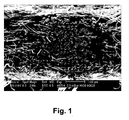
- Fig. 1 a nonwoven fabric with bicomponent fibers, which are designed as continuous fibers.
- the bicomponent fibers are designed as PIE-Fasem and consist of 30% polyamide 6 and about 70% of polyethylene terephthalate.
- the polyethylene terephthalate is enriched with the dopant silver.
- the dopant silver is homogeneously distributed in the component of the fiber body having polyethylene terephthalate.
- the silver is present in a concentration of at least 200 ppm and at most 500 ppm.
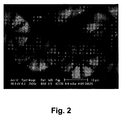
- Fig. 2 shows the bicomponent fibers according to Fig. 1 which have eight segments of polyethylene terephthalate.
- the segments have the dopant Silver on.
- the silver can be recognized in the form of bright spots in the scanning electron micrograph.
- the table shows the three embodiments 1 to 3 of the nonwoven fabric according to the invention.
- Embodiments 1 to 3 show different concentrations of the dopant in the polyethylene terephthalate component.
- the production of nonwovens was carried out in accordance with the in DE 697 25 051 T2 described method and analogously to the preparation of the comparative sample EVOLON 130 g / m 2 or EVO 130th
- the polyethylene terephthalate component was prepared in each of Embodiments 1 to 3 in the following manner.
- Embodiment 1 970 g of polyethylene terephthalate were mixed with 30 g of a master batch component to obtain a 3% concentration of master batch as shown in the table.
- the masterbatch component contained 99% polyethylene terephthalate and 1% silver.
- two 960 grams of polyethylene terephthalate were mixed with 40 grams of the master batch component.
- 950 g of polyethylene terephthalate were mixed with 50 g of said master batch component.
- the dopant used was silver from Silanotex GmbH, 80687 Kunststoff.
- the master batch was "Nano-Silver-Master-Batch" of the named company in the mentioned quantities.
- the nonwoven fabrics of Working Examples 1 to 3 were evaluated for their tear propagation resistance, tear resistance, ductility, uniformity, permeability, thickness, basis weight and shrinkage.
- N stands for Newton
- MD machine direction (production direction)
- CD cross direction. Denote MD and CD while orthogonal to each other load directions, namely in the direction of production and orthogonal thereto.
- the comparative sample used was a nonwoven fabric of the type Evolon with a basis weight of 130 g / m 2 .
- the comparative example is made from bicomponent fibers comprising 70% polyethylene terephthalate and 30% polyamide 6.
- the polyamide used in the embodiments 1 to 3 is also polyamide 6.
- the table essentially states that the doping of embodiments 1 to 3 with silver has no negative effects on the mechanical properties of the exemplary embodiments in comparison with the comparative sample.
- the exemplary embodiments were manufactured analogously to the comparative sample except for the doping, which is commercially available under the product designation "EVOLON 130 g / m 2 " or "EVO 130".
- table 1 2 3 comparison sample 130g / m 2 130g / m 2 130g / m 2 EVO 130g / m 2 standard % Master Batch PET 3%; 4% 5% - Width (mm 2050 2050 2050 2050 Belt speed (m / min) 11.3 11.3 11.3 11.3 11.3 Basis weight (g / m 2 ) 125 126 127 129 Tear strength before washing (N) MD 9.4 10.6 9.8 9.6 CD 9.6 9.4 9.7 9.4 Tear resistance before washing (N) MD 349 360 368 393 CD 400 404 394 415 Extensibility before washing (%) MD 42 41 45 43 CD 48 45 49 48 Thickness (mm) 0.46 0.47 0.47 0.46 Unity CV% 6.1 5.9 6.4 5.8 Permeability before washing in l / m 2 / s at 100 bar 45 44 47 45 Tear strength after
Landscapes
- Engineering & Computer Science (AREA)
- Textile Engineering (AREA)
- Chemical & Material Sciences (AREA)
- Chemical Kinetics & Catalysis (AREA)
- General Chemical & Material Sciences (AREA)
- Manufacturing & Machinery (AREA)
- Nonwoven Fabrics (AREA)
- Woven Fabrics (AREA)
Abstract
Description
- Die Erfindung betrifft einen Vliesstoff zur Verwendung in einem Wischtuch.
- Aus dem Stand der Technik sind Vliesstoffe bekannt, welche einen antimikrobiell wirkenden Dotierstoff aufweisen. Dabei wirkt ein antimikrobiell wirkender Stoff antibakteriell, antiviral, antimykotisch und/ oder gegen Sporen. Vor diesem Hintergrund hat sich insbesondere Silber als geeigneter antimikrobieller Stoff erwiesen.
- Es ist bereits bekannt, Toilettenpapier mit Silber auszurüsten. Diese Ausrüstung ist jedoch nicht dauerhaft, da das Silber lediglich oberflächlich auf das Toilettenpapier aufgetragen wird.
- Häufig wird Silber auch mittels Bindemitteln an textilen Stoffen festgelegt. Durch Waschprozesse wird das aufgetragene Silber jedoch abgelöst und kann in Wasseraufbereitungsanlagen eindringen. Dies ist ein äußerst nachteiliger Effekt, mit dem hohe wirtschaftliche Schäden verbunden sind.
- Der Erfindung liegt daher die Aufgabe zu Grunde, ein Wischtuch anzugeben, welches sich durch eine langfristig wirksame Reaktivität des antimikrobiell wirkenden Dotierstoffes auszeichnet und zugleich mehrfach kostengünstig waschbar ist.
- Erfindungsgemäß wird die voranstehende Aufgabe mit den Merkmalen des Patentanspruchs 1 gelöst.
- Danach umfasst ein Vliesstoff zur Verwendung in einem Wischtuch Bikomponentenfasern mit einem Faserkörper, in welchem zumindest ein Dotierstoff zur antimikrobiellen Ausrüstung aufgenommen ist, wobei die Bikomponentenfasern als Endlosfasern ausgestaltet sind.
- Erfindungsgemäß ist zunächst erkannt worden, dass ein Vliesstoff, welcher Endlosfasern aufweist, auch nach mehreren Waschprozessen eine gute Qualität aufweist. Dies hängt damit zusammen, dass Endlosfasern an einer Vielzahl von Stellen miteinander verschlungen sind und sich daher nur schwer aus dem Vliesstoffverbund herauslösen können. Des Weiteren ist erkannt worden, dass die Verwendung von Bikomponentenfasern mit einem Faserkörper, in welchem zumindest ein Dotierstoff zur antimikrobiellen Ausrüstung aufgenommen ist, erlaubt, den Vliesstoff zu verfestigen. Dabei ist konkret denkbar den Vliesstoff durch einen Wasserstrahlvernadelungsprozess zu verfestigen. Dabei können die Bikomponentenfasern teilweise oder vollständig zu sehr feinen Elementarfasern aufgesplittet werden. Denkbar ist auch, den Vliesstoff durch eine thermische Behandlung zu verfestigen. Ganz konkret ist erkannt worden, dass die Einbindung des antimikrobiellen Dotierstoffes in den Faserkörper eine äußerst langfristige Abgabe des Dotierstoffes sicherstellt. Die antimikrobielle Wirkung wird auf das Wischtuch begrenzt, indem Keimwachstum im Wischtuch selbst weitgehend verhindert wird. Erfindungsgemäß wird der antimikrobiell wirksame Stoff gerade nicht in erheblichem Maße an Oberfächen abgegeben, die mit dem Wischtuch behandelt werden. Der Dotierstoff wird direkt in den Faserkörper eingebunden, wodurch vor allem an der Oberfläche der Endlosfasern eine antimikrobielle Wirkung entsteht. Die Freisetzung des Dotierstoffes erfolgt nur in sehr geringen Mengen, er bleibt weitestgehend im Vliesstoff bzw. im Faserkörper gebunden.
- Die erfindungsgemäße Verwendung zeigt überraschenderweise einen kombinatorischen Effekt, der sich einer hohen Reaktivität des Dotierstoffes und einer hohen Waschbeständigkeit des Wischtuches niederschlägt. Ein waschbares, dauerhaft antimikrobiell dotiertes Wischtuch lässt beispielsweise in milchkontaminiertem Zustand keine bakterielle Zersetzung zu, so dass nahezu keine Geruchsbelastung im Haushalt entstehen kann. Ganz besonders vorteilhaft ist jedoch die Benutzung in der gewerblichen Reinigung, da hier Wischtücher täglich gewaschen und getrocknet werden. Werden die Wischtücher erfindungsgemäß antimikrobiell ausgerüstet, so kann auf eine anschließende Trocknung der Wischtücher verzichtet werden. Versuche haben gezeigt, dass bei jeder Wäsche eine Energieeinsparung von mehr als 3 kWh/kg Wischtuch realisiert werden kann. Folglich ist die genannte Aufgabe gelöst.
- Die Bikomponentenfasern könnten zumindest teilweise in endlose Elementarfasern aufgespaltet sein. Durch diese konkrete Ausgestaltung kann ein Vliesstoff mit sehr feinen Elementarfasern geschaffen werden. Die Aufspaltung kann beispielsweise mittels eines Wasserstrahlvemadelungsverfahrens erfolgen, wobei die Elementarfasern noch zusätzlich untereinander verschlungen werden. Hierdurch kann der Vliesstoff verfestigt werden. Dabei ist vorteilhaft, dass die Elementarfasern eine größere Oberfläche als die ungesplitteten Bikomponentenfasern bei gleichbleibendem Flächengewicht des Vliesstoffs bieten. Durch die Oberfläche kann der Dotierstoff nach außen in Wechselwirkung treten. Besonders vorteilhaft können die Elementarfasern als Mikrofilamente einer Feinheit von 0,05 bis 1 dtex ausgestaltet sein. Mikrofilamente einer solchen Feinheit stellen eine besonders große Kontaktoberfläche für Bakterien und Sporen zur Verfügung.
- Der Dotierstoff könnte nur in einer Komponente des Faserkörpers homogen verteilt sein. Durch diese konkrete Ausgestaltung kann beispielsweise der Mantel einer Kem-Mantel-Endlosfaser aufgeschmolzen werden, um sich mit weiteren Endlosfasern zu verbinden, ohne dass der im Kern vorliegende Dotierstoff negativ beeinträchtigt wird. Vor diesem Hintergrund ist denkbar, dass auch Side-by-Side-Bikomponentenendlosfasem verwendet werden. Des Weiteren ist denkbar, Island-in-the-Sea-Bikomponentenendlosfasern zu verwenden.
- Der Dotierstoff könnte in einer Konzentration von mindestens 200 ppm im Vliesstoff vorliegen. Überraschenderweise hat sich gezeigt, dass bereits eine derart geringe Konzentration des Dotierstoffes eine antimikrobielle Wirkung gegen Viren, Sporen oder Bakterien entfalten kann.
- Der Dotierstoff könnte in einer Konzentration von höchstens 500 ppm im Vliesstoff vorliegen. Die Wahl dieser Konzentration hat sich als vorteilhaft erwiesen, um einem eingefärbten Vliesstoff eine dauerhafte Reaktivität zu verleihen. Durch die Einfärbung wird der Dotierstoff zwar abgeschirmt, durch die genannte Konzentration kann er jedoch seine Wirkung noch in ausreichendem Maße entfalten.
- Die Bikomponentenfaser könnte eine Komponente aus Polyamid oder Polyethylen und eine Komponente aus Polyethylenterephtalat oder Polyester aufweisen. Durch diese konkrete Ausgestaltung ist es problemlos möglich, die Bikomponentenfaser durch Wasserstrahlen in Elementarfasern aufzuspalten.
- Vor diesem Hintergrund könnte die Bikomponentenfaser 30 % Polyamid oder Polyethylen aufweisen. Der Anteil an Polyethylenterephtalat oder Polyester beträgt im Wesentlichen 70 %.
- Der Dotierstoff könnte in der Komponente des Faserkörpers homogen verteilt sein, die Polyethylenterephtalat oder Polyester aufweist. Polyethylenterephtalat und Polyester haben sich als besonders geeignete Medien zur Aufnahme des Dotierstoffes erwiesen. Aufgrund des höheren Massenanteils der Komponente, die Polyethylenterephtalat oder Polyester aufweist, kann eine effektivere Volumenverteilung des Dotierstoffs im Vliesstoff erzielt werden.
- Die Bikomponentenfaser könnte als PIE-Faser ausgestaltet sein. Durch diese konkrete Ausgestaltung kann eine relativ grobe Bikomponentenfaser in sehr feine Elementarfasern mit kuchenstückartigen bzw. kreissegmentartigen Querschnitten aufgespalten werden. Lediglich beispielhaft sei an dieser Stelle auf die
DE 697 25 051 T2 hingewiesen, welche ein Verfahren beschreibt, in dem PIE-Fasern hergestellt und aufgespalten werden. - Der Dotierstoff könnte als Element einer Nebengruppe, insbesondere der Nebengruppe lb des Periodensystems der Elemente, ausgestaltet sein. Nebengruppenelemente zeichnen sich durch antimikrobielle Wirkung aus. Vor diesem Hintergrund ist denkbar, dass mehrere Nebengruppenelemente gemeinsam in dem Faserkörper vorliegen, um unterschiedlichen Bakterienarten selektiv zu begegnen. Es hat sich in Versuchsreihen gezeigt, dass sich in Bezug auf die antimikrobielle Wirksamkeit eine Rangfolge der verwendeten Stoffe ergibt. Diese lässt sich wie folgt darstellen. Silber ist der wirksamste Stoff, gefolgt von Quecksilber, Kupfer, Cadmium, Chrom, Blei, Kobalt, Gold, Zink, Eisen und schließlich Mangan. Das gleiche gilt für Salze und Komplexe der genannten Elemente bzw. Stoffe.
- Der Dotierstoff könnte vor diesem Hintergrund als Silber, Gold oder Kupfer ausgestaltet sein. Diese Elemente zeigen eine besonders zuverlässige antimikrobielle Wirkung und sind kommerziell problemlos als feine Partikel erhältlich.
- Der Vliesstoff könnte ein Flächengewicht von mindestens 20 g/m2 aufweisen. Dieses Flächengewicht hat sich als besonders vorteilhaft erwiesen, um Wischtücher herzustellen.
- Der Vliesstoff könnte eine Färbung aufweisen. Überraschend wurde festgestellt, dass ein antimikrobiell ausgerüsteter Vliesstoff eingefärbt werden kann und dennoch seine antimikrobielle Wirkung beibehält.
- Der hier beschriebene Vliesstoff kann problemlos in Kontakt zur menschlichen Haut stehen. Vorteilhaft weist der hier beschriebene Vliesstoff eine derart geringe Konzentration eines Dotierstoffs auf, dass die menschliche Haut nicht gereizt wird. Insbesondere Neurodermitispatienten bedürfen eines schonenden Vliesstoffes, wie es hier beschrieben ist. Dennoch zeigen die Endlosfasern auch auf der Filamentoberfläche eine ausreichende Konzentration des Dotierstoffs, um Bakterien, Viren und Sporen abzutöten.
- Es gibt nun verschiedene Möglichkeiten, die Lehre der vorliegenden Erfindung auf vorteilhafte Weise auszugestalten und weiterzubilden. Dazu ist einerseits auf die nachgeordneten Ansprüche, andererseits auf die nachfolgende Erläuterung bevorzugter Ausführungsbeispiele der erfindungsgemäßen Lehre anhand der Tabelle und der Zeichnung zu verweisen.
- In Verbindung mit der Erläuterung der bevorzugten Ausführungsbeispiele anhand der Tabelle und der Zeichnung werden auch im Allgemeinen bevorzugte Ausgestaltungen und Weiterbildungen der Lehre erläutert.
- In der Zeichnung zeigen
- Fig. 1
- eine rasterelektronenmikroskobische Aufnahme eines Vliesstoffes, welcher PIE-Bikomponentenfasern mit antimikrobieller Ausrüstung umfasst, und
- Fig. 2
- eine rasterelektronenmikroskobische Aufnahme von PIE-Fasern, deren Polyethylenterephtalatkomponente mit Silber dotiert ist, wobei sich das Silber in hellen, weisslichen Punkte zeigt.
- In der Zeichnung zeigt
Fig. 1 einen Vliesstoff mit Bikomponentenfasern, die als Endlosfasern ausgestaltet sind. Die Bikomponentenfasern sind als PIE-Fasem ausgestaltet und bestehen zu 30 % aus Polyamid 6 und zu etwa 70 % aus Polyethylentereptalat. Das Polyethylenterephtalat ist mit dem Dotierstoff Silber angereichert. Dabei ist der Dotierstoff Silber in der Komponente des Faserkörpers homogen verteilt, die Polyethylenterephtalat aufweist. Das Silber liegt in einer Konzentration von mindestens 200 ppm und höchstens 500 ppm vor. -
Fig. 2 zeigt die Bikomponentenfasern gemäßFig. 1 , die acht Segmente aus Polyethylenterephtalat aufweisen. Dabei weisen die Segmente den Dotierstoff Silber auf. Das Silber ist in Form von hellen Punkten in der Rasterelektronenmikroskopaufnahme zu erkennen. - Die Tabelle zeigt die drei Ausführungsbeispiele 1 bis 3 des erfindungsgemäßen Vliesstoffes. Die Ausführungsbeispiele 1 bis 3 zeigen unterschiedliche Konzentrationen des Dotierstoffes in der Polyethylenterephtalatkomponente. Die Herstellung der Vliesstoffe (Ausführungsbeispiele 1 bis 3) erfolgte in Anlehnung an das in
DE 697 25 051 T2 beschriebene Verfahren und analog zur Herstellung der Vergleichsprobe EVOLON 130 g/m2 bzw. EVO 130. - Die Polyethylenterephtalatkomponente wurde bei jedem der Ausführungsbeispiele 1 bis 3 in folgender Weise hergestellt:
- Zur Herstellung des Ausführungsbeispiels 1 wurden 970 g Polyethylenterephtalat mit 30 g einer Master-Batch-Komponente gemischt, um eine 3%ige Konzentration an Master-Batch im Sinne der Tabelle zu erhalten. Dabei enthielt die Master-Batch-Komponente 99 % Polyethylenterephtalat und 1 % Silber. Analog wurden für das Ausführungsbeispiel zwei 960 g Polyethylenterephtalat mit 40 g der Master-Batch-Komponente gemischt. Für Ausführungsbeispiel drei wurden 950 g Polyethylenterephtalat mit 50 g der genannten Master-Batch-Komponente gemischt. Als Dotierstoff wurde Silber der Firma Silanotex GmbH, 80687 München, verwendet. Ganz konkret wurde als Master-Batch "Nano-Silver-Master-Batch" der genannten Firma in den genannten Mengen verwendet.
- Die Vliesstoffe der Ausführungsbeispiele 1 bis 3 wurden auf ihre Weiterreißfestigkeit, ihre Reißfestigkeit, ihre Dehnbarkeit, ihre Einheitlichkeit, ihre Permeabilität, ihre Dicke, ihr Flächengewicht und ihren Schrumpf untersucht. Dabei steht "N" für Newton, "MD" für machine direction (Produktionsrichtung) und "CD" für cross direction. MD und CD bezeichnen dabei orthogonal zueinander stehende Belastungsrichtungen, nämlich in Produktionsrichtung und orthogonal hierzu.
- Als Vergleichsprobe diente dabei ein Vliesstoff des Typs Evolon mit einem Flächengewicht von 130 g/m2. Das Vergleichsbeispiel ist aus Bikomponentenfasern gefertigt, welche 70 % Polyethylenterephtalat und 30 % Polyamid 6 aufweisen. Bei dem in den Ausführungsbeispielen 1 bis 3 verwendeten Polyamid handelt es sich ebenfalls um Polyamid 6.
- Der Tabelle kann im Wesentlichen entnommen werden, dass die Dotierung der Ausführungsbeispiele 1 bis 3 mit Silber keine negativen Auswirkungen auf die mechanischen Eigenschaften der Ausführungsbeispiele im Vergleich zur Vergleichsprobe hat. Die Ausführungsbeispiele wurden bis auf die Dotierung analog zur Vergleichsprobe gefertigt, die im Handel unter der Produktbezeichnung "EVOLON 130 g/m2" bzw. "EVO 130" erhältlich ist.
- Schließlich sei ausdrücklich darauf hingewiesen, dass die voranstehend beschriebenen Ausführungsbeispiele lediglich zur Erörterung der beanspruchten Lehre dienen, diese jedoch nicht auf diese Ausführungsbeispiele einschränken.
Tabelle 1 2 3 Vergleichsprobe 130g/m2 130g/m2 130g/m2 EVO 130g/m2 Standard % Master Batch PET 3%; 4% 5% - Breite / mm 2050 2050 2050 2050 Bandgeschwindigkeit ( m/min) 11,3 11,3 11,3 11,3 Flächengewicht ( g/m2) 125 126 127 129 Weiterreissfestigkeit vor dem Waschen ( N) MD 9,4 10,6 9,8 9,6 CD 9,6 9,4 9,7 9,4 Reissfestigkeit vor dem Waschen ( N) MD 349 360 368 393 CD 400 404 394 415 Dehnbarkeit vor dem Waschen ( %) MD 42 41 45 43 CD 48 45 49 48 Dicke ( mm) 0,46 0,47 0,47 0,46 Einheitlichkeit CV % 6,1 5,9 6,4 5,8 Permeabilität vor dem Waschen in l/m2/s bei 100 bar 45 44 47 45 Weiterreissfestigkeitnach einmal Waschen ( N) MD 11,2 11,2 11,9 ** CD 9,4 10,3 11,2 ** Reissfestigkeit nach einmal Waschen ( N) MD 396 373 394 ** CD 427 448 411 ** Dehnbarkeit nach einmal Waschen( %) MD 49 47 51 ** CD 51 51 51 ** Dicke nach Waschen ( mm) 0,59 0,57 0,6 ** Flächengewicht nach Waschen ( g/m2) 137 136 135 ** Schrumpf nach einmal Waschen bei 90°C MD -4% -3,8% -4,3% -4,2% CD -2,6% -2,8% -2,6% -2,6%
Claims (15)
- Vliesstoff zur Verwendung in einem Wischtuch, umfassend Bikomponentenfasern mit einem Faserkörper, in welchem zumindest ein Dotierstoff zur antimikrobiellen Ausrüstung aufgenommen ist, wobei die Bikomponentenfasern als Endlosfasern ausgestaltet sind.
- Vliesstoff nach Anspruch 1, dadurch gekennzeichnet, dass die Bikomponentenfasern in Elementarfiasern aufspaltbar sind.
- Vliesstoff nach Anspruch 2, dadurch gekennzeichnet, dass die Elementarfasern eine Feinheit von 0,05 bis 1 dtex aufweisen.
- Vliesstoff nach einem der Ansprüche 1 bis 3, dadurch gekennzeichnet, dass der Dotierstoff nur in einer Komponente des Faserkörpers homogen verteilt ist.
- Vliesstoff nach einem der Ansprüche 1 bis 4, dadurch gekennzeichnet, dass der Dotierstoff in einer Konzentration von mindestens 200 ppm vorliegt.
- Vliesstoff nach einem der Ansprüche 1 bis 5, dadurch gekennzeichnet, dass der Dotierstoff in einer Konzentration von höchstens 500 ppm vorliegt.
- Vliesstoff nach einem der Ansprüche 1 bis 6, dadurch gekennzeichnet, dass die Bikomponentenfaser eine Komponente aus Polyamid oder Polyethylen und eine Komponente aus Polyethylenterephtalat oder Polyester aufweist.
- Vliesstoff nach Anspruch 7, dadurch gekennzeichnet, dass die Bikomponentenfaser 30 % Polyamid oder Polyethylen aufweist.
- Vliesstoff nach Anspruch 7 oder 8, dadurch gekennzeichnet, dass der Dotierstoff in der Komponente des Faserkörpers homogen verteilt ist, die Polyethylenterephtalat oder Polyester aufweist.
- Vliesstoff nach einem der Ansprüche 1 bis 9, dadurch gekennzeichnet, dass die Bikomponentenfaser als PIE-Faser ausgestaltet ist.
- Vliesstoff nach einem der Ansprüche 1 bis 10, dadurch gekennzeichnet, dass der Dotierstoff als Element einer Nebengruppe, insbesondere der Nebengruppe l b, ausgestaltet ist.
- Vliesstoff nach Anspruch 11, dadurch gekennzeichnet, dass der Dotierstoff als Silber, Gold oder Kupfer ausgestaltet ist.
- Vliesstoff nach einem der Ansprüche 1 bis 12, gekennzeichnet durch ein Flächengewicht von mindestens 20 g/m2.
- Vliesstoff nach einem der Ansprüche 1 bis 13, gekennzeichnet durch eine Färbung.
- Verwendung eines Vliesstoffs nach einem der voranstehenden Ansprüche in einem Wischtuch oder zur Herstellung eines Wischtuchs.
Priority Applications (4)
| Application Number | Priority Date | Filing Date | Title |
|---|---|---|---|
| EP08005131A EP2103724B1 (de) | 2008-03-19 | 2008-03-19 | Wischtuch mit einem antibakteriell ausgerüsteten Vliesstoff |
| ES08005131T ES2365270T3 (es) | 2008-03-19 | 2008-03-19 | Trapo de fregar con un material no tejido dotado de un apresto antibacteriano. |
| AT08005131T ATE512243T1 (de) | 2008-03-19 | 2008-03-19 | Wischtuch mit einem antibakteriell ausgerüsteten vliesstoff |
| PCT/EP2009/001721 WO2009115217A1 (de) | 2008-03-19 | 2009-03-11 | Antibakteriell ausgerüsteter vliesstoff mit bikomponentenfasern |
Applications Claiming Priority (1)
| Application Number | Priority Date | Filing Date | Title |
|---|---|---|---|
| EP08005131A EP2103724B1 (de) | 2008-03-19 | 2008-03-19 | Wischtuch mit einem antibakteriell ausgerüsteten Vliesstoff |
Publications (2)
| Publication Number | Publication Date |
|---|---|
| EP2103724A1 true EP2103724A1 (de) | 2009-09-23 |
| EP2103724B1 EP2103724B1 (de) | 2011-06-08 |
Family
ID=39789533
Family Applications (1)
| Application Number | Title | Priority Date | Filing Date |
|---|---|---|---|
| EP08005131A Active EP2103724B1 (de) | 2008-03-19 | 2008-03-19 | Wischtuch mit einem antibakteriell ausgerüsteten Vliesstoff |
Country Status (3)
| Country | Link |
|---|---|
| EP (1) | EP2103724B1 (de) |
| AT (1) | ATE512243T1 (de) |
| ES (1) | ES2365270T3 (de) |
Cited By (2)
| Publication number | Priority date | Publication date | Assignee | Title |
|---|---|---|---|---|
| WO2014011839A1 (en) * | 2012-07-13 | 2014-01-16 | The Procter & Gamble Company | Stretchable laminates for absorbent articles and methods for making the same |
| CN106319754A (zh) * | 2016-09-08 | 2017-01-11 | 河南工程学院 | 功能性复合抗菌羊毛絮片及其制备方法 |
Citations (3)
| Publication number | Priority date | Publication date | Assignee | Title |
|---|---|---|---|---|
| DE69725051T2 (de) | 1996-06-17 | 2004-07-15 | Carl Freudenberg Kg | Vliesstoff aus sehr feinen Endlosfilamenten |
| US20040214495A1 (en) * | 1999-05-27 | 2004-10-28 | Foss Manufacturing Co., Inc. | Anti-microbial products |
| WO2007078203A1 (en) * | 2006-01-03 | 2007-07-12 | Norwex Holding As | Anti-bacterial micro-fibre and production thereof |
-
2008
- 2008-03-19 EP EP08005131A patent/EP2103724B1/de active Active
- 2008-03-19 ES ES08005131T patent/ES2365270T3/es active Active
- 2008-03-19 AT AT08005131T patent/ATE512243T1/de active
Patent Citations (3)
| Publication number | Priority date | Publication date | Assignee | Title |
|---|---|---|---|---|
| DE69725051T2 (de) | 1996-06-17 | 2004-07-15 | Carl Freudenberg Kg | Vliesstoff aus sehr feinen Endlosfilamenten |
| US20040214495A1 (en) * | 1999-05-27 | 2004-10-28 | Foss Manufacturing Co., Inc. | Anti-microbial products |
| WO2007078203A1 (en) * | 2006-01-03 | 2007-07-12 | Norwex Holding As | Anti-bacterial micro-fibre and production thereof |
Cited By (4)
| Publication number | Priority date | Publication date | Assignee | Title |
|---|---|---|---|---|
| WO2014011839A1 (en) * | 2012-07-13 | 2014-01-16 | The Procter & Gamble Company | Stretchable laminates for absorbent articles and methods for making the same |
| CN104411484A (zh) * | 2012-07-13 | 2015-03-11 | 宝洁公司 | 用于吸收制品的可拉伸层压体及其制备方法 |
| CN104411484B (zh) * | 2012-07-13 | 2017-03-08 | 宝洁公司 | 用于吸收制品的可拉伸层压体及其制备方法 |
| CN106319754A (zh) * | 2016-09-08 | 2017-01-11 | 河南工程学院 | 功能性复合抗菌羊毛絮片及其制备方法 |
Also Published As
| Publication number | Publication date |
|---|---|
| EP2103724B1 (de) | 2011-06-08 |
| ES2365270T3 (es) | 2011-09-27 |
| ATE512243T1 (de) | 2011-06-15 |
Similar Documents
| Publication | Publication Date | Title |
|---|---|---|
| DE19609143C1 (de) | Melt-blown-Vlies, Verfahren zu dessen Herstellung und dessen Verwendungen | |
| DE10002778B4 (de) | Verwendung eines Mikrofilament-Vliesstoffes als Reinigungstuch | |
| DE2731291C2 (de) | Wildlederartiger Textilverbundstoff und Verfahren zu seiner Herstellung | |
| EP2731487B1 (de) | Flachwischbezug mit antimikrobieller oder antibakterieller ausrüstung | |
| DE69931553T2 (de) | Antimikrobielles Formteil und Verfahren zu seiner Herstellung | |
| DE2841749A1 (de) | Verfahren zum nachweis eines impraegnierungsmittels und mit einem nachweismittel versehene stoffe | |
| AT512143A1 (de) | Cellulosefasern mit hydrophoben Eigenschaften und hoher Weichheit und der dazugehörige Herstellungsprozess | |
| DE102009059276A1 (de) | Formulierung mit Metallnanopartikel | |
| EP1383947B2 (de) | Bioaktive faserprodukte | |
| DE69716689T2 (de) | Absorbierender Verbundvliesstoff mit einer weichen Fläche und einer rauhen Fläche und Verfahren zur Herstellung | |
| DE69127356T2 (de) | Sich wie leder anfühlendes polgewebe sowie verfahren zu seiner herstellung | |
| DE102017110330A1 (de) | Farbabgebendes Produkt, insbesondere zum Färben von oder Auffrischen von Färbungen in textilen Materialien mit indigoiden Farbstoffen | |
| EP2103724B1 (de) | Wischtuch mit einem antibakteriell ausgerüsteten Vliesstoff | |
| WO2009115217A1 (de) | Antibakteriell ausgerüsteter vliesstoff mit bikomponentenfasern | |
| EP1788130A1 (de) | Textil und Verfahren zu dessen Herstellung | |
| DE2803848A1 (de) | Strickmaterial aus einem faservlies | |
| DE10248583A1 (de) | Textilbehandlungsmittel | |
| EP1775372B1 (de) | Kationisch ausgerüstetes Textilmaterial und seine Verwendung | |
| DE102024139558B3 (de) | Antimikrobielles Vliestuchprodukt | |
| DE102008015053A1 (de) | Antibakteriell ausgerüstetes Vlies mit Bikomponetenfasern | |
| EP3056604B1 (de) | Putz-, wasch- und/oder poliersubstrat bestehend aus textilen und/oder vliesartigen und/oder schwammartigen strukturen zur reinigung von oberflächen beliebiger art mit antimikrobiellen eigenschaften | |
| DE102015119949A1 (de) | Farbabgebendes Produkt, insbesondere zum Färben von oder Auffrischen von Färbungen in textilen Materialien | |
| EP3690136A1 (de) | Nichtgewebtes faservliesstoffmaterial | |
| CH570470A5 (en) | Permanent anti-microbial treatment of synthetic fibres - by adding anti-microbial substances to spinning melt or dope before spinning | |
| DD300605A7 (de) | Zusammensetzung zur behandlung von textilem material |
Legal Events
| Date | Code | Title | Description |
|---|---|---|---|
| PUAI | Public reference made under article 153(3) epc to a published international application that has entered the european phase |
Free format text: ORIGINAL CODE: 0009012 |
|
| AK | Designated contracting states |
Kind code of ref document: A1 Designated state(s): AT BE BG CH CY CZ DE DK EE ES FI FR GB GR HR HU IE IS IT LI LT LU LV MC MT NL NO PL PT RO SE SI SK TR |
|
| AX | Request for extension of the european patent |
Extension state: AL BA MK RS |
|
| 17P | Request for examination filed |
Effective date: 20100302 |
|
| 17Q | First examination report despatched |
Effective date: 20100422 |
|
| AKX | Designation fees paid |
Designated state(s): AT BE BG CH CY CZ DE DK EE ES FI FR GB GR HR HU IE IS IT LI LT LU LV MC MT NL NO PL PT RO SE SI SK TR |
|
| GRAP | Despatch of communication of intention to grant a patent |
Free format text: ORIGINAL CODE: EPIDOSNIGR1 |
|
| RIN1 | Information on inventor provided before grant (corrected) |
Inventor name: HALLER, JUDITH Inventor name: GROTEN ROBERT Inventor name: EISENHUT, ANDREAS Inventor name: SCHINDLER THOMAS |
|
| GRAS | Grant fee paid |
Free format text: ORIGINAL CODE: EPIDOSNIGR3 |
|
| GRAA | (expected) grant |
Free format text: ORIGINAL CODE: 0009210 |
|
| AK | Designated contracting states |
Kind code of ref document: B1 Designated state(s): AT BE BG CH CY CZ DE DK EE ES FI FR GB GR HR HU IE IS IT LI LT LU LV MC MT NL NO PL PT RO SE SI SK TR |
|
| REG | Reference to a national code |
Ref country code: GB Ref legal event code: FG4D Free format text: NOT ENGLISH |
|
| REG | Reference to a national code |
Ref country code: CH Ref legal event code: EP |
|
| REG | Reference to a national code |
Ref country code: IE Ref legal event code: FG4D Free format text: LANGUAGE OF EP DOCUMENT: GERMAN |
|
| REG | Reference to a national code |
Ref country code: DE Ref legal event code: R096 Ref document number: 502008003782 Country of ref document: DE Effective date: 20110721 |
|
| RIN2 | Information on inventor provided after grant (corrected) |
Inventor name: SCHINDLER THOMAS Inventor name: HALLER, JUDITH Inventor name: GROTEN ROBERT Inventor name: EISENHUT, ANDREAS |
|
| REG | Reference to a national code |
Ref country code: NO Ref legal event code: T2 Effective date: 20110608 |
|
| REG | Reference to a national code |
Ref country code: ES Ref legal event code: FG2A Ref document number: 2365270 Country of ref document: ES Kind code of ref document: T3 Effective date: 20110927 |
|
| REG | Reference to a national code |
Ref country code: NL Ref legal event code: VDEP Effective date: 20110608 |
|
| PG25 | Lapsed in a contracting state [announced via postgrant information from national office to epo] |
Ref country code: LT Free format text: LAPSE BECAUSE OF FAILURE TO SUBMIT A TRANSLATION OF THE DESCRIPTION OR TO PAY THE FEE WITHIN THE PRESCRIBED TIME-LIMIT Effective date: 20110608 Ref country code: HR Free format text: LAPSE BECAUSE OF FAILURE TO SUBMIT A TRANSLATION OF THE DESCRIPTION OR TO PAY THE FEE WITHIN THE PRESCRIBED TIME-LIMIT Effective date: 20110608 Ref country code: SE Free format text: LAPSE BECAUSE OF FAILURE TO SUBMIT A TRANSLATION OF THE DESCRIPTION OR TO PAY THE FEE WITHIN THE PRESCRIBED TIME-LIMIT Effective date: 20110608 |
|
| PG25 | Lapsed in a contracting state [announced via postgrant information from national office to epo] |
Ref country code: LV Free format text: LAPSE BECAUSE OF FAILURE TO SUBMIT A TRANSLATION OF THE DESCRIPTION OR TO PAY THE FEE WITHIN THE PRESCRIBED TIME-LIMIT Effective date: 20110608 Ref country code: GR Free format text: LAPSE BECAUSE OF FAILURE TO SUBMIT A TRANSLATION OF THE DESCRIPTION OR TO PAY THE FEE WITHIN THE PRESCRIBED TIME-LIMIT Effective date: 20110909 Ref country code: CY Free format text: LAPSE BECAUSE OF FAILURE TO SUBMIT A TRANSLATION OF THE DESCRIPTION OR TO PAY THE FEE WITHIN THE PRESCRIBED TIME-LIMIT Effective date: 20110608 Ref country code: SI Free format text: LAPSE BECAUSE OF FAILURE TO SUBMIT A TRANSLATION OF THE DESCRIPTION OR TO PAY THE FEE WITHIN THE PRESCRIBED TIME-LIMIT Effective date: 20110608 |
|
| PG25 | Lapsed in a contracting state [announced via postgrant information from national office to epo] |
Ref country code: NL Free format text: LAPSE BECAUSE OF FAILURE TO SUBMIT A TRANSLATION OF THE DESCRIPTION OR TO PAY THE FEE WITHIN THE PRESCRIBED TIME-LIMIT Effective date: 20110608 |
|
| REG | Reference to a national code |
Ref country code: IE Ref legal event code: FD4D |
|
| PG25 | Lapsed in a contracting state [announced via postgrant information from national office to epo] |
Ref country code: IE Free format text: LAPSE BECAUSE OF FAILURE TO SUBMIT A TRANSLATION OF THE DESCRIPTION OR TO PAY THE FEE WITHIN THE PRESCRIBED TIME-LIMIT Effective date: 20110608 Ref country code: PT Free format text: LAPSE BECAUSE OF FAILURE TO SUBMIT A TRANSLATION OF THE DESCRIPTION OR TO PAY THE FEE WITHIN THE PRESCRIBED TIME-LIMIT Effective date: 20111010 Ref country code: EE Free format text: LAPSE BECAUSE OF FAILURE TO SUBMIT A TRANSLATION OF THE DESCRIPTION OR TO PAY THE FEE WITHIN THE PRESCRIBED TIME-LIMIT Effective date: 20110608 Ref country code: CZ Free format text: LAPSE BECAUSE OF FAILURE TO SUBMIT A TRANSLATION OF THE DESCRIPTION OR TO PAY THE FEE WITHIN THE PRESCRIBED TIME-LIMIT Effective date: 20110608 Ref country code: IS Free format text: LAPSE BECAUSE OF FAILURE TO SUBMIT A TRANSLATION OF THE DESCRIPTION OR TO PAY THE FEE WITHIN THE PRESCRIBED TIME-LIMIT Effective date: 20111008 |
|
| PG25 | Lapsed in a contracting state [announced via postgrant information from national office to epo] |
Ref country code: RO Free format text: LAPSE BECAUSE OF FAILURE TO SUBMIT A TRANSLATION OF THE DESCRIPTION OR TO PAY THE FEE WITHIN THE PRESCRIBED TIME-LIMIT Effective date: 20110608 Ref country code: PL Free format text: LAPSE BECAUSE OF FAILURE TO SUBMIT A TRANSLATION OF THE DESCRIPTION OR TO PAY THE FEE WITHIN THE PRESCRIBED TIME-LIMIT Effective date: 20110608 Ref country code: SK Free format text: LAPSE BECAUSE OF FAILURE TO SUBMIT A TRANSLATION OF THE DESCRIPTION OR TO PAY THE FEE WITHIN THE PRESCRIBED TIME-LIMIT Effective date: 20110608 |
|
| PLBE | No opposition filed within time limit |
Free format text: ORIGINAL CODE: 0009261 |
|
| STAA | Information on the status of an ep patent application or granted ep patent |
Free format text: STATUS: NO OPPOSITION FILED WITHIN TIME LIMIT |
|
| 26N | No opposition filed |
Effective date: 20120309 |
|
| PG25 | Lapsed in a contracting state [announced via postgrant information from national office to epo] |
Ref country code: DK Free format text: LAPSE BECAUSE OF FAILURE TO SUBMIT A TRANSLATION OF THE DESCRIPTION OR TO PAY THE FEE WITHIN THE PRESCRIBED TIME-LIMIT Effective date: 20110608 |
|
| REG | Reference to a national code |
Ref country code: DE Ref legal event code: R097 Ref document number: 502008003782 Country of ref document: DE Effective date: 20120309 |
|
| BERE | Be: lapsed |
Owner name: CARL FREUDENBERG K.G. Effective date: 20120331 |
|
| PG25 | Lapsed in a contracting state [announced via postgrant information from national office to epo] |
Ref country code: MC Free format text: LAPSE BECAUSE OF NON-PAYMENT OF DUE FEES Effective date: 20120331 |
|
| REG | Reference to a national code |
Ref country code: CH Ref legal event code: PL |
|
| GBPC | Gb: european patent ceased through non-payment of renewal fee |
Effective date: 20120319 |
|
| PG25 | Lapsed in a contracting state [announced via postgrant information from national office to epo] |
Ref country code: LI Free format text: LAPSE BECAUSE OF NON-PAYMENT OF DUE FEES Effective date: 20120331 Ref country code: BE Free format text: LAPSE BECAUSE OF NON-PAYMENT OF DUE FEES Effective date: 20120331 Ref country code: CH Free format text: LAPSE BECAUSE OF NON-PAYMENT OF DUE FEES Effective date: 20120331 Ref country code: GB Free format text: LAPSE BECAUSE OF NON-PAYMENT OF DUE FEES Effective date: 20120319 |
|
| PG25 | Lapsed in a contracting state [announced via postgrant information from national office to epo] |
Ref country code: BG Free format text: LAPSE BECAUSE OF FAILURE TO SUBMIT A TRANSLATION OF THE DESCRIPTION OR TO PAY THE FEE WITHIN THE PRESCRIBED TIME-LIMIT Effective date: 20110908 |
|
| PG25 | Lapsed in a contracting state [announced via postgrant information from national office to epo] |
Ref country code: MT Free format text: LAPSE BECAUSE OF FAILURE TO SUBMIT A TRANSLATION OF THE DESCRIPTION OR TO PAY THE FEE WITHIN THE PRESCRIBED TIME-LIMIT Effective date: 20110608 |
|
| PG25 | Lapsed in a contracting state [announced via postgrant information from national office to epo] |
Ref country code: TR Free format text: LAPSE BECAUSE OF FAILURE TO SUBMIT A TRANSLATION OF THE DESCRIPTION OR TO PAY THE FEE WITHIN THE PRESCRIBED TIME-LIMIT Effective date: 20110608 |
|
| REG | Reference to a national code |
Ref country code: AT Ref legal event code: MM01 Ref document number: 512243 Country of ref document: AT Kind code of ref document: T Effective date: 20130319 |
|
| PG25 | Lapsed in a contracting state [announced via postgrant information from national office to epo] |
Ref country code: LU Free format text: LAPSE BECAUSE OF NON-PAYMENT OF DUE FEES Effective date: 20120319 |
|
| PG25 | Lapsed in a contracting state [announced via postgrant information from national office to epo] |
Ref country code: HU Free format text: LAPSE BECAUSE OF FAILURE TO SUBMIT A TRANSLATION OF THE DESCRIPTION OR TO PAY THE FEE WITHIN THE PRESCRIBED TIME-LIMIT Effective date: 20080319 |
|
| PG25 | Lapsed in a contracting state [announced via postgrant information from national office to epo] |
Ref country code: AT Free format text: LAPSE BECAUSE OF NON-PAYMENT OF DUE FEES Effective date: 20130319 |
|
| REG | Reference to a national code |
Ref country code: FR Ref legal event code: PLFP Year of fee payment: 9 |
|
| REG | Reference to a national code |
Ref country code: FR Ref legal event code: PLFP Year of fee payment: 10 |
|
| REG | Reference to a national code |
Ref country code: FR Ref legal event code: PLFP Year of fee payment: 11 |
|
| PGFP | Annual fee paid to national office [announced via postgrant information from national office to epo] |
Ref country code: ES Payment date: 20250415 Year of fee payment: 18 |
|
| PGFP | Annual fee paid to national office [announced via postgrant information from national office to epo] |
Ref country code: DE Payment date: 20260320 Year of fee payment: 19 Ref country code: NO Payment date: 20260318 Year of fee payment: 19 |
|
| PGFP | Annual fee paid to national office [announced via postgrant information from national office to epo] |
Ref country code: FI Payment date: 20260323 Year of fee payment: 19 Ref country code: IT Payment date: 20260320 Year of fee payment: 19 |
|
| PGFP | Annual fee paid to national office [announced via postgrant information from national office to epo] |
Ref country code: FR Payment date: 20260323 Year of fee payment: 19 |