EP2096441A2 - Automatisches Analysegerät - Google Patents
Automatisches Analysegerät Download PDFInfo
- Publication number
- EP2096441A2 EP2096441A2 EP09001960A EP09001960A EP2096441A2 EP 2096441 A2 EP2096441 A2 EP 2096441A2 EP 09001960 A EP09001960 A EP 09001960A EP 09001960 A EP09001960 A EP 09001960A EP 2096441 A2 EP2096441 A2 EP 2096441A2
- Authority
- EP
- European Patent Office
- Prior art keywords
- liquid
- automatic analyzer
- thermostat bath
- passage
- degasifier
- Prior art date
- Legal status (The legal status is an assumption and is not a legal conclusion. Google has not performed a legal analysis and makes no representation as to the accuracy of the status listed.)
- Withdrawn
Links
Images

Classifications
-
- G—PHYSICS
- G01—MEASURING; TESTING
- G01N—INVESTIGATING OR ANALYSING MATERIALS BY DETERMINING THEIR CHEMICAL OR PHYSICAL PROPERTIES
- G01N35/00—Automatic analysis not limited to methods or materials provided for in any single one of groups G01N1/00 - G01N33/00; Handling materials therefor
-
- G—PHYSICS
- G01—MEASURING; TESTING
- G01N—INVESTIGATING OR ANALYSING MATERIALS BY DETERMINING THEIR CHEMICAL OR PHYSICAL PROPERTIES
- G01N35/00—Automatic analysis not limited to methods or materials provided for in any single one of groups G01N1/00 - G01N33/00; Handling materials therefor
- G01N2035/00346—Heating or cooling arrangements
-
- G—PHYSICS
- G01—MEASURING; TESTING
- G01N—INVESTIGATING OR ANALYSING MATERIALS BY DETERMINING THEIR CHEMICAL OR PHYSICAL PROPERTIES
- G01N35/00—Automatic analysis not limited to methods or materials provided for in any single one of groups G01N1/00 - G01N33/00; Handling materials therefor
- G01N2035/00346—Heating or cooling arrangements
- G01N2035/00356—Holding samples at elevated temperature (incubation)
- G01N2035/00386—Holding samples at elevated temperature (incubation) using fluid heat transfer medium
- G01N2035/00396—Holding samples at elevated temperature (incubation) using fluid heat transfer medium where the fluid is a liquid
-
- G—PHYSICS
- G01—MEASURING; TESTING
- G01N—INVESTIGATING OR ANALYSING MATERIALS BY DETERMINING THEIR CHEMICAL OR PHYSICAL PROPERTIES
- G01N35/00—Automatic analysis not limited to methods or materials provided for in any single one of groups G01N1/00 - G01N33/00; Handling materials therefor
- G01N2035/00465—Separating and mixing arrangements
Definitions
- the present invention relates to an automatic analyzer that analyzes Components of biological samples such as blood and urine. More particularly, the invention relates to an automatic analyzer having a thermostat bath that stores a liquid for maintaining a reaction vessel at a constant temperature.
- An automatic analyzer mixes a sample and a reagent in a reaction vessel and measures optical characteristics of a reaction liquid to perform qualitative and quantitative analyses of a target component.
- Such an automatic analyzer needs to have stable photometry capabilities.
- an analyzer that enables analysis with reduced consumption of a sample and a reagent and a small amount of reaction liquid, it is necessary to reduce the size of a reaction vessel.
- the area of the reaction liquid to be subjected to photometry is also reduced and accordingly it has been necessary to thin the flux of light from a light source used for photometry. Photometry performed by these analyzers may be affected even by air bubbles having a smaller size in comparison with conventional cases.
- JP-A-2005-181087 discloses an automatic analyzer having an air trap for removing air bubbles in a passage for circulating the water in a thermostat bath. This air trap is adapted to remove air bubbles by using the difference in specific gravity between the water and the air bubbles.
- JP-A-2005-181087 is a method for removing air bubbles having such a size that they come up to the liquid surface under the difference in specific gravity.
- the surfacing speed of the micro-bubbles extremely decreases with decreasing diameter of air bubbles. Therefore, in a passage in which the liquid in the thermostat bath is circulated by a pump, micro-bubbles existed that cannot be easily removed by the above-described air trap due to the size of the micro-bubbles.
- the air trap for removing air bubbles by the specific gravity difference it is necessary to satisfy two conflicting conditions. Specifically, it is necessary to decrease the flow rate as low as possible in order to improve the effects of.
- An object of the present invention is to provide an automatic analyzer in which a vacuum degasifier removes dissolved gas not only during water supply to the thermostat bath but also during circulation to reduce the generation of micro-bubbles, thus enabling stable photometry.
- the present invention is configured as follows.
- the present invention provides an automatic analyzer comprising: a reaction vessel for mixing a sample and a reagent; a thermostat bath for storing a liquid into which the reaction vessel is immersed; a discharge pipe for discharging the liquid from the thermostat bath; a supply pipe for supplying a liquid to the thermostat bath; a pump disposed between the discharge pipe and the supply pipe to circulate the liquid in the pipes; and a degasifier for removing dissolved gas from the liquid circulating in the pipes.
- the concentration of dissolved gas (for example, amount of dissolved oxygen) in the liquid circulating in the thermostat bath depends on the type of liquid circulating in the thermostat bath, temperature controlled to a homeothermal state, and other conditions, and is inherent to each analyzer. Therefore, the automatic analyzer may include a degasifier that can constantly attain the dissolved gas concentration level specifically required for each analyzer. Further, the automatic analyzer may be designed to supervise the deaeration state of the liquid in the thermostat bath though monitoring of the dissolved gas concentration level.
- the dissolved gas concentration of the liquid is reduced by the degasifier for a time.
- the deaeration capabilities of the liquid by the degasifier may exceed the rate of gas redissolution from the surface into the inside of the liquid in the thermostat bath.
- a vacuum degasifier includes an infinite number of thin pipes having a small diameter to increase the surface area of the liquid thus improving the deaeration efficiency by a vacuum pump. Therefore, when the degasifier is directly connected between the discharge pipe and the supply pipe having a pump for circulating the liquid in the thermostat bath, the flow rate of the circulating the liquid is likely to be reduced. Therefore, preferably, a bypass passage for maintaining the flow rate in parallel with the pipe passing through the degasifier may be separately disposed between the discharge pipe having the degasifier and the supply pipe. For such a configuration, it is preferable to control the flow rate of the liquid to each passage so that the deaeration capabilities of liquid by the degasifier may exceed the rate of gas redissolution from the surface into the inside of the liquid in the thermostat bath.
- the automatic analyzer of the present invention can reduce the concentration of dissolved gas in the liquid circulating in the thermostat bath while maintaining a passage flow rate required to maintain constant temperature of the liquid circulating in the thermostat bath, thus eliminating the generation of micro-bubbles itself and accordingly enabling stable photometry.
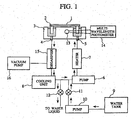
- reaction liquid a mixture of a sample and a reagent held in the reaction vessel 2
- the light that has penetrated the reaction liquid is measured by a multi-wavelength photometer 14 to perform qualitative and quantitative analysis of a specific component in the sample.
- the liquid supplied to the thermostat bath 3 and the liquid circulated therethrough are opened to air, respectively, in the water tank 9 and at the surface of the thermostat bath 3 into which the reaction vessel 2 is immersed. Therefore, these liquids are normally circulating in the thermostat bath in a state that dissolved gas is present therein. Dissolved gas in the liquids may appear as minute air bubbles (micro-bubbles) due to various factors such as temperature rise and pressure fluctuations by a pump. Such micro-bubbles may cause diffuse reflection of the light from the light source lamp, resulting in the deterioration of the photometry accuracy.
- a typical automatic analyzer performs simultaneously measures the absorbance of a main wavelength and a sub wavelength as a base line to use the absorbance difference between the two wavelengths for concentration calculation.
- the main wavelength is a wavelength at which an indicator substance reveals absorbance fluctuations in response to the concentration of the components under measurement.
- the sub wavelength is a wavelength that is not affected by absorbance fluctuations of the indicator substance responsive to the concentration of the components under measurement.
- the absorbance difference between the main and sub wavelengths is small in a region at which concentration of the components under measurement is low. In some cases, therefore, it is preferable to use the absorbance with a single wavelength as it is for calculation of the concentration in order to improve the measurement sensitivity. In such a case, however, deterioration in the photometry accuracy caused by particularly micro-bubbles will largely affect measurements.
- the present invention is configured such that a degasifier 15 is provided on a passage for circulating the liquid in the thermostat bath and then the dissolved gas in the liquid in the degasifier is degasified by using a vacuum pump 16 to remove the source itself from which micro-bubbles would otherwise be produced. Even if the liquid is degasified by the degasifier, gas redissolution from the surface into the inside of the liquid in the thermostat bath progresses unless the liquid is continuously degasified. Therefore, according to the present invention, a degasifier is provided in the circulation passage for performing temperature control of the liquid in the thermostat bath, thus enabling continuous deaeration.
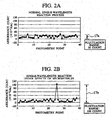
- Figs. 2A and 28 show a difference between a normal reaction process and a reaction process affected by micro-bubbles in photometry.
- the graph in Fig. 2A shows a normal reaction process and the graph in Fig. 28 a reaction process affected by micro-bubbles.
- the horizontal axis in each graph shows photometry points indicating the course of reaction, and the vertical axis the absorbance count.
- an absorbance change is perceived at a photometry timing of the 25th point, which will be regarded to be caused by the passage of micro-bubbles.
- Fig. 3 is a graph showing results obtained by comparing a relation between the dissolved oxygen concentration in the liquid circulating in the thermostat bath and the photometry stability using averages of reaction process fluctuation ranges in single wavelength photometry as indicator.
- the graph data shown in Fig. 3 is obtained under a condition where 37°C surfactant solution is used as a liquid circulating in the thermostat bath.
- the graph of Fig. 3 plots averages obtained by repetitively measuring 100 times reaction process fluctuation ranges (ranges shown by 17a and 17b of Figs. 2A and 28) indicating absorbance fluctuations of water with respect to a single dissolved oxygen concentration.
- reaction process fluctuation range With a dissolved oxygen concentration of less than 5.3 mg/L, the reaction process fluctuation range is reduced 1/3 times that in a case without deaeration (with a saturated-dissolved oxygen concentration of 6.86 mg/L in 37°C pure water). Since the reaction process fluctuation range is not further improved at a dissolved oxygen concentration lower than 5.3 mg/L, it turns out that the concentration of 5.3 mg/L is a threshold value required for stable photometry.
- the automatic analyzer may include a degasifier that meets the thus-obtained relevant condition. Also, the automatic analyzer may include a sensor for measuring the concentration of dissolved gas in the liquid circulating in the thermostat bath such that an alarm is generated if the dissolved gas concentration exceeds a threshold value inherent to the analyzer.
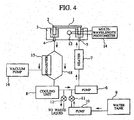
- Fig. 4 is a block diagram showing an embodiment of an automatic analyzer which applies a bypass passage in parallel with the degasifier passage according to the present invention.
- the present embodiment is provided with a bypass passage 18 in parallel with the degasifier passage in addition to the degasifier passage on the circulating passage in order to maintain the minimum flow rate necessary to perform temperature control of the liquid in the thermostat bath.
- the ratio of the flow rate of the degasifier passage to the flow rate of the bypass passage is such that both the flow rate of the entire circulation passage required for liquid temperature control and the deaeration capabilities of the liquid are satisfied.
- the automatic analyzer include a regulation valve for controlling the amounts of liquid flowing in the degasifier passage and the bypass passage such that the flow rate of the liquid for the degasifier passage is adjusted in response to measurements provided by the sensor.
Landscapes
- Physics & Mathematics (AREA)
- Health & Medical Sciences (AREA)
- Life Sciences & Earth Sciences (AREA)
- Chemical & Material Sciences (AREA)
- Analytical Chemistry (AREA)
- Biochemistry (AREA)
- General Health & Medical Sciences (AREA)
- General Physics & Mathematics (AREA)
- Immunology (AREA)
- Pathology (AREA)
- Automatic Analysis And Handling Materials Therefor (AREA)
- Investigating Or Analysing Materials By Optical Means (AREA)
- Optical Measuring Cells (AREA)
Applications Claiming Priority (1)
| Application Number | Priority Date | Filing Date | Title |
|---|---|---|---|
| JP2008047024A JP2009204445A (ja) | 2008-02-28 | 2008-02-28 | 自動分析装置 |
Publications (2)
| Publication Number | Publication Date |
|---|---|
| EP2096441A2 true EP2096441A2 (de) | 2009-09-02 |
| EP2096441A3 EP2096441A3 (de) | 2010-11-17 |
Family
ID=40792596
Family Applications (1)
| Application Number | Title | Priority Date | Filing Date |
|---|---|---|---|
| EP09001960A Withdrawn EP2096441A3 (de) | 2008-02-28 | 2009-02-12 | Automatisches Analysegerät |
Country Status (4)
| Country | Link |
|---|---|
| US (1) | US20090220383A1 (de) |
| EP (1) | EP2096441A3 (de) |
| JP (1) | JP2009204445A (de) |
| CN (1) | CN101520460A (de) |
Families Citing this family (17)
| Publication number | Priority date | Publication date | Assignee | Title |
|---|---|---|---|---|
| CN101982779B (zh) * | 2010-09-17 | 2012-07-25 | 济南齐力医疗器械有限公司 | 一种分析仪器的自动取样机构 |
| JP5950733B2 (ja) * | 2012-07-06 | 2016-07-13 | 株式会社日立ハイテクノロジーズ | 自動分析装置 |
| JP6165432B2 (ja) * | 2012-10-26 | 2017-07-19 | 東芝メディカルシステムズ株式会社 | 自動分析装置 |
| JP5772886B2 (ja) * | 2013-06-26 | 2015-09-02 | 東亜ディーケーケー株式会社 | 分析装置 |
| JP6156003B2 (ja) * | 2013-09-17 | 2017-07-05 | セイコーエプソン株式会社 | 液体噴射装置 |
| CN104914064A (zh) * | 2014-03-14 | 2015-09-16 | 株式会社岛津制作所 | 分析装置 |
| CN106662594B (zh) * | 2014-06-26 | 2019-01-22 | 株式会社日立高新技术 | 自动分析装置 |
| CN106771078B (zh) * | 2017-01-06 | 2023-05-30 | 中国科学院地球化学研究所 | 一种界面二氧化碳交换通量连续自动测定装置 |
| CN114026432B (zh) * | 2019-06-26 | 2025-08-08 | 株式会社日立高新技术 | 自动分析装置 |
| US20230078595A1 (en) * | 2020-02-26 | 2023-03-16 | Hitachi High-Tech Corporation | Automatic analyzer |
| CN112213266B (zh) * | 2020-09-29 | 2021-05-14 | 湖北鑫英泰系统技术股份有限公司 | 一种具有激光器调温功能的激光监控装置 |
| JP7664106B2 (ja) | 2021-07-15 | 2025-04-17 | 株式会社日立ハイテク | 自動分析装置 |
| CN118140147A (zh) * | 2021-11-09 | 2024-06-04 | Dic株式会社 | 自动分析装置和自动分析方法 |
| JP7400870B2 (ja) * | 2022-05-13 | 2023-12-19 | Dic株式会社 | 化学分析装置 |
| JP7400872B2 (ja) * | 2022-05-13 | 2023-12-19 | Dic株式会社 | 化学分析装置 |
| JP7400871B2 (ja) * | 2022-05-13 | 2023-12-19 | Dic株式会社 | 化学分析装置 |
| JP7400869B2 (ja) * | 2022-05-13 | 2023-12-19 | Dic株式会社 | 化学分析装置 |
Citations (1)
| Publication number | Priority date | Publication date | Assignee | Title |
|---|---|---|---|---|
| JP2005181087A (ja) | 2003-12-19 | 2005-07-07 | Hitachi High-Technologies Corp | 自動分析装置 |
Family Cites Families (8)
| Publication number | Priority date | Publication date | Assignee | Title |
|---|---|---|---|---|
| JPS6385334A (ja) * | 1986-09-30 | 1988-04-15 | Toshiba Corp | 分析装置用恒温装置 |
| JPH0696099B2 (ja) * | 1989-03-02 | 1994-11-30 | 武 仁多見 | 気液分離装置 |
| JPH0738982B2 (ja) * | 1991-04-17 | 1995-05-01 | 日東電工株式会社 | 循環冷却水の脱気方法 |
| JPH0812854B2 (ja) * | 1993-01-22 | 1996-02-07 | 日本電気株式会社 | ウェットエッチング装置 |
| DE4446270C1 (de) * | 1994-12-23 | 1996-02-29 | Hewlett Packard Gmbh | Basisstruktur für einen Flüssigkeitschromatographie-Entgaser |
| JPH09318635A (ja) * | 1996-05-30 | 1997-12-12 | Hitachi Ltd | 自動分析装置 |
| TW522455B (en) * | 1998-11-09 | 2003-03-01 | Ebara Corp | Plating method and apparatus therefor |
| FR2857753B1 (fr) * | 2003-07-18 | 2006-05-05 | Millipore Corp | Appareil analyseur equipe de moyens de purification d'eau |
-
2008
- 2008-02-28 JP JP2008047024A patent/JP2009204445A/ja active Pending
-
2009
- 2009-01-16 US US12/355,266 patent/US20090220383A1/en not_active Abandoned
- 2009-02-12 EP EP09001960A patent/EP2096441A3/de not_active Withdrawn
- 2009-02-20 CN CN200910004194A patent/CN101520460A/zh active Pending
Patent Citations (1)
| Publication number | Priority date | Publication date | Assignee | Title |
|---|---|---|---|---|
| JP2005181087A (ja) | 2003-12-19 | 2005-07-07 | Hitachi High-Technologies Corp | 自動分析装置 |
Also Published As
| Publication number | Publication date |
|---|---|
| US20090220383A1 (en) | 2009-09-03 |
| JP2009204445A (ja) | 2009-09-10 |
| EP2096441A3 (de) | 2010-11-17 |
| CN101520460A (zh) | 2009-09-02 |
Similar Documents
| Publication | Publication Date | Title |
|---|---|---|
| EP2096441A2 (de) | Automatisches Analysegerät | |
| US9989548B2 (en) | Automatic analyzer and method | |
| EP3163305B1 (de) | Automatische analytische vorrichtung | |
| JP4185859B2 (ja) | 自動分析装置 | |
| RU2013124969A (ru) | Способ и устройство для определения параметров системы в целях уменьшения коррозии в установке первичной обработки нефти | |
| CN105738287B (zh) | 水质分析仪 | |
| JP4817100B2 (ja) | 水質モニタリング装置 | |
| US7193717B2 (en) | System and method for analyzing microbial growth | |
| CN105452849A (zh) | 同时测量液体样品的浊度、颜色和氯含量的系统和方法 | |
| US11573109B2 (en) | Measurement of fluid parameters | |
| JP7229060B2 (ja) | 自動分析装置 | |
| JP5702587B2 (ja) | 自動分析装置及び分析方法 | |
| JP7778955B2 (ja) | 自動分析装置および自動分析装置の光源安定化方法 | |
| US8507262B2 (en) | Apparatus and method for monitoring cultures | |
| JPH049750A (ja) | 恒温槽浸漬型分析装置 | |
| CN115575187A (zh) | 一种水质分析仪进液补偿控制系统 | |
| CN110865197A (zh) | 一种分析分析物的离散样品等分试样的方法 |
Legal Events
| Date | Code | Title | Description |
|---|---|---|---|
| PUAI | Public reference made under article 153(3) epc to a published international application that has entered the european phase |
Free format text: ORIGINAL CODE: 0009012 |
|
| 17P | Request for examination filed |
Effective date: 20090312 |
|
| AK | Designated contracting states |
Kind code of ref document: A2 Designated state(s): AT BE BG CH CY CZ DE DK EE ES FI FR GB GR HR HU IE IS IT LI LT LU LV MC MK MT NL NO PL PT RO SE SI SK TR |
|
| AX | Request for extension of the european patent |
Extension state: AL BA RS |
|
| PUAL | Search report despatched |
Free format text: ORIGINAL CODE: 0009013 |
|
| AK | Designated contracting states |
Kind code of ref document: A3 Designated state(s): AT BE BG CH CY CZ DE DK EE ES FI FR GB GR HR HU IE IS IT LI LT LU LV MC MK MT NL NO PL PT RO SE SI SK TR |
|
| AX | Request for extension of the european patent |
Extension state: AL BA RS |
|
| AKX | Designation fees paid |
Designated state(s): DE FR |
|
| STAA | Information on the status of an ep patent application or granted ep patent |
Free format text: STATUS: THE APPLICATION IS DEEMED TO BE WITHDRAWN |
|
| 18D | Application deemed to be withdrawn |
Effective date: 20110518 |