EP2094532B1 - Türverkleidung, insbesondere für ein kraftfahrzeug, und fertigungsverfahren - Google Patents
Türverkleidung, insbesondere für ein kraftfahrzeug, und fertigungsverfahren Download PDFInfo
- Publication number
- EP2094532B1 EP2094532B1 EP20070819106 EP07819106A EP2094532B1 EP 2094532 B1 EP2094532 B1 EP 2094532B1 EP 20070819106 EP20070819106 EP 20070819106 EP 07819106 A EP07819106 A EP 07819106A EP 2094532 B1 EP2094532 B1 EP 2094532B1
- Authority
- EP
- European Patent Office
- Prior art keywords
- fleece
- absorber
- release film
- motor vehicle
- production method
- Prior art date
- Legal status (The legal status is an assumption and is not a legal conclusion. Google has not performed a legal analysis and makes no representation as to the accuracy of the status listed.)
- Not-in-force
Links
- 238000004519 manufacturing process Methods 0.000 title claims 2
- 239000006096 absorbing agent Substances 0.000 claims description 21
- 239000000835 fiber Substances 0.000 claims description 12
- 239000011888 foil Substances 0.000 claims description 5
- 239000004033 plastic Substances 0.000 claims description 4
- 229920003023 plastic Polymers 0.000 claims description 4
- 238000001816 cooling Methods 0.000 claims description 2
- 238000007493 shaping process Methods 0.000 claims 1
- 239000003795 chemical substances by application Substances 0.000 description 11
- 239000004743 Polypropylene Substances 0.000 description 10
- 229920001155 polypropylene Polymers 0.000 description 10
- 238000000034 method Methods 0.000 description 8
- -1 polypropylene Polymers 0.000 description 7
- 238000003856 thermoforming Methods 0.000 description 7
- 238000010438 heat treatment Methods 0.000 description 6
- 239000002131 composite material Substances 0.000 description 4
- 239000004744 fabric Substances 0.000 description 3
- 229920000728 polyester Polymers 0.000 description 3
- 239000004698 Polyethylene Substances 0.000 description 2
- 239000006260 foam Substances 0.000 description 2
- 239000010410 layer Substances 0.000 description 2
- 239000000463 material Substances 0.000 description 2
- 238000002360 preparation method Methods 0.000 description 2
- 238000004080 punching Methods 0.000 description 2
- 229920012266 Poly(ether sulfone) PES Polymers 0.000 description 1
- 239000004695 Polyether sulfone Substances 0.000 description 1
- 238000010521 absorption reaction Methods 0.000 description 1
- 239000002318 adhesion promoter Substances 0.000 description 1
- 239000000853 adhesive Substances 0.000 description 1
- 238000004026 adhesive bonding Methods 0.000 description 1
- 230000001070 adhesive effect Effects 0.000 description 1
- 238000003490 calendering Methods 0.000 description 1
- 239000004745 nonwoven fabric Substances 0.000 description 1
- 229920006393 polyether sulfone Polymers 0.000 description 1
- 229920000573 polyethylene Polymers 0.000 description 1
- 229920000098 polyolefin Polymers 0.000 description 1
- 239000000843 powder Substances 0.000 description 1
- 238000003825 pressing Methods 0.000 description 1
- 230000005855 radiation Effects 0.000 description 1
- 238000007789 sealing Methods 0.000 description 1
- 239000002356 single layer Substances 0.000 description 1
- 238000002604 ultrasonography Methods 0.000 description 1
Images
Classifications
-
- B—PERFORMING OPERATIONS; TRANSPORTING
- B60—VEHICLES IN GENERAL
- B60R—VEHICLES, VEHICLE FITTINGS, OR VEHICLE PARTS, NOT OTHERWISE PROVIDED FOR
- B60R13/00—Elements for body-finishing, identifying, or decorating; Arrangements or adaptations for advertising purposes
- B60R13/02—Internal Trim mouldings ; Internal Ledges; Wall liners for passenger compartments; Roof liners
- B60R13/0237—Side or rear panels
- B60R13/0243—Doors
-
- B—PERFORMING OPERATIONS; TRANSPORTING
- B60—VEHICLES IN GENERAL
- B60R—VEHICLES, VEHICLE FITTINGS, OR VEHICLE PARTS, NOT OTHERWISE PROVIDED FOR
- B60R13/00—Elements for body-finishing, identifying, or decorating; Arrangements or adaptations for advertising purposes
- B60R13/08—Insulating elements, e.g. for sound insulation
- B60R13/0892—Insulating elements, e.g. for sound insulation for humidity insulation
-
- Y—GENERAL TAGGING OF NEW TECHNOLOGICAL DEVELOPMENTS; GENERAL TAGGING OF CROSS-SECTIONAL TECHNOLOGIES SPANNING OVER SEVERAL SECTIONS OF THE IPC; TECHNICAL SUBJECTS COVERED BY FORMER USPC CROSS-REFERENCE ART COLLECTIONS [XRACs] AND DIGESTS
- Y10—TECHNICAL SUBJECTS COVERED BY FORMER USPC
- Y10T—TECHNICAL SUBJECTS COVERED BY FORMER US CLASSIFICATION
- Y10T442/00—Fabric [woven, knitted, or nonwoven textile or cloth, etc.]
- Y10T442/60—Nonwoven fabric [i.e., nonwoven strand or fiber material]
- Y10T442/659—Including an additional nonwoven fabric
-
- Y—GENERAL TAGGING OF NEW TECHNOLOGICAL DEVELOPMENTS; GENERAL TAGGING OF CROSS-SECTIONAL TECHNOLOGIES SPANNING OVER SEVERAL SECTIONS OF THE IPC; TECHNICAL SUBJECTS COVERED BY FORMER USPC CROSS-REFERENCE ART COLLECTIONS [XRACs] AND DIGESTS
- Y10—TECHNICAL SUBJECTS COVERED BY FORMER USPC
- Y10T—TECHNICAL SUBJECTS COVERED BY FORMER US CLASSIFICATION
- Y10T442/00—Fabric [woven, knitted, or nonwoven textile or cloth, etc.]
- Y10T442/60—Nonwoven fabric [i.e., nonwoven strand or fiber material]
- Y10T442/674—Nonwoven fabric with a preformed polymeric film or sheet
- Y10T442/678—Olefin polymer or copolymer sheet or film [e.g., polypropylene, polyethylene, ethylene-butylene copolymer, etc.]
-
- Y—GENERAL TAGGING OF NEW TECHNOLOGICAL DEVELOPMENTS; GENERAL TAGGING OF CROSS-SECTIONAL TECHNOLOGIES SPANNING OVER SEVERAL SECTIONS OF THE IPC; TECHNICAL SUBJECTS COVERED BY FORMER USPC CROSS-REFERENCE ART COLLECTIONS [XRACs] AND DIGESTS
- Y10—TECHNICAL SUBJECTS COVERED BY FORMER USPC
- Y10T—TECHNICAL SUBJECTS COVERED BY FORMER US CLASSIFICATION
- Y10T442/00—Fabric [woven, knitted, or nonwoven textile or cloth, etc.]
- Y10T442/60—Nonwoven fabric [i.e., nonwoven strand or fiber material]
- Y10T442/696—Including strand or fiber material which is stated to have specific attributes [e.g., heat or fire resistance, chemical or solvent resistance, high absorption for aqueous compositions, water solubility, heat shrinkability, etc.]
Definitions
- the present invention relates to a process for producing a release agent.
- a release agent is for example from the DE 103 26 154 A1 , of the US 6, 197, 403 B1 , of the DE 35 10 018 C2, as well as the G 82 25 069 known.
- the vehicle door described in the documents is provided on the inside with a door panel, wherein the volume enclosed by the outer door panel and door panel is divided by means of a release agent into an outer wet space and an inner dry space. From the DE 200 06 192 U1 is also known as a release agent.
- the release agent has an absorber fleece with a base fleece made of plastic fibers.
- the plastic fibers are polyester fibers and / or polypropylene fibers. More preferably, the weight ratio between polyester fibers and polypropylene fibers is from 25:75 to 35:55, more preferably 30:70.
- the base fabric has a basis weight of 150 to 500 grams / m 2 , most preferably 170 to 220 grams / m 2 .
- the base fabric has a thickness of 5 to 30, preferably 7 to 20 mm.
- the separating film likewise present according to the invention is preferably made of polyolefin, preferably made of polypropylene.
- the film has a thickness between 0.1 and 4 mm, preferably 1 to 2 mm.
- the release agent according to the invention additionally comprises a cover fleece.
- the cover fleece is preferably substantially, most preferably entirely of polypropylene (PP) to improve adhesion to the PP backing.
- a function of the cover fleece may be to provide protection for the relatively fibrous ground fleece.
- the absorber fleece is preferably arranged between the cover fleece and the release film.
- the base fleece of another plastic material, for example polyethersulfone (PES) and then with an adhesion promoter, for example polyethylene powder, in order to enable or to improve the connection between the PP carrier and the base fleece.
- PES polyethersulfone
- an adhesion promoter for example polyethylene powder
- the absorber fleece and the release film are not only deformed during deep-drawing, but also bonded together in a material-locking manner.
- This material bond takes place in that the absorber fleece and / or the release film are heated to such an extent that, after or when they are stacked on one another, they may cohesively join together under the application of pressure during subsequent cooling.
- This has the advantage that no adhesive between the release film and the absorber fleece must be used.
- the release film is heated prior to deformation.
- the release film is heated at least up to its plasticizing temperature.
- the heating 4 of the release film 1 can be carried out with any energy input known to the person skilled in the art, for example by means of radiation, contact heating, convection, ultrasound or a combination thereof.
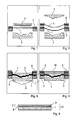
- an absorber fleece 5 which is specified in more detail below and which is held by a further frame 6 is arranged above the separating foil 1 ( Fig. 2 ).
- thermoforming tool 3 stamp 7 By means of a movable in the direction of the thermoforming tool 3 stamp 7, which may for example consist of a 10 cm thick foam, absorber web 5 and release film 1 are pressed together in the thermoforming mold 3 and simultaneously pulled by vacuum V at its three-dimensionally shaped mold surface ( Fig. 3 ). Due to the remaining heat of the release film 1, the release film 1 and the absorber nonwoven fabric 5 enter into an intimate, in particular cohesive, composite, which is subsequently punched (tool W in FIG Fig. 4 ) can be provided in the desired shape and with the necessary recesses. Thereafter, the punch 7 and the deep-drawing die 3 are again removed from each other and the prepared release agent can be removed. Alternatively, the release film 1 is heated and then pre-blown.
- thermoforming punch in the pre-blown release film 1 and vacuum is applied, so that the release film applies to the thermoforming punch.
- the Absorbervlies 5 is pressed with a foam stamp on the thermoformed release film.
- the inventive method can be carried out very easily and inexpensively. The deformation of the release film, the Absorbervlieses and their cohesive connection takes place in a process step, so that the inventive method is much easier to perform than the method according to the prior art.
- the absorber fleece 5 used is preferably a composite with a base fleece 8, which consists of polyester fibers and polypropylene fibers, preferably in a weight ratio of 25:75 to 35:55, in particular about 30:70.
- a cover fleece 9 is placed at least on one side, which contains only polypropylene fibers and the composite gives a certain strength or protects the very fibrous absorber fleece.
- this cover fleece 9 is as in FIG Fig. 5 shown, after pressing on the release film 1 preferably arranged on the side facing away from this surface side.
- the layers 8, 9 are preferably bonded together by sealing or gluing together.
- the preparation of the absorber nonwoven preferably takes place in time prior to carrying out the method according to the invention.
- a single-layer absorber fleece whose at least one, preferably both surface (s) calendered; i.e. e.g. are heat treated to solidify them.
- PP and / or PE fibers can be mixed with a nonwoven made of PES fibers.
Landscapes
- Engineering & Computer Science (AREA)
- Mechanical Engineering (AREA)
- Physics & Mathematics (AREA)
- Acoustics & Sound (AREA)
- Laminated Bodies (AREA)
- Nonwoven Fabrics (AREA)
- Blow-Moulding Or Thermoforming Of Plastics Or The Like (AREA)
- Vehicle Interior And Exterior Ornaments, Soundproofing, And Insulation (AREA)
- Solid-Sorbent Or Filter-Aiding Compositions (AREA)
Description
- Die vorliegende Erfindung betrifft ein Verfahren zur Herstellung eines Trennmittels.
- Ein Trennmittel ist beispielsweise aus der
DE 103 26 154 A1 , derUS 6, 197, 403 B1 , derDE 35 10 018 C2, sowie der G 82 25 069 bekannt. Die in den Druckschriften beschriebene Fahrzeugtür ist innenraumseitig mit einer Türverkleidung versehen, wobei das von äußerem Türblech und Türverkleidung umschlossene Volumen mittels eines Trennmittels in einen äußeren Nassraum und einen inneren Trockenraum unterteilt ist. Aus derDE 200 06 192 U1 ist ebenfalls ein Trennmittel bekannt. - Es war die Aufgabe der vorliegenden Erfindung ein Verfahren zur Herstellung eines Trennmittels zur Verfügung zu stellen.
- Gelöst wird die Aufgabe mit einem Verfahren nach Anspruch 1.
- Es war für den Fachmann überaus erstaunlich und nicht zu erwarten, dass sich mit dem Trennmittel verbesserte akustische Absorptionseigenschaften erzielen lassen. Dadurch wird die Geräuschbelastung im Fahrzeuginneren deutlich reduziert, was den Fahrkomfort den Fahrzeuginsassen erhöht.
- Das Trennmittel weist ein Absorbervlies mit einem Grundvlies aus Kunststofffasern auf. Vorzugsweise handelt es sich bei den Kunststofffasern um Polyesterfasern und/oder Polypropylenfasern. Besonders bevorzugt beträgt das Gewichtsverhältnis zwischen Polyesterfasern und Polypropylenfasern von 25:75 bis 35:55, besonders bevorzugt jedoch 30:70.
- Vorzugsweise hat das Grundvlies ein Flächengewicht von 150 bis 500 Gramm/m2, ganz besonders bevorzugt 170 bis 220 Gramm/m2.
- Vorzugsweise weist das Grundvlies eine Dicke von 5 bis 30 vorzugsweise 7 bis 20 mm auf.
- Die erfindungsgemäß ebenfalls vorhandene Trennfolie ist vorzugsweise aus Polyolefin besonders bevorzugt aus Polypropylen gefertigt. Vorzugsweise weist die Folie eine Dicke zwischen 0,1 und 4 mm vorzugsweise 1 bis 2 mm auf.
- Vorzugsweise weist das erfindungsgemäße Trennmittel zusätzlich ein Deckvlies auf. Das Deckvlies besteht vorzugsweise im wesentlichen, ganz besonders bevorzugt vollständig aus Polypropylen (PP) um die Haftung zu dem PP-Träger zu verbessern. Eine Funktion des Deckvlieses kann darin bestehen, einen Schutz für das vergleichsweise fasrige Grundvlies zur Verfügung zu stellen.
- Vorzugsweise ist das Absorbervlies zwischen dem Deckvlies und der Trennfolie angeordnet.
- Es ist jedoch auch denkbar das Grundvlies aus einem anderen Kunststoffmaterial, beispielsweise Polyethersulfon (PES) und dann mit einem Haftvermittler, beispielsweise Polyethylen-Puder, zu versehen, um die Verbindung zwischen dem PP-Träger und dem Grundvlies zu ermöglichen bzw. zu verbessern.
- Erfindungsgemäß werden das Absorbervlies und die Trennfolie beim Tiefziehen nicht nur verformt sondern auch stoffschlüssig miteinander verbunden. Dieser Stoffschluss erfolgt dadurch, dass das Absorbervlies und/oder die Trennfolie so stark erwärmt werden, dass sie sich nach oder beim Aufeinanderlegen ggf. unter der Anwendung von Druck beim anschließenden Erkalten miteinander stoffschlüssig verbinden. Dies hat den Vorteil, dass kein Klebstoff zwischen der Trennfolie und dem Absorbervlies eingesetzt werden muss.
- Erfindungsgemäß wird die Trennfolie vor dem Verformen erwärmt. Vorzugsweise wird die Trennfolie dabei mindestens bis zu ihrer Plastifizierungstemperatur erwärmt.
- Im folgenden wird die Erfindung anhand der
Figuren 1 bis 5 erläutert. Diese Erläuterungen sind lediglich beispielhaft und schränken den allgemeinen Erfindungsgedanken nicht ein. Die Erläuterungen gelten für alle Gegenstände der vorliegenden Erfindung gleichermaßen. - Figur 1
- zeigt das Erwärmen der Trennfolie.
- Figur 2
- zeigt das Anordnen des Absorbervlieses oberhalb der Trennfolie.
- Figur 3
- zeigt das gemeinsame Tiefziehen der Trennfolie und des Absorbervlieses.
- Figur 4
- zeigt das Stanzen des Verbundes aus Trennfolie und Absorbervlies.
- Figur 5
- zeigt schematisch das erfindungsgemäße Trennmittel.
- Zunächst wird, wie in
Fig. 1 gezeigt, die noch ebene Trennfolie 1 in einen ersten Rahmen 2 gespannt, oberhalb eines Tiefziehwerkzeugs 3 positioniert und von oben mittels einer Heizung 4 erwärmt bis sie mindestens ihre Plastifizierungstemperatur erreicht hat. Die Erwärmung 4 der Trennfolie 1 kann mit jedem dem Fachmann geläufigen Energieeintrag, beispielsweise mittels Strahlung, Kontaktheizung, Konvektion, Ultraschall oder einer Kombination aus diesen erfolgen. Nach dem Verfahrensschritt der Heizung 4 wird ein nachfolgend näher spezifiziertes Absorbervlies 5, welches von einem weiteren Rahmen 6 gehalten wird, oberhalb der Trennfolie 1 angeordnet (Fig. 2 ). Mittels eines in Richtung des Tiefziehwerkzeugs 3 verfahrbaren Stempels 7, welcher beispielsweise aus einem 10 cm dicken Schaum bestehen kann, werden Absorbervlies 5 und Trennfolie 1 gemeinsam in das Tiefziehwerkzeug 3 gepresst und gleichzeitig durch Vakuum V an dessen dreidimensional geformte Formoberfläche gezogen (Fig. 3 ). Durch die noch vorhandene Restwärme der Trennfolie 1, gehen die Trennfolie 1 und das Absorbervlies 5 dabei einen innigen, insbesondere stoffschlüssigen, Verbund ein, der nachfolgend durch Stanzen (Werkzeug W inFig. 4 ) in die gewünschte Form und mit den notwendigen Ausnehmungen versehen werden kann. Danach werden der Stempel 7 und das Tiefziehwerkzeug 3 wieder voneinander entfernt und das hergestellte Trennmittel kann entnommen werden. Alternativ wird die Trennfolie 1 aufgeheizt und dann vorgeblasen. In einem nächsten Schritt fährt ein Tiefziehstempel in die vorgeblasene Trennfolie 1 und Vakuum wird angelegt, so dass sich die Trennfolie an den Tiefziehstempel anlegt. Anschließend wird das Absorbervlies 5 mit einem Schaumstempel auf die tiefgezogene Trennfolie aufgepresst. Das erfindungsgemäße Verfahren kann sehr einfach und kostengünstig durchgeführt werden. Die Verformung der Trennfolie, des Absorbervlieses sowie deren stoffschlüssige Verbindung erfolgt in einem Verfahrensschritt, so dass das erfindungsgemäße Verfahren wesentlich einfacher durchzuführen ist als die Verfahren gemäß dem Stand der Technik. - Als Absorbervlies 5 wird vorzugsweise ein Verbund mit einem Grundvlies 8 eingesetzt, welches aus Polyesterfasern und Polypropylenfasern, vorzugsweise in einem Gewichtsverhältnis von 25:75 bis 35:55, insbesondere etwa 30:70, besteht. Auf dieses Flächengebilde wird vorzugsweise zumindest einseitig ein Deckvlies 9 aufgesetzt, welches ausschließlich Polypropylenfasern enthält und dem Verbund eine gewisse Festigkeit verleiht bzw. das sehr faserige Absorbervlies schützt. Bei einem nur zweilagigen Absorbervlies 5 ist dieses Deckvlies 9, wie in
Fig. 5 dargestellt, nach dem Aufpressen auf die Trennfolie 1 vorzugsweise auf der von dieser abgewandten Flächenseite angeordnet. Die Lagen 8, 9 sind vorzugsweise stoffschlüssig, durch Siegeln oder Kleben, miteinander verbunden. Die Herstellung des Absorbervlieses erfolgt zeitlich vorzugsweise vor der Durchführung des erfindungsgemäßen Verfahren. - Vorzugsweise wird ein einlagiges Absorbervlies, dessen mindestens eine, vorzugsweise beide Oberfläche(n) kalandriert; d.h. z.B. wärmebehandelt sind, um diese zu verfestigen.
- Für eine bessere Haftung können einem Vlies aus PES-Fasem PP und/oder PE-Fasern beigemischt werden.
-
- 1
- Trennfolie
- 2
- Rahmen
- 3
- Tiefziehwerkzeug
- 4
- Heizung, Erwärmung
- 5
- Absorbervlies
- 6
- Rahmen
- 7
- Stempel
- 8
- Grundvlies
- 9
- Deckvlies
- 10
- Trennmittel
- V
- Vakum
- W
- Stanzwerkzeug
Claims (1)
- Verfahren zur Herstellung eines Trennmittels, das das Volumen zwischen Türblech und Türverkleidung in einen äußeren Nassraum und einen inneren Trockenraum unterteilt und das aus einem Verbund aus einer Trennfolie (1) und einem Absorbervlies (5) besteht wobei das Absorbervlies (5) aus einem Grundvlies (8) aus Kunststofffasern besteht, bei dem die Trennfolie (1) und das Absorbervlies (5) gemeinsam verformt, vorzugsweise tiefgezogen, werden, dadurch gekennzeichnet. dass die Trennfolie vor dem Verformen erwärmt wird und das Absorbervlies (5) und die Trennfolie (1) beim Tiefziehen verbunden werden, indem sie sich nach dem Erkalten miteinander stoffschlüssig verbinden.
Applications Claiming Priority (3)
| Application Number | Priority Date | Filing Date | Title |
|---|---|---|---|
| DE102006050474 | 2006-10-20 | ||
| DE200710015600 DE102007015600B4 (de) | 2006-10-20 | 2007-03-29 | Verfahren zur Herstellung eines Trennmittels |
| PCT/EP2007/009041 WO2008046618A1 (de) | 2006-10-20 | 2007-10-18 | Türverkleidung, insbesondere für ein kraftfahrzeug, und fertigungsverfahren |
Publications (2)
| Publication Number | Publication Date |
|---|---|
| EP2094532A1 EP2094532A1 (de) | 2009-09-02 |
| EP2094532B1 true EP2094532B1 (de) | 2013-10-16 |
Family
ID=38973775
Family Applications (1)
| Application Number | Title | Priority Date | Filing Date |
|---|---|---|---|
| EP20070819106 Not-in-force EP2094532B1 (de) | 2006-10-20 | 2007-10-18 | Türverkleidung, insbesondere für ein kraftfahrzeug, und fertigungsverfahren |
Country Status (6)
| Country | Link |
|---|---|
| US (1) | US20110092124A1 (de) |
| EP (1) | EP2094532B1 (de) |
| JP (1) | JP2010506779A (de) |
| CN (1) | CN101557963B (de) |
| DE (1) | DE102007015600B4 (de) |
| WO (1) | WO2008046618A1 (de) |
Families Citing this family (5)
| Publication number | Priority date | Publication date | Assignee | Title |
|---|---|---|---|---|
| DE102009017361B4 (de) | 2009-04-14 | 2013-03-28 | Airbus Operations Gmbh | Vorrichtung und Verfahren zum Drapieren von Fasergewirken für gekrümmte Profilstrukturteile aus Faserverbundmaterial |
| DK2720862T3 (en) | 2011-06-17 | 2016-09-19 | Fiberweb Inc | Vapor permeable, water impervious TOTAL MAJOR MULTI-LAYER ARTICLE |
| WO2012178027A2 (en) | 2011-06-23 | 2012-12-27 | Fiberweb, Inc. | Vapor-permeable, substantially water-impermeable multilayer article |
| DK2723568T3 (en) | 2011-06-23 | 2017-10-23 | Fiberweb Llc | Vapor permeable, essentially all water impermeable, multilayer |
| EP2723567A4 (de) | 2011-06-24 | 2014-12-24 | Fiberweb Inc | Dampfdurchlässiger und im wesentlichen wasserundurchlässiger mehrschichtiger artikel |
Family Cites Families (15)
| Publication number | Priority date | Publication date | Assignee | Title |
|---|---|---|---|---|
| DE8225069U1 (de) * | 1983-02-03 | Pelz, Ernst, 8192 Geretsried | Feuchtigkeitsbeweisende Türverkleidung | |
| DE3220768C2 (de) * | 1982-06-02 | 1986-10-16 | ERPE - Ernst Pelz - Vertriebs GmbH + Co - Verwaltungs KG, 8581 Vorbach | Verfahren zum Herstellen von mit einer strukturierten Dekorschicht versehenen Formteilen aus Faservliesen |
| DE3510018A1 (de) * | 1984-06-30 | 1986-01-23 | Hilmar 5630 Remscheid Herrmann | Wasserschutzbekleidung zum abdecken von karosserieteilen gegen von aussen in den fahrgastraum eindringende naesse |
| DE4209024B4 (de) * | 1992-01-17 | 2005-10-27 | Carcoustics Tech Center Gmbh | Isolationsteil |
| DE9219007U1 (de) * | 1992-06-04 | 1996-11-28 | Lignotock Gmbh, 36205 Sontra | Mehrschicht-Faservliesmatte aus bindemittelhaltigen Zellulose- oder Lignozellulosefasern |
| US5298694A (en) * | 1993-01-21 | 1994-03-29 | Minnesota Mining And Manufacturing Company | Acoustical insulating web |
| FR2732934B1 (fr) * | 1995-04-11 | 1997-05-23 | Sofitec Sa | Protection de panneau de garnissage pour habitacle de vehicule |
| JPH0924777A (ja) * | 1995-07-13 | 1997-01-28 | Ikeda Bussan Co Ltd | 内装構造 |
| US6197403B1 (en) * | 1998-04-06 | 2001-03-06 | Hp Pelzer (Automotive Systems), Inc. | Integral sound absorber and water deflector door panel |
| JP2000085085A (ja) * | 1998-09-10 | 2000-03-28 | Oji Paper Co Ltd | 成形用積層体およびそれを用いた内装部品 |
| DE20006192U1 (de) * | 2000-04-04 | 2001-08-09 | Odenwald-Chemie GmbH, 69250 Schönau | Formteil |
| DE10105843A1 (de) * | 2001-01-16 | 2002-07-18 | Fleissner Gerold | Verfahren und Vorrichtung zum Transport eines Vlieses zwischen zwei mit Abstand voneinander angeordneten Walzen |
| DE20122399U1 (de) * | 2001-05-17 | 2005-10-13 | Sächsisches Textilforschungsinstitut e.V. | Soft-Touch-Formteil für die Fahrzeuginnenausstattung |
| DE10326154B4 (de) * | 2003-06-06 | 2005-09-08 | Johnson Controls Interiors Gmbh & Co. Kg | Türmodul für Fahrzeugtür |
| DE102005043183A1 (de) * | 2005-09-09 | 2007-03-22 | Johnson Controls Interiors Gmbh & Co. Kg | Kraftfahrzeugtür |
-
2007
- 2007-03-29 DE DE200710015600 patent/DE102007015600B4/de not_active Expired - Fee Related
- 2007-10-18 CN CN2007800443351A patent/CN101557963B/zh active Active
- 2007-10-18 WO PCT/EP2007/009041 patent/WO2008046618A1/de not_active Ceased
- 2007-10-18 US US12/446,377 patent/US20110092124A1/en not_active Abandoned
- 2007-10-18 JP JP2009532725A patent/JP2010506779A/ja active Pending
- 2007-10-18 EP EP20070819106 patent/EP2094532B1/de not_active Not-in-force
Also Published As
| Publication number | Publication date |
|---|---|
| CN101557963B (zh) | 2011-06-01 |
| WO2008046618A1 (de) | 2008-04-24 |
| DE102007015600A1 (de) | 2008-04-30 |
| US20110092124A1 (en) | 2011-04-21 |
| DE102007015600B4 (de) | 2015-04-02 |
| JP2010506779A (ja) | 2010-03-04 |
| EP2094532A1 (de) | 2009-09-02 |
| CN101557963A (zh) | 2009-10-14 |
Similar Documents
| Publication | Publication Date | Title |
|---|---|---|
| EP0671259B1 (de) | Mehrschichtplatte oder Körper mit einem Kern, der Naturfasern enthält und Verfahren zu deren Herstellung | |
| EP2525962B1 (de) | Sandwichbauteil und verfahren zu dessen herstellung | |
| EP3083249B1 (de) | Verfahren zum herstellen eines sandwichbauteils | |
| DE10255039B4 (de) | Flächiges verpresstes Verbundstoffformteil mit Schichtaufbau mit mindestens einer hohlraumbildenden Kernlage | |
| EP1646492B1 (de) | Innenausstattungskomponenten von kraftfahrzeugen mit einem definierten oberflächenprofil | |
| EP2925506B1 (de) | Verfahren zur herstellung wenigstens zweilagiger bauteile | |
| DE102013206086A1 (de) | Mehrschichtiges Strukturbauteil | |
| EP0713759A2 (de) | Verfahren zur Herstellung eines kaschierten Warmformteils | |
| EP2094532B1 (de) | Türverkleidung, insbesondere für ein kraftfahrzeug, und fertigungsverfahren | |
| WO2014121974A1 (de) | Füllkörper zum einführen in einen hohlraum z.b. einer fahrzeugkarosserie, herstellungsverfahren für einen solchen füllkörper sowie verfahren zum akustischen abdichten eines hohlraums z.b. einer fahrzeugkarosserie | |
| EP2529916B1 (de) | Verfahren zum Herstellen eines kaschierten Formteils | |
| EP2251858A1 (de) | Luftschall isolierender Materialaufbau | |
| EP1103424B1 (de) | Verfahren zum Herstellen eines Mehrschichtmaterials und Mehrschichtmaterial | |
| EP1151841B1 (de) | Belederungsteil für eine Fahrzeuginnenraumverkleidung und Verfahren zur Herstellung derselben | |
| DE4400894A1 (de) | Verfahren zur Herstellung von Innenbauteilen für Kraftfahrzeuge | |
| EP2737987B1 (de) | Verfahren und Vorrichtung zur Herstellung eines Innenverkleidungsteils | |
| DE102009017758A1 (de) | Dachhimmelelement für ein Kraftfahrzeug | |
| EP0993935B1 (de) | Verfahren zur Herstellung einer Dachversteifung für Fahrzeuge und Dachversteifung | |
| WO2011003629A1 (de) | Verkleidungsteil und verfahren zur herstellung eines verkleidungsteils | |
| DE4224667C2 (de) | Herstellung einer mehrlagigen Wandverkleidung | |
| DE102015221967A1 (de) | Verfahren zur Herstellung eines naturfaserverstärkten Innenverkleidungsteils | |
| DE19827362A1 (de) | Aufgeschäumtes Formteil | |
| EP1682321B1 (de) | Herstellung einer fahrzeug-innenverkleidung | |
| DE10253825A1 (de) | Verfahren zur Herstellung eines Werkstoffverbundes | |
| DE102014207948B4 (de) | Verfahren zum stoffschlüssigen Verbinden von Fahrzeugbauteilen |
Legal Events
| Date | Code | Title | Description |
|---|---|---|---|
| PUAI | Public reference made under article 153(3) epc to a published international application that has entered the european phase |
Free format text: ORIGINAL CODE: 0009012 |
|
| 17P | Request for examination filed |
Effective date: 20090520 |
|
| AK | Designated contracting states |
Kind code of ref document: A1 Designated state(s): AT BE BG CH CY CZ DE DK EE ES FI FR GB GR HU IE IS IT LI LT LU LV MC MT NL PL PT RO SE SI SK TR |
|
| 17Q | First examination report despatched |
Effective date: 20091008 |
|
| DAX | Request for extension of the european patent (deleted) | ||
| GRAP | Despatch of communication of intention to grant a patent |
Free format text: ORIGINAL CODE: EPIDOSNIGR1 |
|
| INTG | Intention to grant announced |
Effective date: 20130507 |
|
| GRAS | Grant fee paid |
Free format text: ORIGINAL CODE: EPIDOSNIGR3 |
|
| GRAA | (expected) grant |
Free format text: ORIGINAL CODE: 0009210 |
|
| AK | Designated contracting states |
Kind code of ref document: B1 Designated state(s): AT BE BG CH CY CZ DE DK EE ES FI FR GB GR HU IE IS IT LI LT LU LV MC MT NL PL PT RO SE SI SK TR |
|
| REG | Reference to a national code |
Ref country code: GB Ref legal event code: FG4D Free format text: NOT ENGLISH |
|
| REG | Reference to a national code |
Ref country code: CH Ref legal event code: EP |
|
| REG | Reference to a national code |
Ref country code: IE Ref legal event code: FG4D Free format text: LANGUAGE OF EP DOCUMENT: GERMAN |
|
| REG | Reference to a national code |
Ref country code: AT Ref legal event code: REF Ref document number: 636316 Country of ref document: AT Kind code of ref document: T Effective date: 20131115 |
|
| REG | Reference to a national code |
Ref country code: DE Ref legal event code: R096 Ref document number: 502007012398 Country of ref document: DE Effective date: 20131212 |
|
| REG | Reference to a national code |
Ref country code: NL Ref legal event code: VDEP Effective date: 20131016 |
|
| REG | Reference to a national code |
Ref country code: LT Ref legal event code: MG4D |
|
| BERE | Be: lapsed |
Owner name: JOHNSON CONTROLS INTERIORS G.M.B.H. & CO. KG Effective date: 20131031 |
|
| PG25 | Lapsed in a contracting state [announced via postgrant information from national office to epo] |
Ref country code: IS Free format text: LAPSE BECAUSE OF FAILURE TO SUBMIT A TRANSLATION OF THE DESCRIPTION OR TO PAY THE FEE WITHIN THE PRESCRIBED TIME-LIMIT Effective date: 20140216 Ref country code: NL Free format text: LAPSE BECAUSE OF FAILURE TO SUBMIT A TRANSLATION OF THE DESCRIPTION OR TO PAY THE FEE WITHIN THE PRESCRIBED TIME-LIMIT Effective date: 20131016 Ref country code: FI Free format text: LAPSE BECAUSE OF FAILURE TO SUBMIT A TRANSLATION OF THE DESCRIPTION OR TO PAY THE FEE WITHIN THE PRESCRIBED TIME-LIMIT Effective date: 20131016 Ref country code: LT Free format text: LAPSE BECAUSE OF FAILURE TO SUBMIT A TRANSLATION OF THE DESCRIPTION OR TO PAY THE FEE WITHIN THE PRESCRIBED TIME-LIMIT Effective date: 20131016 Ref country code: SE Free format text: LAPSE BECAUSE OF FAILURE TO SUBMIT A TRANSLATION OF THE DESCRIPTION OR TO PAY THE FEE WITHIN THE PRESCRIBED TIME-LIMIT Effective date: 20131016 |
|
| PG25 | Lapsed in a contracting state [announced via postgrant information from national office to epo] |
Ref country code: ES Free format text: LAPSE BECAUSE OF FAILURE TO SUBMIT A TRANSLATION OF THE DESCRIPTION OR TO PAY THE FEE WITHIN THE PRESCRIBED TIME-LIMIT Effective date: 20131016 Ref country code: LV Free format text: LAPSE BECAUSE OF FAILURE TO SUBMIT A TRANSLATION OF THE DESCRIPTION OR TO PAY THE FEE WITHIN THE PRESCRIBED TIME-LIMIT Effective date: 20131016 Ref country code: CY Free format text: LAPSE BECAUSE OF FAILURE TO SUBMIT A TRANSLATION OF THE DESCRIPTION OR TO PAY THE FEE WITHIN THE PRESCRIBED TIME-LIMIT Effective date: 20131016 |
|
| REG | Reference to a national code |
Ref country code: CH Ref legal event code: PL |
|
| PG25 | Lapsed in a contracting state [announced via postgrant information from national office to epo] |
Ref country code: PT Free format text: LAPSE BECAUSE OF FAILURE TO SUBMIT A TRANSLATION OF THE DESCRIPTION OR TO PAY THE FEE WITHIN THE PRESCRIBED TIME-LIMIT Effective date: 20140217 |
|
| REG | Reference to a national code |
Ref country code: DE Ref legal event code: R119 Ref document number: 502007012398 Country of ref document: DE Effective date: 20140501 |
|
| REG | Reference to a national code |
Ref country code: IE Ref legal event code: MM4A |
|
| PG25 | Lapsed in a contracting state [announced via postgrant information from national office to epo] |
Ref country code: MC Free format text: LAPSE BECAUSE OF FAILURE TO SUBMIT A TRANSLATION OF THE DESCRIPTION OR TO PAY THE FEE WITHIN THE PRESCRIBED TIME-LIMIT Effective date: 20131016 Ref country code: CH Free format text: LAPSE BECAUSE OF NON-PAYMENT OF DUE FEES Effective date: 20131031 Ref country code: EE Free format text: LAPSE BECAUSE OF FAILURE TO SUBMIT A TRANSLATION OF THE DESCRIPTION OR TO PAY THE FEE WITHIN THE PRESCRIBED TIME-LIMIT Effective date: 20131016 Ref country code: LI Free format text: LAPSE BECAUSE OF NON-PAYMENT OF DUE FEES Effective date: 20131031 |
|
| PLBE | No opposition filed within time limit |
Free format text: ORIGINAL CODE: 0009261 |
|
| STAA | Information on the status of an ep patent application or granted ep patent |
Free format text: STATUS: NO OPPOSITION FILED WITHIN TIME LIMIT |
|
| PG25 | Lapsed in a contracting state [announced via postgrant information from national office to epo] |
Ref country code: PL Free format text: LAPSE BECAUSE OF FAILURE TO SUBMIT A TRANSLATION OF THE DESCRIPTION OR TO PAY THE FEE WITHIN THE PRESCRIBED TIME-LIMIT Effective date: 20131016 Ref country code: CZ Free format text: LAPSE BECAUSE OF FAILURE TO SUBMIT A TRANSLATION OF THE DESCRIPTION OR TO PAY THE FEE WITHIN THE PRESCRIBED TIME-LIMIT Effective date: 20131016 Ref country code: RO Free format text: LAPSE BECAUSE OF FAILURE TO SUBMIT A TRANSLATION OF THE DESCRIPTION OR TO PAY THE FEE WITHIN THE PRESCRIBED TIME-LIMIT Effective date: 20131016 Ref country code: DE Free format text: LAPSE BECAUSE OF NON-PAYMENT OF DUE FEES Effective date: 20140501 Ref country code: SK Free format text: LAPSE BECAUSE OF FAILURE TO SUBMIT A TRANSLATION OF THE DESCRIPTION OR TO PAY THE FEE WITHIN THE PRESCRIBED TIME-LIMIT Effective date: 20131016 Ref country code: IT Free format text: LAPSE BECAUSE OF FAILURE TO SUBMIT A TRANSLATION OF THE DESCRIPTION OR TO PAY THE FEE WITHIN THE PRESCRIBED TIME-LIMIT Effective date: 20131016 |
|
| REG | Reference to a national code |
Ref country code: FR Ref legal event code: ST Effective date: 20140804 |
|
| 26N | No opposition filed |
Effective date: 20140717 |
|
| GBPC | Gb: european patent ceased through non-payment of renewal fee |
Effective date: 20140116 |
|
| PG25 | Lapsed in a contracting state [announced via postgrant information from national office to epo] |
Ref country code: BE Free format text: LAPSE BECAUSE OF NON-PAYMENT OF DUE FEES Effective date: 20131031 Ref country code: DK Free format text: LAPSE BECAUSE OF FAILURE TO SUBMIT A TRANSLATION OF THE DESCRIPTION OR TO PAY THE FEE WITHIN THE PRESCRIBED TIME-LIMIT Effective date: 20131016 |
|
| PG25 | Lapsed in a contracting state [announced via postgrant information from national office to epo] |
Ref country code: IE Free format text: LAPSE BECAUSE OF NON-PAYMENT OF DUE FEES Effective date: 20131018 |
|
| PG25 | Lapsed in a contracting state [announced via postgrant information from national office to epo] |
Ref country code: GB Free format text: LAPSE BECAUSE OF NON-PAYMENT OF DUE FEES Effective date: 20140116 Ref country code: FR Free format text: LAPSE BECAUSE OF NON-PAYMENT OF DUE FEES Effective date: 20131216 |
|
| REG | Reference to a national code |
Ref country code: AT Ref legal event code: MM01 Ref document number: 636316 Country of ref document: AT Kind code of ref document: T Effective date: 20131018 |
|
| PG25 | Lapsed in a contracting state [announced via postgrant information from national office to epo] |
Ref country code: SI Free format text: LAPSE BECAUSE OF FAILURE TO SUBMIT A TRANSLATION OF THE DESCRIPTION OR TO PAY THE FEE WITHIN THE PRESCRIBED TIME-LIMIT Effective date: 20131016 Ref country code: AT Free format text: LAPSE BECAUSE OF NON-PAYMENT OF DUE FEES Effective date: 20131018 |
|
| PG25 | Lapsed in a contracting state [announced via postgrant information from national office to epo] |
Ref country code: TR Free format text: LAPSE BECAUSE OF FAILURE TO SUBMIT A TRANSLATION OF THE DESCRIPTION OR TO PAY THE FEE WITHIN THE PRESCRIBED TIME-LIMIT Effective date: 20131016 |
|
| PG25 | Lapsed in a contracting state [announced via postgrant information from national office to epo] |
Ref country code: LU Free format text: LAPSE BECAUSE OF NON-PAYMENT OF DUE FEES Effective date: 20131018 Ref country code: HU Free format text: LAPSE BECAUSE OF FAILURE TO SUBMIT A TRANSLATION OF THE DESCRIPTION OR TO PAY THE FEE WITHIN THE PRESCRIBED TIME-LIMIT; INVALID AB INITIO Effective date: 20071018 Ref country code: BG Free format text: LAPSE BECAUSE OF FAILURE TO SUBMIT A TRANSLATION OF THE DESCRIPTION OR TO PAY THE FEE WITHIN THE PRESCRIBED TIME-LIMIT Effective date: 20131016 |
|
| PG25 | Lapsed in a contracting state [announced via postgrant information from national office to epo] |
Ref country code: GR Free format text: LAPSE BECAUSE OF NON-PAYMENT OF DUE FEES Effective date: 20131016 Ref country code: MT Free format text: LAPSE BECAUSE OF FAILURE TO SUBMIT A TRANSLATION OF THE DESCRIPTION OR TO PAY THE FEE WITHIN THE PRESCRIBED TIME-LIMIT Effective date: 20131016 |
|
| PG25 | Lapsed in a contracting state [announced via postgrant information from national office to epo] |
Ref country code: GR Free format text: LAPSE BECAUSE OF FAILURE TO SUBMIT A TRANSLATION OF THE DESCRIPTION OR TO PAY THE FEE WITHIN THE PRESCRIBED TIME-LIMIT Effective date: 20140117 |