EP2093553A2 - Vorrichtung zur Optimierung der Shakersystemleistung und dazugehörige Steuerverfahren - Google Patents
Vorrichtung zur Optimierung der Shakersystemleistung und dazugehörige Steuerverfahren Download PDFInfo
- Publication number
- EP2093553A2 EP2093553A2 EP08075809A EP08075809A EP2093553A2 EP 2093553 A2 EP2093553 A2 EP 2093553A2 EP 08075809 A EP08075809 A EP 08075809A EP 08075809 A EP08075809 A EP 08075809A EP 2093553 A2 EP2093553 A2 EP 2093553A2
- Authority
- EP
- European Patent Office
- Prior art keywords
- supposed
- operating condition
- field
- coil
- drive
- Prior art date
- Legal status (The legal status is an assumption and is not a legal conclusion. Google has not performed a legal analysis and makes no representation as to the accuracy of the status listed.)
- Granted
Links
Images








Classifications
-
- G—PHYSICS
- G01—MEASURING; TESTING
- G01M—TESTING STATIC OR DYNAMIC BALANCE OF MACHINES OR STRUCTURES; TESTING OF STRUCTURES OR APPARATUS, NOT OTHERWISE PROVIDED FOR
- G01M7/00—Vibration-testing of structures; Shock-testing of structures
- G01M7/02—Vibration-testing by means of a shake table
- G01M7/022—Vibration control arrangements, e.g. for generating random vibrations
Definitions
- the present invention relates to apparatus for optimization of the electro-dynamic shaker system operating condition according to the test purpose or situation and related method.
- the inner structure of an electro-dynamic shaker is shown in Figure 1 .
- the field coil 4 is built in the magnetic circuit 2.
- the armature 6 is supported by the air suspension 8 so that it can move along the centre line of the shaker. Specimen of the vibration test can be attached at the head of the armature 6.
- the drive coil 10 is wound at the bottom of the armature 6.
- the air duct 14 is attached at the bottom of the magnetic circuit 2, and the other end of the duct 14 is connected to the blower 16. With rotating the blower 16, air-flow from the air-intake 18 at the top of the magnetic circuit 2 to inside is generated, and this air-flow cools the field coil 4 and the drive coil 10.
- FIG. 2 A block diagram of a vibration test system using the electro-dynamic shaker in the Figure 1 is shown in Figure 2 .
- Specimen 20 is attached on the top of the armature 6.
- Field current is fed to the field coil 4 by the field power supply 25.
- the blower power supply 27 feeds the power to the blower 16.
- Frequency spectrum of the desired vibration to be applied to the specimen is defined as the control reference spectrum for the vibration controller 22.
- the drive signal from the vibration controller 22 is amplified by the amplifier 24 and fed to the drive coil 10. Yielded vibration is measured by the acceleration sensor 30 attached on the armature 6, and this response signal is returned to the vibration controller 22.
- the spectral analysis of the response signal is carried out by the vibration controller 22, and the spectrum of the drive signal is modified so that the matching of the response spectrum to the reference spectrum will be improved in the next control loop. And the drive waveform signal is generated based on the new drive spectrum, and the drive signal is outputted to the amplifier 24. In such a way, generation of the desired vibration for the specimen to be tested is accomplished.
- Random vibration test random vibration having a required power spectral density is given to the specimen
- Sine vibration test at a fixed frequency Swept-sine vibration test that gives sinusoidal vibration of which frequency varies with time
- SOR Sine-On-Random
- ROR Random-On-Random
- Waveform replication test that regenerates the recorded vibration waveform for testing the specimen just as it was
- the value of the field coil current fed by the field power supply 26 is decided based on the maximum rating force of the corresponding system and fixed at the moment of the shipping at the manufacturer and could not be changed by the operator. So, it was impossible for the operator to carry out a test with reducing the field current value in case of only small excitation force is required to reduce the total power consumption. Even when it was allowed for the operator to change the field current by himself by some means, it was not easy to use appropriately, because professional knowledge and skill were required to predict the influence of the change of the field current setting correctly.
- JP-A-200113033 discloses a method to reduce the blower rotation for the purpose of quiet operating when the required force is small. But just the same as above, it intends to solve the heat problem with focusing on the field current only. So, even if the purpose of quiet operating is looked as if it has been solved, the increase of heat generation by the drive current is not solved at all.
- This invention provides apparatus that can calculate the optimal operating condition of the electro-dynamic shaker system in respect of the criteria such as energy-saving or quiet operating with regard to the performance limitations of the system and with solving the above mentioned problems.
- Steps refer to those shown in Figures 6 and 7 .
- the calculation means for the necessary excitation force is a method to calculate the necessary excitation force substantially based on the drive current.
- the word 'substantially' means not only the case directly based on the drive current data but also such cases to calculate the necessary drive current using the drive current-acceleration characteristics data measured prior to the operation and the data of required acceleration such as a swept-sine profile.
- Program means not only executable programs but also includes the concept of source programs, compressed programs and enciphered programs.
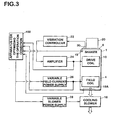
- Vibration controller 22 controls the drive signal that is fed to the drive coil 10 via the amplifier 24 so that the vibration having the desired spectrum is fed to the specimen 20.
- the apparatus 100 for optimizing the operating condition observes the drive current fed to the drive coil 10 by the amplifier 24 and the field current outputted by the variable field current power supply 26, and determines a preferable operating condition that meets the purpose of the operation based on this information. And with keeping the situation that the specimen 20 is fed with the desired vibration controlled by the vibration controller 22, the apparatus 100 controls the variable field current power supply 26 and the variable blower power supply 28 so that the operating condition gradually reaches the determined one.
- This embodiment is not only suitable for the random vibration test that feeds vibration having a desired spectrum to the specimen, but also for other vibration test such as swept-sine test that feeds sinusoidal vibration having continuously varying frequency.
- FIG. 4 A functional block diagram of the apparatus 100 for optimizing the operating condition is shown in Figure 4 .
- the drive current fed to the drive coil 10 is controlled by the vibration controller 22 under the condition that a standard condition field current is fed to the field coil 4.
- the calculation means for the necessary excitation force 34 measures the said field current and the said drive current, and calculates the excitation force that the said shaker 1 is generating.
- the excitation force value calculated as in above is the force necessary to feed the desired vibration to specimen 20 using this shaker 1.
- the calculation means for the supposed necessary drive current 36 calculates the necessary supposed drive current at each supposed field current that is varied from the said standard field current value.
- the calculation means for the supposed temperature 38 calculates the supposed field coil temperature when the said supposed field current is fed to the field coil 4 and the supposed drive coil temperature when the said supposed drive current is fed to the drive coil 10. As the supposed cooling capability is varied, the calculation means for the supposed temperature 38 calculates the above supposed temperatures.
- the selection means of the operating condition 40 selects a combination of supposed field current and supposed cooling capability under which the supposed temperatures of the field coil and the drive coil will not exceed the limitation and the focused feature of operation will be satisfied among multiple combinations of supposed field current and supposed cooling capability when applied as the operating condition to the shaker 1. For instance, when the sound noise is the focused feature of operation, the combination of supposed field current and supposed cooling capability that will realize the minimum blower rotation is selected among the combinations that satisfy the temperature criterion. When the power consumption is the focus of operation, the combination of supposed field current and supposed cooling capability is selected that will realize the minimum total power consumption of the system.
- the output means of the operating condition 42 controls the variable field current power supply 26 to change the field current from the present value to the supposed field current value indicated in the said selected operating condition gradually under the situation the specimen 20 is fed with the desired vibration controlled by the vibration controller 22.
- the output means 42 controls the variable blower power supply 28 to change the blower rotation to the supposed rotation value indicated in the said selected operating condition gradually.
- the transition time for each step in the above gradual change should be kept longer than the necessary time for the stable control by the vibration controller 22 that controls the drive current corresponding to the change of the field current.
- the shaker 1 used in this embodiment has the conventional structure as shown in the Figure 1 , but differs only at the point that the temperature sensor 19 is set at the air-intake 18 for the cooling air and the temperature sensor 19A is set at the vent 14 .
- the temperature sensor 19 and 19A By this temperature sensor 19 and 19A, the temperature of the cooling air and the amount of temperature raised by the heat generation of the coils can be measured.
- the sensor 19 is used. But the sensor 19A can be an alternative, or both of them can be used as stated later.
- FIG. 5 An example of the hardware implementation configuration of the apparatus 100 for the operating condition optimization using a PC (personal computer) and the dedicated hardware is shown in Figure 5 .
- CPU 54 supervises the whole system and the user interface with the connected components such as the main memory 55, hard disk 56, keyboard/mouse 58, display 50 and other peripherals. It is convenient to use a PC for this part.
- a dedicated hardware called “master controller” 25 is connected, and the variable field current power supply 26 and the variable blower power supply 28 is connected to the master controller 25.
- the master controller 25 can command the variable field current power supply 26 and the variable blower power supply 28 and control the outputs of these power supplies.
- the master controller 25 is realized as a DSP (digital signal processor) system having memory and I/O ports. In the memory, program codes for the optimization of the operating condition procedure are stored. The control of the field current using the variable field current power supply 26 and of the blower rotation using the variable blower power supply 28 is carried out via the I/O port.
- the output signals of the sensors from the amplifier 24, from the variable field current power supply 26 and from sensor 19 are digitized by the A/D converter under control of the DSP.
- variable field current power supply 26 and the variable blower power supply 28 are dedicated switching converter systems each designed for each required function. These are dedicated systems comprising of the power circuit and the control circuit (DSP). Each system is controlled by the DSP program on the control board and can communicate with the master controller 25 via network (CAN bus is used in this embodiment). Receiving the command from the master controller 25, the DSP in the variable field current power supply 26, or in the variable blower power supply 28, controls and drives the power devices to operate the required switching converter and thereby supply the required output.
- DSP control circuit
- an OS operating system
- dedicated software that supervises the control of the dedicated hardware and user interface are loaded.
- the software works together with the OS to affect the function required.
- the OS can be omitted when possible.
- Data of the characteristics of the shaker 1 and the excitation system are necessary for the apparatus 100 for optimizing the operating condition and to determine the optimal operating condition.
- the characteristic data are recorded in the master controller 25 as the program codes 27 for the optimization.
- Data of Field current - Force coefficient relationship experimental formula, Power consumption formula, Temperature model formula, the standard operating condition and the ratings of the amplifier are recorded in the codes.
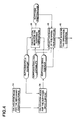
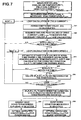
- FIG. 6 A flowchart of the optimization program 27 for the operating condition is shown in Figure 6 .
- the operator fixes the specimen 20 on the top part of the armature 6 of the shaker 1 and sets the vibration controller 22 so that the desired vibration will be fed to the specimen 20.
- a desired random vibration is to be fed to the specimen 20.
- the desired vibration is described by frequency spectrum data, and the operator inputs the given spectrum data to the vibration controller 22.
- the CPU 54 of the apparatus 100 inquires the operator to select the criteria of the optimization (For example Energy saving or Quiet noise or other parameter) through the display 50.
- the operator selects the criteria using the keyboard/mouse 58.
- the CPU 54 records the selected criteria of the optimization on the memory 52, and sends the information to the master controller 25.
- the master controller 25 records the received data of the criteria on the memory (step S4).
- the CPU 54 of the apparatus 100 reads the recorded standard operating condition, and commands the variable field current power supply 26 to output the field current of standard value I fon [A] via the I/O port 57 and the master controller 25.
- the variable field current power supply 26 controls the field current to be I fon [A].
- the CPU 54 commands the variable blower power supply 28 to control the blower rotation to be the standard value of V on [Hz] (step S5).
- the operator manipulates the vibration controller 22 to control the shaker 1 to feed the desired vibration to the specimen 20.
- the vibration controller 22 controls the vibration controller 22 to control the shaker 1 to feed the desired vibration to the specimen 20.
- some automatic control of the vibration controller 22 for this activity by the apparatus 100 is possible.
- the response acceleration is monitored by the sensor 30, and according to the acceleration information the drive current from the amplifier 24 is controlled, and the desired vibration is fed to the specimen 20.
- step S6 After the control by the vibration controller 22 is settled, the master controller 25 carries out step S6.
- the vibration control is settled after passing of a definite time (e.g. 1[s]). Judgment of the control settlement can be done when the change of the drive current RMS value has settled within a threshold by monitoring the said drive current.
- step S6 the master controller 25 measures the field current I f0 which is the output of the variable field current power supply 26, and measures the drive current signal which is the output from the amplifier 24 and gets the RMS value I d0 and the peak value I d0_peak . Also, the cooling air temperature T in is measured by the output of the temperature sensor 19.
- step S7 the master controller 25 calculates the excitation force necessary to carry out the required test under the present load condition:
- the master controller 25 searches and determines the optimal operating condition based on the calculated data of necessary force RMS value F 1 and the peak value F 1_peak , referring to the optimization criteria indicated by the CPU 54 (step S8).
- control by the vibration controller 22 is kept and the vibration testing of the specimen is continued.
- the master controller 25 selects the operating condition that meets the optimization criteria among the combinations of the conditions of varied field coil current and the varied blower rotation.
- step S84 calculation of total power consumption and estimate of the temperatures of the drive and field coil are done.
- the drive power consumption P d , the field power consumption P f and the blower power consumption P b are calculated by the following Power consumption formulae:
- P d R d ⁇ 0 ⁇ 1 + c d ⁇ T in - T d ⁇ 0 ⁇ I d 2 / 1 - R d ⁇ 0 ⁇ c d I d 2 ⁇ k d ⁇ V ⁇ d
- P f R f ⁇ 0 ⁇ 1 + c f ⁇ T in - T f ⁇ 0 ⁇ I f 2 / 1 - R f ⁇ 0 ⁇ c f I f 2 ⁇ k f ⁇ V ⁇ f
- P b P b ⁇ 0 ⁇ V / V 0 3
- the total power P t is calculated as the sum of P d , P f and P b .
- the master controller 25 judges whether the estimated value of T f and T d are within the predetermined limitation of coil temperature (step S85).
- a marking that indicates the condition is impossible to be used (e.g. "NG") is recorded, in addition to the records of the calculated values of total power P t , estimated temperatures of the field coil T f and of the drive coil T d in the data tables shown in the Figure 8 A, B, C and D (step S86).
- Figure 8A is the data table recording the drive coil equilibrium temperature T d estimation for the combinations of field current and blower rotation. It can be seen that T d is estimated as 60 degree Celsius when the field current is 20[A] and the blower rotation is 60[Hz]. When this temperature value is exceeding the limitation, the marking "NG" is recorded in the table in Figure 8D.
- Figure 8B is the similar table for the field coil temperature T f .
- Figure 8C is that for the total power consumption P t
- Figure 8D is the table to record the cases that either or both of the coil temperatures exceed the limitation.
- the master controller 25 checks whether the blower rotation values to be examined still remain (step S87).
- the blower rotation values to be examined still remain (step S87).
- the drive coil temperature, the field coil temperature and the total power consumption are estimated for all the supposed blower rotation values that should be examined.
- the procedure can be broken at the stage when the violation of the temperature limitation by either of the coils occurred. It is obvious that the lower rotation value gives higher temperature estimates than the critical rotation value.
- step S81 the Force coefficient ⁇ when the field current is varied from I fon to I f is calculated using the Field current-Force relationship (A-2).
- the necessary drive current RMS value I d and the peak value I d_peak are calculated by using the data of the necessary force RMS value F 1 and the peak value F 1_peak calculated in step S7 (step S82).
- I d F 1 / ⁇
- I d_peak F 1 _peak / ⁇
- the calculated supposed drive current RMS value I d is checked whether it is within the maximum rating of the amplifier 24.
- the calculated supposed drive current peak value I d_peak is checked whether it is within the maximum peak rating of the amplifier 24 (step S83).
- marking "NG” is recorded in the corresponding part of the table in Figure 8D .
- the next supposed drive current e.g. 16[A]
- Step 83 When not exceeded, the steps following on from Step 83 are processed, and the data of the temperatures of the coils and the total power consumption under the varied blower rotation values one by one are recorded in the table as shown by Figure 8 .
- all the supposed blower rotation values are examined (or broken in mid-flow), returning to step S81 occurs and further examination about the next field current is carried out.
- the master controller 25 carries out the selection of the optimal operating condition, referring to the table in Figure 8 .
- the minimum total power consumption case in Figure 8C is selected among those possible cases that has no "NG” marking in the table in Figure 8D (step S88).
- the master controller 25 controls the variable field current supply 26 and the variable blower power supply 28 to bring the operating condition to the determined optimal conditions with keeping the vibration test by the vibration controller 22 continued and unaffected (step S9).
- the change of the control condition to the determined optimal condition is gradually carried out in a stepwise fashion.
- the master controller 25 controls each step in the change of the field current to be 1) not larger than a defined value (e.g. 1[A]) and 2) not faster than a defined duration (e.g. 1[s]).
- Condition 1) is to avoid too large change per step, and the condition 2) is to avoid undesirable interference of the control with that of the vibration controller 22.
- Blower rotation is also changed gradually avoiding the mechanical and electrical stress that could occur when the change was too fast.
- the master controller 25 sends the resultant data of the optimization to the CPU 54.
- the CPU 54 indicates the data, as shown by example in Figure 9 , on the display as a report of the control status at present.
- Random vibration test is a test method to generate a stationary random vibration having a defined desired spectrum. Therefore it is usual that the drive current does not show a significant change after it has settled. So, although the automatic optimization process of the operating condition is carried out continuously throughout the testing, it is usual that the resultant operating condition also does not show a significant change.
- the drive current in case of a test that feeds a sinusoidal vibration with its frequency varying (Swept-sine vibration test) , the drive current must be varied with time even if the generated acceleration level was constant because of the existence of the response characteristics of the shaker 1 and test load 20. Even in such cases, the method of this invention can be applicable; for instance when the drive current is averaged and peak value measured for the duration of the full single way of the frequency sweep, an optimization for the whole swept frequency band is possible to be done.
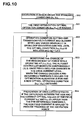
- FIG. 10 A flowchart of the optimization program for the operating condition that the case of the excitation situation does not change too fast is shown in Figure 10 .
- Step S50 and S51 are the same as steps S4 to S8 in the first embodiment, and step S52 is equal to the step S9.
- the master controller 25 continues to monitor the drive current periodically (e.g. once per 0.5[s]).
- step S53 judges whether the drive current varied at an extent larger than a defined threshold or not.
- the change is smaller than the threshold, no change of the operating condition is made. This is to avoid the bad influences to change the condition according to too small changes.
- the optimization process step S6 to S8 in Figure 6
- step S54 the control to bring the system to the new operating condition is done.
- control method in this embodiment can be applied not only to the swept-sine test as above, but also to such situations where the specimen characteristics change during the random vibration test or to situations such as the excitation level is changed during the testing.
- control method can also be applied to any other form of vibration testing, including, but not limited to, Sine-on-Random, Random-on-Random, Spot Sine, Shock, Waveform replication, Resonance Dwell and so on.
- calculation process of the supposed drive current does not pay attention to the frequency characteristics of the control objects.
- Frequency characteristics of the excitation system and/or of the desired vibration can be regarded in the process of calculation of the drive current in the optimization of the operating conditions.
- transition to the determined optimal operating condition is controlled to occur with keeping the test excitation
- some trial excitation stage can be set for the optimization.
- real or actual testing can be carried out after stopping the trial excitation and starting the real test with the operating condition already set to the optimized operating conditions
- CPU 54 measures the drive current during the test operation and records the data as a time series.
- calculation of the optimal operating condition at each moment is carried out by using the recorded drive current data at each moment.
- the calculation process is already described above, and this calculation can be done in an off-line manner using external computers.
- this operating condition data is fed to the master controller 25, and the operation based on the optimal operating condition at each moment (calculated prior to the operation) is carried out.
- off-line calculation of the optimal operating condition and estimation of the effectiveness of the apparatus of this invention becomes possible.
- the optimal operating condition is calculated based on the measured drive current. But direct measurement of the drive current is not always required, but 'substantial measurement' of the drive current is also possible; calculated drive current data using the drive current-acceleration characteristics data measured prior to the operation and the data of required acceleration such as swept-sine profile can be usable for the process.
- the thermal equilibrium temperatures of the coils are estimated using the thermal model of the coil temperature based on the information of the cooling air temperature. But temperature information of the field coil 4 can be gotten through the measurement of the field coil current and voltage; when resistance change by the temperature can be detected, then the coil temperature can be estimated by using a pre-determined table or thermal coefficient of the coil resistance. The same method can be applied to the drive coil 10.
- the direct measurement method of coil temperatures ideally should not be employed in the above stated method and the method to estimate the coil temperature solely based on the information of the currents fed to the coils by using the coil thermal model.
- the estimated coil temperatures can only have the meaning of the "temperature at the thermal equilibrium in the stationary state", there remains the possibility that a very different estimated temperature compared to the actual temperature can occur. Also there is a risk of estimation error caused by the limitation of the thermal model.
- the present temperature of the coils can be known by direct measurement, more accurate optimal control can be possible such as the method to adjust the blower rotation by directly comparing the measured coil temperatures with the temperature limitation.
- the temperature of the field coils and drive coils can be got from measurement of the air inlet temperature and air outlet temperature.
- the temperature difference is proportional to the power dissipated in the coils.
- the power dissipation in the coils is known by measurement and by control and the blower speed is also known by control. With these known parameters, the temperature of the coils can be calculated by using the thermal model.
- the calculation method is explained by using the directly measured data of the drive and field current, but the method can of course include the case that the currents are in-directly measured by voltage.
- the selection of the best fit operating condition is done by the master controller 25. But other methods are possible such as the operator selects from among all the possible conditions that satisfy the criteria and are displayed for the operator.
- sound noise level is estimated through the cooling capability (blower rotation). But direct measurement method of sound noise can be applied to the optimization procedure.
- the focused feature of operation can be defined for example as system energy (minimizing system energy), system efficiency (maximizing system efficiency), blower noise (minimizing blower noise) or any other system feature that would be the focus of minimizing or maximizing the particular system parameter.
- the focused feature of operation may also be a combination of features and weighting may or may not be employed for each feature.
- the time from the beginning of the excitation at step S5 to the data acquisition of the currents and others at step S6 is assumed as a pre-determined definite time. But this time can be managed by the operator according to the content of the testing. This time can also be determined through observation of the drive signal.
- a combination of the field current and the cooling capability is selected among the possible combinations of supposed field current and supposed blower rotation that satisfy the temperature condition searched by varying both of the field current and the blower rotation.
- This method is suitable for the waveform replication test such as those called SHOCK test during which the field current should be kept fixed or for the idling state during which the field current can be kept constant at a smaller value.
- operating condition is determined by the following procedure: Fixing the specimen to be tested to the armature, feeding the determined field current, the drive current is controlled so that the desired vibration is applied to the specimen, and the drive current value in this state is detected. Next, supposed temperatures of the field coil and the drive coil are calculated under each of the supposed cooling capability of the cooling apparatus which is varied for calculation. And a supposed operating condition (blower rotation) that does not exceed the temperature limit is selected as the operating condition. As such, a proper blower rotation can be selected.
- IMV vibration test system model "i240/SA3M” was used as the shaker1 and the amplifier 24, and IMV Digital vibration control system "K2" as the vibration controller 22 was used.
- Specimen 20 was a dummy mass load of 120kg, and the dedicated hardware developed for the embodiment of this method was used. Optimization criterion was "Energy save”.
- Figure 11A the reference acceleration profile (desired vibration) was suddenly increased or decreased, and the changes of the drive and field current are seen in the same figure.
- Figure 11B is showing the power consumption at the drive coil 10, consumption at the field coil 4 and consumption at the blower. The dramatic reduction of the blower power consumption and that of the field coil are observed clearly, and these are contributing to reduce the total power consumption.
- Figures 12A and 12B are zoomed displays of the first 80[s] of Figures 11A and 11B and show greater detail.
Landscapes
- Physics & Mathematics (AREA)
- General Physics & Mathematics (AREA)
- Reciprocating, Oscillating Or Vibrating Motors (AREA)
- Apparatuses For Generation Of Mechanical Vibrations (AREA)
- Testing Of Devices, Machine Parts, Or Other Structures Thereof (AREA)
Applications Claiming Priority (2)
| Application Number | Priority Date | Filing Date | Title |
|---|---|---|---|
| JP2008039025 | 2008-02-20 | ||
| JP2008164493A JP4231095B1 (ja) | 2008-02-20 | 2008-06-24 | 運転条件決定装置および方法 |
Publications (3)
| Publication Number | Publication Date |
|---|---|
| EP2093553A2 true EP2093553A2 (de) | 2009-08-26 |
| EP2093553A3 EP2093553A3 (de) | 2012-05-30 |
| EP2093553B1 EP2093553B1 (de) | 2015-01-14 |
Family
ID=40445145
Family Applications (1)
| Application Number | Title | Priority Date | Filing Date |
|---|---|---|---|
| EP08075809.7A Active EP2093553B1 (de) | 2008-02-20 | 2008-10-04 | Vorrichtung zur Optimierung der Shakersystemleistung und dazugehörige Steuerverfahren |
Country Status (4)
| Country | Link |
|---|---|
| US (1) | US8069728B2 (de) |
| EP (1) | EP2093553B1 (de) |
| JP (1) | JP4231095B1 (de) |
| CN (1) | CN101514939B (de) |
Families Citing this family (11)
| Publication number | Priority date | Publication date | Assignee | Title |
|---|---|---|---|---|
| JP5461140B2 (ja) * | 2009-10-13 | 2014-04-02 | 株式会社振研 | 振動試験装置 |
| JP2014074612A (ja) * | 2012-10-03 | 2014-04-24 | Emitsuku Kk | 振動発生機 |
| DE102015104108A1 (de) * | 2014-03-20 | 2015-09-24 | GM Global Technology Operations LLC (n. d. Ges. d. Staates Delaware) | Parameterschätzung in einem aktor |
| US9777660B2 (en) | 2014-03-20 | 2017-10-03 | GM Global Technology Operations LLC | Parameter estimation in an actuator |
| US10746626B2 (en) * | 2014-04-03 | 2020-08-18 | Bruel & Kjaer Vts Limited | Vibration testing system and methodology |
| JP7086411B2 (ja) * | 2019-12-17 | 2022-06-20 | エミック株式会社 | 振動試験における加振能力予測評価装置、加振能力予測評価方法及び加振能力予測評価プログラム |
| DE102020001527A1 (de) * | 2020-03-10 | 2021-09-16 | Gentherm Gmbh | Verfahren zum Betreiben eines Temperiergebläses |
| CN113204255B (zh) * | 2021-06-21 | 2021-12-21 | 北京博科测试系统股份有限公司 | 一种多自由度振动台功率谱加载控制方法 |
| CN113624431B (zh) * | 2021-08-18 | 2023-06-30 | 苏州东菱振动试验仪器有限公司 | 风冷式电动振动台 |
| JP7261270B2 (ja) * | 2021-08-27 | 2023-04-19 | Imv株式会社 | 振動試験装置 |
| JP7261271B2 (ja) * | 2021-08-27 | 2023-04-19 | Imv株式会社 | 振動試験支援ネットワークシステム |
Citations (1)
| Publication number | Priority date | Publication date | Assignee | Title |
|---|---|---|---|---|
| JP2001013033A (ja) | 1999-06-28 | 2001-01-19 | Tabai Espec Corp | 振動試験装置 |
Family Cites Families (9)
| Publication number | Priority date | Publication date | Assignee | Title |
|---|---|---|---|---|
| GB772930A (en) * | 1954-09-09 | 1957-04-17 | Textron American Inc | Electromagnetic vibrator |
| GB1119911A (en) * | 1964-10-28 | 1968-07-17 | Derritron Ltd | Improvements relating to electromechanical vibrators |
| DE59913312D1 (de) * | 1998-08-31 | 2006-05-18 | Siemens Ag | Verfahren zur begrenzung eines elektrischen stroms durch ein elektrisches bauteil und begrenzungsvorrichtung |
| JP3767273B2 (ja) * | 1999-09-24 | 2006-04-19 | 富士通株式会社 | 回転振動試験機 |
| JP3380809B2 (ja) | 2001-11-21 | 2003-02-24 | エスペック株式会社 | 振動試験装置 |
| US6904807B1 (en) * | 2003-12-04 | 2005-06-14 | Labworks, Inc. | Shakers and methods of testing |
| US7270472B2 (en) * | 2005-02-23 | 2007-09-18 | Bose Corporation | Resonant shaking |
| CN2821555Y (zh) * | 2005-09-02 | 2006-09-27 | 苏州东菱振动试验仪器有限公司 | 电动振动台驱动线圈绕组并联水冷结构 |
| CN101071080B (zh) * | 2007-04-30 | 2010-12-08 | 苏州东菱振动试验仪器有限公司 | 驱动线圈非接触式测温方法及其装置 |
-
2008
- 2008-06-24 JP JP2008164493A patent/JP4231095B1/ja active Active
- 2008-10-02 US US12/244,269 patent/US8069728B2/en active Active
- 2008-10-04 EP EP08075809.7A patent/EP2093553B1/de active Active
- 2008-10-24 CN CN2008101749534A patent/CN101514939B/zh active Active
Patent Citations (1)
| Publication number | Priority date | Publication date | Assignee | Title |
|---|---|---|---|---|
| JP2001013033A (ja) | 1999-06-28 | 2001-01-19 | Tabai Espec Corp | 振動試験装置 |
Also Published As
| Publication number | Publication date |
|---|---|
| EP2093553A3 (de) | 2012-05-30 |
| US8069728B2 (en) | 2011-12-06 |
| CN101514939A (zh) | 2009-08-26 |
| JP4231095B1 (ja) | 2009-02-25 |
| US20090205430A1 (en) | 2009-08-20 |
| JP2009222699A (ja) | 2009-10-01 |
| EP2093553B1 (de) | 2015-01-14 |
| CN101514939B (zh) | 2012-08-08 |
Similar Documents
| Publication | Publication Date | Title |
|---|---|---|
| EP2093553B1 (de) | Vorrichtung zur Optimierung der Shakersystemleistung und dazugehörige Steuerverfahren | |
| US7275012B2 (en) | Automated method and apparatus for processor thermal validation | |
| US7349170B1 (en) | Method of monitoring operation of a disk drive by analyzing the envelope of a read-back signal in the frequency domain | |
| JP5181312B2 (ja) | デジタル・システムの信頼性を監視する方法、及びそのシステム | |
| US7661316B2 (en) | Method and apparatus for sensing and controlling fan speed | |
| CN109477874B (zh) | 具有改善的热性能的磁共振成像 | |
| Hanson et al. | Thermal response to DVFS: Analysis with an Intel Pentium M | |
| US7346468B2 (en) | Method and apparatus for detecting heat sink faults | |
| CN101769990B (zh) | 马达温升特性测试系统及方法 | |
| CN106357168B (zh) | 电动机驱动装置 | |
| CN106374814A (zh) | 电动机驱动装置以及探测方法 | |
| JP5660179B1 (ja) | 管理制御システム、サーバシステム、管理制御方法及び管理制御プログラム | |
| JP2024042021A (ja) | 振動試験における加振能力予測評価システム、加振能力予測評価方法及び加振能力予測評価プログラム | |
| Kielb et al. | Experimental study of aerodynamic and structural damping in a full-scale rotating turbine | |
| JP2009121890A (ja) | 運転条件決定装置およびプログラム | |
| JP4812858B2 (ja) | 振動発生装置の運転条件決定装置 | |
| JP5708384B2 (ja) | ヒータ断線検知装置、電力調整装置及びヒータ断線検知方法 | |
| CN110319044A (zh) | 风扇测试方法 | |
| JP4812857B2 (ja) | 振動発生装置の運転条件決定装置 | |
| JPH0856917A (ja) | 勾配磁場発生方法及びmri装置 | |
| US10591383B2 (en) | Characterizing the I/O-performance-per-watt of a computing device across a range of vibrational operating environments | |
| JP7061416B2 (ja) | 電気試験測定装置及びプロセッサ制御による方法 | |
| EP4328564A1 (de) | Thermogravimetrische messvorrichtung und verfahren zu ihrer einstellung | |
| US6948356B2 (en) | Viscoelasticity measuring instrument | |
| TW201213040A (en) | Spindle inspection system and method |
Legal Events
| Date | Code | Title | Description |
|---|---|---|---|
| PUAI | Public reference made under article 153(3) epc to a published international application that has entered the european phase |
Free format text: ORIGINAL CODE: 0009012 |
|
| AK | Designated contracting states |
Kind code of ref document: A2 Designated state(s): AT BE BG CH CY CZ DE DK EE ES FI FR GB GR HR HU IE IS IT LI LT LU LV MC MT NL NO PL PT RO SE SI SK TR |
|
| AX | Request for extension of the european patent |
Extension state: AL BA MK RS |
|
| PUAL | Search report despatched |
Free format text: ORIGINAL CODE: 0009013 |
|
| AK | Designated contracting states |
Kind code of ref document: A3 Designated state(s): AT BE BG CH CY CZ DE DK EE ES FI FR GB GR HR HU IE IS IT LI LT LU LV MC MT NL NO PL PT RO SE SI SK TR |
|
| AX | Request for extension of the european patent |
Extension state: AL BA MK RS |
|
| RIC1 | Information provided on ipc code assigned before grant |
Ipc: G01M 7/02 20060101AFI20120425BHEP Ipc: B06B 1/04 20060101ALI20120425BHEP |
|
| 17P | Request for examination filed |
Effective date: 20121123 |
|
| AKX | Designation fees paid |
Designated state(s): AT BE BG CH CY CZ DE DK EE ES FI FR GB GR HR HU IE IS IT LI LT LU LV MC MT NL NO PL PT RO SE SI SK TR |
|
| 17Q | First examination report despatched |
Effective date: 20140205 |
|
| GRAP | Despatch of communication of intention to grant a patent |
Free format text: ORIGINAL CODE: EPIDOSNIGR1 |
|
| INTG | Intention to grant announced |
Effective date: 20140822 |
|
| GRAS | Grant fee paid |
Free format text: ORIGINAL CODE: EPIDOSNIGR3 |
|
| GRAA | (expected) grant |
Free format text: ORIGINAL CODE: 0009210 |
|
| AK | Designated contracting states |
Kind code of ref document: B1 Designated state(s): AT BE BG CH CY CZ DE DK EE ES FI FR GB GR HR HU IE IS IT LI LT LU LV MC MT NL NO PL PT RO SE SI SK TR |
|
| REG | Reference to a national code |
Ref country code: GB Ref legal event code: FG4D |
|
| REG | Reference to a national code |
Ref country code: CH Ref legal event code: EP |
|
| REG | Reference to a national code |
Ref country code: IE Ref legal event code: FG4D |
|
| REG | Reference to a national code |
Ref country code: AT Ref legal event code: REF Ref document number: 707304 Country of ref document: AT Kind code of ref document: T Effective date: 20150215 |
|
| REG | Reference to a national code |
Ref country code: DE Ref legal event code: R096 Ref document number: 602008036334 Country of ref document: DE Effective date: 20150226 |
|
| REG | Reference to a national code |
Ref country code: NL Ref legal event code: VDEP Effective date: 20150114 |
|
| REG | Reference to a national code |
Ref country code: AT Ref legal event code: MK05 Ref document number: 707304 Country of ref document: AT Kind code of ref document: T Effective date: 20150114 |
|
| REG | Reference to a national code |
Ref country code: LT Ref legal event code: MG4D |
|
| PG25 | Lapsed in a contracting state [announced via postgrant information from national office to epo] |
Ref country code: LT Free format text: LAPSE BECAUSE OF FAILURE TO SUBMIT A TRANSLATION OF THE DESCRIPTION OR TO PAY THE FEE WITHIN THE PRESCRIBED TIME-LIMIT Effective date: 20150114 Ref country code: FI Free format text: LAPSE BECAUSE OF FAILURE TO SUBMIT A TRANSLATION OF THE DESCRIPTION OR TO PAY THE FEE WITHIN THE PRESCRIBED TIME-LIMIT Effective date: 20150114 Ref country code: HR Free format text: LAPSE BECAUSE OF FAILURE TO SUBMIT A TRANSLATION OF THE DESCRIPTION OR TO PAY THE FEE WITHIN THE PRESCRIBED TIME-LIMIT Effective date: 20150114 Ref country code: BG Free format text: LAPSE BECAUSE OF FAILURE TO SUBMIT A TRANSLATION OF THE DESCRIPTION OR TO PAY THE FEE WITHIN THE PRESCRIBED TIME-LIMIT Effective date: 20150414 Ref country code: NO Free format text: LAPSE BECAUSE OF FAILURE TO SUBMIT A TRANSLATION OF THE DESCRIPTION OR TO PAY THE FEE WITHIN THE PRESCRIBED TIME-LIMIT Effective date: 20150414 Ref country code: ES Free format text: LAPSE BECAUSE OF FAILURE TO SUBMIT A TRANSLATION OF THE DESCRIPTION OR TO PAY THE FEE WITHIN THE PRESCRIBED TIME-LIMIT Effective date: 20150114 Ref country code: SE Free format text: LAPSE BECAUSE OF FAILURE TO SUBMIT A TRANSLATION OF THE DESCRIPTION OR TO PAY THE FEE WITHIN THE PRESCRIBED TIME-LIMIT Effective date: 20150114 |
|
| PG25 | Lapsed in a contracting state [announced via postgrant information from national office to epo] |
Ref country code: PL Free format text: LAPSE BECAUSE OF FAILURE TO SUBMIT A TRANSLATION OF THE DESCRIPTION OR TO PAY THE FEE WITHIN THE PRESCRIBED TIME-LIMIT Effective date: 20150114 Ref country code: GR Free format text: LAPSE BECAUSE OF FAILURE TO SUBMIT A TRANSLATION OF THE DESCRIPTION OR TO PAY THE FEE WITHIN THE PRESCRIBED TIME-LIMIT Effective date: 20150415 Ref country code: NL Free format text: LAPSE BECAUSE OF FAILURE TO SUBMIT A TRANSLATION OF THE DESCRIPTION OR TO PAY THE FEE WITHIN THE PRESCRIBED TIME-LIMIT Effective date: 20150114 Ref country code: LV Free format text: LAPSE BECAUSE OF FAILURE TO SUBMIT A TRANSLATION OF THE DESCRIPTION OR TO PAY THE FEE WITHIN THE PRESCRIBED TIME-LIMIT Effective date: 20150114 Ref country code: IS Free format text: LAPSE BECAUSE OF FAILURE TO SUBMIT A TRANSLATION OF THE DESCRIPTION OR TO PAY THE FEE WITHIN THE PRESCRIBED TIME-LIMIT Effective date: 20150514 Ref country code: AT Free format text: LAPSE BECAUSE OF FAILURE TO SUBMIT A TRANSLATION OF THE DESCRIPTION OR TO PAY THE FEE WITHIN THE PRESCRIBED TIME-LIMIT Effective date: 20150114 |
|
| REG | Reference to a national code |
Ref country code: DE Ref legal event code: R097 Ref document number: 602008036334 Country of ref document: DE |
|
| PG25 | Lapsed in a contracting state [announced via postgrant information from national office to epo] |
Ref country code: SK Free format text: LAPSE BECAUSE OF FAILURE TO SUBMIT A TRANSLATION OF THE DESCRIPTION OR TO PAY THE FEE WITHIN THE PRESCRIBED TIME-LIMIT Effective date: 20150114 Ref country code: DK Free format text: LAPSE BECAUSE OF FAILURE TO SUBMIT A TRANSLATION OF THE DESCRIPTION OR TO PAY THE FEE WITHIN THE PRESCRIBED TIME-LIMIT Effective date: 20150114 Ref country code: RO Free format text: LAPSE BECAUSE OF FAILURE TO SUBMIT A TRANSLATION OF THE DESCRIPTION OR TO PAY THE FEE WITHIN THE PRESCRIBED TIME-LIMIT Effective date: 20150114 Ref country code: EE Free format text: LAPSE BECAUSE OF FAILURE TO SUBMIT A TRANSLATION OF THE DESCRIPTION OR TO PAY THE FEE WITHIN THE PRESCRIBED TIME-LIMIT Effective date: 20150114 Ref country code: CZ Free format text: LAPSE BECAUSE OF FAILURE TO SUBMIT A TRANSLATION OF THE DESCRIPTION OR TO PAY THE FEE WITHIN THE PRESCRIBED TIME-LIMIT Effective date: 20150114 |
|
| REG | Reference to a national code |
Ref country code: FR Ref legal event code: PLFP Year of fee payment: 8 |
|
| PLBE | No opposition filed within time limit |
Free format text: ORIGINAL CODE: 0009261 |
|
| STAA | Information on the status of an ep patent application or granted ep patent |
Free format text: STATUS: NO OPPOSITION FILED WITHIN TIME LIMIT |
|
| 26N | No opposition filed |
Effective date: 20151015 |
|
| PG25 | Lapsed in a contracting state [announced via postgrant information from national office to epo] |
Ref country code: IT Free format text: LAPSE BECAUSE OF FAILURE TO SUBMIT A TRANSLATION OF THE DESCRIPTION OR TO PAY THE FEE WITHIN THE PRESCRIBED TIME-LIMIT Effective date: 20150114 |
|
| PG25 | Lapsed in a contracting state [announced via postgrant information from national office to epo] |
Ref country code: SI Free format text: LAPSE BECAUSE OF FAILURE TO SUBMIT A TRANSLATION OF THE DESCRIPTION OR TO PAY THE FEE WITHIN THE PRESCRIBED TIME-LIMIT Effective date: 20150114 |
|
| PG25 | Lapsed in a contracting state [announced via postgrant information from national office to epo] |
Ref country code: BE Free format text: LAPSE BECAUSE OF FAILURE TO SUBMIT A TRANSLATION OF THE DESCRIPTION OR TO PAY THE FEE WITHIN THE PRESCRIBED TIME-LIMIT Effective date: 20150114 Ref country code: LU Free format text: LAPSE BECAUSE OF FAILURE TO SUBMIT A TRANSLATION OF THE DESCRIPTION OR TO PAY THE FEE WITHIN THE PRESCRIBED TIME-LIMIT Effective date: 20151004 |
|
| REG | Reference to a national code |
Ref country code: CH Ref legal event code: PL |
|
| PG25 | Lapsed in a contracting state [announced via postgrant information from national office to epo] |
Ref country code: MC Free format text: LAPSE BECAUSE OF FAILURE TO SUBMIT A TRANSLATION OF THE DESCRIPTION OR TO PAY THE FEE WITHIN THE PRESCRIBED TIME-LIMIT Effective date: 20150114 |
|
| REG | Reference to a national code |
Ref country code: IE Ref legal event code: MM4A |
|
| PG25 | Lapsed in a contracting state [announced via postgrant information from national office to epo] |
Ref country code: CH Free format text: LAPSE BECAUSE OF NON-PAYMENT OF DUE FEES Effective date: 20151031 Ref country code: LI Free format text: LAPSE BECAUSE OF NON-PAYMENT OF DUE FEES Effective date: 20151031 |
|
| PG25 | Lapsed in a contracting state [announced via postgrant information from national office to epo] |
Ref country code: IE Free format text: LAPSE BECAUSE OF NON-PAYMENT OF DUE FEES Effective date: 20151004 |
|
| REG | Reference to a national code |
Ref country code: FR Ref legal event code: PLFP Year of fee payment: 9 |
|
| PG25 | Lapsed in a contracting state [announced via postgrant information from national office to epo] |
Ref country code: HU Free format text: LAPSE BECAUSE OF FAILURE TO SUBMIT A TRANSLATION OF THE DESCRIPTION OR TO PAY THE FEE WITHIN THE PRESCRIBED TIME-LIMIT; INVALID AB INITIO Effective date: 20081004 |
|
| PG25 | Lapsed in a contracting state [announced via postgrant information from national office to epo] |
Ref country code: CY Free format text: LAPSE BECAUSE OF FAILURE TO SUBMIT A TRANSLATION OF THE DESCRIPTION OR TO PAY THE FEE WITHIN THE PRESCRIBED TIME-LIMIT Effective date: 20150114 |
|
| PG25 | Lapsed in a contracting state [announced via postgrant information from national office to epo] |
Ref country code: TR Free format text: LAPSE BECAUSE OF FAILURE TO SUBMIT A TRANSLATION OF THE DESCRIPTION OR TO PAY THE FEE WITHIN THE PRESCRIBED TIME-LIMIT Effective date: 20150114 Ref country code: MT Free format text: LAPSE BECAUSE OF FAILURE TO SUBMIT A TRANSLATION OF THE DESCRIPTION OR TO PAY THE FEE WITHIN THE PRESCRIBED TIME-LIMIT Effective date: 20150114 |
|
| REG | Reference to a national code |
Ref country code: FR Ref legal event code: PLFP Year of fee payment: 10 |
|
| PG25 | Lapsed in a contracting state [announced via postgrant information from national office to epo] |
Ref country code: PT Free format text: LAPSE BECAUSE OF FAILURE TO SUBMIT A TRANSLATION OF THE DESCRIPTION OR TO PAY THE FEE WITHIN THE PRESCRIBED TIME-LIMIT Effective date: 20150114 |
|
| REG | Reference to a national code |
Ref country code: FR Ref legal event code: PLFP Year of fee payment: 11 |
|
| PGFP | Annual fee paid to national office [announced via postgrant information from national office to epo] |
Ref country code: DE Payment date: 20250909 Year of fee payment: 18 |
|
| PGFP | Annual fee paid to national office [announced via postgrant information from national office to epo] |
Ref country code: GB Payment date: 20251016 Year of fee payment: 18 |
|
| PGFP | Annual fee paid to national office [announced via postgrant information from national office to epo] |
Ref country code: FR Payment date: 20251030 Year of fee payment: 18 |