EP2069056B1 - Verfahren zur herstellung einer protonenleitenden, polyazol-enthaltenden membran - Google Patents
Verfahren zur herstellung einer protonenleitenden, polyazol-enthaltenden membran Download PDFInfo
- Publication number
- EP2069056B1 EP2069056B1 EP07818099.9A EP07818099A EP2069056B1 EP 2069056 B1 EP2069056 B1 EP 2069056B1 EP 07818099 A EP07818099 A EP 07818099A EP 2069056 B1 EP2069056 B1 EP 2069056B1
- Authority
- EP
- European Patent Office
- Prior art keywords
- acid
- oder
- polyazole
- composition
- range
- Prior art date
- Legal status (The legal status is an assumption and is not a legal conclusion. Google has not performed a legal analysis and makes no representation as to the accuracy of the status listed.)
- Not-in-force
Links
- 239000012528 membrane Substances 0.000 title claims description 63
- 238000000034 method Methods 0.000 title claims description 41
- 230000008569 process Effects 0.000 title description 14
- -1 heteroaromatic carboxylic acids Chemical class 0.000 claims description 76
- 239000000178 monomer Substances 0.000 claims description 61
- 229920000642 polymer Polymers 0.000 claims description 59
- 239000002253 acid Substances 0.000 claims description 45
- 239000000203 mixture Substances 0.000 claims description 44
- 125000003118 aryl group Chemical group 0.000 claims description 36
- ABLZXFCXXLZCGV-UHFFFAOYSA-N phosphonic acid group Chemical group P(O)(O)=O ABLZXFCXXLZCGV-UHFFFAOYSA-N 0.000 claims description 36
- 125000001072 heteroaryl group Chemical group 0.000 claims description 34
- 230000007062 hydrolysis Effects 0.000 claims description 32
- 238000006460 hydrolysis reaction Methods 0.000 claims description 32
- 229920000137 polyphosphoric acid Polymers 0.000 claims description 28
- 238000004132 cross linking Methods 0.000 claims description 16
- 238000004519 manufacturing process Methods 0.000 claims description 11
- QAOWNCQODCNURD-UHFFFAOYSA-N Sulfuric acid Chemical compound OS(O)(=O)=O QAOWNCQODCNURD-UHFFFAOYSA-N 0.000 claims description 10
- 229910052799 carbon Inorganic materials 0.000 claims description 6
- SCKXCAADGDQQCS-UHFFFAOYSA-N Performic acid Chemical compound OOC=O SCKXCAADGDQQCS-UHFFFAOYSA-N 0.000 claims description 5
- 238000011065 in-situ storage Methods 0.000 claims description 4
- 210000004379 membrane Anatomy 0.000 description 62
- NBIIXXVUZAFLBC-UHFFFAOYSA-N Phosphoric acid Chemical compound OP(O)(O)=O NBIIXXVUZAFLBC-UHFFFAOYSA-N 0.000 description 52
- 229910052736 halogen Inorganic materials 0.000 description 29
- 150000002367 halogens Chemical class 0.000 description 29
- 125000000542 sulfonic acid group Chemical group 0.000 description 28
- 235000011007 phosphoric acid Nutrition 0.000 description 26
- 229910000147 aluminium phosphate Inorganic materials 0.000 description 25
- 238000006116 polymerization reaction Methods 0.000 description 24
- 150000003254 radicals Chemical class 0.000 description 22
- 239000007788 liquid Substances 0.000 description 21
- 239000000243 solution Substances 0.000 description 20
- XLYOFNOQVPJJNP-UHFFFAOYSA-N water Substances O XLYOFNOQVPJJNP-UHFFFAOYSA-N 0.000 description 19
- 150000001875 compounds Chemical class 0.000 description 15
- 239000000446 fuel Substances 0.000 description 12
- 229910052739 hydrogen Inorganic materials 0.000 description 12
- UFHFLCQGNIYNRP-UHFFFAOYSA-N Hydrogen Chemical compound [H][H] UFHFLCQGNIYNRP-UHFFFAOYSA-N 0.000 description 11
- 230000009471 action Effects 0.000 description 11
- 239000001257 hydrogen Substances 0.000 description 11
- 125000006732 (C1-C15) alkyl group Chemical group 0.000 description 10
- 150000002431 hydrogen Chemical class 0.000 description 10
- 229910052760 oxygen Inorganic materials 0.000 description 10
- GJVFBWCTGUSGDD-UHFFFAOYSA-L pentamethonium bromide Chemical compound [Br-].[Br-].C[N+](C)(C)CCCCC[N+](C)(C)C GJVFBWCTGUSGDD-UHFFFAOYSA-L 0.000 description 10
- 239000001301 oxygen Substances 0.000 description 9
- 230000015572 biosynthetic process Effects 0.000 description 8
- 0 CC(*1)=NC1[Al]C(*)N Chemical compound CC(*1)=NC1[Al]C(*)N 0.000 description 7
- 229910019142 PO4 Inorganic materials 0.000 description 7
- 239000000654 additive Substances 0.000 description 7
- QVGXLLKOCUKJST-UHFFFAOYSA-N atomic oxygen Chemical compound [O] QVGXLLKOCUKJST-UHFFFAOYSA-N 0.000 description 7
- 239000011203 carbon fibre reinforced carbon Substances 0.000 description 7
- IJGRMHOSHXDMSA-UHFFFAOYSA-N Atomic nitrogen Chemical compound N#N IJGRMHOSHXDMSA-UHFFFAOYSA-N 0.000 description 6
- UHOVQNZJYSORNB-UHFFFAOYSA-N Benzene Chemical compound C1=CC=CC=C1 UHOVQNZJYSORNB-UHFFFAOYSA-N 0.000 description 6
- NINIDFKCEFEMDL-UHFFFAOYSA-N Sulfur Chemical compound [S] NINIDFKCEFEMDL-UHFFFAOYSA-N 0.000 description 6
- 150000007513 acids Chemical class 0.000 description 6
- 125000000217 alkyl group Chemical group 0.000 description 6
- 125000004432 carbon atom Chemical group C* 0.000 description 6
- 238000006243 chemical reaction Methods 0.000 description 6
- 239000007789 gas Substances 0.000 description 6
- 229920002492 poly(sulfone) Polymers 0.000 description 6
- 238000002360 preparation method Methods 0.000 description 6
- 238000007711 solidification Methods 0.000 description 6
- 230000008023 solidification Effects 0.000 description 6
- 238000005507 spraying Methods 0.000 description 6
- 229920001577 copolymer Polymers 0.000 description 5
- 239000006185 dispersion Substances 0.000 description 5
- 150000002148 esters Chemical class 0.000 description 5
- 239000011261 inert gas Substances 0.000 description 5
- 229910052757 nitrogen Inorganic materials 0.000 description 5
- 229910052698 phosphorus Inorganic materials 0.000 description 5
- 229920002480 polybenzimidazole Polymers 0.000 description 5
- 238000006277 sulfonation reaction Methods 0.000 description 5
- 229910052717 sulfur Inorganic materials 0.000 description 5
- 239000011593 sulfur Substances 0.000 description 5
- 229910003209 (NH4)3H(SeO4)2 Inorganic materials 0.000 description 4
- OZAIFHULBGXAKX-UHFFFAOYSA-N 2-(2-cyanopropan-2-yldiazenyl)-2-methylpropanenitrile Chemical compound N#CC(C)(C)N=NC(C)(C)C#N OZAIFHULBGXAKX-UHFFFAOYSA-N 0.000 description 4
- KAKZBPTYRLMSJV-UHFFFAOYSA-N Butadiene Chemical compound C=CC=C KAKZBPTYRLMSJV-UHFFFAOYSA-N 0.000 description 4
- 239000004971 Cross linker Substances 0.000 description 4
- OAICVXFJPJFONN-UHFFFAOYSA-N Phosphorus Chemical compound [P] OAICVXFJPJFONN-UHFFFAOYSA-N 0.000 description 4
- SMWDFEZZVXVKRB-UHFFFAOYSA-N Quinoline Chemical compound N1=CC=CC2=CC=CC=C21 SMWDFEZZVXVKRB-UHFFFAOYSA-N 0.000 description 4
- KKEYFWRCBNTPAC-UHFFFAOYSA-N Terephthalic acid Chemical compound OC(=O)C1=CC=C(C(O)=O)C=C1 KKEYFWRCBNTPAC-UHFFFAOYSA-N 0.000 description 4
- 150000008065 acid anhydrides Chemical class 0.000 description 4
- 150000001408 amides Chemical class 0.000 description 4
- 150000001805 chlorine compounds Chemical class 0.000 description 4
- 238000001816 cooling Methods 0.000 description 4
- WJJMNDUMQPNECX-UHFFFAOYSA-N dipicolinic acid Chemical compound OC(=O)C1=CC=CC(C(O)=O)=N1 WJJMNDUMQPNECX-UHFFFAOYSA-N 0.000 description 4
- 150000004820 halides Chemical class 0.000 description 4
- QQVIHTHCMHWDBS-UHFFFAOYSA-N isophthalic acid Chemical compound OC(=O)C1=CC=CC(C(O)=O)=C1 QQVIHTHCMHWDBS-UHFFFAOYSA-N 0.000 description 4
- 239000011574 phosphorus Substances 0.000 description 4
- XNGIFLGASWRNHJ-UHFFFAOYSA-N phthalic acid Chemical compound OC(=O)C1=CC=CC=C1C(O)=O XNGIFLGASWRNHJ-UHFFFAOYSA-N 0.000 description 4
- 238000012545 processing Methods 0.000 description 4
- XSCHRSMBECNVNS-UHFFFAOYSA-N quinoxaline Chemical compound N1=CC=NC2=CC=CC=C21 XSCHRSMBECNVNS-UHFFFAOYSA-N 0.000 description 4
- 239000002904 solvent Substances 0.000 description 4
- 150000000000 tetracarboxylic acids Chemical class 0.000 description 4
- 150000003628 tricarboxylic acids Chemical class 0.000 description 4
- ARCGXLSVLAOJQL-UHFFFAOYSA-N trimellitic acid Chemical compound OC(=O)C1=CC=C(C(O)=O)C(C(O)=O)=C1 ARCGXLSVLAOJQL-UHFFFAOYSA-N 0.000 description 4
- 125000003837 (C1-C20) alkyl group Chemical group 0.000 description 3
- OYFRNYNHAZOYNF-UHFFFAOYSA-N 2,5-dihydroxyterephthalic acid Chemical compound OC(=O)C1=CC(O)=C(C(O)=O)C=C1O OYFRNYNHAZOYNF-UHFFFAOYSA-N 0.000 description 3
- KLSJWNVTNUYHDU-UHFFFAOYSA-N Amitrole Chemical group NC1=NC=NN1 KLSJWNVTNUYHDU-UHFFFAOYSA-N 0.000 description 3
- LSNNMFCWUKXFEE-UHFFFAOYSA-M Bisulfite Chemical compound OS([O-])=O LSNNMFCWUKXFEE-UHFFFAOYSA-M 0.000 description 3
- IAZDPXIOMUYVGZ-UHFFFAOYSA-N Dimethylsulphoxide Chemical compound CS(C)=O IAZDPXIOMUYVGZ-UHFFFAOYSA-N 0.000 description 3
- 229920000557 Nafion® Polymers 0.000 description 3
- PCNDJXKNXGMECE-UHFFFAOYSA-N Phenazine Natural products C1=CC=CC2=NC3=CC=CC=C3N=C21 PCNDJXKNXGMECE-UHFFFAOYSA-N 0.000 description 3
- 239000004734 Polyphenylene sulfide Substances 0.000 description 3
- HEMHJVSKTPXQMS-UHFFFAOYSA-M Sodium hydroxide Chemical compound [OH-].[Na+] HEMHJVSKTPXQMS-UHFFFAOYSA-M 0.000 description 3
- 150000001252 acrylic acid derivatives Chemical class 0.000 description 3
- 125000003277 amino group Chemical group 0.000 description 3
- 125000003178 carboxy group Chemical group [H]OC(*)=O 0.000 description 3
- 238000005266 casting Methods 0.000 description 3
- 238000007598 dipping method Methods 0.000 description 3
- 238000001125 extrusion Methods 0.000 description 3
- 239000000945 filler Substances 0.000 description 3
- 125000005843 halogen group Chemical group 0.000 description 3
- 125000004435 hydrogen atom Chemical group [H]* 0.000 description 3
- 238000002156 mixing Methods 0.000 description 3
- QZHDEAJFRJCDMF-UHFFFAOYSA-N perfluorohexanesulfonic acid Chemical compound OS(=O)(=O)C(F)(F)C(F)(F)C(F)(F)C(F)(F)C(F)(F)C(F)(F)F QZHDEAJFRJCDMF-UHFFFAOYSA-N 0.000 description 3
- 235000021317 phosphate Nutrition 0.000 description 3
- 229920001643 poly(ether ketone) Polymers 0.000 description 3
- 229920000069 polyphenylene sulfide Polymers 0.000 description 3
- 150000003839 salts Chemical class 0.000 description 3
- 239000007858 starting material Substances 0.000 description 3
- ZTWTYVWXUKTLCP-UHFFFAOYSA-N vinylphosphonic acid Chemical compound OP(O)(=O)C=C ZTWTYVWXUKTLCP-UHFFFAOYSA-N 0.000 description 3
- MYRTYDVEIRVNKP-UHFFFAOYSA-N 1,2-Divinylbenzene Chemical compound C=CC1=CC=CC=C1C=C MYRTYDVEIRVNKP-UHFFFAOYSA-N 0.000 description 2
- FOMVFKTYQSZBMJ-UHFFFAOYSA-N 1,5-dihydroxycyclohexa-3,5-diene-1,2-dicarboxylic acid Chemical compound OC(=O)C1C=CC(O)=CC1(O)C(O)=O FOMVFKTYQSZBMJ-UHFFFAOYSA-N 0.000 description 2
- UKGMFBZPIQCNPM-UHFFFAOYSA-N 1,6-dihydroxycyclohexa-3,5-diene-1,2-dicarboxylic acid Chemical compound OC(=O)C1C=CC=C(O)C1(O)C(O)=O UKGMFBZPIQCNPM-UHFFFAOYSA-N 0.000 description 2
- YDMVPJZBYSWOOP-UHFFFAOYSA-N 1h-pyrazole-3,5-dicarboxylic acid Chemical compound OC(=O)C=1C=C(C(O)=O)NN=1 YDMVPJZBYSWOOP-UHFFFAOYSA-N 0.000 description 2
- PIZHFBODNLEQBL-UHFFFAOYSA-N 2,2-diethoxy-1-phenylethanone Chemical compound CCOC(OCC)C(=O)C1=CC=CC=C1 PIZHFBODNLEQBL-UHFFFAOYSA-N 0.000 description 2
- YWJNJZBDYHRABW-UHFFFAOYSA-N 2,4-dihydroxybenzene-1,3-dicarboxylic acid Chemical compound OC(=O)C1=CC=C(O)C(C(O)=O)=C1O YWJNJZBDYHRABW-UHFFFAOYSA-N 0.000 description 2
- SMZOUWXMTYCWNB-UHFFFAOYSA-N 2-(2-methoxy-5-methylphenyl)ethanamine Chemical compound COC1=CC=C(C)C=C1CCN SMZOUWXMTYCWNB-UHFFFAOYSA-N 0.000 description 2
- XMNIXWIUMCBBBL-UHFFFAOYSA-N 2-(2-phenylpropan-2-ylperoxy)propan-2-ylbenzene Chemical compound C=1C=CC=CC=1C(C)(C)OOC(C)(C)C1=CC=CC=C1 XMNIXWIUMCBBBL-UHFFFAOYSA-N 0.000 description 2
- NIXOWILDQLNWCW-UHFFFAOYSA-N 2-Propenoic acid Natural products OC(=O)C=C NIXOWILDQLNWCW-UHFFFAOYSA-N 0.000 description 2
- XFCMNSHQOZQILR-UHFFFAOYSA-N 2-[2-(2-methylprop-2-enoyloxy)ethoxy]ethyl 2-methylprop-2-enoate Chemical compound CC(=C)C(=O)OCCOCCOC(=O)C(C)=C XFCMNSHQOZQILR-UHFFFAOYSA-N 0.000 description 2
- WFUGQJXVXHBTEM-UHFFFAOYSA-N 2-hydroperoxy-2-(2-hydroperoxybutan-2-ylperoxy)butane Chemical compound CCC(C)(OO)OOC(C)(CC)OO WFUGQJXVXHBTEM-UHFFFAOYSA-N 0.000 description 2
- CDOWNLMZVKJRSC-UHFFFAOYSA-N 2-hydroxyterephthalic acid Chemical compound OC(=O)C1=CC=C(C(O)=O)C(O)=C1 CDOWNLMZVKJRSC-UHFFFAOYSA-N 0.000 description 2
- HSTOKWSFWGCZMH-UHFFFAOYSA-N 3,3'-diaminobenzidine Chemical group C1=C(N)C(N)=CC=C1C1=CC=C(N)C(N)=C1 HSTOKWSFWGCZMH-UHFFFAOYSA-N 0.000 description 2
- QXGJCWSBOZXWOV-UHFFFAOYSA-N 3,4-dihydroxyphthalic acid Chemical compound OC(=O)C1=CC=C(O)C(O)=C1C(O)=O QXGJCWSBOZXWOV-UHFFFAOYSA-N 0.000 description 2
- WAJQSFFBBJKSBB-UHFFFAOYSA-N 4,5-dihydroxynaphthalene-2,7-dicarboxylic acid Chemical compound OC1=CC(C(O)=O)=CC2=CC(C(=O)O)=CC(O)=C21 WAJQSFFBBJKSBB-UHFFFAOYSA-N 0.000 description 2
- MZGVIIXFGJCRDR-UHFFFAOYSA-N 4,6-dihydroxybenzene-1,3-dicarboxylic acid Chemical compound OC(=O)C1=CC(C(O)=O)=C(O)C=C1O MZGVIIXFGJCRDR-UHFFFAOYSA-N 0.000 description 2
- LFEWXDOYPCWFHR-UHFFFAOYSA-N 4-(4-carboxybenzoyl)benzoic acid Chemical compound C1=CC(C(=O)O)=CC=C1C(=O)C1=CC=C(C(O)=O)C=C1 LFEWXDOYPCWFHR-UHFFFAOYSA-N 0.000 description 2
- WVDRSXGPQWNUBN-UHFFFAOYSA-N 4-(4-carboxyphenoxy)benzoic acid Chemical compound C1=CC(C(=O)O)=CC=C1OC1=CC=C(C(O)=O)C=C1 WVDRSXGPQWNUBN-UHFFFAOYSA-N 0.000 description 2
- NEQFBGHQPUXOFH-UHFFFAOYSA-N 4-(4-carboxyphenyl)benzoic acid Chemical compound C1=CC(C(=O)O)=CC=C1C1=CC=C(C(O)=O)C=C1 NEQFBGHQPUXOFH-UHFFFAOYSA-N 0.000 description 2
- VNLYHYHJIXGBFX-UHFFFAOYSA-N 4-(trifluoromethyl)phthalic acid Chemical compound OC(=O)C1=CC=C(C(F)(F)F)C=C1C(O)=O VNLYHYHJIXGBFX-UHFFFAOYSA-N 0.000 description 2
- BCEQKAQCUWUNML-UHFFFAOYSA-N 4-hydroxybenzene-1,3-dicarboxylic acid Chemical compound OC(=O)C1=CC=C(O)C(C(O)=O)=C1 BCEQKAQCUWUNML-UHFFFAOYSA-N 0.000 description 2
- XFFZVIRSYFJKEX-UHFFFAOYSA-N 4-phenylpyridine-2,5-dicarboxylic acid Chemical compound C1=NC(C(=O)O)=CC(C=2C=CC=CC=2)=C1C(O)=O XFFZVIRSYFJKEX-UHFFFAOYSA-N 0.000 description 2
- QNVNLUSHGRBCLO-UHFFFAOYSA-N 5-hydroxybenzene-1,3-dicarboxylic acid Chemical compound OC(=O)C1=CC(O)=CC(C(O)=O)=C1 QNVNLUSHGRBCLO-UHFFFAOYSA-N 0.000 description 2
- UJOBWOGCFQCDNV-UHFFFAOYSA-N 9H-carbazole Chemical compound C1=CC=C2C3=CC=CC=C3NC2=C1 UJOBWOGCFQCDNV-UHFFFAOYSA-N 0.000 description 2
- QGZKDVFQNNGYKY-UHFFFAOYSA-O Ammonium Chemical compound [NH4+] QGZKDVFQNNGYKY-UHFFFAOYSA-O 0.000 description 2
- XKRFYHLGVUSROY-UHFFFAOYSA-N Argon Chemical compound [Ar] XKRFYHLGVUSROY-UHFFFAOYSA-N 0.000 description 2
- OMPJBNCRMGITSC-UHFFFAOYSA-N Benzoylperoxide Chemical compound C=1C=CC=CC=1C(=O)OOC(=O)C1=CC=CC=C1 OMPJBNCRMGITSC-UHFFFAOYSA-N 0.000 description 2
- CURLTUGMZLYLDI-UHFFFAOYSA-N Carbon dioxide Chemical compound O=C=O CURLTUGMZLYLDI-UHFFFAOYSA-N 0.000 description 2
- MYMOFIZGZYHOMD-UHFFFAOYSA-N Dioxygen Chemical compound O=O MYMOFIZGZYHOMD-UHFFFAOYSA-N 0.000 description 2
- SIKJAQJRHWYJAI-UHFFFAOYSA-N Indole Chemical compound C1=CC=C2NC=CC2=C1 SIKJAQJRHWYJAI-UHFFFAOYSA-N 0.000 description 2
- RRHGJUQNOFWUDK-UHFFFAOYSA-N Isoprene Chemical compound CC(=C)C=C RRHGJUQNOFWUDK-UHFFFAOYSA-N 0.000 description 2
- WHXSMMKQMYFTQS-UHFFFAOYSA-N Lithium Chemical compound [Li] WHXSMMKQMYFTQS-UHFFFAOYSA-N 0.000 description 2
- CERQOIWHTDAKMF-UHFFFAOYSA-N Methacrylic acid Chemical class CC(=C)C(O)=O CERQOIWHTDAKMF-UHFFFAOYSA-N 0.000 description 2
- OKKJLVBELUTLKV-UHFFFAOYSA-N Methanol Chemical compound OC OKKJLVBELUTLKV-UHFFFAOYSA-N 0.000 description 2
- 125000000520 N-substituted aminocarbonyl group Chemical group [*]NC(=O)* 0.000 description 2
- UFWIBTONFRDIAS-UHFFFAOYSA-N Naphthalene Chemical compound C1=CC=CC2=CC=CC=C21 UFWIBTONFRDIAS-UHFFFAOYSA-N 0.000 description 2
- 239000004693 Polybenzimidazole Substances 0.000 description 2
- 239000004721 Polyphenylene oxide Substances 0.000 description 2
- KYQCOXFCLRTKLS-UHFFFAOYSA-N Pyrazine Chemical compound C1=CN=CC=N1 KYQCOXFCLRTKLS-UHFFFAOYSA-N 0.000 description 2
- JUJWROOIHBZHMG-UHFFFAOYSA-N Pyridine Chemical compound C1=CC=NC=C1 JUJWROOIHBZHMG-UHFFFAOYSA-N 0.000 description 2
- PPBRXRYQALVLMV-UHFFFAOYSA-N Styrene Chemical compound C=CC1=CC=CC=C1 PPBRXRYQALVLMV-UHFFFAOYSA-N 0.000 description 2
- QYKIQEUNHZKYBP-UHFFFAOYSA-N Vinyl ether Chemical compound C=COC=C QYKIQEUNHZKYBP-UHFFFAOYSA-N 0.000 description 2
- MCMNRKCIXSYSNV-UHFFFAOYSA-N Zirconium dioxide Chemical compound O=[Zr]=O MCMNRKCIXSYSNV-UHFFFAOYSA-N 0.000 description 2
- 239000003570 air Substances 0.000 description 2
- 150000001336 alkenes Chemical class 0.000 description 2
- ROOXNKNUYICQNP-UHFFFAOYSA-N ammonium persulfate Chemical compound [NH4+].[NH4+].[O-]S(=O)(=O)OOS([O-])(=O)=O ROOXNKNUYICQNP-UHFFFAOYSA-N 0.000 description 2
- 150000008064 anhydrides Chemical class 0.000 description 2
- MWPLVEDNUUSJAV-UHFFFAOYSA-N anthracene Chemical compound C1=CC=CC2=CC3=CC=CC=C3C=C21 MWPLVEDNUUSJAV-UHFFFAOYSA-N 0.000 description 2
- 230000008901 benefit Effects 0.000 description 2
- ANUAIBBBDSEVKN-UHFFFAOYSA-N benzene-1,2,4,5-tetramine Chemical compound NC1=CC(N)=C(N)C=C1N ANUAIBBBDSEVKN-UHFFFAOYSA-N 0.000 description 2
- 125000003785 benzimidazolyl group Chemical group N1=C(NC2=C1C=CC=C2)* 0.000 description 2
- WZJYKHNJTSNBHV-UHFFFAOYSA-N benzo[h]quinoline Chemical compound C1=CN=C2C3=CC=CC=C3C=CC2=C1 WZJYKHNJTSNBHV-UHFFFAOYSA-N 0.000 description 2
- 235000019400 benzoyl peroxide Nutrition 0.000 description 2
- IISBACLAFKSPIT-UHFFFAOYSA-N bisphenol A Chemical compound C=1C=C(O)C=CC=1C(C)(C)C1=CC=C(O)C=C1 IISBACLAFKSPIT-UHFFFAOYSA-N 0.000 description 2
- 208000002352 blister Diseases 0.000 description 2
- 239000003054 catalyst Substances 0.000 description 2
- 239000002322 conducting polymer Substances 0.000 description 2
- 229920001940 conductive polymer Polymers 0.000 description 2
- 238000007796 conventional method Methods 0.000 description 2
- 230000007423 decrease Effects 0.000 description 2
- 238000011161 development Methods 0.000 description 2
- 230000018109 developmental process Effects 0.000 description 2
- 125000004386 diacrylate group Chemical group 0.000 description 2
- 150000001991 dicarboxylic acids Chemical class 0.000 description 2
- 150000001993 dienes Chemical class 0.000 description 2
- MPFLRYZEEAQMLQ-UHFFFAOYSA-N dinicotinic acid Chemical compound OC(=O)C1=CN=CC(C(O)=O)=C1 MPFLRYZEEAQMLQ-UHFFFAOYSA-N 0.000 description 2
- GWZCCUDJHOGOSO-UHFFFAOYSA-N diphenic acid Chemical compound OC(=O)C1=CC=CC=C1C1=CC=CC=C1C(O)=O GWZCCUDJHOGOSO-UHFFFAOYSA-N 0.000 description 2
- ZUOUZKKEUPVFJK-UHFFFAOYSA-N diphenyl Chemical compound C1=CC=CC=C1C1=CC=CC=C1 ZUOUZKKEUPVFJK-UHFFFAOYSA-N 0.000 description 2
- USIUVYZYUHIAEV-UHFFFAOYSA-N diphenyl ether Chemical compound C=1C=CC=CC=1OC1=CC=CC=C1 USIUVYZYUHIAEV-UHFFFAOYSA-N 0.000 description 2
- KZTYYGOKRVBIMI-UHFFFAOYSA-N diphenyl sulfone Chemical compound C=1C=CC=CC=1S(=O)(=O)C1=CC=CC=C1 KZTYYGOKRVBIMI-UHFFFAOYSA-N 0.000 description 2
- 125000001495 ethyl group Chemical group [H]C([H])([H])C([H])([H])* 0.000 description 2
- STVZJERGLQHEKB-UHFFFAOYSA-N ethylene glycol dimethacrylate Substances CC(=C)C(=O)OCCOC(=O)C(C)=C STVZJERGLQHEKB-UHFFFAOYSA-N 0.000 description 2
- 125000001153 fluoro group Chemical group F* 0.000 description 2
- 238000010438 heat treatment Methods 0.000 description 2
- 125000002887 hydroxy group Chemical group [H]O* 0.000 description 2
- 239000003999 initiator Substances 0.000 description 2
- 238000005342 ion exchange Methods 0.000 description 2
- LVPMIMZXDYBCDF-UHFFFAOYSA-N isocinchomeronic acid Chemical compound OC(=O)C1=CC=C(C(O)=O)N=C1 LVPMIMZXDYBCDF-UHFFFAOYSA-N 0.000 description 2
- 229910052744 lithium Inorganic materials 0.000 description 2
- MJIVRKPEXXHNJT-UHFFFAOYSA-N lutidinic acid Chemical compound OC(=O)C1=CC=NC(C(O)=O)=C1 MJIVRKPEXXHNJT-UHFFFAOYSA-N 0.000 description 2
- 238000005259 measurement Methods 0.000 description 2
- 239000000155 melt Substances 0.000 description 2
- 125000002496 methyl group Chemical group [H]C([H])([H])* 0.000 description 2
- JKQOBWVOAYFWKG-UHFFFAOYSA-N molybdenum trioxide Chemical compound O=[Mo](=O)=O JKQOBWVOAYFWKG-UHFFFAOYSA-N 0.000 description 2
- 229910052901 montmorillonite Inorganic materials 0.000 description 2
- ABMFBCRYHDZLRD-UHFFFAOYSA-N naphthalene-1,4-dicarboxylic acid Chemical compound C1=CC=C2C(C(=O)O)=CC=C(C(O)=O)C2=C1 ABMFBCRYHDZLRD-UHFFFAOYSA-N 0.000 description 2
- DFFZOPXDTCDZDP-UHFFFAOYSA-N naphthalene-1,5-dicarboxylic acid Chemical compound C1=CC=C2C(C(=O)O)=CC=CC2=C1C(O)=O DFFZOPXDTCDZDP-UHFFFAOYSA-N 0.000 description 2
- RXOHFPCZGPKIRD-UHFFFAOYSA-N naphthalene-2,6-dicarboxylic acid Chemical compound C1=C(C(O)=O)C=CC2=CC(C(=O)O)=CC=C21 RXOHFPCZGPKIRD-UHFFFAOYSA-N 0.000 description 2
- WPUMVKJOWWJPRK-UHFFFAOYSA-N naphthalene-2,7-dicarboxylic acid Chemical compound C1=CC(C(O)=O)=CC2=CC(C(=O)O)=CC=C21 WPUMVKJOWWJPRK-UHFFFAOYSA-N 0.000 description 2
- 230000003647 oxidation Effects 0.000 description 2
- 238000007254 oxidation reaction Methods 0.000 description 2
- 150000002926 oxygen Chemical class 0.000 description 2
- YNPNZTXNASCQKK-UHFFFAOYSA-N phenanthrene Chemical compound C1=CC=C2C3=CC=CC=C3C=CC2=C1 YNPNZTXNASCQKK-UHFFFAOYSA-N 0.000 description 2
- 239000010452 phosphate Substances 0.000 description 2
- NBIIXXVUZAFLBC-UHFFFAOYSA-K phosphate Chemical compound [O-]P([O-])([O-])=O NBIIXXVUZAFLBC-UHFFFAOYSA-K 0.000 description 2
- BASFCYQUMIYNBI-UHFFFAOYSA-N platinum Chemical compound [Pt] BASFCYQUMIYNBI-UHFFFAOYSA-N 0.000 description 2
- 229920006393 polyether sulfone Polymers 0.000 description 2
- 239000005518 polymer electrolyte Substances 0.000 description 2
- 229920005597 polymer membrane Polymers 0.000 description 2
- 229920006324 polyoxymethylene Polymers 0.000 description 2
- 229920001296 polysiloxane Polymers 0.000 description 2
- 229920001343 polytetrafluoroethylene Polymers 0.000 description 2
- 239000004810 polytetrafluoroethylene Substances 0.000 description 2
- GMIOYJQLNFNGPR-UHFFFAOYSA-N pyrazine-2,5-dicarboxylic acid Chemical compound OC(=O)C1=CN=C(C(O)=O)C=N1 GMIOYJQLNFNGPR-UHFFFAOYSA-N 0.000 description 2
- IAYUQKZZQKUOFL-UHFFFAOYSA-N pyridine-2,3,5,6-tetramine Chemical compound NC1=CC(N)=C(N)N=C1N IAYUQKZZQKUOFL-UHFFFAOYSA-N 0.000 description 2
- HLRLQGYRJSKVNX-UHFFFAOYSA-N pyrimidine-2,4-dicarboxylic acid Chemical compound OC(=O)C1=CC=NC(C(O)=O)=N1 HLRLQGYRJSKVNX-UHFFFAOYSA-N 0.000 description 2
- CYIDZMCFTVVTJO-UHFFFAOYSA-N pyromellitic acid Chemical compound OC(=O)C1=CC(C(O)=O)=C(C(O)=O)C=C1C(O)=O CYIDZMCFTVVTJO-UHFFFAOYSA-N 0.000 description 2
- 230000005855 radiation Effects 0.000 description 2
- 125000001424 substituent group Chemical group 0.000 description 2
- 125000000999 tert-butyl group Chemical group [H]C([H])([H])C(*)(C([H])([H])[H])C([H])([H])[H] 0.000 description 2
- CIHOLLKRGTVIJN-UHFFFAOYSA-N tert‐butyl hydroperoxide Chemical compound CC(C)(C)OO CIHOLLKRGTVIJN-UHFFFAOYSA-N 0.000 description 2
- 150000005672 tetraenes Chemical class 0.000 description 2
- XOLBLPGZBRYERU-UHFFFAOYSA-N tin dioxide Chemical compound O=[Sn]=O XOLBLPGZBRYERU-UHFFFAOYSA-N 0.000 description 2
- 150000005671 trienes Chemical class 0.000 description 2
- 125000000391 vinyl group Chemical group [H]C([*])=C([H])[H] 0.000 description 2
- 229920002554 vinyl polymer Polymers 0.000 description 2
- NLVXSWCKKBEXTG-UHFFFAOYSA-N vinylsulfonic acid Chemical compound OS(=O)(=O)C=C NLVXSWCKKBEXTG-UHFFFAOYSA-N 0.000 description 2
- 238000005406 washing Methods 0.000 description 2
- 239000010457 zeolite Substances 0.000 description 2
- QNODIIQQMGDSEF-UHFFFAOYSA-N (1-hydroxycyclohexyl)-phenylmethanone Chemical compound C=1C=CC=CC=1C(=O)C1(O)CCCCC1 QNODIIQQMGDSEF-UHFFFAOYSA-N 0.000 description 1
- KDGNCLDCOVTOCS-UHFFFAOYSA-N (2-methylpropan-2-yl)oxy propan-2-yl carbonate Chemical compound CC(C)OC(=O)OOC(C)(C)C KDGNCLDCOVTOCS-UHFFFAOYSA-N 0.000 description 1
- NOBYOEQUFMGXBP-UHFFFAOYSA-N (4-tert-butylcyclohexyl) (4-tert-butylcyclohexyl)oxycarbonyloxy carbonate Chemical compound C1CC(C(C)(C)C)CCC1OC(=O)OOC(=O)OC1CCC(C(C)(C)C)CC1 NOBYOEQUFMGXBP-UHFFFAOYSA-N 0.000 description 1
- MFEWNFVBWPABCX-UHFFFAOYSA-N 1,1,2,2-tetraphenylethane-1,2-diol Chemical compound C=1C=CC=CC=1C(C(O)(C=1C=CC=CC=1)C=1C=CC=CC=1)(O)C1=CC=CC=C1 MFEWNFVBWPABCX-UHFFFAOYSA-N 0.000 description 1
- NALFRYPTRXKZPN-UHFFFAOYSA-N 1,1-bis(tert-butylperoxy)-3,3,5-trimethylcyclohexane Chemical compound CC1CC(C)(C)CC(OOC(C)(C)C)(OOC(C)(C)C)C1 NALFRYPTRXKZPN-UHFFFAOYSA-N 0.000 description 1
- HSLFISVKRDQEBY-UHFFFAOYSA-N 1,1-bis(tert-butylperoxy)cyclohexane Chemical compound CC(C)(C)OOC1(OOC(C)(C)C)CCCCC1 HSLFISVKRDQEBY-UHFFFAOYSA-N 0.000 description 1
- SUTQSIHGGHVXFK-UHFFFAOYSA-N 1,2,2-trifluoroethenylbenzene Chemical compound FC(F)=C(F)C1=CC=CC=C1 SUTQSIHGGHVXFK-UHFFFAOYSA-N 0.000 description 1
- BZPCMSSQHRAJCC-UHFFFAOYSA-N 1,2,3,3,4,4,5,5,5-nonafluoro-1-(1,2,3,3,4,4,5,5,5-nonafluoropent-1-enoxy)pent-1-ene Chemical compound FC(F)(F)C(F)(F)C(F)(F)C(F)=C(F)OC(F)=C(F)C(F)(F)C(F)(F)C(F)(F)F BZPCMSSQHRAJCC-UHFFFAOYSA-N 0.000 description 1
- BEQKKZICTDFVMG-UHFFFAOYSA-N 1,2,3,4,6-pentaoxepane-5,7-dione Chemical compound O=C1OOOOC(=O)O1 BEQKKZICTDFVMG-UHFFFAOYSA-N 0.000 description 1
- OWQPOVKKUWUEKE-UHFFFAOYSA-N 1,2,3-benzotriazine Chemical compound N1=NN=CC2=CC=CC=C21 OWQPOVKKUWUEKE-UHFFFAOYSA-N 0.000 description 1
- SLLFVLKNXABYGI-UHFFFAOYSA-N 1,2,3-benzoxadiazole Chemical compound C1=CC=C2ON=NC2=C1 SLLFVLKNXABYGI-UHFFFAOYSA-N 0.000 description 1
- JYEUMXHLPRZUAT-UHFFFAOYSA-N 1,2,3-triazine Chemical compound C1=CN=NN=C1 JYEUMXHLPRZUAT-UHFFFAOYSA-N 0.000 description 1
- QWUWMCYKGHVNAV-UHFFFAOYSA-N 1,2-dihydrostilbene Chemical group C=1C=CC=CC=1CCC1=CC=CC=C1 QWUWMCYKGHVNAV-UHFFFAOYSA-N 0.000 description 1
- VDYWHVQKENANGY-UHFFFAOYSA-N 1,3-Butyleneglycol dimethacrylate Chemical compound CC(=C)C(=O)OC(C)CCOC(=O)C(C)=C VDYWHVQKENANGY-UHFFFAOYSA-N 0.000 description 1
- VMLKTERJLVWEJJ-UHFFFAOYSA-N 1,5-naphthyridine Chemical compound C1=CC=NC2=CC=CN=C21 VMLKTERJLVWEJJ-UHFFFAOYSA-N 0.000 description 1
- UICXTANXZJJIBC-UHFFFAOYSA-N 1-(1-hydroperoxycyclohexyl)peroxycyclohexan-1-ol Chemical compound C1CCCCC1(O)OOC1(OO)CCCCC1 UICXTANXZJJIBC-UHFFFAOYSA-N 0.000 description 1
- HOCMRGMKKFPXRF-UHFFFAOYSA-N 1-(2-butylphenyl)-2-hydroxy-2-phenylethanone Chemical compound CCCCC1=CC=CC=C1C(=O)C(O)C1=CC=CC=C1 HOCMRGMKKFPXRF-UHFFFAOYSA-N 0.000 description 1
- VXNZUUAINFGPBY-UHFFFAOYSA-N 1-Butene Chemical compound CCC=C VXNZUUAINFGPBY-UHFFFAOYSA-N 0.000 description 1
- LGJCFVYMIJLQJO-UHFFFAOYSA-N 1-dodecylperoxydodecane Chemical compound CCCCCCCCCCCCOOCCCCCCCCCCCC LGJCFVYMIJLQJO-UHFFFAOYSA-N 0.000 description 1
- WJFKNYWRSNBZNX-UHFFFAOYSA-N 10H-phenothiazine Chemical compound C1=CC=C2NC3=CC=CC=C3SC2=C1 WJFKNYWRSNBZNX-UHFFFAOYSA-N 0.000 description 1
- TZMSYXZUNZXBOL-UHFFFAOYSA-N 10H-phenoxazine Chemical compound C1=CC=C2NC3=CC=CC=C3OC2=C1 TZMSYXZUNZXBOL-UHFFFAOYSA-N 0.000 description 1
- PIPQOFRJDBZPFR-UHFFFAOYSA-N 1h-benzimidazole-5,6-dicarboxylic acid Chemical compound C1=C(C(O)=O)C(C(=O)O)=CC2=C1NC=N2 PIPQOFRJDBZPFR-UHFFFAOYSA-N 0.000 description 1
- KWVGIHKZDCUPEU-UHFFFAOYSA-N 2,2-dimethoxy-2-phenylacetophenone Chemical compound C=1C=CC=CC=1C(OC)(OC)C(=O)C1=CC=CC=C1 KWVGIHKZDCUPEU-UHFFFAOYSA-N 0.000 description 1
- GDOBGDUGIFUCJV-UHFFFAOYSA-N 2,2-dimethylbutane;2-methylprop-2-enoic acid Chemical compound CCC(C)(C)C.CC(=C)C(O)=O.CC(=C)C(O)=O.CC(=C)C(O)=O GDOBGDUGIFUCJV-UHFFFAOYSA-N 0.000 description 1
- WFNRNCNCXRGUKN-UHFFFAOYSA-N 2,3,5,6-tetrafluoroterephthalic acid Chemical compound OC(=O)C1=C(F)C(F)=C(C(O)=O)C(F)=C1F WFNRNCNCXRGUKN-UHFFFAOYSA-N 0.000 description 1
- KKTUQAYCCLMNOA-UHFFFAOYSA-N 2,3-diaminobenzoic acid Chemical compound NC1=CC=CC(C(O)=O)=C1N KKTUQAYCCLMNOA-UHFFFAOYSA-N 0.000 description 1
- VEPOHXYIFQMVHW-XOZOLZJESA-N 2,3-dihydroxybutanedioic acid (2S,3S)-3,4-dimethyl-2-phenylmorpholine Chemical compound OC(C(O)C(O)=O)C(O)=O.C[C@H]1[C@@H](OCCN1C)c1ccccc1 VEPOHXYIFQMVHW-XOZOLZJESA-N 0.000 description 1
- PGRIMKUYGUHAKH-UHFFFAOYSA-N 2,4,5,6-tetrafluorobenzene-1,3-dicarboxylic acid Chemical compound OC(=O)C1=C(F)C(F)=C(F)C(C(O)=O)=C1F PGRIMKUYGUHAKH-UHFFFAOYSA-N 0.000 description 1
- CVMBCYJJZICNKP-UHFFFAOYSA-N 2-(phosphonomethyl)prop-2-enoic acid Chemical group OC(=O)C(=C)CP(O)(O)=O CVMBCYJJZICNKP-UHFFFAOYSA-N 0.000 description 1
- GJKGAPPUXSSCFI-UHFFFAOYSA-N 2-Hydroxy-4'-(2-hydroxyethoxy)-2-methylpropiophenone Chemical compound CC(C)(O)C(=O)C1=CC=C(OCCO)C=C1 GJKGAPPUXSSCFI-UHFFFAOYSA-N 0.000 description 1
- HWSSEYVMGDIFMH-UHFFFAOYSA-N 2-[2-[2-(2-methylprop-2-enoyloxy)ethoxy]ethoxy]ethyl 2-methylprop-2-enoate Chemical compound CC(=C)C(=O)OCCOCCOCCOC(=O)C(C)=C HWSSEYVMGDIFMH-UHFFFAOYSA-N 0.000 description 1
- WTFIBNADFLSJCI-UHFFFAOYSA-N 2-carbamoylprop-2-enylphosphonic acid Chemical compound NC(=O)C(=C)CP(O)(O)=O WTFIBNADFLSJCI-UHFFFAOYSA-N 0.000 description 1
- WJJCZAQVUHNJDO-UHFFFAOYSA-N 2-hydroxy-1-[4-(2-hydroxyethoxy)phenyl]-2-phenylpropan-1-one Chemical compound C=1C=CC=CC=1C(O)(C)C(=O)C1=CC=C(OCCO)C=C1 WJJCZAQVUHNJDO-UHFFFAOYSA-N 0.000 description 1
- MILSYCKGLDDVLM-UHFFFAOYSA-N 2-phenylpropan-2-ylbenzene Chemical compound C=1C=CC=CC=1C(C)(C)C1=CC=CC=C1 MILSYCKGLDDVLM-UHFFFAOYSA-N 0.000 description 1
- GSSXLFACIJSBOM-UHFFFAOYSA-N 2h-pyran-2-ol Chemical compound OC1OC=CC=C1 GSSXLFACIJSBOM-UHFFFAOYSA-N 0.000 description 1
- YJLVXRPNNDKMMO-UHFFFAOYSA-N 3,4,5,6-tetrafluorophthalic acid Chemical compound OC(=O)C1=C(F)C(F)=C(F)C(F)=C1C(O)=O YJLVXRPNNDKMMO-UHFFFAOYSA-N 0.000 description 1
- GWHLJVMSZRKEAQ-UHFFFAOYSA-N 3-(2,3-dicarboxyphenyl)phthalic acid Chemical compound OC(=O)C1=CC=CC(C=2C(=C(C(O)=O)C=CC=2)C(O)=O)=C1C(O)=O GWHLJVMSZRKEAQ-UHFFFAOYSA-N 0.000 description 1
- FRIBMENBGGCKPD-UHFFFAOYSA-N 3-(2,3-dimethoxyphenyl)prop-2-enal Chemical compound COC1=CC=CC(C=CC=O)=C1OC FRIBMENBGGCKPD-UHFFFAOYSA-N 0.000 description 1
- XYFRHHAYSXIKGH-UHFFFAOYSA-N 3-(5-methoxy-2-methoxycarbonyl-1h-indol-3-yl)prop-2-enoic acid Chemical compound C1=C(OC)C=C2C(C=CC(O)=O)=C(C(=O)OC)NC2=C1 XYFRHHAYSXIKGH-UHFFFAOYSA-N 0.000 description 1
- CARSMBZECAABMO-UHFFFAOYSA-N 3-chloro-2,6-dimethylbenzoic acid Chemical compound CC1=CC=C(Cl)C(C)=C1C(O)=O CARSMBZECAABMO-UHFFFAOYSA-N 0.000 description 1
- BBCQSMSCEJBIRD-UHFFFAOYSA-N 3-fluorophthalic acid Chemical compound OC(=O)C1=CC=CC(F)=C1C(O)=O BBCQSMSCEJBIRD-UHFFFAOYSA-N 0.000 description 1
- YYPNJNDODFVZLE-UHFFFAOYSA-N 3-methylbut-2-enoic acid Chemical compound CC(C)=CC(O)=O YYPNJNDODFVZLE-UHFFFAOYSA-N 0.000 description 1
- RQBIGPMJQUKYAH-UHFFFAOYSA-N 4-(3,4-diaminophenoxy)benzene-1,2-diamine Chemical compound C1=C(N)C(N)=CC=C1OC1=CC=C(N)C(N)=C1 RQBIGPMJQUKYAH-UHFFFAOYSA-N 0.000 description 1
- JKETWUADWJKEKN-UHFFFAOYSA-N 4-(3,4-diaminophenyl)sulfonylbenzene-1,2-diamine Chemical compound C1=C(N)C(N)=CC=C1S(=O)(=O)C1=CC=C(N)C(N)=C1 JKETWUADWJKEKN-UHFFFAOYSA-N 0.000 description 1
- UITKHKNFVCYWNG-UHFFFAOYSA-N 4-(3,4-dicarboxybenzoyl)phthalic acid Chemical compound C1=C(C(O)=O)C(C(=O)O)=CC=C1C(=O)C1=CC=C(C(O)=O)C(C(O)=O)=C1 UITKHKNFVCYWNG-UHFFFAOYSA-N 0.000 description 1
- LFBALUPVVFCEPA-UHFFFAOYSA-N 4-(3,4-dicarboxyphenyl)phthalic acid Chemical compound C1=C(C(O)=O)C(C(=O)O)=CC=C1C1=CC=C(C(O)=O)C(C(O)=O)=C1 LFBALUPVVFCEPA-UHFFFAOYSA-N 0.000 description 1
- ILPWTQGYOZFLBN-UHFFFAOYSA-N 4-[(3,4-diaminophenyl)methyl]benzene-1,2-diamine Chemical compound C1=C(N)C(N)=CC=C1CC1=CC=C(N)C(N)=C1 ILPWTQGYOZFLBN-UHFFFAOYSA-N 0.000 description 1
- SBBQDUFLZGOASY-OWOJBTEDSA-N 4-[(e)-2-(4-carboxyphenyl)ethenyl]benzoic acid Chemical compound C1=CC(C(=O)O)=CC=C1\C=C\C1=CC=C(C(O)=O)C=C1 SBBQDUFLZGOASY-OWOJBTEDSA-N 0.000 description 1
- PHQYMDAUTAXXFZ-UHFFFAOYSA-N 4-[2-(4-carboxyphenyl)-1,1,1,3,3,3-hexafluoropropan-2-yl]benzoic acid Chemical compound C1=CC(C(=O)O)=CC=C1C(C(F)(F)F)(C(F)(F)F)C1=CC=C(C(O)=O)C=C1 PHQYMDAUTAXXFZ-UHFFFAOYSA-N 0.000 description 1
- DBCAQXHNJOFNGC-UHFFFAOYSA-N 4-bromo-1,1,1-trifluorobutane Chemical compound FC(F)(F)CCCBr DBCAQXHNJOFNGC-UHFFFAOYSA-N 0.000 description 1
- HAEJSGLKJYIYTB-ZZXKWVIFSA-N 4-carboxycinnamic acid Chemical compound OC(=O)\C=C\C1=CC=C(C(O)=O)C=C1 HAEJSGLKJYIYTB-ZZXKWVIFSA-N 0.000 description 1
- GDRVFDDBLLKWRI-UHFFFAOYSA-N 4H-quinolizine Chemical compound C1=CC=CN2CC=CC=C21 GDRVFDDBLLKWRI-UHFFFAOYSA-N 0.000 description 1
- QURGMSIQFRADOZ-UHFFFAOYSA-N 5-(3,5-dicarboxyphenyl)benzene-1,3-dicarboxylic acid Chemical compound OC(=O)C1=CC(C(O)=O)=CC(C=2C=C(C=C(C=2)C(O)=O)C(O)=O)=C1 QURGMSIQFRADOZ-UHFFFAOYSA-N 0.000 description 1
- MMHLSHSAOIJBHI-UHFFFAOYSA-N 5-(3-carboxyphenyl)benzene-1,3-dicarboxylic acid Chemical compound OC(=O)C1=CC=CC(C=2C=C(C=C(C=2)C(O)=O)C(O)=O)=C1 MMHLSHSAOIJBHI-UHFFFAOYSA-N 0.000 description 1
- LQEZHWGJSWHXPJ-UHFFFAOYSA-N 5-(4-carboxyphenyl)benzene-1,3-dicarboxylic acid Chemical compound C1=CC(C(=O)O)=CC=C1C1=CC(C(O)=O)=CC(C(O)=O)=C1 LQEZHWGJSWHXPJ-UHFFFAOYSA-N 0.000 description 1
- KBZFDRWPMZESDI-UHFFFAOYSA-N 5-aminobenzene-1,3-dicarboxylic acid Chemical compound NC1=CC(C(O)=O)=CC(C(O)=O)=C1 KBZFDRWPMZESDI-UHFFFAOYSA-N 0.000 description 1
- AUIOTTUHAZONIC-UHFFFAOYSA-N 5-fluorobenzene-1,3-dicarboxylic acid Chemical compound OC(=O)C1=CC(F)=CC(C(O)=O)=C1 AUIOTTUHAZONIC-UHFFFAOYSA-N 0.000 description 1
- KDCGOANMDULRCW-UHFFFAOYSA-N 7H-purine Chemical compound N1=CNC2=NC=NC2=C1 KDCGOANMDULRCW-UHFFFAOYSA-N 0.000 description 1
- 229910018072 Al 2 O 3 Inorganic materials 0.000 description 1
- QGZKDVFQNNGYKY-UHFFFAOYSA-N Ammonia Chemical compound N QGZKDVFQNNGYKY-UHFFFAOYSA-N 0.000 description 1
- 229910021630 Antimony pentafluoride Inorganic materials 0.000 description 1
- 229910017251 AsO4 Inorganic materials 0.000 description 1
- ROFVEXUMMXZLPA-UHFFFAOYSA-N Bipyridyl Chemical compound N1=CC=CC=C1C1=CC=CC=N1 ROFVEXUMMXZLPA-UHFFFAOYSA-N 0.000 description 1
- UUEYEUDSRFNIQJ-UHFFFAOYSA-N CCOC(N)=O.CCOC(N)=O.CC(=C)C(O)=O.CC(=C)C(O)=O Chemical compound CCOC(N)=O.CCOC(N)=O.CC(=C)C(O)=O.CC(=C)C(O)=O UUEYEUDSRFNIQJ-UHFFFAOYSA-N 0.000 description 1
- UGFAIRIUMAVXCW-UHFFFAOYSA-N Carbon monoxide Chemical compound [O+]#[C-] UGFAIRIUMAVXCW-UHFFFAOYSA-N 0.000 description 1
- 239000002000 Electrolyte additive Substances 0.000 description 1
- 239000004593 Epoxy Substances 0.000 description 1
- PXGOKWXKJXAPGV-UHFFFAOYSA-N Fluorine Chemical compound FF PXGOKWXKJXAPGV-UHFFFAOYSA-N 0.000 description 1
- 229910003562 H2MoO4 Inorganic materials 0.000 description 1
- 229910004328 HNbO3 Inorganic materials 0.000 description 1
- VEXZGXHMUGYJMC-UHFFFAOYSA-N Hydrochloric acid Chemical compound Cl VEXZGXHMUGYJMC-UHFFFAOYSA-N 0.000 description 1
- OWYWGLHRNBIFJP-UHFFFAOYSA-N Ipazine Chemical compound CCN(CC)C1=NC(Cl)=NC(NC(C)C)=N1 OWYWGLHRNBIFJP-UHFFFAOYSA-N 0.000 description 1
- 239000007836 KH2PO4 Substances 0.000 description 1
- 229910010951 LiH2 Inorganic materials 0.000 description 1
- 229920000106 Liquid crystal polymer Polymers 0.000 description 1
- OFOBLEOULBTSOW-UHFFFAOYSA-N Malonic acid Chemical compound OC(=O)CC(O)=O OFOBLEOULBTSOW-UHFFFAOYSA-N 0.000 description 1
- UIHCLUNTQKBZGK-UHFFFAOYSA-N Methyl isobutyl ketone Natural products CCC(C)C(C)=O UIHCLUNTQKBZGK-UHFFFAOYSA-N 0.000 description 1
- 238000005481 NMR spectroscopy Methods 0.000 description 1
- 239000002033 PVDF binder Substances 0.000 description 1
- 229930040373 Paraformaldehyde Natural products 0.000 description 1
- 229920001145 Poly(N-vinylacetamide) Polymers 0.000 description 1
- 229930182556 Polyacetal Natural products 0.000 description 1
- 239000004952 Polyamide Substances 0.000 description 1
- 239000004695 Polyether sulfone Substances 0.000 description 1
- 239000002202 Polyethylene glycol Substances 0.000 description 1
- 239000004642 Polyimide Substances 0.000 description 1
- 229920000265 Polyparaphenylene Polymers 0.000 description 1
- 239000004793 Polystyrene Substances 0.000 description 1
- 229920002377 Polythiazyl Polymers 0.000 description 1
- 239000004372 Polyvinyl alcohol Substances 0.000 description 1
- 229920001328 Polyvinylidene chloride Polymers 0.000 description 1
- WTKZEGDFNFYCGP-UHFFFAOYSA-N Pyrazole Chemical compound C=1C=NNC=1 WTKZEGDFNFYCGP-UHFFFAOYSA-N 0.000 description 1
- CZPWVGJYEJSRLH-UHFFFAOYSA-N Pyrimidine Chemical compound C1=CN=CN=C1 CZPWVGJYEJSRLH-UHFFFAOYSA-N 0.000 description 1
- 229910018287 SbF 5 Inorganic materials 0.000 description 1
- 229910052581 Si3N4 Inorganic materials 0.000 description 1
- 229910020628 SiW12O40 Inorganic materials 0.000 description 1
- 229910006404 SnO 2 Inorganic materials 0.000 description 1
- QAOWNCQODCNURD-UHFFFAOYSA-L Sulfate Chemical compound [O-]S([O-])(=O)=O QAOWNCQODCNURD-UHFFFAOYSA-L 0.000 description 1
- LSNNMFCWUKXFEE-UHFFFAOYSA-N Sulfurous acid Chemical compound OS(O)=O LSNNMFCWUKXFEE-UHFFFAOYSA-N 0.000 description 1
- DPOPAJRDYZGTIR-UHFFFAOYSA-N Tetrazine Chemical compound C1=CN=NN=N1 DPOPAJRDYZGTIR-UHFFFAOYSA-N 0.000 description 1
- 229910004369 ThO2 Inorganic materials 0.000 description 1
- 229910008243 Zr3(PO4)4 Inorganic materials 0.000 description 1
- DGEZNRSVGBDHLK-UHFFFAOYSA-N [1,10]phenanthroline Chemical compound C1=CN=C2C3=NC=CC=C3C=CC2=C1 DGEZNRSVGBDHLK-UHFFFAOYSA-N 0.000 description 1
- UKMBKKFLJMFCSA-UHFFFAOYSA-N [3-hydroxy-2-(2-methylprop-2-enoyloxy)propyl] 2-methylprop-2-enoate Chemical compound CC(=C)C(=O)OCC(CO)OC(=O)C(C)=C UKMBKKFLJMFCSA-UHFFFAOYSA-N 0.000 description 1
- JUIBLDFFVYKUAC-UHFFFAOYSA-N [5-(2-ethylhexanoylperoxy)-2,5-dimethylhexan-2-yl] 2-ethylhexaneperoxoate Chemical compound CCCCC(CC)C(=O)OOC(C)(C)CCC(C)(C)OOC(=O)C(CC)CCCC JUIBLDFFVYKUAC-UHFFFAOYSA-N 0.000 description 1
- KCTSXBFNNAXQFG-UHFFFAOYSA-N [hydroxy(oxido)phosphaniumyl]phosphinic acid Chemical compound OP(=O)P(O)=O KCTSXBFNNAXQFG-UHFFFAOYSA-N 0.000 description 1
- GUCYFKSBFREPBC-UHFFFAOYSA-N [phenyl-(2,4,6-trimethylbenzoyl)phosphoryl]-(2,4,6-trimethylphenyl)methanone Chemical compound CC1=CC(C)=CC(C)=C1C(=O)P(=O)(C=1C=CC=CC=1)C(=O)C1=C(C)C=C(C)C=C1C GUCYFKSBFREPBC-UHFFFAOYSA-N 0.000 description 1
- YRKCREAYFQTBPV-UHFFFAOYSA-N acetylacetone Natural products CC(=O)CC(C)=O YRKCREAYFQTBPV-UHFFFAOYSA-N 0.000 description 1
- 238000010306 acid treatment Methods 0.000 description 1
- 230000002378 acidificating effect Effects 0.000 description 1
- 230000000996 additive effect Effects 0.000 description 1
- 125000003545 alkoxy group Chemical group 0.000 description 1
- 125000002947 alkylene group Chemical group 0.000 description 1
- HSFWRNGVRCDJHI-UHFFFAOYSA-N alpha-acetylene Natural products C#C HSFWRNGVRCDJHI-UHFFFAOYSA-N 0.000 description 1
- PNEYBMLMFCGWSK-UHFFFAOYSA-N aluminium oxide Inorganic materials [O-2].[O-2].[O-2].[Al+3].[Al+3] PNEYBMLMFCGWSK-UHFFFAOYSA-N 0.000 description 1
- 239000012080 ambient air Substances 0.000 description 1
- 150000001412 amines Chemical class 0.000 description 1
- BIGPRXCJEDHCLP-UHFFFAOYSA-N ammonium bisulfate Chemical compound [NH4+].OS([O-])(=O)=O BIGPRXCJEDHCLP-UHFFFAOYSA-N 0.000 description 1
- LFVGISIMTYGQHF-UHFFFAOYSA-N ammonium dihydrogen phosphate Chemical compound [NH4+].OP(O)([O-])=O LFVGISIMTYGQHF-UHFFFAOYSA-N 0.000 description 1
- 229910001870 ammonium persulfate Inorganic materials 0.000 description 1
- 235000019395 ammonium persulphate Nutrition 0.000 description 1
- VBVBHWZYQGJZLR-UHFFFAOYSA-I antimony pentafluoride Chemical compound F[Sb](F)(F)(F)F VBVBHWZYQGJZLR-UHFFFAOYSA-I 0.000 description 1
- LJCFOYOSGPHIOO-UHFFFAOYSA-N antimony pentoxide Inorganic materials O=[Sb](=O)O[Sb](=O)=O LJCFOYOSGPHIOO-UHFFFAOYSA-N 0.000 description 1
- 238000013459 approach Methods 0.000 description 1
- 229910052786 argon Inorganic materials 0.000 description 1
- 125000000751 azo group Chemical group [*]N=N[*] 0.000 description 1
- ZOQOMVWXXWHKGT-UHFFFAOYSA-N benzene-1,3,5-tricarboxylic acid Chemical compound OC(=O)C1=CC(C(O)=O)=CC(C(O)=O)=C1.OC(=O)C1=CC(C(O)=O)=CC(C(O)=O)=C1 ZOQOMVWXXWHKGT-UHFFFAOYSA-N 0.000 description 1
- BTZVACANDIHKJX-UHFFFAOYSA-N benzo[g]pteridine Chemical compound N1=CN=CC2=NC3=CC=CC=C3N=C21 BTZVACANDIHKJX-UHFFFAOYSA-N 0.000 description 1
- QRUDEWIWKLJBPS-UHFFFAOYSA-N benzotriazole Chemical compound C1=CC=C2N[N][N]C2=C1 QRUDEWIWKLJBPS-UHFFFAOYSA-N 0.000 description 1
- 239000012964 benzotriazole Substances 0.000 description 1
- 239000004305 biphenyl Substances 0.000 description 1
- 235000010290 biphenyl Nutrition 0.000 description 1
- 125000002529 biphenylenyl group Chemical group C1(=CC=CC=2C3=CC=CC=C3C12)* 0.000 description 1
- NLNRQJQXCQVDQJ-UHFFFAOYSA-N bis(3,4-diaminophenyl)methanone Chemical compound C1=C(N)C(N)=CC=C1C(=O)C1=CC=C(N)C(N)=C1 NLNRQJQXCQVDQJ-UHFFFAOYSA-N 0.000 description 1
- 229920001400 block copolymer Polymers 0.000 description 1
- 238000007664 blowing Methods 0.000 description 1
- 238000009835 boiling Methods 0.000 description 1
- 150000001649 bromium compounds Chemical class 0.000 description 1
- IAQRGUVFOMOMEM-UHFFFAOYSA-N butene Natural products CC=CC IAQRGUVFOMOMEM-UHFFFAOYSA-N 0.000 description 1
- FUFJGUQYACFECW-UHFFFAOYSA-L calcium hydrogenphosphate Chemical compound [Ca+2].OP([O-])([O-])=O FUFJGUQYACFECW-UHFFFAOYSA-L 0.000 description 1
- 229910002092 carbon dioxide Inorganic materials 0.000 description 1
- 239000001569 carbon dioxide Substances 0.000 description 1
- 229910002091 carbon monoxide Inorganic materials 0.000 description 1
- 125000002843 carboxylic acid group Chemical group 0.000 description 1
- 150000001735 carboxylic acids Chemical class 0.000 description 1
- 230000015556 catabolic process Effects 0.000 description 1
- YACLQRRMGMJLJV-UHFFFAOYSA-N chloroprene Chemical compound ClC(=C)C=C YACLQRRMGMJLJV-UHFFFAOYSA-N 0.000 description 1
- 230000000052 comparative effect Effects 0.000 description 1
- 238000009833 condensation Methods 0.000 description 1
- 230000005494 condensation Effects 0.000 description 1
- 239000011231 conductive filler Substances 0.000 description 1
- 239000000470 constituent Substances 0.000 description 1
- 238000007334 copolymerization reaction Methods 0.000 description 1
- 229910052593 corundum Inorganic materials 0.000 description 1
- 230000008878 coupling Effects 0.000 description 1
- 238000010168 coupling process Methods 0.000 description 1
- 238000005859 coupling reaction Methods 0.000 description 1
- YQHLDYVWEZKEOX-UHFFFAOYSA-N cumene hydroperoxide Chemical compound OOC(C)(C)C1=CC=CC=C1 YQHLDYVWEZKEOX-UHFFFAOYSA-N 0.000 description 1
- 238000005520 cutting process Methods 0.000 description 1
- XJOBOFWTZOKMOH-UHFFFAOYSA-N decanoyl decaneperoxoate Chemical compound CCCCCCCCCC(=O)OOC(=O)CCCCCCCCC XJOBOFWTZOKMOH-UHFFFAOYSA-N 0.000 description 1
- 238000006731 degradation reaction Methods 0.000 description 1
- 238000009792 diffusion process Methods 0.000 description 1
- 238000010790 dilution Methods 0.000 description 1
- 239000012895 dilution Substances 0.000 description 1
- MHJAJDCZWVHCPF-UHFFFAOYSA-L dimagnesium phosphate Chemical compound [Mg+2].OP([O-])([O-])=O MHJAJDCZWVHCPF-UHFFFAOYSA-L 0.000 description 1
- NEQVFHFOWYYPBS-UHFFFAOYSA-M dimethyl(3-triphenylphosphaniumylpropyl)azanium;dibromide Chemical compound Br.[Br-].C=1C=CC=CC=1[P+](C=1C=CC=CC=1)(CCCN(C)C)C1=CC=CC=C1 NEQVFHFOWYYPBS-UHFFFAOYSA-M 0.000 description 1
- CZZYITDELCSZES-UHFFFAOYSA-N diphenylmethane Chemical compound C=1C=CC=CC=1CC1=CC=CC=C1 CZZYITDELCSZES-UHFFFAOYSA-N 0.000 description 1
- 230000000694 effects Effects 0.000 description 1
- 238000010894 electron beam technology Methods 0.000 description 1
- LYNZCPPLPJJGES-UHFFFAOYSA-N ethenesulfonic acid Chemical compound C(=C)S(=O)(=O)O.C(=C)S(=O)(=O)O LYNZCPPLPJJGES-UHFFFAOYSA-N 0.000 description 1
- JYAYDEULNXVJLZ-UHFFFAOYSA-N ethenylphosphonic acid Chemical compound C(=C)P(O)(=O)O.C(=C)P(O)(O)=O JYAYDEULNXVJLZ-UHFFFAOYSA-N 0.000 description 1
- RTZKZFJDLAIYFH-UHFFFAOYSA-N ether Substances CCOCC RTZKZFJDLAIYFH-UHFFFAOYSA-N 0.000 description 1
- 150000002170 ethers Chemical class 0.000 description 1
- 238000013213 extrapolation Methods 0.000 description 1
- 230000002349 favourable effect Effects 0.000 description 1
- 239000000835 fiber Substances 0.000 description 1
- 239000012530 fluid Substances 0.000 description 1
- 229910052731 fluorine Inorganic materials 0.000 description 1
- 239000011737 fluorine Substances 0.000 description 1
- UQSQSQZYBQSBJZ-UHFFFAOYSA-N fluorosulfonic acid Chemical compound OS(F)(=O)=O UQSQSQZYBQSBJZ-UHFFFAOYSA-N 0.000 description 1
- 239000011521 glass Substances 0.000 description 1
- 239000003365 glass fiber Substances 0.000 description 1
- 230000009477 glass transition Effects 0.000 description 1
- HCDGVLDPFQMKDK-UHFFFAOYSA-N hexafluoropropylene Chemical group FC(F)=C(F)C(F)(F)F HCDGVLDPFQMKDK-UHFFFAOYSA-N 0.000 description 1
- 229920001519 homopolymer Polymers 0.000 description 1
- 229930195733 hydrocarbon Natural products 0.000 description 1
- 150000002430 hydrocarbons Chemical class 0.000 description 1
- JWFYORYPRRVBPH-UHFFFAOYSA-J hydrogen phosphate;titanium(4+) Chemical compound [Ti+4].OP([O-])([O-])=O.OP([O-])([O-])=O JWFYORYPRRVBPH-UHFFFAOYSA-J 0.000 description 1
- 230000003301 hydrolyzing effect Effects 0.000 description 1
- QWPPOHNGKGFGJK-UHFFFAOYSA-N hypochlorous acid Chemical compound ClO QWPPOHNGKGFGJK-UHFFFAOYSA-N 0.000 description 1
- TVZISJTYELEYPI-UHFFFAOYSA-N hypodiphosphoric acid Chemical compound OP(O)(=O)P(O)(O)=O TVZISJTYELEYPI-UHFFFAOYSA-N 0.000 description 1
- 230000006872 improvement Effects 0.000 description 1
- 239000012535 impurity Substances 0.000 description 1
- HOBCFUWDNJPFHB-UHFFFAOYSA-N indolizine Chemical compound C1=CC=CN2C=CC=C21 HOBCFUWDNJPFHB-UHFFFAOYSA-N 0.000 description 1
- 229920000592 inorganic polymer Polymers 0.000 description 1
- 229920000554 ionomer Polymers 0.000 description 1
- WFKAJVHLWXSISD-UHFFFAOYSA-N isobutyramide Chemical compound CC(C)C(N)=O WFKAJVHLWXSISD-UHFFFAOYSA-N 0.000 description 1
- 125000001449 isopropyl group Chemical group [H]C([H])([H])C([H])(*)C([H])([H])[H] 0.000 description 1
- 230000007246 mechanism Effects 0.000 description 1
- 150000001247 metal acetylides Chemical class 0.000 description 1
- VLAPMBHFAWRUQP-UHFFFAOYSA-L molybdic acid Chemical compound O[Mo](O)(=O)=O VLAPMBHFAWRUQP-UHFFFAOYSA-L 0.000 description 1
- 229910000402 monopotassium phosphate Inorganic materials 0.000 description 1
- 229910052680 mordenite Inorganic materials 0.000 description 1
- QYZFTMMPKCOTAN-UHFFFAOYSA-N n-[2-(2-hydroxyethylamino)ethyl]-2-[[1-[2-(2-hydroxyethylamino)ethylamino]-2-methyl-1-oxopropan-2-yl]diazenyl]-2-methylpropanamide Chemical compound OCCNCCNC(=O)C(C)(C)N=NC(C)(C)C(=O)NCCNCCO QYZFTMMPKCOTAN-UHFFFAOYSA-N 0.000 description 1
- 125000004123 n-propyl group Chemical group [H]C([H])([H])C([H])([H])C([H])([H])* 0.000 description 1
- OBKARQMATMRWQZ-UHFFFAOYSA-N naphthalene-1,2,5,6-tetracarboxylic acid Chemical compound OC(=O)C1=C(C(O)=O)C=CC2=C(C(O)=O)C(C(=O)O)=CC=C21 OBKARQMATMRWQZ-UHFFFAOYSA-N 0.000 description 1
- OLAPPGSPBNVTRF-UHFFFAOYSA-N naphthalene-1,4,5,8-tetracarboxylic acid Chemical compound C1=CC(C(O)=O)=C2C(C(=O)O)=CC=C(C(O)=O)C2=C1C(O)=O OLAPPGSPBNVTRF-UHFFFAOYSA-N 0.000 description 1
- 125000001624 naphthyl group Chemical group 0.000 description 1
- 229910052674 natrolite Inorganic materials 0.000 description 1
- 229910052754 neon Inorganic materials 0.000 description 1
- GKAOGPIIYCISHV-UHFFFAOYSA-N neon atom Chemical compound [Ne] GKAOGPIIYCISHV-UHFFFAOYSA-N 0.000 description 1
- 150000002825 nitriles Chemical class 0.000 description 1
- 229910052756 noble gas Inorganic materials 0.000 description 1
- 229910000510 noble metal Inorganic materials 0.000 description 1
- 229920006120 non-fluorinated polymer Polymers 0.000 description 1
- JFNLZVQOOSMTJK-KNVOCYPGSA-N norbornene Chemical compound C1[C@@H]2CC[C@H]1C=C2 JFNLZVQOOSMTJK-KNVOCYPGSA-N 0.000 description 1
- 125000001181 organosilyl group Chemical group [SiH3]* 0.000 description 1
- VLTRZXGMWDSKGL-UHFFFAOYSA-N perchloric acid Chemical compound OCl(=O)(=O)=O VLTRZXGMWDSKGL-UHFFFAOYSA-N 0.000 description 1
- 230000000737 periodic effect Effects 0.000 description 1
- 125000000864 peroxy group Chemical group O(O*)* 0.000 description 1
- JRKICGRDRMAZLK-UHFFFAOYSA-L peroxydisulfate Chemical class [O-]S(=O)(=O)OOS([O-])(=O)=O JRKICGRDRMAZLK-UHFFFAOYSA-L 0.000 description 1
- 229950000688 phenothiazine Drugs 0.000 description 1
- 125000001997 phenyl group Chemical group [H]C1=C([H])C([H])=C(*)C([H])=C1[H] 0.000 description 1
- 125000000843 phenylene group Chemical group C1(=C(C=CC=C1)*)* 0.000 description 1
- ACVYVLVWPXVTIT-UHFFFAOYSA-N phosphinic acid Chemical compound O[PH2]=O ACVYVLVWPXVTIT-UHFFFAOYSA-N 0.000 description 1
- 150000003013 phosphoric acid derivatives Chemical class 0.000 description 1
- 125000004437 phosphorous atom Chemical group 0.000 description 1
- 229910052615 phyllosilicate Inorganic materials 0.000 description 1
- 229910052697 platinum Inorganic materials 0.000 description 1
- 229920003227 poly(N-vinyl carbazole) Polymers 0.000 description 1
- 229920002006 poly(N-vinylimidazole) polymer Polymers 0.000 description 1
- 229920001084 poly(chloroprene) Polymers 0.000 description 1
- 229920002493 poly(chlorotrifluoroethylene) Polymers 0.000 description 1
- 229920002755 poly(epichlorohydrin) Polymers 0.000 description 1
- 229920000052 poly(p-xylylene) Polymers 0.000 description 1
- 229920002627 poly(phosphazenes) Polymers 0.000 description 1
- 229920000548 poly(silane) polymer Polymers 0.000 description 1
- 229920001197 polyacetylene Polymers 0.000 description 1
- 229920002401 polyacrylamide Polymers 0.000 description 1
- 229920002239 polyacrylonitrile Polymers 0.000 description 1
- 229920002647 polyamide Polymers 0.000 description 1
- 229920000767 polyaniline Polymers 0.000 description 1
- 229920002577 polybenzoxazole Polymers 0.000 description 1
- 229920001707 polybutylene terephthalate Polymers 0.000 description 1
- 229920001610 polycaprolactone Polymers 0.000 description 1
- 239000004632 polycaprolactone Substances 0.000 description 1
- 239000004417 polycarbonate Substances 0.000 description 1
- 229920000515 polycarbonate Polymers 0.000 description 1
- 229920003257 polycarbosilane Polymers 0.000 description 1
- 239000005023 polychlorotrifluoroethylene (PCTFE) polymer Substances 0.000 description 1
- 229920002721 polycyanoacrylate Polymers 0.000 description 1
- 229920000728 polyester Polymers 0.000 description 1
- 229920000570 polyether Polymers 0.000 description 1
- 229920001223 polyethylene glycol Polymers 0.000 description 1
- 229920000139 polyethylene terephthalate Polymers 0.000 description 1
- 239000005020 polyethylene terephthalate Substances 0.000 description 1
- 229920001721 polyimide Polymers 0.000 description 1
- 229920000441 polyisocyanide Polymers 0.000 description 1
- 229920005594 polymer fiber Polymers 0.000 description 1
- 229920006254 polymer film Polymers 0.000 description 1
- 229920000098 polyolefin Polymers 0.000 description 1
- 229920006380 polyphenylene oxide Polymers 0.000 description 1
- 229920001451 polypropylene glycol Polymers 0.000 description 1
- 229920002223 polystyrene Polymers 0.000 description 1
- 229920001021 polysulfide Polymers 0.000 description 1
- 239000005077 polysulfide Substances 0.000 description 1
- 150000008117 polysulfides Polymers 0.000 description 1
- 229920000909 polytetrahydrofuran Polymers 0.000 description 1
- 229920002635 polyurethane Polymers 0.000 description 1
- 239000004814 polyurethane Substances 0.000 description 1
- 229920002689 polyvinyl acetate Polymers 0.000 description 1
- 239000011118 polyvinyl acetate Substances 0.000 description 1
- 229920002451 polyvinyl alcohol Polymers 0.000 description 1
- 235000019422 polyvinyl alcohol Nutrition 0.000 description 1
- 239000004800 polyvinyl chloride Substances 0.000 description 1
- 229920000915 polyvinyl chloride Polymers 0.000 description 1
- 229920001289 polyvinyl ether Polymers 0.000 description 1
- 229920002620 polyvinyl fluoride Polymers 0.000 description 1
- 239000005033 polyvinylidene chloride Substances 0.000 description 1
- 229920002981 polyvinylidene fluoride Polymers 0.000 description 1
- 229920002717 polyvinylpyridine Polymers 0.000 description 1
- 229920000036 polyvinylpyrrolidone Polymers 0.000 description 1
- 239000001267 polyvinylpyrrolidone Substances 0.000 description 1
- 235000013855 polyvinylpyrrolidone Nutrition 0.000 description 1
- 230000008092 positive effect Effects 0.000 description 1
- CHKVPAROMQMJNQ-UHFFFAOYSA-M potassium bisulfate Chemical compound [K+].OS([O-])(=O)=O CHKVPAROMQMJNQ-UHFFFAOYSA-M 0.000 description 1
- 229910000343 potassium bisulfate Inorganic materials 0.000 description 1
- GNSKLFRGEWLPPA-UHFFFAOYSA-M potassium dihydrogen phosphate Chemical compound [K+].OP(O)([O-])=O GNSKLFRGEWLPPA-UHFFFAOYSA-M 0.000 description 1
- USHAGKDGDHPEEY-UHFFFAOYSA-L potassium persulfate Chemical compound [K+].[K+].[O-]S(=O)(=O)OOS([O-])(=O)=O USHAGKDGDHPEEY-UHFFFAOYSA-L 0.000 description 1
- LVTHXRLARFLXNR-UHFFFAOYSA-M potassium;1,1,2,2,3,3,4,4,4-nonafluorobutane-1-sulfonate Chemical compound [K+].[O-]S(=O)(=O)C(F)(F)C(F)(F)C(F)(F)C(F)(F)F LVTHXRLARFLXNR-UHFFFAOYSA-M 0.000 description 1
- GVPLVOGUVQAPNJ-UHFFFAOYSA-M potassium;hydron;trioxido(oxo)-$l^{5}-arsane Chemical compound [K+].O[As](O)([O-])=O GVPLVOGUVQAPNJ-UHFFFAOYSA-M 0.000 description 1
- GLGXXYFYZWQGEL-UHFFFAOYSA-M potassium;trifluoromethanesulfonate Chemical compound [K+].[O-]S(=O)(=O)C(F)(F)F GLGXXYFYZWQGEL-UHFFFAOYSA-M 0.000 description 1
- 239000000843 powder Substances 0.000 description 1
- 238000003825 pressing Methods 0.000 description 1
- XWCIXXXLOAAWPU-UHFFFAOYSA-N prop-1-enylphosphonic acid Chemical compound CC=CP(O)(O)=O XWCIXXXLOAAWPU-UHFFFAOYSA-N 0.000 description 1
- FBCQUCJYYPMKRO-UHFFFAOYSA-N prop-2-enyl 2-methylprop-2-enoate Chemical compound CC(=C)C(=O)OCC=C FBCQUCJYYPMKRO-UHFFFAOYSA-N 0.000 description 1
- BWJUFXUULUEGMA-UHFFFAOYSA-N propan-2-yl propan-2-yloxycarbonyloxy carbonate Chemical compound CC(C)OC(=O)OOC(=O)OC(C)C BWJUFXUULUEGMA-UHFFFAOYSA-N 0.000 description 1
- QQONPFPTGQHPMA-UHFFFAOYSA-N propylene Natural products CC=C QQONPFPTGQHPMA-UHFFFAOYSA-N 0.000 description 1
- CPNGPNLZQNNVQM-UHFFFAOYSA-N pteridine Chemical compound N1=CN=CC2=NC=CN=C21 CPNGPNLZQNNVQM-UHFFFAOYSA-N 0.000 description 1
- 238000000746 purification Methods 0.000 description 1
- PBMFSQRYOILNGV-UHFFFAOYSA-N pyridazine Chemical compound C1=CC=NN=C1 PBMFSQRYOILNGV-UHFFFAOYSA-N 0.000 description 1
- UMJSCPRVCHMLSP-UHFFFAOYSA-N pyridine Natural products COC1=CC=CN=C1 UMJSCPRVCHMLSP-UHFFFAOYSA-N 0.000 description 1
- CHGYKYXGIWNSCD-UHFFFAOYSA-N pyridine-2,4,6-tricarboxylic acid Chemical compound OC(=O)C1=CC(C(O)=O)=NC(C(O)=O)=C1 CHGYKYXGIWNSCD-UHFFFAOYSA-N 0.000 description 1
- 150000003222 pyridines Chemical class 0.000 description 1
- 150000003230 pyrimidines Chemical class 0.000 description 1
- JWVCLYRUEFBMGU-UHFFFAOYSA-N quinazoline Chemical compound N1=CN=CC2=CC=CC=C21 JWVCLYRUEFBMGU-UHFFFAOYSA-N 0.000 description 1
- 229920005604 random copolymer Polymers 0.000 description 1
- 230000035484 reaction time Effects 0.000 description 1
- 229940082569 selenite Drugs 0.000 description 1
- MCAHWIHFGHIESP-UHFFFAOYSA-L selenite(2-) Chemical compound [O-][Se]([O-])=O MCAHWIHFGHIESP-UHFFFAOYSA-L 0.000 description 1
- 150000004760 silicates Chemical class 0.000 description 1
- 229910052665 sodalite Inorganic materials 0.000 description 1
- WBHQBSYUUJJSRZ-UHFFFAOYSA-M sodium bisulfate Chemical compound [Na+].OS([O-])(=O)=O WBHQBSYUUJJSRZ-UHFFFAOYSA-M 0.000 description 1
- 229910000342 sodium bisulfate Inorganic materials 0.000 description 1
- AJPJDKMHJJGVTQ-UHFFFAOYSA-M sodium dihydrogen phosphate Chemical compound [Na+].OP(O)([O-])=O AJPJDKMHJJGVTQ-UHFFFAOYSA-M 0.000 description 1
- 229910000162 sodium phosphate Inorganic materials 0.000 description 1
- XGPOMXSYOKFBHS-UHFFFAOYSA-M sodium;trifluoromethanesulfonate Chemical compound [Na+].[O-]S(=O)(=O)C(F)(F)F XGPOMXSYOKFBHS-UHFFFAOYSA-M 0.000 description 1
- 239000007787 solid Substances 0.000 description 1
- 238000001179 sorption measurement Methods 0.000 description 1
- 238000004611 spectroscopical analysis Methods 0.000 description 1
- 238000003756 stirring Methods 0.000 description 1
- 239000000126 substance Substances 0.000 description 1
- 238000006467 substitution reaction Methods 0.000 description 1
- 150000003460 sulfonic acids Chemical class 0.000 description 1
- 150000003467 sulfuric acid derivatives Chemical class 0.000 description 1
- OBTWBSRJZRCYQV-UHFFFAOYSA-N sulfuryl difluoride Chemical compound FS(F)(=O)=O OBTWBSRJZRCYQV-UHFFFAOYSA-N 0.000 description 1
- 239000000725 suspension Substances 0.000 description 1
- 238000003786 synthesis reaction Methods 0.000 description 1
- 238000010345 tape casting Methods 0.000 description 1
- 229910052645 tectosilicate Inorganic materials 0.000 description 1
- WYKYCHHWIJXDAO-UHFFFAOYSA-N tert-butyl 2-ethylhexaneperoxoate Chemical compound CCCCC(CC)C(=O)OOC(C)(C)C WYKYCHHWIJXDAO-UHFFFAOYSA-N 0.000 description 1
- PFBLRDXPNUJYJM-UHFFFAOYSA-N tert-butyl 2-methylpropaneperoxoate Chemical compound CC(C)C(=O)OOC(C)(C)C PFBLRDXPNUJYJM-UHFFFAOYSA-N 0.000 description 1
- GJBRNHKUVLOCEB-UHFFFAOYSA-N tert-butyl benzenecarboperoxoate Chemical compound CC(C)(C)OOC(=O)C1=CC=CC=C1 GJBRNHKUVLOCEB-UHFFFAOYSA-N 0.000 description 1
- 229920001169 thermoplastic Polymers 0.000 description 1
- 239000004416 thermosoftening plastic Substances 0.000 description 1
- ZCUFMDLYAMJYST-UHFFFAOYSA-N thorium dioxide Chemical compound O=[Th]=O ZCUFMDLYAMJYST-UHFFFAOYSA-N 0.000 description 1
- ITMCEJHCFYSIIV-UHFFFAOYSA-N triflic acid Chemical compound OS(=O)(=O)C(F)(F)F ITMCEJHCFYSIIV-UHFFFAOYSA-N 0.000 description 1
- PGOMVYSURVZIIW-UHFFFAOYSA-N trifluoro(nitroso)methane Chemical compound FC(F)(F)N=O PGOMVYSURVZIIW-UHFFFAOYSA-N 0.000 description 1
- 239000002918 waste heat Substances 0.000 description 1
- 229910001845 yogo sapphire Inorganic materials 0.000 description 1
Classifications
-
- C—CHEMISTRY; METALLURGY
- C08—ORGANIC MACROMOLECULAR COMPOUNDS; THEIR PREPARATION OR CHEMICAL WORKING-UP; COMPOSITIONS BASED THEREON
- C08J—WORKING-UP; GENERAL PROCESSES OF COMPOUNDING; AFTER-TREATMENT NOT COVERED BY SUBCLASSES C08B, C08C, C08F, C08G or C08H
- C08J5/00—Manufacture of articles or shaped materials containing macromolecular substances
- C08J5/20—Manufacture of shaped structures of ion-exchange resins
- C08J5/22—Films, membranes or diaphragms
-
- C—CHEMISTRY; METALLURGY
- C08—ORGANIC MACROMOLECULAR COMPOUNDS; THEIR PREPARATION OR CHEMICAL WORKING-UP; COMPOSITIONS BASED THEREON
- C08G—MACROMOLECULAR COMPOUNDS OBTAINED OTHERWISE THAN BY REACTIONS ONLY INVOLVING UNSATURATED CARBON-TO-CARBON BONDS
- C08G73/00—Macromolecular compounds obtained by reactions forming a linkage containing nitrogen with or without oxygen or carbon in the main chain of the macromolecule, not provided for in groups C08G12/00 - C08G71/00
- C08G73/06—Polycondensates having nitrogen-containing heterocyclic rings in the main chain of the macromolecule
- C08G73/22—Polybenzoxazoles
-
- B—PERFORMING OPERATIONS; TRANSPORTING
- B01—PHYSICAL OR CHEMICAL PROCESSES OR APPARATUS IN GENERAL
- B01D—SEPARATION
- B01D67/00—Processes specially adapted for manufacturing semi-permeable membranes for separation processes or apparatus
- B01D67/0002—Organic membrane manufacture
- B01D67/002—Organic membrane manufacture from melts
-
- B—PERFORMING OPERATIONS; TRANSPORTING
- B01—PHYSICAL OR CHEMICAL PROCESSES OR APPARATUS IN GENERAL
- B01D—SEPARATION
- B01D71/00—Semi-permeable membranes for separation processes or apparatus characterised by the material; Manufacturing processes specially adapted therefor
- B01D71/06—Organic material
- B01D71/58—Other polymers having nitrogen in the main chain, with or without oxygen or carbon only
- B01D71/62—Polycondensates having nitrogen-containing heterocyclic rings in the main chain
-
- B—PERFORMING OPERATIONS; TRANSPORTING
- B01—PHYSICAL OR CHEMICAL PROCESSES OR APPARATUS IN GENERAL
- B01D—SEPARATION
- B01D71/00—Semi-permeable membranes for separation processes or apparatus characterised by the material; Manufacturing processes specially adapted therefor
- B01D71/06—Organic material
- B01D71/76—Macromolecular material not specifically provided for in a single one of groups B01D71/08 - B01D71/74
- B01D71/82—Macromolecular material not specifically provided for in a single one of groups B01D71/08 - B01D71/74 characterised by the presence of specified groups, e.g. introduced by chemical after-treatment
-
- C—CHEMISTRY; METALLURGY
- C08—ORGANIC MACROMOLECULAR COMPOUNDS; THEIR PREPARATION OR CHEMICAL WORKING-UP; COMPOSITIONS BASED THEREON
- C08G—MACROMOLECULAR COMPOUNDS OBTAINED OTHERWISE THAN BY REACTIONS ONLY INVOLVING UNSATURATED CARBON-TO-CARBON BONDS
- C08G73/00—Macromolecular compounds obtained by reactions forming a linkage containing nitrogen with or without oxygen or carbon in the main chain of the macromolecule, not provided for in groups C08G12/00 - C08G71/00
- C08G73/06—Polycondensates having nitrogen-containing heterocyclic rings in the main chain of the macromolecule
- C08G73/18—Polybenzimidazoles
-
- C—CHEMISTRY; METALLURGY
- C08—ORGANIC MACROMOLECULAR COMPOUNDS; THEIR PREPARATION OR CHEMICAL WORKING-UP; COMPOSITIONS BASED THEREON
- C08J—WORKING-UP; GENERAL PROCESSES OF COMPOUNDING; AFTER-TREATMENT NOT COVERED BY SUBCLASSES C08B, C08C, C08F, C08G or C08H
- C08J5/00—Manufacture of articles or shaped materials containing macromolecular substances
- C08J5/20—Manufacture of shaped structures of ion-exchange resins
- C08J5/22—Films, membranes or diaphragms
- C08J5/2206—Films, membranes or diaphragms based on organic and/or inorganic macromolecular compounds
- C08J5/2218—Synthetic macromolecular compounds
- C08J5/2256—Synthetic macromolecular compounds based on macromolecular compounds obtained by reactions other than those involving carbon-to-carbon bonds, e.g. obtained by polycondensation
-
- C—CHEMISTRY; METALLURGY
- C08—ORGANIC MACROMOLECULAR COMPOUNDS; THEIR PREPARATION OR CHEMICAL WORKING-UP; COMPOSITIONS BASED THEREON
- C08L—COMPOSITIONS OF MACROMOLECULAR COMPOUNDS
- C08L79/00—Compositions of macromolecular compounds obtained by reactions forming in the main chain of the macromolecule a linkage containing nitrogen with or without oxygen or carbon only, not provided for in groups C08L61/00 - C08L77/00
-
- H—ELECTRICITY
- H01—ELECTRIC ELEMENTS
- H01M—PROCESSES OR MEANS, e.g. BATTERIES, FOR THE DIRECT CONVERSION OF CHEMICAL ENERGY INTO ELECTRICAL ENERGY
- H01M8/00—Fuel cells; Manufacture thereof
- H01M8/04—Auxiliary arrangements, e.g. for control of pressure or for circulation of fluids
-
- H—ELECTRICITY
- H01—ELECTRIC ELEMENTS
- H01M—PROCESSES OR MEANS, e.g. BATTERIES, FOR THE DIRECT CONVERSION OF CHEMICAL ENERGY INTO ELECTRICAL ENERGY
- H01M8/00—Fuel cells; Manufacture thereof
- H01M8/10—Fuel cells with solid electrolytes
-
- H—ELECTRICITY
- H01—ELECTRIC ELEMENTS
- H01M—PROCESSES OR MEANS, e.g. BATTERIES, FOR THE DIRECT CONVERSION OF CHEMICAL ENERGY INTO ELECTRICAL ENERGY
- H01M8/00—Fuel cells; Manufacture thereof
- H01M8/10—Fuel cells with solid electrolytes
- H01M8/1016—Fuel cells with solid electrolytes characterised by the electrolyte material
- H01M8/1018—Polymeric electrolyte materials
- H01M8/102—Polymeric electrolyte materials characterised by the chemical structure of the main chain of the ion-conducting polymer
- H01M8/103—Polymeric electrolyte materials characterised by the chemical structure of the main chain of the ion-conducting polymer having nitrogen, e.g. sulfonated polybenzimidazoles [S-PBI], polybenzimidazoles with phosphoric acid, sulfonated polyamides [S-PA] or sulfonated polyphosphazenes [S-PPh]
-
- H—ELECTRICITY
- H01—ELECTRIC ELEMENTS
- H01M—PROCESSES OR MEANS, e.g. BATTERIES, FOR THE DIRECT CONVERSION OF CHEMICAL ENERGY INTO ELECTRICAL ENERGY
- H01M8/00—Fuel cells; Manufacture thereof
- H01M8/10—Fuel cells with solid electrolytes
- H01M8/1016—Fuel cells with solid electrolytes characterised by the electrolyte material
- H01M8/1018—Polymeric electrolyte materials
- H01M8/1041—Polymer electrolyte composites, mixtures or blends
-
- H—ELECTRICITY
- H01—ELECTRIC ELEMENTS
- H01M—PROCESSES OR MEANS, e.g. BATTERIES, FOR THE DIRECT CONVERSION OF CHEMICAL ENERGY INTO ELECTRICAL ENERGY
- H01M8/00—Fuel cells; Manufacture thereof
- H01M8/10—Fuel cells with solid electrolytes
- H01M8/1016—Fuel cells with solid electrolytes characterised by the electrolyte material
- H01M8/1018—Polymeric electrolyte materials
- H01M8/1041—Polymer electrolyte composites, mixtures or blends
- H01M8/1046—Mixtures of at least one polymer and at least one additive
- H01M8/1048—Ion-conducting additives, e.g. ion-conducting particles, heteropolyacids, metal phosphate or polybenzimidazole with phosphoric acid
-
- H—ELECTRICITY
- H01—ELECTRIC ELEMENTS
- H01M—PROCESSES OR MEANS, e.g. BATTERIES, FOR THE DIRECT CONVERSION OF CHEMICAL ENERGY INTO ELECTRICAL ENERGY
- H01M8/00—Fuel cells; Manufacture thereof
- H01M8/10—Fuel cells with solid electrolytes
- H01M8/1016—Fuel cells with solid electrolytes characterised by the electrolyte material
- H01M8/1018—Polymeric electrolyte materials
- H01M8/1069—Polymeric electrolyte materials characterised by the manufacturing processes
- H01M8/1072—Polymeric electrolyte materials characterised by the manufacturing processes by chemical reactions, e.g. in situ polymerisation or in situ crosslinking
-
- H—ELECTRICITY
- H01—ELECTRIC ELEMENTS
- H01M—PROCESSES OR MEANS, e.g. BATTERIES, FOR THE DIRECT CONVERSION OF CHEMICAL ENERGY INTO ELECTRICAL ENERGY
- H01M8/00—Fuel cells; Manufacture thereof
- H01M8/10—Fuel cells with solid electrolytes
- H01M8/1016—Fuel cells with solid electrolytes characterised by the electrolyte material
- H01M8/1018—Polymeric electrolyte materials
- H01M8/1069—Polymeric electrolyte materials characterised by the manufacturing processes
- H01M8/1081—Polymeric electrolyte materials characterised by the manufacturing processes starting from solutions, dispersions or slurries exclusively of polymers
-
- H—ELECTRICITY
- H01—ELECTRIC ELEMENTS
- H01M—PROCESSES OR MEANS, e.g. BATTERIES, FOR THE DIRECT CONVERSION OF CHEMICAL ENERGY INTO ELECTRICAL ENERGY
- H01M8/00—Fuel cells; Manufacture thereof
- H01M8/10—Fuel cells with solid electrolytes
- H01M8/1016—Fuel cells with solid electrolytes characterised by the electrolyte material
- H01M8/1018—Polymeric electrolyte materials
- H01M8/1069—Polymeric electrolyte materials characterised by the manufacturing processes
- H01M8/1086—After-treatment of the membrane other than by polymerisation
- H01M8/1088—Chemical modification, e.g. sulfonation
-
- B—PERFORMING OPERATIONS; TRANSPORTING
- B01—PHYSICAL OR CHEMICAL PROCESSES OR APPARATUS IN GENERAL
- B01D—SEPARATION
- B01D2323/00—Details relating to membrane preparation
- B01D2323/06—Specific viscosities of materials involved
-
- B—PERFORMING OPERATIONS; TRANSPORTING
- B01—PHYSICAL OR CHEMICAL PROCESSES OR APPARATUS IN GENERAL
- B01D—SEPARATION
- B01D2323/00—Details relating to membrane preparation
- B01D2323/08—Specific temperatures applied
-
- B—PERFORMING OPERATIONS; TRANSPORTING
- B01—PHYSICAL OR CHEMICAL PROCESSES OR APPARATUS IN GENERAL
- B01D—SEPARATION
- B01D2323/00—Details relating to membrane preparation
- B01D2323/08—Specific temperatures applied
- B01D2323/081—Heating
-
- B—PERFORMING OPERATIONS; TRANSPORTING
- B01—PHYSICAL OR CHEMICAL PROCESSES OR APPARATUS IN GENERAL
- B01D—SEPARATION
- B01D2323/00—Details relating to membrane preparation
- B01D2323/12—Specific ratios of components used
-
- B—PERFORMING OPERATIONS; TRANSPORTING
- B01—PHYSICAL OR CHEMICAL PROCESSES OR APPARATUS IN GENERAL
- B01D—SEPARATION
- B01D2323/00—Details relating to membrane preparation
- B01D2323/42—Details of membrane preparation apparatus
-
- C—CHEMISTRY; METALLURGY
- C08—ORGANIC MACROMOLECULAR COMPOUNDS; THEIR PREPARATION OR CHEMICAL WORKING-UP; COMPOSITIONS BASED THEREON
- C08J—WORKING-UP; GENERAL PROCESSES OF COMPOUNDING; AFTER-TREATMENT NOT COVERED BY SUBCLASSES C08B, C08C, C08F, C08G or C08H
- C08J2379/00—Characterised by the use of macromolecular compounds obtained by reactions forming in the main chain of the macromolecule a linkage containing nitrogen with or without oxygen, or carbon only, not provided for in groups C08J2361/00 - C08J2377/00
- C08J2379/04—Polycondensates having nitrogen-containing heterocyclic rings in the main chain; Polyhydrazides; Polyamide acids or similar polyimide precursors
- C08J2379/06—Polyhydrazides; Polytriazoles; Polyamino-triazoles; Polyoxadiazoles
-
- H—ELECTRICITY
- H01—ELECTRIC ELEMENTS
- H01M—PROCESSES OR MEANS, e.g. BATTERIES, FOR THE DIRECT CONVERSION OF CHEMICAL ENERGY INTO ELECTRICAL ENERGY
- H01M2300/00—Electrolytes
- H01M2300/0017—Non-aqueous electrolytes
- H01M2300/0065—Solid electrolytes
- H01M2300/0082—Organic polymers
-
- Y—GENERAL TAGGING OF NEW TECHNOLOGICAL DEVELOPMENTS; GENERAL TAGGING OF CROSS-SECTIONAL TECHNOLOGIES SPANNING OVER SEVERAL SECTIONS OF THE IPC; TECHNICAL SUBJECTS COVERED BY FORMER USPC CROSS-REFERENCE ART COLLECTIONS [XRACs] AND DIGESTS
- Y02—TECHNOLOGIES OR APPLICATIONS FOR MITIGATION OR ADAPTATION AGAINST CLIMATE CHANGE
- Y02E—REDUCTION OF GREENHOUSE GAS [GHG] EMISSIONS, RELATED TO ENERGY GENERATION, TRANSMISSION OR DISTRIBUTION
- Y02E60/00—Enabling technologies; Technologies with a potential or indirect contribution to GHG emissions mitigation
- Y02E60/30—Hydrogen technology
- Y02E60/50—Fuel cells
-
- Y—GENERAL TAGGING OF NEW TECHNOLOGICAL DEVELOPMENTS; GENERAL TAGGING OF CROSS-SECTIONAL TECHNOLOGIES SPANNING OVER SEVERAL SECTIONS OF THE IPC; TECHNICAL SUBJECTS COVERED BY FORMER USPC CROSS-REFERENCE ART COLLECTIONS [XRACs] AND DIGESTS
- Y02—TECHNOLOGIES OR APPLICATIONS FOR MITIGATION OR ADAPTATION AGAINST CLIMATE CHANGE
- Y02P—CLIMATE CHANGE MITIGATION TECHNOLOGIES IN THE PRODUCTION OR PROCESSING OF GOODS
- Y02P70/00—Climate change mitigation technologies in the production process for final industrial or consumer products
- Y02P70/50—Manufacturing or production processes characterised by the final manufactured product
Definitions
- the present invention relates to a process for producing a proton-conducting, polyazole-containing membrane.
- Polymer electrolyte membranes are already known and are used in particular in fuel cells. Sulfonic acid-modified polymers, in particular perfluorinated polymers, are frequently used. A prominent example of this is Nafion TM by DuPont de Nemours, Willmington USA. Proton conduction requires a relatively high water content in the membrane, typically 4-20 molecules of water per sulfonic acid group. The necessary water content, but also the stability of the polymer in combination with acidic water and the reaction gases hydrogen and oxygen, usually limits the operating temperature of the PEM fuel cell stacks to 80-100 ° C. Under pressure, the operating temperatures can be increased to> 120 ° C. Otherwise, higher operating temperatures can not be realized without a power loss of the fuel cell.
- step C the formation of the planar structure [step C] in the DE 102 46 461 A1 , Step C) in the DE 102 46 459 A1 , Step B) in the DE 102 13 540 A1 ] by means of known measures, such. Casting, spraying, knife coating, extrusion, which are known in the art for polymer film production. However, further information on the exact procedure can not be found in the pamphlets.
- the phosphoric acid used is commercially available polyphosphoric acid, as available for example from Riedel-de Haen.
- the polyphosphoric acid H n + 2 P n O 3n + 1 (n> 1) usually has a content, calculated as P 2 O 5 (acidimetric), of at least 83%.
- Preferred aromatic or heteroaromatic groups are derived from benzene, naphthalene, biphenyl, diphenyl ether, diphenylmethane, diphenyldimethylmethane, bisphenone, diphenylsulfone, quinoline, pyridine, bipyridine, pyridazine, pyrimidine, pyrazine, triazine, tetrazine, pyrol, pyrazole, anthracene, benzopyrrole, benzotriazole, Benzooxathiadiazole, benzooxadiazole, benzopyridine, benzopyrazine, benzopyrazidine, benzopyrimidine, benzopyrazine, benzotriazine, indolizine, quinolizine, pyridopyridine, imidazopyrimidine, pyrazinopyrimidine, carbazole, aciridine, phenazine, benzoquinoline, P
- the substitution pattern of Ar 1 , Ar 4 , Ar 6 , Ar 7 , Ar 8 , Ar 9 , Ar 10 , Ar 11 is arbitrary, in the case of phenylene, for example, Ar 1 , Ar 4 , Ar 6 , Ar 7 , Ar 8 , Ar 9 , Ar 10 , Ar 11 are ortho, meta and para-phenylene. Particularly preferred groups are derived from benzene and biphenylene, which may optionally also be substituted.
- Preferred alkyl groups are short chain alkyl groups of 1 to 4 carbon atoms, such as. For example, methyl, ethyl, n- or i-propyl and t-butyl groups.
- Preferred aromatic groups are phenyl or naphthyl groups.
- the alkyl groups and the aromatic groups may be substituted.
- Preferred substituents are halogen atoms such as. For example, fluorine, amino groups, hydroxy groups or short-chain alkyl groups, such as. For example, methyl or ethyl groups.
- the polyazoles can also have different recurring units which differ, for example, in their radical X. Preferably, however, it has only the same X radicals in a repeating unit.
- polyazole polymers are polyimidazoles, polybenzothiazoles, polybenzoxazoles, polyoxadiazoles, polyquinoxalines, polythiadiazoles, poly (pyridines), poly (pyrimidines) and poly (tetrazapyrenes).
- the polyazole is a copolymer containing at least two units of the formulas (I) to (XXII) which differ from one another.
- the polymers can be present as block copolymers (diblock, triblock), random copolymers, periodic copolymers and / or alternating polymers.
- the polyazole is a homopolymer containing only units of the formula (I) and / or (II).
- the number of repeating azole units in the polymer is preferably an integer greater than or equal to 10.
- Particularly preferred polymers contain at least 100 recurring azole units.
- polymers containing recurring benzimidazole units are preferred.
- Polymers containing recurring benzimidazole units are represented by the following formulas: where n and m are integers greater than or equal to 10, preferably greater than or equal to 100.
- the polyazoles have at least one sulfonic acid and / or phosphonic acid group.
- Such polymers are described in the document DE 102 46 459 A1 described.
- the polyazoles used, but especially the polybenzimidazoles are characterized by a high molecular weight. Measured as intrinsic viscosity, this is at least 0.2 dl / g, preferably 0.8 to 10 dl / g, in particular 1 to 10 dl / g.
- Preferred polybenzimidazoles are commercially available under the trade name ® Celazole.
- the preparation of the polyazole takes place in situ.
- one or more compounds which are capable of forming polyazoles under the action of heat can be added to the polyphosphoric acid.
- mixtures are suitable which comprise one or more aromatic and / or heteroaromatic tetra-amino compounds and one or more aromatic and / or heteroaromatic carboxylic acids or derivatives thereof which comprise at least two acid groups per carboxylic acid monomer.
- one or more aromatic and / or heteroaromatic diaminocarboxylic acids can be used for the preparation of polyazoles.
- the aromatic and heteroaromatic tetra-amino compounds include, inter alia, 3,3 ', 4,4'-tetraaminobiphenyl, 2,3,5,6-tetraaminopyridine, 1,2,4,5-tetraaminobenzene, 3,3', 4,4'-tetraaminodiphenylsulfone, 3,3 ', 4,4'-tetraaminodiphenyl ether, 3,3', 4,4'-tetraaminobenzophenone, 3,3 ', 4,4'-tetraaminodiphenylmethane and 3,3', 4, 4'-Tetraaminodiphenyldimethylmethan and salts thereof, in particular their mono-, di-, tri- and tetrahydrochloride derivatives.
- the mixture may comprise aromatic and / or heteroaromatic carboxylic acids.
- aromatic and / or heteroaromatic carboxylic acids are dicarboxylic acids and tricarboxylic acids and tetracarboxylic acids or their esters or their anhydrides or their acid halides, in particular their acid halides and / or acid bromides.
- the aromatic dicarboxylic acids are isophthalic acid, terephthalic acid, phthalic acid, 5-hydroxyisophthalic acid, 4-hydroxyisophthalic acid, 2-hydroxyterephthalic acid, 5-aminoisophthalic acid, 5-N, N-dimethylaminoisophthalic acid, 5-N, N-diethylaminoisophthalic acid, 2.5 Dihydroxyterephthalic acid, 2,6-dihydroxyisophthalic acid, 4,6-dihydroxyisophthalic acid, 2,3-dihydroxyphthalic acid, 2,4-dihydroxyphthalic acid.
- aromatic tricarboxylic acids or their C1-C20-alkyl esters or C5-C12-aryl esters or their acid anhydrides or their acid chlorides are preferably 1,3,5-benzenetricarboxylic acid (trimesic acid), 1,2, 4-benzenetricarboxylic acid (trimellitic acid), (2-carboxyphenyl) iminodiacetic acid, 3,5,3'-biphenyltricarboxylic acid, 3,5,4'-biphenyltricarboxylic acid.
- aromatic tetracarboxylic acids or their C 1 -C 20 -alkyl esters or C 5 -C 12 -aryl esters or their acid anhydrides or their acid chlorides are preferably 3,5,3 ', 5'-biphenyltetracarboxylic acid, 1,2,4, 5-benzene tetracarboxylic acid, benzophenone tetracarboxylic acid, 3,3 ', 4,4'-biphenyltetracarboxylic acid, 2,2', 3,3'-biphenyltetracarboxylic acid, 1,2,5,6-naphthalenetetracarboxylic acid, 1,4,5,8-naphthalenetetracarboxylic acid.
- heteroaromatic carboxylic acids are preferably heteroaromatic dicarboxylic acids and tricarboxylic acids and tetracarboxylic acids or their esters or their anhydrides.
- Heteroaromatic carboxylic acids are aromatic systems which contain at least one nitrogen, oxygen, sulfur or phosphorus atom in the aromatic.
- pyridine-2,5-dicarboxylic acid pyridine-3,5-dicarboxylic acid, pyridine-2,6-dicarboxylic acid, pyridine-2,4-dicarboxylic acid, 4-phenyl-2,5-pyridinedicarboxylic acid, 3,5 Pyrazoledicarboxylic acid, 2,6-pyrimidinedicarboxylic acid, 2,5-pyrazinedicarboxylic acid, 2,4,6-pyridinetricarboxylic acid, benzimidazole-5,6-dicarboxylic acid and their C1-C20 alkyl ester or C5-C12 aryl ester, or their acid anhydrides or their acid chlorides.
- the content of tricarboxylic acid or tetracarboxylic acids is between 0 and 30 mol%, preferably 0.1 and 20 mol%, in particular 0.5 and 10 mol%.
- aromatic and heteroaromatic diaminocarboxylic acids include, inter alia, diaminobenzoic acid, 4-phenoxycarbonyl-3, '4'-diaminodiphenylether and their mono- and dihydrochloride derivatives.
- the mixing ratio of aromatic carboxylic acids to heteroaromatic carboxylic acids is between 1:99 and 99: 1, preferably between 1:50 and 50: 1.
- mixtures are, in particular, mixtures of N-heteroaromatic dicarboxylic acids and aromatic dicarboxylic acids.
- dicarboxylic acids are isophthalic acid, terephthalic acid, phthalic acid, 2,5-dihydroxyterephthalic acid, 2,6-dihydroxyisophthalic acid, 4,6-dihydroxyisophthalic acid, 2,3-dihydroxyphthalic acid, 2,4-dihydroxyphthalic acid.
- At least 0.5% by weight, in particular from 1 to 30% by weight and particularly preferably from 2 to 15% by weight, of monomers are preferably used for the preparation of polyazoles, in each case based on the resulting weight of the composition to be used.
- the polyazoles are prepared directly from the monomers in the polyphosphoric acid, the polyazoles are distinguished by a high molecular weight. This is especially true for the polybenzimidazoles. Measured as intrinsic viscosity, this is in the range of 0.3 to 10 dl / g, preferably in the range of 1 to 5 dl / g.
- compounds which are heat-reactive to form polyazoles, which compounds are prepared by reacting one or more aromatic and / or heteroaromatic tetra-amino compounds with one or more aromatic and / or heteroaromatic carboxylic acids or their derivatives which contain at least two acid groups per carboxylic acid monomer, or of one or more aromatic and / or heteroaromatic diaminocarboxylic acids in the melt at temperatures of up to 400 ° C, in particular up to 350 ° C, preferably up to 280 ° C are available.
- the compounds to be used for preparing these prepolymers have been previously set forth.
- compositions suitable for the purposes of the present invention in each case based on their total weight (weight) 95.0 wt .-% to 99.5 wt .-%, Polyphosphoric acid and 5.0 wt .-% to 0.5 wt .-% polyazole.
- the composition to be used in the present process is preferably in the form of a dispersion, suspension or solution and may optionally comprise low solids contents and / or gel proportions.
- the proportion of filterable constituents is particularly preferably less than 30.0% by weight, preferably less than 10.0% by weight, in particular less than 5.0% by weight, in each case based on the total weight of the composition.
- the determination of the amounts which can be filtered off is advantageously carried out at the temperature at which the process according to the invention is carried out (temperature at the opening).
- sieves with sieve openings (meshes) of less than 1.0 mm, preferably less than 500 ⁇ m, more preferably less than 100 ⁇ m, are preferably used.
- the composition to be used in the process has a solution viscosity in the range from 10 Pas to 1000 Pas, preferably in the range from 20 Pas to 800 Pas, more preferably in the range from 30 Pas to 600 Pas, in particular in the range from 50 Pas to 500 Pas ,
- the solution viscosity is measured according to DIN 53018 at a shear rate of 30 Hz between two 20 mm plates. The viscosity is measured at the temperature which corresponds to the temperature at the opening during the manufacture of the membrane.
- the polyazole in the composition desirably has an intrinsic viscosity (IV) in at least 96% sulfuric acid of from 0.3 to 10, more preferably from 1 to 5.
- IV intrinsic viscosity
- the intrinsic viscosity can be determined in a manner known per se by measuring concentration series and extrapolation to infinite dilution. The measurements are preferably carried out at a temperature between 0 ° C and 100 ° C, more preferably between 20 ° C and 80 ° C, in particular at 25 ° C.
- Ostwald viscometers and / or viscometers according to Ubbelohde has proven particularly useful.
- the composition to be used further contains at least one polymer that is not a polyazole (polymer (B).)
- This polymer may be dissolved, dispersed or suspended, inter alia.
- the weight ratio of polyazole to polymer (B) is preferably in the range of 0.1 to 50, preferably in the range of 0.2 to 20, especially preferably in the range of 1 to 10. If the polyazole is first formed in situ, the weight ratio can be calculated from the weight of the monomers to form the polyazole, taking into account the released in the condensation compounds, such as water.
- Preferred polymers include, but are not limited to, polyolefins such as poly (chloroprene), polyacetylene, polyphenylene, poly ( p -xylylene), polyarylmethylene, polyarmethylene, polystyrene, polymethylstyrene, polyvinylalcohol, polyvinylacetate, polyvinylether, polyvinylamine, poly (N-vinylacetamide), polyvinylimidazole , Polyvinylcarbazole, polyvinylpyrrolidone, polyvinylpyridine, polyvinylchloride, polyvinylidene chloride, polytetrafluoroethylene, polyhexafluoropropylene, copolymers of PTFE with hexafluoropropylene, with perfluoropropyl vinyl ether, with trifluoronitrosomethane, with sulfonyl fluoride vinyl ether, with carbalkoxyperfluoroalkoxy
- the preferred polymers (B) also include polymers with covalently bonded acid groups. These acid groups include in particular sulfonic acid groups.
- the polymers modified with sulfonic acid groups preferably have a content of sulfonic acid groups in the range from 0.5 to 3 meq / g. This value is determined by the so-called ion exchange capacity (IEC).
- the sulfonic acid groups are converted into the free acid.
- the polymer is treated in a known manner with acid, wherein excess acid is removed by washing.
- the sulfonated polymer is first treated for 2 hours in boiling water. Subsequently, excess water is blotted and the sample is dried for 15 hours at 160 ° C in a vacuum oven at p ⁇ 1 mbar. Then the dry weight of the Membrane determined.
- the thus dried polymer is then dissolved in DMSO at 80 ° C for 1 h. The solution is then titrated with 0.1 M NaOH. From the consumption of the acid to the equivalent point and the dry weight, the ion exchange capacity (IEC) is then calculated.
- IEC ion exchange capacity
- polymers containing sulfonic acid groups can be prepared by sulfonation of polymers.
- Methods for the sulfonation of polymers are in F. Kucera et. al. Polymer Engineering and Science 1988, Vol. 38, No 5, 783-792 described.
- the sulfonation conditions can be selected so that a low degree of sulfonation is formed ( DE-A-19959289 ).
- non-fluorinated polymers were developed by sulfonation of high-temperature-stable thermoplastics.
- sulfonated polyether ketones DE-A-4219077 . WO96 / 01177
- sulfonated polysulfones J. Membr. Sci. 83 (1993) p.211
- sulfonated polyphenylene sulfide DE-A-19527435
- US-A-6110616 describes copolymers of butadiene and styrene and their subsequent sulfonation for use in fuel cells.
- polymers can also be obtained by polyreactions of monomers comprising acid groups.
- perfluorinated polymers as in US-A-5422411 described by copolymerization of trifluorostyrene and sulfonyl-modified trifuorostyrene.
- perfluorosulfonic acid polymers include Nafion® ( US-A-3692569 ). This polymer can be used as in US-A-4453991 be brought into solution and then used as ionomer.
- polymers having acid groups include sulfonated polyether ketones, sulfonated polysulfones, sulfonated polyphenylene sulfides, perfluorinated sulfonic acid group-containing polymers, as in US-A-3692569 . US-A-5422411 and US-A-6110616 described.
- polymers (B) which have a glass transition temperature or Vicat softening temperature VST / A / 50 of at least 100 ° C., preferably at least 150 ° C. and very particularly preferably at least 180 ° C. to have.
- polysulfones having a Vicat softening temperature VST / A / 50 of 180 ° C to 230 ° C are preferred.
- the weight decreases only insignificantly by treatment with 85% phosphoric acid.
- the weight ratio of the plate after the phosphoric acid treatment to the weight of the plate before the treatment is greater than or equal to 0.8, in particular greater than or equal to 0.9, and particularly preferably greater than or equal to 0.95. This value is measured on a sheet of polymer (B) which is 2 mm thick, 5 cm long and 2 cm wide. This plate is placed in phosphoric acid, wherein the weight ratio of phosphoric acid to plate is 10. Subsequently, the phosphoric acid is heated with stirring for 24 hours at 100 ° C. The plate is then freed from excess phosphoric acid by washing with water and dried. After this, the plate is weighed again.
- Preferred polymers include polysulfones, especially polysulfone having aromatics in the backbone.
- preferred polysulfones and polyether sulfones have a melt volume rate MVR 300 / 21.6 smaller or equal to 40 cm 3/10 min, especially less than or equal to 30 cm 3/10 min and particularly preferably less than or equal to 20 cm 3 / 10 min measured to ISO 1133.
- the mixture is heated to a temperature of up to 400 ° C, in particular 350 ° C, preferably up to 280 ° C, in particular 100 ° C to 250 ° C and particularly preferably in the range of 200 ° C to 250 ° C.
- an inert gas for example nitrogen or a noble gas, such as neon or argon, is preferably used.
- compositions can be added in addition fillers, in particular proton-conductive fillers, and additional acids.
- the resulting membrane comprises at most 80% by weight, preferably at most 50% by weight and particularly preferably at most 20% by weight of additives.
- composition may also contain perfluorinated sulfonic acid additives (preferably 0.1-20% by weight, preferably 0.2-15% by weight, more preferably 0.2-10% by weight). These additives improve performance near the cathode to increase oxygen solubility and oxygen diffusion and reduce the adsorption of phosphoric acid and phosphate to platinum.
- perfluorinated sulfonic acid additives preferably 0.1-20% by weight, preferably 0.2-15% by weight, more preferably 0.2-10% by weight.
- Non-limiting examples of persulfonated additives are: trifluoromethanesulfonic acid, potassium trifluoromethanesulfonate, sodium trifluoromethanesulfonate, lithium, Ammoniumtrifluormethansulfonat, Kaliumperfluorohexansulfonat, Natriumperfluorohexansulfonat perfluorohexanesulphonate, lithium, ammonium perfluorohexanesulphonate, perfluorohexanesulphonic acid, potassium nonafluorobutanesulphonate, Natriumnonafluorbutansulfonat, Lithiumnonafluorbutansulfonat, Ammoniumnonafluorbutansulfonat, Cäsiumnonafluorbutansulfonat, Triethylammoniumperfluorohexasulfonat, Perflurosulfoimide and Nafion.
- the polyphosphoric acid and at least one polyazole-containing composition is pressed through an opening, preferably a nozzle.
- a nozzle refers to a still steadily tapering piece, through which the solution is passed.
- the opening is slit-shaped and has an elongated, narrow, preferably rectangular shape.
- the gap width of the slot is preferably in the range of 10 cm to 2.0 m, more preferably in the range of 20 cm to 50 cm.
- the length of the gap is favorably in the range of 250 microns to 5 mm, in particular in the range of 800 microns to 1600 microns.
- the ratio of the gap width to the gap length is preferably in the range from 10: 1 to 10000: 1, particularly preferably in the range from 100: 1 to 1000: 1.
- the process is carried out at a temperature, measured at the opening, in the range from 120 ° C. to 300 ° C., preferably in the range from 120 ° C. to 180 ° C., particularly preferably in the range from 165 ° C. to 170 ° C. ,
- the other process parameters can in principle be chosen freely and adapted to the respective individual case. Nevertheless, it has proved to be particularly favorable, the pressure at which the solution is forced through the opening to a value of at least 0.1 bar, preferably of at least 1.5 bar, in particular to a value in the range of 2 bar to 2.5 bar, set.
- the orifice is part of an extruder through which the solution is extruded.
- the use of single-screw extruders or twin-screw extruders has proven particularly useful in this context.
- the extruder can have regions with different temperatures (synthesis region, opening). It is only essential that the criteria according to the invention, ie. H. the solution viscosity and the extrusion temperature at the opening.
- the composition pressed by the nozzle is preferably applied to a support, in particular to an electrode. Subsequently, the extruded composition is solidified.
- the application of the composition to the carrier takes place in such a way that several fields of the composition are formed on the carrier, which are not interconnected.
- This can be z. B. can be achieved by pressing the composition through a split gap or the application briefly interrupts the carrier and continues at another point.
- An advantage of this procedure is, inter alia, the ability to tailor the shape of the membrane according to the requirements and to avoid subsequent cutting.
- the solidification of the extruded membrane according to the invention is carried out by cooling, z. B. by cold blowing, and / or an aftertreatment (hydrolysis and / or crosslinking), preferably with a liquid or a liquid mixture, preferably in a dip bath containing the aforementioned liquids.
- the abovementioned liquids temper the extruded membrane to a preselected temperature range, so that the cooling and / or after-treatment (hydrolysis and / or crosslinking) can take place via a preselected temperature profile.
- the extruded membrane obtained in the process is preferably subjected to a post-treatment with moisture, so that the present polyphosphoric acid is at least partially hydrolyzed to form low molecular weight polyphosphoric acid and / or phosphoric acid.
- the treatment of the membrane is preferably carried out at temperatures in the range of -100 ° C and 150 ° C, preferably at temperatures between 10 ° C and 120 ° C, in particular between room temperature (20 ° C) and 110 ° C, more preferably between 30 ° C and 100 ° C.
- the treatment is preferably carried out under normal pressure, but it can also be effected under the action of pressure.
- the membrane is passed through a bath comprising water or aqueous liquids.
- the hydrolysis of the polyphosphoric acid causes a solidification of the composition and a decrease in the layer thickness and formation of a membrane.
- the solidified membrane generally has a thickness between 15 and 3000 microns, preferably 20 and 2000 microns, in particular between 20 and 1500 microns, wherein the membrane is self-supporting.
- the upper temperature limit for the moisture treatment is usually 150 ° C. With extremely short exposure to moisture, for example from superheated steam, this steam may also be hotter than 150 ° C. Essential for the upper temperature limit is the duration of the treatment.
- the hydrolysis can also take place in climatic chambers in which the hydrolysis can be controlled in a controlled manner under defined action of moisture.
- the moisture can be adjusted in a targeted manner by the temperature or saturation of the contacting environment, for example gases such as air, nitrogen, carbon dioxide or other suitable gases, or water vapor.
- gases such as air, nitrogen, carbon dioxide or other suitable gases, or water vapor.
- the duration of treatment depends on the parameters selected above.
- the duration of treatment depends on the thickness of the membrane.
- the treatment time is between a few seconds to minutes, for example under the action of superheated steam, or up to full days, for example in air at room temperature and low relative humidity.
- the treatment time is preferably between 10 seconds and 300 hours, in particular 1 minute to 200 hours.
- the treatment time is preferably between 1 and 200 hours.
- the membrane obtained can be self-supporting, d. H. It can be detached from the carrier without damage and then optionally further processed directly.
- the concentration of phosphoric acid and thus the conductivity of the polymer membrane according to the invention is adjustable.
- the concentration of phosphoric acid is given as mol of acid per mole of repeat unit of the polymer.
- the concentration (moles of phosphoric acid relative to a repeating unit of the formula (III), i.e. polybenzimidazole) is between 10 and 90, in particular between 12 and 85, more preferably between 15 and 80, moles of phosphoric acid.
- concentrations of phosphoric acid relative to a repeating unit of the formula (III), i.e. polybenzimidazole is between 10 and 90, in particular between 12 and 85, more preferably between 15 and 80, moles of phosphoric acid.
- Such high doping levels (concentrations) are very difficult or even impossible to access by the addition of polyazoles with commercially available ortho-phosphoric acid.
- liquids or liquid mixtures mentioned for the aftertreatment are those which make hydrolysis of the polyphosphoric acid possible (hydrolyzing liquid).
- the treatment of the extruded membrane takes place at the abovementioned temperatures.
- the hydrolysis liquid comprises not only water but also at least one oxygen acid of the phosphorus and / or sulfur. Again, the treatment is preferably carried out under atmospheric pressure, but can also be carried out under the action of pressure.
- the hydrolysis liquid may be a solution, which liquid may also contain suspended and / or dispersed components.
- the viscosity of the hydrolysis liquid can be within a wide range, with the addition of solvents or an increase in temperature taking place to adjust the viscosity can.
- the dynamic viscosity is preferably in the range from 0.1 to 10000 mPa * s, in particular from 0.2 to 2000 mPa * s, where these values can be measured, for example, in accordance with DIN 53015.
- the aftertreatment can be carried out by any known method.
- the membrane may be immersed in a liquid bath or sprayed with the hydrolysis liquid.
- the hydrolysis liquid can be poured over the membrane.
- the oxy acids of phosphorus and / or sulfur include, in particular, phosphinic acid, phosphonic acid, phosphoric acid, hypodiphosphonic acid, hypodiphosphoric acid, oligophosphoric acids, sulfurous acid, sulfuric acid and / or sulfuric acid. These acids can be used individually or as a mixture.
- the oxygen acids of phosphorus and / or sulfur include radically polymerizable monomers comprising phosphonic acid and / or sulfonic acid groups.
- the liquid insofar as it contains water, can bring about hydrolysis and, on the other hand, bring about solidification by subsequent polymerization of the monomers.
- the aftertreatment liquid also has compounds capable of crosslinking, the solidification can also be effected by crosslinking.
- Monomers comprising phosphonic acid groups are known in the art. These are compounds which have at least one carbon-carbon double bond and at least one phosphonic acid group. Preferably, the two carbon atoms that form the carbon-carbon double bond have at least two, preferably three, bonds to groups that result in little steric hindrance of the double bond. These groups include, among others, hydrogen atoms and halogen atoms, especially fluorine atoms.
- the polymer comprising phosphonic acid groups results from the polymerization product which is obtained by polymerization of the monomer comprising phosphonic acid groups alone or with further monomers and / or crosslinkers.
- the monomer comprising phosphonic acid groups may comprise one, two, three or more carbon-carbon double bonds. Furthermore, the monomer comprising phosphonic acid groups may contain one, two, three or more phosphonic acid groups.
- the monomer comprising phosphonic acid groups contains 2 to 20, preferably 2 to 10, carbon atoms.
- the monomers comprising preferred phosphonic acid groups are, inter alia, alkenes having phosphonic acid groups, such as ethenephosphonic acid, propenephosphonic acid, butenephosphonic acid; Acrylic acid and / or methacrylic acid compounds having phosphonic acid groups such as 2-phosphonomethylacrylic acid, 2-phosphonomethylmethacrylic acid, 2-phosphonomethylacrylamide and 2-phosphonomethylmethacrylamide.
- vinylphosphonic acid ethenphosphonic acid
- ethenphosphonic acid such as is obtainable, for example, from Aldrich or Clariant GmbH
- a preferred vinylphosphonic acid has a purity of more than 70%, in particular 90% and particularly preferably more than 97% purity.
- the monomers comprising phosphonic acid groups can furthermore also be used in the form of derivatives which can subsequently be converted into the acid, wherein the conversion to the acid can also take place in the polymerized state.
- derivatives include, in particular, the salts, the esters, the amides and the halides of the monomers comprising phosphonic acid groups.
- the monomers comprising phosphonic acid groups can also be introduced onto and into the membrane after the hydrolysis. This can be done by means of per se known means (e.g., spraying, dipping, etc.) known in the art.
- the ratio of the weight of the sum of phosphoric acid, polyphosphoric acid and the Hydrolysis products of polyphosphoric acid to the weight of free-radically polymerizable monomers for example, the monomers comprising phosphonic acid groups, preferably greater than or equal to 1: 2, in particular greater than or equal to 1: 1. and more preferably greater than or equal to 2: 1.
- the ratio of the weight of the sum of phosphoric acid, polyphosphoric acid and the hydrolysis products of the polyphosphoric acid to the weight of the radically polymerizable monomers is in the range of 1000: 1 to 3: 1, especially 100: 1 to 5: 1 and more preferably 50: 1 to 10 :1.
- This ratio can be easily determined by conventional methods, wherein the phosphoric acid, polyphosphoric acid and their hydrolysis products can be washed out of the membrane many times.
- the weight of the polyphosphoric acid and its hydrolysis products can be obtained after the complete hydrolysis to phosphoric acid. This also generally applies to the radically polymerizable monomers.
- Monomers comprising sulfonic acid groups are known in the art. These are compounds which have at least one carbon-carbon double bond and at least one sulfonic acid group. Preferably, the two carbon atoms that form the carbon-carbon double bond have at least two, preferably three, bonds to groups that result in little steric hindrance of the double bond. These groups include, among others, hydrogen atoms and halogen atoms, especially fluorine atoms.
- the polymer comprising sulfonic acid groups results from the polymerization product which is obtained by polymerization of the monomer comprising sulfonic acid groups alone or with further monomers and / or crosslinkers.
- the monomer comprising sulfonic acid groups may comprise one, two, three or more carbon-carbon double bonds. Further, the monomer comprising sulfonic acid groups may contain one, two, three or more sulfonic acid groups.
- the monomer comprising sulfonic acid groups contains 2 to 20, preferably 2 to 10, carbon atoms.
- Included among the preferred monomers comprising sulfonic acid include alkenes having sulfonic acid groups, such as ethene sulfonic acid, propylene sulfonic acid, butene sulfonic acid; Acrylic acid and / or methacrylic acid compounds having sulfonic acid groups such as 2-sulfonomethylacrylic acid, 2-sulfonomethylmethacrylic acid, 2-sulfonomethylacrylic acid amide and 2-sulfonomethylmethacrylic acid amide.
- alkenes having sulfonic acid groups such as ethene sulfonic acid, propylene sulfonic acid, butene sulfonic acid
- Acrylic acid and / or methacrylic acid compounds having sulfonic acid groups such as 2-sulfonomethylacrylic acid, 2-sulfonomethylmethacrylic acid, 2-sulfonomethylacrylic acid amide and 2-sulfonomethylmeth
- vinyl sulfonic acid ethene sulfonic acid
- a preferred vinylsulfonic acid has a purity of more than 70%, in particular 90% and particularly preferably more than 97% purity.
- the monomers comprising sulfonic acid groups can furthermore also be used in the form of derivatives which can subsequently be converted into the acid, wherein the conversion to the acid can also take place in the polymerized state.
- derivatives include, in particular, the salts, the esters, the amides and the halides of the monomers comprising sulfonic acid groups.
- the monomers comprising sulfonic acid groups can also be introduced onto and into the membrane after the hydrolysis. This can be done by means of per se known means (e.g., spraying, dipping, etc.) known in the art.
- monomers capable of crosslinking can be used. These monomers can be added to the hydrolysis liquid. In addition, the monomers capable of crosslinking can also be applied to the membrane obtained after hydrolysis.
- the monomers capable of crosslinking are, in particular, compounds which have at least 2 carbon-carbon double bonds exhibit. Preference is given to dienes, trienes, tetraenes, dimethyl acrylates, trimethyl acrylates, tetramethyl acrylates, diacrylates, triacrylates, tetraacrylates.
- the substituents of the above radical R are preferably halogen, hydroxyl, carboxyl, carboxyl, carboxyl esters, nitriles, amines, silyl, siloxane radicals.
- crosslinkers are allyl methacrylate, ethylene glycol dimethacrylate, diethylene glycol dimethacrylate, triethylene glycol dimethacrylate, tetra- and polyethylene glycol dimethacrylate, 1,3-butanediol dimethacrylate, glycerol dimethacrylate, diurethane dimethacrylate, trimethylpropane trimethacrylate, epoxy acrylates, for example, Ebacryl, N ', N-methylenebisacrylamide, carbinol, butadiene, isoprene, chloroprene, divinylbenzene and / or bisphenol A dimethylacrylate.
- These Compounds are commercially available, for example, from Sartomer Company Exton, Pennsylvania under the names CN-120, CN104 and CN-980.
- crosslinkers are optional, these compounds usually in the range between 0.05 to 30 wt .-%, preferably 0.1 to 20 wt.%, Particularly preferably 1 and 10 wt .-%, based on the weight of the membrane , can be used.
- crosslinking monomers can also be applied by spraying etc.
- the monomers comprising phosphonic acid and / or sulfonic acid groups or the crosslinking monomers can be polymerized, wherein the polymerization preferably takes place free-radically.
- the radical formation can be effected thermally, photochemically, chemically and / or electrochemically.
- a starter solution containing at least one substance capable of forming radicals may be added to the hydrolysis fluid.
- a starter solution can be applied to the membrane after hydrolysis. This can be done by means of per se known means (e.g., spraying, dipping, etc.) known in the art.
- Suitable free-radical formers include azo compounds, peroxy compounds, persulfate compounds or azoamidines.
- Non-limiting examples are dibenzoyl peroxide, dicumyl peroxide, cumene hydroperoxide, diisopropyl peroxydicarbonate, bis (4-t-butylcyclohexyl) peroxydicarbonate, dipotassium persulfate, ammonium peroxydisulfate, 2,2'-azobis (2-methylpropionitrile) (AIBN), 2,2'-azobis (isobutyric amide ) hydrochloride, benzopinacol, dibenzyl derivatives, methyl ethyl ketone peroxide, 1,1-azobiscyclohexanecarbonitrile, methyl ethyl ketone peroxide, acetylacetone peroxide, dilauryl peroxide, didecanoyl peroxide, tert-butyl per-2-eth
- radical formers can be used which form radicals upon irradiation.
- preferred compounds are ⁇ , ⁇ -diethoxyacetophenone (DEAP, Upjon Corp), n-butyl benzoin ether (®Trigonal-14, AKZO) and 2,2-dimethoxy-2-phenylacetophenone (®Igacure 651) and 1-benzoylcyclohexanol ( ®Igacure 184), bis (2,4,6-trimethylbenzoyl) -phenylphosphine oxide (®Irgacure 819) and 1- [4- (2-hydroxyethoxy) phenyl] -2-hydroxy-2-phenylpropan-1-one (®Irgacure 2959), each from Ciba Geigy Corp. are commercially available.
- free radical initiator Usually, between 0.0001 and 5% by weight, in particular 0.01 to 3% by weight (based on the weight of the free-radically polymerizable monomers, monomers comprising phosphonic acid and / or sulfonic acid groups or the crosslinking monomers) of free radical initiator are added.
- the amount of free radical generator can be varied depending on the desired degree of polymerization.
- IR infra red, ie light with a wavelength of more than 700 nm
- NIR near IR, ie light with a wavelength in the range from about 700 to 2000 nm or an energy in the range of about 0.6 to 1.75 eV).
- the polymerization can also be carried out by the action of UV light having a wavelength of less than 400 nm.
- This polymerization is known per se and for example in Hans Joerg Elias, Makromolekulare Chemie, 5th Edition, Volume 1, pp. 492-511 ; DR Arnold, NC Baird, JR Bolton, JCD Brand, PW M Jacobs, P.de Mayo, WR Ware, Photochemistry-An Introduction, Academic Press, New York and MK Mishra, Radical Photopolymerization of Vinyl Monomers, J. Macromol. Sci.-Revs. Macromol. Chem. Phys. C22 (1982-1983) 409 described.
- a membrane is irradiated with a radiation dose in the range from 1 to 300 kGy, preferably from 3 to 200 kGy and most preferably from 20 to 100 kGy.
- the polymerization of the monomers comprising phosphonic acid and / or sulfonic acid groups or of the crosslinking monomers is preferably carried out at temperatures above room temperature (20 ° C.) and below 200 ° C., in particular at temperatures between 40 ° C. and 150 ° C., particularly preferably between 50 ° C and 120 ° C.
- the polymerization is preferably carried out under normal pressure, but can also be effected under the action of pressure.
- the polymerization leads to a solidification of the flat structure, this solidification can be followed by microhardness measurement.
- the increase in hardness caused by the polymerization is preferably at least 20%, based on the hardness of the sheet-like structure obtained in step B).
- the molar ratio of the molar sum of phosphoric acid, polyphosphoric acid and the hydrolysis products of the polyphosphoric acid to the number of moles of the phosphonic acid groups and / or sulfonic acid groups is available in the monomers comprising monomers comprising monomers by polymerization of phosphonic acid groups and / or monomers comprising sulfonic acid groups, preferably greater than or equal to 1: 2, in particular greater than or equal to 1: 1. and more preferably greater than or equal to 2: 1.
- the molar ratio of the molar sum of phosphoric acid, polyphosphoric acid and the hydrolysis products of polyphosphoric acid to the number of moles of phosphonic acid groups and / or sulfonic acid groups in the monomers comprising monomers and / or monomers comprising phosphonic acid groups is preferably in the range from 1000: 1 to 3: 1, in particular 100: 1 to 5: 1 and particularly preferably 50: 1 to 10: 1.
- the molar ratio can be determined by conventional methods. In particular, spectroscopic methods, for example NMR spectroscopy, can be used for this purpose. It is to be considered that the phosphonic acid groups in the formal oxidation state 3 and the phosphorus in phosphoric acid, polyphosphoric acid or hydrolysis products thereof are present in the oxidation state 5.
- the planar structure obtained after the polymerization is a self-supporting membrane.
- the degree of polymerization is preferably at least 2, in particular at least 5, particularly preferably at least 30 repeating units, in particular at least 50 repeating units, very particularly preferably at least 100 repeating units.
- M n the number average molecular weight
- the proportion of weight Phosphonic acid-containing monomers and to free radical initiator compared to the ratios of the preparation of the membrane kept constant.
- the conversion achieved in a comparative polymerization is preferably greater than or equal to 20%, in particular greater than or equal to 40% and particularly preferably greater than or equal to 75%, based on the monomers comprising phosphonic acid groups.
- the hydrolysis liquid comprises water, the concentration of the water generally not being particularly critical. According to a particular aspect of the present invention, the hydrolysis liquid comprises 5 to 80 wt .-%, preferably 8 to 70 wt .-% and particularly preferably 10 to 50 wt .-% water. The amount of water that is formally contained in the oxygen acids is not taken into account in the water content of the hydrolysis liquid.
- acids phosphoric acid and / or sulfuric acid are particularly preferred, these acids in particular comprising 5 to 70 wt .-%, preferably 10 to 60 wt .-% and particularly preferably 15 to 50 wt .-% water.
- the membrane can still be crosslinked by exposure to heat in the presence of oxygen.
- This hardening of the membrane additionally improves the properties of the membrane.
- the membrane can be heated to a temperature of at least 150 ° C, preferably at least 200 ° C and more preferably at least 250 ° C.
- the oxygen concentration in this process step is usually in the range of 5 to 50% by volume, preferably 10 to 40% by volume, without this being intended to limit it.
- IR InfraRot, ie light with a wavelength of more than 700 nm
- NIR Near IR, ie light having a wavelength in the range of about 700 to 2000 nm or a Energy in the range of about 0.6 to 1.75 eV).
- Another method is irradiation with ⁇ -rays.
- the radiation dose is between 5 and 200 kGy.
- the duration of the crosslinking reaction can be in a wide range. In general, this reaction time is in the range of 1 second to 10 hours, preferably 1 minute to 1 hour, without this being a restriction.
- Areas of application of the membranes obtainable by the process according to the invention include in particular their use as polymer electrolyte membrane in fuel cells.
Landscapes
- Chemical & Material Sciences (AREA)
- Chemical Kinetics & Catalysis (AREA)
- Engineering & Computer Science (AREA)
- Manufacturing & Machinery (AREA)
- General Chemical & Material Sciences (AREA)
- Sustainable Development (AREA)
- Sustainable Energy (AREA)
- Life Sciences & Earth Sciences (AREA)
- Electrochemistry (AREA)
- Polymers & Plastics (AREA)
- Organic Chemistry (AREA)
- Health & Medical Sciences (AREA)
- Medicinal Chemistry (AREA)
- Composite Materials (AREA)
- Materials Engineering (AREA)
- Crystallography & Structural Chemistry (AREA)
- Dispersion Chemistry (AREA)
- Inorganic Chemistry (AREA)
- Macromolecular Compounds Obtained By Forming Nitrogen-Containing Linkages In General (AREA)
- Extrusion Moulding Of Plastics Or The Like (AREA)
- Conductive Materials (AREA)
- Treatments Of Macromolecular Shaped Articles (AREA)
- Fuel Cell (AREA)
Description
- Die vorliegende Erfindung betrifft ein Verfahren zur Herstellung einer protonenleitenden, Polyazol-enthaltenden Membran.
- Polymer-Elektrolyt-Membranen (PEM) sind bereits bekannt und werden insbesondere in Brennstoffzellen eingesetzt. Dabei finden häufig Sulfonsäuremodifizierte Polymere, insbesondere perfluorierte Polymere Anwendung. Prominentes Beispiel hierfür ist Nafion™ von DuPont de Nemours, Willmington USA. Für die Protonenleitung ist ein relativ hoher Wassergehalt in der Membran erforderlich, der typischerweise bei 4 - 20 Molekülen Wasser pro Sulfonsäuregruppe liegt. Der notwendige Wassergehalt, aber auch die Stabilität des Polymers in Verbindung mit saurem Wasser und den Reaktionsgasen Wasserstoff und Sauerstoff, limitiert die Betriebstemperatur der PEM-Brennstoffzellenstacks üblicherweise auf 80 -100 °C. Unter Druck kann die Betriebstemperaturen auf >120 °C erhöht werden. Ansonsten können höhere Betriebstemperaturen ohne einen Leistungsverlust der Brennstoffzelle nicht realisiert werden.
- Aus systemtechnischen Gründen sind aber höhere Betriebstemperaturen als 100 °C in der Brennstoffzelle wünschenswert. Die Aktivität der in der Membran-Elektroden-Einheit (MEE) enthaltenen Katalysatoren auf Edelmetallbasis ist bei hohen Betriebstemperaturen wesentlich besser. Insbesondere sind bei der Verwendung von sogenannten Reformaten aus Kohlenwasserstoffen deutliche Mengen an Kohlenmonoxid im Reformergas enthalten, die üblicherweise durch eine aufwendige Gasaufbereitung bzw. Gasreinigung entfernt werden müssen. Bei hohen Betriebstemperaturen steigt die Toleranz der Katalysatoren gegenüber den CO-Verunreinigungen.
- Des Weiteren entsteht Wärme beim Betrieb von Brennstoffzellen. Eine Kühlung dieser Systeme auf unter 80°C kann jedoch sehr aufwendig sein. Je nach Leistungsabgabe können die Kühlvorrichtungen wesentlich einfacher gestaltet werden. Das bedeutet, dass in Brennstoffzellensystemen, die bei Temperaturen über 100°C betrieben werden, die Abwärme deutlich besser nutzbar gemacht und somit die Brennstoffzellensystem-Effizienz durch Strom-Wärmekopplung gesteigert werden kann.
- Um diese Temperaturen zu erreichen, werden im Allgemeinen Membranen mit neuen Leitfähigkeitsmechanismen verwendet. Ein Ansatz hierfür ist der Einsatz von Membranen, die ohne den Einsatz von Wasser eine elektrische Leitfähigkeit zeigen. Die erste erfolgversprechende Entwicklung in diese Richtung ist in der Schrift
WO 96/13872 - Weiterentwicklungen dieses Membrantyps werden in den Druckschriften
DE 102 46 459 A1 ,DE 102 46 461 A1 ,DE 101 44 815 A1 undDE 102 13 540 A1 beschrieben. -
DE 102 46 461 A1 offenbart protonenleitende Polymermembranen, die durch ein Verfahren erhältlich sind, welches die Schritte aufweist: - A) Herstellung einer Mischung, umfassend Polyphosphorsäure, mindestens ein Polyazol (Polymer A) und/oder mindestens ein oder mehrere Verbindung(en), die unter Einwirkung von Wärme gemäss Schritt B) zur Bildung von Polyazolen geeignet sind,
- B) Erwärmen der Mischung erhältlich gemäss Schritt A) unter Inertgas auf Temperaturen von bis zu 400°C,
- C) Aufbringen einer Schicht unter Verwendung der Mischung gemäss Schritt A) und/oder B) auf einem Träger,
- D) Behandlung der in Schritt C) gebildeten Membran bis diese selbsttragend ist, wobei der gemäss Schritt A) und/oder Schritt B) erhältlichen Zusammensetzung mindestens ein weiteres Polymer (Polymer B), das kein Polyazol darstellt, zugefügt wird, wobei das Gewichtsverhältnis von Polyazol zu Polymer B im Bereich von 0,1 bis 50 liegt.
-
DE 102 46 459 A1 betrifft protonenleitende Polymermembranen auf Basis von Phosphonsäuregruppen enthaltenden Polyazolen, die durch ein Verfahren erhältlich sind, welches die Schritte umfasst: - A) Mischen von einem oder mehreren aromatischen und/oder heteroaromatischen Tetra-Amino-Verbindungen mit einer oder mehreren aromatischen und/oder heteroaromatischen Carbonsäuren oder deren Derivate, die mindestens zwei Säuregruppen pro Carbonsäure-Monomer enthalten, wobei zumindest ein Teil der Tetra-Aminoverbindungen und/oder der Carbonsäuren mindestens eine Phosphonsäuregruppe umfasst, oder Mischen von einer oder mehreren aromatischen und/oder heteroaromatischen Diaminocarbonsäuren, von denen zumindest ein Teil Phosphonsäuregruppen umfasst, in Polyphosphorsäure, unter Ausbildung einer Lösung und/oder Dispersion,
- B) Erwärmen der Lösung und/oder Dispersion erhältlich gemäss Schritt A) unter Inertgas auf Temperaturen von bis zu 350°C unter Ausbildung von Polyazol-Polymeren,
- C) Aufbringen einer Schicht unter Verwendung der Mischung gemäss Schritt A) und/oder B) auf einem Träger,
- D) Behandlung der in Schritt C) gebildeten Membran bis diese selbsttragend ist.
-
DE 102 13 540 A1 betrifft protonenleitende Polymermembranen auf Basis von Polyvinylphosphonsäure, die durch ein Verfahren erhältlich sind, welches die Schritte umfasst: - A) Lösen eines Polymeren, insbesondere eines Polyazols, in vinylhaltiger Phosphonsäure,
- B) Bildung eines flächigen Gebildes unter Verwendung der Lösung gemäss Schritt A) auf einem Träger
- C) Aufbringen einer Starterlösung auf das gemäss Schritt B) gebildete flächige Gebilde und
- D) Polymerisation der in dem flächigen Gebilde gemäss Schritt C) vorhandenen Vinylphosphonsäure.
- Bei diesen Verfahren soll die Bildung des flächigen Gebildes [Schritt C) in der
DE 102 46 461 A1 , Schritt C) in derDE 102 46 459 A1 , Schritt B) in derDE 102 13 540 A1 ] mittels an sich bekannter Maßnahmen, wie z. B. Gießen, Sprühen, Rakeln, Extrusion, erfolgen, die aus dem Stand der Technik zur Polymerfilm-Herstellung bekannt sind. Weitere Hinweise zur genauen Vorgehensweise sind den Druckschriften jedoch nicht zu entnehmen. - Leider ist die Herstellung der obigen Membranen durch Gießen, Sprühen oder Rakeln sehr aufwendig und teuer. Sie erfordert den Einsatz von großen Mengen Lösungsmittel zum Lösen und Aufbringen des Polymers auf den Träger, die später entfernt und zurückgewonnen werden müssen. Weiterhin ist das Verfahren sehr zeitaufwendig und erlaubt nur eine niedrige Raum-Zeit-Ausbeute. Ein zusätzliches Problem stellen die Qualitätsschwankungen dar, die häufig bei unterschiedlichen Produktionschargen zu beobachten sind. Darüber hinaus ist die Verarbeitung von Polyazolen mit vergleichsweise hohen Molekulargewichten wegen der schlechteren Löslichkeit dieser Polymere, der ansteigende Inhomogenität der entsprechenden Lösungen und der zunehmenden Ausbildung von Blasen besonders schwierig.
- Auch die Extrusion der Mischungen zu den entsprechenden flächigen Gebilden ist nicht trivial. Es tritt insbesondere das Problem auf, dass wegen der vergleichsweise hohen Temperaturen die Polyazole zu Polymeren mit immer höheren Molekulargewichten weiter kondensieren, wodurch die Eigenschaften der Polymere und der Membranen, sofern sie überhaupt erhalten werden können, signifikant verschlechtert werden. Darüber hinaus wird durch das erhöhte Molekulargewicht die Verarbeitung der Polyazole zunehmend erschwert, so dass in vielen Fällen überhaupt keine Membranen mehr erhalten werden können. Die Herstellung von Membranen mit hoher Qualität und Reproduzierbarkeit ist zur Zeit nicht möglich.
- Aufgabe der vorliegenden Erfindung war daher, ein verbessertes Verfahren zur Herstellung einer protonenleitenden, Polyazol-enthaltenden Membran anzugeben, welches die vorstehenden Nachteile nicht aufweist und die Herstellung der Membranen auf möglichst einfache Art und Weise großtechnisch und kostengünstig ermöglicht. Insbesondere sollte das Verfahren
- ⇒ möglichst wenig Lösungsmittel benötigen,
- ⇒ eine Herstellung der Membranen mit verbesserter Raum-Zeit-Ausbeute ermöglichen,
- ⇒ zu Membranen mit möglichst hoher Qualität und möglichst geringen Chargenschwankungen führen,
- ⇒ die Verarbeitung von Polyazolen mit vergleichsweise hohen Molekulargewichten erlauben und
- ⇒ die Ausbildung von Blasen in der Membran bestmöglich verhindern.
- Gelöst werden diese Aufgaben durch ein Verfahren mit allen Merkmalen des Anspruchs 1.
- Bei der verwendeten Phosphorsäure handelt es sich um handelsübliche Polyphosphorsäure, wie diese beispielsweise von Riedel-de Haen erhältlich ist. Die Polyphosphorsäure Hn+2PnO3n+1 (n>1) besitzt üblicherweise einen Gehalt, berechnet als P2O5 (acidimetrisch), von mindestens 83%.
- Das Polyazol enthält vorzugsweise wiederkehrende Azoleinheiten der allgemeinen Formel (I) und/oder (II) und/oder (III) und/oder (IV) und/oder (V) und/oder (VI) und/oder (VII) und/oder (VIII) und/oder (IX) und/oder (X) und/oder (XI) und/oder (XII) und/oder (XIII) und/oder (XIV) und/oder (XV) und/oder (XVI) und/oder (XVII) und/oder (XVIII) und/oder (XIX) und/oder (XX) und/oder (XXI) und/oder (XXII)


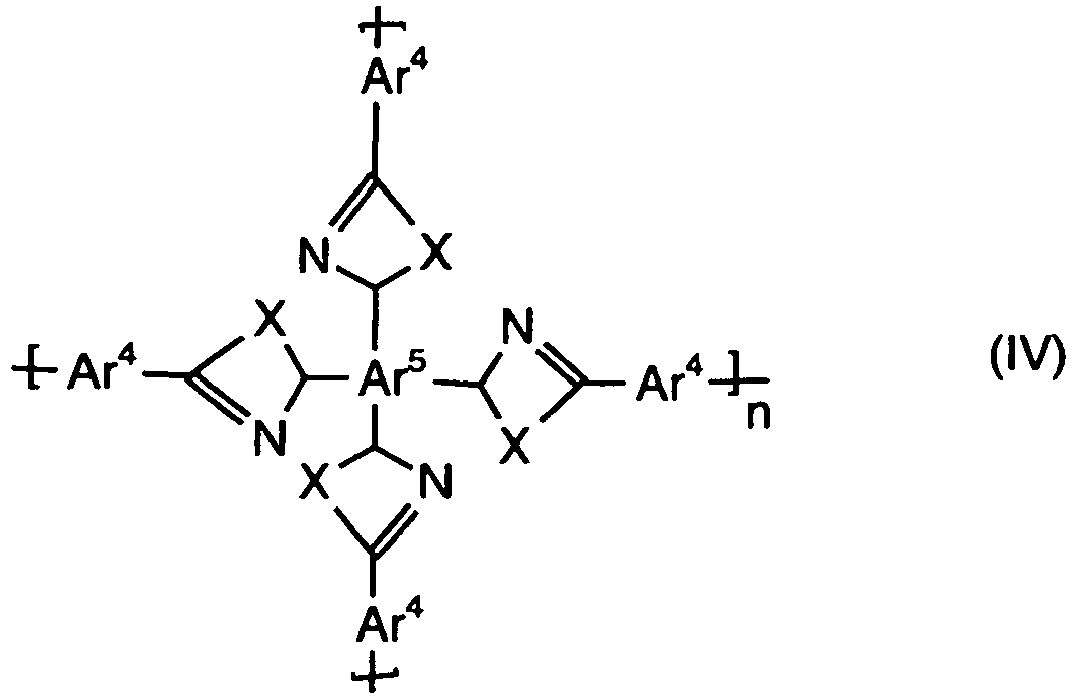


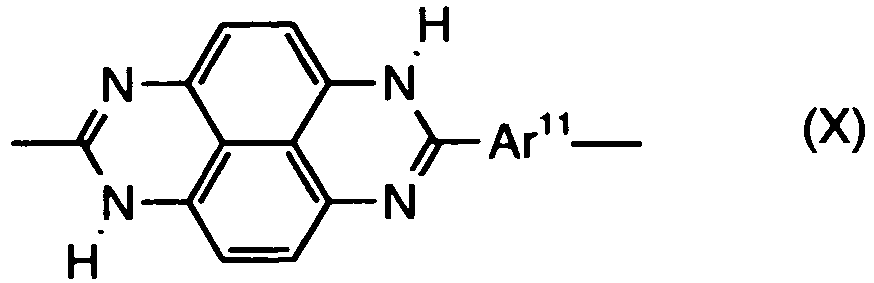


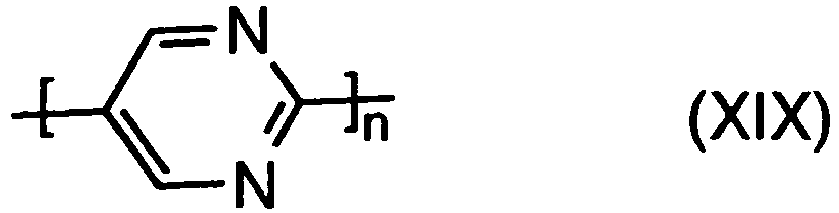


- Ar
- gleich oder verschieden sind und für eine vierbindige aromatische oder heteroaromatische Gruppe stehen, die ein- oder mehrkernig sein kann,
- Ar1
- gleich oder verschieden sind und für eine zweibindige aromatische oder heteroaromatische Gruppe stehen, die ein- oder mehrkernig sein kann,
- Ar2
- gleich oder verschieden sind und für eine zwei oder dreibindige aromatische oder heteroaromatische Gruppe stehen, die ein- oder mehrkernig sein kann,
- Ar3
- gleich oder verschieden sind und für eine dreibindige aromatische oder heteroaromatische Gruppe stehen, die ein- oder mehrkernig sein kann,
- Ar4
- gleich oder verschieden sind und für eine dreibindige aromatische oder heteroaromatische Gruppe stehen, die ein- oder mehrkernig sein kann,
- Ar5
- gleich oder verschieden sind und für eine vierbindige aromatische oder heteroaromatische Gruppe stehen, die ein- oder mehrkernig sein kann,
- Ar6
- gleich oder verschieden sind und für eine zweibindige aromatische oder heteroaromatische Gruppe stehen, die ein- oder mehrkernig sein kann,
- Ar7
- gleich oder verschieden sind und für eine zweibindige aromatische oder heteroaromatische Gruppe stehen, die ein- oder mehrkernig sein kann,
- Ar8
- gleich oder verschieden sind und für eine dreibindige aromatische oder heteroaromatische Gruppe stehen, die ein- oder mehrkernig sein kann,
- Ar9
- gleich oder verschieden sind und für eine zwei- oder drei- oder vierbindige aromatische oder heteroaromatische Gruppe stehen, die ein- oder mehrkernig sein kann,
- Ar10
- gleich oder verschieden sind und für eine zwei- oder dreibindige aromatische oder heteroaromatische Gruppe stehen, die ein- oder mehrkernig sein kann,
- Ar11
- gleich oder verschieden sind und für eine zweibindige aromatische oder heteroaromatische Gruppe stehen, die ein- oder mehrkernig sein kann,
- X
- gleich oder verschieden ist und für Sauerstoff, Schwefel oder eine Aminogruppe steht, die ein Wasserstoffatom, eine 1- 20 Kohlenstoffatome aufweisende Gruppe, vorzugsweise eine verzweigte oder nicht verzweigte Alkyl- oder Alkoxygruppe, oder eine Arylgruppe als weiteren Rest trägt
- R
- in allen Formeln außer Formel (XX) gleich oder verschieden für Wasserstoff, eine Alkylgruppe oder eine aromatische Gruppe und in Formel (XX) für eine Alkylengruppe oder eine aromatische Gruppe steht und
- n, m
- eine ganze Zahl größer gleich 10, bevorzugt größer gleich 100 ist.
- Bevorzugte aromatische oder heteroaromatische Gruppen leiten sich von Benzol, Naphthalin, Biphenyl, Diphenylether, Diphenylmethan, Diphenyldimethylmethan, Bisphenon, Diphenylsulfon, Chinolin, Pyridin, Bipyridin, Pyridazin, Pyrimidin, Pyrazin, Triazin, Tetrazin, Pyrol, Pyrazol, Anthracen, Benzopyrrol, Benzotriazol, Benzooxathiadiazol, Benzooxadiazol, Benzopyridin, Benzopyrazin, Benzopyrazidin, Benzopyrimidin, Benzopyrazin, Benzotriazin, Indolizin, Chinolizin, Pyridopyridin, Imidazopyrimidin, Pyrazinopyrimidin, Carbazol, Aciridin, Phenazin, Benzochinolin, Phenoxazin, Phenothiazin, Acridizin, Benzopteridin, Phenanthrolin und Phenanthren, die gegebenenfalls auch substituiert sein können, ab.
- Dabei ist das Substitionsmuster von Ar1, Ar4, Ar6, Ar7, Ar8, Ar9, Ar10, Ar11 beliebig, im Falle vom Phenylen beispielsweise kann Ar1, Ar4, Ar6, Ar7, Ar8, Ar9, Ar10, Ar11 ortho-, meta- und para-Phenylen sein. Besonders bevorzugte Gruppen leiten sich von Benzol und Biphenylen, die gegebenenfalls auch substituiert sein können, ab.
- Bevorzugte Alkylgruppen sind kurzkettige Alkylgruppen mit 1 bis 4 Kohlenstoffatomen, wie z. B. Methyl-, Ethyl-, n- oder i-Propyl- und t-Butyl-Gruppen.
- Bevorzugte aromatische Gruppen sind Phenyl- oder Naphthyl-Gruppen. Die Alkylgruppen und die aromatischen Gruppen können substituiert sein.
- Bevorzugte Substituenten sind Halogenatome wie z. B. Fluor, Aminogruppen, Hydroxygruppen oder kurzkettige Alkylgruppen, wie z. B. Methyl- oder Ethylgruppen.
- Bevorzugt sind Polyazole mit wiederkehrenden Einheiten der Formel (I) bei denen die Reste X innerhalb einer wiederkehrenden Einheit gleich sind.
- Die Polyazole können grundsätzlich auch unterschiedliche wiederkehrende Einheiten aufweisen, die sich beispielsweise in ihrem Rest X unterscheiden. Vorzugsweise jedoch weist es nur gleiche Reste X in einer wiederkehrenden Einheit auf.
- Weitere bevorzugte Polyazol-Polymere sind Polyimidazole, Polybenzthiazole, Polybenzoxazole, Polyoxadiazole, Polyquinoxalines, Polythiadiazole Poly(pyridine), Poly(pyrimidine) und Poly(tetrazapyrene).
- In einer weiteren Ausführungsform der vorliegenden Erfindung ist das Polyazol ein Copolymer, das mindestens zwei Einheiten der Formel (I) bis (XXII) enthält, die sich voneinander unterscheiden. Die Polymere können als Blockcopolymere (Diblock, Triblock), statistische Copolymere, periodische Copolymere und/oder alternierende Polymere vorliegen.
- In einer besonders bevorzugten Ausführungsform der vorliegenden Erfindung ist das Polyazol ein Homopolymer, das nur Einheiten der Formel (I) und/oder (II) enthält.
- Die Anzahl der wiederkehrende Azoleinheiten im Polymer ist vorzugsweise eine ganze Zahl größer gleich 10. Besonders bevorzugte Polymere enthalten mindestens 100 wiederkehrende Azoleinheiten.
- Im Rahmen der vorliegenden Erfindung sind Polymere enthaltend wiederkehrenden Benzimidazoleinheiten bevorzugt. Einige Beispiele der äußerst zweckmäßigen
- Polymere enthaltend wiederkehrende Benzimidazoleinheiten werden durch die nachfolgende Formeln wiedergegeben:


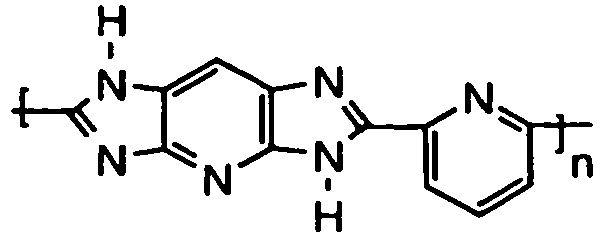


- Im Rahmen einer besonders bevorzugten Variante der vorliegenden Erfindung weisen die Polyazole mindestens eine Sulfonsäure- und/oder Phosphonsäuregruppe auf. Derartige Polymere werden in der Druckschrift
DE 102 46 459 A1 beschrieben. - Die eingesetzten Polyazole, insbesondere jedoch die Polybenzimidazole zeichnen sich durch ein hohes Molekulargewicht aus. Gemessen als intrinsische Viskosität beträgt diese mindestens 0,2 dl/g, vorzugsweise 0,8 bis 10 dl/g, insbesondere 1 bis 10 dl/g.
- Bevorzugte Polybenzimidazole sind unter dem Handelsnamen ®Celazole kommerziell erhältlich.
- Gemäß einer besonders bevorzugten Variante des erfindungsgemäßen Verfahren erfolgt die Herstellung des Polyazols in situ. Hierzu können der Polyphosphorsäure ein oder mehrere Verbindungen beigefügt werden, die unter Einwirkung von Wärme zur Bildung von Polyazolen fähig sind.
- Insbesondere sind Mischungen geeignet, die ein oder mehreren aromatische und/oder heteroaromatische Tetra-Amino-Verbindungen und eine oder mehrere aromatische und/oder heteroaromatische Carbonsäuren oder deren Derivate, die mindestens zwei Säuregruppen pro Carbonsäure-Monomer umfassen. Des weiteren können ein oder mehrere aromatische und/oder heteroaromatische Diaminocarbonsäuren zur Herstellung von Polyazolen eingesetzt werden.
- Zu den aromatischen und heteroaromatischen Tetra-Amino-Verbindungen gehören unter anderem 3,3',4,4'-Tetraaminobiphenyl, 2,3,5,6-Tetraaminopyridin, 1,2,4,5-Tetraaminobenzol, 3,3',4,4'-Tetraaminodiphenylsulfon, 3,3',4,4'-Tetraaminodiphenylether, 3,3',4,4'-Tetraaminobenzophenon, 3,3',4,4'-Tetraaminodiphenylmethan und 3,3',4,4'-Tetraaminodiphenyldimethylmethan sowie deren Salze, insbesondere deren Mono-, Di-, Tri- und Tetrahydrochloridderivate. Hiervon sind 3,3',4,4'-Tetraaminobiphenyl, 2,3,5,6-Tetraaminopyridin und 1,2,4,5-Tetraaminobenzol besonders bevorzugt.
- Des weiteren kann die Mischung aromatische und/oder heteroaromatische Carbonsäuren umfassen. Hierbei handelt es sich um Dicarbonsäuren und Tricarbonsäuren und Tetracarbonsäuren oder deren Estern oder deren Anhydride oder deren Säurehalogenide, insbesondere deren Säurehalogenide und/oder Säurebromide. Vorzugsweise handelt es sich bei den aromatischen Dicarbonsäuren um Isophthalsäure, Terephthalsäure, Phthalsäure, 5-Hydroxyisophthalsäure, 4-Hydroxyisophthalsäure, 2-Hydroxyterephthalsäure, 5-Aminoisophthalsäure, 5-N,N-Dimethylaminoisophthalsäure, 5-N,N-Diethylaminoisophthalsäure, 2,5-Dihydroxyterephthalsäure, 2,6-Dihydroxyisophthalsäure, 4,6-Dihydroxyisophthalsäure, 2,3-Dihydroxyphthalsäure, 2,4-Dihydroxyphthalsäure. 3,4-Dihydroxyphthalsäure, 3-Fluorophthalsäure, 5-Fluoroisophthalsäure, 2-Fluoroterphthalsäure, Tetrafluorophthalsäure, Tetrafluoroisophthalsäure, Tetrafluoroterephthalsäure,1,4-Naphthalindicarbonsäure, 1,5-Naphthalindicarbonsäure, 2,6-Naphthalindicarbonsäure, 2,7-Naphthalindicarbonsäure, Diphensäure, 1,8-dihydroxynaphthalin-3,6-dicarbonsäure, Diphenylether-4,4'-dicarbonsäure, Benzophenon-4,4'-dicarbonsäure, Diphenylsulfon-4,4'-dicarbonsäure, Biphenyl-4,4'-dicarbonsäure, 4-Trifluoromethylphthalsäure, 2,2-Bis(4-carboxyphenyl)hexafluoropropan, 4,4'-Stilbendicarbonsäure, 4-Carboxyzimtsäure, bzw. deren C1-C20-Alkyl-Ester oder C5-C12-Aryl-Ester, oder deren Säureanhydride oder deren Säurechloride.
- Bei den aromatischen Tricarbonsäuren oder deren C1-C20-Alkyl- Ester oder C5-C12-Aryl-Ester oder deren Säureanhydride oder deren Säurechloride handelt es sich bevorzugt um 1,3,5-Benzol-tricarbonsäure (Trimesic acid), 1,2,4-Benzol-tricarbonsäure (Trimellitic acid), (2-Carboxyphenyl)iminodiessigsäure, 3,5,3'-Biphenyltricarbonsäure, 3,5,4'-Biphenyltricarbonsäure.
- Bei den aromatischen Tetracarbonsäuren oder deren C1-C20-Alkyl- Ester oder C5-C12-Aryl-Ester oder deren Säureanhydride oder deren Säurechloride handelt es sich bevorzugt um 3,5,3',5'-Biphenyltetracarbonsäure, 1,2,4,5-Benzoltetracarbonsäure, Benzophenontetracarbonsäure, 3,3',4,4'-Biphenyltetracarbonsäure, 2,2',3,3'-Biphenyltetracarbonsäure, 1,2,5,6-Naphthalintetracarbonsäure, 1,4,5,8-Naphthalintetracarbonsäure.
- Bei den heteroaromatischen Carbonsäuren handelt es sich bevorzugt um heteroaromatische Dicarbonsäuren und Tricarbonsäuren und Tetracarbonsäuren oder deren Estern oder deren Anhydride. Als heteroaromatische Carbonsäuren werden aromatische Systeme verstanden welche mindestens ein Stickstoff, Sauerstoff, Schwefel oder Phosphoratom im Aromaten enthalten. Vorzugsweise handelt es sich um Pyridin-2,5-dicarbonsäure, Pyridin-3,5- dicarbonsäure, Pyridin-2,6-dicarbonsäure, Pyridin-2,4-dicarbonsäure, 4-Phenyl-2,5- pyridindicarbonsäure, 3,5-Pyrazoldicarbonsäure, 2,6 -Pyrimidindicarbonsäure, 2,5- Pyrazindicarbonsäure, 2,4,6-Pyridintricarbonsäure, Benzimidazol-5,6-dicarbonsäure sowie deren C1- C20-AlkylEster oder C5-C12-Aryl-Ester, oder deren Säureanhydride oder deren Säurechloride.
- Der Gehalt an Tricarbonsäure oder Tetracarbonsäuren (bezogen auf eingesetzte Dicarbonsäure) beträgt zwischen 0 und 30 Mol-%, vorzugsweise 0,1 und 20 Mol %, insbesondere 0,5 und 10 Mol-%.
- Des weiteren können auch aromatische und heteroaromatische Diaminocarbonsäuren eingesetzt werden. Zu diesen gehört unter anderem Diaminobenzoesäure, 4-Phenoxycarbonyl-3,'4'-diaminodiphenylether und deren Mono- und Dihydrochloridderivate.
- Bevorzugt werden Mischungen von mindestens 2 verschiedenen aromatischen Carbonsäuren eingesetzt. Besonders bevorzugt werden Mischungen eingesetzt, die neben aromatischen Carbonsäuren auch heteroaromatische Carbonsäuren enthalten. Das Mischungsverhältnis von aromatischen Carbonsäuren zu heteroaromatischen Carbonsäuren beträgt zwischen 1:99 und 99:1, vorzugsweise zwischen 1:50 bis 50:1.
- Bei diesen Mischungen handelt es sich insbesondere um Mischungen von N-heteroaromatischen Dicarbonsäuren und aromatischen Dicarbonsäuren. Nicht limitierende Beispiele für Dicarbonsäuren sind Isophthalsäure, Terephthalsäure, Phthalsäure, 2,5-Dihydroxyterephthalsäure, 2,6-Dihydroxyisophthalsäure, 4,6-Dihydroxyisophthalsäure, 2,3-Dihydroxyphthalsäure, 2,4-Dihydroxyphthalsäure. 3,4-Dihydroxyphthalsäure,1,4-Naphthalindicarbonsäure, 1,5-Naphthalindicarbonsäure, 2,6-Naphthalindicarbonsäure, 2,7-Naphthalindicarbonsäure, Diphensäure, 1,8-dihydroxynaphthalin-3,6-dicarbonsäure, Diphenylether-4,4'-dicarbonsäure, Benzophenon-4,4'-dicarbonsäure, Diphenylsulfon-4,4'-dicarbonsäure, Biphenyl-4,4'-dicarbonsäure, 4-Trifluoromethylphthalsäure, Pyridin-2,5-dicarbonsäure, Pyridin-3,5-dicarbonsäure, Pyridin-2,6-dicarbonsäure, Pyridin-2,4-dicarbonsäure, 4-Phenyl-2,5-pyridindicarbonsäure, 3,5-Pyrazoldicarbonsäure, 2,6 -Pyrimidindicarbonsäure,2,5-Pyrazindicarbonsäure.
- Soll ein möglichst hohes Molekulargewicht erzielt werden, so liegt das Molverhältnis von Carbonsäuregruppen zu Aminogruppen bei der Umsetzung von Tetra-Amino-Verbindungen mit einer oder mehreren aromatischen Carbonsäuren oder deren Estern, die mindestens zwei Säuregruppen pro Carbonsäure-Monomer enthalten, vorzugsweise in der Nähe von 1:2.
- Bevorzugt werden mindestens 0,5 Gew.-%, insbesondere 1 bis 30 Gew.-% und besonders bevorzugt 2 bis 15 Gew.-% Monomere zur Herstellung von Polyazolen eingesetzt, jeweils bezogen auf das resultierende Gewicht der zu verwendenden Zusammensetzung.
- Werden die Polyazole unmittelbar in der Polyphosphorsäure aus den Monomeren hergestellt, zeichnen sich die Polyazole durch ein hohes Molekulargewicht aus. Dies gilt insbesondere für die Polybenzimidazole. Gemessen als Intrinsische Viskosität liegt diese im Bereich von 0,3 bis 10 dl/g, vorzugsweise im Bereich von 1 bis 5 dl/g.
- Insofern auch Tricarbonsäuren oder Tetracarbonsäre eingesetzt werden, wird hierdurch eine Verzweigung/ Vernetzung des gebildeten Polymeren erzielt. Diese trägt zur Verbesserung der mechanischen Eigenschaft bei.
- Gemäß einem weiteren Aspekt der vorliegenden Erfindung werden Verbindungen verwendet, die unter Einwirkung von Wärme zur Bildung von Polyazolen geeignet sind, wobei diese Verbindungen durch Umsetzung von einem oder mehreren aromatischen und/oder heteroaromatischen Tetra-Amino-Verbindungen mit einer oder mehreren aromatischen und/oder heteroaromatischen Carbonsäuren bzw. deren Derivate, die mindestens zwei Säuregruppen pro Carbonsäure-Monomer enthalten, oder von einer oder mehreren aromatischen und/oder heteroaromatischen Diaminocarbonsäuren in der Schmelze bei Temperaturen von bis zu 400°C, insbesondere bis zu 350°C, bevorzugt bis zu 280°C erhältlich sind. Die zur Herstellung dieser Präpolymere einzusetzenden Verbindungen wurden zuvor dargelegt.
- Die jeweiligen Anteile der Polyphosphorsäure und des Polyazols unterliegen Beschränkungen. Für die Zwecke der vorliegenden Erfindung geeignete Zusammensetzungen enthalten, jeweils bezogen auf ihr Gesamtgewicht (Einwaage) 95,0 Gew.-% bis 99,5 Gew.-%, Polyphosphorsäure und 5,0 Gew.-% bis 0,5 Gew.-% Polyazol.
- Die bei vorliegenden Verfahren einzusetzende Zusammensetzung liegt vorzugsweise als Dispersion, Suspension oder Lösung vor und kann ggf. geringe Feststoffanteile und/oder Gelanteile umfassen. Besonders bevorzugt ist der Anteil abfiltrierbarer Bestandteile jedoch kleiner 30,0 Gew.-%, vorzugsweise kleiner 10,0 Gew.-%, insbesondere kleiner 5,0 Gew.-%, jeweils bezogen auf das Gesamtgewicht der Zusammensetzung. Die Bestimmung der abfiltrierbaren Mengen erfolgt dabei günstigerweise bei der Temperatur, bei welcher das erfindungsgemäße Verfahren durchgeführt wird (Temperatur an der Öffnung). Weiterhin werden vorzugsweise Siebe mit Sieböffnungen (Maschen) kleiner 1,0 mm, bevorzugt kleiner 500 µm, besonders bevorzugt kleiner 100 µm, eingesetzt.
- Die bei dem Verfahren einzusetzende Zusammensetzung weist eine Lösungsviskosität im Bereich von 10 Pas bis 1000 Pas, bevorzugt im Bereich von 20 Pas bis 800 Pas, besonders bevorzugt im Bereich von 30 Pas bis 600 Pas, insbesondere im Bereich von 50 Pas bis 500 Pas, auf. Die Lösungsviskosität wird nach DIN 53018 bei einer Scherrate von 30 Hz zwischen zwei 20 mm Platten gemessen. Die Messung der Viskosität erfolgt bei der Temperatur, die der Temperatur an der Öffnung während der Herstellung der Membran entspricht.
- Weiterhin weist das Polyazol in der Zusammensetzung günstigerweise eine Grenzviskosität (IV) in mindestens 96 %-iger Schwefelsäure von 0,3 bis 10, besonders bevorzugt von 1 bis 5, auf. Dabei kann die Grenzviskosität auf an sich bekannte Weise durch Vermessen von Konzentrationsreihen und Extrapolation auf unendliche Verdünnung ermittelt werden. Die Messungen werden vorzugsweise bei einer Temperatur zwischen 0°C und 100°C, besonders bevorzugt zwischen 20°C und 80°C, insbesondere bei 25°C, durchgeführt. Ferner hat sich der Einsatz von Ostwald-Viskosimetern und/oder Viskosimetern nach Ubbelohde ganz besonders bewährt.
- Weitere Informationen zu den Viskositätsgrößen und den zugehörigen Bestimmungsverfahren können der gängigen Fachliteratur, z. B. Ullmann 1, 67-85; (4.) 5, 755-778, entnommen werden, deren Offenbarung hiermit durch Bezugnahme eingeschlossen wird.
- Im Rahmen einer sehr bevorzugten Variante der vorliegenden Erfindung enthält die einzusetzende Zusammensetzung weiterhin mindestens ein Polymer, das kein Polyazol darstellt (Polymer (B). Diese Polymer kann unter anderem gelöst, dispergiert oder suspendiert vorliegen.
- Hierbei liegt das Gewichtsverhältnis von Polyazol zu Polymer (B) bevorzugt im Bereich von 0,1 bis 50, vorzugsweise im Bereich von 0,2 bis 20, besonders bevorzugt im Bereich von 1 bis 10. Falls das Polyazol erst in situ gebildet wird, kann das Gewichtsverhältnis rechnerisch aus dem Gewicht der Monomeren zur Bildung des Polyazols erhalten werden, wobei die bei der Kondensation freigesetzten Verbindungen, beispielsweise Wasser zu berücksichtigen sind.
- Zu den bevorzugten Polymeren gehören unter anderem Polyolefine, wie Poly(cloropren), Polyacetylen, Polyphenylen, Poly(p-xylylen), Polyarylmethylen, Polyarmethylen, Polystyrol, Polymethylstyrol, Polyvinylalkohol, Polyvinylacetat, Polyvinylether, Polyvinylamin, Poly(N-vinylacetamid), Polyvinylimidazol, Polyvinylcarbazol, Polyvinylpyrrolidon, Polyvinylpyridin, Polyvinylchlorid, Polyvinylidenchlorid, Polytetrafluorethylen, Polyhexafluorpropylen, Copolymere von PTFE mit Hexafluoropropylen, mit Perfluorpropylvinylether, mit Trifluoronitrosomethan, mit Sulfonylfluoridvinylether, mit Carbalkoxyperfluoralkoxyvinylether, Polychlortrifluorethylen, Polyvinylfluorid, Polyvinylidenfluorid, Polyacrolein, Polyacrylamid, Polyacrylnitril, Polycyanacrylate, Polymethacrylimid, Cycloolefinische Copolymere, insbesondere aus Norbornen; Polymere mit C-O-Bindungen in der Hauptkette, beispielsweise Polyacetal, Polyoxymethylen, Polyether, Polypropylenoxid, Polyepichlorhydrin, Polytetrahydrofuran, Polyphenylenoxid, Polyetherketon, Polyester, insbesondere Polyhydroxyessigsäure, Polyethylenterephthalat, Polybutylenterephthalat, Polyhydroxybenzoat, Polyhydroxypropionsäure, Polypivalolacton, Polycaprolacton, Polymalonsäure, Polycarbonat; Polymere C-S-Bindungen in der Hauptkette, beispielsweise Polysulfidether, Polyphenylensulfid, Polyethersulfon; Polymere C-N-Bindungen in der Hauptkette, beispielsweise Polyimine, Polyisocyanide,Polyetherimin, Polyanilin, Polyamide, Polyhydrazide, Polyurethane, Polyimide, Polyazole, Polyazine; Flüssigkristalline Polymere, insbesondere Vectra sowie Anorganische Polymere, beispielsweise Polysilane, Polycarbosilane, Polysiloxane, Polykieselsäure, Polysilikate, Silicone, Polyphosphazene und Polythiazyl.
- Des weiteren gehören zu den bevorzugten Polymeren (B) auch Polymere mit kovalent gebundenen Säuregruppen. Diese Säuregruppen umfassen insbesondere Sulfonsäuregruppen. Die mit Sulfonsäuregruppen modifizierten Polymere besitzen vorzugsweise einen Gehalt an Sulfonsäuregruppen im Bereich von 0,5 bis 3 meq/g. Dieser Wert wird über die sog. lonenaustauschkapazität (IEC) bestimmt.
- Zur Messung der IEC werden die Sulfonsäuregruppen in die freie Säure überführt. Hierzu wird das Polymere auf bekannte Weise mit Säure behandelt, wobei überschüssige Säure durch Waschen entfernt wird. So wird das sulfonierte Polymer zunächst 2 Stunden in siedendem Wasser behandelt. Anschließend wird überschüssiges Wasser abgetupft und die Probe während 15 Stunden bei 160°C im Vakuumtrockenschrank bei p<1 mbar getrocknet. Dann wird das Trockengewicht der Membran bestimmt. Das so getrocknete Polymer wird dann in DMSO bei 80°C während 1 h gelöst. Die Lösung wird anschließend mit 0,1 M NaOH titriert. Aus dem Verbrauch der Säure bis zum Equivalentpunkt und dem Trockengewicht wird dann die lonenaustauschkapazität (IEC) berechnet.
- Derartige Polymere sind in der Fachwelt bekannt. So können Sulfonsäuregruppen enthaltende Polymere beispielsweise durch Sulfonierung von Polymeren hergestellt werden. Verfahren zur Sulfonierung von Polymeren sind in F. Kucera et. al. Polymer Engineering and Science1988, Vol. 38, No 5, 783-792 beschrieben. Hierbei können die Sulfonierungsbedingungen so gewählt werden, dass ein niedriger Sulfonierungsgrad entsteht (
DE-A-19959289 ). - So wurde eine weitere Klasse nichtfluorierter Polymere durch Sulfonierung von hochtemperaturstabilen Thermoplasten entwickelt. So sind sulfonierte Polyetherketone (
DE-A-4219077 ,WO96/01177 DE-A-19527435 ) bekannt. -
US-A-6110616 beschreibt Copolymere aus Butadien und Styrol und deren anschliesende Sulfonierung zur Verwendung für Brennstoffzellen. - Des weiteren können derartige Polymere auch durch Polyreaktionen von Monomeren erhalten werden, die Säuregruppen umfassen. So können perfluorinierte Polymere wie in
US-A-5422411 beschrieben durch Copolymerisation aus Trifluorostyrol und sulfonylmodifiziertem Trifuorostyrol hergestellt werden. - Zu diesen Perfluorosulfonsäurepolymeren gehört unter anderem Nafion® (
US-A-3692569 ). Dieses Polymer kann wie inUS-A-4453991 beschrieben in Lösung gebracht und dann als lonomer eingesetzt werden. - Zu den bevorzugten Polymeren mit Säuregruppen gehören unter anderem sulfonierte Polyetherketone, sulfonierte Polysulfone, sulfonierte Polyphenylensulfide, perfluorinierte sulfonsäuregruppenhaltige Polymere, wie in
US-A-3692569 ,US-A-5422411 undUS-A-6110616 beschrieben. - Zur Anwendung in Brennstoffzellen mit einer Dauergebrauchstemperatur oberhalb 100°C werden solche Polymere (B) bevorzugt, die eine Glasübergangstemperatur oder Vicat-Erweichungstemperatur VST/A/50 von mindestens 100°C, bevorzugt mindestens 150°C und ganz besonders bevorzugt mindestens 180°C haben. Hierbei sind Polysulfone mit einer Vicat-Erweichungstemperatur VST/A/50 von 180°C bis 230°C bevorzugt.
- Darüber hinaus sind Polymere (B) bevorzugt, die eine geringe Löslichkeit und/oder Abbaubarkeit in Phosphorsäure aufweisen. Gemäß einer besonderen Ausführungsform der vorliegenden Erfindung ist nimmt das Gewicht durch eine Behandlung mit 85%iger Phosphorsäure nur unwesentlich ab. Vorzugsweise ist das Gewichtsverhältnis der Platte nach der Phosphorsäure-Behandlung zum Gewicht der Platte vor der Behandlung größer oder gleich 0,8, insbesondere größer oder gleich 0,9 und besonders bevorzugt größer oder gleich 0,95. Dieser Wert wird an einer Platte aus Polymer (B) gemessen, die 2 mm dick, 5 cm lang und 2 cm breit ist. Diese Platte wird in Phosphorsäure gegeben, wobei das Gewichtsverhältnis von Phosphorsäure zu Platte 10 beträgt. Anschließend wird die Phosphorsäure unter Rühren 24 Stunden auf 100°C erhitzt. Anschließend wird die Platte durch Waschen mit Wasser von überschüssiger Phosphorsäure befreit und getrocknet. Hiernach wird die Platte erneut gewogen.
- Zu den bevorzugten Polymeren gehören Polysulfone, insbesondere Polysulfon mit Aromaten in der Hauptkette. Gemäß einem besonderen Aspekt der vorliegenden Erfindung weisen bevorzugte Polysulfone und Polyethersulfone eine Schmelzvolumenrate MVR 300/21,6 kleiner oder gleich 40 cm3/ 10 min, insbesondere kleiner oder gleich 30 cm3/ 10 min und besonders bevorzugt kleiner oder gleich 20 cm3/ 10 min gemessen nach ISO 1133 auf.
- Zur Polymerisation wird die Mischung wird auf eine Temperatur von bis zu 400°C, insbesondere 350°C, vorzugsweise bis zu 280°C, insbesondere 100°C bis 250°C und besonders bevorzugt im Bereich von 200°C bis 250°C erhitzt. Hierbei wird vorzugsweise ein Inertgas, beispielsweise Stickstoff oder ein Edelgas, wie Neon oder Argon, eingesetzt.
- Zur weiteren Verbesserung der anwendungstechnischen Eigenschaften können der Zusammensetzung zusätzlich noch Füllstoffe, insbesondere protonenleitende Füllstoffe, sowie zusätzliche Säuren zugesetzt werden.
- Nicht limitierende Beispiele für protonenleitende Füllstoffe sind
- Sulfate wie:
- CSHSO4, Fe(SO4)2, (NH4)3H(SO4)2, LiHSO4, NaHSO4, KHSO4, RbSO4, LiN2H5SO4, NH4HSO4,
- Phosphate wie
- Zr3(PO4)4, Zr(HPO4)2, HZr2(PO4)3, UO2PO4.3H2O, H8UO2PO4, Ce(HPO4)2, Ti(HPO4)2, KH2PO4, NaH2PO4, LiH2PO4, NH4H2PO4, CsH2PO4, CaHPO4, MgHPO4, HSbP2O8, HSb3P2O14, H5Sb5P2O20,
- Polysäure wie
- H3PW12O40.nH2O (n=21-29), H3SiW12O40.nH2O (n=21-29), HxWO3, HSbWO6, H3PMO12O40, H2Sb4O11, HTaWO6, HNbO3, HTiNbO5, HTiTaO5, HSbTeO6, H5Ti4O9, HSbO3, H2MoO4
- Selenite und Arsenide wie
- (NH4)3H(SeO4)2, UO2AsO4, (NH4)3H(SeO4)2, KH2AsO4, Cs3H(SeO4)2, Rb3H(SeO4)2,
- Oxide wie
- Al2O3, Sb2O5, ThO2, SnO2, ZrO2, MoO3
- Silikate wie
- Zeolithe, Zeolithe(NH4+), Schichtsilikate, Gerüstsilikate, H-Natrolite, H-Mordenite, NH4-Analcine, NH4-Sodalite, NH4-Gallate, H-Montmorillonite
- Säuren wie
- HClO4, SbF5
- Füllstoffe wie
- Carbide, insbesondere SiC, Si3N4, Fasern, insbesondere Glasfasern, Glaspulvern und/oder Polymerfasern, bevorzugt auf Basis von Polyazolen.
- Diese Additive können in der Zusammensetzung in üblichen Mengen enthalten sein, wobei jedoch die positiven Eigenschaften, wie hohe Leitfähigkeit, hohe Lebensdauer und hohe mechanische Stabilität der Membran durch Zugabe von zu großen Mengen an Additiven nicht allzu stark beeinträchtigt werden sollten. Im allgemeinen umfasst die resultierende Membran höchstens 80 Gew.-%, vorzugsweise höchstens 50 Gew.-% und besonders bevorzugt höchstens 20 Gew.-% Additive.
- Als weiteres kann die Zusammensetzung auch perfluorierte Sulfonsäure-Additive (vorzugsweise 0,1-20 Gew.-%, bevorzugt 0,2-15 Gew.%, ganz bevorzugt 0,2-10 Gew.-%) enthalten. Diese Additive führen zur Leistungsverbesserung, in der Nähe der Kathode zur Erhöhung der Sauerstofflöslichkeit und Sauerstoffdiffusion und zur Verringerung der Adsorbtion von Phosphorsäure und Phosphat zu Platin. (Electrolyte additives for phosphoric acid fuel cells. Gang, Xiao; Hjuler, H. A.; Olsen, C.; Berg, R. W.; Bjerrum, N. J. Chem. Dep. A, Tech. Univ. Denmark, Lyngby, Den. J. Electrochem. Soc. (1993), 140(4), 896-902 und Perfluorosulfonimide as an additive in phosphoric acid fuel cell. Razaq, M.; Razaq, A.; Yeager, E.; DesMarteau, Darryl D.; Singh, S. Case Cent. Electrochem. Sci., Case West. Reserve Univ., Cleveland, OH, USA. J. Electrochem. Soc. (1989), 136(2), 385-90.)
- Nicht limitierende Beispiele für persulfonierte Additive sind: Trifluomethansulfonsäure, Kaliumtrifluormethansulfonat, Natriumtrifluormethansulfonat, Lithiumtrifluormethansulfonat, Ammoniumtrifluormethansulfonat, Kaliumperfluorohexansulfonat, Natriumperfluorohexansulfonat, Lithiumperfluorohexansulfonat, Ammoniumperfluorohexansulfonat, Perfluorohexansulfonsäure, Kaliumnonafluorbutansulfonat, Natriumnonafluorbutansulfonat, Lithiumnonafluorbutansulfonat, Ammoniumnonafluorbutansulfonat, Cäsiumnonafluorbutansulfonat, Triethylammoniumperfluorohexasulfonat, Perflurosulfoimide und Nafion.
- Bei dem erfindungsgemäßen Verfahren wird die Polyphosphorsäure und mindestens ein Polyazol enthaltende Zusammensetzung durch eine Öffnung, vorzugsweise eine Düse, gepresst. Eine Düse bezeichnet ein sich noch vorn stetig verengendes Stück, durch welches die Lösung geleitet wird.
- Die Öffnung ist schlitzförmig ausgebildet und besitzt eine längliche, schmale, vorzugsweise rechteckige Form. Die Spaltbreite des Schlitzes ist bevorzugt im Bereich von 10 cm bis 2,0 m, besonders bevorzugt im Bereich von 20 cm bis 50 cm. Die Länge des Spalts ist günstigerweise im Bereich von 250 µm bis 5 mm, insbesondere im Bereich von 800 µm bis 1600 µm. Das Verhältnis der Spaltbreite zur Spaltlänge ist bevorzugt im Bereich von 10:1 bis 10000:1, besonders bevorzugt im Bereich von 100:1 bis 1000:1.
- Man führt das Verfahren bei einer Temperatur, gemessen an der Öffnung, im Bereich von 120°C bis 300°C, bevorzugt im Bereich von 120°C bis 180°C, besonders bevorzugt im Bereich von 165°C bis 170°C, durch.
- Die sonstigen Verfahrensparameter können prinzipiell frei gewählt und auf den jeweiligen Einzelfall abgestimmt werden. Dennoch hat es sich als besonders günstig erwiesen, den Druck, mit welchem die Lösung durch die Öffnung gepresst wird, auf einen Wert von mindestens 0,1 bar, bevorzugt von mindestens 1,5 bar, insbesondere auf einen Wert im Bereich von 2 bar bis 2,5 bar, einzustellen.
- Im Rahmen einer ganz besonders bevorzugten Ausführungsform ist die Öffnung ein Teil eines Extruders, durch welche die Lösung extrudiert wird. Der Einsatz von Einschneckenextrudern oder Doppelschneckenextrudern hat sich in diesem Zusammenhang ganz besonders bewährt.
- Weiterhin ist es erfindungsgemäß ganz besonders günstig, das Polyazol und die Polyphosphorsäure im Extruder zu mischen. Sofern das Polyazol im Extruder in situ hergestellt werden soll, kann der Extruder Bereiche mit unterschiedlichen Temperaturen (Synthesebereich, Öffnung) aufweisen. Wesentlich ist lediglich, dass die erfindungsgemäßen Kriterien, d. h. die Lösungsviskosität und die Extrusionstemperatur an der Öffnung, eingehalten werden.
- Die durch die Düse gepresste Zusammensetzung wird vorzugsweise auf einen Träger, insbesondere auf eine Elektrode, aufgetragen. Anschließend wird die extrudierte Zusammensetzung verfestigt.
- Im Rahmen einer besonders bevorzugten Variante der vorliegenden Erfindung erfolgt die Auftragung der Zusammensetzung auf den Träger derart, dass mehrere Felder der Zusammensetzung auf dem Träger gebildet werden, die nicht untereinander verbunden sind. Dies kann z. B. dadurch erreicht werden, dass man die Zusammensetzung durch einen geteilten Spalt presst oder die Auftragung auf den Träger kurzzeitig unterbricht und an einer anderen Stelle fortsetzt. Ein Vorteil dieser Vorgehensweise ist u. a. die Möglichkeit, die Gestalt der Membran entsprechend den Anforderungen direkt maßzuschneidern und ein späteres Zuschneiden zu vermeiden.
- Die erfindungsgemäße Verfestigung der extrudierten Membran erfolgt durch Abkühlung, z. B. durch Kaltblasen, und/oder eine Nachbehandlung (Hydrolyse und/oder Vernetzung), bevorzugt mit einer Flüssigkeit oder einem Flüssigkeitsgemisch, vorzugsweise in einem Tauchbad, welches die vorstehend genannten Flüssigkeiten enthält.
- Die vorstehend genannten Flüssigkeiten temperieren die extrudierte Membran auf einen vorgewählten Temperaturbereich, so dass die Abkühlung und/oder Nachbehandlung (Hydrolyse und/oder Vernetzung) über ein vorgewähltes Temperaturprofil erfolgen kann.
- Die bei dem Verfahren erhaltene, extrudierte Membran wird vorzugsweise einer Nachbehandlung mit Feuchtigkeit unterzogen, so dass die anwesende Polyphosphorsäure unter Ausbildung niedermolekularer Polyphosphorsäure und/oder Phosphorsäure zumindest teilweise hydrolysiert. Die Behandlung der Membran erfolgt vorzugsweise bei Temperaturen im Bereich von -100°C und 150°C, vorzugsweise bei Temperaturen zwischen 10°C und 120°C, insbesondere zwischen Raumtemperatur (20°C) und 110°C, besonders bevorzugt zwischen 30°C und 100°C. Weiterhin geschieht die Behandlung bevorzugt unter Normaldruck, sie kann aber auch unter Einwirkung von Druck erfolgen. Im Rahmen einer besonders bevorzugten Variante der vorliegenden Erfindung wird die Membran durch ein Bad, welches Wasser oder wässrige Flüssigkeiten umfasst, geführt.
- Die Hydrolyse der Polyphosphorsäure bedingt eine Verfestigung der Zusammensetzung und eine Abnahme der Schichtdicke und Ausbildung einer Membran. Die verfestigte Membran hat im Allgemeinen eine Dicke zwischen 15 und 3000 µm, vorzugsweise 20 und 2000 µm, insbesondere zwischen 20 und 1500 µm, wobei die Membran selbsttragend ist.
- Die obere Temperaturgrenze für die Feuchtigkeitsbehandlung beträgt in der Regel 150°C. Bei extrem kurzer Einwirkung von Feuchtigkeit, beispielsweise von überhitztem Dampf kann dieser Dampf auch heißer als 150°C sein. Wesentlich für die Temperaturobergrenze ist die Dauer der Behandlung.
- Die Hydrolyse kann auch in Klimakammern erfolgen bei der unter definierter Feuchtigkeitseinwirkung die Hydrolyse gezielt gesteuert werden kann. Hierbei kann die Feuchtigkeit durch die Temperatur bzw. Sättigung der kontaktierenden Umgebung, beispielsweise Gase wie Luft, Stickstoff, Kohlendioxid oder andere geeignete Gase, oder Wasserdampf gezielt eingestellt werden. Die Behandlungsdauer ist abhängig von den vorstehend gewählten Parametern.
- Weiterhin ist die Behandlungsdauer von der Dicke der Membran abhängig.
- In der Regel beträgt die Behandlungsdauer zwischen wenigen Sekunden bis Minuten, beispielsweise unter Einwirkung von überhitztem Wasserdampf, oder bis hin zu ganzen Tagen, beispielsweise an der Luft bei Raumtemperatur und geringer relativer Luftfeuchtigkeit. Bevorzugt beträgt die Behandlungsdauer zwischen 10 Sekunden und 300 Stunden, insbesondere 1 Minute bis 200 Stunden.
- Wird die Hydrolyse bei Raumtemperatur (20°C) mit Umgebungsluft einer relativen Luftfeuchtigkeit von 40-80% durchgeführt beträgt die Behandlungsdauer vorzugsweise zwischen 1 und 200 Stunden.
- Die erhaltene Membran kann selbsttragend ausgebildet werden, d. h. sie kann vom Träger ohne Beschädigung abgelöst und anschließend ggf. direkt weiterverarbeitet werden.
- Über den Grad der Hydrolyse, d.h. die Dauer, Temperatur und Umgebungsfeuchtigkeit, ist die Konzentration an Phosphorsäure und damit die Leitfähigkeit der erfindungsgemäßen Polymermembran einstellbar. Erfindungsgemäß wird die Konzentration der Phosphorsäure als Mol Säure pro Mol Wiederholungseinheit des Polymers angegeben. Im Rahmen der vorliegenden Erfindung beträgt die Konzentration (Mol Phosporsäure bezogen auf eine Wiederholeinheit der Formel (III), d.h. Polybenzimidazol) zwischen 10 und 90, insbesondere zwischen 12 und 85, insbesondere bevorzugt zwischen 15 und 80, Mol Phosporsäure. Derartig hohe Dotierungsgrade (Konzentrationen) sind durch Dotieren von Polyazolen mit kommerziell erhältlicher ortho-Phosphorsäure nur sehr schwierig bzw. gar nicht zugänglich.
- In einer weiteren Ausführungsform der Erfindung handelt es sich bei den zur Nachbehandlung genannten Flüssigkeiten bzw. Flüssigkeitsgemischen um solche, die eine Hydrolyse der Polyphosphorsäure ermöglichen (Hydrolysierflüssigkeit).
- Die Behandlung der extrudierten Membran erfolgt bei den vorstehend genannten Temperaturen. Die Hydrolyseflüssigkeit umfasst neben Wasser auch mindestens eine Sauerstoffsäure des Phosphors und/oder Schwefels. Auch hier erfolgt die Behandlung vorzugsweise unter Normaldruck, kann aber auch unter Einwirkung von Druck erfolgen.
- Die Hydrolyseflüssigkeit kann eine Lösung darstellen, wobei die Flüssigkeit auch suspendierte und/oder dispergierte Bestandteile enthalten kann. Die Viskosität der Hydrolyseflüssigkeit kann in weiten Bereichen liegen, wobei zur Einstellung der Viskosität eine Zugabe von Lösungsmitteln oder eine Temperaturerhöhung erfolgen kann. Vorzugsweise liegt die dynamische Viskosität im Bereich von 0,1 bis 10000 mPa*s, insbesondere 0,2 bis 2000 mPa*s, wobei diese Werte beispielsweise gemäß DIN 53015 gemessen werden können.
- Die Nachbehandlung kann mit jeder bekannten Methode erfolgen. Beispielsweise kann die Membran in ein Flüssigkeitsbad getaucht oder mit der Hydrolyseflüssigkeit besprüht werden. Weiterhin kann die Hydrolyseflüssigkeit über die Membran gegossen werden.
- Zu den Sauerstoffsäuren des Phosphors und/oder Schwefels gehören insbesondere Phosphinsäure, Phosphonsäure, Phosphorsäure, Hypodiphosphonsäure Hypodiphosphorsäure, Oligophosphorsäuren, schwefelige Säure, dischwefelige Säure und/oder Schwefelsäure. Diese Säuren können einzeln oder als Mischung eingesetzt werden.
- Des Weiteren umfassen die Sauerstoffsäuren des Phosphors und/oder Schwefels radikalisch polymerisierbare Monomere, die Phosphonsäure- und/oder Sulfonsäuregruppen umfassen. In dieser Ausführungsform kann die Flüssigkeit, insofern diese wasserhaltig ist, eine Hydrolyse bewirken und andererseits durch nachfolgende Polymerisation der Monomeren eine Verfestigung bewirken. Insofern die Nachbehandlungsflüssigkeit auch zur Vernetzung befähigte Verbindungen aufweist, kann die Verfestigung auch durch die Vernetzung erfolgen.
- Phosphonsäuregruppen umfassende Monomere sind in der Fachwelt bekannt. Es handelt sich hierbei um Verbindungen, die mindestens eine Kohlenstoff-Kohlenstoff-Doppelbindung und mindestens eine Phosphonsäuregruppe aufweisen. Vorzugsweise weisen die zwei Kohlenstoffatome, die Kohlenstoff-Kohlenstoff-Doppelbindung bilden, mindestens zwei, vorzugsweise 3 Bindungen zu Gruppen auf, die zu einer geringen sterischen Hinderung der Doppelbindung führen. Zu diesen Gruppen gehören unter anderem Wasserstoffatome und Halogenatome, insbesondere Fluoratome. Im Rahmen der vorliegenden Erfindung ergibt sich das Phosphonsäuregruppen umfassende Polymer aus dem Polymerisationsprodukt, das durch Polymerisation des Phosphonsäuregruppen umfassenden Monomers allein oder mit weiteren Monomeren und/oder Vernetzern erhalten wird.
- Das Phosphonsäuregruppen umfassende Monomer kann ein, zwei, drei oder mehr Kohlenstoff-Kohlenstoff-Doppelbindungen umfassen. Des weiteren kann das Phosphonsäuregruppen umfassende Monomer ein, zwei, drei oder mehr Phosphonsäuregruppen enthalten.
- Im allgemeinen enthält das Phosphonsäuregruppen umfassende Monomer 2 bis 20, vorzugsweise 2 bis 10 Kohlenstoffatome.
- Bei dem Phosphonsäuregruppen umfassenden Monomer handelt es sich vorzugsweise um Verbindungen der Formel

- R
- eine Bindung, eine zweibindige C1-C15-Alkylengruppe, zweibindige C1-C15-Alkylenoxygruppe, beispielsweise Ethylenoxygruppe oder zweibindige C5-C20-Aryl- oder Heteroarylgruppe bedeutet, wobei die vorstehenden Reste ihrerseits mit Halogen, -OH, COOZ, -CN, NZ2 substituiert sein können,
- Z
- unabhängig voneinander Wasserstoff, C1-C15-Alkylgruppe, C1-C15-Alkoxygruppe, Ethylenoxygruppe oder C5-C20-Aryl oder Heteroarylgruppe bedeutet, wobei die vorstehenden Reste ihrerseits mit Halogen, -OH, -CN, substituiert sein können und
- x
- eine ganze Zahl 1, 2, 3, 4, 5, 6, 7, 8, 9 oder 10 bedeutet
- y
- eine ganze Zahl 1, 2, 3, 4, 5, 6, 7, 8, 9 oder 10 bedeutet
- R
- eine Bindung, eine zweibindige C1-C15-Alkylengruppe, zweibindige C1-C15-Alkylenoxygruppe, beispielsweise Ethylenoxygruppe oder zweibindige C5-C20-Aryl- oder Heteroarylgruppe bedeutet, wobei die vorstehenden Reste ihrerseits mit Halogen, -OH, COOZ, -CN, NZ2 substituiert sein können,
- Z
- unabhängig voneinander Wasserstoff, C1-C15-Alkylgruppe, C1-C15-Alkoxygruppe, Ethylenoxygruppe oder C5-C20-Aryl oder Heteroarylgruppe bedeutet, wobei die vorstehenden Reste ihrerseits mit Halogen, -OH, -CN, substituiert sein können und
- x
- eine ganze Zahl 1, 2, 3, 4, 5, 6, 7, 8, 9 oder 10 bedeutet
- A
- eine Gruppe der Formeln COOR2, CN, CONR2 2, OR2 und/oder R2 darstellt, worin R2 Wasserstoff, eine C1-C15-Alkylgruppe, C1-C15-Alkoxygruppe, Ethylenoxygruppe oder C5-C20-Aryl oder Heteroarylgruppe bedeutet, wobei die vorstehenden Reste ihrerseits mit Halogen, -OH, COOZ, -CN, NZ2 substituiert sein können
- R
- eine Bindung, eine zweibindige C1-C15-Alkylengruppe, zweibindige C1-C15-Alkylenoxygruppe, beispielsweise Ethylenoxygruppe oder zweibindige C5-C20-Aryl- oder Heteroarylgruppe bedeutet, wobei die vorstehenden Reste ihrerseits mit Halogen, -OH, COOZ, -CN, NZ2 substituiert sein können,
- Z
- unabhängig voneinander Wasserstoff, C1-C15-Alkylgruppe, C1-C15-Alkoxygruppe, Ethylenoxygruppe oder C5-C20-Aryl oder Heteroarylgruppe bedeutet, wobei die vorstehenden Reste ihrerseits mit Halogen, -OH, -CN, substituiert sein können und
- x
- eine ganze Zahl 1, 2, 3, 4, 5, 6, 7, 8, 9 oder 10 bedeutet.
- Zu den bevorzugten Phosphonsäuregruppen umfassenden Monomeren gehören unter anderem Alkene, die Phosphonsäuregruppen aufweisen, wie Ethenphosphonsäure, Propenphosphonsäure, Butenphosphonsäure; Acrylsäure- und/oder Methacrylsäure-Verbindungen, die Phosphonsäuregruppen aufweisen, wie beispielsweise 2-Phosphonomethyl-acrylsäure, 2-Phosphonomethyl-methacrylsäure, 2-Phosphonomethyl-acrylsäureamid und 2-Phosphonomethyl-methacrylsäureamid.
- Besonders bevorzugt wird handelsübliche Vinylphosphonsäure (Ethenphosphonsäure), wie diese beispielsweise von der Firma Aldrich oder Clariant GmbH erhältlich ist, eingesetzt. Eine bevorzugte Vinylphosphonsäure weist eine Reinheit von mehr als 70%, insbesondere 90 % und besonders bevorzugt mehr als 97% Reinheit auf.
- Die Phosphonsäuregruppen umfassenden Monomere können des weiteren auch in Form von Derivaten eingesetzt werden, die anschließend in die Säure überführt werden können, wobei die Überführung zur Säure auch in polymerisiertem Zustand erfolgen kann. Zu diesen Derivaten gehören insbesondere die Salze, die Ester, die Amide und die Halogenide der Phosphonsäuregruppen umfassenden Monomere.
- Die Phosphonsäuregruppen umfassenden Monomere können des Weiteren auch nach der Hydrolyse auf und in die Membran eingebracht werden. Dies kann mittels an sich bekannter Maßnahmen (z.B. Sprühen, Tauchen etc.) die aus dem Stand der Technik bekannt sind, erfolgen.
- Gemäß einem besonderen Aspekt der vorliegenden Erfindung ist das Verhältnis des Gewichts der Summe aus Phosphorsäure, Polyphosphorsäure und der Hydrolyseprodukte der Polyphosphorsäure zum Gewicht der radikalisch polymerisierbaren Monomere, beispielsweise der Phosphonsäuregruppen umfassenden Monomere, vorzugsweise größer oder gleich 1:2, insbesondere größer oder gleich 1:1. und besonders bevorzugt größer oder gleich 2:1.
- Vorzugsweise liegt das Verhältnis des Gewichts der Summe aus Phosphorsäure, Polyphosphorsäure und der Hydrolyseprodukte der Polyphosphorsäure zum Gewicht der radikalisch polymerisierbaren Monomere im Bereich von 1000:1 bis 3:1, insbesondere 100:1 bis 5:1 und besonders bevorzugt 50:1 bis 10:1.
- Dieses Verhältnis kann leicht durch übliche Verfahren ermittelt werden, wobei die Phosphorsäure, Polyphosphorsäure und deren Hydrolyseprodukte vielfach aus der Membran ausgewaschen werden können. Hierbei kann das Gewicht der Polyphosphorsäure und deren Hydrolyseprodukte nach der vollständigen Hydrolyse zur Phosphorsäure bezogen werden. Dies gilt im Allgemeinen ebenfalls für die radikalisch polymerisierbaren Monomere.
- Sulfonsäuregruppen umfassende Monomere sind in der Fachwelt bekannt. Es handelt sich hierbei um Verbindungen, die mindestens eine Kohlenstoff-Kohlenstoff-Doppelbindung und mindestens eine Sulfonsäuregruppe aufweisen. Vorzugsweise weisen die zwei Kohlenstoffatome, die Kohlenstoff-Kohlenstoff-Doppelbindung bilden, mindestens zwei, vorzugsweise 3 Bindungen zu Gruppen auf, die zu einer geringen sterischen Hinderung der Doppelbindung führen. Zu diesen Gruppen gehören unter anderem Wasserstoffatome und Halogenatome, insbesondere Fluoratome. Im Rahmen der vorliegenden Erfindung ergibt sich das Sulfonsäuregruppen umfassende Polymer aus dem Polymerisationsprodukt, das durch Polymerisation des Sulfonsäuregruppen umfassenden Monomers allein oder mit weiteren Monomeren und/oder Vernetzern erhalten wird.
- Das Sulfonsäuregruppen umfassende Monomer kann ein, zwei, drei oder mehr Kohlenstoff-Kohlenstoff-Doppelbindungen umfassen. Des weiteren kann das Sulfonsäuregruppen umfassende Monomer ein, zwei, drei oder mehr Sulfonsäuregruppen enthalten.
- Im Allgemeinen enthält das Sulfonsäuregruppen umfassende Monomer 2 bis 20, vorzugsweise 2 bis 10 Kohlenstoffatome.
- Bei dem Sulfonsäuregruppen umfassenden Monomer handelt es sich vorzugsweise um Verbindungen der Formel
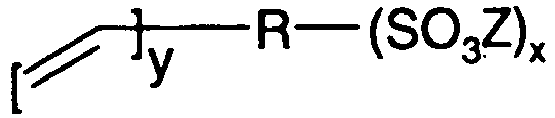
- R
- eine Bindung, eine zweibindige C1-C15-Alkylengruppe, zweibindige C1-C15-Alkylenoxygruppe, beispielsweise Ethylenoxygruppe oder zweibindige C5-C20-Aryl- oder Heteroarylgruppe bedeutet, wobei die vorstehenden Reste ihrerseits mit Halogen, -OH, COOZ, -CN, NZ2 substituiert sein können,
- Z
- unabhängig voneinander Wasserstoff, C1-C15-Alkylgruppe, C1-C15-Alkoxygruppe, Ethylenoxygruppe oder C5-C20-Aryl oder Heteroarylgruppe bedeutet, wobei die vorstehenden Reste ihrerseits mit Halogen, -OH, -CN, substituiert sein können und
- x
- eine ganze Zahl 1, 2, 3, 4, 5, 6, 7, 8, 9 oder 10 bedeutet
- y
- eine ganze Zahl 1, 2, 3, 4, 5, 6, 7, 8, 9 oder 10 bedeutet
- R
- eine Bindung, eine zweibindige C1-C15-Alkylengruppe, zweibindige C1-C15-Alkylenoxygruppe, beispielsweise Ethylenoxygruppe oder zweibindige C5-C20-Aryl- oder Heteroarylgruppe bedeutet, wobei die vorstehenden Reste ihrerseits mit Halogen, -OH, COOZ, -CN, NZ2 substituiert sein können,
- Z
- unabhängig voneinander Wasserstoff, C1-C15-Alkylgruppe, C1-C15-Alkoxygruppe, Ethylenoxygruppe oder C5-C20-Aryl oder Heteroarylgruppe bedeutet, wobei die vorstehenden Reste ihrerseits mit Halogen, -OH, -CN, substituiert sein können und
- x
- eine ganze Zahl 1, 2, 3, 4, 5, 6, 7, 8, 9 oder 10 bedeutet
- A
- eine Gruppe der Formeln COOR2, CN, CONR2 2, OR2 und/oder R2 darstellt, worin R2 Wasserstoff, eine C1-C15-Alkylgruppe, C1-C15-Alkoxygruppe, Ethylenoxygruppe oder C5-C20-Aryl oder Heteroarylgruppe bedeutet, wobei die vorstehenden Reste ihrerseits mit Halogen, -OH, COOZ, -CN, NZ2 substituiert sein können
- R
- eine Bindung, eine zweibindige C1-C15-Alkylengruppe, zweibindige C1-C15-Alkylenoxygruppe, beispielsweise Ethylenoxygruppe oder zweibindige C5-C20-Aryl- oder Heteroarylgruppe bedeutet, wobei die vorstehenden Reste ihrerseits mit Halogen, -OH, COOZ, -CN, NZ2 substituiert sein können,
- Z
- unabhängig voneinander Wasserstoff, C1-C15-Alkylgruppe, C1-C15-Alkoxygruppe, Ethylenoxygruppe oder C5-C20-Aryl oder Heteroarylgruppe bedeutet, wobei die vorstehenden Reste ihrerseits mit Halogen, -OH, -CN, substituiert sein können und
- x
- eine ganze Zahl 1, 2, 3, 4, 5, 6, 7, 8, 9 oder 10 bedeutet.
- Zu den bevorzugten Sulfonsäuregruppen umfassenden Monomeren gehören unter anderem Alkene, die Sulfonsäuregruppen aufweisen, wie Ethensulfonsäure, Propensulfonsäure, Butensulfonsäure; Acrylsäure- und/oder Methacrylsäure-Verbindungen, die Sulfonsäuregruppen aufweisen, wie beispielsweise 2-Sulfonomethyl-acrylsäure, 2-Sulfonomethyl-methacrylsäure, 2-Sulfonomethylacrylsäureamid und 2-Sulfonomethyl-methacrylsäureamid.
- Besonders bevorzugt wird handelsübliche Vinylsulfonsäure (Ethensulfonsäure), wie diese beispielsweise von der Firma Aldrich oder Clariant GmbH erhältlich ist, eingesetzt. Eine bevorzugte Vinylsulfonsäure weist eine Reinheit von mehr als 70%, insbesondere 90 % und besonders bevorzugt mehr als 97% Reinheit auf.
- Die Sulfonsäuregruppen umfassenden Monomere können des Weiteren auch in Form von Derivaten eingesetzt werden, die anschließend in die Säure überführt werden können, wobei die Überführung zur Säure auch in polymerisiertem Zustand erfolgen kann. Zu diesen Derivaten gehören insbesondere die Salze, die Ester, die Amide und die Halogenide der Sulfonsäuregruppen umfassenden Monomere.
- Die Sulfonsäuregruppen umfassenden Monomere können des weiteren auch nach der Hydrolyse auf und in die Membran eingebracht werden. Dies kann mittels an sich bekannter Maßnahmen (z.B. Sprühen, Tauchen etc.) die aus dem Stand der Technik bekannt sind, erfolgen.
- In einer weiteren Ausführungsform der Erfindung können zur Vernetzung befähigte Monomere eingesetzt werden. Diese Monomere können der Hydrolyseflüssigkeit beigefügt werden. Darüber hinaus können die zur Vernetzung befähigten Monomere auch auf die nach der Hydrolyse erhaltene Membran aufgebracht werden.
- Bei den zur Vernetzung befähigten Monomeren handelt es sich insbesondere um Verbindungen, die mindestens 2 Kohlenstoff-Kohlenstoff Doppelbindungen aufweisen. Bevorzugt werden Diene, Triene, Tetraene, Dimethylacrylate, Trimethylacrylate, Tetramethylacrylate, Diacrylate, Triacrylate, Tetraacrylate.
- Besonders bevorzugt sind Diene, Triene, Tetraene der Formel

- Dimethylacrylate, Trimethylycrylate, Tetramethylacrylate der Formel

- Diacrylate, Triacrylate, Tetraacrylate der Formel
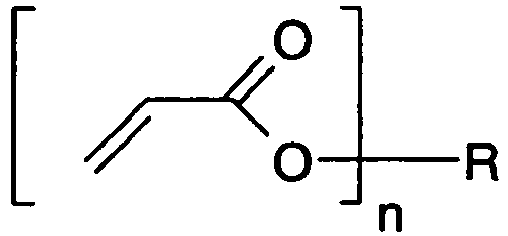
- R
- eine C1-C15-Alkylgtuppe, C5-C20-Aryl oder Heteroarylgruppe, NR', -SO2, PR', Si(R')2 bedeutet, wobei die vorstehenden Reste ihrerseits substituiert sein können,
- R'
- unabhängig voneinander Wasserstoff, eine C1-C15-Alkylgruppe, C1-C15-Alkoxygruppe, C5-C20-Aryl oder Heteroarylgruppe bedeutet und
- n
- mindestens 2 ist.
- Bei den Substituenten des vorstehenden Restes R handelt es sich vorzugsweise um Halogen, Hydroxyl, Carboxy, Carboxyl, Carboxylester, Nitrile, Amine, Silyl, Siloxan Reste.
- Besonders bevorzugte Vernetzer sind Allylmethacrylat, Ethylenglykoldimethacrylat, Diethylenglykoldimethacrylat, Triethylenglykoldimethacrylat, Tetra- und Polyethylenglykoldimethacrylat, 1,3-Butandioldimethacrylat, Glycerindimethacrylat, Diurethandimethacrylat, Trimethylpropantrimethacrylat, Epoxyacrylate, beispielsweise Ebacryl, N',N-Methylenbisacrylamid, Carbinol, Butadien, Isopren, Chloropren, Divinylbenzol und/oder Bisphenol-A-dimethylacrylat. Diese Verbindungen sind beispielsweise von Sartomer Company Exton, Pennsylvania unter den Bezeichnungen CN-120, CN104 und CN-980 kommerziell erhältlich.
- Der Einsatz von Vernetzern ist optional, wobei diese Verbindungen üblich im Bereich zwischen 0,05 bis 30 Gew.-%, vorzugsweise 0,1 bis 20 Gew.%, besonders bevorzugt 1 und 10 Gew.-%, bezogen auf das Gewicht der Membran, eingesetzt werden können.
- Die vernetzenden Monomere können auch durch Sprühen etc. aufgebracht werden.
- Gemäß einem besonderen Aspekt der vorliegenden Erfindung können die Phosphonsäure- und/oder Sulfonsäuregruppen umfassenden Monomere bzw. die vernetzenden Monomere polymerisiert werden, wobei die Polymerisation vorzugsweise radikalisch erfolgt. Die Radikalbildung kann thermisch, photochemisch, chemisch und/oder elektrochemisch erfolgen.
- Beispielsweise kann eine Starterlösung, die mindestens eine zur Bildung von Radikalen befähigte Substanz enthält, der Hydrolyseflüssigkeit beigefügt werden. Des Weiteren eine Starterlösung auf die Membran nach der Hydrolyse aufgebracht werden. Dies kann mittels an sich bekannter Maßnahmen (z.B. Sprühen, Tauchen etc.) die aus dem Stand der Technik bekannt sind, erfolgen.
- Geeignete Radikalbildner sind unter anderem Azoverbindungen, Peroxyverbindungen, Persulfatverbindungen oder Azoamidine. Nicht limitierende Beispiele sind Dibenzoylperoxid, Dicumolperoxid, Cumolhydroperoxid, Diisopropylperoxidicarbonat, Bis(4-t-butylcyclohexyl)peroxidicarbonat, Dikaliumpersulfat, Ammoniumperoxidisulfat, 2,2'-Azobis(2-methylpropionitril) (AIBN), 2,2'-Azobis-(isobuttersäureamidin)hydrochlorid, Benzpinakol, Dibenzylderivate, Methylethylenketonperoxid, 1,1-Azobiscyclohexancarbonitril, Methylethylketonperoxid, Acetylacetonperoxid, Dilaurylperoxid, Didecanoylperoxid, tert.-Butylper-2-ethylhexanoat, Ketonperoxid, Methylisobutylketonperoxid, Cyclohexanonperoxid, Dibenzoylperoxid, tert.-Butylperoxybenzoat, tert.-Butylperoxyisopropylcarbonat, 2,5-Bis(2-ethylhexanoyl-peroxy)-2,5-dimethylhexan, tert.-Butylperoxy-2-ethylhexanoat, tert.-Butylperoxy-3,5,5-trimethylhexanoat, tert.-Butylperoxyisobutyrat, tert.-Butylperoxyacetat, Dicumylperoxid, 1,1-Bis(tert.-butylperoxy)cyclohexan, 1,1-Bis(tert.-butylperoxy)3,3,5-trimethylcyclohexan, Cumylhydroperoxid, tert.-Butylhydroperoxid, Bis(4-tert.-butylcyclohexyl)peroxydicarbonat, sowie die von der Firma DuPont unter dem Namen ®Vazo, beispielsweise ®Vazo V50 und ®Vazo WS erhältlichen Radikalbildner.
- Des Weiteren können auch Radikalbildner eingesetzt werden, die bei Bestrahlung Radikale bilden. Zu den bevorzugten Verbindungen gehören unter anderem α,α-Diethoxyacetophenon (DEAP, Upjon Corp), n-Butylbenzoinether (®Trigonal-14, AKZO) und 2,2-Dimethoxy-2-phenylacetophenon (®Igacure 651) und 1-Benzoylcyclohexanol (®Igacure 184), Bis(2,4,6-trimethylbenzoyl)-phenylphosphinoxid (®Irgacure 819) und 1-[4-(2-Hydroxyethoxy)phenyl]-2-hydroxy-2-phenylpropan-1-on (®Irgacure 2959), die jeweils von der Fa. Ciba Geigy Corp. kommerziell erhältlich sind.
- Üblicherweise werden zwischen 0,0001 und 5 Gew.%, insbesondere 0,01 bis 3 Gew.-% (bezogen auf das Gewicht der radikalisch polymerisierbaren Monomere; Phosphonsäure- und/oder Sulfonsäuregruppen umfassenden Monomere bzw. der vernetzenden Monomere) an Radikalbildner zugesetzt. Die Menge an Radikalbildner kann je nach gewünschten Polymerisationsgrad variiert werden.
- Die Polymerisation kann auch durch Einwirken von IR bzw. NIR (IR = InfraRot, d. h. Licht mit einer Wellenlänge von mehr als 700 nm; NIR = Nahes IR, d. h. Licht mit einer Wellenlänge im Bereich von ca. 700 bis 2000 nm bzw. einer Energie im Bereich von ca. 0.6 bis 1.75 eV) erfolgen.
- Die Polymerisation kann auch durch Einwirken von UV-Licht mit einer Wellenlänge von weniger als 400 nm erfolgen. Diese Polymerisationsmethode ist an sich bekannt und beispielsweise in Hans Joerg Elias, Makromolekulare Chemie, 5.Auflage, Band 1, s.492-511; D. R. Arnold, N. C. Baird, J. R. Bolton, J. C. D. Brand, P. W. M Jacobs, P.de Mayo, W. R. Ware, Photochemistry-An Introduction, Academic Press , New York und M.K.Mishra, Radical Photopolymerization of Vinyl Monomers, J. Macromol. Sci.-Revs. Macromol. Chem. Phys. C22(1982-1983) 409 beschrieben.
- Die Polymerisation kann auch durch Einwirken von β-,γ- und/oder Elektronen Strahlen erzielt werden. Gemäß einer besonderen Ausführungsform der vorliegenden Erfindung wird eine Membran mit einer Strahlungsdosis im Bereich von 1 bis 300 kGy, bevorzugt von 3 bis 200 kGy und ganz besonders bevorzugt von 20 bis 100 kGy bestrahlt.
- Die Polymerisation der Phosphonsäure- und/oder Sulfonsäuregruppen umfassenden Monomere bzw. der vernetzenden Monomere erfolgt vorzugsweise bei Temperaturen oberhalb Raumtemperatur (20°C) und kleiner 200°C, insbesondere bei Temperaturen zwischen 40°C und 150°C, besonders bevorzugt zwischen 50°C und 120°C. Die Polymerisation erfolgt vorzugsweise unter Normaldruck, kann aber auch unter Einwirkung von Druck erfolgen. Die Polymerisation führt zu einer Verfestigung des flächigen Gebildes, wobei diese Verfestigung durch Mikrohärtemessung verfolgt werden kann. Vorzugsweise beträgt die durch die Polymerisation bedingte Zunahme der Härte mindestens 20%, bezogen auf die Härte des in Schritt B) erhaltenen flächigen Gebildes.
- Gemäß einem besonderen Aspekt der vorliegenden Erfindung ist das molare Verhältnis der molaren Summe aus Phosphorsäure, Polyphosphorsäure und der Hydrolyseprodukte der Polyphosphorsäure zur Anzahl der Mole der Phosphonsäuregruppen und/oder Sulfonsäuregruppen in den durch Polymerisation von Phosphonsäuregruppen umfassenden Monomere und/oder Sulfonsäuregruppen umfassenden Monomere erhältlichen Polymere, vorzugsweise größer oder gleich 1:2, insbesondere größer oder gleich 1:1. und besonders bevorzugt größer oder gleich 2:1.
- Vorzugsweise liegt das molare Verhältnis der molaren Summe aus Phosphorsäure, Polyphosphorsäure und der Hydrolyseprodukte der Polyphosphorsäure zur Anzahl der Mole der Phosphonsäuregruppen und/oder Sulfonsäuregruppen in den durch Polymerisation von Phosphonsäuregruppen umfassenden Monomere und/oder Sulfonsäuregruppen umfassenden Monomere erhältlichen Polymere im Bereich von 1000:1 bis 3:1, insbesondere 100:1 bis 5:1 und besonders bevorzugt 50:1 bis 10:1.
- Das Molverhältnis kann mit üblichen Methoden bestimmt werden. Hierzu können insbesondere spektroskopiesche Verfahren, beispielsweise die NMR-Spektroskopie eingesetzt werden. Hierbei ist zu bedenken, dass die Phosphonsäuregruppen in der formalen Oxidationsstufe 3 und der Phosphor in Phosphorsäure, Polyphosphorsäure bzw. Hydrolyseprodukte hiervon in der Oxidationsstufe 5 vorliegen.
- Je nach gewünschten Polymerisationsgrad ist das flächige Gebilde, welches nach der Polymerisation erhalten wird, eine selbsttragende Membran. Bevorzugt beträgt der Polymerisationsgrad mindestens 2, insbesondere mindestens 5, besonders bevorzugt mindestens 30 Wiederholeinheiten, insbesondere mindestens 50 Wiederholeinheiten, ganz besonders bevorzugt mindestens 100 Wiederholeinheiten. Dieser Polymerisationsgrad bestimmt sich über das Zahlenmittel des Molekulargewichts Mn, das durch GPC-Methoden ermittelt werden kann. Aufgrund der Probleme die in der Membran enthaltenen Phosphonsäuregruppen umfassenden Polymere ohne Abbau zu isolieren, wird dieser Wert anhand einer Probe bestimmt, die durch Polymerisation von Phosphonsäuregruppen umfassenden Monomeren ohne Zusatz von Polymer durchgeführt wird. Hierbei wird der Gewichtsanteil an Phosphonsäuregruppen umfassenden Monomeren und an Radikalstarter im Vergleich zu den Verhältnissen der Herstellung der Membran konstant gehalten. Der Umsatz, der bei einer Vergleichspolymerisation erzielt wird, ist vorzugsweise größer oder gleich 20%, insbesondere größer oder gleich 40% und besonders bevorzugt größer oder gleich 75%, bezogen auf die eingesetzten Phosphonsäuregruppen umfassenden Monomere.
- Die Hydrolyseflüssigkeit umfasst Wasser, wobei die Konzentration des Wassers im Allgemeinen nicht besonders kritisch ist. Gemäß einem besonderen Aspekt der vorliegenden Erfindung umfasst die Hydrolyseflüssigkeit 5 bis 80 Gew.-%, vorzugsweise 8 bis 70 Gew.-% und besonders bevorzugt 10 bis 50 Gew.-% Wasser. Die Wassermenge, die in den Sauerstoffsäuren formal enthalten ist, wird bei dem Wassergehalt der Hydrolyseflüssigkeit nicht berücksichtigt.
- Von den zuvor genannten Säuren sind Phosphorsäure und/oder Schwefelsäure besonders bevorzugt, wobei diese Säuren insbesondere 5 bis 70 Gew.-%, vorzugsweise 10 bis 60 Gew.-% und besonders bevorzugt 15 bis 50 Gew.-% Wasser umfassen.
- Im Anschluss an die Feuchtigkeitsbehandlung kann die Membran durch Einwirken von Hitze in Gegenwart von Sauerstoff noch vernetzt werden. Diese Härtung der Membran verbessert die Eigenschaften der Membran zusätzlich. Hierzu kann die Membran auf eine Temperatur von mindestens 150°C, vorzugsweise mindestens 200°C und besonders bevorzugt mindestens 250°C erwärmt werden. Die Sauerstoffkonzentration liegt bei diesem Verfahrensschritt üblich im Bereich von 5 bis 50 Vol.-%, vorzugsweise 10 bis 40 Vol.-%, ohne dass hierdurch eine Beschränkung erfolgen soll. Auch diese Vernetzung kann auch durch Einwirken von IR bzw. NIR (IR = InfraRot, d. h. Licht mit einer Wellenlänge von mehr als 700 nm; NIR = Nahes IR, d. h. Licht mit einer Wellenlänge im Bereich von ca. 700 bis 2000 nm bzw. einer Energie im Bereich von ca. 0.6 bis 1.75 eV) erfolgen. Eine weitere Methode ist die Bestrahlung mit β-Strahlen. Die Strahlungsdosis beträgt hierbei zwischen 5 und 200 kGy.
- Je nach gewünschtem Vernetzungsgrad kann die Dauer der Vernetzungsreaktion in einem weiten Bereich liegen. Im Allgemeinen liegt diese Reaktionszeit im Bereich von 1 Sekunde bis 10 Stunden, vorzugsweise 1 Minute bis 1 Stunde, ohne dass hierdurch eine Beschränkung erfolgen soll.
- Das erfindungsgemäße Verfahren erlaubt eine vergleichsweise einfache und kostengünstige Herstellung von Säure-dotierten, Polyazol-enthaltenden Membranen, welches leicht großtechnisch umgesetzt werden kann. Dabei können durch die erfindungsgemäße Vorgehensweise insbesondere die folgenden Vorteile erreicht werden:
- ⇒ zur Herstellung der Membranen wird deutlich weniger, meist kein Lösungsmittel benötigt,
- ⇒ die Herstellung der Membranen kann mit einer deutlich besseren Raum-Zeit-Ausbeute erfolgen,
- ⇒ es werden Membranen mit vergleichsweise hoher Qualität und Reproduzierbarkeit erhalten, Qualitätsschwankungen zwischen unterschiedlichen Chargen werden so gut wie gar nicht beobachtet,
- ⇒ die Verarbeitung von Polyazolen mit vergleichsweise hohen Molekulargewichten ist nun möglich und
- ⇒ die Ausbildung von Blasen in der Membran wird nahezu vollständig verhindert.
- Anwendungsgebiete der durch das erfindungsgemäße Verfahren erhältlichen Membranen umfassen insbesondere ihre Verwendung als Polymer-Elektrolyt-Membran in Brennstoffzellen. Für weitere Details wird auf die Druckschriften
DE 102 13 540 A1 ,DE 102 46 559 A1 undDE 102 46 461 A1 verwiesen).
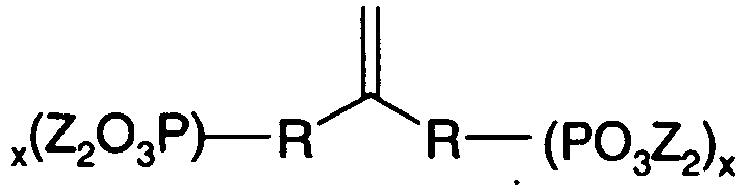


Claims (15)
- Verfahren zur Herstellung einer protonenleitenden, Polyazol-enthaltenden Membran, bei welchem manA) eine Zusammensetzung die, jeweils bezogen auf ihr Gesamtgewicht, 95,0 Gew.-% bis 99,5 Gew.-% Polyphosphorsäure und 0,5 Gew.-% bis 5,0 Gew.-% Polyazol enthält,B) bei einer Temperatur im Bereich von 120°C bis 300°C durch eine Schlitzöffnung extrudiert,C) die Zusammensetzung die Polyphosphorsäure und Polyazol enthält eine Lösungsviskosität im Bereich von 10 Pas bis 1000 Pas aufweist, gemessen nach DIN 53018 bei der Temperatur an der Schlitzöffnung während der Herstellung der Membran, undD) die Zusammensetzung anschließend durch Abkühlung und/oder Hydrolyse und/oder Vernetzung verfestigt.
- Verfahren nach Anspruch 1, dadurch gekennzeichnet, dass man die Zusammensetzung bei einer Temperatur im Bereich von 120°C bis 180°C durch die Öffnung extrudiert.
- Verfahren nach Anspruch 1 oder 2, dadurch gekennzeichnet, dass man Zusammensetzung einsetzt, die eine Lösungsviskosität im Bereich von 20 Pas bis 800 Pas aufweist, gemessen nach DIN 53018 bei der Temperatur an der Öffnung während der Herstellung der Membran.
- Verfahren nach mindestens einem der vorangehenden Ansprüche, dadurch gekennzeichnet, dass man eine Zusammensetzung einsetzt, die mindestens ein Polyazol mit einer Grenzviskosität, gemessen in mindestens 96 Gew.-%-iger Schwefelsäure, im Bereich von 0,3 bis 10 enthält.
- Verfahren nach Anspruch 4, dadurch gekennzeichnet, dass die Schlitzöffnung eine Spaltbreite im Bereich von 20 cm bis 50 cm aufweist.
- Verfahren nach Anspruch 4 oder 5, dadurch gekennzeichnet, dass die Schlitzöffnung eine Spaltlänge im Bereich von 800 µm bis 1600 µm aufweist.
- Verfahren nach Anspruch 4, 5 oder 6, dadurch gekennzeichnet, dass die Schlitzöffnung ein Verhältnis von Spaltbreite zu Spaltlänge im Bereich von 100:1 bis 1000:1 aufweist.
- Verfahren nach mindestens einem der vorangehenden Ansprüche, dadurch gekennzeichnet, dass man die Zusammensetzung mit einem Druck von mindestens 0,1 bar durch die Öffnung presst,
- Verfahren nach Anspruch 1, dadurch gekennzeichnet, dass man die Polyphosphorsäure und das Polyazol im Extruder mischt.
- Verfahren nach mindestens einem der vorangehenden Ansprüche, dadurch gekennzeichnet, dass man das Polyazola) durch Umsetzung von einem oder mehreren aromatischen und/oder heteroaromatischen Tetra-Amino-Verbindungen mit einer oder mehreren aromatischen und/oder heteroaromatischen Carbonsäuren oder deren Derivate, die mindestens zwei Säuregruppen pro Carbonsäure-Monomer enthalten, oderb) durch Umsetzung von einer oder mehreren aromatischen und/oder heteroaromatischen Diaminocarbonsäuren
in situ herstellt. - Verfahren nach mindestens einem der vorangehenden Ansprüche, dadurch gekennzeichnet, dass das Polyazol mindestens eine Phosphonsäuregruppe umfasst.
- Verfahren nach mindestens einem der vorangehenden Ansprüche, dadurch gekennzeichnet, dass man die Zusammensetzung auf einem Träger aufträgt.
- Verfahren nach Anspruch 12, dadurch gekennzeichnet, dass man mehrere Felder der Zusammensetzung auf dem Träger aufträgt, die nicht untereinander verbunden sind.
- Verfahren nach mindestens einem der vorangehenden Ansprüche, dadurch gekennzeichnet, dass man die Zusammensetzung verfestigt, indem man sie mit Feuchtigkeit behandelt.
- Verfahren nach mindestens einem der vorangehenden Ansprüche, dadurch gekennzeichnet, dass man eine Zusammensetzung einsetzt, die mindestens ein von Polyazol verschiedenes Polymer enthält.
Applications Claiming Priority (2)
| Application Number | Priority Date | Filing Date | Title |
|---|---|---|---|
| DE102006042760A DE102006042760A1 (de) | 2006-09-12 | 2006-09-12 | Verfahren zur Herstellung einer protonenleitenden, Polyazol-enthaltenden Membran |
| PCT/EP2007/007896 WO2008031554A1 (de) | 2006-09-12 | 2007-09-11 | Verfahren zur herstellung einer protonenleitenden, polyazol-enthaltenden membran |
Publications (2)
| Publication Number | Publication Date |
|---|---|
| EP2069056A1 EP2069056A1 (de) | 2009-06-17 |
| EP2069056B1 true EP2069056B1 (de) | 2013-04-10 |
Family
ID=38982455
Family Applications (1)
| Application Number | Title | Priority Date | Filing Date |
|---|---|---|---|
| EP07818099.9A Not-in-force EP2069056B1 (de) | 2006-09-12 | 2007-09-11 | Verfahren zur herstellung einer protonenleitenden, polyazol-enthaltenden membran |
Country Status (9)
| Country | Link |
|---|---|
| US (1) | US8273277B2 (de) |
| EP (1) | EP2069056B1 (de) |
| JP (1) | JP5309030B2 (de) |
| KR (1) | KR101419074B1 (de) |
| CN (1) | CN101516483B (de) |
| CA (1) | CA2661934A1 (de) |
| DE (1) | DE102006042760A1 (de) |
| RU (1) | RU2009113469A (de) |
| WO (1) | WO2008031554A1 (de) |
Families Citing this family (13)
| Publication number | Priority date | Publication date | Assignee | Title |
|---|---|---|---|---|
| DE10361932A1 (de) * | 2003-12-30 | 2005-07-28 | Celanese Ventures Gmbh | Protonenleitende Membran und deren Verwendung |
| DE10361832A1 (de) * | 2003-12-30 | 2005-07-28 | Celanese Ventures Gmbh | Protonenleitende Membran und deren Verwendung |
| DE102009001141A1 (de) | 2008-10-29 | 2010-05-06 | Volkswagen Ag | Verfahren zur Herstellung einer Polymerelektrolytmembran |
| DE102009001137A1 (de) | 2008-10-29 | 2010-05-06 | Volkswagen Ag | Polymerelektrolytmembran für Brennstoffzellen und Verfahren zu ihrer Herstellung |
| EP2373406A1 (de) * | 2008-12-06 | 2011-10-12 | Basf Se | Verfahren zur herstellung einer protonenleitenden membran |
| JP5399517B2 (ja) * | 2009-01-14 | 2014-01-29 | ビーエーエスエフ ソシエタス・ヨーロピア | プロトン伝導性の膜を製造するためのモノマービーズ |
| CN102803346B (zh) * | 2009-06-20 | 2014-09-10 | 巴斯夫欧洲公司 | 含聚唑的组合物 |
| US8669296B2 (en) * | 2009-06-20 | 2014-03-11 | Basf Se | Method for the production of a high-molecular polyazol |
| WO2011003538A1 (de) * | 2009-07-09 | 2011-01-13 | Basf Se | Methode zur mechanischen stabilisierung von stickstoffhaltigen polymeren |
| DE102009028758A1 (de) | 2009-08-20 | 2011-02-24 | Volkswagen Ag | Langzeitstabile Polymerelektrolytmembran für HT-Brennstoffzellen und Verfahren zu ihrer Herstellung |
| DE102011007425A1 (de) * | 2011-04-14 | 2012-10-18 | Wacker Chemie Ag | Polymere auf der Basis von Polyazolen |
| KR101910577B1 (ko) * | 2011-11-16 | 2018-12-31 | 삼성전자주식회사 | 조성물, 이로부터 형성된 복합체, 이를 이용한 전극과 복합막 및 이를 채용한 연료전지 |
| CN112820922B (zh) * | 2019-11-18 | 2022-09-02 | 坤艾新材料科技(上海)有限公司 | 陶瓷颗粒增强高温质子交换膜及其制造方法、电化学设备 |
Family Cites Families (17)
| Publication number | Priority date | Publication date | Assignee | Title |
|---|---|---|---|---|
| US3692569A (en) * | 1970-02-12 | 1972-09-19 | Du Pont | Surface-activated fluorocarbon objects |
| US4453991A (en) * | 1981-05-01 | 1984-06-12 | E. I. Du Pont De Nemours And Company | Process for making articles coated with a liquid composition of perfluorinated ion exchange resin |
| US5422411A (en) * | 1993-09-21 | 1995-06-06 | Ballard Power Systems Inc. | Trifluorostyrene and substituted trifluorostyrene copolymeric compositions and ion-exchange membranes formed therefrom |
| GB9413417D0 (en) | 1994-07-04 | 1994-08-24 | Ford Roger A | Improved composite materials and method for making them |
| US5525436A (en) | 1994-11-01 | 1996-06-11 | Case Western Reserve University | Proton conducting polymers used as membranes |
| DE19527435A1 (de) | 1995-07-27 | 1997-01-30 | Hoechst Ag | Polymerelektrolyte und Verfahren zu deren Herstellung |
| CA2227835C (en) * | 1995-07-27 | 2008-07-15 | Hoechst Research & Technology Deutschland Gmbh & Co. Kg | Polymeric electrolytes and process for their preparation |
| US6110616A (en) * | 1998-01-30 | 2000-08-29 | Dais-Analytic Corporation | Ion-conducting membrane for fuel cell |
| DE19959289A1 (de) * | 1999-12-09 | 2001-06-13 | Axiva Gmbh | Verfahren zur Herstellung von sulfonierten aromatischen Polymeren und Verwendung der Verfahrensprodukte zur Herstellung von Membranen |
| US20030013817A1 (en) * | 2001-06-26 | 2003-01-16 | Kelly Lu | High temperature ionic polymers and membranes made therefrom |
| DE10144815A1 (de) | 2001-09-12 | 2003-03-27 | Celanese Ventures Gmbh | Protonenleitende Membran und deren Verwendung |
| DE10213540A1 (de) * | 2002-03-06 | 2004-02-19 | Celanese Ventures Gmbh | Lösung aus Vinylphosphonsäure, Verfahren zur Herstellung einer Polymerelektrolytmembran aus Polyvinylphosphaonsäure und deren Anwendung in Brennstoffzellen |
| DE10246373A1 (de) * | 2002-10-04 | 2004-04-15 | Celanese Ventures Gmbh | Protonenleitende Polymermembran umfassend Sulfonsäuregruppen enthaltende Polyazole und deren Anwendung in Brennstoffzellen |
| DE10246461A1 (de) * | 2002-10-04 | 2004-04-15 | Celanese Ventures Gmbh | Protonenleitende Polymermembran enthaltend Polyazolblends und deren Anwendung in Brennstoffzellen |
| DE10246459A1 (de) | 2002-10-04 | 2004-04-15 | Celanese Ventures Gmbh | Protonenleitende Polymermembran umfassend Phosphonsäuregruppen enthaltende Polyazole und deren Anwendung in Brennstoffzellen |
| EP1624511A1 (de) * | 2004-08-05 | 2006-02-08 | Pemeas GmbH | Membran-Elektroden-Einheiten und Brennstoffzellen mit erhöhter Lebensdauer |
| EP1657274A1 (de) | 2004-11-10 | 2006-05-17 | SOLVAY (Société Anonyme) | Polybenzazol Blockcopolymer |
-
2006
- 2006-09-12 DE DE102006042760A patent/DE102006042760A1/de not_active Withdrawn
-
2007
- 2007-09-11 RU RU2009113469/04A patent/RU2009113469A/ru not_active Application Discontinuation
- 2007-09-11 CN CN2007800339451A patent/CN101516483B/zh not_active Expired - Fee Related
- 2007-09-11 EP EP07818099.9A patent/EP2069056B1/de not_active Not-in-force
- 2007-09-11 KR KR1020097004537A patent/KR101419074B1/ko not_active Expired - Fee Related
- 2007-09-11 JP JP2009527733A patent/JP5309030B2/ja not_active Expired - Fee Related
- 2007-09-11 US US12/440,968 patent/US8273277B2/en not_active Expired - Fee Related
- 2007-09-11 CA CA002661934A patent/CA2661934A1/en not_active Abandoned
- 2007-09-11 WO PCT/EP2007/007896 patent/WO2008031554A1/de not_active Ceased
Also Published As
| Publication number | Publication date |
|---|---|
| WO2008031554A1 (de) | 2008-03-20 |
| US8273277B2 (en) | 2012-09-25 |
| JP2010503182A (ja) | 2010-01-28 |
| CA2661934A1 (en) | 2008-03-20 |
| JP5309030B2 (ja) | 2013-10-09 |
| US20100181697A1 (en) | 2010-07-22 |
| CN101516483B (zh) | 2013-02-06 |
| RU2009113469A (ru) | 2010-10-20 |
| KR101419074B1 (ko) | 2014-07-24 |
| DE102006042760A1 (de) | 2008-03-27 |
| CN101516483A (zh) | 2009-08-26 |
| KR20090051187A (ko) | 2009-05-21 |
| EP2069056A1 (de) | 2009-06-17 |
Similar Documents
| Publication | Publication Date | Title |
|---|---|---|
| EP1527494B1 (de) | Protonenleitende polymembran, welche sulfonsäuregruppen enthaltende polymere umfasst, und deren anwendung in brennstoffzellen | |
| EP1559164B1 (de) | Protonenleitende polymermembran enthaltend polyazolblends und deren anwendung in brennstoffzellen | |
| EP1379572B1 (de) | Protonenleitende membran und deren verwendung | |
| EP2069056A1 (de) | Verfahren zur herstellung einer protonenleitenden, polyazol-enthaltenden membran | |
| EP1527493B1 (de) | Protonenleitende polymermembran, welche phosphonsäuregruppen enthaltende polymere aufweist, und deren anwendung in brennstoffzellen | |
| EP2267059B1 (de) | Protonenleitende Membran und deren Verwendung | |
| EP1552574B1 (de) | Protonenleitende polymermembran umfassend sulfonsäuregruppen enthaltende polyazole und deren anwendung in brennstoffzellen | |
| EP1537164A1 (de) | Verfahren zur herstellung von protonenleitenden polymermembranen, verbesserte polymermembranen und deren anwendung in brennstoffzellen | |
| WO2011006625A1 (de) | Verfahren zum betrieb einer brennstoffzelle und zugehörige brennstoffzelle | |
| EP1701995B1 (de) | Protonenleitende membran und deren verwendung | |
| EP2373406A1 (de) | Verfahren zur herstellung einer protonenleitenden membran | |
| DE102005038195A1 (de) | Verbesserte Membran-Elektrodeneinheiten und Brennstoffzellen mit langer Lebensdauer | |
| DE10235357A1 (de) | Protonenleitende Polymermembran umfassend Phosphonsäure- und Sulfonsäuregruppen enthaltende Polymere und deren Anwendung in Brennstoffzellen | |
| EP2443175B1 (de) | Polyazol-haltige zusammensetzung | |
| WO2009124737A9 (de) | Verfahren zum betrieb einer brennstoffzelle | |
| DE102005052378A1 (de) | Verbesserte Membran-Elektrodeneinheiten und Brennstoffzellen mit hoher Lebensdauer | |
| DE10235356A1 (de) | Protonenleitende Polymermembran umfassend Sulfonsäuregruppen enthaltende Polymere und deren Anwendung in Brennstoffzellen | |
| WO2011006623A1 (de) | Verfahren zum betrieb einer brennstoffzelle | |
| DE10330461A1 (de) | Verfahren zur Herstellung von protonenleitenden Polymermembranen, verbesserte Polymermembranen und deren Anwendung in Brennstoffzellen | |
| WO2012153172A1 (de) | Mechanisch stabilisierte polyazole enthaltend mindestens einen polyvinylalkohol |
Legal Events
| Date | Code | Title | Description |
|---|---|---|---|
| PUAI | Public reference made under article 153(3) epc to a published international application that has entered the european phase |
Free format text: ORIGINAL CODE: 0009012 |
|
| 17P | Request for examination filed |
Effective date: 20090414 |
|
| AK | Designated contracting states |
Kind code of ref document: A1 Designated state(s): AT BE BG CH CY CZ DE DK EE ES FI FR GB GR HU IE IS IT LI LT LU LV MC MT NL PL PT RO SE SI SK TR |
|
| AX | Request for extension of the european patent |
Extension state: AL BA HR MK RS |
|
| 17Q | First examination report despatched |
Effective date: 20100325 |
|
| RAP1 | Party data changed (applicant data changed or rights of an application transferred) |
Owner name: BASF FUEL CELL RESEARCH GMBH |
|
| DAX | Request for extension of the european patent (deleted) | ||
| GRAP | Despatch of communication of intention to grant a patent |
Free format text: ORIGINAL CODE: EPIDOSNIGR1 |
|
| GRAS | Grant fee paid |
Free format text: ORIGINAL CODE: EPIDOSNIGR3 |
|
| GRAA | (expected) grant |
Free format text: ORIGINAL CODE: 0009210 |
|
| AK | Designated contracting states |
Kind code of ref document: B1 Designated state(s): AT BE BG CH CY CZ DE DK EE ES FI FR GB GR HU IE IS IT LI LT LU LV MC MT NL PL PT RO SE SI SK TR |
|
| REG | Reference to a national code |
Ref country code: GB Ref legal event code: FG4D Free format text: NOT ENGLISH |
|
| REG | Reference to a national code |
Ref country code: CH Ref legal event code: EP Ref country code: AT Ref legal event code: REF Ref document number: 605674 Country of ref document: AT Kind code of ref document: T Effective date: 20130415 |
|
| REG | Reference to a national code |
Ref country code: IE Ref legal event code: FG4D Free format text: LANGUAGE OF EP DOCUMENT: GERMAN |
|
| REG | Reference to a national code |
Ref country code: DE Ref legal event code: R096 Ref document number: 502007011604 Country of ref document: DE Effective date: 20130606 |
|
| PG25 | Lapsed in a contracting state [announced via postgrant information from national office to epo] |
Ref country code: SI Free format text: LAPSE BECAUSE OF FAILURE TO SUBMIT A TRANSLATION OF THE DESCRIPTION OR TO PAY THE FEE WITHIN THE PRESCRIBED TIME-LIMIT Effective date: 20130410 |
|
| REG | Reference to a national code |
Ref country code: NL Ref legal event code: VDEP Effective date: 20130410 Ref country code: LT Ref legal event code: MG4D |
|
| PG25 | Lapsed in a contracting state [announced via postgrant information from national office to epo] |
Ref country code: GR Free format text: LAPSE BECAUSE OF FAILURE TO SUBMIT A TRANSLATION OF THE DESCRIPTION OR TO PAY THE FEE WITHIN THE PRESCRIBED TIME-LIMIT Effective date: 20130711 Ref country code: ES Free format text: LAPSE BECAUSE OF FAILURE TO SUBMIT A TRANSLATION OF THE DESCRIPTION OR TO PAY THE FEE WITHIN THE PRESCRIBED TIME-LIMIT Effective date: 20130721 Ref country code: IS Free format text: LAPSE BECAUSE OF FAILURE TO SUBMIT A TRANSLATION OF THE DESCRIPTION OR TO PAY THE FEE WITHIN THE PRESCRIBED TIME-LIMIT Effective date: 20130810 Ref country code: NL Free format text: LAPSE BECAUSE OF FAILURE TO SUBMIT A TRANSLATION OF THE DESCRIPTION OR TO PAY THE FEE WITHIN THE PRESCRIBED TIME-LIMIT Effective date: 20130410 Ref country code: FI Free format text: LAPSE BECAUSE OF FAILURE TO SUBMIT A TRANSLATION OF THE DESCRIPTION OR TO PAY THE FEE WITHIN THE PRESCRIBED TIME-LIMIT Effective date: 20130410 Ref country code: PT Free format text: LAPSE BECAUSE OF FAILURE TO SUBMIT A TRANSLATION OF THE DESCRIPTION OR TO PAY THE FEE WITHIN THE PRESCRIBED TIME-LIMIT Effective date: 20130812 Ref country code: SE Free format text: LAPSE BECAUSE OF FAILURE TO SUBMIT A TRANSLATION OF THE DESCRIPTION OR TO PAY THE FEE WITHIN THE PRESCRIBED TIME-LIMIT Effective date: 20130410 Ref country code: LT Free format text: LAPSE BECAUSE OF FAILURE TO SUBMIT A TRANSLATION OF THE DESCRIPTION OR TO PAY THE FEE WITHIN THE PRESCRIBED TIME-LIMIT Effective date: 20130410 |
|
| PG25 | Lapsed in a contracting state [announced via postgrant information from national office to epo] |
Ref country code: LV Free format text: LAPSE BECAUSE OF FAILURE TO SUBMIT A TRANSLATION OF THE DESCRIPTION OR TO PAY THE FEE WITHIN THE PRESCRIBED TIME-LIMIT Effective date: 20130410 Ref country code: BG Free format text: LAPSE BECAUSE OF FAILURE TO SUBMIT A TRANSLATION OF THE DESCRIPTION OR TO PAY THE FEE WITHIN THE PRESCRIBED TIME-LIMIT Effective date: 20130710 Ref country code: PL Free format text: LAPSE BECAUSE OF FAILURE TO SUBMIT A TRANSLATION OF THE DESCRIPTION OR TO PAY THE FEE WITHIN THE PRESCRIBED TIME-LIMIT Effective date: 20130410 Ref country code: CY Free format text: LAPSE BECAUSE OF FAILURE TO SUBMIT A TRANSLATION OF THE DESCRIPTION OR TO PAY THE FEE WITHIN THE PRESCRIBED TIME-LIMIT Effective date: 20130410 |
|
| PG25 | Lapsed in a contracting state [announced via postgrant information from national office to epo] |
Ref country code: EE Free format text: LAPSE BECAUSE OF FAILURE TO SUBMIT A TRANSLATION OF THE DESCRIPTION OR TO PAY THE FEE WITHIN THE PRESCRIBED TIME-LIMIT Effective date: 20130410 Ref country code: SK Free format text: LAPSE BECAUSE OF FAILURE TO SUBMIT A TRANSLATION OF THE DESCRIPTION OR TO PAY THE FEE WITHIN THE PRESCRIBED TIME-LIMIT Effective date: 20130410 Ref country code: CZ Free format text: LAPSE BECAUSE OF FAILURE TO SUBMIT A TRANSLATION OF THE DESCRIPTION OR TO PAY THE FEE WITHIN THE PRESCRIBED TIME-LIMIT Effective date: 20130410 Ref country code: DK Free format text: LAPSE BECAUSE OF FAILURE TO SUBMIT A TRANSLATION OF THE DESCRIPTION OR TO PAY THE FEE WITHIN THE PRESCRIBED TIME-LIMIT Effective date: 20130410 |
|
| PLBE | No opposition filed within time limit |
Free format text: ORIGINAL CODE: 0009261 |
|
| STAA | Information on the status of an ep patent application or granted ep patent |
Free format text: STATUS: NO OPPOSITION FILED WITHIN TIME LIMIT |
|
| PG25 | Lapsed in a contracting state [announced via postgrant information from national office to epo] |
Ref country code: RO Free format text: LAPSE BECAUSE OF FAILURE TO SUBMIT A TRANSLATION OF THE DESCRIPTION OR TO PAY THE FEE WITHIN THE PRESCRIBED TIME-LIMIT Effective date: 20130410 Ref country code: IT Free format text: LAPSE BECAUSE OF FAILURE TO SUBMIT A TRANSLATION OF THE DESCRIPTION OR TO PAY THE FEE WITHIN THE PRESCRIBED TIME-LIMIT Effective date: 20130410 |
|
| 26N | No opposition filed |
Effective date: 20140113 |
|
| BERE | Be: lapsed |
Owner name: BASF FUEL CELL RESEARCH G.M.B.H. Effective date: 20130930 |
|
| REG | Reference to a national code |
Ref country code: DE Ref legal event code: R097 Ref document number: 502007011604 Country of ref document: DE Effective date: 20140113 |
|
| PG25 | Lapsed in a contracting state [announced via postgrant information from national office to epo] |
Ref country code: MC Free format text: LAPSE BECAUSE OF FAILURE TO SUBMIT A TRANSLATION OF THE DESCRIPTION OR TO PAY THE FEE WITHIN THE PRESCRIBED TIME-LIMIT Effective date: 20130410 |
|
| REG | Reference to a national code |
Ref country code: CH Ref legal event code: PL |
|
| REG | Reference to a national code |
Ref country code: IE Ref legal event code: MM4A |
|
| PG25 | Lapsed in a contracting state [announced via postgrant information from national office to epo] |
Ref country code: CH Free format text: LAPSE BECAUSE OF NON-PAYMENT OF DUE FEES Effective date: 20130930 Ref country code: LI Free format text: LAPSE BECAUSE OF NON-PAYMENT OF DUE FEES Effective date: 20130930 Ref country code: BE Free format text: LAPSE BECAUSE OF NON-PAYMENT OF DUE FEES Effective date: 20130930 Ref country code: IE Free format text: LAPSE BECAUSE OF NON-PAYMENT OF DUE FEES Effective date: 20130911 |
|
| REG | Reference to a national code |
Ref country code: AT Ref legal event code: MM01 Ref document number: 605674 Country of ref document: AT Kind code of ref document: T Effective date: 20130911 |
|
| PGFP | Annual fee paid to national office [announced via postgrant information from national office to epo] |
Ref country code: GB Payment date: 20140929 Year of fee payment: 8 |
|
| PGFP | Annual fee paid to national office [announced via postgrant information from national office to epo] |
Ref country code: FR Payment date: 20140929 Year of fee payment: 8 Ref country code: DE Payment date: 20141128 Year of fee payment: 8 |
|
| PG25 | Lapsed in a contracting state [announced via postgrant information from national office to epo] |
Ref country code: AT Free format text: LAPSE BECAUSE OF NON-PAYMENT OF DUE FEES Effective date: 20130911 |
|
| PG25 | Lapsed in a contracting state [announced via postgrant information from national office to epo] |
Ref country code: TR Free format text: LAPSE BECAUSE OF FAILURE TO SUBMIT A TRANSLATION OF THE DESCRIPTION OR TO PAY THE FEE WITHIN THE PRESCRIBED TIME-LIMIT Effective date: 20130410 Ref country code: MT Free format text: LAPSE BECAUSE OF FAILURE TO SUBMIT A TRANSLATION OF THE DESCRIPTION OR TO PAY THE FEE WITHIN THE PRESCRIBED TIME-LIMIT Effective date: 20130410 |
|
| PG25 | Lapsed in a contracting state [announced via postgrant information from national office to epo] |
Ref country code: HU Free format text: LAPSE BECAUSE OF FAILURE TO SUBMIT A TRANSLATION OF THE DESCRIPTION OR TO PAY THE FEE WITHIN THE PRESCRIBED TIME-LIMIT; INVALID AB INITIO Effective date: 20070911 Ref country code: LU Free format text: LAPSE BECAUSE OF NON-PAYMENT OF DUE FEES Effective date: 20130911 |
|
| REG | Reference to a national code |
Ref country code: DE Ref legal event code: R119 Ref document number: 502007011604 Country of ref document: DE |
|
| GBPC | Gb: european patent ceased through non-payment of renewal fee |
Effective date: 20150911 |
|
| REG | Reference to a national code |
Ref country code: FR Ref legal event code: ST Effective date: 20160531 |
|
| PG25 | Lapsed in a contracting state [announced via postgrant information from national office to epo] |
Ref country code: GB Free format text: LAPSE BECAUSE OF NON-PAYMENT OF DUE FEES Effective date: 20150911 Ref country code: DE Free format text: LAPSE BECAUSE OF NON-PAYMENT OF DUE FEES Effective date: 20160401 |
|
| PG25 | Lapsed in a contracting state [announced via postgrant information from national office to epo] |
Ref country code: FR Free format text: LAPSE BECAUSE OF NON-PAYMENT OF DUE FEES Effective date: 20150930 |