EP2067397B1 - Erntevorsatz für landwirtschaftliche Erntemaschinen zum Aufnehmen und Weiterfördern von Halmfrüchten - Google Patents
Erntevorsatz für landwirtschaftliche Erntemaschinen zum Aufnehmen und Weiterfördern von Halmfrüchten Download PDFInfo
- Publication number
- EP2067397B1 EP2067397B1 EP08168993A EP08168993A EP2067397B1 EP 2067397 B1 EP2067397 B1 EP 2067397B1 EP 08168993 A EP08168993 A EP 08168993A EP 08168993 A EP08168993 A EP 08168993A EP 2067397 B1 EP2067397 B1 EP 2067397B1
- Authority
- EP
- European Patent Office
- Prior art keywords
- side parts
- axis
- parts
- pivoted
- transport position
- Prior art date
- Legal status (The legal status is an assumption and is not a legal conclusion. Google has not performed a legal analysis and makes no representation as to the accuracy of the status listed.)
- Active
Links
Images

Classifications
-
- A—HUMAN NECESSITIES
- A01—AGRICULTURE; FORESTRY; ANIMAL HUSBANDRY; HUNTING; TRAPPING; FISHING
- A01D—HARVESTING; MOWING
- A01D41/00—Combines, i.e. harvesters or mowers combined with threshing devices
- A01D41/12—Details of combines
- A01D41/14—Mowing tables
- A01D41/144—Foldable headers
-
- A—HUMAN NECESSITIES
- A01—AGRICULTURE; FORESTRY; ANIMAL HUSBANDRY; HUNTING; TRAPPING; FISHING
- A01B—SOIL WORKING IN AGRICULTURE OR FORESTRY; PARTS, DETAILS, OR ACCESSORIES OF AGRICULTURAL MACHINES OR IMPLEMENTS, IN GENERAL
- A01B73/00—Means or arrangements to facilitate transportation of agricultural machines or implements, e.g. folding frames to reduce overall width
- A01B73/02—Folding frames
- A01B73/04—Folding frames foldable about a horizontal axis
- A01B73/044—Folding frames foldable about a horizontal axis the axis being oriented in a longitudinal direction
- A01B73/046—Folding frames foldable about a horizontal axis the axis being oriented in a longitudinal direction each folding frame part being foldable in itself
Definitions
- the invention relates to a harvesting attachment for agricultural harvesting machines for receiving and conveying strawberries, for example corn plants, which is movable in a forward direction over a field during harvesting operation, with an attachable to a harvester central part, two first side parts, each on a different side of the middle part about a first, horizontally and in the forward direction extending axis between a working position and a transport position pivotally articulated, and two second side parts, each on the outside at one of the first side parts about a second, horizontally and in the forward direction extending axis between a working position and a transport position are pivotally articulated, wherein the middle part and the first and second side parts in the working position laterally juxtaposed mowing and conveying elements comprise and the side parts of each side of the header g ege- or in the same direction about the associated axes between the working position and the transport position are pivotable, in which they are located above the middle part.
- DE 41 31 491 A describes a maize harvester for forage harvesters, in which the outer parts can be folded up about horizontal, in the forward direction axes.
- the side parts are pivoted about horizontal, in the forward direction axes and placed horizontally over the middle part, while in the considered as generic DE 298 17 666 U is proposed to pivot in a five-piece header, the inner side panels in the transport position vertically upwards and turn the outer side panels in contrast again inwardly in an approximately horizontal position, so that the outer side parts are arranged above the middle parts.
- the DE 103 03 380 A describes another five-piece header, in which the inner side parts are pivoted in the transport position by about 135 ° upwards and inwards, while the outer side parts are pivoted in opposite directions to the inner side parts by 180 ° to the outside.
- the working width of the header is limited by the maximum permissible height during road travel when the side parts are pivoted upwards by 90 ° ( DE 41 31 491 A ), or it is limited to twice the width permitted on the road when the side parts are pivoted inwards by 180 ° and deposited above the middle part ( EP 0 491 405 A ).
- the arrangement after DE 298 17 666 U allows larger working widths, which are also limited by height and width restrictions in road travel upwards, which also for the embodiment according to DE 103 03 380 A applies.
- the object underlying the invention is seen to provide a harvesting attachment, which allows a greater working width compared to the prior art in compliance with restrictions on the transport width and height.
- a harvesting header comprises a central part and at its lateral ends pivotally hinged about first horizontal and forward axes extending first side panels. At the outer ends of the first side parts second side parts are pivotally articulated about horizontally and in the forward direction extending second axes. At the outer ends of the second side parts in turn outer parts are hinged to horizontally and in the forward direction extending third axis.
- the central part is removably attachable to a harvester, be it rigid or a horizontal, extending in the forward direction swing axle to adjust the position of the header to ground contours, the pendulum motion is suppressed when driving on the road.
- the header therefore comprises a total of (at least) seven parts, namely the middle part, four side parts and two outer parts.
- All these parts include mowing and conveying elements for receiving and conveying plants and extend in a working position transversely to the forward direction and horizontally in a common working plane.
- the outer and side parts are pivoted about the axes mentioned in a transport position, including power-operated actuators, in particular in the form of hydraulic cylinders, are provided.
- the side parts are pivoted inwards or inwards in the same direction.
- the outer parts are also pivoted relative to the second side parts about third axes in their transport position, it being possible to pivot them in the same direction with the side parts of the associated side inwards, or in opposite directions to rotate outwards.
- the second side parts are pivoted in the transport position by 180 ° about the second axis inwardly, while the outer parts are pivoted in the transport position by 180 ° about the third axis inwardly.
- the side parts and the outer parts in the transport position take a sandwich-like configuration in which they are all oriented vertically and the outer part is located between the two side parts.
- the first side parts are furthest out and the second side parts furthest inside.
- the individual parts can be pivoted one after the other at the same time or in a suitable order avoiding a collision.
- the invention is suitable for all types of harvesting attachments, such as maize headers, corn pickers and cutting units, which can be used on self-propelled or tractor-mounted harvesting machines, especially in the form of mounted or towed or self-propelled forage harvester or combine harvesters.
- a promotion of the crop in the harvester is not mandatory, so that the invention, for example, to carrier vehicles with mowers in the form of mowing or mowing or the like. Can be used for cutting grass with pivoting side and outer parts application.
- the first side parts are oriented vertically in the transport position, d. H. They are pivoted 90 ° between the working position and the transport position.
- the second side parts are pivoted by 180 ° inwards, so that they are then oriented vertically downwards.
- FIG. 1 is a plan view of a self-propelled harvester 10 in the form of a forage harvester reproduced with a on the intake duct 12 of the harvester 10 releasably mounted header 14.
- the harvesting attachment 14 exemplified here as an embodiment of a harvesting device is designed in the form of a mowing attachment and comprises eight juxtaposed mowing and conveying elements 16, 18, 20, 22 for cutting and pulling stalk-like crops, such as corn, which operate independently of rows and from lower Cutting discs and upper conveyor drums with superimposed conveyor discs composed around their edge recesses for receiving plants that rotate about common, vertical axes.
- any other numbers and embodiments of mowing and conveying elements 16, 18, 20, 22 could also be used, in particular with endless conveyors.
- the working widths of the individual mowing and conveying elements 16, 18, 20, 22 amount in the illustrated embodiment in each case 1.5 m (corresponding to two rows of cultivated at a distance of 75 cm plants, such as corn), so that the total working width is 12 m.
- the working widths of the individual mowing and conveying elements 16, 18, 20, 22 can also be smaller or larger than mentioned and also different.
- the working width of the outer mowing and conveying elements could be only 75 cm.
- the header 14 comprises a support frame comprising a central portion 24 and two first side portions 26, 28 disposed thereon at both lateral ends, at the lateral ends of which second lateral portions 30, 32 adjoin, and outer portions 34 at the lateral ends thereof , 36 connect.
- the first lateral sections 26, 28 of the support frame each carry a mowing and conveying element 18, while the central portion 24 of the support frame two mowing and Conveyor elements 16 carries and the second lateral portions 30, 32 of the support frame each carry a mowing and conveying element 20 and the outer portions 34, 36 of the support frame also each carry a mowing and conveying element 22.
- the harvested material from the crop rotation in the arrow directions shown about the vertical axis, driven by a drive train from the harvester 10 ago mowing and conveying elements 16,18, 20, 22 separated from the ground crop is at its rear sides in cooperation with at the first lateral sections 26, 28 of the support frame mounted transverse conveyor drums 38 and attached to the second side sections 30, 32 of the support frame transverse conveyor drums 40 and attached to the central portion 24 inclined conveyor drums 42 fed into the intake duct 12 of the harvester 10, from which it is chopped and ejected onto a transport vehicle.
- the central portion 24 of the support frame forms with the attached mowing and conveying elements 16 and the associated inclined conveyor drums 42 a central portion 50 of the header 14th
- first lateral portion 26 of the support frame forms with the attached mowing and conveying elements 18 and the associated transverse conveyor drum 38, a first side portion 44 of the header 14.
- the forward in the forward direction of the harvester 10 left first side portion 28 of the support frame forms with the attached mowing and conveying elements 18 and the associated transverse conveyor drum 38, a further first side part 44 of the header 14th
- the right in the forward direction of the harvester 10 second lateral portion 30 of the support frame forms with the attached mowing and conveying elements 20 and the associated transverse conveyor drum 40, a second side portion 46 of the header 14.
- the forward in the forward direction of the harvester 10 second lateral portion 32 of the support frame forms with the attached mowing and conveying elements 20 and the associated transverse conveyor drum 40 another second side portion 46 of the header 14th
- outer portion 34 of the support frame forms with the attached mowing and conveying elements 22 an outer part 48 of the header 14th
- the side parts 44, 46 and the outer parts 48 are therefore arranged in the forward direction in a plane laterally adjacent to the central part 50.
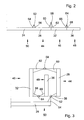
- the header 14 is in a in the FIG. 3 shown transported position.
- the position of the central part 50 relative to the intake channel 12 does not change in the transport position relative to the working position.
- the first side portions 26, 28 of the first side members 44 are each hinged about a horizontally and forwardly extending first axis 52 pivotally mounted to the central portion 24 of the central portion 50 by brackets 54, 56 with the central portion 24 and the first lateral portion 26th , 28 are connected.
- the second side portions 30, 32 of the second side members 46 are each hinged about a horizontally and forwardly extending second axis 58 pivotally adjacent to the adjacent end of the first side portion 26 or 28 by holders 60, 62 with the first portion 26 or 28 or the second lateral section 30, 32 are connected.
- the outer portions 36, 38 of the outer members 48 are each hinged about a horizontally and forwardly extending third axis 64 pivotally at the adjacent end of the second lateral portion 30 or 32, by mounts 66, 68 with the second portion 30 or 32 or the outer portion 36, 38 are connected.
- the second axis 58 is farther from the sections 28, 32 (or 26 and 30) than the axes 52 and 64 of the sections adjacent thereto, thus in the transport position of the outer part 48 between the side panels 44, 46 finds room.
- the axes 52, 58, 64 are expediently designed as hinges.
- Power-operated actuators (not shown) serve in a conventional manner for pivoting the sections 26 to 36 about the axes 52, 58, 64.
- the actuators may be rotary actuators, for. B. hydraulic motors, or linear drives, z. B. hydraulic cylinders, which are connected via suitable drive trains to the sections 26 to 36, such as cables or per se known linkage (s. DE 33 24 458 A and US 4,355,690 A the disclosures of which are incorporated by reference into the present documentation).
- the actuators pivot the outer parts 48 by 180 ° relative to the second side parts 46 about the third axis 64 inwardly. Subsequently or simultaneously, the second side parts 46 are pivoted about the second axis 58 with respect to the first side parts 44 by 180 ° about the axes 58 inwardly. Subsequently or simultaneously, the first side parts 44 are pivoted about the first axis 52 with respect to the central part 50 by 90 ° about the axes 52 upwards.
- the control of the order of the pivoting movements can be based on a detection of the position of the actuators or the side parts 44, 46 and the outer part 48 or on a time recording or by means of a suitable series connection of the actuators (s. DE 298 17 666 U ).
Landscapes
- Life Sciences & Earth Sciences (AREA)
- Environmental Sciences (AREA)
- Engineering & Computer Science (AREA)
- Mechanical Engineering (AREA)
- Soil Sciences (AREA)
- Harvester Elements (AREA)
- Agricultural Machines (AREA)
Description
- Die Erfindung betrifft einen Erntevorsatz für landwirtschaftliche Erntemaschinen zum Aufnehmen und Weiterfördern von Halmfrüchten, beispielsweise Maispflanzen, der beim Erntebetrieb in einer Vorwärtsrichtung über ein Feld bewegbar ist, mit einem an einer Erntemaschine anbringbaren Mittelteil, zwei ersten Seitenteilen, die an jeweils einer anderen Seite des Mittelteils um eine erste, sich horizontal und in der Vorwärtsrichtung erstreckende Achse zwischen einer Arbeitsstellung und einer Transportstellung schwenkbar angelenkt sind, und zwei zweiten Seitenteilen, die jeweils außenseitig an einem der ersten Seitenteile um eine zweite, sich horizontal und in der Vorwärtsrichtung erstreckende Achse zwischen einer Arbeitsstellung und einer Transportstellung schwenkbar angelenkt sind, wobei der Mittelteil und die ersten und zweiten Seitenteile in der Arbeitsstellung seitlich nebeneinander angeordnete Mäh- und Förderelemente umfassen und die Seitenteile jeder Seite des Erntevorsatzes gegen- oder gleichsinnig um die zugehörigen Achsen zwischen der Arbeitsstellung und der Transportstellung verschwenkbar sind, in der sie sich oberhalb des Mittelteils befinden.
- Während von der Landmaschinenindustrie derzeit immer breitere Erntevorsätze für selbst fahrende Erntemaschinen angeboten werden, die es dem Landwirt ermöglichen, ein Feld in kürzerer Zeit und mit weniger Überfahrungen abzuernten, ist die maximale Breite von Fahrzeugen beim Befahren einer Straße gesetzlich beschränkt. Die Emtevorsätze werden deshalb in der Regel auf einem Anhänger transportiert oder in eine Transportstellung eingeklappt, in der ihre Breite gegenüber ihrer Betriebsposition vermindert ist. Das Einklappen hat den Vorteil, dass ein zeitaufwändiges Abnehmen und Wiederanbringen des Erntevorsatzes von bzw. an der Erntemaschine zum Transport auf einem Anhänger entfällt.
- In der
DE 41 31 491 A wird ein Maiserntegerät für Feldhäcksler beschrieben, bei dem die Außenteile um horizontale, in Vorwärtsrichtung verlaufende Achsen hochklappbar sind. Gemäß derEP 0 491 405 A werden die Seitenteile um horizontale, in Vorwärtsrichtung verlaufende Achsen verschwenkt und horizontal über das Mittelteil gelegt, während in der als gattungsbildend angesehenenDE 298 17 666 U vorgeschlagen wird, bei einem fünfteiligen Erntevorsatz die inneren Seitenteile in der Transportstellung vertikal nach oben zu schwenken und die äußeren Seitenteile demgegenüber wieder nach innen in eine etwa horizontale Stellung zu drehen, so dass die äußeren Seitenteile oberhalb der Mittelteile angeordnet sind. DieDE 103 03 380 A beschreibt einen anderen fünfteiligen Erntevorsatz, bei dem die inneren Seitenteile in der Transportstellung um etwa 135° nach oben und innen geschwenkt sind, während die äußeren Seitenteile gegensinnig zu den inneren Seitenteilen um 180° nach außen geschwenkt werden. - Bei einteilig verschwenkbaren Seitenteilen ist die Arbeitsbreite des Erntevorsatzes durch die bei der Straßenfahrt maximal zulässige Höhe begrenzt, wenn die Seitenteile um 90° nach oben verschwenkt werden (
DE 41 31 491 A ), oder sie ist auf das Doppelte der bei der Straßenfahrt zulässigen Breite eingeschränkt, wenn die Seitenteile um 180° nach innen verschwenkt und oberhalb des Mittelteils abgelegt werden (EP 0 491 405 A ). Die Anordnung nachDE 298 17 666 U ermöglicht demgegenüber größere Arbeitsbreiten, die aber ebenfalls durch Höhen- und Breitenrestriktionen bei der Straßenfahrt nach oben hin begrenzt sind, was auch für die Ausführungsform nachDE 103 03 380 A gilt. - Die der Erfindung zu Grunde liegende Aufgabe wird darin gesehen, einen Erntevorsatz bereitzustellen, der bei Einhaltung von Beschränkungen der Transportbreite und -höhe eine gegenüber dem Stand der Technik größere Arbeitsbreite ermöglicht.
- Diese Aufgabe wird erfindungsgemäß durch die Lehre des Patentanspruchs 1 gelöst, wobei in den weiteren Patentansprüchen Merkmale aufgeführt sind, die die Lösung in vorteilhafter Weise weiterentwickeln.
- Ein Erntevorsatz umfasst einen Mittelteil und an dessen seitlichen Enden um horizontal und in Vorwärtsrichtung verlaufende erste Achsen schwenkbar angelenkte erste Seitenteile. An den äußeren Enden der ersten Seitenteile sind zweite Seitenteile um horizontal und in Vorwärtsrichtung verlaufende zweite Achsen schwenkbar angelenkt. An den äußeren Enden der zweiten Seitenteile sind wiederum Außenteile um horizontal und in Vorwärtsrichtung verlaufende dritte Achsen schwenkbar angelenkt. Der Mittelteil ist an einer Erntemaschine abnehmbar anbringbar, sei es starr oder um eine horizontale, sich in Vorwärtsrichtung erstreckende Pendelachse zur Anpassung der Position des Erntevorsatzes an Bodenkonturen, wobei die Pendelbewegung bei einer Straßenfahrt unterbunden wird. Der Erntevorsatz umfasst demnach insgesamt (mindestens) sieben Teile, nämlich den Mittelteil, vier Seitenteile und zwei Außenteile. Alle diese Teile umfassen Mäh- und Förderelemente zum Aufnehmen und Weiterfördern von Pflanzen und erstrecken sich in einer Arbeitsstellung quer zur Vorwärtsrichtung und horizontal in einer gemeinsamen Arbeitsebene. Zum Straßentransport werden die Außen- und Seitenteile um die erwähnten Achsen in eine Transportstellung verschwenkt, wozu fremdkraftbetätigte Aktoren, insbesondere in der Form von Hydraulikzylindern, vorgesehen sind. Auf jeder Seite des Erntevorsatzes werden die Seitenteile gegen- oder gleichsinnig nach innen verschwenkt. Die Außenteile werden ebenfalls gegenüber den zweiten Seitenteilen um dritte Achsen in ihre Transportstellung verschwenkt, wobei es möglich ist, sie gleichsinnig mit den Seitenteilen der zugehörigen Seite nach innen zu verschwenken, oder sie gegensinnig dazu nach außen zu drehen.
- Die zweiten Seitenteile werden in der Transportposition um 180° um die zweite Achse nach innen verschwenkt, während die Außenteile in der Transportposition um 180° um die dritte Achse nach innen verschwenkt werden. Dadurch nehmen die Seitenteile und die Außenteile in der Transportstellung eine sandwichartige Konfiguration ein, in der sie alle vertikal orientiert sind und der Außenteil sich zwischen den beiden Seitenteilen befindet. Dabei befinden sich die ersten Seitenteile am weitesten außen und die zweiten Seitenteile am weitesten innen. Die einzelnen Teile können gleichzeitig oder in geeigneter, eine Kollision vermeidender Reihenfolge nacheinander verschwenkt werden.
- Auf diese Weise erreicht man bei einer relativ großen Arbeitsbreite eine kompakte Konfiguration des Erntevorsatzes in der Transportstellung. Die Erfindung eignet sich für alle Arten von Erntevorsätzen, wie Maisgebisse, Maispflücker und Schneidwerke, die an selbstfahrenden oder an Traktoren montierten Erntemaschinen insbesondere in Form von angebauten oder gezogenen oder selbstfahrenden Feldhäckslern oder Mähdreschern Verwendung finden können. Eine Förderung des Ernteguts in die Erntemaschine ist nicht zwingend erforderlich, so dass die Erfindung beispielsweise auch an Trägerfahrzeugen mit Mähgeräten in Form von Mähkreiseln oder Mähscheiben oder dgl. zum Schneiden von Gras mit verschwenkbaren Seiten- und Außenteilen Anwendung finden kann.
- Die ersten Seitenteile sind in der Transportstellung vertikal orientiert, d. h. sie werden um 90° zwischen der Arbeitsstellung und der Transportstellung verschwenkt. Die zweiten Seitenteile werden um 180° nach innen verschwenkt, so dass sie dann vertikal nach unten orientiert sind.
- In der Zeichnung ist ein nachfolgend näher beschriebenes Ausführungsbeispiel der Erfindung dargestellt. Es zeigt:
- Fig. 1
- eine Draufsicht auf eine selbst fahrende Erntemaschine mit einem daran angeordneten Erntevorsatz,
- Fig. 2
- eine Frontansicht der linken Hälfte des Erntevorsatzes in der Arbeitsstellung, und
- Fig. 3
- eine Frontansicht der linken Hälfte des Erntevorsatzes in der Transportstellung.
- In der
Figur 1 ist eine Draufsicht auf eine selbstfahrende Erntemaschine 10 in Form eines Feldhäckslers mit einem am Einzugskanal 12 der Erntemaschine 10 lösbar angebrachten Erntevorsatz 14 wiedergegeben. Der hier als Ausführungsform für ein Erntegerät beispielhaft dargestellte Erntevorsatz 14 ist in Form eines Mähvorsatzes ausgebildet und umfasst acht nebeneinander angeordnete Mäh- und Förderelemente 16, 18, 20, 22 zum Abschneiden und Einziehen stängelartigen Ernteguts, wie Mais, die reihenunabhängig arbeiten und sich aus unteren Schneidscheiben und oberen Fördertrommeln mit übereinander angeordneten Förderscheiben mit um ihren Rand verteilten Aussparungen zur Aufnahme von Pflanzen zusammensetzen, die um gemeinsame, vertikale Achsen rotieren. Da es sich hier nur um ein Ausführungsbeispiel handelt, könnten auch beliebige andere Anzahlen an und Ausführungsformen von Mähund Förderelementen 16, 18, 20, 22 Verwendung finden, insbesondere mit Endlosförderern. Die Arbeitsbreiten der einzelnen Mäh- und Förderelemente 16, 18, 20, 22 betragen in der dargestellten Ausführungsform jeweils 1,5 m (entsprechend zwei Reihen von im Abstand von 75 cm angebauten Pflanzen, wie Mais), so dass die Gesamtarbeitsbreite 12 m beträgt. Die Arbeitsbreiten der einzelnen Mäh- und Förderelemente 16, 18, 20, 22 können aber auch kleiner oder größer als erwähnt und auch unterschiedlich sein. So könnte die Arbeitsbreite der äußeren Mäh- und Förderelemente nur 75 cm betragen. - Der Erntevorsatz 14 umfasst einen Tragrahmen, der einen Mittelabschnitt 24 und zwei daran an beiden seitlichen Enden angeordnete, erste seitliche Abschnitte 26, 28 umfasst, an deren seitlichen Enden sich zweite seitliche Abschnitte 30, 32 anschließen, und an deren seitlichen Enden sich äußere Abschnitte 34, 36 anschließen. Die ersten seitlichen Abschnitte 26, 28 des Tragrahmens tragen jeweils ein Mäh- und Förderelement 18, während der Mittelabschnitt 24 des Tragrahmens zwei Mäh- und Förderelemente 16 trägt und die zweiten seitlichen Abschnitte 30, 32 des Tragrahmens jeweils ein Mäh- und Förderelement 20 tragen und die äußeren Abschnitte 34, 36 des Tragrahmens auch je ein Mäh- und Förderelement 22 tragen.
- Das im Erntebetrieb von den in den gezeigten Pfeilrichtungen um die Hochachse rotierenden, durch einen Antriebsstrang von der Erntemaschine 10 her angetriebenen Mäh- und Förderelementen 16,18, 20, 22 vom Boden abgetrennte Erntematerial wird an ihren Rückseiten im Zusammenwirken mit an den ersten seitlichen Abschnitten 26, 28 des Tragrahmens angebrachten Querfördertrommeln 38 und an den zweiten seitlichen Abschnitten 30, 32 des Tragrahmens angebrachten Querfördertrommeln 40 und am Mittelabschnitt 24 angebrachten Schrägfördertrommeln 42 in den Einzugskanal 12 der Erntemaschine 10 gefördert, von der es gehäckselt und auf ein Transportfahrzeug ausgeworfen wird.
- Der Mittelabschnitt 24 des Tragrahmens bildet mit den daran befestigten Mäh- und Förderelementen 16 und den zugehörigen Schrägfördertrommeln 42 einen Mittelteil 50 des Erntevorsatzes 14.
- Der in Vorwärtsrichtung der Erntemaschine 10 rechte erste seitliche Abschnitt 26 des Tragrahmens bildet mit den daran befestigten Mäh- und Förderelementen 18 und der zugehörigen Querfördertrommel 38 einen ersten Seitenteil 44 des Erntevorsatzes 14. Der in Vorwärtsrichtung der Erntemaschine 10 linke erste seitliche Abschnitt 28 des Tragrahmens bildet mit den daran befestigten Mäh- und Förderelementen 18 und der zugehörigen Querfördertrommel 38 einen weiteren ersten Seitenteil 44 des Erntevorsatzes 14.
- Der in Vorwärtsrichtung der Erntemaschine 10 rechte zweite seitliche Abschnitt 30 des Tragrahmens bildet mit den daran befestigten Mäh- und Förderelementen 20 und der zugehörigen Querfördertrommel 40 einen zweiten Seitenteil 46 des Erntevorsatzes 14. Der in Vorwärtsrichtung der Erntemaschine 10 linke zweite seitliche Abschnitt 32 des Tragrahmens bildet mit den daran befestigten Mäh- und Förderelementen 20 und der zugehörigen Querfördertrommel 40 einen weiteren zweiten Seitenteil 46 des Erntevorsatzes 14.
- Der in Vorwärtsrichtung der Erntemaschine 10 rechte äußere Abschnitt 34 des Tragrahmens bildet mit den daran befestigten Mäh- und Förderelementen 22 einen Außenteil 48 des Erntevorsatzes 14.
- Der in Vorwärtsrichtung der Erntemaschine 10 linke äußere Abschnitt 36 des Tragrahmens bildet mit den daran befestigten Mäh- und Förderelementen 22 einen weiteren Außenteil 48 des Erntevorsatzes 14.
- In der in den
Figuren 1 und2 dargestellten Arbeitsstellung sind die Seitenteile 44, 46 und die Außenteile 48 demnach in Vorwärtsrichtung in einer Ebene seitlich neben dem Mittelteil 50 angeordnet. Um die Breite des Erntevorsatzes 14 zum Transport auf einer Straße zu verringern und somit ein Abnehmen und anschließendes Wiederanbringen des Erntevorsatzes 14 von der Erntemaschine 10 zu ersparen, ist der Erntevorsatz 14 in eine in derFigur 3 gezeigte Transportposition verbringbar. Die Position des Mittelteils 50 relativ zum Einzugskanal 12 verändert sich in der Transportstellung gegenüber der Arbeitsstellung nicht. - Die ersten seitlichen Abschnitte 26, 28 der ersten Seitenteile 44 sind jeweils um eine sich horizontal und in Vorwärtsrichtung erstreckende erste Achse 52 schwenkbar am Mittelabschnitt 24 des Mittelteils 50 angelenkt, die durch Halterungen 54, 56 mit dem Mittelabschnitt 24 bzw. dem ersten seitlichen Abschnitt 26, 28 verbunden sind. Die zweiten seitlichen Abschnitte 30, 32 der zweiten Seitenteile 46 sind jeweils um eine sich horizontal und in Vorwärtsrichtung erstreckende zweite Achse 58 schwenkbar am benachbarten Ende des ersten seitlichen Abschnitts 26 oder 28 angelenkt, die durch Halterungen 60, 62 mit dem ersten Abschnitt 26 oder 28 bzw. dem zweiten seitlichen Abschnitt 30, 32 verbunden sind. Die äußeren Abschnitte 36, 38 der Außenteile 48 sind jeweils um eine sich horizontal und in Vorwärtsrichtung erstreckende dritte Achse 64 schwenkbar am benachbarten Ende des zweiten seitlichen Abschnitts 30 oder 32 angelenkt, die durch Halterungen 66, 68 mit dem zweiten Abschnitt 30 oder 32 bzw. dem äußeren Abschnitt 36, 38 verbunden sind. Die zweite Achse 58 ist weiter von den Abschnitten 28, 32 (bzw. 26 und 30) entfernt als die Achsen 52 und 64 von den ihnen benachbarten Abschnitten, damit in der Transportstellung der Außenteil 48 zwischen den Seitenteilen 44, 46 Platz findet.
- Die Achsen 52, 58, 64 sind zweckmäßigerweise als Scharniere ausgeführt. Fremdkraftbetätigte Aktoren (nicht gezeigt) dienen in an sich bekannter Weise zum Verschwenken der Abschnitte 26 bis 36 um die Achsen 52, 58, 64. Die Aktoren können Rotationsantriebe sein, z. B. Hydraulikmotore, oder Linearantriebe, z. B. Hydraulikzylinder, die über geeignete Antriebsstränge mit den Abschnitten 26 bis 36 verbunden sind, wie Seilzüge oder an sich bekannte Gestänge (s.
DE 33 24 458 A undUS 4 355 690 A , deren Offenbarungen durch Verweis mit in die vorliegenden Unterlagen aufgenommen werden). - Die Aktoren verschwenken die Außenteile 48 um 180° gegenüber den zweiten Seitenteilen 46 um die dritten Achsen 64 nach innen. Anschließend oder gleichzeitig werden die zweiten Seitenteile 46 um die zweiten Achsen 58 gegenüber den ersten Seitenteilen 44 um 180° um die Achsen 58 nach innen verschwenkt. Anschließend oder gleichzeitig werden die ersten Seitenteile 44 um die ersten Achsen 52 gegenüber dem Mittelteil 50 um 90° um die Achsen 52 nach oben verschwenkt. Die Kontrolle der Reihenfolge der Schwenkbewegungen kann auf einer Erfassung der Position der Aktoren oder der Seitenteile 44, 46 und des Außenteils 48 oder auf einer Zeiterfassung basieren oder mittels einer geeigneten Reihenschaltung der Aktoren erfolgen (s.
DE 298 17 666 U ). Auf diese Weise erzielt man eine sandwichartige Transportstellung, in der die Seitenteile 44, 46 vertikal orientiert sind und den Außenteil 48 zwischen sich aufnehmen. Die in denFiguren 2 und 3 nicht dargestellte rechte Hälfte des Erntevorsatzes wird zur Längsmittelebene des Erntevorsatzes 14 symmetrisch in die Transportstellung verschwenkt. Die Bewegung in die Arbeitsstellung erfolgt in umgekehrter Richtung.
Claims (6)
- Erntevorsatz (14) für landwirtschaftliche Erntemaschinen (10) zum Aufnehmen und Weiterfördern von Halmfrüchten, beispielsweise Maispflanzen, der beim Erntebetrieb in einer Vorwärtsrichtung über ein Feld bewegbar ist, mit einem an einer Erntemaschine (10) anbringbaren Mittelteil (50), zwei ersten Seitenteilen (44), die an jeweils einer anderen Seite des Mittelteils (50) um eine erste, sich horizontal und in der Vorwärtsrichtung erstreckende Achse (52) zwischen einer Arbeitsstellung und einer Transportstellung schwenkbar angelenkt sind, und zwei zweiten Seitenteilen (46), die jeweils außenseitig an einem der ersten Seitenteile (44) um eine zweite, sich horizontal und in der Vorwärtsrichtung erstreckende Achse (58) zwischen einer Arbeitsstellung und einer Transportstellung schwenkbar angelenkt sind, wobei der Mittelteil (50) und die ersten und zweiten Seitenteile (44, 46) in der Arbeitsstellung seitlich nebeneinander angeordnete Mäh- und Förderelemente (16, 18, 20) umfassen und die Seitenteile (44, 46) jeder Seite des Erntevorsatzes (14) gegen- oder gleichsinnig um die zugehörigen Achsen (52, 58) zwischen der Arbeitsstellung und der Transportstellung verschwenkbar sind, in der sie sich oberhalb des Mittelteils (50) befinden, dadurch gekennzeichnet, dass außenseitig an den zweiten Seitenteilen (46) jeweils ein Mäh- und Förderelemente (22) umfassender Außenteil (48) um eine dritte, sich horizontal und in der Vorwärtsrichtung erstreckende Achse (64) zwischen einer Arbeitsstellung und einer Transportstellung schwenkbar angelenkt ist und dass die Außenteile (48) in der Transportstellung vertikal orientiert sind und sich zwischen den vertikal orientierten Seitenteilen (44, 46) befinden.
- Erntevorsatz (14) nach Anspruch 1, dadurch gekennzeichnet, dass die Außenteile (48) gleichsinnig oder gegensinnig mit den Seitenteilen (44, 46) der jeweiligen Seite des Erntevorsatzes (14) zwischen der Arbeitsstellung und der Transportstellung verschwenkbar sind.
- Erntevorsatz (14) nach Anspruch 1 oder 2, dadurch gekennzeichnet, dass die ersten Seitenteile (44) zwischen der Arbeitsstellung und der Transportstellung gegenüber dem Mittelteil (50) um 90° um die erste Achse (52) verschwenkbar sind.
- Erntevorsatz (14) nach einem der Ansprüche 1 bis 3, dadurch gekennzeichnet, dass die zweiten Seitenteile (46) zwischen der Arbeitsstellung und der Transportstellung gegenüber den ersten Seitenteilen (44) um 180° um die zweite Achse (58) verschwenkbar sind.
- Erntevorsatz (14) nach einem der Ansprüche 1 bis 4, dadurch gekennzeichnet, dass die Außenteile (48) zwischen der Arbeitsstellung und der Transportstellung gegenüber den zweiten Seitenteilen (46) um 180° um die dritte Achse (64) verschwenkbar sind.
- Erntevorsatz (14) nach einem der Ansprüche 1 bis 5, dadurch gekennzeichnet, dass die zweite Achse (58) weiter von Abschnitten (26 bis 36) eines Tragrahmens der ersten und zweiten Seitenteile (44, 46) entfernt ist als die erste Achse (52) von einem Abschnitt (24) eines Tragrahmens des Mittelteils (50) und Abschnitten (26, 28) des Tragrahmens der ersten Seitenteile (44), und dass die zweite Achse (58) weiter von Abschnitten (26 bis 36) eines Tragrahmens der ersten und zweiten Seitenteile (44, 46) entfernt ist als die dritte Achse (64) von Abschnitten (26 bis 36) eines Tragrahmens der Außenteile (48) und der zweiten Seitenteile (46).
Applications Claiming Priority (1)
| Application Number | Priority Date | Filing Date | Title |
|---|---|---|---|
| DE102007058312A DE102007058312A1 (de) | 2007-12-04 | 2007-12-04 | Erntevorsatz für landwirtschaftliche Erntemaschinen zum Aufnehmen und Weiterfördern von Halmfrüchten |
Publications (2)
| Publication Number | Publication Date |
|---|---|
| EP2067397A1 EP2067397A1 (de) | 2009-06-10 |
| EP2067397B1 true EP2067397B1 (de) | 2011-06-22 |
Family
ID=40418051
Family Applications (1)
| Application Number | Title | Priority Date | Filing Date |
|---|---|---|---|
| EP08168993A Active EP2067397B1 (de) | 2007-12-04 | 2008-11-13 | Erntevorsatz für landwirtschaftliche Erntemaschinen zum Aufnehmen und Weiterfördern von Halmfrüchten |
Country Status (3)
| Country | Link |
|---|---|
| EP (1) | EP2067397B1 (de) |
| AT (1) | ATE513463T1 (de) |
| DE (1) | DE102007058312A1 (de) |
Families Citing this family (12)
| Publication number | Priority date | Publication date | Assignee | Title |
|---|---|---|---|---|
| DE102010002878A1 (de) * | 2010-03-15 | 2011-09-15 | Maschinenfabrik Kemper Gmbh & Co. Kg | Zwischen Betriebs- und Transportstellung bewegbarer Erntevorsatz |
| US11395459B2 (en) | 2013-05-03 | 2022-07-26 | Jacky Van De Sluis | Gang mower with reel mower cutting units carried by two V-shaped beams foldable on a trailer frame |
| DK2798936T3 (en) * | 2013-05-03 | 2016-08-01 | De Sluis Jacky Van | Combination Mower wheeled rock-cutting devices |
| DE102014013141B4 (de) * | 2014-09-10 | 2023-03-09 | Claas Saulgau Gmbh | Landwirtschaftliches Arbeitsgerät |
| DE102015206142A1 (de) | 2015-04-07 | 2016-10-13 | Maschinenfabrik Kemper Gmbh & Co. Kg | Erntevorsatz für landwirtschaftliche Erntemaschinen |
| DE102015206346A1 (de) | 2015-04-09 | 2016-10-13 | Maschinenfabrik Kemper Gmbh & Co. Kg | Erntevorsatz für landwirtschaftliche Erntemaschinen zum Aufnehmen und Weiterfördern von Halmfrüchten |
| DE102015206343B4 (de) | 2015-04-09 | 2024-08-22 | Maschinenfabrik Kemper Gmbh & Co. Kg | Erntegerät mit teleskopierbarem Mähtrommelaufsatz |
| US10070575B2 (en) | 2016-08-05 | 2018-09-11 | Cnh Industrial America Llc | Agricultural machine with folding header |
| US10433483B2 (en) | 2017-08-21 | 2019-10-08 | Cnh Industrial America Llc | Agricultural header with one or more movable wing sections |
| NL1044084B1 (nl) | 2021-07-05 | 2023-01-11 | Evers Agro B V | Mestinjecteur |
| DE102022128070A1 (de) * | 2022-10-24 | 2024-04-25 | Claas Saulgau Gmbh | Maisgebiss für einen Feldhäcksler und Feldhäcksler mit einem solchen Maisgebiss |
| DE102022128071A1 (de) | 2022-10-24 | 2024-04-25 | Claas Saulgau Gmbh | Maisgebiss für einen Feldhäcksler und Feldhäcksler mit einem solchen Maisgebiss |
Family Cites Families (10)
| Publication number | Priority date | Publication date | Assignee | Title |
|---|---|---|---|---|
| US4133391A (en) * | 1976-08-24 | 1979-01-09 | Richardson Manufacturing Company, Inc. | Folding flexible undercutter plow |
| US4355690A (en) | 1980-12-18 | 1982-10-26 | Deere & Company | Stack folding outrigger system |
| DE3324458A1 (de) | 1983-07-07 | 1985-01-24 | Carl Geringhoff GmbH & Co KG, 4730 Ahlen | Maiserntemaschine |
| IT1241605B (it) | 1990-12-18 | 1994-01-19 | Capello R & F Flli | Testata ripiegabile per la raccolta del mais |
| DE4131491C2 (de) | 1991-09-21 | 1999-11-18 | Claas Saulgau Gmbh | Maiserntegerät für Feldhäcksler |
| DE19800356A1 (de) * | 1998-01-08 | 1999-07-15 | Poettinger Gmbh Geb | Kreiselheuer |
| DE19823555A1 (de) * | 1998-05-27 | 1999-12-02 | Claas Saulgau Gmbh | Heuwerbungsmaschine |
| DE29817666U1 (de) | 1998-10-05 | 1998-12-10 | Maschinenfabrik Kemper GmbH & Co. KG, 48703 Stadtlohn | Maschine zum Mähen von Mais u.dgl. stengelartigem Erntegut |
| DE10303380A1 (de) | 2003-01-29 | 2004-08-05 | Claas Saulgau Gmbh | Erntemaschine zum Ernten von stängelartigem Erntegut wie Mais oder dergleichen |
| US7497269B2 (en) * | 2005-10-07 | 2009-03-03 | Bourgault Industries Ltd. | Folding transport system with wing lock for an implement |
-
2007
- 2007-12-04 DE DE102007058312A patent/DE102007058312A1/de not_active Withdrawn
-
2008
- 2008-11-13 EP EP08168993A patent/EP2067397B1/de active Active
- 2008-11-13 AT AT08168993T patent/ATE513463T1/de active
Also Published As
| Publication number | Publication date |
|---|---|
| EP2067397A1 (de) | 2009-06-10 |
| DE102007058312A1 (de) | 2009-06-10 |
| ATE513463T1 (de) | 2011-07-15 |
Similar Documents
| Publication | Publication Date | Title |
|---|---|---|
| EP2067397A1 (de) | Erntevorsatz für landwirtschaftliche Erntemaschinen zum Aufnehmen und Weiterfördern von Halmfrüchten | |
| EP1709858B1 (de) | Erntevorsatz für landwirtschaftliche Erntemaschinen | |
| EP1287732B1 (de) | Erntevorsatz | |
| EP1362504A1 (de) | Maschine zum Mähen von stängelartigem Erntegut | |
| DE102008042392B4 (de) | Erntevorsatz für landwirtschaftliche Erntemaschinen | |
| EP1095555B1 (de) | Heuwerbungsmaschine | |
| EP1093708A1 (de) | Mähgerät | |
| DE102007002659A1 (de) | Maschine zum Mähen von stängelartigem Erntegut | |
| EP1796454B1 (de) | Erntegerät, insbesondere erntevorsatz für landwirtschaftliche erntemaschinen zum aufnehmen und weiterfördern von halmfrüchten | |
| DE102005006216B4 (de) | Selbstfahrende landwirtschaftliche Erntemaschine | |
| DE102008058281A1 (de) | Mähmaschine sowie Verfahren zur Schwaderzeugung beim Mähen eines Feldes | |
| DE102014208071B4 (de) | Zwischen einer Betriebs- und einer Transportstellung verstellbares landwirtschaftliches Arbeitsgerät | |
| EP2055174B1 (de) | Selbstfahrende landwirtschaftliche Erntemaschine | |
| DE102005004212B4 (de) | Erntevorsatz für landwirtschaftliche Erntemaschine | |
| DE102006030508B4 (de) | Anordnung zur pendelnden Aufhängung eines Erntevorsatzes an einer Erntemaschine | |
| DE102007059267A1 (de) | Erntevorsatz für landwirtschaftliche Erntemaschinen zum Aufnehmen und Weiterfördern von Halmfrüchten | |
| DE102015206142A1 (de) | Erntevorsatz für landwirtschaftliche Erntemaschinen | |
| BE1031908B1 (de) | Erntevorsatz für eine selbstfahrende Erntemaschine | |
| DE102006053771B4 (de) | Maschine zum Mähen von stängelartigem Erntegut | |
| EP2735220B1 (de) | Zwischen betriebs- und transportstellung bewegbarer erntevorsatz | |
| DE102013208349B4 (de) | Antriebsanordnung für einen Erntevorsatz einer Erntemaschine | |
| EP1922915B1 (de) | Maschine zum Mähen von stängelartigem Erntegut | |
| DE102006047530A1 (de) | Erntegerät mit teleskopierbarer Fördereinrichtung | |
| DE102012221278B4 (de) | Zwischen Betriebs- und Transportstellung bewegbarer Erntevorsatz mit unsymmetrischen Mittel- und Außenteilen | |
| DE102006022480B4 (de) | Landwirtschaftliches Arbeitsgerät mit einem Tragrahmen |
Legal Events
| Date | Code | Title | Description |
|---|---|---|---|
| PUAI | Public reference made under article 153(3) epc to a published international application that has entered the european phase |
Free format text: ORIGINAL CODE: 0009012 |
|
| AK | Designated contracting states |
Kind code of ref document: A1 Designated state(s): AT BE BG CH CY CZ DE DK EE ES FI FR GB GR HR HU IE IS IT LI LT LU LV MC MT NL NO PL PT RO SE SI SK TR |
|
| AX | Request for extension of the european patent |
Extension state: AL BA MK RS |
|
| 17P | Request for examination filed |
Effective date: 20091210 |
|
| 17Q | First examination report despatched |
Effective date: 20100119 |
|
| AKX | Designation fees paid |
Designated state(s): AT BE BG CH CY CZ DE DK EE ES FI FR GB GR HR HU IE IS IT LI LT LU LV MC MT NL NO PL PT RO SE SI SK TR |
|
| GRAP | Despatch of communication of intention to grant a patent |
Free format text: ORIGINAL CODE: EPIDOSNIGR1 |
|
| GRAS | Grant fee paid |
Free format text: ORIGINAL CODE: EPIDOSNIGR3 |
|
| GRAA | (expected) grant |
Free format text: ORIGINAL CODE: 0009210 |
|
| AK | Designated contracting states |
Kind code of ref document: B1 Designated state(s): AT BE BG CH CY CZ DE DK EE ES FI FR GB GR HR HU IE IS IT LI LT LU LV MC MT NL NO PL PT RO SE SI SK TR |
|
| REG | Reference to a national code |
Ref country code: GB Ref legal event code: FG4D Free format text: NOT ENGLISH |
|
| REG | Reference to a national code |
Ref country code: CH Ref legal event code: EP |
|
| REG | Reference to a national code |
Ref country code: IE Ref legal event code: FG4D Free format text: LANGUAGE OF EP DOCUMENT: GERMAN |
|
| REG | Reference to a national code |
Ref country code: DE Ref legal event code: R096 Ref document number: 502008003944 Country of ref document: DE Effective date: 20110804 |
|
| REG | Reference to a national code |
Ref country code: NL Ref legal event code: VDEP Effective date: 20110622 |
|
| PG25 | Lapsed in a contracting state [announced via postgrant information from national office to epo] |
Ref country code: LT Free format text: LAPSE BECAUSE OF FAILURE TO SUBMIT A TRANSLATION OF THE DESCRIPTION OR TO PAY THE FEE WITHIN THE PRESCRIBED TIME-LIMIT Effective date: 20110622 Ref country code: NO Free format text: LAPSE BECAUSE OF FAILURE TO SUBMIT A TRANSLATION OF THE DESCRIPTION OR TO PAY THE FEE WITHIN THE PRESCRIBED TIME-LIMIT Effective date: 20110922 Ref country code: SE Free format text: LAPSE BECAUSE OF FAILURE TO SUBMIT A TRANSLATION OF THE DESCRIPTION OR TO PAY THE FEE WITHIN THE PRESCRIBED TIME-LIMIT Effective date: 20110622 Ref country code: HR Free format text: LAPSE BECAUSE OF FAILURE TO SUBMIT A TRANSLATION OF THE DESCRIPTION OR TO PAY THE FEE WITHIN THE PRESCRIBED TIME-LIMIT Effective date: 20110622 |
|
| PG25 | Lapsed in a contracting state [announced via postgrant information from national office to epo] |
Ref country code: GR Free format text: LAPSE BECAUSE OF FAILURE TO SUBMIT A TRANSLATION OF THE DESCRIPTION OR TO PAY THE FEE WITHIN THE PRESCRIBED TIME-LIMIT Effective date: 20110923 Ref country code: LV Free format text: LAPSE BECAUSE OF FAILURE TO SUBMIT A TRANSLATION OF THE DESCRIPTION OR TO PAY THE FEE WITHIN THE PRESCRIBED TIME-LIMIT Effective date: 20110622 Ref country code: SI Free format text: LAPSE BECAUSE OF FAILURE TO SUBMIT A TRANSLATION OF THE DESCRIPTION OR TO PAY THE FEE WITHIN THE PRESCRIBED TIME-LIMIT Effective date: 20110622 Ref country code: CY Free format text: LAPSE BECAUSE OF FAILURE TO SUBMIT A TRANSLATION OF THE DESCRIPTION OR TO PAY THE FEE WITHIN THE PRESCRIBED TIME-LIMIT Effective date: 20110622 Ref country code: FI Free format text: LAPSE BECAUSE OF FAILURE TO SUBMIT A TRANSLATION OF THE DESCRIPTION OR TO PAY THE FEE WITHIN THE PRESCRIBED TIME-LIMIT Effective date: 20110622 |
|
| PG25 | Lapsed in a contracting state [announced via postgrant information from national office to epo] |
Ref country code: NL Free format text: LAPSE BECAUSE OF FAILURE TO SUBMIT A TRANSLATION OF THE DESCRIPTION OR TO PAY THE FEE WITHIN THE PRESCRIBED TIME-LIMIT Effective date: 20110622 |
|
| REG | Reference to a national code |
Ref country code: IE Ref legal event code: FD4D |
|
| PG25 | Lapsed in a contracting state [announced via postgrant information from national office to epo] |
Ref country code: PT Free format text: LAPSE BECAUSE OF FAILURE TO SUBMIT A TRANSLATION OF THE DESCRIPTION OR TO PAY THE FEE WITHIN THE PRESCRIBED TIME-LIMIT Effective date: 20111024 Ref country code: IS Free format text: LAPSE BECAUSE OF FAILURE TO SUBMIT A TRANSLATION OF THE DESCRIPTION OR TO PAY THE FEE WITHIN THE PRESCRIBED TIME-LIMIT Effective date: 20111022 Ref country code: IE Free format text: LAPSE BECAUSE OF FAILURE TO SUBMIT A TRANSLATION OF THE DESCRIPTION OR TO PAY THE FEE WITHIN THE PRESCRIBED TIME-LIMIT Effective date: 20110622 Ref country code: CZ Free format text: LAPSE BECAUSE OF FAILURE TO SUBMIT A TRANSLATION OF THE DESCRIPTION OR TO PAY THE FEE WITHIN THE PRESCRIBED TIME-LIMIT Effective date: 20110622 Ref country code: EE Free format text: LAPSE BECAUSE OF FAILURE TO SUBMIT A TRANSLATION OF THE DESCRIPTION OR TO PAY THE FEE WITHIN THE PRESCRIBED TIME-LIMIT Effective date: 20110622 |
|
| PG25 | Lapsed in a contracting state [announced via postgrant information from national office to epo] |
Ref country code: SK Free format text: LAPSE BECAUSE OF FAILURE TO SUBMIT A TRANSLATION OF THE DESCRIPTION OR TO PAY THE FEE WITHIN THE PRESCRIBED TIME-LIMIT Effective date: 20110622 Ref country code: PL Free format text: LAPSE BECAUSE OF FAILURE TO SUBMIT A TRANSLATION OF THE DESCRIPTION OR TO PAY THE FEE WITHIN THE PRESCRIBED TIME-LIMIT Effective date: 20110622 Ref country code: RO Free format text: LAPSE BECAUSE OF FAILURE TO SUBMIT A TRANSLATION OF THE DESCRIPTION OR TO PAY THE FEE WITHIN THE PRESCRIBED TIME-LIMIT Effective date: 20110622 |
|
| PLBE | No opposition filed within time limit |
Free format text: ORIGINAL CODE: 0009261 |
|
| STAA | Information on the status of an ep patent application or granted ep patent |
Free format text: STATUS: NO OPPOSITION FILED WITHIN TIME LIMIT |
|
| 26N | No opposition filed |
Effective date: 20120323 |
|
| PG25 | Lapsed in a contracting state [announced via postgrant information from national office to epo] |
Ref country code: IT Free format text: LAPSE BECAUSE OF FAILURE TO SUBMIT A TRANSLATION OF THE DESCRIPTION OR TO PAY THE FEE WITHIN THE PRESCRIBED TIME-LIMIT Effective date: 20110622 |
|
| PG25 | Lapsed in a contracting state [announced via postgrant information from national office to epo] |
Ref country code: DK Free format text: LAPSE BECAUSE OF FAILURE TO SUBMIT A TRANSLATION OF THE DESCRIPTION OR TO PAY THE FEE WITHIN THE PRESCRIBED TIME-LIMIT Effective date: 20110622 Ref country code: MC Free format text: LAPSE BECAUSE OF NON-PAYMENT OF DUE FEES Effective date: 20111130 |
|
| REG | Reference to a national code |
Ref country code: DE Ref legal event code: R097 Ref document number: 502008003944 Country of ref document: DE Effective date: 20120323 |
|
| REG | Reference to a national code |
Ref country code: FR Ref legal event code: ST Effective date: 20120731 |
|
| PG25 | Lapsed in a contracting state [announced via postgrant information from national office to epo] |
Ref country code: FR Free format text: LAPSE BECAUSE OF NON-PAYMENT OF DUE FEES Effective date: 20111130 |
|
| PG25 | Lapsed in a contracting state [announced via postgrant information from national office to epo] |
Ref country code: MT Free format text: LAPSE BECAUSE OF FAILURE TO SUBMIT A TRANSLATION OF THE DESCRIPTION OR TO PAY THE FEE WITHIN THE PRESCRIBED TIME-LIMIT Effective date: 20110622 |
|
| PG25 | Lapsed in a contracting state [announced via postgrant information from national office to epo] |
Ref country code: ES Free format text: LAPSE BECAUSE OF FAILURE TO SUBMIT A TRANSLATION OF THE DESCRIPTION OR TO PAY THE FEE WITHIN THE PRESCRIBED TIME-LIMIT Effective date: 20111003 |
|
| PG25 | Lapsed in a contracting state [announced via postgrant information from national office to epo] |
Ref country code: LU Free format text: LAPSE BECAUSE OF NON-PAYMENT OF DUE FEES Effective date: 20111113 |
|
| PG25 | Lapsed in a contracting state [announced via postgrant information from national office to epo] |
Ref country code: BG Free format text: LAPSE BECAUSE OF FAILURE TO SUBMIT A TRANSLATION OF THE DESCRIPTION OR TO PAY THE FEE WITHIN THE PRESCRIBED TIME-LIMIT Effective date: 20110922 |
|
| REG | Reference to a national code |
Ref country code: CH Ref legal event code: PL |
|
| GBPC | Gb: european patent ceased through non-payment of renewal fee |
Effective date: 20121113 |
|
| PG25 | Lapsed in a contracting state [announced via postgrant information from national office to epo] |
Ref country code: CH Free format text: LAPSE BECAUSE OF NON-PAYMENT OF DUE FEES Effective date: 20121130 Ref country code: LI Free format text: LAPSE BECAUSE OF NON-PAYMENT OF DUE FEES Effective date: 20121130 |
|
| PG25 | Lapsed in a contracting state [announced via postgrant information from national office to epo] |
Ref country code: TR Free format text: LAPSE BECAUSE OF FAILURE TO SUBMIT A TRANSLATION OF THE DESCRIPTION OR TO PAY THE FEE WITHIN THE PRESCRIBED TIME-LIMIT Effective date: 20110622 |
|
| PG25 | Lapsed in a contracting state [announced via postgrant information from national office to epo] |
Ref country code: HU Free format text: LAPSE BECAUSE OF FAILURE TO SUBMIT A TRANSLATION OF THE DESCRIPTION OR TO PAY THE FEE WITHIN THE PRESCRIBED TIME-LIMIT Effective date: 20110622 |
|
| PG25 | Lapsed in a contracting state [announced via postgrant information from national office to epo] |
Ref country code: GB Free format text: LAPSE BECAUSE OF NON-PAYMENT OF DUE FEES Effective date: 20121113 |
|
| REG | Reference to a national code |
Ref country code: AT Ref legal event code: MM01 Ref document number: 513463 Country of ref document: AT Kind code of ref document: T Effective date: 20131113 |
|
| PG25 | Lapsed in a contracting state [announced via postgrant information from national office to epo] |
Ref country code: AT Free format text: LAPSE BECAUSE OF NON-PAYMENT OF DUE FEES Effective date: 20131113 |
|
| PGFP | Annual fee paid to national office [announced via postgrant information from national office to epo] |
Ref country code: DE Payment date: 20251021 Year of fee payment: 18 |
|
| PGFP | Annual fee paid to national office [announced via postgrant information from national office to epo] |
Ref country code: BE Payment date: 20251127 Year of fee payment: 18 |