EP2045408A2 - Wärmedämmstoff mit Zellulosefasern und Verfahren zu dessen Herstellung - Google Patents
Wärmedämmstoff mit Zellulosefasern und Verfahren zu dessen Herstellung Download PDFInfo
- Publication number
- EP2045408A2 EP2045408A2 EP20080016760 EP08016760A EP2045408A2 EP 2045408 A2 EP2045408 A2 EP 2045408A2 EP 20080016760 EP20080016760 EP 20080016760 EP 08016760 A EP08016760 A EP 08016760A EP 2045408 A2 EP2045408 A2 EP 2045408A2
- Authority
- EP
- European Patent Office
- Prior art keywords
- wood chips
- cellulose fibers
- thermal insulation
- insulation material
- trunk
- Prior art date
- Legal status (The legal status is an assumption and is not a legal conclusion. Google has not performed a legal analysis and makes no representation as to the accuracy of the status listed.)
- Granted
Links
- 229920003043 Cellulose fiber Polymers 0.000 title claims abstract description 41
- 239000012774 insulation material Substances 0.000 title claims abstract description 20
- 238000004519 manufacturing process Methods 0.000 title claims description 14
- 239000002023 wood Substances 0.000 claims abstract description 50
- 239000011159 matrix material Substances 0.000 claims abstract description 5
- 238000003801 milling Methods 0.000 claims description 17
- 238000009413 insulation Methods 0.000 claims description 16
- 238000000034 method Methods 0.000 claims description 10
- 239000011810 insulating material Substances 0.000 claims description 3
- 238000010924 continuous production Methods 0.000 claims 1
- 238000005520 cutting process Methods 0.000 description 7
- 238000009434 installation Methods 0.000 description 5
- 239000002131 composite material Substances 0.000 description 4
- 239000000463 material Substances 0.000 description 4
- 239000010893 paper waste Substances 0.000 description 4
- 239000000835 fiber Substances 0.000 description 3
- 238000007664 blowing Methods 0.000 description 2
- 238000003754 machining Methods 0.000 description 2
- 230000036346 tooth eruption Effects 0.000 description 2
- 241000233866 Fungi Species 0.000 description 1
- 230000015572 biosynthetic process Effects 0.000 description 1
- 239000013590 bulk material Substances 0.000 description 1
- 230000001419 dependent effect Effects 0.000 description 1
- 230000018109 developmental process Effects 0.000 description 1
- 230000002349 favourable effect Effects 0.000 description 1
- 239000003063 flame retardant Substances 0.000 description 1
- 239000000417 fungicide Substances 0.000 description 1
- 239000003365 glass fiber Substances 0.000 description 1
- 229910052500 inorganic mineral Inorganic materials 0.000 description 1
- 238000011835 investigation Methods 0.000 description 1
- 239000011707 mineral Substances 0.000 description 1
- 239000002557 mineral fiber Substances 0.000 description 1
- 239000000203 mixture Substances 0.000 description 1
- 238000002360 preparation method Methods 0.000 description 1
- 230000002250 progressing effect Effects 0.000 description 1
- 150000003839 salts Chemical class 0.000 description 1
- 238000005204 segregation Methods 0.000 description 1
- 239000000126 substance Substances 0.000 description 1
Images

Classifications
-
- E—FIXED CONSTRUCTIONS
- E04—BUILDING
- E04B—GENERAL BUILDING CONSTRUCTIONS; WALLS, e.g. PARTITIONS; ROOFS; FLOORS; CEILINGS; INSULATION OR OTHER PROTECTION OF BUILDINGS
- E04B1/00—Constructions in general; Structures which are not restricted either to walls, e.g. partitions, or floors or ceilings or roofs
- E04B1/62—Insulation or other protection; Elements or use of specified material therefor
- E04B1/74—Heat, sound or noise insulation, absorption, or reflection; Other building methods affording favourable thermal or acoustical conditions, e.g. accumulating of heat within walls
-
- C—CHEMISTRY; METALLURGY
- C04—CEMENTS; CONCRETE; ARTIFICIAL STONE; CERAMICS; REFRACTORIES
- C04B—LIME, MAGNESIA; SLAG; CEMENTS; COMPOSITIONS THEREOF, e.g. MORTARS, CONCRETE OR LIKE BUILDING MATERIALS; ARTIFICIAL STONE; CERAMICS; REFRACTORIES; TREATMENT OF NATURAL STONE
- C04B30/00—Compositions for artificial stone, not containing binders
-
- C—CHEMISTRY; METALLURGY
- C04—CEMENTS; CONCRETE; ARTIFICIAL STONE; CERAMICS; REFRACTORIES
- C04B—LIME, MAGNESIA; SLAG; CEMENTS; COMPOSITIONS THEREOF, e.g. MORTARS, CONCRETE OR LIKE BUILDING MATERIALS; ARTIFICIAL STONE; CERAMICS; REFRACTORIES; TREATMENT OF NATURAL STONE
- C04B2111/00—Mortars, concrete or artificial stone or mixtures to prepare them, characterised by specific function, property or use
- C04B2111/20—Resistance against chemical, physical or biological attack
- C04B2111/28—Fire resistance, i.e. materials resistant to accidental fires or high temperatures
-
- E—FIXED CONSTRUCTIONS
- E04—BUILDING
- E04B—GENERAL BUILDING CONSTRUCTIONS; WALLS, e.g. PARTITIONS; ROOFS; FLOORS; CEILINGS; INSULATION OR OTHER PROTECTION OF BUILDINGS
- E04B1/00—Constructions in general; Structures which are not restricted either to walls, e.g. partitions, or floors or ceilings or roofs
- E04B1/62—Insulation or other protection; Elements or use of specified material therefor
- E04B1/74—Heat, sound or noise insulation, absorption, or reflection; Other building methods affording favourable thermal or acoustical conditions, e.g. accumulating of heat within walls
- E04B2001/742—Use of special materials; Materials having special structures or shape
-
- Y—GENERAL TAGGING OF NEW TECHNOLOGICAL DEVELOPMENTS; GENERAL TAGGING OF CROSS-SECTIONAL TECHNOLOGIES SPANNING OVER SEVERAL SECTIONS OF THE IPC; TECHNICAL SUBJECTS COVERED BY FORMER USPC CROSS-REFERENCE ART COLLECTIONS [XRACs] AND DIGESTS
- Y02—TECHNOLOGIES OR APPLICATIONS FOR MITIGATION OR ADAPTATION AGAINST CLIMATE CHANGE
- Y02W—CLIMATE CHANGE MITIGATION TECHNOLOGIES RELATED TO WASTEWATER TREATMENT OR WASTE MANAGEMENT
- Y02W30/00—Technologies for solid waste management
- Y02W30/50—Reuse, recycling or recovery technologies
- Y02W30/91—Use of waste materials as fillers for mortars or concrete
Definitions
- the invention relates to a thermal insulation material with cellulose fibers and a process for its preparation.
- thermal insulation materials For thermal insulation of buildings, it is generally known od, their floors, ceilings, walls, roofs. Like. To prove with glass or mineral fibers existing mats. As an inexpensive alternative to this, the application of thermal insulation materials from wood shavings, in particular planing or milling shavings, as well as cellulose fibers or flakes is known, which are obtained from waste paper, in particular recycled newsprint. Thermal insulation materials of this type are either used as bulk material or od with the help of blowing devices. Like. Blown into prepared cavities, which can also consist of prefabricated, cuboid frame members in the case of prefabricated houses (eg. DE 199 06 138 A1 . DE 103 26 515 A1 ).
- a disadvantage of the use of wood chips and cellulose fibers is that they result in low, for a good thermal insulation to low installation densities to subsequent settlements. Such settlements have the formation of thermal bridges and thus energy losses result. It is therefore common practice to incorporate thermal insulation materials of this type with such high densities that subsequent settlement is ruled out are. While for wood chips installation densities of z. M 3 are considered subsidence proof as about 65 kg / have proved subsidence proof for good-quality, long cellulose fibers from waste paper densities of about 58 kg / m 3 and for short cellulose fibers densities of about 70 kg / m 3. However, this leads to the further disadvantage that the heat insulation materials have a lower thermal insulation at these densities than at the optimum for thermal insulation densities.
- the invention Since cellulose fibers are still a well-suited for thermal insulation, the invention, the technical problem of providing a cellulosic fiber-containing thermal insulation material that can be installed regardless of the length of the cellulose fibers with a settlement density, the closer than before to that for optimum Thermal insulation appropriate density value is.
- the thermal insulation material according to the invention contains a matrix of resilient, wood-chips forming cavities and cellulose fibers embedded in the cavities.
- a suitable method for producing such a thermal insulation method according to the invention is characterized in that resilient wood chips are produced by a trunk of a damp wood with a Kegelstimradfrästechnikzeug is processed and the resulting wood chips are dried and mixed with cellulose fibers.
- the invention has the surprising advantage that the resilient wood chips form a stable scaffold, which has a settlement density of only about 30 kg / m 3 .
- the desired spring elasticity and thus settlement safety which is particularly lacking in short cellulose fibers, are produced.
- the reference numeral 1 is intended to indicate a filled with a thermal insulation blank according to the invention hollow body.
- the thermal insulation material contains a hollow body 1 filling matrix of indicated with white lines, exaggerated size shown, elastic wood chips 2, which form a plurality of cavities between them, and indicated by black shading cellulose fibers 3, which are embedded in the cavities.
- the wood chips 2 preferably have a length of about 10 mm to 20 mm, a thickness of about 0.05 mm to 0.4 mm and a width of about 5 mm to 15 mm.
- the cellulose fibers 3 are those as commonly used for thermal insulation purposes and z. B. sold under the brand "Isofloc". Such cellulose fibers may, for. B.
- the mixing ratio of the wood chips 2 with the cellulose fibers 3 is preferably 20: 80 to 80: 20 in mass%, based on the total mass. Any existing aggregates such. As mineral salts, fungi and fire protection od. Like. Are immaterial to the invention and are therefore not considered here.
- the elastic wood chips 2 form how Fig. 1 indicates a settlement-safe matrix or a support structure of low density, the cavities of which accommodate the much finer cellulose fibers 3 in itself, without segregating the individual components and z.
- the resilient wood chips 2 have a settlement safe density of z. B. about 30 g / m 3 .
- the cellulose fibers 3 are arranged only in the cavities of the wood chips 2, they also have a significantly lower density than the usual, minimum settlement density of about 58 kg / m 3 corresponds, whereby their thermal conductivity is significantly reduced.
- the wood chips 2 are cheaper than cellulose fibers, it also follows that the price of the composite thermal insulation material of the present invention is lower than that of a pure cellulose fiber thermal insulation material.
- the mixture of wood chips and cellulose fibers can mechanically z. B. by means of a drum mixer or pneumatically done by the individual substances are blown by means of a conventional blowing machine in a common reservoir. This can simultaneously be formed as a rotating, preferably cylindrical drum or provided with an agitator to ensure intimate mixing. It must be considered surprising that very short cellulose fibers well fill the voids between the wood chips in the heat insulation material thus produced and no segregation occurs during later processing and / or transport of the composite material.
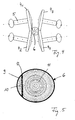
- the production of resilient wood chips is carried out according to a particularly preferred feature of the invention with a Kegelstirnplanfräskopf 4 according to FIGS. 2 and 3 , which at the end of a z. B. motorized, rotatable in the direction of arrow shaft 5 is fixed.
- the milling head 4 includes a conical or frusto-conical working surface 4 a, which is provided with radially arranged cutting blades and is applied flat against a schematically indicated stem 6 made of wood, the in Fig. 2 perpendicular to the plane of the milling head 4 can be moved along.
- Fig. 3 shows, formed from a plurality of helically arranged cutting teeth 7. This ensures that next to each other several narrow chips instead of only one wide chip from the trunk 6 is milled.
- the cone angle ⁇ of the milling head 4 which is considered important for achieving a particularly thin chip material, is preferably 5 ° to 30 °.
- a with at least one milling head 4 after FIGS. 2 and 3 equipped bevel face milling tool 8 ( Fig. 4 ) in a conventional, with a feed rate of z. B. 80 m / min working chipper line of a sawmill install.
- the milling tool 8 contains a total of four milling heads 4 FIGS.
- each two milling heads (4 1 , 4 2 or 4 3 , 4 4 ) are arranged side by side or in the feed direction of the trunk 6 in a row and wherein the pair 4 1 , 4 2 compared to the pair 4 3 , 4 4 on the diametrically opposite side of the trunk 6 is arranged.
- the cutting takes place in the longitudinal direction of the trunk 6.
- the wood chips are reduced to a residual moisture of z. B. 8% to 12% or less dried before mixing with the cellulose fibers.
- FIG. 5 A preferred machining of a log 6 during machining is in Fig. 5 indicated.
- the trunk 6 contains, as usual in the outer area a bark 9, which is first removed.
- An inwardly adjacent to the bark 9 area 10 of the trunk 6 is usually machined to produce so-called wood chips, while an inner core 11 of the trunk 6 for the production of boards od.
- an inner core 11 of the trunk 6 for the production of boards od.
- the area 10 intended for processing wood chips is only slightly reduced, but on the other hand it is achieved that the wood chips 2 according to the invention are processed in a region 12 in which the trunk 6 already has a comparatively large diameter.
- the average cutting height can therefore z. B. depending on the trunk cross section about 100 mm to 300 mm.
- the accumulated Spangut is expedient sucked immediately after its production and fed via a pneumatic conveyor to a dryer.
- the spangenut may also be provided with necessary or desired fungicides and flame retardants or the like.
- the invention is not limited to the described embodiment, which can be modified in many ways. This is especially true for the exemplified dimensions of the processed wood chips and cellulose fibers.
- both long and short cellulose fibers can be processed in the manner described.
- the specified milling heads 4 and the milling tools 8 produced with these can be designed differently than described.
Landscapes
- Engineering & Computer Science (AREA)
- Chemical & Material Sciences (AREA)
- Structural Engineering (AREA)
- Architecture (AREA)
- Physics & Mathematics (AREA)
- Ceramic Engineering (AREA)
- Electromagnetism (AREA)
- Civil Engineering (AREA)
- Acoustics & Sound (AREA)
- Materials Engineering (AREA)
- Organic Chemistry (AREA)
- Dry Formation Of Fiberboard And The Like (AREA)
- Thermal Insulation (AREA)
- Building Environments (AREA)
Abstract
Description
- Die Erfindung betrifft einen Wärmedämmstoff mit Zellulosefasern und ein Verfahren zu dessen Herstellung.
- Zur Wärmeisolierung von Gebäuden ist es allgemein bekannt, deren Böden, Decken, Wände, Dächer od. dgl. mit aus Glas- oder Mineralfasern bestehenden Matten zu belegen. Als preisgünstige Alternative hierzu ist die Anwendung von Wärmedämmstoffen aus Holzspänen, insbesondere Hobel- bzw. Frässpänen, sowie aus Zellulosefasern bzw. -flocken bekannt, die aus Altpapier, insbesondere recyceltem Zeitungspapier gewonnen werden. Wärmedämmstoffe dieser Art werden entweder als Schüttgut verwendet oder mit Hilfe von Blasvorrichtungen od. dgl. in vorbereitete Hohlräume eingeblasen, die im Falle von Fertighäusern auch aus vorgefertigten, quaderförmigen Rahmenelementen bestehen können (z. B.
DE 199 06 138 A1 ,DE 103 26 515 A1 ). - Ein Nachteil bei der Anwendung von Holzspänen und Zellulosefasern besteht darin, dass diese bei geringen, für eine gute Wärmedämmung zu geringen Einbaudichten zu nachträglichen Setzungen führen. Derartige Setzungen haben die Bildung von Wärmebrücken und damit Energieverluste zur Folge. Es ist daher üblich, Wärmedämmstoffe dieser Art mit so hohen Dichten einzubauen, dass nachträgliche Setzungen ausgeschlossen sind. Während für Holzspäne Einbaudichten von z. B. ca. 65 kg/m3 als setzungssicher gelten, haben sich für qualitativ gute, lange Zellulosefasern aus Altpapier Dichten von ca. 58 kg/m3 und für kurze Zellulosefasern Dichten von ca. 70 kg/m3 als setzungssicher erwiesen. Das führt allerdings zu dem weiteren Nachteil, dass die Wärmedämmstoffe bei diesen Dichten eine geringere Wärmedämmung als bei den für die Wärmedämmung optimalen Dichten aufweisen. Untersuchungen haben gezeigt, dass eine hohe Setzungsicherheit und eine gute Wärmedämmung in entgegengesetzte Richtungen laufen und eine besonders gute Wärmedämmung mit Einbaudichten im Bereich von ca. 40 kg/m3 erreicht wird. Das hat auch Folgen für die Kosten, die für eine gewünschte Wärmedämmung entstehen, weil Dämmstoffe mit einer vergleichsweise höheren Wärmeleitzahl λ eine entsprechend erhöhte Dicke d der Wärmedämmstoffschicht erfordern, um denselben U-Wert (U = λ : d) zu erhalten.
- Im speziellen Fall von Zellulosefasern geht die Entwicklung als Folge des immer häufiger recycelten Altpapiers (Zeitungspapiers) hin zu immer kürzeren Fasern. Daher tritt hier die beschriebene Unvereinbarkeit von guter Wärmedämmwirkung, Setzungssicherheit und geringem Preis im besonderen Maße hervor.
- Da Zellulosefasern dennoch ein für die Wärmedämmung gut geeigneter Dämmstoff sind, liegt der Erfindung das technische Problem zugrunde, einen Zellulosefasern enthaltenden Wärmedämmstoff zu schaffen, der unabhängig von der Länge der Zellulosefasern mit einer Setzungsdichte eingebaut werden kann, die näher als bisher an dem für eine optimale Wärmedämmung zweckmäßigen Dichtewert liegt.
- Zur Lösung dieser Aufgabe enthält der erfindungsgemäße Wärmedämmstoff eine Matrix aus federelastischen, Hohlräume bildenden Holzspänen und in die Hohlräume eingelagerte Zellulosefasern.
- Ein zur Herstellung eines derartigen Wärmedämmstoffs geeignetes Verfahren ist erfindungsgemäß dadurch gekennzeichnet, dass federelastische Holzspäne hergestellt werden, indem ein Stamm aus einem feuchten Holz mit einem Kegelstimradfräswerkzeug bearbeitet wird und die dadurch erhaltenen Holzspäne getrocknet und mit Zellulosefasern vermischt werden.
- Die Erfindung bringt den überraschenden Vorteil mit sich, dass die federelastischen Holzspäne ein stabiles Stützgerüst bilden, das eine Setzungsdichte von nur ca. 30 kg/m3 besitzt. Dadurch wird, wenn die Holzspäne mit Zellulosefasern vermischt sind, einerseits die gewünsche Federelastizität und damit Setzungsicherheit, die insbesondere kurzen Zellulosefasern fehlt, hergestellt. Andererseits wird erreicht, dass insgesamt ein Kompositdämmstoff entsteht, der eine deutlich reduzierte, aber dennoch setzungssichere Einbaudichte bezüglich der Zellulosefasern hat, die auch hier zum weitaus überwiegenden Teil die Funktion der Wärmedämmung ausüben. Selbst mit schlechten, d. h. der kurzen Zellulosefasern konnte bei einem Mischungsverhältnis von Fasern zu Spänen von 1 : 1 eine setzungssichere Einbaudichte von ca. 40 kg/m3 realisiert und dadurch eine Annäherung an den optimalen Wärmeleitwert erzielt werden.
- Weitere vorteilhafte Merkmale der Erfindung ergeben sich aus den Unteransprüchen.
- Die Erfindung wird nachfolgend in Verbindung mit den beiliegenden Zeichnungen an einem Ausführungsbeispiel näher erläutert. Es zeigen:
-
Fig. 1 schematisch einen mit dem erfindungsgemäßen Wärmedämmstoff gefüllten Hohlkörper; -
Fig. 2 eine Seitenansicht eines für die Herstellung von federelastischen Holzspänen besonders gut geeigneten Kegelstirnplanfräskopfs; -
Fig. 3 eine Vorderansicht des Kegelstirnplanfräskopfs nachFig. 2 ; -
Fig. 4 ein aus mehreren Kegelstirnplanfräsköpfen nachFig. 2 zusammengesetztes Werkzeug; und -
Fig. 5 schematisch die erfindungsgemäße Herstellung von federelastischen Holzspänen aus einem Holzstamm. - In
Fig. 1 soll das Bezugszeichen 1 einen mit einem erfindungsgemäßen Wärmedämmstoff gefüllten Hohlkörper andeuten. Der Wärmedämmstoff enthält eine den Hohlkörper 1 ausfüllende Matrix aus mit weißen Linien angedeuteten, übertrieben groß dargestellten, federelastischen Holzspänen 2, die zwischen sich eine Vielzahl von Hohlräumen bilden, und aus mit schwarzer Schattierung angedeuteten Zellulosefasern 3, die in die Hohlräume eingelagert sind. Die Holzspäne 2 weisen vorzugsweise eine Länge von ca. 10 mm bis 20 mm, eine Dicke von ca. 0,05 mm bis 0,4 mm und eine Breite von ca. 5 mm bis 15 mm auf. Dagegen handelt es sich bei den Zellulosefasern 3 um solche, wie sie üblicherweise für Wärmedämmzwecke verwendet und z. B. unter der Marke "Isofloc" vertrieben werden. Derartige Zellulosefasern können z. B. eine Durchschnittslänge von ca. 0,5 mm bis 9 mm und einen Duchmesser von z.B. 0,1 mm bis 0,2 mm besitzen, was weitgehend davon abhängt, aus einem wie oft recycelten Altpapier sie hergestellt wurden. Das Mischungsverhältnis der Holzspäne 2 mit den Zellulosefasern 3 beträgt vorzugsweise 20 : 80 bis 80 : 20 in Massen%, bezogen auf die Gesamtmasse. Etwa vorhandene Zuschlagsstoffe wie z. B. mineralische Salze, Pilz- und Brandschutzmittel od. dgl. sind für die Erfindung unwesentlich und werden daher hier nicht berücksichtigt. - Die federelastischen Holzspäne 2 bilden, wie
Fig. 1 andeutet, eine setzungssichere Matrix bzw. ein Stützgerüst geringer Dichte, dessen Hohlräume die viel feineren Zellulosefasern 3 in sich aufnehmen, ohne dass sich die einzelnen Komponenten entmischen und sich z. B. die Zellulosefasern 3 durch ihr Eigengewicht am Boden des Hohlkörpers 1 oder, wenn es sich um eine lose Schüttung handelt, auf der Unterlage der Schüttung ansammeln. Dadurch wird das Zellulosematerial weit weniger als bisher durch sein Eigengewicht belastet. Die federelastischen Holzspäne 2 haben eine setzungssichere Dichte von z. B. ca. 30 g/m3. Da die Zellulosefasern 3 nur in den Hohlräumen der Holzspäne 2 angeordnet sind, haben auch sie eine deutlich geringere Dichte als der üblichen, minimalen Setzungsdichte von ca. 58 kg/m3 entspricht, wodurch ihre Wärmeleitfähigkeit deutlich reduziert ist. Da die Holzspäne 2 außerdem preiswerter als Zellulosefasern sind, folgt daraus auch, dass der Preis des erfindungsgemäßen, zusammengesetzten Wärmedämmstoffs niedriger als der für einen Wärmedämmstoff aus reinen Zellulosefasern ist. - Die Mischung der Holzspäne und der Zellulosefasern kann mechanisch z. B. mittels eines Trommelmischers oder pneumatisch erfolgen, indem die einzelnen Stoffe mittels je einer herkömmlichen Einblasmaschine in einen gemeinsamen Vorratsbehälter eingeblasen werden. Dieser kann gleichzeitig als rotierende, vorzugsweise zylindrische Trommel ausgebildet oder mit einem Rührwerk versehen sein, um eine innige Vermischung zu gewährleisten. Es muss als überraschend angesehen werden, dass in dem so hergestellten Wärmedämmstoff auch sehr kurze Zellulosefasern die Hohlräume zwischen den Holzspänen gut ausfüllen und keine Entmischung beim späteren Verarbeiten und/oder Transport des Kompositmaterials eintritt.
- Als setzungssichere Dichten für den erfindungsgemäßen Wärmedämmstoff haben sich bisher Dichten zwischen 30 kg/m3 und 50 kg/m3, vorzugsweise von ca. 40 kg/m3 als zweckmäßig erwiesen.
- Die Herstellung der federelastischen Holzspäne erfolgt nach einem besonders bevorzugten Merkmal der Erfindung mit einem Kegelstirnplanfräskopf 4 gemäß
Fig. 2 und 3 , der am Ende einer z. B. motorisch betriebenen, in Pfeilrichtung drehbaren Welle 5 befestigt ist. Der Fräskopf 4 enthält eine kegel- oder kegelstumpfförmige Arbeitsfläche 4a, die mit radial angeordneten Schneidmessern versehen ist und plan gegen einen schematisch angedeuteten Stamm 6 aus Holz angelegt wird, der inFig. 2 senkrecht zur Zeichenebene am Fräskopf 4 entlang bewegt werden kann. - Obwohl grundsätzlich auch die Anwendung von radial durchgehenden Schneidmessern möglich wäre, werden diese vorzugsweise, wie
Fig. 3 zeigt, aus einer Mehrzahl von spiralisch angeordneten Schneidzähnen 7 gebildet. Dadurch wird erreicht, dass nebeneinander mehrere schmale Späne anstatt nur je ein breiter Span vom Stamm 6 abgefräst wird. - Der zur Erzielung eines besonders dünnen Spangutes für wichtig gehaltene Kegelwinkel κ des Fräskopfs 4 beträgt vorzugsweise 5° bis 30°. Für die Spanungsdicke h gilt dabei im Wesentlichen die Formel

worin fz = Vf/(n · z) den Vorschub eines Schneidzahns 7 mit der Vorschubgeschwindigkeit Vf des Stammes 6, der Drehzahl n der Welle 5 und der Zahl z der Schneidzähne 7 sowie Φ den Eingriffswinkel des Schneidzahns 7 bedeuten. - Für eine wirtschaftlich sinnvolle Herstellung wird erfindungsgemäß vorgeschlagen, ein mit wenigstens einem Fräskopf 4 nach
Fig. 2 und 3 ausgerüstetes Kegelstirnplanfräswerkzeug 8 (Fig. 4 ) in eine übliche, mit einer Vorschubgeschwindigkeit von z. B. 80 m/min arbeitenden Spanerlinie eines Sägewerks einzubauen. Dadurch werden separate Anlagen und damit Herstellungskosten eingespart. Im Ausführungsbeispiel enthält des Fräswerkzeug 8 insgesamt vier Fräsköpfe 4 nachFig. 2 und 3 , wobei je zwei Fräsköpfe (41, 42 bzw. 43, 44) jeweils nebeneinander bzw. in Vorschubrichtung des Stamms 6 hintereinander angeordnet sind und wobei das Paar 41, 42 im Vergleich zum Paar 43, 44 auf der diametral gegenüberliegenden Seite des Stamms 6 angeordnet ist. Dadurch erfolgt die Zerspanung in Längsrichtung des Stamms 6. - Zur Erzielung qualitativ hochwertiger, federelastischer Holzspäne 2 hat es sich als zweckmäßig erwiesen, die Stämme 6 unter Anwendung beispielsweise von waldfeuchtem Rundholz in feuchtem Zustand zu zerspanen. Ein Spangut, das mit einer Stammfeuchte u von z. B. 50 % (u = Masse des feuchten Holzes - Masse des trockenen Holzes, geteilt durch die Masse des trockenen Holzes mal 100) hergestellt wurde, ist z. B. leicht gerollt und zeigt im Gegensatz zu einem unter denselben Bedingungen, jedoch von einem trockenen Stamm 6 erhaltenen Spangut eine deutlich geringere Neigung zur Faltenbildung. Überraschend eignet sich ein derartiges, dünnes und federelastisches Spangut besonders gut für die Zwecke der vorliegenden Erfindung, da die setzungssichere Dicke der Späne mit zunehmender Ausgangsfeuchte bei der Zerspanung immer geringer wird. Offenbar ist eine Faltstruktur von Spänen für die gewünschte Federelastizität eher nachteilig als vorteilhaft.
- Im Anschluss an ihre Herstellung werden die Holzspäne auf eine Restfeuchte von z. B. 8 % bis 12 % oder weniger getrocknet, bevor sie mit den Zellulosefasern vermischt werden.
- Eine bevorzugte Bearbeitung eines Stammes 6 während der Zerspanung ist in
Fig. 5 angedeutet. Der Stamm 6 enthält wie üblich im äußeren Bereich eine Rinde 9, die zunächst entfernt wird. Ein sich nach innen zu an die Rinde 9 anschließender Bereich 10 des Stamms 6 wird normalerweise unter Herstellung von sogenannten Hackschnitzeln zerspant, während ein innenliegender Kern 11 des Stamms 6 zur Herstellung von Brettern od. dgl. benutzt wird. Erfindungsgemäß wird demgegenüber vorgeschlagen, auf beiden Seiten des Stamms 6 und zwischen den Bereichen 10 und 11 jeweils einen Bereich 12 mit einer radialen Breite von z. B. 1 mm bis 5 mm vorzusehen, der unter Anwendung des Fräswerkzeugs 8 nachFig. 4 der Herstellung der erfindungsgemäßen, federelastischen Holzspäne 2 (Fig. 1 ) dient. Dadurch wird einerseits der zur Verarbeitung von Hackschnitzeln bestimmte Bereich 10 nur geringfügig verkleinert, andererseits aber erreicht, dass die erfindungsgemäßen Holzspäne 2 in einem Bereich 12 abgearbeitet werden, in welchem der Stamm 6 bereits einen vergleichsweise großen Durchmesser hat. Dadurch ist mit einem vergleichsweise geringen Aufwand an Material und Kosten für das Fräswerkzeug 8 eine wirtschaftlich günstigere Spanerzeugung möglich, als wenn die Späne in dem direkt auf die Rinde 9 folgenden Bereich 10 erzeugt würden. Die durchschnittliche Schnitthöhe kann daher z. B. je nach Stammquerschnitt ca. 100 mm bis 300 mm betragen. - Das anfallende Spangut wird zweckmäßig unmittelbar nach seiner Erzeugung abgesaugt und über eine pneumatische Förderung einem Trockner zugeführt. Zuvor oder auch später beim Vermischen mit den Zellulosefasern kann das Spangut außerdem mit erforderlichen oder erwünschten Pilz- und Brandschutzmitteln od. dgl. versehen werden.
- Die Erfindung ist nicht auf das beschriebene Ausführungsbeispiel beschränkt, das auf vielfache Weise abgewandelt werden kann. Das gilt insbesondere für die beispielhaft angegebenen Abmessungen der verarbeiteten Holzspäne und Zellulosefasern. Insbesondere können auf die beschriebene Weise sowohl lange als auch kurze Zellulosefasern verarbeitet werden. In jedem Fall ergibt sich der Vorteil, dass aufgrund der Zumischung der Holzspäne 2 die Gesamtdichte an Zellulosefasern 3 kleiner ist, weniger Zellulosematerial benötigt wird und wegen des geringeren Marktpreises für die Holzspäne eine Kostenreduzierung erzielt wird. Auch die angegebenen Fräsköpfe 4 und die mit diesen hergestellten Fräswerkzeuge 8 können anders als beschrieben ausgebildet sein. Schließlich versteht sich, dass die verschiedenen Merkmale auch in anderen als den beschriebenen und dargestellten Kombinationen angewendet werden können.
Claims (14)
- Wärmedämmstoff mit Zellulosefasern (3), dadurch gekennzeichnet, dass er eine Matrix aus federelastischen, Hohlräume bildenden Holzspänen (2) enthält und die Zellulosefasern (3) in die Hohlräume eingelagert sind.
- Wärmedämmstoff nach Anspruch 1, dadurch gekennzeichnet, dass die Holzspäne (2) eine Länge von 10 mm bis 20 mm, eine Dicke von 0,05 mm bis 0,4 mm und eine Breite von 5 mm bis 15 aufweisen.
- Wärmedämmstoff nach Anspruch 1 oder 2, dadurch gekennzeichnet, dass die Zellulosefasern (3) eine Länge von 0,5 mm bis 9 mm und einen Durchmesser von 0,1 mm bis 0,2 mm aufweisen.
- Wärmedämmstoff nach einem der Ansprüche 1 bis 3, dadurch gekennzeichnet, dass die Holzspäne (2) eine Feuchte von 1 % bis 12 % aufweisen.
- Wärmedämmstoff nach einem der Ansprüche 1 bis 4, dadurch gekennzeichnet, dass die Holzspäne (2) und Zellulosefasern (3) in einem Mischungsverhältnis von 20 : 80 bis 80 : 20 Massen% vorliegen.
- Wärmedämmstoff nach einem der Ansprüche 1 bis 5, dadurch gekennzeichnet, dass er eine Setzungsdichte zwischen 30 kg/m3 und 50 kg/m3 aufweist.
- Verfahren zur Herstellung eines Zellulosefasern (3) enthaltenden Wärmedämmstoffs, dadurch gekennzeichnet, dass federelastische Holzspäne (2) hergestellt werden, indem ein Stamm (6) aus feuchtem Holz mit einem Kegelstirnplanfräswerkzeug (8) bearbeitet wird, und dass die dadurch erhaltenen Holzspäne (2) getrocknet und mit den Zellulosefasern (3) vermischt werden.
- Verfahren nach Anspruch 7, dadurch gekennzeichnet, dass die getrockneten Holzspäne (2) und die Zellulosefasern (3) in einem Massenverhältnis von 20 : 80 bis 80 : 20 vermischt werden.
- Verfahren nach Anspruch 7 oder 8, dadurch gekennzeichnet, dass die Holzspäne (2) auf eine Restfeuchte von 1 % bis 12 % getrocknet werden.
- Verfahren nach einem der Ansprüche 7 bis 9, dadurch gekennzeichnet, dass die Holzspäne (2) aus einem Bereich (12) des Stammquerschnitts erhalten werden, aus dem auch Hackschnitzel gewonnen werden.
- Verfahren nach einem der Ansprüche 7 bis 10, dadurch gekennzeichnet, dass die Holzspäne (2) mit einem Kegelstirnplanfräswerkzeug (8) erhalten werden, das wenigstens zwei, an diametral gegenüberliegenden Stellen des Stamms (6) angeordnete Fräsköpfe (4) enthält.
- Verfahren nach Anspruch 11, dadurch gekennzeichnet, dass die Holzspäne (2) von jedem Fräskopf (4) aus einem ca. 1 mm bis 5 mm breiten Bereich (12) des Stamms (6) gewonnen werden.
- Verfahren nach einem der Ansprüche 10 bis 12, dadurch gekennzeichnet, dass die Herstellung der Holzspäne (2) im Durchlaufverfahren in einer Spanerlinie eines Sägewerks erfolgt, wobei das Kegelstirnplanfräswerkzeug (8) in der Spanerlinie hinter einer der Hackschnitzelerzeugung dienenden Zerspanungsstation angeordnet wird.
- Verfahren nach Anspruch 13, dadurch gekennzeichnet, dass ein Kegelstimradfräswerkzeug (8) verwendet wird, das wenigstens zwei in Durchlaufrichtung hintereinander angeordnete Fräsköpfe (4) enthält.
Applications Claiming Priority (1)
| Application Number | Priority Date | Filing Date | Title |
|---|---|---|---|
| DE200710047542 DE102007047542A1 (de) | 2007-10-02 | 2007-10-02 | Wärmedämmstoff mit Zellulosefasern und Verfahren zu dessen Herstellung |
Publications (3)
| Publication Number | Publication Date |
|---|---|
| EP2045408A2 true EP2045408A2 (de) | 2009-04-08 |
| EP2045408A3 EP2045408A3 (de) | 2011-03-16 |
| EP2045408B1 EP2045408B1 (de) | 2013-01-23 |
Family
ID=40149538
Family Applications (1)
| Application Number | Title | Priority Date | Filing Date |
|---|---|---|---|
| EP20080016760 Not-in-force EP2045408B1 (de) | 2007-10-02 | 2008-09-24 | Wärmedämmstoff mit Zellulosefasern und Verfahren zu dessen Herstellung |
Country Status (2)
| Country | Link |
|---|---|
| EP (1) | EP2045408B1 (de) |
| DE (1) | DE102007047542A1 (de) |
Cited By (4)
| Publication number | Priority date | Publication date | Assignee | Title |
|---|---|---|---|---|
| WO2012168673A1 (fr) * | 2011-06-09 | 2012-12-13 | A.P.C.A. (Assemblée Permanente Des Chambres D'agriculture) | Materiau de protection et/ou de combustion a partir d'une matiere vegetale cellulosique et procede de fabrication correspondant |
| EP2813629A1 (de) | 2013-06-12 | 2014-12-17 | isofloc AG | Anordnung von Ballen und Verfahren zur Herstellung einer Mischung unterschiedlicher Isolationsmaterialien |
| US20190309891A1 (en) * | 2018-04-10 | 2019-10-10 | Lucia Groß | Thermal Insulation Material and Method for Its Production |
| WO2024100087A1 (en) | 2022-11-09 | 2024-05-16 | Circusol Holding B.V. | Method and system for manufacturing cellulose-based insulation |
Citations (2)
| Publication number | Priority date | Publication date | Assignee | Title |
|---|---|---|---|---|
| DE19906138A1 (de) | 1999-02-13 | 2000-08-24 | Isofloc Oekologische Bautechni | Vorrichtung und Einrichtung zum Befüllen von hohlen Rahmenelementen mit Dämmstoff-Flocken und Verfahren zur Anwendung der Vorrichtung |
| DE10326515A1 (de) | 2003-06-10 | 2005-01-13 | META-I.D. Ökologische Innovation GmbH | Verfahren zur Behandlung und zum Transport von Dämmstoffflocken sowie Auflockerungs- und Entladevorrichtung für einen mit Dämmstoffflocken beladenen Container |
Family Cites Families (3)
| Publication number | Priority date | Publication date | Assignee | Title |
|---|---|---|---|---|
| DE19516186A1 (de) * | 1995-05-05 | 1996-11-07 | Willoc Holding B V | Dämmaterial aus Naturprodukten und Herstellungsverfahren dafür |
| DE19539309C2 (de) * | 1995-10-23 | 2000-01-05 | Thomas Goetz | Schallschutz- bzw. Schalldämmstoff, Bauplatte daraus sowie Verfahren zu dessen bzw. deren Herstellung |
| DE102004011931B4 (de) * | 2004-03-11 | 2006-09-14 | Kronotec Ag | Dämmstoffplatte aus einem Holzwerkstoff-Bindemittelfaser-Gemisch |
-
2007
- 2007-10-02 DE DE200710047542 patent/DE102007047542A1/de not_active Withdrawn
-
2008
- 2008-09-24 EP EP20080016760 patent/EP2045408B1/de not_active Not-in-force
Patent Citations (2)
| Publication number | Priority date | Publication date | Assignee | Title |
|---|---|---|---|---|
| DE19906138A1 (de) | 1999-02-13 | 2000-08-24 | Isofloc Oekologische Bautechni | Vorrichtung und Einrichtung zum Befüllen von hohlen Rahmenelementen mit Dämmstoff-Flocken und Verfahren zur Anwendung der Vorrichtung |
| DE10326515A1 (de) | 2003-06-10 | 2005-01-13 | META-I.D. Ökologische Innovation GmbH | Verfahren zur Behandlung und zum Transport von Dämmstoffflocken sowie Auflockerungs- und Entladevorrichtung für einen mit Dämmstoffflocken beladenen Container |
Cited By (8)
| Publication number | Priority date | Publication date | Assignee | Title |
|---|---|---|---|---|
| WO2012168673A1 (fr) * | 2011-06-09 | 2012-12-13 | A.P.C.A. (Assemblée Permanente Des Chambres D'agriculture) | Materiau de protection et/ou de combustion a partir d'une matiere vegetale cellulosique et procede de fabrication correspondant |
| FR2976298A1 (fr) * | 2011-06-09 | 2012-12-14 | A P C A Assemblee Permanente Des Chambres D Agriculture | Materiau de protection et/ou de combustion a partir d'une matiere vegetale cellulosique et procede de fabrication correspondant |
| EP2813629A1 (de) | 2013-06-12 | 2014-12-17 | isofloc AG | Anordnung von Ballen und Verfahren zur Herstellung einer Mischung unterschiedlicher Isolationsmaterialien |
| US20190309891A1 (en) * | 2018-04-10 | 2019-10-10 | Lucia Groß | Thermal Insulation Material and Method for Its Production |
| EP3552787A1 (de) * | 2018-04-10 | 2019-10-16 | Groß, Lucia | Wärmedämmstoff und verfahren zu dessen herstellung |
| CN110355848A (zh) * | 2018-04-10 | 2019-10-22 | 卢西亚·格罗斯 | 热隔绝物料和用于其制造的方法 |
| US12123539B2 (en) | 2018-04-10 | 2024-10-22 | Lucia Groß | Thermal insulation material and method for its production |
| WO2024100087A1 (en) | 2022-11-09 | 2024-05-16 | Circusol Holding B.V. | Method and system for manufacturing cellulose-based insulation |
Also Published As
| Publication number | Publication date |
|---|---|
| DE102007047542A1 (de) | 2009-04-09 |
| EP2045408A3 (de) | 2011-03-16 |
| EP2045408B1 (de) | 2013-01-23 |
Similar Documents
| Publication | Publication Date | Title |
|---|---|---|
| DE3686583T2 (de) | Mehrschichtiges holzprodukt. | |
| DE1303874C2 (de) | Verfahren zur herstellung von schallschluckplatten | |
| DE60003919T2 (de) | Verbundplatten aus hanffasern | |
| EP2045408B1 (de) | Wärmedämmstoff mit Zellulosefasern und Verfahren zu dessen Herstellung | |
| CH709486A2 (de) | Leichtbauelement, Herstellungsverfahren dafür, Verwendung desselben, sowie Leichtbauplatte und Dämmstoff. | |
| DE69926525T2 (de) | Holzspan und verfahren zur herstellung von zellstoff | |
| DE69517046T2 (de) | Verbindungskonstruktion für holzelemente | |
| CH712472A2 (de) | Verfahren zum Herstellen von Plattenelementen aus Holz, Plattenelemente und Verwendung derselben. | |
| DE3936314A1 (de) | Mehrschichtmassivholzerzeugnisse wie balken, bretter und leimbinder sowie verfahren zu deren herstellung | |
| EP3552787B1 (de) | Verfahren zur herstellung eines wärmedämmstoffs | |
| EP0663272B1 (de) | Verfahren zum Zerlegen eines Baumstammes in allseitig bearbeitete Holzerzeugnisse | |
| EP0799947B1 (de) | Holzbalken und Verfahren zu dessen Herstellung | |
| DE19632997A1 (de) | Verwendung von Paralleloid-Holzstrands für die Herstellung von Komposit-Balken | |
| DE102019125358B4 (de) | Verfahren zur Herstellung eines Verbundwerkstoffs | |
| DE9316636U1 (de) | Endlosbauholzstange | |
| EP1360383B1 (de) | Blockbohle und verfahren zu deren herstellung | |
| EP4090507B1 (de) | Osb-platte mit deckschicht aus typha-blattmaterial | |
| DE4439279C1 (de) | Trägerelement | |
| DE69317600T2 (de) | Baumaterial aus geschichtetem und verleimtem Holz | |
| EP0726373A1 (de) | Massivholzelement | |
| DE7425877U (de) | Ummantelung für eine Platte mit einem Gipskern | |
| DE202023002988U1 (de) | Modular aufgebauter Rollladen-/Raffstorekasten | |
| DE102023108363A1 (de) | Modular aufgebauter rollladen-/raffstorekasten | |
| DE9107371U1 (de) | Holzbalken | |
| AT507030B1 (de) | Gerüstbelagsplatte |
Legal Events
| Date | Code | Title | Description |
|---|---|---|---|
| PUAI | Public reference made under article 153(3) epc to a published international application that has entered the european phase |
Free format text: ORIGINAL CODE: 0009012 |
|
| AK | Designated contracting states |
Kind code of ref document: A2 Designated state(s): AT BE BG CH CY CZ DE DK EE ES FI FR GB GR HR HU IE IS IT LI LT LU LV MC MT NL NO PL PT RO SE SI SK TR |
|
| AX | Request for extension of the european patent |
Extension state: AL BA MK RS |
|
| 19U | Interruption of proceedings before grant |
Effective date: 20100226 |
|
| 19W | Proceedings resumed before grant after interruption of proceedings |
Effective date: 20100701 |
|
| PUAL | Search report despatched |
Free format text: ORIGINAL CODE: 0009013 |
|
| AK | Designated contracting states |
Kind code of ref document: A3 Designated state(s): AT BE BG CH CY CZ DE DK EE ES FI FR GB GR HR HU IE IS IT LI LT LU LV MC MT NL NO PL PT RO SE SI SK TR |
|
| AX | Request for extension of the european patent |
Extension state: AL BA MK RS |
|
| 17P | Request for examination filed |
Effective date: 20110608 |
|
| AKX | Designation fees paid |
Designated state(s): AT BE BG CH CY CZ DE DK EE ES FI FR GB GR HR HU IE IS IT LI LT LU LV MC MT NL NO PL PT RO SE SI SK TR |
|
| GRAP | Despatch of communication of intention to grant a patent |
Free format text: ORIGINAL CODE: EPIDOSNIGR1 |
|
| GRAS | Grant fee paid |
Free format text: ORIGINAL CODE: EPIDOSNIGR3 |
|
| GRAA | (expected) grant |
Free format text: ORIGINAL CODE: 0009210 |
|
| AK | Designated contracting states |
Kind code of ref document: B1 Designated state(s): AT BE BG CH CY CZ DE DK EE ES FI FR GB GR HR HU IE IS IT LI LT LU LV MC MT NL NO PL PT RO SE SI SK TR |
|
| REG | Reference to a national code |
Ref country code: GB Ref legal event code: FG4D Free format text: NOT ENGLISH |
|
| REG | Reference to a national code |
Ref country code: CH Ref legal event code: EP |
|
| REG | Reference to a national code |
Ref country code: AT Ref legal event code: REF Ref document number: 595074 Country of ref document: AT Kind code of ref document: T Effective date: 20130215 Ref country code: CH Ref legal event code: EP |
|
| REG | Reference to a national code |
Ref country code: IE Ref legal event code: FG4D Free format text: LANGUAGE OF EP DOCUMENT: GERMAN |
|
| REG | Reference to a national code |
Ref country code: DE Ref legal event code: R096 Ref document number: 502008009158 Country of ref document: DE Effective date: 20130321 |
|
| REG | Reference to a national code |
Ref country code: CH Ref legal event code: NV Representative=s name: ISLER AND PEDRAZZINI AG, CH |
|
| REG | Reference to a national code |
Ref country code: LT Ref legal event code: MG4D |
|
| REG | Reference to a national code |
Ref country code: NL Ref legal event code: VDEP Effective date: 20130123 |
|
| PG25 | Lapsed in a contracting state [announced via postgrant information from national office to epo] |
Ref country code: BG Free format text: LAPSE BECAUSE OF FAILURE TO SUBMIT A TRANSLATION OF THE DESCRIPTION OR TO PAY THE FEE WITHIN THE PRESCRIBED TIME-LIMIT Effective date: 20130423 Ref country code: IS Free format text: LAPSE BECAUSE OF FAILURE TO SUBMIT A TRANSLATION OF THE DESCRIPTION OR TO PAY THE FEE WITHIN THE PRESCRIBED TIME-LIMIT Effective date: 20130523 Ref country code: SE Free format text: LAPSE BECAUSE OF FAILURE TO SUBMIT A TRANSLATION OF THE DESCRIPTION OR TO PAY THE FEE WITHIN THE PRESCRIBED TIME-LIMIT Effective date: 20130123 Ref country code: LT Free format text: LAPSE BECAUSE OF FAILURE TO SUBMIT A TRANSLATION OF THE DESCRIPTION OR TO PAY THE FEE WITHIN THE PRESCRIBED TIME-LIMIT Effective date: 20130123 Ref country code: ES Free format text: LAPSE BECAUSE OF FAILURE TO SUBMIT A TRANSLATION OF THE DESCRIPTION OR TO PAY THE FEE WITHIN THE PRESCRIBED TIME-LIMIT Effective date: 20130504 Ref country code: NO Free format text: LAPSE BECAUSE OF FAILURE TO SUBMIT A TRANSLATION OF THE DESCRIPTION OR TO PAY THE FEE WITHIN THE PRESCRIBED TIME-LIMIT Effective date: 20130423 |
|
| PG25 | Lapsed in a contracting state [announced via postgrant information from national office to epo] |
Ref country code: SI Free format text: LAPSE BECAUSE OF FAILURE TO SUBMIT A TRANSLATION OF THE DESCRIPTION OR TO PAY THE FEE WITHIN THE PRESCRIBED TIME-LIMIT Effective date: 20130123 Ref country code: PL Free format text: LAPSE BECAUSE OF FAILURE TO SUBMIT A TRANSLATION OF THE DESCRIPTION OR TO PAY THE FEE WITHIN THE PRESCRIBED TIME-LIMIT Effective date: 20130123 Ref country code: PT Free format text: LAPSE BECAUSE OF FAILURE TO SUBMIT A TRANSLATION OF THE DESCRIPTION OR TO PAY THE FEE WITHIN THE PRESCRIBED TIME-LIMIT Effective date: 20130523 Ref country code: NL Free format text: LAPSE BECAUSE OF FAILURE TO SUBMIT A TRANSLATION OF THE DESCRIPTION OR TO PAY THE FEE WITHIN THE PRESCRIBED TIME-LIMIT Effective date: 20130123 Ref country code: FI Free format text: LAPSE BECAUSE OF FAILURE TO SUBMIT A TRANSLATION OF THE DESCRIPTION OR TO PAY THE FEE WITHIN THE PRESCRIBED TIME-LIMIT Effective date: 20130123 Ref country code: LV Free format text: LAPSE BECAUSE OF FAILURE TO SUBMIT A TRANSLATION OF THE DESCRIPTION OR TO PAY THE FEE WITHIN THE PRESCRIBED TIME-LIMIT Effective date: 20130123 Ref country code: GR Free format text: LAPSE BECAUSE OF FAILURE TO SUBMIT A TRANSLATION OF THE DESCRIPTION OR TO PAY THE FEE WITHIN THE PRESCRIBED TIME-LIMIT Effective date: 20130424 |
|
| PG25 | Lapsed in a contracting state [announced via postgrant information from national office to epo] |
Ref country code: HR Free format text: LAPSE BECAUSE OF FAILURE TO SUBMIT A TRANSLATION OF THE DESCRIPTION OR TO PAY THE FEE WITHIN THE PRESCRIBED TIME-LIMIT Effective date: 20130123 |
|
| PG25 | Lapsed in a contracting state [announced via postgrant information from national office to epo] |
Ref country code: DK Free format text: LAPSE BECAUSE OF FAILURE TO SUBMIT A TRANSLATION OF THE DESCRIPTION OR TO PAY THE FEE WITHIN THE PRESCRIBED TIME-LIMIT Effective date: 20130123 Ref country code: RO Free format text: LAPSE BECAUSE OF FAILURE TO SUBMIT A TRANSLATION OF THE DESCRIPTION OR TO PAY THE FEE WITHIN THE PRESCRIBED TIME-LIMIT Effective date: 20130123 Ref country code: SK Free format text: LAPSE BECAUSE OF FAILURE TO SUBMIT A TRANSLATION OF THE DESCRIPTION OR TO PAY THE FEE WITHIN THE PRESCRIBED TIME-LIMIT Effective date: 20130123 Ref country code: EE Free format text: LAPSE BECAUSE OF FAILURE TO SUBMIT A TRANSLATION OF THE DESCRIPTION OR TO PAY THE FEE WITHIN THE PRESCRIBED TIME-LIMIT Effective date: 20130123 Ref country code: CZ Free format text: LAPSE BECAUSE OF FAILURE TO SUBMIT A TRANSLATION OF THE DESCRIPTION OR TO PAY THE FEE WITHIN THE PRESCRIBED TIME-LIMIT Effective date: 20130123 |
|
| PG25 | Lapsed in a contracting state [announced via postgrant information from national office to epo] |
Ref country code: CY Free format text: LAPSE BECAUSE OF FAILURE TO SUBMIT A TRANSLATION OF THE DESCRIPTION OR TO PAY THE FEE WITHIN THE PRESCRIBED TIME-LIMIT Effective date: 20130123 |
|
| PLBE | No opposition filed within time limit |
Free format text: ORIGINAL CODE: 0009261 |
|
| STAA | Information on the status of an ep patent application or granted ep patent |
Free format text: STATUS: NO OPPOSITION FILED WITHIN TIME LIMIT |
|
| PG25 | Lapsed in a contracting state [announced via postgrant information from national office to epo] |
Ref country code: IT Free format text: LAPSE BECAUSE OF FAILURE TO SUBMIT A TRANSLATION OF THE DESCRIPTION OR TO PAY THE FEE WITHIN THE PRESCRIBED TIME-LIMIT Effective date: 20130123 |
|
| 26N | No opposition filed |
Effective date: 20131024 |
|
| REG | Reference to a national code |
Ref country code: DE Ref legal event code: R097 Ref document number: 502008009158 Country of ref document: DE Effective date: 20131024 |
|
| PG25 | Lapsed in a contracting state [announced via postgrant information from national office to epo] |
Ref country code: MC Free format text: LAPSE BECAUSE OF FAILURE TO SUBMIT A TRANSLATION OF THE DESCRIPTION OR TO PAY THE FEE WITHIN THE PRESCRIBED TIME-LIMIT Effective date: 20130123 |
|
| GBPC | Gb: european patent ceased through non-payment of renewal fee |
Effective date: 20130924 |
|
| REG | Reference to a national code |
Ref country code: IE Ref legal event code: MM4A |
|
| PG25 | Lapsed in a contracting state [announced via postgrant information from national office to epo] |
Ref country code: IE Free format text: LAPSE BECAUSE OF NON-PAYMENT OF DUE FEES Effective date: 20130924 Ref country code: GB Free format text: LAPSE BECAUSE OF NON-PAYMENT OF DUE FEES Effective date: 20130924 |
|
| PGFP | Annual fee paid to national office [announced via postgrant information from national office to epo] |
Ref country code: CH Payment date: 20140922 Year of fee payment: 7 |
|
| REG | Reference to a national code |
Ref country code: AT Ref legal event code: MM01 Ref document number: 595074 Country of ref document: AT Kind code of ref document: T Effective date: 20130924 |
|
| PGFP | Annual fee paid to national office [announced via postgrant information from national office to epo] |
Ref country code: DE Payment date: 20141003 Year of fee payment: 7 Ref country code: FR Payment date: 20140917 Year of fee payment: 7 |
|
| PG25 | Lapsed in a contracting state [announced via postgrant information from national office to epo] |
Ref country code: AT Free format text: LAPSE BECAUSE OF NON-PAYMENT OF DUE FEES Effective date: 20130924 |
|
| PGFP | Annual fee paid to national office [announced via postgrant information from national office to epo] |
Ref country code: BE Payment date: 20140917 Year of fee payment: 7 |
|
| PG25 | Lapsed in a contracting state [announced via postgrant information from national office to epo] |
Ref country code: MT Free format text: LAPSE BECAUSE OF FAILURE TO SUBMIT A TRANSLATION OF THE DESCRIPTION OR TO PAY THE FEE WITHIN THE PRESCRIBED TIME-LIMIT Effective date: 20130123 Ref country code: TR Free format text: LAPSE BECAUSE OF FAILURE TO SUBMIT A TRANSLATION OF THE DESCRIPTION OR TO PAY THE FEE WITHIN THE PRESCRIBED TIME-LIMIT Effective date: 20130123 |
|
| PG25 | Lapsed in a contracting state [announced via postgrant information from national office to epo] |
Ref country code: HU Free format text: LAPSE BECAUSE OF FAILURE TO SUBMIT A TRANSLATION OF THE DESCRIPTION OR TO PAY THE FEE WITHIN THE PRESCRIBED TIME-LIMIT; INVALID AB INITIO Effective date: 20080924 Ref country code: LU Free format text: LAPSE BECAUSE OF NON-PAYMENT OF DUE FEES Effective date: 20130924 |
|
| REG | Reference to a national code |
Ref country code: DE Ref legal event code: R119 Ref document number: 502008009158 Country of ref document: DE |
|
| REG | Reference to a national code |
Ref country code: CH Ref legal event code: PL |
|
| REG | Reference to a national code |
Ref country code: FR Ref legal event code: ST Effective date: 20160531 |
|
| PG25 | Lapsed in a contracting state [announced via postgrant information from national office to epo] |
Ref country code: CH Free format text: LAPSE BECAUSE OF NON-PAYMENT OF DUE FEES Effective date: 20150930 Ref country code: LI Free format text: LAPSE BECAUSE OF NON-PAYMENT OF DUE FEES Effective date: 20150930 Ref country code: DE Free format text: LAPSE BECAUSE OF NON-PAYMENT OF DUE FEES Effective date: 20160401 |
|
| PG25 | Lapsed in a contracting state [announced via postgrant information from national office to epo] |
Ref country code: FR Free format text: LAPSE BECAUSE OF NON-PAYMENT OF DUE FEES Effective date: 20150930 |
|
| PG25 | Lapsed in a contracting state [announced via postgrant information from national office to epo] |
Ref country code: BE Free format text: LAPSE BECAUSE OF NON-PAYMENT OF DUE FEES Effective date: 20150930 |