EP2043802B1 - Bindemittel enthaltende thermoplastische massen für die herstellung metallischer formkörper - Google Patents
Bindemittel enthaltende thermoplastische massen für die herstellung metallischer formkörper Download PDFInfo
- Publication number
- EP2043802B1 EP2043802B1 EP07787140A EP07787140A EP2043802B1 EP 2043802 B1 EP2043802 B1 EP 2043802B1 EP 07787140 A EP07787140 A EP 07787140A EP 07787140 A EP07787140 A EP 07787140A EP 2043802 B1 EP2043802 B1 EP 2043802B1
- Authority
- EP
- European Patent Office
- Prior art keywords
- weight
- component
- poly
- binder
- dioxepane
- Prior art date
- Legal status (The legal status is an assumption and is not a legal conclusion. Google has not performed a legal analysis and makes no representation as to the accuracy of the status listed.)
- Active
Links
Classifications
-
- B—PERFORMING OPERATIONS; TRANSPORTING
- B22—CASTING; POWDER METALLURGY
- B22F—WORKING METALLIC POWDER; MANUFACTURE OF ARTICLES FROM METALLIC POWDER; MAKING METALLIC POWDER; APPARATUS OR DEVICES SPECIALLY ADAPTED FOR METALLIC POWDER
- B22F3/00—Manufacture of workpieces or articles from metallic powder characterised by the manner of compacting or sintering; Apparatus specially adapted therefor ; Presses and furnaces
- B22F3/10—Sintering only
-
- B—PERFORMING OPERATIONS; TRANSPORTING
- B22—CASTING; POWDER METALLURGY
- B22F—WORKING METALLIC POWDER; MANUFACTURE OF ARTICLES FROM METALLIC POWDER; MAKING METALLIC POWDER; APPARATUS OR DEVICES SPECIALLY ADAPTED FOR METALLIC POWDER
- B22F3/00—Manufacture of workpieces or articles from metallic powder characterised by the manner of compacting or sintering; Apparatus specially adapted therefor ; Presses and furnaces
- B22F3/10—Sintering only
- B22F3/1017—Multiple heating or additional steps
- B22F3/1021—Removal of binder or filler
- B22F3/1025—Removal of binder or filler not by heating only
-
- B—PERFORMING OPERATIONS; TRANSPORTING
- B22—CASTING; POWDER METALLURGY
- B22F—WORKING METALLIC POWDER; MANUFACTURE OF ARTICLES FROM METALLIC POWDER; MAKING METALLIC POWDER; APPARATUS OR DEVICES SPECIALLY ADAPTED FOR METALLIC POWDER
- B22F1/00—Metallic powder; Treatment of metallic powder, e.g. to facilitate working or to improve properties
- B22F1/10—Metallic powder containing lubricating or binding agents; Metallic powder containing organic material
-
- C—CHEMISTRY; METALLURGY
- C04—CEMENTS; CONCRETE; ARTIFICIAL STONE; CERAMICS; REFRACTORIES
- C04B—LIME, MAGNESIA; SLAG; CEMENTS; COMPOSITIONS THEREOF, e.g. MORTARS, CONCRETE OR LIKE BUILDING MATERIALS; ARTIFICIAL STONE; CERAMICS; REFRACTORIES; TREATMENT OF NATURAL STONE
- C04B35/00—Shaped ceramic products characterised by their composition; Ceramics compositions; Processing powders of inorganic compounds preparatory to the manufacturing of ceramic products
- C04B35/622—Forming processes; Processing powders of inorganic compounds preparatory to the manufacturing of ceramic products
- C04B35/626—Preparing or treating the powders individually or as batches ; preparing or treating macroscopic reinforcing agents for ceramic products, e.g. fibres; mechanical aspects section B
- C04B35/63—Preparing or treating the powders individually or as batches ; preparing or treating macroscopic reinforcing agents for ceramic products, e.g. fibres; mechanical aspects section B using additives specially adapted for forming the products, e.g.. binder binders
- C04B35/632—Organic additives
-
- C—CHEMISTRY; METALLURGY
- C04—CEMENTS; CONCRETE; ARTIFICIAL STONE; CERAMICS; REFRACTORIES
- C04B—LIME, MAGNESIA; SLAG; CEMENTS; COMPOSITIONS THEREOF, e.g. MORTARS, CONCRETE OR LIKE BUILDING MATERIALS; ARTIFICIAL STONE; CERAMICS; REFRACTORIES; TREATMENT OF NATURAL STONE
- C04B35/00—Shaped ceramic products characterised by their composition; Ceramics compositions; Processing powders of inorganic compounds preparatory to the manufacturing of ceramic products
- C04B35/622—Forming processes; Processing powders of inorganic compounds preparatory to the manufacturing of ceramic products
- C04B35/626—Preparing or treating the powders individually or as batches ; preparing or treating macroscopic reinforcing agents for ceramic products, e.g. fibres; mechanical aspects section B
- C04B35/63—Preparing or treating the powders individually or as batches ; preparing or treating macroscopic reinforcing agents for ceramic products, e.g. fibres; mechanical aspects section B using additives specially adapted for forming the products, e.g.. binder binders
- C04B35/632—Organic additives
- C04B35/634—Polymers
-
- C—CHEMISTRY; METALLURGY
- C04—CEMENTS; CONCRETE; ARTIFICIAL STONE; CERAMICS; REFRACTORIES
- C04B—LIME, MAGNESIA; SLAG; CEMENTS; COMPOSITIONS THEREOF, e.g. MORTARS, CONCRETE OR LIKE BUILDING MATERIALS; ARTIFICIAL STONE; CERAMICS; REFRACTORIES; TREATMENT OF NATURAL STONE
- C04B35/00—Shaped ceramic products characterised by their composition; Ceramics compositions; Processing powders of inorganic compounds preparatory to the manufacturing of ceramic products
- C04B35/622—Forming processes; Processing powders of inorganic compounds preparatory to the manufacturing of ceramic products
- C04B35/626—Preparing or treating the powders individually or as batches ; preparing or treating macroscopic reinforcing agents for ceramic products, e.g. fibres; mechanical aspects section B
- C04B35/63—Preparing or treating the powders individually or as batches ; preparing or treating macroscopic reinforcing agents for ceramic products, e.g. fibres; mechanical aspects section B using additives specially adapted for forming the products, e.g.. binder binders
- C04B35/632—Organic additives
- C04B35/634—Polymers
- C04B35/63404—Polymers obtained by reactions only involving carbon-to-carbon unsaturated bonds
- C04B35/63408—Polyalkenes
-
- C—CHEMISTRY; METALLURGY
- C04—CEMENTS; CONCRETE; ARTIFICIAL STONE; CERAMICS; REFRACTORIES
- C04B—LIME, MAGNESIA; SLAG; CEMENTS; COMPOSITIONS THEREOF, e.g. MORTARS, CONCRETE OR LIKE BUILDING MATERIALS; ARTIFICIAL STONE; CERAMICS; REFRACTORIES; TREATMENT OF NATURAL STONE
- C04B35/00—Shaped ceramic products characterised by their composition; Ceramics compositions; Processing powders of inorganic compounds preparatory to the manufacturing of ceramic products
- C04B35/622—Forming processes; Processing powders of inorganic compounds preparatory to the manufacturing of ceramic products
- C04B35/626—Preparing or treating the powders individually or as batches ; preparing or treating macroscopic reinforcing agents for ceramic products, e.g. fibres; mechanical aspects section B
- C04B35/63—Preparing or treating the powders individually or as batches ; preparing or treating macroscopic reinforcing agents for ceramic products, e.g. fibres; mechanical aspects section B using additives specially adapted for forming the products, e.g.. binder binders
- C04B35/632—Organic additives
- C04B35/634—Polymers
- C04B35/63448—Polymers obtained otherwise than by reactions only involving carbon-to-carbon unsaturated bonds
- C04B35/63488—Polyethers, e.g. alkylphenol polyglycolether, polyethylene glycol [PEG], polyethylene oxide [PEO]
-
- C—CHEMISTRY; METALLURGY
- C08—ORGANIC MACROMOLECULAR COMPOUNDS; THEIR PREPARATION OR CHEMICAL WORKING-UP; COMPOSITIONS BASED THEREON
- C08L—COMPOSITIONS OF MACROMOLECULAR COMPOUNDS
- C08L59/00—Compositions of polyacetals; Compositions of derivatives of polyacetals
-
- C—CHEMISTRY; METALLURGY
- C08—ORGANIC MACROMOLECULAR COMPOUNDS; THEIR PREPARATION OR CHEMICAL WORKING-UP; COMPOSITIONS BASED THEREON
- C08L—COMPOSITIONS OF MACROMOLECULAR COMPOUNDS
- C08L61/00—Compositions of condensation polymers of aldehydes or ketones; Compositions of derivatives of such polymers
-
- B—PERFORMING OPERATIONS; TRANSPORTING
- B22—CASTING; POWDER METALLURGY
- B22F—WORKING METALLIC POWDER; MANUFACTURE OF ARTICLES FROM METALLIC POWDER; MAKING METALLIC POWDER; APPARATUS OR DEVICES SPECIALLY ADAPTED FOR METALLIC POWDER
- B22F2998/00—Supplementary information concerning processes or compositions relating to powder metallurgy
- B22F2998/10—Processes characterised by the sequence of their steps
-
- C—CHEMISTRY; METALLURGY
- C04—CEMENTS; CONCRETE; ARTIFICIAL STONE; CERAMICS; REFRACTORIES
- C04B—LIME, MAGNESIA; SLAG; CEMENTS; COMPOSITIONS THEREOF, e.g. MORTARS, CONCRETE OR LIKE BUILDING MATERIALS; ARTIFICIAL STONE; CERAMICS; REFRACTORIES; TREATMENT OF NATURAL STONE
- C04B2235/00—Aspects relating to ceramic starting mixtures or sintered ceramic products
- C04B2235/02—Composition of constituents of the starting material or of secondary phases of the final product
- C04B2235/50—Constituents or additives of the starting mixture chosen for their shape or used because of their shape or their physical appearance
- C04B2235/54—Particle size related information
- C04B2235/5418—Particle size related information expressed by the size of the particles or aggregates thereof
- C04B2235/5436—Particle size related information expressed by the size of the particles or aggregates thereof micrometer sized, i.e. from 1 to 100 micron
-
- C—CHEMISTRY; METALLURGY
- C08—ORGANIC MACROMOLECULAR COMPOUNDS; THEIR PREPARATION OR CHEMICAL WORKING-UP; COMPOSITIONS BASED THEREON
- C08L—COMPOSITIONS OF MACROMOLECULAR COMPOUNDS
- C08L23/00—Compositions of homopolymers or copolymers of unsaturated aliphatic hydrocarbons having only one carbon-to-carbon double bond; Compositions of derivatives of such polymers
-
- C—CHEMISTRY; METALLURGY
- C08—ORGANIC MACROMOLECULAR COMPOUNDS; THEIR PREPARATION OR CHEMICAL WORKING-UP; COMPOSITIONS BASED THEREON
- C08L—COMPOSITIONS OF MACROMOLECULAR COMPOUNDS
- C08L71/00—Compositions of polyethers obtained by reactions forming an ether link in the main chain; Compositions of derivatives of such polymers
- C08L71/02—Polyalkylene oxides
Definitions
- the present invention relates to binders for powdered metals or powdered metal alloys, thermoplastic material containing these binders for the production of metallic moldings, processes for their preparation, their use and processes for the production of moldings therefrom.
- Metallic moldings can be produced by injection molding of thermoplastic compositions which, in addition to metal powders, comprise an organic binder. These are highly filled organic polymer molding compounds. After injection molding, extrusion or compression of the thermoplastic composition into a green body, the organic binder is removed and the resulting debindered green body is sintered.
- EP-A 0 465 940 relates to such thermoplastic compositions for the production of metallic moldings, in addition to a sinterable powdered metal or a powdered metal alloy or mixtures thereof, a mixture of Polyoxymethylenhomo- or copolymers and a polymer immiscible therewith as a binder.
- Suitable additional polymers include polyolefins, especially polyethylene and polypropylene, as well as polymers of methacrylic acid esters such as PMMA.
- Debinding may be accomplished by treatment in a gaseous acidic atmosphere at elevated temperature to depolymerize the polyoxymethylene homopolymers or copolymers, followed by thermal debinding of the immiscible polymer.
- binders for inorganic material powders for producing metallic and ceramic moldings are a mixture of polyoxymethylene homopolymers or copolymers and a polymer system of polytetrahydrofuran and at least one polymer of C 2-8 olefins, vinylaromatic monomers, vinyl esters of aliphatic C 1-8 carboxylic acids , Vinyl C 1-8 alkyl ethers or C 1-12 alkyl (meth) acrylates.
- DE-A 40 00 278 relates to a method for producing an inorganic sintered compact.
- a mixture of a sinterable inorganic powder and polyoxymethylene is used as a binder to form a green body.
- the binder is removed by treating the green body with a gaseous atmosphere containing boron trifluoride. Subsequently, the thus treated green body is sintered.
- sinterable powders are oxide ceramic powders such as Al 2 O 3 , ZrO 2 , Y 2 O 3 , as well as non-oxide ceramic powders such as SiC, Si 3 N 4 .
- stress cracks can occur, which become visible only after sintering and represent defects of the shaped bodies.
- binders may be their not always satisfactory flowability, provided that they have been processed to high-filled thermoplastic compositions. In particular, in the case of complex injection-molded parts, this may result in a lack of filling of the mold.
- Object of the present invention is therefore to provide an improved binder for powdered metal powder, which avoids the disadvantages of the known binders.
- the dimensional stability of the components should be preserved during debindering.
- the high debinding rate should continue to be given.
- this binder has an improved flowability and can be removed without residue during debinding.
- complex molded injection molded bodies can be produced and debinded without problems.
- component B 1 are Polyoxymethylenhomo- or copolymers in an amount of 50 to 96 wt .-%, preferably 60 to 90 wt .-%, particularly preferably 70 to 85 wt .-%, based on the total amount of the binder B, used.
- the polyoxymethylene copolymers are known as such and are commercially available. They are usually prepared by polymerization of trioxane as main monomers; In addition, comonomers are included.
- the main monomers are preferably selected from trioxane and other cyclic or linear formals or other sources of formaldehyde.
- main monomers is intended to express that the proportion of these monomers in the total amount of monomers, ie the sum of main and comonomers, is greater than the proportion of comonomers in the total amount of monomers.
- such POM polymers have at least 50 mole percent of recurring units -CH 2 O- in the polymer backbone.
- Suitable polyoxymethylene copolymers are, in particular, those which, in addition to the repeating units -CH 2 O-up to 50, preferably 0.01 to 20 mol%, in particular 0.1 to 10 mol% and very particularly preferably 0.5 to 6 mol -% of recurring units wherein R 1 to R 4 are independently a hydrogen atom, a C 1 to C 4 alkyl group or a halogen-substituted alkyl group having 1 to 4 carbon atoms and R 5 is a -CH 2 -, -CH 2 O-, a C 1 to C 4 alkyl or C 1 to C 4 haloalkyl substituted methylene group or a corresponding oxymethylene group and n has a value in the range of 0 to 3.
- these groups can be introduced into the copolymers by ring opening of cyclic ethers.
- Preferred cyclic ethers are those of the formula wherein R 1 to R 5 and n have the abovementioned meaning.
- ethylene oxide, 1,2-propylene oxide, 1,2-butylene oxide, 1,3-butylene oxide, 1,3-dioxane, 1,3-dioxolane and 1,3-dioxepane are mentioned as cyclic ethers and linear oligo- or polyformals such as polydioxolane or polydioxepan called comonomers.
- 1,3-dioxolane and 1,3-dioxepane are particularly preferred comonomers. Very particular preference is given to mentioning 1,3-dioxepane.
- Oxymethylenterpolymerisate for example, by reacting trioxane, one of the cyclic ethers described above with a third monomer, preferably bifunctional compounds of the formula and or wherein Z is a chemical bond, -O-, -ORO- (R is C 1 - to C 8 -alkylene or C 3 - to C 8 -cycloalkylene), prepared as in EP-A 0 465 940 described.
- Preferred monomers of this type are ethylene diglycide, diglycidyl ether and diether from glycidylene and formaldehyde, dioxane or trioxane in the molar ratio 2: 1 and diether from 2 mol glycidyl compound and 1 mol of an aliphatic diol having 2 to 8 carbon atoms such as the diglycidyl ethers of ethylene glycol, 1 , 4-butanediol, 1,3-butanediol, cyclobutane-1,3-diol, 1,2-propanediol and cyclohexane-1,4-diol, to name just a few examples.
- End-group-stabilized polyoxymethylene polymers which have predominantly CC or -O-CH 3 bonds at the chain ends are particularly preferred.
- the preferred polyoxymethylene copolymers have melting points of at least 150 ° C and weight average molecular weights M w in the range of from 5,000 to 300,000, preferably from 6,000 to 150,000, more preferably in the range from 7,000 to 60,000. Particular preference is given to POM copolymers having a nonuniformity (M w / M n ) of from 2 to 15, preferably from 2.5 to 12, particularly preferably 3 to 9.
- the measurements are generally carried out by gel permeation chromatography (GPC) / SEC (size exclusion chromatography), the M n value (number average molecular weight) is generally determined by GPC / SEC.
- Component B 2 comprises polyolefins or mixtures thereof in an amount of 2 to 35 wt .-%, preferably 3 to 20 wt .-%, particularly preferably 4 to 15 wt .-%, based on the total amount of the binder B).
- polyolefins are those having 2 to 8 carbon atoms, in particular 2 to 4 carbon atoms called and their copolymers. Particularly preferred may be mentioned polyethylene and polypropylene and their copolymers, such as are known in the art and commercially available, for example under the trade names Lupolen ® or Novolen ® from BASF AG.
- the polymers of component B 2 can be prepared by polymerization processes known per se, preferably free-radically, for example by emulsion, bead, solution or bulk polymerization.
- Suitable initiators depending on the monomers and the type of polymerization, are radical initiators such as peroxy compounds and azo compounds, the amounts of initiator generally being in the range from 0.001 to 0.5% by weight, based on the monomers.
- Suitable polymerization processes are in EP-A-0 465 940 described.
- Suitable as component B 3 are poly-1,3-dioxepan-O-CH 2 -O-CH 2 -CH 2 -CH 2 -CH 2 , poly-1,3-dioxolane -O-CH 2 -O-CH 2 -CH 2 - or mixtures thereof in an amount of 2 to 40 wt .-%, preferably 5 to 30 wt .-%, particularly preferably 10 to 26 wt .-%, based on the total amount of the binder B.
- Poly-1 3-dioxepane is particularly preferred because of its rapid depolymerization under acidic conditions.
- Poly-1,3-dioxepan and poly-1,3-dioxolane can be prepared by analogous methods such as the polyoxymethylene homopolymers or copolymers, so that further details are unnecessary here.
- the weight average molecular weight is in the range of 10,000 to 150,000, preferably (in the case of poly-1,3-dioxepane) in the range of 15,000 to 50,000, more preferably (in the case of poly-1,3-dioxepane) in the range of 18,000 to 35,000) and preferably (in the case of poly-1,3-dioxolane) from 30,000 to 120,000, more preferably (in the case of poly-1,3-dioxolane) from 40,000 to 110,000.
- novel binders B) are used in thermoplastic compositions for the production of metallic moldings.
- metals which may be present in powder form are aluminum, iron, in particular iron carbonyl powder, cobalt, copper, nickel, silicon, titanium and tungsten.
- powdered metal alloys for example, high or low alloy steels and metal alloys based on aluminum, iron, titanium, copper, nickel, cobalt or tungsten are mentioned. Both powder of already finished alloys and the powder mixtures of the individual alloy components can be used.
- the metal powders, metal alloy powders and metal carbonyl powders may also be used in admixture.
- the particle sizes of the powders are preferably from 0.1 to 80 .mu.m, more preferably from 1.0 to 50 .mu.m.
- Dispiergiertosmittel may be selected from known dispersants. Examples are oligomeric polyethylene oxide having an average molecular weight of 200 to 600, stearic acid, stearic acid amide, Hydroxystearic acid, fatty alcohols, fatty alcohol sulfonates and block copolymers of ethylene and propylene oxide, as well as more preferably polyisobutylene. Polyisobutylene is particularly preferably used in an amount of 1 to 6% by volume, based on the components A), B) and C).
- thermoplastic compositions may also contain conventional additives and processing aids which favorably influence the rheological properties of the mixtures during shaping.
- thermoplastic compositions according to the invention is carried out according to the invention by melting the component B) and mixing in the components A) and optionally C).
- component B) can be melted in a twin-screw extruder at temperatures of preferably 150 to 220 ° C., in particular 170 to 200 ° C.
- Component A) is then metered at temperatures in the same range in the required amount to the melt stream of component B).
- component A) contains on the surface the dispersant (s) C).
- the preparation of the thermoplastic compositions according to the invention can also be carried out by melting the components B) and C) in the presence of component A) at temperatures of 150 to 220 ° C.
- a particularly preferred device for metering component A) contains as an essential element a screw located in a heatable metal cylinder, which promotes component A) in the melt of component B).
- the method described above has the advantage over the mixture of the components at room temperature and subsequent extrusion with an increase in temperature, that a decomposition of the polyoxymethylene used as a binder is largely avoided due to the high shear forces occurring in this variant.
- thermoplastic compositions of the invention can be used for the production of metallic moldings from the powder A).
- the usual screw and piston injection molding machines can be used.
- the molding is generally carried out at temperatures of 175 to 200 ° C and pressures of 3,000 to 20,000 kPa in molds having a temperature of 60 to 120 ° C.
- the extrusion to pipes, rods and profiles is preferably carried out at temperatures of 170 to 200 ° C.
- the green bodies obtained after molding are treated with a gaseous, acidic atmosphere.
- a gaseous, acidic atmosphere Corresponding methods are for example in DE-A 39 29 869 and DE-A 40 00 278 described. This treatment is carried out according to the invention preferably at temperatures in the range of 20 to 180 ° C over a period of preferably 0.1 to 24 hours, preferably 0.5 to 12 hours.
- Suitable acids for the treatment in this first stage of the process according to the invention are, for example, inorganic gases which are already gaseous at room temperature but at least evaporable at the treatment temperature.
- examples are hydrohalic acids and nitric acid.
- Suitable organic acids are those which have a boiling point of less than 130 ° C. at normal pressure, such as formic acid, acetic acid, oxalic acid or trifluoroacetic acid and mixtures thereof.
- the acid BF 3 and its adducts to inorganic ethers can be used.
- the required treatment time depends on the treatment temperature and the concentration of the acid in the treatment atmosphere as well as on the size of the molding.
- a carrier gas When a carrier gas is used, it is generally passed in advance through the acid and loaded therewith. The thus loaded carrier gas is then brought to the treatment temperature, which is suitably higher than the loading temperature in order to avoid condensation of the acid.
- the acid is admixed to the carrier gas via a metering device and the mixture is heated to such an extent that the acid can no longer condense.
- the acid treatment is preferably carried out until the polyoxymethylene content of the binder is at least 80% by weight, preferably at least 90% by weight removed. This can be checked, for example, by weight loss. Subsequently, the product thus obtained is preferably heated for 0.1 to 12, more preferably 0.3 to 6 hours to a temperature of preferably 250 to 700 ° C, particularly preferably 250 to 600 ° C, to the remaining amount of the binder completely remove.
- the product thus freed from the binder can be converted in a customary manner by sintering into the desired shaped body, in particular metallic or ceramic shaped body.
- thermoplastic compositions according to the invention also have the advantage that the green bodies or metallic or ceramic shaped bodies produced therefrom are free of cracks and pores even with large wall thicknesses.
- removal of the binder can be done in two stages. First, the polyoxymethylene is removed by hydrolytic degradation at relatively low temperatures, leaving most of the polymer system B 2 ). The products obtained thereafter (brown body) are relatively stable and can be easily handled or transported. The removal of the remainder of the polymer system B 2 ) can then take place at elevated temperatures.
- thermoplastic compositions The invention is explained in more detail below with reference to examples in which different polyoxymethylene-containing binders were used for the thermoplastic compositions.
- the formulations 1 to 7 were prepared in a twin-screw extruder with a 30 mm shaft diameter and a shaft speed of 70 rpm. Approximately 5.6 kg / h of the molten at 180 ° C binder preparation were metered into the extruder. In a second extruder flanged laterally to this extruder, which was equipped with a conveyor coil for powder, 40 kg / h of the iron / nickel powder were metered and heated to 170 ° C to the end of the conveyor line.
- the metal powder was mixed with the polymeric binder, the mixture sheared, homogenized and pressed as strands through nozzles.
- the strands were cooled in a stream of air and granulated.
- the granules thus obtained contained about 56% by volume of a mixture of 92% by weight of carbonyl iron powder and 8% by weight of carbonyl nickel powder.
- thermoplastic compositions according to the invention In order to enable a practically close comparison of the flowability and thus the processability of the thermoplastic compositions according to the invention, a part of the above compositions was tested with a so-called flow spiral. It is a tool with a spiral flow path.
- This injection molding tool was sprayed on a commercially available injection molding machine (Engel cc 90) under standard conditions. In this case, the tool was tempered to a temperature T of 132 ° C (T ⁇ the melting temperature of the binder) and the injection conditions such as cylinder and nozzle temperature, plasticizing time, injection speed and mold temperature were kept unchanged to determine the covered under identical conditions path of the material can. This distance traveled (in cm) is thus a practical test for the flowability of the material under production conditions.
- Table 1 example Composition binder Flow path [cm] segregation 1 POM (2 mol% 1,3-dioxepane); PE; 1.3 polydioxepane 25 weak 2 POM (2 mol% 1,3-dioxepane); PE; 1.3 polydioxolane 24 weak 3 POM (2 mol% 1,3-dioxepane); PE; 1.3 polydioxepane 27 weak 4 POM (2 mol% 1,3-dioxepane); PE; 1.3 polydioxepane 27 weak 5 POM (2 mol% 1,3-dioxepane); PE; 18 very strong 6 POM (2 mol% 1,3-dioxepane), PE; PTHF 22 strongly
- thermoplastic compositions according to the invention With the thermoplastic compositions according to the invention, a significant improvement in the processability in injection molding could also be achieved under production-like conditions on real components.
- a wider processing window has been observed: in particular, the tool temperature can be selected over a wider temperature range.
- Discharges as they are frequently observed in particular close to the gate occurred with the molding compositions of Examples 1 to 4 significantly less than in Comparative Examples 5 to 7. While with the molding compositions from the comparative examples on critical components sometimes stress cracks were observed, the moldings were made the masses of Examples 1 to 4 in each case crack-free.
- Table 2 example Composition binder Rz ( ⁇ m) 1 POM (2 mol% 1,3-dioxepane); PE; 1.3 polydioxepane 2.2 2 POM (2 mol% 1,3-dioxepane); PE; 1.3 polydioxolane 2.0 3 POM (2 mol% 1,3-dioxepane); PE; 1.3 polydioxolane 2.3 4 POM (2 mol% 1,3-dioxepane); PE; 1.3 polydioxepane 2.4 5 POM (2 mol% 1,3-dioxepane); PE; 3.5 6 POM (2 mol% 1,3-dioxepane), polyethylene, PTHF 3.2 7 POM (2 mol% 1,3-dioxepane); 1.3 polydioxepane 3.7
- green strength The strength of components after injection molding (green strength) and after debindering (brown strength) is of great importance for the further processing of MIM components: high green and brown strengths are an indication that the components can be handled easily in the further processing steps without breaking.
- bending bars with dimensions of 65 x 7 x 5 mm were sprayed and subjected to a 4-point bending test based on DIN EN 843 (part 1).
- the brown strength the flexural rods were previously (as described above) catalytically debonded.
- Table 3 example Composition binder Green strength (MPa) Brown strength (Mpa) 1 POM (2 mol% 1,3-dioxepane); PE; 1.3 polydioxepane 18.2 5.6 2 POM (2 mol% 1,3-dioxepane); PE; 1.3 polydioxolane 16.6 5.3 3 POM (2 mol% 1,3-dioxepane); PE; 1.3 polydioxolane 16.5 5.0 4 POM (2 mol% 1,3-dioxepane); PE; 1.3 polydioxepane 16.4 5.1 5 POM (2 mol% 1,3-dioxepane); PE; 22.6 4.8 6 POM (2 mol% 1,3-dioxepane), polyethylene, PTHF 7.4 4.0 7 POM (2 mol% 1,3-dioxepane); 1.3 polydioxepane 6.5 1.2
Landscapes
- Chemical & Material Sciences (AREA)
- Engineering & Computer Science (AREA)
- Manufacturing & Machinery (AREA)
- Ceramic Engineering (AREA)
- Organic Chemistry (AREA)
- Chemical Kinetics & Catalysis (AREA)
- Inorganic Chemistry (AREA)
- Materials Engineering (AREA)
- Structural Engineering (AREA)
- Polymers & Plastics (AREA)
- Health & Medical Sciences (AREA)
- Medicinal Chemistry (AREA)
- Mechanical Engineering (AREA)
- Compositions Of Macromolecular Compounds (AREA)
- Powder Metallurgy (AREA)
- Adhesives Or Adhesive Processes (AREA)
- Moulds For Moulding Plastics Or The Like (AREA)
- Injection Moulding Of Plastics Or The Like (AREA)
Description
- Die vorliegende Erfindung betrifft Bindemittel für pulverförmige Metalle oder pulverförmige Metalllegierungen, diese Bindemittel enthaltende thermoplastische Massen für die Herstellung metallischer Formkörper, Verfahren zu ihrer Herstellung, ihre Verwendung und Verfahren zur Herstellung von Formkörpern daraus.
- Metallische Formkörper können durch Spritzgießen von thermoplastischen Massen hergestellt werden, die neben Metallpulvern ein organisches Bindemittel aufweisen. Es handelt sich um hochgefüllte organische Polymerformmassen. Nach dem Spritzgießen, Extrudieren oder Verpressen der thermoplastischen Masse zu einem Grünkörper wird das organische Bindemittel entfernt, und der erhaltene entbinderte Grünkörper wird gesintert.
-
EP-A 0 465 940 betrifft derartige thermoplastische Massen für die Herstellung metallischer Formkörper, die neben einem sinterbaren pulverförmigen Metall oder einer pulverförmigen Metalllegierung oder deren Mischungen eine Mischung aus Polyoxymethylenhomo- oder copolymerisaten und einem damit nicht mischbaren Polymerisat als Bindemittel enthalten. Als zusätzliches Polymerisat kommen Polyolefine, insbesondere Polyethylen und Polypropylen, wie auch Polymerisate von Methacrylsäureestern wie PMMA in Betracht. Die Entbinderung kann durch Behandlung in einer gasförmigen säurehaltigen Atmosphäre bei erhöhter Temperatur erfolgen, wobei die Polyoxymethylenhomo- oder copolymerisate depolymerisiert werden, gefolgt von einer thermischen Restentbinderung des nicht mischbaren Polymerisates. -
DE 100 19 447 A1 beschreibt Bindemittel für anorganische Materialpulver zur Herstellung metallischer und keramischer Formkörper, wobei diese Bindemittel eine Mischung aus Polyoxymethylenhomo- oder copolymerisaten und einem Polymersystem aus Polytetrahydrofuran und mindestens einem Polymer aus C2-8-Olefinen, vinylaromatischen Monomeren, Vinylestern aliphatischer C1-8-Carbonsäuren, Vinyl-C1-8-alkylethern oder C1-12-Alkyl(meth)acrylaten enthalten. -
DE-A 40 00 278 betrifft ein Verfahren zur Herstellung eines anorganischen Sinterformteils. Dazu wird ein Gemisch aus einem sinterbaren anorganischen Pulver und Polyoxymethylen als Bindemittel zu einem Grünkörper verformt. Das Bindemittel wird durch Behandeln des Grünkörpers mit einer gasförmigen, Bortrifluorid enthaltenden Atmosphäre entfernt. Anschließend wird der so behandelte Grünkörper versintert. Beispiele für sinterfähige Pulver sind oxidische Keramikpulver wie Al2O3, ZrO2, Y2O3, als auch nicht-oxidische Keramikpulver wie SiC, Si3N4. - Bei der Herstellung metallischer Formkörper unter Verwendung der aus dem Stand der Technik bekannten Bindemittel treten häufig Entmischungsprobleme auf, insbesondere in Angussnähe, die anschließend wegpoliert werden müssen.
- Ferner können Spannungsrisse auftreten, die erst nach dem Sintern sichtbar werden und Defekte der Formkörper darstellen.
- Ein weiterer Nachteil der bekannten Bindemittel kann in ihrer nicht immer zufriedenstellenden Fließfähigkeit liegen, sofern sie zu hoch gefüllten thermoplastischen Massen verarbeitet wurden. Insbesondere bei komplexen Spritzgussteilen kann sich hierdurch unter Umständen eine mangelnde Ausfüllung der Form ergeben.
- Aufgabe der vorliegenden Erfindung ist daher die Bereitstellung eines verbesserten Bindemittels für pulverförmige Metallpulver, das die Nachteile der bekannten Bindemittel vermeidet. Die Formstabilität der Bauteile soll beim Entbindern erhalten bleiben. Zudem soll auch die hohe Entbinderungsgeschwindigkeit weiterhin gegeben sein.
- Die Aufgabe wird erfindungsgemäß gelöst durch ein Bindemittel B) für pulverförmige Metalle oder Metalllegierungen oder deren Mischungen, enthaltend eine Mischung aus
- B1) 50 bis 96 Gew.-% eines oder mehrerer Polyoxymethylenhomo- oder -copolymerisate;
- B2) 2 bis 35 Gew.-% eines oder mehrerer Polyolefine;
- B3) 2 bis 40 Gew.-% Poly-1,3-dioxepan oder Poly-1,3-dioxolan oder deren Mischungen,
- Es wurde erfindungsgemäß gefunden, dass durch Verwendung der drei Binderkomponenten B1), B2) und B3) dieses Bindemittel eine verbesserte Fließfähigkeit aufweist und bei der Entbinderung rückstandsfrei entfernt werden kann. So lassen sich insbesondere komplex geformte Spritzgusskörper problemlos herstellen und entbindern.
- Die einzelnen Komponenten des Bindemittels B) werden im folgenden näher beschrieben.
- Als Komponente B1) werden Polyoxymethylenhomo- oder -copolymerisate in einer Menge von 50 bis 96 Gew.-%, bevorzugt 60 bis 90 Gew.-%, besonders bevorzugt 70 bis 85 Gew.-%, bezogen auf die Gesamtmenge des Bindemittels B, eingesetzt.
- Die Polyoxymethylencopolymere (POM) sind als solche bekannt und handelsüblich. Sie werden üblicherweise durch Polymerisation von Trioxan als Hauptmonomere hergestellt; außerdem werden Comonomere mitverwendet. Bevorzugt sind die Hauptmonomere ausgewählt aus Trioxan und anderen cyclischen oder linearen Formalen bzw. sonstigen Formaldehyd-Quellen.
- Die Bezeichnung Hauptmonomere soll ausdrücken, dass der Anteil dieser Monomere an der Gesamtmonomermenge, also der Summe von Haupt- und Comonomeren, größer ist als der Anteil der Comonomere an der Gesamtmonomermenge.
- Ganz allgemein weisen derartige POM-Polymere mindestens 50 mol-% an wiederkehrenden Einheiten -CH2O- in der Polymerhauptkette auf. Geeignete Polyoxymethylencopolymere sind insbesondere solche, die neben den wiederkehrenden Einheiten -CH2O-noch bis zu 50, vorzugsweise 0,01 bis 20 mol-%, insbesondere 0,1 bis 10 mol-% und ganz besonders bevorzugt 0,5 bis 6 mol-% an wiederkehrenden Einheiten


- Ebenfalls geeignet sind Oxymethylenterpolymerisate, die beispielsweise durch Umsetzung von Trioxan, einem der vorstehend beschriebenen cyclischen Ether mit einem dritten Monomeren, vorzugsweise bifunktionellen Verbindungen der Formel

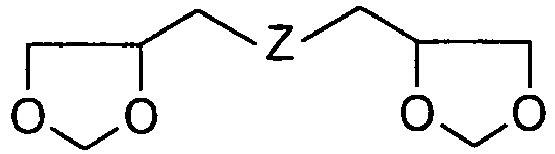
EP-A 0 465 940 beschrieben. - Bevorzugte Monomere dieser Art sind Ethylendiglycid, Diglycidylether und Diether aus Glycidylen und Formaldehyd, Dioxan oder Trioxan im Molverhältnis 2:1 sowie Diether aus 2 mol Glycidylverbindung und 1 mol eines aliphatischen Diols mit 2 bis 8 C-Atomen wie beispielsweise die Diglycidylether von Ethylenglykol, 1,4-Butandiol, 1,3-Butandiol, Cyclobutan-1,3-diol, 1,2-Propandiol und Cyclohexan-1,4-diol, um nur einige Beispiele zu nennen.
- Endgruppenstabilisierte Polyoxymethylenpolymerisate, die an den Kettenenden überwiegend C-C- oder -O-CH3- Bindungen aufweisen, werden besonders bevorzugt.
- Die bevorzugten Polyoxymethylencopolymere haben Schmelzpunkte von mindestens 150°C und Molekulargewichte (Gewichtsmittelwert) Mw im Bereich von 5.000 bis 300.000, bevorzugt von 6.000 bis 150.000, besonders bevorzugt im Bereich von 7.000 bis 60.000. Insbesondere bevorzugt sind POM-Copolymerisate mit einer Uneinheitlichkeit (Mw/Mn) von 2 bis 15, bevorzugt von 2,5 bis 12, besonders bevorzugt 3 bis 9. Die Messungen erfolgen in der Regel über Gelpermeationschromatographie (GPC) / SEC (size exclusion chromatography), der Mn-Wert (Zahlenmittel des Molekulargewichtes) wird im allgemeinen bestimmt mittels GPC/SEC.
- Verfahren zur Herstellung der Polyoxymethylenhomo- und -copolymerisate sind dem Fachmann bekannt.
- Komponente B2) umfasst Polyolefine oder deren Mischungen in einer Menge von 2 bis 35 Gew.-%, bevorzugt 3 bis 20 Gew.-%, besonders bevorzugt 4 bis 15 Gew.-%, bezogen auf die Gesamtmenge des Bindemittels B).
- Als Polyolefine seien solche mit 2 bis 8 C-Atomen, insbesondere 2 bis 4 C-Atomen genannt sowie deren Copolymerisate. Besonders bevorzugt seien Polyethylen und Polypropylen sowie deren Copolymere genannt, wie sie dem Fachmann bekannt und kommerziell erhältlich sind, beispielsweise unter dem Handelsnamen Lupolen® bzw. Novolen® von der BASF AG.
- Die Polymere der Komponente B2) können nach an sich bekannten Polymerisationsverfahren, vorzugsweise radikalisch, beispielsweise durch Emulsions-, Perl-, Lösungs-oder Substanzpolymerisation hergestellt werden. Als Initiator kommen, abhängig von den Monomeren und dem Polymerisationstyp, Radikal-Initiatoren wie Peroxyverbindungen und Azoverbindungen in Betracht, wobei die Initiatormengen im allgemeinen im Bereich von 0,001 bis 0,5 Gew.-%, bezogen auf die Monomeren, liegen. Geeignete Polymerisationsverfahren sind in
EP-A-0 465 940 beschrieben. - Als Komponente B3) geeignet sind Poly-1,3-dioxepan -O-CH2-O-CH2-CH2-CH2-CH2, Poly-1,3-dioxolan -O-CH2-O-CH2-CH2- oder deren Mischungen in einer Menge von 2 bis 40 Gew.-%, bevorzugt 5 bis 30 Gew.-%, besonders bevorzugt 10 bis 26 Gew.-%, bezogen auf die Gesamtmenge des Bindemittels B. Poly-1,3-dioxepan wird wegen seiner schnellen Depolymerisation unter sauren Bedingungen besonders bevorzugt.
- Poly-1,3-dioxepan und Poly-1,3-dioxolan können nach analogen Verfahren wie die Polyoxymethylenhomo- bzw. -copolymerisate hergestellt werden, so dass sich hier nähere Angaben erübrigen. Das Molekulargewicht (Gewichtsmittelwert) liegt im Bereich von 10.000 bis 150.000, bevorzugt (im Falle von Poly-1,3-dioxepan) im Bereich von 15.000 bis 50.000, besonders bevorzugt (im Falle von Poly-1,3-dioxepan) im Bereich von 18.000 bis 35.000) und bevorzugt (im Falle von Poly-1,3-dioxolan) 30.000 bis 120.000, besonders bevorzugt (im Falle von Poly-1,3-dioxolan) 40.000 bis 110.000.
- Unter den Bedingungen der Compoundierung oder Spritzgussverarbeitung tritt zwischen den Polyoxymethylenpolymerisaten B1) und B3) praktisch keine Umacetalisierung ein, d. h. es findet praktisch kein Austausch von Comonomereinheiten statt.
- Die erfindungsgemäßen Bindemittel B) werden in thermoplastischen Massen für die Herstellung metallischer Formkörper eingesetzt.
- Gegenstand der Erfindung sind daher auch thermoplastische Massen für die Herstellung metallischer Formkörper, enthaltend
- A) 40 bis 70 Vol.-%, bevorzugt 45 bis 65 Vol.-%, besonders bevorzugt 50 bis 60 Vol.-% eines sinterbaren pulverförmigen Metalls oder einer sinterbaren pulverförmigen Metalllegierung oder deren Mischungen,
- B) 30 bis 60 Vol.-%, bevorzugt 35 bis 55 Vol.-%, besonders bevorzugt 40 bis 50 Vol.-% einer Mischung aus
- B1) 50 bis 96 Gew.-%, bevorzugt 60 bis 90 Gew.-%, besonders bevorzugt 70 bis 85 Gew.-% eines oder mehrerer Polyoxymethylenhomo- oder -copolymerisate, bevorzugt ein Polyoxymethylencopolymerisat mit 0,01 bis 20 mol-% 1,3-Dioxepan oder 1,3-Dioxolan als Comonomer;
- B2) 2 bis 35 Gew.-%, bevorzugt 3 bis 20 Gew.-%, besonders bevorzugt 4 bis 15 Gew.-% eines oder mehrerer Polyolefine, bevorzugt Polyethylen;
- B3) 2 bis 40 Gew.-%, bevorzugt 5 bis 30 Gew.-%, besonders bevorzugt 10 bis 26 Gew.-% Poly-1,3-dioxepan oder Poly-1,3-dioxolan oder deren Mischungen, bevorzugt Poly-1,3-dioxepan
- C) 0 bis 5 Vol.-% eines Dispergierhilfsmittels,
- Als Metalle, die in Pulverform vorliegen können, seien beispielsweise Aluminium, Eisen, insbesondere Eisencarbonylpulver, Kobalt, Kupfer, Nickel, Silicium, Titan und Wolfram genannt. Als pulverförmige Metalllegierungen sind beispielsweise hoch- oder niederlegierte Stähle sowie Metalllegierungen auf der Basis von Aluminium, Eisen, Titan, Kupfer, Nickel, Kobalt oder Wolfram zu nennen. Dabei können sowohl Pulver von bereits fertigen Legierungen als auch die Pulvermischungen der einzelnen Legierungsbestandteile eingesetzt werden. Die Metallpulver, Metalllegierungspulver und Metallcarbonylpulver können auch im Gemisch eingesetzt werden.
- Die Korngrößen der Pulver betragen vorzugsweise 0,1 bis 80 µm, besonders bevorzugt 1,0 bis 50 µm.
- Aufgrund der hohen Fließfähigkeit des erfindungsgemäßen Bindemittels ist eine hohe Beladung des Bindemittels mit dem Pulver A) möglich, ohne dass die Fließfähigkeit zu stark beeinträchtigt wird.
- Das als Komponente C) gegebenenfalls vorliegende Dispiergierhilfsmittel kann aus bekannten Dispergierhilfsmitteln ausgewählt sein. Beispiele sind oligomeres Polyethylenoxid mit einem mittleren Molekulargewicht von 200 bis 600, Stearinsäure, Stearinsäureamid, Hydroxystearinsäure, Fettalkohole, Fettalkoholsulfonate und Blockcopolymere von Ethylen- und Propylenoxid, wie auch besonders bevorzugt Polyisobutylen. Besonders bevorzugt wird Polyisobutylen in einer Menge von 1 bis 6 Vol-%, bezogen auf die Komponenten A), B) und C), eingesetzt.
- Zusätzlich können die thermoplastischen Massen auch übliche Zusatzstoffe und Verarbeitungshilfsmittel, die die rheologischen Eigenschaften der Mischungen bei der Formgebung günstig beeinflussen, enthalten.
- Die Herstellung der erfindungsgemäßen thermoplastischen Massen erfolgt erfindungsgemäß durch Aufschmelzen der Komponente B) und Einmischen der Komponenten A) und gegebenenfalls C). Beispielsweise kann die Komponente B) in einem Zweischneckenextruder bei Temperaturen von vorzugsweise 150 bis 220 °C, insbesondere 170 bis 200 °C aufgeschmolzen werden. Die Komponente A) wird anschließend bei Temperaturen im gleichen Bereich in der erforderlichen Menge zu dem Schmelzestrom der Komponente B) dosiert. Vorteilhafterweise enthält die Komponente A) auf der Oberfläche das oder die Dispergierhilfsmittel C). Die Herstellung der erfindungsgemäßen thermoplastischen Massen kann aber auch durch Aufschmelzen der Komponenten B) und C) in Gegenwart der Komponente A) bei Temperaturen von 150 bis 220 °C erfolgen.
- Eine besonders bevorzugte Vorrichtung zur Dosierung der Komponente A) enthält als wesentliches Element eine in einem heizbaren Metallzylinder befindliche Förderschnecke, die die Komponente A) in die Schmelze der Komponente B) fördert. Das vorstehend beschriebene Verfahren hat gegenüber der Mischung der Komponenten bei Raumtemperatur und anschließender Extrusion unter Temperaturerhöhung den Vorteil, dass eine Zersetzung des als Bindemittel eingesetzten Polyoxymethylens infolge der bei dieser Variante auftretenden hohen Scherkräfte weitgehend vermieden wird.
- Die erfindungsgemäßen thermoplastischen Massen können zur Herstellung von metallischen Formkörpern aus dem Pulver A) verwendet werden.
- Die vorliegende Erfindung betrifft daher auch ein Verfahren zur Herstellung von Formkörpern aus den vorstehend beschriebenen thermoplastischen Massen durch
- a) Verformen der thermoplastischen Masse durch Spritzgießen, Extrudieren oder Verpressen zu einem Grünkörper,
- b) Entfernen des Bindemittels durch Behandeln des Grünkörpers bei einer Temperatur im Bereich von 20 bis 180°C für 0,1 bis 24 Stunden mit einer gasförmigen säurehaltigen Atmosphäre,
- c) nachfolgendes Erhitzen für 0,1 bis 12 Stunden auf eine Temperatur im Bereich von 250 bis 600 °C und
- d) nachfolgendes Sintern des so erhaltenen entbinderten Grünkörpers.
- Für die Formgebung durch Spritzguss können die üblichen Schnecken- und Kolbenspritzgussmaschinen eingesetzt werden. Die Formgebung erfolgt im allgemeinen bei Temperaturen von 175 bis 200 °C und Drücken von 3.000 bis 20.000 kPa in Formen, die eine Temperatur von 60 bis 120°C aufweisen.
- Die Extrusion zu Rohren, Stangen und Profilen erfolgt vorzugsweise bei Temperaturen von 170 bis 200°C.
- Zur Entfernung des Bindemittels werden die nach der Formgebung erhaltenen Grünkörper mit einer gasförmigen, säurehaltigen Atmosphäre behandelt. Entsprechende Verfahren sind beispielsweise in
DE-A 39 29 869 undDE-A 40 00 278 beschrieben. Diese Behandlung erfolgt erfindungsgemäß vorzugsweise bei Temperaturen im Bereich von 20 bis 180°C über einen Zeitraum von vorzugsweise 0,1 bis 24 Stunden, vorzugsweise 0,5 bis 12 Stunden. - Geeignete Säuren für die Behandlung in dieser ersten Stufe des erfindungsgemäßen Verfahrens sind beispielsweise anorganische, bei Raumtemperatur bereits gasförmige, zumindest aber bei der Behandlungstemperatur verdampfbare Säuren. Beispiele sind Halogenwasserstoffsäuren und Salpetersäure. Geeignete organische Säuren sind solche, die bei Normaldruck eine Siedetemperatur von weniger als 130°C aufweisen, wie Ameisensäure, Essigsäure, Oxalsäure oder Trifluoressigsäure und deren Mischungen.
- Weiterhin können als Säure BF3 und dessen Addukte an anorganische Ether eingesetzt werden. Die erforderliche Behandlungsdauer hängt von der Behandlungstemperatur und der Konzentration der Säure in der Behandlungsatmosphäre wie auch von der Größe des Formkörpers ab.
- Wird ein Trägergas verwendet, so wird dies im allgemeinen vorher durch die Säure geleitet und mit dieser beladen. Das so beladene Trägergas wird dann auf die Behandlungstemperatur gebracht, die zweckmäßigerweise höher als die Beladungstemperatur ist, um eine Kondensation der Säure zu vermeiden. Bevorzugt wird die Säure über eine Dosiereinrichtung dem Trägergas zugemischt und die Mischung soweit erwärmt, dass die Säure nicht mehr kondensieren kann.
- Die Säurebehandlung wird vorzugsweise solange durchgeführt, bis der Polyoxymethylenanteil des Bindemittels zumindestens 80 Gew.-%, vorzugsweise mindestens 90 Gew.-% entfernt ist. Dies läßt sich beispielsweise anhand der Gewichtsabnahme überprüfen. Anschließend wird das so erhaltene Produkt vorzugsweise für 0,1 bis 12, besonders bevorzugt 0,3 bis 6 Stunden auf eine Temperatur von vorzugsweise 250 bis 700°C, besonders bevorzugt 250 bis 600 °C erhitzt, um den vorhandenen Rest des Bindemittels vollständig zu entfernen.
- Das so vom Bindemittel befreite Produkt kann in üblicher Weise durch Sintern in den gewünschten Formkörper, insbesondere metallischen oder keramischen Formkörper überführt werden.
- Die erfindungsgemäßen thermoplastischen Massen weisen neben der rückstandsfreien Entbinderung, der hohen Fließfähigkeit und hohen Beladbarkeit mit den Pulvern A) zudem den Vorteil auf, dass die daraus hergestellten Grünkörper bzw. metallischen oder keramischen Formkörper auch bei großen Wandstärken frei von Rissen und Poren sind. Zudem liegt ein Vorteil darin, dass die Entfernung des Bindemittels in zwei Stufen erfolgen kann. Zunächst wird das Polyoxymethylen bei relativ niedrigen Temperaturen durch hydrolytischen Abbau entfernt, wobei der größte Teil des Polymersystems B2) verbleibt. Die danach erhaltenen Produkte (Braunkörper) sind relativ stabil und können problemlos gehandhabt oder transportiert werden. Die Entfernung des Restes des Polymersystems B2) kann dann bei erhöhten Temperaturen erfolgen.
- Die Erfindung wird nachstehend anhand von Beispielen, in denen für die thermoplastischen Massen unterschiedliche Polyoxymethylen enthaltende Bindemittel eingesetzt wurden, näher erläutert.
- Die Masse 1 B wies die folgende Zusammensetzung auf:
- 56,7 Vol-% einer Mischung aus 92 Gew.-% Carbonyleisenpulver und 8 Gew.-% Carbonylnickelpulver
- 43,3 Vol-% Binder enthaltend 79,7 Gew.-% Polyoximethylen mit 2 mol-% 1,3-Dioxepan; 4,4 Gew.-% Polyethylen und 15,9 Gew.-% Poly-1,3-dioxepan.
- Die zweite Masse 2B wies die folgende Zusammensetzung auf:
- 56,7 Vol-% einer Mischung aus 92 Gew.-% Carbonyleisenpulver und 8 Gew.-% Carbonylnickelpulver
- 43,3 Vol-% Binder enthaltend 75,3 Gew.-% Polyoximethylen mit 2 mol-% 1,3-Dioxepan; 8,4 Gew.-% Polyethylen und 16,3 Gew.-% Polydioxolan.
- Die dritte Masse 3B wies die folgende Zusammensetzung auf:
- 56,7 Vol-% einer Mischung aus 92 Gew.-% Carbonyleisenpulver und 8 Gew.-% Carbonylnickelpulver
- 43,3 Vol-% Binder enthaltend 70,0 Gew.-% Polyoximethylen mit 2 mol-% 1,3-Dioxepan; 10,0 Gew.-% Polyethylen und 20,0 Gew.-% Poly-1,3-dioxepan
- Die vierte Masse 4B wies die folgende Zusammensetzung auf:
- 57,5 Vol-% einer Mischung aus 92 Gew.-% Carbonyleisenpulver und 8 Gew.-% Carbonylnickelpulver
- 42,5 Vol-% Binder enthaltend 67,1 Gew.-% Polyoximethylen mit 2 mol-% 1,3-Dioxepan; 7,5 Gew.-% Polyethylen und 25,4 Gew.-% Poly-1,3-dioxepan.
- Die fünfte Masse 5B wies die folgende Zusammensetzung auf:
- 56,2 Vol-% einer Mischung aus 92 Gew.-% Carbonyleisenpulver und 8 Gew.-% Carbonylnickelpulver
- 43,8 Vol-% Binder enthaltend 89,9 Gew.-% Polyoximethylen mit 2 mol-% 1,3-Dioxepan und 10,1 Gew.-% Polyethylen.
- Die sechste Masse 6B wies die folgende Zusammensetzung auf:
- 56,2 Vol-% einer Mischung aus 92 Gew.-% Carbonyleisenpulver und 8 Gew.-% Carbonylnickelpulver
- 43,8 Vol-% Binder enthaltend 92,6 Gew.-% Polyoximethylen mit 2 mol-% 1,3-Dioxepan; 5,1 Gew.-% Polyethylen und 2,3 Gew.-% Polytretrahydrofuran.
- Die siebte Masse 7B wies die folgende Zusammensetzung auf:
- 56,2 Vol-% einer Mischung aus 92 Gew.-% Carbonyleisenpulver und 8 Gew.-% Carbonylnickelpulver
- 43,8 Vol-% Binder enthaltend 80 Gew.-% Polyoximethylen mit 2 mol-% 1,3-Dioxepan und 20 Gew.-% Poly-1,3-dioxepan.
- Die Herstellung der Formulierungen 1 bis 7 erfolgte in einem Doppelwellenextruder mit 30 mm Wellendurchmesser und einer Wellendrehzahl von 70 Upm. Ca. 5,6 kg/h der bei 180°C aufgeschmolzenen Bindemittelzubereitung wurden in den Extruder dosiert. In einen seitlich an diesen Extruder angeflanschten zweiten Extruder, der mit einer Förderwendel für Pulver ausgerüstet war, wurden 40 kg/h des Eisen-/Nickelpulvers dosiert und bis zum Ende der Förderstrecke auf 170°C erwärmt.
- Am Ende der Förderstrecke wurde das Metallpulver mit dem polymeren Bindemittel vermischt, die Mischung geschert, homogenisiert und als Stränge durch Düsen gepresst. Die Stränge wurden in einem Luftstrom abgekühlt und granuliert. Die so erhaltenen Granulate enthielten ca. 56 Vol.-% einer Mischung aus 92 Gew.-% Carbonyleisenpulver und 8 Gew.-% Carbonylnickelpulver.
- Um einen möglichst praxisnahen Vergleich der Fließfähigkeit und damit der Verarbeitbarkeit der erfindungsgemäßen thermoplastischen Massen zu ermöglichen, wurde ein Teil der vorstehenden Massen mit einer sogenannten Fließspirale getestet. Dabei handelt es sich um ein Werkzeug mit einem spiralförmigen Fließweg. Dieses Spritzgusswerkzeug wurde auf einer handelsüblichen Spritzgussmaschine (Engel cc 90) unter Standardbedingungen abgespritzt. Dabei wurde das Werkzeug auf eine Temperatur T von 132°C (T < der Schmelztemperatur des Bindemittels) temperiert und die Spritzbedingungen wie Zylinder- und Düsentemperatur, Plastifizierzeit, Einspritzgeschwindigkeit und Werkzeugtemperatur wurden unverändert gehalten, um den unter identischen Bedingungen zurückgelegten Weg des Materials bestimmen zu können. Dieser zurückgelegte Weg (in cm) ist somit ein praxisnaher Test für die Fließfähigkeit des Materials unter Produktionsbedingungen. Am Ende der Fließspirale zeigen sich je nach Zusammensetzung mehr oder weniger stark ausgeprägte Entmischungserscheinungen. Die Länge und Ausprägung dieser Entmischungserscheinungen wurde als qualitatives Maß zur Beschreibung der Entmischungsneigung der Formmassen herangezogen. Die Ergebnisse sind in der nachstehenden Tabelle 1 zusammengefasst.
Tabelle 1 Beispiel Zusammensetzung Bindemittel Fließweg [cm] Entmischung 1 POM (2 mol-% 1,3-Dioxepan); PE; 1,3-Polydioxepan 25 schwach 2 POM (2 mol-% 1,3-Dioxepan); PE; 1,3-Polydioxolan 24 schwach 3 POM (2 mol-% 1,3-Dioxepan); PE; 1,3-Polydioxepan 27 schwach 4 POM (2 mol-% 1,3-Dioxepan); PE; 1,3-Polydioxepan 27 schwach 5 POM (2 mol-% 1,3-Dioxepan); PE; 18 sehr stark 6 POM (2 mol-% 1,3-Dioxepan), PE; PTHF 22 stark 7 POM (2 mol-% 1,3-Dioxepan); 1,3-Polydioxepan 23 stark - Die Ergebnisse zeigen, dass der Fließweg bei den Formassen auf Basis POM-Polyethylen-Polydioxepan und POM- Polyethylen-Polydioxolan gegenüber den Vergleichsbeispielen deutlich verbessert wird; außerdem wird die Tendenz zur Entmischung vermindert.
- Mit den erfindungsgemäßen thermoplastischen Massen konnte auch unter produktionsähnlichen Bedingungen an realen Bauteilen eine deutliche Verbesserung der Verarbeitbarkeit beim Spritzgießen erreicht werden. Insbesondere wurde ein breiteres Verarbeitungsfenster beobachet: insbesonders kann die Werkzeugtemperatur in einem breiteren Temperaturbereich gewählt werden. Entmischungen wie sie inbesondere in Angußnähe häufig zu beobachten sind traten mit den Formmassen aus den Beispielen 1 bis 4 deutlich weniger auf als in den Vergleichsbeispielen 5 bis 7. Während mit den Formassen aus den Vergleichsbeispielen an kritischen Bauteilen zuweilen Spannungsrisse beobachtet wurden, waren die Formteile aus den Massen der Beispiele 1 bis 4 in jedem Fall rißfrei.
- Entmischungen führen nach dem Entbindern und Sintern zu Oberflächenrauhigkeiten, die insbesondere bei Sichtteilen, z. B. in Cosumerartikeln, eine aufwendige Nachbearbeitung durch Polieren erforderlich machen. Aus den o. g. Formmassen gemäß Beispiel 1 bis 7 wurden Plättchen gespritzt und diese anschließend entbindert und gesintert. Danach wurde in einem Bereich von 8 x 13 mm in Angußnähe die maximale Rauhigkeitsprofilhöhe Rz gemäß DIN EN ISO 4287 bestimmt. Die mittleren Rz-Werte sind in Tabelle 2 wiedergegeben.
Tabelle 2 Beispiel Zusammensetzung Bindemittel Rz (µm) 1 POM (2 mol-% 1,3-Dioxepan); PE; 1,3-Polydioxepan 2,2 2 POM (2 mol-% 1,3-Dioxepan); PE; 1,3-Polydioxolan 2,0 3 POM (2 mol-% 1,3-Dioxepan); PE; 1,3-Polydioxolan 2,3 4 POM (2 mol-% 1,3-Dioxepan); PE; 1,3-Polydioxepan 2,4 5 POM (2 mol-% 1,3-Dioxepan); PE; 3,5 6 POM (2 mol-% 1,3-Dioxepan), Polyethylen, PTHF 3,2 7 POM (2 mol-% 1,3-Dioxepan); 1,3-Polydioxepan 3,7 - Erfahrungsgemäß sind Rz-Werte≤ 2,5 µm ein Indiz dafür, dass sich aus dem gesinterten Bauteil mit sehr geringem Polieraufwand ein qualitativ hochwertiges Produkt mit sehr glatter Oberfläche erzielen läßt, die z. B. den Ansprüchen an viele Consumerartikel genügt. Die Formmassen aus den Beispielen 1 bis 4 weisen Rz-Werte ≤ 2,5 µm auf und bieten damit einen erheblichen Vorteil bei der Herstellung von Bauteilen mit hoher Oberflächengüte.
- Untersuchung der Entbinderungsgeschwindigkeit und der Formstabilität beim Entbindern
- Eine wichtige Forderung an die verbesserte Rezeptur war die Sicherstellung einer hohen Entbinderungsgeschwindigkeit sowie die Formstabilität beim Entbindern. Zur Bewertung des Verhaltens beim Entbindern wurden Plättchen mit 48 mm Länge, 15 mm Breite und 6 mm Dicke hergestellt und in einem Entbinderungsofen auf jeweils 2 Rollen so gelagert, dass der Abstand 42 mm betrug. Der Ofen wurde zunächst auf 110 °C aufgeheizt und für 30 min mit 500 1/h Stickstoff gespült. Dann wurden unter Aufrechterhaltung der Stickstoffspülung 30 ml/h an 98%-iger Salpetersäure zudosiert. Die Säurezufuhr wurde 2,5 h lang aufrecht erhalten; anschließend wurde der Ofen 45 min lang mit 500 l/h Stickstoff gespült und auf Raumtemperatur abgekühlt. Durch Durchbrechen der Teile und optische Begutachtung wurde festgestellt, dass alle Proben aus den Beispielen 1 bis 7 vollständig entbindert waren. Die erfindungsgemäßen Rezepturen nach Beispiel 1 bis 4 haben also keinen nachteiligen Effekt hinsichtlich der Entbinderungsgeschwindigkeit. Zur Bewertung der Formstabilität wurde die Durchbiegung der Proben begutachtet. An den Plättchen hergestellt nach Rezepturen gemäß Beispiel 1 bis 6 konnte keine meßbare Durchbiegung festgestellt werden; Plättchen gemäß Beispiel 7 waren unter ihrem Eigengewicht gebrochen. Das bedeutet, dass die erfindungsgemäßen Rezepturen mindestenes genauso formstabil beim Entbindern sind wie die Rezepturen aus den Vergleichbeispielen 5 und 6 und deutlich besser als Vergleichsbeispiel 7.
- Die Festigkeit von Bauteilen nach dem Spritzgießen (Grünfestigkeit) und nach dem Entbindern (Braunfestigkeit) ist für die Weiterverarbeitung von MIM-Bauteilen von großer Bedeutung: hohe Grün- und Braunfestigkeiten sind ein Indiz dafür, dass die Bauteile in den weiteren Verarbeitungsschritten problemlos gehandhabt werden können ohne dabei zu brechen. Zur Bestimmung der Grün- und Braunfestigkeit wurden Biegestäbe mit den Abmessungen 65 x 7 x 5 mm gespritzt und einer 4-Punktbiegeprüfung in Anlehnung an DIN EN 843 (Teil 1) unterzogen. Zur Bestimmung der Braunfestigkeit wurden die Biegestäbe zuvor (wie oben beschrieben) katalytisch entbindert. Die Ergebnisse sind in nachstehender Tabelle 3 zusammengefaßt:
Tabelle 3 Beispiel Zusammensetzung Bindemittel Grünfestigkeit (MPa) Braunfestigkeit (Mpa) 1 POM (2 mol-% 1,3-Dioxepan); PE; 1,3-Polydioxepan 18,2 5,6 2 POM (2 mol-% 1,3-Dioxepan); PE; 1,3-Polydioxolan 16,6 5,3 3 POM (2 mol-% 1,3-Dioxepan); PE; 1,3-Polydioxolan 16,5 5,0 4 POM (2 mol-% 1,3-Dioxepan); PE; 1,3-Polydioxepan 16,4 5,1 5 POM (2 mol-% 1,3-Dioxepan); PE; 22,6 4,8 6 POM (2 mol-% 1,3-Dioxepan), Polyethylen, PTHF 7,4 4,0 7 POM (2 mol-% 1,3-Dioxepan); 1,3-Polydioxepan 6,5 1,2 - Die Ergebnisse zeigen, dass die Grünfestigkeit durch Zugabe von Polydioxepan oder Polydioxolan allenfalls geringfügig vermindert wird (Beispiele 1 bis 4). Die Grünfestigkeit ist sogar deutlich besser als in den Vergleichsbeispielen 6 und 7. Die Braunfestigkeit wird sogar etwas verbessert.
Claims (10)
- Bindemittel B) für pulverförmige Metalle oder Metalllegierungen oder deren Mischungen, enthaltendB1) 50 bis 96 Gew.-% eines oder mehrerer Polyoxymethylenhomo- oder -copolymerisate;B2) 2 bis 35 Gew.-% eines oder mehrerer Polyolefine;B3) 2 bis 40 Gew.-% Poly-1,3-dioxepan oder Poly-1,3-dioxolan oder deren Mischungen,wobei die Summe der Gewichtsanteile der Komponenten B1, B2 und B3 100% ergibt.
- Bindemittel nach Anspruch 1, dadurch gekennzeichnet, dass die Mischung 70 bis 85 Gew.-% der Komponente B1), 4 bis 15 Gew.-% der Komponente B2), und 10 bis 26 Gew.-% der Komponente B3) enthält, wobei die Summe der Gewichtsanteile der Komponenten B1, B2 und B3 100% ergibt.
- Bindemittel nach einem der Ansprüche 1 oder 2, dadurch gekennzeichnet, dass als Komponente B1) ein Polyoxymethylencopolymerisat mit 0,01 bis 20 mol-% 1,3-Dioxepan oder 1,3-Dioxolan als Comonomer, als Komponente B2) Polyethylen und als Komponente B3) Poly-1,3-dioxepan oder Poly-1,3-dioxolan enthalten sind.
- Thermoplastische Massen für die Herstellung metallischer Formkörper, enthaltendA) 40 bis 70 Vol.-% eines sinterbaren pulverförmigen Metalls oder einer sinterbaren pulverförmigen Metallegierung oder deren Mischungen,B) 30 bis 60 Vol.-% einer Mischung ausB1) 50 bis 96 Gew.-% eines oder mehrerer Polyoxymethylenhomo- oder copolymerisate;B2) 2 bis 35 Gew.-% eines oder mehrerer Polyolefine;B3) 2 bis 40 Gew.-% Poly-1,3-dioxepan oder Poly-1,3-dioxolan oder deren Mischungen als Bindemittel, wobei die Summe der Gewichtsanteile der Komponenten B1, B2 und B3 100% ergibt, undC) 0 bis 5 Vol.-% eines Dispergierhilfsmittels.
- Thermoplastische Massen nach Anspruch 4, dadurch gekennzeichnet, dass die Komponente B) 70 bis 85 Gew.-% der Komponente B1), 4 bis 15 Gew.-% der Komponente B2), und 10 bis 26 Gew.-% der Komponente B3) enthält, wobei die Summe der Gewichtsanteile der Komponenten B1, B2 und B3 100% ergibt.
- Thermoplastische Massen nach einem der Ansprüche 4 oder 5, dadurch gekennzeichnet, dass als Komponente B1) ein Polyoxymethylencopolymerisat mit 0,01 bis 20 mol-% 1,3-Dioxepan als Comonomer,als Komponente B2) Polyethylen und als Komponente B3) Poly-1,3-dioxepan oder Poly-1,3-dioxolan enthalten sind.
- Verwendung der thermoplastischen Massen, definiert gemäß einem der Ansprüche 4 bis 6 zur Herstellung von metallischen Formkörpern.
- Metallische Formkörper, hergestellt aus thermoplastischen Massen, definiert gemäß einem der Ansprüche 4 bis 6.
- Verfahren zur Herstellung einer thermoplastischen Masse, enthaltend als wesentliche KomponentenA) 40 bis 70 Vol.-% eines sinterbaren pulverförmigen Metalls oder einer sinterbaren pulverförmigen Metallegierung oder deren Mischungen,B) 30 bis 60 Vol.-% einer Mischung ausB1) 50 bis 96 Gew.-% eines oder mehrerer Polyoxymethylenhomo- oder -copolymerisate;B2) 2 bis 35 Gew.-% eines oder mehrerer Polyolefine;B3) 2 bis 40 Gew.-% Poly-1,3-dioxepan oder Poly-1,3-dioxolan oder deren Mischungen
als Bindemittel, wobei die Summe der Gewichtsanteile der Komponenten B1, B2 und B3 100% ergibt, undC) 0 bis 5 Vol.-% eines Dispergierhilfsmittels,
dadurch gekennzeichnet, dass mana1) die Komponente B) bei Temperaturen von 150 bis 220 °C aufschmilzt und anschließendb1) die Komponente A) gegebenenfalls zusammen mit der Komponente C) bei Temperaturen im gleichen Bereich wie in Schritt a) zu dem Schmelzestrom der Komponente B) dosiert oder dass man.a2) die Komponenten B) und C) in Gegenwart der Komponente A) bei Temperaturen von 150 bis 220 °C aufschmilzt. - Verfahren zur Herstellung von Formkörpern aus einer thermoplastischen Masse, definiert gemäß einem der Ansprüche 4 bis 6, durcha) Verformen der thermoplastischen Masse durch Spritzgießen, Extrudieren oder Verpressen zu einem Grünkörper,b) Entfernen des Bindemittels durch Behandeln des Grünkörpers bei einer Temperatur im Bereich von 20 bis 180 °C für 0,1 bis 24 Stunden mit einer gasförmigen säurehaltigen Atmosphäre,c) nachfolgendes Erhitzen für 0,1 bis 12 Stunden auf eine Temperatur im Bereich von 250 bis 600 °C undd) nachfolgendes Sintern des so erhaltenen entbinderten Grünkörpers.
Priority Applications (4)
| Application Number | Priority Date | Filing Date | Title |
|---|---|---|---|
| PL07787140T PL2043802T3 (pl) | 2006-07-13 | 2007-07-05 | Masy termoplastyczne zawierające środki wiążące do wytwarzania kształtek metalowych |
| EP07787140A EP2043802B1 (de) | 2006-07-13 | 2007-07-05 | Bindemittel enthaltende thermoplastische massen für die herstellung metallischer formkörper |
| SI200731016T SI2043802T1 (sl) | 2006-07-13 | 2007-07-05 | Termoplastične mase ki vsebujejo vezalna sredstva za proizvodnjo kovinskih kalupov |
| CY20121100872T CY1113144T1 (el) | 2006-07-13 | 2012-09-24 | Θερμοπλαστικες μαζες που περιεχουν συγκολλητικα μεσα για την παραγωγη μεταλλικων μορφωμενων σωματων |
Applications Claiming Priority (3)
| Application Number | Priority Date | Filing Date | Title |
|---|---|---|---|
| EP06117157 | 2006-07-13 | ||
| PCT/EP2007/056857 WO2008006776A1 (de) | 2006-07-13 | 2007-07-05 | Bindemittel enthaltende thermoplastische massen für die herstellung metallischer formkörper |
| EP07787140A EP2043802B1 (de) | 2006-07-13 | 2007-07-05 | Bindemittel enthaltende thermoplastische massen für die herstellung metallischer formkörper |
Publications (2)
| Publication Number | Publication Date |
|---|---|
| EP2043802A1 EP2043802A1 (de) | 2009-04-08 |
| EP2043802B1 true EP2043802B1 (de) | 2012-06-27 |
Family
ID=38630571
Family Applications (1)
| Application Number | Title | Priority Date | Filing Date |
|---|---|---|---|
| EP07787140A Active EP2043802B1 (de) | 2006-07-13 | 2007-07-05 | Bindemittel enthaltende thermoplastische massen für die herstellung metallischer formkörper |
Country Status (15)
| Country | Link |
|---|---|
| US (1) | US20090288739A1 (de) |
| EP (1) | EP2043802B1 (de) |
| JP (1) | JP5249213B2 (de) |
| KR (1) | KR101425689B1 (de) |
| CN (1) | CN101489704B (de) |
| BR (1) | BRPI0714047B1 (de) |
| CY (1) | CY1113144T1 (de) |
| DK (1) | DK2043802T3 (de) |
| ES (1) | ES2386651T3 (de) |
| PL (1) | PL2043802T3 (de) |
| PT (1) | PT2043802E (de) |
| RU (1) | RU2446031C2 (de) |
| SI (1) | SI2043802T1 (de) |
| UA (1) | UA96452C2 (de) |
| WO (1) | WO2008006776A1 (de) |
Families Citing this family (38)
| Publication number | Priority date | Publication date | Assignee | Title |
|---|---|---|---|---|
| CA2696386C (en) * | 2007-08-29 | 2012-12-18 | Vito Nv | Method for producing a three-dimensional macroporous filament construct based on phase inversion and construct thereby obtained |
| KR20110031951A (ko) * | 2008-06-26 | 2011-03-29 | 악셀레론 파마 인코포레이티드 | 액티빈-actriia의 길항물질 및 적혈구 수준을 증가시키기 위한 이들의 용도 |
| EP2416910A1 (de) * | 2009-04-09 | 2012-02-15 | Basf Se | Verfahren zur herstellung eines turbinenrads für einen abgasturbolader |
| CN101942175B (zh) * | 2010-09-09 | 2012-09-19 | 上海材料研究所 | 一种用于三层复合材料的改性聚甲醛材料 |
| WO2012123913A2 (de) * | 2011-03-16 | 2012-09-20 | Basf Se | Verfahren zur herstellung von metallischen oder keramischen formkörpern |
| US9162927B2 (en) | 2011-03-16 | 2015-10-20 | Basf Se | Process for producing metallic or ceramic shaped bodies |
| US9403212B2 (en) | 2011-05-18 | 2016-08-02 | Basf Se | Process for producing components by powder injection molding |
| ES2740984T3 (es) | 2011-05-18 | 2020-02-07 | Basf Se | Procedimiento para la fabricación de componentes por procedimiento de moldeo por inyección de polvo |
| US8674018B2 (en) | 2011-09-07 | 2014-03-18 | Basf Se | Binder and process for producing metallic or ceramic moldings in powder injection molding |
| KR101929081B1 (ko) | 2011-09-07 | 2018-12-13 | 바스프 에스이 | 분말 사출 성형에서 금속 또는 세라믹 성형물을 제조하기 위한 결합제 및 방법 |
| US20130203921A1 (en) * | 2012-02-02 | 2013-08-08 | Basf Se | Thermoplastic pom composition |
| SG11201404549WA (en) * | 2012-02-02 | 2014-10-30 | Basf Se | Thermoplastic pom material |
| TW201500443A (zh) | 2013-04-18 | 2015-01-01 | Basf Se | 聚甲醛共聚物及熱塑性pom組成物 |
| KR102363249B1 (ko) * | 2014-05-21 | 2022-02-16 | 바스프 에스이 | 성형물의 굴곡 인성 개선 방법 |
| US10456834B2 (en) | 2014-06-02 | 2019-10-29 | Basf Se | Process for the production of sintered moldings |
| TW201609894A (zh) | 2014-07-22 | 2016-03-16 | 巴斯夫歐洲公司 | 用於熔結絲的製造方法中的混合物 |
| US10501869B2 (en) | 2015-07-14 | 2019-12-10 | Basf Se | Filaments based on a coated core material |
| TWI628238B (zh) * | 2016-08-15 | 2018-07-01 | 晟銘電子科技股份有限公司 | 改良之粉末射出成型射料、利用其製造之產品與產品製造方法 |
| AU2017374924A1 (en) | 2016-12-13 | 2019-06-06 | Basf Se | Filaments for use as a support material in fused deposition modeling |
| WO2018156933A1 (en) | 2017-02-24 | 2018-08-30 | Hewlett-Packard Development Company, L.P. | Three-dimensional printing |
| JP6842536B2 (ja) | 2017-02-24 | 2021-03-17 | ヒューレット−パッカード デベロップメント カンパニー エル.ピー.Hewlett‐Packard Development Company, L.P. | 3次元(3d)印刷 |
| CN111032252B (zh) | 2017-08-02 | 2022-06-03 | 巴斯夫欧洲公司 | 一种通过熔丝制造法(fff)制造三维生胚的方法 |
| WO2019025471A1 (en) | 2017-08-02 | 2019-02-07 | Basf Se | NOZZLE CONTAINING AT LEAST ONE STATIC MIXER ELEMENT PREPARED BY A LASER SELECTIVE FUSION (SLM) PROCESS |
| CN108097970A (zh) * | 2017-12-28 | 2018-06-01 | 东莞华晶粉末冶金有限公司 | 金属粉末注射成型喂料及其制备方法 |
| EP3941668A4 (de) * | 2019-03-18 | 2023-01-04 | Hewlett-Packard Development Company, L.P. | Herstellung von dreidimensionalen metallgegenständen |
| EP3911461A4 (de) | 2019-03-18 | 2022-11-09 | Hewlett-Packard Development Company, L.P. | Steuerung der verformung eines grünlings |
| CN113453825B (zh) | 2019-03-18 | 2023-10-31 | 惠普发展公司,有限责任合伙企业 | 三维对象成型 |
| KR20220119422A (ko) | 2019-12-19 | 2022-08-29 | 바스프 에스이 | 3차원 그린 바디의 제조 방법 |
| KR20220139387A (ko) * | 2020-02-14 | 2022-10-14 | 셀라니즈 인터내셔날 코포레이션 | 무기 입자 소결용 결합제 조성물 및 이의 사용 방법 |
| CN116917064A (zh) | 2021-01-20 | 2023-10-20 | 巴斯夫欧洲公司 | 用于制备具有低密度和良好机械性质的金属部件的材料和方法 |
| WO2022200170A1 (en) | 2021-03-22 | 2022-09-29 | Basf Se | Mim feedstock and process for manufacturing of metal parts with improved yield strength and ductility |
| US12569911B2 (en) | 2021-04-07 | 2026-03-10 | Asahi Kasei Kabushiki Kaisha | Composition for use in sintered molded bodies and sintered molded body |
| WO2022215473A1 (ja) | 2021-04-07 | 2022-10-13 | 旭化成株式会社 | 成形体、成形体の製造方法及び焼結体の製造方法 |
| KR20230173165A (ko) | 2021-07-19 | 2023-12-26 | 아사히 가세이 가부시키가이샤 | 무기 분말 사출 성형용 조성물, 그리고 그것을 사용한 성형체 및 소결체 |
| EP4415903A1 (de) | 2021-10-15 | 2024-08-21 | Basf Se | Verfahren zur herstellung einer porösen transportschicht |
| JP2024544986A (ja) | 2021-11-15 | 2024-12-05 | ビーエーエスエフ ソシエタス・ヨーロピア | 付加製造で使用される融合バリア及び支持構造用のセラミック原料 |
| TW202413728A (zh) | 2022-05-27 | 2024-04-01 | 德商巴斯夫歐洲公司 | 用作電解槽之多孔傳輸層之透氣導電板 |
| CN115338405B (zh) * | 2022-08-31 | 2024-06-04 | 中南大学 | 一种微注射成形铁基小模数齿轮的制备方法 |
Family Cites Families (9)
| Publication number | Priority date | Publication date | Assignee | Title |
|---|---|---|---|---|
| US5041505A (en) * | 1989-09-13 | 1991-08-20 | Hoechst Celanese Corp. | Non-crystalline acetal copolymer elastomers |
| DE59101468D1 (de) * | 1990-02-21 | 1994-06-01 | Basf Ag | Thermoplastische Massen für die Herstellung keramischer Formkörper. |
| DE4021741A1 (de) * | 1990-07-07 | 1992-01-09 | Basf Ag | Thermoplastische massen fuer die herstellung keramischer formkoerper |
| DE4021739A1 (de) * | 1990-07-07 | 1992-01-09 | Basf Ag | Thermoplastische massen fuer die herstellung metallischer formkoerper |
| CN1109450A (zh) * | 1994-03-26 | 1995-10-04 | 朱志宏 | 多功能聚合粉 |
| DE19548319A1 (de) * | 1995-12-22 | 1997-06-26 | Basf Magnetics Gmbh | Thermoplastische Formmassen zum Spritzgießen von Formteilen und Spritzguß-Formteil daraus |
| JP2955754B1 (ja) * | 1998-06-01 | 1999-10-04 | 有限会社モールドリサーチ | 金属粉末の射出成形用組成物と、その組成物を用いた射出成形及び焼結法 |
| CH694401A5 (de) * | 1999-05-26 | 2004-12-31 | Basf Ag | Nickelarmer, molybdänarmer, biokompatibler, nicht Allergie auslösender, korrosionsbeständiger austenitischer Stahl. |
| DE10019447A1 (de) * | 2000-04-19 | 2001-10-25 | Basf Ag | Bindemittel für anorganische Materialpulver zur Herstellung metallischer und keramischer Formkörper |
-
2007
- 2007-07-05 PT PT07787140T patent/PT2043802E/pt unknown
- 2007-07-05 EP EP07787140A patent/EP2043802B1/de active Active
- 2007-07-05 SI SI200731016T patent/SI2043802T1/sl unknown
- 2007-07-05 ES ES07787140T patent/ES2386651T3/es active Active
- 2007-07-05 WO PCT/EP2007/056857 patent/WO2008006776A1/de not_active Ceased
- 2007-07-05 UA UAA200901185A patent/UA96452C2/uk unknown
- 2007-07-05 BR BRPI0714047-9A patent/BRPI0714047B1/pt active IP Right Grant
- 2007-07-05 JP JP2009518858A patent/JP5249213B2/ja not_active Expired - Fee Related
- 2007-07-05 KR KR1020097001988A patent/KR101425689B1/ko active Active
- 2007-07-05 DK DK07787140.8T patent/DK2043802T3/da active
- 2007-07-05 CN CN2007800265231A patent/CN101489704B/zh active Active
- 2007-07-05 US US12/373,439 patent/US20090288739A1/en not_active Abandoned
- 2007-07-05 PL PL07787140T patent/PL2043802T3/pl unknown
- 2007-07-05 RU RU2009104739/02A patent/RU2446031C2/ru not_active IP Right Cessation
-
2012
- 2012-09-24 CY CY20121100872T patent/CY1113144T1/el unknown
Also Published As
| Publication number | Publication date |
|---|---|
| JP5249213B2 (ja) | 2013-07-31 |
| JP2009542880A (ja) | 2009-12-03 |
| RU2009104739A (ru) | 2010-08-20 |
| RU2446031C2 (ru) | 2012-03-27 |
| ES2386651T3 (es) | 2012-08-24 |
| BRPI0714047B1 (pt) | 2018-01-02 |
| UA96452C2 (uk) | 2011-11-10 |
| BRPI0714047A2 (pt) | 2012-12-11 |
| US20090288739A1 (en) | 2009-11-26 |
| CN101489704B (zh) | 2011-04-20 |
| PL2043802T3 (pl) | 2012-11-30 |
| KR101425689B1 (ko) | 2014-08-06 |
| CN101489704A (zh) | 2009-07-22 |
| CY1113144T1 (el) | 2016-04-13 |
| PT2043802E (pt) | 2012-07-23 |
| EP2043802A1 (de) | 2009-04-08 |
| DK2043802T3 (da) | 2012-10-08 |
| SI2043802T1 (sl) | 2012-11-30 |
| KR20090035689A (ko) | 2009-04-10 |
| WO2008006776A1 (de) | 2008-01-17 |
Similar Documents
| Publication | Publication Date | Title |
|---|---|---|
| WO2008006776A1 (de) | Bindemittel enthaltende thermoplastische massen für die herstellung metallischer formkörper | |
| EP1276811B1 (de) | Bindemittel für anorganische materialpulver zur herstellung metallischer und keramischer formkörper | |
| EP0465940B1 (de) | Thermoplastische Massen für die Herstellung metallischer Formkörper | |
| EP0444475B1 (de) | Thermoplastische Massen für die Herstellung keramischer Formkörper | |
| DE69307172T2 (de) | Bindersystem für den Gebrauch beim Spritzgiessen von sinterfähigen Pulvern und dieses Bindersystem enthaltende Formmasse | |
| EP0701875B1 (de) | Verfahren zur Herstellung metallischer Formteile durch Pulverspritzguss | |
| EP2686286B1 (de) | Verfahren zur herstellung von metallischen oder keramischen formkörpern | |
| DE4207865C2 (de) | Lösungsmittelfreie formpreßbare Keramik-Zusammensetzungen sowie Verfahren zur Bildung von Keramikgegenständen | |
| EP0800882A2 (de) | Verfahren zur Herstellung von Granulat und Formteilen aus Hartmetall- oder Cermet-Materialien | |
| EP0697931B1 (de) | Verfahren zur herstellung von sinterformteilen | |
| EP2416910A1 (de) | Verfahren zur herstellung eines turbinenrads für einen abgasturbolader | |
| WO2012156905A1 (de) | Verfahren zur herstellung von bauteilen im pulverspritzgussverfahren | |
| KR102275122B1 (ko) | 금속분말 사출 성형용 결합제 조성물 | |
| EP2809722A1 (de) | Thermoplastische pom-masse | |
| DE69605999T2 (de) | Verfahren zum Formen von Teilen aus anorganischen Pulvern | |
| EP0599285B1 (de) | Verfahren und Formmasse zur Herstellung anorganischer Sintererzeugnisse durch Spritzgiessen | |
| EP1969024B1 (de) | Verfahren zur herstellung von oxymethylen-polymeren | |
| EP2739417B1 (de) | Bindemittelmischung für die herstellung von formteilen mittels spritzverfahren | |
| EP0513500A1 (de) | Verfahren zur Herstellung offenporöser, fasriger Teile aus Polytetrafluorethylen durch Spritzguss oder Extrusion | |
| DE102005045046A1 (de) | Wolfram-Schrot | |
| DE4235429A1 (de) | Verfahren zur Herstellung von Sinterformteilen |
Legal Events
| Date | Code | Title | Description |
|---|---|---|---|
| PUAI | Public reference made under article 153(3) epc to a published international application that has entered the european phase |
Free format text: ORIGINAL CODE: 0009012 |
|
| 17P | Request for examination filed |
Effective date: 20090213 |
|
| AK | Designated contracting states |
Kind code of ref document: A1 Designated state(s): AT BE BG CH CY CZ DE DK EE ES FI FR GB GR HU IE IS IT LI LT LU LV MC MT NL PL PT RO SE SI SK TR |
|
| AX | Request for extension of the european patent |
Extension state: AL BA HR MK RS |
|
| REG | Reference to a national code |
Ref country code: DE Ref legal event code: R079 Ref document number: 502007010135 Country of ref document: DE Free format text: PREVIOUS MAIN CLASS: B22F0003100000 Ipc: B22F0001000000 |
|
| RIC1 | Information provided on ipc code assigned before grant |
Ipc: B22F 1/00 20060101AFI20111116BHEP Ipc: B22F 3/10 20060101ALI20111116BHEP Ipc: C08L 59/00 20060101ALI20111116BHEP |
|
| GRAP | Despatch of communication of intention to grant a patent |
Free format text: ORIGINAL CODE: EPIDOSNIGR1 |
|
| DAX | Request for extension of the european patent (deleted) | ||
| GRAS | Grant fee paid |
Free format text: ORIGINAL CODE: EPIDOSNIGR3 |
|
| GRAA | (expected) grant |
Free format text: ORIGINAL CODE: 0009210 |
|
| AK | Designated contracting states |
Kind code of ref document: B1 Designated state(s): AT BE BG CH CY CZ DE DK EE ES FI FR GB GR HU IE IS IT LI LT LU LV MC MT NL PL PT RO SE SI SK TR |
|
| REG | Reference to a national code |
Ref country code: GB Ref legal event code: FG4D Free format text: NOT ENGLISH |
|
| REG | Reference to a national code |
Ref country code: CH Ref legal event code: EP |
|
| REG | Reference to a national code |
Ref country code: AT Ref legal event code: REF Ref document number: 563869 Country of ref document: AT Kind code of ref document: T Effective date: 20120715 |
|
| REG | Reference to a national code |
Ref country code: IE Ref legal event code: FG4D Free format text: LANGUAGE OF EP DOCUMENT: GERMAN |
|
| REG | Reference to a national code |
Ref country code: PT Ref legal event code: SC4A Free format text: AVAILABILITY OF NATIONAL TRANSLATION Effective date: 20120717 |
|
| REG | Reference to a national code |
Ref country code: DE Ref legal event code: R096 Ref document number: 502007010135 Country of ref document: DE Effective date: 20120823 |
|
| REG | Reference to a national code |
Ref country code: ES Ref legal event code: FG2A Ref document number: 2386651 Country of ref document: ES Kind code of ref document: T3 Effective date: 20120824 |
|
| REG | Reference to a national code |
Ref country code: RO Ref legal event code: EPE |
|
| REG | Reference to a national code |
Ref country code: SK Ref legal event code: T3 Ref document number: E 12071 Country of ref document: SK |
|
| REG | Reference to a national code |
Ref country code: DK Ref legal event code: T3 |
|
| REG | Reference to a national code |
Ref country code: SE Ref legal event code: TRGR |
|
| REG | Reference to a national code |
Ref country code: NL Ref legal event code: T3 |
|
| REG | Reference to a national code |
Ref country code: GR Ref legal event code: EP Ref document number: 20120401609 Country of ref document: GR Effective date: 20120903 |
|
| REG | Reference to a national code |
Ref country code: PL Ref legal event code: T3 |
|
| REG | Reference to a national code |
Ref country code: EE Ref legal event code: FG4A Ref document number: E007110 Country of ref document: EE Effective date: 20120918 |
|
| REG | Reference to a national code |
Ref country code: HU Ref legal event code: AG4A Ref document number: E015217 Country of ref document: HU |
|
| PLBE | No opposition filed within time limit |
Free format text: ORIGINAL CODE: 0009261 |
|
| STAA | Information on the status of an ep patent application or granted ep patent |
Free format text: STATUS: NO OPPOSITION FILED WITHIN TIME LIMIT |
|
| 26N | No opposition filed |
Effective date: 20130328 |
|
| REG | Reference to a national code |
Ref country code: DE Ref legal event code: R097 Ref document number: 502007010135 Country of ref document: DE Effective date: 20130328 |
|
| PG25 | Lapsed in a contracting state [announced via postgrant information from national office to epo] |
Ref country code: MT Free format text: LAPSE BECAUSE OF FAILURE TO SUBMIT A TRANSLATION OF THE DESCRIPTION OR TO PAY THE FEE WITHIN THE PRESCRIBED TIME-LIMIT Effective date: 20120627 |
|
| REG | Reference to a national code |
Ref country code: FR Ref legal event code: PLFP Year of fee payment: 10 |
|
| PGFP | Annual fee paid to national office [announced via postgrant information from national office to epo] |
Ref country code: LU Payment date: 20160725 Year of fee payment: 10 Ref country code: LT Payment date: 20160623 Year of fee payment: 10 Ref country code: EE Payment date: 20160629 Year of fee payment: 10 Ref country code: PT Payment date: 20160624 Year of fee payment: 10 |
|
| PGFP | Annual fee paid to national office [announced via postgrant information from national office to epo] |
Ref country code: NL Payment date: 20160725 Year of fee payment: 10 |
|
| PGFP | Annual fee paid to national office [announced via postgrant information from national office to epo] |
Ref country code: FI Payment date: 20160722 Year of fee payment: 10 Ref country code: MC Payment date: 20160728 Year of fee payment: 10 Ref country code: GB Payment date: 20160729 Year of fee payment: 10 |
|
| PGFP | Annual fee paid to national office [announced via postgrant information from national office to epo] |
Ref country code: CY Payment date: 20160628 Year of fee payment: 10 Ref country code: AT Payment date: 20160727 Year of fee payment: 10 Ref country code: SE Payment date: 20160726 Year of fee payment: 10 Ref country code: RO Payment date: 20160704 Year of fee payment: 10 Ref country code: LV Payment date: 20160705 Year of fee payment: 10 Ref country code: GR Payment date: 20160725 Year of fee payment: 10 Ref country code: SI Payment date: 20160705 Year of fee payment: 10 |
|
| PGFP | Annual fee paid to national office [announced via postgrant information from national office to epo] |
Ref country code: BE Payment date: 20160725 Year of fee payment: 10 |
|
| REG | Reference to a national code |
Ref country code: FR Ref legal event code: PLFP Year of fee payment: 11 |
|
| REG | Reference to a national code |
Ref country code: LT Ref legal event code: MM4D Effective date: 20170705 |
|
| REG | Reference to a national code |
Ref country code: EE Ref legal event code: MM4A Ref document number: E007110 Country of ref document: EE Effective date: 20170731 |
|
| REG | Reference to a national code |
Ref country code: NL Ref legal event code: MM Effective date: 20170801 |
|
| REG | Reference to a national code |
Ref country code: SE Ref legal event code: EUG |
|
| REG | Reference to a national code |
Ref country code: AT Ref legal event code: MM01 Ref document number: 563869 Country of ref document: AT Kind code of ref document: T Effective date: 20170705 |
|
| GBPC | Gb: european patent ceased through non-payment of renewal fee |
Effective date: 20170705 |
|
| PG25 | Lapsed in a contracting state [announced via postgrant information from national office to epo] |
Ref country code: SE Free format text: LAPSE BECAUSE OF NON-PAYMENT OF DUE FEES Effective date: 20170706 Ref country code: LT Free format text: LAPSE BECAUSE OF NON-PAYMENT OF DUE FEES Effective date: 20170705 Ref country code: GB Free format text: LAPSE BECAUSE OF NON-PAYMENT OF DUE FEES Effective date: 20170705 Ref country code: CY Free format text: LAPSE BECAUSE OF NON-PAYMENT OF DUE FEES Effective date: 20170705 Ref country code: RO Free format text: LAPSE BECAUSE OF NON-PAYMENT OF DUE FEES Effective date: 20170705 Ref country code: NL Free format text: LAPSE BECAUSE OF NON-PAYMENT OF DUE FEES Effective date: 20170801 Ref country code: FI Free format text: LAPSE BECAUSE OF NON-PAYMENT OF DUE FEES Effective date: 20170705 |
|
| REG | Reference to a national code |
Ref country code: SI Ref legal event code: KO00 Effective date: 20180320 |
|
| PG25 | Lapsed in a contracting state [announced via postgrant information from national office to epo] |
Ref country code: SI Free format text: LAPSE BECAUSE OF NON-PAYMENT OF DUE FEES Effective date: 20170706 Ref country code: AT Free format text: LAPSE BECAUSE OF NON-PAYMENT OF DUE FEES Effective date: 20170705 Ref country code: LV Free format text: LAPSE BECAUSE OF NON-PAYMENT OF DUE FEES Effective date: 20170705 Ref country code: EE Free format text: LAPSE BECAUSE OF NON-PAYMENT OF DUE FEES Effective date: 20170731 Ref country code: GR Free format text: LAPSE BECAUSE OF NON-PAYMENT OF DUE FEES Effective date: 20180208 Ref country code: PT Free format text: LAPSE BECAUSE OF NON-PAYMENT OF DUE FEES Effective date: 20180105 |
|
| REG | Reference to a national code |
Ref country code: BE Ref legal event code: MM Effective date: 20170731 |
|
| PG25 | Lapsed in a contracting state [announced via postgrant information from national office to epo] |
Ref country code: LU Free format text: LAPSE BECAUSE OF NON-PAYMENT OF DUE FEES Effective date: 20170705 |
|
| REG | Reference to a national code |
Ref country code: FR Ref legal event code: PLFP Year of fee payment: 12 |
|
| PG25 | Lapsed in a contracting state [announced via postgrant information from national office to epo] |
Ref country code: BE Free format text: LAPSE BECAUSE OF NON-PAYMENT OF DUE FEES Effective date: 20170731 |
|
| PGFP | Annual fee paid to national office [announced via postgrant information from national office to epo] |
Ref country code: IE Payment date: 20180726 Year of fee payment: 12 Ref country code: IT Payment date: 20180725 Year of fee payment: 12 |
|
| PGFP | Annual fee paid to national office [announced via postgrant information from national office to epo] |
Ref country code: BG Payment date: 20180724 Year of fee payment: 14 |
|
| PG25 | Lapsed in a contracting state [announced via postgrant information from national office to epo] |
Ref country code: BG Free format text: LAPSE BECAUSE OF NON-PAYMENT OF DUE FEES Effective date: 20180206 |
|
| PG25 | Lapsed in a contracting state [announced via postgrant information from national office to epo] |
Ref country code: MC Free format text: LAPSE BECAUSE OF NON-PAYMENT OF DUE FEES Effective date: 20170731 |
|
| PG25 | Lapsed in a contracting state [announced via postgrant information from national office to epo] |
Ref country code: IE Free format text: LAPSE BECAUSE OF NON-PAYMENT OF DUE FEES Effective date: 20190705 |
|
| PG25 | Lapsed in a contracting state [announced via postgrant information from national office to epo] |
Ref country code: IT Free format text: LAPSE BECAUSE OF NON-PAYMENT OF DUE FEES Effective date: 20190705 |
|
| PG25 | Lapsed in a contracting state [announced via postgrant information from national office to epo] |
Ref country code: IS Free format text: LAPSE BECAUSE OF NON-PAYMENT OF DUE FEES Effective date: 20190801 |
|
| PGFP | Annual fee paid to national office [announced via postgrant information from national office to epo] |
Ref country code: SK Payment date: 20220620 Year of fee payment: 16 |
|
| PGFP | Annual fee paid to national office [announced via postgrant information from national office to epo] |
Ref country code: PL Payment date: 20220609 Year of fee payment: 16 |
|
| PGFP | Annual fee paid to national office [announced via postgrant information from national office to epo] |
Ref country code: DK Payment date: 20220722 Year of fee payment: 16 |
|
| PGFP | Annual fee paid to national office [announced via postgrant information from national office to epo] |
Ref country code: HU Payment date: 20220626 Year of fee payment: 16 |
|
| PGFP | Annual fee paid to national office [announced via postgrant information from national office to epo] |
Ref country code: CH Payment date: 20220726 Year of fee payment: 16 |
|
| REG | Reference to a national code |
Ref country code: DK Ref legal event code: EBP Effective date: 20230731 |
|
| REG | Reference to a national code |
Ref country code: SK Ref legal event code: MM4A Ref document number: E 12071 Country of ref document: SK Effective date: 20230705 |
|
| REG | Reference to a national code |
Ref country code: CH Ref legal event code: PL |
|
| PG25 | Lapsed in a contracting state [announced via postgrant information from national office to epo] |
Ref country code: HU Free format text: LAPSE BECAUSE OF NON-PAYMENT OF DUE FEES Effective date: 20230706 Ref country code: SK Free format text: LAPSE BECAUSE OF NON-PAYMENT OF DUE FEES Effective date: 20230705 Ref country code: CH Free format text: LAPSE BECAUSE OF NON-PAYMENT OF DUE FEES Effective date: 20230731 |
|
| PG25 | Lapsed in a contracting state [announced via postgrant information from national office to epo] |
Ref country code: DK Free format text: LAPSE BECAUSE OF NON-PAYMENT OF DUE FEES Effective date: 20230731 |
|
| PG25 | Lapsed in a contracting state [announced via postgrant information from national office to epo] |
Ref country code: DK Free format text: LAPSE BECAUSE OF NON-PAYMENT OF DUE FEES Effective date: 20230731 |
|
| PG25 | Lapsed in a contracting state [announced via postgrant information from national office to epo] |
Ref country code: PL Free format text: LAPSE BECAUSE OF NON-PAYMENT OF DUE FEES Effective date: 20230705 |
|
| PG25 | Lapsed in a contracting state [announced via postgrant information from national office to epo] |
Ref country code: PL Free format text: LAPSE BECAUSE OF NON-PAYMENT OF DUE FEES Effective date: 20230705 |
|
| PGFP | Annual fee paid to national office [announced via postgrant information from national office to epo] |
Ref country code: TR Payment date: 20250618 Year of fee payment: 19 |
|
| PGFP | Annual fee paid to national office [announced via postgrant information from national office to epo] |
Ref country code: CZ Payment date: 20250623 Year of fee payment: 19 |
|
| PGFP | Annual fee paid to national office [announced via postgrant information from national office to epo] |
Ref country code: ES Payment date: 20250812 Year of fee payment: 19 |
|
| PGFP | Annual fee paid to national office [announced via postgrant information from national office to epo] |
Ref country code: DE Payment date: 20250728 Year of fee payment: 19 |
|
| PGFP | Annual fee paid to national office [announced via postgrant information from national office to epo] |
Ref country code: FR Payment date: 20250725 Year of fee payment: 19 |