EP2029633B1 - Formaldehyde free binder - Google Patents
Formaldehyde free binder Download PDFInfo
- Publication number
- EP2029633B1 EP2029633B1 EP07783269A EP07783269A EP2029633B1 EP 2029633 B1 EP2029633 B1 EP 2029633B1 EP 07783269 A EP07783269 A EP 07783269A EP 07783269 A EP07783269 A EP 07783269A EP 2029633 B1 EP2029633 B1 EP 2029633B1
- Authority
- EP
- European Patent Office
- Prior art keywords
- copolymer
- fiber product
- woven fiber
- vinyl
- acid
- Prior art date
- Legal status (The legal status is an assumption and is not a legal conclusion. Google has not performed a legal analysis and makes no representation as to the accuracy of the status listed.)
- Not-in-force
Links
Images

Classifications
-
- C—CHEMISTRY; METALLURGY
- C03—GLASS; MINERAL OR SLAG WOOL
- C03C—CHEMICAL COMPOSITION OF GLASSES, GLAZES OR VITREOUS ENAMELS; SURFACE TREATMENT OF GLASS; SURFACE TREATMENT OF FIBRES OR FILAMENTS MADE FROM GLASS, MINERALS OR SLAGS; JOINING GLASS TO GLASS OR OTHER MATERIALS
- C03C25/00—Surface treatment of fibres or filaments made from glass, minerals or slags
- C03C25/10—Coating
- C03C25/24—Coatings containing organic materials
- C03C25/26—Macromolecular compounds or prepolymers
-
- C—CHEMISTRY; METALLURGY
- C03—GLASS; MINERAL OR SLAG WOOL
- C03C—CHEMICAL COMPOSITION OF GLASSES, GLAZES OR VITREOUS ENAMELS; SURFACE TREATMENT OF GLASS; SURFACE TREATMENT OF FIBRES OR FILAMENTS MADE FROM GLASS, MINERALS OR SLAGS; JOINING GLASS TO GLASS OR OTHER MATERIALS
- C03C25/00—Surface treatment of fibres or filaments made from glass, minerals or slags
- C03C25/10—Coating
- C03C25/24—Coatings containing organic materials
- C03C25/26—Macromolecular compounds or prepolymers
- C03C25/28—Macromolecular compounds or prepolymers obtained by reactions involving only carbon-to-carbon unsaturated bonds
-
- C—CHEMISTRY; METALLURGY
- C08—ORGANIC MACROMOLECULAR COMPOUNDS; THEIR PREPARATION OR CHEMICAL WORKING-UP; COMPOSITIONS BASED THEREON
- C08F—MACROMOLECULAR COMPOUNDS OBTAINED BY REACTIONS ONLY INVOLVING CARBON-TO-CARBON UNSATURATED BONDS
- C08F8/00—Chemical modification by after-treatment
- C08F8/14—Esterification
-
- C—CHEMISTRY; METALLURGY
- C08—ORGANIC MACROMOLECULAR COMPOUNDS; THEIR PREPARATION OR CHEMICAL WORKING-UP; COMPOSITIONS BASED THEREON
- C08F—MACROMOLECULAR COMPOUNDS OBTAINED BY REACTIONS ONLY INVOLVING CARBON-TO-CARBON UNSATURATED BONDS
- C08F8/00—Chemical modification by after-treatment
- C08F8/30—Introducing nitrogen atoms or nitrogen-containing groups
- C08F8/32—Introducing nitrogen atoms or nitrogen-containing groups by reaction with amines
-
- C—CHEMISTRY; METALLURGY
- C08—ORGANIC MACROMOLECULAR COMPOUNDS; THEIR PREPARATION OR CHEMICAL WORKING-UP; COMPOSITIONS BASED THEREON
- C08F—MACROMOLECULAR COMPOUNDS OBTAINED BY REACTIONS ONLY INVOLVING CARBON-TO-CARBON UNSATURATED BONDS
- C08F8/00—Chemical modification by after-treatment
- C08F8/44—Preparation of metal salts or ammonium salts
-
- C—CHEMISTRY; METALLURGY
- C08—ORGANIC MACROMOLECULAR COMPOUNDS; THEIR PREPARATION OR CHEMICAL WORKING-UP; COMPOSITIONS BASED THEREON
- C08F—MACROMOLECULAR COMPOUNDS OBTAINED BY REACTIONS ONLY INVOLVING CARBON-TO-CARBON UNSATURATED BONDS
- C08F8/00—Chemical modification by after-treatment
- C08F8/48—Isomerisation; Cyclisation
-
- C—CHEMISTRY; METALLURGY
- C08—ORGANIC MACROMOLECULAR COMPOUNDS; THEIR PREPARATION OR CHEMICAL WORKING-UP; COMPOSITIONS BASED THEREON
- C08K—Use of inorganic or non-macromolecular organic substances as compounding ingredients
- C08K5/00—Use of organic ingredients
- C08K5/16—Nitrogen-containing compounds
- C08K5/17—Amines; Quaternary ammonium compounds
-
- C—CHEMISTRY; METALLURGY
- C09—DYES; PAINTS; POLISHES; NATURAL RESINS; ADHESIVES; COMPOSITIONS NOT OTHERWISE PROVIDED FOR; APPLICATIONS OF MATERIALS NOT OTHERWISE PROVIDED FOR
- C09D—COATING COMPOSITIONS, e.g. PAINTS, VARNISHES OR LACQUERS; FILLING PASTES; CHEMICAL PAINT OR INK REMOVERS; INKS; CORRECTING FLUIDS; WOODSTAINS; PASTES OR SOLIDS FOR COLOURING OR PRINTING; USE OF MATERIALS THEREFOR
- C09D125/00—Coating compositions based on homopolymers or copolymers of compounds having one or more unsaturated aliphatic radicals, each having only one carbon-to-carbon double bond, and at least one being terminated by an aromatic carbocyclic ring; Coating compositions based on derivatives of such polymers
- C09D125/02—Homopolymers or copolymers of hydrocarbons
- C09D125/04—Homopolymers or copolymers of styrene
- C09D125/08—Copolymers of styrene
-
- C—CHEMISTRY; METALLURGY
- C09—DYES; PAINTS; POLISHES; NATURAL RESINS; ADHESIVES; COMPOSITIONS NOT OTHERWISE PROVIDED FOR; APPLICATIONS OF MATERIALS NOT OTHERWISE PROVIDED FOR
- C09D—COATING COMPOSITIONS, e.g. PAINTS, VARNISHES OR LACQUERS; FILLING PASTES; CHEMICAL PAINT OR INK REMOVERS; INKS; CORRECTING FLUIDS; WOODSTAINS; PASTES OR SOLIDS FOR COLOURING OR PRINTING; USE OF MATERIALS THEREFOR
- C09D135/00—Coating compositions based on homopolymers or copolymers of compounds having one or more unsaturated aliphatic radicals, each having only one carbon-to-carbon double bond, and at least one being terminated by a carboxyl radical, and containing at least another carboxyl radical in the molecule, or of salts, anhydrides, esters, amides, imides or nitriles thereof; Coating compositions based on derivatives of such polymers
- C09D135/06—Copolymers with vinyl aromatic monomers
-
- D—TEXTILES; PAPER
- D04—BRAIDING; LACE-MAKING; KNITTING; TRIMMINGS; NON-WOVEN FABRICS
- D04H—MAKING TEXTILE FABRICS, e.g. FROM FIBRES OR FILAMENTARY MATERIAL; FABRICS MADE BY SUCH PROCESSES OR APPARATUS, e.g. FELTS, NON-WOVEN FABRICS; COTTON-WOOL; WADDING ; NON-WOVEN FABRICS FROM STAPLE FIBRES, FILAMENTS OR YARNS, BONDED WITH AT LEAST ONE WEB-LIKE MATERIAL DURING THEIR CONSOLIDATION
- D04H1/00—Non-woven fabrics formed wholly or mainly of staple fibres or like relatively short fibres
- D04H1/40—Non-woven fabrics formed wholly or mainly of staple fibres or like relatively short fibres from fleeces or layers composed of fibres without existing or potential cohesive properties
- D04H1/58—Non-woven fabrics formed wholly or mainly of staple fibres or like relatively short fibres from fleeces or layers composed of fibres without existing or potential cohesive properties by applying, incorporating or activating chemical or thermoplastic bonding agents, e.g. adhesives
- D04H1/587—Non-woven fabrics formed wholly or mainly of staple fibres or like relatively short fibres from fleeces or layers composed of fibres without existing or potential cohesive properties by applying, incorporating or activating chemical or thermoplastic bonding agents, e.g. adhesives characterised by the bonding agents used
-
- D—TEXTILES; PAPER
- D04—BRAIDING; LACE-MAKING; KNITTING; TRIMMINGS; NON-WOVEN FABRICS
- D04H—MAKING TEXTILE FABRICS, e.g. FROM FIBRES OR FILAMENTARY MATERIAL; FABRICS MADE BY SUCH PROCESSES OR APPARATUS, e.g. FELTS, NON-WOVEN FABRICS; COTTON-WOOL; WADDING ; NON-WOVEN FABRICS FROM STAPLE FIBRES, FILAMENTS OR YARNS, BONDED WITH AT LEAST ONE WEB-LIKE MATERIAL DURING THEIR CONSOLIDATION
- D04H1/00—Non-woven fabrics formed wholly or mainly of staple fibres or like relatively short fibres
- D04H1/40—Non-woven fabrics formed wholly or mainly of staple fibres or like relatively short fibres from fleeces or layers composed of fibres without existing or potential cohesive properties
- D04H1/58—Non-woven fabrics formed wholly or mainly of staple fibres or like relatively short fibres from fleeces or layers composed of fibres without existing or potential cohesive properties by applying, incorporating or activating chemical or thermoplastic bonding agents, e.g. adhesives
- D04H1/64—Non-woven fabrics formed wholly or mainly of staple fibres or like relatively short fibres from fleeces or layers composed of fibres without existing or potential cohesive properties by applying, incorporating or activating chemical or thermoplastic bonding agents, e.g. adhesives the bonding agent being applied in wet state, e.g. chemical agents in dispersions or solutions
-
- C—CHEMISTRY; METALLURGY
- C08—ORGANIC MACROMOLECULAR COMPOUNDS; THEIR PREPARATION OR CHEMICAL WORKING-UP; COMPOSITIONS BASED THEREON
- C08L—COMPOSITIONS OF MACROMOLECULAR COMPOUNDS
- C08L2312/00—Crosslinking
-
- H—ELECTRICITY
- H05—ELECTRIC TECHNIQUES NOT OTHERWISE PROVIDED FOR
- H05K—PRINTED CIRCUITS; CASINGS OR CONSTRUCTIONAL DETAILS OF ELECTRIC APPARATUS; MANUFACTURE OF ASSEMBLAGES OF ELECTRICAL COMPONENTS
- H05K1/00—Printed circuits
- H05K1/02—Details
- H05K1/03—Use of materials for the substrate
- H05K1/0313—Organic insulating material
- H05K1/0353—Organic insulating material consisting of two or more materials, e.g. two or more polymers, polymer + filler, + reinforcement
- H05K1/0366—Organic insulating material consisting of two or more materials, e.g. two or more polymers, polymer + filler, + reinforcement reinforced, e.g. by fibres, fabrics
Definitions
- the present invention relates to a new formaldehyde-free binder composition, to the related method of its use for making fibrous products (including glass fiber products and especially fiberglass insulation), and to the fiber products themselves.
- the present invention specifically relates to an aqueous binder composition containing a modified copolymer of maleic anhydride and a vinyl aromatic compound such as styrene.
- the copolymer is modified by reaction with a primary alkanolamine (preferably monoethanotamine (MEA)).
- MEA monoethanotamine
- the modified copolymer is self-curing and cures as a consequence of cross-linking, esterification reactions between pendant carboxyls and hydroxyl groups on the solubilized (hydrolyzed) modified copolymer chains.
- Additional polyol(s) including diethanolamine and/or triethanolamine, can be added to the binder to increase either, or both the pH of the aqueous binder composition and the crosslink density of the cured hinder
- Phenol-formaldehyde (PF) resins as well as PF resins extended with urea (PFU resins), have been the mainstays of fiberglass insulation binder technology over the past several years. Such resins are inexpensive and provide the cured fiberglass insulation product with excellent physical properties.
- Fiberglass insulation is typically made by spraying a dilute aqueous solution of the PF or PFU resin adhesive binder onto glass fibers, generally hot from being recently formed, forming a mat or blanket of the binder-treated fibers and then heating the mat or blanket to an elevated temperature in an oven to cure fully the adhesive resin.
- U.S. 5,030,507 describes an emulsion copolymer binder for nonwoven products that is alleged to cure formaldehyde free.
- the copolymer is prepared by the emulsion polymerization of an (meth)acrylic acid ester. in combination with styrene, acrylonitrile or vinyl acetate, and both a hydroxy(meth)acrylate and an isocyanate.
- U.S. 5,198,492 and 5,278,222 describe a latex binder for cellulose, said to be especially useful where low formaldehyde emissions are important.
- the binder is a combination of a non-formaldehyde emitting latex admixed with an aqueous copolymer dispersion of a highly functionalized emulsion copolymer.
- the functionalized emulsion copolymer is a low solids emulsion, i.e., 10 to 16% by weight of solids, made from 10 to 60 % of an olefinically unsaturated non-ionic organic compound and equal parts of a carboxylic acid and an olefinically unsaturated carboxylic acid hydroxy ester, or an olefinically unsaturated amide, or a mixture thereof.
- U.S. 5,318,990 describes a formaldehyde free formulation for fiberglass insulation based on aqueous solution of a polymeric carboxylic acid, especially a polyacrylic acid, and a monomeric triol, such as glycerol, trimethylolpropane and the like. Other polyols may optionally be present.
- the formulation requires the presence of a phosphorus accelerator (catalyst) in the aqueous solution to obtain an effective cure at suitable temperatures.
- U.S. 5,340,868 describes a binder for making a fiberglass mat comprising an aqueous solution of a polymeric carboxylic acid, such as polyacrylic acid, a ⁇ -hydroxyalkylamide and an at least tri-functional monomeric carboxylic acid, such as citric acid, trimellitic acid, hemimellitic acid, trimesic acid, tricarballylic acid, 1,2,3,4-butanetetracarboxylic acid (BTCA) and pyromellitic acid.
- a polymeric carboxylic acid such as polyacrylic acid, a ⁇ -hydroxyalkylamide
- an at least tri-functional monomeric carboxylic acid such as citric acid, trimellitic acid, hemimellitic acid, trimesic acid, tricarballylic acid, 1,2,3,4-butanetetracarboxylic acid (BTCA) and pyromellitic acid.
- BTCA 1,2,3,4-butanetetracarboxylic acid
- U.S. 5,354,803 describes a graft copolymer of a low molecular polyvinyl alcohol (PVOH) as a formaldehyde-free binder, having a vinyl or acrylic monomer grafted onto the PVOH through emulsion polymerization in the presence of free-radical generators.
- Suitable monomers include acrylic acid and maleic acid.
- U.S. 5,393,849 describes a curable composition useful in making binder formulations made by combining an unsaturated polyester resin and a polyamino compound.
- U.S. 5,498,658 (and the related divisional U.S. 5,520,997 ) describes a self-curing, formaldehyde-free interpolymer latex binder.
- the interpolymer is prepared principally by emulsion polymerization from the following monomers (1) an unsaturated monomer having a nucleophile group, (2) an unsaturated dicarboxylic acid, (3) (meth)acrylonitrile and optionally (4) a (meth)acrylic acid ester and (5) styrene.
- the unsaturated monomer having a nucleophile group has a functional group, such as an amino or hydroxy, which in combination with the dicarboxylic acid, allows the polymer to self-cross-link.
- Examples of such monomers are acrylamide and hydroxpropyl acrylate (see Examples 1, 2 and 3).
- Representative dicarboxylic acids include maleic acid and itaconic acid.
- U.S. 5,661,213 (and the related patents U.S. 5,763,524 ; U.S. 6,136,916 and U.S. 6,221,973 ) describes a formaldehyde free formulation for fiberglass insulation based on an aqueous solution of a polyacid, such as a polyacrylic acid, and a polyol (at least a diol), with a molecular weight less than about 1000, such as, for example, ethylene glycol, glycerol, pentaerythritol, trimethylol propane, sorbitol, sucrose, glucose, resorcinol, catechol, pyrogallol, olycollated ureas, 1,4-cyclohexane diol, diethanolamine, triethanolamine, and certain reactive polyols such as, for example, ⁇ -hydroxyalkylamides.
- a polyacid such as a polyacrylic acid
- a polyol at least a
- the carboxyl groups of the polyacid are neutralized to an extent of less than about 35% with a fixed base.
- the formulation generally requires the presence of a phosphorus accelerator (catalyst) in the aqueous solution to obtain an effective cure at suitable temperatures.
- U.S. 5.932,689 describes a formaldehyde free formulation for fiberglass insulation based on a combination of three components (1) a polyacid, such as polyacrylic acid, (2) an active hydrogen-containing compound, such as a polyol, or a pulyamine, and (3) a cyanamide, a dicyanamide or a cyanoguanidine.
- a polyacid such as polyacrylic acid
- an active hydrogen-containing compound such as a polyol, or a pulyamine
- a cyanamide, a dicyanamide or a cyanoguanidine an accelerator (catalyst) is said to be optional.
- Suitable accelerators include a phosphorus or fluoroborate compound.
- the carboxyl groups of the polyacid are neutralized to an extent of less than about 35% with a fixed base.
- U.S. 5,977,232 describes a formaldehyde free formulation for fiberglass insulation based on a combination of three essential components (1) a polyacid, such as polyacrylic acid, (2) an active hydrogen-containing compound, such as a polyol, or a polyamine, and (3) a fluoroborate accelerator.
- a polyacid such as polyacrylic acid
- an active hydrogen-containing compound such as a polyol, or a polyamine
- a fluoroborate accelerator a fluoroborate accelerator
- U.S. 6,071,994 describes a formaldehyde-free aqueous binder comprising (1) a free-radically polymerized polymer containing from 5 to 1.00% by weight of units derived either from an ethylenically unsaturated acid anhydride, or from an ethylenically unsaturated dicarboxylic acid whose carboxyl groups can form an anhydride group, and (2) an alkanolamine having at least two hydroxy groups.
- polymers containing acrylic acid are preferred and all of the examples were formulated to cure at a pH of below 4.0.
- U.S. 6,114,464 describes a binder for producing shaped articles, such as chipboard, comprising a curable composition of an addition polymer of an unsaturated mono- or dicarboxylic acid and a multi-hydroxyalkylated polyamine.
- U.S. 6,171,654 describes preparing fiberglass insulation using a water soluble or water-dispersible curable polyester resin binder formed by reacting a polyol, such as pentaerythritol, a terephthalate polymer, such as recycled polyethytene terephthalate (PET), a polyacid, such as isophthalic and terephthalic acid, an end (mono-functional) acid, a reactive diluent (crosslinker) such as a melamine resin, and an acid catalyst.
- a polyol such as pentaerythritol
- a terephthalate polymer such as recycled polyethytene terephthalate (PET)
- PET recycled polyethytene terephthalate
- a polyacid such as isophthalic and terephthalic acid
- an end (mono-functional) acid such as isophthalic and terephthalic acid
- crosslinker such as a
- U.S. 6,331,350 describes a binder formulation for fiberglass very similar to U.S. 5,661,213 except that the polyacid must have a low molecular weight and the pH of the aqueous solution must be adjusted to less than 3.5.
- U.S. 6,426,121 describes dual cross-linkable emulsion polymers for use with nonwoven materials.
- the polymers "incorporate at least two different but reactive functionalities, i.e., hydroxy and carboxy.”
- the polymer is formed by polymerizing ethylenically unsaturated carboxylic acids in the presence of PVOH. Hydroxy functionality can be incorporated using hydroxy functional acrylates.
- the patent does not describe the polymer as self-cross-linking and suggests cross-linking by using a dual crosslinker system of a polyaldehyde and a polyaziridine.
- US-A-3,245,933 discloses styrene-maleic anhydride copolymers cross-linked with aliphatic polyhydroxy compounds.
- Example XII of US-A-3,245,933 discloses the preparation of a final coating solution using a small amount of ethanolamine as the modifier.
- the amine modifier is not intended to function as a crosslinking agent.
- the copolymers of US-A-3,245,933 are partially half esterified which limits the opportunity for crosslinking by the polyhydroxy compound.
- Figure 1 illustrates the nature of the chemical reaction that is believed to occur as a consequence of ME A modification of an SMA copolymer in accordance with the present invention.
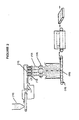
- Figure 2 schematically illustrates a method of making fiberglass insulation using the binder composition of the present invention.
- the present invention is directed to a non-woven fiber product comprising fibers and a binder composition, said fiber product being obtainable by curing an aqueous binder composition comprising
- the present invention is also directed to a method for binding together a loosely associated mat of fibers comprising (1) contacting said fibers with the aqueous binder composition defined in any of claims 1 to 17 and (2) heating said aqueous binder composition to a temperature within 50 to 300°C to effect cure.
- the present invention involves the use of a formaldehyde-free binder composition and a method of its use for making non-woven fiber products (e.g ., fiberglass insulation and related products, such as thin fiberglass mats (all hereinafter referred to generically as glass fiber products)) and the present invention is directed to the resulting products themselves, especially fiberglass insulation products, made with the cured (crosslinked) binder composition.
- non-woven fiber products e.g ., fiberglass insulation and related products, such as thin fiberglass mats (all hereinafter referred to generically as glass fiber products)
- the present invention involves the use of an aqueous binder composition containing a modified copolymer of maleic anhydride and a vinyl aromatic compound such as styrene.
- the copolymer is modified by reaction with a primary alkanolamine (preferably monoethanolamine (MEA)).
- MEA monoethanolamine
- the modified copolymer is self-curing and cures as a consequence of cross-linking, esterification reactions between pendant carboxyls and hydroxyl groups on the solubilized (hydrolyzed) modified copolymer chains. Additional polyol(s) are added to the binder composition to increase both the pH of the aqueous binder composition and the crosslink density of the cured binder.
- the present invention involves the use of an aqueous binder composition containing a modified styrene-maleic anhydride (SMA) copolymer.
- SMA modified styrene-maleic anhydride
- maleic anhydride and alternatively maleic acid
- a vinyl aromatic compound preferably styrene
- SMA free radical initiators
- Suitable SMA copolymers for practicing the present invention are commercially available from many sources, such that the details of SMA copolymerization procedures need not be described herein.
- the fully formulated binder composition can be applied as a dilute aqueous solution to the fibers and can be cured by thermal energy, i.e ., by heat.
- the aqueous solution has a substantially alkaline pH (pH of at least 5.0) and usually a pH of 7 or above.
- Curing (e.g ., crosslinking) of the polymer in the binder composition takes place via an esterification reaction between pendant carboxyl groups of the modified copolymers (preferably modified SMA copolymer) and both pendant hydroxyl groups of the modified copolymers (preferably modified SMA copolymer) and hydroxyl groups from optionally added polyol(s), such as from diethanolamine and/or triethanolamine. Additional crosslinking may occur with any additional polyol that may optionally be added to the formulation.
- curing As used herein, "curing,” “cured” and similar terms are intended to embrace the structural and/or morphological change which occurs in an aqueous binder composition, such as by covalent chemical reaction (crosslinking), ionic interaction or clustering, improved adhesion to the substrate, phase transformation or inversion, and hydrogen bonding when the binder composition is dried and heated to cause the properties of a flexible, porous substrate, such as a mat or blanket of glass fibers, especially glass fibers, to which an effective amount of the binder composition has been applied, to be altered.
- crosslinking covalent chemical reaction
- ionic interaction or clustering improved adhesion to the substrate
- phase transformation or inversion phase transformation or inversion
- hydrogen bonding when the binder composition is dried and heated to cause the properties of a flexible, porous substrate, such as a mat or blanket of glass fibers, especially glass fibers, to which an effective amount of the binder composition has been applied, to be altered.
- cured binder means the cured product of the modified copolymer of maleic anhydride and a vinyl aromatic compound and any added polyol, which cured product bonds the fibers of a fibrous product together. Generally, the bonding occurs at the intersection of overlapping fibers.
- formaldehyde-free is meant that the composition is substantially free from formaldehyde, and does not liberate substantial formaldehyde as a result of drying and/or curing; typically, less than 1 ppm formaldehyde, based on the weight of the composition, is present in a formaldehyde-free composition.
- additives that are themselves free from formaldehyde and do not generate formaldehyde during drying and/or curing.
- aqueous means water and mixtures composed substantially of water.
- fibers As used herein the terms “fibers,” “fibrous” and the like are intended to embrace materials that have an elongated morphology exhibiting an aspect ratio (length to thickness) of greater than 100, generally greater than 500, and often greater than 1000. Indeed, an aspect ratio of over 10,000 is possible.
- heat resistant fibers and the like are intended to embrace heat-resistant fibers suitable for withstanding elevated temperatures such as mineral fibers, aramid fibers, ceramic fibers, metal fibers, carbon fibers, polyimide fibers, certain polyester fibers, rayon fibers, and especially glass fibers. Such fibers are substantially unaffected by exposure to temperatures above about 120° C.
- substantially alkaline means a pH of above about 5.0.
- an alkaline pH means a pH of above 7.0.
- the terms "mat,” “batt” and “blanket” are used somewhat interchangeably to embrace a variety of glass fiber substrates of a range of thicknesses and densities, made by entangling short fibers, long continuous fibers and mixtures thereof. Particularly preferred are mats, batts, or blankets made using heat resistant fibers.
- water dilutable when used in connection with a binder composition means that water can be added to the binder composition in an amount of at least ten times the mass of the composition without causing solids to precipitate.
- the present invention involves the use of an aqueous binder composition, preferably a substantially alkaline aqueous binder composition and most preferably an alkaline hinder composition, comprising, as its essential constituent, a modified copolymer of maleic anhydride and a vinyl aromatic compound (preferably a modified SMA copolymer).
- the binder composition contains additional polyol, preferably diethanolamine (DEA), triethanolamine (TEA), or a mixture thereof.
- the present invention provides a method for binding together a loosely associated, non-woven mat or blanket of fibers, preferably heat resistant fibers, comprising (1) contacting said fibers with a curable, aqueous (preferably substantially alkaline and most preferably alkaline) binder composition as defined in claim 1 (preferably a modified SMA copolymer), and (2) heating said curable binder composition to 50 to 300°C to effect cure of the copolymer.
- a curable, aqueous (preferably substantially alkaline and most preferably alkaline) binder composition as defined in claim 1 (preferably a modified SMA copolymer) preferably a modified SMA copolymer
- curing is effected at a temperature broadly within the range from 75° C. to 300° C. usually at a temperature between 100° C. and up to a temperature of about 250° C.
- the present invention provides a fibrous product, preferably a glass fiber product and especially a fiberglass insulation product, comprising a crosslinked (cured) binder composition obtained by curing a curable binder composition as defined above, applied to the fibers, preferably heat resistant fibers and particularly glass fibers, which are assembled into a non-woven mat or blanket.
- a crosslinked (cured) binder composition obtained by curing a curable binder composition as defined above, applied to the fibers, preferably heat resistant fibers and particularly glass fibers, which are assembled into a non-woven mat or blanket.
- the copolymer used to prepare the composition used in the present invention is prepared from maleic anhydride (or maleic acid), i.e ., MA monomer and a vinyl aromatic monomer.
- Suitable vinyl aromatic monomers are, for instances, styrene, alpha-methylstyrene and vinyl toluene.
- the copolymer e.g .. an SMA copolymer
- a copolymer containing vinyl aromatic monomer and MA monomer can be prepared using known processes and requires no description here.
- the copolymer e.g .. an SMA copolymer
- the copolymer typically contains from 7 mole % to 50 mole % maleic anhydride (maleic acid) monomer and conversely from 50 mole % to 93 mole % vinyl aromatic monomer, preferably styrene monomer. More usually, the starting polymer contains from 20 mole % to 40 mole % maleic anhydride (maleic acid) monomer and conversely from 60 mole % to 80 mole % vinyl aromatic monomer, preferably styrene monomer.
- the molecular weight of the copolymer e.g ., the SMA copolymer
- the copolymer has a number-average molecular weight of between about 1000 and 300,000.
- the copolymer e.g., the SMA copolymer
- the copolymer can contain a minor amount (less than 50 mole % and usually less than 30 mole % based on the amount of maleic anhydride (maleic acid)) of another unsaturated carboxylic acid monomer such as aconitic acid, itaconic acid, acrylic acid, methacrylic acid, crotonic acid, isocrotonic acid, citraconic acid, and fumaric acid and the mixtures thereof.
- aconitic acid such as aconitic acid, itaconic acid, acrylic acid, methacrylic acid, crotonic acid, isocrotonic acid, citraconic acid, and fumaric acid and the mixtures thereof.
- the copolymer also can contain a minor amount (less that 50 mole % and usually less than 30 mole %, based on the amount of the vinyl aromatic monomer such as styrene) of another hydrophobic vinyl monomer.
- Another "hydrophobic vinyl monomer” is a monomer that typically produces, as a homopolymer, a polymer that is water-insoluble or capable of absorbing less than 10% by weight water.
- Suitable hydrophobic vinyl monomers within the broadest aspects of the present invention arc exemplified by (i) vinyl esters of aliphatic acids such as vinyl acetate, vinyl propionate, vinyl butyrate, vinyl caproate, vinyl 2-ethylhexanoate, vinyl laurate, and vinyl stearate; (ii) diene monomers such as butadiene and isoprene; (iii) vinyl monomers and halogenated vinyl monomers such as ethylene, propylene, cyclohexene, vinyl chloride and vinylidene chloride; (iv) acrylates and alkyl acrylates, such as methyl acrylate, ethyl acrylate, n-propyl acrylate, isopropyl acrylate, n-butyl acrylate, isobutyl acrylate, tert-butyl acrylate, n-hexyl acrylate, cyclohexyl acrylate, and 2-
- a preferred SMA copolymer for use in the binder composition is one which is only soluble in water at a substantially alkaline pH and especially preferred are those SMA copolymers which are only soluble at an alkaline pH (as those terms are defined above).
- Such copolymers can be prepared by the bulk, free radical polymerization of maleic anhydride (alternatively maleic acid) and styrene, optionally in the presence of the other unsaturated monomers described above, using well-known technology. Indeed, such SMA copolymers are commercially available from many sources. Due to the hydrophobic property of such SMA copolymers, they yield cured non-woven fiber products, such as glass fiber products, with superior wet tensile strength properties.
- the copolymer (preferably an SMA copolymer) is initially modified by reaction with a primary alkanolamine (preferably monoethanolamine (MEA)).
- a primary alkanolamine is defined as compound that has both amino and hydroxyl functional groups as illustrated by 2-(2-aminoethoxy)ethanol, aminoethyl ethanolamine, aminobutanol and other aminoalkanols, and by monoethanolamine. This modification produces a soluble, modified copolymer having both hydroxy and carboxyl groups.
- Figure 1 illustrates the nature of the chemical reaction that is believed to take place as a consequence of the modification of the copolymer (an SMA copolymer is shown) with MEA.
- the modification can be accomplished by mixing the copolymer (e.g .. an SMA Copolymer), which usually is supplied in flake or powder form, with a primary alkanolamine, preferably MEA.
- the alkanolamine-modified (e.g .. MEA-modified) copolymer can then be diluted with water.
- the modification is accomplished by mixing the copolymer with an aqueous solution of the primary alkanolamine, such as MEA.
- initial mixing of the copolymer and primary alkanolamine preferably MEA
- the primary alkanolamine such as MEA
- the primary alkanolamine generally is provided in an amount relative to the copolymer, sufficient to provide at least 0.05 mole of primary amine moiety per mole of MA monomer units in the copolymer.
- the primary alkanolamine such as MEA
- MEA is provided in an amount relative to the copolymer, sufficient to provide between about 0.05 mole to 0.4 mole of primary amine moiety per mole of MA monomer units in the copolymer.
- An aqueous solution of from 0.1 to 99.9 % (i.e., essentially neat primary alkanolamine such as MEA) by weight primary alkanolamine will generally be suitable for preparing the modified copolymer. While an aqueous-based reaction between the copolymer and the primary alkanolamine, such as MEA, can occur at an ambient temperature, usually to minimize the duration of this procedure it is preferred to conduct the reaction at a temperature in the range of 40 to 125 °C or higher. In order to minimize the amount of water that accompanies the binder composition during shipment and storage, it is preferable to use a concentrated solution of a primary alkanolamine, especially META, for modifying the copolymer. In any event, the solution of the primary alkanolamine used for preparing the modified copolymer will usually contain between 10 and 99.9 weight % of the primary alkanolamine, such as MEA.
- a modified copolymer is produced that can be self-curing.
- the binder composition have at least a substantially alkaline pH (pH of at least 5.0) and it is more preferred that the pH of the binder composition actually be alkaline (pH of at least 7.0).
- a base is ammonia
- other bases including secondary alkanolamine amines such as DEA and tertiary alkanolamine such as TEA also can be used for this purpose.
- the addition of a secondary alkanolamine, a tertiary alkanolamine and mixtures thereof, especially, DEA and/or TEA, to the modified copolymer solution also serves as a polyol source for participating in crosslinking reactions that causes the binder composition to cure. It is preferred not to use inorganic bases, such as hydroxides, as these materials tend to reduce the hydrophobic character of the binder composition. Usually, ammonia in an amount of 1.0 to 10% by weight of the aqueous solution of the modified copolymer should be sufficient for this purpose.
- a polyol is included in the binder composition.
- Such polyols include ethylene glycol, diethylene glycol, triethylene glycol, polyethylcneoxide (hydroxy terminated), glycerol, pentaerythritol, trimethylol propane, diethanotamine, triethanolamine, ethyl diethanolamine, methyl diethanolamine, sorbitol, a polysaccharide such as fructose, sucrose, and glucose, polyvinyl alcohols, resorcinol, catechol, pyrogallol, glycollated ureas, and 1,4-cyclohexane diol to name a few.
- a secondary or tertiary alkanolamine, and especially DEA or TEA is preferred as these polyols also add alkalinity to the binder composition.
- the amount of polyol in the composition should provide a mole ratio of -COOH contributed by the modified copolymer component (and any other optional polyacid in the composition) to -OH contributed both by the modified copolymer component and by any additional polyol component ( i . e ., the -COOH:-OH ratio of the composition) in the range of about 10:1 to 1:10, most often in the range of 5:1 to 1:5 and most usually in the range of 2:1 to 1:2.
- another alkanolamine such as DEA and/or TEA
- This mole ratio is conveniently determined by a calculating the ratio of the number of moles of the modified copolymer multiplied by its average -COOH functionality (plus any other polyacid component) to the sum of the number of moles of the modified copolymer multiplied by its average -OH functionality and the number of moles of the polyol component(s) multiplied by its (their) average functionality.
- the mole ratio of-COOH to -OH in the composition is in the range of about 2:1 to about 1:2 and more preferably in the range of 1.5:1 to 1:1.5.
- composition also could include as an additional polyacid component an aqueous substantially alkaline solution of a hydrolyzed (solubilized) copolymer of maleic anhydride and a vinyl aromatic compound such as styrene.
- a hydrolyzed (solubilized) copolymer of maleic anhydride and a vinyl aromatic compound such as styrene The preparation of such a hydrolyzed (solubilized) copolymer is described in an application co-filed on even date herewith by the same inventors as listed on this application and bearing the same title and assigned the assigaee's docket number GP 20078-USA.
- DEA and/or TEA as the principal polyol additive and in those instances where DEA and/or TEA is the principal polyol, it may nonetheless be desirable in some cases to include some amount (generally a small amount of less than 5 weight percent and often less than 1 weight percent) of an additional (optional) polyol as noted above.
- additional (optional) polyol as noted above.
- Other available additives for augmenting the cross-linking of the binder composition include urea and polyamino compounds, both synthetic and natural (e.g., protein sources such as soy). The present invention should not be limited to any selection of other optional crosslinking additives.
- the binder composition in the making of non-woven fiber products, such as fiberglass insulation, the binder composition usually is formulated into a dilute aqueous solution and then is usually applied, such as by spraying, onto fibers, such as glass fibers which in the case of fiberglass manufacture are generally hot from having been freshly formed. Binder compositions containing somewhere between 1 % by weight and 50 % by weight solids are typically used for making fiber products, including glass fiber products.
- the aqueous solution of the modified copolymer can be easily blended with other ingredient commonly used in the binder compositions for preparing fiber products and diluted with additional water to a low concentration which is readily applied onto the fibers, such as by spraying.
- a silane coupling agent e.g., an organo silicon oil
- a silane coupling agent e.g., an organo silicon oil
- Suitable silane coupling agents have been marketed by the Dow-Corning Corporation, Petrarch Systems, and by the General Electric Company. Their formulation and manufacture are well known such that detailed description thereof need not be given. This invention is not directed to and thus is not limited to the use of any particular silane additives.
- Fibrous mat manufacturers also normally add "dedusting” oil to minimize dust formation in the finished product.
- dedusting oils are usually high boiling point mineral oils.
- Owens-Coming also adds dye to the binder formulation to color the product pink.
- Other pigments, such as carbon black, also may be added. This invention is not directed to and thus is not limited to the use of any such additives or pigments.
- the binder composition may be prepared by combining the aqueous solution of the copolymer and the silane coupling agent in a relatively easy mixing procedure carried out at ambient temperatures.
- the binder composition can be used immediately and may be diluted with water to a concentration suitable for the desired method of application, such as by spraying onto the glass fibers.
- Figure 2 schematically illustrates the manufacture of fiberglass insulation in a continuous process wherein molten glass flows from a melting furnace (10) is divided into streams (11) and is attenuated into fibers (12).
- the fiber attenuation generally is performed by centrifuging the molten glass though spinners (13) or by fluid jets (not shown) to form discontinuous glass fibers (12) of relatively small dimensions and large aspect ratio.
- the predominant proportion of glass fibers used in the manufacture of fiberglass insulation has a diameter within the range from 0.5 to 20 ⁇ m and a length within the range from 0.5 to 10 cm.
- a curable binder composition is generally formulated as a liquid and is applied usually by spraying (14) onto the hot glass fibers emerging from the fiber attenuation mechanism.
- the binder-treated fibers then are collected as they are randomly deposited on a moving foraminous conveyor belt (15).
- the dynamics of the binder application is such that much of the water in the binder is evaporated as the hot fibers are cooled by contact with the aqueous binder.
- the resin binder then becomes tacky holding the mass of fibers together as the resin begins to set.
- the fibers are collected on a conveyor belt (15) in a haphazard manner to form a non-woven mat (16).
- the depth (thickness) of the fibers forming the mat is determined by the speed of fiber formation and the speed of the conveyor belt (15).
- the fibrous product can be formed as a relatively thin product of 0.32 cm to 0.64 cm (about 1/8 to 1/4 inch) or it can be formed as a thick mat of 15.2 cm to 20.3 cm (6 to 8 inches) or even more.
- the density of the product also can be varied from a relatively fluffy low density product to a higher density of 96 kg/m 3 to 160 kg/m 3 (6 to 10 pounds per cubic foot) or higher, as is well understood by those skilled in the art.
- the aqueous binder composition after it is applied to the glass fibers, is heated to effect final drying and full curing.
- the duration and temperature of heating will affect the rate of processability and handleability, degree of curing and property development of the treated substrate.
- the curing temperatures are within the range from 50 to 300° C., preferably within the range from 90 to 230° C. and the curing time will usually be somewhere between 3 seconds to about 15 minutes.
- Curing in the present context is to be understood as meaning the chemical alteration of the composition, for example crosslinking through formation to covalent bonds between the various constituents of the composition, especially the esterification reaction between pendant carboxyl (-COOH) of modified copolymer and the hydroxyl (-OH) moieties both of the modified copolymer and any added polyol, such as DEA and/or TEA, the formation of ionic interactions and clusters, and formation of hydrogen bonds.
- the drying and curing functions may be conducted in two or more distinct steps, if desired.
- the composition may be first heated at a temperature and for a time sufficient to substantially dry but not to substantially cure the binder composition and then heated for a second time at a higher temperature and/or for a longer period of time to effect curing (cross-linking to a thermoset structure).
- Such a preliminary procedure referred to as "B-staging" may be used to provide a binder-treated product, for example, in roll form, which may at a later stage be fully cured, with or without forming or molding into a particular configuration, concurrent with the curing process. This makes it possible, for example, to use the compositions for producing binder-impregnated semi-fabricates which can be molded and cured elsewhere.
- the aqueous binder can be satisfactorily cured without the assistance of any condensation accelerator, i.e., in the absence of any condensation accelerator, at conventional temperatures and in a commercially acceptable period of time for making fiber products and particularly glass fiber products.
- Suitable condensation accelerators that optionally can be used in the binder composition for promoting the esterification reaction, i.e., the crosslinking reaction, between the carboxylic (-COOH) moieties of the modified copolymer and the hydroxyl (-OH) moieties of both the modified copolymer and any added polyol, such as added DEA and/or TEA, include inorganic acids, such as sulfuric acid, lead acetate, sodium acetate, calcium acetate, zinc acetate, organotin compounds, titanium esters, antimony trioxide, germanium salts, ammonium chlorine, sodium hypophosphite, sodium phosphite and organic acids such as methane sulfonic acid and para toluene sulfonic acid.
- inorganic acids such as sulfuric acid, lead acetate, sodium acetate, calcium acetate, zinc acetate
- organotin compounds such as sulfuric acid, lead acetate, sodium acetate, calcium a
- the phosphorus accelerators (catalysts) described in U.S. 5,661,213 can also be optionally employed, but are not necessary to obtain a complete cure at a commercially acceptable temperature and within a commercially acceptable time.
- Other condensation accelerators that could be used will be apparent to those skilled in the art and the present invention is not limited to any particular optional condensation accelerator. Indeed, the use of the binder composition is usually employed in the absence of such accelerators.
- the condensation accelerator When used, the condensation accelerator would generally be present in an amount of 10 wt. % or less, more usually 0.01 to 10 wt. %, even more typically 0.1 wt. % to 5 wt. %, and most often 0.5 wt. % to 2 wt. %, based on the weight of the modified copolymer.
- one of the advantages of the hinder composition is that such condensation accelerators are not necessary for obtaining cure of the binder composition under commercially acceptable conditions of temperature and time, usually from about 140 to 240 °C and under 15 minutes.
- the binder composition is usually applied to the hot glass fibers as they are being produced and formed into a mat or blanket.
- water is volatilized from the binder as it is applied onto the hot glass fibers, and the high-solids binder-coated fibers are formed into a mat and heated to cure the binder fully and thereby produce a finished fiber product, e.g ., fiberglass insulation product.
- the binder composition is generally applied in an amount such that the cured binder constitutes about 5 wt. % to about 15 wt. % of the finished glass fiber product, e.g ., fiberglass insulation product, although it can be as little as 1 wt. % or less and as high as 20 wt.
- the amount of binder for most thermal insulation products will be the amount necessary to lock the fibers into an integral mass by bonding the fibers where they cross or overlap. For this reason, it is desired to have binder compositions with good flow characteristics, so that the binder solution can be applied to the fiber at a low volume that will flow to the fiber intersections.
- the binder composition may be applied to the fibers by one of a variety conventional techniques such as, for example, air or airless spraying, padding, saturating, roll coating, curtain coating, beater deposition, and coagulation.
- the binder composition can be applied to the glass fibers by flooding a collected mat of glass fibers and draining off the excess, by applying the blinder composition onto the fibers during mat formation, by spraying the fiber mat or the like.
- passing the non-woven web through a saturating bath of the binder composition may be a useful method for applying the binder, as well as roll transfer application.
- Continuous fibers also may be employed in the form of mats or blankets fabricated by swirling the endless filaments or strands of continuous fibers, or they may be chopped or cut to shorter lengths for mat or batt formation. Use can also be made of ultra-fine fibers formed by the attenuation of glass rods. Also, such fibers may be treated with a size, anchoring agent or other modifying agent before use or application of the binder.
- Glass fiber insulation products may also contain fibers that are not in themselves heat-resistant such as, for example, certain polyester fibers, rayon fibers, nylon fibers, and superabsorbent fibers, in so far as they do not materially adversely affect the performance of the glass fiber product.
- the fiber component will represent the principal material of the non-woven fiber products, such as a fiberglass insulation product. Usually 99-60 percent by weight of the product will be composed of the fibers, while the amount of binder solids will broadly be in reverse proportion ranging from 1-40 percent, depending upon the density and character of the product.
- Glass insulations having a density less than 16.02 kg/m 3 may be formed with binders present in the lower range of concentrations while molded or compressed products having a density as high as 481 kg/m 3 to 641 kg/m 3 (30-40 pounds per cubic foot) can be fabricated of systems embodying the binder composition in the higher proportion of the described range.
- Non-woven products and especially glass fiber products can be formed as a relatively thin product, such as a mat having a thickness of 2.54* 10 -4 m to 1.27* 10 -3 m (about 10 to 50 mils); or they can be formed as a relatively thick product, such as a blanket of 30.5 cm to 35.5 cm (12 to 14 inches) or more.
- Fiber products, including glass fiber products, of any thickness are embraced by the present invention..
- the time and temperature for cure for any particular glass fiber product will depend in part on the amount of binder in the final structure and the thickness and density of the structure that is formed and can be determined by one skilled in the art using only routine testing.
- a cure time ranging from several seconds to 1-5 minutes usually will be sufficient at a cure temperature within the range of 175°- 300° C.
- Glass fiber products may be used for applications such as, for example, insulation batts or rolls, as reinforcing mat for roofing or flooring applications, as roving, as microglass-based substrate for printed circuit boards or battery separators, as filter stock, as tape stock, and as reinforcement scrim in cementitious and non-cementitious coatings for masonry. Still other uses will be readily apparent to those skilled in the art.
- This IR spectrum indicates that the reaction of SMA with DEA under aqueous conditions is primarily a hydrolysis reaction where the anhydride is opened up by the DEA (acting as a base) and held as an ammonium carboxylate salt.
- the IR spectra of the cured sample showed the presence of both ester and amide indicating the crosslinking occurs by both ester and amide formation.
- Example 1 To the hinder preparations described in Example 1 and Example 6 (Comparison) was added an aqueous 40 % (by weight) urea solution in an amount to provide about 10% by active weight of urea and the resulting binder solutions were adjusted to 20 % by weight total solids with additonal water.
- the resulting binder solutions showed excellent thermosetting properties when heated 210 °C.
- Hand sheets were prepared by sprinkling the binder onto a glass mat, formed from 1 ⁇ 2 inch PPG M-8035 chopped glass fibers dispersed in water containing a polyacrylamide, vacuuming the excess binder off the glass fibers and then curing the sheet in an oven at 200 to 240°C for 1 to 5 minutes.
- Dry tensile, wet tensile and hot/wet tensile strengths of mats prepared using these binder compositions were measured on a Thwing-Albert tensile tester (0-200 kg load cell).
- Dry tensile strengths of mats prepared using the binder compositions were measured by subjecting 7.62 cm by 12.7 cm (3 inch by 5 inch) samples of the hand sheets, prepared in the manner outlined below, to breaking using the QC-1000 Materials Tester by the Thwing Albert Instrument Co.
- Hot/wet tensile strength of mats prepared using these binder compositions were then measured by soaking the handsheets in 185° F (85° C) water for 10 minutes. Samples of the hand sheets 7.62 cm by 12.7 cm (3 inches by 5 inches) were then subjected to breaking in the same tensile tester (QC-1000 Materials Tester by the Thwing albert Instrument Co.) while they were still hot and wet.
- Table 1 below reports tensile test results performed on hand sheets made with a standard phenol-formaldehyde (PF) resin (GP 2894) that is commercially available from Georgia-Pacific Resins, Inc. and conventionally used to make fiberglass insulation.
- the results using the conventional PF resin can be compared to the results obtained using the comparative binders (Example 5, Example 6 and Example 7(6)), and binder compositions of the invention (Example 1, Example 3 and Example 7(1)) as shown below in Table 1.
- the binders are applied at a solids content of 20% by weight
- the binder of Example 3 was prepared at about 10% by weight total solids and thus was used directly without modification.
Landscapes
- Chemical & Material Sciences (AREA)
- Organic Chemistry (AREA)
- Chemical Kinetics & Catalysis (AREA)
- General Chemical & Material Sciences (AREA)
- Life Sciences & Earth Sciences (AREA)
- Engineering & Computer Science (AREA)
- Medicinal Chemistry (AREA)
- Polymers & Plastics (AREA)
- Health & Medical Sciences (AREA)
- Materials Engineering (AREA)
- Textile Engineering (AREA)
- General Life Sciences & Earth Sciences (AREA)
- Wood Science & Technology (AREA)
- Geochemistry & Mineralogy (AREA)
- Dispersion Chemistry (AREA)
- Treatments For Attaching Organic Compounds To Fibrous Goods (AREA)
- Reinforced Plastic Materials (AREA)
- Nonwoven Fabrics (AREA)
- Addition Polymer Or Copolymer, Post-Treatments, Or Chemical Modifications (AREA)
- Macromolecular Compounds Obtained By Forming Nitrogen-Containing Linkages In General (AREA)
Priority Applications (1)
| Application Number | Priority Date | Filing Date | Title |
|---|---|---|---|
| PL07783269T PL2029633T3 (pl) | 2006-06-16 | 2007-05-04 | Substancja wiążąca pozbawiona formaldehydu |
Applications Claiming Priority (2)
| Application Number | Priority Date | Filing Date | Title |
|---|---|---|---|
| US11/454,326 US7803879B2 (en) | 2006-06-16 | 2006-06-16 | Formaldehyde free binder |
| PCT/US2007/068226 WO2007149643A1 (en) | 2006-06-16 | 2007-05-04 | Formaldehyde free binder |
Publications (2)
| Publication Number | Publication Date |
|---|---|
| EP2029633A1 EP2029633A1 (en) | 2009-03-04 |
| EP2029633B1 true EP2029633B1 (en) | 2011-11-02 |
Family
ID=38544169
Family Applications (1)
| Application Number | Title | Priority Date | Filing Date |
|---|---|---|---|
| EP07783269A Not-in-force EP2029633B1 (en) | 2006-06-16 | 2007-05-04 | Formaldehyde free binder |
Country Status (5)
| Country | Link |
|---|---|
| US (1) | US7803879B2 (pl) |
| EP (1) | EP2029633B1 (pl) |
| AT (1) | ATE531737T1 (pl) |
| PL (1) | PL2029633T3 (pl) |
| WO (1) | WO2007149643A1 (pl) |
Families Citing this family (54)
| Publication number | Priority date | Publication date | Assignee | Title |
|---|---|---|---|---|
| US7842382B2 (en) | 2004-03-11 | 2010-11-30 | Knauf Insulation Gmbh | Binder compositions and associated methods |
| WO2006044302A1 (en) * | 2004-10-13 | 2006-04-27 | Knauf Insulation Gmbh | Polyester binding compositions |
| KR101410624B1 (ko) | 2005-07-26 | 2014-06-20 | 크나우프 인설레이션 게엠베하 | 접착제 및 이들로 만들어진 물질 |
| US9217065B2 (en) * | 2006-06-16 | 2015-12-22 | Georgia-Pacific Chemicals Llc | Binder compositions for making fiberglass products |
| US9169364B2 (en) | 2006-06-16 | 2015-10-27 | Georgia-Pacific Chemicals Llc | Binder compositions and methods for making and using same |
| US7795354B2 (en) * | 2006-06-16 | 2010-09-14 | Georgia-Pacific Chemicals Llc | Formaldehyde free binder |
| US9169157B2 (en) * | 2006-06-16 | 2015-10-27 | Georgia-Pacific Chemicals Llc | Formaldehyde free binder |
| DK2108006T3 (da) | 2007-01-25 | 2020-12-21 | Knauf Insulation Gmbh | Bindemidler og materialer lavet dermed |
| BRPI0721232B1 (pt) | 2007-01-25 | 2023-01-24 | Knauf Insulation Limited | Placa de madeira compósita |
| EP2450493B1 (en) | 2007-01-25 | 2024-10-02 | Knauf Insulation SPRL | Mineral fibre board |
| WO2008127936A2 (en) | 2007-04-13 | 2008-10-23 | Knauf Insulation Gmbh | Composite maillard-resole binders |
| US20080274292A1 (en) | 2007-05-03 | 2008-11-06 | Kiarash Alavi Shooshtari | Binding of fibrous material utilizing a crosslinked polyamic acid |
| GB0715100D0 (en) | 2007-08-03 | 2007-09-12 | Knauf Insulation Ltd | Binders |
| CA2758993A1 (en) * | 2009-04-13 | 2010-10-21 | Owens Corning Intellectual Capital, Llc | Soft fiber insulation product |
| US9718729B2 (en) * | 2009-05-15 | 2017-08-01 | Owens Corning Intellectual Capital, Llc | Biocides for bio-based binders, fibrous insulation products and wash water systems |
| US20110003522A1 (en) * | 2009-05-15 | 2011-01-06 | Liang Chen | Bio-based aqueous binder for fiberglass insulation materials and non-woven mats |
| WO2011002730A1 (en) * | 2009-06-29 | 2011-01-06 | Owens Corning Intellectual Capital, Llc | Modified starch based binders |
| EP2462169B1 (en) | 2009-08-07 | 2019-02-27 | Knauf Insulation | Molasses binder |
| WO2011022668A1 (en) * | 2009-08-20 | 2011-02-24 | Georgia-Pacific Chemicals Llc | Modified binders for making fiberglass products |
| EP2899227A1 (en) | 2009-10-09 | 2015-07-29 | Owens-Corning Intellectual Capital, LLC | Bio-based binders for insulation and non-woven mats |
| US20110223364A1 (en) | 2009-10-09 | 2011-09-15 | Hawkins Christopher M | Insulative products having bio-based binders |
| BR112012013476A2 (pt) * | 2009-12-02 | 2016-05-24 | Georgia Pacific Chemicals Llc | composições aglutinantes para a produção de produtos de fibra de vidro |
| US8809477B2 (en) | 2010-02-01 | 2014-08-19 | Johns Manville | Formaldehyde-free protein-containing binder compositions |
| US8680224B2 (en) * | 2010-02-01 | 2014-03-25 | Johns Manville | Formaldehyde-free protein-containing binder compositions |
| CN103025777B (zh) | 2010-05-07 | 2016-01-20 | 克瑙夫绝缘私人有限公司 | 碳水化合物粘合剂及用其制备的材料 |
| JP6223823B2 (ja) | 2010-05-07 | 2017-11-01 | ナフ インサレーション エセペーアールエル | 炭水化物ポリアミン結合剤およびそれを用いて作製される材料 |
| EP2576882B1 (en) | 2010-06-07 | 2015-02-25 | Knauf Insulation | Fiber products having temperature control additives |
| EP2694717B1 (en) | 2011-04-07 | 2017-06-28 | Cargill, Incorporated | Bio-based binders including carbohydrates and a pre-reacted product of an alcohol or polyol and a monomeric or polymeric polycarboxylic acid |
| WO2012152731A1 (en) | 2011-05-07 | 2012-11-15 | Knauf Insulation | Liquid high solids binder composition |
| US9957409B2 (en) | 2011-07-21 | 2018-05-01 | Owens Corning Intellectual Capital, Llc | Binder compositions with polyvalent phosphorus crosslinking agents |
| BR112014017220A8 (pt) * | 2012-01-13 | 2017-07-04 | Georgia Pacific Chemicals Llc | composições aglutinantes e métodos para fabricar e utilizar as mesmas |
| GB201206193D0 (en) | 2012-04-05 | 2012-05-23 | Knauf Insulation Ltd | Binders and associated products |
| US20150091209A1 (en) | 2012-04-18 | 2015-04-02 | Knauf Insulation Gmbh | Molding apparatus and process |
| US9394431B2 (en) | 2012-06-07 | 2016-07-19 | Johns Manville | Formaldehyde free binder compositions with urea-aldehyde reaction products |
| US20140342627A1 (en) * | 2012-06-07 | 2014-11-20 | Johns Manville | Formaldehyde free binder compositions with urea-aldehyde reaction products |
| US10815593B2 (en) | 2012-11-13 | 2020-10-27 | Johns Manville | Viscosity modified formaldehyde-free binder compositions |
| GB201214734D0 (en) | 2012-08-17 | 2012-10-03 | Knauf Insulation Ltd | Wood board and process for its production |
| ES2921601T3 (es) | 2012-12-05 | 2022-08-30 | Knauf Insulation Sprl | Aglutinante |
| MX378024B (es) | 2013-03-13 | 2025-03-10 | Knauf Insulation Gmbh | Proceso de moldeado para un producto aislante.. |
| US11401204B2 (en) | 2014-02-07 | 2022-08-02 | Knauf Insulation, Inc. | Uncured articles with improved shelf-life |
| GB201408909D0 (en) | 2014-05-20 | 2014-07-02 | Knauf Insulation Ltd | Binders |
| GB201412709D0 (en) | 2014-07-17 | 2014-09-03 | Knauf Insulation And Knauf Insulation Ltd | Improved binder compositions and uses thereof |
| CA2986429C (en) * | 2015-05-26 | 2020-03-10 | Saint-Gobain Adfors Canada, Ltd. | Glass mat reinforcement |
| KR102145117B1 (ko) | 2015-08-10 | 2020-08-14 | 주식회사 쿠라레 | 비수 전해질 전지용 바인더 조성물, 그리고 그것을 사용한 비수 전해질 전지용 슬러리 조성물, 비수 전해질 전지 부극, 및 비수 전해질 전지 |
| GB201517867D0 (en) | 2015-10-09 | 2015-11-25 | Knauf Insulation Ltd | Wood particle boards |
| GB201610063D0 (en) | 2016-06-09 | 2016-07-27 | Knauf Insulation Ltd | Binders |
| GB201701569D0 (en) | 2017-01-31 | 2017-03-15 | Knauf Insulation Ltd | Improved binder compositions and uses thereof |
| CN107499884A (zh) * | 2017-08-24 | 2017-12-22 | 深圳市策维科技有限公司 | 真空加热系统和方法 |
| CN108355612B (zh) * | 2018-01-26 | 2020-06-16 | 安徽建筑大学 | 内交联铪金属有机骨架材料的合成方法 |
| GB201804907D0 (en) | 2018-03-27 | 2018-05-09 | Knauf Insulation Ltd | Composite products |
| GB201804908D0 (en) | 2018-03-27 | 2018-05-09 | Knauf Insulation Ltd | Binder compositions and uses thereof |
| EP3896043B1 (en) * | 2020-04-17 | 2025-04-02 | Depco-Trh Pty Ltd | High opacity laminate surface |
| EP4208425A4 (en) * | 2020-09-01 | 2025-01-15 | Owens-Corning Intellectual Capital, LLC | AQUEOUS BINDER COMPOSITIONS FOR MINERAL WOOL PRODUCTS |
| CA3200567A1 (en) * | 2020-10-01 | 2022-04-07 | Owens Corning Intellectual Capital, Llc | Additives for binder compositions in fibrous insulation products |
Citations (1)
| Publication number | Priority date | Publication date | Assignee | Title |
|---|---|---|---|---|
| US3245933A (en) * | 1960-05-19 | 1966-04-12 | Sinclair Research Inc | Styrene-maleic anhydride copolymers cross-linked with aliphatic polyhydroxy compounds |
Family Cites Families (70)
| Publication number | Priority date | Publication date | Assignee | Title |
|---|---|---|---|---|
| US2486804A (en) * | 1947-10-08 | 1949-11-01 | Henry H Frede And Company | Coating cellulosic textiles with maleic anhydride-styrene copolymer and solid polyethylene glycol |
| US3297657A (en) * | 1963-03-08 | 1967-01-10 | Deering Milliken Res Corp | Styrene-maleic anhydride copolymerization process |
| DE1745954A1 (de) | 1968-02-13 | 1971-09-16 | Hoechst Ag | Verfahren zur Herstellung von AEthanolimidderivaten von Styrol-Maleinsaeureanhydrid-Cotelomerisaten |
| US3715233A (en) * | 1970-09-18 | 1973-02-06 | Standard Oil Co | Process for preparing fiberglass preforms |
| DE2118690A1 (de) * | 1971-04-17 | 1973-02-01 | Reichhold Albert Chemie Ag | Verfahren zur herstellung von polyimiden |
| US4054713A (en) * | 1973-12-28 | 1977-10-18 | Kao Soap Co., Ltd. | Process for preparing glass fiber mats |
| US4029623A (en) * | 1974-10-07 | 1977-06-14 | Ppg Industries, Inc. | Glass fiber sizing compositions for the reinforcement of resin matrices |
| US4032690A (en) * | 1975-01-24 | 1977-06-28 | Mitsubishi Paper Mills, Ltd. | Thermosensitive recording material |
| DE2810137A1 (de) | 1978-03-09 | 1979-09-13 | Cassella Ag | Binder fuer daemmstoffe und verfahren zur herstellung von daemmstoffen |
| US4220752A (en) * | 1978-08-14 | 1980-09-02 | Westinghouse Electric Corp. | Method of making a high temperature capability water soluble polyester insulating resin solution |
| US4330444A (en) * | 1979-09-04 | 1982-05-18 | Ppg Industries, Inc. | Sizing composition and sized fibers with increased hardness |
| US4477496A (en) * | 1981-06-15 | 1984-10-16 | Ppg Industries, Inc. | Process for preparing sized glass fiber roving |
| SU1073240A1 (ru) * | 1982-07-22 | 1984-02-15 | Институт Химии Ан Узсср | Способ модификации сополимера стирола и малеинового ангидрида |
| FR2587024B1 (fr) | 1985-09-11 | 1992-01-10 | Inst Francais Du Petrole | Composition de mortiers hydrauliques presentant notamment une resistance a la traction amelioree |
| DD247456A1 (de) | 1986-04-02 | 1987-07-08 | Leuna Werke Veb | Herstellung waessriger loesungen carboxyl- und hydroxylgruppenenthaltender copolymerer |
| CA1330284C (en) | 1988-07-15 | 1994-06-21 | Luciano Michael Parrinello | Chemically treated shapes, fillers and reinforcement for polymer matrices |
| FR2638448B1 (fr) * | 1988-10-27 | 1992-08-21 | Saint Gobain Isover | Liant et encollage a base de celui-ci pour fibres minerales |
| US5278222A (en) * | 1989-02-13 | 1994-01-11 | Rohm And Haas Company | Low viscosity, fast curing binder for cellulose |
| US5198492A (en) * | 1989-02-13 | 1993-03-30 | Rohn And Haas Company | Low viscosity, fast curing binder for cellulose |
| US5091465A (en) * | 1989-12-13 | 1992-02-25 | Union Carbide Chemicals And Plastics Company, Inc. | Glass fiber size |
| US5030507A (en) * | 1990-01-12 | 1991-07-09 | National Starch And Chemical Investment Holding Corporation | Formaldehyde-free nonwoven binder composition |
| DE4010794A1 (de) * | 1990-04-04 | 1991-10-10 | Bayer Ag | Waessrige loesungen oder dispersionen von hydroxyfunktionellen copolymerisaten, ein verfahren zu ihrer herstellung und ihrer verwendung |
| US5389716A (en) * | 1992-06-26 | 1995-02-14 | Georgia-Pacific Resins, Inc. | Fire resistant cured binder for fibrous mats |
| US5661213A (en) * | 1992-08-06 | 1997-08-26 | Rohm And Haas Company | Curable aqueous composition and use as fiberglass nonwoven binder |
| US5354803A (en) * | 1993-03-29 | 1994-10-11 | Sequa Chemicals, Inc. | Polyvinyl alcohol graft copolymer nonwoven binder emulsion |
| JPH06287276A (ja) | 1993-04-05 | 1994-10-11 | Sanyo Chem Ind Ltd | 水性エポキシ樹脂組成物 |
| US5340868A (en) * | 1993-06-21 | 1994-08-23 | Owens-Corning Fiberglass Technology Inc. | Fibrous glass binders |
| US5318990A (en) * | 1993-06-21 | 1994-06-07 | Owens-Corning Fiberglas Technology Inc. | Fibrous glass binders |
| US5362842A (en) * | 1993-09-10 | 1994-11-08 | Georgia Pacific Resins, Inc. | Urea-formaldehyde resin composition and method of manufacture thereof |
| US5393849A (en) * | 1993-10-19 | 1995-02-28 | Georgia-Pacific Resins, Inc. | Curable polyester/polyamino compositions |
| DE4342157A1 (de) | 1993-12-10 | 1995-06-14 | Leuna Werke Gmbh | Kationische Papierleimungsmittel |
| WO1995030061A1 (en) | 1994-05-03 | 1995-11-09 | Akmakjian, Lewis | Synthetic shake shingle |
| US5498658A (en) * | 1994-11-17 | 1996-03-12 | The B. F. Goodrich Company | Formaldehyde-free latex for use as a binder or coating |
| US5670585A (en) * | 1995-06-13 | 1997-09-23 | Schuller International, Inc. | Use of polyacrylic acid and other polymers as additives in fiberglass formaldehyde based binders |
| DE19602555A1 (de) * | 1996-01-25 | 1997-08-07 | Basf Lacke & Farben | Wäßrige Bindemittellösungen und -dispersionen |
| DE19606394A1 (de) * | 1996-02-21 | 1997-08-28 | Basf Ag | Formaldehydfreie, wäßrige Bindemittel |
| DE19606393A1 (de) | 1996-02-21 | 1997-08-28 | Basf Ag | Formaldehydfreie Bindemittel für Formkörper |
| US5804005A (en) * | 1996-05-09 | 1998-09-08 | Buck; George S. | Bonding fibrous batts with thermosetting fiber-binders of certain expoxy resins |
| DE19621573A1 (de) * | 1996-05-29 | 1997-12-04 | Basf Ag | Thermisch härtbare, wäßrige Zusammensetzungen |
| US5932665A (en) * | 1997-02-06 | 1999-08-03 | Johns Manville International, Inc. | Polycarboxy polymer acid binders having reduced cure temperatures |
| TW408152B (en) * | 1997-04-25 | 2000-10-11 | Rohm & Haas | Formaldehyde-free curable composition and method for bonding heat-resistant fibers of a nonwoven material by using the composition |
| US5919873A (en) * | 1997-07-28 | 1999-07-06 | Rio Oeste, S.A. | Crosslinked phenolic polyesters |
| US5977232A (en) * | 1997-08-01 | 1999-11-02 | Rohm And Haas Company | Formaldehyde-free, accelerated cure, aqueous composition for bonding glass fiber heat-resistant nonwovens |
| DE19735959A1 (de) | 1997-08-19 | 1999-02-25 | Basf Ag | Verwendung thermisch härtbarer, wässriger Zusammensetzungen als Bindemittel für Formkörper |
| US6171654B1 (en) * | 1997-11-28 | 2001-01-09 | Seydel Research, Inc. | Method for bonding glass fibers with cross-linkable polyester resins |
| NL1008041C2 (nl) | 1998-01-16 | 1999-07-19 | Tidis B V I O | Toepassing van een wateroplosbaar bindmiddelsysteem voor de productie van glas- of steenwol. |
| US6407197B1 (en) | 1998-03-04 | 2002-06-18 | Dsm N.V. | Aqueous dispersion of a polymer |
| US6331350B1 (en) | 1998-10-02 | 2001-12-18 | Johns Manville International, Inc. | Polycarboxy/polyol fiberglass binder of low pH |
| EP0990727A1 (en) | 1998-10-02 | 2000-04-05 | Johns Manville International Inc. | Polycarboxy/polyol fiberglass binder |
| US6194512B1 (en) * | 1999-06-28 | 2001-02-27 | Owens Corning Fiberglas Technology, Inc. | Phenol/formaldehyde and polyacrylic acid co-binder and low emissions process for making the same |
| EP1086932A1 (en) | 1999-07-16 | 2001-03-28 | Rockwool International A/S | Resin for a mineral wool binder comprising the reaction product of an amine with a first and second anhydride |
| EP1170265A1 (en) | 2000-07-04 | 2002-01-09 | Rockwool International A/S | Binder for mineral wool products |
| US6426121B1 (en) * | 2000-10-17 | 2002-07-30 | Air Products Polymers, L.P. | Dual crosslinkable emulsion polymers at ambient conditions |
| US6734232B2 (en) | 2002-03-15 | 2004-05-11 | Georgia-Pacific Resins, Inc. | Styrene-acrylate copolymer composition suitable for surface size |
| WO2003104284A2 (en) * | 2002-06-06 | 2003-12-18 | Georgia-Pacific Resins, Inc. | Epoxide-type formaldehyde free insulation binder |
| EP1517959B1 (en) * | 2002-06-18 | 2009-03-11 | Georgia-Pacific Chemicals LLC | Polyester-type formaldehyde free insulation binder |
| US7384881B2 (en) | 2002-08-16 | 2008-06-10 | H.B. Fuller Licensing & Financing, Inc. | Aqueous formaldehyde-free composition and fiberglass insulation including the same |
| US6734237B1 (en) | 2002-10-28 | 2004-05-11 | Johns Manville International,, Inc. | Imidazoline containing fiberglass binder |
| US20040082240A1 (en) | 2002-10-29 | 2004-04-29 | Rodrigues Klein A. | Fiberglass nonwoven binder |
| US20040082241A1 (en) | 2002-10-29 | 2004-04-29 | Rodrigues Klein A. | Fiberglass nonwoven binder |
| US6699945B1 (en) | 2002-12-03 | 2004-03-02 | Owens Corning Fiberglas Technology, Inc. | Polycarboxylic acid based co-binder |
| DE10261805A1 (de) | 2002-12-19 | 2004-07-08 | Ami Agrolinz Melamine International Gmbh | Kunststoffdispersionen |
| US6803439B2 (en) | 2003-02-20 | 2004-10-12 | Johns Nanville International, Inc. | Fatty acid containing fiberglass binder |
| US20040254285A1 (en) | 2003-06-12 | 2004-12-16 | Rodrigues Klein A. | Fiberglass nonwoven binder |
| US20050059770A1 (en) | 2003-09-15 | 2005-03-17 | Georgia-Pacific Resins Corporation | Formaldehyde free insulation binder |
| US20050112374A1 (en) | 2003-11-20 | 2005-05-26 | Alan Michael Jaffee | Method of making fibrous mats and fibrous mats |
| US20060231487A1 (en) * | 2005-04-13 | 2006-10-19 | Bartley Stuart L | Coated filter media |
| CA2560044C (en) | 2005-10-03 | 2010-11-23 | Rohm And Haas Company | Composite materials and methods of making the same |
| US9169157B2 (en) * | 2006-06-16 | 2015-10-27 | Georgia-Pacific Chemicals Llc | Formaldehyde free binder |
| US7795354B2 (en) * | 2006-06-16 | 2010-09-14 | Georgia-Pacific Chemicals Llc | Formaldehyde free binder |
-
2006
- 2006-06-16 US US11/454,326 patent/US7803879B2/en active Active
-
2007
- 2007-05-04 AT AT07783269T patent/ATE531737T1/de active
- 2007-05-04 PL PL07783269T patent/PL2029633T3/pl unknown
- 2007-05-04 EP EP07783269A patent/EP2029633B1/en not_active Not-in-force
- 2007-05-04 WO PCT/US2007/068226 patent/WO2007149643A1/en not_active Ceased
Patent Citations (1)
| Publication number | Priority date | Publication date | Assignee | Title |
|---|---|---|---|---|
| US3245933A (en) * | 1960-05-19 | 1966-04-12 | Sinclair Research Inc | Styrene-maleic anhydride copolymers cross-linked with aliphatic polyhydroxy compounds |
Also Published As
| Publication number | Publication date |
|---|---|
| PL2029633T3 (pl) | 2012-01-31 |
| WO2007149643A1 (en) | 2007-12-27 |
| US7803879B2 (en) | 2010-09-28 |
| EP2029633A1 (en) | 2009-03-04 |
| US20070292618A1 (en) | 2007-12-20 |
| ATE531737T1 (de) | 2011-11-15 |
Similar Documents
| Publication | Publication Date | Title |
|---|---|---|
| EP2029633B1 (en) | Formaldehyde free binder | |
| EP2044134B1 (en) | Cured binder composition prepared by heating an alkaline, aqueous, formaldehyde free composition based on copolymer of maleic anhydride/vinyl aromatic compound | |
| US9169157B2 (en) | Formaldehyde free binder | |
| EP1935933B1 (en) | Curable aqueous compositions | |
| US20050059770A1 (en) | Formaldehyde free insulation binder | |
| EP1517959B1 (en) | Polyester-type formaldehyde free insulation binder | |
| US6734237B1 (en) | Imidazoline containing fiberglass binder | |
| EP0873976B1 (en) | Formaldehyde-free compositions for nonwovens | |
| EP1935940B1 (en) | Curable aqueous compositions | |
| US6884838B2 (en) | Water repellant fiberglass binder | |
| US6803439B2 (en) | Fatty acid containing fiberglass binder | |
| WO2006041848A2 (en) | Water repellant fiberglass binder comprising a fluorinated polymer | |
| EP1580199B1 (en) | Curable composition and use thereof | |
| EP1506977B1 (en) | Curable composition and use as binder | |
| HK1001096A1 (en) | Curable aqueous composition and use as fiberglass nonwoven binder | |
| HK1001096B (en) | Curable aqueous composition and use as fiberglass nonwoven binder |
Legal Events
| Date | Code | Title | Description |
|---|---|---|---|
| PUAI | Public reference made under article 153(3) epc to a published international application that has entered the european phase |
Free format text: ORIGINAL CODE: 0009012 |
|
| 17P | Request for examination filed |
Effective date: 20081119 |
|
| AK | Designated contracting states |
Kind code of ref document: A1 Designated state(s): AT BE BG CH CY CZ DE DK EE ES FI FR GB GR HU IE IS IT LI LT LU LV MC MT NL PL PT RO SE SI SK TR |
|
| AX | Request for extension of the european patent |
Extension state: AL BA HR MK RS |
|
| 17Q | First examination report despatched |
Effective date: 20090403 |
|
| GRAP | Despatch of communication of intention to grant a patent |
Free format text: ORIGINAL CODE: EPIDOSNIGR1 |
|
| RIC1 | Information provided on ipc code assigned before grant |
Ipc: C08F 8/32 20060101AFI20110412BHEP Ipc: C09D 135/06 20060101ALN20110412BHEP Ipc: C03C 25/26 20060101ALI20110412BHEP Ipc: D04H 1/64 20060101ALI20110412BHEP Ipc: D06M 15/285 20060101ALN20110412BHEP Ipc: D06M 15/233 20060101ALN20110412BHEP Ipc: C09D 125/08 20060101ALN20110412BHEP |
|
| GRAS | Grant fee paid |
Free format text: ORIGINAL CODE: EPIDOSNIGR3 |
|
| GRAA | (expected) grant |
Free format text: ORIGINAL CODE: 0009210 |
|
| DAX | Request for extension of the european patent (deleted) | ||
| AK | Designated contracting states |
Kind code of ref document: B1 Designated state(s): AT BE BG CH CY CZ DE DK EE ES FI FR GB GR HU IE IS IT LI LT LU LV MC MT NL PL PT RO SE SI SK TR |
|
| REG | Reference to a national code |
Ref country code: GB Ref legal event code: FG4D |
|
| REG | Reference to a national code |
Ref country code: CH Ref legal event code: EP |
|
| REG | Reference to a national code |
Ref country code: IE Ref legal event code: FG4D |
|
| REG | Reference to a national code |
Ref country code: SE Ref legal event code: TRGR |
|
| REG | Reference to a national code |
Ref country code: DE Ref legal event code: R096 Ref document number: 602007018481 Country of ref document: DE Effective date: 20120112 |
|
| REG | Reference to a national code |
Ref country code: PL Ref legal event code: T3 |
|
| REG | Reference to a national code |
Ref country code: NL Ref legal event code: VDEP Effective date: 20111102 |
|
| LTIE | Lt: invalidation of european patent or patent extension |
Effective date: 20111102 |
|
| PG25 | Lapsed in a contracting state [announced via postgrant information from national office to epo] |
Ref country code: IS Free format text: LAPSE BECAUSE OF FAILURE TO SUBMIT A TRANSLATION OF THE DESCRIPTION OR TO PAY THE FEE WITHIN THE PRESCRIBED TIME-LIMIT Effective date: 20120302 Ref country code: LT Free format text: LAPSE BECAUSE OF FAILURE TO SUBMIT A TRANSLATION OF THE DESCRIPTION OR TO PAY THE FEE WITHIN THE PRESCRIBED TIME-LIMIT Effective date: 20111102 |
|
| PG25 | Lapsed in a contracting state [announced via postgrant information from national office to epo] |
Ref country code: GR Free format text: LAPSE BECAUSE OF FAILURE TO SUBMIT A TRANSLATION OF THE DESCRIPTION OR TO PAY THE FEE WITHIN THE PRESCRIBED TIME-LIMIT Effective date: 20120203 Ref country code: BE Free format text: LAPSE BECAUSE OF FAILURE TO SUBMIT A TRANSLATION OF THE DESCRIPTION OR TO PAY THE FEE WITHIN THE PRESCRIBED TIME-LIMIT Effective date: 20111102 Ref country code: SI Free format text: LAPSE BECAUSE OF FAILURE TO SUBMIT A TRANSLATION OF THE DESCRIPTION OR TO PAY THE FEE WITHIN THE PRESCRIBED TIME-LIMIT Effective date: 20111102 Ref country code: LV Free format text: LAPSE BECAUSE OF FAILURE TO SUBMIT A TRANSLATION OF THE DESCRIPTION OR TO PAY THE FEE WITHIN THE PRESCRIBED TIME-LIMIT Effective date: 20111102 Ref country code: PT Free format text: LAPSE BECAUSE OF FAILURE TO SUBMIT A TRANSLATION OF THE DESCRIPTION OR TO PAY THE FEE WITHIN THE PRESCRIBED TIME-LIMIT Effective date: 20120302 Ref country code: NL Free format text: LAPSE BECAUSE OF FAILURE TO SUBMIT A TRANSLATION OF THE DESCRIPTION OR TO PAY THE FEE WITHIN THE PRESCRIBED TIME-LIMIT Effective date: 20111102 |
|
| PG25 | Lapsed in a contracting state [announced via postgrant information from national office to epo] |
Ref country code: CY Free format text: LAPSE BECAUSE OF FAILURE TO SUBMIT A TRANSLATION OF THE DESCRIPTION OR TO PAY THE FEE WITHIN THE PRESCRIBED TIME-LIMIT Effective date: 20111102 |
|
| PG25 | Lapsed in a contracting state [announced via postgrant information from national office to epo] |
Ref country code: CZ Free format text: LAPSE BECAUSE OF FAILURE TO SUBMIT A TRANSLATION OF THE DESCRIPTION OR TO PAY THE FEE WITHIN THE PRESCRIBED TIME-LIMIT Effective date: 20111102 Ref country code: DK Free format text: LAPSE BECAUSE OF FAILURE TO SUBMIT A TRANSLATION OF THE DESCRIPTION OR TO PAY THE FEE WITHIN THE PRESCRIBED TIME-LIMIT Effective date: 20111102 Ref country code: SK Free format text: LAPSE BECAUSE OF FAILURE TO SUBMIT A TRANSLATION OF THE DESCRIPTION OR TO PAY THE FEE WITHIN THE PRESCRIBED TIME-LIMIT Effective date: 20111102 Ref country code: BG Free format text: LAPSE BECAUSE OF FAILURE TO SUBMIT A TRANSLATION OF THE DESCRIPTION OR TO PAY THE FEE WITHIN THE PRESCRIBED TIME-LIMIT Effective date: 20120202 Ref country code: EE Free format text: LAPSE BECAUSE OF FAILURE TO SUBMIT A TRANSLATION OF THE DESCRIPTION OR TO PAY THE FEE WITHIN THE PRESCRIBED TIME-LIMIT Effective date: 20111102 |
|
| PG25 | Lapsed in a contracting state [announced via postgrant information from national office to epo] |
Ref country code: RO Free format text: LAPSE BECAUSE OF FAILURE TO SUBMIT A TRANSLATION OF THE DESCRIPTION OR TO PAY THE FEE WITHIN THE PRESCRIBED TIME-LIMIT Effective date: 20111102 |
|
| PLBE | No opposition filed within time limit |
Free format text: ORIGINAL CODE: 0009261 |
|
| STAA | Information on the status of an ep patent application or granted ep patent |
Free format text: STATUS: NO OPPOSITION FILED WITHIN TIME LIMIT |
|
| REG | Reference to a national code |
Ref country code: AT Ref legal event code: MK05 Ref document number: 531737 Country of ref document: AT Kind code of ref document: T Effective date: 20111102 |
|
| 26N | No opposition filed |
Effective date: 20120803 |
|
| REG | Reference to a national code |
Ref country code: DE Ref legal event code: R097 Ref document number: 602007018481 Country of ref document: DE Effective date: 20120803 |
|
| PG25 | Lapsed in a contracting state [announced via postgrant information from national office to epo] |
Ref country code: MC Free format text: LAPSE BECAUSE OF NON-PAYMENT OF DUE FEES Effective date: 20120531 |
|
| REG | Reference to a national code |
Ref country code: CH Ref legal event code: PL |
|
| PG25 | Lapsed in a contracting state [announced via postgrant information from national office to epo] |
Ref country code: AT Free format text: LAPSE BECAUSE OF FAILURE TO SUBMIT A TRANSLATION OF THE DESCRIPTION OR TO PAY THE FEE WITHIN THE PRESCRIBED TIME-LIMIT Effective date: 20111102 Ref country code: LI Free format text: LAPSE BECAUSE OF NON-PAYMENT OF DUE FEES Effective date: 20120531 Ref country code: CH Free format text: LAPSE BECAUSE OF NON-PAYMENT OF DUE FEES Effective date: 20120531 |
|
| REG | Reference to a national code |
Ref country code: IE Ref legal event code: MM4A |
|
| PG25 | Lapsed in a contracting state [announced via postgrant information from national office to epo] |
Ref country code: ES Free format text: LAPSE BECAUSE OF FAILURE TO SUBMIT A TRANSLATION OF THE DESCRIPTION OR TO PAY THE FEE WITHIN THE PRESCRIBED TIME-LIMIT Effective date: 20120213 Ref country code: IE Free format text: LAPSE BECAUSE OF NON-PAYMENT OF DUE FEES Effective date: 20120504 |
|
| PG25 | Lapsed in a contracting state [announced via postgrant information from national office to epo] |
Ref country code: FI Free format text: LAPSE BECAUSE OF FAILURE TO SUBMIT A TRANSLATION OF THE DESCRIPTION OR TO PAY THE FEE WITHIN THE PRESCRIBED TIME-LIMIT Effective date: 20111102 |
|
| PG25 | Lapsed in a contracting state [announced via postgrant information from national office to epo] |
Ref country code: MT Free format text: LAPSE BECAUSE OF FAILURE TO SUBMIT A TRANSLATION OF THE DESCRIPTION OR TO PAY THE FEE WITHIN THE PRESCRIBED TIME-LIMIT Effective date: 20111102 |
|
| PG25 | Lapsed in a contracting state [announced via postgrant information from national office to epo] |
Ref country code: TR Free format text: LAPSE BECAUSE OF FAILURE TO SUBMIT A TRANSLATION OF THE DESCRIPTION OR TO PAY THE FEE WITHIN THE PRESCRIBED TIME-LIMIT Effective date: 20111102 |
|
| PG25 | Lapsed in a contracting state [announced via postgrant information from national office to epo] |
Ref country code: LU Free format text: LAPSE BECAUSE OF NON-PAYMENT OF DUE FEES Effective date: 20120504 |
|
| PG25 | Lapsed in a contracting state [announced via postgrant information from national office to epo] |
Ref country code: HU Free format text: LAPSE BECAUSE OF FAILURE TO SUBMIT A TRANSLATION OF THE DESCRIPTION OR TO PAY THE FEE WITHIN THE PRESCRIBED TIME-LIMIT Effective date: 20070504 |
|
| REG | Reference to a national code |
Ref country code: FR Ref legal event code: PLFP Year of fee payment: 10 |
|
| REG | Reference to a national code |
Ref country code: FR Ref legal event code: PLFP Year of fee payment: 11 |
|
| REG | Reference to a national code |
Ref country code: FR Ref legal event code: PLFP Year of fee payment: 12 |
|
| PGFP | Annual fee paid to national office [announced via postgrant information from national office to epo] |
Ref country code: FR Payment date: 20200312 Year of fee payment: 14 |
|
| PGFP | Annual fee paid to national office [announced via postgrant information from national office to epo] |
Ref country code: DE Payment date: 20200422 Year of fee payment: 14 |
|
| PGFP | Annual fee paid to national office [announced via postgrant information from national office to epo] |
Ref country code: IT Payment date: 20200414 Year of fee payment: 14 Ref country code: SE Payment date: 20200512 Year of fee payment: 14 Ref country code: PL Payment date: 20200430 Year of fee payment: 14 Ref country code: GB Payment date: 20200422 Year of fee payment: 14 |
|
| REG | Reference to a national code |
Ref country code: DE Ref legal event code: R119 Ref document number: 602007018481 Country of ref document: DE |
|
| REG | Reference to a national code |
Ref country code: SE Ref legal event code: EUG |
|
| GBPC | Gb: european patent ceased through non-payment of renewal fee |
Effective date: 20210504 |
|
| PG25 | Lapsed in a contracting state [announced via postgrant information from national office to epo] |
Ref country code: SE Free format text: LAPSE BECAUSE OF NON-PAYMENT OF DUE FEES Effective date: 20210505 |
|
| PG25 | Lapsed in a contracting state [announced via postgrant information from national office to epo] |
Ref country code: GB Free format text: LAPSE BECAUSE OF NON-PAYMENT OF DUE FEES Effective date: 20210504 Ref country code: DE Free format text: LAPSE BECAUSE OF NON-PAYMENT OF DUE FEES Effective date: 20211201 |
|
| PG25 | Lapsed in a contracting state [announced via postgrant information from national office to epo] |
Ref country code: FR Free format text: LAPSE BECAUSE OF NON-PAYMENT OF DUE FEES Effective date: 20210531 |
|
| REG | Reference to a national code |
Ref country code: GB Ref legal event code: 732E Free format text: REGISTERED BETWEEN 20230112 AND 20230118 |
|
| PG25 | Lapsed in a contracting state [announced via postgrant information from national office to epo] |
Ref country code: PL Free format text: LAPSE BECAUSE OF NON-PAYMENT OF DUE FEES Effective date: 20210504 |
|
| PG25 | Lapsed in a contracting state [announced via postgrant information from national office to epo] |
Ref country code: IT Free format text: LAPSE BECAUSE OF NON-PAYMENT OF DUE FEES Effective date: 20200504 |
|
| PG25 | Lapsed in a contracting state [announced via postgrant information from national office to epo] |
Ref country code: IT Free format text: LAPSE BECAUSE OF NON-PAYMENT OF DUE FEES Effective date: 20210504 |