EP2014342A1 - Computerlesbares Speichermedium mit darauf gespeichertem Spielprogramm und Spielgerät - Google Patents
Computerlesbares Speichermedium mit darauf gespeichertem Spielprogramm und Spielgerät Download PDFInfo
- Publication number
- EP2014342A1 EP2014342A1 EP08011520A EP08011520A EP2014342A1 EP 2014342 A1 EP2014342 A1 EP 2014342A1 EP 08011520 A EP08011520 A EP 08011520A EP 08011520 A EP08011520 A EP 08011520A EP 2014342 A1 EP2014342 A1 EP 2014342A1
- Authority
- EP
- European Patent Office
- Prior art keywords
- game
- data
- digest
- saved
- moving image
- Prior art date
- Legal status (The legal status is an assumption and is not a legal conclusion. Google has not performed a legal analysis and makes no representation as to the accuracy of the status listed.)
- Granted
Links
Images










Classifications
-
- A—HUMAN NECESSITIES
- A63—SPORTS; GAMES; AMUSEMENTS
- A63F—CARD, BOARD, OR ROULETTE GAMES; INDOOR GAMES USING SMALL MOVING PLAYING BODIES; VIDEO GAMES; GAMES NOT OTHERWISE PROVIDED FOR
- A63F13/00—Video games, i.e. games using an electronically generated display having two or more dimensions
- A63F13/45—Controlling the progress of the video game
- A63F13/49—Saving the game status; Pausing or ending the game
- A63F13/493—Resuming a game, e.g. after pausing, malfunction or power failure
-
- A—HUMAN NECESSITIES
- A63—SPORTS; GAMES; AMUSEMENTS
- A63F—CARD, BOARD, OR ROULETTE GAMES; INDOOR GAMES USING SMALL MOVING PLAYING BODIES; VIDEO GAMES; GAMES NOT OTHERWISE PROVIDED FOR
- A63F13/00—Video games, i.e. games using an electronically generated display having two or more dimensions
- A63F13/45—Controlling the progress of the video game
- A63F13/49—Saving the game status; Pausing or ending the game
- A63F13/497—Partially or entirely replaying previous game actions
-
- A—HUMAN NECESSITIES
- A63—SPORTS; GAMES; AMUSEMENTS
- A63F—CARD, BOARD, OR ROULETTE GAMES; INDOOR GAMES USING SMALL MOVING PLAYING BODIES; VIDEO GAMES; GAMES NOT OTHERWISE PROVIDED FOR
- A63F13/00—Video games, i.e. games using an electronically generated display having two or more dimensions
- A63F13/60—Generating or modifying game content before or while executing the game program, e.g. authoring tools specially adapted for game development or game-integrated level editor
-
- A—HUMAN NECESSITIES
- A63—SPORTS; GAMES; AMUSEMENTS
- A63F—CARD, BOARD, OR ROULETTE GAMES; INDOOR GAMES USING SMALL MOVING PLAYING BODIES; VIDEO GAMES; GAMES NOT OTHERWISE PROVIDED FOR
- A63F13/00—Video games, i.e. games using an electronically generated display having two or more dimensions
- A63F13/70—Game security or game management aspects
- A63F13/75—Enforcing rules, e.g. detecting foul play or generating lists of cheating players
-
- A—HUMAN NECESSITIES
- A63—SPORTS; GAMES; AMUSEMENTS
- A63F—CARD, BOARD, OR ROULETTE GAMES; INDOOR GAMES USING SMALL MOVING PLAYING BODIES; VIDEO GAMES; GAMES NOT OTHERWISE PROVIDED FOR
- A63F13/00—Video games, i.e. games using an electronically generated display having two or more dimensions
- A63F13/85—Providing additional services to players
- A63F13/86—Watching games played by other players
-
- A—HUMAN NECESSITIES
- A63—SPORTS; GAMES; AMUSEMENTS
- A63F—CARD, BOARD, OR ROULETTE GAMES; INDOOR GAMES USING SMALL MOVING PLAYING BODIES; VIDEO GAMES; GAMES NOT OTHERWISE PROVIDED FOR
- A63F13/00—Video games, i.e. games using an electronically generated display having two or more dimensions
- A63F13/45—Controlling the progress of the video game
- A63F13/48—Starting a game, e.g. activating a game device or waiting for other players to join a multiplayer session
-
- A—HUMAN NECESSITIES
- A63—SPORTS; GAMES; AMUSEMENTS
- A63F—CARD, BOARD, OR ROULETTE GAMES; INDOOR GAMES USING SMALL MOVING PLAYING BODIES; VIDEO GAMES; GAMES NOT OTHERWISE PROVIDED FOR
- A63F2300/00—Features of games using an electronically generated display having two or more dimensions, e.g. on a television screen, showing representations related to the game
- A63F2300/60—Methods for processing data by generating or executing the game program
- A63F2300/63—Methods for processing data by generating or executing the game program for controlling the execution of the game in time
- A63F2300/634—Methods for processing data by generating or executing the game program for controlling the execution of the game in time for replaying partially or entirely the game actions since the beginning of the game
-
- A—HUMAN NECESSITIES
- A63—SPORTS; GAMES; AMUSEMENTS
- A63F—CARD, BOARD, OR ROULETTE GAMES; INDOOR GAMES USING SMALL MOVING PLAYING BODIES; VIDEO GAMES; GAMES NOT OTHERWISE PROVIDED FOR
- A63F2300/00—Features of games using an electronically generated display having two or more dimensions, e.g. on a television screen, showing representations related to the game
- A63F2300/60—Methods for processing data by generating or executing the game program
- A63F2300/63—Methods for processing data by generating or executing the game program for controlling the execution of the game in time
- A63F2300/636—Methods for processing data by generating or executing the game program for controlling the execution of the game in time involving process of starting or resuming a game
-
- A—HUMAN NECESSITIES
- A63—SPORTS; GAMES; AMUSEMENTS
- A63F—CARD, BOARD, OR ROULETTE GAMES; INDOOR GAMES USING SMALL MOVING PLAYING BODIES; VIDEO GAMES; GAMES NOT OTHERWISE PROVIDED FOR
- A63F2300/00—Features of games using an electronically generated display having two or more dimensions, e.g. on a television screen, showing representations related to the game
- A63F2300/80—Features of games using an electronically generated display having two or more dimensions, e.g. on a television screen, showing representations related to the game specially adapted for executing a specific type of game
- A63F2300/807—Role playing or strategy games
Definitions
- an object of the present invention is to provide a computer-readable storage medium having stored therein a game program for allowing a player to freely play and enjoy the game to the end, and a game apparatus.
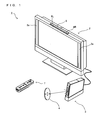
- the input/output processor 11a is connected to the extension connector 20 and the external memory card connector 21.
- the extension connector 20 is a connector for interface, such as a USB or a SCSI, and allows communication with the network by connecting thereto a media such as an external storage media, connecting thereto a peripheral device such as another controller, and/or connecting thereto a wired communication connector, without using the wireless communication module 18.
- the external memory card connector 21 is a connector for connecting thereto an external storage media such as a memory card.
- the input/output processor 11a accesses an external storage media through the extension connector 20 or the external memory card connector 21 so as to store data or read data.
- the system LSI 11 reboots a boot program of the game apparatus body 3.
- the eject button 26 is connected to the disk drive 14.
- the optical disc 4 is ejected from the disk drive 14.
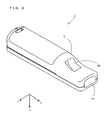
- the cross key 72a is an operation section for outputting an operation signal in accordance with the aforementioned direction input operation performed by a player
- an operation section which includes four push switches so as to form a cross, and outputs an operation signal in accordance with a push switch pressed by a player
- an operation section including not only the four push switches but also a center switch provided at the center of the cross may be provided.
- the cross key 72a may be replaced with an operation section which includes an inclinable stick (so-called joystick) projecting from the top surface of the housing 71 and outputs an operation signal in accordance with the inclining direction of the stick.
- the operation buttons 72a, 72b, 72c, 72d, 72e, 72f and 72g are assigned with respective operation functions in accordance with the game program executed by the game apparatus body 3.
- the operation buttons 72b, 72c and 72d are arranged in a line at the center in the front-rear direction on the top surface of the housing 71.
- the operation buttons 72e, 72f and 72g are arranged in a line in the left-right direction between the operation buttons 72b and 72d on the top surface of the housing 71.
- the operation button 72f has a top surface thereof buried in the top surface of the housing 71, so as not to be inadvertently pressed by the player.
- a sound hole for externally outputting a sound from a speaker (speaker 706 shown in FIG. 5 ), which will be described below, is provided between the operation buttons 72e, 72f, and 72g and the operation button 72b.
- a recessed portion is formed on a bottom surface of the housing 71.
- the recessed portion provided on the bottom surface of the housing 71 is formed at a position at which an index finger or middle finger of the player is located when the player holds the controller 7 with one hand so as to face the front surface of the controller 7 to the markers 8L and 8R.
- an operation button 72i is provided on a slope surface of the recessed portion.
- the operation button 72i is an operation section acting as, for example, a B button.
- the imaging information calculation section 74 is a system for analyzing image data taken by the controller 7 and detecting for the centroid, the size and the like of an area having a high brightness in the image data, and the imaging information calculation section 74 has, for example, a maximum sampling period of about 200 frames/sec. , and therefore can trace and analyze even a relatively fast motion of the controller 7.
- the structure of the imaging information calculation section 74 will be described later in detail.
- the connector 73 is provided on a rear surface of the housing 70.
- the connector 73 is, for example, an edge connector, and is used for, for example, engaging and connecting with a connecting cable.
- the up/down direction of the controller 7 is defined as the y-axis direction, and a direction toward the top surface (the surface on which the operation button 72a and the like are provided) of the housing 71 is defined as a y-axis positive direction.
- the left/right direction of the controller 7 is defined as the x-axis direction, and a direction toward the left side surface (the side surface which is not shown in FIG. 3 but shown in FIG. 4 ) of the housing 71 is defined as an x-axis positive direction.
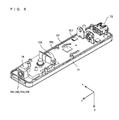
- FIG. 5 is a perspective view illustrating, as viewed from the rear surface side of the controller 7, a state where an upper housing (a part of the housing 71) of the controller 7 is removed.
- FIG. 6 is a perspective view illustrating, as viewed from the front surface side of the controller 7, a state where a lower housing (a part of the housing 71) of the controller 7 is removed.
- FIG. 6 is a perspective view illustrating a reverse side of a substrate 700 shown in FIG. 5 .
- the substrate 700 is fixed inside the housing 71, and on a top main surface of the substrate 700, the operation buttons 72a, 72b, 72c, 72d, 72e, 72f, 72g and 72h, an acceleration sensor 701, the LEDs 702, an antenna 754 and the like are provided. These elements are connected to a microcomputer 751 (see FIGS. 6 and 7 ) and the like via lines (not shown) formed on the substrate 700 and the like.
- the microcomputer 751 functions as exemplary button data generation means of the present invention so as to generate operation button data in accordance with a type of the operation button 72a or the like.
- This mechanism is widely known, and, for example, is realized by the microcomputer 751 detecting for line contact or line disconnection, which is performed by using a switch mechanism such as a tact switch provided under a key top. More specifically, for example, when the operation button is pressed, a current flows by the line contact, and the microcomputer 751 detects for an operation button connected to a line through which the current flows, and generates a signal in accordance with the type of the operation button.
- the imaging information calculation section 74 includes an infrared filter 741, a lens 742, the image pickup element 743 and an image processing circuit 744 located in order, respectively, from the front surface of the controller 7 on the bottom main surface of the substrate 700.
- the connector 73 is attached.
- a sound IC 707 and the microcomputer 751 are provided on the bottom main surface of the substrate 700.
- the sound IC 707 which is connected to the microcomputer 751 and the amplifier 708 via lines formed on the substrate 700 and the like, outputs a sound signal to the speaker 706 via the amplifier 708 based on the sound data transmitted from the game apparatus body 3.
- a vibrator 704 is provided on the bottom main surface of the substrate 700.
- the vibrator 704 is, for example, a vibration motor or a solenoid.
- the vibrator 704 is connected to the microcomputer 751 via lines formed on the substrate 700 or the like such that the operation of the vibrator 704 is on or off in accordance with vibration data transmitted from the game apparatus body 3.
- the controller 7 is vibrated by an actuation of the vibrator 704, and the vibration is conveyed to the player's hand holding the controller 7, and thus a so-called vibration-feedback game is realized.
- the vibrator 704 is disposed slightly toward the front of the housing 71, thereby allowing the housing 71 held by the player to strongly vibrate, that is, allowing the player to easily feel the vibration.
- the controller 7 includes a communication section 75 in addition to the operation section 72, the imaging information calculation section 74, the acceleration sensor 701, the vibrator 704, the speaker 706, the sound IC 707, and the amplifier 708 as described above.
- the acceleration detectionmeans are capable of detecting for only acceleration (linear acceleration) along a straight line corresponding to each axis of the acceleration sensor.
- a direct output of the acceleration sensor 701 is limited to signals indicative of linear acceleration (static or dynamic) along each of the two or three axes thereof.
- the accelerationsensor701 cannot directly detect movement along a non-linear (e.g. arcuate) path, rotation, rotational movement, angular displacement, tilt, position, attitude or any other physical characteristic.
- the controller When the controller is actually in the static state, it is possible to determine whether or not the controller tilts relative to the gravity direction and to also determine a degree of the tilt, based on the acceleration having been detected. Specifically, when a state where 1G (gravitational acceleration) is applied to a detection axis of the acceleration sensor in the vertically downward direction represents a reference, it is possible to determine whether or not the controller tilts relative to the vertically downward direction, based on only whether or not 1G is applied in the direction of the detection axis of the acceleration sensor. Further, it is possible to determine a degree to which the controller tilts relative to the vertically down ward direction, based on a magnitude of the acceleration applied in the direction of the detection axis.
- 1G gravitational acceleration
- the acceleration sensor capable of detecting an acceleration in multiaxial directions subjects, to a processing, the acceleration signals having been detected in the respective axes so as to more specifically determine the degree to which the controller tilts relative to the gravity direction.
- the processor may calculate, based on the output from the acceleration sensor 701, data representing an angle at which the controller 7 tilts, an approximate degree to which the controller 7 tilts may be inferred based on the output from the acceleration sensor 701 without calculating the data representing the angle of the tilt.
- the acceleration sensor 701 is used in combination with the processor, the tilt, attitude, or position of the controller 7 can be determined.
- the type of the value calculated as the tilt is also very different between a gyro sensor and an acceleration sensor; i.e., the value is an angle when a gyro sensor is used and is a vector when an acceleration sensor is used. Therefore, when a gyro sensor is used instead of an acceleration sensor or vice versa, data on tilt also needs to be processed through a predetermined conversion taking into account the fundamental differences between these two devices. Due to the fact that the nature of the gyro sensor is known to one skilled in the art, as well as the fundamental differences between the acceleration detection means and the gyro sensor, further details are not provided herein. While a gyro-sensor is advantageous in that a rotation can be directly detected, an acceleration sensor is generally more cost effective when used in connection with the controller described herein.
- the communication section 75 includes the microcomputer 751, a memory 752, the wireless module 753 and the antenna 754.
- the microcomputer 751 controls the wireless module 753 for wirelessly transmitting the transmission data while using the memory 752 as a storage area during the process. Further, the microcomputer 751 controls operations of the sound IC 707 and the vibrator 704 based on data having been received from the game apparatus body 3 by the wireless module 753 via the antenna 754.
- the sound IC 707 processes sound data transmitted from the game apparatus body 3 via the communication section 75, and the like.
- the microcomputer 751 actuates the vibrator 704 in accordance with, for example, vibration data (for example, a signal for powering the vibrator 704 ON or OFF) transmitted from the game apparatus body 3 through the communication section 75.
- Data from the controller 7 including an operation signal (key data) from the operation section 72, acceleration signals (x, y, and z-axis direction acceleration data: hereinafter, simply referred to as acceleration data) from the acceleration sensor 701, and the process result data from the imaging information calculation section 74 are outputted to the microcomputer 751.
- the microcomputer 751 temporarily stores the input data (key data, acceleration data, and process result data) in the memory 752 as the transmission data which is to be transmitted to the communication unit 6.
- the wireless transmission from the communication section 75 to the communication unit 6 is performed at regular time intervals, and game process is generally performed at a cycle of 1/60 sec., and therefore the wireless transmission needs to be performed at a cycle of a shorter time period.
- the game process unit is 16.7 ms (1/60 sec.), and the transmission interval of the communication section 75 structured using the Bluetooth (registered trademark) is, for example, 5 ms.
- the microcomputer 751 outputs the transmission data stored in the memory 752 as a series of operation information to the wireless module 753.
- the wireless module 753 uses, for example, the Bluetooth (registered trademark) technology to modulate the operation information onto a carrier wave of a predetermined frequency, and radiates the radio wave signal from the antenna 754.
- data from the controller 7 including the key data from the operation section 72, the acceleration data from the acceleration sensor 701, and the process result data from the imaging information calculation section 74 are modulated onto the radio wave signal by the wireless module 753 and transmitted from the controller 7.
- the communication unit 6 of the game apparatus body 3 receives the radio wave signal, and the game apparatus body 3 demodulates or decodes the radio wave signal to obtain the series of operation information (the key data, the acceleration data, and the process result data). Based on the obtained operation information and the game program, the CPU 10 of the game apparatus body 3 performs the game process.
- the communication section 75 is structured using the Bluetooth (registered trademark) technology
- the communication section 75 can have a function of receiving transmission data which is wirelessly transmitted from another device.
- FIGS. 8 to 16 each shows an exemplary game screen used for the present embodiment.
- a game used for the present embodiment is an action adventure game.
- a player controls a player character in a three-dimensional virtual space, and plays the game in accordance with a predetermined story/scenario which has been previously set by a game developer.
- multiple "puzzles (tricks) " are set at some locations in the virtual space. A player solves the multiple "puzzles" so as to continue the game.
- FIG. 8 is a diagram illustrating a title menu of this game.
- the “game” is an option for playing the game in a normal manner.
- the “digest” is an option for presenting a digest of a main content (storyline, flow of scenario) of the game from the beginning through the end. Further, this game is divided, in advance, into “scenes” based on the flow of the scenario.
- the “scene menu” is an option for allowing selection of a predetermined "scene” so as to start the game play from the selected scene. A player is allowed to select a desired one from the three options.
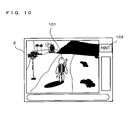
- FIG. 10 shows an exemplary game screen displayed when the game is started by selecting one of "start” or "load”.
- a three-dimensional virtual game space is displayed on the television 2, and a player character 101 is also displayed therein. Further, a hint button 102 is displayed on the upper right portion of the screen. A player controls a player character 101 on the screen by using the controller 7 so as to play the game.
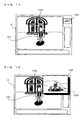
- FIG. 11 shows an exemplary scene in which the "puzzle” is set.
- how to open a door 103 is set as the "puzzle”.
- the player needs to solve the "puzzle” in some manner so as to open the door 103 and continue the game.
- it is necessary to press a switch provided at a predetermined position on a floor.
- a player may press the hint button 102.
- a relatively small window 104 is displayed in a portion of the upper right area of the screen so as to reproduce moving images (hereinafter, referred to as an approach movie) indicating how to open the door 103.
- an approach movie representing a state where the player character 101 moves onto a switch 105 provided on the floor for opening the door 103, and stands on the switch 105 (that is, presses the switch 105) is reproduced.
- the player can know how to open the door 103. Therefore, the player moves the player character 101 to the switch 105 provided on the floor, and causes the player character 101 to stand thereon, as indicated by the approach movie, so as to open the door 103, thereby continuing the game.
- the player when, for example, a player cannot find how to solve the puzzle, and therefore does not continue the game, the player is allowed to press the hint button, so that the approach movie indicating, for example, how to solve the puzzle for the scene is reproduced.
- the player may play the game to the end without becoming stuck with the game, and the player may clear the game.
- the approach movie indicates, as an actual example, how to solve the puzzle, or the like (that is, how to solve the puzzle is demonstrated), and therefore the player may understand how to solve the puzzle, or the like, more easily as compared to a case where a hint or the like is indicated by using character information only. Further, the player may enjoy the presented approach information as it is.
- FIG. 13 shows an exemplary game screen displayed when the "digest” is selected.
- a digest movie is displayed in a movie area 110, and a scene name 111 representing a current scene is displayed below the movie area 110.
- the digest movie includes, for example, a "played moving image” representing a recorded image of a game screen obtained by a game developer having actually played the game, an "event movie” which is inserted in the game as necessary, and the like.
- the game is played in accordance with a scenario having a storyline representing the order of "forest” ⁇ “cave” ⁇ “tower” ⁇ “temple”.
- the content of the digest movie is reproduced as a digest such that the game starts with a scene of "forest” and advances to "cave” ⁇ “tower” ⁇ “temple”.
- a player is allowed to know a main game story and scenario, and a game plot by viewing the digest movie.
- the operation button 72d while the digest movie is being reproduced, the player is allowed to play the game from the scene being reproduced at this time. For example, it is assumed that, when fifteen minutes has passed from the start of the reproduction of the digest movie, a played moving image for "temple" corresponding to one of stages of the game is being reproduced. At this time, when a player presses the operation button 72d, an inquiry message 112 for inquiring whether or not the game is to be played from this scene is displayed as shown in FIG. 14 . When a player responds positively to the message, the saved data (hereinafter, referred to as digest saved-data) for digest, which has been previously set, is read.
- digest saved-data the saved data for digest
- the digest saved-data are saved data which is previously set so as to correspond to the scenes, respectively, in the game.
- the saved data having been previously set is read. Therefore, a level and various statuses (parameter such as HP) of the player character are advanced to some degree as compared to those provided when the game is started. Further, items which may belong to the player character when the game has been normally played and advanced to the temple are set as items belonging to the player character.
- saved data to be used when attacking against the temple is ready is read. It is possible to start the game from the scene of "temple" by reading the digest saved-data described above.
- a player is allowed to know the outline of the game content by viewing the digest movie. Further, when a player desires to play the game from a certain scene of the digest movie being reproduced, the player is allowed to start the game from the scene. Therefore, a player can not only know the entire outline of the game content but also play the game from a scene desired by the player, so that the player can more easily enjoy the game. As described above, saving is not allowed in the "digest mode" during the game play, and therefore it is possible to prevent a player who desires to clear the game by him/herself, or a player who desires to thoroughly play the game from reducing his/her interest in the game.
- a player who desires to easily play the game or a player who dose not have a lot of time for the game is allowed to easily enjoy the game by selecting the "digest” (or "scene menu” described below).
- a player who desires to enj oy the game as much as possible is allowed to thoroughly enjoy, by selecting the "game", the game including, for example, a trick event, and a sub-story (elements other than the main game story) which are not provided in the "digest”.
- data of the game obtained by his/her own attacking can be stored as saved data.
- FIG.15 shows an exemplary screen displayed when the "scene menu” is selected.
- a list 151 indicating scene names is displayed on almost a left half of the screen (the list 151 can be scrolled because all the scene names cannot be simultaneously displayed).
- the "scene” is obtained by dividing the scenario of this game.
- the scenario of this game includes a scene of "cave”, and the "cave” includes a first aboveground level, a first underground level, and a second underground level.
- the game may be divided into "scene 1" representing a scene in which the first aboveground level is attacked and the first underground level is just reached, "scene 2" representing a scene in which the first underground level is attacked, and the second underground level is just reached, "scene 3” representing a scene in which the second underground level is attacked and a location immediately preceding a deepest portion, of the cave, occupied by a boss character is just reached, and "scene 4" representing a scene of a fight against the boss character.
- the digest saved-data correspond to the scenes, respectively. Furthermore, the corresponding digest saved-data is reproduced from the opening portion of each scene.
- the digest saved-data corresponding to "scene 1" is saved data which is reproduced from the entrance to the cave.
- the digest saved-data corresponding to "scene 2" is saved data which is reproduced from the arrival at the first underground level of the cave.
- the digest saved-data corresponding to "scene 3” is saved data which is reproduced from the arrival at the second underground level of the cave
- the digest saved-data corresponding to "scene 4" is saved data which is reproduced from a location immediately preceding a location occupied by the boss character. A player is allowed to start the game from the opening portion of a desired scene in the game by loading the digest saved-data.
- FIG. 15 when a desired scene name is designated by a cursor, a moving image 152 representing a content of the scene is reproduced to the right of the scene names.
- the content of the moving image 152 represents a part of the scene designated by the cursor.
- the digest saved-data is set based on an assumption that the game has been played up to the scene, and the level of and the items belonging to the player character are set based on each scene. Therefore, a player can play the game without feeling unnatural and becoming stuck with the game as compared to a case where a game is played by using a player character in an initial state (a state immediately after the game is started).
- FIG. 17 is a diagram illustrating a memory map of the external mainmemory 12 of the game apparatus body 3.
- the external main memory 12 includes a program storage area 121, a data storage area 124, and a work area 132.
- Data of the program storage area 121 and the data storage area 124 are stored in the optical disc 16, and is transmitted to and stored in the external main memory 12 when the game program is executed.
- each data is described as a form of table data. However, the data need not to be stored in a form of table data in practice, and a process of contents represented by the table may be stored.
- the program storage area 121 stores a game program to be executed by the CPU 10, and the game program includes a game main program 122, a movie reproduction program 123, and the like.
- the game main program 122 is a program for a process of a flow chart which is shown below in FIG. 25 .
- the movie reproduction program 123 is a program for decoding and reproducing data representing, for example, a moving image and a sound having been compressed and encoded.
- the movie reproduction program 123 is used for reproducing a moving image file such as the approach movie and the digest movie described above.
- the data storage area 124 stores data such as game main data 125, a puzzle table 126, an approach movie 127, a digest movie 128, a digest movie correspondence table 129, digest saved-data 130, and a scene table 131.
- the game main data 125 represents data necessary for the game process performed when the "game" is selected from the title menu shown in FIG. 8 .
- the game main data 125 includes data (position data, various parameters, and the like) associated with the player character 101, an opponent character, and the like, appearing in the game, data (topography data and the like) associated with a virtual game space, image data, audio data, and the like.
- the puzzle table 126 is data representing correspondences among locations at which the "puzzles" are set in the game, contents of the "puzzles", and the approach movies which represent the "puzzles” and indicate how to solve the "puzzles", respectively.
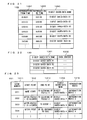
- FIG. 18 is a diagram illustrating an exemplary data structure of the puzzle table 126.
- the puzzle table 126 includes a location 1261, a puzzle number 1265, a puzzle content 1266, an approach movie name 1267, and a scene number 1268.
- the location 1261 represents data indicating a location (area), in the virtual game space, at which a puzzle is set.
- the location 1261 further includes an area name 1262, a base point name 1263, and a specific location name 1264.
- a puzzle 1 is set at a house of a village head (the specific location name 1264) of ⁇ village (the base point name 1263) in ⁇ area (the area name 1262).
- the puzzle number 1265 is a number for identifying each "puzzle”
- the puzzle content 1266 is data representing a specific content of each "puzzle”.
- the content such as a content that a predetermined switch needs to be pressed so as to open a door, and a content that a predetermined enemy needs to be eliminated so as to transfer to another world, are defined in the puzzle content 1266.
- the approach movie name 1267 represents a name of the approach movie corresponding to each "puzzle”.
- the scene number 1268 is a number for identifying a scene in which each "puzzle" is set.
- the scene number 1268 corresponds to a scene number 1311 of the scene table 131 described below.
- FIG. 19 is a diagram illustrating an exemplary data structure of the approach movie 127.
- An approach movie name 1271 represents a name for identifying each approach movie, and corresponds to the approach movie name 1267 of the puzzle table 126.
- a movie content 1272 represents a specific movie content.
- the movie content 1272 represents video/audio data which are compressed and encoded based on a predetermined standard such as MPEG-2.
- the digest movie 128 is a movie reproduced when the "digest" is selected from the title menu shown in FIG. 8 .
- FIG. 20 is a diagram conceptually illustrating an exemplary structure of the digest movie. The time shown in FIG. 20 is represented by "hour:minute: second". The digest movie shown in FIG. 20 indicates that a video into which a course from the start of the game to arrival at 00 village is digested is reproduced from the start of the reproduction to 0:01:00. Further, it is indicated that a video representing a state where puzzle 1 is solved in ⁇ village is reproduced from 0:01:00 to 0:02:00.
- a video (event movie) representing an event which happens in ⁇ village is reproduced from 0:02:00 to 0:03:30.
- the order in which the scenes of the game are reproduced is based on a flow of the story/scenario which is previously set by a developer.
- the digest movie correspondence table 129 is a table for defining correspondence between a portion, of a video of the digest movie, to be reproduced, and the digest saved-data 130 described below.
- the digest movie correspondence table 129 is a table in which the digest saved-data 130 to be read in response to the instruction for start being issued during reproduction of the digest movie are defined so as to correspond to the scenes, respectively, of the digest movie.
- FIG. 21 is a diagram illustrating an exemplary data structure of the digest movie correspondence table 129.
- the digest movie correspondence table 129 includes a reproduction from-time 1291 and a reproduction to-time 1292, and a digest saved-data name 1293.
- the reproduction from-time 1291 and the reproduction to-time 1292 are data indicating a time range representing an elapsed time from the start of the reproduction of the digest movie.
- the time range is a range from a time at which one minute has passed from the start of the reproduction of the digest movie to a time immediately preceding a time at which two minutes passes from the start of the reproduction of the digest movie.
- the digest saved-data name 1293 represents data used for designating the digest saved-data to be read when an instruction for game play is issued in a time range from the reproduction from-time 1291 to the reproduction to-time 1292.
- the range of the digest movie is defined by using the elapsed time from the start of the reproduction, the present invention is not limited thereto.
- the range may be defined by using a frame number of the reproduced moving image.
- the digest saved-data 130 represents saved data which is previously set in accordance with the flow of the game.
- FIG. 22 is a diagram illustrating an exemplary data structure of the digest saved-data 130.
- the digest saved-data name 1301 is a name for uniquely identifying each digest saved-data, and corresponds to the digest saved-data name 1293 of the digest movie correspondence table 129.
- the data content 1302 represent a specific content of the saved data.
- the data content 1302 includes data representing a level of the player character, items belonging to the player character, a current location thereof in the virtual game space, an event scene having been cleared, and the like, based on each scene.
- the scene table 131 represents a table for defining each scene in the game.
- the scene table 131 represents data mainly used in the "scene menu" screen as shown in FIG. 15 .
- FIG. 23 is a diagram illustrating an exemplary data structure of the scene table 131.
- the scene table 131 is a collection of a scene number 1311, a start point 1312, an end point 1313, digest saved-data name 1314, and an introduction movie 1315.
- the scene number 1311 is a number for identifying each scene.
- the start point 1312 and the end point 1313 represent data indicating a range of each scene in the game (scenario). In the example shown in FIG.
- a scene from the start of the game to clearing of puzzle 1 is defined as one scene (corresponding to scene number "001").
- the digest saved-data name 1314 corresponds to the digest saved-data name 1301 of the digest saved-data 130.
- the introduction movie 1315 represents movie data (corresponding to a moving image 122 shown in FIG. 15 ) for introducing a content of each scene. The opening portion of each scene is stored as the movie data.
- the work area 132 is an area for storing various data, flags and the like, which are temporarily used in the game process.
- progress information 133 and the like are stored in the work area 132.
- the progress information 133 represents data associated with the progress state of the game being currently played by a player, and includes a puzzle number 134, a scene number 135, and the like.
- the puzzle number 134 represents data indicating whether or not a "puzzle” as described above is set at a location, in the virtual space, at which the player character is currently positioned, and in a scene, in the game, in which the player character currently appears, and indicating, when the "puzzle” is set, the location corresponding to the "puzzle".
- the puzzle number 134 corresponds to the puzzle number 1265 of the puzzle table 126. Further, when the hint button 102 is pressed, the data is referred to so as to retrieve the approach movie corresponding to the "puzzle".
- the scene number 135 represents data corresponding to the scene number 1311 of the scene table 131, and represents data indicating a scene being currently played by a player.
- the work area 132 stores various data, flags, and the like which are temporarily used during the game process.
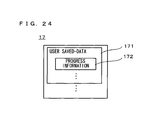
- FIG. 24 is a diagram illustrating a memory map of the flash memory 17 shown in FIG. 2 .
- the flash memory 17 is a non-volatile memory, and the data described below are not eliminated but held even when the game apparatus body 3 is powered off.
- the flash memory 17 stores user saved-data 171 and the like. The data may be transferred to and stored in the external main memory 12 when the game program is executed.
- the user saved-data 171 is data representing a progress state of a game. In the game process started by selecting the "game" from the title menu, the saved data is generated or updated by, for example, an instruction for saving being issued from a player.
- the progress information 172 included in the user saved-data 171 corresponds to the progress information 133, in the work area 132, stored as a part of the user saved-data 171.
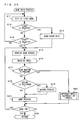
- FIG. 25 is a flow chart showing the game process performed after the process steps described above are completed.
- step S1 when the execution of the game program is started, the title menu (refer to FIG. 8 ) is firstly displayed. Then, an input (selection of a menu option) from a player is received (step S1). When the input from the player is received, a selected option is then determined. Initially, whether or not the "game” is selected is determined (step S2). When a result of the determination indicates that the "game” is selected (YES in step S2), a game main process (step S3) is performed as described below.
- step S4 determines whether or not the "digest” is selected.
- a digest process step S5 is performed as described below.
- step S4 when it is determined in step S4 that the "digest” is not selected (NO in step S4), whether or not the "scene menu” is selected is then determined (step S6).
- step S6 When a result of the determination indicates that the "scene menu” is selected (YESinstepS6), ascenemenuprocess (stepS7) is performed as describe below.
- step S8 determines whether or not the game process is to be ended.
- the determination represents YES
- the game process according to the present embodiment is ended, and when the determination represents NO, the process is returned to step S1 and the game process is repeated.
- step S12 whether or not a player selects the "load” from the start menu is determined.
- a result of the determination indicates that the player selects the "load” (YES in step S12)
- predetermined user saved-data is read in accordance with a player's operation (step S13).
- the game is started, and a game screen is displayed (step S15).
- a game process other than the approach movie reproduction process is performed, for example, various processes for the general game process, such as a process for moving the player character 101 or a process for causing the player character 101 to perform attacking, based on the input from the player, are performed.
- the scene number 135 of the progress information 133 is updated as necessary so as to indicate a scene being currently played by a player.
- the puzzle number 1265 corresponding to the puzzle is read from the puzzle table 126, and copied and set to the puzzle number 134 of the progress information 133.
- step S18 the approach movie reproduction process of step S18 will be described in detail with reference to a flow chart shown in FIG. 27 .
- the puzzle number 134 is read from the progress information 133 of the work area 132 (step S31) . Whether or not the puzzle number 134 indicates "NULL” is determined (step S32).
- step S32 Whether or not the puzzle number 134 indicates "NULL” is determined.
- the result of the determination indicates that the puzzle number 134 indicates "NULL” (YES in step S32)
- a process for indicating that no hint is provided is performed (step S33)
- the approach movie process is ended.
- the puzzle number is determined for each frame, and when the puzzle number 134 indicates "NULL", the hint button 102 may not be displayed.
- step S34 a process for retrieving the approach movie name 1267 from the puzzle table 126 based on a value set to the puzzle number 134 is performed (step S34) .
- the puzzle table 126 is accessed so as to retrieve the puzzle number 1265 corresponding to the value of the puzzle number 134 of the progress information 133.
- the approach movie name 1267 of the puzzle number 1265 having been retrieved is acquired.
- the movie content 1272 is read from the approach movie 127 based on the approach movie name 1267 (step S35) .
- the window 104 (refer to FIG. 12 ) for reproducing the approach movie is generated, and a process for reproducing the movie content 1272 is performed by using the window. That is, the approach movie is reproduced (step S36).
- step S22 whether or not the game main process is to be ended is determined.
- the determination represents YES
- the game main process is ended, and when the determination represents NO, the process is returned to step S15, and the process is repeated. This is the end of the game main process.
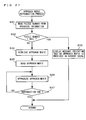
- step S5 the digest process of step S5 will be described in detail with reference to a flow chart shown in FIG. 28 .
- the digest movie 128 is read from the external main memory 12 (step S41).
- step S42 a screen for digest as shown in FIG. 13 is generated, and the process for reproducing the digest movie is performed (step S42) .
- the reception of an input from a player is simultaneously started.
- step S43 whether or not a player presses a predetermined button, such as the operation button 72d, while the digest movie is being reproduced is determined.
- the input is referred to as a digest start instruction
- a digest start instruction starting a game from halfway while the digest movie is being reproduced is referred to as a digest start.
- step S44 whether or not the reproduction of the digest movie is completed is then determined.
- the reproduction of the digest movie has not been completed (NO in step S44)
- the process is returned to step S42, and the reproduction of the digest movie is continued.
- step S43 when the digest start instruction is issued (YES in step S43), an inquiry screen, as shown in FIG. 14 , for inquiring whether or not the digest start is to be made is then displayed, and the input from the player is received (step S45) . At this time, the reproduction of the digest movie is stopped.
- step S46 determines whether or not the input content indicates an instruction for "digest start" (for example, whether or not "YES” is selected on the screen shown in FIG. 14 ) (step S46).
- step S46 determines whether or not the input content does not indicate an instruction for "digest start" (NO in step S46)
- the process is returned to step S42, and the reproduction of the digest movie is continued.
- step S46 when a result of the determination indicates that the input content indicates an instruction for "digest start" (YES in step S46), a reproduction position at which the digest movie is being currently reproduced is detected (step S47) . An elapsed time from the start of the reproduction of the digest movie is acquired, and the reproduction position at which the digest movie is being currently reproduced is detected based on the elapsed time.
- step S49 the game process in the digest mode described above is started based on the digest saved-data having been read (step S49). That is, the game process is performed in a state where no saving is allowed.
- the digest mode when an operation for saving is performed while the game is being played, nothing is performed and information that no saving is allowed is displayed, or a display for saving is not performed so as to prevent a user from performing an operation for saving.
- step S50 whether or not an instruction for ending a game in the digest mode is issued is determined.
- NO in step S50 no instruction for ending is issued
- the process is returned to step S39, and the game process in the digest mode is continued.
- the instruction for ending is issued (YES in step S50)
- the digest process is ended.
- step S7 the scene menu process of step S7 will be described in detail with reference to a flow chart shown in FIG. 29 .
- the scene table 131 is read from the external main memory 12 (step S61).
- a screen for listing and displaying the scenes in the game is generated based on the scene table 131 (step S62) .
- the list screen is displayed, and an input from a user is received (step S63).
- a cursor is designating scene 001 displayed at the top of the screen.
- the introduction movie 1315 for introducing the opening portion of the scene designated by the cursor is read and reproduced.
- step S64 When a user makes an input on the list screen, whether or not the input content represents an input for selecting one of the scenes is determined (step S64). When a result of the determination indicates that no scene is selected (NO in step S64), whether or not an instruction for ending the scene menu is inputted is subsequently determined (step S65). When a result of the determination indicates that no instruction for ending is issued (NO in step S65), the process is returned to step S63, and when the instruction for ending is issued (YES in step S65), the scene menu process is ended.
- step 64 when it is determined in step 64 that one of the scenes is selected (YES in step S64), an inquiry screen as shown in FIG. 16 is then displayed, and an input from a player is received (step S66).
- step S66 When a player makes an input in response to the inquiry screen, whether or not the input content indicates an instruction for "game start” (for example, whether or not "YES” is selected on the screen shown in FIG .16 ) is determined (step S67) .
- step S67 When a result of the determination indicates that the input content does not indicate an instruction for "game start” (NO in step S67), the process is returned to step S63, and the list screen is displayed.
- the digest saved-data name 1314 corresponding to the selected scene is acquired from the scene table 131.
- the data content 1302 is retrieved from the digest saved-data 130 based on the digest saved-data name 1314, and is read as a part of the progress information 133 of the work area 132 (step S68).
- step S69 the game process is started in the digest mode based on the digest saved-data having been read.
- step S70 whether or not the instruction for ending the game in the digest mode is issued is determined.
- the process is returned to step S59, and the game process in the digest mode is continued.
- the instruction for ending is issued (YES in step S70)
- the scene menu process is ended.
- the player when a player cannot find how to solve the "puzzle" which is set in the game, the player is allowed to view, in the scene, moving images for indicating how to solve the puzzle when the player desires to. Therefore, a player that cannot find how to solve the "puzzle” may not become stuck with the game, and reduction, due to the puzzle being unsolved, in motivation for clearing the game may be prevented. Thus, a player unaccustomed to a game or a player that does not have a lot of time for game play is allowed to play and clear the game to the end.
- a content (the scenario or the story) of the game can be roughly known from the digest movie, and further the game can be played from a desired scene in the digest movie.
- a player knows the flow of the preceding story or the like, and therefore a state where a player does not know the storyline preceding the middle of the story can be prevented and the player is allowed to play the game in natural manner.
- a player that does not have a lot of time for playing a large volume of game can easily enjoy the large volume of game.
- An image quality of the approach movie may be reduced as compared to a general game screen. For example, when a frame rate of a general game screen is set to 60 fps, a frame rate of the approach movie may be set to 15 fps. Further, the resolution of the approach movie may be set so as to be reduced. That is, the "visual quality" of the approach movie may be set so as to be degraded as compared to an actual game screen. Thus, a player is prevented from being sat is fied by viewing, in the approach movie, a scene in which the puzzle is solved. A player that desires to view, with increased image quality, the scene in which the puzzle is solved may think that the player needs to operate and play the game by him/herself, so that the player may keep his/her motivation for the game play.
- the game process may be temporarily stopped, or a player may be allowed to operate the player character. Further, when the game process is temporarily stopped, the approach movie may be displayed full-screen.
- the approach movie may be provided such that operation data representing the same movement as a movement of the player character in the approach movie is previously generated, and the player character is moved in a window for reproducing the approach movie, based on the operation data.
- the size of a file can be reduced as compared to a case where a moving image file is reproduced.
- the content of the approach movie may represent, as moving images, a content (game approach information) useful for continuing the game in addition to a method for solving a predetermined puzzle (trick).
- the content of the approach movie may be moving images for indicating how to fight against a boss character which is eliminated only by attacking a predetermined weak point.
- the content of the approach movie may be moving images indicating rocks to be pressed, and the order in which the rocks are to be pressed, so as to jump over a valley in which a lot of rocks to be pressed are scattered.
- any approach movie representing game approach information for preventing the game from becoming stuck may be used.
- approach information represents an actual movement of a player character, a player may not become stuck with the game.
- a player unaccustomed to a game or a player that does not have a lot of time for game play may smoothly play the game, and continue to play a large volume of game to the end so as to clear the game.
- the use of the digest saved-data may not be allowed for a certain initial time period (immediately after the game is purchased). For example, although the digest saved-data cannot be used immediately after the game is purchased, a plurality of pieces of the digest saved-data may be gradually used in accordance with a time period in which the game has been played. In this case, the digest saved-data are set so as not to be used when the game is shipped.
- the flash memory 17 of the game apparatus body 3 purchased by a player stores the total cumulative time period obtained by adding the time periods in which the game has been played.
- the total cumulative time period during which the game has been played is read from the flash memory 17 every time the game is started, and when the total cumulative time period during which the game has been played is greater than a predetermined time period, the use of the digest saved-data may be allowed.
- the ending portion of the game cannot be played from the beginning, so that a player may not reduce his/her interest in the game, and when a user, who cannot continue the game, almost gives up the game halfway, the use of the digest saved-data is allowed, thereby enhancing the motivation of the player.
- the use of the digest saved-data may be allowed when a predetermined time period has passed from the release date of the game, or from a date on which the game is played for the first time as well as the use of the digest saved-data may be allowed based on the total time period during which the game has been played.
- the digest saved-data can be used regardless of the play time of each player, and therefore, when a predetermined time period has passed, a player who desires to clear the game by him/herself at first but has stopped playing the game halfway, or the like, is allowed to use the digest saved-data for playing the game to the end.
- the digest saved-data can be used, so that a user who desires to clear the game by him/herself may not lose his/her interest in the game.
- the "digest” is set so as not to be selected from the title menu shown in FIG. 8 for a certain initial time period. Only when the predetermined time period as described above has passed, the "digest” may be selected from the title menu shown in FIG. 8 .
- the digest saved-data may not be stored in the optical disc 4, and may be distributed through the network.
- a server for storing and distributing the digest saved-data is provided.
- the game apparatus body 3 is allowed to access the server by using the wireless communication module 18 of the game apparatus body 3 through, for example, the Internet.
- the digest saved-data may be downloaded from the server, and stored in the flash memory 17.
- the digest saved-data may not be stored in the flash memory 17, and may be used only when the game apparatus body 3 is connected to the network. For example, when the "scene menu" is selected from the title menu shown in FIG. 8 , the game apparatus body 3 may be automatically connected to the network.
- the digest saved-data is acquired from the server, and the screen as shown in FIG. 15 may be displayed based on the digest saved-data. Also in this case, the ending portion of the game is not allowed to be played from the beginning, so that a player may not reduce his/her interest in the game.
- the distribution time may be set such that the digest saved-data is sequentially distributed after a predetermined time period has passed from the release date of the game.
- the digest saved-data can be distributed regardless of the play time of each player, and, therefore, for example, even a player who desires to clear the game by him/herself at first but has stopped playing the game halfway, can download the digest saved-data from the server after the predetermined time period has passed, so that the player may play the game to the end.
- the digest saved-data is distributed after a predetermined time period has passed from the release date, and therefore it is easier to play the game to the end.
- the use of the digest saved-data may be allowed.
- the digest saved-data may be used only when the game has been cleared, and after the predetermined time period as described above has passed, the digest saved-data may be used even when the game has not been cleared.
- a user who desires to clear the game by him/herself is allowed to have an advantage that the user is allowed to view the digest at any time, and play a desired scene.
- the "approach movie” described above as well as the digest saved-data may be distributed through the network. Also in this case, the "approach movie” may be downloaded only when a predetermined time period based on the play time or the like has passed. Thus, a player who has become stuck with the game and has given up clearing the game may play the game again.
- the flash memory 17 or the like stores an operation history of a game play of each player, and each player may be allowed to create his/her own "approach movie” based on the operation history.
- the "approach movie” created by each player may be uploaded to the server.
- the server When the hint button 102 is pressed, the server may be accessed so as to view the "approach movies" created by various players.
- a plurality of methods may be considered as a method for approaching a scene in the game
- a plurality of approach methods including an approach method for which a skilled operation is required, a method in which an approach is made in a relatively easy operation, and the like may be viewed.
- each player may be allowed to edit the moving images in various manners when creating his/her own "approach movie” (for example, character representing comments or the like of the player may be included and simultaneously displayed in the moving images).
- it is possible to create and upload the "approach movie” based on the individual character of each player in addition to simple creation and upload of the "approach movie”.
- it is possible to view various "approach movies” based on the individual character of each player, thereby enhancing interest in the game.
- the game apparatus of the present embodiment is similarly applied as a game apparatus incorporating a monitor, and a personal computer and a workstation functioning as a game apparatus by executing the game program, and the like.
Landscapes
- Engineering & Computer Science (AREA)
- Multimedia (AREA)
- Business, Economics & Management (AREA)
- Computer Security & Cryptography (AREA)
- General Business, Economics & Management (AREA)
- Processing Or Creating Images (AREA)
- User Interface Of Digital Computer (AREA)
Applications Claiming Priority (1)
| Application Number | Priority Date | Filing Date | Title |
|---|---|---|---|
| JP2007176669A JP5358071B2 (ja) | 2007-07-04 | 2007-07-04 | ゲームプログラム、およびゲーム装置 |
Publications (2)
| Publication Number | Publication Date |
|---|---|
| EP2014342A1 true EP2014342A1 (de) | 2009-01-14 |
| EP2014342B1 EP2014342B1 (de) | 2020-07-08 |
Family
ID=39816964
Family Applications (1)
| Application Number | Title | Priority Date | Filing Date |
|---|---|---|---|
| EP08011520.7A Active EP2014342B1 (de) | 2007-07-04 | 2008-06-25 | Computerlesbares Speichermedium mit darauf gespeichertem Spielprogramm und Spielgerät |
Country Status (3)
| Country | Link |
|---|---|
| US (1) | US10751618B2 (de) |
| EP (1) | EP2014342B1 (de) |
| JP (1) | JP5358071B2 (de) |
Cited By (7)
| Publication number | Priority date | Publication date | Assignee | Title |
|---|---|---|---|---|
| WO2021066848A1 (en) * | 2019-10-04 | 2021-04-08 | Google Llc | State share and use between gameplay video and game |
| EP4119209A4 (de) * | 2020-05-30 | 2023-07-19 | Tencent Technology (Shenzhen) Company Limited | Verfahren zum starten eines interaktionsszenarios, vorrichtung, speichermedium, client-ende und server |
| EP4051398A4 (de) * | 2019-11-01 | 2023-11-15 | Sony Interactive Entertainment Inc. | Inhalts-streaming mit spielstart |
| US11896909B2 (en) | 2018-12-14 | 2024-02-13 | Sony Interactive Entertainment LLC | Experience-based peer recommendations |
| US11951405B2 (en) | 2020-05-28 | 2024-04-09 | Sony Interactive Entertainment Inc. | Media-object binding for dynamic generation and displaying of play data associated with media |
| US12070696B2 (en) | 2020-11-09 | 2024-08-27 | Sony Interactive Entertainment Inc. | Replayable activities for interactive content titles |
| US12239909B2 (en) | 2020-05-28 | 2025-03-04 | Sony Interactive Entertainment Inc. | Media-object binding for predicting performance in a media |
Families Citing this family (18)
| Publication number | Priority date | Publication date | Assignee | Title |
|---|---|---|---|---|
| JP5551899B2 (ja) * | 2009-07-14 | 2014-07-16 | 任天堂株式会社 | 情報処理システム、情報処理装置、情報処理プログラム |
| JP5749895B2 (ja) * | 2010-04-05 | 2015-07-15 | 株式会社ソニー・コンピュータエンタテインメント | ゲーム装置 |
| JP5542020B2 (ja) * | 2010-09-22 | 2014-07-09 | 株式会社ソニー・コンピュータエンタテインメント | 情報処理システム、情報処理方法、プログラム及び情報記憶媒体 |
| JP5404677B2 (ja) * | 2011-03-08 | 2014-02-05 | 株式会社ソニー・コンピュータエンタテインメント | データアクセス管理方法およびデータアクセス管理システム |
| US8870661B2 (en) * | 2012-12-21 | 2014-10-28 | Sony Computer Entertainment America Llc | Cloud-based game slice generation and frictionless social sharing with instant play |
| JP6470488B2 (ja) | 2013-09-18 | 2019-02-13 | 任天堂株式会社 | 情報処理プログラム、情報処理装置、情報処理システム、及び情報処理方法 |
| JP2015058136A (ja) | 2013-09-18 | 2015-03-30 | 任天堂株式会社 | 情報処理プログラム、情報処理装置、情報処理システム、及び情報処理方法 |
| CN105359094A (zh) | 2014-04-04 | 2016-02-24 | 微软技术许可有限责任公司 | 可扩展应用表示 |
| EP3131053B1 (de) * | 2014-04-07 | 2020-08-05 | Sony Interactive Entertainment Inc. | Bewegtbildverteilungsvorrichtung für ein spiel, bewegtbildverteilungsverfahren für ein spiel und bewegtbildverteilungsprogramm für ein spiel |
| WO2015154276A1 (en) | 2014-04-10 | 2015-10-15 | Microsoft Technology Licensing, Llc | Slider cover for computing device |
| EP3129868A4 (de) * | 2014-04-11 | 2017-06-14 | Microsoft Technology Licensing, LLC | Erweiterbare anwendungsdarstellung, meilensteine und storylines |
| JP5815073B2 (ja) * | 2014-05-02 | 2015-11-17 | 株式会社ソニー・コンピュータエンタテインメント | クライアント装置、情報処理方法、プログラム及び情報記憶媒体 |
| JP6154527B1 (ja) * | 2016-08-08 | 2017-06-28 | 株式会社ドワンゴ | ゲームサーバ、ゲームシステム制御方法及びゲームシステム制御プログラム |
| US10675544B2 (en) * | 2017-03-31 | 2020-06-09 | Sony Interactive Entertainment LLC | Personalized user interface based on in-application behavior |
| JP6475816B2 (ja) * | 2017-12-28 | 2019-02-27 | 株式会社スクウェア・エニックス | ネットワークゲームシステム、ゲーム装置、及びプログラム |
| JP7222722B2 (ja) * | 2019-01-17 | 2023-02-15 | 株式会社ソニー・インタラクティブエンタテインメント | 情報処理システム、情報処理方法およびコンピュータプログラム |
| US11541317B2 (en) * | 2020-02-06 | 2023-01-03 | Sony Interactive Entertainment Inc. | Automated weapon selection for new players using AI |
| US12539467B2 (en) * | 2023-05-10 | 2026-02-03 | Sony Interactive Entertainment Inc. | Auto capturing of computer game video to generate additional video |
Citations (5)
| Publication number | Priority date | Publication date | Assignee | Title |
|---|---|---|---|---|
| EP1172131A2 (de) * | 2000-03-08 | 2002-01-16 | KCEO Inc. | Eine Videospielvorrichtung, ein Trainingskontrollverfahren für Charakter und ein entsprechendes lesbares Aufzeichnungsmedium |
| JP2002200351A (ja) | 2000-04-28 | 2002-07-16 | Square Co Ltd | キャラクタに対するヒントを表示する処理を実行するゲーム制御方法、記録媒体、ゲーム装置、及び、ゲームプログラム |
| US20030151628A1 (en) * | 2001-10-20 | 2003-08-14 | Salter Hal Christopher | Interactive game providing instruction in musical notation and in learning an instrument |
| WO2006017068A1 (en) * | 2004-07-07 | 2006-02-16 | Wms Gaming Inc. | Wagering game with episodic-game feature for payoffs |
| JP2007176669A (ja) | 2005-12-28 | 2007-07-12 | Mitsubishi Electric Corp | エレベータのかご内位置表示器 |
Family Cites Families (10)
| Publication number | Priority date | Publication date | Assignee | Title |
|---|---|---|---|---|
| GB9517808D0 (en) * | 1995-08-31 | 1995-11-01 | Philips Electronics Uk Ltd | Interactive entertainment personalisation |
| US6166718A (en) * | 1996-06-18 | 2000-12-26 | Konami Co., Ltd. | Video game system with vertical array of cursor images |
| JP3468465B2 (ja) * | 2000-11-15 | 2003-11-17 | 株式会社ソニー・コンピュータエンタテインメント | 情報分岐制御方法、プログラム実行装置、コンピュータに実行させるための情報分岐制御プログラム、及びコンピュータに実行させるための情報分岐制御プログラムを記録した記録媒体 |
| US7156733B2 (en) * | 2002-12-20 | 2007-01-02 | Electronics Arts Inc. | Using shared files in a game console or computer for cross-game state sharing |
| US7214133B2 (en) * | 2003-05-09 | 2007-05-08 | Microsoft Corporation | Method and apparatus for retrieving recorded races for use in a game |
| JP2007503966A (ja) * | 2003-05-13 | 2007-03-01 | エレクトロニック アーツ インコーポレイテッド | モーフターゲットと別の要素からのモーフィングを用いたビデオゲーム内のプレーヤーのカスタマイズ |
| US20060064733A1 (en) * | 2004-09-20 | 2006-03-23 | Norton Jeffrey R | Playing an audiovisual work with dynamic choosing |
| US20060148571A1 (en) * | 2005-01-04 | 2006-07-06 | Electronic Arts Inc. | Computer game with game saving including history data to allow for play reacquaintance upon restart of game |
| US8667395B2 (en) * | 2005-08-19 | 2014-03-04 | Nintendo Co., Ltd. | Method and apparatus for creating video game and entertainment demonstrations with full preview and/or other features |
| US20070099684A1 (en) * | 2005-11-03 | 2007-05-03 | Evans Butterworth | System and method for implementing an interactive storyline |
-
2007
- 2007-07-04 JP JP2007176669A patent/JP5358071B2/ja active Active
-
2008
- 2008-06-25 EP EP08011520.7A patent/EP2014342B1/de active Active
- 2008-06-30 US US12/216,171 patent/US10751618B2/en active Active
Patent Citations (5)
| Publication number | Priority date | Publication date | Assignee | Title |
|---|---|---|---|---|
| EP1172131A2 (de) * | 2000-03-08 | 2002-01-16 | KCEO Inc. | Eine Videospielvorrichtung, ein Trainingskontrollverfahren für Charakter und ein entsprechendes lesbares Aufzeichnungsmedium |
| JP2002200351A (ja) | 2000-04-28 | 2002-07-16 | Square Co Ltd | キャラクタに対するヒントを表示する処理を実行するゲーム制御方法、記録媒体、ゲーム装置、及び、ゲームプログラム |
| US20030151628A1 (en) * | 2001-10-20 | 2003-08-14 | Salter Hal Christopher | Interactive game providing instruction in musical notation and in learning an instrument |
| WO2006017068A1 (en) * | 2004-07-07 | 2006-02-16 | Wms Gaming Inc. | Wagering game with episodic-game feature for payoffs |
| JP2007176669A (ja) | 2005-12-28 | 2007-07-12 | Mitsubishi Electric Corp | エレベータのかご内位置表示器 |
Cited By (9)
| Publication number | Priority date | Publication date | Assignee | Title |
|---|---|---|---|---|
| US11896909B2 (en) | 2018-12-14 | 2024-02-13 | Sony Interactive Entertainment LLC | Experience-based peer recommendations |
| WO2021066848A1 (en) * | 2019-10-04 | 2021-04-08 | Google Llc | State share and use between gameplay video and game |
| EP4051398A4 (de) * | 2019-11-01 | 2023-11-15 | Sony Interactive Entertainment Inc. | Inhalts-streaming mit spielstart |
| US12005354B2 (en) | 2019-11-01 | 2024-06-11 | Sony Interactive Entertainment Inc. | Content streaming with gameplay launch |
| US11951405B2 (en) | 2020-05-28 | 2024-04-09 | Sony Interactive Entertainment Inc. | Media-object binding for dynamic generation and displaying of play data associated with media |
| US12239909B2 (en) | 2020-05-28 | 2025-03-04 | Sony Interactive Entertainment Inc. | Media-object binding for predicting performance in a media |
| EP4119209A4 (de) * | 2020-05-30 | 2023-07-19 | Tencent Technology (Shenzhen) Company Limited | Verfahren zum starten eines interaktionsszenarios, vorrichtung, speichermedium, client-ende und server |
| US12589295B2 (en) | 2020-05-30 | 2026-03-31 | Tencent Technology (Shenzhen) Company Limited | Interaction scene starting method and apparatus, storage medium, client, and server |
| US12070696B2 (en) | 2020-11-09 | 2024-08-27 | Sony Interactive Entertainment Inc. | Replayable activities for interactive content titles |
Also Published As
| Publication number | Publication date |
|---|---|
| US10751618B2 (en) | 2020-08-25 |
| EP2014342B1 (de) | 2020-07-08 |
| US20090011838A1 (en) | 2009-01-08 |
| JP2009011569A (ja) | 2009-01-22 |
| JP5358071B2 (ja) | 2013-12-04 |
Similar Documents
| Publication | Publication Date | Title |
|---|---|---|
| EP2014342B1 (de) | Computerlesbares Speichermedium mit darauf gespeichertem Spielprogramm und Spielgerät | |
| US10226699B2 (en) | Computer-readable storage medium having game program stored therein, and game apparatus | |
| US8690656B2 (en) | Game apparatus and computer readable storage medium storing game program | |
| JP5651324B2 (ja) | ゲームプログラム、ゲーム装置およびゲーム制御方法 | |
| US8979650B2 (en) | Game apparatus, recording medium having game program recorded thereon, and game system | |
| EP2044986B1 (de) | Datenverwaltungsvorrichtung und Datenverteilungsverfahren | |
| US8164595B2 (en) | Computer-readable storage medium having distribution chart display program stored therein, information processing apparatus, and distribution chart display system | |
| US20090163274A1 (en) | Computer-readable storage medium having game program stored therein and game apparatus | |
| US8628391B2 (en) | Video game with helper role or obstructer role for second player having separate display | |
| US20100144433A1 (en) | Computer-readable storage medium having game program stored therein and game apparatus | |
| JP2010201180A (ja) | ゲーム装置およびゲームプログラム | |
| US8043161B2 (en) | Game system | |
| US9687743B2 (en) | Information processing system, information processing apparatus, and computer-readable storage medium having information processing program stored therein | |
| US8277322B2 (en) | Game system | |
| JP2004242706A (ja) | ゲームプログラムおよびゲーム装置 | |
| JP6046220B2 (ja) | ゲーム装置およびゲームプログラム | |
| JP2014039862A (ja) | ゲーム装置およびゲームプログラム | |
| JP3707739B2 (ja) | ゲーム装置、ゲーム装置の制御方法及びプログラム |
Legal Events
| Date | Code | Title | Description |
|---|---|---|---|
| PUAI | Public reference made under article 153(3) epc to a published international application that has entered the european phase |
Free format text: ORIGINAL CODE: 0009012 |
|
| AK | Designated contracting states |
Kind code of ref document: A1 Designated state(s): AT BE BG CH CY CZ DE DK EE ES FI FR GB GR HR HU IE IS IT LI LT LU LV MC MT NL NO PL PT RO SE SI SK TR |
|
| AX | Request for extension of the european patent |
Extension state: AL BA MK RS |
|
| 17P | Request for examination filed |
Effective date: 20090515 |
|
| AKX | Designation fees paid |
Designated state(s): DE FR GB |
|
| 17Q | First examination report despatched |
Effective date: 20110428 |
|
| RAP1 | Party data changed (applicant data changed or rights of an application transferred) |
Owner name: NINTENDO CO., LTD. |
|
| STAA | Information on the status of an ep patent application or granted ep patent |
Free format text: STATUS: EXAMINATION IS IN PROGRESS |
|
| REG | Reference to a national code |
Ref country code: DE Ref legal event code: R079 Ref document number: 602008062933 Country of ref document: DE Free format text: PREVIOUS MAIN CLASS: A63F0013100000 Ipc: A63F0013497000 |
|
| GRAP | Despatch of communication of intention to grant a patent |
Free format text: ORIGINAL CODE: EPIDOSNIGR1 |
|
| STAA | Information on the status of an ep patent application or granted ep patent |
Free format text: STATUS: GRANT OF PATENT IS INTENDED |
|
| RIC1 | Information provided on ipc code assigned before grant |
Ipc: A63F 13/60 20140101ALI20191107BHEP Ipc: A63F 13/86 20140101ALI20191107BHEP Ipc: A63F 13/75 20140101ALI20191107BHEP Ipc: A63F 13/497 20140101AFI20191107BHEP Ipc: A63F 13/493 20140101ALI20191107BHEP |
|
| INTG | Intention to grant announced |
Effective date: 20191203 |
|
| GRAS | Grant fee paid |
Free format text: ORIGINAL CODE: EPIDOSNIGR3 |
|
| GRAJ | Information related to disapproval of communication of intention to grant by the applicant or resumption of examination proceedings by the epo deleted |
Free format text: ORIGINAL CODE: EPIDOSDIGR1 |
|
| GRAL | Information related to payment of fee for publishing/printing deleted |
Free format text: ORIGINAL CODE: EPIDOSDIGR3 |
|
| STAA | Information on the status of an ep patent application or granted ep patent |
Free format text: STATUS: EXAMINATION IS IN PROGRESS |
|
| INTC | Intention to grant announced (deleted) | ||
| GRAJ | Information related to disapproval of communication of intention to grant by the applicant or resumption of examination proceedings by the epo deleted |
Free format text: ORIGINAL CODE: EPIDOSDIGR1 |
|
| GRAL | Information related to payment of fee for publishing/printing deleted |
Free format text: ORIGINAL CODE: EPIDOSDIGR3 |
|
| GRAP | Despatch of communication of intention to grant a patent |
Free format text: ORIGINAL CODE: EPIDOSNIGR1 |
|
| GRAR | Information related to intention to grant a patent recorded |
Free format text: ORIGINAL CODE: EPIDOSNIGR71 |
|
| STAA | Information on the status of an ep patent application or granted ep patent |
Free format text: STATUS: GRANT OF PATENT IS INTENDED |
|
| GRAA | (expected) grant |
Free format text: ORIGINAL CODE: 0009210 |
|
| STAA | Information on the status of an ep patent application or granted ep patent |
Free format text: STATUS: THE PATENT HAS BEEN GRANTED |
|
| INTG | Intention to grant announced |
Effective date: 20200528 |
|
| AK | Designated contracting states |
Kind code of ref document: B1 Designated state(s): DE FR GB |
|
| REG | Reference to a national code |
Ref country code: GB Ref legal event code: FG4D |
|
| REG | Reference to a national code |
Ref country code: DE Ref legal event code: R096 Ref document number: 602008062933 Country of ref document: DE |
|
| REG | Reference to a national code |
Ref country code: DE Ref legal event code: R097 Ref document number: 602008062933 Country of ref document: DE |
|
| PLBE | No opposition filed within time limit |
Free format text: ORIGINAL CODE: 0009261 |
|
| STAA | Information on the status of an ep patent application or granted ep patent |
Free format text: STATUS: NO OPPOSITION FILED WITHIN TIME LIMIT |
|
| 26N | No opposition filed |
Effective date: 20210409 |
|
| P01 | Opt-out of the competence of the unified patent court (upc) registered |
Effective date: 20230428 |
|
| PGFP | Annual fee paid to national office [announced via postgrant information from national office to epo] |
Ref country code: GB Payment date: 20260511 Year of fee payment: 19 |
|
| PGFP | Annual fee paid to national office [announced via postgrant information from national office to epo] |
Ref country code: DE Payment date: 20260430 Year of fee payment: 19 |
|
| PGFP | Annual fee paid to national office [announced via postgrant information from national office to epo] |
Ref country code: FR Payment date: 20260511 Year of fee payment: 19 |