EP2003307A2 - Ventilbetriebssystem und Ansaugsteuerungssystem für einen Motor - Google Patents
Ventilbetriebssystem und Ansaugsteuerungssystem für einen Motor Download PDFInfo
- Publication number
- EP2003307A2 EP2003307A2 EP08010819A EP08010819A EP2003307A2 EP 2003307 A2 EP2003307 A2 EP 2003307A2 EP 08010819 A EP08010819 A EP 08010819A EP 08010819 A EP08010819 A EP 08010819A EP 2003307 A2 EP2003307 A2 EP 2003307A2
- Authority
- EP
- European Patent Office
- Prior art keywords
- valve body
- connecting shaft
- end portion
- drive lever
- intake passage
- Prior art date
- Legal status (The legal status is an assumption and is not a legal conclusion. Google has not performed a legal analysis and makes no representation as to the accuracy of the status listed.)
- Withdrawn
Links
Images




Classifications
-
- F—MECHANICAL ENGINEERING; LIGHTING; HEATING; WEAPONS; BLASTING
- F02—COMBUSTION ENGINES; HOT-GAS OR COMBUSTION-PRODUCT ENGINE PLANTS
- F02B—INTERNAL-COMBUSTION PISTON ENGINES; COMBUSTION ENGINES IN GENERAL
- F02B27/00—Use of kinetic or wave energy of charge in induction systems, or of combustion residues in exhaust systems, for improving quantity of charge or for increasing removal of combustion residues
- F02B27/02—Use of kinetic or wave energy of charge in induction systems, or of combustion residues in exhaust systems, for improving quantity of charge or for increasing removal of combustion residues the systems having variable, i.e. adjustable, cross-sectional areas, chambers of variable volume, or like variable means
- F02B27/0226—Use of kinetic or wave energy of charge in induction systems, or of combustion residues in exhaust systems, for improving quantity of charge or for increasing removal of combustion residues the systems having variable, i.e. adjustable, cross-sectional areas, chambers of variable volume, or like variable means characterised by the means generating the charging effect
- F02B27/0231—Movable ducts, walls or the like
-
- F—MECHANICAL ENGINEERING; LIGHTING; HEATING; WEAPONS; BLASTING
- F02—COMBUSTION ENGINES; HOT-GAS OR COMBUSTION-PRODUCT ENGINE PLANTS
- F02B—INTERNAL-COMBUSTION PISTON ENGINES; COMBUSTION ENGINES IN GENERAL
- F02B27/00—Use of kinetic or wave energy of charge in induction systems, or of combustion residues in exhaust systems, for improving quantity of charge or for increasing removal of combustion residues
- F02B27/02—Use of kinetic or wave energy of charge in induction systems, or of combustion residues in exhaust systems, for improving quantity of charge or for increasing removal of combustion residues the systems having variable, i.e. adjustable, cross-sectional areas, chambers of variable volume, or like variable means
- F02B27/0205—Use of kinetic or wave energy of charge in induction systems, or of combustion residues in exhaust systems, for improving quantity of charge or for increasing removal of combustion residues the systems having variable, i.e. adjustable, cross-sectional areas, chambers of variable volume, or like variable means characterised by the charging effect
- F02B27/0215—Oscillating pipe charging, i.e. variable intake pipe length charging
-
- F—MECHANICAL ENGINEERING; LIGHTING; HEATING; WEAPONS; BLASTING
- F02—COMBUSTION ENGINES; HOT-GAS OR COMBUSTION-PRODUCT ENGINE PLANTS
- F02B—INTERNAL-COMBUSTION PISTON ENGINES; COMBUSTION ENGINES IN GENERAL
- F02B27/00—Use of kinetic or wave energy of charge in induction systems, or of combustion residues in exhaust systems, for improving quantity of charge or for increasing removal of combustion residues
- F02B27/02—Use of kinetic or wave energy of charge in induction systems, or of combustion residues in exhaust systems, for improving quantity of charge or for increasing removal of combustion residues the systems having variable, i.e. adjustable, cross-sectional areas, chambers of variable volume, or like variable means
- F02B27/0226—Use of kinetic or wave energy of charge in induction systems, or of combustion residues in exhaust systems, for improving quantity of charge or for increasing removal of combustion residues the systems having variable, i.e. adjustable, cross-sectional areas, chambers of variable volume, or like variable means characterised by the means generating the charging effect
- F02B27/0247—Plenum chambers; Resonance chambers or resonance pipes
- F02B27/0263—Plenum chambers; Resonance chambers or resonance pipes the plenum chamber and at least one of the intake ducts having a common wall, and the intake ducts wrap partially around the plenum chamber, i.e. snail-type
-
- F—MECHANICAL ENGINEERING; LIGHTING; HEATING; WEAPONS; BLASTING
- F02—COMBUSTION ENGINES; HOT-GAS OR COMBUSTION-PRODUCT ENGINE PLANTS
- F02B—INTERNAL-COMBUSTION PISTON ENGINES; COMBUSTION ENGINES IN GENERAL
- F02B27/00—Use of kinetic or wave energy of charge in induction systems, or of combustion residues in exhaust systems, for improving quantity of charge or for increasing removal of combustion residues
- F02B27/02—Use of kinetic or wave energy of charge in induction systems, or of combustion residues in exhaust systems, for improving quantity of charge or for increasing removal of combustion residues the systems having variable, i.e. adjustable, cross-sectional areas, chambers of variable volume, or like variable means
- F02B27/0226—Use of kinetic or wave energy of charge in induction systems, or of combustion residues in exhaust systems, for improving quantity of charge or for increasing removal of combustion residues the systems having variable, i.e. adjustable, cross-sectional areas, chambers of variable volume, or like variable means characterised by the means generating the charging effect
- F02B27/0268—Valves
- F02B27/0278—Multi-way valves
-
- F—MECHANICAL ENGINEERING; LIGHTING; HEATING; WEAPONS; BLASTING
- F02—COMBUSTION ENGINES; HOT-GAS OR COMBUSTION-PRODUCT ENGINE PLANTS
- F02B—INTERNAL-COMBUSTION PISTON ENGINES; COMBUSTION ENGINES IN GENERAL
- F02B27/00—Use of kinetic or wave energy of charge in induction systems, or of combustion residues in exhaust systems, for improving quantity of charge or for increasing removal of combustion residues
- F02B27/02—Use of kinetic or wave energy of charge in induction systems, or of combustion residues in exhaust systems, for improving quantity of charge or for increasing removal of combustion residues the systems having variable, i.e. adjustable, cross-sectional areas, chambers of variable volume, or like variable means
- F02B27/0294—Actuators or controllers therefor; Diagnosis; Calibration
-
- F—MECHANICAL ENGINEERING; LIGHTING; HEATING; WEAPONS; BLASTING
- F02—COMBUSTION ENGINES; HOT-GAS OR COMBUSTION-PRODUCT ENGINE PLANTS
- F02D—CONTROLLING COMBUSTION ENGINES
- F02D9/00—Controlling engines by throttling air or fuel-and-air induction conduits or exhaust conduits
- F02D9/08—Throttle valves specially adapted therefor; Arrangements of such valves in conduits
- F02D9/12—Throttle valves specially adapted therefor; Arrangements of such valves in conduits having slidably-mounted valve members; having valve members movable longitudinally of conduit
-
- F—MECHANICAL ENGINEERING; LIGHTING; HEATING; WEAPONS; BLASTING
- F02—COMBUSTION ENGINES; HOT-GAS OR COMBUSTION-PRODUCT ENGINE PLANTS
- F02M—SUPPLYING COMBUSTION ENGINES IN GENERAL WITH COMBUSTIBLE MIXTURES OR CONSTITUENTS THEREOF
- F02M35/00—Combustion-air cleaners, air intakes, intake silencers, or induction systems specially adapted for, or arranged on, internal-combustion engines
- F02M35/10—Air intakes; Induction systems
- F02M35/10006—Air intakes; Induction systems characterised by the position of elements of the air intake system in direction of the air intake flow, i.e. between ambient air inlet and supply to the combustion chamber
- F02M35/10026—Plenum chambers
- F02M35/10065—Valves arranged in the plenum chamber
-
- F—MECHANICAL ENGINEERING; LIGHTING; HEATING; WEAPONS; BLASTING
- F16—ENGINEERING ELEMENTS AND UNITS; GENERAL MEASURES FOR PRODUCING AND MAINTAINING EFFECTIVE FUNCTIONING OF MACHINES OR INSTALLATIONS; THERMAL INSULATION IN GENERAL
- F16K—VALVES; TAPS; COCKS; ACTUATING-FLOATS; DEVICES FOR VENTING OR AERATING
- F16K31/00—Actuating devices; Operating means; Releasing devices
- F16K31/44—Mechanical actuating means
- F16K31/52—Mechanical actuating means with crank, eccentric, or cam
- F16K31/523—Mechanical actuating means with crank, eccentric, or cam comprising a sliding valve
-
- F—MECHANICAL ENGINEERING; LIGHTING; HEATING; WEAPONS; BLASTING
- F02—COMBUSTION ENGINES; HOT-GAS OR COMBUSTION-PRODUCT ENGINE PLANTS
- F02D—CONTROLLING COMBUSTION ENGINES
- F02D9/00—Controlling engines by throttling air or fuel-and-air induction conduits or exhaust conduits
- F02D9/08—Throttle valves specially adapted therefor; Arrangements of such valves in conduits
- F02D9/10—Throttle valves specially adapted therefor; Arrangements of such valves in conduits having pivotally-mounted flaps
- F02D9/1065—Mechanical control linkage between an actuator and the flap, e.g. including levers, gears, springs, clutches, limit stops of the like
-
- F—MECHANICAL ENGINEERING; LIGHTING; HEATING; WEAPONS; BLASTING
- F02—COMBUSTION ENGINES; HOT-GAS OR COMBUSTION-PRODUCT ENGINE PLANTS
- F02D—CONTROLLING COMBUSTION ENGINES
- F02D9/00—Controlling engines by throttling air or fuel-and-air induction conduits or exhaust conduits
- F02D9/08—Throttle valves specially adapted therefor; Arrangements of such valves in conduits
- F02D9/10—Throttle valves specially adapted therefor; Arrangements of such valves in conduits having pivotally-mounted flaps
- F02D9/109—Throttle valves specially adapted therefor; Arrangements of such valves in conduits having pivotally-mounted flaps having two or more flaps
- F02D9/1095—Rotating on a common axis, e.g. having a common shaft
-
- Y—GENERAL TAGGING OF NEW TECHNOLOGICAL DEVELOPMENTS; GENERAL TAGGING OF CROSS-SECTIONAL TECHNOLOGIES SPANNING OVER SEVERAL SECTIONS OF THE IPC; TECHNICAL SUBJECTS COVERED BY FORMER USPC CROSS-REFERENCE ART COLLECTIONS [XRACs] AND DIGESTS
- Y02—TECHNOLOGIES OR APPLICATIONS FOR MITIGATION OR ADAPTATION AGAINST CLIMATE CHANGE
- Y02T—CLIMATE CHANGE MITIGATION TECHNOLOGIES RELATED TO TRANSPORTATION
- Y02T10/00—Road transport of goods or passengers
- Y02T10/10—Internal combustion engine [ICE] based vehicles
- Y02T10/12—Improving ICE efficiencies
-
- Y—GENERAL TAGGING OF NEW TECHNOLOGICAL DEVELOPMENTS; GENERAL TAGGING OF CROSS-SECTIONAL TECHNOLOGIES SPANNING OVER SEVERAL SECTIONS OF THE IPC; TECHNICAL SUBJECTS COVERED BY FORMER USPC CROSS-REFERENCE ART COLLECTIONS [XRACs] AND DIGESTS
- Y10—TECHNICAL SUBJECTS COVERED BY FORMER USPC
- Y10T—TECHNICAL SUBJECTS COVERED BY FORMER US CLASSIFICATION
- Y10T74/00—Machine element or mechanism
- Y10T74/20—Control lever and linkage systems
-
- Y—GENERAL TAGGING OF NEW TECHNOLOGICAL DEVELOPMENTS; GENERAL TAGGING OF CROSS-SECTIONAL TECHNOLOGIES SPANNING OVER SEVERAL SECTIONS OF THE IPC; TECHNICAL SUBJECTS COVERED BY FORMER USPC CROSS-REFERENCE ART COLLECTIONS [XRACs] AND DIGESTS
- Y10—TECHNICAL SUBJECTS COVERED BY FORMER USPC
- Y10T—TECHNICAL SUBJECTS COVERED BY FORMER US CLASSIFICATION
- Y10T74/00—Machine element or mechanism
- Y10T74/20—Control lever and linkage systems
- Y10T74/20012—Multiple controlled elements
-
- Y—GENERAL TAGGING OF NEW TECHNOLOGICAL DEVELOPMENTS; GENERAL TAGGING OF CROSS-SECTIONAL TECHNOLOGIES SPANNING OVER SEVERAL SECTIONS OF THE IPC; TECHNICAL SUBJECTS COVERED BY FORMER USPC CROSS-REFERENCE ART COLLECTIONS [XRACs] AND DIGESTS
- Y10—TECHNICAL SUBJECTS COVERED BY FORMER USPC
- Y10T—TECHNICAL SUBJECTS COVERED BY FORMER US CLASSIFICATION
- Y10T74/00—Machine element or mechanism
- Y10T74/20—Control lever and linkage systems
- Y10T74/20207—Multiple controlling elements for single controlled element
Definitions
- the present invention relates to a valve operating system in which a valve body is mounted on a supporting member so as to move between predetermined first and second positions, and the valve body is operated by an actuator, and an engine intake control system comprising the valve operating system.
- the present invention has been accomplished in view of such circumstances, and it is an object thereof to provide a valve operating system that enables a valve body to be held at one position with hardly any dependence on the output of an actuator, thus greatly reducing overall load on the actuator, and an engine intake control system comprising the valve operating system.
- a valve operating system in which a valve body is mounted on a supporting member so as to move between predetermined first and second positions, and the valve body is operated by an actuator, wherein the valve operating system comprises a drive shaft that is rotatably supported on the supporting member and connected to the actuator, a drive lever that is fixedly provided on the drive shaft and can pivot in a direction of movement of the valve body, a follower arm that is fixedly provided on the valve body, a link, a first connecting shaft that pivotably connects one end of the link and the drive lever, and a second connecting shaft that pivotably connects the other end of the link and the follower arm; in response to a movement of the valve body from the first position to the second position by pivoting of the drive lever, a center of the first connecting shaft approaches from one side a straight line connecting two centers of the drive shaft and the second connecting shaft, and after the valve body reaches the second position, further pivoting of the drive lever is carried out through
- the support corresponds to an intake manifold M in an embodiment of the present invention, which will be described below.
- the valve body after the valve body is moved to the first position by the output of the actuator, by further pivoting the drive lever through the predetermined angle so that the center of the first connecting shaft moves to the other side of the dead point on the straight line connecting the centers of the drive shaft and the second connecting shaft, the valve body can be locked in the second position. It is thus possible to eliminate or reduce the output of the actuator when holding the valve body in the second position, and the load on the actuator is greatly reduced, thus serving for energy saving.
- a portion that abuts against the valve body so as to define the second position is formed resilient, and said portion is compressively changed in shape in response to movement of the center of the first connecting shaft to the other side of the dead point on the straight line.
- the portion corresponds to a funnel member 4a in the embodiment of the present invention, which will be described below.
- a position where pivoting of the drive lever is stopped after the center of the first connecting shaft moves to the other side of the dead point on the straight line is adjustable.
- an engine intake control system in which an intake manifold is formed from a surge chamber communicating with an air inlet, a first intake passage that bypasses one side wall of the surge chamber and that has an upstream end portion and a downstream end portion opening in the surge chamber, and a second intake passage that has an upstream end portion opening in the surge chamber so as to oppose the downstream end portion of the first intake passage across a gap and a downstream end portion connected to an intake port of an engine, a sleeve-shaped valve body is slidably fitted around one of the opposing end portions, that is, the first intake passage end portion, of the first and second intake passages, the valve body moving between a first position in which the valve body is distanced from the other of the opposing end portions, that is, the second intake passage end portion, and a second position in which the valve body is in contact with the second intake passage end portion, and an actuator is connected to the valve body via a valve operating system, wherein the valve operating system comprises a
- the fourth feature of the present invention in a state in which the valve body is moved to the second position by the output of the actuator and the valve body is locked in this position by the valve operating system, it is possible to eliminate or reduce the output of the actuator, thus greatly reducing the load on the actuator. Moreover, when the valve body is in the second position, the first and second intake passages are in an uninterruptedly continuous state, the interior of the intake manifold attains a low speed intake mode suitable for low speed running, and since this low speed intake mode is very frequently used when the engine is running, the load on the actuator can be still further reduced, thus serving for energy saving.
- At least one of abutment parts of the valve body and the second intake passage end portion abutting against each other in the second position of the valve body is formed from a resilient member, and the resilient member is compressively changed in shape in response to movement of the center of the first connecting shaft to the other side of the dead point on the straight line.
- the resilient member corresponds to the funnel member 4a in the embodiment of the present invention, which will be described below.
- the force of repulsion of the resilient member from the compression acts on the drive lever, thus suppressing uncontrolled movement thereof, and it is thus possible to more reliably maintain the locked state of the valve body in the second position.
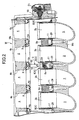
- reference symbol M denotes an intake manifold of a four-cylinder engine E; the intake manifold includes a surge chamber 2 having an air inlet 1 at its upper end, four parallel first intake passages 3 that bypass part of a lower wall of the surge chamber 2 and that have an upstream end portion 3a and a downstream end portion 3b opening in the surge chamber 2, and four parallel second intake passages 4 passing through an upper wall of the surge chamber 2, an upstream end portion 4a of the second intake passage 4 opposing the downstream end portion 3b of the first intake passage 3 across a gap.
- This intake manifold M is mounted on one side face of a cylinder head of the engine E, and a downstream end portion 4b of the second intake passage 4 is connected to an intake port 5 of the engine E.
- a throttle body (not illustrated) for regulating the amount of intake air of the engine E is mounted on the air inlet 1.
- the intake manifold M is divided into an upper block Ma and a lower block Mb along a dividing plane in the middle of the surge chamber 2.
- the upper block Ma includes an upper half of the surge chamber 2 and the group of second intake passages 4, and is made of a light alloy or a synthetic resin
- the lower block Mb includes a lower half of the surge chamber 2 and the group of first intake passages 3 and is made of a light alloy or a synthetic resin
- these two blocks Ma and Mb are joined via a plurality of bolts or are connected together by vibration welding.
- the mutually opposing downstream end portion 3b of the first intake passage 3, which has an upward-facing attitude, and upstream end portion 4a of the second intake passage 4, which has a downward-facing attitude, have a gap opened therebetween, and the two are disposed so as to oppose each other across the gap.
- the downstream end portion 3b of the first intake passage 3 is called the first intake passage end portion 3b
- the upstream end portion 4a of the second intake passage 4 is called the second intake passage end portion 4a.
- a valve body 8 is provided between the first and second intake passage end portions 3b and 4a, the valve body 8 providing continuity therebetween or opening the second intake passage end portion 4a to the surge chamber 2.
- the first intake passage end portion 3b is formed in a straight shape
- the second intake passage end portion 4a is formed from a funnel member 4a secured to a lower face of the upper block Ma via a screw 9 and arranged coaxially with the first intake passage end portion 3b, this funnel member 4a being molded using a resilient material such as rubber.
- the upstream end portion 3a of the first intake passage 3 is also formed from a funnel member 3a secured to a base face of the lower block Mb via a screw 7.
- the valve body 8 is formed in a sleeve shape that is axially slidably fitted around an outer peripheral face of the first intake passage end portion 3b, and an annular seal member 11 is attached to the inner periphery of the valve body 8, the seal member 11 being in slidable intimate contact with the outer peripheral face of the first intake passage end portion 3b.
- Four of the valve bodies 8 are integrally connected to each other via bridges 8a to thus form four connected valve bodies 8.
- Each valve body 8 can move between a first position A (see FIG. 2 and FIG. 3 ) in which it is distanced downward from the second intake passage end portion 4a and the second intake passage end portion 4a opens into the surge chamber 2, and a second position B (see FIG.
- valve body 8 in which the upper end of the valve body 8 is in intimate contact with the second intake passage end portion 4a to thus provide continuity between the first and second intake passage end portions 3b and 4a, and in order to define the first position A for the valve body 8 a lower limit stopper 29 made of a resilient material is installed to receive the lower end of the valve body 8.
- a linear motion guide bearing system 13 is provided between the intake manifold M and the four connected valve bodies 8, the linear motion guide bearing system 13 smoothly guiding linear movement of the valve body 8 between the first and second positions A and B.
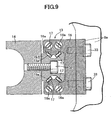
- This linear motion guide bearing system 13 includes a high rigidity support post 14 that is secured to the upper block Ma via a bolt 31 so as to extend along a direction of movement of the valve body 8 and that is disposed on one side of a central part of the four connected valve bodies 8, a rail 15 secured to a front face of the support post 14 via a plurality of bolts 32 so as to extend along the direction of movement of the valve body 8, and a slider 16 movably straddle-mounted on the rail 15, and this slider 16 is secured to the bridge 8a in the central part of the four connected valve bodies 8 (hereinafter, called the central bridge) via bolts 33. As shown in FIG.
- a plurality of roller rolling grooves 15a and 16a are formed on opposing faces of the rail 15 and slider 16 so as to extend in the longitudinal direction of the rail 15, and these roller rolling grooves 15a and 16a are filled with a large number of rollers 17 in multiple rows.
- the linear motion guide bearing system 13 is disposed so that at least one part thereof is put between the two valve bodies 8 connected by the central bridge 8a.
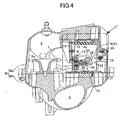
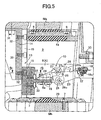
- a valve operating system 10 for operating the valve body 8 is explained by reference to FIG. 1 , and FIG. 4 to FIG. 6 .
- a drive shaft 18 is disposed in the surge chamber 2 along the direction in which the four connected valve bodies 8 are arranged and on the opposite side of the four connected valve bodies 8 to the linear motion guide bearing system 13, and this drive shaft 18 is rotatably supported by one side wall of the upper block Ma and a support wall 20 projecting toward the surge chamber 2 side from the upper block Ma.
- An actuator 21 mounted on the outside face of the upper block Ma is connected to the outer end of the drive shaft 18 so as to enable the drive shaft 18 to rotate back and forth. Any type of actuator, such as an electrically-driven type, an electromagnetic type, or a negative pressure type is available as this actuator 21..
- a drive lever 23 projecting toward the central bridge 8a is provided, fixed by a bolt 22, on a portion of the drive shaft 18 in proximity to the support wall 20.
- a follower arm 24 projecting toward the drive lever 23 is fixedly provided on the central bridge 8a (see FIG. 4 ), and the drive lever 23 and the follower arm 24 are connected via a link 25.
- one end of the link 25 is relatively pivotably connected to an extremity of the drive lever via a first connecting shaft 26, and the other end of the link 25 is relatively pivotably connected to an extremity of the follower arm 24 via a second connecting shaft 27.
- the valve operating system 10 is thus connected, together with the linear motion guide bearing system 13, to the central bridge 8a.
- the drive lever 23, the follower arm 24, and the link 25 are arranged as follows. That is, when the valve body 8 is moved from a first position A shown in FIG. 5 to a second position B shown in FIG. 6 by pivoting of the drive lever 23, the center 26c of the first connecting shaft 26 approaches from below a straight line 28 connecting two centers 18c and 27c of the drive shaft 18 and the second connecting shaft 27, and after the valve body 8 reaches the second position B where it abuts against the second intake passage end portion 4a, that is, the funnel member 4a, the drive lever 23 is further pivoted through a predetermined angle, and the center 26c of the first connecting shaft 26 is made to move above the dead point on the straight line 28 while the funnel member 4a, which is a resilient body, is compressively changed in shape.
- the valve body 8 is locked in the second position B, thus preventing it from moving toward the first position A side due to its own weight or vibration.
- the valve body 8 held in the first position A in this way is distanced from the funnel-shaped second intake passage end portion 4a, in the second intake passage 4 the second intake passage end portion 4a opens directly in the surge chamber 2. Therefore, in an intake stroke of each cylinder of the engine E, air having a flow rate controlled by the throttle body (not illustrated) flows into the surge chamber 2 from the air inlet 1 as shown in FIG. 3 , and is taken immediately into the engine E through the short second intake passage 4.
- the interior of the intake manifold M thus attains a high speed intake mode that is suitable for high speed running, charging efficiency is enhanced by effectively utilizing an intake pulsation effect, and the high speed output performance of the engine E can be improved.
- the inlet of the second intake passage 4, that is, the second intake passage end portion 4a has a funnel shape, the flow of intake air into the second intake passage 4 becomes smooth, and the intake efficiency can be enhanced.
- valve body 8 When the engine E is running at low speed, by pivoting the drive lever 23 upward, which is opposite to the above, with the output of the actuator 21 via the drive shaft 18, the valve body 8 is held in the second position B shown in FIG. 6 . That is, the valve body 8 is held in a state in which it is in intimate contact with the inner peripheral face of the second intake passage end portion 4a, which is formed from the resilient funnel member, and since this valve body 8 gives an uninterruptedly continuous state between the first and second intake passages 3 and 4, in the intake stroke of each cylinder of the engine E, air having a flow rate controlled by the throttle body (not illustrated) flows into the surge chamber 2 from the air inlet 1 and is supplied to the engine E through a long passage formed from the first and second intake passages 3 and 4 and the valve body 8. Therefore, the interior of the intake manifold M attains a low speed intake mode that is suitable for low speed running, charging efficiency is enhanced by effectively utilizing an intake inertia effect, and the low speed output performance of the engine E can be improved.
- valve body 8 In the process in which upward pivoting of the drive lever 23 by the output of the actuator 21 makes the valve body 8 rise from the first position A to the second position B, as described above, in the second position B the valve body 8 causes the funnel member 4a, which is a resilient body, to be compressively changed in shape, the center 26c of the first connecting shaft 26 moves above the dead point on the straight line 28, and the drive lever 23 makes the stopper arm 23a abut against the stopper bolt 30 to thus stop pivoting thereof, thereby locking the valve body 8 in the second position B. Therefore, following this, even if the output of the actuator 21 is made zero or is greatly reduced, it is possible to prevent the valve body 8 from moving from the second position B due to its own weight or vibration.
- the drive lever 23 may be pivoted downward by the output of the actuator 21, and the center 26c of the first connecting shaft 26 may be moved downward from the dead point on the straight-line 28.
- the valve body 8 can move smoothly between the first and second positions A and B without galling against the first intake passage end portion 3b occurring, thus enhancing the responsiveness of operation. It is thus possible to control a sliding gap appropriately and easily, while lowering the precision of machining of sliding faces of the first intake passage end portion 3b and the valve body 8, and not only does this contribute to a reduction in cost due to improvement of productivity, but it is also possible to improve the responsiveness of operation due to the driving force for the valve body 8 decreasing and reduce the size of the actuator 21.
- the linear motion guide bearing system 13 includes the high rigidity support post 14 secured to the upper block Ma so as to extend along the direction of movement of the valve body 8 and disposed on one side of a central part of the four connected valve bodies 8, the rail 15 secured to the front face of the support post 14 so as to extend along the direction of movement of the valve body 8, and the slider 16 movably straddle-mounted on the rail 15 and secured to the central bridge 8a, and the slider 16 is put between the two valve bodies 8 connected by the central bridge 8a, the single linear motion guide bearing system 13 can be as close to the center of gravity of the four connected valve bodies 8 as possible; this enables the operating attitude of the four connected valve bodies 8 to be stabilized, and it is possible to avoid as far as possible any increase in the dimensions of the intake control system resulting from installation of the linear motion guide bearing system 13.
- linear motion guide bearing system 13 and the valve operating system 10 are both connected to the central bridge 8a, it is possible to dispose the linear motion guide bearing system 13 and the valve operating system 10 in proximity to each other, the tilt moment of the four connected valve bodies 8 due to operation of the operating system 10 can be suppressed, and the function of the linear motion guide bearing system 13 can be enhanced, thus further serving for improvement in the responsiveness of operation of the four connected valve bodies 8.
- the present invention is not limited to the above embodiment, and may be modified in a variety of ways as long as the modifications do not depart from the gist thereof.
- the upstream end portion 4a of the second intake passage 4 may be formed in a cylindrical shape, and the valve body 8 may be slidably fitted around the outer peripheral face thereof so as to open and close the gap between the upstream end portion 4a and the downstream end portion 3b of the first intake passage 3.
- the present invention may also be applied to a single-cylinder engine as well as a multi-cylinder engine other than the above four-cylinder engine.
- a valve operating system that includes a drive shaft, a drive lever that is fixedly provided thereon and can pivot in a direction of movement of a valve body, a follower arm that is fixedly provided on the valve body, a link, a first connecting shaft that connects one end of the link and the drive lever, and a second connecting shaft that connects the other end of the link and the follower arm; in response to a movement of the valve body from a first position to a second position by pivoting of the drive lever, a center of the first connecting shaft approaches from one side a straight line connecting two centers of the drive shaft and the second connecting shaft, and after the valve body reaches the second position, further pivoting of the drive lever is carried out through a predetermined angle so that the center of the first connecting shaft moves to the other side of a dead point on the straight line.
Landscapes
- Engineering & Computer Science (AREA)
- General Engineering & Computer Science (AREA)
- Mechanical Engineering (AREA)
- Chemical & Material Sciences (AREA)
- Combustion & Propulsion (AREA)
- Health & Medical Sciences (AREA)
- Biomedical Technology (AREA)
- Characterised By The Charging Evacuation (AREA)
- Control Of Throttle Valves Provided In The Intake System Or In The Exhaust System (AREA)
Applications Claiming Priority (1)
| Application Number | Priority Date | Filing Date | Title |
|---|---|---|---|
| JP2007159377A JP4974775B2 (ja) | 2007-06-15 | 2007-06-15 | 吸気制御装置及びエンジンの吸気制御装置 |
Publications (2)
| Publication Number | Publication Date |
|---|---|
| EP2003307A2 true EP2003307A2 (de) | 2008-12-17 |
| EP2003307A3 EP2003307A3 (de) | 2013-04-17 |
Family
ID=39720660
Family Applications (1)
| Application Number | Title | Priority Date | Filing Date |
|---|---|---|---|
| EP08010819.4A Withdrawn EP2003307A3 (de) | 2007-06-15 | 2008-06-13 | Ventilbetriebssystem und Ansaugsteuerungssystem für einen Motor |
Country Status (3)
| Country | Link |
|---|---|
| US (1) | US7966985B2 (de) |
| EP (1) | EP2003307A3 (de) |
| JP (1) | JP4974775B2 (de) |
Citations (1)
| Publication number | Priority date | Publication date | Assignee | Title |
|---|---|---|---|---|
| JPH07224670A (ja) | 1994-01-29 | 1995-08-22 | Dr Ing H C F Porsche Ag | 多気筒内燃機関用の吸気装置 |
Family Cites Families (16)
| Publication number | Priority date | Publication date | Assignee | Title |
|---|---|---|---|---|
| DE2259868A1 (de) * | 1972-12-07 | 1974-06-12 | Albrecht Automatik Kg | Schieberventil |
| US4053542A (en) * | 1976-07-22 | 1977-10-11 | Acf Industries, Inc. | Control means for secondary throttle |
| JPS5688924A (en) * | 1979-12-21 | 1981-07-18 | Shin Meiwa Ind Co Ltd | Operating device of all-speed governer |
| FR2483861A1 (fr) * | 1980-06-05 | 1981-12-11 | Renault | Dispositif de limitation de vitesse pour vehicule propulse par moteur a combustion interne |
| US4890586A (en) * | 1986-08-06 | 1990-01-02 | Honda Giken Kogyo Kabushiki Kaisha | Intake device for an internal combustion engine |
| JPH0387825U (de) * | 1989-12-20 | 1991-09-06 | ||
| DE19717272A1 (de) * | 1996-05-04 | 1997-11-06 | Volkswagen Ag | Luftansauganlage für eine Brennkraftmaschine |
| US6481415B1 (en) * | 1999-03-25 | 2002-11-19 | Siemens Canada Limited | Electronic throttle control |
| JP4252682B2 (ja) * | 1999-09-02 | 2009-04-08 | 本田技研工業株式会社 | 自動二輪車用エンジンの吸気制御装置 |
| JP4007009B2 (ja) * | 2002-01-22 | 2007-11-14 | 三菱自動車工業株式会社 | 吸気装置 |
| JP4195271B2 (ja) * | 2002-10-17 | 2008-12-10 | 株式会社日立製作所 | 操作アクチュエータ |
| JP2006132371A (ja) * | 2004-11-04 | 2006-05-25 | Yamaha Motor Co Ltd | エンジン及びそれを備えた車両 |
| JP4781952B2 (ja) * | 2006-01-17 | 2011-09-28 | ヤマハ発動機株式会社 | 車両 |
| JP5027469B2 (ja) * | 2006-01-17 | 2012-09-19 | ヤマハ発動機株式会社 | 車両 |
| JP4842066B2 (ja) * | 2006-04-14 | 2011-12-21 | ヤマハ発動機株式会社 | 車両 |
| JP2008075523A (ja) * | 2006-09-20 | 2008-04-03 | Yamaha Motor Co Ltd | 吸気制御装置、鞍乗型車両、及び切換条件設定方法 |
-
2007
- 2007-06-15 JP JP2007159377A patent/JP4974775B2/ja not_active Expired - Fee Related
-
2008
- 2008-06-13 US US12/139,250 patent/US7966985B2/en not_active Expired - Fee Related
- 2008-06-13 EP EP08010819.4A patent/EP2003307A3/de not_active Withdrawn
Patent Citations (1)
| Publication number | Priority date | Publication date | Assignee | Title |
|---|---|---|---|---|
| JPH07224670A (ja) | 1994-01-29 | 1995-08-22 | Dr Ing H C F Porsche Ag | 多気筒内燃機関用の吸気装置 |
Also Published As
| Publication number | Publication date |
|---|---|
| EP2003307A3 (de) | 2013-04-17 |
| JP4974775B2 (ja) | 2012-07-11 |
| US20080314348A1 (en) | 2008-12-25 |
| US7966985B2 (en) | 2011-06-28 |
| JP2008309108A (ja) | 2008-12-25 |
Similar Documents
| Publication | Publication Date | Title |
|---|---|---|
| US7631628B2 (en) | Engine intake control system | |
| US8375982B2 (en) | Hydraulic circuit and manifold with multifunction valve | |
| JP3338842B2 (ja) | 内燃機関の圧縮を変更する方法および装置 | |
| US6415765B1 (en) | Throttle unit of engine | |
| US10961901B2 (en) | Turbine for an exhaust turbocharger having a two-volute turbine housing and a linear valve for volute connection and wastegate control | |
| CN104420927A (zh) | 用于润滑剂喷嘴的控制阀 | |
| US7350502B2 (en) | Apparatus and method for controlling exhaust pressure | |
| US7966985B2 (en) | Valve operating system and engine intake control system | |
| EP0990826A1 (de) | Steuerventilanordnnung | |
| US6006722A (en) | Fine resolution air control valve | |
| US8438848B2 (en) | Engine with turbocharger and EGR | |
| US8695336B2 (en) | Exhaust gas waste gate system with charge pressure control | |
| US20180306103A1 (en) | Non-circular gears for rotary wastegate actuator | |
| US7997247B2 (en) | Engine intake control system | |
| JP4179263B2 (ja) | 過給機付内燃機関 | |
| JP6384286B2 (ja) | バルブユニット | |
| US20170362996A1 (en) | Wastegate closed position detent feature | |
| FI125312B (en) | Flow control valve and method for operating a flow control valve | |
| JP4349987B2 (ja) | 吸気量制御装置 | |
| JPS6128712A (ja) | 過給空気の温度調整装置 | |
| JP2008309102A (ja) | エンジンの吸気制御装置 | |
| JP2008309106A (ja) | エンジンの吸気制御装置 | |
| JP2018132064A (ja) | バルブユニット | |
| JP2008309100A (ja) | エンジンの吸気制御装置 | |
| JP2008309107A (ja) | エンジンの吸気制御装置 |
Legal Events
| Date | Code | Title | Description |
|---|---|---|---|
| PUAI | Public reference made under article 153(3) epc to a published international application that has entered the european phase |
Free format text: ORIGINAL CODE: 0009012 |
|
| AK | Designated contracting states |
Kind code of ref document: A2 Designated state(s): AT BE BG CH CY CZ DE DK EE ES FI FR GB GR HR HU IE IS IT LI LT LU LV MC MT NL NO PL PT RO SE SI SK TR |
|
| AX | Request for extension of the european patent |
Extension state: AL BA MK RS |
|
| PUAL | Search report despatched |
Free format text: ORIGINAL CODE: 0009013 |
|
| AK | Designated contracting states |
Kind code of ref document: A3 Designated state(s): AT BE BG CH CY CZ DE DK EE ES FI FR GB GR HR HU IE IS IT LI LT LU LV MC MT NL NO PL PT RO SE SI SK TR |
|
| AX | Request for extension of the european patent |
Extension state: AL BA MK RS |
|
| RIC1 | Information provided on ipc code assigned before grant |
Ipc: F02M 35/10 20060101ALI20130311BHEP Ipc: F16K 31/52 20060101ALI20130311BHEP Ipc: F02D 9/12 20060101ALI20130311BHEP Ipc: F02B 27/02 20060101AFI20130311BHEP |
|
| AKY | No designation fees paid | ||
| REG | Reference to a national code |
Ref country code: DE Ref legal event code: R108 Effective date: 20140102 |
|
| STAA | Information on the status of an ep patent application or granted ep patent |
Free format text: STATUS: THE APPLICATION IS DEEMED TO BE WITHDRAWN |
|
| 18D | Application deemed to be withdrawn |
Effective date: 20131018 |