EP2000808B1 - Vorrichtung und verfahren zur behandlung von mikroplatten - Google Patents
Vorrichtung und verfahren zur behandlung von mikroplatten Download PDFInfo
- Publication number
- EP2000808B1 EP2000808B1 EP07740037.2A EP07740037A EP2000808B1 EP 2000808 B1 EP2000808 B1 EP 2000808B1 EP 07740037 A EP07740037 A EP 07740037A EP 2000808 B1 EP2000808 B1 EP 2000808B1
- Authority
- EP
- European Patent Office
- Prior art keywords
- wells
- nozzles
- nozzle
- micro plate
- row
- Prior art date
- Legal status (The legal status is an assumption and is not a legal conclusion. Google has not performed a legal analysis and makes no representation as to the accuracy of the status listed.)
- Active
Links
Images




Classifications
-
- G—PHYSICS
- G01—MEASURING; TESTING
- G01N—INVESTIGATING OR ANALYSING MATERIALS BY DETERMINING THEIR CHEMICAL OR PHYSICAL PROPERTIES
- G01N1/00—Sampling; Preparing specimens for investigation
- G01N1/28—Preparing specimens for investigation including physical details of (bio-)chemical methods covered elsewhere, e.g. G01N33/50, C12Q
-
- B—PERFORMING OPERATIONS; TRANSPORTING
- B01—PHYSICAL OR CHEMICAL PROCESSES OR APPARATUS IN GENERAL
- B01L—CHEMICAL OR PHYSICAL LABORATORY APPARATUS FOR GENERAL USE
- B01L3/00—Containers or dishes for laboratory use, e.g. laboratory glassware; Droppers
- B01L3/50—Containers for the purpose of retaining a material to be analysed, e.g. test tubes
- B01L3/508—Rigid containers without fluid transport within
- B01L3/5085—Rigid containers without fluid transport within for multiple samples, e.g. microtitration plates
-
- G—PHYSICS
- G01—MEASURING; TESTING
- G01N—INVESTIGATING OR ANALYSING MATERIALS BY DETERMINING THEIR CHEMICAL OR PHYSICAL PROPERTIES
- G01N35/00—Automatic analysis not limited to methods or materials provided for in any single one of groups G01N1/00 - G01N33/00; Handling materials therefor
- G01N35/10—Devices for transferring samples or any liquids to, in, or from, the analysis apparatus, e.g. suction devices, injection devices
- G01N35/1065—Multiple transfer devices
- G01N35/1074—Multiple transfer devices arranged in a two-dimensional array
-
- B—PERFORMING OPERATIONS; TRANSPORTING
- B01—PHYSICAL OR CHEMICAL PROCESSES OR APPARATUS IN GENERAL
- B01L—CHEMICAL OR PHYSICAL LABORATORY APPARATUS FOR GENERAL USE
- B01L2200/00—Solutions for specific problems relating to chemical or physical laboratory apparatus
- B01L2200/14—Process control and prevention of errors
- B01L2200/141—Preventing contamination, tampering
-
- B—PERFORMING OPERATIONS; TRANSPORTING
- B01—PHYSICAL OR CHEMICAL PROCESSES OR APPARATUS IN GENERAL
- B01L—CHEMICAL OR PHYSICAL LABORATORY APPARATUS FOR GENERAL USE
- B01L2300/00—Additional constructional details
- B01L2300/08—Geometry, shape and general structure
- B01L2300/0809—Geometry, shape and general structure rectangular shaped
- B01L2300/0829—Multi-well plates; Microtitration plates
-
- B—PERFORMING OPERATIONS; TRANSPORTING
- B01—PHYSICAL OR CHEMICAL PROCESSES OR APPARATUS IN GENERAL
- B01L—CHEMICAL OR PHYSICAL LABORATORY APPARATUS FOR GENERAL USE
- B01L9/00—Supporting devices; Holding devices
- B01L9/54—Supports specially adapted for pipettes and burettes
-
- Y—GENERAL TAGGING OF NEW TECHNOLOGICAL DEVELOPMENTS; GENERAL TAGGING OF CROSS-SECTIONAL TECHNOLOGIES SPANNING OVER SEVERAL SECTIONS OF THE IPC; TECHNICAL SUBJECTS COVERED BY FORMER USPC CROSS-REFERENCE ART COLLECTIONS [XRACs] AND DIGESTS
- Y10—TECHNICAL SUBJECTS COVERED BY FORMER USPC
- Y10T—TECHNICAL SUBJECTS COVERED BY FORMER US CLASSIFICATION
- Y10T436/00—Chemistry: analytical and immunological testing
- Y10T436/25—Chemistry: analytical and immunological testing including sample preparation
- Y10T436/2575—Volumetric liquid transfer
Definitions
- the present invention relates to a micro plate treating device and a micro plate treating method.
- the micro plate is a member wherein pluralities of wells, which can hold liquid, are arranged in a matrix form (row and column form).
- the intervals between the individual wells in these micro plates tend to be normalized.
- a micro plate having 96 wells the row interval thereof, which is the distance in the column direction between the well centers of any one of the rows where some of the wells are arranged and those of the rows where wells adjacent to the wells in the column direction are arranged, and the column interval thereof, which is the distance in the row direction between those of any one of the columns where some of the wells are arranged and those of the columns where wells adjacent thereto in the row direction are arranged, are each 9 mm.
- the row interval and the column interval are each 4.5 mm.
- a dispensing device wherein a single nozzle head equipped with nozzles the number of which is equal to the number of the individual wells in each of the micro plates or with dispensing tips fitted to the nozzles is used to insert the dispensing tips simultaneously into the individual wells in each of the micro plates and then solutions or suspensions to be handled so as to be equal to each other in kind or amount are sucked or discharged (Patent Document 1).
- micro plates each having wells the number of which corresponds to the number of the specimens are prepared by the following number in order to hold, in advance, reagent solutions, specimens, or magnetic particle suspensions required for the treatment: a number corresponding to the number of steps required for the treatment process or the number of the required kinds of the reagents or the like.
- the dispensing device which can cause the magnetic particles to be adsorbed on inner walls of the dispensing tips corresponding to nozzles, are used to transfer the magnetic particles successively to the individual wells in plurality of the micro plates, so as to suspend the particles in the wells, thereby causing reaction. These steps are successively performed, thereby conducting the treatment (Patent Documents 1 and 2) .
- the number of the micro plates to be used increases since any one of the micro plates is assigned to each of the kinds.
- the moving distance of the nozzle head corresponds to the distance over which the nozzle head passes all the micro plates the number of which corresponds to the number of the kinds of the reagents or the like required for the treatment; therefore, when the number of the micro plates increases, the moving distance of the nozzle head increases. As a result, there remains a problem that it is feared that the treatment can neither be promptly nor effectively conducted.
- the liquid amount can be sufficiently used by combining ordinary micro plates with the above-mentioned dispensing device.
- the liquid amount to be handled is increased so that a liquid amount of about one thousand microliters to several thousands of microliters needs to be handled, it is necessary to increase the volume of each of the wells and further increase the volume of each of the dispensing tips.
- the interval between the wells in the micro plates is normalized, the height of the micro plates increases and further the length of the dispensing tips in the axial direction thereof increases, so that the scale of the device is enlarged in the vertical direction.
- Patent Document 3 relates to dispensing into a microplate on the surface of which a plurality of wells are arranged and formed, a pitch which is an integral multiple of the arrangement pitch of the wells in a predetermined direction.
- a liquid dispensing apparatus having nozzles arranged, an operation of injecting a liquid into a part of the well with the nozzle, and moving the nozzle by a predetermined arrangement pitch of the wells. The operation of moving in the direction is repeated until all the wells have been injected.
- Patent Document 4 relates to an arrangement for handling and selective magnetic field directed horizontally magnetic rinsing of particles and liquids, magnetic beads and vessels, comprises a two-dimensional pipette arrangement, a two-dimensional magnet holder arrangement and a two-dimensional arrangement of cavities. The arrangements are in combination with a handling mechanism.
- a first object thereof is to provide a micro plate treating device and a micro plate treating method capable of handling a larger number of kinds of solution or suspensions or a larger volume of solutions or suspensions per work area or per volume of the device by use of a normalized micro plate without enlarging the scale of the device.
- a second object thereof is to provide a micro plate treating device and a micro plate treating method capable of conducting treatment more promptly and more effectively in the case of making the number of wells and the number of nozzles unchanged.
- a third object thereof is to provide a micro plate treating device and a micro plate treating method having a high functionality even when the number of treating-targets to be handled in parallel is made large.
- micro plate treating device and a micro plate treating method as defined in the independent claims.
- Advantageous further developments of the invention are set forth in the dependent claims.
- a first aspect of the invention is a micro plate treating device, comprising a micro plate having wells arranged in a matrix form, one or more nozzle heads each having nozzles capable of sucking and discharging a fluid and arranged in a matrix form, and moving means capable of moving relatively an interval between the micro plate and the nozzle heads, wherein tips of all the nozzles arranged in each of the nozzle heads are configured to be permitted to be simultaneously inserted into some of the wells in the micro plate, at least one of the row interval or the column interval of the nozzles is set to two or more natural number multiple of the row interval or the column interval of the corresponding wells (i.e., the corresponding ones out of the wells), the natural number being two or more, and at least one of the row number or the column number of all the corresponding nozzles is one divided by the natural number, multiplied by the row number or the column number of the wells respectively.
- the "matrix form” refers to a structure wherein along two directions of a column direction and a row direction, elements such as wells or nozzles are arranged at a predetermined row interval and a predetermined column interval, the number of the rows is a predetermined number, and the number of the columns is a predetermined number respectively.
- the number of the rows and the number of the columns are each two or more.
- the column direction and the row direction are usually orthogonal to each other, but are not limited thereto. Thus, the directions may be obliquely intersected.
- the matrix form also include a case in which in individual rows or columns adjacent to each other, for example, the row or columns are shifted from each other by a length of a half of the column interval or the row interval so that the elements are alternated, thereby arranging the elements into a closed-pack form.
- the "row interval" means the distance in column direction between the center of any one out of elements arranged in a matrix form or a centerline of the row in which the element is arranged and the center of an element adjacent thereto in the column direction or the centerline of the row in which the element is arranged.
- the "column interval” means the distance in row direction between the center of any one out of elements arranged in a matrix form or a centerline of the column in which the element is arranged and the center of an element adjacent thereto in the row direction or the centerline of the column in which the element is arranged.
- the "nozzles" are parts for sucking and discharging a fluid, and examples of the fluid include gas and liquid.
- the nozzles are each a cylinder having a plunger, or a channel connected to a mechanism for sucking and discharging a fluid by deformation of bellows or an elastomer. Examples of the nozzles include channels in dispensing tips fitted to fitting nozzles.
- the tips of all the nozzles are configured to be permitted to be simultaneously inserted into some of the wells in the micro plate", it is generally necessary that: the row number or the column number of the matrix of the nozzles is smaller than that of the matrix of wells; the angle made between the row direction and the column direction in the matrix of the nozzles is equal to that in the matrix of the wells; and the row interval or the column interval of the matrix of the nozzles is a natural number multiple of the row interval or the column interval of the matrix of the wells.
- the following is inevitably present in the micro plate: matrix form arrangements of nozzles which each have the same configuration as the arrangement of the wells in a matrix form and which do not overlap with each other, the number of the arrangements being at least natural number (> 1) (the arrangements will be referred to as "partial well matrices" hereinafter).
- any one of the well elements belonging to any one of the partial well matrices and the corresponding one of the well elements belonging to any one of the partial well matrices adjacent thereto are not separated from each other by not less than the distance between any adjacent ones out of the wells in the micro plate.
- the area for work can be limited to the inside of the single micro plate having an area substantially consistent with that of the nozzle head although the well groups which are independent and which the nozzle heads can be simultaneously inserted into are present in a number of two or more; thus, the work area is not enlarged in vain.
- the tips of all of the nozzles of the nozzle head can be positioned to be permitted to be inserted into all the partial well matrices in the micro plate by repeating a movement corresponding to at longest the distance of the row interval or the column interval at least ((N-1) times wherein N is a natural number (> 1)).
- the natural number is two or more, it is necessary that at least either one of the row number or the column number of the wells in the micro plate is a number having this natural number (> 1) as a divisor thereof.
- the natural number corresponds to "3".
- the column number of the nozzles is 4, which is 1/"3" of 12, which is the column number of the wells. In such a way, 12 of the column number of the wells has "3" as a divisor thereof.
- a second aspect of the invention is the micro plate treating device which further comprises a control unit, wherein the control unit causes the moving means to attain the relative movement between the nozzle head and the micro plate, thereby causing the tips of all the nozzles fitted to the nozzle head to be positioned in such a manner that the tips can be simultaneously inserted into the wells belonging to a first partial well matrix, which is the corresponding partial well matrix, in the micro plate, inserting the tips of the nozzles simultaneously into the wells so that a treatment operation is conducted, pulling out the tips; and then causes the moving means to attain the relative movement between the nozzle head and the micro plate, thereby causing the tips of all the nozzles to be positioned in such a manner that the tips can be simultaneously inserted into the wells belonging to a second partial well matrix, which is the corresponding partial well matrix, in the micro plate.
- the number of the partial well matrices is at least the natural number (n > 1) .
- all the nozzles can be inserted into all the partial well matrices in the micro plate by carrying out relative movement between by at least the natural number (n > 1 time) the nozzle head and the micro plate along the corresponding column direction and/or row direction by the distance of the row interval or column interval of the wells in the micro plate.
- the "first partial well matrix” and the "second partial well matrix” do not have wells overlapping with each other.
- the number of the partial well matrices is nm in total for the single micro plate.
- the "treatment” include suction of the fluid from the wells or discharge thereof into the wells, repetition of the suction and the discharge, adsorption of magnetic particles contained in a liquid onto inner walls of the nozzles by applying a magnetic field to the nozzles, re-suspension of the magnetic particles by removing the magnetic field, and detection of a liquid amount.
- a third aspect of the invention is the micro plate treating device, wherein individual partial well matrices along a moving path of the nozzle head hold solutions or suspensions necessary for individual steps of the treatment in accordance with the order of the steps.
- the "moving path” is a path through which the nozzle head passes when the nozzle head is moved successively parallel over all the partial well matrices, and is preferably a path the distance of which is the shortest along the moving course. Accordingly, selection from the individual partial well matrices is made in accordance with the order of the treating steps, and then necessary solutions, such as reagents, and others are put thereto.
- solutions or suspensions to be handled so as to be equivalent to each other in kind or amount are put in the wells in the same (i.e., single one) belonging to out of the partial well matrices, and solutions or suspensions to be handled so as to be different from each other in kind or amount are put in the wells belonging to any different ones out of the partial well matrices.
- solutions or suspensions equivalent to each other in kind may be put in the wells belonging to different ones out of the partial well matrices.
- a fourth aspect of the invention is the micro plate treating device, wherein the control unit causes the nozzle head to be successively moved so as to position the tips of the nozzles in the state that the tips can be inserted into all the wells belonging to each of the well groups, in the micro plate, into which the tips of the same nozzles fitted to the nozzle head can be inserted.
- Each of the well groups includes one unit of each of well elements belonging to each of the partial well matrices, so as to avoid the overlap of two or more units thereof. Accordingly, the element number of the wells belonging to each of the well groups is equal to the number of the partial well matrices present in the single micro plate. In other words, according to this manner, the individual nozzles are in the state that the nozzles can be simultaneously inserted into the corresponding each of the wells in all the well groups.
- the number of the wells belonging to each of the well groups is at least the natural number (n > 1).
- the number of the wells belonging to each of the well groups is nm.
- the moving path of each of the nozzles inside the well groups is a path permitting the nozzle to pass through all the well elements in the well groups in accordance with the order of the treating steps, and is preferably a path the distance of which is the shortest.
- a fifth aspect of the invention is the micro plate treating device, wherein partitions for partitioning the well groups, in the micro plate, into which the same nozzles fitted to the nozzle head can be inserted from each other are built on the upper surface of the micro plate so as to be projected therefrom.
- a large number of specimens to be treated can be treated in the state that the specimens are partitioned from each other with the partitions; therefore, once the nozzles are moved into one of areas surrounded by the partitions, the treatment can be conducted without shifting the tips of the nozzles over any one of the partitions.
- a sixth aspect of the invention is the micro plate treating of the micro plate and one or more optional micro plates equivalent thereto are each at least the natural number.
- the individual nozzle heads can be set up or controlled to cause the operations of the heads to be linked with each other.
- the nozzle head of the micro plate treating device is provided with magnetic force means having two or more magnets which can be brought into contact with the nozzles and be separated from the nozzles, so that a magnetic field can be applied simultaneously to the inside of the nozzles and be further removed therefrom.
- the magnetic force means comprises plural comb teeth members that can be moved relatively to the nozzle heads, wherein nozzle rows having the nozzles arranged along the row direction and nozzle columns having the nozzles arranged along the column direction are arranged, along the row direction or the column direction, that extend along the row direction or the column direction, at least one of the members having a width permitted to be inserted in the nozzle row interval or the nozzle column interval, and that each have a length adjacent to all the nozzles in one or two of the nozzle rows or the nozzle columns when the members are inserted therein, and a supporting member connected to the comb teeth members;
- the nozzle row interval or the nozzle column interval has, for example, a row interval or column interval set to a natural number multiple of the row interval or column interval of the wells, the natural number being two or more.
- the required comb teeth members are comb teeth members the number of which is (the number of nozzle rows-1) or (the number of nozzle columns-1). Allowable are comb teeth members adjacent to the nozzle rows or nozzle columns in the state that the members are not inserted in gaps between the nozzle rows or between the nozzle columns.
- the distance between any one of the magnets and the nozzles adjacent to the magnet is a range permitting a magnetic field necessary for the treatment operation to be applied to the nozzles.
- the supporting member is, for example, a member for connecting the comb teeth members to each other at single-ends of the comb teeth members at the backside of the nozzle-advancing direction.
- magnets may be arranged at each side thereof at the column interval or row interval, correspondingly to any two adjacent ones of the nozzle rows or any two adjacent ones of the nozzle columns at each side of the width direction.
- a ninth aspect of the invention is the micro plate treating device, wherein the nozzle head further comprises light-detecting means for detecting the state of the liquid in the nozzles. It is therefore necessary that the nozzles or dispensing tips fitted to fitting nozzles are made of a translucent member or translucent members. Examples of the "the state of liquid” include the presence or absence of the liquid, and the suction amount or the discharge amount of the liquid.
- a tenth aspect of the invention is the micro plate treating device wherein: the light-detecting means comprises plural light-detecting comb teeth members that can be moved relatively to the nozzle heads, wherein nozzle rows having the nozzles arranged along the row direction and nozzle columns having the nozzles arranged along the column direction are arranged, along the row direction or the column direction, that extend along the row direction or the column direction, at least one of the members having a width permitted to be inserted in the nozzle row interval or the nozzle column interval, and that each have a length adjacent to all the nozzles in one or two of the nozzle rows or the nozzle columns when the members are inserted therein, and a supporting member connected to the light-detecting comb teeth members; and at least one light-detecting unit is set up to each of the light-detecting comb teeth members.
- the nozzle row interval or the nozzle column interval has, for example, a row interval or column interval set to a natural number multiple of the row interval or column interval of the wells, the natural number being two or more.
- the required comb teeth members are light-detecting comb teeth members the number of which is (the number of nozzle rows - 1) or (the number of nozzle columns - 1).
- the light-detecting comb teeth members may be positioned outside the nozzle rows or the nozzle columns.
- the supporting member is, for example, a member for connecting the light-detecting comb teeth members to each other at single-ends of the comb teeth members.
- An eleventh aspect of the invention is a micro plate treating method, comprising a first step of preparing a micro plate having wells arranged in a matrix form, and one or more nozzle heads each having nozzles capable of sucking and discharging a liquid and arranged in a matrix form, and moving, relatively to the micro plate, the nozzle heads wherein at least one of the row interval or the column interval of the nozzles is set to a natural number multiple of the row interval or the column interval of the corresponding wells, the natural number being two or more, and at least one of the row number or the column number of the corresponding nozzles is one divided by the natural number, multiplied by the row number or the column number of the wells respectively, thereby positioning all the nozzles fitted to each of the nozzle heads in such a manner that all the nozzles can be simultaneously inserted into the wells belonging to a first partial well matrix in the micro plate; and a second step of attaining relative movement between the nozzle heads and the micro plate, thereby positioning tips of all the
- the number of the partial well matrices is at least the natural number (n > 1). Accordingly, in a case where the row interval and the column interval of the nozzles are a natural number (n > 1) multiple of the row interval of the wells and a natural number (m > 1) multiple of the column interval of the wells, respectively, the number of the partial well matrices is nm in total for the single micro plate. The number of steps therefore is nm in total for the single micro plate.
- all the nozzles can be simultaneously inserted into all the partial well matrices in the micro plate by carrying out relative movement between the nozzle head and the micro plate along the corresponding column direction or row direction by the distance of the row interval or column interval of the wells in the micro plate at least natural number times (n > 1) .
- a twelfth aspect of the invention is the micro plate treating method, wherein the first step comprises the step of treatment inserting the nozzles to the individual wells, thereby attaining the treatment operation, and the step of pulling out the nozzles from the wells.
- the second step also may have an inserting step, a treating step, or a pulling-out step in the same manner as the first step.
- the step number required is decided in accordance with at least the set natural number (n > 1). Steps the number of which is at least the natural number times are required.
- the "treatment" referred to herein is as described above.
- a thirteenth aspect of the invention is the micro plate treating method, wherein the first or second step comprises the step of applying a magnetic field to the inside of the nozzles and the step of removing the magnetic field at the time of the suction or discharge.
- a fourteenth aspect of the invention is the micro plate treating method, wherein the first or second step comprises the step of detecting the state of the liquid in the nozzles.
- At least one of the row interval or column interval of the nozzles is a natural number multiple of the row interval or column interval of the corresponding wells, the natural number being two or more; therefore, two or more of the wells can be caused to correspond to one of the nozzles. Accordingly, without setting up any new micro plate, two or more kinds of solutions or the like can be handled in the single micro plate. As a result, a larger number of kinds of solutions or the like can be handled without increasing the area for work.
- any one of the nozzles can correspond to two or more of the wells; therefore, a liquid having a volume two or more times larger than the volume handled by any one of the wells can be handled by any one of the nozzles.
- usable large spaces make their appearance between adjacent ones of the nozzles; therefore, each of the nozzles can be provided with mechanisms for giving various functions, such as a function of applying magnetic force into the nozzle, and a function of detecting the state of the liquid in the nozzle or the like, without enlarging the scale of the device.
- the second or eleventh aspect of the invention produces the advantageous effects of the first aspect of the invention.
- the wells which can be handled at a time by any one of the nozzle heads correspond to each of the partial well matrices which belong to the single micro plate and do not overlap with each other, and further the individual partial well matrices are apart from each other only by a distance corresponding to the distance between the wells adjacent to each other in the micro plate; therefore, when a solution or the like that is necessary for a single treatment operation is put into each of the partial well matrices, it is sufficient that the moving distance of the nozzle head which permits the single treatment operation to be completed is short. Thus, the treatment operation can be promptly and effectively conducted.
- any one of the nozzle heads is used to make it possible to conduct a series of treatment operations, for many objects to be treated, composed of plural steps continuously to the last; therefore, the treatment efficiency is high for the work area. Additionally, it is sufficient that the moving distance of the nozzle head is short; thus, the working efficiency is high.
- each of the well groups includes one unit of each of well elements belonging to each of the partial well matrices, so as to avoid the overlap of two or more units thereof. Therefore, when the nozzles are moved in such a manner that the nozzles can be inserted to all the wells belonging to the well group, a series of treatment operations composed of steps the number of which is at least the natural number (n > 1) can be continuously applied to a large number of objects in the single micro plate to the last inside the single micro plate; thus, the device is high in reliability and is easily controlled.
- the treatment operation based on the single nozzle is finished inside the partitions.
- the treatment can be conducted without shifting the tip of the nozzle over the partitions. Therefore, cross contamination over the partitions can be certainly prevented.
- the individual nozzles are each moved inside the partitions. Thus, the control of the movement is easy.
- the total number of the nozzles fitted to the nozzle heads the number of which is at least the natural number can be made equal to the number of wells in any one of the micro plates, and the number of the nozzle heads can be made equal to the number of the micro plates. Accordingly, the moving distance of the nozzle heads becomes remarkably small although the total number of the nozzles of the nozzle heads is substantially equal to the number of the wells in any one of the micro plates.
- simultaneous treatment operations in the micro plates can be conducted; thus, the number of objects to be treated is maintained, and each of the micro plates has partial well matrices the number of which is at least the natural number. For this reason, the nozzle heads can be used plural times for any one of the micro plates.
- a magnetic field can be applied to the nozzles; therefore, a suspension wherein magnetic particles are suspended in the wells in the micro plate are used and the particles can be adsorbed on inner walls of the nozzles so as to be separated. As a result, various treatments can be conducted.
- magnets which may have an intense magnetic force can be set up by use of the gaps between adjacent ones of the nozzle rows or adjacent ones of the nozzle columns, which have the row interval or column interval of the nozzles fitted to the nozzle head, which is set to the natural number multiple of the row interval or column interval of the wells, the natural number being two or more. Therefore, even when the micro plate is a micro plate wherein wells are densely integrated, an intense magnetic field can be applied to the individual nozzles and removed therefrom by means of a simple mechanism.
- the sucking or discharging state of the liquid can be measured by detecting the states of the insides of the nozzles .
- a control high in reliability can be made.
- a light-detecting unit can be set up by use of the gaps between adjacent ones of the nozzle rows or adjacent ones of the nozzle columns, which have the row interval or column interval of the nozzles fitted to the nozzle head, which is set to the natural number multiple of the row interval or column interval of the wells, the natural number being two or more. Therefore, even when the micro plate is a micro plate wherein wells are densely integrated, the individual states of the nozzles can be certainly and effectively detected. Thus, a control high in reliability can be made.
- the single micro plate can cope with plural steps using plural kinds of solutions or the like by applying simultaneous insertion, suction, discharge and pulling-out repeatedly to the partial well matrices present in the micro plate. Accordingly, the plural steps can be carried out without enlarging the area for work.
- Fig. 1 is a perspective view of a micro plate treating device 10 according to a first embodiment of the invention.
- the micro plate treating device 10 has two micro plates 13 and 14 wherein wells are arranged in a matrix form, two nozzle heads 11 and 12 each having dispensing tips 15, as nozzle parts, fitted to nozzles which can suck and discharge fluids and are arranged in a matrix form, moving means (not illustrated) for moving the interval between the micro plates 13 and 14 and the nozzle heads 11 and 12 relatively, comb teeth magnets 24 as magnetic force means for applying a magnetic field to the insides of the dispensing tips 15, and comb teeth light-detecting units 25 as light-detecting means for detecting the states of the liquids in the dispensing tips 15.
- Reference numeral 24a represents a tray fitted to be fixed to the nozzle head in order to support the comb teeth magnet 24 so as to be movable in the row direction.
- each of the micro plates 13 and 14 96 openings, i.e., circular wells 16 and 17 are arranged in a matrix form of 8 rows ⁇ 12 columns in a substrate 19, which is in a rectangular form as a whole.
- the distances between the wells, that is, the row interval and the column interval are each 9 mm.
- the nozzle heads 11 and 12 are arranged to be relatively movable over the micro plates 13 and 14, respectively.
- the nozzle heads 11 and 12 each have a mechanism unit 23 equipped with cylinders and nozzles connected to the cylinders, as the above-mentioned sucking and discharging mechanism, and the dispensing tips 15 fitted to the nozzles.
- the dispensing tips 15 each have a large-diameter section 21 and a small-diameter section 20 connected to the large-diameter section 21.
- a fitting section 22 that is to be fitted to each of the nozzles is fitted to the upper side of the large-diameter section 21.
- the tips of the small-diameter sections 20 each have a diameter permitted to be inserted into each of the wells 16 and 17 in the micro plates 13 and 14.
- the tips of all the dispensing tips 15 arranged in the matrix form of in each of the nozzle heads 11 and 12 are positioned in such a manner that the tips can be simultaneously inserted into some of the wells (i.e., any partial well matrices) in the micro plate 13 or 14.
- the row interval of the matrix, where the dispensing tips 15 as nozzles are arranged is set to a "2" multiple, as a natural number multiple, of the row interval of the matrix where the wells 16 and 17 are arranged.
- the row number, "4", of the dispensing tips 15, as all the corresponding nozzles is 1 to the natural number of the row number, "8", of the wells, that is, 1/"2".
- the matrix where the dispensing tips 15 are arranged is a matrix where tips corresponding to 4 rows of the wells 16 and 17 in the matrix of the micro plate 13 and 14 are thinned out so that the dispensing tips 15 of 4 rows ⁇ 12 columns, the number of which is 48, are arranged. Accordingly, the number of the dispensing tips 15 of each of the nozzle heads 11 and 12 is 48, so that the number of the dispensing tips 15 in the two nozzle heads is 96. The number is equal to the number of the wells in any one of the micro plates.
- the material of the micro plates is, for example, a resin such as polyethylene, polypropylene, polyester, polystyrene, polyvinyl, or acrylic resin.
- the moving means for the nozzle heads 11 and 12, which is not illustrated, is, for example, a Z axis motor for attaining movement in the vertical direction, and a ball screw mechanism driven rotationally by the motor; an X axis motor for attaining movements in the X axis direction along the row direction of the micro plates 13 and 14, and a ball screw mechanism driven rotationally by the motor; and a Y axis motor for attaining movements in the Y axis direction along the column direction of the micro plates 13 and 14, and a ball screw mechanism driven rotationally by the motor.
- Figs. 3(a) and (b) are views illustrating the micro plate 13 (14) in detail.
- the micro plate 13 is a micro plate wherein the wells 16 and 17, the number of which is 96, are arranged in a matrix form of 8 rows ⁇ 12 columns on the substrate 19.
- partitions 18, in the form of slender thin plates, are arranged on the surface of the substrate 19 so as to be projected upwards in such a manner that three of the partitions 18 are positioned along the row direction and eleven of the partitions 18 are positioned along the column direction and in such a manner that the partitions 18 cause all the wells to be partitioned into the well groups each made of wells the number of which is the natural number, "2" (i.e., one of the wells 16 and one of the wells 17), which are arranged in the column direction, correspondingly to the row interval of the arranged dispensing tips 15 of the corresponding nozzle head 11.
- "2" i.e., one of the wells 16 and one of the wells 17
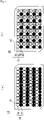
- Fig. 4(a) illustrates a first partial well matrix (the wells 16, represented by white circles in the figure) and a second partial well matrix (the wells 17, represented by black circles in the figure), which are each a group of wells into which all the matrix form dispensing tips 15 of the nozzle head 11 corresponding to the micro plate 13, which are arranged in a matrix form, can be simultaneously inserted. Accordingly, the arrangement of the dispensing tips 15 of the nozzle head 11 has a matrix corresponding to the arrangement of the first partial well matrix (the wells 16) and the second partial well matrix (the wells 17).
- any one group composed of any one of the wells 16 belonging to the first partial well matrix (the wells 16) and represented by one of the white circles, and one of the wells 17 belonging to the second partial well matrix (the wells 17) and represented by one of the black circles which is below the well 16 represented by the white circle and is adjacent thereto in the column direction is a well group 50 that is a group of wells into which the same dispensing tip 15 out of the dispensing tips 15 fitted to the corresponding nozzle head 11 can be inserted. Accordingly, the dispensing tip 15 positioned once in each of areas surrounded by the partitions 18 is not shifted over any one of the partitions 18 until the treatment operations about the micro plates 13 and 14 are completed.
- Fig. 5(a) is a perspective view illustrating the comb teeth magnet 24 and the comb teeth light-detecting unit 25, which are in the state that they are taken out.
- the comb teeth magnet 24 has two or more magnets 61 arranged to be brought into contact with the dispensing tips 15 fitted to the nozzle head 11 and separated therefrom, so as to apply a magnetic field simultaneously to the insides of the dispensing tips 15, as nozzles, and remove the magnetic field.
- the comb teeth magnet 24 has: comb teeth members 60 that are arranged in gaps between adjacent rows of the dispensing tips 15 having a row interval set to a "2" multiple, the number “2" being the natural number of the row interval of the wells 16 and 17, so as to be movable along the row direction, that extend along the row direction, and that are fitted to have a width permitted to be inserted in any one of gaps between adjacent rows of the dispensing tips 15, the number of the comb teeth members 60 being 4, which is the row number of the dispensing tips 15; and a supporting member 60a connected to single-ends of the comb teeth members 60 and extending in the column direction.
- Each of the comb teeth members 60 is equipped with magnets 61 arranged at the column interval, correspondingly to the positions of the dispensing tips 15 as individual nozzles.
- the number of the magnets 61 is the column number, that is, 12.
- reference numeral 62 represents a guide rail laid along the longitudinal direction of the comb teeth members 60, that is, the row direction, so as to guide the movement of the comb teeth light-detecting unit 25, which will be described below, arranged on the upper surface of the comb teeth members 60 so as to be movable.
- Figs. 6 are views illustrating the comb teeth light-detecting unit 25 in detail.
- the comb teeth light-detecting unit 25 is a unit arranged on the comb teeth magnet 24 fitted to the nozzle head 11 to be movable to the comb teeth magnet 24, thereby detecting the states of the liquids in the dispensing tips 15.
- the comb teeth light-detecting unit 25 has: light-detecting comb teeth members 66 that are arranged in gaps between adjacent rows of the dispensing tips having a row interval set to a "2" multiple, which is the natural number of the row interval of the wells 16 and 17, so as to be movable along the row direction to the comb teeth magnet 24 or the dispensing tips 15, that extend along the row direction, and that are fitted to have a width permitted to be inserted in any one of gaps between adjacent rows of the dispensing tips 15, the number of the light-detecting comb teeth members 66 being 4, which is the row number of the dispensing tips 15; and a supporting member 67 connected to single-ends of the light-detecting comb teeth members 66 and extending in the column direction. In each of the light-detecting comb teeth members 66, a single light-detecting hole 69 is made along the column direction.
- a tip of an optical fiber from a light-emitting unit 71 To the light-detecting hole 69 in the light-detecting comb teeth member 66 adjacent thereto is fitted a tip of an optical fiber 72 connected to an optical sensor 73, so as to face a space where the dispensing tip 15 sandwiched between the two light-detecting comb teeth members 66 is to be arranged.
- Reference numeral 68 represents a groove made in each of the light-detecting comb teeth members 66 along the row direction, so as to be slide with being engaged with the guide rail 62.
- the micro plate treating device 10 has a control unit, not illustrated, for controlling operations of the sucking and discharging mechanism, the moving means, the magnetic force means, or the light-detecting means.
- the control unit has a data processing device having a CPU and a memory for storing, for example, a program and data for making operations in accordance with instructions; a display section such as a display for displaying the states of the operations, instructing command data, input data, or processed result data; inputting means, such as a keyboard or mouse, through which instructing commands or data are input; and outputting means, such as a printer, an external memory, or a communicating device for outputting the processed result data.
- micro plate treating device 10 giving, as an example, a treatment for extracting a nucleic acid such as DNA from specimens, for which the two micro plates 13 and 14 are used, by use of only the nozzle head 11.
- Suspensions of specimens and reagent solutions, which are necessary for the treatment, are put beforehand in the wells 16 and 17 in each of the micro plates 13 and 14.
- the partial well matrix (the wells 16) of 4 rows ⁇ 12 columns, composed of the wells 16 represented by the white circles, and the partial well matrix (the wells 17) of 4 rows ⁇ 12 columns, composed of the wells 17 represented by the black circles are used as units to put 48 specimens such as bloods collected from 48 subjects, as objects to be treated, beforehand in the partial well matrix (the wells 16) to which the wells 16 represented by the white circles belong, and put, for example, suspensions where magnetic particles having, on their surfaces, function groups that can be bonded to the target object material beforehand in the partial well matrix (the wells 17) to which the other wells 17, represented by the other black circles micro plate 13, belong.
- the nozzle head 11 is moved by the moving means, so as to position the 48 individual dispensing tips 15 in such a manner that the tips 15 can be inserted into the partial well matrix (the wells 17) to which the wells 17 represented by the corresponding black circles in the micro plate 13 belong, in which the specimens are put. All the 48 dispensing tips 15 are simultaneously inserted into all the wells 17 belonging to the partial well matrix (the wells 17), and then the suspensions of the magnetic particles are sucked.
- the suction is attained is based on the following: the light-detecting comb teeth members 66 of the comb teeth light-detecting unit 25 fitted to the nozzle head 11 are moved in the row direction, whereby the optical sensors 73 receive light rays radiated from the light emitting units 71 and transmitted through the dispensing tips 15, about the states of the liquids in the individual dispensing tips 15, so as to measure the presence or the absence of each of the liquids.
- the nozzle head 11 is moved upwards to pull out the dispensing tips 15 from the partial well matrix (the wells 17) to which the wells 17 represented by the black circles in the micro plate 13 belong, and then the tips 15 are moved along the column direction by the row interval.
- the 48 tips 15 are positioned in such a manner that the tips 15 can be simultaneously inserted into the partial well matrix (the wells 16) to which the wells 16 represented by the white circles belong. Then, all the 48 dispensing tips 15 are simultaneously inserted into all the wells 16 corresponding to the partial well matrix (the wells 16), so as to discharge the suspensions of the magnetic particles into the individual specimen suspensions.
- all the dispensing tips 15 are moved in such a manner that the tips 15 can be inserted into the wells 16 in the partial well matrix (the wells 16) to which the wells 16 represented by the white circles in the micro plate 14 belong. Then, all the dispensing tips 15 are simultaneously inserted into all the wells 16 in the partial well matrix (the wells 16), and then the specimens and the magnetic-particle-mixed suspensions are discharged thereinto, so as to cause them together with, for example, a reagent in which the specimens can be dissolved out of the above-mentioned reagents to react with each other. In this way, DNA or the like is extracted from the specimens, and then bonded to the magnetic particles.
- the dispensing tips 15 are pulled out from the individual wells 16 in the partial well matrix (the wells 16) .
- the nozzle head 11 is then moved in the column direction by the row interval so as to move all the dispensing tips 15 fitted to the nozzle head 11 in such a manner that the all tips 15 can be inserted into the partial well matrix (the wells 17) to which the wells 17 represented by the black circles in the micro plate 14 belong.
- treatment operations for which four micro plates each having 48 wells of 6 rows ⁇ 8 columns that are completely independently configured are required can be attained by only treatment operations with the two micro plates 13 and 14, which each have 96 wells of 8 rows ⁇ 12 columns.
- the moving distance of the nozzle head 11 is a distance corresponding to about 3 ⁇ 6 rows.
- the moving distance is a distance corresponding to about 1 ⁇ 8 rows. This distance difference becomes larger as the number of treatment operations is made larger.
- Fig. 2 is illustrated a perspective view of a micro plate treating device 30 according to a second embodiment of the invention.
- the micro plate treating device 30 has four micro plates 35, 36, 37 and 38 wherein wells are arranged in a matrix form, 4 nozzle heads 31, 32, 33 and 34 each having dispensing tips 15, as nozzle parts, fitted to nozzles which can suck and discharge fluids and are arranged in a matrix form, moving means (not illustrated) for moving the interval between the micro plates 35, 36, 37 and 38 and the nozzle heads 31, 32, 33 and 34 relatively, comb teeth magnets 46 as magnetic force means for applying a magnetic field to the insides of the dispensing tips 15, and comb teeth light-detecting units 25 for detecting the states of the liquids in the dispensing tips 15.
- Reference numeral 46a represents a tray fitted to be fixed to the nozzle head 31 in order to support the comb teeth magnet 46 so as to be movable in the row direction.
- 96 openings i.e., circular wells 39, 40, 41 and 42 are arranged in a matrix form of 8 rows ⁇ 12 columns in a substrate 44, which is in a rectangular form as a whole.
- the distances between the wells, that is, the row interval and the column interval are each 9 mm.
- the nozzle heads 31, 32, 33 and 34 are arranged to be relatively moved over the micro plates 35, 36, 37 and 38, respectively.
- the nozzle heads 31, 32, 33 and 34 each have a mechanism unit 45 equipped with cylinders and nozzles connected to the cylinders, as the above-mentioned sucking and dischargeing mechanism, and the dispensing tips 15 fitted to the nozzles.
- the dispensing tips 15 each have a large-diameter section 21 and a small-diameter section 20 connected to the large-diameter section 21 in the same manner as in the micro plate treating device 10.
- a fitting section 22 that is to be fitted to each of the nozzles is fitted to the upper side of the large-diameter section 21.
- the tips of the small-diameter sections 20 each have a diameter permitted to be inserted into each of the wells 39, 40, 41 and 42 in the micro plates 35, 36, 37 and 38.
- the tips of all the dispensing tips 15 arranged in the matrix form of in each of the nozzle heads 31, 32, 33 and 34 are positioned in such a manner that the tips can be simultaneously inserted into some of the wells (i.e., any partial well matrix) in the micro plate 35, 36, 37 or 38.
- the row interval of the matrix, where the dispensing tips 15 as nozzles are arranged is set to a "2" multiple, as a natural number multiple, of the row interval of the matrix where the wells 39, 40, 41 and 42 are arranged.
- the row number, "4", of the dispensing tips 15 as all the corresponding nozzles is set to a "2" multiple, as a natural number multiple, of the column number.
- the row number, "4", of the dispensing tips 15, as all the corresponding nozzles, is 1 to the natural number of the row number, "8", of the wells, that is, 1/"2".
- the column number, "6", is 1 to the natural number of the column number, "12", of the wells, that is, 1/"2".
- the matrix where the dispensing tips 15 are arranged is a matrix where tips corresponding to 4 rows and 6 columns of the wells 39, 40, 41 and 42 in the matrix of the micro plate 35, 36, 37 or 38 are thinned out so that the dispensing tips 15 of 4 rows ⁇ 6 columns, the number of which is 24, are arranged.
- the number of the dispensing tips 15 of each of the nozzle heads 31, 32, 33 and 34 is 24, so that the number of the dispensing tips 15 in the 4 nozzle heads is 96.
- the number is equal to the number of the wells in any one of the micro plates.
- the material of the micro plates is, for example, a resin such as polyethylene, polypropylene, polyester, polystyrene, polyvinyl, or acrylic resin.
- the moving means for the nozzle heads 31, 32, 33 and 34 is included known mechanism such as, which is not illustrated, for example, a Z axis motor for attaining movement in the vertical direction, and a ball screw mechanism; an X axis motor for attaining movements in the X axis direction along the row direction of the micro plates 35, 36, 37, 38, and a ball screw mechanism; and a Y axis motor for attaining movements in the Y axis direction along the column direction of the micro plates 35, 36, 37, 38, and a ball screw mechanism.
- Figs. 3 (c) and (d) are views illustrating the micro plate 35 (36, 37 or 38) in detail.
- the micro plate 35 is a micro plate wherein the wells 39, 40, 41 and 42, the number of which is 96, are arranged in a matrix form of 8 rows ⁇ 12 columns on the substrate 44.
- partitions 43 in the form of slender thin plates, are arranged on the surface of the substrate 44 so as to be projected upwards in such a manner that three of the partitions 18 are positioned along the row direction and five of the partitions 18 are positioned along the column direction and in such a manner that the partitions 18 cause all the wells to be partitioned into groups each made of wells the number of which is the natural number, "4" (i.e., one of the wells 39, one of the wells 40, one of the wells 41 and one of the wells 42), which are arranged in the column direction and the row direction, correspondingly to the row interval and the column interval of the arranged dispensing tips 15 of the corresponding nozzle head 31.
- "4" i.e., one of the wells 39, one of the wells 40, one of the wells 41 and one of the wells 42
- Fig. 4(b) illustrates a first partial well matrix (the wells 41, each represented by a white circle in the figure), a second partial well matrix (the wells 42, each represented by a single-line in the figure), a third partial well matrix (the wells 39, each represented by a cross in the figure), and a forth partial well matrix (the wells 40, each represented by a black circle in the figure), which are each a group of wells into which all the matrix form dispensing tips 15 of the nozzle head 31 corresponding to the micro plate 35 can be simultaneously inserted.
- the wells 41 each represented by a white circle in the figure
- the wells 42 each represented by a single-line in the figure
- the wells 39 each represented by a cross in the figure
- a forth partial well matrix the wells 40, each represented by a black circle in the figure
- the arrangements of the dispensing tips 15 of the nozzle heads 31, 32, 33 and 34 have a matrix corresponding to the arrangement of the first partial well matrix (the wells 41), the second partial well matrix (the wells 42), the third partial well matrix (the wells 39), and the fourth partial well matrix (the wells 40).
- any one group composed of any one of the wells 41 belonging to the first partial well matrix (the wells 41) and represented by one of the white circles, one of the wells 42 belonging to the second partial well matrix (the wells 42) and represented by one of the single-lines, one of the wells 39 belonging to the third partial well matrix (the wells 39) and represented by one of the crosses, and one of the wells 40 belonging to the fourth partial well matrix (the wells 40) and represented by one of the black circles is a well group 51 that is a group of wells into which the same dispensing tip 15 out of the dispensing tips 15 fitted to the corresponding nozzle head 31, 32, 33 or 34 can be inserted. Accordingly, the dispensing tip 15 positioned once in each of areas surrounded by the partitions 43 is not shifted over any one of the partitions 43 until the treatment operations about the micro plates 35, 36, 37 and 38 are completed.
- Fig. 5(b) is a perspective view illustrating the comb teeth magnet 46 and the comb teeth light-detecting unit 25, which are in the state that they are taken out.
- the comb teeth magnet 46 has magnets 65, the total number of which is 24, arranged to be brought into contact with the dispensing tips 15 and separated therefrom, so as to apply a magnetic field simultaneously to the insides of the dispensing tips 15, as nozzles, and remove the magnetic field.
- the comb teeth magnet 46 has: comb teeth members 63 that are arranged in gaps between adjacent rows of the dispensing tips 15 having a row interval set to a "2" multiple, the number "2" being the natural number of each of the row interval and the column interval of the wells 39, 40, 41 and 42, so as to be movable along the row direction, that extend along the row direction, and that are fitted to have a width permitted to be inserted in any one of gaps between adjacent rows of the dispensing tips 15, the number of the comb teeth members 63 being 4, which is the row number of the dispensing tips 15; and a supporting member 63a connected to single-ends of the comb teeth members 63 and extending in the column direction.
- Each of the comb teeth members 63 is equipped with magnets 65 arranged to have a column interval set to a "2" multiple as the natural number multiple of the column interval of the wells, correspondingly to the positions of the dispensing tips 15 as individual nozzles.
- the column number of the magnets 61 is 1/"2" as one divided by the natural number, so as to be 1. That is, the number of the magnets 61 is 6.
- reference numeral 64 represents a guide rail laid along the longitudinal direction of the comb teeth members 63, that is, the row direction, so as to guide the movement of the above-mentioned comb teeth light-detecting unit 25 arranged on the upper surface of the comb teeth members 63 so as to be movable.
- the micro plate treating device 30 has a control unit, not illustrated, for controlling operations of the sucking and discharging mechanism, the moving means, the magnetic force means, and the light-detecting means.
- the control unit is as described about the micro plate treating device 10 according to the first embodiment.
- micro plate treating device 30 giving, as an example, a treatment for extracting DNA from specimens.
- the individual partial well matrices (4 row ⁇ 6 columns) to which the wells represented by the white circles, the single-lines, the crosses and the black circles belong are used as units to put, beforehand, suspensions capable of capturing the target material (for example, suspensions wherein magnetic particles having function groups on their surfaces are suspended) in the individual wells in the partial well matrix (the wells 41) corresponding to the white circles, put 24 specimens, such as bloods collected from 24 subjects, as treating objects beforehand in the individual wells 42 in the partial well matrix (the wells 42) corresponding to the single-lines, put a reagent necessary for dissolving the specimens in the individual wells 39 in the partial well matrix (the wells 39) corresponding to the crosses, and put a reagent necessary for disassociating the target material from the magnetic particles in the individual wells 40 in the partial well matrix (the wells 40)
- the nozzle heads 31-34 are each moved along a predetermined moving path by the moving means, thereby conducting successive treatment operations.
- the individual dispensing tips 15, the number of which is 24, of each of the nozzle heads 31, 32, 33 and 34 are positioned in such a manner that the tips 15 can be simultaneously inserted into the partial well matrix (the wells 41) to which the wells 41 containing the specimens and represented by the white circles belong.
- all the dispensing tips 15, the number of which is 24, are simultaneously inserted into the wells corresponding to the partial well matrix (the wells 41) in each of the micro plates 35, 36, 37 and 38, so that the suspensions of the magnetic particles are sucked.
- the suction is attained is based on the following: the light-detecting comb teeth members 66 of the comb teeth light-detecting units 25 fitted to the nozzle heads 31, 32, 33 and 34 are moved in the row direction, whereby the states of the liquids in the individual dispensing tips 15 are measured. Next, the nozzle heads 31, 32, 33 and 34 are each moved upwards to pull out the dispensing tips 15 from the partial well matrix (the wells 41). The tips 15 are then moved along the row direction by the column interval.
- the 24 dispensing tips 15 are positioned in such a manner that the tips 15 can be simultaneously inserted into the partial well matrix (the wells 42) to which the wells 42 represented by the single-lines in each of the micro plates 35, 36, 37 and 38 belong. Then, all the 24 dispensing tips 15 are simultaneously inserted into all the wells 42 corresponding to the partial well matrix (the wells 42), so as to discharge the suspensions of the magnetic particles into the individual specimen solutions.
- the dispensing tips 15 are pulled out from the partial well matrix (the wells 42).
- the tips 15 are then moved along the column direction by the row interval.
- the dispensing tips 15, the number of which is 24 per nozzle head are positioned in such a manner that the tips 15 can be simultaneously inserted into the partial well matrix (the wells 39) to which the wells 39 represented by the crosses belong.
- all the 24 dispensing tips 15 in each of the 4 nozzle heads 31, 32, 33 and 34 are simultaneously inserted into the wells 39 corresponding to the partial well matrix (the wells 39), so as to repeat a suction and a discharge.
- the specimens and the magnetic-particle-mixed suspensions are discharged thereinto, so as to cause them together with, for example, the reagent in which the specimens can be dissolved to react with each other.
- DNA or the like is extracted from the specimens, and then adsorbed to the magnetic particles.
- the dispensing tips 15 are pulled out from the individual wells in the partial well matrix.
- the nozzle heads 31, 32, 33 and 34 are then moved in the row direction by the column interval so as to move all the dispensing tips 15 in each of the nozzle heads 31, 32, 33 and 34 in such a manner that the tips 15 can be inserted into the partial well matrix (the wells 40) to which the wells 40 represented by the black circles in each of the micro plates 35, 36, 37 and 38 belong.
- all the dispensing tips 15 are simultaneously inserted into all the wells 40 in the partial well matrix (the wells 40).
- the comb teeth magnets 46 are then moved to separate the individual magnets 65 from the dispensing tips 15, thereby removing the magnetic field.
- a suction and a discharge are repeated, together with the disassociating liquid held in the wells 40 in the partial well matrix (the wells 40), thereby attaining re-suspension.
- a magnetic field is again applied thereto, so as to cause only the magnetic particles to be adsorbed onto the inner walls of the dispensing tips 15, whereby the magnetic particles are removed.
- the target nucleic acid such as DNA
- the 4 nozzle heads having a total nozzle number equal to the number of the wells in any one of the micro plates are used to treat the 4 micro plates simultaneously; therefore, the moving distance between the micro plates is short although the treating speed thereof is equal to the treating speed of a nozzle head having nozzles the number of which is equal to the number of wells in any one of the micro plates.
- the treating speed as a whole increases.
- the number of steps can be increased by making the treating period or the number of micro plates unchanged.
- the moving path of the nozzle heads 31, 32, 33 and 34 is a path along which the individual dispensing tips 15 arranged therein pass through the wells 41, 42, 39 and 40 in the order thereof.
- treatment operations in the 4 micro plates can be simultaneously conducted in parallel, in the unit of each of the 4 partial well matrices, although there are used the nozzle heads wherein the number of their dispensing tips is 96, which is equal to the number of the wells in each of the micro plates.
- Figs. 7 to 9 each schematically illustrate a situation that micro plates, and a nozzle head or nozzle heads are used in the case of conducting treatment using a magnetic particle suspension ( ⁇ ), a specimen suspension ( ⁇ ), and 6 reagents ( ⁇ , ... ⁇ ).
- Fig. 7 illustrates a treatment using a device in the prior art.
- 8 micro plates 101 to 108 which each have 96 wells of 8 rows ⁇ 12 columns, are prepared.
- a nozzle head 100 is used wherein 96 nozzles (dispensing tips a1 to a8) having the same configuration as the wells are arranged.
- the micro plates 101 to 108 each contain any one of the magnetic particle suspension, the specimen suspension, and the 6 reagent solutions in accordance with the order of the treatment operations.
- the treatment is conducted by repeating a suction and a discharge by moving the magnetic particles successively to the individual micro plates by use of the nozzle head 100. In order to complete the treatment, it is necessary to move the nozzle head 100 along the 8 micro plates 101 to 108. Final products therefrom are held in a micro plate 109.
- Fig. 8 illustrates a treatment using the micro plate treating device 10 according to the first embodiment.
- 8 micro plates 131 to 134 and 141 to 144 which each have 96 wells of 8 rows ⁇ 12 columns, are prepared.
- the two nozzle heads 11 and 12 are used, wherein 48 nozzles (dispensing tips a1 to a4, and b1 to b4) of 4 rows ⁇ 12 columns are arranged. Accordingly, the total number of the nozzles is 96.
- Contents held in the individual micro plates 131 to 134 are equivalent with those held in the individual micro plates 141 to 144.
- each of the micro plates two selected from the same magnetic particle suspension, specimen suspension and six reagent solution as above in accordance with the order of steps for the treatment are held in the two partial well matrices, respectively, the partial well matrices each having a configuration corresponding to the configuration of the nozzle head 11 or 12.
- the nozzle heads 11 and 12 are used to move the magnetic particles successively to the individual micro plates, and in the each of the micro plates, the nozzle head 11 or 12 is moved by the row interval of the two partial well matrices, thereby repeating a suction and a discharge so as to conduct the treatment.
- the treatment operations are simultaneously completed in the two nozzle heads.
- the individual nozzle heads 11 and 12 are simultaneously moved by a distance corresponding to 4 out of the micro plates; thus, the moving distance is shorter and the treatment can be more speedily attained than in the prior art.
- the final products are held in a micro plate 135; the final products include products obtained by effect of the nozzle head 11 and those obtained by effect of the nozzle head 12.
- Well matrices for the two are classified into elements "A" and "B".
- Fig. 9 illustrates an example of a treatment using the micro plate treating device 30 according to the second embodiment.
- 8 micro plates to 358 which each have 96 wells of 8 rows x 12 columns, are used as a whole.
- the 4 nozzle heads 31, 32, 33 and 34 are used, wherein 24 nozzles (a1 to a4, b1 to b4 and c1 to c4) of 4 rows x 6 columns are arranged. Accordingly, the total number of the nozzles is 96.
- Contents held in the micro plates 351, 353, 355 and 357 are equivalent with those held in the micro plates 352, 354, 356 and 358, respectively.
- each of the micro plates 4 selected from the same magnetic particle suspension, specimen suspension and 6 reagent solutions as above in accordance with the order of steps for the treatment are held in the 4 partial well matrices, respectively, the partial well matrices having configurations corresponding to the configurations of the nozzle heads 31, 32, 33 and 34.
- the nozzle heads 31, 32, 33 and 34 are used to move the magnetic particles successively to the individual micro plates, and in the each of the micro plates, one of the nozzles is moved by the row interval and the column interval of the 4 partial well matrices, thereby repeating a suction and a discharge so as to conduct the treatment. In this way, the treatment operations are simultaneously conducted in the 4 nozzle heads, thereby completing the treatment.
- the individual nozzle heads 31, 32, 33 and 34 are simultaneously moved between the two micro plates 351 and 352, the micro plates 353 and 354, the micro plates 355 and 366, and micro plates 357 and 358, respectively; thus, the moving distance is even far shorter and the treatment can be even more speedily attained.
- the final products are put in a micro plate 359 in the unit of each of the 4 partial well matrices, which are composed of individual elements "A", "B", "C” and "D", by use of the individual nozzle heads.
- the sucking and discharging mechanism only a cylinder has been described; however, the following mechanism may be used: a mechanism using bellows-type dispensing tips and causing the tips to be deformed, the tips having a container which can put liquid and gas onto the inside surrounded by wall faces that partially have a deformable wall face which can be deformed into a predetermined form without changing the entire inner surface area of the wall faces substantially, and a mouth, connected to the container, through which a liquid sucked or discharged by expansion and contraction of the inside by the deformation of the deformable wall face can be caused to flow in and flow out.
- micro plate treating device and the micro plate treating method according to the invention are concerned with all fields, example of which are fields of industry, agricultures such as foods, agricultural production and fishery processing, pharmacy, medicals, wherein as hygiene, insurance, diseases and inheritance and others are handled, chemistry, biology, and other fields in which treatments of various solutions are required.
- the invention is particularly useful for cases of carrying out a series of treatment operations of many objects in a predetermined order by use of many reagents or materials in parallel.
Landscapes
- Health & Medical Sciences (AREA)
- Chemical & Material Sciences (AREA)
- Analytical Chemistry (AREA)
- General Health & Medical Sciences (AREA)
- Pathology (AREA)
- Physics & Mathematics (AREA)
- Life Sciences & Earth Sciences (AREA)
- Biochemistry (AREA)
- General Physics & Mathematics (AREA)
- Immunology (AREA)
- Clinical Laboratory Science (AREA)
- Chemical Kinetics & Catalysis (AREA)
- Hematology (AREA)
- Automatic Analysis And Handling Materials Therefor (AREA)
- Sampling And Sample Adjustment (AREA)
- Apparatus Associated With Microorganisms And Enzymes (AREA)
Claims (13)
- Mikroplattenbehandlungsvorrichtung (10, 30), umfassend eine Mikroplatte (13, 14, 35-38, 131-135, 141-144, 351-359) mit Näpfchen (16, 17, 39-42), die in einer ersten Matrixform angeordnet sind, wobei sich die erste Matrixform aus mindestes einer ersten und einer zweiten Teilnäpfchenmatrix zusammensetzt,einen oder mehrere Düsenköpfe (11, 12, 31-34, 100) jeweils mit Düsen, die in der Lage sind, ein Fluid anzusaugen und abzugeben, wobei die Düsen jedes Düsenkopfs in einer zweiten Matrixform angeordnet sind, wobei die zweite Matrixform der ersten und einer zweiten Teilnäpfchenmatrix entspricht,und Bewegungseinrichtungen, die in der Lage sind, eine Relativbewegung zwischen der Mikroplatte (13, 14, 35-38, 131-135, 141-144, 351-359) und den Düsenköpfen (11, 12, 31-34, 100) zu erreichen,wobei Spitzen aller Düsen, die in jedem der Düsenköpfe (11, 12, 31-34, 100) angeordnet sind, dazu ausgelegt sind, es zuzulassen, gleichzeitig in alle Näpfchen (16, 17, 39-42) der ersten Teilnäpfchenmatrix oder in alle Näpfchen (16, 17, 39-42) der zweiten Teilnäpfchenmatrix der Mikroplatte (13, 14, 35-38, 131-135, 141-144, 351-359) eingeführt zu werden,wobei eine Näpfchengruppe definiert ist, die Näpfchengruppe aus benachbarten Näpfchen (16, 17, 39-42) der ersten und zweiten Teilnäpfchenmatrix gebildet sind, die Zahl an Näpfchen (16, 17, 39-42) in einer Näpfchengruppe gleich der Zahl an Teilnäpfchenmatrizes ist, und wobei jede einzelne Düse des Düsenkopfs ausschließlich für eine Näpfchengruppe bestimmt ist und es zugelassen wird, dass sie in alle Näpfchen (16, 17, 39-42) einer Näpfchengruppe eingeführt wird, undder Zeilenabstand oder der Spaltenabstand der Düsen auf eine natürliche vielfache Zahl des Zeilenabstands oder des Spaltenabstands der entsprechenden Näpfchen (16, 17, 39-42) eingestellt ist, wobei es sich bei der natürlichen Zahl um zwei oder mehr handelt, und die Zeilenzahl und/oder Spaltenzahl aller entsprechenden Düsen eins geteilt durch die natürliche Zahl, jeweils multipliziert mit der Zeilenzahl oder der Spaltenzahl der Näpfchen (16, 17, 39-42) ist, unddie Düsenköpfe (11, 12, 31-34, 100) jeweils aus Düsenzeilen, in denen die Düsen in der Richtung der Näpfchenzeilen angeordnet sind, und Düsenspalten, in denen die Düsen in der Richtung der Näpfchenspalten angeordnet sind, und zwei oder mehr Magneten (61, 65) bestehen, die angebaut sind, um entlang der Zeilenrichtung oder der Spaltenrichtung zwischen mindestens einem Abstand zwischen den Düsenzeilen oder den Düsenspalten relativ bewegt zu werden, wodurch die Magnete (61, 65) auf eine solche Weise in Kontakt mit den Düsen gebracht und von diesen wieder getrennt werden können, dass gleichzeitig ein Magnetfeld an die Innenseiten der Düsen angelegt und von diesen wieder entfernt werden kann.
- Mikroplattenbehandlungsvorrichtung (10, 30) nach Anspruch 1, die darüber hinaus eine Steuereinheit umfasst, wobei die Steuereinheit bewirkt, dass die Bewegungseinrichtungen die Relativbewegung zwischen dem Düsenkopf und der Mikroplatte (13, 14, 35-38, 131-135, 141-144, 351-359) erreichen, wodurch bewirkt wird, dass die Spitzen aller Düsen, die an den Düsenkopf angebaut sind, auf eine solche Weise positioniert werden, dass die Spitzen gleichzeitig in die Näpfchen (16, 17, 39-42), die zur ersten Teilnäpfchenmatrix in der Mikroplatte (13, 14, 35-38, 131-135, 141-144, 351-359) gehören, eingeführt werden können, die Spitzen der Düsen gleichzeitig in die Näpfchen (16, 17, 39-42) eingeführt werden, so dass ein Behandlungsvorgang ausgeführt wird, die Spitzen herausgezogen werden; und dann bewirkt, dass die Bewegungseinrichtungen die Relativbewegung zwischen dem Düsenkopf und der Mikroplatte (13, 14, 35-38, 131-135, 141-144, 351-359) erreichen, wodurch bewirkt wird, dass die Spitzen aller Düsen auf eine solche Weise positioniert werden, dass die Spitzen gleichzeitig in die Näpfchen (16, 17, 39-42) eingeführt werden können, die zur zweiten Teilnäpfchenmatrix in der Mikroplatte (13, 14, 35-38, 131-135, 141-144, 351-359) gehören.
- Mikroplattenbehandlungsvorrichtung (10, 30) nach Anspruch 2, wobei einzelne Teilnäpfchenmatrizes entlang eines Bewegungspfads des Düsenkopfs Lösungen oder Suspensionen enthalten, die für einzelne Schritte einer Behandlung gemäß der Reihenfolge der einzelnen Schritte notwendig sind.
- Mikroplattenbehandlungsvorrichtung (10, 30) nach einem der Ansprüche 2 oder 3, wobei die Steuereinheit bewirkt, dass der Düsenkopf sukzessive bewegt wird, um die Spitzen der Düsen in dem Zustand zu positionieren, dass die Spitzen in alle Näpfchen (16, 17, 39-42), die jeweils zu den Näpfchengruppen in der Mikroplatte (13, 14, 35-38, 131-135, 141-144, 351-359) gehören, in welche die Spitzen derselben Düsen, die an den Düsenkopf angebaut sind, eingeführt werden können.
- Mikroplattenbehandlungsvorrichtung (10, 30) nach einem der Ansprüche 1 bis 4, wobei Trennwände, um die Näpfchengruppen der Mikroplatte (13, 14, 35-38, 131-135, 141-144, 351-359) abzutrennen, auf der Oberfläche der Mikroplatte (13, 14, 35-38, 131-135, 141-144, 351-359) davon vorstehend gebildet sind.
- Mikroplattenbehandlungsvorrichtung (10, 30) nach Anspruch 1, wobei es sich bei der Zahl der Düsenköpfe (11, 12, 31-34, 100) und der Zahl der Mikroplatten (13, 14, 35-38, 131-135, 141-144, 351-359) um zumindest die natürliche Zahl handelt.
- Mikroplattenbehandlungsvorrichtung (10, 30) nach Anspruch 1, wobei: eine Magnetkrafteinrichtung mit den zwei oder mehr Magneten (61, 65) mehrere Kammzinkenteile aufweist, die relativ zu den Düsenköpfen (11, 12, 31-34, 100) bewegt werden können, die sich entlang der Zeilenrichtung oder der Spaltenrichtung erstrecken, wobei mindestens eines der Teile eine Breite hat, der es erlaubt ist, in den Düsenzeilenabstand oder den Düsenspaltenabstand eingeführt zu werden, und die jeweils eine Länge angrenzend an alle Düsen in einer oder zwei der Düsenzeilen oder Düsenspalten haben, wenn die Teile darin eingeführt sind, und ein Stützteil umfasst, das an die Kammzinkenteile angeschlossen ist; und die Magnete (61, 65), die am Spaltenabstand oder Zeilenabstand an Positionen angeordnet sind, die angrenzenden der einzelnen Düsen entsprechen, in jedes der Kammzinkenteile eingebaut ssnd.
- Mikroplattenbehandlungsvorrichtung (10, 30) nach einem der Ansprüche 1 bis 7, wobei der Düsenkopf darüber hinaus eine Lichterfassungseinrichtung umfasst, um den Zustand der Flüssigkeit in den Düsen zu erfassen.
- Mikroplattenbehandlungsvorrichtung (10, 30) nach Anspruch 8, wobei: die Lichterfassungseinrichtung mehrere lichterfassende Kammzinkenteile umfasst, die relativ zu den Düsenköpfen (11, 12, 31-34, 100) bewegt werden können, wobei Düsenzeilen mit den Düsen, die entlang der Zeilenrichtung angeordnet sind, und Düsenspalten mit den Düsen, die in der Spaltenrichtung angeordnet sind, entlang der Zeilenrichtung oder der Spaltenrichtung angeordnet sind, die sich entlang der Zeilenrichtung oder der Spaltenrichtung erstrecken, wobei mindestens eines der Teile eine Breite hat, der es erlaubt ist, in den Düsenzeilenabstand oder den Düsenspaltenabstand eingeführt zu werden, und die jeweils eine Länge angrenzend an alle Düsen in einer oder zwei der Düsenzeilen oder Düsenspalten haben, wenn die Teile darin eingeführt sind, und ein Stützteil umfasst, das an die lichterfassenden Kammzinkenteile angeschlossen ist; und mindestens eine Lichterfassungseinheit auf jedem der lichterfassenden Kammzinkenteile eingerichtet ist.
- Mikroplattenbehandlungsverfahren, umfassend einen ersten Schritt des Vorbereitens einer Mikroplatte (13, 14, 35-38, 131-135, 141-144, 351-359) mit Näpfchen (16, 17, 39-42), die in einer ersten Matrixform angeordnet sind, wobei sich die erste Matrixform aus mindestes einer ersten und einer zweiten Teilnäpfchenmatrix zusammensetzt, und einen oder mehrere Düsenköpfe (11, 12, 31-34, 100) jeweils mit Düsen, die in der Lage sind, ein Fluid anzusaugen und abzugeben, wobei die Düsen jedes Düsenkopfs in einer zweiten Matrixform angeordnet sind, wobei die zweite Matrixform der ersten und zweiten Teilnäpfchenmatrix entspricht, und des Bewegens der Düsenköpfe (11, 12, 31-34, 100) relativ zur Mikroplatte (13, 14, 35-38, 131-135, 141-144, 351-359),wobei eine Näpfchengruppe definiert ist, die Näpfchengruppe aus benachbarten Näpfchen (16, 17, 39-42) der ersten und zweiten Teilnäpfchenmatrix gebildet sind, die Zahl an Näpfchen (16, 17, 39-42) in einer Näpfchengruppe gleich der Zahl an Teilnäpfchenmatrizes ist, und wobei jede einzelne Düse des Düsenkopfs ausschließlich für eine Näpfchengruppe bestimmt ist und es zugelassen wird, dass sie in alle Näpfchen (16, 17, 39-42) einer Näpfchengruppe eingeführt wird, undwobei der Zeilenabstand und/oder der Spaltenabstand der Düsen auf eine natürliche vielfache Zahl des Zeilenabstands oder des Spaltenabstands der entsprechenden Näpfchen (16, 17, 39-42) eingestellt ist, wobei es sich bei der natürlichen Zahl um zwei oder mehr handelt, und die Zeilenzahl und/oder Spaltenzahl aller entsprechenden Düsen eins geteilt durch die natürliche Zahl, jeweils multipliziert mit der Zeilenzahl oder der Spaltenzahl der Näpfchen (16, 17, 39-42) ist, wodurch alle Düsen, die in jeden der Düsenköpfe (11, 12, 31-34, 100) eingebaut sind, auf eine solche Weise positioniert werden, dass alle Düsen gleichzeitig in die Näpfchen (16, 17, 39-42) eingeführt werden können, die zur ersten Teilnäpfchenmatrix in der Mikroplatte (13, 14, 35-38, 131-135, 141-144, 351-359) gehören, undeinen zweiten Schritt des Erreichens einer Relativbewegung zwischen den Düsenköpfen (11, 12, 31-34, 100) und der Mikroplatte (13, 14, 35-38, 131-135, 141-144, 351-359), wodurch die Spitzen aller Düsen auf eine solche Weise positioniert werden, dass die Spitzen gleichzeitig in die Näpfchen (16, 17, 39-42) eingeführt werden können, die zur zweiten Teilnäpfchenmatrix gehört, bei der es sich um die entsprechende Teilnäpfchenmatrix in der Mikroplatte (13, 14, 35-38, 131-135, 141-144, 351-359) handelt,wobei der erste oder zweite Schritt den Schritt des Anlegens eines Magnetfelds gleichzeitig an die Innenseite der Düsen und den Schritt des Entfernens des Magnetfelds gleichzeitig zum Zeitpunkt des Ansaugens oder Abgebens umfasst, undder Magnetfeldanlegeschritt mittels zweier oder mehr Magnete (61, 65) erreicht wird, die eingebaut sind, um entlang der Zeilenrichtung oder der Spaltenrichtung zwischen mindestens einem Zwischenraum zwischen den Düsenzeilen oder Düsenspalten relativ zu den Düsenköpfen (11, 12, 31-34, 100) bewegt zu werden, die jeweils mit Düsenzeilen, in denen die Düsen in der Richtung der Zeilen angeordnet sind, und Düsenspalten versehen sind, in denen die Düsen in der Richtung der Spalten angeordnet sind, wodurch die Magnete (61, 65) in Kontakt mit den Düsen gebracht und wieder davon getrennt werden können.
- Mikroplattenbehandlungsverfahren nach Anspruch 10, wobei der erste Schritt den Schritt des Einführens der Düsen in die einzelnen Näpfchen (16, 17, 39-42), wodurch ein Ansaugen oder Abgeben erreicht wird, und den Schritt des Herausziehens der Düsen aus den Näpfchen (16, 17, 39-42) umfasst.
- Mikroplattenbehandlungsverfahren nach einem der Ansprüche 10 oder 11, wobei der erste oder zweite Schritt den Schritt des Erfassens des Zustands der Flüssigkeit in den Düsen umfasst.
- Mikroplattenbehandlungsverfahren nach einem der Ansprüche 10 bis 12, wobei Trennwände, um die Näpfchengruppen der Mikroplatte (13, 14, 35-38, 131-135, 141-144, 351-359) abzutrennen, auf der Oberfläche der Mikroplatte (13, 14, 35-38, 131-135, 141-144, 351-359) davon vorstehend gebildet sind.
Applications Claiming Priority (2)
| Application Number | Priority Date | Filing Date | Title |
|---|---|---|---|
| JP2006089286 | 2006-03-28 | ||
| PCT/JP2007/056599 WO2007111347A1 (ja) | 2006-03-28 | 2007-03-28 | マイクロプレート処理装置およびマイクロプレート処理方法 |
Publications (3)
| Publication Number | Publication Date |
|---|---|
| EP2000808A1 EP2000808A1 (de) | 2008-12-10 |
| EP2000808A4 EP2000808A4 (de) | 2015-07-08 |
| EP2000808B1 true EP2000808B1 (de) | 2022-05-04 |
Family
ID=38541263
Family Applications (1)
| Application Number | Title | Priority Date | Filing Date |
|---|---|---|---|
| EP07740037.2A Active EP2000808B1 (de) | 2006-03-28 | 2007-03-28 | Vorrichtung und verfahren zur behandlung von mikroplatten |
Country Status (5)
| Country | Link |
|---|---|
| US (2) | US8562920B2 (de) |
| EP (1) | EP2000808B1 (de) |
| JP (1) | JP4990266B2 (de) |
| CN (1) | CN101416064B (de) |
| WO (1) | WO2007111347A1 (de) |
Families Citing this family (23)
| Publication number | Priority date | Publication date | Assignee | Title |
|---|---|---|---|---|
| JP4804278B2 (ja) * | 2006-08-30 | 2011-11-02 | ユニバーサル・バイオ・リサーチ株式会社 | マイクロプレート分割処理装置およびマイクロプレート分割処理方法 |
| GB2467929A (en) * | 2009-02-19 | 2010-08-25 | Nordiag Asa | Pipette with bellows |
| DE102008025992B4 (de) * | 2008-05-30 | 2011-01-27 | Siemens Healthcare Diagnostics Gmbh | Titerplatte und Verfahren zur Detektion eines Analyten |
| WO2013009654A1 (en) | 2011-07-08 | 2013-01-17 | Life Technologies Corporation | Method and apparatus for automated sample manipulation |
| EP2771128A4 (de) * | 2011-10-28 | 2015-09-30 | Hewlett Packard Development Co | Paralleles adressierungsverfahren |
| JP2013134069A (ja) * | 2011-12-26 | 2013-07-08 | Hitachi High-Technologies Corp | 自動分析装置 |
| EP2618157A1 (de) * | 2012-01-17 | 2013-07-24 | Eppendorf Ag | Laborvorrichtung zur Behandlung eines Probenaufnahmeabschnitts mit einer magnetischen Werkzeugvorrichtung, magnetische Werkzeugvorrichtung, Probenaufnahmevorrichtung zur Verwendung mit der magnetischen Werkzeugvorrichtung und Verfahren zur Durchführung eines Arbeitsschrittes mit mindestens einer Flüssigkeitsprobe unter Verwendung eines magnetischen Feldes |
| US9504981B2 (en) * | 2013-05-15 | 2016-11-29 | True Health Diagnostics Llc | Methods for purifying nucleic acids and devices thereof |
| CN106103737B (zh) | 2013-11-12 | 2020-04-07 | 生命科技公司 | 用于乳状液分解的系统和方法 |
| CN105980826B (zh) * | 2014-02-11 | 2019-01-15 | 沃拉克有限公司 | 用于处理待分析样品的装置和方法 |
| WO2015191877A1 (en) | 2014-06-11 | 2015-12-17 | Life Technologies Corporation | Systems and methods for substrate enrichment |
| CN104437690B (zh) * | 2014-11-26 | 2016-06-29 | 清华大学深圳研究生院 | 一种用于生化分析的微孔板、金属镍模具及其制备方法 |
| EP3433791B1 (de) | 2016-03-25 | 2022-01-12 | T-Central, Inc. | System und verfahren für sicherheit und verwaltung von internet der dinge (iot) |
| JP2018048928A (ja) * | 2016-09-23 | 2018-03-29 | 東芝テック株式会社 | 液滴噴射装置 |
| JP2018048926A (ja) * | 2016-09-23 | 2018-03-29 | 東芝テック株式会社 | 液滴噴射装置 |
| JP6694796B2 (ja) * | 2016-10-18 | 2020-05-20 | ヤマハ発動機株式会社 | 細胞移動装置 |
| US10320795B2 (en) * | 2017-02-17 | 2019-06-11 | Microsoft Technology Licensing, Llc | Context-aware device permissioning for hierarchical device collections |
| CN107782860A (zh) * | 2017-12-06 | 2018-03-09 | 苏州市苏测检测技术有限公司 | 阵列式食品样品质量快速检测机构 |
| US20200326317A1 (en) * | 2018-01-30 | 2020-10-15 | Hewlett-Packard Development Company, L.P. | Fluidic ejection systems with titration plate form factors |
| DE102018131088A1 (de) * | 2018-12-05 | 2020-06-10 | Biofluidix Gmbh | Flüssigkeitsdosiervorrichtung zur ballistischen Abgabe von Dosiermengen im Nanoliterbereich, Flüssigkeitsdosierverfahren und Pipettierspitze hierfür |
| US11684926B2 (en) * | 2019-07-14 | 2023-06-27 | Zhuhai Sanmed Biotech Ltd. | System and processes for isolation and enrichment by magnetic separation |
| CN111112181B (zh) * | 2019-12-09 | 2021-02-09 | 深圳市佳鑫一帆科技有限公司 | 一种高精密度的洗板头 |
| EP4575510A4 (de) * | 2022-08-19 | 2026-07-01 | Hitachi High Tech Corp | Ausgabevorrichtung und genetische testvorrichtung damit |
Family Cites Families (18)
| Publication number | Priority date | Publication date | Assignee | Title |
|---|---|---|---|---|
| JPH0649882B2 (ja) | 1990-05-21 | 1994-06-29 | 住友特殊金属株式会社 | 永久磁石用合金粉末組成物 |
| JP3115501B2 (ja) * | 1994-06-15 | 2000-12-11 | プレシジョン・システム・サイエンス株式会社 | 分注機を利用した磁性体の脱着制御方法及びこの方法によって処理される各種装置 |
| US5895631A (en) | 1995-03-20 | 1999-04-20 | Precision System Science Co., Ltd. | Liquid processing method making use of pipette device and apparatus for same |
| AU738336B2 (en) * | 1996-05-20 | 2001-09-13 | Precision System Science Co., Ltd. | Control method and apparatus for controlling magnetic particles by a sample distributor |
| US6805840B1 (en) * | 1998-03-19 | 2004-10-19 | Precision Systems Science Co., Ltd. | Apparatus for integrated process of magnetic particles and method of controlling the same |
| JP3587052B2 (ja) | 1998-03-25 | 2004-11-10 | 株式会社日立製作所 | 生体試料前処理方法及びその装置 |
| US20030012699A1 (en) * | 1998-11-18 | 2003-01-16 | Thomas Moore | Simultaneous handling of magnetic beads in a two-dimensional arrangement |
| US6723237B1 (en) * | 1999-01-18 | 2004-04-20 | Precision Systems Science Co., Ltd. | Concentration device using magnetic particles and method therefor |
| US6485690B1 (en) * | 1999-05-27 | 2002-11-26 | Orchid Biosciences, Inc. | Multiple fluid sample processor and system |
| JP2001013152A (ja) * | 1999-07-01 | 2001-01-19 | Yoshimi Iida | 液体分注方法、液体分注装置および分注ノズル用チップ |
| JP2001183382A (ja) * | 1999-12-28 | 2001-07-06 | Roche Diagnostics Gmbh | 分注機の動作確認装置および確認方法 |
| JP2002001092A (ja) * | 2000-06-22 | 2002-01-08 | Shimadzu Corp | 排液装置 |
| DE10156790A1 (de) * | 2001-11-19 | 2003-06-18 | Chemagen Biopolymer Technologi | Vorrichtung und Verfahren zum Behandeln von Magnetpartikeln |
| DE10236029A1 (de) * | 2002-08-02 | 2004-02-19 | Cybio Systems Gmbh | Einrichtung zum Dispensieren und Beobachten der Lumineszenz von Einzelproben in Multiprobenanordnungen |
| JP4021335B2 (ja) * | 2003-01-31 | 2007-12-12 | ユニバーサル・バイオ・リサーチ株式会社 | 監視機能付分注装置および分注装置の監視方法 |
| JP4072724B2 (ja) * | 2003-04-16 | 2008-04-09 | 日立工機株式会社 | 自動分注装置 |
| JP2005077308A (ja) * | 2003-09-02 | 2005-03-24 | Corona Giken Kogyo Kk | 検体トレー、及び検体トレーの使用方法 |
| JP2006078356A (ja) | 2004-09-10 | 2006-03-23 | Yokogawa Electric Corp | バイオチップ作成装置 |
-
2007
- 2007-03-28 US US12/225,747 patent/US8562920B2/en not_active Expired - Fee Related
- 2007-03-28 WO PCT/JP2007/056599 patent/WO2007111347A1/ja not_active Ceased
- 2007-03-28 CN CN200780011693.2A patent/CN101416064B/zh not_active Expired - Fee Related
- 2007-03-28 EP EP07740037.2A patent/EP2000808B1/de active Active
- 2007-03-28 JP JP2008507514A patent/JP4990266B2/ja not_active Expired - Fee Related
-
2013
- 2013-09-27 US US14/038,964 patent/US8778284B2/en not_active Expired - Fee Related
Also Published As
| Publication number | Publication date |
|---|---|
| EP2000808A1 (de) | 2008-12-10 |
| WO2007111347A1 (ja) | 2007-10-04 |
| US20100047132A1 (en) | 2010-02-25 |
| CN101416064A (zh) | 2009-04-22 |
| US20140024135A1 (en) | 2014-01-23 |
| US8562920B2 (en) | 2013-10-22 |
| EP2000808A4 (de) | 2015-07-08 |
| CN101416064B (zh) | 2012-08-22 |
| JPWO2007111347A1 (ja) | 2009-08-13 |
| JP4990266B2 (ja) | 2012-08-01 |
| US8778284B2 (en) | 2014-07-15 |
Similar Documents
| Publication | Publication Date | Title |
|---|---|---|
| US8778284B2 (en) | Micro plate treating device and micro plate treating method | |
| EP1972945B1 (de) | Balgdispensierapparat und verfahren | |
| US20250018390A1 (en) | Positional tracking and encoding in microfluidic devices | |
| CA2450676C (en) | Method and system for microfluidic interfacing to arrays | |
| EP1101119B1 (de) | Dosierkopf zur parallelen bearbeitung einer vielzahl von fluidproben | |
| US6485690B1 (en) | Multiple fluid sample processor and system | |
| US7615193B2 (en) | Bead dispensing system | |
| EP1722235B1 (de) | Vorrichtung zum Einfangen von Kügelchen und Verfahren und Vorrichtung zum Anordnen von Kügelchen | |
| EP2031408A1 (de) | Transformierbarer behälter mit darin enthaltenem träger, vorrichtung zur bearbeitung davon und verfahren zur bearbeitung des transformierbaren behälters mit darin enthaltenem träger | |
| US20050247673A1 (en) | Confinement of fluids on surfaces | |
| Wang et al. | Microfluidic cap-to-dispense (μCD): a universal microfluidic–robotic interface for automated pipette-free high-precision liquid handling | |
| US20080038164A1 (en) | Biochemical reaction apparatus and biochemical reaction method | |
| WO2004076018A2 (en) | Reagent dispenser and dispensing method | |
| JP4804278B2 (ja) | マイクロプレート分割処理装置およびマイクロプレート分割処理方法 | |
| WO2008013205A1 (en) | Chip mounting type integration processing apparatus, chip-shaped container and chip mounting type integration processing method | |
| KR20040007402A (ko) | 마이크로-어레이를 형성하기 위한 방법 및 장치 | |
| EP3974841A1 (de) | Mehrkanalige pipettiervorrichtung | |
| KR102040196B1 (ko) | 다중검지 바이오센서 시스템 및 그 동작 방법 | |
| JPH11337558A (ja) | 多サンプル処理方式 |
Legal Events
| Date | Code | Title | Description |
|---|---|---|---|
| PUAI | Public reference made under article 153(3) epc to a published international application that has entered the european phase |
Free format text: ORIGINAL CODE: 0009012 |
|
| 17P | Request for examination filed |
Effective date: 20080923 |
|
| AK | Designated contracting states |
Kind code of ref document: A1 Designated state(s): AT BE BG CH CY CZ DE DK EE ES FI FR GB GR HU IE IS IT LI LT LU LV MC MT NL PL PT RO SE SI SK TR |
|
| DAX | Request for extension of the european patent (deleted) | ||
| RA4 | Supplementary search report drawn up and despatched (corrected) |
Effective date: 20150610 |
|
| STAA | Information on the status of an ep patent application or granted ep patent |
Free format text: STATUS: EXAMINATION IS IN PROGRESS |
|
| 17Q | First examination report despatched |
Effective date: 20180516 |
|
| GRAJ | Information related to disapproval of communication of intention to grant by the applicant or resumption of examination proceedings by the epo deleted |
Free format text: ORIGINAL CODE: EPIDOSDIGR1 |
|
| STAA | Information on the status of an ep patent application or granted ep patent |
Free format text: STATUS: GRANT OF PATENT IS INTENDED |
|
| GRAP | Despatch of communication of intention to grant a patent |
Free format text: ORIGINAL CODE: EPIDOSNIGR1 |
|
| RIC1 | Information provided on ipc code assigned before grant |
Ipc: B01J 19/26 20060101ALI20210921BHEP Ipc: B01J 19/08 20060101ALI20210921BHEP Ipc: G01N 1/00 20060101ALI20210921BHEP Ipc: G01N 35/10 20060101AFI20210921BHEP |
|
| INTG | Intention to grant announced |
Effective date: 20211015 |
|
| RIN1 | Information on inventor provided before grant (corrected) |
Inventor name: TAJIMA, HIDEJI |
|
| GRAS | Grant fee paid |
Free format text: ORIGINAL CODE: EPIDOSNIGR3 |
|
| GRAA | (expected) grant |
Free format text: ORIGINAL CODE: 0009210 |
|
| STAA | Information on the status of an ep patent application or granted ep patent |
Free format text: STATUS: THE PATENT HAS BEEN GRANTED |
|
| AK | Designated contracting states |
Kind code of ref document: B1 Designated state(s): AT BE BG CH CY CZ DE DK EE ES FI FR GB GR HU IE IS IT LI LT LU LV MC MT NL PL PT RO SE SI SK TR |
|
| REG | Reference to a national code |
Ref country code: GB Ref legal event code: FG4D |
|
| REG | Reference to a national code |
Ref country code: CH Ref legal event code: EP |
|
| REG | Reference to a national code |
Ref country code: AT Ref legal event code: REF Ref document number: 1489590 Country of ref document: AT Kind code of ref document: T Effective date: 20220515 |
|
| REG | Reference to a national code |
Ref country code: DE Ref legal event code: R096 Ref document number: 602007061505 Country of ref document: DE |
|
| REG | Reference to a national code |
Ref country code: IE Ref legal event code: FG4D |
|
| REG | Reference to a national code |
Ref country code: LT Ref legal event code: MG9D |
|
| REG | Reference to a national code |
Ref country code: NL Ref legal event code: MP Effective date: 20220504 |
|
| REG | Reference to a national code |
Ref country code: AT Ref legal event code: MK05 Ref document number: 1489590 Country of ref document: AT Kind code of ref document: T Effective date: 20220504 |
|
| PG25 | Lapsed in a contracting state [announced via postgrant information from national office to epo] |
Ref country code: SE Free format text: LAPSE BECAUSE OF FAILURE TO SUBMIT A TRANSLATION OF THE DESCRIPTION OR TO PAY THE FEE WITHIN THE PRESCRIBED TIME-LIMIT Effective date: 20220504 Ref country code: PT Free format text: LAPSE BECAUSE OF FAILURE TO SUBMIT A TRANSLATION OF THE DESCRIPTION OR TO PAY THE FEE WITHIN THE PRESCRIBED TIME-LIMIT Effective date: 20220905 Ref country code: NL Free format text: LAPSE BECAUSE OF FAILURE TO SUBMIT A TRANSLATION OF THE DESCRIPTION OR TO PAY THE FEE WITHIN THE PRESCRIBED TIME-LIMIT Effective date: 20220504 Ref country code: LT Free format text: LAPSE BECAUSE OF FAILURE TO SUBMIT A TRANSLATION OF THE DESCRIPTION OR TO PAY THE FEE WITHIN THE PRESCRIBED TIME-LIMIT Effective date: 20220504 Ref country code: GR Free format text: LAPSE BECAUSE OF FAILURE TO SUBMIT A TRANSLATION OF THE DESCRIPTION OR TO PAY THE FEE WITHIN THE PRESCRIBED TIME-LIMIT Effective date: 20220805 Ref country code: FI Free format text: LAPSE BECAUSE OF FAILURE TO SUBMIT A TRANSLATION OF THE DESCRIPTION OR TO PAY THE FEE WITHIN THE PRESCRIBED TIME-LIMIT Effective date: 20220504 Ref country code: ES Free format text: LAPSE BECAUSE OF FAILURE TO SUBMIT A TRANSLATION OF THE DESCRIPTION OR TO PAY THE FEE WITHIN THE PRESCRIBED TIME-LIMIT Effective date: 20220504 Ref country code: BG Free format text: LAPSE BECAUSE OF FAILURE TO SUBMIT A TRANSLATION OF THE DESCRIPTION OR TO PAY THE FEE WITHIN THE PRESCRIBED TIME-LIMIT Effective date: 20220804 Ref country code: AT Free format text: LAPSE BECAUSE OF FAILURE TO SUBMIT A TRANSLATION OF THE DESCRIPTION OR TO PAY THE FEE WITHIN THE PRESCRIBED TIME-LIMIT Effective date: 20220504 |
|
| PG25 | Lapsed in a contracting state [announced via postgrant information from national office to epo] |
Ref country code: PL Free format text: LAPSE BECAUSE OF FAILURE TO SUBMIT A TRANSLATION OF THE DESCRIPTION OR TO PAY THE FEE WITHIN THE PRESCRIBED TIME-LIMIT Effective date: 20220504 Ref country code: LV Free format text: LAPSE BECAUSE OF FAILURE TO SUBMIT A TRANSLATION OF THE DESCRIPTION OR TO PAY THE FEE WITHIN THE PRESCRIBED TIME-LIMIT Effective date: 20220504 Ref country code: IS Free format text: LAPSE BECAUSE OF FAILURE TO SUBMIT A TRANSLATION OF THE DESCRIPTION OR TO PAY THE FEE WITHIN THE PRESCRIBED TIME-LIMIT Effective date: 20220904 |
|
| PG25 | Lapsed in a contracting state [announced via postgrant information from national office to epo] |
Ref country code: SK Free format text: LAPSE BECAUSE OF FAILURE TO SUBMIT A TRANSLATION OF THE DESCRIPTION OR TO PAY THE FEE WITHIN THE PRESCRIBED TIME-LIMIT Effective date: 20220504 Ref country code: RO Free format text: LAPSE BECAUSE OF FAILURE TO SUBMIT A TRANSLATION OF THE DESCRIPTION OR TO PAY THE FEE WITHIN THE PRESCRIBED TIME-LIMIT Effective date: 20220504 Ref country code: EE Free format text: LAPSE BECAUSE OF FAILURE TO SUBMIT A TRANSLATION OF THE DESCRIPTION OR TO PAY THE FEE WITHIN THE PRESCRIBED TIME-LIMIT Effective date: 20220504 Ref country code: DK Free format text: LAPSE BECAUSE OF FAILURE TO SUBMIT A TRANSLATION OF THE DESCRIPTION OR TO PAY THE FEE WITHIN THE PRESCRIBED TIME-LIMIT Effective date: 20220504 Ref country code: CZ Free format text: LAPSE BECAUSE OF FAILURE TO SUBMIT A TRANSLATION OF THE DESCRIPTION OR TO PAY THE FEE WITHIN THE PRESCRIBED TIME-LIMIT Effective date: 20220504 |
|
| REG | Reference to a national code |
Ref country code: DE Ref legal event code: R097 Ref document number: 602007061505 Country of ref document: DE |
|
| PLBE | No opposition filed within time limit |
Free format text: ORIGINAL CODE: 0009261 |
|
| STAA | Information on the status of an ep patent application or granted ep patent |
Free format text: STATUS: NO OPPOSITION FILED WITHIN TIME LIMIT |
|
| 26N | No opposition filed |
Effective date: 20230207 |
|
| PGFP | Annual fee paid to national office [announced via postgrant information from national office to epo] |
Ref country code: FR Payment date: 20230327 Year of fee payment: 17 |
|
| PG25 | Lapsed in a contracting state [announced via postgrant information from national office to epo] |
Ref country code: SI Free format text: LAPSE BECAUSE OF FAILURE TO SUBMIT A TRANSLATION OF THE DESCRIPTION OR TO PAY THE FEE WITHIN THE PRESCRIBED TIME-LIMIT Effective date: 20220504 |
|
| PG25 | Lapsed in a contracting state [announced via postgrant information from national office to epo] |
Ref country code: MC Free format text: LAPSE BECAUSE OF FAILURE TO SUBMIT A TRANSLATION OF THE DESCRIPTION OR TO PAY THE FEE WITHIN THE PRESCRIBED TIME-LIMIT Effective date: 20220504 |
|
| REG | Reference to a national code |
Ref country code: CH Ref legal event code: PL |
|
| GBPC | Gb: european patent ceased through non-payment of renewal fee |
Effective date: 20230328 |
|
| REG | Reference to a national code |
Ref country code: BE Ref legal event code: MM Effective date: 20230331 |
|
| PG25 | Lapsed in a contracting state [announced via postgrant information from national office to epo] |
Ref country code: LU Free format text: LAPSE BECAUSE OF NON-PAYMENT OF DUE FEES Effective date: 20230328 |
|
| REG | Reference to a national code |
Ref country code: IE Ref legal event code: MM4A |
|
| PG25 | Lapsed in a contracting state [announced via postgrant information from national office to epo] |
Ref country code: GB Free format text: LAPSE BECAUSE OF NON-PAYMENT OF DUE FEES Effective date: 20230328 |
|
| PG25 | Lapsed in a contracting state [announced via postgrant information from national office to epo] |
Ref country code: LI Free format text: LAPSE BECAUSE OF NON-PAYMENT OF DUE FEES Effective date: 20230331 Ref country code: IT Free format text: LAPSE BECAUSE OF FAILURE TO SUBMIT A TRANSLATION OF THE DESCRIPTION OR TO PAY THE FEE WITHIN THE PRESCRIBED TIME-LIMIT Effective date: 20220504 Ref country code: IE Free format text: LAPSE BECAUSE OF NON-PAYMENT OF DUE FEES Effective date: 20230328 Ref country code: GB Free format text: LAPSE BECAUSE OF NON-PAYMENT OF DUE FEES Effective date: 20230328 Ref country code: CH Free format text: LAPSE BECAUSE OF NON-PAYMENT OF DUE FEES Effective date: 20230331 |
|
| PG25 | Lapsed in a contracting state [announced via postgrant information from national office to epo] |
Ref country code: BE Free format text: LAPSE BECAUSE OF NON-PAYMENT OF DUE FEES Effective date: 20230331 |
|
| PGFP | Annual fee paid to national office [announced via postgrant information from national office to epo] |
Ref country code: DE Payment date: 20240320 Year of fee payment: 18 |
|
| PG25 | Lapsed in a contracting state [announced via postgrant information from national office to epo] |
Ref country code: BG Free format text: LAPSE BECAUSE OF FAILURE TO SUBMIT A TRANSLATION OF THE DESCRIPTION OR TO PAY THE FEE WITHIN THE PRESCRIBED TIME-LIMIT Effective date: 20220504 |
|
| PG25 | Lapsed in a contracting state [announced via postgrant information from national office to epo] |
Ref country code: BG Free format text: LAPSE BECAUSE OF FAILURE TO SUBMIT A TRANSLATION OF THE DESCRIPTION OR TO PAY THE FEE WITHIN THE PRESCRIBED TIME-LIMIT Effective date: 20220504 |
|
| PG25 | Lapsed in a contracting state [announced via postgrant information from national office to epo] |
Ref country code: FR Free format text: LAPSE BECAUSE OF NON-PAYMENT OF DUE FEES Effective date: 20240331 |
|
| PG25 | Lapsed in a contracting state [announced via postgrant information from national office to epo] |
Ref country code: FR Free format text: LAPSE BECAUSE OF NON-PAYMENT OF DUE FEES Effective date: 20240331 |
|
| PG25 | Lapsed in a contracting state [announced via postgrant information from national office to epo] |
Ref country code: CY Free format text: LAPSE BECAUSE OF FAILURE TO SUBMIT A TRANSLATION OF THE DESCRIPTION OR TO PAY THE FEE WITHIN THE PRESCRIBED TIME-LIMIT; INVALID AB INITIO Effective date: 20070328 |
|
| PG25 | Lapsed in a contracting state [announced via postgrant information from national office to epo] |
Ref country code: HU Free format text: LAPSE BECAUSE OF FAILURE TO SUBMIT A TRANSLATION OF THE DESCRIPTION OR TO PAY THE FEE WITHIN THE PRESCRIBED TIME-LIMIT; INVALID AB INITIO Effective date: 20070328 |
|
| REG | Reference to a national code |
Ref country code: DE Ref legal event code: R119 Ref document number: 602007061505 Country of ref document: DE |
|
| PG25 | Lapsed in a contracting state [announced via postgrant information from national office to epo] |
Ref country code: TR Free format text: LAPSE BECAUSE OF FAILURE TO SUBMIT A TRANSLATION OF THE DESCRIPTION OR TO PAY THE FEE WITHIN THE PRESCRIBED TIME-LIMIT Effective date: 20220504 |
|
| PG25 | Lapsed in a contracting state [announced via postgrant information from national office to epo] |
Ref country code: DE Free format text: LAPSE BECAUSE OF NON-PAYMENT OF DUE FEES Effective date: 20251001 |