EP1998192A2 - Réflecteur triple avec lentille de Fresnel et système de capteur à grand angle le comprenant - Google Patents
Réflecteur triple avec lentille de Fresnel et système de capteur à grand angle le comprenant Download PDFInfo
- Publication number
- EP1998192A2 EP1998192A2 EP08164500A EP08164500A EP1998192A2 EP 1998192 A2 EP1998192 A2 EP 1998192A2 EP 08164500 A EP08164500 A EP 08164500A EP 08164500 A EP08164500 A EP 08164500A EP 1998192 A2 EP1998192 A2 EP 1998192A2
- Authority
- EP
- European Patent Office
- Prior art keywords
- triple
- reflector
- light
- angle
- wide
- Prior art date
- Legal status (The legal status is an assumption and is not a legal conclusion. Google has not performed a legal analysis and makes no representation as to the accuracy of the status listed.)
- Withdrawn
Links
- 239000011521 glass Substances 0.000 claims description 4
- 239000004033 plastic Substances 0.000 claims description 4
- 229920003023 plastic Polymers 0.000 claims description 4
- 229920003229 poly(methyl methacrylate) Polymers 0.000 claims description 3
- 239000004926 polymethyl methacrylate Substances 0.000 claims description 3
- PXHVJJICTQNCMI-UHFFFAOYSA-N Nickel Chemical compound [Ni] PXHVJJICTQNCMI-UHFFFAOYSA-N 0.000 claims 4
- 229910052751 metal Inorganic materials 0.000 claims 3
- 239000002184 metal Substances 0.000 claims 3
- 229910001369 Brass Inorganic materials 0.000 claims 2
- 229910000906 Bronze Inorganic materials 0.000 claims 2
- RYGMFSIKBFXOCR-UHFFFAOYSA-N Copper Chemical compound [Cu] RYGMFSIKBFXOCR-UHFFFAOYSA-N 0.000 claims 2
- BQCADISMDOOEFD-UHFFFAOYSA-N Silver Chemical compound [Ag] BQCADISMDOOEFD-UHFFFAOYSA-N 0.000 claims 2
- 229910000831 Steel Inorganic materials 0.000 claims 2
- RTAQQCXQSZGOHL-UHFFFAOYSA-N Titanium Chemical compound [Ti] RTAQQCXQSZGOHL-UHFFFAOYSA-N 0.000 claims 2
- 229910052782 aluminium Inorganic materials 0.000 claims 2
- XAGFODPZIPBFFR-UHFFFAOYSA-N aluminium Chemical compound [Al] XAGFODPZIPBFFR-UHFFFAOYSA-N 0.000 claims 2
- 239000010951 brass Substances 0.000 claims 2
- 239000010974 bronze Substances 0.000 claims 2
- 229910052802 copper Inorganic materials 0.000 claims 2
- 239000010949 copper Substances 0.000 claims 2
- KUNSUQLRTQLHQQ-UHFFFAOYSA-N copper tin Chemical compound [Cu].[Sn] KUNSUQLRTQLHQQ-UHFFFAOYSA-N 0.000 claims 2
- PCHJSUWPFVWCPO-UHFFFAOYSA-N gold Chemical compound [Au] PCHJSUWPFVWCPO-UHFFFAOYSA-N 0.000 claims 2
- 229910052737 gold Inorganic materials 0.000 claims 2
- 239000010931 gold Substances 0.000 claims 2
- 239000011133 lead Substances 0.000 claims 2
- 229910052759 nickel Inorganic materials 0.000 claims 2
- MOFOBJHOKRNACT-UHFFFAOYSA-N nickel silver Chemical compound [Ni].[Ag] MOFOBJHOKRNACT-UHFFFAOYSA-N 0.000 claims 2
- 239000010956 nickel silver Substances 0.000 claims 2
- 229910052709 silver Inorganic materials 0.000 claims 2
- 239000004332 silver Substances 0.000 claims 2
- 239000010959 steel Substances 0.000 claims 2
- 239000010936 titanium Substances 0.000 claims 2
- 229910052719 titanium Inorganic materials 0.000 claims 2
- VYPSYNLAJGMNEJ-UHFFFAOYSA-N Silicium dioxide Chemical compound O=[Si]=O VYPSYNLAJGMNEJ-UHFFFAOYSA-N 0.000 claims 1
- 230000005540 biological transmission Effects 0.000 claims 1
- 239000005388 borosilicate glass Substances 0.000 claims 1
- 239000005329 float glass Substances 0.000 claims 1
- 239000005304 optical glass Substances 0.000 claims 1
- 239000004417 polycarbonate Substances 0.000 claims 1
- 229920000515 polycarbonate Polymers 0.000 claims 1
- 239000004800 polyvinyl chloride Substances 0.000 claims 1
- 238000007493 shaping process Methods 0.000 claims 1
- 238000004544 sputter deposition Methods 0.000 claims 1
- 238000007740 vapor deposition Methods 0.000 claims 1
- 229910000679 solder Inorganic materials 0.000 abstract description 5
- 238000004519 manufacturing process Methods 0.000 description 17
- 238000000034 method Methods 0.000 description 13
- 238000005286 illumination Methods 0.000 description 12
- 230000011514 reflex Effects 0.000 description 11
- 238000012360 testing method Methods 0.000 description 6
- 238000010276 construction Methods 0.000 description 5
- 238000013461 design Methods 0.000 description 5
- 238000005516 engineering process Methods 0.000 description 5
- 230000000694 effects Effects 0.000 description 4
- 230000010287 polarization Effects 0.000 description 4
- 238000005520 cutting process Methods 0.000 description 2
- 239000000463 material Substances 0.000 description 2
- 238000005259 measurement Methods 0.000 description 2
- 238000000465 moulding Methods 0.000 description 2
- 238000003491 array Methods 0.000 description 1
- 230000015572 biosynthetic process Effects 0.000 description 1
- 238000012937 correction Methods 0.000 description 1
- 238000009826 distribution Methods 0.000 description 1
- 239000011888 foil Substances 0.000 description 1
- 238000005304 joining Methods 0.000 description 1
- 238000000691 measurement method Methods 0.000 description 1
- 238000012986 modification Methods 0.000 description 1
- 230000004048 modification Effects 0.000 description 1
- 230000003287 optical effect Effects 0.000 description 1
- 238000005375 photometry Methods 0.000 description 1
- 238000012545 processing Methods 0.000 description 1
- 230000002035 prolonged effect Effects 0.000 description 1
- 238000002310 reflectometry Methods 0.000 description 1
- 230000001953 sensory effect Effects 0.000 description 1
Images






Classifications
-
- B—PERFORMING OPERATIONS; TRANSPORTING
- B29—WORKING OF PLASTICS; WORKING OF SUBSTANCES IN A PLASTIC STATE IN GENERAL
- B29D—PRODUCING PARTICULAR ARTICLES FROM PLASTICS OR FROM SUBSTANCES IN A PLASTIC STATE
- B29D11/00—Producing optical elements, e.g. lenses or prisms
- B29D11/00605—Production of reflex reflectors
-
- G—PHYSICS
- G02—OPTICS
- G02B—OPTICAL ELEMENTS, SYSTEMS OR APPARATUS
- G02B5/00—Optical elements other than lenses
- G02B5/12—Reflex reflectors
- G02B5/122—Reflex reflectors cube corner, trihedral or triple reflector type
-
- G—PHYSICS
- G02—OPTICS
- G02B—OPTICAL ELEMENTS, SYSTEMS OR APPARATUS
- G02B5/00—Optical elements other than lenses
- G02B5/12—Reflex reflectors
- G02B5/122—Reflex reflectors cube corner, trihedral or triple reflector type
- G02B5/124—Reflex reflectors cube corner, trihedral or triple reflector type plural reflecting elements forming part of a unitary plate or sheet
Definitions
- the invention relates to a method and the formation of a suitable reflector for wide-angle observation of a reflective surface by means of a reflex sensor, which may also be equipped with polarizing filters or work as a laser reflection sensor.
- the triple-angle wide-angle sensor system consists of a doctrine for selecting the viewing angle and a triple reflector consisting of a plurality of triplets.
- the triple partial areas arranged around the triple center are mirror sides, almost at right angles to each other, and the axis of the triple alternates by -5 ° and + 5 ° or more from the incidence slot of the reflector surface.
- a special feature of the triples is the considerable extension of at least one triple surface.
- the aim of the triple-angle wide-angle sensor system is to provide a reflex sensor system capable of observing an area having an opening angle of 80 ° and more at a retroreflective value at each illuminance angle of the observed horizontal area of at least 3,000 mcd / lx.
- moving bodies in space for example vehicles or transport gondolas, can be observed, even if these bodies change their angle to the observer, for example when a conveyor nacelle is guided in a curve.
- a reflex signal in its intensity is received strong enough of at least 3,000 mcd / Ix, can also be a connected measurement technique, for example, for distance measurement or position measurement work reliably.
- the problem is that so far there are no high-quality reflex surfaces on the market for the tasks of the reflex sensor, which provide an intense Retroflexsignal resistant, especially not if the reflective surface is positioned at 40 ° and more deviating from the Lot.
- the reflectors or reflective films on the market as far as they have wide-angle properties, are designed for road traffic, for reflective signs or personal protection reflectors on clothes. These reflective structures produce a broadband distribution of the reflected light. As a result, their reflected light energy is insufficient to give reflex sensors bundled reliable retroflex signals. For reflex sensors, as much of the light as possible has to be retroflected in a targeted manner to the receiver.
- this novel triple reflector can also with well-known Technology can be formed as Mikrocubereflektor, as he is particularly required for the laser sensor or film technology.
- the requirements for laser sensors are the inventor in the DE 197 27 527 described.
- pyramidal triple surfaces are completely unsuitable, on the one hand, because they retroflect only about 66 ° of the light, on the other hand, because they are unsuitable for the required light beam contour and precision for laser sensors.
- the invention therefore uses a special design of Fulicube triples.
- triple forms such as the three-sided pyramid.
- preference must be given to the modification of the fullcube because, in principle, it has a much lower scattering loss than the pyramid.
- Pyramidal triple structures can be cut out of a flat common area, whereas fullcube triplets in toolmaking require the arrangement of a large number of components in order to represent large structured areas made up of a large number of triplets.
- the production methods and their advantages and disadvantages in the production of triples are known in the art and need not be repeated here.
- the invention takes advantage of the experience gained with the manufacture and use of Fullcube triples in the art.
- the Fullcube triplet has the excellent property of receiving incident light over a wide tolerance range of the angle of incidence and retroflecting it almost completely to the light source.
- the retroflexion takes place via the light reflection on the three square surfaces of the fullcube triple.
- This angle tolerance for the incident light is used in practical application today in most retro-reflective sensors.
- the mounting and alignment of the reflectors in relation to the transmitter / receiver system is simple and fault-tolerant. Also Beam movements due to vibrations are usually tolerated by this reflection element with fullcube triples.
- triple systems that can be assigned to the fullcube. Because it is essential to distinguish between triples, which are pyramidal triples that can be cut from a base area, and fullcube triples, which can only be produced by joining subsegments.
- the production of the retroreflective technology knows Fullcube triple, whose triple axis is deviating from the incidence of the reflector surface aligned.
- the wide angle sensor system uses as a triple reflector a particular variation of the full cube triple, in which at least one triple partial area is substantially larger than the smallest triple partial area.
- This enlarged, extended triple part surface helps to catch even very wide-angle incident light and pass it on to the other triple partial areas, so that the light is retroflected in the direction of the light source.
- the result is a triple, which works completely surprisingly in practice substantially marwinkliger, as one could expect.
- each triple at least a triple partial area is much larger than the smallest Tripelteil constitutional the triple. It is only the substantially enlarged, namely prolonged triple partial area, which makes it possible to capture incident light at very wide angles and to achieve the excellent reflection values shown in FIG. 34 and the table of FIG. 35.
- the particular triple mold according to the invention with enlarged, extended triple part surface can be achieved when the triples in the plate method, which in the British Patent 269,760 to Stimson is described. Deviating from this, of course, the modern production techniques and materials of microstructure technology are used. But at one point, the inventive structure of the reflector deviates significantly from Stimson. Is there the triple aligned aligned to the incidence slot, the triple axes of the triple are strongly different from the incidence of the reflector surface aligned, namely at least +/- 5 ° and more and combined with triples whose triple axes, for example, +/- 15 ° from Deviating solder deviate the reflector surface.
- the desired extended triple part surface arises when notching the tool element plates when using the Stimson plate method by the oblique wedge-shaped cutting in the plates ( FIGS. 11 and 12 ).
- the invention proposes a wide-angle sensor with a reflector in which a light receiver is used to a light transmitter so that the observation angle is as small as possible.
- the viewing angle of 0 ° means that the light receiver is positioned towards the light emitter so that the light retroreflected by the reflector is received on the same axis as it was transmitted.
- Such arrangements are known in the sensor art and are solved, for example, by using semi-transparent mirrors or beam splitters. However, some light energy is lost in this arrangement, because even unwanted beam paths arise. To avoid such complex optical devices, it is sufficient for the invention Sensor system to position the light receiver as close to the axis of the light emitter, so that an observation angle greater than 0 °, for example, 0.2 °, and not more than 1 ° is formed.
- the reflector can be observed over a horizontal of about + 40 ° to -40 °, which corresponds to an opening angle of the observed by the sensor surface of about 80 ° and a constant retroreflective power of the reflector of about 3,000 mcd / Ix.
- the opening angle can be significantly extended. Because with the tilting of the triple axis away from the incidence slot of the reflector surface, ie with the enlargement of the triple axis, also increases the extended triple part surface, which captures the light much better.
- the amazing effect of the system according to the invention is based on this particular triple shape of the reflector, which achieves the Weitwinkltechnik the reflector not only by pivoting the triple axis, but by the associated enlargement of the extended triple partial area. For example, if the triple axes are swiveled horizontally by +/- 5 °, a horizontal wide angle of more than 40 ° is achieved, but the extremely high reflection power of more than 9,000 mcd / lx at horizontal and vertical 0 ° remains.
- the invention thus makes it possible to provide a wide-angle sensor system with a triple reflector by an angle of view of the wide-angle sensor of 1 ° or smaller and the design of a triple array for the reflector, which consists of a plurality of Fullcube triples, of which the vast majority of triples extended at least one substantially Own triple-surface and the triple axis is inclined by +/- 5 ° or more relative to the entrance slot of the light entry surface, and when using a Fullcube triplet manufacturing method by means of Stimson plates or Gubela strands, so that over a viewing angle of +/- 40 ° or more the wide angle sensor receives a retroflex signal over its entire viewing angle of 80 ° or more, its reflectance value never drops below 3,000 mcd / Ix drops and so that the wide-angle sensor can also be equipped with a polarizing filter.
- the reflector can be equipped on the light entry surface with a Fresnel lens, which increases the illumination angle.
- the slight deviations of 90 ° are due to the different refractive properties of the coming to processing plastics or glasses and the different shrinkage behavior of the materials required for tooling vorrauseilenden angle correction.
- Striking is the shape of the mirror surface (3), which is an uneven quadrilateral.
- This form arises in an inventive Wide-angle structure of the reflector, if the structure in the horizontal to both sides should be wide, so the angle of inclination of the triple axes to the incidence of the reflector surface for the one group of the triple + 5 ° and should be for the second triple group -5 °. It should be noted that it is of course possible to add further triples with different angles of inclination of the triple axes of the wide-angle structure, for example with an inclination angle of 0 ° or about +/- 15 °.
- the two triple partial surfaces, the mirror surfaces (2 and 3), are substantially larger and longer than the triple partial area 1.
- the extended Tripelteil configuration invention (2) makes the Ankleuchtungsweitwinkltechnik in the Fig. 3 horizontal, the triple part surface (3) in a substantially smaller vertical direction. See also the table of the Fig. 33 ,
- the center of the triple is the lowest point (4), which touches all three mirror surfaces.
- the footprint of the triple projected on a plane is an uneven hexagon.
- the shape of the triple is such that, with other similar triples, it forms a wide-angle mirror structure of the reflector ( FIG. Fig. 3 and Fig. 4 ), which can capture the incident light from two opposite directions.
- the light entry surface (17) of the reflector is not positioned to scale here.
- the incidence slot (16) to the light entry surface (17) corresponds to a direct angle of incidence of the light at horizontal and vertical 0 °.
- the triple axis (18) of the triple is in this example, pointing away from the entrance slot to the right by about -5 °, inclined towards the triple section area (2).
- minus values are slope values pointing to the right for the observer, plus values are left-leaning slope values.
- the inclination could also be made to the edge of the triple, which is formed by the triple partial surfaces (2 and 3). It is important for the present invention that the inclination of the triple axis takes place in the direction of the extended triple partial surface or partial surfaces, or to the triple edge, which is formed from these extended partial surfaces. For thus the light trapping effect of the extended triple partial areas according to the invention becomes effective for the wide angle range.
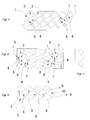
- Fig. 2 a single triple of the wide-angle mirror structure of the reflector, this triple to a segment, see Fig. 20 and Fig. 21 , of the Wide-angle mirror structure is one that is aligned only on one side for the illumination wide-angle, as in the Fig. 7 to 10 shown.
- This triple consists of three mirror surfaces (1, 2, 5), which in turn are almost at right angles to each other. He is like the triple in Fig. 1 with its triple axis inclined by -5 ° to the right towards the triple surface 2.
- the shape of the triple part surfaces, mirror surfaces (2 and 5), are each elongated rectangles.
- the center of the triple is the lowest point (4).
- the footprint of the triple projected on a plane is an uneven hexagon.
- the shape of the triple is such that, with other similar triples, it forms a wide-angle mirror structure of the reflector ( FIG. Fig. 7 and Fig. 8 ), which receives and retroflects the incident light predominantly from a spatial direction to the right of the incidence slot.
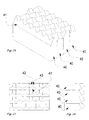
- Fig. 3 a wide - angle mirror structure of the reflector, which consists of triples of the Fig. 1 is joined together. Due to the perspective view, the mirror surfaces (2 and 7) of the Fig. 4 not visible.
- the mirror surfaces (1) and (3) show the triple of the first orientation.
- the mirror surfaces (6) and (8) show the triples of the second orientation in their rotated by 180 ° position relative to the triplets of the first orientation.
- the triples of a same orientation are arranged in rows. It alternate rows with opposite orientation. The orientation of the triple roughly determines the spatial direction from which it preferably receives light.
- the inclination angle of the triple axis with respect to the incidence solder is indicated by minus when the inclination in the figure for shows the viewer to the right and indicated by plus, if the inclination in the figure points to the left.
- Fig. 4 the wide angle mirror structure of the reflector of Fig. 3 in the view from above and thus the projection of all edges on a base.
- Fig. 5 the section through the wide-angle mirror structure of the reflector of the Fig. 4 , The cut passes through the opposing triple rows.
- Fig. 6 rotated the wide-angle mirror structure of the reflector in space so that all the mirror surfaces (3) of the triple of the first orientation (9) with the mirror surfaces (8) of the triple of the second orientation (10) show a closed specular surface for the viewer.
- the wide - angle mirror structure of the reflector is made up of the triplets of the Fig. 1 seamlessly put together.
- Fig. 7 the wide - angle mirror structure of the reflector, which is aligned on one side to the right and the triples of the Fig. 2 is joined together.
- a mirror surface (12) of Fig. 8 not visible.
- Fig. 8 the same wide angle mirror structure of the reflector Fig. 7 in the view from above and thus the projection of all edges on a base. All mirror surfaces of the triple are rectangles. The mirror surfaces (11, 12, 13) are arranged around the triple center (14). All triples are evenly aligned and therefore receive the light predominantly from the right side of the incidence slot.
- Fig. 9 the section through the wide-angle mirror structure of the reflector of the Fig. 8 , The cut passes through all arranged in the same orientation triples.
- Fig. 10 the wide angle mirror structure of the reflector of Fig. 7 rotated in the room so that all the mirror surfaces (13) of the triples of the same orientation (15) show a closed-looking area for the viewer as a single large mirror.
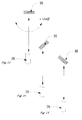
- Fig. 11 the principle of the triple with the extended Tripelteil relations (2). These are opposite to the two other triple sub-surfaces in an almost right angle, shown in this two-dimensional sketch as a line (23). From the incidence slot (16) of the light entry surface (17), the triple axis (18) deviates by, for example, 5 °. Here the triple axis is inclined towards the extended triple part surface (2).
- the light transmitter (24) of the reflex sensor transmits the light beam (26), which finds reference points on the extended triple part surface (2) within the triple, which allows a retroflexion of the light via the beam path (28) to the receiver (25). Even if the transmitter and receiver are replaced in this example, the beam path results in the opposite direction.
- Fig. 12 the sensor (29), which can observe the reflectors (30) in a horizontal opening angle of greater than 80 °.
- Fig. 13, Fig. 14 and Fig. 15 the sensor (29), which can observe the reflectors even with rotation of more than +/- 40 ° deviating from the beam path between the sensor and the reflector.
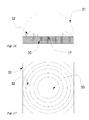
- the reflector (30) on the light entrance side (17) was additionally surface-structured with a Fresnel lens.
- the Fresnel lens enhances the ability of the Reflectors for Weitwinkltechnik.
- the theoretical lens mold (31) has a flattened in the center arc and determines the shape of the linearly applied in this example in circles Fresnel structure.
- the Fresnel structure can be micronized with known technique manufacture in the cutting process.
- Fig. 17 the reflector (30) of Fig. 16 in view of the light entrance surface (17) with the linear circles of the Fresnel structure (32) and the planar center (33) of the surface of the light entry side (17), which was not patterned.
- the Fresnel lens can also have a completely different shape.
- the reflector may be curved in itself or only the light entrance side.
- Fig. 18 the reflector (30), in the view of the light entry surface, with a division of the reflex structure in the segments (35) and (36).
- the reflector (30) as viewed from the light entry surface, is divided into numerous segments which point in very different directions with the extended triple subareas, for example (38) and (39). But it can also be added segments whose triples are not inclined, so that their triple axis corresponds to the incidence slot to the reflector surface.
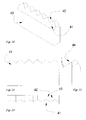
- Fig. 20 to Fig. 31 show the tool production for the production of wide-angle reflectors using the Gubela plate method.
- Fig. 20 a tool element (40), which may be formed as a glass body and a reflector element itself, with a chamfer, which forms a virtually unlimited triple partial surface (41).
- the plate-shaped tool element is notched at the upper edge. The edges of the notches form the two further triple partial surfaces (42) and (43) in FIG Fig. 25 visible, noticeable.
- Fig. 21 the tool element from the broad side with the chamfer (41).
- Fig. 22 the tool element from the narrow side with the angle (44), which determines the position of the notch. If the triple axis is to be inclined to the large triple part surface (41) by, for example, 5 °, an angle of approximately 30 ° should be used here relative to the light entry surface of the reflector.
- Fig. 23 shows the strand-shaped tool element in the view perpendicular to the light entry surface.
- the over the entire length of the strand running Tripelteil preparation faces the triple partial surfaces (42) and (43). All Tripelteil vom are almost at right angles to each other.
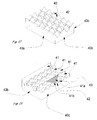
- Fig. 24 a complete reflector structure composed of the four tool elements (40).
- Fig. 25 equals to Fig. 24 viewed from the Lichteinfallslot.
- Fig. 26 the block of four tool elements in section.
- Fig. 27 the negative of the Fig. 24 , which corresponds to the galvanic impression and can be used as a metallic reflector or as a tool structure for the molding of wide-angle reflectors.
- the negative is a suitable retro-reflector.
- Marked are the triple partial surfaces (42) and (43).
- the triple part surface (41) is not visible.
- the outer edges of the negative are marked (40a) and (40b) and the concealed outer edge (40c), so that in the following Fig. 28 can detect the rotation of the negative in relation to the viewer.
- Fig. 28 the negative turned to the viewer Fig. 27 with the outer edge (40b) and the now visible outer edges (40c).
- the elongated Tripelteil lake (41) according to the invention extend in their width over the entire length of the negative.
- the triple partial surfaces (42) and (43) are at almost right angles to the triple partial surface (41).
- the visible part in this representation (41 a) and the non-visible part (41 b) shown the actual effective Tripelteil configuration (41) to the two marked Tripelteil lake (42) and (43) suitable reference points to light from far Capture the angle of illumination.
- the construction with the Gubela strands allows wide-angle triplets of the group of fullcubetripel associated with a very large light capture surface for wide-angle light. Because the large triple sub-area (41) can provide for several triples at the same time overlapping reference surfaces, which is formed from the sum of all reference points that can capture light and this can pass to the other triple sub-surfaces for retroflexion.
- Fig. 29 to Fig. 31 show yet another variant of Gubela strands to make even more extended light capture surfaces for a second spatial direction, for example, a vertical.
- FIG. 29 the tool element (45), the tool element (40) from Fig. 22 is similar. However, the notches (46) that meet the chamfer (47) are formed with non-uniform sides, which is in FIG Fig. (30 ) becomes visible.
- Fig. 30 the tool element in longitudinal section with the indicated chamfer (47) and the non-uniform notches (46).
- the edges (48) and (49) of the notches (46) form the two triple partial surfaces, which are almost at right angles to the chamfer (47), which corresponds to the third triple part surface Fig. 31 the view of the tool element from the light entrance side of the entrance slot accordingly.
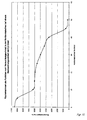
- Fig. 32 the reflectance values of an exemplary reflector made of PMMA, which is the retroflective structure of the Fig. 3 corresponds, as a function of the angle of illumination in the horizontal axis of the Fig. 4 at an observation angle of 0.2 °.
- the measuring method The vertical angle is 0 °.
- the Xoffset is 0 °, the Yoffset 0.5 °.
- the return values are entered in mcd / Ix.
- the test sample "IMOS Wide Angle 1" is commissioned by the company IMOS Gubela GmbH, Renchen, Germany, for the inventor and consists of a 50x50 mm reflector plate with welded back box.
- the reflective surface is about 47x47 mm in size and consists of the structures of the invention Fig. 3 with significantly extended triple part surfaces whose maximum power lies somewhat from the horizontal.
- the reflex structure consists of triples, which are set in tracks and whose extended triple side per track is rotated by 180 °. The inclination of the triple axes are inclined at 5 ° to the extended triple surfaces.
- the triples are designed as Mikrocubetripel whose smallest edge length is about 1 mm.
- the triple structure is suitable for sensors with polarization filters or laser sensors.
- the construction of the structure of the test specimen is also suitable for the production of microstructured reflective foils.
- Fig. 33 the table of photometric measurement results in detail of Fig. 32 , It means (test point), specifying the observation angle 0.2 ° followed by the angles of illumination in degrees at horizontal (H) and vertical (V). (HV) is the angle of illumination at horizontal and vertical 0 °. It can be seen that the test sample was designed for horizontal Weitwinkltechnik out.
Landscapes
- Physics & Mathematics (AREA)
- Engineering & Computer Science (AREA)
- General Physics & Mathematics (AREA)
- Optics & Photonics (AREA)
- Ophthalmology & Optometry (AREA)
- Manufacturing & Machinery (AREA)
- Health & Medical Sciences (AREA)
- Mechanical Engineering (AREA)
- Optical Elements Other Than Lenses (AREA)
- Length Measuring Devices By Optical Means (AREA)
- Photometry And Measurement Of Optical Pulse Characteristics (AREA)
- Optical Radar Systems And Details Thereof (AREA)
- Aerials With Secondary Devices (AREA)
- Navigation (AREA)
- Measurement Of Velocity Or Position Using Acoustic Or Ultrasonic Waves (AREA)
Applications Claiming Priority (2)
| Application Number | Priority Date | Filing Date | Title |
|---|---|---|---|
| DE10216579A DE10216579A1 (de) | 2002-04-14 | 2002-04-14 | Weitwinkelsensorsystem mit Tripelreflektor und Herstellung der Werkzeuge |
| EP03007645A EP1361460B1 (fr) | 2002-04-14 | 2003-04-03 | Réflecteur triple et système de sensors à grand angle d'ouverture l'utilisant |
Related Parent Applications (1)
| Application Number | Title | Priority Date | Filing Date |
|---|---|---|---|
| EP03007645A Division EP1361460B1 (fr) | 2002-04-14 | 2003-04-03 | Réflecteur triple et système de sensors à grand angle d'ouverture l'utilisant |
Publications (2)
| Publication Number | Publication Date |
|---|---|
| EP1998192A2 true EP1998192A2 (fr) | 2008-12-03 |
| EP1998192A3 EP1998192A3 (fr) | 2009-04-29 |
Family
ID=28458830
Family Applications (3)
| Application Number | Title | Priority Date | Filing Date |
|---|---|---|---|
| EP08164497A Withdrawn EP2012147A3 (fr) | 2002-04-14 | 2003-04-03 | Réflecteur triple et système de capteur à grand angle d'ouverture l'utilisant |
| EP08164500A Withdrawn EP1998192A3 (fr) | 2002-04-14 | 2003-04-03 | Réflecteur triple avec lentille de Fresnel et système de capteur à grand angle le comprenant |
| EP03007645A Expired - Lifetime EP1361460B1 (fr) | 2002-04-14 | 2003-04-03 | Réflecteur triple et système de sensors à grand angle d'ouverture l'utilisant |
Family Applications Before (1)
| Application Number | Title | Priority Date | Filing Date |
|---|---|---|---|
| EP08164497A Withdrawn EP2012147A3 (fr) | 2002-04-14 | 2003-04-03 | Réflecteur triple et système de capteur à grand angle d'ouverture l'utilisant |
Family Applications After (1)
| Application Number | Title | Priority Date | Filing Date |
|---|---|---|---|
| EP03007645A Expired - Lifetime EP1361460B1 (fr) | 2002-04-14 | 2003-04-03 | Réflecteur triple et système de sensors à grand angle d'ouverture l'utilisant |
Country Status (4)
| Country | Link |
|---|---|
| US (3) | US7135671B2 (fr) |
| EP (3) | EP2012147A3 (fr) |
| AT (1) | ATE421706T1 (fr) |
| DE (2) | DE10216579A1 (fr) |
Cited By (1)
| Publication number | Priority date | Publication date | Assignee | Title |
|---|---|---|---|---|
| DE102021111397A1 (de) | 2021-05-03 | 2022-11-03 | Sick Engineering Gmbh | Reflektor für ein Transmissiometer und damit ausgerüstetes Transmissiometer |
Families Citing this family (24)
| Publication number | Priority date | Publication date | Assignee | Title |
|---|---|---|---|---|
| EP2442148B1 (fr) | 2003-03-06 | 2016-06-08 | 3M Innovative Properties Co. | Laminé comportant des éléments en coin de cube et feuille rétroréfléchissante |
| US7152983B2 (en) | 2003-03-06 | 2006-12-26 | 3M Innovative Properties Company | Lamina comprising cube corner elements and retroreflective sheeting |
| US7308207B2 (en) * | 2003-11-17 | 2007-12-11 | Raytheon Company | Method for identifying an interrogated object using a dynamic optical tag identification system |
| US8268435B2 (en) * | 2005-09-26 | 2012-09-18 | Avery Dennison Corporation | Retroreflective sheeting |
| DE202006013375U1 (de) † | 2006-08-31 | 2006-11-02 | Sick Ag | Ziel für eine optoelektronische Schutzeinrichtung |
| US8465639B2 (en) * | 2008-04-09 | 2013-06-18 | Orafol Americas Inc. | Pin based method of precision diamond turning to make prismatic mold and sheeting |
| JPWO2010067583A1 (ja) * | 2008-12-08 | 2012-05-17 | 日本カーバイド工業株式会社 | 再帰反射物品 |
| US9295741B2 (en) * | 2012-03-27 | 2016-03-29 | Earl Yerby | Apparatus and method for sanitizing articles utilizing a plurality of reflector units to evenly distribute UV radiation |
| WO2015187433A1 (fr) * | 2014-05-27 | 2015-12-10 | Wang Michael W | Procédés d'optimisation de systèmes d'affichage rétroréfléchissants |
| CN104148898B (zh) * | 2014-08-08 | 2016-06-01 | 浙江道明光电科技有限公司 | 具有微棱镜阵列结构的反光材料模具的制作方法 |
| JP2016080937A (ja) * | 2014-10-20 | 2016-05-16 | 株式会社アスカネット | 再帰性反射体製造用の金型及びこの金型を用いた再帰性反射体の製造方法 |
| AU2015350056B2 (en) | 2014-11-20 | 2019-09-26 | Avery Dennison Corporation | Tiled retroreflector with multi-stage dicing |
| DE102016118656B4 (de) | 2016-09-30 | 2022-10-20 | Automotive Lighting Reutlingen Gmbh | Fahrzeug mit einem Retroreflektor mit mehreren Retroreflektorelementen |
| CN110300904A (zh) | 2017-02-20 | 2019-10-01 | 3M创新有限公司 | 包括延迟片的回射制品 |
| EP3583449A4 (fr) | 2017-02-20 | 2020-12-30 | 3M Innovative Properties Company | Article rétroréfléchissant à couche de réduction de contraste |
| CN110312952B (zh) | 2017-02-20 | 2022-09-27 | 3M创新有限公司 | 光学制品和与其交互的系统 |
| KR20200061370A (ko) | 2017-09-27 | 2020-06-02 | 쓰리엠 이노베이티브 프로퍼티즈 캄파니 | 장비 및 안전 모니터링을 위하여 광학 패턴들을 이용하는 개인 보호 장비 관리 시스템 |
| DE102018101292B4 (de) | 2018-01-22 | 2020-10-29 | Hans-Erich Gubela | Retroreflektorelement zur Verwendung im Straßenverkehr und Spritzgussform |
| DE102018101289B4 (de) | 2018-01-22 | 2019-10-17 | Imos Gubela Gmbh | Retroreflektor mit einer gekrümmten Oberfläche, Abformwerkzeug zur Herstellung des Retroreflektors und Verfahren zur Herstellung des Abformwerkzeugs |
| DE102018101291B4 (de) | 2018-01-22 | 2020-10-29 | Hans-Erich Gubela | Verwendung und Verfahren zur Herstellung eines elastischen Retroreflektors |
| DE102018112043B4 (de) * | 2018-05-18 | 2022-01-13 | Hans-Erich Gubela | Anordnung eines Retroreflektors mit Optikelementen |
| DE102018117569B4 (de) | 2018-07-20 | 2023-09-07 | Hans-Erich Gubela | Retroreflektor, Spritzgussform und Verwendung eines Retroreflektors |
| CN109765537B (zh) * | 2019-01-04 | 2020-10-13 | 北京环境特性研究所 | 一种极化可调节的角反射器和角反射器极化调节方法 |
| DE102020004967B4 (de) * | 2020-08-14 | 2024-08-01 | Hans-Erich Gubela | Retroreflektierendes Element mit einem Sicherheitselement |
Family Cites Families (28)
| Publication number | Priority date | Publication date | Assignee | Title |
|---|---|---|---|---|
| GB269760A (en) | 1926-07-02 | 1927-04-28 | Jonathan Cass Stimson | Process and apparatus for making central triple reflectors |
| US3649153A (en) * | 1969-11-04 | 1972-03-14 | Peter E Brudy | Faceted core |
| US3899154A (en) * | 1970-09-05 | 1975-08-12 | Ichikoh Industries Ltd | Light reflector mold |
| US3923378A (en) * | 1973-04-24 | 1975-12-02 | Amerace Corp | Cube-corner reflector with non-aligned cube axes and element axes |
| US3833285A (en) * | 1973-05-22 | 1974-09-03 | Amerace Esna Corp | Retrodirective reflector visible over wide range of observation angles |
| USRE29396E (en) * | 1975-02-18 | 1977-09-13 | Amerace Corporation | Pin having nonaligned cube axis and pin axis and bundle of such pins |
| US4066236A (en) * | 1976-06-25 | 1978-01-03 | Beatrice Foods Co. | Cube corner type retroreflector bodies and molds made therewith |
| US4095773A (en) * | 1976-11-18 | 1978-06-20 | Beatrice Foods Co. | Subassemblies for cube corner type retroreflector molds |
| US4189209A (en) * | 1978-10-13 | 1980-02-19 | Ferro Corporation | Retroreflector of integrated light reflecting units of varying configurations |
| US4588258A (en) * | 1983-09-12 | 1986-05-13 | Minnesota Mining And Manufacturing Company | Cube-corner retroreflective articles having wide angularity in multiple viewing planes |
| DE4410994C2 (de) * | 1992-10-30 | 1996-01-25 | Gubela Sen Hans Erich | Körper oder Bauteil eines strangförmigen Tripelreflektors und Werkzeugelement zur Abformung von Tripelreflektoren |
| WO1994018581A1 (fr) * | 1993-01-30 | 1994-08-18 | Kernforschungszentrum Karlsruhe Gmbh | Outil de modelage, son procede de fabrication et miroir triple |
| DK111293D0 (da) * | 1993-10-04 | 1993-10-04 | Franke Kell Erik | Retroreflektivt foliemateriale |
| US5565151A (en) * | 1994-09-28 | 1996-10-15 | Reflexite Corporation | Retroreflective prism structure with windows formed thereon |
| JP3359456B2 (ja) * | 1995-01-31 | 2002-12-24 | 日本カーバイド工業株式会社 | 内部全反射型再帰反射シート |
| WO1997004939A1 (fr) * | 1995-07-28 | 1997-02-13 | Nippon Carbide Kogyo Kabushiki Kaisha | Procede de fabrication d'une matrice microprisme |
| US6120280A (en) * | 1995-07-28 | 2000-09-19 | Nippon Carbide Kogyo Kabushiki Kaisha | Microprism master mold |
| US6159407A (en) * | 1996-01-26 | 2000-12-12 | 3M Innovative Properties Company | Stacked laminate mold and method of making |
| US6015214A (en) * | 1996-05-30 | 2000-01-18 | Stimsonite Corporation | Retroreflective articles having microcubes, and tools and methods for forming microcubes |
| DE29707066U1 (de) * | 1997-04-21 | 1997-08-14 | IMOS Gubela GmbH, 77871 Renchen | Mikroretroflektor |
| DE19727527C5 (de) * | 1997-06-30 | 2015-02-19 | Hans-Erich Gubela sen. | Auf der Retroreflexion eines Laserstrahlers basierende Sensoreinrichtung |
| KR100573526B1 (ko) * | 1997-07-02 | 2006-04-26 | 미네소타 마이닝 앤드 매뉴팩춰링 캄파니 | 큐브 코너형 시트 성형 몰드와 그것의 제조 방법 |
| US5981032A (en) * | 1997-07-02 | 1999-11-09 | 3M Innovative Properties Company | Retroreflective cube corner sheeting mold and sheeting formed therefrom |
| WO2001038906A2 (fr) * | 1999-11-23 | 2001-05-31 | Digilens, Inc. | Dispositif de retroreflexion optique |
| JP3468418B2 (ja) * | 2000-03-15 | 2003-11-17 | 日本カーバイド工業株式会社 | 三角錐型キユーブコーナー型再帰反射シート |
| US6353489B1 (en) * | 2000-11-23 | 2002-03-05 | Digilens, Inc. | Optical retro-reflection device |
| US6626544B2 (en) * | 2001-03-28 | 2003-09-30 | Reflexite Corporation | Prismatic retroreflector having a multi-plane facet |
| DE10119671A1 (de) * | 2001-04-20 | 2002-10-24 | Sen Hans-Erich Gubela | Umlenkspiegelstruktur, bestehend aus einer Vielzahl von Tripeln |
-
2002
- 2002-04-14 DE DE10216579A patent/DE10216579A1/de not_active Ceased
-
2003
- 2003-04-03 EP EP08164497A patent/EP2012147A3/fr not_active Withdrawn
- 2003-04-03 EP EP08164500A patent/EP1998192A3/fr not_active Withdrawn
- 2003-04-03 DE DE50311110T patent/DE50311110D1/de not_active Expired - Lifetime
- 2003-04-03 AT AT03007645T patent/ATE421706T1/de not_active IP Right Cessation
- 2003-04-03 EP EP03007645A patent/EP1361460B1/fr not_active Expired - Lifetime
- 2003-04-14 US US10/412,936 patent/US7135671B2/en not_active Expired - Lifetime
-
2006
- 2006-08-14 US US11/503,750 patent/US7268340B2/en not_active Expired - Lifetime
-
2007
- 2007-05-30 US US11/807,845 patent/US20070258157A1/en not_active Abandoned
Cited By (2)
| Publication number | Priority date | Publication date | Assignee | Title |
|---|---|---|---|---|
| DE102021111397A1 (de) | 2021-05-03 | 2022-11-03 | Sick Engineering Gmbh | Reflektor für ein Transmissiometer und damit ausgerüstetes Transmissiometer |
| DE102021111397B4 (de) | 2021-05-03 | 2026-01-08 | Endress+Hauser Sick Gmbh+Co. Kg | Reflektor für ein Transmissiometer und damit ausgerüstetes Transmissiometer |
Also Published As
| Publication number | Publication date |
|---|---|
| US20070258157A1 (en) | 2007-11-08 |
| EP1361460A2 (fr) | 2003-11-12 |
| US20070007441A1 (en) | 2007-01-11 |
| US20030193717A1 (en) | 2003-10-16 |
| EP2012147A2 (fr) | 2009-01-07 |
| US7135671B2 (en) | 2006-11-14 |
| EP2012147A3 (fr) | 2009-04-29 |
| DE50311110D1 (de) | 2009-03-12 |
| EP1361460B1 (fr) | 2009-01-21 |
| ATE421706T1 (de) | 2009-02-15 |
| EP1361460A3 (fr) | 2005-01-05 |
| EP1998192A3 (fr) | 2009-04-29 |
| US7268340B2 (en) | 2007-09-11 |
| DE10216579A1 (de) | 2003-10-23 |
Similar Documents
| Publication | Publication Date | Title |
|---|---|---|
| EP1361460B1 (fr) | Réflecteur triple et système de sensors à grand angle d'ouverture l'utilisant | |
| DE69104214T2 (de) | Retroreflektierendes material mit verbesserter eckigkeit. | |
| DE68915367T2 (de) | Effizientes Material für einen Retroreflektor. | |
| DE3624188C2 (fr) | ||
| DE68919749T2 (de) | Effizientes Material für einen Würfelecken Retroreflektor. | |
| DE68918311T2 (de) | Von innen beleuchtetes retro-reflektierendes Lichtzeichen. | |
| DE69424436T2 (de) | Asymmetrischer würfeleckiger gegenstand und herstellungsverfahren | |
| DE10124370B4 (de) | Optisches Element mit Totalreflexion | |
| DE69222765T2 (de) | Optischer spiegel | |
| DE69427919T2 (de) | Doppelrilliger retroreflektiver würfeleckiger körper und herstellungsverfahren | |
| DE69504496T2 (de) | Optische vorrichtung mit gerichteter reflexion | |
| DE69932853T2 (de) | Abbildende artikel und zweiachsige retroreflektierende elemente verwendende verfahren | |
| DE60027602T2 (de) | Würfelecken-retroreflexionselement des dreieckpyramidentyps | |
| DE4236799A1 (de) | Verfahren zur Herstellung von Tripel-Reflektoren und deren Werkzeugen | |
| DE4429683C1 (de) | Körper oder Bauteil eines strangförmigen Tripelreflektors und/ oder Werkzeugelements zur Abformung von Tripelreflektoren | |
| EP1251367B1 (fr) | Miroir de déviation, consistant en une multitude de triples | |
| EP3523572B1 (fr) | Dispositif de déflexion de la lumière, procédé de réalisation d'un dispositif de déflexion de la lumière et dispositif d'éclairage | |
| DE102012022418B4 (de) | Retroreflektor, optisches System, ortsfeste Anordnung eines Retroreflektors und Abformwerkzeug | |
| EP3356868A1 (fr) | Panneau routier rétroréfléchissant, matériau en bande rétroréfléchissant et procédé de fabrication associé | |
| DE10324402A1 (de) | Optische Vorrichtung mit vielen Gruppierungen Eindimensionaler optischer Elemente | |
| WO2006136381A2 (fr) | Prisme triple reflechissant la lumiere, reflecteur et procede d'identification d'un objet | |
| DE102016001543A1 (de) | Retro-Rückstrahler | |
| EP2369393A1 (fr) | Dispositif de rupture de lumière | |
| WO2011124294A1 (fr) | Dispositif pour le découplage réduit au niveau de l'éblouissement de la lumière | |
| DE102018101289B4 (de) | Retroreflektor mit einer gekrümmten Oberfläche, Abformwerkzeug zur Herstellung des Retroreflektors und Verfahren zur Herstellung des Abformwerkzeugs |
Legal Events
| Date | Code | Title | Description |
|---|---|---|---|
| PUAI | Public reference made under article 153(3) epc to a published international application that has entered the european phase |
Free format text: ORIGINAL CODE: 0009012 |
|
| AC | Divisional application: reference to earlier application |
Ref document number: 1361460 Country of ref document: EP Kind code of ref document: P |
|
| AK | Designated contracting states |
Kind code of ref document: A2 Designated state(s): AT BE BG CH CY CZ DE DK EE ES FI FR GB GR HU IE IT LI LU MC NL PT RO SE SI SK TR |
|
| PUAL | Search report despatched |
Free format text: ORIGINAL CODE: 0009013 |
|
| AK | Designated contracting states |
Kind code of ref document: A3 Designated state(s): AT BE BG CH CY CZ DE DK EE ES FI FR GB GR HU IE IT LI LU MC NL PT RO SE SI SK TR |
|
| AKX | Designation fees paid | ||
| STAA | Information on the status of an ep patent application or granted ep patent |
Free format text: STATUS: THE APPLICATION IS DEEMED TO BE WITHDRAWN |
|
| 18D | Application deemed to be withdrawn |
Effective date: 20091030 |
|
| REG | Reference to a national code |
Ref country code: DE Ref legal event code: 8566 |