EP1997703B1 - Redundante Bremsaktuatoren für ein Bremssystem mit Failsafefunktion - Google Patents
Redundante Bremsaktuatoren für ein Bremssystem mit Failsafefunktion Download PDFInfo
- Publication number
- EP1997703B1 EP1997703B1 EP08157045.9A EP08157045A EP1997703B1 EP 1997703 B1 EP1997703 B1 EP 1997703B1 EP 08157045 A EP08157045 A EP 08157045A EP 1997703 B1 EP1997703 B1 EP 1997703B1
- Authority
- EP
- European Patent Office
- Prior art keywords
- brake
- control unit
- actuation
- actuation mechanism
- local control
- Prior art date
- Legal status (The legal status is an assumption and is not a legal conclusion. Google has not performed a legal analysis and makes no representation as to the accuracy of the status listed.)
- Not-in-force
Links
Images






Classifications
-
- B—PERFORMING OPERATIONS; TRANSPORTING
- B60—VEHICLES IN GENERAL
- B60T—VEHICLE BRAKE CONTROL SYSTEMS OR PARTS THEREOF; BRAKE CONTROL SYSTEMS OR PARTS THEREOF, IN GENERAL; ARRANGEMENT OF BRAKING ELEMENTS ON VEHICLES IN GENERAL; PORTABLE DEVICES FOR PREVENTING UNWANTED MOVEMENT OF VEHICLES; VEHICLE MODIFICATIONS TO FACILITATE COOLING OF BRAKES
- B60T17/00—Component parts, details, or accessories of power brake systems not covered by groups B60T8/00, B60T13/00 or B60T15/00, or presenting other characteristic features
- B60T17/18—Safety devices; Monitoring
- B60T17/22—Devices for monitoring or checking brake systems; Signal devices
- B60T17/221—Procedure or apparatus for checking or keeping in a correct functioning condition of brake systems
-
- B—PERFORMING OPERATIONS; TRANSPORTING
- B60—VEHICLES IN GENERAL
- B60T—VEHICLE BRAKE CONTROL SYSTEMS OR PARTS THEREOF; BRAKE CONTROL SYSTEMS OR PARTS THEREOF, IN GENERAL; ARRANGEMENT OF BRAKING ELEMENTS ON VEHICLES IN GENERAL; PORTABLE DEVICES FOR PREVENTING UNWANTED MOVEMENT OF VEHICLES; VEHICLE MODIFICATIONS TO FACILITATE COOLING OF BRAKES
- B60T13/00—Transmitting braking action from initiating means to ultimate brake actuator with power assistance or drive; Brake systems incorporating such transmitting means, e.g. air-pressure brake systems
- B60T13/74—Transmitting braking action from initiating means to ultimate brake actuator with power assistance or drive; Brake systems incorporating such transmitting means, e.g. air-pressure brake systems with electrical assistance or drive
- B60T13/746—Transmitting braking action from initiating means to ultimate brake actuator with power assistance or drive; Brake systems incorporating such transmitting means, e.g. air-pressure brake systems with electrical assistance or drive and mechanical transmission of the braking action
-
- B—PERFORMING OPERATIONS; TRANSPORTING
- B60—VEHICLES IN GENERAL
- B60T—VEHICLE BRAKE CONTROL SYSTEMS OR PARTS THEREOF; BRAKE CONTROL SYSTEMS OR PARTS THEREOF, IN GENERAL; ARRANGEMENT OF BRAKING ELEMENTS ON VEHICLES IN GENERAL; PORTABLE DEVICES FOR PREVENTING UNWANTED MOVEMENT OF VEHICLES; VEHICLE MODIFICATIONS TO FACILITATE COOLING OF BRAKES
- B60T8/00—Arrangements for adjusting wheel-braking force to meet varying vehicular or ground-surface conditions, e.g. limiting or varying distribution of braking force
- B60T8/32—Arrangements for adjusting wheel-braking force to meet varying vehicular or ground-surface conditions, e.g. limiting or varying distribution of braking force responsive to a speed condition, e.g. acceleration or deceleration
- B60T8/321—Arrangements for adjusting wheel-braking force to meet varying vehicular or ground-surface conditions, e.g. limiting or varying distribution of braking force responsive to a speed condition, e.g. acceleration or deceleration deceleration
-
- B—PERFORMING OPERATIONS; TRANSPORTING
- B60—VEHICLES IN GENERAL
- B60T—VEHICLE BRAKE CONTROL SYSTEMS OR PARTS THEREOF; BRAKE CONTROL SYSTEMS OR PARTS THEREOF, IN GENERAL; ARRANGEMENT OF BRAKING ELEMENTS ON VEHICLES IN GENERAL; PORTABLE DEVICES FOR PREVENTING UNWANTED MOVEMENT OF VEHICLES; VEHICLE MODIFICATIONS TO FACILITATE COOLING OF BRAKES
- B60T8/00—Arrangements for adjusting wheel-braking force to meet varying vehicular or ground-surface conditions, e.g. limiting or varying distribution of braking force
- B60T8/32—Arrangements for adjusting wheel-braking force to meet varying vehicular or ground-surface conditions, e.g. limiting or varying distribution of braking force responsive to a speed condition, e.g. acceleration or deceleration
- B60T8/34—Arrangements for adjusting wheel-braking force to meet varying vehicular or ground-surface conditions, e.g. limiting or varying distribution of braking force responsive to a speed condition, e.g. acceleration or deceleration having a fluid pressure regulator responsive to a speed condition
- B60T8/343—Systems characterised by their lay-out
- B60T8/344—Hydraulic systems
- B60T8/345—Hydraulic systems having more than one brake circuit per wheel
-
- B—PERFORMING OPERATIONS; TRANSPORTING
- B60—VEHICLES IN GENERAL
- B60T—VEHICLE BRAKE CONTROL SYSTEMS OR PARTS THEREOF; BRAKE CONTROL SYSTEMS OR PARTS THEREOF, IN GENERAL; ARRANGEMENT OF BRAKING ELEMENTS ON VEHICLES IN GENERAL; PORTABLE DEVICES FOR PREVENTING UNWANTED MOVEMENT OF VEHICLES; VEHICLE MODIFICATIONS TO FACILITATE COOLING OF BRAKES
- B60T8/00—Arrangements for adjusting wheel-braking force to meet varying vehicular or ground-surface conditions, e.g. limiting or varying distribution of braking force
- B60T8/32—Arrangements for adjusting wheel-braking force to meet varying vehicular or ground-surface conditions, e.g. limiting or varying distribution of braking force responsive to a speed condition, e.g. acceleration or deceleration
- B60T8/88—Arrangements for adjusting wheel-braking force to meet varying vehicular or ground-surface conditions, e.g. limiting or varying distribution of braking force responsive to a speed condition, e.g. acceleration or deceleration with failure responsive means, i.e. means for detecting and indicating faulty operation of the speed responsive control means
- B60T8/885—Arrangements for adjusting wheel-braking force to meet varying vehicular or ground-surface conditions, e.g. limiting or varying distribution of braking force responsive to a speed condition, e.g. acceleration or deceleration with failure responsive means, i.e. means for detecting and indicating faulty operation of the speed responsive control means using electrical circuitry
-
- B—PERFORMING OPERATIONS; TRANSPORTING
- B60—VEHICLES IN GENERAL
- B60T—VEHICLE BRAKE CONTROL SYSTEMS OR PARTS THEREOF; BRAKE CONTROL SYSTEMS OR PARTS THEREOF, IN GENERAL; ARRANGEMENT OF BRAKING ELEMENTS ON VEHICLES IN GENERAL; PORTABLE DEVICES FOR PREVENTING UNWANTED MOVEMENT OF VEHICLES; VEHICLE MODIFICATIONS TO FACILITATE COOLING OF BRAKES
- B60T2270/00—Further aspects of brake control systems not otherwise provided for
- B60T2270/40—Failsafe aspects of brake control systems
- B60T2270/404—Brake-by-wire or X-by-wire failsafe
-
- B—PERFORMING OPERATIONS; TRANSPORTING
- B60—VEHICLES IN GENERAL
- B60T—VEHICLE BRAKE CONTROL SYSTEMS OR PARTS THEREOF; BRAKE CONTROL SYSTEMS OR PARTS THEREOF, IN GENERAL; ARRANGEMENT OF BRAKING ELEMENTS ON VEHICLES IN GENERAL; PORTABLE DEVICES FOR PREVENTING UNWANTED MOVEMENT OF VEHICLES; VEHICLE MODIFICATIONS TO FACILITATE COOLING OF BRAKES
- B60T2270/00—Further aspects of brake control systems not otherwise provided for
- B60T2270/40—Failsafe aspects of brake control systems
- B60T2270/414—Power supply failure
-
- B—PERFORMING OPERATIONS; TRANSPORTING
- B60—VEHICLES IN GENERAL
- B60T—VEHICLE BRAKE CONTROL SYSTEMS OR PARTS THEREOF; BRAKE CONTROL SYSTEMS OR PARTS THEREOF, IN GENERAL; ARRANGEMENT OF BRAKING ELEMENTS ON VEHICLES IN GENERAL; PORTABLE DEVICES FOR PREVENTING UNWANTED MOVEMENT OF VEHICLES; VEHICLE MODIFICATIONS TO FACILITATE COOLING OF BRAKES
- B60T2270/00—Further aspects of brake control systems not otherwise provided for
- B60T2270/82—Brake-by-Wire, EHB
Definitions
- the present invention relates generally to a system according to the preamble of claim 1, for controlling the application of a brake of a vehicle, which is particularly well-suited for controlling the application of an electromechanical brake with self-enforcing characteristics, and more specifically to a redundant brake actuator according to the preamble of claim 20, for use in connection with such a system to provide fail safe operation.
- a brake system and brake actuator are disclosed in WO 2005/030522 A .
- U.S. Patent No. 5,788,023 discloses a disc brake for a vehicle which can be actuated electrically and whose brake linings can be pressed against the brake disc with the aid of an electric motor.
- the electric motor transmits its actuation force, via a so-called planetary rolling-contact threaded spindle, onto an axially displaceably mounted piston which interacts with the brake lining.
- U.S. Patent No. 5,829,557 discloses another vehicle disc brake which can be actuated electrically and whose brake linings can in turn be pressed against the brake disc by means of an electric motor serving as an actuator.
- the electric motor comprises a spindle gear mechanism and, by means of a spindle element which can be of different designs, is connected, in the direction of displacement of the brake linings, to an axially displaceable piston which acts on a brake lining.
- an additional gear mechanism for converting the torque and rotational speed.
- a major problem with conventional brakes with an electric actuator is the high actuator force that has to be applied in order to achieve a sufficient braking effect.
- the necessary high actuator force and the resulting large power demand of the actuator make it necessary to employ very large drive units, usually electric motors, which have large torques, and are also heavy and expensive.
- electromechanical brakes have, to date, not become widespread as vehicle brakes, for example.
- a self-enforcing brake works according to the principle that the braking force amplifies itself.
- the friction force between the brake linings and the brake disc give rise, with help of a self-enforcing mechanism, to increased force against the brake linings and brake disc.
- This increased force gives, in turn, rise to increased friction force.
- the degree of self-enforcement defines the relation between the applied force and the actual braking force.
- the self-enforcement is strongly dependent on the disc/pad friction coefficient. Normally, the variations in the disc/pad friction coefficient are large, and are dependent on, among other factors, the temperature of the disc and/or pad. Variations in disc/pad friction coefficient are even possible within one and the same brake application.
- the static reinforcement of the self-enforcing mechanism is principally infinity. That means that one can produce and control large brake forces by only applying relatively moderate forces.
- the brake is stable, which means that a pushing force has to be applied to produce brake forces.
- the self-enforced brake instead will become unstable, which means that a pulling force has to be applied to hold the brake at a specific brake force or else uncontrolled braking (i.e., lockup) can occur.
- each control means (84) includes a main control unit (80) which is in communication with the central control unit (72) and with the various system sensors, and an auxiliary control unit (82) which is in communication with the main control unit (80).
- the main control unit (80) controls operation of drives (34, 34') of the self-enforcing brake (10), while the auxiliary control unit (82) controls operation of an adjusting means (42) of the self-enforcing brake (10).
- the auxiliary control unit (82) may be isolated from the central control unit (72) and the various system sensors, thereby severely restricting operation of the auxiliary control unit (82), or even rendering the auxiliary control unit (82) essentially useless.
- auxiliary control unit (82) is capable of only very limited brake actuation, even when the auxiliary control unit (82) is fully functional. True brake actuation control capability is not provided. Instead, again assuming that the main control unit (80) ceases to function properly (due to a power failure, a short, physical damage, or for any of a number of other reasons) and is no longer able to properly control drives (34, 34'), the auxiliary control unit (82) allows only for control of the adjusting means (42). As the '749 application itself recognizes, this provides only very limited control of the self-enforcing brake (10), permitting an open brake to remain open, and possibly permitting a closed brake to be caused to open.
- the auxiliary control unit (82) can not be used to control adjusting means (42) such that the self-enforcing brake is caused to be placed or remain under load, or there would exist the very real possibility of uncontrolled braking (i.e., lockup) due to the nature of the self-enforcing brake (10).
- a system for controlling application of an electronically controlled brake which is well-suited for controlling the application of an electromechanical brake unit with self-energizing characteristics, which includes a redundant brake actuator for providing fail safe operation, which provides redundant communication with at least one central control unit and system sensors such that a functioning portion of the brake actuator is still in communication with these elements even during failure of another portion of the brake actuator, and which allows for a functioning portion of the brake actuator to provide at least a level of brake actuator control sufficient to avoid catastrophic consequences even during failure of another portion of the brake actuator.
- Another object of the present invention is to provide a system for controlling application of an electronically controlled brake having the above characteristics and which includes a redundant brake actuator for providing fail safe operation and high availability of the vehicle.
- a further object of the present invention is to provide a system for controlling application of an electronically controlled brake having the above characteristics and which provides redundant communication with at least one central control unit and system sensors such that a functioning portion of the brake actuator is still in communication with these elements even during failure of another portion of the brake actuator.
- Still another object of the present invention is to provide a system for controlling application of an electronically controlled brake having the above characteristics and which allows for a functioning portion of the brake actuator to provide at least a level of brake actuator control sufficient to avoid catastrophic consequences even during failure of another portion of the brake actuator.
- a vehicle brake system which includes a first power supply supplying electrical power to a first power supply network, a second power supply supplying electrical power to a second power supply network, a first central control unit in communication with a first control network, the first central control unit receiving electrical power from the first power supply network, a second central control unit in communication with a second control network, the second central control unit receiving electrical power from the second power supply network, and a plurality of brake units.
- Each of the plurality of brake units includes a brake component, a self-enforcing mechanism associated with and acting upon the brake component, a first actuation mechanism acting upon the self enforcing mechanism, in response to a first actuation control signal, to cause actuation of the brake component, and a second actuation mechanism acting upon the self enforcing mechanism, in response to a second actuation control signal, to cause actuation of the brake component.
- Each brake unit also includes a first local control unit in direct communication with the first central control unit via the first control network and receiving power from the first power supply network, and a second local control unit in direct communication with the second central control unit via the second control network and receiving power from the second power supply network.
- the first local control unit is in communication with the first actuation mechanism and transmits the first actuation control signal to the first actuation mechanism, under certain circumstances, to cause actuation of the brake component.
- the second local control unit is in communication with the second actuation mechanism and transmits the second actuation control signal to the second actuation mechanism, under certain circumstances, to cause actuation of the brake component.
- each of the plurality of brake units further includes a first sensor in communication with the first local control unit, the first sensor sensing at least one wheel parameter and supplying a signal indicative of the at least one wheel parameter to the first local control unit, and a second sensor in communication with the second local control unit, the second sensor sensing at least one wheel parameter and supplying a signal indicative of the at least one wheel parameter to the second local control unit.
- the at least one wheel parameter comprises at least one of position of a brake component, brake force, brake torque, pad wear, wheel speed, bearing temperature, torque and tire pressure.
- the first local control unit and the second local control unit of each of the plurality of brake units are in communication. In some embodiments, at least one of the first local control unit and the second local control unit of at least one of the plurality of brake units is in communication with at least one of the first local control unit and the second local control unit of at least one other of the plurality of brake units. In some embodiments, the first power supply network and the second power supply network are in communication via an isolation mechanism, the isolation mechanism preventing a failure in one of the first power supply network and the second power supply network from deleteriously affecting the other of the first power supply network and the second power supply network. In certain of these embodiments, the isolation mechanism comprises a fuse.
- each first local control unit and the second local control unit of each of the plurality of brake units are electrically, thermally and mechanically separated from one another so as to prevent a failure in one of the first local control unit and the second local control unit from deleteriously affecting the other of the first local control unit and the second local control unit.
- each first local control unit and each second local control unit include a mode control module that transmits an actuation enable signal which causes the actuation mechanism with which that control unit is in communication to be enabled, and an actuation control module that transmits an actuation control signal which causes the actuation mechanism with which that control unit is in communication to be actuated.
- each actuation mechanism actuates only if it is receiving the actuation enable signal when it receives the actuation control signal.
- the first actuation mechanism comprises a first motor and the second actuation mechanism comprises a second motor. In some embodiments, the first actuation mechanism comprises a first motor winding and the second actuation mechanism comprises a second motor winding, the first motor winding and the second motor winding acting on a common rotor and stator. In some embodiments, the first actuation mechanism comprises a first motor and the second actuation mechanism comprises a second motor and a mechanical spring. In certain of these embodiments, the mechanical spring biases the brake component toward a released position, and the brake component is moveable against the bias of the mechanical spring toward an applied position by the second motor. In certain embodiments, the mechanical spring biases the brake component toward an applied position, and the brake component is moveable against the bias of the mechanical spring toward a released position by the second motor.
- the first control network and the second control network comprise time division multiplexed communications networks. In certain of these embodiments, the first control network and the second control network comprise FlexRay networks. In some embodiments, the first central control unit and said second central control unit each comprise a plurality of local control units communicating over two independent networks.
- a brake unit for use in a vehicle brake system includes a brake component, a self-enforcing mechanism associated with and acting upon the brake component, a first actuation mechanism, the first actuation mechanism acting upon the self enforcing mechanism, in response to a first actuation control signal, to cause actuation of the brake component, and a second actuation mechanism, the second actuation mechanism acting upon the self enforcing mechanism, in response to a second actuation control signal, to cause actuation of the brake component.
- the brake unit also includes a first local control unit in communication with the first actuation mechanism and transmitting the first actuation control signal to the first actuation mechanism, under certain circumstances, to cause actuation of the brake component, and a second local control unit in communication with the second actuation mechanism and transmitting the second actuation control signal to the second actuation mechanism, under certain circumstances, to cause actuation of the brake component.
- the first actuation mechanism is operable, in the case of a failure, independently of the second actuation mechanism, to cause the brake component to be applied and to be released, in response to the first actuation control signal
- the second actuation mechanism is operable, in the case of a failure, independently of the first actuation mechanism, to cause the brake component to be applied and to be released, in response to the second actuation control signal.
- the brake unit further includes a first sensor in communication with the first local control unit, the first sensor sensing at least one wheel parameter and supplying a signal indicative of the at least one wheel parameter to the first local control unit, and a second sensor in communication with the second local control unit, the second sensor sensing at least one wheel parameter and supplying a signal indicative of the at least one wheel parameter to the second local control unit.
- the at least one wheel parameter comprises at least one of position of a brake component, brake force, brake torque, pad wear, wheel speed, bearing temperature, torque and tire pressure.
- first local control unit and the second local control unit are in communication. In some embodiments, the first local control unit and the second local control unit are electrically, thermally and mechanically separated from one another so as to prevent a failure in one of the first local control unit and the second local control unit from deleteriously affecting the other of the first local control unit and the second local control unit.
- each of the first local control unit and the second local control unit include a mode control module that transmits an actuation enable signal which causes the actuation mechanism with which that control unit is in communication to be enabled, and an actuation control module that transmits an actuation control signal which causes the actuation mechanism with which that control unit is in communication to be actuated.
- each actuation mechanism actuates only if it is receiving the actuation enable signal when it receives the actuation control signal.
- the first actuation mechanism comprises a first motor and the second actuation mechanism comprises a second motor. In some embodiments, the first actuation mechanism comprises a first motor winding and the second actuation mechanism comprises a second motor winding, the first motor winding and the second motor winding acting on a common rotor and stator. In some embodiments, the first actuation mechanism comprises a first motor and the second actuation mechanism comprises a second motor and a mechanical spring. In certain of these embodiments, the mechanical spring biases the brake component toward a released position, and the brake component is moveable against the bias of the mechanical spring toward an applied position by the second motor. In certain embodiments, the mechanical spring biases the brake component toward an applied position, and the brake component is moveable against the bias of the mechanical spring toward a released position by the second motor.
- the first control network and the second control network comprise time division multiplexed communications networks. In certain of these embodiments, the first control network and the second control network comprise FlexRay networks.
- System 10 may be employed in any of numerous types of vehicles, although it should be noted that system 10 is particularly well-suited for use in heavy vehicles. It should also be noted that, in Figures 1-3 and 7 , electrical power supply links are shown using solid lines, while communications links are shown using dashed lines.
- System 10 includes at least a first power supply 12 supplying electrical power to a first power supply network 14 and a second power supply 12' supplying electrical power to a second power supply network 14'.
- first and second power supply networks 14, 14' are in communication via a link 16 so as to provide for power supply redundancy in first and second power supply networks 14, 14' should one of first or second power supplies 12, 12' fail.
- an isolation mechanism 17 be disposed within link 16 so as to prevent a failure (e.g., a short) in one of the first or second power supply networks 14, 14' from deleteriously affecting the other power supply network 14, 14'.
- Isolation mechanism 17 may, for example, take the form of one or more fuses.
- First and second power supplies 12, 12' may take the form of two batteries charged from at least one generator, two generators, one battery and one generator or other combinations of batteries, generators and/or various other types of power supplies. If desired, more than two power supplies 12, 12' and/or more than two power supply networks 14, 14' may be provided for even further redundancy.
- System 10 also includes at least a first central control unit 18 in communication with a first control network 20 and a second central control unit 18' in communication with a second control network 20'.
- first and second central control units 18, 18' are in communication with each other via a communications link 22 such that central control units 18, 18' can monitor the status of each other and identify potential failures.
- First and second central control units 18, 18' are preferably redundant, providing identical control signals via first and second control networks 20, 20', respectively.
- First central control unit 18 receives electrical power from first power supply network 14, while second central control unit 18' receives electrical power from second power supply network 14', again for purposes of redundancy in the case of failure of one of power supply networks 14, 14'. Since vehicle brake systems having central control units communicating via control networks are very well known in the art, the detailed configuration and operation of first and second central control units 18, 18' and of first and second control networks 20, 20' is not described herein.
- System 10 also includes a plurality of brake units 24, each of which comprises an electrical control part 101 and an electromechanical actuation part 102, as described more fully below.
- Each brake unit 24 receives power from both of first and second power supplies 12, 12' via first and second power supply networks 14, 14', and each of which is in communication with both of first and second central control units 18, 18' via first and second control networks 20, 20', as is described more fully below.
- the number of brake units 24 that system 10 contains may be varied, so long as that number is sufficient enough to brake the vehicle in accordance with vehicle requirements. In a typical case, one brake unit 24 is provided per wheel of the vehicle. In Figure 1 , four brake units 24 1 , 24 2 , 24 3 , 24 4 are shown, although one skilled in the art could easily modify system 10 to operate with a fewer or greater number of brake units 24.
- each brake unit 24 is in communication with at least one other brake unit 24 via a communications link 25 so as to provide even further communications redundancy as described in more detail below.
- first brake unit 24 1 is in communication with second brake unit 24 2
- third brake unit 24 3 is in communication with fourth brake unit 24 4 .
- the brake units 24 in communication with each other are associated with wheels disposed on the same vehicle axle.
- first brake unit 24 1 and second brake unit 24 2 may be associated with wheels disposed on one vehicle axle
- third brake unit 24 3 and fourth brake unit 24 4 may be associated with wheels disposed on another vehicle axle.
- Each brake unit 24 includes a brake component 26 (i.e., brake applicator) with a self-enforcing mechanism 28 associated with and acting upon brake component 26.
- brake component 26 i.e., brake applicator
- self-enforcing mechanism 28 associated with and acting upon brake component 26.
- Numerous brake components with associated self-enforcing mechanisms are notoriously well-known in the art (with several of the patents listed in the Background of the Invention section above being exemplary thereof). As such, the configuration and operation of brake component 26 and self-enforcing mechanism 28 is not described in detail herein.
- Each brake unit 24 also includes a first actuation mechanism acting upon the self enforcing mechanism 28, in response to a first actuation control signal, to cause actuation of the brake component 26, and a second actuation mechanism acting upon the self enforcing mechanism 28, in response to a second actuation control signal, to cause actuation of the brake component 26.
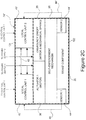
- First and second actuation mechanisms may be of the same type, and may comprise, for example, a first motor 30 and a second motor 30' (as shown in Figure 2A ), or a first motor winding 32 and a second motor winding 32' acting on a common rotor and stator 34 (as shown in Figure 2B ).
- the brake unit may comprise more than one actuator, and that the dual winding concept shown in Figure 2B may be employed for one of more of these actuators.
- a dual winding motor may be employed along with an electromagnet for parking lock functionality, while in a pneumatic unit, a number of electromagnet valves with the dual winding feature may be employed.
- Many other configurations are, of course, possible.
- first and second actuation mechanisms may be different from one another.
- first actuation mechanism may comprises a first motor 36
- second actuation mechanism may comprise an emergency on/off (apply/release) mechanism 38, such as a second motor and a mechanical spring.
- Emergency on/off mechanism 38 may be configured such that the mechanical spring biases brake component 26 toward a released position, with brake component 26 being moveable against the bias of the mechanical spring toward an applied position by the second motor.
- emergency on/off mechanism 38 may be configured such that the mechanical spring biases brake component 26 toward an applied position, with brake component 26 being moveable against the bias of the mechanical spring toward a released position by the second motor.
- the first actuation mechanism is supplied power by first power supply network 14 and the second actuation mechanism is supplied power by second power supply network 14' for redundancy.
- first actuation mechanism is operable, independently of the second actuation mechanism, to cause brake component 26 to be applied and to be released, in response to the first actuation control signal (described more fully below)
- second actuation mechanism is operable, independently of the first actuation mechanism, to cause brake component 26 to be applied and to be released, in response to the second actuation control signal (described more fully below).
- Each brake unit also includes a first local control unit 40 in direct communication with first central control unit 18 via first control network 20, and second local control unit 40' in direct communication with second central control unit 18' via second control network 20'.
- first local control unit 40 receives power from first power supply network 14, while second local control unit 40' receives power from second power supply network 14'.
- First local control unit 40 is in communication with the first actuation mechanism and transmits the first actuation control signal to the first actuation mechanism, under certain circumstances (as described more fully below), to cause actuation of brake component 26.
- second local control unit 40' is in communication with the second actuation mechanism and transmits the second actuation control signal to the second actuation mechanism, under certain circumstances (again as described more fully below), to cause actuation of brake component 26.
- first local control unit 40 and second local control unit 40' of each of the brake unit 24 are in communication via a communications link 42.
- at least one of first local control unit 40 and second local control unit 40' of at least one brake unit 24 is in communication with at least one of first local control unit 40 and second local control unit 40' of at least one other brake unit 24 via communications link 25 (shown in Figure 1 ).
- First local control unit 40 and second local control unit 40' are preferably electrically, thermally and mechanically separated from one another so as to prevent a failure in one of first and second local control units 40, 40' from deleteriously affecting the other of first and second local control units 40, 40'.
- communications link 42 between first and second local control units 40, 40' is configured so as to prevent any electrical failure in one of first and second local control units 40, 40' from having any effect on the other local control unit.
- Each brake unit 24 further includes a first sensor 44 in communication with first local control unit 40 via a connection 46, and a second sensor 44' in communication with second local control unit 40' via a connection 46'.
- Connections 46, 46' can comprise any type of connection for transmitting a signal, such as an analog signal, a digital signal, a serial communication signal, a pulse-width modulated signal, etc.
- First and second sensors 44, 44' sense at least one wheel parameter and supply signals indicative of the at least one wheel parameter to first local control unit 40 and second local control unit 40', respectively, via connection 46 and connection 46', respectively.
- First and second sensors 44, 44' supply information sufficient for the control and monitoring (diagnosis) of the functions of first and second local control units 40, 40', and may be internal in brake unit 24 and/or external to brake unit 24.
- Examples of internal sensors include position sensors, brake force sensors, brake torque sensors and pad wear sensors.
- Examples of external sensors include wheel speed sensors, bearing temperature sensors, torque sensors and tire pressure sensors. Any combination of these, and other, sensors may be employed in connection with each brake unit 24.
- Each of first and second local control units 40, 40' includes at least one microcontroller, and each controls and monitors at least a part of the brake unit 24 functions. More specifically, each of first and second local control units 40, 40' is designed so as to monitor every vital failure of its own functionality, such that no single failure in either local control unit 40, 40' or in the actuation mechanism associated with each local control unit 40, 40' shall inhibit the other local control unit 40, 40' and/or associated brake mechanism from performing its function (fail silent operation).
- Each of first and second local control units 40, 40' receives sensor information from first and second sensors 44, 44' sufficient enough to monitor the safety critical status of each brake unit 24.
- first and second central control units 18, 18' With the redundant control network topology described above, at least one of first and second central control units 18, 18' will be informed about a safety critical status of any brake unit 24 failure.
- at least one of first and second central control units 18, 18' will, for any single failure in brake system 10, be able to communicate the best possible demand for each brake unit 24 and also reach every brake unit 24 with this demand.
- the safety critical status covers both locally irrecoverable failures and locally recoverable failures.
- locally irrecoverable failures include mechanical rupture of brake parts and tire pressure loss.
- Locally irrecoverable failures are, to the highest possible degree, recovered on vehicle brake system level by the use of the remaining functional brake units 24 to maintain the dynamic stability of the vehicle if a local failure occurs.
- valid sensor and status information from each brake unit 24 is essential, which the design of the system 10 guarantees.
- Locally fully or partly recoverable failures are recoverable by redundant design in first and second local control units 40, 40' and the first and second actuation mechanisms of each brake unit 24. These components are designed redundantly and recoverably so as to avoid failures that could endanger the vehicle dynamic stability and/or guarantee a high availability of the vehicle for economic reasons.
- Each local control unit 40, 40' and its associated actuation mechanism is able to control brake component 26 (i.e., cause to be both applied and released) with at least degraded performance, even with a total loss of functionality of the other local control unit 40, 40' and/or its associated actuation mechanism.
- each of first and second local control units 40, 40' is mainly controlled by at least one microcontroller.
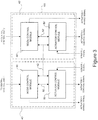
- the software in the microcontroller is divided into at least two main software modules, a mode control module 48, 48' and an actuator control module 50, 50'.
- Both mode control module 48, 48' and actuator control module 50, 50' possess at least one separate means to turn the actuation mechanism with which each local control unit 40, 40' is associated into the fail silent mode.
- Actuator control module 50, 50' employs the same means normally employed for control of actuation mechanisms (i.e., providing an actuation control signal).
- Mode control module 48, 48' employs a separate mean for enabling of the actuation mechanism.
- mode control module 48, 48' preferably transmits a non-static actuation enable signal which requires the signal to be toggled by a software integrated watchdog/safety loop to enable the actuation mechanism to be "on” (i.e., ready to actuate upon receipt of the actuation control signal).
- Actuator control module 50, 50' is at least responsible for controlling the actuation mechanism using the information from sensors 44, 44' connected to local control units 40, 40' and the demand for braking received from a decision software module (not shown). Since operation of actuator control and decision software are extremely well-known in the art, further detail concerning such software is not provided herein.
- Mode control module 48 and actuator control module 50 of first local control unit 40 are in communication with one another, as indicated by 52, while mode control module 48' and actuator control module 50' of second local control unit 40' are in communication with one another, as indicated by 52'. Additionally, actuator control module 50, and optionally mode control module 48, of first local control unit 40 communicates through at least one internal communication link 42 with actuator control module 50', and optionally mode control module 48', of second local control unit 40' in order to synchronize the actuation of the two actuation mechanisms of each brake unit 24.
- Mode control module 48, 48' is responsible for making the decision for the mode of operation for the actuation mechanism with which it is associated. The decision is made according to the information available from the brake unit sensors (i.e., both first and second sensors 44, 44' available through internal communications link 42) and the information available and received from central control units 18, 18', other wheel control units and/or external vehicle sensors connected to the system control network.
- the decisions in the two decision software modules in one brake unit 24 shall be identical. If internal communication link 42 is failing, or for some other reason the decision is not identical, a decision shall be made with the help of a third control unit outside the local brake unit 24. This third unit taking part in the decision can be the other brake unit 24 on the same axle of the vehicle (via communications link 25, for example) or at least one of central control units 18, 18'.
- This additional information for the local decision software module is for example useful for a decision software module to determine if there is only an internal communication failure or if there is a partial or total failure in the other control module. Only when both communication networks are lost, a totally local decision of the modes of operation of the brake unit is made.
- FIG. 4 an exemplary embodiment of a vehicle brake system 10' incorporating dual controller wheel brake modules 24 as shown in Figure 3 , and employing a FlexRay control network is shown.
- Each of the modules 24 includes an electrical control part 101, having mode control modules 48, 48' and actuator control modules 50, 50', as shown in Figure 3 , and as described above, as well as an electromechanical actuation part 102, as shown in Figures 2A-2C , and as described above.
- solid lines are used to represent elements being supplied power from first power supply network 14, while dashed lines are used to represent elements being supplied power from second power supply network 14'.
- System 10' builds upon a FlexRay communication network, with the basic principle being to employ a number of dually supplied dual controller wheel brake modules 24, each communicating via two pairs of communications channels (A and B).
- a pair of dual control modules 24 acts as four synchronized control CPUs acting as a virtual axle module to perform the safety software in the brake unit with an at least triple redundancy and a triple majority decision for the output of the safety software.
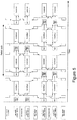
- An example of the time sharing of the resources and information flow in such an axle block is shown in Figure 5 and described below.
- the vehicle brake control could be performed in the virtual axle module with the same high degree of redundancy.
- the vehicle brake control may be split into at least two tasks executed on different virtual axle modules communicating with each other over the network.
- System 10' also includes dually supplied gateways 56, 56' for connection to the vehicle information, such as a brake pedal and/or a vehicle control system, as well as dually supplied gateways 58, 58' for connection to a connected trailer.
- axle 3 has separate B-channels for the axle communication 25" and 25'" which increases the information exchange capacity of the axle network but also decreases the redundancy of the system network.
- axle communication (equivalent to 25" and 25"') takes place over the common A and B channels.
- the final topology is defined according the requirement of each vehicle type.
- a time schematic shows how the information exchange through an external and internal network could be arranged between two brake units according to Figure 3 arranged in accordance with system 10' shown in Figure 4 or axle units according to Figure 7 arranged in accordance with system 10" shown in Figure 8 .
- time division multiplexed based communication networks e.g., FlexRay networks
- This synchronization feature allows physically separated modules to build a multi-processor block for a common task.
- two dual-controller brakes are communicating to verify the output to the actuation of the brake by a minimum of three results from calculations made in at least three separate controllers.
- a single failure of one of four modules on an axle there still could be a majority of three decision.
- a time-based flowchart illustrates time sharing between a wheel control system and a brake control system, such as the brake control system shown in Figure 9 , when a time division multiplexing technique is employed, such as may be employed by the FlexRay control network shown in Figure 4 , or by the control system shown in Figure 8 with at least two axle control units forming the vehicle brake control system.
- the wheel control software is executed on a higher priority level than the vehicle brake control software, and the wheel control software is interrupting and halting the vehicle brake control software. In a dual core controller there could be one software task in each core.
- the vehicle brake control cycle period time is normally longer than the wheel control cycle period time, but the vehicle brake control cycle period time shall, if longer, be a multiple of the wheel control cycle period time.
- Both the wheel control and the vehicle brake control software uses the same redundancy method with at least a triple majority output voting, as described above.
- the vehicle brake control could be split into several tasks where, for example, the first axle could be responsible for one task and the second axle for another task.
- FIG. 7 a block diagram illustrating exemplary communications to, from and within local control units 24' forming part of the brake actuators shown in Figures 1 and 2A-2C is shown.
- the communications are very similar to those shown in Figure 3 , with the exception that control of the the brake actuator is achieved on a per axle basis.
- actuator control modules 50, 50' each receive sensor signals from two sensors, and each transmits to actuation control signals (e.g., a left actuation control signal and a right actuation control signal).
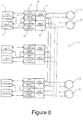
- FIG. 8 An exemplary vehicle brake system 10" employing the axle brake modules 24 shown in Figure 7 is shown in Figure 8 .
- Each of the axle control modules 24 includes two actuator control modules 50, 50', each having a left actuating power driver 60, 60' and a right actuating power driver 62, 62' for redundantly actuating, respectively a left actuator 64 and a right actuator 66.
- solid lines are used to represent elements being supplied power from first power supply network 14, while dashed lines are used to represent elements being supplied power from second power supply network 14'.
- system 10" builds upon a FlexRay communication network, with the basic principle being to employ a number of dually supplied dual controller axle brake modules 24', each communicating via two pairs of communications channels (A and B). Also in a similar manner to system 10' shown in Figure 4 , system 10" also includes dually supplied gateways 68, 68' for connection to the vehicle information, such as a brake pedal and/or a vehicle control system, as well as dually supplied gateways 70, 70' for connection to a connected trailer.
- vehicle information such as a brake pedal and/or a vehicle control system
- the basic principle of system 10" is to employ a number of dually supplied dual controller axle brake modules 24'.
- the pair of dual controllers act as four synchronized control CPUs acting as a virtual vehicle module to perform the safety software in the axle unit with an at east triple redundancy and a triple majority decision for the output of the safety software.
- An example of the time sharing of the resources and information flow in such an axle block is shown in Figure 5 and described above.
- the vehicle brake control could be performed in the virtual vehicle module with the same high degree of redundancy. As such, there is no need of separate ECUs for the vehicle brake control.
- System 10' differs from system 10' in that central control functionality, rather than being provided by separate central control units 18, 18', is performed by local control units 48, 48'. This eliminates the central control units 18, 18' as additional hardware in the system.
- Each central control unit 72, 72', 72" takes the form of two or more (four each are illustrated) local control units 48, 48' that are communicating over two independent networks.
- the safety philosophy is based on data from at least three independent sources - if a failure occurs, data is available from at least two and the failure can be detected and a decision can be made from still correct data.
- systems 10, 10', 10", 10"' described above refer specifically to brake systems, these systems, as well as the distributed safety system modules, may be used to control various other types of vehicle systems, such as individual suspensions, wheel/axle steering, tire pressure control, etc.
- the present invention therefore, provides a system for controlling application of an electronically controlled brake which is well-suited for controlling the application of an electromechanical brake unit with self-energizing characteristics, which includes a redundant brake actuator for providing fail safe operation, which provides redundant communication with at least one central control unit and system sensors such that a functioning portion of the brake actuator is still in communication with these elements even during failure of another portion of the brake actuator, and which allows for a functioning portion of the brake actuator to provide at least a level of brake actuator control sufficient to avoid catastrophic consequences even during failure of another portion of the brake actuator.
Landscapes
- Engineering & Computer Science (AREA)
- Transportation (AREA)
- Mechanical Engineering (AREA)
- Physics & Mathematics (AREA)
- Fluid Mechanics (AREA)
- Regulating Braking Force (AREA)
- Valves And Accessory Devices For Braking Systems (AREA)
- Braking Systems And Boosters (AREA)
Claims (33)
- Ein Fahrzeugbremssystem, umfassend:ein erstes Stromversorgungsgerät (12), das einem ersten Stromversorgungsnetz (14) elektrischen Strom zuführt;eine erste zentrale Steuereinheit (18) in Verbindung mit einem ersten Steuernetzwerk (20), wobei die erste zentrale Steuereinheit (18) elektrischen Strom von dem ersten Stromversorgungsnetz (14) erhält;eine Vielzahl von Bremseinheiten (24), wobei jede dieser mehreren Bremseinheiten (24) umfasst:eine Bremskomponente (26);einen Selbstverstärkungsmechanismus (28), der dieser Bremskomponente (26) zugeordnet ist und auf diese einwirkt;einen ersten Betätigungsmechanismus, wobei dieser erste Betätigungsmechanismus in Reaktion auf ein erstes Betätigungssteuersignal auf den Selbstverstärkungsmechanismus (28) einwirkt, um eine Betätigung der Bremskomponente (26) zu bewirken;einen zweiten Betätigungsmechanismus, wobei dieser zweite Betätigungsmechanismus in Reaktion auf ein zweites Betätigungssteuersignal auf den Selbstverstärkungsmechanismus (28) einwirkt, um eine Betätigung der Bremskomponente (26) zu bewirken;eine erste lokale Steuereinheit (40), die über das erste Steuernetzwerk (20) in unmittelbarer Verbindung mit der ersten zentralen Steuereinheit (18) steht und von dem ersten Stromversorgungsnetz (14) Strom erhält, wobei diese erste lokale Steuereinheit (40) mit dem ersten Betätigungsmechanismus in Verbindung steht und das erste Betätigungssteuersignal an den ersten Betätigungsmechanismus übermittelt, um unter bestimmten Umständen eine Betätigung der Bremskomponente (26) zu bewirken;dadurch gekennzeichnet, dass das Fahrzeugbremssystem außerdem umfasst:ein zweites Stromversorgungsgerät (12'), das einem zweiten Stromversorgungsnetz (14') elektrischen Strom zuführt,eine zweite lokale Steuereinheit (18') in Verbindung mit einem zweiten Steuernetzwerk (20'), wobei diese zweite zentrale Steuereinheit (18') elektrischen Strom von dem zweiten Stromversorgungsnetz (14') erhält, undjede dieser Vielzahl von Bremseinheiten (24) außerdem umfasst:eine zweite lokale Steuereinheit (40'), die über das zweite Steuernetzwerk (20') in unmittelbarer Verbindung mit der zweiten zentralen Steuereinheit (18') steht und von dem zweiten Stromversorgungsnetz (14') mit Strom versorgt wird, wobei die zweite lokale Steuereinheit (40') in Verbindung mit dem zweiten Betätigungsmechanismus steht und das zweite Betätigungssteuersignal an diesen zweiten Betätigungsmechanismus überträgt, um unter bestimmten Umständen eine Betätigung der Bremskomponente (26) zu bewirken.
- Fahrzeugbremssystem nach Anspruch 1, wobei der erste Betätigungsmechanismus von dem ersten Stromversorgungsnetz (14) mit Strom versorgt wird und der zweite Betätigungsmechanismus von dem zweiten Stromversorgungsnetz (14') mit Strom versorgt wird.
- Fahrzeugbremssystem nach Anspruch 1, wobei jede der Vielzahl von Bremseinheiten (24) außerdem umfasst:einen ersten Sensor (44) in Verbindung mit der ersten lokalen Steuereinheit (40), wobei der erste Sensor (44) mindestens einen Radparameter erfasst und ein Signal, das für den wenigstens einen Radparameter bezeichnend ist, an die erste lokale Steuereinheit (40) übermittelt; undeinen zweiten Sensor (44') in Verbindung mit der zweiten lokalen Steuereinheit (40'), wobei dieser zweite Sensor (44') mindestens einen Radparameter erfasst und ein Signal, das für den wenigstens einen Radparameter bezeichnend ist, an die zweite lokale Steuereinheit (40') übermittelt.
- Fahrzeugbremssystem nach Anspruch 3, wobei der mindestens eine Radparameter wenigstens eines der folgenden umfasst: Position einer Bremskomponente, Bremskraft, Bremsmoment, Belagverschleiß, Raddrehzahl, Lagertemperatur, Drehmoment und Reifendruck.
- Fahrzeugbremssystem nach Anspruch 1, wobei die erste lokale Steuereinheit (40) und die zweite lokale Steuereinheit (40') jeder der Vielzahl von Bremseinheiten (24) miteinander in Verbindung stehen.
- Fahrzeugbremssystem nach Anspruch 1, wobei mindestens eine der ersten lokalen Steuereinheit (40) und der zweiten lokalen Steuereinheit (40') wenigstens einer der Vielzahl von Bremseinheiten (24) in Verbindung mit wenigstens einer der ersten lokalen Steuereinheit (40) und der zweiten lokalen Steuereinheit (40') wenigstens einer anderen der Vielzahl von Bremseinheiten (24) steht.
- Fahrzeugbremssystem nach Anspruch 1, wobei das erste Stromversorgungsnetz (14) und das zweite Stromversorgungsnetz (14') über einen Isolierungsmechanismus (17) in Verbindung stehen, wobei der Isolierungsmechanismus (17) verhindert, dass sich ein Fehler in einem von dem ersten Stromversorgungsnetz (14) und dem zweiten Stromversorgungsnetz (14') nachteilig auf das andere von dem ersten Stromversorgungsnetz (40) und dem zweiten Stromversorgungsnetz (40') in nachteiliger Weise auswirkt.
- Fahrzeugbremssystem nach Anspruch 7, wobei der Isolierungsmechanismus (17) eine Sicherung umfasst.
- Fahrzeugbremssystem nach Anspruch 1, wobei die erste lokale Steuereinheit (40) und die zweite lokale Steuereinheit (40') jeder der Vielzahl von Bremseinheiten (24) elektrisch, thermisch und mechanisch voneinander getrennt sind, um zu verhindern, dass sich ein Fehler in einer der ersten lokalen Steuereinheit (40) und der zweiten lokalen Steuereinheit (40') die andere der ersten lokalen Steuereinheit (40) und der zweiten lokalen Steuereinheit (40') in nachteiliger Weise auswirkt.
- Fahrzeugbremssystem nach Anspruch 1, wobei jede erste lokale Steuereinheit (40) und jede zweite lokale Steuereinheit (40') umfasst:ein Modussteuermodul (48), das ein Betätigungsfreigabesignal überträgt, das bewirkt, dass der Betätigungsmechanismus, mit dem diese Steuereinheit in Verbindung steht, aktiviert wird; undein Betätigungssteuermodul, das ein Betätigungssteuersignal überträgt, das bewirkt, dass der Betätigungsmechanismus, mit dem diese Steuereinheit in Verbindung steht, betätigt wird.
- Fahrzeugbremssystem nach Anspruch 10, wobei jeder Betätigungsmechanismus nur dann betätigt wird, wenn er das Betätigungsfreigabesignal empfängt, wenn er das Betätigungssteuersignal empfängt.
- Fahrzeugbremssystem nach Anspruch 1, wobei der erste Betätigungsmechanismus einen ersten Motor (30) und der zweite Betätigungsmechanismus einen zweiten Motor (30') umfasst.
- Fahrzeugbremssystem nach Anspruch 1, wobei der erste Betätigungsmechanismus eine erste Motorwicklung (32) umfasst und der zweite Betätigungsmechanismus eine zweite Motorwicklung (32') umfasst, wobei die erste Motorwicklung (32) und die zweite Motorwicklung (32') auf einen gemeinsamen Rotor und Stator (34) einwirken.
- Fahrzeugbremssystem nach Anspruch 1, wobei der erste Betätigungsmechanismus einen ersten Motor (36) umfasst und der zweite Betätigungsmechanismus einen zweiten Motor und eine mechanische Feder (38) umfasst.
- Fahrzeugbremssystem nach Anspruch 14, wobei die mechanische Feder die Bremskomponente (26) in Richtung auf eine gelöste Position hin vorspannt, und wobei die Bremskomponente (26) durch den zweiten Motor gegen die Vorspannung der mechanischen Feder in Richtung auf eine angelegte Position bewegbar ist.
- Fahrzeugbremssystem nach Anspruch 14, wobei die mechanische Feder die Bremskomponente (26) in Richtung auf eine angelegte Position vorspannt, und wobei die Bremskomponente (26) durch den zweiten Motor gegen die Vorspannung der mechanischen Feder in Richtung einer gelösten Position bewegbar ist.
- Fahrzeugbremssystem nach Anspruch 1, wobei das erste Steuernetzwerk (20) und das zweite Steuernetzwerk (20') Zeitmultiplex-Kommunikationsnetzwerke umfassen.
- Fahrzeugbremssystem nach Anspruch 1, wobei das erste Steuernetzwerk (20) und das zweite Steuerungsnetzwerk (20') FlexRay-Netzwerke umfassen.
- Fahrzeugbremssystem nach Anspruch 1, wobei die erste zentrale Steuereinheit (18) und die zweite zentrale Steuereinheit (18') jeweils eine Vielzahl von lokalen Steuereinheiten (48, 48') umfassen, die über zwei unabhängige Netzwerke miteinander kommunizieren.
- Bremseinheit zur Verwendung in einem Fahrzeugbremssystem, wobei die Bremseinheit umfasst:eine Bremskomponente (26);einen Selbstverstärkungsmechanismus (28), der dieser Bremskomponente (26) zugeordnet ist und auf diese einwirkt;einen ersten Betätigungsmechanismus, wobei dieser erste Betätigungsmechanismus in Reaktion auf ein erstes Betätigungssteuersignal auf den Selbstverstärkungsmechanismus (28) einwirkt, um eine Betätigung der Bremskomponente (26) zu bewirken;einen zweiten Betätigungsmechanismus, wobei dieser zweite Betätigungsmechanismus in Reaktion auf ein zweites Betätigungssteuersignal auf den Selbstverstärkungsmechanismus (28) einwirkt, um eine Betätigung der Bremskomponente (26) zu bewirken; undeine erste lokale Steuereinheit (40) in unmittelbarer Verbindung mit dem ersten Betätigungsmechanismus, wobei diese das erste Betätigungssteuersignal an den ersten Betätigungsmechanismus übermittelt, um unter bestimmten Umständen eine Betätigung der Bremskomponente (26) zu bewirken;wobei der erste Betätigungsmechanismus für den Fall einer Fehlfunktion unabhängig von dem zweiten Betätigungsmechanismus bedienbar ist, um zu bewirken, dass die Bremskomponente (26) in Reaktion auf das erste Betätigungssteuersignal angelegt und gelöst wird;dadurch gekennzeichnet, dass das Fahrzeugbremssystem außerdem umfasst:eine zweite lokale Steuereinheit (40') in unmittelbarer Verbindung mit dem zweiten Betätigungsmechanismus, wobei diese das zweite Betätigungssteuersignal an den zweiten Betätigungsmechanismus übermittelt, um unter bestimmten Umständen eine Betätigung der Bremskomponente (26) zu bewirken;wobei der zweite Betätigungsmechanismus für den Fall einer Fehlfunktion unabhängig von dem ersten Betätigungsmechanismus bedienbar ist, um zu bewirken, dass die Bremskomponente (26) in Reaktion auf das zweite Betätigungssteuersignal angelegt und gelöst wird.
- Bremseinheit nach Anspruch 20, außerdem umfassend:einem ersten Sensor (44) in Verbindung mit der ersten lokalen Steuereinheit (40), wobei dieser erste Sensor (44) mindestens einen Radparameter erfasst und ein Signal, das für den wenigstens einen Radparameter bezeichnend ist, an die erste lokale Steuereinheit (40) übermittelt; undeinen zweiten Sensor (44') in Verbindung mit der zweiten lokalen Steuereinheit (40'), wobei der zweite Sensor (44') mindestens einen Radparameter erfasst und ein Signal, das für den wenigstens einen Radparameter bezeichnend ist, an die zweite lokale Steuereinheit übermittelt.
- Bremseinheit nach Anspruch 21, wobei der mindestens eine Radparameter wenigstens eine der folgenden umfasst: Position einer Bremskomponente, Bremskraft, Bremsmoment, Bremsbelagverschleiß, Raddrehzahl, Lagertemperatur, Drehmoment und Reifendruck.
- Bremseinheit nach Anspruch 20, wobei die erste lokale Steuereinheit (40) und die zweite lokale Steuereinheit (40') in Verbindung stehen.
- Bremseinheit nach Anspruch 20, wobei die erste lokale Steuereinheit (40) und die zweite lokale Steuereinheit (40') elektrisch, thermisch und mechanisch voneinander getrennt sind, um zu verhindern, dass ein Fehler in einer von der ersten lokalen Steuereinheit (40) und der zweiten lokalen Steuereinheit (40') sich auf die andere von der ersten lokalen Steuereinheit (40) und der zweiten lokalen Steuereinheit (40') in negativer Weise auswirkt.
- Bremseinheit nach Anspruch 20, wobei jede der ersten lokalen Steuereinheit (40) und der zweiten lokalen Steuereinheit (40') umfasst:ein Modussteuermodul (48), das ein Betätigungsfreigabesignal überträgt, das bewirkt, dass der Betätigungsmechanismus, mit dem die Steuereinheit in Verbindung steht, aktiviert wird; undein Betätigungssteuermodul, das ein Betätigungssteuersignal überträgt, das bewirkt, dass der Betätigungsmechanismus, mit dem die Steuereinheit in Verbindung steht, betätigt wird.
- Bremseinheit nach Anspruch 25, wobei jeder Betätigungsmechanismus nur dann schaltet, wenn er das Betätigungsfreigabesignal empfängt, während er das Betätigungssteuersignal empfängt.
- Bremseinheit nach Anspruch 20, wobei der erste Betätigungsmechanismus einen ersten Motor (30) umfasst und der zweite Betätigungsmechanismus einen zweiten Motor (30') umfasst.
- Bremseinheit nach Anspruch 20, wobei der erste Betätigungsmechanismus eine erste Motorwicklung (32) umfasst und der zweite Betätigungsmechanismus eine zweite Motorwicklung (32') umfasst, wobei die erste Motorwicklung (32) und die zweite Motorwicklung (32') auf einen gemeinsamen Rotor und Stator einwirken.
- Bremseinheit nach Anspruch 20, wobei der erste Betätigungsmechanismus einen ersten Motor (36) umfasst und der zweite Betätigungsmechanismus einen zweiten Motor und eine mechanische Feder (38) umfasst.
- Bremseinheit nach Anspruch 29, wobei die mechanische Feder die Bremskomponente (26) in Richtung auf eine gelöste Position hin vorspannt, und wobei die Bremskomponente (26) durch den zweiten Motor gegen die Vorspannung der mechanischen Feder in Richtung einer angelegten Position bewegbar ist.
- Bremseinheit nach Anspruch 29, wobei die mechanische Feder die Bremskomponente (26) in Richtung auf eine angelegte Position hin vorspannt, und wobei die Bremskomponente (26) durch den zweiten Motor gegen die Vorspannung der mechanischen Feder in Richtung einer gelösten Position bewegbar ist.
- Fahrzeugbremssystem nach Anspruch 20, wobei das erste Steuernetzwerk (20) und das zweite Steuernetzwerk (20') Zeitmultiplex-Kommunikationsnetzwerke umfassen.
- Fahrzeugbremssystem nach Anspruch 20, wobei das erste Steuernetzwerk (20) und das zweite Steuernetz (20') FlexRay-Netzwerke umfassen.
Applications Claiming Priority (1)
| Application Number | Priority Date | Filing Date | Title |
|---|---|---|---|
| US11/755,282 US7837278B2 (en) | 2007-05-30 | 2007-05-30 | Redundant brake actuators for fail safe brake system |
Publications (3)
| Publication Number | Publication Date |
|---|---|
| EP1997703A2 EP1997703A2 (de) | 2008-12-03 |
| EP1997703A3 EP1997703A3 (de) | 2017-01-04 |
| EP1997703B1 true EP1997703B1 (de) | 2018-03-21 |
Family
ID=39561926
Family Applications (1)
| Application Number | Title | Priority Date | Filing Date |
|---|---|---|---|
| EP08157045.9A Not-in-force EP1997703B1 (de) | 2007-05-30 | 2008-05-28 | Redundante Bremsaktuatoren für ein Bremssystem mit Failsafefunktion |
Country Status (2)
| Country | Link |
|---|---|
| US (1) | US7837278B2 (de) |
| EP (1) | EP1997703B1 (de) |
Cited By (3)
| Publication number | Priority date | Publication date | Assignee | Title |
|---|---|---|---|---|
| EP4077079B1 (de) * | 2019-12-21 | 2024-08-14 | Haldex Aktiebolag | Elektromechanische bremsanlage |
| WO2025058774A1 (en) * | 2023-09-13 | 2025-03-20 | Continental Automotive Systems, Inc. | Redundant power supply architecture for two independent boardnets with cross connection to support supply from only one power input for electronic brake systems |
| EP4098499B1 (de) * | 2021-05-31 | 2026-01-07 | Aptiv Technologies AG | Raddrehzahlmesssystem |
Families Citing this family (71)
| Publication number | Priority date | Publication date | Assignee | Title |
|---|---|---|---|---|
| DE102005048595A1 (de) * | 2005-10-06 | 2007-04-12 | Robert Bosch Gmbh | Verfahren zur Anbindung eines FlexRay-Teilnehmers mit einem Mikrocontroller an eine FlexRay-Kommunikationsverbindung über eine FlexRay-Kommunikationssteuereinrichtung, und FlexRay-Kommunikationssteuereinrichtung, FlexRay-Teilnehmer und FlexRay-Kommunikationssystem zur Realisierung dieses Verfahrens |
| DE102007021286A1 (de) * | 2007-05-07 | 2008-11-13 | Continental Automotive Gmbh | Elektromechanisches Bremssystem mit einer ausfallsicheren Energieversorgung und Verfahren zur ausfallsicheren Energieversorgung in einem elektromechanischen Bremssystem für Fahrzeuge |
| DE102007033885A1 (de) * | 2007-07-20 | 2009-01-22 | Siemens Ag | Verfahren zur transparenten Replikation einer Softwarekomponente eines Softwaresystems |
| DE102009016638A1 (de) * | 2008-04-24 | 2009-10-29 | Continental Teves Ag & Co. Ohg | Mehrkreisige elektrohydraulische Kraftfahrzeugbremsanlage und Betriebsverfahren dazu |
| ES2413501T3 (es) * | 2008-10-21 | 2013-07-16 | Mitsubishi Electric Corporation | Dispositivo de control de freno para vehículo ferroviario |
| DE102010003232A1 (de) * | 2009-04-06 | 2010-10-07 | Continental Teves Ag & Co. Ohg | Verfahren zum Betreiben einer Bremsanlage, Bremsanlage und Kraftfahrzeug |
| FR2944563B1 (fr) * | 2009-04-16 | 2011-04-22 | Aircelle Sa | Dispositif d'inversion de poussee |
| DE102010002825A1 (de) * | 2010-03-12 | 2011-09-15 | Robert Bosch Gmbh | Verfahren zum Einstellen der von einer Feststellbremse ausgeübten Klemmkraft |
| US8489302B2 (en) | 2010-09-14 | 2013-07-16 | Goodrich Corporation | Systems and methods for dynamically stable braking |
| FR2970387B1 (fr) * | 2011-01-10 | 2013-12-13 | Messier Bugatti | Actionneur electromecanique a double excitation. |
| DE102012010562B4 (de) * | 2012-05-26 | 2013-12-24 | Audi Ag | Feststellbremsensystem für ein Fahrzeug |
| US20150112572A1 (en) * | 2012-06-11 | 2015-04-23 | International Engine Intellectual Property Company Llc | Centralized actuator control module |
| US9201720B2 (en) * | 2012-08-13 | 2015-12-01 | Nxp B.V. | FlexRay network runtime error detection and containment |
| DE102012218274A1 (de) * | 2012-10-08 | 2014-04-10 | Robert Bosch Gmbh | Paralleles Auslesen eines analogen Sensors durch zwei Steuereinheiten |
| DE102015208148A1 (de) * | 2014-06-30 | 2015-12-31 | Continental Teves Ag & Co. Ohg | Bremsanlage für ein Kraftfahrzeug |
| DE102014212537A1 (de) * | 2014-06-30 | 2015-12-31 | Continental Teves Ag & Co. Ohg | Bremsanlage für ein Kraftfahrzeug |
| WO2016089570A1 (en) | 2014-12-04 | 2016-06-09 | Robert Bosch Gmbh | Integrated wheel speed and brake pad wear monitoring system |
| US10144402B2 (en) * | 2016-08-29 | 2018-12-04 | GM Global Technology Operations LLC | Brake-by-wire system |
| US10501063B2 (en) * | 2016-08-29 | 2019-12-10 | GM Global Technology Operations LLC | Brake-by-wire system |
| US10507816B2 (en) * | 2016-08-30 | 2019-12-17 | GM Global Technology Operations LLC | Brake-by-wire system |
| US11046330B1 (en) | 2016-09-14 | 2021-06-29 | Apple Inc. | Redundant vehicle actuator system |
| US10140237B2 (en) | 2016-09-29 | 2018-11-27 | Ford Global Technologies, Llc | Fail functional automated driving |
| IT201600108159A1 (it) * | 2016-10-26 | 2018-04-26 | Freni Brembo Spa | Sistema elettronico di controllo trazione e frenata di un veicolo e relativo metodo |
| DE102017222445A1 (de) * | 2017-01-11 | 2018-07-12 | Continental Teves Ag & Co. Ohg | Bremsanlage für ein Kraftfahrzeug und Verfahren zum Betrieb einer Bremsanlage |
| DE102017201982A1 (de) * | 2017-02-08 | 2018-08-09 | Robert Bosch Gmbh | Bremsmotor-Steuergerät und Bremssystem für ein Fahrzeug mit einem elektrischen Bremsmotor |
| JP6895036B2 (ja) * | 2017-03-31 | 2021-06-30 | 日立Astemo株式会社 | 車両用ブレーキシステム |
| IT201700105896A1 (it) * | 2017-09-21 | 2019-03-21 | Freni Brembo Spa | Impianto frenante per veicoli di tipo brake by wire munito di azionamento elettrico e di back-up elettrico |
| DE102017218488A1 (de) * | 2017-10-16 | 2019-04-18 | Knorr-Bremse Systeme für Nutzfahrzeuge GmbH | Brems-Redundanzkonzept für hochautomatisiertes Fahren |
| JP6988417B2 (ja) * | 2017-12-07 | 2022-01-05 | 株式会社アドヴィックス | 車両用制動装置 |
| US10647329B2 (en) | 2017-12-12 | 2020-05-12 | Uatc, Llc | Disengaging autonomous control of vehicle |
| CN109747615A (zh) * | 2018-02-13 | 2019-05-14 | 重庆长安汽车股份有限公司 | 自动驾驶车辆制动系统及控制方法 |
| DE102018111682A1 (de) * | 2018-05-15 | 2019-11-21 | Wabco Gmbh | System für ein elektrisch angetriebenes Fahrzeug sowie Fahrzeug damit und Verfahren dafür |
| EP3626561B1 (de) | 2018-09-18 | 2020-11-04 | KNORR-BREMSE Systeme für Nutzfahrzeuge GmbH | Redundantes bremssystem für ein autonom angetriebenes fahrzeug |
| EP3626554B1 (de) * | 2018-09-18 | 2024-03-06 | KNORR-BREMSE Systeme für Nutzfahrzeuge GmbH | Fahrzeugsteuerungssystem |
| CN109204281A (zh) * | 2018-09-27 | 2019-01-15 | 芜湖伯特利汽车安全系统股份有限公司 | 具有双控独立控制功能的制动系统及其控制方法 |
| JP6606780B1 (ja) * | 2018-10-09 | 2019-11-20 | 三菱電機株式会社 | 車両用電動制動装置およびその制御方法 |
| WO2020204510A1 (ko) | 2019-03-29 | 2020-10-08 | 주식회사 만도 | 전자식 브레이크 시스템 및 그 제어 방법 |
| EP4656474A1 (de) * | 2019-03-29 | 2025-12-03 | HL Mando Corporation | Bremsanlage |
| FR3096326B1 (fr) * | 2019-05-23 | 2022-10-28 | Safran Landing Systems | Système de freinage d’aéronef avec dispositifs de commande dissimilaires et module logiciel utilisé en cas de défaillance |
| EP3758301B1 (de) * | 2019-06-25 | 2022-05-04 | KNORR-BREMSE Systeme für Nutzfahrzeuge GmbH | Vorrichtung und verfahren zur bereitstellung einer redundanten kommunikation in einer fahrzeugarchitektur und entsprechende steuerarchitektur |
| KR102183952B1 (ko) * | 2019-06-27 | 2020-11-27 | 현대모비스 주식회사 | 자율주행 차량의 제어장치 |
| CN112550254B (zh) | 2019-09-10 | 2022-11-15 | 瀚德万安(上海)电控制动系统有限公司 | 电子机械制动系统及其控制方法 |
| DE102020205961A1 (de) * | 2019-11-06 | 2021-05-06 | Robert Bosch Gesellschaft mit beschränkter Haftung | Sensoranordnung für ein Fahrzeug und mehrkreisiges Bremssystem |
| DE102020107706A1 (de) | 2020-03-20 | 2021-09-23 | HELLA GmbH & Co. KGaA | Bremssystem und Fahrzeug mit dem Bremssystem |
| EP3888983A1 (de) * | 2020-03-31 | 2021-10-06 | Hitachi Astemo Netherlands B.V. | Betriebssicheres elektrisches bremssystem |
| US11465636B2 (en) * | 2021-02-01 | 2022-10-11 | Ree Automotive Ltd. | Control systems for vehicle corner modules and methods of operation |
| KR20220135068A (ko) | 2021-03-29 | 2022-10-06 | 현대자동차주식회사 | Bbw 시스템에 적용되는 리던던시 제어 시스템 |
| DE102021108524A1 (de) * | 2021-04-06 | 2022-10-06 | Audi Aktiengesellschaft | Bremssystem für ein autonomes Fahrzeug |
| DE102021108523A1 (de) * | 2021-04-06 | 2022-10-06 | Audi Aktiengesellschaft | Bremssystem für ein autonomes Fahrzeug |
| DE102021205582A1 (de) * | 2021-06-01 | 2022-12-01 | Robert Bosch Gesellschaft mit beschränkter Haftung | Elektromechanisches Bremssystem für ein Kraftfahrzeug, Verfahren |
| DE102021205584A1 (de) * | 2021-06-01 | 2022-12-01 | Robert Bosch Gesellschaft mit beschränkter Haftung | Elektromechanisches Bremssystem für ein Kraftfahrzeug, Verfahren |
| DE102021205583A1 (de) * | 2021-06-01 | 2022-12-01 | Robert Bosch Gesellschaft mit beschränkter Haftung | Elektromechanisches Bremssystem für ein Kraftfahrzeug, Verfahren |
| EP4190651B1 (de) | 2021-12-02 | 2025-05-07 | Volvo Truck Corporation | Redundante fahrzeugsteuerungssysteme auf basis von reifensensoren |
| EP4190598B1 (de) * | 2021-12-02 | 2024-11-20 | Volvo Truck Corporation | Redundante fahrzeugsteuerungssysteme auf der basis von reifensensoren - lastschätzung |
| EP4209399A1 (de) * | 2022-01-05 | 2023-07-12 | Volvo Car Corporation | Bremssteuerungssystem zur steuerung eines bremssystems, fahrzeug und verfahren zum betrieb eines bremssteuerungssystems |
| DE202022101338U1 (de) * | 2022-03-11 | 2023-06-21 | Haldex Brake Products Aktiebolag | Elektrisches Bremssystem |
| DE102022209930A1 (de) * | 2022-09-21 | 2024-03-21 | Continental Automotive Technologies GmbH | Bremssystem mit flexibler Architektur und Verfahren zum Betreiben eines derartigen Bremssystems |
| JP7860491B2 (ja) * | 2022-10-27 | 2026-05-18 | 株式会社アドヴィックス | ブレーキシステム |
| DE102023114603A1 (de) * | 2023-06-02 | 2025-02-20 | Zf Cv Systems Global Gmbh | Elektronisches Bremssystem, Verfahren zur Steuerung und Anhängefahrzeug |
| KR20240174912A (ko) * | 2023-06-08 | 2024-12-18 | 현대모비스 주식회사 | 전동식 브레이크 및 이의 제어방법 |
| KR20250014952A (ko) | 2023-07-24 | 2025-02-03 | 현대자동차주식회사 | EMB(electro mechanical brake) 비상제동 장치 및 비상제동 방법 |
| US12459478B2 (en) | 2023-10-18 | 2025-11-04 | Ford Global Technologies, Llc | Brake architecture for a full, four corner electromechanical braking system |
| US12679310B2 (en) * | 2023-10-18 | 2026-07-14 | Ford Global Technologies, Llc | Brake architecture for combined hydraulic and electromechanical braking system |
| DE102023211288A1 (de) * | 2023-11-14 | 2025-05-15 | Robert Bosch Gesellschaft mit beschränkter Haftung | Verfahren zum Betreiben einer Aktuatoranordnung, Aktuatoranordnung, Kraftfahrzeug |
| CN117533282A (zh) * | 2023-12-15 | 2024-02-09 | 上海同驭汽车科技有限公司 | 一种电子制动系统及控制方法 |
| KR20250101341A (ko) * | 2023-12-27 | 2025-07-04 | 현대모비스 주식회사 | 전동식 브레이크 통신 시스템 |
| DE102024204787A1 (de) | 2024-05-24 | 2025-11-27 | Robert Bosch Gesellschaft mit beschränkter Haftung | Modularer Bremssattel |
| US20250368175A1 (en) * | 2024-06-04 | 2025-12-04 | Ford Global Technologies, Llc | Single electric brake booster module with redundant electronics |
| US20250388201A1 (en) * | 2024-06-19 | 2025-12-25 | Infineon Technologies Ag | Integrated braking interface device |
| EP4707090A1 (de) * | 2024-09-10 | 2026-03-11 | KB Intellectual Property GmbH & Co. KG | Redundantes bremssystem gesteuert durch ein achsmodul |
| KR20260076445A (ko) * | 2024-11-20 | 2026-05-28 | 에이치엘만도 주식회사 | 브레이크 시스템 및 그 제어 방법 |
Family Cites Families (14)
| Publication number | Priority date | Publication date | Assignee | Title |
|---|---|---|---|---|
| GB2163225B (en) * | 1984-08-18 | 1988-07-06 | Lucas Ind Plc | Improvements in self-energising disc brakes |
| US4852699A (en) * | 1987-03-31 | 1989-08-01 | Aisin Seiki Kabushiki Kaisha | Disk brake assembly |
| US4974704A (en) * | 1987-11-03 | 1990-12-04 | Pedersen Development Corporation | Self-energizing disc/rotor or rim brake |
| US4946007A (en) * | 1987-11-03 | 1990-08-07 | Pedersen Development Co. | Self-energizing brake |
| GB8822764D0 (en) * | 1988-09-28 | 1988-11-02 | Lucas Ind Plc | Self-energising disc brakes |
| DE19511287B4 (de) * | 1994-07-21 | 2004-05-06 | Continental Teves Ag & Co. Ohg | Elektromechanische betätigbare Scheibenbremse |
| ES2151976T3 (es) * | 1995-05-19 | 2001-01-16 | Continental Ag | Actuador de freno para un freno de accionamiento electrico de vehiculo. |
| DE19548392C2 (de) * | 1995-12-22 | 2001-05-17 | Siemens Ag | Bremsanlage für ein Kraftfahrzeug |
| AU2003222844A1 (en) * | 2002-04-26 | 2003-11-10 | Estop Gmbh | Motor vehicle brake system comprising a parking brake function and electromechanical wheel brake for such a motor vehicle brake system |
| US7748793B2 (en) * | 2002-05-28 | 2010-07-06 | Estop Gmbh | Fail-safe concept for an electromechanical brake |
| SE0302563D0 (sv) * | 2003-09-26 | 2003-09-26 | Haldex Brake Prod Ab | A parking brake mechanism for a disc brake |
| SE0302562D0 (sv) * | 2003-09-26 | 2003-09-26 | Haldex Brake Prod Ab | A brake with double electric motors |
| US7096108B2 (en) * | 2003-09-26 | 2006-08-22 | Haldex Brake Products Ab | Brake system with distributed electronic control units incorporating failsafe mode |
| WO2005110829A1 (en) * | 2004-05-13 | 2005-11-24 | Haldex Brake Products Ab | Control and power supply network for vehicle braking system |
-
2007
- 2007-05-30 US US11/755,282 patent/US7837278B2/en not_active Expired - Fee Related
-
2008
- 2008-05-28 EP EP08157045.9A patent/EP1997703B1/de not_active Not-in-force
Non-Patent Citations (1)
| Title |
|---|
| None * |
Cited By (3)
| Publication number | Priority date | Publication date | Assignee | Title |
|---|---|---|---|---|
| EP4077079B1 (de) * | 2019-12-21 | 2024-08-14 | Haldex Aktiebolag | Elektromechanische bremsanlage |
| EP4098499B1 (de) * | 2021-05-31 | 2026-01-07 | Aptiv Technologies AG | Raddrehzahlmesssystem |
| WO2025058774A1 (en) * | 2023-09-13 | 2025-03-20 | Continental Automotive Systems, Inc. | Redundant power supply architecture for two independent boardnets with cross connection to support supply from only one power input for electronic brake systems |
Also Published As
| Publication number | Publication date |
|---|---|
| US7837278B2 (en) | 2010-11-23 |
| US20080296106A1 (en) | 2008-12-04 |
| EP1997703A2 (de) | 2008-12-03 |
| EP1997703A3 (de) | 2017-01-04 |
Similar Documents
| Publication | Publication Date | Title |
|---|---|---|
| US7837278B2 (en) | Redundant brake actuators for fail safe brake system | |
| CN114599558B (zh) | 机动车辆制动系统 | |
| KR101889994B1 (ko) | 자동차용 고장-안전 주차 브레이크 | |
| EP3623242B1 (de) | System und verfahren zur steuerung eines elektrofahrzeugs | |
| EP2094549B1 (de) | Modus mit reduzierter leistung für ein elektrisches bremssystem eines flugzeugs | |
| JP7166255B2 (ja) | 車両用の電気ブレーキシステム | |
| US8489302B2 (en) | Systems and methods for dynamically stable braking | |
| US20030006726A1 (en) | Electrical brake system | |
| JP3242900B2 (ja) | 自動車用電気式ブレーキ装置 | |
| EP2284054B1 (de) | Dezentralisiertes elektrisches Bremssystem | |
| EP1695886B1 (de) | Bremssystem mit einer fehlertoleranten Kommunikationsknoten-Architektur | |
| EP3532354B1 (de) | Elektronisches system zur steuerung von zug und bremsung eines fahrzeugs und entsprechendes verfahren | |
| US6390571B1 (en) | Redundant aircraft braking system architecture | |
| EP3604058B1 (de) | Fahrzeugbremssystem | |
| CN109952240A (zh) | 包括用于电子驻车制动器的致动单元的独立控制单元的系统 | |
| CN115195685A (zh) | 用于自主车辆的制动系统 | |
| KR20220135068A (ko) | Bbw 시스템에 적용되는 리던던시 제어 시스템 | |
| US20250100528A1 (en) | Brake system for a motor vehicle, and electrohydraulic brake system | |
| CN120530038A (zh) | 备用层级中安全性提高的制动系统的运行方法及备用层级中安全性提高的制动系统 | |
| KR20250003799A (ko) | 철도 차량을 위한 브레이크 시스템 및 제동 방법 | |
| EP1861291B1 (de) | Energieversorgungsnetz für Bremssystem | |
| CN118977690A (zh) | 一种冗余制动的电子机械制动系统及车辆 | |
| US12559072B2 (en) | Decentralized control system for a motor vehicle braking system, motor vehicle braking system and motor vehicle | |
| CN119816436A (zh) | 具有灵活架构的制动系统及用于运行这种制动系统的方法 | |
| KR20250003808A (ko) | 철도 차량을 위한 브레이크 시스템 및 제동 방법 |
Legal Events
| Date | Code | Title | Description |
|---|---|---|---|
| PUAI | Public reference made under article 153(3) epc to a published international application that has entered the european phase |
Free format text: ORIGINAL CODE: 0009012 |
|
| AK | Designated contracting states |
Kind code of ref document: A2 Designated state(s): AT BE BG CH CY CZ DE DK EE ES FI FR GB GR HR HU IE IS IT LI LT LU LV MC MT NL NO PL PT RO SE SI SK TR |
|
| AX | Request for extension of the european patent |
Extension state: AL BA MK RS |
|
| PUAL | Search report despatched |
Free format text: ORIGINAL CODE: 0009013 |
|
| AK | Designated contracting states |
Kind code of ref document: A3 Designated state(s): AT BE BG CH CY CZ DE DK EE ES FI FR GB GR HR HU IE IS IT LI LT LU LV MC MT NL NO PL PT RO SE SI SK TR |
|
| AX | Request for extension of the european patent |
Extension state: AL BA MK RS |
|
| RIC1 | Information provided on ipc code assigned before grant |
Ipc: B60T 13/74 20060101ALI20161128BHEP Ipc: B60T 17/22 20060101AFI20161128BHEP Ipc: B60T 8/88 20060101ALI20161128BHEP Ipc: B60T 8/32 20060101ALI20161128BHEP Ipc: B60T 8/34 20060101ALI20161128BHEP |
|
| 17P | Request for examination filed |
Effective date: 20170630 |
|
| RBV | Designated contracting states (corrected) |
Designated state(s): AT BE BG CH CY CZ DE DK EE ES FI FR GB GR HR HU IE IS IT LI LT LU LV MC MT NL NO PL PT RO SE SI SK TR |
|
| AKX | Designation fees paid |
Designated state(s): AT BE BG CH CY CZ DE DK EE ES FI FR GB GR HR HU IE IS IT LI LT LU LV MC MT NL NO PL PT RO SE SI SK TR |
|
| AXX | Extension fees paid |
Extension state: AL Extension state: RS Extension state: MK Extension state: BA |
|
| GRAP | Despatch of communication of intention to grant a patent |
Free format text: ORIGINAL CODE: EPIDOSNIGR1 |
|
| INTG | Intention to grant announced |
Effective date: 20171005 |
|
| GRAS | Grant fee paid |
Free format text: ORIGINAL CODE: EPIDOSNIGR3 |
|
| GRAA | (expected) grant |
Free format text: ORIGINAL CODE: 0009210 |
|
| AK | Designated contracting states |
Kind code of ref document: B1 Designated state(s): AT BE BG CH CY CZ DE DK EE ES FI FR GB GR HR HU IE IS IT LI LT LU LV MC MT NL NO PL PT RO SE SI SK TR |
|
| REG | Reference to a national code |
Ref country code: GB Ref legal event code: FG4D |
|
| REG | Reference to a national code |
Ref country code: CH Ref legal event code: EP |
|
| REG | Reference to a national code |
Ref country code: AT Ref legal event code: REF Ref document number: 980752 Country of ref document: AT Kind code of ref document: T Effective date: 20180415 |
|
| REG | Reference to a national code |
Ref country code: IE Ref legal event code: FG4D |
|
| REG | Reference to a national code |
Ref country code: DE Ref legal event code: R096 Ref document number: 602008054481 Country of ref document: DE |
|
| REG | Reference to a national code |
Ref country code: NL Ref legal event code: MP Effective date: 20180321 |
|
| PG25 | Lapsed in a contracting state [announced via postgrant information from national office to epo] |
Ref country code: NO Free format text: LAPSE BECAUSE OF FAILURE TO SUBMIT A TRANSLATION OF THE DESCRIPTION OR TO PAY THE FEE WITHIN THE PRESCRIBED TIME-LIMIT Effective date: 20180621 Ref country code: FI Free format text: LAPSE BECAUSE OF FAILURE TO SUBMIT A TRANSLATION OF THE DESCRIPTION OR TO PAY THE FEE WITHIN THE PRESCRIBED TIME-LIMIT Effective date: 20180321 Ref country code: LT Free format text: LAPSE BECAUSE OF FAILURE TO SUBMIT A TRANSLATION OF THE DESCRIPTION OR TO PAY THE FEE WITHIN THE PRESCRIBED TIME-LIMIT Effective date: 20180321 Ref country code: CY Free format text: LAPSE BECAUSE OF FAILURE TO SUBMIT A TRANSLATION OF THE DESCRIPTION OR TO PAY THE FEE WITHIN THE PRESCRIBED TIME-LIMIT Effective date: 20180321 Ref country code: HR Free format text: LAPSE BECAUSE OF FAILURE TO SUBMIT A TRANSLATION OF THE DESCRIPTION OR TO PAY THE FEE WITHIN THE PRESCRIBED TIME-LIMIT Effective date: 20180321 |
|
| REG | Reference to a national code |
Ref country code: LT Ref legal event code: MG4D |
|
| REG | Reference to a national code |
Ref country code: AT Ref legal event code: MK05 Ref document number: 980752 Country of ref document: AT Kind code of ref document: T Effective date: 20180321 |
|
| PG25 | Lapsed in a contracting state [announced via postgrant information from national office to epo] |
Ref country code: GR Free format text: LAPSE BECAUSE OF FAILURE TO SUBMIT A TRANSLATION OF THE DESCRIPTION OR TO PAY THE FEE WITHIN THE PRESCRIBED TIME-LIMIT Effective date: 20180622 Ref country code: BG Free format text: LAPSE BECAUSE OF FAILURE TO SUBMIT A TRANSLATION OF THE DESCRIPTION OR TO PAY THE FEE WITHIN THE PRESCRIBED TIME-LIMIT Effective date: 20180621 Ref country code: LV Free format text: LAPSE BECAUSE OF FAILURE TO SUBMIT A TRANSLATION OF THE DESCRIPTION OR TO PAY THE FEE WITHIN THE PRESCRIBED TIME-LIMIT Effective date: 20180321 Ref country code: SE Free format text: LAPSE BECAUSE OF FAILURE TO SUBMIT A TRANSLATION OF THE DESCRIPTION OR TO PAY THE FEE WITHIN THE PRESCRIBED TIME-LIMIT Effective date: 20180321 |
|
| PG25 | Lapsed in a contracting state [announced via postgrant information from national office to epo] |
Ref country code: RO Free format text: LAPSE BECAUSE OF FAILURE TO SUBMIT A TRANSLATION OF THE DESCRIPTION OR TO PAY THE FEE WITHIN THE PRESCRIBED TIME-LIMIT Effective date: 20180321 Ref country code: IT Free format text: LAPSE BECAUSE OF FAILURE TO SUBMIT A TRANSLATION OF THE DESCRIPTION OR TO PAY THE FEE WITHIN THE PRESCRIBED TIME-LIMIT Effective date: 20180321 Ref country code: EE Free format text: LAPSE BECAUSE OF FAILURE TO SUBMIT A TRANSLATION OF THE DESCRIPTION OR TO PAY THE FEE WITHIN THE PRESCRIBED TIME-LIMIT Effective date: 20180321 Ref country code: ES Free format text: LAPSE BECAUSE OF FAILURE TO SUBMIT A TRANSLATION OF THE DESCRIPTION OR TO PAY THE FEE WITHIN THE PRESCRIBED TIME-LIMIT Effective date: 20180321 Ref country code: NL Free format text: LAPSE BECAUSE OF FAILURE TO SUBMIT A TRANSLATION OF THE DESCRIPTION OR TO PAY THE FEE WITHIN THE PRESCRIBED TIME-LIMIT Effective date: 20180321 Ref country code: PL Free format text: LAPSE BECAUSE OF FAILURE TO SUBMIT A TRANSLATION OF THE DESCRIPTION OR TO PAY THE FEE WITHIN THE PRESCRIBED TIME-LIMIT Effective date: 20180321 |
|
| PG25 | Lapsed in a contracting state [announced via postgrant information from national office to epo] |
Ref country code: SK Free format text: LAPSE BECAUSE OF FAILURE TO SUBMIT A TRANSLATION OF THE DESCRIPTION OR TO PAY THE FEE WITHIN THE PRESCRIBED TIME-LIMIT Effective date: 20180321 Ref country code: CZ Free format text: LAPSE BECAUSE OF FAILURE TO SUBMIT A TRANSLATION OF THE DESCRIPTION OR TO PAY THE FEE WITHIN THE PRESCRIBED TIME-LIMIT Effective date: 20180321 Ref country code: AT Free format text: LAPSE BECAUSE OF FAILURE TO SUBMIT A TRANSLATION OF THE DESCRIPTION OR TO PAY THE FEE WITHIN THE PRESCRIBED TIME-LIMIT Effective date: 20180321 |
|
| REG | Reference to a national code |
Ref country code: CH Ref legal event code: PL |
|
| PG25 | Lapsed in a contracting state [announced via postgrant information from national office to epo] |
Ref country code: PT Free format text: LAPSE BECAUSE OF FAILURE TO SUBMIT A TRANSLATION OF THE DESCRIPTION OR TO PAY THE FEE WITHIN THE PRESCRIBED TIME-LIMIT Effective date: 20180723 |
|
| REG | Reference to a national code |
Ref country code: DE Ref legal event code: R097 Ref document number: 602008054481 Country of ref document: DE |
|
| PLBE | No opposition filed within time limit |
Free format text: ORIGINAL CODE: 0009261 |
|
| STAA | Information on the status of an ep patent application or granted ep patent |
Free format text: STATUS: NO OPPOSITION FILED WITHIN TIME LIMIT |
|
| REG | Reference to a national code |
Ref country code: BE Ref legal event code: MM Effective date: 20180531 |
|
| PG25 | Lapsed in a contracting state [announced via postgrant information from national office to epo] |
Ref country code: MC Free format text: LAPSE BECAUSE OF FAILURE TO SUBMIT A TRANSLATION OF THE DESCRIPTION OR TO PAY THE FEE WITHIN THE PRESCRIBED TIME-LIMIT Effective date: 20180321 Ref country code: DK Free format text: LAPSE BECAUSE OF FAILURE TO SUBMIT A TRANSLATION OF THE DESCRIPTION OR TO PAY THE FEE WITHIN THE PRESCRIBED TIME-LIMIT Effective date: 20180321 |
|
| REG | Reference to a national code |
Ref country code: IE Ref legal event code: MM4A |
|
| 26N | No opposition filed |
Effective date: 20190102 |
|
| GBPC | Gb: european patent ceased through non-payment of renewal fee |
Effective date: 20180621 |
|
| PG25 | Lapsed in a contracting state [announced via postgrant information from national office to epo] |
Ref country code: CH Free format text: LAPSE BECAUSE OF NON-PAYMENT OF DUE FEES Effective date: 20180531 Ref country code: LI Free format text: LAPSE BECAUSE OF NON-PAYMENT OF DUE FEES Effective date: 20180531 |
|
| PG25 | Lapsed in a contracting state [announced via postgrant information from national office to epo] |
Ref country code: LU Free format text: LAPSE BECAUSE OF NON-PAYMENT OF DUE FEES Effective date: 20180528 |
|
| PG25 | Lapsed in a contracting state [announced via postgrant information from national office to epo] |
Ref country code: FR Free format text: LAPSE BECAUSE OF NON-PAYMENT OF DUE FEES Effective date: 20180531 Ref country code: GB Free format text: LAPSE BECAUSE OF NON-PAYMENT OF DUE FEES Effective date: 20180621 Ref country code: IE Free format text: LAPSE BECAUSE OF NON-PAYMENT OF DUE FEES Effective date: 20180528 |
|
| PG25 | Lapsed in a contracting state [announced via postgrant information from national office to epo] |
Ref country code: SI Free format text: LAPSE BECAUSE OF FAILURE TO SUBMIT A TRANSLATION OF THE DESCRIPTION OR TO PAY THE FEE WITHIN THE PRESCRIBED TIME-LIMIT Effective date: 20180321 Ref country code: BE Free format text: LAPSE BECAUSE OF NON-PAYMENT OF DUE FEES Effective date: 20180531 |
|
| PGFP | Annual fee paid to national office [announced via postgrant information from national office to epo] |
Ref country code: DE Payment date: 20190315 Year of fee payment: 12 |
|
| PG25 | Lapsed in a contracting state [announced via postgrant information from national office to epo] |
Ref country code: MT Free format text: LAPSE BECAUSE OF NON-PAYMENT OF DUE FEES Effective date: 20180528 |
|
| PG25 | Lapsed in a contracting state [announced via postgrant information from national office to epo] |
Ref country code: TR Free format text: LAPSE BECAUSE OF FAILURE TO SUBMIT A TRANSLATION OF THE DESCRIPTION OR TO PAY THE FEE WITHIN THE PRESCRIBED TIME-LIMIT Effective date: 20180321 |
|
| PG25 | Lapsed in a contracting state [announced via postgrant information from national office to epo] |
Ref country code: HU Free format text: LAPSE BECAUSE OF FAILURE TO SUBMIT A TRANSLATION OF THE DESCRIPTION OR TO PAY THE FEE WITHIN THE PRESCRIBED TIME-LIMIT; INVALID AB INITIO Effective date: 20080528 |
|
| PG25 | Lapsed in a contracting state [announced via postgrant information from national office to epo] |
Ref country code: IS Free format text: LAPSE BECAUSE OF FAILURE TO SUBMIT A TRANSLATION OF THE DESCRIPTION OR TO PAY THE FEE WITHIN THE PRESCRIBED TIME-LIMIT Effective date: 20180721 |
|
| REG | Reference to a national code |
Ref country code: DE Ref legal event code: R119 Ref document number: 602008054481 Country of ref document: DE |
|
| PG25 | Lapsed in a contracting state [announced via postgrant information from national office to epo] |
Ref country code: DE Free format text: LAPSE BECAUSE OF NON-PAYMENT OF DUE FEES Effective date: 20201201 |