EP1995362B1 - Herstellungsverfahren von Fasergarn aus Textilabfällen - Google Patents
Herstellungsverfahren von Fasergarn aus Textilabfällen Download PDFInfo
- Publication number
- EP1995362B1 EP1995362B1 EP20080352008 EP08352008A EP1995362B1 EP 1995362 B1 EP1995362 B1 EP 1995362B1 EP 20080352008 EP20080352008 EP 20080352008 EP 08352008 A EP08352008 A EP 08352008A EP 1995362 B1 EP1995362 B1 EP 1995362B1
- Authority
- EP
- European Patent Office
- Prior art keywords
- spikes
- fibres
- drum
- fibers
- les
- Prior art date
- Legal status (The legal status is an assumption and is not a legal conclusion. Google has not performed a legal analysis and makes no representation as to the accuracy of the status listed.)
- Not-in-force
Links
Images

Classifications
-
- D—TEXTILES; PAPER
- D01—NATURAL OR MAN-MADE THREADS OR FIBRES; SPINNING
- D01G—PRELIMINARY TREATMENT OF FIBRES, e.g. FOR SPINNING
- D01G11/00—Disintegrating fibre-containing articles to obtain fibres for re-use
- D01G11/04—Opening rags to obtain fibres for re-use
-
- Y—GENERAL TAGGING OF NEW TECHNOLOGICAL DEVELOPMENTS; GENERAL TAGGING OF CROSS-SECTIONAL TECHNOLOGIES SPANNING OVER SEVERAL SECTIONS OF THE IPC; TECHNICAL SUBJECTS COVERED BY FORMER USPC CROSS-REFERENCE ART COLLECTIONS [XRACs] AND DIGESTS
- Y02—TECHNOLOGIES OR APPLICATIONS FOR MITIGATION OR ADAPTATION AGAINST CLIMATE CHANGE
- Y02W—CLIMATE CHANGE MITIGATION TECHNOLOGIES RELATED TO WASTEWATER TREATMENT OR WASTE MANAGEMENT
- Y02W30/00—Technologies for solid waste management
- Y02W30/50—Reuse, recycling or recovery technologies
- Y02W30/66—Disintegrating fibre-containing textile articles to obtain fibres for re-use
Definitions
- the present invention relates to carded cycle spinning, more particularly to the manufacture of yarn according to this spinning technique, from textile waste.
- the method according to the invention makes it possible to lengthen the fiber resulting from the step as defined for unraveling and fraying, with respect to the corresponding step of the state of the art, and thus to confer on the yarn process a tensile strength compatible with the requirements of knitting and weaving the yarn.
- the reduction of the density of the tips of the first drum, compared with a higher density of spikes with the methods of the prior art makes it possible to reduce or even prevent the fibers constituting the textile waste from being broken during demagnetization; that is to say that the process according to the invention makes it possible to preserve as much as possible the length of the fibers constituting the textile waste used.
- the current density of spikes on a conventional unraveling drum is 8 spikes per square centimeter plus or minus 8 to 12% depending on the textiles to be treated.
- the mesh is thus open but not broken for a smooth preparation for fraying.
- the spraying of an oil-based emulsion on the textile waste before the demaling stage makes it possible to give the fibers a swelling and promotes a demagnetisation by softness, to keep a maximum of fiber length.
- the higher peak density on the second drum allows progressive opening of the fibers and thus further reduces the risk of fiber breakage.
- the resistance thus obtained of the yarn thanks to the length of its constituent fibers, as close as possible to the length of the initial fibers constituting the textile waste used, advantageously makes it possible to implement the method according to the invention with a material first entirely made of recycled material.
- the characteristics of the yarn obtained according to the process according to the invention also have a better resistance to abrasion and pilling as well as to friction.
- waste recycling is a permanent environmental problem. Thanks to the process according to the invention, the textile waste can be reused without any particular limit, and thus advantageously allow charitable organizations to continue their recovery activities of old textiles.
- the process according to the invention also makes it possible to avoid overproduction of materials, in particular synthetic and cellulosic materials, which are expensive in energy and often at risk for the environment.
- the method according to the invention also makes it possible to avoid the use of dyeing on the raw materials, because the colors can be obtained by textile color mixtures all derived from the recycled raw material, hence reducing the risks. pollution by releases of potentially toxic materials, and energy saving.
- the density of the tips on the second drum is between about 2.52 and 4.8 peaks per square centimeter.
- This feature makes it possible to reduce or even avoid a shortening of the fibers that will emerge from the second rotating drum.
- said tips on said first and / or second drums are beveled flat tips.
- This feature contributes to softening the unraveling and fraying operations by a smoother attacking shape of the beveled tips, as compared to the more aggressive tapered and tapered tips of conventional fraying / demounting drums according to the methods of the prior art. .
- said two food rolls on the one hand and said first drum on the other hand are separated by a distance of between 6 and 8 millimeters.
- This feature helps to reduce or even avoid fiber breakage during demagnetization.
- This distance in the processes of the prior art such as that described above is of the order of 3 mm, with a variation of 5 to 7% in addition, ie an increase of at least 100% of the distance between them.
- the circumferential speed of the tips of said first rotary drum is between 15 and 20 meters per second.
- a rotational speed of 350 rpm for a drum 1 meter in diameter, a rotational speed of 350 rpm, with a speed of 18.31 meters per second.
- the drums used in the processes of the state of the art generally rotate at rotational speeds of the order of 1000 revolutions per minute or even higher, for a drum of one meter in diameter, ie a linear velocity of more than 50 meters per second.
- the method according to the invention according to this advantageous characteristic reduces the speed of the first drum by more than 50%.
- the circumferential speed of the tips of said second rotary drum is slower than that of the first drum.
- said first carding unit is equipped with packings having a plurality of points forming a carding angle of the order of 60 °.
- the inclination of these tips is of the order of 75 ° to 80 °.
- a lower inclination makes it possible to obtain a "stuffing" effect, ie a well-controlled workmanship.
- This characteristic also makes it possible to have a less important carding point, and avoids the pilling of the materials and a sparing of the fibers.
- the density of the tips of the first carding group is between 7 and 8 points per square centimeter.
- said second carding unit is equipped with semi-rigid linings.
- the semi-rigid linings of said second carding group comprise biconvex tips.
- This feature provides a more fluid tip less aggressive and may further reduce fiber breaks.
- the density of the tips of the second carding group is between 25 and 30 points per square centimeter, preferably between 28 and 29 points.
- the density of these tips is about 18% to about 22% higher than the identical steel wire.
- the method according to the invention consists in introducing a step of pre-stretching respective wicks between two rubbing sleeves before the step of winding said wicks.
- This feature allows to enter the divider with a thicker, more consistent, and less broken fiber.
- the present invention furthermore relates to a yarn obtained with a process according to the invention, characterized in that it comprises 38% of wool fibers, 22% of cotton fibers, 28% of polyamide fibers, 7% of acrylic fibers, and 5% of various other fibers.
- the density of spikes on the second drum will preferably be between about 2.52 and 4.8 peaks per square centimeter.
- the tips 5 on said first and / or second drums are beveled flat tips, for example tips 5 having a cylindrical body of various section to choose, including circular, elliptical, etc ...
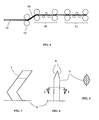
- the beveled tip is obtained for example by machining an inclined plane 6 at the tip end, intercepting the cylindrical surface of the tip body, as shown in FIG. figure 2 in side view.
- the tip 5 attacks the textile by this inclined plane 6 preventing tearing of the fibers, as is the case with conical tips drums of the prior art.
- the two food rolls 2 and the first drum 3 are separated by a distance d of between 6 and 8 millimeters, preferably a distance of 6 millimeters.
- the circumferential speed of the tips of the first rotary drum 3 is preferably between 15 and 20 meters per second, for example for a drum 1 meter in diameter, a rotational speed of 350 revolutions per minute, with a circumferential speed of 18 , 31 meters per second. This speed can however vary more or less depending on the textiles to work.
- the circumferential speed of the tips of the second rotating drum will preferably be slower than that of the first drum.
- the first carding group is preferably equipped with gaskets having a plurality of tips forming a carding angle of the order of 60 °, with a peak density of between 7 and 8 points per square centimeter, for example 7.44 points at square centimeter (48 points per square inch).
- the second carding unit is advantageously equipped with semi-rigid linings, preferably comprising biconvex tips 7 made of steel with lateral sharpening 8 on densified foam felt 9, the density of which is for example between 25 and 30 points per square centimeter, for example. example 28.67 peaks per square centimeter (185 points per square inch);
- the Figures 3 to 5 represent an embodiment of a biconvex point 7, respectively in lateral view, front view and in section along the line II of the figure 4 ; the biconvex tips have good strength in tips end.
- a pre-stretching step is introduced between the wicks between two wiper sleeves before the winding step of the wicks, as shown in FIG. figure 6 .
- the figure 6 represents a first group 10 of friction sleeves, followed by a second group 11 of friction sleeves which may be identical to the first group; the pre-stretching of the locks 14 consists of rotating the rolls the second group 11 faster than the cylinders of the first group 10, thereby stretching the locks 14 in an area between the first 10 and second 11 groups of friction sleeves.
- the fiber web is referenced 12 entering the divider 13 before entering the first group of friction sleeves.
- An example of yarn obtained with the method described above advantageously has the following composition: 38% wool fibers, 22% cotton fibers, 28% polyamide fibers, 7% acrylic fibers, and 5% fibers. other miscellaneous.
Landscapes
- Engineering & Computer Science (AREA)
- Textile Engineering (AREA)
- Yarns And Mechanical Finishing Of Yarns Or Ropes (AREA)
- Preliminary Treatment Of Fibers (AREA)
- Treatment Of Fiber Materials (AREA)
Claims (13)
- Verfahren zur Herstellung eines Garns in der Streichgarnspinnerei aus Textilabfällen, dadurch gekennzeichnet, dass es die Schritte umfasst, dass:- eine Emulsion auf Ölbasis auf die Textilabfälle aufgesprüht wird,- die Textilabfälle aufgelöst werden, indem sie auf einem Transporttisch (1) und anschließend zwischen zwei Zuführwalzen (2) befördert werden, von wo aus sie auf einen ersten Dreh-Tambour (3) gelangen, dessen Zylinderoberfläche (4) mit Spitzen (5) bedeckt ist, wobei die Spitzendichte bei ungefähr 2,4 bis 3,6 Spitzen je Quadratzentimeter liegt,- die aus dem ersten Dreh-Tambour austretenden Textilabfälle zerfasert werden, indem sie auf einem Transporttisch und anschießend zwischen zwei Zuführwalzen befördert werden, von wo aus sie auf einen zweiten Dreh-Tambour gelangen, dessen Zylinderoberfläche mit Spitzen bedeckt ist, wobei im Hinblick auf die Gewinnung von für die Garnbildung geeigneten Fasern die Spitzendichte höher als jene des ersten Dreh-Tambours ist,- die aus dem zweiten Tambour austretenden Fasern in eine erste Kardiergruppe eingeführt werden,- die aus der ersten Kardiergruppe austretenden Fasern zur Gewinnung eines Faservlieses in eine zweite Kardiergruppe eingeführt werden,- das Faservlies in eine Mehrzahl von Lunten aufgeteilt wird, die jeweils zur Bildung eines Garns geeignet sind,- die Lunten aufgewickelt und anschließend versponnen werden, um eine Mehrzahl von Garnen zu gewinnen, die jeweils auf eine Mehrzahl von Spulen aufgewickelt werden.
- Verfahren nach Anspruch 1, dadurch gekennzeichnet, dass die Dichte der Spitzen auf dem zweiten Tambour bei ungefähr 2,52 bis 4,8 Spitzen je Quadratzentimeter liegt.
- Verfahren nach Anspruch 1 oder 2, dadurch gekennzeichnet, dass es sich bei den Spitzen auf dem ersten und/oder zweiten Tambour um flach abgeschrägte Spitzen handelt.
- Verfahren nach einem der Ansprüche 1 bis 3, dadurch gekennzeichnet, dass die beiden Zuführwalzen und der erste Tambour einen Abstand von 6 bis 8 Millimeter voneinander aufweisen.
- Verfahren nach einem der Ansprüche 1 bis 4, dadurch gekennzeichnet, dass die Umfangsgeschwindigkeit der Spitzen des ersten Dreh-Tambours bei 15 bis 20 Meter pro Sekunde liegt.
- Verfahren nach einem der Ansprüche 1 bis 5, dadurch gekennzeichnet, dass die Umfangsgeschwindigkeit der Spitzen des zweiten Dreh-Tambours langsamer als jene des ersten Tambours ist.
- Verfahren nach einem der Ansprüche 1 bis 6, dadurch gekennzeichnet, dass die erste Kardiergruppe mit Garnituren ausgestattet ist, welche eine Mehrzahl von Spitzen aufweisen, die einen Kardierwinkel in einer Größenordnung von 60° bilden.
- Verfahren nach Anspruch 7, dadurch gekennzeichnet, dass die Dichte der Spitzen der ersten Kardiergruppe bei 7 bis 8 Spitzen pro Quadratzentimeter liegt.
- Verfahren nach einem der Ansprüche 1 bis 8, dadurch gekennzeichnet, dass die zweite Kardiergruppe mit halbsteifen Garnituren ausgestattet ist.
- Verfahren nach einem der Ansprüche 1 bis 9, dadurch gekennzeichnet, dass die halbsteifen Garnituren der zweiten Kardiergruppe bikonvexe Spitzen umfassen.
- Verfahren nach Anspruch 9 oder 10, dadurch gekennzeichnet, dass die Dichte der Spitzen der zweiten Kardiergruppe bei 25 bis 30 Spitzen pro Quadratzentimeter liegt.
- Verfahren nach einem der Ansprüche 1 bis 11, dadurch gekennzeichnet, dass es darin besteht, dass vor dem Schritt des Aufwickelns der Lunten jeweils ein Schritt des Vor-Streckens der Lunten zwischen zwei Reibhülsen eingeschoben wird.
- Garn, welches mit dem Verfahren nach einem der Ansprüche 1 bis 11 gewonnen wird, dadurch gekennzeichnet, dass dieses 38 % Wollfasern, 22 % Baumwollfasern, 28 % Polyamidfasern, 7 % Acrylfasern und 5 % an diversen anderen Fasern umfasst.
Applications Claiming Priority (1)
| Application Number | Priority Date | Filing Date | Title |
|---|---|---|---|
| FR0703608A FR2916454B1 (fr) | 2007-05-22 | 2007-05-22 | Procede de fabrication d'un fil en filature de type cycle carde, a partir de dechets textiles. |
Publications (2)
| Publication Number | Publication Date |
|---|---|
| EP1995362A1 EP1995362A1 (de) | 2008-11-26 |
| EP1995362B1 true EP1995362B1 (de) | 2011-10-26 |
Family
ID=38866715
Family Applications (1)
| Application Number | Title | Priority Date | Filing Date |
|---|---|---|---|
| EP20080352008 Not-in-force EP1995362B1 (de) | 2007-05-22 | 2008-05-19 | Herstellungsverfahren von Fasergarn aus Textilabfällen |
Country Status (4)
| Country | Link |
|---|---|
| EP (1) | EP1995362B1 (de) |
| AT (1) | ATE530683T1 (de) |
| ES (1) | ES2376377T3 (de) |
| FR (1) | FR2916454B1 (de) |
Families Citing this family (2)
| Publication number | Priority date | Publication date | Assignee | Title |
|---|---|---|---|---|
| FR3074194B1 (fr) * | 2017-11-30 | 2019-11-15 | Renault S.A.S | Procede de fabrication d'un fil a partir de dechets textiles provenant de vehicules automobiles et son utilisation |
| CN111139643A (zh) * | 2019-12-26 | 2020-05-12 | 安徽元琛环保科技股份有限公司 | 一种滤料开松用预处理整理剂及其应用 |
Family Cites Families (4)
| Publication number | Priority date | Publication date | Assignee | Title |
|---|---|---|---|---|
| FR1317189A (fr) * | 1962-03-12 | 1963-02-01 | Swift Spinning Mills | Procédé et appareil de cardage |
| DE19530715A1 (de) * | 1995-08-21 | 1997-02-27 | Chemnitzer Spinnereimaschinen | Verfahren und Anlage zur Herstellung von Faserbändern für Spinnmaschinen |
| CZ284124B6 (cs) * | 1997-02-07 | 1998-08-12 | Rieter Elitex A.S. | Způsob výroby vláken a zařízení k provádění tohoto způsobu |
| DE10108140A1 (de) * | 2001-02-20 | 2002-08-29 | Rieter Ag Maschf | Vorrichtung zum Öffnen und Reinigen von Fasergut |
-
2007
- 2007-05-22 FR FR0703608A patent/FR2916454B1/fr not_active Expired - Fee Related
-
2008
- 2008-05-19 AT AT08352008T patent/ATE530683T1/de not_active IP Right Cessation
- 2008-05-19 ES ES08352008T patent/ES2376377T3/es active Active
- 2008-05-19 EP EP20080352008 patent/EP1995362B1/de not_active Not-in-force
Also Published As
| Publication number | Publication date |
|---|---|
| ATE530683T1 (de) | 2011-11-15 |
| FR2916454A1 (fr) | 2008-11-28 |
| ES2376377T3 (es) | 2012-03-13 |
| FR2916454B1 (fr) | 2009-07-31 |
| EP1995362A1 (de) | 2008-11-26 |
Similar Documents
| Publication | Publication Date | Title |
|---|---|---|
| CN102021688B (zh) | 纺纱机械 | |
| US20090173055A1 (en) | Composite cotton and polyester yarn and method for making same | |
| FR3065468A3 (fr) | Structure textile recyclee et empeigne tissee pour chaussures | |
| CH661532A5 (fr) | Procede de fabrication d'une garniture metallique de carde, et garniture de carde fabriquee selon ce procede. | |
| EP1995362B1 (de) | Herstellungsverfahren von Fasergarn aus Textilabfällen | |
| CH616967A5 (de) | ||
| CA1199483A (fr) | Machine de filature-retordage sur broche tubulaire, notamment pour la fabrication de fils fantaisie | |
| JP2009144311A (ja) | 複合糸およびその製造方法 | |
| EP2118348B1 (de) | Zwirnverfahren und garnspule | |
| FR3004984A1 (fr) | Procede de fabrication d'un materiau composite realise avec des fils de fibres vegetales et materiau composite realise selon ce procede. | |
| DE2834034A1 (de) | Verfahren zum spinnen von garn aus stapelfasern in einem luftwirbel in einem luftrohr und vorrichtung zum durchfuehren dieses verfahrens | |
| DE202015009470U1 (de) | Auflösevorrichtung | |
| EP1339902B1 (de) | Verfahren und vorrichtung zur herstellung von bauschigem glasfaserstrang | |
| EP0745709A1 (de) | Flachfaserflocken und Aufbereitungsverfahren | |
| EP1690965B1 (de) | Verfahren zur Herstellung eines Garnes mit Fasern mit einem Schmelzpunkt unter 180°C | |
| EP1816245B1 (de) | Membran für Gasbrenner, die aus einem Textilartikel besteht, der Zwirn mit mindestens zwei Metallfasersträngen enthält, mit etwa rundem Profil | |
| FR3074194B1 (fr) | Procede de fabrication d'un fil a partir de dechets textiles provenant de vehicules automobiles et son utilisation | |
| CN213232951U (zh) | 一种新型高强剑麻混合绳 | |
| DE102006015848B4 (de) | Garniturband zum Formen von Zigaretten und/oder Filtern | |
| EP4488429A1 (de) | Verfahren und anlage zur herstellung von flachen pflanzenfasersträngen | |
| CN107227603A (zh) | 纺纱棉条切断装置 | |
| IT202100015566A1 (it) | Filo interdentale in nylon riciclato, e processo di produzione. | |
| FR2899603A1 (fr) | Fil reliefe, et procede de fabrication | |
| DE2211514A1 (de) | Offenendiger Spinnprozeß und Verfahren für die Wiederaufnahme dieses Prozesses nach Garnbruch | |
| FR3078079A1 (fr) | Installation de recyclage de nontisse |
Legal Events
| Date | Code | Title | Description |
|---|---|---|---|
| PUAI | Public reference made under article 153(3) epc to a published international application that has entered the european phase |
Free format text: ORIGINAL CODE: 0009012 |
|
| AK | Designated contracting states |
Kind code of ref document: A1 Designated state(s): AT BE BG CH CY CZ DE DK EE ES FI FR GB GR HR HU IE IS IT LI LT LU LV MC MT NL NO PL PT RO SE SI SK TR |
|
| AX | Request for extension of the european patent |
Extension state: AL BA MK RS |
|
| 17P | Request for examination filed |
Effective date: 20090514 |
|
| AKX | Designation fees paid |
Designated state(s): AT BE BG CH CY CZ DE DK EE ES FI FR GB GR HR HU IE IS IT LI LT LU LV MC MT NL NO PL PT RO SE SI SK TR |
|
| GRAP | Despatch of communication of intention to grant a patent |
Free format text: ORIGINAL CODE: EPIDOSNIGR1 |
|
| GRAS | Grant fee paid |
Free format text: ORIGINAL CODE: EPIDOSNIGR3 |
|
| GRAA | (expected) grant |
Free format text: ORIGINAL CODE: 0009210 |
|
| AK | Designated contracting states |
Kind code of ref document: B1 Designated state(s): AT BE BG CH CY CZ DE DK EE ES FI FR GB GR HR HU IE IS IT LI LT LU LV MC MT NL NO PL PT RO SE SI SK TR |
|
| REG | Reference to a national code |
Ref country code: GB Ref legal event code: FG4D Free format text: NOT ENGLISH |
|
| REG | Reference to a national code |
Ref country code: CH Ref legal event code: EP |
|
| REG | Reference to a national code |
Ref country code: IE Ref legal event code: FG4D |
|
| REG | Reference to a national code |
Ref country code: DE Ref legal event code: R096 Ref document number: 602008010816 Country of ref document: DE Effective date: 20111222 |
|
| REG | Reference to a national code |
Ref country code: NL Ref legal event code: VDEP Effective date: 20111026 |
|
| REG | Reference to a national code |
Ref country code: ES Ref legal event code: FG2A Ref document number: 2376377 Country of ref document: ES Kind code of ref document: T3 Effective date: 20120313 |
|
| LTIE | Lt: invalidation of european patent or patent extension |
Effective date: 20111026 |
|
| REG | Reference to a national code |
Ref country code: AT Ref legal event code: MK05 Ref document number: 530683 Country of ref document: AT Kind code of ref document: T Effective date: 20111026 |
|
| PG25 | Lapsed in a contracting state [announced via postgrant information from national office to epo] |
Ref country code: LT Free format text: LAPSE BECAUSE OF FAILURE TO SUBMIT A TRANSLATION OF THE DESCRIPTION OR TO PAY THE FEE WITHIN THE PRESCRIBED TIME-LIMIT Effective date: 20111026 Ref country code: IS Free format text: LAPSE BECAUSE OF FAILURE TO SUBMIT A TRANSLATION OF THE DESCRIPTION OR TO PAY THE FEE WITHIN THE PRESCRIBED TIME-LIMIT Effective date: 20120226 Ref country code: NO Free format text: LAPSE BECAUSE OF FAILURE TO SUBMIT A TRANSLATION OF THE DESCRIPTION OR TO PAY THE FEE WITHIN THE PRESCRIBED TIME-LIMIT Effective date: 20120126 |
|
| PG25 | Lapsed in a contracting state [announced via postgrant information from national office to epo] |
Ref country code: HR Free format text: LAPSE BECAUSE OF FAILURE TO SUBMIT A TRANSLATION OF THE DESCRIPTION OR TO PAY THE FEE WITHIN THE PRESCRIBED TIME-LIMIT Effective date: 20111026 Ref country code: SI Free format text: LAPSE BECAUSE OF FAILURE TO SUBMIT A TRANSLATION OF THE DESCRIPTION OR TO PAY THE FEE WITHIN THE PRESCRIBED TIME-LIMIT Effective date: 20111026 Ref country code: SE Free format text: LAPSE BECAUSE OF FAILURE TO SUBMIT A TRANSLATION OF THE DESCRIPTION OR TO PAY THE FEE WITHIN THE PRESCRIBED TIME-LIMIT Effective date: 20111026 Ref country code: PT Free format text: LAPSE BECAUSE OF FAILURE TO SUBMIT A TRANSLATION OF THE DESCRIPTION OR TO PAY THE FEE WITHIN THE PRESCRIBED TIME-LIMIT Effective date: 20120227 Ref country code: LV Free format text: LAPSE BECAUSE OF FAILURE TO SUBMIT A TRANSLATION OF THE DESCRIPTION OR TO PAY THE FEE WITHIN THE PRESCRIBED TIME-LIMIT Effective date: 20111026 Ref country code: PL Free format text: LAPSE BECAUSE OF FAILURE TO SUBMIT A TRANSLATION OF THE DESCRIPTION OR TO PAY THE FEE WITHIN THE PRESCRIBED TIME-LIMIT Effective date: 20111026 Ref country code: GR Free format text: LAPSE BECAUSE OF FAILURE TO SUBMIT A TRANSLATION OF THE DESCRIPTION OR TO PAY THE FEE WITHIN THE PRESCRIBED TIME-LIMIT Effective date: 20120127 Ref country code: NL Free format text: LAPSE BECAUSE OF FAILURE TO SUBMIT A TRANSLATION OF THE DESCRIPTION OR TO PAY THE FEE WITHIN THE PRESCRIBED TIME-LIMIT Effective date: 20111026 |
|
| REG | Reference to a national code |
Ref country code: IE Ref legal event code: FD4D |
|
| PG25 | Lapsed in a contracting state [announced via postgrant information from national office to epo] |
Ref country code: CY Free format text: LAPSE BECAUSE OF FAILURE TO SUBMIT A TRANSLATION OF THE DESCRIPTION OR TO PAY THE FEE WITHIN THE PRESCRIBED TIME-LIMIT Effective date: 20111026 |
|
| PG25 | Lapsed in a contracting state [announced via postgrant information from national office to epo] |
Ref country code: SK Free format text: LAPSE BECAUSE OF FAILURE TO SUBMIT A TRANSLATION OF THE DESCRIPTION OR TO PAY THE FEE WITHIN THE PRESCRIBED TIME-LIMIT Effective date: 20111026 Ref country code: BG Free format text: LAPSE BECAUSE OF FAILURE TO SUBMIT A TRANSLATION OF THE DESCRIPTION OR TO PAY THE FEE WITHIN THE PRESCRIBED TIME-LIMIT Effective date: 20120126 Ref country code: CZ Free format text: LAPSE BECAUSE OF FAILURE TO SUBMIT A TRANSLATION OF THE DESCRIPTION OR TO PAY THE FEE WITHIN THE PRESCRIBED TIME-LIMIT Effective date: 20111026 Ref country code: DK Free format text: LAPSE BECAUSE OF FAILURE TO SUBMIT A TRANSLATION OF THE DESCRIPTION OR TO PAY THE FEE WITHIN THE PRESCRIBED TIME-LIMIT Effective date: 20111026 Ref country code: IE Free format text: LAPSE BECAUSE OF FAILURE TO SUBMIT A TRANSLATION OF THE DESCRIPTION OR TO PAY THE FEE WITHIN THE PRESCRIBED TIME-LIMIT Effective date: 20111026 Ref country code: EE Free format text: LAPSE BECAUSE OF FAILURE TO SUBMIT A TRANSLATION OF THE DESCRIPTION OR TO PAY THE FEE WITHIN THE PRESCRIBED TIME-LIMIT Effective date: 20111026 |
|
| PG25 | Lapsed in a contracting state [announced via postgrant information from national office to epo] |
Ref country code: RO Free format text: LAPSE BECAUSE OF FAILURE TO SUBMIT A TRANSLATION OF THE DESCRIPTION OR TO PAY THE FEE WITHIN THE PRESCRIBED TIME-LIMIT Effective date: 20111026 |
|
| PLBE | No opposition filed within time limit |
Free format text: ORIGINAL CODE: 0009261 |
|
| STAA | Information on the status of an ep patent application or granted ep patent |
Free format text: STATUS: NO OPPOSITION FILED WITHIN TIME LIMIT |
|
| 26N | No opposition filed |
Effective date: 20120727 |
|
| REG | Reference to a national code |
Ref country code: DE Ref legal event code: R097 Ref document number: 602008010816 Country of ref document: DE Effective date: 20120727 |
|
| PG25 | Lapsed in a contracting state [announced via postgrant information from national office to epo] |
Ref country code: MC Free format text: LAPSE BECAUSE OF NON-PAYMENT OF DUE FEES Effective date: 20120531 |
|
| REG | Reference to a national code |
Ref country code: CH Ref legal event code: PL |
|
| PG25 | Lapsed in a contracting state [announced via postgrant information from national office to epo] |
Ref country code: AT Free format text: LAPSE BECAUSE OF FAILURE TO SUBMIT A TRANSLATION OF THE DESCRIPTION OR TO PAY THE FEE WITHIN THE PRESCRIBED TIME-LIMIT Effective date: 20111026 Ref country code: CH Free format text: LAPSE BECAUSE OF NON-PAYMENT OF DUE FEES Effective date: 20120531 Ref country code: LI Free format text: LAPSE BECAUSE OF NON-PAYMENT OF DUE FEES Effective date: 20120531 |
|
| REG | Reference to a national code |
Ref country code: DE Ref legal event code: R119 Ref document number: 602008010816 Country of ref document: DE Effective date: 20121201 |
|
| PG25 | Lapsed in a contracting state [announced via postgrant information from national office to epo] |
Ref country code: FI Free format text: LAPSE BECAUSE OF FAILURE TO SUBMIT A TRANSLATION OF THE DESCRIPTION OR TO PAY THE FEE WITHIN THE PRESCRIBED TIME-LIMIT Effective date: 20111026 Ref country code: DE Free format text: LAPSE BECAUSE OF NON-PAYMENT OF DUE FEES Effective date: 20121201 |
|
| PG25 | Lapsed in a contracting state [announced via postgrant information from national office to epo] |
Ref country code: MT Free format text: LAPSE BECAUSE OF FAILURE TO SUBMIT A TRANSLATION OF THE DESCRIPTION OR TO PAY THE FEE WITHIN THE PRESCRIBED TIME-LIMIT Effective date: 20111026 |
|
| PGFP | Annual fee paid to national office [announced via postgrant information from national office to epo] |
Ref country code: BE Payment date: 20130624 Year of fee payment: 6 |
|
| PG25 | Lapsed in a contracting state [announced via postgrant information from national office to epo] |
Ref country code: LU Free format text: LAPSE BECAUSE OF NON-PAYMENT OF DUE FEES Effective date: 20120519 |
|
| PG25 | Lapsed in a contracting state [announced via postgrant information from national office to epo] |
Ref country code: HU Free format text: LAPSE BECAUSE OF FAILURE TO SUBMIT A TRANSLATION OF THE DESCRIPTION OR TO PAY THE FEE WITHIN THE PRESCRIBED TIME-LIMIT Effective date: 20080519 |
|
| PGFP | Annual fee paid to national office [announced via postgrant information from national office to epo] |
Ref country code: GB Payment date: 20150521 Year of fee payment: 8 |
|
| REG | Reference to a national code |
Ref country code: FR Ref legal event code: PLFP Year of fee payment: 9 |
|
| GBPC | Gb: european patent ceased through non-payment of renewal fee |
Effective date: 20160519 |
|
| REG | Reference to a national code |
Ref country code: FR Ref legal event code: PLFP Year of fee payment: 10 |
|
| PG25 | Lapsed in a contracting state [announced via postgrant information from national office to epo] |
Ref country code: GB Free format text: LAPSE BECAUSE OF NON-PAYMENT OF DUE FEES Effective date: 20160519 |
|
| PG25 | Lapsed in a contracting state [announced via postgrant information from national office to epo] |
Ref country code: BE Free format text: LAPSE BECAUSE OF NON-PAYMENT OF DUE FEES Effective date: 20140531 |
|
| PGFP | Annual fee paid to national office [announced via postgrant information from national office to epo] |
Ref country code: ES Payment date: 20170608 Year of fee payment: 10 Ref country code: IT Payment date: 20170518 Year of fee payment: 10 |
|
| PGFP | Annual fee paid to national office [announced via postgrant information from national office to epo] |
Ref country code: TR Payment date: 20170504 Year of fee payment: 10 |
|
| REG | Reference to a national code |
Ref country code: FR Ref legal event code: PLFP Year of fee payment: 11 |
|
| PG25 | Lapsed in a contracting state [announced via postgrant information from national office to epo] |
Ref country code: IT Free format text: LAPSE BECAUSE OF NON-PAYMENT OF DUE FEES Effective date: 20180519 |
|
| REG | Reference to a national code |
Ref country code: ES Ref legal event code: FD2A Effective date: 20190913 |
|
| PG25 | Lapsed in a contracting state [announced via postgrant information from national office to epo] |
Ref country code: ES Free format text: LAPSE BECAUSE OF NON-PAYMENT OF DUE FEES Effective date: 20180520 |
|
| PG25 | Lapsed in a contracting state [announced via postgrant information from national office to epo] |
Ref country code: TR Free format text: LAPSE BECAUSE OF NON-PAYMENT OF DUE FEES Effective date: 20180519 |
|
| PGFP | Annual fee paid to national office [announced via postgrant information from national office to epo] |
Ref country code: FR Payment date: 20230417 Year of fee payment: 16 |
|
| PG25 | Lapsed in a contracting state [announced via postgrant information from national office to epo] |
Ref country code: FR Free format text: LAPSE BECAUSE OF NON-PAYMENT OF DUE FEES Effective date: 20240531 |