EP1990469B1 - Keramik-harz-verbundrolle und herstellungsverfahren dafür - Google Patents
Keramik-harz-verbundrolle und herstellungsverfahren dafür Download PDFInfo
- Publication number
- EP1990469B1 EP1990469B1 EP07714461A EP07714461A EP1990469B1 EP 1990469 B1 EP1990469 B1 EP 1990469B1 EP 07714461 A EP07714461 A EP 07714461A EP 07714461 A EP07714461 A EP 07714461A EP 1990469 B1 EP1990469 B1 EP 1990469B1
- Authority
- EP
- European Patent Office
- Prior art keywords
- ceramic
- resin
- roll
- layer
- thermally sprayed
- Prior art date
- Legal status (The legal status is an assumption and is not a legal conclusion. Google has not performed a legal analysis and makes no representation as to the accuracy of the status listed.)
- Not-in-force
Links
- 239000000805 composite resin Substances 0.000 title claims abstract description 30
- 238000004519 manufacturing process Methods 0.000 title claims description 12
- 239000000919 ceramic Substances 0.000 claims abstract description 114
- 229920005989 resin Polymers 0.000 claims abstract description 71
- 239000011347 resin Substances 0.000 claims abstract description 71
- 239000002245 particle Substances 0.000 claims abstract description 64
- 229910052751 metal Inorganic materials 0.000 claims abstract description 10
- 239000002184 metal Substances 0.000 claims abstract description 10
- 230000000149 penetrating effect Effects 0.000 claims abstract description 9
- 238000000034 method Methods 0.000 claims description 20
- 239000007788 liquid Substances 0.000 claims description 18
- 238000005507 spraying Methods 0.000 claims description 17
- 239000003822 epoxy resin Substances 0.000 claims description 16
- 229920000647 polyepoxide Polymers 0.000 claims description 16
- 238000007750 plasma spraying Methods 0.000 claims description 11
- 238000010438 heat treatment Methods 0.000 claims description 10
- 229920001187 thermosetting polymer Polymers 0.000 claims description 8
- 239000010410 layer Substances 0.000 description 60
- 239000010408 film Substances 0.000 description 37
- 238000005299 abrasion Methods 0.000 description 13
- 239000000126 substance Substances 0.000 description 13
- 230000000052 comparative effect Effects 0.000 description 12
- 238000005260 corrosion Methods 0.000 description 12
- 230000007797 corrosion Effects 0.000 description 12
- 239000000463 material Substances 0.000 description 11
- GWEVSGVZZGPLCZ-UHFFFAOYSA-N Titan oxide Chemical compound O=[Ti]=O GWEVSGVZZGPLCZ-UHFFFAOYSA-N 0.000 description 10
- 239000000203 mixture Substances 0.000 description 9
- 239000003795 chemical substances by application Substances 0.000 description 8
- 229920000620 organic polymer Polymers 0.000 description 8
- XLYOFNOQVPJJNP-UHFFFAOYSA-N water Substances O XLYOFNOQVPJJNP-UHFFFAOYSA-N 0.000 description 8
- 239000002861 polymer material Substances 0.000 description 7
- 239000002994 raw material Substances 0.000 description 6
- 238000007789 sealing Methods 0.000 description 6
- 238000005470 impregnation Methods 0.000 description 5
- 239000004033 plastic Substances 0.000 description 5
- 229920003023 plastic Polymers 0.000 description 5
- MCMNRKCIXSYSNV-UHFFFAOYSA-N Zirconium dioxide Chemical compound O=[Zr]=O MCMNRKCIXSYSNV-UHFFFAOYSA-N 0.000 description 4
- 229910010293 ceramic material Inorganic materials 0.000 description 4
- 239000002131 composite material Substances 0.000 description 4
- 230000000694 effects Effects 0.000 description 4
- 239000002344 surface layer Substances 0.000 description 4
- HEMHJVSKTPXQMS-UHFFFAOYSA-M Sodium hydroxide Chemical compound [OH-].[Na+] HEMHJVSKTPXQMS-UHFFFAOYSA-M 0.000 description 3
- 239000011195 cermet Substances 0.000 description 3
- 239000000243 solution Substances 0.000 description 3
- XEEYBQQBJWHFJM-UHFFFAOYSA-N Iron Chemical compound [Fe] XEEYBQQBJWHFJM-UHFFFAOYSA-N 0.000 description 2
- 239000002253 acid Substances 0.000 description 2
- 239000003513 alkali Substances 0.000 description 2
- 229910045601 alloy Inorganic materials 0.000 description 2
- 239000000956 alloy Substances 0.000 description 2
- PNEYBMLMFCGWSK-UHFFFAOYSA-N aluminium oxide Inorganic materials [O-2].[O-2].[O-2].[Al+3].[Al+3] PNEYBMLMFCGWSK-UHFFFAOYSA-N 0.000 description 2
- 239000011248 coating agent Substances 0.000 description 2
- 238000000576 coating method Methods 0.000 description 2
- QDOXWKRWXJOMAK-UHFFFAOYSA-N dichromium trioxide Chemical compound O=[Cr]O[Cr]=O QDOXWKRWXJOMAK-UHFFFAOYSA-N 0.000 description 2
- 239000004850 liquid epoxy resins (LERs) Substances 0.000 description 2
- 239000011259 mixed solution Substances 0.000 description 2
- 239000000843 powder Substances 0.000 description 2
- 230000003014 reinforcing effect Effects 0.000 description 2
- 239000002904 solvent Substances 0.000 description 2
- 229910000838 Al alloy Inorganic materials 0.000 description 1
- 229920003319 Araldite® Polymers 0.000 description 1
- 229910001369 Brass Inorganic materials 0.000 description 1
- 229910001018 Cast iron Inorganic materials 0.000 description 1
- RYGMFSIKBFXOCR-UHFFFAOYSA-N Copper Chemical compound [Cu] RYGMFSIKBFXOCR-UHFFFAOYSA-N 0.000 description 1
- DIZPMCHEQGEION-UHFFFAOYSA-H aluminium sulfate (anhydrous) Chemical compound [Al+3].[Al+3].[O-]S([O-])(=O)=O.[O-]S([O-])(=O)=O.[O-]S([O-])(=O)=O DIZPMCHEQGEION-UHFFFAOYSA-H 0.000 description 1
- 239000010951 brass Substances 0.000 description 1
- 230000001680 brushing effect Effects 0.000 description 1
- 229910052802 copper Inorganic materials 0.000 description 1
- 239000010949 copper Substances 0.000 description 1
- 230000001419 dependent effect Effects 0.000 description 1
- 238000011156 evaluation Methods 0.000 description 1
- 229910052742 iron Inorganic materials 0.000 description 1
- 239000007769 metal material Substances 0.000 description 1
- 238000002156 mixing Methods 0.000 description 1
- 238000003825 pressing Methods 0.000 description 1
- 230000001737 promoting effect Effects 0.000 description 1
- 238000005488 sandblasting Methods 0.000 description 1
- 238000009751 slip forming Methods 0.000 description 1
- 239000010935 stainless steel Substances 0.000 description 1
- 229910001220 stainless steel Inorganic materials 0.000 description 1
- 230000003746 surface roughness Effects 0.000 description 1
- 238000007751 thermal spraying Methods 0.000 description 1
- 229920002803 thermoplastic polyurethane Polymers 0.000 description 1
- RUDFQVOCFDJEEF-UHFFFAOYSA-N yttrium(III) oxide Inorganic materials [O-2].[O-2].[O-2].[Y+3].[Y+3] RUDFQVOCFDJEEF-UHFFFAOYSA-N 0.000 description 1
Images

Classifications
-
- D—TEXTILES; PAPER
- D21—PAPER-MAKING; PRODUCTION OF CELLULOSE
- D21F—PAPER-MAKING MACHINES; METHODS OF PRODUCING PAPER THEREON
- D21F3/00—Press section of machines for making continuous webs of paper
- D21F3/02—Wet presses
- D21F3/08—Pressure rolls
-
- F—MECHANICAL ENGINEERING; LIGHTING; HEATING; WEAPONS; BLASTING
- F16—ENGINEERING ELEMENTS AND UNITS; GENERAL MEASURES FOR PRODUCING AND MAINTAINING EFFECTIVE FUNCTIONING OF MACHINES OR INSTALLATIONS; THERMAL INSULATION IN GENERAL
- F16C—SHAFTS; FLEXIBLE SHAFTS; ELEMENTS OR CRANKSHAFT MECHANISMS; ROTARY BODIES OTHER THAN GEARING ELEMENTS; BEARINGS
- F16C13/00—Rolls, drums, discs, or the like; Bearings or mountings therefor
-
- Y—GENERAL TAGGING OF NEW TECHNOLOGICAL DEVELOPMENTS; GENERAL TAGGING OF CROSS-SECTIONAL TECHNOLOGIES SPANNING OVER SEVERAL SECTIONS OF THE IPC; TECHNICAL SUBJECTS COVERED BY FORMER USPC CROSS-REFERENCE ART COLLECTIONS [XRACs] AND DIGESTS
- Y10—TECHNICAL SUBJECTS COVERED BY FORMER USPC
- Y10T—TECHNICAL SUBJECTS COVERED BY FORMER US CLASSIFICATION
- Y10T428/00—Stock material or miscellaneous articles
- Y10T428/24—Structurally defined web or sheet [e.g., overall dimension, etc.]
- Y10T428/24355—Continuous and nonuniform or irregular surface on layer or component [e.g., roofing, etc.]
- Y10T428/24372—Particulate matter
Definitions
- the present invention relates to a ceramic-resin composite roll that can be used in the various kinds of industries and more particularly, to a ceramic-resin composite roll that is superior in impact resistance, abrasion resistance, chemical resistance and corrosion resistance and can be used as a paper making roll, and its production method.
- a ceramic roll having a thermally sprayed ceramic film is used in a pressing part, a coating part, and a wiring part in a paper making process. Since the ceramic particles in the thermally sprayed ceramic film are fused and bonded to each other strongly, the ceramic roll is superior in strength and abrasion resistance in general as a whole.
- Japanese Examined Patent Publication No. 7-111036 discloses a production method of a press roll for a paper making machine in which a foundation layer is formed of a metal material on the outer circumference of a metal core body and a ceramic layer is formed on the outer circumference of the foundation layer.
- the press roll disclosed in this document comprises a roll core 11, a foundation layer 12 formed on the outer circumference of the roll core 11, and a ceramic layer 13 formed on the outer circumference of the foundation layer 12.
- the ceramic layer 13 is formed by thermally spraying ceramic powder.
- an organic polymer material is coated on the surface layer of the ceramic layer 13 to form an organic polymer layer 15 penetrating in the spaces among ceramic particles 14.
- Japanese Unexamined Patent Publication No. 6-81292 discloses a press roll in which a plastic-ceramic mixture sprayed film or plastic-cermet mixture sprayed film is formed on a mother material surface. According to this document, the whole of the thermally sprayed film can be formed of the mixture of plastic and ceramic or the mixture of plastic and cermet.
- the organic polymer material is coated on the surface layer of the thermally sprayed ceramic film, and the spaces among the ceramic particles of the surface layer is filled with the organic polymer material.
- the impact resistance, abrasion resistance, chemical resistance and corrosion resistance are not sufficiently provided only by filling the surface layer of the thermally sprayed ceramic film with the organic polymer material.
- the organic polymer material penetrating in the spaces among the ceramic particles is an epoxy resin
- the epoxy resin having a low viscosity since it takes time to impregnate the film with the resin because the press roll is large in size, the resin is hardened during the impregnating process. Thus, it was difficult to impregnate the thermally sprayed ceramic film with the resin sufficiently.
- the organic polymer material is diluted with a solvent, after the solvent is removed at the time of hardening, the porosity of the thermally sprayed film becomes high, so that the impact resistance, abrasion resistance, chemical resistance and corrosion resistance are not high.
- the film is formed by thermally spraying the mixture material of plastic and ceramic or the mixture material of plastic and cermet.
- the mixture material since the voids are generated due to spraying, sufficient sealing effect cannot be provided.
- the mixture material is thermally sprayed, since the plastic intervenes in not only the voids among the ceramic particles but also in a bonded part among the ceramic particles, the fused bonding of the ceramic particles becomes insufficient and the ceramic particles are likely to be removed, so that the sprayed film is rather inferior in strength to the ceramic.
- the present invention was made in order to solve the above problem and it is an object of the present invention to provide a ceramic-resin composite roll superior in impact resistance, abrasion resistance, chemical resistance and corrosion resistance, and its production method.
- a ceramic-resin composite roll according to the present invention comprises a metal roll core, a foundation layer formed on the outer circumferential surface of the metal roll core, and a thermally sprayed ceramic film formed on the outer circumferential surface of the foundation layer.
- the thermally sprayed ceramic film includes a ceramic particle layer in which adjacent ceramic particles are fused and bonded to each other, and a resin layer penetrating into the spaces among the ceramic particles from the surface of the ceramic particle layer to the surface of the foundation layer.
- the ceramic particles in the thermally sprayed ceramic film are fused and bonded to each other strongly, strength and abrasion resistance that are properties of the thermally sprayed ceramic film can be maintained. Furthermore, the resin penetrating in the spaces among the ceramic particles over the whole thickness of the thermally sprayed film functions as a sealing member and a reinforcing member. Therefore, since a composite material of the fused and bonded ceramic particles and the resin penetrating in the ceramic particles is formed over the whole thermally sprayed film from the surface of the thermally sprayed film to the foundation layer, the impact resistance and the abrasion resistance of the roll is improved and since the roll is completely sealed to the foundation layer, the chemical resistance and the corrosion resistance thereof are improved.
- the resin forming the resin layer is a thermosetting resin such as an epoxy resin and urethane resin. Especially, when the epoxy resin is used, the impact resistance, abrasion resistance, chemical resistance and corrosion resistance of the ceramic-resin composite roll are improved.
- a production method of a ceramic-resin composite roll comprises the following steps.
- the ceramic spraying step and the resin impregnating step are separately performed. More specifically, since only the ceramic material is thermally sprayed unlike the Japanese Unexamined Patent Publication No. 6-81292 in which the ceramic-resin mixture is thermally sprayed, the ceramic particles are fused and bonded strongly to each other.
- the ceramic particles are thermally sprayed by a water-stabilized plasma spraying method.
- the ceramic particles are strongly bonded to each other, so that the film can be superior in strength.
- the water-stabilized plasma spraying method since particles having a large diameter can be thermally sprayed as compared with the gas plasma spraying method, the spaces among the ceramic particles can be large and the liquid resin can easily penetrate.
- the step of hardening the liquid resin by heating the whole roll is performed separately from the resin impregnating step, the resin whose hardening speed is slow and whose hardening temperature is high can be selected. Therefore, the liquid resin can be prevented from being hardened during the resin impregnating step, so that the thermally sprayed film can be sufficiently impregnated with the resin from its surface to the foundation layer.
- the thermosetting liquid resin penetrates into the spaces among the ceramic particles from the surface of the ceramic particle layer to the surface of the foundation layer.
- the sealing effect of the thermally sprayed ceramic film can be considerably improved and the chemical resistance and the corrosion resistance of the ceramic-resin composite roll can be improved.
- the resin layer is continuously formed so as to fill the spaces among the ceramic particles from the surface of the thermally sprayed ceramic film to the foundation layer, the resin serves as a reinforcing member of the thermally sprayed film, so that the impact resistance and the abrasion resistance of the ceramic-resin composite roll can be improved.
- the resin hardening step is performed by setting and heating the whole resin-impregnated roll in a heating furnace.
- the impregnated resin can be uniformly and surely hardened, the ceramic-resin composite can improve the strength of the roll.
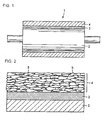
- Fig. 1 is a sectional view showing the essential part of a ceramic-resin composite roll according to one embodiment of the present invention.
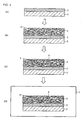
- Fig. 2 is an enlarged sectional view showing the essential part of the roll shown in Fig. 1 in detail.
- a ceramic-resin composite roll 1 comprises a metal roll core 2, a foundation layer 3 formed on the outer circumferential surface thereof and a thermally sprayed ceramic film 4 formed on the outer circumferential surface thereof.
- the roll 1 can be preferably used as a paper making roll. According to the size of the whole roll 1, its diameter is 0.4 to 2m, and its surface length (the length of the roll surface that does not include the length of a shaft projecting to both sides) is 2 to 10m.
- the roll core 2 is formed of iron, stainless steel, copper, brass and the like.
- the foundation layer 3 is formed of a nickel-chrome alloy or a nickel-chrome-aluminum alloy, and it is provided to bond and integrate the roll core 2 and the thermally sprayed film 4 and to prevent the corrosion of the roll core 2.
- the thickness of the foundation layer 2 is about 100 to 800 ⁇ m.
- the thermally sprayed ceramic film 4 comprises a ceramic particle layer in which adjacent ceramic particles 5 are fused and bonded to each other, and a layer of a resin 6 penetrating into the spaces among the ceramic particles 5 from the surface of the ceramic particle layer to the surface of the foundation layer 3. That is, the thermally sprayed ceramic film 4 is formed of a composite material of the fused and bonded ceramic and the resin, so that it contains the fused and bonded ceramic particles 5 formed by thermally spraying a ceramic material only, and the resin 6 penetrating into the spaces among the ceramic particles 5.
- the fused and bonded ceramic particles 5 are continuously provided from the surface of the thermally sprayed film 4 toward the foundation layer 2.
- the resin 6 is also continuously provided among the ceramic particles 5 from the surface of the thermally sprayed ceramic film 4 to the foundation layer 3 so as to fill the spaces among the ceramic particles.
- the ceramic material includes gray alumina (97%Al 2 O 3 -3%TiO 2 ), white alumina (Al 2 O 3 ), titania (TiO 2 ), alumina-titania (Al 2 O 3 -TiO 2 ), chromia (CrO 2 ), zirconia (ZrO 2 ), zirconia-yttria (ZrO 2 -Y) and the like. These can be used alone or mixed.
- the resin 6 is preferably a thermosetting resin, especially an epoxy resin.
- the production method of the ceramic-resin composite roll comprises a foundation layer forming step (A), a ceramic spraying step (B), a resin impregnating step (C), and a resin hardening step (D).
- the foundation layer 3 is formed on the outer circumferential surface of the roll core 2 in the foundation layer forming step.
- the foundation layer 3 can be formed by arc spraying, frame spraying and plasma spraying.
- the layer of the ceramic particles 5 is formed on the outer circumferential surface of the foundation layer 3 in the ceramic spraying step.
- the ceramic material is thermally sprayed without mixing other materials.
- the grain diameter of the thermally sprayed material is about 10 to 200 ⁇ m.
- the thermal spraying can be performed by the well-known method such as the water-stabilized plasma spraying method and the gas plasma spraying method, it is preferable that the water-stabilized plasma spraying method is used in order to implement the strong bonding force of the ceramic particles.
- the thermally sprayed material has a relatively large grain diameter and the porosity of the ceramic particle layer is high so that the ceramic particle layer can be easily filled with a resin in the later resin impregnating step.
- the thickness of the thermally sprayed layer is about 0.5 to 3mm.
- the porosity of the ceramic particle layer before the resin impregnation is about 5 to 15%.
- the impregnating method of the liquid resin includes coating, brushing and spraying means, and the thermally sprayed film can be impregnated with the liquid resin by that means.
- the resin having a low viscosity of 100cps to 200cps at a temperature between room temperature and a preheat temperature it is preferable to select the resin having a low viscosity of 100cps to 200cps at a temperature between room temperature and a preheat temperature in order to impregnate the spaces of the ceramic particles 5 with the liquid resin 6 over the whole thickness from the surface of the ceramic particle layer to the surface of the foundation layer 3.
- the whole roll is heated after the resin impregnation and the liquid resin 6 in the thermally sprayed film is hardened in the resin hardening step.
- the hardening step is preferably performed such that the whole roll is put in a heating furnace 7 and heated therein. It is preferable that the heating condition is at 80 to 120°C for 1 to 10 hours.
- the surface of the roll is cut so as to have a predetermined dimension and ground to have a predetermined surface roughness, whereby the ceramic-resin composite roll is completed.
- a cast iron roll core having a length of 5100mm, a surface length of 3400mm and a diameter of 550mm was cleaned and defatted and roughened by sandblasting. Then, a nickel-chrome alloy was thermally sprayed onto the surface of the roll core by an arc spraying equipment, whereby a foundation layer having a thickness of 0.5mm was formed.
- alumina-titania (Al 2 O 3 -13%TiO 2 ) powder having an average grain diameter of 35 ⁇ m was thermally sprayed by a water-stabilized plasma spraying equipment, whereby a thermally sprayed ceramic film having a thickness of 1.2mm and a porosity of 8% was formed.
- the thermally sprayed ceramic roll was preheated to 70°C and a liquid epoxy resin raw material that was preheated to 70°C was applied from the surface of the roll so that the roll was impregnated with it.
- the used epoxy resin raw material was a mixed solution of 100 parts by mass of Araldite (produced by VANTICO AG) as a main agent and 32 parts by mass of HY932 (produced by VANTICO AG) as a hardening agent.
- the viscosity of this epoxy resin raw material liquid was 100 to 200cps.
- the thermally sprayed ceramic roll impregnated with the epoxy resin row material liquid was put in a heating furnace and the epoxy resin was hardened at 110°C for four hours, whereby a ceramic-epoxy resin composite layer was formed.
- the surface of the ceramic-resin composite layer was cut so as to have a thickness of 1.0mm, and finally ground to have an arithmetic average roughness (Ra) defined by JIS-B0601 of 1.0 ⁇ m, whereby a ceramic-resin composite roll having a roll outer diameter of 553mm was provided.
- Ra arithmetic average roughness
- the same process as the working example 1 was performed until the ceramic spraying step. Then, a thermally sprayed ceramic roll was preheated to 70°C and a liquid epoxy resin raw material that was preheated to 70°C was applied from the surface of the roll so that the roll was impregnated with it.
- the used epoxy resin raw material was a mixed solution of 100 parts by mass of Pelnox 106 (produced by Japan Pelnox Corporation) as a main agent and 80 parts by mass of Pelcure HV19 (produced by Japan Pelnox Corporation) as a hardening agent and 4 parts by mass of DY-070 (produced by VANTICO AG) as a reaction promoting agent.
- the viscosity of this epoxy resin raw material liquid was 100 to 200cps.
- the same process as the working example 1 was performed until the ceramic spraying step. Meanwhile, in this case, the resin impregnating step and the hardening step were not performed.
- the surface was cut and ground similar to the working example 1, whereby a ceramic roll having a layer formed of only ceramic was provided.
- Comparative test was performed on each roll of the working example 1, the comparative example 2 and the comparative example 2 in the following method to evaluate impact resistance, abrasion resistance, chemical resistance and corrosion resistance. The result of each test is shown in Table 1.
- Equotip hardness (ASTM standard : A956-96) was measured by an Equotip 2-E type impact equipment (produced by PROCEQ SA).
- a blast material was sprayed to the roll surface and a time required to remove the ceramic layer was measured.
- the ceramic-resin composite roll according to the present invention is superior in impact resistance, abrasion resistance, chemical resistance and corrosion resistance, so that it can be advantageously used as rolls for various kinds of industries, especially as a paper making roll.
Landscapes
- Engineering & Computer Science (AREA)
- General Engineering & Computer Science (AREA)
- Mechanical Engineering (AREA)
- Coating By Spraying Or Casting (AREA)
- Rolls And Other Rotary Bodies (AREA)
- Paper (AREA)
- Reduction Rolling/Reduction Stand/Operation Of Reduction Machine (AREA)
Claims (6)
- Keramik-Harz-Verbundrolle (1) mit:einem metallischen Rollenkern (2);einer Grundschicht (3) ausgebildet auf der äußeren Umfangsfläche des metallischen Rollenkerns (2); undeinem thermisch aufgespritzten Keramikfilm (4) ausgebildet auf der äußeren Umfangsfläche der Grundschicht (3), wobeider thermisch aufgespritzte Keramikfilm (4) aufweist:eine Keramikpartikelschicht, in der benachbarte Keramikpartikel (5) verschmolzen und miteinander verbunden sind; gekennzeichnet durcheine Harzschicht (6), die die Zwischenräume zwischen den Keramikpartikeln (5) von der Oberfläche der Keramikpartikelschicht bis zur Oberfläche der Grundschicht (3) durchdringt.
- Die Keramik-Harz-Verbundrolle (1) nach Anspruch 1, wobei das Harz, das die Harzschicht (6) bildet, ein wärmehärtendes Harz ist.
- Die Keramik-Harz-Verbundrolle (1) nach Anspruch 1, wobei das Harz, das die Harzschicht (6) bildet, ein Epoxidharz ist.
- Ein Herstellungsverfahren für eine Keramik-Harz-Verbundrolle (1) mit:einem Schritt (A) zur Bildung einer Grundschicht, in dem eine Grundschicht (3) auf der äußeren Umfangsfläche eines metallischen Rollenkerns (2) gebildet wird;einem Keramik-Spritzschritt (B), in dem Keramikpartikel (5) auf die äußere Umfangsfläche der Grundschicht (3) zur Bildung eine Keramikpartikelschicht, in der benachbarte Keramikpartikel (5) verschmolzen und miteinander verbunden sind, gespritzt werden;einem Harz-Imprägnierschritt (C), in dem Zwischenräume zwischen den Keramikpartikeln (5) der Keramikpartikelschicht mit einem wärmehärtenden, flüssigen Harz imprägniert werden; undeinem Harz-Härtungsschritt (D), in dem das flüssige Harz gehärtet wird durch Erwärmen der ganzen Rolle nach dem Harz-Imprägnierschritt; dadurch gekennzeichnet, dassdas wärmehärtende, flüssige Harz in die Zwischenräume zwischen den Keramikpartikeln (5) von der Oberfläche der Keramikpartikelschicht bis zur Oberfläche der Grundschicht (3) eindringt.
- Das Herstellungsverfahren der Keramik-Harz-Verbundrolle (1) nach Anspruch 4, wobei
die Keramikpartikel (5) thermisch mit einem wasser-stabilisierten Plasmaspritzverfahren aufgesprüht werden. - Das Herstellungsverfahren der Keramik-Harz-Verbundrolle (1) nach Anspruch 4, wobei
der Harz-Härtungsschritt (D) in einem Wärmebehandlungsofen durchgeführt wird.
Applications Claiming Priority (2)
| Application Number | Priority Date | Filing Date | Title |
|---|---|---|---|
| JP2006051080A JP4871610B2 (ja) | 2006-02-27 | 2006-02-27 | セラミックス−樹脂複合ロールおよびその製造方法 |
| PCT/JP2007/052935 WO2007097272A1 (ja) | 2006-02-27 | 2007-02-19 | セラミックス-樹脂複合ロールおよびその製造方法 |
Publications (3)
| Publication Number | Publication Date |
|---|---|
| EP1990469A1 EP1990469A1 (de) | 2008-11-12 |
| EP1990469A4 EP1990469A4 (de) | 2009-03-25 |
| EP1990469B1 true EP1990469B1 (de) | 2010-06-02 |
Family
ID=38437312
Family Applications (1)
| Application Number | Title | Priority Date | Filing Date |
|---|---|---|---|
| EP07714461A Not-in-force EP1990469B1 (de) | 2006-02-27 | 2007-02-19 | Keramik-harz-verbundrolle und herstellungsverfahren dafür |
Country Status (10)
| Country | Link |
|---|---|
| US (2) | US20090068405A1 (de) |
| EP (1) | EP1990469B1 (de) |
| JP (1) | JP4871610B2 (de) |
| KR (1) | KR101279758B1 (de) |
| CN (1) | CN101389809B (de) |
| AT (1) | ATE470010T1 (de) |
| AU (1) | AU2007218765B2 (de) |
| CA (1) | CA2642899A1 (de) |
| DE (1) | DE602007006916D1 (de) |
| WO (1) | WO2007097272A1 (de) |
Families Citing this family (6)
| Publication number | Priority date | Publication date | Assignee | Title |
|---|---|---|---|---|
| JP2010025198A (ja) * | 2008-07-17 | 2010-02-04 | Da-Jang Li | 微細な模様を有するローラーの製造方法 |
| DE102011075810A1 (de) * | 2011-05-13 | 2012-11-15 | Voith Patent Gmbh | Korrosionsbeständige walzenbeschichtung |
| CN103058582B (zh) * | 2013-01-04 | 2015-02-25 | 杭州顺隆胶辊有限公司 | 一种纤维素增强树脂基陶瓷覆面辊及其制备方法 |
| JP2015045529A (ja) * | 2013-08-27 | 2015-03-12 | Tdk株式会社 | 回転磁界センサ |
| CN105625081B (zh) * | 2016-03-17 | 2017-05-10 | 安徽山鹰纸业股份有限公司 | 造纸机湿部导辊及其运用 |
| CN114950919B (zh) * | 2022-04-12 | 2023-07-04 | 中国人民解放军陆军装甲兵学院 | 一种用于树脂基复合材料的复合涂层的制备方法和装置 |
Family Cites Families (18)
| Publication number | Priority date | Publication date | Assignee | Title |
|---|---|---|---|---|
| US4301730A (en) * | 1977-09-29 | 1981-11-24 | Pamarco Incorporated | Anilox roll and method of making the same |
| US4495907A (en) * | 1983-01-18 | 1985-01-29 | Cummins Engine Company, Inc. | Combustion chamber components for internal combustion engines |
| FI86566C (fi) * | 1989-10-27 | 1992-09-10 | Valmet Paper Machinery Inc | Vals foer anvaendning vid pappersframstaellning och foerfarande foer framstaellning av valsen. |
| JPH07111036B2 (ja) * | 1990-10-08 | 1995-11-29 | ヤマウチ株式会社 | 抄紙機用プレスロールの製造方法 |
| DE69119690T2 (de) * | 1990-10-08 | 1996-10-02 | Yamauchi Corp | Presswalze für Papiermaschinen |
| US5334288A (en) * | 1992-09-09 | 1994-08-02 | Ishikawajima-Harima Heavy Industries Co., Ltd. | Press roll in a paper machine |
| EP0870867B1 (de) * | 1997-04-11 | 2002-12-11 | Metso Paper, Inc. | Walze für eine Papier- oder Kartonmaschine und Verfahren zur Herstellung der Walze |
| US6409645B1 (en) * | 1997-06-13 | 2002-06-25 | Sw Paper Inc. | Roll cover |
| JP2952224B2 (ja) * | 1997-12-03 | 1999-09-20 | 吉川工業株式会社 | 被印刷体圧着・移送用ローラー |
| FI105351B (fi) * | 1999-02-15 | 2000-07-31 | Valmet Corp | Menetelmä kuluvan pinnan tiivistämiseksi |
| FI117945B (fi) * | 1999-02-15 | 2007-04-30 | Metso Paper Inc | Menetelmä telan pinnoitteen tiivistämiseksi, telavaipan pinnoite ja keraamipinnoitettu tela |
| JP2001131730A (ja) * | 1999-10-28 | 2001-05-15 | Nippon Steel Hardfacing Co Ltd | 溶射皮膜の強化方法および強化された溶射皮膜を有する部材 |
| JP2002088462A (ja) * | 2000-09-14 | 2002-03-27 | Nippon Steel Corp | 封孔処理方法及び封孔処理された溶射皮膜とその皮膜を施したファンまたはブロワー |
| JP2003138306A (ja) * | 2001-10-29 | 2003-05-14 | Nippon Steel Corp | プラスチックを用いた溶銑の脱硫方法 |
| JP3598401B2 (ja) * | 2001-12-19 | 2004-12-08 | トーカロ株式会社 | 封孔処理剤、封孔処理方法及び封孔処理を施した溶射皮膜被覆部材 |
| US7524557B2 (en) * | 2002-07-04 | 2009-04-28 | Kabushiki Kaisha Toshiba | Highly heat conductive insulating member, method of manufacturing the same and electromagnetic device |
| JP4041083B2 (ja) * | 2004-03-25 | 2008-01-30 | ヤマウチ株式会社 | 抄紙機用プレスロール、その製造方法、湿紙に対するプレス方法および抄紙機用プレスロールの表面研磨方法 |
| JP7111036B2 (ja) * | 2019-03-14 | 2022-08-02 | 王子ホールディングス株式会社 | 注ぎ具 |
-
2006
- 2006-02-27 JP JP2006051080A patent/JP4871610B2/ja not_active Expired - Fee Related
-
2007
- 2007-02-19 CA CA002642899A patent/CA2642899A1/en not_active Abandoned
- 2007-02-19 WO PCT/JP2007/052935 patent/WO2007097272A1/ja not_active Ceased
- 2007-02-19 EP EP07714461A patent/EP1990469B1/de not_active Not-in-force
- 2007-02-19 US US12/280,883 patent/US20090068405A1/en not_active Abandoned
- 2007-02-19 KR KR1020087018612A patent/KR101279758B1/ko not_active Expired - Fee Related
- 2007-02-19 AT AT07714461T patent/ATE470010T1/de not_active IP Right Cessation
- 2007-02-19 CN CN2007800065926A patent/CN101389809B/zh not_active Expired - Fee Related
- 2007-02-19 AU AU2007218765A patent/AU2007218765B2/en not_active Ceased
- 2007-02-19 DE DE602007006916T patent/DE602007006916D1/de active Active
-
2011
- 2011-11-16 US US13/297,739 patent/US20120058365A1/en not_active Abandoned
Also Published As
| Publication number | Publication date |
|---|---|
| AU2007218765A1 (en) | 2007-08-30 |
| EP1990469A1 (de) | 2008-11-12 |
| CN101389809B (zh) | 2012-01-11 |
| KR101279758B1 (ko) | 2013-07-04 |
| JP2007231427A (ja) | 2007-09-13 |
| US20090068405A1 (en) | 2009-03-12 |
| WO2007097272A1 (ja) | 2007-08-30 |
| JP4871610B2 (ja) | 2012-02-08 |
| US20120058365A1 (en) | 2012-03-08 |
| AU2007218765B2 (en) | 2011-07-07 |
| ATE470010T1 (de) | 2010-06-15 |
| KR20080105036A (ko) | 2008-12-03 |
| CA2642899A1 (en) | 2007-08-30 |
| DE602007006916D1 (de) | 2010-07-15 |
| EP1990469A4 (de) | 2009-03-25 |
| CN101389809A (zh) | 2009-03-18 |
Similar Documents
| Publication | Publication Date | Title |
|---|---|---|
| EP1990469B1 (de) | Keramik-harz-verbundrolle und herstellungsverfahren dafür | |
| JP4057137B2 (ja) | 抄紙機/板紙抄紙機用プレスロール、その製造方法、およびコーティング組成 | |
| EP2024561B1 (de) | Statisches entwässerungsorgan für bahnformiermaschine und verfahren zum abdecken einer für eine bahnformiermaschine konstruiertes statisches entwässerungsorgan | |
| EP2719544B1 (de) | Verfahren zur Herstellung eines Rotationstiefdruckzylinders | |
| US9863091B2 (en) | Roll | |
| EP0803009B1 (de) | Verfahren zur herstellung einer walze, walze, und beschichtung für eine walze, zur anwendung in der papierherstellung | |
| US7135137B2 (en) | Process for producing resin roll | |
| CN1142373C (zh) | 用于辊上涂层的密封方法,该方法形成的涂层和辊 | |
| US20050233880A1 (en) | Roll and method for the manufacture of such a roll | |
| US20040151857A1 (en) | Coating method for a roll or cylinder | |
| KR20250084320A (ko) | 내마모 성능을 향상시킨 CFRP Roll 제조방법 | |
| JP2007154362A (ja) | 抄紙機用ロール及びその製造方法 | |
| FI115153B (fi) | Telapinnoite ja menetelmä telapinnoitteen valmistamiseksi | |
| EP2512816B1 (de) | Verfahren zur herstellung einer besonders beim flexodruck nützlichen dosierwalze | |
| JP2007154361A (ja) | 抄紙機用ロール及びその製造方法 |
Legal Events
| Date | Code | Title | Description |
|---|---|---|---|
| PUAI | Public reference made under article 153(3) epc to a published international application that has entered the european phase |
Free format text: ORIGINAL CODE: 0009012 |
|
| 17P | Request for examination filed |
Effective date: 20080822 |
|
| AK | Designated contracting states |
Kind code of ref document: A1 Designated state(s): AT BE BG CH CY CZ DE DK EE ES FI FR GB GR HU IE IS IT LI LT LU LV MC NL PL PT RO SE SI SK TR |
|
| A4 | Supplementary search report drawn up and despatched |
Effective date: 20090223 |
|
| 17Q | First examination report despatched |
Effective date: 20090528 |
|
| GRAP | Despatch of communication of intention to grant a patent |
Free format text: ORIGINAL CODE: EPIDOSNIGR1 |
|
| GRAS | Grant fee paid |
Free format text: ORIGINAL CODE: EPIDOSNIGR3 |
|
| GRAA | (expected) grant |
Free format text: ORIGINAL CODE: 0009210 |
|
| DAX | Request for extension of the european patent (deleted) | ||
| AK | Designated contracting states |
Kind code of ref document: B1 Designated state(s): AT BE BG CH CY CZ DE DK EE ES FI FR GB GR HU IE IS IT LI LT LU LV MC NL PL PT RO SE SI SK TR |
|
| REG | Reference to a national code |
Ref country code: GB Ref legal event code: FG4D |
|
| REG | Reference to a national code |
Ref country code: CH Ref legal event code: EP |
|
| REG | Reference to a national code |
Ref country code: IE Ref legal event code: FG4D |
|
| REF | Corresponds to: |
Ref document number: 602007006916 Country of ref document: DE Date of ref document: 20100715 Kind code of ref document: P |
|
| REG | Reference to a national code |
Ref country code: NL Ref legal event code: VDEP Effective date: 20100602 |
|
| PG25 | Lapsed in a contracting state [announced via postgrant information from national office to epo] |
Ref country code: SE Free format text: LAPSE BECAUSE OF FAILURE TO SUBMIT A TRANSLATION OF THE DESCRIPTION OR TO PAY THE FEE WITHIN THE PRESCRIBED TIME-LIMIT Effective date: 20100602 Ref country code: LT Free format text: LAPSE BECAUSE OF FAILURE TO SUBMIT A TRANSLATION OF THE DESCRIPTION OR TO PAY THE FEE WITHIN THE PRESCRIBED TIME-LIMIT Effective date: 20100602 |
|
| LTIE | Lt: invalidation of european patent or patent extension |
Effective date: 20100602 |
|
| PG25 | Lapsed in a contracting state [announced via postgrant information from national office to epo] |
Ref country code: LV Free format text: LAPSE BECAUSE OF FAILURE TO SUBMIT A TRANSLATION OF THE DESCRIPTION OR TO PAY THE FEE WITHIN THE PRESCRIBED TIME-LIMIT Effective date: 20100602 Ref country code: AT Free format text: LAPSE BECAUSE OF FAILURE TO SUBMIT A TRANSLATION OF THE DESCRIPTION OR TO PAY THE FEE WITHIN THE PRESCRIBED TIME-LIMIT Effective date: 20100602 Ref country code: SI Free format text: LAPSE BECAUSE OF FAILURE TO SUBMIT A TRANSLATION OF THE DESCRIPTION OR TO PAY THE FEE WITHIN THE PRESCRIBED TIME-LIMIT Effective date: 20100602 |
|
| PG25 | Lapsed in a contracting state [announced via postgrant information from national office to epo] |
Ref country code: PL Free format text: LAPSE BECAUSE OF FAILURE TO SUBMIT A TRANSLATION OF THE DESCRIPTION OR TO PAY THE FEE WITHIN THE PRESCRIBED TIME-LIMIT Effective date: 20100602 Ref country code: CY Free format text: LAPSE BECAUSE OF FAILURE TO SUBMIT A TRANSLATION OF THE DESCRIPTION OR TO PAY THE FEE WITHIN THE PRESCRIBED TIME-LIMIT Effective date: 20100602 |
|
| PG25 | Lapsed in a contracting state [announced via postgrant information from national office to epo] |
Ref country code: EE Free format text: LAPSE BECAUSE OF FAILURE TO SUBMIT A TRANSLATION OF THE DESCRIPTION OR TO PAY THE FEE WITHIN THE PRESCRIBED TIME-LIMIT Effective date: 20100602 Ref country code: NL Free format text: LAPSE BECAUSE OF FAILURE TO SUBMIT A TRANSLATION OF THE DESCRIPTION OR TO PAY THE FEE WITHIN THE PRESCRIBED TIME-LIMIT Effective date: 20100602 |
|
| PG25 | Lapsed in a contracting state [announced via postgrant information from national office to epo] |
Ref country code: IS Free format text: LAPSE BECAUSE OF FAILURE TO SUBMIT A TRANSLATION OF THE DESCRIPTION OR TO PAY THE FEE WITHIN THE PRESCRIBED TIME-LIMIT Effective date: 20101002 Ref country code: SK Free format text: LAPSE BECAUSE OF FAILURE TO SUBMIT A TRANSLATION OF THE DESCRIPTION OR TO PAY THE FEE WITHIN THE PRESCRIBED TIME-LIMIT Effective date: 20100602 Ref country code: RO Free format text: LAPSE BECAUSE OF FAILURE TO SUBMIT A TRANSLATION OF THE DESCRIPTION OR TO PAY THE FEE WITHIN THE PRESCRIBED TIME-LIMIT Effective date: 20100602 Ref country code: PT Free format text: LAPSE BECAUSE OF FAILURE TO SUBMIT A TRANSLATION OF THE DESCRIPTION OR TO PAY THE FEE WITHIN THE PRESCRIBED TIME-LIMIT Effective date: 20101004 Ref country code: CZ Free format text: LAPSE BECAUSE OF FAILURE TO SUBMIT A TRANSLATION OF THE DESCRIPTION OR TO PAY THE FEE WITHIN THE PRESCRIBED TIME-LIMIT Effective date: 20100602 Ref country code: BE Free format text: LAPSE BECAUSE OF FAILURE TO SUBMIT A TRANSLATION OF THE DESCRIPTION OR TO PAY THE FEE WITHIN THE PRESCRIBED TIME-LIMIT Effective date: 20100602 |
|
| PG25 | Lapsed in a contracting state [announced via postgrant information from national office to epo] |
Ref country code: IT Free format text: LAPSE BECAUSE OF FAILURE TO SUBMIT A TRANSLATION OF THE DESCRIPTION OR TO PAY THE FEE WITHIN THE PRESCRIBED TIME-LIMIT Effective date: 20100602 |
|
| PLBE | No opposition filed within time limit |
Free format text: ORIGINAL CODE: 0009261 |
|
| STAA | Information on the status of an ep patent application or granted ep patent |
Free format text: STATUS: NO OPPOSITION FILED WITHIN TIME LIMIT |
|
| PG25 | Lapsed in a contracting state [announced via postgrant information from national office to epo] |
Ref country code: DK Free format text: LAPSE BECAUSE OF FAILURE TO SUBMIT A TRANSLATION OF THE DESCRIPTION OR TO PAY THE FEE WITHIN THE PRESCRIBED TIME-LIMIT Effective date: 20100602 |
|
| 26N | No opposition filed |
Effective date: 20110303 |
|
| PG25 | Lapsed in a contracting state [announced via postgrant information from national office to epo] |
Ref country code: GR Free format text: LAPSE BECAUSE OF FAILURE TO SUBMIT A TRANSLATION OF THE DESCRIPTION OR TO PAY THE FEE WITHIN THE PRESCRIBED TIME-LIMIT Effective date: 20100903 |
|
| REG | Reference to a national code |
Ref country code: DE Ref legal event code: R097 Ref document number: 602007006916 Country of ref document: DE Effective date: 20110302 |
|
| PG25 | Lapsed in a contracting state [announced via postgrant information from national office to epo] |
Ref country code: MC Free format text: LAPSE BECAUSE OF NON-PAYMENT OF DUE FEES Effective date: 20110228 |
|
| REG | Reference to a national code |
Ref country code: CH Ref legal event code: PL |
|
| GBPC | Gb: european patent ceased through non-payment of renewal fee |
Effective date: 20110219 |
|
| PG25 | Lapsed in a contracting state [announced via postgrant information from national office to epo] |
Ref country code: CH Free format text: LAPSE BECAUSE OF NON-PAYMENT OF DUE FEES Effective date: 20110228 Ref country code: LI Free format text: LAPSE BECAUSE OF NON-PAYMENT OF DUE FEES Effective date: 20110228 |
|
| REG | Reference to a national code |
Ref country code: FR Ref legal event code: ST Effective date: 20111102 |
|
| REG | Reference to a national code |
Ref country code: IE Ref legal event code: MM4A |
|
| PG25 | Lapsed in a contracting state [announced via postgrant information from national office to epo] |
Ref country code: IE Free format text: LAPSE BECAUSE OF NON-PAYMENT OF DUE FEES Effective date: 20110219 Ref country code: FR Free format text: LAPSE BECAUSE OF NON-PAYMENT OF DUE FEES Effective date: 20110228 |
|
| PG25 | Lapsed in a contracting state [announced via postgrant information from national office to epo] |
Ref country code: GB Free format text: LAPSE BECAUSE OF NON-PAYMENT OF DUE FEES Effective date: 20110219 |
|
| PG25 | Lapsed in a contracting state [announced via postgrant information from national office to epo] |
Ref country code: LU Free format text: LAPSE BECAUSE OF NON-PAYMENT OF DUE FEES Effective date: 20110219 |
|
| PG25 | Lapsed in a contracting state [announced via postgrant information from national office to epo] |
Ref country code: BG Free format text: LAPSE BECAUSE OF FAILURE TO SUBMIT A TRANSLATION OF THE DESCRIPTION OR TO PAY THE FEE WITHIN THE PRESCRIBED TIME-LIMIT Effective date: 20100902 Ref country code: TR Free format text: LAPSE BECAUSE OF FAILURE TO SUBMIT A TRANSLATION OF THE DESCRIPTION OR TO PAY THE FEE WITHIN THE PRESCRIBED TIME-LIMIT Effective date: 20100602 |
|
| PG25 | Lapsed in a contracting state [announced via postgrant information from national office to epo] |
Ref country code: ES Free format text: LAPSE BECAUSE OF FAILURE TO SUBMIT A TRANSLATION OF THE DESCRIPTION OR TO PAY THE FEE WITHIN THE PRESCRIBED TIME-LIMIT Effective date: 20100913 Ref country code: HU Free format text: LAPSE BECAUSE OF FAILURE TO SUBMIT A TRANSLATION OF THE DESCRIPTION OR TO PAY THE FEE WITHIN THE PRESCRIBED TIME-LIMIT Effective date: 20100602 |
|
| PGFP | Annual fee paid to national office [announced via postgrant information from national office to epo] |
Ref country code: FI Payment date: 20170209 Year of fee payment: 11 Ref country code: DE Payment date: 20170214 Year of fee payment: 11 |
|
| REG | Reference to a national code |
Ref country code: DE Ref legal event code: R119 Ref document number: 602007006916 Country of ref document: DE |
|
| PG25 | Lapsed in a contracting state [announced via postgrant information from national office to epo] |
Ref country code: FI Free format text: LAPSE BECAUSE OF NON-PAYMENT OF DUE FEES Effective date: 20180219 |
|
| PG25 | Lapsed in a contracting state [announced via postgrant information from national office to epo] |
Ref country code: DE Free format text: LAPSE BECAUSE OF NON-PAYMENT OF DUE FEES Effective date: 20180901 |