EP1974649A2 - Programmgesteuertes Haushaltgerät mit einer Einrichtung zur Klangausgabe - Google Patents
Programmgesteuertes Haushaltgerät mit einer Einrichtung zur Klangausgabe Download PDFInfo
- Publication number
- EP1974649A2 EP1974649A2 EP08004130A EP08004130A EP1974649A2 EP 1974649 A2 EP1974649 A2 EP 1974649A2 EP 08004130 A EP08004130 A EP 08004130A EP 08004130 A EP08004130 A EP 08004130A EP 1974649 A2 EP1974649 A2 EP 1974649A2
- Authority
- EP
- European Patent Office
- Prior art keywords
- output
- household appliance
- program
- memory
- serial
- Prior art date
- Legal status (The legal status is an assumption and is not a legal conclusion. Google has not performed a legal analysis and makes no representation as to the accuracy of the status listed.)
- Granted
Links
Images

Classifications
-
- A—HUMAN NECESSITIES
- A47—FURNITURE; DOMESTIC ARTICLES OR APPLIANCES; COFFEE MILLS; SPICE MILLS; SUCTION CLEANERS IN GENERAL
- A47L—DOMESTIC WASHING OR CLEANING; SUCTION CLEANERS IN GENERAL
- A47L15/00—Washing or rinsing machines for crockery or tableware
- A47L15/42—Details
- A47L15/4293—Arrangements for programme selection, e.g. control panels; Indication of the selected programme, programme progress or other parameters of the programme, e.g. by using display panels
-
- D—TEXTILES; PAPER
- D06—TREATMENT OF TEXTILES OR THE LIKE; LAUNDERING; FLEXIBLE MATERIALS NOT OTHERWISE PROVIDED FOR
- D06F—LAUNDERING, DRYING, IRONING, PRESSING OR FOLDING TEXTILE ARTICLES
- D06F34/00—Details of control systems for washing machines, washer-dryers or laundry dryers
- D06F34/28—Arrangements for programme selection, e.g. control panels therefor; Arrangements for indicating programme parameters, e.g. the selected programme or its progress
-
- D—TEXTILES; PAPER
- D06—TREATMENT OF TEXTILES OR THE LIKE; LAUNDERING; FLEXIBLE MATERIALS NOT OTHERWISE PROVIDED FOR
- D06F—LAUNDERING, DRYING, IRONING, PRESSING OR FOLDING TEXTILE ARTICLES
- D06F2105/00—Systems or parameters controlled or affected by the control systems of washing machines, washer-dryers or laundry dryers
- D06F2105/58—Indications or alarms to the control system or to the user
- D06F2105/60—Audible signals
Definitions
- the invention relates to a program-controlled household appliance, such as washing machine, tumble dryer, dishwasher or oven, with a device for sound output, which includes a speaker and a memory, are stored in the output pattern for the sound output in digital form.
- Such a household appliance is from the DE 100 56 498 B4 in which a music storage medium or a radio is installed, which can be controlled depending on the program.
- a music storage medium CDs or cassettes can be played.
- To output simple sounds that signal certain program states, such a system is far too expensive. It is also important to ensure that the inserted cassette or CD does not become dirty or wet.
- a household appliance here a washing machine, known to which an MP3 player can be connected.
- the MP3 player is connected by means of a data connection to the controller of the washing machine, which converts the received audio data into an output signal for the loudspeaker.
- the controller of the washing machine can control the MP3 player via the data connection so that depending on the state of the program flow in the household appliance, the corresponding audio file from the MP3 player via the data connection to the audio output unit and output to the speaker.
- this system is very expensive, and it can only be used an MP3 player that can be operated permanently in a humid environment. It is also important to ensure a good seal of the connectors, so that the signal transmission is not affected by corrosive contacts.
- the Miele W 2557 WPS buzzer is used in the washing machine to acoustically signal the switch operation or program conditions.
- a buzzer however, different signals are sometimes difficult to recognize.
- the tones of a buzzer may be bothersome by some users.
- From the DE 34 03 487 C2 is a household appliance with a device for speech known.
- speech sequences are stored in digital form in a speech memory.
- the digital information is converted by means of a transmission network into analog signals and fed to an amplifier.
- From the DE 10 2005 006 858 A1 it is known To provide a sound output in a hearing aid using a delta-sigma modulator.
- an analog sound signal is recorded and fed via an analog-to-digital converter to the delta-sigma converter, from which the sound signal to be output via the loudspeaker is generated via further components.
- the object of the invention is to provide a household appliance with a sound output device which has high sound quality and is simple and inexpensive to manufacture.
- the achievable with the invention advantages are in addition to the simple and inexpensive construction in that the sound output has a high quality.
- the high sound quality gives the household appliance a high quality appearance.
- the user turns it off with pleasant sound outputs, because he perceives simpler sound outputs, such as beeps as unpleasant. Therefore, it is always ensured that the acoustic signal output remains activated and program states or emergency situations can be reliably and promptly communicated to the user.
- the device for sound output comprises a driver and a converter device for converting the digital output patterns into an analog output signal for the driver or loudspeaker.
- the memory has a serial output, via which the digital output patterns can be serially output as a bit sequence.
- the program control in particular the microcontroller of the program control, also controls the sound output, if this is provided in the program sequence, for example in the washing program or in the baking program.
- the converter device has a low-pass filter whose output is connected directly to the driver, wherein the low-pass filter can be used to convert the serial digital output pattern into an analog output signal.
- the low-pass filter acts as an integrator, whereby the consecutive bits with the "1" state effect a gradual increase in the level of the analogue output signal. If the incoming bits are "0", they will cause a gradual decrease in the level of the analog output signal. This interplay provides an analog output signal to the driver or loudspeaker, which is held in memory by the previous definition and storage.
- the low-pass filter comprises an R-C member having a cut-off frequency of about 15 kHz to 20 kHz. In this way, audible frequencies are generated optimally for humans, whereby the quality for the sounds to be output is further improved.
- the memory used is a serial PROM, EPROM or FLASH, in which the digital, serial output pattern can be permanently programmed.
- serial PROMs are inexpensive and easy to use for this purpose.
- the memory it is expedient for the memory to have a clock input with which the serial output of the output pattern can be controlled, wherein a range between 0.5 MHz and 2 MHz is used as the clock frequency. With this clock frequency is achieved that almost all audible frequencies can be output with the specified intensity as a digital serial bit stream from the serial PROM.
- a memory with a capacity in the range of 4 to 20 Mbit is used.
- the clock frequency of 1 MHz results in a total duration for the sound output of 4 to 20 sec.
- a memory has proved with a capacity of 16 Mbit, which is quite inexpensive as a mass-produced.
- each area contains a separate output pattern.
- the respective starting address, from which the respective output pattern is stored as a digital bit stream the selection for the individual output pattern is made. In this way, in a single PROM several output patterns, each forming its own sound, stored and called in operation by the program control.
- Fig. 1 is shown as a program-controlled household appliance, a washing machine 1.
- the washing machine 1 has on the user or operator side facing a control panel 2, on the control and display elements 3 are arranged.
- the device for sound output 4 is further housed, wherein the speaker 8 ( Fig. 2 ) is arranged so that the sound output is not affected.
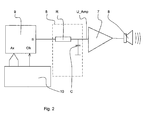
- Fig. 2 the structure of the device for sound output 4 is illustrated as a block diagram.
- the serial memory 9 for example a serial ROM, PROM, EPROM or FLASH
- the digital output patterns are stored for sound generation.
- a memory 9 so-called read-only memory are used, which are programmed in the manufacturing process with the output patterns.
- a FLASH or certain types of EPROMS a subsequent programming is possible, which also adjustments to the sound output to the current taste or other fads are possible.
- the clock input Clk is clocked at a clock of 1 MHz, whereby the start address in the serial memory 9 is set beforehand to the address input Ax, from which the serial output takes place.
- the clock and the setting of the address is provided by the microcontroller 10 of the program control for the domestic appliance 1 hereby.
- the programming for the serial memory 9 is not explained here, wherein it should be noted that the data to be entered into the memory 9 must be generated or calculated beforehand. In this data generation, the behavior of the integrator 6, the speaker 8 and the used clock frequency Clk must be taken into account in order to achieve the desired sound.
- the calculation is performed, for example, according to the delta-sigma method or similar methods in order to generate the data for a suitable bit pattern.
- the high computational effort to generate the data for the appropriate bit pattern does not have to be provided in the household appliance 1, but is carried out once on an external computer.
- the serial output S of the memory 9 is connected to the input of the low-pass filter 6, which acts as an integrator.
- the capacitor C is charged, as a result of which the voltage level U_Amp at the input of the driver 7 is gradually increased.
- the driver 7 serves to provide the necessary power for the speaker 8 and to make the decoupling of the low-pass filter 6 to the speaker 8.
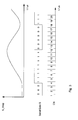
- Fig. 3 the waveform is sketched by way of example.
- the serial bit stream S from the serial memory 9 ( Fig. 2 ) clocked out.
- the signal U_Amp is present.
- From the clock Clk 1 to 3 zeros are output.
- the level U_Amp remains at a low initial value.
- From clock Clk 4 follows a series of ones that cause a substantially steady increase in the level U_Amp.
- From clock Clk 12 follows again a series of zeros, which cause a decrease in the level U_Amp until the clock 18.
- From cycle Clk 14 follows again a series of ones, whereby from this point on again an increase of the level U_Amp is effected.
- the signal U_Amp which has a vibration over a longer sequence of clocks Clk, here 20 clocks, is sent via the driver 7 (FIG. Fig. 2 ) the speaker 8 ( Fig. 2 ), which converts the conversion of the electrical signal into an acoustic signal as a sound.
- the time axis t is the unit us, so that one ⁇ s is provided for each clock.
Landscapes
- Engineering & Computer Science (AREA)
- Textile Engineering (AREA)
- Control Of Washing Machine And Dryer (AREA)
- Washing And Drying Of Tableware (AREA)
- Cookers (AREA)
- Reverberation, Karaoke And Other Acoustics (AREA)
- Selective Calling Equipment (AREA)
- Circuit For Audible Band Transducer (AREA)
Abstract
Description
- Die Erfindung betrifft ein programmgesteuertes Haushaltgerät, wie Waschmaschine, Wäschetrockner, Geschirrspüler oder Backofen, mit einer Einrichtung zur Klangausgabe, die einen Lautsprecher und einen Speicher, in den Ausgabemuster für die Klangausgabe in digitaler Form abgespeichert sind, umfasst.
- Ein derartiges Haushaltgerät ist aus der
DE 100 56 498 B4 bekannt, bei dem ein Musikspeichermedium oder ein Radio eingebaut ist, welches programmabhängig ansteuerbar ist. Mit dem Musikspeichermedium können CDs oder Kassetten abgespielt werden. Zur Ausgabe von einfachen Klängen, die bestimmte Programmzustände signalisieren, ist ein solches System viel zu aufwändig. Ferner ist stets darauf zu achten, dass die eingelegte Kassette oder CD nicht verschmutzt oder nass wird. - Aus der
DE 10 2006 030 184 A1 ist ein Haushaltgerät, hier eine Waschmaschine, bekannt, an die ein MP3-Spieler angeschlossen werden kann. Hierbei wird der MP3-Spieler mittels einer Datenverbindung an die Steuerung der Waschmaschine angeschlossen, die die empfangenen Audiodaten zu einem Ausgabesignal für den Lautsprecher umwandelt. Die Steuerung der Waschmaschine kann über die Datenverbindung den MP3-Spieler so steuern, dass je nach Zustand des Programmablaufs im Haushaltgerät die entsprechende Audiodatei vom MP3-Spieler über die Datenverbindung zur Audioausgabeeinheit übertragen und zum Lautsprecher ausgegeben wird. Auch dieses System ist sehr aufwendig, und es kann nur ein MP3-Spieler eingesetzt werden, der dauerhaft in feuchter Umgebung betrieben werden kann. Ferner ist auf eine gute Abdichtung der Verbinder zu achten, damit die Signalübertragung nicht durch korrodierende Kontakte beeinträchtigt wird. - Zur Ausgabe von Programmzuständen ist es generell bekannt, Klangausgaben zu verwenden. Beispielsweise werden bei der Waschmaschine Miele W 2557 WPS Summer verwendet, um die Schalterbetätigung oder Programmzustände akustisch zu signalisieren. Bei einem Summer sind jedoch unterschiedliche Signale manchmal schwer zu erkennen. Ferner können die Töne von einem Summer von manchen Benutzern als störend empfunden werden.
- Aus der
DE 34 03 487 C2 ist ein Haushaltgerät mit einer Einrichtung zur Sprachausgabe bekannt. Hierbei sind Sprachsequenzen in digitaler Form in einem Sprachspeicher abgespeichert. Die digitalen Informationen werden mittels eines Übertragungsnetzwerkes in Analogsignale gewandelt und einem Verstärker zugeführt. Aus derDE 10 2005 006 858 A1 ist es bekannt, eine Klangausgabe in einem Hörhilfegerät mit Hilfe eines Delta-Sigma-Modulators bereitzustellen. Hierbei wird ein analoges Klangsignal aufgenommen und über einen Analog-Digitalwandler dem Delta-Sigma-Wandler zugeführt, woraus über weitere Komponenten das über den Lautsprecher auszugebende Klangssignal erzeugt wird. - Aus der Zeitschrift "ct 1988, Heft 8, Seite 74 bis 87 ist es bekannt, in einem Computer eine gesteuerte Sprachausgabe bereitzustellen. Das Tonsignal wird dadurch erzeugt, dass eine bitweise Ausgabe von Werten zu festen Zeitpunkten zu einem Lautsprecher erfolgt. Hierbei regen die einzelnen Bits als direktes Stromsignal die Lautsprechermembrane an, wobei die Trägheit der Membrane mit zur Klangerzeugung ausgenutzt wird. Dieses System ist jedoch nicht dazu geeignet, Klangbilder von hoher Qualität zu erzeugen, weil keine unterschiedlichen Pegel für die Klangausgabe erzeugt werden können.
- Die Aufgabe der Erfindung ist, ein Haushaltgerät mit einer Einrichtung zur Klangausgabe bereitzustellen, die eine hohe Klangqualität besitzt und einfach und kostengünstig herzustellen ist.
- Erfindungsgemäß wird diese Aufgabe durch ein Haushaltgerät mit den Merkmalen des Patentanspruchs 1 gelöst. Vorteilhafte Ausgestaltungen und Weiterbildungen der Erfindung ergeben sich aus den nachfolgenden abhängigen Ansprüchen.
- Die mit der Erfindung erreichbaren Vorteile bestehen neben dem einfachen und kostengünstigen Aufbau darin, dass die Klangausgabe eine hohe Qualität aufweist. Durch die hohe Klangqualität wird dem Haushaltgerät eine hohe Qualitätsanmutung verliehen. Ferner besteht bei angenehmen Klangausgaben nicht die Gefahr, dass der Benutzer diese abschaltet, weil er einfachere Klangausgaben, wie Piepstöne als unangenehm empfindet. Deshalb wird stets sichergestellt, dass die akustische Signalausgabe aktiviert bleibt und Programmzustände oder Notsituationen zuverlässig und zeitnah dem Benutzer mitgeteilt werden können.
- Hierzu umfasst die Einrichtung zur Klangausgabe einen Treiber und eine Wandlereinrichtung zur Umwandlung der digitalen Ausgabemuster in ein analoges Ausgabesignal für den Treiber oder Lautsprecher. Der Speicher besitzt einen seriellen Ausgang, über den die digitalen Ausgabemuster als Bitfolge seriell ausgebbar sind. Auf diese Weise wird ein sehr einfacher Aufbau für die Einrichtung zur Klangausgabe erreicht, wobei im Speicher das auszugebende Signal als digitale Bitfolge abgespeichert und seriell ausgegeben wird. Die Programmsteuerung, insbesondere der Mikrocontroller der Programmsteuerung, steuert auch die Klangausgabe, wenn dies im Programmablauf, beispielsweise im Waschprogramm oder im Backprogramm, vorgesehen ist.
- In einer zweckmäßigen Ausführung besitzt die Wandlereinrichtung einen Tiefpass, dessen Ausgang direkt mit dem Treiber verbunden ist, wobei mit dem Tiefpass die Wandlung des seriellen, digitalen Ausgabemusters in ein analoges Ausgabesignal durchführbar ist. Der Tiefpass wirkt hierbei als Integrierer, wobei die zeitlich nacheinander eintreffenden Bits mit dem "1" Zustand eine allmähliche Pegelerhöhung für das analoge Ausgabesignal bewirken. Wenn die eintreffenden Bits den Zustand "0" aufweisen, dann bewirken sie eine allmähliche Verminderung des Pegels für das analoge Ausgabesignal. Durch dieses Wechselspiel wird ein analoges Ausgangssignal für den Treiber bzw. den Lautsprecher bereitgestellt, welches durch die vorherige Festlegung und Abspeicherung im Speicher bereitgehalten wird.
- In einer weiteren Ausführung umfasst der Tiefpass ein R-C-Glied, welches eine Grenzfrequenz von ungefähr 15 kHz bis 20 kHz hat. Auf diese Weise werden für den Menschen hörbare Frequenzen optimal erzeugt, wodurch die Qualität für die auszugebenden Klänge nochmals verbessert wird.
- In einer zweckmäßigen Ausführung wird als Speicher ein serielles PROM, EPROM oder FLASH verwendet, in den das digitale, serielle Ausgabemuster fest einprogrammierbar ist. Diese sogenannten seriellen PROMs sind preiswert und für diesen Zweck gut verwendbar.
- Es ist hierbei zweckmäßig, dass der Speicher einen Takteingang besitzt, mit dem die serielle Ausgabe des Ausgabemusters steuerbar ist, wobei als Taktfrequenz ein Bereich zwischen 0,5 MHz und 2 MHz verwendet wird. Mit dieser Taktfrequenz wird erreicht, dass nahezu alle hörbaren Frequenzen mit der vorgegebenen Intensität als digitaler serieller Bitstrom aus dem seriellen PROM ausgegeben werden können.
- In einer zweckmäßigen Weiterbildung wird ein Speicher mit einer Kapazität im Bereich von 4 bis 20 Mbit verwendet. In Verbindung mit der Taktfrequenz von 1 MHz ergibt sich eine Gesamtdauer für die Klangausgabe von 4 bis 20 sek. Als zweckmäßig hat sich ein Speicher mit einer Kapazität von 16 Mbit erwiesen, der als Massenartikel recht preisgünstig beschaffbar ist.
- In einer vorteilhaften Weiterbildung ist der Speicher bereichsweise ansteuerbar, wobei jeder Bereich jeweils ein separates Ausgabemuster enthält. Durch Anlegen der jeweiligen Anfangsadresse, ab der das jeweilige Ausgabemuster als digitaler Bitstrom abgespeichert ist, wird die Auswahl für das einzelne Ausgabemuster getroffen. Auf diese Weise können in einem einzigen PROM mehrere Ausgabemuster, die jeweils einen eigenen Klang bilden, abgelegt und im Betrieb durch die Programmsteuerung aufgerufen werden.
- Ein Ausführungsbeispiel der Erfindung ist in den Zeichnungen schematisch dargestellt und wird nachfolgend näher beschrieben. Es zeigen:
- Fig. 1:
- eine programmgesteuerte Waschmaschine oder einen Trockner mit einer Einrichtung zur Klangausgabe;
- Fig. 2:
- ein Blockschaltbild der Einrichtung zur Klangausgabe und
- Fig. 3:
- den Verlauf des Ausgabemusters und des Ausgabesignals in einer skizzierten Darstellung.
- In
Fig. 1 ist als programmgesteuertes Haushaltgerät eine Waschmaschine 1 dargestellt. Die Waschmaschine 1 besitzt auf der dem Benutzer oder Bediener zugewandten Seite eine Bedienblende 2, auf der Bedien- und Anzeigeelemente 3 angeordnet sind. In der Bedienblende 2 ist ferner die Einrichtung zur Klangausgabe 4 untergebracht, wobei der Lautsprecher 8 (Fig. 2 ) so angeordnet ist, dass die Klangausgabe nicht beeinträchtigt wird. - In
Fig. 2 ist der Aufbau der Einrichtung zur Klangausgabe 4 als Blockschaltbild verdeutlicht. Im seriellen Speicher 9, beispielsweise ein serielles ROM, PROM, EPROM oder FLASH, sind die digitalen Ausgabemuster zur Klangerzeugung abgespeichert. Als Speicher 9 werden sogenannte nur-lese-Speicher verwendet, die im Fertigungsprozess mit den Ausgabemustern programmiert werden. Bei einem FLASH oder bestimmten Arten von EPROMS ist eine nachträgliche Programmierung möglich, wodurch auch Anpassungen hinsichtlich der Klangausgaben an den jeweiligen Zeitgeschmack oder sonstigen Modeerscheinungen möglich sind. Zur seriellen Ausgabe des Ausgabemusters wird der Takteingang Clk mit einem Takt von 1 MHz getaktet, wobei vorher an den Adresseingang Ax die Startadresse im seriellen Speicher 9 eingestellt wird, ab der die serielle Ausgabe erfolgt. Der Takt und die Einstellung der Adresse wird durch hierbei durch den Mikrocontroller 10 der Programmsteuerung für das Haushaltgerät 1 bereitgestellt. Die Programmierung für den seriellen Speicher 9 ist hierbei nicht erläutert, wobei hierzu anzumerken ist, dass die in den Speicher 9 einzutragenden Daten vorher erzeugt bzw. berechnet werden müssen. Bei dieser Datenerzeugung muss das Verhalten des Integrierers 6, des Lautsprechers 8 und der verwendeten Taktfrequenz Clk berücksichtigt werden, um den gewünschten Klang zu erreichen. Die Berechnung erfolgt beispielsweise nach dem Delta-Sigma Verfahren oder ähnlichen Verfahren, um die Daten für ein geeignetes Bitmuster zu generieren. Der hohe Rechenaufwand zur Erzeugung der Daten für das geeignete Bitmuster muss nicht im Haushaltgerät 1 erbracht werden, sondern wird einmalig auf einem externen Computer durchgeführt. - Der serielle Ausgang S des Speichers 9 ist mit dem Eingang des Tiefpasses 6 verbunden, der als Integrierer wirkt. Hierbei wird beispielsweise bei einer eintreffenden Folge von "1" der Kondensator C aufgeladen, wodurch der Spannungspegel U_Amp am Eingang des Treibers 7 allmählich erhöht wird. Der Treiber 7 dient dazu, die nötige Leistung für den Lautsprecher 8 bereitzustellen und die Entkopplung des Tiefpasses 6 zum Lautsprecher 8 vorzunehmen.
- In
Fig. 3 ist der Signalverlauf beispielhaft aufskizziert. Mit dem Takt Clk wird der serielle Bitstrom S aus dem seriellen Speicher 9 (Fig. 2 ) heraus getaktet. Am Eingang des Treibers 7 (Fig. 2 ) liegt das Signal U_Amp an. Vom Takt Clk 1 bis 3 werden Nullen ausgegeben. Der Pegel U_Amp bleibt auf einem niedrigen Anfangswert. Ab Takt Clk 4 folgt eine Reihe von Einsen, die eine im wesentlichen stetige Erhöhung des Pegels U_Amp bewirken. Ab Takt Clk 12 folgt wieder eine Reihe von Nullen, die eine Abnahme des Pegels U_Amp bis zum Takt 18 bewirken. Ab Takt Clk 14 folgt wieder eine Reihe von Einsen, wodurch ab diesem Zeitpunkt wieder eine Erhöhung des Pegels U_Amp bewirkt wird. Das Signal U_Amp, welches über eine längere Abfolge von Takten Clk, hier 20 Takte, eine Schwingung hat, wird über den Treiber 7 (Fig. 2 ) dem Lautsprecher 8 (Fig. 2 ) zugeführt, der die Umwandlung des elektrischen Signals in ein akustisches Signal als Klang umwandelt. In diesem Beispiel gilt für die Zeitachsen t die Einheit us, so dass für jeden Takt eine us vorgesehen ist.
Claims (8)
- Programmgesteuertes Haushaltgerät (1), insbesondere Waschmaschine, Wäschetrockner, Geschirrspüler oder Backofen, mit einer Einrichtung zur Klangausgabe (4), die einen Lautsprecher (8) und einen Speicher (9), in den Ausgabemuster für die Klangausgabe in digitaler Form abgespeichert sind, umfasst,
dadurch gekennzeichnet,
dass die Einrichtung zur Klangausgabe (4) einen Treiber (7) und eine Wandlereinrichtung (6) zur Umwandlung der digitalen Ausgabemuster in ein analoges Ausgabesignal (U_Amp) für den Treiber (7) oder Lautsprecher (8), umfasst, wobei der Speicher (9) einen seriellen Ausgang (S) besitzt, über den die digitalen Ausgabemuster als Bitfolge seriell ausgebbar sind und dass die Wandlereinrichtung (6) einen Tiefpass (6) besitzt, dessen Ausgang direkt mit dem Treiber (7) verbunden ist, wobei mit dem Tiefpass (6) die Wandlung des seriellen, digitalen Ausgabemusters in ein analoges Ausgabesignal (U_Amp) durchführbar ist. - Programmgesteuertes Haushaltgerät (1) nach Anspruch 1,
dadurch gekennzeichnet,
dass der Tiefpass (6) ein R-C-Glied umfasst, welches eine Grenzfrequenz von ungefähr 15 kHz bis 20 kHz hat. - Programmgesteuertes Haushaltgerät (1) nach Anspruch 1,
dadurch gekennzeichnet,
dass als Speicher (9) ein serielles PROM, EPROM oder FLASH verwendet wird, in den das digitale serielle Ausgabemuster fest einprogrammierbar ist. - Programmgesteuertes Haushaltgerät (1) nach Anspruch 3,
dadurch gekennzeichnet,
dass der Speicher (9) einen Takteingang (Clk) besitzt, mit dem die serielle Ausgabe des Ausgabemusters steuerbar ist, wobei als Taktfrequenz ein Bereich zwischen 0,5 MHz und 2 MHz verwendet wird. - Programmgesteuertes Haushaltgerät (1) nach Anspruch 3,
dadurch gekennzeichnet,
dass der Speicher (9) eine Kapazität von 4 bis 20 Mbit besitzt. - Programmgesteuertes Haushaltgerät (1) nach Anspruch 5,
dadurch gekennzeichnet,
dass der Speicher (9) eine Kapazität von 16 Mbit besitzt. - Programmgesteuertes Haushaltgerät (1) nach einem der Ansprüche 1 bis 6,
dadurch gekennzeichnet,
dass der Speicher (9) bereichsweise ansteuerbar ist, wobei jeder Bereich jeweils ein separates Ausgabemuster enthält. - Programmgesteuertes Haushaltgerät (1) nach Anspruch 1,
dadurch gekennzeichnet,
dass die Wandlereinrichtung (6) zur Erzeugung des analogen Ausgabesignals (U_Amp) dafür vorgesehen ist, das digitale Ausgabemuster nach einem Delta-Sigma Verfahren zu verarbeiten.
Priority Applications (1)
| Application Number | Priority Date | Filing Date | Title |
|---|---|---|---|
| PL08004130T PL1974649T3 (pl) | 2007-03-26 | 2008-03-06 | Programowo sterowany sprzęt gospodarstwa domowego z urządzeniem do wydawania dźwięku |
Applications Claiming Priority (1)
| Application Number | Priority Date | Filing Date | Title |
|---|---|---|---|
| DE102007014902A DE102007014902A1 (de) | 2007-03-26 | 2007-03-26 | Programmgesteuertes Haushaltgerät mit einer Einrichtung zur Klangausgabe |
Publications (3)
| Publication Number | Publication Date |
|---|---|
| EP1974649A2 true EP1974649A2 (de) | 2008-10-01 |
| EP1974649A3 EP1974649A3 (de) | 2010-12-22 |
| EP1974649B1 EP1974649B1 (de) | 2011-12-14 |
Family
ID=39590697
Family Applications (1)
| Application Number | Title | Priority Date | Filing Date |
|---|---|---|---|
| EP08004130A Not-in-force EP1974649B1 (de) | 2007-03-26 | 2008-03-06 | Programmgesteuertes Haushaltgerät mit einer Einrichtung zur Klangausgabe |
Country Status (5)
| Country | Link |
|---|---|
| EP (1) | EP1974649B1 (de) |
| AT (1) | ATE536796T1 (de) |
| DE (1) | DE102007014902A1 (de) |
| ES (1) | ES2375419T3 (de) |
| PL (1) | PL1974649T3 (de) |
Families Citing this family (1)
| Publication number | Priority date | Publication date | Assignee | Title |
|---|---|---|---|---|
| DE102015103874B4 (de) * | 2015-03-17 | 2022-12-15 | Miele & Cie. Kg | Haushaltsgerät mit einer Einrichtung zur Klangausgabe |
Citations (4)
| Publication number | Priority date | Publication date | Assignee | Title |
|---|---|---|---|---|
| DE3403487C2 (de) | 1984-02-01 | 1988-01-07 | Bosch-Siemens Hausgeraete Gmbh, 7000 Stuttgart, De | |
| DE10056498B4 (de) | 2000-11-15 | 2006-07-06 | BSH Bosch und Siemens Hausgeräte GmbH | Programmgesteuertes Haushaltgerät mit verbessertem Geräuschbild |
| DE102005006858A1 (de) | 2005-02-15 | 2006-09-07 | Siemens Audiologische Technik Gmbh | Hörhilfegerät mit einem Ausgangsverstärker, der einen Sigma-Delta-Modulator umfasst |
| DE102006030184A1 (de) | 2005-06-30 | 2007-01-25 | Lg Electronics Inc. | Haushaltsgerät mit einem MP3-Spieler |
Family Cites Families (4)
| Publication number | Priority date | Publication date | Assignee | Title |
|---|---|---|---|---|
| EP0245531A1 (de) * | 1986-05-14 | 1987-11-19 | Deutsche ITT Industries GmbH | Verwendung von halbleitertechnischen Festwertspeichern |
| JPH10187199A (ja) * | 1996-12-24 | 1998-07-14 | Oki Electric Ind Co Ltd | 半導体記憶媒体記録装置及び半導体記憶媒体再生装置 |
| DE20010314U1 (de) * | 2000-03-13 | 2001-08-02 | Hörmann KG Antriebstechnik, 33790 Halle | Antriebssteuervorrichtung zum Steuern einer Antriebseinheit |
| DE10106793A1 (de) * | 2001-02-12 | 2002-08-29 | Cleanmax Ag | Geräte mit Sprachmodul |
-
2007
- 2007-03-26 DE DE102007014902A patent/DE102007014902A1/de not_active Withdrawn
-
2008
- 2008-03-06 AT AT08004130T patent/ATE536796T1/de active
- 2008-03-06 PL PL08004130T patent/PL1974649T3/pl unknown
- 2008-03-06 EP EP08004130A patent/EP1974649B1/de not_active Not-in-force
- 2008-03-06 ES ES08004130T patent/ES2375419T3/es active Active
Patent Citations (4)
| Publication number | Priority date | Publication date | Assignee | Title |
|---|---|---|---|---|
| DE3403487C2 (de) | 1984-02-01 | 1988-01-07 | Bosch-Siemens Hausgeraete Gmbh, 7000 Stuttgart, De | |
| DE10056498B4 (de) | 2000-11-15 | 2006-07-06 | BSH Bosch und Siemens Hausgeräte GmbH | Programmgesteuertes Haushaltgerät mit verbessertem Geräuschbild |
| DE102005006858A1 (de) | 2005-02-15 | 2006-09-07 | Siemens Audiologische Technik Gmbh | Hörhilfegerät mit einem Ausgangsverstärker, der einen Sigma-Delta-Modulator umfasst |
| DE102006030184A1 (de) | 2005-06-30 | 2007-01-25 | Lg Electronics Inc. | Haushaltsgerät mit einem MP3-Spieler |
Also Published As
| Publication number | Publication date |
|---|---|
| EP1974649B1 (de) | 2011-12-14 |
| PL1974649T3 (pl) | 2012-04-30 |
| EP1974649A3 (de) | 2010-12-22 |
| ATE536796T1 (de) | 2011-12-15 |
| DE102007014902A1 (de) | 2008-10-09 |
| ES2375419T3 (es) | 2012-02-29 |
Similar Documents
| Publication | Publication Date | Title |
|---|---|---|
| DE60037122T2 (de) | Hörgerät mit zusätzlicher Musiksynthese | |
| CN102056067B (zh) | 利用多用途控制装置进行程序选择的预编程听力辅助装置 | |
| JP2005519269A5 (de) | ||
| DE2850286C2 (de) | Uhrzeitgesteuerte elektronische Melodie-Schlagwerksschaltung | |
| DE102018216667B3 (de) | Verfahren zur Verarbeitung von Mikrofonsignalen in einem Hörsystem sowie Hörsystem | |
| EP2991379B1 (de) | Verfahren und vorrichtung zur verbesserten wahrnehmung der eigenen stimme | |
| CA2680542A1 (en) | System and method for improving audio signals for the hearing impaired | |
| CN105999509A (zh) | 一种耳鸣治疗音乐的生成方法及耳鸣治疗系统 | |
| EP1974649B1 (de) | Programmgesteuertes Haushaltgerät mit einer Einrichtung zur Klangausgabe | |
| DE102015103874B4 (de) | Haushaltsgerät mit einer Einrichtung zur Klangausgabe | |
| DE102019215301B4 (de) | Klangsignalerzeugungsvorrichtung und klangsignalerzeugungsverfahren | |
| DE102012203349B4 (de) | Verfahren zum Anpassen einer Hörvorrichtung anhand des Sensory Memory und Anpassvorrichtung | |
| DE102017220183A1 (de) | Verfahren zum Betrieb einer elektromotorischen Massageeinrichtung eines Sitzes | |
| EP1885158B1 (de) | Hörhilfe mit einem Audiosignalerzeuger und Verfahren | |
| DE102004037376B3 (de) | Frei konfigurierbare Informationssignale bei Hörhilfegeräten | |
| EP3834723A1 (de) | Verfahren zur ermittlung der hörschwelle einer testperson | |
| EP3698474B1 (de) | Verfahren zur einstellung von parametern zur individuellen anpassung eines audiosignals | |
| DE102008034144B4 (de) | Verfahren zur Audio-Signaleinstellung und Gargerät | |
| DE102008014208A1 (de) | Vorrichtung zum Erzeugen von Schallwellen mit Infraschallfrequenzen | |
| EP2262282A2 (de) | Verfahren zur Ermittlung einer Frequenzantwort einer Hörvorrichtung und zugehörige Hörvorrichtung | |
| CN102932713B (zh) | 信号处理装置 | |
| CN101479788B (zh) | 声音帧长度适配 | |
| DE10120488B4 (de) | Verfahren zur Sprachsteuerung eines Gargeräts und dieses durchführende Gargerät | |
| Arsinte et al. | A Rapid Prototyping model concept for a DSP based hearing aid | |
| EP3595332A1 (de) | Vorrichtung zur audiosignalverarbeitung für einen piezoelektrischen lautsprecher |
Legal Events
| Date | Code | Title | Description |
|---|---|---|---|
| PUAI | Public reference made under article 153(3) epc to a published international application that has entered the european phase |
Free format text: ORIGINAL CODE: 0009012 |
|
| AK | Designated contracting states |
Kind code of ref document: A2 Designated state(s): AT BE BG CH CY CZ DE DK EE ES FI FR GB GR HR HU IE IS IT LI LT LU LV MC MT NL NO PL PT RO SE SI SK TR |
|
| AX | Request for extension of the european patent |
Extension state: AL BA MK RS |
|
| PUAL | Search report despatched |
Free format text: ORIGINAL CODE: 0009013 |
|
| AK | Designated contracting states |
Kind code of ref document: A3 Designated state(s): AT BE BG CH CY CZ DE DK EE ES FI FR GB GR HR HU IE IS IT LI LT LU LV MC MT NL NO PL PT RO SE SI SK TR |
|
| AX | Request for extension of the european patent |
Extension state: AL BA MK RS |
|
| 17P | Request for examination filed |
Effective date: 20101130 |
|
| RIC1 | Information provided on ipc code assigned before grant |
Ipc: A47L 15/42 20060101AFI20110502BHEP Ipc: D06F 39/00 20060101ALI20110502BHEP Ipc: F24C 7/08 20060101ALI20110502BHEP Ipc: D06F 58/28 20060101ALI20110502BHEP |
|
| GRAP | Despatch of communication of intention to grant a patent |
Free format text: ORIGINAL CODE: EPIDOSNIGR1 |
|
| AKX | Designation fees paid |
Designated state(s): AT BE BG CH CY CZ DE DK EE ES FI FR GB GR HR HU IE IS IT LI LT LU LV MC MT NL NO PL PT RO SE SI SK TR |
|
| GRAS | Grant fee paid |
Free format text: ORIGINAL CODE: EPIDOSNIGR3 |
|
| GRAA | (expected) grant |
Free format text: ORIGINAL CODE: 0009210 |
|
| AK | Designated contracting states |
Kind code of ref document: B1 Designated state(s): AT BE BG CH CY CZ DE DK EE ES FI FR GB GR HR HU IE IS IT LI LT LU LV MC MT NL NO PL PT RO SE SI SK TR |
|
| REG | Reference to a national code |
Ref country code: GB Ref legal event code: FG4D Free format text: NOT ENGLISH |
|
| REG | Reference to a national code |
Ref country code: CH Ref legal event code: EP |
|
| REG | Reference to a national code |
Ref country code: IE Ref legal event code: FG4D |
|
| REG | Reference to a national code |
Ref country code: DE Ref legal event code: R084 Ref document number: 502008005812 Country of ref document: DE |
|
| REG | Reference to a national code |
Ref country code: ES Ref legal event code: GC2A Effective date: 20120131 |
|
| REG | Reference to a national code |
Ref country code: GB Ref legal event code: 746 Effective date: 20120130 |
|
| REG | Reference to a national code |
Ref country code: ES Ref legal event code: FG2A Ref document number: 2375419 Country of ref document: ES Kind code of ref document: T3 Effective date: 20120229 |
|
| REG | Reference to a national code |
Ref country code: DE Ref legal event code: R096 Ref document number: 502008005812 Country of ref document: DE Effective date: 20120308 |
|
| REG | Reference to a national code |
Ref country code: DE Ref legal event code: R084 Ref document number: 502008005812 Country of ref document: DE Effective date: 20120127 |
|
| REG | Reference to a national code |
Ref country code: NL Ref legal event code: VDEP Effective date: 20111214 |
|
| PG25 | Lapsed in a contracting state [announced via postgrant information from national office to epo] |
Ref country code: LT Free format text: LAPSE BECAUSE OF FAILURE TO SUBMIT A TRANSLATION OF THE DESCRIPTION OR TO PAY THE FEE WITHIN THE PRESCRIBED TIME-LIMIT Effective date: 20111214 Ref country code: NO Free format text: LAPSE BECAUSE OF FAILURE TO SUBMIT A TRANSLATION OF THE DESCRIPTION OR TO PAY THE FEE WITHIN THE PRESCRIBED TIME-LIMIT Effective date: 20120314 |
|
| REG | Reference to a national code |
Ref country code: PL Ref legal event code: LICE Effective date: 20120202 Ref country code: PL Ref legal event code: T3 |
|
| LTIE | Lt: invalidation of european patent or patent extension |
Effective date: 20111214 |
|
| PG25 | Lapsed in a contracting state [announced via postgrant information from national office to epo] |
Ref country code: NL Free format text: LAPSE BECAUSE OF FAILURE TO SUBMIT A TRANSLATION OF THE DESCRIPTION OR TO PAY THE FEE WITHIN THE PRESCRIBED TIME-LIMIT Effective date: 20111214 Ref country code: SE Free format text: LAPSE BECAUSE OF FAILURE TO SUBMIT A TRANSLATION OF THE DESCRIPTION OR TO PAY THE FEE WITHIN THE PRESCRIBED TIME-LIMIT Effective date: 20111214 Ref country code: GR Free format text: LAPSE BECAUSE OF FAILURE TO SUBMIT A TRANSLATION OF THE DESCRIPTION OR TO PAY THE FEE WITHIN THE PRESCRIBED TIME-LIMIT Effective date: 20120315 Ref country code: HR Free format text: LAPSE BECAUSE OF FAILURE TO SUBMIT A TRANSLATION OF THE DESCRIPTION OR TO PAY THE FEE WITHIN THE PRESCRIBED TIME-LIMIT Effective date: 20111214 Ref country code: LV Free format text: LAPSE BECAUSE OF FAILURE TO SUBMIT A TRANSLATION OF THE DESCRIPTION OR TO PAY THE FEE WITHIN THE PRESCRIBED TIME-LIMIT Effective date: 20111214 Ref country code: SI Free format text: LAPSE BECAUSE OF FAILURE TO SUBMIT A TRANSLATION OF THE DESCRIPTION OR TO PAY THE FEE WITHIN THE PRESCRIBED TIME-LIMIT Effective date: 20111214 |
|
| PG25 | Lapsed in a contracting state [announced via postgrant information from national office to epo] |
Ref country code: CY Free format text: LAPSE BECAUSE OF FAILURE TO SUBMIT A TRANSLATION OF THE DESCRIPTION OR TO PAY THE FEE WITHIN THE PRESCRIBED TIME-LIMIT Effective date: 20111214 |
|
| REG | Reference to a national code |
Ref country code: IE Ref legal event code: FD4D |
|
| PG25 | Lapsed in a contracting state [announced via postgrant information from national office to epo] |
Ref country code: SK Free format text: LAPSE BECAUSE OF FAILURE TO SUBMIT A TRANSLATION OF THE DESCRIPTION OR TO PAY THE FEE WITHIN THE PRESCRIBED TIME-LIMIT Effective date: 20111214 Ref country code: IS Free format text: LAPSE BECAUSE OF FAILURE TO SUBMIT A TRANSLATION OF THE DESCRIPTION OR TO PAY THE FEE WITHIN THE PRESCRIBED TIME-LIMIT Effective date: 20120414 Ref country code: BG Free format text: LAPSE BECAUSE OF FAILURE TO SUBMIT A TRANSLATION OF THE DESCRIPTION OR TO PAY THE FEE WITHIN THE PRESCRIBED TIME-LIMIT Effective date: 20120314 Ref country code: EE Free format text: LAPSE BECAUSE OF FAILURE TO SUBMIT A TRANSLATION OF THE DESCRIPTION OR TO PAY THE FEE WITHIN THE PRESCRIBED TIME-LIMIT Effective date: 20111214 Ref country code: CZ Free format text: LAPSE BECAUSE OF FAILURE TO SUBMIT A TRANSLATION OF THE DESCRIPTION OR TO PAY THE FEE WITHIN THE PRESCRIBED TIME-LIMIT Effective date: 20111214 Ref country code: IE Free format text: LAPSE BECAUSE OF FAILURE TO SUBMIT A TRANSLATION OF THE DESCRIPTION OR TO PAY THE FEE WITHIN THE PRESCRIBED TIME-LIMIT Effective date: 20111214 |
|
| PG25 | Lapsed in a contracting state [announced via postgrant information from national office to epo] |
Ref country code: RO Free format text: LAPSE BECAUSE OF FAILURE TO SUBMIT A TRANSLATION OF THE DESCRIPTION OR TO PAY THE FEE WITHIN THE PRESCRIBED TIME-LIMIT Effective date: 20111214 Ref country code: PT Free format text: LAPSE BECAUSE OF FAILURE TO SUBMIT A TRANSLATION OF THE DESCRIPTION OR TO PAY THE FEE WITHIN THE PRESCRIBED TIME-LIMIT Effective date: 20120416 |
|
| BERE | Be: lapsed |
Owner name: MIELE & CIE. K.G. Effective date: 20120331 |
|
| PLBE | No opposition filed within time limit |
Free format text: ORIGINAL CODE: 0009261 |
|
| STAA | Information on the status of an ep patent application or granted ep patent |
Free format text: STATUS: NO OPPOSITION FILED WITHIN TIME LIMIT |
|
| PG25 | Lapsed in a contracting state [announced via postgrant information from national office to epo] |
Ref country code: DK Free format text: LAPSE BECAUSE OF FAILURE TO SUBMIT A TRANSLATION OF THE DESCRIPTION OR TO PAY THE FEE WITHIN THE PRESCRIBED TIME-LIMIT Effective date: 20111214 Ref country code: MC Free format text: LAPSE BECAUSE OF NON-PAYMENT OF DUE FEES Effective date: 20120331 |
|
| REG | Reference to a national code |
Ref country code: CH Ref legal event code: PL |
|
| 26N | No opposition filed |
Effective date: 20120917 |
|
| REG | Reference to a national code |
Ref country code: DE Ref legal event code: R097 Ref document number: 502008005812 Country of ref document: DE Effective date: 20120917 |
|
| PG25 | Lapsed in a contracting state [announced via postgrant information from national office to epo] |
Ref country code: BE Free format text: LAPSE BECAUSE OF NON-PAYMENT OF DUE FEES Effective date: 20120331 Ref country code: CH Free format text: LAPSE BECAUSE OF NON-PAYMENT OF DUE FEES Effective date: 20120331 Ref country code: LI Free format text: LAPSE BECAUSE OF NON-PAYMENT OF DUE FEES Effective date: 20120331 |
|
| PG25 | Lapsed in a contracting state [announced via postgrant information from national office to epo] |
Ref country code: FI Free format text: LAPSE BECAUSE OF FAILURE TO SUBMIT A TRANSLATION OF THE DESCRIPTION OR TO PAY THE FEE WITHIN THE PRESCRIBED TIME-LIMIT Effective date: 20111214 |
|
| PG25 | Lapsed in a contracting state [announced via postgrant information from national office to epo] |
Ref country code: MT Free format text: LAPSE BECAUSE OF FAILURE TO SUBMIT A TRANSLATION OF THE DESCRIPTION OR TO PAY THE FEE WITHIN THE PRESCRIBED TIME-LIMIT Effective date: 20111214 |
|
| REG | Reference to a national code |
Ref country code: AT Ref legal event code: MM01 Ref document number: 536796 Country of ref document: AT Kind code of ref document: T Effective date: 20130306 |
|
| PG25 | Lapsed in a contracting state [announced via postgrant information from national office to epo] |
Ref country code: LU Free format text: LAPSE BECAUSE OF NON-PAYMENT OF DUE FEES Effective date: 20120306 |
|
| PG25 | Lapsed in a contracting state [announced via postgrant information from national office to epo] |
Ref country code: HU Free format text: LAPSE BECAUSE OF FAILURE TO SUBMIT A TRANSLATION OF THE DESCRIPTION OR TO PAY THE FEE WITHIN THE PRESCRIBED TIME-LIMIT Effective date: 20080306 |
|
| PG25 | Lapsed in a contracting state [announced via postgrant information from national office to epo] |
Ref country code: AT Free format text: LAPSE BECAUSE OF NON-PAYMENT OF DUE FEES Effective date: 20130306 |
|
| REG | Reference to a national code |
Ref country code: FR Ref legal event code: PLFP Year of fee payment: 9 |
|
| REG | Reference to a national code |
Ref country code: FR Ref legal event code: PLFP Year of fee payment: 10 |
|
| REG | Reference to a national code |
Ref country code: FR Ref legal event code: PLFP Year of fee payment: 11 |
|
| PGFP | Annual fee paid to national office [announced via postgrant information from national office to epo] |
Ref country code: GB Payment date: 20180329 Year of fee payment: 11 |
|
| PGFP | Annual fee paid to national office [announced via postgrant information from national office to epo] |
Ref country code: PL Payment date: 20180305 Year of fee payment: 11 Ref country code: TR Payment date: 20180301 Year of fee payment: 11 Ref country code: FR Payment date: 20180329 Year of fee payment: 11 |
|
| PGFP | Annual fee paid to national office [announced via postgrant information from national office to epo] |
Ref country code: DE Payment date: 20180331 Year of fee payment: 11 Ref country code: ES Payment date: 20180423 Year of fee payment: 11 |
|
| PGFP | Annual fee paid to national office [announced via postgrant information from national office to epo] |
Ref country code: IT Payment date: 20180323 Year of fee payment: 11 |
|
| REG | Reference to a national code |
Ref country code: DE Ref legal event code: R119 Ref document number: 502008005812 Country of ref document: DE |
|
| GBPC | Gb: european patent ceased through non-payment of renewal fee |
Effective date: 20190306 |
|
| PG25 | Lapsed in a contracting state [announced via postgrant information from national office to epo] |
Ref country code: GB Free format text: LAPSE BECAUSE OF NON-PAYMENT OF DUE FEES Effective date: 20190306 Ref country code: DE Free format text: LAPSE BECAUSE OF NON-PAYMENT OF DUE FEES Effective date: 20191001 |
|
| PG25 | Lapsed in a contracting state [announced via postgrant information from national office to epo] |
Ref country code: FR Free format text: LAPSE BECAUSE OF NON-PAYMENT OF DUE FEES Effective date: 20190331 Ref country code: IT Free format text: LAPSE BECAUSE OF NON-PAYMENT OF DUE FEES Effective date: 20190306 |
|
| REG | Reference to a national code |
Ref country code: ES Ref legal event code: FD2A Effective date: 20200724 |
|
| PG25 | Lapsed in a contracting state [announced via postgrant information from national office to epo] |
Ref country code: ES Free format text: LAPSE BECAUSE OF NON-PAYMENT OF DUE FEES Effective date: 20190307 |
|
| PG25 | Lapsed in a contracting state [announced via postgrant information from national office to epo] |
Ref country code: PL Free format text: LAPSE BECAUSE OF NON-PAYMENT OF DUE FEES Effective date: 20190306 |
|
| PG25 | Lapsed in a contracting state [announced via postgrant information from national office to epo] |
Ref country code: TR Free format text: LAPSE BECAUSE OF NON-PAYMENT OF DUE FEES Effective date: 20190306 |