EP1973186B1 - Brennstoffzellenstapel - Google Patents
Brennstoffzellenstapel Download PDFInfo
- Publication number
- EP1973186B1 EP1973186B1 EP08004940A EP08004940A EP1973186B1 EP 1973186 B1 EP1973186 B1 EP 1973186B1 EP 08004940 A EP08004940 A EP 08004940A EP 08004940 A EP08004940 A EP 08004940A EP 1973186 B1 EP1973186 B1 EP 1973186B1
- Authority
- EP
- European Patent Office
- Prior art keywords
- hinges
- fuel cell
- cell stack
- hinge mechanism
- power generation
- Prior art date
- Legal status (The legal status is an assumption and is not a legal conclusion. Google has not performed a legal analysis and makes no representation as to the accuracy of the status listed.)
- Ceased
Links
- 239000000446 fuel Substances 0.000 title claims description 37
- 239000007789 gas Substances 0.000 claims description 38
- 239000002826 coolant Substances 0.000 claims description 33
- 230000008878 coupling Effects 0.000 claims description 28
- 238000010168 coupling process Methods 0.000 claims description 28
- 238000005859 coupling reaction Methods 0.000 claims description 28
- 238000010248 power generation Methods 0.000 claims description 23
- 239000003792 electrolyte Substances 0.000 claims description 16
- 239000000376 reactant Substances 0.000 claims description 2
- 239000012530 fluid Substances 0.000 claims 2
- 239000002737 fuel gas Substances 0.000 description 35
- QVGXLLKOCUKJST-UHFFFAOYSA-N atomic oxygen Chemical compound [O] QVGXLLKOCUKJST-UHFFFAOYSA-N 0.000 description 32
- 239000001301 oxygen Substances 0.000 description 32
- 229910052760 oxygen Inorganic materials 0.000 description 32
- 229910052751 metal Inorganic materials 0.000 description 22
- 239000002184 metal Substances 0.000 description 22
- 239000012528 membrane Substances 0.000 description 16
- OKTJSMMVPCPJKN-UHFFFAOYSA-N Carbon Chemical compound [C] OKTJSMMVPCPJKN-UHFFFAOYSA-N 0.000 description 4
- 229910052799 carbon Inorganic materials 0.000 description 4
- 239000003054 catalyst Substances 0.000 description 4
- 239000005518 polymer electrolyte Substances 0.000 description 4
- 239000007787 solid Substances 0.000 description 4
- LYCAIKOWRPUZTN-UHFFFAOYSA-N Ethylene glycol Chemical compound OCCO LYCAIKOWRPUZTN-UHFFFAOYSA-N 0.000 description 3
- 238000007599 discharging Methods 0.000 description 3
- 238000003487 electrochemical reaction Methods 0.000 description 3
- 239000000463 material Substances 0.000 description 3
- 229920002943 EPDM rubber Polymers 0.000 description 2
- UFHFLCQGNIYNRP-UHFFFAOYSA-N Hydrogen Chemical compound [H][H] UFHFLCQGNIYNRP-UHFFFAOYSA-N 0.000 description 2
- 229920000459 Nitrile rubber Polymers 0.000 description 2
- 229910000831 Steel Inorganic materials 0.000 description 2
- PPBRXRYQALVLMV-UHFFFAOYSA-N Styrene Chemical compound C=CC1=CC=CC=C1 PPBRXRYQALVLMV-UHFFFAOYSA-N 0.000 description 2
- 238000009792 diffusion process Methods 0.000 description 2
- 239000001257 hydrogen Substances 0.000 description 2
- 229910052739 hydrogen Inorganic materials 0.000 description 2
- 230000001939 inductive effect Effects 0.000 description 2
- 239000002245 particle Substances 0.000 description 2
- 239000010959 steel Substances 0.000 description 2
- XLYOFNOQVPJJNP-UHFFFAOYSA-N water Substances O XLYOFNOQVPJJNP-UHFFFAOYSA-N 0.000 description 2
- 244000043261 Hevea brasiliensis Species 0.000 description 1
- VHOQXEIFYTTXJU-UHFFFAOYSA-N Isobutylene-isoprene copolymer Chemical compound CC(C)=C.CC(=C)C=C VHOQXEIFYTTXJU-UHFFFAOYSA-N 0.000 description 1
- 229910001260 Pt alloy Inorganic materials 0.000 description 1
- 229920000800 acrylic rubber Polymers 0.000 description 1
- 229910052782 aluminium Inorganic materials 0.000 description 1
- XAGFODPZIPBFFR-UHFFFAOYSA-N aluminium Chemical compound [Al] XAGFODPZIPBFFR-UHFFFAOYSA-N 0.000 description 1
- 230000000712 assembly Effects 0.000 description 1
- 238000000429 assembly Methods 0.000 description 1
- 229920005549 butyl rubber Polymers 0.000 description 1
- 230000015556 catabolic process Effects 0.000 description 1
- 239000000470 constituent Substances 0.000 description 1
- 238000007796 conventional method Methods 0.000 description 1
- 230000003247 decreasing effect Effects 0.000 description 1
- 238000006731 degradation reaction Methods 0.000 description 1
- 229920001971 elastomer Polymers 0.000 description 1
- 230000005611 electricity Effects 0.000 description 1
- 229920001973 fluoroelastomer Polymers 0.000 description 1
- 229920005560 fluorosilicone rubber Polymers 0.000 description 1
- UQSQSQZYBQSBJZ-UHFFFAOYSA-N fluorosulfonic acid Chemical compound OS(F)(=O)=O UQSQSQZYBQSBJZ-UHFFFAOYSA-N 0.000 description 1
- 239000003014 ion exchange membrane Substances 0.000 description 1
- 229920003049 isoprene rubber Polymers 0.000 description 1
- 229920003052 natural elastomer Polymers 0.000 description 1
- 229920001194 natural rubber Polymers 0.000 description 1
- 238000012856 packing Methods 0.000 description 1
- 229920001084 poly(chloroprene) Polymers 0.000 description 1
- 229920000058 polyacrylate Polymers 0.000 description 1
- 229920000642 polymer Polymers 0.000 description 1
- 239000005060 rubber Substances 0.000 description 1
- 229920002379 silicone rubber Polymers 0.000 description 1
- 239000004945 silicone rubber Substances 0.000 description 1
- 239000010935 stainless steel Substances 0.000 description 1
- 229910001220 stainless steel Inorganic materials 0.000 description 1
- 238000004381 surface treatment Methods 0.000 description 1
Images



Classifications
-
- H—ELECTRICITY
- H01—ELECTRIC ELEMENTS
- H01M—PROCESSES OR MEANS, e.g. BATTERIES, FOR THE DIRECT CONVERSION OF CHEMICAL ENERGY INTO ELECTRICAL ENERGY
- H01M8/00—Fuel cells; Manufacture thereof
- H01M8/24—Grouping of fuel cells, e.g. stacking of fuel cells
- H01M8/2465—Details of groupings of fuel cells
- H01M8/247—Arrangements for tightening a stack, for accommodation of a stack in a tank or for assembling different tanks
- H01M8/2475—Enclosures, casings or containers of fuel cell stacks
-
- H—ELECTRICITY
- H01—ELECTRIC ELEMENTS
- H01M—PROCESSES OR MEANS, e.g. BATTERIES, FOR THE DIRECT CONVERSION OF CHEMICAL ENERGY INTO ELECTRICAL ENERGY
- H01M8/00—Fuel cells; Manufacture thereof
- H01M8/24—Grouping of fuel cells, e.g. stacking of fuel cells
- H01M8/2465—Details of groupings of fuel cells
- H01M8/247—Arrangements for tightening a stack, for accommodation of a stack in a tank or for assembling different tanks
- H01M8/248—Means for compression of the fuel cell stacks
-
- Y—GENERAL TAGGING OF NEW TECHNOLOGICAL DEVELOPMENTS; GENERAL TAGGING OF CROSS-SECTIONAL TECHNOLOGIES SPANNING OVER SEVERAL SECTIONS OF THE IPC; TECHNICAL SUBJECTS COVERED BY FORMER USPC CROSS-REFERENCE ART COLLECTIONS [XRACs] AND DIGESTS
- Y02—TECHNOLOGIES OR APPLICATIONS FOR MITIGATION OR ADAPTATION AGAINST CLIMATE CHANGE
- Y02E—REDUCTION OF GREENHOUSE GAS [GHG] EMISSIONS, RELATED TO ENERGY GENERATION, TRANSMISSION OR DISTRIBUTION
- Y02E60/00—Enabling technologies; Technologies with a potential or indirect contribution to GHG emissions mitigation
- Y02E60/30—Hydrogen technology
- Y02E60/50—Fuel cells
Definitions
- the present invention relates to a fuel cell stack including a stack body formed by stacking a plurality of unit cells in a stacking direction and a box-shaped casing containing the stack body.
- Each of the unit cells includes an electrolyte electrode assembly and separators sandwiching the electrolyte electrode assembly.
- the electrolyte electrode assembly includes a pair of electrodes and an electrolyte interposed between the electrodes.
- a solid polymer electrolyte fuel cell employs an electrolyte membrane (electrolyte) comprising a polymer ion exchange membrane.
- the electrolyte membrane is interposed between an anode and a cathode to form a membrane electrode assembly.
- the membrane electrode assembly is sandwiched between separators to form a fuel cell.
- a predetermined number of (e.g., several tens to several hundreds of) fuel cells are stacked together to form a fuel cell stack to obtain the desired electrical energy.
- a predetermined number of fuel cells e.g., several tens to several hundreds of
- a fuel cell stack disclosed in Japanese Laid-Open Patent Publication No. 2002-298901 is known.
- a stack body is formed by stacking a predetermined number of unit cells, and current collecting terminals (terminal plates) are provided outside the stack body, and end plates are provided outside the current collecting terminals.
- the end plates are coupled to a casing by a hinge mechanism.
- the casing includes a plurality of panels provided on upper and lower, and left and right sides between the end plates.
- the number of components is reduced effectively, and it is possible to use thin end plates. As a result, reduction in the overall size and weight of the fuel cell stack is achieved easily.
- the end plate 2 of the casing 1 is fixed to four side plates 4a, 4b, 4c, and 4d by a hinge mechanism 3.
- the hinge mechanism 3 includes tabs 5 provided on four sides of the end plates 2, and tabs 6 of the side plates 4a to 4d. The tabs 5 and the tabs 6 are provided alternately. In this state, coupling pins 7 are inserted in these tabs 5, 6.
- a power generation surface 8 is provided, and passages 9a to 9f for supplying an oxygen-containing gas, a fuel gas, and a coolant in a stacking direction are provided on both sides of the power generation surface 8.
- the desired tightening load is applied to the components between the end plates 2 of the casing 1.
- the load applied to the members at the center in the axial direction of the coupling pin 7 is larger than the load applied to the opposite ends in the axial direction.
- the coupling pin 7 connecting the end plate 2 and the wide side plates 4b, 4d is significantly long. Therefore, large deformation of the coupling pin 7 may occur easily. Under the circumstances, it is not possible to apply the desired electrode load over the entire power generation surface 8 suitably. Further, a relatively large stress is generated in the hinge mechanism 3 easily, and the strength of the hinge mechanism 3 may be decreased undesirably.
- a main object of the present invention is to provide a fuel cell stack which makes it possible to apply a uniform surface pressure to the entire power generation surface (area) of the electrode, and achieve stress reduction with simple and economical structure.
- the present invention relates to a fuel cell stack including a stack body formed by stacking a plurality of unit cells in a stacking direction and a box-shaped casing containing the stack body.
- Each of the unit cells includes an electrolyte electrode assembly and separators sandwiching the electrolyte electrode assembly.
- the electrolyte electrode assembly includes a pair of electrodes and an electrolyte interposed between the electrodes.
- the casing includes end plates provided at opposite ends of the stack body in the stacking direction, a plurality of side plates provided on sides of the stack body, and a hinge mechanism for coupling the end plates and the side plates.
- the hinge mechanism is dimensioned such that the hinge mechanism falls within a size of a power generation area of the electrodes.
- the hinge mechanism for coupling the end plates and the side plates are dimensioned such that the hinge mechanism falls within the size of the power generation area of the electrode.
- FIG. 1 is a partial-broken perspective view schematically showing a fuel cell stack 10 according to a first embodiment of the present invention
- FIG. 2 is a partial exploded perspective view schematically showing the fuel cell stack 10.
- the fuel cell stack 10 includes a stack body 14 formed by stacking a plurality of unit cells 12 horizontally in a direction indicated by an arrow A. At one end of the stack body 14 in the stacking direction indicated by the arrow A, a terminal plate 16a is provided. An insulating plate 18a is provided outside the terminal plate 16a, and an end plate 20a is provided outside the insulating plate 18a. At the other end of the stack body 14 in the stacking direction, a terminal plate 16b is provided. An insulating plate 18b is provided outside the terminal plate 16b, and an end plate 20b is provided outside the insulating plate 18b.
- the fuel cell stack 10 is placed in a casing 22 having the rectangular end plates 20a, 20b.
- each of the unit cells 12 is formed by sandwiching a membrane electrode assembly (electrolyte electrode assembly) 26 between a first metal separator (anode side separator) 28 and a second metal separator (cathode side separator) 30.
- the first metal separator 28 and the second metal separator 30 have ridges and protrusions in cross section by corrugating thin metal plates by press forming.
- first metal separator 28 and the second metal separator 30 are steel plates, stainless steel plates, aluminum plates, plated steel sheets, or metal plates having anti-corrosive surfaces by surface treatment.
- carbon separators may be used.
- an oxygen-containing gas supply passage 32a for supplying an oxygen-containing gas and a fuel gas supply passage 34a for supplying a fuel gas such as a hydrogen-containing gas are provided.
- the oxygen-containing gas supply passage 32a and the fuel gas supply passage 34a extend through the unit cell 12 in the direction indicated by the arrow A.
- a fuel gas discharge passage 34b for discharging the fuel gas and an oxygen-containing gas discharge passage 32b for discharging the oxygen-containing gas are provided.
- the fuel gas discharge passage 34b and the oxygen-containing gas discharge passage 32b extend through the unit cell 12 in the direction indicated by the arrow A.
- a coolant supply passage 36a for supplying a coolant is provided at one end of the unit cell 12 in a lateral direction indicated by an arrow B.
- a coolant discharge passage 36b for discharging the coolant is provided at the other end of the unit cell 12 in the lateral direction.
- the coolant supply passage 36a and the coolant discharge passage 36b extend through the unit cell 12 in the direction indicated by the arrow A.
- the membrane electrode assembly 26 includes an anode 40, a cathode 42, and a solid polymer electrolyte membrane 38 interposed between the anode 40 and the cathode 42.
- the solid polymer electrolyte membrane 38 is formed by impregnating a thin membrane of perfluorosulfonic acid with water, for example.
- the surface area of the anode 40 is smaller than the surface area of the cathode 42.
- Each of the anode 40 and the cathode 42 has a gas diffusion layer (not shown) such as a carbon paper, and an electrode catalyst layer (not shown) of platinum alloy supported on porous carbon particles.
- the carbon particles are deposited uniformly on the surface of the gas diffusion layer.
- the electrode catalyst layer of the anode 40 and the electrode catalyst layer of the cathode 42 are formed on both surfaces of the solid polymer electrolyte membrane 38, respectively.
- the first metal separator 28 has a fuel gas flow field 44 on its surface 28a facing the membrane electrode assembly 26.
- the fuel gas flow field 44 is connected between the fuel gas supply passage 34a and the fuel gas discharge passage 34b.
- the fuel gas flow field 44 comprises a plurality of corrugated grooves extending in the direction indicated by the arrow C.
- An inlet buffer 46a is provided at an upper end of the fuel gas flow field 44, and an outlet buffer 46b is provided at a lower end of the fuel gas flow field 44.
- a plurality of supply holes 48a and a plurality of discharge holes 48b are formed on the surface 28a of the first metal separator 28.
- the supply holes 48a connect the fuel gas supply passage 34a and the inlet buffer 46a
- the discharge holes 48b connect the fuel gas discharge passage 34b and the outlet buffer 46b.
- the second metal separator 30 has an oxygen-containing gas flow field 50 on its surface 30a facing the membrane electrode assembly 26.
- the oxygen-containing gas flow field 50 is connected between the oxygen-containing gas supply passage 32a and the oxygen-containing gas discharge passage 32b.
- the oxygen-containing gas flow field 50 comprises a plurality of corrugated grooves extending in the direction indicated by the arrow C.
- An inlet buffer 52a is provided at an upper end of the oxygen-containing gas flow field 50, and an outlet buffer 52b is provided at a lower end of the oxygen-containing gas flow field 50.
- a coolant flow field 54 is formed between a surface 30b of the second metal separator 30 and a surface 28b of the first metal separator 28.
- the coolant flow field 54 is connected between the coolant supply passage 36a and the coolant discharge passage 36b. That is, the coolant flow field 54 is formed by overlapping the back surface of the fuel gas flow field 44 and the back surface of the oxygen-containing gas flow field 50.
- the coolant flow field 54 extends in the direction indicated by the arrow B.
- a first seal member 56 is formed integrally on the surfaces 28a, 28b of the first metal separator 28, around the outer end of the first metal separator 28.
- a second seal member 58 is formed integrally on the surfaces 30a, 30b of the second metal separator 30, around the outer end of the second metal separator 30.
- the first and second seal members 56, 58 are made of seal material, cushion material or packing material such as EPDM (Ethylene Propylene Diene Monomer), NBR (Nitrile Butadiene Rubber), fluoro rubber, silicone rubber, fluoro silicone rubber, butyl rubber (Isobutene-Isoprene Rubber), natural rubber, styrene rubber, chloroprene rubber, or acrylic rubber.
- a first current collecting terminal 60a extends outwardly in the stacking direction, at a position spaced upwardly by a predetermined distance from the center in the surface of the terminal plate 16a.
- the first current collecting terminal 60a is inserted into an insulating cylindrical portion 62, and in this state, the first current collecting terminal 60a passes through the insulating plate 18a and a hole 64 of the end plate 20a, and protrudes outwardly.
- a second current collecting terminal 60b extends outwardly in the stacking direction, at a position spaced upwardly by a predetermined distance from the center in the surface of the terminal plate 16b (see FIG. 2 ).
- the casing 22 includes the end plates 20a, 20b, a plurality of side plates 64a to 64d provided on sides of the stack body 14, angle members 66 for coupling adjacent ends of the side plates 64a to 64d, and a hinge mechanism 68 for coupling the end plates 20a, 20b and the side plates 64a to 64d.
- the side plates 64a to 64d are thin metal plates.
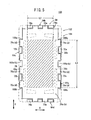
- the hinge mechanism 68 includes two first hinges 70a, 70b provided at each of upper and lower sides of the end plates 20a, 20b, and four first hinges 70c, 70d provided at each of left and right sides of the end plates 20a, 20b.
- the hinge mechanism 68 further includes three second hinges 72a, 72b provided at each of longitudinal ends (in the direction indicated by the arrow A) of the side plates 64a, 64c provided on both sides of the stack body 14 in the direction indicated by the arrow B, and three second hinges 74a, 74b provided at each of longitudinal ends of the side plates 64b, 64d provided on both of upper and lower sides of the stack body 14.
- the three second hinges 72a, 72b of the side plates 64a, 64c and the four first hinges 70c, 70d of each of both sides of the end plates 20a, 20b are provided alternately, and the long coupling pins 76a are inserted into these hinges to couple the side plates 64a, 64c to the end plates 20a, 20b together.
- the three second hinges 74a, 74b of the side plates 64a, 64b and the first hinges 70a, 70b on the upper and lower sides of the end plates 20a, 20b are provided alternately, and the short coupling pins 76b are inserted into these hinges to couple the side plates 64b, 64d and the end plates 20a, 20b together.
- the hinge mechanism 68 is dimensioned such that the hinge mechanism 68 falls within a size of a power generation area 78 of the anode 40 and the cathode 42.
- the power generation area 78 is defined by the distance L1 in the direction indicated by the arrow C and the distance L2 in the direction indicated by the arrow B.
- the first hinges 70c and the second hinges 72a of the hinge mechanism 68 are provided alternately, the first hinges 70c and the second hinges 72a are positioned within the distance L1 in the direction indicated by the arrow C.
- the size of the shaft of the coupling pin 76a is not more than the distance L1.
- first hinges 70a and the second hinges 74a of the hinge mechanism 68 are provided alternately, the first hinges 70a and the second hinges 74a are positioned within the distance L2 in the direction indicated by the arrow B.
- the size of the shaft of the coupling pin 76b is not more than the distance L2.
- the present embodiment is particularly advantageous in the case where the distance L1 is larger than the distance L2 (L1 > L2), and the value of the distance L1 is significantly larger than the value of the distance L2. More specifically, preferably, the relationship of the distance L1 > the distance L2 x 1.5 is satisfied.
- the side plates 64a to 64d have a plurality of holes 80 at both of the lateral ends, respectively. Screw holes 82 corresponding to the holes 80 are formed in the respective sides of the angle members 66. Screws 84 inserted into the holes 80 are screwed into the screw holes 82 to fix the side plates 64a to 64d together through the angle members 66. In this manner, the casing 22 is fabricated (see FIG. 1 ).
- angle members 66 may have holes, and the side plates 64a to 64d may have screw holes. In this case, the angle members 66 are placed outside the side plates 64a to 64d for fixing the angle members 66 and the side plates 64a to 64d together.
- a coolant inlet manifold 90a and a coolant outlet manifold 90b extending in the direction indicated by the arrow C are provided at the end plate 20a.
- the coolant inlet manifold 90a is connected to the coolant supply passage 36a, and the coolant outlet manifold 90b is connected to the coolant discharge passage 36b.
- an oxygen-containing gas inlet manifold 92a and a fuel gas inlet manifold 94a are provided at upper positions of the end plate 20b.
- the oxygen-containing gas inlet manifold 92a is connected to the oxygen-containing gas supply passage 32a, and the fuel gas inlet manifold 94a is connected to the fuel gas supply passage 34a.
- An oxygen-containing gas outlet manifold 92b and a fuel gas outlet manifold 94b are provided at lower positions of the end plate 20b.
- the oxygen-containing gas outlet manifold 92b is connected to the oxygen-containing gas discharge passage 32b, and the fuel gas outlet manifold 94b is connected to the fuel gas discharge passage 34b.
- an oxygen-containing gas is supplied from the oxygen-containing gas inlet manifold 92a of the end plate 20b to the oxygen-containing gas supply passage 32a, and a fuel gas such as a hydrogen-containing gas is supplied from the fuel gas inlet manifold 94a to the fuel gas supply passage 34a. Further, a coolant such as pure water or ethylene glycol is supplied from the coolant inlet manifold 90a at the end plate 20a to the coolant supply passage 36a.
- the oxygen-containing gas, the fuel gas, and the coolant are supplied to the unit cells 12 stacked together in the direction indicated by the arrow A.
- the oxygen-containing gas flows from the oxygen-containing gas supply passage 32a to the oxygen-containing gas flow field 50 of the second metal separator 30, and flows along the cathode 42 of the membrane electrode assembly 26 for inducing an electrochemical reaction at the cathode 42.
- the fuel gas flows from the fuel gas supply passage 34a to the fuel gas flow field 44 through the supply holes 48a of the first metal separator 28, and flows along the anode 40 of the membrane electrode assembly 26 for inducing an electrochemical reaction at the anode 40.
- the oxygen-containing gas supplied to the cathode 42, and the fuel gas supplied to the anode 40 are consumed in the electrochemical reactions at catalyst layers of the cathode 42 and the anode 40 for generating electricity.
- the oxygen-containing gas consumed at the cathode 42 flows along the oxygen-containing gas discharge passage 32b, and is discharged to the outside from the oxygen-containing gas outlet manifold 92b at the end plate 20b.
- the fuel gas consumed at the anode 40 flows through the discharge holes 48b, and flows along the fuel gas discharge passage 34b. Then, the fuel gas is discharged to the outside from the fuel gas outlet manifold 94b at the end plate 20b.
- the coolant flows from the coolant supply passage 36a into the coolant flow field 54 between the first and second metal separators 28, 30, and flows in the direction indicated by the arrow B. After the coolant cools the membrane electrode assembly 26, the coolant flows along the coolant discharge passage 36b, and is discharged from the coolant outlet manifold 90b of the end plate 20a.
- the first hinges 70c and the second hinges 72a of the hinge mechanism 68 are provided alternately, and positioned within the distance L1 in the direction indicated by the arrow C.
- the length of the shaft of the coupling pin 76a is not more than the distance L1.
- the first hinges 70a and the second hinges 74a of the hinge mechanism 68 are provided alternately, and positioned within the length L2 in the direction indicated by the arrow B.
- the length of the shaft of the coupling pin 76b is not more than the distance L2.
- the shafts of the coupling pins 76a, 76b become significantly long. Therefore, the load applied to the outside of the power generation area 78 becomes significantly small. Thus, in the hinge mechanism 68, the load is locally applied to the center of the power generation area 78, and the coupling pins 76a, 76b may be deformed significantly.
- the hinge mechanism 68 is within the size of the power generation area 78.
- the lengths of the coupling pins 76a, 76b are reduced effectively.
- the strength of the casing 22 is optimized, and the size of the fuel cell stack 10 is minimized advantageously.
- FIG. 5 is a front view showing a fuel cell stack 100 according to a second embodiment of the present invention.
- the constituent elements that are identical to those of the fuel cell stack 10 according to the first embodiment are labeled with the same reference numeral, and description thereof will be omitted.
- two or four coolant supply passages 36a are provided at one end in the direction indicated by the arrow B, and two or four coolant discharge passages 36b are provided at the other end in the direction indicated by the arrow B.
- a casing 102 of the fuel cell stack 100 has a hinge mechanism 104.
- a plurality of first hinges 70c, 70d are provided on both of the left and the right sides of the end plates 20a, 20b, and the first hinges 70c, 70d are separated by providing spaces 106a, 106b at vertically substantially central positions.
- second hinges 72a, 72b and the first hinges 70c, 70d are provided alternately, and likewise, the second hinges 72a, 72b are vertically separated into two parts by the spaces 106a, 106b.
- Coupling pins 108a are inserted into the first hinges 70c, 70d and the second hinges 72a, 72b on the upper side, and coupling pins 108b are inserted into the first hinges 70c, 70d and the second hinges 72a, 72b on the lower side.
- the hinge mechanism 104 is dimensioned such that the hinge mechanism 104 falls within the size of the power generation area 78 of the anode 40 and the cathode 42.
- the hinge mechanism 104 has the two coupling pins 108a, 108b on the long sides of the end plates 20a, 20b, i.e., within the distance L1.
- the lengths of the coupling pins 108a, 108b are reduced by half or more.
- a casing (22) includes end plates (20a, 20b), side plates (64a to 64d), and a hinge mechanism (68) for coupling the end plates (20a, 20b) and the side plates (64a to 64d).
- a power generation area (78) is defined by the distance L1 and the distance L2.
- first hinges (70c) and second hinges (72a) of the hinge mechanism (68) are provided alternately, the first hinges (70c) and the second hinges (72a) are positioned within the distance L1.
- the length of the shaft of a coupling pin (76a) is not more than the length L1.
- first hinges (70a) and the second hinges (74a) are provided alternately, the first hinges (70a) and the second hinges (74a) are positioned within the length L2.
- the length of the shaft of a coupling pin (76b) is not more than the length L2.
Landscapes
- Life Sciences & Earth Sciences (AREA)
- Engineering & Computer Science (AREA)
- Manufacturing & Machinery (AREA)
- Sustainable Development (AREA)
- Sustainable Energy (AREA)
- Chemical & Material Sciences (AREA)
- Chemical Kinetics & Catalysis (AREA)
- Electrochemistry (AREA)
- General Chemical & Material Sciences (AREA)
- Fuel Cell (AREA)
Claims (5)
- Brennstoffzellenstapel umfassend:einen Stapelkörper (14), der durch Stapeln einer Vielzahl von Einheitszellen (12) in einer Stapelrichtung gebildet ist, wobei die Einheitszellen (12) jeweils eine Elektrolytelektrodenanordnung (26) und die Elektrolytelektrodenanordnung (26) zwischen sich aufnehmende Separatoren(28, 30) enthalten, wobei die Elektrolytelektrodenanordnung (26) ein Paar von Elektroden (40, 42) sowie einen zwischen den Elektroden(40, 42) eingefügten Elektrolyten (38) enthalten; undein kastenförmiges Gehäuse (22), das den Stapelkörper (14) aufnimmt, wobei das Gehäuse (22) umfasst:worin der Anlenkmechanismus (68) derart dimensioniert ist, dass der Anlenkmechanismus (68) in eine Größe einer Stromerzeugungsfläche (78) der Elektroden (40, 42) hinein fällt.Endplatten (20a, 20b), die an in der Stapelrichtung entgegengesetzten Enden des Stapelkörpers (14) vorgesehen sind;eine Mehrzahl von Seitenplatten (64a bis 64d), die an Seiten des Stapelkörpers (14) vorgesehen sind; undein Anlenkmechanismus (68) zum Koppeln der Endplatten (20a, 20b) und der Seitenplatten (64a bis 64 d),
- Brennstoffzellenstapel nach Anspruch 1, worin eine Form der Stromerzeugungsfläche (78) rechteckig ist und der Anlenkmechanismus (68) eine Mehrzahl von Anlenkungen (70c, 72a) zum Einsetzen eines Kupplungsstifts (76a) in die Anlenkungen (70c, 72a) enthält, wobei die Anlenkungen (70c, 72a) entlang jeder Seite der Stromerzeugungsfläche (78) vorgesehen sind und innerhalb einer Fläche von nicht mehr als der Länge jeder Seite angeordnet sind.
- Brennstoffzellenstapel nach Anspruch 2, worin die Stromerzeugungsfläche (78) eine Länge L1 einer Längsseite aufweist und eine Länge L2 einer kurzen Seite der Beziehung L1 > 1,5 x L2 genügt.
- Brennstoffzellenstapel nach Anspruch 3, worin zwei der Kupplungsstifte (108a, 108b) koaxial in die Anlenkungen (70c, 72a) eingesetzt sind, welche entlang einer Längsseite der Stromerzeugungsfläche (78) vorgesehen sind.
- Brennstoffzellenstapel nach Anspruch 1, worin eine Mehrzahl von Fluidkanälen (32a) für Reaktionsgase und Kühlmittel sich durch die Einheitszellen (12) in der Stapelrichtung hindurch erstrecken und die Fluidkanäle (32a) außerhalb der Stromerzeugungsfläche (78) der Elektroden (40, 42) ausgebildet sind.
Applications Claiming Priority (1)
| Application Number | Priority Date | Filing Date | Title |
|---|---|---|---|
| JP2007077845A JP5134272B2 (ja) | 2007-03-23 | 2007-03-23 | 燃料電池スタック |
Publications (2)
| Publication Number | Publication Date |
|---|---|
| EP1973186A1 EP1973186A1 (de) | 2008-09-24 |
| EP1973186B1 true EP1973186B1 (de) | 2009-10-14 |
Family
ID=39382047
Family Applications (1)
| Application Number | Title | Priority Date | Filing Date |
|---|---|---|---|
| EP08004940A Ceased EP1973186B1 (de) | 2007-03-23 | 2008-03-17 | Brennstoffzellenstapel |
Country Status (5)
| Country | Link |
|---|---|
| US (1) | US8034503B2 (de) |
| EP (1) | EP1973186B1 (de) |
| JP (1) | JP5134272B2 (de) |
| CN (1) | CN101271984B (de) |
| DE (1) | DE602008000203D1 (de) |
Families Citing this family (8)
| Publication number | Priority date | Publication date | Assignee | Title |
|---|---|---|---|---|
| KR101063461B1 (ko) * | 2008-10-15 | 2011-09-08 | 삼성전기주식회사 | 연료 전지 |
| WO2010047697A1 (en) * | 2008-10-22 | 2010-04-29 | Utc Power Corporation | Fuel cell stack assembly seal |
| CN101908636B (zh) * | 2009-06-04 | 2014-05-28 | 本田技研工业株式会社 | 燃料电池组 |
| GB2509158A (en) * | 2012-12-21 | 2014-06-25 | Intelligent Energy Ltd | Fuel Cell Stack Assembly and Method of Assembly |
| GB2509152A (en) * | 2012-12-21 | 2014-06-25 | Intelligent Energy Ltd | Fuel Cell Stack Assembly and Method of Assembly |
| GB2509163A (en) * | 2012-12-21 | 2014-06-25 | Intelligent Energy Ltd | Fuel Cell Stack Assembly and Method of Assembly |
| CN111785999B (zh) * | 2020-07-01 | 2024-06-04 | 上海氢晨新能源科技有限公司 | 一种一体式燃料电池电堆的封装结构及其装配方法 |
| CN114824640B (zh) * | 2022-04-24 | 2025-07-29 | 中澳储能电力科技(西安)有限公司 | 一种用于夹持电芯组件的电池组壳体及电池组 |
Family Cites Families (17)
| Publication number | Priority date | Publication date | Assignee | Title |
|---|---|---|---|---|
| JP4562834B2 (ja) * | 1999-10-27 | 2010-10-13 | パナソニック株式会社 | 燃料電池 |
| JP3516892B2 (ja) * | 1999-11-09 | 2004-04-05 | 松下電器産業株式会社 | 高分子電解質型燃料電池スタック |
| JP4672892B2 (ja) | 2001-03-30 | 2011-04-20 | 本田技研工業株式会社 | 燃料電池スタック |
| DE10392584B4 (de) * | 2002-04-30 | 2021-05-12 | General Motors Corp. (N.D.Ges.D. Staates Delaware) | Elektrochemischer Brennstoffzellenstapel |
| CN1459885A (zh) * | 2002-05-16 | 2003-12-03 | 台湾神户电池股份有限公司 | Pem燃料电池及更换pem燃料电池薄膜电极组的方法 |
| JP2004362940A (ja) * | 2003-06-04 | 2004-12-24 | Yuasa Corp | 燃料電池セルスタック |
| JP4214022B2 (ja) * | 2003-08-27 | 2009-01-28 | 本田技研工業株式会社 | 燃料電池スタック |
| JP4402438B2 (ja) * | 2003-11-27 | 2010-01-20 | 本田技研工業株式会社 | 燃料電池の製造方法および燃料電池の製造装置 |
| FR2865852B1 (fr) * | 2004-02-03 | 2007-01-26 | Peugeot Citroen Automobiles Sa | Pile a combustible a lame elastique de serrage des cellules et vehicule automobile correspondant. |
| JP4820068B2 (ja) * | 2004-08-02 | 2011-11-24 | 本田技研工業株式会社 | 燃料電池スタック |
| US7641999B2 (en) * | 2004-08-27 | 2010-01-05 | Honda Motor Co., Ltd. | Fuel cell stack |
| JP4664030B2 (ja) * | 2004-09-29 | 2011-04-06 | 本田技研工業株式会社 | 燃料電池スタック |
| JP2006269233A (ja) * | 2005-03-23 | 2006-10-05 | Toyota Motor Corp | 燃料電池用のセルおよびその製造方法、一対のセパレータおよびその製造方法、並びに燃料電池 |
| JP2007048553A (ja) * | 2005-08-09 | 2007-02-22 | Honda Motor Co Ltd | 燃料電池スタック |
| JP4795016B2 (ja) * | 2005-09-06 | 2011-10-19 | 本田技研工業株式会社 | 燃料電池スタック |
| JP2007294243A (ja) * | 2006-04-25 | 2007-11-08 | Toyota Motor Corp | 燃料電池 |
| DE102006042109B4 (de) * | 2006-09-07 | 2011-12-29 | Staxera Gmbh | Gehäuse zum Aufnehmen zumindest eines Brennstoffzellenstapels und dessen Verwendung |
-
2007
- 2007-03-23 JP JP2007077845A patent/JP5134272B2/ja not_active Expired - Fee Related
-
2008
- 2008-03-17 DE DE602008000203T patent/DE602008000203D1/de active Active
- 2008-03-17 EP EP08004940A patent/EP1973186B1/de not_active Ceased
- 2008-03-21 CN CN2008100873572A patent/CN101271984B/zh not_active Expired - Fee Related
- 2008-03-21 US US12/052,800 patent/US8034503B2/en active Active
Also Published As
| Publication number | Publication date |
|---|---|
| DE602008000203D1 (de) | 2009-11-26 |
| US8034503B2 (en) | 2011-10-11 |
| EP1973186A1 (de) | 2008-09-24 |
| JP2008243384A (ja) | 2008-10-09 |
| JP5134272B2 (ja) | 2013-01-30 |
| CN101271984B (zh) | 2010-06-02 |
| CN101271984A (zh) | 2008-09-24 |
| US20080233459A1 (en) | 2008-09-25 |
Similar Documents
| Publication | Publication Date | Title |
|---|---|---|
| EP1995809B1 (de) | Brennstoffzelle beinhaltend Metallseparator mit kreuzenden Kühlkanälen | |
| EP1973186B1 (de) | Brennstoffzellenstapel | |
| US8221935B2 (en) | Fuel cell stack | |
| CN103199296B (zh) | 燃料电池堆 | |
| CN103872371B (zh) | 燃料电池堆 | |
| US8221929B2 (en) | Fuel cell stack | |
| EP2296213B1 (de) | Brennstoffzellenstapel | |
| JP4871348B2 (ja) | 燃料電池スタック | |
| JP5226431B2 (ja) | 燃料電池スタック | |
| US7759014B2 (en) | Fuel cell having a seal member | |
| CA2485042C (en) | Fuel cell stack | |
| US7790326B2 (en) | Fuel cell and separator for fuel cell | |
| JP6059615B2 (ja) | 燃料電池スタック | |
| CN108140865B (zh) | 燃料电池堆 | |
| US7709132B2 (en) | Fuel cell stack | |
| JP5378049B2 (ja) | 燃料電池スタック | |
| JP6104105B2 (ja) | 燃料電池スタック | |
| JP2015076337A (ja) | 燃料電池スタック |
Legal Events
| Date | Code | Title | Description |
|---|---|---|---|
| PUAI | Public reference made under article 153(3) epc to a published international application that has entered the european phase |
Free format text: ORIGINAL CODE: 0009012 |
|
| 17P | Request for examination filed |
Effective date: 20080317 |
|
| AK | Designated contracting states |
Kind code of ref document: A1 Designated state(s): AT BE BG CH CY CZ DE DK EE ES FI FR GB GR HR HU IE IS IT LI LT LU LV MC MT NL NO PL PT RO SE SI SK TR |
|
| AX | Request for extension of the european patent |
Extension state: AL BA MK RS |
|
| AKX | Designation fees paid |
Designated state(s): DE GB |
|
| GRAP | Despatch of communication of intention to grant a patent |
Free format text: ORIGINAL CODE: EPIDOSNIGR1 |
|
| RAP1 | Party data changed (applicant data changed or rights of an application transferred) |
Owner name: HONDA MOTOR CO., LTD. |
|
| GRAS | Grant fee paid |
Free format text: ORIGINAL CODE: EPIDOSNIGR3 |
|
| GRAA | (expected) grant |
Free format text: ORIGINAL CODE: 0009210 |
|
| RIN1 | Information on inventor provided before grant (corrected) |
Inventor name: ISHIZUKA, AYUMU C/O HONDA R&D CO.,LTD. Inventor name: YOSHITOMI, RYOICHI C/O HONDA R&D CO., LTD. |
|
| AK | Designated contracting states |
Kind code of ref document: B1 Designated state(s): DE GB |
|
| REG | Reference to a national code |
Ref country code: GB Ref legal event code: FG4D |
|
| REF | Corresponds to: |
Ref document number: 602008000203 Country of ref document: DE Date of ref document: 20091126 Kind code of ref document: P |
|
| PLBE | No opposition filed within time limit |
Free format text: ORIGINAL CODE: 0009261 |
|
| STAA | Information on the status of an ep patent application or granted ep patent |
Free format text: STATUS: NO OPPOSITION FILED WITHIN TIME LIMIT |
|
| 26N | No opposition filed |
Effective date: 20100715 |
|
| REG | Reference to a national code |
Ref country code: DE Ref legal event code: R084 Ref document number: 602008000203 Country of ref document: DE |
|
| REG | Reference to a national code |
Ref country code: GB Ref legal event code: 746 Effective date: 20141114 |
|
| REG | Reference to a national code |
Ref country code: DE Ref legal event code: R084 Ref document number: 602008000203 Country of ref document: DE Effective date: 20141120 |
|
| PGFP | Annual fee paid to national office [announced via postgrant information from national office to epo] |
Ref country code: DE Payment date: 20190305 Year of fee payment: 12 Ref country code: GB Payment date: 20190313 Year of fee payment: 12 |
|
| REG | Reference to a national code |
Ref country code: DE Ref legal event code: R119 Ref document number: 602008000203 Country of ref document: DE |
|
| PG25 | Lapsed in a contracting state [announced via postgrant information from national office to epo] |
Ref country code: DE Free format text: LAPSE BECAUSE OF NON-PAYMENT OF DUE FEES Effective date: 20201001 |
|
| GBPC | Gb: european patent ceased through non-payment of renewal fee |
Effective date: 20200317 |
|
| PG25 | Lapsed in a contracting state [announced via postgrant information from national office to epo] |
Ref country code: GB Free format text: LAPSE BECAUSE OF NON-PAYMENT OF DUE FEES Effective date: 20200317 |