EP1965975B1 - Multiaxial fabric with strain-responsive viscous liquid polymers - Google Patents
Multiaxial fabric with strain-responsive viscous liquid polymers Download PDFInfo
- Publication number
- EP1965975B1 EP1965975B1 EP06846516.0A EP06846516A EP1965975B1 EP 1965975 B1 EP1965975 B1 EP 1965975B1 EP 06846516 A EP06846516 A EP 06846516A EP 1965975 B1 EP1965975 B1 EP 1965975B1
- Authority
- EP
- European Patent Office
- Prior art keywords
- fabric
- poly
- yarns
- layer
- fiber
- Prior art date
- Legal status (The legal status is an assumption and is not a legal conclusion. Google has not performed a legal analysis and makes no representation as to the accuracy of the status listed.)
- Not-in-force
Links
- 239000004744 fabric Substances 0.000 title claims description 77
- 229920000642 polymer Polymers 0.000 title claims description 49
- 239000007788 liquid Substances 0.000 title description 7
- 239000000835 fiber Substances 0.000 claims description 85
- -1 poly(hexyl methacrylate) Polymers 0.000 claims description 72
- 239000000853 adhesive Substances 0.000 claims description 31
- 230000001070 adhesive effect Effects 0.000 claims description 31
- 229920000129 polyhexylmethacrylate Polymers 0.000 claims description 16
- 229920003235 aromatic polyamide Polymers 0.000 claims description 15
- 239000003822 epoxy resin Substances 0.000 claims description 14
- 229920000647 polyepoxide Polymers 0.000 claims description 14
- 239000004760 aramid Substances 0.000 claims description 13
- 229920001577 copolymer Polymers 0.000 claims description 12
- 238000000034 method Methods 0.000 claims description 12
- BAPJBEWLBFYGME-UHFFFAOYSA-N acrylic acid methyl ester Natural products COC(=O)C=C BAPJBEWLBFYGME-UHFFFAOYSA-N 0.000 claims description 10
- VGGSQFUCUMXWEO-UHFFFAOYSA-N Ethene Chemical compound C=C VGGSQFUCUMXWEO-UHFFFAOYSA-N 0.000 claims description 9
- 239000005977 Ethylene Substances 0.000 claims description 9
- 239000004698 Polyethylene Substances 0.000 claims description 9
- 229920000573 polyethylene Polymers 0.000 claims description 9
- 229920000197 polyisopropyl acrylate Polymers 0.000 claims description 8
- JOYRKODLDBILNP-UHFFFAOYSA-N Ethyl urethane Chemical compound CCOC(N)=O JOYRKODLDBILNP-UHFFFAOYSA-N 0.000 claims description 7
- 239000004830 Super Glue Substances 0.000 claims description 7
- 150000004982 aromatic amines Chemical class 0.000 claims description 7
- ZBCBWPMODOFKDW-UHFFFAOYSA-N diethanolamine Chemical compound OCCNCCO ZBCBWPMODOFKDW-UHFFFAOYSA-N 0.000 claims description 7
- FGBJXOREULPLGL-UHFFFAOYSA-N ethyl cyanoacrylate Chemical compound CCOC(=O)C(=C)C#N FGBJXOREULPLGL-UHFFFAOYSA-N 0.000 claims description 7
- 229920006231 aramid fiber Polymers 0.000 claims description 6
- 125000000843 phenylene group Chemical group C1(=C(C=CC=C1)*)* 0.000 claims description 5
- 239000004952 Polyamide Substances 0.000 claims description 4
- 229920002647 polyamide Polymers 0.000 claims description 4
- 229920000728 polyester Polymers 0.000 claims description 3
- UIWXSTHGICQLQT-UHFFFAOYSA-N ethenyl propanoate Chemical compound CCC(=O)OC=C UIWXSTHGICQLQT-UHFFFAOYSA-N 0.000 claims description 2
- 235000004879 dioscorea Nutrition 0.000 claims 1
- 239000010410 layer Substances 0.000 description 65
- 230000035515 penetration Effects 0.000 description 11
- 239000002131 composite material Substances 0.000 description 8
- 239000012530 fluid Substances 0.000 description 8
- 239000000463 material Substances 0.000 description 8
- 230000008569 process Effects 0.000 description 8
- 239000007787 solid Substances 0.000 description 8
- 239000000654 additive Substances 0.000 description 7
- 208000014674 injury Diseases 0.000 description 7
- 230000008733 trauma Effects 0.000 description 7
- YXFVVABEGXRONW-UHFFFAOYSA-N Toluene Chemical compound CC1=CC=CC=C1 YXFVVABEGXRONW-UHFFFAOYSA-N 0.000 description 6
- 239000000178 monomer Substances 0.000 description 6
- 150000001805 chlorine compounds Chemical group 0.000 description 5
- 150000004985 diamines Chemical group 0.000 description 5
- 230000009477 glass transition Effects 0.000 description 5
- 229910052751 metal Inorganic materials 0.000 description 5
- 239000002184 metal Substances 0.000 description 5
- 229920002480 polybenzimidazole Polymers 0.000 description 5
- 229920000137 polyphosphoric acid Polymers 0.000 description 5
- 238000009987 spinning Methods 0.000 description 5
- OYFRNYNHAZOYNF-UHFFFAOYSA-N 2,5-dihydroxyterephthalic acid Chemical compound OC(=O)C1=CC(O)=C(C(O)=O)C=C1O OYFRNYNHAZOYNF-UHFFFAOYSA-N 0.000 description 4
- 239000004743 Polypropylene Substances 0.000 description 4
- 238000010276 construction Methods 0.000 description 4
- 230000001419 dependent effect Effects 0.000 description 4
- 229920002577 polybenzoxazole Polymers 0.000 description 4
- 229920000098 polyolefin Polymers 0.000 description 4
- 229920001155 polypropylene Polymers 0.000 description 4
- 239000000843 powder Substances 0.000 description 4
- 125000001140 1,4-phenylene group Chemical group [H]C1=C([H])C([*:2])=C([H])C([H])=C1[*:1] 0.000 description 3
- CBCKQZAAMUWICA-UHFFFAOYSA-N 1,4-phenylenediamine Chemical compound NC1=CC=C(N)C=C1 CBCKQZAAMUWICA-UHFFFAOYSA-N 0.000 description 3
- 229920012306 M5 Rigid-Rod Polymer Fiber Polymers 0.000 description 3
- 239000004693 Polybenzimidazole Substances 0.000 description 3
- 230000000996 additive effect Effects 0.000 description 3
- 238000003491 array Methods 0.000 description 3
- 125000003118 aryl group Chemical group 0.000 description 3
- 238000012512 characterization method Methods 0.000 description 3
- 230000000052 comparative effect Effects 0.000 description 3
- 229920006253 high performance fiber Polymers 0.000 description 3
- 239000004615 ingredient Substances 0.000 description 3
- 239000000203 mixture Substances 0.000 description 3
- 238000006116 polymerization reaction Methods 0.000 description 3
- 238000002360 preparation method Methods 0.000 description 3
- 230000001681 protective effect Effects 0.000 description 3
- LXEJRKJRKIFVNY-UHFFFAOYSA-N terephthaloyl chloride Chemical compound ClC(=O)C1=CC=C(C(Cl)=O)C=C1 LXEJRKJRKIFVNY-UHFFFAOYSA-N 0.000 description 3
- 239000005711 Benzoic acid Substances 0.000 description 2
- VEXZGXHMUGYJMC-UHFFFAOYSA-M Chloride anion Chemical compound [Cl-] VEXZGXHMUGYJMC-UHFFFAOYSA-M 0.000 description 2
- 229920000742 Cotton Polymers 0.000 description 2
- 229920000271 Kevlar® Polymers 0.000 description 2
- 229920003373 Kevlar® 129 Polymers 0.000 description 2
- KAESVJOAVNADME-UHFFFAOYSA-N Pyrrole Chemical compound C=1C=CNC=1 KAESVJOAVNADME-UHFFFAOYSA-N 0.000 description 2
- 239000002253 acid Substances 0.000 description 2
- 230000004913 activation Effects 0.000 description 2
- 125000004432 carbon atom Chemical group C* 0.000 description 2
- 230000000694 effects Effects 0.000 description 2
- 238000005516 engineering process Methods 0.000 description 2
- 238000010348 incorporation Methods 0.000 description 2
- QQVIHTHCMHWDBS-UHFFFAOYSA-N isophthalic acid Chemical compound OC(=O)C1=CC=CC(C(O)=O)=C1 QQVIHTHCMHWDBS-UHFFFAOYSA-N 0.000 description 2
- 239000011159 matrix material Substances 0.000 description 2
- 239000012071 phase Substances 0.000 description 2
- IAYUQKZZQKUOFL-UHFFFAOYSA-N pyridine-2,3,5,6-tetramine Chemical compound NC1=CC(N)=C(N)N=C1N IAYUQKZZQKUOFL-UHFFFAOYSA-N 0.000 description 2
- 230000009467 reduction Effects 0.000 description 2
- 230000003252 repetitive effect Effects 0.000 description 2
- 229920005989 resin Polymers 0.000 description 2
- 239000011347 resin Substances 0.000 description 2
- 229920003252 rigid-rod polymer Polymers 0.000 description 2
- 238000007378 ring spinning Methods 0.000 description 2
- MHSKRLJMQQNJNC-UHFFFAOYSA-N terephthalamide Chemical compound NC(=O)C1=CC=C(C(N)=O)C=C1 MHSKRLJMQQNJNC-UHFFFAOYSA-N 0.000 description 2
- 230000008719 thickening Effects 0.000 description 2
- 239000002759 woven fabric Substances 0.000 description 2
- ZZPLGBZOTXYEQS-UHFFFAOYSA-N 2,3-dichlorobenzene-1,4-dicarbonyl chloride Chemical compound ClC(=O)C1=CC=C(C(Cl)=O)C(Cl)=C1Cl ZZPLGBZOTXYEQS-UHFFFAOYSA-N 0.000 description 1
- ZBMISJGHVWNWTE-UHFFFAOYSA-N 3-(4-aminophenoxy)aniline Chemical compound C1=CC(N)=CC=C1OC1=CC=CC(N)=C1 ZBMISJGHVWNWTE-UHFFFAOYSA-N 0.000 description 1
- DPYROBMRMXHROQ-UHFFFAOYSA-N 4,6-diaminobenzene-1,3-diol Chemical compound NC1=CC(N)=C(O)C=C1O DPYROBMRMXHROQ-UHFFFAOYSA-N 0.000 description 1
- VYZAMTAEIAYCRO-UHFFFAOYSA-N Chromium Chemical compound [Cr] VYZAMTAEIAYCRO-UHFFFAOYSA-N 0.000 description 1
- 235000009967 Erodium cicutarium Nutrition 0.000 description 1
- 240000003759 Erodium cicutarium Species 0.000 description 1
- XEEYBQQBJWHFJM-UHFFFAOYSA-N Iron Chemical compound [Fe] XEEYBQQBJWHFJM-UHFFFAOYSA-N 0.000 description 1
- 239000004642 Polyimide Substances 0.000 description 1
- ATJFFYVFTNAWJD-UHFFFAOYSA-N Tin Chemical compound [Sn] ATJFFYVFTNAWJD-UHFFFAOYSA-N 0.000 description 1
- 238000010042 air jet spinning Methods 0.000 description 1
- 125000001931 aliphatic group Chemical group 0.000 description 1
- 150000001408 amides Chemical class 0.000 description 1
- 238000004458 analytical method Methods 0.000 description 1
- 239000003963 antioxidant agent Substances 0.000 description 1
- 235000006708 antioxidants Nutrition 0.000 description 1
- 150000004984 aromatic diamines Chemical class 0.000 description 1
- 230000008901 benefit Effects 0.000 description 1
- 230000015572 biosynthetic process Effects 0.000 description 1
- 125000002529 biphenylenyl group Chemical group C1(=CC=CC=2C3=CC=CC=C3C12)* 0.000 description 1
- 238000000237 capillary viscometry Methods 0.000 description 1
- 125000002837 carbocyclic group Chemical group 0.000 description 1
- 239000003054 catalyst Substances 0.000 description 1
- 239000003795 chemical substances by application Substances 0.000 description 1
- 239000011248 coating agent Substances 0.000 description 1
- 238000000576 coating method Methods 0.000 description 1
- 239000003086 colorant Substances 0.000 description 1
- 239000013068 control sample Substances 0.000 description 1
- 230000002596 correlated effect Effects 0.000 description 1
- 238000000113 differential scanning calorimetry Methods 0.000 description 1
- KPUWHANPEXNPJT-UHFFFAOYSA-N disiloxane Chemical class [SiH3]O[SiH3] KPUWHANPEXNPJT-UHFFFAOYSA-N 0.000 description 1
- 229920001971 elastomer Polymers 0.000 description 1
- 239000000806 elastomer Substances 0.000 description 1
- 239000000839 emulsion Substances 0.000 description 1
- 239000003623 enhancer Substances 0.000 description 1
- RTZKZFJDLAIYFH-UHFFFAOYSA-N ether Substances CCOCC RTZKZFJDLAIYFH-UHFFFAOYSA-N 0.000 description 1
- 238000002474 experimental method Methods 0.000 description 1
- 239000013305 flexible fiber Substances 0.000 description 1
- 238000005227 gel permeation chromatography Methods 0.000 description 1
- 239000011521 glass Substances 0.000 description 1
- 238000010438 heat treatment Methods 0.000 description 1
- 125000000623 heterocyclic group Chemical group 0.000 description 1
- 229920006158 high molecular weight polymer Polymers 0.000 description 1
- 229920001519 homopolymer Polymers 0.000 description 1
- 239000004761 kevlar Substances 0.000 description 1
- 229920001684 low density polyethylene Polymers 0.000 description 1
- 239000004702 low-density polyethylene Substances 0.000 description 1
- 239000000314 lubricant Substances 0.000 description 1
- 238000005461 lubrication Methods 0.000 description 1
- 238000004519 manufacturing process Methods 0.000 description 1
- 238000010297 mechanical methods and process Methods 0.000 description 1
- RXOHFPCZGPKIRD-UHFFFAOYSA-N naphthalene-2,6-dicarboxylic acid Chemical compound C1=C(C(O)=O)C=CC2=CC(C(=O)O)=CC=C21 RXOHFPCZGPKIRD-UHFFFAOYSA-N 0.000 description 1
- 125000004433 nitrogen atom Chemical group N* 0.000 description 1
- 238000007383 open-end spinning Methods 0.000 description 1
- 125000000962 organic group Chemical group 0.000 description 1
- 125000003367 polycyclic group Chemical group 0.000 description 1
- 229920001721 polyimide Polymers 0.000 description 1
- 239000013047 polymeric layer Substances 0.000 description 1
- 229920002451 polyvinyl alcohol Polymers 0.000 description 1
- 238000012545 processing Methods 0.000 description 1
- QQONPFPTGQHPMA-UHFFFAOYSA-N propylene Natural products CC=C QQONPFPTGQHPMA-UHFFFAOYSA-N 0.000 description 1
- CYVYLVVUKPNYKL-UHFFFAOYSA-N quinoline-2,6-dicarboxylic acid Chemical compound N1=C(C(O)=O)C=CC2=CC(C(=O)O)=CC=C21 CYVYLVVUKPNYKL-UHFFFAOYSA-N 0.000 description 1
- 230000003014 reinforcing effect Effects 0.000 description 1
- 230000004044 response Effects 0.000 description 1
- 238000000518 rheometry Methods 0.000 description 1
- 238000012216 screening Methods 0.000 description 1
- 239000007790 solid phase Substances 0.000 description 1
- 238000010561 standard procedure Methods 0.000 description 1
- 230000003068 static effect Effects 0.000 description 1
- 239000000725 suspension Substances 0.000 description 1
- 238000012360 testing method Methods 0.000 description 1
- 125000005628 tolylene group Chemical group 0.000 description 1
- 230000007704 transition Effects 0.000 description 1
- 238000009827 uniform distribution Methods 0.000 description 1
- LEONUFNNVUYDNQ-UHFFFAOYSA-N vanadium atom Chemical compound [V] LEONUFNNVUYDNQ-UHFFFAOYSA-N 0.000 description 1
Images
Classifications
-
- A—HUMAN NECESSITIES
- A41—WEARING APPAREL
- A41D—OUTERWEAR; PROTECTIVE GARMENTS; ACCESSORIES
- A41D31/00—Materials specially adapted for outerwear
- A41D31/04—Materials specially adapted for outerwear characterised by special function or use
- A41D31/24—Resistant to mechanical stress, e.g. pierce-proof
- A41D31/245—Resistant to mechanical stress, e.g. pierce-proof using layered materials
-
- B—PERFORMING OPERATIONS; TRANSPORTING
- B32—LAYERED PRODUCTS
- B32B—LAYERED PRODUCTS, i.e. PRODUCTS BUILT-UP OF STRATA OF FLAT OR NON-FLAT, e.g. CELLULAR OR HONEYCOMB, FORM
- B32B5/00—Layered products characterised by the non- homogeneity or physical structure, i.e. comprising a fibrous, filamentary, particulate or foam layer; Layered products characterised by having a layer differing constitutionally or physically in different parts
- B32B5/02—Layered products characterised by the non- homogeneity or physical structure, i.e. comprising a fibrous, filamentary, particulate or foam layer; Layered products characterised by having a layer differing constitutionally or physically in different parts characterised by structural features of a fibrous or filamentary layer
- B32B5/12—Layered products characterised by the non- homogeneity or physical structure, i.e. comprising a fibrous, filamentary, particulate or foam layer; Layered products characterised by having a layer differing constitutionally or physically in different parts characterised by structural features of a fibrous or filamentary layer characterised by the relative arrangement of fibres or filaments of different layers, e.g. the fibres or filaments being parallel or perpendicular to each other
-
- B—PERFORMING OPERATIONS; TRANSPORTING
- B32—LAYERED PRODUCTS
- B32B—LAYERED PRODUCTS, i.e. PRODUCTS BUILT-UP OF STRATA OF FLAT OR NON-FLAT, e.g. CELLULAR OR HONEYCOMB, FORM
- B32B5/00—Layered products characterised by the non- homogeneity or physical structure, i.e. comprising a fibrous, filamentary, particulate or foam layer; Layered products characterised by having a layer differing constitutionally or physically in different parts
- B32B5/22—Layered products characterised by the non- homogeneity or physical structure, i.e. comprising a fibrous, filamentary, particulate or foam layer; Layered products characterised by having a layer differing constitutionally or physically in different parts characterised by the presence of two or more layers which are next to each other and are fibrous, filamentary, formed of particles or foamed
- B32B5/24—Layered products characterised by the non- homogeneity or physical structure, i.e. comprising a fibrous, filamentary, particulate or foam layer; Layered products characterised by having a layer differing constitutionally or physically in different parts characterised by the presence of two or more layers which are next to each other and are fibrous, filamentary, formed of particles or foamed one layer being a fibrous or filamentary layer
- B32B5/26—Layered products characterised by the non- homogeneity or physical structure, i.e. comprising a fibrous, filamentary, particulate or foam layer; Layered products characterised by having a layer differing constitutionally or physically in different parts characterised by the presence of two or more layers which are next to each other and are fibrous, filamentary, formed of particles or foamed one layer being a fibrous or filamentary layer another layer next to it also being fibrous or filamentary
-
- C—CHEMISTRY; METALLURGY
- C08—ORGANIC MACROMOLECULAR COMPOUNDS; THEIR PREPARATION OR CHEMICAL WORKING-UP; COMPOSITIONS BASED THEREON
- C08J—WORKING-UP; GENERAL PROCESSES OF COMPOUNDING; AFTER-TREATMENT NOT COVERED BY SUBCLASSES C08B, C08C, C08F, C08G or C08H
- C08J5/00—Manufacture of articles or shaped materials containing macromolecular substances
-
- D—TEXTILES; PAPER
- D06—TREATMENT OF TEXTILES OR THE LIKE; LAUNDERING; FLEXIBLE MATERIALS NOT OTHERWISE PROVIDED FOR
- D06M—TREATMENT, NOT PROVIDED FOR ELSEWHERE IN CLASS D06, OF FIBRES, THREADS, YARNS, FABRICS, FEATHERS OR FIBROUS GOODS MADE FROM SUCH MATERIALS
- D06M15/00—Treating fibres, threads, yarns, fabrics, or fibrous goods made from such materials, with macromolecular compounds; Such treatment combined with mechanical treatment
- D06M15/19—Treating fibres, threads, yarns, fabrics, or fibrous goods made from such materials, with macromolecular compounds; Such treatment combined with mechanical treatment with synthetic macromolecular compounds
-
- D—TEXTILES; PAPER
- D06—TREATMENT OF TEXTILES OR THE LIKE; LAUNDERING; FLEXIBLE MATERIALS NOT OTHERWISE PROVIDED FOR
- D06M—TREATMENT, NOT PROVIDED FOR ELSEWHERE IN CLASS D06, OF FIBRES, THREADS, YARNS, FABRICS, FEATHERS OR FIBROUS GOODS MADE FROM SUCH MATERIALS
- D06M15/00—Treating fibres, threads, yarns, fabrics, or fibrous goods made from such materials, with macromolecular compounds; Such treatment combined with mechanical treatment
- D06M15/19—Treating fibres, threads, yarns, fabrics, or fibrous goods made from such materials, with macromolecular compounds; Such treatment combined with mechanical treatment with synthetic macromolecular compounds
- D06M15/21—Macromolecular compounds obtained by reactions only involving carbon-to-carbon unsaturated bonds
- D06M15/263—Macromolecular compounds obtained by reactions only involving carbon-to-carbon unsaturated bonds of unsaturated carboxylic acids; Salts or esters thereof
-
- F—MECHANICAL ENGINEERING; LIGHTING; HEATING; WEAPONS; BLASTING
- F41—WEAPONS
- F41H—ARMOUR; ARMOURED TURRETS; ARMOURED OR ARMED VEHICLES; MEANS OF ATTACK OR DEFENCE, e.g. CAMOUFLAGE, IN GENERAL
- F41H5/00—Armour; Armour plates
- F41H5/02—Plate construction
- F41H5/04—Plate construction composed of more than one layer
- F41H5/0471—Layered armour containing fibre- or fabric-reinforced layers
- F41H5/0485—Layered armour containing fibre- or fabric-reinforced layers all the layers being only fibre- or fabric-reinforced layers
-
- B—PERFORMING OPERATIONS; TRANSPORTING
- B32—LAYERED PRODUCTS
- B32B—LAYERED PRODUCTS, i.e. PRODUCTS BUILT-UP OF STRATA OF FLAT OR NON-FLAT, e.g. CELLULAR OR HONEYCOMB, FORM
- B32B2262/00—Composition or structural features of fibres which form a fibrous or filamentary layer or are present as additives
- B32B2262/02—Synthetic macromolecular fibres
- B32B2262/0261—Polyamide fibres
- B32B2262/0269—Aromatic polyamide fibres
-
- B—PERFORMING OPERATIONS; TRANSPORTING
- B32—LAYERED PRODUCTS
- B32B—LAYERED PRODUCTS, i.e. PRODUCTS BUILT-UP OF STRATA OF FLAT OR NON-FLAT, e.g. CELLULAR OR HONEYCOMB, FORM
- B32B2571/00—Protective equipment
- B32B2571/02—Protective equipment defensive, e.g. armour plates or anti-ballistic clothing
-
- Y—GENERAL TAGGING OF NEW TECHNOLOGICAL DEVELOPMENTS; GENERAL TAGGING OF CROSS-SECTIONAL TECHNOLOGIES SPANNING OVER SEVERAL SECTIONS OF THE IPC; TECHNICAL SUBJECTS COVERED BY FORMER USPC CROSS-REFERENCE ART COLLECTIONS [XRACs] AND DIGESTS
- Y10—TECHNICAL SUBJECTS COVERED BY FORMER USPC
- Y10T—TECHNICAL SUBJECTS COVERED BY FORMER US CLASSIFICATION
- Y10T428/00—Stock material or miscellaneous articles
- Y10T428/24—Structurally defined web or sheet [e.g., overall dimension, etc.]
- Y10T428/24058—Structurally defined web or sheet [e.g., overall dimension, etc.] including grain, strips, or filamentary elements in respective layers or components in angular relation
-
- Y—GENERAL TAGGING OF NEW TECHNOLOGICAL DEVELOPMENTS; GENERAL TAGGING OF CROSS-SECTIONAL TECHNOLOGIES SPANNING OVER SEVERAL SECTIONS OF THE IPC; TECHNICAL SUBJECTS COVERED BY FORMER USPC CROSS-REFERENCE ART COLLECTIONS [XRACs] AND DIGESTS
- Y10—TECHNICAL SUBJECTS COVERED BY FORMER USPC
- Y10T—TECHNICAL SUBJECTS COVERED BY FORMER US CLASSIFICATION
- Y10T442/00—Fabric [woven, knitted, or nonwoven textile or cloth, etc.]
- Y10T442/20—Coated or impregnated woven, knit, or nonwoven fabric which is not [a] associated with another preformed layer or fiber layer or, [b] with respect to woven and knit, characterized, respectively, by a particular or differential weave or knit, wherein the coating or impregnation is neither a foamed material nor a free metal or alloy layer
- Y10T442/2369—Coating or impregnation improves elasticity, bendability, resiliency, flexibility, or shape retention of the fabric
-
- Y—GENERAL TAGGING OF NEW TECHNOLOGICAL DEVELOPMENTS; GENERAL TAGGING OF CROSS-SECTIONAL TECHNOLOGIES SPANNING OVER SEVERAL SECTIONS OF THE IPC; TECHNICAL SUBJECTS COVERED BY FORMER USPC CROSS-REFERENCE ART COLLECTIONS [XRACs] AND DIGESTS
- Y10—TECHNICAL SUBJECTS COVERED BY FORMER USPC
- Y10T—TECHNICAL SUBJECTS COVERED BY FORMER US CLASSIFICATION
- Y10T442/00—Fabric [woven, knitted, or nonwoven textile or cloth, etc.]
- Y10T442/20—Coated or impregnated woven, knit, or nonwoven fabric which is not [a] associated with another preformed layer or fiber layer or, [b] with respect to woven and knit, characterized, respectively, by a particular or differential weave or knit, wherein the coating or impregnation is neither a foamed material nor a free metal or alloy layer
- Y10T442/2615—Coating or impregnation is resistant to penetration by solid implements
-
- Y—GENERAL TAGGING OF NEW TECHNOLOGICAL DEVELOPMENTS; GENERAL TAGGING OF CROSS-SECTIONAL TECHNOLOGIES SPANNING OVER SEVERAL SECTIONS OF THE IPC; TECHNICAL SUBJECTS COVERED BY FORMER USPC CROSS-REFERENCE ART COLLECTIONS [XRACs] AND DIGESTS
- Y10—TECHNICAL SUBJECTS COVERED BY FORMER USPC
- Y10T—TECHNICAL SUBJECTS COVERED BY FORMER US CLASSIFICATION
- Y10T442/00—Fabric [woven, knitted, or nonwoven textile or cloth, etc.]
- Y10T442/20—Coated or impregnated woven, knit, or nonwoven fabric which is not [a] associated with another preformed layer or fiber layer or, [b] with respect to woven and knit, characterized, respectively, by a particular or differential weave or knit, wherein the coating or impregnation is neither a foamed material nor a free metal or alloy layer
- Y10T442/2615—Coating or impregnation is resistant to penetration by solid implements
- Y10T442/2623—Ballistic resistant
Definitions
- the present invention is related to a multiaxial fabric useful in ballistic applications.
- Personal ballistic body armor particularly vests, helmets, and other articles, arc formed generally of materials which serve to prevent penetration of a bullet or other projectile, and any other object that is forcefully applied to the armor, such as a knife.
- These articles are primarily used for the armed forces, but also have police and civilian applications.
- Fabrics known for ballistic applications include those having at least two layers having unidirectional fibers such that the fibers in the second layer are skew to fibers in the first layer are known. See, for example, U.S. Patent Application Nos. 2002/0164911 , 2003/0228815 , and 2005/0081571 .
- U.S. Patent Application No. 2004/0045428 and U.S. Patent No. 6,238,768 discloses a composite which has at least one layer that is network of certain high strength filaments in a matrix material.
- U.S. Patent No. 4,183,993 discloses the use of laminates in a unidirectional reinforcing fabric that includes a weft knit yarn fabric formed of a multiplicity of weft knit stitches and a multiplicity of parallel longitudinally extending warp inserts held in the weft knit fabric.
- U.S. Patent No. 5,935,678 discloses a ballistic laminate structure in sheet form that includes first and second arrays of unidirectionally-oriented fiber bundles. The second array of fiber bundles is cross-plied at an angle to the first array of fiber bundles. In this construction, a polymeric film resides between the first and second cross-plied arrays of fiber bundles so as to adhere the first and second arrays of fiber bundles together without substantial penetration of the film into the fiber bundles.
- U.S. Patent No. 5,677,029 discloses a ballistic article having at least one fibrous layer and at least one polymeric layer that is in contact with and bound to all or portion of the fibrous layer.
- WO 2004/074761 A1 relates to an anti-penetration flexible composite material, comprising a series of ballistic fibres arranged on one or more overlying layers, in which at least one portion of said fibres is impregnated with a resin or a polymer in the form of a viscous or visco-elastic liquid.
- multiaxial fabrics comprising;
- garment and article comprising such fabrics and method of making such fabrics.
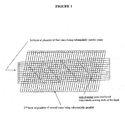
- FIG. 1 includes an illustration of the use of multiple unidirectional layers and transverse fibers in the construction of a multiaxial fabric.
- the invention concerns a multiaxial fabric comprising
- At least one plurality of yarns comprises aramid fiber. In certain embodiments, at least one plurality of yarns comprises polybispyridazole fiber.
- One preferred polybispyridazole is poly[2,6-diimidazo[4,5-b:4,5-e]- pyridinylene-1,4(2,5-dihydroxy)phenylene).
- the transverse yarn comprises fiber of polyester, polyethylene, polyamide, aramid, polyareneazoles, polypyridazoles, or polypyridobisimidazole.
- the fabric further comprises a third yarn layer comprising a plurality of third yarns being substantially parallel in a third direction and skew or off-set with respect to the first yarns and second yarns.
- the fabric further comprises a fourth yarn layer comprising a plurality of fourth yarns being substantially parallel in a fourth direction and skew or off-set with respect to the first, second and third yarns.
- the invention also relates to a method of producing a fabric comprising:
- the term "off-set" simply means not directly on top.
- the term "skew" when referring to two pluralities of yarn means that the pluralities lie at different angles relative to each other. Any angles that provide acceptable performance can be used.
- One skilled in the art is capable of determining optimum skew for a particular construction. For example, with two layers, the pluralities may be at 0 degrees and 90 degrees. Other examples are 0 degree/45 degrees/90 degrees and 0 degrees/45 degrees/90 degrees/45 degrees.
- the invention concerns multiaxial fabrics comprising a first layer comprising a plurality of first yarns being substantially parallel in a first direction, and a second layer comprising a plurality of second yarns being substantially parallel in a second direction and skew with respect to the first yarns.
- the fabrics utilize yarn interlaced transversely within the layers.
- the layers may be arranged in any sequential order and can be optionally coated with a high viscosity polymer that has a Tg in the range of -40 to 0°C, a molecular weight of 20,000 to 100,000, and a viscosity of 2 ⁇ 10 5 to 10 12 Pa ⁇ s (2x10 6 to 10 13 poise) at 20°C.
- Such layers include a third yarn layer comprising a plurality of third yarns being substantially parallel in a third direction and skew with respect to the first yarns and second yarns.
- Other layers include a fourth yarn layer comprising a plurality of fourth yarns being substantially parallel in a fourth direction and skew with respect to the first, second and third yarns.
- suitable fibers for use in the layers include those made from a polymer such as a polyolefin (for example, polyethylene or polypropylene), polyimide, polyester, poly(vinyl alcohol), polybenzazoles, such as polybenzimidazole (PBI), polyaramid, such as poly(paraphenylene terephthalamide) sold by E. I. du Pont de Nemours and Company (DuPont), Wilmington, DE under the trade name KEVLAR®, and polypyridazoles, such as the polypyridobisimidazole available from Magellan Systems International, Richmond VA under the trade name M5®.
- the tenacity of a fiber should be at least 900 MPa according to ASTM D-885 in order to provide superior ballistic penetration resistance.
- a fiber also has a modulus of at least 10 GPa.
- aramid is preferred.
- aramid is meant a polyamide wherein at least 85% of the amide (-CO-NH-) linkages are attached directly to two aromatic rings. Suitable aramid fibers are described in Man-Made Fibers - Science and Technology, Volume 2, Section titled Fiber-Forming Aromatic Polyamides, page 297, W. Black et al., Interscience Publishers, 1968 . Aramid fibers are, also, disclosed in U.S. Patent Nos. 4,172,938 ; 3,869,429 ; 3,819,587 ; 3,673,143 ; 3,354,127 ; and 3,094,511 .
- Additives can be used with the aramid and it has been found that up to as much as 10 percent, by weight, of other polymeric material can be blended with the aramid or that copolymers can be used having as much as 10 percent of other diamine substituted for the diamine of the aramid or as much as 10 percent of other diacid chloride substituted for the diacid chloride or the aramid.
- the preferred aramid is a para-aramid and poly(p-phcnylcnc terephthalamide)(PPD-T) is the preferred para-aramid.
- PPD-T is meant the homopolymer resulting from approximately mole-for-mole polymerization of p-phenylene diamine and terephthaloyl chloride and, also, copolymers resulting from incorporation of small amounts of other diamines with the p-phenylene diamine and of small amounts of other diacid chlorides with the terephthaloyl chloride.
- PPD-T means copolymers resulting from incorporation of other aromatic diamines and other aromatic diacid chlorides such as, for example, 2,6-naphthaloyl chloride or chloro- or dichloroterephthaloyl chloride or 3,4'-diaminodiphenylether.
- polyethylene is meant a predominantly linear polyethylene material of preferably more than one million molecular weight that may contain minor amounts of chain branching or comonomers not exceeding 5 modifying units per 100 main chain carbon atoms, and that may also contain admixed therewith not more than about 50 weight percent of one or more polymeric additives such as alkene-1-polymers, in particular low density polyethylene, propylene, and the like, or low molecular weight additives such as anti-oxidants, lubricants, ultra-violet screening agents, colorants and the like which are commonly incorporated.
- polymeric additives such as alkene-1-polymers, in particular low density polyethylene, propylene, and the like, or low molecular weight additives such as anti-oxidants, lubricants, ultra-violet screening agents, colorants and the like which are commonly incorporated.
- ECPE extended chain polyethylene
- polypropylene is preferably a predominantly linear polypropylene material of more than one million molecular weight.
- High molecular weight linear polyolefin fibers are commercially available. Preparation of polyolefin fibers is discussed in U.S. Patent No. 4,457,985 .
- Polyareneazole polymers such as polybenzazoles and polypyridazoles, can be made by reacting a mix of dry ingredients with a polyphosphoric acid (PPA) solution.
- the dry ingredients may comprise azole-forming monomers and metal powders. Accurately weighed batches of these dry ingredients can be obtained through employment of at least some of the preferred embodiments of the present invention.
- Exemplary azole-forming monomers include 2,5-dimercapto-p-phenylene diaminc, tcrcphthalic acid, bis-(4-benzoic acid), oxy-bis-(4-benzoic acid), 2,5-dihydroxyterephthalic acid, isophthalic acid, 2,5-pyridodicarboxylic acid, 2,6-napthalenedicarboxylic acid, 2,6-quinolinedicarboxylic acid, 2,6-bis(4-carboxyphenyl) pyridobisimidazole, 2,3,5,6-tetraaminopyridine, 4,6-diaminoresorcinol, 2,5-diaminohydroquinonc, 1,4-diamino-2,5-dithiobenzene, or any combination thereof.
- the azole forming monomers include 2,3,5,6-tetraaminopyridine and 2,5-dihydroxyterephthalic acid.
- it is preferred that that the azole-forming monomers are phosphorylated.
- phosphorylated azole-forming monomers are polymerized in the presence of polyphosphoric acid and a metal catalyst.
- Metal powders can be employed to help build the molecular weight of the final polymer.
- the metal powders typically include iron powder, tin powder, vanadium powder, chromium powder, and any combination thereof.
- the azole-forming monomers and metal powders are mixed and then the mixture is reacted with polyphosphoric acid to form a polyareneazole polymer solution. Additional polyphosphoric acid can be added to the polymer solution if desired.
- the polymer solution is typically extruded or spun through a die or spinneret to prepare or spin the filament.
- Polybenzoxazole (PBO) and polybenzothiazole (PBZ) are two suitable polybenzazole polymers. These polymers are described in PCT Application No. WO 93/20400 . Polybenzoxazole and polybenzothiazole are preferably made up of repetitive units of the following structures:
- aromatic groups shown joined to the nitrogen atoms may be heterocyclic, they are preferably carbocyclic; and while they may be fused or unfused polycyclic systems, they are preferably single six-membered rings.
- group shown in the main chain of the bis-azoles is the preferred para-phenylene group, that group may be replaced by any divalent organic group which doesn't interfere with preparation of the polymer, or no group at all. For example, that group may be aliphatic up to twelve carbon atoms, tolylene, biphenylene, bis-phenylene ether, and the like.
- the polybenzoxazole and polybenzothiazole used to make fibers of this invention should have at least 25 and preferably at least 100 repetitive units. Preparation of the polymers and spinning of those polymers is disclosed in the aforementioned PCT Patent Application No. WO 93/20400 .
- Fibers made from poly(pyridazole) polymers are suitable for use in the present invention. These polymers include poly(pyridimidazle), poly(pyridothiazole), poly(pyridoxazole), poly(pyridobisimidazole), poly(pyridobisthiazole), and poly(pyridobisoxazole).
- Poly(pryidobisimidazole) is a rigid rod polymer that is of high strength.
- the poly(pyridobisimidazole) fiber can have an inherent viscosity of at least 20 dl/g or at least 25 dl/g or at least 28 dl/g.
- Such fibers include PIPD fiber (also known as M5® fiber and fiber made from poly[2,6-diimidazo[4,5-b:4,5-e]- pyridinylene-1,4(2,5-dihydroxy)phenylene).
- PIPD fiber is based on the structure:
- Poly(pyridobisimidazole) fiber can be distinguished from the well known commercially available PBI fiber or poly(benzimidazole) fiber in that that poly(benzimidazole) fiber is a poly(bibenzimidazole).
- Poly(bibenzimidazole) fiber is not a rigid rod polymer and has low fiber strength and low tensile modulus when compared to poly(pyridobisimidazoles).
- PIPD fibers have been reported to have the potential to have an average modulus of about 310 GPa (2100 grams/denier) and an average tenacities of up to 5.8 GPa (39.6 grams/denier). These fibers have been described by Brew, et al., Composites Science and Technology 1999, 59, 1109 ; Van der Jagt and Beukers, Polymer 1999, 40, 1035 ; Sikkema, Polymer 1998, 39, 5981 ; Klop and Lammers, Polymer, 1998, 39, 5987 ; Hageman, et al., Polymer 1999, 40, 1313 .
- High performance fiber structures can take many forms such as knitted fabric, woven fabric, uniweave structures, uni-directional sheets, multi-directional sheets (those, for example, having fibers crossing over at an angle between 20 and 90 degrees), a non-woven layer (for example, felt), or even as single fibers.
- a fiber structure may take the form of more 10, 20, 40, or 60 layers of individual fiber structures of this invention.
- Treated layers may be placed at the back, away from the point of impact, or may be placed in the middle, or in any other fashion in order to optimize performance in the body armor.
- the polymer concentration may be the same for each of the treated layers, or may vary from layer to layer so as to provide a desired variation of stiffness through the pack.
- Treated layers can be used in a pack consisting of types of fabric structures that may vary from layer to layer.
- the high performance fiber structure may be manufactured into body armor by a standard vest-making process such as stitching.
- Body armor is constructed by manufacturers in order to meet penetration resistance, blunt trauma, and other requirements as established by the National Institute of Justice via NIJ 100-98.
- NIJ 100-98 the manner in which the ballistic panels are assembled into a single unit differs from one manufacturer to another.
- the multiple layers are bias stitched around the entire edge of the panel; in others, the layers are tack stitched together at several locations.
- Some manufacturers assemble the fabrics with a number of rows of vertical or horizontal stitching; some may even quilt the entire ballistic panel. No evidence exists that stitching impairs the ballistic-resistant properties of a panel. Instead, stitching tends to improve the overall performance, especially in cases of blunt trauma, depending upon the type of fabric used.
- one or more, high viscosity polymer adhesives with low glass transition temperatures arc coated onto or impregnated into a fiber structure.
- the high viscosity polymer adhesive may be variously referred to as polymer or adhesive.
- impregnated it should be understood that it is also intended to embrace coating.
- Excellent ballistic resistance is preserved while blunt trauma resistance is improved.
- Back face deformation (BFD) is an indicator of blunt trauma, that is, the lower the BFD, the less trauma a person wearing a protective device would sustain.
- a liquid adhesive impregnated into a fiber structure at low levels is believed to essentially act as a friction enhancer by modifying the sliding friction of the filaments in the weave under ballistic impact conditions.
- such materials provide a reduction in back face deformation, while retaining or slightly improving ballistic resistance to penetration in an article such as body armor.
- BFD is expressed in millimeters (mm).
- the present invention is also an article comprising one or more layers of a high performance fiber structure impregnated (or coated) with 1 to 15 percent by weight of a high viscosity adhesive with a T g between -40°C and 0°C.
- the glass transition temperatures were measured using differential scanning calorimetry (DSC) at 10°C/min heating rates. The center point of the transition was chosen as T g .
- T g is expressed in °C throughout the specification.
- liquid adhesives are preferred to solid adhesives.
- Solid adhesive matrices can result in reduced ballistic penetration resistance, as do other stiffer additives and as well as systems that are too stiff or too high in friction due to the presence of 15 wt% or more of the adhesive additive. As discussed below, such behavior is expected for very high friction and stiffness in impregnated fabrics as when multiple layers are impacted by high velocity projectiles.
- the frequency dependent glass transitions are resolved as maxima in the loss signal. Taking the frequency extremes, at 0.1 Hz and 30 Hz the T g in PHM ranges from -18.5°C to -2°C, respectively. Over the same frequency range, the T g for PVP ranges from 3°C to 12.5°C. These correspond to activation energies of 167 kJ/mol and 272 kJ/mol (40 kcal/mol and 65 kcal/mol) for PHM and PVP, respectively.
- the very high strain rates of the ballistic event contribute to a high equivalent frequency of deformation (>>10 5 Hz). This elevated strain rate easily converts PVP and PHM from the liquid to the glassy solid phase. For example, at 10 5 Hz, the T g based on this activation energy for PHM would be shifted to 25°C. This value shows that even PHM is well into the glassy phase at room temperature under the high strain rates induced by ballistic impact.
- the T g of the high viscosity adhesive used in this invention falls in the range of -40 to 0°C and preferably in the range of - 35 to -10°C.
- the high strain rates from the ballistic event are enough to shift this frequency dependent T g above room temperature, converting the viscous adhesives into stiff glassy solids. Because of the low T g and "fluid" nature, these adhesives provide flexible fabrics for making protective vests that are comfortable under static conditions. If the glass transition is below -40°C, the strain rates are not high enough to convert the system into a glassy phase.
- the adhesives should be high viscosity polymer fluids. They should not be elastic solids, very high molecular weight polymers, semi-crystalline elastic solids, or cross-linked elastic solids. Polymers, such as these, can reduce penetration resistance and will be stiffer, thereby causing a reduction in comfort. Furthermore, the solid adhesives applied at low levels, especially, will not be self-healing and will lose effectiveness once the fabric is deformed substantially.
- the adhesives used in this invention may also be characterized by their molecular weight (Mw) and viscosity. Molecular weights are weight average and typically determined by gel permeation chromatography.
- the molecular weight of the viscous fluid polymer may, for example, be in the range of 20,000 to 400,000 g/mol (20,000 to 100,000 in some embodiments).
- the desired viscosity range for the viscous fluid polymers is 2 ⁇ 10 5 to 10 12 Pa ⁇ s (2x10 6 to 10 13 poise). Viscosity is typically measured at room temperature, but generally, the viscosities of the subject adhesives as provided herein are too high at room temperature to be measured by standard techniques.
- viscosity is estimated by extrapolating from high temperature melt viscosity, melt flow index characterization or other qualitative rheological characterization.
- One typical method applied for zero shear viscosity characterization of polymer fluids is cone-and-plate rheometry or capillary viscometry.
- a low viscosity outside the above range will typically reduce performance, such as in the case of siloxane fluids with low Tg, even those with high Mws. These materials reduce friction due to lubrication. This has been correlated with poor ballistic performance as disclosed by Briscoe, B. J., Motamedi, F. "The ballistic impact characteristics of aramid fabrics: the influence of interface friction", Wear 1992 158(1-2), 229 ).
- Liquid adhesives with appropriate properties can be formed in many ways including as a suspension, emulsion or melt polymerization and in the form of blend or a copolymer.
- polymers useful as high viscosity adhesives herein include poly (vinyl propionate), poly(hexyl methacrylate), poly(isopropyl acrylate), and ethylene/methyl acrylate copolymer (wherein the ethylene content is 38 weight percent and the methyl acrylate content is 62 weight percent).
- High viscosity adhesives with flow and modulus properties distinctly different from solid elastomers were impregnated into ballistic fabrics.
- a desirably high level of both ballistic penetration resistance and back face deformation (a measure of blunt trauma) was found in the range of 1 to 15 wt % additive level in polyaramid fabric depending on how many layers were treated. It is believed that this type of system would provide a 20 - 30% weight savings compared to the area density needed to provide satisfactory blunt trauma protection in fabric vests currently in use.
- High viscosity adhesives as used in this invention have a glass transition temperature T g that enables them to give desirable liquid adhesive performance in this invention, and control back face deformation through viscosity and friction effects in a fiber structure.
- fiber is defined as a relatively flexible, macroscopically homogeneous body having a high ratio of length to width across its cross-sectional area perpendicular to its length.
- the fiber cross section can be any shape, but is typically round.
- filament or “continuous filament” is used interchangeably with the term “fiber.”
- staple fibers refers to fibers that are cut to a desired length or fibers that occur naturally with or naturally have a low ratio of length to width across its cross-sectional area perpendicular to its length when compared with filaments. Length can vary from 2.54 mm (0.1 inch) to several feet. In some embodiments, the length is from 2.54 mm to 20.3 cm (0.1 inch to 8 inches). Man made staple fibers are cut to a length suitable for processing on cotton, woolen, or worsted yarn spinning equipment.
- the staple fibers can have (a) substantially uniform length, (b) variable or random length, or (c) subsets of the staple fibers have substantially uniform length and the staple fibers in the other subsets have different lengths, with the staple fibers in the subsets mixed together forming a substantially uniform distribution.
- suitable staple fibers have a length of 1 to 30 centimeters. Staple fibers made by short staple processes result in a fiber length of 1 to 6 centimeters.
- the staple fibers can be made by any process.
- the staple fibers can formed by stretch breaking continuous fibers resulting in staple fibers with deformed sections that act as crimps.
- the staple fibers can be cut from continuous straight fibers using a rotary cutter or a guillotine cutter resulting in straight (i.e., non crimped) staple fiber, or additionally cut from crimped continuous fibers having a saw tooth shaped crimp along the length of the staple fiber, with a crimp (or repeating bend) frequency of no more than 8 crimps per centimeter.
- Stretch broken staple fibers can be made by breaking a tow or a bundle of continuous filaments during a stretch break operation having one or more break zones that are a prescribed distance creating a random variable mass of fibers having an average cut length controlled by break zone adjustment.
- Staple fibers of this invention can be converted into yarns using traditional long and short staple ring spinning processes which are well known in the art.
- cotton system spinning fiber lengths from 3/4 inch to 2-1/4 inch (i.e., 1.9 to 5.7 cm.) are typically used.
- worsted or woolen system spinning fibers up to 6-1/2 inches (i.e., 16.5 cm.) are typically used.
- this is not intended to be limiting to ring spinning because the yarns may also be spun using air jet spinning, open end spinning, and many other types of spinning which converts staple fiber into useable yarns.
- the stretch broken staple fibers typically have length of up to 7 inches (i.e., 17.8 cm.) long and can be made using traditional stretch-broken tow to top staple processes. Staple fibers having maximum lengths of up to 20 inches (i.e., 51 cm) are possible through processes as described for example in PCT Patent Application No. WO 0077283 . Yarns are so made by consolidated fibers into spun yarn using filament entanglement with air jets having a tenacity in the range of 3 to 7 grams per decitex.
- These yarns may have secondary twist, that is, they may be twisted after formation to impart more tenacity to the yarn, in which case the tenacity can be in the 10 to 18 grams per denier (i.e., 9 to 17 grams per dtex) range.
- Stretch broken staple fibers normally do not require crimp because the process imparts a degree of crimp into the fiber.
- continuous filament refers to a flexible fiber having relatively small-diameter and whose length is longer than those indicated for staple fibers.
- Continuous filament fibers can be converted to multifilament yarns by processes well known to those skilled in the art.
- Fabrics of this invention can take on numerous configurations, including, but not limited to, knitted or woven fabrics or non-woven structures. Such fabric configurations are well known to those skilled in the art.
- non-woven fabric is meant a network of fibers, including unidirectional (if contained within a matrix resin), felt, fiber batts, and the like.
- woven fabric is meant a fabric woven using any fabric weave, such as plain weave, crowfoot weave, basket weave, satin weave, twill weave, and the like. Plain and twill weaves are believed to be the most common weaves used in the trade.
- layers of multiaxial fabric are made from high tenacity of 930 dtex poly(p-phenylene terphthalamide) continuous filament yarn with a linear density of 1.66 dtex per filament, available from E. I. DuPont de Nemours and Company under the trademark Kevlar® 129.
- Each layer of fabric is constructed with four sets of parallel yarns at 7.1 ends per cm (18 ends per inch) arranged in different angles and bound together by a set of low denier and low tenacity of loop-forming polyethylene yarn.
- Areal density of each multiaxial fabric layer is about 0.27 kg/m 2 .
- the tensile strength of the four sets of yarns used in the multiaxial fabric is 24.3 gram/dtex, and the density of the fiber is 1.44 gram/cm 3 .
- the stability of the multiaxial fabric layer is poor.
- the yarns in the multiaxial fabric layer can be distorted and pushed aside by the penetration of a sharp object.
- Seventeen layers of the multiaxial fabric of about 15" x 15" size are stitched together around the edge and with a cross stitch to form a composite structure with a total areal density of about 4.6 kg/m 2 .
- the assembly is then tested against 357 mag bullet per NIJ ballistic standard 0101.04 for Level II for both ballistic V50 and backface deformation. The results, especially the backface deformation of the composite structure of the is poor due to low structure stability of the fabric layers.
- layers of multiaxial fabric are made from high tenacity of 930 dtex poly(p-phenylene terphthalamide) continuous filament yarn with a linear density of 1.66 dtex per filament, available from E. I. DuPont de Nemours and Company under the trademark Kevlar® 129.
- Each layer of fabric is constructed with four sets of parallel yarns at 7.1 ends per cm (18 ends per inch) arranged in different angles and bound together by a set of low denier and low tenacity of loop-forming polyethylene yarn.
- Areal density of each multiaxial fabric layer is about 0.27 kg/m 2 .
- the tensile strength of the four sets of yarns used in the multiaxial fabric is 24.3 gram/dtex, and the density of the fiber is 1.44 gram/cm 3 .
- the layer of multiaxial fabric is further coated with about 5 wt% of a high viscosity polymer having a Tg in the range of -40° to 10° C with a zero share melt viscosity 2x 10⁶ to 101.3 Pa ⁇ s (1013 poise) at 20° C, and a molecular weight of 20,000 to 100,000.
- Areal density of each coated multiaxial fabric layer is about 0.284 kg/m 2 .
- the structure stability of the multiaxial fabric layer of this invention is very good.
Landscapes
- Engineering & Computer Science (AREA)
- Textile Engineering (AREA)
- Chemical & Material Sciences (AREA)
- Ceramic Engineering (AREA)
- General Engineering & Computer Science (AREA)
- Chemical Kinetics & Catalysis (AREA)
- Materials Engineering (AREA)
- Health & Medical Sciences (AREA)
- Manufacturing & Machinery (AREA)
- Medicinal Chemistry (AREA)
- Polymers & Plastics (AREA)
- Organic Chemistry (AREA)
- Laminated Bodies (AREA)
- Aiming, Guidance, Guns With A Light Source, Armor, Camouflage, And Targets (AREA)
- Manufacturing Of Multi-Layer Textile Fabrics (AREA)
- Reinforced Plastic Materials (AREA)
- Nonwoven Fabrics (AREA)
- Professional, Industrial, Or Sporting Protective Garments (AREA)
Applications Claiming Priority (2)
| Application Number | Priority Date | Filing Date | Title |
|---|---|---|---|
| US74914705P | 2005-12-08 | 2005-12-08 | |
| PCT/US2006/061739 WO2007067950A1 (en) | 2005-12-08 | 2006-12-07 | Multiaxial fabric with strain-responsive viscous liquid polymers |
Publications (2)
| Publication Number | Publication Date |
|---|---|
| EP1965975A1 EP1965975A1 (en) | 2008-09-10 |
| EP1965975B1 true EP1965975B1 (en) | 2015-11-11 |
Family
ID=37831433
Family Applications (1)
| Application Number | Title | Priority Date | Filing Date |
|---|---|---|---|
| EP06846516.0A Not-in-force EP1965975B1 (en) | 2005-12-08 | 2006-12-07 | Multiaxial fabric with strain-responsive viscous liquid polymers |
Country Status (8)
| Country | Link |
|---|---|
| US (1) | US8171569B2 (enExample) |
| EP (1) | EP1965975B1 (enExample) |
| JP (1) | JP5102775B2 (enExample) |
| KR (1) | KR101337052B1 (enExample) |
| CN (1) | CN101321618B (enExample) |
| BR (1) | BRPI0620574A2 (enExample) |
| CA (1) | CA2630153A1 (enExample) |
| WO (1) | WO2007067950A1 (enExample) |
Families Citing this family (14)
| Publication number | Priority date | Publication date | Assignee | Title |
|---|---|---|---|---|
| US9012339B2 (en) * | 2005-12-08 | 2015-04-21 | E I Du Pont De Nemours And Company | Multiaxial fabric for ballistic applications |
| US8166569B1 (en) * | 2006-11-29 | 2012-05-01 | E. I. Du Pont De Nemours And Company | Multiaxial polyethylene fabric and laminate |
| US8256019B2 (en) * | 2007-08-01 | 2012-09-04 | Honeywell International Inc. | Composite ballistic fabric structures for hard armor applications |
| RU2441760C1 (ru) * | 2010-10-28 | 2012-02-10 | Общество с ограниченной ответственностью Научно-производственное предприятие "АРМОКОМ-ЦЕНТР" | Способ изготовления полимерного композиционного материала, преимущественно для бронепанели, полимерный композиционный материал, преимущественно для бронепанели и бронепанель из полимерного копозиционного материала |
| EP2663450B1 (en) | 2011-01-12 | 2018-07-04 | The Board of Trustees of The Leland Stanford Junior University | Composite laminated structures and methods for manufacturing and using the same |
| ITPN20110046A1 (it) * | 2011-06-20 | 2012-12-21 | Daniele Marino | Protezione dagli agenti atmosferici per veicoli |
| US9023451B2 (en) | 2011-09-06 | 2015-05-05 | Honeywell International Inc. | Rigid structure UHMWPE UD and composite and the process of making |
| US9023450B2 (en) | 2011-09-06 | 2015-05-05 | Honeywell International Inc. | High lap shear strength, low back face signature UD composite and the process of making |
| US9023452B2 (en) * | 2011-09-06 | 2015-05-05 | Honeywell International Inc. | Rigid structural and low back face signature ballistic UD/articles and method of making |
| US9194662B1 (en) * | 2013-03-15 | 2015-11-24 | Peter D. Poulsen | Article for dispersing energy of a blast or impact |
| US20150030805A1 (en) * | 2013-07-29 | 2015-01-29 | Compagnie Chomarat | Composite bi-angle and thin-ply laminate tapes and methods for manufacturing and using the same |
| CN103541108A (zh) * | 2013-11-04 | 2014-01-29 | 吴江市祥盛纺织品有限公司 | 一种闪光棉记忆面料 |
| CN103726193A (zh) * | 2013-12-30 | 2014-04-16 | 吴江金名来丝绸进出口有限公司 | 一种抗菌面料 |
| CN111020780B (zh) * | 2019-12-19 | 2020-11-24 | 界首市华宇纺织有限公司 | 一种高粘度的保暖抗菌纱线及其生产工艺 |
Family Cites Families (29)
| Publication number | Priority date | Publication date | Assignee | Title |
|---|---|---|---|---|
| US3354127A (en) * | 1966-04-18 | 1967-11-21 | Du Pont | Aromatic copolyamides |
| US3819587A (en) * | 1969-05-23 | 1974-06-25 | Du Pont | Wholly aromatic carbocyclic polycarbonamide fiber having orientation angle of less than about 45{20 |
| US3673143A (en) * | 1970-06-24 | 1972-06-27 | Du Pont | Optically anisotropic spinning dopes of polycarbonamides |
| US3869429A (en) * | 1971-08-17 | 1975-03-04 | Du Pont | High strength polyamide fibers and films |
| JPS53294A (en) * | 1976-06-23 | 1978-01-05 | Teijin Ltd | Preparation of aromatic polyamide with high degree of polymerization |
| US4183993A (en) * | 1978-01-30 | 1980-01-15 | Gulf States Paper Corporation | Reinforced fabric and laminate made therewith |
| FR2469277A1 (fr) | 1979-11-08 | 1981-05-22 | Poudres & Explosifs Ste Nale | Dispositif de protection contre les chocs et les explosions constitues de materiaux stratifies a base de fibres et de resine viscoelastique |
| US4457985A (en) * | 1982-03-19 | 1984-07-03 | Allied Corporation | Ballistic-resistant article |
| US5160776A (en) * | 1987-07-13 | 1992-11-03 | Allied-Signal Inc. | Ballistic-resistant composite article |
| US5124195A (en) * | 1990-01-10 | 1992-06-23 | Allied-Signal Inc. | Flexible coated fibrous webs |
| US5677029A (en) * | 1990-11-19 | 1997-10-14 | Alliedsignal Inc. | Ballistic resistant fabric articles |
| US6268301B1 (en) | 1992-03-25 | 2001-07-31 | Toyobo Co., Ltd. | Ballistic-resistant article and process for making the same |
| JPH06220288A (ja) * | 1993-01-28 | 1994-08-09 | Dainippon Ink & Chem Inc | 合成樹脂組成物およびそれをコーティングしてなる繊維 |
| US5354605A (en) * | 1993-04-02 | 1994-10-11 | Alliedsignal Inc. | Soft armor composite |
| US5935678A (en) * | 1994-05-17 | 1999-08-10 | Park; Andrew D. | Ballistic laminate structure in sheet form |
| JPH0985865A (ja) * | 1995-09-27 | 1997-03-31 | Teijin Ltd | 耐衝撃性能に優れた硬質複合製品 |
| IT1282143B1 (it) * | 1996-04-29 | 1998-03-12 | Citterio Flli Spa | Tessuto multiassiale multistrato, atto a essere utilizzato per impieghi balistici e procedimento per realizzare il suddetto tessuto |
| NL1003405C2 (nl) * | 1996-06-24 | 1998-01-07 | Dsm Nv | Antiballistisch vormdeel. |
| JPH10271697A (ja) * | 1997-03-21 | 1998-10-09 | Nippon Steel Corp | 充電装置 |
| IT1317268B1 (it) * | 2000-04-17 | 2003-05-27 | Citterio Flli Spa | Tessuto multistrato rinforzato e procedimento per la sua realizzazione |
| JP4067972B2 (ja) * | 2001-05-03 | 2008-03-26 | バーデー、 インコーポレイテッド | 防弾用途向け擬似一方向布帛 |
| US6737368B2 (en) * | 2001-12-19 | 2004-05-18 | E. I. Du Pont De Nemours And Company | Multiple threat penetration resistant articles |
| US6841492B2 (en) * | 2002-06-07 | 2005-01-11 | Honeywell International Inc. | Bi-directional and multi-axial fabrics and fabric composites |
| CA2504631C (en) * | 2002-09-10 | 2011-10-18 | Tex Tech Industries, Inc. | Enhanced energy absorbing materials |
| ITMI20030295A1 (it) * | 2003-02-19 | 2004-08-20 | Citterio Flli Spa | Materiale composito flessibile resistente alla penetrazione |
| JP4560829B2 (ja) * | 2004-04-15 | 2010-10-13 | 日本電気硝子株式会社 | 複合材料 |
| US20050282007A1 (en) | 2004-06-21 | 2005-12-22 | Sauer Bryan B | Ballistic performance enhancement of fiber structure |
| US9012339B2 (en) * | 2005-12-08 | 2015-04-21 | E I Du Pont De Nemours And Company | Multiaxial fabric for ballistic applications |
| JP5489463B2 (ja) * | 2005-12-08 | 2014-05-14 | イー・アイ・デュポン・ドウ・ヌムール・アンド・カンパニー | 多軸布帛 |
-
2006
- 2006-12-07 BR BRPI0620574-7A patent/BRPI0620574A2/pt active Search and Examination
- 2006-12-07 KR KR1020087016438A patent/KR101337052B1/ko not_active Expired - Fee Related
- 2006-12-07 CN CN2006800455284A patent/CN101321618B/zh not_active Expired - Fee Related
- 2006-12-07 US US12/086,266 patent/US8171569B2/en not_active Expired - Fee Related
- 2006-12-07 JP JP2008544653A patent/JP5102775B2/ja not_active Expired - Fee Related
- 2006-12-07 CA CA 2630153 patent/CA2630153A1/en not_active Abandoned
- 2006-12-07 WO PCT/US2006/061739 patent/WO2007067950A1/en not_active Ceased
- 2006-12-07 EP EP06846516.0A patent/EP1965975B1/en not_active Not-in-force
Also Published As
| Publication number | Publication date |
|---|---|
| JP5102775B2 (ja) | 2012-12-19 |
| US20090136706A1 (en) | 2009-05-28 |
| CN101321618B (zh) | 2012-07-18 |
| KR20080081957A (ko) | 2008-09-10 |
| BRPI0620574A2 (pt) | 2011-11-16 |
| CA2630153A1 (en) | 2007-06-14 |
| US8171569B2 (en) | 2012-05-08 |
| JP2009518526A (ja) | 2009-05-07 |
| WO2007067950A1 (en) | 2007-06-14 |
| CN101321618A (zh) | 2008-12-10 |
| KR101337052B1 (ko) | 2013-12-05 |
| EP1965975A1 (en) | 2008-09-10 |
Similar Documents
| Publication | Publication Date | Title |
|---|---|---|
| US7900267B2 (en) | Multiaxial fabric | |
| EP1973433B1 (en) | Multiaxial fabric for ballistic applications | |
| KR101433404B1 (ko) | 다축 폴리에틸렌 직물 및 라미네이트 | |
| EP1965975B1 (en) | Multiaxial fabric with strain-responsive viscous liquid polymers | |
| IL142149A (en) | Composite material mixed with shield | |
| US7968476B1 (en) | Fabric assembly suitable for resisting ballistic objects and method of manufacture | |
| MX2008007113A (en) | Multiaxial fabric with strain-responsive viscous liquid polymers | |
| MX2008007115A (en) | Multiaxial fabric for ballistic applications | |
| MX2008007116A (es) | Tejido multiaxial | |
| US20120164371A1 (en) | Fabric assembly suitable for resisting ballistic objects and method of manufacture |
Legal Events
| Date | Code | Title | Description |
|---|---|---|---|
| PUAI | Public reference made under article 153(3) epc to a published international application that has entered the european phase |
Free format text: ORIGINAL CODE: 0009012 |
|
| 17P | Request for examination filed |
Effective date: 20080611 |
|
| AK | Designated contracting states |
Kind code of ref document: A1 Designated state(s): DE FR GB IT NL |
|
| RBV | Designated contracting states (corrected) |
Designated state(s): DE FR GB IT NL |
|
| 17Q | First examination report despatched |
Effective date: 20090722 |
|
| DAX | Request for extension of the european patent (deleted) | ||
| GRAP | Despatch of communication of intention to grant a patent |
Free format text: ORIGINAL CODE: EPIDOSNIGR1 |
|
| INTG | Intention to grant announced |
Effective date: 20150722 |
|
| GRAS | Grant fee paid |
Free format text: ORIGINAL CODE: EPIDOSNIGR3 |
|
| GRAA | (expected) grant |
Free format text: ORIGINAL CODE: 0009210 |
|
| REG | Reference to a national code |
Ref country code: FR Ref legal event code: PLFP Year of fee payment: 10 |
|
| AK | Designated contracting states |
Kind code of ref document: B1 Designated state(s): DE FR GB IT NL |
|
| REG | Reference to a national code |
Ref country code: GB Ref legal event code: FG4D |
|
| REG | Reference to a national code |
Ref country code: DE Ref legal event code: R096 Ref document number: 602006047293 Country of ref document: DE |
|
| REG | Reference to a national code |
Ref country code: NL Ref legal event code: MP Effective date: 20160211 |
|
| PG25 | Lapsed in a contracting state [announced via postgrant information from national office to epo] |
Ref country code: IT Free format text: LAPSE BECAUSE OF FAILURE TO SUBMIT A TRANSLATION OF THE DESCRIPTION OR TO PAY THE FEE WITHIN THE PRESCRIBED TIME-LIMIT Effective date: 20151111 Ref country code: NL Free format text: LAPSE BECAUSE OF FAILURE TO SUBMIT A TRANSLATION OF THE DESCRIPTION OR TO PAY THE FEE WITHIN THE PRESCRIBED TIME-LIMIT Effective date: 20151111 |
|
| REG | Reference to a national code |
Ref country code: DE Ref legal event code: R097 Ref document number: 602006047293 Country of ref document: DE |
|
| PLBE | No opposition filed within time limit |
Free format text: ORIGINAL CODE: 0009261 |
|
| STAA | Information on the status of an ep patent application or granted ep patent |
Free format text: STATUS: NO OPPOSITION FILED WITHIN TIME LIMIT |
|
| 26N | No opposition filed |
Effective date: 20160812 |
|
| GBPC | Gb: european patent ceased through non-payment of renewal fee |
Effective date: 20160211 |
|
| REG | Reference to a national code |
Ref country code: FR Ref legal event code: PLFP Year of fee payment: 11 |
|
| PG25 | Lapsed in a contracting state [announced via postgrant information from national office to epo] |
Ref country code: GB Free format text: LAPSE BECAUSE OF NON-PAYMENT OF DUE FEES Effective date: 20160211 |
|
| REG | Reference to a national code |
Ref country code: FR Ref legal event code: PLFP Year of fee payment: 12 |
|
| PGFP | Annual fee paid to national office [announced via postgrant information from national office to epo] |
Ref country code: DE Payment date: 20191126 Year of fee payment: 14 |
|
| PGFP | Annual fee paid to national office [announced via postgrant information from national office to epo] |
Ref country code: FR Payment date: 20191115 Year of fee payment: 14 |
|
| REG | Reference to a national code |
Ref country code: DE Ref legal event code: R119 Ref document number: 602006047293 Country of ref document: DE |
|
| PG25 | Lapsed in a contracting state [announced via postgrant information from national office to epo] |
Ref country code: FR Free format text: LAPSE BECAUSE OF NON-PAYMENT OF DUE FEES Effective date: 20201231 |
|
| PG25 | Lapsed in a contracting state [announced via postgrant information from national office to epo] |
Ref country code: DE Free format text: LAPSE BECAUSE OF NON-PAYMENT OF DUE FEES Effective date: 20210701 |