EP1960330B1 - Verfahren zur herstellung von substituierten diamantanen - Google Patents
Verfahren zur herstellung von substituierten diamantanen Download PDFInfo
- Publication number
- EP1960330B1 EP1960330B1 EP06828601A EP06828601A EP1960330B1 EP 1960330 B1 EP1960330 B1 EP 1960330B1 EP 06828601 A EP06828601 A EP 06828601A EP 06828601 A EP06828601 A EP 06828601A EP 1960330 B1 EP1960330 B1 EP 1960330B1
- Authority
- EP
- European Patent Office
- Prior art keywords
- diamantanes
- diamantane
- acid
- group
- dinitroxylated
- Prior art date
- Legal status (The legal status is an assumption and is not a legal conclusion. Google has not performed a legal analysis and makes no representation as to the accuracy of the status listed.)
- Not-in-force
Links
- 238000004519 manufacturing process Methods 0.000 title claims description 20
- 239000002253 acid Substances 0.000 claims abstract description 30
- -1 nitroxy groups Chemical group 0.000 claims abstract description 29
- 239000012038 nucleophile Substances 0.000 claims abstract description 25
- 238000000034 method Methods 0.000 claims abstract description 24
- XLYOFNOQVPJJNP-UHFFFAOYSA-N water Substances O XLYOFNOQVPJJNP-UHFFFAOYSA-N 0.000 claims abstract description 24
- 238000006243 chemical reaction Methods 0.000 claims abstract description 16
- 150000001875 compounds Chemical class 0.000 claims abstract description 5
- ZICQBHNGXDOVJF-UHFFFAOYSA-N diamantane Chemical compound C1C2C3CC(C4)CC2C2C4C3CC1C2 ZICQBHNGXDOVJF-UHFFFAOYSA-N 0.000 claims description 31
- 239000000203 mixture Substances 0.000 claims description 26
- 239000011541 reaction mixture Substances 0.000 claims description 17
- QTBSBXVTEAMEQO-UHFFFAOYSA-N Acetic acid Chemical compound CC(O)=O QTBSBXVTEAMEQO-UHFFFAOYSA-N 0.000 claims description 13
- RTZKZFJDLAIYFH-UHFFFAOYSA-N Diethyl ether Chemical compound CCOCC RTZKZFJDLAIYFH-UHFFFAOYSA-N 0.000 claims description 12
- GRYLNZFGIOXLOG-UHFFFAOYSA-N Nitric acid Chemical compound O[N+]([O-])=O GRYLNZFGIOXLOG-UHFFFAOYSA-N 0.000 claims description 12
- 239000000460 chlorine Substances 0.000 claims description 12
- 229910017604 nitric acid Inorganic materials 0.000 claims description 12
- HEDRZPFGACZZDS-UHFFFAOYSA-N Chloroform Chemical compound ClC(Cl)Cl HEDRZPFGACZZDS-UHFFFAOYSA-N 0.000 claims description 10
- BDAGIHXWWSANSR-UHFFFAOYSA-N Formic acid Chemical compound OC=O BDAGIHXWWSANSR-UHFFFAOYSA-N 0.000 claims description 10
- 229910052799 carbon Inorganic materials 0.000 claims description 10
- WEVYAHXRMPXWCK-UHFFFAOYSA-N Acetonitrile Chemical compound CC#N WEVYAHXRMPXWCK-UHFFFAOYSA-N 0.000 claims description 9
- XEKOWRVHYACXOJ-UHFFFAOYSA-N Ethyl acetate Chemical compound CCOC(C)=O XEKOWRVHYACXOJ-UHFFFAOYSA-N 0.000 claims description 9
- QAOWNCQODCNURD-UHFFFAOYSA-N Sulfuric acid Chemical compound OS(O)(=O)=O QAOWNCQODCNURD-UHFFFAOYSA-N 0.000 claims description 8
- 239000003960 organic solvent Substances 0.000 claims description 8
- 239000003795 chemical substances by application Substances 0.000 claims description 7
- 235000019253 formic acid Nutrition 0.000 claims description 7
- WYURNTSHIVDZCO-UHFFFAOYSA-N Tetrahydrofuran Chemical compound C1CCOC1 WYURNTSHIVDZCO-UHFFFAOYSA-N 0.000 claims description 6
- 238000003756 stirring Methods 0.000 claims description 6
- YMWUJEATGCHHMB-UHFFFAOYSA-N Dichloromethane Chemical compound ClCCl YMWUJEATGCHHMB-UHFFFAOYSA-N 0.000 claims description 5
- 238000000746 purification Methods 0.000 claims description 5
- VEXZGXHMUGYJMC-UHFFFAOYSA-N Hydrochloric acid Chemical compound Cl VEXZGXHMUGYJMC-UHFFFAOYSA-N 0.000 claims description 4
- NBIIXXVUZAFLBC-UHFFFAOYSA-N Phosphoric acid Chemical compound OP(O)(O)=O NBIIXXVUZAFLBC-UHFFFAOYSA-N 0.000 claims description 4
- 239000003153 chemical reaction reagent Substances 0.000 claims description 4
- JCXJVPUVTGWSNB-UHFFFAOYSA-N nitrogen dioxide Inorganic materials O=[N]=O JCXJVPUVTGWSNB-UHFFFAOYSA-N 0.000 claims description 4
- 239000002243 precursor Substances 0.000 claims description 4
- 238000010992 reflux Methods 0.000 claims description 4
- VZGDMQKNWNREIO-UHFFFAOYSA-N tetrachloromethane Chemical compound ClC(Cl)(Cl)Cl VZGDMQKNWNREIO-UHFFFAOYSA-N 0.000 claims description 4
- 125000002496 methyl group Chemical group [H]C([H])([H])* 0.000 claims description 3
- BMYNFMYTOJXKLE-UHFFFAOYSA-N 3-azaniumyl-2-hydroxypropanoate Chemical compound NCC(O)C(O)=O BMYNFMYTOJXKLE-UHFFFAOYSA-N 0.000 claims description 2
- MGWGWNFMUOTEHG-UHFFFAOYSA-N 4-(3,5-dimethylphenyl)-1,3-thiazol-2-amine Chemical compound CC1=CC(C)=CC(C=2N=C(N)SC=2)=C1 MGWGWNFMUOTEHG-UHFFFAOYSA-N 0.000 claims description 2
- ZCYVEMRRCGMTRW-UHFFFAOYSA-N 7553-56-2 Chemical compound [I] ZCYVEMRRCGMTRW-UHFFFAOYSA-N 0.000 claims description 2
- WKBOTKDWSSQWDR-UHFFFAOYSA-N Bromine atom Chemical compound [Br] WKBOTKDWSSQWDR-UHFFFAOYSA-N 0.000 claims description 2
- ZAMOUSCENKQFHK-UHFFFAOYSA-N Chlorine atom Chemical compound [Cl] ZAMOUSCENKQFHK-UHFFFAOYSA-N 0.000 claims description 2
- PXGOKWXKJXAPGV-UHFFFAOYSA-N Fluorine Chemical compound FF PXGOKWXKJXAPGV-UHFFFAOYSA-N 0.000 claims description 2
- CBENFWSGALASAD-UHFFFAOYSA-N Ozone Chemical compound [O-][O+]=O CBENFWSGALASAD-UHFFFAOYSA-N 0.000 claims description 2
- 229910001963 alkali metal nitrate Inorganic materials 0.000 claims description 2
- 229910000147 aluminium phosphate Inorganic materials 0.000 claims description 2
- GDTBXPJZTBHREO-UHFFFAOYSA-N bromine Substances BrBr GDTBXPJZTBHREO-UHFFFAOYSA-N 0.000 claims description 2
- 229910052794 bromium Inorganic materials 0.000 claims description 2
- 229910052801 chlorine Inorganic materials 0.000 claims description 2
- 239000011737 fluorine Substances 0.000 claims description 2
- 229910052731 fluorine Inorganic materials 0.000 claims description 2
- 229910052736 halogen Inorganic materials 0.000 claims description 2
- 150000002367 halogens Chemical group 0.000 claims description 2
- XMBWDFGMSWQBCA-UHFFFAOYSA-N hydrogen iodide Chemical compound I XMBWDFGMSWQBCA-UHFFFAOYSA-N 0.000 claims description 2
- 229940071870 hydroiodic acid Drugs 0.000 claims description 2
- 239000011630 iodine Substances 0.000 claims description 2
- 229910052740 iodine Inorganic materials 0.000 claims description 2
- ZHNUHDYFZUAESO-UHFFFAOYSA-N Formamide Chemical compound NC=O ZHNUHDYFZUAESO-UHFFFAOYSA-N 0.000 claims 3
- 239000001117 sulphuric acid Substances 0.000 claims 2
- 235000011149 sulphuric acid Nutrition 0.000 claims 2
- KEJOCWOXCDWNID-UHFFFAOYSA-N Nitrilooxonium Chemical compound [O+]#N KEJOCWOXCDWNID-UHFFFAOYSA-N 0.000 claims 1
- 150000001721 carbon Chemical group 0.000 claims 1
- 229960004132 diethyl ether Drugs 0.000 claims 1
- 238000010438 heat treatment Methods 0.000 claims 1
- YNGRGHODNDCZCC-UHFFFAOYSA-N nitro hydrogen sulfate Chemical compound OS(=O)(=O)O[N+]([O-])=O YNGRGHODNDCZCC-UHFFFAOYSA-N 0.000 claims 1
- 230000008707 rearrangement Effects 0.000 abstract description 21
- 125000002887 hydroxy group Chemical group [H]O* 0.000 abstract description 8
- 238000006467 substitution reaction Methods 0.000 abstract description 3
- 125000004432 carbon atom Chemical group C* 0.000 description 19
- 238000002360 preparation method Methods 0.000 description 19
- 239000007858 starting material Substances 0.000 description 10
- 238000000605 extraction Methods 0.000 description 9
- 239000000047 product Substances 0.000 description 9
- 238000001953 recrystallisation Methods 0.000 description 8
- 125000000524 functional group Chemical group 0.000 description 7
- GXAHVKOYBPXTKV-UHFFFAOYSA-N 4,9-dihydroxydiamantane Chemical compound C1C2C3CC(O)(C4)CC2C2C4C3CC1(O)C2 GXAHVKOYBPXTKV-UHFFFAOYSA-N 0.000 description 6
- OKKJLVBELUTLKV-UHFFFAOYSA-N Methanol Chemical compound OC OKKJLVBELUTLKV-UHFFFAOYSA-N 0.000 description 6
- 239000002904 solvent Substances 0.000 description 6
- 238000004587 chromatography analysis Methods 0.000 description 5
- 239000010432 diamond Substances 0.000 description 5
- 229910052739 hydrogen Inorganic materials 0.000 description 5
- 230000007062 hydrolysis Effects 0.000 description 5
- 238000006460 hydrolysis reaction Methods 0.000 description 5
- 125000001931 aliphatic group Chemical group 0.000 description 4
- 239000012043 crude product Substances 0.000 description 4
- 239000000463 material Substances 0.000 description 4
- VLKZOEOYAKHREP-UHFFFAOYSA-N n-Hexane Chemical compound CCCCCC VLKZOEOYAKHREP-UHFFFAOYSA-N 0.000 description 4
- 239000002244 precipitate Substances 0.000 description 4
- 239000007787 solid Substances 0.000 description 4
- 239000000126 substance Substances 0.000 description 4
- 238000001644 13C nuclear magnetic resonance spectroscopy Methods 0.000 description 3
- 238000005160 1H NMR spectroscopy Methods 0.000 description 3
- OSWFIVFLDKOXQC-UHFFFAOYSA-N 4-(3-methoxyphenyl)aniline Chemical compound COC1=CC=CC(C=2C=CC(N)=CC=2)=C1 OSWFIVFLDKOXQC-UHFFFAOYSA-N 0.000 description 3
- HEMHJVSKTPXQMS-UHFFFAOYSA-M Sodium hydroxide Chemical compound [OH-].[Na+] HEMHJVSKTPXQMS-UHFFFAOYSA-M 0.000 description 3
- 150000007513 acids Chemical class 0.000 description 3
- 230000015572 biosynthetic process Effects 0.000 description 3
- 125000003178 carboxy group Chemical group [H]OC(*)=O 0.000 description 3
- 150000001732 carboxylic acid derivatives Chemical class 0.000 description 3
- 229910003460 diamond Inorganic materials 0.000 description 3
- 150000008282 halocarbons Chemical class 0.000 description 3
- 239000000543 intermediate Substances 0.000 description 3
- 238000004377 microelectronic Methods 0.000 description 3
- 230000003647 oxidation Effects 0.000 description 3
- 238000007254 oxidation reaction Methods 0.000 description 3
- KEQGZUUPPQEDPF-UHFFFAOYSA-N 1,3-dichloro-5,5-dimethylimidazolidine-2,4-dione Chemical compound CC1(C)N(Cl)C(=O)N(Cl)C1=O KEQGZUUPPQEDPF-UHFFFAOYSA-N 0.000 description 2
- NHQDETIJWKXCTC-UHFFFAOYSA-N 3-chloroperbenzoic acid Chemical compound OOC(=O)C1=CC=CC(Cl)=C1 NHQDETIJWKXCTC-UHFFFAOYSA-N 0.000 description 2
- 241001136792 Alle Species 0.000 description 2
- UFHFLCQGNIYNRP-UHFFFAOYSA-N Hydrogen Chemical compound [H][H] UFHFLCQGNIYNRP-UHFFFAOYSA-N 0.000 description 2
- 238000007066 Koch-Haaf carboxylation reaction Methods 0.000 description 2
- 241000235546 Rhizopus stolonifer Species 0.000 description 2
- DTQVDTLACAAQTR-UHFFFAOYSA-N Trifluoroacetic acid Chemical compound OC(=O)C(F)(F)F DTQVDTLACAAQTR-UHFFFAOYSA-N 0.000 description 2
- ORILYTVJVMAKLC-UHFFFAOYSA-N adamantane Chemical compound C1C(C2)CC3CC1CC2C3 ORILYTVJVMAKLC-UHFFFAOYSA-N 0.000 description 2
- 125000003282 alkyl amino group Chemical group 0.000 description 2
- 125000003118 aryl group Chemical group 0.000 description 2
- 239000012267 brine Substances 0.000 description 2
- 230000031709 bromination Effects 0.000 description 2
- 238000005893 bromination reaction Methods 0.000 description 2
- 150000001735 carboxylic acids Chemical class 0.000 description 2
- 239000007795 chemical reaction product Substances 0.000 description 2
- XTHPWXDJESJLNJ-UHFFFAOYSA-N chlorosulfonic acid Substances OS(Cl)(=O)=O XTHPWXDJESJLNJ-UHFFFAOYSA-N 0.000 description 2
- 238000000576 coating method Methods 0.000 description 2
- 150000004292 cyclic ethers Chemical class 0.000 description 2
- 125000000753 cycloalkyl group Chemical group 0.000 description 2
- 238000005516 engineering process Methods 0.000 description 2
- 239000000284 extract Substances 0.000 description 2
- 229930195733 hydrocarbon Natural products 0.000 description 2
- 150000002430 hydrocarbons Chemical class 0.000 description 2
- 239000001257 hydrogen Substances 0.000 description 2
- 238000002329 infrared spectrum Methods 0.000 description 2
- IIPYXGDZVMZOAP-UHFFFAOYSA-N lithium nitrate Chemical compound [Li+].[O-][N+]([O-])=O IIPYXGDZVMZOAP-UHFFFAOYSA-N 0.000 description 2
- 239000002113 nanodiamond Substances 0.000 description 2
- 230000001590 oxidative effect Effects 0.000 description 2
- 229920000642 polymer Polymers 0.000 description 2
- FGIUAXJPYTZDNR-UHFFFAOYSA-N potassium nitrate Chemical compound [K+].[O-][N+]([O-])=O FGIUAXJPYTZDNR-UHFFFAOYSA-N 0.000 description 2
- 238000006462 rearrangement reaction Methods 0.000 description 2
- 239000011734 sodium Substances 0.000 description 2
- VWDWKYIASSYTQR-UHFFFAOYSA-N sodium nitrate Chemical compound [Na+].[O-][N+]([O-])=O VWDWKYIASSYTQR-UHFFFAOYSA-N 0.000 description 2
- HPALAKNZSZLMCH-UHFFFAOYSA-M sodium;chloride;hydrate Chemical compound O.[Na+].[Cl-] HPALAKNZSZLMCH-UHFFFAOYSA-M 0.000 description 2
- 239000000243 solution Substances 0.000 description 2
- 210000002023 somite Anatomy 0.000 description 2
- 238000003786 synthesis reaction Methods 0.000 description 2
- XADNPTMHMQGTJZ-UHFFFAOYSA-N 1-acetaminodiamantane Chemical compound C1C(CC23)CC4C2CC2CC4C1(NC(=O)C)C3C2 XADNPTMHMQGTJZ-UHFFFAOYSA-N 0.000 description 1
- CFMZSMGAMPBRBE-UHFFFAOYSA-N 2-hydroxyisoindole-1,3-dione Chemical compound C1=CC=C2C(=O)N(O)C(=O)C2=C1 CFMZSMGAMPBRBE-UHFFFAOYSA-N 0.000 description 1
- XDTMQSROBMDMFD-UHFFFAOYSA-N Cyclohexane Chemical compound C1CCCCC1 XDTMQSROBMDMFD-UHFFFAOYSA-N 0.000 description 1
- 150000008064 anhydrides Chemical class 0.000 description 1
- YOKBFUOPNPIXQC-UHFFFAOYSA-N anti-tetramantane Chemical compound C1C(CC2C3C45)CC6C2CC52CC5CC7C2C6C13CC7C4C5 YOKBFUOPNPIXQC-UHFFFAOYSA-N 0.000 description 1
- 239000008346 aqueous phase Substances 0.000 description 1
- 229910052796 boron Inorganic materials 0.000 description 1
- 125000003917 carbamoyl group Chemical group [H]N([H])C(*)=O 0.000 description 1
- BVKZGUZCCUSVTD-UHFFFAOYSA-N carbonic acid Chemical compound OC(O)=O BVKZGUZCCUSVTD-UHFFFAOYSA-N 0.000 description 1
- 125000002915 carbonyl group Chemical group [*:2]C([*:1])=O 0.000 description 1
- 239000010779 crude oil Substances 0.000 description 1
- AMFOXYRZVYMNIR-UHFFFAOYSA-N ctk0i0750 Chemical compound C12CC(C3)CC(C45)C1CC1C4CC4CC1C2C53C4 AMFOXYRZVYMNIR-UHFFFAOYSA-N 0.000 description 1
- 150000004985 diamines Chemical class 0.000 description 1
- 239000000539 dimer Substances 0.000 description 1
- 239000002019 doping agent Substances 0.000 description 1
- 239000003814 drug Substances 0.000 description 1
- 238000012377 drug delivery Methods 0.000 description 1
- 238000009510 drug design Methods 0.000 description 1
- 238000007876 drug discovery Methods 0.000 description 1
- CHNUOJQWGUIOLD-NFZZJPOKSA-N epalrestat Chemical compound C=1C=CC=CC=1\C=C(/C)\C=C1/SC(=S)N(CC(O)=O)C1=O CHNUOJQWGUIOLD-NFZZJPOKSA-N 0.000 description 1
- 150000002148 esters Chemical class 0.000 description 1
- 239000000706 filtrate Substances 0.000 description 1
- 238000001914 filtration Methods 0.000 description 1
- 239000012847 fine chemical Substances 0.000 description 1
- 239000000446 fuel Substances 0.000 description 1
- 238000007306 functionalization reaction Methods 0.000 description 1
- 239000011521 glass Substances 0.000 description 1
- 150000002440 hydroxy compounds Chemical class 0.000 description 1
- 125000004356 hydroxy functional group Chemical group O* 0.000 description 1
- 230000033444 hydroxylation Effects 0.000 description 1
- 238000005805 hydroxylation reaction Methods 0.000 description 1
- 150000002596 lactones Chemical class 0.000 description 1
- 230000004770 neurodegeneration Effects 0.000 description 1
- 208000015122 neurodegenerative disease Diseases 0.000 description 1
- 238000006396 nitration reaction Methods 0.000 description 1
- 125000000449 nitro group Chemical group [O-][N+](*)=O 0.000 description 1
- 229910052757 nitrogen Inorganic materials 0.000 description 1
- ODUCDPQEXGNKDN-UHFFFAOYSA-N nitroxyl Chemical group O=N ODUCDPQEXGNKDN-UHFFFAOYSA-N 0.000 description 1
- SJYNFBVQFBRSIB-UHFFFAOYSA-N norbornadiene Chemical compound C1=CC2C=CC1C2 SJYNFBVQFBRSIB-UHFFFAOYSA-N 0.000 description 1
- 230000000269 nucleophilic effect Effects 0.000 description 1
- 238000010534 nucleophilic substitution reaction Methods 0.000 description 1
- 239000007800 oxidant agent Substances 0.000 description 1
- 229910052698 phosphorus Inorganic materials 0.000 description 1
- 239000004033 plastic Substances 0.000 description 1
- 229920003023 plastic Polymers 0.000 description 1
- 239000003495 polar organic solvent Substances 0.000 description 1
- 229910052573 porcelain Inorganic materials 0.000 description 1
- 239000004323 potassium nitrate Substances 0.000 description 1
- 235000010333 potassium nitrate Nutrition 0.000 description 1
- 125000002924 primary amino group Chemical group [H]N([H])* 0.000 description 1
- 239000004065 semiconductor Substances 0.000 description 1
- 239000004317 sodium nitrate Substances 0.000 description 1
- 235000010344 sodium nitrate Nutrition 0.000 description 1
- YLQBMQCUIZJEEH-UHFFFAOYSA-N tetrahydrofuran Natural products C=1C=COC=1 YLQBMQCUIZJEEH-UHFFFAOYSA-N 0.000 description 1
- 230000003612 virological effect Effects 0.000 description 1
- 239000003039 volatile agent Substances 0.000 description 1
Classifications
-
- C—CHEMISTRY; METALLURGY
- C07—ORGANIC CHEMISTRY
- C07C—ACYCLIC OR CARBOCYCLIC COMPOUNDS
- C07C203/00—Esters of nitric or nitrous acid
- C07C203/02—Esters of nitric acid
- C07C203/08—Esters of nitric acid having nitrate groups bound to carbon atoms of rings other than six-membered aromatic rings
-
- C—CHEMISTRY; METALLURGY
- C07—ORGANIC CHEMISTRY
- C07C—ACYCLIC OR CARBOCYCLIC COMPOUNDS
- C07C29/00—Preparation of compounds having hydroxy or O-metal groups bound to a carbon atom not belonging to a six-membered aromatic ring
- C07C29/09—Preparation of compounds having hydroxy or O-metal groups bound to a carbon atom not belonging to a six-membered aromatic ring by hydrolysis
- C07C29/12—Preparation of compounds having hydroxy or O-metal groups bound to a carbon atom not belonging to a six-membered aromatic ring by hydrolysis of esters of mineral acids
-
- C—CHEMISTRY; METALLURGY
- C07—ORGANIC CHEMISTRY
- C07C—ACYCLIC OR CARBOCYCLIC COMPOUNDS
- C07C51/00—Preparation of carboxylic acids or their salts, halides or anhydrides
- C07C51/347—Preparation of carboxylic acids or their salts, halides or anhydrides by reactions not involving formation of carboxyl groups
- C07C51/353—Preparation of carboxylic acids or their salts, halides or anhydrides by reactions not involving formation of carboxyl groups by isomerisation; by change of size of the carbon skeleton
-
- C—CHEMISTRY; METALLURGY
- C07—ORGANIC CHEMISTRY
- C07C—ACYCLIC OR CARBOCYCLIC COMPOUNDS
- C07C67/00—Preparation of carboxylic acid esters
- C07C67/10—Preparation of carboxylic acid esters by reacting carboxylic acids or symmetrical anhydrides with ester groups or with a carbon-halogen bond
- C07C67/11—Preparation of carboxylic acid esters by reacting carboxylic acids or symmetrical anhydrides with ester groups or with a carbon-halogen bond being mineral ester groups
-
- C—CHEMISTRY; METALLURGY
- C07—ORGANIC CHEMISTRY
- C07C—ACYCLIC OR CARBOCYCLIC COMPOUNDS
- C07C2603/00—Systems containing at least three condensed rings
- C07C2603/56—Ring systems containing bridged rings
- C07C2603/90—Ring systems containing bridged rings containing more than four rings
Definitions
- the present invention describes methods for the selective production of derivatized diamantanes wherein the binding of difficult to separate product mixtures is avoided and yields of at least 60%, based on the starting material used, of the diamantane are obtained.
- Diamantanes are of interest as starting materials for microelectronics, pharmacy, nanotechnology and materials science. Potential applications are, for example, the production of temperature-stable plastics, coatings with tailored conductivities for LEDs and transistors, nanoelectronics and the use in pharmaceuticals against viral and neurodegenerative diseases.
- Of particular interest here are diamantanes having hydroxy, carbonyl, carboxyh amino and / or aminocarbonyl groups, since they are important intermediates for the preparation of oligomeric and polymeric diamantanes.
- the said functional groups can be substituted by other functional groups, so that in this way substituted diamantanes are important starting materials for the preparation of further substituted diamantanes.
- the prior art knows some methods for producing hydroxylated diamantanes.
- the previously known methods provide only low yields of hydroxylated diamantanes and / or require elaborate purification steps (e.g., chromatography) and / or require the use of fine chemicals, i. high purity solvents and reagents.
- Oxidation of 4-hydroxydiamantane 8 with the fungus Rhizopus nigricans gives a mixture of 1,9-dihydroxydiamantane 9 and 4,9-dihydroxydiamantane 2 in a ratio of 5: 1 in 69% yield ( Blaney, Frank; Johnston, Don E .; McKervey, M. Anthony; Jones, Ewart RH; Pragnell, John. Hydroxylation of diamantane 1 and 4 oi with the fungus Rhizopus nigricans. Journal of the Chemical Society, Chemical Communications (1974), (8), 297-8 ). Disadvantage of this method is that 7 is used as a very expensive starting material and a difficult to separate mixture is formed in which 2 is only about 15% contained
- the US 2005/0074690 A1 describes polymers containing monomeric units of diamantanes.
- This document describes a process for the preparation of di- to tetra-hydroxylated diamantanes by reaction of diamantane with N hydroxyphthalimide and Co-II-acetylacetonate. The disadvantage is that a product mixture is formed and the yield is low.
- the US 5,430,193 and the US 5,410,092 describe methods for converting a diamantane lactone into the corresponding hydroxy ketone, wherein hydroxy and carbonyl groups are separated by at least one bridgehead GAtom. The diamondoid lactone with an anhydride in the presence of. Reacted acid and hydrolyzed the intermediate ketoester.
- the selective introduction of functional groups into unsubstituted diamantanes is not possible with these methods.
- the WO 03/050066 A1 and the WO 021057201 A2 describe functionalized or polymerizable higher diamantanes. However, both writings give no indication of the preparation of the derivatized diamantanes.
- Oxidation of diamantane 1 with m -chloroperbenzoic acid or HNO 3 as the oxidant and CH 2 Cl 2 as the solvent is described in AA Fokin, BA Tkachenko, PA Guchenko, DV Gusev, PR Schreiner: Functionalized Nanodiamonds Part I. An Experimental Assessment of Diamondane and Computational Predictions for Higher Diamondoids. Chem. Eur. J. 2005, 11, 7091-7101 described. However, when nitric acid is used and then reacted with water, a mixture of different monohydroxydiamantanes (8 and 13) is formed; when m-chloroperbenzoic acid is used, even mixtures of different mono- and dihydroxyadarnantans are formed.
- the present invention provides processes for producing substituted diamantanes.
- the diamantanes used as starting material are nitroxylated in a first step.
- the nitroxy group is a good leaving group and can therefore be easily substituted by other nucleophiles.
- the nitroxylated diamantanes are reacted with nucleophiles
- hydroxy compounds can be converted by reaction with formic acid in concentrated sulfuric acid to the corresponding carboxylic acids.
- This Koch-Haaf reaction is for example in L Vodicka, J Janku, J Burkhard: "Synthesis of diamantanedicarboxylic acid with the carboxy groups at tertiary carbon atoms.” Lab. Synth. Fuels, Prague Inst. Chem.-Technol., Prague, Czech. Collection of the Czechoslovak Chemical Communications (1983), 48 (4), 1162-1172 described.
- the object of the invention is to provide at least twice nitroxylated diamantanes and a process for their preparation. Another object of the invention is to improve the processes for preparing substituted diamantanes, wherein improvement is understood to mean an increase in the yield and / or an increase in the selectivity of product formation.
- the object of providing improved processes for preparing the substituted diamantanes is achieved according to the invention by reacting 1 equivalent of the diamantane with 1.8 to 20.0 equivalents of a nitroxylating agent per nitroxy group to be introduced in a first step.
- the reaction takes place in an organic solvent.
- the organic solvent is selected from the group CH 2 Cl 2 , CHCl 3 , CCl 4 , diethyl ether, THF, ethyl acetate or mixtures thereof.
- the nitroxylated diamantanes are reacted in a further step with a nucleophile, wherein the nucleophile substitutes all nitroxy groups.
- the yield and / or selectivity of the preparation of diamines which are at least doubly substituted diamantanes are significantly increased by initially oxidizing diamantanes 1 at least twice and subsequently reacting the resultant product mixture in the presence of a nucleophile to form the corresponding mixture of multiply substituted diamonds.
- substituted refers to those functional groups which have been introduced or introduced only with the aid of the inventive method.
- At least one nitroxyl group has been found to be attached in an apical position of the diamantane in the at least two-fold nitroxylation of diamantanes, ie, in position 4 or 9.
- the nitroxy group is a good leaving group and can be replaced by other nucleophilic groups.
- the person skilled in the art knows how to introduce these nucleophiles. It is also known that and how the resulting product mixtures can be separated and purified, for example by extraction, recrystallization or chromatography.
- the at least dinitroxylated diamondane is rearranged in the presence of a strong acid.
- a strong acid Surprisingly, it has been found that at least two-fold nitroxylated diamantanes, in which at least one nitroxy group is bonded to an apical carbon atom, rearrange upon addition of a strong acid. In this rearrangement, a nitroxy group that was not previously bound to an apical carbon atom migrates to an apical carbon atom to which hydrogen was previously bound.
- the at least two-nitroxylated diamantanes bearing at least one apical nitroxy group may be first hydrolyzed with water (as a nucleophile) and then rearranged in the presence of a strong acid.
- water as a nucleophile
- the preparation of the at least twice nitroxylated diamondoids by the process according to the invention is carried out according to the following general procedure M, n and R are defined as described on page 8.
- 1 mole of the diamondoid 18 is mixed with 0 to 2 liters of a nonpolar organic solvent and 8 moles to 25 moles of a nitroxylating reagent per nitroxy group to be introduced at -5 ° C to 5 ° C and for 1 hour to 3 hours at 20 ° C to 30 ° C C stirred.
- the crude product 14 can be further processed directly or optionally isolated.
- diamantanes are, for example, diamantane and its mono- or polysubstituted alkyl-substituted derivatives.
- the nitration preferably uses an organic solvent selected from the group of halogenated hydrocarbons having one to two C atoms, preferably methylene chloride, chloroform, carbon tetrachloride, diethyl ether, tetrahydrofuran, ethyl acetate or a mixture thereof.
- Precursors of concentrated nitric acid are, for example, mixtures of concentrated sulfuric acid with w (H 2 SO 4 ) ⁇ 96% and at least one alkali metal nitrate, for example lithium nitrate, sodium nitrate, potassium nitrate, or mixtures of ozone and nitrogen dioxide or NO + X - and NO 2 + X - Reagents wherein X is a halogen selected from fluorine, chlorine, bromine, iodine.
- X is a halogen selected from fluorine, chlorine, bromine, iodine.
- the crude product 14 is added to a concentrated strong acid, wherein per nitroxy group of the crude product used as starting material 14 each 1.5 mol to 5 Mol acid can be used. It is stirred for 1 h to 3 h at 20 ° C to 30 ° C. Thereafter, the reaction mixture 19 is placed on ice (1 to 3 volumes of ice per volume of reaction mixture) and optionally filtered. Subsequently, the reaction product 20 is purified, the purification being carried out by means of chromatography, recrystallization, batchwise or continuous extraction.
- the organic solvent is removed and the remaining aqueous phase heated to reflux for 1 h to 2 h.
- the reaction mixture is cooled to 20 ° C to 30 ° C and filtered.
- the residue consisting of a mixture of different hydroxylated diamantanes 21 is added to a concentrated strong acid, wherein per nitroxy group of the starting material used as starting material 14 each 1.5 mol to 5 moles of acid are used. It is stirred for 1 h to 3 h at 20 ° C to 30 ° C.
- reaction mixture 20 is placed on ice (1 to 2 volumes of ice per volume of reaction mixture) and optionally filtered.
- the rearrangement in the presence of a concentrated strong acid can be dispensed with.
- the reaction product is purified, wherein the purification by means of chromatography, recrystallization, discontinuous or continuous extraction.
- strong acids are those whose pK a value is less than or equal to 2.
- Strong acids suitable for the rearrangement reaction include, but are not limited to, sulfuric acid, hydrochloric acid, hydrobromic acid, hydroiodic acid, nitric acid, phosphoric acid and trifluoroacetic acid.
- the strong acid is preferably used in concentrated form, "concentrated” meaning those solutions of strong acids whose pH is less than or equal to zero.
- the optional filtration after the rearrangement is preferably carried out via a glass or porcelain frit.
- Optional product purification is by recrystallization, chromatography or extraction.
- a solvent selected from the group consisting of aliphatic chain or cyclic ethers having two to fourteen C atoms, halogenated hydrocarbons having one to two C atoms, aliphatic chain or cyclic hydrocarbons having four to fourteen C atoms is used , aromatic or araliphatic hydrocarbons having six to fourteen C atoms and their mixtures.
- At least one organic solvent selected from the group consisting of aliphatic chain or cyclic ethers of two to fourteen C atoms, halogenated hydrocarbons of one to two C atoms, aliphatic chain or cyclic hydrocarbons of four is used as the extraction agent to fourteen C atoms, aromatic or araliphatic hydrocarbons having six to fourteen C atoms and their mixtures.
- Diamond derivatives find applications in, for example, pharmacology, microelectronics and materials science. In pharmacology, they can be used for pharmacophore-based drug design, combinatorial drug discovery, drug delivery and diagnostics. In microelectronics, diamondoids are suitable materials for rigid, durable electronic components in the nanometer range, for applications in the field of field emission, for sensors, for the controlled introduction of dopants such as N, P, B in semiconductor technology and as growth seed in the production of artificial diamonds. Furthermore, diamondoids find use in materials science, for example for surface films, coatings and polymers.
- reaction sequence described in the present invention from at least two nitroxylation and subsequent rearrangement can also be used for the preparation of other diamondoids, for example for adamantane, triamantane, tetramantane, pentamant, hexamantane, heptamantane, octamantane, nonamantane and decamantane.
- Diamantan 1 (19.3 g, 0.103 mol), CH 2 Cl 2 (100 times) and 99% HNO 3 (38.5 mL, 0.91 mmol) are mixed at 0 ° C, 30 minutes at 20 ° C cooled, cooled to 0 ° C and the excess acid was neutralized with solid NaHCO 3.
- the precipitate is filtered off and CH 2 Cl 2 removed under reduced pressure The residue remaining after removal of the CH 2 Cl 2 is recrystallized from n-hexane to give 21, 7 g (85%) 1-nitroxydiamantane 22.
- Diamantan 1 (10 g, 0.053 mol), CH 2 Cl 2 (130 mL), and 99% HNO 3 (57 mL, 1.35 mol) are mixed at 0 ° C, stirred for 10 h at 25 ° C , Cooled to 0 ° C and the excess acid was neutralized with dry NaHCO 3 . The precipitate is filtered off and CH 2 Cl 2 removed under reduced pressure. The residue remaining after removal of the CH 2 Cl 2 contains a mixture of dinitroxydiamantanes 26 (16.1 g, 97%).
- Diamantan 1 (1.28 g, 0.149 mol), CH 2 Cl 2 (250 mL) and 100% HNO 3 (90 mL, 2.13 mol) are mixed at 0 ° C, stirred for 2 h at 25 ° C and then diluted with water (180 mL). The CH 2 Cl 2 is removed and the reaction mixture 26 is refluxed for 1.5 hours. Removal of the water in vacuo gave as a residue a mixture of different Oligohydroxyde 20. These 20 are added to 200 mL 96% H 2 SO 4 and stirred for 2 h at room temperature. Thereafter, the reaction mixture is added to 300 g of ice and filtered.
Landscapes
- Chemical & Material Sciences (AREA)
- Organic Chemistry (AREA)
- Chemical Kinetics & Catalysis (AREA)
- Engineering & Computer Science (AREA)
- Oil, Petroleum & Natural Gas (AREA)
- Organic Low-Molecular-Weight Compounds And Preparation Thereof (AREA)
Description
- Die vorliegende Erfindung beschreibt Verfahren zur selektiven Herstellung von derivatisierten Diamantanen, wobei die Bindung von schwer trennbaren Produktgemischein vermieden wird und Ausbeuten von mindestens 60%, bezogen auf das als Edukt eingesetzte Diamantan, erhalten werden.
- Diamantane sind als Ausgangsstoffe für die Mikroelektronik, die Pharmazie, die Nanotechnologie und die Materialwissenschaften von Interesse. Potenzielle Anwendungen sind beispielsweise die Herstellung temperaturstabiler Kunststoffe, Beschichtungen mit maßgeschneiderten Leitfähigkeiten für LEDs und Transistoren, die Nanoelektronik sowie die Verwendung in Pharmazeutika gegen virale und neurodegenerative Erkrankungen.
Von besonderem Interesse sind hierbei Diamantane mit Hydroxy-, Carbonyl-, Carboxyh Amino- und/oder Aminocarbonylgruppen, da sie wichtige Zwischenprodukte für die Herstellung oligomerer und polymerer Diamantane sind. Außerdem lassen sich die genannten funktionellen Gruppen durch andere funktionelle Gruppen substituieren, so dass auf diese Weise substituierte Diamantane wichtige Ausgangsstoffe für die Herstellung weiterer substituierter Diamantane darstellen. - Der Stand der Technik kennt einige Verfahren zur Herstellung hydroxylierter Diamantane. Die bisher bekannten Verfahren liefern jedoch nur geringe Ausbeuten an hydroxylierten Diamantanen und/oder erfordern aufwändige Reinigungsschritte (beispielsweise Chromatographie) und/oder verwenden erfordern die Verwendung von Feinchemikalien, d.h. hoch reinen Lösungsmitteln und Reagenzien.
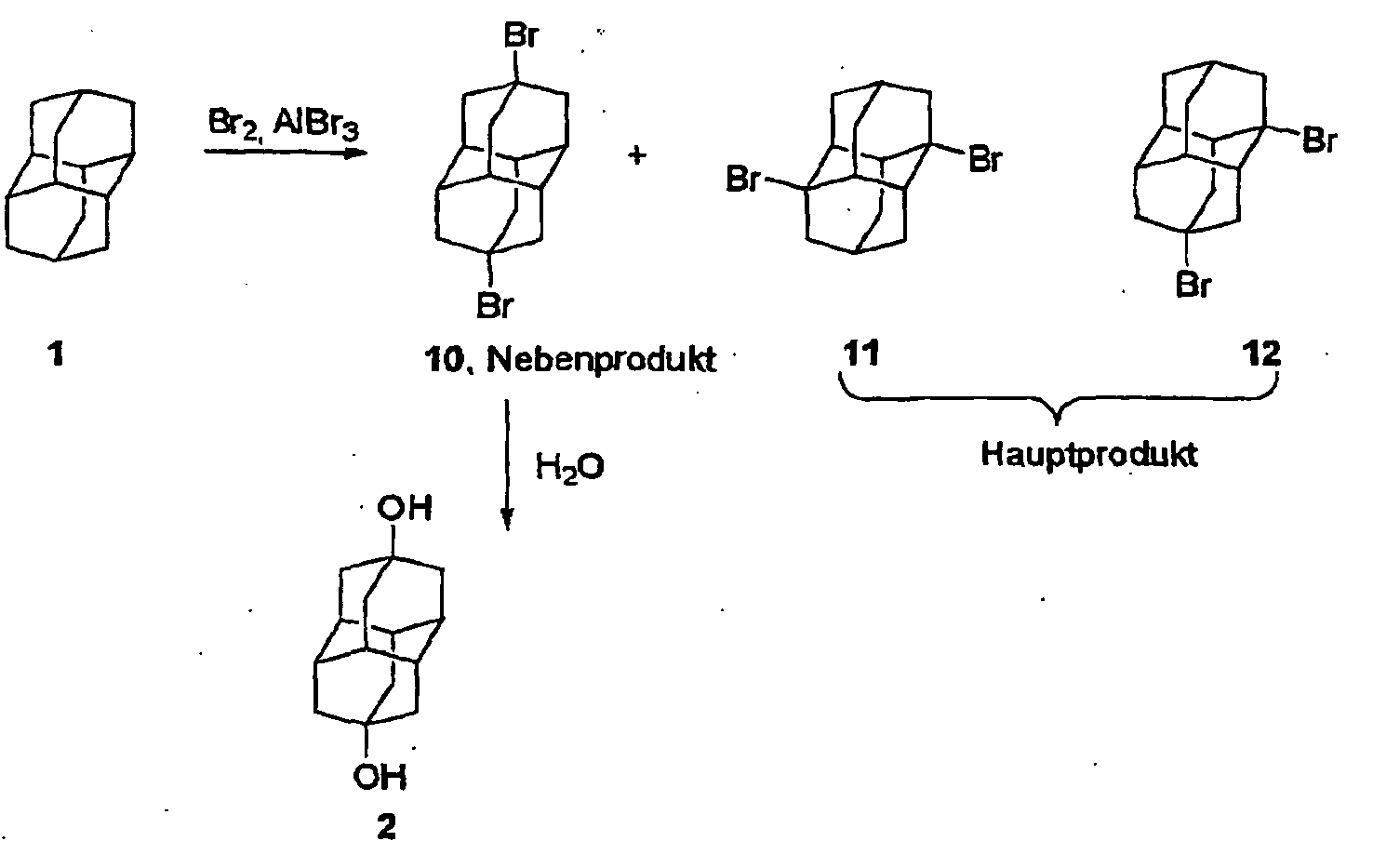
- So ergibt die Oxidation von Diamantan 1 in 96% Schwefelsäure nur 5% des entsprechenden Dihydroxyderivats 2, neben den Hauptprodukten 3 und 4 (Courtney, T.; Johnston, D. E.; McKervey, M. A.; Rooney, J. J. Chemistry of diamantane. 1. Synthesis and functionalization reactions. Journal of the Chemical Society, Perkin Transactions 1: Organic and Bio-Organic Chemistry (1972-1999) (1972), (21), 2691-6). Bei dieser Methode ist die Ausbeute des gewünsähten Produktes 2 sehr schlecht, und die entstehende Mischung ist nur mit hohem Aufwand zu trennen.


- Oxidation von 4-Hydroxydiamantan 8 mit dem Pilz Rhizopus nigricans ergibt eine Mischung von 1,9-Dihydroxydiamantan 9 und 4,9-Dihydroxydiamantan 2 in einem Verhältnis von 5:1 in 69% Ausbeute (Blaney, Frank; Johnston, Don E.; McKervey, M. Anthony; Jones, Ewart R. H.; Pragnell, John. Hydroxylation of diamantan-1-and -4-oi with the fungus Rhizopus nigricans. Journal of the Chemical Society, Chemical Communications (1974), (8), 297-8). Nachteil dieser Methode ist, dass 7 als sehr teures Ausgangsmaterial eingesetzt wird und eine schwer trennbare Mischung entsteht, in der 2 nur zu etwa 15% enthalten ist

- Bromierung von Diamantan zu 4,9-0ibromodiamantan 10, gefolgt von einer Hydrolyse zu 2 (Janku, Josef; Burkhard, Jiri; Vodicka, Ludek. Hydrolysis of bromine derivatives of diamantane with nitric acid. Zeitschrift fuer Chemie (1981), 21(9), 325-6). Diese Methode verläuft nur mit geringer Selektivität bei der Bromierung und dementsprechend geringer Ausbeute an 3.
- Die
US 2005/0074690 A1 beschreibt Polymere enthaltend Monomereinheiten aus Diamantanen. In dieser In dieser Schrift wird ein Verfahren zur Herstellung von zweifach bis vierfach hydroxylierten Diamantanen durch Umsetzung von Diamantan mit N Hydroxyphthalimid und Co-II-acetylacetonat beschrieben. Nachteilig ist, dass ein Produktgemisch entsteht und die Ausbeute gering ist.
DieUS 5,430,193 und dieUS 5,410,092 beschreiben Verfahren zur Überführung eines Diarnantan-Lactons in das korrespondierende Hydroxyketon, wobei Hydroxy- und Carbonylgruppe durch mindestens ein Brückenkopf-GAtom getrennt sind. Dabei wird das Diamantoid-Lacton mit einem Anhydrid in Gegenwart von. Säure umgesetzt und der als Zwischenprodukt entstehende Ketoester hydrolysiert. Die selektive Einführung funktioneller Gruppen in unsubstituierte Diamantane ist mit diesen Verfahren jedoch nicht möglich. - Die
WO 03/050066 A1 WO 021057201 A2 - Die Oxidation von Diamantan 1 mit m-Chlorperbenzoesäure oder HNO3 als Oxidationsmittel und CH2Cl2 als Lösungsmittel ist in AA Fokin, BA Tkachenko, PA Guchenko, DV Gusev, PR Schreiner: Functionalized Nanodiamonds Part I. An Experimental Assessment of Diamantane and Computational Predictions for Higher Diamondoids. Chem. Eur. J. 2005, 11, 7091-7101 beschrieben. Allerdings entsteht bei Verwendung -von Salpetersäure und anschließender Umsetzung mit Wasser ein Gemisch verschiedener Monohydroxydiamantane (8 und 13); bei Verwendung von m-Chlorperbenzoesäure entstehen sogar Gemische verschiedener Mono- und Dihydroxyadarnantane.

- Die vorliegende Erfindung zeichnet sich gegenüber dem Stand der Technik dadurch aus, dass sie es gestattet, substituierte Diamantane aus den korrespondierenden nitroxylierten Diamantanen selektiv herzustellen.
Überraschend wurde gefunden, dass - mononitroxylierte Diamantane sich mit zahlreichen Nucleophilen abfangen lassen und somit als Zwischenprodukte für die Herstellung einfach substituierter Diamantane geeignet sind, und dass
- die dem Fachmann bisher nicht bekannten mindestens zweifach nitroxylierten Diamantane zur selektiven Herstellung mindestens zweifach derivatisierter Diamantane verwendet werden können.
- Des Weiteren liefert die vorliegende Erfindung Verfahren, um substituierte Diamantane herzustellen. Dabei werden die als Edukt verwendeten Diamantane in einem ersten Schritt nitroxyliert. Die Nitroxygruppe ist eine gute Abgangsgruppe und lässt sich daher gut durch andere Nucleophile substituieren. In einem weiteren Schritt werden die nitroxylierten Diamantane mit Nucleophilen umgesetzt
- Überraschend wurde gefunden, dass im Falle einer mindestens zweifachen Nitroxylierung mindestens eine Nitroxygruppe an ein apicales Kohlenstoffatom des Diamantans gebunden wird.
Des Weiteren wurde im Rahmen der Arbeiten, die zur vorliegenden Erfindungen führten, gefunden, dass sich zweifach nitroxylierte sowie zweifach hydroxylierten Diamantane in Gegenwart einer starken Säure umlagern, wenn eine der beiden Nitroxy- oder Hydroxygruppen zuvor an ein apicales Kohlenstoffatom gebunden war. Bei dieser Umlagerung wandert eine Nitroxy- oder Hydroxygruppe, der zuvor nicht an ein apicales Kohlenstoffatom gebunden war, an ein apicales Kohlenstoffatom, an das zuvor Wasserstoff gebunden war. Das Umlagerungsprodukt kann anschließend mit weiteren Nucleophilen umgesetzt werden. - Dem Fachmann ist bekannt, wie er Hydroxygruppen in andere funktionelle Gruppen überführen kann. So lassen sich Hydroxyverbindungen durch Umsetzung mit Ameisensäure in konzentrierter Schwefelsäure zu den korrespondierenden Carbonsäuren umsetzen. Diese Koch-Haaf-Reaktion ist beispielsweise in L Vodicka, J Janku, J Burkhard: "Synthesis of diamantanedicarboxylic acid with the carboxy groups bonded at tertiary carbon atoms." Lab. Synth. Fuels, Prague Inst. Chem.-Technol., Prague, Czech. Collection of the Czechoslovak Chemical Communications (1983), 48 (4), 1162-1172 beschrieben. Dem Fachmann ist ebenfalls bekannt, dass er die Koch-Haaf-Reaktion auch verwenden kann, um nitroxylierte Verbindungen in die entsprechenden Carbonsäuren zu überführen. Diese Reaktion ist in TM Gund, M Nomura, PvR Schleyer, J. Org. Chem. 1974, 39, 2987-2994, beschrieben.
Die Einführung von Alkylaminogruppen ist dem Fachmann bekannt und beispielsweise in AA Fokin, BA Tkachenko, PA Guchenko, DV Gusev, PR Schreiner Functionalized Nanodiamonds Part I. An Experimental Assessment of Diamantane and Computational Predictions for Higher Diamondoids. Chem. Eur. J. 2005, 11, 7091-7101 am Beispiel der Umsetzung von bromierten Diamantanen mit Acetonitril beschrieben. Der Fachmann weiß, dass er in analoger Weise auch Hydroxy- und Nitroxygruppen in Alkylaminogruppen überführen kann.
Dem Fachmann ist bekannt, wie er Hydroxy- und Nitroxygruppen in Alkylcarbonsäureester überführen kann, wobei OH- bzw. -ONO2-Gruppen durch OCO-AlkylGruppen substituiert werden. So ist die Herstellung von 1-Acetoxydiamantan aus 1-Hydroxydiamantan und Essigsäure beispielsweise in J Janku, L Vodicka, J Jeziorsky. Sbornik Vysoke Skoly Chemicko-Technologicke v Praze, D: Technologie Paliv. 1984, D49, 5-23 beschrieben. - Aufgabe der Erfindung ist es, mindestens zweifach nitroxylierte Diamantane sowie ein Verfahren zu deren Herstellung bereitzustellen. Eine weitere Aufgabe der Erfindung ist es, die Verfahren zur Herstellung substituierter Diamantane zu verbessem, wobei unter Verbesserung eine Erhöhung der Ausbeute und/oder eine Erhöhung der Selektivität der Produktbildung verstanden wird.
- Die erfindungsgemäßen, mindestens zweifach nitroxylierten Diamantane besitzen die allgemeine Strukturformel

- wobei n eine ganze Zahl zwischen 0 und 6 darstellt,
- m eine ganze Zahl zwischen 0 und 1 darstellt,
- die Methylgruppe im Falle von m = 1 bevorzugt an Position 1, 3 oder 4 des Diamantans gebunden ist,
- und mindestens eine Nitroxygruppe an ein apicales Kohlenstoffatom gebunden ist.
- Die Aufgabe, verbesserte Verfahren zur Herstellung der substituierter Diamantane bereitzustellen, wird erfindungsgemäß gelöst, indem in einem ersten Schritt 1 Äquivalent des Diamantans mit je 1,8 bis 20,0 Äquivalenten eines Nitroxylierungsmittels pro einzuführender Nitroxygruppe umgesetzt wird. Optional findet die Umsetzung in einem organischen Lösungsmittel statt Bevorzugt wird das organische Lösungsmittel ausgewählt aus der Gruppe CH2Cl2, CHCl3, CCl4, Diethylether, THF, Ethylacetat oder Gemischen davon.
- Erfindungsgemäß werden die nitroxylierten Diamantane in einem weiteren Schritt mit einem Nucleophil umgesetzt, wobei das Nucleophil alle Nitroxygruppen substituiert.
- Überraschend wurde gefunden, dass Ausbeute und/oder Selektivität der Herstellung mindestens zweifach substituierter Diamantane signifikant gesteigert werden, indem Diamantane 1 zunächst mindestens zweifach nitroxyliert werden und das dabei entstehende Produktgemisch anschließend in Gegenwart eines Nucleophils zum korrespondierenden Gemisch mehrfach substituierter Diamantoide umgesetzt wird. Dabei bezieht sich der Begriff substituiert auf solche funktionellen Gruppen, die erst mit Hilfe der erfindungsgemäßen Verfahren eingeführt werden oder eingeführt worden sind.
Es wurde gefunden, dass bei der mindestens zweifachen Nitroxylierung von Diamantanen mindestens eine Nitroxylgruppe in einer apicalen Position des Diamantans gebunden wird, d.h. in Position 4 oder 9. Die Nitroxygruppe ist eine gute Abgangsgruppe und lässt sich durch andere nucleophile Gruppen ersetzen. Dem Fachmann ist bekannt, wie er diese Nucleophile einführen muss. Ferner ist bekannt, dass und wie die entstehende Produktgemische getrennt und gereinigt werden können, beispielsweise durch Extraktion, Umkristallisation oder Chromatographie. - In einer bevorzugten Ausführungsform der vorliegenden Erfindung wird das mindestens zweifach nitroxylierte Diamantan in Gegenwart einer starken Säure umgelagert. Überraschend wurde gefunden, dass sich mindestens zweifach nitroxylierte Diamantane, bei denen mindestens eine Nitroxygruppe an ein apicales Kohlenstoffatom gebunden ist, bei Zugabe einer starken Säure umlagern. Bei dieser Umlagerung wandert eine Nitroxygruppe, die zuvor nicht an ein apicales Kohlenstoffatom gebunden war, an ein apicales Kohlenstoffatom, an das zuvor Wasserstoff gebunden war. Alternativ können die mindestens zweifach nitroxylierten Diamantane, die mindestens eine apicale Nitroxygruppe tragen, zunächst mit Wasser (als Nucleophil) hydrolysiert werden und anschließend in Gegenwart einer starken Säure umgelagert werden. Im Rahmen der vorliegenden Erfindung wurde festgestellt, dass sich nicht nur Dinitroxy-, sondern auch Dihydroxydiamantane in Gegenwart einer starken Säure umlagern, wenn zuvor mindestens eine apicale Nitroxy- oder Dihydroxygruppe an ein apicales Kohlenstoffatom gebunden war. Nitrierte Verbindungen sind dagegen nicht in der Lage, die oben beschriebene Umlagerungsreaktion einzugehen. Dem Fachmann ist bekannt, dass es nach dem derzeitigen Stand der Technik keine Möglichkeit gibt, die Nitrogruppe -NO2 in eine Nitroxygruppe -ONO2 überzuführen. Die erfindungsgemäße mindestens zweifache Nitroxylierung ist daher der entscheidende Schritt bei der Herstellung mindestens zweifach substituierter Diamantane mit hoher Ausbeute und/oder Selektivität.
- Die saure Umlagerung von mindestens zweifach nitroxylierten Diamantanen ist beispielhaft, aber nicht erschöpfend, für 1,4-Dinitroxydiamantan 16 gezeigt:

- Die saure Umlagerung von mindestens zweifach hydroxylierten Diamantanen ist beispielhaft, aber nicht erschöpfend, für 1,4-Dihydroxydiamantan 2 gezeigt:

- Dem Fachmann stehen hiermit folgende erfindungsgemäße Verfahren zur Herstellung mindestens zweifach substituierter Diamantane zur Verfügung:
- a) mindestens zweifache Nitroxylierung, gefolgt von der Substitution aller Nitroxygruppen mit einem Nucleophil oder
- b) mindestens zweifache Nitroxylierung, anschließende Umlagerung in Gegenwart einer starken Säure, nach erfolgter Umlagerung werden alle Nitroxygruppen durch ein Nucleophil ersetzt oder
- c) mindestens zweifache Nitroxylierung, anschließende Umsetzung mit Wasser (als Nucleophil), Umlagerung der mindestens zweifach hydroxylierten Verbindung in Gegenwart einer starken Säure, nach erfolgter Umlagerung werden alle Hydroxygruppen durch ein weiteres Nucleophil ersetzt.
- Die erfindungsgemäßen Verfahren zur Herstellung mindestens zweifach substituierter Diamantoide sind nachfolgend beschrieben.
- Die Herstellung der mindestens zweifach nitroxylierten Diamantoide nach dem erfindungsgemäßen Verfahren wird nach folgender allgemeiner Vorschrift durchgeführt

1 Mol des Diamantoids 18 wird mit 0 bis 2 Litern eines unpolaren organischen Lösungsmittels und 8 Mol bis 25 Mol eines Nitroxylierungsreagenzes pro einzuführender Nitroxygruppe bei -5 °C bis 5°C gemischt und für 1 h bis 3 h bei 20°C bis 30°C gerührt.
Das Rohprodukt 14 kann direkt weiter verarbeitet oder optional isoliert werden. - Im letzteren Fall wird überschüssige Säure mit festem NaHCO3 abgefangen. Der dabei gebildete Niederschlag wird abfiltriert und das unpolare organische Lösungsmittel bei vermindertem Druck entfernt.
- Diamantane im Sinne der vorliegenden Erfindung sind beispielsweise Diamantan und dessen einfach oder mehrfach alkylsubstituierten Derivate.
Bevorzugt wird bei der Nitrierung ein organisches Lösungsmittel verwendet, ausgewählt aus der Gruppe halogenierter Kohlenwasserstoff mit ein bis zwei C-Atomen, bevorzugt Methylenchlorid, Chloroform, Tetrachlorkohlenstoff, Diethylether, Tetrahydrofuran, Ethylacetat oder ein Gemisch davon.
Unter "Nitroxylierungsmittel" wird im Rahmen der vorliegenden Erfindung konzentrierte Salpetersäure mit w (HNO3) = 75% bis 100% oder eine Vorstufe der konzentrierten Salpetersäure verstanden. Vorstufen der konzentrierten Salpetersäure sind beispielsweise Gemische aus konzentrierter Schwefelsäure mit w (H2SO4) ≧ 96% und mindestens einem Alkalimetallnitrat, beispielsweise Lithiumnitrat, Natriumnitrat, Kaliumnitrat, oder Gemische aus Ozon und Stickstoffdioxid oder NO+X- und NO2 +X- Reagenzien, wobei X ein Halogen ist, ausgewählt aus Fluor, Chlor, Brom, Iod. Dem Fachmann ist bekannt, wie er aus diesen Vorstufen der konzentrierten Salpetersäure die konzentrierte Salpetersäure gewinnt. -

- Das Rohprodukt 14 wird zu einer konzentrierten starken Säure gegeben, wobei pro Nitroxygruppe des als Edukt eingesetzten Rohproduktes 14 je 1,5 Mol bis 5 Mol Säure eingesetzt werden. Es wird 1 h bis 3 h bei 20 °C bis 30 °C gerührt. Danach wird die Reaktionsmischung 19 auf Eis gegeben (1 bis 3 Volumenteile Eis pro Volumenteil Reaktionsmischung) und optional filtriert.
Anschließend wird das Reaktionsprodukt 20 gereinigt, wobei die Reinigung mittels Chromatographie, Umkristallisation, diskontinuierlicher oder kontinuierlicher Extraktion erfolgt. -

- Das Rohprodukt 14 wird nach dem Rühren bei 20°C bis 30 °C mit Wasse r im Verhältnis Reaktionsmischung : Wasser = 1 : 0,3 bis 1: 0,7 verdünnt. Das organische Lösungsmittel wird entfernt und die verbleibende wässrige Phase für 1 h bis 2 h zum Rückfluss erhitzt. Dann wird die Reaktionsmischung auf 20 °C bis 30 °C abgekühlt und filtriert. Der Rückstand bestehend aus einem Gemisch verschiedener hydroxylierter Diamantane 21 wird zu einer konzentrierten starken Säure gegeben, wobei pro Nitroxygruppe des als Edukt eingesetzten Rohproduktes 14 je 1,5 Mol bis 5 Mol Säure eingesetzt werden. Es wird 1 h bis 3 h bei 20 °C bis 30 °C gerührt. Danach wird die Reaktionsmischung 20 auf Eis gegeben (1 bis 2 Volumenteile Eis pro Volumenteil Reaktionsmischung) und optional filtriert.
Optional kann auf die Umlagerung in Gegenwart einer konzentrierten starken Säure verzichtet werden.
Anschließend wird das Reaktionsprodukt gereinigt, wobei die Reinigung mittels Chromatographie, Umkristallisation, diskontinuierlicher oder kontinuierlicher Extraktion erfolgt. - Dem Fachmann ist bekannt, dass starke Säuren solche Säuren sind, deren pKa-Wert kleiner oder gleich 2 ist. Für die Umlagerungsreaktion geeignete starke Säuren sind beispielsweise, aber nicht erschöpfend, Schwefelsäure, Salzsäure, Bromwasserstoffsäure, lodwasserstoffsäure, Salpetersäure, Phosphorsäure und Trifluoressigsäure. Bevorzugt wird die starke Säure in konzentrierter Form eingesetzt, wobei unter "konzentriert" solche Lösungen starker Säuren verstanden werden, deren pH-Wert kleiner oder gleich Null ist.
Die optionale Filtration nach der Umlagerung erfolgt bevorzugt über eine Glas- oder Porzellanfritte.
Die optionale Reinigung des Produktes erfolgt durch Umkristallisation, chromatographie oder Extraktion.
Im Falle der Umkristallisation wird ein Lösungsmittel verwendet, das ausgewählt ist aus der Gruppe aliphatische kettenförmige oder cyclische Ether mit zwei bis vierzehn C-Atomen, halogenierte Kohlenwasserstoffe mit ein bis zwei C-Atomen, aliphatische kettenförmige oder cyclische Kohlenwasserstoffe mit vier bis vierzehn C-Atomen, aromatische oder araliphatische Kohlenwasserstoffe mit sechs bis vierzehn C-Atomen und ihren Gemischen. Erfolgt die Reinigung mittels Extraktion, so wird als Extraktionsmittel mindestens ein organisches Lösungsmittel verwendet, ausgewählt aus der Gruppe aliphatische kettenförmige oder cyclische Ether mit zwei bis vierzehn C-Atomen, halogenierte Kohlenwasserstoffe mit ein bis zwei C-Atomen, aliphatische kettenförmige oder cyclische Kohlenwasserstoffe mit vier bis vierzehn C-Atomen, aromatische oder araliphatische Kohlenwasserstoffe mit sechs bis vierzehn C-Atomen und ihren Gemischen. - Dem Fachmann ist bekannt, wie er mittels nucleophiler Substitution ONO2- oder OH-Gruppen in andere funktionelle Gruppen überführen kann. Beispielhaft, aber nicht erschöpfend, sind hier exemplarisch -NHCOCH3, -COOH, -NHCOOH als funktionelle Gruppen und CH3COOH, HCOOH, CH3CN, H2O, HCONH2 als Nucleophile genannt. Wasser selbst dient im Rahmen der vorliegenden Erfindung des Weiteren auch als Nucleophil, mit dem die -ONO2-Gruppen substituiert werden können.
- Diamantanderivate finden Anwendungen beispielsweise in der Pharmakologie, der Mikroelektronik und den Materialwissenschaften. In der Pharmakologie können sie für Pharmakophoren-basiertes Wirkstoffdesign, kombinatorische Drug Discovery, Drug Delivery und für Diagnostika verwendet werden. In der Mikroelektronik sind Diamantoide geeignete Werkstoffe für starre, haltbare elektronische Bauteile im Nanometerbereich, für Anwendungen im Bereich der Feldemission, für Sensoren, für die kontrollierte Einführung von Dotierungssubstanzen wie N, P, B in der Halbleitertechnik sowie als Wachsturnskeim in der Produktion künstlicher Diamanten. Des Weiteren finden Diamantoide Verwendung in den Materialwissenschaften, beispielsweise für Oberflächenfilme, Beschichtungen und Polymere.
- Dem Fachmann ist ohne Weiteres ersichtlich, dass sich die in der vorliegenden Erfindung beschriebene Reaktionsfolge aus mindestens zweifacher Nitroxylierung und anschließender Umlagerung auch für die Herstellung anderer Diamantoide verwenden lässt, beispielsweise für Adamantan, Triamantan, Tetramantan, Pentamant, Hexamantan, Heptamantan, Octamantan, Nonamantan und Decamantan.
-

- Diamantan 1 (19,3 g; 0,103 mol), CH2Cl2 (100 mal) und 99%-ige HNO3 (38,5 mL; 0,91 moll werden bei 0 °C gemischt, 30 Minuten bei 20 °C gerührt, auf 0°C abgekühlt und der Säureüberschuss mit festem NaHCO3 neutralisiert. Der Niederschlag wird abfiltriert und CH2Cl2 bei vermindertem Druck entfernt. Der nach Entfernen des CH2Cl2 verbleibende Rückstand wird aus n-Hexan umkristallisiert und ergibt 21,7 g (85%) 1-Nitroxydiamantan 22.
1H-NMR: (400 MHz, δ, ppm, CDCl3): 2.30 bs (2H), 2.15 bs (3H), 2.05 m (6H), 1.68 m (4H), 1.60 m (2H), 1.47 m (2H).
13C-NMR: (100 MHz, δ, ppm, CDCl3): 93.7 (C), 40.5 (CH), 39.3 (CH2), 39.2 (CH), 37.5 (CH2), 36.7 (CH2), 36.3 (CH), 32.3 (CH2), 30.3 (CH), 24.6 (CH). Charakteristische Banden im IR-Spektruni: (v, com-1, CHCl3): 2997 (C-H), 2855 (C-H), 1611 (N=O), 1306 (N=O), 1247 (C-0). -

- 1 g (4.0 mmol) 1-Nitroxydiamantan 22 werden in 100 mL Acetonitril gelöst. Das Reaktionsgemisch wird für 10 h zum Rückfluss erhitzt und anschließend auf Raumtemperatur abgekühlt. Dann wird 1 mL Wasser hinzugefügt. Nach Entfernen der flüchtigen Bestandteile bei vermindertem Druck wird der Rückstand aus CCl4 umkristallisiert. Es resultieren 0.78 g (79 %) 1 Acetaminodiarnantan 23.
1H-NMR: (400 MHz, δ, ppm, CDCl3): 5.50 (brs, 1H), 2.22 (m, 2H), 2.03 (m, 2H), 1.93 (m, 4H), 1.90 (s, 4H), 1.49 (m, 2H), 1.45 (m, 8H).
13C-NMR: (100 MHz, δ, ppm, CDCl3): 169.1. 56.1, 41.5, 39.1, 38.7, 38.1, 37.3, 37.0, 32.8, 28.6, 25.1, 24.5.
MS (70 eV) (m/z, %): 245 (71), 230 (14), 202 (7), 186 (94), 171 (4), 157 (6), 143 (11), 130 (45), 129 (41), 95 (90), 94 (100), 79 (25), 67 (18), 53 (11). -

- 1 g (4,0 mmol) 1-Nitroxydiamantan 22 werden bei einer Temperatur von 10 °C unter Rühren zu einem Gemisch aus 25 mL 98 %-iger H2SO4 und 2 mL Ameisensäure gegeben. Zusätzlich werden bei dieser Temperatur innerhalb von 1 h weitere 3 mL Ameisensäure zugegeben. Das Reaktionsgemisch wird auf 100 g Eis gegeben und dreimal mit je 20 mL Chloroform extrahiert. Die vereinigten Extrakte werden zunächst mit Wasser, dann mit Sole gewaschen und über Na2SO4 getrocknet. Entfernen des Lösungsmittels bei vermindertem Druck und anschließende Umkristallisation des Rückstands aus CHCl3 ergeben 0.75 g (81 %) 1-Diamantancarbonsäure 24.
-

- 1 g (4,0 mmol) 1-Nitroxydiamantan 22 werden in 10 mL Essigsäure gelöst Das Reaktionsgemisch wird für 10 h bei 70 °C gerührt, a uf Raumtemperatur abgekühlt, mit 30 mL Wasser verdünnt und dreimal mit je 10 mL Chloroform extrahiert. Die vereinigten Extrakte werden zunächst mit Wasser, dann mit Sole gewaschen und über Na2SO4 getrocknet. Entfernen des Lösungsmittels bei vermindertem Druck und Umkristallisation des Rückstands aus n-Hexan ergeben 0,88 g (89 %) 1-Acetoxydiamantan 25.
-
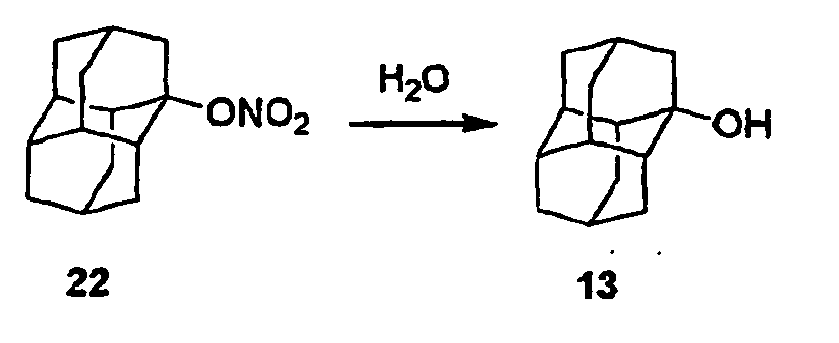
- 1 g (4,0 mmol) 1-Nitroxydiamantan 22 werden in 4 mL 30 %-iger Salpetersäure gelöst und für 3 h zum Rückfluss erhitzt. Das Reaktionsgemisch wird abgekühlt und filtiert Der Niederschlag wird im Vakuum getrocknet und aus Cyclohexan umkristallisiert. Es resultieren 0,73 g (90 %) 1-Hydroxydiamantan 13.
-

- Diamantan 1 (10 g, 0,053 mol), CH2Cl2 (130 mL) und 99 %-ige HNO3 (57 mL, 1,35 mol) werden bei 0 °C gemischt, für 10 h bei 25 °C g erührt, auf 0 °C abgekühlt und der Säureüberschuss mit trockenem NaHCO3 neutralisiert. Der Niederschlag wird abfiltriert und CH2Cl2 bei vermindertem Druck entfernt. Der nach dem Entfernen des CH2Cl2 verbleibende Rückstand enthält ein Gemisch von Dinitroxydiamantanen 26 (16,1 g; 97 %).
1H-NMR: (400 MHz, δ, ppm, CDCl3): 2.40-2.00 m, 1.91-1:35 m. Charakteristische Signale der C-ONO2-Gruppe im 13C-NMR: (100 MHz, δ, ppm, CDCl3): 93.7 (C), 91.9 (C), 90.5 (C), 87.9 (C).
Charakteristische Banden im IR-Spektrum (v, cm-1, CHCl3): 2990 (C-H), 2860 (C-H), 1610 (N=O), 1306 (N=0), 1250 (C-0), 1245 (C-0). -
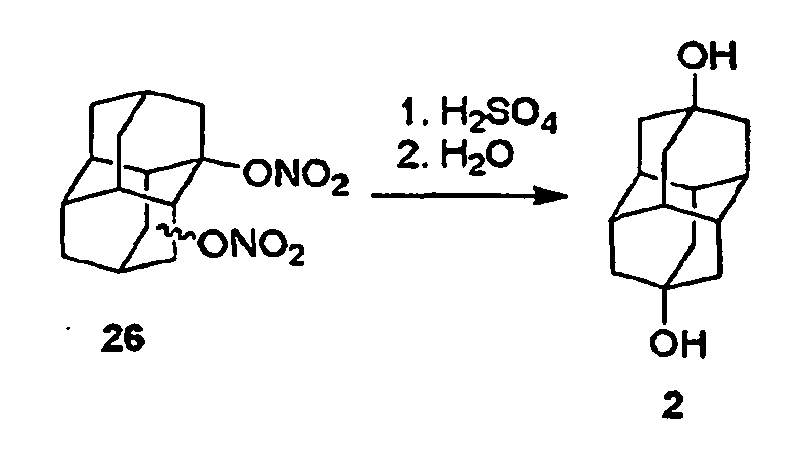
- 5 g des Gemisches der Dinitroxydiamantane 26 werden bei 0 °C zu 100 mL einer 98 %-igen H2SO4 gegeben und anschließend für 2,5 h bei Raumtemperatur gerührt Danach wird das Reaktionsgemisch auf 300 g Eis gegossen. Extraktion mit Chloroform, Entfernen des Lösungsmittels unter vermindertem Druck und Umkristallisation des Rückstandes aus Methanol ergeben 2,5 g (71 %) 4,9-Dihydroxydiamantan 2 in Form eines farblosen Feststoffes, Schmelzpunkt 291-293 °C (Lit. 290-292 °C).
-

- Diamantan 1 (1,28 g, 0,149 mol), CH2Cl2 (250 mL) und 100% HNO3 (90 mL, 2,13 mol) werden bei 0 °C gemischt, für 2 h bei 25 °C ge rührt und im Anschluss mit Wasser (180 mL) verdünnt. Das CH2Cl2 wird entfernt, und die Reaktionsmischung 26 wird für 1,5 h refluziert. Entfernung des Wassers im Vakuum ergab als Rückstand eine Mischung verschiedener Oligohydroxyde 20. Diese 20 werden zu 200 mL 96% H2SO4 gegeben und für 2 h bei Raumtemperatur gerührt. Danach wird die Reaktionsmischung auf 300 g Eis gegeben und filtriert. Extraktion des Filtrats mit einem oder mehreren organischen Lösemitteln (typischerweise Diethylether) ergibt 21,3 g (0,097 mmol, 65%) 4,9-Dihydroxydiamantan (2, m=0) als weißen Feststoff, Smp. 291-293 °C (aus Methanol, lit. 290-292 °C).
Claims (13)
- Verbindung der Formel
 wobei n eine ganze Zahl zwischen 0 und 6 darstellt,m eine ganze Zahl zwischen 0 und 1 darstellt,die Methylgruppe im Falle von m = 1 bevorzugt an Position 1, 3 oder 4 des Diamantans gebunden ist,und mindestens eine Nitroxygruppe an ein apicales Kohlenstoffatom gebunden ist.
 - Verfahren zur Herstellung eines mindestens zweifach nitroxylierten Diamantans, gekennzeichnet durch die Schrittea) Mischen des zu nitroxylierenden Diamantans mit einem Nitroxylierungsreagenz bei -5 °C bis 5 °C im Stoffmengenverhältnis Diamantan : Nitroxylierungsmittel = 1 : 8 bis 1: 25 pro einzuführender Nitroxygruppe,b) Rühren bei 20 °C bis 30 °C für 1 h bis 3 h.
- Verfahren gemäß Anspruch 2, dadurch gekennzeichnet, dass als Nitroxylierungsmittel Nitriersäure oder konzentrierte Salpetersäure verwendet wird.
- Verfahren gemäß Anspruch 2, dadurch gekennzeichnet, dass als Nitroxylierungsmittel eine Vorstufe der konzentrierten Salpetersäure verwendet wird, bevorzugt ein Gemisch aus konzentrierter Schwefelsäure und einem Alkalimetallnitrat oder ein Gemisch aus Ozon und Stickstoffdioxid, NO+X- und NO2 +X- Reagenzien, wobei X ein Halogen ist, ausgewählt aus Fluor, Chlor, Brom, Iod.
- Verfahren gemäß einem der Ansprüche 2 bis 4, dadurch gekennzeichnet, dass in Schritt a) zusätzlich ein organisches Lösungsmittel verwendet wird, ausgewählt aus der Gruppe CH2Cl2, CHCl3, CCl4, Diethylether, THF, Ethylacetat oder ein Gemisch davon.
- Verfahren zur Herstellung mindestens zweifach substituierter Diamantane, gekennzeichnet durch die Schrittea) Herstellung eines mindestens zweifach nitroxylierten Diamantans gemäß einem der Ansprüche 2 bis 5,b) Umsetzung des mindestens zweifach nitroxylierten Diamantans mit einem Nucleophil.
- Verfahren zur Herstellung mindestens zweifach hydroxylierter Diamantane, gekennzeichnet durch die Schrittea) Herstellung eines mindestens zweifach nitroxylierten Diamantans gemäß einem der Ansprüche 2 bis 5,b) Zugabe von Wasser,c) Erhitzen zum Rückfluss für 1 h bis 2 h,d) Zugabe von 1,5 bis 5 Mol einer starken konzentrierten Säure pro Nitroxygruppe, die gemäß Schritt a) eingeführt wurde,e) Rühren für 1 h bis 3 h bei 20 °C bis 30 °C,f) Zugabe von je 1 Volumenteil der Reaktionsmischung aus Schritt e) zu 1 bis 2 Volumenteilen Eis.
- Verfahren zur Herstellung mindestens zweifach hydroxylierter Diamantane, gekennzeichnet durch die Schrittea) Herstellung eines mindestens zweifach nitroxylierten Diamantans gemäß einem der Ansprüche 2 bis 5,b) Zugabe von 1,5 Mol bis 5 Mol einer starken konzentrierten Säure pro Nitroxygruppe, die gemäß Schritt a) eingeführt wurde,c) Rühren bei 20 °C bis 30 °C für 1 h bis 3 h,d) Zugabe der Reaktionsmischung aus Schritt c) zu 1 bis 3 Volumenteilen Eis pro Volumenteil der Reaktionsmischung.
- Verfahren zur Herstellung mindestens zweifach hydroxylierter Diamantane gemäß einem der Ansprüche 7 und 8, dadurch gekennzeichnet, dass die starke konzentrierte Säure in Schritt e) ausgewählt ist aus der Gruppe Schwefelsäure, Salzsäure, Bromwasserstoffsäure, lodwasserstoffsäure, Salpetersäure, Phosphorsäure.
- Verfahren zur Herstellung mindestens zweifach substituierter Diamantane, gekennzeichnet durch die Schrittea) Herstellung eines mindestens zweifach nitroxylierten Diamantans gemäß einem der Ansprüche 2 bis 5,b) Umsetzen des mindestens zweifach nitroxylierten Diamantans mit einem Nucleophil, ausgewählt aus der Gruppe HCOOH, CH3COOH, HCONH2, CH3CN.
- Verfahren zur Herstellung mindestens zweifach substituierter Diamantane, gekennzeichnet durch die Schrittec) Herstellung eines mindestens zweifach nitroxylierten Diamantans gemäß einem der Ansprüche 2 bis 5,d) Zugabe von 1,5 Mol bis 5 Mol einer starken konzentrierten Säure pro Nitroxygruppe, die gemäß Schritt a) eingeführt wurde,e) Rühren bei 20 °C bis 30 °C für 1 h bis 3 h,f) Umsetzen des Reaktionsgemisches aus Schritt c) mit einem Nucleophil, ausgewählt aus der Gruppe HCOOH, CH3COOH, HCONH2, CH3CN.
- Verfahren zur Herstellung mindestens zweifach substituierter Diamantane, gekennzeichnet durch die Schrittea) Herstellung eines mindestens zweifach hydroxylierten Diamantans gemäß einem der Ansprüche 7 bis 9,b) Umsetzen des zweifach hydroxylierten Diamantans mit einem Nucleophil, ausgewählt aus der Gruppe HCOOH, CH3COOH, HCONH2, CH3CN.
- Verfahren zur Herstellung substituierter Diamantane gemäß einem der Ansprüche 7 bis 12, dadurch gekennzeichnet, dass zusätzlich und als letzter Schritt eine Reinigung des Produktes durchgeführt wird.
Applications Claiming Priority (2)
| Application Number | Priority Date | Filing Date | Title |
|---|---|---|---|
| DE102005058357A DE102005058357A1 (de) | 2005-12-06 | 2005-12-06 | Verfahren zur Herstellung von substituierten Diamantanen |
| PCT/DE2006/002146 WO2007065409A2 (de) | 2005-12-06 | 2006-12-04 | Verfahren zur herstellung von substituierten diamantanen |
Publications (2)
| Publication Number | Publication Date |
|---|---|
| EP1960330A2 EP1960330A2 (de) | 2008-08-27 |
| EP1960330B1 true EP1960330B1 (de) | 2011-11-02 |
Family
ID=38108599
Family Applications (1)
| Application Number | Title | Priority Date | Filing Date |
|---|---|---|---|
| EP06828601A Not-in-force EP1960330B1 (de) | 2005-12-06 | 2006-12-04 | Verfahren zur herstellung von substituierten diamantanen |
Country Status (5)
| Country | Link |
|---|---|
| US (1) | US8716539B2 (de) |
| EP (1) | EP1960330B1 (de) |
| AT (1) | ATE531681T1 (de) |
| DE (1) | DE102005058357A1 (de) |
| WO (1) | WO2007065409A2 (de) |
Families Citing this family (3)
| Publication number | Priority date | Publication date | Assignee | Title |
|---|---|---|---|---|
| DE102008027341A1 (de) | 2008-06-07 | 2009-12-10 | Justus-Liebig-Universität Giessen | Monoveretherte Diole der Diamantoiden |
| US8581262B2 (en) | 2009-08-04 | 2013-11-12 | Merck Patent Gmbh | Electronic devices comprising multi cyclic hydrocarbons |
| CN113061072B (zh) * | 2021-03-30 | 2023-12-15 | 郑州药领医药科技有限公司 | 一种制备1-环丙基萘的方法 |
Family Cites Families (5)
| Publication number | Priority date | Publication date | Assignee | Title |
|---|---|---|---|---|
| US5298666A (en) | 1992-09-18 | 1994-03-29 | Mobil Oil Corporation | Synthesis of adamantane-2,4-dione |
| US5430193A (en) | 1994-04-22 | 1995-07-04 | Mobil Oil Corporation | Synthesis of 4-hydroxy-2-adamantanes and related compounds |
| WO2002057201A2 (en) | 2001-01-19 | 2002-07-25 | Chevron U.S.A. Inc. | Polymerizable higher diamondoid derivatives |
| JP2005511730A (ja) | 2001-12-07 | 2005-04-28 | シェブロン ユー.エス.エー. インコーポレイテッド | 官能性化高級ダイヤモンドイド |
| US7488565B2 (en) | 2003-10-01 | 2009-02-10 | Chevron U.S.A. Inc. | Photoresist compositions comprising diamondoid derivatives |
-
2005
- 2005-12-06 DE DE102005058357A patent/DE102005058357A1/de not_active Withdrawn
-
2006
- 2006-12-04 AT AT06828601T patent/ATE531681T1/de active
- 2006-12-04 EP EP06828601A patent/EP1960330B1/de not_active Not-in-force
- 2006-12-04 US US12/086,058 patent/US8716539B2/en not_active Expired - Fee Related
- 2006-12-04 WO PCT/DE2006/002146 patent/WO2007065409A2/de not_active Ceased
Also Published As
| Publication number | Publication date |
|---|---|
| EP1960330A2 (de) | 2008-08-27 |
| US8716539B2 (en) | 2014-05-06 |
| ATE531681T1 (de) | 2011-11-15 |
| DE102005058357A1 (de) | 2007-06-28 |
| WO2007065409A2 (de) | 2007-06-14 |
| WO2007065409A3 (de) | 2007-10-25 |
| US20100036153A1 (en) | 2010-02-11 |
Similar Documents
| Publication | Publication Date | Title |
|---|---|---|
| EP2748148B1 (de) | Verfahren zur reinigung von pyrazolen | |
| EP1215190A1 (de) | Verbessertes Verfahren zur Reinigung von Ketonen, erhalten aus den korrespondierenden Terpenen durch Ozonolyse und Reduktion | |
| EP2931703B1 (de) | Verfahren zur herstellung von bis(3-aminophenyl)-disulfiden und 3-aminothiolen | |
| DE102005058357A1 (de) | Verfahren zur Herstellung von substituierten Diamantanen | |
| DE2707232A1 (de) | Verfahren zur herstellung halogenmethylierter diphenylaether | |
| DE2514001A1 (de) | Verfahren zur herstellung von glyoxalmonoacetalen | |
| EP1902042B1 (de) | Verfahren zur herstellung von 3,4-dichlor-isothiazolcarbonsäure | |
| EP1456161A1 (de) | Verfahren zur herstellung von deoxybenzoinen | |
| DE1124963B (de) | Verfahren zur Herstellung von ª-(p-Phenylbenzoyl)-ª-arylaminocarbinolderivaten | |
| DE2702088C2 (de) | Verfahren zur Autoxidation eines Cycloalkanons zu dem entsprechenden Cycloalkan-1,2-dion | |
| EP0417543B1 (de) | Verfahren zur Herstellung von 3-Methylchinolin-8-carbonsäure | |
| EP0081666A1 (de) | Verfahren zur Herstellung von Pentafluorbenzylalkohol | |
| DE69014378T2 (de) | Zwischenprodukte, nutzbar für die Synthese von Delphinidinchlorid. | |
| EP0143888B1 (de) | Verfahren zur Herstellung von 17-Alpha-acyloxy-6-chlor-1-alpha, 2-alpha-methylen-4,6-pregnadien-3,20-dionen | |
| DE2948058A1 (de) | Verfahren zur herstellung substituierter benzaldehyde | |
| DE2620968C3 (de) | Verfahren zur Herstellung von 4-Chlor-2-methyl-crotonaldehyd | |
| DE1668387C3 (de) | S-Methylsulfonyl-S-hydroxy-S-(3-dimethyl-aminopropyl)-5H-dibenzo eckige Klammer auf a, d eckige Klammer zu -cycloheptene und Verfahren zu deren Herstellung | |
| EP0220592B1 (de) | 2-(3-Brompropyl)-5,5-dimethyl-1,3-dioxan, sowie Verfahren zur Herstellung desselben und des 2-(4-Brombutyl)-5,5-dimethyl-1,3-dioxans | |
| EP0008358A1 (de) | Neue Bis-epoxy-dialkoxy-alkane, deren Herstellung und Verwendung | |
| DE2300326A1 (de) | Verfahren zur herstellung von aromatischen aldehyden | |
| EP4714934A1 (de) | Verfahren zur herstellung von alkyl-3-hydroxy-2-methylenalkanoaten | |
| DE2600657A1 (de) | Verfahren zur herstellung von alpha- hydroxycarbonylverbindungen | |
| AT266807B (de) | Verfahren zum Herstellung der neuen 7-Chloro-4-thiaönanthsäure | |
| DE10057198A1 (de) | Verfahren zur Herstellung von Orthokohlensäureester | |
| DE2410988C3 (de) | Verfahren zur Herstellung von 2-Aminobutanol |
Legal Events
| Date | Code | Title | Description |
|---|---|---|---|
| PUAI | Public reference made under article 153(3) epc to a published international application that has entered the european phase |
Free format text: ORIGINAL CODE: 0009012 |
|
| 17P | Request for examination filed |
Effective date: 20080618 |
|
| AK | Designated contracting states |
Kind code of ref document: A2 Designated state(s): AT BE BG CH CY CZ DE DK EE ES FI FR GB GR HU IE IS IT LI LT LU LV MC NL PL PT RO SE SI SK TR |
|
| RIN1 | Information on inventor provided before grant (corrected) |
Inventor name: FOKIN, ANDREY, A. Inventor name: SCHREINER, PETER R., PROF. DR. |
|
| RIN1 | Information on inventor provided before grant (corrected) |
Inventor name: FOKIN, ANDREY, A. Inventor name: SCHREINER, PETER R., PROF. DR. |
|
| 17Q | First examination report despatched |
Effective date: 20081022 |
|
| GRAP | Despatch of communication of intention to grant a patent |
Free format text: ORIGINAL CODE: EPIDOSNIGR1 |
|
| DAX | Request for extension of the european patent (deleted) | ||
| GRAS | Grant fee paid |
Free format text: ORIGINAL CODE: EPIDOSNIGR3 |
|
| GRAA | (expected) grant |
Free format text: ORIGINAL CODE: 0009210 |
|
| AK | Designated contracting states |
Kind code of ref document: B1 Designated state(s): AT BE BG CH CY CZ DE DK EE ES FI FR GB GR HU IE IS IT LI LT LU LV MC NL PL PT RO SE SI SK TR |
|
| REG | Reference to a national code |
Ref country code: GB Ref legal event code: FG4D Free format text: NOT ENGLISH |
|
| REG | Reference to a national code |
Ref country code: CH Ref legal event code: EP |
|
| REG | Reference to a national code |
Ref country code: IE Ref legal event code: FG4D |
|
| REG | Reference to a national code |
Ref country code: DE Ref legal event code: R096 Ref document number: 502006010541 Country of ref document: DE Effective date: 20111229 |
|
| REG | Reference to a national code |
Ref country code: NL Ref legal event code: T3 |
|
| LTIE | Lt: invalidation of european patent or patent extension |
Effective date: 20111102 |
|
| PG25 | Lapsed in a contracting state [announced via postgrant information from national office to epo] |
Ref country code: LT Free format text: LAPSE BECAUSE OF FAILURE TO SUBMIT A TRANSLATION OF THE DESCRIPTION OR TO PAY THE FEE WITHIN THE PRESCRIBED TIME-LIMIT Effective date: 20111102 Ref country code: IS Free format text: LAPSE BECAUSE OF FAILURE TO SUBMIT A TRANSLATION OF THE DESCRIPTION OR TO PAY THE FEE WITHIN THE PRESCRIBED TIME-LIMIT Effective date: 20120302 |
|
| PG25 | Lapsed in a contracting state [announced via postgrant information from national office to epo] |
Ref country code: GR Free format text: LAPSE BECAUSE OF FAILURE TO SUBMIT A TRANSLATION OF THE DESCRIPTION OR TO PAY THE FEE WITHIN THE PRESCRIBED TIME-LIMIT Effective date: 20120203 Ref country code: LV Free format text: LAPSE BECAUSE OF FAILURE TO SUBMIT A TRANSLATION OF THE DESCRIPTION OR TO PAY THE FEE WITHIN THE PRESCRIBED TIME-LIMIT Effective date: 20111102 Ref country code: PL Free format text: LAPSE BECAUSE OF FAILURE TO SUBMIT A TRANSLATION OF THE DESCRIPTION OR TO PAY THE FEE WITHIN THE PRESCRIBED TIME-LIMIT Effective date: 20111102 Ref country code: SE Free format text: LAPSE BECAUSE OF FAILURE TO SUBMIT A TRANSLATION OF THE DESCRIPTION OR TO PAY THE FEE WITHIN THE PRESCRIBED TIME-LIMIT Effective date: 20111102 Ref country code: PT Free format text: LAPSE BECAUSE OF FAILURE TO SUBMIT A TRANSLATION OF THE DESCRIPTION OR TO PAY THE FEE WITHIN THE PRESCRIBED TIME-LIMIT Effective date: 20120302 Ref country code: SI Free format text: LAPSE BECAUSE OF FAILURE TO SUBMIT A TRANSLATION OF THE DESCRIPTION OR TO PAY THE FEE WITHIN THE PRESCRIBED TIME-LIMIT Effective date: 20111102 |
|
| REG | Reference to a national code |
Ref country code: IE Ref legal event code: FD4D |
|
| PG25 | Lapsed in a contracting state [announced via postgrant information from national office to epo] |
Ref country code: CY Free format text: LAPSE BECAUSE OF FAILURE TO SUBMIT A TRANSLATION OF THE DESCRIPTION OR TO PAY THE FEE WITHIN THE PRESCRIBED TIME-LIMIT Effective date: 20111102 |
|
| BERE | Be: lapsed |
Owner name: JUSTUS-LIEBIG-UNIVERSITAT GIESSEN Effective date: 20111231 |
|
| PG25 | Lapsed in a contracting state [announced via postgrant information from national office to epo] |
Ref country code: CZ Free format text: LAPSE BECAUSE OF FAILURE TO SUBMIT A TRANSLATION OF THE DESCRIPTION OR TO PAY THE FEE WITHIN THE PRESCRIBED TIME-LIMIT Effective date: 20111102 Ref country code: EE Free format text: LAPSE BECAUSE OF FAILURE TO SUBMIT A TRANSLATION OF THE DESCRIPTION OR TO PAY THE FEE WITHIN THE PRESCRIBED TIME-LIMIT Effective date: 20111102 Ref country code: SK Free format text: LAPSE BECAUSE OF FAILURE TO SUBMIT A TRANSLATION OF THE DESCRIPTION OR TO PAY THE FEE WITHIN THE PRESCRIBED TIME-LIMIT Effective date: 20111102 Ref country code: IE Free format text: LAPSE BECAUSE OF FAILURE TO SUBMIT A TRANSLATION OF THE DESCRIPTION OR TO PAY THE FEE WITHIN THE PRESCRIBED TIME-LIMIT Effective date: 20111102 Ref country code: MC Free format text: LAPSE BECAUSE OF NON-PAYMENT OF DUE FEES Effective date: 20111231 Ref country code: DK Free format text: LAPSE BECAUSE OF FAILURE TO SUBMIT A TRANSLATION OF THE DESCRIPTION OR TO PAY THE FEE WITHIN THE PRESCRIBED TIME-LIMIT Effective date: 20111102 Ref country code: BG Free format text: LAPSE BECAUSE OF FAILURE TO SUBMIT A TRANSLATION OF THE DESCRIPTION OR TO PAY THE FEE WITHIN THE PRESCRIBED TIME-LIMIT Effective date: 20120202 |
|
| REG | Reference to a national code |
Ref country code: CH Ref legal event code: PL |
|
| PG25 | Lapsed in a contracting state [announced via postgrant information from national office to epo] |
Ref country code: IT Free format text: LAPSE BECAUSE OF FAILURE TO SUBMIT A TRANSLATION OF THE DESCRIPTION OR TO PAY THE FEE WITHIN THE PRESCRIBED TIME-LIMIT Effective date: 20111102 Ref country code: RO Free format text: LAPSE BECAUSE OF FAILURE TO SUBMIT A TRANSLATION OF THE DESCRIPTION OR TO PAY THE FEE WITHIN THE PRESCRIBED TIME-LIMIT Effective date: 20111102 |
|
| PLBE | No opposition filed within time limit |
Free format text: ORIGINAL CODE: 0009261 |
|
| STAA | Information on the status of an ep patent application or granted ep patent |
Free format text: STATUS: NO OPPOSITION FILED WITHIN TIME LIMIT |
|
| 26N | No opposition filed |
Effective date: 20120803 |
|
| PG25 | Lapsed in a contracting state [announced via postgrant information from national office to epo] |
Ref country code: BE Free format text: LAPSE BECAUSE OF NON-PAYMENT OF DUE FEES Effective date: 20111231 Ref country code: LI Free format text: LAPSE BECAUSE OF NON-PAYMENT OF DUE FEES Effective date: 20111231 Ref country code: CH Free format text: LAPSE BECAUSE OF NON-PAYMENT OF DUE FEES Effective date: 20111231 |
|
| REG | Reference to a national code |
Ref country code: DE Ref legal event code: R097 Ref document number: 502006010541 Country of ref document: DE Effective date: 20120803 |
|
| REG | Reference to a national code |
Ref country code: AT Ref legal event code: MM01 Ref document number: 531681 Country of ref document: AT Kind code of ref document: T Effective date: 20111204 |
|
| PG25 | Lapsed in a contracting state [announced via postgrant information from national office to epo] |
Ref country code: LU Free format text: LAPSE BECAUSE OF NON-PAYMENT OF DUE FEES Effective date: 20111204 |
|
| PG25 | Lapsed in a contracting state [announced via postgrant information from national office to epo] |
Ref country code: AT Free format text: LAPSE BECAUSE OF NON-PAYMENT OF DUE FEES Effective date: 20111204 Ref country code: FI Free format text: LAPSE BECAUSE OF FAILURE TO SUBMIT A TRANSLATION OF THE DESCRIPTION OR TO PAY THE FEE WITHIN THE PRESCRIBED TIME-LIMIT Effective date: 20111102 |
|
| PG25 | Lapsed in a contracting state [announced via postgrant information from national office to epo] |
Ref country code: TR Free format text: LAPSE BECAUSE OF FAILURE TO SUBMIT A TRANSLATION OF THE DESCRIPTION OR TO PAY THE FEE WITHIN THE PRESCRIBED TIME-LIMIT Effective date: 20111102 |
|
| PG25 | Lapsed in a contracting state [announced via postgrant information from national office to epo] |
Ref country code: HU Free format text: LAPSE BECAUSE OF FAILURE TO SUBMIT A TRANSLATION OF THE DESCRIPTION OR TO PAY THE FEE WITHIN THE PRESCRIBED TIME-LIMIT Effective date: 20111102 Ref country code: ES Free format text: LAPSE BECAUSE OF FAILURE TO SUBMIT A TRANSLATION OF THE DESCRIPTION OR TO PAY THE FEE WITHIN THE PRESCRIBED TIME-LIMIT Effective date: 20120213 |
|
| REG | Reference to a national code |
Ref country code: FR Ref legal event code: PLFP Year of fee payment: 10 |
|
| REG | Reference to a national code |
Ref country code: FR Ref legal event code: PLFP Year of fee payment: 11 |
|
| PGFP | Annual fee paid to national office [announced via postgrant information from national office to epo] |
Ref country code: NL Payment date: 20161221 Year of fee payment: 11 Ref country code: DE Payment date: 20161213 Year of fee payment: 11 Ref country code: GB Payment date: 20161222 Year of fee payment: 11 |
|
| PGFP | Annual fee paid to national office [announced via postgrant information from national office to epo] |
Ref country code: FR Payment date: 20161222 Year of fee payment: 11 |
|
| REG | Reference to a national code |
Ref country code: DE Ref legal event code: R119 Ref document number: 502006010541 Country of ref document: DE |
|
| REG | Reference to a national code |
Ref country code: NL Ref legal event code: MM Effective date: 20180101 |
|
| GBPC | Gb: european patent ceased through non-payment of renewal fee |
Effective date: 20171204 |
|
| PG25 | Lapsed in a contracting state [announced via postgrant information from national office to epo] |
Ref country code: NL Free format text: LAPSE BECAUSE OF NON-PAYMENT OF DUE FEES Effective date: 20180101 |
|
| REG | Reference to a national code |
Ref country code: FR Ref legal event code: ST Effective date: 20180831 |
|
| PG25 | Lapsed in a contracting state [announced via postgrant information from national office to epo] |
Ref country code: FR Free format text: LAPSE BECAUSE OF NON-PAYMENT OF DUE FEES Effective date: 20180102 Ref country code: DE Free format text: LAPSE BECAUSE OF NON-PAYMENT OF DUE FEES Effective date: 20180703 |
|
| PG25 | Lapsed in a contracting state [announced via postgrant information from national office to epo] |
Ref country code: GB Free format text: LAPSE BECAUSE OF NON-PAYMENT OF DUE FEES Effective date: 20171204 |