EP1960099B1 - Verfahren zur herstellung eines stationären phasentrennmaterials auf basis von siliziumdioxid - Google Patents
Verfahren zur herstellung eines stationären phasentrennmaterials auf basis von siliziumdioxid Download PDFInfo
- Publication number
- EP1960099B1 EP1960099B1 EP06824629.7A EP06824629A EP1960099B1 EP 1960099 B1 EP1960099 B1 EP 1960099B1 EP 06824629 A EP06824629 A EP 06824629A EP 1960099 B1 EP1960099 B1 EP 1960099B1
- Authority
- EP
- European Patent Office
- Prior art keywords
- silica
- stationary phase
- phase separation
- alkyl
- suitably
- Prior art date
- Legal status (The legal status is an assumption and is not a legal conclusion. Google has not performed a legal analysis and makes no representation as to the accuracy of the status listed.)
- Not-in-force
Links
Images

Classifications
-
- B—PERFORMING OPERATIONS; TRANSPORTING
- B01—PHYSICAL OR CHEMICAL PROCESSES OR APPARATUS IN GENERAL
- B01J—CHEMICAL OR PHYSICAL PROCESSES, e.g. CATALYSIS OR COLLOID CHEMISTRY; THEIR RELEVANT APPARATUS
- B01J20/00—Solid sorbent compositions or filter aid compositions; Sorbents for chromatography; Processes for preparing, regenerating or reactivating thereof
- B01J20/30—Processes for preparing, regenerating, or reactivating
- B01J20/32—Impregnating or coating ; Solid sorbent compositions obtained from processes involving impregnating or coating
- B01J20/3231—Impregnating or coating ; Solid sorbent compositions obtained from processes involving impregnating or coating characterised by the coating or impregnating layer
- B01J20/3242—Layers with a functional group, e.g. an affinity material, a ligand, a reactant or a complexing group
-
- B—PERFORMING OPERATIONS; TRANSPORTING
- B01—PHYSICAL OR CHEMICAL PROCESSES OR APPARATUS IN GENERAL
- B01J—CHEMICAL OR PHYSICAL PROCESSES, e.g. CATALYSIS OR COLLOID CHEMISTRY; THEIR RELEVANT APPARATUS
- B01J20/00—Solid sorbent compositions or filter aid compositions; Sorbents for chromatography; Processes for preparing, regenerating or reactivating thereof
- B01J20/30—Processes for preparing, regenerating, or reactivating
- B01J20/32—Impregnating or coating ; Solid sorbent compositions obtained from processes involving impregnating or coating
-
- B—PERFORMING OPERATIONS; TRANSPORTING
- B01—PHYSICAL OR CHEMICAL PROCESSES OR APPARATUS IN GENERAL
- B01J—CHEMICAL OR PHYSICAL PROCESSES, e.g. CATALYSIS OR COLLOID CHEMISTRY; THEIR RELEVANT APPARATUS
- B01J20/00—Solid sorbent compositions or filter aid compositions; Sorbents for chromatography; Processes for preparing, regenerating or reactivating thereof
- B01J20/02—Solid sorbent compositions or filter aid compositions; Sorbents for chromatography; Processes for preparing, regenerating or reactivating thereof comprising inorganic material
- B01J20/10—Solid sorbent compositions or filter aid compositions; Sorbents for chromatography; Processes for preparing, regenerating or reactivating thereof comprising inorganic material comprising silica or silicate
- B01J20/103—Solid sorbent compositions or filter aid compositions; Sorbents for chromatography; Processes for preparing, regenerating or reactivating thereof comprising inorganic material comprising silica or silicate comprising silica
-
- B—PERFORMING OPERATIONS; TRANSPORTING
- B01—PHYSICAL OR CHEMICAL PROCESSES OR APPARATUS IN GENERAL
- B01J—CHEMICAL OR PHYSICAL PROCESSES, e.g. CATALYSIS OR COLLOID CHEMISTRY; THEIR RELEVANT APPARATUS
- B01J20/00—Solid sorbent compositions or filter aid compositions; Sorbents for chromatography; Processes for preparing, regenerating or reactivating thereof
- B01J20/28—Solid sorbent compositions or filter aid compositions; Sorbents for chromatography; Processes for preparing, regenerating or reactivating thereof characterised by their form or physical properties
- B01J20/28014—Solid sorbent compositions or filter aid compositions; Sorbents for chromatography; Processes for preparing, regenerating or reactivating thereof characterised by their form or physical properties characterised by their form
- B01J20/28016—Particle form
-
- B—PERFORMING OPERATIONS; TRANSPORTING
- B01—PHYSICAL OR CHEMICAL PROCESSES OR APPARATUS IN GENERAL
- B01J—CHEMICAL OR PHYSICAL PROCESSES, e.g. CATALYSIS OR COLLOID CHEMISTRY; THEIR RELEVANT APPARATUS
- B01J20/00—Solid sorbent compositions or filter aid compositions; Sorbents for chromatography; Processes for preparing, regenerating or reactivating thereof
- B01J20/28—Solid sorbent compositions or filter aid compositions; Sorbents for chromatography; Processes for preparing, regenerating or reactivating thereof characterised by their form or physical properties
- B01J20/28014—Solid sorbent compositions or filter aid compositions; Sorbents for chromatography; Processes for preparing, regenerating or reactivating thereof characterised by their form or physical properties characterised by their form
- B01J20/28042—Shaped bodies; Monolithic structures
-
- B—PERFORMING OPERATIONS; TRANSPORTING
- B01—PHYSICAL OR CHEMICAL PROCESSES OR APPARATUS IN GENERAL
- B01J—CHEMICAL OR PHYSICAL PROCESSES, e.g. CATALYSIS OR COLLOID CHEMISTRY; THEIR RELEVANT APPARATUS
- B01J20/00—Solid sorbent compositions or filter aid compositions; Sorbents for chromatography; Processes for preparing, regenerating or reactivating thereof
- B01J20/28—Solid sorbent compositions or filter aid compositions; Sorbents for chromatography; Processes for preparing, regenerating or reactivating thereof characterised by their form or physical properties
- B01J20/28054—Solid sorbent compositions or filter aid compositions; Sorbents for chromatography; Processes for preparing, regenerating or reactivating thereof characterised by their form or physical properties characterised by their surface properties or porosity
- B01J20/28057—Surface area, e.g. B.E.T specific surface area
- B01J20/28061—Surface area, e.g. B.E.T specific surface area being in the range 100-500 m2/g
-
- B—PERFORMING OPERATIONS; TRANSPORTING
- B01—PHYSICAL OR CHEMICAL PROCESSES OR APPARATUS IN GENERAL
- B01J—CHEMICAL OR PHYSICAL PROCESSES, e.g. CATALYSIS OR COLLOID CHEMISTRY; THEIR RELEVANT APPARATUS
- B01J20/00—Solid sorbent compositions or filter aid compositions; Sorbents for chromatography; Processes for preparing, regenerating or reactivating thereof
- B01J20/28—Solid sorbent compositions or filter aid compositions; Sorbents for chromatography; Processes for preparing, regenerating or reactivating thereof characterised by their form or physical properties
- B01J20/28054—Solid sorbent compositions or filter aid compositions; Sorbents for chromatography; Processes for preparing, regenerating or reactivating thereof characterised by their form or physical properties characterised by their surface properties or porosity
- B01J20/28078—Pore diameter
- B01J20/28083—Pore diameter being in the range 2-50 nm, i.e. mesopores
-
- B—PERFORMING OPERATIONS; TRANSPORTING
- B01—PHYSICAL OR CHEMICAL PROCESSES OR APPARATUS IN GENERAL
- B01J—CHEMICAL OR PHYSICAL PROCESSES, e.g. CATALYSIS OR COLLOID CHEMISTRY; THEIR RELEVANT APPARATUS
- B01J20/00—Solid sorbent compositions or filter aid compositions; Sorbents for chromatography; Processes for preparing, regenerating or reactivating thereof
- B01J20/281—Sorbents specially adapted for preparative, analytical or investigative chromatography
- B01J20/286—Phases chemically bonded to a substrate, e.g. to silica or to polymers
-
- B—PERFORMING OPERATIONS; TRANSPORTING
- B01—PHYSICAL OR CHEMICAL PROCESSES OR APPARATUS IN GENERAL
- B01J—CHEMICAL OR PHYSICAL PROCESSES, e.g. CATALYSIS OR COLLOID CHEMISTRY; THEIR RELEVANT APPARATUS
- B01J20/00—Solid sorbent compositions or filter aid compositions; Sorbents for chromatography; Processes for preparing, regenerating or reactivating thereof
- B01J20/281—Sorbents specially adapted for preparative, analytical or investigative chromatography
- B01J20/286—Phases chemically bonded to a substrate, e.g. to silica or to polymers
- B01J20/287—Non-polar phases; Reversed phases
-
- B—PERFORMING OPERATIONS; TRANSPORTING
- B01—PHYSICAL OR CHEMICAL PROCESSES OR APPARATUS IN GENERAL
- B01J—CHEMICAL OR PHYSICAL PROCESSES, e.g. CATALYSIS OR COLLOID CHEMISTRY; THEIR RELEVANT APPARATUS
- B01J20/00—Solid sorbent compositions or filter aid compositions; Sorbents for chromatography; Processes for preparing, regenerating or reactivating thereof
- B01J20/30—Processes for preparing, regenerating, or reactivating
- B01J20/3078—Thermal treatment, e.g. calcining or pyrolizing
-
- B—PERFORMING OPERATIONS; TRANSPORTING
- B01—PHYSICAL OR CHEMICAL PROCESSES OR APPARATUS IN GENERAL
- B01J—CHEMICAL OR PHYSICAL PROCESSES, e.g. CATALYSIS OR COLLOID CHEMISTRY; THEIR RELEVANT APPARATUS
- B01J20/00—Solid sorbent compositions or filter aid compositions; Sorbents for chromatography; Processes for preparing, regenerating or reactivating thereof
- B01J20/30—Processes for preparing, regenerating, or reactivating
- B01J20/3092—Packing of a container, e.g. packing a cartridge or column
-
- B—PERFORMING OPERATIONS; TRANSPORTING
- B01—PHYSICAL OR CHEMICAL PROCESSES OR APPARATUS IN GENERAL
- B01J—CHEMICAL OR PHYSICAL PROCESSES, e.g. CATALYSIS OR COLLOID CHEMISTRY; THEIR RELEVANT APPARATUS
- B01J20/00—Solid sorbent compositions or filter aid compositions; Sorbents for chromatography; Processes for preparing, regenerating or reactivating thereof
- B01J20/30—Processes for preparing, regenerating, or reactivating
- B01J20/32—Impregnating or coating ; Solid sorbent compositions obtained from processes involving impregnating or coating
- B01J20/3202—Impregnating or coating ; Solid sorbent compositions obtained from processes involving impregnating or coating characterised by the carrier, support or substrate used for impregnation or coating
- B01J20/3204—Inorganic carriers, supports or substrates
-
- B—PERFORMING OPERATIONS; TRANSPORTING
- B01—PHYSICAL OR CHEMICAL PROCESSES OR APPARATUS IN GENERAL
- B01J—CHEMICAL OR PHYSICAL PROCESSES, e.g. CATALYSIS OR COLLOID CHEMISTRY; THEIR RELEVANT APPARATUS
- B01J20/00—Solid sorbent compositions or filter aid compositions; Sorbents for chromatography; Processes for preparing, regenerating or reactivating thereof
- B01J20/30—Processes for preparing, regenerating, or reactivating
- B01J20/32—Impregnating or coating ; Solid sorbent compositions obtained from processes involving impregnating or coating
- B01J20/3214—Impregnating or coating ; Solid sorbent compositions obtained from processes involving impregnating or coating characterised by the method for obtaining this coating or impregnating
- B01J20/3225—Impregnating or coating ; Solid sorbent compositions obtained from processes involving impregnating or coating characterised by the method for obtaining this coating or impregnating involving a post-treatment of the coated or impregnated product
- B01J20/3227—Impregnating or coating ; Solid sorbent compositions obtained from processes involving impregnating or coating characterised by the method for obtaining this coating or impregnating involving a post-treatment of the coated or impregnated product by end-capping, i.e. with or after the introduction of functional or ligand groups
-
- B—PERFORMING OPERATIONS; TRANSPORTING
- B01—PHYSICAL OR CHEMICAL PROCESSES OR APPARATUS IN GENERAL
- B01J—CHEMICAL OR PHYSICAL PROCESSES, e.g. CATALYSIS OR COLLOID CHEMISTRY; THEIR RELEVANT APPARATUS
- B01J20/00—Solid sorbent compositions or filter aid compositions; Sorbents for chromatography; Processes for preparing, regenerating or reactivating thereof
- B01J20/30—Processes for preparing, regenerating, or reactivating
- B01J20/32—Impregnating or coating ; Solid sorbent compositions obtained from processes involving impregnating or coating
- B01J20/3231—Impregnating or coating ; Solid sorbent compositions obtained from processes involving impregnating or coating characterised by the coating or impregnating layer
- B01J20/3242—Layers with a functional group, e.g. an affinity material, a ligand, a reactant or a complexing group
- B01J20/3244—Non-macromolecular compounds
- B01J20/3246—Non-macromolecular compounds having a well defined chemical structure
-
- B—PERFORMING OPERATIONS; TRANSPORTING
- B01—PHYSICAL OR CHEMICAL PROCESSES OR APPARATUS IN GENERAL
- B01J—CHEMICAL OR PHYSICAL PROCESSES, e.g. CATALYSIS OR COLLOID CHEMISTRY; THEIR RELEVANT APPARATUS
- B01J20/00—Solid sorbent compositions or filter aid compositions; Sorbents for chromatography; Processes for preparing, regenerating or reactivating thereof
- B01J20/30—Processes for preparing, regenerating, or reactivating
- B01J20/32—Impregnating or coating ; Solid sorbent compositions obtained from processes involving impregnating or coating
- B01J20/3231—Impregnating or coating ; Solid sorbent compositions obtained from processes involving impregnating or coating characterised by the coating or impregnating layer
- B01J20/3242—Layers with a functional group, e.g. an affinity material, a ligand, a reactant or a complexing group
- B01J20/3244—Non-macromolecular compounds
- B01J20/3246—Non-macromolecular compounds having a well defined chemical structure
- B01J20/3257—Non-macromolecular compounds having a well defined chemical structure the functional group or the linking, spacer or anchoring group as a whole comprising at least one of the heteroatoms nitrogen, oxygen or sulfur together with at least one silicon atom, these atoms not being part of the carrier as such
-
- B—PERFORMING OPERATIONS; TRANSPORTING
- B01—PHYSICAL OR CHEMICAL PROCESSES OR APPARATUS IN GENERAL
- B01J—CHEMICAL OR PHYSICAL PROCESSES, e.g. CATALYSIS OR COLLOID CHEMISTRY; THEIR RELEVANT APPARATUS
- B01J20/00—Solid sorbent compositions or filter aid compositions; Sorbents for chromatography; Processes for preparing, regenerating or reactivating thereof
- B01J20/30—Processes for preparing, regenerating, or reactivating
- B01J20/32—Impregnating or coating ; Solid sorbent compositions obtained from processes involving impregnating or coating
- B01J20/3231—Impregnating or coating ; Solid sorbent compositions obtained from processes involving impregnating or coating characterised by the coating or impregnating layer
- B01J20/3242—Layers with a functional group, e.g. an affinity material, a ligand, a reactant or a complexing group
- B01J20/3244—Non-macromolecular compounds
- B01J20/3246—Non-macromolecular compounds having a well defined chemical structure
- B01J20/3257—Non-macromolecular compounds having a well defined chemical structure the functional group or the linking, spacer or anchoring group as a whole comprising at least one of the heteroatoms nitrogen, oxygen or sulfur together with at least one silicon atom, these atoms not being part of the carrier as such
- B01J20/3259—Non-macromolecular compounds having a well defined chemical structure the functional group or the linking, spacer or anchoring group as a whole comprising at least one of the heteroatoms nitrogen, oxygen or sulfur together with at least one silicon atom, these atoms not being part of the carrier as such comprising at least two different types of heteroatoms selected from nitrogen, oxygen or sulfur with at least one silicon atom
-
- B—PERFORMING OPERATIONS; TRANSPORTING
- B01—PHYSICAL OR CHEMICAL PROCESSES OR APPARATUS IN GENERAL
- B01J—CHEMICAL OR PHYSICAL PROCESSES, e.g. CATALYSIS OR COLLOID CHEMISTRY; THEIR RELEVANT APPARATUS
- B01J20/00—Solid sorbent compositions or filter aid compositions; Sorbents for chromatography; Processes for preparing, regenerating or reactivating thereof
- B01J20/30—Processes for preparing, regenerating, or reactivating
- B01J20/32—Impregnating or coating ; Solid sorbent compositions obtained from processes involving impregnating or coating
- B01J20/3231—Impregnating or coating ; Solid sorbent compositions obtained from processes involving impregnating or coating characterised by the coating or impregnating layer
- B01J20/3242—Layers with a functional group, e.g. an affinity material, a ligand, a reactant or a complexing group
- B01J20/3244—Non-macromolecular compounds
- B01J20/3246—Non-macromolecular compounds having a well defined chemical structure
- B01J20/3257—Non-macromolecular compounds having a well defined chemical structure the functional group or the linking, spacer or anchoring group as a whole comprising at least one of the heteroatoms nitrogen, oxygen or sulfur together with at least one silicon atom, these atoms not being part of the carrier as such
- B01J20/3261—Non-macromolecular compounds having a well defined chemical structure the functional group or the linking, spacer or anchoring group as a whole comprising at least one of the heteroatoms nitrogen, oxygen or sulfur together with at least one silicon atom, these atoms not being part of the carrier as such comprising a cyclic structure not containing any of the heteroatoms nitrogen, oxygen or sulfur, e.g. aromatic structures
-
- B—PERFORMING OPERATIONS; TRANSPORTING
- B01—PHYSICAL OR CHEMICAL PROCESSES OR APPARATUS IN GENERAL
- B01J—CHEMICAL OR PHYSICAL PROCESSES, e.g. CATALYSIS OR COLLOID CHEMISTRY; THEIR RELEVANT APPARATUS
- B01J20/00—Solid sorbent compositions or filter aid compositions; Sorbents for chromatography; Processes for preparing, regenerating or reactivating thereof
- B01J20/30—Processes for preparing, regenerating, or reactivating
- B01J20/32—Impregnating or coating ; Solid sorbent compositions obtained from processes involving impregnating or coating
- B01J20/3231—Impregnating or coating ; Solid sorbent compositions obtained from processes involving impregnating or coating characterised by the coating or impregnating layer
- B01J20/3242—Layers with a functional group, e.g. an affinity material, a ligand, a reactant or a complexing group
- B01J20/3285—Coating or impregnation layers comprising different type of functional groups or interactions, e.g. different ligands in various parts of the sorbent, mixed mode, dual zone, bimodal, multimodal, ionic or hydrophobic, cationic or anionic, hydrophilic or hydrophobic
-
- C—CHEMISTRY; METALLURGY
- C01—INORGANIC CHEMISTRY
- C01B—NON-METALLIC ELEMENTS; COMPOUNDS THEREOF; METALLOIDS OR COMPOUNDS THEREOF NOT COVERED BY SUBCLASS C01C
- C01B33/00—Silicon; Compounds thereof
- C01B33/113—Silicon oxides; Hydrates thereof
- C01B33/12—Silica; Hydrates thereof, e.g. lepidoic silicic acid
-
- B—PERFORMING OPERATIONS; TRANSPORTING
- B01—PHYSICAL OR CHEMICAL PROCESSES OR APPARATUS IN GENERAL
- B01J—CHEMICAL OR PHYSICAL PROCESSES, e.g. CATALYSIS OR COLLOID CHEMISTRY; THEIR RELEVANT APPARATUS
- B01J2220/00—Aspects relating to sorbent materials
- B01J2220/50—Aspects relating to the use of sorbent or filter aid materials
- B01J2220/54—Sorbents specially adapted for analytical or investigative chromatography
-
- B—PERFORMING OPERATIONS; TRANSPORTING
- B01—PHYSICAL OR CHEMICAL PROCESSES OR APPARATUS IN GENERAL
- B01J—CHEMICAL OR PHYSICAL PROCESSES, e.g. CATALYSIS OR COLLOID CHEMISTRY; THEIR RELEVANT APPARATUS
- B01J2220/00—Aspects relating to sorbent materials
- B01J2220/50—Aspects relating to the use of sorbent or filter aid materials
- B01J2220/58—Use in a single column
-
- B—PERFORMING OPERATIONS; TRANSPORTING
- B01—PHYSICAL OR CHEMICAL PROCESSES OR APPARATUS IN GENERAL
- B01J—CHEMICAL OR PHYSICAL PROCESSES, e.g. CATALYSIS OR COLLOID CHEMISTRY; THEIR RELEVANT APPARATUS
- B01J2220/00—Aspects relating to sorbent materials
- B01J2220/80—Aspects related to sorbents specially adapted for preparative, analytical or investigative chromatography
- B01J2220/82—Shaped bodies, e.g. monoliths, plugs, tubes, continuous beds
Definitions
- the invention relates to a method of preparing a stationary phase separation material that can be used in chromatography separation methods.
- Chromatographic stationary phase separation materials used in liquid chromatography are commonly based on a porous carrier of silica onto which a functionalisation has been made in order to achieve the desired separation characteristics for a certain analyte to be separated.
- Common types of functionalisation are the preparation of hydrophobic stationary phases, e.g. a C18-phase, in which usually octadecylsilane is used as a functionalising agent and reacted with silanol groups of porous silica.
- hydrophobic stationary phases e.g. a C18-phase
- silanol groups reacting with the functionalising agent mainly due to steric hindrance. Remaining silanol groups make the material very susceptible to hydrolysis, due to their polar nature.
- the retention time and also capacity, the maximum amount of analyte applied without introducing competitive interaction, for a certain analyte depend on the actual surface coverage of the functionalisation. Moreover, the optimum surface coverage is a function of both the analyte and the actual surface functionalisation.
- the surface coverage obtained under normally applied procedures, which is a surface bonding on bare, fully rehydroxylated silica, is typically higher than optimum for all analytes.
- a lowering of the surface coverage of functional groups on silica has according to one method according to the state of the art been achieved by, instead of using an excess, using a deficit of the functionalising agent, e.g. an organosilane.
- a deficit of functionalising agent e.g. an organosilane.
- the level of surface coverage is difficult to reproduce, due to, e.g., remaining moisture and exact determination of the chemically available surface.
- hydrophobic organosilane molecules often tend to form clusters, which lead to "island” formation and thus an uneven distribution of the organosilane on the silica surface.
- silanol groups when using a deficit of the organosilane used for modification there will be remaining silanol groups present which are usually blocked with an end-capping agent such as a lower alkyl organo silane, e.g. trimethylchlorosilane.
- an end-capping agent such as a lower alkyl organo silane, e.g. trimethylchlorosilane.
- end-capped silanol groups are still susceptible to hydrolysis which means that the chemical stability will be even lower than, e.g., conventional C18-phases at extreme pH-values ( ⁇ 2 and >10).
- end-capping is difficult to make complete which means that there will usually be remaining silanol groups present which are very susceptible to hydrolysis.
- Remaining silanol groups also interact unfavourably with analytes, especially basic analytes.
- a lowering of the surface coverage of functional groups on silica can be made by end-capping some of the silanol groups prior to functionalisation as described in Marshall et al, J. of Chrom., 361 (1986) 71-92 . Also in this case, there are problems with an even lower chemical stability than conventional C18-phases due to the increased number of end-capped silanol groups.
- US 3,722,181 A discloses a polymeric stationary phase chemically bonded to a substrate of silica.
- JP2005154197 discloses treating a silica gel with a carboxylic acid and/or carboxylic acid derivative to produce an alkali-resistant chemically modified silica gel.
- silica based material which has high chemical and mechanical stability and onto which functionalisation can be made in a controlled way.
- a stationary phase separation material for chromatography which has high chemical and mechanical stability, and which has high loadability.
- a stationary phase separation material which has all the performance benefits of state of the art surface functionalised silica based on pure silica at the same time the chemical stability is higher.
- the method includes preparing an organo-modified silica using a method comprising providing a reaction mixture by mixing in an aqueous medium comprising from about 25 to about 100 weight % water, silica (S) and one or more organosilane compounds (A), and reacting the mixture.
- the reaction mixture is suitably provided by, in any order, adding to, and at least partially dissolving in, an aqueous medium comprising from about 25 to about 100 weight % water, one or more organosilane compounds A, and, adding silica (S), wherein the silica (S) does not comprise a surface organic modification.
- the "aqueous medium” comprises suitably at least about 30 weight % water, also suitably from about 30 to about 100 weight, preferably at least about 40 weight % water, also preferably from about 40 to about 100 weight %, more preferably at least about 60 weight % water, also more preferably from about 60 to about 100 weight %, most preferably at least about 80 weight % water, also most preferably from about 80 to about 100 weight %.
- the aqueous medium suitably comprises less than about 10 weight % of any organic solvent not miscible with water, preferably less than about 1 weight %, most preferably the aqueous medium is free from any organic solvents not miscible with water.
- the one or more organosilane compounds (A) are suitably dissolved in an aqueous medium comprising an organic solvent, miscible with water, in an amount of from about 1 to about 75 weight %, preferably from about 5 to about 60 weight %, most preferably from about 10 to about 50 weight %.
- the organic solvent is suitably an alcohol, which is preferably a monohydric or a dihydric alcohol. Examples of preferred alcohols are methanol, ethanol, propanol, and isopropanol, ethylene glycol and propylene glycol. Most preferably, the alcohol is methanol or ethanol.
- the amount of the organic solvent in the reaction mixture may also be varied during the time the components of the reaction mixture are allowed to react.
- the liquid phase of the reaction mixture comprises an organic solvent in an amount within the above-specified limits and after some time of reaction, the water content is increased by addition of water, or evaporation of organic solvent, and the reaction mixture is further reacted.
- the amount one or more organosilane compounds (A) added to the aqueous medium, calculated as weight % of the total reaction mixture, is suitably from about 1 to about 25 weight %, preferably from about 5 to about 15 weight %.
- the amount silica (S) added to the aqueous medium is suitably from about 1 to about 50 weight %, preferably from about 3 to about 30 weight %, most preferably from about 5 to about 20 weight %.
- the temperature of the reaction mixture is suitably from about 40 to about 300°C, preferably from about 50 to about 200°C, more preferably from about 75 to about 175°C, even more preferably from about 80 to about 175°C, even more preferably from about 90 to about 160°C, most preferably from about 100 to about 150°C.
- the reaction mixture is subjected to a pressure above atmospheric pressure in order to be able to achieve the temperatures of the reaction mixture.
- the components of the reaction mixture are allowed to react for suitably at least about 1 minute, also suitably from about 1 minute to about 500 hours, preferably at least about 30 minutes, also preferably from about 30 minutes to about 300 hours, more preferably at least about 1 hour, also more preferably from about 1 hour to about 200 hours, most preferably at least about 3 hours, also most preferably from about 3 hours to about 100 hours.
- the reaction mixture suitably comprises a base for adjusting the pH to the alkaline side.
- the pH in the reaction mixture is suitably from about 7.5 to about 13, preferably from about 10 to about 11.5.
- the choice of base is not critical. However, bases belonging to the group of ammonia and organic amines are preferred.
- an acid which can be an inorganic or an organic acid, is suitably added after the components of the reaction mixture have been allowed to react.
- the acid is a mineral acid, preferably nitric acid, hydrochloric acid or sulphuric acid.
- the mixture is suitably filtered and the silica is washed.
- washing medium preferably water and also an organic solvent such as acetone, tetrahydrofuran, 1,4-or dioxane are used.
- the organo-modified silica is dried, suitably at a temperature of from about 50°C to about140°C.
- the method comprises a temperature increase during the preparation of the organo-modified silica.
- the temperature of the reaction mixture is suitably increased from a temperature TEMP1 to a higher temperature TEMP2. Both temperature TEMP1 and temperature TEMP2 are within the ranges of the temperature of the reaction mixture already specified.
- the method comprises a first step wherein the reaction mixture of silica (S) and one or more organosilane compounds (A) is reacted at a temperature TEMP1 , followed by a second step comprising subjecting the reacted silica produced in the first step to a temperature TEMP2, wherein TEMP2>TEMP1.
- One alternative comprises washing and drying the reacted silica produced in the first step before mixing it with an aqueous medium before exposure to temperature TEMP2 in the second step.
- Another alternative comprises keeping the reacted silica produced in the first step in the solution in which it has been reacted and increase the temperature to TEMP2.
- a further alternative is to use a silica comprising an organic surface modification as a starting material and subject the material to the conditions according to the second step in the embodiment described.
- the silica comprising an organic surface modification may be reacted with one or more organosilane compounds (A), thereby including further organosilane moieties into the silica.
- this reaction step is suitably made before subjecting the material to the conditions according to the second step in the embodiment described.
- the silica comprising an organic surface modification suitably comprises a surface modification comprising organic groups being C 1 -C 4 alkyl, C 2 -C 4 alkenyl, or C 2 -C 4 alkynyl.
- the organo-modified silica may again be reacted with one or more further organosilane compounds (A), which can be the same or different from the ones used before, thereby including further organosilane moieties into the organo-modified silica.
- Temperature TEMP1 is suitably within the range of from about 50 to about 100°C, preferably from about 75 to about 100°C, most preferably from about 90 to about 100°C.
- Temperature TFMP2 is suitably within the range of from about 100 to about 200°C, preferably from about 110 to about 150°C, most preferably from about 120 to about 140°C.
- the liquid phase of the reaction mixture suitably comprises from about 80 to about 100 weight % water, preferably from about 90 to about 100 weight %, most preferably from about 95 to about 100 weight %.
- the content of water in the liquid phase of the reaction mixture is increased when increasing the temperature from temperature TEMP1 to temperature TEMP2.
- the increase in water content is suitably made by addition of water or by evaporation of the organic solvent miscible with water that may be present in the reaction mixture.
- the reaction mixture is subjected to the temperature TEMP1 for suitably at least about 1 minute, also suitably from about 1 minute to about 500 hours, preferably at least about 30 minutes, also preferably from about 30 minutes to about 300 hours, more preferably at least about 1 hour, also more preferably from about 1 hour to about 200 hours, most preferably at least about 3 hours, also most preferably from about 3 hours to about 100 hours.
- the organo-modified silica produced in the first step is subjected to the temperature TEMP2 for suitably at least about 1 minute, also suitably from about 1 minute to about 500 hours, preferably at least about 30 minutes, also preferably from about 30 minutes to about 300 hours, more preferably at least about 1 hour, also more preferably from about 1 hour to about 200 hours, most preferably at least about 3 hours, also most preferably from about 3 hours to about 100 hours.
- R 1 groups are methyl, ethyl, propyl, 2-propyl, butyl, 2-butyl, ethenyl, 2-propenyl, 1-propenyl, 1-(1-butenyl), 1-(2-butenyl), 4(1-butenyl), 2-(1-butenyl), 2-(2-butenyl), 3-(1-butenyl), ethynyl, 1-propynyl, 3-propynyl, 1-(1-butynyl), 1-(2-butynyl), 4-(1-butynyl), and 3-butynyl.
- R3 groups are methyl, ethyl, propyl, 2-propyl, butyl, 2- butyl, ethenyl, 2-propenyl, 1-propenyl, 1-(1 -butenyl), 1-(2-butenyl), 4(1 -butenyl), 2-(1- butenyl), 2-(2-butenyl), 3-(1 -butenyl), ethynyl, 1-propynyl, 3-propynyl, 1-(1-butynyl), 1-(2- butynyl), 4-(1-butynyl), and 3-butynyl.
- R 4 and R 5 groups are methyl, ethyl, propyl, 2-propyl, butyl, 2-butyl, ethenyl, 2-propenyl, 1-propenyl, 1-(1-butenyl), 1-(2-butenyl), 4(1-butenyl), 2-(1 -butenyl), 2-(2-butenyl), 3-(1 -butenyl), ethynyl, 1-propynyl, 3-propynyl, 1-(1-butynyl), 1-(2-butynyl), 4-(1-butynyl), and 3-butynyl.
- R 6 groups are methylene, ethylene, propylene, 2-propylene, butylene, 2-butylene, ethenylene, 2-propenylene, 1-propenylene, 1-(1-butenylene), 1-(2-butenylene), 4(1-butenylene), 2-(1-butenylene), 2-(2-butenylene), 3-(1-butenylene), 1-propynylene, 3-propynylene, 1-(1-butynylene), 1-(2-butynylene), 4-(1-butynylene), and 3-butynylene.
- organosilane compounds A all types of leaving groups X and Y can be used but they are suitably a halogen, alkoxy or alkylamine, preferably chlorine, methoxy or ethoxy.
- suitable organosilane compounds A include monoalkyltrialkoxy silanes such as methyltrimethoxysilane, ethyltrimethoxysilane, methyltriethoxysilane and ethyltriethoxysilane, dialkyldialkoxysilanes such as dimethyldimethoxysilane, diethyldimethoxysilane, dimethyldiethoxysilane and diethyldiethoxysilane, monoalkyltrihalogenosilanes such as methyltrichlorosilane, ethyltrichlorosilane and dialkyldihaloenosilanes such as dimethyldichlorosilane and diethyldichlorosilane.
- monoalkyltrialkoxy silanes such as methyltrimethoxysilane, ethyltrimethoxysilane, methyltriethoxysilane and ethyltriethoxysi
- suitable organosilane compounds A include Bis(trimethoxysilyl)methane, Bis(triethoxysilyl)methane, Bis(trimethoxysilyl)ethane, Bis(triethoxysilyl)ethane, Bis(trimethoxysilyl)propane, Bis(triethoxysilyl)propane, Bis(triethoxysilyl)butane, Bis(triethoxysilyl)butane, Bis(trihalogensilyl)methane, Bis(trihalogensilyl)ethane, Bis(trihalogen)propane, Bis(trihalogensilyl)butane.
- a methyltrialkoxysilane, a dimethyldialkoxysilane, an ethyltrialkoxysilane or a Bis(trialkoxysilyl)ethane is used where the alkoxy is methoxy or ethoxy.
- the organo-modified silica can comprise a part which is unmodified silica, and a part which is silica comprising organic groups bonded to the silica, the organic groups suitably belong to the group of alkyl-, alkenyl-, alkynyl-, alkylene-, alkenylene- or alkynylene groups.
- the organo-modified silica suitably comprises organic groups distributed from the surface into the silica based material in a gradually decreasing concentration.
- the organo-modified silica suitably comprises a part which is unmodified silica, and a part comprising alkyl groups, alkenyl groups or alkynyl groups bonded to silicon atoms comprised in a -OSi ⁇ group and/or alkylene groups, alkenylene groups or alkynylene groups bonded to two silicon atoms which each are comprised in a -OSi ⁇ group.
- the alkyl groups are suitably C 1 -C 4 alkyl groups, preferably C 1 -C 3 alkyl groups, most preferably C 1 -C 2 alkyl groups.
- the alkenyl groups are suitably C 2 -C 4 alkenyl groups, preferably C 2 -C 3 alkenyl groups.
- the alkynylyl groups are suitably C 2 -C 4 alkynyl groups, preferably C 2 -C 3 alkynyl groups.
- the alkylene groups are suitably C 1 -C 8 alkylene groups, preferably C 1 -C 5 alkylene groups, most preferably C 1 -C 3 alkylene groups.
- the alkenylene groups are suitably C 2- C 8 alkenylene groups, preferably C 2 -C 5 alkenylene groups, most preferably C 2 -C 3 alkenylene groups.
- the alkynylene groups are suitably C 2 -C 8 alkynylene groups, preferably C 2 -C 5 alkynylene groups, most preferably C 2 -C 3 alkynylene groups.
- Examples of preferred alkyl-, alkenyl- or alkynyl groups are methyl, ethyl, propyl, 2-propyl, butyl, 2-butyl, ethenyl, 2-propenyl, 1-propenyl, 1-(1-butenyl), 1-(2-butenyl), 4(1-butenyl), 2-(1-butenyl), 2-(2-butenyl), 3-(1-butenyl), ethynyl, 1-propynyl, 3-propynyl, 1-(1-butynyl), 1-(2-butynyl), 4-(1-butynyl), and 3-butynyl.
- Examples of preferred alkylene-, alkenylene- or alkynylene groups are methylene, ethylene, propylene, 2-propylene, butylene, 2-butylene, ethenylene, 2-propenylene, 1-propenylene, 1-(1-butenylene), 1-(2-butenylene), 4(1-butenylene), 2-(1-butenylene), 2-(2-butenylene), 3-(1-butenylene), 1-propynylene, 3-propynylene, 1-(1-butynylene), 1-(2-butynylene), 4-(1-butynylene), and 3-butynylene.
- the part which is the unmodified silica suitably comprises the most inner part of the organo-modified silica, i.e., the part most distant from a surface.
- unmodified silica is herein meant silica which does not comprise any organic groups bonded to the silica, i.e., the silica has not been altered by any reaction with any organic compound.
- organic groups are alkyl and alkylene groups.
- unmodified silica a silicon atom is suitably bonded to at least one, preferably four, - OSi ⁇ groups in which the silicon atoms of the -OSi ⁇ groups are not further bonded to any organic group, thereby forming a domain of unmodified silica.
- the silica (S) as well as the organo-modified silica is suitably in the form particles, preferably porous particles.
- the volume average size of the porous particles is suitably from about 0.5 to about 500 ⁇ m, preferably from about 1 to about 200 ⁇ m, most preferably from about 1.5 to about 50 ⁇ m.
- the particles are preferably substantially spherical.
- the average pore size of the porous particles is suitably from about 1 to about 5000 ⁇ , preferably from about 10 to about 3000 ⁇ , most preferably from about 50 to about 2000 ⁇ .
- the silica based material (S) and the organo-modified silica based material is suitably in the form of a monolithic material.
- the monolithic material suitably has a meso pore size of from about 10 to about 3000 ⁇ , preferably from about 50 to about 2000 ⁇ .
- the pore size of the organo-modified silica based material is suitably from about 70 to about 100% of the pore size of the silica based material (S), preferably from about 80 to about 100%, most preferably from about 90 to about 100%.
- the pore volume of the silica based material (S) and the organo-modified silica based material is suitably from about 0.1 to about 4 ml/g, preferably from about 0.3 to about 2 ml/g, most preferably from about 0.5 to about 1.5 ml/g.
- the specific surface area (BET method) of the silica based material (S) and the organo-modified silica based material is suitably from about 1 to about 1000 m 2 /g, preferably from about 25 to about 700 m 2 /g. most preferably from about 50 to about 500 m 2 /g.
- the stationary phase separation material comprises the organo-modified silica based material.
- the stationary phase separation material comprises a surface-functionalisation in the form of one or more functional groups.
- the one or more functional groups belong to the group of diol-substituted alkyl, amino-substituted alkyl, cyanoalkyl, fluoroalkyl, phenyl, fluorophenyl, phenylalkyl and C 1 -C 30 alkyl, preferably C 4 -, C 8 -, and C 18 alkyl.
- Solid state silicon 29 Si
- NMR Nuclear Magnetic Resonance
- the organo-modified silica suitably has a ratio of the amount of silicon atoms having a T2 structure to the amount of silicon atoms having a T3 structure of less than about 1, also suitably from about 0 to about 1, preferably from about 0.1 to about 0.9, preferably from about 0.15 to about 0.75, most preferably from about 0.2 to about 0.6, as determined by solid state NMR spectroscopy.
- the stationary phase separation material suitably has a ratio of the amount of silicon atoms having a T2 structure to the amount of silicon atoms having a T3 structure less than about 0.75, also suitably from about 0 to about 0.5, preferably less than about 0.5, also preferably from about 0 to about 0.5, most preferably less than about 0.3, also preferably from about 0 to about 0.3, as determined by solid state NMR spectroscopy.
- a T1 structure would represent a silicon atom having an organic group attached and only one -OSi ⁇ group attached to the silicon.
- the T1 structure is substantially absent in the organo-modified silica and also substantially absent in the stationary phase separation material according to the present invention.
- the ratio of the amount of T1 to the amount of all of (T1+T2+T3) in the organo-modified silica is suitably from about 0 to about 0.05, preferably from about 0 to about 0.01 , most preferably from about 0 to about 0.001.
- the ratio of the amount of T2 to the amount of all of (T1 +T2+T3) in the organo-modified material, as determined by solid state NMR spectroscopy, is suitably less than about 0.40, also suitably from about 0.10 to about 0.40, preferably less than about 0.35, also preferably from about 0.15 to about 0.35.
- the ratio of the amount of T3 to the amount of all of (T1+T2+T3) in the organo-modified silica, as determined by solid state NMR spectroscopy, is suitably more than, or equal to, about 0.60, also suitably from about 0.60 to about 0.90, preferably more than about 0.65, also preferably from about 0.65 to about 0.85.
- the ratio of the amount of T1 to all the amount of all of (T1+T2+T3) in the stationary phase separation material is suitably from about 0 to about 0.05, preferably from about 0 to about 0.01 , most preferably from about 0 to about 0.001.
- the ratio of the amount of T2 to the amount of all of (T1+T2+T3) in the stationary phase separation material, as determined by solid state NMR spectroscopy, is suitably less than about 0.40, also suitably from about 0 to about 0.40, preferably less than about 0.30, also preferably from about 0 to about 0.30, most preferably less than about 0.25, also most preferably from about 0 to about 0.25.
- the ratio of the amount of T3 to the amount of all of (T1+T2+T3) in the stationary phase separation material, as determined by solid state NMR spectroscopy, is suitably more than, or equal to, about 0.70, also suitably from about 0.70 to about 1, preferably more than about 0.75, also preferably from about 0.75 to about 1.
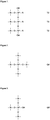
- a silicon atom having four -OSi ⁇ groups attached to the silicon is said to have a Q4 structure ( Fig. 2 ).
- Pure silica comprises essentially Q4 silicons.
- a silicon atom having one hydroxyl group attached and also three -OSi ⁇ groups attached to the silicon is said to have a Q3 structure ( Fig. 3 ).
- Q4 and Q3 structures can be analysed by solid state silicon NMR spectroscopy.
- the organo-modified silica and the stationary phase separation material suitably comprise silicon atoms having a Q4 structure.
- the surface of the organo-modified silica suitably comprises silicon atoms, being part of the silica, which do not have any organic groups bonded to them.
- the ratio of the amount of Q3 after complete functionalisation and/or endcapping of silanol groups of the organo-modified silica to the amount of Q3 before functionalisation and/or endcapping of the organo-modified silica is suitably from about 0.01 to about 0.99, preferably from about 0.10 to about 0.95, most preferably from about 0.25 to about 0.90.
- the pore size of the stationary phase separation material is suitably from about 20 to about 100% of the pore size of the silica (S), preferably from about 30 to about 95%, most preferably from about 40 to about 90%.
- the pore volume of the stationary phase separation material is suitably from about 0.1 to about 4 ml/g, preferably from about 0.2 to about 2 ml/g, most preferably from about 0.3 to about 1.2 ml/g.
- the specific surface area (BET method) of the stationary phase separation material is suitably from about 1 to about 1000 m 2 /g, preferably from about 25 to about 700 m 2 /g. most preferably from about 50 to about 500 m 2 /g.
- the specific surface area (BET method) normally decreases when a material is being functionalised.
- a functionalised organo-modified silica normally has a lower specific surface area (BET method) than the organo-modified silica itself.
- the organo-modified silica and the stationary phase separation material have suitably a mechanical strength which is about equal to the silica based material (S).
- the stability of the organo-modified silica and the stationary phase separation material in alkaline environments can be measured by packing the material in a column, pumping an alkaline solution through the column and determining the silicon content in the eluate (by elemental analysis).
- the alkaline stability of the organo-modified silica based material and the stationary phase separation material preferably having a C 18-, C8- or C4 functionalisation, determined as ppm silicon per specific surface area (BET method) [ppm Si/ m 2 /g] in the eluate from the procedure of pumping 41.5 ml.
- the alkaline stability of the organo-modified silica and the stationary phase separation material preferably having a C18-, C8- or C4 functionalisation, determined as ppm silicon per specific surface area (BET method) [ppm Si/ m 2 /g] in the eluate from the procedure of pumping 41.5 ml.
- the organo-modified silica based material is suitably less than about 0.2 [ppm Si/ m 2 /g], or from about 0 to about 0.2 [ppm Si/ m 2 /g], preferably less than about 0.15 [ppm Si/ m 2 /g], or from about 0 to about 0.15 [ppm Si/ m 2 /g].
- the method of preparing a stationary phase separation material comprises surface-functionalisation of the organo-modified silica according to the present invention by reacting the organo-modified silica with one or more functionalising agents comprising a functional group, selected from diol-substituted alkyl, amino-substituted alkyl, cyanoalkyl, fluoroalkyl, phenyl, fluorophenyl, phenylalkyl, or C 1 - C 30 alkyl, preferably C 4 -, C 8 -, and C 18 alkyl.
- the functionalising agent is an organosilane comprising the functional group.
- silica is a well- known procedure and details about suitable procedures are described in, for example, Silica Gel and Bonded Phases - Their Production, Properties and Use in LC. Raymond P. W. Scott., John Wiley & Sons Ltd., 1993, England, UK, p. 159-160 .
- the surface- functionalisation is suitably made in a non-aqueous medium, e.g., toluene.
- a step of end-capping is preferably made.
- end-capping agent trimethylchlorosilane or dimethyldichlorosilane is preferably used.
- the stationary phase separation material can be used in chromatographic separation methods.
- chromatographic separation methods can be, for example, HPLC, supercritical fluid chromatography (SFC), and simulating moving bed (SMB).
- a packed separation column for chromatography can comprise the stationary phase separation material.
- the preparation of a packed column for chromatography can comprise a step of packing the stationary phase separation material in a column.
- a method of separating chemical compounds from a mixture can comprise contacting the mixture with the stationary phase separation material according to the present invention.
- the carbon content was measured by elemental analysis to 3.9 weight %.
- the carbon content was measured by elemental analysis to 7.1 weight %.
- Example 2 The product of Example 2 was dispersed in Milli-Q-water and the mixture was put in an autoclave. The temperature was raised to 130°C and kept for 72 hours. The temperature was then cooled to below 40°C, filtered and washed with Milli-Q-water and acetone. The material was dried at 90°C for 4 h.
- the carbon content was measured by elemental analysis to 7.1 weight %.
- the organo-modified silica prepared according to Example 1 was subjected to functionalisation into a C18-phase using dimethyl-octadecylchlorosilane employing standard procedures (i.e. using an amino-based catalyst in toluene). After functionalisation, the resulting phase was was endcapped using trimethylchlorosilane.
- the carbon content from the C18-functionality was determined to 8.6 weight %.
- the organo-modified silica prepared according to Example 3 was functionalised in the same way as described in Example 4.
- the carbon content from the C18-functionality was determined to 7.3 weight %.
- organo-modified silicas were made according to Example 2 and Example 3, using between 30 and 40 mL or organosilanes, and the same amounts of other components.
- organosilanes were used methyltrimethoxysilane, methyltriethoxysilane, ethyltrimethoxysilane, propyltrimethoxy-silane, and bis(triethoxysilyl) ethane.
- the resulting materials were in some cases subjected to a C18- functionalisation in the same manner as described in Example 4.
- the C18 functionalising agent was either dimethyl-octadecylchlorosilane ("C18") or methyl- octadecyldichlorosilane ("di-C18").
- Table 1 summarises the components used, their amount and if the autoclavation step according to Example 3 has been used or not. Table 1.
- acetonitrile/50 mM HOAc-NEt 3 50:50 was used as a mobile phase.
- the pH was 12.
- the flow rate was 1 mL/min during analysis and 0.1 mL/min inbetween.
- the temperature was 25°C.
- the analytes toluene, nortriptyline, imipramine and amitriptyline were tested at regular intervals.
- the capacity factor, k' which is a measurement of the relative retention behaviour was determined for all analytes.
- Tables 2 to 4 show the results.
- ⁇ k'/ ⁇ t is the change of k' over the latest 40 minutes.
- Stationary phase according to the invention (Example 2) Time (h) k' toluene ⁇ k'/ ⁇ t k' nortriptyline ⁇ k'/ ⁇ t K' imipramine ⁇ k'/ ⁇ t k' amitriptyline ⁇ k'/ ⁇ t 0 7.62 - 12.15 - 19.55 - 24.58 - 40 7.74 0.003 13.76 0.040 20.96 0.035 26.33 0.044 80 7.68 -0.0015 14.09 0.0082 21.16 0.0050 26.56 0.0058 120 7.66 -0.0005 14.26 0.0042 21.25 0.0022 26.68 0.0030 Table 3.
- the results show that for toluene, which only interacts significantly with the hydrophobic C18 functionality, there is no deterioration of the C18 functionality over time.
- the results for the other analytes, which also interact with hydrophilic structures such as silanol groups show that there is an increased interaction over time which indicates a deterioration process at the silica surface.
- the C18 functionality is deteriorating to a much lesser degree than for a conventional C18-phase.
- the chemical stability of a C18 phase according to the present invention is significant higher than for a conventional C18 phase.
- the column was thereafter subjected to 0.1 M NaOH (aq)/ethanol 50:50 for five hours. After equilibration of the column, the capacity factors were determined again for the analytes using the same conditions as before.
- Example 17 (Chemical stability of the stationary phase separation material as leakage of silicon):
- the material of the present invention exhibits a much higher stability to strong alkaline solutions than a conventional C18-phase.
- the stability is also reproducible between different batches.
- the mechanical stability of porous silica particles is measured by packing about 25 mm of silica particles in a column having an inner diameter of 50 mm, using a pressure of 40 bar.
- a mobile phase is pumped through the column and the back-pressure which is needed to be exceeded in order to move the mobile phase through the column is determined.
- the silica particles are thereafter subjected to a pressure of 60, 80, 100, 120, 150, 200, 250, and 300 bar, wherein the back-pressure is measured at each piston pressure.
- the pressure increase [%] to 40 bar, at each piston pressure, is determined.
- organo-modified silica prepared as described above has excellent mechanical stability.
- Organo-modified silicas were prepared according to the method of combined Examples 2 and 3, varying the amount of organosilane (ethyltrimethoxy silane). A C18-functionalisation was then following the procedure in Example 4. Remaining silanols were endcapped with trimethoxy silane. The carbon contents in the organo-modified silicas and in the C18-functionalised phases were determined. The relation is shown in Fig. 4 .
Landscapes
- Chemical & Material Sciences (AREA)
- Analytical Chemistry (AREA)
- Organic Chemistry (AREA)
- Chemical Kinetics & Catalysis (AREA)
- Inorganic Chemistry (AREA)
- Physics & Mathematics (AREA)
- Thermal Sciences (AREA)
- Engineering & Computer Science (AREA)
- Nanotechnology (AREA)
- Silicon Compounds (AREA)
- Solid-Sorbent Or Filter-Aiding Compositions (AREA)
Claims (7)
- Verfahren zur Herstellung eines stationären Phasentrennmaterials, umfassend Herstellen eines Organo-modifizierten Siliziumdioxids durch Bereitstellen eines Reaktionsgemisches durch Vermischen von Siliziumdioxid (S) und einer oder mehreren Organosilan-Verbindungen (A) in einem wässrigen Medium, das 25 bis 100 Gewichts-% Wasser umfasst, und Bringen des Gemisches zur Reaktion, wobei in einem ersten Schritt das Reaktionsgemisch aus Siliziumdioxid (S) und einer oder mehreren Organosilan-Verbindungen (A) bei einer Temperatur TEMP1 zur Reaktion gebracht wird, gefolgt von einem zweiten Schritt, umfassend Aussetzen des umgesetzten Siliziumdioxids, das in dem ersten Schritt hergestellt wird, einer Temperatur TEMP2, um ein Organo-modifiziertes Siliziumdioxid zu bilden, wobei TEMP2 > TEMP1;
wobei die eine oder die mehreren Organosilan-Verbindungen A:- die allgemeine Formel (R1)3-n(X)nSiR3 aufweisen, wobei R1 für C1-4-Alkyl, C2-4-Alkenyl oder C2-4-Alkinyl steht, R3 für C1-8-Alkyl, C2-8-Alkenyl oder C2-8-Alkinyl steht und X eine Abgangsgruppe ist, ausgewählt aus Halogen, Alkoxy und Alkylamin, n = 2 oder 3, oder- die allgemeine Formel (R4)3-n(X)nSiR6Si(R5)3-m(Y)m aufweisen, wobei R4 und R5 unabhängig voneinander für C1-4-Alkyl, C2-4-Alkenyl oder C2-4-Alkinyl stehen, R6 für C1-8-Alkylen, C2-8-Alkenylen oder C2-8-Alkinylen steht und X und Y jeweils Abgangsgruppen sind, ausgewählt aus Halogen, Alkoxy und Alkylamin, n = 2 oder 3, m = 2 oder 3,das Siliziumdioxid (S) keine organische Oberflächenmodifikation aufweist und in der Form von porösen Teilchen oder in der Form eines monolithischen Materials vorliegt;
wobei das Verfahren ferner Umsetzen des Organo-modifizierten Siliziumdioxids mit einem funktionalisierenden Agens umfasst, welches eine funktionelle Gruppe umfasst, ausgewählt aus Diol-substituiertem Alkyl, Amino-substituiertem Alkyl, Cyanoalkyl, Fluoralkyl, Phenyl, Fluorphenyl, Phenylalkyl und C1-30-Alkyl. - Verfahren zur Herstellung eines stationären Phasentrennmaterials nach Anspruch 1, wobei die eine oder die mehreren Organosilan-Verbindungen A:- die allgemeine Formel (R1)3-n(X)nSiR3 aufweisen, wobei R1 für C1-2-Alkyl steht, R3 für C1-2-Alkyl steht und X eine Abgangsgruppe ist, n = 2 oder 3, oder- die allgemeine Formel (R4)3-n(X)nSiR6Si(R5)3-m(Y)m aufweisen, wobei R4 und R5 unabhängig voneinander für C1-2-Alkyl stehen, R6 für C1-3-Alkylen steht und X und Y Abgangsgruppen sind, n = 2 oder 3, m = 2 oder 3.
- Verfahren zur Herstellung eines stationären Phasentrennmaterials nach Anspruch 1 oder 2, wobei das Reaktionsgemisch in beliebiger Reihenfolge bereitgestellt wird durch(i) Geben einer oder mehrerer Organosilan-Verbindungen A in ein wässriges Medium, welches 25 bis 100 Gewichts-% Wasser umfasst, und zumindest teilweise Lösen darin und(ii) Zugeben von Siliziumdioxid (S).
- Verfahren zur Herstellung eines stationären Phasentrennmaterials nach einem der Ansprüche 1 bis 3, wobei die Temperatur des Reaktionsgemisches 40 °C bis 300 °C beträgt.
- Verfahren zur Herstellung eines stationären Phasentrennmaterials nach einem der Ansprüche 1 bis 4, wobei die Temperatur des Reaktionsgemisches 75 °C bis 175 °C beträgt.
- Verfahren zur Herstellung eines stationären Phasentrennmaterials nach einem der Ansprüche 1 bis 5, wobei die Temperatur TEMP1 im Bereich von 75 °C bis 100 °C liegt und die Temperatur TEMP2 im Bereich von 100 °C bis 175 °C liegt.
- Verfahren zur Herstellung eines stationären Phasentrennmaterials nach einem der Ansprüche 1 bis 6, wobei das funktionalisierende Agens ein Organosilan ist.
Priority Applications (1)
| Application Number | Priority Date | Filing Date | Title |
|---|---|---|---|
| EP06824629.7A EP1960099B1 (de) | 2005-12-16 | 2006-12-11 | Verfahren zur herstellung eines stationären phasentrennmaterials auf basis von siliziumdioxid |
Applications Claiming Priority (3)
| Application Number | Priority Date | Filing Date | Title |
|---|---|---|---|
| EP05112325 | 2005-12-16 | ||
| PCT/SE2006/050570 WO2007070001A2 (en) | 2005-12-16 | 2006-12-11 | Silica based material |
| EP06824629.7A EP1960099B1 (de) | 2005-12-16 | 2006-12-11 | Verfahren zur herstellung eines stationären phasentrennmaterials auf basis von siliziumdioxid |
Publications (2)
| Publication Number | Publication Date |
|---|---|
| EP1960099A2 EP1960099A2 (de) | 2008-08-27 |
| EP1960099B1 true EP1960099B1 (de) | 2019-10-23 |
Family
ID=36374500
Family Applications (1)
| Application Number | Title | Priority Date | Filing Date |
|---|---|---|---|
| EP06824629.7A Not-in-force EP1960099B1 (de) | 2005-12-16 | 2006-12-11 | Verfahren zur herstellung eines stationären phasentrennmaterials auf basis von siliziumdioxid |
Country Status (15)
| Country | Link |
|---|---|
| EP (1) | EP1960099B1 (de) |
| JP (1) | JP4999861B2 (de) |
| KR (1) | KR100971939B1 (de) |
| CN (1) | CN101356003B (de) |
| AR (1) | AR062446A1 (de) |
| BR (1) | BRPI0619969B1 (de) |
| CA (1) | CA2633444C (de) |
| DK (1) | DK1960099T3 (de) |
| EG (1) | EG26120A (de) |
| ES (1) | ES2757566T3 (de) |
| HR (1) | HRP20080266A2 (de) |
| IL (1) | IL191909A (de) |
| RU (1) | RU2401694C2 (de) |
| UA (1) | UA88413C2 (de) |
| WO (1) | WO2007070001A2 (de) |
Cited By (1)
| Publication number | Priority date | Publication date | Assignee | Title |
|---|---|---|---|---|
| WO2025027478A1 (en) * | 2023-07-28 | 2025-02-06 | Waters Technologies Corporation | Hybrid-bonded chromatography materials |
Families Citing this family (13)
| Publication number | Priority date | Publication date | Assignee | Title |
|---|---|---|---|---|
| US8277883B2 (en) | 2008-06-13 | 2012-10-02 | Agilent Technologies, Inc. | Porous silica microspheres having organosilane modified surfaces |
| TWI503411B (zh) * | 2010-08-11 | 2015-10-11 | Nat Health Research Institutes | B群腦膜炎球菌次單位疫苗之製造及純化 |
| BR112015032101A2 (pt) | 2013-06-24 | 2017-07-25 | Akzo Nobel Chemicals Int Bv | partícula de sílica modificada; método de preparação de uma partícula de sílica modificada; utilização de uma partícula de sílica modificada; e coluna de separação por cromatografia |
| CN105642260B (zh) * | 2014-12-02 | 2017-12-15 | 中国科学院大连化学物理研究所 | 一种树枝状碳十八二氧化硅微球固定相及其制备和应用 |
| JP6702325B2 (ja) * | 2015-08-05 | 2020-06-03 | 東亞合成株式会社 | 炭素分析方法 |
| US10618920B2 (en) * | 2016-06-03 | 2020-04-14 | Agilent Technologies, Inc. | Functionalized particles having modified phases |
| JP7133019B2 (ja) * | 2017-12-21 | 2022-09-07 | エクソンモービル・テクノロジー・アンド・エンジニアリング・カンパニー | オルガノシリカ材料の製造方法及びその使用 |
| WO2019145920A1 (en) * | 2018-01-29 | 2019-08-01 | Waters Technologies Corporation | Difluoroacetic acid ion pairing reagent for high sensitivity, high resolution lc-ms of biomolecules |
| EP3744684A1 (de) | 2019-05-29 | 2020-12-02 | Nouryon Chemicals International B.V. | Poröse siliciumdioxidpartikel |
| EP3744683A1 (de) | 2019-05-29 | 2020-12-02 | Nouryon Chemicals International B.V. | Poröse siliciumdioxidpartikel |
| CN110981211B (zh) * | 2019-12-31 | 2022-08-12 | 江苏盈天化学有限公司 | 一种可用于精馏的聚合物改性玻璃填料的制备方法 |
| US20230257580A1 (en) * | 2020-06-23 | 2023-08-17 | Lg Electronics Inc. | Polyimide and method of preparing the same |
| CN114849677B (zh) * | 2022-06-10 | 2024-01-26 | 重庆大学 | 一种磷酸根吸附材料及其制备方法 |
Citations (1)
| Publication number | Priority date | Publication date | Assignee | Title |
|---|---|---|---|---|
| JP2005154197A (ja) * | 2003-11-26 | 2005-06-16 | Dokai Chemical Industries Co Ltd | 耐アルカリ性化学修飾型シリカゲル及びその製造方法 |
Family Cites Families (15)
| Publication number | Priority date | Publication date | Assignee | Title |
|---|---|---|---|---|
| DE2344388B2 (de) * | 1973-09-03 | 1978-06-22 | Elektroschmelzwerk Kempten Gmbh, 8000 Muenchen | Verfahren zum Herstellen von hydrophobem Siliciumdioxyd |
| US4298500A (en) * | 1980-05-05 | 1981-11-03 | Varian Associates, Inc. | Mixed phase chromatographic compositions |
| US4778909A (en) * | 1984-05-11 | 1988-10-18 | Northeastern University | Stable silica-based ether bonded phases for biopolymer separations |
| DE3616133A1 (de) | 1985-09-25 | 1987-11-19 | Merck Patent Gmbh | Kugelfoermige sio(pfeil abwaerts)2(pfeil abwaerts)-partikel |
| US4705725A (en) * | 1986-11-28 | 1987-11-10 | E. I. Du Pont De Nemours And Company | Substrates with sterically-protected, stable, covalently-bonded organo-silane films |
| US5013585A (en) * | 1989-06-13 | 1991-05-07 | Shin-Etsu Chemical Co., Ltd. | Method for the preparation of surface-modified silica particles |
| DE4419234A1 (de) * | 1994-06-01 | 1995-12-07 | Wacker Chemie Gmbh | Verfahren zur Silylierung von anorganischen Oxiden |
| DE19502453C1 (de) * | 1995-01-27 | 1996-09-05 | Hoechst Ag | Verfahren zur Herstellung von modifizierten Si0¶2¶- Aerogelen und deren Verwendung |
| US5667674A (en) * | 1996-01-11 | 1997-09-16 | Minnesota Mining And Manufacturing Company | Adsorption medium and method of preparing same |
| DE19648798C2 (de) * | 1996-11-26 | 1998-11-19 | Hoechst Ag | Verfahren zur Herstellung von organisch modifizierten Aerogelen durch Oberflächenmodifikation des wäßrigen Gels (ohne vorherigen Lösungsmitteltausch) und anschließender Trocknung |
| DE19756831A1 (de) * | 1997-12-19 | 1999-07-01 | Wacker Chemie Gmbh | Siliciumdioxid, das an seiner Oberfläche teil- oder vollständig silylierte Polykieselsäureketten trägt |
| EP1047733B1 (de) * | 1998-01-15 | 2004-03-17 | Cabot Corporation | Verfahren zur herstellung von organisch modifizierter kieselgel |
| WO2000071246A1 (en) * | 1999-05-25 | 2000-11-30 | Dcv, Inc. | Silica-based, endcapped chromatographic packing having improved stability under high ph conditions |
| US7125488B2 (en) | 2004-02-12 | 2006-10-24 | Varian, Inc. | Polar-modified bonded phase materials for chromatographic separations |
| WO2006039507A2 (en) * | 2004-10-01 | 2006-04-13 | Phenomenex, Inc. | Ph stable chromatographic media using templated multilayer organic/inorganic grafting |
-
2006
- 2006-12-11 ES ES06824629T patent/ES2757566T3/es active Active
- 2006-12-11 WO PCT/SE2006/050570 patent/WO2007070001A2/en not_active Ceased
- 2006-12-11 CN CN2006800474779A patent/CN101356003B/zh not_active Expired - Fee Related
- 2006-12-11 EP EP06824629.7A patent/EP1960099B1/de not_active Not-in-force
- 2006-12-11 BR BRPI0619969A patent/BRPI0619969B1/pt not_active IP Right Cessation
- 2006-12-11 JP JP2008545544A patent/JP4999861B2/ja not_active Expired - Fee Related
- 2006-12-11 KR KR1020087014553A patent/KR100971939B1/ko not_active Expired - Fee Related
- 2006-12-11 CA CA2633444A patent/CA2633444C/en not_active Expired - Fee Related
- 2006-12-11 DK DK06824629.7T patent/DK1960099T3/da active
- 2006-12-11 UA UAA200808105A patent/UA88413C2/ru unknown
- 2006-12-11 RU RU2008129104/05A patent/RU2401694C2/ru not_active IP Right Cessation
- 2006-12-11 HR HR20080266A patent/HRP20080266A2/xx not_active Application Discontinuation
- 2006-12-15 AR ARP060105544A patent/AR062446A1/es not_active Application Discontinuation
-
2008
- 2008-06-03 IL IL191909A patent/IL191909A/en not_active IP Right Cessation
- 2008-06-10 EG EG2008060965A patent/EG26120A/en active
Patent Citations (1)
| Publication number | Priority date | Publication date | Assignee | Title |
|---|---|---|---|---|
| JP2005154197A (ja) * | 2003-11-26 | 2005-06-16 | Dokai Chemical Industries Co Ltd | 耐アルカリ性化学修飾型シリカゲル及びその製造方法 |
Non-Patent Citations (1)
| Title |
|---|
| ROUQUEROL J ET AL: "RECOMMENDATIONS FOR THE CHARACTERIZATION OF POROUS SOLIDS", PURE & APPLIED CHEMISTRY, PERGAMON PRESS, OXFORD, GB, vol. 66, no. 8, 1 January 1994 (1994-01-01), pages 1739 - 1758, XP001208381, ISSN: 0033-4545 * |
Cited By (1)
| Publication number | Priority date | Publication date | Assignee | Title |
|---|---|---|---|---|
| WO2025027478A1 (en) * | 2023-07-28 | 2025-02-06 | Waters Technologies Corporation | Hybrid-bonded chromatography materials |
Also Published As
| Publication number | Publication date |
|---|---|
| IL191909A0 (en) | 2009-08-03 |
| CN101356003B (zh) | 2011-05-11 |
| RU2401694C2 (ru) | 2010-10-20 |
| CA2633444C (en) | 2012-07-17 |
| WO2007070001A2 (en) | 2007-06-21 |
| WO2007070001A3 (en) | 2007-09-07 |
| EG26120A (en) | 2013-03-05 |
| KR20080077627A (ko) | 2008-08-25 |
| HRP20080266A2 (en) | 2008-09-30 |
| IL191909A (en) | 2013-03-24 |
| BRPI0619969A2 (pt) | 2011-10-25 |
| UA88413C2 (ru) | 2009-10-12 |
| KR100971939B1 (ko) | 2010-07-23 |
| AR062446A1 (es) | 2008-11-12 |
| JP2009519201A (ja) | 2009-05-14 |
| EP1960099A2 (de) | 2008-08-27 |
| BRPI0619969B1 (pt) | 2016-05-24 |
| RU2008129104A (ru) | 2010-01-27 |
| CN101356003A (zh) | 2009-01-28 |
| CA2633444A1 (en) | 2007-06-21 |
| DK1960099T3 (da) | 2020-01-27 |
| JP4999861B2 (ja) | 2012-08-15 |
| ES2757566T3 (es) | 2020-04-29 |
Similar Documents
| Publication | Publication Date | Title |
|---|---|---|
| US9308520B2 (en) | Silica based material | |
| IL191909A (en) | Organo-modified silica based material | |
| JP4282324B2 (ja) | 表面から有機基を取り除いた多孔質混成物粒子 | |
| JP5089543B2 (ja) | クロマトグラフィー分離用多孔質有機・無機ハイブリッドモノリス状物質、およびその製造方法 | |
| JP6364375B2 (ja) | クロマトグラフ分離用ハイブリッド材料 | |
| Brook et al. | Sugar-modified silanes: precursors for silica monoliths | |
| JP4943396B2 (ja) | クロマトグラフィー分離のための多孔質有機・無機ハイブリッド粒子、及びそれらの製造法 | |
| AU2004288994B2 (en) | Polar silanes for binding to substrates and use of the bound substrates in chromatography | |
| CN109414681A (zh) | 用于色谱分离的包含表面多孔芯和周围材料的杂化材料 | |
| Antochshuk et al. | Adsorption, thermogravimetric, and NMR studies of FSM-16 material functionalized with alkylmonochlorosilanes | |
| JP2007523331A (ja) | 有機基を表面から除去した多孔質ハイブリッドモノリス材料 | |
| JP2010515804A (ja) | クロマトグラフ分離用多孔質炭素−ヘテロ原子−ケイ素ハイブリッド無機/有機材料およびその調製のための方法 | |
| CN102471513A (zh) | 包含可离子化改性剂的高纯度色谱材料 | |
| AU2005291937A1 (en) | pH stable chromatographic media using templated multilayer organic/inorganic grafting | |
| CN107106932B (zh) | 具有改进的pH稳定性的色谱材料、其制备方法和其用途 | |
| CN111804007A (zh) | 亲水性材料的疏水化方法 | |
| US7329386B2 (en) | Column packing material and method for producing the same | |
| Cao et al. | Oligodeoxynucleotide molecule delivery by organically modified SBA-15 mesoporous materials |
Legal Events
| Date | Code | Title | Description |
|---|---|---|---|
| PUAI | Public reference made under article 153(3) epc to a published international application that has entered the european phase |
Free format text: ORIGINAL CODE: 0009012 |
|
| 17P | Request for examination filed |
Effective date: 20080613 |
|
| AK | Designated contracting states |
Kind code of ref document: A2 Designated state(s): AT BE BG CH CY CZ DE DK EE ES FI FR GB GR HU IE IS IT LI LT LU LV MC NL PL PT RO SE SI SK TR |
|
| REG | Reference to a national code |
Ref country code: HK Ref legal event code: DE Ref document number: 1124279 Country of ref document: HK |
|
| DAX | Request for extension of the european patent (deleted) | ||
| RAP1 | Party data changed (applicant data changed or rights of an application transferred) |
Owner name: AKZO NOBEL N.V. Owner name: AKZO NOBEL PULP AND PERFORMANCE CHEMICALS AB |
|
| STAA | Information on the status of an ep patent application or granted ep patent |
Free format text: STATUS: EXAMINATION IS IN PROGRESS |
|
| 17Q | First examination report despatched |
Effective date: 20161213 |
|
| RAP1 | Party data changed (applicant data changed or rights of an application transferred) |
Owner name: AKZO NOBEL CHEMICALS INTERNATIONAL B.V. |
|
| REG | Reference to a national code |
Ref country code: DE Ref legal event code: R079 Ref document number: 602006058741 Country of ref document: DE Free format text: PREVIOUS MAIN CLASS: B01J0020320000 Ipc: B01J0020286000 |
|
| GRAP | Despatch of communication of intention to grant a patent |
Free format text: ORIGINAL CODE: EPIDOSNIGR1 |
|
| STAA | Information on the status of an ep patent application or granted ep patent |
Free format text: STATUS: GRANT OF PATENT IS INTENDED |
|
| RIC1 | Information provided on ipc code assigned before grant |
Ipc: B01J 20/287 20060101ALI20190424BHEP Ipc: B01J 20/30 20060101ALI20190424BHEP Ipc: B01J 20/32 20060101ALI20190424BHEP Ipc: B01J 20/286 20060101AFI20190424BHEP Ipc: B01J 20/28 20060101ALI20190424BHEP |
|
| INTG | Intention to grant announced |
Effective date: 20190521 |
|
| RAP1 | Party data changed (applicant data changed or rights of an application transferred) |
Owner name: NOURYON CHEMICALS INTERNATIONAL B.V. |
|
| GRAS | Grant fee paid |
Free format text: ORIGINAL CODE: EPIDOSNIGR3 |
|
| GRAA | (expected) grant |
Free format text: ORIGINAL CODE: 0009210 |
|
| STAA | Information on the status of an ep patent application or granted ep patent |
Free format text: STATUS: THE PATENT HAS BEEN GRANTED |
|
| AK | Designated contracting states |
Kind code of ref document: B1 Designated state(s): AT BE BG CH CY CZ DE DK EE ES FI FR GB GR HU IE IS IT LI LT LU LV MC NL PL PT RO SE SI SK TR |
|
| REG | Reference to a national code |
Ref country code: GB Ref legal event code: FG4D |
|
| REG | Reference to a national code |
Ref country code: CH Ref legal event code: EP |
|
| REG | Reference to a national code |
Ref country code: IE Ref legal event code: FG4D |
|
| REG | Reference to a national code |
Ref country code: DE Ref legal event code: R096 Ref document number: 602006058741 Country of ref document: DE |
|
| REG | Reference to a national code |
Ref country code: AT Ref legal event code: REF Ref document number: 1193070 Country of ref document: AT Kind code of ref document: T Effective date: 20191115 |
|
| REG | Reference to a national code |
Ref country code: DK Ref legal event code: T3 Effective date: 20200120 |
|
| REG | Reference to a national code |
Ref country code: NL Ref legal event code: MP Effective date: 20191023 |
|
| PGFP | Annual fee paid to national office [announced via postgrant information from national office to epo] |
Ref country code: BE Payment date: 20191227 Year of fee payment: 14 Ref country code: FR Payment date: 20191226 Year of fee payment: 14 |
|
| REG | Reference to a national code |
Ref country code: LT Ref legal event code: MG4D |
|
| REG | Reference to a national code |
Ref country code: ES Ref legal event code: FG2A Ref document number: 2757566 Country of ref document: ES Kind code of ref document: T3 Effective date: 20200429 |
|
| PG25 | Lapsed in a contracting state [announced via postgrant information from national office to epo] |
Ref country code: PT Free format text: LAPSE BECAUSE OF FAILURE TO SUBMIT A TRANSLATION OF THE DESCRIPTION OR TO PAY THE FEE WITHIN THE PRESCRIBED TIME-LIMIT Effective date: 20200224 Ref country code: FI Free format text: LAPSE BECAUSE OF FAILURE TO SUBMIT A TRANSLATION OF THE DESCRIPTION OR TO PAY THE FEE WITHIN THE PRESCRIBED TIME-LIMIT Effective date: 20191023 Ref country code: BG Free format text: LAPSE BECAUSE OF FAILURE TO SUBMIT A TRANSLATION OF THE DESCRIPTION OR TO PAY THE FEE WITHIN THE PRESCRIBED TIME-LIMIT Effective date: 20200123 Ref country code: GR Free format text: LAPSE BECAUSE OF FAILURE TO SUBMIT A TRANSLATION OF THE DESCRIPTION OR TO PAY THE FEE WITHIN THE PRESCRIBED TIME-LIMIT Effective date: 20200124 Ref country code: PL Free format text: LAPSE BECAUSE OF FAILURE TO SUBMIT A TRANSLATION OF THE DESCRIPTION OR TO PAY THE FEE WITHIN THE PRESCRIBED TIME-LIMIT Effective date: 20191023 Ref country code: LT Free format text: LAPSE BECAUSE OF FAILURE TO SUBMIT A TRANSLATION OF THE DESCRIPTION OR TO PAY THE FEE WITHIN THE PRESCRIBED TIME-LIMIT Effective date: 20191023 Ref country code: SE Free format text: LAPSE BECAUSE OF FAILURE TO SUBMIT A TRANSLATION OF THE DESCRIPTION OR TO PAY THE FEE WITHIN THE PRESCRIBED TIME-LIMIT Effective date: 20191023 Ref country code: NL Free format text: LAPSE BECAUSE OF FAILURE TO SUBMIT A TRANSLATION OF THE DESCRIPTION OR TO PAY THE FEE WITHIN THE PRESCRIBED TIME-LIMIT Effective date: 20191023 Ref country code: LV Free format text: LAPSE BECAUSE OF FAILURE TO SUBMIT A TRANSLATION OF THE DESCRIPTION OR TO PAY THE FEE WITHIN THE PRESCRIBED TIME-LIMIT Effective date: 20191023 |
|
| PGFP | Annual fee paid to national office [announced via postgrant information from national office to epo] |
Ref country code: DE Payment date: 20191231 Year of fee payment: 14 Ref country code: ES Payment date: 20200102 Year of fee payment: 14 Ref country code: GB Payment date: 20200102 Year of fee payment: 14 Ref country code: DK Payment date: 20191230 Year of fee payment: 14 |
|
| PG25 | Lapsed in a contracting state [announced via postgrant information from national office to epo] |
Ref country code: IS Free format text: LAPSE BECAUSE OF FAILURE TO SUBMIT A TRANSLATION OF THE DESCRIPTION OR TO PAY THE FEE WITHIN THE PRESCRIBED TIME-LIMIT Effective date: 20200224 |
|
| REG | Reference to a national code |
Ref country code: HK Ref legal event code: WD Ref document number: 1124279 Country of ref document: HK Ref country code: DE Ref legal event code: R097 Ref document number: 602006058741 Country of ref document: DE |
|
| PG2D | Information on lapse in contracting state deleted |
Ref country code: IS |
|
| PG25 | Lapsed in a contracting state [announced via postgrant information from national office to epo] |
Ref country code: IS Free format text: LAPSE BECAUSE OF FAILURE TO SUBMIT A TRANSLATION OF THE DESCRIPTION OR TO PAY THE FEE WITHIN THE PRESCRIBED TIME-LIMIT Effective date: 20200223 Ref country code: CZ Free format text: LAPSE BECAUSE OF FAILURE TO SUBMIT A TRANSLATION OF THE DESCRIPTION OR TO PAY THE FEE WITHIN THE PRESCRIBED TIME-LIMIT Effective date: 20191023 Ref country code: EE Free format text: LAPSE BECAUSE OF FAILURE TO SUBMIT A TRANSLATION OF THE DESCRIPTION OR TO PAY THE FEE WITHIN THE PRESCRIBED TIME-LIMIT Effective date: 20191023 Ref country code: RO Free format text: LAPSE BECAUSE OF FAILURE TO SUBMIT A TRANSLATION OF THE DESCRIPTION OR TO PAY THE FEE WITHIN THE PRESCRIBED TIME-LIMIT Effective date: 20191023 |
|
| REG | Reference to a national code |
Ref country code: CH Ref legal event code: PL |
|
| REG | Reference to a national code |
Ref country code: AT Ref legal event code: MK05 Ref document number: 1193070 Country of ref document: AT Kind code of ref document: T Effective date: 20191023 |
|
| PLBE | No opposition filed within time limit |
Free format text: ORIGINAL CODE: 0009261 |
|
| STAA | Information on the status of an ep patent application or granted ep patent |
Free format text: STATUS: NO OPPOSITION FILED WITHIN TIME LIMIT |
|
| PG25 | Lapsed in a contracting state [announced via postgrant information from national office to epo] |
Ref country code: MC Free format text: LAPSE BECAUSE OF FAILURE TO SUBMIT A TRANSLATION OF THE DESCRIPTION OR TO PAY THE FEE WITHIN THE PRESCRIBED TIME-LIMIT Effective date: 20191023 Ref country code: IT Free format text: LAPSE BECAUSE OF FAILURE TO SUBMIT A TRANSLATION OF THE DESCRIPTION OR TO PAY THE FEE WITHIN THE PRESCRIBED TIME-LIMIT Effective date: 20191023 Ref country code: SK Free format text: LAPSE BECAUSE OF FAILURE TO SUBMIT A TRANSLATION OF THE DESCRIPTION OR TO PAY THE FEE WITHIN THE PRESCRIBED TIME-LIMIT Effective date: 20191023 |
|
| 26N | No opposition filed |
Effective date: 20200724 |
|
| PG25 | Lapsed in a contracting state [announced via postgrant information from national office to epo] |
Ref country code: LU Free format text: LAPSE BECAUSE OF NON-PAYMENT OF DUE FEES Effective date: 20191211 Ref country code: IE Free format text: LAPSE BECAUSE OF NON-PAYMENT OF DUE FEES Effective date: 20191211 |
|
| PG25 | Lapsed in a contracting state [announced via postgrant information from national office to epo] |
Ref country code: AT Free format text: LAPSE BECAUSE OF FAILURE TO SUBMIT A TRANSLATION OF THE DESCRIPTION OR TO PAY THE FEE WITHIN THE PRESCRIBED TIME-LIMIT Effective date: 20191023 Ref country code: CH Free format text: LAPSE BECAUSE OF NON-PAYMENT OF DUE FEES Effective date: 20191231 Ref country code: LI Free format text: LAPSE BECAUSE OF NON-PAYMENT OF DUE FEES Effective date: 20191231 Ref country code: SI Free format text: LAPSE BECAUSE OF FAILURE TO SUBMIT A TRANSLATION OF THE DESCRIPTION OR TO PAY THE FEE WITHIN THE PRESCRIBED TIME-LIMIT Effective date: 20191023 |
|
| PG25 | Lapsed in a contracting state [announced via postgrant information from national office to epo] |
Ref country code: CY Free format text: LAPSE BECAUSE OF FAILURE TO SUBMIT A TRANSLATION OF THE DESCRIPTION OR TO PAY THE FEE WITHIN THE PRESCRIBED TIME-LIMIT Effective date: 20191023 |
|
| REG | Reference to a national code |
Ref country code: DE Ref legal event code: R119 Ref document number: 602006058741 Country of ref document: DE |
|
| REG | Reference to a national code |
Ref country code: DK Ref legal event code: EBP Effective date: 20201231 |
|
| PG25 | Lapsed in a contracting state [announced via postgrant information from national office to epo] |
Ref country code: HU Free format text: LAPSE BECAUSE OF FAILURE TO SUBMIT A TRANSLATION OF THE DESCRIPTION OR TO PAY THE FEE WITHIN THE PRESCRIBED TIME-LIMIT; INVALID AB INITIO Effective date: 20061211 |
|
| GBPC | Gb: european patent ceased through non-payment of renewal fee |
Effective date: 20201211 |
|
| REG | Reference to a national code |
Ref country code: BE Ref legal event code: MM Effective date: 20201231 |
|
| PG25 | Lapsed in a contracting state [announced via postgrant information from national office to epo] |
Ref country code: FR Free format text: LAPSE BECAUSE OF NON-PAYMENT OF DUE FEES Effective date: 20201231 |
|
| PG25 | Lapsed in a contracting state [announced via postgrant information from national office to epo] |
Ref country code: GB Free format text: LAPSE BECAUSE OF NON-PAYMENT OF DUE FEES Effective date: 20201211 Ref country code: DE Free format text: LAPSE BECAUSE OF NON-PAYMENT OF DUE FEES Effective date: 20210701 |
|
| PG25 | Lapsed in a contracting state [announced via postgrant information from national office to epo] |
Ref country code: DK Free format text: LAPSE BECAUSE OF NON-PAYMENT OF DUE FEES Effective date: 20201231 |
|
| REG | Reference to a national code |
Ref country code: ES Ref legal event code: FD2A Effective date: 20220208 |
|
| PG25 | Lapsed in a contracting state [announced via postgrant information from national office to epo] |
Ref country code: TR Free format text: LAPSE BECAUSE OF FAILURE TO SUBMIT A TRANSLATION OF THE DESCRIPTION OR TO PAY THE FEE WITHIN THE PRESCRIBED TIME-LIMIT Effective date: 20191023 Ref country code: ES Free format text: LAPSE BECAUSE OF NON-PAYMENT OF DUE FEES Effective date: 20201212 |
|
| PG25 | Lapsed in a contracting state [announced via postgrant information from national office to epo] |
Ref country code: BE Free format text: LAPSE BECAUSE OF NON-PAYMENT OF DUE FEES Effective date: 20201231 |