EP1944174A1 - Lithographic printing plate material, lithographic printing plate, method for preparing lithographic printing plate, and method for printing by lithographic printing plate - Google Patents
Lithographic printing plate material, lithographic printing plate, method for preparing lithographic printing plate, and method for printing by lithographic printing plate Download PDFInfo
- Publication number
- EP1944174A1 EP1944174A1 EP06821910A EP06821910A EP1944174A1 EP 1944174 A1 EP1944174 A1 EP 1944174A1 EP 06821910 A EP06821910 A EP 06821910A EP 06821910 A EP06821910 A EP 06821910A EP 1944174 A1 EP1944174 A1 EP 1944174A1
- Authority
- EP
- European Patent Office
- Prior art keywords
- printing plate
- acid
- group
- image formation
- planographic printing
- Prior art date
- Legal status (The legal status is an assumption and is not a legal conclusion. Google has not performed a legal analysis and makes no representation as to the accuracy of the status listed.)
- Withdrawn
Links
- 238000007639 printing Methods 0.000 title claims abstract description 215
- 239000000463 material Substances 0.000 title claims abstract description 84
- 238000000034 method Methods 0.000 title claims abstract description 67
- 150000001875 compounds Chemical class 0.000 claims abstract description 66
- 229910052782 aluminium Inorganic materials 0.000 claims abstract description 52
- XAGFODPZIPBFFR-UHFFFAOYSA-N aluminium Chemical compound [Al] XAGFODPZIPBFFR-UHFFFAOYSA-N 0.000 claims abstract description 52
- 239000003505 polymerization initiator Substances 0.000 claims abstract description 30
- 239000000178 monomer Substances 0.000 claims abstract description 29
- 238000006243 chemical reaction Methods 0.000 claims abstract description 26
- 230000015572 biosynthetic process Effects 0.000 claims description 67
- 230000008569 process Effects 0.000 claims description 20
- 235000015112 vegetable and seed oil Nutrition 0.000 claims description 20
- 239000008158 vegetable oil Substances 0.000 claims description 20
- 230000005660 hydrophilic surface Effects 0.000 claims description 5
- 238000011109 contamination Methods 0.000 abstract description 3
- 239000000428 dust Substances 0.000 abstract description 3
- 238000011084 recovery Methods 0.000 abstract 1
- -1 phthalocyanine compound Chemical class 0.000 description 101
- 239000000243 solution Substances 0.000 description 75
- 239000010410 layer Substances 0.000 description 73
- 229920000642 polymer Polymers 0.000 description 56
- 239000011230 binding agent Substances 0.000 description 36
- 150000003839 salts Chemical class 0.000 description 36
- 239000002245 particle Substances 0.000 description 32
- XLYOFNOQVPJJNP-UHFFFAOYSA-N water Substances O XLYOFNOQVPJJNP-UHFFFAOYSA-N 0.000 description 32
- 239000002253 acid Substances 0.000 description 31
- 235000014113 dietary fatty acids Nutrition 0.000 description 31
- 229930195729 fatty acid Natural products 0.000 description 31
- 239000000194 fatty acid Substances 0.000 description 31
- 229920005989 resin Polymers 0.000 description 30
- 239000011347 resin Substances 0.000 description 30
- 125000000217 alkyl group Chemical group 0.000 description 28
- 238000011282 treatment Methods 0.000 description 28
- 238000007788 roughening Methods 0.000 description 25
- 229920001577 copolymer Polymers 0.000 description 24
- 150000002148 esters Chemical class 0.000 description 24
- 239000004094 surface-active agent Substances 0.000 description 23
- NBIIXXVUZAFLBC-UHFFFAOYSA-N Phosphoric acid Chemical compound OP(O)(O)=O NBIIXXVUZAFLBC-UHFFFAOYSA-N 0.000 description 22
- 239000000975 dye Substances 0.000 description 22
- HEMHJVSKTPXQMS-UHFFFAOYSA-M Sodium hydroxide Chemical compound [OH-].[Na+] HEMHJVSKTPXQMS-UHFFFAOYSA-M 0.000 description 21
- QAOWNCQODCNURD-UHFFFAOYSA-N Sulfuric acid Chemical compound OS(O)(=O)=O QAOWNCQODCNURD-UHFFFAOYSA-N 0.000 description 20
- 239000011248 coating agent Substances 0.000 description 19
- 238000000576 coating method Methods 0.000 description 19
- 229910044991 metal oxide Inorganic materials 0.000 description 19
- 150000004706 metal oxides Chemical class 0.000 description 19
- 239000000049 pigment Substances 0.000 description 19
- 229910052799 carbon Inorganic materials 0.000 description 18
- 150000004665 fatty acids Chemical class 0.000 description 18
- 239000000203 mixture Substances 0.000 description 18
- 239000011241 protective layer Substances 0.000 description 17
- 229920003171 Poly (ethylene oxide) Polymers 0.000 description 15
- 239000003795 chemical substances by application Substances 0.000 description 15
- RTZKZFJDLAIYFH-UHFFFAOYSA-N Diethyl ether Chemical compound CCOCC RTZKZFJDLAIYFH-UHFFFAOYSA-N 0.000 description 14
- 125000003118 aryl group Chemical group 0.000 description 14
- 150000001721 carbon Chemical group 0.000 description 14
- 229910052751 metal Inorganic materials 0.000 description 14
- 239000002184 metal Substances 0.000 description 14
- 239000000126 substance Substances 0.000 description 13
- QTBSBXVTEAMEQO-UHFFFAOYSA-N Acetic acid Chemical compound CC(O)=O QTBSBXVTEAMEQO-UHFFFAOYSA-N 0.000 description 12
- VEXZGXHMUGYJMC-UHFFFAOYSA-N Hydrochloric acid Chemical compound Cl VEXZGXHMUGYJMC-UHFFFAOYSA-N 0.000 description 12
- OKKJLVBELUTLKV-UHFFFAOYSA-N Methanol Chemical compound OC OKKJLVBELUTLKV-UHFFFAOYSA-N 0.000 description 12
- 239000003921 oil Substances 0.000 description 12
- 235000019198 oils Nutrition 0.000 description 12
- 239000002966 varnish Substances 0.000 description 12
- LYCAIKOWRPUZTN-UHFFFAOYSA-N Ethylene glycol Chemical compound OCCO LYCAIKOWRPUZTN-UHFFFAOYSA-N 0.000 description 11
- DNIAPMSPPWPWGF-UHFFFAOYSA-N Propylene glycol Chemical compound CC(O)CO DNIAPMSPPWPWGF-UHFFFAOYSA-N 0.000 description 11
- 239000003513 alkali Substances 0.000 description 11
- 229910000147 aluminium phosphate Inorganic materials 0.000 description 11
- 238000006116 polymerization reaction Methods 0.000 description 11
- PEDCQBHIVMGVHV-UHFFFAOYSA-N Glycerine Chemical compound OCC(O)CO PEDCQBHIVMGVHV-UHFFFAOYSA-N 0.000 description 10
- GWEVSGVZZGPLCZ-UHFFFAOYSA-N Titan oxide Chemical compound O=[Ti]=O GWEVSGVZZGPLCZ-UHFFFAOYSA-N 0.000 description 10
- 125000003710 aryl alkyl group Chemical group 0.000 description 10
- 238000005238 degreasing Methods 0.000 description 10
- 239000003094 microcapsule Substances 0.000 description 10
- OKTJSMMVPCPJKN-UHFFFAOYSA-N Carbon Chemical compound [C] OKTJSMMVPCPJKN-UHFFFAOYSA-N 0.000 description 9
- GRYLNZFGIOXLOG-UHFFFAOYSA-N Nitric acid Chemical compound O[N+]([O-])=O GRYLNZFGIOXLOG-UHFFFAOYSA-N 0.000 description 9
- MUBZPKHOEPUJKR-UHFFFAOYSA-N Oxalic acid Chemical compound OC(=O)C(O)=O MUBZPKHOEPUJKR-UHFFFAOYSA-N 0.000 description 9
- XCJYREBRNVKWGJ-UHFFFAOYSA-N copper(II) phthalocyanine Chemical compound [Cu+2].C12=CC=CC=C2C(N=C2[N-]C(C3=CC=CC=C32)=N2)=NC1=NC([C]1C=CC=CC1=1)=NC=1N=C1[C]3C=CC=CC3=C2[N-]1 XCJYREBRNVKWGJ-UHFFFAOYSA-N 0.000 description 9
- 239000008151 electrolyte solution Substances 0.000 description 9
- 230000008030 elimination Effects 0.000 description 9
- 238000003379 elimination reaction Methods 0.000 description 9
- 229920001519 homopolymer Polymers 0.000 description 9
- 125000002887 hydroxy group Chemical group [H]O* 0.000 description 9
- 229910017604 nitric acid Inorganic materials 0.000 description 9
- 239000002736 nonionic surfactant Substances 0.000 description 9
- 150000003254 radicals Chemical class 0.000 description 9
- DGAQECJNVWCQMB-PUAWFVPOSA-M Ilexoside XXIX Chemical compound C[C@@H]1CC[C@@]2(CC[C@@]3(C(=CC[C@H]4[C@]3(CC[C@@H]5[C@@]4(CC[C@@H](C5(C)C)OS(=O)(=O)[O-])C)C)[C@@H]2[C@]1(C)O)C)C(=O)O[C@H]6[C@@H]([C@H]([C@@H]([C@H](O6)CO)O)O)O.[Na+] DGAQECJNVWCQMB-PUAWFVPOSA-M 0.000 description 8
- 239000003112 inhibitor Substances 0.000 description 8
- 125000001997 phenyl group Chemical group [H]C1=C([H])C([H])=C(*)C([H])=C1[H] 0.000 description 8
- 229920001223 polyethylene glycol Polymers 0.000 description 8
- 239000011734 sodium Substances 0.000 description 8
- 229910052708 sodium Inorganic materials 0.000 description 8
- 239000002904 solvent Substances 0.000 description 8
- 125000001424 substituent group Chemical group 0.000 description 8
- OFOBLEOULBTSOW-UHFFFAOYSA-N Malonic acid Chemical compound OC(=O)CC(O)=O OFOBLEOULBTSOW-UHFFFAOYSA-N 0.000 description 7
- 239000002202 Polyethylene glycol Substances 0.000 description 7
- 238000010521 absorption reaction Methods 0.000 description 7
- 150000001450 anions Chemical class 0.000 description 7
- 238000007743 anodising Methods 0.000 description 7
- 239000003054 catalyst Substances 0.000 description 7
- 239000003086 colorant Substances 0.000 description 7
- 238000004132 cross linking Methods 0.000 description 7
- 239000003431 cross linking reagent Substances 0.000 description 7
- 239000006185 dispersion Substances 0.000 description 7
- WGCNASOHLSPBMP-UHFFFAOYSA-N hydroxyacetaldehyde Natural products OCC=O WGCNASOHLSPBMP-UHFFFAOYSA-N 0.000 description 7
- 239000006224 matting agent Substances 0.000 description 7
- 239000005011 phenolic resin Substances 0.000 description 7
- 150000002989 phenols Chemical class 0.000 description 7
- 235000011121 sodium hydroxide Nutrition 0.000 description 7
- 239000007787 solid Substances 0.000 description 7
- ZWEHNKRNPOVVGH-UHFFFAOYSA-N 2-Butanone Chemical compound CCC(C)=O ZWEHNKRNPOVVGH-UHFFFAOYSA-N 0.000 description 6
- NIXOWILDQLNWCW-UHFFFAOYSA-N 2-Propenoic acid Natural products OC(=O)C=C NIXOWILDQLNWCW-UHFFFAOYSA-N 0.000 description 6
- JWAZRIHNYRIHIV-UHFFFAOYSA-N 2-naphthol Chemical compound C1=CC=CC2=CC(O)=CC=C21 JWAZRIHNYRIHIV-UHFFFAOYSA-N 0.000 description 6
- RSWGJHLUYNHPMX-UHFFFAOYSA-N Abietic-Saeure Natural products C12CCC(C(C)C)=CC2=CCC2C1(C)CCCC2(C)C(O)=O RSWGJHLUYNHPMX-UHFFFAOYSA-N 0.000 description 6
- NIXOWILDQLNWCW-UHFFFAOYSA-M Acrylate Chemical compound [O-]C(=O)C=C NIXOWILDQLNWCW-UHFFFAOYSA-M 0.000 description 6
- 229920002134 Carboxymethyl cellulose Polymers 0.000 description 6
- KRHYYFGTRYWZRS-UHFFFAOYSA-M Fluoride anion Chemical compound [F-] KRHYYFGTRYWZRS-UHFFFAOYSA-M 0.000 description 6
- KWYUFKZDYYNOTN-UHFFFAOYSA-M Potassium hydroxide Chemical compound [OH-].[K+] KWYUFKZDYYNOTN-UHFFFAOYSA-M 0.000 description 6
- KHPCPRHQVVSZAH-HUOMCSJISA-N Rosin Natural products O(C/C=C/c1ccccc1)[C@H]1[C@H](O)[C@@H](O)[C@@H](O)[C@@H](CO)O1 KHPCPRHQVVSZAH-HUOMCSJISA-N 0.000 description 6
- 239000003945 anionic surfactant Substances 0.000 description 6
- 238000002048 anodisation reaction Methods 0.000 description 6
- 125000000484 butyl group Chemical group [H]C([*])([H])C([H])([H])C([H])([H])C([H])([H])[H] 0.000 description 6
- 239000001768 carboxy methyl cellulose Substances 0.000 description 6
- 235000010948 carboxy methyl cellulose Nutrition 0.000 description 6
- 239000008112 carboxymethyl-cellulose Substances 0.000 description 6
- 239000002781 deodorant agent Substances 0.000 description 6
- 239000003999 initiator Substances 0.000 description 6
- 239000012948 isocyanate Substances 0.000 description 6
- 238000004519 manufacturing process Methods 0.000 description 6
- 125000002496 methyl group Chemical group [H]C([H])([H])* 0.000 description 6
- 125000005010 perfluoroalkyl group Chemical group 0.000 description 6
- 150000003460 sulfonic acids Chemical class 0.000 description 6
- VZCYOOQTPOCHFL-UHFFFAOYSA-N trans-butenedioic acid Natural products OC(=O)C=CC(O)=O VZCYOOQTPOCHFL-UHFFFAOYSA-N 0.000 description 6
- KHPCPRHQVVSZAH-UHFFFAOYSA-N trans-cinnamyl beta-D-glucopyranoside Natural products OC1C(O)C(O)C(CO)OC1OCC=CC1=CC=CC=C1 KHPCPRHQVVSZAH-UHFFFAOYSA-N 0.000 description 6
- WWZKQHOCKIZLMA-UHFFFAOYSA-N Caprylic acid Natural products CCCCCCCC(O)=O WWZKQHOCKIZLMA-UHFFFAOYSA-N 0.000 description 5
- LFQSCWFLJHTTHZ-UHFFFAOYSA-N Ethanol Chemical compound CCO LFQSCWFLJHTTHZ-UHFFFAOYSA-N 0.000 description 5
- 125000003342 alkenyl group Chemical group 0.000 description 5
- 150000001412 amines Chemical class 0.000 description 5
- 125000003277 amino group Chemical group 0.000 description 5
- 239000004359 castor oil Substances 0.000 description 5
- 235000019438 castor oil Nutrition 0.000 description 5
- KRVSOGSZCMJSLX-UHFFFAOYSA-L chromic acid Substances O[Cr](O)(=O)=O KRVSOGSZCMJSLX-UHFFFAOYSA-L 0.000 description 5
- 239000002270 dispersing agent Substances 0.000 description 5
- 150000002170 ethers Chemical class 0.000 description 5
- AWJWCTOOIBYHON-UHFFFAOYSA-N furo[3,4-b]pyrazine-5,7-dione Chemical compound C1=CN=C2C(=O)OC(=O)C2=N1 AWJWCTOOIBYHON-UHFFFAOYSA-N 0.000 description 5
- 235000011187 glycerol Nutrition 0.000 description 5
- ZEMPKEQAKRGZGQ-XOQCFJPHSA-N glycerol triricinoleate Natural products CCCCCC[C@@H](O)CC=CCCCCCCCC(=O)OC[C@@H](COC(=O)CCCCCCCC=CC[C@@H](O)CCCCCC)OC(=O)CCCCCCCC=CC[C@H](O)CCCCCC ZEMPKEQAKRGZGQ-XOQCFJPHSA-N 0.000 description 5
- XEEYBQQBJWHFJM-UHFFFAOYSA-N iron Substances [Fe] XEEYBQQBJWHFJM-UHFFFAOYSA-N 0.000 description 5
- 239000003002 pH adjusting agent Substances 0.000 description 5
- 239000003208 petroleum Substances 0.000 description 5
- XAEFZNCEHLXOMS-UHFFFAOYSA-M potassium benzoate Chemical compound [K+].[O-]C(=O)C1=CC=CC=C1 XAEFZNCEHLXOMS-UHFFFAOYSA-M 0.000 description 5
- 238000002360 preparation method Methods 0.000 description 5
- 229960004063 propylene glycol Drugs 0.000 description 5
- 235000013772 propylene glycol Nutrition 0.000 description 5
- ARXJGSRGQADJSQ-UHFFFAOYSA-N 1-methoxypropan-2-ol Chemical compound COCC(C)O ARXJGSRGQADJSQ-UHFFFAOYSA-N 0.000 description 4
- HEQOJEGTZCTHCF-UHFFFAOYSA-N 2-amino-1-phenylethanone Chemical compound NCC(=O)C1=CC=CC=C1 HEQOJEGTZCTHCF-UHFFFAOYSA-N 0.000 description 4
- BKZXZGWHTRCFPX-UHFFFAOYSA-N 2-tert-butyl-6-methylphenol Chemical compound CC1=CC=CC(C(C)(C)C)=C1O BKZXZGWHTRCFPX-UHFFFAOYSA-N 0.000 description 4
- WDJHALXBUFZDSR-UHFFFAOYSA-N Acetoacetic acid Natural products CC(=O)CC(O)=O WDJHALXBUFZDSR-UHFFFAOYSA-N 0.000 description 4
- CSCPPACGZOOCGX-UHFFFAOYSA-N Acetone Chemical compound CC(C)=O CSCPPACGZOOCGX-UHFFFAOYSA-N 0.000 description 4
- FERIUCNNQQJTOY-UHFFFAOYSA-N Butyric acid Chemical compound CCCC(O)=O FERIUCNNQQJTOY-UHFFFAOYSA-N 0.000 description 4
- 0 CC(C)C1*CCC1 Chemical compound CC(C)C1*CCC1 0.000 description 4
- KRHYYFGTRYWZRS-UHFFFAOYSA-N Fluorane Chemical compound F KRHYYFGTRYWZRS-UHFFFAOYSA-N 0.000 description 4
- WSFSSNUMVMOOMR-UHFFFAOYSA-N Formaldehyde Chemical compound O=C WSFSSNUMVMOOMR-UHFFFAOYSA-N 0.000 description 4
- 229920000881 Modified starch Polymers 0.000 description 4
- VYPSYNLAJGMNEJ-UHFFFAOYSA-N Silicium dioxide Chemical compound O=[Si]=O VYPSYNLAJGMNEJ-UHFFFAOYSA-N 0.000 description 4
- 229920002472 Starch Polymers 0.000 description 4
- 229960000583 acetic acid Drugs 0.000 description 4
- 235000011054 acetic acid Nutrition 0.000 description 4
- 239000000654 additive Substances 0.000 description 4
- 125000003545 alkoxy group Chemical group 0.000 description 4
- 150000001408 amides Chemical class 0.000 description 4
- 230000002421 anti-septic effect Effects 0.000 description 4
- 239000007864 aqueous solution Substances 0.000 description 4
- TZCXTZWJZNENPQ-UHFFFAOYSA-L barium sulfate Chemical compound [Ba+2].[O-]S([O-])(=O)=O TZCXTZWJZNENPQ-UHFFFAOYSA-L 0.000 description 4
- 125000001797 benzyl group Chemical group [H]C1=C([H])C([H])=C(C([H])=C1[H])C([H])([H])* 0.000 description 4
- XUPYJHCZDLZNFP-UHFFFAOYSA-N butyl butanoate Chemical compound CCCCOC(=O)CCC XUPYJHCZDLZNFP-UHFFFAOYSA-N 0.000 description 4
- 239000002738 chelating agent Substances 0.000 description 4
- 238000011161 development Methods 0.000 description 4
- GGSUCNLOZRCGPQ-UHFFFAOYSA-N diethylaniline Chemical compound CCN(CC)C1=CC=CC=C1 GGSUCNLOZRCGPQ-UHFFFAOYSA-N 0.000 description 4
- XBDQKXXYIPTUBI-UHFFFAOYSA-N dimethylselenoniopropionate Natural products CCC(O)=O XBDQKXXYIPTUBI-UHFFFAOYSA-N 0.000 description 4
- POULHZVOKOAJMA-UHFFFAOYSA-N dodecanoic acid Chemical compound CCCCCCCCCCCC(O)=O POULHZVOKOAJMA-UHFFFAOYSA-N 0.000 description 4
- 238000005530 etching Methods 0.000 description 4
- 235000019441 ethanol Nutrition 0.000 description 4
- 125000000524 functional group Chemical group 0.000 description 4
- 150000004676 glycans Chemical class 0.000 description 4
- 125000005843 halogen group Chemical group 0.000 description 4
- 125000004435 hydrogen atom Chemical group [H]* 0.000 description 4
- PQLMXFQTAMDXIZ-UHFFFAOYSA-N isoamyl butyrate Chemical compound CCCC(=O)OCCC(C)C PQLMXFQTAMDXIZ-UHFFFAOYSA-N 0.000 description 4
- VZCYOOQTPOCHFL-UPHRSURJSA-N maleic acid Chemical compound OC(=O)\C=C/C(O)=O VZCYOOQTPOCHFL-UPHRSURJSA-N 0.000 description 4
- 150000007522 mineralic acids Chemical class 0.000 description 4
- 125000001624 naphthyl group Chemical group 0.000 description 4
- FBUKVWPVBMHYJY-UHFFFAOYSA-N nonanoic acid Chemical compound CCCCCCCCC(O)=O FBUKVWPVBMHYJY-UHFFFAOYSA-N 0.000 description 4
- 150000007524 organic acids Chemical class 0.000 description 4
- 230000003647 oxidation Effects 0.000 description 4
- 238000007254 oxidation reaction Methods 0.000 description 4
- 229920001225 polyester resin Polymers 0.000 description 4
- 239000004645 polyester resin Substances 0.000 description 4
- 239000002685 polymerization catalyst Substances 0.000 description 4
- 229920001282 polysaccharide Polymers 0.000 description 4
- 239000005017 polysaccharide Substances 0.000 description 4
- 229920002451 polyvinyl alcohol Polymers 0.000 description 4
- 235000019422 polyvinyl alcohol Nutrition 0.000 description 4
- 229920000036 polyvinylpyrrolidone Polymers 0.000 description 4
- 239000001267 polyvinylpyrrolidone Substances 0.000 description 4
- 235000013855 polyvinylpyrrolidone Nutrition 0.000 description 4
- 238000012545 processing Methods 0.000 description 4
- 239000000047 product Substances 0.000 description 4
- 235000019698 starch Nutrition 0.000 description 4
- 238000012719 thermal polymerization Methods 0.000 description 4
- OGIDPMRJRNCKJF-UHFFFAOYSA-N titanium oxide Inorganic materials [Ti]=O OGIDPMRJRNCKJF-UHFFFAOYSA-N 0.000 description 4
- 229920002554 vinyl polymer Polymers 0.000 description 4
- ALKYHXVLJMQRLQ-UHFFFAOYSA-N 3-Hydroxy-2-naphthoate Chemical compound C1=CC=C2C=C(O)C(C(=O)O)=CC2=C1 ALKYHXVLJMQRLQ-UHFFFAOYSA-N 0.000 description 3
- 241000894006 Bacteria Species 0.000 description 3
- BHPQYMZQTOCNFJ-UHFFFAOYSA-N Calcium cation Chemical compound [Ca+2] BHPQYMZQTOCNFJ-UHFFFAOYSA-N 0.000 description 3
- 239000004375 Dextrin Substances 0.000 description 3
- 229920001353 Dextrin Polymers 0.000 description 3
- XEKOWRVHYACXOJ-UHFFFAOYSA-N Ethyl acetate Chemical compound CCOC(C)=O XEKOWRVHYACXOJ-UHFFFAOYSA-N 0.000 description 3
- 239000004354 Hydroxyethyl cellulose Chemical class 0.000 description 3
- 229920000663 Hydroxyethyl cellulose Chemical class 0.000 description 3
- KFZMGEQAYNKOFK-UHFFFAOYSA-N Isopropanol Chemical compound CC(C)O KFZMGEQAYNKOFK-UHFFFAOYSA-N 0.000 description 3
- CERQOIWHTDAKMF-UHFFFAOYSA-M Methacrylate Chemical compound CC(=C)C([O-])=O CERQOIWHTDAKMF-UHFFFAOYSA-M 0.000 description 3
- ZMXDDKWLCZADIW-UHFFFAOYSA-N N,N-Dimethylformamide Chemical compound CN(C)C=O ZMXDDKWLCZADIW-UHFFFAOYSA-N 0.000 description 3
- 239000004372 Polyvinyl alcohol Substances 0.000 description 3
- XUIMIQQOPSSXEZ-UHFFFAOYSA-N Silicon Chemical group [Si] XUIMIQQOPSSXEZ-UHFFFAOYSA-N 0.000 description 3
- RTAQQCXQSZGOHL-UHFFFAOYSA-N Titanium Chemical compound [Ti] RTAQQCXQSZGOHL-UHFFFAOYSA-N 0.000 description 3
- YXFVVABEGXRONW-UHFFFAOYSA-N Toluene Chemical compound CC1=CC=CC=C1 YXFVVABEGXRONW-UHFFFAOYSA-N 0.000 description 3
- ZMANZCXQSJIPKH-UHFFFAOYSA-N Triethylamine Chemical compound CCN(CC)CC ZMANZCXQSJIPKH-UHFFFAOYSA-N 0.000 description 3
- ZJCCRDAZUWHFQH-UHFFFAOYSA-N Trimethylolpropane Chemical compound CCC(CO)(CO)CO ZJCCRDAZUWHFQH-UHFFFAOYSA-N 0.000 description 3
- 239000006096 absorbing agent Substances 0.000 description 3
- 230000009471 action Effects 0.000 description 3
- 229920000180 alkyd Polymers 0.000 description 3
- PNEYBMLMFCGWSK-UHFFFAOYSA-N aluminium oxide Inorganic materials [O-2].[O-2].[O-2].[Al+3].[Al+3] PNEYBMLMFCGWSK-UHFFFAOYSA-N 0.000 description 3
- 239000002280 amphoteric surfactant Substances 0.000 description 3
- 239000002518 antifoaming agent Substances 0.000 description 3
- ISAOCJYIOMOJEB-UHFFFAOYSA-N benzoin Chemical compound C=1C=CC=CC=1C(O)C(=O)C1=CC=CC=C1 ISAOCJYIOMOJEB-UHFFFAOYSA-N 0.000 description 3
- 239000001045 blue dye Substances 0.000 description 3
- 229910001424 calcium ion Inorganic materials 0.000 description 3
- 239000003093 cationic surfactant Substances 0.000 description 3
- 229920002678 cellulose Polymers 0.000 description 3
- 235000010980 cellulose Nutrition 0.000 description 3
- KRKNYBCHXYNGOX-UHFFFAOYSA-N citric acid Chemical compound OC(=O)CC(O)(C(O)=O)CC(O)=O KRKNYBCHXYNGOX-UHFFFAOYSA-N 0.000 description 3
- 229910017052 cobalt Inorganic materials 0.000 description 3
- 239000010941 cobalt Substances 0.000 description 3
- GUTLYIVDDKVIGB-UHFFFAOYSA-N cobalt atom Chemical compound [Co] GUTLYIVDDKVIGB-UHFFFAOYSA-N 0.000 description 3
- 239000004020 conductor Substances 0.000 description 3
- LDHQCZJRKDOVOX-NSCUHMNNSA-N crotonic acid Chemical compound C\C=C\C(O)=O LDHQCZJRKDOVOX-NSCUHMNNSA-N 0.000 description 3
- 125000000753 cycloalkyl group Chemical group 0.000 description 3
- 125000000113 cyclohexyl group Chemical group [H]C1([H])C([H])([H])C([H])([H])C([H])(*)C([H])([H])C1([H])[H] 0.000 description 3
- 125000001511 cyclopentyl group Chemical group [H]C1([H])C([H])([H])C([H])([H])C([H])(*)C1([H])[H] 0.000 description 3
- 235000019425 dextrin Nutrition 0.000 description 3
- 125000004386 diacrylate group Chemical group 0.000 description 3
- WOWBFOBYOAGEEA-UHFFFAOYSA-N diafenthiuron Chemical compound CC(C)C1=C(NC(=S)NC(C)(C)C)C(C(C)C)=CC(OC=2C=CC=CC=2)=C1 WOWBFOBYOAGEEA-UHFFFAOYSA-N 0.000 description 3
- MTHSVFCYNBDYFN-UHFFFAOYSA-N diethylene glycol Chemical compound OCCOCCO MTHSVFCYNBDYFN-UHFFFAOYSA-N 0.000 description 3
- 238000004090 dissolution Methods 0.000 description 3
- 230000005611 electricity Effects 0.000 description 3
- 239000000839 emulsion Substances 0.000 description 3
- 125000001495 ethyl group Chemical group [H]C([H])([H])C([H])([H])* 0.000 description 3
- 239000011737 fluorine Substances 0.000 description 3
- 229910052731 fluorine Inorganic materials 0.000 description 3
- 239000003349 gelling agent Substances 0.000 description 3
- 238000010438 heat treatment Methods 0.000 description 3
- 125000004051 hexyl group Chemical group [H]C([H])([H])C([H])([H])C([H])([H])C([H])([H])C([H])([H])C([H])([H])* 0.000 description 3
- XMBWDFGMSWQBCA-UHFFFAOYSA-N hydrogen iodide Chemical class I XMBWDFGMSWQBCA-UHFFFAOYSA-N 0.000 description 3
- 235000019447 hydroxyethyl cellulose Nutrition 0.000 description 3
- 238000010348 incorporation Methods 0.000 description 3
- 239000010954 inorganic particle Substances 0.000 description 3
- 229910052742 iron Inorganic materials 0.000 description 3
- SZVJSHCCFOBDDC-UHFFFAOYSA-N iron(II,III) oxide Inorganic materials O=[Fe]O[Fe]O[Fe]=O SZVJSHCCFOBDDC-UHFFFAOYSA-N 0.000 description 3
- LVHBHZANLOWSRM-UHFFFAOYSA-N itaconic acid Chemical compound OC(=O)CC(=C)C(O)=O LVHBHZANLOWSRM-UHFFFAOYSA-N 0.000 description 3
- 229920000126 latex Polymers 0.000 description 3
- 239000004816 latex Substances 0.000 description 3
- 239000000944 linseed oil Substances 0.000 description 3
- 235000021388 linseed oil Nutrition 0.000 description 3
- 239000011976 maleic acid Substances 0.000 description 3
- 239000011572 manganese Substances 0.000 description 3
- 235000019426 modified starch Nutrition 0.000 description 3
- PSZYNBSKGUBXEH-UHFFFAOYSA-N naphthalene-1-sulfonic acid Chemical class C1=CC=C2C(S(=O)(=O)O)=CC=CC2=C1 PSZYNBSKGUBXEH-UHFFFAOYSA-N 0.000 description 3
- PXHVJJICTQNCMI-UHFFFAOYSA-N nickel Substances [Ni] PXHVJJICTQNCMI-UHFFFAOYSA-N 0.000 description 3
- 125000002347 octyl group Chemical group [H]C([*])([H])C([H])([H])C([H])([H])C([H])([H])C([H])([H])C([H])([H])C([H])([H])C([H])([H])[H] 0.000 description 3
- 238000007645 offset printing Methods 0.000 description 3
- 229940116315 oxalic acid Drugs 0.000 description 3
- 235000006408 oxalic acid Nutrition 0.000 description 3
- IEQIEDJGQAUEQZ-UHFFFAOYSA-N phthalocyanine Chemical compound N1C(N=C2C3=CC=CC=C3C(N=C3C4=CC=CC=C4C(=N4)N3)=N2)=C(C=CC=C2)C2=C1N=C1C2=CC=CC=C2C4=N1 IEQIEDJGQAUEQZ-UHFFFAOYSA-N 0.000 description 3
- 229920001451 polypropylene glycol Polymers 0.000 description 3
- 239000000843 powder Substances 0.000 description 3
- 230000001737 promoting effect Effects 0.000 description 3
- 230000035945 sensitivity Effects 0.000 description 3
- 229910052710 silicon Inorganic materials 0.000 description 3
- 239000002002 slurry Substances 0.000 description 3
- 159000000000 sodium salts Chemical class 0.000 description 3
- 239000008107 starch Substances 0.000 description 3
- 125000003696 stearoyl group Chemical group O=C([*])C([H])([H])C([H])([H])C([H])([H])C([H])([H])C([H])([H])C([H])([H])C([H])([H])C([H])([H])C([H])([H])C([H])([H])C([H])([H])C([H])([H])C([H])([H])C([H])([H])C([H])([H])C([H])([H])C([H])([H])[H] 0.000 description 3
- 239000010936 titanium Substances 0.000 description 3
- 229910052719 titanium Inorganic materials 0.000 description 3
- DVKJHBMWWAPEIU-UHFFFAOYSA-N toluene 2,4-diisocyanate Chemical compound CC1=CC=C(N=C=O)C=C1N=C=O DVKJHBMWWAPEIU-UHFFFAOYSA-N 0.000 description 3
- 238000012546 transfer Methods 0.000 description 3
- 229920003169 water-soluble polymer Polymers 0.000 description 3
- 238000009736 wetting Methods 0.000 description 3
- 229910052725 zinc Inorganic materials 0.000 description 3
- 239000011701 zinc Substances 0.000 description 3
- QWQFVUQPHUKAMY-UHFFFAOYSA-N 1,2-diphenyl-2-propoxyethanone Chemical compound C=1C=CC=CC=1C(OCCC)C(=O)C1=CC=CC=C1 QWQFVUQPHUKAMY-UHFFFAOYSA-N 0.000 description 2
- YXIWHUQXZSMYRE-UHFFFAOYSA-N 1,3-benzothiazole-2-thiol Chemical compound C1=CC=C2SC(S)=NC2=C1 YXIWHUQXZSMYRE-UHFFFAOYSA-N 0.000 description 2
- RWNUSVWFHDHRCJ-UHFFFAOYSA-N 1-butoxypropan-2-ol Chemical compound CCCCOCC(C)O RWNUSVWFHDHRCJ-UHFFFAOYSA-N 0.000 description 2
- OZAIFHULBGXAKX-UHFFFAOYSA-N 2-(2-cyanopropan-2-yldiazenyl)-2-methylpropanenitrile Chemical compound N#CC(C)(C)N=NC(C)(C)C#N OZAIFHULBGXAKX-UHFFFAOYSA-N 0.000 description 2
- OXQGTIUCKGYOAA-UHFFFAOYSA-N 2-Ethylbutanoic acid Chemical compound CCC(CC)C(O)=O OXQGTIUCKGYOAA-UHFFFAOYSA-N 0.000 description 2
- XNWFRZJHXBZDAG-UHFFFAOYSA-N 2-METHOXYETHANOL Chemical compound COCCO XNWFRZJHXBZDAG-UHFFFAOYSA-N 0.000 description 2
- NKBWMBRPILTCRD-UHFFFAOYSA-N 2-Methylheptanoic acid Chemical compound CCCCCC(C)C(O)=O NKBWMBRPILTCRD-UHFFFAOYSA-N 0.000 description 2
- ZNQVEEAIQZEUHB-UHFFFAOYSA-N 2-ethoxyethanol Chemical compound CCOCCO ZNQVEEAIQZEUHB-UHFFFAOYSA-N 0.000 description 2
- OMIGHNLMNHATMP-UHFFFAOYSA-N 2-hydroxyethyl prop-2-enoate Chemical compound OCCOC(=O)C=C OMIGHNLMNHATMP-UHFFFAOYSA-N 0.000 description 2
- XLLIQLLCWZCATF-UHFFFAOYSA-N 2-methoxyethyl acetate Chemical compound COCCOC(C)=O XLLIQLLCWZCATF-UHFFFAOYSA-N 0.000 description 2
- SVTBMSDMJJWYQN-UHFFFAOYSA-N 2-methylpentane-2,4-diol Chemical compound CC(O)CC(C)(C)O SVTBMSDMJJWYQN-UHFFFAOYSA-N 0.000 description 2
- OVBFMEVBMNZIBR-UHFFFAOYSA-N 2-methylvaleric acid Chemical compound CCCC(C)C(O)=O OVBFMEVBMNZIBR-UHFFFAOYSA-N 0.000 description 2
- MFKRHJVUCZRDTF-UHFFFAOYSA-N 3-methoxy-3-methylbutan-1-ol Chemical compound COC(C)(C)CCO MFKRHJVUCZRDTF-UHFFFAOYSA-N 0.000 description 2
- VVBLNCFGVYUYGU-UHFFFAOYSA-N 4,4'-Bis(dimethylamino)benzophenone Chemical compound C1=CC(N(C)C)=CC=C1C(=O)C1=CC=C(N(C)C)C=C1 VVBLNCFGVYUYGU-UHFFFAOYSA-N 0.000 description 2
- BTXXTMOWISPQSJ-UHFFFAOYSA-N 4,4,4-trifluorobutan-2-one Chemical class CC(=O)CC(F)(F)F BTXXTMOWISPQSJ-UHFFFAOYSA-N 0.000 description 2
- HVBSAKJJOYLTQU-UHFFFAOYSA-N 4-aminobenzenesulfonic acid Chemical compound NC1=CC=C(S(O)(=O)=O)C=C1 HVBSAKJJOYLTQU-UHFFFAOYSA-N 0.000 description 2
- JOOXCMJARBKPKM-UHFFFAOYSA-N 4-oxopentanoic acid Chemical compound CC(=O)CCC(O)=O JOOXCMJARBKPKM-UHFFFAOYSA-N 0.000 description 2
- IZSHZLKNFQAAKX-UHFFFAOYSA-N 5-cyclopenta-2,4-dien-1-ylcyclopenta-1,3-diene Chemical group C1=CC=CC1C1C=CC=C1 IZSHZLKNFQAAKX-UHFFFAOYSA-N 0.000 description 2
- 244000215068 Acacia senegal Species 0.000 description 2
- KWOLFJPFCHCOCG-UHFFFAOYSA-N Acetophenone Chemical compound CC(=O)C1=CC=CC=C1 KWOLFJPFCHCOCG-UHFFFAOYSA-N 0.000 description 2
- 229910000838 Al alloy Inorganic materials 0.000 description 2
- CIWBSHSKHKDKBQ-JLAZNSOCSA-N Ascorbic acid Chemical compound OC[C@H](O)[C@H]1OC(=O)C(O)=C1O CIWBSHSKHKDKBQ-JLAZNSOCSA-N 0.000 description 2
- CPELXLSAUQHCOX-UHFFFAOYSA-M Bromide Chemical compound [Br-] CPELXLSAUQHCOX-UHFFFAOYSA-M 0.000 description 2
- VTYYLEPIZMXCLO-UHFFFAOYSA-L Calcium carbonate Chemical compound [Ca+2].[O-]C([O-])=O VTYYLEPIZMXCLO-UHFFFAOYSA-L 0.000 description 2
- VEXZGXHMUGYJMC-UHFFFAOYSA-M Chloride anion Chemical compound [Cl-] VEXZGXHMUGYJMC-UHFFFAOYSA-M 0.000 description 2
- 229940126062 Compound A Drugs 0.000 description 2
- RGHNJXZEOKUKBD-SQOUGZDYSA-N D-gluconic acid Chemical compound OC[C@@H](O)[C@@H](O)[C@H](O)[C@@H](O)C(O)=O RGHNJXZEOKUKBD-SQOUGZDYSA-N 0.000 description 2
- RWSOTUBLDIXVET-UHFFFAOYSA-N Dihydrogen sulfide Chemical class S RWSOTUBLDIXVET-UHFFFAOYSA-N 0.000 description 2
- IAZDPXIOMUYVGZ-UHFFFAOYSA-N Dimethylsulphoxide Chemical compound CS(C)=O IAZDPXIOMUYVGZ-UHFFFAOYSA-N 0.000 description 2
- QXNVGIXVLWOKEQ-UHFFFAOYSA-N Disodium Chemical class [Na][Na] QXNVGIXVLWOKEQ-UHFFFAOYSA-N 0.000 description 2
- YCKRFDGAMUMZLT-UHFFFAOYSA-N Fluorine atom Chemical compound [F] YCKRFDGAMUMZLT-UHFFFAOYSA-N 0.000 description 2
- AEMRFAOFKBGASW-UHFFFAOYSA-N Glycolic acid Chemical compound OCC(O)=O AEMRFAOFKBGASW-UHFFFAOYSA-N 0.000 description 2
- 229920000084 Gum arabic Polymers 0.000 description 2
- NLDMNSXOCDLTTB-UHFFFAOYSA-N Heterophylliin A Natural products O1C2COC(=O)C3=CC(O)=C(O)C(O)=C3C3=C(O)C(O)=C(O)C=C3C(=O)OC2C(OC(=O)C=2C=C(O)C(O)=C(O)C=2)C(O)C1OC(=O)C1=CC(O)=C(O)C(O)=C1 NLDMNSXOCDLTTB-UHFFFAOYSA-N 0.000 description 2
- QIGBRXMKCJKVMJ-UHFFFAOYSA-N Hydroquinone Chemical compound OC1=CC=C(O)C=C1 QIGBRXMKCJKVMJ-UHFFFAOYSA-N 0.000 description 2
- 239000005639 Lauric acid Substances 0.000 description 2
- CERQOIWHTDAKMF-UHFFFAOYSA-N Methacrylic acid Chemical compound CC(=C)C(O)=O CERQOIWHTDAKMF-UHFFFAOYSA-N 0.000 description 2
- ZCQWOFVYLHDMMC-UHFFFAOYSA-N Oxazole Chemical class C1=COC=N1 ZCQWOFVYLHDMMC-UHFFFAOYSA-N 0.000 description 2
- ABLZXFCXXLZCGV-UHFFFAOYSA-N Phosphorous acid Chemical compound OP(O)=O ABLZXFCXXLZCGV-UHFFFAOYSA-N 0.000 description 2
- 239000004698 Polyethylene Substances 0.000 description 2
- 229920001214 Polysorbate 60 Polymers 0.000 description 2
- 239000004793 Polystyrene Substances 0.000 description 2
- QQONPFPTGQHPMA-UHFFFAOYSA-N Propene Chemical group CC=C QQONPFPTGQHPMA-UHFFFAOYSA-N 0.000 description 2
- 229920002125 Sokalan® Polymers 0.000 description 2
- 244000028419 Styrax benzoin Species 0.000 description 2
- 235000000126 Styrax benzoin Nutrition 0.000 description 2
- PPBRXRYQALVLMV-UHFFFAOYSA-N Styrene Chemical compound C=CC1=CC=CC=C1 PPBRXRYQALVLMV-UHFFFAOYSA-N 0.000 description 2
- 235000008411 Sumatra benzointree Nutrition 0.000 description 2
- WYURNTSHIVDZCO-UHFFFAOYSA-N Tetrahydrofuran Chemical compound C1CCOC1 WYURNTSHIVDZCO-UHFFFAOYSA-N 0.000 description 2
- HCHKCACWOHOZIP-UHFFFAOYSA-N Zinc Chemical compound [Zn] HCHKCACWOHOZIP-UHFFFAOYSA-N 0.000 description 2
- XLOMVQKBTHCTTD-UHFFFAOYSA-N Zinc monoxide Chemical compound [Zn]=O XLOMVQKBTHCTTD-UHFFFAOYSA-N 0.000 description 2
- MCMNRKCIXSYSNV-UHFFFAOYSA-N Zirconium dioxide Chemical compound O=[Zr]=O MCMNRKCIXSYSNV-UHFFFAOYSA-N 0.000 description 2
- XQAXGZLFSSPBMK-UHFFFAOYSA-M [7-(dimethylamino)phenothiazin-3-ylidene]-dimethylazanium;chloride;trihydrate Chemical compound O.O.O.[Cl-].C1=CC(=[N+](C)C)C=C2SC3=CC(N(C)C)=CC=C3N=C21 XQAXGZLFSSPBMK-UHFFFAOYSA-M 0.000 description 2
- 235000010489 acacia gum Nutrition 0.000 description 2
- 239000000205 acacia gum Substances 0.000 description 2
- 230000002378 acidificating effect Effects 0.000 description 2
- 150000001298 alcohols Chemical class 0.000 description 2
- HDTRYLNUVZCQOY-LIZSDCNHSA-N alpha,alpha-trehalose Chemical compound O[C@@H]1[C@@H](O)[C@H](O)[C@@H](CO)O[C@@H]1O[C@@H]1[C@H](O)[C@@H](O)[C@H](O)[C@@H](CO)O1 HDTRYLNUVZCQOY-LIZSDCNHSA-N 0.000 description 2
- QGZKDVFQNNGYKY-UHFFFAOYSA-O ammonium group Chemical group [NH4+] QGZKDVFQNNGYKY-UHFFFAOYSA-O 0.000 description 2
- 150000003863 ammonium salts Chemical class 0.000 description 2
- WURBFLDFSFBTLW-UHFFFAOYSA-N benzil Chemical compound C=1C=CC=CC=1C(=O)C(=O)C1=CC=CC=C1 WURBFLDFSFBTLW-UHFFFAOYSA-N 0.000 description 2
- 229960002130 benzoin Drugs 0.000 description 2
- IISBACLAFKSPIT-UHFFFAOYSA-N bisphenol A Chemical compound C=1C=C(O)C=CC=1C(C)(C)C1=CC=C(O)C=C1 IISBACLAFKSPIT-UHFFFAOYSA-N 0.000 description 2
- 230000001680 brushing effect Effects 0.000 description 2
- 125000003917 carbamoyl group Chemical group [H]N([H])C(*)=O 0.000 description 2
- 239000006229 carbon black Substances 0.000 description 2
- 150000001732 carboxylic acid derivatives Chemical class 0.000 description 2
- YCIMNLLNPGFGHC-UHFFFAOYSA-N catechol Chemical compound OC1=CC=CC=C1O YCIMNLLNPGFGHC-UHFFFAOYSA-N 0.000 description 2
- 239000001913 cellulose Substances 0.000 description 2
- 229910052804 chromium Inorganic materials 0.000 description 2
- 239000011651 chromium Substances 0.000 description 2
- 230000000052 comparative effect Effects 0.000 description 2
- 238000007796 conventional method Methods 0.000 description 2
- 229910052802 copper Inorganic materials 0.000 description 2
- 239000010949 copper Substances 0.000 description 2
- 125000004093 cyano group Chemical group *C#N 0.000 description 2
- JHIVVAPYMSGYDF-UHFFFAOYSA-N cyclohexanone Chemical compound O=C1CCCCC1 JHIVVAPYMSGYDF-UHFFFAOYSA-N 0.000 description 2
- HGCIXCUEYOPUTN-UHFFFAOYSA-N cyclohexene Chemical group C1CCC=CC1 HGCIXCUEYOPUTN-UHFFFAOYSA-N 0.000 description 2
- 238000010790 dilution Methods 0.000 description 2
- 239000012895 dilution Substances 0.000 description 2
- 230000000694 effects Effects 0.000 description 2
- 230000007515 enzymatic degradation Effects 0.000 description 2
- 239000003822 epoxy resin Substances 0.000 description 2
- LZCLXQDLBQLTDK-UHFFFAOYSA-N ethyl 2-hydroxypropanoate Chemical compound CCOC(=O)C(C)O LZCLXQDLBQLTDK-UHFFFAOYSA-N 0.000 description 2
- CBOQJANXLMLOSS-UHFFFAOYSA-N ethyl vanillin Chemical compound CCOC1=CC(C=O)=CC=C1O CBOQJANXLMLOSS-UHFFFAOYSA-N 0.000 description 2
- 238000011156 evaluation Methods 0.000 description 2
- 235000019197 fats Nutrition 0.000 description 2
- 229910002804 graphite Inorganic materials 0.000 description 2
- 239000010439 graphite Substances 0.000 description 2
- 235000019382 gum benzoic Nutrition 0.000 description 2
- IPCSVZSSVZVIGE-UHFFFAOYSA-N hexadecanoic acid Chemical compound CCCCCCCCCCCCCCCC(O)=O IPCSVZSSVZVIGE-UHFFFAOYSA-N 0.000 description 2
- 239000001023 inorganic pigment Substances 0.000 description 2
- 238000007689 inspection Methods 0.000 description 2
- JEIPFZHSYJVQDO-UHFFFAOYSA-N iron(III) oxide Inorganic materials O=[Fe]O[Fe]=O JEIPFZHSYJVQDO-UHFFFAOYSA-N 0.000 description 2
- MLFHJEHSLIIPHL-UHFFFAOYSA-N isoamyl acetate Chemical compound CC(C)CCOC(C)=O MLFHJEHSLIIPHL-UHFFFAOYSA-N 0.000 description 2
- 125000000959 isobutyl group Chemical group [H]C([H])([H])C([H])(C([H])([H])[H])C([H])([H])* 0.000 description 2
- KQNPFQTWMSNSAP-UHFFFAOYSA-N isobutyric acid Chemical compound CC(C)C(O)=O KQNPFQTWMSNSAP-UHFFFAOYSA-N 0.000 description 2
- 150000002513 isocyanates Chemical class 0.000 description 2
- ZFSLODLOARCGLH-UHFFFAOYSA-N isocyanuric acid Chemical compound OC1=NC(O)=NC(O)=N1 ZFSLODLOARCGLH-UHFFFAOYSA-N 0.000 description 2
- GWYFCOCPABKNJV-UHFFFAOYSA-N isovaleric acid Chemical compound CC(C)CC(O)=O GWYFCOCPABKNJV-UHFFFAOYSA-N 0.000 description 2
- JVTAAEKCZFNVCJ-UHFFFAOYSA-N lactic acid Chemical compound CC(O)C(O)=O JVTAAEKCZFNVCJ-UHFFFAOYSA-N 0.000 description 2
- 239000011133 lead Substances 0.000 description 2
- 239000007788 liquid Substances 0.000 description 2
- WPBNNNQJVZRUHP-UHFFFAOYSA-L manganese(2+);methyl n-[[2-(methoxycarbonylcarbamothioylamino)phenyl]carbamothioyl]carbamate;n-[2-(sulfidocarbothioylamino)ethyl]carbamodithioate Chemical compound [Mn+2].[S-]C(=S)NCCNC([S-])=S.COC(=O)NC(=S)NC1=CC=CC=C1NC(=S)NC(=O)OC WPBNNNQJVZRUHP-UHFFFAOYSA-L 0.000 description 2
- SGLXWMAOOWXVAM-UHFFFAOYSA-L manganese(2+);octanoate Chemical compound [Mn+2].CCCCCCCC([O-])=O.CCCCCCCC([O-])=O SGLXWMAOOWXVAM-UHFFFAOYSA-L 0.000 description 2
- 239000012528 membrane Substances 0.000 description 2
- 150000002739 metals Chemical class 0.000 description 2
- BDAGIHXWWSANSR-UHFFFAOYSA-N methanoic acid Natural products OC=O BDAGIHXWWSANSR-UHFFFAOYSA-N 0.000 description 2
- 239000002480 mineral oil Substances 0.000 description 2
- 235000010446 mineral oil Nutrition 0.000 description 2
- 238000006386 neutralization reaction Methods 0.000 description 2
- 229910052759 nickel Inorganic materials 0.000 description 2
- 125000000449 nitro group Chemical group [O-][N+](*)=O 0.000 description 2
- 230000003287 optical effect Effects 0.000 description 2
- 125000000962 organic group Chemical group 0.000 description 2
- 239000012860 organic pigment Substances 0.000 description 2
- 230000003204 osmotic effect Effects 0.000 description 2
- 125000000963 oxybis(methylene) group Chemical group [H]C([H])(*)OC([H])([H])* 0.000 description 2
- 239000010893 paper waste Substances 0.000 description 2
- PGMYKACGEOXYJE-UHFFFAOYSA-N pentyl acetate Chemical compound CCCCCOC(C)=O PGMYKACGEOXYJE-UHFFFAOYSA-N 0.000 description 2
- CFNJLPHOBMVMNS-UHFFFAOYSA-N pentyl butyrate Chemical compound CCCCCOC(=O)CCC CFNJLPHOBMVMNS-UHFFFAOYSA-N 0.000 description 2
- 150000004968 peroxymonosulfuric acids Chemical class 0.000 description 2
- 125000000286 phenylethyl group Chemical group [H]C1=C([H])C([H])=C(C([H])=C1[H])C([H])([H])C([H])([H])* 0.000 description 2
- 150000004714 phosphonium salts Chemical class 0.000 description 2
- 229920002401 polyacrylamide Polymers 0.000 description 2
- 239000004584 polyacrylic acid Substances 0.000 description 2
- 229920000647 polyepoxide Polymers 0.000 description 2
- 229920000573 polyethylene Polymers 0.000 description 2
- 229920005596 polymer binder Polymers 0.000 description 2
- 239000002491 polymer binding agent Substances 0.000 description 2
- 229920000193 polymethacrylate Polymers 0.000 description 2
- 229920002503 polyoxyethylene-polyoxypropylene Polymers 0.000 description 2
- 229920006324 polyoxymethylene Polymers 0.000 description 2
- 238000001556 precipitation Methods 0.000 description 2
- TVDSBUOJIPERQY-UHFFFAOYSA-N prop-2-yn-1-ol Chemical compound OCC#C TVDSBUOJIPERQY-UHFFFAOYSA-N 0.000 description 2
- BDERNNFJNOPAEC-UHFFFAOYSA-N propan-1-ol Chemical compound CCCO BDERNNFJNOPAEC-UHFFFAOYSA-N 0.000 description 2
- 235000019260 propionic acid Nutrition 0.000 description 2
- JEXVQSWXXUJEMA-UHFFFAOYSA-N pyrazol-3-one Chemical compound O=C1C=CN=N1 JEXVQSWXXUJEMA-UHFFFAOYSA-N 0.000 description 2
- WQGWDDDVZFFDIG-UHFFFAOYSA-N pyrogallol Chemical compound OC1=CC=CC(O)=C1O WQGWDDDVZFFDIG-UHFFFAOYSA-N 0.000 description 2
- IUVKMZGDUIUOCP-BTNSXGMBSA-N quinbolone Chemical compound O([C@H]1CC[C@H]2[C@H]3[C@@H]([C@]4(C=CC(=O)C=C4CC3)C)CC[C@@]21C)C1=CCCC1 IUVKMZGDUIUOCP-BTNSXGMBSA-N 0.000 description 2
- 238000010526 radical polymerization reaction Methods 0.000 description 2
- 238000007127 saponification reaction Methods 0.000 description 2
- 238000007789 sealing Methods 0.000 description 2
- 239000010703 silicon Substances 0.000 description 2
- 150000003464 sulfur compounds Chemical class 0.000 description 2
- 230000003746 surface roughness Effects 0.000 description 2
- 239000003784 tall oil Substances 0.000 description 2
- 239000003760 tallow Substances 0.000 description 2
- HJUGFYREWKUQJT-UHFFFAOYSA-N tetrabromomethane Chemical compound BrC(Br)(Br)Br HJUGFYREWKUQJT-UHFFFAOYSA-N 0.000 description 2
- 229920001169 thermoplastic Polymers 0.000 description 2
- 239000004416 thermosoftening plastic Substances 0.000 description 2
- 150000003573 thiols Chemical class 0.000 description 2
- ANRHNWWPFJCPAZ-UHFFFAOYSA-M thionine Chemical compound [Cl-].C1=CC(N)=CC2=[S+]C3=CC(N)=CC=C3N=C21 ANRHNWWPFJCPAZ-UHFFFAOYSA-M 0.000 description 2
- XOLBLPGZBRYERU-UHFFFAOYSA-N tin dioxide Chemical compound O=[Sn]=O XOLBLPGZBRYERU-UHFFFAOYSA-N 0.000 description 2
- JOXIMZWYDAKGHI-UHFFFAOYSA-N toluene-4-sulfonic acid Chemical compound CC1=CC=C(S(O)(=O)=O)C=C1 JOXIMZWYDAKGHI-UHFFFAOYSA-N 0.000 description 2
- 229910052723 transition metal Inorganic materials 0.000 description 2
- 150000003624 transition metals Chemical class 0.000 description 2
- IMNIMPAHZVJRPE-UHFFFAOYSA-N triethylenediamine Chemical compound C1CN2CCN1CC2 IMNIMPAHZVJRPE-UHFFFAOYSA-N 0.000 description 2
- NQPDZGIKBAWPEJ-UHFFFAOYSA-N valeric acid Chemical compound CCCCC(O)=O NQPDZGIKBAWPEJ-UHFFFAOYSA-N 0.000 description 2
- ROVRRJSRRSGUOL-UHFFFAOYSA-N victoria blue bo Chemical compound [Cl-].C12=CC=CC=C2C(NCC)=CC=C1C(C=1C=CC(=CC=1)N(CC)CC)=C1C=CC(=[N+](CC)CC)C=C1 ROVRRJSRRSGUOL-UHFFFAOYSA-N 0.000 description 2
- 239000001043 yellow dye Substances 0.000 description 2
- HDTRYLNUVZCQOY-UHFFFAOYSA-N α-D-glucopyranosyl-α-D-glucopyranoside Natural products OC1C(O)C(O)C(CO)OC1OC1C(O)C(O)C(O)C(CO)O1 HDTRYLNUVZCQOY-UHFFFAOYSA-N 0.000 description 1
- PUPZLCDOIYMWBV-UHFFFAOYSA-N (+/-)-1,3-Butanediol Chemical compound CC(O)CCO PUPZLCDOIYMWBV-UHFFFAOYSA-N 0.000 description 1
- VMHYWKBKHMYRNF-UHFFFAOYSA-N (2-chlorophenyl)-phenylmethanone Chemical compound ClC1=CC=CC=C1C(=O)C1=CC=CC=C1 VMHYWKBKHMYRNF-UHFFFAOYSA-N 0.000 description 1
- NIONDZDPPYHYKY-SNAWJCMRSA-N (2E)-hexenoic acid Chemical compound CCC\C=C\C(O)=O NIONDZDPPYHYKY-SNAWJCMRSA-N 0.000 description 1
- OBETXYAYXDNJHR-SSDOTTSWSA-M (2r)-2-ethylhexanoate Chemical compound CCCC[C@@H](CC)C([O-])=O OBETXYAYXDNJHR-SSDOTTSWSA-M 0.000 description 1
- JNYAEWCLZODPBN-JGWLITMVSA-N (2r,3r,4s)-2-[(1r)-1,2-dihydroxyethyl]oxolane-3,4-diol Chemical compound OC[C@@H](O)[C@H]1OC[C@H](O)[C@H]1O JNYAEWCLZODPBN-JGWLITMVSA-N 0.000 description 1
- OYHQOLUKZRVURQ-NTGFUMLPSA-N (9Z,12Z)-9,10,12,13-tetratritiooctadeca-9,12-dienoic acid Chemical compound C(CCCCCCC\C(=C(/C\C(=C(/CCCCC)\[3H])\[3H])\[3H])\[3H])(=O)O OYHQOLUKZRVURQ-NTGFUMLPSA-N 0.000 description 1
- WRIDQFICGBMAFQ-UHFFFAOYSA-N (E)-8-Octadecenoic acid Natural products CCCCCCCCCC=CCCCCCCC(O)=O WRIDQFICGBMAFQ-UHFFFAOYSA-N 0.000 description 1
- 229920002818 (Hydroxyethyl)methacrylate Polymers 0.000 description 1
- DNIAPMSPPWPWGF-GSVOUGTGSA-N (R)-(-)-Propylene glycol Chemical compound C[C@@H](O)CO DNIAPMSPPWPWGF-GSVOUGTGSA-N 0.000 description 1
- BJEPYKJPYRNKOW-REOHCLBHSA-N (S)-malic acid Chemical compound OC(=O)[C@@H](O)CC(O)=O BJEPYKJPYRNKOW-REOHCLBHSA-N 0.000 description 1
- DHKHKXVYLBGOIT-UHFFFAOYSA-N 1,1-Diethoxyethane Chemical compound CCOC(C)OCC DHKHKXVYLBGOIT-UHFFFAOYSA-N 0.000 description 1
- WSLDOOZREJYCGB-UHFFFAOYSA-N 1,2-Dichloroethane Chemical compound ClCCCl WSLDOOZREJYCGB-UHFFFAOYSA-N 0.000 description 1
- NNOZGCICXAYKLW-UHFFFAOYSA-N 1,2-bis(2-isocyanatopropan-2-yl)benzene Chemical compound O=C=NC(C)(C)C1=CC=CC=C1C(C)(C)N=C=O NNOZGCICXAYKLW-UHFFFAOYSA-N 0.000 description 1
- NWUYHJFMYQTDRP-UHFFFAOYSA-N 1,2-bis(ethenyl)benzene;1-ethenyl-2-ethylbenzene;styrene Chemical compound C=CC1=CC=CC=C1.CCC1=CC=CC=C1C=C.C=CC1=CC=CC=C1C=C NWUYHJFMYQTDRP-UHFFFAOYSA-N 0.000 description 1
- DKEGCUDAFWNSSO-UHFFFAOYSA-N 1,8-dibromooctane Chemical compound BrCCCCCCCCBr DKEGCUDAFWNSSO-UHFFFAOYSA-N 0.000 description 1
- CUVLMZNMSPJDON-UHFFFAOYSA-N 1-(1-butoxypropan-2-yloxy)propan-2-ol Chemical compound CCCCOCC(C)OCC(C)O CUVLMZNMSPJDON-UHFFFAOYSA-N 0.000 description 1
- QWOZZTWBWQMEPD-UHFFFAOYSA-N 1-(2-ethoxypropoxy)propan-2-ol Chemical compound CCOC(C)COCC(C)O QWOZZTWBWQMEPD-UHFFFAOYSA-N 0.000 description 1
- MWGRRMQNSQNFID-UHFFFAOYSA-N 1-(2-methylpropoxy)propan-2-ol Chemical compound CC(C)COCC(C)O MWGRRMQNSQNFID-UHFFFAOYSA-N 0.000 description 1
- JKEHLQXXZMANPK-UHFFFAOYSA-N 1-[1-(1-propoxypropan-2-yloxy)propan-2-yloxy]propan-2-ol Chemical compound CCCOCC(C)OCC(C)OCC(C)O JKEHLQXXZMANPK-UHFFFAOYSA-N 0.000 description 1
- HUDYANRNMZDQGA-UHFFFAOYSA-N 1-[4-(dimethylamino)phenyl]ethanone Chemical compound CN(C)C1=CC=C(C(C)=O)C=C1 HUDYANRNMZDQGA-UHFFFAOYSA-N 0.000 description 1
- GYSCBCSGKXNZRH-UHFFFAOYSA-N 1-benzothiophene-2-carboxamide Chemical compound C1=CC=C2SC(C(=O)N)=CC2=C1 GYSCBCSGKXNZRH-UHFFFAOYSA-N 0.000 description 1
- IGRHQNITNJZXKA-UHFFFAOYSA-N 1-bromo-1-nitropropan-1-ol Chemical compound CCC(O)(Br)[N+]([O-])=O IGRHQNITNJZXKA-UHFFFAOYSA-N 0.000 description 1
- JOLQKTGDSGKSKJ-UHFFFAOYSA-N 1-ethoxypropan-2-ol Chemical compound CCOCC(C)O JOLQKTGDSGKSKJ-UHFFFAOYSA-N 0.000 description 1
- IXPNQXFRVYWDDI-UHFFFAOYSA-N 1-methyl-2,4-dioxo-1,3-diazinane-5-carboximidamide Chemical compound CN1CC(C(N)=N)C(=O)NC1=O IXPNQXFRVYWDDI-UHFFFAOYSA-N 0.000 description 1
- GQCZPFJGIXHZMB-UHFFFAOYSA-N 1-tert-Butoxy-2-propanol Chemical compound CC(O)COC(C)(C)C GQCZPFJGIXHZMB-UHFFFAOYSA-N 0.000 description 1
- HYZJCKYKOHLVJF-UHFFFAOYSA-N 1H-benzimidazole Chemical compound C1=CC=C2NC=NC2=C1 HYZJCKYKOHLVJF-UHFFFAOYSA-N 0.000 description 1
- XYHKNCXZYYTLRG-UHFFFAOYSA-N 1h-imidazole-2-carbaldehyde Chemical compound O=CC1=NC=CN1 XYHKNCXZYYTLRG-UHFFFAOYSA-N 0.000 description 1
- PIZHFBODNLEQBL-UHFFFAOYSA-N 2,2-diethoxy-1-phenylethanone Chemical compound CCOC(OCC)C(=O)C1=CC=CC=C1 PIZHFBODNLEQBL-UHFFFAOYSA-N 0.000 description 1
- YTTWDTVYXAEAJA-UHFFFAOYSA-N 2,2-dimethyl-hexanoic acid Chemical compound CCCCC(C)(C)C(O)=O YTTWDTVYXAEAJA-UHFFFAOYSA-N 0.000 description 1
- UXTRYFGMEADKEK-UHFFFAOYSA-N 2,2-dimethylpropane-1,3-diol 3-hydroxy-2,2-dimethylpropanoic acid oxepan-2-one Chemical compound OCC(C)(C)CO.OCC(C)(C)C(O)=O.O=C1CCCCCO1 UXTRYFGMEADKEK-UHFFFAOYSA-N 0.000 description 1
- LXOFYPKXCSULTL-UHFFFAOYSA-N 2,4,7,9-tetramethyldec-5-yne-4,7-diol Chemical compound CC(C)CC(C)(O)C#CC(C)(O)CC(C)C LXOFYPKXCSULTL-UHFFFAOYSA-N 0.000 description 1
- XFBOJHLYDJZYSP-UHFFFAOYSA-N 2,8-dioxoadenine Chemical compound N1C(=O)N=C2NC(=O)NC2=C1N XFBOJHLYDJZYSP-UHFFFAOYSA-N 0.000 description 1
- AZUHIVLOSAPWDM-UHFFFAOYSA-N 2-(1h-imidazol-2-yl)-1h-imidazole Chemical compound C1=CNC(C=2NC=CN=2)=N1 AZUHIVLOSAPWDM-UHFFFAOYSA-N 0.000 description 1
- SMZOUWXMTYCWNB-UHFFFAOYSA-N 2-(2-methoxy-5-methylphenyl)ethanamine Chemical compound COC1=CC=C(C)C=C1CCN SMZOUWXMTYCWNB-UHFFFAOYSA-N 0.000 description 1
- SBASXUCJHJRPEV-UHFFFAOYSA-N 2-(2-methoxyethoxy)ethanol Chemical compound COCCOCCO SBASXUCJHJRPEV-UHFFFAOYSA-N 0.000 description 1
- HHAPGMVKBLELOE-UHFFFAOYSA-N 2-(2-methylpropoxy)ethanol Chemical compound CC(C)COCCO HHAPGMVKBLELOE-UHFFFAOYSA-N 0.000 description 1
- HRWADRITRNUCIY-UHFFFAOYSA-N 2-(2-propan-2-yloxyethoxy)ethanol Chemical compound CC(C)OCCOCCO HRWADRITRNUCIY-UHFFFAOYSA-N 0.000 description 1
- HUFRRBHGGJPNGG-UHFFFAOYSA-N 2-(2-propan-2-yloxypropoxy)propan-1-ol Chemical compound CC(C)OC(C)COC(C)CO HUFRRBHGGJPNGG-UHFFFAOYSA-N 0.000 description 1
- DJCYDDALXPHSHR-UHFFFAOYSA-N 2-(2-propoxyethoxy)ethanol Chemical compound CCCOCCOCCO DJCYDDALXPHSHR-UHFFFAOYSA-N 0.000 description 1
- XYVAYAJYLWYJJN-UHFFFAOYSA-N 2-(2-propoxypropoxy)propan-1-ol Chemical compound CCCOC(C)COC(C)CO XYVAYAJYLWYJJN-UHFFFAOYSA-N 0.000 description 1
- PANIBUVGEJDJGE-UHFFFAOYSA-N 2-(2-sulfophenoxy)benzenesulfonic acid Chemical class OS(=O)(=O)C1=CC=CC=C1OC1=CC=CC=C1S(O)(=O)=O PANIBUVGEJDJGE-UHFFFAOYSA-N 0.000 description 1
- PAWQVTBBRAZDMG-UHFFFAOYSA-N 2-(3-bromo-2-fluorophenyl)acetic acid Chemical compound OC(=O)CC1=CC=CC(Br)=C1F PAWQVTBBRAZDMG-UHFFFAOYSA-N 0.000 description 1
- RWLALWYNXFYRGW-UHFFFAOYSA-N 2-Ethyl-1,3-hexanediol Chemical compound CCCC(O)C(CC)CO RWLALWYNXFYRGW-UHFFFAOYSA-N 0.000 description 1
- GOXQRTZXKQZDDN-UHFFFAOYSA-N 2-Ethylhexyl acrylate Chemical compound CCCCC(CC)COC(=O)C=C GOXQRTZXKQZDDN-UHFFFAOYSA-N 0.000 description 1
- BDLXTDLGTWNUFM-UHFFFAOYSA-N 2-[(2-methylpropan-2-yl)oxy]ethanol Chemical compound CC(C)(C)OCCO BDLXTDLGTWNUFM-UHFFFAOYSA-N 0.000 description 1
- COBPKKZHLDDMTB-UHFFFAOYSA-N 2-[2-(2-butoxyethoxy)ethoxy]ethanol Chemical compound CCCCOCCOCCOCCO COBPKKZHLDDMTB-UHFFFAOYSA-N 0.000 description 1
- JDSQBDGCMUXRBM-UHFFFAOYSA-N 2-[2-(2-butoxypropoxy)propoxy]propan-1-ol Chemical compound CCCCOC(C)COC(C)COC(C)CO JDSQBDGCMUXRBM-UHFFFAOYSA-N 0.000 description 1
- WFSMVVDJSNMRAR-UHFFFAOYSA-N 2-[2-(2-ethoxyethoxy)ethoxy]ethanol Chemical compound CCOCCOCCOCCO WFSMVVDJSNMRAR-UHFFFAOYSA-N 0.000 description 1
- FMVOPJLFZGSYOS-UHFFFAOYSA-N 2-[2-(2-ethoxypropoxy)propoxy]propan-1-ol Chemical compound CCOC(C)COC(C)COC(C)CO FMVOPJLFZGSYOS-UHFFFAOYSA-N 0.000 description 1
- LCZVSXRMYJUNFX-UHFFFAOYSA-N 2-[2-(2-hydroxypropoxy)propoxy]propan-1-ol Chemical compound CC(O)COC(C)COC(C)CO LCZVSXRMYJUNFX-UHFFFAOYSA-N 0.000 description 1
- WAEVWDZKMBQDEJ-UHFFFAOYSA-N 2-[2-(2-methoxypropoxy)propoxy]propan-1-ol Chemical compound COC(C)COC(C)COC(C)CO WAEVWDZKMBQDEJ-UHFFFAOYSA-N 0.000 description 1
- YJTIFIMHZHDNQZ-UHFFFAOYSA-N 2-[2-(2-methylpropoxy)ethoxy]ethanol Chemical compound CC(C)COCCOCCO YJTIFIMHZHDNQZ-UHFFFAOYSA-N 0.000 description 1
- LYJYPLBZBGLWJW-UHFFFAOYSA-N 2-[2-(2-methylpropoxy)propoxy]propan-1-ol Chemical compound CC(C)COC(C)COC(C)CO LYJYPLBZBGLWJW-UHFFFAOYSA-N 0.000 description 1
- FETMDPWILVCFLL-UHFFFAOYSA-N 2-[2-(2-propan-2-yloxyethoxy)ethoxy]ethanol Chemical compound CC(C)OCCOCCOCCO FETMDPWILVCFLL-UHFFFAOYSA-N 0.000 description 1
- JBDQVFGGGVTGDI-UHFFFAOYSA-N 2-[2-(2-propan-2-yloxypropoxy)propoxy]propan-1-ol Chemical compound CC(C)OC(C)COC(C)COC(C)CO JBDQVFGGGVTGDI-UHFFFAOYSA-N 0.000 description 1
- KCBPVRDDYVJQHA-UHFFFAOYSA-N 2-[2-(2-propoxyethoxy)ethoxy]ethanol Chemical compound CCCOCCOCCOCCO KCBPVRDDYVJQHA-UHFFFAOYSA-N 0.000 description 1
- GICQWELXXKHZIN-UHFFFAOYSA-N 2-[2-[(2-methylpropan-2-yl)oxy]ethoxy]ethanol Chemical compound CC(C)(C)OCCOCCO GICQWELXXKHZIN-UHFFFAOYSA-N 0.000 description 1
- MXVMODFDROLTFD-UHFFFAOYSA-N 2-[2-[2-(2-butoxyethoxy)ethoxy]ethoxy]ethanol Chemical compound CCCCOCCOCCOCCOCCO MXVMODFDROLTFD-UHFFFAOYSA-N 0.000 description 1
- GTAKOUPXIUWZIA-UHFFFAOYSA-N 2-[2-[2-(2-ethoxyethoxy)ethoxy]ethoxy]ethanol Chemical compound CCOCCOCCOCCOCCO GTAKOUPXIUWZIA-UHFFFAOYSA-N 0.000 description 1
- LBFDHCAVTAWIQD-UHFFFAOYSA-N 2-[2-[2-(2-ethoxypropoxy)propoxy]propoxy]propan-1-ol Chemical compound CCOC(C)COC(C)COC(C)COC(C)CO LBFDHCAVTAWIQD-UHFFFAOYSA-N 0.000 description 1
- AJSNIWUHRQAZOS-UHFFFAOYSA-N 2-[2-[2-(2-methylpropoxy)ethoxy]ethoxy]ethanol Chemical compound CC(C)COCCOCCOCCO AJSNIWUHRQAZOS-UHFFFAOYSA-N 0.000 description 1
- VAUZVHMWNUHESY-UHFFFAOYSA-N 2-[2-[2-(2-methylpropoxy)propoxy]propoxy]propan-1-ol Chemical compound CC(C)COC(C)COC(C)COC(C)CO VAUZVHMWNUHESY-UHFFFAOYSA-N 0.000 description 1
- JECPJHZWLKEQFB-UHFFFAOYSA-N 2-[2-[2-(2-propan-2-yloxyethoxy)ethoxy]ethoxy]ethanol Chemical compound CC(C)OCCOCCOCCOCCO JECPJHZWLKEQFB-UHFFFAOYSA-N 0.000 description 1
- SXNRWWNGEQMQCB-UHFFFAOYSA-N 2-[2-[2-(2-propoxyethoxy)ethoxy]ethoxy]ethanol Chemical compound CCCOCCOCCOCCOCCO SXNRWWNGEQMQCB-UHFFFAOYSA-N 0.000 description 1
- JSQCKFRRGUFBEE-UHFFFAOYSA-N 2-[2-[2-[(2-methylpropan-2-yl)oxy]ethoxy]ethoxy]ethanol Chemical compound CC(C)(C)OCCOCCOCCO JSQCKFRRGUFBEE-UHFFFAOYSA-N 0.000 description 1
- XSVOLJGTUZXMGQ-UHFFFAOYSA-N 2-[2-[2-[(2-methylpropan-2-yl)oxy]propoxy]propoxy]propan-1-ol Chemical compound OCC(C)OCC(C)OCC(C)OC(C)(C)C XSVOLJGTUZXMGQ-UHFFFAOYSA-N 0.000 description 1
- AQRQHYITOOVBTO-UHFFFAOYSA-N 2-[2-[2-[2-(2-hydroxypropoxy)propoxy]propoxy]propoxy]propan-1-ol Chemical compound CC(O)COC(C)COC(C)COC(C)COC(C)CO AQRQHYITOOVBTO-UHFFFAOYSA-N 0.000 description 1
- DCNSLUGOHIBLOR-UHFFFAOYSA-N 2-[2-[2-[2-(2-methylpropoxy)ethoxy]ethoxy]ethoxy]ethanol Chemical compound CC(C)COCCOCCOCCOCCO DCNSLUGOHIBLOR-UHFFFAOYSA-N 0.000 description 1
- VMQRRHYHVHLXBN-UHFFFAOYSA-N 2-[2-[2-[2-[(2-methylpropan-2-yl)oxy]ethoxy]ethoxy]ethoxy]ethanol Chemical compound CC(C)(C)OCCOCCOCCOCCO VMQRRHYHVHLXBN-UHFFFAOYSA-N 0.000 description 1
- URDCARMUOSMFFI-UHFFFAOYSA-N 2-[2-[bis(carboxymethyl)amino]ethyl-(2-hydroxyethyl)amino]acetic acid Chemical compound OCCN(CC(O)=O)CCN(CC(O)=O)CC(O)=O URDCARMUOSMFFI-UHFFFAOYSA-N 0.000 description 1
- TXBCBTDQIULDIA-UHFFFAOYSA-N 2-[[3-hydroxy-2,2-bis(hydroxymethyl)propoxy]methyl]-2-(hydroxymethyl)propane-1,3-diol Chemical compound OCC(CO)(CO)COCC(CO)(CO)CO TXBCBTDQIULDIA-UHFFFAOYSA-N 0.000 description 1
- FDSUVTROAWLVJA-UHFFFAOYSA-N 2-[[3-hydroxy-2,2-bis(hydroxymethyl)propoxy]methyl]-2-(hydroxymethyl)propane-1,3-diol;prop-2-enoic acid Chemical compound OC(=O)C=C.OC(=O)C=C.OC(=O)C=C.OC(=O)C=C.OC(=O)C=C.OCC(CO)(CO)COCC(CO)(CO)CO FDSUVTROAWLVJA-UHFFFAOYSA-N 0.000 description 1
- DZZAHLOABNWIFA-UHFFFAOYSA-N 2-butoxy-1,2-diphenylethanone Chemical compound C=1C=CC=CC=1C(OCCCC)C(=O)C1=CC=CC=C1 DZZAHLOABNWIFA-UHFFFAOYSA-N 0.000 description 1
- POAOYUHQDCAZBD-UHFFFAOYSA-N 2-butoxyethanol Chemical compound CCCCOCCO POAOYUHQDCAZBD-UHFFFAOYSA-N 0.000 description 1
- ZCDADJXRUCOCJE-UHFFFAOYSA-N 2-chlorothioxanthen-9-one Chemical compound C1=CC=C2C(=O)C3=CC(Cl)=CC=C3SC2=C1 ZCDADJXRUCOCJE-UHFFFAOYSA-N 0.000 description 1
- TWJNQYPJQDRXPH-UHFFFAOYSA-N 2-cyanobenzohydrazide Chemical compound NNC(=O)C1=CC=CC=C1C#N TWJNQYPJQDRXPH-UHFFFAOYSA-N 0.000 description 1
- KMNCBSZOIQAUFX-UHFFFAOYSA-N 2-ethoxy-1,2-diphenylethanone Chemical compound C=1C=CC=CC=1C(OCC)C(=O)C1=CC=CC=C1 KMNCBSZOIQAUFX-UHFFFAOYSA-N 0.000 description 1
- IEVADDDOVGMCSI-UHFFFAOYSA-N 2-hydroxybutyl 2-methylprop-2-enoate Chemical compound CCC(O)COC(=O)C(C)=C IEVADDDOVGMCSI-UHFFFAOYSA-N 0.000 description 1
- GWZMWHWAWHPNHN-UHFFFAOYSA-N 2-hydroxypropyl prop-2-enoate Chemical compound CC(O)COC(=O)C=C GWZMWHWAWHPNHN-UHFFFAOYSA-N 0.000 description 1
- BQZJOQXSCSZQPS-UHFFFAOYSA-N 2-methoxy-1,2-diphenylethanone Chemical compound C=1C=CC=CC=1C(OC)C(=O)C1=CC=CC=C1 BQZJOQXSCSZQPS-UHFFFAOYSA-N 0.000 description 1
- MYISVPVWAQRUTL-UHFFFAOYSA-N 2-methylthioxanthen-9-one Chemical compound C1=CC=C2C(=O)C3=CC(C)=CC=C3SC2=C1 MYISVPVWAQRUTL-UHFFFAOYSA-N 0.000 description 1
- HCGFUIQPSOCUHI-UHFFFAOYSA-N 2-propan-2-yloxyethanol Chemical compound CC(C)OCCO HCGFUIQPSOCUHI-UHFFFAOYSA-N 0.000 description 1
- YEYKMVJDLWJFOA-UHFFFAOYSA-N 2-propoxyethanol Chemical compound CCCOCCO YEYKMVJDLWJFOA-UHFFFAOYSA-N 0.000 description 1
- LQJBNNIYVWPHFW-UHFFFAOYSA-N 20:1omega9c fatty acid Natural products CCCCCCCCCCC=CCCCCCCCC(O)=O LQJBNNIYVWPHFW-UHFFFAOYSA-N 0.000 description 1
- WXBXVVIUZANZAU-UHFFFAOYSA-N 2E-decenoic acid Natural products CCCCCCCC=CC(O)=O WXBXVVIUZANZAU-UHFFFAOYSA-N 0.000 description 1
- OILUAKBAMVLXGF-UHFFFAOYSA-N 3,5,5-trimethyl-hexanoic acid Chemical compound OC(=O)CC(C)CC(C)(C)C OILUAKBAMVLXGF-UHFFFAOYSA-N 0.000 description 1
- NECRQCBKTGZNMH-UHFFFAOYSA-N 3,5-dimethylhex-1-yn-3-ol Chemical compound CC(C)CC(C)(O)C#C NECRQCBKTGZNMH-UHFFFAOYSA-N 0.000 description 1
- NUYADIDKTLPDGG-UHFFFAOYSA-N 3,6-dimethyloct-4-yne-3,6-diol Chemical compound CCC(C)(O)C#CC(C)(O)CC NUYADIDKTLPDGG-UHFFFAOYSA-N 0.000 description 1
- PYSRRFNXTXNWCD-UHFFFAOYSA-N 3-(2-phenylethenyl)furan-2,5-dione Chemical compound O=C1OC(=O)C(C=CC=2C=CC=CC=2)=C1 PYSRRFNXTXNWCD-UHFFFAOYSA-N 0.000 description 1
- QCAHUFWKIQLBNB-UHFFFAOYSA-N 3-(3-methoxypropoxy)propan-1-ol Chemical compound COCCCOCCCO QCAHUFWKIQLBNB-UHFFFAOYSA-N 0.000 description 1
- GWYFCOCPABKNJV-UHFFFAOYSA-M 3-Methylbutanoic acid Natural products CC(C)CC([O-])=O GWYFCOCPABKNJV-UHFFFAOYSA-M 0.000 description 1
- AAISFOKTTIQKLN-UHFFFAOYSA-N 3-[3-[(2-methylpropan-2-yl)oxy]propoxy]propan-1-ol Chemical compound CC(C)(C)OCCCOCCCO AAISFOKTTIQKLN-UHFFFAOYSA-N 0.000 description 1
- BUZICZZQJDLXJN-UHFFFAOYSA-N 3-azaniumyl-4-hydroxybutanoate Chemical compound OCC(N)CC(O)=O BUZICZZQJDLXJN-UHFFFAOYSA-N 0.000 description 1
- XIAMXNMLRAUKOQ-UHFFFAOYSA-N 3-bromo-3-nitropentane-2,4-diol Chemical compound CC(O)C(Br)(C(C)O)[N+]([O-])=O XIAMXNMLRAUKOQ-UHFFFAOYSA-N 0.000 description 1
- GNSFRPWPOGYVLO-UHFFFAOYSA-N 3-hydroxypropyl 2-methylprop-2-enoate Chemical compound CC(=C)C(=O)OCCCO GNSFRPWPOGYVLO-UHFFFAOYSA-N 0.000 description 1
- QZPSOSOOLFHYRR-UHFFFAOYSA-N 3-hydroxypropyl prop-2-enoate Chemical compound OCCCOC(=O)C=C QZPSOSOOLFHYRR-UHFFFAOYSA-N 0.000 description 1
- GBSGXZBOFKJGMG-UHFFFAOYSA-N 3-propan-2-yloxypropan-1-ol Chemical compound CC(C)OCCCO GBSGXZBOFKJGMG-UHFFFAOYSA-N 0.000 description 1
- LDMRLRNXHLPZJN-UHFFFAOYSA-N 3-propoxypropan-1-ol Chemical compound CCCOCCCO LDMRLRNXHLPZJN-UHFFFAOYSA-N 0.000 description 1
- UPMLOUAZCHDJJD-UHFFFAOYSA-N 4,4'-Diphenylmethane Diisocyanate Chemical compound C1=CC(N=C=O)=CC=C1CC1=CC=C(N=C=O)C=C1 UPMLOUAZCHDJJD-UHFFFAOYSA-N 0.000 description 1
- OKISUZLXOYGIFP-UHFFFAOYSA-N 4,4'-dichlorobenzophenone Chemical compound C1=CC(Cl)=CC=C1C(=O)C1=CC=C(Cl)C=C1 OKISUZLXOYGIFP-UHFFFAOYSA-N 0.000 description 1
- OSWFIVFLDKOXQC-UHFFFAOYSA-N 4-(3-methoxyphenyl)aniline Chemical compound COC1=CC=CC(C=2C=CC(N)=CC=2)=C1 OSWFIVFLDKOXQC-UHFFFAOYSA-N 0.000 description 1
- NDWUBGAGUCISDV-UHFFFAOYSA-N 4-hydroxybutyl prop-2-enoate Chemical compound OCCCCOC(=O)C=C NDWUBGAGUCISDV-UHFFFAOYSA-N 0.000 description 1
- JQSMHHQVBMUQKO-UHFFFAOYSA-N 5-methyl-1H-1,10-phenanthrolin-2-one Chemical compound CC1=C2C=CC(NC2=C2N=CC=CC2=C1)=O JQSMHHQVBMUQKO-UHFFFAOYSA-N 0.000 description 1
- LRUDIIUSNGCQKF-UHFFFAOYSA-N 5-methyl-1H-benzotriazole Chemical compound C1=C(C)C=CC2=NNN=C21 LRUDIIUSNGCQKF-UHFFFAOYSA-N 0.000 description 1
- OEOIWYCWCDBOPA-UHFFFAOYSA-N 6-methyl-heptanoic acid Chemical compound CC(C)CCCCC(O)=O OEOIWYCWCDBOPA-UHFFFAOYSA-N 0.000 description 1
- YPIFGDQKSSMYHQ-UHFFFAOYSA-N 7,7-dimethyloctanoic acid Chemical compound CC(C)(C)CCCCCC(O)=O YPIFGDQKSSMYHQ-UHFFFAOYSA-N 0.000 description 1
- XZOYHFBNQHPJRQ-UHFFFAOYSA-N 7-methyloctanoic acid Chemical compound CC(C)CCCCCC(O)=O XZOYHFBNQHPJRQ-UHFFFAOYSA-N 0.000 description 1
- ZCYVEMRRCGMTRW-UHFFFAOYSA-N 7553-56-2 Chemical compound [I] ZCYVEMRRCGMTRW-UHFFFAOYSA-N 0.000 description 1
- OAOABCKPVCUNKO-UHFFFAOYSA-N 8-methyl Nonanoic acid Chemical compound CC(C)CCCCCCC(O)=O OAOABCKPVCUNKO-UHFFFAOYSA-N 0.000 description 1
- LPEKGGXMPWTOCB-UHFFFAOYSA-N 8beta-(2,3-epoxy-2-methylbutyryloxy)-14-acetoxytithifolin Natural products COC(=O)C(C)O LPEKGGXMPWTOCB-UHFFFAOYSA-N 0.000 description 1
- QSBYPNXLFMSGKH-UHFFFAOYSA-N 9-Heptadecensaeure Natural products CCCCCCCC=CCCCCCCCC(O)=O QSBYPNXLFMSGKH-UHFFFAOYSA-N 0.000 description 1
- QTBSBXVTEAMEQO-UHFFFAOYSA-M Acetate Chemical compound CC([O-])=O QTBSBXVTEAMEQO-UHFFFAOYSA-M 0.000 description 1
- HRPVXLWXLXDGHG-UHFFFAOYSA-N Acrylamide Chemical compound NC(=O)C=C HRPVXLWXLXDGHG-UHFFFAOYSA-N 0.000 description 1
- 235000006667 Aleurites moluccana Nutrition 0.000 description 1
- USFZMSVCRYTOJT-UHFFFAOYSA-N Ammonium acetate Chemical compound N.CC(O)=O USFZMSVCRYTOJT-UHFFFAOYSA-N 0.000 description 1
- 239000005695 Ammonium acetate Substances 0.000 description 1
- 229910052582 BN Inorganic materials 0.000 description 1
- ROFVEXUMMXZLPA-UHFFFAOYSA-N Bipyridyl Chemical compound N1=CC=CC=C1C1=CC=CC=N1 ROFVEXUMMXZLPA-UHFFFAOYSA-N 0.000 description 1
- LSNNMFCWUKXFEE-UHFFFAOYSA-M Bisulfite Chemical compound OS([O-])=O LSNNMFCWUKXFEE-UHFFFAOYSA-M 0.000 description 1
- PZNSFCLAULLKQX-UHFFFAOYSA-N Boron nitride Chemical compound N#B PZNSFCLAULLKQX-UHFFFAOYSA-N 0.000 description 1
- 229910001369 Brass Inorganic materials 0.000 description 1
- NLZUEZXRPGMBCV-UHFFFAOYSA-N Butylhydroxytoluene Chemical compound CC1=CC(C(C)(C)C)=C(O)C(C(C)(C)C)=C1 NLZUEZXRPGMBCV-UHFFFAOYSA-N 0.000 description 1
- OYPRJOBELJOOCE-UHFFFAOYSA-N Calcium Chemical compound [Ca] OYPRJOBELJOOCE-UHFFFAOYSA-N 0.000 description 1
- VYZAMTAEIAYCRO-UHFFFAOYSA-N Chromium Chemical compound [Cr] VYZAMTAEIAYCRO-UHFFFAOYSA-N 0.000 description 1
- RYGMFSIKBFXOCR-UHFFFAOYSA-N Copper Chemical compound [Cu] RYGMFSIKBFXOCR-UHFFFAOYSA-N 0.000 description 1
- FBPFZTCFMRRESA-FSIIMWSLSA-N D-Glucitol Natural products OC[C@H](O)[C@H](O)[C@@H](O)[C@H](O)CO FBPFZTCFMRRESA-FSIIMWSLSA-N 0.000 description 1
- RGHNJXZEOKUKBD-UHFFFAOYSA-N D-gluconic acid Natural products OCC(O)C(O)C(O)C(O)C(O)=O RGHNJXZEOKUKBD-UHFFFAOYSA-N 0.000 description 1
- GHVNFZFCNZKVNT-UHFFFAOYSA-N Decanoic acid Natural products CCCCCCCCCC(O)=O GHVNFZFCNZKVNT-UHFFFAOYSA-N 0.000 description 1
- FEWJPZIEWOKRBE-JCYAYHJZSA-N Dextrotartaric acid Chemical compound OC(=O)[C@H](O)[C@@H](O)C(O)=O FEWJPZIEWOKRBE-JCYAYHJZSA-N 0.000 description 1
- BWGNESOTFCXPMA-UHFFFAOYSA-N Dihydrogen disulfide Chemical compound SS BWGNESOTFCXPMA-UHFFFAOYSA-N 0.000 description 1
- KCXVZYZYPLLWCC-UHFFFAOYSA-N EDTA Chemical compound OC(=O)CN(CC(O)=O)CCN(CC(O)=O)CC(O)=O KCXVZYZYPLLWCC-UHFFFAOYSA-N 0.000 description 1
- 229940120146 EDTMP Drugs 0.000 description 1
- BRLQWZUYTZBJKN-UHFFFAOYSA-N Epichlorohydrin Chemical compound ClCC1CO1 BRLQWZUYTZBJKN-UHFFFAOYSA-N 0.000 description 1
- 239000004593 Epoxy Substances 0.000 description 1
- DBVJJBKOTRCVKF-UHFFFAOYSA-N Etidronic acid Chemical compound OP(=O)(O)C(O)(C)P(O)(O)=O DBVJJBKOTRCVKF-UHFFFAOYSA-N 0.000 description 1
- 229910002551 Fe-Mn Inorganic materials 0.000 description 1
- 108010010803 Gelatin Proteins 0.000 description 1
- 244000043261 Hevea brasiliensis Species 0.000 description 1
- 239000005057 Hexamethylene diisocyanate Substances 0.000 description 1
- WOBHKFSMXKNTIM-UHFFFAOYSA-N Hydroxyethyl methacrylate Chemical compound CC(=C)C(=O)OCCO WOBHKFSMXKNTIM-UHFFFAOYSA-N 0.000 description 1
- IMQLKJBTEOYOSI-GPIVLXJGSA-N Inositol-hexakisphosphate Chemical compound OP(O)(=O)O[C@H]1[C@H](OP(O)(O)=O)[C@@H](OP(O)(O)=O)[C@H](OP(O)(O)=O)[C@H](OP(O)(O)=O)[C@@H]1OP(O)(O)=O IMQLKJBTEOYOSI-GPIVLXJGSA-N 0.000 description 1
- 239000005058 Isophorone diisocyanate Substances 0.000 description 1
- FYYHWMGAXLPEAU-UHFFFAOYSA-N Magnesium Chemical compound [Mg] FYYHWMGAXLPEAU-UHFFFAOYSA-N 0.000 description 1
- 239000004368 Modified starch Substances 0.000 description 1
- 235000021360 Myristic acid Nutrition 0.000 description 1
- TUNFSRHWOTWDNC-UHFFFAOYSA-N Myristic acid Natural products CCCCCCCCCCCCCC(O)=O TUNFSRHWOTWDNC-UHFFFAOYSA-N 0.000 description 1
- FXHOOIRPVKKKFG-UHFFFAOYSA-N N,N-Dimethylacetamide Chemical compound CN(C)C(C)=O FXHOOIRPVKKKFG-UHFFFAOYSA-N 0.000 description 1
- QPCDCPDFJACHGM-UHFFFAOYSA-N N,N-bis{2-[bis(carboxymethyl)amino]ethyl}glycine Chemical compound OC(=O)CN(CC(O)=O)CCN(CC(=O)O)CCN(CC(O)=O)CC(O)=O QPCDCPDFJACHGM-UHFFFAOYSA-N 0.000 description 1
- JLTDJTHDQAWBAV-UHFFFAOYSA-N N,N-dimethylaniline Chemical compound CN(C)C1=CC=CC=C1 JLTDJTHDQAWBAV-UHFFFAOYSA-N 0.000 description 1
- CNCOEDDPFOAUMB-UHFFFAOYSA-N N-Methylolacrylamide Chemical compound OCNC(=O)C=C CNCOEDDPFOAUMB-UHFFFAOYSA-N 0.000 description 1
- NPKSPKHJBVJUKB-UHFFFAOYSA-N N-phenylglycine Chemical compound OC(=O)CNC1=CC=CC=C1 NPKSPKHJBVJUKB-UHFFFAOYSA-N 0.000 description 1
- 229910002651 NO3 Inorganic materials 0.000 description 1
- 229930192627 Naphthoquinone Natural products 0.000 description 1
- NHNBFGGVMKEFGY-UHFFFAOYSA-N Nitrate Chemical compound [O-][N+]([O-])=O NHNBFGGVMKEFGY-UHFFFAOYSA-N 0.000 description 1
- IOVCWXUNBOPUCH-UHFFFAOYSA-M Nitrite anion Chemical compound [O-]N=O IOVCWXUNBOPUCH-UHFFFAOYSA-M 0.000 description 1
- 239000004677 Nylon Substances 0.000 description 1
- 239000005642 Oleic acid Substances 0.000 description 1
- ZQPPMHVWECSIRJ-UHFFFAOYSA-N Oleic acid Natural products CCCCCCCCC=CCCCCCCCC(O)=O ZQPPMHVWECSIRJ-UHFFFAOYSA-N 0.000 description 1
- 229910019142 PO4 Inorganic materials 0.000 description 1
- QVHMSMOUDQXMRS-UHFFFAOYSA-N PPG n4 Chemical compound CC(O)COC(C)COC(C)COC(C)CO QVHMSMOUDQXMRS-UHFFFAOYSA-N 0.000 description 1
- 235000021314 Palmitic acid Nutrition 0.000 description 1
- 229930040373 Paraformaldehyde Natural products 0.000 description 1
- MIYFJEKZLFWKLZ-UHFFFAOYSA-N Phenylmethyl benzeneacetate Chemical compound C=1C=CC=CC=1COC(=O)CC1=CC=CC=C1 MIYFJEKZLFWKLZ-UHFFFAOYSA-N 0.000 description 1
- IMQLKJBTEOYOSI-UHFFFAOYSA-N Phytic acid Natural products OP(O)(=O)OC1C(OP(O)(O)=O)C(OP(O)(O)=O)C(OP(O)(O)=O)C(OP(O)(O)=O)C1OP(O)(O)=O IMQLKJBTEOYOSI-UHFFFAOYSA-N 0.000 description 1
- 239000004721 Polyphenylene oxide Substances 0.000 description 1
- 229920002396 Polyurea Polymers 0.000 description 1
- 239000004373 Pullulan Substances 0.000 description 1
- 229920001218 Pullulan Polymers 0.000 description 1
- NRCMAYZCPIVABH-UHFFFAOYSA-N Quinacridone Chemical compound N1C2=CC=CC=C2C(=O)C2=C1C=C1C(=O)C3=CC=CC=C3NC1=C2 NRCMAYZCPIVABH-UHFFFAOYSA-N 0.000 description 1
- KJTLSVCANCCWHF-UHFFFAOYSA-N Ruthenium Chemical compound [Ru] KJTLSVCANCCWHF-UHFFFAOYSA-N 0.000 description 1
- 235000019485 Safflower oil Nutrition 0.000 description 1
- 239000004115 Sodium Silicate Substances 0.000 description 1
- VMHLLURERBWHNL-UHFFFAOYSA-M Sodium acetate Chemical compound [Na+].CC([O-])=O VMHLLURERBWHNL-UHFFFAOYSA-M 0.000 description 1
- 239000004288 Sodium dehydroacetate Substances 0.000 description 1
- IYFATESGLOUGBX-YVNJGZBMSA-N Sorbitan monopalmitate Chemical compound CCCCCCCCCCCCCCCC(=O)OC[C@@H](O)[C@H]1OC[C@H](O)[C@H]1O IYFATESGLOUGBX-YVNJGZBMSA-N 0.000 description 1
- 239000004147 Sorbitan trioleate Substances 0.000 description 1
- PRXRUNOAOLTIEF-ADSICKODSA-N Sorbitan trioleate Chemical compound CCCCCCCC\C=C/CCCCCCCC(=O)OC[C@@H](OC(=O)CCCCCCC\C=C/CCCCCCCC)[C@H]1OC[C@H](O)[C@H]1OC(=O)CCCCCCC\C=C/CCCCCCCC PRXRUNOAOLTIEF-ADSICKODSA-N 0.000 description 1
- 235000021355 Stearic acid Nutrition 0.000 description 1
- 229920000147 Styrene maleic anhydride Polymers 0.000 description 1
- 229930006000 Sucrose Natural products 0.000 description 1
- CZMRCDWAGMRECN-UGDNZRGBSA-N Sucrose Chemical compound O[C@H]1[C@H](O)[C@@H](CO)O[C@@]1(CO)O[C@@H]1[C@H](O)[C@@H](O)[C@H](O)[C@@H](CO)O1 CZMRCDWAGMRECN-UGDNZRGBSA-N 0.000 description 1
- FEWJPZIEWOKRBE-UHFFFAOYSA-N Tartaric acid Natural products [H+].[H+].[O-]C(=O)C(O)C(O)C([O-])=O FEWJPZIEWOKRBE-UHFFFAOYSA-N 0.000 description 1
- ZMZDMBWJUHKJPS-UHFFFAOYSA-M Thiocyanate anion Chemical compound [S-]C#N ZMZDMBWJUHKJPS-UHFFFAOYSA-M 0.000 description 1
- HDTRYLNUVZCQOY-WSWWMNSNSA-N Trehalose Natural products O[C@@H]1[C@@H](O)[C@@H](O)[C@@H](CO)O[C@@H]1O[C@@H]1[C@H](O)[C@@H](O)[C@@H](O)[C@@H](CO)O1 HDTRYLNUVZCQOY-WSWWMNSNSA-N 0.000 description 1
- GSEJCLTVZPLZKY-UHFFFAOYSA-N Triethanolamine Chemical compound OCCN(CCO)CCO GSEJCLTVZPLZKY-UHFFFAOYSA-N 0.000 description 1
- DTQVDTLACAAQTR-UHFFFAOYSA-M Trifluoroacetate Chemical compound [O-]C(=O)C(F)(F)F DTQVDTLACAAQTR-UHFFFAOYSA-M 0.000 description 1
- WGLPBDUCMAPZCE-UHFFFAOYSA-N Trioxochromium Chemical compound O=[Cr](=O)=O WGLPBDUCMAPZCE-UHFFFAOYSA-N 0.000 description 1
- NIONDZDPPYHYKY-UHFFFAOYSA-N Z-hexenoic acid Natural products CCCC=CC(O)=O NIONDZDPPYHYKY-UHFFFAOYSA-N 0.000 description 1
- QCWXUUIWCKQGHC-UHFFFAOYSA-N Zirconium Chemical compound [Zr] QCWXUUIWCKQGHC-UHFFFAOYSA-N 0.000 description 1
- IJCWFDPJFXGQBN-RYNSOKOISA-N [(2R)-2-[(2R,3R,4S)-4-hydroxy-3-octadecanoyloxyoxolan-2-yl]-2-octadecanoyloxyethyl] octadecanoate Chemical compound CCCCCCCCCCCCCCCCCC(=O)OC[C@@H](OC(=O)CCCCCCCCCCCCCCCCC)[C@H]1OC[C@H](O)[C@H]1OC(=O)CCCCCCCCCCCCCCCCC IJCWFDPJFXGQBN-RYNSOKOISA-N 0.000 description 1
- DGEZNRSVGBDHLK-UHFFFAOYSA-N [1,10]phenanthroline Chemical compound C1=CN=C2C3=NC=CC=C3C=CC2=C1 DGEZNRSVGBDHLK-UHFFFAOYSA-N 0.000 description 1
- CQHKDHVZYZUZMJ-UHFFFAOYSA-N [2,2-bis(hydroxymethyl)-3-prop-2-enoyloxypropyl] prop-2-enoate Chemical compound C=CC(=O)OCC(CO)(CO)COC(=O)C=C CQHKDHVZYZUZMJ-UHFFFAOYSA-N 0.000 description 1
- FHLPGTXWCFQMIU-UHFFFAOYSA-N [4-[2-(4-prop-2-enoyloxyphenyl)propan-2-yl]phenyl] prop-2-enoate Chemical compound C=1C=C(OC(=O)C=C)C=CC=1C(C)(C)C1=CC=C(OC(=O)C=C)C=C1 FHLPGTXWCFQMIU-UHFFFAOYSA-N 0.000 description 1
- YDONNITUKPKTIG-UHFFFAOYSA-N [Nitrilotris(methylene)]trisphosphonic acid Chemical compound OP(O)(=O)CN(CP(O)(O)=O)CP(O)(O)=O YDONNITUKPKTIG-UHFFFAOYSA-N 0.000 description 1
- JJLKTTCRRLHVGL-UHFFFAOYSA-L [acetyloxy(dibutyl)stannyl] acetate Chemical compound CC([O-])=O.CC([O-])=O.CCCC[Sn+2]CCCC JJLKTTCRRLHVGL-UHFFFAOYSA-L 0.000 description 1
- 238000002679 ablation Methods 0.000 description 1
- 238000005299 abrasion Methods 0.000 description 1
- 239000003082 abrasive agent Substances 0.000 description 1
- 239000011354 acetal resin Substances 0.000 description 1
- 125000002777 acetyl group Chemical group [H]C([H])([H])C(*)=O 0.000 description 1
- 239000006230 acetylene black Substances 0.000 description 1
- 150000001252 acrylic acid derivatives Chemical class 0.000 description 1
- 125000005396 acrylic acid ester group Chemical group 0.000 description 1
- 238000007259 addition reaction Methods 0.000 description 1
- 230000000996 additive effect Effects 0.000 description 1
- 230000001070 adhesive effect Effects 0.000 description 1
- 150000001299 aldehydes Chemical class 0.000 description 1
- 235000010443 alginic acid Nutrition 0.000 description 1
- 229920000615 alginic acid Polymers 0.000 description 1
- 229910052783 alkali metal Inorganic materials 0.000 description 1
- 150000001340 alkali metals Chemical class 0.000 description 1
- 229910052784 alkaline earth metal Inorganic materials 0.000 description 1
- 150000001342 alkaline earth metals Chemical class 0.000 description 1
- 150000003973 alkyl amines Chemical class 0.000 description 1
- 150000005215 alkyl ethers Chemical class 0.000 description 1
- 229910045601 alloy Inorganic materials 0.000 description 1
- 239000000956 alloy Substances 0.000 description 1
- OBETXYAYXDNJHR-UHFFFAOYSA-N alpha-ethylcaproic acid Natural products CCCCC(CC)C(O)=O OBETXYAYXDNJHR-UHFFFAOYSA-N 0.000 description 1
- BJEPYKJPYRNKOW-UHFFFAOYSA-N alpha-hydroxysuccinic acid Natural products OC(=O)C(O)CC(O)=O BJEPYKJPYRNKOW-UHFFFAOYSA-N 0.000 description 1
- WNROFYMDJYEPJX-UHFFFAOYSA-K aluminium hydroxide Chemical compound [OH-].[OH-].[OH-].[Al+3] WNROFYMDJYEPJX-UHFFFAOYSA-K 0.000 description 1
- 125000003368 amide group Chemical group 0.000 description 1
- 150000001409 amidines Chemical class 0.000 description 1
- 229940043376 ammonium acetate Drugs 0.000 description 1
- 235000019257 ammonium acetate Nutrition 0.000 description 1
- LFVGISIMTYGQHF-UHFFFAOYSA-N ammonium dihydrogen phosphate Chemical compound [NH4+].OP(O)([O-])=O LFVGISIMTYGQHF-UHFFFAOYSA-N 0.000 description 1
- 229910000387 ammonium dihydrogen phosphate Inorganic materials 0.000 description 1
- 125000000129 anionic group Chemical group 0.000 description 1
- PGEHNUUBUQTUJB-UHFFFAOYSA-N anthanthrone Chemical compound C1=CC=C2C(=O)C3=CC=C4C=CC=C5C(=O)C6=CC=C1C2=C6C3=C54 PGEHNUUBUQTUJB-UHFFFAOYSA-N 0.000 description 1
- PYKYMHQGRFAEBM-UHFFFAOYSA-N anthraquinone Natural products CCC(=O)c1c(O)c2C(=O)C3C(C=CC=C3O)C(=O)c2cc1CC(=O)OC PYKYMHQGRFAEBM-UHFFFAOYSA-N 0.000 description 1
- 239000001000 anthraquinone dye Substances 0.000 description 1
- 150000004056 anthraquinones Chemical class 0.000 description 1
- 229910052787 antimony Inorganic materials 0.000 description 1
- 239000003963 antioxidant agent Substances 0.000 description 1
- 230000003078 antioxidant effect Effects 0.000 description 1
- 235000006708 antioxidants Nutrition 0.000 description 1
- 150000004945 aromatic hydrocarbons Chemical class 0.000 description 1
- 125000004104 aryloxy group Chemical group 0.000 description 1
- 235000010323 ascorbic acid Nutrition 0.000 description 1
- 229960005070 ascorbic acid Drugs 0.000 description 1
- 239000011668 ascorbic acid Substances 0.000 description 1
- 125000004429 atom Chemical group 0.000 description 1
- QVGXLLKOCUKJST-UHFFFAOYSA-N atomic oxygen Chemical compound [O] QVGXLLKOCUKJST-UHFFFAOYSA-N 0.000 description 1
- 150000001541 aziridines Chemical class 0.000 description 1
- 229910052788 barium Inorganic materials 0.000 description 1
- 239000011324 bead Substances 0.000 description 1
- 235000015278 beef Nutrition 0.000 description 1
- WPYMKLBDIGXBTP-UHFFFAOYSA-N benzoic acid Chemical compound OC(=O)C1=CC=CC=C1 WPYMKLBDIGXBTP-UHFFFAOYSA-N 0.000 description 1
- RWCCWEUUXYIKHB-UHFFFAOYSA-N benzophenone Chemical compound C=1C=CC=CC=1C(=O)C1=CC=CC=C1 RWCCWEUUXYIKHB-UHFFFAOYSA-N 0.000 description 1
- 239000012965 benzophenone Substances 0.000 description 1
- QRUDEWIWKLJBPS-UHFFFAOYSA-N benzotriazole Chemical compound C1=CC=C2N[N][N]C2=C1 QRUDEWIWKLJBPS-UHFFFAOYSA-N 0.000 description 1
- 239000012964 benzotriazole Substances 0.000 description 1
- 150000001565 benzotriazoles Chemical class 0.000 description 1
- GONOPSZTUGRENK-UHFFFAOYSA-N benzyl(trichloro)silane Chemical compound Cl[Si](Cl)(Cl)CC1=CC=CC=C1 GONOPSZTUGRENK-UHFFFAOYSA-N 0.000 description 1
- VBICKXHEKHSIBG-UHFFFAOYSA-N beta-monoglyceryl stearate Natural products CCCCCCCCCCCCCCCCCC(=O)OCC(O)CO VBICKXHEKHSIBG-UHFFFAOYSA-N 0.000 description 1
- 230000001588 bifunctional effect Effects 0.000 description 1
- 229910052797 bismuth Inorganic materials 0.000 description 1
- JCXGWMGPZLAOME-UHFFFAOYSA-N bismuth atom Chemical compound [Bi] JCXGWMGPZLAOME-UHFFFAOYSA-N 0.000 description 1
- 238000009835 boiling Methods 0.000 description 1
- KGBXLFKZBHKPEV-UHFFFAOYSA-N boric acid Chemical compound OB(O)O KGBXLFKZBHKPEV-UHFFFAOYSA-N 0.000 description 1
- 239000004327 boric acid Substances 0.000 description 1
- 229960002645 boric acid Drugs 0.000 description 1
- 239000010951 brass Substances 0.000 description 1
- 230000003139 buffering effect Effects 0.000 description 1
- DLDJFQGPPSQZKI-UHFFFAOYSA-N but-2-yne-1,4-diol Chemical compound OCC#CCO DLDJFQGPPSQZKI-UHFFFAOYSA-N 0.000 description 1
- OTJZCIYGRUNXTP-UHFFFAOYSA-N but-3-yn-1-ol Chemical compound OCCC#C OTJZCIYGRUNXTP-UHFFFAOYSA-N 0.000 description 1
- YHWCPXVTRSHPNY-UHFFFAOYSA-N butan-1-olate;titanium(4+) Chemical compound [Ti+4].CCCC[O-].CCCC[O-].CCCC[O-].CCCC[O-] YHWCPXVTRSHPNY-UHFFFAOYSA-N 0.000 description 1
- 229910052791 calcium Inorganic materials 0.000 description 1
- 239000011575 calcium Substances 0.000 description 1
- 229910000019 calcium carbonate Inorganic materials 0.000 description 1
- 244000192479 candlenut Species 0.000 description 1
- 239000000828 canola oil Substances 0.000 description 1
- 235000019519 canola oil Nutrition 0.000 description 1
- 125000003178 carboxy group Chemical group [H]OC(*)=O 0.000 description 1
- 229920003064 carboxyethyl cellulose Polymers 0.000 description 1
- 150000007942 carboxylates Chemical group 0.000 description 1
- 150000001735 carboxylic acids Chemical class 0.000 description 1
- 125000002057 carboxymethyl group Chemical group [H]OC(=O)C([H])([H])[*] 0.000 description 1
- 239000005018 casein Substances 0.000 description 1
- BECPQYXYKAMYBN-UHFFFAOYSA-N casein, tech. Chemical compound NCCCCC(C(O)=O)N=C(O)C(CC(O)=O)N=C(O)C(CCC(O)=N)N=C(O)C(CC(C)C)N=C(O)C(CCC(O)=O)N=C(O)C(CC(O)=O)N=C(O)C(CCC(O)=O)N=C(O)C(C(C)O)N=C(O)C(CCC(O)=N)N=C(O)C(CCC(O)=N)N=C(O)C(CCC(O)=N)N=C(O)C(CCC(O)=O)N=C(O)C(CCC(O)=O)N=C(O)C(COP(O)(O)=O)N=C(O)C(CCC(O)=N)N=C(O)C(N)CC1=CC=CC=C1 BECPQYXYKAMYBN-UHFFFAOYSA-N 0.000 description 1
- 235000021240 caseins Nutrition 0.000 description 1
- 125000002091 cationic group Chemical group 0.000 description 1
- 229920002301 cellulose acetate Polymers 0.000 description 1
- 230000008859 change Effects 0.000 description 1
- 239000013522 chelant Substances 0.000 description 1
- 150000001805 chlorine compounds Chemical class 0.000 description 1
- 229910001430 chromium ion Inorganic materials 0.000 description 1
- 229910000423 chromium oxide Inorganic materials 0.000 description 1
- IAQWMWUKBQPOIY-UHFFFAOYSA-N chromium(4+);oxygen(2-) Chemical compound [O-2].[O-2].[Cr+4] IAQWMWUKBQPOIY-UHFFFAOYSA-N 0.000 description 1
- AYTAKQFHWFYBMA-UHFFFAOYSA-N chromium(IV) oxide Inorganic materials O=[Cr]=O AYTAKQFHWFYBMA-UHFFFAOYSA-N 0.000 description 1
- 229960004106 citric acid Drugs 0.000 description 1
- 235000015165 citric acid Nutrition 0.000 description 1
- 238000004140 cleaning Methods 0.000 description 1
- 238000004040 coloring Methods 0.000 description 1
- 230000021615 conjugation Effects 0.000 description 1
- 239000000470 constituent Substances 0.000 description 1
- 238000007334 copolymerization reaction Methods 0.000 description 1
- 239000011162 core material Substances 0.000 description 1
- 238000005260 corrosion Methods 0.000 description 1
- 230000007797 corrosion Effects 0.000 description 1
- 239000002385 cottonseed oil Substances 0.000 description 1
- 235000012343 cottonseed oil Nutrition 0.000 description 1
- 239000013078 crystal Substances 0.000 description 1
- ZXJXZNDDNMQXFV-UHFFFAOYSA-M crystal violet Chemical compound [Cl-].C1=CC(N(C)C)=CC=C1[C+](C=1C=CC(=CC=1)N(C)C)C1=CC=C(N(C)C)C=C1 ZXJXZNDDNMQXFV-UHFFFAOYSA-M 0.000 description 1
- HABLENUWIZGESP-UHFFFAOYSA-N decanoic acid Chemical compound CCCCCCCCCC(O)=O.CCCCCCCCCC(O)=O HABLENUWIZGESP-UHFFFAOYSA-N 0.000 description 1
- 230000008021 deposition Effects 0.000 description 1
- LSXWFXONGKSEMY-UHFFFAOYSA-N di-tert-butyl peroxide Chemical compound CC(C)(C)OOC(C)(C)C LSXWFXONGKSEMY-UHFFFAOYSA-N 0.000 description 1
- YXVFQADLFFNVDS-UHFFFAOYSA-N diammonium citrate Chemical compound [NH4+].[NH4+].[O-]C(=O)CC(O)(C(=O)O)CC([O-])=O YXVFQADLFFNVDS-UHFFFAOYSA-N 0.000 description 1
- 239000010432 diamond Substances 0.000 description 1
- 229910003460 diamond Inorganic materials 0.000 description 1
- 150000001989 diazonium salts Chemical class 0.000 description 1
- SOCTUWSJJQCPFX-UHFFFAOYSA-N dichromate(2-) Chemical compound [O-][Cr](=O)(=O)O[Cr]([O-])(=O)=O SOCTUWSJJQCPFX-UHFFFAOYSA-N 0.000 description 1
- 150000001993 dienes Chemical class 0.000 description 1
- 229940028356 diethylene glycol monobutyl ether Drugs 0.000 description 1
- XXJWXESWEXIICW-UHFFFAOYSA-N diethylene glycol monoethyl ether Chemical compound CCOCCOCCO XXJWXESWEXIICW-UHFFFAOYSA-N 0.000 description 1
- 229940075557 diethylene glycol monoethyl ether Drugs 0.000 description 1
- 229940105990 diglycerin Drugs 0.000 description 1
- GPLRAVKSCUXZTP-UHFFFAOYSA-N diglycerol Chemical compound OCC(O)COCC(O)CO GPLRAVKSCUXZTP-UHFFFAOYSA-N 0.000 description 1
- SBZXBUIDTXKZTM-UHFFFAOYSA-N diglyme Chemical compound COCCOCCOC SBZXBUIDTXKZTM-UHFFFAOYSA-N 0.000 description 1
- WMYWOWFOOVUPFY-UHFFFAOYSA-L dihydroxy(dioxo)chromium;phosphoric acid Chemical compound OP(O)(O)=O.O[Cr](O)(=O)=O WMYWOWFOOVUPFY-UHFFFAOYSA-L 0.000 description 1
- 239000000539 dimer Substances 0.000 description 1
- MHPUGCYGQWGLJL-UHFFFAOYSA-N dimethyl pentanoic acid Natural products CC(C)CCCC(O)=O MHPUGCYGQWGLJL-UHFFFAOYSA-N 0.000 description 1
- 229960001760 dimethyl sulfoxide Drugs 0.000 description 1
- PPSZHCXTGRHULJ-UHFFFAOYSA-N dioxazine Chemical compound O1ON=CC=C1 PPSZHCXTGRHULJ-UHFFFAOYSA-N 0.000 description 1
- SZXQTJUDPRGNJN-UHFFFAOYSA-N dipropylene glycol Chemical compound OCCCOCCCO SZXQTJUDPRGNJN-UHFFFAOYSA-N 0.000 description 1
- 150000002019 disulfides Chemical class 0.000 description 1
- ODQWQRRAPPTVAG-GZTJUZNOSA-N doxepin Chemical compound C1OC2=CC=CC=C2C(=C/CCN(C)C)/C2=CC=CC=C21 ODQWQRRAPPTVAG-GZTJUZNOSA-N 0.000 description 1
- 238000001035 drying Methods 0.000 description 1
- 229960001484 edetic acid Drugs 0.000 description 1
- NFDRPXJGHKJRLJ-UHFFFAOYSA-N edtmp Chemical compound OP(O)(=O)CN(CP(O)(O)=O)CCN(CP(O)(O)=O)CP(O)(O)=O NFDRPXJGHKJRLJ-UHFFFAOYSA-N 0.000 description 1
- 230000007613 environmental effect Effects 0.000 description 1
- TUEYHEWXYWCDHA-UHFFFAOYSA-N ethyl 5-methylthiadiazole-4-carboxylate Chemical compound CCOC(=O)C=1N=NSC=1C TUEYHEWXYWCDHA-UHFFFAOYSA-N 0.000 description 1
- 235000019439 ethyl acetate Nutrition 0.000 description 1
- 229940093499 ethyl acetate Drugs 0.000 description 1
- XYIBRDXRRQCHLP-UHFFFAOYSA-N ethyl acetoacetate Chemical compound CCOC(=O)CC(C)=O XYIBRDXRRQCHLP-UHFFFAOYSA-N 0.000 description 1
- 229940116333 ethyl lactate Drugs 0.000 description 1
- 229940073505 ethyl vanillin Drugs 0.000 description 1
- JVICFMRAVNKDOE-UHFFFAOYSA-M ethyl violet Chemical compound [Cl-].C1=CC(N(CC)CC)=CC=C1C(C=1C=CC(=CC=1)N(CC)CC)=C1C=CC(=[N+](CC)CC)C=C1 JVICFMRAVNKDOE-UHFFFAOYSA-M 0.000 description 1
- 239000010419 fine particle Substances 0.000 description 1
- 125000001153 fluoro group Chemical group F* 0.000 description 1
- 238000005187 foaming Methods 0.000 description 1
- 235000013305 food Nutrition 0.000 description 1
- 229960004279 formaldehyde Drugs 0.000 description 1
- 235000019253 formic acid Nutrition 0.000 description 1
- 239000006232 furnace black Substances 0.000 description 1
- 230000004927 fusion Effects 0.000 description 1
- 239000000499 gel Substances 0.000 description 1
- 239000008273 gelatin Substances 0.000 description 1
- 229920000159 gelatin Polymers 0.000 description 1
- 235000019322 gelatine Nutrition 0.000 description 1
- 235000011852 gelatine desserts Nutrition 0.000 description 1
- 239000000174 gluconic acid Substances 0.000 description 1
- 229950006191 gluconic acid Drugs 0.000 description 1
- 235000012208 gluconic acid Nutrition 0.000 description 1
- 229960004275 glycolic acid Drugs 0.000 description 1
- PCHJSUWPFVWCPO-UHFFFAOYSA-N gold Chemical compound [Au] PCHJSUWPFVWCPO-UHFFFAOYSA-N 0.000 description 1
- 229910052737 gold Inorganic materials 0.000 description 1
- 239000010931 gold Substances 0.000 description 1
- 229920000578 graft copolymer Polymers 0.000 description 1
- 230000005484 gravity Effects 0.000 description 1
- 239000001046 green dye Substances 0.000 description 1
- 150000002357 guanidines Chemical class 0.000 description 1
- 229940083094 guanine derivative acting on arteriolar smooth muscle Drugs 0.000 description 1
- 229940093915 gynecological organic acid Drugs 0.000 description 1
- 229910052736 halogen Inorganic materials 0.000 description 1
- 125000000623 heterocyclic group Chemical group 0.000 description 1
- RRAMGCGOFNQTLD-UHFFFAOYSA-N hexamethylene diisocyanate Chemical compound O=C=NCCCCCCN=C=O RRAMGCGOFNQTLD-UHFFFAOYSA-N 0.000 description 1
- ZPAHIDQOBSVHOQ-UHFFFAOYSA-N hexan-2-yl 3-oxobutanoate Chemical compound CCCCC(C)OC(=O)CC(C)=O ZPAHIDQOBSVHOQ-UHFFFAOYSA-N 0.000 description 1
- ZILMEHNWSRQIEH-UHFFFAOYSA-N hexanoic acid Chemical compound CCCCCC(O)=O.CCCCCC(O)=O ZILMEHNWSRQIEH-UHFFFAOYSA-N 0.000 description 1
- 229940051250 hexylene glycol Drugs 0.000 description 1
- ZMZDMBWJUHKJPS-UHFFFAOYSA-N hydrogen thiocyanate Natural products SC#N ZMZDMBWJUHKJPS-UHFFFAOYSA-N 0.000 description 1
- 230000007062 hydrolysis Effects 0.000 description 1
- 238000006460 hydrolysis reaction Methods 0.000 description 1
- 150000002433 hydrophilic molecules Chemical class 0.000 description 1
- 230000002209 hydrophobic effect Effects 0.000 description 1
- 238000003384 imaging method Methods 0.000 description 1
- 150000002460 imidazoles Chemical class 0.000 description 1
- 150000002462 imidazolines Chemical class 0.000 description 1
- 235000019239 indanthrene blue RS Nutrition 0.000 description 1
- UHOKSCJSTAHBSO-UHFFFAOYSA-N indanthrone blue Chemical compound C1=CC=C2C(=O)C3=CC=C4NC5=C6C(=O)C7=CC=CC=C7C(=O)C6=CC=C5NC4=C3C(=O)C2=C1 UHOKSCJSTAHBSO-UHFFFAOYSA-N 0.000 description 1
- PJXISJQVUVHSOJ-UHFFFAOYSA-N indium(III) oxide Inorganic materials [O-2].[O-2].[O-2].[In+3].[In+3] PJXISJQVUVHSOJ-UHFFFAOYSA-N 0.000 description 1
- 230000005764 inhibitory process Effects 0.000 description 1
- 229940079865 intestinal antiinfectives imidazole derivative Drugs 0.000 description 1
- 239000011630 iodine Substances 0.000 description 1
- 229910052740 iodine Inorganic materials 0.000 description 1
- 239000003456 ion exchange resin Substances 0.000 description 1
- 229920003303 ion-exchange polymer Polymers 0.000 description 1
- UQSXHKLRYXJYBZ-UHFFFAOYSA-N iron oxide Inorganic materials [Fe]=O UQSXHKLRYXJYBZ-UHFFFAOYSA-N 0.000 description 1
- 235000013980 iron oxide Nutrition 0.000 description 1
- DCYOBGZUOMKFPA-UHFFFAOYSA-N iron(2+);iron(3+);octadecacyanide Chemical compound [Fe+2].[Fe+2].[Fe+2].[Fe+3].[Fe+3].[Fe+3].[Fe+3].N#[C-].N#[C-].N#[C-].N#[C-].N#[C-].N#[C-].N#[C-].N#[C-].N#[C-].N#[C-].N#[C-].N#[C-].N#[C-].N#[C-].N#[C-].N#[C-].N#[C-].N#[C-] DCYOBGZUOMKFPA-UHFFFAOYSA-N 0.000 description 1
- WTFXARWRTYJXII-UHFFFAOYSA-N iron(2+);iron(3+);oxygen(2-) Chemical compound [O-2].[O-2].[O-2].[O-2].[Fe+2].[Fe+3].[Fe+3] WTFXARWRTYJXII-UHFFFAOYSA-N 0.000 description 1
- VBMVTYDPPZVILR-UHFFFAOYSA-N iron(2+);oxygen(2-) Chemical class [O-2].[Fe+2] VBMVTYDPPZVILR-UHFFFAOYSA-N 0.000 description 1
- FGKJLKRYENPLQH-UHFFFAOYSA-N isocaproic acid Chemical compound CC(C)CCC(O)=O FGKJLKRYENPLQH-UHFFFAOYSA-N 0.000 description 1
- PXZQEOJJUGGUIB-UHFFFAOYSA-N isoindolin-1-one Chemical class C1=CC=C2C(=O)NCC2=C1 PXZQEOJJUGGUIB-UHFFFAOYSA-N 0.000 description 1
- 238000002955 isolation Methods 0.000 description 1
- QXJSBBXBKPUZAA-UHFFFAOYSA-N isooleic acid Natural products CCCCCCCC=CCCCCCCCCC(O)=O QXJSBBXBKPUZAA-UHFFFAOYSA-N 0.000 description 1
- NIMLQBUJDJZYEJ-UHFFFAOYSA-N isophorone diisocyanate Chemical compound CC1(C)CC(N=C=O)CC(C)(CN=C=O)C1 NIMLQBUJDJZYEJ-UHFFFAOYSA-N 0.000 description 1
- MGIYRDNGCNKGJU-UHFFFAOYSA-N isothiazolinone Chemical class O=C1C=CSN1 MGIYRDNGCNKGJU-UHFFFAOYSA-N 0.000 description 1
- 239000003350 kerosene Substances 0.000 description 1
- 239000004310 lactic acid Substances 0.000 description 1
- 235000014655 lactic acid Nutrition 0.000 description 1
- 229960000448 lactic acid Drugs 0.000 description 1
- 238000010030 laminating Methods 0.000 description 1
- 229940040102 levulinic acid Drugs 0.000 description 1
- 229920002521 macromolecule Polymers 0.000 description 1
- 229910052749 magnesium Inorganic materials 0.000 description 1
- 239000011777 magnesium Substances 0.000 description 1
- 229940107698 malachite green Drugs 0.000 description 1
- FDZZZRQASAIRJF-UHFFFAOYSA-M malachite green Chemical compound [Cl-].C1=CC(N(C)C)=CC=C1C(C=1C=CC=CC=1)=C1C=CC(=[N+](C)C)C=C1 FDZZZRQASAIRJF-UHFFFAOYSA-M 0.000 description 1
- 150000002689 maleic acids Chemical class 0.000 description 1
- 239000001630 malic acid Substances 0.000 description 1
- 229940099690 malic acid Drugs 0.000 description 1
- 235000011090 malic acid Nutrition 0.000 description 1
- 229910052748 manganese Inorganic materials 0.000 description 1
- 238000010297 mechanical methods and process Methods 0.000 description 1
- 230000007246 mechanism Effects 0.000 description 1
- 238000002844 melting Methods 0.000 description 1
- 230000008018 melting Effects 0.000 description 1
- 150000002734 metacrylic acid derivatives Chemical class 0.000 description 1
- 150000001247 metal acetylides Chemical class 0.000 description 1
- 239000002923 metal particle Substances 0.000 description 1
- NYGZLYXAPMMJTE-UHFFFAOYSA-M metanil yellow Chemical group [Na+].[O-]S(=O)(=O)C1=CC=CC(N=NC=2C=CC(NC=3C=CC=CC=3)=CC=2)=C1 NYGZLYXAPMMJTE-UHFFFAOYSA-M 0.000 description 1
- 125000005641 methacryl group Chemical group 0.000 description 1
- FQPSGWSUVKBHSU-UHFFFAOYSA-N methacrylamide Chemical compound CC(=C)C(N)=O FQPSGWSUVKBHSU-UHFFFAOYSA-N 0.000 description 1
- 125000005397 methacrylic acid ester group Chemical group 0.000 description 1
- 229920000609 methyl cellulose Polymers 0.000 description 1
- 229940057867 methyl lactate Drugs 0.000 description 1
- 239000001923 methylcellulose Substances 0.000 description 1
- 235000010981 methylcellulose Nutrition 0.000 description 1
- SNVLJLYUUXKWOJ-UHFFFAOYSA-N methylidenecarbene Chemical compound C=[C] SNVLJLYUUXKWOJ-UHFFFAOYSA-N 0.000 description 1
- 229960000907 methylthioninium chloride Drugs 0.000 description 1
- 238000012986 modification Methods 0.000 description 1
- 230000004048 modification Effects 0.000 description 1
- 235000019837 monoammonium phosphate Nutrition 0.000 description 1
- AJDUTMFFZHIJEM-UHFFFAOYSA-N n-(9,10-dioxoanthracen-1-yl)-4-[4-[[4-[4-[(9,10-dioxoanthracen-1-yl)carbamoyl]phenyl]phenyl]diazenyl]phenyl]benzamide Chemical compound O=C1C2=CC=CC=C2C(=O)C2=C1C=CC=C2NC(=O)C(C=C1)=CC=C1C(C=C1)=CC=C1N=NC(C=C1)=CC=C1C(C=C1)=CC=C1C(=O)NC1=CC=CC2=C1C(=O)C1=CC=CC=C1C2=O AJDUTMFFZHIJEM-UHFFFAOYSA-N 0.000 description 1
- WQEPLUUGTLDZJY-UHFFFAOYSA-N n-Pentadecanoic acid Natural products CCCCCCCCCCCCCCC(O)=O WQEPLUUGTLDZJY-UHFFFAOYSA-N 0.000 description 1
- FUZZWVXGSFPDMH-UHFFFAOYSA-N n-hexanoic acid Natural products CCCCCC(O)=O FUZZWVXGSFPDMH-UHFFFAOYSA-N 0.000 description 1
- OBJNZHVOCNPSCS-UHFFFAOYSA-N naphtho[2,3-f]quinazoline Chemical compound C1=NC=C2C3=CC4=CC=CC=C4C=C3C=CC2=N1 OBJNZHVOCNPSCS-UHFFFAOYSA-N 0.000 description 1
- 150000002791 naphthoquinones Chemical class 0.000 description 1
- 229920003052 natural elastomer Polymers 0.000 description 1
- 229930014626 natural product Natural products 0.000 description 1
- 229920001194 natural rubber Polymers 0.000 description 1
- 150000002823 nitrates Chemical class 0.000 description 1
- MGFYIUFZLHCRTH-UHFFFAOYSA-N nitrilotriacetic acid Chemical compound OC(=O)CN(CC(O)=O)CC(O)=O MGFYIUFZLHCRTH-UHFFFAOYSA-N 0.000 description 1
- 239000012299 nitrogen atmosphere Substances 0.000 description 1
- 229920003986 novolac Polymers 0.000 description 1
- 229920001778 nylon Polymers 0.000 description 1
- QIQXTHQIDYTFRH-UHFFFAOYSA-N octadecanoic acid Chemical compound CCCCCCCCCCCCCCCCCC(O)=O QIQXTHQIDYTFRH-UHFFFAOYSA-N 0.000 description 1
- OQCDKBAXFALNLD-UHFFFAOYSA-N octadecanoic acid Natural products CCCCCCCC(C)CCCCCCCCC(O)=O OQCDKBAXFALNLD-UHFFFAOYSA-N 0.000 description 1
- ZQPPMHVWECSIRJ-KTKRTIGZSA-N oleic acid Chemical compound CCCCCCCC\C=C/CCCCCCCC(O)=O ZQPPMHVWECSIRJ-KTKRTIGZSA-N 0.000 description 1
- 235000021313 oleic acid Nutrition 0.000 description 1
- 150000004010 onium ions Chemical class 0.000 description 1
- 235000005985 organic acids Nutrition 0.000 description 1
- 150000001451 organic peroxides Chemical class 0.000 description 1
- 229920000620 organic polymer Polymers 0.000 description 1
- 125000002524 organometallic group Chemical group 0.000 description 1
- 150000004893 oxazines Chemical class 0.000 description 1
- JCGNDDUYTRNOFT-UHFFFAOYSA-N oxolane-2,4-dione Chemical compound O=C1COC(=O)C1 JCGNDDUYTRNOFT-UHFFFAOYSA-N 0.000 description 1
- 229910052760 oxygen Inorganic materials 0.000 description 1
- 239000001301 oxygen Substances 0.000 description 1
- NWVVVBRKAWDGAB-UHFFFAOYSA-N p-methoxyphenol Chemical compound COC1=CC=C(O)C=C1 NWVVVBRKAWDGAB-UHFFFAOYSA-N 0.000 description 1
- AZQWKYJCGOJGHM-UHFFFAOYSA-N para-benzoquinone Natural products O=C1C=CC(=O)C=C1 AZQWKYJCGOJGHM-UHFFFAOYSA-N 0.000 description 1
- HVAMZGADVCBITI-UHFFFAOYSA-N pent-4-enoic acid Chemical compound OC(=O)CCC=C HVAMZGADVCBITI-UHFFFAOYSA-N 0.000 description 1
- WXZMFSXDPGVJKK-UHFFFAOYSA-N pentaerythritol Chemical compound OCC(CO)(CO)CO WXZMFSXDPGVJKK-UHFFFAOYSA-N 0.000 description 1
- VLTRZXGMWDSKGL-UHFFFAOYSA-M perchlorate Inorganic materials [O-]Cl(=O)(=O)=O VLTRZXGMWDSKGL-UHFFFAOYSA-M 0.000 description 1
- VLTRZXGMWDSKGL-UHFFFAOYSA-N perchloric acid Chemical compound OCl(=O)(=O)=O VLTRZXGMWDSKGL-UHFFFAOYSA-N 0.000 description 1
- YFSUTJLHUFNCNZ-UHFFFAOYSA-N perfluorooctane-1-sulfonic acid Chemical compound OS(=O)(=O)C(F)(F)C(F)(F)C(F)(F)C(F)(F)C(F)(F)C(F)(F)C(F)(F)C(F)(F)F YFSUTJLHUFNCNZ-UHFFFAOYSA-N 0.000 description 1
- 150000002978 peroxides Chemical class 0.000 description 1
- 125000002080 perylenyl group Chemical class C1(=CC=C2C=CC=C3C4=CC=CC5=CC=CC(C1=C23)=C45)* 0.000 description 1
- CSHWQDPOILHKBI-UHFFFAOYSA-N peryrene Natural products C1=CC(C2=CC=CC=3C2=C2C=CC=3)=C3C2=CC=CC3=C1 CSHWQDPOILHKBI-UHFFFAOYSA-N 0.000 description 1
- 235000021317 phosphate Nutrition 0.000 description 1
- 125000002467 phosphate group Chemical group [H]OP(=O)(O[H])O[*] 0.000 description 1
- 150000003009 phosphonic acids Chemical class 0.000 description 1
- 229940068041 phytic acid Drugs 0.000 description 1
- 235000002949 phytic acid Nutrition 0.000 description 1
- 239000000467 phytic acid Substances 0.000 description 1
- 239000004014 plasticizer Substances 0.000 description 1
- 229920001495 poly(sodium acrylate) polymer Polymers 0.000 description 1
- 229920000172 poly(styrenesulfonic acid) Polymers 0.000 description 1
- 229920002037 poly(vinyl butyral) polymer Polymers 0.000 description 1
- 229920000058 polyacrylate Polymers 0.000 description 1
- 229920002239 polyacrylonitrile Polymers 0.000 description 1
- 229920006122 polyamide resin Polymers 0.000 description 1
- 229920000768 polyamine Polymers 0.000 description 1
- 239000004417 polycarbonate Substances 0.000 description 1
- 229920000515 polycarbonate Polymers 0.000 description 1
- 125000003367 polycyclic group Chemical group 0.000 description 1
- 229920000570 polyether Polymers 0.000 description 1
- 229920001721 polyimide Polymers 0.000 description 1
- 239000009719 polyimide resin Substances 0.000 description 1
- 229920001228 polyisocyanate Polymers 0.000 description 1
- 239000005056 polyisocyanate Substances 0.000 description 1
- 230000000379 polymerizing effect Effects 0.000 description 1
- 229920005862 polyol Polymers 0.000 description 1
- 150000003077 polyols Chemical class 0.000 description 1
- 229920005990 polystyrene resin Polymers 0.000 description 1
- 229940005642 polystyrene sulfonic acid Drugs 0.000 description 1
- 229920005553 polystyrene-acrylate Polymers 0.000 description 1
- 229920005749 polyurethane resin Polymers 0.000 description 1
- 229920002689 polyvinyl acetate Polymers 0.000 description 1
- 239000011118 polyvinyl acetate Substances 0.000 description 1
- 229920001289 polyvinyl ether Polymers 0.000 description 1
- 159000000001 potassium salts Chemical class 0.000 description 1
- 239000002244 precipitate Substances 0.000 description 1
- 238000003825 pressing Methods 0.000 description 1
- 238000003672 processing method Methods 0.000 description 1
- DOKHEARVIDLSFF-UHFFFAOYSA-N prop-1-en-1-ol Chemical group CC=CO DOKHEARVIDLSFF-UHFFFAOYSA-N 0.000 description 1
- KCXFHTAICRTXLI-UHFFFAOYSA-N propane-1-sulfonic acid Chemical class CCCS(O)(=O)=O KCXFHTAICRTXLI-UHFFFAOYSA-N 0.000 description 1
- LLHKCFNBLRBOGN-UHFFFAOYSA-N propylene glycol methyl ether acetate Chemical compound COCC(C)OC(C)=O LLHKCFNBLRBOGN-UHFFFAOYSA-N 0.000 description 1
- 229960003351 prussian blue Drugs 0.000 description 1
- 239000013225 prussian blue Substances 0.000 description 1
- 235000019423 pullulan Nutrition 0.000 description 1
- LLBIOIRWAYBCKK-UHFFFAOYSA-N pyranthrene-8,16-dione Chemical compound C12=CC=CC=C2C(=O)C2=CC=C3C=C4C5=CC=CC=C5C(=O)C5=C4C4=C3C2=C1C=C4C=C5 LLBIOIRWAYBCKK-UHFFFAOYSA-N 0.000 description 1
- 229940079877 pyrogallol Drugs 0.000 description 1
- 150000003242 quaternary ammonium salts Chemical class 0.000 description 1
- 125000004151 quinonyl group Chemical group 0.000 description 1
- 239000007870 radical polymerization initiator Substances 0.000 description 1
- 239000001044 red dye Substances 0.000 description 1
- 238000007670 refining Methods 0.000 description 1
- 238000012552 review Methods 0.000 description 1
- PYWVYCXTNDRMGF-UHFFFAOYSA-N rhodamine B Chemical compound [Cl-].C=12C=CC(=[N+](CC)CC)C=C2OC2=CC(N(CC)CC)=CC=C2C=1C1=CC=CC=C1C(O)=O PYWVYCXTNDRMGF-UHFFFAOYSA-N 0.000 description 1
- 229940043267 rhodamine b Drugs 0.000 description 1
- 239000010731 rolling oil Substances 0.000 description 1
- 229910052707 ruthenium Inorganic materials 0.000 description 1
- 235000005713 safflower oil Nutrition 0.000 description 1
- 239000003813 safflower oil Substances 0.000 description 1
- 239000004065 semiconductor Substances 0.000 description 1
- HBMJWWWQQXIZIP-UHFFFAOYSA-N silicon carbide Chemical compound [Si+]#[C-] HBMJWWWQQXIZIP-UHFFFAOYSA-N 0.000 description 1
- 229910010271 silicon carbide Inorganic materials 0.000 description 1
- 239000000377 silicon dioxide Substances 0.000 description 1
- 229910052709 silver Inorganic materials 0.000 description 1
- 239000004332 silver Substances 0.000 description 1
- 239000001632 sodium acetate Substances 0.000 description 1
- 235000017281 sodium acetate Nutrition 0.000 description 1
- 235000010413 sodium alginate Nutrition 0.000 description 1
- 239000000661 sodium alginate Substances 0.000 description 1
- 229940005550 sodium alginate Drugs 0.000 description 1
- 235000019259 sodium dehydroacetate Nutrition 0.000 description 1
- 229940079839 sodium dehydroacetate Drugs 0.000 description 1
- KKCBUQHMOMHUOY-UHFFFAOYSA-N sodium oxide Chemical compound [O-2].[Na+].[Na+] KKCBUQHMOMHUOY-UHFFFAOYSA-N 0.000 description 1
- 229910001948 sodium oxide Inorganic materials 0.000 description 1
- NNMHYFLPFNGQFZ-UHFFFAOYSA-M sodium polyacrylate Chemical compound [Na+].[O-]C(=O)C=C NNMHYFLPFNGQFZ-UHFFFAOYSA-M 0.000 description 1
- NTHWMYGWWRZVTN-UHFFFAOYSA-N sodium silicate Chemical compound [Na+].[Na+].[O-][Si]([O-])=O NTHWMYGWWRZVTN-UHFFFAOYSA-N 0.000 description 1
- 229910052911 sodium silicate Inorganic materials 0.000 description 1
- DSOWAKKSGYUMTF-GZOLSCHFSA-M sodium;(1e)-1-(6-methyl-2,4-dioxopyran-3-ylidene)ethanolate Chemical compound [Na+].C\C([O-])=C1/C(=O)OC(C)=CC1=O DSOWAKKSGYUMTF-GZOLSCHFSA-M 0.000 description 1
- AUPJTDWZPFFCCP-GMFCBQQYSA-M sodium;2-[methyl-[(z)-octadec-9-enyl]amino]ethanesulfonate Chemical class [Na+].CCCCCCCC\C=C/CCCCCCCCN(C)CCS([O-])(=O)=O AUPJTDWZPFFCCP-GMFCBQQYSA-M 0.000 description 1
- 239000002689 soil Substances 0.000 description 1
- 235000011071 sorbitan monopalmitate Nutrition 0.000 description 1
- 239000001570 sorbitan monopalmitate Substances 0.000 description 1
- 229940031953 sorbitan monopalmitate Drugs 0.000 description 1
- 235000019337 sorbitan trioleate Nutrition 0.000 description 1
- 229960000391 sorbitan trioleate Drugs 0.000 description 1
- 239000001589 sorbitan tristearate Substances 0.000 description 1
- 235000011078 sorbitan tristearate Nutrition 0.000 description 1
- 229960004129 sorbitan tristearate Drugs 0.000 description 1
- 239000000600 sorbitol Substances 0.000 description 1
- 239000003549 soybean oil Substances 0.000 description 1
- 235000012424 soybean oil Nutrition 0.000 description 1
- 238000005507 spraying Methods 0.000 description 1
- 238000010186 staining Methods 0.000 description 1
- 239000008117 stearic acid Substances 0.000 description 1
- 238000003860 storage Methods 0.000 description 1
- 229920003048 styrene butadiene rubber Polymers 0.000 description 1
- 150000003440 styrenes Chemical class 0.000 description 1
- 239000005720 sucrose Substances 0.000 description 1
- SEEPANYCNGTZFQ-UHFFFAOYSA-N sulfadiazine Chemical compound C1=CC(N)=CC=C1S(=O)(=O)NC1=NC=CC=N1 SEEPANYCNGTZFQ-UHFFFAOYSA-N 0.000 description 1
- 229950000244 sulfanilic acid Drugs 0.000 description 1
- 125000000542 sulfonic acid group Chemical group 0.000 description 1
- XTQHKBHJIVJGKJ-UHFFFAOYSA-N sulfur monoxide Chemical compound S=O XTQHKBHJIVJGKJ-UHFFFAOYSA-N 0.000 description 1
- 238000003786 synthesis reaction Methods 0.000 description 1
- 229920003051 synthetic elastomer Polymers 0.000 description 1
- 229920003002 synthetic resin Polymers 0.000 description 1
- 239000000057 synthetic resin Substances 0.000 description 1
- 239000005061 synthetic rubber Substances 0.000 description 1
- 229940042055 systemic antimycotics triazole derivative Drugs 0.000 description 1
- 239000011975 tartaric acid Substances 0.000 description 1
- 229960001367 tartaric acid Drugs 0.000 description 1
- 235000002906 tartaric acid Nutrition 0.000 description 1
- JRMUNVKIHCOMHV-UHFFFAOYSA-M tetrabutylammonium bromide Chemical compound [Br-].CCCC[N+](CCCC)(CCCC)CCCC JRMUNVKIHCOMHV-UHFFFAOYSA-M 0.000 description 1
- YLQBMQCUIZJEEH-UHFFFAOYSA-N tetrahydrofuran Natural products C=1C=COC=1 YLQBMQCUIZJEEH-UHFFFAOYSA-N 0.000 description 1
- 229920002803 thermoplastic polyurethane Polymers 0.000 description 1
- JOUDBUYBGJYFFP-FOCLMDBBSA-N thioindigo Chemical compound S\1C2=CC=CC=C2C(=O)C/1=C1/C(=O)C2=CC=CC=C2S1 JOUDBUYBGJYFFP-FOCLMDBBSA-N 0.000 description 1
- OKYDCMQQLGECPI-UHFFFAOYSA-N thiopyrylium Chemical compound C1=CC=[S+]C=C1 OKYDCMQQLGECPI-UHFFFAOYSA-N 0.000 description 1
- NBOMNTLFRHMDEZ-UHFFFAOYSA-N thiosalicylic acid Chemical compound OC(=O)C1=CC=CC=C1S NBOMNTLFRHMDEZ-UHFFFAOYSA-N 0.000 description 1
- 229940103494 thiosalicylic acid Drugs 0.000 description 1
- YRHRIQCWCFGUEQ-UHFFFAOYSA-N thioxanthen-9-one Chemical compound C1=CC=C2C(=O)C3=CC=CC=C3SC2=C1 YRHRIQCWCFGUEQ-UHFFFAOYSA-N 0.000 description 1
- 150000003606 tin compounds Chemical class 0.000 description 1
- 238000004448 titration Methods 0.000 description 1
- WXBXVVIUZANZAU-CMDGGOBGSA-N trans-2-decenoic acid Chemical compound CCCCCCC\C=C\C(O)=O WXBXVVIUZANZAU-CMDGGOBGSA-N 0.000 description 1
- 125000005270 trialkylamine group Chemical group 0.000 description 1
- 150000003918 triazines Chemical class 0.000 description 1
- 150000003628 tricarboxylic acids Chemical class 0.000 description 1
- ZIBGPFATKBEMQZ-UHFFFAOYSA-N triethylene glycol Chemical compound OCCOCCOCCO ZIBGPFATKBEMQZ-UHFFFAOYSA-N 0.000 description 1
- JLGLQAWTXXGVEM-UHFFFAOYSA-N triethylene glycol monomethyl ether Chemical compound COCCOCCOCCO JLGLQAWTXXGVEM-UHFFFAOYSA-N 0.000 description 1
- BIKXLKXABVUSMH-UHFFFAOYSA-N trizinc;diborate Chemical compound [Zn+2].[Zn+2].[Zn+2].[O-]B([O-])[O-].[O-]B([O-])[O-] BIKXLKXABVUSMH-UHFFFAOYSA-N 0.000 description 1
- 239000002383 tung oil Substances 0.000 description 1
- 150000003673 urethanes Chemical class 0.000 description 1
- 229940005605 valeric acid Drugs 0.000 description 1
- MWOOGOJBHIARFG-UHFFFAOYSA-N vanillin Chemical compound COC1=CC(C=O)=CC=C1O MWOOGOJBHIARFG-UHFFFAOYSA-N 0.000 description 1
- FGQOOHJZONJGDT-UHFFFAOYSA-N vanillin Natural products COC1=CC(O)=CC(C=O)=C1 FGQOOHJZONJGDT-UHFFFAOYSA-N 0.000 description 1
- 235000012141 vanillin Nutrition 0.000 description 1
- 125000000391 vinyl group Chemical group [H]C([*])=C([H])[H] 0.000 description 1
- 239000011787 zinc oxide Substances 0.000 description 1
- 229910052726 zirconium Inorganic materials 0.000 description 1
- 150000003953 γ-lactams Chemical class 0.000 description 1
Classifications
-
- B—PERFORMING OPERATIONS; TRANSPORTING
- B41—PRINTING; LINING MACHINES; TYPEWRITERS; STAMPS
- B41C—PROCESSES FOR THE MANUFACTURE OR REPRODUCTION OF PRINTING SURFACES
- B41C1/00—Forme preparation
- B41C1/10—Forme preparation for lithographic printing; Master sheets for transferring a lithographic image to the forme
- B41C1/1008—Forme preparation for lithographic printing; Master sheets for transferring a lithographic image to the forme by removal or destruction of lithographic material on the lithographic support, e.g. by laser or spark ablation; by the use of materials rendered soluble or insoluble by heat exposure, e.g. by heat produced from a light to heat transforming system; by on-the-press exposure or on-the-press development, e.g. by the fountain of photolithographic materials
-
- C—CHEMISTRY; METALLURGY
- C09—DYES; PAINTS; POLISHES; NATURAL RESINS; ADHESIVES; COMPOSITIONS NOT OTHERWISE PROVIDED FOR; APPLICATIONS OF MATERIALS NOT OTHERWISE PROVIDED FOR
- C09D—COATING COMPOSITIONS, e.g. PAINTS, VARNISHES OR LACQUERS; FILLING PASTES; CHEMICAL PAINT OR INK REMOVERS; INKS; CORRECTING FLUIDS; WOODSTAINS; PASTES OR SOLIDS FOR COLOURING OR PRINTING; USE OF MATERIALS THEREFOR
- C09D11/00—Inks
- C09D11/02—Printing inks
- C09D11/10—Printing inks based on artificial resins
- C09D11/101—Inks specially adapted for printing processes involving curing by wave energy or particle radiation, e.g. with UV-curing following the printing
-
- B—PERFORMING OPERATIONS; TRANSPORTING
- B41—PRINTING; LINING MACHINES; TYPEWRITERS; STAMPS
- B41C—PROCESSES FOR THE MANUFACTURE OR REPRODUCTION OF PRINTING SURFACES
- B41C1/00—Forme preparation
- B41C1/10—Forme preparation for lithographic printing; Master sheets for transferring a lithographic image to the forme
- B41C1/1008—Forme preparation for lithographic printing; Master sheets for transferring a lithographic image to the forme by removal or destruction of lithographic material on the lithographic support, e.g. by laser or spark ablation; by the use of materials rendered soluble or insoluble by heat exposure, e.g. by heat produced from a light to heat transforming system; by on-the-press exposure or on-the-press development, e.g. by the fountain of photolithographic materials
- B41C1/1016—Forme preparation for lithographic printing; Master sheets for transferring a lithographic image to the forme by removal or destruction of lithographic material on the lithographic support, e.g. by laser or spark ablation; by the use of materials rendered soluble or insoluble by heat exposure, e.g. by heat produced from a light to heat transforming system; by on-the-press exposure or on-the-press development, e.g. by the fountain of photolithographic materials characterised by structural details, e.g. protective layers, backcoat layers or several imaging layers
-
- B—PERFORMING OPERATIONS; TRANSPORTING
- B41—PRINTING; LINING MACHINES; TYPEWRITERS; STAMPS
- B41C—PROCESSES FOR THE MANUFACTURE OR REPRODUCTION OF PRINTING SURFACES
- B41C2201/00—Location, type or constituents of the non-imaging layers in lithographic printing formes
- B41C2201/02—Cover layers; Protective layers
-
- B—PERFORMING OPERATIONS; TRANSPORTING
- B41—PRINTING; LINING MACHINES; TYPEWRITERS; STAMPS
- B41C—PROCESSES FOR THE MANUFACTURE OR REPRODUCTION OF PRINTING SURFACES
- B41C2201/00—Location, type or constituents of the non-imaging layers in lithographic printing formes
- B41C2201/10—Location, type or constituents of the non-imaging layers in lithographic printing formes characterised by inorganic compounds, e.g. pigments
-
- B—PERFORMING OPERATIONS; TRANSPORTING
- B41—PRINTING; LINING MACHINES; TYPEWRITERS; STAMPS
- B41C—PROCESSES FOR THE MANUFACTURE OR REPRODUCTION OF PRINTING SURFACES
- B41C2201/00—Location, type or constituents of the non-imaging layers in lithographic printing formes
- B41C2201/12—Location, type or constituents of the non-imaging layers in lithographic printing formes characterised by non-macromolecular organic compounds
-
- B—PERFORMING OPERATIONS; TRANSPORTING
- B41—PRINTING; LINING MACHINES; TYPEWRITERS; STAMPS
- B41C—PROCESSES FOR THE MANUFACTURE OR REPRODUCTION OF PRINTING SURFACES
- B41C2201/00—Location, type or constituents of the non-imaging layers in lithographic printing formes
- B41C2201/14—Location, type or constituents of the non-imaging layers in lithographic printing formes characterised by macromolecular organic compounds, e.g. binder, adhesives
-
- B—PERFORMING OPERATIONS; TRANSPORTING
- B41—PRINTING; LINING MACHINES; TYPEWRITERS; STAMPS
- B41C—PROCESSES FOR THE MANUFACTURE OR REPRODUCTION OF PRINTING SURFACES
- B41C2210/00—Preparation or type or constituents of the imaging layers, in relation to lithographic printing forme preparation
- B41C2210/04—Negative working, i.e. the non-exposed (non-imaged) areas are removed
-
- B—PERFORMING OPERATIONS; TRANSPORTING
- B41—PRINTING; LINING MACHINES; TYPEWRITERS; STAMPS
- B41C—PROCESSES FOR THE MANUFACTURE OR REPRODUCTION OF PRINTING SURFACES
- B41C2210/00—Preparation or type or constituents of the imaging layers, in relation to lithographic printing forme preparation
- B41C2210/08—Developable by water or the fountain solution
-
- B—PERFORMING OPERATIONS; TRANSPORTING
- B41—PRINTING; LINING MACHINES; TYPEWRITERS; STAMPS
- B41C—PROCESSES FOR THE MANUFACTURE OR REPRODUCTION OF PRINTING SURFACES
- B41C2210/00—Preparation or type or constituents of the imaging layers, in relation to lithographic printing forme preparation
- B41C2210/22—Preparation or type or constituents of the imaging layers, in relation to lithographic printing forme preparation characterised by organic non-macromolecular additives, e.g. dyes, UV-absorbers, plasticisers
-
- B—PERFORMING OPERATIONS; TRANSPORTING
- B41—PRINTING; LINING MACHINES; TYPEWRITERS; STAMPS
- B41C—PROCESSES FOR THE MANUFACTURE OR REPRODUCTION OF PRINTING SURFACES
- B41C2210/00—Preparation or type or constituents of the imaging layers, in relation to lithographic printing forme preparation
- B41C2210/24—Preparation or type or constituents of the imaging layers, in relation to lithographic printing forme preparation characterised by a macromolecular compound or binder obtained by reactions involving carbon-to-carbon unsaturated bonds, e.g. acrylics, vinyl polymers
Definitions
- the present invention relates to a planographic printing plate material, a planographic printing plate, a planographic printing plate preparing process and a printing process employing a planographic printing plate.
- An inexpensive printing plate material for CTP (Computer to Plate) systems which can be easily handled and has a printing capability comparable to that of PS plates, is required for digitization of printing data.
- Patent Document 1 a printing process (see for example Patent Document 1) which comprises the steps of mounting a printing plate material after image formation on a printing press without treating with any specific processing chemicals, and supplying a dampening solution and printing ink to the printing plate material to remove unnecessary portions, i.e., non-image portions and obtain a printing plate for subsequent printing.
- Patent Document 2 Japanese Patent O.P.I. Publication No. 4-261539
- Patent Document 2 Japanese Patent O.P.I. Publication No. 2005-193655
- An object of the invention is to provide a planographic printing plate material and a planographic printing plate which excel in ink stain elimination property and in dot quality, and are difficult to produce printing fault due to foreign matter adhesion, and to provide a process of preparing the planographic printing plate and a printing process employing the planographic printing plate.
- the present invention can provide a planographic printing plate material and a planographic printing plate which excel in ink stain elimination property and dot quality, and are difficult to produce printing fault due to foreign matter adhesion, a process of preparing the planographic printing plate, and a printing process employing the planographic printing plate.
- a planographic printing plate material excels in ink stain elimination property and dot quality and is difficult to produce printing fault due to foreign matter adhesion, which comprises an aluminum support and provided thereon, an image formation layer containing a light-to-heat conversion material, a photopolymerizable compound and a polymerization initiator, wherein non-image portions of the image formation layer after imagewise exposure can be removed by supplying printing ink containing at least one selected from a polymerizable monomer and a polymerizable oligomer.
- the planographic printing plate material of the invention comprising an aluminum support and provided thereon, an image formation layer containing a light-to-heat conversion material, a photopolymerizable compound and a polymerization initiator is characterized in that the image formation layer can be removed on a printing press by printing ink containing at least one selected from a polymerizable monomer and a polymerizable oligomer.
- the planographic printing plate material of the invention has an image formation layer on an aluminum support, and the image formation layer contains a light heat conversion material.
- the light-to-heat conversion material is one which generates heat due to imagewise exposure wherein an image is formed on the image formation layer by action of the generated heat.
- As the light heat conversion material there is infrared absorbing dye or pigment.
- the Infrared absorbing dye examples include a general infrared absorbing dye such as a cyanine dye, a chloconium dye, a polymethine dye, an azulenium dye, a squalenium dye, a thiopyrylium dye, a naphthoquinone dye or an anthraquinone dye, and an organometallic complex such as a phthalocyanine compound, a naphthalocyanine compound, an azo compound, a thioamide compound, a dithiol compound or an indoaniline compound.
- a general infrared absorbing dye such as a cyanine dye, a chloconium dye, a polymethine dye, an azulenium dye, a squalenium dye, a thiopyrylium dye, a naphthoquinone dye or an anthraquinone dye
- an organometallic complex such as a
- the light-heat conversion materials include compounds disclosed in Japanese Patent O.P.I. Publication Nos. 63-139191 , 64-33547 , 1-160683 , 1-280750 , 1-293342 , 2-2074 , 3-26593 , 3-30991 , 3-34891 , 3-36093 , 3-36094 , 3-36095 , 3-42281 , 3-97589 and 3-103476 . These compounds may be used singly or in combination.
- pigment examples include carbon, graphite, a metal and a metal oxide.
- Furnace black and acetylene black is preferably used as the carbon.
- the graininess (d 50 ) thereof is preferably not more than 100 nm, and more preferably not more than 50 nm.
- the graphite is one having a particle size of preferably not more than 0.5 ⁇ m, more preferably not more than 100 nm, and most preferably not more than 50 nm.
- any metal can be used as long as the metal is in a form of fine particles having preferably a particle size of not more than 0.5 ⁇ m, more preferably not more than 100 nm, and most preferably not more than 50 nm.
- the metal may have any shape such as spherical, flaky and needle-like. Colloidal metal particles such as those of silver or gold are particularly preferred.
- the metal oxide materials having black color in the visible regions, or electro-conductive materials or semi-conductive materials can be used.
- the materials having black color in the visible regions include black iron oxide (Fe 3 O 4 ), and black complex metal oxides containing at least two metals. Black complex metal oxides comprised of at least two metals are preferred.
- the black complex metal oxides include complex metal oxides comprising at least two selected from Al, Ti, Cr, Mn, Fe, Co, Ni, Cu, Zn, Sb, and Ba. These can be prepared according to the methods disclosed in Japanese Patent O.P.I. Publication Nos. 9-27393 , 9-25126 , 9-237570 , 9-241529 and 10-231441 .
- the complex metal oxide used in the invention is preferably a complex Cu-Cr-Mn type metal oxide or a Cu-Fe-Mn type metal oxide.
- the Cu-Cr-Mn type metal oxides are preferably subjected to the treatment disclosed in Japanese Patent O.P.I. Publication Nos. 8-27393 in order to reduce isolation of a 6-valent chromium ion.
- the primary average particle size of these complex metal oxides is preferably from 1.0 ⁇ m or less, and more preferably from 0.01 to 0.5 ⁇ m.
- the primary average particle size of not more than 1 ⁇ m improves light heat conversion efficiency relative to the addition amount of the particles, and the primary average particle size of from 0.01 to 1.0 ⁇ m further improves a light heat conversion efficiency relative to the addition amount of the particles.
- the light heat conversion efficiency relative to the addition amount of the particles greatly depends on a dispersity of the particles, and well-dispersed particles have high light heat conversion efficiency.
- these complex metal oxide particles are separately dispersed according to a known dispersing method before added to a coating liquid to prepare a particle dispersion liquid (paste).
- the metal oxides having a primary average particle size of less than 0.01 ⁇ m are not preferred since they are difficult to disperse.
- a dispersant is optionally used for dispersion.
- the addition amount of the dispersant is preferably from 0.01 to 5% by weight, and more preferably from 0.1 to 2% by weight, based on the weight of the complex metal oxide particles.
- Kinds of the dispersant are not specifically limited, but the dispersant is preferably a silicon-contained surfactant containing a silicon atom.
- electro-conductive materials or semiconductive materials examples include Sb-doped SnO 2 (ATO), Sn-added In 2 O 3 (ITO), TiO 2 , TiO prepared by reducing TiO 2 (titanium oxide nitride, generally titanium black). Particles prepared by covering a core material such as BaSO 4 , TiO 2 , 9Al 2 O 3 ⁇ 2B 2 O and K 2 O ⁇ nTiO 2 with these metal oxides is usable.
- the particle size of these particles is preferably not more than 0.5 ⁇ m, more preferably not more than 100 nm, and most preferably not more than 50 nm.
- the especially preferred light heat conversion materials are the above-described infrared absorbing dyes or the black complex metal oxides comprised of at least two metal oxides.
- the addition amount of the light heat conversion materials is preferably 0.1 to 50% by weight, more preferably 1 to 30% by weight, and most preferably 3 to 25% by weight based on the weight of the layer to which the material are added.
- the photopolymerizable compound used in the invention comprises a monomer/prepolymer having an ethylenically unsaturated bond which is capable of polymerizing by action of actinic light.
- Examples of the photopolymerizable monomer/polymer include a monofunctional acrylate such as 2-ethylhexyl acrylate, 2-hydroxyethyl acrylate or 2-hydroxypropyl acrylate or its derivative, or a methacrylate, itaconate, crotonate or maleate alternative of the above acrylate; a bifunctional acrylate such as polyethylene glycol diacrylate, pentaerythritol diacrylate, bisphenol A diacrylate, or diacrylate of hydroxypivalic acid neopentyl glycol- ⁇ -caprolactone adduct or its derivative, or a methacrylate, itaconate, crotonate or maleate alternative of the above diacrylate; and a polyfunctional acrylate such as trimethylolpropane tri(meth)acrylate, dipentaerythritol pentaacrylate, dipentaerythritol hexacrylate, pyrrogallol triacrylate
- a prepolymer which is obtained by incorporating acrylic acid or methacrylic acid in an oligomer with an appropriate molecular weight to give a photopolymerizable property
- a prepolymer which is obtained by incorporating acrylic acid or methacrylic acid in an oligomer with an appropriate molecular weight to give a photopolymerizable property
- other photopolymerizable compound compounds disclosed in Japanese Patent O.P.I. Publication Nos. 61-6649 and 62-173295 , compounds disclosed in (0085) through (0097) of Japanese Patent O.P.I. Publication No.
- the photopolymerizable compound contained in the image formation layer are suitably designed in accordance with final performance of planographic printing plate material.
- the photopolymerizable compound is selected from the following viewpoints.
- a chemical structure in which the unsaturated group content per one molecule is more is preferred, and in most cases, a chemical structure in which the unsaturated group content per one molecule is two or more is preferred.
- compounds having a chemical structure in which the unsaturated group content per one molecule is three or more are preferably used.
- compounds having a chemical structure in which the unsaturated group content per one molecule is different or compounds having a different polymerizable group can be used in combination, whereby both sensitivity and layer strength are adjusted.
- the photopolymerizable compound is important in view of its compatibility with other components (for example, a binder polymer, a polymerization initiator, or a colorant, etc.) or its dispersion property in the image formation layer. For example, in some cases the compatibility is improved by use of a low purity compound or combined use of two or more kinds of the compound.
- the compound with a specific structure is sometimes selected in order to improve adhesion to an aluminum support or a protective layer described later.
- the photopolymerizable compound content of the image formation layer is preferably from 5 to 80% by weight, and more preferably from 25 to 75% by weight.
- the photopolymerizable compound may be used singly or as a mixture of two or more kinds thereof.
- the chemical structure or addition amount of the photopolymerizable compound can be suitably selected from the standpoint of polymerization inhibition due to oxygen, resolution, fogging property, refractive index change or surface adhesive property.
- upper layer coating or lower layer coating can be carried out.
- a binder polymer can be used in order to improve layer property or on-press developability of the image formation layer.
- a conventional known polymer can be used without any limitations as the binder polymer, and a linear organic polymer having a layer formation property is preferred.
- the binder polymer include acryl resin, polyvinyl acetal resin, polyurethane resin, polyurea resin, polyimide resin, polyamide resin, epoxy resin, methacryl resin, polystyrene resin, novolak type phenol resin, polyester resin, synthetic rubber, and natural rubber.
- the binder polymer preferably has a crosslinking property in increasing layer strength of image portions.
- a crosslinkable functional group such as an ethylenically unsaturated bond is incorporated into the main or side chain of polymers.
- the incorporation of the crosslinkable functional group can be carried out by copolymerization or polymer reaction.
- Examples of a polymer having in the main chain an ethylenically unsaturated bond include poly(1,4-butadiene) and poly(1,4-isoprene).
- Examples of a polymer having in the side chain an ethylenically unsaturated bond include an acrylic acid ester or amide polymer or a methacrylic acid ester or amide polymer in which a part of the ester or amide residue (R of -COOR or -CONHR) poly(1,4-butadiene) is substituted with an ethylenically unsaturated bond.
- the binder polymer having a crosslinking property addition polymerizes by addition of a radical (a polymerization initiator radical or a propagation radical from the polymerizable compound generated during polymerization) to the crosslinking functional group where the polymer polymerizes directly or through a polymerization chain derived from the polymerizable compound, whereby the polymer is crosslinked and hardened.
- a radical a polymerization initiator radical or a propagation radical from the polymerizable compound generated during polymerization
- an atom for example, a hydrogen atom on a carbon atom adjacent to the functional crosslinking group
- the crosslinking group content (the content of the radically polymerizable unsaturated double bond measured by iodine titration technique) of the binder polymer is preferably from 0.1 to 10.0 mmol per g of binder polymer, more preferably from 1.0 to 7.0 mmol per g of binder polymer, and most preferably from 2.0 to 5.5 mmol per g of binder polymer.
- the above range of the crosslinking group content provides good sensitivity and storage stability.
- the binder polymer has high solubility or dispersibility to ink or dampening solution in improving on-press developability of image formation layer at unexposed portions.
- the binder polymer is preferably oleophilic, and in order to improve solubility or dispersibility to dampening solution, the binder polymer is preferably hydrophilic. Accordingly, combined use of an oleophilic binder polymer and a hydrophilic binder polymer is effective in the invention.
- hydrophilic binder polymer examples include ones having in the molecule a hydroxyl group, a carboxyl group, a carboxylate group, a hydroxyethyl group, a polyoxyethyl group, a hydroxypropyl group, a polyoxypropyl group, an amino group, an aminopropyl group, an ammonium group, an amido group, a carboxymethyl group, a sulfonic acid group and a phosphate group.
- binder polymer examples include gum arabic, casein, gelatin, starch derivatives, carboxymethylcellulose or its sodium salt, cellulose acetate, sodium alginate, vinyl acetate-maleic acid copolymers, styrene-maleic acid copolymers, polyacrylates or their salts, polymethacrylates or their salts, a homopolymer or copolymer of hydroxyethyl methacrylate, a homopolymer or copolymer of hydroxyethyl acrylate, a homopolymer or copolymer of hydroxypropyl methacrylate, a homopolymer or copolymer of hydroxypropyl acrylate, a homopolymer or copolymer of hydroxybutyl methacrylate, a homopolymer or copolymer of hydroxybutyl acrylate, polyethylene glycols, hydroxypropylene polymers, polyvinyl alcohols, hydrolyzed polyvinyl acetate having
- the polymer binder has a weight average molecular weight of preferably not less than 5,000, and more preferably from 10,000 to 300,000.
- the polymer binder has a number average molecular weight of preferably not less than 1,000, and more preferably from 2,000 to 250,000.
- the dispersion degree (weight average molecular weight/number average molecular weight) of the binder polymer is preferably from 1.1 to 10.
- the binder polymer may be any of a random polymer, a blocked polymer or a grafted polymer, but is preferably a random polymer.
- the binder polymer can be synthesized according to a conventional method.
- a binder polymer having a crosslinkable group in the side chain can be easily synthesized according to radical polymerization or polymer reaction.
- a radical polymerization initiator used in the radical polymerization a known compound such as an azo initiator or a peroxide initiator can be used.
- Solvents used in the synthesis include tetrahydrofuran, ethylene dichloride, cyclohexanone, acetone, methanol, ethanol, ethylene glycol monomethyl ether, ethylene glycol monoethyl ether, 2-methoxyethyl acetate, diethylene glycol dimethyl ether, 1-methoxy-2-propanol, 1-methoxy-2-propyl acetate, N,N-dimethylformamide, N,N-dimethylacetamide, toluene, ethyl acetate, methyl lactate, ethyl lactate, dimethylsulfoxide and water. These solvents may be used singly or as an admixture of two or more kinds thereof.
- the binder polymers may be used singly or as an admixture of two or more kinds thereof.
- the binder polymer content is preferably from 10 to 90% by weight, more preferably from 20 to 80% by weight, and still more preferably from 30 to 70% by weight, based on the solid content of image formation material.
- the range of the binder polymer content provides good strength of image portions and good image formation properties.
- the content ratio by weight of polymerizable compound to binder polymer is preferably from 1/9 to 7/3.
- the polymerization initiator used in the invention is one which generates a radical by action of light and/or heat and initiates curing reaction of the photopolymerizable compound described above, so-called a photopolymerization initiator or a thermal polymerization initiator.
- a thermal polymerization which is thermally decomposed to generate a radical, is preferably used, since a light-to-heat conversion material is used in combination.
- an onium salt a halogen atom-containing triazine compound (triazine derivatives disclosed in Japanese Patent Publication Nos. 59-1281 and 61-9621 , and Japanese Patent O.P.I. Publication No. 60-60104 ), an iron-arene complex and bisimidazole (such as 2,4,5-triarylimidazole dimer disclosed in Japanese Patent O.P.I. Publication Nos. 55-127550 and 60-202437 ) are preferably used.
- onium salt there are an iodonium salt, a sulfonium salt, a phosphonium salt, a stannonium salt, an oxazolium salt.
- the preferred onium salt is a compound represented by formula (I), (II), (III), or (IV) below.
- R 1 through R 4 and R 10 through R 13 independently represent an alkyl group, an aryl group or an aralkyl group, provided that R 1 through R 4 and R 10 through R 13 may combine with each other to form a ring.
- R 5 , R 6 and R 7 independently represent an alkyl group or an aryl group, provided that R 5 through R 7 may combine with each other to form a ring.
- R 8 and R 9 independently represent an aryl group.
- X - represents a counter anion.
- a phosphonium salt compound (hereinafter also referred to as the phosphonium salt in the invention) represented by formula (I) will be explained.
- Examples of the group represented by R 1 through R 4 are as follows.
- alkyl group examples include a straight-chained or branched alkyl group, e.g., a methyl group, an ethyl group, a butyl group, an i-butyl group, a hexyl group, an octyl group or a stearoyl group.
- An alkyl group having a carbon atom number of from 1 to 10 is preferred, and a butyl group is especially preferred in view of color density.
- These alkyl groups may combine with each other to form a ring.
- the preferred cycloalkyl group is one having a carbon atom number of from 5 to 7 (for example, a cyclopentyl group or a cyclohexyl group).
- Examples of the aryl group include a phenyl group and a naphthyl group, and examples of the aralkyl group include a benzyl group and a phenetyl group.
- These groups may have further a substituent.
- substituents include a halogen atom, a cyano group, a nitro group, an alkyl group, an aryl group, a hydroxyl group, an amino group (including an alkyl-substituted amino group), an alkoxy group, a carbamoyl group, and -COOR or -OCOR (R represents an organic group such as an alky group or an aryl group).
- the counter anion represented by X- is not limited, as long as it is a monovalent anion.
- the counter anion is preferably a halogen ion, and more preferably a chloride anion or a bromide anion in view of color density.
- Examples of the counter anion include bromide, chloride, iodide, fluoride, perchlorate, benzoate, thiocyanate, acetate, trifluoroacetate, hexafluorophosphate, nitrate and salicynate.
- a sulfonium salt compound (hereinafter also referred to as the sulfonium salt in the invention) represented by formula (II) will be explained.
- Examples of the group represented by R 5 through R 7 are as follows.
- alkyl group examples include a straight-chained or branched alkyl group, e.g., a methyl group, an ethyl group, a butyl group, an i-butyl group, a hexyl group, an octyl group or a stearoyl group.
- An alkyl group having a carbon atom number of from 1 to 10 is preferred, and a butyl group is especially preferred in view of color density.
- These alkyl groups may combine with each other to form a ring.
- the preferred cycloalkyl group is one having a carbon atom number of from 5 to 7 (for example, a cyclopentyl group or a cyclohexyl group).
- aryl group examples include a phenyl group and a naphthyl group.
- the counter anion represented by X - is the same as those denoted in X - of formula (I) above.
- Examples of the aryl group represented by R 8 and R 9 include a phenyl group and a naphthyl group. These groups may have further a substituent. Examples of the substituent are the same as those denoted in formula (I) above.
- the counter anion represented by X - is the same as those denoted in X - of formula (I) above.
- ammonium salt compound (hereinafter also referred to as the ammonium salt in the invention) represented by formula (I) will be explained.
- Examples of the group represented by R 10 through R 13 are as follows.
- alkyl group examples include a straight-chained or branched alkyl group, e.g., a methyl group, an ethyl group, a butyl group, an i,-butyl group, a hexyl group, an octyl group or a stearoyl group.
- An alkyl group having a carbon atom number of from 1 to 10 is preferred, and a butyl group is especially preferred in view of color density.
- These alkyl groups may combine with each other to form a ring.
- the preferred cycloalkyl group is one having a carbon atom number of from 5 to 7 (for example, a cyclopentyl group or a cyclohexyl group).
- Examples of the aryl group include a phenyl group and a naphthyl group, and examples of the aralkyl group include a benzyl group and a phenetyl group.
- These groups may have further a substituent.
- substituents include a halogen atom, a cyano group, a nitro group, an alkyl group, an aryl group, a hydroxyl group, an amino group (including an alkyl-substituted amino group), an alkoxy group, a carbamoyl group, and -COOR or -OCOR (R represents an organic group such as an alky group or an aryl group).
- Ph represents a phenyl group.
- onium salt examples include various onium compounds disclosed in Japanese Patent Publication No. 55-39162 , Japanese Patent O.P.I. Publication No. 59-14023 , and Macromolecules, Vol. 10, pp. 1307 (1977 ).
- the addition amount of the onium salt in the invention is different in kinds of onium salts used or using methods, but is preferably from 0.2 to 5 g per m 2 of image formation material.
- iron-arene complexes there are compounds having the following chemical structure.
- R 1 represents an alkyl group, an aryl group or an alkoxy group.
- the iron-arene complex is preferably compound (1)-1.
- the bisimidazole compound is preferably a compound having the following chemical structure.
- onium salts are preferred.
- polymerization initiators can be used in combination with the polymerization initiators described above in order to increase sensitivity.
- examples of other polymerization initiators include an organic peroxide compound disclosed in Japanese Patent O.P.I. Publication Nos. 59-1504 and 61-243807 ; a diazonium compound in Japanese Patent Publication Nos. 43-23684 , 44-6413 , 47-1604 and US Patent No. 3,567,453 ; an organic azide compound disclosed in US Patent Nos. 2,848,328 , 2,852,379 and 2,940,853 ; orthoquinondiazide compounds disclosed in Japanese Patent Publication Nos. 36-22062 , 37-13109 , 38-18015 and 45-9610 ; azo compounds disclosed in Japanese Patent Publication No.
- the polymerization initiator used in the invention is one having absorption maximum in the range of preferably not longer than 400 nm, more preferably not longer than 360 nm, and still more preferably not longer than 300 nm.
- Such a polymerization initiator having absorption in the UV range makes it possible to handle a planographic printing plate material under room light.
- the polymerization initiator can be used singly or as an admixture of one or more kinds thereof.
- the polymerization initiator can be added to a layer optionally provided other than the image formation layer.
- the sensitizer examples include a triazine compound disclosed in Japanese Patent O.P.I. Publication No. 64-13140 , an aromatic onium compound or aromatic halonium compound disclosed in Japanese Patent O.P.I. Publication No. 64-13141 , an organic peroxide disclosed in Japanese Patent O.P.I. Publication No. 64-13143 , a bisimidazole compound or an thiol compound disclosed in Japanese Patent Publication No. 45-37377 and US Patent No. 3,652,275 .
- the sensitizer content of the image formation layer is preferably 0.01 to 5 parts by weight based on 100 parts by weight of photopolymerizable, oleophilic and thermoplastic monomer/prepolymer.
- a polymerization initiator or a chain transfer catalyst represented by amine or a sulfur compound for example, thiol or disulfide
- the polymerization promoting agent or chain transfer catalyst can be added to the photopolymerizable composition.
- examples thereof include amines such as N-phenyl glycine, triethanolamine, and N,N-diethylaniline; thiols as disclosed in US Patent No. 4,414,312 and Japanese Patent O.P.I. Publication No. 64-13144 ; disulfides as disclosed in Japanese Patent O.P.I. Publication No. 2-291561 ; thions as disclosed in US Patent No. 3,558,322 and Japanese Patent O.P.I. Publication No. 64-17048 ; and o-acylthiohydroxamate or N-alkoxypyridinethions as disclosed in Japanese Patent O.P.I. Publication No. 2-291560 .
- the preferable amine is N,N-diethylaniline
- the preferable sulfur compound is 2-mercaptobenzothiazole.
- the thermal polymerization inhibitor is preferably a quinone or phenol type compound, for example, hydroquinone, pyrogallol, p-methoxyphenol, catechol, ⁇ -naphtol or 2,6-di-t-butyl-p-cresol.
- the inhibitor content of the image formation layer is not more than 10 parts by weight, and preferably 0.01 to 5 parts by weight based on 100 parts by weight of photopolymerizable, oleophilic and thermoplastic monomer/prepolymer.
- a plate inspection process for examining if the image is correctly formed on the printing plate.
- a printing plate before printing has a property in which an image formed on the printing plate is visible, that is, image visibility.
- the printing plate material of the invention is a processless printing plate material capable of carrying out printing without special development, it is preferred that the optical density of exposed portions or unexposed portions in the printing plate material varies by light for exposure or heat generated on exposure.
- a method for providing image visibility to a printing plate material in the invention there is a method employing a cyanine type infrared light absorbing dye, which varies its optical density on exposure, a method employing a combination of a photo-induced acid generating agent and a compound varying its color by an acid, a method employing a combination of a color forming agent such as a leuco dye and a color developing agent or a method employing the heat melting particles or heat fusible particles which are clouded before exposure but transparent after exposure.
- microcapsule type image formation layer it is preferred in the microcapsule type image formation layer that hydrophobic components are contained within the microcapsules and hydrophilic components are contained outside the microcapsules.
- the image formation layer is preferably a microcapsule type image formation layer in providing superior on-press developability.
- the image formation layer can contain other additives such as a surfactant, a colorant, a print-out agent, a higher fatty acid derivative, a plasticizer, inorganic particles, and low molecular weight hydrophilic compound.
- additives can be added in the from of molecular dispersion, and can be encapsulated together with the polymerizable compound described above in microcapsules.
- the image formation layer preferably contains a surfactant in order to promote on-press developability at initial printing and to improve coated surface properties.
- a surfactant there are a nonionic surfactant, an anionic surfactant, a cationic surfactant, an amphoteric surfactant and a fluorine-containing surfactant. These surfactants may be used singly or as an admixture of two or more kinds thereof.
- the nonionic surfactant is not limited, and a conventional known nonionic surfactant can be used.
- examples thereof include polyoxyethylenealkyl ethers, polyoxyethylenealkylphenyl ethers, polyoxyethylene-polystyrylphenyl ethers, polyoxyethylenepolyoxypropylenalkyl ethers, partial esters of glycerin and fatty acids, partial esters of sorbitan and fatty acids, partial esters of pentaerythritol and fatty acids, propylene glycol monofatty acid ester, partial esters of sucrose and fatty acids, partial esters of polyoxyethylenesorbitan and fatty acids, partial esters of polyoxyethylenesorbitol and fatty acids, esters of polyoxyethylene glycol and fatty acids, partial esters of polyglycerin and fatty acids, polyoxyethylene castor oil, partial esters of polyoxyethyleneglycerin and fatty acids, fatty acid diethanolamides, N,N-bis-2-hydroxyalky
- the anionic surfactant is not limited, and a conventional known anionic surfactant can be used.
- the anionic surfactant include fatty acid salts, abietic acid salts, hydroxyalkane sulfonic acid salts, alkane sulfonic acid salts, dialkylsulfosuccinic acid salts, straight-chained alkylbenzene sulfonic acid salts, branched alkylbenzene sulfonic acid salts, alkylnaphthalene sulfonic acid salts, alkyldiphenylether sulfonic acid salts, alkylphenoxypolyoxyethylenepropyl sulfonic acid salts, polyoxyethylenealkyl sulfophenylether salts, N-methyl-N-oleiltaurine sodium salts, N-alkylsulfosuccinic acid monoamide disodium salts, petroleum sulfonic acid salts, nitrated castor oil,
- the cationic surfactant is not limited, and a conventional known cationic surfactant can be used. Examples thereof include alkylamine salts, quaternary ammonium salts such as tetrabutylammonium bromide, polyoxyethylene alkylamine salts, and polyethylene polyamine derivatives.
- amphoteric surfactant is not limited, and a conventional known amphoteric surfactant can be used. Examples thereof include carboxybetains, aminn carboxylic acids, sulfobetaines, aminosulfates and imidazolines.
- Surfactants in which the polyoxyethylene in the surfactants described above is replaced by polyoxymethylene polyoxypropylene or polyoxybutylene, can be also used.
- a preferred surfactant is a fluorine-containing surfactant having a perfluoroalkyl group in the molecule.
- examples thereof include anionic ones such as perfluoroalkyl carboxylic acid salts, perfluoroalkyl sulfonic acid salts, and perfluoroalkyl phosphates; amphoteric ones such as perfluoroalkyl betaines; cationic ones such as perfluoroalkyltrimethylammonium salts; and nonionic ones such as perfluoroalkylamineoxide, perfluoroalkylethylene oxide adduct, an oligomer having a perfluoroalkyl group and a hydrophilic group, an oligomer having a perfluoroalkyl group and an oleophilic group, an oligomer having a perfluoroalkyl group, a hydrophilic group and an oleophilic group, and urethanes having a perfluoroalkyl group
- surfactants may be used singly or as an admixture of two or more kinds thereof.
- the surfactant content of the image formation layer is preferably from 0.001 to 10% by weight, and more preferably from 0.01 to 5% by weight.
- the image formation layer in the invention can contain as a colorant a dye having a strong absorption in the visible wavelength range.
- a dye having a strong absorption in the visible wavelength range examples include Oil Yellow #101, Oil Yellow #103, Oil Pink #312, Oil green BG, Oil Blue BOS, Oil Blue #603, Oil Black BY, Oil Black BS, Oil Black T-505 (all of these are manufactured by Orient Chemical Industries, Ltd.), Victoria Pure Blue, Crystal Violet (CI42555), Methyl Violet (CI42535), Ethyl Violet, Rhodamine B (CI145170B), Malachite Green (CI42000), Methylene Blue (CI52015) and dyes described in Japanese Patent O.P.I. Publication No. 62-293247 .
- Pigments such as phthalocyanine pigment, azo pigment, carbon black and titanium oxide can be suitably used also.
- These dyes are preferably added to the image formation layer, since image portions can be easily discriminated from non-image portions.
- the additional amount of the dye in the image formation layer is preferably from 0.01 to 10 % by weight.
- a protective layer is preferably provided on the image formation layer in order to prevent flaws from occurring during handling.
- the protective layer may be provided directly or through an intermediate layer on the image formation layer. It is preferred that the protective layer can be removed on a printing press.
- the protective layer contains a water soluble resin or a water swellable resin in which a water soluble resin is partly cross-linked.
- the water-soluble resin include polysaccharides, polyethylene oxide, polypropylene oxide, polyvinyl alcohol, polyethylene glycol (PEG), polyvinyl ether, a styrenebutadiene copolymer, a conjugation diene polymer latex of methyl methacrylate-butadiene copolymer, an acryl polymer latex, a vinyl polymer latex, polyacrylamide, and polyvinyl pyrrolidone.
- polysaccharides are preferably used as the water-soluble resin.
- polysaccharide starches, celluloses, polyuronic acid and pullulan can be used.
- a cellulose derivative such as a methyl cellulose salt, a carboxymethyl cellulose salt or a hydroxyethyl cellulose salt is preferable, and a sodium or ammonium salt of carboxymethyl cellulose is more preferable.
- These polysaccharides can form a preferred surface shape of the hydrophilic layer.
- the protective layer can contain a light-to-heat conversion material described above.
- the protective layer in the invention preferably contains a matting agent with an average size of from 1 to 20 ⁇ m, in order to prevent flaws from occurring while the printing plate material is mounted on a laser apparatus or on a printing press.
- the matting agent is preferably inorganic particles having a new Mohs hardness of not less than 5 or an organic matting agent.
- examples of the inorganic particles having a new Mohs hardness of not less than 5 include particles of metal oxides (for example, silica, alumina, titania, zirconia, iron oxides, chromium oxide), particles of metal carbides (for example, silicon carbide), boron nitride particles, and diamond particles.
- the organic matting agent include starch described in US Patent No.
- the adding amount of the matting agent in the protective layer is preferably from 0.1 g to less than 10 g per m 2 .
- a coating solution for the protective layer may contain a nonionic surfactant in order to secure uniform coatability of the protective layer.
- the nonionic surfactant include sorbitan tristearate, sorbitan monopalmitate, sorbitan trioleate, stearic acid monoglyceride, polyoxyethylenenonylphenyl ether, and polyoxyethylenedodecyl ether.
- the content of the nonionic surfactant is preferably 0.05 to 5% by weight, and more preferably 1 to 3% by weight based on the total solid content of the protective layer.
- the dry thickness of the protective layer is preferably 0.05 to 1.5 g/m 2 , and more preferably 0.1 to 0.7 g/m 2 . This content range prevents occurrence of staining or scratches or deposition of fingerprints, and minimizes ablation scum without impairing removability of the protective layer.
- an aluminum support used in the invention an aluminum support comprised of aluminum or aluminum alloy (hereinafter simply referred to as aluminum) is used in view of gravity or rigidity.
- aluminum alloy there can be used various ones including an alloy of aluminum and a metal such as silicon, copper, manganese, magnesium, chromium, zinc, lead, bismuth, nickel, titanium, sodium or iron.
- An aluminum plate can be used which is manufactured according to various calender procedures.
- the thickness of the aluminum support is not specifically limited, as long as it can be mounted on a printing press, but the aluminum support with a thickness of from 50 to 500 ⁇ m is generally easy to handle.
- the aluminum support in the invention is preferably one having a hydrophilic surface, and more preferably one (i.e. grained aluminum support) subjected to any of known surface roughening treatment, anodizing treatment and hydrophilization processing.
- the grained aluminum support can be manufactured according to any conventional method. As one of the preferred manufacturing method, there is a method disclosed in Japanese Patent O.P.I. Publication No. 10-869 .
- the aluminum support in the invention is subjected to degreasing treatment for removing rolling oil prior to surface roughening (graining).
- the degreasing treatments include degreasing treatment employing solvents such as trichlene and thinner, and an emulsion degreasing treatment employing an emulsion such as kerosene or triethanol. It is also possible to use an aqueous alkali solution such as caustic soda for the degreasing treatment. When an aqueous alkali solution such as caustic soda is used for the degreasing treatment, it is possible to remove soils and an oxidized film which can not be removed by the above-mentioned degreasing treatment alone.
- the resulting support is preferably subjected to desmut treatment in an aqueous solution of an acid such as phosphoric acid, nitric acid, sulfuric acid, chromic acid, or a mixture thereof, since smut is produced on the surface of the support.
- an acid such as phosphoric acid, nitric acid, sulfuric acid, chromic acid, or a mixture thereof, since smut is produced on the surface of the support.
- the brushing roughening method is carried out by rubbing the surface of the aluminum support with a rotating brush with a brush hair with a diameter of 0.2 to 0.8 mm, while supplying slurry in which volcanic ash particles with a particle size of 10 to 100 ⁇ m are dispersed in water to the surface of the support.
- the honing roughening method is carried out by ejecting obliquely slurry with pressure applied from nozzles to the surface of the aluminum support, the slurry containing volcanic ash particles with a particle size of 10 to 100 ⁇ m dispersed in water.
- the surface roughening can be also carried out by laminating the aluminum support surface with a sheet whose surface was coated with abrasive particles with a particle size of from 10 to 100 ⁇ m at intervals of 100 to 200 ⁇ m and at a density of 2.5 x 10 3 to 10 x 10 3 /cm 2 , and applying pressure to the sheet to transfer the roughened pattern of the sheet to the support and roughen the surface of the aluminum support.
- the support After the support has been roughened mechanically, it is preferably dipped in an acid or an aqueous alkali solution in order to remove abrasives and aluminum dust, etc. which have been embedded in the surface of the aluminum support.
- the acid include sulfuric acid, persulfuric acid, hydrofluoric acid, phosphoric acid, nitric acid and hydrochloric acid
- the alkali include sodium hydroxide and potassium hydroxide.
- an aqueous alkali solution of for example, sodium hydroxide is preferably used.
- the dissolution amount of aluminum in the support surface is preferably 0.5 to 5 g/m 2 .
- the support After the support has been dipped in the aqueous alkali solution, it is preferable for the support to be dipped in an acid such as phosphoric acid, nitric acid, sulfuric acid and chromic acid, or in a mixed acid thereof, for neutralization.
- an acid such as phosphoric acid, nitric acid, sulfuric acid and chromic acid, or in a mixed acid thereof, for neutralization.
- electrolytic surface roughening method a method, in which the support is electrolytically surface roughened in an acidic electrolytic solution employing alternating current, is preferred.
- an acidic electrolytic solution generally used for the electrolytic surface roughening can be used, it is preferable to use an electrolytic solution of hydrochloric acid or that of nitric acid.
- the electrolytic surface roughening method disclosed in Japanese Patent Publication No. 48-28123 , British Patent No. 896,563 and Japanese Patent O.P.I. Publication No. 53-67507 can be used.
- voltage applied is generally from 1 to 50 V, and preferably from 10 to 30 V.
- the current density used can be selected from the range from 10 to 200 A/dm 2 , and is preferably from 50 to 150 A/dm 2 .
- the quantity of electricity can be selected from the range of from 100 to 5000 C/dm 2 , and is preferably 100 to 2000 C/dm 2 .
- the temperature during the electrolytically surface roughening may be in the range of from 10 to 50 °C, and is preferably from 15 to 45 °C.
- voltage applied is generally from 1 to 50 V, and preferably from 5 to 30 V.
- the current density used can be selected from the range from 10 to 200 A/dm 2 , and is preferably from 20 to 100 A/dm 2 .
- the quantity of electricity can be selected from the range of from 100 to 5000 C/dm 2 , and is preferably 100 to 2000 C/dm 2 .
- the temperature during the electrolytically surface roughening may be in the range of from 10 to 50 °C, and is preferably from 15 to 45 °C.
- the nitric acid concentration in the electrolytic solution is preferably from 0.1% by weight to 5% by weight. It is possible to optionally add, to the electrolytic solution, nitrates, chlorides, amines, aldehydes, phosphoric acid, chromic acid, boric acid, acetic acid or oxalic acid.
- voltage applied is generally from 1 to 50 V, and preferably from 2 to 30 V.
- the current density used can be selected from the range from 10 to 200 A/dm 2 , and is preferably from 50 to 150 A/dm 2 .
- the quantity of electricity can be selected from the range of from 100 to 5000 C/dm 2 , preferably 100 to 2000 C/dm 2 , and more preferably from 200 to 1000 C/dm 2 .
- the temperature during the electrolytically surface roughening may be in the range of from 10 to 50 °C, and is preferably from 15 to 45 °C.
- the hydrochloric acid concentration in the electrolytic solution is preferably from 0.1% by weight to 5% by weight.
- the support After the support has been electrolytically surface roughened, it is preferably dipped in an acid or an aqueous alkali solution in order to remove aluminum dust, etc (desmut treatment). produced in the surface of the support.
- the acid include sulfuric acid, persulfuric acid, hydrofluoric acid, phosphoric acid, nitric acid and hydrochloric acid
- the alkali include sodium hydroxide and potassium hydroxide.
- the aqueous alkali solution is preferably used.
- the dissolution amount of aluminum in the support surface is preferably 0.5 to 5 g/m 2 .
- the support After the support has been dipped in the aqueous alkali solution, it is preferable for the support to be dipped in an acid such as phosphoric acid, nitric acid, sulfuric acid and chromic acid, or in a mixed acid thereof, for neutralization.
- an acid such as phosphoric acid, nitric acid, sulfuric acid and chromic acid, or in a mixed acid thereof, for neutralization.
- the mechanical surface roughening and electrolytic surface roughening may be carried out singly, and the mechanical surface roughening followed by the electrolytic surface roughening may be carried out.
- anodizing treatment may be carried out.
- the anodizing treatment forms an anodization film on the surface of the aluminum support.
- a method of applying a current density of from 1 to 10 A/dm 2 to an aqueous solution containing sulfuric acid and/or phosphoric acid in a concentration of from 10 to 50%, as an electrolytic solution there is preferably used a method of applying a high current density to sulfuric acid as described in U.S. Patent No.
- the coated amount of the formed anodization film is suitably 1 to 50 mg/dm 2 , and preferably 10 to 40 mg/dm 2 .
- the coated amount of the formed anodization film can be obtained from the weight difference between the aluminum plates before and after dissolution of the anodization film.
- the anodization film of the aluminum plate is dissolved employing for example, an aqueous phosphoric acid chromic acid solution which is prepared by dissolving 35 ml of 85% by weight phosphoric acid and 20 g of chromium (IV) oxide in 1 liter of water.
- an aqueous phosphoric acid chromic acid solution which is prepared by dissolving 35 ml of 85% by weight phosphoric acid and 20 g of chromium (IV) oxide in 1 liter of water.
- the aluminum support which has been subjected to anodizing treatment, is optionally subjected to sealing treatment.
- sealing treatment it is possible to use known methods using hot water, boiling water, steam, a sodium silicate solution, an aqueous dichromate solution, a nitrite solution and an ammonium acetate solution.
- a water soluble resin such as polyvinyl phosphonic acid, a polymer or copolymer having a sulfonic acid in the side chain or polyacrylic acid; a water soluble metal salt such as zinc borate; a yellow dye; an amine salt; and so on.
- the sol-gel treatment support disclosed in Japanese Patent O.P.I. Publication No. 5-304358 which has a functional group capable of causing addition reaction by radicals as a covalent bond, is suitably used.
- the printing ink preferably contains at least one selected from a polymerizable monomer and a polymerizable oligomer.
- the polymerizable monomer has an ethylenically unsaturated bond, and a weight average molecular weight of less than 3,000
- the polymerizable oligomer has an ethylenically unsaturated bond, and a weight average molecular weight of not less than 3,000.
- Examples thereof include (meth)acxylic acid, maleic acid, and their oligomer; and urethane resin, epoxy resin, polyester resin, polyol resin, and vegetable oil modified with a compound having an ethylenically unsaturated bond such as (meth)acrylic acid, Among them, a compound having an ethylenically unsaturated bond, which are miscible with a rosin-modified phenol resin, for example, vegetable oil modified with an ethylenically unsaturated, is preferred. These compounds may be used alone or as an admixture of two or more kinds thereof.
- the content of the polymerizable monomer and/or oligomer in the printing ink in the invention is preferably from 10 to 40% by weight.
- incorporation of the polymerizable monomer and/or the polymerizable oligomer to printing ink reduces paper wastes or image faults at initial printing stage, and further makes it possible to remove easily stains at non-image portions of the printing plate caused by scratches or pressure.
- This mechanism is not clear, but is probably because the polymerizable monomer and/or the polymerizable oligomer swells a layer at portions unnecessary for printing in an exposed planographic printing plate material, and makes it possible to remove easily the swelled portions due to ink tackiness.
- printing ink preferably contains vegetable oil.
- vegetable oil include soybean oil, cotton seed oil, linseed oil, safflower oil, tung oil, tall oil, castor oil, oiticica oil, candlenut oil, akarritom seed fat, parinarium seed fat, dehydrated castor oil, and canola oil. These vegetable oils may be alone or as an admixture of two or more kinds thereof.
- the content of the vegetable oil in the printing ink is preferably from 10 to 40% by weight.
- incorporation of vegetable oil to printing ink reduces paper wastes at initial printing stage or image faults, and minimizes stains at non-image portions of the printing plate produced by scratches or pressure. This is probably because the vegetable oil enhances a swell property of a layer at portions unnecessary for printing in an exposed planographic printing plate material.
- the printing ink in the invention can contain pigment for coloring.
- pigment used in the invention there are known inorganic or organic pigments.
- the inorganic pigment include titanium oxide, calcium carbonate, barium sulfate, alumina white, zinc oxide, prussian blue, red iron oxide, carbon black, aluminum powder, and brass powder.
- organic pigment examples include soluble azo pigments of the ⁇ -naphthol, ⁇ -oxynaphthoic acid, ⁇ -oxynaphthoic acid arylide, acetoacetic acid arylide, and pyrazolone type; insoluble azo pigments of the ⁇ -naphthol, ⁇ -oxynaphthoic acid arylide, acetoacetic acid arylide monoazo, acetoacetic acid arylide bisoazo, and pyrazolone type; phthalocyanine pigments such as copper phthalocyanine blue, chlorinated or brominated copper phthalocyanine blue, sulfonated copper phthalocyanine blue, and metal free phthalocyanine; and polycyclic or heterocyclic pigments of the quinacridone, dioxazine, pyranthrone, anthanthrone, indanthrone, anthrapyrimidine, fravanthrone, ,
- resin used in conventional ink for offset printing can be used without any limitations.
- examples of such resin include rosin modified phenol resin, rosin modified maleic acid resin, and various alkyd resins, petroleum resin, rosin ester resin, polyester resin, gilsonite and their modified resins.
- the rosin modified phenol resin can be used alone or in combination with synthetic resins such as various alkyd resins, petroleum resin, rosin ester resin, polyester resin, gilsonite and their modified resins.
- Various alkyd resins, petroleum resin, etc. can be also used in combination with the rosin modified phenol resin.
- These binders can be used alone or as a mixture of two or more kinds thereof.
- the resins above cross-linked or gelled employing a cross-linking agent or a gelling agent also can be used as a binder for printing ink.
- the cross-linking agent include isocyanate compounds such as tolylene diisocyanate, diphenylmethane diisocyanate, isophorone diisocyanate, hexamethylene diisocyanate, tetramethylxylylene diisocyanate, and polymethylenepolyphenyl polyisocyanate.
- the gelling agent examples include aziridine compounds such as trimethylolpropane-tris- ⁇ -N-aziridinylpropionnate, and pentaerithritolpropane-tris- ⁇ -N-aziridinylpropionnate; epoxy compounds such as glycerol polyglycidyl ether, and trimethylolpropane polyglycidyl ether; and aluminum chelate compounds such as ethylacetate aluminum diisopropoxide.
- These cross-linking agents or gelling agents can be used alone or as a mixture of two or more kinds thereof, respectively.
- the binder is preferably a cross-linked resin which is obtained by heating a mixture of a resin with a hydroxyl group and a polyfunctional isocyanate compound as a cross-linking agent or a mixture of a resin with a hydroxyl group, a polyfunctional isocyanate compound as a cross-linking agent and a catalyst. That is, the cross-linked resin is preferably used which is obtained by heating and reacting a resin with a hydroxyl group, a polyfunctional isocyanate compound as a cross-linking agent, and optionally a catalyst.
- the resin with a hydroxyl group and the polyfunctional isocyanate is appropriately selected from those described above.
- the catalyst can be used conventional ones such as organic titanate compounds, organic tin compounds, and organic amines. Typical examples thereof include tetrabutyl titanate, stannous octilate, dibutyltin acetate, triethylamine, dimethylaniline, and triethylenediamine. These catalysts can be used alone or as an admixture of two or more kinds thereof.
- the heating condition is not specifically limited as long as it is such condition under which the resin with a hydroxyl group is cross-linked through the cross-linking agent.
- the printing ink of the invention can contain a photopolymerization initiator.
- a photopolymerization initiator conventional ones can be used, but one which can absorb ultraviolet light to generate an active radical is preferred. Examples thereof include acetophenone, 2,2-diethoxyacetophenone, p-dimethylaminoacetophenone, benzophenone, 2-chlorobenzophenone, p,p'-dichloro-benzophenone, p,p'-bisdiethylaminobenzophenone, Michler's ketone, benzil, dibenzoyl, benzoin methyl ether, benzoin ethyl ether, benzoin propyl ether, benzoin n-propyl ether, benzoin isobutyl ether, benzoin n-butyl ether, benzoin dimethyl ketal, tetramethylthiuram monosulfide, thioxanthone, 2-chlorothioxanthone
- the printing ink of the invention can contain an oxidation polymerization catalyst.
- the oxidation polymerization catalyst conventional ones can be used. Typical examples thereof include a metal salt of an organic carboxylic acid, for example, a salt of an organic carboxylic acid such as acetic acid, propionic acid, butyric acid, isopentanoic acid, hexanoic acid, 2-ethylbutyric acid, naththenic acid, octylic acid, nonanoic acid, decanoic acid, 2-ethylhexanoic acid, isooctanoic acid, isononanoic acid, lauric acid, palmitic acid, stearic acid, oleic acid, linoleic acid, neodecanoic acid, versatic acid, secanoic acid, linseed oil fatty acid, tall oil fatty acid, dimethylhexanoic acid, 3,5,5-trimethylhexanoic acid, or
- the printing ink in the invention for offset printing optionally contains an additive such as a polymerization inhibitor, a pigment dispersant, a drying retarder, a solvent, an anti-oxidant, a cleaning auxiliary, an anti-abrasion agent, an anti-offset agent or a nonionic surfactant.
- an additive such as a polymerization inhibitor, a pigment dispersant, a drying retarder, a solvent, an anti-oxidant, a cleaning auxiliary, an anti-abrasion agent, an anti-offset agent or a nonionic surfactant.
- dampening solution contains an alkylene glycol monoalkyl ether compound.
- the alkylene glycol monoalkyl ether is a monoether of alkylene glycol with alkyl. It is preferred that the alkylene glycol monoalkyl ether is dissolved in dampening solution and used.
- the alkylene glycol monoalkyl ether compound is preferably a compound represented by formula (A).
- formula (A) R 11 -O-(CH 2 C(R 12 )HO) n -H
- R 11 represents an alkyl group having a carbon atom number of from 1 to 6
- R 12 represents a methyl group or a hydrogen atom
- n represents an integer of from 1 to 4.
- Examples of the compound represented by formula (A) include ethylene glycol monomethyl ether, diethylene glycol monomethyl ether, triethylene glycol monomethyl ether, tetraethylene glycol monomethyl ether, ethylene glycol monoethyl ether, diethylene glycol monoethyl ether, triethylene glycol monoethyl ether, tetraethylene glycol monoethyl ether, ethylene glycol monopropyl ether, diethylene glycol monopropyl ether, triethylene glycol monopropyl ether, tetraethylene glycol monopropyl ether, ethylene glycol monoisopropyl ether, diethylene glycol monoisopropyl ether, triethylene glycol monoisopropyl ether, tetraethylene glycol monoisopropyl ether, ethylene glycol monobutyl ether, diethylene glycol monobutyl ether, triethylene glycol monobutyl ether, tetraethylene glycol monoisopropyl ether, ethylene
- the compound represented by formula (A) may be used singly or as an admixture of two or more kinds thereof.
- the content of the compound represented by formula (A) in the dampening solution in the invention is suitably from 0.05 to 5% by weight, preferably from 0.2 to 3% by weight, and more preferably from 0.3 to 2% by weight, in view of printing durability.
- the dampening solution in the invention preferably contains, in addition to the alkylene glycol monoalkyl ether compound above, a pH adjusting agent, a wetting property improving aid, a water-soluble polymer, a chelating agent or an antiseptic.
- At least one selected from water-soluble organic or inorganic acids and their salts can be used. These compounds are effective in adjusting pH of a dampening solution, giving a buffering effect to a dampening solution, appropriately etching a support of a printing plate, and preventing corrosion of the support.
- Preferred organic acids include citric acid, ascorbic acid, malic acid, tartaric acid, lactic acid, acetic acid, gluconic acid, hydroxyacetic acid, oxalic acid, malonic acid, levulinic acid, sulfanilic acid, p-toluenesulfonic acid, phosphoric acid, phosphonic acid and phytic acid.
- inorganic acids examples include nitric acid and sulfuric acid.
- Alkali metal, alkaline earth metal, ammonium or organic amine salts of the organic or inorganic acids can be suitably used.
- These organic or inorganic acids or their salts may be used singly or as an admixture of two or more kinds thereof.
- the content of the pH adjusting agent in the dampening solution is suitably from 0.001 to 0.1% by weight.
- the pH adjusting agent content not less than 0.001% by weight minimizes contamination during printing due to etching to an aluminum support.
- the pH adjusting agent content not more than 0.1% by weight is preferred in preventing rust of a printing press.
- the pH of the dampening solution is preferably from 4.5 to 7.5.
- the above pH range minimizes contamination during printing.
- Surfactants or other solvents can be used as the wetting property improving aid.
- an anionic surfactant and/or a nonionic surfactant are preferred.
- anionic surfactant examples include fatty acid salts, abietic acid salts, hydroxyalkanesulfonic acid salts, alkanesulfonic acid salts, dialkylsulfosuccinic acid salts, straight chain alkylbebzenesulfonic acid salts, branched alktlbebzenesulfonic acid salts, alkylnaphthalenesulfonic acid salts, alkylphenoxypolyoxyethylene propylsulfonic acid salts, polyoxyethylene alkylsulfophenyl ether, N-methyl-N-oleyltaurine sodium salts, N-alkylsulfosuccinic acid monoamide disodium salts, petroleum sulfonic acid salts, sulfated castor oil, sulfated tallow oil, fatty acid alkyl ester sulfuric acid ester salts, alkyl sulfate salts, polyoxyethylene alkyl ether sulfuric acid ester
- nonionic surfactant examples include polyoxyethylene alkylphenyl ethers, polyoxyethylene polystyrylphenyl ethers, polyoxyethylene polyoxypropylene alkyl ethers, glycerin fatty acid partial esters, sorbitan fatty acid partial esters, pentaerythritol fatty acid partial esters, propylene glycol monofatty acid esters, sugar fatty acid partial esters, polyoxyethylene sorbitan fatty acid partial esters, polyoxyethylene sorbitol fatty acid partial esters, polyethylene glycol fatty acid esters, polyglycerin fatty acid partial esters, polyoxyethylene-modified caster oils, polyoxyethylene glycerin fatty acid partial esters, fatty acid diethanolamides, N,N-bis-2-hydroxyalkylamines, polyoxyethylene alkylamine, triethanolamine fatty acid esters, polyoxyethylene-polyoxypropylene block polymers, and trialkylamineoxides.
- fluorine-contained surfactants or silicon-contained surfactants can be also used.
- the surfactant content of the dampening solution preferably not more than 1% by weight, and more preferably from 0.001 to 0.5% by weight in view of foaming.
- the surfactants may be used as an admixture of two or more kinds thereof.
- wetting property improving aid examples include propylene glycol, dipropylene glycol, tripropylene glycol, tetrapropylene glycol, pentapropylene glycol, ethylene glycol, diethylene glycol, triethylene glycol, butylene glycol, hexylene glycol, 2-ethyl-1,3-hexanediol, 3-methoxy-3-methyl-1-butanol, 1-butoxy-2-propanol, glycerin, diglycerin, polyglycerin, trimethylol propane, 2-pyrrolidones having an alkyl group having a carbon atom number of from 1 to 8 at the 1-position, 3,5-dimethyl-1-hexyne-3-ol, 2,4, 7,9-tetramethyl-5-decyne-4,7-diol, propargyl alcohol (2-propyne-1-ol), 3-butyne-1-ol, 1-buty-ne-3-ol, 2-buty
- 3-methoxy-3-methyl-1-butanol and 1-butoxy-2-propanol are especially preferred.
- These solvents may be used singly or as an admixture of two or more kinds thereof.
- the content of these solvents in the dampening solution is preferably from 0.002 to 1% by weight, and more preferably from 0.005 to 0.5% by weight.
- water soluble polymer there are natural products or their modification products such as gum arabic, starch derivatives (for example, dextrin, enzymatic degradation dextrin, hydroxypropylated enzymatic degradation dextrin, carboxymethylated starch, phosphoric acid starch, or octenylsuccinic acid-modified starch), alginates and cellulose derivatives (for example, carboxymethylcellulose, carboxyethylcellulose, methylcellulose, or hydroxyethylcellulose); synthetic products such as polyethylene glycol or its copolymer, polyvinyl alcohol or its copolymer, polyacrylamide or its copolymer, polyacrylic acid or its copolymer, vinyl methyl ether-maleic anhydride copolymer and polystyrene sulfonic acid or its copolymer; and polyvinyl pyrrolidone.
- carboxymethylcellulose, and hydroxyethylcellulose are especially preferred.
- the dampening solution contains a chelating agent.
- the chelating agent include ethylenediaminetetracetic acid or its sodium or potassium salt; diethylenetriaminepentacetic acid or its sodium or potassium salt; hydroxyethylethylene-diaminetriacetic acid or its sodium or potassium salt; nitrilotriacetic acid or its sodium salt; organic phosphonic acids or their salts such as 1-hydroxyethane-1,1-diphosphonic acid or its sodium or potassium salt, and aminotri-(methylenephosphonic acid) or its sodium or potassium salt; and phosphonoalkane tricarboxylic acids or their salts.
- organic amine salts are also effective.
- the chelating agent content of the dampening solution is suitably from 0.0001 to 0.5% by weight, and preferably from 0.0005 to 0.2% by weight.
- antiseptic there are formalin, imidazole derivatives, sodium dehydroacetate, 4-isothiazoline-3-on derivatives, benzotriazole derivatives, amidine or guanidine derivatives, diazine or triazole derivatives, oxazole or oxazine derivatives, and bromonitroalcohols such as bromonitropropanol, 1,1-dibromo-1-nitro-2-ethaol and 3-bromo-3-nitropentane-2,4-diol.
- the content of the antiseptic in the dampening solution is an amount effective to the bacteria, mildew or ferment and is preferably from 0.001 to 0.5% by weight. Two or more kinds of the antiseptic effective to bacteria, mildew or ferment are preferably used in combination.
- the dampening solution may contain a deodorant, a colorant, an anti-rusting agent or an anti-foaming agent.
- R 1 represents an alkyl group having a carbon atom number of from 1 to 15, an alkenyl group, an aralkyl group, or a phenyl group.
- the alkyl or alkenyl group has preferably a carbon atom number of from 4 to 8.
- the alkyl, alkenyl or aralkyl group of R 1 may be straight-chained or branched.
- the alkenyl group preferably has one double bond.
- Examples of the aralkyl group include a benzyl group and phenylethyl group.
- One or more hydrogen atoms of the alkyl, alkenyl, aralkyl or phenyl group represented by R 1 may be substituted with a hydroxyl group or an acetyl group.
- R 2 represents an alkyl group having a carbon atom number of from 3 to 10, an aralkyl group, or a phenyl group, provided that the alkyl or aralkyl group may be straight-chained or branched.
- the alkyl group has preferably a carbon atom number of from 3 to 9.
- Examples of the aralkyl group include a benzyl group and a phenylethyl group.
- Examples of the deodorant include esters of formic acid, acetic acid, propionic acid, butyric acid, isobutyric acid, 2-ethylbutyric acid, valeric acid, isovaleric acid, 2-methylvaleric acid, hexanoic acid (caproic acid), 4-methylpentanoic (isohexanoic acid), 2-hexenoic acid, 4-pentenoic acid, heptahoic acid, 2-methylheptanoic acid, octanoic acid (caprylic acid), nonanoic acid, decanoic acid (capric acid), 2-decenoic acid, lauric acid or myristic acid.
- benzyl phenylacetate and acetoacetic acid esters such as ethyl acetoacetate or 2-hexyl acetoacetate.
- n-pentyl acetate, isopentyl acetate, n-butyl butyrate, n-pentyl butyrate and isopentyl butyrate are preferred, and n-butyl butyrate, n-pentyl butyrate and isopentyl butyrate are preferred.
- the content of the deodorant in the dampening solution is suitably from 0.001 to 0.5% by weight, and preferably from 0.002 to 0.2% by weight.
- the deodorant can improve working environment. Vanillin or ethylvanillin can be used with the above deodorant.
- dyes for food are preferably used.
- yellow dyes include CI Nos. 19140, and 15985
- red dyes include CI Nos. 16185, 45430, 16255, 45380, and 45100
- violet dyes include CI No. 42640
- blue dyes include CI Nos. 42090 and 73015
- green dyes include CI No. 42095.
- the colorant content of the dampening solution is preferably from 0.0001 to 0.5% by weight.
- anti-rusting agent examples include benzotriazole, 5-methylbenzotriazole, thiosalicylic acid, benzimidazole or their derivative.
- the anti-rusting agent content of the dampening solution is preferably from 0.0001 to 0.5% by weight.
- the anti-foaming agent is preferably a silicon-containing anti-foaming agent, which may be of the emulsion type or of the solution type.
- the dampening solution in the invention can contain alcohols in order to adjust the surface tension or viscosity and improve the printing performance.
- Examples of the alcohols include methyl alcohol, ethyl alcohol, propyl alcohol, and isopropyl alcohol.
- a constituent other that the components described above of the dampening solution in the invention is water.
- the dampening solution on the market is ordinarily a concentrated dampening solution.
- the concentrated dampening solution which is comprised of the components described above, is prepared by dissolving the above solid components in water.
- the concentrated dampening solution is diluted with water by a factor of 10 to 200 on using.
- water giving a fluoride ion concentration of from 0 to 0.1 ppm in the dampening solution is preferably used.
- a method removing a fluoride ion from water for dilution there are a precipitation method and an absorption method.
- the precipitation method coagulates a fluoride ion in water by aluminum hydroxide to produce precipitates, whereby the fluoride ion is removed.
- the absorption method passes water through a vessel filled with an absorption agent, whereby the fluoride ion is filtered and removed.
- the absorption agent there are activated alumina, activated carbon, an ion-exchange resin and a reverse osmotic membrane.
- water giving a calcium ion concentration of from 0.01 to 40 ppm in the dampening solution is preferably used.
- pure water, ion-exchanged water or water purified with a reverse osmotic membrane is preferably used.
- the dampening solution can be used both in a conventional dampener and in a continuous feed dampening system, and is used preferably in the continuous feed dampening system.
- the dampening solution in the invention is applied to Mitsubishi Diamatic Dampener, Komorimatic Dampener, Dahlgren Dampener, or Alcolor Dampener manufactured by Heiderberg Co., Ltd.
- the planographic printing plate material of the invention is one having so-called on-press developability wherein it is mounted on a printing press after imagewise exposure without using special chemicals and supplied with dampening water and printing ink to remove unnecessary portions, followed by printing.
- the image formation layer of a thermal melt or fusion type planographic printing plate material forms oleophilic image portions at exposed portions and forms non-image portions at unexposed portions, the image formation layer at unexposed portions being removed.
- the image formation layer at unexposed portions can be removed by water, but is preferably subjected to so-called on-press development.
- Removal (on-press development) of the image formation layer at unexposed portions of a printing plate material mounted on a printing press plate cylinder can be carried out by bringing a dampening roller and an inking roller into contact with the image formation layer while rotating the plate cylinder.
- the sequence described later or other various sequences can be carried out.
- the supplied amount of dampening solution may be adjusted to be greater or smaller than the amount ordinarily supplied in printing, and the adjustment may be carried out stepwise or continuously.
- a dampening roller is brought into contact with the image formation layer of a printing plate material on the plate cylinder during one to several tens of rotations of the plate cylinder, and then an inking roller brought into contact with the image formation layer during the next one to tens of rotations of the plate cylinder. Thereafter, printing is carried out.
- Sequence (2) An inking roller is brought into contact with the image formation layer of a printing plate material on the plate cylinder during one to several tens of rotations of the plate cylinder, and then a dampening roller brought into contact with the image formation layer during the next one to tens of rotations of the plate cylinder. Thereafter, printing is carried out.
- Sequence (3) An inking roller and a dampening roller are brought into contact with the image formation layer of a printing plate material on the plate cylinder during one to several tens of rotations of the plate cylinder. Thereafter, printing starts.
- composition of Varnish 1 Rosin-modified phenol resin (Mw: 100,000, Acid value: 15, produced by HITACHI KASEI POLYMER CO., LTD.) 400 parts Mineral oil 59 parts (Composition of Varnish 2) Rosin-modified phenol resin (Mw: 100,000, Acid value: 15, produced by HITACHI KASEI POLYMER CO., LTD.) 400 parts Linseed oil 59 parts
- Pigment Phthalocyanine Blue (produced by DAINICHI SEIKA KOGYO CO., LTD.) 20.0 parts Varnish 1 43.5 parts Polymerizable monomer (Acrylic acid-modified vegetable oil A) 30.0 parts Polymerization initiator ⁇ -Aminoacetophenone (produced by CIBA SPECIALTY CHEMICALS CO., LTD.) 5.0 parts Polymerization inhibitor t-butylhydroxytoluene (produced by ALBEMARLE CORPORATION) 0.5 parts
- ⁇ -aminoacetophenone produced by CIBA SPECIALTY CHEMICALS CO.
- Printing ink 2 was obtained, which contained the polymerizable oligomer and vegetable oil.
- Composition of Printing ink 2 Pigment Phthalocyanine Blue (produced by DAINICHI SEIKA KOGYO CO., LTD.) 20.0 parts Varnish 2 43.5 parts Polymerizable monomer (Acrylic acid-modified vegetable oil A) 30.0 parts Polymerization initiator ⁇ -Aminoacetophenone (produced by CIBA SPECIALTY CHEMICALS CO., LTD.) 5.0 parts Polymerization inhibitor t-Butylhydroxytoluene (produced by ALBEMARLE CORPORATION) 0.5 parts
- Pigment (Phthalocyanine Blue, produced by DAINICHI SEIKA KOGYO CO., LTD.) was added to the varnish 1 above in an amount as shown in composition of Printing ink 3 below, kneaded with a bead mill, and kneaded with a three roll kneader. Thereafter, four parts by weight of polyethylene wax compound (Wax Compound, produced by SHAMROCK CO., LTD.), one part by weight of dryer, and five parts by weight of mineral oil were further added thereto, and stirred for 1 hour. Thus, Printing ink 3 was obtained, which did not contain any of a polymerizable monomer, a polymerizable oligomer and vegetable oil.
- Composition of Printing ink 3 Pigment Phthalocyanine Blue (produced by DAINICHI SEIKA KOGYO CO., LTD.) 20.0 parts Varnish 1 70.0 parts
- a 0.24 mm thick aluminum plate (material 1050, refining H16) was immersed in an aqueous 5% by weight sodium hydroxide solution at 65 °C for 1 minute for degreasing treatment, and washed with water. Subsequently, the aluminum plate was subjected to an electrolytic surface-roughening treatment in a 1% hydrochloric acid solution at 40 °C, at a current of 20 A for 20 seconds (400 A ⁇ sec/dm 2 ), employing a carbon electrode, washed with water, and immersed (desmut-treated) in a 2% sodium oxide solution at 60°C for 60 seconds.
- the resulting plate was immersed in 80 °C water for 30 seconds, dried at 40 °C to obtain a grained aluminum support.
- the surface roughness Ra of this hydrophilic support was 0.34 ⁇ m, measured employing a surface roughness measuring device (RST PLUS produced by WYKO Co., Ltd.).
- subbing layer coating solution 1 was coated on the aluminum support obtained above, employing a bar giving a coating amount of 7.5 ml/m 2 , and dried in an oven at 80 °C for 10 seconds.
- (Subbing layer coating solution 1) Water 15 g Methanol 135 g Compound A 0.7 g
- Planographic printing plate material sample 1 was prepared.
- Image formation layer coating solution 1 Infrared absorbing agent (1) 0.05 g Polymerization initiator (PS-1) 0.2 g Binder polymer (1) (Average molecular weight 80,000) 0.5 g Polymerizable compound (Isocyanuric acid EO-modified triacrylate, produced by Shinnakamura Kagaku Kogyo Co., Ltd., NK Ester M-315) 1.0 g Naphthalenesulfonic acid salt of Victoria Pure Blue 0.02 g Fluorine-contained surfactant (1) 0.1 g Methyl ethyl ketone 18.0 g
- subbing layer coating solution 2 was coated on the aluminum support obtained above, employing a bar giving a coating amount of 7.5 ml/m 2 , and dried in an oven at 80°C for 10 seconds.
- Image formation layer coating solution 2 was coated on the subbed support obtained above, employing a wire bar, and dried in an oven at 70 °C for 60 seconds to form an image formation layer with a dry coating amount of 0.9 g/m 2 .
- Image formation layer coating solution 2 Watwer 40 g Propylene glycol monomethyl ether 50 g Methyl ethyl ketone 10 g Infrared absorbing dye (3) 0.15 g Binder polymer (2) (Average molecular weight 80,000) 0.5 g Microcapsule dispersion solution 5 g (in terms of solid content) Polymerization initiator (PS-1) 0.5 g Fluorine-contained surfactant (1) 0.1 g Infrared absorbing agent (3)
- protective layer coating solution 1 was coated on the image formation layer, employing a wire bar, and dried in an oven at 60 °C for 30 seconds to form a protective layer with a dry coating amount of 0.3 g/m 2 .
- Planographic printing plate material sample 2 was prepared.
- Protective layer coating solution 1 Sodium polyacrylate aqueous solution (Trade name, AQUALIC DL522, produced by Nippon Shokubai Co., Ltd., solid content: 30% by weight, water-soluble resin) 15 parts Blocked isocyanate WB-700 40 parts Aqueous solution of trehalose powder, Treha (mp.
- the resulting planographic printing plate material samples were imagewise exposed based on image data, employing a 830 nm semiconductor laser (with a beam spot diameter of 10 ⁇ m, at a resolution of 2000 dpi in the scanning and subscanning directions) at exposure energy on the sample surface of 150 mJ/cm 2 .
- dpi means a dot number per 2.54 cm.
- the image data contained a solid image and a dot image with a dot area of from 1 to 99%.
- Each of the above exposed planographic printing plate material samples was mounted on a plate cylinder of a DAIYA 1F-1 type printing press produced by Mitsubishi Jukogyo Co., Ltd.
- the mounted sample was made to contact a dampening roller and supplied with the following dampening solution 1 during two revolutions of the cylinder, and then made to contact an ink roller and supplied with printing ink 1, 2 or 3 shown in Table 1, during two revolutions of the cylinder. Successively, the sample remained in contact with the dampening roller and the ink roller, and printing paper sheets were fed and printing was initiated.
- Printing was carried out employing coated paper sheets to obtain 5000 prints.
- the dot image with a dot area of 2% was observed through a 100-power loupe, and evaluated according to the following rankings.
- Ranking 5 indicates a high quality dot image without fringes, ranking number dropping simply with lowering of dot quality.
- Ranking less than ranking 3 indicates that the dot image quality is totally off from practical use.
- the planographic printing plate material sample obtained above was exposed through an original having an image having a dot area of 70% with a screen line number of 175.
- the exposed printing plate material sample was mounted on the printing press described above, and printing was carried out supplying the dampening solution described above and printing ink as shown in Table 1 to the printing plate material sample.
- Images were printed on an obverse surface of a fresh wood-free paper sheet, while spraying, on the paper sheet obverse surface, powder Nikkariko AS-60 (with an average particle size of from 20 to 30 ⁇ m, produced by Nikka Ltd.), and then on the rear surface of the printing paper sheet having the printed image on the obverse surface to obtain 1000 prints.
- the 1000 th printed sheet was observed for evaluation of printing fault, and evaluated according to the following rankings.
- Ranking 5 indicates an image without printing fault, ranking number dropping simply with increase of printing fault.
- Printed image providing ranking less than ranking 3 is totally off from practical use.
- Printing was carried out employing the exposed planographic printing plate material sample obtained above and coated paper sheets to obtain 1000 prints. After that, only the ink roller was bought into contact with the exposed printing plate material sample to form an ink layer on the entire surface of the sample, and then conventional printing was carried out supplying dampening water and printing ink onto the resulting sample via the dampening roller and the ink roller. The number of paper sheets printed from the beginning of conventional printing until a print without ink stain at non-image portions was obtained was counted, and evaluated as a measure of ink stain elimination property. The less the number is, the better the ink stain elimination property.
- Table 1 Print No. Planographic printing plate material sample No. Ink No. Dot quality Printing Fault Ink stain elimination property Remarks 1 1 3 2 2 300 Comp. 2 2 3 2 2 300 Comp. 3 1 1 5 4 30 Inv. 4 1 2 5 4 30 Inv. 5 2 1 5 5 5 50 Inv. 6 2 2 5 5 50 Inv. Comp.: Comparative, Inv.: Inventive
- inventive prints according to the printing process of the invention are excellent in dot quality and ink stain elimination property and are difficult to produce printing fault, as compared with comparative prints.
Landscapes
- Chemical & Material Sciences (AREA)
- Engineering & Computer Science (AREA)
- Materials Engineering (AREA)
- Thermal Sciences (AREA)
- Manufacturing & Machinery (AREA)
- Life Sciences & Earth Sciences (AREA)
- Optics & Photonics (AREA)
- Physics & Mathematics (AREA)
- Organic Chemistry (AREA)
- Wood Science & Technology (AREA)
- Materials For Photolithography (AREA)
- Printing Plates And Materials Therefor (AREA)
- Photosensitive Polymer And Photoresist Processing (AREA)
- Manufacture Or Reproduction Of Printing Formes (AREA)
- Inks, Pencil-Leads, Or Crayons (AREA)
Abstract
This invention provides a lithographic printing plate material that is excellent in contamination recovery and halftone dot quality and is less likely to cause printing troubles by dust adherence or the like. The lithographic printing plate material comprises an aluminum base material and an image forming function layer provided on the aluminum base material, the image forming function layer containing a photo-thermal conversion material, a photopolymerizable compound, and a polymerization initiator. The lithographic printing plate material is characterized in that the image forming function layer in its non-image part can be removed by, after image-wise exposure, supplying a printing ink containing at least one material selected from polymerizable monomers and polymerizable oligomers. There are also provided a lithographic printing plate, a method for preparing the lithographic printing plate, and a method for printing by a lithographic printing plate.
Description
- The present invention relates to a planographic printing plate material, a planographic printing plate, a planographic printing plate preparing process and a printing process employing a planographic printing plate.
- An inexpensive printing plate material for CTP (Computer to Plate) systems, which can be easily handled and has a printing capability comparable to that of PS plates, is required for digitization of printing data.
- In recent years, a so-called processless printing plate material has been desired from the viewpoints of environmental protection, which does not require development employing specific chemicals. Thus, a printing process (see for example Patent Document 1) has been noticed which comprises the steps of mounting a printing plate material after image formation on a printing press without treating with any specific processing chemicals, and supplying a dampening solution and printing ink to the printing plate material to remove unnecessary portions, i.e., non-image portions and obtain a printing plate for subsequent printing.
- As a method of overcoming problem in that it takes a long time from when supply of printing ink and/or dampening solution begins until when good image quality prints are obtained in a printing process employing a processless planographic printing plate material, proposed is a method employing a specific ink (see for example, Patent Document 2). However, the problem is not still solved that stains once adhered on non-image portions of a planographic printing plate are difficult to remove the non-image portions by even supply of dampening solution, i.e., stain elimination property is poor. Further, there are problems that dot quality and image quality of prints are not satisfactory and printing fault due to adhered foreign matter is likely to occur. A printing process overcoming these problems has been strongly required.
Patent Document 1: Japanese Patent O.P.I. Publication No.4-261539
Patent Document 2: Japanese Patent O.P.I. Publication No.2005-193655 - The present invention has been made in view of the above. An object of the invention is to provide a planographic printing plate material and a planographic printing plate which excel in ink stain elimination property and in dot quality, and are difficult to produce printing fault due to foreign matter adhesion, and to provide a process of preparing the planographic printing plate and a printing process employing the planographic printing plate.
- The above object of the invention can be attained by one of the following constitutions.
- 1. A planographic printing plate material comprising an aluminum support and provided thereon, an image formation layer containing a light-to-heat conversion material, a photopolymerizable compound, and a polymerization initiator, characterized in that non-image portions of the image formation layer after imagewise exposure can be removed by supplying printing ink containing at least one selected from a polymerizable monomer and a polymerizable oligomer.
- 2. A planographic printing plate material comprising an aluminum support and provided thereon, an image formation layer containing a light-to-heat conversion material, a photopolymerizable compound, and a polymerization initiator, characterized in that the image formation layer can be removed on a printing press by printing ink containing at least one selected from a polymerizable monomer and a polymerizable oligomer.
- 3. The planographic printing plate material of item 1 or 2 above, characterized in that the aluminum support has a hydrophilic surface.
- 4. The planographic printing plate material of any one of items 1 through 3 above, characterized in that the printing ink further contains vegetable oil.
- 5. A planographic printing plate characterized in that it is prepared by imagewise exposing a planographic printing plate material comprising an aluminum support and provided thereon, an image formation layer containing a light-to-heat conversion material, a photopolymerizable compound, and a polymerization initiator, and supplying printing ink containing at least one selected from a polymerizable monomer and a polymerizable oligomer to the exposed planographic printing plate material.
- 6. The planographic printing plate of item 5 above, characterized in that the aluminum support has a hydrophilic surface.
- 7. The planographic printing plate of item 5 or 6 above, characterized in that the printing ink further contains vegetable oil.
- 8. A process of preparing a planographic printing plate characterized in that the process prepares the planographic printing plate of any one of items 5 through 7 above, and the printing ink containing at least one selected from a polymerizable monomer and a polymerizable oligomer.
- 9. A printing process employing a planographic printing plate characterized in that the process comprises supplying printing ink containing at least one selected from a polymerizable monomer and a polymerizable oligomer to the planographic printing plate of any one of items 5 through 7, whereby printing is conducted.
- The present invention can provide a planographic printing plate material and a planographic printing plate which excel in ink stain elimination property and dot quality, and are difficult to produce printing fault due to foreign matter adhesion, a process of preparing the planographic printing plate, and a printing process employing the planographic printing plate.
- The present inventor has found that a planographic printing plate material excels in ink stain elimination property and dot quality and is difficult to produce printing fault due to foreign matter adhesion, which comprises an aluminum support and provided thereon, an image formation layer containing a light-to-heat conversion material, a photopolymerizable compound and a polymerization initiator, wherein non-image portions of the image formation layer after imagewise exposure can be removed by supplying printing ink containing at least one selected from a polymerizable monomer and a polymerizable oligomer.
- The planographic printing plate material of the invention comprising an aluminum support and provided thereon, an image formation layer containing a light-to-heat conversion material, a photopolymerizable compound and a polymerization initiator is characterized in that the image formation layer can be removed on a printing press by printing ink containing at least one selected from a polymerizable monomer and a polymerizable oligomer.
- The present invention will be explained in detail below.
- The planographic printing plate material of the invention has an image formation layer on an aluminum support, and the image formation layer contains a light heat conversion material.
- The light-to-heat conversion material is one which generates heat due to imagewise exposure wherein an image is formed on the image formation layer by action of the generated heat. As the light heat conversion material, there is infrared absorbing dye or pigment.
- Examples of the Infrared absorbing dye include a general infrared absorbing dye such as a cyanine dye, a chloconium dye, a polymethine dye, an azulenium dye, a squalenium dye, a thiopyrylium dye, a naphthoquinone dye or an anthraquinone dye, and an organometallic complex such as a phthalocyanine compound, a naphthalocyanine compound, an azo compound, a thioamide compound, a dithiol compound or an indoaniline compound.
- Exemplarily, the light-heat conversion materials include compounds disclosed in Japanese Patent O.P.I. Publication Nos.
63-139191 64-33547 1-160683 1-280750 1-293342 2-2074 3-26593 3-30991 3-34891 3-36093 3-36094 3-36095 3-42281 3-97589 3-103476 - Examples of pigment include carbon, graphite, a metal and a metal oxide.
- Furnace black and acetylene black is preferably used as the carbon. The graininess (d50) thereof is preferably not more than 100 nm, and more preferably not more than 50 nm.
- The graphite is one having a particle size of preferably not more than 0.5 µm, more preferably not more than 100 nm, and most preferably not more than 50 nm.
- As the metal, any metal can be used as long as the metal is in a form of fine particles having preferably a particle size of not more than 0.5 µm, more preferably not more than 100 nm, and most preferably not more than 50 nm. The metal may have any shape such as spherical, flaky and needle-like. Colloidal metal particles such as those of silver or gold are particularly preferred.
- As the metal oxide, materials having black color in the visible regions, or electro-conductive materials or semi-conductive materials can be used. Examples of the materials having black color in the visible regions include black iron oxide (Fe3O4), and black complex metal oxides containing at least two metals. Black complex metal oxides comprised of at least two metals are preferred. Typically, the black complex metal oxides include complex metal oxides comprising at least two selected from Al, Ti, Cr, Mn, Fe, Co, Ni, Cu, Zn, Sb, and Ba. These can be prepared according to the methods disclosed in Japanese Patent O.P.I. Publication Nos.
9-27393 9-25126 9-237570 9-241529 10-231441 8-27393 - These complex metal oxides have a high light heat conversion efficiency. The primary average particle size of these complex metal oxides is preferably from 1.0 µm or less,
and more preferably from 0.01 to 0.5 µm. The primary average particle size of not more than 1 µm improves light heat conversion efficiency relative to the addition amount of the particles, and the primary average particle size of from 0.01 to 1.0 µm further improves a light heat conversion efficiency relative to the addition amount of the particles. The light heat conversion efficiency relative to the addition amount of the particles greatly depends on a dispersity of the particles, and well-dispersed particles have high light heat conversion efficiency. Accordingly, it is preferred that these complex metal oxide particles are separately dispersed according to a known dispersing method before added to a coating liquid to prepare a particle dispersion liquid (paste). The metal oxides having a primary average particle size of less than 0.01 µm are not preferred since they are difficult to disperse. A dispersant is optionally used for dispersion. The addition amount of the dispersant is preferably from 0.01 to 5% by weight, and more preferably from 0.1 to 2% by weight, based on the weight of the complex metal oxide particles. Kinds of the dispersant are not specifically limited, but the dispersant is preferably a silicon-contained surfactant containing a silicon atom. - Examples of the electro-conductive materials or semiconductive materials include Sb-doped SnO2 (ATO), Sn-added In2O3 (ITO), TiO2, TiO prepared by reducing TiO2 (titanium oxide nitride, generally titanium black). Particles prepared by covering a core material such as BaSO4, TiO2, 9Al2O3·2B2O and K2O·nTiO2 with these metal oxides is usable. The particle size of these particles is preferably not more than 0.5 µm, more preferably not more than 100 nm, and most preferably not more than 50 nm.
- The especially preferred light heat conversion materials are the above-described infrared absorbing dyes or the black complex metal oxides comprised of at least two metal oxides.
- The addition amount of the light heat conversion materials is preferably 0.1 to 50% by weight, more preferably 1 to 30% by weight, and most preferably 3 to 25% by weight based on the weight of the layer to which the material are added.
- The photopolymerizable compound used in the invention comprises a monomer/prepolymer having an ethylenically unsaturated bond which is capable of polymerizing by action of actinic light.
- Examples of the photopolymerizable monomer/polymer include a monofunctional acrylate such as 2-ethylhexyl acrylate, 2-hydroxyethyl acrylate or 2-hydroxypropyl acrylate or its derivative, or a methacrylate, itaconate, crotonate or maleate alternative of the above acrylate; a bifunctional acrylate such as polyethylene glycol diacrylate, pentaerythritol diacrylate, bisphenol A diacrylate, or diacrylate of hydroxypivalic acid neopentyl glycol-ε-caprolactone adduct or its derivative, or a methacrylate, itaconate, crotonate or maleate alternative of the above diacrylate; and a polyfunctional acrylate such as trimethylolpropane tri(meth)acrylate, dipentaerythritol pentaacrylate, dipentaerythritol hexacrylate, pyrrogallol triacrylate or its derivative or a methacrylate, itaconate, crotonate or maleate alternative of the above polyfunctional acrylate. As a resin having an ethylenically unsaturated bond, so-called a prepolymer, which is obtained by incorporating acrylic acid or methacrylic acid in an oligomer with an appropriate molecular weight to give a photopolymerizable property, can be suitably employed. As other photopolymerizable compound, compounds disclosed in Japanese Patent O.P.I. Publication Nos.
61-6649 62-173295 2005-41206 - Details such as chemical structure, single use, combination use or addition amount of the photopolymerizable compound contained in the image formation layer are suitably designed in accordance with final performance of planographic printing plate material. For example, the photopolymerizable compound is selected from the following viewpoints.
- A chemical structure in which the unsaturated group content per one molecule is more is preferred, and in most cases, a chemical structure in which the unsaturated group content per one molecule is two or more is preferred. In order to increase strength of image portions, i.e., cured layer, compounds having a chemical structure in which the unsaturated group content per one molecule is three or more are preferably used. Further, compounds having a chemical structure in which the unsaturated group content per one molecule is different or compounds having a different polymerizable group (for example, acrylates, methacrylates, styrene compounds or vinyl ether compounds) can be used in combination, whereby both sensitivity and layer strength are adjusted.
- Selection of the photopolymerizable compound is important in view of its compatibility with other components (for example, a binder polymer, a polymerization initiator, or a colorant, etc.) or its dispersion property in the image formation layer. For example, in some cases the compatibility is improved by use of a low purity compound or combined use of two or more kinds of the compound. The compound with a specific structure is sometimes selected in order to improve adhesion to an aluminum support or a protective layer described later.
- The photopolymerizable compound content of the image formation layer is preferably from 5 to 80% by weight, and more preferably from 25 to 75% by weight. The photopolymerizable compound may be used singly or as a mixture of two or more kinds thereof. Further, the chemical structure or addition amount of the photopolymerizable compound can be suitably selected from the standpoint of polymerization inhibition due to oxygen, resolution, fogging property, refractive index change or surface adhesive property. Optionally, upper layer coating or lower layer coating can be carried out.
- In the invention, a binder polymer can be used in order to improve layer property or on-press developability of the image formation layer. A conventional known polymer can be used without any limitations as the binder polymer, and a linear organic polymer having a layer formation property is preferred. Examples of the binder polymer include acryl resin, polyvinyl acetal resin, polyurethane resin, polyurea resin, polyimide resin, polyamide resin, epoxy resin, methacryl resin, polystyrene resin, novolak type phenol resin, polyester resin, synthetic rubber, and natural rubber.
- The binder polymer preferably has a crosslinking property in increasing layer strength of image portions. In order to give crosslinking property to the binder polymer, a crosslinkable functional group such as an ethylenically unsaturated bond is incorporated into the main or side chain of polymers. The incorporation of the crosslinkable functional group can be carried out by copolymerization or polymer reaction.
- Examples of a polymer having in the main chain an ethylenically unsaturated bond include poly(1,4-butadiene) and poly(1,4-isoprene).
- Examples of a polymer having in the side chain an ethylenically unsaturated bond include an acrylic acid ester or amide polymer or a methacrylic acid ester or amide polymer in which a part of the ester or amide residue (R of -COOR or -CONHR) poly(1,4-butadiene) is substituted with an ethylenically unsaturated bond.
- As the ethylenically unsaturated bond (R described above), there are listed -(CH2)nCR1=CR2R3, -(CH2O)nCH2CR1=CR2R3, -(CH2CH2O)nCH2CR1=CR2R3, -(CH2)nNH-CO-O-CH2CR1=CR2R3, -(CH2)n-O-CO-CR1=CR2R3 and -(CH2CH2O)2-X (in which R1 through R3 independently represent a hydrogen atom, a halogen atom, an alkyl group having a carbon atom number of from 1 to 20, an aryl group, an alkoxy group or an aryloxy group, provided that R1 and R2 or R1 and R3 may combine with each other to form a ring; n represents an integer of from 1 to 10; and X represents a dicyclopentadienyl group).
- Typical examples of the ester residue include -CH2CH=CH2, -CH2CH2O-CH2CH=CH2, -CH2C(CH3)=CH2, -CH2CH=CH-C6H5, -CH2CH2OCOCH=CH-C6H5, -CH2CH2OCOC(CH3)=CH2, -CH2CH2OCOCH=CH2, -CH2CH2-NHCOO-CH2CH=CH2, and -CH2CH2O-X (in which X represents a dicyclopentadienyl group).
- Typical examples of the amide residue include -CH2CH=CH2, -CH2CH2-Y (in which Y represents a cyclohexene residue), and -CH2CH2-OCO-CH=CH2.
- The binder polymer having a crosslinking property addition polymerizes by addition of a radical (a polymerization initiator radical or a propagation radical from the polymerizable compound generated during polymerization) to the crosslinking functional group where the polymer polymerizes directly or through a polymerization chain derived from the polymerizable compound, whereby the polymer is crosslinked and hardened. Or an atom (for example, a hydrogen atom on a carbon atom adjacent to the functional crosslinking group) in the binder polymer is extracted to form polymer radicals, whereby the polymer radicals combine with each other and the polymer is crosslinked and hardened.
- The crosslinking group content (the content of the radically polymerizable unsaturated double bond measured by iodine titration technique) of the binder polymer is preferably from 0.1 to 10.0 mmol per g of binder polymer, more preferably from 1.0 to 7.0 mmol per g of binder polymer, and most preferably from 2.0 to 5.5 mmol per g of binder polymer. The above range of the crosslinking group content provides good sensitivity and storage stability.
- It is preferred that the binder polymer has high solubility or dispersibility to ink or dampening solution in improving on-press developability of image formation layer at unexposed portions.
- In order to improve solubility or dispersibility to ink, the binder polymer is preferably oleophilic, and in order to improve solubility or dispersibility to dampening solution, the binder polymer is preferably hydrophilic. Accordingly, combined use of an oleophilic binder polymer and a hydrophilic binder polymer is effective in the invention.
- Examples of the hydrophilic binder polymer include ones having in the molecule a hydroxyl group, a carboxyl group, a carboxylate group, a hydroxyethyl group, a polyoxyethyl group, a hydroxypropyl group, a polyoxypropyl group, an amino group, an aminopropyl group, an ammonium group, an amido group, a carboxymethyl group, a sulfonic acid group and a phosphate group.
- Typical examples of the binder polymer include gum arabic, casein, gelatin, starch derivatives, carboxymethylcellulose or its sodium salt, cellulose acetate, sodium alginate, vinyl acetate-maleic acid copolymers, styrene-maleic acid copolymers, polyacrylates or their salts, polymethacrylates or their salts, a homopolymer or copolymer of hydroxyethyl methacrylate, a homopolymer or copolymer of hydroxyethyl acrylate, a homopolymer or copolymer of hydroxypropyl methacrylate, a homopolymer or copolymer of hydroxypropyl acrylate, a homopolymer or copolymer of hydroxybutyl methacrylate, a homopolymer or copolymer of hydroxybutyl acrylate, polyethylene glycols, hydroxypropylene polymers, polyvinyl alcohols, hydrolyzed polyvinyl acetate having a hydrolysis degree of not less than 60% by weight, and preferably not less than 80% by weight, polyvinyl formal, polyvinyl butyral, polyvinyl pyrrolidone, a homopolymer or copolymer of acrylamide, a homopolymer or copolymer of methacrylamide, a homopolymer or copolymer of N-methylolacrylamide, polyvinyl pyrrolidone, alcohol-soluble nylon, and polyether of 2,2-bis-(4-hydroxyphenyl)-propane and epichlorohydrin.
- The polymer binder has a weight average molecular weight of preferably not less than 5,000, and more preferably from 10,000 to 300,000. The polymer binder has a number average molecular weight of preferably not less than 1,000, and more preferably from 2,000 to 250,000. The dispersion degree (weight average molecular weight/number average molecular weight) of the binder polymer is preferably from 1.1 to 10.
- The binder polymer may be any of a random polymer, a blocked polymer or a grafted polymer, but is preferably a random polymer.
- The binder polymer can be synthesized according to a conventional method. A binder polymer having a crosslinkable group in the side chain can be easily synthesized according to radical polymerization or polymer reaction. As a radical polymerization initiator used in the radical polymerization, a known compound such as an azo initiator or a peroxide initiator can be used. Solvents used in the synthesis include tetrahydrofuran, ethylene dichloride, cyclohexanone, acetone, methanol, ethanol, ethylene glycol monomethyl ether, ethylene glycol monoethyl ether, 2-methoxyethyl acetate, diethylene glycol dimethyl ether, 1-methoxy-2-propanol, 1-methoxy-2-propyl acetate, N,N-dimethylformamide, N,N-dimethylacetamide, toluene, ethyl acetate, methyl lactate, ethyl lactate, dimethylsulfoxide and water. These solvents may be used singly or as an admixture of two or more kinds thereof.
- The binder polymers may be used singly or as an admixture of two or more kinds thereof.
- The binder polymer content is preferably from 10 to 90% by weight, more preferably from 20 to 80% by weight, and still more preferably from 30 to 70% by weight, based on the solid content of image formation material. The range of the binder polymer content provides good strength of image portions and good image formation properties.
- The content ratio by weight of polymerizable compound to binder polymer is preferably from 1/9 to 7/3.
- The polymerization initiator used in the invention is one which generates a radical by action of light and/or heat and initiates curing reaction of the photopolymerizable compound described above, so-called a photopolymerization initiator or a thermal polymerization initiator. In the invention, a thermal polymerization, which is thermally decomposed to generate a radical, is preferably used, since a light-to-heat conversion material is used in combination.
- As the polymerization initiator in the invention, an onium salt, a halogen atom-containing triazine compound (triazine derivatives disclosed in Japanese Patent Publication Nos.
59-1281 61-9621 60-60104 55-127550 60-202437 - As the onium salt, there are an iodonium salt, a sulfonium salt, a phosphonium salt, a stannonium salt, an oxazolium salt. The preferred onium salt is a compound represented by formula (I), (II), (III), or (IV) below.


- In formulae above, R1 through R4 and R10 through R13 independently represent an alkyl group, an aryl group or an aralkyl group, provided that R1 through R4 and R10 through R13 may combine with each other to form a ring. R5, R6 and R7 independently represent an alkyl group or an aryl group, provided that R5 through R7 may combine with each other to form a ring. R8 and R9 independently represent an aryl group. X- represents a counter anion.
- A phosphonium salt compound (hereinafter also referred to as the phosphonium salt in the invention) represented by formula (I) will be explained.
- Examples of the group represented by R1 through R4 are as follows.
- Examples of the alkyl group include a straight-chained or branched alkyl group, e.g., a methyl group, an ethyl group, a butyl group, an i-butyl group, a hexyl group, an octyl group or a stearoyl group. An alkyl group having a carbon atom number of from 1 to 10 is preferred, and a butyl group is especially preferred in view of color density. These alkyl groups may combine with each other to form a ring. The preferred cycloalkyl group is one having a carbon atom number of from 5 to 7 (for example, a cyclopentyl group or a cyclohexyl group).
- Examples of the aryl group include a phenyl group and a naphthyl group, and examples of the aralkyl group include a benzyl group and a phenetyl group.
- These groups may have further a substituent. Examples of the substituent include a halogen atom, a cyano group, a nitro group, an alkyl group, an aryl group, a hydroxyl group, an amino group (including an alkyl-substituted amino group), an alkoxy group, a carbamoyl group, and -COOR or -OCOR (R represents an organic group such as an alky group or an aryl group).
- The counter anion represented by X- is not limited, as long as it is a monovalent anion. The counter anion is preferably a halogen ion, and more preferably a chloride anion or a bromide anion in view of color density. Examples of the counter anion include bromide, chloride, iodide, fluoride, perchlorate, benzoate, thiocyanate, acetate, trifluoroacetate, hexafluorophosphate, nitrate and salicynate.
- A sulfonium salt compound (hereinafter also referred to as the sulfonium salt in the invention) represented by formula (II) will be explained.
- Examples of the group represented by R5 through R7 are as follows.
- Examples of the alkyl group include a straight-chained or branched alkyl group, e.g., a methyl group, an ethyl group, a butyl group, an i-butyl group, a hexyl group, an octyl group or a stearoyl group. An alkyl group having a carbon atom number of from 1 to 10 is preferred, and a butyl group is especially preferred in view of color density. These alkyl groups may combine with each other to form a ring. The preferred cycloalkyl group is one having a carbon atom number of from 5 to 7 (for example, a cyclopentyl group or a cyclohexyl group).
- Examples of the aryl group include a phenyl group and a naphthyl group.
- As a ring which is formed in such a manner that R5 through R7 combine with each other to include S+, there is a benzothiathiopyrylium ring.
- These groups may have further a substituent. Examples of the substituent are the same as those denoted in formula (I) above.
- The counter anion represented by X- is the same as those denoted in X- of formula (I) above.
- An iodonium salt compound (hereinafter also referred to as the iodonium salt in the invention) represented by formula
- Examples of the aryl group represented by R8 and R9 include a phenyl group and a naphthyl group. These groups may have further a substituent. Examples of the substituent are the same as those denoted in formula (I) above.
- The counter anion represented by X- is the same as those denoted in X- of formula (I) above.
- An ammonium salt compound (hereinafter also referred to as the ammonium salt in the invention) represented by formula (I) will be explained.
- Examples of the group represented by R10 through R13 are as follows.
- Examples of the alkyl group include a straight-chained or branched alkyl group, e.g., a methyl group, an ethyl group, a butyl group, an i,-butyl group, a hexyl group, an octyl group or a stearoyl group. An alkyl group having a carbon atom number of from 1 to 10 is preferred, and a butyl group is especially preferred in view of color density. These alkyl groups may combine with each other to form a ring. The preferred cycloalkyl group is one having a carbon atom number of from 5 to 7 (for example, a cyclopentyl group or a cyclohexyl group).
- Examples of the aryl group include a phenyl group and a naphthyl group, and examples of the aralkyl group include a benzyl group and a phenetyl group.
- These groups may have further a substituent. Examples of the substituent include a halogen atom, a cyano group, a nitro group, an alkyl group, an aryl group, a hydroxyl group, an amino group (including an alkyl-substituted amino group), an alkoxy group, a carbamoyl group, and -COOR or -OCOR (R represents an organic group such as an alky group or an aryl group).
- Next, typical examples of the onium salt in the invention will be listed, but the invention is not limited thereto.

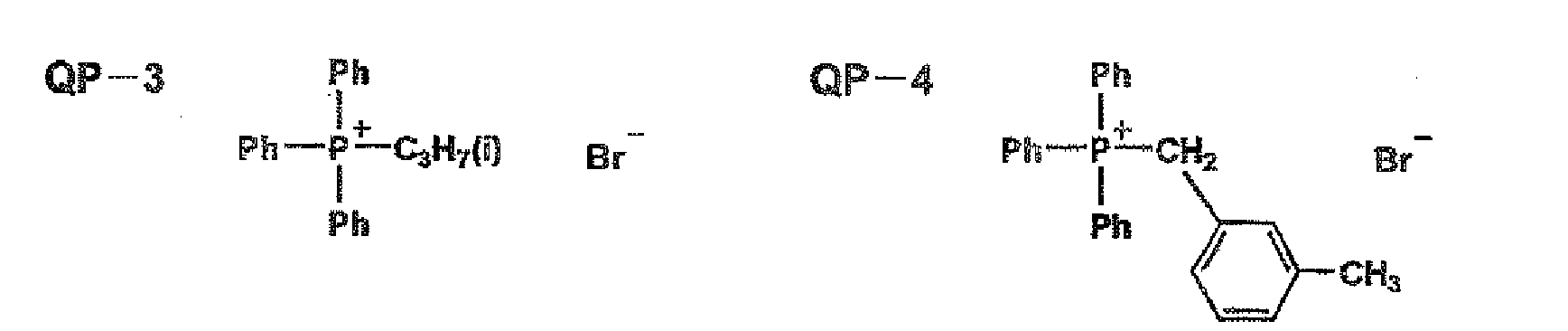


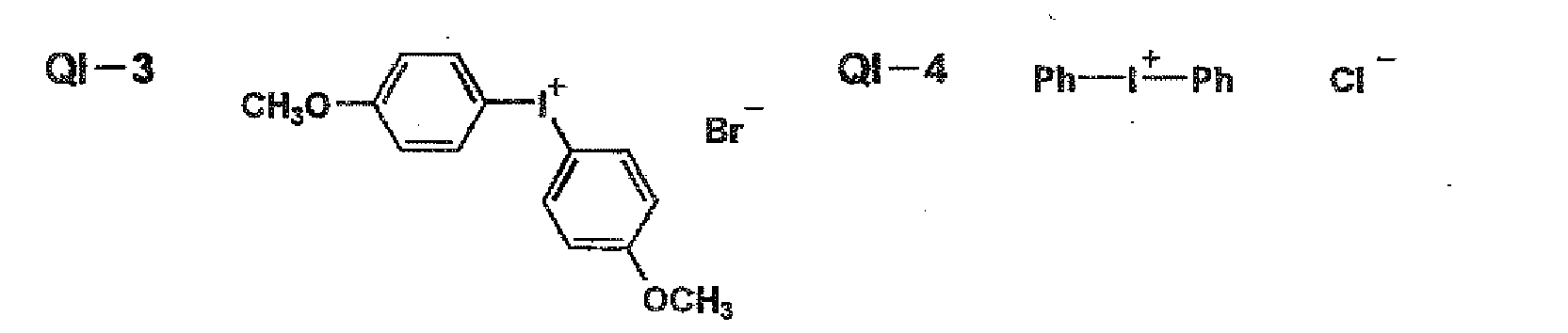




- In the chemical structures above, Ph represents a phenyl group.
- Other examples of the onium salt include various onium compounds disclosed in Japanese Patent Publication No.
55-39162 59-14023 - The addition amount of the onium salt in the invention is different in kinds of onium salts used or using methods, but is preferably from 0.2 to 5 g per m2 of image formation material.
- As the iron-arene complexes, there are compounds having the following chemical structure.

- In the formulae above, R1 represents an alkyl group, an aryl group or an alkoxy group.
- The iron-arene complex is preferably compound (1)-1.

- The bisimidazole compound is preferably a compound having the following chemical structure.

- Among these polymerization initiators, onium salts are preferred.
- Other polymerization initiators can be used in combination with the polymerization initiators described above in order to increase sensitivity. Examples of other polymerization initiators include an organic peroxide compound disclosed in Japanese Patent O.P.I. Publication Nos.
59-1504 61-243807 43-23684 44-6413 47-1604 US Patent No. 3,567,453 ; an organic azide compound disclosed inUS Patent Nos. 2,848,328 ,2,852,379 and2,940,853 ; orthoquinondiazide compounds disclosed in Japanese Patent Publication Nos.36-22062 37-13109 38-18015 45-9610 59-142205 1-54440 109,851 126,712 5-213861 5-255347 59-152396 61-151197 2-182701 3-209477 59-107344 - The polymerization initiator used in the invention is one having absorption maximum in the range of preferably not longer than 400 nm, more preferably not longer than 360 nm, and still more preferably not longer than 300 nm. Such a polymerization initiator having absorption in the UV range makes it possible to handle a planographic printing plate material under room light.
- The polymerization initiator can be used singly or as an admixture of one or more kinds thereof. The polymerization initiator can be added to a layer optionally provided other than the image formation layer.
- Other components such as a sensitizer, a thermal polymerization inhibitor, and a polymerization promoting agent can be added to the image formation layer, as long as the effect of the invention is not jeopardized.
- Examples of the sensitizer include a triazine compound disclosed in Japanese Patent O.P.I. Publication No.
64-13140 64-13141 64-13143 45-37377 US Patent No. 3,652,275 . The sensitizer content of the image formation layer is preferably 0.01 to 5 parts by weight based on 100 parts by weight of photopolymerizable, oleophilic and thermoplastic monomer/prepolymer. - As the polymerization promoting agent, a polymerization initiator or a chain transfer catalyst represented by amine or a sulfur compound (for example, thiol or disulfide) can be added to the image formation layer.
- The polymerization promoting agent or chain transfer catalyst can be added to the photopolymerizable composition. Examples thereof include amines such as N-phenyl glycine, triethanolamine, and N,N-diethylaniline; thiols as disclosed in
US Patent No. 4,414,312 and Japanese Patent O.P.I. Publication No.64-13144 2-291561 US Patent No. 3,558,322 and Japanese Patent O.P.I. Publication No.64-17048 2-291560 - The thermal polymerization inhibitor is preferably a quinone or phenol type compound, for example, hydroquinone, pyrogallol, p-methoxyphenol, catechol, β-naphtol or 2,6-di-t-butyl-p-cresol. The inhibitor content of the image formation layer is not more than 10 parts by weight, and preferably 0.01 to 5 parts by weight based on 100 parts by weight of photopolymerizable, oleophilic and thermoplastic monomer/prepolymer.
- Before a printing plate with an image is mounted on a printing press for printing, there is usually a plate inspection process for examining if the image is correctly formed on the printing plate. When the plate inspection process is carried out, it is preferred that a printing plate before printing has a property in which an image formed on the printing plate is visible, that is, image visibility. Since the printing plate material of the invention is a processless printing plate material capable of carrying out printing without special development, it is preferred that the optical density of exposed portions or unexposed portions in the printing plate material varies by light for exposure or heat generated on exposure.
- As a method for providing image visibility to a printing plate material in the invention, there is a method employing a cyanine type infrared light absorbing dye, which varies its optical density on exposure, a method employing a combination of a photo-induced acid generating agent and a compound varying its color by an acid, a method employing a combination of a color forming agent such as a leuco dye and a color developing agent or a method employing the heat melting particles or heat fusible particles which are clouded before exposure but transparent after exposure.
- In the invention, there are several methods which incorporate the components described above constituting the image formation layer or other components described later. There is, for example, a method disclosed in Japanese Patent O.P.I. Publication No.
2002-287334 2001-277740 2001-277742 - Besides the components described above, the image formation layer can contain other additives such as a surfactant, a colorant, a print-out agent, a higher fatty acid derivative, a plasticizer, inorganic particles, and low molecular weight hydrophilic compound. These additives can be added in the from of molecular dispersion, and can be encapsulated together with the polymerizable compound described above in microcapsules.
- In the invention, the image formation layer preferably contains a surfactant in order to promote on-press developability at initial printing and to improve coated surface properties. As the surfactant, there are a nonionic surfactant, an anionic surfactant, a cationic surfactant, an amphoteric surfactant and a fluorine-containing surfactant. These surfactants may be used singly or as an admixture of two or more kinds thereof.
- The nonionic surfactant is not limited, and a conventional known nonionic surfactant can be used. Examples thereof include polyoxyethylenealkyl ethers, polyoxyethylenealkylphenyl ethers, polyoxyethylene-polystyrylphenyl ethers, polyoxyethylenepolyoxypropylenalkyl ethers, partial esters of glycerin and fatty acids, partial esters of sorbitan and fatty acids, partial esters of pentaerythritol and fatty acids, propylene glycol monofatty acid ester, partial esters of sucrose and fatty acids, partial esters of polyoxyethylenesorbitan and fatty acids, partial esters of polyoxyethylenesorbitol and fatty acids, esters of polyoxyethylene glycol and fatty acids, partial esters of polyglycerin and fatty acids, polyoxyethylene castor oil, partial esters of polyoxyethyleneglycerin and fatty acids, fatty acid diethanolamides, N,N-bis-2-hydroxyalkylamines, polyoxyethylenealkylamines, triethanolamine fatty acid esters, trialkylamine oxides, polyethylene glycol and a copolymer of polyethylene glycol and polypropylene glycol.
- The anionic surfactant is not limited, and a conventional known anionic surfactant can be used. Examples of the anionic surfactant include fatty acid salts, abietic acid salts, hydroxyalkane sulfonic acid salts, alkane sulfonic acid salts, dialkylsulfosuccinic acid salts, straight-chained alkylbenzene sulfonic acid salts, branched alkylbenzene sulfonic acid salts, alkylnaphthalene sulfonic acid salts, alkyldiphenylether sulfonic acid salts, alkylphenoxypolyoxyethylenepropyl sulfonic acid salts, polyoxyethylenealkyl sulfophenylether salts, N-methyl-N-oleiltaurine sodium salts, N-alkylsulfosuccinic acid monoamide disodium salts, petroleum sulfonic acid salts, nitrated castor oil, sulfated beef tallow, fatty acid alkyl ester sulfate salts, alkylsulfate salts, polyoxyethylenealkylethersulfate salts, fatty acid monoglyceride sulfate salts, polyoxyethylenealkyl-phenylethersulfate salts, polyoxyethylenestyryl-phenylethersulfate salts, alkylphosphate salts, polyoxyethylenealkyletherphosphate salts, polyoxyethylenealkylphenyletherphosphate salts, partial saponification products of styrene-maleic anhydride copolymers, partial saponification products of olefin-maleic anhydride copolymers, and condensates of naphthalene sulfonic acid salts with formalin.
- The cationic surfactant is not limited, and a conventional known cationic surfactant can be used. Examples thereof include alkylamine salts, quaternary ammonium salts such as tetrabutylammonium bromide, polyoxyethylene alkylamine salts, and polyethylene polyamine derivatives.
- The amphoteric surfactant is not limited, and a conventional known amphoteric surfactant can be used. Examples thereof include carboxybetains, aminn carboxylic acids, sulfobetaines, aminosulfates and imidazolines.
- Surfactants, in which the polyoxyethylene in the surfactants described above is replaced by polyoxymethylene polyoxypropylene or polyoxybutylene, can be also used.
- A preferred surfactant is a fluorine-containing surfactant having a perfluoroalkyl group in the molecule. Examples thereof include anionic ones such as perfluoroalkyl carboxylic acid salts, perfluoroalkyl sulfonic acid salts, and perfluoroalkyl phosphates; amphoteric ones such as perfluoroalkyl betaines; cationic ones such as perfluoroalkyltrimethylammonium salts; and nonionic ones such as perfluoroalkylamineoxide, perfluoroalkylethylene oxide adduct, an oligomer having a perfluoroalkyl group and a hydrophilic group, an oligomer having a perfluoroalkyl group and an oleophilic group, an oligomer having a perfluoroalkyl group, a hydrophilic group and an oleophilic group, and urethanes having a perfluoroalkyl group or an oleophilic group. The fluorine-containing surfactants disclosed in Japanese Patent O.P.I. Publication Nos.
62-17950 62-226143 60-168144 - These surfactants may be used singly or as an admixture of two or more kinds thereof.
- The surfactant content of the image formation layer is preferably from 0.001 to 10% by weight, and more preferably from 0.01 to 5% by weight.
- The image formation layer in the invention can contain as a colorant a dye having a strong absorption in the visible wavelength range. Examples of the dye include Oil Yellow #101, Oil Yellow #103, Oil Pink #312, Oil green BG, Oil Blue BOS, Oil Blue #603, Oil Black BY, Oil Black BS, Oil Black T-505 (all of these are manufactured by Orient Chemical Industries, Ltd.), Victoria Pure Blue, Crystal Violet (CI42555), Methyl Violet (CI42535), Ethyl Violet, Rhodamine B (CI145170B), Malachite Green (CI42000), Methylene Blue (CI52015) and dyes described in Japanese Patent O.P.I. Publication No.
62-293247 - These dyes are preferably added to the image formation layer, since image portions can be easily discriminated from non-image portions. The additional amount of the dye in the image formation layer is preferably from 0.01 to 10 % by weight.
- In the invention, a protective layer is preferably provided on the image formation layer in order to prevent flaws from occurring during handling. The protective layer may be provided directly or through an intermediate layer on the image formation layer. It is preferred that the protective layer can be removed on a printing press.
- In the invention, it is preferred that the protective layer contains a water soluble resin or a water swellable resin in which a water soluble resin is partly cross-linked. Examples of the water-soluble resin include polysaccharides, polyethylene oxide, polypropylene oxide, polyvinyl alcohol, polyethylene glycol (PEG), polyvinyl ether, a styrenebutadiene copolymer, a conjugation diene polymer latex of methyl methacrylate-butadiene copolymer, an acryl polymer latex, a vinyl polymer latex, polyacrylamide, and polyvinyl pyrrolidone. In the invention, polysaccharides are preferably used as the water-soluble resin. As the polysaccharide, starches, celluloses, polyuronic acid and pullulan can be used. Among them, a cellulose derivative such as a methyl cellulose salt, a carboxymethyl cellulose salt or a hydroxyethyl cellulose salt is preferable, and a sodium or ammonium salt of carboxymethyl cellulose is more preferable. These polysaccharides can form a preferred surface shape of the hydrophilic layer.
- In the invention, the protective layer can contain a light-to-heat conversion material described above.
- The protective layer in the invention preferably contains a matting agent with an average size of from 1 to 20 µm, in order to prevent flaws from occurring while the printing plate material is mounted on a laser apparatus or on a printing press.
- The matting agent is preferably inorganic particles having a new Mohs hardness of not less than 5 or an organic matting agent. Examples of the inorganic particles having a new Mohs hardness of not less than 5 include particles of metal oxides (for example, silica, alumina, titania, zirconia, iron oxides, chromium oxide), particles of metal carbides (for example, silicon carbide), boron nitride particles, and diamond particles. Examples of the organic matting agent include starch described in
US Patent No. 2,322,037 , starch derivatives described inBE 625,451 GB 981,198 JP-B-44-3643 CH 330,158 US Patent No. 3,079,257 , and polycarbonate described inUS Patent No. 3,022,169 . The adding amount of the matting agent in the protective layer is preferably from 0.1 g to less than 10 g per m2. - A coating solution for the protective layer may contain a nonionic surfactant in order to secure uniform coatability of the protective layer. Examples of the nonionic surfactant include sorbitan tristearate, sorbitan monopalmitate, sorbitan trioleate, stearic acid monoglyceride, polyoxyethylenenonylphenyl ether, and polyoxyethylenedodecyl ether. The content of the nonionic surfactant is preferably 0.05 to 5% by weight, and more preferably 1 to 3% by weight based on the total solid content of the protective layer.
- In the invention, the dry thickness of the protective layer is preferably 0.05 to 1.5 g/m2, and more preferably 0.1 to 0.7 g/m2. This content range prevents occurrence of staining or scratches or deposition of fingerprints, and minimizes ablation scum without impairing removability of the protective layer.
- Next, an aluminum support used in the invention will be explained. As the aluminum support used in the invention, an aluminum support comprised of aluminum or aluminum alloy (hereinafter simply referred to as aluminum) is used in view of gravity or rigidity. As the aluminum alloy, there can be used various ones including an alloy of aluminum and a metal such as silicon, copper, manganese, magnesium, chromium, zinc, lead, bismuth, nickel, titanium, sodium or iron. An aluminum plate can be used which is manufactured according to various calender procedures. The thickness of the aluminum support is not specifically limited, as long as it can be mounted on a printing press, but the aluminum support with a thickness of from 50 to 500 µm is generally easy to handle.
- The aluminum support in the invention is preferably one having a hydrophilic surface, and more preferably one (i.e. grained aluminum support) subjected to any of known surface roughening treatment, anodizing treatment and hydrophilization processing. The grained aluminum support can be manufactured according to any conventional method. As one of the preferred manufacturing method, there is a method disclosed in Japanese Patent O.P.I. Publication No.
10-869 - It is preferable that the aluminum support in the invention is subjected to degreasing treatment for removing rolling oil prior to surface roughening (graining). The degreasing treatments include degreasing treatment employing solvents such as trichlene and thinner, and an emulsion degreasing treatment employing an emulsion such as kerosene or triethanol. It is also possible to use an aqueous alkali solution such as caustic soda for the degreasing treatment. When an aqueous alkali solution such as caustic soda is used for the degreasing treatment, it is possible to remove soils and an oxidized film which can not be removed by the above-mentioned degreasing treatment alone. When an aqueous alkali solution such as caustic soda is used for the degreasing treatment, the resulting support is preferably subjected to desmut treatment in an aqueous solution of an acid such as phosphoric acid, nitric acid, sulfuric acid, chromic acid, or a mixture thereof, since smut is produced on the surface of the support.
- As the surface roughening methods, there are a mechanical method and an electrolytically etching method.
- Though there is no restriction for the mechanical surface roughening method, a brushing roughening method and a honing roughening method are preferable. The brushing roughening method is carried out by rubbing the surface of the aluminum support with a rotating brush with a brush hair with a diameter of 0.2 to 0.8 mm, while supplying slurry in which volcanic ash particles with a particle size of 10 to 100 µm are dispersed in water to the surface of the support. The honing roughening method is carried out by ejecting obliquely slurry with pressure applied from nozzles to the surface of the aluminum support, the slurry containing volcanic ash particles with a particle size of 10 to 100 µm dispersed in water. The surface roughening can be also carried out by laminating the aluminum support surface with a sheet whose surface was coated with abrasive particles with a particle size of from 10 to 100 µm at intervals of 100 to 200 µm and at a density of 2.5 x 10³ to 10 x 103/cm2, and applying pressure to the sheet to transfer the roughened pattern of the sheet to the support and roughen the surface of the aluminum support.
- After the support has been roughened mechanically, it is preferably dipped in an acid or an aqueous alkali solution in order to remove abrasives and aluminum dust, etc. which have been embedded in the surface of the aluminum support. Examples of the acid include sulfuric acid, persulfuric acid, hydrofluoric acid, phosphoric acid, nitric acid and hydrochloric acid, and examples of the alkali include sodium hydroxide and potassium hydroxide. Among those mentioned above, an aqueous alkali solution of for example, sodium hydroxide is preferably used. The dissolution amount of aluminum in the support surface is preferably 0.5 to 5 g/m2. After the support has been dipped in the aqueous alkali solution, it is preferable for the support to be dipped in an acid such as phosphoric acid, nitric acid, sulfuric acid and chromic acid, or in a mixed acid thereof, for neutralization.
- Though there is no restriction for the electrolytic surface roughening method, a method, in which the support is electrolytically surface roughened in an acidic electrolytic solution employing alternating current, is preferred. Though an acidic electrolytic solution generally used for the electrolytic surface roughening can be used, it is preferable to use an electrolytic solution of hydrochloric acid or that of nitric acid. The electrolytic surface roughening method disclosed in Japanese Patent Publication No.
48-28123 896,563 53-67507 - When the support is electrolytically surface roughened by using an electrolytic solution of nitric acid, voltage applied is generally from 1 to 50 V, and preferably from 5 to 30 V. The current density used can be selected from the range from 10 to 200 A/dm2, and is preferably from 20 to 100 A/dm2. The quantity of electricity can be selected from the range of from 100 to 5000 C/dm2, and is preferably 100 to 2000 C/dm2. The temperature during the electrolytically surface roughening may be in the range of from 10 to 50 °C, and is preferably from 15 to 45 °C. The nitric acid concentration in the electrolytic solution is preferably from 0.1% by weight to 5% by weight. It is possible to optionally add, to the electrolytic solution, nitrates, chlorides, amines, aldehydes, phosphoric acid, chromic acid, boric acid, acetic acid or oxalic acid.
- When the support is electrolytically surface roughened by using an electrolytic solution of hydrochloric acid, voltage applied is generally from 1 to 50 V, and preferably from 2 to 30 V. The current density used can be selected from the range from 10 to 200 A/dm2, and is preferably from 50 to 150 A/dm2. The quantity of electricity can be selected from the range of from 100 to 5000 C/dm2, preferably 100 to 2000 C/dm2, and more preferably from 200 to 1000 C/dm2. The temperature during the electrolytically surface roughening may be in the range of from 10 to 50 °C, and is preferably from 15 to 45 °C. The hydrochloric acid concentration in the electrolytic solution is preferably from 0.1% by weight to 5% by weight.
- After the support has been electrolytically surface roughened, it is preferably dipped in an acid or an aqueous alkali solution in order to remove aluminum dust, etc (desmut treatment). produced in the surface of the support. Examples of the acid include sulfuric acid, persulfuric acid, hydrofluoric acid, phosphoric acid, nitric acid and hydrochloric acid, and examples of the alkali include sodium hydroxide and potassium hydroxide. Among those mentioned above, the aqueous alkali solution is preferably used. The dissolution amount of aluminum in the support surface is preferably 0.5 to 5 g/m2. After the support has been dipped in the aqueous alkali solution, it is preferable for the support to be dipped in an acid such as phosphoric acid, nitric acid, sulfuric acid and chromic acid, or in a mixed acid thereof, for neutralization.
- The mechanical surface roughening and electrolytic surface roughening may be carried out singly, and the mechanical surface roughening followed by the electrolytic surface roughening may be carried out.
- After the surface roughening, anodizing treatment may be carried out. There is no restriction in particular for the method of anodizing treatment used in the invention, and known methods can be used. The anodizing treatment forms an anodization film on the surface of the aluminum support. For the anodizing treatment there is preferably used a method of applying a current density of from 1 to 10 A/dm2 to an aqueous solution containing sulfuric acid and/or phosphoric acid in a concentration of from 10 to 50%, as an electrolytic solution. However, it is also possible to use a method of applying a high current density to sulfuric acid as described in
U.S. Patent No. 1,412,768 , a method to electrolytically etching the support in phosphoric acid as described inU.S. Patent No. 3,511,661 , or a method of employing a solution containing two or more kinds of chromic acid, oxalic acid, malonic acid, etc. The coated amount of the formed anodization film is suitably 1 to 50 mg/dm2, and preferably 10 to 40 mg/dm2. The coated amount of the formed anodization film can be obtained from the weight difference between the aluminum plates before and after dissolution of the anodization film. The anodization film of the aluminum plate is dissolved employing for example, an aqueous phosphoric acid chromic acid solution which is prepared by dissolving 35 ml of 85% by weight phosphoric acid and 20 g of chromium (IV) oxide in 1 liter of water. - The aluminum support, which has been subjected to anodizing treatment, is optionally subjected to sealing treatment. For the sealing treatment, it is possible to use known methods using hot water, boiling water, steam, a sodium silicate solution, an aqueous dichromate solution, a nitrite solution and an ammonium acetate solution.
- As the hydrophilization processing method after the above treatments, there is a method of undercoating, on the support, a water soluble resin such as polyvinyl phosphonic acid, a polymer or copolymer having a sulfonic acid in the side chain or polyacrylic acid; a water soluble metal salt such as zinc borate; a yellow dye; an amine salt; and so on. The sol-gel treatment support disclosed in Japanese Patent O.P.I. Publication No.
5-304358 - In the invention, the printing ink preferably contains at least one selected from a polymerizable monomer and a polymerizable oligomer.
- Herein, the polymerizable monomer has an ethylenically unsaturated bond, and a weight average molecular weight of less than 3,000, and the polymerizable oligomer has an ethylenically unsaturated bond, and a weight average molecular weight of not less than 3,000. Examples thereof include (meth)acxylic acid, maleic acid, and their oligomer; and urethane resin, epoxy resin, polyester resin, polyol resin, and vegetable oil modified with a compound having an ethylenically unsaturated bond such as (meth)acrylic acid, Among them, a compound having an ethylenically unsaturated bond, which are miscible with a rosin-modified phenol resin, for example, vegetable oil modified with an ethylenically unsaturated, is preferred. These compounds may be used alone or as an admixture of two or more kinds thereof. The content of the polymerizable monomer and/or oligomer in the printing ink in the invention is preferably from 10 to 40% by weight.
- When printing is carried out employing a planographic printing plate described later, incorporation of the polymerizable monomer and/or the polymerizable oligomer to printing ink reduces paper wastes or image faults at initial printing stage, and further makes it possible to remove easily stains at non-image portions of the printing plate caused by scratches or pressure. This mechanism is not clear, but is probably because the polymerizable monomer and/or the polymerizable oligomer swells a layer at portions unnecessary for printing in an exposed planographic printing plate material, and makes it possible to remove easily the swelled portions due to ink tackiness.
- In the invention, printing ink preferably contains vegetable oil. Example of the vegetable oil include soybean oil, cotton seed oil, linseed oil, safflower oil, tung oil, tall oil, castor oil, oiticica oil, candlenut oil, akarritom seed fat, parinarium seed fat, dehydrated castor oil, and canola oil. These vegetable oils may be alone or as an admixture of two or more kinds thereof. In the invention, the content of the vegetable oil in the printing ink is preferably from 10 to 40% by weight.
- When printing is carried out employing a planographic printing plate described later, incorporation of vegetable oil to printing ink reduces paper wastes at initial printing stage or image faults, and minimizes stains at non-image portions of the printing plate produced by scratches or pressure. This is probably because the vegetable oil enhances a swell property of a layer at portions unnecessary for printing in an exposed planographic printing plate material.
- The printing ink in the invention can contain pigment for coloring. As the pigment used in the invention, there are known inorganic or organic pigments. Examples of the inorganic pigment include titanium oxide, calcium carbonate, barium sulfate, alumina white, zinc oxide, prussian blue, red iron oxide, carbon black, aluminum powder, and brass powder. Examples of the organic pigment include soluble azo pigments of the β-naphthol, β-oxynaphthoic acid, β-oxynaphthoic acid arylide, acetoacetic acid arylide, and pyrazolone type; insoluble azo pigments of the β-naphthol, β-oxynaphthoic acid arylide, acetoacetic acid arylide monoazo, acetoacetic acid arylide bisoazo, and pyrazolone type; phthalocyanine pigments such as copper phthalocyanine blue, chlorinated or brominated copper phthalocyanine blue, sulfonated copper phthalocyanine blue, and metal free phthalocyanine; and polycyclic or heterocyclic pigments of the quinacridone, dioxazine, pyranthrone, anthanthrone, indanthrone, anthrapyrimidine, fravanthrone, thioindigo, anthraquinone, perynone, perylene, isoindolinone, metal complexes, and quinophtharone type.
- As a binder used in printing ink in the invention, resin used in conventional ink for offset printing can be used without any limitations. Examples of such resin include rosin modified phenol resin, rosin modified maleic acid resin, and various alkyd resins, petroleum resin, rosin ester resin, polyester resin, gilsonite and their modified resins. The rosin modified phenol resin can be used alone or in combination with synthetic resins such as various alkyd resins, petroleum resin, rosin ester resin, polyester resin, gilsonite and their modified resins. Various alkyd resins, petroleum resin, etc. can be also used in combination with the rosin modified phenol resin. These binders can be used alone or as a mixture of two or more kinds thereof.
- The resins above cross-linked or gelled employing a cross-linking agent or a gelling agent also can be used as a binder for printing ink. Examples of the cross-linking agent include isocyanate compounds such as tolylene diisocyanate, diphenylmethane diisocyanate, isophorone diisocyanate, hexamethylene diisocyanate, tetramethylxylylene diisocyanate, and polymethylenepolyphenyl polyisocyanate. Examples of the gelling agent include aziridine compounds such as trimethylolpropane-tris-β-N-aziridinylpropionnate, and pentaerithritolpropane-tris-β-N-aziridinylpropionnate; epoxy compounds such as glycerol polyglycidyl ether, and trimethylolpropane polyglycidyl ether; and aluminum chelate compounds such as ethylacetate aluminum diisopropoxide. These cross-linking agents or gelling agents can be used alone or as a mixture of two or more kinds thereof, respectively.
- The binder is preferably a cross-linked resin which is obtained by heating a mixture of a resin with a hydroxyl group and a polyfunctional isocyanate compound as a cross-linking agent or a mixture of a resin with a hydroxyl group, a polyfunctional isocyanate compound as a cross-linking agent and a catalyst. That is, the cross-linked resin is preferably used which is obtained by heating and reacting a resin with a hydroxyl group, a polyfunctional isocyanate compound as a cross-linking agent, and optionally a catalyst. The resin with a hydroxyl group and the polyfunctional isocyanate is appropriately selected from those described above. As the catalyst can be used conventional ones such as organic titanate compounds, organic tin compounds, and organic amines. Typical examples thereof include tetrabutyl titanate, stannous octilate, dibutyltin acetate, triethylamine, dimethylaniline, and triethylenediamine. These catalysts can be used alone or as an admixture of two or more kinds thereof. The heating condition is not specifically limited as long as it is such condition under which the resin with a hydroxyl group is cross-linked through the cross-linking agent.
- The printing ink of the invention can contain a photopolymerization initiator. As the photopolymerization initiator, conventional ones can be used, but one which can absorb ultraviolet light to generate an active radical is preferred. Examples thereof include acetophenone, 2,2-diethoxyacetophenone, p-dimethylaminoacetophenone, benzophenone, 2-chlorobenzophenone, p,p'-dichloro-benzophenone, p,p'-bisdiethylaminobenzophenone, Michler's ketone, benzil, dibenzoyl, benzoin methyl ether, benzoin ethyl ether, benzoin propyl ether, benzoin n-propyl ether, benzoin isobutyl ether, benzoin n-butyl ether, benzoin dimethyl ketal, tetramethylthiuram monosulfide, thioxanthone, 2-chlorothioxanthone, 2-methylthioxanthone, azobisisobutyronitrile, benzoin peroxide, and di-tert-butyl peroxide. These catalysts may be optionally used as an admixture of two or more kinds thereof.
- The printing ink of the invention can contain an oxidation polymerization catalyst. As the oxidation polymerization catalyst, conventional ones can be used. Typical examples thereof include a metal salt of an organic carboxylic acid, for example, a salt of an organic carboxylic acid such as acetic acid, propionic acid, butyric acid, isopentanoic acid, hexanoic acid, 2-ethylbutyric acid, naththenic acid, octylic acid, nonanoic acid, decanoic acid, 2-ethylhexanoic acid, isooctanoic acid, isononanoic acid, lauric acid, palmitic acid, stearic acid, oleic acid, linoleic acid, neodecanoic acid, versatic acid, secanoic acid, linseed oil fatty acid, tall oil fatty acid, dimethylhexanoic acid, 3,5,5-trimethylhexanoic acid, or dimethyloctanoic acid with cobalt, manganese, lead, iron, zinc, calcium, or zirconium; a phenanthroline compound such as 1,10-phenanthroline or 5-methylphenanthrolone; and 2,2'-dipyridine, but the invention is not limited thereto. These compounds can be optionally used as an admixture of two or more kinds thereof.
- The printing ink in the invention for offset printing optionally contains an additive such as a polymerization inhibitor, a pigment dispersant, a drying retarder, a solvent, an anti-oxidant, a cleaning auxiliary, an anti-abrasion agent, an anti-offset agent or a nonionic surfactant.
- It is preferred that dampening solution contains an alkylene glycol monoalkyl ether compound. The alkylene glycol monoalkyl ether is a monoether of alkylene glycol with alkyl. It is preferred that the alkylene glycol monoalkyl ether is dissolved in dampening solution and used.
- The alkylene glycol monoalkyl ether compound is preferably a compound represented by formula (A).
Formula (A) R11-O-(CH2C(R12)HO)n-H
- In formula above, R11 represents an alkyl group having a carbon atom number of from 1 to 6, R12 represents a methyl group or a hydrogen atom, and n represents an integer of from 1 to 4.
- Examples of the compound represented by formula (A) include ethylene glycol monomethyl ether, diethylene glycol monomethyl ether, triethylene glycol monomethyl ether, tetraethylene glycol monomethyl ether, ethylene glycol monoethyl ether, diethylene glycol monoethyl ether, triethylene glycol monoethyl ether, tetraethylene glycol monoethyl ether, ethylene glycol monopropyl ether, diethylene glycol monopropyl ether, triethylene glycol monopropyl ether, tetraethylene glycol monopropyl ether, ethylene glycol monoisopropyl ether, diethylene glycol monoisopropyl ether, triethylene glycol monoisopropyl ether, tetraethylene glycol monoisopropyl ether, ethylene glycol monobutyl ether, diethylene glycol monobutyl ether, triethylene glycol monobutyl ether, tetraethylene glycol monobutyl ether, ethylene glycol monoisobutyl ether, diethylene glycol monoisobutyl ether, triethylene glycol monoisobutyl ether, tetraethylene glycol monoisobutyl ether, ethylene glycol monotert-butyl ether, diethylene glycol monotert-butyl ether, triethylene glycol monotert-butyl ether, tetraethylene glycol monotert-butyl ether, propylene glycol monomethyl ether, dipropylene glycol monomethyl ether, tripropylene glycol monomethyl ether, propylene glycol monoethyl ether, dipropylene glycol monoethyl ether, tripropylene glycol monoethyl ether, tetrapropylene glycol monoethyl ether, propylene glycol monopropyl ether, dipropylene glycol monopropyl ether, tripropylene glycol monopropyl ether, propylene glycol monoisopropyl ether, dipropylene glycol monoisopropyl ether, tripropylene glycol monoisopropyl ether, dipropylene glycol monobutyl ether, tripropylene glycol monobutyl ether, propylene glycol monoisobutyl ether, dipropylene glycol monoisobutyl ether, tripropylene glycol monoisobutyl ether, propylene glycol monotert-butyl ether, dipropylene glycol monotert-butyl ether, and tripropylene glycol monotert-butyl ether.
- The compound represented by formula (A) may be used singly or as an admixture of two or more kinds thereof.
- The content of the compound represented by formula (A) in the dampening solution in the invention is suitably from 0.05 to 5% by weight, preferably from 0.2 to 3% by weight, and more preferably from 0.3 to 2% by weight, in view of printing durability.
- The dampening solution in the invention preferably contains, in addition to the alkylene glycol monoalkyl ether compound above, a pH adjusting agent, a wetting property improving aid, a water-soluble polymer, a chelating agent or an antiseptic.
- As the pH adjusting agent, at least one selected from water-soluble organic or inorganic acids and their salts can be used. These compounds are effective in adjusting pH of a dampening solution, giving a buffering effect to a dampening solution, appropriately etching a support of a printing plate, and preventing corrosion of the support. Preferred organic acids include citric acid, ascorbic acid, malic acid, tartaric acid, lactic acid, acetic acid, gluconic acid, hydroxyacetic acid, oxalic acid, malonic acid, levulinic acid, sulfanilic acid, p-toluenesulfonic acid, phosphoric acid, phosphonic acid and phytic acid.
- Examples of the inorganic acids include nitric acid and sulfuric acid. Alkali metal, alkaline earth metal, ammonium or organic amine salts of the organic or inorganic acids can be suitably used. These organic or inorganic acids or their salts may be used singly or as an admixture of two or more kinds thereof.
- The content of the pH adjusting agent in the dampening solution is suitably from 0.001 to 0.1% by weight. The pH adjusting agent content not less than 0.001% by weight minimizes contamination during printing due to etching to an aluminum support. The pH adjusting agent content not more than 0.1% by weight is preferred in preventing rust of a printing press.
- The pH of the dampening solution is preferably from 4.5 to 7.5. The above pH range minimizes contamination during printing.
- Surfactants or other solvents can be used as the wetting property improving aid. As the surfactants used, an anionic surfactant and/or a nonionic surfactant are preferred.
- Examples of the anionic surfactant include fatty acid salts, abietic acid salts, hydroxyalkanesulfonic acid salts, alkanesulfonic acid salts, dialkylsulfosuccinic acid salts, straight chain alkylbebzenesulfonic acid salts, branched alktlbebzenesulfonic acid salts, alkylnaphthalenesulfonic acid salts, alkylphenoxypolyoxyethylene propylsulfonic acid salts, polyoxyethylene alkylsulfophenyl ether, N-methyl-N-oleyltaurine sodium salts, N-alkylsulfosuccinic acid monoamide disodium salts, petroleum sulfonic acid salts, sulfated castor oil, sulfated tallow oil, fatty acid alkyl ester sulfuric acid ester salts, alkyl sulfate salts, polyoxyethylene alkyl ether sulfuric acid ester salts, fatty acid monoglyceride sulfate ester salts, polyoxyethylene alkylphenyl ether sulfuric acid salts, polyoxyethylene styrylphenyl ether sulfuric acid salts, alkylphosphate ester salts, polyoxyethylene alkyl ether phosphoric acid ester salts, polyoxyethylene alkylphenyl ether phosphoric acid ester salts, partially saponified styrene anhydrous maleic acid copolymer, partially saponified olefin-anhydrous maleic acid copolymer, and naphthalenesulfonic acid salt-formaline condensates. Of the foregoing, dialkylsulfosuccinic acid salts, alkyl sulfate salts and alkylnaphthalenesulfonic acid salts are preferred.
- Examples of the nonionic surfactant include polyoxyethylene alkylphenyl ethers, polyoxyethylene polystyrylphenyl ethers, polyoxyethylene polyoxypropylene alkyl ethers, glycerin fatty acid partial esters, sorbitan fatty acid partial esters, pentaerythritol fatty acid partial esters, propylene glycol monofatty acid esters, sugar fatty acid partial esters, polyoxyethylene sorbitan fatty acid partial esters, polyoxyethylene sorbitol fatty acid partial esters, polyethylene glycol fatty acid esters, polyglycerin fatty acid partial esters, polyoxyethylene-modified caster oils, polyoxyethylene glycerin fatty acid partial esters, fatty acid diethanolamides, N,N-bis-2-hydroxyalkylamines, polyoxyethylene alkylamine, triethanolamine fatty acid esters, polyoxyethylene-polyoxypropylene block polymers, and trialkylamineoxides.
- Besides the above, fluorine-contained surfactants or silicon-contained surfactants can be also used. The surfactant content of the dampening solution preferably not more than 1% by weight, and more preferably from 0.001 to 0.5% by weight in view of foaming. The surfactants may be used as an admixture of two or more kinds thereof.
- Other examples of the wetting property improving aid include propylene glycol, dipropylene glycol, tripropylene glycol, tetrapropylene glycol, pentapropylene glycol, ethylene glycol, diethylene glycol, triethylene glycol, butylene glycol, hexylene glycol, 2-ethyl-1,3-hexanediol, 3-methoxy-3-methyl-1-butanol, 1-butoxy-2-propanol, glycerin, diglycerin, polyglycerin, trimethylol propane, 2-pyrrolidones having an alkyl group having a carbon atom number of from 1 to 8 at the 1-position, 3,5-dimethyl-1-hexyne-3-ol, 2,4, 7,9-tetramethyl-5-decyne-4,7-diol, propargyl alcohol (2-propyne-1-ol), 3-butyne-1-ol, 1-buty-ne-3-ol, 2-butyne-1,4-diol, and 3,6-dimethyl-4-octyne-3,6-diol.
- Among these, 3-methoxy-3-methyl-1-butanol and 1-butoxy-2-propanol are especially preferred.
- These solvents may be used singly or as an admixture of two or more kinds thereof. The content of these solvents in the dampening solution is preferably from 0.002 to 1% by weight, and more preferably from 0.005 to 0.5% by weight.
- As the water soluble polymer, there are natural products or their modification products such as gum arabic, starch derivatives (for example, dextrin, enzymatic degradation dextrin, hydroxypropylated enzymatic degradation dextrin, carboxymethylated starch, phosphoric acid starch, or octenylsuccinic acid-modified starch), alginates and cellulose derivatives (for example, carboxymethylcellulose, carboxyethylcellulose, methylcellulose, or hydroxyethylcellulose); synthetic products such as polyethylene glycol or its copolymer, polyvinyl alcohol or its copolymer, polyacrylamide or its copolymer, polyacrylic acid or its copolymer, vinyl methyl ether-maleic anhydride copolymer and polystyrene sulfonic acid or its copolymer; and polyvinyl pyrrolidone. Among these, carboxymethylcellulose, and hydroxyethylcellulose are especially preferred. The water soluble polymer content of the dampening solution is preferably from 0.001 to 0.5% by weight, and more preferably from 0.005 to 0.2% by weight.
- It is preferred that the dampening solution contains a chelating agent. Preferred examples of the chelating agent include ethylenediaminetetracetic acid or its sodium or potassium salt; diethylenetriaminepentacetic acid or its sodium or potassium salt; hydroxyethylethylene-diaminetriacetic acid or its sodium or potassium salt; nitrilotriacetic acid or its sodium salt; organic phosphonic acids or their salts such as 1-hydroxyethane-1,1-diphosphonic acid or its sodium or potassium salt, and aminotri-(methylenephosphonic acid) or its sodium or potassium salt; and phosphonoalkane tricarboxylic acids or their salts. As alternatives of the sodium or potassium salts, organic amine salts are also effective. Among these, those, which stably exist in a dampening solution and do not jeopardize printability, are employed. The chelating agent content of the dampening solution is suitably from 0.0001 to 0.5% by weight, and preferably from 0.0005 to 0.2% by weight.
- As the antiseptic, there are formalin, imidazole derivatives, sodium dehydroacetate, 4-isothiazoline-3-on derivatives, benzotriazole derivatives, amidine or guanidine derivatives, diazine or triazole derivatives, oxazole or oxazine derivatives, and bromonitroalcohols such as bromonitropropanol, 1,1-dibromo-1-nitro-2-ethaol and 3-bromo-3-nitropentane-2,4-diol. The content of the antiseptic in the dampening solution, although different due to kinds of bacteria, mildew or ferment, is an amount effective to the bacteria, mildew or ferment and is preferably from 0.001 to 0.5% by weight. Two or more kinds of the antiseptic effective to bacteria, mildew or ferment are preferably used in combination.
- The dampening solution may contain a deodorant, a colorant, an anti-rusting agent or an anti-foaming agent.
- As the deodorant, a compound represented by formula (I) is preferably used.
Formula (I) R1-COOR2
- In formula (I), R1 represents an alkyl group having a carbon atom number of from 1 to 15, an alkenyl group, an aralkyl group, or a phenyl group. The alkyl or alkenyl group has preferably a carbon atom number of from 4 to 8. The alkyl, alkenyl or aralkyl group of R1 may be straight-chained or branched. The alkenyl group preferably has one double bond.
- Examples of the aralkyl group include a benzyl group and phenylethyl group. One or more hydrogen atoms of the alkyl, alkenyl, aralkyl or phenyl group represented by R1 may be substituted with a hydroxyl group or an acetyl group. R2 represents an alkyl group having a carbon atom number of from 3 to 10, an aralkyl group, or a phenyl group, provided that the alkyl or aralkyl group may be straight-chained or branched. The alkyl group has preferably a carbon atom number of from 3 to 9. Examples of the aralkyl group include a benzyl group and a phenylethyl group.
- Examples of the deodorant include esters of formic acid, acetic acid, propionic acid, butyric acid, isobutyric acid, 2-ethylbutyric acid, valeric acid, isovaleric acid, 2-methylvaleric acid, hexanoic acid (caproic acid), 4-methylpentanoic (isohexanoic acid), 2-hexenoic acid, 4-pentenoic acid, heptahoic acid, 2-methylheptanoic acid, octanoic acid (caprylic acid), nonanoic acid, decanoic acid (capric acid), 2-decenoic acid, lauric acid or myristic acid.
- In addition to the above, there are benzyl phenylacetate and acetoacetic acid esters such as ethyl acetoacetate or 2-hexyl acetoacetate. Among these, n-pentyl acetate, isopentyl acetate, n-butyl butyrate, n-pentyl butyrate and isopentyl butyrate are preferred, and n-butyl butyrate, n-pentyl butyrate and isopentyl butyrate are preferred.
- The content of the deodorant in the dampening solution is suitably from 0.001 to 0.5% by weight, and preferably from 0.002 to 0.2% by weight. The deodorant can improve working environment. Vanillin or ethylvanillin can be used with the above deodorant.
- As the colorants, dyes for food are preferably used. Examples of yellow dyes include CI Nos. 19140, and 15985, examples of red dyes include CI Nos. 16185, 45430, 16255, 45380, and 45100, examples of violet dyes include CI No. 42640, examples of blue dyes include CI Nos. 42090 and 73015, and examples of green dyes include CI No. 42095. The colorant content of the dampening solution is preferably from 0.0001 to 0.5% by weight.
- Examples of the anti-rusting agent include benzotriazole, 5-methylbenzotriazole, thiosalicylic acid, benzimidazole or their derivative. The anti-rusting agent content of the dampening solution is preferably from 0.0001 to 0.5% by weight.
- The anti-foaming agent is preferably a silicon-containing anti-foaming agent, which may be of the emulsion type or of the solution type.
- The dampening solution in the invention can contain alcohols in order to adjust the surface tension or viscosity and improve the printing performance.
- Examples of the alcohols include methyl alcohol, ethyl alcohol, propyl alcohol, and isopropyl alcohol.
- A constituent other that the components described above of the dampening solution in the invention is water. The dampening solution on the market is ordinarily a concentrated dampening solution. The concentrated dampening solution, which is comprised of the components described above, is prepared by dissolving the above solid components in water. The concentrated dampening solution is diluted with water by a factor of 10 to 200 on using.
- In the invention, water giving a fluoride ion concentration of from 0 to 0.1 ppm in the dampening solution is preferably used. As a method removing a fluoride ion from water for dilution, there are a precipitation method and an absorption method. The precipitation method coagulates a fluoride ion in water by aluminum hydroxide to produce precipitates, whereby the fluoride ion is removed. The absorption method passes water through a vessel filled with an absorption agent, whereby the fluoride ion is filtered and removed. As the absorption agent, there are activated alumina, activated carbon, an ion-exchange resin and a reverse osmotic membrane.
- In the invention, water giving a calcium ion concentration of from 0.01 to 40 ppm in the dampening solution is preferably used. In order to remove a calcium ion from water for dilution and obtain the dampening solution falling within the above calcium ion range, pure water, ion-exchanged water or water purified with a reverse osmotic membrane is preferably used.
- The dampening solution can be used both in a conventional dampener and in a continuous feed dampening system, and is used preferably in the continuous feed dampening system. The dampening solution in the invention is applied to Mitsubishi Diamatic Dampener, Komorimatic Dampener, Dahlgren Dampener, or Alcolor Dampener manufactured by Heiderberg Co., Ltd.
- The planographic printing plate material of the invention is one having so-called on-press developability wherein it is mounted on a printing press after imagewise exposure without using special chemicals and supplied with dampening water and printing ink to remove unnecessary portions, followed by printing. In the preferred embodiment of the invention, the image formation layer of a thermal melt or fusion type planographic printing plate material forms oleophilic image portions at exposed portions and forms non-image portions at unexposed portions, the image formation layer at unexposed portions being removed. The image formation layer at unexposed portions can be removed by water, but is preferably subjected to so-called on-press development. Removal (on-press development) of the image formation layer at unexposed portions of a printing plate material mounted on a printing press plate cylinder can be carried out by bringing a dampening roller and an inking roller into contact with the image formation layer while rotating the plate cylinder. The sequence described later or other various sequences can be carried out.
- The supplied amount of dampening solution may be adjusted to be greater or smaller than the amount ordinarily supplied in printing, and the adjustment may be carried out stepwise or continuously.
- Sequence (1) A dampening roller is brought into contact with the image formation layer of a printing plate material on the plate cylinder during one to several tens of rotations of the plate cylinder, and then an inking roller brought into contact with the image formation layer during the next one to tens of rotations of the plate cylinder. Thereafter, printing is carried out.
- Sequence (2) An inking roller is brought into contact with the image formation layer of a printing plate material on the plate cylinder during one to several tens of rotations of the plate cylinder, and then a dampening roller brought into contact with the image formation layer during the next one to tens of rotations of the plate cylinder. Thereafter, printing is carried out.
- Sequence (3) An inking roller and a dampening roller are brought into contact with the image formation layer of a printing plate material on the plate cylinder during one to several tens of rotations of the plate cylinder. Thereafter, printing starts.
- The present invention will be explained below employing examples, but is not limited thereto. In the examples, "parts" is parts by weight, unless otherwise specified.
- The following varnish composition was placed in a fourneck flask with a condenser, a thermometer, and a stirrer, heated to a temperature of 200 °C, and stirred for one hour at 200 °C to obtain a solution. Thereafter, 1 part of tolylene diisocyanate (TDI) was added to the resulting solution, and further stirred at 90 °C for 3 hours under nitrogen atmosphere. Thus, Varnish 1 and Varnish 2 for printing ink for offset printing were manufactured.
(Composition of Varnish 1) Rosin-modified phenol resin (Mw: 100,000, Acid value: 15, produced by HITACHI KASEI POLYMER CO., LTD.) 400 parts Mineral oil 59 parts (Composition of Varnish 2) Rosin-modified phenol resin (Mw: 100,000, Acid value: 15, produced by HITACHI KASEI POLYMER CO., LTD.) 400 parts Linseed oil 59 parts - Acrylic acid-modified vegetable oil A as a monomer, α-aminoacetophenone (produced by CIBA SPECIALTY CHEMICALS CO., LTD.) as a polymerization initiator, a polymerization inhibitor (t-butyl-hydroxytoluene, produced by ALBEMARLE CORPORATION), and pigment (Phthalocyanine Blue, produced by DAINICHI SEIKA KOGYO CO., LTD.) were added to the varnish 1 above in an amount as shown in composition of Printing ink 1 below (the addition amount of each component being represented in terms of parts), kneaded with a three roll kneader, and one part of oxidation polymerization catalyst (mixture of cobalt octylate and manganese octylate, produced by Shinto Fine CO., LTD.) was added thereto, and stirred for 1 hour. Thus, printing ink 1 was obtained, which contained the polymerizable oligomer.
-
Pigment Phthalocyanine Blue (produced by DAINICHI SEIKA KOGYO CO., LTD.) 20.0 parts Varnish 1 43.5 parts Polymerizable monomer (Acrylic acid-modified vegetable oil A) 30.0 parts Polymerization initiator α-Aminoacetophenone (produced by CIBA SPECIALTY CHEMICALS CO., LTD.) 5.0 parts Polymerization inhibitor t-butylhydroxytoluene (produced by ALBEMARLE CORPORATION) 0.5 parts -

Average molecular weight: 486 - Acrylic acid-modified vegetable oil A as a monomer, α-aminoacetophenone (produced by CIBA SPECIALTY CHEMICALS CO., LTD.) as a photopolymerization initiator, a polymerization inhibitor (t-butyl-hydroxytoluene, produced by ALBEMARLE CORPORATION), and pigment (Phthalocyanine Blue, produced by DAINICHI SEIKA KOGYO CO., LTD.) were added to the varnish 2 above in an amount as shown in composition of Printing ink 2 below (the addition amount of each component being represented in terms of parts), kneaded with a three roll kneader, and one part of oxidation polymerization catalyst (mixture of cobalt octylate and manganese octylate, produced by SHINTO FINE CO., LTD.) was added thereto, and stirred for 1 hour. Thus, Printing ink 2 was obtained, which contained the polymerizable oligomer and vegetable oil.
(composition of Printing ink 2) Pigment Phthalocyanine Blue (produced by DAINICHI SEIKA KOGYO CO., LTD.) 20.0 parts Varnish 2 43.5 parts Polymerizable monomer (Acrylic acid-modified vegetable oil A) 30.0 parts Polymerization initiator α-Aminoacetophenone (produced by CIBA SPECIALTY CHEMICALS CO., LTD.) 5.0 parts Polymerization inhibitor t-Butylhydroxytoluene (produced by ALBEMARLE CORPORATION) 0.5 parts - Pigment (Phthalocyanine Blue, produced by DAINICHI SEIKA KOGYO CO., LTD.) was added to the varnish 1 above in an amount as shown in composition of Printing ink 3 below, kneaded with a bead mill, and kneaded with a three roll kneader. Thereafter, four parts by weight of polyethylene wax compound (Wax Compound, produced by SHAMROCK CO., LTD.), one part by weight of dryer, and five parts by weight of mineral oil were further added thereto, and stirred for 1 hour. Thus, Printing ink 3 was obtained, which did not contain any of a polymerizable monomer, a polymerizable oligomer and vegetable oil.
(Composition of Printing ink 3) Pigment Phthalocyanine Blue (produced by DAINICHI SEIKA KOGYO CO., LTD.) 20.0 parts Varnish 1 70.0 parts - A 0.24 mm thick aluminum plate (material 1050, refining H16) was immersed in an aqueous 5% by weight sodium hydroxide solution at 65 °C for 1 minute for degreasing treatment, and washed with water. Subsequently, the aluminum plate was subjected to an electrolytic surface-roughening treatment in a 1% hydrochloric acid solution at 40 °C, at a current of 20 A for 20 seconds (400 A·sec/dm2), employing a carbon electrode, washed with water, and immersed (desmut-treated) in a 2% sodium oxide solution at 60°C for 60 seconds.
- Subsequently, the resulting plate was subjected to anodization treatment according to the following conditions:
- Processing bath: 30% by weight sulfuric acid solution
- Current density: 2A/dm2
- Temperature: 40 °C
- Treatment time: 60 seconds
- The resulting plate was immersed in 80 °C water for 30 seconds, dried at 40 °C to obtain a grained aluminum support.
- The surface roughness Ra of this hydrophilic support was 0.34 µm, measured employing a surface roughness measuring device (RST PLUS produced by WYKO Co., Ltd.).
- The following subbing layer coating solution 1 was coated on the aluminum support obtained above, employing a bar giving a coating amount of 7.5 ml/m2, and dried in an oven at 80 °C for 10 seconds.
(Subbing layer coating solution 1) Water 15 g Methanol 135 g Compound A 0.7 g -

- Subsequently, the following image formation layer coating solution 1 was coated employing a wire bar, and dried in an oven at 100 °C for 60 seconds to form an image formation layer with a dry coating amount of 1.0 g/m2. Thus, Planographic printing plate material sample 1 was prepared. Image formation layer coating solution 1
Infrared absorbing agent (1) 0.05 g Polymerization initiator (PS-1) 0.2 g Binder polymer (1) (Average molecular weight 80,000) 0.5 g Polymerizable compound (Isocyanuric acid EO-modified triacrylate, produced by Shinnakamura Kagaku Kogyo Co., Ltd., NK Ester M-315) 1.0 g Naphthalenesulfonic acid salt of Victoria Pure Blue 0.02 g Fluorine-contained surfactant (1) 0.1 g Methyl ethyl ketone 18.0 g -

-

-

-

- The following subbing layer coating solution 2 was coated on the aluminum support obtained above, employing a bar giving a coating amount of 7.5 ml/m2, and dried in an oven at 80°C for 10 seconds.
(Subbing layer coating solution 2) Water 15 g Methanol 135 g Compound B 0.7 g Compound B: CH2=C(CH3) COO (C2H4O)nP=O (OH)2 - Subsequently, the following image formation layer coating solution 2 was coated on the subbed support obtained above, employing a wire bar, and dried in an oven at 70 °C for 60 seconds to form an image formation layer with a dry coating amount of 0.9 g/m2.
Image formation layer coating solution 2 Watwer 40 g Propylene glycol monomethyl ether 50 g Methyl ethyl ketone 10 g Infrared absorbing dye (3) 0.15 g Binder polymer (2) (Average molecular weight 80,000) 0.5 g Microcapsule dispersion solution 5 g (in terms of solid content) Polymerization initiator (PS-1) 0.5 g Fluorine-contained surfactant (1) 0.1 g Infrared absorbing agent (3) 
-

- Subsequently, the following protective layer coating solution 1 was coated on the image formation layer, employing a wire bar, and dried in an oven at 60 °C for 30 seconds to form a protective layer with a dry coating amount of 0.3 g/m2. Thus, Planographic printing plate material sample 2 was prepared.
Protective layer coating solution 1 Sodium polyacrylate aqueous solution
(Trade name, AQUALIC DL522, produced by Nippon Shokubai Co., Ltd., solid content: 30% by weight, water-soluble resin)15 parts Blocked isocyanate WB-700 40 parts Aqueous solution of trehalose powder,
Treha (mp. 97° C, produced by Hayashihara Shoji Co., Ltd.) having a solid content of 10% by weight35 parts Blue dye
(Trade Name: Aoiro nigo, produced by Kiriya Chemical Co., Ltd.)2 parts Matting agent:
Monodisperse silica particles with an average particle size of 8 µm3 parts Matting agent
Monodisperse silica particles with an average particle size of 3-5 µm5 parts -

- The resulting planographic printing plate material samples were imagewise exposed based on image data, employing a 830 nm semiconductor laser (with a beam spot diameter of 10 µm, at a resolution of 2000 dpi in the scanning and subscanning directions) at exposure energy on the sample surface of 150 mJ/cm2. Herein, "dpi" means a dot number per 2.54 cm. The image data contained a solid image and a dot image with a dot area of from 1 to 99%.
- Each of the above exposed planographic printing plate material samples was mounted on a plate cylinder of a DAIYA 1F-1 type printing press produced by Mitsubishi Jukogyo Co., Ltd. The mounted sample was made to contact a dampening roller and supplied with the following dampening solution 1 during two revolutions of the cylinder, and then made to contact an ink roller and supplied with printing ink 1, 2 or 3 shown in Table 1, during two revolutions of the cylinder. Successively, the sample remained in contact with the dampening roller and the ink roller, and printing paper sheets were fed and printing was initiated.
- Immediately after printing, the printed matter was exposed to UV light to dry the printing ink. Thus, prints were obtained.
Dampening solution 1 Propylene glycol mono-n-butyl ether 1.0 kg 1,2-Propane diol 0.5 kg 3,6-Dimethyl-4-octine-3,6-diol 0.5 kg Perfluorooctanesulfonic acid 0.1 kg Ethylenediamine tetramethylenephosphonic acid 0.8 kg Ethylene oxide-propylene oxide copolymer 0.1 kg Glycerin 0.1 kg Ammonium nitrate 0.02 kg Carboxymethylcellulose 0.01 kg Ammonium dihydrogen phosphate 0.4 kg Diammonium citrate 0.01 kg Sodium acetate 0.01 kg 2,3-Bromo-2-nitroethanol 0.002 kg 2-Methyl-5-chloro-4-isothazoline-3-one 0.002 kg Water was added to make a 10 liter solution. - Printing was carried out employing coated paper sheets to obtain 5000 prints. The dot image with a dot area of 2% was observed through a 100-power loupe, and evaluated according to the following rankings. Ranking 5 indicates a high quality dot image without fringes, ranking number dropping simply with lowering of dot quality. Ranking less than ranking 3 indicates that the dot image quality is totally off from practical use.
- The planographic printing plate material sample obtained above was exposed through an original having an image having a dot area of 70% with a screen line number of 175. The exposed printing plate material sample was mounted on the printing press described above, and printing was carried out supplying the dampening solution described above and printing ink as shown in Table 1 to the printing plate material sample. Images were printed on an obverse surface of a fresh wood-free paper sheet, while spraying, on the paper sheet obverse surface, powder Nikkariko AS-60 (with an average particle size of from 20 to 30 µm, produced by Nikka Ltd.), and then on the rear surface of the printing paper sheet having the printed image on the obverse surface to obtain 1000 prints.
- The 1000th printed sheet was observed for evaluation of printing fault, and evaluated according to the following rankings. Ranking 5 indicates an image without printing fault, ranking number dropping simply with increase of printing fault. Printed image providing ranking less than ranking 3 is totally off from practical use.
- Printing was carried out employing the exposed planographic printing plate material sample obtained above and coated paper sheets to obtain 1000 prints. After that, only the ink roller was bought into contact with the exposed printing plate material sample to form an ink layer on the entire surface of the sample, and then conventional printing was carried out supplying dampening water and printing ink onto the resulting sample via the dampening roller and the ink roller. The number of paper sheets printed from the beginning of conventional printing until a print without ink stain at non-image portions was obtained was counted, and evaluated as a measure of ink stain elimination property. The less the number is, the better the ink stain elimination property.
- The results are shown in Table 1.
Table 1 Print No. Planographic printing plate material sample No. Ink No. Dot quality Printing Fault Ink stain elimination property Remarks 1 1 3 2 2 300 Comp. 2 2 3 2 2 300 Comp. 3 1 1 5 4 30 Inv. 4 1 2 5 4 30 Inv. 5 2 1 5 5 50 Inv. 6 2 2 5 5 50 Inv. Comp.: Comparative, Inv.: Inventive - As is apparent from Table 1, inventive prints according to the printing process of the invention are excellent in dot quality and ink stain elimination property and are difficult to produce printing fault, as compared with comparative prints.
Claims (9)
- A planographic printing plate material comprising an aluminum support and provided thereon, an image formation layer containing a light-to-heat conversion material, a photopolymerizable compound and a polymerization initiator, characterized in that non-image portions of the image formation layer after imagewise exposure can be removed by supplying printing ink containing at least one selected from a polymerizable monomer and a polymerizable oligomer.
- A planographic printing plate material comprising an aluminum support and provided thereon, an image formation layer containing a light-to-heat conversion material, a photopolymerizable compound and a polymerization initiator, characterized in that the image formation layer can be removed on a printing press by printing ink containing at least one selected from a polymerizable monomer and a polymerizable oligomer.
- The planographic printing plate material of claim 1 or 2, characterized in that the aluminum support has a hydrophilic surface.
- The planographic printing plate material of any one of claims 1 through 3, characterized in that the printing ink further contains vegetable oil.
- A planographic printing plate characterized in that it is prepared by imagewise exposing a planographic printing plate material comprising an aluminum support and provided thereon, an image formation layer containing a light-to-heat conversion material, a photopolymerizable compound, and a polymerization initiator, and supplying printing ink containing at least one selected from a polymerizable monomer and a polymerizable oligomer to the exposed planographic printing plate material.
- The planographic printing plate of claim 5, characterized in that the aluminum support has a hydrophilic surface.
- The planographic printing plate of claim 5 or 6, characterized in that the printing ink further contains vegetable oil.
- A process of preparing a planographic printing plate characterized in that the process prepares the planographic printing plate of any one of claims 5 through 7, and the printing ink containing at least one selected from a polymerizable monomer and a polymerizable oligomer.
- A printing process employing a planographic printing plate characterized in that the process comprises supplying printing ink containing at least one selected from a polymerizable monomer and a polymerizable oligomer to the planographic printing plate of any one of items 5 through 7, whereby printing is conducted.
Applications Claiming Priority (2)
| Application Number | Priority Date | Filing Date | Title |
|---|---|---|---|
| JP2005318100 | 2005-11-01 | ||
| PCT/JP2006/320708 WO2007052470A1 (en) | 2005-11-01 | 2006-10-18 | Lithographic printing plate material, lithographic printing plate, method for preparing lithographic printing plate, and method for printing by lithographic printing plate |
Publications (1)
| Publication Number | Publication Date |
|---|---|
| EP1944174A1 true EP1944174A1 (en) | 2008-07-16 |
Family
ID=38005623
Family Applications (1)
| Application Number | Title | Priority Date | Filing Date |
|---|---|---|---|
| EP06821910A Withdrawn EP1944174A1 (en) | 2005-11-01 | 2006-10-18 | Lithographic printing plate material, lithographic printing plate, method for preparing lithographic printing plate, and method for printing by lithographic printing plate |
Country Status (5)
| Country | Link |
|---|---|
| US (1) | US20090110832A1 (en) |
| EP (1) | EP1944174A1 (en) |
| JP (1) | JPWO2007052470A1 (en) |
| CN (1) | CN101316721A (en) |
| WO (1) | WO2007052470A1 (en) |
Cited By (2)
| Publication number | Priority date | Publication date | Assignee | Title |
|---|---|---|---|---|
| EP2236570A3 (en) * | 2009-03-31 | 2010-11-24 | Fujifilm Corporation | Ink composition, ink composition for inkjet recording, inkjet recording method, and printed article obtained by inkjet recording method |
| EP3590976A4 (en) * | 2017-02-28 | 2020-03-25 | Fujifilm Corporation | Curable composition, lithographic printing plate precursor, and method for preparing lithographic printing plate |
Families Citing this family (14)
| Publication number | Priority date | Publication date | Assignee | Title |
|---|---|---|---|---|
| JP5155677B2 (en) * | 2008-01-22 | 2013-03-06 | 富士フイルム株式会社 | Planographic printing plate precursor and its plate making method |
| US20120007914A1 (en) * | 2009-03-26 | 2012-01-12 | Mimaki Engineering Co., Ltd. | Printing method |
| JP5049366B2 (en) * | 2010-03-29 | 2012-10-17 | 富士フイルム株式会社 | Laser engraving flexographic printing plate precursor |
| US20110253171A1 (en) * | 2010-04-15 | 2011-10-20 | John Moore | Chemical Composition and Methods for Removing Epoxy-Based Photoimageable Coatings Utilized In Microelectronic Fabrication |
| JP6061449B2 (en) * | 2011-03-31 | 2017-01-18 | 太陽インキ製造株式会社 | Photo-curable thermosetting resin composition, dry film and cured product thereof, and printed wiring board using them |
| JP5604398B2 (en) * | 2011-09-30 | 2014-10-08 | 富士フイルム株式会社 | Planographic printing plate precursor and lithographic printing plate preparation method |
| US8632943B2 (en) | 2012-01-30 | 2014-01-21 | Southern Lithoplate, Inc. | Near-infrared sensitive, positive-working, image forming composition and photographic element containing a 1,1-di[(alkylphenoxy)ethoxy]cyclohexane |
| US8846981B2 (en) | 2012-01-30 | 2014-09-30 | Southern Lithoplate, Inc. | 1,1-di[(alkylphenoxy)ethoxy]cyclohexanes |
| JP5708946B2 (en) * | 2012-03-16 | 2015-04-30 | 荒川化学工業株式会社 | Printing ink binder, printing ink varnish and printing ink |
| CN106313870B (en) * | 2016-08-19 | 2018-06-15 | 浙江康尔达新材料股份有限公司 | One kind can be imaged coating, thermosensitive negative planographic printing plate and its method for platemaking |
| EP3650239B1 (en) * | 2017-12-26 | 2023-04-19 | Sumitomo Riko Company Limited | Flexographic printing plate precursor |
| CN109021680A (en) * | 2018-07-28 | 2018-12-18 | 广东绿之彩印刷科技股份有限公司 | It is a kind of directly to export the ink and preparation method thereof on the film |
| CN111860739A (en) * | 2020-07-17 | 2020-10-30 | 山东华冠智能卡有限公司 | A kind of preparation method of graphene-based RFID antenna |
| JP6886065B1 (en) * | 2020-10-12 | 2021-06-16 | 大日精化工業株式会社 | Oil-based ink compositions, printing films, laminate films, and packaging materials |
Family Cites Families (92)
| Publication number | Priority date | Publication date | Assignee | Title |
|---|---|---|---|---|
| US1412768A (en) | 1920-03-08 | 1922-04-11 | Edward M Kline | Gas burner |
| US2322037A (en) | 1939-07-07 | 1943-06-15 | Eastman Kodak Co | Photographic film |
| GB763288A (en) | 1954-06-16 | 1956-12-12 | Kodak Ltd | Improvements in photo mechanical processes and materials therefor |
| CH330158A (en) | 1954-07-31 | 1958-05-31 | Typon Ag | Process for the production of photographic material with a roughened, practically non-matt surface |
| US2852379A (en) | 1955-05-04 | 1958-09-16 | Eastman Kodak Co | Azide resin photolithographic composition |
| US3079257A (en) | 1957-08-30 | 1963-02-26 | Agfa Ag | Photographic materials containing acrylonitrile copolymers as matting agents |
| US3022169A (en) | 1958-03-05 | 1962-02-20 | Agfa Ag | Matting of photographic layers |
| US2940853A (en) | 1958-08-21 | 1960-06-14 | Eastman Kodak Co | Azide sensitized resin photographic resist |
| GB896563A (en) | 1959-12-10 | 1962-05-16 | Algraphy Ltd | Improvements in or relating to the graining of lithographic plates |
| NL273273A (en) | 1961-01-06 | |||
| BE625451A (en) | 1962-11-29 | |||
| JPS4323684B1 (en) | 1965-04-01 | 1968-10-12 | ||
| DE1572136B1 (en) | 1965-06-03 | 1969-09-18 | Du Pont | Photopolymerizable mixture |
| DE1550705B2 (en) | 1965-06-28 | 1975-05-22 | Caterpillar Tractor Co., (N.D.Ges. D.Staates Kalifornien), San Leandro, Calif. (V.St.A.) | Hydrodynamic-mechanical change gear |
| JPS459610B1 (en) | 1965-07-19 | 1970-04-07 | ||
| US3511661A (en) | 1966-07-01 | 1970-05-12 | Eastman Kodak Co | Lithographic printing plate |
| US3567453A (en) | 1967-12-26 | 1971-03-02 | Eastman Kodak Co | Light sensitive compositions for photoresists and lithography |
| US3558322A (en) | 1968-10-30 | 1971-01-26 | Du Pont | Photoactivatable compositions and layers containing arylthioketones |
| JPS471604B1 (en) | 1968-12-06 | 1972-01-17 | ||
| US3652275A (en) | 1970-07-09 | 1972-03-28 | Du Pont | HEXAARYLBIIMIDAZOLE BIS (p-DIALKYL-AMINOPHENYL-{60 ,{62 -UNSATURATED) KETONE COMPOSITIONS |
| JPS4828123A (en) | 1972-04-14 | 1973-04-13 | ||
| JPS585795B2 (en) | 1976-11-27 | 1983-02-01 | 日本軽金属株式会社 | Manufacturing method of rough aluminum plate for offset printing |
| JPS5539162A (en) | 1978-09-12 | 1980-03-18 | Sharp Kk | Cooking device heating source controller |
| JPS59818B2 (en) | 1979-03-23 | 1984-01-09 | 東洋紡績株式会社 | Photosensitive resin composition |
| GB2050384B (en) | 1979-04-02 | 1983-04-07 | Bristol Myers Co | Antitumor antibacterial agents |
| US4414312A (en) | 1980-09-03 | 1983-11-08 | E. I. Du Pont De Nemours & Co. | Photopolymerizable polyamide ester resin compositions containing an oxygen scavenger |
| JPS591504A (en) | 1982-06-26 | 1984-01-06 | Nippon Oil & Fats Co Ltd | Photopolymerization initiator composition |
| JPS591281A (en) | 1982-06-28 | 1984-01-06 | Fujitsu Ltd | Manufacture of plunger type hammer |
| JPS5914023A (en) | 1982-07-15 | 1984-01-24 | Chugoku Denki Seizo Kk | Method for controlling suppressing device of flicker |
| US5089536A (en) | 1982-11-22 | 1992-02-18 | Minnesota Mining And Manufacturing Company | Energy polmerizable compositions containing organometallic initiators |
| JPS59107344A (en) | 1982-12-13 | 1984-06-21 | Hitachi Chem Co Ltd | Photosensitive resin composition |
| JPS59142205A (en) | 1983-02-02 | 1984-08-15 | Nippon Oil & Fats Co Ltd | Highly sensitive photoinitiator composition |
| US4590287A (en) | 1983-02-11 | 1986-05-20 | Ciba-Geigy Corporation | Fluorinated titanocenes and photopolymerizable composition containing same |
| US5073476A (en) | 1983-05-18 | 1991-12-17 | Ciba-Geigy Corporation | Curable composition and the use thereof |
| JPS6060104A (en) | 1983-09-12 | 1985-04-06 | Fuji Photo Film Co Ltd | Photopolymerizable composition |
| JPS60168144A (en) | 1984-02-13 | 1985-08-31 | Japan Synthetic Rubber Co Ltd | Peeling soluting composition |
| JPS60202437A (en) | 1984-03-27 | 1985-10-12 | Toyobo Co Ltd | Composition for forming photosensitive image |
| JPS616649A (en) | 1984-06-20 | 1986-01-13 | Konishiroku Photo Ind Co Ltd | Image receiving element |
| JPS619621A (en) | 1984-06-25 | 1986-01-17 | Keiji Iimura | Optical cell and its production |
| US4713401A (en) | 1984-12-20 | 1987-12-15 | Martin Riediker | Titanocenes and a radiation-polymerizable composition containing these titanocenes |
| JPH0757765B2 (en) | 1985-04-23 | 1995-06-21 | 日本油脂株式会社 | Photopolymerization initiator |
| JPS6217950A (en) | 1985-07-16 | 1987-01-26 | Mitsubishi Atom Power Ind Inc | Manufacture of porous lithium-lead alloy electrode |
| JPS62173295A (en) | 1986-01-27 | 1987-07-30 | Nisshinbo Ind Inc | Sublimation-type thermal transfer image-receiving paper |
| JPH06105351B2 (en) | 1986-03-27 | 1994-12-21 | 富士写真フイルム株式会社 | Photosensitive composition |
| JPH065384B2 (en) | 1986-06-12 | 1994-01-19 | 富士写真フイルム株式会社 | Photosensitive printing plate |
| EP0288076B1 (en) | 1987-04-24 | 1991-09-04 | EASTMAN KODAK COMPANY (a New Jersey corporation) | Infrared filter dyes for photographic elements |
| JPS6413141A (en) | 1987-07-06 | 1989-01-18 | Fuji Photo Film Co Ltd | Photopolymerizable composition |
| JPS6413144A (en) | 1987-07-06 | 1989-01-18 | Fuji Photo Film Co Ltd | Photopolymerizable composition |
| JPH07120036B2 (en) | 1987-07-06 | 1995-12-20 | 富士写真フイルム株式会社 | Photopolymerizable composition |
| JPS6413143A (en) | 1987-07-06 | 1989-01-18 | Fuji Photo Film Co Ltd | Photopolymerizable composition |
| JPS6417048A (en) | 1987-07-10 | 1989-01-20 | Fuji Photo Film Co Ltd | Photopolymerizable composition |
| JPS6454440A (en) | 1987-08-24 | 1989-03-01 | Toyo Boseki | Photopolymerizable composition |
| US4753923A (en) | 1987-11-20 | 1988-06-28 | Eastman Kodak Company | Thermally-transferred near-infrared absorbing dyes |
| DE3872854T2 (en) | 1987-12-21 | 1993-03-04 | Eastman Kodak Co | INFRARED ABSORBENT CYANINE DYES FOR DYE DONOR ELEMENTS FOR USE IN LASER-INDUCED THERMAL DYE TRANSFER. |
| JP2557252B2 (en) | 1988-05-07 | 1996-11-27 | コニカ株式会社 | Silver halide photographic material |
| JP2660421B2 (en) | 1988-05-20 | 1997-10-08 | コニカ株式会社 | Silver halide photographic material |
| US4954414A (en) | 1988-11-08 | 1990-09-04 | The Mead Corporation | Photosensitive composition containing a transition metal coordination complex cation and a borate anion and photosensitive materials employing the same |
| US4954415A (en) | 1989-03-09 | 1990-09-04 | The Mead Corporation | Photoinitiator compositions containing O-acylthiohydroxamate or an N-alkoxypyridinethione and photohardenable compositions containing the same |
| CA2009652A1 (en) | 1989-03-09 | 1990-09-09 | Paul Davis | Photoinitiator compositions containing disulfides and photohardenable compositions containing the same |
| US5019480A (en) | 1989-06-16 | 1991-05-28 | Eastman Kodak Company | Infrared absorbing indene-bridged-polymethine dyes for dye-donor element used in laser-induced thermal dye transfer |
| US4950639A (en) | 1989-06-16 | 1990-08-21 | Eastman Kodak Company | Infrared absorbing bis(aminoaryl)polymethine dyes for dye-donor element used in laser-induced thermal dye transfer |
| US4942141A (en) | 1989-06-16 | 1990-07-17 | Eastman Kodak Company | Infrared absorbing squarylium dyes for dye-donor element used in laser-induced thermal dye transfer |
| US5034303A (en) | 1989-06-16 | 1991-07-23 | Eastman Kodak Company | Infrared absorbing trinuclear cyanine dyes for dye-donor element used in laser-induced thermal dye transfer |
| US4950640A (en) | 1989-06-16 | 1990-08-21 | Eastman Kodak Company | Infrared absorbing merocyanine dyes for dye-donor element used in laser-induced thermal dye transfer |
| US4948778A (en) | 1989-06-20 | 1990-08-14 | Eastman Kodak Company | Infrared absorbing oxyindolizine dyes for dye-donor element used in laser-induced thermal dye transfer |
| US4952552A (en) | 1989-06-20 | 1990-08-28 | Eastman Kodak Company | Infrared absorbing quinoid dyes for dye-donor element used in laser-induced thermal dye transfer |
| US4912083A (en) | 1989-06-20 | 1990-03-27 | Eastman Kodak Company | Infrared absorbing ferrous complexes for dye-donor element used in laser-induced thermal dye transfer |
| JP2681699B2 (en) | 1989-09-18 | 1997-11-26 | コニカ株式会社 | Metal-containing indoaniline compounds |
| JP2775649B2 (en) | 1989-10-13 | 1998-07-16 | 富士写真フイルム株式会社 | Photopolymerization initiator and photopolymerizable composition comprising aluminate complex |
| JP2990300B2 (en) | 1991-02-16 | 1999-12-13 | コニカ株式会社 | Antistatic planographic printing plate |
| JP2711491B2 (en) | 1992-02-07 | 1998-02-10 | 東洋インキ製造株式会社 | Sulfonium complex or oxosulfonium complex |
| JP2803454B2 (en) | 1992-03-13 | 1998-09-24 | 東洋インキ製造株式会社 | Sulfonium complex or oxosulfonium complex |
| JPH05304358A (en) | 1992-04-28 | 1993-11-16 | Fujitsu Ltd | Bonding head |
| JP2880409B2 (en) | 1994-07-15 | 1999-04-12 | 大日精化工業株式会社 | Method for reducing hexavalent chromium elution from chromium-containing composite oxide pigments |
| JP3212065B2 (en) | 1995-07-12 | 2001-09-25 | 大日精化工業株式会社 | Fine particle composite oxide black pigment and method for producing the same |
| JPH0927393A (en) | 1995-07-12 | 1997-01-28 | Seiwa Denki Kk | Discharge lamp lighting device |
| JP3622062B2 (en) | 1995-10-19 | 2005-02-23 | 愛知機械工業株式会社 | Gear manufacturing method |
| JP3347934B2 (en) | 1996-02-28 | 2002-11-20 | 大日精化工業株式会社 | Coloring composition for black matrix, method for producing black matrix, and light-emitting flat panel display panel provided with light-shielding black matrix |
| JP2997206B2 (en) | 1996-03-06 | 2000-01-11 | 大日精化工業株式会社 | Fine particle composite oxide black pigment and method for producing the same |
| JP3567402B2 (en) | 1996-06-12 | 2004-09-22 | コニカミノルタホールディングス株式会社 | Method for producing lithographic printing plate support, lithographic printing plate support obtained by the method, and photosensitive lithographic printing plate using the support |
| JP3713109B2 (en) | 1996-10-29 | 2005-11-02 | 株式会社ムラコシ精工 | Door lock device |
| JP3453038B2 (en) | 1997-02-18 | 2003-10-06 | 大日精化工業株式会社 | Fine particle composite oxide black pigment |
| JP2001277742A (en) | 2000-01-27 | 2001-10-10 | Fuji Photo Film Co Ltd | Original plate for lithographic printing plate |
| JP2001277740A (en) | 2000-01-27 | 2001-10-10 | Fuji Photo Film Co Ltd | Original plate for lithographic printing plate |
| JP3818015B2 (en) | 2000-05-02 | 2006-09-06 | 富士ゼロックス株式会社 | Image fixing device |
| JP4266077B2 (en) | 2001-03-26 | 2009-05-20 | 富士フイルム株式会社 | Planographic printing plate precursor and planographic printing method |
| JP4649823B2 (en) * | 2003-06-18 | 2011-03-16 | セイコーエプソン株式会社 | Maintenance liquid for inkjet recording |
| JP4418714B2 (en) | 2003-07-10 | 2010-02-24 | 富士フイルム株式会社 | Planographic printing plate precursor and planographic printing method |
| US7163779B2 (en) * | 2003-12-12 | 2007-01-16 | Konica Minolta Medical & Graphic, Inc. | Planographic printing plate material process, planographic printing plate and printing process |
| JP2005193655A (en) | 2003-12-12 | 2005-07-21 | Konica Minolta Medical & Graphic Inc | Manufacturing method for lithographic printing plate, lithographic printing plate, and printing method for lithographic printing plate |
| JP4603873B2 (en) * | 2003-12-26 | 2010-12-22 | 富士フイルム株式会社 | Planographic printing plate precursor and planographic printing method |
| JP2005281738A (en) * | 2004-03-29 | 2005-10-13 | Konica Minolta Medical & Graphic Inc | Aluminum support for lithographic printing plate, manufacturing method therefor, lithographic printing plate material, and image-forming method |
-
2006
- 2006-10-18 CN CNA2006800441582A patent/CN101316721A/en active Pending
- 2006-10-18 EP EP06821910A patent/EP1944174A1/en not_active Withdrawn
- 2006-10-18 JP JP2007542324A patent/JPWO2007052470A1/en active Pending
- 2006-10-18 WO PCT/JP2006/320708 patent/WO2007052470A1/en not_active Ceased
- 2006-10-18 US US12/091,253 patent/US20090110832A1/en not_active Abandoned
Non-Patent Citations (1)
| Title |
|---|
| See references of WO2007052470A1 * |
Cited By (3)
| Publication number | Priority date | Publication date | Assignee | Title |
|---|---|---|---|---|
| EP2236570A3 (en) * | 2009-03-31 | 2010-11-24 | Fujifilm Corporation | Ink composition, ink composition for inkjet recording, inkjet recording method, and printed article obtained by inkjet recording method |
| US8361603B2 (en) | 2009-03-31 | 2013-01-29 | Fujifilm Corporation | Ink composition, ink composition for inkjet recording, inkjet recording method, and printed article obtained by inkjet recording method |
| EP3590976A4 (en) * | 2017-02-28 | 2020-03-25 | Fujifilm Corporation | Curable composition, lithographic printing plate precursor, and method for preparing lithographic printing plate |
Also Published As
| Publication number | Publication date |
|---|---|
| US20090110832A1 (en) | 2009-04-30 |
| CN101316721A (en) | 2008-12-03 |
| JPWO2007052470A1 (en) | 2009-04-30 |
| WO2007052470A1 (en) | 2007-05-10 |
Similar Documents
| Publication | Publication Date | Title |
|---|---|---|
| EP1334842B1 (en) | Printing plate precursor and printing plate | |
| US20090110832A1 (en) | Planographic printing plate material, planographic printing plate, planographic printing plate preparing process and printing process employing planographic printing plate | |
| EP3408098B1 (en) | Negatively-working lithographic printing plate precursor and method | |
| US20090087779A1 (en) | Printing plate material | |
| US20070287094A1 (en) | Planographic Printing Plate, Planographic Printing Plate Material, Support for Planographic Printing Plate Material, and Planographic Printing Method | |
| EP1371484B1 (en) | Planographic printing plate precursor and its fixing method on plate cylinder | |
| US7041429B2 (en) | Light sensitive composition and light sensitive planographic printing plate material | |
| US7332259B2 (en) | Aluminum support for planographic printing plate, its manufacturing process, and planographic printing plate material | |
| JP2006256132A (en) | Negative type photosensitive lithographic printing plate material and platemaking method for lithographic printing plate | |
| EP1642745A2 (en) | Aluminum support for planographic printing plate, its manufacturing process, and planographic printing plate material | |
| EP1400352B1 (en) | Printing plate precursor and printing method | |
| EP1541346B1 (en) | Process for making planographic printing plates, and printing process | |
| US20090029283A1 (en) | Manufacturing method of aluminum support for planographic printing plate material, aluminum support for planographic printing plate material, and planographic printing plate material | |
| EP4208344B1 (en) | Lithographic printing plate precursor and method of use | |
| US20060269869A1 (en) | Aluminum support for light sensitive planographic printing plate material and light sensitive planographic printing plate material | |
| JP6155186B2 (en) | Printing method using on-press development type lithographic printing plate precursor | |
| EP1625943B1 (en) | Support for planographic printing plate and planographic printing plate precursor | |
| US20090311621A1 (en) | Support for planographic printing plate material, manufacturing method thereof, and planographic printing plate material employing the same | |
| US7157209B2 (en) | Manufacturing process of aluminum support for planographic printing plate, aluminum support for planographic printing plate, planographic printing plate material and image formation process | |
| EP1859955A1 (en) | Lithographic printing plate making method and image exposing system | |
| JP2007168213A (en) | Lithographic printing plate material, lithographic printing plate, method for manufacturing lithographic printing plate and method for printing with lithographic printing plate | |
| JP2003114532A (en) | Negative image forming material | |
| JP2004243582A (en) | Method for printing using dampening water for lithographic printing plate and original printing plate for thermal lithographic printing plate | |
| JP2004255785A (en) | Printing method using original plate for lithographic printing plate | |
| JP2007168212A (en) | Support for lithographic printing plate material, its manufacturing method and lithographic printing plate material using this support |
Legal Events
| Date | Code | Title | Description |
|---|---|---|---|
| PUAI | Public reference made under article 153(3) epc to a published international application that has entered the european phase |
Free format text: ORIGINAL CODE: 0009012 |
|
| 17P | Request for examination filed |
Effective date: 20080429 |
|
| AK | Designated contracting states |
Kind code of ref document: A1 Designated state(s): AT BE BG CH CY CZ DE DK EE ES FI FR GB GR HU IE IS IT LI LT LU LV MC NL PL PT RO SE SI SK TR |
|
| STAA | Information on the status of an ep patent application or granted ep patent |
Free format text: STATUS: THE APPLICATION HAS BEEN WITHDRAWN |
|
| 18W | Application withdrawn |
Effective date: 20080925 |