EP1936616A2 - Antriebsvorrichtung zum Verstellen einer Objektivlinse, Montageverfahren dafür und optisches Plattengerät - Google Patents
Antriebsvorrichtung zum Verstellen einer Objektivlinse, Montageverfahren dafür und optisches Plattengerät Download PDFInfo
- Publication number
- EP1936616A2 EP1936616A2 EP07024432A EP07024432A EP1936616A2 EP 1936616 A2 EP1936616 A2 EP 1936616A2 EP 07024432 A EP07024432 A EP 07024432A EP 07024432 A EP07024432 A EP 07024432A EP 1936616 A2 EP1936616 A2 EP 1936616A2
- Authority
- EP
- European Patent Office
- Prior art keywords
- objective lens
- driving device
- lens driving
- magnet
- optical disc
- Prior art date
- Legal status (The legal status is an assumption and is not a legal conclusion. Google has not performed a legal analysis and makes no representation as to the accuracy of the status listed.)
- Granted
Links
- 230000003287 optical effect Effects 0.000 title claims description 60
- 238000000034 method Methods 0.000 title claims description 11
- 230000009471 action Effects 0.000 claims description 8
- 238000010586 diagram Methods 0.000 description 9
- 239000000463 material Substances 0.000 description 8
- 238000005516 engineering process Methods 0.000 description 7
- 239000000853 adhesive Substances 0.000 description 4
- 230000001070 adhesive effect Effects 0.000 description 4
- 230000004048 modification Effects 0.000 description 4
- 238000012986 modification Methods 0.000 description 4
- 238000006073 displacement reaction Methods 0.000 description 3
- 238000005476 soldering Methods 0.000 description 3
- 238000005452 bending Methods 0.000 description 2
- 238000005520 cutting process Methods 0.000 description 2
- 230000004907 flux Effects 0.000 description 2
- 230000007246 mechanism Effects 0.000 description 2
- 230000008569 process Effects 0.000 description 2
- 239000011347 resin Substances 0.000 description 2
- 229920005989 resin Polymers 0.000 description 2
- 230000004044 response Effects 0.000 description 2
- 230000015556 catabolic process Effects 0.000 description 1
- 238000006731 degradation reaction Methods 0.000 description 1
- 230000006866 deterioration Effects 0.000 description 1
- 230000000694 effects Effects 0.000 description 1
- 230000005489 elastic deformation Effects 0.000 description 1
- 230000002708 enhancing effect Effects 0.000 description 1
- 230000005307 ferromagnetism Effects 0.000 description 1
- 230000006870 function Effects 0.000 description 1
- 230000001678 irradiating effect Effects 0.000 description 1
- 238000004519 manufacturing process Methods 0.000 description 1
- 239000002184 metal Substances 0.000 description 1
- 238000012544 monitoring process Methods 0.000 description 1
- 238000000465 moulding Methods 0.000 description 1
- 229920000515 polycarbonate Polymers 0.000 description 1
- 239000004417 polycarbonate Substances 0.000 description 1
- 229920001296 polysiloxane Polymers 0.000 description 1
Images


Classifications
-
- G—PHYSICS
- G11—INFORMATION STORAGE
- G11B—INFORMATION STORAGE BASED ON RELATIVE MOVEMENT BETWEEN RECORD CARRIER AND TRANSDUCER
- G11B7/00—Recording or reproducing by optical means, e.g. recording using a thermal beam of optical radiation by modifying optical properties or the physical structure, reproducing using an optical beam at lower power by sensing optical properties; Record carriers therefor
- G11B7/08—Disposition or mounting of heads or light sources relatively to record carriers
- G11B7/09—Disposition or mounting of heads or light sources relatively to record carriers with provision for moving the light beam or focus plane for the purpose of maintaining alignment of the light beam relative to the record carrier during transducing operation, e.g. to compensate for surface irregularities of the latter or for track following
- G11B7/0925—Electromechanical actuators for lens positioning
- G11B7/0933—Details of stationary parts
-
- G—PHYSICS
- G11—INFORMATION STORAGE
- G11B—INFORMATION STORAGE BASED ON RELATIVE MOVEMENT BETWEEN RECORD CARRIER AND TRANSDUCER
- G11B7/00—Recording or reproducing by optical means, e.g. recording using a thermal beam of optical radiation by modifying optical properties or the physical structure, reproducing using an optical beam at lower power by sensing optical properties; Record carriers therefor
- G11B7/08—Disposition or mounting of heads or light sources relatively to record carriers
- G11B7/09—Disposition or mounting of heads or light sources relatively to record carriers with provision for moving the light beam or focus plane for the purpose of maintaining alignment of the light beam relative to the record carrier during transducing operation, e.g. to compensate for surface irregularities of the latter or for track following
- G11B7/0925—Electromechanical actuators for lens positioning
- G11B7/0935—Details of the moving parts
-
- G—PHYSICS
- G11—INFORMATION STORAGE
- G11B—INFORMATION STORAGE BASED ON RELATIVE MOVEMENT BETWEEN RECORD CARRIER AND TRANSDUCER
- G11B7/00—Recording or reproducing by optical means, e.g. recording using a thermal beam of optical radiation by modifying optical properties or the physical structure, reproducing using an optical beam at lower power by sensing optical properties; Record carriers therefor
- G11B7/12—Heads, e.g. forming of the optical beam spot or modulation of the optical beam
- G11B7/125—Optical beam sources therefor, e.g. laser control circuitry specially adapted for optical storage devices; Modulators, e.g. means for controlling the size or intensity of optical spots or optical traces
- G11B7/127—Lasers; Multiple laser arrays
- G11B7/1275—Two or more lasers having different wavelengths
-
- G—PHYSICS
- G11—INFORMATION STORAGE
- G11B—INFORMATION STORAGE BASED ON RELATIVE MOVEMENT BETWEEN RECORD CARRIER AND TRANSDUCER
- G11B7/00—Recording or reproducing by optical means, e.g. recording using a thermal beam of optical radiation by modifying optical properties or the physical structure, reproducing using an optical beam at lower power by sensing optical properties; Record carriers therefor
- G11B7/12—Heads, e.g. forming of the optical beam spot or modulation of the optical beam
- G11B7/22—Apparatus or processes for the manufacture of optical heads, e.g. assembly
-
- G—PHYSICS
- G11—INFORMATION STORAGE
- G11B—INFORMATION STORAGE BASED ON RELATIVE MOVEMENT BETWEEN RECORD CARRIER AND TRANSDUCER
- G11B7/00—Recording or reproducing by optical means, e.g. recording using a thermal beam of optical radiation by modifying optical properties or the physical structure, reproducing using an optical beam at lower power by sensing optical properties; Record carriers therefor
- G11B2007/0003—Recording, reproducing or erasing systems characterised by the structure or type of the carrier
- G11B2007/0006—Recording, reproducing or erasing systems characterised by the structure or type of the carrier adapted for scanning different types of carrier, e.g. CD & DVD
-
- G—PHYSICS
- G11—INFORMATION STORAGE
- G11B—INFORMATION STORAGE BASED ON RELATIVE MOVEMENT BETWEEN RECORD CARRIER AND TRANSDUCER
- G11B7/00—Recording or reproducing by optical means, e.g. recording using a thermal beam of optical radiation by modifying optical properties or the physical structure, reproducing using an optical beam at lower power by sensing optical properties; Record carriers therefor
- G11B7/08—Disposition or mounting of heads or light sources relatively to record carriers
- G11B7/09—Disposition or mounting of heads or light sources relatively to record carriers with provision for moving the light beam or focus plane for the purpose of maintaining alignment of the light beam relative to the record carrier during transducing operation, e.g. to compensate for surface irregularities of the latter or for track following
- G11B7/095—Disposition or mounting of heads or light sources relatively to record carriers with provision for moving the light beam or focus plane for the purpose of maintaining alignment of the light beam relative to the record carrier during transducing operation, e.g. to compensate for surface irregularities of the latter or for track following specially adapted for discs, e.g. for compensation of eccentricity or wobble
- G11B7/0956—Disposition or mounting of heads or light sources relatively to record carriers with provision for moving the light beam or focus plane for the purpose of maintaining alignment of the light beam relative to the record carrier during transducing operation, e.g. to compensate for surface irregularities of the latter or for track following specially adapted for discs, e.g. for compensation of eccentricity or wobble to compensate for tilt, skew, warp or inclination of the disc, i.e. maintain the optical axis at right angles to the disc
Definitions
- the present invention relates to an optical disc apparatus which performs reproducing of information recorded on an optical recording medium and recording of information on an optical recording medium, in particular, the present invention relates to architecture and assembling method of an objective lens driving device which is arranged in the optical disc apparatus.
- an optical disc apparatus When recording or reproducing is performed on an optical recording medium such as a compact disc (CD), a digital versatile disc (DVD), in addition, a Blu-ray disc (BD) which is capable of high density recording and the like, an optical disc apparatus is utilized.
- the optical disc apparatus when the recording or reproducing is performed on the optical recording medium, it is necessary to control position of an objective lens in order that focal point of the objective lens is always positioned on a recording surface of the optical recording medium regardless of waving surface of the recording medium or the like, or position of a beam spot which is formed by the objective lens is not displaced from a track of the optical recording medium.
- an objective lens driving device is arranged on the optical disc apparatus.
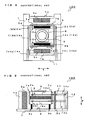
- Fig. 8 is a schematic plan view to show a structure of an objective lens driving device 100 in conventional technology when the objective lens driving device is viewed from top.
- Fig. 9 is a schematic lateral view to show a structure of the objective lens driving device 100 in conventional technology when the objective lens driving device is viewed from one side.
- the objective lens driving device 100 is mainly composed of a base member 1 which is made by metal having ferromagnetism and a lens holder 2 which is made by molded resin.
- a through hole (not shown) to pass a light beam is formed, and above the through hole, the lens holder 2 detail of which will be described later is disposed.
- a pair of permanent magnets 3a, 3b which face each other with a predetermined distance so as to sandwich the lens holder 2, are disposed to stand.
- Each of these permanent magnets 3a, 3b is fixed on the base member 1 in a state they are integrated magnetically by fixing outer surface of each of the magnets 3a, 3b magnetically on raised portions 1a, 1b which are formed by bending the base member 1.
- a pair of yokes 4a, 4b are disposed to stand between the permanent magnets 3a, 3b so that they face each other in substantially the same direction as the permanent magnets 3a, 3b.
- Each of these yokes 4a, 4b is formed by bending the base member 1.
- each of the yokes 4a, 4b effectively draws magnetic flux from the respective permanent magnets 3a, 3b so that high density magnetic flux is given mainly to a focusing coil 6, and tracking coils 7a - 7d, which are disposed between the yokes 4a, 4b, which will be described later, as a result, it plays a role to improve drive efficiency of the lens holder 2.
- a light path hole (not shown) which extends in perpendicular direction to a paper surface of Fig. 8 , is formed in central part of it in order to pass the light beam, and an objective lens 9 is held by an objective lens holding portion 8 which is set up in upper side of a cavity.
- the objective lens 9 which is held by the objective lens holding portion 8 is mounted such that an optical axis of it becomes parallel to a direction which is perpendicular to the paper surface of Fig. 8 .
- cavity portions 10a, 10b are set up such that the above described yokes 4a, 4b can penetrate them.
- a focusing coil 6 is set up such that it surrounds the optical axis of the objective lens 9 which is mounted on the lens holder 2, and the coil is fixed on the lens holder 2 by an adhesive or the like.
- the tracking coils 7a - 7d are set up in left and right of the side walls such that every pair of them face each other and the tracking coils 7a - 7d are connected as a whole by a wire.
- a gel holder 11 which is formed of molded resin such as polycarbonate or the like is fixed, and in addition, a circuit board 12 is disposed to stand adjoining to outside of the gel holder 11.
- wires (rod like elastic supporting members)13a, 13b, 13c, 13d which have conductivity are connected by soldering to two positions of upper and lower direction in left and right sides of this circuit board 12, respectively.
- Each of these four wires 13a - 13d are inserted into the through holes 14a, 14b, 14c, 14d which are formed in the gel holder 11, at corresponding position to the connected positions to the circuit board 12, that is, two positions of upper and lower direction in left and right sides, respectively.
- gel material which has silicone as main component, is filled.
- the gel material is formed by injecting low viscosity gel material (sol) into the through holes 14a - 14d of the gel holder 11 and irradiating it with ultraviolet rays for a predetermined period of time so that the material becomes solidified in a gel state.
- This gel holder 11 play a role of attenuating and suppressing vibration that is generated in each of the wires 13a - 13d in response to driving of the lens holder 2, by the gel material.
- the lens holder 2 when electric current is supplied via wires 13a, 13c to the focusing coil 6 from the circuit board 12, the lens holder 2 becomes movable in a focusing direction F (See, Fig. 9 ) by electromagnetic action (electromagnetic force action) with a magnetic field which is formed by the permanent magnets 3a, 3b.
- a focusing direction F See, Fig. 9
- electromagnetic action electromagnettic force action
- the lens holder 2 is made movable in a tracking direction T (See, Fig. 8 ) by electromagnetic action (electromagnetic force action) with a magnetic field which is formed by the permanent magnets 3a, 3b.
- the objective lens driving device 100 which is structured as above, there is a case that a center of driving force which is decided by positional relation between a magnetic circuit which is composed of the base member 1, the permanent magnets 3a, 3b and yokes 4a, 4b, and coils (focusing coil 6, and tracking coils 7a - 7d), and a center of supporting which is decided by pasting state of wires 13a - 13d that support the lens holder 2, do not agree with each other when the device is assembled.
- a center of driving force which is decided by positional relation between a magnetic circuit which is composed of the base member 1, the permanent magnets 3a, 3b and yokes 4a, 4b, and coils (focusing coil 6, and tracking coils 7a - 7d), and a center of supporting which is decided by pasting state of wires 13a - 13d that support the lens holder 2, do not agree with each other when the device is assembled.
- the lens holder 2 is driven in the focusing direction or the tracking direction, moment is generated and the
- the objective lens 9 If the objective lens 9 is tilted against the optical recording medium, it causes deterioration of recording performance and reproducing performance of the optical disc apparatus. In particular, for an optical disc apparatus which has compatibility with an optical recording medium for high density recording, because influence of the tilting of the objective lens 9 is much large, it is necessary to suppress tilting of the objective lens 9 as little as possible.
- Displacement of the center of driving force is generated by variation in parts dimension of the coils, the lens holder, and the like, and by variation in assembly when these parts are assembled. Further, displacement of the center of supporting is generated by error in attaching the wires 13a - 13d and the like.
- the above described tilting of the objective lens 9 was made not be generated by strict control of accuracy of the parts and accuracy of assembly. However, in such a case, it has caused problems of cost rise of components, aggravation of workability, degradation of productivity and the like.
- a position of the center of supporting of the movable portion can be adjusted in order to agree positions of the center of driving force and the center of supporting with each other, without changing position of the center of driving force of the objective lens driving device by disposing rod like elastic supporting members which are disposed in both sides in optical axis direction of the objective lens as one pair, aligning in not parallel, and by adjusting rigidity a plurality of elastic fixing portions of elastic base plate to which end portion of each of the rod like elastic supporting member is fixed. As a result, the DC tilting can be reduced.
- an objective lens driving device which has a structure in which as for some of rod like elastic supporting members which support an objective lens holding member in movable manner in one axial direction or two axial directions with respect to the base plate, rigidity ratio of at least one rod like elastic supporting member to others of the rod like elastic supporting member, is changed by constraining one end portion of the at least one rod like elastic supporting member using high viscosity material.
- the center of driving force and the center of supporting can be agreed with each other by absorbing the assembling error and the parts error, and the objective lens can become hard to tilt with respect to an optical disc when the movable portion is moved.
- an objective lens driving device which has a structure in which, for example, a fixing member which supports a rod like elastic supporting member, is structured to have a cut portion in a halfway of a connection portion with the rod like elastic supporting member, a span in at least one moving direction of the rod like elastic supporting member is changed by an adjusting component which is inserted to the cut portion.
- the span of the rod like elastic supporting member can be changed easily and with high accuracy and the center of driving force and the center of supporting can be agreed with each other by utilizing elastic deformation of the fixing member in which the cut portion is formed.
- an object of the present invention to provide an objective lens driving device in which tilting of an objective lens that is generated when it is driven can be cut down without making accuracy of parts or accuracy of assembly strict and in addition without increasing number of parts. Further, it is another object of the present invention to provide an assembling method of such objective lens driving device. In addition, it is other object of the present invention to provide an optical disc apparatus which can improve recording performance and reproducing performance by including an objective lens driving device that can cut down tilting of the objective lens which is generated when the device is driven.
- an objective lens driving device in accordance with the present invention is characterized by including: an objective lens; a lens holder which holds the objective lens; a rod like elastic supporting member which supports the lens holder in movable manner; a magnet on which a chucked portion that makes chucking from outside of the device possible, is set up; and a driving portion which displaces the lens holder using an electromagnetic force action that is generated between a magnetic field which is generated by the magnet and electric current which passes a coil.
- the chucked portion is set up on the magnet, it becomes possible to perform positional adjustment in a final step of assembling for the objective lens driving device by moving the magnet while holding the magnet surely utilizing a jig.
- the chucked portion is formed by processing of a part of the magnet.
- an objective lens driving device in that the tilting of the objective lens which is generated when the device is driven, can be cut down, can be provided without increasing number of parts.
- the objective lens driving device structured as above described and according to the present invention, it is preferable that two of the magnets are disposed such that they face each other to sandwich the lens holder, and the chucked portion is formed on a surface which is other than a surface that is parallel to the surface to face between the two magnets.
- an optical disc apparatus in accordance with the present invention is characterized by including the objective lens driving device structured as above described.
- the optical disc apparatus includes the objective lens driving device structured as above described, tilting of the objective lens when recording or reproducing is performed can be suppressed. As a result, it becomes possible to provide an optical disc apparatus in which recording performance and reproducing performance are improved.
- an assembling method for an objective lens driving device in accordance with the present invention is characterized by including: an objective lens; a lens holder which holds the objective lens; a rod like elastic supporting member which supports the lens holder in movable manner; a magnet on which a chucked portion that makes chucking from outside of the device possible, is set up; and a driving portion which displaces the lens holder using an electromagnetic force action that is generated between a magnetic field which is generated by the magnet and electric current which passes a coil, and the method is also characterized by including a step to chuck the magnet by a jig utilizing the chucked portion and to perform positional adjustment of the magnet.
- Fig. 1 is a block diagram to show a structure of one embodiment of an optical disc apparatus in which an objective lens driving device according to the present invention, is arranged.
- the optical disc apparatus 21 is set up to be capable of recording information to an optical disc (optical recording medium) 20 and of reproducing information which is recorded on the optical disc 20.
- the optical disc apparatus 21 can perform recording and reproducing information on/from three kinds of optical discs 20 of a BD, a DVD, and a CD.
- Reference numeral 22 designates a spindle motor and the optical disc 20 is held detachably by a chuck portion (not shown) which is set up above the spindle motor 22.
- the spindle motor 22 continuously rotates the optical disc 20 when the optical disc 20 is recorded or reproduced. Rotation control of the spindle motor 22 is performed by a spindle motor driving circuit 23.
- Reference numeral 24 designates an optical pickup, which irradiates a laser beam that is emitted from a light source to the optical disc 20 to make reading information which is recorded on the optical disc 20 and writing information on the optical disc 20 possible.
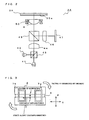
- Fig. 2 is a schematic diagram to show an optical system of the optical pickup 24. As shown in Fig. 2 , the optical pickup 24 is equipped with a first light source 41, a second light source 42, a dichroic prism 43, a collimator lens 44, a beam splitter 45, an objective lens 9, a condenser lens 46, and a photo detector 47.
- a structure of the optical system by which the optical pickup is structured is not limited to the above described example, and various modifications can be introduced, of course.
- the first light source 41 is a laser diode which emits a laser beam having single wavelength, and it emits the laser beam having a wavelength of 405 nm band which is used for a BD.
- the second light source 42 is a laser diode which is compatible to two wavelengths and can emit laser beams having two wavelengths, and it switches between the laser beams having a wavelength of 650 nm band which is used for a DVD and a wavelength of 780 nm band which is used for a CD and emits the beam.
- the laser beam which is emitted from the light sources 41 or 42, passes the dichroic prism 43, and is converted into parallel ray by the collimator lens 44.
- the laser beam passes the beam splitter 45 and is condensed by the objective lens 9 on a recording surface 20a on which information of the optical disc 20 is recorded.
- a reflected beam reflected by the recording surface 20a of the optical disc 20 passes the objective lens 9, is reflected by the beam splitter 45, and is condensed by the condenser lens 46 on a photo receiving region in the photo detector 47.
- the photo detector 47 converts received light information into electric signal.
- a laser driving circuit 25 controls driving of the light sources 41, 42 when information is reproduced and recorded.
- the laser driving circuit 25 controls the light sources 41, 42 based on signal from a modulating circuit 32 which modulates information input from outside. Further, the laser driving circuit 25 also performs output control of the laser beam which is emitted from the light sources 41, 42 based on information from a photo receiving element (not shown) for front monitoring.
- a signal processing portion 26 is supplied electric signal from the photo detector 47 (See, fig. 2 ), and performs processing of the supplied electric signal to generate RF signal, focus error signal (FE signal), and tracking error signal (TE signal).
- An information detecting circuit 27 performs processing waveform equalization and the like on the RF signal supplied from the signal processing portion 26 to perform reading out of the information which is recorded on the optical disc 20.
- the information read out by the information detecting circuit 27 is demodulated by a demodulating circuit 28, and the demodulated reproducing signal is output to external devices (not shown) such as a personal computer and the like.
- a servo circuit 29 performs generation of focus driving signal and tracking driving signal based on the FE signal and the TE signal which are generated by the signal processing portion 26.
- An actuator driving circuit 30 controls driving of objective lens driving device 50 (See, Fig. 2 ) on which the objective lens 9 (See, Fig. 2 ) is mounted, based on the focus driving signal and the tracking driving signal which are supplied from the servo circuit 29.
- a system control portion 31 includes a microcomputer to adequately perform control processes in response to necessary operations which are achieved by respective portions composing the optical disc apparatus 21.
- ROM 33 Read Only Memory (ROM) 33 and Random Access Memory (RAM) 34 are set up.
- ROM 33 various parameters and operating programs which are required for the system control portion 31 to achieve various processes, are stored.
- the RAM 34 is used as a working region for the system control portion 31 and it is made as a storing region for various kinds of data.
- a structure of the objective lens driving device 50 according to the present embodiment is basically the same as a structure of the conventional objective lens driving device 100 shown in Fig. 8 and Fig. 9 . Therefore, explanation about portions which has the same structure will be omitted. Further, for explanation on the objective lens driving device 50 according to the present embodiment, on the components which are the same as those for the objective lens driving device 100, the same reference numerals are used.
- the objective lens driving device 50 has different structure about the permanent magnets 3a, 3b from the conventional objective lens driving device 100. Therefore, hereinafter explanation will be given for these. First, reason why the structure of the permanent magnets 3a, 3b is different from those for the conventional objective lens driving device 100, will be explained with reference to Fig. 3 .
- Fig. 3 is a diagram to explain a principle that tilting is generated in the objective lens 9 when an objective lens driving device is driven.
- a center of driving force shown in Fig. 3 is decided by a positional relation among a magnetic circuit which is composed of the permanent magnets 3a, 3b, yokes 4a, 4b, and the base member 1, and focusing coil 6 and tracking coils 7a - 7d which are fixed on the lens holder 2. Further, a center of supporting is decided by pasting state of the wires 13a - 13d which support the lens holder 2.
- a state that the center of driving force and the center of supporting are displaced in the focusing direction F is shown as one example.
- force along the tracking direction T is generated in the state that the center of driving force and the center of supporting are displaced in the focusing direction F as shown in Fig. 3
- a moment of the force is generated and the lens holder 2 rotates in a direction shown by arrows in Fig. 3
- the objective lens 9 which is mounted on the lens holder 2 is tilted (DC tilting is generated).
- the displacement of the center of driving force and the center of supporting is generated by variation in parts dimension and by variation in assembly.
- the permanent magnets 3a, 3b are structured such that the center of driving force and the center of supporting can be agreed with each other by adjusting position of the permanent magnets 3a, 3b when they are assembled without enhancing the accuracy of parts and the like so high.
- Fig. 4A and Fig. 4B are diagrams to show a structure of a permanent magnet 3a which is arranged in an objective lens driving device 50.
- Fig. 4A is a schematic perspective view to show a structure of the permanent magnet 3a
- Fig. 4B is a schematic plan view to show a structure of the permanent magnet 3a.
- the permanent magnet 3a is formed in a rectangular parallelepiped shape.
- grooves 61 which have substantially rectangular cross section, are formed in a symmetrical position on two surfaces JS, JS, which face each other on the permanent magnet 3a.
- a surface JF on the permanent magnets 3a is a surface facing to the lens holder 2
- a surface JU is a surface which corresponds to the top surface in Fig. 9 .
- the groove 61 which is formed on the permanent magnet 3a is formed, for example, by cutting operation for the permanent magnet 3a.
- forming method for the groove 61 is not limited to the cutting operation and it is no problem that they are formed using a method or the like to form the groove utilizing a shape of molding tool which is used when the permanent magnet 3a is formed.
- description is given about the permanent magnet 3a in the above explanation, however, the same grooves 61 are formed also on the permanent magnet 3b.
- FIG. 5 is a diagram to explain about positional adjustment of the permanent magnets 3a, 3b, which are arranged in the objective lens driving device 50. Because the grooves 61 are formed in the permanent magnets 3a, 3b, it is possible to chuck them surely utilizing a jig. In this point the groove 61 which is formed in the permanent magnets 3a, 3b can be said that it functions as a chucked portion.
- the permanent magnets 3a, 3b can be chucked by the jig utilizing the grooves61, position of the permanent magnet can be adjusted by moving it in the focusing direction F, the tracking direction T, and a rotational direction ⁇ shown in Fig. 5 , in a final step of assembling the objective lens driving device 50.
- the adjustment it is no problem that, for example, the tilting (DC tilting) of the objective lens 9 is detected utilizing an autocollimator while the objective lens driving device 50 is driven, then the positions of the permanent magnets 3a, 3b which are chucked by the jig, are moved such that an amount of the DC tilting becomes small.
- the permanent magnets 3a, 3b are fixed on the raised portions 1a, 1b (See, Fig. 8 ) by an adhesive or the like in order that the positions do not move after the positions of the permanent magnets 3a, 3b are decided (after the positional adjustment is completed).
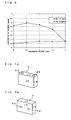
- Fig. 6 is a graph to show one example of result that the adjustment of the DC tilting is performed by moving the permanent magnets 3a, 3b in the focusing direction F (that is, a height direction with respect to the base member 1). As shown in Fig. 6 , it is understood that the position can be adjusted where the amount of the DC tilting becomes as little as possible by performing the positional adjustment of the permanent magnet 3a, 3b (only moving in the focusing direction in this embodiment) in the final step of assembling. In addition, in Fig.
- a Ra tilting means the tilting in a radial direction (it is the same as the tracking direction)
- a Ta tilting means the tilting in tangential direction (it is a direction perpendicular to the focusing direction and the tracking direction).
- the objective lens driving device has a structure in that two grooves 61 which have substantially rectangular cross section, are set up symmetrically on the permanent magnets 3a, 3b.
- the present invention is not intended to limit to the embodiment, and various modifications can be introduced without departing object of the present invention. That is, for example, it is no problem that a structure is employed in which more than two grooves 61 are set up in each of left side and right side respectively, and it is not necessary that they are in symmetrical position.
- the shape of the groove 61 it is possible to introduce any modification in its shape as far as it can be surely chucked by the jig.
- the objective lens driving device has a structure in that the chucked portion (groove 61) is formed on the surface JS of the permanent magnets 3a, 3b.
- the present invention is not limited to the embodiment, and for example, it is no problem that a structure is employed in which the chucked portion 62 is formed on the top surface JU of the permanent magnets 3a, 3b as shown in Fig. 7A .
- a structure is employed in that a hole which has substantially circular cross section, is formed as the chucked portion 62.
- the hole which is structured as the chucked portion 62 is made to have two diameters in upper side (a first hole) and in lower side (a second hole) (the second hole has larger diameter), and the tip portion (it is possible to extend and to retract the tip portion toward the side surface of the hole by the switching mechanism) of the jig is hung at a step of two holes.
- a structure is employed in which the chucked portion 62 is formed on a surface JR of the permanent magnets 3a, 3b, that is a rear surface of the surface JF which faces to the lens holder 2 as shown in Fig. 7B according to the structure of the objective lens driving device.
- the optical disc apparatus 1 is an apparatus which can perform recording and reproducing of the optical disc. However, it is of course no problem that the apparatus can perform only reproducing. Further, it is needless to say that as for the kind of the optical disc 20 to which the optical disc apparatus 1 is applied, it is not limited to the kinds described in the present embodiment, and it can be changed adequately.
- the objective lens driving device By the objective lens driving device according to the present invention, tilting of the objective lens can be suppressed small. As a result, recording performance and reproducing performance of an optical disc apparatus in which an objective lens driving device according to the present invention is arranged, can be improved. Therefore, the objective lens driving device according to the present invention is very useful.
- Features, components and specific details of the structures of the above-described embodiments may be exchanged or combined to form further embodiments optimized for the respective application. As far as those modifications are readily apparent for an expert skilled in the art they shall be disclosed implicitly by the above description without specifying explicitly every possible combination, for the sake of conciseness of the present description.
Landscapes
- Physics & Mathematics (AREA)
- Optics & Photonics (AREA)
- Optical Recording Or Reproduction (AREA)
- Optical Head (AREA)
Applications Claiming Priority (1)
| Application Number | Priority Date | Filing Date | Title |
|---|---|---|---|
| JP2006342194A JP2008152888A (ja) | 2006-12-20 | 2006-12-20 | 対物レンズ駆動装置、その組立て方法、及び光ディスク装置 |
Publications (3)
| Publication Number | Publication Date |
|---|---|
| EP1936616A2 true EP1936616A2 (de) | 2008-06-25 |
| EP1936616A3 EP1936616A3 (de) | 2008-11-26 |
| EP1936616B1 EP1936616B1 (de) | 2010-10-06 |
Family
ID=39167513
Family Applications (1)
| Application Number | Title | Priority Date | Filing Date |
|---|---|---|---|
| EP07024432A Not-in-force EP1936616B1 (de) | 2006-12-20 | 2007-12-17 | Antriebsvorrichtung zum Verstellen einer Objektivlinse, Montageverfahren dafür und optisches Plattengerät |
Country Status (4)
| Country | Link |
|---|---|
| US (1) | US20080151708A1 (de) |
| EP (1) | EP1936616B1 (de) |
| JP (1) | JP2008152888A (de) |
| DE (1) | DE602007009629D1 (de) |
Families Citing this family (1)
| Publication number | Priority date | Publication date | Assignee | Title |
|---|---|---|---|---|
| US8390276B2 (en) * | 2010-09-27 | 2013-03-05 | Bourns Incorporated | Target magnet assembly for a sensor used with a steering gear |
Citations (6)
| Publication number | Priority date | Publication date | Assignee | Title |
|---|---|---|---|---|
| JP2001184682A (ja) | 1999-12-27 | 2001-07-06 | Ricoh Co Ltd | 対物レンズ駆動装置 |
| JP2002074705A (ja) | 2000-08-22 | 2002-03-15 | Ricoh Co Ltd | 対物レンズ駆動装置、その組付け方法及び光ディスク装置 |
| EP1205920A2 (de) | 2000-11-08 | 2002-05-15 | Pioneer Corporation | Linsenantriebsgerät |
| JP2003030873A (ja) | 2001-07-18 | 2003-01-31 | Ricoh Co Ltd | 対物レンズ駆動装置、光ピックアップ装置及び光ディスク装置 |
| JP2006031781A (ja) | 2004-07-14 | 2006-02-02 | Sumida Corporation | 光ピックアップおよびその組立て方法 |
| JP2006134532A (ja) | 2004-11-09 | 2006-05-25 | Canon Inc | 光ピックアップ |
Family Cites Families (6)
| Publication number | Priority date | Publication date | Assignee | Title |
|---|---|---|---|---|
| KR100403586B1 (ko) * | 2001-04-12 | 2003-10-30 | 삼성전자주식회사 | 광픽업 장치 및 그 조립방법 |
| KR100486279B1 (ko) * | 2002-11-13 | 2005-04-29 | 삼성전자주식회사 | 광픽업 액츄에이터 및 그를 채용한 광디스크 드라이브 |
| JP3841217B2 (ja) * | 2003-06-17 | 2006-11-01 | 船井電機株式会社 | 光ピックアップ |
| JP4032425B2 (ja) * | 2003-11-12 | 2008-01-16 | 船井電機株式会社 | 光ヘッド装置 |
| JP2006286049A (ja) * | 2005-03-31 | 2006-10-19 | Toshiba Corp | 光ディスク装置 |
| JP4783671B2 (ja) * | 2006-05-24 | 2011-09-28 | 株式会社日立メディアエレクトロニクス | 光ピックアップ |
-
2006
- 2006-12-20 JP JP2006342194A patent/JP2008152888A/ja active Pending
-
2007
- 2007-12-17 DE DE602007009629T patent/DE602007009629D1/de active Active
- 2007-12-17 EP EP07024432A patent/EP1936616B1/de not_active Not-in-force
- 2007-12-19 US US12/000,976 patent/US20080151708A1/en not_active Abandoned
Patent Citations (6)
| Publication number | Priority date | Publication date | Assignee | Title |
|---|---|---|---|---|
| JP2001184682A (ja) | 1999-12-27 | 2001-07-06 | Ricoh Co Ltd | 対物レンズ駆動装置 |
| JP2002074705A (ja) | 2000-08-22 | 2002-03-15 | Ricoh Co Ltd | 対物レンズ駆動装置、その組付け方法及び光ディスク装置 |
| EP1205920A2 (de) | 2000-11-08 | 2002-05-15 | Pioneer Corporation | Linsenantriebsgerät |
| JP2003030873A (ja) | 2001-07-18 | 2003-01-31 | Ricoh Co Ltd | 対物レンズ駆動装置、光ピックアップ装置及び光ディスク装置 |
| JP2006031781A (ja) | 2004-07-14 | 2006-02-02 | Sumida Corporation | 光ピックアップおよびその組立て方法 |
| JP2006134532A (ja) | 2004-11-09 | 2006-05-25 | Canon Inc | 光ピックアップ |
Also Published As
| Publication number | Publication date |
|---|---|
| EP1936616A3 (de) | 2008-11-26 |
| JP2008152888A (ja) | 2008-07-03 |
| DE602007009629D1 (de) | 2010-11-18 |
| EP1936616B1 (de) | 2010-10-06 |
| US20080151708A1 (en) | 2008-06-26 |
Similar Documents
| Publication | Publication Date | Title |
|---|---|---|
| TW200837743A (en) | Objective lens drive, optical pickup, and optical disc apparatus | |
| US8116177B2 (en) | Optical pickup and disc drive apparatus | |
| EP1936616B1 (de) | Antriebsvorrichtung zum Verstellen einer Objektivlinse, Montageverfahren dafür und optisches Plattengerät | |
| JP4046666B2 (ja) | 光ヘッド装置、および光ヘッド装置の製造方法 | |
| EP1717800B1 (de) | Stellantrieb für optischen Lesekopf und optische Aufzeichnungs- und/oder Wiedergabevorrichtung | |
| EP2012318B1 (de) | Linsenhalter für optischen Lesekopf und optischer Lesekopf damit | |
| EP1950751B1 (de) | Objektivlinsenbetätigungsglied und optische Aufnahmevorrichtung damit | |
| EP1936617B1 (de) | Antriebsvorrichtung zum Verstellen einer Objektivlinse und optisches Plattengerät | |
| JP2002260258A (ja) | 対物レンズ駆動装置及びこれを備えたディスク装置 | |
| KR20060083889A (ko) | 대물 렌즈 구동 장치, 광픽업 및 광디스크 장치 | |
| JP4137108B2 (ja) | 光ピックアップ装置及び光ディスク装置 | |
| JP4533322B2 (ja) | 光ピックアップ | |
| JP4508134B2 (ja) | 対物レンズアクチュエータ及びそれを備えた光ピックアップ装置 | |
| US7627877B2 (en) | Objective lens actuator and optical pickup unit employing the same | |
| JP2009146531A (ja) | 光ピックアップ用レンズホルダ及びそれを備えた光ピックアップ | |
| EP2178085A1 (de) | Optische Abtastvorrichtung | |
| JP2002197700A (ja) | 光学ピックアップ装置 | |
| JP2000020982A (ja) | 2レンズ光ヘッド装置及びディスク記録又は再生装置 | |
| JP2010040067A (ja) | 対物レンズアクチュエータ及び光ディスク装置 | |
| JP2009076179A (ja) | 光ピックアップ用レンズホルダ及びそれを備えた光ピックアップ | |
| JP2009245476A (ja) | 対物レンズアクチュエータ及び光ディスク装置 | |
| JP2003196866A (ja) | 光ピックアップ装置 | |
| JP2008243251A (ja) | 光ヘッド及び光ディスク装置 | |
| JP2004103193A (ja) | 光ピックアップ装置及びこの光ピックアップ装置を用いた光ディスク装置 | |
| JP2006120216A (ja) | 光ピックアップ及びこれを備えたディスクドライブ装置 |
Legal Events
| Date | Code | Title | Description |
|---|---|---|---|
| PUAI | Public reference made under article 153(3) epc to a published international application that has entered the european phase |
Free format text: ORIGINAL CODE: 0009012 |
|
| AK | Designated contracting states |
Kind code of ref document: A2 Designated state(s): AT BE BG CH CY CZ DE DK EE ES FI FR GB GR HU IE IS IT LI LT LU LV MC MT NL PL PT RO SE SI SK TR |
|
| AX | Request for extension of the european patent |
Extension state: AL BA HR MK RS |
|
| PUAL | Search report despatched |
Free format text: ORIGINAL CODE: 0009013 |
|
| AK | Designated contracting states |
Kind code of ref document: A3 Designated state(s): AT BE BG CH CY CZ DE DK EE ES FI FR GB GR HU IE IS IT LI LT LU LV MC MT NL PL PT RO SE SI SK TR |
|
| AX | Request for extension of the european patent |
Extension state: AL BA HR MK RS |
|
| 17P | Request for examination filed |
Effective date: 20090326 |
|
| AKX | Designation fees paid |
Designated state(s): DE FR GB |
|
| 17Q | First examination report despatched |
Effective date: 20091218 |
|
| GRAP | Despatch of communication of intention to grant a patent |
Free format text: ORIGINAL CODE: EPIDOSNIGR1 |
|
| GRAC | Information related to communication of intention to grant a patent modified |
Free format text: ORIGINAL CODE: EPIDOSCIGR1 |
|
| GRAS | Grant fee paid |
Free format text: ORIGINAL CODE: EPIDOSNIGR3 |
|
| GRAA | (expected) grant |
Free format text: ORIGINAL CODE: 0009210 |
|
| AK | Designated contracting states |
Kind code of ref document: B1 Designated state(s): DE FR GB |
|
| REG | Reference to a national code |
Ref country code: GB Ref legal event code: FG4D |
|
| REF | Corresponds to: |
Ref document number: 602007009629 Country of ref document: DE Date of ref document: 20101118 Kind code of ref document: P |
|
| PLBE | No opposition filed within time limit |
Free format text: ORIGINAL CODE: 0009261 |
|
| STAA | Information on the status of an ep patent application or granted ep patent |
Free format text: STATUS: NO OPPOSITION FILED WITHIN TIME LIMIT |
|
| 26N | No opposition filed |
Effective date: 20110707 |
|
| REG | Reference to a national code |
Ref country code: DE Ref legal event code: R097 Ref document number: 602007009629 Country of ref document: DE Effective date: 20110707 |
|
| PGFP | Annual fee paid to national office [announced via postgrant information from national office to epo] |
Ref country code: GB Payment date: 20131211 Year of fee payment: 7 Ref country code: DE Payment date: 20131211 Year of fee payment: 7 |
|
| PGFP | Annual fee paid to national office [announced via postgrant information from national office to epo] |
Ref country code: FR Payment date: 20131209 Year of fee payment: 7 |
|
| REG | Reference to a national code |
Ref country code: DE Ref legal event code: R119 Ref document number: 602007009629 Country of ref document: DE |
|
| GBPC | Gb: european patent ceased through non-payment of renewal fee |
Effective date: 20141217 |
|
| REG | Reference to a national code |
Ref country code: FR Ref legal event code: ST Effective date: 20150831 |
|
| PG25 | Lapsed in a contracting state [announced via postgrant information from national office to epo] |
Ref country code: GB Free format text: LAPSE BECAUSE OF NON-PAYMENT OF DUE FEES Effective date: 20141217 Ref country code: DE Free format text: LAPSE BECAUSE OF NON-PAYMENT OF DUE FEES Effective date: 20150701 |
|
| PG25 | Lapsed in a contracting state [announced via postgrant information from national office to epo] |
Ref country code: FR Free format text: LAPSE BECAUSE OF NON-PAYMENT OF DUE FEES Effective date: 20141231 |