EP1936617B1 - Antriebsvorrichtung zum Verstellen einer Objektivlinse und optisches Plattengerät - Google Patents
Antriebsvorrichtung zum Verstellen einer Objektivlinse und optisches Plattengerät Download PDFInfo
- Publication number
- EP1936617B1 EP1936617B1 EP07024433A EP07024433A EP1936617B1 EP 1936617 B1 EP1936617 B1 EP 1936617B1 EP 07024433 A EP07024433 A EP 07024433A EP 07024433 A EP07024433 A EP 07024433A EP 1936617 B1 EP1936617 B1 EP 1936617B1
- Authority
- EP
- European Patent Office
- Prior art keywords
- objective lens
- region
- coils
- driving device
- magnets
- Prior art date
- Legal status (The legal status is an assumption and is not a legal conclusion. Google has not performed a legal analysis and makes no representation as to the accuracy of the status listed.)
- Not-in-force
Links
- 230000003287 optical effect Effects 0.000 title claims description 67
- 230000009471 action Effects 0.000 claims description 10
- 230000005405 multipole Effects 0.000 claims description 6
- 238000010586 diagram Methods 0.000 description 19
- 238000004519 manufacturing process Methods 0.000 description 7
- 230000004907 flux Effects 0.000 description 6
- 239000000463 material Substances 0.000 description 5
- 230000004044 response Effects 0.000 description 3
- 238000005476 soldering Methods 0.000 description 3
- 239000000853 adhesive Substances 0.000 description 2
- 230000001070 adhesive effect Effects 0.000 description 2
- 238000005516 engineering process Methods 0.000 description 2
- 230000006870 function Effects 0.000 description 2
- 238000000034 method Methods 0.000 description 2
- 230000008569 process Effects 0.000 description 2
- 239000011347 resin Substances 0.000 description 2
- 229920005989 resin Polymers 0.000 description 2
- 238000005452 bending Methods 0.000 description 1
- 230000005307 ferromagnetism Effects 0.000 description 1
- 230000001678 irradiating effect Effects 0.000 description 1
- 239000002184 metal Substances 0.000 description 1
- 238000012986 modification Methods 0.000 description 1
- 230000004048 modification Effects 0.000 description 1
- 238000012544 monitoring process Methods 0.000 description 1
- 229920000515 polycarbonate Polymers 0.000 description 1
- 239000004417 polycarbonate Substances 0.000 description 1
- 229920001296 polysiloxane Polymers 0.000 description 1
Images




Classifications
-
- G—PHYSICS
- G11—INFORMATION STORAGE
- G11B—INFORMATION STORAGE BASED ON RELATIVE MOVEMENT BETWEEN RECORD CARRIER AND TRANSDUCER
- G11B7/00—Recording or reproducing by optical means, e.g. recording using a thermal beam of optical radiation by modifying optical properties or the physical structure, reproducing using an optical beam at lower power by sensing optical properties; Record carriers therefor
- G11B7/08—Disposition or mounting of heads or light sources relatively to record carriers
- G11B7/09—Disposition or mounting of heads or light sources relatively to record carriers with provision for moving the light beam or focus plane for the purpose of maintaining alignment of the light beam relative to the record carrier during transducing operation, e.g. to compensate for surface irregularities of the latter or for track following
- G11B7/0925—Electromechanical actuators for lens positioning
- G11B7/0933—Details of stationary parts
-
- G—PHYSICS
- G11—INFORMATION STORAGE
- G11B—INFORMATION STORAGE BASED ON RELATIVE MOVEMENT BETWEEN RECORD CARRIER AND TRANSDUCER
- G11B7/00—Recording or reproducing by optical means, e.g. recording using a thermal beam of optical radiation by modifying optical properties or the physical structure, reproducing using an optical beam at lower power by sensing optical properties; Record carriers therefor
- G11B7/08—Disposition or mounting of heads or light sources relatively to record carriers
- G11B7/09—Disposition or mounting of heads or light sources relatively to record carriers with provision for moving the light beam or focus plane for the purpose of maintaining alignment of the light beam relative to the record carrier during transducing operation, e.g. to compensate for surface irregularities of the latter or for track following
- G11B7/0925—Electromechanical actuators for lens positioning
- G11B7/0935—Details of the moving parts
-
- G—PHYSICS
- G11—INFORMATION STORAGE
- G11B—INFORMATION STORAGE BASED ON RELATIVE MOVEMENT BETWEEN RECORD CARRIER AND TRANSDUCER
- G11B7/00—Recording or reproducing by optical means, e.g. recording using a thermal beam of optical radiation by modifying optical properties or the physical structure, reproducing using an optical beam at lower power by sensing optical properties; Record carriers therefor
- G11B7/12—Heads, e.g. forming of the optical beam spot or modulation of the optical beam
- G11B7/125—Optical beam sources therefor, e.g. laser control circuitry specially adapted for optical storage devices; Modulators, e.g. means for controlling the size or intensity of optical spots or optical traces
- G11B7/127—Lasers; Multiple laser arrays
- G11B7/1275—Two or more lasers having different wavelengths
-
- G—PHYSICS
- G11—INFORMATION STORAGE
- G11B—INFORMATION STORAGE BASED ON RELATIVE MOVEMENT BETWEEN RECORD CARRIER AND TRANSDUCER
- G11B7/00—Recording or reproducing by optical means, e.g. recording using a thermal beam of optical radiation by modifying optical properties or the physical structure, reproducing using an optical beam at lower power by sensing optical properties; Record carriers therefor
- G11B2007/0003—Recording, reproducing or erasing systems characterised by the structure or type of the carrier
- G11B2007/0006—Recording, reproducing or erasing systems characterised by the structure or type of the carrier adapted for scanning different types of carrier, e.g. CD & DVD
-
- G—PHYSICS
- G11—INFORMATION STORAGE
- G11B—INFORMATION STORAGE BASED ON RELATIVE MOVEMENT BETWEEN RECORD CARRIER AND TRANSDUCER
- G11B7/00—Recording or reproducing by optical means, e.g. recording using a thermal beam of optical radiation by modifying optical properties or the physical structure, reproducing using an optical beam at lower power by sensing optical properties; Record carriers therefor
- G11B7/08—Disposition or mounting of heads or light sources relatively to record carriers
- G11B7/09—Disposition or mounting of heads or light sources relatively to record carriers with provision for moving the light beam or focus plane for the purpose of maintaining alignment of the light beam relative to the record carrier during transducing operation, e.g. to compensate for surface irregularities of the latter or for track following
- G11B7/095—Disposition or mounting of heads or light sources relatively to record carriers with provision for moving the light beam or focus plane for the purpose of maintaining alignment of the light beam relative to the record carrier during transducing operation, e.g. to compensate for surface irregularities of the latter or for track following specially adapted for discs, e.g. for compensation of eccentricity or wobble
- G11B7/0956—Disposition or mounting of heads or light sources relatively to record carriers with provision for moving the light beam or focus plane for the purpose of maintaining alignment of the light beam relative to the record carrier during transducing operation, e.g. to compensate for surface irregularities of the latter or for track following specially adapted for discs, e.g. for compensation of eccentricity or wobble to compensate for tilt, skew, warp or inclination of the disc, i.e. maintain the optical axis at right angles to the disc
Definitions
- the present invention relates to an optical disc apparatus which performs reproducing of information recorded on an optical recording medium and recording of information on an optical recording medium, in particular, the present invention relates to an objective lens driving device which drives an objective lens that is arranged in the optical disc apparatus.
- An optical recording medium such as a compact disc (hereinafter referred to as a CD), or a digital versatile disc (hereinafter referred to as a DVD) has become popular.
- a study about high density recording on the optical recording medium is advanced, and for example, an optical recording medium which is made for high density recording such as a Blu-ray disc (hereinafter referred to as a BD) is being put to practical use. Recording and reproducing of these optical recording media are performed utilizing an optical disc apparatus.
- an objective lens is arranged to condense a laser beam which is emitted from a light source on a recording surface of the optical recording medium.
- position of the objective lens is lens is always kept on the recording surface of the optical recording medium despite of waving and the like of the optical recording medium, and that a position of the beam spot which is formed by condensing of the objective lens is not displaced from track which is formed on the optical recording medium.
- JP-A-2006-024266 an objective lens driving device which has a structure in that a region of a rectangular parallelepiped magnet which is arranged on the objective lens driving device, is cut two times in laterally and vertically and magnetized, and focusing coils and tracking coils are disposed in cross shape. It says that according to this, variation in direction of magnetic field and its magnitude become small and the tilting of the objective lens when it is driven can be suppressed small.
- an objective lens driving device is proposed in that, for example, a rounded portion is set up on a driving magnet which is included in the objective lens driving device, and distributional shape of magnetic flux density on a plane where a driving coil is disposed, becomes substantially symmetry to a peak of the magnetic flux density. It says that according to this, disbalance of forces which are generated in respective portions of the driving coils, is not generated even when the objective lens is moved for focusing and tracking and any moment with respect to center of supporting of movable portion is not generated.
- all facing regions of the two magnets that are disposed to face each other for sandwiching the objective lens have the same magnetic polarities. Therefore, a ratio of part where direction of the magnetic field that is formed by the magnets becomes slanted without being orthogonal to the focusing coil, is increased, it is conceivable that magnetic force of the magnet can not be effectively used.
- JP-A-2002-237067 because it has a structure in that the rounded portion is set up in the driving magnets, processing step for the magnet is increased and it becomes to add load in manufacturing process, in addition, it causes a problem that manufacturing cost is increased.
- the document WO 2005/066945 A1 discloses a lens actuator assembly for an optical head with a lens system and two separate actuators according to the preamble of claim 1 in order to provide a compact and robust configuration for the assembly.
- the document EP 1 124 222 A2 discloses a lens actuator assembly including magnetic flux producing elements interacting with tracking coils.
- the respective directions of the flux produced by the elements in different areas are opposite to each other and a portion of a boundary surface between the areas is inclined with regard to a focus direction of the lens.
- an object of the present invention to provide an objective lens driving device in that the tilting of the objective lens by the harmful torque can be suppressed, and it is easy to manufacture. Further, it is another object of the present invention to provide an optical disc apparatus in which recording performance and reproducing performance are improved by including the above described objective lens driving device.
- an objective lens driving device which may in particular include: an objective lens; a lens holder which holds the objective lens; two magnets which are disposed facing each other to sandwich the lens holder; focusing coils which are fixed on the lens holder to generate driving force in focusing direction by electromagnetic force action with the magnets; tracking coils which are fixed on the lens holder to generate driving force in tracking direction by electromagnetic force action with the magnets; and an elastic supporting member which supports the lens holder in displaceable manner
- the device is characterized by a structure in which on a surface of the lens holder which faces to the magnet, one of the focusing coils and two of the tracking coils are set up to align in a direction that is parallel to the tracking direction with the focusing coil being as a center, the magnets are magnetized as multipole magnets such that two effective portions which are sides of the focusing coil that face each other to generate the driving force, act with magnetic fields which have respectively different directions, and such that two effective portions which are sides of
- the device has a structure that does not generate harmful torque as little as possible by specific designing for configuration of magnets.
- the arrangement it is possible to suppress tilting of the objective lens. Further, it does not happen that operation when the magnet is manufactured is burdensome in comparison with the conventional one because the magnets used are only multipole magnetized magnets which have specific configuration.
- the objective lens driving device is structured such that N-S polarity of the two magnets becomes inverse at a part of the surfaces which face each other, it is easy for magnetic field of the magnets to become substantially orthogonal to coils at the part. As a result, it is possible to increase efficiency of electromagnetic force action of the objective lens driving device.
- the present invention has a structure in that the magnets are multipole magnetized magnets that are composed of a first region which has a rectangular parallelepiped shape, a second region which is formed in a substantially U shaped cross section to surround the first region and has an inverse N-S polarity with respect to the first region, and a third region that is composed of two rectangular parallelepiped shape regions which are formed to sandwich the second region and that has the same N-S polarity with respect to the first region in the objective lens driving device which is structured as above described.
- the present invention it is possible to realize a structure in that surfaces which face each other have inverse polarity at a part for two magnets by changing disposal direction of one kind of magnet. As a result, it is possible to manufacture an objective lens driving device that can suppress tilting of the objective lens with low cost.
- the present invention is characterized by an optical disc apparatus in which an objective lens driving device that is structured as above described is arranged.
- tilting of the objective lens can be suppressed when recording or reproducing is performed because in the optical disc apparatus the objective lens driving device which is structured as above described is arranged.
- the objective lens driving device which is structured as above described is arranged.
- Fig. 1 is a block diagram to show a structure of an optical disc apparatus according to the present embodiment.
- the optical disc apparatus 1 is set up to be capable of reproducing of information which is recorded on an optical disc (optical recording medium) 20. At this point the optical disc apparatus 1 can perform reproducing of information which is recorded in three kinds of optical discs of a BD, a DVD, and a CD.
- Reference numeral 2 designates a spindle motor and the optical disc 20 is held detachably by a chuck portion (not shown) which is set up above the spindle motor 2.
- the spindle motor 2 continuously rotates the optical disc 20 when reproducing of information which is recorded on the optical disc 20, is performed. Rotation control of the spindle motor 2 is performed by a spindle motor driving circuit 3.
- Reference numeral 4 designates an optical pickup, which irradiates a laser beam that is emitted from a light source to the optical disc 20 to make reading of information which is recorded on the optical disc 20, possible.
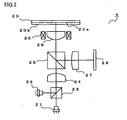
- Fig. 2 is a schematic diagram to show an optical system of the optical pickup 4. As shown in Fig. 2 , the optical pickup 4 is equipped with a first light source 21, a second light source 22, a dichroic prism 23, a collimator lens 24, a beam splitter 25, an objective lens 26, a condenser lens 27, and a photo detector 28.
- a structure of the optical system by which the optical pickup is structured is not limited to the above described example, and various modifications can be introduced, of course.
- the first light source 21 is a laser diode which emits a laser beam having single wavelength, and it emits the laser beam having a wavelength of 405 nm band which is used for a BD.
- the second light source 22 is a laser diode which is compatible to two wavelengths and can emit laser beams having two wavelengths, and it emits by switching the laser beams having a wavelength of 650 nm band which is used for a DVD and a wavelength of 780 nm band which is used for a CD.
- the laser beam which is emitted from the light sources 21 or 22, passes the dichroic prism 23, and is converted into parallel ray by the collimator lens 24.
- the laser beam passes the beam splitter 25 and is condensed by the objective lens 26 on a recording surface 20a on which information of the optical disc 20 is recorded.
- a reflected beam reflected by the recording surface 20a of the optical disc 20 passes the objective lens 26, is reflected by the beam splitter 25, and is condensed by the condenser lens 27 on a photo receiving region in the photo detector 28.
- the photo detector 28 converts received light information into electric signal.
- a laser driving circuit 5 performs switching of the first light source 21, and the second light source 22 in response to kind of the optical disc 20 which is loaded in the optical disc apparatus 1, and the laser driving circuit 5 also performs output control of the laser beam which is emitted from the light sources 21, 22 based on information from a photo receiving element (not shown) for front monitoring.
- a signal processing portion 6 is supplied electric signal from the photo detector 28 (See, Fig. 2 ), and performs processing of the supplied electric signal to generate RF signal, focus error signal (FE signal), and tracking error signal (TE signal).
- An information detecting circuit 7 performs processing of waveform equalization and the like on the RF signal which is supplied from the signal processing portion 6 to perform reading out of the information which is recorded on the optical disc 20.
- the information read out by the information detecting circuit 7 is demodulated by a decoder 8, and the demodulated reproducing signal is output to external devices such as a personal computer and the like via an interface 12.
- a servo circuit 9 performs generation of focus driving signal and tracking driving signal based on the FE signal and the TE signal which are generated by the signal processing portion 6.
- An actuator driving circuit 10 controls driving of objective lens driving device 30 (See, Fig. 2 ) on which the objective lens 26 (See, Fig. 2 ) is mounted, based on signal such as the focus driving signal, the tracking driving signal, and the like which are supplied from the servo circuit 9. A detail of the objective lens driving device 30 will be described later.
- a system control portion 11 includes a microcomputer to adequately perform control processes in response to required operations which are achieved by respective portions composing the optical disc apparatus 1.
- ROM 13 Read Only Memory
- RAM 14 Random Access Memory
- the RAM 14 is used as a working region for the system control portion 11 and it is made as a storing region for various kinds of data.
- Fig. 3 is a schematic plan view to show a structure of an objective lens driving device 30 when viewed from top.
- Fig. 4 is a schematic side view to show a structure of the objective lens driving device 30 when viewed from a side.
- an explanation on the objective lens driving device 30 according to the present embodiment will be given with reference to mainly Fig. 3 and Fig. 4 .
- the objective lens driving device 30 is mainly composed of a base member 31 which is made by metal having ferromagnetism and a lens holder 32 which is made by molded resin.
- a through hole (not shown) to pass a laser beam is formed, and above the through hole, the lens holder 32 detail of which will be described later is disposed.
- a pair of permanent magnets 33a, 33b which face each other with a predetermined distance so as to sandwich the lens holder 32, are disposed to stand.
- raised portions 31a, 31b which are formed by bending the base member 31, are disposed and the permanent magnets 33a, 33b and the raised portions 31a, 31b are fixed magnetically with each other.
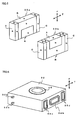
- Fig. 5 is a schematic perspective view to show a structure of permanent magnets 33a, 33b which are arranged in the objective lens driving device 30.
- Both of the permanent magnets 33a, 33b are multipole magnetized magnets in a rectangular parallelepiped shape.
- Both of the permanent magnets 33a, 33b are composed of a first region A which has a pole N in a rectangular parallelepiped shape, a second region B which is formed in a substantially U shaped cross section to surround the first region A and has a pole S, and a third region C which is composed of two rectangular parallelepiped shapes and formed to sandwich the second region B and has a pole N.
- the permanent magnet 33b is disposed to stand on the base member 31 in a state that the permanent magnet 33a is set in upside down.
- the first region A of the permanent magnet 33a faces to the second region B of the permanent magnet 33b and the first region A of the permanent magnet 33b faces to the second region B of the permanent magnet 33a.
- N-S polarity of the first region A and the second region B are inverse, magnetic field is generated substantially straightly from the permanent magnet 33a to the permanent magnet 33b or from the permanent magnet 33b to the permanent magnet 33a.
- directions of the magnetic fields do not become the state as above described.
- first region A and the third region C of the permanent magnets 33a, 33b are set in the pole N and the second region B is set in the pole S
- the present invention is not intended to limit this embodiment. That is to say, it is no problem that the first region A and the third region C are set in the pole S and the second region B is set in the pole N.
- a gel holder 36 which is formed by molded resin such as polycarbonate or the like is fixed, and in addition, a circuit board 39 is disposed to stand adjoining to outside of the gel holder 36.
- wires 37a, 37b, 37c, 37d which have conductivity are connected by soldering in two points of upper and lower directions in left and right sides of this circuit board 39, respectively.
- Each of these four wires 37a - 37d are inserted into through holes 38a, 38b, 38c, 38d which are formed in the gel holder 36, at corresponding positions to the connected positions to the circuit board 39, that is, two positions of upper and lower directions in left and right sides, respectively.
- wires 37a, 37c which are in the upper side are fixed in a state that they are electrically connected with the focusing coils 34a, 34b whose detail will be explained later, by soldering at wire support portions 32a, 32c which are set up in the lens holder 32.
- wires 37b, 37d which are in the lower side are fixed in a state that they are electrically connected with the tracking coils 35a - 35d whose detail will be explained later, by soldering at wire support portions 32b, 32d which are set up in the lens holder 32.
- number of wires to support the lens holder 32 is four, however, the present invention is not intended to limit this embodiment. That is to say, it is no problem that the number of wires is adequately changed as far as they can support properly the lens holder 32 and the lens holder 32 can be moved adequately.
- gel material which has silicone as main component, is filled.
- the gel material is formed by injecting low viscosity gel material (sol) into the respective through holes 38a - 38d of the gel holder 36 and irradiating it with ultraviolet rays for a predetermined period of time so that the material is cured into a gel state.
- This gel holder 36 plays a role of attenuating and suppressing vibration that is generated in each of the wires 37a - 37d in response to driving of the lens holder 32, by the gel material.
- a light path hole (not shown) which extends in perpendicular direction to a paper surface of Fig. 3 , is formed in central part of the lens holder 32 in order to pass the laser beam, and the objective lens 26 is held by an objective lens holding portion (not shown) which is set up in upper side of a cavity.
- the objective lens 26 which is mounted on the lens holder 32, is mounted such that an optical axis of it becomes parallel to a direction which is perpendicular to the paper surface of Fig. 3 .
- one focusing coil 34a and two tracking coils 35a, 35b are fixed on the lens holder 32 by an adhesive or the like. Further, on outside of side walls which face to the permanent magnet 33b among the side wall of the lens holder 32, also, one focusing coil 34b and two tracking coils 35c, 35d are fixed on the lens holder 32 by an adhesive or the like such that they are disposed in symmetrical position with the focusing coil 34a and two tracking coils 35a, 35b which are disposed on the outside of the side wall that face to the permanent magnet 33a.
- Fig. 6 is a schematic perspective view to show a structure of the lens holder 32 which is arranged in the objective lens driving device 30.
- the focusing coil 34b and the tracking coils 35c, 35d which are fixed on the lens holder 32, are disposed to align in a direction that is parallel to the tracking direction (direction shown by an arrow T in Fig. 6 ) with the focusing coil 34b being as a center. Further, though they are not shown in Fig. 6 , the focusing coil 34a and the tracking coils 35a, 35b are disposed similarly.
- the focusing coil 34a and the focusing coil 34b are connected by one wire as a whole, and the tracking coils 35a - 35d are also connected by one wire as a whole.
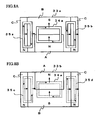
- Fig. 7A is a diagram to explain positional relation among the focusing coil 34a, the tracking coils 35a, 35b, and the permanent magnet 33a.
- Fig. 7B is a diagram to explain positional relation among the focusing coil 34b, the tracking coils 35c, 35d and the permanent magnet 33b.
- Fig. 7A and Fig. 7B are diagrams when they are viewed from the same direction that goes from below to above in Fig. 3 .
- the focusing coil 34b and the tracking coils 35c, 35d are shown in dotted line, because they exist in back side of the magnet.
- the focusing coil 34a is disposed such that one of its longer side overlaps with the first region A of the permanent magnet 33a, and the other longer side overlaps with the second region B of the permanent magnet 33a. Further, the focusing coil 34a is disposed such that a line which divides its shorter side in two equal parts and passes a center of the coil "O", overlaps with a border line of the first region A and the second region B of the permanent magnet 33a. In this case, one half of the shorter side of the focusing coil 34a overlaps with the first region A of the permanent magnet 33a and the other half of the shorter side overlaps with the second region B.
- the focusing coil 34b is also disposed with respect to the permanent magnet 33b in the same positional relation as that of the focusing coil 34a and the permanent magnet 33a as shown in Fig. 7B .
- the tracking coils 35a, 35b are disposed such that one of their longer side overlaps with the second region B of the permanent magnet 33a, and the other longer side overlaps with the third region C of the permanent magnet 33a. Further, the tracking coils 35a, 35b are disposed such that a line which divides their shorter side in two equal parts and passes a center of the coil "P", overlaps with a border line of the second region B and the third region C of the permanent magnet 33a. In this case, one half of the shorter side of the tracking coils 35a, 35b overlaps with the second region B of the permanent magnet 33a and the other half of the shorter side overlaps with the third region C.
- the tracking coils 35c, 35d are also disposed with respect to the permanent magnet 33b in the same positional relation as that of the tracking coils 35a, 35b and the permanent magnet 33a as shown in Fig. 7B .
- Fig. 8A and Fig. 8B are diagrams to explain about driving forces which are generated in the focusing coils 34a, 34b and the tracking coils 35a - 35d that are arranged in the objective lens driving device 30.
- Fig. 8A is a diagram to explain about driving forces which are generated in a focusing coil 34a and tracking coils 35a, 35b
- Fig. 8B is a diagram to explain about driving forces which are generated in a focusing coil 34b and tracking coils 35c, 35d.
- Fig. 8A and Fig. 8B are similar drawings to Fig. 7A and Fig. 7B
- Fig. 8A and Fig. 8B are drawings that direction of electric current which passes the coils (dotted line arrow) and direction of driving forces which are generated in the respective coils (solid line arrow), are added.
- the focusing coils 34a, 34b are connected by one wire as above described, and the focusing coil 34a and the focusing coil 34b are wound such that driving forces having the same direction are generated in both of them when the electric current passes the focusing coils.
- the tracking coils 35a - 35d are connected by one wire as above described, and the respective tracking coils 35a - 35d are wound such that driving forces having the same direction are generated in the respective coils when the electric current passes the tracking coils.
- the objective lens 26 can be driven with the lens holder 32 because the driving forces having a certain direction are generated in the focusing coils 34a, 34b, and the tracking coils 35a - 35d, by passing electric current in the focusing coils 34a, 34b, and the tracking coils 35a - 35d.
- directions of electric currents which pass the focusing coils 34a, 34b, and the tracking coils 35a - 35d directions of the driving forces which are generated in the respective coils are changed, and moving direction of the lens holder 32 can be controlled.
- the permanent magnets 33a, 33b which are arranged in the objective lens driving device 30 according to the present embodiment, one of them is disposed upside down with respect to the other.
- the direction of the magnetic field of a part at which the focusing coils 34a, 34b are disposed is substantially orthogonal to side of the coils, it has a merit that magnetic forces of the permanent magnets 33a, 33b can be used effectively for the driving force of the focusing coils 34a, 34b.
- the driving forces which are generated in the tracking coils 35a - 35d become an unbalanced state and the objective lens is made tilted in case where the lens holder 32 is moved along the tracking direction.
- Fig. 9A and Fig. 9B explanation will be given with reference to Fig. 9A and Fig. 9B .
- Fig. 9A and Fig. 9B are diagrams to explain the driving forces which are generated in the tracking coils 35a - 35d in a state where the lens holder 32 in the objective lens driving device 30 is moved along the tracking direction.
- Fig. 9A is a diagram to explain the driving forces which are generated in the tracking coils 35a, 35b
- Fig. 9B is a diagram to explain the driving forces which are generated in the tracking coils 35c, 35d.
- solid line arrows shown in Fig. 9A and Fig. 9B designate forces which are generated in the coils, and lengths of them mean their magnitude schematically for the sake of convenience in explanation.
- dotted line arrows shown in Fig. 9A and Fig. 9B designate directions of electric currents which pass the tracking coils.
- the magnetic flux density distribution of upper side and lower side of the coils becomes different state in one of the two effective portions of the tracking coil 35a and the tracking coil 35c. Because of this, in the tracking coil 35a, the force that is generated by the electromagnetic force action in the upper side of the coil becomes larger than that in the lower side of the coil as shown in Fig. 9A . As a result, an unbalanced state is caused in the driving forces which are generated in the coils, and torque to rotate the lens holder 32 (See, Fig. 3 ) clockwise is generated.
- the force that is generated by the electromagnetic force action in the lower side of the coil becomes larger than that in the upper side of the coil.
- an unbalanced state is caused in the driving forces which are generated in the coils, and torque to rotate the lens holder 32 counterclockwise is generated. Therefore, two torques which have different rotational directions are generated in the lens holder 32 and both torques are cancelled with each other, rotation of the lens holder 32 (that is, tilting of the objective lens 26) can be suppressed.
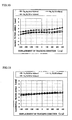
- Fig. 10 and Fig. 11 are graphs to show a tilting characteristic of the objective lens 26 in the objective lens driving device 30 according to the present embodiment.
- Fig. 10 shows tilting angles (radial tilting angle) of the objective lens 26 in the radial direction (See, Fig. 3 ) when the objective lens 26 is moved ⁇ 0.4mm along the tracking direction in the states that offset in the focusing direction are +0.3mm, 0mm, and - 0.3mm.
- Fig. 11 shows the tilting angles (tangential tilting angle) of the objective lens 26 in the tangential direction (See, Fig. 3 ) when the objective lens 26 is moved ⁇ 0.4mm along the tracking direction in the states that offset in the focusing direction are +0.3mm, 0mm, and -0.3mm.
- both of the radial tilting and the tangential tilting can be suppressed small when the objective lend driving device 30 is driven. Therefore, when the objective lens driving device 30 according to the present embodiment is utilized, it becomes possible to perform reproducing of the optical disc 20 in a state that tilting of the objective lens 26 is suppressed small, as a result, the reproducing performance of the optical disc apparatus 1 can be improved.
- the optical disc apparatus 1 is an apparatus which can perform only reproducing of the optical disc.
- the apparatus is an optical disc apparatus which can perform both recording and reproducing, and in this case, tilting of the objective lens can be suppressed when recording is performed.
- the kind of the optical disc 20 to which the optical disc apparatus 1 is applied it is not limited to the kinds described in the present embodiment, and it can be changed adequately.
- the objective lens driving device By the objective lens driving device according to the present invention, tilting of the objective lens can be suppressed small. As a result, recording performance and reproducing performance of an optical disc apparatus in which an objective lens driving device according to the present invention is arranged, can be improved. Therefore, the objective lens driving device according to the present invention is very useful.
Landscapes
- Physics & Mathematics (AREA)
- Optics & Photonics (AREA)
- Optical Recording Or Reproduction (AREA)
Claims (2)
- Objektivlinsen-Antriebsvorrichtung mit:einer Objektivlinse (26);einem Linsenhalter (32), der dazu angeordnet ist, die Objektivlinse (26) zu halten;zwei Magneten (33a, 33b) die einander zugewandt dazu angeordnet sind, den Linsenhalter (32) sandwichartig zu umschließen;Fokussierspulen (34a, 34b), die an dem Linsenhalter (32) befestigt sind, um eine Antriebskraft in der Fokussierrichtung (F) durch eine elektromagnetische Kraftwirkung mit den Magneten (33a, 33b) zu erzeugen;Spurführungsspulen (35a - 35d), die an dem Linsenhalter (26) befestigt sind, um eine Antriebskraft in der Spurführungsrichtung (T) durch eine elektromagnetische Kraftwirkung mit den Magneten (33a, 33b) zu erzeugen; undeinem elastischen Halteelement (36, 37a - 37d), das dazu angeordnet ist, den Linsenhalter (26) beweglich zu halten,wobei
auf jeder der Oberflächen des Linsenhalters (32), die jeweils den beiden Magneten (33a, 33b) zugewandt sind, eine der Fokussierspulen (34a, 34b) und zwei der Spurführungsspulen (35a - 35d) dazu eingerichtet sind, in einer Richtung zu fluchten, die parallel zur Spurführungsrichtung (T) ist, wobei die Fokussierspule (34a, 34b) in einer Mitte zwischen den Spurführungsspulen (34a, 34b) angeordnet ist,
dadurch gekennzeichnet, dass
die beiden Magnete (33a, 33b) vielpolige Magnete und zueinander umgekehrt angeordnet sind,
die vielpoligen Magnete (33a, 33b) aus einem ersten Bereich (A), der eine Quaderform aufweist, einem zweiten Bereich (B), der um den ersten Bereich (A) so ausgebildet ist, dass er einen im Wesentlichen U-förmigen Querschnitt aufweist, und in Bezug auf den ersten Bereich (A) eine entgegengesetzte N-S-Polarität aufweist, und einen dritten Bereich (C) besteht, der aus zwei quaderförmigen Bereichen besteht, die dazu ausgebildet sind, den zweiten Bereich (B) sandwichartig einzuschließen, und der die gleiche N-S-Polarität in Bezug auf den ersten Bereich (A) aufweist,
von zwei wirksamen Abschnitten, die entgegengesetzte Seiten der Fokussierspule (34a, 34b) sind und die die Antriebskraft erzeugen, einer so angeordnet ist, dass er dem ersten Abschnitt (A) zugewandt ist, und der andere so angeordnet ist, dass er dem zweiten Abschnitt (B) zugewandt ist, und
von zwei wirksamen Abschnitten, die entgegengesetzte Seiten der Spurführungsspulen (35a - 35d) sind und die die Antriebskraft erzeugen, einer so angeordnet ist, dass er dem zweiten Abschnitt (B) zugewandt ist, und der andere so angeordnet ist, dass er dem dritten Abschnitt (C) zugewandt ist. - Optisches Plattengerät, dadurch gekennzeichnet, dass es mit der Objektivlinsen-Antriebsvorrichtung gemäß Anspruch 1 versehen ist.
Applications Claiming Priority (1)
| Application Number | Priority Date | Filing Date | Title |
|---|---|---|---|
| JP2006345282A JP2008159126A (ja) | 2006-12-22 | 2006-12-22 | 対物レンズ駆動装置および光ディスク装置 |
Publications (3)
| Publication Number | Publication Date |
|---|---|
| EP1936617A2 EP1936617A2 (de) | 2008-06-25 |
| EP1936617A3 EP1936617A3 (de) | 2008-11-26 |
| EP1936617B1 true EP1936617B1 (de) | 2010-07-07 |
Family
ID=39167632
Family Applications (1)
| Application Number | Title | Priority Date | Filing Date |
|---|---|---|---|
| EP07024433A Not-in-force EP1936617B1 (de) | 2006-12-22 | 2007-12-17 | Antriebsvorrichtung zum Verstellen einer Objektivlinse und optisches Plattengerät |
Country Status (4)
| Country | Link |
|---|---|
| US (1) | US7835234B2 (de) |
| EP (1) | EP1936617B1 (de) |
| JP (1) | JP2008159126A (de) |
| DE (1) | DE602007007563D1 (de) |
Family Cites Families (10)
| Publication number | Priority date | Publication date | Assignee | Title |
|---|---|---|---|---|
| US6344936B1 (en) * | 1999-09-29 | 2002-02-05 | Matsushita Electric Industrial Co., Ltd. | Objective lens driving apparatus |
| JP3998883B2 (ja) * | 2000-02-08 | 2007-10-31 | パイオニア株式会社 | ディスクプレーヤのレンズ駆動装置 |
| JP2002237067A (ja) | 2001-02-14 | 2002-08-23 | Ricoh Co Ltd | 対物レンズ駆動装置 |
| JP2003346359A (ja) * | 2002-05-27 | 2003-12-05 | Pioneer Electronic Corp | レンズ駆動装置用コイル基板及びレンズ駆動装置 |
| JP2004005813A (ja) * | 2002-05-31 | 2004-01-08 | Tdk Corp | 光ヘッド装置及びそれを用いた光再生装置 |
| JP2004295932A (ja) * | 2003-03-25 | 2004-10-21 | Funai Electric Co Ltd | 光ヘッドの対物レンズ駆動装置 |
| KR20050070699A (ko) * | 2003-12-30 | 2005-07-07 | 삼성전자주식회사 | 광픽업용 액츄에이터 |
| WO2005066945A1 (en) * | 2004-01-12 | 2005-07-21 | Mempile Inc. | Lens actuator assembly for optical head |
| JP2006024266A (ja) | 2004-07-07 | 2006-01-26 | Toshiba Corp | 対物レンズアクチュエータ及び光ディスク装置 |
| TWI322424B (en) * | 2005-12-27 | 2010-03-21 | Ind Tech Res Inst | Objective lens deiving apparatus |
-
2006
- 2006-12-22 JP JP2006345282A patent/JP2008159126A/ja active Pending
-
2007
- 2007-12-17 DE DE602007007563T patent/DE602007007563D1/de active Active
- 2007-12-17 EP EP07024433A patent/EP1936617B1/de not_active Not-in-force
- 2007-12-19 US US12/000,933 patent/US7835234B2/en not_active Expired - Fee Related
Also Published As
| Publication number | Publication date |
|---|---|
| US20080259774A1 (en) | 2008-10-23 |
| EP1936617A2 (de) | 2008-06-25 |
| US7835234B2 (en) | 2010-11-16 |
| JP2008159126A (ja) | 2008-07-10 |
| EP1936617A3 (de) | 2008-11-26 |
| DE602007007563D1 (de) | 2010-08-19 |
Similar Documents
| Publication | Publication Date | Title |
|---|---|---|
| EP1936617B1 (de) | Antriebsvorrichtung zum Verstellen einer Objektivlinse und optisches Plattengerät | |
| EP1936616B1 (de) | Antriebsvorrichtung zum Verstellen einer Objektivlinse, Montageverfahren dafür und optisches Plattengerät | |
| KR100689042B1 (ko) | 광픽업용 액츄에이터 및 광기록 및/또는 재생장치 | |
| JP2003331443A (ja) | 対物レンズ駆動装置及びそれを備えた光ヘッド | |
| EP1675112B1 (de) | Stellantrieb für optischen Lesekopf und optische Aufzeichnungs- und/oder Wiedergabevorrichtung | |
| KR100689035B1 (ko) | 광픽업용 액츄에이터 및 광기록 및/또는 재생장치 | |
| JP2004110971A (ja) | 対物レンズ駆動装置、光ピックアップ装置、及び光ディスク装置 | |
| US7453656B2 (en) | Recording and/or reproducing apparatus with an optical pickup actuator having high thrust | |
| EP2012318B1 (de) | Linsenhalter für optischen Lesekopf und optischer Lesekopf damit | |
| KR100444563B1 (ko) | 2축액튜에이터및광디스크장치 | |
| KR20060083889A (ko) | 대물 렌즈 구동 장치, 광픽업 및 광디스크 장치 | |
| JP4533322B2 (ja) | 光ピックアップ | |
| JP2005332518A (ja) | 光学部品3軸駆動装置及びそれを用いた記録再生装置 | |
| CN100545925C (zh) | 光拾取器 | |
| JP4974850B2 (ja) | 対物レンズ駆動装置および光ピックアップ装置 | |
| JP4508134B2 (ja) | 対物レンズアクチュエータ及びそれを備えた光ピックアップ装置 | |
| US8254220B2 (en) | Objective lens actuator | |
| JP2009146531A (ja) | 光ピックアップ用レンズホルダ及びそれを備えた光ピックアップ | |
| JP2009245476A (ja) | 対物レンズアクチュエータ及び光ディスク装置 | |
| JP2007234112A (ja) | 対物レンズアクチュエータ及び情報記録再生装置 | |
| KR20070001803A (ko) | 광학 저장 매체를 위한 픽업과 상기 픽업을 구비한디바이스 | |
| JPH01204232A (ja) | レンズアクチュエータ | |
| JP2007213694A (ja) | 光ピックアップ装置 | |
| KR20060136355A (ko) | 광픽업 및 광디스크 장치 | |
| JP2000113482A (ja) | 光ピックアップ装置および光ディスク装置 |
Legal Events
| Date | Code | Title | Description |
|---|---|---|---|
| PUAI | Public reference made under article 153(3) epc to a published international application that has entered the european phase |
Free format text: ORIGINAL CODE: 0009012 |
|
| AK | Designated contracting states |
Kind code of ref document: A2 Designated state(s): AT BE BG CH CY CZ DE DK EE ES FI FR GB GR HU IE IS IT LI LT LU LV MC MT NL PL PT RO SE SI SK TR |
|
| AX | Request for extension of the european patent |
Extension state: AL BA HR MK RS |
|
| PUAL | Search report despatched |
Free format text: ORIGINAL CODE: 0009013 |
|
| AK | Designated contracting states |
Kind code of ref document: A3 Designated state(s): AT BE BG CH CY CZ DE DK EE ES FI FR GB GR HU IE IS IT LI LT LU LV MC MT NL PL PT RO SE SI SK TR |
|
| AX | Request for extension of the european patent |
Extension state: AL BA HR MK RS |
|
| 17P | Request for examination filed |
Effective date: 20090430 |
|
| AKX | Designation fees paid |
Designated state(s): DE FR GB |
|
| GRAP | Despatch of communication of intention to grant a patent |
Free format text: ORIGINAL CODE: EPIDOSNIGR1 |
|
| GRAS | Grant fee paid |
Free format text: ORIGINAL CODE: EPIDOSNIGR3 |
|
| GRAA | (expected) grant |
Free format text: ORIGINAL CODE: 0009210 |
|
| AK | Designated contracting states |
Kind code of ref document: B1 Designated state(s): DE FR GB |
|
| REG | Reference to a national code |
Ref country code: GB Ref legal event code: FG4D |
|
| REF | Corresponds to: |
Ref document number: 602007007563 Country of ref document: DE Date of ref document: 20100819 Kind code of ref document: P |
|
| PLBE | No opposition filed within time limit |
Free format text: ORIGINAL CODE: 0009261 |
|
| STAA | Information on the status of an ep patent application or granted ep patent |
Free format text: STATUS: NO OPPOSITION FILED WITHIN TIME LIMIT |
|
| 26N | No opposition filed |
Effective date: 20110408 |
|
| REG | Reference to a national code |
Ref country code: DE Ref legal event code: R097 Ref document number: 602007007563 Country of ref document: DE Effective date: 20110408 |
|
| REG | Reference to a national code |
Ref country code: FR Ref legal event code: PLFP Year of fee payment: 9 |
|
| PGFP | Annual fee paid to national office [announced via postgrant information from national office to epo] |
Ref country code: DE Payment date: 20151208 Year of fee payment: 9 Ref country code: GB Payment date: 20151216 Year of fee payment: 9 |
|
| PGFP | Annual fee paid to national office [announced via postgrant information from national office to epo] |
Ref country code: FR Payment date: 20151110 Year of fee payment: 9 |
|
| REG | Reference to a national code |
Ref country code: DE Ref legal event code: R119 Ref document number: 602007007563 Country of ref document: DE |
|
| GBPC | Gb: european patent ceased through non-payment of renewal fee |
Effective date: 20161217 |
|
| REG | Reference to a national code |
Ref country code: FR Ref legal event code: ST Effective date: 20170831 |
|
| PG25 | Lapsed in a contracting state [announced via postgrant information from national office to epo] |
Ref country code: FR Free format text: LAPSE BECAUSE OF NON-PAYMENT OF DUE FEES Effective date: 20170102 |
|
| PG25 | Lapsed in a contracting state [announced via postgrant information from national office to epo] |
Ref country code: DE Free format text: LAPSE BECAUSE OF NON-PAYMENT OF DUE FEES Effective date: 20170701 Ref country code: GB Free format text: LAPSE BECAUSE OF NON-PAYMENT OF DUE FEES Effective date: 20161217 |