EP1935914A1 - Hydroxyester-vorverlängerte Epoxidgruppen terminierte Zähigkeitsverbesserer und Verfahren zu deren Herstellung - Google Patents
Hydroxyester-vorverlängerte Epoxidgruppen terminierte Zähigkeitsverbesserer und Verfahren zu deren Herstellung Download PDFInfo
- Publication number
- EP1935914A1 EP1935914A1 EP06127080A EP06127080A EP1935914A1 EP 1935914 A1 EP1935914 A1 EP 1935914A1 EP 06127080 A EP06127080 A EP 06127080A EP 06127080 A EP06127080 A EP 06127080A EP 1935914 A1 EP1935914 A1 EP 1935914A1
- Authority
- EP
- European Patent Office
- Prior art keywords
- formula
- terminated
- diglycidyl ether
- carboxyl
- groups
- Prior art date
- Legal status (The legal status is an assumption and is not a legal conclusion. Google has not performed a legal analysis and makes no representation as to the accuracy of the status listed.)
- Ceased
Links
- 238000000034 method Methods 0.000 title claims description 10
- 230000015572 biosynthetic process Effects 0.000 title description 4
- 238000003786 synthesis reaction Methods 0.000 title description 2
- 229920000642 polymer Polymers 0.000 claims abstract description 128
- GYZLOYUZLJXAJU-UHFFFAOYSA-N diglycidyl ether Chemical compound C1OC1COCC1CO1 GYZLOYUZLJXAJU-UHFFFAOYSA-N 0.000 claims abstract description 79
- 229920000647 polyepoxide Polymers 0.000 claims abstract description 74
- 125000003178 carboxy group Chemical group [H]OC(*)=O 0.000 claims abstract description 40
- 239000000203 mixture Substances 0.000 claims abstract description 37
- 239000003822 epoxy resin Substances 0.000 claims abstract description 31
- 238000006243 chemical reaction Methods 0.000 claims abstract description 17
- NIXOWILDQLNWCW-UHFFFAOYSA-M Acrylate Chemical compound [O-]C(=O)C=C NIXOWILDQLNWCW-UHFFFAOYSA-M 0.000 claims abstract description 16
- LFQSCWFLJHTTHZ-UHFFFAOYSA-N Ethanol Chemical compound CCO LFQSCWFLJHTTHZ-UHFFFAOYSA-N 0.000 claims abstract description 13
- 238000002360 preparation method Methods 0.000 claims abstract description 12
- 150000004985 diamines Chemical class 0.000 claims abstract description 11
- 125000003055 glycidyl group Chemical group C(C1CO1)* 0.000 claims abstract description 11
- 239000004848 polyfunctional curative Substances 0.000 claims abstract description 5
- 125000002947 alkylene group Chemical group 0.000 claims abstract description 3
- 125000002993 cycloalkylene group Chemical group 0.000 claims abstract description 3
- KAKZBPTYRLMSJV-UHFFFAOYSA-N Butadiene Chemical compound C=CC=C KAKZBPTYRLMSJV-UHFFFAOYSA-N 0.000 claims description 44
- 150000002118 epoxides Chemical group 0.000 claims description 41
- 229920001577 copolymer Polymers 0.000 claims description 21
- 239000004593 Epoxy Substances 0.000 claims description 15
- 125000002496 methyl group Chemical group [H]C([H])([H])* 0.000 claims description 14
- LNEPOXFFQSENCJ-UHFFFAOYSA-N haloperidol Chemical compound C1CC(O)(C=2C=CC(Cl)=CC=2)CCN1CCCC(=O)C1=CC=C(F)C=C1 LNEPOXFFQSENCJ-UHFFFAOYSA-N 0.000 claims description 13
- 239000011159 matrix material Substances 0.000 claims description 10
- 125000001931 aliphatic group Chemical group 0.000 claims description 9
- RTZKZFJDLAIYFH-UHFFFAOYSA-N Diethyl ether Chemical compound CCOCC RTZKZFJDLAIYFH-UHFFFAOYSA-N 0.000 claims description 8
- UWFRVQVNYNPBEF-UHFFFAOYSA-N 1-(2,4-dimethylphenyl)propan-1-one Chemical compound CCC(=O)C1=CC=C(C)C=C1C UWFRVQVNYNPBEF-UHFFFAOYSA-N 0.000 claims description 6
- 125000004432 carbon atom Chemical group C* 0.000 claims description 6
- 125000001495 ethyl group Chemical group [H]C([H])([H])C([H])([H])* 0.000 claims description 6
- XUCHXOAWJMEFLF-UHFFFAOYSA-N bisphenol F diglycidyl ether Chemical group C1OC1COC(C=C1)=CC=C1CC(C=C1)=CC=C1OCC1CO1 XUCHXOAWJMEFLF-UHFFFAOYSA-N 0.000 claims description 5
- 239000003795 chemical substances by application Substances 0.000 claims description 5
- HPILSDOMLLYBQF-UHFFFAOYSA-N 2-[1-(oxiran-2-ylmethoxy)butoxymethyl]oxirane Chemical compound C1OC1COC(CCC)OCC1CO1 HPILSDOMLLYBQF-UHFFFAOYSA-N 0.000 claims description 4
- HSDVRWZKEDRBAG-UHFFFAOYSA-N 2-[1-(oxiran-2-ylmethoxy)hexoxymethyl]oxirane Chemical compound C1OC1COC(CCCCC)OCC1CO1 HSDVRWZKEDRBAG-UHFFFAOYSA-N 0.000 claims description 4
- LCFVJGUPQDGYKZ-UHFFFAOYSA-N Bisphenol A diglycidyl ether Chemical compound C=1C=C(OCC2OC2)C=CC=1C(C)(C)C(C=C1)=CC=C1OCC1CO1 LCFVJGUPQDGYKZ-UHFFFAOYSA-N 0.000 claims description 4
- IAYPIBMASNFSPL-UHFFFAOYSA-N Ethylene oxide Chemical compound C1CO1 IAYPIBMASNFSPL-UHFFFAOYSA-N 0.000 claims description 4
- GOOHAUXETOMSMM-UHFFFAOYSA-N Propylene oxide Chemical compound CC1CO1 GOOHAUXETOMSMM-UHFFFAOYSA-N 0.000 claims description 4
- NLHHRLWOUZZQLW-UHFFFAOYSA-N Acrylonitrile Chemical compound C=CC#N NLHHRLWOUZZQLW-UHFFFAOYSA-N 0.000 claims description 3
- 230000004913 activation Effects 0.000 claims description 2
- 238000010438 heat treatment Methods 0.000 claims description 2
- 150000001412 amines Chemical group 0.000 claims 3
- -1 3-(piperazino)-propyl Chemical group 0.000 abstract description 13
- 229920005989 resin Polymers 0.000 abstract description 10
- 239000011347 resin Substances 0.000 abstract description 10
- NTXGQCSETZTARF-UHFFFAOYSA-N buta-1,3-diene;prop-2-enenitrile Chemical compound C=CC=C.C=CC#N NTXGQCSETZTARF-UHFFFAOYSA-N 0.000 abstract description 5
- 229920000459 Nitrile rubber Polymers 0.000 abstract 3
- 125000003700 epoxy group Chemical group 0.000 abstract 2
- 125000005702 oxyalkylene group Chemical group 0.000 abstract 1
- 239000000376 reactant Substances 0.000 abstract 1
- 150000003254 radicals Chemical class 0.000 description 14
- IISBACLAFKSPIT-UHFFFAOYSA-N bisphenol A Chemical compound C=1C=C(O)C=CC=1C(C)(C)C1=CC=C(O)C=C1 IISBACLAFKSPIT-UHFFFAOYSA-N 0.000 description 12
- IJGRMHOSHXDMSA-UHFFFAOYSA-N Atomic nitrogen Chemical compound N#N IJGRMHOSHXDMSA-UHFFFAOYSA-N 0.000 description 10
- 239000007787 solid Substances 0.000 description 10
- 239000007788 liquid Substances 0.000 description 9
- 238000004519 manufacturing process Methods 0.000 description 8
- 239000000853 adhesive Substances 0.000 description 7
- 230000001070 adhesive effect Effects 0.000 description 7
- 229940106691 bisphenol a Drugs 0.000 description 6
- 125000001424 substituent group Chemical group 0.000 description 6
- PEDCQBHIVMGVHV-UHFFFAOYSA-N Glycerine Chemical compound OCC(O)CO PEDCQBHIVMGVHV-UHFFFAOYSA-N 0.000 description 5
- 229920013646 Hycar Polymers 0.000 description 5
- 229910052757 nitrogen Inorganic materials 0.000 description 5
- 239000000047 product Substances 0.000 description 5
- HDPLHDGYGLENEI-UHFFFAOYSA-N 2-[1-(oxiran-2-ylmethoxy)propan-2-yloxymethyl]oxirane Chemical compound C1OC1COC(C)COCC1CO1 HDPLHDGYGLENEI-UHFFFAOYSA-N 0.000 description 4
- VPWNQTHUCYMVMZ-UHFFFAOYSA-N 4,4'-sulfonyldiphenol Chemical class C1=CC(O)=CC=C1S(=O)(=O)C1=CC=C(O)C=C1 VPWNQTHUCYMVMZ-UHFFFAOYSA-N 0.000 description 4
- 229930185605 Bisphenol Natural products 0.000 description 4
- ZJCCRDAZUWHFQH-UHFFFAOYSA-N Trimethylolpropane Chemical compound CCC(CO)(CO)CO ZJCCRDAZUWHFQH-UHFFFAOYSA-N 0.000 description 4
- 239000002253 acid Substances 0.000 description 4
- PXKLMJQFEQBVLD-UHFFFAOYSA-N bisphenol F Chemical compound C1=CC(O)=CC=C1CC1=CC=C(O)C=C1 PXKLMJQFEQBVLD-UHFFFAOYSA-N 0.000 description 4
- 229920001223 polyethylene glycol Polymers 0.000 description 4
- KUBDPQJOLOUJRM-UHFFFAOYSA-N 2-(chloromethyl)oxirane;4-[2-(4-hydroxyphenyl)propan-2-yl]phenol Chemical compound ClCC1CO1.C=1C=C(O)C=CC=1C(C)(C)C1=CC=C(O)C=C1 KUBDPQJOLOUJRM-UHFFFAOYSA-N 0.000 description 3
- CSCPPACGZOOCGX-UHFFFAOYSA-N Acetone Chemical compound CC(C)=O CSCPPACGZOOCGX-UHFFFAOYSA-N 0.000 description 3
- 229920003319 Araldite® Polymers 0.000 description 3
- LYCAIKOWRPUZTN-UHFFFAOYSA-N Ethylene glycol Chemical compound OCCO LYCAIKOWRPUZTN-UHFFFAOYSA-N 0.000 description 3
- 239000004609 Impact Modifier Substances 0.000 description 3
- 150000001298 alcohols Chemical class 0.000 description 3
- 229920001971 elastomer Polymers 0.000 description 3
- 150000002148 esters Chemical class 0.000 description 3
- OETHQSJEHLVLGH-UHFFFAOYSA-N metformin hydrochloride Chemical compound Cl.CN(C)C(=N)N=C(N)N OETHQSJEHLVLGH-UHFFFAOYSA-N 0.000 description 3
- 230000003647 oxidation Effects 0.000 description 3
- 238000007254 oxidation reaction Methods 0.000 description 3
- 239000005060 rubber Substances 0.000 description 3
- 239000007858 starting material Substances 0.000 description 3
- 229920001187 thermosetting polymer Polymers 0.000 description 3
- 239000012745 toughening agent Substances 0.000 description 3
- KUAUJXBLDYVELT-UHFFFAOYSA-N 2-[[2,2-dimethyl-3-(oxiran-2-ylmethoxy)propoxy]methyl]oxirane Chemical compound C1OC1COCC(C)(C)COCC1CO1 KUAUJXBLDYVELT-UHFFFAOYSA-N 0.000 description 2
- 229920003344 Epilox® Polymers 0.000 description 2
- 150000001252 acrylic acid derivatives Chemical class 0.000 description 2
- 230000002411 adverse Effects 0.000 description 2
- 150000001336 alkenes Chemical class 0.000 description 2
- 125000003277 amino group Chemical group 0.000 description 2
- 230000008901 benefit Effects 0.000 description 2
- DJUWPHRCMMMSCV-UHFFFAOYSA-N bis(7-oxabicyclo[4.1.0]heptan-4-ylmethyl) hexanedioate Chemical compound C1CC2OC2CC1COC(=O)CCCCC(=O)OCC1CC2OC2CC1 DJUWPHRCMMMSCV-UHFFFAOYSA-N 0.000 description 2
- 239000003054 catalyst Substances 0.000 description 2
- 239000007795 chemical reaction product Substances 0.000 description 2
- 238000000576 coating method Methods 0.000 description 2
- 150000001875 compounds Chemical class 0.000 description 2
- 238000010276 construction Methods 0.000 description 2
- 125000004122 cyclic group Chemical group 0.000 description 2
- 238000009826 distribution Methods 0.000 description 2
- 150000002170 ethers Chemical class 0.000 description 2
- 235000011187 glycerol Nutrition 0.000 description 2
- ACCCMOQWYVYDOT-UHFFFAOYSA-N hexane-1,1-diol Chemical compound CCCCCC(O)O ACCCMOQWYVYDOT-UHFFFAOYSA-N 0.000 description 2
- 125000002887 hydroxy group Chemical group [H]O* 0.000 description 2
- 239000004850 liquid epoxy resins (LERs) Substances 0.000 description 2
- XNGIFLGASWRNHJ-UHFFFAOYSA-N phthalic acid Chemical compound OC(=O)C1=CC=CC=C1C(O)=O XNGIFLGASWRNHJ-UHFFFAOYSA-N 0.000 description 2
- 229920005862 polyol Polymers 0.000 description 2
- 230000008439 repair process Effects 0.000 description 2
- 229920006395 saturated elastomer Polymers 0.000 description 2
- 239000000565 sealant Substances 0.000 description 2
- RIOQSEWOXXDEQQ-UHFFFAOYSA-N triphenylphosphine Chemical compound C1=CC=CC=C1P(C=1C=CC=CC=1)C1=CC=CC=C1 RIOQSEWOXXDEQQ-UHFFFAOYSA-N 0.000 description 2
- 125000000391 vinyl group Chemical group [H]C([*])=C([H])[H] 0.000 description 2
- 229920002554 vinyl polymer Chemical group 0.000 description 2
- LFKLPJRVSHJZPL-UHFFFAOYSA-N 1,2:7,8-diepoxyoctane Chemical compound C1OC1CCCCC1CO1 LFKLPJRVSHJZPL-UHFFFAOYSA-N 0.000 description 1
- WTYYGFLRBWMFRY-UHFFFAOYSA-N 2-[6-(oxiran-2-ylmethoxy)hexoxymethyl]oxirane Chemical compound C1OC1COCCCCCCOCC1CO1 WTYYGFLRBWMFRY-UHFFFAOYSA-N 0.000 description 1
- HIGURUTWFKYJCH-UHFFFAOYSA-N 2-[[1-(oxiran-2-ylmethoxymethyl)cyclohexyl]methoxymethyl]oxirane Chemical compound C1OC1COCC1(COCC2OC2)CCCCC1 HIGURUTWFKYJCH-UHFFFAOYSA-N 0.000 description 1
- JZUHIOJYCPIVLQ-UHFFFAOYSA-N 2-methylpentane-1,5-diamine Chemical compound NCC(C)CCCN JZUHIOJYCPIVLQ-UHFFFAOYSA-N 0.000 description 1
- NHJIDZUQMHKGRE-UHFFFAOYSA-N 7-oxabicyclo[4.1.0]heptan-4-yl 2-(7-oxabicyclo[4.1.0]heptan-4-yl)acetate Chemical compound C1CC2OC2CC1OC(=O)CC1CC2OC2CC1 NHJIDZUQMHKGRE-UHFFFAOYSA-N 0.000 description 1
- ZFIVKAOQEXOYFY-UHFFFAOYSA-N Diepoxybutane Chemical compound C1OC1C1OC1 ZFIVKAOQEXOYFY-UHFFFAOYSA-N 0.000 description 1
- BRLQWZUYTZBJKN-UHFFFAOYSA-N Epichlorohydrin Chemical compound ClCC1CO1 BRLQWZUYTZBJKN-UHFFFAOYSA-N 0.000 description 1
- 150000007513 acids Chemical class 0.000 description 1
- 125000000217 alkyl group Chemical group 0.000 description 1
- RMRFFCXPLWYOOY-UHFFFAOYSA-N allyl radical Chemical compound [CH2]C=C RMRFFCXPLWYOOY-UHFFFAOYSA-N 0.000 description 1
- 150000001408 amides Chemical class 0.000 description 1
- IMUDHTPIFIBORV-UHFFFAOYSA-N aminoethylpiperazine Chemical compound NCCN1CCNCC1 IMUDHTPIFIBORV-UHFFFAOYSA-N 0.000 description 1
- 125000003118 aryl group Chemical group 0.000 description 1
- XFUOBHWPTSIEOV-UHFFFAOYSA-N bis(oxiran-2-ylmethyl) cyclohexane-1,2-dicarboxylate Chemical class C1CCCC(C(=O)OCC2OC2)C1C(=O)OCC1CO1 XFUOBHWPTSIEOV-UHFFFAOYSA-N 0.000 description 1
- CDQSJQSWAWPGKG-UHFFFAOYSA-N butane-1,1-diol Chemical compound CCCC(O)O CDQSJQSWAWPGKG-UHFFFAOYSA-N 0.000 description 1
- 150000001735 carboxylic acids Chemical class 0.000 description 1
- 239000004359 castor oil Substances 0.000 description 1
- 235000019438 castor oil Nutrition 0.000 description 1
- 238000004132 cross linking Methods 0.000 description 1
- SSJXIUAHEKJCMH-UHFFFAOYSA-N cyclohexane-1,2-diamine Chemical compound NC1CCCCC1N SSJXIUAHEKJCMH-UHFFFAOYSA-N 0.000 description 1
- 125000000596 cyclohexenyl group Chemical group C1(=CCCCC1)* 0.000 description 1
- 125000005725 cyclohexenylene group Chemical group 0.000 description 1
- 230000001419 dependent effect Effects 0.000 description 1
- 230000006866 deterioration Effects 0.000 description 1
- 150000001991 dicarboxylic acids Chemical class 0.000 description 1
- 235000014113 dietary fatty acids Nutrition 0.000 description 1
- 239000003085 diluting agent Substances 0.000 description 1
- 230000000694 effects Effects 0.000 description 1
- 229930195729 fatty acid Natural products 0.000 description 1
- 239000000194 fatty acid Substances 0.000 description 1
- 150000004665 fatty acids Chemical class 0.000 description 1
- 239000006260 foam Substances 0.000 description 1
- 125000000524 functional group Chemical group 0.000 description 1
- 239000007789 gas Substances 0.000 description 1
- 230000009477 glass transition Effects 0.000 description 1
- ZEMPKEQAKRGZGQ-XOQCFJPHSA-N glycerol triricinoleate Natural products CCCCCC[C@@H](O)CC=CCCCCCCCC(=O)OC[C@@H](COC(=O)CCCCCCCC=CC[C@@H](O)CCCCCC)OC(=O)CCCCCCCC=CC[C@H](O)CCCCCC ZEMPKEQAKRGZGQ-XOQCFJPHSA-N 0.000 description 1
- 238000011065 in-situ storage Methods 0.000 description 1
- 239000006115 industrial coating Substances 0.000 description 1
- 238000002347 injection Methods 0.000 description 1
- 239000007924 injection Substances 0.000 description 1
- 239000000463 material Substances 0.000 description 1
- WSFSSNUMVMOOMR-NJFSPNSNSA-N methanone Chemical compound O=[14CH2] WSFSSNUMVMOOMR-NJFSPNSNSA-N 0.000 description 1
- 238000002156 mixing Methods 0.000 description 1
- OLAPPGSPBNVTRF-UHFFFAOYSA-N naphthalene-1,4,5,8-tetracarboxylic acid Chemical compound C1=CC(C(O)=O)=C2C(C(=O)O)=CC=C(C(O)=O)C2=C1C(O)=O OLAPPGSPBNVTRF-UHFFFAOYSA-N 0.000 description 1
- 229920003986 novolac Polymers 0.000 description 1
- OEIJHBUUFURJLI-UHFFFAOYSA-N octane-1,8-diol Chemical compound OCCCCCCCCO OEIJHBUUFURJLI-UHFFFAOYSA-N 0.000 description 1
- 239000003973 paint Substances 0.000 description 1
- 150000004714 phosphonium salts Chemical group 0.000 description 1
- 229920000768 polyamine Polymers 0.000 description 1
- 229920000728 polyester Polymers 0.000 description 1
- 238000006116 polymerization reaction Methods 0.000 description 1
- 150000003077 polyols Chemical class 0.000 description 1
- 150000008442 polyphenolic compounds Chemical class 0.000 description 1
- 235000013824 polyphenols Nutrition 0.000 description 1
- 230000003389 potentiating effect Effects 0.000 description 1
- 239000000843 powder Substances 0.000 description 1
- 230000002035 prolonged effect Effects 0.000 description 1
- 230000001681 protective effect Effects 0.000 description 1
- 150000003242 quaternary ammonium salts Chemical group 0.000 description 1
- 239000002994 raw material Substances 0.000 description 1
- 239000011541 reaction mixture Substances 0.000 description 1
- 238000007789 sealing Methods 0.000 description 1
- 239000002904 solvent Substances 0.000 description 1
- 238000003860 storage Methods 0.000 description 1
- 239000004616 structural foam Substances 0.000 description 1
- 239000000126 substance Substances 0.000 description 1
- 150000003512 tertiary amines Chemical class 0.000 description 1
- 229920000428 triblock copolymer Polymers 0.000 description 1
- 229920006337 unsaturated polyester resin Polymers 0.000 description 1
- 239000003981 vehicle Substances 0.000 description 1
- XLYOFNOQVPJJNP-UHFFFAOYSA-N water Substances O XLYOFNOQVPJJNP-UHFFFAOYSA-N 0.000 description 1
Classifications
-
- C—CHEMISTRY; METALLURGY
- C08—ORGANIC MACROMOLECULAR COMPOUNDS; THEIR PREPARATION OR CHEMICAL WORKING-UP; COMPOSITIONS BASED THEREON
- C08G—MACROMOLECULAR COMPOUNDS OBTAINED OTHERWISE THAN BY REACTIONS ONLY INVOLVING UNSATURATED CARBON-TO-CARBON BONDS
- C08G59/00—Polycondensates containing more than one epoxy group per molecule; Macromolecules obtained by polymerising compounds containing more than one epoxy group per molecule using curing agents or catalysts which react with the epoxy groups
- C08G59/02—Polycondensates containing more than one epoxy group per molecule
- C08G59/12—Polycondensates containing more than one epoxy group per molecule of polycarboxylic acids with epihalohydrins or precursors thereof
-
- C—CHEMISTRY; METALLURGY
- C08—ORGANIC MACROMOLECULAR COMPOUNDS; THEIR PREPARATION OR CHEMICAL WORKING-UP; COMPOSITIONS BASED THEREON
- C08C—TREATMENT OR CHEMICAL MODIFICATION OF RUBBERS
- C08C19/00—Chemical modification of rubber
- C08C19/30—Addition of a reagent which reacts with a hetero atom or a group containing hetero atoms of the macromolecule
- C08C19/34—Addition of a reagent which reacts with a hetero atom or a group containing hetero atoms of the macromolecule reacting with oxygen or oxygen-containing groups
- C08C19/36—Addition of a reagent which reacts with a hetero atom or a group containing hetero atoms of the macromolecule reacting with oxygen or oxygen-containing groups with carboxy radicals
-
- C—CHEMISTRY; METALLURGY
- C08—ORGANIC MACROMOLECULAR COMPOUNDS; THEIR PREPARATION OR CHEMICAL WORKING-UP; COMPOSITIONS BASED THEREON
- C08G—MACROMOLECULAR COMPOUNDS OBTAINED OTHERWISE THAN BY REACTIONS ONLY INVOLVING UNSATURATED CARBON-TO-CARBON BONDS
- C08G59/00—Polycondensates containing more than one epoxy group per molecule; Macromolecules obtained by polymerising compounds containing more than one epoxy group per molecule using curing agents or catalysts which react with the epoxy groups
- C08G59/18—Macromolecules obtained by polymerising compounds containing more than one epoxy group per molecule using curing agents or catalysts which react with the epoxy groups ; e.g. general methods of curing
- C08G59/20—Macromolecules obtained by polymerising compounds containing more than one epoxy group per molecule using curing agents or catalysts which react with the epoxy groups ; e.g. general methods of curing characterised by the epoxy compounds used
- C08G59/22—Di-epoxy compounds
Definitions
- the invention relates to the field of tougheners.
- Polymers have long been used as materials. However, certain polymers have the problem that in the case of sudden impact stress, the polymer matrix breaks, i. that their impact resistance is low. In particular, polymer matrices based on epoxy resins are very strong but are often not very impact resistant. Therefore, it has been tried for some time to improve the impact resistance.
- liquid rubbers By the use of chemically reactive groups, such as hydroxyl, carboxyl, vinyl or amino groups such liquid rubbers are chemically incorporated into the matrix.
- reactive liquid rubbers have long existed butadiene / acrylonitrile copolymers terminated with hydroxyl, carboxyl, vinyl or amino groups available from B.F. Goodrich, or Noveon, offered under the trade name Hycar®.
- the polymers according to claims 1, 11, 13 and 14 provide such polymers. They can all be prepared from a carboxyl group-terminated polymer according to claim 11, which in turn can be obtained from an easily accessible carboxyl-terminated butadiene / acrylonitrile copolymer.
- the opportunities offered by the different pre-extension and termination molecules allow a wide range of different tougheners to be tailored to meet their needs.
- the polymers terminated with functional groups have the great advantage that they have a narrow molecular weight distribution and a very high proportion of molecules suitable as toughening agents.
- the polymers according to claims 1, 11, 13 and 14 can be widely used as agents for increasing the impact resistance of a polymer matrix according to claim 18. Particularly preferred is their use in epoxy resin matrix.
- thermosetting epoxy resin adhesives are particularly preferred. They have exceptionally good impact toughness.
- the present invention relates, in a first aspect, to epoxy group-terminated polymer of the formula (I).
- R 1 is a divalent radical of a carboxyl-terminated butadiene / acrylonitrile copolymer CTBN after removal of the terminal carboxyl groups.
- R 2 is a polyepoxide PEP after removal of n epoxide groups and R 2 'is H or a radical connected to R 2.
- Y 1 and Y 2 independently of one another are H or methyl.
- R 3 is a diglycidyl ether DGE after removal of the two glycidyl ether groups.
- n stands for a value of 2 to 4, in particular of 2
- R 1 is a radical as obtained by formal removal of the carboxyl groups of a carboxy-terminated butadiene / acrylonitrile copolymer CTBN commercially available under the name Hycar® CTBN from Noveon. It preferably has a structure of the formula (IV).
- R is a linear or branched alkylene radical having 1 to 6 C atoms, in particular 4 C atoms, which is optionally substituted by unsaturated groups.
- the substituent R represents a substituent of the formula (VII), wherein the dashed lines represent the attachment sites here as well
- the subscript q stands for a value between 40 and 100, in particular between 50 and 90.
- the designations b and c represent the structural elements which originate from butadiene and a the structural element which originates from acrylonitrile.
- the indices x, m , and p in turn represent values describing the relationship of the structural elements a, b and c to one another.
- the index x stands for values of 0.05 - 0.3, the index m for values of 0.5 - 0.8, the index p for values of 0.1 - 0.2 with the assumption that the sum of x, m and p is equal to 1.
- formula (IV) is not necessarily a triblock copolymer.
- the radical R 2 is a polyepoxide PEP after removal of n epoxide groups.
- the epoxide group is a structural element of an epoxirane ring ( ) Understood.
- Particularly preferred epoxide groups are glycidyl ether groups As "glycidyl ether group", in addition to the case where Y 1 in the last formula is H, for the sake of simplicity, the present invention also refers to that group of the last formula in which Y 1 is methyl.
- Polyepoxides can be prepared in a known manner, for example, from the oxidation of the corresponding olefins or from the reaction of epichlorohydrin with the corresponding polyols.
- the polyepoxide PEP is a diepoxide, triepoxide or tetraepoxide, in particular a diglycidyl ether, triglycidyl ether or tetraglycidyl ether.
- Such polyepoxides, or polyglycidyl ethers are known to the skilled person, on the one hand, as epoxide reactive diluents and also as epoxy resins.
- the aliphatic or cycloaliphatic diglycidyl ether is a diglycidyl ether of the formula (V ") or (V ''').
- r stands for a value from 1 to 9, in particular for 3 or 5.
- q' stands for a value from 0 to 10
- t ' for a value from 0 to 10, with the proviso that the sum of q' and t ' ⁇ 1.
- d ' represents the structural element derived from ethylene oxide
- e' represents the structural element derived from propylene oxide.
- formula (V '' ') is (poly) ethylene glycol diglycidyl ether, (poly) propylene glycol diglycidyl ether and (poly) ethylene glycol / propylene glycol diglycidyl ether, wherein the building blocks d' and e 'may be arranged blockwise, alternately or randomly.
- Particularly suitable aliphatic or cycloaliphatic diglycidyl ethers are ethylene glycol diglycidyl ether, butanediol diglycidyl ether or hexanediol diglycidyl ether.
- the polyepoxide PEP is a polyepoxide prepared from an oxidation of olefins.
- PEP polyepoxides PEP are those which have at least one epoxide group which are prepared via oxidation of a cyclohexenyl or cyclohexenylene group.
- Preferred such polyepoxides are PEP and polyesters of polycarboxylic acids and 3,4-epoxycyclohexylmethyl alcohol, especially bis (3,4-epoxycyclohexylmethyl) adipate.
- v stands for a value of 2 to 8 and R 6 and R 6 'independently of one another are H or a C 1 -C 6 -alkyl radical.
- Particularly suitable are 3,4-epoxycyclohexylmethyl-3,4-epoxycyclohexanecarboxylate, bis (3,4-epoxycyclohexylmethyl) adipate, 1,2,7,8-diepoxyoctane, 1,2,3,4-diepoxybutane and 1,2 , 5,6-Diepoxycyclooktan.
- the polyepoxide PEP is an aromatic diglycidyl ether.
- aromatic diglycidyl ethers which, after removal of two glycidyl ether groups, have a radical R 2 of the formula (V ').
- R '' 'independently of one another is H, methyl or ethyl and z' is 0 or 1.
- the polyepoxide PEP is an epoxy resin.
- the epoxy resin may be a so-called epoxy liquid resin or a solid epoxy resin.
- solid epoxy resin is well known to the person skilled in the art and is used in contrast to "liquid epoxy resins".
- the glass transition temperature of solid resins is above room temperature, i. they can be ground at room temperature to give pourable powders.
- Preferred solid epoxy resins have the formula (VIII)
- the substituents R 4 , R 5 and Y 2 independently of one another are either H or CH 3 .
- the index S1 stands for a value of> 1.5, in particular from 2 to 12.
- Such solid epoxy resins are commercially available, for example, from Dow or Huntsman or Hexion.
- Preferred liquid epoxy resins have the formula (IX)
- the substituents R 4 , R 5 and Y 2 independently of one another are either H or CH 3 .
- the index S1 stands for a value from 0 to 1.
- S1 stands for a value of less than 0.2.
- DGEBA diglycidyl ether of bisphenol A
- a / F refers to a mixture of acetone with formaldehyde, which as starting material in its preparation is used.
- Such liquid resins are available, for example, as Araldite® GY 250, Araldite® PY 304, Araldite® GY 282 (Huntsman) or D.E.R. TM 331 or D.E.R. TM 330 (Dow) or Epikote 828 (Hexion).
- radical R 2 in a particularly suitable form represents the formula (V) or (V ').
- R ', R "and R"' independently of one another are H, methyl or ethyl, z 'is 0 or 1 and s' is 0 or a value of 0.1-12.
- a particularly preferred polyepoxide PEP is bisphenol A diglycidyl ether.
- the radical R 3 is a diglycidyl ether DGE after removal of the two glycidyl ether groups.
- the possibilities for the diglycidyl ether DGE basically correspond to those of the polyepoxides PEP already listed as diglycidyl ethers .
- the diglycidyl ether DGE is an aliphatic or cycloaliphatic diglycidyl ether, in particular a diglycidyl ether of the formula (VI ") or (VI"').
- formula (VI "') is (poly) ethylene glycol diglycidyl ether, (poly) propylene glycol diglycidyl ether and (poly) ethylene glycol / propylene glycol diglycidyl ether, wherein blocks d and e may be block-like, alternating or random.
- Particularly suitable aliphatic or cycloaliphatic diglycidyl ethers are ethylene glycol diglycidyl ether, butanediol diglycidyl ether or hexanediol diglycidyl ether.
- the diglycidyl ether DGE is a diglycidyl ether which, after removal of the two glycidyl ether groups corresponding to the radical R 3 , has the formula (VI) or (VI ').
- R ', R "and R'" independently of one another are H, methyl or ethyl, z is 0 or 1 and s is 0 or a value of 0.1-12.
- a particularly preferred diglycidyl ether DGE is bisphenol F diglycidyl ether.
- the epoxide group-terminated polymer of the formula (I) can be prepared as follows:
- a first step is from a carboxyl-terminated butadiene / acrylonitrile copolymer CTBN of the formula HOOC-R 1 -COOH and a polyepoxide PEP in a stoichiometric excess (n ' ⁇ n) of HOOC-R 1 -COOH a carboxyl group-terminated polymer of formula (II) prepared:
- polyepoxide PEP and HOOC-R 1 -COOH are used in such an amount that the stoichiometric ratio of the COOH groups to epoxide groups [COOH] / [ ] ⁇ 2.
- terminal is from the carboxyl-terminated polymer of formula (II) and a diglycidyl ether DGE of the formula (III) in a stoichiometric excess (n " ⁇ n) of the diglycidyl ether DGE an epoxy group-terminated polymer of the formula (I) made:
- the polymer of the formula (II) and the diglycidyl ether of the formula (III) are used in such an amount relative to one another that the stoichiometric ratio of the glycidyl ether groups to COOH groups is.
- carboxyl-terminated polymers of formula (II) form a further aspect of the present invention.
- the definition, possibilities and preferred embodiments of the radicals and indices listed in this formula (II) correspond to those which have already been described in detail in this document for epoxide group-terminated polymer of the formula (I).
- a further aspect of the present invention is a process for preparing a carboxyl-terminated polymer of the formula (II) by reacting a polyepoxide PEP with a carboxyl-terminated butadiene / acrylonitrile copolymer CTBN of the formula HOOC-R 1 -COOH, characterized that for this reaction the polyepoxide PEP and HOOC-R 1 -COOH are used in an amount relative to one another which corresponds to a stoichiometric ratio of the COOH groups to epoxide groups [COOH] / [ ] of ⁇ 2.
- This procedure has already been described in detail earlier in this document.
- a further aspect of the present invention is a process for preparing an epoxide group-terminated polymer of the formula (I) by reacting a carboxyl-terminated polymer of the formula (II) with a diglycidyl ether DGE of the formula (III), characterized in that Implementation of the polymer of formula (II) and the diglycidyl ether of the formula (III) are used in an amount to each other, the stoichiometric ratio of the glycidyl ether groups to COOH groups of ⁇ 2.
- R 9 is H or an alkyl or alkenyl radical, in particular an allyl radical.
- reaction products of the carboxyl group-terminated polymer of the formula (II) with diamines or (meth) acrylate-functional alcohols or glycidyl ether-functional (meth) acrylates which in particular to amine-terminated polymers of the formula (XI) (XI ') and (XI "), or to (meth) acrylate-terminated polymers of the formula (XII) and (XII') according to the following exemplary reaction scheme.
- R 7 is H or methyl and R 8 is a divalent radical, in particular an alkylene, cycloalkylene or (poly) oxyalkylene radical.
- the diamines 1- (2-aminoethyl) piperazine (DA1), or 2-methylpentamethylenediamine (DA2), or 1,2-diaminocyclohexane (DA3), and the glycidyl (meth) acrylate (GMA) and the hydroxy-functional (DA) Meth) acrylate (HMA) are each used in stoichiometric excess, ie k, k ', k ", k"' and k "" are each greater than n.
- reaction conditions for the formation of amides and esters are known from the literature and can be applied to the synthesis of these reaction products, in particular the polymers of formula (XI), (XI '), (XI "), (XII) and (XII') are transferred.
- R 10 is a divalent radical and Q 1 is an end group which is selected from the group consisting of the formula (XVI), (XVI '), (XVI ") and -NH 2 .
- Particularly suitable end-capped polymers of the formula (XV) are the above-described epoxy-terminated polymers of the formula (I), carboxyl-terminated polymers of the formula (II), amine-terminated polymers of the formula (XI), (XI ') or (XI ") and (meth) acrylate group-terminated polymers of the formula (XII) or (XII ').
- the carboxyl-terminated polymers of the formula (II) and end-capped polymers of the formula (XV) thus prepared in particular the epoxide-group-terminated polymers of the formula (I), amine-group-terminated polymers of the formula (XI), (XI ') or (XI ") and (meth) acrylate group-terminated polymers of the formula (XII) or (XII ') can be used as agents for increasing the impact resistance of a polymer matrix and can be used as so-called impact modifiers.
- polymers of formula (I), (II), (XI), (XI '), (XI "), (XII) and (XII') are preferably used in cross-linking compositions, especially in systems in which these polymers react
- the question in which compositions these polymers are used depends in particular on the polymer matrix:
- (meth) acrylate-group-terminated polymers of the formula (XII) or (XII ') are in particular (meth) acrylates or unsaturated polyester resins, which crosslink via a radical or UV light initiated polymerization reaction to form a polymer matrix, preferably used.
- Epoxide group-terminated polymers of the formula (I) and carboxyl-terminated polymers of the formula (II) and amine-terminated polymers of the formula (XI), (XI ') or (XI ") are preferably used in epoxy resin compositions.
- the epoxy group-terminated polymers of the formula (I) are preferably used in the component in which an epoxy resin A is present.
- the epoxy resin A may be an epoxy liquid resin of the formula (IX) or an epoxy solid resin of the formula (VIII).
- the composition comprises, in addition to an epoxy resin A, a curing agent B for epoxy resins which is activated by elevated temperature.
- a curing agent B for epoxy resins which is activated by elevated temperature.
- Such compositions are used in particular as thermosetting Epoxidharzklebstoffe and harden on heating a temperature which is above the heat activation of the thermally activatable hardener B , so that a cured composition is formed.
- carboxyl group-terminated polymers of the formula (II) they may also be used in the component in which an epoxy resin A is present.
- compositions can be widely used.
- examples include adhesives, sealants, coatings, foams, structural foams, paints, injection resins or coatings. They can be used, for example, in civil engineering, in the manufacture or repair of industrial goods or consumer goods. In particular, they are preferably used as adhesives, in particular for the body construction and the manufacture of windows, household machines or means of transport, such as vehicles by water or by land, preferably automobiles, buses, trucks, trains or ships; or used as a sealant for sealing joints, seams or cavities in industrial manufacturing or repair.
- compositions as crash-resistant adhesives, in particular for the production of transport equipment, preferably in the OEM sector of transport construction.
- compositions are used as high-structural adhesives for civil engineering or heavy-duty industrial coatings.
- the epoxy-terminated polymers ETBN1 and ETBN2 and ETBN 3 showed a marked increase in impact resistance in thermosetting epoxy resin adhesives.
Landscapes
- Chemical & Material Sciences (AREA)
- Health & Medical Sciences (AREA)
- Chemical Kinetics & Catalysis (AREA)
- Medicinal Chemistry (AREA)
- Polymers & Plastics (AREA)
- Organic Chemistry (AREA)
- General Chemical & Material Sciences (AREA)
- Epoxy Resins (AREA)
- Addition Polymer Or Copolymer, Post-Treatments, Or Chemical Modifications (AREA)
Abstract
Die vorliegende Erfindung betrifft Zähigkeitsverbesserer. Es werden funktionelle Endgruppen aufweisende terminierte Polymere vorgestellt, welche durch Polyepoxide vorverlängert werden und durch eine weitere Reaktion zu Polymeren mit anderen funktionellen Gruppen terminiert werden. Die Zähigkeitsverbesserer zeichnen sich durch einen geringen Gehalt an die Eigenschaften von Zusammensetzungen verschlechterten Edukten oder Edukt-Folgeprodukte aus und dadurch, dass die Bildung von höhermolekularen Additionsprodukte stark verringert bis ausgeschlossen wird, so dass sehr geringe Viskositäten bei guter Lagerstabilität entstehen. Als besonders bevorzugt gilt das Epoxidgruppen-terminierte Polymer der Formel (I).
Description
- Die Erfindung betrifft das Gebiet der Zähigkeitsverbesserer.
- Polymere werden seit langem als Werkstoffe eingesetzt. Gewisse Polymere weisen jedoch das Problem auf, dass bei schlagartiger Schlagbeanspruchung die Polymermatrix bricht, d.h. dass ihre Schlagzähigkeit gering ist. Insbesondere Polymermatrices basierend auf Epoxidharzen sind zwar sehr fest sind aber vielfach nicht sehr schlagzäh. Deshalb wurde schon länger versucht, die Schlagzähigkeit zu verbessern.
- Dies wurde beispielsweise mit der Verwendung von speziellen Copolymeren, welche als sogenannte Flüssigkautschuke bezeichnet werden, schon seit längerem versucht. Durch die Verwendung von chemisch reaktiven Gruppen, wie Hydroxyl-, Carboxyl-, Vinyl- oder Amino-Gruppen sind derartige Flüssigkautschuke chemisch in die Matrix einbaubar. So existieren beispielsweise seit langem reaktive Flüssigkautschuke Butadien/Acrylonitil-Copolymere, welche mit Hydroxyl-, Carboxyl-, Vinyl- oder Amino-Gruppen terminiert sind, welche von der Firma B.F. Goodrich, beziehungsweise Noveon, unter dem Handelsnamen Hycar® angeboten. Als Ausgangsbasis wird hierfür stets das Carboxylgruppen-terminierte Butadien/Acrylonitil-Copolymer verwendet, zu welchem üblicherweise ein starker Überschuss an einem Diamin, Diepoxid oder ein Glycidyl(meth)acrylat zugesetzt wird. Dies führt jedoch dazu, dass sich einerseits eine hohe Viskosität bildet oder andererseits dass ein sehr hoher Gehalt an unumgesetztem Diamin, Diepoxid oder Glycidyl(meth)acrylat, welches entweder aufwändig entfernt werden muss oder aber die mechanischen Eigenschaften stark negativ beeinflusst.
- Es besteht jedoch vielfach der Wunsch noch weiter erhöhte Schlagzähigkeit zu erhalten und eine breitere Vielfalt an Zähigkeitsverbesserern zu haben. Eine derartige Möglichkeit in diese Richtung besteht in der Kettenverlängerung von Epoxidgruppen-terminierten Polymeren durch Bisphenole oder durch die Verwendung höher molekularer Epoxidharzen bei der Herstellung. Auch hier entstehen je nach Reaktionsführung grosse Mengen an unumgesetzten Bisphenolen oder an verlängerten Epoxidharzen, die beide schnell die Eigenschaften von Zusammensetzungen negativ beeinflussen können. Weiterhin sind derartige Addukte schnell nicht mehr flüssig, wodurch derartige Zähigkeitsverbesserer enthaltende Zusammensetzungen konsequenterweise vielfach nicht mehr prozesssicher appliziert werden können. Zudem führt die Verwendung von Bisphenolen zu verringerter Lagerstabilität.
- Aufgabe der vorliegenden Erfindung ist es daher, Zähigkeitsverbesserer mit funktionellen Endgruppen zur Verfügung zustellen, welche in der Lage sind, die Probleme des Standes der Technik zu beheben. Die Polymere gemäss der Ansprüche 1, 11, 13 und 14 stellen derartige Polymere zur Verfügung. Sie lassen sich alle aus einem Carboxylgruppen-terminierten Polymer gemäss Anspruch 11 herstellen, welches seinerseits aus einem leicht zugänglichen Carboxylgruppen-terminierten Butadien/Acrylonitril-Copolymer erhalten werden kann. Durch die Möglichkeiten, die sich aus den unterschiedlichen Molekülen zur Vorverlängerung und Terminierung ergeben, ist eine breite Palette von unterschiedlichen Zähigkeitsverbesserer möglich, und lässt sich auf die Bedürfnisse hin massschneidern. Die mit funktionellen Gruppen terminierten Polymere haben den grossen Vorteil, dass sie eine enge Molekulargewichtsverteilung sowie einen sehr hohen Anteil an als Zähigkeitsverbesserer geeigneten Molekülen aufweisen.
- Dieser Vorteil entsteht insbesondere durch das Verfahren der Herstellung des Carboxylgruppen-terminierten Polymers gemäss Anspruch 11, welches als Ausgangspunkt für die Herstellung der Polymere gemäss Anspruch 1, 13 und 14 dienen und insbesondere durch das zwei Schritte umfassende Verfahren zur Herstellung eines Endgruppen-terminierten Polymers gemäss Anspruch 17. Bei diesem Verfahren gemäss Anspruch 15 ist gewährleistet, dass als allenfalls unumgesetzte Edukte lediglich bereits als Zähigkeitsverbesserer wirkende Substanzen vorhanden sind, welche bei einem allenfalls weiter zu Polymer gemäss Anspruch 1, 13 oder 14 führenden Reaktionsschritt ebenfalls zu reaktiven Zähigkeitsverbesserern reagieren. Somit werden keine oder nur unwesentliche Mengen an die Mechanik negativ beeinflussenden Verbindungen gebildet, so dass äusserst potente Zähigkeitsverbesserer zur Verfügung gestellt werden können. Trotz der vielen Möglichkeiten, die sich aus Vorverlängerung und Epoxidterminierung ergeben, sind die Polymere erstaunlich niederviskos.
- Die Polymere gemäss Anspruch 1, 11, 13 und 14 lassen sich breit als Mittel zur Erhöhung der Schlagzähigkeit einer Polymermatrix gemäss Anspruch 18 verwenden. Besonders bevorzugt ist deren Einsatz in Epoxidharzmatrix.
- Weitere Aspekte der Erfindung betreffen Polymere gemäss Anspruch 1, 11, 13 oder 14 enthaltende Zusammensetzungen sowie ausgehärtete Zusammensetzungen gemäss Anspruch 24 und 25.
- Besonders bevorzugt werden derartige Polymere in Klebstoffen, insbesondere hitzehärtende Epoxidharzklebstoffen, eingesetzt. Sie weisen ausserordentlich gute Schlagzähigkeiten auf.
- Bevorzugte Ausführungen der Erfindung sind Gegenstand der abhängigen Ansprüche.
- Die vorliegende Erfindung betrifft in einem ersten Aspekt Epoxidgruppen-terminiertes Polymer der Formel (I).

- Hierbei steht R1 für einen divalenten Rest eines Carboxylgruppen-terminierten Butadien/Acrylonitril-Copolymers CTBN nach Entfernung der terminalen Carboxylgruppen. Weiterhin steht R2 für ein Polyepoxid PEP nach Entfernung von n Epoxid-Gruppen und R2' für H oder für einen mit R2 verbundenen Rest. Weiterhin stehen Y1 und Y2 unabhängig voneinander für H oder Methyl. R3 steht für einen Diglycidylether DGE nach Entfernung der zwei Glycidylether-Gruppen. Schliesslich steht n für einen Wert von 2 bis 4, insbesondere von 2
- Insbesondere steht R1 für einen Rest, wie er durch formelle Entfernung der Carboxyl-Gruppen eines unter dem Namen Hycar® CTBN von Noveon kommerziell vertriebenen Carboxylgruppen-terminierten Butadien/Acrylonitril-Copolymers CTBN, erhalten wird. Bevorzugt weist er eine Struktur der Formel (IV) auf.

- Hierbei stellen die gestrichelten Linien die Anbindungsstellen der zwei Carboxylgruppen dar. R steht für einen linearen oder verzweigten Alkylenrest mit 1 bis 6 C-Atomen, insbesondere mit 4 C-Atomen, welcher gegebenenfalls mit ungesättigten Gruppen substituiert ist. In einer besonders zu erwähnende Ausführungsform stellt der Substituent R einen Substituenten der Formel (VII) dar, wobei auch hier die gestrichelten Linien die Anbindungsstellen darstellen

- Weiterhin steht der Index q für einen Wert zwischen 40 und 100, insbesondere zwischen 50 und 90. Weiterhin stellen die Bezeichnungen b und c die Strukturelemente, welche von Butadien stammen und a das Strukturelement, welches von Acrylonitril stammt, dar. Die Indices x, m, und p stellen ihrerseits Werte dar, die das Verhältnis der Strukturelement a, b und c zueinander beschreiben. Der Index x steht für Werte von 0.05 - 0.3, der Index m für Werten von 0.5 - 0.8, der Index p für Werte von 0.1 - 0.2 mit der Voraussetzung, dass die Summe von x, m und p gleich 1 ist.
- Dem Fachmann ist klar, dass die in Formel (IV), wie auch die im Weiteren in Formeln (VI"') und (V"') gezeigten Strukturen als vereinfachte Darstellungen zu verstehen sind. Somit können die Bausteine a, b und c, bzw. d und e oder d' und e', jeweils zufällig, abwechselnd oder blockweise zueinander angeordnet sein. Insbesondere stellt somit Formel (IV) nicht zwangsläufig ein Triblock-Copolymer dar.
- Der Rest R2 steht für ein Polyepoxid PEP nach Entfernung von n Epoxid-Gruppen. Als Epoxid-Gruppe wird ein Strukturelement eines Epoxiran-Ringes () verstanden. Besonders bevorzugte Epoxid-Gruppen sind Glycidylether-Gruppen


- Polyepoxide können auf bekannte Art und Weise zum Beispiel aus der Oxidation von den entsprechenden Olefinen oder aus der Reaktion von Epichlorhydrin mit den entsprechenden Polyolen hergestellt werden.
- Es handelt sich beim Polyepoxid PEP um ein Diepoxid, Triepoxid oder Tetraepoxid, insbesondere um ein Diglycidylether, Triglycidylether oder Tetraglycidylether. Derartige Polyepoxide, bzw. Polyglycidylether, sind dem Fachmann bekannt einerseits als Epoxid-Reaktivverdünner als auch als Epoxidharze.
- In einer Ausführungsform ist das Polyepoxid PEP ein aliphatischer oder cycloaliphatischer Polyglycidylether, bevorzugt ein aliphatischer oder cycloaliphatischer Diglycidylether, wie
- Glycidylether von difunktionellen gesättigten oder ungesättigten, verzweigten oder unverzweigten, zyklischen oder offenkettigen C2 - C30 Alkoholen, z.B. Ethylenglykol-, Butandiol-, Hexandiol-, Oktandioldigylcidylether, Cyclohexandimethanoldigylcidylether, Neopentylglycoldiglycidylether etc.
- Glycidylether von tri- oder tetrafunktionellen, gesättigten oder ungesättigten, verzweigten oder unverzweigten, zyklischen oder offenkettigen Alkoholen wie epoxidiertes Rhizinusöl, epoxidiertes Trimethylolpropan, epoxidiertes Pentaerythrol oder Polyglycidylether von aliphatischen Polyolen wie Glycerin, Trimethylolpropan etc.
- Epoxidierte Dicarbonsäuren wie Phthalsäure-, Tetra- und Hexahydrophthalsäurediglycidylester, Diglycidylester von dimeren Fettsäuren etc.
- Insbesondere handelt es sich beim aliphatischen oder cycloaliphatischen Diglycidylether um einen Diglycidylether der Formel (V") oder (V''').


- Hierbei steht r' für einen Wert von 1 bis 9, insbesondere für 3 oder 5. Zudem steht q' für einen Wert von 0 bis 10 und t' für einen Wert von 0 bis 10, mit der Massgabe, dass die Summe von q' und t' ≥ 1 ist. Schliesslich stellt d' das Strukturelement dar, welches von Ethylenoxid stammt, und e' stellt das Strukturelement dar, welches von Propylenoxid stammt. Es handelt sich somit bei Formel (V''') um (Poly)ethylenglycoldiglycidylether, (Poly)propylenglycoldiglycidylether und (Poly)ethylenglycol/propylenglycol-diglycidylether, wobei die Bausteine d' und e' blockartig, abwechselnd oder zufällig angeordnet sein können.
- Besonders geeignete aliphatische oder cycloaliphatische Diglycidylether sind Ethylenglykoldiglycidylether, Butandioldiglycidylether oder Hexandioldiglycidylether.
- In einer weiteren Ausführungsform ist das Polyepoxid PEP ein Polyepoxid, welches aus einer Oxidation von Olefinen hergestellt wurde.
- Bevorzugte Beispiele für derartige Polyepoxide PEP sind solche, welche mindestens eine Epoxidgruppe aufweisen, welche über Oxidation einer Cyclohexenyl- oder Cyclohexenylen-Gruppe hergestellt werden.
- Bevorzugte derartige Polyepoxide PEP sind


- In einer weiteren Ausführungsform ist das Polyepoxid PEP ein aromatischer Diglycidylether. Diese sind einerseits sogenannte epoxidierte Novolake und andererseits aromatische Diglycidylether, welche nach Entfernung von zwei Glycidylether-Gruppen einen Resten R2 der Formel (V') aufweisen.
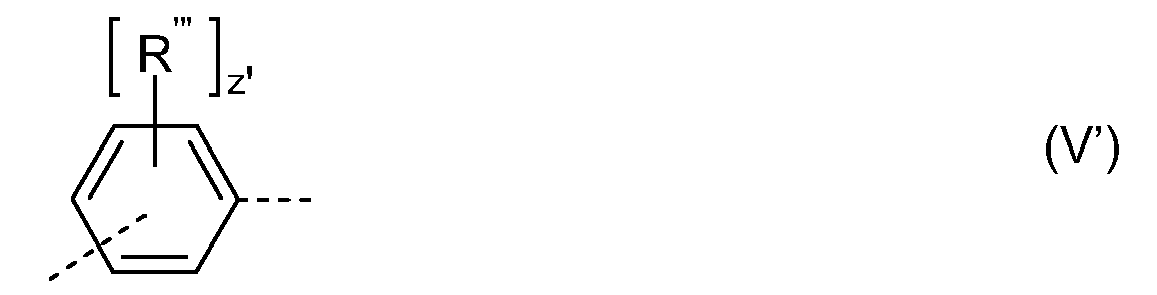
- Hierbei steht R''' unabhängig von einander für H, Methyl oder Ethyl und z' für 0 oder 1. Es handelt sich somit um o-Phenylen, m-Phenylen, p-Phenylen, sowie deren mit Methyl- oder Ethylgruppen ringsubstituierten abgeleiteten Strukturen.
- In einer weiteren Ausführungsform ist das Polyepoxid PEP ein Epoxidharz. Das Epoxidharz kann ein sogenanntes Epoxid-Flüssigharz oder ein Epoxid-Festharz sein.
- Der Begriff "Epoxid-Festharz" ist dem Epoxid-Fachmann bestens bekannt und wird im Gegensatz zu "Epoxid-Flüssigharzen" verwendet. Die Glasübergangstemperatur von Festharzen liegt über Raumtemperatur, d.h. sie lassen sich bei Raumtemperatur zu schüttfähigen Pulvern zerkleinern.
- Bevorzugte Epoxid-Festharze weisen die Formel (VIII) auf

- Hierbei stehen die Substituenten R4, R5 und Y2 unabhängig voneinander entweder für H oder CH3. Weiterhin steht der Index S1 für einen Wert von > 1.5, insbesondere von 2 bis 12.
- In diesem Dokument ist die Verwendung des Terms "unabhängig voneinander" in Zusammenhang mit Substituenten, Resten oder Gruppen dahingehend auszulegen, dass im selben Molekül die gleich bezeichneten Substituenten, Reste oder Gruppen gleichzeitig mit unterschiedlicher Bedeutung auftreten können.
- Derartige Epoxid-Festharze sind kommerziell erhältlich beispielsweise von Dow oder Huntsman oder Hexion.
- Verbindungen der Formel (VIII) mit einem Index S1 zwischen 1 und 1.5 werden vom Fachmann als Semisolid-Epoxidharze bezeichnet. Für die hier vorliegende Erfindung werden sie ebenfalls als Festharze betrachtet. Bevorzugt Epoxid-Festharze sind jedoch Epoxid-Festharze im engeren Sinn, d.h. der Index S1 weist einen Wert von > 1.5 auf.
- Bevorzugte Epoxid-Flüssigharze weisen die Formel (IX) auf

- Hierbei stehen die Substituenten R4, R5 und Y2 unabhängig voneinander entweder für H oder CH3. Weiterhin steht der Index S1 für einen Wert von 0 bis 1. Bevorzugt steht S1 für einen Wert von kleiner als 0.2.
- Es handelt sich somit vorzugsweise um Diglycidylether von Bisphenol-A (DGEBA), von Bisphenol-F sowie von Bisphenol-A/F (Die Bezeichnung "A/F" verweist hierbei auf eine Mischung von Aceton mit Formaldehyd, welche als Edukt bei dessen Herstellung verwendet wird). Solche Flüssigharze sind beispielsweise als Araldite® GY 250, Araldite® PY 304, Araldite® GY 282 (Huntsman) oder D.E.R.™ 331 oder D.E.R.™ 330 (Dow) oder Epikote 828 (Hexion) erhältlich.
- Somit stellt der Rest R2 in einer besonders geeigneten Form die Formel (V) oder (V') dar.


- Hierbei stehen R', R" und R"' unabhängig voneinander für H, Methyl oder Ethyl, z' für 0 oder 1 und s' für 0 oder für einen Wert von 0.1 - 12.
- Ein besonders bevorzugtes Polyepoxid PEP ist Bisphenol-A-Diglycidylether.
- Der Rest R3 steht für einen Diglycidylether DGE nach Entfernung der zwei Glycidylether-Gruppen. Die Möglichkeiten für den Diglycidylether DGE entsprechen grundsätzlich denjenigen der bereits als Diglycidylether aufgeführten Polyepoxide PEP.
- Insbesondere ist der Diglycidylether DGE ein aliphatischer oder cycloaliphatischer Diglycidylether, insbesondere ein Diglycidylether der Formel (VI") oder (VI"').


- Hierbei steht r für einen Wert von 1 bis 9, insbesondere für 3 oder 5. Zudem steht q für einen Wert von 0 bis 10 und t für einen Wert von 0 bis 10, mit der Massgabe, dass die Summe von q und t ≥ 1 ist. Schliesslich stellt d das Strukturelement dar, welches von Ethylenoxid stammt, und e stellt das Strukturelement dar, welches von Propylenoxid stammt. Es handelt sich somit bei Formel (VI"') um (Poly)ethylenglycoldiglycidylether, (Poly)propylenglycoldiglycidylether und (Poly)ethylenglycol/propylenglycol-diglycidylether, wobei die Bausteine d und e blockartig, abwechselnd oder zufällig angeordnet sein können.
- Besonders geeignete aliphatische oder cycloaliphatische Diglycidylether sind Ethylenglykoldiglycidylether, Butandioldiglycidylether oder Hexandioldiglycidylether.
- In einer weiteren besonders geeigneten Ausführungsform ist der Diglycidylether DGE ein Diglycidylether, welcher nach Entfernung der zwei Glycidylether-Gruppen, entsprechend dem Rest R3, die Formel (VI) oder (VI') aufweist.


- Hierbei stehen R', R" und R'" unabhängig voneinander für H, Methyl oder Ethyl, z für 0 oder 1 und s für 0 oder für einen Wert von 0.1 - 12.
- Ein besonders bevorzugter Diglycidylether DGE ist Bisphenol-F-Diglycidylether.
- Das Epoxidgruppen-terminiertes Polymer der Formel (I) lässt sich wie folgt herstellen:
- In einem ersten Schritt ("Vorverlängerung") wird aus einem Carboxylgruppen-terminierten Butadien/Acrylonitril-Copolymer CTBN der Formel HOOC-R1-COOH und einem Polyepoxid PEP in einem stöchiometrischen Überschuss (n' ≥ n) des HOOC-R1-COOH ein Carboxylgruppen-terminiertes Polymer der Formel (II) hergestellt:

- Für diese Umsetzung werden Polyepoxid PEP und HOOC-R1-COOH so in einer Menge eingesetzt, dass das stöchiometrischen Verhältnis der COOH-Gruppen zu Epoxid-Gruppen [COOH] / [] ≥ 2 ist.

- Ist dieses Verhältnis = 2, entsprechend n' = n, ist der Anteil von höher molekularen Spezies tendenziell erhöht, was zu stark erhöhten Viskositäten im Carboxylgruppen-terminierten Polymer der Formel (II), bzw. im Epoxidgruppen-terminierten Polymer der Formel (I), führen kann, was unter Umständen Anlass zu Problemen geben kann. Bei einem Verhältnis von < 2 (entsprechend n'<n), insbesondere von «2, wird dieses Problem sehr stark vergrössert. Deshalb ist bei diesem Verhältnis ein Wert von >2 bevorzugt. Typischerweise ist ein Verhältnis von > 4, vor allem » 2, entsprechend n' » n, sehr bevorzugt. In diesen Fällen weist die Reaktionsmischung einen relativ grossen Gehalt an unumgesetzten HOOC-R1-COOH auf. Dies ist jedoch nicht weiter störend, wie nachfolgend diskutiert wird.
- Es ist dem Fachmann klar, dass auch Mischungen von Polyepoxiden PEP und/oder Carboxylgruppen-terminierten Butadien/Acrylonitril-Copolymeren CTBN der Formel HOOC-R1-COOH eingesetzt werden können.
- In einem zweiten Schritt ("Terminierung") wird aus dem Carboxylgruppen-terminierten Polymer der Formel (II) und einem Diglycidylether DGE der Formel (III) in einem stöchiometrischen Überschuss (n" ≥ n) des Diglycidylether DGE ein Epoxidgruppen-terminiertes Polymer der Formel (I) hergestellt:

- Für diese Umsetzung werden das Polymer der Formel (II) und der Diglycidylether der Formel (III) in einer solchen Menge zueinander eingesetzt, dass das stöchiometrischen Verhältnis der Glycidylether-Gruppen zu COOH-Gruppen

- Ist dieses Verhältnis = 2, entsprechend n" = n, ist der Anteil von höher molekularen Spezies erhöht, was zu stark erhöhten Viskositäten im Epoxid-gruppen-terminierten Polymer der Formel (I), führen kann, was unter Umständen Anlass zu Problemen geben kann. Bei einem Verhältnis von < 2 (entsprechend n'<n), insbesondere von «2, wird dieses Problem sehr stark vergrössert. Deshalb ist bei diesem Verhältnis ein Wert von >2 bevorzugt. Typischerweise ist ein Verhältnis von > 4, vor allem » 2, entsprechend n" » n, sehr bevorzugt.
- Falls in der Edukt-Mischung am Anfang dieses zweiten Schrittes noch aus dem ersten Schritt unumgesetztes Carboxylgruppen-terminiertes Butadien/Acrylonitril-Copolymer CTBN HOOC-R1-COOH vorhanden ist, wird dieses im zweiten Schritt zu einem Epoxid-Gruppen terminierten Polymer der aus dem Stand der Technik bekannten Formel (X) reagiert.

- Auf diese Art und Weise kann gewährleistet werden, dass möglichst viele Epoxidgruppen-terminierte Polymere, welche als Schlagzähigkeitsmodifikatoren verwendet werden können, in der Schlussmischung vorhanden sind. Insbesondere wird entgegen dem Verfahren aus dem Stand der Technik verhindert, dass eine grosse Molekulargewichtsverteilung vorhanden ist, was zu einer Verschlechterung der Applikationseigenschafen, insbesondere einer hohen Viskosität, führt.
- Es ist dem Fachmann klar, dass auch Mischungen von Carboxylgruppen-terminierten Polymeren der Formel (II) und/oder Diglycidylethern DGE der Formel (III) eingesetzt werden können. In einer derartigen Herstellungsweise entstehen in situ Mischungen von Epoxidgruppen-terminierte Polymeren der Formel (I).
- In beiden Schritten erfolgt eine Esterbildung. Derartige Umsetzungen von Epoxiden, bzw. Glycidylethern mit Carbonsäuren sind dem Fachmann bekannt sowie die Reaktionsbedingungen hierfür. Insbesondere werden höhere Temperaturen, typischerweise bei Temperaturen von 100°C, bevorzugt um 140°C, und gegebenenfalls Katalysatoren eingesetzt und vorzugsweise unter Schutzgas. Beispiele für derartige Katalysatoren sind Triphenylphosphin, tertiäre Amine, quaternäre Phosphoniumsalze oder quaternäre Ammoniumsalze.
- Somit bilden Carboxylgruppen-terminierte Polymere der Formel (II) einen weiteren Aspekt der vorliegenden Erfindung. Die Definition, Möglichkeiten und bevorzugten Ausführungsformen der in dieser Formel (II) aufgeführten Reste und Indizes entsprechen denjenigen, wie sie in diesem Dokument bereits vorgängig für Epoxidgruppen-terminiertes Polymer der Formel (I) detailliert beschrieben wurden.
- Einen weiteren Aspekt der vorliegenden Erfindung bildet ein Verfahren zur Herstellung eines Carboxylgruppen-terminierten Polymers der Formel (II) durch eine Umsetzung eines Polyepoxides PEP mit einem Carboxylgruppen-terminierten Butadien/Acrylonitril-Copolymer CTBN der Formel HOOC-R1-COOH, dadurch gekennzeichnet, dass für diese Umsetzung das Polyepoxid PEP und HOOC-R1-COOH in einer Menge zueinander eingesetzt werden, das einem stöchiometrischen Verhältnis der COOH-Gruppen zu Epoxid-Gruppen [COOH] / [] von ≥ 2 entspricht. Dieses Verfahren wurde im Detail bereits vorgängig in diesem Dokument beschrieben.

- Einen weiteren Aspekt der vorliegenden Erfindung bildet ein Verfahren zur Herstellung eines Epoxidgruppen-terminiertes Polymers der Formel (I) durch die Umsetzung eines Carboxylgruppen-terminierten Polymers der Formel (II) mit einem Diglycidylether DGE der Formel (III), dadurch gekennzeichnet, dass für diese Umsetzung das Polymer der Formel (II) und der Diglycidylether der Formel (III) in einer Menge zueinander eingesetzt werden, das einem stöchiometrischen Verhältnis der Glycidylethergruppen zu COOH-Gruppen


- Dieses Verfahren wurde im Detail bereits vorgängig in diesem Dokument beschrieben.
- Es ist dem Fachmann klar, dass die Epoxidgruppen-terminierten Polymere der Formel (I) weiter reagiert werden können. So ist insbesondere die Verlängerung mittels Polyphenolen, insbesondere mittel Bisphenolen, wie Bisphenol-A, unter Umständen sehr hilfreich, um noch höher molekularere Epoxidgruppen-terminierte Polymere oder Phenol-terminierte Polymere zu erhalten, wie sie beispielsweise in den folgenden Formel (XIII) und (XIV) wiedergegeben sind:


- Hierbei steht der Index f für 0 oder 1. R9 steht hierbei für H oder einen Alkyl- oder Alkenylresten, insbesondere für einen Allylrest.
- Weitere Aspekte sind Umsetzungsprodukte aus dem Carboxylgruppen-terminierte Polymer der Formel (II) mit Diaminen oder (Meth)acrylat-funktionellen Alkoholen oder Glycidylether-funktionellen (Meth)acrylaten, welche insbesondere zu Amingruppen-terminierten Polymeren der Formel (XI) (XI') und (XI"), bzw. zu (Meth)acrylatgruppen-terminierten Polymeren der Formel (XII) und (XII') gemäss dem folgenden beispielhaften Reaktionsschema, führen.


- Hierbei steht R7 für H oder Methyl und R8 steht für einen divalenten Rest, insbesondere für einen Alkylen-, Cycloalkylen- oder (Poly)oxyalkylen-Rest. Die Diamine 1-(2-Aminoethyl)piperazin (DA1), bzw. 2-Methylpentamethylendiamin (DA2), bzw. 1,2-Diaminocyclohexan (DA3), sowie das Glycidyl(meth)acrylat (GMA) und das Hydroxy-funktionelle (Meth)acrylat (HMA) werden jeweils im stöchiometrischen Überschuss verwendet, d.h. k, k', k", k"' und k"" sind jeweils grösser als n.
- Die Reaktionsbedingungen zur Bildung von Amiden und Estern sind aus der Literatur bekannt und können auf die Synthese dieser Umsetzungsprodukte, insbesondere der Polymere der Formel (XI), (XI'), (XI"), (XII) und (XII'), übertragen werden.
- Somit bildet ein weiterer Aspekt der vorliegenden Erfindung ein Verfahren zur Herstellung eines Endgruppen-terminierten Polymers der Formel (XV),

- a) Vorverlängerung, d.h. Umsetzung eines Polyepoxides PEP mit einem stöchiometrischen Überschuss eines Carboxylgruppen-terminierten Butadien/Acrylonitril-Copolymers CTBN der Formel HOOC-R1-COOH zu einem Carboxylgruppen terminierten Polymer der Formel (II), wie vorgängig bereits beschrieben, derart, dass das Polyepoxid PEP und HOOC-R1-COOH in einer Menge zueinander eingesetzt werden, dass das Verhältnis der COOH-Gruppen zu Epoxid-Gruppen [COOH] / [ ] ≥ 2 ist;

wobei das Polyepoxid PEP und das Carboxylgruppen-terminierten Butadien/Acrylonitril-Copolymers CTBN der Formel HOOC-R1-COOH wie vorgängig bereits beschrieben wurde, zu wählen sind; - b) Terminierung, d.h. Umsetzung eines Carboxylgruppen-terminierten Polymers der Formel (II) mit einem Diglycidylether oder mit einem Diamin oder mit einem (Meth)acrylat-funktionellen Alkohol oder mit einem Glycidylether-funktionellen (Meth)acrylat derart, dass der Diglycidylether oder das Diamin oder der (Meth)acrylat-funktionelle Alkohol oder das Glycidylether-funktionelle (Meth)acrylat und das Carboxylgruppen-terminierte Polymers der Formel (II) in einer Menge entsprechend einem Molekül Diglycidylether oder Diamin oder (Meth)acrylat-funktioneller Alkohol oder Glycidylether-funktionelles (Meth)acrylat pro COOH-Gruppe eines Moleküls Carboxyl-gruppen-terminierten Polymers der Formel (II) zueinander eingesetzt werden.
- Hierbei stehen in Formel (XV) R10 für einen divalenten Rest steht und Q1 eine Endgruppe ist, welche ausgewählt ist aus der Gruppe bestehend aus der Formel (XVI), (XVI'), (XVI") und -NH2.

- Es gilt die Massgabe, dass
Q für -NH- steht für den Fall,
in dem Q1 für -NH2 oder die Formel (XVI") steht, und
Q für -O- oder die Formel (XVII) steht für den Fall,
in dem Q1 für die Formel (XVI') steht, und
Q für die Formel (XVII) steht für den Fall,
in dem Q1 für die Formel (XVI) steht. - Als Endgruppen-terminierten Polymere der Formel (XV) gelten insbesondere die vorgängig beschriebenen Epoxidgruppen-terminierten Polymere der Formel (I), Carboxylgruppen-terminierten Polymere der Formel (II), Amingruppen-terminierten Polymere der Formel (XI), (XI') oder (XI") und (Meth)acrylatgruppen-terminierten Polymere der Formel (XII) oder (XII').
- Die so hergestellten Carboxylgruppen-terminierten Polymere der Formel (II) und beschriebenen Endgruppen-terminierten Polymere der Formel (XV), insbesondere die Epoxidgruppen-terminierten Polymere der Formel (I), Amingruppen-terminierten Polymere der Formel (XI), (XI') oder (XI") und (Meth)acrylatgruppen-terminierten Polymere der Formel (XII) oder (XII'), können als Mittel zur Erhöhung der Schlagzähigkeit einer Polymermatrix verwendet werden und sind als sogenannte Schlagzähigkeitsmodifikatoren einsetzbar.
- Vorzugsweise sind die Carboxylgruppen-terminierten Polymere der Formel (II) und Endgruppen-terminierten Polymere der Formel (XV), insbesondere Epoxidgruppen-terminierten Polymere der Formel (I), Amingruppen-terminierten Polymere der Formel (XI), (XI') oder (XI") und (Meth)acrylatgruppen-terminierten Polymere der Formel (XII) oder (XII'), bei Raumtemperatur flüssig oder viskos bis hochviskos. Bevorzugt sind sie zumindest bei einer Temperatur von 60°C mit den üblichen Mitteln verarbeitbar. Meist bevorzugt sind sie zumindest bei 60°C giessbar oder zumindest von honigartiger Konsistenz. Falls sie hochviskos oder fest sind können sie gegebenenfalls in Lösungsmittel oder Harzen, wie Epoxid-Flüssigharzen gelöst, emulgiert oder dispergiert werden.
- Diese Polymeren der Formel (I), (II), (XI), (XI'), (XI"), (XII) und (XII') werden vorzugsweise in vernetzenden Zusammensetzungen verwendet, insbesondere in Systemen, in welche diese Polymere einreagieren können. Somit ist die Frage, in welchen Zusammensetzungen diese Polymere eingesetzt werden, insbesondere abhängig von der Polymermatrix. So werden (Meth)acrylatgruppen-terminierten Polymere der Formel (XII) oder (XII') insbesondere in (Meth)acrylaten oder ungesättigten Polyesterharzen, welche über eine Radikal oder UV-Licht initiierte Polymerisationsreaktion zu einer Polymermatrix vernetzen, bevorzugt eingesetzt.
- Epoxidgruppen-terminierte Polymere der Formel (I) sowie Carboxylgruppen-terminierte Polymere der Formel (II) und Amingruppenterminierte Polymere der Formel (XI), (XI') oder (XI") werden bevorzugt in Epoxidharzzusammensetzungen eingesetzt.
- Im Falle der Epoxidgruppen-terminierten Polymere der Formel (I) werden sie vorzugsweise in der Komponente eingesetzt, in welcher ein Epoxidharz A vorhanden ist. Das Epoxidharz A kann ein Epoxid-Flüssigharz der Formel (IX) oder ein Epoxid-Festharz der Formel (VIII) sein. In einer Ausführungsform weist die Zusammensetzung neben einem Epoxidharz A einen Härter B für Epoxidharze, welcher durch erhöhte Temperatur aktiviert wird, auf. Derartige Zusammensetzungen werden insbesondere als hitzehärtende Epoxidharzklebstoffe eingesetzt und härten beim Erhitzen auf eine Temperatur, welche über der Hitzeaktivierung des thermisch aktivierbaren Härters B liegt, aus, so dass eine ausgehärtete Zusammensetzung entsteht.
- Im Falle der Carboxylgruppen-terminierten Polymere der Formel (II), können sie ebenfalls in der Komponente eingesetzt werden, in welcher ein Epoxidharz A vorhanden ist.
- Im Falle der Carboxylgruppen-terminierten Polymere der Formel (II) oder der Amingruppen-terminierten Polymere der Formel (XI), (XI') oder (XI") können sie jedoch auch in einer Härterkomponente eingesetzt werden. Eine derartige Härterkomponente enthält einen Härter für Epoxidharze, wie beispielsweise Polyamine oder Polymercaptane. Durch die Vermischung der zwei Komponenten reagieren diese, insbesondere auch bei Raumtemperatur, miteinander und es entsteht eine ausgehärtete Zusammensetzung.
- Derartige Zusammensetzungen lassen sich breit anwenden. Beispiele hierfür sind Klebstoffe, Dichtstoffe, Beschichtungen, Schäume, Strukturschäume, Lacke, Injektionsharze oder Beläge. Sie können beispielsweise im Hoch- oder Tiefbau, in der Fertigung oder Reparatur von industriellen Gütern oder Konsumgütern verwendet werden. Insbesondere bevorzugt werden sie als Klebstoffe verwendet, insbesondere für den Karosseriebau und der Fertigung von Fenstern, Haushaltmaschinen oder Transportmitteln, wie Fahrzeugen zu Wasser oder zu Lande, bevorzugt Automobile, Busse, Lastkraftwagen, Züge oder Schiffe; oder als Dichtstoff zum Abdichten von Fugen, Nähten oder Hohlräumen in der industriellen Fertigung oder Reparatur verwendet.
- Insbesondere bevorzugt werden derartige Zusammensetzungen als crashfeste Klebstoffe insbesondere für den Transportmittelbau, bevorzugt im OEM-Bereich von Transportmittelbau, eingesetzt.
- Weiterhin bevorzugt werden derartige Zusammensetzungen als hochstrukturelle Klebstoffe für den Hoch- und Tiefbau oder als hochbelastbare Industriebeschichtungen, eingesetzt.
-
Hycar® CTBN 1300X13: Säurezahl = 32 mg/g KOH = 570 meq/kg
Mw = ca. 3150 g/molD.E.R. 331 (Bisphenol-A-Diglycidylether="BADGE"): 5.40 eq/kg
Mw = ca. 185 g/eqEpilox F-17-00 (Bisphenol-F-Diglycidylether="BFDGE"): 5.88 eq/kg
Mw = ca. 170 g/eqEurepox RV-H (1,6-Hexandiol-diglycidylether="HDDGE"): 6.94 eq/kg Bisphenol-A: Mw = 228.3 g/mol - 300.0 g (171 meq COOH) Carboxylgruppen-terminiertes Acrylnitril-/ Butadien Copolymer (Hycar® CTBN 1300X13) und 7.9 g D.E.R. 331 (42.8 meq Epoxy) wurden in einen Planschliffkolben mit Rührer, Stickstoffeinleitung und Vakuumanschluss eingewogen. Das Gemisch wurde unter leichtem Vakuum während 3h bei 180°C gerührt. Somit konnte eine viskose Masse mit einer Säurezahl von etwa 23.4 mg/g KOH (ca. 416 meq/kg) erhalten werden. Das so erhaltene Produkt wurde als CTBN1 bezeichnet.
- 300.0 g (171 meq COOH) Carboxylgruppen-terminiertes Acrylnitril-/ Butadien Copolymer (Hycar® CTBN 1300X13) und 4.42 g Eurepox RV-H (28.5 meq Epoxy) wurden in einen Planschliffkolben mit Rührer, Stickstoffeinleitung und Vakuumanschluss eingewogen. Das Gemisch wurde unter leichtem Vakuum während 4h bei 180°C gerührt. Somit konnte eine viskose Masse mit einer Säurezahl von etwa 26.3 mg/g KOH (ca. 468 meq/kg) erhalten werden. Das so erhaltene Produkt wurde als CTBN2 bezeichnet.
- 100.0 g (ca. 41.6 meq COOH) CTBN1 und 150.0 g (882 meq Epoxy) Epilox F 17-00 wurden in einen Planschliffkolben mit Rührer, Stickstoffeinleitung und Vakuumanschluss eingewogen. Das Gemisch wurde während 3h bei 180°C unter leichtem Vakuum gerührt, bis ein viskoses Epoxidharz mit einem Epoxidgehalt von ca. 3.36 eq/kg erhalten wurde. Das so erhaltene Produkt wurde als ETBN1 bezeichnet.
- 100.0 g (ca. 46.8 meq COOH) CTBN2 und 150.0 g (810 meq Epoxy) D.E.R. 331 wurden in einen Planschliffkolben mit Rührer, Stickstoffeinleitung und Vakuumanschluss eingewogen. Das Gemisch wurde während 3h bei 180°C unter leichtem Vakuum gerührt, bis ein viskoses Epoxidharz mit einem Epoxidgehalt von ca. 3.05 eq/kg erhalten wurde. Das so erhaltene Produkt wurde als ETBN2 bezeichnet
- 150.0 g (ca. 504 meq Epoxy) ETBN1 und 7.5g (ca. 65 meq OH) Bisphenol-A wurden in einen Planschliffkolben mit Rührer, Stickstoffeinleitung und Vakuumanschluss eingewogen. Das Gemisch wurde während 3h bei 180°C unter leichtem Vakuum gerührt, bis ein viskoses Epoxidharz mit einem Epoxidgehalt von ca. 2.78 eq/kg erhalten wurde. Das so erhaltene Produkt wurde als ETBN3 bezeichnet
- Die Epoxidgruppen-terminiertes Polymere ETBN1 und ETBN2 und ETBN 3 zeigten in hitzehärtenden Epoxidharzklebstoffen eine markante Erhöhung der Schlagzähigkeit.
Claims (25)
- Epoxidgruppen-terminiertes Polymer der Formel (I)

R2 für ein Polyepoxid PEP nach Entfernung von n Epoxid-Gruppen steht; R2' für H oder für einen mit R2 verbundenen Rest steht;
R3 für einen Diglycidylether DGE nach Entfernung der zwei Glycidylether-Gruppen steht;
Y1 und Y2 unabhängig voneinander für H oder Methyl stehen;
n für einen Wert von 2 bis 4, insbesondere von 2, steht. - Epoxidgruppen-terminiertes Polymer gemäss Anspruch 1, dadurch gekennzeichnet, dass R1 die Formel (IV) aufweist

b und c die Strukturelemente, welche von Butadien stammen, und a das Strukturelement, welches von Acrylonitril stammt, darstellen;
R für einen linearen oder verzweigten Alkylenrest mit 1 bis 6 C-Atomen, insbesondere mit 4 C-Atomen, welcher gegebenenfalls mit ungesättigten Gruppen substituiert ist, steht;
q ein Wert von 40 bis 100, insbesondere von 50 bis 90, darstellt;
x = 0.05 - 0.3, m = 0.5 - 0.8, p = 0.1 - 0.2;
unter der Voraussetzung, dass x + m + p = 1 ist. - Epoxidgruppen-terminiertes Polymer gemäss Anspruch 1 oder 2, dadurch gekennzeichnet, dass R2 die Formel (V) oder (V') aufweist


- Epoxidgruppen-terminiertes Polymer gemäss Anspruch 3, dadurch gekennzeichnet, dass das Polyepoxid PEP Bisphenol-A-Diglycidylether ist.
- Epoxidgruppen-terminiertes Polymer gemäss Anspruch 1 oder 2, dadurch gekennzeichnet, dass das Polyepoxid PEP ein aliphatischer oder cycloaliphatischer Polyglycidylether, bevorzugt ein aliphatischer oder cycloaliphatischer Diglycidylether, insbesondere ein Diglycidylether der Formel (V") oder (V'''), ist


d' das Strukturelement, welches von Ethylenoxid stammt, und e' das Strukturelement, welches von Propylenoxid stammt, darstellen;
q' für einen Wert von 0 bis 10 und t' für einen Wert von 0 bis 10 steht, mit der Massgabe, dass die Summe von q' und t' ≥ 1 ist. - Epoxidgruppen-terminiertes Polymer gemäss Anspruch 5, dadurch gekennzeichnet, dass das Polyepoxid PEP Ethylenglykoldiglycidylether, Butandioldiglycidylether oder Hexandioldiglycidylether ist.
- Epoxidgruppen-terminiertes Polymer gemäss einem der Ansprüche 1 - 6,
dadurch gekennzeichnet, dass R3 die Formel (VI) oder (VI') aufweist
- Epoxidgruppen-terminiertes Polymer gemäss einem der Ansprüche 1 bis 6, dadurch gekennzeichnet, dass der Diglycidylether DGE Bisphenol-F-Diglycidylether ist.
- Epoxidgruppen-terminiertes Polymer gemäss einem der Ansprüche 1 bis 6, dadurch gekennzeichnet, dass der Diglycidylether DGE ein aliphatischer oder cycloaliphatischer Diglycidylether ist, insbesondere ein Diglycidylether der Formel (VI") oder (VI"') ist


d das Strukturelement, welches von Ethylenoxid stammt, und e das Strukturelement, welches von Propylenoxid stammt, darstellen;
q für einen Wert von 0 bis 10 und t für einen Wert von 0 bis 10 steht, mit der Massgabe, dass die Summe von q und t ≥ 1 ist. - Epoxidgruppen-terminiertes Polymer gemäss Anspruch 9, dadurch gekennzeichnet, dass der Diglycidylether DGE Ethylenglykoldiglycidylether, Butandioldiglycidylether oder Hexandioldiglycidylether ist.
- Carboxylgruppen-terminiertes Polymer der Formel (II)
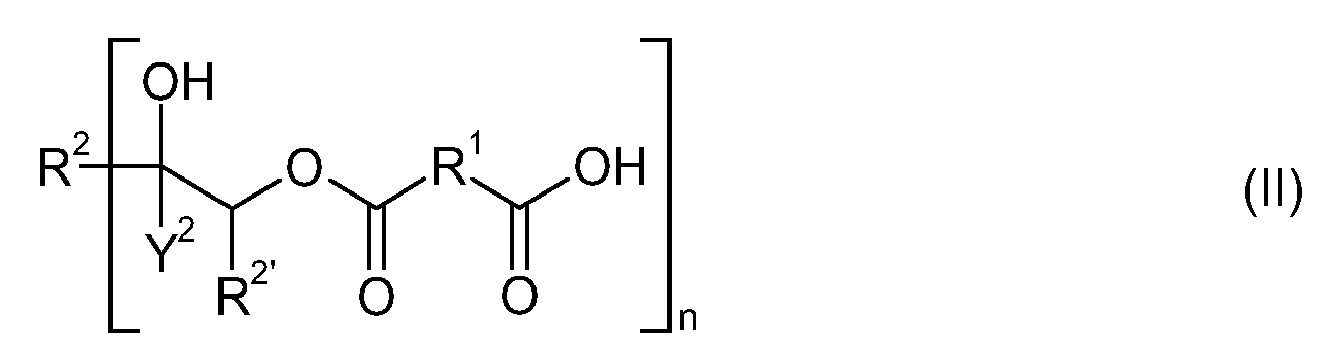
R2 für ein Polyepoxid PEP nach Entfernung von n Epoxid-Gruppen steht; R2' für H oder für einen mit R2 verbundenen Rest steht;
Y2 für H oder Methyl steht und
n für einen Wert von 2 bis 4, bevorzugt 2 steht. - Carboxylgruppen-terminiertes Polymer gemäss Anspruch 11, dadurch gekennzeichnet, dass R1 die Formel (IV) aufweist

b und c die Strukturelemente, welche von Butadien stammen, und a das Strukturelement, welches von Acrylonitril stammt, darstellen;
R für einen linearen oder verzweigten Alkylenrest mit 1 bis 6 C-Atomen, insbesondere mit 4 C-Atomen, welcher gegebenenfalls mit ungesättigten Gruppen substituiert ist, steht;
q ein Wert von 40 bis 100, insbesondere von 50 bis 90, darstellt;
x = 0.05 - 0.3, m = 0.5 - 0.8, p = 0.1 - 0.2;
unter der Voraussetzung, dass x + m + p = 1 ist. - Amingruppen-terminiertes Polymer der Formel (XI) oder (XI') oder (XI")


R2 für ein Polyepoxid PEP nach Entfernung von n Epoxid-Gruppen steht; R2' für H oder für einen mit R2 verbundenen Rest steht;
Y2 für H oder Methyl steht und
n für einen Wert von 2 bis 4, bevorzugt 2 steht. - (Meth)acrylatgruppen-terminiertes Polymer der Formel (XII) oder (XII')


R2 für ein Polyepoxid PEP nach Entfernung von n Epoxid-Gruppen steht; R2' für H oder für einen mit R2 verbundenen Rest steht;
Y2 für H oder Methyl steht; R7 für H oder Methyl steht;
R8 für einen divalenten Resten, insbesondere für einen Alkylen-, Cycloalkylen- oder (Poly)oxyalkylen-Resten, steht und
n für einen Wert von 2 bis 4, bevorzugt 2 steht. - Verfahren zur Herstellung eines Carboxylgruppen-terminierten Polymers gemäss Anspruch 11 oder 12 durch eine Umsetzung eines Polyepoxides PEP mit einem Carboxylgruppen-terminierten Butadien/Acrylonitril-Copolymers CTBN der Formel HOOC-R1-COOH, dadurch gekennzeichnet, dass für diese Umsetzung das Polyepoxid PEP und HOOC-R1-COOH in einer Menge zueinander eingesetzt werden entsprechend einem stöchiometrischen Verhältnis der COOH-Gruppen zu Epoxid-Gruppen [COOH] / [] von ≥ 2.

- Verfahren zur Herstellung eines Epoxidgruppen-terminierten Polymers gemäss einem der Ansprüche 1 bis 10 durch eine Umsetzung eines Carboxylgruppen-terminierten Polymers der Formel (II) gemäss Anspruch 11 oder 12 mit einem Diglycidylether DGE der Formel (III), dadurch gekennzeichnet, dass für diese Umsetzung das Polymer der Formel (II) und der Diglycidylether der Formel (III) in einer Menge zueinander eingesetzt werden entsprechend einem stöchiometrischen Verhältnis der Glycidylether-Gruppen zu COOH-Gruppen


- Verfahren zur Herstellung eines Endgruppen-terminierten Polymers der Formel (XV)
 a) Vorverlängerung, d.h. Umsetzung eines Polyepoxides PEP mit einem stöchiometrischen Überschuss eines Carboxylgruppen-terminierten Butadien/Acrylonitril-Copolymers CTBN der Formel HOOC-R1-COOH zu einem Carboxylgruppen terminierten Polymer der Formel (II) gemäss Anspruch 11 oder 12, derart, dass das Polyepoxid PEP und HOOC-R1-COOH in einer Menge zueinander eingesetzt werden, dass das Verhältnis der COOH-Gruppen zu Epoxid-Gruppen [COOH] / [] ≥ 2 ist;
wobei das Polyepoxid PEP und das Carboxylgruppen-terminierte Butadien/Acrylonitril-Copolymer CTBN der Formel HOOC-R1-COOH wie in den Ansprüchen 1 bis 10 beschrieben, zu wählen sind;b) Terminierung, d.h. Umsetzung eines Carboxylgruppen-terminierten Polymers der Formel (II) mit einem Diglycidylether oder mit einem Diamin oder mit einem (Meth)acrylat-funktionellen Alkohol oder mit einem Glycidylether-funktionellen (Meth)acrylat derart, dass der Diglycidylether oder das Diamin oder der (Meth)acrylat-funktionelle Alkohol oder das Glycidylether-funktionelle (Meth)acrylat und das Carboxylgruppen-terminierte Polymers der Formel (II) in einer Menge entsprechend einem Molekül Diglycidylether oder Diamin oder (Meth)acrylat-funktioneller Alkohol oder Glycidyletherfunktionelles (Meth)acrylat pro COOH-Gruppe eines Moleküls Carboxylgruppen-terminierten Polymers der Formel (II) zueinander eingesetzt werden;wobei in Formel (XV) R10 für einen divalenten Rest steht und Q1 eine Endgruppe ist, welche ausgewählt ist aus der Gruppe bestehend aus der Formel (XVI), (XVI'), (XVI") und -NH2
Q für -NH- steht für den Fall,
in dem Q1 für -NH2 oder die Formel (XVI") steht, und
Q für -O- oder die Formel (XVII) steht für den Fall,
in dem Q1 für die Formel (XVI') steht, und
Q für die Formel (XVII) steht für den Fall,
in dem Q1 für die Formel (XVI) steht. - Verwendung eines Carboxylgruppen-terminierten Polymers der Formel (II) gemäss Anspruch 11 oder 12, eines Endgruppen-terminierten Polymers der Formel (XV), hergestellt nach einem Verfahren gemäss Anspruch 17, insbesondere eines Epoxidgruppen-terminiertes Polymers der Formel (I) gemäss einem der Ansprüche 1 - 10 oder eines Amingruppen-terminierten Polymers der Formel (XI) oder (XI') oder (XI") gemäss Anspruch 13 oder eines (Meth)acrylatgruppen-terminierten Polymers der Formel (XII) oder (XII') gemäss Anspruch 14, als Mittel zur Erhöhung der Schlagzähigkeit einer Polymermatrix.
- Verwendung gemäss Anspruch 18, dadurch gekennzeichnet, dass die Polymermatrix eine Epoxidharzmatrix ist.
- Zusammensetzung enthaltend ein Amingruppen-terminiertes Polymer der Formel (XI) oder (XI') oder (XI") gemäss Anspruch 13 oder ein (Meth)acrylatgruppen-terminiertes Polymer der Formel (XII) oder (XII') gemäss Anspruch 14.
- Zusammensetzung enthaltend ein Epoxidgruppen-terminiertes Polymer der Formel (I) gemäss einem der Ansprüche 1 - 10 oder ein Carboxylgruppen-terminiertes Polymers der Formel (II) gemäss Anspruch 11 oder 12.
- Zusammensetzung gemäss Anspruch 21, dadurch gekennzeichnet, dass die Zusammensetzung weiterhin mindestens ein Epoxidharz A enthält.
- Zusammensetzung gemäss Anspruch 22, dadurch gekennzeichnet, dass die Zusammensetzung weiterhin einen Härter B für Epoxidharze, welcher durch erhöhte Temperatur aktiviert wird, enthält.
- Ausgehärtete Zusammensetzung erhalten aus einer Zusammensetzung gemäss Anspruch 22 und einer Beimischung eines Härters für Epoxidharze.
- Ausgehärtete Zusammensetzung erhalten aus Erhitzung einer Zusammensetzung gemäss Anspruch 23 auf eine Temperatur, welche über der Hitzeaktivierung des thermisch aktivierbaren Härters B liegt.
Priority Applications (6)
| Application Number | Priority Date | Filing Date | Title |
|---|---|---|---|
| EP06127080A EP1935914A1 (de) | 2006-12-22 | 2006-12-22 | Hydroxyester-vorverlängerte Epoxidgruppen terminierte Zähigkeitsverbesserer und Verfahren zu deren Herstellung |
| US12/448,481 US7951879B2 (en) | 2006-12-22 | 2007-12-21 | Hydroxy ester pre-extended epoxy-terminated viscosifiers and method for producing the same |
| PCT/EP2007/064432 WO2008077932A2 (de) | 2006-12-22 | 2007-12-21 | Hydroxyester-vorverlängerte epoxidgruppen terminierte zähigkeitsverbesserer und verfahren zu deren herstellung |
| EP07858045A EP2125925A2 (de) | 2006-12-22 | 2007-12-21 | Hydroxyester-vorverlängerte epoxidgruppen terminierte zähigkeitsverbesserer und verfahren zu deren herstellung |
| JP2009542095A JP5398541B2 (ja) | 2006-12-22 | 2007-12-21 | ヒドロキシエステルで予備鎖延長したエポキシ末端増粘剤およびその製造方法 |
| CN2007800505131A CN101589086B (zh) | 2006-12-22 | 2007-12-21 | 羟基酯预增长的环氧基封端韧性改进剂及其制备方法 |
Applications Claiming Priority (1)
| Application Number | Priority Date | Filing Date | Title |
|---|---|---|---|
| EP06127080A EP1935914A1 (de) | 2006-12-22 | 2006-12-22 | Hydroxyester-vorverlängerte Epoxidgruppen terminierte Zähigkeitsverbesserer und Verfahren zu deren Herstellung |
Publications (1)
| Publication Number | Publication Date |
|---|---|
| EP1935914A1 true EP1935914A1 (de) | 2008-06-25 |
Family
ID=38072020
Family Applications (2)
| Application Number | Title | Priority Date | Filing Date |
|---|---|---|---|
| EP06127080A Ceased EP1935914A1 (de) | 2006-12-22 | 2006-12-22 | Hydroxyester-vorverlängerte Epoxidgruppen terminierte Zähigkeitsverbesserer und Verfahren zu deren Herstellung |
| EP07858045A Withdrawn EP2125925A2 (de) | 2006-12-22 | 2007-12-21 | Hydroxyester-vorverlängerte epoxidgruppen terminierte zähigkeitsverbesserer und verfahren zu deren herstellung |
Family Applications After (1)
| Application Number | Title | Priority Date | Filing Date |
|---|---|---|---|
| EP07858045A Withdrawn EP2125925A2 (de) | 2006-12-22 | 2007-12-21 | Hydroxyester-vorverlängerte epoxidgruppen terminierte zähigkeitsverbesserer und verfahren zu deren herstellung |
Country Status (5)
| Country | Link |
|---|---|
| US (1) | US7951879B2 (de) |
| EP (2) | EP1935914A1 (de) |
| JP (1) | JP5398541B2 (de) |
| CN (1) | CN101589086B (de) |
| WO (1) | WO2008077932A2 (de) |
Families Citing this family (4)
| Publication number | Priority date | Publication date | Assignee | Title |
|---|---|---|---|---|
| EP2436712A1 (de) | 2010-10-01 | 2012-04-04 | Sika Technology AG | Schlagzähigkeitsmodifikatoren für Epoxidharzzusammensetzungen |
| CN104144959B (zh) * | 2012-03-23 | 2018-03-09 | 陶氏环球技术有限责任公司 | 应力耐久性提高的耐碰撞粘合剂 |
| US10081704B2 (en) | 2015-03-24 | 2018-09-25 | Evonik Degussa Gmbh | Epoxy systems having improved fracture toughness |
| CN115558084B (zh) * | 2022-11-09 | 2024-06-04 | 山东天一化学股份有限公司 | 腰果酚封端中高分子量溴化环氧树脂及其方法、阻燃聚酯长丝及其方法、阻燃高分子材料 |
Citations (3)
| Publication number | Priority date | Publication date | Assignee | Title |
|---|---|---|---|---|
| GB2046270A (en) * | 1979-04-12 | 1980-11-12 | Nippon Soda Co | Curable polybutadiene modified epoxy resin |
| JPS56122823A (en) * | 1980-02-29 | 1981-09-26 | Nitto Electric Ind Co Ltd | Flexible epoxy resin powder composition |
| GB2186577A (en) * | 1986-02-13 | 1987-08-19 | Hitachi Chemical Co Ltd | Electroconductive resin paste |
Family Cites Families (9)
| Publication number | Priority date | Publication date | Assignee | Title |
|---|---|---|---|---|
| JPS5853914A (ja) * | 1981-09-28 | 1983-03-30 | Toho Rayon Co Ltd | エポキシ樹脂組成物 |
| US4465542A (en) * | 1982-02-19 | 1984-08-14 | Mitsui Petrochemical Industries, Ltd. | Adhesive composition |
| JPH0610240B2 (ja) * | 1985-06-07 | 1994-02-09 | 宇部興産株式会社 | ゴム変性エポキシ樹脂の製造方法 |
| JPS61287952A (ja) * | 1985-06-15 | 1986-12-18 | Matsushita Electric Works Ltd | 封止用エポキシ樹脂組成物 |
| JPH06248056A (ja) * | 1993-03-01 | 1994-09-06 | Nissan Chem Ind Ltd | エポキシ樹脂組成物 |
| WO1998015597A1 (fr) * | 1996-10-08 | 1998-04-16 | Hitachi Chemical Company, Ltd. | Structure a separation de phases, composition de resine comportant ladite structure, materiau de moulage pour enrobage de composants electroniques, et dispositif a composant electronique |
| JP4946115B2 (ja) * | 2005-04-07 | 2012-06-06 | 住友ベークライト株式会社 | エポキシ樹脂組成物及び半導体装置 |
| EP1935915A1 (de) * | 2006-12-22 | 2008-06-25 | Sika Technology AG | Amid- oder Thioester-vorverlängerte Epoxidgruppen terminierte Zähigkeitsverbesserer und Verfahren zu deren Herstellung |
| EP1935904A1 (de) * | 2006-12-22 | 2008-06-25 | Sika Technology AG | Ester-vorverlängerte Epoxidgruppen terminierte Zähigkeitsverbesserer und Verfahren zu deren Herstellung |
-
2006
- 2006-12-22 EP EP06127080A patent/EP1935914A1/de not_active Ceased
-
2007
- 2007-12-21 EP EP07858045A patent/EP2125925A2/de not_active Withdrawn
- 2007-12-21 JP JP2009542095A patent/JP5398541B2/ja not_active Expired - Fee Related
- 2007-12-21 WO PCT/EP2007/064432 patent/WO2008077932A2/de not_active Ceased
- 2007-12-21 CN CN2007800505131A patent/CN101589086B/zh not_active Expired - Fee Related
- 2007-12-21 US US12/448,481 patent/US7951879B2/en not_active Expired - Fee Related
Patent Citations (3)
| Publication number | Priority date | Publication date | Assignee | Title |
|---|---|---|---|---|
| GB2046270A (en) * | 1979-04-12 | 1980-11-12 | Nippon Soda Co | Curable polybutadiene modified epoxy resin |
| JPS56122823A (en) * | 1980-02-29 | 1981-09-26 | Nitto Electric Ind Co Ltd | Flexible epoxy resin powder composition |
| GB2186577A (en) * | 1986-02-13 | 1987-08-19 | Hitachi Chemical Co Ltd | Electroconductive resin paste |
Non-Patent Citations (5)
| Title |
|---|
| DATABASE WPI Week 198145, Derwent World Patents Index; AN 1981-82591D, XP002437987 * |
| DATABASE WPI Week 198704, Derwent World Patents Index; AN 1987-025137, XP002437986 * |
| GAO ET AL: "Synthesis and application of carboxy terminal butadiene acrylonitrile epoxy ester toughening agent Synthesis and application of carboxy terminal butadiene acrylonitrile epoxy ester toughening agent", REGUXING-SHUZHI = THERMOSETTING RESIN, REGUXING SHUZHI BIANJIBU,, CN, vol. 20, no. 5, 2005, pages 21 - 23, XP009084859, ISSN: 1002-7432 * |
| KUNZ S C ET AL: "LOW TEMPERATURE BEHAVIOR OF EPOXY -RUBBER PARTICULATE COMPOSITES", CAMBRIDGE UNIVERSITY ENGINEERING DEPARTMENT - TECHNICAL REPORT, CAMBRIDGE, GB, vol. CUED/C-MATS/TR-75, 1981, pages 1 - 33, XP009084854, ISSN: 0309-6505 * |
| SIEBERT ET AL: "Chemistry of rubber toughened epoxy resins. I Chemistry of rubber toughened epoxy resins. I", PAPERS PRESENTED AT THE MEETINGS - AMERICAN CHEMICAL SOCIETY, DIVISION OF ORGANIC COATINGS AND PLASTICS CHEMISTRY, AMERICAN CHEMICAL SOCIETY, WASHINGTON, DC,, US, vol. 31, no. 1, 1971, pages 552 - 560, XP009084858, ISSN: 0096-512X * |
Also Published As
| Publication number | Publication date |
|---|---|
| JP2010513641A (ja) | 2010-04-30 |
| WO2008077932A3 (de) | 2008-08-21 |
| US7951879B2 (en) | 2011-05-31 |
| WO2008077932A2 (de) | 2008-07-03 |
| EP2125925A2 (de) | 2009-12-02 |
| CN101589086A (zh) | 2009-11-25 |
| US20100087588A1 (en) | 2010-04-08 |
| JP5398541B2 (ja) | 2014-01-29 |
| CN101589086B (zh) | 2012-09-26 |
Similar Documents
| Publication | Publication Date | Title |
|---|---|---|
| EP2125901B1 (de) | Ester-vorverlängerte epoxidgruppen terminierte zähigkeitsverbesserer und verfahren zu deren herstellung | |
| DE2248776C3 (de) | Verfahren zur Herstellung von Überzügen auf der Basis von Pulverlacken | |
| DE2741268A1 (de) | Klebstoffsysteme mit einem bisaminopiperazin enthaltenden polyamid- haerter | |
| EP0675143A2 (de) | Amin-modifizierte Epoxidharz-Zusammensetzung | |
| EP2867260A1 (de) | Polybutadien mit epoxygruppen | |
| EP3770200A1 (de) | Epoxidharz-zusammensetzung für chemikalienresistente beschichtungszwecke | |
| DE1966703C3 (de) | Langkettige, aliphatische oder cycloaliphatische Säurereste enthaltende Diglycidylester | |
| EP1745096B1 (de) | Härtbare zusammensetzungen auf basis von epoxidharzen und 3(4)-(aminomethyl)-cyclohexan-propanamin und 1,4(5)-cyclooctandimethanamin | |
| DE1916174C3 (de) | Verfahren zur Herstellung von vorverlängerten, epoxidgruppenhaltigen Addukten und deren Verwendung | |
| DE60204010T2 (de) | Addukte von polyalkylenglykolmonoglycidylethern und aminverbindungen | |
| DE69711474T2 (de) | Reaktive Beschleuniger für Amin-gehärtete Epoxidharze | |
| EP0872505B1 (de) | Härtbare Mischungen aus Glycidylverbindungen, aminischen Härtern und heterocyclischen Beschleunigern | |
| EP2805982B1 (de) | Polybutadien mit Epoxygruppen | |
| DE3486406T2 (de) | Verfahren zum Überziehen von Substraten mit einem Überzugsfilm. | |
| EP2125925A2 (de) | Hydroxyester-vorverlängerte epoxidgruppen terminierte zähigkeitsverbesserer und verfahren zu deren herstellung | |
| DE1954466A1 (de) | Haertbare Mischungen aus Epoxidharzen und zwei heterocyclische Kerne enthaltenden diprimaeren Diaminen | |
| DE69224326T2 (de) | Wärmehärtbare Harzzusammensetzung | |
| EP2167589B1 (de) | Kathodischer korrosionsschutz für bewehrungen von stahlbetonwerken | |
| DE2231728A1 (de) | Neue diamine, verfahren zu ihrer herstellung und ihre verwendung | |
| EP0131842A1 (de) | Flüssiger Epoxidharzhärter und Verfahren zu dessen Herstellung | |
| EP0131802B1 (de) | Verfahren zur Herstellung von Oberflächenbeschichtungen auf Basis von Epoxidharz/Härter-Mischungen | |
| WO2008077935A1 (de) | Amid- oder thioester-vorverlängerte epoxidgruppen terminierte zähigkeitsverbesserer und verfahren zu deren herstellung | |
| EP0748845A1 (de) | Verfahren zur Herstellung von flexiblen Epoxid-Harz-Systemen | |
| EP0566822B1 (de) | Flexible Härter | |
| DE69328927T2 (de) | Wässrige härtungsmittel für epoxidharzsysteme |
Legal Events
| Date | Code | Title | Description |
|---|---|---|---|
| PUAI | Public reference made under article 153(3) epc to a published international application that has entered the european phase |
Free format text: ORIGINAL CODE: 0009012 |
|
| AK | Designated contracting states |
Kind code of ref document: A1 Designated state(s): AT BE BG CH CY CZ DE DK EE ES FI FR GB GR HU IE IS IT LI LT LU LV MC NL PL PT RO SE SI SK TR |
|
| AX | Request for extension of the european patent |
Extension state: AL BA HR MK RS |
|
| STAA | Information on the status of an ep patent application or granted ep patent |
Free format text: STATUS: THE APPLICATION HAS BEEN REFUSED |
|
| 18R | Application refused |
Effective date: 20080811 |