EP1930646A2 - Anzeigevorrichtung - Google Patents
Anzeigevorrichtung Download PDFInfo
- Publication number
- EP1930646A2 EP1930646A2 EP07021201A EP07021201A EP1930646A2 EP 1930646 A2 EP1930646 A2 EP 1930646A2 EP 07021201 A EP07021201 A EP 07021201A EP 07021201 A EP07021201 A EP 07021201A EP 1930646 A2 EP1930646 A2 EP 1930646A2
- Authority
- EP
- European Patent Office
- Prior art keywords
- display body
- display
- spring
- pressing
- plate spring
- Prior art date
- Legal status (The legal status is an assumption and is not a legal conclusion. Google has not performed a legal analysis and makes no representation as to the accuracy of the status listed.)
- Withdrawn
Links
Images






Classifications
-
- F—MECHANICAL ENGINEERING; LIGHTING; HEATING; WEAPONS; BLASTING
- F16—ENGINEERING ELEMENTS AND UNITS; GENERAL MEASURES FOR PRODUCING AND MAINTAINING EFFECTIVE FUNCTIONING OF MACHINES OR INSTALLATIONS; THERMAL INSULATION IN GENERAL
- F16M—FRAMES, CASINGS OR BEDS OF ENGINES, MACHINES OR APPARATUS, NOT SPECIFIC TO ENGINES, MACHINES OR APPARATUS PROVIDED FOR ELSEWHERE; STANDS; SUPPORTS
- F16M11/00—Stands or trestles as supports for apparatus or articles placed thereon ; Stands for scientific apparatus such as gravitational force meters
- F16M11/02—Heads
- F16M11/04—Means for attachment of apparatus; Means allowing adjustment of the apparatus relatively to the stand
- F16M11/06—Means for attachment of apparatus; Means allowing adjustment of the apparatus relatively to the stand allowing pivoting
- F16M11/10—Means for attachment of apparatus; Means allowing adjustment of the apparatus relatively to the stand allowing pivoting around a horizontal axis
-
- G—PHYSICS
- G06—COMPUTING OR CALCULATING; COUNTING
- G06F—ELECTRIC DIGITAL DATA PROCESSING
- G06F1/00—Details not covered by groups G06F3/00 - G06F13/00 and G06F21/00
- G06F1/16—Constructional details or arrangements
- G06F1/1613—Constructional details or arrangements for portable computers
- G06F1/1615—Constructional details or arrangements for portable computers with several enclosures having relative motions, each enclosure supporting at least one I/O or computing function
- G06F1/1616—Constructional details or arrangements for portable computers with several enclosures having relative motions, each enclosure supporting at least one I/O or computing function with folding flat displays, e.g. laptop computers or notebooks having a clamshell configuration, with body parts pivoting to an open position around an axis parallel to the plane they define in closed position
-
- G—PHYSICS
- G06—COMPUTING OR CALCULATING; COUNTING
- G06F—ELECTRIC DIGITAL DATA PROCESSING
- G06F1/00—Details not covered by groups G06F3/00 - G06F13/00 and G06F21/00
- G06F1/16—Constructional details or arrangements
- G06F1/1613—Constructional details or arrangements for portable computers
- G06F1/1633—Constructional details or arrangements of portable computers not specific to the type of enclosures covered by groups G06F1/1615 - G06F1/1626
- G06F1/1675—Miscellaneous details related to the relative movement between the different enclosures or enclosure parts
- G06F1/1679—Miscellaneous details related to the relative movement between the different enclosures or enclosure parts for locking or maintaining the movable parts of the enclosure in a fixed position, e.g. latching mechanism at the edge of the display in a laptop or for the screen protective cover of a PDA
-
- G—PHYSICS
- G06—COMPUTING OR CALCULATING; COUNTING
- G06F—ELECTRIC DIGITAL DATA PROCESSING
- G06F1/00—Details not covered by groups G06F3/00 - G06F13/00 and G06F21/00
- G06F1/16—Constructional details or arrangements
- G06F1/1613—Constructional details or arrangements for portable computers
- G06F1/1633—Constructional details or arrangements of portable computers not specific to the type of enclosures covered by groups G06F1/1615 - G06F1/1626
- G06F1/1675—Miscellaneous details related to the relative movement between the different enclosures or enclosure parts
- G06F1/1681—Details related solely to hinges
-
- G—PHYSICS
- G06—COMPUTING OR CALCULATING; COUNTING
- G06F—ELECTRIC DIGITAL DATA PROCESSING
- G06F1/00—Details not covered by groups G06F3/00 - G06F13/00 and G06F21/00
- G06F1/16—Constructional details or arrangements
- G06F1/1613—Constructional details or arrangements for portable computers
- G06F1/1633—Constructional details or arrangements of portable computers not specific to the type of enclosures covered by groups G06F1/1615 - G06F1/1626
- G06F1/1684—Constructional details or arrangements related to integrated I/O peripherals not covered by groups G06F1/1635 - G06F1/1675
- G06F1/1696—Constructional details or arrangements related to integrated I/O peripherals not covered by groups G06F1/1635 - G06F1/1675 the I/O peripheral being a printing or scanning device
-
- E—FIXED CONSTRUCTIONS
- E05—LOCKS; KEYS; WINDOW OR DOOR FITTINGS; SAFES
- E05D—HINGES OR SUSPENSION DEVICES FOR DOORS, WINDOWS OR WINGS
- E05D11/00—Additional features or accessories of hinges
- E05D11/08—Friction devices between relatively-movable hinge parts
- E05D11/087—Friction devices between relatively-movable hinge parts with substantially axial friction, e.g. friction disks
-
- E—FIXED CONSTRUCTIONS
- E05—LOCKS; KEYS; WINDOW OR DOOR FITTINGS; SAFES
- E05F—DEVICES FOR MOVING WINGS INTO OPEN OR CLOSED POSITION; CHECKS FOR WINGS; WING FITTINGS NOT OTHERWISE PROVIDED FOR, CONCERNED WITH THE FUNCTIONING OF THE WING
- E05F1/00—Closers or openers for wings, not otherwise provided for in this subclass
- E05F1/08—Closers or openers for wings, not otherwise provided for in this subclass spring-actuated, e.g. for horizontally sliding wings
- E05F1/10—Closers or openers for wings, not otherwise provided for in this subclass spring-actuated, e.g. for horizontally sliding wings for swinging wings, e.g. counterbalance
- E05F1/12—Mechanisms in the shape of hinges or pivots, operated by springs
- E05F1/1207—Mechanisms in the shape of hinges or pivots, operated by springs with a coil spring parallel with the pivot axis
- E05F1/1215—Mechanisms in the shape of hinges or pivots, operated by springs with a coil spring parallel with the pivot axis with a canted-coil torsion spring
-
- E—FIXED CONSTRUCTIONS
- E05—LOCKS; KEYS; WINDOW OR DOOR FITTINGS; SAFES
- E05Y—INDEXING SCHEME ASSOCIATED WITH SUBCLASSES E05D AND E05F, RELATING TO CONSTRUCTION ELEMENTS, ELECTRIC CONTROL, POWER SUPPLY, POWER SIGNAL OR TRANSMISSION, USER INTERFACES, MOUNTING OR COUPLING, DETAILS, ACCESSORIES, AUXILIARY OPERATIONS NOT OTHERWISE PROVIDED FOR, APPLICATION THEREOF
- E05Y2999/00—Subject-matter not otherwise provided for in this subclass
-
- F—MECHANICAL ENGINEERING; LIGHTING; HEATING; WEAPONS; BLASTING
- F16—ENGINEERING ELEMENTS AND UNITS; GENERAL MEASURES FOR PRODUCING AND MAINTAINING EFFECTIVE FUNCTIONING OF MACHINES OR INSTALLATIONS; THERMAL INSULATION IN GENERAL
- F16M—FRAMES, CASINGS OR BEDS OF ENGINES, MACHINES OR APPARATUS, NOT SPECIFIC TO ENGINES, MACHINES OR APPARATUS PROVIDED FOR ELSEWHERE; STANDS; SUPPORTS
- F16M2200/00—Details of stands or supports
- F16M2200/04—Balancing means
- F16M2200/041—Balancing means for balancing rotational movement of the head
-
- Y—GENERAL TAGGING OF NEW TECHNOLOGICAL DEVELOPMENTS; GENERAL TAGGING OF CROSS-SECTIONAL TECHNOLOGIES SPANNING OVER SEVERAL SECTIONS OF THE IPC; TECHNICAL SUBJECTS COVERED BY FORMER USPC CROSS-REFERENCE ART COLLECTIONS [XRACs] AND DIGESTS
- Y10—TECHNICAL SUBJECTS COVERED BY FORMER USPC
- Y10S—TECHNICAL SUBJECTS COVERED BY FORMER USPC CROSS-REFERENCE ART COLLECTIONS [XRACs] AND DIGESTS
- Y10S248/00—Supports
- Y10S248/917—Video display screen support
-
- Y—GENERAL TAGGING OF NEW TECHNOLOGICAL DEVELOPMENTS; GENERAL TAGGING OF CROSS-SECTIONAL TECHNOLOGIES SPANNING OVER SEVERAL SECTIONS OF THE IPC; TECHNICAL SUBJECTS COVERED BY FORMER USPC CROSS-REFERENCE ART COLLECTIONS [XRACs] AND DIGESTS
- Y10—TECHNICAL SUBJECTS COVERED BY FORMER USPC
- Y10S—TECHNICAL SUBJECTS COVERED BY FORMER USPC CROSS-REFERENCE ART COLLECTIONS [XRACs] AND DIGESTS
- Y10S248/00—Supports
- Y10S248/917—Video display screen support
- Y10S248/919—Adjustably orientable video screen support
- Y10S248/922—Angular
- Y10S248/923—Tilting
Definitions
- the present invention relates to a display device whose display body having a display surface is capable of tilting.
- a display device whose display body having a display surface on which information is displayed is capable of tilting.
- Such display device allows the display body to move from a position where the display surface of which is in the vertical position to a position where the display surface of which is in a inclined position.
- the display device is capable of holding the display body at an optional position. The display body starts to move by loading its housing, and so on.
- An object of the present invention is to provide a display device capable of starting the movement of the display body by a relatively small load.
- a display device of the prevent invention which includes: (i) a display body having a display surface which displays information, at one surface side, (ii) a supporting mechanism for supporting the display body movable around a supporting axis provided at a lower end of the display body at a vertical position where the display surface is in the vertical position and at an inclined position where the display surface is in the inclined position, (iii) a pressing mechanism having an elastic member for storing repulsive force by being pressed by the display body as the display body moves from the vertical position to the inclined position, and for pressing the display body by the repulsive force of the elastic member in the direction from the inclined position to the vertical position, and (iv) a position holding mechanism having a first contact member for contacting the display body and a second contact member for pressing the first contact member in an axis direction of the supporting axis, and for holding the display body at an optional position between the vertical position and the inclined position by contact friction generated between the first contact member and the second contact
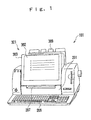
- Fig. 1 is a perspective view showing a display device as the first embodiment of the present invention, which is applied to a business machine 101.
- the business machine 101 provides a main body housing 201 for storing or holding each part of the business machine 101.
- a display body housing 303 is provided so as to be sandwiched by both side parts of the main body housing 201 at a front surface side of the main body housing 201 (at the front side of Fig. 1 ).
- a plane display surface 302 for displaying information such as a letter, an image, and so on, at a front surface side of the display body housing 303.
- the display surface 302 is a LCD (Liquid Crystal Display) panel having a touch panel function allowing an input of information, for example.
- LCD Liquid Crystal Display
- the display body housing 303 stores each part (not shown) for realizing a display function to the display surface 302.
- the display surface 302 and the display body housing 303 constitute a display body 301.
- the display body 301 is capable of tilting. Consequently, the business machine 101 has a tilt mechanism 701 (see Fig. 2 ) for tilting the display body 301.
- a keyboard 206 as an operational part for inputting information is provided.
- a manual feed 207 is formed at a front surface of the main body housing 201 and at a lower position of the display body 301.
- the manual feed 207 is for feeding paper (a check paper, for example).
- a discharge outlet (not shown) is formed at a back surface side of the main body housing 201.
- a paper path (not shown) connecting the manual feed 207 and the discharge outlet is formed inside the main body housing 201.
- a paper inserted into the manual feed 207 is conveyed into a direction of the discharge outlet along the paper path by a conveying mechanism (not shown) provided inside the main body housing 201.
- the conveying paper is printed the information input through an operation of the keyboard 206, and so on, by a printing mechanism (not shown) provided near the discharge outlet and inside the main body housing 201, and is discharged from the discharge outlet.
- the discharged paper is received by a catch tray 308, which is provided at a back surface side of the main body housing 201.
- Fig. 2 is a perspective view showing the tilt mechanism 701.
- a plane fixing plate 411 which is a part of the display body 301 and is parallel with the display surface 302, is housed in a lower end part of the display body housing 303.
- the fixing plate 411 is fixed to the display body housing 303 by a screw (not shown).
- a side surface plate 412a is provided at a right side of the fixing plate 411 when seen from the display surface 302.
- a side surface plate 412b is provided at a left side of the fixing plate 411 when seen from the display surface 302.
- the side surface plates 412a and 412b are perpendicular with respect to the fixing plate 411, respectively.
- a supporting axis 413a extended into a side direction is integrally provided at an outside surface of the side surface plate 412a (see Figs. 9 , 12 , and so on).
- a supporting axis 413b extended into a side direction is integrally provided at an outside surface of the side surface plate 412b (see Figs. 12 and so on).
- the supporting axes 413a and 413b are concentric each other and have an axis direction parallel with the surface direction of the display surface 302.
- the supporting axes 413a and 413b may be called as a supporting axis 413 altogether.
- the supporting axes 413a and 413b more extend into fixing plate 411 than the side surface plates 412a and 412b do.
- Caps 415a and 415b covering the extended parts of the supporting axes 413a and 413b are attached at the side surface plates 412a and 412b.
- An axis supporter 414a is fixed to an upper surface of a right end of the manual feed 207 of the main body housing 201 when seen from the display surface 302.
- an axis supporter 414b is fixed to an upper surface of a left end when seen from the display surface 302.
- the axis supporters 414a and 414b rotatably hold the supporting axes 413a and 413b, respectively. Therefore, the display body 301 is movably supported at the vertical position where the display surface 302 is in the vertical position as shown in Fig.
- a stopper (not shown) is provided at the main body housing 201.
- the stopper controls the movement of the display body 301 by contacting the display body housing 303 and locates the display body 301 at an inclined position. That is, the fixing plate 411, the side surface plates 412a and 412b, the supporting axes 413a and 413b, the axis supporters 414a and 414b, and the stopper constitute a supporting mechanism 401.
- a torsion spring 511a as an elastic member is provided at a right side of the side surface plate 412a when seen from the display surface 302.
- a torsion spring 511b is provided as an elastic member is provided at a left side of the side surface plate 412b when seen from the display surface 302.
- the torsion spring 511a has an arm 521a extended into a side direction and an arm 522a extended upward as its both end parts.
- the torsion spring 511a stores repulsive force by approximating the arms 521a and 522a to be in a closing state, and restores to an opening state by releasing the closing state.
- the torsion spring 511b has also a similar structure. Thereinafter, the torsion springs 511a and 511b may be called as a torsion spring 511 altogether.
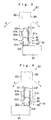
- Fig. 3 is a side view of Fig. 2 seen from the direction of A.
- the display body 301 is located in the vertical position.
- the torsion spring 511a at a right side when seen from the display surface 302's side is provided in a manner that an opening/closing axis, which is a center of its inside diameter, is concentric with the supporting axis 413a (see Fig. 9 ).
- the torsion spring 511a is provided in a manner that the arm 522a closes in the direction of arrow C.
- the arm 521a is held by an arm holder 512a, which is a part of the axis holder 414a.
- An arm pressing part 513a is provided at the display surface 302's side with respect to the side surface plate 412a. As shown in Fig. 3 , when the display body 301 is in the vertical position, the art 522a comes in contact with the arm pressing part 513a.
- Fig. 4 is a side view of Fig. 2 seen from the direction of B.
- the display body 301 is located in the vertical position.
- the torsion spring 511b at a left side when seen from the display surface 302's side is provided in a manner that an opening/closing axis, which is a center of an inside diameter, is concentric with the supporting axis 413b (see Fig. 9 ).
- the torsion spring 511b is provided in such a way that the arm 522b closes in a direction of arrow D.
- the arm 521b is held by an arm holder 512b, which is a part of the axis supporter 414b.
- An arm pressing part 513b is provided at a back surface side, which is opposite to the display surface 302 with respect to the side surface plate 412b. As shown in Fig. 4 , when the display body 301 is located in the vertical position, the arm 522b comes in contact with the arm pressing part 513b.
- Fig. 5 is a side view of Fig. 2 seen from the direction of A in a status that the display body 301 moves in the direction of arrow C in Fig. 2
- Fig. 6 is its side view seen from the direction of B.
- the display body 301 is located in an inclined position.
- the arm 522a at a right side of the torsion spring 511a when seen from the display surface 302 is pressed by the arm pressing part 513a so as to be closed in the direction of arrow C.
- the torsion spring 511a stores repulsive force.
- the display body 301 is pressed in the direction from the inclined position to the vertical position by the stored repulsive force.
- a pressing mechanism 501 is realized.
- the contact of the arm pressing part 513a and the arm 522b is released. That is, no pressing force is applied to the arm 522b of the torsion spring 511b and the torsion spring 511b does not change its position. Therefore, the torsion spring 511b stores no repulsive force.
- Fig. 7 is a side view of Fig. 2 seen from the direction of A in a status that the display body 301 moves in the direction of arrow D in Fig. 2
- Fig. 8 is its side view seen from the direction of B.
- the display body 301 is located in an inclined position.
- the contact of the arm pressing part 513a and the arm 522a is released. That is, no pressing force is applied to the arm 522a of the torsion spring 511a and the torsion spring 511a does not change its position. Therefore, the torsion spring 511a stores no repulsive force.
- Fig. 7 is a side view of Fig. 2 seen from the direction of A in a status that the display body 301 moves in the direction of arrow D in Fig. 2
- Fig. 8 is its side view seen from the direction of B.
- the display body 301 is located in an inclined position.
- the contact of the arm pressing part 513a and the arm 522a is released. That is, no pressing force
- the arm 522b at a left side of the torsion spring 511b when seen from the display surface 302 is pressed by the arm pressing part 513b so as to be closed in the direction of arrow D, and the torsion spring 511b stores repulsive force.
- the display body 301 is pressed from the inclined position to the vertical position by the repulsive force.
- the pressing mechanism 501 is realized.
- the display body 301 is capable of holding its position anywhere between the vertical position and the inclined position. Such position holding is realized by a position holding mechanism 601 (see Figs. 9 to 11 ).
- the supporting mechanism 401, the pressing mechanism 501, and the position holding mechanism 601 constitute the tilt mechanism 701.
- Fig. 9 is a front cross sectional view showing the tilt mechanism 701.
- Fig. 9 shows a tilt mechanism 701 situated at a right side only when the business machine 101 is seen at the front side (at the display surface 302's side).
- the axis supporter 414a which is comprised by the supporting mechanism 401, is mainly constituted by a hollow cylinder 411a open in the direction of the fixing plate 411.
- a hollow part of the cylinder 441a is constituted by a first hollow part 442a at an opening side, and a second hollow part 444a partitioned with the first hollow part 442a by a valve 443a which is formed in an inside perimeter of the cylinder 441a.
- a disk part 445a whose diameter is slightly smaller than the inside perimeter of the cylinder 441a (the second hollow part 444a), is integrally provided with the supporting axis 413a at a tip portion of the supporting axis 413a extended from the side surface plate 412a.
- the disk part 445a is housed in the second hollow part 444a.
- the disk part 445a is controlled its movement to the first hollow part 442a by contacting with the valve 443a.
- the disk 445a is pressed to the valve 443a by a first plate spring 611a and a second plate spring 612a (described later). Consequently, the supporting axis 413a is supported by the axis supporter 414a.
- the supporting mechanism 401 located at a left side when the business machine 101 is seen from the front side has also the similar structure.
- the torsion spring 511a which is comprised by the pressing mechanism 501, is wound around the cylinder 441a of the axis supporter 414a.
- the arm 522a has a direction along the winding direction of the torsion spring 511a.
- a tip of the arm 521a is bent in L-shape from the winding direction of the torsion spring 511a.
- An arm hole 541a which penetrates in the direction of the supporting axis 413a is formed at the arm holder 512a, which is a part of the supporter 414a.
- the L-shaped arm 521a is inserted into the arm hole 541a. Consequently, the arm 521a is held to the arm holder 512a.
- the pressing mechanism 501 positioned at a left side when the business machine 101 is seen from the front side has similar structure.
- a position holding mechanism 601 has a first plate spring 611a curving in an arc as a first contacting member, and a second plate spring 612a curving in an arc as a second contacting member, in the second hollow part 444a.
- the first plate spring 611a and the second plate spring 612a have elasticity.
- the first plate spring 611a and the second plate spring 612a are oppositely positioned and contact each other at the curved portion. Both ends of the first plate spring 611a come in contact with the disk part 445a, which is a part of the display body 301. Both ends of the second plate spring 612a come in contact with the cylinder 441a.
- the second plate spring 612a presses the first plate spring 611a to the axis direction of the supporting axis 413a. By this pressing, contact friction occurs between the first plate spring 611a and the second plate spring 612a.
- the display body 301 is held at an optional position between the vertical position and the inclined position by the contact friction.
- the position holding mechanism 601 is realized.
- a position holding mechanism 601 positioned at a left side when the business machine 101 is seen from the front side has also similar structure.
- Fig. 10 is a front cross sectional view showing a tilt mechanism 701 having another position holding mechanism 601.
- a position holding mechanism 601 in this example has a considerably different point from the position holding mechanism 601, which has been explained with reference to Fig. 9 . That is, a compression spring 621a for pressing the second plate spring 612a to the first plate spring 611a is provided.
- a second hollow part 444a in this example exists at more the closing side than the second hollow part 444a in Fig. 9 .
- the compression spring 621a is stretchably stored in the direction of the supporting axis 413a in the second hollow part 444a. Both ends of the second plate spring 612a come in contact with a second pressing plate 622a, the diameter of which is slightly smaller than that of the second hollow part 444a. The compression spring 621a contacts and presses the pressing plate 622a. Thereby, the second plate spring 612a is pressed to the first plate spring 611a by the compression spring 621a. By adopting such structure, contact friction generated between the first plate spring 611a and the second plate spring 612a still more increases.
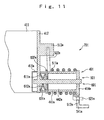
- Fig. 11 is a front cross sectional view showing a tilt mechanism 701 having still another position holding mechanism 601.
- a position holding mechanism 601 in this example has a considerable different point from the position holding mechanism 601, which has been explained with reference to Fig. 9 . That is, the torsion spring 511a presses the second plate spring 612a.
- the disk part 445a is not provided at the tip of the supporting axis 413a. The tip of the supporting axis 413a penetrates the closing side of the cylinder 441a.
- a spring plate housing 631a for housing the first plate spring 611a and the second plate spring 612a is provided between the side surface plate 412a and the cylinder 441a.
- the supporting axis 413a penetrates through the first plate spring 611a and the second plate spring 612a in this example stored in the spring plate storage 631a.
- the torsion spring 511a wound around the cylinder 441a presses the partitioning plate 632a.
- the second plate spring 612a presses the first plate spring 611a.
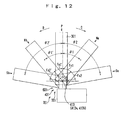
- Fig. 12 is a schematic view showing the display body 301 which moves around the supporting axis 413.
- the display body 301 moves around the supporting axis 413 (the supporting axes 413a and 413b), and is held at an optional position.
- the torsion spring 511 (not shown in Fig. 12 ) does not have repulsive force Fs.
- the torsion 511a When the display body 301 is positioned at the position Na by moving around the supporting axis 413 from the vertical position P to the inclined position Sa (in the direction of arrow C) by an angle ⁇ 1, the torsion 511a has friction force Fs1. When the display body 301 is positioned at the inclined position Sa by moving from the vertical position P by an angle ⁇ 2, the torsion spring 511a has friction force Fs2.
- Fs1 Fs2.
- the repulsive force Fs of the torsion spring 511 is represented by the following formula (A) with a spring constant K and an angle ⁇ .
- Fs K ⁇ ⁇
- Fig. 13 is a schematic view showing the moving display body 301, and gravity W which occurs in the display body 301.
- the gravity W occurs in the display body 301.
- the display body 301 receives acting force Fg due to the gravity force W.
- the acting force Fg which the display body 301 receives, is represented by the following formula (C).
- Fg W ⁇ L ⁇ cos ⁇
- the acting force Fg increases as the display body 301 moves (as cos0° approaches to 1).
- the repulsive force Fs (see Fig. 12 ) of the torsion spring 511 (not shown in Fig. 13 ) and the acting force Fg (see Fig. 13 ), which the display body 301 receives due to the gravity force, are both torque which the display body 301 receives. Since the repulsive force Fs and the acting force Fg are in the opposite direction, the forces negate each other. That is, the torque F which the display body 301 receives is represented by the following formula (D).
- holding force for holding the position of the display body 301 as the tilt mechanism 701 is Fm.
- the holding force Fm is represented by the following formula (E).
- the acting force Fg which the display body 301 receives to due to the gravity force
- the acting force Fg is constant value which is determined by the mass m of the display body 301, and so on.
- the torque F (
- ) the display body 301 receives, can be zero or can be approximated to zero.
- the repulsive force Fs of the torsion spring 511 is represented by the following formula (F) when Fs ⁇ Fg.
- Fs ⁇ Fg m ⁇ g ⁇ cos ⁇
- the display body 301 starts to move by being applied a load.
- a load is applied to the display body 301 from the display surface 302's side in the direction of arrow C.
- the load is applied by a user of the business machine 101 as he/she pushes the display body housing 303 by his/her hand.
- the load as torque is applied to the position holding mechanism 601 through the display body housing 303 and the fixing plate 411 which is fixed to the display body housing 303.
- the torque applied to the position holding mechanism 601 is smaller than the holding force Fm, the display body 301 does not start to move.
- the display body 301 is inclined in the direction of arrow D (see Fig. 2 ).
- the display body 301 stops to move and holds its position.
- a second embodiment of the present invention will be explained with reference to Figs. 14 to 16 .
- Numeric references used in the first embodiment based on Figs. 1 to 13 will be used in Figs. 14 to 16 to designate the same elements, and the overlapping explanation will be omitted.
- a different point in the second embodiment from the first embodiment is that the pressing mechanism 501 comprises a plate spring 551 (plate springs 511a and 511b) as an elastic member instead of the torsion spring 511.
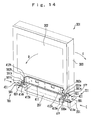
- Fig. 14 is a perspective view showing a tilt mechanism 701 of the second embodiment.
- the plate spring 551a is provided at a right side of the fixing plate 411 and a side part of the side surface plate 412a when seen from the display surface 302.
- the plate spring 551b is provided at a left side of the fixing part 411 and a side part of the side surface plate 412b when seen from the display surface 302.
- the plate spring 551a has a plate spring end 561a and a plate spring end 562a as its both ends.
- the plate spring 551a stores repulsive force by approximating the plate spring end 561a and the plate spring end 562b to be in a closing state, and the plate spring 551a is restored to an opening state by releasing the closing state.
- the plate spring 551b has similar condition to the plate spring 551a.
- Fig. 15 is a side view of Fig. 14 seen from the direction of E.
- An opening/closing center of the plate spring 551a at a right side when seen from the display surface 302 is provided parallel with the supporting axis 413a.
- the plate spring 551a is provided in such a way that the plate spring end 562a closes in the direction of arrow C.
- the plate spring end 561a is held by a fixing member (not shown) to the plate spring holder 565a as a part of the axis supporter 414a.
- the plate spring pressing part 566a is provided at the display surface 302's side with respect to the side surface plate 412a. As shown in Fig. 15 , when the display body 301 is positioned in the vertical position, the plate spring end 562a and the plate spring pressing part 566a come in contact each other.
- Fig. 16 is a side view of Fig. 14 seen from the direction of F.
- An opening/closing center of the plate spring 551b at a left side when seen from the display surface 302 is provided parallel with the supporting axis 413b.
- the plate spring 551b is provided in such a way that the plate end part 562b closes in the direction of D.
- the plate spring end 561b is held by a fixing member (not shown) to the plate spring holder 565b which is a part of the axis supporter 414b.
- the plate spring pressing part 566b is provided at an opposite back surface to the display surface 302 with respect to the side surface plate 412b. As shown in Fig. 16 , when the display body 301 is in the vertical position, the plate spring end 562b and the plate spring pressing part 566b come in contact each other.
- the plate spring 551a stores repulsive force as the display body 301 moves in the direction of arrow C and thereby the plate spring end 562a of the plate spring 551a at a right side when seen from the display surface 302 is pressed by the plate spring pressing part 566a to close in the direction of arrow C.
- the display body 301 is pressed in the vertical direction by the stored repulsive force.
- the pressing mechanism 501 is realized. At this time, the contact between the plate spring pressing part 566b and the plate spring end 562b is released. That is, the repulsive force is not stored to the plate spring 551b.
- the plate spring end 562b of the plate spring 551b at a right side when seen from the display surface 302's side is pressed to the plate spring pressing part 566b to close in the direction of arrow D as the display body 301 moves in the direction of arrow D.
- the plate spring 551b stores repulsive force.
- the display body 301 is pressed in the vertical position by the stored repulsive force.
- the pressing mechanism 501 is realized. At this time, the contact between the plate spring pressing part 566a and the plate spring end 562a is released. That is, no repulsive force is not stored to the plate spring 551a.
- the tilt mechanism 701 when the display body 301 is started to move, the tilt mechanism 701 is required to have a stronger load than the holding force for holding the display body 301. At this time, the holding force of the tilt mechanism 701 can be small and the display body 301 is movable by a relatively small load as the pressure mechanism 501 has the plate spring 551 which has an appropriate repulsive force. That is, according to the second embodiment of the present invention, it is possible that the display body 301 can be started to move by a relatively small load.
- a third embodiment of the present invention will be explained with reference to Figs. 17 to 19 .
- Numeral references used in the first embodiment based on the Figs. 1 to 13 will be used to designate the same elements, and the overlapping explanation will be omitted.
- a different point in the third embodiment from the other embodiments is that the pressing mechanism 501 provides a torsion bar spring 581 (torsion bar springs 581a and 581b) as an elastic member.
- Fig. 17 is a perspective view showing a tilt mechanism 701 of the third embodiment.
- the torsion bar spring 581a is provided at a right side and the torsion bar spring 581b is provided at a left side of the fixing plate 411 when seen from the display surface 302's side.
- the torsion bar springs 581a and 581b penetrate through the side surface plates 412a and 412b, the caps 415a and 415b, and the axis supporters 414a and 414b, respectively.
- the torsion bar spring 581 plays a role of the supporting axis 413 in the other embodiments. Therefore, the torsion bar spring 581 and the supporting axis 413 are concentric each other.
- Both ends of the torsion bar spring 581a are tips 591a and 592a, which bend in a right angle with respect to the main body.
- the tips 591a and 592a face in the opposite direction.
- the torsion bar spring 581a stores repulsive force by twisting the tips 591a and 592a to be in a twisted state. By releasing the twisted state, the torsion bar spring 581a is restored to a straight state.
- the tip 591a is held by a bar holder 595a which is a part of the axis supporter 414a.
- the torsion bar spring 581b has also the same structure as the torsion bar spring 581a, and the tip 591b of the torsion bar spring 581b is held by a bar holder 595b which is a part of the axis supporter 414b.
- a block body 599 is fixed to a central part of the fixing plate 411.
- a bar pressing part 596a is provided at a right side of the block body 599 and a bar pressing part 596b is provided at a left side of the block body 599 when seen from the display surface 302.
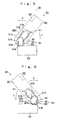
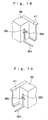
- Fig. 18 is a perspective view showing the block body 599 seen from one side.
- the bar pressing part 596a provided at one side of the block body 599 is in L-shape opening in the direction of arrow C (see Fig. 17 ).
- the torsion bar spring 581a stores repulsive force as the display body 301 moves in the direction of arrow C so that the tip 592a is pressed by the bar pressing part 596a and is twisted in the direction of arrow C.
- the pressing mechanism 501 is realized.
- the tip 592b is released from the bar pressing part 596b. That is, no repulsive force is stored to the torsion bar spring 581b.
- Fig. 19 is a perspective view showing the block body 599 seen from the other side.
- the bar pressing part 596b provided at the other side of the block body 599 is in L-shape opening in the direction of arrow D (see Fig. 17 ).
- the tip 592b and the bar pressing part 596b come in contact each other.
- the tip 592b is pressed by the bar pressing part 596b and is twisted in the direction of arrow D so that the torsion bar spring 581b stores repulsive force.
- the display body 301 is pressed in the vertical direction by the stored repulsive force.
- the pressing mechanism 501 is realized.
- the tip 592a is released from the bar pressing part 596a. That is, no repulsive force is stored to the torsion bar spring 581a.
- the tilt mechanism 701 when the display body 301 is started to move, the tilt mechanism 701 is required to have a stronger load than the holding force for holding the display body 301. At this time, it is possible that the holding force of the tilt mechanism 701 can be small and the display body 301 is movable by a relatively small load as the pressing mechanism 501 has the torsion bar spring 581 which has an appropriate repulsive force. That is, according to the third embodiment of the present invention, it is possible that the display body 301 can be started to move with a relatively small load.
Landscapes
- Engineering & Computer Science (AREA)
- Computer Hardware Design (AREA)
- Theoretical Computer Science (AREA)
- General Engineering & Computer Science (AREA)
- Physics & Mathematics (AREA)
- Human Computer Interaction (AREA)
- General Physics & Mathematics (AREA)
- Mechanical Engineering (AREA)
- Mathematical Physics (AREA)
- Devices For Indicating Variable Information By Combining Individual Elements (AREA)
- Pivots And Pivotal Connections (AREA)
Applications Claiming Priority (1)
| Application Number | Priority Date | Filing Date | Title |
|---|---|---|---|
| JP2006331196A JP4317210B2 (ja) | 2006-12-07 | 2006-12-07 | 表示装置 |
Publications (2)
| Publication Number | Publication Date |
|---|---|
| EP1930646A2 true EP1930646A2 (de) | 2008-06-11 |
| EP1930646A3 EP1930646A3 (de) | 2009-07-15 |
Family
ID=39148477
Family Applications (1)
| Application Number | Title | Priority Date | Filing Date |
|---|---|---|---|
| EP07021201A Withdrawn EP1930646A3 (de) | 2006-12-07 | 2007-10-30 | Anzeigevorrichtung |
Country Status (4)
| Country | Link |
|---|---|
| US (2) | US7660106B2 (de) |
| EP (1) | EP1930646A3 (de) |
| JP (1) | JP4317210B2 (de) |
| CN (1) | CN101196210A (de) |
Cited By (1)
| Publication number | Priority date | Publication date | Assignee | Title |
|---|---|---|---|---|
| WO2015054013A1 (en) * | 2013-10-07 | 2015-04-16 | Ergotron, Inc. | Bi-directional tilt mechanisms and methods |
Families Citing this family (5)
| Publication number | Priority date | Publication date | Assignee | Title |
|---|---|---|---|---|
| US8302262B2 (en) * | 2008-01-23 | 2012-11-06 | Simotec Inc. | Hinge device of plane display |
| US9713281B2 (en) * | 2013-01-07 | 2017-07-18 | Samsung Electronics Co., Ltd. | Hinge device and display apparatus with a hinge device using a sliding position |
| JP5847141B2 (ja) * | 2013-09-05 | 2016-01-20 | 東芝テック株式会社 | 電子秤装置 |
| US10359145B2 (en) * | 2015-09-18 | 2019-07-23 | Ubs Business Solutions Ag | Display system |
| CN113969936B (zh) * | 2021-10-22 | 2022-09-09 | 西安诺瓦星云科技股份有限公司 | 控台 |
Family Cites Families (16)
| Publication number | Priority date | Publication date | Assignee | Title |
|---|---|---|---|---|
| JP3170986B2 (ja) | 1993-12-15 | 2001-05-28 | キヤノン株式会社 | チルト可能なディスプレイ装置を有する機器 |
| US5771540A (en) * | 1997-01-22 | 1998-06-30 | Torqmaster, Inc. | Equilibrated hinge with variable frictional torque |
| JP2001020941A (ja) * | 1999-07-09 | 2001-01-23 | Kato Electrical Mach Co Ltd | チルトヒンジ |
| KR100419927B1 (ko) * | 2000-03-03 | 2004-02-25 | 산요덴키가부시키가이샤 | 폴더형 휴대전화기 |
| KR100390410B1 (ko) * | 2000-06-20 | 2003-07-07 | 엘지전자 주식회사 | 힌지 조립체 |
| JP4014814B2 (ja) * | 2001-03-30 | 2007-11-28 | スガツネ工業株式会社 | ヒンジ装置 |
| DE20112594U1 (de) * | 2001-07-31 | 2002-01-17 | TRW Automotive Electronics & Components GmbH & Co. KG, 78315 Radolfzell | Elektronisches Steuergerät in Fahrzeugen |
| JP3934902B2 (ja) * | 2001-09-28 | 2007-06-20 | シャープ株式会社 | 電子機器 |
| JP2003319051A (ja) * | 2002-04-26 | 2003-11-07 | Nec Corp | 折り畳み型通信端末 |
| KR100463524B1 (ko) * | 2002-05-29 | 2004-12-29 | 엘지전자 주식회사 | 영상표시기기용 힌지어셈블리 |
| WO2005010379A1 (ja) * | 2003-07-28 | 2005-02-03 | Fujitsu Limited | 移動式無線通信装置 |
| JP2005108201A (ja) | 2003-09-12 | 2005-04-21 | Makoto Kida | ヒンジ機構及びそれを備える上扉開閉式パーソナルコンピュータ |
| JP3909849B2 (ja) | 2003-11-05 | 2007-04-25 | 株式会社ナナオ | 衝立部材のスタンド構造 |
| JP2005208080A (ja) | 2004-01-19 | 2005-08-04 | Ohsuzu:Kk | ディスプレイ支持装置 |
| JP3988727B2 (ja) | 2004-01-20 | 2007-10-10 | 双葉金属工業株式会社 | 捩りバネ式ヒンジ |
| JP2005337301A (ja) * | 2004-05-24 | 2005-12-08 | Kato Electrical Mach Co Ltd | ヒンジ装置並びにこのヒンジ装置を用いた電子機器 |
-
2006
- 2006-12-07 JP JP2006331196A patent/JP4317210B2/ja active Active
-
2007
- 2007-10-30 EP EP07021201A patent/EP1930646A3/de not_active Withdrawn
- 2007-12-05 US US11/951,088 patent/US7660106B2/en not_active Expired - Fee Related
- 2007-12-07 CN CN200710196284.6A patent/CN101196210A/zh active Pending
-
2009
- 2009-12-09 US US12/634,411 patent/US7957129B2/en active Active
Non-Patent Citations (1)
| Title |
|---|
| None |
Cited By (2)
| Publication number | Priority date | Publication date | Assignee | Title |
|---|---|---|---|---|
| WO2015054013A1 (en) * | 2013-10-07 | 2015-04-16 | Ergotron, Inc. | Bi-directional tilt mechanisms and methods |
| US9371955B2 (en) | 2013-10-07 | 2016-06-21 | Ergotron, Inc. | Bi-directional tilt mechanisms and methods |
Also Published As
| Publication number | Publication date |
|---|---|
| JP2008145612A (ja) | 2008-06-26 |
| US20100085698A1 (en) | 2010-04-08 |
| CN101196210A (zh) | 2008-06-11 |
| US20080137274A1 (en) | 2008-06-12 |
| US7660106B2 (en) | 2010-02-09 |
| US7957129B2 (en) | 2011-06-07 |
| JP4317210B2 (ja) | 2009-08-19 |
| EP1930646A3 (de) | 2009-07-15 |
Similar Documents
| Publication | Publication Date | Title |
|---|---|---|
| EP1930646A2 (de) | Anzeigevorrichtung | |
| EP2421229B1 (de) | Faltbare mobile Vorrichtung | |
| EP4028857B1 (de) | Scharnierstruktur und klappbare elektronische vorrichtung damit | |
| US7424994B2 (en) | Monitor and a monitor supporting apparatus | |
| US5052078A (en) | Hinge mechanism for portable electronic apparatus | |
| EP2325425A1 (de) | Scharniervorrichtung und gehäuse | |
| EP2161584B1 (de) | Stoßdetektionsvorrichtung und Verpackungsvorrichtung mit solch einer Stoßdetektionsvorrichtung | |
| US6961234B2 (en) | Display support mechanism | |
| US20030174834A1 (en) | Electronic apparatus | |
| US20010055196A1 (en) | Angle adjusting device for a display | |
| US20060238966A1 (en) | Monitor | |
| JPH079563B2 (ja) | ピボット式文字ディスプレイ用制動機構 | |
| US12477049B2 (en) | Hinge supporting device and electronic equipment using the same | |
| US20030061684A1 (en) | Electronic apparatus | |
| US10348913B2 (en) | Image forming apparatus | |
| US20110102982A1 (en) | Electronic apparatus | |
| US7874045B2 (en) | Hinge device | |
| US8792947B2 (en) | Mobile device | |
| JPH11224056A (ja) | ディスプレイの姿勢設定装置とこのディスプレイの姿勢設定装置を備えた情報端末機器 | |
| JP4016503B2 (ja) | 開閉蓋を有する電子機器 | |
| US20050078229A1 (en) | Liquid crystal television receiver | |
| JPH0710093Y2 (ja) | 回転体のヒンジ装置及びこの装置を用いて回転体を表示装置とした電子機器 | |
| JP2590407Y2 (ja) | 原稿圧着板開閉装置 | |
| JPH0630824U (ja) | 表示装置 | |
| EP2562994A1 (de) | Mobile Vorrichtung |
Legal Events
| Date | Code | Title | Description |
|---|---|---|---|
| PUAI | Public reference made under article 153(3) epc to a published international application that has entered the european phase |
Free format text: ORIGINAL CODE: 0009012 |
|
| 17P | Request for examination filed |
Effective date: 20071030 |
|
| AK | Designated contracting states |
Kind code of ref document: A2 Designated state(s): AT BE BG CH CY CZ DE DK EE ES FI FR GB GR HU IE IS IT LI LT LU LV MC MT NL PL PT RO SE SI SK TR |
|
| AX | Request for extension of the european patent |
Extension state: AL BA HR MK RS |
|
| PUAL | Search report despatched |
Free format text: ORIGINAL CODE: 0009013 |
|
| AK | Designated contracting states |
Kind code of ref document: A3 Designated state(s): AT BE BG CH CY CZ DE DK EE ES FI FR GB GR HU IE IS IT LI LT LU LV MC MT NL PL PT RO SE SI SK TR |
|
| AX | Request for extension of the european patent |
Extension state: AL BA HR MK RS |
|
| 17Q | First examination report despatched |
Effective date: 20100201 |
|
| AKX | Designation fees paid |
Designated state(s): DE FR GB |
|
| GRAP | Despatch of communication of intention to grant a patent |
Free format text: ORIGINAL CODE: EPIDOSNIGR1 |
|
| STAA | Information on the status of an ep patent application or granted ep patent |
Free format text: STATUS: THE APPLICATION IS DEEMED TO BE WITHDRAWN |
|
| 18D | Application deemed to be withdrawn |
Effective date: 20110920 |