EP1915474B1 - Improved electroblowing fiber spinning process - Google Patents
Improved electroblowing fiber spinning process Download PDFInfo
- Publication number
- EP1915474B1 EP1915474B1 EP06789834A EP06789834A EP1915474B1 EP 1915474 B1 EP1915474 B1 EP 1915474B1 EP 06789834 A EP06789834 A EP 06789834A EP 06789834 A EP06789834 A EP 06789834A EP 1915474 B1 EP1915474 B1 EP 1915474B1
- Authority
- EP
- European Patent Office
- Prior art keywords
- polymer
- liquid stream
- electrode
- spinning process
- fiber spinning
- Prior art date
- Legal status (The legal status is an assumption and is not a legal conclusion. Google has not performed a legal analysis and makes no representation as to the accuracy of the status listed.)
- Ceased
Links
Images


Classifications
-
- D—TEXTILES; PAPER
- D01—NATURAL OR MAN-MADE THREADS OR FIBRES; SPINNING
- D01D—MECHANICAL METHODS OR APPARATUS IN THE MANUFACTURE OF ARTIFICIAL FILAMENTS, THREADS, FIBRES, BRISTLES OR RIBBONS
- D01D5/00—Formation of filaments, threads, or the like
-
- D—TEXTILES; PAPER
- D01—NATURAL OR MAN-MADE THREADS OR FIBRES; SPINNING
- D01D—MECHANICAL METHODS OR APPARATUS IN THE MANUFACTURE OF ARTIFICIAL FILAMENTS, THREADS, FIBRES, BRISTLES OR RIBBONS
- D01D5/00—Formation of filaments, threads, or the like
- D01D5/0007—Electro-spinning
- D01D5/0061—Electro-spinning characterised by the electro-spinning apparatus
- D01D5/0092—Electro-spinning characterised by the electro-spinning apparatus characterised by the electrical field, e.g. combined with a magnetic fields, using biased or alternating fields
-
- D—TEXTILES; PAPER
- D01—NATURAL OR MAN-MADE THREADS OR FIBRES; SPINNING
- D01D—MECHANICAL METHODS OR APPARATUS IN THE MANUFACTURE OF ARTIFICIAL FILAMENTS, THREADS, FIBRES, BRISTLES OR RIBBONS
- D01D10/00—Physical treatment of artificial filaments or the like during manufacture, i.e. during a continuous production process before the filaments have been collected
-
- D—TEXTILES; PAPER
- D01—NATURAL OR MAN-MADE THREADS OR FIBRES; SPINNING
- D01D—MECHANICAL METHODS OR APPARATUS IN THE MANUFACTURE OF ARTIFICIAL FILAMENTS, THREADS, FIBRES, BRISTLES OR RIBBONS
- D01D5/00—Formation of filaments, threads, or the like
- D01D5/0007—Electro-spinning
- D01D5/0061—Electro-spinning characterised by the electro-spinning apparatus
- D01D5/0069—Electro-spinning characterised by the electro-spinning apparatus characterised by the spinning section, e.g. capillary tube, protrusion or pin
-
- D—TEXTILES; PAPER
- D01—NATURAL OR MAN-MADE THREADS OR FIBRES; SPINNING
- D01D—MECHANICAL METHODS OR APPARATUS IN THE MANUFACTURE OF ARTIFICIAL FILAMENTS, THREADS, FIBRES, BRISTLES OR RIBBONS
- D01D5/00—Formation of filaments, threads, or the like
- D01D5/08—Melt spinning methods
- D01D5/098—Melt spinning methods with simultaneous stretching
-
- D—TEXTILES; PAPER
- D01—NATURAL OR MAN-MADE THREADS OR FIBRES; SPINNING
- D01D—MECHANICAL METHODS OR APPARATUS IN THE MANUFACTURE OF ARTIFICIAL FILAMENTS, THREADS, FIBRES, BRISTLES OR RIBBONS
- D01D5/00—Formation of filaments, threads, or the like
- D01D5/08—Melt spinning methods
- D01D5/098—Melt spinning methods with simultaneous stretching
- D01D5/0985—Melt spinning methods with simultaneous stretching by means of a flowing gas (e.g. melt-blowing)
Definitions
- the present invention relates to a process for forming a fibrous web wherein a polymer-containing liquid stream is spun through a spinning nozzle into an electric field of sufficient strength to impart electrical charge on the stream to form fibers and wherein a forwarding gas stream aids in transporting the liquid stream away from the spinning nozzle.
- PCT publication no. WO 03/080905A discloses an apparatus and method for producing a nanofiber web.
- the method comprises feeding a polymer solution to a spinning nozzle to which a high voltage is applied while compressed gas is used to envelop the polymer solution in a forwarding gas stream as it exits the spinning nozzle, and collecting the resulting nanofiber web on a grounded suction collector.
- the high voltage introduces a hazard to those persons providing routine maintenance to electrified equipment in support of an on-goring manufacturing process.
- the polymer solutions and solvents being processed are often flammable, creating a further potential danger exacerbated by the presence of the high voltage.
- Another disadvantage of the prior art is the necessity of using a quite high voltage. In order to impart electrical charge on the polymer, an electrical field of sufficient strength is needed. Due to the distances involved between the spinning nozzle and the collector, high voltage is used to maintain the electric field. An object of this invention is to lower the voltage used.
- Still another disadvantage of the prior art is the coupling of the spinning nozzle to collector distance to the voltage used.
- DCD die to collector distance
- another object of this invention is to decouple the spinning nozzle to collector distance from the electric field strength.
- WO 2006/071977 relates to a process for forming a fibrous web wherein a polymer stream is spun through a spinning nozzle into an electric field of sufficient strength to import electrical charge on the polymer and wherein a forwarding gas stream aids in transporting the polymer away from the spinning nozzle.
- EP 0363033 relates to a process and apparatus for producing fibrous electrically charged nonwoven webs.
- the present invention is directed to a fiber spinning process as defined by claim 1.
- the present invention is directed to a fiber spinning process comprising providing an uncharged, electrically conductive polymer solution to a spinneret, issuing said polymer solution as a stream in combination with a forwarding gas in a direction from at least one spinning nozzle in said spinneret, passing said stream through an ion flow formed by corona discharge said ion flow being transverse to the direction of the stream to impart electrical charge to said stream, forming fine polymer fibers having average effective diameters of less than about 0.5 micrometer from said stream, and collecting said fine polymer fibers as a fibrous web having substantially no residual electrical charge.
- electro-blown spinning refer interchangeably to a process for forming a fibrous web by which a forwarding gas stream is directed generally towards a collector, into which gas stream a polymer stream is injected from a spinning nozzle, thereby forming a fibrous web which is collected on the collector, wherein an electric charge is imparted on the polymer as it issues from the spinning nozzle.
- fine polymer fibers refers to substantially continuous polymeric fibers having average effective diameters of less than about 1 micrometer.
- corona discharge means a self-sustaining, partial breakdown of a gas subjected to a highly divergent electric field such as that arising near the point in a point-plane electrode geometry.
- the electric field, Ep at the corona point is considerably higher than elsewhere in the gap.
- average effective diameters means the statistical average of fiber diameters as determined by measuring the fiber diameter of at least 20 individual fibers from a scanning electron micrograph.
- point-electrode means any conductive element or array of such elements capable of generating a corona at converging or pointed surfaces thereof.
- substantially no residual electrical charge means that any electrical charge imparted to the fine polymer fibers and the webs collected therefrom is temporary and rapidly dissipates during storage or use, unlike electret fibers or webs.
- the present invention is directed to a fiber spinning process, wherein an uncharged, electrically conductive polymer-containing liquid stream is provided to a spinneret and issued in combination with a forwarding gas from at least one spinning nozzle in the spinneret.
- the polymer-containing liquid stream is passed through an ion flow formed by corona discharge to impart electrical charge to the polymer-containing liquid stream, so as to form fine polymer fibers.
- the fine polymer fibers are collected on a collecting device, preferably in the form of a fibrous web.
- the process of the present invention can be characterized as an electroblowing process, although the manner of imparting electrical charge into the polymer-containing liquid stream is quite different from prior art electroblowing processes.
- the forwarding gas stream provides the majority of the forwarding forces in the initial stages of drawing of the fibers from the issued polymer stream and in the case of polymer solution, simultaneously strips away the mass boundary layer along the individual fiber surface thereby greatly increasing the diffusion rate of solvent from the polymer solution in the form of gas during the formation of the fibrous web.
- the local electric field around the polymer-containing liquid stream is of sufficient strength that the electrical force becomes the dominant drawing force which ultimately draws individual fibers from the polymer-containing liquid stream to form fine polymer fibers with average effective diameters measured in the hundreds of nanometers or less.
- the apparatus In Fig. 2 is used to electro-blow fine fibers such that a liquid stream comprising a polymer and a solvent, or a polymer melt is fed from a storage tank, or in the case of a polymer melt from an extruder 100 to a spinning nozzle 104 (also referred to as a "die") located in a spinneret 102 through which the polymer stream is discharged.
- the liquid stream passes through an electric field generated between spinneret 102 and electrodes 130 and 132 as it is discharged from the spinneret 102.
- Compressed gas which may optionally be heated or cooled in a gas temperature controller 108, is issued from gas nozzles 106 disposed adjacent to or peripherally to the spinning nozzle 104.
- the gas is directed generally in the direction of the liquid stream flow, In a forwarding gas stream that forwards the newly issued liquid stream and aids in the formation of the fibrous web.
- a collector for collecting the fibrous web produced.
- the collector comprises a moving belt 110 onto which the fibrous web is collected.
- the belt 110 is advantageously made from a porous material such as a metal screen so that a vacuum can be drawn from beneath the belt through vacuum chamber 114 from the inlet of blower 112.
- the collection belt is substantially grounded.
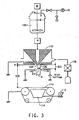
- electrodes 130 and 132 are replaced with an electrode arrangement which is capable of creating a corona discharge under relatively low voltage potentials, and yet still imparting sufficient electrical charge to the polymer-containing liquid stream to form the desired fine polymer fibers.
- a point-electrode 140 is disposed laterally from the centerline of the intended path of a liquid stream containing a polymer by a variable distance EO (electrode offset), and vertically at a variable die-to-electrode distance DED from spinning nozzle 104 and a target-electrode 142 is likewise disposed laterally to the opposite side of the intended liquid stream path, and vertically below the, spinning nozzle.
- the point-electrode 140 is illustrated as a bar lined with a series or array of needles that extends the length of spinneret 102 in the z-direction, into and out of the page.
- the target-electrode 142 is a metal bar extending the length of spinneret 102.
- the DED is short enough to impart electrical charge to the polymer-containing liquid stream prior to fiber formation, e.g. in the case of a molten polymer stream, prior to solidification of fibers formed therefrom.
- the polymer-containing liquid stream that issues from spinning nozzle 104 is directed through gap "g" between the point-electrode and the target-electrode.
- a high voltage is applied to the point-electrode 140, while the target-electrode 142 is grounded.
- the distance "g" between the electrodes is sufficient to permit the voltage applied to the point-electrode to initiate an electron cascade so as to ionize the gas in the gap, but not so small as to permit arcing between the electrodes.
- Distance "g” can be varied based upon the voltage potential applied between the electrodes, as well as based upon the breakdown strength of the gas in the process.
- the voltage potential applied to create the corona discharge can vary depending upon distance "g” and the breakdown strength of the gas used in the process.
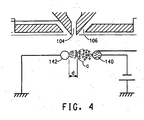
- FIG. 4 is a detailed illustration of the corona discharge and ionization zones that are formed between electrodes 140 and 142.
- a corona discharge zone "c" is formed by electrons emitted from point-electrode 140 ionizing gas near the electrode.
- the point-electrode is negatively charged and the target-electrode is maintained at ground.
- Both positive and negative ions are formed within the corona ionization zone "c”, and the negative ions are drawn toward the target-electrode through an ionization or drift zone, "d", substantially transverse to the direction of the polymer-containing liquid stream flow.
- the ions in the drift zone impart electrical charge to the liquid stream passing through it.
- the point-electrode could be positively charged, while the target-electrode is maintained at ground.
- the point- and target-electrodes can have the same voltage but with different polarities.
- the voltage differential between the electrodes should be at least about 1 kV, but less than the voltage at which electrical arcing between the electrodes occurs, which again will depend upon the distance between the electrodes and the gas used in the process.
- the required voltage differential between the electrodes spaced 3.8 cm apart (in air) is from about 1 kV to about 50 kV.
- the process of the invention avoids the necessity of maintaining the spin pack including the spinneret, as well as all other equipment, at high voltage, as in the prior art process illustrated by Fig. 1 .
- the voltage to the point-electrode, the pack, the target-electrode and the spinneret may be grounded or substantially grounded.
- substantially grounded is meant that the other components preferentially may be held at a low voltage level, i.e., between about -100 V and about +100 V.
- the polymer-containing liquid stream of the present process can be polymer solution, i.e. a polymer dissolved in a suitable solvent, or can be molten polymer. It is preferable that at least the polymer is partially electrically conductive and can retain an electrical charge on the time-scale of the process, and when spinning fibers from a polymer solution, the solvent can also be selected from among those that are somewhat conductive and able to retain an electrical charge on the process time-scale.
- polymers for use in the invention may include polyimide, nylon, polyaramide, polybenzimidazole, polyetherimide, polyacrylonitrile, PET (polyethylene terephthalate), polypropylene, polyaniline, polyethylene oxide, PEN (polyethylene naphthalate), PBT (polybutylene terephthalate), SBR (styrene butadiene rubber), polystyrene, PVC (polyvinyl chloride), polyvinyl alcohol, PVDF (polyvinylidene fluoride), polyvinyl butylene and copolymer or derivative compounds thereof.
- the polymer solution can be prepared by selecting a solvent suitable to dissolve the selected polymer.
- the polymer and/or the polymer solution can be mixed with additives including any resin compatible with an associated polymer, plasticizer, ultraviolet ray stabilizer, crosslink agent, curing agent, reaction initiator, etc.
- electrical dopants can be added to either or both of the polymer or the solvent (when used), to enhance the conductivity of the polymer-containing liquid stream.
- Suitable electrical dopants include, but are not limited to, mineral salts, such as NaCl, KCI or MgCl 2 , CaCl 2 , and the like, organic salts, such as N(CH 3 ) 4 Cl, and the like, conductive polymers such as polyaniline, polythiophene, and the like, or mildly conductive oligomers, such as low molecular weight polyethylene glycols.
- the amount of such electrical dopant(s) should be sufficient to raise the polymer-containing liquid stream conductivity to at least about 10 -12 Siemens/m (less than about 10 13 ohm-cm resistivity).
- the fine polymer fibers and the fibrous web formed by the present process have little, or substantially no residual charge, unlike electret fibers that are known-in-the-art.
- Any polymer solution known to be suitable for use in a conventional electrospinning process may be used in the process of the invention.
- polymer melts and polymer-solvent combinations suitable for use in the process are disclosed in Z. M. Huang et al., Composites Science and Technology, volume 63 (2003), pages 2226-2230 .
- the polymer discharge pressure is in the range of about 0.01 kg/cm 2 to about 200 kg/cm 2 , more advantageously in the range of about 0.1 kg/cm 2 to about 20 kg/cm 2 , and the liquid stream throughput per hole is in the range of about 0.1 mL/min to about 15 mL/min.
- the linear velocity of the compressed gas issued from gas nozzles 106 is advantageously between about 10 and about 20,000 m/min, and more advantageously between about 100 and about 3,000 m/min.
- the fine polymer fibers collected on moving belt 110 have average effective diameters of less than about 1 micrometer, and even less than about 0.5 micrometer.
- the solution was spun in a single orifice electroblowing apparatus comprising a 22 gauge blunt syringe needle, in a concentric forwarding air jet. The needle tip protruded 2 mm below the conductive face of the spin pack body.
- the spin pack body and the spin orifice were electrically grounded through an ammeter, and the PVA solution was directed through a gap between an array of needles charged to a high voltage, which served as the point-electrode and a grounded, cylindrical target-electrode.
- Process conditions are set forth in the Table, below.
- PVA fine fibers formed via this process were collected on a grounded conductive surface and examined under a scanning electron microscope.
- the average effective diameter of the fibers collected was about 400 nm.
- PEO polyethylene oxide
- Mv viscosity average molecular weight 300,000, obtained from Sigma - Aldrich
- NaCl sodium chloride
- the electrical conductivity was measured to be approximately 1600 micro-Siemens/cm, with the same digital conductivity meter being used as in Example 1.
- This solution was spun through a single orifice electroblowing apparatus with a 20 gauge blunt needle. The process conditions for this run are listed in the Table, below.
- the charging method for this run is the same as described in Example 1, utilizing a needle array, which served as the point electrode and a grounded, cylindrical target electrode.
- PEO fine fibers produced during this run were collected on a grounded conductive surface. The average diameters of these fine fibers were then examined under a scanning electron microscope. The average effective diameter of these fibers was approximately 500 nm.
- Example 2 The PEO solution of Example 2 was spun through the single orifice electroblowing apparatus, however the point-electrode geometry was varied. Instead of an array of needles providing the charge, a single wire was used. The solution was directed through the gap between the single wire electrode and a grounded bar, and charged with high voltage. The grounded cylinder served as the target electrode. The conditions used in this run are listed in the Table, below.
Landscapes
- Engineering & Computer Science (AREA)
- Mechanical Engineering (AREA)
- Textile Engineering (AREA)
- Spinning Methods And Devices For Manufacturing Artificial Fibers (AREA)
- Nonwoven Fabrics (AREA)
- Chemical Or Physical Treatment Of Fibers (AREA)
- Artificial Filaments (AREA)
Applications Claiming Priority (2)
| Application Number | Priority Date | Filing Date | Title |
|---|---|---|---|
| US11/205,457 US7582247B2 (en) | 2005-08-17 | 2005-08-17 | Electroblowing fiber spinning process |
| PCT/US2006/032213 WO2007022390A1 (en) | 2005-08-17 | 2006-08-17 | Improved electroblowing fiber spinning process |
Publications (2)
| Publication Number | Publication Date |
|---|---|
| EP1915474A1 EP1915474A1 (en) | 2008-04-30 |
| EP1915474B1 true EP1915474B1 (en) | 2010-01-27 |
Family
ID=37564140
Family Applications (1)
| Application Number | Title | Priority Date | Filing Date |
|---|---|---|---|
| EP06789834A Ceased EP1915474B1 (en) | 2005-08-17 | 2006-08-17 | Improved electroblowing fiber spinning process |
Country Status (8)
| Country | Link |
|---|---|
| US (1) | US7582247B2 (enExample) |
| EP (1) | EP1915474B1 (enExample) |
| JP (1) | JP4948538B2 (enExample) |
| KR (1) | KR101290019B1 (enExample) |
| CN (1) | CN101248223B (enExample) |
| BR (1) | BRPI0616539A2 (enExample) |
| DE (1) | DE602006012058D1 (enExample) |
| WO (1) | WO2007022390A1 (enExample) |
Families Citing this family (36)
| Publication number | Priority date | Publication date | Assignee | Title |
|---|---|---|---|---|
| US8808608B2 (en) * | 2004-12-27 | 2014-08-19 | E I Du Pont De Nemours And Company | Electroblowing web formation process |
| US20110111201A1 (en) * | 2006-01-20 | 2011-05-12 | Reneker Darrell H | Method of making coiled and buckled electrospun fiber structures and uses for same |
| US8361365B2 (en) * | 2006-12-20 | 2013-01-29 | E I Du Pont De Nemours And Company | Process for electroblowing a multiple layered sheet |
| US8277711B2 (en) * | 2007-03-29 | 2012-10-02 | E I Du Pont De Nemours And Company | Production of nanofibers by melt spinning |
| KR100925775B1 (ko) * | 2007-09-21 | 2009-11-11 | 경희대학교 산학협력단 | 압전성이 뛰어난 β-결정을 다량 함유하는 폴리비닐리덴플루오라이드 나노섬유 웹의 제조 방법 |
| WO2009042128A1 (en) * | 2007-09-25 | 2009-04-02 | The University Of Akron | Bubble launched electrospinning jets |
| KR20100100814A (ko) * | 2007-11-20 | 2010-09-15 | 다우 코닝 코포레이션 | 섬유를 포함하는 물품과 상기 물품을 형성하는 방법 |
| US8211353B2 (en) * | 2008-09-05 | 2012-07-03 | E. I. Du Pont De Nemours And Company | Fiber spinning process using a weakly interacting polymer |
| US20100059906A1 (en) * | 2008-09-05 | 2010-03-11 | E. I. Du Pont De Nemours And Company | High throughput electroblowing process |
| JP5375022B2 (ja) * | 2008-10-17 | 2013-12-25 | 旭硝子株式会社 | 繊維の製造方法および触媒層の製造方法 |
| WO2010107503A1 (en) | 2009-03-19 | 2010-09-23 | Millipore Corporation | Removal of microorganisms from fluid samples using nanofiber filtration media |
| JP5479845B2 (ja) * | 2009-10-26 | 2014-04-23 | 国立大学法人信州大学 | 極細繊維製造装置及び極細繊維製造方法 |
| BR112012020388A2 (pt) * | 2010-02-15 | 2016-05-10 | Univ Cornell | aparelho de eletrofiação para formar nanofibras, processos para preparar uma nanofibra e de eletrofiação, fibra, nanofibra, e, esteira de fibra |
| KR20130125287A (ko) * | 2010-05-29 | 2013-11-18 | 애쉴리 에스. 스코트 | 정전기 유도 용매 분출 또는 입자 형성을 위한 장치, 방법 및 유체 조성물 |
| CA2803010C (en) | 2010-07-02 | 2015-11-24 | The Procter & Gamble Company | Dissolvable fibrous web structure article comprising active agents |
| SG10201600617PA (en) | 2010-08-10 | 2016-11-29 | Emd Millipore Corp | Method for retrovirus removal |
| KR101251731B1 (ko) * | 2010-10-29 | 2013-04-05 | 고려대학교 산학협력단 | 전기방사법을 이용한 나노섬유 제조장치 |
| WO2012135679A2 (en) | 2011-04-01 | 2012-10-04 | Emd Millipore Corporation | Nanofiber containing composite structures |
| KR101246095B1 (ko) * | 2011-05-25 | 2013-03-20 | 한국에너지기술연구원 | 이온분사 부직포 제조 장치 및 제조 방법 |
| US9527257B2 (en) * | 2012-08-06 | 2016-12-27 | Clarcor Inc. | Devices and methods for the production of microfibers and nanofibers having one or more additives |
| US9090996B2 (en) | 2012-08-15 | 2015-07-28 | E I Du Pont De Nemours And Company | Multizone electroblowing process |
| GB201303413D0 (en) * | 2013-02-26 | 2013-04-10 | Univ Keele | Polymer electrospinning apparatus |
| DK177766B3 (da) * | 2013-03-19 | 2018-04-30 | Tresu As | Enhed og fremgangsmåde til koronabehandling |
| CN103334165B (zh) * | 2013-06-13 | 2015-09-09 | 厦门大学 | 一种静电纺丝装置 |
| WO2015034431A1 (en) * | 2013-09-09 | 2015-03-12 | Ngee Ann Polytechnic | An electrospinning apparatus and method for the continuous production of fibres |
| US10106915B2 (en) * | 2013-12-18 | 2018-10-23 | Anf Inc. | Electro-spinning type pattern forming apparatus |
| WO2015164227A2 (en) | 2014-04-22 | 2015-10-29 | The Procter & Gamble Company | Compositions in the form of dissolvable solid structures |
| US12059644B2 (en) | 2014-06-26 | 2024-08-13 | Emd Millipore Corporation | Filter structure with enhanced dirt holding capacity |
| KR102206963B1 (ko) | 2015-04-17 | 2021-01-25 | 이엠디 밀리포어 코포레이션 | 접선방향 유동 여과 모드에서 작동되는 나노섬유 한외여과막을 사용하여 샘플에서 목적하는 생물학적 물질을 정제하는 방법 |
| DE112016002637B4 (de) * | 2015-06-12 | 2022-03-24 | Reliance Industries Limited | Elektrostatische mischvorrichtung und verfahren zum vermischen von filamenten |
| WO2017096354A1 (en) | 2015-12-03 | 2017-06-08 | E I Du Pont De Nemours And Company | A fibrous construct and methods relating thereto |
| CN109310541B (zh) | 2016-02-25 | 2021-10-15 | 阿文提特种材料公司 | 包含增强阻挡性能的添加剂的非织造织物 |
| JP6427518B2 (ja) * | 2016-03-17 | 2018-11-21 | 株式会社東芝 | ノズルヘッドモジュール、および電界紡糸装置 |
| WO2019016605A1 (en) | 2017-07-21 | 2019-01-24 | Merck Millipore Ltd | MEMBRANES OF NONWOVEN FIBERS |
| CN112458560A (zh) * | 2020-11-13 | 2021-03-09 | 广东新会美达锦纶股份有限公司 | 一种纺丝生产的热媒加热系统 |
| CN118932609B (zh) * | 2024-07-31 | 2026-04-28 | 东南大学 | 一种自组装成型的高效辐射制冷织物及其制备方法 |
Family Cites Families (15)
| Publication number | Priority date | Publication date | Assignee | Title |
|---|---|---|---|---|
| US3338992A (en) | 1959-12-15 | 1967-08-29 | Du Pont | Process for forming non-woven filamentary structures from fiber-forming synthetic organic polymers |
| US3387326A (en) | 1964-06-04 | 1968-06-11 | Du Pont | Apparatus for charging and spreading a web |
| US3535588A (en) | 1967-04-06 | 1970-10-20 | Du Pont | Apparatus for charging fibrous material |
| US3824052A (en) * | 1971-04-15 | 1974-07-16 | Deering Milliken Res Corp | Apparatus to produce nonwoven fabric |
| US4215682A (en) | 1978-02-06 | 1980-08-05 | Minnesota Mining And Manufacturing Company | Melt-blown fibrous electrets |
| US4233014A (en) | 1979-09-19 | 1980-11-11 | E. I. Du Pont De Nemours And Company | Apparatus for preparing a nonwoven web |
| JPS6094664A (ja) * | 1983-10-26 | 1985-05-27 | 旭化成株式会社 | フィラメント群の開繊法 |
| US4904174A (en) * | 1988-09-15 | 1990-02-27 | Peter Moosmayer | Apparatus for electrically charging meltblown webs (B-001) |
| US5509952A (en) * | 1992-11-23 | 1996-04-23 | Alcatel Network Systems, Inc. | Method for bonding a fiber to a sleeve for fiber optic packaging applications |
| US20020084178A1 (en) | 2000-12-19 | 2002-07-04 | Nicast Corporation Ltd. | Method and apparatus for manufacturing polymer fiber shells via electrospinning |
| US6709623B2 (en) * | 2000-12-22 | 2004-03-23 | Kimberly-Clark Worldwide, Inc. | Process of and apparatus for making a nonwoven web |
| US6872311B2 (en) | 2002-01-31 | 2005-03-29 | Koslow Technologies Corporation | Nanofiber filter media |
| KR100549140B1 (ko) * | 2002-03-26 | 2006-02-03 | 이 아이 듀폰 디 네모아 앤드 캄파니 | 일렉트로-브로운 방사법에 의한 초극세 나노섬유 웹제조방법 |
| AU2003214634A1 (en) | 2002-03-27 | 2003-10-08 | Council Of Scientific And Industrial Research | Anti peptic ulcer activity of an extract of a plant flower woodfordia fruticosa |
| US8808608B2 (en) | 2004-12-27 | 2014-08-19 | E I Du Pont De Nemours And Company | Electroblowing web formation process |
-
2005
- 2005-08-17 US US11/205,457 patent/US7582247B2/en active Active
-
2006
- 2006-08-17 JP JP2008527152A patent/JP4948538B2/ja not_active Expired - Fee Related
- 2006-08-17 KR KR1020087006231A patent/KR101290019B1/ko not_active Expired - Fee Related
- 2006-08-17 WO PCT/US2006/032213 patent/WO2007022390A1/en not_active Ceased
- 2006-08-17 BR BRPI0616539-7A patent/BRPI0616539A2/pt not_active IP Right Cessation
- 2006-08-17 CN CN2006800298993A patent/CN101248223B/zh not_active Expired - Fee Related
- 2006-08-17 EP EP06789834A patent/EP1915474B1/en not_active Ceased
- 2006-08-17 DE DE602006012058T patent/DE602006012058D1/de not_active Expired - Lifetime
Also Published As
| Publication number | Publication date |
|---|---|
| JP4948538B2 (ja) | 2012-06-06 |
| CN101248223B (zh) | 2010-12-22 |
| CN101248223A (zh) | 2008-08-20 |
| JP2009504938A (ja) | 2009-02-05 |
| KR20080038222A (ko) | 2008-05-02 |
| BRPI0616539A2 (pt) | 2011-06-21 |
| US7582247B2 (en) | 2009-09-01 |
| EP1915474A1 (en) | 2008-04-30 |
| DE602006012058D1 (de) | 2010-03-18 |
| KR101290019B1 (ko) | 2013-07-30 |
| WO2007022390A1 (en) | 2007-02-22 |
| US20070040305A1 (en) | 2007-02-22 |
Similar Documents
| Publication | Publication Date | Title |
|---|---|---|
| US7582247B2 (en) | Electroblowing fiber spinning process | |
| EP1941082B1 (en) | Improved fiber charging apparatus | |
| EP1841903B1 (en) | Electroblowing web formation process | |
| EP1834020B1 (en) | Improved electroblowing web formation process | |
| US20060012084A1 (en) | Electroblowing web formation process | |
| US9279203B2 (en) | Manufacturing device and the method of preparing for the nanofibers via electro blown spinning process |
Legal Events
| Date | Code | Title | Description |
|---|---|---|---|
| PUAI | Public reference made under article 153(3) epc to a published international application that has entered the european phase |
Free format text: ORIGINAL CODE: 0009012 |
|
| 17P | Request for examination filed |
Effective date: 20080205 |
|
| AK | Designated contracting states |
Kind code of ref document: A1 Designated state(s): DE FR GB |
|
| 17Q | First examination report despatched |
Effective date: 20080701 |
|
| RBV | Designated contracting states (corrected) |
Designated state(s): DE FR GB |
|
| GRAP | Despatch of communication of intention to grant a patent |
Free format text: ORIGINAL CODE: EPIDOSNIGR1 |
|
| DAX | Request for extension of the european patent (deleted) | ||
| GRAS | Grant fee paid |
Free format text: ORIGINAL CODE: EPIDOSNIGR3 |
|
| GRAA | (expected) grant |
Free format text: ORIGINAL CODE: 0009210 |
|
| AK | Designated contracting states |
Kind code of ref document: B1 Designated state(s): DE FR GB |
|
| REG | Reference to a national code |
Ref country code: GB Ref legal event code: FG4D |
|
| REF | Corresponds to: |
Ref document number: 602006012058 Country of ref document: DE Date of ref document: 20100318 Kind code of ref document: P |
|
| REG | Reference to a national code |
Ref country code: DE Ref legal event code: R096 Ref document number: 602006012058 Country of ref document: DE Effective date: 20100318 |
|
| PLBE | No opposition filed within time limit |
Free format text: ORIGINAL CODE: 0009261 |
|
| STAA | Information on the status of an ep patent application or granted ep patent |
Free format text: STATUS: NO OPPOSITION FILED WITHIN TIME LIMIT |
|
| 26N | No opposition filed |
Effective date: 20101028 |
|
| REG | Reference to a national code |
Ref country code: DE Ref legal event code: R097 Ref document number: 602006012058 Country of ref document: DE Effective date: 20101028 |
|
| REG | Reference to a national code |
Ref country code: FR Ref legal event code: PLFP Year of fee payment: 11 |
|
| REG | Reference to a national code |
Ref country code: FR Ref legal event code: PLFP Year of fee payment: 12 |
|
| REG | Reference to a national code |
Ref country code: FR Ref legal event code: PLFP Year of fee payment: 13 |
|
| REG | Reference to a national code |
Ref country code: DE Ref legal event code: R081 Ref document number: 602006012058 Country of ref document: DE Owner name: DUPONT SAFETY & CONSTRUCTION, INC., WILMINGTON, US Free format text: FORMER OWNER: E.I. DU PONT DE NEMOURS AND CO., WILMINGTON, DEL., US |
|
| REG | Reference to a national code |
Ref country code: GB Ref legal event code: 732E Free format text: REGISTERED BETWEEN 20221027 AND 20221102 |
|
| P01 | Opt-out of the competence of the unified patent court (upc) registered |
Effective date: 20230528 |
|
| PGFP | Annual fee paid to national office [announced via postgrant information from national office to epo] |
Ref country code: GB Payment date: 20230629 Year of fee payment: 18 |
|
| PGFP | Annual fee paid to national office [announced via postgrant information from national office to epo] |
Ref country code: FR Payment date: 20230703 Year of fee payment: 18 Ref country code: DE Payment date: 20230703 Year of fee payment: 18 |
|
| REG | Reference to a national code |
Ref country code: DE Ref legal event code: R119 Ref document number: 602006012058 Country of ref document: DE |
|
| GBPC | Gb: european patent ceased through non-payment of renewal fee |
Effective date: 20240817 |
|
| PG25 | Lapsed in a contracting state [announced via postgrant information from national office to epo] |
Ref country code: DE Free format text: LAPSE BECAUSE OF NON-PAYMENT OF DUE FEES Effective date: 20250301 |
|
| PG25 | Lapsed in a contracting state [announced via postgrant information from national office to epo] |
Ref country code: GB Free format text: LAPSE BECAUSE OF NON-PAYMENT OF DUE FEES Effective date: 20240817 |
|
| PG25 | Lapsed in a contracting state [announced via postgrant information from national office to epo] |
Ref country code: FR Free format text: LAPSE BECAUSE OF NON-PAYMENT OF DUE FEES Effective date: 20240831 |