EP1893709B1 - Klebstofffolie auf basis von nitrilkautschuk-blends zur fixierung von metallteilen auf kunststoffen - Google Patents
Klebstofffolie auf basis von nitrilkautschuk-blends zur fixierung von metallteilen auf kunststoffen Download PDFInfo
- Publication number
- EP1893709B1 EP1893709B1 EP06761934A EP06761934A EP1893709B1 EP 1893709 B1 EP1893709 B1 EP 1893709B1 EP 06761934 A EP06761934 A EP 06761934A EP 06761934 A EP06761934 A EP 06761934A EP 1893709 B1 EP1893709 B1 EP 1893709B1
- Authority
- EP
- European Patent Office
- Prior art keywords
- nitrile rubber
- weight
- adhesive sheet
- resins
- heat
- Prior art date
- Legal status (The legal status is an assumption and is not a legal conclusion. Google has not performed a legal analysis and makes no representation as to the accuracy of the status listed.)
- Expired - Lifetime
Links
- 0 C(C1)*C2=C1C=N2 Chemical compound C(C1)*C2=C1C=N2 0.000 description 1
Images

Classifications
-
- C—CHEMISTRY; METALLURGY
- C09—DYES; PAINTS; POLISHES; NATURAL RESINS; ADHESIVES; COMPOSITIONS NOT OTHERWISE PROVIDED FOR; APPLICATIONS OF MATERIALS NOT OTHERWISE PROVIDED FOR
- C09J—ADHESIVES; NON-MECHANICAL ASPECTS OF ADHESIVE PROCESSES IN GENERAL; ADHESIVE PROCESSES NOT PROVIDED FOR ELSEWHERE; USE OF MATERIALS AS ADHESIVES
- C09J109/00—Adhesives based on homopolymers or copolymers of conjugated diene hydrocarbons
- C09J109/02—Copolymers with acrylonitrile
-
- C—CHEMISTRY; METALLURGY
- C09—DYES; PAINTS; POLISHES; NATURAL RESINS; ADHESIVES; COMPOSITIONS NOT OTHERWISE PROVIDED FOR; APPLICATIONS OF MATERIALS NOT OTHERWISE PROVIDED FOR
- C09J—ADHESIVES; NON-MECHANICAL ASPECTS OF ADHESIVE PROCESSES IN GENERAL; ADHESIVE PROCESSES NOT PROVIDED FOR ELSEWHERE; USE OF MATERIALS AS ADHESIVES
- C09J7/00—Adhesives in the form of films or foils
-
- C—CHEMISTRY; METALLURGY
- C09—DYES; PAINTS; POLISHES; NATURAL RESINS; ADHESIVES; COMPOSITIONS NOT OTHERWISE PROVIDED FOR; APPLICATIONS OF MATERIALS NOT OTHERWISE PROVIDED FOR
- C09J—ADHESIVES; NON-MECHANICAL ASPECTS OF ADHESIVE PROCESSES IN GENERAL; ADHESIVE PROCESSES NOT PROVIDED FOR ELSEWHERE; USE OF MATERIALS AS ADHESIVES
- C09J7/00—Adhesives in the form of films or foils
- C09J7/10—Adhesives in the form of films or foils without carriers
-
- C—CHEMISTRY; METALLURGY
- C09—DYES; PAINTS; POLISHES; NATURAL RESINS; ADHESIVES; COMPOSITIONS NOT OTHERWISE PROVIDED FOR; APPLICATIONS OF MATERIALS NOT OTHERWISE PROVIDED FOR
- C09J—ADHESIVES; NON-MECHANICAL ASPECTS OF ADHESIVE PROCESSES IN GENERAL; ADHESIVE PROCESSES NOT PROVIDED FOR ELSEWHERE; USE OF MATERIALS AS ADHESIVES
- C09J7/00—Adhesives in the form of films or foils
- C09J7/30—Adhesives in the form of films or foils characterised by the adhesive composition
- C09J7/35—Heat-activated
-
- C—CHEMISTRY; METALLURGY
- C09—DYES; PAINTS; POLISHES; NATURAL RESINS; ADHESIVES; COMPOSITIONS NOT OTHERWISE PROVIDED FOR; APPLICATIONS OF MATERIALS NOT OTHERWISE PROVIDED FOR
- C09J—ADHESIVES; NON-MECHANICAL ASPECTS OF ADHESIVE PROCESSES IN GENERAL; ADHESIVE PROCESSES NOT PROVIDED FOR ELSEWHERE; USE OF MATERIALS AS ADHESIVES
- C09J9/00—Adhesives characterised by their physical nature or the effects produced, e.g. glue sticks
-
- B—PERFORMING OPERATIONS; TRANSPORTING
- B29—WORKING OF PLASTICS; WORKING OF SUBSTANCES IN A PLASTIC STATE IN GENERAL
- B29C—SHAPING OR JOINING OF PLASTICS; SHAPING OF MATERIAL IN A PLASTIC STATE, NOT OTHERWISE PROVIDED FOR; AFTER-TREATMENT OF THE SHAPED PRODUCTS, e.g. REPAIRING
- B29C65/00—Joining or sealing of preformed parts, e.g. welding of plastics materials; Apparatus therefor
- B29C65/48—Joining or sealing of preformed parts, e.g. welding of plastics materials; Apparatus therefor using adhesives, i.e. using supplementary joining material; solvent bonding
- B29C65/4805—Joining or sealing of preformed parts, e.g. welding of plastics materials; Apparatus therefor using adhesives, i.e. using supplementary joining material; solvent bonding characterised by the type of adhesives
- B29C65/481—Non-reactive adhesives, e.g. physically hardening adhesives
- B29C65/4825—Pressure sensitive adhesives
-
- B—PERFORMING OPERATIONS; TRANSPORTING
- B29—WORKING OF PLASTICS; WORKING OF SUBSTANCES IN A PLASTIC STATE IN GENERAL
- B29C—SHAPING OR JOINING OF PLASTICS; SHAPING OF MATERIAL IN A PLASTIC STATE, NOT OTHERWISE PROVIDED FOR; AFTER-TREATMENT OF THE SHAPED PRODUCTS, e.g. REPAIRING
- B29C65/00—Joining or sealing of preformed parts, e.g. welding of plastics materials; Apparatus therefor
- B29C65/48—Joining or sealing of preformed parts, e.g. welding of plastics materials; Apparatus therefor using adhesives, i.e. using supplementary joining material; solvent bonding
- B29C65/4805—Joining or sealing of preformed parts, e.g. welding of plastics materials; Apparatus therefor using adhesives, i.e. using supplementary joining material; solvent bonding characterised by the type of adhesives
- B29C65/483—Reactive adhesives, e.g. chemically curing adhesives
-
- B—PERFORMING OPERATIONS; TRANSPORTING
- B29—WORKING OF PLASTICS; WORKING OF SUBSTANCES IN A PLASTIC STATE IN GENERAL
- B29C—SHAPING OR JOINING OF PLASTICS; SHAPING OF MATERIAL IN A PLASTIC STATE, NOT OTHERWISE PROVIDED FOR; AFTER-TREATMENT OF THE SHAPED PRODUCTS, e.g. REPAIRING
- B29C65/00—Joining or sealing of preformed parts, e.g. welding of plastics materials; Apparatus therefor
- B29C65/48—Joining or sealing of preformed parts, e.g. welding of plastics materials; Apparatus therefor using adhesives, i.e. using supplementary joining material; solvent bonding
- B29C65/4865—Joining or sealing of preformed parts, e.g. welding of plastics materials; Apparatus therefor using adhesives, i.e. using supplementary joining material; solvent bonding containing additives
-
- B—PERFORMING OPERATIONS; TRANSPORTING
- B29—WORKING OF PLASTICS; WORKING OF SUBSTANCES IN A PLASTIC STATE IN GENERAL
- B29C—SHAPING OR JOINING OF PLASTICS; SHAPING OF MATERIAL IN A PLASTIC STATE, NOT OTHERWISE PROVIDED FOR; AFTER-TREATMENT OF THE SHAPED PRODUCTS, e.g. REPAIRING
- B29C65/00—Joining or sealing of preformed parts, e.g. welding of plastics materials; Apparatus therefor
- B29C65/48—Joining or sealing of preformed parts, e.g. welding of plastics materials; Apparatus therefor using adhesives, i.e. using supplementary joining material; solvent bonding
- B29C65/50—Joining or sealing of preformed parts, e.g. welding of plastics materials; Apparatus therefor using adhesives, i.e. using supplementary joining material; solvent bonding using adhesive tape, e.g. thermoplastic tape; using threads or the like
- B29C65/5007—Joining or sealing of preformed parts, e.g. welding of plastics materials; Apparatus therefor using adhesives, i.e. using supplementary joining material; solvent bonding using adhesive tape, e.g. thermoplastic tape; using threads or the like characterised by the structure of said adhesive tape, threads or the like
- B29C65/5021—Joining or sealing of preformed parts, e.g. welding of plastics materials; Apparatus therefor using adhesives, i.e. using supplementary joining material; solvent bonding using adhesive tape, e.g. thermoplastic tape; using threads or the like characterised by the structure of said adhesive tape, threads or the like being multi-layered
-
- B—PERFORMING OPERATIONS; TRANSPORTING
- B29—WORKING OF PLASTICS; WORKING OF SUBSTANCES IN A PLASTIC STATE IN GENERAL
- B29C—SHAPING OR JOINING OF PLASTICS; SHAPING OF MATERIAL IN A PLASTIC STATE, NOT OTHERWISE PROVIDED FOR; AFTER-TREATMENT OF THE SHAPED PRODUCTS, e.g. REPAIRING
- B29C65/00—Joining or sealing of preformed parts, e.g. welding of plastics materials; Apparatus therefor
- B29C65/48—Joining or sealing of preformed parts, e.g. welding of plastics materials; Apparatus therefor using adhesives, i.e. using supplementary joining material; solvent bonding
- B29C65/50—Joining or sealing of preformed parts, e.g. welding of plastics materials; Apparatus therefor using adhesives, i.e. using supplementary joining material; solvent bonding using adhesive tape, e.g. thermoplastic tape; using threads or the like
- B29C65/5057—Joining or sealing of preformed parts, e.g. welding of plastics materials; Apparatus therefor using adhesives, i.e. using supplementary joining material; solvent bonding using adhesive tape, e.g. thermoplastic tape; using threads or the like positioned between the surfaces to be joined
-
- B—PERFORMING OPERATIONS; TRANSPORTING
- B29—WORKING OF PLASTICS; WORKING OF SUBSTANCES IN A PLASTIC STATE IN GENERAL
- B29C—SHAPING OR JOINING OF PLASTICS; SHAPING OF MATERIAL IN A PLASTIC STATE, NOT OTHERWISE PROVIDED FOR; AFTER-TREATMENT OF THE SHAPED PRODUCTS, e.g. REPAIRING
- B29C65/00—Joining or sealing of preformed parts, e.g. welding of plastics materials; Apparatus therefor
- B29C65/82—Testing the joint
- B29C65/8207—Testing the joint by mechanical methods
-
- B—PERFORMING OPERATIONS; TRANSPORTING
- B29—WORKING OF PLASTICS; WORKING OF SUBSTANCES IN A PLASTIC STATE IN GENERAL
- B29C—SHAPING OR JOINING OF PLASTICS; SHAPING OF MATERIAL IN A PLASTIC STATE, NOT OTHERWISE PROVIDED FOR; AFTER-TREATMENT OF THE SHAPED PRODUCTS, e.g. REPAIRING
- B29C65/00—Joining or sealing of preformed parts, e.g. welding of plastics materials; Apparatus therefor
- B29C65/82—Testing the joint
- B29C65/8207—Testing the joint by mechanical methods
- B29C65/8238—Impact tests
-
- B—PERFORMING OPERATIONS; TRANSPORTING
- B29—WORKING OF PLASTICS; WORKING OF SUBSTANCES IN A PLASTIC STATE IN GENERAL
- B29C—SHAPING OR JOINING OF PLASTICS; SHAPING OF MATERIAL IN A PLASTIC STATE, NOT OTHERWISE PROVIDED FOR; AFTER-TREATMENT OF THE SHAPED PRODUCTS, e.g. REPAIRING
- B29C66/00—General aspects of processes or apparatus for joining preformed parts
- B29C66/01—General aspects dealing with the joint area or with the area to be joined
- B29C66/05—Particular design of joint configurations
- B29C66/10—Particular design of joint configurations particular design of the joint cross-sections
- B29C66/11—Joint cross-sections comprising a single joint-segment, i.e. one of the parts to be joined comprising a single joint-segment in the joint cross-section
- B29C66/112—Single lapped joints
- B29C66/1122—Single lap to lap joints, i.e. overlap joints
-
- B—PERFORMING OPERATIONS; TRANSPORTING
- B29—WORKING OF PLASTICS; WORKING OF SUBSTANCES IN A PLASTIC STATE IN GENERAL
- B29C—SHAPING OR JOINING OF PLASTICS; SHAPING OF MATERIAL IN A PLASTIC STATE, NOT OTHERWISE PROVIDED FOR; AFTER-TREATMENT OF THE SHAPED PRODUCTS, e.g. REPAIRING
- B29C66/00—General aspects of processes or apparatus for joining preformed parts
- B29C66/40—General aspects of joining substantially flat articles, e.g. plates, sheets or web-like materials; Making flat seams in tubular or hollow articles; Joining single elements to substantially flat surfaces
- B29C66/41—Joining substantially flat articles ; Making flat seams in tubular or hollow articles
- B29C66/43—Joining a relatively small portion of the surface of said articles
-
- B—PERFORMING OPERATIONS; TRANSPORTING
- B29—WORKING OF PLASTICS; WORKING OF SUBSTANCES IN A PLASTIC STATE IN GENERAL
- B29C—SHAPING OR JOINING OF PLASTICS; SHAPING OF MATERIAL IN A PLASTIC STATE, NOT OTHERWISE PROVIDED FOR; AFTER-TREATMENT OF THE SHAPED PRODUCTS, e.g. REPAIRING
- B29C66/00—General aspects of processes or apparatus for joining preformed parts
- B29C66/70—General aspects of processes or apparatus for joining preformed parts characterised by the composition, physical properties or the structure of the material of the parts to be joined; Joining with non-plastics material
- B29C66/71—General aspects of processes or apparatus for joining preformed parts characterised by the composition, physical properties or the structure of the material of the parts to be joined; Joining with non-plastics material characterised by the composition of the plastics material of the parts to be joined
-
- B—PERFORMING OPERATIONS; TRANSPORTING
- B29—WORKING OF PLASTICS; WORKING OF SUBSTANCES IN A PLASTIC STATE IN GENERAL
- B29C—SHAPING OR JOINING OF PLASTICS; SHAPING OF MATERIAL IN A PLASTIC STATE, NOT OTHERWISE PROVIDED FOR; AFTER-TREATMENT OF THE SHAPED PRODUCTS, e.g. REPAIRING
- B29C66/00—General aspects of processes or apparatus for joining preformed parts
- B29C66/70—General aspects of processes or apparatus for joining preformed parts characterised by the composition, physical properties or the structure of the material of the parts to be joined; Joining with non-plastics material
- B29C66/74—Joining plastics material to non-plastics material
- B29C66/742—Joining plastics material to non-plastics material to metals or their alloys
-
- B—PERFORMING OPERATIONS; TRANSPORTING
- B29—WORKING OF PLASTICS; WORKING OF SUBSTANCES IN A PLASTIC STATE IN GENERAL
- B29K—INDEXING SCHEME ASSOCIATED WITH SUBCLASSES B29B, B29C OR B29D, RELATING TO MOULDING MATERIALS OR TO MATERIALS FOR MOULDS, REINFORCEMENTS, FILLERS OR PREFORMED PARTS, e.g. INSERTS
- B29K2027/00—Use of polyvinylhalogenides or derivatives thereof as moulding material
- B29K2027/06—PVC, i.e. polyvinylchloride
-
- B—PERFORMING OPERATIONS; TRANSPORTING
- B29—WORKING OF PLASTICS; WORKING OF SUBSTANCES IN A PLASTIC STATE IN GENERAL
- B29K—INDEXING SCHEME ASSOCIATED WITH SUBCLASSES B29B, B29C OR B29D, RELATING TO MOULDING MATERIALS OR TO MATERIALS FOR MOULDS, REINFORCEMENTS, FILLERS OR PREFORMED PARTS, e.g. INSERTS
- B29K2055/00—Use of specific polymers obtained by polymerisation reactions only involving carbon-to-carbon unsaturated bonds, not provided for in a single one of main groups B29K2023/00 - B29K2049/00, e.g. having a vinyl group, as moulding material
- B29K2055/02—ABS polymers, i.e. acrylonitrile-butadiene-styrene polymers
-
- B—PERFORMING OPERATIONS; TRANSPORTING
- B29—WORKING OF PLASTICS; WORKING OF SUBSTANCES IN A PLASTIC STATE IN GENERAL
- B29K—INDEXING SCHEME ASSOCIATED WITH SUBCLASSES B29B, B29C OR B29D, RELATING TO MOULDING MATERIALS OR TO MATERIALS FOR MOULDS, REINFORCEMENTS, FILLERS OR PREFORMED PARTS, e.g. INSERTS
- B29K2069/00—Use of PC, i.e. polycarbonates or derivatives thereof, as moulding material
-
- B—PERFORMING OPERATIONS; TRANSPORTING
- B29—WORKING OF PLASTICS; WORKING OF SUBSTANCES IN A PLASTIC STATE IN GENERAL
- B29K—INDEXING SCHEME ASSOCIATED WITH SUBCLASSES B29B, B29C OR B29D, RELATING TO MOULDING MATERIALS OR TO MATERIALS FOR MOULDS, REINFORCEMENTS, FILLERS OR PREFORMED PARTS, e.g. INSERTS
- B29K2105/00—Condition, form or state of moulded material or of the material to be shaped
- B29K2105/0088—Blends of polymers
-
- B—PERFORMING OPERATIONS; TRANSPORTING
- B29—WORKING OF PLASTICS; WORKING OF SUBSTANCES IN A PLASTIC STATE IN GENERAL
- B29K—INDEXING SCHEME ASSOCIATED WITH SUBCLASSES B29B, B29C OR B29D, RELATING TO MOULDING MATERIALS OR TO MATERIALS FOR MOULDS, REINFORCEMENTS, FILLERS OR PREFORMED PARTS, e.g. INSERTS
- B29K2305/00—Use of metals, their alloys or their compounds, as reinforcement
- B29K2305/02—Aluminium
-
- B—PERFORMING OPERATIONS; TRANSPORTING
- B29—WORKING OF PLASTICS; WORKING OF SUBSTANCES IN A PLASTIC STATE IN GENERAL
- B29K—INDEXING SCHEME ASSOCIATED WITH SUBCLASSES B29B, B29C OR B29D, RELATING TO MOULDING MATERIALS OR TO MATERIALS FOR MOULDS, REINFORCEMENTS, FILLERS OR PREFORMED PARTS, e.g. INSERTS
- B29K2305/00—Use of metals, their alloys or their compounds, as reinforcement
- B29K2305/08—Transition metals
- B29K2305/12—Iron
-
- C—CHEMISTRY; METALLURGY
- C08—ORGANIC MACROMOLECULAR COMPOUNDS; THEIR PREPARATION OR CHEMICAL WORKING-UP; COMPOSITIONS BASED THEREON
- C08L—COMPOSITIONS OF MACROMOLECULAR COMPOUNDS
- C08L2666/00—Composition of polymers characterized by a further compound in the blend, being organic macromolecular compounds, natural resins, waxes or and bituminous materials, non-macromolecular organic substances, inorganic substances or characterized by their function in the composition
- C08L2666/02—Organic macromolecular compounds, natural resins, waxes or and bituminous materials
-
- C—CHEMISTRY; METALLURGY
- C08—ORGANIC MACROMOLECULAR COMPOUNDS; THEIR PREPARATION OR CHEMICAL WORKING-UP; COMPOSITIONS BASED THEREON
- C08L—COMPOSITIONS OF MACROMOLECULAR COMPOUNDS
- C08L61/00—Compositions of condensation polymers of aldehydes or ketones; Compositions of derivatives of such polymers
-
- C—CHEMISTRY; METALLURGY
- C08—ORGANIC MACROMOLECULAR COMPOUNDS; THEIR PREPARATION OR CHEMICAL WORKING-UP; COMPOSITIONS BASED THEREON
- C08L—COMPOSITIONS OF MACROMOLECULAR COMPOUNDS
- C08L63/00—Compositions of epoxy resins; Compositions of derivatives of epoxy resins
-
- C—CHEMISTRY; METALLURGY
- C08—ORGANIC MACROMOLECULAR COMPOUNDS; THEIR PREPARATION OR CHEMICAL WORKING-UP; COMPOSITIONS BASED THEREON
- C08L—COMPOSITIONS OF MACROMOLECULAR COMPOUNDS
- C08L9/00—Compositions of homopolymers or copolymers of conjugated diene hydrocarbons
- C08L9/02—Copolymers with acrylonitrile
-
- C—CHEMISTRY; METALLURGY
- C09—DYES; PAINTS; POLISHES; NATURAL RESINS; ADHESIVES; COMPOSITIONS NOT OTHERWISE PROVIDED FOR; APPLICATIONS OF MATERIALS NOT OTHERWISE PROVIDED FOR
- C09J—ADHESIVES; NON-MECHANICAL ASPECTS OF ADHESIVE PROCESSES IN GENERAL; ADHESIVE PROCESSES NOT PROVIDED FOR ELSEWHERE; USE OF MATERIALS AS ADHESIVES
- C09J2409/00—Presence of diene rubber
-
- C—CHEMISTRY; METALLURGY
- C09—DYES; PAINTS; POLISHES; NATURAL RESINS; ADHESIVES; COMPOSITIONS NOT OTHERWISE PROVIDED FOR; APPLICATIONS OF MATERIALS NOT OTHERWISE PROVIDED FOR
- C09J—ADHESIVES; NON-MECHANICAL ASPECTS OF ADHESIVE PROCESSES IN GENERAL; ADHESIVE PROCESSES NOT PROVIDED FOR ELSEWHERE; USE OF MATERIALS AS ADHESIVES
- C09J2461/00—Presence of condensation polymers of aldehydes or ketones
-
- C—CHEMISTRY; METALLURGY
- C09—DYES; PAINTS; POLISHES; NATURAL RESINS; ADHESIVES; COMPOSITIONS NOT OTHERWISE PROVIDED FOR; APPLICATIONS OF MATERIALS NOT OTHERWISE PROVIDED FOR
- C09J—ADHESIVES; NON-MECHANICAL ASPECTS OF ADHESIVE PROCESSES IN GENERAL; ADHESIVE PROCESSES NOT PROVIDED FOR ELSEWHERE; USE OF MATERIALS AS ADHESIVES
- C09J2463/00—Presence of epoxy resin
-
- Y—GENERAL TAGGING OF NEW TECHNOLOGICAL DEVELOPMENTS; GENERAL TAGGING OF CROSS-SECTIONAL TECHNOLOGIES SPANNING OVER SEVERAL SECTIONS OF THE IPC; TECHNICAL SUBJECTS COVERED BY FORMER USPC CROSS-REFERENCE ART COLLECTIONS [XRACs] AND DIGESTS
- Y10—TECHNICAL SUBJECTS COVERED BY FORMER USPC
- Y10T—TECHNICAL SUBJECTS COVERED BY FORMER US CLASSIFICATION
- Y10T428/00—Stock material or miscellaneous articles
- Y10T428/28—Web or sheet containing structurally defined element or component and having an adhesive outermost layer
Definitions
- the invention relates to a blend of at least two nitrile rubbers of different composition and at least one reactive resin for bonding metal parts to plastics in portable Consurnerelektronik articles, which have after bonding even at low temperatures below - 15 ° C a high bond strength and shock resistance.
- double-sided pressure-sensitive adhesive tapes are usually used.
- the adhesive forces required for this purpose are sufficient for fixing and fastening the metal components on the plastics.
- the metals used are preferably steel, stainless steel and aluminum.
- plastics e.g. PVC, ABS, PC or blends based on these plastics.
- the demands are constantly increasing. On the one hand, these articles are getting smaller and smaller, so that also the bonding surfaces are getting smaller.
- the bonding must meet additional requirements, since portable articles are used in a wider temperature range and can also be exposed to mechanical stress (impacts, falls, etc.). These requirements are particularly problematic for metal bonding on plastics.
- the plastic can absorb part of the energy in a fall, while metals do not deform at all. In this case, the tape needs to absorb much of the energy. This can be done in a particularly efficient manner by the use of heat-activatable films that can form a particularly high bond strength after activation.
- thermoplastic heat-activated films have been known for a long time and are based e.g. on polyesters or copolyamides. Commercial examples are available from 3M (products 615, 615S) or tesa (product 8440). However, these thermoplastic heat-activatable films also have disadvantages for use in portable consumer goods electronic articles. This applies in particular to the "oozing behavior" under application of pressure under temperature, since in the application mainly diecuts are processed, which then change their shape.
- the nitrile rubber gives the heat-activatable film high dimensional stability and, as a result of the crosslinking reaction, enables high bond strengths on metals and plastics.
- the high dimensional stability and the low fluidity also have disadvantages: Due to the high strength, the heat-activatable film hardens very rapidly at low temperatures and becomes brittle, with the result that the bond becomes shock-sensitive at very low temperatures and rises.
- the WO 01/94493 shows a thermally curable pressure-sensitive adhesive based on a blend of two nitrile rubbers and an epoxy resin as a reactive resin in particular for bonding to oily and / or cold substrates. Nitrile rubbers with low glass transition temperatures are used, both of which are in a similar temperature range. The blends are not (micro) phase separated, and such phase separation is not suggested.
- the invention is based on the object of providing a heat-activatable adhesive film for fixing metal parts to plastics for portable consumer goods electronic articles, which is ready for use in a wide temperature range.
- the film should withstand -20 ° C a cold shock test and have a high bond strength in a temperature range of - 20 ° C to + 50 ° C.
- an adhesive film comprising at least one heat-activatable adhesive based on a blend of at least one nitrile rubber S1 and at least one nitrile rubber S2, wherein the at least one nitrile rubber S1 has an acrylonitrile content of not more than 25% by weight and the at least one Nitrile rubber S2 has an acrylonitrile content of not less than 30% by weight, and at least one of an epoxy resin, novolak resin, melamine resin, terpene phenolic resin, phenolic resin or polyisocyanate ("reactive resin”) or a combination of two or more of said resins, wherein the weight ratio of the nitrile rubber S1 to the nitrile rubber S2 is between 20:80 and 80:20 and the blend is microphase-separated, characterized by at least two different glass transition temperatures in the DSC.
- the reactive resin is capable of crosslinking with itself, with other reactive resins and / or with the nitrile rubbers S1 and S2.
- an improvement in the adhesive properties of the adhesive film is achieved, in particular by the microphase separation and by the formation of two glass transition temperatures at very low temperatures (less than -20 ° C.) and at high temperatures (> 10 ° C.). (Combination of adhesive properties at low and high temperatures).
- thermodynamically incompatible polymer blocks By chemically coupling thermodynamically incompatible polymer blocks, corresponding block copolymers have microphase separation, ie thermodynamically compatible polymer blocks associate while thermodynamically incompatible segregate into spatially separate areas, but without macroscopic phase separation occurs. Depending on the composition, phases of different structure result ("domain formation"). For the invention, it is not necessary for the microphase separation to be observed or measured accordingly to give “ideal” structures.
- the low glass transition temperature domain increases the low temperature impact resistance and low temperature adhesion, while the high temperature domain provides high temperature bond strength and dimensional stability of the die under pressure and temperature.
- the glass transition temperatures reported herein correspond to those resulting from quasi-stationary experiments, such as e.g. DSC (differential or dynamic scanning calorimetry).
- the weight fraction of the nitrile rubbers S1 and S2 in total is preferably between 25 and 70% by weight, particularly preferably between 30 and 60% by weight, of the total composition of the reactive heat-activatable film.
- heat-activatable films with a layer thickness are interposed between the metal parts on the plastics 25 and 300 microns, used in a particularly preferred design with a layer thickness of 50 to 250 microns.
- Nitrile butadiene rubbers are available as Europrene TM from Eni Chem, or as Krynac TM and Perbunan TM from Bayer, or as Breon TM and Nipol N TM from Zeon. Hydrogenated nitrile-butadiene rubbers are available under Therban TM from Bayer and Zetpol TM from Zeon. Nitrile butadiene rubbers are polymerized either hot or cold.
- the nitrile rubbers S1 have an acrylonitrile content of less than 25% by weight. However, in order to avoid complete phase separation, the proportion of acrylonitrile should advantageously be greater than 15% by weight, based on the total amount of S1.
- a further criterion is the glass transition temperature of the nitrile rubbers S1. In order to achieve a microphase separation, the static glass transition temperature in the DSC should preferably be less than -30 ° C., more preferably less than -35 ° C.
- Another criterion for the nitrile rubber S1 is the Mooney viscosity. Since high flexibility at low temperatures must be ensured, the Mooney viscosity should be below 100 (Mooney ML 1 + 4 at 100 ° C). Commercial examples of such nitrile rubbers are e.g. Nipol TM N917 from Zeon Chemicals.
- the nitrile rubbers S2 have an acrylonitrile content of greater than 30% by weight. However, in order to avoid complete phase separation, the acrylonitrile content should preferably be less than 60% by weight, based on the total amount of S2.
- the static glass transition temperature in the DSC should be greater than or equal to - 20 ° C, more preferably greater than - 15 ° C. Since high flexibility at low temperatures must be ensured, the Mooney viscosity of S2 should also be below 100 (Mooney ML 1 + 4 at 100 ° C).
- Commercial examples of such nitrile rubbers are e.g. Nipol TM 1002 from Zeon Chemicals.
- the nitrile rubbers are used in such a way that the weight ratio is between 20% nitrile rubber S1 to 80% nitrile rubber S2 and 80% nitrile rubber S1 to 20% nitrile rubber S2.
- the weight ratio is between 20% nitrile rubber S1 to 80% nitrile rubber S2 and 80% nitrile rubber S1 to 20% nitrile rubber S2.
- the weight ratio is between 20% nitrile rubber S1 to 80% nitrile rubber S2 and 80% nitrile rubber S1 to 20% nitrile rubber S2.
- the weight ratio is between 20% nitrile rubber S1 to 80% nitrile rubber S2 and 80% nitrile rubber S1 to 20% nitrile rubber S2.
- Weight ratio of the nitrile rubber S1 to the nitrile rubber S2 between 40 to 60 and 60 to 40. It has been found to be particularly advantageous to choose a balanced weight ratio, ie substantially 50 to 50.
- the proportion of reactive resins in the blend is preferably between 75 and 30 wt .-%.
- a group to be used in the context of reactive resins includes epoxy resins.
- the epoxy resins include, for example, the reaction product of bisphenol A and epichlorohydrin, epichlorohydrin, glycidyl ester, the reaction product of epichlorohydrin and p-amino phenol.
- Preferred commercial examples are e.g. Araldite TM 6010, CY-281 TM, ECN TM 1273, ECN TM 1280, MY 720, RD-2 from Ciba Geigy, DER TM 331, THE TM 732, THE TM 736, THE TM 432, THE TM 438, THE TM 485 from Dow Chemical, Epon TM 812, 825, 826, 828, 830, 834, 836, 871, 872,1001, 1004, 1031 etc. from Shell Chemical and HPT TM 1071, HPT TM 1079 also from Shell Chemical.
- Aliphatic epoxy resins can also be used advantageously; commercially available examples are vinylcyclohexanedioxides such as ERL-4206, ERL-4221, ERL 4201, ERL-4289 or ERL-0400 from Union Carbide Corp.
- Novolak resins may also be used to advantage, e.g. Epi-Rez TM 5132 from Celanese, ESCN-001 from Sumitomo Chemical, CY-281 from Ciba Geigy, DEN TM 431, DEN TM 438, Quatrex 5010 from Dow Chemical, RE 305S from Nippon Kayaku, Epiclon TM N673 from DaiNippon Ink Chemistry or Epikote TM 152 from Shell Chemical.
- Epi-Rez TM 5132 from Celanese
- ESCN-001 from Sumitomo Chemical
- DEN TM 431, DEN TM 438 Quatrex 5010 from Dow Chemical
- RE 305S from Nippon Kayaku
- Epiclon TM N673 from DaiNippon Ink Chemistry
- Epikote TM 152 from Shell Chemical.
- reactive resins may also be phenolic resins, e.g. YP 50 from Toto Kasei, PKHC from Union Carbide Corp. and BKR 2620 from Showa Union Gosei Corp. deploy.
- phenolic resole resins can also be used as reactive resins in combination with other phenolic resins.
- polyisocyanates such as e.g. Use Coronate TM L from Nippon Polyurethane Ind., Desmodur TM N3300 or Mondur TM 489 from Bayer.
- adhesives (tackifying) resins are also added to the blend; very advantageous to a proportion of up to 30 wt .-%, based on the blend.
- tackifying resins to be added all previously known adhesive resins described in the literature can be used without exception. Mention may be made representative of the pinene, indene and rosin resins, their disproportionated, hydrogenated, polymerized, esterified derivatives and salts, the aliphatic and aromatic hydrocarbon resins, terpene resins and terpene phenolic resins and C5, C9 and other hydrocarbon resins. Any combination of these and other resins can be used to adjust the properties of the resulting adhesive as desired.
- crosslinkers and accelerators can also be optionally added to the mixture.
- Imidazoles commercially available as 2M7, 2E4MN, 2PZ-CN, 2PZ-CNS, PO550, L07N from Shikoku Chem. Corp., for example, are suitable as accelerators. or Curezol 2MZ from Air Products. Further suitable crosslinkers are HMTA (hexamethylenetetramine) additives. Furthermore, amines, in particular tertiary amines can be used for acceleration.
- Plasticizers can also be used advantageously as additives.
- plasticizers based on polyglycol ethers, polyethylene oxides, phosphate esters, aliphatic carboxylic acid esters and benzoic acid esters can be used.
- aromatic carboxylic esters relatively high molecular weight diols, sulfonamides and adipic esters.
- optional fillers e.g., fibers, carbon black, zinc oxide, titanium dioxide, chalk, solid or hollow glass spheres, microspheres of other materials, silicic acid, silicates
- nucleating agents e.g., fibers, carbon black, zinc oxide, titanium dioxide, chalk, solid or hollow glass spheres, microspheres of other materials, silicic acid, silicates
- blowing agents e.g., tackifying additives and thermoplastics
- compounding agents and / or anti-aging agents e.g. be added in the form of primary and secondary antioxidants or in the form of sunscreens.
- further additives are added to the blend, e.g. Polyvinylformal, polyacrylate rubbers, chloroprene rubbers, ethylene-propylene-diene rubbers, methyl-vinyl-silicone rubbers, fluorosilicone rubbers, tetrafluoroethylene-propylene copolymer rubbers, butyl rubbers, styrene-butadiene rubbers.
- Polyvinyl butyrals are available as Butvar TM from Solutia, under Pioloform TM from Wacker and under Mowital TM from Kuraray.
- Polyacrylate Rubbers are available from Nipol AR TM from Zeon.
- Chloroprene rubbers are available under Baypren TM from Bayer.
- Ethylene-propylene-diene rubbers are available under Keltan TM from DSM, under Vistalon TM from Exxon Mobil and under Buna EP TM from Bayer.
- Methyl vinyl silicone rubbers are available from Silastic TM from Dow Corning and Silopren TM from GE Silicones. Fluorosilicone rubbers are available as Silastic TM from GE Silicones.
- Butyl rubbers are available under Esso Butyl TM from Exxon Mobil.
- Styrene-butadiene rubbers are available under Buna S TM from Bayer, and Europrene TM from Eni Chem, and under Polysar S TM from Bayer.
- Polyvinylformals are available on Formvar TM from Ladd Research.
- thermoplastic materials from the group of the following polymers: Polyurethanes, polystyrene, acrylonitrile-butadiene-styrene terpolymers, polyesters, hard polyvinyl chlorides, plasticized polyvinyl chlorides, polyoxymethylenes, polybutylene terephthalates, polycarbonates, fluorinated polymers, such as.
- polystyrene resin As polytetrafluoroethylene, polyamides, ethylene vinyl acetates, polyvinyl acetates, polyimides, polyethers, copolyamides, copolyesters, polyolefins, such as polyethylene, polypropylene, polybutene, polyisobutene, and poly (meth) acrylates.
- the bond strength of the heat-activatable film can be increased by further targeted additization.
- Polyimine or polyvinyl acetate copolymers also use as adhesion-promoting additives.
- the blends of the invention can be prepared from solution or in the melt.
- the known stirring units such as e.g. Kneader, used.
- the entry of heat may be required.
- the blends are coated from solution or from the melt in particular on a temporary carrier. After coating from solution, the solvent is removed in a drying tunnel. For the coating from the melt, the solvent is previously removed from the blend.
- the solvent is stripped off in a concentration extruder under reduced pressure, for which, for example, single- or twin-screw extruders can be used, which preferably distill off the solvent in different or the same vacuum stages and have a feed preheating. Then it is coated via a melt nozzle or an extrusion die, wherein optionally the adhesive film is stretched to achieve the optimum coating thickness.
- the blend is prepared in the melt.
- a kneader, a twin-screw extruder or a planetary roller extruder may preferably be used.
- the coating then takes place again from the melt, again preferably on a temporary support. It is via a melt nozzle or an extrusion die coated, where appropriate, the adhesive film is stretched to achieve the optimum coating thickness.
- Suitable support materials for the blend are the materials familiar to the person skilled in the art, such as films (polyester, PET, PE, PP, BOPP, PVC, polyimide), nonwovens, foams, woven and woven films and release paper (glassine, HDPE, LDPE).
- the substrates should be equipped with a release layer.
- the release layer in a very preferred embodiment of the invention, consists of a silicone release varnish or a fluorinated release varnish.
- the heat-activable adhesive is coated directly onto a release paper and then further used as a transfer tape. To produce larger layer thicknesses, it may also be advantageous to laminate several layers of adhesive together. This takes place particularly preferably with the introduction of heat and pressure.
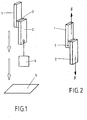
- the bond area is 2 cm 2 . It is a 1.5 mm thick aluminum plate (1) with a width of 2 cm with a polycarbonate (PC) plate (2) with a width of 2 cm and a layer thickness of 3 mm using a heat-activated adhesive film according to the invention ( 3) connected.
- PC polycarbonate
- a 200 ⁇ m thick heat-activatable film is laminated to the aluminum with the aid of a 95 ° C hot plate. Subsequently, the release film is peeled off.
- the heat activation is carried out with a 180 ° C hot stamping press at a pressure of 5 bar and 5 s Verpressdauer.
- Bonding resistance B (see FIGS. 2 and 3)
- the bond strength is determined by a dynamic shear test (cf. Fig. 2 ).
- the bond area is 2 cm 2 . It is a 1.5 mm thick Al plate (1) with a width of 2 cm with a PC plate (2) with a width of 2 cm and a layer thickness of 3 mm by means of a heat-activatable adhesive film (3) according to the invention.
- a 200 ⁇ m thick heat-activatable film is laminated to the aluminum with the aid of a 95 ° C hot plate. Subsequently, the release film is peeled off.
- the heat activation is carried out with a 180 ° C hot stamping press at a pressure of 5 bar and 5 s Verpressdauer.
- Measurements are taken immediately after compression and heat activation, with about 30 minutes to acclimatize to the respective temperature range.
- the heat-activatable film is used with a layer thickness of 200 microns for bonding an aluminum decor piece on a PC mobile phone housing.
- the bond area is approx. 4 cm 2 .
- a hot press with 180 ° C, 5 bar and 5 sec. Hardening time is used. After 24 hours, the mobile phone shell will be on after bonding - cooled down to 20 ° C. The specimens are then mutually twisted (twisted) at this temperature.
- Nipol N1094-80 nitrile rubber
- Breon N36 C80 nitrile rubber
- 40% by weight of phenol novolak resin Durez 33040 blended with 8 parts by weight % HMTA (Rohm and Haas) and 10% by weight of the phenolic resole resin 9610 LW from Bakelite were prepared as a 30% solution in methyl ethyl ketone in a kneader. The kneading time was 20 h.
- the heat-activatable adhesive was then spread from solution onto a glassine release paper and dried at 100 ° C for 10 minutes. After drying, the layer thickness was 100 ⁇ m. Two of these layers were then laminated together with a roll laminator at 100 ° C. Subsequently, the layer thickness was 200 microns.
- Reference Example 1 represents a heat-activatable film based on a high nitrile rubber. Acrylonitrile portion based (36 wt .-%).
- Reference Example 2 is based on a nitrile rubber having a low acrylonitrile content of 23% by weight. All examples were used under the same curing conditions for bonding aluminum to PC - an application that frequently occurs, for example, in the manufacture of mobile phones. After bonding, the samples were subjected to a drop test. The results are shown in Table 1. The respective drop height is given in cm. Table 1: Examples Test method A at RT Test method A at -20 ° C Reference 1 > 150 cm 8 cm Reference 2 > 150 cm 15 cm 3 > 150 cm 50 cm 4 > 150 cm 60 cm
- Table 1 shows that Inventive Examples 3 and 4 have a significantly better cold shock sensitivity at -20 ° C, which in turn is reflected in the higher drop height. At room temperature, however, the differences are very small and all examples have a high resistance to shock.
- Table 2 shows that, especially at low temperatures, the bond strength is highest for Examples 3 and 4 according to the invention. This illustrates that, in conjunction with the excellent low-temperature impact resistance, the examples according to the invention have a significantly better low-temperature behavior.
- Reference Example 1 At room temperature and + 50 ° C, Reference Example 1 has the highest values, since this example is based only on a nitrile rubber with a high acrylonitrile content and thus has the lowest flow behavior in the dynamic shear test. However, the differences are relatively small with respect to Examples 3 and 4 according to the invention and to Reference Example 2.
Landscapes
- Chemical & Material Sciences (AREA)
- Organic Chemistry (AREA)
- Chemical Kinetics & Catalysis (AREA)
- General Chemical & Material Sciences (AREA)
- Engineering & Computer Science (AREA)
- Mechanical Engineering (AREA)
- Adhesives Or Adhesive Processes (AREA)
- Adhesive Tapes (AREA)
- Materials For Medical Uses (AREA)
Applications Claiming Priority (2)
| Application Number | Priority Date | Filing Date | Title |
|---|---|---|---|
| DE102005025056A DE102005025056A1 (de) | 2005-05-30 | 2005-05-30 | Nitrilkautschuk-Blends zur Fixierung von Metallteilen auf Kunststoffen |
| PCT/EP2006/004973 WO2006128629A1 (de) | 2005-05-30 | 2006-05-24 | Klebstofffolie auf basis von nitrilkautschuk-blends zur fixierung von metallteilen auf kunststoffen |
Publications (2)
| Publication Number | Publication Date |
|---|---|
| EP1893709A1 EP1893709A1 (de) | 2008-03-05 |
| EP1893709B1 true EP1893709B1 (de) | 2012-10-10 |
Family
ID=36940752
Family Applications (1)
| Application Number | Title | Priority Date | Filing Date |
|---|---|---|---|
| EP06761934A Expired - Lifetime EP1893709B1 (de) | 2005-05-30 | 2006-05-24 | Klebstofffolie auf basis von nitrilkautschuk-blends zur fixierung von metallteilen auf kunststoffen |
Country Status (9)
| Country | Link |
|---|---|
| US (1) | US7569640B2 (enExample) |
| EP (1) | EP1893709B1 (enExample) |
| JP (1) | JP2008542483A (enExample) |
| KR (1) | KR20080015125A (enExample) |
| CN (1) | CN101184818B (enExample) |
| DE (1) | DE102005025056A1 (enExample) |
| MX (1) | MX2007014573A (enExample) |
| TW (1) | TW200700528A (enExample) |
| WO (1) | WO2006128629A1 (enExample) |
Families Citing this family (15)
| Publication number | Priority date | Publication date | Assignee | Title |
|---|---|---|---|---|
| DE102005035905A1 (de) * | 2005-07-28 | 2007-02-01 | Tesa Ag | Nitrilkautschuk Blends zur Fixierung von Metallteilen auf Kunststoffen |
| DE102006058935A1 (de) * | 2006-12-12 | 2008-02-28 | Tesa Ag | Verbundmittelkopf-Sicherungselement |
| US7934531B2 (en) * | 2008-04-18 | 2011-05-03 | Brady Worldwide, Inc. | Method and apparatus for applying heat activated transfer adhesives |
| DE102008031196A1 (de) * | 2008-07-03 | 2010-01-07 | Tesa Se | Hitze-aktivierbare Klebemassen zur Steigerung der Verbundfestigkeit zwischen Kunststoff und Metallen in Spritzgußbauteilen |
| DE102008053447A1 (de) * | 2008-09-11 | 2010-04-15 | Tesa Se | Klebemasse mit hohem Repulsionswiderstand |
| CN102215654A (zh) * | 2010-04-09 | 2011-10-12 | 许西岳 | 电子产品金属外壳与塑料件组合结构 |
| DE202012004946U1 (de) * | 2012-05-21 | 2013-08-26 | Tesa Se | Lichtabsorbierende hitzeaktivierbare Klebemasse und Klebeband enthaltend solche Klebemasse |
| CN103421435A (zh) * | 2012-05-21 | 2013-12-04 | 德莎欧洲公司 | 可吸收光的热活化胶粘剂及含有这种胶粘剂的胶带 |
| DE102012214401A1 (de) * | 2012-08-13 | 2014-02-13 | Tesa Se | Verfahren zur Herstellung eines Solarmoduls |
| DE102015217860A1 (de) * | 2015-05-05 | 2016-11-10 | Tesa Se | Klebeband mit Klebemasse mit kontinuierlicher Polymerphase |
| DE102015215247A1 (de) * | 2015-08-11 | 2017-02-16 | Tesa Se | Haftklebstoff auf Basis von Acrylnitril-Butadien-Kautschuken |
| JP6864471B2 (ja) * | 2016-12-26 | 2021-04-28 | マクセルホールディングス株式会社 | 熱接着テープおよび熱接着テープの製造方法 |
| DE102017221039B4 (de) * | 2017-11-24 | 2020-09-03 | Tesa Se | Verfahren zur Herstellung einer Haftklebemasse auf Basis von Acrylnitril-Butadien-Kautschuk |
| DE102022100562A1 (de) | 2022-01-11 | 2023-07-13 | Tesa Se | Poly(meth)acrylat-basierte Haftklebemassen enthaltend mindestens einen Acrylnitril-Butadien-Kautschuk |
| DE102024121360A1 (de) | 2024-07-26 | 2026-01-29 | Tesa Se | Haftklebmasse |
Citations (1)
| Publication number | Priority date | Publication date | Assignee | Title |
|---|---|---|---|---|
| WO2001094493A2 (en) * | 2000-06-06 | 2001-12-13 | The Dow Global Technologies Inc | Epoxy based reinforcing patches with improved adhesion to oily metal surfaces |
Family Cites Families (13)
| Publication number | Priority date | Publication date | Assignee | Title |
|---|---|---|---|---|
| GB8510392D0 (en) | 1985-04-24 | 1985-05-30 | British Petroleum Co Plc | Production of thermoplastic elastomer composition |
| JPS6357686A (ja) * | 1986-08-29 | 1988-03-12 | Yokohama Rubber Co Ltd:The | 熱硬化性粘着接着テ−プ |
| JPH01132672A (ja) * | 1987-11-17 | 1989-05-25 | Saiden Kagaku Kk | 感熱性接着剤組成物 |
| US5277972B1 (en) | 1988-09-29 | 1996-11-05 | Tomoegawa Paper Co Ltd | Adhesive tapes |
| JPH06248056A (ja) * | 1993-03-01 | 1994-09-06 | Nissan Chem Ind Ltd | エポキシ樹脂組成物 |
| JPH09236903A (ja) * | 1996-03-01 | 1997-09-09 | Kimoto & Co Ltd | 遮光性マスキングフィルム |
| US6054509A (en) * | 1997-08-28 | 2000-04-25 | Shin-Etsu Chemical Co., Ltd. | Adhesive of epoxy resin, nitrile rubbers and curing agent |
| JP3504500B2 (ja) * | 1997-08-28 | 2004-03-08 | 信越化学工業株式会社 | 熱硬化性接着剤及びそれを用いたフレキシブル印刷配線板材料 |
| DE10258961A1 (de) * | 2002-12-16 | 2004-07-15 | Tesa Ag | Elektrisch leitfähige, hitzeaktivierbare und thermovernetzende Klebstofffolie |
| WO2004094550A1 (en) | 2003-04-10 | 2004-11-04 | 3M Innovative Properties Company | Heat-activatable adhesive |
| DE10361541A1 (de) | 2003-12-23 | 2005-07-28 | Tesa Ag | Klebfolie zur Implantierung von elektrischen Modulen in einen Kartenkörper |
| DE102005026191A1 (de) * | 2005-06-06 | 2006-12-07 | Tesa Ag | Hitze-aktivierbare Folien zur Fixierung von Metallteilen auf Kunststoffen |
| DE102005035905A1 (de) * | 2005-07-28 | 2007-02-01 | Tesa Ag | Nitrilkautschuk Blends zur Fixierung von Metallteilen auf Kunststoffen |
-
2005
- 2005-05-30 DE DE102005025056A patent/DE102005025056A1/de not_active Withdrawn
- 2005-12-29 US US11/321,325 patent/US7569640B2/en not_active Expired - Fee Related
-
2006
- 2006-05-24 CN CN2006800188781A patent/CN101184818B/zh not_active Expired - Fee Related
- 2006-05-24 JP JP2008513982A patent/JP2008542483A/ja active Pending
- 2006-05-24 MX MX2007014573A patent/MX2007014573A/es unknown
- 2006-05-24 TW TW095118434A patent/TW200700528A/zh unknown
- 2006-05-24 KR KR1020077030124A patent/KR20080015125A/ko not_active Abandoned
- 2006-05-24 WO PCT/EP2006/004973 patent/WO2006128629A1/de not_active Ceased
- 2006-05-24 EP EP06761934A patent/EP1893709B1/de not_active Expired - Lifetime
Patent Citations (1)
| Publication number | Priority date | Publication date | Assignee | Title |
|---|---|---|---|---|
| WO2001094493A2 (en) * | 2000-06-06 | 2001-12-13 | The Dow Global Technologies Inc | Epoxy based reinforcing patches with improved adhesion to oily metal surfaces |
Non-Patent Citations (1)
| Title |
|---|
| RUDOF RIESEN ET AL: "Die Glasübergangtemperatur gemessen mit verschiedenen TA-Techniken, Teil 2: Ermittlung der Glasübergangstemperaturen", INTERNET CITATION, 1 February 2003 (2003-02-01), pages 1 - 20, XP002594785, Retrieved from the Internet <URL:http://de.mt.com/global/de/home/supportive_content/usercom/TA_UserCom 18.z2vUzxjPy0vKAxrVCMLHBfbHCI45nZa0nG--.MediaFileComponent.html/tause rc18d.pdf> [retrieved on 20100802] * |
Also Published As
| Publication number | Publication date |
|---|---|
| US20060269743A1 (en) | 2006-11-30 |
| WO2006128629A1 (de) | 2006-12-07 |
| JP2008542483A (ja) | 2008-11-27 |
| TW200700528A (en) | 2007-01-01 |
| EP1893709A1 (de) | 2008-03-05 |
| CN101184818B (zh) | 2012-12-26 |
| CN101184818A (zh) | 2008-05-21 |
| US7569640B2 (en) | 2009-08-04 |
| DE102005025056A1 (de) | 2006-12-07 |
| MX2007014573A (es) | 2008-02-05 |
| KR20080015125A (ko) | 2008-02-18 |
Similar Documents
| Publication | Publication Date | Title |
|---|---|---|
| EP2087056B1 (de) | Hitze-aktiviert verklebbares flächenelement | |
| EP1893708B1 (de) | Hitze-aktivierbare folien zur fixierung von metallteilen auf kunststoffen | |
| EP2293916B1 (de) | Hitze-aktivierbare klebemassen zur steigerung der verbundfestigkeit zwischen kunststoff und metallen in spritzgussbauteilen | |
| EP1658345B1 (de) | Zumindest zweischichtige klebstofffolie | |
| EP1893709A1 (de) | Klebstofffolie auf basis von nitrilkautschuk-blends zur fixierung von metallteilen auf kunststoffen | |
| DE202012004946U1 (de) | Lichtabsorbierende hitzeaktivierbare Klebemasse und Klebeband enthaltend solche Klebemasse | |
| EP2285926A1 (de) | Verstreckte thermoplaste zur verklebung von metallteilen auf kunststoffen, gläsern und metallen und verfahren zu ihrer herstellung | |
| EP1913107A1 (de) | Klebstofffolie auf basis von nitrilkautschuk-blends zur fixierung von metallteilen auf kunststoffen | |
| DE102007063020A1 (de) | Verfahren zur Herstellung eines Antennensystems | |
| WO2005063909A1 (de) | Klebfolie zur implantierung von elektrischen modulen in einen kartenkörper | |
| WO2010028950A1 (de) | Verfahren zur verklebung zweier konststoffoberflächen |
Legal Events
| Date | Code | Title | Description |
|---|---|---|---|
| PUAI | Public reference made under article 153(3) epc to a published international application that has entered the european phase |
Free format text: ORIGINAL CODE: 0009012 |
|
| 17P | Request for examination filed |
Effective date: 20080102 |
|
| AK | Designated contracting states |
Kind code of ref document: A1 Designated state(s): AT BE BG CH CY CZ DE DK EE ES FI FR GB GR HU IE IS IT LI LT LU LV MC NL PL PT RO SE SI SK TR |
|
| DAX | Request for extension of the european patent (deleted) | ||
| 17Q | First examination report despatched |
Effective date: 20090216 |
|
| RAP1 | Party data changed (applicant data changed or rights of an application transferred) |
Owner name: TESA SE |
|
| GRAP | Despatch of communication of intention to grant a patent |
Free format text: ORIGINAL CODE: EPIDOSNIGR1 |
|
| RIC1 | Information provided on ipc code assigned before grant |
Ipc: C09J 7/00 20060101AFI20120425BHEP Ipc: B29K 305/02 20060101ALI20120425BHEP Ipc: C09J 7/02 20060101ALI20120425BHEP Ipc: B29K 105/00 20060101ALI20120425BHEP Ipc: C09J 109/02 20060101ALI20120425BHEP Ipc: B29K 305/12 20060101ALI20120425BHEP Ipc: C08L 9/02 20060101ALI20120425BHEP |
|
| GRAS | Grant fee paid |
Free format text: ORIGINAL CODE: EPIDOSNIGR3 |
|
| GRAA | (expected) grant |
Free format text: ORIGINAL CODE: 0009210 |
|
| RIN1 | Information on inventor provided before grant (corrected) |
Inventor name: HANNEMANN, FRANK Inventor name: KOOP, MATTHIAS Inventor name: HUSEMANN, MARC |
|
| AK | Designated contracting states |
Kind code of ref document: B1 Designated state(s): AT BE BG CH CY CZ DE DK EE ES FI FR GB GR HU IE IS IT LI LT LU LV MC NL PL PT RO SE SI SK TR |
|
| REG | Reference to a national code |
Ref country code: GB Ref legal event code: FG4D Free format text: NOT ENGLISH |
|
| REG | Reference to a national code |
Ref country code: CH Ref legal event code: EP Ref country code: AT Ref legal event code: REF Ref document number: 578969 Country of ref document: AT Kind code of ref document: T Effective date: 20121015 |
|
| REG | Reference to a national code |
Ref country code: IE Ref legal event code: FG4D Free format text: LANGUAGE OF EP DOCUMENT: GERMAN |
|
| REG | Reference to a national code |
Ref country code: DE Ref legal event code: R096 Ref document number: 502006012083 Country of ref document: DE Effective date: 20121213 |
|
| PG25 | Lapsed in a contracting state [announced via postgrant information from national office to epo] |
Ref country code: SI Free format text: LAPSE BECAUSE OF FAILURE TO SUBMIT A TRANSLATION OF THE DESCRIPTION OR TO PAY THE FEE WITHIN THE PRESCRIBED TIME-LIMIT Effective date: 20121010 |
|
| REG | Reference to a national code |
Ref country code: NL Ref legal event code: VDEP Effective date: 20121010 |
|
| REG | Reference to a national code |
Ref country code: LT Ref legal event code: MG4D |
|
| PG25 | Lapsed in a contracting state [announced via postgrant information from national office to epo] |
Ref country code: IS Free format text: LAPSE BECAUSE OF FAILURE TO SUBMIT A TRANSLATION OF THE DESCRIPTION OR TO PAY THE FEE WITHIN THE PRESCRIBED TIME-LIMIT Effective date: 20130210 Ref country code: LT Free format text: LAPSE BECAUSE OF FAILURE TO SUBMIT A TRANSLATION OF THE DESCRIPTION OR TO PAY THE FEE WITHIN THE PRESCRIBED TIME-LIMIT Effective date: 20121010 Ref country code: FI Free format text: LAPSE BECAUSE OF FAILURE TO SUBMIT A TRANSLATION OF THE DESCRIPTION OR TO PAY THE FEE WITHIN THE PRESCRIBED TIME-LIMIT Effective date: 20121010 Ref country code: SE Free format text: LAPSE BECAUSE OF FAILURE TO SUBMIT A TRANSLATION OF THE DESCRIPTION OR TO PAY THE FEE WITHIN THE PRESCRIBED TIME-LIMIT Effective date: 20121010 Ref country code: NL Free format text: LAPSE BECAUSE OF FAILURE TO SUBMIT A TRANSLATION OF THE DESCRIPTION OR TO PAY THE FEE WITHIN THE PRESCRIBED TIME-LIMIT Effective date: 20121010 Ref country code: ES Free format text: LAPSE BECAUSE OF FAILURE TO SUBMIT A TRANSLATION OF THE DESCRIPTION OR TO PAY THE FEE WITHIN THE PRESCRIBED TIME-LIMIT Effective date: 20130121 |
|
| PG25 | Lapsed in a contracting state [announced via postgrant information from national office to epo] |
Ref country code: PL Free format text: LAPSE BECAUSE OF FAILURE TO SUBMIT A TRANSLATION OF THE DESCRIPTION OR TO PAY THE FEE WITHIN THE PRESCRIBED TIME-LIMIT Effective date: 20121010 Ref country code: CY Free format text: LAPSE BECAUSE OF FAILURE TO SUBMIT A TRANSLATION OF THE DESCRIPTION OR TO PAY THE FEE WITHIN THE PRESCRIBED TIME-LIMIT Effective date: 20121010 Ref country code: PT Free format text: LAPSE BECAUSE OF FAILURE TO SUBMIT A TRANSLATION OF THE DESCRIPTION OR TO PAY THE FEE WITHIN THE PRESCRIBED TIME-LIMIT Effective date: 20130211 Ref country code: GR Free format text: LAPSE BECAUSE OF FAILURE TO SUBMIT A TRANSLATION OF THE DESCRIPTION OR TO PAY THE FEE WITHIN THE PRESCRIBED TIME-LIMIT Effective date: 20130111 Ref country code: LV Free format text: LAPSE BECAUSE OF FAILURE TO SUBMIT A TRANSLATION OF THE DESCRIPTION OR TO PAY THE FEE WITHIN THE PRESCRIBED TIME-LIMIT Effective date: 20121010 |
|
| PG25 | Lapsed in a contracting state [announced via postgrant information from national office to epo] |
Ref country code: SK Free format text: LAPSE BECAUSE OF FAILURE TO SUBMIT A TRANSLATION OF THE DESCRIPTION OR TO PAY THE FEE WITHIN THE PRESCRIBED TIME-LIMIT Effective date: 20121010 Ref country code: EE Free format text: LAPSE BECAUSE OF FAILURE TO SUBMIT A TRANSLATION OF THE DESCRIPTION OR TO PAY THE FEE WITHIN THE PRESCRIBED TIME-LIMIT Effective date: 20121010 Ref country code: DK Free format text: LAPSE BECAUSE OF FAILURE TO SUBMIT A TRANSLATION OF THE DESCRIPTION OR TO PAY THE FEE WITHIN THE PRESCRIBED TIME-LIMIT Effective date: 20121010 Ref country code: CZ Free format text: LAPSE BECAUSE OF FAILURE TO SUBMIT A TRANSLATION OF THE DESCRIPTION OR TO PAY THE FEE WITHIN THE PRESCRIBED TIME-LIMIT Effective date: 20121010 Ref country code: BG Free format text: LAPSE BECAUSE OF FAILURE TO SUBMIT A TRANSLATION OF THE DESCRIPTION OR TO PAY THE FEE WITHIN THE PRESCRIBED TIME-LIMIT Effective date: 20130110 |
|
| PLBE | No opposition filed within time limit |
Free format text: ORIGINAL CODE: 0009261 |
|
| STAA | Information on the status of an ep patent application or granted ep patent |
Free format text: STATUS: NO OPPOSITION FILED WITHIN TIME LIMIT |
|
| PG25 | Lapsed in a contracting state [announced via postgrant information from national office to epo] |
Ref country code: RO Free format text: LAPSE BECAUSE OF FAILURE TO SUBMIT A TRANSLATION OF THE DESCRIPTION OR TO PAY THE FEE WITHIN THE PRESCRIBED TIME-LIMIT Effective date: 20121010 Ref country code: IT Free format text: LAPSE BECAUSE OF FAILURE TO SUBMIT A TRANSLATION OF THE DESCRIPTION OR TO PAY THE FEE WITHIN THE PRESCRIBED TIME-LIMIT Effective date: 20121010 |
|
| 26N | No opposition filed |
Effective date: 20130711 |
|
| REG | Reference to a national code |
Ref country code: DE Ref legal event code: R097 Ref document number: 502006012083 Country of ref document: DE Effective date: 20130711 |
|
| BERE | Be: lapsed |
Owner name: TESA SE Effective date: 20130531 |
|
| PG25 | Lapsed in a contracting state [announced via postgrant information from national office to epo] |
Ref country code: MC Free format text: LAPSE BECAUSE OF FAILURE TO SUBMIT A TRANSLATION OF THE DESCRIPTION OR TO PAY THE FEE WITHIN THE PRESCRIBED TIME-LIMIT Effective date: 20121010 |
|
| REG | Reference to a national code |
Ref country code: CH Ref legal event code: PL |
|
| GBPC | Gb: european patent ceased through non-payment of renewal fee |
Effective date: 20130524 |
|
| PG25 | Lapsed in a contracting state [announced via postgrant information from national office to epo] |
Ref country code: CH Free format text: LAPSE BECAUSE OF NON-PAYMENT OF DUE FEES Effective date: 20130531 Ref country code: DE Free format text: LAPSE BECAUSE OF NON-PAYMENT OF DUE FEES Effective date: 20131203 Ref country code: LI Free format text: LAPSE BECAUSE OF NON-PAYMENT OF DUE FEES Effective date: 20130531 |
|
| REG | Reference to a national code |
Ref country code: IE Ref legal event code: MM4A |
|
| PG25 | Lapsed in a contracting state [announced via postgrant information from national office to epo] |
Ref country code: BE Free format text: LAPSE BECAUSE OF NON-PAYMENT OF DUE FEES Effective date: 20130531 |
|
| REG | Reference to a national code |
Ref country code: FR Ref legal event code: ST Effective date: 20140131 |
|
| REG | Reference to a national code |
Ref country code: DE Ref legal event code: R119 Ref document number: 502006012083 Country of ref document: DE Effective date: 20131203 |
|
| PG25 | Lapsed in a contracting state [announced via postgrant information from national office to epo] |
Ref country code: GB Free format text: LAPSE BECAUSE OF NON-PAYMENT OF DUE FEES Effective date: 20130524 Ref country code: IE Free format text: LAPSE BECAUSE OF NON-PAYMENT OF DUE FEES Effective date: 20130524 |
|
| PG25 | Lapsed in a contracting state [announced via postgrant information from national office to epo] |
Ref country code: FR Free format text: LAPSE BECAUSE OF NON-PAYMENT OF DUE FEES Effective date: 20130531 |
|
| REG | Reference to a national code |
Ref country code: AT Ref legal event code: MM01 Ref document number: 578969 Country of ref document: AT Kind code of ref document: T Effective date: 20130524 |
|
| PG25 | Lapsed in a contracting state [announced via postgrant information from national office to epo] |
Ref country code: AT Free format text: LAPSE BECAUSE OF NON-PAYMENT OF DUE FEES Effective date: 20130524 |
|
| PG25 | Lapsed in a contracting state [announced via postgrant information from national office to epo] |
Ref country code: TR Free format text: LAPSE BECAUSE OF FAILURE TO SUBMIT A TRANSLATION OF THE DESCRIPTION OR TO PAY THE FEE WITHIN THE PRESCRIBED TIME-LIMIT Effective date: 20121010 |
|
| PG25 | Lapsed in a contracting state [announced via postgrant information from national office to epo] |
Ref country code: LU Free format text: LAPSE BECAUSE OF NON-PAYMENT OF DUE FEES Effective date: 20130524 Ref country code: HU Free format text: LAPSE BECAUSE OF FAILURE TO SUBMIT A TRANSLATION OF THE DESCRIPTION OR TO PAY THE FEE WITHIN THE PRESCRIBED TIME-LIMIT; INVALID AB INITIO Effective date: 20060524 |