EP1888902B1 - Modulare dichtung - Google Patents
Modulare dichtung Download PDFInfo
- Publication number
- EP1888902B1 EP1888902B1 EP06771245A EP06771245A EP1888902B1 EP 1888902 B1 EP1888902 B1 EP 1888902B1 EP 06771245 A EP06771245 A EP 06771245A EP 06771245 A EP06771245 A EP 06771245A EP 1888902 B1 EP1888902 B1 EP 1888902B1
- Authority
- EP
- European Patent Office
- Prior art keywords
- carrier
- sealing element
- opening
- gasket
- set forth
- Prior art date
- Legal status (The legal status is an assumption and is not a legal conclusion. Google has not performed a legal analysis and makes no representation as to the accuracy of the status listed.)
- Not-in-force
Links
- 238000007789 sealing Methods 0.000 claims description 89
- 238000000034 method Methods 0.000 claims description 24
- 230000014759 maintenance of location Effects 0.000 claims description 13
- 238000003825 pressing Methods 0.000 claims description 5
- 239000012530 fluid Substances 0.000 claims description 3
- 238000009941 weaving Methods 0.000 claims description 3
- 238000012544 monitoring process Methods 0.000 claims description 2
- 238000004064 recycling Methods 0.000 claims description 2
- 238000005452 bending Methods 0.000 claims 1
- 238000004519 manufacturing process Methods 0.000 description 15
- 238000002485 combustion reaction Methods 0.000 description 9
- 230000001788 irregular Effects 0.000 description 8
- 239000000463 material Substances 0.000 description 8
- 239000011295 pitch Substances 0.000 description 6
- 238000010276 construction Methods 0.000 description 5
- 238000013461 design Methods 0.000 description 5
- 230000003068 static effect Effects 0.000 description 5
- 239000002826 coolant Substances 0.000 description 4
- 230000008569 process Effects 0.000 description 4
- 230000000712 assembly Effects 0.000 description 3
- 238000000429 assembly Methods 0.000 description 3
- 230000006835 compression Effects 0.000 description 3
- 238000007906 compression Methods 0.000 description 3
- 239000004744 fabric Substances 0.000 description 3
- 238000009434 installation Methods 0.000 description 3
- 239000007788 liquid Substances 0.000 description 3
- 238000012356 Product development Methods 0.000 description 2
- 239000000853 adhesive Substances 0.000 description 2
- 230000001070 adhesive effect Effects 0.000 description 2
- 230000008901 benefit Effects 0.000 description 2
- 239000000969 carrier Substances 0.000 description 2
- 230000008859 change Effects 0.000 description 2
- 239000012141 concentrate Substances 0.000 description 2
- 238000001816 cooling Methods 0.000 description 2
- 238000009826 distribution Methods 0.000 description 2
- 230000000694 effects Effects 0.000 description 2
- 238000003780 insertion Methods 0.000 description 2
- 230000037431 insertion Effects 0.000 description 2
- 239000002184 metal Substances 0.000 description 2
- 239000000203 mixture Substances 0.000 description 2
- 230000002093 peripheral effect Effects 0.000 description 2
- 238000012546 transfer Methods 0.000 description 2
- 230000015572 biosynthetic process Effects 0.000 description 1
- 238000005219 brazing Methods 0.000 description 1
- 150000001875 compounds Chemical class 0.000 description 1
- 238000005260 corrosion Methods 0.000 description 1
- 230000007797 corrosion Effects 0.000 description 1
- 238000013480 data collection Methods 0.000 description 1
- 239000000835 fiber Substances 0.000 description 1
- 238000005304 joining Methods 0.000 description 1
- 238000012986 modification Methods 0.000 description 1
- 230000004048 modification Effects 0.000 description 1
- 238000002360 preparation method Methods 0.000 description 1
- 230000004044 response Effects 0.000 description 1
- 239000007787 solid Substances 0.000 description 1
- 238000012360 testing method Methods 0.000 description 1
- 229920001169 thermoplastic Polymers 0.000 description 1
- 229920001187 thermosetting polymer Polymers 0.000 description 1
- 239000004416 thermosoftening plastic Substances 0.000 description 1
- XLYOFNOQVPJJNP-UHFFFAOYSA-N water Substances O XLYOFNOQVPJJNP-UHFFFAOYSA-N 0.000 description 1
Images


Classifications
-
- F—MECHANICAL ENGINEERING; LIGHTING; HEATING; WEAPONS; BLASTING
- F16—ENGINEERING ELEMENTS AND UNITS; GENERAL MEASURES FOR PRODUCING AND MAINTAINING EFFECTIVE FUNCTIONING OF MACHINES OR INSTALLATIONS; THERMAL INSULATION IN GENERAL
- F16J—PISTONS; CYLINDERS; SEALINGS
- F16J15/00—Sealings
- F16J15/02—Sealings between relatively-stationary surfaces
- F16J15/06—Sealings between relatively-stationary surfaces with solid packing compressed between sealing surfaces
- F16J15/10—Sealings between relatively-stationary surfaces with solid packing compressed between sealing surfaces with non-metallic packing
- F16J15/12—Sealings between relatively-stationary surfaces with solid packing compressed between sealing surfaces with non-metallic packing with metal reinforcement or covering
- F16J15/121—Sealings between relatively-stationary surfaces with solid packing compressed between sealing surfaces with non-metallic packing with metal reinforcement or covering with metal reinforcement
- F16J15/126—Sealings between relatively-stationary surfaces with solid packing compressed between sealing surfaces with non-metallic packing with metal reinforcement or covering with metal reinforcement consisting of additions, e.g. metallic fibres, metallic powders, randomly dispersed in the packing
-
- F—MECHANICAL ENGINEERING; LIGHTING; HEATING; WEAPONS; BLASTING
- F02—COMBUSTION ENGINES; HOT-GAS OR COMBUSTION-PRODUCT ENGINE PLANTS
- F02F—CYLINDERS, PISTONS OR CASINGS, FOR COMBUSTION ENGINES; ARRANGEMENTS OF SEALINGS IN COMBUSTION ENGINES
- F02F11/00—Arrangements of sealings in combustion engines
-
- F—MECHANICAL ENGINEERING; LIGHTING; HEATING; WEAPONS; BLASTING
- F16—ENGINEERING ELEMENTS AND UNITS; GENERAL MEASURES FOR PRODUCING AND MAINTAINING EFFECTIVE FUNCTIONING OF MACHINES OR INSTALLATIONS; THERMAL INSULATION IN GENERAL
- F16J—PISTONS; CYLINDERS; SEALINGS
- F16J15/00—Sealings
- F16J15/02—Sealings between relatively-stationary surfaces
- F16J15/06—Sealings between relatively-stationary surfaces with solid packing compressed between sealing surfaces
- F16J15/08—Sealings between relatively-stationary surfaces with solid packing compressed between sealing surfaces with exclusively metal packing
Definitions
- the invention relates generally to static gaskets of the type for perfecting a gas or liquid seal between two opposing surfaces, and more particularly toward a modular gasket assembly which is readily adaptable from one application configuration to the next or from one design revision to the next in a product development sequence.
- Static gasket assemblies are used when any two opposing surfaces must be brought together with a liquid or gas tight seal.
- gasket assemblies are used in many locations, including between the cylinder head and cylinder block.
- Specialized sealing elements of the cylinder head gasket surround the combustion chambers, and other specialized sealing elements are disposed around oil flow passages, coolant flow passages, and the like.
- Other gasket applications for engines such as intake manifolds, exhaust manifolds, water pumps and oil pans, also require specialized sealing elements configured to meet the intended application.
- a gasket assembly typically includes a sheet-like gasket body, or carrier, made of resilient metal, rubber-fiber, or other suitable material.
- the carrier functions primarily as a supporting element for holding various sealing elements in precise locations aligned with features in the surfaces to be sealed.
- the carrier may also include holes or notches for fasteners or locating pins.
- the invention relates to a static gasket assembly adapted for compressed disposition between two opposing surfaces is provided for perfecting a seal on at least one of the two opposing surfaces.
- the gasket assembly comprises a sheet-like carrier having at least one opening formed therein.
- a sealing element comprising an article of manufacture which is formed separately from the carrier is operatively disposed in the opening of the carrier.
- the carrier comprises a fabric-like web construction in which the opening of the sealing element can be placed at any location within the carrier thereby enabling the gasket assembly to be readily adapted from one application configuration to the next.
- the sealing element is formed as a modular item which can be located at any position within the body of the carrier by simply forming a opening in the carrier and inserting the sealing element into the opening.
- the only machine set-up required to change from one gasket type to the next may be a location and/or size change of punch dies in a stamping press.
- the invention also relates to a static gasket assembly of the type adapted for compressed disposition between two opposing surfaces for perfecting a seal on at least one of the two opposing surfaces.
- the gasket assembly comprises a sheet-like carrier having at least one opening formed therein for aligning with a feature on one of the two opposing surfaces.
- the carrier comprises a fabric-like web construction.
- a sealing element comprising an article of manufacture formed separately from the carrier is operatively engaged in the opening of the carrier.
- a releasable retention feature is provided for automatically disconnecting the sealing element from the opening in response to a disconnection force after the sealing element has been located on one of the opposing surfaces thereby allowing removal of the carrier for reuse or recycling while the sealing element remains behind to perfect a seal between the opposing surfaces.
- the carrier can be removed and discarded. This has the added effect of reducing the loaded area between the opposing surfaces, leaving only the sealing component to carry the compression loads. Thus, less load is required to create a satisfactory seal because the compression loads are concentrated specifically through the sealing element.
- a method according to claim 1 comprises the steps of forming a grid-like carrier of intersecting strands in a regular or irregular repeating geometrical pattern, forming an opening in the carrier having a size greater than the size of the repeating geometrical pattern, forming a sealing element with a retention feature supported on its periphery, pressing the sealing element into the opening in the carrier until the carrier strands engage the retention feature.
- the sealing element is operatively engaged in the opening in the carrier by a simple pressing operation, with the carrier strands automatically locking the sealing element into position as they engage within the groove around the sealing element. Because the opening in the carrier is sized greater than that of the repeating geometrical pattern, it is assured that at least a plurality of carrier strands are presented with which to interact with the groove in the sealing element.
- Figure 1 is a perspective view of a carrier according to the subject invention prior to the formation of an opening therein;
- Figure 2 is a view as in Figure 1 , however, a plurality of openings have been formed in the carrier;
- Figure 3 is a perspective view as in Figure 2 , and showing various sealing elements ready for installation in respective openings in the carrier;
- Figure 4 is a simplified perspective view showing an assembled gasket according to the invention positioned over a surface to be sealed, with each of the sealing elements aligned over respective features on the surface to be sealed;
- Figure 5 is a perspective view as in Figure 4 yet showing a further progression in the process where the carrier is removed yet the sealing elements remain aligned over their respective features on the surface to be sealed and in preparation to be compressed by an opposing surface;
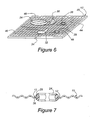
- Figure 6 is a perspective view of an alternative embodiment of the gasket assembly which is intended to remain permanently affixed between the two opposing surfaces to be sealed;
- Figure 7 is a simplified fragmentary cross-sectional view of a sealing element operatively positioned in an opening in the carrier.
- a sheet-like carrier for a static gasket assembly is generally indicated at 10 in Figure 1 .
- the carrier 10 is formed as a fabric-like web construction.
- This web can be made from a polymeric material, such as a thermoplastic or thermoset polymer, or can be made from discrete strands of metal, or from other suitable compositions including cellulous and rubber-like products.
- the cross-section of each strand can be any shape, including the exemplary round style shown in the figures.
- a mesh is preferably formed by these strands as they overlap in a regular or irregular repeating geometrical pattern.
- a regular repeating geometrical pattern takes the form of squares or rectangles, and the distance between adjacent strands in any given set of parallel strands is referred to as the strand pitch.
- the repeating geometric pattern need not be rectilinear. Nor is it necessary that the repeating pattern be composed of exclusively one shape, in which case the pattern will be of an irregular variety.
- the regular repeating geometrical pattern can be any advantageous shape or shapes. In some applications, it may even be desirable to vary the pitch in certain regions of the carrier 10, such as for the purpose of achieving optimal load distributions, and here again resulting in an irregular repeating pattern with each pattern sized differently.
- Figure 2 shows a further progression in the manufacturing operation from that shown in Figure 1 , wherein a plurality of openings have been formed into the fabric of the carrier at strategic locations intended to align with passages or other features on one or both of the opposing surfaces to be sealed.
- the openings may be of any dimensional size and shape, provided that each opening severs at least one strand thereby leaving a plurality of cantilever stems 12 formed by the severed strands (see Figure 7 ).
- a large opening 14 may be of generally circular configuration and adapted for alignment over the combustion chamber of an internal combustion engine block.
- a pair of flanking openings 16, 18 may be of non-circular geometry and aligned over, perhaps, a coolant flow passage or other feature.
- Outlying openings 20, 22 provide additional examples of opening placement, size and application.
- At least one, and preferably several, sealing elements are separately formed as articles of manufacture from a material or materials suitable for the intended sealing application.
- a sealing element for the combustion chamber must be rated for extremely high temperatures and pressures, and configured to withstand high compressive loads.
- the sealing element for the coolant passages in the same gasket can be rated for much lower temperatures and pressures, but with higher regard for corrosion resistance.
- the configuration and material composition of a sealing element will be varied to correspond with an intended application and environment.
- the plurality of sealing elements are shown aligned over their respective openings in the carrier 10.
- a combustion sealing element 24 is aligned over the large opening 14 and has a generally circular construction.
- the combustion sealing element 24 has a general thickness which is greater than the general thickness of the carrier 10, and as shown may even be several times thicker than the carrier 10.
- a retention feature is provided about the periphery of the combustion sealing element 24 for interacting with the cantilevered stems 12 projecting into the opening 24 in the carrier 10.
- the retention feature can of course take many forms, such as a raised lip or catches, but is here shown for simplicity comprising a simple groove 26 in the general plane of the carrier 10 and extending at least partly about the periphery of the sealing element 24.
- the outer diameter of the groove 26, at its root, may be sized to correspond closely to the internal diameter of the opening 14 so that the tips of the cantilever stems 12 remain in pressing contact to hold the sealing element 24 in a secure condition.
- the sealing element 24 may be provided with a chamfered leading edge 28 which both centers the sealing element 24 in the opening 14 during the insertion process, and also uniformly deflects the cantilever stems 12 with wedge-like efficiency.
- the groove 26 is shown in the figures with a generally trough-like configuration, other geometries including non-symmetrical variations are possible.
- the retention feature also includes a release surface which enables the sealing element to be removed from the carrier 10.
- the enabling feature comprises the rounded bottom of the groove 26 against which the cantilever stems 12 can bend and smoothly ride.
- additional sealing elements are shown including an irregularly shaped sealing element 30 adapted for insertion into the opening 16.
- This irregular sealing element 30 may be positioned and configured to perfect a fluid tight seal around a cooling flow passage, around an oil flow passage, around a push rod, or any other feature.
- the sealing element 32 represents a device intended to accomplish a particular function.
- the device-type sealing element 32 may comprise a monitor for measuring temperature, pressure, stress, or other operating conditions.
- An electrical lead 34 may be required for transmitting information regarding the sensed condition to an appropriate data collection device.
- the device-type sealing element 32 may be of the type for controlling a feature or condition.
- such a device-type sealing element 32 may include a valve which selectively restricts or diverts flow of a liquid or gas between the two opposing surfaces to be sealed. For instance, a valve in the coolant flow passage could function like a thermostat.
- the device-type sealing element 32 may respond to vibrations and exert a variable dampening effect to attenuate objectionable vibrations. Other control functions are of course possible.
- the device-type sealing element 32 may be of the load distribution type whose primary or incidental function is to strategically spread and/or concentrate loads between the opposing surfaces to be sealed. In this condition, a device-type sealing element 32 may be resilient with spring-like qualities, or may be of a solid, substantially incompressible nature. In either case, the proper use of such a load distributing sealing element 32 can be effective to complete the sealing requirements and also to control noise, vibration and harshness issues in the system.
- the irregular sealing element 30, the device-type sealing element 32, as well as the additional, exemplary sealing devices 36, 38 are provided with retention features similar to that of the groove 26 described in combination with the sealing element 24, as well as may be provided with similar chamfered edges 28 or other configurations to facilitate a push connection with the carrier 10.
- Figure 4 illustrates a fully assembled gasket assembly according to the invention positioned over a surface to be sealed 40.
- the carrier 10 can be removed as shown in Figure 5 . This is accomplished by holding each of the sealing elements 24, 30, 32, 36, and 38 in position upon the surface to be sealed 40, while the carrier 10 is lifted or otherwise pealed away.
- the sealing elements can be held in position in any number of ways. For examples, the sealing elements can be held in position by pressure applied from above, they can be held in position by gripping devices from below, they can be held by a specially applied adhesive or by a multipurpose compound with adhesive qualities, by an interlocking engagement with the features in the surface to be sealed 40, or the like.
- the step of removing the carrier 10 causes the cantilever stems 12 to deflect out of engagement with the respective grooves 26.
- the carrier 10 can then be reused or recycled, or otherwise discarded.
- Bolt holes 42 are formed in the surface to be sealed 40, and are exemplary as a part of the fastening system between the opposing surfaces with which compressive loads can be established and maintained.
- the carrier 10' is not removed from the surface to be sealed 40.
- the carrier 10' includes an elastomeric edge banding 44 disposed about its periphery for establishing a seal between the two opposing surfaces.
- untrimmed openings 46 which align with the bolt holes 42 to provide clear passage for bolts or other fastening elements.
- the elastomeric seal 44 is particularly effective in situations where it may be necessary to prevent the egress of foreign material into the space between adjoining surfaces, e.g., between a cylinder head and a cylinder block.
- a peripheral seal 44 may not be necessary in other applications such as in exhaust manifold gaskets for an internal combustion engine.
- the carrier 10, 10' may be specifically designed to help distribute the compressive loads. Because the carrier 10, 10' is formed of a fabric mesh, its resultant surface area is less than that of a traditional full-bodied carrier and lower clamping forces may be needed to achieve the same attributes.
- the method for forming an assembled gasket of the type for perfecting a seal upon at least one of the two opposing surfaces is shown in sequence.
- the method comprises the steps of first forming a grid-like carrier 10, 10' of intersecting strands in a regular or irregular repeating geometrical pattern.
- a regular or irregular repeating geometrical pattern it is not necessary that every pattern thus formed be of identical size and shape, as some applications may require varied pitch spacing from one strand to the next.
- an opening 14-22 is formed in the carrier 10, 10' having a size greater than the size of the repeating geometrical pattern.
- a sealing element 24, 30, 32, 36, 38 is separately formed as an article of manufacture and includes a retention feature, e.g., a groove 26, at least partially about its periphery.
- the sealing element is pressed into the opening in the carrier 10, 10' until the carrier strands engage the retention feature, e.g., seat within the groove 26.
- the gasket is conveniently assembled by the press fit retention of separately manufactured sealing elements into a opening or openings which may be formed anywhere within the body of the carrier 10, 10'.
- the installation procedure further includes the steps of positioning the assembled gasket upon a surface 40 to be sealed, and aligning the sealing elements 24, 30, 32, 36, and 38 over passages or other features.
- the carrier 10 is disconnected from the sealing elements while the sealing elements remain aligned over their respective features. The carrier 10 is then recycled, reused or discarded.
- the carrier 10' remains as a permanent fixture together with the sealing elements clamped between the opposing surfaces.
- the step of forming the grid-like carrier 10, 10' can be accomplished in any number of ways, including by weaving strands of metallic, polymeric, or cellulous material, or by other mesh forming techniques like brazing or bonding at overlapping junctures.
- the sealing element 32 may be of a device-type structure, in which the method may further include the steps of monitoring an operating condition, controlling the flow of a fluid, and/or distributing a compressive load between the two opposing surfaces.
- the gasket assembly made in accordance with the described procedures, and in mind of the various structural attributes described above, is particularly adaptable to manufacturing environments in which lower volume production runs can be accomplished without the inefficiencies inherent in prior art gasket manufacturing techniques.
- gasket types i.e., different part numbers
- the same basic engine design has a high-output optional configuration, it is likely that the location of each sealing element will remain fixed, yet specific sealing elements of perhaps higher temperature or pressure ratings will be substituted for the regular configuration versions.
- the sealing elements can be swapped and substituted without affecting the overall manufacturing operations.
- the subject gasket assembly may be readily applied into product prototyping situations, when testing and re-design sequences are carried out in iterative loops.
- the reduced fabrication times for each design revision can lead to shorter product development cycles.
- a further advantage of the invention resides in the variability of the sealing elements which can be manufactured of different thicknesses one from another.
- the thickness of the respective sealing elements combined with their geometric shapes are available to the design engineer as variables.
- the grid-like carrier 10, 10' can be cut or otherwise formed with the openings 16-22 to accommodate any geometry sealing device or sealing element, and the pitch between adjacent strands in the mesh can be varied so that large mesh can be used when larger sealing elements are held and smaller mesh pitches can be used to accommodate smaller components.
- larger pitch mesh carriers 10, 10' may be suited to applications requiring better air flow or heat transfer, such as exhaust manifold gasket applications.
- the particular strands which are woven, interlaced, or otherwise affixed in a grid-like pattern can be of any cross-sectional geometry including round, rectangular, or otherwise.
- the carrier 10, 10' can be either temporary or permanent as the particular application and specific conditions may require. Furthermore, when compared to traditional full-body carriers used in prior art gaskets, manufacturing offal is significantly reduced by the use of the grid-like carrier 10, 10'.
Landscapes
- Engineering & Computer Science (AREA)
- General Engineering & Computer Science (AREA)
- Mechanical Engineering (AREA)
- Chemical & Material Sciences (AREA)
- Combustion & Propulsion (AREA)
- Gasket Seals (AREA)
Claims (7)
- Verfahren zum Bilden und Einbauen einer zusammengesetzten Dichtung der Art, um eine Abdichtung zwischen zwei gegenüberliegenden Flächen (40) zu vollenden, wobei das Verfahren die Schritte umfasst:Bilden eines gitterartigen Trägers (10) von sich kreuzenden Strängen in einem sich wiederholenden geometrischen Muster;Bilden einer Öffnung in dem Träger (10) mit einer Größe, die größer als die Größe des sich wiederholenden geometrischen Musters ist;Bilden eines Dichtelements (24, 30, 32, 36, 38) mit einem Rückhaltemerkmal (26) an seinem Umfang;Drücken des Dichtelements (24, 30, 32, 36, 38) in die Öffnung in dem Träger (10), bis die Stränge des Trägers (10) in das Rückhaltemerkmal (26) eingreifen;Platzieren der zusammengesetzten Dichtung auf einer abzudichtenden Fläche (40) undAusrichten des Dichtelements (24, 30, 32, 36, 38) über einem Merkmal in der abzudichtenden Fläche (40);gekennzeichnet durchTrennen des Trägers (10) von dem Dichtelement (24, 30, 32, 36, 38), während das Dichtelement (24, 30, 32, 36, 38) über dem Merkmal ausgerichtet bleibt.
- Verfahren nach Anspruch 1, weiter umfassend Wiederverwerten des Trägers (10).
- Verfahren nach Anspruch 1 oder 2, wobei der Schritt des Bildens der Trägers (10) den Schritt des Verwebens der Stränge einschließt.
- Verfahren nach einem der Ansprüche 1 bis 3, wobei der Schritt des Drückens des Dichtelements (24, 30, 32, 36, 38) in die Öffnung das Biegen von Auslegern (12) des Trägers (10) einschließt.
- Verfahren nach einem der Ansprüche 1 bis 4, weiter einschließend ein Überwachen eines Betriebszustands mit dem Dichtelement (24, 30, 32, 36, 38).
- Verfahren nach einem der Ansprüche 1 bis 5, weiter umfassend Steuern des Flusses eines Fluids mit dem Dichtelement (24, 30, 32, 36, 38).
- Verfahren nach einem der Ansprüche 1 bis 6, weiter einschließend Verteilen einer Druckbelastung zwischen zwei gegenüberliegenden Flächen (40) mit dem Dichtelement (24, 30, 32, 36, 38).
Applications Claiming Priority (2)
| Application Number | Priority Date | Filing Date | Title |
|---|---|---|---|
| US11/141,892 US7316401B2 (en) | 2005-06-01 | 2005-06-01 | Modular gasket |
| PCT/US2006/020358 WO2006130446A2 (en) | 2005-06-01 | 2006-05-26 | Modular gasket |
Publications (3)
| Publication Number | Publication Date |
|---|---|
| EP1888902A2 EP1888902A2 (de) | 2008-02-20 |
| EP1888902A4 EP1888902A4 (de) | 2012-03-28 |
| EP1888902B1 true EP1888902B1 (de) | 2013-02-13 |
Family
ID=37482167
Family Applications (1)
| Application Number | Title | Priority Date | Filing Date |
|---|---|---|---|
| EP06771245A Not-in-force EP1888902B1 (de) | 2005-06-01 | 2006-05-26 | Modulare dichtung |
Country Status (6)
| Country | Link |
|---|---|
| US (1) | US7316401B2 (de) |
| EP (1) | EP1888902B1 (de) |
| JP (2) | JP5344911B2 (de) |
| KR (1) | KR101267265B1 (de) |
| CN (1) | CN101233311B (de) |
| WO (1) | WO2006130446A2 (de) |
Cited By (1)
| Publication number | Priority date | Publication date | Assignee | Title |
|---|---|---|---|---|
| CN108962968A (zh) * | 2018-08-21 | 2018-12-07 | 武汉天马微电子有限公司 | 一种有机发光显示面板及有机发光显示装置 |
Families Citing this family (8)
| Publication number | Priority date | Publication date | Assignee | Title |
|---|---|---|---|---|
| DE102007032785B4 (de) * | 2007-07-13 | 2010-02-25 | Federal-Mogul Sealing Systems Gmbh | Zylinderkopfdichtung mit einzelnen Dichtelementen |
| JP5640934B2 (ja) | 2011-09-13 | 2014-12-17 | 三菱自動車工業株式会社 | 車両の前部車体構造 |
| US9869409B2 (en) * | 2013-01-15 | 2018-01-16 | Vistadeltek, Llc | Gasket retainer for surface mount fluid component |
| JP6343698B1 (ja) * | 2017-04-19 | 2018-06-13 | 石川ガスケット株式会社 | ガスケット及びその製造方法 |
| KR102043074B1 (ko) * | 2018-04-05 | 2019-11-19 | 이시카와 가스킷 가부시키가이샤 | 가스켓 및 그 제조 방법 |
| WO2020069112A1 (en) * | 2018-09-28 | 2020-04-02 | Federal-Mogul Motorparts Llc | Gasket and grommet installation assembly |
| CN114688251A (zh) * | 2020-12-31 | 2022-07-01 | 浙江三花汽车零部件有限公司 | 一种密封件以及包括该密封件的流体组件和流体装置 |
| JP2025506817A (ja) * | 2022-02-25 | 2025-03-13 | アプライド マテリアルズ インコーポレイテッド | Oリング取り付けテンプレートおよび方法 |
Family Cites Families (28)
| Publication number | Priority date | Publication date | Assignee | Title |
|---|---|---|---|---|
| US1730110A (en) | 1925-05-20 | 1929-10-01 | Mccord Radiator & Mfg Co | Gasket |
| US1627167A (en) | 1925-06-22 | 1927-05-03 | Fitzgerald Mfg Co | Gasket |
| US1602515A (en) | 1925-07-18 | 1926-10-12 | Mccord Radiator & Mfg Co | Gasket |
| US1804574A (en) | 1927-08-11 | 1931-05-12 | Victor Mfg & Gasket Co | Gasket |
| US1771596A (en) | 1927-09-16 | 1930-07-29 | Victor Mfg & Gasket Co | Gasket |
| US2679241A (en) | 1950-11-17 | 1954-05-25 | Gen Motors Corp | Cylinder head gasket construction |
| US3448986A (en) | 1966-08-04 | 1969-06-10 | Parker Hannifin Corp | Gasket and joint for cylinder heads |
| US3499655A (en) | 1966-12-30 | 1970-03-10 | Victor Mfg & Gasket Co | Elastomeric grommet for gaskets |
| US4103913A (en) * | 1976-04-19 | 1978-08-01 | Felt Products Mfg. Co. | Fretting corrosion resistant gasket and method of making same |
| US4213620A (en) * | 1978-12-20 | 1980-07-22 | General Motors Corporation | Cylinder head gasket |
| DE3724515C2 (de) * | 1987-07-24 | 1993-11-18 | Reinz Dichtungs Gmbh | Flachdichtung |
| DE8800475U1 (de) * | 1988-01-16 | 1988-02-25 | Reinz Dichtungs-Gesellschaft Mbh, 7910 Neu-Ulm | Flachdichtung |
| US5145190A (en) | 1991-03-27 | 1992-09-08 | Freudenberg-Nok | Gasket assembly |
| US6454267B1 (en) * | 1992-08-19 | 2002-09-24 | The Boeing Company | Corrosion resistant gasket for aircraft |
| US5564714A (en) | 1993-02-23 | 1996-10-15 | Three Bond Co., Ltd. | Rubber-like molded product with support frame |
| JPH06307549A (ja) * | 1993-04-21 | 1994-11-01 | Three Bond Co Ltd | 支持枠付きゴム状成形品 |
| US5603515A (en) | 1993-07-27 | 1997-02-18 | Caterpillar Inc. | Cylinder head sealing system with carrier plate and removable engine sealing gaskets |
| FR2724439B1 (fr) * | 1994-09-13 | 1996-10-25 | Curty Payen Sa | Joint metal-elastomere, notamment joint d'etancheite plat |
| US5615898A (en) * | 1995-08-15 | 1997-04-01 | Clark; James M. | Bead seal motorcycle gasket |
| US5803465A (en) * | 1996-12-10 | 1998-09-08 | Dana Corporation | Gasket insert |
| US5713582A (en) | 1997-01-03 | 1998-02-03 | Eg&G Pressure Science, Inc. | Seal retainer |
| US5735532A (en) | 1997-01-03 | 1998-04-07 | Eg&G Pressure Science, Inc. | Seal compression limiting retainer |
| US5730448A (en) | 1997-01-03 | 1998-03-24 | Eg&G Pressure Science, Inc. | Seal retainer plate |
| US5735533A (en) | 1997-01-03 | 1998-04-07 | Eg&G Pressure Science, Inc. | Cavity depth increasing retainer |
| DE19913092C5 (de) * | 1999-03-23 | 2007-12-27 | Reinz-Dichtungs-Gmbh | Zylinderkopfdichtung |
| US6845984B2 (en) * | 2000-11-27 | 2005-01-25 | Michael Doyle | Keeper for positioning ring seals |
| US6592128B2 (en) | 2001-05-10 | 2003-07-15 | Agilent Technologies, Inc. | Integrated pneumatic o-ring gasket for mems devices |
| CN2723702Y (zh) * | 2004-05-07 | 2005-09-07 | 东风(十堰)汽缸垫有限公司 | 一种用于大功率柴油发动机的汽缸垫 |
-
2005
- 2005-06-01 US US11/141,892 patent/US7316401B2/en not_active Expired - Fee Related
-
2006
- 2006-05-26 WO PCT/US2006/020358 patent/WO2006130446A2/en not_active Ceased
- 2006-05-26 KR KR1020077028770A patent/KR101267265B1/ko not_active Expired - Fee Related
- 2006-05-26 JP JP2008514708A patent/JP5344911B2/ja not_active Expired - Fee Related
- 2006-05-26 CN CN2006800279386A patent/CN101233311B/zh not_active Expired - Fee Related
- 2006-05-26 EP EP06771245A patent/EP1888902B1/de not_active Not-in-force
-
2012
- 2012-10-23 JP JP2012233735A patent/JP5460811B2/ja not_active Expired - Fee Related
Cited By (1)
| Publication number | Priority date | Publication date | Assignee | Title |
|---|---|---|---|---|
| CN108962968A (zh) * | 2018-08-21 | 2018-12-07 | 武汉天马微电子有限公司 | 一种有机发光显示面板及有机发光显示装置 |
Also Published As
| Publication number | Publication date |
|---|---|
| JP5344911B2 (ja) | 2013-11-20 |
| WO2006130446A2 (en) | 2006-12-07 |
| CN101233311A (zh) | 2008-07-30 |
| KR20080014847A (ko) | 2008-02-14 |
| JP5460811B2 (ja) | 2014-04-02 |
| WO2006130446A3 (en) | 2007-07-05 |
| US7316401B2 (en) | 2008-01-08 |
| US20060273527A1 (en) | 2006-12-07 |
| EP1888902A4 (de) | 2012-03-28 |
| JP2013047570A (ja) | 2013-03-07 |
| EP1888902A2 (de) | 2008-02-20 |
| KR101267265B1 (ko) | 2013-05-23 |
| JP2008542656A (ja) | 2008-11-27 |
| CN101233311B (zh) | 2010-08-25 |
Similar Documents
| Publication | Publication Date | Title |
|---|---|---|
| JP5460811B2 (ja) | モジュラガスケット | |
| EP2008004B1 (de) | Dichtung und verfahren zur herstellung eines verschlusses damit | |
| EP2308709A1 (de) | Schutzplattenmontagestruktur für einen brennstofftank | |
| US5671927A (en) | Gasket assembly with sealing member having main body with integral tabs | |
| JP2009531636A (ja) | 各種材料で形成するガスケット | |
| US11592242B2 (en) | Gasket for a plate heat exchanger | |
| US9285060B2 (en) | Pipe coupling with teethed inserts, method of securing teethed inserts, and method of coupling piping | |
| US8939452B2 (en) | Metal gaskets for cylinder heads, and methods for manufacturing same | |
| DE19531597A1 (de) | Dichtungsanordnung | |
| CN107620761A (zh) | 具有两个连接件的连接组件 | |
| US20130106065A1 (en) | Multi-Layer Inserts for Gaskets | |
| DE102008006676A1 (de) | Flachdichtung | |
| EP1271019B1 (de) | Metalldichtung | |
| US6179299B1 (en) | Multi-layered gasket having meshing gripping members | |
| US20130106063A1 (en) | Multi-Layer Inserts for Gaskets | |
| CN102108913A (zh) | 用于衬垫的具有模制插入件的压缩限制器 | |
| JPH0648806U (ja) | フィルター | |
| JP3084499B2 (ja) | マニホールドガスケットの製造方法 | |
| US9687784B2 (en) | Exhaust system having segmented service flange | |
| DE102008006675A1 (de) | Flachdichtung | |
| MXPA99012014A (en) | Multi-trailed packaging that has members of engr |
Legal Events
| Date | Code | Title | Description |
|---|---|---|---|
| PUAI | Public reference made under article 153(3) epc to a published international application that has entered the european phase |
Free format text: ORIGINAL CODE: 0009012 |
|
| 17P | Request for examination filed |
Effective date: 20071119 |
|
| AK | Designated contracting states |
Kind code of ref document: A2 Designated state(s): DE FR IT |
|
| RBV | Designated contracting states (corrected) |
Designated state(s): DE FR IT |
|
| DAX | Request for extension of the european patent (deleted) | ||
| A4 | Supplementary search report drawn up and despatched |
Effective date: 20120228 |
|
| RIC1 | Information provided on ipc code assigned before grant |
Ipc: F16J 15/02 20060101ALI20120222BHEP Ipc: F02F 11/00 20060101AFI20120222BHEP |
|
| GRAP | Despatch of communication of intention to grant a patent |
Free format text: ORIGINAL CODE: EPIDOSNIGR1 |
|
| RIC1 | Information provided on ipc code assigned before grant |
Ipc: F02F 11/00 20060101AFI20120925BHEP Ipc: F16J 15/02 20060101ALI20120925BHEP |
|
| GRAS | Grant fee paid |
Free format text: ORIGINAL CODE: EPIDOSNIGR3 |
|
| GRAA | (expected) grant |
Free format text: ORIGINAL CODE: 0009210 |
|
| AK | Designated contracting states |
Kind code of ref document: B1 Designated state(s): DE FR IT |
|
| REG | Reference to a national code |
Ref country code: DE Ref legal event code: R096 Ref document number: 602006034526 Country of ref document: DE Effective date: 20130411 |
|
| PLBE | No opposition filed within time limit |
Free format text: ORIGINAL CODE: 0009261 |
|
| STAA | Information on the status of an ep patent application or granted ep patent |
Free format text: STATUS: NO OPPOSITION FILED WITHIN TIME LIMIT |
|
| 26N | No opposition filed |
Effective date: 20131114 |
|
| PG25 | Lapsed in a contracting state [announced via postgrant information from national office to epo] |
Ref country code: DE Free format text: LAPSE BECAUSE OF NON-PAYMENT OF DUE FEES Effective date: 20131203 |
|
| REG | Reference to a national code |
Ref country code: DE Ref legal event code: R119 Ref document number: 602006034526 Country of ref document: DE Effective date: 20131203 |
|
| REG | Reference to a national code |
Ref country code: DE Ref legal event code: R097 Ref document number: 602006034526 Country of ref document: DE Effective date: 20131114 |
|
| PG25 | Lapsed in a contracting state [announced via postgrant information from national office to epo] |
Ref country code: IT Free format text: LAPSE BECAUSE OF NON-PAYMENT OF DUE FEES Effective date: 20130526 |
|
| REG | Reference to a national code |
Ref country code: FR Ref legal event code: ST Effective date: 20140131 |
|
| PG25 | Lapsed in a contracting state [announced via postgrant information from national office to epo] |
Ref country code: FR Free format text: LAPSE BECAUSE OF NON-PAYMENT OF DUE FEES Effective date: 20130531 |
|
| REG | Reference to a national code |
Ref country code: DE Ref legal event code: R082 Ref document number: 602006034526 Country of ref document: DE Representative=s name: BECKER-KURIG-STRAUS PATENTANWAELTE PARTNERSCHA, DE Ref country code: DE Ref legal event code: R082 Ref document number: 602006034526 Country of ref document: DE Representative=s name: BECKER & KURIG PARTNERSCHAFT PATENTANWAELTE MB, DE Ref country code: DE Ref legal event code: R082 Ref document number: 602006034526 Country of ref document: DE Representative=s name: BECKER & KURIG PARTNERSCHAFT PATENTANWAELTE PA, DE Ref country code: DE Ref legal event code: R082 Ref document number: 602006034526 Country of ref document: DE Representative=s name: BECKER, KURIG, STRAUS, DE Ref country code: DE Ref legal event code: R081 Ref document number: 602006034526 Country of ref document: DE Owner name: FEDERAL-MOGUL LLC (N. D. GES. D. STAATES DELAW, US Free format text: FORMER OWNER: FEDERAL-MOGUL CORPORATION, SOUTHFIELD, MICH., US |