EP1887635B1 - Light-emitting device - Google Patents
Light-emitting device Download PDFInfo
- Publication number
- EP1887635B1 EP1887635B1 EP07015539.5A EP07015539A EP1887635B1 EP 1887635 B1 EP1887635 B1 EP 1887635B1 EP 07015539 A EP07015539 A EP 07015539A EP 1887635 B1 EP1887635 B1 EP 1887635B1
- Authority
- EP
- European Patent Office
- Prior art keywords
- light
- substrate
- emitting element
- emitting device
- external connection
- Prior art date
- Legal status (The legal status is an assumption and is not a legal conclusion. Google has not performed a legal analysis and makes no representation as to the accuracy of the status listed.)
- Active
Links
Images

Classifications
-
- H—ELECTRICITY
- H10—SEMICONDUCTOR DEVICES; ELECTRIC SOLID-STATE DEVICES NOT OTHERWISE PROVIDED FOR
- H10H—INORGANIC LIGHT-EMITTING SEMICONDUCTOR DEVICES HAVING POTENTIAL BARRIERS
- H10H20/00—Individual inorganic light-emitting semiconductor devices having potential barriers, e.g. light-emitting diodes [LED]
- H10H20/80—Constructional details
- H10H20/85—Packages
- H10H20/857—Interconnections, e.g. lead-frames, bond wires or solder balls
-
- H—ELECTRICITY
- H10—SEMICONDUCTOR DEVICES; ELECTRIC SOLID-STATE DEVICES NOT OTHERWISE PROVIDED FOR
- H10H—INORGANIC LIGHT-EMITTING SEMICONDUCTOR DEVICES HAVING POTENTIAL BARRIERS
- H10H20/00—Individual inorganic light-emitting semiconductor devices having potential barriers, e.g. light-emitting diodes [LED]
- H10H20/80—Constructional details
- H10H20/85—Packages
- H10H20/8506—Containers
-
- H—ELECTRICITY
- H10—SEMICONDUCTOR DEVICES; ELECTRIC SOLID-STATE DEVICES NOT OTHERWISE PROVIDED FOR
- H10W—GENERIC PACKAGES, INTERCONNECTIONS, CONNECTORS OR OTHER CONSTRUCTIONAL DETAILS OF DEVICES COVERED BY CLASS H10
- H10W72/00—Interconnections or connectors in packages
- H10W72/851—Dispositions of multiple connectors or interconnections
- H10W72/874—On different surfaces
- H10W72/884—Die-attach connectors and bond wires
-
- H—ELECTRICITY
- H10—SEMICONDUCTOR DEVICES; ELECTRIC SOLID-STATE DEVICES NOT OTHERWISE PROVIDED FOR
- H10W—GENERIC PACKAGES, INTERCONNECTIONS, CONNECTORS OR OTHER CONSTRUCTIONAL DETAILS OF DEVICES COVERED BY CLASS H10
- H10W72/00—Interconnections or connectors in packages
- H10W72/90—Bond pads, in general
-
- H—ELECTRICITY
- H10—SEMICONDUCTOR DEVICES; ELECTRIC SOLID-STATE DEVICES NOT OTHERWISE PROVIDED FOR
- H10W—GENERIC PACKAGES, INTERCONNECTIONS, CONNECTORS OR OTHER CONSTRUCTIONAL DETAILS OF DEVICES COVERED BY CLASS H10
- H10W72/00—Interconnections or connectors in packages
- H10W72/90—Bond pads, in general
- H10W72/921—Structures or relative sizes of bond pads
- H10W72/923—Bond pads having multiple stacked layers
-
- H—ELECTRICITY
- H10—SEMICONDUCTOR DEVICES; ELECTRIC SOLID-STATE DEVICES NOT OTHERWISE PROVIDED FOR
- H10W—GENERIC PACKAGES, INTERCONNECTIONS, CONNECTORS OR OTHER CONSTRUCTIONAL DETAILS OF DEVICES COVERED BY CLASS H10
- H10W72/00—Interconnections or connectors in packages
- H10W72/90—Bond pads, in general
- H10W72/941—Dispositions of bond pads
- H10W72/9415—Dispositions of bond pads relative to the surface, e.g. recessed, protruding
-
- H—ELECTRICITY
- H10—SEMICONDUCTOR DEVICES; ELECTRIC SOLID-STATE DEVICES NOT OTHERWISE PROVIDED FOR
- H10W—GENERIC PACKAGES, INTERCONNECTIONS, CONNECTORS OR OTHER CONSTRUCTIONAL DETAILS OF DEVICES COVERED BY CLASS H10
- H10W72/00—Interconnections or connectors in packages
- H10W72/90—Bond pads, in general
- H10W72/941—Dispositions of bond pads
- H10W72/942—Dispositions of bond pads relative to underlying supporting features, e.g. bond pads, RDLs or vias
-
- H—ELECTRICITY
- H10—SEMICONDUCTOR DEVICES; ELECTRIC SOLID-STATE DEVICES NOT OTHERWISE PROVIDED FOR
- H10W—GENERIC PACKAGES, INTERCONNECTIONS, CONNECTORS OR OTHER CONSTRUCTIONAL DETAILS OF DEVICES COVERED BY CLASS H10
- H10W90/00—Package configurations
- H10W90/701—Package configurations characterised by the relative positions of pads or connectors relative to package parts
- H10W90/721—Package configurations characterised by the relative positions of pads or connectors relative to package parts of bump connectors
- H10W90/724—Package configurations characterised by the relative positions of pads or connectors relative to package parts of bump connectors between a chip and a stacked insulating package substrate, interposer or RDL
Definitions
- the present invention relates to a light-emitting device, and more particularly, to a light-emitting device which can effectively use light from a light-emitting element connected to a wiring substrate.
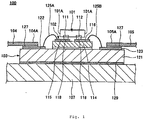
- Fig. 1 is a sectional view illustrating a known light-emitting device.
- a light-emitting device 100 includes a light-emitting element 101, a sub-mount substrate 102, a board substrate 103, external connection terminals 104 and 105, and a heat-sinking plate 107.
- the light-emitting element 101 is an element which emits light from the entire surface thereof.
- the light-emitting element 101 has power supply terminals 111 and 112.
- the light-emitting element 101 is connected to the sub-mount substrate 102 in a flip-chip bonding manner.
- the sub-mount substrate is fixed to the board substrate 103 by the use of a bonding method using an Au-Sn alloy which has thermal conductivity higher than solder.
- the sub-mount substrate 102 includes a substrate body 114 and wiring patterns 115 and 116.
- the substrate body 114 serves to mount the wiring patterns 115 and 116 thereon.
- the substrate body 114 can be made of a material having high thermal conductivity, such as AlN.
- the wiring patterns 115 and 116 are formed on the substrate body 114.
- the wiring pattern 115 is electrically connected to the power supply terminal 111 via a bump 118 and the wiring pattern 116 is electrically connected to the power supply terminal 112 via a bump 118.
- the sub-mount substrate 102 serves to raise the light-emitting element 101 so as to protrude higher than the top surfaces 104A and 105A of portions of the external connection leads 104 and 105, in which the portions are disposed on the board substrate 103.
- the board substrate 103 includes a substrate body 121 and wiring patterns 122 and 123.
- the substrate body 121 serves to mount the wiring patterns 122 and 123 thereon.
- the substrate body 121 can be made of a material having high thermal conductivity, such as AlN or ceramic.
- the wiring patterns 122 and 123 are disposed on the substrate body 121.
- the wiring pattern 122 is electrically connected to the wiring pattern 115 via a wire 125A.
- the wiring pattern 123 is electrically connected to the wiring pattern 116 via a wire 125B. That is, the sub-mount substrate 102 is connected to the board substrate 103 in a wire bonding manner.
- the external connection terminal 104 is fixed onto the wiring pattern 122 using Ag paste 127 as an adhesive.
- the external connection lead 105 is fixed onto the wiring pattern 123 using the Ag paste 127 as an adhesive.
- the heat-sinking plate 107 is fixed onto the bottom surface of the substrate body 121 by using Ag paste.
- the heat-sinking plate 107 serves to release heat, which is generated when the light-emitting element 101 emits light, outside the light-emitting device 100.
- the heat which is generated when the light-emitting element 101 emits light is transmitted to the heat-sinking plate 107 via the sub-mount substrate 102 and the board substrate 103 (see Unexamined Japanese Patent Application Publication No. 2005-203448 ).
- the related-art light-emitting device 100 has a problem with increase in cost because the sub-mount substrate 102 is fixed to the board substrate 103 using an expensive material of an Au-Sn alloy by the use of an Au-Sn bonding method.
- JP 2005-109282 describes a face-down type LED element which is mounted on a sub-mount loaded on a metallic base part. Thereby, heat of the LED element which may be generated at the time of power supply is transmitted to the metallic base part through the sub-mount and discharged by the metallic base part. Tip parts of lead parts are attached to and connected to both sides of the sub-mount in a state insulated from the metallic base part
- EP 1 231 650 describes a reflector-containing semiconductor component which comprises a radiation-emitting LED. The semiconductor component is seated in a housing which comprises at least one base part and a reflector for the radiation from the LED, the LED being fastened on a platform in the vertex of the reflector.
- JP S5-124886 describes another LED element.
- JP 2006-135276 describes a semiconductor light emitting element mounting package.
- the mounting package comprises a silicon substrate having a region in which a semiconductor light emitting element is mounted.
- a groove surrounding the mounting region for the semiconductor light emitting element is formed on the surface, and a reflecting film is formed on the inner surface of the groove.
- the sub-mount substrate provided in the related-art light-emitting device becomes unnecessary because the light-emitting device uses the substrate body having the protruding portion at the position where the light-emitting element is disposed. It is therefore possible to effectively use light emitted from the entire surface of the light-emitting element while reducing the cost thereof.
- the Au-Sn bonding method which incurs high cost becomes unnecessary, the cost of the light-emitting device can be reduced.
- the substrate body having the protruding portion at the position where the light-emitting element is disposed is provided, the wiring pattern electrically connected to the first power supply terminal is formed on the surface of the substrate body on which the protruding portion is disposed, the penetrating electrode which penetrates the substrate body is formed in the protruding portion, and the penetrating electrode is electrically connected to the second power supply terminal. Accordingly, it is possible to effectively use light emitted from the entire surface of the light-emitting element and it is possible to reduce the size of the substrate body, resulting in cost reduction of the light-emitting device.
- light emitted from the entire surface of the light-emitting element can be effectively used and the cost of the light-emitting device can be reduced.
- Fig. 2 is a cross-sectional view illustrating a light-emitting device according to a first embodiment of the invention.
- the light-emitting device 100 includes a wiring substrate 11, a light-emitting element 12, a heat-sinking plate 13 and external connection leads 14 and 15.
- the wiring substrate 11 includes a substrate body 17, an insulation layer 18, a first wiring pattern 21 and a second wiring pattern 22.
- the substrate body 17 comprises a substrate portion 21 and a protruding portion 25.
- the protruding portion 25 is integrated into the substrate portion 24.
- the protruding portion 25 is formed on the top surface 24A of the substrate portion 24 and protrudes from the top surface 24A of the substrate portion 24.
- the top surface 25A of the protruding portion 25 protrudes higher than the top surface 14A of the external connection lead 14 disposed on the first wiring pattern 21 and the top surface 15A of external connection lead 15 disposed on the second wiring pattern 22.
- the protruding portion 25 serves to enable the light-emitting element 12 to be positioned higher than the top surface 14A of the external connection lead 14 and the top surface 15A of the external connection lead 15 at positions where the external connection leads 14 and 15 are disposed on the first wiring pattern 21 and the second wiring pattern 22, respectively.
- a height H1 (height measured when the top surface 24A of the substrate portion 24 is a base level) of the protruding portion 25 can be about 400 ⁇ m.
- the sub-mount substrate 102 provided in the related-art light-emitting device 100 becomes unnecessary.
- the light-emitting device 10 use two substrates (the sub-mount substrate 102 and the board substrate 103) like the related-art light-emitting device 100. That is, a single substrate (the wiring substrate 11) is enough to use for the light-emitting device 10. Accordingly, the cost of the light-emitting device 10 can be reduced.
- the protruding portion 25 takes a form of which a width decreases toward an upper portion (the top surface 25A of the protruding portion 25) from a lower portion thereof.
- a side surface 25B of the protruding portion 25 is an inclined surface inclined at an angle of ⁇ 1 with respect to the top surface 24A of the substrate portion 24.
- the angle ⁇ 1 can be, for example, 54.7° or 90°.
- a material for the substrate body 17 can be silicon.
- An advantage of using silicon as a material for the substrate body 17 is that it is easy to form the protruding portion 25 having the inclined side surface 25B.
- the insulation layer is formed on the top surface 24A of the substrate portion 24 and the top surface 25A and the side surface 25B of the protruding portion 25.
- the insulation layer 18 serves to insulate the first and second wiring patterns 21 and 22 from the substrate body 17.
- the first wiring pattern 21 comprises a light-emitting element connection pad 27, a lead connection portion 28 and a wiring portion 29.
- the light-emitting element connection pad 27 is disposed on the insulation layer 18 formed on the top surface 25A of the protruding portion 25.
- the light-emitting element connection pad 27 is electrically connected to the first power supply terminal 36 of the light-emitting element 12.
- the lead connection portion 28 is disposed on the insulation layer 18 formed on the top surface 24A of the substrate portion 24.
- the lead connection portion 28 is electrically connected to the external connection lead 14.
- the wiring portion 29 is disposed on the insulation layer 18 formed on the side surface 25B of the protruding portion 25 and the top surface 24A of the substrate portion 24.
- the wiring portion 29 is connected to the light-emitting element connection pad 27 at an end thereof and connected to the lead connection portion 28 at the other end thereof.
- the wiring portion 29 serves to electrically connect the light-emitting element pad 27 with the lead connection portion 28.
- the second wiring pattern 22 comprises a light-emitting element connection pad 32, a lead connection portion 33 and a wiring portion 34.
- the light-emitting element connection pad 32 is disposed on the insulation layer 18 formed on the top surface 25A of the protruding portion 25.
- the light-emitting element connection pad 32 is electrically connected to the second power supply terminal 37 of the light-emitting element 12.
- the lead connection portion 33 is disposed on the insulation layer 18 formed on the top surface 24A of the substrate portion 24.
- the lead connection portion 33 is electrically connected to the external connection lead 15.
- the wiring portion 34 is disposed on the insulation layer 18 formed on the side surface 25B of the protruding portion and the top surface 24A of the substrate portion 24.
- the wiring portion 34 is connected to the light-emitting element connection pad 32 at an end thereof and connected to the lead connection portion 33 at the other end thereof.
- the wiring portion 34 serves to electrically connect the light-emitting element connection pad 32 with the lead connection portion 33.
- the light-emitting element 12 is an element which emits light from the entire surface thereof.
- the light-emitting element 12 has a first power supply terminal 36 and a second power supply terminal 37.
- the first power supply terminal 36 is electrically connected to the light-emitting element connection pad 27 via a bump 38.
- the second power supply terminal 37 is electrically connected to the light-emitting element connection pad 32 via a bump 39. That is, the light-emitting element 12 is connected to the first and second wiring patterns 21 and 22 in a flip-chip bonding manner.
- the light-emitting element 12 is disposed at a position higher than the top surface 14A of the external connection lead 14 and the top surface 15A of the external connection lead 15 at positions where the external connection lead 14 and the external connection lead 15 are connected to the first wiring pattern 21 and the second wiring pattern 22, respectively.
- the light-emitting element 12 is disposed to be higher than the top surface 14A of the portion of the external connection lead 14, the portion connected to the first wiring pattern 21, and than the top surface 15A of the portion of the external connection lead 15, the portion connected to the second wiring pattern 22, light emitted from the entire surface of the light-emitting element 12 can be used effectively.
- the heat-sinking plate is attached to the bottom surface 24B of the substrate portion 24 using Ag paste as an adhesive. Accordingly, it is possible to release the heat generated when the light-emitting element 12 emits light since the heat-sinking plate 13 is installed on the bottom surface 24B of the substrate portion 24.
- the external connection lead 14 is attached to the lead connection portion 28 using Ag paste as an adhesive.
- the external connection lead 14 is electrically connected to the first power supply terminal 36 via the first wiring pattern 21.
- the external connection lead 15 is electrically connected to the second power supply terminal 37 via the second wiring pattern 22.
- the external connection leads 14 and 15 are connected to a not-shown power supply source.
- the protruding portion 25 which enables the light-emitting element 12 to protrude higher than the upper faces 14A and 15A of the external connection leads 14 and 15 connected to the wiring substrate 11 is installed on the substrate body 17, the sub-mount substrate provided in the related-art light-emitting device 100 becomes unnecessary. As a result, light from the light-emitting element 12 can be effectively used.
- the light-emitting device 10 there is no necessity to use two substrates (the sub-mount substrate 102 and the board substrate 103) unlike the related-art light-emitting device 100. That is, a single substrate (the wiring substrate 11) is enough to use. As a result, the cost of the light emitting device 10 can be reduced.
- the Au-Sn bonding method which incurs high cost becomes unnecessary. Accordingly, the cost of the light-emitting device 10 can be further reduced.
- the external connection lead 14 and the first wiring pattern 21 can be electrically connected and the external connection lead 14 and the second wiring pattern 22 can be electrically connected.
- the wiring substrate 11 and the heat-sinking plate 13 are placed in a casing and a frame-shaped body designed to expose the light-emitting element 12 is pressed against the external connection leads 14 and 15 the frame-shaped body is held by the casing.
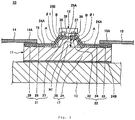
- Fig. 3 is a sectional view illustrating a light-emitting device according to a second embodiment of the invention.
- the light-emitting device 50 has external connection leads 14 and 15, a wiring substrate 51, a heat-sinking plate 52 and a light-emitting element 12.
- the wiring substrate 51 has a substrate body 54, an insulation layer 18, a first wiring pattern 21 and a penetrating electrode 55.
- the substrate body 54 has a substrate portion 61 and a protruding portion 62.
- the protruding portion 62 is integrated into the substrate portion 61.
- the protruding portion 62 is disposed on the top surface 61A of the substrate portion 61 and protrudes from the top surface 61A of the substrate portion 61.
- the top surface 62A of the protruding portion 62 protrudes higher than the top surface 14A of a portion of the external connection lead, the portion disposed on the first wiring pattern 21.
- the protruding portion 62 serves to enable the light-emitting element 12 to protrude higher than the top surface 14A of the portion of the external connection lead 14, the portion disposed on the first wiring pattern 21.
- a Height H2 (height measured when the top surface 61A of the substrate portion 61 is a base level) of the protruding portion 62 may be about 400 ⁇ m.
- the protruding portion 62 which enables the light-emitting element 12 to protrude higher than the top surface 14A of the portion of the external connection lead 14.
- the sub-mount substrate 102 (see Fig. 1 ) provided in the related-art light-emitting device 100 becomes unnecessary. Accordingly, it is possible to effectively use light emitted from the entire surface of the light-emitting element 12. Further, in the light-emitting device 50, since there is no necessity to use two substrates (the sub-mount substrate 102 and the board substrate 103) unlike the conventional light-emitting device 100 but a single wiring substrate 51 is enough to use, the cost of the light-emitting device 50 can be reduced.
- the protruding portion 62 has a side surface 62B on which the insulation layer 18 is formed.
- the side surface 62B of the protruding portion 62 is an inclined surface inclined at an angle of ⁇ 2 with respect to the top surface 61A of the substrate portion 61.
- the angle ⁇ 2 can be, for example, 54.7° or 90°.
- the substrate body 51 has a penetrating hole 65 which penetrates the protruding portion 62 and the substrate portion 61 disposed under the protruding portion 62.
- a material for the substrate body 54 can be silicon.
- An advantage of using silicon as a material for the substrate body 54 is that it is easy to form the protruding portion 62 having the inclined side surface 62B.
- the insulation layer 18 covers the top surface 61A of the substrate portion 61 and the top surface 62A and the side surface 62B of the protruding portion 62.
- the insulation layer 18 is a layer for electrically insulating the first wiring pattern 21 from the penetrating electrode 55.
- the first wiring pattern 21 includes a light-emitting element connection pad 27, a lead connection portion 28 and a wiring portion 29.
- the light-emitting element connection pad 27 is disposed on the insulation layer 18 formed on the protruding portion 62.
- the light-emitting element connection pad 27 is electrically connected to the first power supply terminal 36 of the light-emitting element 12 via a bump 56.
- the lead connection portion 28 is disposed on the insulation layer 18 formed on the top surface 61A of the substrate portion 61.
- the lead connection portion 28 is electrically connected to the external connection lead 14.
- the wiring portion 29 is disposed on the insulation layer 18 formed on the side surface 62B of the protruding portion 62 and the top surface 61A of the substrate portion 61.
- the wiring portion 29 is connected to the light-emitting element connection pad 27 at an end thereof and to the lead connection portion 28 at the other end thereof.
- the wiring portion 29 serves to electrically connect the light-emitting element connection pad 27 with the lead connection portion 28.
- the penetrating electrode 55 is formed in the penetrating hole 65.
- a top end portion of the penetrating electrode 55 and the top surface 18A of the insulation layer 18 are in almost the same plane.
- the top end portion of the penetrating electrode 55 is electrically connected to the second power supply terminal of the light-emitting element 12 via a bump 57.
- a bottom end portion of the penetrating electrode 55 and the bottom surface61B of the substrate portion 61 are in almost the same plane.
- the bottom end portion of the penetrating electrode 55 is electrically and thermally connected to the heat-sinking plate 52 having electrical conductivity by using Ag paste as an adhesive.
- the penetrating electrode 55 is preferably made of a material having thermal conductivity higher than silicon and having electrical conductivity. In detail, it is possible to use copper Cu as the material for the penetrating electrode 55.
- the penetrating electrode can be manufactured, for example by using a plating method.
- the size of the substrate body 54 can be reduced. As a result, the cost of the light-emitting device 50 can be reduced.
- the penetrating electrode 55 is formed of as a material having thermal conductivity higher silicon and having electrical conductivity, it is possible to effectively transmit heat generated when the light-emitting element 12 emits light to the heat-sinking plate 52.
- the heat-sinking plate 52 is attached to the bottom surface 51B of the wiring substrate 51 by using Ag paste as an adhesive.
- the heat-sinking plate 52 is preferably made of a material having electrical conductivity and high thermal conductivity.
- a material for the heat-sinking plate 52 can be copper Cu which has high thermal conductivity.
- the heat-sinking plate 52 is made of a conductive material, it is possible to electrically connect the penetrating electrode 55 with the external connection lead 15.
- the heat-sinking plate 52 is made of a material having electrical conductivity and high thermal conductivity, it is possible to enhance heat-sinking efficiency of the heat-sinking plate 52.
- the external connection lead 14 is attached to the lead connection portion 28 by using Ag paste as an adhesive. Thanks to such configuration, the external connection lead 14 can be electrically connected to the first power supply terminal 36 via the first wiring pattern 21.
- the external connection lead 15 is attached to the heat-sinking plate 52 by using Ag paste as an adhesive. Thanks to such configuration, the external connection lead 15 is electrically connected to the second power supply terminal 37 via the heat-sinking plate 52 and the penetrating electrode 55.
- the light-emitting element 12 is disposed at the position higher than the top surface 14A of the external connection lead 14 formed on the first wiring pattern 21. Thanks to such configuration in which the light-emitting element 12 is disposed at the position higher than the top surface 14A of the external connection lead 14 formed on the first wiring pattern 21, it is possible to effectively use light emitted from the entire surface of the light-emitting element 12.
- the light-emitting element 12 includes the first power supply terminal 36 and the second power supply terminal 37.
- the first power supply terminal 36 is electrically connected to the light-emitting element connection pad 27 via the bump 56.
- the second power supply terminal 37 is electrically connected to the penetrating electrode 55 via the bump 57.
- the penetrating electrode 55 which penetrates the protruding portion 62 and the substrate portion 61 disposed under the protruding portion 62 is provided and the penetrating electrode 55 and the second power supply terminal 37 are electrically connected. It is therefore possible to reduce the size of the substrate body 54, resulting in cost reduction of the light-emitting device 50.
- the penetrating electrode 55 is made of a material having electrical conductivity and thermal conductivity higher than silicon, it is therefore possible to effectively transmit the heat generated when the light-emitting element 12 emits light to the heat-sinking plate 52.
- the light-emitting device 50 according to this embodiment can attain the same advantages as the light-emitting device 10 according to the first embodiment.
- Ag paste is used as an adhesive in the light-emitting device 50 according to this embodiment
- another adhesives can be also used as long as they are electrically conductive.
- Ag paste is used in the light-emitting device 50 according to this embodiment in order to make connections between the external connection lead 14 and the first wiring pattern 21 and between the external connection lead 15 and the heat-sinking plate 52
- such connections can be realized in an alternative manner. That is, the external connection lead 14 and the first wiring pattern 21 may be electrically connected and the external connection lead 15 and the heat-sinking plate 52 may be made electrically connected, without using a conductive adhesive such as Ag paste.
- the wiring substrate 51 and the heat-sinking plate 52 are placed in a casing, a frame-shaped body designed to expose the light-emitting element 12 is pressed against the external connection leads 14 and 15, and the frame body is held by the casing.
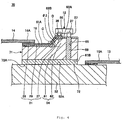
- Fig. 4 is a sectional view illustrating a light-emitting device according to a third embodiment of the invention.
- a light-emitting device 70 according to the third embodiment of the invention is configured in the same manner as the light-emitting device 50 according to the second embodiment, except one thing that the wiring substrate 51 in the second embodiment is substituted with a wiring substrate 71.
- the wiring substrate 71 is configured in the same manner as the wiring substrate 51 explained with reference to the second embodiment, except one thing that the wiring substrate 71 additionally includes a metal layer in.
- the metal layer 72 is made of a metal having high thermal conductivity.
- the metal layer 72 is formed on the bottom surface 61B of a substrate portion 61.
- the metal layer 72 is connected to a lower end portion of a penetrating electrode 55. Thanks to such configuration, the metal layer 72 is electrically and thermally connected to a second power supply terminal 37 via the penetrating electrode 55.
- the metal layer is fixed to the heat-sinking plate 52 by using Ag paste as an adhesive. That is, the metal layer 72 is disposed between the substrate portion 61 and the heat-sinking plate 52. Thanks to such configuration, the heat-sinking plate is electrically and thermally connected to the second power supply terminal of the light-emitting element 12.
- the metal layer 72 can be made of copper Cu.
- the metal layer 72 can be manufactured for example by using a plating method.
- a thickness of the metal layer may be about 5 ⁇ m.
- the metal layer 72 having high thermal conductivity and connected to the penetrating electrode 55 is provided between the substrate portion 61 and the heat-sinking plate 52. It is therefore possible to transmit the heat generated when the light-emitting element 12 emits light to the heat-sinking plate 51, so that heat-sinking efficiency can be enhanced.
- the metal layer 72 is fixed to the heat-sinking plate 52 using Ag paste as an adhesive
- the metal layer may be fixed to the heat-sinking plate 52 by using a direct bonding method without using Ag paste.
- the direct bonding method the bottom surface 72A of the metal layer 72 and the top surface 52A of the heat-sinking plate are activated by plasma to be smooth and flat, then the bottom surface72A of the metal layer 72 is pressed against the top surface 52A of the heat-sinking plate 52, and finally the metal layer 72 and the heat-sinking plate 52 are bonded.
- the metal layer 72 and the heat-sinking plate 52 may be heated so as to be bonded.
- Ag paste is used as an adhesive in the light-emitting device 70 according to this embodiment
- another adhesives also may be used as long as they are electrically conductive.
- the external connection lead 14 and the first wiring pattern 21 may be electrically connected and also the external connection lead 15 and the heat-sinking plate 52 may be electrically connected without using a conductive adhesive such as Ag paste.
- the wiring substrate 71 and the heat-sinking plate 52 are placed in a casing, a frame body designed to expose the light-emitting element 12 is pressed against the external connection leads 14 and 15, and the frame body is held by the casing.
- the invention can be applied to light-emitting devices which can effectively use light emitted from the entire surface of light-emitting elements and can reduce the cost thereof.
Landscapes
- Led Device Packages (AREA)
Description
- The present invention relates to a light-emitting device, and more particularly, to a light-emitting device which can effectively use light from a light-emitting element connected to a wiring substrate.
-
Fig. 1 is a sectional view illustrating a known light-emitting device. - Referring to
Fig. 1 , a light-emitting device 100 includes a light-emittingelement 101, asub-mount substrate 102, aboard substrate 103,external connection terminals sinking plate 107. - The light-emitting
element 101 is an element which emits light from the entire surface thereof. The light-emittingelement 101 has power supply terminals 111 and 112. The light-emittingelement 101 is connected to thesub-mount substrate 102 in a flip-chip bonding manner. - However, the sub-mount substrate is fixed to the
board substrate 103 by the use of a bonding method using an Au-Sn alloy which has thermal conductivity higher than solder. Thesub-mount substrate 102 includes asubstrate body 114 andwiring patterns substrate body 114 serves to mount thewiring patterns substrate body 114 can be made of a material having high thermal conductivity, such as AlN. - The
wiring patterns substrate body 114. Thewiring pattern 115 is electrically connected to the power supply terminal 111 via abump 118 and thewiring pattern 116 is electrically connected to the power supply terminal 112 via abump 118. Thesub-mount substrate 102 serves to raise the light-emittingelement 101 so as to protrude higher than thetop surfaces board substrate 103. - In such a configuration, since the light-emitting
element 101 is raised to protrude higher than thetop surfaces 104A and 105B of the external connection leads 104 and 105 disposed on theboard substrate 103, it is therefore possible to effectively use light emitted from the entire surface of the light-emittingelement 101. - The
board substrate 103 includes asubstrate body 121 andwiring patterns substrate body 121 serves to mount thewiring patterns substrate body 121 can be made of a material having high thermal conductivity, such as AlN or ceramic. Thewiring patterns substrate body 121. Thewiring pattern 122 is electrically connected to thewiring pattern 115 via awire 125A. Thewiring pattern 123 is electrically connected to thewiring pattern 116 via awire 125B. That is, thesub-mount substrate 102 is connected to theboard substrate 103 in a wire bonding manner. - The
external connection terminal 104 is fixed onto thewiring pattern 122 usingAg paste 127 as an adhesive. Theexternal connection lead 105 is fixed onto thewiring pattern 123 using theAg paste 127 as an adhesive. - The heat-
sinking plate 107 is fixed onto the bottom surface of thesubstrate body 121 by using Ag paste. The heat-sinkingplate 107 serves to release heat, which is generated when the light-emittingelement 101 emits light, outside the light-emitting device 100. The heat which is generated when the light-emittingelement 101 emits light is transmitted to the heat-sinking plate 107 via thesub-mount substrate 102 and the board substrate 103 (see Unexamined Japanese Patent Application Publication No.2005-203448 - However, the related-art light-
emitting device 100 has a problem with increase in cost because thesub-mount substrate 102 is fixed to theboard substrate 103 using an expensive material of an Au-Sn alloy by the use of an Au-Sn bonding method. -
JP 2005-109282 EP 1 231 650 describes a reflector-containing semiconductor component which comprises a radiation-emitting LED. The semiconductor component is seated in a housing which comprises at least one base part and a reflector for the radiation from the LED, the LED being fastened on a platform in the vertex of the reflector. -
JP S5-124886 -
JP 2006-135276 - Accordingly, it is an object of the invention to provide a light-emitting device which can effectively use light emitted from the entire surface of a light-emitting element and can reduce the cost thereof.
- In light of the above, a light emitting device according to independent claim is provided.
- Further advantages, features, aspects and details of the invention are evident from the dependent claims, the description and the drawings.
- According to the invention, there is provided a light-emitting device according to claim 1.
- In the above-mentioned configuration, the sub-mount substrate provided in the related-art light-emitting device becomes unnecessary because the light-emitting device uses the substrate body having the protruding portion at the position where the light-emitting element is disposed. It is therefore possible to effectively use light emitted from the entire surface of the light-emitting element while reducing the cost thereof. In addition, since the Au-Sn bonding method which incurs high cost becomes unnecessary, the cost of the light-emitting device can be reduced.
- According to another aspect of the invention, there is provided a light-emitting device according to claim 3.
- In such configurations, the substrate body having the protruding portion at the position where the light-emitting element is disposed is provided, the wiring pattern electrically connected to the first power supply terminal is formed on the surface of the substrate body on which the protruding portion is disposed, the penetrating electrode which penetrates the substrate body is formed in the protruding portion, and the penetrating electrode is electrically connected to the second power supply terminal. Accordingly, it is possible to effectively use light emitted from the entire surface of the light-emitting element and it is possible to reduce the size of the substrate body, resulting in cost reduction of the light-emitting device.
- According to the invention, light emitted from the entire surface of the light-emitting element can be effectively used and the cost of the light-emitting device can be reduced.
- The invention will be better understood by
reference to the following description of embodiments of the invention taken in conjunction with the accompanying drawings, wherein: -
Fig. 1 is a sectional view illustrating a known light-emitting device. -
Fig. 2 is a sectional view illustrating a light-emitting device according to a first embodiment of the invention. -
Fig. 3 is a sectional view illustrating a light-emitting device according to a second embodiment of the invention. -
Fig. 4 is a sectional view illustrating a light-emitting device according to a third embodiment of the invention. - Next, preferred embodiments of the invention will be described with reference to the accompanying drawings.
-
Fig. 2 is a cross-sectional view illustrating a light-emitting device according to a first embodiment of the invention. - Referring to
Fig. 2 , the light-emittingdevice 100 according to the first embodiment of the invention includes awiring substrate 11, a light-emittingelement 12, a heat-sinkingplate 13 and external connection leads 14 and 15. Thewiring substrate 11 includes asubstrate body 17, aninsulation layer 18, afirst wiring pattern 21 and asecond wiring pattern 22. - The
substrate body 17 comprises asubstrate portion 21 and a protrudingportion 25. The protrudingportion 25 is integrated into thesubstrate portion 24. The protrudingportion 25 is formed on thetop surface 24A of thesubstrate portion 24 and protrudes from thetop surface 24A of thesubstrate portion 24. Thetop surface 25A of the protrudingportion 25 protrudes higher than thetop surface 14A of theexternal connection lead 14 disposed on thefirst wiring pattern 21 and thetop surface 15A ofexternal connection lead 15 disposed on thesecond wiring pattern 22. - The protruding
portion 25 serves to enable the light-emittingelement 12 to be positioned higher than thetop surface 14A of theexternal connection lead 14 and thetop surface 15A of theexternal connection lead 15 at positions where the external connection leads 14 and 15 are disposed on thefirst wiring pattern 21 and thesecond wiring pattern 22, respectively. A height H1 (height measured when thetop surface 24A of thesubstrate portion 24 is a base level) of the protrudingportion 25 can be about 400 µm. - As described above, by providing the protruding
portion 25 on thesubstrate body 17 in order to enable the light-emittingelement 12 so as to be positioned higher than thetop surface 14A of theexternal connection lead 14 formed on thefirst wiring pattern 21 and thetop surface 15A of theexternal connection lead 15 formed on thesecond wiring pattern 22, thesub-mount substrate 102 provided in the related-art light-emittingdevice 100 becomes unnecessary. As a result, light emitted from the entire surface of the light-emittingelement 12 can be effectively used. In addition, there is no necessity that the light-emitting device 10 use two substrates (thesub-mount substrate 102 and the board substrate 103) like the related-art light-emitting device 100. That is, a single substrate (the wiring substrate 11) is enough to use for the light-emittingdevice 10. Accordingly, the cost of the light-emittingdevice 10 can be reduced. - The protruding
portion 25 takes a form of which a width decreases toward an upper portion (thetop surface 25A of the protruding portion 25) from a lower portion thereof. Aside surface 25B of the protrudingportion 25 is an inclined surface inclined at an angle of θ1 with respect to thetop surface 24A of thesubstrate portion 24. The angle θ1 can be, for example, 54.7° or 90°. - In such configuration, since the
side surface 25B of the protrudingportion 25 is an inclined surface, it is possible to alleviate stress concentrating on the first andsecond wiring patterns second wiring patterns - A material for the
substrate body 17 can be silicon. An advantage of using silicon as a material for thesubstrate body 17 is that it is easy to form the protrudingportion 25 having theinclined side surface 25B. - The insulation layer is formed on the
top surface 24A of thesubstrate portion 24 and thetop surface 25A and theside surface 25B of the protrudingportion 25. Theinsulation layer 18 serves to insulate the first andsecond wiring patterns substrate body 17. - The
first wiring pattern 21 comprises a light-emittingelement connection pad 27, alead connection portion 28 and awiring portion 29. The light-emittingelement connection pad 27 is disposed on theinsulation layer 18 formed on thetop surface 25A of the protrudingportion 25. The light-emittingelement connection pad 27 is electrically connected to the firstpower supply terminal 36 of the light-emittingelement 12. - The
lead connection portion 28 is disposed on theinsulation layer 18 formed on thetop surface 24A of thesubstrate portion 24. Thelead connection portion 28 is electrically connected to theexternal connection lead 14. - The
wiring portion 29 is disposed on theinsulation layer 18 formed on theside surface 25B of the protrudingportion 25 and thetop surface 24A of thesubstrate portion 24. Thewiring portion 29 is connected to the light-emittingelement connection pad 27 at an end thereof and connected to thelead connection portion 28 at the other end thereof. Thewiring portion 29 serves to electrically connect the light-emittingelement pad 27 with thelead connection portion 28. - The
second wiring pattern 22 comprises a light-emittingelement connection pad 32, alead connection portion 33 and awiring portion 34. The light-emittingelement connection pad 32 is disposed on theinsulation layer 18 formed on thetop surface 25A of the protrudingportion 25. The light-emittingelement connection pad 32 is electrically connected to the secondpower supply terminal 37 of the light-emittingelement 12. - The
lead connection portion 33 is disposed on theinsulation layer 18 formed on thetop surface 24A of thesubstrate portion 24. Thelead connection portion 33 is electrically connected to theexternal connection lead 15. - The
wiring portion 34 is disposed on theinsulation layer 18 formed on theside surface 25B of the protruding portion and thetop surface 24A of thesubstrate portion 24. Thewiring portion 34 is connected to the light-emittingelement connection pad 32 at an end thereof and connected to thelead connection portion 33 at the other end thereof. Thewiring portion 34 serves to electrically connect the light-emittingelement connection pad 32 with thelead connection portion 33. - The light-emitting
element 12 is an element which emits light from the entire surface thereof. The light-emittingelement 12 has a firstpower supply terminal 36 and a secondpower supply terminal 37. The firstpower supply terminal 36 is electrically connected to the light-emittingelement connection pad 27 via abump 38. The secondpower supply terminal 37 is electrically connected to the light-emittingelement connection pad 32 via abump 39. That is, the light-emittingelement 12 is connected to the first andsecond wiring patterns - The light-emitting
element 12 is disposed at a position higher than thetop surface 14A of theexternal connection lead 14 and thetop surface 15A of theexternal connection lead 15 at positions where theexternal connection lead 14 and theexternal connection lead 15 are connected to thefirst wiring pattern 21 and thesecond wiring pattern 22, respectively. - As described above, since the light-emitting
element 12 is disposed to be higher than thetop surface 14A of the portion of theexternal connection lead 14, the portion connected to thefirst wiring pattern 21, and than thetop surface 15A of the portion of theexternal connection lead 15, the portion connected to thesecond wiring pattern 22, light emitted from the entire surface of the light-emittingelement 12 can be used effectively. - The heat-sinking plate is attached to the
bottom surface 24B of thesubstrate portion 24 using Ag paste as an adhesive. Accordingly, it is possible to release the heat generated when the light-emittingelement 12 emits light since the heat-sinkingplate 13 is installed on thebottom surface 24B of thesubstrate portion 24. - The
external connection lead 14 is attached to thelead connection portion 28 using Ag paste as an adhesive. Theexternal connection lead 14 is electrically connected to the firstpower supply terminal 36 via thefirst wiring pattern 21. - The
external connection lead 15 is electrically connected to the secondpower supply terminal 37 via thesecond wiring pattern 22. The external connection leads 14 and 15 are connected to a not-shown power supply source. - In such configurations, since the protruding
portion 25 which enables the light-emittingelement 12 to protrude higher than theupper faces wiring substrate 11 is installed on thesubstrate body 17, the sub-mount substrate provided in the related-art light-emittingdevice 100 becomes unnecessary. As a result, light from the light-emittingelement 12 can be effectively used. In addition, in the case of the light-emittingdevice 10, there is no necessity to use two substrates (thesub-mount substrate 102 and the board substrate 103) unlike the related-art light-emittingdevice 100. That is, a single substrate (the wiring substrate 11) is enough to use. As a result, the cost of thelight emitting device 10 can be reduced. - The Au-Sn bonding method which incurs high cost becomes unnecessary. Accordingly, the cost of the light-emitting
device 10 can be further reduced. - Since the
bump 38 and theexternal connection lead 14 are electrically connected to each other by thefirst wiring pattern 21 while thebump 39 and theexternal connection lead 15 are electrically connected to each other by thesecond wiring pattern 22,wires Fig. 1 ) provided in the conventional light-emittingdevice 100 become unnecessary. Accordingly reliability in electrical connection between the light-emittingelement 12 and the external connection leads 14 and 15 is enhanced. - In the light-emitting
device 10 according to this embodiment, although Ag paste is used as an example of adhesive, other adhesives may be used as long as they are electrically conductive. - In the light-emitting
device 10 according to this embodiment, although it has been exemplified that Ag paste is used for making connections between theexternal connection lead 14 and thefirst wiring pattern 21 and between theexternal connection lead 15 and thesecond wiring pattern 22, such connections also can be attained in an alternative manner without using a conductive adhesive such as Ag paste. For example, as for the alternative manner, theexternal connection lead 14 and thefirst wiring pattern 21 can be electrically connected and theexternal connection lead 14 and thesecond wiring pattern 22 can be electrically connected. In detail, thewiring substrate 11 and the heat-sinkingplate 13 are placed in a casing and a frame-shaped body designed to expose the light-emittingelement 12 is pressed against the external connection leads 14 and 15 the frame-shaped body is held by the casing. -
Fig. 3 is a sectional view illustrating a light-emitting device according to a second embodiment of the invention. - Referring to
Fig. 3 , the light-emittingdevice 50 according to the second embodiment has external connection leads 14 and 15, awiring substrate 51, a heat-sinkingplate 52 and a light-emittingelement 12. - The
wiring substrate 51 has asubstrate body 54, aninsulation layer 18, afirst wiring pattern 21 and a penetratingelectrode 55. Thesubstrate body 54 has asubstrate portion 61 and a protrudingportion 62. The protrudingportion 62 is integrated into thesubstrate portion 61. The protrudingportion 62 is disposed on thetop surface 61A of thesubstrate portion 61 and protrudes from thetop surface 61A of thesubstrate portion 61. Thetop surface 62A of the protrudingportion 62 protrudes higher than thetop surface 14A of a portion of the external connection lead, the portion disposed on thefirst wiring pattern 21. - The protruding
portion 62 serves to enable the light-emittingelement 12 to protrude higher than thetop surface 14A of the portion of theexternal connection lead 14, the portion disposed on thefirst wiring pattern 21. A Height H2 (height measured when thetop surface 61A of thesubstrate portion 61 is a base level) of the protrudingportion 62 may be about 400 µm. - According to such configurations, on the
substrate body 54 there is provided the protrudingportion 62 which enables the light-emittingelement 12 to protrude higher than thetop surface 14A of the portion of theexternal connection lead 14. In addition, the sub-mount substrate 102 (seeFig. 1 ) provided in the related-art light-emittingdevice 100 becomes unnecessary. Accordingly, it is possible to effectively use light emitted from the entire surface of the light-emittingelement 12. Further, in the light-emittingdevice 50, since there is no necessity to use two substrates (thesub-mount substrate 102 and the board substrate 103) unlike the conventional light-emittingdevice 100 but asingle wiring substrate 51 is enough to use, the cost of the light-emittingdevice 50 can be reduced. - The protruding
portion 62 has aside surface 62B on which theinsulation layer 18 is formed. Theside surface 62B of the protrudingportion 62 is an inclined surface inclined at an angle of θ2 with respect to thetop surface 61A of thesubstrate portion 61. The angle θ2 can be, for example, 54.7° or 90°. - Thanks to such configuration in which the
side surface 62B of the protrudingportion 62 is an inclined surface, stress is not concentrated on a portion of thefirst wiring pattern 21 which is formed on stepped portions C and D, so that it is possible to prevent thefirst wiring pattern 21 from breaking (for example, wire disconnection). - The
substrate body 51 has a penetratinghole 65 which penetrates the protrudingportion 62 and thesubstrate portion 61 disposed under the protrudingportion 62. - A material for the
substrate body 54 can be silicon. An advantage of using silicon as a material for thesubstrate body 54 is that it is easy to form the protrudingportion 62 having theinclined side surface 62B. - The
insulation layer 18 covers thetop surface 61A of thesubstrate portion 61 and thetop surface 62A and theside surface 62B of the protrudingportion 62. Theinsulation layer 18 is a layer for electrically insulating thefirst wiring pattern 21 from the penetratingelectrode 55. - The
first wiring pattern 21 includes a light-emittingelement connection pad 27, alead connection portion 28 and awiring portion 29. The light-emittingelement connection pad 27 is disposed on theinsulation layer 18 formed on the protrudingportion 62. The light-emittingelement connection pad 27 is electrically connected to the firstpower supply terminal 36 of the light-emittingelement 12 via abump 56. - The
lead connection portion 28 is disposed on theinsulation layer 18 formed on thetop surface 61A of thesubstrate portion 61. Thelead connection portion 28 is electrically connected to theexternal connection lead 14. - The
wiring portion 29 is disposed on theinsulation layer 18 formed on theside surface 62B of the protrudingportion 62 and thetop surface 61A of thesubstrate portion 61. Thewiring portion 29 is connected to the light-emittingelement connection pad 27 at an end thereof and to thelead connection portion 28 at the other end thereof. Thewiring portion 29 serves to electrically connect the light-emittingelement connection pad 27 with thelead connection portion 28. - The penetrating
electrode 55 is formed in the penetratinghole 65. A top end portion of the penetratingelectrode 55 and thetop surface 18A of theinsulation layer 18 are in almost the same plane. The top end portion of the penetratingelectrode 55 is electrically connected to the second power supply terminal of the light-emittingelement 12 via abump 57. A bottom end portion of the penetratingelectrode 55 and the bottom surface61B of thesubstrate portion 61 are in almost the same plane. The bottom end portion of the penetratingelectrode 55 is electrically and thermally connected to the heat-sinkingplate 52 having electrical conductivity by using Ag paste as an adhesive. - The penetrating
electrode 55 is preferably made of a material having thermal conductivity higher than silicon and having electrical conductivity. In detail, it is possible to use copper Cu as the material for the penetratingelectrode 55. The penetrating electrode can be manufactured, for example by using a plating method. - As described above, thanks to the configurations in which the penetrating
electrode 55 is formed to penetrate the protrudingportion 62 and thesubstrate portion 61 disposed under the protrudingportion 62 and the penetratingelectrode 55 is electrically connected to the secondpower supply terminal 37, the size of thesubstrate body 54 can be reduced. As a result, the cost of the light-emittingdevice 50 can be reduced. - In addition, thanks to the configuration in which the penetrating
electrode 55 is formed of as a material having thermal conductivity higher silicon and having electrical conductivity, it is possible to effectively transmit heat generated when the light-emittingelement 12 emits light to the heat-sinkingplate 52. - The heat-sinking
plate 52 is attached to the bottom surface 51B of thewiring substrate 51 by using Ag paste as an adhesive. The heat-sinkingplate 52 is preferably made of a material having electrical conductivity and high thermal conductivity. For example, a material for the heat-sinkingplate 52 can be copper Cu which has high thermal conductivity. - As described above, thanks to the configuration in which the heat-sinking
plate 52 is made of a conductive material, it is possible to electrically connect the penetratingelectrode 55 with theexternal connection lead 15. - Thanks to the configuration in which the heat-sinking
plate 52 is made of a material having electrical conductivity and high thermal conductivity, it is possible to enhance heat-sinking efficiency of the heat-sinkingplate 52. - The
external connection lead 14 is attached to thelead connection portion 28 by using Ag paste as an adhesive. Thanks to such configuration, theexternal connection lead 14 can be electrically connected to the firstpower supply terminal 36 via thefirst wiring pattern 21. - The
external connection lead 15 is attached to the heat-sinkingplate 52 by using Ag paste as an adhesive. Thanks to such configuration, theexternal connection lead 15 is electrically connected to the secondpower supply terminal 37 via the heat-sinkingplate 52 and the penetratingelectrode 55. - The light-emitting
element 12 is disposed at the position higher than thetop surface 14A of theexternal connection lead 14 formed on thefirst wiring pattern 21. Thanks to such configuration in which the light-emittingelement 12 is disposed at the position higher than thetop surface 14A of theexternal connection lead 14 formed on thefirst wiring pattern 21, it is possible to effectively use light emitted from the entire surface of the light-emittingelement 12. - The light-emitting
element 12 includes the firstpower supply terminal 36 and the secondpower supply terminal 37. The firstpower supply terminal 36 is electrically connected to the light-emittingelement connection pad 27 via thebump 56. The secondpower supply terminal 37 is electrically connected to the penetratingelectrode 55 via thebump 57. - In the light-emitting device according to this embodiment, the penetrating
electrode 55 which penetrates the protrudingportion 62 and thesubstrate portion 61 disposed under the protrudingportion 62 is provided and the penetratingelectrode 55 and the secondpower supply terminal 37 are electrically connected. It is therefore possible to reduce the size of thesubstrate body 54, resulting in cost reduction of the light-emittingdevice 50. - The penetrating
electrode 55 is made of a material having electrical conductivity and thermal conductivity higher than silicon, it is therefore possible to effectively transmit the heat generated when the light-emittingelement 12 emits light to the heat-sinkingplate 52. - The light-emitting
device 50 according to this embodiment can attain the same advantages as the light-emittingdevice 10 according to the first embodiment. - Although it has been exemplified that Ag paste is used as an adhesive in the light-emitting
device 50 according to this embodiment, another adhesives can be also used as long as they are electrically conductive. - Although it has been exemplified that Ag paste is used in the light-emitting
device 50 according to this embodiment in order to make connections between theexternal connection lead 14 and thefirst wiring pattern 21 and between theexternal connection lead 15 and the heat-sinkingplate 52, such connections can be realized in an alternative manner. That is, theexternal connection lead 14 and thefirst wiring pattern 21 may be electrically connected and theexternal connection lead 15 and the heat-sinkingplate 52 may be made electrically connected, without using a conductive adhesive such as Ag paste. In detail, thewiring substrate 51 and the heat-sinkingplate 52 are placed in a casing, a frame-shaped body designed to expose the light-emittingelement 12 is pressed against the external connection leads 14 and 15, and the frame body is held by the casing. -
Fig. 4 is a sectional view illustrating a light-emitting device according to a third embodiment of the invention. - Referring to
Fig. 4 , a light-emittingdevice 70 according to the third embodiment of the invention is configured in the same manner as the light-emittingdevice 50 according to the second embodiment, except one thing that thewiring substrate 51 in the second embodiment is substituted with awiring substrate 71. - The
wiring substrate 71 is configured in the same manner as thewiring substrate 51 explained with reference to the second embodiment, except one thing that thewiring substrate 71 additionally includes a metal layer in. - The
metal layer 72 is made of a metal having high thermal conductivity. Themetal layer 72 is formed on thebottom surface 61B of asubstrate portion 61. Themetal layer 72 is connected to a lower end portion of a penetratingelectrode 55. Thanks to such configuration, themetal layer 72 is electrically and thermally connected to a secondpower supply terminal 37 via the penetratingelectrode 55. - The metal layer is fixed to the heat-sinking
plate 52 by using Ag paste as an adhesive. That is, themetal layer 72 is disposed between thesubstrate portion 61 and the heat-sinkingplate 52. Thanks to such configuration, the heat-sinking plate is electrically and thermally connected to the second power supply terminal of the light-emittingelement 12. Themetal layer 72 can be made of copper Cu. Themetal layer 72 can be manufactured for example by using a plating method. A thickness of the metal layer may be about 5 µm. - In the light-emitting device according to this embodiment, the
metal layer 72 having high thermal conductivity and connected to the penetratingelectrode 55 is provided between thesubstrate portion 61 and the heat-sinkingplate 52. It is therefore possible to transmit the heat generated when the light-emittingelement 12 emits light to the heat-sinkingplate 51, so that heat-sinking efficiency can be enhanced. - Although it has been exemplified that the
metal layer 72 is fixed to the heat-sinkingplate 52 using Ag paste as an adhesive, the metal layer may be fixed to the heat-sinkingplate 52 by using a direct bonding method without using Ag paste. For example, in the direct bonding method, thebottom surface 72A of themetal layer 72 and thetop surface 52A of the heat-sinking plate are activated by plasma to be smooth and flat, then the bottom surface72A of themetal layer 72 is pressed against thetop surface 52A of the heat-sinkingplate 52, and finally themetal layer 72 and the heat-sinkingplate 52 are bonded. In this incidence, themetal layer 72 and the heat-sinkingplate 52 may be heated so as to be bonded. - In the case in which the
metal layer 72 is fixed to the heat-sinkingplate 52 by using such direction bonding method, Ag paste which has poor thermal conductivity becomes unnecessary. In addition, since themetal layer 72 and the heat-sinkingplate 52 are in direct contact with each other, it is therefore possible to effectively release the heat generated when the light-emittingelement 12 emits light. - Although it has been exemplified that Ag paste is used as an adhesive in the light-emitting
device 70 according to this embodiment, another adhesives also may be used as long as they are electrically conductive. - In the light-emitting
device 70 according to this embodiment, although Ag paste is used to connect theexternal connection lead 14 with thefirst wiring pattern 21 and connect theexternal connection lead 15 with the heat-sinkingplate 52, such connections can be achieved in an alternative manner. For example, theexternal connection lead 14 and thefirst wiring pattern 21 may be electrically connected and also theexternal connection lead 15 and the heat-sinkingplate 52 may be electrically connected without using a conductive adhesive such as Ag paste. In detail, thewiring substrate 71 and the heat-sinkingplate 52 are placed in a casing, a frame body designed to expose the light-emittingelement 12 is pressed against the external connection leads 14 and 15, and the frame body is held by the casing. - Although the preferred embodiments of the invention has been shown and described above, it will be apparent to those having ordinary skill in the art that the invention is not limited to the specific embodiments described above but a number of changes, modifications or alternations to the embodiments may be made.
- The invention can be applied to light-emitting devices which can effectively use light emitted from the entire surface of light-emitting elements and can reduce the cost thereof.
Claims (6)
- A light-emitting device, comprising:a light-emitting element (12),a wiring substrate (11; 51; 71), andan external connection lead (14), whereinthe wiring substrate comprises- a substrate body (17; 54), and- a wiring pattern (21, 22) disposed on a surface of the substrate body (17; 54) on which the light-emitting element (12) is disposed, and electrically connected to the light-emitting element, whereinthe substrate body has an integrated protruding portion (25; 62) on the top surface of which the light-emitting element is disposed, and
wherein the external connection lead (14) is disposed on and electrically connected to the wiring pattern, and wherein the protruding portion protrudes higher than a top surface of a portion of the external connection lead, said portion of the external connection lead being disposed on the substrate body, and wherein the protruding portion (25; 62) has a shape of which a width decreases from a lower portion to an upper portion thereof, and wherein a side surface (25B) of the protruding portion is an inclined surface, and wherein a wiring portion (29) of the wiring pattern (21, 22) is disposed on an insulation layer (18) formed on said inclined side surface (25B) of the protruding portion (25), the light emitting element (12) being electrically connected with the external connection lead (14) via said wiring portion (29). - The light-emitting device according to claim 1, further comprising:a heat-sinking plate (13; 52) provided on a surface of the substrate body (17; 54) opposite to the surface on which the protruding portion is disposed.
- A light-emitting device according to any one of claims 1 and 2, wherein:the light-emitting element (12) has a first power supply terminal and a second power supply terminal; andthe wiring pattern (21, 22) is electrically connected to the first power supply terminal, wherein the light-emitting device further comprises:a penetrating electrode (55) which penetrates the substrate body and which is formed in the protruding portion, and whereinthe penetrating electrode is electrically connected to the second power supply terminal.
- The light-emitting device according to claim 2 or according to claim 3 referring back to claim 2, further comprising:a metal layer (72) having high thermal conductivity interposed between the substrate body (17; 54) and the heat-sinking plate (52).
- The light-emitting device according to any of claims 1 to 4, wherein
the substrate body is made of silicon. - The light-emitting device according to any of claims 1 to 5, wherein
a side surface of the protruding portion is an inclined surface inclined at 54.7° with respect to the top surface of the substrate portion.
Applications Claiming Priority (1)
| Application Number | Priority Date | Filing Date | Title |
|---|---|---|---|
| JP2006214700A JP5214121B2 (en) | 2006-08-07 | 2006-08-07 | Light emitting device |
Publications (3)
| Publication Number | Publication Date |
|---|---|
| EP1887635A2 EP1887635A2 (en) | 2008-02-13 |
| EP1887635A3 EP1887635A3 (en) | 2012-12-26 |
| EP1887635B1 true EP1887635B1 (en) | 2017-05-10 |
Family
ID=38657872
Family Applications (1)
| Application Number | Title | Priority Date | Filing Date |
|---|---|---|---|
| EP07015539.5A Active EP1887635B1 (en) | 2006-08-07 | 2007-08-07 | Light-emitting device |
Country Status (4)
| Country | Link |
|---|---|
| US (1) | US7816690B2 (en) |
| EP (1) | EP1887635B1 (en) |
| JP (1) | JP5214121B2 (en) |
| TW (1) | TW200810160A (en) |
Families Citing this family (7)
| Publication number | Priority date | Publication date | Assignee | Title |
|---|---|---|---|---|
| TWI353657B (en) * | 2007-09-28 | 2011-12-01 | Ind Tech Res Inst | An island submount |
| CN102881812B (en) * | 2011-07-15 | 2015-03-25 | 赛恩倍吉科技顾问(深圳)有限公司 | Manufacturing method for Light emitting diode packaging structure |
| JP6006525B2 (en) * | 2012-05-15 | 2016-10-12 | スタンレー電気株式会社 | Semiconductor light emitting device and lamp using the same |
| KR101978941B1 (en) * | 2013-01-28 | 2019-05-15 | 엘지이노텍 주식회사 | Light Emitting Device Package |
| KR102153041B1 (en) * | 2013-12-04 | 2020-09-07 | 삼성전자주식회사 | Semiconductor device package and method of manufacturing the same |
| WO2020250667A1 (en) * | 2019-06-11 | 2020-12-17 | 京セラ株式会社 | Light-emitting substrate and display device |
| JP7311362B2 (en) * | 2019-08-29 | 2023-07-19 | 株式会社ジャパンディスプレイ | Display device |
Family Cites Families (20)
| Publication number | Priority date | Publication date | Assignee | Title |
|---|---|---|---|---|
| JPS54389B2 (en) * | 1975-05-06 | 1979-01-10 | ||
| JPH0513820A (en) * | 1991-07-02 | 1993-01-22 | Omron Corp | Semiconductor device |
| DE4242842C2 (en) * | 1992-02-14 | 1999-11-04 | Sharp Kk | Light-emitting component for surface mounting and method for its production |
| DE10006738C2 (en) * | 2000-02-15 | 2002-01-17 | Osram Opto Semiconductors Gmbh | Light-emitting component with improved light decoupling and method for its production |
| US6600231B2 (en) * | 2000-05-11 | 2003-07-29 | Mitutoyo Corporation | Functional device unit and method of producing the same |
| DE10163799B4 (en) * | 2000-12-28 | 2006-11-23 | Matsushita Electric Works, Ltd., Kadoma | Semiconductor chip mounting substrate and method of manufacturing such a mounting substrate |
| DE10105802A1 (en) * | 2001-02-07 | 2002-08-08 | Patent Treuhand Ges Fuer Elektrische Gluehlampen Mbh | Semiconductor component with reflector |
| JP2003031895A (en) * | 2001-07-13 | 2003-01-31 | Sharp Corp | Semiconductor light emitting device and method of manufacturing the same |
| JP4045781B2 (en) * | 2001-08-28 | 2008-02-13 | 松下電工株式会社 | Light emitting device |
| DE10148227B4 (en) * | 2001-09-28 | 2015-03-05 | Osram Opto Semiconductors Gmbh | Radiation-emitting semiconductor chip, method for its production and radiation-emitting component |
| CN100338786C (en) * | 2002-06-19 | 2007-09-19 | 三垦电气株式会社 | Semiconductor light-emitting device, manufacturing method thereof, and reflector for semiconductor light-emitting device |
| JP3993475B2 (en) * | 2002-06-20 | 2007-10-17 | ローム株式会社 | LED chip mounting structure and image reading apparatus having the same |
| CN100587560C (en) * | 2003-04-01 | 2010-02-03 | 夏普株式会社 | Light-emitting device module, light-emitting device, backside light irradiation device, and display device |
| JP4192742B2 (en) * | 2003-09-30 | 2008-12-10 | 豊田合成株式会社 | Light emitting device |
| JP2005136224A (en) * | 2003-10-30 | 2005-05-26 | Asahi Kasei Electronics Co Ltd | Light emitting diode lighting module |
| TWI227570B (en) * | 2003-12-11 | 2005-02-01 | South Epitaxy Corp | Light-emitting diode packaging structure |
| JP2005203448A (en) | 2004-01-13 | 2005-07-28 | Toyoda Gosei Co Ltd | Light emitting device |
| JP4614679B2 (en) | 2004-01-29 | 2011-01-19 | 京セラ株式会社 | LIGHT EMITTING DEVICE, ITS MANUFACTURING METHOD, AND LIGHTING DEVICE |
| JP2006135276A (en) * | 2004-10-04 | 2006-05-25 | Hitachi Ltd | Semiconductor light emitting device mounting package and manufacturing method thereof |
| JP2006324324A (en) * | 2005-05-17 | 2006-11-30 | Sumitomo Electric Ind Ltd | Light emitting device, method for manufacturing light emitting device, and nitride semiconductor substrate |
-
2006
- 2006-08-07 JP JP2006214700A patent/JP5214121B2/en active Active
-
2007
- 2007-08-06 US US11/882,812 patent/US7816690B2/en active Active
- 2007-08-07 TW TW096128945A patent/TW200810160A/en unknown
- 2007-08-07 EP EP07015539.5A patent/EP1887635B1/en active Active
Also Published As
| Publication number | Publication date |
|---|---|
| EP1887635A2 (en) | 2008-02-13 |
| US7816690B2 (en) | 2010-10-19 |
| JP2008041953A (en) | 2008-02-21 |
| TW200810160A (en) | 2008-02-16 |
| JP5214121B2 (en) | 2013-06-19 |
| US20080030139A1 (en) | 2008-02-07 |
| EP1887635A3 (en) | 2012-12-26 |
Similar Documents
| Publication | Publication Date | Title |
|---|---|---|
| TWI235469B (en) | Thermally enhanced semiconductor package with EMI shielding | |
| KR101095291B1 (en) | Packaged Light Emitting Diodes for High Temperature Operation | |
| US8916958B2 (en) | Semiconductor package with multiple chips and substrate in metal cap | |
| US7936054B2 (en) | Multi-chip package | |
| US8441121B2 (en) | Package carrier and manufacturing method thereof | |
| JP4122784B2 (en) | Light emitting device | |
| JP4841836B2 (en) | Method for manufacturing light emitting device of flip chip type light emitting diode | |
| EP1887635B1 (en) | Light-emitting device | |
| EP3602626B1 (en) | Lighting device with led elements on a mounting element on a flat carrier and method of manufacturing the same | |
| US20060006405A1 (en) | Surface mountable light emitting diode assemblies packaged for high temperature operation | |
| US20100059783A1 (en) | Light Emitting Chip Package With Metal Leads For Enhanced Heat Dissipation | |
| CN101292360A (en) | Integrated circuit mounting for thermal stress relief usable in multi-chip modules | |
| EP1466357B1 (en) | Surface mounted package with die bottom spaced from support board | |
| US7176563B2 (en) | Electronically grounded heat spreader | |
| JP2013532894A (en) | Optoelectronic light emitting module and automotive headlight | |
| EP2852975B1 (en) | Surface mountable semiconductor device | |
| JP2015046495A (en) | Substrate for mounting light emitting element, and light emitting device | |
| US8237188B2 (en) | Light source | |
| JP2008504711A (en) | Light emitting diode module | |
| JP5912471B2 (en) | Semiconductor device | |
| US7310224B2 (en) | Electronic apparatus with thermal module | |
| JPS63190363A (en) | Power package | |
| JP4797621B2 (en) | Semiconductor device and manufacturing method thereof | |
| KR20030046788A (en) | Semiconductor Package and Manufacture Method The Same | |
| JP2012190841A (en) | Led package and led lighting device |
Legal Events
| Date | Code | Title | Description |
|---|---|---|---|
| PUAI | Public reference made under article 153(3) epc to a published international application that has entered the european phase |
Free format text: ORIGINAL CODE: 0009012 |
|
| AK | Designated contracting states |
Kind code of ref document: A2 Designated state(s): AT BE BG CH CY CZ DE DK EE ES FI FR GB GR HU IE IS IT LI LT LU LV MC MT NL PL PT RO SE SI SK TR |
|
| AX | Request for extension of the european patent |
Extension state: AL BA HR MK YU |
|
| PUAL | Search report despatched |
Free format text: ORIGINAL CODE: 0009013 |
|
| AK | Designated contracting states |
Kind code of ref document: A3 Designated state(s): AT BE BG CH CY CZ DE DK EE ES FI FR GB GR HU IE IS IT LI LT LU LV MC MT NL PL PT RO SE SI SK TR |
|
| AX | Request for extension of the european patent |
Extension state: AL BA HR MK RS |
|
| RIC1 | Information provided on ipc code assigned before grant |
Ipc: H01L 33/62 20100101AFI20121119BHEP Ipc: H01L 33/48 20100101ALN20121119BHEP |
|
| 17P | Request for examination filed |
Effective date: 20130626 |
|
| RBV | Designated contracting states (corrected) |
Designated state(s): AT BE BG CH CY CZ DE DK EE ES FI FR GB GR HU IE IS IT LI LT LU LV MC MT NL PL PT RO SE SI SK TR |
|
| RBV | Designated contracting states (corrected) |
Designated state(s): AT BE BG CH CY CZ DE DK EE ES FI FR GB GR HU IE IS IT LI LT LU LV MC MT NL PL PT RO SE SI SK TR |
|
| RBV | Designated contracting states (corrected) |
Designated state(s): AT BE BG CH CY CZ DE DK EE ES FI FR GB GR HU IE IS IT LI LT LU LV MC MT NL PL PT RO SE SI SK TR |
|
| REG | Reference to a national code |
Ref country code: DE Ref legal event code: R079 Ref document number: 602007050904 Country of ref document: DE Free format text: PREVIOUS MAIN CLASS: H01L0033000000 Ipc: H01L0033620000 |
|
| GRAP | Despatch of communication of intention to grant a patent |
Free format text: ORIGINAL CODE: EPIDOSNIGR1 |
|
| RIC1 | Information provided on ipc code assigned before grant |
Ipc: H01L 33/48 20100101ALN20161128BHEP Ipc: H01L 33/62 20100101AFI20161128BHEP |
|
| INTG | Intention to grant announced |
Effective date: 20161213 |
|
| GRAS | Grant fee paid |
Free format text: ORIGINAL CODE: EPIDOSNIGR3 |
|
| GRAA | (expected) grant |
Free format text: ORIGINAL CODE: 0009210 |
|
| AK | Designated contracting states |
Kind code of ref document: B1 Designated state(s): AT BE BG CH CY CZ DE DK EE ES FI FR GB GR HU IE IS IT LI LT LU LV MC MT NL PL PT RO SE SI SK TR |
|
| REG | Reference to a national code |
Ref country code: GB Ref legal event code: FG4D |
|
| REG | Reference to a national code |
Ref country code: AT Ref legal event code: REF Ref document number: 893159 Country of ref document: AT Kind code of ref document: T Effective date: 20170515 Ref country code: CH Ref legal event code: EP |
|
| REG | Reference to a national code |
Ref country code: IE Ref legal event code: FG4D |
|
| REG | Reference to a national code |
Ref country code: DE Ref legal event code: R096 Ref document number: 602007050904 Country of ref document: DE |
|
| REG | Reference to a national code |
Ref country code: NL Ref legal event code: MP Effective date: 20170510 |
|
| REG | Reference to a national code |
Ref country code: LT Ref legal event code: MG4D |
|
| REG | Reference to a national code |
Ref country code: AT Ref legal event code: MK05 Ref document number: 893159 Country of ref document: AT Kind code of ref document: T Effective date: 20170510 |
|
| PG25 | Lapsed in a contracting state [announced via postgrant information from national office to epo] |
Ref country code: ES Free format text: LAPSE BECAUSE OF FAILURE TO SUBMIT A TRANSLATION OF THE DESCRIPTION OR TO PAY THE FEE WITHIN THE PRESCRIBED TIME-LIMIT Effective date: 20170510 Ref country code: LT Free format text: LAPSE BECAUSE OF FAILURE TO SUBMIT A TRANSLATION OF THE DESCRIPTION OR TO PAY THE FEE WITHIN THE PRESCRIBED TIME-LIMIT Effective date: 20170510 Ref country code: FI Free format text: LAPSE BECAUSE OF FAILURE TO SUBMIT A TRANSLATION OF THE DESCRIPTION OR TO PAY THE FEE WITHIN THE PRESCRIBED TIME-LIMIT Effective date: 20170510 Ref country code: AT Free format text: LAPSE BECAUSE OF FAILURE TO SUBMIT A TRANSLATION OF THE DESCRIPTION OR TO PAY THE FEE WITHIN THE PRESCRIBED TIME-LIMIT Effective date: 20170510 Ref country code: GR Free format text: LAPSE BECAUSE OF FAILURE TO SUBMIT A TRANSLATION OF THE DESCRIPTION OR TO PAY THE FEE WITHIN THE PRESCRIBED TIME-LIMIT Effective date: 20170811 |
|
| PG25 | Lapsed in a contracting state [announced via postgrant information from national office to epo] |
Ref country code: LV Free format text: LAPSE BECAUSE OF FAILURE TO SUBMIT A TRANSLATION OF THE DESCRIPTION OR TO PAY THE FEE WITHIN THE PRESCRIBED TIME-LIMIT Effective date: 20170510 Ref country code: BG Free format text: LAPSE BECAUSE OF FAILURE TO SUBMIT A TRANSLATION OF THE DESCRIPTION OR TO PAY THE FEE WITHIN THE PRESCRIBED TIME-LIMIT Effective date: 20170810 Ref country code: SE Free format text: LAPSE BECAUSE OF FAILURE TO SUBMIT A TRANSLATION OF THE DESCRIPTION OR TO PAY THE FEE WITHIN THE PRESCRIBED TIME-LIMIT Effective date: 20170510 Ref country code: PL Free format text: LAPSE BECAUSE OF FAILURE TO SUBMIT A TRANSLATION OF THE DESCRIPTION OR TO PAY THE FEE WITHIN THE PRESCRIBED TIME-LIMIT Effective date: 20170510 Ref country code: NL Free format text: LAPSE BECAUSE OF FAILURE TO SUBMIT A TRANSLATION OF THE DESCRIPTION OR TO PAY THE FEE WITHIN THE PRESCRIBED TIME-LIMIT Effective date: 20170510 Ref country code: IS Free format text: LAPSE BECAUSE OF FAILURE TO SUBMIT A TRANSLATION OF THE DESCRIPTION OR TO PAY THE FEE WITHIN THE PRESCRIBED TIME-LIMIT Effective date: 20170910 |
|
| PG25 | Lapsed in a contracting state [announced via postgrant information from national office to epo] |
Ref country code: EE Free format text: LAPSE BECAUSE OF FAILURE TO SUBMIT A TRANSLATION OF THE DESCRIPTION OR TO PAY THE FEE WITHIN THE PRESCRIBED TIME-LIMIT Effective date: 20170510 Ref country code: SK Free format text: LAPSE BECAUSE OF FAILURE TO SUBMIT A TRANSLATION OF THE DESCRIPTION OR TO PAY THE FEE WITHIN THE PRESCRIBED TIME-LIMIT Effective date: 20170510 Ref country code: CZ Free format text: LAPSE BECAUSE OF FAILURE TO SUBMIT A TRANSLATION OF THE DESCRIPTION OR TO PAY THE FEE WITHIN THE PRESCRIBED TIME-LIMIT Effective date: 20170510 Ref country code: DK Free format text: LAPSE BECAUSE OF FAILURE TO SUBMIT A TRANSLATION OF THE DESCRIPTION OR TO PAY THE FEE WITHIN THE PRESCRIBED TIME-LIMIT Effective date: 20170510 Ref country code: RO Free format text: LAPSE BECAUSE OF FAILURE TO SUBMIT A TRANSLATION OF THE DESCRIPTION OR TO PAY THE FEE WITHIN THE PRESCRIBED TIME-LIMIT Effective date: 20170510 |
|
| REG | Reference to a national code |
Ref country code: DE Ref legal event code: R097 Ref document number: 602007050904 Country of ref document: DE |
|
| PG25 | Lapsed in a contracting state [announced via postgrant information from national office to epo] |
Ref country code: IT Free format text: LAPSE BECAUSE OF FAILURE TO SUBMIT A TRANSLATION OF THE DESCRIPTION OR TO PAY THE FEE WITHIN THE PRESCRIBED TIME-LIMIT Effective date: 20170510 |
|
| PLBE | No opposition filed within time limit |
Free format text: ORIGINAL CODE: 0009261 |
|
| STAA | Information on the status of an ep patent application or granted ep patent |
Free format text: STATUS: NO OPPOSITION FILED WITHIN TIME LIMIT |
|
| REG | Reference to a national code |
Ref country code: CH Ref legal event code: PL |
|
| PG25 | Lapsed in a contracting state [announced via postgrant information from national office to epo] |
Ref country code: MC Free format text: LAPSE BECAUSE OF FAILURE TO SUBMIT A TRANSLATION OF THE DESCRIPTION OR TO PAY THE FEE WITHIN THE PRESCRIBED TIME-LIMIT Effective date: 20170510 |
|
| 26N | No opposition filed |
Effective date: 20180213 |
|
| GBPC | Gb: european patent ceased through non-payment of renewal fee |
Effective date: 20170810 |
|
| PG25 | Lapsed in a contracting state [announced via postgrant information from national office to epo] |
Ref country code: CH Free format text: LAPSE BECAUSE OF NON-PAYMENT OF DUE FEES Effective date: 20170831 Ref country code: LI Free format text: LAPSE BECAUSE OF NON-PAYMENT OF DUE FEES Effective date: 20170831 |
|
| REG | Reference to a national code |
Ref country code: FR Ref legal event code: ST Effective date: 20180430 |
|
| REG | Reference to a national code |
Ref country code: IE Ref legal event code: MM4A |
|
| PG25 | Lapsed in a contracting state [announced via postgrant information from national office to epo] |
Ref country code: SI Free format text: LAPSE BECAUSE OF FAILURE TO SUBMIT A TRANSLATION OF THE DESCRIPTION OR TO PAY THE FEE WITHIN THE PRESCRIBED TIME-LIMIT Effective date: 20170510 |
|
| REG | Reference to a national code |
Ref country code: BE Ref legal event code: MM Effective date: 20170831 |
|
| PG25 | Lapsed in a contracting state [announced via postgrant information from national office to epo] |
Ref country code: LU Free format text: LAPSE BECAUSE OF NON-PAYMENT OF DUE FEES Effective date: 20170807 |
|
| PG25 | Lapsed in a contracting state [announced via postgrant information from national office to epo] |
Ref country code: IE Free format text: LAPSE BECAUSE OF NON-PAYMENT OF DUE FEES Effective date: 20170807 Ref country code: GB Free format text: LAPSE BECAUSE OF NON-PAYMENT OF DUE FEES Effective date: 20170810 |
|
| PG25 | Lapsed in a contracting state [announced via postgrant information from national office to epo] |
Ref country code: FR Free format text: LAPSE BECAUSE OF NON-PAYMENT OF DUE FEES Effective date: 20170831 Ref country code: BE Free format text: LAPSE BECAUSE OF NON-PAYMENT OF DUE FEES Effective date: 20170831 |
|
| PG25 | Lapsed in a contracting state [announced via postgrant information from national office to epo] |
Ref country code: MT Free format text: LAPSE BECAUSE OF NON-PAYMENT OF DUE FEES Effective date: 20170807 |
|
| PG25 | Lapsed in a contracting state [announced via postgrant information from national office to epo] |
Ref country code: HU Free format text: LAPSE BECAUSE OF FAILURE TO SUBMIT A TRANSLATION OF THE DESCRIPTION OR TO PAY THE FEE WITHIN THE PRESCRIBED TIME-LIMIT; INVALID AB INITIO Effective date: 20070807 |
|
| PG25 | Lapsed in a contracting state [announced via postgrant information from national office to epo] |
Ref country code: CY Free format text: LAPSE BECAUSE OF NON-PAYMENT OF DUE FEES Effective date: 20170510 |
|
| PG25 | Lapsed in a contracting state [announced via postgrant information from national office to epo] |
Ref country code: TR Free format text: LAPSE BECAUSE OF FAILURE TO SUBMIT A TRANSLATION OF THE DESCRIPTION OR TO PAY THE FEE WITHIN THE PRESCRIBED TIME-LIMIT Effective date: 20170510 |
|
| PG25 | Lapsed in a contracting state [announced via postgrant information from national office to epo] |
Ref country code: PT Free format text: LAPSE BECAUSE OF FAILURE TO SUBMIT A TRANSLATION OF THE DESCRIPTION OR TO PAY THE FEE WITHIN THE PRESCRIBED TIME-LIMIT Effective date: 20170510 |
|
| REG | Reference to a national code |
Ref country code: DE Ref legal event code: R079 Ref document number: 602007050904 Country of ref document: DE Free format text: PREVIOUS MAIN CLASS: H01L0033620000 Ipc: H10H0020857000 |
|
| PGFP | Annual fee paid to national office [announced via postgrant information from national office to epo] |
Ref country code: DE Payment date: 20250702 Year of fee payment: 19 |