EP1885011A2 - Nonaqueous electrolyte secondary battery - Google Patents
Nonaqueous electrolyte secondary battery Download PDFInfo
- Publication number
- EP1885011A2 EP1885011A2 EP07010817A EP07010817A EP1885011A2 EP 1885011 A2 EP1885011 A2 EP 1885011A2 EP 07010817 A EP07010817 A EP 07010817A EP 07010817 A EP07010817 A EP 07010817A EP 1885011 A2 EP1885011 A2 EP 1885011A2
- Authority
- EP
- European Patent Office
- Prior art keywords
- oxide
- lithium
- cobalt
- nonaqueous electrolyte
- battery
- Prior art date
- Legal status (The legal status is an assumption and is not a legal conclusion. Google has not performed a legal analysis and makes no representation as to the accuracy of the status listed.)
- Granted
Links
- 239000011255 nonaqueous electrolyte Substances 0.000 title claims abstract description 30
- 239000007774 positive electrode material Substances 0.000 claims abstract description 39
- PXHVJJICTQNCMI-UHFFFAOYSA-N Nickel Chemical compound [Ni] PXHVJJICTQNCMI-UHFFFAOYSA-N 0.000 claims abstract description 35
- 239000000203 mixture Substances 0.000 claims abstract description 25
- 229910017052 cobalt Inorganic materials 0.000 claims abstract description 21
- 239000010941 cobalt Substances 0.000 claims abstract description 21
- GUTLYIVDDKVIGB-UHFFFAOYSA-N cobalt atom Chemical compound [Co] GUTLYIVDDKVIGB-UHFFFAOYSA-N 0.000 claims abstract description 21
- WHXSMMKQMYFTQS-UHFFFAOYSA-N Lithium Chemical compound [Li] WHXSMMKQMYFTQS-UHFFFAOYSA-N 0.000 claims abstract description 19
- 229910052744 lithium Inorganic materials 0.000 claims abstract description 19
- 229910052596 spinel Inorganic materials 0.000 claims abstract description 18
- 239000011029 spinel Substances 0.000 claims abstract description 18
- 229910052759 nickel Inorganic materials 0.000 claims abstract description 16
- QVGXLLKOCUKJST-UHFFFAOYSA-N atomic oxygen Chemical compound [O] QVGXLLKOCUKJST-UHFFFAOYSA-N 0.000 claims abstract description 14
- 229910052760 oxygen Inorganic materials 0.000 claims abstract description 14
- 239000001301 oxygen Substances 0.000 claims abstract description 14
- 229910052751 metal Inorganic materials 0.000 claims abstract description 11
- 239000002184 metal Substances 0.000 claims abstract description 11
- WPBNNNQJVZRUHP-UHFFFAOYSA-L manganese(2+);methyl n-[[2-(methoxycarbonylcarbamothioylamino)phenyl]carbamothioyl]carbamate;n-[2-(sulfidocarbothioylamino)ethyl]carbamodithioate Chemical compound [Mn+2].[S-]C(=S)NCCNC([S-])=S.COC(=O)NC(=S)NC1=CC=CC=C1NC(=S)NC(=O)OC WPBNNNQJVZRUHP-UHFFFAOYSA-L 0.000 claims abstract description 8
- 229910021445 lithium manganese complex oxide Inorganic materials 0.000 claims description 58
- 239000002245 particle Substances 0.000 claims description 51
- 239000011572 manganese Substances 0.000 claims description 22
- 229910021439 lithium cobalt complex oxide Inorganic materials 0.000 claims description 17
- 229910052748 manganese Inorganic materials 0.000 claims description 16
- 229910052749 magnesium Inorganic materials 0.000 claims description 15
- 229910052782 aluminium Inorganic materials 0.000 claims description 14
- 229910021440 lithium nickel complex oxide Inorganic materials 0.000 claims description 10
- 238000006467 substitution reaction Methods 0.000 claims description 10
- 229910052719 titanium Inorganic materials 0.000 claims description 9
- PWHULOQIROXLJO-UHFFFAOYSA-N Manganese Chemical compound [Mn] PWHULOQIROXLJO-UHFFFAOYSA-N 0.000 claims description 8
- 229910015160 LixMn2-y Inorganic materials 0.000 claims description 6
- 229910052742 iron Inorganic materials 0.000 claims description 4
- 230000000052 comparative effect Effects 0.000 description 57
- 230000014759 maintenance of location Effects 0.000 description 36
- 238000002474 experimental method Methods 0.000 description 33
- 230000001351 cycling effect Effects 0.000 description 30
- 229910021441 lithium nickel cobalt complex oxide Inorganic materials 0.000 description 23
- 238000000034 method Methods 0.000 description 22
- 239000011777 magnesium Substances 0.000 description 21
- 230000006866 deterioration Effects 0.000 description 20
- 229910014348 LiMn1.95Al0.05O4 Inorganic materials 0.000 description 19
- 229910011325 LiNi0.6Co0.3Mn0.1O2 Inorganic materials 0.000 description 16
- 239000011149 active material Substances 0.000 description 14
- 239000006104 solid solution Substances 0.000 description 11
- 229910015915 LiNi0.8Co0.2O2 Inorganic materials 0.000 description 10
- WMFOQBRAJBCJND-UHFFFAOYSA-M Lithium hydroxide Chemical compound [Li+].[OH-] WMFOQBRAJBCJND-UHFFFAOYSA-M 0.000 description 9
- 239000013078 crystal Substances 0.000 description 9
- 238000004519 manufacturing process Methods 0.000 description 8
- 238000010348 incorporation Methods 0.000 description 7
- SECXISVLQFMRJM-UHFFFAOYSA-N N-Methylpyrrolidone Chemical compound CN1CCCC1=O SECXISVLQFMRJM-UHFFFAOYSA-N 0.000 description 6
- 239000010936 titanium Substances 0.000 description 6
- 230000000694 effects Effects 0.000 description 5
- 238000005549 size reduction Methods 0.000 description 5
- OKTJSMMVPCPJKN-UHFFFAOYSA-N Carbon Chemical compound [C] OKTJSMMVPCPJKN-UHFFFAOYSA-N 0.000 description 4
- HBBGRARXTFLTSG-UHFFFAOYSA-N Lithium ion Chemical compound [Li+] HBBGRARXTFLTSG-UHFFFAOYSA-N 0.000 description 4
- 229910001416 lithium ion Inorganic materials 0.000 description 4
- 239000002002 slurry Substances 0.000 description 4
- XTHFKEDIFFGKHM-UHFFFAOYSA-N Dimethoxyethane Chemical compound COCCOC XTHFKEDIFFGKHM-UHFFFAOYSA-N 0.000 description 3
- KMTRUDSVKNLOMY-UHFFFAOYSA-N Ethylene carbonate Chemical compound O=C1OCCO1 KMTRUDSVKNLOMY-UHFFFAOYSA-N 0.000 description 3
- 229910052799 carbon Inorganic materials 0.000 description 3
- XEEYBQQBJWHFJM-UHFFFAOYSA-N iron Substances [Fe] XEEYBQQBJWHFJM-UHFFFAOYSA-N 0.000 description 3
- YIXJRHPUWRPCBB-UHFFFAOYSA-N magnesium nitrate Chemical compound [Mg+2].[O-][N+]([O-])=O.[O-][N+]([O-])=O YIXJRHPUWRPCBB-UHFFFAOYSA-N 0.000 description 3
- MIVBAHRSNUNMPP-UHFFFAOYSA-N manganese(2+);dinitrate Chemical compound [Mn+2].[O-][N+]([O-])=O.[O-][N+]([O-])=O MIVBAHRSNUNMPP-UHFFFAOYSA-N 0.000 description 3
- 238000002156 mixing Methods 0.000 description 3
- 239000000243 solution Substances 0.000 description 3
- 239000002904 solvent Substances 0.000 description 3
- 238000012360 testing method Methods 0.000 description 3
- ZZXUZKXVROWEIF-UHFFFAOYSA-N 1,2-butylene carbonate Chemical compound CCC1COC(=O)O1 ZZXUZKXVROWEIF-UHFFFAOYSA-N 0.000 description 2
- VAYTZRYEBVHVLE-UHFFFAOYSA-N 1,3-dioxol-2-one Chemical compound O=C1OC=CO1 VAYTZRYEBVHVLE-UHFFFAOYSA-N 0.000 description 2
- OIFBSDVPJOWBCH-UHFFFAOYSA-N Diethyl carbonate Chemical compound CCOC(=O)OCC OIFBSDVPJOWBCH-UHFFFAOYSA-N 0.000 description 2
- 239000002033 PVDF binder Substances 0.000 description 2
- GWEVSGVZZGPLCZ-UHFFFAOYSA-N Titan oxide Chemical compound O=[Ti]=O GWEVSGVZZGPLCZ-UHFFFAOYSA-N 0.000 description 2
- 230000015572 biosynthetic process Effects 0.000 description 2
- 238000009835 boiling Methods 0.000 description 2
- 239000003575 carbonaceous material Substances 0.000 description 2
- 230000015556 catabolic process Effects 0.000 description 2
- UFMZWBIQTDUYBN-UHFFFAOYSA-N cobalt dinitrate Chemical compound [Co+2].[O-][N+]([O-])=O.[O-][N+]([O-])=O UFMZWBIQTDUYBN-UHFFFAOYSA-N 0.000 description 2
- 238000010276 construction Methods 0.000 description 2
- 238000006731 degradation reaction Methods 0.000 description 2
- IEJIGPNLZYLLBP-UHFFFAOYSA-N dimethyl carbonate Chemical compound COC(=O)OC IEJIGPNLZYLLBP-UHFFFAOYSA-N 0.000 description 2
- 238000007606 doctor blade method Methods 0.000 description 2
- KLKFAASOGCDTDT-UHFFFAOYSA-N ethoxymethoxyethane Chemical compound CCOCOCC KLKFAASOGCDTDT-UHFFFAOYSA-N 0.000 description 2
- 239000000463 material Substances 0.000 description 2
- 239000012046 mixed solvent Substances 0.000 description 2
- 239000007773 negative electrode material Substances 0.000 description 2
- 229920002981 polyvinylidene fluoride Polymers 0.000 description 2
- RUOJZAUFBMNUDX-UHFFFAOYSA-N propylene carbonate Chemical compound CC1COC(=O)O1 RUOJZAUFBMNUDX-UHFFFAOYSA-N 0.000 description 2
- 238000003860 storage Methods 0.000 description 2
- 238000003786 synthesis reaction Methods 0.000 description 2
- XOLBLPGZBRYERU-UHFFFAOYSA-N tin dioxide Chemical compound O=[Sn]=O XOLBLPGZBRYERU-UHFFFAOYSA-N 0.000 description 2
- 229910052723 transition metal Inorganic materials 0.000 description 2
- 238000001291 vacuum drying Methods 0.000 description 2
- LZDKZFUFMNSQCJ-UHFFFAOYSA-N 1,2-diethoxyethane Chemical compound CCOCCOCC LZDKZFUFMNSQCJ-UHFFFAOYSA-N 0.000 description 1
- 229910000838 Al alloy Inorganic materials 0.000 description 1
- RYGMFSIKBFXOCR-UHFFFAOYSA-N Copper Chemical compound [Cu] RYGMFSIKBFXOCR-UHFFFAOYSA-N 0.000 description 1
- 229910000733 Li alloy Inorganic materials 0.000 description 1
- 229910001290 LiPF6 Inorganic materials 0.000 description 1
- 229910002651 NO3 Inorganic materials 0.000 description 1
- 229910019714 Nb2O3 Inorganic materials 0.000 description 1
- 229910000978 Pb alloy Inorganic materials 0.000 description 1
- 239000004743 Polypropylene Substances 0.000 description 1
- 229910001128 Sn alloy Inorganic materials 0.000 description 1
- JFBZPFYRPYOZCQ-UHFFFAOYSA-N [Li].[Al] Chemical compound [Li].[Al] JFBZPFYRPYOZCQ-UHFFFAOYSA-N 0.000 description 1
- 229910045601 alloy Inorganic materials 0.000 description 1
- 239000000956 alloy Substances 0.000 description 1
- XAGFODPZIPBFFR-UHFFFAOYSA-N aluminium Chemical compound [Al] XAGFODPZIPBFFR-UHFFFAOYSA-N 0.000 description 1
- JLDSOYXADOWAKB-UHFFFAOYSA-N aluminium nitrate Chemical compound [Al+3].[O-][N+]([O-])=O.[O-][N+]([O-])=O.[O-][N+]([O-])=O JLDSOYXADOWAKB-UHFFFAOYSA-N 0.000 description 1
- 229910021383 artificial graphite Inorganic materials 0.000 description 1
- 150000001721 carbon Chemical class 0.000 description 1
- 229910052804 chromium Inorganic materials 0.000 description 1
- CKFRRHLHAJZIIN-UHFFFAOYSA-N cobalt lithium Chemical compound [Li].[Co] CKFRRHLHAJZIIN-UHFFFAOYSA-N 0.000 description 1
- 239000000571 coke Substances 0.000 description 1
- 239000011889 copper foil Substances 0.000 description 1
- JBTWLSYIZRCDFO-UHFFFAOYSA-N ethyl methyl carbonate Chemical compound CCOC(=O)OC JBTWLSYIZRCDFO-UHFFFAOYSA-N 0.000 description 1
- 239000011888 foil Substances 0.000 description 1
- 229910002804 graphite Inorganic materials 0.000 description 1
- 239000010439 graphite Substances 0.000 description 1
- JWZCKIBZGMIRSW-UHFFFAOYSA-N lead lithium Chemical compound [Li].[Pb] JWZCKIBZGMIRSW-UHFFFAOYSA-N 0.000 description 1
- 239000001989 lithium alloy Substances 0.000 description 1
- 229910000625 lithium cobalt oxide Inorganic materials 0.000 description 1
- UIDWHMKSOZZDAV-UHFFFAOYSA-N lithium tin Chemical compound [Li].[Sn] UIDWHMKSOZZDAV-UHFFFAOYSA-N 0.000 description 1
- 238000005259 measurement Methods 0.000 description 1
- 229910044991 metal oxide Inorganic materials 0.000 description 1
- 150000004706 metal oxides Chemical class 0.000 description 1
- 239000012982 microporous membrane Substances 0.000 description 1
- 238000012986 modification Methods 0.000 description 1
- 230000004048 modification Effects 0.000 description 1
- 229910021382 natural graphite Inorganic materials 0.000 description 1
- KBJMLQFLOWQJNF-UHFFFAOYSA-N nickel(ii) nitrate Chemical compound [Ni+2].[O-][N+]([O-])=O.[O-][N+]([O-])=O KBJMLQFLOWQJNF-UHFFFAOYSA-N 0.000 description 1
- -1 polypropylene Polymers 0.000 description 1
- 229920001155 polypropylene Polymers 0.000 description 1
- 239000002994 raw material Substances 0.000 description 1
- 230000002787 reinforcement Effects 0.000 description 1
- 230000003252 repetitive effect Effects 0.000 description 1
- QHGNHLZPVBIIPX-UHFFFAOYSA-N tin(II) oxide Inorganic materials [Sn]=O QHGNHLZPVBIIPX-UHFFFAOYSA-N 0.000 description 1
Images


Classifications
-
- H—ELECTRICITY
- H01—ELECTRIC ELEMENTS
- H01M—PROCESSES OR MEANS, e.g. BATTERIES, FOR THE DIRECT CONVERSION OF CHEMICAL ENERGY INTO ELECTRICAL ENERGY
- H01M10/00—Secondary cells; Manufacture thereof
- H01M10/05—Accumulators with non-aqueous electrolyte
- H01M10/052—Li-accumulators
- H01M10/0525—Rocking-chair batteries, i.e. batteries with lithium insertion or intercalation in both electrodes; Lithium-ion batteries
-
- H—ELECTRICITY
- H01—ELECTRIC ELEMENTS
- H01M—PROCESSES OR MEANS, e.g. BATTERIES, FOR THE DIRECT CONVERSION OF CHEMICAL ENERGY INTO ELECTRICAL ENERGY
- H01M10/00—Secondary cells; Manufacture thereof
- H01M10/05—Accumulators with non-aqueous electrolyte
- H01M10/058—Construction or manufacture
-
- H—ELECTRICITY
- H01—ELECTRIC ELEMENTS
- H01M—PROCESSES OR MEANS, e.g. BATTERIES, FOR THE DIRECT CONVERSION OF CHEMICAL ENERGY INTO ELECTRICAL ENERGY
- H01M4/00—Electrodes
- H01M4/02—Electrodes composed of, or comprising, active material
- H01M4/13—Electrodes for accumulators with non-aqueous electrolyte, e.g. for lithium-accumulators; Processes of manufacture thereof
- H01M4/131—Electrodes based on mixed oxides or hydroxides, or on mixtures of oxides or hydroxides, e.g. LiCoOx
-
- H—ELECTRICITY
- H01—ELECTRIC ELEMENTS
- H01M—PROCESSES OR MEANS, e.g. BATTERIES, FOR THE DIRECT CONVERSION OF CHEMICAL ENERGY INTO ELECTRICAL ENERGY
- H01M4/00—Electrodes
- H01M4/02—Electrodes composed of, or comprising, active material
- H01M4/36—Selection of substances as active materials, active masses, active liquids
- H01M4/362—Composites
- H01M4/364—Composites as mixtures
-
- H—ELECTRICITY
- H01—ELECTRIC ELEMENTS
- H01M—PROCESSES OR MEANS, e.g. BATTERIES, FOR THE DIRECT CONVERSION OF CHEMICAL ENERGY INTO ELECTRICAL ENERGY
- H01M4/00—Electrodes
- H01M4/02—Electrodes composed of, or comprising, active material
- H01M4/36—Selection of substances as active materials, active masses, active liquids
- H01M4/48—Selection of substances as active materials, active masses, active liquids of inorganic oxides or hydroxides
- H01M4/485—Selection of substances as active materials, active masses, active liquids of inorganic oxides or hydroxides of mixed oxides or hydroxides for inserting or intercalating light metals, e.g. LiTi2O4 or LiTi2OxFy
-
- H—ELECTRICITY
- H01—ELECTRIC ELEMENTS
- H01M—PROCESSES OR MEANS, e.g. BATTERIES, FOR THE DIRECT CONVERSION OF CHEMICAL ENERGY INTO ELECTRICAL ENERGY
- H01M4/00—Electrodes
- H01M4/02—Electrodes composed of, or comprising, active material
- H01M4/36—Selection of substances as active materials, active masses, active liquids
- H01M4/48—Selection of substances as active materials, active masses, active liquids of inorganic oxides or hydroxides
- H01M4/50—Selection of substances as active materials, active masses, active liquids of inorganic oxides or hydroxides of manganese
- H01M4/505—Selection of substances as active materials, active masses, active liquids of inorganic oxides or hydroxides of manganese of mixed oxides or hydroxides containing manganese for inserting or intercalating light metals, e.g. LiMn2O4 or LiMn2OxFy
-
- H—ELECTRICITY
- H01—ELECTRIC ELEMENTS
- H01M—PROCESSES OR MEANS, e.g. BATTERIES, FOR THE DIRECT CONVERSION OF CHEMICAL ENERGY INTO ELECTRICAL ENERGY
- H01M4/00—Electrodes
- H01M4/02—Electrodes composed of, or comprising, active material
- H01M4/36—Selection of substances as active materials, active masses, active liquids
- H01M4/48—Selection of substances as active materials, active masses, active liquids of inorganic oxides or hydroxides
- H01M4/52—Selection of substances as active materials, active masses, active liquids of inorganic oxides or hydroxides of nickel, cobalt or iron
- H01M4/525—Selection of substances as active materials, active masses, active liquids of inorganic oxides or hydroxides of nickel, cobalt or iron of mixed oxides or hydroxides containing iron, cobalt or nickel for inserting or intercalating light metals, e.g. LiNiO2, LiCoO2 or LiCoOxFy
-
- H—ELECTRICITY
- H01—ELECTRIC ELEMENTS
- H01M—PROCESSES OR MEANS, e.g. BATTERIES, FOR THE DIRECT CONVERSION OF CHEMICAL ENERGY INTO ELECTRICAL ENERGY
- H01M4/00—Electrodes
- H01M4/02—Electrodes composed of, or comprising, active material
- H01M2004/021—Physical characteristics, e.g. porosity, surface area
-
- H—ELECTRICITY
- H01—ELECTRIC ELEMENTS
- H01M—PROCESSES OR MEANS, e.g. BATTERIES, FOR THE DIRECT CONVERSION OF CHEMICAL ENERGY INTO ELECTRICAL ENERGY
- H01M4/00—Electrodes
- H01M4/02—Electrodes composed of, or comprising, active material
- H01M4/13—Electrodes for accumulators with non-aqueous electrolyte, e.g. for lithium-accumulators; Processes of manufacture thereof
- H01M4/133—Electrodes based on carbonaceous material, e.g. graphite-intercalation compounds or CFx
-
- H—ELECTRICITY
- H01—ELECTRIC ELEMENTS
- H01M—PROCESSES OR MEANS, e.g. BATTERIES, FOR THE DIRECT CONVERSION OF CHEMICAL ENERGY INTO ELECTRICAL ENERGY
- H01M4/00—Electrodes
- H01M4/02—Electrodes composed of, or comprising, active material
- H01M4/13—Electrodes for accumulators with non-aqueous electrolyte, e.g. for lithium-accumulators; Processes of manufacture thereof
- H01M4/139—Processes of manufacture
- H01M4/1391—Processes of manufacture of electrodes based on mixed oxides or hydroxides, or on mixtures of oxides or hydroxides, e.g. LiCoOx
-
- Y—GENERAL TAGGING OF NEW TECHNOLOGICAL DEVELOPMENTS; GENERAL TAGGING OF CROSS-SECTIONAL TECHNOLOGIES SPANNING OVER SEVERAL SECTIONS OF THE IPC; TECHNICAL SUBJECTS COVERED BY FORMER USPC CROSS-REFERENCE ART COLLECTIONS [XRACs] AND DIGESTS
- Y02—TECHNOLOGIES OR APPLICATIONS FOR MITIGATION OR ADAPTATION AGAINST CLIMATE CHANGE
- Y02E—REDUCTION OF GREENHOUSE GAS [GHG] EMISSIONS, RELATED TO ENERGY GENERATION, TRANSMISSION OR DISTRIBUTION
- Y02E60/00—Enabling technologies; Technologies with a potential or indirect contribution to GHG emissions mitigation
- Y02E60/10—Energy storage using batteries
Definitions
- the present invention relates to nonaqueous electrolyte secondary batteries as generally represented by lithium secondary batteries, and particularly to load characteristic improvements of positive electrode material after cycling.
- nonaqueous electrolyte batteries which use metallic lithium, alloys capable of storage and release of lithium ions or carbon materials for the negative active material and lithium-transition metal complex oxides for the positive electrode material have been noted as high-density batteries.
- lithium-cobalt complex oxide LiCoO 2
- LiNiO 2 lithium-nickel complex oxide
- LiMn 2 O 4 lithium-manganese complex oxide
- a spinel lithium-manganese complex oxide (LiMn 2 O 4 ) is regarded as promising from viewpoints of price and stable supply of raw material.
- lithium-manganese complex oxide LiMn 2 O 4
- this spinel complex oxide shows a marked reduction in capacity with charge-discharge cycling, compared to lithium-cobalt and lithium-nickel complex oxides which do not have a spinel structure.
- Japanese Patent Laying-Open No. Hei 8-45498 proposes a technique for limiting expansion and shrinkage of a cathode mix in its entirety by combining a lithium-manganese complex oxide with a lithium-nickel complex oxide, based on the finding that the lithlum-manganese complex oxide undergoes crystal expansion while the lithium-nickel complex oxide undergoes crystal shrinkage when lithium ions are inserted thereinto.
- Japanese Patent Laying-Open Nos. Hei 11-3698 and Hei 1-54122 propose a technique for improving electronic conduction of a cathode mix as a whole and thus cycle performance characteristics by combining a lithium-nickel complex oxide, a lithium-cobalt complex oxide and a lithium-manganese complex oxide, based on the finding that the lithium-cobalt complex oxide exhibits a higher electronic conduction than the lithium-manganese complex oxide.
- the inventors of the present application have studied the reduction in capacity with cycling for a positive electrode material (active material) containing a mixture of a spinel lithium-manganese complex oxide and a lithium-nickel complex oxide and found that its load characteristics decrease with increasing cycles. That is, the capacity reduction has been observed to occur when its capacities both initially and after cycles are measured at a relatively high current, e.g., at a 1 C discharge rate, as a result of the reduced load characteristics.
- a nonaqueous electrolyte secondary battery in accordance with a first aspect of the present invention is characterized as using a mixture of a first oxide and a second oxide for the positive electrode material.
- the first oxide is a spinel oxide consisting substantially of lithium, manganese, a metal other than manganese, and oxygen.
- the second oxide is different in composition from the first oxide and consists substantially of lithium, nickel, cobalt, a metal other than nickel and cobalt, and oxygen.
- a specific example of the first oxide is an oxide derived via substitution of other element for a part of manganese in a lithium-manganese complex oxide.
- a specific example of the second oxide is an oxide derived via substitution of cobalt and other element for a part of nickel in a lithium-nickel complex oxide.
- the use, in combination, of the first oxide derived via substitution of other element for a part of manganese in the spinel lithium-manganese complex oxide and the second oxide derived via substitution of cobalt and other element for a part of nickel in the lithium-nickel complex oxide is effective to suppress deterioration of load characteristics with cycling.
- a first reason for this is considered due to the inclusion of dissimilar elements, in the form of a solid solution, that causes active material comprising the first and second oxides to undergo a change in electronic state to the extent that improves electronic conduction of the active material in its entirety.
- a second reason is considered due to the use, in combination, of the lithium-manganese complex oxide which undergoes crystal expansion when lithium ions are inserted thereinto and the lithium-nickel-cobalt complex oxide which undergoes crystal shrinkage when lithium ions are inserted thereinto, that is effective to maintain stable contact between particles of the first and second oxides during repetitive cycling.
- first oxides include spinel lithium-manganese complex oxides represented by the compositional formula Li x Mn 2-y M1 y O 4+z (where M1 is at least one element selected from the group consisting of Al, Co, Ni, Mg and Fe, 0 ⁇ x ⁇ 1.2, 0 ⁇ y ⁇ 0.1 and -0.2 ⁇ z ⁇ 0.2).
- M1 in the compositional formula Li x Mn 2-y M1 y O 4+z is at least one of Al and Mg.
- the capacity is suitably maintained at high values, if the aforementioned first and second oxides are mixed in the ratio by weight of 20:80 - 80:20. Within the specified range, the electronic conductivity of the whole is improved and contact between particles of first and second oxides is maintained in a more stable manner, so that deterioration of load characteristics with cycling is suppressed effectively.
- the first oxide in the form of a lithium-manganese complex oxide preferably has a mean particle diameter of 5 - 30 ⁇ m.
- the second oxide in the form of a lithium-nickel-cobalt complex oxide preferably has a mean particle diameter of 3 - 15 ⁇ m. The combination thereof is most preferred.
- the first oxide has a larger mean particle diameter than the second oxide. If the mean particle diameter of each oxide is maintained within the above-specified range, contact between particles of those complex oxides is maintained at a higher degree of occurrence to thereby improve the electronic conduction of the mix in its entirety. Also, expansion and shrinkage are balanced more effectively between those complex oxides so that contact between particles of those complex oxides is maintained in a more stable manner.
- the mean particle diameter is determined by observing the positive active material or cathode mix with a scanning electron microscope (SEM), measuring londitudinal dimensions of 5 particles among active material particles present in a 100 ⁇ m square and calculating a mean value which is taken as a mean dimension for all particles.
- SEM scanning electron microscope
- nonaqueous electrolyte secondary batteries can be provided which are highly reliable and show little deterioration of load characteristics with charge-discharge cycling.
- a nonaqueous electrolyte secondary battery in accordance with a second aspect of the present invention is characterized as using a mixture of a first oxide, second oxide and third oxide for the positive electrode material.
- the first oxide is a spinel oxide consisting substantially of lithium, manganese, a metal other than manganese, and oxygen.
- the second oxide is diffent in composition from the first oxide and consists substantially of lithium, nickel, cobalt, a metal other than nickel and cobalt, and oxygen.
- the third oxide is diffent in composition from the first and second oxides and consists substantially of lithium, cobalt, a metal other than cobalt, and oxygen.
- the first and second oxides used in the first aspect of the present invention are applicable to this second aspect.
- third oxides include lithium-cobalt complex oxides and oxides derived via substitution of other element for a part of cobalt in lithium-cobalt complex oxides.
- the use of the same first and second oxides used in the first aspect suppresses the deterioration of load characteristics with cycling for the same reasons adduced in the first aspect.
- the third oxide is further mixed with the first and second oxides.
- the increased electronic conductivity of the third oxide relative to the first and second oxides is effective to further suppress deterioration of load characteristics with cycling (See, for example, M. Menetrier et al., "The Second Japan-France Joint Seminar on Lithium Batteries, November 23-24, 1998, Morioka, Japan", p.83 ).
- third oxides include complex oxides represented by the compositional formula Li e M3 f Co 1-f O 2 (where, M3 is at least one element selected from the group consisting of Al, Mn, Mg and Ti, 0 ⁇ e ⁇ 1.3 and 0 ⁇ f ⁇ 0.4). Preferred among them are those which contain at least one of Mg and Ti in the place of M3 and satisfy 0.02 ⁇ f ⁇ 0.2 in the compositional formula Li e M3 f Co 1-f O 2 .
- the electronic conductivity of the whole is improved and contact between particles of the first, second and third oxides is maintained in a more stable manner, so that deterioration of load characteristics with cycling can be suppressed.
- electronic conductivity of the whole is further improved and deterioration of load characteristics with cycling is further suppressed.
- the first oxide in the form of a lithium-manganese complex oxide preferably has a mean particle diameter of 5 - 30 ⁇ m.
- the second oxide in the form of a lithium-nickel-cobalt complex oxide preferably has a mean particle diameter of 3 - 15 ⁇ m.
- the third oxide in the form of a lithium-cobalt complex oxide preferably has a mean particle diameter of 3 - 15 ⁇ m. The combination thereof is most preferred.
- the first oxide has a larger mean particle diameter than the second and third oxides. If the mean particle diameter of each oxide is maintained within the above-specified range, contact between particles of those complex oxides is maintained at a higher degree of occurrence to thereby improve the electronic conductivity of the mix in its entirety.
- the mean particle diameter can be determined in the same manner as described in the first aspect.
- nonaqueous electrolyte secondary batteries can be provided which are highly reliable and show little deterioration of load characteristics with charge-discharge cycling.
- the battery materials other than the positive electrode material, for use in the present invention can be selected from those known in the prior art as useful for nonaqueous electrolyte secondary batteries, without particular limitations.
- negative electrode materials include lithium alloys such as metallic lithium, lithium-aluminum alloys capable of storage and release of lithium, lithium-lead alloys and lithium-tin alloys; carbon materials such as graphite, coke and calcined organics; and metal oxides having potentials more negative than the positive active material, such as SnO 2 , SnO, TiO 2 and Nb 2 O 3 .
- nonaqueous electrolyte solvents examples include high-boiling solvents such as ethylene carbonate (EC), propylene carbonate (PC), vinylene carbonate (VC) and butylene carbonate (BC); and mixed solvents thereof in combination with low-boiling solvents such as dimethyl carbonate (DMC), diethyl carbonate (DEC), methyl ethyl carbonate (EMC), 1,2-diethoxyethane (DEE), 1,2-dimethoxy ethane (DME) and ethoxymethoxyethane (EME).
- high-boiling solvents such as ethylene carbonate (EC), propylene carbonate (PC), vinylene carbonate (VC) and butylene carbonate (BC); and mixed solvents thereof in combination with low-boiling solvents such as dimethyl carbonate (DMC), diethyl carbonate (DEC), methyl ethyl carbonate (EMC), 1,2-diethoxyethane (DEE), 1,2-dimeth
- batteris were constructed using various types of positive electrode materials and their performance characteristics were compared.
- Lithium hydroxide (LiOH), manganese nitrate (Mn(NO 3 ) 2 ) and aluminum nitrate (Al(NO 3 ) 3 ) were blended in the ratio by mole of Li to Mn to Al of 1:1.95:0.05.
- the blend was heat treated in the atmosphere at 800 °C for 20 hours and then subjected to size reduction to obtain a lithium-manganese complex oxide (first oxide) having a mean particle diameter of 15 ⁇ m and represented by the compositional formula LiMn 1.95 Al 0.05 O 4 .
- This first oxide had a spinel structure.
- LiOH, nickel nitrate (Ni(NO 3 ) 2 ), cobalt nitrate (Co(NO 3 ) 2 ) and manganese nitrate (Mn(NO 3 ) 3 ) were blended in the ratio by mole of Li to Ni to Co to Mn of 1:0.6:0.3:0.1.
- the blend was heat treated in oxygen atmosphere at 750 °C for 20 hours and then subjected to size reduction to obtain a lithium-nickel-cobalt complex oxide (second oxide) having a mean particle diameter of 10 ⁇ m and represented by the compositional formula LiNi 0.6 Co 0.3 Mn 0.1 O 2 .
- the first and second oxides such obtained were mixed in the ratio by weight of 1:1 to prepare a positive electrode material (positive active material).
- this powder-form positive active material 90 parts by weight of this powder-form positive active material, 5 parts by weight of artificial graphite powder and an N-methyl-2-pyrrolidone (NMP) solution containing 5 parts by weight of polyvinylidene fluoride were mixed to prepare a slurry.
- This slurry was applied to opposite sides of an aluminum foil by a doctor blade technique to form active material layers. Subsequent vacuum drying at 150 °C for 2 hours resulted in the fabrication of a positive electrode.
- NMP N-methyl-2-pyrrolidone
- LiPF6 1 mole/liter of LiPF6 was dissolved in a mixed solvent containing ethylene carbonate and dimethyl carbonate in a ratio by volume of 1:1 to prepare a nonaqueous electrolyte solution.
- a battery A of the present invention in the form of an AA-size nonaqueous electrolyte secondary battery (battery size: 14 mm in diameter, height of 50 mm, nominal capacity of 580 mAh).
- Battery size 14 mm in diameter, height of 50 mm, nominal capacity of 580 mAh.
- Used as a separator was a microporous membrane formed of polypropylene.
- Example 2 the lithium-manganese complex oxide (spinel manganese) represented by the compositional formula LiMn 2 O 4 was used for the first oxide. Otherwise, the procedure of Example 1 was followed to construct a comparative battery X4.
- the lithium-nickel-cobalt complex oxide represented by the compositional formula LiNi 0.8 CO 0.2 O 2 was used for the second oxide. Otherwise, the procedure used to construct the battery A of the present invention was followed to construct a comparative battery X5.
- the positive electrode materials used to construct the above batteries are specified in Table 1.
- Table 1 Type of Battery Positive Electrode Material Present Battery A LiMn 1.95 Al 0.05 O 4 LiNi 0.6 Co 0.3 Mn 0.1 O 2 Comparative Battery X1 LiMn 1.95 Al 0.05 O 4 Comparative Battery X2 LiMn 2 O 4 Comparative Battery X3 LiNi 0.6 Co 0.3 Mn 0.2 O 2 Comparative Battery X4 LiMn 2 O 4 LiNi 0.6 Co 0.3 Mn 0.1 O 2 Comparative Battery X5 LiMn 1.95 Al 0.05 O 4 LiNi 0.8 Co 0.2 O 2
- Each of the present battery A and comparative batteries X1 - X5 was charged, at a constant current of 580 mA which is a value equivalent to the 1C rate, to 4.2 V at room temperature (25 °C), further charged, at a constant voltage of 4.2 V, to an end current of 50 mA, and then discharged, at a constant current of 580 mA which is a value equivalent to the 1C rate, to 2.75 V.
- the discharge capacity was recorded as a 1C capacity A 1 .
- each battery was charged in the same fashion as described above and then discharged, at a constant current of 116 mA which is a value equivalent to the 0.2C rate, to 2.75 V.
- the discharge capacity was recorded as a 0.2C capacity B 1 .
- the 1C and 0.2C capacity retentions can be both improved by incorporation of a dissimilar element (Al) in the first oxide, i.e., the lithium-manganese complex oxide (LiMn 2 O 4 ), in the form of a solid solution.
- a dissimilar element Al
- LiMn 2 O 4 the lithium-manganese complex oxide
- the oxide represented by the compositional formula LiMn 1.95 Al 0.05 O 4 was used for the first oxide incorporating a dissimilar element in the form of a solid solution. It has been also proved that the same effect can be obtained with the use of a lithium-manganese complex oxide represented by the compositional formula Li x Mn 2-y M1 y O 4+z , (where, M1 is at least one element selected from the group consisting of Al, Co, Ni, Mg and Fe, 0 ⁇ x ⁇ 1.2, 0 ⁇ y ⁇ 0.1 and -0.2 ⁇ z ⁇ 0.2).
- each complex oxide is within the above-specified range, contact between particles of the complex oxide is maintained at a higher degree of occurrence to thereby improve electronic conductivity of the cathode mix in its entirety. Also, expansion and shrinkage of each complex oxide are balanced in an effective manner. These are considered to result in the improved characteristics of the batteries C2, A, C3, C6 and C7.
- the first oxide has a larger mean particle diameter than the second oxide.
- batteris were constructed using various types of positive electrode materials and their performance characteristics were compared.
- the first and second oxides were prepared in the same manner as in the above Experiment 1.
- a third oxide was prepared in the following manner. LiOH, cobalt nitrate (Co(NO 3 ) 2 ) and magnesium nitrate (Mg(NO 3 ) 2 ⁇ 6H 2 O) were blended in the ratio by mole of Li to Co to Mg of 1:0.9:0.1. The blend was heat treated in a dry air at 750 °C for 20 hours and then subjected to size reduction to obtain a lithium-cobalt complex oxide (third oxide) having a mean particle diameter of 10 ⁇ m and represented by the formula LiCo 0.9 Mg 0.1 O 2 .
- the first, second and third oxides such obtained were then mixed in the ratio by weight of 1:0.5:0.5 to prepare a positive electrode material (positive active material).
- a battery D in accordance with the present invention was constructed in the same manner as in the above Experiment 1.
- the lithium-manganese complex oxide (first oxide) and the lithium-cobalt complex oxide (third oxide) were mixed in the ratio by weight of 1:1 to provode a positive active material for use in the positive electrode. Otherwise, the procedure used to construct the battery D of the present invention was followed to construct a comparative battery Y1.
- the lithium-manganese complex oxide (first oxide) was used alone to provide a positive active material for use in the positive electrode. Otherwise, the procedure used to construct the battery D of the present invention was followed to construct a comparative battery Y2.
- a lithium-manganese complex oxide represented by LiMn 2 O 4 was used alone to provide a positive active material for use in the positive electrode. Otherwise, the procedure used to construct the battery D of the present invention was followed to construct a comparative battery Y3.
- the lithium-nickel-cobalt complex oxide (second oxide) was used alone to provide a positive active material for use in the positive electrode. Otherwise, the procedure used to construct the battery D of the present invention was followed to construct a comparative battery Y4.
- the lithium-cobalt complex oxide (third oxide) was used alone to provide a positive active material for use in the positive electrode. Otherwise, the procedure used to construct the battery D of the present invention was followed to construct a comparative battery Y5.
- the lithium-manganese complex oxide (spinel manganese) represented by LiMn 2 O 4 was used for the first oxide, and this lithium-manganese complex oxide (first oxide) and the lithium-nickel-cobalt complex oxide (second oxide) were mixed in the ratio by weight of 1:1 to provode a positive active material for use in the positive electrode.
- the procedure used to construct the battery D of the present invention was followed to construct a comparative battery Y6.
- the lithium-nickel-cobalt complex oxide represented by LiNi 0.8 Co 0.2 O 2 was used for the second oxide, and the lithium-manganese complex oxide (first oxide) and this lithium-nickel-cobalt complex oxide (second oxide) were mixed in the ratio by weight of 1:1 to provode a positive active material for use in the positive electrode. Otherwise, the procedure used to construct the battery D of the present invention was followed to construct a comparative battery Y7.
- the lithium-manganese complex oxide (spinel manganese) represented by the compositional formula LiMn 2 O 4 was used for the first oxide. Otherwise, the procedure used to construct the battery D of the present invention was followed to construct a comparative battery Y8.
- the lithium-nickel-cobalt complex oxide represented by compositional formula LiNi 0.8 Co 0.2 O 2 was used for the second oxide. Otherwise, the procedure used to construct the battery D of the present invention was followed to construct a comparative battery Y9.
- the above comparative batteries Y2, Y3, Y4, Y6 and Y7 are identical to the comparative batteries X1, X2, X3, X4 and X5 constructed in Experiment 1, respectively.
- Each of the batteries D and A and comparative batteries Y1 - Y9 constructed in the manner as described above was subjected to a charge-discharge test similar to the above Experiment 1 to determine its 1C capacity retention and 0.2C capacity retention.
- the 1C and 0.2C capacity retentions can be both improved by incorporation of a dissimilar element (Al) in the first oxide, i.e., the lithium-manganese complex oxide (LiMn 2 O 4 ), in the form of a solid solution.
- a dissimilar element Al
- LiMn 2 O 4 the lithium-manganese complex oxide
- the combination of LiMn 1.95 Al 0.05 O 4 , LiNi 0.6 Co 0.3 Mn 0.1 O 2 and LiCo 0.9 Mg 0.1 O 2 in the positive electrode results not only in improvements of the 1C and 0.2C capacity retentions but also in the marked reduction of a difference between the 1C and 0.2C capacity retentions that suppresses deterioration of load characteristic with cycling.
- the oxide represented by the compositional formula LiMn 1.95 Al 0.05 O 4 was used for the first oxide incorporating a dissimilar element in the form of a solid solution. It has been also proved that the same effect can be obtained with the use of a lithium-manganese complex oxide represented by the compositional formula Li x Mn 2-y M1 y O 4+z (where, M1 is at least one element selected from the group consisting of Al, Co, Ni, Mg and Fe, 0 ⁇ x ⁇ 1.2, 0 ⁇ y ⁇ 0.1 and -0.2 ⁇ z ⁇ 0.2).
- the oxide represented by the compositional formula LiCo 0.9 Mg 0.1 O 2 was used for the lithium-cobalt complex oxide (third oxide). It has been also proved that the same effect can be obtained with the use of a lithium-cobalt complex oxide represented by the compositional formula Li e M3 f Co 1-f O 2 (where, M3 is at least one element selected from the group consisting of Al, Mn, Mg and Ti, 0 ⁇ e ⁇ 1.3 and 0 ⁇ f ⁇ 0.4).
- a blending ratio by weight of the first to second to third oxide was varied to 10:45:45, 20:40:40, 80:10:10 and 90:5:5. Otherwise, the procedure used in the above example to construct the battery D in accordance with the present invention was followed to construct batteries E1 - E4. These batteries were measured for 1C and 0.2C capacity retentions in the same manner as in the above Experiment 1. The results are shown in Figure 5.
- the lithium-manganese complex oxide i.e., the first oxide
- the first oxide when incorporated in the mixture in the amount of 20 - 80 % by weight, the 1C and 0.2C capacity retentions are improved and the deterioration of load characteristics with cycling can be suppressed. This is probably because the first oxide, when added within the above-specified range, became more effective to maintain stable contact between particles of the first oxide and the second oxide in the form of lithium-nickel-cobalt complex oxide during charge-discharge cycles.
- a blending ratio by weight of the first to second to third oxide was varied to 50:3:47, 50:5:45, 50:45:5 and 50:47:3. Otherwise, the procedure used in the above example to construct the battery D in accordance with the present invention was followed to construct batteries F1 - F4. These batteries were measured for 1C and 0.2C capacity retentions in the same manner as in the above Experiment 1. The results are shown in Figure 6.
- the mean particle diameter of the third complex oxide falls within the above-specified range, contact between particles of all the complex oxides is maintained at a higher degree of occurrence to thereby improve electronic conductivity of the cathode mix in its entirety as a result of a change in its electronic state. Also, expansion and shrinkage of each complex oxide are balanced in an effective manner. These are considered to result in the improved characteristics of the batteries G2, D and G3.
- the present invention can provide a secondary lithium battery which shows the reduced deterioration of load charactertistic with cycling.
Landscapes
- Chemical & Material Sciences (AREA)
- Chemical Kinetics & Catalysis (AREA)
- Electrochemistry (AREA)
- General Chemical & Material Sciences (AREA)
- Engineering & Computer Science (AREA)
- Inorganic Chemistry (AREA)
- Manufacturing & Machinery (AREA)
- Materials Engineering (AREA)
- Composite Materials (AREA)
- Battery Electrode And Active Subsutance (AREA)
- Secondary Cells (AREA)
- Organic Low-Molecular-Weight Compounds And Preparation Thereof (AREA)
- Fuel Cell (AREA)
Abstract
Description
- The present invention relates to nonaqueous electrolyte secondary batteries as generally represented by lithium secondary batteries, and particularly to load characteristic improvements of positive electrode material after cycling.
- In recent years, nonaqueous electrolyte batteries which use metallic lithium, alloys capable of storage and release of lithium ions or carbon materials for the negative active material and lithium-transition metal complex oxides for the positive electrode material have been noted as high-density batteries.
- The use of a lithium-cobalt complex oxide (LiCoO2), lithium-nickel complex oxide (LiNiO2) or lithium-manganese complex oxide (LiMn2O4), among the lithium-transition metal complex oxides, for the positive active material results in obtaining high discharge voltages of 4 V class, particularly increasing battery energy densities.
- Among the above-listed complex oxides useful for the positive active material, a spinel lithium-manganese complex oxide (LiMn2O4) is regarded as promising from viewpoints of price and stable supply of raw material.
- However, there still remains a room for improvement in the use of such a lithium-manganese complex oxide (LiMn2O4) for the positive electrode material. Specifically, this spinel complex oxide shows a marked reduction in capacity with charge-discharge cycling, compared to lithium-cobalt and lithium-nickel complex oxides which do not have a spinel structure.
- As one solution to this problem, M. Wakihara et al. reports that the reinforcement of a crystal structure by substitution of a dissimilar element, such as Co, Cr or Ni, for a part of Mn atoms in the spinel lithium-manganese complex oxide (LiMn2O4) improves cycle characteristics (see J.Electrochem.Soc., Vol.143, No.1, p.178 (1996)).
- However, such substitution has been still insufficient to improve cycle characteristics because of the following reason. As the spinel lithium-manganese complex oxide undergoes expansion and shrinkage during every charge-discharge cycle of a secondary battery, active material particles also undergo expansion and shrinkage. This reduces a strength of the positive electrode and causes insufficient contact of the active material particles with current collector particles, resulting either in the reduced utilization of the positive electrode or in the fall-off of a cathode mix from a current collector, which both have been problems.
-
Japanese Patent Laying-Open No. Hei 8-45498 - Also,
Japanese Patent Laying-Open Nos. Hei 11-3698 Hei 1-54122 - While such combinations achieve improvements to certain degrees, there still remains a room for improving cycle performance characteristics. The inventors of the present application have studied the reduction in capacity with cycling for a positive electrode material (active material) containing a mixture of a spinel lithium-manganese complex oxide and a lithium-nickel complex oxide and found that its load characteristics decrease with increasing cycles. That is, the capacity reduction has been observed to occur when its capacities both initially and after cycles are measured at a relatively high current, e.g., at a 1 C discharge rate, as a result of the reduced load characteristics.
- It is an object of the present invention to provide a nonaqueous electrolyte secondary battery which has a high capacity retention and exhibits improved cycle performance characteristics.
- A nonaqueous electrolyte secondary battery in accordance with a first aspect of the present invention is characterized as using a mixture of a first oxide and a second oxide for the positive electrode material. The first oxide is a spinel oxide consisting substantially of lithium, manganese, a metal other than manganese, and oxygen. The second oxide is different in composition from the first oxide and consists substantially of lithium, nickel, cobalt, a metal other than nickel and cobalt, and oxygen.
- The first aspect of the present invention is described below.
- A specific example of the first oxide is an oxide derived via substitution of other element for a part of manganese in a lithium-manganese complex oxide. A specific example of the second oxide is an oxide derived via substitution of cobalt and other element for a part of nickel in a lithium-nickel complex oxide.
- The use, in combination, of the first oxide derived via substitution of other element for a part of manganese in the spinel lithium-manganese complex oxide and the second oxide derived via substitution of cobalt and other element for a part of nickel in the lithium-nickel complex oxide is effective to suppress deterioration of load characteristics with cycling. A first reason for this is considered due to the inclusion of dissimilar elements, in the form of a solid solution, that causes active material comprising the first and second oxides to undergo a change in electronic state to the extent that improves electronic conduction of the active material in its entirety. A second reason is considered due to the use, in combination, of the lithium-manganese complex oxide which undergoes crystal expansion when lithium ions are inserted thereinto and the lithium-nickel-cobalt complex oxide which undergoes crystal shrinkage when lithium ions are inserted thereinto, that is effective to maintain stable contact between particles of the first and second oxides during repetitive cycling.
- Examples of first oxides include spinel lithium-manganese complex oxides represented by the compositional formula LixMn2-yM1yO4+z (where M1 is at least one element selected from the group consisting of Al, Co, Ni, Mg and Fe, 0 ≦ x ≦ 1.2, 0 < y ≦ 0.1 and -0.2 ≦ z ≦ 0.2). Preferably, M1 in the compositional formula LixMn2-yM1yO4+z is at least one of Al and Mg.
- Examples of second oxides include complex oxides represented by the compositional formula LiaM2bNicCodO2 (where M2 is at least one element selected from the group consisting of Al, Mn, Mg and Ti, 0 < a < 1.3, 0.02 ≦ b ≦ 0.3, 0.02 ≦ d/(c + d) ≦ 0.9 and b + c + d = 1). Preferred among them are those which contain Al in the place of M2 and satisfy 0.1 ≦ d/(c + d) ≦ 0.5 in the compositional formula LiaM2bNicCodO2.
- The capacity is suitably maintained at high values, if the aforementioned first and second oxides are mixed in the ratio by weight of 20:80 - 80:20. Within the specified range, the electronic conductivity of the whole is improved and contact between particles of first and second oxides is maintained in a more stable manner, so that deterioration of load characteristics with cycling is suppressed effectively.
- The first oxide in the form of a lithium-manganese complex oxide preferably has a mean particle diameter of 5 - 30 µm. The second oxide in the form of a lithium-nickel-cobalt complex oxide preferably has a mean particle diameter of 3 - 15 µm. The combination thereof is most preferred. Preferably, the first oxide has a larger mean particle diameter than the second oxide. If the mean particle diameter of each oxide is maintained within the above-specified range, contact between particles of those complex oxides is maintained at a higher degree of occurrence to thereby improve the electronic conduction of the mix in its entirety. Also, expansion and shrinkage are balanced more effectively between those complex oxides so that contact between particles of those complex oxides is maintained in a more stable manner. As a result, the deterioration of load characteristics with cycling can be suppressed. The mean particle diameter is determined by observing the positive active material or cathode mix with a scanning electron microscope (SEM), measuring londitudinal dimensions of 5 particles among active material particles present in a 100 µm square and calculating a mean value which is taken as a mean dimension for all particles.
- If the above-described configurations and constructions are satisfied properly, nonaqueous electrolyte secondary batteries can be provided which are highly reliable and show little deterioration of load characteristics with charge-discharge cycling.
- A nonaqueous electrolyte secondary battery in accordance with a second aspect of the present invention is characterized as using a mixture of a first oxide, second oxide and third oxide for the positive electrode material. The first oxide is a spinel oxide consisting substantially of lithium, manganese, a metal other than manganese, and oxygen. The second oxide is diffent in composition from the first oxide and consists substantially of lithium, nickel, cobalt, a metal other than nickel and cobalt, and oxygen. The third oxide is diffent in composition from the first and second oxides and consists substantially of lithium, cobalt, a metal other than cobalt, and oxygen.
- The second aspect of the present invention is described below.
- The first and second oxides used in the first aspect of the present invention are applicable to this second aspect.
- Specific examples of third oxides include lithium-cobalt complex oxides and oxides derived via substitution of other element for a part of cobalt in lithium-cobalt complex oxides.
- Also in the second aspect, the use of the same first and second oxides used in the first aspect suppresses the deterioration of load characteristics with cycling for the same reasons adduced in the first aspect.
- In the second invention, the third oxide is further mixed with the first and second oxides. The increased electronic conductivity of the third oxide relative to the first and second oxides is effective to further suppress deterioration of load characteristics with cycling (See, for example, M. Menetrier et al., "The Second Japan-France Joint Seminar on Lithium Batteries, November 23-24, 1998, Morioka, Japan", p.83).
- Examples of third oxides include complex oxides represented by the compositional formula LieM3fCo1-fO2 (where, M3 is at least one element selected from the group consisting of Al, Mn, Mg and Ti, 0 < e < 1.3 and 0 ≦ f ≦ 0.4). Preferred among them are those which contain at least one of Mg and Ti in the place of M3 and satisfy 0.02 ≦ f ≦ 0.2 in the compositional formula LieM3fCo1-fO2.
- The capacity is suitably maintained at high values when the aforementioned first, second and third oxides are mixed in the weight ratio of (first oxide) : (second oxide + third oxide) = 20:80 - 80:20. Within the specified range, the electronic conductivity of the whole is improved and contact between particles of the first, second and third oxides is maintained in a more stable manner, so that deterioration of load characteristics with cycling can be suppressed.
- The capacity is optimally maintained at high values when the aforementioned second and third oxides are mixed in the weight ratio of (second oxide):(third oxide) = 90:10 - 10:90. Within the specified range, electronic conductivity of the whole is further improved and deterioration of load characteristics with cycling is further suppressed.
- The first oxide in the form of a lithium-manganese complex oxide preferably has a mean particle diameter of 5 - 30 µm. The second oxide in the form of a lithium-nickel-cobalt complex oxide preferably has a mean particle diameter of 3 - 15 µm. The third oxide in the form of a lithium-cobalt complex oxide preferably has a mean particle diameter of 3 - 15 µm. The combination thereof is most preferred. Preferably, the first oxide has a larger mean particle diameter than the second and third oxides. If the mean particle diameter of each oxide is maintained within the above-specified range, contact between particles of those complex oxides is maintained at a higher degree of occurrence to thereby improve the electronic conductivity of the mix in its entirety. Also, expansion and shrinkage are balanced more effectively between those complex oxides so that contact between particles of those complex oxides is maintained in a more stable manner. As a result, the load characteristic deterioration with cycling can be suppressed. The mean particle diameter can be determined in the same manner as described in the first aspect.
- If the above-described configurations and constructions are satisfied properly, nonaqueous electrolyte secondary batteries can be provided which are highly reliable and show little deterioration of load characteristics with charge-discharge cycling.
- The matters in common with the first and second aspects of the present invention are below described as "present invention", collectively.
- The battery materials other than the positive electrode material, for use in the present invention, can be selected from those known in the prior art as useful for nonaqueous electrolyte secondary batteries, without particular limitations.
- Examples of negative electrode materials include lithium alloys such as metallic lithium, lithium-aluminum alloys capable of storage and release of lithium, lithium-lead alloys and lithium-tin alloys; carbon materials such as graphite, coke and calcined organics; and metal oxides having potentials more negative than the positive active material, such as SnO2, SnO, TiO2 and Nb2O3.
- Examples of nonaqueous electrolyte solvents include high-boiling solvents such as ethylene carbonate (EC), propylene carbonate (PC), vinylene carbonate (VC) and butylene carbonate (BC); and mixed solvents thereof in combination with low-boiling solvents such as dimethyl carbonate (DMC), diethyl carbonate (DEC), methyl ethyl carbonate (EMC), 1,2-diethoxyethane (DEE), 1,2-dimethoxy ethane (DME) and ethoxymethoxyethane (EME).
-
- Figure 1 shows graphs which compare the present battery A to comparative batteries in terms of capacity retention;
- Figure 2 shows graphs which compare the battery A to the batteries B1 - B4 in terms of capacity retention;
- Figure 3 shows graphs which compare the battery A to the batteries C1 - C8 in terms of capacity retention;
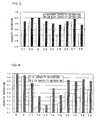
- Figure 4 shows graphs which compare the present batteries A and D to comparative batteries in terms of capacity retention;
- Figure 5 shows graphs which compare the battery D to the batteries E1 - E4 in terms of capacity retention;
- Figure 6 shows graphs which compare the battery D to the batteries F1 - F4 in terms of capacity retention; and
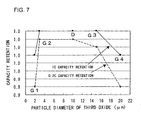
- Figure 7 shows graphs which compare the battery D to the batteries G1 - G4 in terms of capacity retention.
- The present invention is below described in more detail by way of examples. It will be recognized that the following examples merely illustrate the practice of the present invention but are not intended to be limiting thereof. Suitable changes and modifications can be effected without departing from the scope of the present invention.
- The following Experiments 1 - 3 are directed to show examples in accordance with the first aspect of the present invention.
- In this
experiment 1, batteris were constructed using various types of positive electrode materials and their performance characteristics were compared. - Fabrication of a positive electrode is first described. Lithium hydroxide (LiOH), manganese nitrate (Mn(NO3)2) and aluminum nitrate (Al(NO3)3) were blended in the ratio by mole of Li to Mn to Al of 1:1.95:0.05. The blend was heat treated in the atmosphere at 800 °C for 20 hours and then subjected to size reduction to obtain a lithium-manganese complex oxide (first oxide) having a mean particle diameter of 15 µm and represented by the compositional formula LiMn1.95Al0.05O4. This first oxide had a spinel structure.
- Also, LiOH, nickel nitrate (Ni(NO3)2), cobalt nitrate (Co(NO3)2) and manganese nitrate (Mn(NO3)3) were blended in the ratio by mole of Li to Ni to Co to Mn of 1:0.6:0.3:0.1. The blend was heat treated in oxygen atmosphere at 750 °C for 20 hours and then subjected to size reduction to obtain a lithium-nickel-cobalt complex oxide (second oxide) having a mean particle diameter of 10 µm and represented by the compositional formula LiNi0.6Co0.3Mn0.1O2.
- The first and second oxides such obtained were mixed in the ratio by weight of 1:1 to prepare a positive electrode material (positive active material).
- 90 parts by weight of this powder-form positive active material, 5 parts by weight of artificial graphite powder and an N-methyl-2-pyrrolidone (NMP) solution containing 5 parts by weight of polyvinylidene fluoride were mixed to prepare a slurry. This slurry was applied to opposite sides of an aluminum foil by a doctor blade technique to form active material layers. Subsequent vacuum drying at 150 °C for 2 hours resulted in the fabrication of a positive electrode.
- Then, 95 parts by weight of natural graphite and an NMP solution containing 5 parts by weight of polyvinylidene fluoride were mixed to prepare a carbon slurry. This carbon slurry was applied to opposite sides of a copper foil by a doctor blade technique to form carbon layers. Subsequent vacuum drying at 150 °C for 2 hours resulted in the fabrication of a negative electrode.
- 1 mole/liter of LiPF6 was dissolved in a mixed solvent containing ethylene carbonate and dimethyl carbonate in a ratio by volume of 1:1 to prepare a nonaqueous electrolyte solution.
- The above positive electrode, negative electrode and nonaqueous electrolyte solution were used to construct a battery A of the present invention in the form of an AA-size nonaqueous electrolyte secondary battery (battery size: 14 mm in diameter, height of 50 mm, nominal capacity of 580 mAh). Used as a separator was a microporous membrane formed of polypropylene.
- In the positive electrode fabrication of the above Example, only the lithium-manganese complex oxide (first oxide) was used as positive active material. Otherwise, the procedure used to construct the battery A of the present invention was followed to construct a comparative battery X1.
- In the positive electrode fabrication of the above Example, only a lithium-manganese complex oxide (spinel manganese) represented by LiMn2O4 was used as positive active material. Otherwise, the procedure used to construct the battery A of the present invention was followed to construct a comparative battery X2.
- In the positive electrode fabrication of the above Example, only the lithium-nickel-cobalt complex oxide (second oxide) was used as positive active material. Otherwise, the procedure used to construct the battery A of the present invention was followed to construct a comparative battery X3.
- In the positive electrode fabrication of the above Example, the lithium-manganese complex oxide (spinel manganese) represented by the compositional formula LiMn2O4 was used for the first oxide. Otherwise, the procedure of Example 1 was followed to construct a comparative battery X4.
- In the positive electrode fabrication of the above Example, the lithium-nickel-cobalt complex oxide represented by the compositional formula LiNi0.8CO0.2O2 was used for the second oxide. Otherwise, the procedure used to construct the battery A of the present invention was followed to construct a comparative battery X5.
- The positive electrode materials used to construct the above batteries are specified in Table 1.
[TABLE 1] Type of Battery Positive Electrode Material Present Battery A LiMn1.95Al0.05O4 LiNi0.6Co0.3Mn0.1O2 Comparative Battery X1 LiMn1.95Al0.05O4 Comparative Battery X2 LiMn2O4 Comparative Battery X3 LiNi0.6Co0.3Mn0.2O2 Comparative Battery X4 LiMn2O4 LiNi0.6Co0.3Mn0.1O2 Comparative Battery X5 LiMn1.95Al0.05O4 LiNi0.8Co0.2O2 - Each of the present battery A and comparative batteries X1 - X5 was charged, at a constant current of 580 mA which is a value equivalent to the 1C rate, to 4.2 V at room temperature (25 °C), further charged, at a constant voltage of 4.2 V, to an end current of 50 mA, and then discharged, at a constant current of 580 mA which is a value equivalent to the 1C rate, to 2.75 V. The discharge capacity was recorded as a 1C capacity A1.
- Next, each battery was charged in the same fashion as described above and then discharged, at a constant current of 116 mA which is a value equivalent to the 0.2C rate, to 2.75 V. The discharge capacity was recorded as a 0.2C capacity B1.
- The charge-discharge cycle practiced above in measuring the 1C capacity, as a unit cycle, was repeated. After 200 charge-discharge cycles, measurement was carried out in the same manner as above to find a 1C capacity A200 and a 0.2C capacity B200. A 1C capacity retention A200/A1 and a 0.2C capacity retention B200/B1, after 200 cycles, were also found.
- The results are shown in Figure 1.
- In these results, a larger difference between the 1C and 0.2C capacity retentions indicates a larger decrease of load characteristics after cycles.
- As can be seen from comparison between the comparative batteries X1 and X2, the 1C and 0.2C capacity retentions can be both improved by incorporation of a dissimilar element (Al) in the first oxide, i.e., the lithium-manganese complex oxide (LiMn2O4), in the form of a solid solution. This is because the incorporation of the dissimilar element in the first oxide, in the form of a solid solution, reinforced a crystal structure to the extent that suppressed degradation of the crystal structure with cycling.
- From comparison of the comparative batteries X3 - X5 to X1 and X2, it has been found that the 1C and 0.2C capacity retentions can be both improved when LiMn2O4 is mixed with LiNi0.6Co0.3Mn0.1O2 or LiNi0.8Co0.2O2 than when it is used alone in the positive electrode, or, when LiMn1.95Al0.05O4 is mixed with LiNi0.8Co0.2O2 than when it is used alone in the positive electrode. This is because the lithium-manganese complex oxide, when combined with the lithium-nickel-cobalt complex oxide, becomes more effective to suppress expansion and shrinkage of the whole of a positive electrode mix with cycling.
- As can also be seen from comparison of the present battery A to comparative batteries X3 - X5, the combination of LiMn1.95Al0.05O4 with LiNi0.6Co0.3Mn0.1O2 results not only in the marked improvements of the 1C and 0.2C capacity retentions but also in the marked reduction of a difference between the 1C and 0.2C capacity retentions that suppresses load characteristic deterioration with cycling. This is considered due to the incorporation of a dissimilar element in each of the lithium-manganese complex oxide and lithium-nickel-cobalt complex oxide, in the form of a solid solution, that caused a change in electronic state of the active material, i.e., a combination of the first and second oxides, in such a way to increase electronic conductivity of its entirety, and also caused a change in its expansion-shrinkage behavior with charge-discharge cycling in such a way to maintain stable contact between particles of the first and second oxides during charge-discharge cycles.
- In the above examples, the oxide represented by the compositional formula LiMn1.95Al0.05O4 was used for the first oxide incorporating a dissimilar element in the form of a solid solution. It has been also proved that the same effect can be obtained with the use of a lithium-manganese complex oxide represented by the compositional formula LixMn2-yM1yO4+z, (where, M1 is at least one element selected from the group consisting of Al, Co, Ni, Mg and Fe, 0 ≦ x ≦ 1.2, 0 < y ≦ 0.1 and -0.2 ≦ z ≦ 0.2).
- Also in the above examples, the oxide represented by the compositional formula LiNi0.6Co0.3Mn0.1O2 was used for the lithium-nickel-cobalt complex oxide (second oxide) that incorporated a dissimilar element in the form of a solid solution. It has been also proved that the same effect can be obtained with the use of a lithium-nickel-cobalt complex oxide represented by the compositional formula LiaM2bNicCodO2 (where, M2 is at least one element selected from the group consisting of Al, Mn, Mg and Ti, 0 < a < 1.3, 0.02 ≦ b ≦ 0.3, 0.02 ≦ d/(c + d) ≦ 0.9 and b + c + d = 1).
- In this
experiment 2, the amounts of the first and second oxides contained in the positive electrode and accordingly their relative contents were varied to compare performance characteristics of the resulting batteries. - The procedure utilized in the preceding example to construct the battery A in accordance with this invention was followed, with the exception that the mixing ratio by weight of the first to second oxide was varied to 10:90, 20:80, 80:20 and 90:10, to construct batteries B1 - B4. These batteries were subsequently measured for 1C and 0.2C capacity retentions in the same manner as in
Experiment 1. The results are shown in Figure 2. - In Figure 2, the results for the battery A (a ratio by weight of the first to second oxide = 50:50) used in the
Experiment 1 are also shown. - The results shown in Figure 2 demonstrate that when the lithium-manganese complex oxide, i.e., the first oxide is added in the amount of 20 - 80 % by weight of the mixture, the 1C and 0.2C capacity retentions are both improved and the deterioration of load characteristics with cycling is suppressed. This is because the first oxide, when added within the above-specified range, became more effective to maintain stable contact between particles of the first oxide, and the second oxide in the form of lithium-nickel-cobalt complex oxide, during charge-discharge cycles.
- In this
experiment 3, the respective mean particle diameters of the first and second oxides contained in the positive electrode were varied to compare performance characteristics of the resulting batteries. - During synthesis of the first and second oxides, size reduction was effected in such a controlled fashion as to obtain positive electrode materials having mean particle diameters specified in Table 2. Otherwise, the procedure utilized in the preceding example to construct the battery A of the present invention was followed to construct batteries C1 - C8.
[TABLE 2] Battery Particle Diameter of First Oxide Particle Diameter of Second Oxide C1 15 µm 2µm C2 15µm 3µm A 15µm 10µm C3 15µm 15µm C4 15µm 20µm C5 3µm 10µm C6 5µm 10µm C7 30µm 10µm C8 35µm 10µm - Then, the 1C and 0.2C capacity retentions were measured for the batteries C1 - C8 in the same manner as in the
above Experiment 1. The results are shown in Figure 3. In this Figure 3, the data obtained for the battery A of the present invention prepared in the preceding Experiment A are also shown. - As can be seen from the results shown in Figure 3, when the first oxide in the form of a lithium-manganese complex oxide has a mean particle diameter in the range of 5 - 30 µm and the second oxide in the form of a lithium-nickel-cobalt complex oxide has a mean particle diameter in the range of 3 - 15 µm, the 1C and 0.2C capacity retentions, in particular, are improved and the deterioration of load characteristics with cycling can be suppressed.
- Particularly when the mean particle diameter of each complex oxide is within the above-specified range, contact between particles of the complex oxide is maintained at a higher degree of occurrence to thereby improve electronic conductivity of the cathode mix in its entirety. Also, expansion and shrinkage of each complex oxide are balanced in an effective manner. These are considered to result in the improved characteristics of the batteries C2, A, C3, C6 and C7.
- From comparison of the batteries C2, A and C7 to C3 and C6, it is found preferable that the first oxide has a larger mean particle diameter than the second oxide.
- The following Experiments 4 - 7 describe examples in accordance with a second aspect of the present invention.
- In this
experiment 4, batteris were constructed using various types of positive electrode materials and their performance characteristics were compared. - The first and second oxides were prepared in the same manner as in the
above Experiment 1. - Also, a third oxide was prepared in the following manner. LiOH, cobalt nitrate (Co(NO3)2) and magnesium nitrate (Mg(NO3)2·6H2O) were blended in the ratio by mole of Li to Co to Mg of 1:0.9:0.1. The blend was heat treated in a dry air at 750 °C for 20 hours and then subjected to size reduction to obtain a lithium-cobalt complex oxide (third oxide) having a mean particle diameter of 10 µm and represented by the formula LiCo0.9Mg0.1O2.
- The first, second and third oxides such obtained were then mixed in the ratio by weight of 1:0.5:0.5 to prepare a positive electrode material (positive active material).
- Using this positive active material, a positive electrode was fabricated in the same manner as in the
above Experiment 1. - The procedure of the
above Experiment 1 was followed to fabricate a negative electrode and prepare a nonaqueous electrolyte solution. - By using such-obtained positive electrode, negative electrode and nonaqueous electrolyte solution, a battery D in accordance with the present invention was constructed in the same manner as in the
above Experiment 1. - In the above Example, the lithium-manganese complex oxide (first oxide) and the lithium-cobalt complex oxide (third oxide) were mixed in the ratio by weight of 1:1 to provode a positive active material for use in the positive electrode. Otherwise, the procedure used to construct the battery D of the present invention was followed to construct a comparative battery Y1.
- In the above Example, the lithium-manganese complex oxide (first oxide) was used alone to provide a positive active material for use in the positive electrode.
Otherwise, the procedure used to construct the battery D of the present invention was followed to construct a comparative battery Y2. - In the above Example, a lithium-manganese complex oxide (spinel manganese) represented by LiMn2O4 was used alone to provide a positive active material for use in the positive electrode. Otherwise, the procedure used to construct the battery D of the present invention was followed to construct a comparative battery Y3.
- In the above Example, the lithium-nickel-cobalt complex oxide (second oxide) was used alone to provide a positive active material for use in the positive electrode. Otherwise, the procedure used to construct the battery D of the present invention was followed to construct a comparative battery Y4.
- In the above Example, the lithium-cobalt complex oxide (third oxide) was used alone to provide a positive active material for use in the positive electrode. Otherwise, the procedure used to construct the battery D of the present invention was followed to construct a comparative battery Y5.
- In the above Example, the lithium-manganese complex oxide (spinel manganese) represented by LiMn2O4 was used for the first oxide, and this lithium-manganese complex oxide (first oxide) and the lithium-nickel-cobalt complex oxide (second oxide) were mixed in the ratio by weight of 1:1 to provode a positive active material for use in the positive electrode. Otherwise, the procedure used to construct the battery D of the present invention was followed to construct a comparative battery Y6.
- In the above Example, the lithium-nickel-cobalt complex oxide represented by LiNi0.8Co0.2O2 was used for the second oxide, and the lithium-manganese complex oxide (first oxide) and this lithium-nickel-cobalt complex oxide (second oxide) were mixed in the ratio by weight of 1:1 to provode a positive active material for use in the positive electrode. Otherwise, the procedure used to construct the battery D of the present invention was followed to construct a comparative battery Y7.
- In the above Example, the lithium-manganese complex oxide (spinel manganese) represented by the compositional formula LiMn2O4 was used for the first oxide. Otherwise, the procedure used to construct the battery D of the present invention was followed to construct a comparative battery Y8.
- In the above Example, the lithium-nickel-cobalt complex oxide represented by compositional formula LiNi0.8Co0.2O2 was used for the second oxide. Otherwise, the procedure used to construct the battery D of the present invention was followed to construct a comparative battery Y9.
- The above comparative batteries Y2, Y3, Y4, Y6 and Y7 are identical to the comparative batteries X1, X2, X3, X4 and X5 constructed in
Experiment 1, respectively. - The positive materials of the batteries constructed in the manner as described above are listed in Table 3. In Table 3, the battery A of the present invention in the
above Experiment 1 is also shown.[TABLE 3] Positive Electrode Material Present Battery D LiMn1.95Al0.05O4 LiNi0.6Co0.3Mn0.1O2 LiCo0.9Mg0.1O2 Present Battery A LiMn1.95Al0.05O4 LiNi0.6CO0.3Mn0.1O2 Comparative Battery Y1 LiMn1.95Al0.05O4 LiCo0.9Mg0.1O2 Comparative Battery Y2 LiMn1.95Al0.05O4 Comparative Battery Y3 LiMn2O4 Comparative Battery Y4 LiNi0.6Co0.3Mn0.1O2 Comparative Battery Y5 LiCo0.9Mg0.1O2 Comparative Battery Y6 LiMn2O4 LiNi0.6Co0.3Mn0.1O2 Comparative Battery Y7 LiMn1.95Al0.05O4 LiNi0.8Co0.2O2 Comparative Battery Y8 LiMn2O4 LiNi0.6Co0.3Mn0.1O2 LiCo0.9Mg0.1O2 Comparative Battery Y9 LiMn1.95Al0.05O4 LiNi0.8Co0.2O2 LiCo0.9Mg0.1O2 - Each of the batteries D and A and comparative batteries Y1 - Y9 constructed in the manner as described above was subjected to a charge-discharge test similar to the
above Experiment 1 to determine its 1C capacity retention and 0.2C capacity retention. - The results are given in Figure 4.
- As can be seen from comparison between the comparative batteries Y2 and Y3, the 1C and 0.2C capacity retentions can be both improved by incorporation of a dissimilar element (Al) in the first oxide, i.e., the lithium-manganese complex oxide (LiMn2O4), in the form of a solid solution. This is because the incorporation of the dissimilar element in the first oxide, in the form of a solid solution, reinforced a crystal structure to the extent that suppressed degradation of the crystal structure with charge-discharge cycling.
- From comparison of the comparative batteries Y2 - Y4 to Y6 and Y7, it has been found that the 1C and 0.2C capacity retentions can be both improved when LiMn2O4 is mixed with LiNi0.6Co0.3Mn0.1O2 than when it is used alone in the positive electrode, or, when LiMn1.95Al0.05O4 is mixed with LiNi0.8Co0.2O2 than when it is used alone in the positive electrode. This is because the lithium-manganese complex oxide, when combined with the lithium-nickel-cobalt complex oxide, becomes more effective to suppress expansion and shrinkage of a positive electrode mix in its entirety with charge-discharge cycling.
- As can also be seen from comparison of the battery A in accordance with the present invention to the comparative batteries Y6 and Y7, the combination of LiMn1.95Al0.05O4 with LiNi0.6Co0.3Mn0.1O2 results not only in marked improvements of the 1C and 0.2C capacity retentions but also in the marked reduction of a difference between the 1C and 0.2C capacity retentions that suppresses load characteristic deterioration with cycling. This is considered due to the incorporation of a dissimilar element in each of the lithium-manganese complex oxide and lithium-nickel-cobalt complex oxide, in the form of a solid solution, that caused a change in electronic state of the active material comprising the first and and second oxides, in such a way to increase electronic conductivity of its entirety, and also caused a change in its expansion-shrinkage behavior with charge-discharge cycling in such a way to maintain stable contact between particles of the first and second oxides during charge-discharge cycles.
- Also from comparison of the comparative batteries Y1 to Y2 and Y5, it has been found that the 1C and 0.2C capacity retentions can be both improved when the first oxide in the form of LiMn1.95Al0.05O4 is combined with the third oxide in the form of mixed with LiCo0.9Mg0.1O2 than when they are used alone in the positive electrode. This is because the third oxide is more electronically conductive than the first oxide and an electronic state of the active material in its entirety is caused to change when combined to further improve the electronic conductivity.
- As can also be seen from comparison of the comparative batteries Y6 and Y7 to Y8 and Y9, further incorporation of LiCo0.9Mg0.1O2 in the mixture of LiMn2O4 and LiNi0.6Co0.3Mn0.1O2 or the mixture of LiMn1.95Al0.05O4 and LiNi0.8Co0.2O2 results not only in marked improvements of the 1C and 0.2C capacity retentions but also in the marked reduction of a difference between the 1C and 0.2C capacity retentions that suppresses deterioration of load characteristics with cycling. These are considered to result for the same reason stated earlier.
- As can also be seen from comparison of the battery D in accordance with the present invention to the comparative batteries Y8 and Y9, the combination of LiMn1.95Al0.05O4, LiNi0.6Co0.3Mn0.1O2 and LiCo0.9Mg0.1O2 in the positive electrode results not only in improvements of the 1C and 0.2C capacity retentions but also in the marked reduction of a difference between the 1C and 0.2C capacity retentions that suppresses deterioration of load characteristic with cycling. This is considered due to the addition of the third oxide having high electronic conductivity to the active material comprising the first and second oxides with improved electronic conductivities that caused a further change in electonic state of the active material in its entirety.
- In the above examples, the oxide represented by the compositional formula LiMn1.95Al0.05O4 was used for the first oxide incorporating a dissimilar element in the form of a solid solution. It has been also proved that the same effect can be obtained with the use of a lithium-manganese complex oxide represented by the compositional formula LixMn2-yM1yO4+z (where, M1 is at least one element selected from the group consisting of Al, Co, Ni, Mg and Fe, 0 ≦ x ≦ 1.2, 0 < y ≦ 0.1 and -0.2 ≦ z ≦ 0.2).
- Also in the above examples, the oxide represented by the compositional formula LiNi0.6Co0.3Mn0.1O2 was used for the lithium-nickel-cobalt complex oxide (second oxide) that incorporated a dissimilar element in the form of a solid solution. It has been also proved that the same effect can be obtained with the use of a lithium-nickel-cobalt complex oxide represented by the compositional formula LiaM2bNicCodO2 (where, M2 is at least one element selected from the group consisting of Al, Mn, Mg and Ti, 0 < a < 1.3, 0.02 ≦ b ≦ 0.3, 0.02 ≦ d/ (c + d) ≦ 0.9 and b + c + d = 1).
- Also in the above examples, the oxide represented by the compositional formula LiCo0.9Mg0.1O2 was used for the lithium-cobalt complex oxide (third oxide). It has been also proved that the same effect can be obtained with the use of a lithium-cobalt complex oxide represented by the compositional formula LieM3fCo1-fO2 (where, M3 is at least one element selected from the group consisting of Al, Mn, Mg and Ti, 0 < e < 1.3 and 0 ≦ f ≦ 0.4).
- In this
experiment 5, the first oxide content of the positive electrode material was varied to compare performance characteristics of resulting batteries. - A blending ratio by weight of the first to second to third oxide was varied to 10:45:45, 20:40:40, 80:10:10 and 90:5:5. Otherwise, the procedure used in the above example to construct the battery D in accordance with the present invention was followed to construct batteries E1 - E4. These batteries were measured for 1C and 0.2C capacity retentions in the same manner as in the
above Experiment 1. The results are shown in Figure 5. - In Figure 5, the results obtained for the battery D (weight ratio of the first to second to third oxide = 50:25:25) used in the
above Experiment 4 are also shown. - As can be seen from the results shown in Figure 5, when the lithium-manganese complex oxide, i.e., the first oxide, is incorporated in the mixture in the amount of 20 - 80 % by weight, the 1C and 0.2C capacity retentions are improved and the deterioration of load characteristics with cycling can be suppressed. This is probably because the first oxide, when added within the above-specified range, became more effective to maintain stable contact between particles of the first oxide and the second oxide in the form of lithium-nickel-cobalt complex oxide during charge-discharge cycles.
- In this
experiment 6, a ratio by content of the second to third oxide in the positive electrode material was varied to compare performance characteristics of resulting batteries. - A blending ratio by weight of the first to second to third oxide was varied to 50:3:47, 50:5:45, 50:45:5 and 50:47:3. Otherwise, the procedure used in the above example to construct the battery D in accordance with the present invention was followed to construct batteries F1 - F4. These batteries were measured for 1C and 0.2C capacity retentions in the same manner as in the
above Experiment 1. The results are shown in Figure 6. - In Figure 6, the results obtained for the battery D (weight ratio of the first to second to third oxide = 50:25:25) used in the
above Experiment 4 are also shown. - As can be seen from the results shown in Figure 6, when the lithium-nickel-cobalt complex oxide, i.e., the second oxide, and the lithium-cobalt complex oxide, i.e., the third oxide, are mixed in the ratio by weight of 90:10 - 10:90, the 1C and 0.2C capacity retentions are improved and the deterioration of load characteristics with cycling can be suppressed. This is considered due to the addition of the third oxide having high electronic conductivity to the active material comprising the first and second oxides with improved electronic conductivities that caused a further change in electronic state of the active material in its entirety.
- In this experiment 7, a mean particle diameter of the third oxide in the positive electrode material was varied to compare performance characteristics of resulting batteries.
- During synthesis of the third oxide, size reduction was effected in such a controlled fashion as to obtain positive electrode materials having mean particle diameters specified in Table 2. Otherwise, the procedure used in the example to construct the battery D in accordance with the present invention was followed to construct batteries G1 - G4.
[TABLE 4] Battery Particle Diameter of First Oxide Particle Diameter of Second Oxide Particle Diameter of Third Oxide G1 15µm 10µm 2µm G2 15µm 10µm 3µm D 15µm 10µm 10µm G3 15µm 10µm 15µm G4 15µm 10µm 20µm - Then, the 1C and 0.2C capacity retentions were measured for the batteries G1 - G4 in the same manner as in the
above Experiment 1. The results are shown in Figure 7. In this Figure 7, the data obtained for the battery D of the present invention constructed in the precedingExperiment 4 are also shown. - As can be seen from the results shown in Figure 7, when the third oxide, in the form of lithium-cobalt complex oxide, has a mean particle diameter in the range of 3 - 15 µm, the 1C and 0.2C capacity retentions, in paraticular, are improved and the deterioration of load characteristics with cycling can be suppressed.
- Particularly when the mean particle diameter of the third complex oxide falls within the above-specified range, contact between particles of all the complex oxides is maintained at a higher degree of occurrence to thereby improve electronic conductivity of the cathode mix in its entirety as a result of a change in its electronic state. Also, expansion and shrinkage of each complex oxide are balanced in an effective manner. These are considered to result in the improved characteristics of the batteries G2, D and G3.
- As described above in detail, the present invention can provide a secondary lithium battery which shows the reduced deterioration of load charactertistic with cycling.
Claims (14)
- A nonaqueous electrolyte secondary battery characterized as using a mixture of a first oxide, a second oxide and a third oxide for its positive electrode material, said first oxide being a spinel oxide consisting substantially of lithium, manganese, a metal other than manganese, and oxygen, said second oxide being different from the first oxide and consisting substantially of lithium, nickel, cobalt, a metal other than nickel and cobalt, and oxygen, and said third oxide being different from the first and second oxides and consisting substantially of lithium, cobalt and oxygen or of lithium, cobalt, a metal other than cobalt, and oxygen.
- The nonaqueous electrolyte secondary battery as recited in claim 1, characterized in that said first oxide is an oxide derived via substitution of other element for a part of manganese in a lithium-manganese complex oxide, said second oxide is an oxide derived via substitution of cobalt and other element for a part of nickel in a lithium-nickel complex oxide, and said third oxide is a lithium-cobalt complex oxide or an oxide derived via substitution of other element for a part of cobalt in said lithium-cobalt complex oxide.
- The nonaqueous electrolyte secondary battery as recited in claim 1 or 2, characterized in that said first oxide is a lithium-manganese complex oxide represented by the compositional formula LixMn2-yMlyO4+z (where, M1 is at least one element selected from the group consisting of Al, Co, Ni, Mg and Fe, 0 ≤ x ≤ 1.2, 0 < y ≤ 0.1 and -0.2 ≤ z ≤ 0.2).
- The nonaqueous electrolyte secondary battery as recited in any one of claims 1-3, characterized in that said second oxide is represented by the compositional formula LiaM2bNicCodO2 (where, M2 is at least one element selected from the group consisting of Al, Mn, Mg and Ti, 0 < a < 1.3, 0.02 ≤ b ≤ 0.3, 0.02 ≤ d/(c + d) ≤ 0.9 and b + c + d = 1).
- The nonaqueous electrolyte secondary battery as recited in any one of claims 1-4, characterized in that said third oxide is represented by the compositional formula LieM3fCo1-fO2 (where, M3 is at least one element selected from the group consisting of Al, Mn, Mg and Ti, 0 < e < 1.3 and 0 ≤ f ≤ 0.4).
- The nonaqueous electrolyte secondary battery as recited in claim 3, characterized in that M1 in the first oxide's compositional formula LixMn2-yMlyO4+z is at least one of Al and Mg.
- The nonaqueous electrolyte secondary battery as recited in claim 4, characterized in that M2 in the second oxide's compositional formula LiaM2bNicCodO2 is Mn.
- The nonaqueous electrolyte secondary battery as recited in claim 7, characterized in that 0.1 ≤ d/(c + d) ≤ 0.5 is satisfied in the second oxide's compositional formula LiaM2bNicCodO2.
- The nonaqueous electrolyte secondary battery as recited in claim 5, characterized in that said third oxide is represented by the compositional formula LieM3fCo1-fO2 (where, M3 is at least one element selected from the group consisting of Mg and Ti, 0 < e < 1.3 and 0.02 ≤ f ≤ 0.2).
- The nonaqueous electrolyte secondary battery as recited in any one of claims 1-9, characterized in that said first, second and third oxides are mixed in the ratio by weight of (first oxide) to (second oxide + third oxide) = 20:80 - 80:20.
- The nonaqueous electrolyte secondary battery as recited in claim 10, characterized in that said second and third oxides are mixed in the ratio by weight of (second oxide) to (third oxide) = 90:10 - 10:90.
- The nonaqueous electrolyte secondary battery as recited in any one of claim 1-11, characterized in that said first oxide has a mean particle diameter of 5 - 30 µm.
- The nonaqueous electrolyte secondary battery as recited in any one of claim 1-12, characterized in that said second oxide has a mean particle diameter of 3 - 15 µm.
- The nonaqueous electrolyte secondary battery as recited in any one of claim 1- 13, characterized in that said third oxide has a mean particle diameter of 3 - 15 µm.
Applications Claiming Priority (3)
| Application Number | Priority Date | Filing Date | Title |
|---|---|---|---|
| JP5274199 | 1999-03-01 | ||
| JP35861599A JP3869605B2 (en) | 1999-03-01 | 1999-12-17 | Nonaqueous electrolyte secondary battery |
| EP00902892A EP1174937B9 (en) | 1999-03-01 | 2000-02-09 | Nonaqueous electrolyte secondary cell |
Related Parent Applications (3)
| Application Number | Title | Priority Date | Filing Date |
|---|---|---|---|
| EP00902892.9 Division | 2000-02-09 | ||
| EP00902892A Division EP1174937B9 (en) | 1999-03-01 | 2000-02-09 | Nonaqueous electrolyte secondary cell |
| EP00902892A Division-Into EP1174937B9 (en) | 1999-03-01 | 2000-02-09 | Nonaqueous electrolyte secondary cell |
Publications (4)
| Publication Number | Publication Date |
|---|---|
| EP1885011A2 true EP1885011A2 (en) | 2008-02-06 |
| EP1885011A3 EP1885011A3 (en) | 2008-02-20 |
| EP1885011B1 EP1885011B1 (en) | 2011-06-22 |
| EP1885011B9 EP1885011B9 (en) | 2012-09-26 |
Family
ID=26393395
Family Applications (2)
| Application Number | Title | Priority Date | Filing Date |
|---|---|---|---|
| EP00902892A Expired - Lifetime EP1174937B9 (en) | 1999-03-01 | 2000-02-09 | Nonaqueous electrolyte secondary cell |
| EP07010817A Expired - Lifetime EP1885011B9 (en) | 1999-03-01 | 2000-02-09 | Nonaqueous electrolyte secondary battery |
Family Applications Before (1)
| Application Number | Title | Priority Date | Filing Date |
|---|---|---|---|
| EP00902892A Expired - Lifetime EP1174937B9 (en) | 1999-03-01 | 2000-02-09 | Nonaqueous electrolyte secondary cell |
Country Status (8)
| Country | Link |
|---|---|
| US (1) | US6746800B1 (en) |
| EP (2) | EP1174937B9 (en) |
| JP (1) | JP3869605B2 (en) |
| AT (1) | ATE456162T1 (en) |
| CA (1) | CA2365562C (en) |
| DE (1) | DE60043724D1 (en) |
| HU (1) | HUP0200246A2 (en) |
| WO (1) | WO2000052773A1 (en) |
Cited By (6)
| Publication number | Priority date | Publication date | Assignee | Title |
|---|---|---|---|---|
| WO2009131897A1 (en) * | 2008-04-24 | 2009-10-29 | Boston -Power, Inc. | Lithium-ion secondary battery |
| US7816033B2 (en) | 2006-05-29 | 2010-10-19 | Lg Chem, Ltd. | Cathode active material comprising mixture of lithium/manganese spinel oxide and lithium/nickel/cobalt/manganese oxide and lithium secondary battery containing same |
| US8003241B2 (en) | 2006-06-23 | 2011-08-23 | Boston-Power, Inc. | Lithium battery with external positive thermal coefficient layer |
| US8679670B2 (en) | 2007-06-22 | 2014-03-25 | Boston-Power, Inc. | CID retention device for Li-ion cell |
| US8828605B2 (en) | 2004-12-28 | 2014-09-09 | Boston-Power, Inc. | Lithium-ion secondary battery |
| US9166206B2 (en) | 2008-04-24 | 2015-10-20 | Boston-Power, Inc. | Prismatic storage battery or cell with flexible recessed portion |
Families Citing this family (68)
| Publication number | Priority date | Publication date | Assignee | Title |
|---|---|---|---|---|
| JP4940505B2 (en) * | 2000-03-30 | 2012-05-30 | ソニー株式会社 | Lithium ion secondary battery |
| JP4654488B2 (en) * | 2000-06-16 | 2011-03-23 | 三菱化学株式会社 | Positive electrode material for lithium ion secondary battery, positive electrode and battery using the same |
| JP4183374B2 (en) * | 2000-09-29 | 2008-11-19 | 三洋電機株式会社 | Nonaqueous electrolyte secondary battery |
| JP2002203554A (en) * | 2000-12-28 | 2002-07-19 | Sony Corp | Non-aqueous electrolyte secondary battery |
| TW533612B (en) | 2000-12-28 | 2003-05-21 | Sony Corp | Positive-electrode active material and non-aqueous electrolyte secondary battery |
| JP2002203556A (en) * | 2000-12-28 | 2002-07-19 | Sony Corp | Non-aqueous electrolyte secondary battery |
| JP2002203559A (en) * | 2000-12-28 | 2002-07-19 | Sony Corp | Non-aqueous electrolyte secondary battery and method for producing positive electrode active material |
| JP2002203555A (en) * | 2000-12-28 | 2002-07-19 | Sony Corp | Non-aqueous electrolyte secondary battery |
| JP5052712B2 (en) * | 2000-12-28 | 2012-10-17 | ソニー株式会社 | Nonaqueous electrolyte secondary battery |
| WO2002065561A1 (en) * | 2001-02-14 | 2002-08-22 | Sony Corporation | Non-aqueous electrolytic battery |
| JP2002270245A (en) * | 2001-03-14 | 2002-09-20 | Osaka Gas Co Ltd | Non-aqueous secondary battery |
| JP2002270176A (en) * | 2001-03-14 | 2002-09-20 | Sony Corp | Positive electrode material and battery using the same |
| JP5103698B2 (en) * | 2001-04-19 | 2012-12-19 | ソニー株式会社 | Non-aqueous electrolyte secondary battery and manufacturing method thereof |
| JP2003017060A (en) * | 2001-04-25 | 2003-01-17 | Sony Corp | Cathode active material and non-aqueous electrolyte battery |
| JP3873717B2 (en) | 2001-11-09 | 2007-01-24 | ソニー株式会社 | Positive electrode material and battery using the same |
| JP4404179B2 (en) * | 2001-12-06 | 2010-01-27 | ソニー株式会社 | Positive electrode active material and secondary battery using the same |
| KR100441524B1 (en) * | 2002-01-24 | 2004-07-23 | 삼성에스디아이 주식회사 | Positive active material slurry composition for rechargeable lithium battery |
| US7691535B2 (en) | 2002-03-27 | 2010-04-06 | Gs Yuasa Corporation | Active substance of positive electrode and non-aqueous electrolyte battery containing the same |
| US7674556B2 (en) * | 2002-05-30 | 2010-03-09 | Panasonic Corporation | Non-aqueous electrolyte secondary battery and method for charging the same |
| JP4731106B2 (en) * | 2002-09-30 | 2011-07-20 | 三洋電機株式会社 | Nonaqueous electrolyte secondary battery |
| JP3844733B2 (en) * | 2002-12-26 | 2006-11-15 | 松下電器産業株式会社 | Nonaqueous electrolyte secondary battery |
| JP2005243504A (en) * | 2004-02-27 | 2005-09-08 | Sanyo Electric Co Ltd | Lithium secondary battery |
| JP4726423B2 (en) * | 2004-03-17 | 2011-07-20 | 三洋電機株式会社 | Positive electrode material for non-aqueous electrolyte secondary battery and non-aqueous electrolyte secondary battery |
| US7476467B2 (en) * | 2004-03-29 | 2009-01-13 | Lg Chem, Ltd. | Lithium secondary battery with high power |
| US7811707B2 (en) * | 2004-12-28 | 2010-10-12 | Boston-Power, Inc. | Lithium-ion secondary battery |
| US9666862B2 (en) * | 2005-02-23 | 2017-05-30 | Lg Chem, Ltd. | Secondary battery of improved lithium ion mobility and cell capacity |
| JP5105393B2 (en) * | 2005-03-02 | 2012-12-26 | 日立マクセルエナジー株式会社 | Nonaqueous electrolyte secondary battery |
| JP2013020975A (en) * | 2005-03-02 | 2013-01-31 | Hitachi Maxell Energy Ltd | Nonaqueous electrolyte secondary battery |
| JP4273422B2 (en) * | 2005-03-09 | 2009-06-03 | ソニー株式会社 | Positive electrode material and battery |
| CN101263396B (en) | 2005-07-14 | 2011-04-27 | 波士顿电力公司 | Control electronics for Li-ion batteries |
| JP4626568B2 (en) * | 2005-07-29 | 2011-02-09 | ソニー株式会社 | Lithium ion secondary battery |
| CN102522539B (en) * | 2005-08-16 | 2015-06-10 | 株式会社Lg化学 | Cathode active material and lithium secondary battery comprising same |
| US8895187B2 (en) * | 2005-08-16 | 2014-11-25 | Lg Chem, Ltd. | Cathode active material and lithium secondary battery containing the same |
| JP4945967B2 (en) * | 2005-09-02 | 2012-06-06 | パナソニック株式会社 | Non-aqueous electrolyte secondary battery |
| CN102931434B (en) | 2005-10-20 | 2015-09-16 | 三菱化学株式会社 | Lithium secondary battery and non-aqueous electrolyte used therein |
| JP5103857B2 (en) | 2005-11-10 | 2012-12-19 | 日産自動車株式会社 | Secondary battery electrode and secondary battery using the same |
| JP5671770B2 (en) * | 2005-11-16 | 2015-02-18 | 三菱化学株式会社 | Lithium secondary battery |
| JP2007250198A (en) * | 2006-03-13 | 2007-09-27 | Sanyo Electric Co Ltd | Nonaqueous electrolyte secondary battery |
| JP5117729B2 (en) * | 2006-03-27 | 2013-01-16 | 日立マクセルエナジー株式会社 | Non-aqueous secondary battery and method of using the same |
| JP5117730B2 (en) * | 2006-03-27 | 2013-01-16 | 日立マクセルエナジー株式会社 | Non-aqueous secondary battery and method of using the same |
| JP5110556B2 (en) * | 2006-03-27 | 2012-12-26 | 日立マクセルエナジー株式会社 | Non-aqueous secondary battery and method of using the same |
| TWI426678B (en) * | 2006-06-28 | 2014-02-11 | 波士頓電力公司 | Electronic device with multiple charging rate, battery pack, method for charging lithium ion charge storage power supply in electronic device and portable computer |
| JP5135764B2 (en) * | 2006-11-02 | 2013-02-06 | 株式会社Gsユアサ | Nonaqueous electrolyte secondary battery |
| JP2008282667A (en) * | 2007-05-10 | 2008-11-20 | Sony Corp | Cathode active material for lithium ion secondary battery using organic electrolyte |
| US20100108291A1 (en) * | 2008-09-12 | 2010-05-06 | Boston-Power, Inc. | Method and apparatus for embedded battery cells and thermal management |
| CN102422504A (en) * | 2009-05-18 | 2012-04-18 | 波士顿电力公司 | Energy efficient and fast charge modes of a rechargeable battery |
| US20110049977A1 (en) * | 2009-09-01 | 2011-03-03 | Boston-Power, Inc. | Safety and performance optimized controls for large scale electric vehicle battery systems |
| US8483886B2 (en) * | 2009-09-01 | 2013-07-09 | Boston-Power, Inc. | Large scale battery systems and method of assembly |
| DE102009049326A1 (en) * | 2009-10-14 | 2011-04-21 | Li-Tec Battery Gmbh | Cathodic electrode and electrochemical cell for this purpose |
| JP5412298B2 (en) * | 2010-01-12 | 2014-02-12 | 株式会社日立製作所 | Positive electrode material for lithium ion secondary battery and lithium ion secondary battery using the same |
| JP2011040410A (en) * | 2010-10-20 | 2011-02-24 | Sony Corp | Nonaqueous electrolyte secondary battery |
| JP2012142157A (en) * | 2010-12-28 | 2012-07-26 | Sony Corp | Lithium ion secondary battery, positive electrode active material, positive electrode, power tool, electric vehicle, and power storage system |
| EP2696409B1 (en) | 2011-05-23 | 2017-08-09 | LG Chem, Ltd. | High energy density lithium secondary battery having enhanced energy density characteristic |
| KR101336078B1 (en) * | 2011-05-23 | 2013-12-03 | 주식회사 엘지화학 | Lithium Secondary Battery of High Power Property with Improved High Energy Density |
| KR101336674B1 (en) | 2011-05-23 | 2013-12-03 | 주식회사 엘지화학 | Lithium Secondary Battery of High Energy Density with Improved High Power Property |
| JP5839034B2 (en) * | 2011-07-13 | 2016-01-06 | 株式会社Gsユアサ | Nonaqueous electrolyte secondary battery |
| KR101336070B1 (en) | 2011-07-13 | 2013-12-03 | 주식회사 엘지화학 | Lithium Secondary Battery of High Energy with Improved energy Property |
| JP2015018598A (en) * | 2011-11-09 | 2015-01-29 | 新神戸電機株式会社 | Nonaqueous electrolyte secondary battery |
| JP5978024B2 (en) * | 2012-06-21 | 2016-08-24 | 日立マクセル株式会社 | Non-aqueous secondary battery |
| US9660262B2 (en) | 2012-09-11 | 2017-05-23 | Gs Yuasa International Ltd. | Nonaqueous electrolyte secondary battery |
| JP5605867B2 (en) * | 2013-01-29 | 2014-10-15 | Necエナジーデバイス株式会社 | Positive electrode for secondary battery and lithium secondary battery using the same |
| KR101702798B1 (en) * | 2013-03-15 | 2017-02-06 | 닛산 지도우샤 가부시키가이샤 | Non-aqueous electrolyte secondary battery cathode, and non-aqueous electrolyte secondary battery using same |
| WO2014142284A1 (en) * | 2013-03-15 | 2014-09-18 | 日産自動車株式会社 | Non-aqueous electrolyte secondary battery cathode, and non-aqueous electrolyte secondary battery using same |
| EP2991151B1 (en) * | 2013-04-26 | 2018-11-07 | Nissan Motor Co., Ltd | Nonaqueous-electrolyte secondary battery |
| US9583279B2 (en) * | 2013-07-01 | 2017-02-28 | Samsung Sdi Co., Ltd. | Secondary battery |
| EP3683873B1 (en) * | 2017-11-06 | 2023-04-12 | LG Energy Solution, Ltd. | Lithium secondary battery |
| US20220149366A1 (en) * | 2019-02-28 | 2022-05-12 | Panasonic Intellectual Property Management Co., Ltd. | Positive electrode active material for nonaqueous electrolyte secondary battery and nonaqueous electrolyte secondary battery |
| CN113646933B (en) * | 2020-12-31 | 2024-02-13 | 宁德新能源科技有限公司 | Pole pieces, electrochemical devices and electronic devices |
Family Cites Families (10)
| Publication number | Priority date | Publication date | Assignee | Title |
|---|---|---|---|---|
| EP0390185B1 (en) * | 1989-03-30 | 1994-06-22 | Matsushita Electric Industrial Co., Ltd. | Non-aqueous electrolyte secondary cell |
| JP3244314B2 (en) * | 1991-11-13 | 2002-01-07 | 三洋電機株式会社 | Non-aqueous battery |
| JPH07240200A (en) * | 1994-02-28 | 1995-09-12 | Fuji Photo Film Co Ltd | Non-aqueous secondary battery |
| JPH07307164A (en) * | 1994-05-11 | 1995-11-21 | Asahi Chem Ind Co Ltd | Lithium ion secondary battery |
| JPH0845498A (en) | 1994-05-26 | 1996-02-16 | Sony Corp | Non-aqueous electrolyte secondary battery |
| US5783333A (en) * | 1996-11-27 | 1998-07-21 | Polystor Corporation | Lithium nickel cobalt oxides for positive electrodes |
| WO1998029914A1 (en) * | 1996-12-25 | 1998-07-09 | Mitsubishi Denki Kabushiki Kaisha | Anode active material, method for manufacturing the same, and lithium ion secondary cell using the same |
| JP3384280B2 (en) * | 1997-05-08 | 2003-03-10 | 株式会社村田製作所 | Method for producing positive electrode active material for lithium secondary battery |
| JPH113698A (en) | 1997-06-11 | 1999-01-06 | Japan Storage Battery Co Ltd | Lithium ion secondary battery |
| JPH1154122A (en) * | 1997-08-04 | 1999-02-26 | Japan Storage Battery Co Ltd | Lithium ion secondary battery |
-
1999
- 1999-12-17 JP JP35861599A patent/JP3869605B2/en not_active Expired - Lifetime
-
2000
- 2000-02-09 DE DE60043724T patent/DE60043724D1/en not_active Expired - Lifetime
- 2000-02-09 EP EP00902892A patent/EP1174937B9/en not_active Expired - Lifetime
- 2000-02-09 HU HU0200246A patent/HUP0200246A2/en unknown
- 2000-02-09 EP EP07010817A patent/EP1885011B9/en not_active Expired - Lifetime
- 2000-02-09 WO PCT/JP2000/000731 patent/WO2000052773A1/en not_active Ceased
- 2000-02-09 CA CA002365562A patent/CA2365562C/en not_active Expired - Fee Related
- 2000-02-09 AT AT00902892T patent/ATE456162T1/en not_active IP Right Cessation
- 2000-02-09 US US09/914,653 patent/US6746800B1/en not_active Expired - Lifetime
Non-Patent Citations (1)
| Title |
|---|
| None |
Cited By (7)
| Publication number | Priority date | Publication date | Assignee | Title |
|---|---|---|---|---|
| US8828605B2 (en) | 2004-12-28 | 2014-09-09 | Boston-Power, Inc. | Lithium-ion secondary battery |
| US7816033B2 (en) | 2006-05-29 | 2010-10-19 | Lg Chem, Ltd. | Cathode active material comprising mixture of lithium/manganese spinel oxide and lithium/nickel/cobalt/manganese oxide and lithium secondary battery containing same |
| US8003241B2 (en) | 2006-06-23 | 2011-08-23 | Boston-Power, Inc. | Lithium battery with external positive thermal coefficient layer |
| US8679670B2 (en) | 2007-06-22 | 2014-03-25 | Boston-Power, Inc. | CID retention device for Li-ion cell |
| WO2009131897A1 (en) * | 2008-04-24 | 2009-10-29 | Boston -Power, Inc. | Lithium-ion secondary battery |
| CN102017245A (en) * | 2008-04-24 | 2011-04-13 | 波士顿电力公司 | Lithium-ion secondary battery |
| US9166206B2 (en) | 2008-04-24 | 2015-10-20 | Boston-Power, Inc. | Prismatic storage battery or cell with flexible recessed portion |
Also Published As
| Publication number | Publication date |
|---|---|
| HUP0200246A2 (en) | 2002-07-29 |
| EP1174937B1 (en) | 2010-01-20 |
| EP1174937B9 (en) | 2012-09-26 |
| EP1885011B9 (en) | 2012-09-26 |
| EP1174937A1 (en) | 2002-01-23 |
| CA2365562C (en) | 2007-07-10 |
| WO2000052773A1 (en) | 2000-09-08 |
| CA2365562A1 (en) | 2000-09-08 |
| JP3869605B2 (en) | 2007-01-17 |
| US6746800B1 (en) | 2004-06-08 |
| JP2000315503A (en) | 2000-11-14 |
| EP1885011A3 (en) | 2008-02-20 |
| HK1043877A1 (en) | 2002-09-27 |
| EP1174937A4 (en) | 2006-05-17 |
| ATE456162T1 (en) | 2010-02-15 |
| DE60043724D1 (en) | 2010-03-11 |
| EP1885011B1 (en) | 2011-06-22 |
Similar Documents
| Publication | Publication Date | Title |
|---|---|---|
| EP1885011B9 (en) | Nonaqueous electrolyte secondary battery | |
| EP3793008B1 (en) | Positive electrode material, preparation method therefor, and use thereof | |
| CA2336460C (en) | Non-aqueous electrolyte secondary cell | |
| US6372384B1 (en) | Rechargeable lithium battery comprising substituted lithium titanate electrodes | |
| US6682850B1 (en) | Nonaqueous electrolyte solution secondary battery using lithium-manganese composite oxide for positive electrode | |
| KR100794051B1 (en) | Lithium secondary battery | |
| EP1734601B1 (en) | Nonaqueous electrolyte secondary battery | |
| EP1662600B1 (en) | Non-aqueous electrolyte secondary battery | |
| US20070057228A1 (en) | High performance composite electrode materials | |
| JPH1167209A (en) | Lithium secondary battery | |
| US12087944B2 (en) | Positive electrode active material for lithium ion secondary battery, method of manufacturing positive electrode active material for lithium ion secondary battery, and lithium ion secondary battery | |
| EP1207574A1 (en) | Positive active material for non-aqueous electrolyte secondary battery and non-aqueous electrolyte secondary battery comprising same | |
| JP2004006094A (en) | Nonaqueous electrolyte secondary battery | |
| US20210305568A1 (en) | Cathode active material for lithium ion secondary battery and lithium ion secondary battery | |
| US7771875B2 (en) | Positive electrodes for rechargeable batteries | |
| US6391496B1 (en) | Lithium secondary battery with orthorhombic molybdenum and niobium oxide electrodes | |
| US6482546B1 (en) | Rechargeable lithium battery | |
| JPH1074517A (en) | Lithium secondary battery | |
| US12170368B2 (en) | Method of manufacturing positive electrode active material for lithium ion secondary battery | |
| JPH1074516A (en) | Lithium secondary battery | |
| JP3793054B2 (en) | Nonaqueous electrolyte secondary battery | |
| HK1043877B (en) | Nonaqueous electrolyte secondary cell | |
| JP2000277113A (en) | Lithium secondary battery | |
| JPH11219705A (en) | Positive electrode active material for lithium secondary battery |
Legal Events
| Date | Code | Title | Description |
|---|---|---|---|
| PUAI | Public reference made under article 153(3) epc to a published international application that has entered the european phase |
Free format text: ORIGINAL CODE: 0009012 |
|
| PUAL | Search report despatched |
Free format text: ORIGINAL CODE: 0009013 |
|
| AC | Divisional application: reference to earlier application |
Ref document number: 1174937 Country of ref document: EP Kind code of ref document: P |
|
| AK | Designated contracting states |
Kind code of ref document: A2 Designated state(s): AT BE CH CY DE DK ES FI FR GB GR IE IT LI LU MC NL PT SE |
|
| AK | Designated contracting states |
Kind code of ref document: A3 Designated state(s): AT BE CH CY DE DK ES FI FR GB GR IE IT LI LU MC NL PT SE |
|
| 17P | Request for examination filed |
Effective date: 20080808 |
|
| 17Q | First examination report despatched |
Effective date: 20080915 |
|
| AKX | Designation fees paid |
Designated state(s): DE FR GB |
|
| GRAP | Despatch of communication of intention to grant a patent |
Free format text: ORIGINAL CODE: EPIDOSNIGR1 |
|
| GRAC | Information related to communication of intention to grant a patent modified |
Free format text: ORIGINAL CODE: EPIDOSCIGR1 |
|
| GRAS | Grant fee paid |
Free format text: ORIGINAL CODE: EPIDOSNIGR3 |
|
| GRAA | (expected) grant |
Free format text: ORIGINAL CODE: 0009210 |
|
| AC | Divisional application: reference to earlier application |
Ref document number: 1174937 Country of ref document: EP Kind code of ref document: P |
|
| AK | Designated contracting states |
Kind code of ref document: B1 Designated state(s): DE FR GB |
|
| REG | Reference to a national code |
Ref country code: GB Ref legal event code: FG4D |
|
| REG | Reference to a national code |
Ref country code: DE Ref legal event code: R096 Ref document number: 60046120 Country of ref document: DE Effective date: 20110728 |
|
| PLBE | No opposition filed within time limit |
Free format text: ORIGINAL CODE: 0009261 |
|
| STAA | Information on the status of an ep patent application or granted ep patent |
Free format text: STATUS: NO OPPOSITION FILED WITHIN TIME LIMIT |
|
| 26N | No opposition filed |
Effective date: 20120323 |
|
| REG | Reference to a national code |
Ref country code: DE Ref legal event code: R097 Ref document number: 60046120 Country of ref document: DE Effective date: 20120323 |
|
| PGFP | Annual fee paid to national office [announced via postgrant information from national office to epo] |
Ref country code: DE Payment date: 20130206 Year of fee payment: 14 Ref country code: FR Payment date: 20130301 Year of fee payment: 14 Ref country code: GB Payment date: 20130207 Year of fee payment: 14 |
|
| REG | Reference to a national code |
Ref country code: DE Ref legal event code: R119 Ref document number: 60046120 Country of ref document: DE |
|
| GBPC | Gb: european patent ceased through non-payment of renewal fee |
Effective date: 20140209 |
|
| REG | Reference to a national code |
Ref country code: FR Ref legal event code: ST Effective date: 20141031 |
|
| REG | Reference to a national code |
Ref country code: DE Ref legal event code: R119 Ref document number: 60046120 Country of ref document: DE Effective date: 20140902 |
|
| PG25 | Lapsed in a contracting state [announced via postgrant information from national office to epo] |
Ref country code: GB Free format text: LAPSE BECAUSE OF NON-PAYMENT OF DUE FEES Effective date: 20140209 Ref country code: DE Free format text: LAPSE BECAUSE OF NON-PAYMENT OF DUE FEES Effective date: 20140902 Ref country code: FR Free format text: LAPSE BECAUSE OF NON-PAYMENT OF DUE FEES Effective date: 20140228 |