EP1833043B1 - Integrierte Schaltung zum Ansteuern einer Flüssigkristallanzeige - Google Patents
Integrierte Schaltung zum Ansteuern einer Flüssigkristallanzeige Download PDFInfo
- Publication number
- EP1833043B1 EP1833043B1 EP07012266.8A EP07012266A EP1833043B1 EP 1833043 B1 EP1833043 B1 EP 1833043B1 EP 07012266 A EP07012266 A EP 07012266A EP 1833043 B1 EP1833043 B1 EP 1833043B1
- Authority
- EP
- European Patent Office
- Prior art keywords
- circuit
- liquid crystal
- resistor
- reference voltage
- integrated circuit
- Prior art date
- Legal status (The legal status is an assumption and is not a legal conclusion. Google has not performed a legal analysis and makes no representation as to the accuracy of the status listed.)
- Expired - Lifetime
Links
- 239000004973 liquid crystal related substance Substances 0.000 title claims description 78
- 230000005540 biological transmission Effects 0.000 description 15
- 238000010586 diagram Methods 0.000 description 12
- 239000011159 matrix material Substances 0.000 description 3
- 238000004519 manufacturing process Methods 0.000 description 2
- 238000000034 method Methods 0.000 description 2
- 239000004065 semiconductor Substances 0.000 description 2
- 230000000295 complement effect Effects 0.000 description 1
- 239000000758 substrate Substances 0.000 description 1
Images




Classifications
-
- G—PHYSICS
- G09—EDUCATION; CRYPTOGRAPHY; DISPLAY; ADVERTISING; SEALS
- G09G—ARRANGEMENTS OR CIRCUITS FOR CONTROL OF INDICATING DEVICES USING STATIC MEANS TO PRESENT VARIABLE INFORMATION
- G09G3/00—Control arrangements or circuits, of interest only in connection with visual indicators other than cathode-ray tubes
- G09G3/20—Control arrangements or circuits, of interest only in connection with visual indicators other than cathode-ray tubes for presentation of an assembly of a number of characters, e.g. a page, by composing the assembly by combination of individual elements arranged in a matrix no fixed position being assigned to or needed to be assigned to the individual characters or partial characters
- G09G3/34—Control arrangements or circuits, of interest only in connection with visual indicators other than cathode-ray tubes for presentation of an assembly of a number of characters, e.g. a page, by composing the assembly by combination of individual elements arranged in a matrix no fixed position being assigned to or needed to be assigned to the individual characters or partial characters by control of light from an independent source
- G09G3/36—Control arrangements or circuits, of interest only in connection with visual indicators other than cathode-ray tubes for presentation of an assembly of a number of characters, e.g. a page, by composing the assembly by combination of individual elements arranged in a matrix no fixed position being assigned to or needed to be assigned to the individual characters or partial characters by control of light from an independent source using liquid crystals
-
- G—PHYSICS
- G09—EDUCATION; CRYPTOGRAPHY; DISPLAY; ADVERTISING; SEALS
- G09G—ARRANGEMENTS OR CIRCUITS FOR CONTROL OF INDICATING DEVICES USING STATIC MEANS TO PRESENT VARIABLE INFORMATION
- G09G3/00—Control arrangements or circuits, of interest only in connection with visual indicators other than cathode-ray tubes
- G09G3/20—Control arrangements or circuits, of interest only in connection with visual indicators other than cathode-ray tubes for presentation of an assembly of a number of characters, e.g. a page, by composing the assembly by combination of individual elements arranged in a matrix no fixed position being assigned to or needed to be assigned to the individual characters or partial characters
- G09G3/34—Control arrangements or circuits, of interest only in connection with visual indicators other than cathode-ray tubes for presentation of an assembly of a number of characters, e.g. a page, by composing the assembly by combination of individual elements arranged in a matrix no fixed position being assigned to or needed to be assigned to the individual characters or partial characters by control of light from an independent source
- G09G3/36—Control arrangements or circuits, of interest only in connection with visual indicators other than cathode-ray tubes for presentation of an assembly of a number of characters, e.g. a page, by composing the assembly by combination of individual elements arranged in a matrix no fixed position being assigned to or needed to be assigned to the individual characters or partial characters by control of light from an independent source using liquid crystals
- G09G3/3611—Control of matrices with row and column drivers
- G09G3/3696—Generation of voltages supplied to electrode drivers
-
- G—PHYSICS
- G09—EDUCATION; CRYPTOGRAPHY; DISPLAY; ADVERTISING; SEALS
- G09G—ARRANGEMENTS OR CIRCUITS FOR CONTROL OF INDICATING DEVICES USING STATIC MEANS TO PRESENT VARIABLE INFORMATION
- G09G2320/00—Control of display operating conditions
- G09G2320/06—Adjustment of display parameters
- G09G2320/0606—Manual adjustment
-
- G—PHYSICS
- G09—EDUCATION; CRYPTOGRAPHY; DISPLAY; ADVERTISING; SEALS
- G09G—ARRANGEMENTS OR CIRCUITS FOR CONTROL OF INDICATING DEVICES USING STATIC MEANS TO PRESENT VARIABLE INFORMATION
- G09G2320/00—Control of display operating conditions
- G09G2320/06—Adjustment of display parameters
- G09G2320/066—Adjustment of display parameters for control of contrast
Definitions
- the present invention relates to an integrated circuit for driving liquid crystal capable of adjusting display contrast.
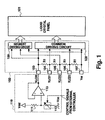
- Fig. 1 is a circuit block diagram illustrating a method of adjusting display contrast using a conventional integrated circuit for driving liquid crystal.
- a liquid crystal panel 101 includes a plurality of segment electrodes and a plurality of common electrodes arranged in a matrix.
- a segment driving signal and a common driving signal are applied to the plurality of segment electrodes and the plurality of common electrodes of the liquid crystal panel 101, respectively, and light is turned on only at the intersection of the matrix for which the potential difference between the segment driving signal and the common driving signal exceeds a prescribed value.
- a liquid crystal driving integrated circuit 102 drives the liquid crystal panel 101 to present a display.
- respective connection points of four serially connected resistor elements R1 forming a resistor are connected to terminals 103-107.
- the terminal 103 receives a reference voltage VLCD0 setting peak values of the segment and common driving signals, and the terminal 107 connects all components of the circuit 102 in common to ground.
- the potential difference between the reference voltage VLCD0 and a ground voltage Vss is quartered by the four resistor elements R1.
- the voltages at the terminals 103-107 will be hereinafter denoted as VLCD0, VLCD1, VLCD2, VLCD3, and Vss, respectively.
- the common driving circuit 108 receives the voltages VLCD0, VLCD1, VLCD3, and Vss to generate the common driving signal.
- the common driving signal changes between the reference voltage VLCD0 and the ground voltage Vss to turn on light at the liquid crystal panel 101, and changes between the voltages VLCD1 and VLCD3 to turn off light at the panel 101. Therefore, in this case, the common driving signal assumes a 1/4 bias driving waveform.
- a segment driving circuit 109 receives the voltages VLCD0, VLCD2, and Vss to generate the segment driving signal.
- the segment driving signal When a light is to be turned on at the liquid crystal panel 101, the segment driving signal changes between the reference voltage VLCD0 and the ground voltage Vss in a phase opposite to that of the common driving signal for turning on light. On the other hand, the segment driving signal remains unchanged at the voltage VLCD2 when light is to be turned off at the panel 101.
- the reference voltage VLCD0 determines display contrast (difference in display between when light is on and off). Therefore, the display contrast of the liquid crystal panel 101 can be optimized by having a variable reference voltage VLCD0 and changing the amplitudes of the common and segment driving signals.
- a reference voltage generation circuit 110 applies the reference voltage VLCD0 to the terminal 103.
- a resistor 111 and a variable resistor 112 are connected in series between a power supply voltage Vdd and a ground voltage Vss.
- An operational amplifier 113 outputs a voltage equal to that present at the connection point between the resistor 111 and the variable resistor 112 as the reference voltage VLCD0.
- the operational amplifier 113 having a small output impedance is used.
- a resistor may be externally connected between the terminals 103-107 to form a resistor member connected in parallel to the four serially connected resistor elements R1, to thereby reduce the impedance on the side of the serially connected resistor elements R1.
- the reference voltage generation circuit 110 receives a control signal for changing the value of the variable resistor 112 from an external controller.
- the reference voltage VLCD0 is changed under the control of the external controller, to thereby adjust the display contrast of the liquid crystal panel 101.
- the reference voltage generation circuit 110 must be externally connected to the liquid crystal driving integrated circuit 102.
- the circuit 110 includes a great number of elements, it would impede reduction in cost of electronic devices.
- ports of the external controller for specific use are dedicated for output of control signals, which would hinder the electronic devices from assuming higher functions.
- Fig. 2 is another circuit block diagram illustrating a method of adjusting display contrast using a conventional liquid crystal driving integrated circuit, which attempts to solve the problems of the circuit in Fig. 1 .
- the liquid crystal panel 101, the common driving circuit 108, and the segment driving circuit 109 of Fig. 1 are not shown.
- the respective connection points of the four serially connected resistor elements R1 are connected to terminals 202-206 for a similar purpose to that described in connection with Fig. 1 .
- the terminal 202 is a power supply terminal receiving the power supply voltage Vdd.
- a regulator 207 outputs a constant voltage VRF based on the power supply voltage Vdd.
- An operational amplifier 208 has a positive terminal connected to the constant voltage VRF, a negative terminal connected to a terminal 209, and an output terminal connected to the terminal 206. The value of current IR flowing across the negative terminal of the operational amplifier 208 can be adjusted under the control of an internal controller.
- serially connected external resistor elements R2, R3, and R4 forming another resistor are connected between the terminals 202 and 206, and an intermediate terminal of the external resistor element R3 is connected to the terminal 209.
- the serially connected resistor elements R2, R3, and R4 are divided into two parts by the intermediate terminal of the resistor element R3.
- the resistance of the part consisting of the resistor element R2 and a portion of the resistor element R3 will be denoted as Ra, and that of the part consisting of the remaining portion of the resistor element R3 and the resistor element R4 as Rb.
- a voltage VLCD4 can be given by ((Ra+Rb)/Ra)VRF+IR ⁇ Rb.
- the value of current IR is controlled by the internal controller to change the voltage VLCD4, thereby adjusting the display contrast of the liquid crystal panel 101.
- US 5,532,718 describes a semiconductor integrated circuit that is arranged to control the contrast of a liquid crystal display panel without providing an external control circuit device.
- An object of the present invention is to provide an integrated circuit for driving liquid crystal that requires no external elements and allows adjustment of display contrast.
- the present invention has been conceived to solve the above problems.
- the present invention provides a liquid crystal driving integrated circuit as set out in claim 1.
- a liquid crystal driving integrated circuit for generating liquid crystal driving voltages that drive a liquid crystal panel to present a display, the voltage being provided from respective connection points of a plurality of serially connected resistor elements forming a first resistor, wherein a reference voltage applied to one end of the said first resistor is variable so as to adjust display contrast of said liquid crystal panel, said circuit comprising:
- the liquid crystal driving integrated circuit further comprising:
- the liquid crystal driving integrated circuit further comprising a second switch circuit (TG12) provided between said one end of said second resistor and said power supply, and having its switching Operation controlled by said mode switching signal, wherein when said first switch circuit is turned on by said mode switching signal, said second switch circuit and said reference voltage generation circuit are turned off by said mode switching signal; and when said first switch circuit is turned off by said mode switching signal, said second switch circuit and said reference voltage generation circuit are turned on by said mode switching signal.
- TG12 second switch circuit
- said reference voltage generation circuit includes a selection circuit for selecting and outputting one of the voltages at the respective connection points of said plurality of serially connected resistor elements forming said second resistor, said selection circuit including:
- control data includes a mode designation code
- said mode switching circuit generates said mode switching signal based on said mode designation code
- Fig. 3 is a circuit diagram showing a main part of a liquid crystal driving integrated circuit according to a first example related to the present invention.
- a liquid crystal driving integrated circuit 1 shown in the broken lines includes a terminal 2 for receiving a power supply voltage VLCD for driving liquid crystal, a terminal 3 for receiving a ground voltage Vss, and terminals 4, 5, 6, and 7 for providing voltages VLCD0, VLCD1, VLCD2, and VLCD3 at respective connection points of four serially connected resistor elements R1 forming a resistor.
- the lower end of the resistor formed by the four serially connected resistor elements is connected to the terminal 3 for connecting all the internal elements of the circuit 1 in common to ground.
- the integrated circuit 1 for driving liquid crystal twelve resistor elements, including a resistor element R5, ten resistor elements R6, and a resistor element R7, are connected in series between the power supply terminal 2 and the ground terminal 3. At the connection points of these twelve resistor elements connected in series, eleven voltages V0-V10 are generated divided by respective resistance values. As the twelve resistor elements connected in series are integrated on a single semiconductor substrate, variation in resistance due to manufacturing of the twelve resistor elements will be the same. Thus, the voltages V0-V10 determined by the ratio of resistance values will not be affected by the variation generated during manufacturing, so that a stable reference voltage VLCD0 can be obtained.
- Each of eleven transmission gates TG0-TG10 has one end connected to a connection point of the twelve serially connected resistor elements, and derives one of the eleven voltages V0-V10 in accordance with control signals CA0-CA10.
- the control signals CA0-CA10 are binary signals attaining either high level (logic "1") or low level (logic "0"), with only one of the control signals CA0-CA10 attaining a high level.
- An operational amplifier 8 has a positive (non-inverting input) terminal connected in common to respective other ends of the transmission gates TG0-TG10, providing as an output the reference voltage VLCD0 for liquid crystal display based on the voltage output from one of the transmission gates TG0-TG10. It should be noted that when the impedance of the resistor formed by the four serially connected resistor elements R1 exceeds the load impedance of the succeeding liquid crystal driving circuit, liquid crystal panel, and the like, the voltages VLCD1, VLCD2, VLCD3 are likely to be unsettled due to decrease in current flowing across the serially connected resistor elements R1. Therefore, taking the magnitude of the load impedance into consideration, an operational amplifier 8 with a low output impedance is used. It is also effective to connect external resistors between the terminals 3-7 to be in parallel to the four serially connected resistor elements R1, to thereby reduce the impedance on the side of the resistor elements R1.
- the five voltages VLCD0, VLCD1, VLCD2, VLCD3, and Vss obtained at respective connection points of the four serially connected resistor elements R1 are applied to a common driving circuit and a segment driving circuit, as in the circuit of Fig. 1 .
- the liquid crystal panel receives common and segment driving signals to display a character and the like.
- As the stage succeeding the four serially connected resistor elements R1 is the same as that of the circuit shown in Fig. 1 , description thereof with reference to Fig. 3 will not be repeated.
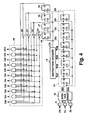
- Fig. 4 is a circuit block diagram illustrating part of the liquid crystal driving integrated circuit that generates control signals CA0-CA10. According to the present example, the liquid crystal driving integrated circuit 1 serves as an interface between integrated circuits allowing only particular input data.
- Terminals 9, 10, and 11 are external input terminals for setting control signals CA0-CA10, receiving an operation enable signal CE, a clock signal CL, and serial data DI from other integrated circuits such as a microcomputer. More specifically, the serial data DI contains, in a serial manner, unique address data for identifying the liquid crystal driving integrated circuit 1, and control data for setting control signals CA0-CA10. The serial data DI can be output from a serial output port of an external controller such as a microcomputer.
- An interface circuit 12 detects the status of the operation enable signal CE, the clock signal CL, and the serial data DI, and outputs control data SDI and a clock signal SCL. More specifically, the interface circuit 12 detects a match of the address data when the operation enable signal CE is at the low level, and outputs the control data when the operation enable signal CE changes to the high level.
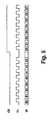
- the interface circuit 12 determines whether or not the address data B0-B3 and A0-A3 supplied in synchronization with the clock signal CL are the unique values predetermined for the liquid crystal driving integrated circuit 1.
- the interface circuit 12 provides the clock signal CL and the control data D0-D7 as the clock signal SCL and the control data SDI, respectively.
- a shift register 13 is formed by cascading eight D-type flip flops, successively right shifting 8-bit control data D0-D7 in synchronization with the clock signal SCL.
- An instruction decoder 14 outputs a latch clock signal LCK when 4 bits D4-D7 of the control data corresponding to an instruction code are detected as the predetermined values unique to the liquid crystal driving integrated circuit 1.
- Latch circuits 15, 16, 17, and 18 latch the remaining 4 bits D0-D3 of the 8-bit control data for setting control signals CA0-CA10 in synchronization with the latch clock signal LCK.
- a decoder 19 outputs control signals CA0-CA10, only one of which attains a high level, based on eight signals consisting of output signals from respective Q terminals of the latch circuits 15-18 and the inverted versions of these output signals supplied by inverters 20, 21, 22, and 23. More specifically, the decoder 19 includes eleven AND gates, and the above eight signals are wired in a matrix to these eleven AND gates in the decoder 19 so that only one of the control signals CA0-CA10 output from the AND gates attains a high level.
- Fig. 6 shows the relationship among the control data D0-D3, control signals CA0-CA10, and the reference voltage VLCD0. When the set of control data D0-D3 is one of those shown in Fig. 6 , a corresponding one of the control signals CA0-CA10 attains a high level and the reference voltage VLCD0 is correspondingly set as one of the voltages V0-V10.
- the reference voltage VLCD0 for liquid crystal display can be set in eleven stages (voltages V0-V10) simply by changing the control data D0-D3. Therefore, the display contrast can be adjusted without attaching external components to the liquid crystal driving integrated circuit 1, allowing cost reduction of electronic devices using the circuit 1.
- serial output ports of the external controller can be used for control of the liquid crystal driving integrated circuit 1, there is no need to use specific ports for this purpose. Accordingly, the specific ports of the external controller can be used for other purposes, so that the electronic devices using the liquid crystal driving integrated circuit 1 can be provided with higher functions.
- resistor elements R1 While the circuit is described as including a first resistor formed by four resistor elements R1 and a second resistor formed by twelve resistor elements, i.e. resistor elements R5, R6, and R7, in this example, respective resistors can include other numbers of serially connected resistor elements.
- Fig. 7 is a circuit diagram illustrating a main part of a liquid crystal driving integrated circuit according to a first embodiment of the present invention.
- a liquid crystal driving integrated circuit 51 shown in the broken lines of Fig. 7 comprises, as in the first example , a first resistor formed by four serially connected resistor elements R1, and a second resistor formed by a resistor element R5, ten resistor elements R6, and a resistor element R7 connected in series.
- the circuit of the present embodiment differs from the liquid crystal driving integrated circuit 1 of the first example in the following respects.
- the present circuit includes a first switch circuit for controlling connection between one end of the first resistor and a power supply. Secondly, the circuit further includes a second switch circuit for controlling connection between the second resistor and the power supply. Thirdly, the present circuit can switch on/off the operational amplifier 8.
- a transmission gate TG11 corresponds to the above-described first switch circuit.
- the transmission gate TG11 is connected between the power supply terminal 2 and the output terminal of the operational amplifier 8, allowing application of the voltage VLCD to one end of the resistor formed by the four serially connected resistor elements R1.
- a transmission gate TG12 corresponds to the above-described second switch circuit, connected between the power supply terminal 2 and one end of the resistor element R5.
- the transmission gate TG12 can block application of the power supply voltage VLCD to the twelve serially connected resistor elements including resistor elements R5, R6 and R7.
- the transmission gates TG11 and TG12 are controlled to operate in a complementary manner by a signal L4 based on the control data D4 as described hereinafter.
- Operation of the operational amplifier 8 is also controlled by the signal L4.
- the level of a control electrode for a current source transistor contained in the operational amplifier 8 can be controlled by the signal L4. More specifically, when the signal L4 is at one logic level, the current source transistor is turned on to operate the operational amplifier 8, and when the signal L4 is at the other logic level, the current source transistor is turned off to stop operation of the amplifier 8.
- the transmission gate TG11 is in an off state and the gate TG12 is in an on state.
- the operational amplifier 8 is not operating, the transmission gate TG11 is in an on state and the gate TG12 is in an off state.
- Fig. 8 is a circuit block diagram illustrating part of the liquid crystal driving integrated circuit that generates control signals CA0-CA10.
- the liquid crystal driving integrated circuit 51 serves as an interface between integrated circuits allowing only particular input data, as does the circuit 1.
- the shift register 13 successively right shifts 8-bit control data D0-D7 output from the interface circuit 12 in synchronization with the clock signal SCL.
- the instruction decoder 14 outputs the latch clock signal LCK when 3 bits D5-D7 of the control data corresponding to an instruction code are detected as the unique values predetermined for the liquid crystal driving integrated circuit 51.
- the control data D4 is used for generation of the signal L4 as described below.
- the latch circuits 15, 16, 17, and 18 latch the remaining four bits D0-D3 of the control data for setting the control signals CAO-CA10 in synchronization with the latch clock signal LCK.
- a latch circuit 24 latches a bit D4 of control data in synchronization with the latch clock signal LCK.
- the signal L4 output from a Q terminal of the latch circuit 24 is supplied to the transmission gates TG11 and TG12 and the operational amplifier 8. More specifically, when the control data D4 is logic "0", the transmission gate TG11 is turned on, the transmission gate TG12 is turned off, and the operational amplifier 8 stops operation.
- the liquid crystal driving voltages VLCD0-VLCD3 are determined based on the power supply voltage VLCD, so that the display contrast of the liquid crystal panel is in a fixed state, uncontrollable by the external controller, or is adjustable by an external resistor.
- the control data D4 is logic "1"
- the transmission gate TG11 is turned off, the transmission gate TG12 is turned on, and the operational amplifier is operated. Consequently, the liquid crystal driving voltages VLCD0-VLCD3 can be varied in accordance with the control signals CA0-CA10, and the display contrast of the liquid crystal panel can be adjusted by the external controller.
- the control signals CA0-CA10 are generated by the decoder 19 based on the relationship shown in Fig. 6 .
- the liquid crystal driving integrated circuit 51 of the present embodiment provides an advantage that, when a user determines that the established intervals between the reference voltages V0-V10 for adjusting display contrast are not appropriate, the display contrast can be adjusted by an external resistor, providing the user with a wider option of voltages for adjusting the display contrast, in addition to the advantages of achieving cost reduction and higher functions of the electronic devices using the liquid crystal driving integrated circuit described in connection with the first example.
- the above-described two resistors can also be formed by a different number of resistor elements than that described above.
- the reference voltage for liquid crystal display can be set in a plurality of stages simply by changing the control data to a user specified value. Therefore, the display contrast can be adjusted without attaching external devices to the liquid crystal driving integrated circuit, to thereby achieve cost reduction of electronic devices using the liquid crystal driving integrated circuit.
- the specific ports will not be occupied, so that the specific ports of the external controller can be used for other purposes and the electronic devices using the liquid crystal driving integrated circuit can be provided with higher functions.
- the display contrast can also be adjusted by an external resistor, advantageously providing a wider option of reference voltages for adjusting the display contrast and allowing the use for more generic purposes.
Landscapes
- Engineering & Computer Science (AREA)
- Chemical & Material Sciences (AREA)
- Crystallography & Structural Chemistry (AREA)
- Physics & Mathematics (AREA)
- Computer Hardware Design (AREA)
- General Physics & Mathematics (AREA)
- Theoretical Computer Science (AREA)
- Liquid Crystal Display Device Control (AREA)
- Liquid Crystal (AREA)
- Control Of Indicators Other Than Cathode Ray Tubes (AREA)
Claims (5)
- Integrierter Flüssigkristall-Ansteuerschaltkreis (1) zum Erzeugen von Flüssigkristall-Ansteuerspannungen (VLCDO, VLCD1, VLCD2, VLCD3), die eine Flüssigkristallanzeige ansteuern, um eine Anzeige zu präsentieren, wobei die Spannungen von jeweiligen Verbindungspunkten einer Vielzahl seriell geschalteter Widerstandselemente (R1) zur Verfügung gestellt werden, die einen ersten Widerstand bilden eine an ein Ende des ersten Widerstands angelegte Referenzspannung (VLCDO) zum Einstellen des Anzeigekontrasts der Flüssigkristallanzeige variabel ist und der Schaltkreis (1) ferner aufweist:einen zweiten Widerstand, der von einer Vielzahl seriell geschalteter Widerstandselemente (R5, R6, R7) gebildet ist, wobei der zweite Widerstand mit einer Spannungsversorgung (VLCD, VSS) verbunden ist,dadurch gekennzeichnet, dass der integrierte Flüssigkristall-Ansteuerschaltkreis (1) ferner aufweist:einen Referenzspannungs-Erzeugungsschaltkreis, der einen Wahlschaltkreis mit einem Schaltelement (TG0-TG10, CAO-CA10) zum Wählen von einer der Spannungen an den jeweiligen Verbindungspunkten der den zweiten Widerstand bildenden Vielzahl von seriell geschalteten Widerstandselementen (R5, R6, R7) aufweist, der eine Spannung von einem mit dem Schaltelement gewählten Verbindungspunkt an einen Spannungsfolger (8) speist und der den Ausgang des Spannungsfolgers als Referenzspannung erzeugt,eine erste Schalter-Schaltung (TG 11) zum wahlweisen Verbinden des einen Endes des ersten Widerstands mit der Spannungsversorgung (VLCD) oder dem Referenzspannungs-Erzeugungsschaltkreis,eine zweite Schalter-Schaltung (TG 12) zum Verbinden oder Trennen des zweiten Widerstands mit bzw. von der Spannungsversorgung (VLCD) undeinen Schaltkreis zum Aktivieren oder Deaktivieren des Referenzspannungs-Erzeugungsschaltkreises, wobei die erste Schalter-Schaltung (TG 11) abgeschaltet und die zweite Schalter-Schaltung (TG 12) angeschaltet ist, wenn der Referenzspannungs-Erzeugungsschaltkreis betrieben werden soll, und die erste Schalter-Schaltung angeschaltet und die zweite Schalter-Schaltung abgeschaltet ist, wenn der Referenzspannungs-Erzeugungsschaltkreis abgeschaltet werden soll.
- Integrierter Flüssigkristall-Ansteuerschaltkreis (1) nach Anspruch 1, der ferner aufweist:eine Wahlschalter-Schaltung (24) zum Erzeugen eines Wahlschaltungssignals für die Steuerung eines Schaltens der ersten Schalter-Schaltung (TG11) und eines Spannungsausgangs des Referenzspannungs-Erzeugungsschaltkreises, wobei entweder eine Spannung von der Spannungsversorgung oder der Spannungsausgang von dem Referenzspannungs-Erzeugungsschaltkreis abhängig vom Wahlschaltungssignal selektiv an das eine Ende des ersten Widerstands als Referenzspannung angelegt werden kann.
- Integrierter Flüssigkristall-Ansteuerschaltkreis (1) nach Anspruch 2, worin die zweite Schalterschaltung (TG12) so ausgebildet ist, dass ihre Schaltoperation von dem Wahlschaltungssignal gesteuert wird.
- Integrierter Flüssigkristall-Ansteuerschaltkreis (1) nach Anspruch 2, worin der Referenzspannungs-Erzeugungsschaltkreis einen Wahlschaltkreis zum Wählen und Ausgeben von einer der Spannung an den jeweiligen Verbindungspunkten der den zweiten Widerstand bildenden Vielzahl von seriell geschalteten Widerstandselementen umfasst, wobei der Wahlschaltkreis aufweist:einen Datenhalteschaltkreis zum Halten von Steuerdaten, die von einer externen Quelle zum Steuern des Wahlschaltkreises angewandt werden,einen Decoder-Schaltkreis (19) zum Decodieren der Steuerdaten, die in dem Datenhalteschaltkreis gehalten werden, und zum Erzeugen eines Steuersignals für den Betrieb des Wahlschaltkreises.
- Integrierter Flüssigkristall-Ansteuerschaltkreis (1) nach Anspruch 4, worin
die Steuerdaten einen Wahlkennzeichnungscode umfassen und
die Wahlschalter-Schaltung das Wahlschaltungssignal auf Basis des Wahlkennzeichnungscodes erzeugt.
Applications Claiming Priority (3)
| Application Number | Priority Date | Filing Date | Title |
|---|---|---|---|
| JP35178298A JP3448493B2 (ja) | 1998-12-10 | 1998-12-10 | 液晶駆動集積回路 |
| JP35644598A JP3448495B2 (ja) | 1998-12-15 | 1998-12-15 | 液晶駆動集積回路 |
| EP99309951A EP1008981B1 (de) | 1998-12-10 | 1999-12-10 | Integrierte Schaltung zur Steuerung einer Flüssigkristall-Anzeige |
Related Parent Applications (1)
| Application Number | Title | Priority Date | Filing Date |
|---|---|---|---|
| EP99309951A Division EP1008981B1 (de) | 1998-12-10 | 1999-12-10 | Integrierte Schaltung zur Steuerung einer Flüssigkristall-Anzeige |
Publications (3)
| Publication Number | Publication Date |
|---|---|
| EP1833043A2 EP1833043A2 (de) | 2007-09-12 |
| EP1833043A3 EP1833043A3 (de) | 2008-03-19 |
| EP1833043B1 true EP1833043B1 (de) | 2015-07-22 |
Family
ID=26579480
Family Applications (2)
| Application Number | Title | Priority Date | Filing Date |
|---|---|---|---|
| EP99309951A Expired - Lifetime EP1008981B1 (de) | 1998-12-10 | 1999-12-10 | Integrierte Schaltung zur Steuerung einer Flüssigkristall-Anzeige |
| EP07012266.8A Expired - Lifetime EP1833043B1 (de) | 1998-12-10 | 1999-12-10 | Integrierte Schaltung zum Ansteuern einer Flüssigkristallanzeige |
Family Applications Before (1)
| Application Number | Title | Priority Date | Filing Date |
|---|---|---|---|
| EP99309951A Expired - Lifetime EP1008981B1 (de) | 1998-12-10 | 1999-12-10 | Integrierte Schaltung zur Steuerung einer Flüssigkristall-Anzeige |
Country Status (4)
| Country | Link |
|---|---|
| US (1) | US6633271B1 (de) |
| EP (2) | EP1008981B1 (de) |
| KR (1) | KR100430356B1 (de) |
| TW (1) | TW521240B (de) |
Families Citing this family (9)
| Publication number | Priority date | Publication date | Assignee | Title |
|---|---|---|---|---|
| JP2002366112A (ja) | 2001-06-07 | 2002-12-20 | Hitachi Ltd | 液晶駆動装置及び液晶表示装置 |
| JP4550334B2 (ja) * | 2001-09-27 | 2010-09-22 | 株式会社日立製作所 | 液晶表示装置および液晶表示装置の製造方法 |
| US6798146B2 (en) * | 2002-01-31 | 2004-09-28 | Kabushiki Kaisha Toshiba | Display apparatus and method of driving the same |
| JP2006106077A (ja) * | 2004-09-30 | 2006-04-20 | Seiko Epson Corp | 電気光学装置及び電子機器 |
| US8760379B2 (en) * | 2007-02-20 | 2014-06-24 | Samsung Display Co., Ltd. | Driving circuit for display panel having user selectable viewing angle, display having the same, and method for driving the display |
| KR101469040B1 (ko) * | 2008-01-02 | 2014-12-05 | 삼성디스플레이 주식회사 | 액정표시장치 및 이의 구동방법 |
| US8115723B2 (en) * | 2009-03-30 | 2012-02-14 | Sitronix Technology Corp. | Driving circuit for display panel |
| TWI401664B (zh) * | 2009-03-31 | 2013-07-11 | Sitronix Technology Corp | 顯示面板之驅動電路 |
| CN111477194B (zh) * | 2020-05-27 | 2022-02-22 | 京东方科技集团股份有限公司 | 公共电压输出电路、显示装置及公共电压补偿方法 |
Family Cites Families (22)
| Publication number | Priority date | Publication date | Assignee | Title |
|---|---|---|---|---|
| US4403777A (en) | 1981-01-08 | 1983-09-13 | Mattel, Inc. | Electronic game using phototransducer |
| US5159326A (en) | 1987-08-13 | 1992-10-27 | Seiko Epson Corporation | Circuit for driving a liquid crystal display device |
| JP2951352B2 (ja) | 1990-03-08 | 1999-09-20 | 株式会社日立製作所 | 多階調液晶表示装置 |
| JPH06180564A (ja) * | 1992-05-14 | 1994-06-28 | Toshiba Corp | 液晶表示装置 |
| JP3324819B2 (ja) * | 1993-03-03 | 2002-09-17 | 三菱電機株式会社 | 半導体集積回路装置 |
| JP3159843B2 (ja) | 1993-09-03 | 2001-04-23 | 株式会社 沖マイクロデザイン | 液晶駆動電圧発生回路 |
| US5574475A (en) * | 1993-10-18 | 1996-11-12 | Crystal Semiconductor Corporation | Signal driver circuit for liquid crystal displays |
| JPH07135625A (ja) * | 1993-11-10 | 1995-05-23 | Fujitsu Ltd | 液晶表示装置のコントラスト調整回路 |
| SG54123A1 (en) | 1993-12-22 | 1998-11-16 | Seiko Epson Corp | Liquid-crystal display system and power supply method |
| US5467009A (en) | 1994-05-16 | 1995-11-14 | Analog Devices, Inc. | Voltage regulator with multiple fixed plus user-selected outputs |
| CA2150502A1 (en) | 1994-08-05 | 1996-02-06 | Michael F. Mattes | Method and apparatus for measuring temperature |
| JPH0973283A (ja) * | 1995-09-05 | 1997-03-18 | Fujitsu Ltd | 液晶表示装置の階調電圧発生回路 |
| JP3518086B2 (ja) * | 1995-09-07 | 2004-04-12 | ソニー株式会社 | 映像信号処理装置 |
| JPH09218392A (ja) * | 1996-02-13 | 1997-08-19 | Fujitsu Ltd | 液晶表示装置の駆動回路 |
| KR100440710B1 (ko) * | 1996-07-31 | 2004-10-14 | 삼성전자주식회사 | 대비비자동조절회로를갖는액정표시장치 |
| JPH1066276A (ja) | 1996-08-21 | 1998-03-06 | Japan Tobacco Inc | 充電保護装置および充電装置 |
| WO1998028731A2 (en) | 1996-12-20 | 1998-07-02 | Cirrus Logic, Inc. | Liquid crystal display signal driver system and method |
| JP3572473B2 (ja) * | 1997-01-30 | 2004-10-06 | 株式会社ルネサステクノロジ | 液晶表示制御装置 |
| KR100225849B1 (ko) * | 1997-02-17 | 1999-10-15 | 윤종용 | Lcd의 컨트라스트제어장치(contrast control apparatus for lcd) |
| JPH10268837A (ja) * | 1997-03-24 | 1998-10-09 | Seiko Epson Corp | 液晶表示器のコントラスト調整方法、液晶表示器の駆動装置、および携帯用情報機器 |
| JP3554135B2 (ja) * | 1997-04-24 | 2004-08-18 | ローム株式会社 | Lcdドライバ |
| US6225992B1 (en) * | 1997-12-05 | 2001-05-01 | United Microelectronics Corp. | Method and apparatus for generating bias voltages for liquid crystal display drivers |
-
1999
- 1999-11-17 TW TW088119996A patent/TW521240B/zh not_active IP Right Cessation
- 1999-12-07 US US09/455,856 patent/US6633271B1/en not_active Expired - Lifetime
- 1999-12-09 KR KR10-1999-0056035A patent/KR100430356B1/ko not_active Expired - Fee Related
- 1999-12-10 EP EP99309951A patent/EP1008981B1/de not_active Expired - Lifetime
- 1999-12-10 EP EP07012266.8A patent/EP1833043B1/de not_active Expired - Lifetime
Also Published As
| Publication number | Publication date |
|---|---|
| EP1833043A2 (de) | 2007-09-12 |
| EP1833043A3 (de) | 2008-03-19 |
| KR20000048016A (ko) | 2000-07-25 |
| KR100430356B1 (ko) | 2004-05-06 |
| TW521240B (en) | 2003-02-21 |
| US6633271B1 (en) | 2003-10-14 |
| EP1008981A1 (de) | 2000-06-14 |
| EP1008981B1 (de) | 2011-09-07 |
Similar Documents
| Publication | Publication Date | Title |
|---|---|---|
| US6653999B2 (en) | Integrated circuit for driving liquid crystal | |
| US6677923B2 (en) | Liquid crystal driver and liquid crystal display incorporating the same | |
| US8232945B2 (en) | Gamma voltage generator and control method thereof and liquid crystal display device utilizing the same | |
| KR19980070572A (ko) | 액정 디스플레이 패널을 구동시키기 위한 액정 구동 회로 | |
| EP1833043B1 (de) | Integrierte Schaltung zum Ansteuern einer Flüssigkristallanzeige | |
| JPH10301081A (ja) | Lcdドライバ | |
| US5696988A (en) | Current/voltage configurable I/O module having two D/A converters serially coupled together such that data stream flows through the first D/A to the second D/A | |
| WO2005093957A1 (en) | Digital to analogue converters | |
| US5680148A (en) | Driving circuit for a display apparatus capable of display of an image with gray scales | |
| JP3108293B2 (ja) | 液晶駆動回路 | |
| JP3448493B2 (ja) | 液晶駆動集積回路 | |
| JPH06175622A (ja) | 液晶駆動回路 | |
| JP3448495B2 (ja) | 液晶駆動集積回路 | |
| JP3160047B2 (ja) | 半導体装置 | |
| JPH09244570A (ja) | Led表示駆動装置 | |
| JP3108307B2 (ja) | 液晶駆動回路 | |
| KR19980027923A (ko) | 액정 디스플레이의 구동용 마이콤의 바이어스 전압 발생회로 | |
| JP2000089713A (ja) | パ―ソナル・コンピュ―タのディスプレイ調整装置及びその制御方法 | |
| JP2001194643A (ja) | 液晶用駆動電源 | |
| JP3237231B2 (ja) | Lcdドライブ回路 | |
| JPS60134218A (ja) | 液晶表示装置 | |
| KR100457333B1 (ko) | 엘시디콘트라스트조절회로및이를구비한엘시디컨트롤러 | |
| KR100476594B1 (ko) | 11채널감마기준입력회로를갖는소스구동회로를포함하는액정표시장치 | |
| JP3211140B2 (ja) | 電圧供給回路 | |
| JPH085985A (ja) | 液晶駆動装置 |
Legal Events
| Date | Code | Title | Description |
|---|---|---|---|
| PUAI | Public reference made under article 153(3) epc to a published international application that has entered the european phase |
Free format text: ORIGINAL CODE: 0009012 |
|
| AC | Divisional application: reference to earlier application |
Ref document number: 1008981 Country of ref document: EP Kind code of ref document: P |
|
| AK | Designated contracting states |
Kind code of ref document: A2 Designated state(s): DE FR GB |
|
| RIN1 | Information on inventor provided before grant (corrected) |
Inventor name: TOKUNAGA, TETSUYA Inventor name: MOTEGI, SHUJI Inventor name: ARAI, HIROYUKI |
|
| PUAL | Search report despatched |
Free format text: ORIGINAL CODE: 0009013 |
|
| AK | Designated contracting states |
Kind code of ref document: A3 Designated state(s): DE FR GB |
|
| 17P | Request for examination filed |
Effective date: 20080417 |
|
| AKX | Designation fees paid |
Designated state(s): DE FR GB |
|
| 17Q | First examination report despatched |
Effective date: 20110706 |
|
| GRAP | Despatch of communication of intention to grant a patent |
Free format text: ORIGINAL CODE: EPIDOSNIGR1 |
|
| INTG | Intention to grant announced |
Effective date: 20150213 |
|
| GRAS | Grant fee paid |
Free format text: ORIGINAL CODE: EPIDOSNIGR3 |
|
| GRAA | (expected) grant |
Free format text: ORIGINAL CODE: 0009210 |
|
| AC | Divisional application: reference to earlier application |
Ref document number: 1008981 Country of ref document: EP Kind code of ref document: P |
|
| AK | Designated contracting states |
Kind code of ref document: B1 Designated state(s): DE FR GB |
|
| REG | Reference to a national code |
Ref country code: GB Ref legal event code: FG4D |
|
| REG | Reference to a national code |
Ref country code: DE Ref legal event code: R096 Ref document number: 69945371 Country of ref document: DE |
|
| REG | Reference to a national code |
Ref country code: FR Ref legal event code: PLFP Year of fee payment: 17 |
|
| REG | Reference to a national code |
Ref country code: DE Ref legal event code: R097 Ref document number: 69945371 Country of ref document: DE |
|
| PLBE | No opposition filed within time limit |
Free format text: ORIGINAL CODE: 0009261 |
|
| STAA | Information on the status of an ep patent application or granted ep patent |
Free format text: STATUS: NO OPPOSITION FILED WITHIN TIME LIMIT |
|
| 26N | No opposition filed |
Effective date: 20160425 |
|
| REG | Reference to a national code |
Ref country code: FR Ref legal event code: PLFP Year of fee payment: 18 |
|
| REG | Reference to a national code |
Ref country code: FR Ref legal event code: PLFP Year of fee payment: 19 |
|
| PGFP | Annual fee paid to national office [announced via postgrant information from national office to epo] |
Ref country code: FR Payment date: 20171121 Year of fee payment: 19 |
|
| PGFP | Annual fee paid to national office [announced via postgrant information from national office to epo] |
Ref country code: GB Payment date: 20171121 Year of fee payment: 19 |
|
| PGFP | Annual fee paid to national office [announced via postgrant information from national office to epo] |
Ref country code: DE Payment date: 20181126 Year of fee payment: 20 |
|
| GBPC | Gb: european patent ceased through non-payment of renewal fee |
Effective date: 20181210 |
|
| PG25 | Lapsed in a contracting state [announced via postgrant information from national office to epo] |
Ref country code: FR Free format text: LAPSE BECAUSE OF NON-PAYMENT OF DUE FEES Effective date: 20181231 |
|
| REG | Reference to a national code |
Ref country code: DE Ref legal event code: R071 Ref document number: 69945371 Country of ref document: DE |
|
| PG25 | Lapsed in a contracting state [announced via postgrant information from national office to epo] |
Ref country code: GB Free format text: LAPSE BECAUSE OF NON-PAYMENT OF DUE FEES Effective date: 20181210 |