EP1828137B1 - 4-cycloalkyl-substituierte tetrahydrochinolinderivate und deren verwendung als medikamente - Google Patents
4-cycloalkyl-substituierte tetrahydrochinolinderivate und deren verwendung als medikamente Download PDFInfo
- Publication number
- EP1828137B1 EP1828137B1 EP05820528A EP05820528A EP1828137B1 EP 1828137 B1 EP1828137 B1 EP 1828137B1 EP 05820528 A EP05820528 A EP 05820528A EP 05820528 A EP05820528 A EP 05820528A EP 1828137 B1 EP1828137 B1 EP 1828137B1
- Authority
- EP
- European Patent Office
- Prior art keywords
- compound
- formula
- inhibitors
- salts
- solvates
- Prior art date
- Legal status (The legal status is an assumption and is not a legal conclusion. Google has not performed a legal analysis and makes no representation as to the accuracy of the status listed.)
- Expired - Lifetime
Links
- 0 CC(C)(C1)Cc2nc(C3CCCC3)c(C(c3ccc(*)cc3)=*)c(C3CCCCC3)c2[C@]1O Chemical compound CC(C)(C1)Cc2nc(C3CCCC3)c(C(c3ccc(*)cc3)=*)c(C3CCCCC3)c2[C@]1O 0.000 description 1
- KBCDEIHBVZSICJ-UHFFFAOYSA-N CC(C)C(NC(CC(C)(C)C1)=C(C2C3CCCC3)C1=O)=C2C(c1ccc(C(F)(F)F)cc1)=O Chemical compound CC(C)C(NC(CC(C)(C)C1)=C(C2C3CCCC3)C1=O)=C2C(c1ccc(C(F)(F)F)cc1)=O KBCDEIHBVZSICJ-UHFFFAOYSA-N 0.000 description 1
Classifications
-
- C—CHEMISTRY; METALLURGY
- C07—ORGANIC CHEMISTRY
- C07D—HETEROCYCLIC COMPOUNDS
- C07D215/00—Heterocyclic compounds containing quinoline or hydrogenated quinoline ring systems
- C07D215/02—Heterocyclic compounds containing quinoline or hydrogenated quinoline ring systems having no bond between the ring nitrogen atom and a non-ring member or having only hydrogen atoms or carbon atoms directly attached to the ring nitrogen atom
- C07D215/16—Heterocyclic compounds containing quinoline or hydrogenated quinoline ring systems having no bond between the ring nitrogen atom and a non-ring member or having only hydrogen atoms or carbon atoms directly attached to the ring nitrogen atom with hetero atoms or with carbon atoms having three bonds to hetero atoms with at the most one bond to halogen, e.g. ester or nitrile radicals, directly attached to ring carbon atoms
- C07D215/20—Oxygen atoms
-
- A—HUMAN NECESSITIES
- A61—MEDICAL OR VETERINARY SCIENCE; HYGIENE
- A61K—PREPARATIONS FOR MEDICAL, DENTAL OR TOILETRY PURPOSES
- A61K31/00—Medicinal preparations containing organic active ingredients
- A61K31/33—Heterocyclic compounds
- A61K31/395—Heterocyclic compounds having nitrogen as a ring hetero atom, e.g. guanethidine or rifamycins
- A61K31/435—Heterocyclic compounds having nitrogen as a ring hetero atom, e.g. guanethidine or rifamycins having six-membered rings with one nitrogen as the only ring hetero atom
- A61K31/47—Quinolines; Isoquinolines
-
- A—HUMAN NECESSITIES
- A61—MEDICAL OR VETERINARY SCIENCE; HYGIENE
- A61P—SPECIFIC THERAPEUTIC ACTIVITY OF CHEMICAL COMPOUNDS OR MEDICINAL PREPARATIONS
- A61P25/00—Drugs for disorders of the nervous system
-
- A—HUMAN NECESSITIES
- A61—MEDICAL OR VETERINARY SCIENCE; HYGIENE
- A61P—SPECIFIC THERAPEUTIC ACTIVITY OF CHEMICAL COMPOUNDS OR MEDICINAL PREPARATIONS
- A61P25/00—Drugs for disorders of the nervous system
- A61P25/28—Drugs for disorders of the nervous system for treating neurodegenerative disorders of the central nervous system, e.g. nootropic agents, cognition enhancers, drugs for treating Alzheimer's disease or other forms of dementia
-
- A—HUMAN NECESSITIES
- A61—MEDICAL OR VETERINARY SCIENCE; HYGIENE
- A61P—SPECIFIC THERAPEUTIC ACTIVITY OF CHEMICAL COMPOUNDS OR MEDICINAL PREPARATIONS
- A61P3/00—Drugs for disorders of the metabolism
-
- A—HUMAN NECESSITIES
- A61—MEDICAL OR VETERINARY SCIENCE; HYGIENE
- A61P—SPECIFIC THERAPEUTIC ACTIVITY OF CHEMICAL COMPOUNDS OR MEDICINAL PREPARATIONS
- A61P3/00—Drugs for disorders of the metabolism
- A61P3/04—Anorexiants; Antiobesity agents
-
- A—HUMAN NECESSITIES
- A61—MEDICAL OR VETERINARY SCIENCE; HYGIENE
- A61P—SPECIFIC THERAPEUTIC ACTIVITY OF CHEMICAL COMPOUNDS OR MEDICINAL PREPARATIONS
- A61P3/00—Drugs for disorders of the metabolism
- A61P3/06—Antihyperlipidemics
-
- A—HUMAN NECESSITIES
- A61—MEDICAL OR VETERINARY SCIENCE; HYGIENE
- A61P—SPECIFIC THERAPEUTIC ACTIVITY OF CHEMICAL COMPOUNDS OR MEDICINAL PREPARATIONS
- A61P3/00—Drugs for disorders of the metabolism
- A61P3/08—Drugs for disorders of the metabolism for glucose homeostasis
- A61P3/10—Drugs for disorders of the metabolism for glucose homeostasis for hyperglycaemia, e.g. antidiabetics
-
- A—HUMAN NECESSITIES
- A61—MEDICAL OR VETERINARY SCIENCE; HYGIENE
- A61P—SPECIFIC THERAPEUTIC ACTIVITY OF CHEMICAL COMPOUNDS OR MEDICINAL PREPARATIONS
- A61P43/00—Drugs for specific purposes, not provided for in groups A61P1/00-A61P41/00
-
- A—HUMAN NECESSITIES
- A61—MEDICAL OR VETERINARY SCIENCE; HYGIENE
- A61P—SPECIFIC THERAPEUTIC ACTIVITY OF CHEMICAL COMPOUNDS OR MEDICINAL PREPARATIONS
- A61P9/00—Drugs for disorders of the cardiovascular system
-
- A—HUMAN NECESSITIES
- A61—MEDICAL OR VETERINARY SCIENCE; HYGIENE
- A61P—SPECIFIC THERAPEUTIC ACTIVITY OF CHEMICAL COMPOUNDS OR MEDICINAL PREPARATIONS
- A61P9/00—Drugs for disorders of the cardiovascular system
- A61P9/10—Drugs for disorders of the cardiovascular system for treating ischaemic or atherosclerotic diseases, e.g. antianginal drugs, coronary vasodilators, drugs for myocardial infarction, retinopathy, cerebrovascula insufficiency, renal arteriosclerosis
-
- C—CHEMISTRY; METALLURGY
- C07—ORGANIC CHEMISTRY
- C07B—GENERAL METHODS OF ORGANIC CHEMISTRY; APPARATUS THEREFOR
- C07B2200/00—Indexing scheme relating to specific properties of organic compounds
- C07B2200/07—Optical isomers
Definitions
- the present application relates to a novel tetrahydroquinoline derivative, a process for its preparation, its use alone or in combinations for the treatment and / or prevention of diseases and its use for the production of medicaments, in particular as an inhibitor of the cholesterol ester transfer protein ( CETP) for the treatment and / or prevention of cardiovascular diseases, in particular hypolipoproteinemias, dyslipidemias, hypertriglyceridemias, hyperlipidemias, hypercholesterolemias and arteriosclerosis.
- CETP cholesterol ester transfer protein
- HDL high-density lipoprotein
- LDL low-density lipoprotein
- VLDL very low-density lipoprotein
- High LDL cholesterol levels (> 160 mg / dl) and low HDL cholesterol levels ( ⁇ 40 mg / dl) contribute significantly to the development of arteriosclerosis [ATP III Guidelines, Report of the NCEP Expert Panel].
- peripheral vascular disease and stroke are also promoted by unfavorable HDL / LDL ratios.
- New methods for increasing HDL cholesterol in the plasma therefore represent a therapeutically useful enrichment in the prevention and treatment of arteriosclerosis and the associated diseases.
- CETP Cholesterol ester transfer protein
- Tetrahydroquinolines with pharmacological activity are known from the EP-A-818,448 .
- WO 99/14215 WO 99/15504 such as WO 03/028727 known.
- Substituted tetrahydronaphthalenes with pharmacological activity are known from the WO 99/14174 known.
- the object of the present invention is to provide new substances for the control of diseases, in particular of cardiovascular diseases, which have an improved therapeutic profile.
- the present invention relates to the compounds of structural formula (I)
- R is cyclopentyl or iso-propyl, and their salts, solvates and solvates of the salts.
- the present invention is in particular the compound having the systematic name (5 S) -4-cyclohexyl-2-cyclopentyl-3 - ⁇ (S) -fluoro [4- (trifluoromethyl) phenyl] methyl ⁇ -7,7-dimethyl- 5,6,7,8-tetrahydroquinoline-5-ol and the structural formula (Ia) and their salts, solvates and solvates of the salts.
- the present invention is in particular the compound having the systematic name (5 S) -4-cyclopentyl-3 - ⁇ (S) -fluoro [4- (trifluoromethyl) phenyl] methyl ⁇ -2-isopropyl-7,7-dimethyl 5,6,7,8-tetrahydroquinoline-5-ol and the structural formula (Ib) and their salts, solvates and solvates of the salts.
- the compound according to the invention can also be present in other stereoisomeric forms (enantiomers, diastereomers).
- the present invention includes all enantiomers, diastereomers and their respective mixtures. From such mixtures of enantiomers and / or diastereomers, the stereoisomerically uniform components can be isolated in a known manner.
- the S configuration shown in formula (I) is at C-5 and at C-3 '.
- Salts used in the context of the present invention are physiologically acceptable salts of the compound according to the invention. Also included are salts which are not suitable for pharmaceutical applications themselves, but can be used, for example, for the isolation or purification of the compound according to the invention.
- Physiologically acceptable salts of the compound of the invention include acid addition salts of mineral acids, carboxylic acids and sulfonic acids, e.g. Salts of hydrochloric, hydrobromic, sulfuric, phosphoric, methanesulfonic, ethanesulfonic, toluenesulfonic, benzenesulfonic, naphthalenedisulfonic, acetic, trifluoroacetic, propionic, lactic, tartaric, malic, citric, fumaric, maleic and benzoic acids.
- Salts of hydrochloric, hydrobromic, sulfuric, phosphoric, methanesulfonic, ethanesulfonic, toluenesulfonic, benzenesulfonic, naphthalenedisulfonic acetic, trifluoroacetic, propionic, lactic, tartaric, malic, citric, fumaric, maleic and benzoic acids.
- Physiologically acceptable salts of the compound according to the invention also include salts of customary bases, such as, by way of example and by way of preference, alkali metal salts (for example sodium and potassium salts), alkaline earth salts (for example calcium and magnesium salts) and ammonium salts derived from ammonia or organic amines having 1 to 16 carbon atoms, as exemplified and preferably ethylamine, diethylamine, triethylamine, ethyldiisopropylamine, monoethanolamine, diethanolamine, Triethanolamine, dicyclohexylamine, dimethylaminoethanol, procaine, dibenzylamine, N-methylmorpholine, arginine, lysine, ethylenediamine and N-methylpiperidine.
- customary bases such as, by way of example and by way of preference, alkali metal salts (for example sodium and potassium salts), alkaline earth salts (for example calcium and magnesium salts) and ammoni
- Solvates in the context of the invention are those forms of the compound according to the invention which form a complex in the solid or liquid state by coordination with solvent molecules. Hydrates are a special form of solvates that coordinate with water. As solvates, hydrates are preferred in the context of the present invention.
- (C 1 -C 4 ) -alkyl in the context of the invention is a straight-chain or branched alkyl radical having 1 to 4 carbon atoms. Examples which may be mentioned are: methyl, ethyl, n-propyl, isopropyl, n-butyl, isobutyl, sec-butyl and tert-butyl.
- the invention further provides a process for the preparation of the compound of the formula (Ia) according to the invention, which comprises reacting the compound of the formula (IIa) first by an asymmetric reduction in the compound of formula (IIIa) then transferred them either
- the compound of the formula (IIa) can be prepared by reacting the compounds of the formulas (VIII), (IX) and (Xa) together in a 3-component reaction in the presence of a protonic or Lewis acid to the compound of formula (XIa) and then oxidized to the compound of formula (IIa).
- the invention further provides a process for the preparation of the compound of the formula (Ib) according to the invention, which comprises reacting the compound of the formula (IIb) first by an asymmetric reduction in the compound of formula (IIIb) then transferred them either
- the compound of the formula (IIb) can be prepared by reacting the compounds of the formulas (VIII), (IX) and (Xb) together in a 3-component reaction in the presence of a protic or Lewis acid to the compound of formula (XIb) and then oxidized to the compound of formula (IIb).
- Suitable inert solvents for the individual process steps are, for example, ethers, such as diethyl ether, diisopropyl ether, dioxane, tetrahydrofuran, glycol dimethyl ether or diethylene glycol dimethyl ether, hydrocarbons, such as benzene, toluene, xylene, hexane, cyclohexane or petroleum fractions, or halogenated hydrocarbons, such as dichloromethane, trichloromethane, carbon tetrachloride, 1,2- Dichloroethane, trichlorethylene or chlorobenzene suitable. It is also possible to use mixtures of the solvents mentioned.
- ethers such as diethyl ether, diisopropyl ether, dioxane, tetrahydrofuran, glycol dimethyl ether or diethylene glycol dimethyl ether
- hydrocarbons such as benzene, toluene, xy
- reducing agents which are suitable for the reduction of telephones to hydroxy compounds.
- reducing agents include in particular complex aluminum or boron hydrides such as lithium, sodium, potassium, zinc borohydride, lithium aluminum hydride, diisobutylaluminum hydride (DIBAH), sodium bis (2-methoxyethoxy) aluminum dihydride, Lithiumtrialkylborhydride or Lithiumtrialkoxyaluminiumhydride, or borane complexes such as Borane-tetrahydrofuran, borane-dimethylsulfide or borane- N, N- diethylaniline complex.
- complex aluminum or boron hydrides such as lithium, sodium, potassium, zinc borohydride, lithium aluminum hydride, diisobutylaluminum hydride (DIBAH), sodium bis (2-methoxyethoxy) aluminum dihydride, Lithiumtrialkylborhydride or Lithiumtrialkoxyaluminiumhydride, or bo
- the asymmetric reduction in process step (II) ⁇ (III) is carried out in the presence of catalytic amounts (0.01 to 0.3 molar equivalents) of enantiomerically pure (1 R , 2 S ) -1-aminoindan-2-ol as chiral inductor.
- the reducing agent used here is preferably borane-N, N-diethylaniline complex.
- the reaction is generally carried out in one of the abovementioned ethers or in toluene, preferably in tetrahydrofuran, in a temperature range from -80.degree. C. to + 50.degree. C., preferably from 0.degree. C. to + 30.degree.
- lithium aluminum hydride or DIBAH is preferably used as the reducing agent.
- the reactions are generally carried out in one of the abovementioned ethers or in toluene, preferably in tetrahydrofuran or toluene, in a temperature range from -80 ° C to + 50 ° C, preferably from 0 ° C to + 30 ° C in the case of lithium aluminum hydride and from -80 ° C to + 30 ° C in the case of DIBAH.
- hydroxy-protecting group in process steps (III) ⁇ (IV) or (VI) ⁇ (V) is a silyl group such as trimethylsilyl, triethylsilyl, triisopropylsilyl or tert. -butyldimethylsilyl, prefers. Particularly preferred is tert. -Butyldimethylsilyl.
- the introduction of the silyl group is generally carried out in one of the abovementioned hydrocarbons, halogenated hydrocarbons, ethers or in dimethylformamide as solvent in the presence of a base such as triethylamine, N, N- diisopropylethylamine, pyridine, 2,6-lutidine or 4- N, N -. Dimethylaminopyridine (DMAP).
- a base such as triethylamine, N, N- diisopropylethylamine, pyridine, 2,6-lutidine or 4- N, N -. Dimethylaminopyridine (DMAP).
- ⁇ (IV) is preferably tert. Butyldimethylsilyltrifluormethansulfonat used as a silylation reagent in combination with 2,6-lutidine as the base.
- the reaction is preferably carried out in dichloromethane or toluene in a temperature range from -40 ° C to + 40 ° C, preferably from -20 ° C to + 30 ° C.
- ⁇ (V) is preferably tert.
- Butyldimethylsilylchlorid used as a silylation reagent in combination with triethylamine and DMAP as bases.
- the reaction is preferably carried out in dimethylformamide in a temperature range from 0 ° C to + 100 ° C, preferably from + 20 ° C to + 80 ° C.
- the fluorination in process step (VI) ⁇ (VII) is generally carried out in one of the abovementioned hydrocarbons or halogenated hydrocarbons or in acetonitrile, preferably in toluene or dichloromethane, with diethylaminosulfur trifluoride (DAST) or morpholinosulfur trifluoride as the fluorinating reagent.
- the reaction is generally carried out in a temperature range from -80 ° C to + 40 ° C, preferably from -60 ° C to + 20 ° C.
- the removal of a silyl protective group in process step (VII) ⁇ (I) is generally carried out with the aid of acids, such as, for example, hydrochloric acid or trifluoroacetic acid, or with the aid of fluorides, such as, for example, hydrogen fluoride or tetrabutylammonium fluoride (TBAF).
- Suitable inert solvents are the ethers listed above, alcohols such as methanol or ethanol, or mixtures of the solvents mentioned. Preference is given to cleavage with TBAF in tetrahydrofuran as solvent.
- the reaction is generally carried out in a temperature range from -20 ° C to + 60 ° C, preferably from 0 ° C to + 30 ° C.
- the condensation reaction (VIII) + (IX) + (X) ⁇ (XI) is generally carried out in one of the abovementioned ethers, in alcohols such as methanol, ethanol, n-propanol or isopropanol, in acetonitrile or in mixtures of said solvents. Preference is given to using diisopropyl ether.
- Suitable proton acids for this process step are generally organic acids, such as, for example, acetic acid, trifluoroacetic acid, oxalic acid or para-toluenesulfonic acid, or inorganic acids, such as, for example, hydrochloric acid, sulfuric acid or phosphoric acid. Also suitable are Lewis acids such as aluminum chloride or zinc chloride. Preference is given to trifluoroacetic acid.
- the reaction is generally carried out in a temperature range from 0 ° C to + 120 ° C, preferably from + 20 ° C to + 80 ° C.
- the oxidation (dehydrogenation) in process step (XI) ⁇ (II) is generally carried out in one of the abovementioned halogenated hydrocarbons or, if appropriate, in alcohols such as methanol or ethanol, in acetonitrile or in water.
- Suitable oxidizing agents are, for example, nitric acid, cerium (IV) ammonium nitrate, 2,3-dichloro-5,6-dicyano-1,4-benzoquinone (DDQ), pyridinium chlorochromate (PCC), osmium tetroxide, manganese dioxide or a catalytic dehydrogenation by means of platinum dioxide or Palladium on activated carbon.
- DDQ 2,3-dichloro-5,6-dicyano-1,4-benzoquinone
- PCC pyridinium chlorochromate
- osmium tetroxide manganese dioxide or a catalytic dehydrogenation by means
- the individual process steps can be carried out at normal, elevated or reduced pressure (for example from 0.5 to 5 bar). Generally, one works at normal pressure.
- tBu tert. butyl
- DAST dimethylaminosulfur trifluoride
- DDQ 2,3-dichloro-5,6-dicyano-1,4-benzoquinone
- Et ethyl
- Me methyl
- Ph phenyl
- TBAF tetrabutylammonium fluoride
- TBDMSOTf tert. -Butyldimethylsilyl trifluoromethanesulfonate
- TFA trifluoroacetic acid].
- It is preferably characterized by high specificity, good tolerability and lower side effects as well as lower toxicity, in particular in the cardiovascular area and in the area of the liver.
- An advantage of the compound according to the invention is its high activity in human plasma.
- a further advantage of the compound according to the invention is a reduced potential for interaction with metabolizing enzymes, in particular with the cytochrome P450 enzymes and in particular with the cytochrome P450 3A4 enzyme.
- the compound of the invention also shows a reduced deposition behavior in adipose tissue.
- the compound of the formula (I) according to the invention has valuable pharmacological properties and can be used for the prevention and treatment of diseases.
- the compound of the present invention is a potent inhibitor of cholesterol ester transfer protein (CETP) and stimulates reverse cholesterol transport. It causes an increase in the HDL cholesterol level in the blood.
- CETP cholesterol ester transfer protein
- the compound of the invention is particularly useful for the treatment and primary or secondary prevention of coronary heart disease, e.g. of myocardial infarction, can be used.
- the compound of the invention may also be used for the treatment and prevention of arteriosclerosis, restenosis, strokes and Alzheimer's disease.
- the compound of the invention may also be used for the treatment and prevention of hypolipoproteinemias, dyslipidemias, hypertriglyceridemias, hyperlipidemias, hypercholesterolemias, obesity, obesity, pancreatitis, insulin-dependent and non-insulin-dependent diabetes, diabetic sequelae such as Retinopathy, nephropathy and neuropathy, combined hyperlipidaemias and the metabolic syndrome.
- the pharmacological activity of the compound according to the invention can be determined by means of the CETP inhibition tests listed below.
- Another object of the present invention is the use of the compound of the invention for the preparation of medicaments for the treatment and / or prevention of diseases, in particular the aforementioned diseases.
- Antidiabetics are understood by way of example and preferably as meaning insulin and insulin derivatives, as well as orally active hypoglycemic agents.
- the orally active hypoglycemic agents include, by way of example and by way of illustration, sulfonylureas, biguadines, meglitinide derivatives, oxadiazolidinones, thiazolidinediones, glucosidase inhibitors, glucagon antagonists, GLP-1 agonists, insulin sensitizers, inhibitors of liver enzymes involved in the stimulation of gluconeogenesis and or glycogenolysis, modulators of glucose uptake, and potassium channel openers, such as those described in U.S. Pat WO 97/26265 and WO 99/03861 are disclosed.
- the compound of formula (I) is administered in combination with a sulphonylurea, such as by way of example and preferably tolbutamide, glibenclamide, glimepiride, glipizide or gliclazide.
- a sulphonylurea such as by way of example and preferably tolbutamide, glibenclamide, glimepiride, glipizide or gliclazide.
- the compound of the formula (I) is administered in combination with a PPARgamma agonist, for example from the class of thiazolidinediones, by way of example and preferably pioglitazone or rosiglitazone.
- a PPARgamma agonist for example from the class of thiazolidinediones, by way of example and preferably pioglitazone or rosiglitazone.
- the compound of formula (I) is used in combination with a mixed PPARalpha / gamma agonist, as exemplified and preferably GI-262570 (Farglitazar), GW 2331, GW 409544, AVE 8042, AVE 8134, AVE 0847, MK-0767 (KRP-297) or AZ-242.
- a mixed PPARalpha / gamma agonist as exemplified and preferably GI-262570 (Farglitazar), GW 2331, GW 409544, AVE 8042, AVE 8134, AVE 0847, MK-0767 (KRP-297) or AZ-242.
- Antithrombotic agents are preferably understood as meaning compounds from the group of platelet aggregation inhibitors, such as, for example and preferably, aspirin, clopidogrel, ticlopidine or dipyridamole, or anticoagulants.
- the compound of formula (I) is administered in combination with a GPIIb / IIIa antagonist, such as by way of example and preferably tirofiban or abciximab.
- the compound of formula (I) is administered in combination with a factor Xa inhibitor, as exemplified and preferably DX 9065a, DPC 906, JTV 803 or BAY 59-7939.
- a factor Xa inhibitor as exemplified and preferably DX 9065a, DPC 906, JTV 803 or BAY 59-7939.
- the compound of the formula (I) is administered in combination with heparin or a low molecular weight (LMW) heparin derivative.
- LMW low molecular weight
- the compound of formula (I) is administered in combination with a vitamin K antagonist, such as by way of example and preferably coumarin.
- hypotensive agents are exemplified and preferably compounds from the group of calcium antagonists, such as by way of example and preferably the compounds nifedipine, amlodipine, nitrendipine, nisoldipine, verapamil or diltiazem, angiotensin AII antagonists, ACE inhibitors, beta-blockers and diuretics Understood.
- the group of calcium antagonists such as by way of example and preferably the compounds nifedipine, amlodipine, nitrendipine, nisoldipine, verapamil or diltiazem, angiotensin AII antagonists, ACE inhibitors, beta-blockers and diuretics Understood.
- the compound of the formula (I) is administered in combination with an antagonist of the alpha 1 receptors.
- the compound of formula (I) is administered in combination with an angiotensin AII antagonist such as by way of example and preferably losartan, valsartan, candesartan, telmisartan, embusartan, irbesartan, olmesartan, tasosartan or saprisartan.
- angiotensin AII antagonist such as by way of example and preferably losartan, valsartan, candesartan, telmisartan, embusartan, irbesartan, olmesartan, tasosartan or saprisartan.
- the compound of formula (I) is administered in combination with an ACE inhibitor such as, by way of example and by way of preference, enalapril, captopril, ramipril, delapril, fosinopril, quinopril, perindopril or trandolapril.
- an ACE inhibitor such as, by way of example and by way of preference, enalapril, captopril, ramipril, delapril, fosinopril, quinopril, perindopril or trandolapril.
- the compound of formula (I) is administered in combination with a beta-blocker such as, by way of example and by way of preference, propranolol or atenolol.
- a beta-blocker such as, by way of example and by way of preference, propranolol or atenolol.
- the compound of formula (I) is administered in combination with a diuretic, such as by way of example and preferably furosemide.
- lipid metabolizing agents are exemplified and preferably compounds of the group of thyroid receptor agonists, cholesterol synthesis inhibitors such as HMG-CoA reductase inhibitors or squalene synthesis inhibitors, ACAT inhibitors, MTP inhibitors, PPAR agonists, fibrates, Cholesterol absorption inhibitors, bile acid reabsorption inhibitors, lipase inhibitors, polymeric Benklareadsorber and the lipoprotein (a) antagonists understood.
- cholesterol synthesis inhibitors such as HMG-CoA reductase inhibitors or squalene synthesis inhibitors
- ACAT inhibitors such as HMG-CoA reductase inhibitors or squalene synthesis inhibitors
- MTP inhibitors MTP inhibitors
- PPAR agonists PPAR agonists
- fibrates Cholesterol absorption inhibitors
- bile acid reabsorption inhibitors bile acid reabsorption inhibitors
- lipase inhibitors polymeric Benkla
- the compound of formula (I) is used in combination with a thyroid receptor agonist such as, by way of example and preferably, D-thyroxine, 3,5,3'-triiodothyronine (T3), CGS 23425 or axitirome (CGS 26214). administered.
- a thyroid receptor agonist such as, by way of example and preferably, D-thyroxine, 3,5,3'-triiodothyronine (T3), CGS 23425 or axitirome (CGS 26214). administered.
- the compound of formula (I) is administered in combination with a squalene synthesis inhibitor, such as by way of example and preferably BMS-188494 or TAK 475.
- a squalene synthesis inhibitor such as by way of example and preferably BMS-188494 or TAK 475.
- the compound of formula (I) is administered in combination with an ACAT inhibitor, such as by way of example and preferably avasimibe, eflucimibe or CS-505.
- an ACAT inhibitor such as by way of example and preferably avasimibe, eflucimibe or CS-505.
- the compound of formula (I) is administered in combination with a cholesterol absorption inhibitor, such as by way of example and preferably ezetimibe, tiqueside or pamaqueside.
- a cholesterol absorption inhibitor such as by way of example and preferably ezetimibe, tiqueside or pamaqueside.
- the compound of formula (I) is administered in combination with a bile acid reabsorption inhibitor such as by way of example and preferably barixibate, AZD 7508, SC 435, SC 635, S-8921, 264W94 or HM 1453.
- a bile acid reabsorption inhibitor such as by way of example and preferably barixibate, AZD 7508, SC 435, SC 635, S-8921, 264W94 or HM 1453.
- the compound of the formula (I) is administered in combination with an MTP inhibitor, such as by way of example and preferably implitapide, BMS-201038 or R-103757.
- an MTP inhibitor such as by way of example and preferably implitapide, BMS-201038 or R-103757.
- the compound of formula (I) is administered in combination with a PPARalpha agonist, e.g. the fibrates fenofibrate, clofibrate, bezafibrate, ciprofibrate or germfibrozil or as exemplified and preferably GW 9578, GW 7647, LY-518674 or NS-220.
- a PPARalpha agonist e.g. the fibrates fenofibrate, clofibrate, bezafibrate, ciprofibrate or germanfibrozil or as exemplified and preferably GW 9578, GW 7647, LY-518674 or NS-220.
- the compound of formula (I) is administered in combination with a PPARdelta agonist such as, for example and preferably, GW 501516.
- the compound of formula (I) is used in combination with a mixed PPARalpha / gamma agonist such as exemplified and preferably GI-262570 (Farglitazar), GW 2331, GW 409544, AVE 8042, AVE 8134, AVE 0847 , MK-0767 (KRP-297) or AZ-242.
- a mixed PPARalpha / gamma agonist such as exemplified and preferably GI-262570 (Farglitazar), GW 2331, GW 409544, AVE 8042, AVE 8134, AVE 0847 , MK-0767 (KRP-297) or AZ-242.
- the compound of formula (I) is administered in combination with a mixed PPARalpha / gamma / delta agonist such as, by way of example and by way of preference MCC-555.
- the compound of formula (I) in combination with a lipase inhibitor from the group of endothelial lipase inhibitors, pancreatic lipase inhibitors, gastric lipase inhibitors, hormone-sensitive lipase inhibitors or the hepatic lipase inhibitors administered.
- the compound of the formula (I) is administered in combination with an inhibitor of pancreatic lipase, preferably from the class of lipstins such as, for example, orlistat.
- the compound of formula (I) is administered in combination with a polymeric bile acid adsorbent such as, by way of example and by way of preference, cholestyramine, colestipol, colesolvam, cholesta gel or colestimide.
- a polymeric bile acid adsorbent such as, by way of example and by way of preference, cholestyramine, colestipol, colesolvam, cholesta gel or colestimide.
- the compound of formula (I) is administered in combination with a lipoprotein (a) antagonist such as, by way of example and by way of preference, gemcabene calcium (CI-1027) or nicotinic acid.
- a lipoprotein (a) antagonist such as, by way of example and by way of preference, gemcabene calcium (CI-1027) or nicotinic acid.
- the compound of formula (I) is administered in combination with an antagonist of the niacin receptor, such as by way of example and preferably Niaspan, Acipimox or Niceritrol.
- an antagonist of the niacin receptor such as by way of example and preferably Niaspan, Acipimox or Niceritrol.
- the compound of formula (I) is administered in combination with an antioxidant such as, by way of example and by way of preference, probucol, AGI 1067 or Bo 653.
- the compound of formula (I) is administered in combination with an LDL receptor inducer such as Lifibrol.
- the compound of formula (I) in combination with an HMG-CoA reductase inhibitor from the class of statins such as by way of example and preferably lovastatin, simvastatin, pravastatin, fluvastatin, atorvastatin, rosuvastatin, cerivastatin or pitavastatin administered.
- statins such as by way of example and preferably lovastatin, simvastatin, pravastatin, fluvastatin, atorvastatin, rosuvastatin, cerivastatin or pitavastatin administered.
- Another object of the present invention are combinations of the compound of formula (I) with substances that cause a reduction in HMG-CoA reductase gene expression.
- substances may be, for example, inhibitors of HMG-CoA reductase transcription or HMG-CoA reductase translation.
- Inhibition of HMG-CoA reductase gene expression can be caused, for example, by inhibition of the S1P (site-1) protease or by lowering the SREBP (sterol receptor binding protein) levels.
- Another object of the present invention are combinations of the compound of formula (I) with substances which have anti-inflammatory and / or the atherosclerotic plaque stabilizing effect.
- substances may be, for example, agents from the class of NSAIDs, the PAF-AH antagonists or the chemokine receptor antagonists, such as, for example, IL-8 receptor antagonists or MCP-1 antagonists.
- the active compound combinations according to the invention have valuable pharmacological properties and can be used for the prevention and treatment of diseases.
- the active compound combinations according to the invention can be used in particular for the treatment and for the primary or secondary prevention of coronary heart diseases, for example of myocardial infarction. They can also be used to treat and prevent atherosclerosis, restenosis, strokes as well as Alzheimer's disease.
- the active compound combinations mentioned can also be used for the treatment and prevention of hypolipoproteinemias, dyslipidemias, hypertriglyceridemias, hyperlipidemias, hypercholesterolemias, obesity (obesity), obesity, pancreatitis, insulin-dependent and non-insulin-dependent diabetes, diabetic sequelae, such as Retinopathy, nephropathy and neuropathy, combined hyperlipidaemias and the metabolic syndrome.
- the active compound combinations according to the invention are suitable for the treatment of hypertension, cardiac insufficiency, angina pectoris, ischaemias and inflammatory diseases.
- Another object of the present invention are pharmaceutical compositions containing the compound of the invention, usually together with one or more inert, non-toxic, pharmaceutically suitable excipients, and their use for the purposes mentioned above.
- the compound of the invention may act systemically and / or locally.
- it may be applied in a suitable manner, e.g. oral, parenteral, pulmonary, nasal, sublingual, lingual, buccal, rectal, dermal, transdermal, conjunctival, otic or as an implant or stent.
- the compound according to the invention can be administered in suitable administration forms.
- the compound of the invention rapidly and / or modified donating application forms containing the compound of the invention in crystalline and / or amorphized and / or dissolved form, such.
- Tablets uncoated or coated tablets, for example with enteric or delayed-release or insoluble coatings which control the release of the compound of the invention
- tablets or films / wafers rapidly breaking down in the oral cavity, films / lyophilisates
- capsules e.g. Soft gelatin capsules
- dragees granules, pellets, powders, emulsions, suspensions, aerosols or solutions.
- parenteral administration can be done bypassing a resorption step (eg, intravenous, intraarterial, intracardiac, intraspinal, or intralumbar) or with involvement of resorption (eg, intramuscular, subcutaneous, intracutaneous, percutaneous, or intraperitoneal).
- a resorption step eg, intravenous, intraarterial, intracardiac, intraspinal, or intralumbar
- suitable application forms include injection and infusion preparations in the form of solutions, suspensions, emulsions, lyophilisates or sterile powders.
- Inhalation medicaments including powder inhalers, nebulizers
- nasal drops solutions or sprays
- lingual, sublingual or buccal tablets films / wafers or capsules
- suppositories ear or ophthalmic preparations
- vaginal capsules aqueous suspensions (lotions, shake mixtures), lipophilic suspensions
- Ointments creams, transdermal therapeutic systems (eg patches), milk, pastes, foams, powdered powders, implants or stents.
- the compound of the invention can be converted into the mentioned application forms. This can be done in a conventional manner by mixing with inert, non-toxic, pharmaceutically suitable excipients.
- These adjuvants include, among others.
- Carrier materials for example microcrystalline cellulose, lactose, mannitol
- solvents for example liquid polyethylene glycols
- emulsifiers and dispersants or wetting agents for example sodium dodecyl sulfate, polyoxysorbitanoleate
- binders for example polyvinylpyrrolidone
- synthetic and natural polymers for example albumin
- stabilizers for example antioxidants such as ascorbic acid
- dyes eg, inorganic pigments such as iron oxides
- flavor and / or odor remedies include, among others.
- Carrier materials for example microcrystalline cellulose, lactose, mannitol
- solvents for example liquid polyethylene glycols
- emulsifiers and dispersants or wetting agents for example sodium
- the dosage is about 0.01 to 100 mg / kg, preferably about 0.01 to 20 mg / kg and most preferably 0.1 to 10 mg / kg of body weight.
- Method 1 Column: Chiralpak IA, 250 mm x 4.6 mm; Eluent: isohexane / 1-propanol 97: 3; Flow: 1.0 ml / min; UV detection: 254 nm.
- Method 2 Instrument: HP 1100 with DAD Detection; Column: Kromasil RP-18, 60 mm ⁇ 2 mm, 3.5 ⁇ m; Eluent A: 5 ml HClO 4 / l water, eluent B: acetonitrile; Gradient: 0 min 2% B ⁇ 0.5 min 2% B ⁇ 4.5 min 90% B ⁇ 9 min 90% B; Flow: 0.75 ml / min; Temperature: 30 ° C; UV detection: 210 nm.
- Method 3 (LC / MS): Device type MS: Micromass ZQ; Device type HPLC: HP 1100 Series; UV DAD; Column: Phenomenex Synergi 2 ⁇ Hydro-RP Mercury 20 mm x 4 mm; Eluent A: 11 water + 0.5 ml 50% formic acid, eluent B: 11 acetonitrile + 0.5 ml 50% formic acid; Gradient: 0.0 min 90% A ⁇ 2.5 min 30% A ⁇ 3.0 min 5% A ⁇ 4.5 min 5% A; Flow: 0.0 min 1 ml / min ⁇ 2.5 min / 3.0 min / 4.5 min 2 ml / min; Oven: 50 ° C; UV detection: 210 nm.
- the enantiomeric excess is determined by method 1 to 97.6% ee.
- the aqueous phase is back-extracted three times with ethyl acetate, the combined organic phases are washed with saturated sodium bicarbonate solution and with saturated common salt solution, and this aqueous phase is back-extracted again with ethyl acetate.
- the combined organic phases are dried over sodium sulfate, filtered, concentrated under reduced pressure and the residue is purified by chromatography (silica gel, mobile phase: isohexane / ethyl acetate gradient).
- CETP is recovered from human plasma by differential centrifugation and column chromatography in partially purified form and used for testing.
- Human plasma is adjusted with NaBr to a density of 1.21 g per ml and centrifuged for 18 hours at 50,000 rpm and 4 ° C.
- the bottom fraction (d> 1.21 g / ml) is applied to a Sephadex® phenyl-Sepharose 4B column (Pharmacia), washed with 0.15 M NaCl / 0.001 M TrisHCl pH 7.4 and then eluted with distilled water.
- the CETP-active fractions are pooled, dialyzed against 50 mM sodium acetate pH 4.5 and applied to a CM-Sepharose ® column (Fa. Pharmacia). With a linear gradient (0-1 M NaCl) is then eluted.
- the pooled CETP fractions are dialysed against 10 mM Tris-HCl pH 7.4 and then by chromatography on a Mono Q ® column (Fa. Pharmacia) purified further.
- acceptor liposomes are analogously isolated from 86 mg cholesteryl oleate, 20 mg triolein and 100 mg phosphatidylcholine dissolved in 1.2 ml dioxane and 114 ml of the above buffer, by sonicating at 50 watts (20 ° C.) for 30 minutes.
- test mix consisting of 1 part of the above buffer, 1 part of donor liposomes and 2 parts of acceptor liposomes is used. 50 .mu.l of test mixture are mixed with 48 .mu.l enriched CETP fraction (1-3 ug), obtained via hydrophobic chromatography from human plasma, and 2 .mu.l of a solution of the substance to be examined in DMSO and incubated at 37 ° C for 4 h.
- the change in fluorescence at 485/535 nm is a measure of CE transfer; the inhibition of the transfer compared to the control batch without substance is determined.
- the change in fluorescence at 510/520 nm is a measure of the CE transfer; the inhibition of the transfer compared to the control batch without substance is determined.
- the change in fluorescence at 485/535 nm is a measure of CE transfer; the inhibition of the transfer compared to the control batch without substance is determined.
- the batch is then adjusted to density 1.21 with NaBr and centrifuged in the Ty 65 rotor for 18 h at 50,000 rpm and 20 ° C.
- the upper phase is recovered and the lipoprotein fractions are purified by gradient centrifugation.
- the isolated, labeled lipoprotein fraction is adjusted to a density of 1.26 with NaBr.
- 4 ml of this solution are covered in centrifuge tubes (SW 40 rotor) with 4 ml of a solution of density 1.21 and 4.5 ml of a solution of density 1.063 (density solutions of PDB buffer and NaBr) and then 24 h at 38,000 rpm and 20 ° C centrifuged in the SW 40 rotor.
- the intermediate layer containing the labeled HDL between density 1.063 and 1.21 is dialysed against 3 x 100 volumes of PDB buffer at 4 ° C.
- the retentate contains radioactively labeled 3 H-CE-HDL which is used for testing at approximately 5 x 10 6 cmp per ml.
- 10 .mu.l HDL are 3 H-cholesterol ester (ca. 50,000 cpm) with 10 .mu.l of biotin-LDL (Fa. Amersham) in 50 mM Hepes / 0.15M NaCl / 0.1% bovine serum albumin (BSA) / 0.05% NaN 3 pH 7.4 with 10 ⁇ l of CETP (1 mg / ml) and 3 ⁇ l of a solution of the substance to be tested in 10% DMSO / 1% BSA incubated for 18 h at 37 ° C.
- biotin-LDL Fe. Amersham
- SPA-streptavidin bead solution (TRKQ 7005) are added, incubated further for 1 h with shaking and then measured in a scintillation counter.
- the controls are incubations with 10 ⁇ l buffer, 10 ⁇ l CETP at 4 ° C and 10 ⁇ l CETP at 37 ° C.
- the substances are transgenic hCETP mice from our own breeding [ Dinchuk et al., BBA, 1295-1301 (1995 )] administered orally by gavage.
- each mouse is taken from blood by puncture of the retroorbital venous plexus to determine its basal CETP activity in the serum (time T1).
- the animals are then given the test substance by gavage.
- the animals are bled a second time (time T2), usually 16 or 24 hours after substance administration; if necessary, this can also be done at a different time.
- an appropriate control group is used for each time point, ie 16 or 24 hours, whose animals only receive the formulating agent without substance.
- the two blood withdrawals per animal are the same as for the substance-treated animals in order to be able to determine the change in CETP activity without inhibitor over the corresponding experimental period (16 or 24 h).
- the blood samples are centrifuged at the end of the coagulation and the serum is pipetted off.
- the cholesteryl ester transport over 4 h is determined.
- usually 2 ul serum are used in the test batch; The test is as under BI.2.3. described carried out.
- triglycerides total cholesterol, HDL cholesterol and LDL cholesterol is carried out with the aid of the COBAS INTEGRA 400 plus analyzer (Roche Diagnostics) according to the manufacturer's instructions.
- transgenic mice are Dinchuk et al., BBA, 1295-1301 (1995 )] Was administered by gavage.
- blood is taken from the mice retro-orbitally to determine serum cholesterol and triglycerides.
- the serum is recovered as described above for hamsters by incubation at 4 ° C overnight and subsequent centrifugation at 6,000 g.
- the mice are bled again to re-assay lipoproteins and triglycerides.
- the changes in the measured parameters are expressed as a percentage change from baseline.
- the compound according to the invention can be converted into pharmaceutical preparations as follows:
- the mixture of compound of the invention, lactose and starch is granulated with a 5% solution (m / m) of the PVP in water.
- the granules are mixed after drying with the magnesium stearate for 5 minutes.
- This mixture is compressed with a conventional tablet press (for the tablet format see above).
- a pressing force of 15 kN is used as a guideline for the compression.
- the rhodigel is suspended in ethanol, the compound according to the invention is added to the suspension. While stirring, the addition of water. Until the swelling of the Rhodigels swirling is about 6 h stirred.
- the compound of the invention is suspended in the mixture of polyethylene glycol and polysorbate with stirring. The stirring is continued until complete dissolution of the compound according to the invention.
- the compound of the invention is dissolved in a concentration below the saturation solubility in a physiologically acceptable solvent (eg isotonic saline solution, glucose solution 5% and / or PEG 400 solution 30%).
- a physiologically acceptable solvent eg isotonic saline solution, glucose solution 5% and / or PEG 400 solution 30%.
- the solution is sterile filtered and filled into sterile and pyrogen-free injection containers.
- the enantiomers are separated by chromatography on a chiral phase (column: Chiralpak AD, 500 mm ⁇ 40 mm, 20 ⁇ m, eluent: isohexane / isopropanol 97.5: 2.5, flow: 50 ml / min):
- CETP is recovered from human plasma by differential centrifugation and column chromatography in partially purified form and used for testing.
- human plasma is adjusted with NaBr to a density of 1.21 g per ml and centrifuged for 18 h at 50,000 rpm and 4 ° C.
- the bottom fraction (d> 1.21 g / ml) is applied to a Sephadex ® phenyl-Sepharose 4B column (Fa. Pharmacia), washed with 0.15M NaCl / 0.001 M trisHCl pH 7.4 and then eluted with distilled water.
- the CETP-active fractions are pooled, dialyzed against 50 mM sodium acetate pH 4.5 and applied to a CM-Sepharose ® column (Fa. Pharmacia). With a linear gradient (0-1 M NaCl) is then eluted.
- the pooled CETP fractions are dialyzed against 10 mM TrisHCl pH 7.4 and then further purified by chromatography on a Mono Q ⁇ column (Pharmacia).
- acceptor liposomes are analogously isolated from 86 mg cholesteryl oleate, 20 mg triolein and 100 mg phosphatidylcholine dissolved in 1.2 ml dioxane and 114 ml of the above buffer, by sonicating at 50 watts (20 ° C.) for 30 minutes.
- test mix consisting of 1 part of the above buffer, 1 part of donor liposomes and 2 parts of acceptor liposomes is used.
- test mixture 50 .mu.l of test mixture are mixed with 48 .mu.l enriched CETP fraction (1-3 ug), obtained via hydrophobic chromatography from human plasma, and 2 .mu.l of a solution of the substance to be examined in DMSO and incubated at 37 ° C for 4 h.
- the change in fluorescence at 485/535 nm is a measure of CE transfer; the inhibition of the transfer compared to the control batch without substance is determined.
- the change in fluorescence at 510/520 nm is a measure of the CE transfer; the inhibition of the transfer compared to the control batch without substance is determined.
- test mix 80 ⁇ l of test mix are mixed with 10 ⁇ l buffer and 2 ⁇ l serum and incubated for 4 h at 37 ° C
- the change in fluorescence at 485/535 nm is a measure of CE transfer; the inhibition of the transfer compared to the control batch without substance is determined.
- the retentate contains radioactively labeled 3 H-CE-HDL which is used for testing at approximately 5 x 10 6 cmp per ml.
- SPA-streptavidin bead solution (TRKQ 7005) are added, incubated further for 1 h with shaking and then measured in a scintillation counter.
- the controls are incubations with 10 ⁇ l buffer, 10 ⁇ l CETP at 4 ° C and 10 ⁇ l CETP at 37 ° C.
- the substances are transgenic hCETP mice from our own breeding [ Dinchuk et al., BBA, 1295-1301 (1995 )] administered orally by gavage.
- each mouse is taken from blood by puncture of the retroorbital venous plexus to determine its basal CETP activity in the serum (time T1).
- time T1 the test substance by gavage.
- the animals are bled a second time (time T2), usually 16 or 24 hours after substance administration; if necessary, this can also be done at a different time.
- an appropriate control group is used for each time point, ie 16 or 24 hours, whose animals only receive the formulating agent without substance.
- the two blood withdrawals per animal are the same as for the substance-treated animals in order to be able to determine the change in CETP activity without inhibitor over the corresponding experimental period (16 or 24 h).
- the blood samples are centrifuged after completion of the coagulation and the serum is pipetted off.
- the cholesteryl ester transport over 4 h is determined.
- usually 2 ul serum are used in the test batch; the test becomes as under B-I.2.3. described carried out.
- triglycerides total cholesterol, HDL cholesterol and LDL cholesterol is carried out with the aid of the COBAS INTEGRA 400 plus analyzer (Roche Diagnostics) according to the manufacturer's instructions.
- the compound according to the invention can be converted into pharmaceutical preparations as follows:
- the mixture of compound of the invention, lactose and starch is granulated with a 5% solution (m / m) of the PVP in water.
- the granules are mixed after drying with the magnesium stearate for 5 minutes.
- This mixture is compressed with a conventional tablet press (for the tablet format see above).
- a pressing force of 15 kN is used as a guideline for the compression.
- a single dose of 100 mg of the compound of the invention corresponds to 10 ml of oral suspension.
- the rhodigel is suspended in ethanol, the compound according to the invention is added to the suspension. While stirring, the addition of water. Until the completion of the swelling of Rhodigels is stirred for about 6 h.
- the compound of the invention is suspended in the mixture of polyethylene glycol and polysorbate with stirring. The stirring is continued until complete dissolution of the compound according to the invention.
- the compound of the invention is dissolved at a concentration below saturation solubility in a physiologically acceptable solvent (e.g., isotonic saline, 5% glucose solution, and / or 30% PEG 400 solution).
- a physiologically acceptable solvent e.g., isotonic saline, 5% glucose solution, and / or 30% PEG 400 solution.
- the solution is sterile filtered and filled into sterile and pyrogen-free injection containers.
Landscapes
- Health & Medical Sciences (AREA)
- Chemical & Material Sciences (AREA)
- Organic Chemistry (AREA)
- Engineering & Computer Science (AREA)
- Bioinformatics & Cheminformatics (AREA)
- Veterinary Medicine (AREA)
- Public Health (AREA)
- General Health & Medical Sciences (AREA)
- Animal Behavior & Ethology (AREA)
- Life Sciences & Earth Sciences (AREA)
- Medicinal Chemistry (AREA)
- Pharmacology & Pharmacy (AREA)
- Chemical Kinetics & Catalysis (AREA)
- General Chemical & Material Sciences (AREA)
- Nuclear Medicine, Radiotherapy & Molecular Imaging (AREA)
- Diabetes (AREA)
- Obesity (AREA)
- Hematology (AREA)
- Biomedical Technology (AREA)
- Neurosurgery (AREA)
- Neurology (AREA)
- Cardiology (AREA)
- Heart & Thoracic Surgery (AREA)
- Child & Adolescent Psychology (AREA)
- Vascular Medicine (AREA)
- Urology & Nephrology (AREA)
- Hospice & Palliative Care (AREA)
- Psychiatry (AREA)
- Emergency Medicine (AREA)
- Endocrinology (AREA)
- Epidemiology (AREA)
- Pharmaceuticals Containing Other Organic And Inorganic Compounds (AREA)
- Quinoline Compounds (AREA)
- Medicines That Contain Protein Lipid Enzymes And Other Medicines (AREA)
- Heterocyclic Carbon Compounds Containing A Hetero Ring Having Nitrogen And Oxygen As The Only Ring Hetero Atoms (AREA)
Abstract
Description
- Die vorliegende Anmeldung betrifft ein neues Tetrahydrochinolin-Derivat, ein Verfahren zu seiner Herstellung, seine Verwendung allein oder in Kombinationen zur Behandlung und/oder Vorbeugung von Krankheiten sowie seine Verwendung zur Herstellung von Arzneimitteln, insbesondere als Inhibitor des Cholesterin-Ester-Transfer-Proteins (CETP) zur Behandlung und/oder Prävention kardiovaskulärer Erkrankungen, insbesondere von Hypolipoproteinämien, Dyslipidämien, Hypertriglyceridämien, Hyperlipidämien, Hypercholesterolämien und Arteriosklerose.
- Durch Arteriosklerose bedingte koronare Herzerkrankungen gehören zu den Haupttodesursachen in der modernen Gesellschaft. In einer Vielzahl von Studien konnte gezeigt werden, dass niedrige Plasmaspiegel des HDL-Cholesterins einen wichtigen Risikofaktor für die Entwicklung von Arteriosklerose darstellen [Barter und Rye, Atherosclerosis 121, 1-12 (1996)]. HDL (high density lipoprotein) stellt neben LDL (low density lipoprotein) und VLDL (very low density lipoprotein) eine Klasse von Lipoproteinen dar, deren wichtigste Funktion der Transport von Lipiden, wie zum Beispiel Cholesterin, Cholesterinester, Triglyceriden, Fettsäuren oder Phospholipiden, im Blut ist. Hohe LDL-Cholesterinspiegel (>160 mg/dl) sowie niedrige HDL-Cholesterinspiegel (<40 mg/dl) tragen wesentlich zur Entwicklung von Arteriosklerose bei [ATP III Guidelines, Report of the NCEP Expert Panel]. Neben koronaren Herzerkrankungen werden auch periphäre Gefäßerkrankungen sowie Schlaganfall durch ungünstige HDL/LDL-Verhältnisse in ihrer Entstehung gefördert. Neue Methoden zur Erhöhung von HDL-Cholesterin im Plasma stellen demzufolge eine therapeutisch sinnvolle Bereicherung bei der Vorbeugung und Behandlung von Arteriosklerose und der damit verbundenen Krankheiten dar.
- Cholesterinester-Transfer-Protein (CETP) mediiert den Austausch von Cholesterinestern und Triglyceriden zwischen den verschiedenen Lipoproteinen im Blut [Tall, J. Lipid Res. 34, 1255-74 (1993)]. Von besonderer Bedeutung ist dabei der Transfer von Cholesterinestern vom HDL auf das LDL, der zu einer Senkung der HDL-Cholesterin-Plasmaspiegel führt. Die Inhibition von CETP sollte demzufolge eine Erhöhung der Plasmaspiegel des HDL-Cholesterins und eine Absenkung der Plasmaspiegel des LDL-Cholesterins bewirken und damit zu einer therapeutisch nützlichen Beeinflussung des Lipidprofils im Plasma führen [McCarthy, Medicinal Res. Rev. 13, 139-59 (1993); Sitori, Phannac. Ther. 67, 443-47 (1995); Swenson, J. Biol. Chem. 264, 14318 (1989)].
- Tetrahydrochinoline mit pharmakologischer Aktivität sind aus der
EP-A-818 448 WO 99/14215 WO 99/15504 WO 03/028727 WO 99/14174 - Aufgabe der vorliegenden Erfindung ist die Bereitstellung neuer Substanzen zur Bekämpfung von Erkrankungen, insbesondere von kardiovaskulären Erkrankungen, die ein verbessertes therapeutisches Profil aufweisen.
- Gegenstand der vorliegenden Erfindung sind die Verbindungen der Strukturformel (I)

- in denen R für Cyclopentyl oder iso-Propyl steht, sowie ihre Salze, Solvate und Solvate der Salze.
- Gegenstand der vorliegenden Erfindung ist insbesondere die Verbindung mit dem systematischen Namen (5S)-4-Cyclohexyl-2-cyclopentyl-3-{(S)-fluor[4-(trifluormethyl)phenyl]methyl}-7,7-dimethyl-5,6,7,8-tetrahydrochinolin-5-ol und der Strukturformel (Ia)

- Gegenstand der vorliegenden Erfindung ist insbesondere auch die Verbindung mit dem systematischen Namen (5S)-4-Cyclopentyl-3-{(S)-fluor[4-(trifluormethyl)phenyl]methyl}-2-isopropyl-7,7-dimethyl-5,6,7,8-tetrahydrochinolin-5-ol und der Strukturformel (Ib)

- Die Verbindungen der Formel (I) (Ia) und (Ib) werden im Folgenden im Singular als "erfindungsgemäße Verbindung" bezeichnet, die Beschreibung bezieht sich aber auf beide Verbindungen.
- Die erfindungsgemäße Verbindung kann auch in anderen stereoisomeren Formen (Enantiomere, Diastereomere) vorliegen. Die vorliegende Erfindung umfasst alle Enantiomeren, Diastereomeren und ihre jeweiligen Mischungen. Aus solchen Mischungen von Enantiomeren und/oder Diastereomeren lassen sich die stereoisomer einheitlichen Bestandteile in bekannter Weise isolieren. Bevorzugt ist die in Formel (I) wiedergegebene S-Konfiguration an C-5 und an C-3'.
- Als Salze sind im Rahmen der vorliegenden Erfindung physiologisch unbedenkliche Salze der erfindungsgemäßen Verbindung bevorzugt. Umfasst sind auch Salze, die für pharmazeutische Anwendungen selbst nicht geeignet sind, jedoch beispielsweise für die Isolierung oder Reinigung der erfindungsgemäßen Verbindung verwendet werden können.
- Physiologisch unbedenkliche Salze der erfindungsgemäßen Verbindung umfassen Säureadditionssalze von Mineralsäuren, Carbonsäuren und Sulfonsäuren, z.B. Salze der Chlorwasserstoffsäure, Bromwasserstoffsäure, Schwefelsäure, Phosphorsäure, Methansulfonsäure, Ethansulfonsäure, Toluolsulfonsäure, Benzolsulfonsäure, Naphthalindisulfonsäure, Essigsäure, Trifluoressigsäure, Propionsäure, Milchsäure, Weinsäure, Äpfelsäure, Zitronensäure, Fumarsäure, Maleinsäure und Benzoesäure.
- Physiologisch unbedenkliche Salze der erfindungsgemäßen Verbindung umfassen auch Salze üblicher Basen, wie beispielhaft und vorzugsweise Alkalimetallsalze (z.B. Natrium- und Kaliumsalze), Erdalkalisalze (z.B. Calcium- und Magnesiumsalze) und Ammoniumsalze, abgeleitet von Ammoniak oder organischen Aminen mit 1 bis 16 C-Atomen, wie beispielhaft und vorzugsweise Ethylamin, Diethylamin, Triethylamin, Ethyldiisopropylamin, Monoethanolamin, Diethanolamin, Triethanolamin, Dicyclohexylamin, Dimethylaminoethanol, Prokain, Dibenzylamin, N-Methylmorpholin, Arginin, Lysin, Ethylendiamin und N-Methylpiperidin.
- Als Solvate werden im Rahmen der Erfindung solche Formen der erfindungsgemäßen Verbindung bezeichnet, welche in festem oder flüssigem Zustand durch Koordination mit Lösungsmittelmolekülen einen Komplex bilden. Hydrate sind eine spezielle Form der Solvate, bei denen die Koordination mit Wasser erfolgt. Als Solvate sind im Rahmen der vorliegenden Erfindung Hydrate bevorzugt.
- (C 1 -C 4 )-Alkyl steht im Rahmen der Erfindung für einen geradkettigen oder verzweigten Alkylrest mit 1 bis 4 Kohlenstoffatomen. Beispielhaft und vorzugsweise seien genannt: Methyl, Ethyl, n-Propyl, Isopropyl, n-Butyl, iso-Butyl, sec.-Butyl und tert.-Butyl.
- Weiterer Gegenstand der Erfindung ist ein Verfahren zur Herstellung der erfindungsgemäßen Verbindung der Formel (Ia), dadurch gekennzeichnet, dass man die Verbindung der Formel (IIa)


-

- PG für eine Hydroxy-Schutzgruppe, vorzugsweise für einen Rest der Formel -SiR1R2R3 steht, worin
R1, R2 und R3 gleich oder verschieden sind und (C1-C4)-Alkyl bedeuten, -

anschließend die Verbindung der Formel (Va) mit Hilfe eines Fluorierungsmittels zu einer Verbindung der Formel (VIIa)
umsetzt und dann die Hydroxy-Schutzgruppe PG nach üblichen Methoden unter Erhalt der Verbindung der Formel (Ia) wieder abspaltet
und die Verbindung der Formel (Ia) gegebenenfalls mit den entsprechenden (i) Lösungsmitteln und/oder (ii) Basen oder Säuren zu ihren Solvaten, Salzen und/oder Solvaten der Salze umsetzt. - Die Verbindung der Formel (IIa) kann hergestellt werden, indem man die Verbindungen der Formeln (VIII), (IX) und (Xa)


- Weiterer Gegenstand der Erfindung ist ein Verfahren zur Herstellung der erfindungsgemäßen Verbindung der Formel (Ib), dadurch gekennzeichnet, dass man die Verbindung der Formel (IIb)


-

- PG für eine Hydroxy-Schutzgruppe, vorzugsweise für einen Rest der Formel -SiR1R2R3 steht, worin
R1, R2 und R3 gleich oder verschieden sind und (C1-C4)-Alkyl bedeuten, -

anschließend die Verbindung der Formel (Vb) mit Hilfe eines Fluorierungsmittels zu einer Verbindung der Formel (VIIb)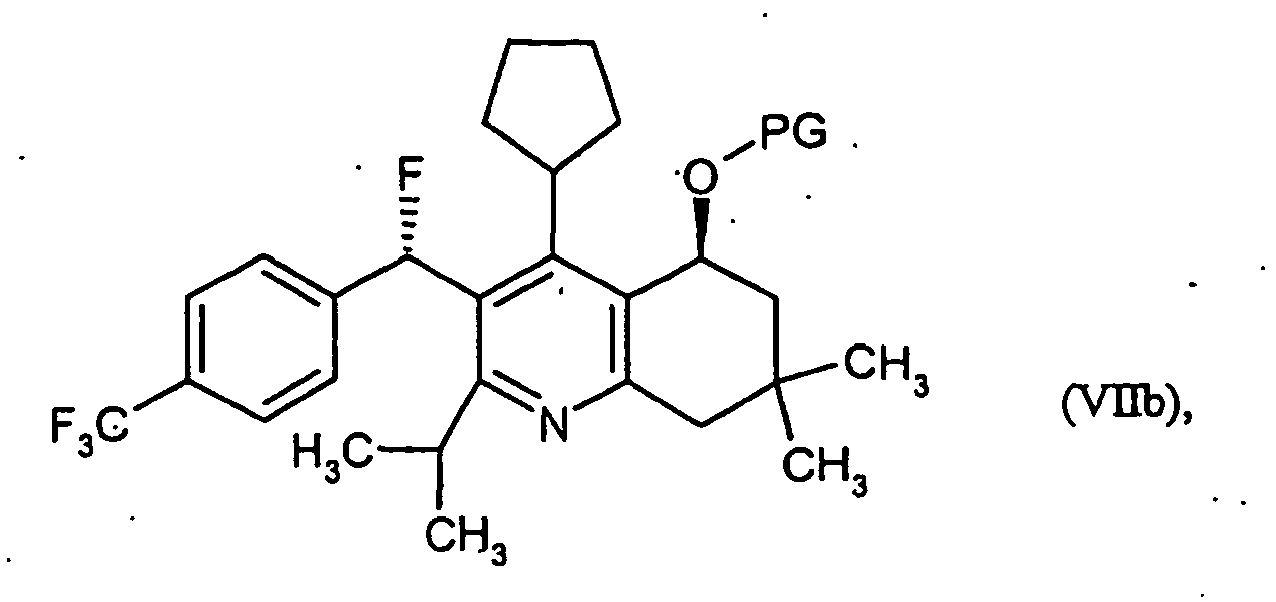
umsetzt und dann die Hydroxy-Schutzgruppe PG nach üblichen Methoden unter Erhalt der Verbindung der Formel (Ib) wieder abspaltet
und die Verbindung der Formel (Ib) gegebenenfalls mit den entsprechenden (i) Lösungsmitteln und/oder (ii) Basen oder Säuren zu ihren Solvaten, Salzen und/oder Solvaten der Salze umsetzt. - Die Verbindung der Formel (IIb) kann hergestellt werden, indem man die Verbindungen der Formeln (VIII), (IX) und (Xb)


- Die Verbindungen der Formeln (VIII), (IX) und (Xa) und (Xb) sind kommerziell erhältlich, literaturbekannt oder können in Analogie zu literaturbekannten Verfahren hergestellt werden (vgl. auch
WO 99/14215 WO 03/028727 - Als inerte Lösungsmittel für die einzelnen Verfahrensschritte sind beispielsweise Ether wie Diethylether, Diisopropylether, Dioxan, Tetrahydrofuran, Glykoldimethylether oder Diethylenglykoldimethylether, Kohlenwasserstoffe wie Benzol, Toluol, Xylol, Hexan, Cyclohexan oder Erdölfraktionen, oder Halogenkohlenwasserstoffe wie Dichlormethan, Trichlormethan, Tetrachlormethan, 1,2-Dichlorethan, Trichlorethylen oder Chlorbenzol geeignet. Ebenso ist es möglich, Gemische der genannten Lösungsmittel zu verwenden.
- Die Reduktionen in den Verfahrensschritten (II) → (III), (IV) → (V) und (III) → (VI) werden im Allgemeinen mit Reduktionsmitteln, die für die Reduktion von Kefonen zu Hydroxyverbindungen geeignet sind, durchgeführt. Hierzu gehören insbesondere komplexe Aluminium- oder Borhydride wie beispielsweise Lithium-, Natrium-, Kalium-, Zinkborhydrid, Lithiumaluminiumhydrid, Diisobutylaluminiumhydrid (DIBAH), Natrium-bis-(2-methoxyethoxy)-aluminiumdihydrid, Lithiumtrialkylborhydride oder Lithiumtrialkoxyaluminiumhydride, oder Boran-Komplexe wie beispielsweise Boran-Tetrahydrofuran-, Boran-Dimethylsulfid- oder Boran-N,N-Diethylanilin-Komplex.
- Die asymmetrische Reduktion im Verfahrensschritt (II) → (III) erfolgt in Gegenwart katalytischer Mengen (0.01 bis 0.3 Mol-Äquivalente) von enantiomerenreinem (1R,2S)-1-Aminoindan-2-ol als chiralem Induktor. Als Reduktionsmittel wird hierbei bevorzugt Boran-NN-Diethylanilin-Komplex verwendet. Die Reaktion wird im Allgemeinen in einem der oben aufgeführten Ether oder in Toluol, vorzugsweise in Tetrahydrofuran, in einem Temperaturbereich von -80°C bis +50°C, bevorzugt von 0°C bis +30°C, durchgeführt.
- Bei den Reduktionen (IV) → (V) und (III) → (VI) wird bevorzugt Lithiumaluminiumhydrid bzw. DIBAH als Reduktionsmittel verwendet. Die Reaktionen werden im Allgemeinen in einem der oben aufgeführten Ether oder in Toluol, vorzugsweise in Tetrahydrofuran oder Toluol, in einem Temperaturbereich von -80°C bis +50°C, bevorzugt von 0°C bis +30°C im Falle von Lithiumaluminiumhydrid und von -80°C bis +30°C im Falle von DIBAH, durchgeführt.
- Als Hydroxy-Schutzgruppe bei den Verfahrensschritten (III) → (IV) bzw. (VI) → (V) wird eine Silylgruppe, wie beispielsweise Trimethylsilyl, Triethylsilyl, Triisopropylsilyl oder tert.-Butyldimethylsilyl, bevorzugt. Besonders bevorzugt ist tert.-Butyldimethylsilyl. Die Einführung der Silylgruppe erfolgt im Allgemeinen in einem der oben aufgeführten Kohlenwasserstoffe, Halogenkohlenwasserstoffe, Ether oder in Dimethylformamid als Lösungsmittel in Gegenwart einer Base wie beispielsweise Triethylamin, N,N-Diisopropylethylamin, Pyridin, 2,6-Lutidin oder 4-N,N-Dimethylaminopyridin (DMAP).
- Im Verfahrensschritt (III) → (IV) wird bevorzugt tert.-Butyldimethylsilyltrifluormethansulfonat als Silylierungsreagenz in Kombination mit 2,6-Lutidin als Base verwendet. Die Reaktion wird bevorzugt in Dichlormethan oder Toluol in einem Temperaturbereich von -40°C bis +40°C, bevorzugt von -20°C bis +30°C, durchgeführt.
- Im Verfahrensschritt (VI) → (V) wird bevorzugt tert.-Butyldimethylsilylchlorid als Silylierungsreagenz in Kombination mit Triethylamin und DMAP als Basen verwendet. Die Reaktion wird bevorzugt in Dimethylformamid in einem Temperaturbereich von 0°C bis +100°C, bevorzugt von +20°C bis +80°C, durchgeführt.
- Die Fluorierung im Verfahrensschritt (VI) → (VII) wird im Allgemeinen in einem der oben aufgeführten Kohlenwasserstoffe oder Halogenkohlenwasserstoffe oder in Acetonitril, vorzugsweise in Toluol oder Dichlormethan, mit Diethylaminoschwefeltrifluorid (DAST) oder Morpholinoschwefeltrifluorid als Fluorierungsreagenz durchgeführt. Die Reaktion erfolgt im Allgemeinen in einem Temperaturbereich von -80°C bis +40°C, bevorzugt von -60°C bis +20°C.
- Die Abspaltung einer Silyl-Schutzgruppe im Verfahrensschritt (VII) → (I) wird im Allgemeinen mit Hilfe von Säuren, wie beispielsweise Salzsäure oder Trifluoressigsäure, oder mit Hilfe von Fluoriden, wie beispielsweise Fluorwasserstoff oder Tetrabutylammoniumfluorid (TBAF), durchgeführt. Als inerte Lösungsmittel sind die oben aufgeführten Ether, Alkohole wie Methanol oder Ethanol, oder Gemische der genannten Lösungsmittel geeignet. Bevorzugt ist eine Abspaltung mit TBAF in Tetrahydrofuran als Lösungsmittel. Die Reaktion erfolgt im Allgemeinen in einem Temperaturbereich von -20°C bis +60°C, bevorzugt von 0°C bis +30°C.
- Die Kondensationsreaktion (VIII) + (IX) + (X) → (XI) wird im Allgemeinen in einem der oben aufgeführten Ether, in Alkoholen wie Methanol, Ethanol, n-Propanol oder Isopropanol, in Acetonitril oder in Gemischen der genannten Lösungsmittel durchgeführt. Bevorzugt wird Diisopropylether verwendet.
- Als Protonen-Säuren eignen sich für diesen Verfahrensschritt im Allgemeinen organische Säuren, wie beispielsweise Essigsäure, Trifluoressigsäure, Oxalsäure oder para-Toluolsulfonsäure, oder anorganische Säuren, wie beispielsweise Salzsäure, Schwefelsäure oder Phosphorsäure. Ebenfalls geeignet sind Lewis-Säuren wie beispielsweise Aluminiumchlorid oder Zinkchlorid. Bevorzugt ist Trifluoressigsäure.
- Die Reaktion erfolgt im Allgemeinen in einem Temperaturbereich von 0°C bis +120°C, bevorzugt von +20°C bis +80°C.
- Die Oxidation (Dehydrierung) im Verfahrensschritt (XI) → (II) wird im Allgemeinen in einem der oben aufgeführten Halogenkohlenwasserstoffe oder gegebenenfalls in Alkoholen wie Methanol oder Ethanol, in Acetonitril oder in Wasser durchgeführt. Als Oxidationsmittel eignen sich beispielsweise Salpetersäure, Cer(IV)-ammoniumnitrat, 2,3-Dichlor-5,6-dicyano-1,4-benzochinon (DDQ), Pyridiniumchlorochromat (PCC), Osmiumtetroxid, Mangandioxid oder eine katalytische Dehydrierung mittels Platindioxid oder Palladium auf Aktivkohle. Bevorzugt ist eine Oxidation mit DDQ in Dichlormethan als Lösungsmittel. Die oxidation erfolgt im Allgemeinen in einem Temperaturbereich von -50°C bis +100°C, bevorzugt von 0°C bis +40°C.
- Die einzelnen Verfahrensschritte können bei normalem, erhöhtem oder bei erniedrigtem Druck durchgeführt werden (z.B. von 0.5 bis 5 bar). Im Allgemeinen arbeitet man bei Normaldruck.
- Die Herstellung der erfindungsgemäßen Verbindung kann durch das folgende Syntheseschema veranschaulicht werden:


- Die erfindungsgemäße Verbindung zeigt ein nicht vorhersehbares, wertvolles pharmakologisches Wirkspektrum. Sie eignet sich daher zur Verwendung als Arzneimittelwirkstoff zur Behandlung und/oder Prophylaxe von Krankheiten bei Menschen und Tieren.
- Die erfindungsgemäße Verbindung eröffnet eine weitere Behandlungsalternative und stellt eine Bereicherung der Pharmazie dar. Im Vergleich zu den bekannten und bisher eingesetzten Präparaten zeigt die erfindungsgemäße Verbindung ein verbessertes Wirkungsspektrum.
- Sie zeichnet sich vorzugsweise durch große Spezifität, gute Verträglichkeit und geringere Nebenwirkungen sowie eine geringere Toxizität insbesondere im Herz-Kreislauf-Bereich und im Bereich der Leber aus.
- Ein Vorteil der erfindungsgemäßen Verbindung ist ihre hohe Aktivität in humanem Plasma. Ein weiterer Vorteil der erfindungsgemäßen Verbindung ist ein verringertes Interaktionspotential mit metabolisierenden Enzymen, insbesondere mit den Cytochrom P450-Enzymen und in besonderem Masse mit dem Cytochrom P450 3A4-Enzym. Die erfindungsgemäße Verbindung zeigt darüber hinaus ein verringertes Ablagerungsverhalten im Fettgewebe.
- Die erfindungsgemäße Verbindung der Formel (I) besitzt wertvolle pharmakologische Eigenschaften und kann zur Vorbeugung und Behandlung vor Erkrankungen verwendet werden. Insbesondere ist die erfindungsgemäße Verbindung ein hochwirksamer Inhibitor des Cholesterin-Ester-Transfer-Proteins (CETP) und stimuliert den reversen Cholesterin-Transport. Sie bewirkt eine Erhöhung des HDL-Cholesterinspiegels im Blut. Die erfmdungsgemäße Verbindung ist insbesondere zur Behandlung und zur primären oder sekundären Prävention koronarer Herzerkrankungen, z.B. von Myokardinfarkt, einsetzbar. Die erfindungsgemäße Verbindung kann zudem zur Behandlung und Prävention von Arteriosklerose, Restenose, Schlaganfällen sowie der Alzheimer'schen Krankheit verwendet werden. Darüber hinaus kann die erfindungsgemäße Verbindung auch zur Behandlung und Prävention von Hypolipoproteinämien, Dyslipidämien, Hypertriglyceridämien, Hyperlipidämien, Hypercholesterolämien, Fettsucht (Adipositas), Fettleibigkeit (Obesitas), Pankreatitis, Insulin-abhängigem und nicht-Insulin-abhängigem Diabetes, diabetischen Spätfolgen, wie beispielsweise Retinopathie, Nephropathie und Neuropathie, von kombinierten Hyperlipidämien sowie des Metabolischen Syndroms eingesetzt werden.
- Die pharmakologische Wirkung der erfindungsgemäßen Verbindung kann mittels der im Folgenden aufgeführten CETP-Inhibitions-Tests ermittelt werden.
- Weiterer Gegenstand der vorliegenden Erfindung ist die Verwendung der erfindungsgemäßen Verbindung zur Herstellung von Medikamenten zur Behandlung und/oder Prävention von Erkrankungen, insbesondere der zuvor genannten Erkrankungen.
- Weiterer Gegenstand der vorliegenden Erfindung ist die Verwendung der erfindungsgemäßen Verbindung zur Herstellung eines Arzneimittels zur Behandlung und/oder Prävention von Erkrankungen, insbesondere der zuvor genannten Erkrankungen.
- Weiterer Gegenstand der vorliegenden Erfindung sind Arzneimittel, die die erfindungsgemäße Verbindung sowie einen oder mehrere weitere Wirkstoffe enthalten, zur Behandlung und/oder Prävention von Erkrankungen. Als geeignete Kombinationswirkstoffe seien beispielhaft und vorzugsweise genannt:
- Antidiabetika,
- antithrombotisch wirkende Substanzen,
- blutdrucksenkende Substanzen,
- den Fettstoffwechsel verändernde Substanzen,
- antientzündlich wirkende Substanzen,
- den arteriosklerotischen Plaque stabilisierende Substanzen.
- Die erfindungsgemäße Verbindung der Formel (I) kann vorzugsweise mit einem oder mehreren
- Antidiabetika, die in der Roten Liste 2002/II, Kapitel 12 genannt sind,
- antithrombotisch wirkenden Mitteln, beispielhaft und vorzugsweise aus der Gruppe der Thrombozytenaggregationshemmer oder der Antikoagulantien,
- den Blutdruck senkenden Wirkstoffen, beispielhaft und vorzugsweise aus der Gruppe der Calcium-Antagonisten, Angiotensin AII-Antagonisten, ACE-Hemmer, beta-Blocker, Phosphodiesterase-Inhibitoren, Stimulatoren der löslichen Guanylatcyclase, cGMP-Enhancer sowie der Diuretika, und/oder
- den Fettstoffwechsel verändernden Wirkstoffen, beispielhaft und vorzugsweise aus der Gruppe der Thyroidrezeptor-Agonisten, der Cholesterinsynthese-Inhibitoren wie HMG-CoA-Reduktase-Inhibitoren, Squalensynthase-Inhibitoren, Squalenepoxidase-Inhibitoren oder Oxidosqualencyclase-Inhibitoren, der ACAT-Inhibitoren, MTP-Inhibitoren, PPAR-Agonisten, Fibrate, Lipase-Inhibitoren, Cholesterinabsorptionshemmer, Gallensäure-Reabsorptionshemmer, polymeren Gallensäureadsorber und der Lipoprotein(a)-Antagonisten
- Unter Antidiabetika werden beispielhaft und vorzugsweise Insulin und Insulinderivate sowie oral wirksame hypoglykämische Wirkstoffe verstanden.
- Insulin und Insulinderivate umfasst hierbei sowohl Insuline tierischen, menschlichen oder biotechnologischen Ursprungs als auch Gemische hieraus.
- Die oral wirksamen hypoglykämischen Wirkstoffe umfassen beispielhaft und vorzugsweise Sulphonylharnstoffe, Biguadine, Meglitinid-Derivate, Oxadiazolidinone, Thiazolidindione, Glukosidase-Inhibitoren, Glukagon-Antagonisten, GLP-1-Agonisten, Insulin-Sensitizer, Inhibitoren von Leberenzymen, die an der Stimulation der Glukoneogenese und/oder Glykogenolyse beteiligt sind, Modulatoren der Glukoseaufnahme sowie Kaliumkanalöffner, wie z.B. diejenigen, die in
WO 97/26265 WO 99/03861 - Bei einer bevorzugten Ausführungsform der Erfindung wird die Verbindung der Formel (I) in Kombination mit Insulin verabreicht.
- Bei einer bevorzugten Ausführungsform der Erfindung wird die Verbindung der Formel (I) in Kombination mit einem Sulphonylharnstoff, wie beispielhaft und vorzugsweise Tolbutamid, Glibenclamid, Glimepirid, Glipizid oder Gliclazid, verabreicht.
- Bei einer bevorzugten Ausführungsform der Erfindung wird die Verbindung der Formel (I) in Kombination mit einem Biguanid, wie beispielhaft und vorzugsweise Metformin, verabreicht.
- Bei einer bevorzugten Ausführungsform der Erfindung wird die Verbindung der Formel (I) in Kombination mit einem Meglitinid-Derivat, wie beispielhaft und vorzugsweise Repaglinid oder Nateglinid, verabreicht.
- Bei einer bevorzugten Ausführungsform der Erfindung wird die Verbindung, der Formel (I) in Kombination mit einem PPARgamma-Agonisten beispielsweise aus der Klasse der Thiazolidindione, wie beispielhaft und vorzugsweise Pioglitazon oder Rosiglitazon, verabreicht.
- Bei einer bevorzugten Ausführungsform der Erfindung wird die Verbindung der Formel (I) in Kombination mit einem gemischten PPARalpha/gamma-Agonisten, wie beispielhaft und vorzugsweise GI-262570 (Farglitazar), GW 2331, GW 409544, AVE 8042, AVE 8134, AVE 0847, MK-0767 (KRP-297) oder AZ-242, verabreicht.
- Unter antithrombotisch wirkenden Mitteln werden vorzugsweise Verbindungen aus der Gruppe der Thrombozytenaggregationshemmer, wie beispielhaft und vorzugsweise Aspirin, Clopidogrel, Ticlopidin oder Dipyridamol, oder der Antikoagulantien verstanden.
- Bei einer bevorzugten Ausführungsform der Erfindung wird die Verbindung der Formel (I) in Kombination mit einem Thrombin-Inhibitor, wie beispielhaft und vorzugsweise Ximelagatran, Melagatran, Bivalirudin oder Clexane, verabreicht.
- Bei einer bevorzugten Ausführungsform der Erfindung wird die Verbindung der Formel (I) in Kombination mit einem GPIIb/IIIa-Antagonisten, wie beispielhaft und vorzugsweise Tirofiban oder Abciximab, verabreicht.
- Bei einer bevorzugten Ausführungsform der Erfindung wird die Verbindung der Formel (I) in Kombination mit einem Faktor Xa-Inhibitor, wie beispielhaft und vorzugsweise DX 9065a, DPC 906, JTV 803 oder BAY 59-7939, verabreicht.
- Bei einer bevorzugten Ausführungsform der Erfindung wird die Verbindung der Formel (I) in Kombination mit Heparin oder einem low molecular weight (LMW)-Heparin-Derivat verabreicht.
- Bei einer bevorzugten Ausführungsform der Erfindung wird die Verbindung der Formel (I) in Kombination mit einem Vitamin K-Antagonisten, wie beispielhaft und vorzugsweise Coumarin, verabreicht.
- Unter blutdrucksenkenden Mitteln werden beispielhaft und vorzugsweise Verbindungen aus der Gruppe der Calcium-Antagonisten, wie beispielhaft und vorzugsweise die Verbindungen Nifedipin, Amlodipin, Nitrendipin, Nisoldipin, Verapamil oder Diltiazem, der Angiotensin AII-Antagonisten, ACE-Hemmer, beta-Blocker sowie der Diuretika verstanden.
- Bei einer bevorzugten Ausführungsform der Erfindung wird die Verbindung der Formel (I) in Kombination mit einem Antagonisten der alpha 1-Rezeptoren verabreicht.
- Bei einer bevorzugten Ausführungsform der Erfindung wird die Verbindung der Formel (I) in Kombination mit Reserpin, Minoxidil, Diazoxid, Dihydralazin, Hydralazin sowie Stickoxid freisetzenden Stoffen, wie beispielhaft und vorzugsweise Glycerinnitrat oder Nitroprussidnatrium, verabreicht.
- Bei einer bevorzugten Ausführungsform, der Erfindung wird die Verbindung der Formel (I) in Kombination mit einem Angiotensin AII-Antagonisten, wie beispielhaft und vorzugsweise Losartan, Valsartan, Candesartan, Telmisartan, Embusartan, Irbesartan, Olmesartan, Tasosartan oder Saprisartan, verabreicht.
- Bei einer bevorzugten Ausführungsform der Erfindung wird die Verbindung der Formel (I) in Kombination mit einem ACE-Hemmer, wie beispielhaft und vorzugsweise Enalapril, Captopril, Ramipril, Delapril, Fosinopril, Quinopril, Perindopril oder Trandolapril, verabreicht.
- Bei einer bevorzugten Ausführungsform der Erfindung wird die Verbindung der Formel (I) in Kombination mit einem beta-Blocker, wie beispielhaft und vorzugsweise Propranolol oder Atenolol, verabreicht.
- Bei einer bevorzugten Ausführungsform der Erfindung wird die Verbindung der Formel (I) in Kombination mit einem Diuretikum, wie beispielhaft und vorzugsweise Furosemid, verabreicht.
- Unter den Fettstoffwechsel verändernden Mitteln werden beispielhaft und vorzugsweise Verbindungen aus der Gruppe der Thyroidrezeptor-Agonisten, der Cholesterinsynthese-Inhibitoren wie HMG-CoA-Reduktase-Inhibitoren oder Squalensynthese-Inhibitoren, der ACAT-Inhibitoren, MTP-Inhibitoren, PPAR-Agonisten, Fibrate, Cholesterinabsorptionshemmer, Gallensäure-Reabsorptionshemmer, Lipase-Inhibitoren, polymeren Gallensäureadsorber sowie der Lipoprotein(a)-Antagonisten verstanden.
- Bei einer bevorzugten Ausführungsform der Erfindung wird die Verbindung der Formel (I) in Kombination mit einem Thyroidrezeptor-Agonisten, wie beispielhaft und vorzugsweise D-Thyroxin, 3,5,3'-Triiodothyronin (T3), CGS 23425 oder Axitirome (CGS 26214), verabreicht.
- Bei einer bevorzugten Ausführungsform der Erfindung wird die Verbindung der Formel (I) in Kombination mit einem Squalensynthese-Inhibitor, wie beispielhaft und vorzugsweise BMS-188494 oder TAK 475, verabreicht.
- Bei einer bevorzugten Ausführungsform der Erfindung wird die Verbindung der Formel (I) in Kombination mit einem ACAT-Inhibitor, wie beispielhaft und vorzugsweise Avasimibe, Eflucimibe oder CS-505, verabreicht.
- Bei einer bevorzugten Ausführungsform der Erfindung wird die Verbindung der Formel (I) in Kombination mit einem Cholesterinabsorptionshemmer, wie beispielhaft und vorzugsweise Ezetimibe, Tiqueside oder Pamaqueside, verabreicht.
- Bei einer bevorzugten Ausführungsform der Erfindung wird die Verbindung der Formel (I) in Kombination mit einem Gallensäure-Reabsorptionshemmer, wie beispielhaft und vorzugsweise Barixibat, AZD 7508, SC 435, SC 635, S-8921, 264W94 oder HM 1453, verabreicht.
- Bei einer bevorzugten Ausführungsform der Erfindung wird die Verbindung der Formel (I) in Kombination mit einem MTP-Inhibitor, wie beispielhaft und vorzugsweise Implitapide, BMS-201038 oder R-103757, verabreicht.
- Bei einer bevorzugten Ausführungsform der Erfindung wird die Verbindung der Formel (I) in Kombination mit einem PPARalpha-Agonisten, wie z.B. die Fibrate Fenofibrat, Clofibrat, Bezafibrat, Ciprofibrat oder Gernfibrozil oder wie beispielhaft und vorzugsweise GW 9578, GW 7647, LY-518674 oder NS-220, verabreicht.
- Bei einer bevorzugten Ausführungsform der Erfindung wird die Verbindung der Formel (I) in Kombination mit einem PPARdelta-Agonisten, wie beispielhaft und vorzugsweise GW 501516, verabreicht.
- Bei einer bevorzugten Ausführungsform der Erfindung wird die Verbindung der Formel (I) in Kombination mit einem gemischten PPARalpha/gamma-Agonisten, wie beispielhaft und vorzugsweise GI-262570 (Farglitazar), GW 2331, GW 409544, AVE 8042, AVE 8134, AVE 0847, MK-0767 (KRP-297) oder AZ-242, verabreicht.
- Bei einer bevorzugten Ausführungsform der Erfindung wird die Verbindung der Formel (I) in Kombination mit einem gemischten PPARalpha/gamma/delta-Agonisten, wie beispielhaft und vorzugsweise MCC-555, verabreicht.
- Bei einer bevorzugten Ausführungsform der Erfindung wird die Verbindung der Formel (I) in Kombination mit einem Lipase-Inhibitor aus der Gruppe der endothelialen Lipase-Inhibitoren, der pankreatischen Lipase-Inhibitoren, der gastrischen Lipase-Inhibitoren, der Hormon-sensitiven Lipase-Inhibitoren oder der hepatischen Lipase-Inhibitoren verabreicht.
- Bei einer besonders bevorzugten Ausführungsform der Erfindung wird die Verbindung der Formel (I) in Kombination mit einem Inhibitor der pankreatrischen Lipase, vorzugsweise aus der Klasse der Lipstatine wie beispielhaft Orlistat, verabreicht.
- Bei einer bevorzugten Ausführungsform der Erfindung wird die Verbindung der Formel (I) in Kombination mit einem polymeren Gallensäureadsorber, wie beispielhaft und vorzugsweise Cholestyramin, Colestipol, Colesolvam, CholestaGel oder Colestimide, verabreicht.
- Bei einer bevorzugten Ausführungsform der Erfindung wird die Verbindung der Formel (I) in Kombination mit einem Lipoprotein(a)-Antagonisten, wie beispielhaft und vorzugsweise Gemcabene calcium (CI-1027) oder Nicotinsäure, verabreicht.
- Bei einer bevorzugten Ausführungsform der Erfindung wird die Verbindung der Formel (I) in Kombination mit einem Antagonisten des Niacin-Rezeptors, wie beispielhaft und vorzugsweise Niaspan, Acipimox oder Niceritrol, verabreicht.
- Bei einer bevorzugten Ausführungsform der Erfindung wird die Verbindung der Formel (I) in Kombination mit einem Antioxidans, wie beispielhaft und vorzugsweise Probucol, AGI 1067 oder Bo 653, verabreicht.
- Bei einer bevorzugten Ausführungsform der Erfindung wird die Verbindung der Formel (I) in Kombination mit einem LDL-Rezeptor-Inducer, wie beispielhaft Lifibrol, verabreicht.
- Bei einer bevorzugten Ausführungsform der Erfindung wird die Verbindung der Formel (I) in Kombination mit einem HMG-CoA-Reduktase-Inhibitor aus der Klasse der Statine, wie beispielhaft und vorzugsweise Lovastatin, Simvastatin, Pravastatin, Fluvastatin, Atorvastatin, Rosuvastatin, Cerivastatin oder Pitavastatin, verabreicht.
- Ein weiterer Gegenstand der vorliegenden Erfindung sind Kombinationen der Verbindung der Formel (I) mit Substanzen, die eine Senkung der HMG-CoA-Reduktase-Genexpression bewirken. Derartige Substanzen können beispielsweise Inhibitoren der HMG-CoA-Reduktasetranskription oder der HMG-CoA-Reduktasetranslation sein. Eine Inhibition der HMG-CoA-Reduktase-Genexpression kann beispielsweise durch Inhibition der S1P (Site-1)-Protease oder durch Senkung der SREBP (sterol receptor binding protein)-Spiegel hervorgerufen werden.
- Ein weiterer Gegenstand der vorliegenden Erfindung sind Kombinationen der Verbindung der Formel (I) mit Substanzen, die antientzündlich und/oder den arteriosklerotischen Plaque stabilisierend wirken. Derartige Substanzen können beispielsweise Wirkstoffe aus der Klasse der NSAIDs, der PAF-AH-Antagonisten oder der Chemokin-Rezeptor-Antagonisten, wie beispielhaft IL-8-Rezeptor-Antagonisten oder MCP-1-Antagonisten, darstellen.
- Die erfindungsgemäßen Wirkstoffkombinationen besitzen wertvolle pharmakologische Eigenschaften und können zur Vorbeugung und Behandlung von Erkrankungen verwendet werden.
- Die erfindungsgemäßen Wirkstoffkombinationen sind insbesondere zur Behandlung und zur primären oder sekundären Prävention koronarer Herzerkrankungen, z.B. von Myokardinfarkt, einsetzbar. Sie können zudem zur Behandlung und Prävention von Arteriosklerose, Restenose, Schlaganfällen sowie der Alzheimer'schen Krankheit verwendet werden. Darüber hinaus können die genannten Wirkstoffkombinationen auch zur Behandlung und Prävention von Hypolipoproteinämien, Dyslipidämien, Hypertriglyceridämien, Hyperlipidämien, Hypercholesterolämien, Fettsucht (Adipositas), Fettleibigkeit (Obesitas), Pankreatitis, Insulin-abhängigem und nicht-Insulin-abhängigem Diabetes, diabetischen Spätfolgen, wie beispielsweise Retinopathie, Nephropathie und Neuropathie, von kombinierten Hyperlipidämien sowie des Metabolischen Syndroms eingesetzt werden. Ferner eignen sich die erfindungsgemäßen Wirkstoffkombinationen zur Behandlung von Bluthochdruck, Herzinsuffizienz, Angina Pectoris, Ischämien sowie von entzündlichen Erkrankungen.
- Weiterer Gegenstand der vorliegenden Erfindung sind Arzneimittel, die die erfindungsgemäße Verbindung, üblicherweise zusammen mit einem oder mehreren inerten, nichttoxischen, pharmazeutisch geeigneten Hilfsstoffen enthalten, sowie deren Verwendung zu den zuvor genannten Zwecken.
- Die erfindungsgemäße Verbindung kann systemisch und/oder lokal wirken. Zu diesem Zweck kann sie auf geeignete Weise appliziert werden, wie z.B. oral, parenteral, pulmonal, nasal, sublingual, lingual, buccal, rectal, dermal, transdermal, conjunctival, otisch oder als Implantat bzw. Stent.
- Für diese Applikationswege kann die erfindungsgemäße Verbindung in geeigneten Applikationsformen verabreicht werden.
- Für die orale Applikation eignen sich nach dem Stand der Technik funktionierende, die erfindungsgemäße Verbindung schnell und/oder modifiziert abgebende Applikationsformen, die die erfindungsgemäße Verbindung in kristalliner und/oder amorphisierter und/oder gelöster Form enthalten, wie z.B. Tabletten (nicht-überzogene oder überzogene Tabletten, beispielsweise mit magensaftresistenten oder sich verzögert auflösenden oder unlöslichen Überzügen, die die Freisetzung der erfindungsgemäßen Verbindung kontrollieren), in der Mundhöhle schnell zerfallende Tabletten oder Filme/Oblaten, Filme/Lyophylisate, Kapseln (beispielsweise Hart- oder Weichgelatinekapseln), Dragees, Granulate, Pellets, Pulver, Emulsionen, Suspensionen, Aerosole oder Lösungen.
- Die parenterale Applikation kann unter Umgehung eines Resorptionsschrittes geschehen (z.B. intravenös, intraarteriell, intrakardial, intraspinal oder intralumbal) oder unter Einschaltung einer Resorption (z.B. intramuskulär, subcutan, intracutan, percutan oder intraperitoneal). Für die parenterale Applikation eignen sich als Applikationsformen u.a. Injektions- und Infusionszubereitungen in Form von Lösungen, Suspensionen, Emulsionen, Lyophilisaten oder sterilen Pulvern.
- Für die sonstigen Applikationswege eignen sich z.B. Inhalationsarzneiformen (u.a. Pulverinhalatoren, Nebulizer), Nasentropfen, -lösungen oder -sprays, lingual, sublingual oder buccal zu applizierende Tabletten, Filme/Oblaten oder Kapseln, Suppositorien, Ohren- oder Augenpräparationen, Vaginalkapseln, wässrige Suspensionen (Lotionen, Schüttelmixturen), lipophile Suspensionen, Salben, Cremes, transdermale therapeutische Systeme (z.B. Pflaster), Milch, Pasten, Schäume, Streupuder, Implantate oder Stents.
- Bevorzugt sind die orale oder parenterale Applikation, insbesondere die orale Applikation.
- Die erfindungsgemäße Verbindung kann in die angeführten Applikationsformen überführt werden. Dies kann in an sich bekannter Weise durch Mischen mit inerten, nichttoxischen, pharmazeutisch geeigneten Hilfsstoffen geschehen. Zu diesen Hilfsstoffen zählen u.a. Trägerstoffe (beispielsweise mikrokristalline Cellulose, Lactose, Mannitol), Lösungsmittel (z.B. flüssige Polyethylenglycole), Emulgatoren und Dispergier- oder Netzmittel (beispielsweise Natriumdodecylsulfat, Polyoxysorbitanoleat), Bindemittel (beispielsweise Polyvinylpyrrolidon), synthetische und natürliche Polymere (beispielsweise Albumin), Stabilisatoren (z.B. Antioxidantien wie beispielsweise Ascorbinsäure), Farbstoffe (z.B. anorganische Pigmente wie beispielsweise Eisenoxide) und Geschmacks- und/oder Geruchskorrigentien.
- Im Allgemeinen hat es sich als vorteilhaft erwiesen, bei parenteraler Applikation Mengen von etwa 0.001 bis 1 mg/kg, vorzugsweise etwa 0.01 bis 0.5 mg/kg Körpergewicht zur Erzielung wirksamer Ergebnisse zu verabreichen. Bei oraler Applikation beträgt die Dosierung etwa 0.01 bis 100 mg/kg, vorzugsweise etwa 0.01 bis 20 mg/kg und ganz besonders bevorzugt 0.1 bis 10 mg/kg Körpergewicht.
- Trotzdem kann es gegebenenfalls erforderlich sein, von den genannten Mengen abzuweichen, und zwar in Abhängigkeit von Körpergewicht, Applikationsweg, individuellem Verhalten gegenüber dem Wirkstoff, Art der Zubereitung und Zeitpunkt bzw. Intervall, zu welchem die Applikation erfolgt. So kann es in einigen Fällen ausreichend sein, mit weniger als der vorgenannten Mindestmenge auszukommen, während in anderen Fällen die genannte obere Grenze überschritten werden muss. Im Falle der Applikation größerer Mengen kann es empfehlenswert sein, diese in mehreren Einzelgaben über den Tag zu verteilen.
- Die nachfolgenden Ausführungsbeispiele erläutern die Erfindung. Die Erfindung ist nicht auf die Beispiele beschränkt.
- Die Prozentangaben in den folgenden Tests und Beispielen sind, sofern nicht anders angegeben, Gewichtsprozente; Teile sind Gewichtsteile. Lösungsmittelverhältnisse, Verdünnungsverhältnisse und Konzentrationsangaben von flüssig/flüssig-Lösungen beziehen sich jeweils auf das Volumen.
-
- CE
- Cholesterinester
- CETP
- Cholesterinester-Transfeiprotein
- DAST
- Dimethylaminoschwefeltrifluorid
- DCI
- direkte chemische Ionisation (bei MS)
- DDQ
- 2,3-Dichlor-5,6-dicyano-1,4-benzochinon
- de
- Diastereomerenüberschuss
- DMF
- N,N-Dimethylformamid
- DMSO
- Dimethylsulfoxid.
- d. Th.
- der Theorie (bei Ausbeute)
- EDTA
- Ethylendiamin-N,N,N',N'-tetraessigsäure
- ee
- Enantiomerenüberschuss
- eq.
- Äquivalent(e)
- ESI
- Elektrospray-Ionisation (bei MS)
- h
- Stunde(n)
- HDL
- High Density Lipoprotein
- HPLC
- Hochdruck-, Hochleistungsflüssigchromatographie
- LC/MS
- Flüssigchromatographie-gekoppelte Massenspektroskopie
- LDL
- Low Density Lipoprotein
- min
- Minute(n)
- MS
- Massenspektroskopie
- NMR
- Kernresonanzspektroskopie
- Rt
- Retentionszeit (bei HPLC)
- SPA
- Scintillation Proximity Assay
- TBAF
- Tetrabutylammoniumfluorid
- TBDMSOTf
- tert.-Butyldimethylsilyl-trifluormethansulfonat
- TFA
- Trifluoressigsäure
- THF
- Tetrahydrofuran
- Methode 1: Säule: Chiralpak IA, 250 mm x 4.6 mm; Eluent: Isohexan/1-Propanol 97:3; Fluss: 1.0 ml/min; UV-Detektion: 254 nm.
- Methode 2: Instrument: HP 1100 mit DAD-Detektion; Säule: Kromasil RP-18, 60 mm x 2 mm, 3.5 µm; Eluent A: 5 ml HClO4/l Wasser, Eluent B: Acetonitril; Gradient: 0 min 2% B → 0.5 min 2% B → 4.5 min 90% B → 9 min 90% B; Fluss: 0.75 ml/min; Temperatur: 30°C; UV-Detektion: 210 nm.
- Methode 3 (LC/MS): Gerätetyp MS: Micromaß ZQ; Gerätetyp HPLC: HP 1100 Series; UV DAD; Säule: Phenomenex Synergi 2µ Hydro-RP Mercury 20 mm x 4 mm; Eluent A: 11 Wasser + 0.5 ml 50%-ige Ameisensäure, Eluent B: 11 Acetonitril + 0.5 ml 50%-ige Ameisensäure; Gradient: 0.0 min 90% A → 2.5 min 30% A → 3.0 min 5% A → 4.5 min 5% A; Fluss: 0.0 min 1 ml/min → 2.5 min/3.0 min/4.5 min 2 ml/min; Ofen: 50°C; UV-Detektion: 210 nm.
- 2-Cyclopentyl-4-cyclohexyl-7,7-dimethyl-3-(4-trifluormethylbenzoyl)-4,6,7,8-tetrahydro-1H-chinolin-5-on

WO 03/028727 - Ausbeute: 3.13 g (14% d. Th.) 1H-NMR (CDCl3, 300 MHz): δ = 0.77-2.05 (m, 20H), 1.17 (s, 6H), 2.21 (m, 2H), 2.40 (2d, 2H), 3.48 (sept, 1H), 3.79 (d, 1H), 5.85 (s, 1H), 7.66 (d, 2H), 7.78 (d, 2H) ppm.
- MS (ESIpos): m/z = 500 [M+H]+.
- 2-Cyclopentyl-4-cyclohexyl-7,7-dimethyl-3-(4-trifluormethylbenzoyl)-7,8-dihydro-6H-chinolin-5-on

- Ausbeute: 3.07 g (98.6% d. Th.)
- 1H-NMR (CDCl3, 400 MHz): δ = 1.01-1.22 (m, 2H), 1.10 (s, 3H), 1.18 (s, 3H), 1.35-2.00 (m, 16H), 2.50-2.69 (m, 3H), 3.07 (s, 2H), 3.35 (m, 1H), 7.75 (d, 2H), 7.94 (m, 2H) ppm.
- MS (ESIpos): m/z = 498 [M+H]+.
- [(5S)-2-Cyclopentyl-4-cyclohexyl-5-hydroxy-7,7-dimethyl-5,6,7,8-tetrahydrochinolin-3-yl](4-trifluormethylphenyl)-methanon

- Ausbeute: 6.97 g (93.5% d. Th.)
- Der Enantiomerenüberschuss wird nach Methode 1 zu 97.6% ee bestimmt.
- 1H-NMR (CDCl3, 400 MHz): δ = 0.90-2.10 (m, 27H), 2.55 (m, 1H), 2.70 (m, 1H), 2.80-3.40 (m, 2H), 5.18 (br. s, 1H), 6.8 (m, 2H), 7.40-8.40 (br. m, 4H) ppm.
- MS (DCl/NH3): m/z = 500 [M+H]+.
- ((5S)-5-{[tert.-Butyl(dimethyl)silyl]oxy}-4-cyclohexyl-2-cyclopentyl-7,7-dimethyl-5,6,7,8-tetrahydrochinolin-3-yl)[4-(trifluormethyl)phenyl]-methanon

- Ausbeute: 5.96 g (80.8% d. Th.)
- 1H-NMR (CDCl3, 300 MHz): δ = 0.13 (s, 3H), 0.19 (s, 3H), 0.86 (s, 9H), 0.99-2.08 (m, 26H), 2.43-2.69 (m, 2H), 2.92-3.29 (m, 2H), 5.24 (br. s, 1H), 6.8 (m, 2H), 7.48-8.03 (br. m, 4H) ppm.
- MS (DCI/NH3): m/z = 614 [M+H]+.
- (S)-((5S)-5-{[tert.-Butyl(dimethyl)silyl]oxy}-4-cyclohexyl-2-cyclopentyl-7,7-dimethyl-5,6,7,8-tetrahydrochinolin-3-yl)[4-(trifluormethyl)phenyl]methanol

- Zu einer Lösung von 5.72 g (9.3 mmol) der Verbindung aus Beispiel 4A in 116 ml trockenem THF werden bei 0°C 10.25 ml einer 1 M Lösung von Lithiumaluminiumhydrid (10.25 mmol, 1.1 eq.) in THF getropft. Es wird unter Rühren innerhalb von 6 h auf Raumtemperatur erwärmt. Zur Aufarbeitung werden 120 ml einer gesättigten Natrium-Kaliumtartrat-Lösung vorsichtig hinzugefügt. Nach Abklingen der Gasentwicklung wird dreimal mit Essigsäureethylester extrahiert, die vereinten organischen Phasen mit einer 1:1-Mischung aus Natriumhydrogencarbonat-Lösung und gesättigter Kochsalz-Lösung gewaschen und diese wässrige Phase wiederum mit Essigsäureethylester rückextrahiert. Die vereinten organischen Phasen werden über Natriumsulfat getrocknet, filtriert und im Vakuum eingeengt. Der Rückstand wird chromatographisch aufgereinigt und dabei die Produkt-Diastereomere aufgetrennt (Säule: Chiralpak AD, 500 mm x 40 mm, 20 µm; Eluent: Isohexan/Isopropanol 97.5:2.5; Fluss: 50 ml/min).
- Ausbeute: 2.5 g (43.6% d. Th.)
- Diastereomerenreinheit: 96.9% de, Rt = 4.15 min (Methode 1).
- 1H-NMR (CDCl3, 400 MHz): δ = 0.18 (br. s, 6H), 0.90 (s, 9H), 1.03-2.09 (m, 26H), 2.10-2.33 (br. m, 1H), 2.37-3.06 (m, 3H), 3.33 (m, 1H), 5.24 und 5.47 (2 br. s, 1H), 6.49 und 6.64 (2 br. s, 1H), 7.31-7.64 (m, 4H) ppm.
- MS (ESIpos): m/z = 616 [M+H]+.
- (R)-((5S)-5-{[tert.-Butyl(dimethyl)silyl]oxy}-4-cyclohexyl-2-cyclopentyl-7,7-dimethyl-5,6,7,8-tetrahydrochinolin-3-yl)[4-(trifluormethyl)phenyl]methanol
- Ausbeute: 3.56 g (61.2% d. Th.)
- Diastereomerenreinheit: 98.6% de, Rt = 2.77 min (Methode 1).
- (5S)-5-{[tert.-Butyl(dimethyl)silyl]oxy}-4-cyclohexyl-2-cyclopentyl-3-{(S)-fluor[4-(trifluormethyl)phenyl]methyl}-7,7-dimethyl-5,6,7,8-tetrahydrochinolin
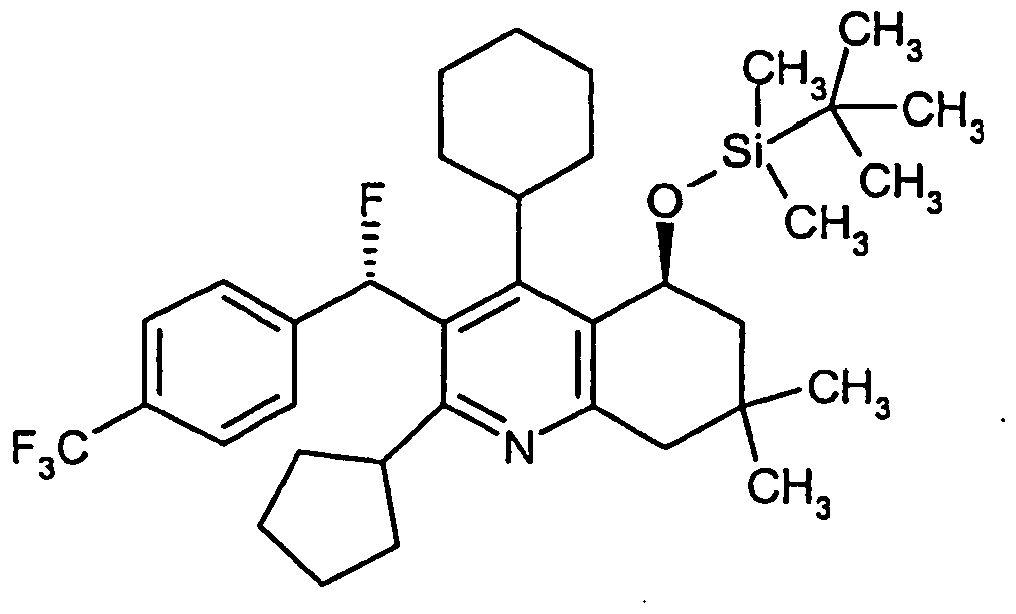
- Zu einer Lösung von 9.96 g (16.2 mmol) der Verbindung aus Beispiel 5A in 300 ml trockenem Toluol werden bei -55°C unter Argon 3.21 ml Diethylaminoschwefeltrifluorid (24.3 mmol, 1.5 eq.) getropft. Es wird unter Rühren 1 h bei dieser Temperatur und anschließend weitere 2 h bei Raumtemperatur nachgerührt. Zur Aufarbeitung werden 120 ml einer gesättigten Natriumhydrogencarbonat-Lösung vorsichtig hinzugefügt. Es wird insgesamt dreimal mit Essigsäureethylester extrahiert. Die vereinten organischen Phasen werden mit gesättigter Kochsalz-Lösung gewaschen, über Natriumsulfat getrocknet, filtriert und im Vakuum eingeengt. Das Rohprodukt wird durch Filtration durch Kieselgel (Laufmittel: Cyclohexan/Essigsäureethylester 9:1) gereinigt.
- Ausbeute: 9.93 g (99.3% d. Th.)
- 1H-NMR (CDCl3, 400 MHz): δ = 0.20 (br. s, 6H), 0.91 (s, 9H), 1.03-2.14 (m, 26H), 2.42-3.04 (m, 3H), 3.35 (m, 1H), 5.26 und 5.52 (2 br. s, 1H), 7.10-7.50 (m, 3H), 7.62 (d, 2H) ppm.
- MS (ESIpos): m/z = 618 [M+H]+.
- (5S)-4-Cyclohexyl-2-cyclopentyl-3-{(S)-fluor[4-(trifluormethyl)phenyl]methyl}-7,7-dimethyl-5,6,7,8-tetrahydrochinolin-5-ol

- Zu einer Lösung von 9.91 g (16.0 mmol) der Verbindung aus Beispiel 6A in 200 ml trockenem THF werden bei 0°C 40.1 ml einer 1 M Lösung von Tetrabutylammoniumfluorid (40.1 mmol, 2.5 eq.) in THF getropft. Es wird auf Raumtemperatur erwärmt und 16 h lang bei dieser Temperatur nachgerührt. Zur Aufarbeitung wird mit 100 ml Essigsäureethylester verdünnt und zweimal mit je 100 ml Wasser sowie mit 50 ml gesättigter Kochsalz-Lösung gewaschen. Die organische Phase wird über Natriumsulfat getrocknet, filtriert und im Vakuum eingeengt. Das Rohprodukt wird chromatographisch gereinigt (Kieselgel, Laufmittel: Isohexan/Essigsäureethylester 100:0 → 1:1).
- Ausbeute: 7.7 g (95.3% d. Th.)
- 1H-NMR (CDCl3, 300 MHz): δ = 1.02 (s, 3H), 1.17 (s, 3H), 1.08-2.15 (m, 21H), 2.59-3.00 (m, 3H), 3.51 (m, 1H), 5.13 (m, 1H), 7.34 (d, 2H), 7.39 (d, 1H), 7.61 (d, 2H) ppm.
- MS (DCI): m/z = 504 [M+H]+
- HPLC (Methode 2): Rt = 5.20 min.
- CETP wird aus humanem Plasma durch Differential-Zentrifugation und Säulenchromatographie in partiell gereinigter Form gewonnen und zum Test verwendet Dazu wird humanes Plasma mit NaBr auf eine Dichte von 1.21 g pro ml eingestellt und 18 h bei 50.000 Upm und 4°C zentrifugiert. Die Bodenfraktion (d >1.21 g/ml) wird auf eine Sephadex®-Phenyl-Sepharose 4B-Säule (Fa. Pharmacia) aufgetragen, mit 0.15 M NaCl / 0.001 M TrisHCl pH 7.4 gewaschen und anschließend mit destilliertem Wasser eluiert. Die CETP-aktiven Fraktionen werden gepoolt, gegen 50 mM Natriumacetat pH 4.5 dialysiert und auf eine CM-Sepharose®-Säule (Fa. Pharmacia) aufgetragen. Mit einem linearen Gradienten (0-1 M NaCl) wird anschließend eluiert. Die gepoolten CETP-Fraktionen werden gegen 10 mM TrisHCl pH 7.4 dialysiert und anschließend durch Chromatographie über eine Mono Q®-Säule (Fa. Pharmacia) weiter gereinigt.
- Messung der CETP-katalysierten Übertragung eines fluoreszierenden Cholesterinesters zwischen Liposomen [modifiziert nach der Vorschrift von Bisgaier et al., J. Lipid Res. 34, 1625 (1993)]:
- Zur Herstellung der Donorliposomen wird 1 mg Cholesteryl-4,4-difluor-5,7-dimethyl-4-bora-3a,4a-diaza-s-indacen-3-dodecanoat (Cholesteryl BODIPY® FL C12, Fa. Molecular Probes) mit 5.35 mg Triolein und 6.67 mg Phosphatidylcholin am Ultraschallbad unter leichtem Erwärmen in 600 µl Dioxan gelöst und diese Lösung sehr langsam unter Ultrabeschallung zu 63 ml 50 mM TrisHCl / 150 mM NaCl / 2 mM EDTA-Puffer pH 7.3 bei Raumtemperatur gegeben. Die Suspension wird anschließend unter N2-Atmosphäre 30 min im Branson-Ultraschallbad bei ca. 50 Watt beschallt, wobei die Temperatur auf ca. 20°C gehalten wird.
- Die Akzeptorliposomen werden analog aus 86 mg Cholesteryloleat, 20 mg Triolein und 100 mg Phosphatidylcholin, in 1.2 ml Dioxan und 114 ml des obigen Puffers gelöst, durch 30-minütige Ultrabeschallung bei 50 Watt (20°C) gewonnen.
- Zur Testung wird ein Testmix bestehend aus 1 Teil obigen Puffers, 1 Teil Donorliposomen und 2 Teilen Akzeptorliposomen verwendet.
50 µl Testmix werden mit 48 µl angereicherter CETP-Fraktion (1-3 µg), gewonnen über hydrophobe Chromatographie aus Humanplasma, sowie 2 µl einer Lösung der zu untersuchenden Substanz in DMSO versetzt und 4 h bei 37°C inkubiert. - Die Veränderung der Fluoreszenz bei 485/535 nm ist ein Maß für den CE-Transfer; die Hemmung des Transfers im Vergleich zum Kontrollansatz ohne Substanz wird ermittelt.
Beispiel Nr. IC50 [nM] Fluoreszenztest 1 25 - 42 µl (86% v/v) humanes Plasma (Sigma P9523) werden mit 6 µl (12% v/v) Donorliposomen sowie 1 µl (2% v/v) einer Lösung der zu untersuchenden Substanz in DMSO versetzt und 24 h bei 37°C inkubiert.
- Die Veränderung der Fluoreszenz bei 510/520 nm (Spaltbreite 2.5 nm) ist ein Maß für den CE-Transfer; die Hemmung des Transfers im Vergleich zum Kontrollansatz ohne Substanz wird ermittelt.
Beispiel Nr. IC50 [nM] Fluoreszenztest in humanem Plasma 1 50 - 80 µl Testmix werden mit 10 µl Puffer sowie 2 µl Serum versetzt und 4 h bei 37°C inkubiert.
- Die Veränderung der Fluoreszenz bei 485/535 nm ist ein Maß für den CE-Transfer; die Hemmung des Transfers im Vergleich zum Kontrollansatz ohne Substanz wird ermittelt.
- 50 ml frisches humanes EDTA-Plasma wird mit NaBr auf eine Dichte von 1.12 eingestellt und bei 4°C im Ty 65-Rotor 18 h bei 50.000 Upm zentrifugiert. Die Oberphase wird zur Gewinnung von kaltem LDL verwendet. Die Unterphase wird gegen 3 x 4 Liter PDB-Puffer (10 mM TrisHCl pH 7.4, 0.15 mM NaCl, 1 mM EDTA, 0.02% NaN3) dialysiert. Pro 10 ml Retentatvolumen werden anschließend 20 µl 3H-Cholesterin (Dupont NET-725; 1 µC/µl gelöst in Ethanol) hinzugesetzt und 72 h bei 37°C unter N2 inkubiert.
- Der Ansatz wird dann mit NaBr auf die Dichte 1.21 eingestellt und im Ty 65-Rotor 18 h bei 50.000 Upm und 20°C zentrifugiert. Man gewinnt die Oberphase und reinigt die Lipoproteinfraktionen durch Gradientenzentrifugation. Dazu wird die isolierte, markierte Lipoproteinfraktion mit NaBr auf eine Dichte von 1.26 eingestellt. Je 4 ml dieser Lösung werden in Zentrifugenröhrchen (SW 40-Rotor) mit 4 ml einer Lösung der Dichte 1.21 sowie 4.5 ml einer Lösung der Dichte 1.063 überschichtet (Dichtelösungen aus PDB-Puffer und NaBr) und anschließend 24 h bei 38.000 Upm und 20°C im SW 40-Rotor zentrifugiert. Die zwischen der Dichte 1.063 und 1.21 liegende, das markierte HDL enthaltende Zwischenschicht wird gegen 3 x 100 Volumen PDB-Puffer bei 4°C dialysiert.
- Das Retentat enthält radioaktiv markiertes 3H-CE-HDL, das auf ca. 5 x 10⁶ cmp pro ml eingestellt zum Test verwendet wird.
- Zur Testung der CETP-Aktivität wird die Übertragung von 3H-Cholesterolester von humanen HD-Lipoproteinen auf biotinylierte LD-Lipoproteine gemessen. Die Reaktion wird durch Zugabe von Streptavidin-SPA®-beads (Fa. Amersham) beendet und die übertragene Radioaktivität direkt im Liquid Scintillation Counter bestimmt.
- Im Testansatz werden 10 µl HDL-3H-Cholesterolester (ca. 50.000 cpm) mit 10 µl Biotin-LDL (Fa. Amersham) in 50 mM Hepes / 0.15 M NaCl / 0.1% Rinderserumalbumin (RSA) / 0.05% NaN3 pH 7.4 mit 10 µl CETP (1 mg/ml) und 3 µl einer Lösung der zu prüfenden Substanz in 10% DMSO / 1% RSA für 18 h bei 37°C inkubiert. Anschließend werden 200 µl der SPA-Streptavidin-bead-Lösung (TRKQ 7005) zugesetzt, 1 h unter Schütteln weiter inkubiert und dann im Scintillationszähler gemessen. Als Kontrollen dienen entsprechende Inkubationen mit 10 µl Puffer, 10 µl CETP bei 4°C sowie 10 µl CETP bei 37°C.
- Die in den Kontrollansätzen mit CETP bei 37°C übertragene Aktivität wird als 100% Übertragung gewertet. Die Substanzkonzentration, bei der diese Übertragung auf die Hälfte reduziert ist, wird, als IC50-Wert angegeben.
Beispiel Nr. IC50 [nM] SPA-Test 1 7 - Zur Prüfung auf CETP-inhibitorische Aktivität werden die Substanzen transgenen hCETP-Mäusen aus eigener Zucht [Dinchuk et al., BBA, 1295-1301 (1995)] oral mit der Schlundsonde verabreicht. Dazu werden männlich Tiere einen Tag vor Versuchsbeginn randomisiert Gruppen mit gleicher Tierzahl, in der Regel n = 4, zugeordnet. Vor der Substanzapplikation wird jeder Maus zur Bestimmung ihrer basalen CETP-Aktivität im Serum Blut durch Punktion des retroorbitalen Venenplexus entnommen (Zeitpunkt T1). Anschließend wird den Tieren die Testsubstanz mit der Schlundsonde verabreicht. Zu bestimmten Zeiten nach Applikation der Testsubstanz wird den Tieren ein zweites Mal Blut durch Punktion entnommen (Zeitpunkt T2), in der Regel 16 oder 24 h nach Substanzapplikation; gegebenenfalls kann dies aber auch zu einem anderen Zeitpunkt erfolgen.
- Um die Hemmaktivität einer Substanz bewerten zu können, wird für jeden Zeitpunkt, also 16 bzw. 24 Stunden, eine entsprechende Kontrollgruppe eingesetzt, deren Tiere nur das Formulierungsmittel ohne Substanz erhalten. Bei den Kontrolltieren erfolgen die zwei Blutentnahmen pro Tier wie bei den substanzbehandelten Tieren, um die Veränderung der CETP-Aktivität ohne Inhibitor über den entsprechenden Versuchszeitraum (16 bzw. 24 h) bestimmen zu können.
- Die Blutproben werden nach Abschluss der Gerinnung zentrifugiert und das Serum wird abpipettiert. Zur Bestimmung der CETP-Aktivität wird der Cholesterylester-Transport über 4 h bestimmt. Dazu werden im Testansatz in der Regel 2 µl Serum eingesetzt; der Test wird wie unter B-I.2.3. beschrieben durchgeführt.
- Die Differenzen im Cholesterylester-Transport [pM CE/h (T2) - pM CE/h (T1)] werden für jedes Tier berechnet und in den Gruppen gemittelt. Eine Substanz, die zu einem der Zeitpunkte den Cholesterylester-Transport um >20% herabsetzt, wird als wirksam angesehen.
Beispiel Nr. % Hemmung bei 3 mg/kg 16h 24 h 1 50 24 - Zur Bestimmung der oralen Wirkung von CETP-Inhibitoren auf Serum-Lipoproteine und -Triglyceride werden 150-200 g schwere weibliche syrische Goldhamster aus eigener Zucht (Stamm BAY:DSN) verwendet. Die Tiere werden pro Käfig zu sechst gruppiert und zwei Wochen bei Futter und Wasser ad libitum akklimatisiert.
- Unmittelbar vor Versuchsbeginn und nach Abschluss der Substanzapplikation wird mittels retroorbitaler Punktion des Venenplexus Blut entnommen, woraus nach 30 min Inkubation bei Raumtemperatur und 20 min Zentrifugation bei 30.000 g Serum gewonnen wird. Die Substanzen werden in 20% Solutol / 80% Wasser gelöst und mit Hilfe einer Schlundsonde peroral verabreicht. Die Kontrolltiere erhalten identische Volumina Lösungsmittel ohne Testsubstanz.
- Die Bestimmung von Triglyceriden, Gesamt-Cholesterin, HDL-Cholesterin und LDL-Cholesterin erfolgt mit Hilfe des Analysegeräts COBAS INTEGRA 400 plus (Fa. Roche Diagnostics) nach Angaben des Herstellers. Aus den Messwerten wird für jeden Parameter die durch Substanzbehandlung hervorgerufene prozentuale Veränderung für jedes Tier berechnet und als Mittelwert mit Standardabweichung pro Gruppe (n = 6 oder n = 12) angegeben. Sind die Substanzeffekte im Vergleich zur Lösungsmittel-behandelten Gruppe signifikant, wird der mittels t-Test ermittelte p-Wert hinzugefügt (* p ≤0.05; ** p ≤0.01; *** p ≤0.005).
Beispiel Nr. % HDL-Anstieg nach 24 h (Dosis: 2 x 10 mg/kg) 1 23 - Zur Bestimmung der oralen Wirkung auf Lipoproteine und Triglyceride wird transgenen Mäusen [Dinchuk et al., BBA, 1295-1301 (1995)] Testsubstanz mit der Schlundsonde verabreicht. Vor Versuchsbeginn wird den Mäusen retroorbital Blut entnommen, um Cholesterin und Triglyceride im Serum zu bestimmen. Das Serum wird, wie oben für Hamster beschrieben, durch Inkubation bei 4°C über Nacht und anschließende Zentrifugation bei 6.000 g gewonnen. Nach drei Tagen wird den Mäusen wieder Blut entnommen, um Lipoproteine und Triglyceride erneut zu bestimmen. Die Veränderungen der gemessenen Parameter werden als prozentuale Veränderung gegenüber dem Ausgangswert ausgedrückt.
Beispiel Nr. % HDL-Anstieg nach 3 d (Dosis: 3 x 3 mg/kg) 1 91 - Die erfindungsgemäße Verbindung kann folgendermaßen in pharmazeutische Zubereitungen überführt werden:
- 100 mg der erfindungsgemäßen Verbindung, 50 mg Lactose (Monohydrat), 50 mg Maisstärke (nativ), 10 mg Polyvinylpyrrolidon (PVP 25) (Fa. BASF, Ludwigshafen, Deutschland) und 2 mg Magnesiumstearat.
- Tablettengewicht 212 mg. Durchmesser 8 mm, Wölbungsradius 12 mm.
- Die Mischung aus erfindungsgemäßer Verbindung, Lactose und Stärke wird mit einer 5%-igen Lösung (m/m) des PVPs in Wasser granuliert. Das Granulat wird nach dem Trocknen mit dem Magnesiumstearat 5 Minuten gemischt. Diese Mischung wird mit einer üblichen Tablettenpresse verpresst (Format der Tablette siehe oben). Als Richtwert für die Verpressung wird eine Presskraft von 15 kN verwendet.
- 1000 mg der erfindungsgemäßen Verbindung, 1000 mg Ethanol (96%), 400 mg Rhodigel® (Xanthan gum der Firma FMC, Pennsylvania, USA) und 99 g Wasser.
- Einer Einzeldosis von 100 mg der erfindungsgemäßen Verbindung entsprechen 10 ml orale Suspension.
- Das Rhodigel wird in Ethanol suspendiert, die erfindungsgemäße Verbindung wird der Suspension zugefügt. Unter Rühren erfolgt die Zugabe des Wassers. Bis zum Abschluss der Quellung des Rhodigels wird ca. 6 h gerührt.
- 500 mg der erfindungsgemäßen Verbindung, 2.5 g Polysorbat und 97 g Polyethylenglycol 400. Einer Einzeldosis von 100 mg der erfindungsgemäßen Verbindung entsprechen 20 g orale Lösung.
- Die erfindungsgemäße Verbindung wird in der Mischung aus Polyethylenglycol und Polysorbat unter Rühren suspendiert. Der Rührvorgang wird bis zur vollständigen Auflösung der erfindungsgemäßen Verbindung fortgesetzt.
- Die erfindungsgemäße Verbindung wird in einer Konzentration unterhalb der Sättigungslöslichkeit in einem physiologisch verträglichen Lösungsmittel (z.B. isotonische Kochsalzlösung, Glucoselösung 5% und/oder PEG 400-Lösung 30%) gelöst. Die Lösung wird steril filtriert und in sterile und pyrogenfreie Injektionsbehältnisse abgefüllt.
- 4-cyclopentyl-2-isopropyl-7,7-dimethyl-3-[4-(tifluormethyl)benzoyl]-4,6,7,8-tetahydrochinolin-5(1H)-on

WO 03/028727 - Ausbeute: 4.15 g (23% d. Th.)
- 1H-NMR (CDCl3, 400 MHz): δ = 1.05 (d, 3H), 1.15 (s, 3H), 1.16 (s, 3H), 1.28 (d, 3H), 1.24-1.61 (m, 7H), 2.30 und 2.51 (2d, 2H), 2.34 (s, 2H), 3.49 (sept, 1H), 3.81 (d, 1H), 5.96 (s, 1H), 7.66 (d, 2H), 7.77 (d, 2H) ppm.
- MS (DCI/NH3): m/z = 460 [M+H]+, 477 [M+NH4]+.
- 4-Cyclopentyl-2-isopropyl-7,7-dimethyl-3-[4-(trifluormethyl)benzoyl]-7,8-dihydrochinolin-5(6H)-on

- Ausbeute: 3.78 g (95.1% d. Th.)
- 1H-NMR (CDCl3, 300 MHz): δ = 1.09 (d, 3H), 1.11 (s, 3H), 1.17 (s, 3H), 1.19 (d, 3H), 1.34-2.00 (m, 8H), 2.51-2.68 (m, 3H), 3.01 (m, 1H), 3.1 (s, 2H), 7.76 (d, 2H), 7.94 (m, 2H) ppm.
- MS (ESIpos): m/z = 458 [M+H]+.
- [(5S)-4-Cyclopentyl-5-hydroxy-2-isopropyl-7,7-dimethyl-5,6,7,8-tetrahydrochinolin-3-yl][4-(trifluormethyl)phenyl]methanon

- Ausbeute: 4.97 g (90.5% d. Th.)
- Der Enantiomerenüberschuss wird nach Methode 1 zu 92.5% ee bestimmt.
- Die Enantiomere werden durch Chromatographie an chiraler Phase getrennt (Säule: Chiralpak AD, 500 mm x 40 mm, 20 µm; Eluent: Isohexan/Isopropanol 97.5:2.5; Fluss: 50 ml/min):
- Ausbeute: 4.46 g (81.2% d. Th.)
- Der Enantiomerenüberschuss wird nach Methode 1 zu 98.1% ee bestimmt; Rt (Methode 1) = 7.09 min.
- 1H-NMR (CDCl3, 300 MHz): δ = 0.94-1.30 (m, 12H), 1.31-2.03 (m, 11H), 2.53 (m, 1H), 2.72 (d, 1H), 2.95-3.12 (m, 1H), 3.29 (m, 1H), 5.18 (m, 1H), 7.73 (d, 2H), 7.93 (m, 2H) ppm.
- MS (DCI): m/z = 460 [M+H]+.
- ((5S)-5-{[tert.-Butyl(dimethyl)silyl]oxy}-4-cyclopentyl-2-isopropyl-7,7-dimethyl-5,6,7,8-tetrahydrochinolin-3-yl)[4-(trifluornlethyl)phenyl]methanon

- Ausbeute: 4.65 g (quantitativ)
- 1H-NMR (CDCl3, 400 MHz): δ = 0.09 (s, 3H), 0.18 (s, 3H), 0.86 (s, 9H), 0.92 (s, 3H), 1.04.(d, 3H), 1.22 (d, 3H), 1.24 (s, 3H), 1.27-1.86 (m, 9H), 1.93-2.02 (m, 1H), 2.50 (m, 1H), 2.58-3.23 (m, 2H), 3.32 (m, 1H), 5.20 (m, 1H), 7.73 (d, 2H), 7.83-8.00 (m, 2H) ppm.
- MS (ESIpos): m/z = 574 [M+H]+.
- (S)-((5S)-5-{[tert.-Butyl(dimethyl)silyl]oxy}-4-cyclopentyl-2-isopropyl-7,7-dimethyl-5,6,7,8-tetrahydrochinolin-3-yl)[4-(trifluormethyl)phenyl]methanol

- Zu einer Lösung von 4.59 g (8.0 mmol) der Verbindung aus Beispiel 4A in 80 ml trockenem THF werden bei 0°C 12.0 ml einer 1 M Lösung von Lithiumaluminiumhydrid (12.0 mmol, 1.5 eq.) in THF getropft. Es wird unter Rühren innerhalb von 16 h auf Raumtemperatur erwärmt. Zur Aufarbeitung werden 120 ml einer gesättigten Natrium-Kaliumtartrat-Lösung vorsichtig hinzugefügt. Nach Abklingen der Gasentwicklung wird zweimal mit Essigsäureethylester extrahiert, die vereinigten organischen Phasen mit gesättigter Kochsalz-Lösung gewaschen, über Natriumsulfat getrocknet, filtriert und im Vakuum eingeengt. Der Rückstand wird chromatographisch aufgereinigt und dabei die Produkt-Diastereomere aufgetrennt (Kieselgel, Laufmittel: Isohexan/Essigsäureethylester 95:5).
- Ausbeute: 2.29 g (49.8% d. Th.)
- 1H-NMR (CDCl3, 300 MHz): δ = 0.13 (s, 3H), 0.20 (s, 3H), 0.64-1.00 (m, 18H), 1.09-2.23 (m, 14H), 2.59 (d, 1H), 2.89 (m, 1H), 3.00 (m, 1H), 3.71 (m, in), 5.21 (t, 1H), 6.22 (br. s, 1H), 7.43 (d, 2H), 7.59 (d, 2H) ppm.
- MS (ESIpos): m/z = 576 [M+H]+
- Rf= 0.26 (Isohexan/Essigsäureethylester 9:1).
- (R)-((5S-5-([tert.-Butyl(dimethyl)silyl]oxy}-4-cyclopentyl-2-isopropyl-7,7-dimethyl-5,6,7,8-tetrahydrochinolin-3-yl)[4-(trifluormethyl)phenyl]methanol
- Ausbeute: 2.48 g (53.9% d. Th.)
- Rf= 0.34 (Isohexan/Essigsäureethylester 9:1).
- (5S)-5-{[tert.-Butyl(dimethyl)silyl]oxy}-4-cyclopentyl-3-{(S)-fluor[4-(trifluorinethyl)phenyl]-methyl}-2-isopropyl-7,7-dimethyl-5,6,7,8-tetrahydrochinolin

- Zu einer Lösung von 2.38 g (4.1 mmol) der Verbindung aus Beispiel 5A in 40 ml trockenem Dichlormethan werden bei -10°C unter Argon 0.82 ml Diethylaminoschwefeltrifluorid (6.2 mmol, 1.5 eq.) getropft. Es wird 200 min bei dieser Temperatur nachgerührt. Zur Aufarbeitung werden unter Eiskühlung 40 ml einer gesättigten Natriumhydrogencarbonat-Lösung vorsichtig hinzugefügt. Es wird insgesamt dreimal mit Essigsäureethylester extrahiert. Anschließend werden die vereinten organischen Phasen mit gesättigter Kochsalz-Lösung gewaschen, über Natriumsulfat getrocknet, filtriert und im Vakuum eingeengt. Das Rohprodukt wird durch Filtration durch Kieselgel (Laufmittel: Cyclohexan/Essigsäureethylester 9: 1) gereinigt.
- Ausbeute: 1.92 g (80.3% d. Th.)
- LC/MS (Methode 3): Rt = 3.85 min.
- MS (ESIpos): m/z = 578 [M+H]+
- Rf = 0.66 (Isohexan/Essigsäureethylester 9:1).
- (5S)-4-Cyclopentyl-3-{(S)-fluor[4-(trifluormethyl)phenyl]methyl)-2-isopropyl-7,7-dimethyl-5,6,7,8-tetrahydrochinolin-5-ol

- Zu einer Lösung von 1.92 g (3.3 mmol) der Verbindung aus Beispiel 6A in 20 ml trockenem THF werden bei 0°C 13.3 ml einer 1 M Lösung von Tetrabutylammoniumfluorid (13.3 mmol, 4.0 eq.) in THF getropft. Die Reaktionsmischung wird 4 h im Eisbad gerührt. Zur Aufarbeitung wird mit 100 ml Essigsäureethylester verdünnt und zweimal mit je 100 ml Wasser sowie mit 50 ml gesättigter Kochsalz-Lösung gewaschen. Die organische Phase wird über Natriumsulfat getrocknet, filtriert und im Vakuum eingeengt. Das Rohprodukt wird chromatographisch gereinigt (Kieselgel, Laufmittel: Isohexan/Essigsäureethylester 9:1 → 2: 1).
- Ausbeute: 1.18 g (76.4% d. Th.) 1H-NMR (CDCl3, 300 MHz): δ = 0.70 (d, 3H), 1:03 (s, 3H), 1.13 (d, 3H), 1.19 (s, 3H), 1.32-2.20 (m, 11H), 2.63-2.97 (m, 3H), 3.86 (m, 1H), 5.15 (m, 1H), 6.94 (d, 1H), 7.34 (d, 2H), 7.61 (d, 2H) ppm.
- MS (DCI): m/z = 464 [M+H]+
- Rf= 0.13 (Isohexan/Essigsäureethylester 4:1).
- Die weitere Abtrennung von im Produkt noch enthaltenen Diastereomeren erfolgt chromatographisch (Säule: Chiralpak AD, 500 mm x 40 mm, 20 µm; Eluent: Isohexan/Isopropanol 97.5:2.5; Fluss: 50 ml/min).
- Ausbeute: 0.35 g (22.9% d. Th.).
- CETP wird aus humanem Plasma durch Differential-Zentrifugation und Säulenchromatographie in partiell gereinigter Form gewonnen und zum Test verwendet. Dazu wird humanes Plasma mit NaBr auf eine Dichte von 1.21 g pro ml eingestellt und 18 h bei 50.000 Upm und 4°C zentrifugiert. Die Bodenfraktion (d >1.21 g/ml) wird auf eine Sephadex®-Phenyl-Sepharose 4B-Säule (Fa. Pharmacia) aufgetragen, mit 0.15 M NaCl / 0.001 M TrisHCl pH 7.4 gewaschen und anschließend mit destilliertem Wasser eluiert. Die CETP-aktiven Fraktionen werden gepoolt, gegen 50 mM Natriumacetat pH 4.5 dialysiert und auf eine CM-Sepharose®-Säule (Fa. Pharmacia) aufgetragen. Mit einem linearen Gradienten (0-1 M NaCl) wird anschließend eluiert. Die gepoolten CETP-Fraktionen werden gegen 10 mM TrisHCl pH 7.4 dialysiert und anschließend durch Chromatographie über eine Mono Q⊗-Säule (Fa. Pharmacia) weiter gereinigt.
- Messung der CETP-katalysierten Übertragung eines fluoreszierenden Cholesterinesters zwischen Liposomen [modifiziert nach der Vorschrift von Bisgaier et al., J. Lipid Res. 34, 1625 (1993)]:
- Zur Herstellung der Donorliposomen wird 1 mg Cholesteryl-4,4-difluor-5,7-dimethyl-4-bora-3a,4a-diaza-s-indacen-3-dodecanoat (Cholesteryl BODIPY® FL C12, Fa. Molecular Probes) mit 5.35 mg Triolein und 6.67 mg Phosphatidylcholin am Ultraschallbad unter leichtem Erwärmen in 600 µl Dioxan gelöst und diese Lösung sehr langsam unter Ultrabeschallung zu 63 ml 50 mM TrisHCl / 150 mM NaCl/2 mM EDTA-Puffer pH 7.3 bei Raumtemperatur gegeben. Die Suspension wird anschließend unter N2-Atmosphäre 30 min im Branson-Ultraschallbad bei ca. 50 Watt beschallt, wobei die Temperatur auf ca. 20°C gehalten wird.
- Die Akzeptorliposomen werden analog aus 86 mg Cholesteryloleat, 20 mg Triolein und 100 mg Phosphatidylcholin, in 1.2 ml Dioxan und 114 ml des obigen Puffers gelöst, durch 30-minütige Ultrabeschallung bei 50 Watt (20°C) gewonnen.
- Zur Testung wird ein Testmix bestehend aus 1 Teil obigen Puffers, 1 Teil Donorliposomen und 2 Teilen Akzeptorliposomen verwendet.
- 50 µl Testmix werden mit 48 µl angereicherter CETP-Fraktion (1-3 µg), gewonnen über hydrophobe Chromatographie aus Humanplasma, sowie 2 µl einer Lösung der zu untersuchenden Substanz in DMSO versetzt und 4 h bei 37°C inkubiert.
- Die Veränderung der Fluoreszenz bei 485/535 nm ist ein Maß für den CE-Transfer; die Hemmung des Transfers im Vergleich zum Kontrollansatz ohne Substanz wird ermittelt.
Beispiel Nr. IC50 [nM] Fluoreszenztest 1 25 - 42 µl (86% v/v) humanes Plasma (Sigma P9523) werden mit 6 µl (12% v/v) Donorliposomen sowie 1 µl (2% v/v) einer Lösung der zu untersuchenden Substanz in DMSO versetzt und 24 h bei 37°C inkubiert.
- Die Veränderung der Fluoreszenz bei 510/520 nm (Spaltbreite 2.5 nm) ist ein Maß für den CE-Transfer; die Hemmung des Transfers im Vergleich zum Kontrollansatz ohne Substanz wird ermittelt.
Beispiel Nr. ICso [nM] Fluoreszenztest in humanem Plasma 1 84 - 80 µl Testmix werden mit 10 µl Puffer sowie 2 µl Serum versetzt und 4 h bei 37°C inkubiert
- Die Veränderung der Fluoreszenz bei 485/535 nm ist ein Maß für den CE-Transfer; die Hemmung des Transfers im Vergleich zum Kontrollansatz ohne Substanz wird ermittelt.
- 50 ml frisches humanes EDTA-Plasma wird mit NaBr auf eine Dichte von 1.12 eingestellt und bei 44°C im Ty 65-Rotor 18 h bei 50.000 Upm zentrifugiert. Die Oberphase wird zur Gewinnung von kaltem LDL verwendet. Die Unterphase wird gegen 3 x 4 Liter PDB-Puffer (10 mM TrisHCl pH 7.4, 0.15 mM NaCl, 1 mM EDTA, 0.02% NaN3) dialysiert. Pro 10 ml Retentatvolumen werden anschließend 20 µl 3H-Cholesterin (Dupont NET-725; 1 µC/µl gelöst in Ethanol) hinzugesetzt und 72 h bei 37°C unter N2 inkubiert.
- Der Ansatz wird dann mit NaBr auf die Dichte 1.21 eingestellt und im Ty 65-Rotor 18 h bei 50.000 Upm und 20°C zentrifugiert. Man gewinnt die Oberphase und reinigt die Lipoproteinfraktionen durch Gradientenzentrifugation. Dazu wird die isolierte, markierte Lipoproteinfraktion mit NaBr auf eine Dichte von 1.26 eingestellt. Je 4 ml dieser Lösung werden in Zentrifugenröhrchen (SW 40-Rotor) mit 4 ml einer Lösung der Dichte 1.21 sowie 4.5 ml einer Lösung der Dichte 1.063 überschichtet (Dichtelösungen aus PDB-Puffer und NaBr) und anschließend 24 h bei 38.000 Upm und 20°C im SW 40-Rotor zentrifugiert. Die zwischen der Dichte 1.063 und 1.21 liegende, das markierte HDL enthaltende Zwischenschicht wird gegen 3 x 100 Volumen PDB-Puffer bei 4°C dialysiert.
- Das Retentat enthält radioaktiv markiertes 3H-CE-HDL, das auf ca. 5 x 10⁶ cmp pro ml eingestellt zum Test verwendet wird.
- Zur Testung der CETP-Aktivität wird die Übertragung von 3H-Cholesterolester von humanen HD-Lipoproteinen auf biotinylierte LD-Lipoproteine gemessen. Die Reaktion wird durch Zugabe von Streptavidin-SPA⊗-beads (Fa. Amersham) beendet und die übertragene Radioaktivität direkt im Liquid Scintillation Counter bestimmt.
- Im Testansatz werden 10 µl HDL-3H-Cholesterolester (ca. 50.000 cpm) mit 10 µl Biotin-LDL (Fa. Amersham) in 50 mM Hepes / 0.15 M NaCl / 0.1% Rinderserumalbumin (RSA) / 0.05% NaN3 pH 7.4 mit 10 µl CETP (1 mg/ml) und 3 µl einer Lösung der zu prüfenden Substanz in 10% DMSO / 1% RSA für 18 h bei 37°C inkubiert. Anschließend werden 200 µl der SPA-Streptavidin-bead-Lösung (TRKQ 7005) zugesetzt, 1 h unter Schütteln weiter inkubiert und dann im Scintillationszähler gemessen. Als Kontrollen dienen entsprechende Inkubationen mit 10 µl Puffer, 10 µl CETP bei 4°C sowie 10 µl CETP bei 37°C.
- Die in den Kontrollansätzen mit CETP bei 37°C übertragene Aktivität wird als 100% Übertragung gewertet. Die Substanzkonzentration, bei der diese Übertragung auf die Hälfte reduziert ist, wird als IC5O-Wert angegeben.
Beispiel Nr. IC50 [nM] SPA-Test 1 12 - Zur Prüfung auf CETP-inhibitorische Aktivität werden die Substanzen transgenen hCETP-Mäusen aus eigener Zucht [Dinchuk et al., BBA, 1295-1301 (1995)] oral mit der Schlundsonde verabreicht. Dazu werden männliche Tiere einen Tag vor Versuchsbeginn randomisiert Gruppen mit gleicher . Tierzahl, in der Regel n = 4, zugeordnet. Vor der Substanzapplikation wird jeder Maus zur Bestimmung ihrer basalen CETP-Aktivität im Serum Blut durch Punktion des retroorbitalen Venenplexus entnommen (Zeitpunkt T1). Anschließend wird den Tieren die Testsubstanz mit der Schlundsonde verabreicht. Zu bestimmten Zeiten nach Applikation der Testsubstanz wird den Tieren ein zweites Mal Blut durch Punktion entnommen (Zeitpunkt T2), in der Regel 16 oder 24 h nach Substanzapplikation; gegebenenfalls kann dies aber auch zu einem anderen Zeitpunkt erfolgen.
- Um die Hemmaktivität einer Substanz bewerten zu können, wird für jeden Zeitpunkt, also 16 bzw. 24 Stunden, eine entsprechende Kontrollgruppe eingesetzt, deren Tiere nur das Formulierungsmittel ohne Substanz erhalten. Bei den Kontrolltieren erfolgen die zwei Blutentnahmen pro Tier wie bei den substanzbehandelten Tieren, um die Veränderung der CETP-Aktivität ohne Inhibitor über den entsprechenden Versuchszeitraum (16 bzw. 24 h) bestimmen zu können.
- Die Blutproben werden nach Abschluss der Gerinnung zentrifugiert und das Serum wird abpipettiert Zur Bestimmung der CETP-Aktivität wird der Cholesterylester-Transport über 4 h bestimmt. Dazu werden im Testansatz in der Regel 2 µl Serum eingesetzt; der Test wird wie unter B-I.2.3. beschrieben durchgeführt.
- Die Differenzen im Cholesterylester-Transport [pM CE/h (T2) - pM CE/h (T1)] werden für jedes Tier berechnet und in den Gruppen gemittelt. Eine Substanz, die zu einem der Zeitpunkte den Cholesterylester-Transport um >20% herabsetzt, wird als wirksam angesehen.
Beispiel Nr. % Hemmung bei 3 mg/kg 16h 24 h 1 49 39 - Zur Bestimmung der oralen Wirkung von CETP-Inhibitoren auf Serum-Lipoproteine und -Triglyceride werden 150-200 g schwere weibliche syrische Goldhamster aus eigener Zucht (Stamm BAY:DSN) verwendet. Die Tiere werden pro Käfig zu sechst gruppiert und zwei Wochen bei Futter und Wasser ad libitum akklimatisiert.
- Unmittelbar vor Versuchsbeginn und nach Abschluss der Substanzapplikation wird mittels retroorbitaler Punktion des Venenplexus Blut entnommen, woraus nach 30 min Inkubation bei Raumtemperatur und 20 min Zentrifugation bei 30.000 g Serum gewonnen wird. Die Substanzen werden in 20% Solutol / 80% Wasser gelöst und mit Hilfe einer Schlundsonde peroral verabreicht. Die Kontrolltiere erhalten identische Volumina Lösungsmittel ohne Testsubstanz.
- Die Bestimmung von Triglyceriden, Gesamt-Cholesterin, HDL-Cholesterin und LDL-Cholesterin erfolgt mit Hilfe des Analysegeräts COBAS INTEGRA 400 plus (Fa. Roche Diagnostics) nach Angaben des Herstellers. Aus den Messwerten wird für jeden Parameter die durch Substanzbehandlung hervorgerufene prozentuale Veränderung für jedes Tier berechnet und als Mittelwert mit Standardabweichung pro Gruppe (n = 6 oder n = 12) angegeben. Sind die Substanzeffekte im Vergleich zur Lösungsmittel-behandelten Gruppe signifikant, wird der mittels t-Test ermittelte p-Wert hinzugefügt (* p ≤0.05; ** p ≤0.01; *** p ≤0.005).
Beispiel Nr. % HDL-Anstieg nach 24 h (Dosis: 2 x 10 mg/kg) 1 20 - Zur Bestimmung der oralen Wirkung auf Lipoproteine und Triglyceride wird transgenen Mäusen [Dinchuk et al., BBA, 1295-1301 (1995)] Testsubstanz mit der Schlundsonde verabreicht. Vor Versuchsbeginn wird den Mäusen retroorbital Blut entnommen, um Cholesterin und Triglyceride im Serum zu bestimmen. Das Serum wird, wie oben für Hamster beschrieben, durch Inkubation bei 4°C über Nacht und anschließende Zentrifugation bei 6.000 g gewonnen. Nach drei Tagen wird den Mäusen wieder Blut entnommen, um Lipoproteine und Triglyceride erneut zu bestimmen. Die Veränderungen der gemessenen Parameter werden als prozentuale Veränderung gegenüber dem Ausgangswert ausgedrückt.
Beispiel Nr. % HDL-Anstieg nach 3 d (Dosis: 3 x 3 mg/kg) 1 85 - Die erfindungsgemäße Verbindung kann folgendermaßen in pharmazeutische Zubereitungen überführt werden:
- 100 mg der erfindungsgemäßen Verbindung, 50 mg Lactose (Monohydrat), 50 mg Maisstärke (nativ), 10 mg Polyvinylpyrrolidon (PVP 25) (Fa. BASF, Ludwigshafen, Deutschland) und 2 mg Magnesiumstearat.
- Tablettengewicht 212 mg. Durchmesser 8 mm, Wölbungsradius 12 mm.
- Die Mischung aus erfindungsgemäßer Verbindung, Lactose und Stärke wird mit einer 5%-igen Lösung (m/m) des PVPs in Wasser granuliert. Das Granulat wird nach dem Trocknen mit dem Magnesiumstearat 5 Minuten gemischt. Diese Mischung wird mit einer üblichen Tablettenpresse verpresst (Format der Tablette siehe oben). Als Richtwert für die Verpressung wird eine Presskraft von 15 kN verwendet.
- 1000 mg der erfindungsgemäßen Verbindung, 1000 mg Ethanol (96%), 400 mg Rhodigel® (Xanthan gum der Firma FMC, Pennsylvania, USA) und 99 g Wasser.
- Einer Einzeldosis von 100 mg der erfindungsgemäßen Verbindung entsprechen 10 ml orale Suspension.
- Das Rhodigel wird in Ethanol suspendiert, die erfindungsgemäße Verbindung wird der Suspension zugefügt. Unter Rühren erfolgt die Zugabe des Wassers. Bis zum Abschluß der Quellung des Rhodigels wird ca. 6 h gerührt.
- 500 mg der erfindungsgemäßen Verbindung, 2.5 g Polysorbat und 97 g Polyethylenglycol 400. Einer Einzeldosis von 100 mg der erfindungsgemäßen Verbindung entsprechen 20 g orale Lösung.
- Die erfindungsgemäße Verbindung wird in der Mischung aus Polyethylenglycol und Polysorbat unter Rühren suspendiert. Der Rührvorgang wird bis zur vollständigen Auflösung der erfindungsgemäßen Verbindung fortgesetzt.
- Die erfindungsgemäße Verbindung wird in einer Konzentration unterhalb der Sättigungslöslichkeit in einem physiologisch verträglichen Lösungsmittel (z.B. isotonische Kochsalzlösung, Glucoselösung 5% und/oder PEG 400-Lösung 30%) gelöst. Die Lösung wird steril filtriert und in sterile und pyrogenfreie Injektionsbehältnisse abgefüllt.

oder in umgekehrter Abfolge der Reaktionssequenz

oder in umgekehrter Abfolge der Reaktionssequenz
Claims (12)
- Verbindung der Formel (I)

- Verbindung der Formel (Ia)

- Verbindung der Formel (Ib)

- Verbindungen wie in einem der Ansprüchen 1 bis 3 definiert, zur Behandlung und/oder Prävention von Krankheiten.
- Verwendung der Verbindungen wie in einem der Ansprüchen 1 bis 3 definiert, zur Herstellung eines Arzneimittels zur primären und/oder sekundären Prävention von koronaren Herzerkrankungen.
- Verwendung der Verbindungen wie in einem der Ansprüchen 1 bis 3 definiert, zur Herstellung eines Arzneimittels zur Behandlung und/oder Prävention von Hypolipoproteinämien, Dyslipidämien, Hypertriglyceridämien, Hyperlipidämien, Hypercholesterolämien, Arteriosklerose, Restenose, Fettsucht (Adipositas), Fettleibigkeit (Obesitas), Diabetes, Schlaganfall und der Alzheimer'schen Krankheit.
- Arzneimittel enthaltend die Verbindungen, wie in einem der Ansprüchen 1 bis 3 definiert, in Kombination mit einem inerten, nicht-toxischen, pharmazeutisch geeigneten Hilfsstoff.
- Arzneimittel enthaltend die Verbindungen, wie in einem der Ansprüchen 1 bis 3 definiert, in Kombination mit einem oder mehreren weiteren Wirkstoffen ausgewählt aus der Gruppe bestehend aus Antidiabetika, Thrombozytenaggregationshemmer, Antikoagulantien, Calcium-Antagonisten, Angiotensin AII-Antagonisten, ACE-Hemmer, beta-Blocker, Phosphodiesterase-Inhibitoren, Stimulatoren der löslichen Guanylatcyclase, cGMP-Enhancer, Diuretika, Thyroidrezeptor-Agonisten, HMG-CoA-Reduktase-Inhibitoren, Squalensynthase-Inhibitoren, Squalenepoxidase-Inhibitoren, Oxidosqüalencyclase-Inhibitoren, ACAT-Inhibitoren, MTP-Inhibitoren, PPAR-Agonisten, Fibrate, Lipase-Inhibitoren, Cholesterinabsorptionshemmer, Gallensäure-Reabsorptionshemmer, polymeren Gallensäureadsorber und Lipoprotein(a)-Antagonisten.
- Arzneimittel nach Anspruch 7 oder 8 zur primären und/oder sekundären Prävention von koronaren Herzerkrankungen.
- Arzneimittel nach Anspruch 7 oder 8 zur Behandlung und/oder Prävention von Hypolipoproteinämien, Dyslipidämien, Hypertriglyceridämien, Hyperlipidämien, Hypercholesterolämien, Arteriosklerose, Restenose, Fettsucht (Adipositas), Fettleibigkeit (Obesitas), Diabetes, Schlaganfall und der Alzheimer'schen Krankheit.
- Verfahren zur Herstellung der Verbindung der Formel (Ia), wie in Anspruch 2 definiert, dadurch gekennzeichnet, dass man die Verbindung der Formel (IIa)

 [A] durch Einführung einer Hydroxy-Schutzgruppe zu einer Verbindung der Formel (IVa)
 PG für eine Hydroxy-Schutzgruppe, vorzugsweise für einen Rest der Formel -SiR1R2R3 steht, worinumsetzt und anschließend über eine diastereoselektive Reduktion in eine Verbindung der Formel (Va)
R1, R2 und R3 gleich oder verschieden sind und (C1-C4)-Alkyl bedeuten,
überführt
oder[B] zunächst diastereoselektiv zu der Verbindung der Formel (VIa)

umsetzt und dann die Hydroxy-Schutzgruppe PG nach üblichen Methoden unter Erhalt der Verbindung der Formel (Ia) wieder abspaltet
und die Verbindung der Formel (Ia) gegebenenfalls mit den entsprechenden (i) Lösungsmitteln und/oder (ii) Basen oder Säuren zu ihren Solvaten, Salzen und/oder Solvaten der Salze umsetzt. - Verfahren zur Herstellung der Verbindung der Formel (Ib), wie in Anspruch 3 definiert, dadurch gekennzeichnet, dass man die Verbindung der Formel (IIb)

 [A] durch Einführung einer Hydroxy-Schutzgruppe zu einer Verbindung der Formel (IVb)
 PG für eine Hydroxy-Schutzgruppe, vorzugsweise für einen Rest der Formel -SiR1R2R3 steht, worinumsetzt und anschließend über eine diastereoselektive Reduktion in eine Verbindung der Formel (Vb)
R1, R2 und R3 gleich oder verschieden sind und (C1-C4)-Alkyl bedeuten,
überführt
oder[B] zunächst diastereoselektiv zu der Verbindung der Formel (VIb)
anschließend die Verbindung der Formel (Vb) mit Hilfe eines Fluorierungsmittels zu einer Verbindung der Formel (VIIb)
umsetzt und dann die Hydroxy-Schutzgruppe PG nach üblichen Methoden unter Erhalt der Verbindung der Formel (Ib) wieder abspaltet
und die Verbindung der Formel (Ib) gegebenenfalls mit den entsprechenden (i) Lösungsmitteln und/oder (ii) Basen oder Säuren zu ihren Solvaten, Salzen und/oder Solvaten der Salze umsetzt.
Priority Applications (3)
| Application Number | Priority Date | Filing Date | Title |
|---|---|---|---|
| PL05820528T PL1828137T3 (pl) | 2004-12-18 | 2005-12-15 | 4-cykloalkilo-podstawione pochodne tetrahydrochinoliny i ich zastosowanie jako leki |
| SI200531547T SI1828137T1 (sl) | 2004-12-18 | 2005-12-15 | 4-cikloalkil-substituirani derivati tetrahidrokinolina in njihova uporaba kot zdravila |
| CY20121100588T CY1112887T1 (el) | 2004-12-18 | 2012-06-29 | Παραγωγα 4-κυκλοαλκυλ-υποκατεστημενης τετραϋδροκινολινης και η χρηση τους ως φαρμακα |
Applications Claiming Priority (3)
| Application Number | Priority Date | Filing Date | Title |
|---|---|---|---|
| DE102004060997A DE102004060997A1 (de) | 2004-12-18 | 2004-12-18 | Chemische Verbindung und ihre Verwendung |
| DE102004061000A DE102004061000A1 (de) | 2004-12-18 | 2004-12-18 | Chemische Verbindung und ihre Verwendung |
| PCT/EP2005/013490 WO2006063828A1 (de) | 2004-12-18 | 2005-12-15 | 4-cycloalkyl-substituierte tetrahydrochinolinderivate und deren verwendung als medikamente |
Publications (2)
| Publication Number | Publication Date |
|---|---|
| EP1828137A1 EP1828137A1 (de) | 2007-09-05 |
| EP1828137B1 true EP1828137B1 (de) | 2012-04-25 |
Family
ID=35841894
Family Applications (1)
| Application Number | Title | Priority Date | Filing Date |
|---|---|---|---|
| EP05820528A Expired - Lifetime EP1828137B1 (de) | 2004-12-18 | 2005-12-15 | 4-cycloalkyl-substituierte tetrahydrochinolinderivate und deren verwendung als medikamente |
Country Status (27)
| Country | Link |
|---|---|
| US (2) | US8124775B2 (de) |
| EP (1) | EP1828137B1 (de) |
| JP (1) | JP5132317B2 (de) |
| KR (1) | KR20070090248A (de) |
| AR (1) | AR055011A1 (de) |
| AT (1) | ATE555097T1 (de) |
| AU (1) | AU2005315770B2 (de) |
| BR (1) | BRPI0519602A2 (de) |
| CA (1) | CA2591397A1 (de) |
| CU (1) | CU23452B7 (de) |
| CY (1) | CY1112887T1 (de) |
| DK (1) | DK1828137T3 (de) |
| DO (1) | DOP2005000259A (de) |
| ES (1) | ES2384980T3 (de) |
| GT (1) | GT200500377A (de) |
| IL (1) | IL184008A (de) |
| MA (1) | MA29100B1 (de) |
| MX (1) | MX2007007188A (de) |
| NO (1) | NO20073146L (de) |
| PE (1) | PE20060767A1 (de) |
| PL (1) | PL1828137T3 (de) |
| PT (1) | PT1828137E (de) |
| RU (1) | RU2393151C2 (de) |
| SI (1) | SI1828137T1 (de) |
| TW (1) | TW200635900A (de) |
| UY (1) | UY29276A1 (de) |
| WO (1) | WO2006063828A1 (de) |
Families Citing this family (10)
| Publication number | Priority date | Publication date | Assignee | Title |
|---|---|---|---|---|
| KR20070090192A (ko) * | 2004-12-18 | 2007-09-05 | 바이엘 헬스케어 아게 | (5s)-3-[(s)-플루오로(4-트리플루오로메틸페닐)메틸]-5,6,7,8-테트라히드로퀴놀린-5-올 유도체 및 이의 cetp억제제로서의 용도 |
| DE102006012548A1 (de) * | 2006-03-18 | 2007-09-20 | Bayer Healthcare Ag | Substituierte Chromanol-Derivate und ihre Verwendung |
| EP2268644B1 (de) * | 2008-03-05 | 2011-08-17 | Boehringer Ingelheim International GmbH | Tricyclische pyridinderivate, solche verbindungen enthaltende medikamente, ihre verwendung und verfahren zu ihrer herstellung |
| MX2012009149A (es) * | 2010-02-19 | 2012-09-28 | Boehringer Ingelheim Int | Derivados de piridina triciclicos, medicamentos que contienen tales compuestos, su uso y proceso para su preparacion. |
| CA2804924C (en) * | 2010-07-09 | 2016-06-28 | Daiichi Sankyo Company, Limited | Substituted pyridine compound |
| JP2014506887A (ja) | 2011-02-17 | 2014-03-20 | ベーリンガー インゲルハイム インターナショナル ゲゼルシャフト ミット ベシュレンクテル ハフツング | 三環式ピリジン誘導体、このような化合物を含有する医薬、それらの使用およびそれらの調製のためのプロセス |
| US9150583B2 (en) | 2011-08-17 | 2015-10-06 | Boehringer Ingelheim International Gmbh | Furo[3,4-c]quinoline derivatives, medicaments containing such compounds, their use and process for their preparation |
| WO2013103150A1 (ja) | 2012-01-06 | 2013-07-11 | 第一三共株式会社 | 置換ピリジン化合物の酸付加塩 |
| RU2703192C2 (ru) | 2014-07-30 | 2019-10-15 | Ф. Хоффманн-Ля Рош Аг | Генетические маркеры для прогнозирования ответа на терапию поднимающими уровень hdl или имитирующими hdl агентами |
| WO2025185022A1 (zh) * | 2024-03-05 | 2025-09-12 | 维康平生(北京)生物科技有限公司 | 一种脂肪体的制备方法 |
Family Cites Families (15)
| Publication number | Priority date | Publication date | Assignee | Title |
|---|---|---|---|---|
| DE4128681A1 (de) * | 1991-08-29 | 1993-03-04 | Bayer Ag | Substituierte mandelsaeurederivate, verfahren zu ihrer herstellung sowie ihre verwendung in arzneimitteln |
| DE19610932A1 (de) * | 1996-03-20 | 1997-09-25 | Bayer Ag | 2-Aryl-substituierte Pyridine |
| DE19627431A1 (de) * | 1996-07-08 | 1998-01-15 | Bayer Ag | Heterocyclisch kondensierte Pyridine |
| US6207671B1 (en) * | 1996-07-08 | 2001-03-27 | Bayer Aktiengesellschaft | Cycloalkano-pyridines |
| DE19627430A1 (de) * | 1996-07-08 | 1998-01-15 | Bayer Ag | Bicyclisch kondensierte Pyridine |
| HRP970330B1 (en) | 1996-07-08 | 2004-06-30 | Bayer Ag | Cycloalkano pyridines |
| DE19704244A1 (de) * | 1997-02-05 | 1998-08-06 | Bayer Ag | 5-Hydroxy-alkyl substituierte Phenyle |
| DE19709125A1 (de) | 1997-03-06 | 1998-09-10 | Bayer Ag | Substituierte Chinoline |
| MA24643A1 (fr) * | 1997-09-18 | 1999-04-01 | Bayer Ag | Tetrahydro-naphtalenes substitues et composes analogues |
| DE19741051A1 (de) | 1997-09-18 | 1999-03-25 | Bayer Ag | Hetero-Tetrahydrochinoline |
| DE19741399A1 (de) * | 1997-09-19 | 1999-03-25 | Bayer Ag | Tetrahydrochinoline |
| DE19935966A1 (de) | 1999-07-30 | 2001-02-01 | Bayer Ag | Verfahren zur Reduktion von Ketoalkoholen |
| DE10148436A1 (de) * | 2001-10-01 | 2003-04-17 | Bayer Ag | Tetrahydrochinoline |
| DE10250687A1 (de) * | 2002-10-31 | 2004-05-13 | Bayer Ag | 7H-Dibenzo(b,g)(1,5)dioxocin-5-on-Derivate und ihre Verwendung |
| KR20070090192A (ko) * | 2004-12-18 | 2007-09-05 | 바이엘 헬스케어 아게 | (5s)-3-[(s)-플루오로(4-트리플루오로메틸페닐)메틸]-5,6,7,8-테트라히드로퀴놀린-5-올 유도체 및 이의 cetp억제제로서의 용도 |
-
2005
- 2005-12-15 BR BRPI0519602-7A patent/BRPI0519602A2/pt not_active IP Right Cessation
- 2005-12-15 AT AT05820528T patent/ATE555097T1/de active
- 2005-12-15 CA CA002591397A patent/CA2591397A1/en not_active Abandoned
- 2005-12-15 MX MX2007007188A patent/MX2007007188A/es active IP Right Grant
- 2005-12-15 US US11/793,482 patent/US8124775B2/en not_active Expired - Fee Related
- 2005-12-15 PL PL05820528T patent/PL1828137T3/pl unknown
- 2005-12-15 WO PCT/EP2005/013490 patent/WO2006063828A1/de not_active Ceased
- 2005-12-15 KR KR1020077016219A patent/KR20070090248A/ko not_active Ceased
- 2005-12-15 DK DK05820528.7T patent/DK1828137T3/da active
- 2005-12-15 AU AU2005315770A patent/AU2005315770B2/en not_active Ceased
- 2005-12-15 PT PT05820528T patent/PT1828137E/pt unknown
- 2005-12-15 ES ES05820528T patent/ES2384980T3/es not_active Expired - Lifetime
- 2005-12-15 SI SI200531547T patent/SI1828137T1/sl unknown
- 2005-12-15 JP JP2007545948A patent/JP5132317B2/ja not_active Expired - Fee Related
- 2005-12-15 EP EP05820528A patent/EP1828137B1/de not_active Expired - Lifetime
- 2005-12-15 RU RU2007127127/04A patent/RU2393151C2/ru not_active IP Right Cessation
- 2005-12-16 PE PE2005001475A patent/PE20060767A1/es not_active Application Discontinuation
- 2005-12-16 DO DO2005P000259A patent/DOP2005000259A/es unknown
- 2005-12-16 TW TW094144588A patent/TW200635900A/zh unknown
- 2005-12-16 AR ARP050105313A patent/AR055011A1/es not_active Application Discontinuation
- 2005-12-19 GT GT200500377A patent/GT200500377A/es unknown
- 2005-12-20 UY UY29276A patent/UY29276A1/es not_active Application Discontinuation
-
2007
- 2007-06-18 IL IL184008A patent/IL184008A/en not_active IP Right Cessation
- 2007-06-18 CU CU20070140A patent/CU23452B7/es not_active IP Right Cessation
- 2007-06-18 MA MA30003A patent/MA29100B1/fr unknown
- 2007-06-19 NO NO20073146A patent/NO20073146L/no not_active Application Discontinuation
-
2012
- 2012-02-16 US US13/398,290 patent/US20120142728A1/en not_active Abandoned
- 2012-06-29 CY CY20121100588T patent/CY1112887T1/el unknown
Also Published As
| Publication number | Publication date |
|---|---|
| DK1828137T3 (da) | 2012-07-23 |
| BRPI0519602A2 (pt) | 2009-02-25 |
| AR055011A1 (es) | 2007-08-01 |
| ES2384980T3 (es) | 2012-07-16 |
| JP2008524145A (ja) | 2008-07-10 |
| IL184008A0 (en) | 2007-10-31 |
| US8124775B2 (en) | 2012-02-28 |
| CY1112887T1 (el) | 2016-04-13 |
| AU2005315770B2 (en) | 2011-12-08 |
| PL1828137T3 (pl) | 2012-09-28 |
| KR20070090248A (ko) | 2007-09-05 |
| RU2007127127A (ru) | 2009-01-27 |
| RU2393151C2 (ru) | 2010-06-27 |
| DOP2005000259A (es) | 2006-11-15 |
| CA2591397A1 (en) | 2006-06-22 |
| NO20073146L (no) | 2007-09-18 |
| ATE555097T1 (de) | 2012-05-15 |
| US20080255068A1 (en) | 2008-10-16 |
| TW200635900A (en) | 2006-10-16 |
| WO2006063828A1 (de) | 2006-06-22 |
| AU2005315770A1 (en) | 2006-06-22 |
| MX2007007188A (es) | 2007-08-14 |
| JP5132317B2 (ja) | 2013-01-30 |
| CU23452B7 (es) | 2009-12-01 |
| UY29276A1 (es) | 2006-07-31 |
| SI1828137T1 (sl) | 2012-08-31 |
| PT1828137E (pt) | 2012-07-04 |
| PE20060767A1 (es) | 2006-09-10 |
| IL184008A (en) | 2012-03-29 |
| MA29100B1 (fr) | 2007-12-03 |
| GT200500377A (es) | 2006-11-09 |
| US20120142728A1 (en) | 2012-06-07 |
| EP1828137A1 (de) | 2007-09-05 |
Similar Documents
| Publication | Publication Date | Title |
|---|---|---|
| EP1017692B1 (de) | 4-heteroaryl-tetrahydrochinoline und ihre verwendung als inhibitoren des cholesterin-ester-transfer-proteins (ctep) | |
| EP0818197B1 (de) | Heterocyclisch kondensierte Pyridine als CETP Inhibitoren | |
| EP0818448B1 (de) | Cycloalkano-pyridine als CETP-Inhibitoren | |
| EP1828136A1 (de) | (5s)-3-[(s)-fluor(4-trifluoromethylphenyl)methyl]-5,6,7,8-tetrahydrochinolin-5-ol derivate und ihre verwendung als cetp-inhibitoren | |
| US20120142728A1 (en) | Chemical compound and its use | |
| WO2007107243A1 (de) | Substituierte chromanol-derivate und ihre verwendung | |
| EP1017677A1 (de) | 4-phenyltetrahydrochinoline als hemmer des cholesterolestertransferproteins | |
| DE19709125A1 (de) | Substituierte Chinoline | |
| EP1434581A1 (de) | 3-[hydroxy-(4-trifluoromethylphenyl)-methyl]-7-spirocyclobutyl-5,6,7,8-tetrahydrochinolin-5-ol- derivate und ihre verwendung als cholesterin-ester-transfer-protein (cetp) - inhibitoren | |
| EP0968162A1 (de) | 5-hydroxy-alkyl substituierte phenyle und deren verwendung in arzneimitteln zur behandlung von arteriosklerose und hyperlipoproteinemie | |
| EP0973744A1 (de) | 2-amino-substituierte pyridine verwendbar zur behandlung von arteriosklerose und hyperlipoproteinemie | |
| DE102004060997A1 (de) | Chemische Verbindung und ihre Verwendung | |
| DE102004061001A1 (de) | Chemische Verbindung und ihre Verwendung | |
| DE102004061000A1 (de) | Chemische Verbindung und ihre Verwendung | |
| DE102004061002A1 (de) | Chemische Verbindung und ihre Verwendung | |
| DE102004061003A1 (de) | Chemische Verbindung und ihre Verwendung | |
| DE102004060999A1 (de) | Chemische Verbindung und ihre Verwendung | |
| DE102004060998A1 (de) | Chemische Verbindung und ihre Verwendung |
Legal Events
| Date | Code | Title | Description |
|---|---|---|---|
| PUAI | Public reference made under article 153(3) epc to a published international application that has entered the european phase |
Free format text: ORIGINAL CODE: 0009012 |
|
| 17P | Request for examination filed |
Effective date: 20070718 |
|
| AK | Designated contracting states |
Kind code of ref document: A1 Designated state(s): AT BE BG CH CY CZ DE DK EE ES FI FR GB GR HU IE IS IT LI LT LU LV MC NL PL PT RO SE SI SK TR |
|
| 17Q | First examination report despatched |
Effective date: 20071019 |
|
| DAX | Request for extension of the european patent (deleted) | ||
| RAP1 | Party data changed (applicant data changed or rights of an application transferred) |
Owner name: BAYER SCHERING PHARMA AG |
|
| RAP1 | Party data changed (applicant data changed or rights of an application transferred) |
Owner name: BAYER SCHERING PHARMA AKTIENGESELLSCHAFT |
|
| RAP1 | Party data changed (applicant data changed or rights of an application transferred) |
Owner name: BAYER PHARMA AKTIENGESELLSCHAFT |
|
| GRAP | Despatch of communication of intention to grant a patent |
Free format text: ORIGINAL CODE: EPIDOSNIGR1 |
|
| GRAS | Grant fee paid |
Free format text: ORIGINAL CODE: EPIDOSNIGR3 |
|
| GRAA | (expected) grant |
Free format text: ORIGINAL CODE: 0009210 |
|
| AK | Designated contracting states |
Kind code of ref document: B1 Designated state(s): AT BE BG CH CY CZ DE DK EE ES FI FR GB GR HU IE IS IT LI LT LU LV MC NL PL PT RO SE SI SK TR |
|
| REG | Reference to a national code |
Ref country code: GB Ref legal event code: FG4D Free format text: NOT ENGLISH |
|
| REG | Reference to a national code |
Ref country code: CH Ref legal event code: EP |
|
| REG | Reference to a national code |
Ref country code: AT Ref legal event code: REF Ref document number: 555097 Country of ref document: AT Kind code of ref document: T Effective date: 20120515 |
|
| REG | Reference to a national code |
Ref country code: IE Ref legal event code: FG4D Free format text: LANGUAGE OF EP DOCUMENT: GERMAN |
|
| REG | Reference to a national code |
Ref country code: DE Ref legal event code: R096 Ref document number: 502005012675 Country of ref document: DE Effective date: 20120614 |
|
| REG | Reference to a national code |
Ref country code: RO Ref legal event code: EPE |
|
| REG | Reference to a national code |
Ref country code: PT Ref legal event code: SC4A Free format text: AVAILABILITY OF NATIONAL TRANSLATION Effective date: 20120627 |
|
| REG | Reference to a national code |
Ref country code: NL Ref legal event code: T3 |
|
| REG | Reference to a national code |
Ref country code: ES Ref legal event code: FG2A Ref document number: 2384980 Country of ref document: ES Kind code of ref document: T3 Effective date: 20120716 |
|
| REG | Reference to a national code |
Ref country code: DK Ref legal event code: T3 |
|
| REG | Reference to a national code |
Ref country code: SE Ref legal event code: TRGR |
|
| REG | Reference to a national code |
Ref country code: EE Ref legal event code: FG4A Ref document number: E006733 Country of ref document: EE Effective date: 20120703 |
|
| REG | Reference to a national code |
Ref country code: SK Ref legal event code: T3 Ref document number: E 11922 Country of ref document: SK |
|
| REG | Reference to a national code |
Ref country code: PL Ref legal event code: T3 |
|
| REG | Reference to a national code |
Ref country code: GR Ref legal event code: EP Ref document number: 20120401663 Country of ref document: GR Effective date: 20120903 |
|
| PGFP | Annual fee paid to national office [announced via postgrant information from national office to epo] |
Ref country code: DK Payment date: 20121211 Year of fee payment: 8 |
|
| REG | Reference to a national code |
Ref country code: HU Ref legal event code: AG4A Ref document number: E014791 Country of ref document: HU |
|
| PGFP | Annual fee paid to national office [announced via postgrant information from national office to epo] |
Ref country code: HU Payment date: 20121126 Year of fee payment: 8 Ref country code: IE Payment date: 20121218 Year of fee payment: 8 Ref country code: IS Payment date: 20121127 Year of fee payment: 8 Ref country code: FI Payment date: 20121211 Year of fee payment: 8 Ref country code: BG Payment date: 20121219 Year of fee payment: 8 Ref country code: LU Payment date: 20121213 Year of fee payment: 8 Ref country code: CZ Payment date: 20121210 Year of fee payment: 8 Ref country code: MC Payment date: 20121127 Year of fee payment: 8 Ref country code: LT Payment date: 20121126 Year of fee payment: 8 Ref country code: DE Payment date: 20121213 Year of fee payment: 8 Ref country code: EE Payment date: 20121126 Year of fee payment: 8 Ref country code: CH Payment date: 20121213 Year of fee payment: 8 |
|
| PGFP | Annual fee paid to national office [announced via postgrant information from national office to epo] |
Ref country code: GR Payment date: 20121130 Year of fee payment: 8 Ref country code: SE Payment date: 20121217 Year of fee payment: 8 Ref country code: TR Payment date: 20121123 Year of fee payment: 8 Ref country code: LV Payment date: 20121123 Year of fee payment: 8 Ref country code: PT Payment date: 20121217 Year of fee payment: 8 Ref country code: ES Payment date: 20121227 Year of fee payment: 8 Ref country code: GB Payment date: 20121212 Year of fee payment: 8 Ref country code: SK Payment date: 20121206 Year of fee payment: 8 Ref country code: SI Payment date: 20121214 Year of fee payment: 8 Ref country code: PL Payment date: 20121203 Year of fee payment: 8 Ref country code: IT Payment date: 20121214 Year of fee payment: 8 |
|
| PLBE | No opposition filed within time limit |
Free format text: ORIGINAL CODE: 0009261 |
|
| STAA | Information on the status of an ep patent application or granted ep patent |
Free format text: STATUS: NO OPPOSITION FILED WITHIN TIME LIMIT |
|
| PGFP | Annual fee paid to national office [announced via postgrant information from national office to epo] |
Ref country code: FR Payment date: 20130107 Year of fee payment: 8 Ref country code: AT Payment date: 20121127 Year of fee payment: 8 Ref country code: NL Payment date: 20121208 Year of fee payment: 8 |
|
| 26N | No opposition filed |
Effective date: 20130128 |
|
| PGFP | Annual fee paid to national office [announced via postgrant information from national office to epo] |
Ref country code: BE Payment date: 20121217 Year of fee payment: 8 |
|
| REG | Reference to a national code |
Ref country code: DE Ref legal event code: R097 Ref document number: 502005012675 Country of ref document: DE Effective date: 20130128 |
|
| PGFP | Annual fee paid to national office [announced via postgrant information from national office to epo] |
Ref country code: CY Payment date: 20121213 Year of fee payment: 8 |
|
| REG | Reference to a national code |
Ref country code: PT Ref legal event code: MM4A Free format text: LAPSE DUE TO NON-PAYMENT OF FEES Effective date: 20140616 |
|
| BERE | Be: lapsed |
Owner name: BAYER PHARMA A.G. Effective date: 20131231 |
|
| REG | Reference to a national code |
Ref country code: DE Ref legal event code: R119 Ref document number: 502005012675 Country of ref document: DE |
|
| REG | Reference to a national code |
Ref country code: DK Ref legal event code: EBP Effective date: 20131231 |
|
| REG | Reference to a national code |
Ref country code: NL Ref legal event code: V1 Effective date: 20140701 |
|
| REG | Reference to a national code |
Ref country code: LT Ref legal event code: MM4D Effective date: 20131215 |
|
| REG | Reference to a national code |
Ref country code: SE Ref legal event code: EUG |
|
| PG25 | Lapsed in a contracting state [announced via postgrant information from national office to epo] |
Ref country code: LT Free format text: LAPSE BECAUSE OF NON-PAYMENT OF DUE FEES Effective date: 20131215 Ref country code: MC Free format text: LAPSE BECAUSE OF NON-PAYMENT OF DUE FEES Effective date: 20131231 |
|
| REG | Reference to a national code |
Ref country code: CH Ref legal event code: PL |
|
| REG | Reference to a national code |
Ref country code: EE Ref legal event code: MM4A Ref document number: E006733 Country of ref document: EE Effective date: 20131231 Ref country code: AT Ref legal event code: MM01 Ref document number: 555097 Country of ref document: AT Kind code of ref document: T Effective date: 20131215 |
|
| GBPC | Gb: european patent ceased through non-payment of renewal fee |
Effective date: 20131215 |
|
| PG25 | Lapsed in a contracting state [announced via postgrant information from national office to epo] |
Ref country code: SE Free format text: LAPSE BECAUSE OF NON-PAYMENT OF DUE FEES Effective date: 20131216 Ref country code: PT Free format text: LAPSE BECAUSE OF NON-PAYMENT OF DUE FEES Effective date: 20140616 Ref country code: RO Free format text: LAPSE BECAUSE OF NON-PAYMENT OF DUE FEES Effective date: 20131215 Ref country code: LU Free format text: LAPSE BECAUSE OF NON-PAYMENT OF DUE FEES Effective date: 20131215 Ref country code: FI Free format text: LAPSE BECAUSE OF NON-PAYMENT OF DUE FEES Effective date: 20131215 Ref country code: CY Free format text: LAPSE BECAUSE OF NON-PAYMENT OF DUE FEES Effective date: 20131215 Ref country code: CZ Free format text: LAPSE BECAUSE OF NON-PAYMENT OF DUE FEES Effective date: 20131215 |
|
| REG | Reference to a national code |
Ref country code: GR Ref legal event code: ML Ref document number: 20120401663 Country of ref document: GR Effective date: 20140702 Ref country code: SK Ref legal event code: MM4A Ref document number: E 11922 Country of ref document: SK Effective date: 20131215 |
|
| REG | Reference to a national code |
Ref country code: DE Ref legal event code: R119 Ref document number: 502005012675 Country of ref document: DE Effective date: 20140701 |
|
| REG | Reference to a national code |
Ref country code: FR Ref legal event code: ST Effective date: 20140829 |
|
| PG25 | Lapsed in a contracting state [announced via postgrant information from national office to epo] |
Ref country code: LV Free format text: LAPSE BECAUSE OF NON-PAYMENT OF DUE FEES Effective date: 20131215 |
|
| REG | Reference to a national code |
Ref country code: SI Ref legal event code: KO00 Effective date: 20140805 |
|
| PG25 | Lapsed in a contracting state [announced via postgrant information from national office to epo] |
Ref country code: LI Free format text: LAPSE BECAUSE OF NON-PAYMENT OF DUE FEES Effective date: 20131231 Ref country code: EE Free format text: LAPSE BECAUSE OF NON-PAYMENT OF DUE FEES Effective date: 20131231 Ref country code: BE Free format text: LAPSE BECAUSE OF NON-PAYMENT OF DUE FEES Effective date: 20131231 Ref country code: BG Free format text: LAPSE BECAUSE OF NON-PAYMENT OF DUE FEES Effective date: 20140930 Ref country code: IS Free format text: LAPSE BECAUSE OF FAILURE TO SUBMIT A TRANSLATION OF THE DESCRIPTION OR TO PAY THE FEE WITHIN THE PRESCRIBED TIME-LIMIT Effective date: 20140701 Ref country code: IE Free format text: LAPSE BECAUSE OF NON-PAYMENT OF DUE FEES Effective date: 20131215 Ref country code: DE Free format text: LAPSE BECAUSE OF NON-PAYMENT OF DUE FEES Effective date: 20140701 Ref country code: NL Free format text: LAPSE BECAUSE OF NON-PAYMENT OF DUE FEES Effective date: 20140701 Ref country code: CH Free format text: LAPSE BECAUSE OF NON-PAYMENT OF DUE FEES Effective date: 20131231 Ref country code: GR Free format text: LAPSE BECAUSE OF NON-PAYMENT OF DUE FEES Effective date: 20140702 |
|
| PG25 | Lapsed in a contracting state [announced via postgrant information from national office to epo] |
Ref country code: SK Free format text: LAPSE BECAUSE OF NON-PAYMENT OF DUE FEES Effective date: 20131215 Ref country code: HU Free format text: LAPSE BECAUSE OF NON-PAYMENT OF DUE FEES Effective date: 20131216 Ref country code: SI Free format text: LAPSE BECAUSE OF NON-PAYMENT OF DUE FEES Effective date: 20131216 Ref country code: GB Free format text: LAPSE BECAUSE OF NON-PAYMENT OF DUE FEES Effective date: 20131215 Ref country code: AT Free format text: LAPSE BECAUSE OF NON-PAYMENT OF DUE FEES Effective date: 20131215 Ref country code: FR Free format text: LAPSE BECAUSE OF NON-PAYMENT OF DUE FEES Effective date: 20131231 |
|
| PG25 | Lapsed in a contracting state [announced via postgrant information from national office to epo] |
Ref country code: DK Free format text: LAPSE BECAUSE OF NON-PAYMENT OF DUE FEES Effective date: 20131231 |
|
| PG25 | Lapsed in a contracting state [announced via postgrant information from national office to epo] |
Ref country code: PL Free format text: LAPSE BECAUSE OF NON-PAYMENT OF DUE FEES Effective date: 20131215 |
|
| REG | Reference to a national code |
Ref country code: ES Ref legal event code: FD2A Effective date: 20150327 |
|
| REG | Reference to a national code |
Ref country code: PL Ref legal event code: LAPE |
|
| PG25 | Lapsed in a contracting state [announced via postgrant information from national office to epo] |
Ref country code: ES Free format text: LAPSE BECAUSE OF NON-PAYMENT OF DUE FEES Effective date: 20131216 |
|
| PG25 | Lapsed in a contracting state [announced via postgrant information from national office to epo] |
Ref country code: IT Free format text: LAPSE BECAUSE OF NON-PAYMENT OF DUE FEES Effective date: 20131231 |
|
| PG25 | Lapsed in a contracting state [announced via postgrant information from national office to epo] |
Ref country code: TR Free format text: LAPSE BECAUSE OF NON-PAYMENT OF DUE FEES Effective date: 20131215 |
|
| PG25 | Lapsed in a contracting state [announced via postgrant information from national office to epo] |
Ref country code: IT Free format text: LAPSE BECAUSE OF NON-PAYMENT OF DUE FEES Effective date: 20131215 |