EP1805270B1 - Wasserbasierende pigmentpräparationen auf oligoesterbasis, ihre herstellung und verwendung - Google Patents
Wasserbasierende pigmentpräparationen auf oligoesterbasis, ihre herstellung und verwendung Download PDFInfo
- Publication number
- EP1805270B1 EP1805270B1 EP05789365A EP05789365A EP1805270B1 EP 1805270 B1 EP1805270 B1 EP 1805270B1 EP 05789365 A EP05789365 A EP 05789365A EP 05789365 A EP05789365 A EP 05789365A EP 1805270 B1 EP1805270 B1 EP 1805270B1
- Authority
- EP
- European Patent Office
- Prior art keywords
- pigment
- weight
- water
- preparation
- component
- Prior art date
- Legal status (The legal status is an assumption and is not a legal conclusion. Google has not performed a legal analysis and makes no representation as to the accuracy of the status listed.)
- Expired - Lifetime
Links
Classifications
-
- C—CHEMISTRY; METALLURGY
- C09—DYES; PAINTS; POLISHES; NATURAL RESINS; ADHESIVES; COMPOSITIONS NOT OTHERWISE PROVIDED FOR; APPLICATIONS OF MATERIALS NOT OTHERWISE PROVIDED FOR
- C09B—ORGANIC DYES OR CLOSELY-RELATED COMPOUNDS FOR PRODUCING DYES, e.g. PIGMENTS; MORDANTS; LAKES
- C09B69/00—Dyes not provided for by a single group of this subclass
- C09B69/10—Polymeric dyes; Reaction products of dyes with monomers or with macromolecular compounds
-
- C—CHEMISTRY; METALLURGY
- C09—DYES; PAINTS; POLISHES; NATURAL RESINS; ADHESIVES; COMPOSITIONS NOT OTHERWISE PROVIDED FOR; APPLICATIONS OF MATERIALS NOT OTHERWISE PROVIDED FOR
- C09C—TREATMENT OF INORGANIC MATERIALS, OTHER THAN FIBROUS FILLERS, TO ENHANCE THEIR PIGMENTING OR FILLING PROPERTIES ; PREPARATION OF CARBON BLACK ; PREPARATION OF INORGANIC MATERIALS WHICH ARE NO SINGLE CHEMICAL COMPOUNDS AND WHICH ARE MAINLY USED AS PIGMENTS OR FILLERS
- C09C1/00—Treatment of specific inorganic materials other than fibrous fillers; Preparation of carbon black
- C09C1/22—Compounds of iron
-
- C—CHEMISTRY; METALLURGY
- C08—ORGANIC MACROMOLECULAR COMPOUNDS; THEIR PREPARATION OR CHEMICAL WORKING-UP; COMPOSITIONS BASED THEREON
- C08K—Use of inorganic or non-macromolecular organic substances as compounding ingredients
- C08K5/00—Use of organic ingredients
- C08K5/0008—Organic ingredients according to more than one of the "one dot" groups of C08K5/01 - C08K5/59
- C08K5/0041—Optical brightening agents, organic pigments
-
- C—CHEMISTRY; METALLURGY
- C08—ORGANIC MACROMOLECULAR COMPOUNDS; THEIR PREPARATION OR CHEMICAL WORKING-UP; COMPOSITIONS BASED THEREON
- C08J—WORKING-UP; GENERAL PROCESSES OF COMPOUNDING; AFTER-TREATMENT NOT COVERED BY SUBCLASSES C08B, C08C, C08F, C08G or C08H
- C08J3/00—Processes of treating or compounding macromolecular substances
- C08J3/20—Compounding polymers with additives, e.g. colouring
-
- C—CHEMISTRY; METALLURGY
- C09—DYES; PAINTS; POLISHES; NATURAL RESINS; ADHESIVES; COMPOSITIONS NOT OTHERWISE PROVIDED FOR; APPLICATIONS OF MATERIALS NOT OTHERWISE PROVIDED FOR
- C09B—ORGANIC DYES OR CLOSELY-RELATED COMPOUNDS FOR PRODUCING DYES, e.g. PIGMENTS; MORDANTS; LAKES
- C09B67/00—Influencing the physical, e.g. the dyeing or printing properties of dyestuffs without chemical reactions, e.g. by treating with solvents grinding or grinding assistants, coating of pigments or dyes; Process features in the making of dyestuff preparations; Dyestuff preparations of a special physical nature, e.g. tablets, films
- C09B67/0071—Process features in the making of dyestuff preparations; Dehydrating agents; Dispersing agents; Dustfree compositions
- C09B67/0084—Dispersions of dyes
- C09B67/0085—Non common dispersing agents
- C09B67/009—Non common dispersing agents polymeric dispersing agent
-
- C—CHEMISTRY; METALLURGY
- C09—DYES; PAINTS; POLISHES; NATURAL RESINS; ADHESIVES; COMPOSITIONS NOT OTHERWISE PROVIDED FOR; APPLICATIONS OF MATERIALS NOT OTHERWISE PROVIDED FOR
- C09D—COATING COMPOSITIONS, e.g. PAINTS, VARNISHES OR LACQUERS; FILLING PASTES; CHEMICAL PAINT OR INK REMOVERS; INKS; CORRECTING FLUIDS; WOODSTAINS; PASTES OR SOLIDS FOR COLOURING OR PRINTING; USE OF MATERIALS THEREFOR
- C09D11/00—Inks
- C09D11/02—Printing inks
- C09D11/023—Emulsion inks
- C09D11/0235—Duplicating inks, e.g. for stencil printing
-
- C—CHEMISTRY; METALLURGY
- C09—DYES; PAINTS; POLISHES; NATURAL RESINS; ADHESIVES; COMPOSITIONS NOT OTHERWISE PROVIDED FOR; APPLICATIONS OF MATERIALS NOT OTHERWISE PROVIDED FOR
- C09D—COATING COMPOSITIONS, e.g. PAINTS, VARNISHES OR LACQUERS; FILLING PASTES; CHEMICAL PAINT OR INK REMOVERS; INKS; CORRECTING FLUIDS; WOODSTAINS; PASTES OR SOLIDS FOR COLOURING OR PRINTING; USE OF MATERIALS THEREFOR
- C09D11/00—Inks
- C09D11/02—Printing inks
- C09D11/03—Printing inks characterised by features other than the chemical nature of the binder
- C09D11/037—Printing inks characterised by features other than the chemical nature of the binder characterised by the pigment
-
- C—CHEMISTRY; METALLURGY
- C09—DYES; PAINTS; POLISHES; NATURAL RESINS; ADHESIVES; COMPOSITIONS NOT OTHERWISE PROVIDED FOR; APPLICATIONS OF MATERIALS NOT OTHERWISE PROVIDED FOR
- C09D—COATING COMPOSITIONS, e.g. PAINTS, VARNISHES OR LACQUERS; FILLING PASTES; CHEMICAL PAINT OR INK REMOVERS; INKS; CORRECTING FLUIDS; WOODSTAINS; PASTES OR SOLIDS FOR COLOURING OR PRINTING; USE OF MATERIALS THEREFOR
- C09D11/00—Inks
- C09D11/02—Printing inks
- C09D11/10—Printing inks based on artificial resins
- C09D11/101—Inks specially adapted for printing processes involving curing by wave energy or particle radiation, e.g. with UV-curing following the printing
-
- C—CHEMISTRY; METALLURGY
- C09—DYES; PAINTS; POLISHES; NATURAL RESINS; ADHESIVES; COMPOSITIONS NOT OTHERWISE PROVIDED FOR; APPLICATIONS OF MATERIALS NOT OTHERWISE PROVIDED FOR
- C09D—COATING COMPOSITIONS, e.g. PAINTS, VARNISHES OR LACQUERS; FILLING PASTES; CHEMICAL PAINT OR INK REMOVERS; INKS; CORRECTING FLUIDS; WOODSTAINS; PASTES OR SOLIDS FOR COLOURING OR PRINTING; USE OF MATERIALS THEREFOR
- C09D11/00—Inks
- C09D11/30—Inkjet printing inks
- C09D11/32—Inkjet printing inks characterised by colouring agents
- C09D11/322—Pigment inks
-
- C—CHEMISTRY; METALLURGY
- C09—DYES; PAINTS; POLISHES; NATURAL RESINS; ADHESIVES; COMPOSITIONS NOT OTHERWISE PROVIDED FOR; APPLICATIONS OF MATERIALS NOT OTHERWISE PROVIDED FOR
- C09D—COATING COMPOSITIONS, e.g. PAINTS, VARNISHES OR LACQUERS; FILLING PASTES; CHEMICAL PAINT OR INK REMOVERS; INKS; CORRECTING FLUIDS; WOODSTAINS; PASTES OR SOLIDS FOR COLOURING OR PRINTING; USE OF MATERIALS THEREFOR
- C09D11/00—Inks
- C09D11/30—Inkjet printing inks
- C09D11/34—Hot-melt inks
-
- C—CHEMISTRY; METALLURGY
- C09—DYES; PAINTS; POLISHES; NATURAL RESINS; ADHESIVES; COMPOSITIONS NOT OTHERWISE PROVIDED FOR; APPLICATIONS OF MATERIALS NOT OTHERWISE PROVIDED FOR
- C09D—COATING COMPOSITIONS, e.g. PAINTS, VARNISHES OR LACQUERS; FILLING PASTES; CHEMICAL PAINT OR INK REMOVERS; INKS; CORRECTING FLUIDS; WOODSTAINS; PASTES OR SOLIDS FOR COLOURING OR PRINTING; USE OF MATERIALS THEREFOR
- C09D11/00—Inks
- C09D11/30—Inkjet printing inks
- C09D11/36—Inkjet printing inks based on non-aqueous solvents
-
- C—CHEMISTRY; METALLURGY
- C09—DYES; PAINTS; POLISHES; NATURAL RESINS; ADHESIVES; COMPOSITIONS NOT OTHERWISE PROVIDED FOR; APPLICATIONS OF MATERIALS NOT OTHERWISE PROVIDED FOR
- C09D—COATING COMPOSITIONS, e.g. PAINTS, VARNISHES OR LACQUERS; FILLING PASTES; CHEMICAL PAINT OR INK REMOVERS; INKS; CORRECTING FLUIDS; WOODSTAINS; PASTES OR SOLIDS FOR COLOURING OR PRINTING; USE OF MATERIALS THEREFOR
- C09D17/00—Pigment pastes, e.g. for mixing in paints
-
- C—CHEMISTRY; METALLURGY
- C09—DYES; PAINTS; POLISHES; NATURAL RESINS; ADHESIVES; COMPOSITIONS NOT OTHERWISE PROVIDED FOR; APPLICATIONS OF MATERIALS NOT OTHERWISE PROVIDED FOR
- C09D—COATING COMPOSITIONS, e.g. PAINTS, VARNISHES OR LACQUERS; FILLING PASTES; CHEMICAL PAINT OR INK REMOVERS; INKS; CORRECTING FLUIDS; WOODSTAINS; PASTES OR SOLIDS FOR COLOURING OR PRINTING; USE OF MATERIALS THEREFOR
- C09D17/00—Pigment pastes, e.g. for mixing in paints
- C09D17/001—Pigment pastes, e.g. for mixing in paints in aqueous medium
Definitions
- the present invention relates to water-based oligoester-based pigment preparations or dispersions, processes for their preparation, their use for coloring natural and synthetic materials, in particular aqueous paints; Dispersion and paint colors of all kinds.
- aqueous pigment preparations are used many times today. Such preparations are for example in EP 0 735 109 . WO 03/006 556 or EP 1 049 745 described.
- dispersants are used which physically stabilize the pigment particles finely in an aqueous medium.
- anionic, cationic, amphoteric or nonionic dispersants having surfactant character, optionally also in macromolecular form, are used.
- the most frequently used dispersants include alkylaryl compounds, their alkoxylation and sulfonation or phosphating products, furthermore dispersants from the group of novolaks or alkoxylated fatty acid derivatives, and also polymeric dispersants consisting of the copolymers of styrene and acrylic or methacrylic acid or esters thereof.
- conventional pigment preparations generally also contain various additives in addition to the surfactants or dispersants, such as wetting agents, thickeners, preservatives, viscosity stabilizers, fillers and retention aids.
- the retention agents often called anti-dryness additives, ensure that the product does not dry out or dries before use.
- low molecular weight, hygroscopic compounds such as glycols, glycerols or high molecular weight nonvolatile polymers such as polyether polyols (polyglycols) are often used.
- the present invention therefore an object of the invention to provide aqueous pigment dispersions that are compatible with as many white dispersions and paints and therefore have a certain "universal compatibility". This should be given in white dispersions a very good compatibility in particular to silicone, PU, alkyd or acrylic dispersion binders. Neither an incompatibility by a developing phase separation nor by differences in the color intensity in the "rub-out test" should be observable.
- the aqueous pigment dispersions should have high color strengths and defined hues at low levels Have viscosity. In the dispersing process; during storage and at the. Incorporation into the white dispersion should occur no flocculation phenomena, reagglomeration or sedimentation. Furthermore, the pigment preparations should have a good on and dry resistance and a good abrasion and abrasion resistance. Surprisingly, it has been found that certain water-soluble or water-dispersible nonionic oligo- or polyesters are suitable as dispersants for pigments, have high compatibility with many white dispersions and paints and therefore achieve the abovementioned object. They are ecotoxicologically harmless and biodegradable.
- JP 2003096170 are shown ionic polyesters formed from 5-methylsulfoisophthalate sodium salt and bis (1-hydroxyethyl) hexahydroterephthalate and are useful as dispersants for the preparation of toners. These polymers also do not have polyalkylene glycol and methyl polyalkylene glycol moieties in the polyester.
- Aromatic-aliphatic polyesters are disclosed as dispersants. These polymers have only ester bonds between the structural units and not the polyalkylene glycol and methyl polyalkylene glycol structural units in the molecule. Disadvantage of such aliphatic ester bonds is that they are exposed to a hydrolytic cleavage in aqueous solution, therefore have only a short life and significantly reduce the storage stability of a pigment preparation.
- the nonionic oligo- or polyesters used in the present invention have hitherto been used only in textile chemistry in textile finishing (finishing) for hydrophilization, for improving the moisture transport, for improving the washability of hydrophobic soiling, such as fats and oils, and for improving the Antistatic of polyester fabrics has been used. Also known is their use as so-called soil release polymers in detergents and cleaners for textiles. Again, they serve to improve the soil release of synthetic fibers, especially polyester and polyester blend fabrics. Examples of water-soluble or water-dispersible oligo- or polyesters are described in the following documents: US 3,712,873 . US 3,959,230 . EP 0 442 101 . DE 44 03 866 . EP 253 567 . EP 357,280 . DE 195 22 431 . EP 0 964 015 and US 6,153,723 ,
- the water-soluble or water-dispersible oligo- or polyesters are polycondensates based on aromatic dicarboxylic acids and glycol components which have two or more hydroxyl groups.
- the minimum concentration is independently of each other suitably at least 0.01 wt .-%, preferably at least 0.1 wt .-%, based on the total weight of the pigment preparation.
- the oligo- or polyester In the case that one or more of the components (IV) and (V) are present, their minimum concentration is independently of each other suitably at least 0.01 wt .-%, preferably at least 0.1 wt. -%, Based on the total weight of the oligo- or polyester.
- the component (A) of the pigment preparation according to the invention is a finely divided organic or inorganic pigment or a mixture of various organic and / or inorganic pigments.
- the component (A) may also be a dye which is insoluble in certain solvents and has this pigment character.
- the pigments can be used both in the form of dry powder and as water-moist press cake.
- organic pigments monoazo, disazo, laked azo, ⁇ -naphthol, naphthol AS, benzimidazolone, disazo condensation, azo metal complex pigments and polycyclic pigments, e.g. Phthalocyanine, quinacridone, perylene, perinone, thioindigo, anthanthrone, anthraquinone, flavanthrone, indanthrone, isoviolanthrone, pyranthrone, dioxazine, quinophthalone, isoindolinone, isoindoline and diketopyrrolopyrrole pigments acidic to alkaline carbon black from the group of Furnaceruße and gas blacks into consideration.
- Phthalocyanine quinacridone, perylene, perinone, thioindigo, anthanthrone, anthraquinone, flavanthrone, indanthrone, isoviolanthrone, pyranthrone
- the organic pigments mentioned are particularly suitable which are as finely divided as possible for the preparation of the preparations, wherein preferably 95% and particularly preferably 99% of the pigment particles have a particle size ⁇ 500 nm.
- the morphology of the pigment particles may differ greatly, and accordingly, the viscosity behavior of the pigment preparations may also vary greatly depending on the particle shape.
- the particles should preferably have a spherical to cube-shaped (with flattened corners) shape.
- organic pigments are carbon black pigments, such as gas or Furnaceruße; Monoazo and disazo pigments, in particular the Color Index Pigments Pigment Yellow 1, Pigment Yellow 3, Pigment Yellow 12, Pigment Yellow 13, Pigment Yellow 14, Pigment Yellow 16, Pigment Yellow 17, Pigment Yellow 73, Pigment Yellow 74, Pigment Yellow 81, Pigment Yellow® 83, Pigment Yellow® 87, Pigment Yellow® 97, Pigment Yellow® 111, Pigment Yellow® 126, Pigment Yellow® 127, Pigment Yellow® 128, Pigment Yellow® 155, Pigment Yellow® 174, Pigment Yellow® 176, Pigment Yellow® 191, Pigment Yellow® 213, Pigment Yellow 214 Pigment Red 38, Pigment Red 144, Pigment Red 214, Pigment Red 242, Pigment Red 262, Pigment Red 266, Pigment Red 269, Pigment Red 274, Pigment Orange 13, Pigment Orange 34 or Pigment Brown 41; ⁇ -naphthol and naphthol AS pigments, in particular the Color Index pigment
- suitable inorganic pigments are titanium dioxides, zinc sulfides, zinc oxides, iron oxides, manganese iron oxides, chromium oxides, ultramarine, nickel or chromium antimony titanium oxides, cobalt oxides, mixed oxides of cobalt and aluminum, rutile mixed phase pigments, rare earth sulfides, bismuth vanadates and extender pigments.
- the organic pigment is preferably combined with carbon black and / or titanium dioxide.
- laked dyes such as Ca, Mg, Al lacquers of dyes containing sulfonic acid and / or carboxylic acid groups.
- pigment dispersions can also be prepared dispersions containing as solids, for example, natural finely divided ores, minerals, difficult or insoluble salts, wax or plastic particles, dyes, crop protection and pesticides, UV absorbers, optical brighteners and polymerization stabilizers.
- Suitable glycol components are the classes of compounds mentioned under II), III), IV) and V).
- II) are ethylene glycol, 1,2-propylene glycol, 1,3-propylene glycol, 1,2-butylene glycol, 2,3-butylene glycol, 1,4-butylene glycol, pentanediols, hexanediols, 3-methoxy-1,2-propylene glycol ..
- the polyalkylene glycols according to III) are preferably derived from ethylene oxide, propylene oxide, n-butylene oxide or isobutylene oxide. These may be homopolymers, copolymers or terpolymers of said alkylene oxides.
- the copolymers may be block copolymers, random copolymers or alternating copolymers. Ethylenediglycol, propylene diglycol, polyethylene glycol, polypropylene glycol or their block copolymers are preferably used. Methylpolyethylene glycols can be used as monofunctional compounds to control the molecular weight of the oligo- or polyesters.
- alkylene oxide addition products according to IV) are, in particular, water-soluble addition products of preferably from 5 to 80 mol of alkylene oxide, for example
- the polyhydric alcohols (polyols) according to V) preferably have 3 to 6 OH groups and are in particular glycerol, pentaerythritol, oligoglycerols, trimethylolethane, trimethylolpropane, 1,2,3-hexanetriol, sorbitol, mannitol. It is also possible to use addition products of ethylene oxide and / or propylene oxide with the polyhydric alcohols mentioned.
- oligo- and polyesters described for component (B) are completely biodegradable. According to the OECD test methods, they are degraded after the corresponding time to a large extent.
- Component (C) of the pigment preparations of the invention are customary dispersants suitable for the preparation of aqueous pigment dispersions and surfactants or mixtures of such substances.
- anionic, cationic, amphoteric or nonionic surfactant compounds are used therefor.
- Dispersing agents which have one or more medium- or long-chain hydrocarbon chains and, in some cases, those which have aromatic ring groups have proved particularly suitable. Of the large number of compounds, only a selection should be mentioned at this point, but without restricting the applicability of the compounds according to the invention to these examples.
- alkyl sulfates such as lauryl sulfate, stearyl sulfate or octadecyl sulfate, primary alkyl sulfonates such as dodecyl sulfonate, and secondary alkyl sulfonates, especially the C 13 -C 17 alkanesulfonate sodium salt, alkyl phosphates, alkylbenzenesulfonates such as dodecylbenzenesulfonic acid, as well as all salts of these compounds.
- soya lecithin or condensation products of fatty acid and taurine or hydroxyethanesulfonic acid as well as alkoxylation products of alkylphenols, castor oil rosin esters, fatty alcohols, fatty amines, fatty acids and fatty acid amides, these alkoxylation products may likewise be endowed with ionic end groups, for example as sulfosuccinic acid half ester or as sulfonic acid , Sulfuric acid and phosphoric acid esters, and their salts, the sulfonates, sulfates or phosphates.
- oxalkylated addition compounds which are obtained by reacting polyepoxides with amines or bisphenol A or bisphenol A derivatives with amines, likewise urea derivatives in a similar manner.
- reaction products of substituted and unsubstituted relatively long- and shorter-chain alkylphenols and their polymeric derivatives such as formaldehyde condensation products, the novolaks.
- Mention may also nonionic alkoxylated styrene-phenol condensates, which are obtained by addition of optionally substituted styrenes to optionally substituted phenols and reaction with ethylene oxide and / or propylene oxide, as well as their ionically modified derivatives, for example as sulfonic acid, sulfuric acid and phosphoric acid esters, and their salts, sulfonates, sulfates or phosphates.
- component (C) Also suitable as surface-active compounds of component (C) are lignosulfonates and polycondensates of ⁇ -naphthalenesulfonic acid and formaldehyde or of alkylarylsulfonic acids, haloarylsulfonic acid, sulfonated phenols or sulfonated ⁇ -naphthols with formaldehyde.
- polymeric dispersants for example aqueous, preferably from 5 to 40 percent by weight, of acrylate resin solutions of dissolved polyacrylates which have been brought into solution by means of bases by neutralization of the vinylic acid components are also suitable.
- the polyacrylates used for this purpose are frequently copolymers which consist essentially of 30 to 80 mol% of monoalkylene aromatics and 20 to 70 mol% of acrylic and / or methacrylic acids and / or esters of acrylic and / or methacrylic acid.
- the polyacrylates used generally have number-average molar masses M n of between 1000 and 100 000 g / mol, preferably 2000 to 50 000 g / mol.
- component (D) for example, cationic, anionic, amphoteric or nonionic compounds are used which promote pigment wetting (wetting agent). Thickeners, preservatives, viscosity stabilizers, grinding aids, fillers and hydrotropic retention agents are also used.
- Suitable retention agents are compounds which optionally also serve as solvents, for example formamide, urea, tetramethylurea, ⁇ -caprolactam, ethylene glycol, propylene glycol, diethylene glycol, triethylene glycol, polyethylene glycol, ⁇ -methyl- ⁇ -hydroxy-polyethylene glycol, dipropylene glycol, polypropylene glycol, copolymers Ethylene and propylene glycol, butylglycol, Methylcellulose, glycerol, N-methylpyrrolidone, 1,3-diethyl-2-imidazolidinone, thiodiglycol, sodium benzenesulfonate, sodium xylenesulfonate, sodium toluenesulfonate, sodium cumene sulfonate, sodium dodecylsulfonate, sodium benzoate, sodium salicylate or sodium Butyl monoglycol sulfate.
- solvents for example formamide, urea
- Further customary additives may be antisettling agents, light stabilizers, antioxidants, degasifiers / defoamers, foam-reducing agents, anti-caking agents and additives which favorably influence viscosity and rheology.
- a viscosity modifier for example, polyvinyl alcohol and cellulose derivatives are suitable.
- Water-soluble natural or synthetic resins and polymers as film formers or binders for increasing adhesion and abrasion resistance are also possible.
- pH regulators organic or inorganic bases and acids are used. Preferred organic bases are amines, such as ethanolamine, diethanolamine, triethanolamine, N, N-dimethylethanolamine, diisopropylamine, aminomethylpropanol or dimethylaminomethylpropanol.
- Preferred inorganic bases are sodium, potassium, lithium hydroxide or ammonia.
- Further customary additives may also be fats and oils of vegetable and animal origin, for example beef tallow, palm kernel fat, coconut oil, rapeseed oil, sunflower oil, linseed oil, palm oil, soybean oil, peanut oil and whale oil, cottonseed oil, corn oil, poppy oil, olive oil, castor oil, rapeseed oil, safflower oil, soybean oil , Sunflower oil, herring oil, sardine oil.
- saturated and unsaturated higher fatty acids are common additives, for example palmitic, Cyprylic, capric, myristic, lauric, stearic, oleic, linoleic, linolenic, caproic, caprylic, arachidic, behenic, palmitoleic, gadoleic, erucic and ricinoleic acid, and their salts.
- Water used to prepare the pigment preparations, component (E), is preferably used in the form of desalted or distilled water. Also drinking water (tap water) and / or water of natural origin can be used.
- the present invention also provides a process for preparing the pigment preparations according to the invention, which comprises dispersing component (A) in the form of powder, granules or aqueous presscake in the presence of water (E) and component (B), then optionally Water, and optionally admixed (C) and / or (D) and adjusting the resulting aqueous pigment dispersion with water to the desired concentration.
- the components (B) and optionally (C) and / or (D) are preferably first mixed and homogenized, then the component (A) is stirred into the initially introduced mixture, the pigment being pasted in and predispersed.
- the pigment preparation with water preferably deionized or distilled water, can be further diluted.
- the pigment preparations according to the invention are suitable for pigmenting and dyeing natural and synthetic materials of all kinds, in particular aqueous paints, dispersion and enamel paints (dispersion paints).
- the pigment preparations according to the invention are suitable for coloring macromolecular materials of all kinds, for example of natural and synthetic fiber materials, preferably cellulose fibers, also for paper pulp dyeing and for laminating dyeing.
- Further applications are the production of printing inks, here for example textile printing, flexoprinting, decorative printing or gravure printing inks, wallpaper paints, water-dilutable paints, wood protection systems, viscose spin dyeings, varnishes, sausage casings, seed, Fertilizers, glass, in particular glass bottles, as well as for mass coloration of roof tiles, for coloring for plasters, concrete, wood stains, crayon mints, felt-tip pens, waxes, paraffins, tusche, pastes for ballpoint pens, chalks, detergents and cleaners, shoe care products, latex products, sanding mills
- high molecular weight organic materials are, for example, cellulose ethers and esters, such as ethylcellulose, nitrocellulose, cellulose acetate
- the pigment preparations according to the invention are suitable for the production of printing inks for use in all conventional ink-jet printers, in particular for those based on the bubble jet or piezo process. These printing inks can be used to print on paper, as well as natural or synthetic fiber materials, films and plastics.
- the pigment preparations of the present invention can be used to print a variety of types of coated or uncoated substrate materials, e.g. For printing on cardboard, cardboard, wood and Hotzwerkstoffen, metallic materials, semiconductor materials, ceramic materials, glasses, glass and ceramic fibers, inorganic materials, concrete, leather, food, cosmetics, skin and hair.
- the substrate material may be two-dimensionally planar or spatially extended, i. be designed in three dimensions and both completely or only partially printed or coated.
- the pigment preparations according to the invention are also suitable as colorants in electrophotographic toners and developers, such as one- or two-component powder toners (also called one- or two-component developers), magnetic toners, liquid toners, latextoners, polymerization toners and special toners.
- electrophotographic toners and developers such as one- or two-component powder toners (also called one- or two-component developers), magnetic toners, liquid toners, latextoners, polymerization toners and special toners.
- Typical toner binders here are polymerization, Polyaddition and polycondensation resins, such as styrene, styrene-acrylate-styrene-butadiene, acrylate, polyester, phenolic epoxy resins, polysulfones, polyurethanes, individually or in combination, and also polyethylene and polypropylene, which contain further ingredients, such as charge control agents, waxes or flow aids, may be included or modified afterwards with these additions.
- Polyaddition and polycondensation resins such as styrene, styrene-acrylate-styrene-butadiene, acrylate, polyester, phenolic epoxy resins, polysulfones, polyurethanes, individually or in combination, and also polyethylene and polypropylene, which contain further ingredients, such as charge control agents, waxes or flow aids, may be included or modified afterwards with these additions.
- the pigment preparations according to the invention are suitable as colorants for powders and powder coatings, in particular for triboelectrically or electrokinetically sprayable powder coatings, which are used for surface coating of objects made of, for example, metal, wood, plastic, glass, ceramic, concrete, textile material, paper or rubber.
- Epoxy resins, carboxyl- and hydroxyl-containing polyester resins, polyurethane resins and acrylic resins are typically used as powder coating resins together with customary hardeners. Combinations of resins are also used. For example, epoxy resins are frequently used in combination with polyester resins containing carboxyl and hydroxyl groups.
- Typical hardener components are, for example, acid anhydrides, imidazoles and also dicyandiamide and derivatives thereof, capped isocyanates, bisacylurethanes, phenolic and melamine resins, triglycidyl isocyanurates, oxazolines and dicarboxylic acids.
- the pigment preparations of the present invention are colorants in inks, preferably ink-jet inks, such as aqueous or non-aqueous (solvent based), microemulsion inks, UV curable inks, and inks that function by the hot-melt process , suitable.
- Ink-jet inks generally contain a total of 0.5 to 15 wt .-%, preferably 1.5 to 8 wt .-%, (calculated on a dry basis) of the pigment preparation according to the invention.
- Microemulsion inks are based on organic solvents, water and optionally an additional hydrotropic substance (interface mediator).
- Microemulsion inks contain 0.5 to 15 wt .-%, preferably 1.5 to 8 wt .-%, of the pigment preparation according to the invention, 5 to 99 wt .-% water and 0.5 to 94.5 wt .-% organic solvent and / or hydrotropic Connection.
- "Solvent-based" ink-jet inks preferably contain 0.5 to 15% by weight of the pigment preparation according to the invention, 85 to 99.5% by weight of organic solvent and / or hydrotropic compounds.
- UV-curable inks contain substantially 0.5 to 30 wt .-% of the pigment preparation according to the invention, 0.5 to 95 wt .-% water, 0.5 to 95 wt .-% of an organic solvent or solvent mixture, 0.5 to 50 wt .-% of a radiation-curable binder and optionally 0 to 10 wt .-% of a photoinitiator.
- Hot-melt inks are usually based on waxes, fatty acids, fatty alcohols or sulfonamides, which are solid at room temperature and become liquid when heated, with the preferred melting range between about 60 ° C and about 140 ° C.
- hot-melt ink-jet inks consist essentially of 20 to 90% by weight of wax and 1 to 10% by weight of the pigment preparation of the invention. Furthermore, 0 to 20 wt.% Of an additional polymer (as a "dye remover"), 0 to 5 wt .-% dispersing aid, 0 to 20 wt .-% viscosity modifier, 0 to 20 wt .-% plasticizer, 0 to 10 wt. -% tackifier additive, 0 to 10 wt .-% transparency stabilizer (prevents, for example, crystallization of the waxes) and 0 to 2 wt .-% antioxidant contained.
- an additional polymer as a "dye remover”
- dispersing aid 0 to 20 wt .-% viscosity modifier
- plasticizer 0 to 20 wt.-% plasticizer
- 0 to 10 wt. -% tackifier additive 0 to 10 wt
- pigment preparations according to the invention are also suitable as colorants for color filters (color filters) for flat panel displays, both for additive and for subtractive color production, and also for photoresists, and as colorants for electronic inks.
- Color filters color filters
- photoresists colorants for electronic inks.
- Electronic Inks or “e-inks”
- electronic paper electronic paper
- the dry resistance was assessed by applying the pigment preparation to a polyester clear film with a 200 ⁇ m doctor blade and storing it in an air-conditioned condition. After a few minutes, half an hour, one day, three and seven days, a determination of drying was made.
- the viscosity was determined using a cone-plate viscometer (Roto Visco 1) from Haake at 20 ° C. (titanium gel: ⁇ 60 mm, 1 °), the dependence of the viscosity on the shear rate being in a range between 0 and 200 s - 1 was examined. The viscosities were measured at a shear rate of 60 s -1 .
- the viscosity was measured immediately after preparation of the preparation, and after storage at 50 ° C. for four weeks and after storage in a climate chamber at ⁇ 0 ° C.
- the pigment either as a powder, granules or as a press cake, was made into a paste in deionized water together with the dispersants and the other additives and then with a dissolver (eg from VMA-Getzmann GmbH, type AE3-M1) or another suitable apparatus homogenized and predispersed.
- a dissolver eg from VMA-Getzmann GmbH, type AE3-M1
- the dispersion was then adjusted to the desired final pigment concentration with deionized water, the grinding media were separated off and the pigment preparation was isolated.
- the pigment preparations described in the following examples were prepared by the method described above, using the following constituents in the stated amounts in such a way that 100 parts of the respective pigment preparation are formed. In the following examples, parts are parts by weight.
- the pigment preparation has a high color strength and is flocculation-stable. In all eight white dispersions, it can be incorporated very easily with easy dispersibility.
- the rub-out test shows no color intensity differences in the six cases A, C, D, F, G and H compared to the rubbed area. In the case of the white dispersions B and E, there are slight differences in color in the rub-out test, but the pigment preparation is still well compatible with these systems.
- the pigment preparation has good rheological properties, proves to be readily flowable and storage stable.
- the viscosity after production is 468 mPa ⁇ s.
- the preparation has a very good resistance to drying, as it dries within 30 minutes to an elastic film that does not crumble from the carrier. Even after seven days there is an elastic film that has not flaked off the wearer.
- the pigment preparation has a high color strength and is particularly flocculation-stable. In all eight white dispersions, it can be incorporated very easily with easy dispersibility. The rub-out test in all cases shows no differences in color intensity compared to the rubbed area. For these eight white dispersions, the preparation is "universally compatible". The pigment preparation has good rheological properties, proves to be readily flowable and storage stable. The viscosity after preparation is 617 mPa ⁇ s. Furthermore, the preparation has a very good resistance to drying, as it dries within 30 minutes to an elastic film that does not crumble from the carrier. Even after seven days there is an elastic film that is not solveplharm from the wearer.
- the pigment preparation has a high color strength with a pure hue, but is not flocculation-stable in various white dispersions and paints. Only in three tested white dispersions, the pigment preparation can be easily incorporated with easy dispersibility (A, D, H). Here, the rub-out test shows no color intensity differences. In four white dispersions (B, C, F, G) and in the white paint A, the rub-out test shows color differences, so that flocculation phenomena can be detected. In the white dispersion E and in the white paint B, the pigment preparation can not be incorporated.
- the pigment preparation has a high color strength and is particularly flocculation-stable. In all eight white dispersions and in the white paint A, it can be incorporated very easily with easy dispersibility. The rub-out test shows in all cases no color intensity differences compared to the rubbed. For the tested application systems, the preparation is "universally compatible". The pigment preparation has good rheological properties, proves to be readily flowable and storage stable. The viscosity after preparation is 744 mPa ⁇ s. Furthermore, the preparation has a very good resistance to drying since it dries to a film within 30 minutes or does not crumble away from the support.
- the pigment preparation has a high color strength with a very pure color and is particularly flocculation-stable. In all eight white dispersions A to H and in the white paint A, it can be incorporated very easily with easy dispersibility. The rub-out test in all cases shows no differences in color intensity compared to the rubbed area. Thus, the preparation is "universal compatible" to the tested dispersions.
- the pigment preparation has excellent rheological properties, proves to be readily flowable and storage stable.
- the viscosity after the preparation is 37 mPa ⁇ s. Furthermore, the preparation has a good resistance to drying, as it dries within 30 minutes to a film that does not crumble from the carrier.
- the pigment preparation has a high color strength and is flocculation-stable. In all eight white dispersions, it can be incorporated very easily with easy dispersibility. The rub-out test in all cases shows no differences in color intensity compared to the rubbed area.
- the pigment preparation has good rheological properties, proves to be readily flowable and storage stable. The viscosity after preparation is 435 mPa ⁇ s. Furthermore, the Good dry-on-dry preparation as it dries within 30 minutes to a film that does not crumble away from the backing.
- the pigment preparation has a high color strength with a pure color and is flocculation-stable. In all eight white dispersions and in the two different paints, they can be incorporated well with easy dispersibility. The rub-out test in all cases shows no differences in color intensity compared to the rubbed area. Thus, the preparation in the tested systems is "universally compatible".
- the pigment preparation has excellent rheological properties, proves to be readily flowable and storage stable.
- the viscosity after preparation is 34 mPa ⁇ s. Furthermore, the preparation has a good resistance to drying, as it dries within 30 minutes to a film that does not crumble from the carrier.
- the pigment preparation has a high color strength with a pure color and is flocculation-stable. In all eight white dispersions, it can be incorporated well with easy dispersibility. The rub-out test in all cases shows no differences in color intensity compared to the rubbed area.
- the pigment preparation has excellent rheological properties, proves to be readily flowable and storage stable.
- the viscosity after preparation is 27 mPa ⁇ s. Furthermore, the preparation has a good resistance to drying, as it dries within 30 minutes to a film that does not crumble from the carrier.
Landscapes
- Chemical & Material Sciences (AREA)
- Organic Chemistry (AREA)
- Engineering & Computer Science (AREA)
- Wood Science & Technology (AREA)
- Materials Engineering (AREA)
- Life Sciences & Earth Sciences (AREA)
- Chemical Kinetics & Catalysis (AREA)
- Polymers & Plastics (AREA)
- Health & Medical Sciences (AREA)
- Medicinal Chemistry (AREA)
- Dispersion Chemistry (AREA)
- General Chemical & Material Sciences (AREA)
- Inks, Pencil-Leads, Or Crayons (AREA)
- Pigments, Carbon Blacks, Or Wood Stains (AREA)
- Compositions Of Macromolecular Compounds (AREA)
- Paints Or Removers (AREA)
- Cosmetics (AREA)
Abstract
Description
- Gegenstand der vorliegenden Erfindung sind wasserbasierende Pigmentpräparationen bzw. -dispersionen auf Oligoesterbasis, Verfahren zu ihrer, Herstellung, ihre Verwendung zum Einfärben von natürlichen und synthetischen Materialien, insbesondere von wässrigen Anstrichmitteln; Dispersions- und Lackfarben aller Art.
- Zum Einfärben in den oben genannten Anwendungen werden heute vielmals wässrige Pigmentpräparationen verwendet. Solche Präparationen werden beispielsweise in
EP 0 735 109 ,WO 03/006 556 EP 1 049 745 beschrieben. Bei der Herstellung der Präparationen werden Dispergiermittel eingesetzt, die die Pigmentteilchen feinteilig in einem wässrigen Medium physikalisch stabilisieren. Gewöhnlicherweise kommen anionische, kationische, amphotere oder nichtionische Dispergiermittel mit Tensidcharakter, gegebenenfalls auch in makromolekularer Form, zum Einsatz. Zu den am häufigsten verwendeten Dispergiermitteln zählen Alkylaryl-Verbindungen, deren Oxalkylierungs- und Sulfonierungs- oder Phosphatierungsprodukte, ferner Dispergiermittel aus der Gruppe der Novolake oder oxalkylierten Fettsäurederivate, zudem polymere Dispergiermittel bestehend aus den Copolymeren von Styrol und Acryl- oder Methacrylsäure bzw. deren Estern. Weiterhin enthalten herkömmliche Pigmentpräparationen neben den Tensiden oder Dispergiermitteln in der Regel auch verschiedene Additive wie Netzmittel, Verdicker, Konservierungsmittel, Viskositätsstabilisatoren, Füllstoffe und Retentionsmittel. Die Retentionsmittel, oft auch Eintrocknungsverhinderer genannt, sorgen dafür, dass das Produkt nicht eintrocknet oder bereits vor der Verwendung antrocknet. Zu diesem Zweck werden häufig niedermolekulare, hygroskopische Verbindungen wie Glykole, Glycerine oder hochmolekulare, nichtflüchtige Polymere wie Polyetherpolyole (Polyglykole) benutzt. - Dispergiermittel und Additive zur Herstellung von Dispersionen mit hohem Pigmentgehalt müssen sorgfältig ausgewählt werden, damit notwendige Eigenschaften, die in folgende drei Hauptaspekte gegliedert werden können, erfüllt werden:
- 1) Zur Erzielung hoher Farbstärken und genau definierter Farbtöne bei niedriger Viskosität müssen die Pigmentteilchen in der Dispersion durch die Dispergiermittel und Additive sehr gut stabilisiert sein. Weder bei dem Dispergiervorgang noch bei der Lagerung sollten Flockungserscheinungen, Reagglomerationen oder Sedimentationen auftreten. Derartige Phänomene führten ansonsten zu Viskositätsänderungen der Präparation und nach Einarbeitung in das Anwendungsmedium zu Farbtonänderungen und Verlusten an Farbstärke, Deckvermögen, Glanz, Homogenität, Brillanz sowie zu schlecht reproduzierbaren Farbtönen, zu Ablaufneigungen bei den gefärbten Materialien und zu einem Rückgang der An- und Eintrockenbeständigkeit.
- 2) Die Pigmentpräparationen sollten möglichst mit einer breiten Anzahl von Anwendungsmedien verträglich sein, weswegen die Dispergiermittel und Additive mit solchen Systemen verträglich sein müssen. Sie sollten quasi "universalverträglich" sein. Wenn die Verträglichkeit nicht ausreicht, kommt es bei der Einbringung der Pigmentpräparation in das Anwendungsmedium zur Flockulation, Reagglomeration oder Stippenbildung. Teilweise werden diese Phänomene direkt durch eine einsetzende Phasenseparation beobachtet, teilweise lässt sich die Unverträglichkeit auch erst durch geeignete Tests, beispielsweise den "Rub-Out-Test", sichtbar machen. Bei dem "Rub-Out-Test" wird der Lack oder die Dispersionsfarbe nach Mischen mit der Pigmentdispersion auf eine Fläche, z. B. auf eine Lackkarte, aufgetragen. Anschließend kann mit einem Pinsel oder durch Nachreiben mit dem Finger das ausgeflockte Pigment zum Teil redispergiert werden. Die nachgeriebene Fläche ist dann kräftiger gefärbt als die angrenzende, nicht nachbehandelte Fläche. Der "Rub-Out-Test" ist eine einfache, aber gute Prüfmethode für die Beurteilung der Flockungsbeständigkeit von Pigmentdispersionen.
- 3) Die Pigmentpräparationen müssen ökotoxikologisch einwandfrei sein und mit Dispergiermitteln hergestellt werden, die biologisch abbaubar sind. Es sind zahlreiche wässrige Pigmentpräparationen bekannt, die den Aspekt 1) erfüllen, z.B. aus
EP 0 542 052 ,EP 0 735 109 ,WO 03/006 556 EP 1 049 745 ,DE 101 35 140 . Sie verfügen über hohe Farbstärken und definierte Farbtöne bei niedriger Viskosität, was eine gute Stabilisierung der Pigmentteilchen in der Dispersion voraussetzt. Bei dem Dispergiervorgang und auch bei der Lagerung treten Flockungserscheinungen, Reagglomerationen oder Sedimentationen nicht oder nur sehr geringfügig auf. Diese Pigmentdispersionen erfüllen aber den Aspekt 2) nicht, da sie nicht mit einer größeren Anzahl an verschiedenen Weißdispersionen verträglich sind. So sind sie in der Regel in zwei bis drei unterschiedliche Weißdispersionen mit guter Verträglichkeit einrührbar, bei weiteren unterschiedlichen Weißdispersionen existiert jedoch eine Unverträglichkeit, die in jedem Fall mittels "Rub-Out-Test" deutlich nachgewiesen werden kann. Häufig ist die Unverträglichkeit bei mindestens einer getesteten Weißdispersion auch durch eine Nichtmischbarkeit oder eine klar ausgeprägte, meist unmittelbar nach dem Einrühren der Pigmentpräparation in die Weißdispersion beginnende Phasenseparation beobachtbar. Die Unverträglichkeit dieser Pigmentdispersionen zu einer großen Anzahl unterschiedlicher Weißdispersionen bringt viele anwendungstechnische Nachteile mit sich. - Es besteht daher ein Bedarf an wässrigen Pigmentpräparationen, die die oben genannten Nachteile nicht aufweisen und die Aspekte 1) und 2) erfüllen und zudem mit biologisch abbaubaren Dispergiermitteln hergestellt werden können und folglich auch den Aspekt 3) erfüllen. Der vorliegenden Erfindung lag daher die Aufgabe zugrunde, wässrige Pigmentdispersionen bereitzustellen, die mit möglichst vielen Weißdispersionen und Lacken verträglich sind und demnach eine gewisse "Universalverträglichkeit" aufweisen. Hierbei soll in Weißdispersionen eine sehr gute Verträglichkeit insbesondere zu Silikon-, PU-, Alkyd- oder Acryldispersionsbindemitteln gegeben sein. Weder soll eine Unverträglichkeit durch eine sich ausbildende Phasenseparation noch durch Unterschiede in der Farbstärke beim "Rub-Out-Test" beobachtbar sein. Weiterhin sollen die wässrigen Pigmentdispersionen hohe Farbstärken und definierte Farbtöne bei niedriger Viskosität aufweisen. Bei dem Dispergiervorgang; bei der Lagerung und bei der . Einarbeitung in die Weißdispersion sollen keine Flockungserscheinungen, Reagglomerationen oder Sedimentationen auftreten. Weiterhin sollen die Pigmentpräparationen über eine gute An- und Eintrockenbeständigkeit und eine gute Scheuer- und Abriebfestigkeit verfügen. Überaschenderweise wurde gefunden, dass sich bestimmte wasserlösliche oder wasserdispergierbare nichtionische Oligo- bzw. Polyester als Dispergiermittel für Pigmente eignen, eine hohe Verträglichkeit zu vielen Weißdispersionen und Lacken aufweisen und daher die vorstehend genannte Aufgabe lösen. Sie sind ökotoxikologisch unbedenklich und biologisch abbaubar.
- Bislang wurden solche nichtionischen Oligo- oder Polyester nicht als Dispergiermittel für wässrige Pigmentpräparationen verwendet.
US 5 973 026 beschreibt als Polyester das ionische Copoly(1,2-propylendiethylen)terephthalat-copoly(Natrium-sulfoisophthalat)-dicarboxylat, das zur Herstellung von Ink Jet Inks verwendet wird. Dieses Polymer verfügt jedoch nicht über Polyalkylenglykol- und Methylpolyalkylenglykol-Struktureinheiten im Polyester, die in der hier vorliegenden Erfindung beschrieben werden und essentiell für die sterische Stabilisierung in der Dispersion sind, damit diese flockungsbeständig und verträglich zu vielen Anwendungsmedien ist. - In
JP 2003096170 - In
JP 1-141968 - Die in der vorliegenden Erfindung verwendeten nichtionischen Oligo- oder Polyester sind bisher nur in der Textilchemie bei der textilen Ausrüstung (Finishing) zur Hydrophilisierung, zur Verbesserung des Feuchtigkeitstransports, zur Verbesserung der Auswaschbarkeit von hydrophoben Anschmutzungen, wie z.B. Fetten und Ölen, und zur Verbesserung der Antistatik von Polyestergeweben eingesetzt worden. Bekannt ist auch deren Verwendung als so genannte Soil Release Polymere in Wasch- und Reinigungsmitteln für Textilien. Auch hier dienen sie zur Verbesserung der Schmutzablösung von Synthesefasern, insbesondere von Polyester und Polyestermischgeweben. Beispiele für wasserlösliche oder wasserdispergierbare Oligo- bzw. Polyester werden in den folgenden Schriften beschrieben:
US 3,712,873 ,US 3,959,230 ,EP 0 442 101 ,DE 44 03 866 ,EP 253 567 EP 357 280 DE 195 22 431 ,EP 0 964 015 undUS 6,153,723 . - Die wasserlöslichen oder wasserdispergierbaren Oligo- oder Polyester sind Polykondensate auf der Basis von aromatischen Dicarbonsäuren und Glykolkomponenten, welche über zwei oder mehr Hydroxylgruppen verfügen.
- Gegenstand der vorliegenden Erfindung sind wässrige Pigmentpräparationen, enthaltend
- (A) 5 bis 80 Gew.-%, vorzugsweise 20 bis 70 Gew.-%, mindestens eines organischen und/oder anorganischen Pigments,
- (B) 0,1 bis 30 Gew.-%, vorzugsweise 1 bis 15 Gew.-%, mindestens eines wasserlöslichen oder wasserdispergierbaren nichtionischen Oligo- oder Polyesters, der erhältlich ist durch Polykondensation von Dicarbonsäure- und Glykolkomponenten, umfassend
- I) 10 bis 50 Gew.-%, vorzugsweise 15 bis 30 Gew.-%, einer oder mehrerer aromatischer Dicarbonsäuren, deren Ester oder Anhydride;
- II) 2 bis 50 Gew.-%, vorzugsweise 5 bis 45 Gew.-%, C2-C8-Alkylendiole,
- III) 3 bis 80 Gew.-%, vorzugsweise 5 bis 75 Gew.-%. Poly(C1-C4-alkylen)glykole und/oder Methylpoly(C2-C4-alkylen)glykole,
- IV) 0 bis 10 Gew.-% eines wasserlöslichen Anlagerungsproduktes von Alkylenoxid an C1-C24-Alkohole, an C6-C18-Alkylphenole oder an C8-C24-Alkylamine und
- V) 0 bis 10 Gew.-% eines oder mehrerer Polyole, jeweils bezogen auf das Gesamtgewicht Oligo- oder Polyesters;
- (C) 0 bis 30 Gew.%, vorzugsweise 0,1 bis 15 Gew.-%, weiterer zur Herstellung wässriger Pigmentdispersionen üblicher Dispergiermittel und Tenside,
- (D) 0 bis 50 Gew.-%, vorzugsweise 0,1 bis 20 Gew.-%, weiterer zur Herstellung wässriger Pigmentdispersionen üblicher Zusatzstoffe, und
- (E) 5 bis 90 Gew.-%, vorzugsweise 5 bis 78,8 Gew.-%, Wasser,
- Im Falle dass eine oder mehrere der Komponenten (C) und (D) vorhanden sind, beträgt deren Minimalkonzentration unabhängig voneinander zweckmäßigerweise mindestens 0,01 Gew.-%, bevorzugt mindestens 0,1 Gew.-%, bezogen auf das Gesamtgewicht der Pigmentpräparation. Gleiches gilt für den Oligo- bzw. Polyester: Im Falle dass eine oder mehrere der Komponenten (IV) und (V) vorhanden sind, beträgt deren Minimalkonzentration unabhängig voneinander zweckmäßigerweise mindestens 0,01 Gew.-%, bevorzugt mindestens 0,1 Gew.-%, bezogen auf das Gesamtgewicht des Oligo- bzw. Polyesters.
- Die Komponente (A) der erfindungsgemäßen Pigmentpräparation ist ein feinteiliges organisches oder anorganisches Pigment oder ein Gemisch verschiedener organischer und/oder anorganischer Pigmente. Die Komponente (A) kann auch ein Farbstoff sein, der in bestimmten Lösungsmitteln unlöslich ist und in diesen Pigmentcharakter hat. Die Pigmente können sowohl in Form trockenen Pulvers als auch als wasserfeuchter Presskuchen eingesetzt werden.
- Als organische Pigmente kommen Monoazo-, Disazo-, verlackte Azo-, β-Naphthol-, Naphthol AS-, Benzimidazolon-, Disazokondensations-, Azo-MetallkomplexPigmente und polycyclische Pigmente wie z.B. Phthalocyanin-, Chinacridon-, Perylen-, Perinon-, Thioindigo-, Anthanthron-, Anthrachinon-, Flavanthron-, Indanthron-, Isoviolanthron-, Pyranthron-, Dioxazin-, Chinophthalon-, Isoindolinon-, Isoindolin- und Diketopyrrolopyrrol-Pigmente oder ein saurer bis alkalischer Ruß aus der Gruppe der Furnaceruße und Gasruße in Betracht.
- Von den genannten organischen Pigmenten sind diejenigen besonders geeignet, die für die Herstellung der Präparationen möglichst feinteilig sind, wobei bevorzugt 95 % und besonders bevorzugt 99 % der Pigmentpartikel eine Teilchengröße ≤ 500 nm besitzen. In Abhängigkeit vom verwendeten Pigment kann sich die Morphologie der Pigmentteilchen sehr stark unterscheiden, und dementsprechend kann auch das Viskositätsverhalten der Pigmentpräparationen in Abhängigkeit von der Teilchenform sehr unterschiedlich sein. Um ein ideales, newtonsches Viskositätsverhalten der Präparationen zu erhalten, sollten die Teilchen bevorzugt eine kugelförmige bis würfelförmige (mit abgeflachten Ecken) Gestalt besitzen.
- Als beispielhafte Auswahl besonders bevorzugter organischer Pigmente sind dabei Rußpigmente, wie z.B. Gas- oder Furnaceruße; Monoazo- und Disazopigmente, insbesondere die Colour Index Pigmente Pigment Yellow 1, Pigment Yellow 3, Pigment Yellow 12, Pigment Yellow 13, Pigment Yellow 14, Pigment Yellow 16, Pigment Yellow 17, Pigment Yellow 73, Pigment Yellow 74, Pigment Yellow 81, Pigment Yellow 83, Pigment Yellow 87, Pigment Yellow 97, Pigment Yellow 111, Pigment Yellow 126, Pigment Yellow 127, Pigment Yellow 128, Pigment Yellow 155, Pigment Yellow 174, Pigment Yellow 176, Pigment Yellow 191, Pigment Yellow 213, Pigment Yellow 214, Pigment Red 38, Pigment Red 144, Pigment Red 214, Pigment Red 242, Pigment Red 262, Pigment Red 266, Pigment Red 269, Pigment Red 274, Pigment Orange 13, Pigment Orange 34 oder Pigment Brown 41; β-Naphthol- und Naphthol AS-Pigmente, insbesondere die Colour Index Pigmente Pigment Red 2, Pigment Red 3, Pigment Red 4, Pigment Red 5; Pigment Red 9, Pigment Red 12, Pigment Red 14, Pigment Red 53:1, Pigment Red 112, Pigment Red 146, Pigment Red 147, Pigment Red 170, Pigment Red 184, Pigment Red 187, Pigment Red 188, Pigment Red 210, Pigment Red 247, Pigment Red 253, Pigment Red 256, Pigment Orange 5, Pigment Orange 38 oder Pigment Brown 1; verlackte Azo- und Metallkomplexpigmente, insbesondere die Colour Index Pigmente Pigment Red 48:2, Pigment Red 48:3, Pigment Red 48:4, Pigment Red 57:1, Pigment Red 257, Pigment Orange 68 oder Pigment Orange 70; Benzimidazolinpigmente, insbesondere die Colour Index Pigmente Pigment Yellow 120, Pigment Yellow 151, Pigment Yellow 154, Pigment Yellow 175, Pigment Yellow 180, Pigment Yellow 181, Pigment Yellow 194, Pigment Red 175, Pigment Red 176, Pigment Red 185, Pigment Red 208, Pigment Violet 32, Pigment Orange 36, Pigment Orange 62, Pigment Orange 72 oder Pigment Brown 25; Isoindolinon- und Isoindolinpigmente, insbesondere die Colour Index Pigmente Pigment Yellow 139 oder Pigment Yellow 173; Phthalocyaninpigmente, insbesondere die Colour Index Pigmente Pigment Blue 15, Pigment Blue 15:1, Pigment Blue 15:2, Pigment Blue 15:3, Pigment Blue 15:4, Pigment Blue 15:6, Pigment Blue 16, Pigment Green 7 oder Pigment Green 36; Anthanthron-, Anthrachinon-, Chinacridon-, Dioxazin-, Indanthron-, Perylen-, Perinon- und Thioindigopigmente, insbesondere die Colour Index Pigmente Pigment Yellow 196, Pigment Red 122, Pigment Red 149, Pigment Red 168, Pigment Red 177, Pigment Red 179, Pigment Red 181, Pigment Red 207, Pigment Red 209, Pigment Red 263, Pigment Blue 60, Pigment Violet 19, Pigment Violet 23 oder Pigment Orange 43; Triarylcarboniumpigmente, insbesondere die Colour Index Pigmente Pigment Red 169, Pigment Blue 56 oder Pigment Blue 61; Diketopyrrolopyrrolpigmente, insbesondere die Colour Index Pigmente Pigment Red 254, Pigment Red 255, Pigment Red 264, Pigment Red 270, Pigment Red 272, Pigment Orange 71, Pigment Orange 73, Pigment Orange 81 zu rennen.
Geeignete anorganische Pigmente sind beispielsweise Titandioxide, Zinksulfide, Zinkoxide, Eisenoxide, Manganeisenoxide, Chromoxide, Ultramarin, Nickel- oder Chromantimontitanoxide, Cobaltoxide, Mischoxide des Cobalts und Aluminiums, Rutilmischphasenpigmente, Sulfide der seltenen Erden, Bismutvanadate sowie Verschnittpigmente.
Das organische Pigment ist vorzugsweise mit Ruß und/oder Titandioxid kombiniert.
Ferner eignen sich verlackte Farbstoffe wie Ca-, Mg-, Al-Lacke von sulfonsäure- und/oder carbonsäuregruppenhaltigen Farbstoffen. - Anstelle von Pigmentdispersionen lassen sich auch Dispersionen herstellen, die als Feststoffe beispielsweise natürliche feinteilige Erze, Mineralien, schwer- oder unlösliche Salze, Wachs- oder Kunststoffteilchen, Farbstoffe, Pflanzenschutz- und Schädlingsbekämpfungsmittel, UV-Absorber, optische Aufheller und Polymerisationsstabilisatoren enthalten.
- Bei der Komponente (B) handelt es sich um wasserlösliche oder wasserdispergierbare nichtionische Oligo- oder Polyester, die auf Basis der folgenden Monomere aufgebaut sein können:
- Als Dicarbonsäurekomponente werden aromatische Dicarbonsäuren, insbesondere Terephthalsäure, Isophthalsäure, Phthalsäure, Biphenyldicarbonsäuren, Naphthalin-dicarbonsäuren, Trimellitsäure oder Trimesinsäure eingesetzt.
- Aromatische und aliphatische Monocarbonsäuren können zusätzlich zur Steuerung des Molekulargewichts eingesetzt werden. Zu den aromatischen gehören z. B. die Benzoesäure und deren o-, m=, und p-Derivate z.B. die Toluylsäure, Chlorbenzoesäure, Brombenzoesäure, Nitrobenzoesäure und Hydroxybenzoesäure. Auch mehrkernige, aromatische Monocarbonsäuren wie die a-Naphthoesäure oder die β-Naphthoesäure können eingesetzt werden. Zu den aliphatischen gehören die Monohydroxymonocarbonsäuren, insbesondere Glykolsäure, Milchsäure, ω-Hydroxystearinsäure und ω-Hydroxycapronsäure. Alle vorgenannten Carbonsäuren können auch zur Polykondensation auch in der Form ihrer Ester oder ihrer Anhydride eingesetzt werden. Beispiele hierfür sind Dimethylterephthalat, Diethylterephthalat und Phthalsäureanhydrid.
- Als Glykolkomponenten kommen die unter II), III), IV) und V) genannten Verbindungsklassen in Betracht.
Beispiele für II) sind Ethylenglykol, 1,2-Propylenglykol, 1,3-Propylenglykol, 1,2-Butylenglykol, 2,3-Butylenglykol, 1,4-Butylenglykol, Pentandiole, Hexandiole, 3-Methoxy-1,2-propylenglykol.. - Die Polyalkylenglykole gemäß III) leiten sich bevorzugt von Ethylenoxid, Propylenoxid, n-Butylenoxid oder Isobutylenoxid ab. Dabei kann es sich um Homopolymere, Copolymere oder Terpolymere der genannten Alkylenoxide handeln. Bei den Copolymeren kann es sich um Blockcopolymere, um statistische Copolymere oder um alternierende Copolymere handeln. Bevorzugt verwendet man Ethylendiglykol, Propylendiglykol, Polyethylenglykol, Polypropylenglykol oder deren Blockcopolymere.
Methylpolyethylenglykole können als monofunktionelle Verbindungen zur Steuerung des Molekulargewichts der Oligo- oder Polyester eingesetzt werden. - Die Alkylenoxidanlagerungsprodukte gemäß IV) sind insbesondere wasserlösliche Anlagerungsprodukte von vorzugsweise 5 bis 80 Mol Alkylenoxid, z.B.
- Ethylenoxid, Propylenoxid, Butylenoxid oder deren Mischungen an 1 Mol C1- bis C24-Alkohole, C6- bis C18-Alkylphenole oder C8- bis C24-Alkylamine.
- Die mehrwertigen Alkohole (Polyole) gemäß V) haben bevorzugt 3 bis 6 OH-Gruppen und sind insbesondere Glycerin, Pentaerythrit, Oligoglycerine, Trimethylolethan, Trimethylolpropan, 1,2,3-Hexantriol, Sorbit, Mannit. Es können auch Additionsprodukte von Ethylenoxid und/oder Propylenoxid an die genannten mehrwertigen Alkohole eingesetzt werden.
- Oligö- und Polyester, die erfindungsgemäß als Komponente (B) eingesetzt werden können, haben vorzugsweise folgende Struktur:

- R1 und R7
- ein linearer oder verzweigter C1-C18-Alkylrest bedeutet, .
- R2, R4, R6
- unabhängig voneinander C1-C8-Alkylen-, z. B. Ethylen-, Propylen-, Butylen- und/oder Cycloalkylenreste, z. B. 1,4-Cyclohexylen- oder 1,4-Dimethylencyclohexylenreste sowie deren Gemische, bedeuten,
- R3 und R5
- Arylen- oder Alkarylen-, wie z.B. 1,4-Phenylen, 1,3-Phenylen, 1,2-Phenylen, 1,8-Naphthylen, 1,4-Naphthylen, 2,2'-Biphenylen, 4,4'-Biphenylen und deren Mischungen bedeuten,
- a, b und d
- jeweils eine Zahl zwischen 1 und 200 bedeuten, wobei die Summe von a, b und d mindestens 5 ist;
- c
- eine Zahl zwischen 1 und 20 ist.
- Bevorzugt sind Oligo- und Polyester der Formel (1), worin
- R1 und R7
- Methyl und/oder Ethyl, '
- R2, R4, R6
- Ethylen, 1,2-Propylen, oder deren Gemische,
- R3 und R5
- 1,4-Phenylen und 1,3-Phenylen ,
- a, b und d
- eine Zahl zwischen 1 und 100, wobei die Summe von a, b und d mindestens 5 ist;
- c
- eine Zahl zwischen 1 und 10
- Bevorzugte Oligo- bzw. Polyester sind weiterhin solche der Formel (2)
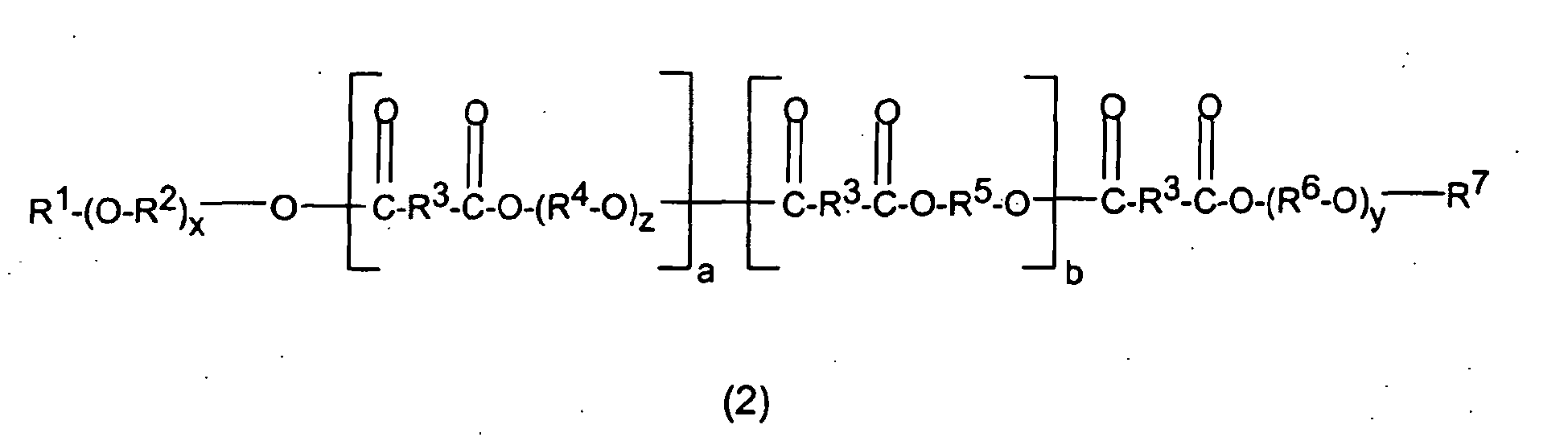
- R1 und R7
- ein linearer oder verzweigter C1-C18-Alkylrest bedeutet,
- R2 und R6
- Ethylen ist, ....
- R3
- 1,4-Phenylen oder 1,3-Phenylen ist,
- R4
- Ethylen ist,
- R5
- Ethylen, 1,2-Propylen oder eine Kombination davon sind,
- x und y
- unabhängig voneinander eine Zahl zwischen 1 und 500 bedeuten,
- z
- eine Zahl zwischen 10 und 140 bedeutet,
- a
- eine Zahl zwischen 1 und 12 bedeutet,
- b
- eine Zahl zwischen 7 und 40 bedeutet, wobei a + b mindestens gleich 11 ist.
- Besonders bevorzugt bedeuten unabhängig voneinander in der Formel (2)
- R1 und R7
- einen linearen oder verzweigten C1-C4-Alkylrest,
- R2 und R6
- Ethylen,
- R3
- 1,4-Phenylen oder 1,3-Phenylen,
- R4
- Ethylen,
- R5
- Ethylen, 1,2-Propylen oder eine Kombination davon,
- x und y
- unabhängig voneinander eine Zahl zwischen 3 und 45,
- z
- eine Zahl zwischen 18 und 70,
- a
- eine Zahl zwischen 2 und 5,
- b
- eine Zahl zwischen 8 und 12, a + b eine Zahl zwischen 12 und 17.
- Die für die Komponente (B) beschriebenen Oligo- und Polyester sind vollständig biologisch abbaubar. Sie sind nach den OECD-Testmethoden nach der entsprechenden Zeit zu einem Großteil abgebaut.
- Als Komponente (C) der erfindungsgemäßen Pigmentpräparationen dienen übliche, zur Herstellung wässriger Pigmentdispersiönen geeignete Dispergiermittel und Tenside oder Gemische solcher Substanzen. Üblicherweise werden anionische, kationische, amphotere oder nichtionische grenzflächenaktive Verbindungen hierfür verwendet. Besonders bewährt haben sich darunter Dispergiermittel, die eine oder mehrere mittel- oder langkettige Kohlenwasserstoffketten besitzen, zum Teil auch solche, die über aromatische Ringgruppen verfügen. Von der Vielzahl der Verbindungen soll an dieser Stelle nur eine Auswahl angeführt werden, ohne jedoch die Anwendbarkeit der erfindungsgemäßen Verbindungen auf diese Beispiele einzuschränken. Beispiele sind Alkylsulfate wie z.B. Laurylsulfat, Stearylsulfat oder Octadecylsulfat, primäre Alkylsulfonate wie z.B. Dodecylsulfonat, und sekundäre Alkylsulfonate, insbesondere das C13-C17-Alkansulfonat-Natriumsalz, Alkylphosphate, Alkylbenzolsulfonate wie beispielsweise die Dodecylbenzolsulfonsäure, ebenso alle Salze dieser Verbindungen. Ferner eignet sich Sojalecithin oder es werden Kondensationsprodukte aus Fettsäure und Taurin oder Hydroxyethansulfonsäure verwendet, ebenso Alkoxylierungsprodukte von Alkylphenolen, Rizinusölkolophoniumestern, Fettalkoholen, Fettaminen, Fettsäuren und Fettsäureamiden, diese Alkoxylierungsprodukte können desgleichen mit ionischen Endgruppen ausgestattet sein, beispielsweise als Sulfobernsteinsäure-Halbester oder auch als Sulfonsäure-, Schwefelsäure- und Phosphorsäureester, sowie deren Salze, den Sulfonaten, Sulfaten oder Phosphaten. Auch sind oxalkylierte Additionsverbindungen, die durch Umsetzung von Polyepoxiden mit Aminen oder Bisphenol-A bzw. Bisphenol-A-Derivaten mit Aminen erhalten werden, geeignet, in ähnlicher Weise auch Harnstoffderivate.
- Ebenso eignen sich Umsetzungsprodukte aus substituierten und unsubstituierten länger- und kürzerkettigen Alkylphenolen sowie deren polymeren Derivaten, z.B. Formaldehyd-Kondensationsprodukten, den Novolaken. Erwähnt seien auch nichtionische alkoxylierte Styrol-Phenol-Kondensate, die durch Anlagerung von gegebenenfalls substituierten Styrolen an gegebenenfalls substituierten Phenolen und Umsetzung mit Ethylenoxid und/oder Propylenoxid erhalten werden, ebenso deren ionisch modifizierten Derivate, beispielsweise als Sulfonsäure-, Schwefelsäure- und Phosphorsäureester, sowie deren Salze, den Sulfonaten, Sulfaten oder Phosphaten. Zudem eignen sich als grenzflächenaktive Verbindungen der Komponente (C) auch Ligninsulfonate und Polykondensate aus β-Naphthalinsulfonsäure und Formaldehyd bzw. auch aus Alkylarylsulfonsäuren, Halogenarylsulfonsäure, sulfonierten Phenolen oder sulfonierten β-Naphtholen mit Formaldehyd. Schließlich eignen sich auch polymere Dispergiermittel, beispielsweise wässrige, vorzugsweise 5 bis 40 gewichtsprozentige, Acrylatharzlösungen aus gelösten Polyacrylaten, die mit Hilfe von Basen durch Neutralisation der vinylischen Säurebausteine in Lösung gebracht wurden. Die hierzu verwendeten Polyacrylate stellen häufig Copolymere dar, die im Wesentlichen aus 30 bis 80 Mol-% Monoalkylenaromaten und 20 bis 70 Mol-% Acryl- und/oder Methacrylsäuren und/oder Estern der Acryl- und/oder Methacrylsäure bestehen. Die verwendeten Polyacrylate weisen zumeist zahlenmittlere Molmassen Mn zwischen 1000 und 100000 g/mol, vorzugsweise 2000 bis 50000 g/mol, auf.
- Als Komponente (D) werden beispielsweise kationische, anionische, amphotere oder nicht ionogene Verbindungen verwendet, die die Pigmentbenetzung fördern (Netzmittel). Auch kommen Verdicker, Konservierungsmittel, Viskositätsstabilisatoren, Mahlhilfsmittel, Füllstoffe und hydrotrope Retentionsmittel zum Einsatz.
Als Retentionsmittel eignen sich Verbindungen, die gegebenenfalls auch als Lösungsmittel dienen, beispielsweise Formamid, Harnstoff, Tetramethylharnstoff, ε-Caprolactam, Ethylenglykol, Propylenglykol, Diethylenglykol, Triethylenglykol, Polyethylenglykol, α-Methyl-ω-hydroxy-polyethylenglykolether, Dipropylenglykol, Polypropylenglykol, Copolymere aus Ethylen- und Propylenglykol, Butylglykol, Methylcellulose, Glycerin, N-Methylpyrrolidon, 1,3-Diethyl-2-imidazolidinon, Thiodiglykol, Natrium-Benzolsulfonat, Natrium-Xylolsulfonat, Natrium-Toluolsulfonat, Natrium-Cumolsulfonat, Natrium-Dodecylsulfonat, Natrium- Benzoat, Natrium-Salicylat oder Natrium-Butylmonoglykolsulfat sein. Weitere übliche Zusatzstoffe können Antiabsetzmittel, Lichtschutzmittel, Antioxidantien, Entgaser/Entschäumer, schaumreduzierende Mittel sein, Antibackmittel sowie Additive, welche die Viskosität und Rheologie günstig beeinflussen.
Als Mittel zur Regulierung der Viskosität kommen z.B. Polyvinylalkohol und Cellulosederivate infrage. Wasserlösliche natürliche oder künstliche Harze sowie Polymere als Filmbildner bzw. Bindemittel zur Erhöhung von Haft- und Abriebfestigkeit kommen ebenso in Betracht. Als pH-Regulatoren kommen organische oder anorganische Basen und Säuren zum Einsatz. Bevorzugte organische Basen sind Amine, wie z.B. Ethanolamin, Diethanolamin, Triethanolamin, N,N-Dimethylethanolamin, Diisopropylamin, Aminomethylpropanol oder Dimethylaminomethylpropanol. Bevorzugte anorganische Basen sind Natrium-, Kalium-, Lithiumhydroxid oder Ammoniak.
Weitere übliche Zusatzstoffe können auch Fette und Öle pflanzlicher und tierischer Herkunft sein, beispielsweise Rindertalg, Palmkernfett, Kokosfett, Rapsöl, Sonnenblumenöl, Leinöl, Palmöl, Sojaöl, Erdnussöl und Walöl, Baumwollsaatöl, Maisöl, Mohnöl, Olivenöl, Rizinusöl, Rüböl, Safloröl, Sojabohnenöl, Sonnenblumenöl, Heringöl, Sardinenöl. Auch sind die gesättigten und ungesättigten höheren Fettsäuren gängige Additive, z.B. Palmitinsäure, Cyprylsäure, Caprinsäure, Myristinsäure, Laurinsäure, Stearinsäure, Ölsäure, Linolsäure, Linolensäure, Capronsäure, Caprylsäure, Arachinsäure, Behensäure, Palmitoleinsäure, Gadoleinsäure, Erucasäure und Ricinolsäure, sowie deren Salze. - Zur Herstellung der Pigmentpräparationen benutztes Wasser, Komponente (E), wird vorzugsweise in Form von entsalztem oder destilliertem Wasser eingesetzt. Auch Trinkwasser (Leitungswasser) und/oder Wasser natürlichen Ursprungs kann verwendet werden.
- Gegenstand der vorliegenden Erfindung ist auch ein Verfahren zur Herstellung der erfindungsgemäßen Pigmentpräparationen, dadurch gekennzeichnet, dass man die Komponente (A) in Form von Pulver, Granulat oder wässrigem Presskuchen in Gegenwart von Wasser (E) sowie der Komponente (B) dispergiert, anschließend gegebenenfalls Wasser, sowie gegebenenfalls (C) und/oder (D) zumischt und die erhaltende wässrige Pigmentdispersion mit Wasser auf die gewünschte Konzentration einstellt. Vorzugsweise werden die Komponenten (B) und gegebenenfalls (C) und/oder (D) zunächst vermischt und homogenisiert, dann die Komponente (A) in die vorgelegte Mischung eingerührt, wobei das Pigment angeteigt und vordispergiert wird. Je nach Kornhärte der eingesetzten Pigment wird anschließend gegebenenfalls unter Kühlung mit Hilfe eines Mahl- oder Dispergieraggregats feindispergiert oder feinverteilt. Dazu können Rührwerke, Dissolver (Sägezahnrührer), Rotor-Stator-Mühlen, Kugelmühlen, Rührwerkskugelmühlen wie Sand- und Perlmühlen, Schnellmischer, Knetapparaturen, Walzenstühle oder Hochleistungsperlmühlen verwendet werden. Die Feindispergierung bzw. Mahlung der Pigmente erfolgt bis zur gewünschten Teilchengrößenverteilung und kann bei Temperaturen im Bereich von 0 bis 100°C erfolgen, zweckmäßig bei einer Temperatur zwischen 10 und 70°C, vorzugsweise bei 20 bis 60°C. Im Anschluss an die Feindispergierung kann die bei 20 bis 60°C Im Anschluss an die Feindispergierung kann die Pigmentpräparation mit Wasser, vorzugsweise entionisiertem oder destilliertem Wasser, weiter verdünnt werden.
- Die erfindungsgemäßen Pigmentpräparationen eignen sich zum Pigmentieren und Färben von natürlichen und synthetischen Materialien aller Art, insbesondere von wässrigen Anstrichmitteln, Dispersions- und Lackfarben (Dispersionslacken).
- Ferner eignen sich die erfindungsgemäßen Pigmentpräparationen zur Einfärbung makromolekularer Materialien aller Art, z.B. von natürlichen und synthetischen Fasermaterialien, bevorzugt Cellulosefasern, auch zur Papiermassefärbung wie zur Laminateinfärbung. Weitere Anwendungen sind die Herstellung von Druckfarben, hierbei beispielsweise Textildruck-, Flexodruck-, Dekordruck- oder Tiefdruckfarben, Tapetenfarben, wasserverdünnbaren Lacken, Holzschutzsystemen, Viskose-Spinnfärbungen, Lacken, Wurstdärmen, Saatgut, Düngemittel, Glas, insbesondere Glasflaschen, sowie zur Massefärbung von Dachziegeln, zur Einfärbung für Putze, Beton, Holzbeizen, Buntstiftminen, Faserschreiber, Wachse, Paraffine, Tuschen, Pasten für Kugelschreiber, Kreiden, Wasch- und Reinigungsmittel, Schuhpflegemittel, Latex-Produkten, Schleifmifteln sowie zum Einfärben von Kunststoffen bzw. hochmolekularen Materialien aller Art. Hochmolekulare organische Materialien sind beispielsweise Celluloseether und - ester, wie Ethylcellulose, Nitrocellulose, Celluloseacetat oder Cellulosebutyrat, natürliche Harze oder Kunstharze, wie Polymerisationsharze oder Kondensationsharze, z.B. Aminoplaste, insbesondere Harnstoff- und Melaminformaldehydharze, Alkydharze, Acrylharze, Phenoplaste, Polycarbonate, Polyolefine, wie Polystyrol, Polyvinylchlorid, Polyethylen, Polypopylen, Polyacrylnitril, Polyacrylsäureester, Polyamide, Polyurethane oder Polyester, Gummi, Casein, Latices, Silikon, Silikonharze, einzeln oder in Mischung.
- Weiterhin eignen sich die erfindungsgemäßen Pigmentpräparationen zur Herstellung von Drucktinten für den Einsatz in allen konventionellen Ink-Jet-Druckern, insbesondere für solche, die auf dem Bubble-Jet- oder Piezo-Verfahren beruhen. Mit diesen Drucktinten kann Papier bedruckt werden, sowie natürliche oder synthetische Fasermaterialien, Folien und Kunststoffe. Zudem können die erfindungsgemäßen Pigmentpräparationen zum Bedrucken verschiedenster Arten von beschichteten oder unbeschichteten Substratmaterialien verwendet werden, so z.B. zum Bedrucken von Pappe, Karton, Holz und Hotzwerkstoffen, metallischen Materialien, Halbleitermaterialien, keramischen Materialien, Gläsern, Glas- und Keramikfasern, anorganischen Werkstoffen, Beton, Leder, Lebensmitteln, Kosmetika, Haut und Haaren. Das Substratmaterial kann dabei zweidimensional eben oder räumlich ausgedehnt, d.h. dreidimensional gestaltet sein und sowohl vollständig oder nur teilweise bedruckt oder beschichtet werden.
- Die erfindungsgemäßen Pigmentpräparationen sind außerdem geeignet als Farbmittel in elektrophotographischen Tonern und Entwicklern, wie z.B. Ein- oder Zweikomponentenpulvertonern (auch Ein- oder Zweikomponenten-Entwickler genannt), Magnettoner, Flüssigtoner, Latextoner, Polymerisationstoner sowie Spezialtoner. Typische Tonerbindemittel hierbei sind Polymerisations-, Polyadditions- und Polykondensationsharze, wie Styrol-, Styrolacrylat-Styrolbutadien-, Acrylat-, Polyester-, Phenol-Epoxidharze, Polysulfone, Polyurethane, einzeln oder in Kombination, sowie Polyethylen und Polypropylen, die noch weitere Inhaltsstoffe, wie Ladungssteuermittel, Wachse oder Fließhilfsmittel, enthalten können oder im Nachhinein mit diesen Zusätzen modifiziert werden.
- Ferner sind die erfindungsgemäßen Pigmentpräparationen geeignet als Farbmittel für Pulver und Pulverlacke, insbesondere für triboelektrisch oder elektrokinetisch versprühbare Pulverlacke, die zur Oberflächenbeschichtung von Gegenständen aus beispielsweise Metall, Holz, Kunststoff, Glas, Keramik, Beton, Textilmaterial, Papier oder Kautschuk zur Anwendung kommen. Als Pulverlackharze werden hier typischerweise Epoxidharze, carboxyl- und hydroxylgruppenhaltige Polyesterharze, Polyurethan- und Acrylharze zusammen mit üblichen Härtern eingesetzt. Auch Kombinationen von Harzen finden Verwendung. So werden beispielsweise häufig Epoxidharze in Kombination mit carboxyl- und hydroxylgruppenhaltigen Polyesterharzen eingesetzt. Typische Härterkomponenten (in Abhängigkeit vom Harzsystem) sind beispielsweise Säureanhydride, Imidazole sowie Dicyandiamid und deren Abkömmlinge, verkappte Isocyanate, Bisacylurethane, Phenol- und Melaminharze, Triglycidylisocyanurate, Oxazoline und Dicarbonsäuren.
- Außerdem sind die erfindungsgemäßen Pigmentpräparationen als Farbmittel in Tinten, vorzugsweise lnk-Jet Tinten, wie z.B. auf wässriger oder nichtwässriger Basis ("Solvent Based"), Mikroemulsionstinten, UV-härtbare Tinten sowie in solchen Tinten, die nach dem Hot-Melt-Verfahren funktionieren, geeignet. Ink-Jet-Tinten enthalten im Allgemeinen insgesamt 0,5 bis 15 Gew.-%, vorzugsweise 1,5 bis 8 Gew.-%, (trocken gerechnet) der erfindungsgemäßen Pigmentpräparation. Mikroemulsionstinten basieren auf organischen Lösemitteln, Wasser und ggf. einer zusätzlichen hydrotropen Substanz (Grenzflächenvermittler). Mikroemulsionstinten enthalten 0,5 bis 15 Gew.-%, vorzugsweise 1,5 bis 8 Gew.-%, der erfindungsgemäßen Pigmentpräparation, 5 bis 99 Gew.-% Wasser und 0,5 bis 94,5 Gew.-% organisches Lösungsmittel und/oder hydrotrope Verbindung. "Solvent Based" Ink-Jet-Tinten enthalten vorzugsweise 0,5 bis 15 Gew.-% der erfindungsgemäßen Pigmentpräparation, 85 bis 99,5 Gew.-% organisches Lösungsmittel und/oder hydrotrope Verbindungen. UV-härtbare Tinten enthalten im wesentlichen 0,5 bis 30 Gew.-% der erfindungsgemäßen Pigmentpräparation, 0,5 bis 95 Gew.-% Wasser, 0,5 bis 95 Gew.-% eines organischen Lösungsmittels oder Lösungsmittelgemisches, 0,5 bis 50 Gew.-% eines strahlungshärtbaren Bindemittels und gegebenenfalls 0 bis 10 Gew.-% eines Photoinitiators. Hot-Melt-Tinten basieren meist auf Wachsen, Fettsäuren, Fettalkoholen oder Sulfonamiden, die bei Raumtemperatur fest sind und bei Erwärmen flüssig werden, wobei der bevorzugte Schmelzbereich zwischen ca. 60°C und ca. 140°C liegt. Hot-Melt-Ink-Jet-Tinten bestehen z.B. im Wesentlichen aus 20 bis 90 Gew.-% Wachs und 1 bis 10 Gew.-% der erfindungsgemäßen Pigmentpräparation. Weiterhin können 0 bis 20 Gew.% eines zusätzlichen Polymers (als "Farbstofflöser"), 0 bis 5 Gew.-% Dispergierhilfsmittel, 0 bis 20 Gew.-% Viskositätsveränderer, 0 bis 20 Gew.-% Plastifizierer, 0 bis 10 Gew.-% Klebrigkeifszusatz, 0 bis 10 Gew.-% Transparenzstabilisator (verhindert z.B. Kristallisation der Wachse) sowie 0 bis 2 Gew.-% Antioxidans enthalten sein.
- Außerdem sind die erfindungsgemäßen Pigmentpräparationen auch geeignet als Farbmittel für Farbfilter ("Colour'Filter") für "Flat Panel Displays", sowohl für die additive wie für die subtraktive Farbetzeugung, ferner für "Photo-Resists", sowie als Farbmittel für elektronische Tinten ("Electronic Inks" bzw. "e-inks") oder elektronisches Papier ("Electronic Paper" bzw. "e-paper").
- Die Bestimmung der Farbstärke und des Farbtons erfolgte nach DIN 55986. Für den "Rub-Out-Test" wurde die Dispersionsfarbe oder der Lack nach Mischen mit der Pigmentdispersion auf eine Lackkarte aufgetragen. Anschließend wurde mit dem Finger auf dem unteren Teil der Lackkarte nachgerieben. Unverträglichkeit lag vor, wenn die nachgeriebene Fläche dann kräftiger gefärbt ist als die angrenzende, nicht nachbehandelte Fläche (der "Rub-Out-Test" wird in
DE 2 638 946 beschrieben). Die coloristischen Daten und die Verträglichkeiten mit den einzufärbenden Medien wurden mit acht verschiedenen Weißdispersionen und bis zu zwei verschiedenen Lacken ermittelt: - 1. Weißdispersion A (für Außenanstriche, Wasserbasis, 20 % TiO2
- 2. Weißdispersion B (für Außenanstriche, Wasserbasis, 1 % TiO2
- 3. Weißdispersion C (für Außenanstriche, Wasserbasis, 13,4 % TiO2
- 4. Weißdispersion D (für Außenanstriche, Wasserbasis, 22,6 % TiO2
- 5. Weißdispersion E (für Außenanstriche, Wasserbasis, Bindemittel Polysiloxanemulsion, TiO2, Talkum, Calciumcarbonat)
- 6. Weißdispersion F (für Innenanstriche, Wasserbasis, Polymerdispersion, frei von Lösungsmittel und Weichmachern, emissionsarm, TiO2, Calciumcarbonat)
- 7. Weißdispersion G (Dispersionsfarbe speziell für Fassaden, Wasserbasis, Polymerdispersion, Weißpigmente, anorganische Pigmente, silikatische Füllstoffe, Talkum, Calciumcarbonat)
- 8. Weißdispersion H (für Innenanstriche, Wasserbasis, Polyacrylate, TiO2, Calciumcarbonat)
- 9. Weißlack A (Wasserbasis, Bindemittel Viacryl VSC®, 20 % TiO2)
- 10. Weißlack B (Alkydharzbasis, Bindemittel Vialkyd AS®, organisches Lösungsmittel, 27 % TiO2).
- Die Beurteilung der Eintrockenbeständigkeit erfolgte, indem die Pigmentpräparation mit einem 200 µm Rakel auf eine Polyester-Klarsichtfolie aufgezogen und klimatisiert gelagert wurde. Nach wenigen Minuten, einer halben Stunde, einem Tag, drei und sieben Tagen wurde eine Bestimmung der Eintrocknung vorgenommen.
Die Viskosität wurde mit einem Kegel-Platte-Viskosimeter (Roto Visco 1) der Firma Haake bei 20°C bestimmt (Titankegel: ∅ 60 mm, 1 °), wobei die Abhängigkeit der Viskosität von dem Schergefälle in einem Bereich zwischen 0 und 200 s-1 untersucht wurde. Die Viskositäten wurden bei einem Schergefälle von 60 s-1 gemessen. - Für eine Beurteilung der Lagerstabilität der Dispersionen wurde die Viskosität direkt nach der Herstellung der Präparation gemessen, sowie nach vierwöchiger Lagerung bei 50°C und nach Lagerung in einer Klimakammer mit < 0°C.
- Das Pigment wurde, entweder als Pulver, Granulat oder als Presskuchen, zusammen mit den Dispergiermitteln und den anderen Zusätzen in entionisiertem Wasser angeteigt und dann mit einem Dissolver (z.B. von der Firma VMA-Getzmann GmbH, Type AE3-M1) oder einer anderen geeigneten Apparatur homogenisiert und vordispergiert. Die anschließende Feindispergierung erfolgte mit Hilfe einer Perlmühle (z.B. mit AE3-M1 von VMA-Getzmann) oder aber einem anderen geeigneten Dispergieraggregat, wobei die Mahlung mit Siliquarzitperlen oder Zirkonmischoxidperlen der Größe d = 1 mm unter Kühlung bis zur gewünschten Farbstärke und Coloristik erfolgte. Im Anschluss wurde die Dispersion mit entionisiertem Wasser auf die gewünschte Pigmentendkonzentration eingestellt, die Mahlkörper abgetrennt und die Pigmentpräparation isoliert.
- Die in den folgenden Beispielen beschriebenen Pigmentpräparationen wurden nach dem zuvor beschriebenen Verfahren hergestellt, wobei die folgenden Bestandteile in den angegebenen Mengen so verwendet wurden, dass 100 Teile der jeweiligen Pigmentpräparation entstehen. In den nachfolgenden Beispielen bedeuten Teile Gewichtsteile.
-
20 Teile C.l. Pigment Violett 23 (Komponente A) 11 Teile Komponente (B), Formel (1) mit R1 und R7 = Methyl, R2 und R6 = Ethylen, R3 und R5 = 1,4-Phenylen, R4 = 1,2-Propylen, a, b und d ist in der Summe im Durchschnitt circa 35, c ist im Durchschnitt circa 2 10 Teile α-Methyl-ω-hydroxy-polyethylenglykolether (Mn 470 - 530 g/mol) (Komponente D) 8 Teile oxalkylierte Additionsverbindung aus Bisphenol-A und einem Amin, nichtionisch (Komponente C) 0,2 Teile Konservierungsmittel (Komponente D) Rest Wasser (Komponente E). - Die Pigmentpräparation hat eine hohe Farbstärke und ist flockungsstabil. In alle acht Weißdispersionen lässt sie sich unter leichter Verteilbarkeit sehr gut einarbeiten. Der Rub-Out-Test zeigt in den sechs Fällen A, C, D, F, G und H keine Farbstärkeunterschiede im Vergleich zur nachgeriebenen Fläche. Bei den Weißdispersionen B und E zeigen sich beim Rub-Out-Test geringe Farbunterschiede, jedoch ist die Pigmentpräparation zu diesen Systemen noch gut verträglich. Die Pigmentpräparation besitzt gute rheologische Eigenschaften, erweist sich als gut fließfähig und lagerstabil. Die Viskosität nach der Herstellung beträgt 468 mPa·s. Weiterhin verfügt die Präparation über eine sehr gute Eintrockenbeständigkeit, da sie innerhalb von 30 Minuten zu einem elastischen Film trocknet, der vom Träger nicht abbröckelt. Auch nach sieben Tagen liegt ein elastischer Film vor, der nicht vom Träger abgeplatzt ist.
-
40 Teile C.l. Pigment Schwarz 7 (Komponente A) 8,5 Teile Komponente (B), Formel (1) mit R1 und R7 = Methyl, R2 und R6 = Ethylen, R3 und R5 = 1,4-Phenylen, R4 = 1,2-Propylen, a, b und d ist in der Summe im Durchschnitt circa 90, c ist im Durchschnitt circa 5 10 Teile α-Methyl-ω-hydroxy-polyethylenglykolether (Mn 470 - 530 g/mol) (Komponente D) 2 Teile oxalkylierte Additionsverbindung aus Bisphenol-A und einem Amin, nichtionisch (Komponente C) 0,5 Teile Natrium-di-2-ethylhexylsulfosuccinat (Komponente C) 0,9 Teile Konservierungsmittel (Komponente D) Rest Wasser (Komponente E). - Die Pigmentpräparation hat eine hohe Farbstärke und ist besonders flockungsstabil. In alle acht Weißdispersionen lässt sie sich unter leichter Verteilbarkeit sehr gut einarbeiten. Der Rub-Out-Test zeigt in allen Fällen keine Farbstärkeunterschiede im Vergleich zur nachgeriebenen Fläche. Bei diesen acht Weißdispersionen ist die Präparation "universalverträglich". Die Pigmentpräparation besitzt gute rheologische Eigenschaften, erweist sich als gut fließfähig und lagerstabil. Die Viskosität nach der Herstellung beträgt 617 mPa·s. Weiterhin verfügt die Präparation über eine sehr gute Eintrockenbeständigkeit, da sie innerhalb von 30 Minuten zu einem elastischen Film trocknet, der vom Träger nicht abbröckelt. Auch nach sieben Tagen liegt ein elastischer Film vor, der nicht vom Träger abgeplätzt ist.
-
40 Teile C.l. Pigment Schwarz 7 (Komponente A) 8,5 Teile oxalkylierter Fettalkohol, nichtionisch (Komponente C) 10 Teile α-Methyl-ω-hydroxy-polyethylenglykolether (Mn 470 - 530 g/mol) (Komponente D) 2 Teile oxalkylierte Additionsverbindung aus Bisphenol-A und einem Amin, nichtionisch (Komponente C) 0,5 Teile Natrium-di-2-ethylhexylsulfosuccinat (Komponente C) 0,9 Teile Konservierungsmittel (Komponente D) Rest Wasser (Komponente E). - Die Pigmentpräparation hat eine hohe Farbstärke mit reinem Farbton, ist jedoch in verschiedenen Weißdispersionen und Lacken nicht flockungsstabil. Nur in drei getestete Weißdispersionen lässt sich die Pigmentpräparation unter leichter Verteilbarkeit gut einarbeiten (A, D, H). Hier zeigt der Rub-Out-Test keine Farbstärkeunterschiede. In vier Weißdispersionen (B, C, F, G) und in dem Weißlack A zeigt der Rub-Out-Test Farbunterschiede, so dass Flockungserscheinungen nachgewiesen werden können. In die Weißdispersion E und in den Weißlack B lässt sich die Pigmentpräparation nicht einarbeiten.
-
40 Teile C.l. Pigment Rot 146 (Komponente A) 7 Teile Komponente (B), Formel (1) mit R1 und R7 = Methyl, R2 und . R6 = Ethylen, R3 und R5 = 1,4-Phenylen, R4 = 1 ,2-Propylen, a, b und d ist in der Summe im Durchschnitt circa 35, c ist im Durchschnitt circa 2 20 Teile Propylenglykol (Komponente D) 4 Teile oxalkylierte Additionsverbindung aus Bisphenol-A und einem Amin, nichtionisch (Komponente C) 0,2 Teile Konservierungsmittel (Komponente D) Rest Wasser (Komponente E). - Die Pigmentpräparation hat eine hohe Farbstärke und ist besonders flockungsstabil. In alle acht Weißdispersionen und in den Weißlack A lässt sie sich unter leichter Verteilbarkeit sehr gut einarbeiten. Der Rub-Out-Test zeigt in allen Fällen keine Farbstärkeunterschiede im Vergleich zur nachgeriebenen. Bei den getesteten Applikationssystemen ist die Präparation "universalverträglich". Die Pigmentpräparation besitzt gute rheologische Eigenschaften, erweist sich als gut fließfähig und lagerstabil. Die Viskosität nach der Herstellung beträgt 744 mPa·s. Weiterhin verfügt die Präparation über eine sehr gute Eintrockenbeständigkeit, da sie innerhalb von 30 Minuten zu einem Film trocknet, oder vom Träger nicht abbröckelt.
-
35 Teile C.l. Pigment Gelb 154 (Komponente A) 4,5 Teile Komponente (B), Formel (2) mit R1 und R7 = Methyl, R2 und R6 = Ethylen, R3 = 1,4-Phenylen, R4 = Ethylen, R5 = Ethylen und 1,2-Propylen als statistisches Gemisch, x und y ist jeweils im Durchschnitt circa 45, z ist im Durchschnitt 35, a ist im Durchschnitt circa 3, b ist im Durchschnitt circa 10 15 Teile Propylenglykol (Komponente D) 0,9 Teile Konservierungsmittel (Komponente D) Rest Wasser (Komponente E). - Die Pigmentpräparation hat eine hohe Farbstärke mit sehr reinem Farbton und ist besonders flockungsstabil. In alle acht Weißdispersionen A bis H und in den Weißlack A lässt sie sich unter leichter Verteilbarkeit sehr gut einarbeiten. Der Rub-Out-Test zeigt in allen Fällen keine Farbstärkeunterschiede im Vergleich zur nachgeriebenen Fläche. Somit ist die Präparation zu den getesteten Dispersionen "universalverträglich". Die Pigmentpräparation besitzt ausgezeichnete rheologische Eigenschaften, erweist sich als gut fließfähig und lagerstabil. Die Viskosität nach der Herstellung beträgt 37 mPa·s. Weiterhin verfügt die Präparation über eine gute Eintrockenbeständigkeit, da sie innerhalb von 30 Minuten zu einem Film trocknet, der vom Träger nicht abbröckelt.
-
40 Teile C.l. Pigment Gelb 97 (Komponente A) 11 Teile Komponente (B), Formel (1) mit R1 und R7 = Methyl, R2 und R6 = Ethylen, R3 und R5 = 1,4-Phenylen, R4 = 1,2-Propylen, a, b und d ist in der Summe im Durchschnitt circa 35, c ist im Durchschnitt circa 2 10 Teile Propylenglykol (Komponente D) 5 Teile oxalkylierter Fettalkohol, nichtionisch (Komponente C) .. 0,2 Teile Konservierungsmittel (Komponente D) Rest Wasser (Komponente E). - Die Pigmentpräparation hat eine hohe Farbstärke und ist flockungsstabil. In alle acht Weißdispersionen lässt sie sich unter leichter Verteilbarkeit sehr gut einarbeiten. Der Rub-Out-Test zeigt in allen Fällen keine Farbstärkeunterschiede im Vergleich zur nachgeriebenen Fläche. Die Pigmentpräparation besitzt gute rheologische Eigenschaften, erweist sich als gut fließfähig und lagerstabil. Die Viskosität nach der Herstellung beträgt 435 mPa·s. Weiterhin verfügt die Präparation über eine gute Eintrockenbeständigkeit, da sie innerhalb von 30 Minuten zu einem Film trocknet, der vom Träger nicht abbröckelt.
-
40 Teile C.l. Pigment Gelb 151 (Komponente A) 3 Teile Komponente (B), Formel (1) mit R1 und R7 = Methyl, R2 und R6 = Ethylen, R3 und R5 = 1,4-Phenylen, R4 = 1,2-Propylen, a, b und d ist in der Summe im Durchschnitt circa 35, c ist im Durchschnitt circa 2 10 Teile Polyethylenglykol (Mn 260 - 240 g/mol) (Komponente D) 1 Teile oxalkylierter Fettalkohol, nichtionisch (Komponente C) 0,5 Teile Entschäumer (Komponente D) 0,2 Teile Konservierungsmittel (Komponente D) Rest Wasser (Komponente E). - Die Pigmentpräparation hat eine hohe Farbstärke mit reinem Farbton und ist flockungsstabil. In alle acht Weißdispersionen und in die zwei verschiedenen Lacke lässt sie sich unter leichter Verteilbarkeit gut einarbeiten. Der Rub-Out-Test zeigt in allen Fällen keine Farbstärkeunterschiede im Vergleich zur nachgeriebenen Fläche. Somit ist die Präparation in den getestet Systemen "universalverträglich". Die Pigmentpräparation besitzt ausgezeichnete rheologische Eigenschaften, erweist sich als gut fließfähig und lagerstabil. Die Viskosität nach der Herstellung beträgt 34 mPa·s. Weiterhin verfügt die Präparation über eine gute Eintrockenbeständigkeit, da sie innerhalb von 30 Minuten zu einem Film trocknet, der vom Träger nicht abbröckelt.
-
20 Teile C.l. Pigment Rot 122 (Komponente A) 4 Teile Komponente (B), Formel (1) mit R1 und R7 = Methyl, R2 und R6 = Ethylen, R3 und R5 = 1,4-Phenylen, R4 = 1,2-Propylen, a, b und d ist in der Summe im Durchschnitt circa 35, c ist im Durchschnitt circa 2 9 Teile Polyethylenglykol (Mn 260 - 240 g/mol) (Komponente D) 1 Teile oxalkylierter Fettalkohol, nichtionisch (Komponente C) 0,5 Teile Entschäumer (Komponente D) 0,2 Teile Konservierungsmittel (Komponente D) Rest Wasser (Komponente E). - Die Pigmentpräparation hat eine hohe Farbstärke mit reinem Farbton und ist flockungsstabil. In alle acht Weißdispersionen lässt sie sich unter leichter Verteilbarkeit gut einarbeiten. Der Rub-Out-Test zeigt in allen Fällen keine Farbstärkeunterschiede im Vergleich zur nachgeriebenen Fläche. Die Pigmentpräparation besitzt ausgezeichnete rheologische Eigenschaften, erweist sich als gut fließfähig und lagerstabil. Die Viskosität nach der Herstellung beträgt 27 mPa·s. Weiterhin verfügt die Präparation über eine gute Eintrockenbeständigkeit, da sie innerhalb von 30 Minuten zu einem Film trocknet, der vom Träger nicht abbröckelt.
Claims (13)
- Wässrige Pigmentpräparation, enthaltend(A) 5 bis 80 Gew.-% mindestens eines organischen und/oder anorganischen Pigments,(B) 0,1 bis 30 Gew.-% mindestens eines wasserlöslichen oder wasserdispergierbaren nichtionischen Oligo- oder Polyesters, der erhältlich ist durch Polykondensation von Dicarbonsäure- und Glykolkomponenten, umfassendI) 10 bis 50 Gew.% einer oder mehrerer aromatischer Dicarbonsäuren, deren Ester oder Anhydride;II) 2 bis 50 Gew.-% C2-C8-Alkylen-diole,III) 3 bis 80 Gew.-% Poly(C1-C4-alkylen)glykole und/oder Methylpoly(C2-C4-alkylen)glykole,IV) 0 bis 10 Gew.% eines wasserlöslichen Anlagerungsproduktes von Alkylenoxid an C1-C24-Alkohole, an C6-C18-Alkylphenole oder an C8-C24-Alkylamine undV) 0 bis 10 Gew.% eines oder mehrerer Polyole, jeweils bezogen auf das Gesamtgewicht Oligo- oder Polyesters;(C) 0 bis 30 Gew.-% weiterer zur Herstellung wässriger Pigmentdispersionen üblicher Dispergiermittel und Tenside,(D) 0 bis 50 Gew.-% weiterer zur Herstellung wässriger Pigmentdispersionen üblicher Zusatzstoffe, und(E) 5 bis 90 Gew.-% Wasser,jeweils bezogen auf das Gesamtgewicht der Pigmentpräparation.
- Pigmentpräparation nach Anspruch 1, enthaltend(A) 20 bis 70 Gew.-% mindestens eines organischen und/oder anorganischen Pigments,(B) 1 bis 15 Gew.-% mindestens eines wasserlöslichen oder wasserdispergierbaren nichtionischen Oligo- oder Polyesters, der erhältlich ist durch Polykondensation von Dicarbonsäure- und Glykolkomponenten, umfassendI) 15 bis 30 Gew.-% einer oder mehrerer aromatischer Dicarbonsäuren, deren Ester oder Anhydride;II) 5 bis 45 Gew.-% C2-C8-Alkylen-diole,III) 5 bis 75 Gew.-% Poly(C1-C4-alkylen)glykole und/oder Methylpoly-(C2-C4-alkylen)glykole,IV) 0 bis 10 Gew.-% eines wasserlöslichen Anlagerungsproduktes von Alkylenoxid an C1-C24-Alkohole, an C6-C18-Alkylphenole oder an C8-C24-Alkylamine undV) 0 bis 10 Gew.-% eines oder mehrerer Polyole, jeweils bezogen auf das Gesamtgewicht Oligo- oder Polyesters;(C) 0,1 bis 15 Gew.-% weiterer zur Herstellung wässriger Pigmentdispersionen üblicher Dispergiermittel und Tenside,(D) 0,1 bis 20 Gew.% weiterer zur Herstellung wässriger Pigmentdispersionen üblicher Zusatzstoffe, und(E) 5 bis 78,8 Gew.% Wasser,
jeweils bezogen auf das Gesamtgewicht der Pigmentpräparation. - Pigmentpräparation nach einem oder mehreren der Ansprüche 1 bis 2, dadurch gekennzeichnet, dass das organische Pigment (A) mindestens ein Pigment aus der Gruppe der Monoazo-, Disazo-, vedackten Azo-, β-Naphthol-, Naphthol AS-, Benzimidazolon-, Disazokondensations-, Azo-Metallkomplex-, Phthalocyanin-, Chinacridon-, Perylen-, Perinon-, Thioindigo-, Anthanthron-, Anthrachinon-, Flavanthron-, Indanthron-, Isoviolanthron-, Pyranthron-, Dioxazin-, Chinophthalon-, Isoindolin-, Isoindolinon- oder Diketopyrrolopyrrol-Pigmente oder ein saurer bis alkalischer Ruß aus der Gruppe der Furnaceruße oder Gasruße, oder eine Kombination davon ist.
- Pigmentpräparation nach einem oder mehreren der Ansprüche 1 bis 2, dadurch gekennzeichnet, dass das anorganische Pigment (A) mindestens ein Pigment aus der Gruppe der Titandioxide, Zinksulfide, Zinkoxide, Eisenoxide, Manganeisenoxide, Chromoxide, Ultramarin, Nickel- oder Chromantimontitanoxide, Cobaltoxide, Mischoxide des Cobalts und Aluminiums, Rutilmischphasenpigmente, Sulfide der seltenen Erden, Bismutvanadate sowie Verschnittpigmente, oder eine Kombination davon ist.
- Pigmentpräparation nach einem oder mehreren der Ansprüche 1 bis 4, dadurch gekennzeichnet, dass das organische Pigment mit Ruß und/oder Titandioxid kombiniert ist.
- Pigmentpräparation nach einem oder mehreren der Ansprüche 1 bis 5, dadurch gekennzeichnet, dass Komponente (B) einer oder mehrerer Verbindungen der Formel (1) entspricht:
 R1 und R7 ein linearer oder verzweigter C1-C18-Alkylrest bedeutet,R2, R4, R6 unabhängig voneinander (C1-C8)-Alkylen,R3 und R5 Arylen oder Alkarylen,a, b und d eine Zahl zwischen 1 und 200 ist, wobei die Summe von a, b und d mindestens 5 ist,c eine Zahl zwischen 1 und 20 ist.
 - Pigmentpräparation nach Anspruch 6, dadurch gekennzeichnet, dassR1 und R7 Methyl und/oder Ethyl,R2, R4, R6 Ethylen, 1,2-Propylen, oder deren Gemische,R3 und R5 1,4-Phenylen und 1,3-Phenylen ,a, b und d eine Zahl zwischen 1 und 100, wobei die Summe von a, b und d mindestens 5 ist;c eine Zahl zwischen 1 und 10bedeuten.
- Pigmentpräparation nach einem oder mehreren der Ansprüche 1 bis 7, dadurch gekennzeichnet, dass Komponente (B) einer oder mehrerer Verbindungen der Formel (2) entspricht:
 R1 und R7 ein linearer oder verzweigter C1-C18-Alkylrest bedeutet,R2 und R6 Ethylen ist,R3 1,4-Phenylen oder 1,3-Phenylen ist,R4 Ethylen ist,R5 Ethylen, 1,2-Propylen oder eine Kombination davon ist,x und y unabhängig voneinander eine Zahl zwischen 1 und 500 bedeuten,z eine Zahl zwischen 10 und 140 bedeutet,a eine Zahl zwischen 1 und 12 bedeutet,b eine Zahl zwischen 7 und 40 bedeutet, wobei a + b mindestens gleich 11 ist.
 - Pigmentpräparation nach Anspruch 8, dadurch gekennzeichnet, dassR1 und R7 ein linearer oder verzweigter C1-C4-Alkylrest bedeutet,R2 und R6 Ethylen ist,R3 1,4-Phenylen oder 1,3-Phenylen ist,R4 Ethylen ist,R5 Ethylen, 1,2-Propylen oder eine Kombination davon ist,x und y unabhängig voneinander eine Zahl zwischen 3 und 45 bedeuten,z eine Zahl zwischen 18 und 70 bedeutet,a eine Zahl zwischen 2 und 5 bedeutet,b eine Zahl zwischen 8 und 12, a + b eine Zahl zwischen 12 und 17bedeutet.
- Verfahren zur Herstellung einer Pigmentpräparation gemäß einem oder mehreren der Ansprüche 1 bis 9, dadurch gekennzeichnet, dass die man die Komponente (A) in Form von Pulver, Granulat oder wässrigem Presskuchen in Gegenwart von Wasser (E) sowie der Komponente (B) dispergiert, anschließend gegebenenfalls Wasser, sowie gegebenenfalls (C) und/oder (D) zumischt und die erhaltende wässrige Pigmentdispersion gegebenenfalls mit Wasser verdünnt.
- Verwendung einer Pigmentpräparation nach einem oder mehreren der Ansprüche 1 bis 9 zum Pigmentieren natürlicher oder synthetischer Materialien.
- Verwendung nach Anspruch 11 zum Pigmentieren und Färben von wässrigen Anstrichmitteln, Dispersions- und Lackfarben (Dispersionslacken), wasserverdünnbaren Lacken, Tapetenfarben und Druckfarben.
- Verwendung nach Anspruch 11 zum Pigmentieren und Färben von natürlichen und synthetischen Fasermaterialien, Cellulosefasern, zur Papiermassefärbung und Laminateinfärbung sowie zur Herstellung von Drucktinten, Ink-Jet-Tinten, elektrophotographischen Tonern, Pulverlacken, Farbfiltern, elektronischen Tinten und "Electronic Papier, Holzschutzsystemen, Viskose-Spinnfärbung, Wurstdärmen, Saatgut, Düngemitteln, Glasflaschen, sowie zur Massefärbung von Dachziegeln, zur Einfärbung für Putze, Beton, Holzbeizen, Buntstiftminen, Faserschreibern. Wachsen, Paraffinen, Tuschen, Pasten für Kugelschreiber, Kreiden, Wasch- und Reinigungsmitteln, Schuhpflegemitteln, Latex-Produkten, Schleifmitteln sowie zum Einfärben von Kunststoffen.
Applications Claiming Priority (2)
| Application Number | Priority Date | Filing Date | Title |
|---|---|---|---|
| DE102004051455A DE102004051455A1 (de) | 2004-10-22 | 2004-10-22 | Wasserbasierende Pigmentpräparationen auf Oligoesterbasis, ihre Herstellung und Verwendung |
| PCT/EP2005/010514 WO2006045396A1 (de) | 2004-10-22 | 2005-09-29 | Wasserbasierende pigmentpräparationen auf oligoesterbasis, ihre herstellung und verwendung |
Publications (2)
| Publication Number | Publication Date |
|---|---|
| EP1805270A1 EP1805270A1 (de) | 2007-07-11 |
| EP1805270B1 true EP1805270B1 (de) | 2008-12-10 |
Family
ID=35345124
Family Applications (1)
| Application Number | Title | Priority Date | Filing Date |
|---|---|---|---|
| EP05789365A Expired - Lifetime EP1805270B1 (de) | 2004-10-22 | 2005-09-29 | Wasserbasierende pigmentpräparationen auf oligoesterbasis, ihre herstellung und verwendung |
Country Status (11)
| Country | Link |
|---|---|
| US (1) | US7811376B2 (de) |
| EP (1) | EP1805270B1 (de) |
| JP (1) | JP4887300B2 (de) |
| KR (1) | KR20070068399A (de) |
| CN (1) | CN1993436B (de) |
| AR (1) | AR051590A1 (de) |
| BR (1) | BRPI0517443A (de) |
| DE (2) | DE102004051455A1 (de) |
| ES (1) | ES2315915T3 (de) |
| NO (1) | NO20072502L (de) |
| WO (1) | WO2006045396A1 (de) |
Families Citing this family (35)
| Publication number | Priority date | Publication date | Assignee | Title |
|---|---|---|---|---|
| US7300511B2 (en) | 2005-07-01 | 2007-11-27 | Sun Chemical Corporation | Low viscosity, highly pigmented oil based dispersions exhibiting a low relative interfacial tension drop |
| DE102005045147A1 (de) * | 2005-09-16 | 2007-03-29 | Beiersdorf Ag | Kosmetische Zubereitungen zur dekorativen Anwendung auf der Haut |
| DE102006019553A1 (de) * | 2006-04-27 | 2007-10-31 | Clariant International Limited | Wasserbasierende Pigmentpräparation |
| KR20090019858A (ko) * | 2006-05-23 | 2009-02-25 | 바스프 에스이 | 고차분지형 폴리카르보네이트의 안료용 분산제로서의 용도 |
| ES2361050T3 (es) | 2007-10-10 | 2011-06-13 | Clariant Finance (Bvi) Limited | Preparado de pigmentos basado en glicol para la tinción en masa de fibras de poliacrilonitrilo. |
| DE102008021511A1 (de) * | 2008-04-30 | 2009-11-05 | Clariant International Limited | Pigmentdispergatoren und leicht dispergierbare feste Pigmentzubereitungen |
| CN101591510A (zh) * | 2008-05-26 | 2009-12-02 | 3M创新有限公司 | 漆面处理组合物、漆面处理方法及漆面修补方法 |
| JP5394055B2 (ja) * | 2008-12-17 | 2014-01-22 | 株式会社ミマキエンジニアリング | 非水系インクジェットインク |
| JP5483670B2 (ja) * | 2008-12-26 | 2014-05-07 | 竹本油脂株式会社 | 非水系顔料分散剤及び顔料組成物 |
| DE102009021071A1 (de) * | 2009-05-13 | 2010-11-18 | Basf Coatings Ag | Effektwasserbasislacke mit verbesserten optischen Eigenschaften |
| WO2011040570A1 (ja) | 2009-10-02 | 2011-04-07 | 花王株式会社 | トナー用結着樹脂 |
| US8425727B2 (en) * | 2010-01-22 | 2013-04-23 | Clariant Finance (Bvi) Limited | Method for increasing glueability of paper or paperboard |
| DE102011014250A1 (de) * | 2011-03-17 | 2012-09-20 | Clariant International Ltd. | Pulverlackzusammensetzung zum Strukturieren und Texturieren von Lackoberflächen |
| KR101953811B1 (ko) * | 2011-08-29 | 2019-03-04 | 에톡스 케미칼즈 엘엘씨 | 에멀전 중합, 안료 분산 및 자외선 코팅용의 신규한 반응성 계면 활성제 |
| US8779057B2 (en) * | 2011-11-14 | 2014-07-15 | Dow Global Technologies Llc | Dye-encapsulated dispersions suitable for printing applications |
| JP5678950B2 (ja) * | 2012-01-06 | 2015-03-04 | Tdk株式会社 | ガラスセラミックス焼結体及び配線基板 |
| DE102012018544A1 (de) * | 2012-09-19 | 2014-03-20 | Clariant International Ltd. | Derivate der Sulfobernsteinsäure als Dispergiermittel in bindemittelfreien Pigmentpräparationen |
| CN104870578B (zh) | 2012-12-28 | 2021-01-12 | 印制能源技术有限公司 | 导电墨水及其制造方法 |
| US9718737B2 (en) | 2015-04-21 | 2017-08-01 | Behr Process Corporation | Decorative coating compositions |
| JP2017061661A (ja) * | 2015-09-25 | 2017-03-30 | 富士フイルム株式会社 | 水性顔料分散液及びその製造方法、着色組成物、インク組成物、並びに、インクジェット記録方法 |
| MX2018014351A (es) * | 2016-06-18 | 2019-03-14 | Milliken & Co | Composiciones adecuadas para usarse en la preparacion de fertilizantes, metodos para preparar dichas composiciones, y metodos para preparar fertilizantes usando las mismas. |
| US20200024456A1 (en) * | 2016-07-28 | 2020-01-23 | Kao Corporation | Manufacturing method for fine organic pigment |
| DE102017003927A1 (de) | 2016-12-05 | 2018-06-07 | Gertraud Scholz | Anionische Soll Release Polyester und deren Verwendung |
| CN109280427A (zh) * | 2017-07-21 | 2019-01-29 | 包头中科世纪科技有限责任公司 | 水性树脂色浆及其制备方法 |
| DE102018004071A1 (de) | 2018-05-22 | 2019-11-28 | Gertraud Scholz | Nichtionische Soil Release Polyester und deren Verwendung |
| DE102019200789A1 (de) | 2019-01-23 | 2020-07-23 | Clariant International Ltd | Wasserbasierende Pigmentpräparationen, ihre Herstellung und Verwendung |
| EP3914633B1 (de) | 2019-01-23 | 2023-11-15 | Clariant International Ltd | Dispergiermittel |
| KR102836965B1 (ko) * | 2019-05-15 | 2025-07-22 | 엠. 테크닉 가부시키가이샤 | 페릴렌계 흑색 안료 미립자, 그 제조 방법, 그것을 포함하는 흑색 안료 조성물, 및 색상 및/또는 채도가 제어된 페릴렌계 흑색 안료 미립자의 제조 방법 |
| DE102019210457A1 (de) | 2019-07-16 | 2021-01-21 | Clariant International Ltd | Wässrige Pigmentpräparationen sowie deren Verwendung für Abtönsysteme und zur Einfärbung von Beschichtungsstoffen |
| EP3951701A1 (de) * | 2020-08-06 | 2022-02-09 | Koninklijke Philips N.V. | Schärfenerhaltende respiratorische bewegungskompensation |
| EP4092088A1 (de) * | 2021-05-20 | 2022-11-23 | Clariant International Ltd | Universelle dispergiermittel für anorganische und organische pigmente |
| EP4105287B1 (de) | 2021-05-26 | 2024-07-24 | Cliq Swisstech (The Netherlands) B.V. | Pastenzusammensetzungen |
| TWI870006B (zh) * | 2022-09-08 | 2025-01-11 | 日商關西塗料股份有限公司 | 分支聚酯之製造方法以及包含該分支聚酯之溶劑型顏料分散組成物及溶劑型塗料組成物 |
| CN115626975B (zh) * | 2022-10-25 | 2024-02-23 | 常州华日新材有限公司 | 一种防沉剂以及相应的防沉降颜料糊的制备方法 |
| DE102023109600A1 (de) | 2023-04-17 | 2024-10-17 | Gertraud Scholz | Anionische Soil Release Polyester und deren Verwendung |
Family Cites Families (26)
| Publication number | Priority date | Publication date | Assignee | Title |
|---|---|---|---|---|
| US3712873A (en) | 1970-10-27 | 1973-01-23 | Procter & Gamble | Textile treating compositions which aid in the removal of soil from polyester and polyamide synthetic textile materials |
| US3959230A (en) | 1974-06-25 | 1976-05-25 | The Procter & Gamble Company | Polyethylene oxide terephthalate polymers |
| US4116924A (en) * | 1975-07-15 | 1978-09-26 | Hercules Incorporated | Pigment concentrations |
| DE2638946C3 (de) | 1976-08-28 | 1983-06-16 | Hoechst Ag, 6230 Frankfurt | Pigmentdispersionen für den Einsatz in hydrophilen und hydrophoben Medien |
| GB8617255D0 (en) | 1986-07-15 | 1986-08-20 | Procter & Gamble Ltd | Laundry compositions |
| JPH0819365B2 (ja) | 1987-11-30 | 1996-02-28 | 日本油脂株式会社 | 顔料分散剤 |
| ATE134669T1 (de) | 1988-08-26 | 1996-03-15 | Procter & Gamble | Schmutzabweisende mittel mit von allylgruppen abgeleiteten sulphonierten endgruppen |
| DE4001415A1 (de) | 1990-01-19 | 1991-07-25 | Basf Ag | Polyester, die nichtionische tenside einkondensiert enthalten, ihre herstellung und ihre verwendung in waschmitteln |
| DE4112327A1 (de) | 1991-04-16 | 1992-10-22 | Bayer Ag | Waessrige oligourethanformierung fuer pigmente |
| US5770651A (en) | 1991-04-16 | 1998-06-23 | Bayer Aktiengesellschaft | Use of oligourethanes as formulating agents for aqueous pigment preparations |
| JPH0539457A (ja) * | 1991-08-08 | 1993-02-19 | Dainippon Ink & Chem Inc | 水性被覆組成物 |
| ES2086613T3 (es) | 1991-11-01 | 1996-07-01 | Hoechst Ag | Dispersiones acuosas de pigmentos. |
| DE4403866A1 (de) | 1994-02-08 | 1995-08-10 | Basf Ag | Amphiphile Polyester, Verfahren zu ihrer Herstellung und ihre Verwendung in Waschmitteln |
| JP2881106B2 (ja) * | 1994-02-25 | 1999-04-12 | 大日精化工業株式会社 | 水性顔料分散液及びその製造法 |
| DE19522431A1 (de) | 1994-08-11 | 1996-02-15 | Huels Chemische Werke Ag | Schmutzlösepolymere auf Basis von Oligoestern als Bestandteil von Formulierungen zur Ablösung von Öl- und Fettschmutz |
| DE19511624A1 (de) | 1995-03-30 | 1996-10-02 | Bayer Ag | Wäßrige Pigmentpräparationen |
| US5913972A (en) * | 1996-04-22 | 1999-06-22 | Dainichiseika Color & Chemicals Mfg. Co., Ltd. | Aqueous pigment dispersion, water-soluble resin, production process of the resin, and equipment suitable for use with the dispersion |
| DE19801759A1 (de) | 1998-01-20 | 1999-07-22 | Bayer Ag | Wäßrige Pigmentpräparationen |
| US5973026A (en) | 1998-02-02 | 1999-10-26 | Xerox Corporation | Ink jet inks |
| DE19826356A1 (de) | 1998-06-12 | 1999-12-16 | Clariant Gmbh | Schmutzablösevermögende Oligoester |
| DE19854352A1 (de) | 1998-11-25 | 2000-05-31 | Clariant Gmbh | Haarbehandlungsmittel enthaltend Oligoester |
| DE60131634T2 (de) | 2000-10-13 | 2008-10-30 | Kansai Paint Co., Ltd., Amagasaki | Pigment-dispergierendes harz |
| DE10133051A1 (de) * | 2001-07-07 | 2003-01-16 | Clariant Gmbh | Wasserbasierende Farbmittelpräparationen für den Ink-Jet-Druck |
| DE10133641A1 (de) | 2001-07-11 | 2003-01-30 | Clariant Gmbh | Wasserbasierende Pigmentdispersionen, ihre Herstellung und Verwendung |
| DE10135140A1 (de) | 2001-07-19 | 2003-01-30 | Clariant Gmbh | Wasserbasierende Pigmentdispersionen auf Acrylatbasis |
| DE10350556A1 (de) | 2003-10-29 | 2005-06-02 | Clariant Gmbh | Wasserbasierende Pigmentpräparationen |
-
2004
- 2004-10-22 DE DE102004051455A patent/DE102004051455A1/de not_active Withdrawn
-
2005
- 2005-09-29 EP EP05789365A patent/EP1805270B1/de not_active Expired - Lifetime
- 2005-09-29 JP JP2007537143A patent/JP4887300B2/ja not_active Expired - Fee Related
- 2005-09-29 KR KR1020077009100A patent/KR20070068399A/ko not_active Withdrawn
- 2005-09-29 WO PCT/EP2005/010514 patent/WO2006045396A1/de not_active Ceased
- 2005-09-29 BR BRPI0517443-0A patent/BRPI0517443A/pt not_active IP Right Cessation
- 2005-09-29 DE DE502005006233T patent/DE502005006233D1/de not_active Expired - Lifetime
- 2005-09-29 CN CN2005800266305A patent/CN1993436B/zh not_active Expired - Fee Related
- 2005-09-29 US US11/665,949 patent/US7811376B2/en active Active
- 2005-09-29 ES ES05789365T patent/ES2315915T3/es active Active
- 2005-10-20 AR ARP050104382A patent/AR051590A1/es unknown
-
2007
- 2007-05-15 NO NO20072502A patent/NO20072502L/no not_active Application Discontinuation
Also Published As
| Publication number | Publication date |
|---|---|
| EP1805270A1 (de) | 2007-07-11 |
| CN1993436A (zh) | 2007-07-04 |
| JP4887300B2 (ja) | 2012-02-29 |
| ES2315915T3 (es) | 2009-04-01 |
| US20070261596A1 (en) | 2007-11-15 |
| DE102004051455A1 (de) | 2006-04-27 |
| US7811376B2 (en) | 2010-10-12 |
| KR20070068399A (ko) | 2007-06-29 |
| BRPI0517443A (pt) | 2008-10-07 |
| DE502005006233D1 (de) | 2009-01-22 |
| JP2008517113A (ja) | 2008-05-22 |
| CN1993436B (zh) | 2010-07-21 |
| NO20072502L (no) | 2007-05-15 |
| WO2006045396A1 (de) | 2006-05-04 |
| AR051590A1 (es) | 2007-01-24 |
Similar Documents
| Publication | Publication Date | Title |
|---|---|---|
| EP2013299B1 (de) | Wasserbasierende pigmentpräparation | |
| WO2006045396A1 (de) | Wasserbasierende pigmentpräparationen auf oligoesterbasis, ihre herstellung und verwendung | |
| EP2147066B1 (de) | Wässrige pigmentpräparationen | |
| EP2146797B1 (de) | Pigmentpräparationen auf wasserbasis | |
| EP2183327B1 (de) | Wässrige pigmentpräparationen mit anionischen additiven auf allyl- und vinyletherbasis | |
| EP2396371B1 (de) | Leicht dispergierbare feste pigmentzubereitungen | |
| EP3914634B1 (de) | Wasserbasierte pigmentpräparationen, ihre herstellung und verwendung | |
| EP1687379A1 (de) | Wasserbasierende pigmentpräparationen | |
| DE10133641A1 (de) | Wasserbasierende Pigmentdispersionen, ihre Herstellung und Verwendung | |
| EP2183328A1 (de) | Wässrige pigmentpräparationen mit nichtionischen additiven auf allyl- und vinyletherbasis | |
| WO2007087961A2 (de) | Dispergiermittel für wässrige pigmentpräparationen | |
| DE102005019747B3 (de) | Wasserbasierende Pigmentpräparationen | |
| DE102006052139A1 (de) | Universelle Stir-in Pigmente | |
| EP4341353A1 (de) | Universelle dispergiermittel für anorganische und organische pigmente | |
| DE102007032185A1 (de) | Pigmentzubereitungen mit polymeren Dispergiermitteln |
Legal Events
| Date | Code | Title | Description |
|---|---|---|---|
| PUAI | Public reference made under article 153(3) epc to a published international application that has entered the european phase |
Free format text: ORIGINAL CODE: 0009012 |
|
| 17P | Request for examination filed |
Effective date: 20070522 |
|
| AK | Designated contracting states |
Kind code of ref document: A1 Designated state(s): AT BE BG CH CY CZ DE DK EE ES FI FR GB GR HU IE IS IT LI LT LU LV MC NL PL PT RO SE SI SK TR |
|
| RIN1 | Information on inventor provided before grant (corrected) |
Inventor name: FECHNER, BJOERN Inventor name: LERCH, ALEXANDER Inventor name: AHRENS, HENDRIK Inventor name: BECHTOLD, UWE Inventor name: LANG, FRANK-PETER |
|
| 17Q | First examination report despatched |
Effective date: 20070822 |
|
| DAX | Request for extension of the european patent (deleted) | ||
| GRAP | Despatch of communication of intention to grant a patent |
Free format text: ORIGINAL CODE: EPIDOSNIGR1 |
|
| GRAS | Grant fee paid |
Free format text: ORIGINAL CODE: EPIDOSNIGR3 |
|
| RBV | Designated contracting states (corrected) |
Designated state(s): CH DE ES FR GB IT LI SE TR |
|
| GRAA | (expected) grant |
Free format text: ORIGINAL CODE: 0009210 |
|
| AK | Designated contracting states |
Kind code of ref document: B1 Designated state(s): CH DE ES FR GB IT LI SE TR |
|
| REG | Reference to a national code |
Ref country code: GB Ref legal event code: FG4D Free format text: NOT ENGLISH |
|
| REG | Reference to a national code |
Ref country code: CH Ref legal event code: EP |
|
| REF | Corresponds to: |
Ref document number: 502005006233 Country of ref document: DE Date of ref document: 20090122 Kind code of ref document: P |
|
| REG | Reference to a national code |
Ref country code: SE Ref legal event code: TRGR |
|
| REG | Reference to a national code |
Ref country code: ES Ref legal event code: FG2A Ref document number: 2315915 Country of ref document: ES Kind code of ref document: T3 |
|
| PLBE | No opposition filed within time limit |
Free format text: ORIGINAL CODE: 0009261 |
|
| STAA | Information on the status of an ep patent application or granted ep patent |
Free format text: STATUS: NO OPPOSITION FILED WITHIN TIME LIMIT |
|
| 26N | No opposition filed |
Effective date: 20090911 |
|
| REG | Reference to a national code |
Ref country code: CH Ref legal event code: PCOW Free format text: NEW ADDRESS: PATENT MANAGEMENT INDUSTRIEPARK HOECHST / G 860, 65926 FRANKFURT AM MAIN (DE) |
|
| REG | Reference to a national code |
Ref country code: FR Ref legal event code: PLFP Year of fee payment: 12 |
|
| REG | Reference to a national code |
Ref country code: FR Ref legal event code: PLFP Year of fee payment: 13 |
|
| REG | Reference to a national code |
Ref country code: FR Ref legal event code: PLFP Year of fee payment: 14 |
|
| P01 | Opt-out of the competence of the unified patent court (upc) registered |
Effective date: 20230505 |
|
| PGFP | Annual fee paid to national office [announced via postgrant information from national office to epo] |
Ref country code: TR Payment date: 20230911 Year of fee payment: 19 Ref country code: IT Payment date: 20230920 Year of fee payment: 19 Ref country code: GB Payment date: 20230926 Year of fee payment: 19 |
|
| PGFP | Annual fee paid to national office [announced via postgrant information from national office to epo] |
Ref country code: SE Payment date: 20230926 Year of fee payment: 19 Ref country code: FR Payment date: 20230926 Year of fee payment: 19 Ref country code: DE Payment date: 20230928 Year of fee payment: 19 |
|
| PGFP | Annual fee paid to national office [announced via postgrant information from national office to epo] |
Ref country code: ES Payment date: 20231018 Year of fee payment: 19 |
|
| PGFP | Annual fee paid to national office [announced via postgrant information from national office to epo] |
Ref country code: CH Payment date: 20231002 Year of fee payment: 19 |
|
| REG | Reference to a national code |
Ref country code: DE Ref legal event code: R119 Ref document number: 502005006233 Country of ref document: DE |
|
| REG | Reference to a national code |
Ref country code: SE Ref legal event code: EUG |
|
| REG | Reference to a national code |
Ref country code: CH Ref legal event code: PL |
|
| GBPC | Gb: european patent ceased through non-payment of renewal fee |
Effective date: 20240929 |
|
| PG25 | Lapsed in a contracting state [announced via postgrant information from national office to epo] |
Ref country code: DE Free format text: LAPSE BECAUSE OF NON-PAYMENT OF DUE FEES Effective date: 20250401 |
|
| PG25 | Lapsed in a contracting state [announced via postgrant information from national office to epo] |
Ref country code: GB Free format text: LAPSE BECAUSE OF NON-PAYMENT OF DUE FEES Effective date: 20240929 |
|
| PG25 | Lapsed in a contracting state [announced via postgrant information from national office to epo] |
Ref country code: IT Free format text: LAPSE BECAUSE OF NON-PAYMENT OF DUE FEES Effective date: 20240929 |
|
| PG25 | Lapsed in a contracting state [announced via postgrant information from national office to epo] |
Ref country code: FR Free format text: LAPSE BECAUSE OF NON-PAYMENT OF DUE FEES Effective date: 20240930 |
|
| PG25 | Lapsed in a contracting state [announced via postgrant information from national office to epo] |
Ref country code: CH Free format text: LAPSE BECAUSE OF NON-PAYMENT OF DUE FEES Effective date: 20240930 |
|
| PG25 | Lapsed in a contracting state [announced via postgrant information from national office to epo] |
Ref country code: SE Free format text: LAPSE BECAUSE OF NON-PAYMENT OF DUE FEES Effective date: 20240930 |
|
| REG | Reference to a national code |
Ref country code: ES Ref legal event code: FD2A Effective date: 20251031 |
|
| PG25 | Lapsed in a contracting state [announced via postgrant information from national office to epo] |
Ref country code: ES Free format text: LAPSE BECAUSE OF NON-PAYMENT OF DUE FEES Effective date: 20240930 |