EP1789840B1 - Verfahren und vorrichtung zur versiegelung von mit einem lcp-substrat hergestellten flex-schaltungen - Google Patents
Verfahren und vorrichtung zur versiegelung von mit einem lcp-substrat hergestellten flex-schaltungen Download PDFInfo
- Publication number
- EP1789840B1 EP1789840B1 EP05781615.9A EP05781615A EP1789840B1 EP 1789840 B1 EP1789840 B1 EP 1789840B1 EP 05781615 A EP05781615 A EP 05781615A EP 1789840 B1 EP1789840 B1 EP 1789840B1
- Authority
- EP
- European Patent Office
- Prior art keywords
- substrate
- iso
- circuit elements
- cover sheet
- static press
- Prior art date
- Legal status (The legal status is an assumption and is not a legal conclusion. Google has not performed a legal analysis and makes no representation as to the accuracy of the status listed.)
- Expired - Lifetime
Links
Images

Classifications
-
- H—ELECTRICITY
- H05—ELECTRIC TECHNIQUES NOT OTHERWISE PROVIDED FOR
- H05K—PRINTED CIRCUITS; CASINGS OR CONSTRUCTIONAL DETAILS OF ELECTRIC APPARATUS; MANUFACTURE OF ASSEMBLAGES OF ELECTRICAL COMPONENTS
- H05K3/00—Apparatus or processes for manufacturing printed circuits
- H05K3/22—Secondary treatment of printed circuits
- H05K3/28—Applying non-metallic protective coatings
- H05K3/281—Applying non-metallic protective coatings by means of a preformed insulating foil
-
- B—PERFORMING OPERATIONS; TRANSPORTING
- B30—PRESSES
- B30B—PRESSES IN GENERAL
- B30B15/00—Details of, or accessories for, presses; Auxiliary measures in connection with pressing
- B30B15/34—Heating or cooling presses or parts thereof
-
- B—PERFORMING OPERATIONS; TRANSPORTING
- B30—PRESSES
- B30B—PRESSES IN GENERAL
- B30B5/00—Presses characterised by the use of pressing means other than those mentioned in the preceding groups
- B30B5/02—Presses characterised by the use of pressing means other than those mentioned in the preceding groups wherein the pressing means is in the form of a flexible element, e.g. diaphragm, urged by fluid pressure
-
- B—PERFORMING OPERATIONS; TRANSPORTING
- B32—LAYERED PRODUCTS
- B32B—LAYERED PRODUCTS, i.e. PRODUCTS BUILT-UP OF STRATA OF FLAT OR NON-FLAT, e.g. CELLULAR OR HONEYCOMB, FORM
- B32B37/00—Methods or apparatus for laminating, e.g. by curing or by ultrasonic bonding
- B32B37/10—Methods or apparatus for laminating, e.g. by curing or by ultrasonic bonding characterised by the pressing technique, e.g. using action of vacuum or fluid pressure
-
- B—PERFORMING OPERATIONS; TRANSPORTING
- B32—LAYERED PRODUCTS
- B32B—LAYERED PRODUCTS, i.e. PRODUCTS BUILT-UP OF STRATA OF FLAT OR NON-FLAT, e.g. CELLULAR OR HONEYCOMB, FORM
- B32B37/00—Methods or apparatus for laminating, e.g. by curing or by ultrasonic bonding
- B32B37/10—Methods or apparatus for laminating, e.g. by curing or by ultrasonic bonding characterised by the pressing technique, e.g. using action of vacuum or fluid pressure
- B32B37/1009—Methods or apparatus for laminating, e.g. by curing or by ultrasonic bonding characterised by the pressing technique, e.g. using action of vacuum or fluid pressure using vacuum and fluid pressure
-
- B—PERFORMING OPERATIONS; TRANSPORTING
- B32—LAYERED PRODUCTS
- B32B—LAYERED PRODUCTS, i.e. PRODUCTS BUILT-UP OF STRATA OF FLAT OR NON-FLAT, e.g. CELLULAR OR HONEYCOMB, FORM
- B32B37/00—Methods or apparatus for laminating, e.g. by curing or by ultrasonic bonding
- B32B37/14—Methods or apparatus for laminating, e.g. by curing or by ultrasonic bonding characterised by the properties of the layers
- B32B37/16—Methods or apparatus for laminating, e.g. by curing or by ultrasonic bonding characterised by the properties of the layers with all layers existing as coherent layers before laminating
- B32B37/18—Methods or apparatus for laminating, e.g. by curing or by ultrasonic bonding characterised by the properties of the layers with all layers existing as coherent layers before laminating involving the assembly of discrete sheets or panels only
- B32B37/182—Methods or apparatus for laminating, e.g. by curing or by ultrasonic bonding characterised by the properties of the layers with all layers existing as coherent layers before laminating involving the assembly of discrete sheets or panels only one or more of the layers being plastic
- B32B37/185—Laminating sheets, panels or inserts between two discrete plastic layers
-
- H—ELECTRICITY
- H05—ELECTRIC TECHNIQUES NOT OTHERWISE PROVIDED FOR
- H05K—PRINTED CIRCUITS; CASINGS OR CONSTRUCTIONAL DETAILS OF ELECTRIC APPARATUS; MANUFACTURE OF ASSEMBLAGES OF ELECTRICAL COMPONENTS
- H05K3/00—Apparatus or processes for manufacturing printed circuits
- H05K3/22—Secondary treatment of printed circuits
- H05K3/28—Applying non-metallic protective coatings
- H05K3/284—Applying non-metallic protective coatings for encapsulating mounted components
-
- B—PERFORMING OPERATIONS; TRANSPORTING
- B32—LAYERED PRODUCTS
- B32B—LAYERED PRODUCTS, i.e. PRODUCTS BUILT-UP OF STRATA OF FLAT OR NON-FLAT, e.g. CELLULAR OR HONEYCOMB, FORM
- B32B2305/00—Condition, form or state of the layers or laminate
- B32B2305/34—Inserts
-
- B—PERFORMING OPERATIONS; TRANSPORTING
- B32—LAYERED PRODUCTS
- B32B—LAYERED PRODUCTS, i.e. PRODUCTS BUILT-UP OF STRATA OF FLAT OR NON-FLAT, e.g. CELLULAR OR HONEYCOMB, FORM
- B32B2305/00—Condition, form or state of the layers or laminate
- B32B2305/55—Liquid crystals
-
- H—ELECTRICITY
- H05—ELECTRIC TECHNIQUES NOT OTHERWISE PROVIDED FOR
- H05K—PRINTED CIRCUITS; CASINGS OR CONSTRUCTIONAL DETAILS OF ELECTRIC APPARATUS; MANUFACTURE OF ASSEMBLAGES OF ELECTRICAL COMPONENTS
- H05K1/00—Printed circuits
- H05K1/18—Printed circuits structurally associated with non-printed electric components
- H05K1/189—Printed circuits structurally associated with non-printed electric components characterised by the use of flexible or folded printed circuits
-
- H—ELECTRICITY
- H05—ELECTRIC TECHNIQUES NOT OTHERWISE PROVIDED FOR
- H05K—PRINTED CIRCUITS; CASINGS OR CONSTRUCTIONAL DETAILS OF ELECTRIC APPARATUS; MANUFACTURE OF ASSEMBLAGES OF ELECTRICAL COMPONENTS
- H05K2201/00—Indexing scheme relating to printed circuits covered by H05K1/00
- H05K2201/01—Dielectrics
- H05K2201/0137—Materials
- H05K2201/0141—Liquid crystal polymer [LCP]
-
- H—ELECTRICITY
- H05—ELECTRIC TECHNIQUES NOT OTHERWISE PROVIDED FOR
- H05K—PRINTED CIRCUITS; CASINGS OR CONSTRUCTIONAL DETAILS OF ELECTRIC APPARATUS; MANUFACTURE OF ASSEMBLAGES OF ELECTRICAL COMPONENTS
- H05K2203/00—Indexing scheme relating to apparatus or processes for manufacturing printed circuits covered by H05K3/00
- H05K2203/06—Lamination
- H05K2203/065—Binding insulating layers without adhesive, e.g. by local heating or welding, before lamination of the whole PCB
-
- H—ELECTRICITY
- H05—ELECTRIC TECHNIQUES NOT OTHERWISE PROVIDED FOR
- H05K—PRINTED CIRCUITS; CASINGS OR CONSTRUCTIONAL DETAILS OF ELECTRIC APPARATUS; MANUFACTURE OF ASSEMBLAGES OF ELECTRICAL COMPONENTS
- H05K2203/00—Indexing scheme relating to apparatus or processes for manufacturing printed circuits covered by H05K3/00
- H05K2203/06—Lamination
- H05K2203/068—Features of the lamination press or of the lamination process, e.g. using special separator sheets
-
- H—ELECTRICITY
- H05—ELECTRIC TECHNIQUES NOT OTHERWISE PROVIDED FOR
- H05K—PRINTED CIRCUITS; CASINGS OR CONSTRUCTIONAL DETAILS OF ELECTRIC APPARATUS; MANUFACTURE OF ASSEMBLAGES OF ELECTRICAL COMPONENTS
- H05K2203/00—Indexing scheme relating to apparatus or processes for manufacturing printed circuits covered by H05K3/00
- H05K2203/13—Moulding and encapsulation; Deposition techniques; Protective layers
- H05K2203/1305—Moulding and encapsulation
- H05K2203/1311—Foil encapsulation, e.g. of mounted components
Definitions
- Flex circuits are used in a wide variety of applications where an electrical circuit must bend around corners or be flexed during operation. Flex circuits are thin, light weight, flexible and exhibit high routability. Traditionally, polyimide films have been used as substrates in the manufacture of flex circuits due to their good thermal stability and mechanical strength. Other properties of polyimide films, however, limit the speed or frequency at which electric components mounted thereto can operate.
- LCP Liquid crystal polymer
- LCP is a thermoplastic aromatic polyester which is thermally stable, with an upper use temperature in excess of 250°C and good inherent flame retardant properties.
- LCP films in comparison to polyimide films, have about one-tenth of the moisture uptake and a lower coefficient of humidity expansion. Lower moisture absorption leads to higher frequency signal and data processing. Additionally, LCP films have a lower dielectric constant and a lower loss or dissipation factor over the functional frequency range of 1kHz to 45 GHz, with negligible moisture effects, compared to polyimide films.
- liquide-crystalline polymers are suitable for applications requiring high-density and high-frequency circuits.
- An overcoat for PCBs Machine Design, Penton Media, Cleveland, OH, US; vol. 73, no 10, May 2001, page 116, ISSN 0024-9114 .
- Document DE 199 20 577 C1 describes a membrane press for furniture plates.
- the membrane press consists of two membranes arranged to form a first and a second chamber and two reservoirs for warm and cold fluid.
- the membrane press operates as follows. Hot fluid is provided to the first chamber to coat the furniture plate with paper, leather or laminate.
- pressurized air is provided to the second chamber. Due to the arrangement of the membranes, the pressurized air displaces the hot fluid in the first chamber. Hence, the hot fluid is removed from the first chamber.
- an outlet of the second chamber is opened and additionally, the cold fluid is provided to the first chamber.
- the outlet of the second chamber is closed and pressurized air is provided to empty the first chamber again. Finally, the press is opened and the coated furniture plate could be removed.
- Document US 2,575,734 describes a press having a chamber formed by an elastic diaphragm and a press head.
- the elastic diaphragm is sealed to the press head.
- steam or hot water could be introduced into the chamber between the press head and the elastic diaphragm.
- the chamber between the press head and the elastic diaphragm is connected to a source of cooling water.
- the flexible diaphragm is an elastomer such as rubber or a silicone polymer.
- Document JP 2001 230528 A describes a device and a method to mount semiconductor elements on a printed circuit board. Therefore, IC chips are placed on a substrate. Diaphragms of elastic members are fitted to the side of the substrate on an upper die. This upper die is lowered and the diaphragm pressurizes the IC chips. Thus, the diaphragms are deformed along the shape of the substrate and the IC chip, and the substrate and the IC chips are pressurized uniformly as one.
- This invention is directed to a method and apparatus for affixing an LCP cover layer to a flex circuit consisting of circuit elements mounted to an LCP substrate in order to protect the circuit elements from damage and/or reduced operational efficiency due to the presence of moisture and contaminants.
- the apparatus includes an iso-static press having a hollow interior connected to a source of oil or other liquid whose temperature can be accurately controlled and maintained.
- the oil is heated to a temperature in the range of approximately 283°C to 320°C and transferred from a tank into the interior of the press.
- the base of the press has a plate or membrane formed of a flexible material covered with a non-stick surface which does not adhere to LCP.
- the flex circuit is placed on a support such that the circuit elements are exposed.
- An LCP cover layer is then placed atop the flex circuit, after which time the press is activated to move into contact with the cover layer.
- the flexible membrane at the base of the press is capable of substantially conforming to the shape of the circuit elements, thus urging the LCP cover layer around them to the underlying LCP substrate of the flex circuit.
- the temperature and pressure applied by the press is sufficient to cause the LCP cover layer and substrate to "flow" or melt to a limited extent and thus adhere together forming a secure bond so that the circuit elements between the two are substantially encapsulated.
- the apparatus 10 includes an iso-static press 12 having a housing 14 formed with a hollow interior.
- the base of the housing 14 mounts a flexible membrane 16 having an exposed surface coated with Teflon® or other release agent which will not stick to LCP, and an inside surface coated with a hydrophobic film.
- the flexible membrane 16 is formed of high density polyethylene, butyl rubber, ethylene propylene diene monomer rubber or a similar material.
- the press 12 is operative to apply heat and pressure against a cover layer 18 which overlies a flex circuit 20 placed upon a support 22.
- the press 12 is heated by the introduction into its hollow interior of heated oil or a similar fluid whose temperature can be relatively accurately controlled and maintained within the range of about 283°C to 325°C.
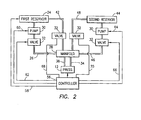
- a first reservoir 24 having heating elements (not shown) containing a valve 32 is connected by a supply line 26 to a manifold 28.
- a pump 30 and valve 32 are located in the supply line 26, between the first reservoir 24 and manifold 28, as shown.
- the manifold 28, is connected by an input line 34 to one port at the top of the press 12, and by an output line 38 to a second port.
- a recirculation line 42 containing a valve 32, is connected between the manifold 28 and the top of the first reservoir 24.
- a second reservoir 44 which contains the same fluid as first reservoir 24 except at ambient temperature.
- the bottom of second reservoir 44 is connected by a line 46 to the manifold 28, and a recirculation line 48 connects the manifold 28 to the top of the second reservoir 44.
- a pump 30 and valve 32 are located in the line 46 between the second reservoir 44 and manifold 28, and a valve 32 is mounted in the recirculation line 48.
- the press 12 is moved with respect to the support 22 by a number of pneumatic or hydraulic pistons 50 which are mounted at equal intervals along the top surface of the press 12.
- the pistons 50 are independently actuated by a source of air or fluid (not shown) to ensure that the press 12 applies uniform pressure to the cover layer 18 and flex circuit 20 over the entire surface area of the flexible membrane 16.
- the detailed construction of the press 12 forms no part of this invention, and is therefore not discussed further herein.
- the method and apparatus 10 of this invention are designed to provide a means for encapsulating circuit elements to protect them from moisture and contaminants.
- the flex circuit 20 consists of a substrate 52 formed of LCP upon which a number of circuit elements 54 are mounted.
- the cover layer 18 is also formed of LCP, which, because of its thermoplastic nature, will "flow" or begin to melt at a temperature of about 283°C. By placing the cover layer 18 over the flex circuit 20 and applying heat and pressure, the cover layer 18 and substrate 52 adhere to one another with a secure bond and entirely enclose the circuit elements 54 between them.
- the apparatus 10 is operated by a commercially available controller 56 as schematically depicted in the flow diagram of Fig. 2 .
- a commercially available controller 56 as schematically depicted in the flow diagram of Fig. 2 .
- oil or other fluid within the first reservoir 24 is brought up to a temperature in the range of 283°C to 325°C by activating heating elements (not shown) therein.
- the controller 56 is operative to activate the heating elements via a signal input through lead 58, or they may be independently activated by a switch (not shown) located at the first reservoir 24.
- the controller 56 then inputs signals through leads 60 and 62 to start the pump 30 and open valve 32, respectively, thus initiating the flow of heated oil out of the first reservoir 24.
- the controller 56 deactivates the pump 30 and valve 32 in line 46 from second reservoir 44 by signals input through leads 64 and 66, respectively.
- the heated oil flows into the press 12 through the manifold 28 and into the input line 34 leading into the interior of the press 12.
- the temperature of the heated oil within the press 12 is controlled and maintained by continuously recirculating it from the first reservoir 24 through the manifold 28 and input line 34 into the press 12, and then out of the press 12 through the output line 38 and manifold 28 to the recirculation line 42 connecting the manifold 28 to the first reservoir 24.
- the controller 56 opens the valve 32 within recirculation line 42 via a signal input through line 68 to allow the heated oil to pass from the manifold 28 into the first reservoir 24.
- the encapsulation process can proceed.
- the flex circuit 16 is positioned on the support 22 so that the circuit elements 54 on the LCP substrate 52 are exposed.
- the LCP cover layer 18 is then placed atop the substrate 52 and circuit elements 54.
- the controller 56 operates the pistons 50 causing the press 12 to move toward the support 22.
- the flexible membrane 16 at the bottom of the press 12 with the cover layer 18, at a uniform pressure on the order of 200 psi, the flexible plate 16 substantially conforms to the shape of the circuit elements 54 beneath.
- the cover layer 18 is forced around the circuit elements 54 into contact with substrate 52.
- the press 12 is maintained in this position for a period of time sufficient to heat both the LCP cover layer 18 and LCP substrate 52 to a melt temperature of at least 283°C, but not more than about 320°C, causing them to bond to one another and thus encapsulate the circuit elements 54 between the two.
- the temperature of the press 12 may be stepped down by circulating comparatively cool, ambient temperature oil into the press 12 from the second reservoir 44.
- the controller 56 is operative to deactivate the pump 30 and close valve 32 within line 26 connected to the first reservoir 24, while activating pump 30 and opening valve 32 within the line 46 connected to the second reservoir 44.
- the controller 56 closes the valve 32 within the recirculation line 42, and then opens the valve 32 within the recirculation line 48 extending from the manifold 28 to the second reservoir 44 by inputting a signal to such valve 32 through a line 70.
- ambient temperature oil is recirculated within the press 12 to reduce its temperature.
Landscapes
- Engineering & Computer Science (AREA)
- Physics & Mathematics (AREA)
- Fluid Mechanics (AREA)
- Mechanical Engineering (AREA)
- Manufacturing & Machinery (AREA)
- Microelectronics & Electronic Packaging (AREA)
- Non-Metallic Protective Coatings For Printed Circuits (AREA)
- Liquid Crystal (AREA)
- Press Drives And Press Lines (AREA)
- Devices For Indicating Variable Information By Combining Individual Elements (AREA)
Claims (6)
- Vorrichtung (10) zum Abdichten von Schaltungselementen einer elektrischen Schaltung zwischen einem Substrat (20), auf dem die Schaltungselemente befestigt sind, und einer Abdeckplatte (18), die über dem Substrat (20) und den Schaltungselementen liegt, wobei das Substrat (20) und die Abdeckplatte (18) jeweils aus Flüssigkristallpolymer gebildet sind, wobei die Vorrichtung (10) umfasst:- eine Isostatpresse (12) mit einem hohlen Innenraum, wobei der hohle Innenraum mit einer ersten Quelle (24) für Heizfluid und einer zweiten Quelle (44) für Kühlfluid verbunden ist,- eine flexible Membran (16), die an der Isostatpresse (12) in Stellung zum Kontakt mit der Abdeckplatte (18) befestigt ist, und- eine Trageinrichtung (22) zum Tragen des Substrats (20) und der Abdeckplatte (18),- wodurch die Isostatpresse (12) und die flexible Membran (16) dazu geeignet sind, ausreichend Kraft und Wärme anzuwenden, um zu bewirken, dass das Flüssigkristallpolymer, das sowohl die Abdeckplatte (18) als auch das Substrat (20) bildet, zusammenklebt und somit die Schaltungselemente zwischen den beiden abdichtet,- dadurch gekennzeichnet, dass die Isostatpresse (12) dazu geeignet ist, zumindest teilweise mit Heizfluid gefüllt zu sein, wenn die Isostatpresse (12) zur Trageinrichtung (22) geführt wird, so dass die Isostatpresse (12) auf eine geeignete Temperatur erwärmt wird, bevor die flexible Membran (16) die Abdeckplatte (18) berührt und sich im Wesentlichen an die Form der auf dem Substrat (20) befindlichen Schaltungselemente anpasst.
- Vorrichtung (10) nach Anspruch 1, wobei die flexible Membran (16) aus einem Material gebildet ist, das aus der Gruppe ausgewählt wird, die aus hochdichtem Polyethylen, Butylkautschuk und Ethylenpropylendienmonomerkautschuk besteht.
- Vorrichtung (10) nach Anspruch 1, wobei die flexible Membran (16) mit einer nichthaftenden Oberfläche zum Kontakt mit der Abdeckplatte ausgebildet ist.
- Verfahren zum Abdichten von Schaltungselementen einer elektrischen Schaltung zwischen einem Substrat (20), auf dem die Schaltungselemente befestigt sind, und einer Abdeckplatte (18), die über dem Substrat (20) und den Schaltungselementen liegt, wobei das Substrat (20) und die Abdeckplatte (18) jeweils aus Flüssigkristallpolymer gebildet sind, wobei das Verfahren die folgenden Schritte umfasst:- Platzieren des Substrats (20), auf dem die Schaltungselemente befestigt sind, auf einer Trageinrichtung (22),- Platzieren der Abdeckplatte (18) über dem Substrat (20), auf dem die Schaltungselemente befestigt sind,- Füllen eines hohlen Innenraums der Isostatpresse (12) zumindest teilweise mit Heizfluid, so dass die Isostatpresse auf eine geeignete Temperatur erwärmt wird, bevor die Isostatpresse zur Trageinrichtung (22) geführt wird,- Führen einer Isostatpresse (12) zur Trageinrichtung (22), so dass eine flexible Membran (16), die an der Isostatpresse (12) in Stellung zum Kontakt mit der Abdeckplatte (18) befestigt ist, die Abdeckplatte (18) berührt und sich im Wesentlichen an die Form der auf dem Substrat (20) befindlichen Schaltungselemente anpasst,- Anwenden von ausreichend Kraft und Wärme durch die Isostatpresse (12) und die flexible Membran (16), um zu bewirken, dass das Flüssigkristallpolymer zusammenklebt und somit die Schaltungselemente zwischen dem Substrat (20) und der Abdeckplatte (18) abdichtet.
- Verfahren nach Anspruch 4, wobei die Temperatur der Isostatpresse (12) nach Abschluss eines oder mehrerer Abdichtvorgänge durch Zirkulieren eines Kühlfluids von einem zweiten Reservoir (44) in die Presse stufenweise gesenkt wird.
- Verfahren nach Anspruch 4 oder 5, wobei die Temperatur des der Isostatpresse (12) zugeführten Heizfluids innerhalb eines Temperaturbereichs von 283°C bis 325°C liegt.
Applications Claiming Priority (2)
| Application Number | Priority Date | Filing Date | Title |
|---|---|---|---|
| US10/910,715 US7768619B2 (en) | 2004-08-03 | 2004-08-03 | Method and apparatus for sealing flex circuits made with an LCP substrate |
| PCT/US2005/027013 WO2006017394A2 (en) | 2004-08-03 | 2005-08-01 | Method and apparatus for sealing flex circuits made with an lcp substrate |
Publications (3)
| Publication Number | Publication Date |
|---|---|
| EP1789840A2 EP1789840A2 (de) | 2007-05-30 |
| EP1789840A4 EP1789840A4 (de) | 2009-09-02 |
| EP1789840B1 true EP1789840B1 (de) | 2015-05-13 |
Family
ID=35757043
Family Applications (1)
| Application Number | Title | Priority Date | Filing Date |
|---|---|---|---|
| EP05781615.9A Expired - Lifetime EP1789840B1 (de) | 2004-08-03 | 2005-08-01 | Verfahren und vorrichtung zur versiegelung von mit einem lcp-substrat hergestellten flex-schaltungen |
Country Status (5)
| Country | Link |
|---|---|
| US (1) | US7768619B2 (de) |
| EP (1) | EP1789840B1 (de) |
| JP (1) | JP4607183B2 (de) |
| CA (1) | CA2575993C (de) |
| WO (1) | WO2006017394A2 (de) |
Families Citing this family (4)
| Publication number | Priority date | Publication date | Assignee | Title |
|---|---|---|---|---|
| US7128801B2 (en) * | 2005-02-03 | 2006-10-31 | Harris Corporation | Method and apparatus for sealing flex circuits having heat sensitive circuit elements |
| US8014167B2 (en) * | 2007-09-07 | 2011-09-06 | Seagate Technology Llc | Liquid crystal material sealed housing |
| DK2337670T3 (da) * | 2008-09-18 | 2019-07-22 | Fraunhofer Ges Forschung | Fremgangsmåde og indretning til fremstilling af kompositmaterialekomponenter samt trykenhed |
| US9363890B2 (en) | 2010-12-27 | 2016-06-07 | Kuraray Co., Ltd. | Circuit board and method of manufacturing same |
Citations (1)
| Publication number | Priority date | Publication date | Assignee | Title |
|---|---|---|---|---|
| JP2000286537A (ja) * | 1999-03-31 | 2000-10-13 | Kuraray Co Ltd | 回路基板およびその製造方法 |
Family Cites Families (21)
| Publication number | Priority date | Publication date | Assignee | Title |
|---|---|---|---|---|
| US2575734A (en) * | 1947-12-30 | 1951-11-20 | Westinghouse Electric Corp | Press |
| US5184211A (en) * | 1988-03-01 | 1993-02-02 | Digital Equipment Corporation | Apparatus for packaging and cooling integrated circuit chips |
| US5538789A (en) * | 1990-02-09 | 1996-07-23 | Toranaga Technologies, Inc. | Composite substrates for preparation of printed circuits |
| JP2001501547A (ja) * | 1992-06-12 | 2001-02-06 | アルミナム カンパニー オブ アメリカ | 非平面を有する多層構造の製造方法 |
| US5827999A (en) * | 1994-05-26 | 1998-10-27 | Amkor Electronics, Inc. | Homogeneous chip carrier package |
| US6320257B1 (en) * | 1994-09-27 | 2001-11-20 | Foster-Miller, Inc. | Chip packaging technique |
| US5788808A (en) * | 1997-04-15 | 1998-08-04 | International Business Machines Corporation | Apparatus for forming cavity substrates using compressive pads |
| US5885668A (en) * | 1997-05-07 | 1999-03-23 | Hoechst Celanese Corporation | Process for surface modification of an LCP film |
| DE19920577C1 (de) | 1999-05-04 | 2001-01-04 | Wemhoener Heinrich Gmbh Co | Membranpresse |
| JP2001230528A (ja) | 2000-02-15 | 2001-08-24 | Sony Corp | 実装装置及び実装方法 |
| US6372992B1 (en) * | 2000-10-05 | 2002-04-16 | 3M Innovative Properties Company | Circuit protective composites |
| WO2002049404A2 (en) | 2000-12-14 | 2002-06-20 | World Properties Inc. | Liquid crystalline polymer bond plies and circuits formed therefrom |
| US6459581B1 (en) * | 2000-12-19 | 2002-10-01 | Harris Corporation | Electronic device using evaporative micro-cooling and associated methods |
| JP2002217523A (ja) * | 2001-01-23 | 2002-08-02 | Tdk Corp | 電子装置の製造方法 |
| US20020155279A1 (en) * | 2001-02-14 | 2002-10-24 | Chunping Dai | Method of manufacturing dimensionally stable cellulosic fibre-based composite board and product |
| US6483705B2 (en) * | 2001-03-19 | 2002-11-19 | Harris Corporation | Electronic module including a cooling substrate and related methods |
| JP4513235B2 (ja) * | 2001-05-31 | 2010-07-28 | ソニー株式会社 | フリップチップ実装装置 |
| JP2003039199A (ja) * | 2001-07-30 | 2003-02-12 | Hitachi Electronics Eng Co Ltd | 基板プレス装置 |
| US6452798B1 (en) * | 2001-09-12 | 2002-09-17 | Harris Corporation | Electronic module including a cooling substrate having a fluid cooling circuit therein and related methods |
| US6977187B2 (en) | 2002-06-19 | 2005-12-20 | Foster-Miller, Inc. | Chip package sealing method |
| AU2002335176A1 (en) * | 2002-10-02 | 2004-04-23 | Jsr Trading Co., Ltd. | Laminating system |
-
2004
- 2004-08-03 US US10/910,715 patent/US7768619B2/en active Active
-
2005
- 2005-08-01 EP EP05781615.9A patent/EP1789840B1/de not_active Expired - Lifetime
- 2005-08-01 CA CA2575993A patent/CA2575993C/en not_active Expired - Fee Related
- 2005-08-01 WO PCT/US2005/027013 patent/WO2006017394A2/en not_active Ceased
- 2005-08-01 JP JP2007524868A patent/JP4607183B2/ja not_active Expired - Fee Related
Patent Citations (1)
| Publication number | Priority date | Publication date | Assignee | Title |
|---|---|---|---|---|
| JP2000286537A (ja) * | 1999-03-31 | 2000-10-13 | Kuraray Co Ltd | 回路基板およびその製造方法 |
Also Published As
| Publication number | Publication date |
|---|---|
| WO2006017394A2 (en) | 2006-02-16 |
| JP4607183B2 (ja) | 2011-01-05 |
| EP1789840A2 (de) | 2007-05-30 |
| WO2006017394A3 (en) | 2007-04-05 |
| US20060028612A1 (en) | 2006-02-09 |
| US7768619B2 (en) | 2010-08-03 |
| EP1789840A4 (de) | 2009-09-02 |
| CA2575993C (en) | 2012-01-10 |
| JP2008508745A (ja) | 2008-03-21 |
| CA2575993A1 (en) | 2006-02-16 |
Similar Documents
| Publication | Publication Date | Title |
|---|---|---|
| JP5334135B2 (ja) | 積層装置 | |
| JPH10315257A (ja) | 真空積層装置および真空積層方法 | |
| JP3627090B2 (ja) | 積層成形方法および積層成形装置 | |
| EP1848578B1 (de) | Vorrichtung zum abdichten von flexiblen schaltungen mit wärmeempfindlichen schaltungselementen | |
| JPS63296388A (ja) | プリント回路板中の穴を一時的にシールする装置及び方法 | |
| US20120018084A1 (en) | Printed Circuit Board Assembly Manufacturing Device And Method | |
| EP1789840B1 (de) | Verfahren und vorrichtung zur versiegelung von mit einem lcp-substrat hergestellten flex-schaltungen | |
| JP3243598B2 (ja) | 真空積層装置および真空積層方法 | |
| AU2006265765B2 (en) | Fabrication of electronic components in plastic | |
| JP3243608B2 (ja) | 真空積層装置および真空積層方法 | |
| KR20050100758A (ko) | 열진공 코팅기 및 열진공 코팅방법 | |
| JPS61293836A (ja) | 積層板の成形用治具 | |
| JPH10175229A (ja) | 真空積層装置 | |
| JP2000141389A (ja) | 真空積層装置および真空積層方法 | |
| TWM324587U (en) | High-speed pressing machine with the mode of hydraulic pressure | |
| JPH0477205A (ja) | セラミック積層体の圧着方法 | |
| JPH1126518A (ja) | 熱圧着装置 |
Legal Events
| Date | Code | Title | Description |
|---|---|---|---|
| PUAI | Public reference made under article 153(3) epc to a published international application that has entered the european phase |
Free format text: ORIGINAL CODE: 0009012 |
|
| 17P | Request for examination filed |
Effective date: 20070208 |
|
| AK | Designated contracting states |
Kind code of ref document: A2 Designated state(s): AT BE BG CH CY CZ DE DK EE ES FI FR GB GR HU IE IS IT LI LT LU LV MC NL PL PT RO SE SI SK TR |
|
| AX | Request for extension of the european patent |
Extension state: AL BA HR MK YU |
|
| RBV | Designated contracting states (corrected) |
Designated state(s): DE FR GB |
|
| DAX | Request for extension of the european patent (deleted) | ||
| A4 | Supplementary search report drawn up and despatched |
Effective date: 20090803 |
|
| 17Q | First examination report despatched |
Effective date: 20091127 |
|
| REG | Reference to a national code |
Ref country code: DE Ref legal event code: R079 Ref document number: 602005046555 Country of ref document: DE Free format text: PREVIOUS MAIN CLASS: G02F0001133900 Ipc: H05K0003280000 |
|
| GRAP | Despatch of communication of intention to grant a patent |
Free format text: ORIGINAL CODE: EPIDOSNIGR1 |
|
| RIC1 | Information provided on ipc code assigned before grant |
Ipc: B32B 37/18 20060101ALI20141128BHEP Ipc: B30B 15/34 20060101ALI20141128BHEP Ipc: H05K 1/18 20060101ALN20141128BHEP Ipc: H05K 3/28 20060101AFI20141128BHEP Ipc: B30B 5/02 20060101ALI20141128BHEP Ipc: B32B 37/10 20060101ALI20141128BHEP |
|
| INTG | Intention to grant announced |
Effective date: 20150107 |
|
| GRAS | Grant fee paid |
Free format text: ORIGINAL CODE: EPIDOSNIGR3 |
|
| GRAA | (expected) grant |
Free format text: ORIGINAL CODE: 0009210 |
|
| AK | Designated contracting states |
Kind code of ref document: B1 Designated state(s): DE FR GB |
|
| REG | Reference to a national code |
Ref country code: GB Ref legal event code: FG4D |
|
| REG | Reference to a national code |
Ref country code: DE Ref legal event code: R096 Ref document number: 602005046555 Country of ref document: DE Effective date: 20150625 |
|
| REG | Reference to a national code |
Ref country code: DE Ref legal event code: R097 Ref document number: 602005046555 Country of ref document: DE |
|
| PLBE | No opposition filed within time limit |
Free format text: ORIGINAL CODE: 0009261 |
|
| STAA | Information on the status of an ep patent application or granted ep patent |
Free format text: STATUS: NO OPPOSITION FILED WITHIN TIME LIMIT |
|
| 26N | No opposition filed |
Effective date: 20160216 |
|
| REG | Reference to a national code |
Ref country code: FR Ref legal event code: PLFP Year of fee payment: 12 |
|
| REG | Reference to a national code |
Ref country code: FR Ref legal event code: PLFP Year of fee payment: 13 |
|
| REG | Reference to a national code |
Ref country code: FR Ref legal event code: PLFP Year of fee payment: 14 |
|
| P01 | Opt-out of the competence of the unified patent court (upc) registered |
Effective date: 20230525 |
|
| PGFP | Annual fee paid to national office [announced via postgrant information from national office to epo] |
Ref country code: DE Payment date: 20240828 Year of fee payment: 20 |
|
| PGFP | Annual fee paid to national office [announced via postgrant information from national office to epo] |
Ref country code: GB Payment date: 20240827 Year of fee payment: 20 |
|
| PGFP | Annual fee paid to national office [announced via postgrant information from national office to epo] |
Ref country code: FR Payment date: 20240826 Year of fee payment: 20 |
|
| REG | Reference to a national code |
Ref country code: DE Ref legal event code: R071 Ref document number: 602005046555 Country of ref document: DE |
|
| REG | Reference to a national code |
Ref country code: GB Ref legal event code: PE20 Expiry date: 20250731 |