EP1785136A2 - Inhalative Arzneimittel enthaltend ein Anticholinergikum in Kombination mit Corticosteroiden und Betamimetika - Google Patents
Inhalative Arzneimittel enthaltend ein Anticholinergikum in Kombination mit Corticosteroiden und Betamimetika Download PDFInfo
- Publication number
- EP1785136A2 EP1785136A2 EP07103257A EP07103257A EP1785136A2 EP 1785136 A2 EP1785136 A2 EP 1785136A2 EP 07103257 A EP07103257 A EP 07103257A EP 07103257 A EP07103257 A EP 07103257A EP 1785136 A2 EP1785136 A2 EP 1785136A2
- Authority
- EP
- European Patent Office
- Prior art keywords
- ethanol
- hydroxy
- methyl
- propellant
- benzoxazin
- Prior art date
- Legal status (The legal status is an assumption and is not a legal conclusion. Google has not performed a legal analysis and makes no representation as to the accuracy of the status listed.)
- Withdrawn
Links
- 230000003454 betamimetic effect Effects 0.000 title claims abstract description 17
- 239000003246 corticosteroid Substances 0.000 title claims abstract description 9
- 239000003814 drug Substances 0.000 title claims description 42
- 229940079593 drug Drugs 0.000 title claims description 11
- 239000000544 cholinesterase inhibitor Substances 0.000 title 1
- 230000001078 anti-cholinergic effect Effects 0.000 claims abstract description 3
- 150000003839 salts Chemical class 0.000 claims description 465
- LFQSCWFLJHTTHZ-UHFFFAOYSA-N Ethanol Chemical compound CCO LFQSCWFLJHTTHZ-UHFFFAOYSA-N 0.000 claims description 57
- BPZSYCZIITTYBL-UHFFFAOYSA-N formoterol Chemical compound C1=CC(OC)=CC=C1CC(C)NCC(O)C1=CC=C(O)C(NC=O)=C1 BPZSYCZIITTYBL-UHFFFAOYSA-N 0.000 claims description 57
- 239000000443 aerosol Substances 0.000 claims description 36
- 150000001875 compounds Chemical class 0.000 claims description 36
- 239000000203 mixture Substances 0.000 claims description 33
- CPELXLSAUQHCOX-UHFFFAOYSA-M Bromide Chemical compound [Br-] CPELXLSAUQHCOX-UHFFFAOYSA-M 0.000 claims description 29
- 239000003380 propellant Substances 0.000 claims description 24
- GIIZNNXWQWCKIB-UHFFFAOYSA-N Serevent Chemical compound C1=C(O)C(CO)=CC(C(O)CNCCCCCCOCCCCC=2C=CC=CC=2)=C1 GIIZNNXWQWCKIB-UHFFFAOYSA-N 0.000 claims description 23
- 239000000843 powder Substances 0.000 claims description 23
- 229960004017 salmeterol Drugs 0.000 claims description 22
- 239000004480 active ingredient Substances 0.000 claims description 20
- 239000000725 suspension Substances 0.000 claims description 17
- -1 GW 215864 Chemical compound 0.000 claims description 16
- 239000013543 active substance Substances 0.000 claims description 15
- 239000000546 pharmaceutical excipient Substances 0.000 claims description 14
- 239000002775 capsule Substances 0.000 claims description 13
- 229960002848 formoterol Drugs 0.000 claims description 13
- VZCYOOQTPOCHFL-OWOJBTEDSA-N Fumaric acid Chemical compound OC(=O)\C=C\C(O)=O VZCYOOQTPOCHFL-OWOJBTEDSA-N 0.000 claims description 11
- 150000001450 anions Chemical class 0.000 claims description 11
- VZCYOOQTPOCHFL-UHFFFAOYSA-N trans-butenedioic acid Natural products OC(=O)C=CC(O)=O VZCYOOQTPOCHFL-UHFFFAOYSA-N 0.000 claims description 10
- VOVIALXJUBGFJZ-KWVAZRHASA-N Budesonide Chemical compound C1CC2=CC(=O)C=C[C@]2(C)[C@@H]2[C@@H]1[C@@H]1C[C@H]3OC(CCC)O[C@@]3(C(=O)CO)[C@@]1(C)C[C@@H]2O VOVIALXJUBGFJZ-KWVAZRHASA-N 0.000 claims description 9
- 229960004436 budesonide Drugs 0.000 claims description 9
- VEXZGXHMUGYJMC-UHFFFAOYSA-M Chloride anion Chemical compound [Cl-] VEXZGXHMUGYJMC-UHFFFAOYSA-M 0.000 claims description 8
- ATUOYWHBWRKTHZ-UHFFFAOYSA-N Propane Chemical compound CCC ATUOYWHBWRKTHZ-UHFFFAOYSA-N 0.000 claims description 8
- 239000002552 dosage form Substances 0.000 claims description 8
- 239000002245 particle Substances 0.000 claims description 8
- 239000002904 solvent Substances 0.000 claims description 8
- 150000004677 hydrates Chemical class 0.000 claims description 7
- AFVFQIVMOAPDHO-UHFFFAOYSA-N Methanesulfonic acid Chemical compound CS(O)(=O)=O AFVFQIVMOAPDHO-UHFFFAOYSA-N 0.000 claims description 6
- MNJNSRQVLNIPFN-UHFFFAOYSA-N 4-[2-[[4-(benzimidazol-1-yl)-2-methylbutan-2-yl]amino]-1-hydroxyethyl]-2-[(4-methoxyphenyl)methylamino]phenol Chemical compound C1=CC(OC)=CC=C1CNC1=CC(C(O)CNC(C)(C)CCN2C3=CC=CC=C3N=C2)=CC=C1O MNJNSRQVLNIPFN-UHFFFAOYSA-N 0.000 claims description 5
- KOTMQCNDGLTIHR-UHFFFAOYSA-N 4-[2-[[4-(benzimidazol-1-yl)-2-methylbutan-2-yl]amino]-1-hydroxyethyl]-3-fluorophenol Chemical compound C1=NC2=CC=CC=C2N1CCC(C)(C)NCC(O)C1=CC=C(O)C=C1F KOTMQCNDGLTIHR-UHFFFAOYSA-N 0.000 claims description 5
- 125000004172 4-methoxyphenyl group Chemical group [H]C1=C([H])C(OC([H])([H])[H])=C([H])C([H])=C1* 0.000 claims description 5
- HBAQYPYDRFILMT-UHFFFAOYSA-N 8-[3-(1-cyclopropylpyrazol-4-yl)-1H-pyrazolo[4,3-d]pyrimidin-5-yl]-3-methyl-3,8-diazabicyclo[3.2.1]octan-2-one Chemical class C1(CC1)N1N=CC(=C1)C1=NNC2=C1N=C(N=C2)N1C2C(N(CC1CC2)C)=O HBAQYPYDRFILMT-UHFFFAOYSA-N 0.000 claims description 5
- LUKZNWIVRBCLON-GXOBDPJESA-N Ciclesonide Chemical compound C1([C@H]2O[C@@]3([C@H](O2)C[C@@H]2[C@@]3(C[C@H](O)[C@@H]3[C@@]4(C)C=CC(=O)C=C4CC[C@H]32)C)C(=O)COC(=O)C(C)C)CCCCC1 LUKZNWIVRBCLON-GXOBDPJESA-N 0.000 claims description 5
- 239000003963 antioxidant agent Substances 0.000 claims description 5
- WPYMKLBDIGXBTP-UHFFFAOYSA-N benzoic acid Chemical compound OC(=O)C1=CC=CC=C1 WPYMKLBDIGXBTP-UHFFFAOYSA-N 0.000 claims description 5
- 229960003728 ciclesonide Drugs 0.000 claims description 5
- 239000000470 constituent Substances 0.000 claims description 5
- 229960002714 fluticasone Drugs 0.000 claims description 5
- MGNNYOODZCAHBA-GQKYHHCASA-N fluticasone Chemical compound C1([C@@H](F)C2)=CC(=O)C=C[C@]1(C)[C@]1(F)[C@@H]2[C@@H]2C[C@@H](C)[C@@](C(=O)SCF)(O)[C@@]2(C)C[C@@H]1O MGNNYOODZCAHBA-GQKYHHCASA-N 0.000 claims description 5
- 229960001664 mometasone Drugs 0.000 claims description 5
- QLIIKPVHVRXHRI-CXSFZGCWSA-N mometasone Chemical compound C1CC2=CC(=O)C=C[C@]2(C)[C@]2(Cl)[C@@H]1[C@@H]1C[C@@H](C)[C@@](C(=O)CCl)(O)[C@@]1(C)C[C@@H]2O QLIIKPVHVRXHRI-CXSFZGCWSA-N 0.000 claims description 5
- 239000012453 solvate Substances 0.000 claims description 5
- 208000027771 Obstructive airways disease Diseases 0.000 claims description 4
- 229910019142 PO4 Inorganic materials 0.000 claims description 4
- QAOWNCQODCNURD-UHFFFAOYSA-L Sulfate Chemical compound [O-]S([O-])(=O)=O QAOWNCQODCNURD-UHFFFAOYSA-L 0.000 claims description 4
- UREBDLICKHMUKA-CXSFZGCWSA-N dexamethasone Chemical compound C1CC2=CC(=O)C=C[C@]2(C)[C@]2(F)[C@@H]1[C@@H]1C[C@@H](C)[C@@](C(=O)CO)(O)[C@@]1(C)C[C@@H]2O UREBDLICKHMUKA-CXSFZGCWSA-N 0.000 claims description 4
- 208000027866 inflammatory disease Diseases 0.000 claims description 4
- 230000002757 inflammatory effect Effects 0.000 claims description 4
- NNPPMTNAJDCUHE-UHFFFAOYSA-N isobutane Chemical compound CC(C)C NNPPMTNAJDCUHE-UHFFFAOYSA-N 0.000 claims description 4
- VZCYOOQTPOCHFL-UPHRSURJSA-N maleic acid Chemical compound OC(=O)\C=C/C(O)=O VZCYOOQTPOCHFL-UPHRSURJSA-N 0.000 claims description 4
- IJDNQMDRQITEOD-UHFFFAOYSA-N n-butane Chemical compound CCCC IJDNQMDRQITEOD-UHFFFAOYSA-N 0.000 claims description 4
- 125000001436 propyl group Chemical group [H]C([*])([H])C([H])([H])C([H])([H])[H] 0.000 claims description 4
- 239000003381 stabilizer Substances 0.000 claims description 4
- 125000000472 sulfonyl group Chemical group *S(*)(=O)=O 0.000 claims description 4
- JOXIMZWYDAKGHI-UHFFFAOYSA-N toluene-4-sulfonic acid Chemical compound CC1=CC=C(S(O)(=O)=O)C=C1 JOXIMZWYDAKGHI-UHFFFAOYSA-N 0.000 claims description 4
- QTBSBXVTEAMEQO-UHFFFAOYSA-M Acetate Chemical compound CC([O-])=O QTBSBXVTEAMEQO-UHFFFAOYSA-M 0.000 claims description 3
- FEWJPZIEWOKRBE-JCYAYHJZSA-N Dextrotartaric acid Chemical compound OC(=O)[C@H](O)[C@@H](O)C(O)=O FEWJPZIEWOKRBE-JCYAYHJZSA-N 0.000 claims description 3
- NHNBFGGVMKEFGY-UHFFFAOYSA-N Nitrate Chemical compound [O-][N+]([O-])=O NHNBFGGVMKEFGY-UHFFFAOYSA-N 0.000 claims description 3
- 208000006673 asthma Diseases 0.000 claims description 3
- NBMKJKDGKREAPL-DVTGEIKXSA-N beclomethasone Chemical compound C1CC2=CC(=O)C=C[C@]2(C)[C@]2(Cl)[C@@H]1[C@@H]1C[C@H](C)[C@@](C(=O)CO)(O)[C@@]1(C)C[C@@H]2O NBMKJKDGKREAPL-DVTGEIKXSA-N 0.000 claims description 3
- 229940092705 beclomethasone Drugs 0.000 claims description 3
- 150000002016 disaccharides Chemical class 0.000 claims description 3
- 238000004519 manufacturing process Methods 0.000 claims description 3
- 150000002772 monosaccharides Chemical class 0.000 claims description 3
- NBIIXXVUZAFLBC-UHFFFAOYSA-K phosphate Chemical compound [O-]P([O-])([O-])=O NBIIXXVUZAFLBC-UHFFFAOYSA-K 0.000 claims description 3
- 239000010452 phosphate Substances 0.000 claims description 3
- 239000004094 surface-active agent Substances 0.000 claims description 3
- XWTYSIMOBUGWOL-UHFFFAOYSA-N (+-)-Terbutaline Chemical compound CC(C)(C)NCC(O)C1=CC(O)=CC(O)=C1 XWTYSIMOBUGWOL-UHFFFAOYSA-N 0.000 claims description 2
- RTLJQOLVPIGICL-UHFFFAOYSA-N 4-[2-(tert-butylamino)-1-hydroxyethyl]-2-(methylsulfonylmethyl)phenol Chemical compound CC(C)(C)NCC(O)C1=CC=C(O)C(CS(C)(=O)=O)=C1 RTLJQOLVPIGICL-UHFFFAOYSA-N 0.000 claims description 2
- KRKNYBCHXYNGOX-UHFFFAOYSA-K Citrate Chemical compound [O-]C(=O)CC(O)(CC([O-])=O)C([O-])=O KRKNYBCHXYNGOX-UHFFFAOYSA-K 0.000 claims description 2
- PMPVIKIVABFJJI-UHFFFAOYSA-N Cyclobutane Chemical class C1CCC1 PMPVIKIVABFJJI-UHFFFAOYSA-N 0.000 claims description 2
- LVZWSLJZHVFIQJ-UHFFFAOYSA-N Cyclopropane Chemical class C1CC1 LVZWSLJZHVFIQJ-UHFFFAOYSA-N 0.000 claims description 2
- OTMSDBZUPAUEDD-UHFFFAOYSA-N Ethane Chemical class CC OTMSDBZUPAUEDD-UHFFFAOYSA-N 0.000 claims description 2
- 229910002651 NO3 Inorganic materials 0.000 claims description 2
- MUBZPKHOEPUJKR-UHFFFAOYSA-N Oxalic acid Chemical compound OC(=O)C(O)=O MUBZPKHOEPUJKR-UHFFFAOYSA-N 0.000 claims description 2
- VQDBNKDJNJQRDG-UHFFFAOYSA-N Pirbuterol Chemical compound CC(C)(C)NCC(O)C1=CC=C(O)C(CO)=N1 VQDBNKDJNJQRDG-UHFFFAOYSA-N 0.000 claims description 2
- WKHOPHIMYDJVSA-UHFFFAOYSA-N [3-[2-(tert-butylamino)-1-hydroxyethyl]-5-(2-methylpropanoyloxy)phenyl] 2-methylpropanoate Chemical compound CC(C)C(=O)OC1=CC(OC(=O)C(C)C)=CC(C(O)CNC(C)(C)C)=C1 WKHOPHIMYDJVSA-UHFFFAOYSA-N 0.000 claims description 2
- 229960003060 bambuterol Drugs 0.000 claims description 2
- ANZXOIAKUNOVQU-UHFFFAOYSA-N bambuterol Chemical compound CN(C)C(=O)OC1=CC(OC(=O)N(C)C)=CC(C(O)CNC(C)(C)C)=C1 ANZXOIAKUNOVQU-UHFFFAOYSA-N 0.000 claims description 2
- 229960004620 bitolterol Drugs 0.000 claims description 2
- FZGVEKPRDOIXJY-UHFFFAOYSA-N bitolterol Chemical compound C1=CC(C)=CC=C1C(=O)OC1=CC=C(C(O)CNC(C)(C)C)C=C1OC(=O)C1=CC=C(C)C=C1 FZGVEKPRDOIXJY-UHFFFAOYSA-N 0.000 claims description 2
- 239000001273 butane Chemical class 0.000 claims description 2
- 229960001386 carbuterol Drugs 0.000 claims description 2
- KEMXXQOFIRIICG-UHFFFAOYSA-N carbuterol Chemical compound CC(C)(C)NCC(O)C1=CC=C(O)C(NC(N)=O)=C1 KEMXXQOFIRIICG-UHFFFAOYSA-N 0.000 claims description 2
- 229960001117 clenbuterol Drugs 0.000 claims description 2
- STJMRWALKKWQGH-UHFFFAOYSA-N clenbuterol Chemical compound CC(C)(C)NCC(O)C1=CC(Cl)=C(N)C(Cl)=C1 STJMRWALKKWQGH-UHFFFAOYSA-N 0.000 claims description 2
- 150000004676 glycans Chemical class 0.000 claims description 2
- 229960000708 hexoprenaline Drugs 0.000 claims description 2
- OXLZNBCNGJWPRV-UHFFFAOYSA-N hexoprenaline Chemical compound C=1C=C(O)C(O)=CC=1C(O)CNCCCCCCNCC(O)C1=CC=C(O)C(O)=C1 OXLZNBCNGJWPRV-UHFFFAOYSA-N 0.000 claims description 2
- 229930195733 hydrocarbon Natural products 0.000 claims description 2
- 150000002430 hydrocarbons Chemical class 0.000 claims description 2
- XMBWDFGMSWQBCA-UHFFFAOYSA-N hydrogen iodide Chemical compound I XMBWDFGMSWQBCA-UHFFFAOYSA-N 0.000 claims description 2
- 229950002451 ibuterol Drugs 0.000 claims description 2
- 239000001282 iso-butane Substances 0.000 claims description 2
- 239000000314 lubricant Substances 0.000 claims description 2
- VNWKTOKETHGBQD-UHFFFAOYSA-N methane Chemical class C VNWKTOKETHGBQD-UHFFFAOYSA-N 0.000 claims description 2
- OFBQJSOFQDEBGM-UHFFFAOYSA-N n-pentane Chemical class CCCCC OFBQJSOFQDEBGM-UHFFFAOYSA-N 0.000 claims description 2
- 150000002482 oligosaccharides Polymers 0.000 claims description 2
- 229960005414 pirbuterol Drugs 0.000 claims description 2
- 229920001282 polysaccharide Polymers 0.000 claims description 2
- 239000005017 polysaccharide Substances 0.000 claims description 2
- 229960002288 procaterol Drugs 0.000 claims description 2
- FKNXQNWAXFXVNW-BLLLJJGKSA-N procaterol Chemical compound N1C(=O)C=CC2=C1C(O)=CC=C2[C@@H](O)[C@@H](NC(C)C)CC FKNXQNWAXFXVNW-BLLLJJGKSA-N 0.000 claims description 2
- 239000001294 propane Chemical class 0.000 claims description 2
- 229960002720 reproterol Drugs 0.000 claims description 2
- WVLAAKXASPCBGT-UHFFFAOYSA-N reproterol Chemical compound C1=2C(=O)N(C)C(=O)N(C)C=2N=CN1CCCNCC(O)C1=CC(O)=CC(O)=C1 WVLAAKXASPCBGT-UHFFFAOYSA-N 0.000 claims description 2
- KDYFGRWQOYBRFD-UHFFFAOYSA-L succinate(2-) Chemical compound [O-]C(=O)CCC([O-])=O KDYFGRWQOYBRFD-UHFFFAOYSA-L 0.000 claims description 2
- 150000005846 sugar alcohols Polymers 0.000 claims description 2
- 229950007862 sulfonterol Drugs 0.000 claims description 2
- 229940095064 tartrate Drugs 0.000 claims description 2
- 229960000195 terbutaline Drugs 0.000 claims description 2
- JOXIMZWYDAKGHI-UHFFFAOYSA-M toluene-4-sulfonate Chemical compound CC1=CC=C(S([O-])(=O)=O)C=C1 JOXIMZWYDAKGHI-UHFFFAOYSA-M 0.000 claims description 2
- DBCKRBGYGMVSTI-UHFFFAOYSA-N 2-oxo-7-[2-[2-[3-(2-phenylethoxy)propylsulfonyl]ethylazaniumyl]ethyl]-3h-1,3-benzothiazol-4-olate Chemical compound C1=2SC(=O)NC=2C(O)=CC=C1CCNCCS(=O)(=O)CCCOCCC1=CC=CC=C1 DBCKRBGYGMVSTI-UHFFFAOYSA-N 0.000 claims 1
- LSLYOANBFKQKPT-DIFFPNOSSA-N 5-[(1r)-1-hydroxy-2-[[(2r)-1-(4-hydroxyphenyl)propan-2-yl]amino]ethyl]benzene-1,3-diol Chemical compound C([C@@H](C)NC[C@H](O)C=1C=C(O)C=C(O)C=1)C1=CC=C(O)C=C1 LSLYOANBFKQKPT-DIFFPNOSSA-N 0.000 claims 1
- 229960001022 fenoterol Drugs 0.000 claims 1
- 150000008282 halocarbons Chemical class 0.000 claims 1
- IXTCZMJQGGONPY-XJAYAHQCSA-N rofleponide Chemical compound C1([C@@H](F)C2)=CC(=O)CC[C@]1(C)[C@]1(F)[C@@H]2[C@@H]2C[C@H]3O[C@@H](CCC)O[C@@]3(C(=O)CO)[C@@]2(C)C[C@@H]1O IXTCZMJQGGONPY-XJAYAHQCSA-N 0.000 claims 1
- 229950004432 rofleponide Drugs 0.000 claims 1
- 229960005294 triamcinolone Drugs 0.000 claims 1
- GFNANZIMVAIWHM-OBYCQNJPSA-N triamcinolone Chemical compound O=C1C=C[C@]2(C)[C@@]3(F)[C@@H](O)C[C@](C)([C@@]([C@H](O)C4)(O)C(=O)CO)[C@@H]4[C@@H]3CCC2=C1 GFNANZIMVAIWHM-OBYCQNJPSA-N 0.000 claims 1
- 239000000808 adrenergic beta-agonist Substances 0.000 abstract description 15
- 238000002360 preparation method Methods 0.000 abstract description 9
- 229960001334 corticosteroids Drugs 0.000 abstract description 7
- 238000000034 method Methods 0.000 abstract description 7
- 239000008194 pharmaceutical composition Substances 0.000 abstract description 6
- 208000023504 respiratory system disease Diseases 0.000 abstract description 3
- 150000001768 cations Chemical class 0.000 description 110
- 150000003431 steroids Chemical class 0.000 description 89
- 239000000243 solution Substances 0.000 description 22
- 239000004615 ingredient Substances 0.000 description 15
- 238000009472 formulation Methods 0.000 description 13
- VEXZGXHMUGYJMC-UHFFFAOYSA-N Hydrochloric acid Chemical compound Cl VEXZGXHMUGYJMC-UHFFFAOYSA-N 0.000 description 12
- CIWBSHSKHKDKBQ-JLAZNSOCSA-N Ascorbic acid Natural products OC[C@H](O)[C@H]1OC(=O)C(O)=C1O CIWBSHSKHKDKBQ-JLAZNSOCSA-N 0.000 description 11
- XLYOFNOQVPJJNP-UHFFFAOYSA-N water Substances O XLYOFNOQVPJJNP-UHFFFAOYSA-N 0.000 description 11
- 239000002253 acid Substances 0.000 description 10
- GUBGYTABKSRVRQ-XLOQQCSPSA-N Alpha-Lactose Chemical compound O[C@@H]1[C@@H](O)[C@@H](O)[C@@H](CO)O[C@H]1O[C@@H]1[C@@H](CO)O[C@H](O)[C@H](O)[C@H]1O GUBGYTABKSRVRQ-XLOQQCSPSA-N 0.000 description 9
- GUBGYTABKSRVRQ-QKKXKWKRSA-N Lactose Natural products OC[C@H]1O[C@@H](O[C@H]2[C@H](O)[C@@H](O)C(O)O[C@@H]2CO)[C@H](O)[C@@H](O)[C@H]1O GUBGYTABKSRVRQ-QKKXKWKRSA-N 0.000 description 9
- KRKNYBCHXYNGOX-UHFFFAOYSA-N citric acid Chemical compound OC(=O)CC(O)(C(O)=O)CC(O)=O KRKNYBCHXYNGOX-UHFFFAOYSA-N 0.000 description 9
- 239000008101 lactose Substances 0.000 description 9
- 229960001375 lactose Drugs 0.000 description 9
- LERNTVKEWCAPOY-VOGVJGKGSA-N C[N+]1(C)[C@H]2C[C@H](C[C@@H]1[C@H]1O[C@@H]21)OC(=O)C(O)(c1cccs1)c1cccs1 Chemical compound C[N+]1(C)[C@H]2C[C@H](C[C@@H]1[C@H]1O[C@@H]21)OC(=O)C(O)(c1cccs1)c1cccs1 LERNTVKEWCAPOY-VOGVJGKGSA-N 0.000 description 8
- 229960000257 tiotropium bromide Drugs 0.000 description 8
- RATSWNOMCHFQGJ-TUYNVFRMSA-N (e)-but-2-enedioic acid;n-[2-hydroxy-5-[(1s)-1-hydroxy-2-[[(2s)-1-(4-methoxyphenyl)propan-2-yl]amino]ethyl]phenyl]formamide;dihydrate Chemical compound O.O.OC(=O)\C=C\C(O)=O.C1=CC(OC)=CC=C1C[C@H](C)NC[C@@H](O)C1=CC=C(O)C(NC=O)=C1.C1=CC(OC)=CC=C1C[C@H](C)NC[C@@H](O)C1=CC=C(O)C(NC=O)=C1 RATSWNOMCHFQGJ-TUYNVFRMSA-N 0.000 description 7
- 239000012530 fluid Substances 0.000 description 7
- QAOWNCQODCNURD-UHFFFAOYSA-N Sulfuric acid Chemical compound OS(O)(=O)=O QAOWNCQODCNURD-UHFFFAOYSA-N 0.000 description 6
- 150000007513 acids Chemical class 0.000 description 6
- HUPFGZXOMWLGNK-UHFFFAOYSA-N diflunisal Chemical compound C1=C(O)C(C(=O)O)=CC(C=2C(=CC(F)=CC=2)F)=C1 HUPFGZXOMWLGNK-UHFFFAOYSA-N 0.000 description 6
- 229960000616 diflunisal Drugs 0.000 description 6
- 229960000289 fluticasone propionate Drugs 0.000 description 6
- WMWTYOKRWGGJOA-CENSZEJFSA-N fluticasone propionate Chemical compound C1([C@@H](F)C2)=CC(=O)C=C[C@]1(C)[C@]1(F)[C@@H]2[C@@H]2C[C@@H](C)[C@@](C(=O)SCF)(OC(=O)CC)[C@@]2(C)C[C@@H]1O WMWTYOKRWGGJOA-CENSZEJFSA-N 0.000 description 6
- 239000007789 gas Substances 0.000 description 6
- DMJDEZUEYXVYNO-UHFFFAOYSA-N 3-(4-phenylphenyl)prop-2-enoic acid Chemical compound C1=CC(C=CC(=O)O)=CC=C1C1=CC=CC=C1 DMJDEZUEYXVYNO-UHFFFAOYSA-N 0.000 description 5
- QTBSBXVTEAMEQO-UHFFFAOYSA-N Acetic acid Chemical compound CC(O)=O QTBSBXVTEAMEQO-UHFFFAOYSA-N 0.000 description 5
- OVBJJZOQPCKUOR-UHFFFAOYSA-L EDTA disodium salt dihydrate Chemical compound O.O.[Na+].[Na+].[O-]C(=O)C[NH+](CC([O-])=O)CC[NH+](CC([O-])=O)CC([O-])=O OVBJJZOQPCKUOR-UHFFFAOYSA-L 0.000 description 5
- NBIIXXVUZAFLBC-UHFFFAOYSA-N Phosphoric acid Chemical compound OP(O)(O)=O NBIIXXVUZAFLBC-UHFFFAOYSA-N 0.000 description 5
- FAPWRFPIFSIZLT-UHFFFAOYSA-M Sodium chloride Chemical compound [Na+].[Cl-] FAPWRFPIFSIZLT-UHFFFAOYSA-M 0.000 description 5
- 229960003610 formoterol fumarate dihydrate Drugs 0.000 description 5
- 239000003755 preservative agent Substances 0.000 description 5
- 229940037001 sodium edetate Drugs 0.000 description 5
- 208000006545 Chronic Obstructive Pulmonary Disease Diseases 0.000 description 4
- BDAGIHXWWSANSR-UHFFFAOYSA-N Formic acid Chemical compound OC=O BDAGIHXWWSANSR-UHFFFAOYSA-N 0.000 description 4
- XBDQKXXYIPTUBI-UHFFFAOYSA-N Propionic acid Chemical class CCC(O)=O XBDQKXXYIPTUBI-UHFFFAOYSA-N 0.000 description 4
- 239000000654 additive Substances 0.000 description 4
- 235000006708 antioxidants Nutrition 0.000 description 4
- 235000010323 ascorbic acid Nutrition 0.000 description 4
- 239000011668 ascorbic acid Substances 0.000 description 4
- 229960005070 ascorbic acid Drugs 0.000 description 4
- 239000012141 concentrate Substances 0.000 description 4
- 239000006199 nebulizer Substances 0.000 description 4
- PEDCQBHIVMGVHV-UHFFFAOYSA-N Glycerine Chemical compound OCC(O)CO PEDCQBHIVMGVHV-UHFFFAOYSA-N 0.000 description 3
- KFZMGEQAYNKOFK-UHFFFAOYSA-N Isopropanol Chemical compound CC(C)O KFZMGEQAYNKOFK-UHFFFAOYSA-N 0.000 description 3
- AFVFQIVMOAPDHO-UHFFFAOYSA-M Methanesulfonate Chemical compound CS([O-])(=O)=O AFVFQIVMOAPDHO-UHFFFAOYSA-M 0.000 description 3
- DNIAPMSPPWPWGF-UHFFFAOYSA-N Propylene glycol Chemical compound CC(O)CO DNIAPMSPPWPWGF-UHFFFAOYSA-N 0.000 description 3
- 235000015165 citric acid Nutrition 0.000 description 3
- 239000008139 complexing agent Substances 0.000 description 3
- 239000000890 drug combination Substances 0.000 description 3
- 239000013583 drug formulation Substances 0.000 description 3
- 229940093915 gynecological organic acid Drugs 0.000 description 3
- 125000001449 isopropyl group Chemical group [H]C([H])([H])C([H])(*)C([H])([H])[H] 0.000 description 3
- 150000007522 mineralic acids Chemical class 0.000 description 3
- 150000007524 organic acids Chemical class 0.000 description 3
- 235000005985 organic acids Nutrition 0.000 description 3
- 235000021317 phosphate Nutrition 0.000 description 3
- 229960005018 salmeterol xinafoate Drugs 0.000 description 3
- GVJHHUAWPYXKBD-UHFFFAOYSA-N (±)-α-Tocopherol Chemical compound OC1=C(C)C(C)=C2OC(CCCC(C)CCCC(C)CCCC(C)C)(C)CCC2=C1C GVJHHUAWPYXKBD-UHFFFAOYSA-N 0.000 description 2
- PZNPLUBHRSSFHT-RRHRGVEJSA-N 1-hexadecanoyl-2-octadecanoyl-sn-glycero-3-phosphocholine Chemical compound CCCCCCCCCCCCCCCCCC(=O)O[C@@H](COP([O-])(=O)OCC[N+](C)(C)C)COC(=O)CCCCCCCCCCCCCCC PZNPLUBHRSSFHT-RRHRGVEJSA-N 0.000 description 2
- 125000005975 2-phenylethyloxy group Chemical group 0.000 description 2
- 206010001889 Alveolitis Diseases 0.000 description 2
- 208000035939 Alveolitis allergic Diseases 0.000 description 2
- VTYYLEPIZMXCLO-UHFFFAOYSA-L Calcium carbonate Chemical compound [Ca+2].[O-]C([O-])=O VTYYLEPIZMXCLO-UHFFFAOYSA-L 0.000 description 2
- 201000003883 Cystic fibrosis Diseases 0.000 description 2
- 208000027445 Farmer Lung Diseases 0.000 description 2
- WQZGKKKJIJFFOK-GASJEMHNSA-N Glucose Natural products OC[C@H]1OC(O)[C@H](O)[C@@H](O)[C@@H]1O WQZGKKKJIJFFOK-GASJEMHNSA-N 0.000 description 2
- 229940121948 Muscarinic receptor antagonist Drugs 0.000 description 2
- GRYLNZFGIOXLOG-UHFFFAOYSA-N Nitric acid Chemical compound O[N+]([O-])=O GRYLNZFGIOXLOG-UHFFFAOYSA-N 0.000 description 2
- 229920003171 Poly (ethylene oxide) Polymers 0.000 description 2
- 239000002671 adjuvant Substances 0.000 description 2
- 150000001298 alcohols Chemical class 0.000 description 2
- 230000000172 allergic effect Effects 0.000 description 2
- 208000010668 atopic eczema Diseases 0.000 description 2
- 229960000686 benzalkonium chloride Drugs 0.000 description 2
- CADWTSSKOVRVJC-UHFFFAOYSA-N benzyl(dimethyl)azanium;chloride Chemical compound [Cl-].C[NH+](C)CC1=CC=CC=C1 CADWTSSKOVRVJC-UHFFFAOYSA-N 0.000 description 2
- WQZGKKKJIJFFOK-VFUOTHLCSA-N beta-D-glucose Chemical compound OC[C@H]1O[C@@H](O)[C@H](O)[C@@H](O)[C@@H]1O WQZGKKKJIJFFOK-VFUOTHLCSA-N 0.000 description 2
- 239000000812 cholinergic antagonist Substances 0.000 description 2
- 229940125782 compound 2 Drugs 0.000 description 2
- 238000007906 compression Methods 0.000 description 2
- 230000006835 compression Effects 0.000 description 2
- 239000003937 drug carrier Substances 0.000 description 2
- 230000000694 effects Effects 0.000 description 2
- 201000001155 extrinsic allergic alveolitis Diseases 0.000 description 2
- 208000022195 farmer lung disease Diseases 0.000 description 2
- 229960000193 formoterol fumarate Drugs 0.000 description 2
- 239000001530 fumaric acid Substances 0.000 description 2
- 239000008103 glucose Substances 0.000 description 2
- 208000022098 hypersensitivity pneumonitis Diseases 0.000 description 2
- 239000007788 liquid Substances 0.000 description 2
- 239000000463 material Substances 0.000 description 2
- 229960002744 mometasone furoate Drugs 0.000 description 2
- WOFMFGQZHJDGCX-ZULDAHANSA-N mometasone furoate Chemical compound O([C@]1([C@@]2(C)C[C@H](O)[C@]3(Cl)[C@@]4(C)C=CC(=O)C=C4CC[C@H]3[C@@H]2C[C@H]1C)C(=O)CCl)C(=O)C1=CC=CO1 WOFMFGQZHJDGCX-ZULDAHANSA-N 0.000 description 2
- 239000004033 plastic Substances 0.000 description 2
- 229920003023 plastic Polymers 0.000 description 2
- 239000011780 sodium chloride Substances 0.000 description 2
- 239000008347 soybean phospholipid Substances 0.000 description 2
- 238000003860 storage Methods 0.000 description 2
- 239000000126 substance Substances 0.000 description 2
- KDYFGRWQOYBRFD-UHFFFAOYSA-N succinic acid Chemical compound OC(=O)CCC(O)=O KDYFGRWQOYBRFD-UHFFFAOYSA-N 0.000 description 2
- 239000001117 sulphuric acid Substances 0.000 description 2
- 230000002195 synergetic effect Effects 0.000 description 2
- 230000001225 therapeutic effect Effects 0.000 description 2
- 238000002604 ultrasonography Methods 0.000 description 2
- 229930003231 vitamin Natural products 0.000 description 2
- 239000011782 vitamin Substances 0.000 description 2
- 235000013343 vitamin Nutrition 0.000 description 2
- 229940088594 vitamin Drugs 0.000 description 2
- 229950000339 xinafoate Drugs 0.000 description 2
- JNYAEWCLZODPBN-JGWLITMVSA-N (2r,3r,4s)-2-[(1r)-1,2-dihydroxyethyl]oxolane-3,4-diol Chemical class OC[C@@H](O)[C@H]1OC[C@H](O)[C@H]1O JNYAEWCLZODPBN-JGWLITMVSA-N 0.000 description 1
- WRIDQFICGBMAFQ-UHFFFAOYSA-N (E)-8-Octadecenoic acid Natural products CCCCCCCCCC=CCCCCCCC(O)=O WRIDQFICGBMAFQ-UHFFFAOYSA-N 0.000 description 1
- BJEPYKJPYRNKOW-REOHCLBHSA-N (S)-malic acid Chemical compound OC(=O)[C@@H](O)CC(O)=O BJEPYKJPYRNKOW-REOHCLBHSA-N 0.000 description 1
- LVGUZGTVOIAKKC-UHFFFAOYSA-N 1,1,1,2-tetrafluoroethane Chemical compound FCC(F)(F)F LVGUZGTVOIAKKC-UHFFFAOYSA-N 0.000 description 1
- JLPULHDHAOZNQI-ZTIMHPMXSA-N 1-hexadecanoyl-2-(9Z,12Z-octadecadienoyl)-sn-glycero-3-phosphocholine Chemical compound CCCCCCCCCCCCCCCC(=O)OC[C@H](COP([O-])(=O)OCC[N+](C)(C)C)OC(=O)CCCCCCC\C=C/C\C=C/CCCCC JLPULHDHAOZNQI-ZTIMHPMXSA-N 0.000 description 1
- SJJCQDRGABAVBB-UHFFFAOYSA-N 1-hydroxy-2-naphthoic acid Chemical compound C1=CC=CC2=C(O)C(C(=O)O)=CC=C21 SJJCQDRGABAVBB-UHFFFAOYSA-N 0.000 description 1
- OWEGMIWEEQEYGQ-UHFFFAOYSA-N 100676-05-9 Natural products OC1C(O)C(O)C(CO)OC1OCC1C(O)C(O)C(O)C(OC2C(OC(O)C(O)C2O)CO)O1 OWEGMIWEEQEYGQ-UHFFFAOYSA-N 0.000 description 1
- FPIPGXGPPPQFEQ-UHFFFAOYSA-N 13-cis retinol Natural products OCC=C(C)C=CC=C(C)C=CC1=C(C)CCCC1(C)C FPIPGXGPPPQFEQ-UHFFFAOYSA-N 0.000 description 1
- ZMPRRFPMMJQXPP-UHFFFAOYSA-N 2-sulfobenzoic acid Chemical class OC(=O)C1=CC=CC=C1S(O)(=O)=O ZMPRRFPMMJQXPP-UHFFFAOYSA-N 0.000 description 1
- LQJBNNIYVWPHFW-UHFFFAOYSA-N 20:1omega9c fatty acid Natural products CCCCCCCCCCC=CCCCCCCCC(O)=O LQJBNNIYVWPHFW-UHFFFAOYSA-N 0.000 description 1
- BMYNFMYTOJXKLE-UHFFFAOYSA-N 3-azaniumyl-2-hydroxypropanoate Chemical compound NCC(O)C(O)=O BMYNFMYTOJXKLE-UHFFFAOYSA-N 0.000 description 1
- OSWFIVFLDKOXQC-UHFFFAOYSA-N 4-(3-methoxyphenyl)aniline Chemical compound COC1=CC=CC(C=2C=CC(N)=CC=2)=C1 OSWFIVFLDKOXQC-UHFFFAOYSA-N 0.000 description 1
- QSBYPNXLFMSGKH-UHFFFAOYSA-N 9-Heptadecensaeure Natural products CCCCCCCC=CCCCCCCCC(O)=O QSBYPNXLFMSGKH-UHFFFAOYSA-N 0.000 description 1
- WSVLPVUVIUVCRA-KPKNDVKVSA-N Alpha-lactose monohydrate Chemical compound O.O[C@@H]1[C@@H](O)[C@@H](O)[C@@H](CO)O[C@H]1O[C@@H]1[C@@H](CO)O[C@H](O)[C@H](O)[C@H]1O WSVLPVUVIUVCRA-KPKNDVKVSA-N 0.000 description 1
- 239000005711 Benzoic acid Substances 0.000 description 1
- COVZYZSDYWQREU-UHFFFAOYSA-N Busulfan Chemical compound CS(=O)(=O)OCCCCOS(C)(=O)=O COVZYZSDYWQREU-UHFFFAOYSA-N 0.000 description 1
- TUCZHEKNJKIWMP-IHXODTLASA-N CC(C(O[C@@H](C1)CC2[N](C)(C)C1C1[C@]22OC12)=O)(c1ccccc1)c1ccccc1 Chemical compound CC(C(O[C@@H](C1)CC2[N](C)(C)C1C1[C@]22OC12)=O)(c1ccccc1)c1ccccc1 TUCZHEKNJKIWMP-IHXODTLASA-N 0.000 description 1
- FBPFZTCFMRRESA-FSIIMWSLSA-N D-Glucitol Natural products OC[C@H](O)[C@H](O)[C@@H](O)[C@H](O)CO FBPFZTCFMRRESA-FSIIMWSLSA-N 0.000 description 1
- FBPFZTCFMRRESA-KVTDHHQDSA-N D-Mannitol Chemical compound OC[C@@H](O)[C@@H](O)[C@H](O)[C@H](O)CO FBPFZTCFMRRESA-KVTDHHQDSA-N 0.000 description 1
- FBPFZTCFMRRESA-JGWLITMVSA-N D-glucitol Chemical compound OC[C@H](O)[C@@H](O)[C@H](O)[C@H](O)CO FBPFZTCFMRRESA-JGWLITMVSA-N 0.000 description 1
- 229920002307 Dextran Polymers 0.000 description 1
- CPELXLSAUQHCOX-UHFFFAOYSA-N Hydrogen bromide Chemical compound Br CPELXLSAUQHCOX-UHFFFAOYSA-N 0.000 description 1
- GUBGYTABKSRVRQ-PICCSMPSSA-N Maltose Natural products O[C@@H]1[C@@H](O)[C@H](O)[C@@H](CO)O[C@@H]1O[C@@H]1[C@@H](CO)OC(O)[C@H](O)[C@H]1O GUBGYTABKSRVRQ-PICCSMPSSA-N 0.000 description 1
- 229930195725 Mannitol Natural products 0.000 description 1
- 239000005642 Oleic acid Substances 0.000 description 1
- ZQPPMHVWECSIRJ-UHFFFAOYSA-N Oleic acid Natural products CCCCCCCCC=CCCCCCCCC(O)=O ZQPPMHVWECSIRJ-UHFFFAOYSA-N 0.000 description 1
- MUBZPKHOEPUJKR-UHFFFAOYSA-L Oxalate Chemical compound [O-]C(=O)C([O-])=O MUBZPKHOEPUJKR-UHFFFAOYSA-L 0.000 description 1
- 239000002202 Polyethylene glycol Substances 0.000 description 1
- OFOBLEOULBTSOW-UHFFFAOYSA-N Propanedioic acid Natural products OC(=O)CC(O)=O OFOBLEOULBTSOW-UHFFFAOYSA-N 0.000 description 1
- CZMRCDWAGMRECN-UGDNZRGBSA-N Sucrose Chemical compound O[C@H]1[C@H](O)[C@@H](CO)O[C@@]1(CO)O[C@@H]1[C@H](O)[C@@H](O)[C@H](O)[C@@H](CO)O1 CZMRCDWAGMRECN-UGDNZRGBSA-N 0.000 description 1
- 229930006000 Sucrose Natural products 0.000 description 1
- 239000000150 Sympathomimetic Substances 0.000 description 1
- FEWJPZIEWOKRBE-UHFFFAOYSA-N Tartaric acid Natural products [H+].[H+].[O-]C(=O)C(O)C(O)C([O-])=O FEWJPZIEWOKRBE-UHFFFAOYSA-N 0.000 description 1
- FPIPGXGPPPQFEQ-BOOMUCAASA-N Vitamin A Natural products OC/C=C(/C)\C=C\C=C(\C)/C=C/C1=C(C)CCCC1(C)C FPIPGXGPPPQFEQ-BOOMUCAASA-N 0.000 description 1
- 229930003427 Vitamin E Natural products 0.000 description 1
- TVXBFESIOXBWNM-UHFFFAOYSA-N Xylitol Natural products OCCC(O)C(O)C(O)CCO TVXBFESIOXBWNM-UHFFFAOYSA-N 0.000 description 1
- 150000001242 acetic acid derivatives Chemical class 0.000 description 1
- 230000001476 alcoholic effect Effects 0.000 description 1
- 150000001335 aliphatic alkanes Chemical class 0.000 description 1
- FPIPGXGPPPQFEQ-OVSJKPMPSA-N all-trans-retinol Chemical compound OC\C=C(/C)\C=C\C=C(/C)\C=C\C1=C(C)CCCC1(C)C FPIPGXGPPPQFEQ-OVSJKPMPSA-N 0.000 description 1
- BJEPYKJPYRNKOW-UHFFFAOYSA-N alpha-hydroxysuccinic acid Natural products OC(=O)C(O)CC(O)=O BJEPYKJPYRNKOW-UHFFFAOYSA-N 0.000 description 1
- 229910000147 aluminium phosphate Inorganic materials 0.000 description 1
- PYMYPHUHKUWMLA-WDCZJNDASA-N arabinose Chemical compound OC[C@@H](O)[C@@H](O)[C@H](O)C=O PYMYPHUHKUWMLA-WDCZJNDASA-N 0.000 description 1
- PYMYPHUHKUWMLA-UHFFFAOYSA-N arabinose Natural products OCC(O)C(O)C(O)C=O PYMYPHUHKUWMLA-UHFFFAOYSA-N 0.000 description 1
- 244000052616 bacterial pathogen Species 0.000 description 1
- 230000009286 beneficial effect Effects 0.000 description 1
- 235000010233 benzoic acid Nutrition 0.000 description 1
- 229960004365 benzoic acid Drugs 0.000 description 1
- 150000001558 benzoic acid derivatives Chemical class 0.000 description 1
- 229940124748 beta 2 agonist Drugs 0.000 description 1
- SRBFZHDQGSBBOR-UHFFFAOYSA-N beta-D-Pyranose-Lyxose Natural products OC1COC(O)C(O)C1O SRBFZHDQGSBBOR-UHFFFAOYSA-N 0.000 description 1
- GUBGYTABKSRVRQ-QUYVBRFLSA-N beta-maltose Chemical compound OC[C@H]1O[C@H](O[C@H]2[C@H](O)[C@@H](O)[C@H](O)O[C@@H]2CO)[C@H](O)[C@@H](O)[C@@H]1O GUBGYTABKSRVRQ-QUYVBRFLSA-N 0.000 description 1
- 230000000903 blocking effect Effects 0.000 description 1
- KDYFGRWQOYBRFD-NUQCWPJISA-N butanedioic acid Chemical compound O[14C](=O)CC[14C](O)=O KDYFGRWQOYBRFD-NUQCWPJISA-N 0.000 description 1
- 229910000019 calcium carbonate Inorganic materials 0.000 description 1
- 229960001927 cetylpyridinium chloride Drugs 0.000 description 1
- NFCRBQADEGXVDL-UHFFFAOYSA-M cetylpyridinium chloride monohydrate Chemical compound O.[Cl-].CCCCCCCCCCCCCCCC[N+]1=CC=CC=C1 NFCRBQADEGXVDL-UHFFFAOYSA-M 0.000 description 1
- 229960004106 citric acid Drugs 0.000 description 1
- 238000004891 communication Methods 0.000 description 1
- 238000011109 contamination Methods 0.000 description 1
- 235000014113 dietary fatty acids Nutrition 0.000 description 1
- 125000004212 difluorophenyl group Chemical group 0.000 description 1
- FIFVQZLUEWHMSV-UHFFFAOYSA-N ethyl n-[4-[2-(tert-butylamino)-1-hydroxyethyl]-2-cyano-6-fluorophenyl]carbamate Chemical compound CCOC(=O)NC1=C(F)C=C(C(O)CNC(C)(C)C)C=C1C#N FIFVQZLUEWHMSV-UHFFFAOYSA-N 0.000 description 1
- LYCAIKOWRPUZTN-UHFFFAOYSA-N ethylene glycol Natural products OCCO LYCAIKOWRPUZTN-UHFFFAOYSA-N 0.000 description 1
- 229930195729 fatty acid Natural products 0.000 description 1
- 239000000194 fatty acid Substances 0.000 description 1
- 235000019253 formic acid Nutrition 0.000 description 1
- 239000012458 free base Substances 0.000 description 1
- 229960002598 fumaric acid Drugs 0.000 description 1
- 235000011087 fumaric acid Nutrition 0.000 description 1
- 230000006870 function Effects 0.000 description 1
- WIGCFUFOHFEKBI-UHFFFAOYSA-N gamma-tocopherol Natural products CC(C)CCCC(C)CCCC(C)CCCC1CCC2C(C)C(O)C(C)C(C)C2O1 WIGCFUFOHFEKBI-UHFFFAOYSA-N 0.000 description 1
- 239000011521 glass Substances 0.000 description 1
- 150000002334 glycols Chemical class 0.000 description 1
- 238000000227 grinding Methods 0.000 description 1
- 150000005826 halohydrocarbons Chemical class 0.000 description 1
- 125000002887 hydroxy group Chemical group [H]O* 0.000 description 1
- WGCNASOHLSPBMP-UHFFFAOYSA-N hydroxyacetaldehyde Natural products OCC=O WGCNASOHLSPBMP-UHFFFAOYSA-N 0.000 description 1
- 238000001746 injection moulding Methods 0.000 description 1
- TWBYWOBDOCUKOW-UHFFFAOYSA-N isonicotinic acid Chemical class OC(=O)C1=CC=NC=C1 TWBYWOBDOCUKOW-UHFFFAOYSA-N 0.000 description 1
- QXJSBBXBKPUZAA-UHFFFAOYSA-N isooleic acid Natural products CCCCCCCC=CCCCCCCCCC(O)=O QXJSBBXBKPUZAA-UHFFFAOYSA-N 0.000 description 1
- 239000007951 isotonicity adjuster Substances 0.000 description 1
- 229960001021 lactose monohydrate Drugs 0.000 description 1
- 239000012669 liquid formulation Substances 0.000 description 1
- 238000012423 maintenance Methods 0.000 description 1
- 239000011976 maleic acid Substances 0.000 description 1
- 150000002689 maleic acids Chemical class 0.000 description 1
- 239000001630 malic acid Substances 0.000 description 1
- 235000011090 malic acid Nutrition 0.000 description 1
- 239000000594 mannitol Substances 0.000 description 1
- 235000010355 mannitol Nutrition 0.000 description 1
- HEBKCHPVOIAQTA-UHFFFAOYSA-N meso ribitol Natural products OCC(O)C(O)C(O)CO HEBKCHPVOIAQTA-UHFFFAOYSA-N 0.000 description 1
- 229910052751 metal Inorganic materials 0.000 description 1
- 239000002184 metal Substances 0.000 description 1
- 238000002156 mixing Methods 0.000 description 1
- 229910017604 nitric acid Inorganic materials 0.000 description 1
- ZQPPMHVWECSIRJ-KTKRTIGZSA-N oleic acid Chemical compound CCCCCCCC\C=C/CCCCCCCC(O)=O ZQPPMHVWECSIRJ-KTKRTIGZSA-N 0.000 description 1
- 229920001542 oligosaccharide Polymers 0.000 description 1
- 238000010979 pH adjustment Methods 0.000 description 1
- 230000020477 pH reduction Effects 0.000 description 1
- 150000002942 palmitic acid derivatives Chemical class 0.000 description 1
- 239000000825 pharmaceutical preparation Substances 0.000 description 1
- 230000000144 pharmacologic effect Effects 0.000 description 1
- 150000003013 phosphoric acid derivatives Chemical class 0.000 description 1
- 125000005547 pivalate group Chemical group 0.000 description 1
- 229920001223 polyethylene glycol Polymers 0.000 description 1
- 229920001451 polypropylene glycol Polymers 0.000 description 1
- 229920000136 polysorbate Polymers 0.000 description 1
- 229940068965 polysorbates Drugs 0.000 description 1
- 239000001267 polyvinylpyrrolidone Substances 0.000 description 1
- 229920000036 polyvinylpyrrolidone Polymers 0.000 description 1
- 235000013855 polyvinylpyrrolidone Nutrition 0.000 description 1
- 238000003825 pressing Methods 0.000 description 1
- 125000002924 primary amino group Chemical group [H]N([H])* 0.000 description 1
- 235000019260 propionic acid Nutrition 0.000 description 1
- 230000001681 protective effect Effects 0.000 description 1
- IUVKMZGDUIUOCP-BTNSXGMBSA-N quinbolone Chemical compound O([C@H]1CC[C@H]2[C@H]3[C@@H]([C@]4(C=CC(=O)C=C4CC3)C)CC[C@@]21C)C1=CCCC1 IUVKMZGDUIUOCP-BTNSXGMBSA-N 0.000 description 1
- 229940044601 receptor agonist Drugs 0.000 description 1
- 239000000018 receptor agonist Substances 0.000 description 1
- YGSDEFSMJLZEOE-UHFFFAOYSA-N salicylic acid Chemical class OC(=O)C1=CC=CC=C1O YGSDEFSMJLZEOE-UHFFFAOYSA-N 0.000 description 1
- 229910052710 silicon Inorganic materials 0.000 description 1
- 239000010703 silicon Substances 0.000 description 1
- 238000009097 single-agent therapy Methods 0.000 description 1
- WXMKPNITSTVMEF-UHFFFAOYSA-M sodium benzoate Chemical compound [Na+].[O-]C(=O)C1=CC=CC=C1 WXMKPNITSTVMEF-UHFFFAOYSA-M 0.000 description 1
- 239000004299 sodium benzoate Substances 0.000 description 1
- 235000010234 sodium benzoate Nutrition 0.000 description 1
- 159000000000 sodium salts Chemical class 0.000 description 1
- 239000000600 sorbitol Substances 0.000 description 1
- 235000010356 sorbitol Nutrition 0.000 description 1
- 229940083466 soybean lecithin Drugs 0.000 description 1
- 239000007921 spray Substances 0.000 description 1
- 238000004544 sputter deposition Methods 0.000 description 1
- 239000005720 sucrose Substances 0.000 description 1
- 230000001975 sympathomimetic effect Effects 0.000 description 1
- 229940064707 sympathomimetics Drugs 0.000 description 1
- 239000011975 tartaric acid Substances 0.000 description 1
- 235000002906 tartaric acid Nutrition 0.000 description 1
- 238000002560 therapeutic procedure Methods 0.000 description 1
- 229930003799 tocopherol Natural products 0.000 description 1
- 239000011732 tocopherol Substances 0.000 description 1
- 235000019149 tocopherols Nutrition 0.000 description 1
- 230000001960 triggered effect Effects 0.000 description 1
- 235000019155 vitamin A Nutrition 0.000 description 1
- 239000011719 vitamin A Substances 0.000 description 1
- 235000019165 vitamin E Nutrition 0.000 description 1
- 239000011709 vitamin E Substances 0.000 description 1
- 229940046009 vitamin E Drugs 0.000 description 1
- 229940045997 vitamin a Drugs 0.000 description 1
- 239000000811 xylitol Substances 0.000 description 1
- HEBKCHPVOIAQTA-SCDXWVJYSA-N xylitol Chemical compound OC[C@H](O)[C@@H](O)[C@H](O)CO HEBKCHPVOIAQTA-SCDXWVJYSA-N 0.000 description 1
- 235000010447 xylitol Nutrition 0.000 description 1
- 229960002675 xylitol Drugs 0.000 description 1
- QUEDXNHFTDJVIY-UHFFFAOYSA-N γ-tocopherol Chemical class OC1=C(C)C(C)=C2OC(CCCC(C)CCCC(C)CCCC(C)C)(C)CCC2=C1 QUEDXNHFTDJVIY-UHFFFAOYSA-N 0.000 description 1
Images

Classifications
-
- A—HUMAN NECESSITIES
- A61—MEDICAL OR VETERINARY SCIENCE; HYGIENE
- A61K—PREPARATIONS FOR MEDICAL, DENTAL OR TOILETRY PURPOSES
- A61K45/00—Medicinal preparations containing active ingredients not provided for in groups A61K31/00 - A61K41/00
- A61K45/06—Mixtures of active ingredients without chemical characterisation, e.g. antiphlogistics and cardiaca
-
- A—HUMAN NECESSITIES
- A61—MEDICAL OR VETERINARY SCIENCE; HYGIENE
- A61K—PREPARATIONS FOR MEDICAL, DENTAL OR TOILETRY PURPOSES
- A61K31/00—Medicinal preparations containing organic active ingredients
- A61K31/13—Amines
- A61K31/135—Amines having aromatic rings, e.g. ketamine, nortriptyline
-
- A—HUMAN NECESSITIES
- A61—MEDICAL OR VETERINARY SCIENCE; HYGIENE
- A61K—PREPARATIONS FOR MEDICAL, DENTAL OR TOILETRY PURPOSES
- A61K31/00—Medicinal preparations containing organic active ingredients
- A61K31/16—Amides, e.g. hydroxamic acids
- A61K31/165—Amides, e.g. hydroxamic acids having aromatic rings, e.g. colchicine, atenolol, progabide
- A61K31/167—Amides, e.g. hydroxamic acids having aromatic rings, e.g. colchicine, atenolol, progabide having the nitrogen of a carboxamide group directly attached to the aromatic ring, e.g. lidocaine, paracetamol
-
- A—HUMAN NECESSITIES
- A61—MEDICAL OR VETERINARY SCIENCE; HYGIENE
- A61K—PREPARATIONS FOR MEDICAL, DENTAL OR TOILETRY PURPOSES
- A61K31/00—Medicinal preparations containing organic active ingredients
- A61K31/33—Heterocyclic compounds
- A61K31/395—Heterocyclic compounds having nitrogen as a ring hetero atom, e.g. guanethidine or rifamycins
- A61K31/435—Heterocyclic compounds having nitrogen as a ring hetero atom, e.g. guanethidine or rifamycins having six-membered rings with one nitrogen as the only ring hetero atom
- A61K31/46—8-Azabicyclo [3.2.1] octane; Derivatives thereof, e.g. atropine, cocaine
-
- A—HUMAN NECESSITIES
- A61—MEDICAL OR VETERINARY SCIENCE; HYGIENE
- A61K—PREPARATIONS FOR MEDICAL, DENTAL OR TOILETRY PURPOSES
- A61K31/00—Medicinal preparations containing organic active ingredients
- A61K31/56—Compounds containing cyclopenta[a]hydrophenanthrene ring systems; Derivatives thereof, e.g. steroids
-
- A—HUMAN NECESSITIES
- A61—MEDICAL OR VETERINARY SCIENCE; HYGIENE
- A61K—PREPARATIONS FOR MEDICAL, DENTAL OR TOILETRY PURPOSES
- A61K31/00—Medicinal preparations containing organic active ingredients
- A61K31/56—Compounds containing cyclopenta[a]hydrophenanthrene ring systems; Derivatives thereof, e.g. steroids
- A61K31/58—Compounds containing cyclopenta[a]hydrophenanthrene ring systems; Derivatives thereof, e.g. steroids containing heterocyclic rings, e.g. danazol, stanozolol, pancuronium or digitogenin
-
- A—HUMAN NECESSITIES
- A61—MEDICAL OR VETERINARY SCIENCE; HYGIENE
- A61P—SPECIFIC THERAPEUTIC ACTIVITY OF CHEMICAL COMPOUNDS OR MEDICINAL PREPARATIONS
- A61P11/00—Drugs for disorders of the respiratory system
-
- A—HUMAN NECESSITIES
- A61—MEDICAL OR VETERINARY SCIENCE; HYGIENE
- A61P—SPECIFIC THERAPEUTIC ACTIVITY OF CHEMICAL COMPOUNDS OR MEDICINAL PREPARATIONS
- A61P11/00—Drugs for disorders of the respiratory system
- A61P11/06—Antiasthmatics
-
- A—HUMAN NECESSITIES
- A61—MEDICAL OR VETERINARY SCIENCE; HYGIENE
- A61P—SPECIFIC THERAPEUTIC ACTIVITY OF CHEMICAL COMPOUNDS OR MEDICINAL PREPARATIONS
- A61P11/00—Drugs for disorders of the respiratory system
- A61P11/08—Bronchodilators
Definitions
- the present invention relates to novel drug compositions based on a novel anticholinergic, corticosteroids and betamimetics, processes for their preparation and their use in the treatment of respiratory diseases.
- the present invention relates to novel drug compositions for inhalation on the basis of a new anticholesterolgic, corticosteroids and betamimetics, processes for their preparation and their use in the treatment of respiratory diseases.
- an unexpectedly beneficial therapeutic effect particularly a synergistic effect in the treatment of inflammatory or obstructive airways diseases
- a novel anticholinergic agent is co-administered with one or more corticosteroids and together with one or more betamimetics.
- the drug combinations according to the invention can be used in a lower dosage than is the case with the otherwise customary monotherapy of the individual compounds.
- unwanted side effects such as those that can occur, for example, in the administration of corticosteroids and betamimetics, can be reduced.
- the above-mentioned effects can be observed both in simultaneous application within a single drug formulation and in successive application of the three drug components in separate formulations.
- the simultaneous administration of the active ingredient constituents in a single formulation is preferred.
- the medicaments according to the invention are preferably applied by inhalation according to the invention.
- Particularly preferred according to the invention is that salt of formula 1 in which X - represents bromide.
- the salts of formula 1 are known from the international patent application WO 02/32899 known. Reference to the salts of Formula 1 includes reference to their optionally available hydrates and solvates.
- corticosteroids are understood as meaning compounds selected from the group consisting of flunisolides, beclomethasones, triamcinolones, budesonide, fluticasones, mometasones, ciclesonides, rofleponides, GW 215864, KSR 592, ST-126 and Dexametasone.
- compound 2 is selected from the group consisting of flunisolides, beclomethasone, triamcinolones, budesonide, fluticasone, mometasone, ciclesonide and dexametasone. More preferably compound 2 is selected from budesonide, fluticasone, mometasone and ciclesonide. If applicable, in the context of the present patent application, instead of the term corticosteroids 2 , only the term steroids 2 is used.
- Reference to steroids 2 in the context of the present invention includes reference to salts or derivatives 2 ' that may be formed by the steroids.
- Examples of possible salts or derivatives 2 ' include: sodium salts, sulphobenzoates, phosphates, isonicotinates, acetates, propionates, dihydrogen phosphates, palmitates, pivalates or furoates.
- the compounds of formula 2 may also be present in the form of their hydrates.
- betamimetics 3 are bambuterol, bitolterol, carbuterol, clenbuterol, fenoterof, formoterol, hexoprenaline, ibuterol, pirbuterol, procaterol, reproterol, salmeterol, sulfonterol, terbutaline, tolubuterol, 4-hydroxy-7- [2 - ⁇ [2 - 3- (2-phenylethoxy) propyl] sulfonyl ⁇ ethyl] amino ⁇ ethyl] -2 (3H) -benzothiazolone, 1- (2-fluoro-4-hydroxyphenyl) -2- [4- (1-benzimidazolyl) -2 -methyl-2-butylamino] ethanol, 1- [3- (4-methoxybenzylamino) -4-hydroxyphenyl] -2- [4- (1-benzimidazolyl) -2-methyl-2-butylamino]
- Suitable betamimetics 3 are particularly preferably salmeterol salts or formoterol salts.
- Reference to the term betamimetics 3 includes reference to the respective enantiomers or mixtures thereof.
- the salts of salmeterol and formoterol accordingly includes the respective enantiomeric salts of R-salmeterol, S-salmeterol, R, R -formoterols, S, S- formoterols, R, S- formoterofs , S, R -Formoterols and mixtures thereof, wherein the enantiomeric salts of the R-salmeterol and R, R- formoterol is of particular importance.
- the compounds 3 according to the invention may also present in the form of their hydrates or solvates.
- reference to compounds 3 refers to physiologically acceptable acid addition salts.
- physiologically acceptable acid addition salts of betamimetics 3 are understood according to the invention pharmaceutically acceptable salts selected from salts of hydrochloric, hydrobromic, sulfuric, phosphoric, methanesulfonic, acetic, fumaric, succinic, lactic, citric, tartaric, 1-hydroxy-2-naphthalenecarboxylic, cinnamic, 4-phenylcinnamic, difluunal or maleic acids.
- mixtures of the abovementioned acids can also be used for the preparation of the salts 3 .
- the salts of the betamimetics 3 are preferably selected from the group consisting of hydrochloride, hydrobromide, sulfate, phosphate, fumarate, methanesulfonate, 4-phenylcinnamate, diflunisal and xinafoate.
- Particularly preferred are the salts of 3 in the case of salmeterol selected from those salts having a solubility in water of 0.1 mg / ml or less, preferably 0.05 mg / ml or less, more preferably 0.04 mg / ml or less.
- particularly preferred salts of almeterol are xinafoate, 4-phenylcinnamate and diflunisal.
- Particularly preferred salts 3 of salmeterol have a solubility in water of 0.035 mg / ml or less, such as 4-phenylcinnamate or diflunisal.
- Particularly preferred are the salts of 3 in the case of the formoterol selected from hydrochloride, sulfate and fumarate, of which the hydrochloride and fumarate are particularly preferred.
- the formoterol fumarate is particularly preferred.
- betamimetics 3 ' the free base of formoterol or salmeterol understood, whereas it is the invention particularly preferred compounds 3, for example, salmeterol xinafoate, salmeterol 4-phenylcinnamate or Formoterolfumarat.
- betamimetics 3 are optionally also referred to as sympathomimetics or beta-2 receptor agonists ( ⁇ 2-agonists). All of these terms are considered equivalent in the context of the present invention.
- suitable inhalable powders which are filled into suitable capsules (inhalers) by means of appropriate powder inhalers may preferably be used.
- One aspect of the present invention accordingly relates to a pharmaceutical composition containing a combination of 1 , 2 and 3 .
- Another aspect of the present invention relates to a pharmaceutical composition containing one or more salts 1 , one or more compounds 2 and one or more compounds 3 , optionally in the form of their solvates or hydrates.
- the active ingredients may be present either together in a single administration form, in two or in three separate administration forms.
- Preferred according to the invention are medicaments which contain the active compounds 1 , 2 and 3 in a single administration form.
- the present invention further relates to the use of 1 , 2 and 3 for the preparation of a therapeutically effective amounts of 1 , 2 and 3 containing medicament for the treatment of inflammatory and / or obstructive airways diseases, in particular of asthma and / or chronic obstructive pulmonary diseases (COPD) simultaneous or successive application.
- the medicament combinations according to the invention can be used for the production of a medicament for the treatment of, for example, cystic fibrosis or allergic alveolitis (Farmers Lung) by simultaneous or successive application.
- An application of the active compound combinations according to the invention does not take place only if a treatment with one of the pharmaceutically active substances is contraindicated.
- the present invention further aims at the simultaneous or successive use of therapeutically effective doses of the combination of the above medicaments 1 , 2 and 3 for the treatment of inflammatory or obstructive airways diseases, in particular asthma and / or chronic obstructive pulmonary diseases (COPD), if treatment with steroids or Betamimetics is not contraindicated from a therapeutic point of view, by simultaneous or successive application.
- the present invention is further directed to the simultaneous or successive use of therapeutically effective doses of the combination of the above drugs 1 , 2 and 3 for the treatment of, for example, cystic fibrosis or allergic alveolitis (Farmers Lung).
- the constituents 1 , 2 and 3 may be present in the form of their enantiomers, mixtures of the enantiomers or in the form of the racemates.
- the medicaments according to the invention contain the active compounds 1 , 2 and 3 in such an amount that a single application of a dosage of the active ingredient combination 1 , 2 and 3 from 1 to 10000 ⁇ g, preferably from 10 to 2000 ⁇ g corresponds.
- the conditions in which the active compounds 1 , 2 and 3 can be used in the active compound combinations according to the invention are variable.
- the active compounds 1 , 2 and 3 may optionally be in the form of their solvates or hydrates.
- the weight ratios which can be used in the context of the present invention vary due to the different molecular weight of the various compounds and due to their different potency.
- the drug combinations according to the invention may contain compounds 1 ' and 2 in weight ratios ranging from 1: 250 to 250: 1, preferably from 1: 150 to 150: 1.
- the weight ratios of 1' to 2 are more preferably in a range of about 1 : 40 to 40: 1, more preferably from 1:30 to 30: 1.
- preferred combinations of 1 and 2 according to the invention may contain the cation 1 ' and one of the above-mentioned preferred steroids 2 in the following ratios by weight: 1:20; 1:19; 1:18; 1:17; 1:16; 1:15; 1:14; 1:13; 1:12; 1:11; 1:10; 1: 9; 1: 8; 1: 7; 1: 6; 1: 5; 1: 4; 1: 3; 1: 2; 1: 1; 2: 1; 3: 1; 4: 1; 5: 1; 6: 1; 7: 1; 8: 1; 9: 1; 10: 1; 11: 1; 12: 1; 13: 1; 14: 1; 15: 1; 16: 1; 17: 1; 18: 1; 19: 1; 20: 1.
- the use of the medicaments according to the invention comprising the combinations of 1 and 2 is usually carried out such that 1 ' and 2 together in dosages of 5 to 500 ⁇ p, preferably from 10 to 2000 ⁇ g, more preferably from 15 to 1000 ⁇ g, further preferably from 20 to 800 ⁇ g, preferably according to the invention from 30 to 700 ⁇ g, preferably from 40 to 600 ⁇ g, preferably from 50 to 500 ⁇ g, preferably from 40 to 500 ⁇ g, more preferably from 50 to 400 ⁇ g are included per single dose.
- combinations according to the invention of 1 and 2 contain such an amount of 1 ' and steroid 2 that the total dosage per single dose is approximately 35 ⁇ g, 45 ⁇ g, 50 ⁇ g, 55 ⁇ g, 60 ⁇ g, 65 ⁇ g, 70 ⁇ g, 75 ⁇ g, 80 ⁇ g, 85 ⁇ g, 90 ⁇ g, 95 ⁇ g, 100 ⁇ g.
- the combinations of 1 and 2 according to the invention may contain an amount of cation 1 ' and steroid 2 such that 16.5 ⁇ g 1' and 25 ⁇ g 2 , 16.5 ⁇ g 1 'and 25 ⁇ g per single dose 2 , 16.5 ⁇ g 1 ' and 50 ⁇ g 2 , 16.5 ⁇ g 1 ' and 100 ⁇ g 2 , 16.5 ⁇ g 1 ' and 150 ⁇ g 2 , 16.5 ⁇ g 1' and 200 ⁇ g 2 , 16.5 ⁇ g 1 ' and 250 ⁇ g 2 , 33.0 ⁇ g 1 'and 25 ⁇ g 2 , 33.0 ⁇ g 1' and 50 ⁇ g 2 , 33.0 ⁇ g 1 ' and 100 ⁇ g 2 , 33.0 ⁇ g 1' and 150 ⁇ g 2 , 33.0 ⁇ g 1 ' and 200 ⁇ g 2 , 33.0 ⁇ g 1' and 250 ⁇ g 2 , 49,5 ⁇ g 1 'and 25 .mu.g 2, 49,5 ⁇ g 1' and 50 ⁇ g 2 , 49,5 ⁇ g 1 'and
- the active ingredient amounts of 1 ' and 1' applied by way of example correspond to those mentioned above 2 the following administered per single dose of active ingredient amounts of 1 ' and 2 the following applied per single dose amounts of 1 and 2 : 20 ⁇ g 1 and 25 ⁇ g 2 , 20 ⁇ g 1 and 50 ⁇ g 2 , 20 ⁇ g 1 and 100 ⁇ g 2 , 20 ⁇ g 1 and 150 ⁇ g 2 , 20 ⁇ g 1 and 200 ⁇ g 2 , 20 ⁇ g 1 and 250 ⁇ g 2 , 40 ⁇ g 1 and 25 ⁇ g 2 , 40 ⁇ g 1 and 25 ⁇ g 2 , 40 ⁇ g 1 and 50 ⁇ g 2 , 40 ⁇ g 1 and 100 ⁇ g 2 , 40 ⁇ g 1 and 150 ⁇ g 2 , 40 ⁇ g 1 and 200 ⁇ g 2 , 40 ⁇ g 1 and 250 ⁇ g 2 ,
- the ratio of 1 to 3 may be 1: 300 to 30: 1, preferably 1: 230 to 20: 1, more preferably from 1: 150 to 10: 1, further preferably from 1:50 to 5: 1, particularly preferred from 1:35 to 2: 1.
- the active compound combinations according to the invention can contain 1 ' and 3' in the case of, for example, formoterol in weight ratios which, for example, in a range from about 1:10 to 300: 1, preferably 1: 5 to 200: 1, preferably 1: 3 to 150: 1 , more preferably from 1: 2 to 100: 1.
- preferred combinations of 1 and 3 according to the invention may contain the pharmacologically active cation 1 ' and formoterol 3' in the following weight ratios: 1: 5, 1: 4, 1: 3, 1: 2 , 1: 1, 2: 1, 3: 1, 4: 1, 5: 1, 6: 1, 7: 1, 8: 1, 9: 1, 10: 1, 11: 1, 12: 1, 13 : 1, 14: 1, 15: 1, 16: 1, 17: 1, 18: 1, 19: 1, 20: 1, 21: 1, 22: 1, 23: 1, 24: 1, 25: 1 , 26: 1, 27: 1, 28: 1, 29: 1, 30: 1, 31: 1, 32: 1, 33: 1, 34: 1, 35: 1, 36: 1, 37: 1, 38 : 1, 39: 1, 40: 1, 41: 1, 42: 1, 43: 1, 44: 1, 45: 1, 46: 1, 47: 1, 48: 1, 49: 1, 50: 1 , 51: 1, 52: 1, 53: 1, 54: 1, 55: 1, 56: 1, 57: 1, 58: 1, 59: 1, 60
- the use of the medicaments according to the invention containing the combinations of 1 and 3 is usually carried out so that the pharmacologically active cation 1 ' and formoterol 3' together in dosages of 5 to 5000 ⁇ g, preferably from 10 to 2000 ⁇ g, more preferably from 15 to 1000 ⁇ g, further preferred from 20 to 800 .mu.g, according to the invention preferably from 30 to 600 .mu.g, preferably from 40 to 500 .mu.g are contained.
- combinations of 1 and 3 according to the invention contain such an amount of cation 1 ' and formoterol 3' that the total dosage per single dose is approximately 10 ⁇ g, 15 ⁇ g, 20 ⁇ g, 25 ⁇ g, 30 ⁇ g, 35 ⁇ g, 45 ⁇ g, 50 ⁇ g, 55 ⁇ g, 60 ⁇ g, 65 ⁇ g, 70 ⁇ g.
- the combinations of 1 and 3 according to the invention may contain an amount of cation 1 ' and formoterol 3' such that, for example, 8.3 ⁇ g 1 ' and 2.5 ⁇ g 3' , 8, 3 ⁇ g 1 ' and 4,9 ⁇ g 3 ' , 8,3 ⁇ g 1 ' and 9,8 ⁇ g 3' , 8,3 ⁇ g 1 'and 14,7 ⁇ g 3' , 8,3 ⁇ g 1 ' and 19,6 ⁇ g 3' , 8,3 ⁇ g 1 ' and 24.4 ⁇ g 3' , 16.5 ⁇ g 1 ' and 2.5 ⁇ g 3 ' , 16.5 ⁇ g 1 ' and 4.9 ⁇ g 3' , 16.5 ⁇ g 1 ' and 9.8 ⁇ g 3' , 16.5 ⁇ g 1 ' and 14,7 ⁇ g 3 ' , 16,5 ⁇ g 1' and 19,6 ⁇ g 3 ' , 16,5 ⁇ g 1' and 24,4 ⁇ g 3 ' , 33, ⁇ g 1' and 2,5 ⁇ g 3
- the active substance amounts of 1 ' and 3' applied by way of example given above correspond to the following per single administration Amounts of 1 and 3 : 10 ⁇ g 1 and 2,9 ⁇ g 3 , 10 ⁇ g 1 and 5,7 ⁇ g 3 , 10 ⁇ g 1 and 11,5 ⁇ g 3 , 10 ⁇ g 1 and 17,2 ⁇ g 3 , 10 ⁇ g 1 and 22,9 ⁇ g 3 , 10 ⁇ g 1 and 28 , 5 ⁇ g 3 , 20 ⁇ g 1 and 2,9 ⁇ g 3 , 20 ⁇ g 1 and 5,7 ⁇ g 3 , 20 ⁇ g 1 and 11,5 ⁇ g 3 , 20 ⁇ g 1 and 17,2 ⁇ g 3 , 20 ⁇ g 1 and 22,9 ⁇ g 3 , 20 ⁇ g 1 and 28,5 ⁇ g 3 , 40 ⁇ g 1 and 2,9 ⁇ g 3 , 40 ⁇ g 1 and 5,7 ⁇ g 3 , 40 ⁇ g 1 and 11,5 ⁇ g 3 , 40 ⁇ g 1 and 11,5 ⁇ g 3 , 40 ⁇ g 1 and 2,9 ⁇ g 3 , 40 ⁇ g 1 and 5,7 ⁇ g 3 , 40 ⁇
- Is referred to as a present invention preferred combination of 1 and 3 uses the combination of active ingredients in the 3 stands for formoterol fumarate dihydrate and the salt 1 is bromide, corresponding to the above-exemplified administered per single dose quantities of active substances 1 'and 3' the following administered per single dose quantities 1 and 3 : 10 ⁇ g 1 and 3 ⁇ g 3 , 10 ⁇ g 1 and 6 ⁇ g 3 , 10 ⁇ g 1 and 12 ⁇ g 3 , 10 ⁇ g 1 and 18 ⁇ g 3 , 10 ⁇ g 1 and 24 ⁇ g 3 , 10 ⁇ g 1 and 30 ⁇ g 3 , 20 ⁇ g 1 and 3 ⁇ g 3 , 20 ⁇ g 1 and 6 ⁇ g 3 , 20 ⁇ g 1 and 12 ⁇ g 3 , 20 ⁇ g 1 and 18 ⁇ g 3 , 20 ⁇ g 1 and 24 ⁇ g 3 , 20 ⁇ g 1 and 30 ⁇ g 3 , 40 ⁇ g 1 and 3 ⁇ g 3 , 40 ⁇ g
- the active compound combinations according to the invention can contain 1 ' and 3' in the case of, for example, salmeterol in weight ratios which, for example, in a range from about 1:30 to 400: 1, preferably 1:25 to 200: 1, preferably 1:20 to 100: 1 , more preferably from 1:15 to 50: 1.
- preferred combinations of 1 and 3 according to the invention may contain the cation 1 ' and salmeterol 3' in the following weight ratios: 1:15, 1:14, 1:13, 1:12, 1 : 11, 1:10, 1: 9, 1: 8, 1: 7, 1: 6, 1: 5, 1: 4, 1: 3, 1: 2, 1: 1, 2: 1, 3: 1 , 4: 1, 5: 1, 6: 1, 7: 1, 8: 1, 9: 1, 10: 1, 11: 1, 12: 1, 13: 1, 14: 1, 15: 1, 16 : 1, 17: 1, 18: 1, 19: 1, 20: 1, 21: 1, 22: 1, 23: 1, 24: 1, 25: 1, 26: 1, 27: 1, 28: 1 , 29: 1, 30: 1, 31: 1, 32: 1, 33: 1, 34: 1. 35: 1st
- the application of the medicaments according to the invention containing the combinations of 1 and 3 is usually carried out so that the cation 1 ' and salmeterol 3' together in dosages of 5 to 5000 ⁇ g, preferably from 10 to 2000 ⁇ g, more preferably from 15 to 1000 ⁇ g, further preferably from 20 to 800 ⁇ g, according to the invention preferably from 30 to 750 ⁇ g, preferably from 40 to 700 ⁇ g are included.
- combinations of 1 and 3 according to the invention contain such an amount of 1 ' and salmeterol 3' that the total dosage per single dose is approximately 15 ⁇ g, 20 ⁇ g, 25 ⁇ g, 30 ⁇ g, 35 ⁇ g, 45 ⁇ g, 50 ⁇ g, 55 ⁇ g, 60 ⁇ g, 65 ⁇ g, 70 ⁇ g, 75 ⁇ g, 80 ⁇ g , 85 ⁇ g, 90 ⁇ g, 95 ⁇ g, 100 ⁇ g, 105 ⁇ g, 110 ⁇ g, 115 ⁇ g, 120 ⁇ g, 125 ⁇ g, 130 ⁇ g, 135 ⁇ g, 140 ⁇ g, 145 ⁇ g, 150 ⁇ g, 155 ⁇ g, 160 ⁇ g, 165 ⁇ g, 170 ⁇ g, 175 ⁇ g, 180 ⁇ g, 185 ⁇ g, 190 ⁇ g, 195 ⁇ g, 200 ⁇ g, 205 ⁇ g , 210 ⁇ g, 215 ⁇ g, 220 ⁇ g, 225 ⁇ g, 230 ⁇ g, 235 ⁇ g, 240 ⁇ g, 245 ⁇ g
- the combinations of 1 and 3 according to the invention may contain an amount of cation 1 ' and salmeterol 3' such that, for example, 8.3 ⁇ g 1 ' and 12.5 ⁇ g 3' , 8, 3 ⁇ g 1 ' and 25 ⁇ g 3' , 8,3 ⁇ g 1 ' and 50 ⁇ g 3' , 8,3 ⁇ g 1 ' and 75 ⁇ g 3' , 8,3 ⁇ g 1 ' and 100 ⁇ g 3' , 8,3 ⁇ g 1 ' and 200 ⁇ g 3', 16, 5 ⁇ g 1 ' and 12.5 ⁇ g 3' , 16.5 ⁇ g 1 ' and 25 ⁇ g 3' , 16.5 ⁇ g 1 ' and 50 ⁇ g 3' , 16.5 ⁇ g 1 ' and 75 ⁇ g 3' , 16.5 ⁇ g 1 ' and 100 ⁇ g 3' , 16.5 ⁇ g 1 ' and 200 ⁇ g 3', 33.0 ⁇ g 1 ' and 12.5 ⁇ g 3' , 33.0 ⁇ g 1 ' and 1 ' and
- the active substance amounts of 1 ' and 3' applied by way of example given above by single administration correspond to the following per single administration applied amounts of 1 and 3 : 10 ⁇ g 1 and 18.2 ⁇ g 3 , 10 ⁇ g 1 and 36.3 ⁇ g 3 , 10 ⁇ g 1 and 72.6 ⁇ g 3 , 10 ⁇ g 1 and 108.9 ⁇ g 3 , 10 ⁇ g 1 and 145.2 ⁇ g 3 , 10 ⁇ g 1 and 290.4 ⁇ g 3 , 20 ⁇ g 1 and 18.2 ⁇ g 3 , 20 ⁇ g 1 and 36.3 ⁇ g 3 , 20 ⁇ g 1 and 72.6 ⁇ g 3 , 20 ⁇ g 1 and 108.9 ⁇ g 3 , 20 ⁇ g 1 and 145.2 ⁇ g 3 , 20 ⁇ g 1 and 290, 4 ⁇ g 3 , 40 ⁇ g 1 and 18.2 ⁇ g 3 , 40 ⁇ g 1 and 38.
- the amounts of active ingredient applied to the drug combinations according to the invention can be calculated if, instead of the salmeterol xinafoate, the compounds 3 salmeterol-4-phenylcinnamate salt (4-phenylcinnamate) and salmeterol-5 (2,4-phenylcinnamate) which are likewise preferably used according to the invention are used.
- difluorophenyl) salicylic acid salt (5- (2,4-difluorophenyl) salicylate; diflunisal).
- the application of the active compound combinations according to the invention from 1 , 2 and 3 is preferably carried out by inhalation.
- the ingredients 1 , 2 and 3 must be provided in inhaled dosage forms.
- Suitable inhalable dosage forms according to the invention are inhalable powders, propellant-containing metered-dose aerosols or propellant-free inhalable solutions.
- Inventive inhalable powders comprising the active ingredient combination of 1 , 2 and 3 may consist solely of the active substances mentioned or of a mixture of the active substances mentioned with physiologically acceptable excipients. If appropriate, the term carrier is used in the context of the present invention instead of the term excipient.
- propellant-free inhalable solutions also includes concentrates or sterile, ready-to-use inhalable solutions.
- the administration forms according to the invention may contain the active ingredient combination of 1 , 2 and 3 either together in one, in two or in three separate administration forms. These administration forms which can be used in the context of the present invention are described in detail in the following part of the description.
- the inhalable powders according to the invention may contain 1 , 2 and 3 either alone or in admixture with suitable physiologically acceptable auxiliaries.
- physiologically acceptable excipients can be used to prepare these inhalable powders according to the invention: monosaccharides (eg glucose or arabinose), disaccharides (eg lactose, sucrose, maltose), oligo and polysaccharides (eg dextrans), polyalcohols (eg sorbitol, mannitol, xylitol), salts (eg sodium chloride, calcium carbonate) or mixtures of these excipients.
- mono- or disaccharides are used, wherein the use of lactose or glucose, in particular, but not exclusively in the form of their hydrates, is preferred.
- Lactose most preferably lactose monohydrate, is used as adjuvant for the purposes of the invention.
- the auxiliaries have a maximum average particle size of up to 250 ⁇ m, preferably between 10 and 150 ⁇ m, particularly preferably between 15 and 80 ⁇ m. If appropriate, it may appear appropriate to add finer excipient fractions having a mean particle size of 1 to 9 ⁇ m to the auxiliaries mentioned above. The latter finer excipients are also selected from the aforementioned group of usable excipients.
- micronized active ingredient 1 , 2 and 3 preferably having an average particle size of 0.5 to 10 .mu.m, particularly preferably 1 to 5 .mu.m, are admixed with the excipient mixture in order to produce the inhalable powders according to the invention.
- the maintenance powders of the invention may be provided and applied either in the form of a single powder mixture containing both 1 and 2 and 3 or in the form of separate inhalable powders containing only 1 , 2 and 3 , respectively.
- the inhalable powders according to the invention can be applied by means of inhalers known from the prior art.
- Inhalable powders according to the invention which in addition to 1 , 2 and 3 also contain one or more physiologically acceptable auxiliaries, can be administered, for example, by means of inhalers which deliver a single dose from a supply by means of a measuring chamber as described in US Pat US 4570630A or other apparatus as described in the DE 36 25 685 A be described, dose.
- the inhalable powders according to the invention which contain physiologically acceptable adjuvants in addition to 1 , 2 and 3, are preferably filled into capsules (known as inhalers) which are used in inhalers such as, for example, in US Pat WO 94/28958 described, apply.
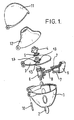
- FIG. 1 A particularly preferred inhaler for use of the medicament combination according to the invention in inhalants is shown in FIG.
- This inhaler (handihaler) for the inhalation of powdered medicines from capsules is characterized by a housing 1, comprising two windows 2, a deck 3, in which there are air inlet openings and which is provided with a sieve 5 fastened via a screen housing 4, one with deck 3 connected inhalation chamber 6, at the one provided with two ground needles 7, against a spring 8 movable pusher 9 is provided, and a hinged via an axis 10 to the housing 1, the deck 3 and a cap 11 mouthpiece 12 and air passage holes 13 for adjusting the Ströumungswiderstands.
- inhalable powders according to the invention are to be filled into capsules (inhalettes) in the sense of the preferred application mentioned above, fillages of from 1 to 30 mg, preferably from 3 to 20 mg, preferably from 5 to 10 mg of inhalable powder per capsule are suitable. These contain, according to the invention, either together or in each case the doses already mentioned above for 1 , 2 and 3 per single dose.
- Propellant gas-containing inhalation aerosols according to the invention may contain 1 , 2 and 3 dissolved in the propellant gas or in dispersed form.
- 1 , 2 and 3 may be contained in separate dosage forms or in a common dosage form, wherein 1 , 2 and 3 either dissolved in each case, respectively dispersed or optionally dissolved only one or two of the components and the other or the other components may be dispersed .
- the propellant gases which can be used for the preparation of the inhalation aerosols according to the invention are known from the prior art.
- Suitable propellant gases are selected from the group consisting of hydrocarbons such as n-propane, n-butane or isobutane and halohydrocarbons such as fluorinated derivatives of methane, ethane, propane, butane, cyclopropane or cyclobutane.
- hydrocarbons such as n-propane, n-butane or isobutane
- halohydrocarbons such as fluorinated derivatives of methane, ethane, propane, butane, cyclopropane or cyclobutane.
- the abovementioned propellant gases may be used alone or in mixtures thereof.
- Particularly preferred propellants are halogenated alkane derivatives selected from TG134a and TG227 and mixtures thereof.
- the propellant-containing inhalation aerosols of the present invention may further contain other ingredients such as co-solvents, stabilizers, surfactants, antioxidants, lubricants, preservatives, and pH adjusters. All of these ingredients are known in the art.
- the propellant-containing inhalable inhalation aerosols according to the invention may contain up to 5% by weight of active ingredient 1 , 2 and / or 3 .
- Aerosols according to the invention contain, for example, 0.002 to 5% by weight, 0.01 to 3% by weight, 0.015 to 2% by weight, 0.1 to 2% by weight, 0.5 to 2% by weight or 0.5 to 1 % By weight of active ingredient 1 , 2 and / or 3 .
- the active substance particles preferably have an average particle size of up to 10 ⁇ m, preferably from 0.1 to 5 ⁇ m, particularly preferably from 1 to 5 ⁇ m.
- the addition of editic acid (EDTA) or one of the known salts thereof, sodium edetate, as a stabilizer or complexing agent can be dispensed with in the present formulation.
- Other embodiments include this compound (s).
- the content based on sodium edetate is below 100 mg / 100 ml, preferably below 50 mg / 100 ml, particularly preferably below 20 mg / 100 ml.
- such inhalable solutions are preferred in which the content of sodium edetate is 0 to 10 mg / 100 ml.
- Co-solvents and / or further auxiliaries can be added to the propellant-free inhalable solutions according to the invention.
- Preferred co-solvents are those which contain hydroxyl groups or other polar groups, for example alcohols - in particular isopropyl alcohol, glycols - in particular propylene glycol, polyethylene glycol, polypropylene glycol, glycol ethers, glycerol, polyoxyethylene alcohols and polyoxyethylene fatty acid esters.
- auxiliaries and additives is meant in this context any physiologically acceptable substance that is not an active ingredient but can be formulated together with the active ingredient (s) in the physiologically suitable solvent in order to improve the qualitative properties of the active ingredient formulation.
- auxiliaries and additives include, for example, surfactants such as soybean lecithin, oleic acid, sorbitan esters such as polysorbates, polyvinylpyrrolidone other stabilizers, complexing agents, antioxidants and / or preservatives that ensure or prolong the useful life of the finished drug formulation, flavorings, vitamins and / or other additives known in the art.
- the additives also include physiologically acceptable salts such as sodium chloride as isotonic agents.
- Preferred excipients include antioxidants, such as ascorbic acid, if not already used for pH adjustment, vitamin A, vitamin E, tocopherols, and similar vitamins or provitamins found in the human organism.
- Preservatives may be used to protect the formulation from contamination by germs. Suitable preservatives are those known in the art, in particular cetylpyridinium chloride, benzalkonium chloride or benzoic acid or benzoates such as sodium benzoate in the concentration known from the prior art.
- the above-mentioned preservatives are preferably contained in concentrations of up to 50 mg / 100 ml, more preferably between 5 and 20 mg / 100 ml.
- preferred formulations contain only benzalkonium chloride and sodium edetate. In another preferred embodiment, sodium edetate is dispensed with.
- propellant-free inhalable solutions are particularly those inhalers that can nebulise a small amount of a liquid formulation in the therapeutically necessary dosage within a few seconds in a therapeutically inhalant suitable aerosol.
- Such a device for propellant-free administration of a metered amount of a liquid medicament for inhalation use for example, in the international patent application WO 91/14468 as well as in the WO 97/12687 (There in particular Figures 6a and 6b) described in detail.
- the nebulizers (devices) described there are also known as Respimat®.
- This nebuliser can advantageously be used to produce the inhalable aerosols according to the invention comprising the active ingredient combination of 1 , 2 and 3 . Due to its cylindrical shape and a handy size of less than 9 to 15 cm in length and 2 to 4 cm in width, this device can always be carried by the patient.
- the nebulizer sprays a defined volume of the drug formulation using high pressures through small nozzles to form inhalable aerosols.
- the hollow piston with valve body corresponds to one in the WO 97/12687 disclosed device. It partially protrudes into the cylinder of the pump housing and is arranged axially displaceably in the cylinder. In particular, reference is made to FIGS. 1-4, in particular FIG. 3, and the associated parts of the description.
- the hollow piston with valve body exerts on its high pressure side at the time of release of the spring a pressure of 5 to 60 Mpa (about 50 to 600 bar), preferably 10 to 60 Mpa (about 100 to 600 bar) on the fluid, the measured drug solution. Volumes of from 10 to 50 microliters are preferred, volumes from 10 to 20 microliters are particularly preferred, and a volume of 15 microliters per stroke is very particularly preferred.
- the valve body is preferably attached to the end of the hollow piston, which faces the nozzle body.
- the nozzle in the nozzle body is preferably microstructured, ie produced by microtechnology.
- Microstructured nozzle bodies are for example in the WO-94/07607 disclosed; This document is hereby incorporated by reference, in particular to the figure 1 and its description disclosed therein.
- the nozzle body consists for example of two firmly interconnected plates made of glass and / or silicon, of which at least one plate has one or more microstructured channels, the nozzle inlet side with the Connect the nozzle outlet side.
- At the nozzle outlet side, at least one round or non-round aperture is 2 to 10 microns deep and 5 to 15 microns wide, with the depth preferably being 4.5 to 6.5 microns and the length being 7 to 9 microns.
- the jet directions of the nozzles in the nozzle body can be parallel to one another or they are inclined towards one another in the direction of the nozzle opening.
- the jet directions may be inclined at an angle of 20 degrees to 160 degrees to each other, preferably an angle of 60 to 150 degrees, particularly preferably 80 to 100 °.
- the nozzle orifices are preferably located at a distance of 10 to 200 microns, more preferably at a distance of 10 to 100 microns, more preferably 30 to 70 microns. Most preferred are 50 microns.
- the jet directions accordingly meet in the vicinity of the nozzle openings.
- the liquid pharmaceutical preparation meets the nozzle body with an inlet pressure of up to 600 bar, preferably 200 to 300 bar, and is atomized via the nozzle openings into an inhalable aerosol.
- the preferred particle or droplet sizes of the aerosol are up to 20 microns, preferably 3 to 10 microns.
- the locking mechanism includes a spring, preferably a cylindrical helical compression spring, as a memory for the mechanical energy.
- the spring acts on the output flange as a jump piece whose movement is determined by the position of a locking member.
- the path of the output flange is precisely limited by an upper and a lower stop.
- the spring is preferably transmitted via a force translating gear, e.g. a fferschubgetriebe, stretched by an external torque that is generated when turning the upper housing part against the spring housing in the lower housing part.
- the upper housing part and the output flange contain a single or multi-start wedge gear.
- the locking member with engaging locking surfaces is arranged annularly around the output flange. It consists for example of a radially elastically deformable ring made of plastic or metal. The ring is arranged in a plane perpendicular to the atomizer axis. After tensioning the spring, the locking surfaces of the locking member push in the path of the output flange and prevent the relaxation of the spring.
- the Sprerrglied is triggered by a button.
- the Shutter button is connected or coupled to the locking member. To trigger the locking mechanism, the shutter button is parallel to the ring plane, and preferably in the atomizer, moved; while the deformable ring is deformed in the ring plane. Constructive details of the locking mechanism are in the WO 97/20590 described.
- the lower housing part is pushed in the axial direction over the spring housing and covers the storage, the drive of the spindle and the reservoir for the fluid.
- the housing upper part When actuating the atomizer, the housing upper part is rotated against the lower housing part, wherein the lower housing part entrains the spring housing.
- the spring is compressed and tensioned via the screw slide, and the lock engages automatically.
- the angle of rotation is preferably an integer fraction of 360 degrees, e.g. 180 degrees.
- the driven part Simultaneously with the tensioning of the spring, the driven part is displaced in the upper housing part by a predetermined path, the hollow piston is withdrawn within the cylinder in the pump housing, whereby a subset of the fluid from the reservoir is sucked into the high-pressure chamber in front of the nozzle.
- the storage container contains the aqueous aerosol preparation according to the invention.
- the sputtering process is initiated by lightly pressing the shutter button.
- the blocking mechanism clears the way for the stripping section.
- the tensioned spring pushes the piston into the cylinder of the pump housing.
- the fluid exits the nozzle of the atomizer in atomized form.
- the components of the atomizer are made of a functionally suitable material.
- the housing of the atomizer and - as far as the function allows - other parts are preferably made of plastic, for example by injection molding. Physiologically harmless materials are used for medical purposes.
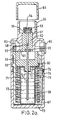
- FIG. 2 a shows a longitudinal section through the atomizer with the spring tensioned
- FIG. 2 b shows a longitudinal section through the atomizer with the spring relaxed.
- the upper housing part (51) contains the pump housing (52), at the end of which the holder (53) for the atomizer nozzle is mounted. In the holder is the nozzle body (54) and a filter (55).
- the hollow piston (57) fastened in the output flange (56) of the locking mechanism projects partially into the cylinder of the pump housing. At its end, the hollow piston carries the valve body (58).
- the hollow piston is sealed by means of the seal (59).
- the stop (60) on which the output flange rests with a relaxed spring.
- the stop (61) On which the output flange rests when the spring is tensioned.
- the locking member (62) slides between the stop (61) and a support (63) in the upper housing part.
- the release button (64) is in communication with the locking member.
- the housing upper part ends in the mouthpiece (65) and is closed with the attachable protective cap (66).
- the spring housing (67) with compression spring (68) is rotatably supported by means of the snap lugs (69) and pivot bearing on the upper housing part.
- the lower housing part (70) is pushed.
- the replaceable reservoir (71) for the fluid (72) to be atomized Within the spring housing is the replaceable reservoir (71) for the fluid (72) to be atomized.
- the reservoir is closed with the stopper (73) through which the hollow piston protrudes into the reservoir and with its end immersed in the fluid (stock of drug solution).
- the spindle (74) for the mechanical counter is mounted in the lateral surface of the spring housing.
- the drive pinion (75) At the end of the spindle, which faces the upper housing part, there is the drive pinion (75). The rider (76) sits on the spindle.
- the nebulizer described above is suitable for nebulizing the aerosol preparations according to the invention to form an aerosol suitable for inhalation.
- the mass applied should be at least 97%, preferably at least 98% of all operations of the inhaler (Hube) of a defined amount with a maximum tolerance of 25%, preferably 20% of this amount correspond.
- the mass applied should be at least 97%, preferably at least 98% of all operations of the inhaler (Hube) of a defined amount with a maximum tolerance of 25%, preferably 20% of this amount correspond.
- the inhaler Hube
- between 5 and 30 mg of formulation per stroke are applied as a defined mass, more preferably between 5 and 20 mg.
- formulation according to the invention may also be aerosolized by means of inhalers other than those described above, for example jet-stream inhalers.
- a further aspect of the present invention relates to pharmaceuticals in the form of propellant-free inhalable solutions or suspensions as described above in conjunction with a device suitable for administering these formulations, preferably in conjunction with the Respimat®.
- the present invention aims at propellant-free inhalable solutions or suspensions characterized by the combination of active substances 1 , 2 and 3 according to the invention in combination with the device known by the name Respimat®.
- the present invention relates to the above-mentioned devices for inhalation, preferably the Respimat®, characterized in that they contain above-described propellant-free inhalable solutions or suspensions according to the invention.
- the propellant-free inhalable solutions or suspensions according to the invention can also be present as concentrates or sterile ready-to-use inhalable solutions or suspensions in addition to the solutions and suspensions provided above for application in the Respimat.
- ready-to-use formulations can be generated from the concentrates by adding isotonic saline solutions.
- Sterile ready-to-use formulations can be applied by means of energy-powered, stand-alone or portable nebulizers which generate inhalable aerosols by means of ultrasound or compressed air according to the Venturi principle or other principles.
- a further aspect of the present invention relates to pharmaceuticals in the form of propellant-free inhalable solutions or suspensions, described above as concentrates or sterile ready-to-use formulations, in combination with a device suitable for administering these solutions, characterized in that the device is is an energy-powered stand-alone or portable nebulizer that generates inhalable aerosols by means of ultrasound or compressed air according to the Venturi principle or other principles.
- suspension aerosol ingredients wt% 1 ' bromide 0,039 Fluticasone propionate 0.3 salmeterol 0.033 isopropyl 0.1 TG 227 ad 100
Landscapes
- Health & Medical Sciences (AREA)
- Chemical & Material Sciences (AREA)
- Medicinal Chemistry (AREA)
- Pharmacology & Pharmacy (AREA)
- Life Sciences & Earth Sciences (AREA)
- Animal Behavior & Ethology (AREA)
- General Health & Medical Sciences (AREA)
- Public Health (AREA)
- Veterinary Medicine (AREA)
- Epidemiology (AREA)
- Pulmonology (AREA)
- Bioinformatics & Cheminformatics (AREA)
- Organic Chemistry (AREA)
- Engineering & Computer Science (AREA)
- Chemical Kinetics & Catalysis (AREA)
- General Chemical & Material Sciences (AREA)
- Nuclear Medicine, Radiotherapy & Molecular Imaging (AREA)
- Emergency Medicine (AREA)
- Pain & Pain Management (AREA)
- Pharmaceuticals Containing Other Organic And Inorganic Compounds (AREA)
- Medicines That Contain Protein Lipid Enzymes And Other Medicines (AREA)
- Acyclic And Carbocyclic Compounds In Medicinal Compositions (AREA)
- Medicinal Preparation (AREA)
- Steroid Compounds (AREA)
- Nitrogen Condensed Heterocyclic Rings (AREA)
Abstract
Description
- Die vorliegende Erfindung betrifft neuartige Arzneimittelkompositionen auf der Basis eines neuen Anticholinergikums, Corticosteroiden und Betamimetika, Verfahren zu deren Herstellung sowie deren Verwendung bei der Therapie von Atemwegserkrankungen.
- Die vorliegende Erfindung betrifft neuartige Arzneimittelkompositionen für die Inhalation auf der Basis eines neuen Anticholirtergikums, Corticosteroiden und Betamimetika, Verfahren zu deren Herstellung sowie deren Verwendung bei der Therapie von Atemwegserkrankungen.
- Überraschenderweise kann ein unerwartet vorteilhafter therapeutischer Effekt, insbesondere ein synergistischer Effekt bei der Behandlung von entzündlichen oder obstruktiven Atemwegserkrankungen gezeigt werden, wenn ein neues Anticholinergikum gemeinsam mit einem oder mehreren Corticosteroiden und gemeinsam mit ein oder mehreren Betamimetika zur Anwendung gelangen. Aufgrund dieses synergistischen Effekts sind die erfindungsgemäßen Arzneimittelkombinationen in geringerer Dosierung einsetzbar, als dies bei der sonst üblichen Monotherapie der Einzelverbindungen der Fall ist. Dadurch lassen sich unerwünschte Nebenwirkungen, wie sie beispielsweise bei der Applikation von Corticosteroiden und Betamimetika auftreten können, vermindern.
- Die vorstehend genannten Effekte können sowohl bei gleichzeitiger Applikation innerhalb einer einzigen Wirkstoffformulierung als auch bei sukzessiver Applikation der drei Wirkstoffkomponenten in getrennten Formulierungen beobachtet werden. Erfindungsgemäß bevorzugt ist die gleichzeitige Applikation der Wirkstofifbestandteile in einer einzigen Formulierung. Die erfindungsgemäßen Arzneimittel werden erfindungsgemäß bevorzugt inhalativ appliziert.
- Im Rahmen der vorliegenden Erfindung gelangen als Anticholinergikum die Salze der Formel 1

- X - ein einfach negativ geladenes Anion, vorzugsweise ein Anion ausgewählt aus der Gruppe bestehend aus Chlorid, Bromid, Iodid, Sulfat, Phosphat, Methansulfonat, Nitrat, Maleat, Acetat, Citrat, Fumarat, Tartrat, Oxalat, Succinat, Benzoat und p-Toluolsulfonat bedeutet zur Anwendung.
- Bevorzugt gelangen die Salze der Formel 1 zur Anwendung, worin
- X - ein einfach negativ geladenes Anion ausgewählt aus der Gruppe Chlorid, Bromid, 4-Toluolsulfonat und Methansulfonat, bevorzugt Bromid, bedeutet.
- Besonders bevorzugt gelangen die Salze der Formel 1 zur Anwendung, worin
- X - ein einfach negativ geladenes Anion ausgewählt aus der Gruppe Chlorid, Bromid und Methansulfonat, bevorzugt Bromid, bedeutet.
- Erfindungsgemäß besonders bevorzugt ist dasjenige Salz der Formel 1 , in dem X - für Bromid steht.
- Die Salze der Formel 1 sind aus der Internationalen Patentanmeldung
WO 02/32899 - Im Rahmen der vorliegenden Patentanmeldung ist eine explizite Bezugnahme auf das pharmakologisch aktive Kation der Formel
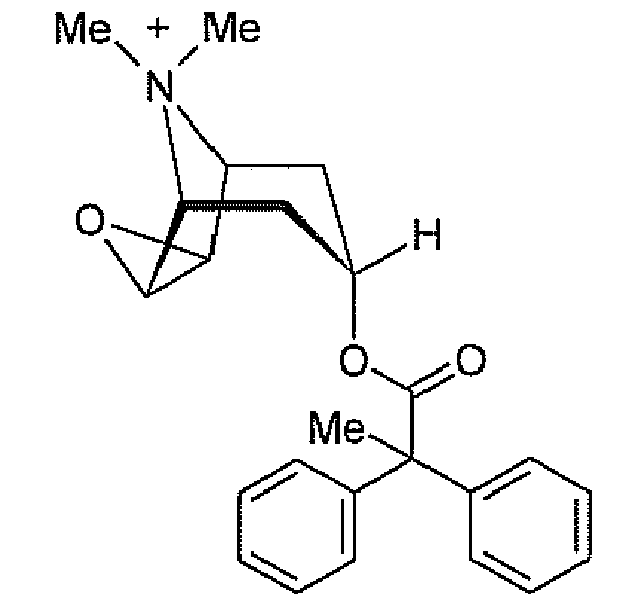
- Im Rahmen der vorliegenden Erfindung werden unter Corticosteroiden (im Folgenden 2 ) Verbindungen verstanden, die ausgewählt sind aus der Gruppe bestehend aus Flunisolide, Beclomethasone, Triamcinolone, Budesonid, Fluticasone, Mometasone, Ciclesonide, Rofleponide, GW 215864, KSR 592, ST-126 und Dexametasone. Bevorzugt ist die Verbindung 2 ausgewählt aus der Gruppe bestehend aus Flunisolide, Beclomethasone, Triamcinolone, Budesonid, Fluticasone, Mometasone, Ciclesonide und Dexametasone. Besonders bevorzugt ist die Verbindung 2 ausgewählt aus Budesonid, Fluticasone, Mometasone und Ciclesonide. Gegebenfalls wid im Rahmen der vorliegenden Patentanmeldung statt der Bezeichnung Corticosteroide 2 auch nur die Bezeichnung Steroide 2 verwendet.
- Eine Bezugnahme auf Steroide 2 schließt im Rahmen der vorliegenden Erfindung eine Bezugnahme auf Salze oder Derivate 2' , die von den Steroiden gebildet werden können, mit ein. Als mögliche Salze oder Derivate 2' werden beispielsweise genannt: Natriumsalze, Sulfobenzoate, Phosphate, Isonicotinate, Acetate, Propionate, Dihydrogenphosphate, Palmitate, Pivalate oder Furoate. Gegebenenfalls können die Verbindungen der Formel 2 auch in Form ihrer Hydrate vorliegen.
- Als Betamimetika 3 kommen erfindungsgemäß Bambuterol, Bitolterol, Carbuterol, Clenbuterol, Fenoterof, Formoterol, Hexoprenalin, Ibuterol, Pirbuterol, Procaterol, Reproterol, Salmeterol, Sulfonterol, Terbutalin, Tolubuterol, 4-Hydroxy-7-[2-{[2-{[3-(2-phenylethoxy)propyl]sulfonyl}ethyl]-amino}ethyl]-2(3H)-benzothiazolon, 1-(2-Fluoro-4-hydroxyphenyl)-2-[4-(1-benzimidazolyl)-2-methyl-2-butylamino]ethanol, 1-[3-(4-Methoxybenzyl-amino)-4-hydroxyphenyl]-2-[4-(1-benzimidazolyl)-2-methyl-2-butylamino]ethanol, 1-[2H-5-Hydroxy-3-oxo-4H-1,4-benzoxazin-8-yl]-2-[3-(4-N,N-dimethylaminophenyl)-2-methyl-2-propylamino]ethanol, 1-[2H-5-Hydroxy-3-oxo-4H-1,4-benzoxazin-8-yl]-2-[3-(4-methoxyphenyl)-2-methyl-2-propylamino]ethanol, 1-[2 H-5-Hydroxy-8-oxa-4H-1,4-benzoxazin-8-yl]-2-[3-(4-n-butyloxyphenyl)-2-methyl-2-propylamino]ethanol 1-[2H-5-Hydroxy-3-oxo-4H-1,4-benzoxazin-8-yl]-2-{4-[3-(4-methoxyphenyl)-1,2,4-triazol-8-yl]-2-methyl-2-butylamino}ethanol, 5-Hydroxy-8-(1-hydroxy-2-isopropylaminobutyl)-2H-1,4-benzoxazin-3-(4H)-on, 1-(4-Amino-3-chloro-5-trifluormethylphenyl)-2-tert-butylamino)ethanol oder 1-(4-Ethoxycarbonylamino-3-cyano-5-fluorophenyl)-2-(tert-butylamino)ethanol in Betracht.
- Erfindungsgemäß bevorzugt werden als Betamimetika 3 in der erfindungsgemäßen Wirkstoffkombination eingesetzt Formoterol, Salmeterol,
- 4-Hydroxy-7-[2-{[2-{[3-(2-phenylethoxy)propyl]sulfonyl}ethyl]-amino}ethyl]-2(3H)-benzothiazolan,
- 1-(2-Fluoro-4-hydroxyphenyl)-2-[4-(1-benzimidazolyl)-2-methyl-2-butylamino]ethanol ,
- 1-[3-(4-Methoxybenzyl-amino)-4-hydroxyphenyl]-2-[4-(1-benzimidazolyl)-2-methyl-2-butylamino]ethanol,
- 1-[2H-5-Hydroxy-3-oxo-4H-1,4-benzoxazin-8-yl]-2-[3-(4-N,N-dimethylaminophenyl)-2-methyl-2-propylamino]ethanol,
- 1-[2H-5-Hydroxy-3-oxo-4H-1,4-benzoxazin-8-yl]-2-[3-(4-methoxyphenyl)-2-methyl-2-propylamino]ethanol,
- 1-[2H-5-Hydroxy-3-oxo-4H-1,4-benzoxazin-8-yl]-2-[8-{4-n-butyloxyphenyl)-2-methyl-2-propylamino]ethanol oder
- 1-[2H-5-Hydroxy-3-oxo-4H-1,4-benzoxazin-8-yl]-2-{4-[3-(4-methoxyphenyl)-1,2,4-triazol-3-yl]-2-methyf-2-butylamino}ethanol.
- Als Betamimetika 3 kommen erfindungsgemäß besonders bevorzugt Salmeterolsalze oder Formoterolsalze in Betracht. Eine Bezugnahme auf den Begriff Betamimetika 3 schließt eine Bezugnahme auf die jeweiligen Enantiomere oder deren Gemische mit ein. Beispielsweise schließt eine Bezugnahme auf die erfindunsgemäß besonders bevorzugten Verbindungen 3 , die Salze des Salmeterols und Formoterols, dementsprechend die jeweiligen enantiomeren Salze des R-Salmeterols, S-Salmeterols, R,R-Formoterols, S,S-Formoterols, R,S-Formoterofs, S,R-Formoterols sowie deren Gemische mit ein, wobei den enantiomeren Salzen des R-Salmeterols und R,R-Formoterols eine besondere Bedeutung zukommt. Die Verbindungen 3 können erfindungsgemäß ferner in Form ihrer Hydrate oder Solvate vorliegend.
- Im Rahmen der vorliegenden Erfindung ist mit der Bezugnahme auf Verbindungen 3 eine Bezugnahme auf physiologisch verträgliche Säureadditionssalze zu verstehen. Als physiologisch verträgliche Säureadditionssalze der Betamimetika 3 werden erfindungsgemäß pharmazeutisch verträgliche Salze verstanden, die ausgewählt aus den Salzen der Salzsäure, Bromwasserstoffsäure, Schwefelsäure, Phosphorsäure, Methansulfionsäure, Essigsäure, Fumarsäure, Bernsteinsäure, Milchsäure, Zitronensäure, Weinsäure, 1-Hydroxy-2-naphthalincarbonsäure, Zimtsäure, 4-Phenylzimtsäure, Diflunisal oder Maleinsäure sind. Gegebenenfalls können zur Herstellung der Salze 3 auch Mischungen der vorgenannten Säuren eingesetzt werden.
Erfindungsgemäß bevorzugt sind die Salze der Betamimetika 3 ausgewählt aus der Gruppe bestehend aus Hydrochlorid, Hydrobromid, Sulfat, Phosphat, Fumarat Methansulfonat, 4-Phenylcinnamat, Diflunisal und Xinafoat. Besonders bevorzugt sind die Salze von 3 im Falle des Salmeterols ausgewählt aus denjenigen Salzen, die eine Löslichkeit in Wasser von von 0,1 mg/ml oder weniger, bevorzugt 0,05 mg/ml oder weniger, besonders bevorzugt 0,04 mg/ml oder weniger aufweisen. Indiesem Zusammenhang seien als besonders bevorzugte Salze des Almeterols das Xinafoat, das 4-Phenylcinnamat und das Diflunisal genannt. Besonders bevorzugte Salze 3 des Salmeterols weisen in Wasser eine Löslichkeit von 0,035 mg/ml oder weniger auf, wie beispielsweise das 4-Phenylcinnamat oder das Diflunisal. Besonders bevorzugt sind die Salze von 3 im Falle des Formoterols ausgewählt aus Hydrochlorid, Sulfat und Fumarat, von denen das Hydrochlorid und Fumarat besonders bevorzugt sind. Erfindungsgemäß von herausragender Bedeutung ist Formoterolfumarat. - Erfolgt im Rahmen der vorliegenden Erfindung eine Bezugnahme auf nicht in der Salzform vorliegende Betamimetika, so wird dies durch eine Bezugnahme auf Verbindungen 3' erkennbar. Beispielsweise wird unter den erfindungsgemäß bevorzugten, nicht in der Salzform vorliegenden Betamimetika 3' die freie Base des Formoterols oder des Salmeterols verstanden, wohingegen es sich bei den erfindungsgemäß besonders bevorzugten Verbindungen 3 beispielsweise um Salmeterolxinafoat, Salmeterol-4-phenylcinnamat oder Formoterolfumarat handelt.
- Im Rahmen der vorliegenden Erfindung werden die Betamimetika 3 gegebenenfalls auch bezeichnet als Sympathomimetika oder Beta-2-Rezeptor-Agonisten (β2-Agonisten). All diese Bezeichnungen sind im Rahmen der vorliegenden Erfindung als äquivalent anzusehen.
- Die Applikation der erfindungsgemäßen Arzneimittelkombinationen aus 1 , 2 und 3 erfolgt erfindungsgemäß auf inhalativem Wege. Hierbei können erfindungsgemäß bevorzugt geeignete Inhaltionspulver, die in geeignete Kapseln (Inhaletten) abgefüllt mittels entsprechender Pulverinhalatoren appliziert werden, zum Einsatz kommen.
- Ein Aspekt der vorliegenden Erfindung betrifft dementsprechend ein Arzneimittel, welches eine Kombination aus 1 , 2 und 3 enthält.
- Ein weiterer Aspekt der vorliegenden Erfindung betrifft ein Arzneimittel, welches ein oder mehrere Salze 1, ein oder mehrere Verbindungen 2 und ein oder mehrere Verbindungen 3 , gegebenfalls in Form ihrer Solvate oder Hydrate enthält. Hierbei können die Wirkstoffe entweder gemeinsam in einer einzigen Darreichungsform, in zwei oder in drei getrennten Darreichungsformen enthalten sein. Erfindungsgemäß bevorzugt sind Arzneimittel, die die Wirkstoffe 1 , 2 und 3 in einer einzigen Darreichungsform enthalten.
- Ein weiterer Aspekt der vorliegenden Erfindung betrifft ein Arzneimittel, welches neben therapeutisch wirksamen Mengen von 1 , 2 und 3 einen pharmazeutisch verträglichen Trägerstoff enthält. Ein weitere Aspekt der vorliegenden Erfindung betrifft ein Arzneimittel, welches neben therapeutisch wirksamen Mengen von 1 , 2 und 3 keinen pharmazeutisch verträglichen Trägerstoff enthält.
- Die vorliegende Erfindung betrifft ferner die Verwendung von 1, 2 und 3 zur Herstellung eines therapeutisch wirksame Mengen von 1, 2 und 3 enthaltenden Arzneimittels zur Behandlung von entzündlichen und/oder obstruktiven Atemwegserkrankungen, insbesondere von Asthma und/oder chronisch obstruktiven Lungenerkrankungen (COPD) durch simultane oder sukzessive Applikation. Ferner können die erfindungsgemäßen Arzneimittelkombinationen zur Herstellung eines Arzneimittels zur Behandlung von beispielsweise cystischer Fibrose oder allergischer Alveolitis (Farmers Lung) durch simultane oder sukzessive Applikation Verwendung finden. Eine Anwendung der erfindungsgemäßen Wirkstoffkombinationen erfolgt nur dann nicht, wenn eine Behandlung mit einem der pharmazeutisch aktiven Wirkstoffe kontraindiziert ist.
- Die vorliegende Erfindung zielt ferner auf die simultane oder sukzessive Verwendung therapeutisch wirksamer Dosen der Kombination vorstehender Arzneimittel 1 , 2 und 3 zur Behandlung von entzündlichen oder obstruktiven Atemwegserkrankungen, insbesondere von Asthma und/oder chronisch obstruktiven Lungenerkrankungen (COPD), sofern eine Behandlung mit Steroiden oder Betamimetika aus therapeutischer Sicht nicht kontraindiziert ist, durch simultane oder sukzessive Applikation. Die vorliegende Erfindung zielt ferner auf die simultane oder sukzessive Verwendung therapeutisch wirksamer Dosen der Kombination vorstehender Arzneimittel 1, 2 und 3 zur Behandlung von beispielsweise cystischer Fibrose oder allergischer Alveolitis (Farmers Lung).
- In den erfindungsgemäßen Wirkstoffkombinationen aus 1 , 2 und 3 können die Bestandteile 1 , 2 und 3 in Form ihrer Enantiomere, Gemische der Enantiomere oder in Form der Racemate enthalten sein. Beispielsweise enthalten die erfindungsgemäßen Arzneimittel die Wirkstoffe 1 , 2 und 3 in einer solchen Menge, daß eine einmalige Applikation einer Dosierung der Wirkstoffkombination 1 , 2 und 3 von 1 bis 10000µg, bevorzugt von 10 bis 2000µg entspricht.
Die Verhältnisse, in denen die Wirkstoffe 1 , 2 und 3 in die erfindungsgemäßen Wirkstoffkombinationen eingesetzt werden können, sind variabel. Die Wirkstoffe 1 , 2 und 3 können gegebenfalls in Form ihrer Solvate oder Hydrate vorliegen. Je nach Wahl der Verbindungen 1 , 2 und 3 variieren die im Rahmen der vorliegenden Erfindung einsetzbaren Gewichtsverhältnisse aufgrund des unterschiedlichen Molekulargewichts der verschiedenen Verbindungen sowie aufgrund ihrer unterschiedlichen Wirkstärke. In der Regel können die erfindungsgemäßen Arzneimittelkombinationen die Verbindungen 1' und 2 in Gewichtsverhältnissen enthalten, die in einem Bereich von 1:250 bis 250:1, bevorzugt von 1:150 bis 150:1, liegen. Bei den besonders bevorzugten Arzneimittelkompositionen, die neben 1' eine Verbindung ausgewählt aus der Gruppe bestehend aus Budesonid, Fluticasone, Mometasone, ST-126 und Ciclesonide als Steroid 2 enthalten, liegen die Gewichtsverhältnisse von 1' zu 2 besonders bevorzugt in einem Bereich von etwa 1:40 bis 40:1, ferner bevorzugt von 1:30 bis 30:1. - Beispielsweise und ohne den Umfang der Erfindung darauf zu beschränken, können bevorzugte erfindungsgemäße Kombinationen aus 1 und 2 das Kation 1' und eines der vorstehend genannten bevorzugt zur Anwendung gelangenden Steroide 2 in den folgenden Gewichtsverhältnissen enthalten: 1:20; 1:19; 1:18; 1:17; 1:16; 1:15; 1:14; 1:13; 1:12; 1:11; 1:10; 1:9; 1:8; 1:7; 1:6; 1:5; 1:4; 1:3; 1:2; 1:1; 2:1; 3:1; 4:1; 5:1; 6:1; 7:1; 8:1; 9:1; 10:1; 11:1; 12:1; 13:1; 14:1; 15:1; 16:1; 17:1; 18:1; 19:1; 20:1.
- Die Anwendung der erfindungsgemäßen Arzneimittel enthaltend die Kombinationen aus 1 und 2 erfolgt üblicherweise so, dass 1' und 2 gemeinsam in Dosierungen von 5 bis 500µpbevorzugt von 10 bis 2000µg, besonders bevorzugt von 15 bis 1000µg, ferner bevorzugt von 20 bis 800µg, erfindungsgemäß bevorzugt von 30 bis 700µg, bevorzugt von 40 bis 600µg, bevorzugt von 50 bis 500µg, bevorzugt von 40 bis 500µg, besonders bevorzugt von 50 bis 400µg pro Einmalgabe enthalten sind. Beispielsweise enthalten erfindungsgemäße Kombinationen aus 1 und 2 eine solche Menge an 1' und Steroid 2 , dass die Gesamtdosierung pro Einmalgabe etwa 35µg, 45µg, 50µg, 55µg, 60µg, 65µg, 70µg, 75µg, 80µg, 85µg, 90µg, 95µg, 100µg, 105µg, 110µg, 115µg, 120µg, 125µg, 130µg, 135µg,140 µg, 145µg, 150µg, 155µg, 160µg, 165µg, 170µg, 175µg, 180µg, 185µg, 190µg, 195µg, 200µg, 205µg, 210µg, 215µg, 220µg, 225µg, 230µg, 235µg, 240µg, 245µg, 250µg, 255µg, 260µg, 265µg, 270µg, 275µg, 280µg, 285µg, 290µg, 295µg, 300µg, 305µg, 310µg, 315µg, 320µg, 325µg, 330µg, 335µg, 340µg, 345µg, 350µg, 355µg, 360µg, 365µg, 370µg, 375µg, 380µg, 385µg, 390µg, 395µg, 400µg, 405µg, 410µg, 415µg, 420µg, 425µg, 430µg, 435µg, 440µg, 445µg, 450µg, 455µg, 460µg, 465µg, 470µg, 475µg, 480µg, 485µg, 490µg, 495µg, 500µg, 505µg, 510µg, 515µg, 520µg, 525µg, 530µg, 535µg, 540µg, 545µg, 550µg, 555µg, 560µg, 565µg, 570µg, 575µg, 580µg, 585µg, 590µg, 595µg, 600µg, 605µg, 610µg oder ähnliches beträgt. Für den Fachmann ist ersichtlich, dass vorstehend genannte Dosierungsvorschläge pro Einmalgabe nicht als auf die explizit angegebenen Zahlenwerte beschränkt anzusehen ist. Schwankungen um etwa ± 2,5µg, insbesondere Schwankungen im Dezimalbereich sind, wie für den Fachmann ersichtlich, ebenfalls umfasst. Bei diesen Dosierungsbereichen können die Wirkstoffe 1' und 2 in den vorhergehend beschriebenen Gewichtsverhältnissen enthalten sein.
- Beispielsweise und ohne den Umfang der Erfindung darauf zu beschränken, können die erfindungsgemäßen Kombinationen aus 1 und 2 eine solche Menge an Kation 1' und Steroid 2 enthalten, dass pro Einmalgabe 16,5µg 1' und 25µg 2 , 16,5µg 1 ' und 25µg 2, 16,5µg 1' und 50µg 2, 16,5µg 1' und 100µg 2, 16,5µg 1' und 150µg 2, 16,5µg 1' und 200µg 2, 16,5µg 1' und 250µg 2 , 33,0µg 1 ' und 25µg 2 , 33,0µg 1' und 50µg 2, 33,0µg 1' und 100µg 2, 33,0µg 1' und 150µg 2 , 33,0µg 1' und 200µg 2, 33,0µg 1' und 250µg 2, 49,5µg 1' und 25µg 2, 49,5µg 1' und 50µg 2, 49,5µg 1' und 100µg 2 , 49,5µg 1' und 150µg 2, 49,5µg 1' und 200µg 2 , 49,5µg 1' und 250µg 2 , 82,6µg 1' und 25µg 2, 82,6µg 1 ' und 50µg 2 , 82,6µg 1' und 100µg 2 , 82,6µg 1' und 150µg 2 , 82,6µg 1' und 200µg 2, 82,6µg 1' und 250µg 2 , 165,1µg 1' und 25µg 2 , 165,1µg 1' und 50µg 2, 165,1µg 1 ' und 50µg 2 , 165,1µg 1' und 100µg 2 , 165,1µg 1' und 150µg 2, 165,1µg 1' und 200µg 2 , 185,1µg 1' und 250µg 2 , 206,4µg 1' und 25µg 2 , 206.4µg 1' und 50µg 2 , 206,4µg 1' und 100µg 2 , 206,4µg 1' und 150µg 2 , 206,4µg 1' und 200µg 2, 206,4µg 1' und 250µg 2, 412,8µg 1' und 25µg 2, 412,8µg 1' und 50µg 2, 412,8µg 1' und 100µg 2, 412,8µg 1' und 150µg 2, 412,8µg 1' und 200µg 2, 412,8µg 1' und 250µg 2 enthalten sind.
- Wird als eine erfindungsgemäß bevorzugte Kombination aus 1 und 2 die Wirkstoffkombination verwendet, in der als Salz 1 das Bromid verwendet wird und in der 2 für eines der vorstehend als bevorzugt offenbarten Steroide steht, entsprechen die vorstehen beispielhaft genannten pro Einmalgabe applizierten Wirkstoffmengen von 1' und 2 den nachfolgenden pro Einmalgabe applizierten Wirkstoffmengen von 1' und 2 den nachfolgenden pro Einmalgabe applizierten Mengen an 1 und 2: 20µg 1 und 25µg 2, 20µg 1 und 50µg 2, 20µg 1 und 100µg 2, 20µg 1 und 150µg 2, 20µg 1 und 200µg 2, 20µg 1 und 250µg 2, 40µg 1 und 25µg 2, 40µg 1 und 25µg 2, 40µg 1 und 50µg 2, 40µg 1 und 100µg 2, 40µg 1 und 150µg 2, 40µg 1 und 200µg 2, 40µg 1 und 250µg 2 , 60µg 1 und 25µg 2, 60µg 1 und 50µg 2, 60µg 1 und 100µg 2, 60µg 1 und 150µg 2, 60µg 1 und 200µg 2, 60µg 1 und 250µg 2, 100µg 1 und 25µg 2, 100µg 1 und 50µg 2, 100µg 1 und 100µg 2, 100µg 1 und 150µg 2 , 100µg 1 und 200µg 2, 100µg 1 und 250µg 2 , 200µg 1 und 25µg 2 , 200µg 1 und 50µg 2 , 200µg 1 und 100µg 2, 200µg 1 und 150µg 2, 200µg 1 und 200µg 2, 200µg 1 und 250µg 2 , 250µg 1 und 25µg 2 , 250µg 1 und 50µg 2, 250µg 1 und 100µg 2, 250µg 1 und 150µg 2 , 250µg 1 und 200µg 2, 250µg 1 und 250µg 2, 500µg 1 und 25µg 2, 500µg 1 und 50µg 2, 500µg 1 und 100µg 2, 500µg 1 und 150µg 2 , 500µg 1 und 200µg 2 , 500µg 1 und 250µg 2 , enthalten sind.
- Gleichzeitig kann das Verhältnis von 1 zu 3 1:300 bis 30:1, bevorzugt von 1:230 bis 20:1, besonders bevorzugt von 1:150 bis 10:1, ferner bevorzugt von 1:50 bis 5:1, besonders bevorzugt von 1:35 bis 2:1 liegen.
- Die erfindungsgemäßen Wirkstoffkombinationen können 1' und 3' im Falle von beispielsweise Formoterol in Gewichtsverhältnissen enthalten, die beispielsweise in einem Bereich von etwa 1:10 bis 300:1, bevorzugt 1:5 bis 200:1, bevorzugt 1:3 bis 150:1, besonders bevorzugt von 1:2 bis 100:1 liegen.
- Beispielsweise und ohne den Umfang der Erfindung darauf zu beschränken, können bevorzugte erfindungsgemäße Kombinationen aus 1 und 3 das pharmakologisch aktive Kation 1' und Formoterol 3' in den folgenden Gewichtsverhältnissen enthalten: 1:5, 1:4, 1:3, 1:2, 1:1, 2:1, 3:1, 4:1, 5:1, 6:1, 7:1, 8:1, 9:1, 10:1, 11:1, 12:1, 13:1, 14:1, 15:1, 16:1, 17:1, 18:1, 19:1, 20:1, 21:1, 22:1, 23:1, 24:1, 25:1, 26:1, 27:1, 28:1, 29:1, 30:1, 31:1, 32:1, 33:1, 34:1, 35:1, 36:1, 37:1, 38:1, 39:1, 40:1, 41:1, 42:1, 43:1, 44:1, 45:1, 46:1, 47:1, 48:1, 49:1, 50:1, 51:1, 52:1, 53:1, 54:1, 55:1 , 56:1, 57:1, 58:1, 59:1, 60:1, 61:1, 62:1, 63:1, 64:1, 65:1, 66:1, 67:1, 68:1, 69:1, 70:1, 71:1, 72:1, 73:1, 74:1, 75:1, 76:1, 77:1, 78:1, 79:1, 80:1, 81:1, 82:1, 83:1, 84:1, 85:1, 86:1, 87:1, 88:1, 89:1, 90:1, 91:1, 92:1, 93:1, 94:1, 95:1, 96:1, 97:1, 98:1, 99:1, 100:1.
- Die Anwendung der erfindungsgemäßen Arzneimittel enthaltend die Kombinationen aus 1 und 3 erfolgt üblicherweise so, daß das pharmakologisch aktive Kation 1' und Formoterol 3' gemeinsam in Dosierungen von 5 bis 5000µg, bevorzugt von 10 bis 2000µg, besonders bevorzugt von 15 bis 1000µg, ferner bevorzugt von 20 bis 800µg, erfindungsgemäß bevorzugt von 30 bis 600µg, bevorzugt von 40 bis 500µg enthalten sind.
- Beispielsweise enthalten erfindungsgemäße Kombinationen aus 1 und 3 eine solche Menge an Kation 1' und Formoterol 3' , daß die Gesamtdosierung pro Einmalgabe etwa 10µg, 15µg, 20µg, 25µg, 30µg, 35µg, 45µg, 50µg, 55µg, 60µg, 65µg, 70µg, 75µg, 80µg, 85µg, 90µg, 95µg, 100µg, 105µg, 110µg, 115µg, 120µg, 125µg, 130µg, 135µg, 140µg, 145µg, 150µg, 155µg, 160µg, 165µg, 170µg, 175µg, 180µg, 185µg, 190µg, 195µg, 200µg, 205µg, 210µg, 215µg, 220µg, 225µg, 230µg, 235µg, 240µg, 245µg, 250µg, 255µg, 260µg, 265µg, 270µg, 275µg 280µg, 285µg, 290µg, 295µg, 300µg, 305µg, 310µg, 315µg, 320µg, 325µg, 330µg, 335µg, 340µg, 345µg, 350µg, 355µg, 360µg, 365µg, 370µg, 375µg, 380µg, 385µg, 390µg, 395µg, 400µg, 405µg, 410µg, 415µg, 420µg, 425µg, 430µg, 435µg, 440µg, 445µg, 450µg, 455µg, 460µg, 465µg, 470µg, 475µg, 480µg, 485µg, 490µg, 495µg, 500µg, 505µg, 510µg, 515µg, 520µg, 525µg, 530µg, 535µg, 540µg, 545µg, 550µg, 555µg, 560µg, 565µg, 570µg, 575µg, 580µg, 585µg, 590µg, 595µg, 600µg, oder ähnliches beträgt. Für den Fachmann ist ersichtlich, daß vorstehend genannte Dosierungsvorschläge pro Einmalgabe nicht als auf die explizit angegebenen Zahlenwerte beschränkt anzusehen ist. Schwankungen um etwa ± 2,5 µg, insbesondere Schwankungen im Dezimalbereich sind, wie für den Fachmann ersichtlich, ebenfalls umfaßt. Bei diesen Dosierungsbereichen sind die Wirkstoffe 1' und 3' in den vorhergehend beschriebenen Gewichtsverhältnissen enthalten.
- Beispielsweise und ohne den Umfang der Erfindung darauf zu beschränken, können die erfindungsgemäßen Kombinationen aus 1 und 3 eine solche Menge an Kation 1' und Formoterol 3' enthalten, daß pro Einmalgabe beispielsweise 8,3µg 1' und 2,5µg 3' , 8,3µg 1' und 4,9µg 3', 8,3µg 1' und 9,8µg 3' , 8,3µg 1 ' und 14,7µg 3' , 8,3µg 1' und 19,6µg 3' , 8,3µg 1' und 24,4µg 3' , 16,5µg 1' und 2,5µg 3', 16,5µg 1' und 4,9µg 3' , 16,5µg 1' und 9,8µg 3' , 16,5µg 1' und 14,7µg 3' , 16,5µg 1' und 19,6µg 3' , 16,5µg 1' und 24,4µg 3' , 33,µg 1' und 2,5µg 3' , 33,0µg 1' und 4,9µg 3' , 33,0µg 1' und 9,8µg 3' , 33,0µg 1' und 14,7µg 3' , 33,0µg 1' und 19,6µg 3' , 33,0µg 1' und 24,4µg 3' , 49,5µg 1' und 2,5µg 3' , 49,5µg 1' und 4,9µg 3' , 49,5µg 1' und 9,8µg 3' , 49,5µg 1' und 14,7µg 3' , 49,5µg 1 ' und 19,6µg 3' , 49,5µg 1' und 24,4µg 3' , 82.6µg 1' und 2,5µg 3' , 82,6µg 1' und 4,9µg 3' , 82,6µg 1' und 9,8µg 3' , 82,6µg 1' und 14,7µg 3' , 82,6µg 1' und 19,6µg 3', 82,6µg 1' und 24,4µg 3' , 165,1µg 1' und 2,5µg 3' , 165,1µg 1' und 4,9µg 3' , 165,1µg 1' und 9,8µg 3' , 165,1µg 1' und 14,7µg 3' , 165,1µg 1' und 19,6µg 3' , 165,1µg 1' und 24,4µg 3', 206,4µg 1' und 2,5µg 3', 206,4µg 1' und 4,9µg 3', 206,4µg 1' und 9,8µg 3' , 206,4µg 1' und 14,7µg 3', 206,4µg 1' und 19,6µg 3', 206,4µg 1' und 24,4µg 3', 412,8µg 1' und 2,5µg 3', 412,8µg 1' und 4,9µg 3', 412,8µg 1' und 9,8µg 3', 412,8µg 1' und 14,7µg 3', 412,8µg 1' und 19,6µg 3', 412,8µg 1' und 24,4µg 3' enthalten sind.
- Wird als eine erfindungsgemäß bevorzugte Kombination aus 1 und 3 die Wirkstoffkombination verwendet, in der das Salz 1 das Bromid darstellt und in der 3 für Formoterolfumarat steht, entsprechen die vorstehend beispielhaft genannten pro Einmalgabe applizierten Wirkstoffmengen von 1' und 3' den nachfolgenden pro Einmalgabe applizierten Mengen an 1 und 3 : 10µg 1 und 2,9µg 3 , 10µg 1 und 5,7µg 3, 10µg 1 und 11,5µg 3 , 10µg 1 und 17,2µg 3 , 10µg 1 und 22,9µg 3 , 10µg 1 und 28,5µg 3 , 20µg 1 und 2,9µg 3 , 20µg 1 und 5,7µg 3 , 20µg 1 und 11,5µg 3 , 20µg 1 und 17,2µg 3 , 20µg 1 und 22,9µg 3 , 20µg 1 und 28,5µg 3 , 40µg 1 und 2,9µg 3 , 40µg 1 und 5,7µg 3 , 40µg 1 und 11,5µg 3 , 40µg 1 und 17,2µg 3 , 40µg 1 und 22,9µg 3 , 40µg 1 und 28,5µg 3 , 60µg 1 und 2,9µg 3 , 60µg 1 und 5,7µg 3 , 60µg 1 und 11,5µg 3 , 60µg 1 und 17,2µg 3 , 60µg 1 und 22,9µg 3, 60µg 1 und 28,5µg 3 , 100µg 1 und 2,9µg 3 , 100µg 1 und 5,7µg 3 , 100µg 1 und 11,5µg 3 , 100µg 1 und 17,2µg 3 , 100µg 1 und 22,9µg 3, 100µg 1 und 28,5µg 3, 200µg 1 und 2,9µg 3, 200µg 1 und 5,7µg 3, 200µg 1 und 11,5µg 3, 200µg 1 und 17,2µg 3, 200µg 1 und 22,9µg 3, 200µg 1 und 28,5µg 3, 250µg 1 und 2,9µg 3 , 250µg 1 und 5,7µg 3 , 250µg 1 und 11,5µg 3 , 250µg 1 und 17,2µg 3, 250µg 1 und 22,9µg 3 , 250µg 1 und 28,5µg 3, 500µg 1 und 2,9µg 3 , 500µg 1 und 5,7µg 3, 500µg 1 und 11,5µg 3, 500µg 1 und 17,2µg 3, 500µg 1 und 22,9µg 3, 500µg 1 und 28,5mg 3.
- Wird als eine erfindungsgemäß bevorzugte Kombination aus 1 und 3 , die Wirkstoffkombination verwendet, in der 3 für Formoterolfumaratdihydrat steht und das Salz 1 das Bromid darstellt, entsprechen die vorstehend beispielhaft genannten pro Einmalgabe applizierten Wirkstoffmengen von 1' und 3' den nachfolgenden pro Einmalgabe applizierten Mengen an 1 und 3: 10µg 1 und 3µg 3, 10µg 1 und 6µg 3, 10µg 1 und 12µg 3, 10µg 1 und 18µg 3 , 10µg 1 und 24µg 3 , 10µg 1 und 30µg 3 , 20µg 1 und 3µg 3 , 20µg 1 und 6µg 3 , 20µg 1 und 12µg 3 , 20µg 1 und 18µg 3 , 20µg 1 und 24µg 3 , 20µg 1 und 30µg 3 , 40µg 1 und 3µg 3, 40µg 1 und 6µg 3, 40µg 1 und 12µg 3, 40µg 1 und 18µg 3, 40µg 1 und 24µg 3, 40µg 1 und 30µg 3 , 60µg 1 und 3µg 3 , 60µg 1 und 6µg 3 , 60µg 1 und 12µg 3 , 60µg 1 und 18µg 3 , 60µg 1 und 24µg 3 , 60µg 1 und 30µg 3, 100µg 1 und 3µg 3 , 100µg 1 und 6µg 3 , 100µg 1 und 12µg 3 , 100µg 1 und 18µg 3 , 100µg 1 und 24µg 3 , 100µg 1 und 30µg 3 , 200µg 1 und 3µg 3 , 200µg 1 und 6µg 3 , 200µg 1 und 12µg 3, 200µg 1 und 18µg 3 , 200µg 1 und 24µg 3 , 200µg 1 und 30µg 3 , 250µg 1 und 3µg 3 , 250µg 1 und 6µg 3 , 250µg 1 und 12µg 3 , 250µg 1 und 18µg 3 , 250µg 1 und 24µg 3 , 250µg 1 und 30µg 3 , 500µg 1 und 3µg 3 , 500µg 1 und 6µg 3 , 500µg 1 und 12µg 3 , 500µg 1 und 18µg 3 , 500µg 1 und 24µg 3 , 500µg 1 und 30µg 3 .
- Die erfindungsgemäßen Wirkstoffkombinationen können 1' und 3' im Falle von beispielsweise Salmeterol in Gewichtsverhältnissen enthalten, die beispielsweise in einem Bereich von etwa 1:30 bis 400:1, bevorzugt 1:25 bis 200:1, bevorzugt 1:20 bis 100:1, besonders bevorzugt von 1:15 bis 50:1 liegen.
- Beispielsweise und ohne den Umfang der Erfindung darauf zu beschränken, können bevorzugte erfindungsgemäße Kombinationen aus 1 und 3 das Kation 1' und Salmeterol 3' in den folgenden Gewichtsverhältnissen enthalten: 1:15, 1:14, 1:13, 1:12, 1:11, 1:10, 1:9, 1:8, 1:7, 1:6, 1:5, 1:4, 1:3, 1:2, 1:1, 2:1, 3:1, 4:1, 5:1, 6:1, 7:1, 8:1, 9:1, 10:1, 11:1, 12:1, 13:1, 14:1, 15:1, 16:1, 17:1, 18:1, 19:1, 20:1, 21:1, 22:1, 23:1, 24:1, 25:1, 26:1, 27:1, 28:1, 29:1, 30:1, 31:1, 32:1, 33:1, 34:1. 35:1.
- Die Anwendung der erfindungsgemäßen Arzneimittel enthaltend die Kombinationen aus 1 und 3 erfolgt üblicherweise so, daß das Kation 1' und Salmeterol 3' gemeinsam in Dosierungen von 5 bis 5000µg, bevorzugt von 10 bis 2000µg, besonders bevorzugt von 15 bis 1000µg, ferner bevorzugt von 20 bis 800µg, erfindungsgemäß bevorzugt von 30 bis 750µg, bevorzugt von 40 bis 700µg enthalten sind.
- Beispielsweise enthalten erfindungsgemäße Kombinationen aus 1 und 3 eine solche Menge an 1' und Salmeterol 3' , daß die Gesamtdosierung pro Einmalgabe etwa 15µg, 20µg, 25µg, 30µg, 35µg, 45µg, 50µg, 55µg, 60µg, 65µg, 70µg, 75µg, 80µg, 85µg, 90µg, 95µg, 100µg, 105µg, 110µg, 115µg, 120µg, 125µg, 130µg, 135µg, 140µg, 145µg, 150µg, 155µg, 160µg, 165µg, 170µg, 175µg, 180µg, 185µg, 190µg, 195µg, 200µg, 205µg, 210µg, 215µg, 220µg, 225µg, 230µg, 235µg, 240µg, 245µg, 250µg, 255µg, 260µg, 265µg, 270µg, 275µg, 280µg, 285µg, 290µg, 295µg, 300µg, 305µg, 310µg, 315µg, 320µg, 325µg, 330µg, 335µg, 340µg, 345µg, 350µg, 355µg, 360µg, 365µg, 370µg, 375µg, 380µg, 385µg, 390µg, 395µg, 400µg, 405µg, 410µg. 415µg, 420µg, 425µg, 430µg, 435µg, 440µg, 445µg, 450µg, 455µg, 460µg, 465µg, 470µg, 475µg, 480µg, 485µg, 490µg, 495µg, 500µg, 505µg, 510µg, 515µg, 520µg, 525µg, 530µg, 535µg, 540µg, 545µg, 550µg, 555µg, 560µg, 565µg, 570µg, 575µg, 580µg, 585µg, 59µg, 595µg, 600µg, 605µg, 610µg, 615µg, 620µg, 625µg, 630µg, 635µg, 640µg, 645µg, 650µg, 655µg, 660µg, 665µg, 670µg, 675µg, 680µg, 685µg, 690µg, 695µg, 700µg oder ähnliches beträgt. Für den Fachmann ist ersichtlich, daß vorstehend genannte Dosierungsvorschläge pro Einmalgabe nicht als auf die explizit angegebenen Zahlenwerte beschränkt anzusehen ist. Schwankungen um etwa ± 2,5 µg, insbesondere Schwankungen im Dezimalbereich sind, wie für den Fachmann ersichtlich, ebenfalls umfaßt. Bei diesen Dosierungsbereichen sind die Wirkstoffe 1' und 3' in den vorhergehend beschriebenen Gewichtsverhältnissen enthalten.
- Beispielsweise und ohne den Umfang der Erfindung darauf zu beschränken, können die erfindungsgemäßen Kombinationen aus 1 und 3 eine solche Menge an Kation 1' und Salmeterol 3' enthalten, daß pro Einmalgabe beispielsweise 8,3µg 1' und 12,5µg 3', 8,3µg 1' und 25µg 3', 8,3µg 1' und 50µg 3', 8,3µg 1' und 75µg 3', 8,3µg 1' und 100µg 3', 8,3µg 1' und 200µg 3', 16,5µg 1' und 12,5µg 3' , 16,5µg 1' und 25µg 3' , 16,5µg 1' und 50µg 3', 16,5µg 1' und 75µg 3', 16,5µg 1' und 100µg 3', 16,5µg 1' und 200µg 3', 33,0µg 1' und 12,5µg 3', 33,0µg 1' und 25µg 3', 33,0µg 1' und 50µg 3', 33,0µg 1 ' und 75µg 3', 33,0µg 1' und 100µg 3', 33,0µg 1' und 200µg 3', 49,5µg 1' und 12,5µg 3', 49,5µg 1' und 25µg 3', 49,5µg 1' und 50µg 3', 49,5µg 1' und 75µg 3', 49,5µg 1' und 100µg 3', 49,5µg 1' und 200µg 3', 82,6µg 1 ' und 12,5µg 3 ', 82,6µg 1' und 25µg 3', 82,6µg 1' und 50µg 3', 82,6µg 1' und 75µg 3', 82,6µg 1' und 100µg 3' , 82,6µg 1' und 200µg 3' , 165,1µg 1' und 12,5µg 3' , 165,1µg 1' und 25µg 3' , 165,1µg 1' und 50µg 3' , 165,1µg 1' und 75µg 3' , 165,1µg 1' und 100µg 3' , 165,1µg 1' und 200µg 3' , 206,4µg 1' und 12,5µg 3' , 206,4µg 1' und 25µg 3' , 206,4µg 1' und 50µg 3' , 206,4µg 1' und 75µg 3' , 206,4µg 1' und 100µg 3' , 206,4µg 1' und 200µg 3' , 412,8µg 1' und 12,5µg 3' , 412,8µg 1' und 25µg 3' , 412,8µg 1' und 50µg 3' , 412,8µg 1' und 75µg 3' , 412,8µg 1' und 100µg 3' , 412,8µg 1' und 200µg 3' enthalten sind.
- Wird als eine erfindungsgemäß bevorzugte Kombination aus 1 und 3 die Wirkstoffkombination verwendet, in der als Salz 1 das Bromid verwendet wird und in der 3 für Salmeterolxinafoat steht, entsprechen die vorstehend beispielhaft genannten pro Einmalgabe applizierten Wirkstoffmengen von 1' und 3' den nachfolgenden pro Einmalgabe applizierten Mengen an 1 und 3 : 10µg 1 und 18,2µg 3 , 10µg 1 und 36,3µg 3 , 10µg 1 und 72,6µg 3, 10µg 1 und 108,9µg 3 , 10µg 1 und 145,2µg 3 , 10µg 1 und 290,4µg 3 , 20µg 1 und 18,2µg 3 , 20µg 1 und 36,3µg 3 , 20µg 1 und 72,6µg 3 , 20µg 1 und 108,9µg 3 , 20µg 1 und 145,2µg 3 , 20µg 1 und 290,4µg 3, 40µg 1 und 18,2µg 3 , 40µg 1 und 38,3µg 3 , 40µg 1 und 72,6µg 3 , 40µg 1 und 108,9µg 3, 40µg 1 und 145,2µg 3 , 40µg 1 und 290,4µg 3 , 60µg 1 und 18,2µg 3 , 60µg 1 und 36,3µg 3 , 60µg 1 und 72,6µg 3 , 60µg 1 und 108,9µg 3 , 60µg 1 und 145,2µg 3 , 60µg 1 und 290,4µg 3, 100µg 1 und 18,2µg 3 , 100µg 1 und 36,3µg 3 , 100µg 1 und 72,6µg 3, 100µg 1 und 108,9µg 3 , 100µg 1 und 145,2µg 3 , 100µg 1 und 290,4µg 3, 200µg 1 und 18,2µg 3 , 200µg 1 und 36,3µg 3 , 200µg 1 und 72,6µg 3 , 200µg 1 und 108,9µg 3, 200µg 1 und 145,2µg 3 , 200µg 1 und 290,4µg 3, 250µg 1 und 18,2µg 3 , 280µg 1 und 36,3µg 3 , 250µg 1 und 72,6µg 3 , 250µg 1 und 108,9µg 3, 250µg 1 und 145,2µg 3 , 250µg 1 und 290,4µg 3 , 500µg 1 und 18,2µg 3 , 500µg 1 und 36,3µg 3 , 500µg 1 und 72,6µg 3 , 500µg 1 und 108,9µg 3, 500µg 1 und 145,2µg 3 , 500µg 1 und 290,4µg 3.
- In analoger Art und Weise sind die pro Einmalgabe applizierten Wirkstoffmengen der erfindungsgemäßen Arzneimittelkombinationen berechenbar, wenn statt des Salmeterolxinafoats die als ebenfalls erfindungsgemäß bevorzugt zum Einsatz gelangenden Verbindungen 3 Salmeterol-4-Phenylzimtsäuresalz (4-Phenylcinnamat) und Salmeterol-5-(2,4-difluorphenyl)salicylsäuresalz (5-(2,4-difluorphenyl)salicylat; Diflunisal) verwendet werden.
- Die Applikation der erfindungsgemäßen Wirkstoffkombinationen aus 1 , 2 und 3 erfolgt bevorzugt auf inhalativem Wege. Hierzu müssen die Bestandteile 1 , 2 und 3 in inhalierbaren Darreichungsformen bereitgestellt werden. Als inhalierbare Darreichungsformen kommen erfindungsgemäß Inhalationspulver, treibgashaltige Dosieraerosole oder treibgasfreie Inhalationslösungen in Betracht. Erfindungsgemäße Inhalationspulver enthaltend die Wirkstoffkombination aus 1, 2 und 3 können allein aus den genannten Wirkstoffen oder aus einem Gemisch der genannten Wirkstoffe mit physiologisch verträglichen Hilfsstoffen bestehen. Gegebenenfalls wird im Rahmen der vorliegenden Erfindung statt des Begriffs Hilfsstoffs auch der Begriff Trägerstoff verwendet. Im Rahmen der vorliegenden Erfindung sind von dem Begriff treibgasfreie Inhalationslösungen auch Konzentrate oder sterile, gebrauchsfertige Inhalationslösungen umfaßt. Die erfindungsgemäßen Darreichungsformen können die Wirkstoffkombination aus 1 , 2 und 3 entweder gemeinsam in einer, in zwei oder in drei getrennten Darreichungsformen enthalten. Diese im Rahmen der vorliegenden Erfindung einsetzbaren Darreichungsformen werden im nachfolgenden Teil der Beschreibung detailliert beschrieben.
- Die erfindungsgemäßen Inhaltionspulver können 1 , 2 und 3 entweder allein oder im Gemisch mit geeigneten physiologisch unbedenklichen Hilfsstoffen enthalten.
- Sind die Wirkstoffe 1 , 2 und 3 im Gemisch mit physiologisch unbedenklichen Hilfsstoffen enthalten, können zur Darstellung dieser erfindungsgemäßen inhalationspulver die folgenden physiologisch unbedenklichen Hilfsstoffe zur Anwendung gelangen: Monosaccharide (z.B. Glucose oder Arabinose), Disaccharide (z.B. Lactose, Saccharose, Maltose), Oligo- und Polysaccharide (z.B. Dextrane), Polyalkohole (z.B. Sorbit, Mannit, Xylit), Salze (z.B. Natriumchlorid, Calciumcarbonat) oder Mischungen dieser Hilfsstoffe. Bevorzugt gelangen Mono- oder Disaccharide zur Anwendung, wobei die Verwendung von Lactose oder Glucose, insbesondere, aber nicht ausschließlich in Form ihrer Hydrate, bevorzugt ist. Als besonders bevorzugt im Sinne der Erfindung gelangt Lactose, höchst bevorzugt Lactosemonohydrat als Hilfsstoff zur Anwendung.
- Die Hilfsstoffe weisen im Rahmen der erfindungsgemäßen Inhaltionspulver eine maximale mittlere Teilchengröße von bis zu 250µm, bevorzugt zwischen 10 und 150µm, besonders bevorzugt zwischen 15 und 80µm auf. Gegebenenfalls kann es sinnvoll erscheinen, den vorstehend genannten Hilfststoffen feinere Hilfsstofffraktionen mit einer mittleren Teilchengröße von 1 bis 9µm beizumischen. Letztgenannte feinere Hilfsstoffe sind ebenfalls ausgewählt aus der vorstehend genannten Gruppe an einsetzbaren Hilfsstoffen. Schließlich wird zur Herstellung der erfindungsgemäßen Inhaltionspulver mikronisierter Wirkstoff 1 , 2 und 3 , vorzugsweise mit einer mittleren Teilchengröße von 0,5 bis 10µm, besonders bevorzugt von 1 bis 5µm, der Hilfsstoffmischung beigemischt. Verfahren zur Herstellung der erfindungsgemäßen Inhaltionspulver durch Mahlen und Mikronisieren sowie durch abschließendes Mischen der Bestandteile sind aus dem Stand der Technik bekannt. Die erfindungsgemäßen lnhaltionspulver können entweder in Form einer einzigen Pulvermischung, die sowohl 1 als auch 2 und 3 enthält oder in Form von separaten Inhalationspulvern, die lediglich 1 , 2 beziehungsweise 3 enthalten bereitgestellt und appliziert werden.
- Die erfindungsgemäßen Inhalationspulver können mittels aus dem Stand der Technik bekannten Inhalatoren appliziert werden.
Erfindungsgemäße Inhalationspulver, die neben 1 , 2 und 3 ferner einen oder mehrere physiologisch unbedenkliche Hilfsstoffe enthalten, können beispielsweise mittels Inhalatoren appliziert werden, die eine einzelne Dosis aus einem Vorrat mittels einer Meßkammer, wie er in derUS 4570630A beschrieben wird, oder über andere apparative Vorrichtungen, wie sie in derDE 36 25 685 A beschrieben werden, dosieren. Vorzugsweise werden die erfindungsgemäßen Inhalationspulver, die neben 1 , 2 und 3 physiologisch unbedenkliche Hilfsstoffe enthalten, allerdings in Kapseln abgefüllt (zu sogenannten Inhaletten), die in Inhalatoren wie beispielsweise in derWO 94/28958 - Ein zur Anwendung der erfindungsgemäßen Arzneimittelkombination in Inhaletten besonders bevorzugter Inhalator ist Figur 1 zu entnehmen.
Dieser Inhalator (Handihaler) für die Inhalation pulverförmiger Arzneimittel aus Kapseln ist gekennzeichnet durch ein Gehäuse 1, enthaltend zwei Fenster 2, ein Deck 3, in dem sich Lufteinlaßöffnungen befinden und welches mit einem über ein Siebgehäuse 4 befestigten Sieb 5 versehen ist, eine mit Deck 3 verbundene Inhalationskammer 6, an der ein mit zwei geschliffenen Nadeln 7 versehener, gegen eine Feder 8 beweglicher Drücker 9 vorgesehen ist, sowie ein über eine Achse 10 klappbar mit dem Gehäuse 1, dem Deck 3 und einer Kappe 11 verbundenes Mundstück 12 sowie Luftdurchlaßlöcher 13 zur Einstellung des Ströumungswiderstands. - Sollen die erfindungsgemäßen Inhalationspulver im Sinne der vorstehend gennannten bevorzugten Anwendung in Kapseln (Inhaletten) abgefüllt werden, bieten sich Füllmengen von 1 bis 30mg, bevorzugt von 3 bis 20mg, bevorzugt 5 bis 10 mg Inhalationspulver pro Kapsel an. Diese enthalten erfindungsgemäß entweder gemeinsam oder jeweils die bereits vorstehend für 1, 2 und 3 genannten Dosierungen pro Einmalgabe.
- Erfindungsgemäße treibgashaltige Inhaltionsaerosole können 1, 2 und 3 im Treibgas gelöst oder in dispergierter Form enthalten. Hierbei können 1, 2 und 3 in getrennten Darreichungsformen oder in einer gemeinsamen Darreichungsform enthalten sein, wobei 1 , 2 und 3 entweder jeweils gelöst, jeweils dispergiert oder gegebenenfalls nur eine oder zwei der Komponenten gelöst und die andere beziehungsweise die anderen Komponenten dispergiert enthalten sein können.
Die zur Herstellung der erfindungsgemäßen Inhaltionsaerosole einsetzbaren Treibgase sind aus dem Stand der Technik bekannt. Geeignete Treibgase sind ausgewählt aus der Gruppe bestehend aus Kohlenwasserstoffen wie n-Propan, n-Butan oder Isobutan und Halogenkohlenwasserstoffen wie fluorierten Derivaten des Methans, Ethans, Propans, Butans, Cyclopropans oder Cyclobutans. Die vorstehend genannten Treibgase können dabei allein oder in Mischungen derselben zur Verwendnung kommen. Besonders bevorzugte Treibgase sind halogenierte Alkanderivate ausgewählt aus TG134a und TG227 und Mischungen derselben. - Die erfindungsgemäßem treibgashaltigen Inhalationsaerosole können ferner weitere Bestandteile wie Kosolventien, Stabilisatoren, oberflächenaktive Mittel (surfactants), Antioxidantien, Schmiermittel, Konservierungsmittel sowie Mittel zur Einstellung des pH-Werts enthalten. All diese Bestandteile sind im Stand der Technik bekannt.
- Die erfindungsgemäßen treibgashaltigen Inhaltionsaerosole können bis zu 5 Gew-% an Wirkstoff 1 , 2 und/oder 3 enthalten. Erfindungsgemäße Aerosole enthalten beispielsweise 0,002 bis 5 Gew-%, 0,01 bis 3 Gew-%, 0,015 bis 2 Gew-%, 0,1 bis 2 Gew-%, 0,5 bis 2 Gew-% oder 0,5 bis 1 Gew-% an Wirkstoff 1 , 2 und/oder 3 .
- Liegen die Wirkstoffe 1, 2 und/oder 3 in dispergierter Form vor, weisen die Wirkstoffteilchen bevorzugt eine mittlere Teilchengröße von bis zu 10 µm, bevorzugt von 0,1 bis 5 µm, besonders bevorzugt von 1 bis 5 µm auf.
- Die vorstehend genannten erfindungsgemäßen treibgashaltigen Inhaltionaerosole können mittels im Stand der Technik bekannten Inhalatoren (MDIs = metered dose inhalers) appliziert werden. Dementsprechend betrifft ein weiterer Aspekt der vorliegenden Erfindung Arzneimittel in Form von wie vorstehend beschriebenen treibgashaltigen Aerosolen in Verbindung mit einem oder mehreren zur Verabreichung dieser Aerosole geeigneten Inhalatoren. Ferner betrifft die vorliegende Erfindung Inhalatoren, dadurch gekennzeichnet, daß sie vorstehend beschriebene erfindungsgemäße treibgashaltige Aerosole enthalten.
Die vorliegende Erfindung betrifft ferner Kartuschen, die ausgestattet mit einem geeigneten Ventil in einem geeigneten Inhalator zur Anwendung gelangen können und die eine der vorstehend genannten erfindungsgemäßen treibgashaltigen lnhalationsaerosole enthalten. Geeignete Kartuschen und Verfahren zur Abfüllung dieser Kartuschen mit den erfindungsgemäßen treibgashaltigen Inhaltionsaerosolen sind aus dem Stand der Technik bekannt. - C) Treibgasfreie Inhaltionslösungen oder Suspensionen enthaltend die erfindungsgemäßen Wirkstoffkombinationen aus 1 , 2 und 3:
- Besonders bevorzugt erfolgt die Applikation der erfindungsgemäßen Wirkstoffkombination in Form von treibgasfreien Inhalationslösungen und lnhaltionssuspensionen. Als Lösungsmittel kommen hierzu wässrige oder alkoholische, bevorzugt ethanolische Lösungen in Betracht. Das Lösungsmittel kann ausschließlich Wasser sein oder es ist ein Gemisch aus Wasser und Ethanol. Der relative Anteil an Ethanol gegenüber Wasser ist nicht begrenzt, bevorzugt liegt die maximale Grenze jedoch bei bis 70 Volumenprozent, insbesondere bei bis zu 60 Volumenprozent und besonders bevorzugt bei bis zu 30 Volumenprozent. Die restlichen Volumenprozente werden von Wasser aufgefüllt. Die 1 , 2 und 3 , getrennt oder gemeinsam enthaltenden Lösungen oder Suspensionen werden mit geeigneten Säuren auf einen pH-Wert von 2 bis 7, bevorzugt von 2 bis 5 eingestellt. Zur Einstellung dieses pH-Werts können Säuren ausgewählt aus anorganischen oder organischen Säuren Verendung finden. Beispiele für besonders geeignete anorganische Säuren sind Salzsäure, Bromwasserstoffsäure, Salpetersäure, Schwefelsäure und/oder Phosphorsäure. Beispiele für besonders geeignete organische Säuren sind: Ascorbinsäure, Zitronensäure, Äpfelsäure, Weinsäure, Maleinsäure, Bernsteinsäure, Fumarsäure, Essigsäure, Ameisensäure und/oder Propionsäure und andere. Bevorzugte anorganische Säuren sind Salzsäure, Schwefelsäure. Es können auch die Säuren verwendet werden, die bereits mit einem der Wirkstoffe ein Säureadditionssalz bilden. Unter den organischen Säuren sind Ascorbinsäure, Fumarsäure und Zitronensäure bevorzugt. Gegebenenfalls können auch Gemische der genannten Säuren eingesetzt werden, insbesondere in Fällen von Säuren, die neben ihren Säuerungseigenschaften auch andere Eigenschaften, z.B. als Geschmackstoffe, Antioxidantien oder Komplexbildner besitzen, wie beispielsweise Zitronensäure oder Ascorbinsäure. Erfindungsgemäß besonders bevorzugt wird Salzsäure zur Einstellung des pH-Werts verwendet.
- Erfindungsgemäß kann in der vorliegenden Formulierung auf den Zusatz von Editinsäure (EDTA) oder einem der bekannten Salze davon, Natriumedetat, als Stabilisator oder Komplexbildner verzichtet werden.
Andere Ausführungsformen beinhalten diese Verbindung(en).
In einer solchen bevorzugten Ausführungsform liegt der Gehalt bezogen auf Natriumedetat unter 100 mg /100ml, bevorzugt unter 50 mg/100ml, besonders bevorzugt unter 20 mg/100ml. Generell sind solche Inhaltionslösungen bevorzugt, in denen der Gehalt an Natriumedetat bei 0 bis 10mg/100ml liegt. - Den erfindungsgemäßen treibgasfreien Inhaltionslösungen können Co-Solventien und/oder weitere Hilfsstoffe zugesetzt werden.
Bevorzugte Co-Solventien sind solche, die Hydroxylgruppen oder andere polare Gruppen enthalten, beispielsweise Alkohole - insbesondere Isopropylalkohol, Glykole - insbesondere Propylenglykol, Polyethylenglykol, Polypropylenglykol, Glykolether, Glycerol, Polyoxyethylenalkohole und Polyoxyethylen-Fettsäureester.
Unter Hilfs- und Zusatzstoffen wird in diesem Zusammenhang jeder physiologisch verträgliche Stoff verstanden, der kein Wirkstoff ist, aber zusammen mit dem (den) Wirkstoff(en) in dem physiologisch geeigneten Lösungsmittel formuliert werden kann, um die qualitativen Eigenschaften der Wirkstoffformulierung zu verbessern. Bevorzugt entfalten diese Stoffe keine oder im Kontext mit der angestrebten Therapie keine nennenswerte oder zumindest keine unerwünschte pharmakologische Wirkung. Zu den Hilfs- und Zusatzstoffen zählen z.B. oberflächenaktive Stoffe, wie z.B. Sojalecithin, Ölsäure, Sorbitanester, wie Polysorbate, Polyvinylpyrrolidon sonstige Stabilisatoren, Komplexbildner, Antioxidantien und/oder Konservierungsstoffe, die die Verwendungsdauer der fertigen Arzneimittelformulierung gewährleisten oder verlängern, Geschmackstoffe, Vitamine und/oder sonstige dem Stand der Technik bekannte Zusatzstoffe. Zu den Zusatzstoffen zählen auch physiologisch unbedenkliche Salze wie beispielsweise Natriumchlorid als Isotonantien. - Zu den bevorzugten Hilfsstoffen zählen Antioxidantien, wie beispielsweise Ascorbinsäure, sofern nicht bereits für die Einstellung des pH-Werts verwendet, Vitamin A, Vitamin E, Tocopherole und ähnliche im menschlichen Organismus vorkommende Vitamine oder Provitamine.
Konservierungsstoffe können eingesetzt werden, um die Formulierung vor Kontamination mit Keimen zu schützen. Als Konservierungsstoffe eignen sich die dem Stand der Technik bekannten, insbesondere Cetylpyridiniumchlorid, Benzalkoniumchlorid oder Benzoesäure bzw. Benzoate wie Natriumbenzoat in der aus dem Stand der Technik bekannten Konzentration. Die vorstehend genannten Konservierungsstoffe sind vorzugsweise in Konzentrationen von bis zu 50mg/100ml, besondersbevorzugt zwischen 5 und 20 mg/100ml enthalten. - Bevorzugte Formulierungen enthalten außer dem Lösungsmittel Wasser und der Wirkstoffkombination aus 1 , 2 und 3 nur noch Benzalkoniumchlorid und Natriumedetat. In einer anderen bevorzugten Ausführungsform wird auf Natriumedetat verzichtet.
- Zur Applikation der erfindungsgemäßen treibgasfreien Inhaltionslösungen sind besonders solche Inhalatoren, die eine kleine Menge einer flüssigen Formulierung in der therapeutisch notwendigen Dosierung binnen weniger Sekunden in ein therapeutisch-inhalativ geeignetes Aerosol vernebeln können. Im Rahmen der vorliegenden Erfindung sind solche Vernebler bevorzugt, bei denen bereits eine Menge von weniger als 100 µL, bevorzugt weniger als 50 µL, besonders bevorzugt zwischen 20 und 30 µL Wirkstofflösung mit bevorzugt einem Hub zu einem Aerosol mit einer durchschnittlichen Teilchengröße von weniger als 20 µm, bevorzugt weniger als 10 µm, so vernebelt werden können, daß der inhalierbare Anteil des Aerosols bereits der therapeutisch wirksamen Menge entspricht.
- Eine derartige Vorrichtung zur treibgasfreien Verabreichung einer dosierten Menge eines flüssigen Arzneimittels zur inhalativen Anwendung, wird beispielsweise in der internationalen Patentanmeldung
WO 91/14468 WO 97/12687 - Dieser Vernebler (Respimat®) kann vorteilhaft zur Erzeugung der erfindungsgemäßen inhalierbaren Aerosole enthaltend die Wirkstoffkombination aus 1 , 2 und 3 eingesetzt werden. Aufgrund seiner zylinderähnlichen Form und einer handlichen Größe von weniger als 9 bis 15 cm in der Länge und 2 bis 4 cm in der Breite kann dieses Device jederzeit vom Patienten mitgeführt werden. Der Vernebler versprüht ein definiertes Volumen der Arzneimittelformulierung unter Anwendung hoher Drücke durch kleine Düsen, so daß inhalierbare Aerosole entstehen.
- Im wesentlichen besteht der bevorzugte Zerstäuber aus einem Gehäuseoberteil, einem Pumpengehäuse, einer Düse, einem Sperrspannwerk, einem Federgehäuse, einer Feder und einem Vorratsbehälter, gekennzeichnet durch
- ein Pumpengehäuse, das im Gehäuseoberteil befestigt ist, und das an seinem einen Ende einen Düsenkörper mit der Düse bzw. Düsenanordnung trägt,
- einen Hohlkolben mit Ventilkörper,
- einen Abtriebsflansch, in dem der Hohlkolben befestigt ist, und der sich im Gehäuseoberteil befindet,
- ein Sperrspannwerk, das sich im Gehäuseoberteil befindet,
- ein Federgehäuse mit der darin befindlichen Feder, das am Gehäuseoberteil mittels eines Drehlagers drehbar gelagert ist,
- ein Gehäuseunterteil, das auf das Federgehäuse in axialer Richtung aufgesteckt ist.
- Der Hohlkolben mit Ventilkörper entspricht einer in der
WO 97/12687 - Der Ventilkörper ist bevorzugt an dem Ende des Hohlkolbens angebracht, das dem Düsenkörper zugewandt ist.
- Die Düse im Düsenkörper ist bevorzugt mikrostrukturiert, d.h. durch Mikrotechnik hergestellt. Mikrostrukturierte Düsenkörper sind beispielsweise in der
WO-94/07607
Der Düsenkörper besteht z.B. aus zwei fest miteinander verbundenen Platten aus Glas und/oder Silizium, von denen wenigstens eine Platte einen oder mehrere mikrostrukturierte Kanäle aufweist, die die Düseneinlaßseite mit der Düsenauslaßseite verbinden. Auf der Düsenauslaßseite ist mindestens eine runde oder nicht-runde Öffnung von 2 bis 10 Mikrometer Tiefe und 5 bis 15 Mikrometern Breite, wobei die Tiefe bevorzugt bei 4, 5 bis 6,5 Mikrometern und die Länge bei 7 bis 9 Mikrometern beträgt.
Im Fall von mehreren Düsenöffnungen, bevorzugt sind zwei, können die Strahlrichtungen der Düsen im Düsenkörper parallel zueinander verlaufen oder sie sind in Richtung Düsenöffnung gegeneinander geneigt. Bei einem Düsenkörper mit mindestens zwei Düsenöffnungen auf der Auslaßseite können die Strahlrichtungen mit einem Winkel von 20 Grad bis 160 Grad gegeneinander geneigt sein, bevorzugt wird ein Winkel von 60 bis 150 Grad, insbesondere bevorzugt 80 bis 100°.
Die Düsenöffnungen sind bevorzugt in einer Entfernung von 10 bis 200 Mikrometern angeordnet, stärker bevorzugt in einer Entfernung von 10 bis 100 Mikrometer, besonders bevorzugt 30 bis 70 Mikrometer. Am stärksten bevorzugt sind 50 Mikrometer.
Die Strahlrichtungen treffen sich dementsprechend in der Umgebung der Düsenöffnungen. - Die flüssige Arzneimittelzubereitung trifft mit einem Eingangsdruck von bis zu 600 bar, bevorzugt 200 bis 300 bar auf den Düsenkörper und wird über die Düsenöffnungen in ein inhalierbares Aerosol zerstäubt. Die bevorzugten Teilchen- bzw. Tröpfchengrößen des Aerosols liegen bei bis zu 20 Mikrometern, bevorzugt 3 bis 10 Mikrometern.
- Das Sperrspannwerk enthält eine Feder, bevorzugt eine zylindrische schraubenförmige Druckfeder, als Speicher für die mechanische Energie. Die Feder wirkt auf den Abtriebsflansch als Sprungstück, dessen Bewegung durch die Position eines Sperrglieds bestimmt wird. Der Weg des Abtriebsflansches wird durch einen oberen und einen unteren Anschlag präzise begrenzt. Die Feder wird bevorzugt über ein kraftübersetzendes Getriebe, z.B. ein Schraubschubgetriebe, durch ein äußeres Drehmoment gespannt, das beim Drehen des Gehäuseoberteils gegen das Federgehäuse im Gehäuseunterteil erzeugt wird. In diesem Fall enthalten das Gehäuseoberteil und der Abtriebsflansch ein ein- oder mehrgängiges Keilgetriebe.
- Das Sperrglied mit einrückenden Sperrflächen ist ringförmig um den Abtriebsflansch angeordnet. Es besteht z.B. aus einem in sich radial elastisch verformbaren Ring aus Kunststoff oder aus Metall. Der Ring ist in einer Ebene senkrecht zur Zerstäuberachse angeordnet. Nach dem Spannen der Feder schieben sich die Sperrflächen des Sperrgliedes in den Weg des Abtriebsflansches und verhindern das Entspannen der Feder. Das Sprerrglied wird mittels einer Taste ausgelöst. Die Auslösetaste ist mit dem Sperrglied verbunden oder gekoppelt. Zum Auslösen des Sperrspannwerkes wird die Auslösetaste parallel zur Ringebene, und zwar bevorzugt in den Zerstäuber hinein, verschoben; dabei wird der verformbare Ring in der Ringebene verformt. Konstruktive Details des Sperrspannwerkes sind in der
WO 97/20590 - Das Gehäuseunterteil wird in axialer Richtung über das Federgehäuse geschoben und verdeckt die Lagerung, den Antrieb der Spindel und den Vorratsbehälter für das Fluid.
- Beim Betätigen des Zerstäubers wird das Gehäuseobereil gegen das Gehäuseunterteil gedreht, wobei das Gehäuseunterteil das Federgehäuse mitnimmt. Dabei wird die Feder über das Schraubschubgetriebe zusammengedrückt und gespannt, und das Sperrwerk rastet selbsttätig ein. Der Drehwinkel ist bevorzugt ein ganzzahliger Bruchteil von 360 Grad, z.B. 180 Grad. Gleichzeitig mit dem Spannen der Feder wird das Abtriebsteil im Gehäuseoberteil um einen vorgegebenen Weg verschoben, der Hohlkolben wird innerhalb des Zylinders im Pumpengehäuse zurückgezogen, wodurch eine Teilmenge des Fluids aus dem Vorratsbehälter in den Hochdruckraum vor der Düse eingesaugt wird.
- In den Zerstäuber können gegebenenfalls nacheinander mehrere das zu zerstäubende Fluid enthaltende austauschbare Vorratsbehälter eingeschoben und benutzt werden. Der Vorratsbehälter enthält die erfindungsgemäße wässerige Aerosolzubereitung.
- Der Zerstäubungsvorgang wird durch leichtes Eindrücken der Auslösetaste eingeleitet. Dabei gibt das Sperrwerk den Weg für das Abtriebsteil frei. Die gespannte Feder schiebt den Kolben in den Zylinder des Pumpengehäuses hinein. Das Fluid tritt aus der Düse des Zerstäubers in zerstäubter Form aus.
- Weitere konstruktive Details sind in den
PCT-Anmeldungen WO 97/12683 WO 97/20590 - Die Bauteile des Zerstäubers (Verneblers) sind aus einem der Funktion entsprechend geeignetem Material. Das Gehäuse des Zerstäubers und -- so weit es die Funktion erlaubt - auch andere Teile sind bevorzugt aus Kunststoff, z.B. im Spritzgießverfahren, hergestellt. Für medizinische Zwecke werden physiologisch unbedenkliche Materialien verwendet.
- In den dieser Patentanmeldung beigefügten Figuren 2a/b, die identisch sind mit den Figuren 6 a/b der
WO 97/12687 - Figur 2a zeigt einen Längsschnitt durch den Zerstäuber bei gespannter Feder, Figur 2b zeigt einen Längsschnitt durch den Zerstäuber bei entspannter Feder.
- Das Gehäuseoberteil (51) enthält das Pumpengehäuse (52), an dessen Ende der Halter (53) für die Zerstäuberdüse angebracht ist. In dem Halter befindet sich der Düsenkörper (54) und ein Filter (55). Der im Abtriebsflansch (56) des Sperrspannwerkes befestigte Hohlkolben (57) ragt teilweise in den Zylinder des Pumpengehäuses hinein. An seinem Ende trägt der Hohlkolben den Ventilkörper (58). Der Hohlkolben ist mittels der Dichtung (59) abgedichtet. Innerhalb des Gehäuseoberteils befindet sich der Anschlag (60), an dem der Abtriebsflansch bei entspannter Feder anliegt. Am Abtriebsflansch befindet sich der Anschlag (61), an dem der Abtriebsflansch bei gespannter Feder anliegt. Nach dem Spannen der Feder schiebt sich das Sperrglied (62) zwischen den Anschlag (61) und eine Abstützung (63) im Gehäuseoberteil. Die Auslösetaste (64) steht mit dem Sperrglied in Verbindung. Das Gehäuseobereil endet im Mundstück (65) und ist mit der aufsteckbaren Schutzkappe (66) verschlossen.
- Das Federgehäuse (67) mit Druckfeder (68) ist mittels der Schnappnasen (69) und Drehlager am Gehäuseoberteil drehbar gelagert. Über das Federgehäuse ist das Gehäuseunterteil (70) geschoben. Innerhalb des Federgehäuses befindet sich der austauschbare Vorratsbehälter (71) für das zu zerstäubende Fluid (72). Der Vorratsbehälter ist mit dem Stopfen (73) verschlossen, durch den der Hohlkolben in den Vorratsbehälter hineinragt und mit seinem Ende in das Fluid (Vorrat an Wirkstofflösung) eintaucht.
- In der Mantelfläche des Federgehäuses ist die Spindel (74) für das mechanische Zählwerk angebracht. An dem Ende der Spindel, das dem Gehäuseoberteil zugewandt ist, befindet das Antriebsritzel (75). Auf der Spindel sitzt der Reiter (76).
- Der oben beschriebene Vernebler ist geeignet, die erfindungsgemäßen Aerosolzubereitungen zu einem für die Inhalation geeignetem Aerosol zu vernebeln.
- Wird die erfindungsgemäße Formulierung mittels der vorstehend beschriebenen Technik (Respimat®) vernebelt, sollte die ausgebrachte Masse bei wenigstens 97%, bevorzugt wenigstens 98% aller Betätigungen des Inhalators (Hube) einer definierten Menge mit einem Toleranzbereichs von maximal 25%, bevorzugt 20% dieser Menge entsprechen. Bevorzugt werden pro Hub zwischen 5 und 30 mg Formulierung als definierte Masse ausgebracht, besonders bevorzugt zwischen 5 und 20 mg.
- Die erfindungsgemäße Formulierung kann jedoch auch mittels anderer als der vorstehend beschriebenen Inahalatoren, beispielsweise Jet-Stream-Inhalatoren, vernebelt werden.
- Dementsprechend betrifft ein weiterer Aspekt der vorliegenden Erfindung Arzneimittel in Form von wie vorstehend beschriebenen treibgasfreien Inhaltionslösungen oder Suspensionen in Verbindung mit einer zur Verabreichung dieser Formulierungen geeigneten Vorrichtung, bevorzugt in Verbindung mit dem Respimat®. Bevorzugt zielt die vorliegende Erfindung auf treibgasfreie Inhaltionslösungen oder Suspensionen gekennzeichnet durch die erfindungsgemäßen Wirkstoffkombination aus 1, 2 und 3 in Verbindung mit der unter der Bezeichnung Respimat® bekannten Vorrichtung. Ferner betrifft die vorliegende Erfindung vorstehend genannte Vorrichtungen zur Inhalation, bevorzugt den Respimat®, dadurch gekennzeichnet, daß sie vorstehend beschriebene erfindungsgemäße treibgasfreie Inhaltionslösungen oder Suspensionen enthalten.
- Die erfindungsgemäßen treibgasfreien Inhalationslösungen oder Suspensionen können neben den vorstehend, zur Applikation im Respimat vorgesehenen Lösungen und Suspensionen auch als Konzentrate oder sterile gebrauchsfertige Inhalationslösungen bzw. -suspensionen vorliegen. Aus den Konzentraten lassen sich beispielsweise durch Zugabe von isotonischen Kochsalzlösungen gebrauchsfertige Formulierungen generieren. Sterile gebrauchsfertige Formulierungen können mittels energiebetriebener Stand- oder transportabler Vernebler, die inhalierbare Aerosole mittels Ultraschall oder Druckluft nach dem Venturiprinzip oder anderen Prinzipien erzeugen, appliziert werden.
- Dementsprechend betrifft ein weiterer Aspekt der vorliegenden Erfindung Arzneimittel in Form von wie vorstehend beschriebenen treibgasfreien Inhaltionslösungen oder Suspensionen, die als Konzentrate oder sterile gebrauchsfertige Formulierungen vorliegen, in Verbindung mit einer zur Verabreichung dieser Lösungen geeigneten Vorrichtung, dadurch gekennzeichnet, daß es sich bei dieser Vorrichtung um einen energiebetriebenen Stand- oder transportablen Vernebler handelt, der inhalierbare Aerosole mittels Ultraschall oder Druckluft nach dem Venturiprinzip oder anderen Prinzipien erzeugt.
- Die folgenden Beispiele dienen einer weitergehenden Erläuterung der vorliegenden Erfindung, ohne den Umfang der Erfindung allerdings auf die nachfolgenden beispielhaften Ausführungsformen zu beschränken.
- 1)
Bestandteile µg pro Kapsel 1' -Bromid 100 Budesonid 200 Salmeterolxinafoat 55,9 Lactose 4644,1 Summe 5000 Bestandteile µg pro Kapsel 1' -Bromid 75 Fluticasone-propionat 125 Salmeterol-4-phenylcinnamat 50 Lactose 4650 Summe 5000 Bestandteile µg pro Kapsel 1' -Bromid 75 Mometasone-furoat 250 Formoterolfumaratdihydrat 12 Lactose 4663 Summe 5000 Bestandteile µg pro Kapsel 1'-Bromid 100 Fluticasone-propionat 250 Formoterolfumaratdihydrat 12 Lactose 4638 Summe 5000 Bestandteile µg pro Kapsel 1' -Bromid 200 Formoterolfumaratdihydrat 12 Fluticasone-propionat 250 Lactose 24538 Summe 25000 Bestandteile µg pro Kapsel 1' -Bromid 75 Fluticasone-propionat 125 Salmeterol-diflunisal 50 Lactose 24750 Summe 25000 - 1) Suspensionsaerosol:
Bestandteile Gew-% 1' -Bromid 0,035 Budesonid 0,4 Formoterolfumaratdihydrat 0,066 Sojalecithin 0,2 TG 134a : TG227 = 2:3 ad 100 Bestandteile Gew% 1' -Bromid 0,039 Fluticasone-propionat 0,3 Salmeterolxinafoat 0,033 Isopropylmyristat 0,1 TG 227 ad 100 Bestandteile Gew-% 1' -Bromid 0,039 Mometasone-furoat 0,6 Salmeterol x diflunisal 0,066 Isopropylmyristat 0,1 TG 227 ad 100 Bestandteile Gew-% 1' -Bromid 0,035 Fluticasone-propionat 0,3 Salmeterol-4-phenylcinnamat 0,066 Sojalecithin 0,2 TG 11 : TG12 = 2:3 ad 100 Bestandteile Gew-% 1' -Bromid 0,039 Salmeterolxinafoat 0,033 Budesonid 0,4 Ethanol, absolut 0,5 Isopropylmyristat 0,1 TG 227 ad 100
Claims (24)
- Arzneimittel für die Inhalation gekennzeichnet durch einen Gehalt an wenigstens einem Anticholinergikum der Formel 1 ,
 X - ein einfach negativ geladenes Anion, vorzugsweise ein Anion ausgewählt aus der Gruppe bestehend aus Chlorid, Bromid, Iodid, Sulfat, Phosphat, Methansulfonat, Nitrat, Maleat, Acetat, Citrat, Fumarat, Tartrat, Oxalat, Succinat, Benzoat und p-Toluolsulfonat bedeutet,wenigstens einem Corticosteroid (2) sowie wenigstens einem Betamimetikum (3), gegebenenfalls in Form ihrer Enantiomere, Gemische der Enantiomere oder in Form der Racemate, gegebenenfalls in Form der Solvate oder Hydrate sowie gegebenenfalls gemeinsam mit einem physiologisch unbedenklichen Hilfsstoff.
 - Arzneimittel nach Anspruch 1, dadurch gekennzeichnet, daß die Wirkstoffe 1 , 2 und 3 entweder gemeinsam in einer einzigen Darreichungsform oder in zwei oder drei getrennten Darreichungsformen enthalten sind.
- Arzneimittel nach einem der Ansprüche 1 oder 2, dadurch gekennzeichnet, daß 1 ausgewählt ist aus der Gruppe der Salze, in denen X - für ein einfach negativ geladenes Anion ausgewählt aus der Gruppe bestehend aus Chlorid, Bromid, 4-Toluolsulfonat und Methansulfonat, bevorzugt Bromid steht.
- Arzneimittel nach einem der Ansprüche 1 bis 3, dadurch gekennzeichnet, daß 2 ausgewählt ist aus der Gruppe bestehend aus Flunisolide, Beclomethasone, Triamcinolone, Budesonid, Fluticasone, Mometasone, Ciclesonide, Rofleponide, GW 215864, KSR 592, ST-126 und Dexametasone.
- Arzneimittel nach Anspruch 4, dadurch gekennzeichnet, daß 2 ausgewählt ist aus der Gruppe bestehend aus Flunisolide, Beclomethasone, Triamcinolone, Budesonid, Fluticasone, Mometasone, Ciclesonide und Dexametasone.
- Arzneimittel nach einem der Ansprüche 1 bis 5, dadurch gekennzeichnet, daß 3 ausgewählt ist aus der Gruppe bestehend aus Bambuterol, Bitolterol, Carbuterol, Clenbuterol, Fenoterol, Formoterol, Hexoprenalin, Ibuterol, Pirbuterol, Procaterol, Reproterol, Salmeterol, Sulfonterol, Terbutalin, Tolubuterol, 4-Hydroxy-7-[2-{[2-{[3-(2-phenylethoxy)propyl]sulfonyl}ethyl]-amino}ethyl]-2(3H)-benzothiazolon,1-(2-Fluoro-4-hydroxyphenyl)-2-[4-(1-benzimidazolyl)-2-methyl-2-butylamino]ethanol, 1-[3-(4-Methoxybenzyl-amino)-4-hydroxyphenyl]-2-[4-(1-benzimidazolyl)-2-methyl-2-butylamino]ethanol,1-[2H-5-Hydroxy-3-oxo-4H-1,4-benzoxazin-8-yl]-2-[3-(4-N,N-dimethylaminophenyl)-2-methyl-2-propylamino]ethanol,1-[2H-5-Hydroxy-3-oxo-4H-1,4-benzoxazin-8-yl]-2-[3-(4-methoxyphenyl)-2-methyl-2-propylamino]ethanol,1-[2H-5-Hydroxy-3-oxo-4H-1,4-benzoxazin-8-yl]-2-[3-(4-n-butyloxyphenyl)-2-methyl-2-propylamino]ethanol ,1-[2H-5-Hydroxy-3-oxo-4H-1,4-benzoxazin-8-yl]-2-{4-[3-(4-methoxyphenyl)-1,2,4-triazol-3-yl]-2-methyl-2-butylamino]ethanol,5-Hydroxy-8-(1-hydroxy-2-isopropylaminobutyl)-2H-1,4-benzoxazin-3-(4H)-on,1-(4-Amino-3-chloro-5-trifluormethylphenyl)-2-tert-butylamino)ethanol und1-(4-Ethoxycarbonylamino-3-cyano-5-fluorophenyl)-2-(tert.-butylamino)ethanol.
- Arzneimittel nach Anspruch 6, dadurch gekennzeichnet, daß 3 ausgewählt ist aus der Gruppe bestehend aus Formoterol, Salmeterol,4-Hydroxy-7-[2-{[2-{[3-(2-pheny)ethoxy)propyl]sulfonyl}ethyl]-amino}ethyl]-2(3H)-benzothiazolon,1-(2-Fluoro-4-hydroxyphenyl)-2-[4-(1-benzimidazolyl)-2-methyl-2-butylamino]ethanol, 1-[3-(4-Methoxybenzyl-amino)-4-hydroxyphenyl]-2-[4-(1-benzimidazolyl)-2-methyl-2-butylamino]ethanol,1-[2H-5-Hydroxy-3-oxo-4H-1,4-benzoxazin-8-yl]-2-[3-(4-N,N-dimethylaminophenyl)-2-methyl-2-propylamino]ethanol,1-[2H-5-Hydroxy-3-oxo-4H-1,4-benzoxazin-8-yl]-2-[3-(4-methoxyphenyl)-2-methyl-2-propylamino]ethanol,1-[2H-5-Hydroxy-3-oxo-4H-1,4-benzoxazin-8-yl]-2-[3-(4-n-butyloxyphenyl)-2-methyl-2-propylamina]ethanol und1-[2H-Hydroxy-3-oxo-4H-1 ,4-benzoxazin-8-yl]-2-{4-[3-(4-methoxyphenyl)-1,2,4-triazol-3-yl]-2-methyl-2-butylamino}ethanol.
- Arneimittel nach einem der Ansprüche 1 bis 7, dadurch gekennzeichnet, daß die Gewichtsverhältnisse van 1' zu 2 in einem Bereich von 1:250 bis 250:1, bevorzugt von 1:150 bis 150:1 liegen.
- Arneimittel nach einem der Ansprüche 1 bis 8, dadurch gekennzeichnet, daß die Gewichtsverhältnisse von 1 zu 3 in einem Bereich von 1:300 bis 30:1, bevorzugt von 1:230 bis 20:1 liegen.
- Arzneimittel nach einem der Ansprüche 1 bis 9, dadurch gekennzeichnet, daß eine einmaliger Applikation einer Dosierung der Wirkstoffkombination 1 , 2 und 3 von 1 bis 10000µg, bevorzugt von 10 bis 2000µg entspricht.
- Arzneimittel nach einem der Ansprüche 1 bis 10, dadurch gekennzeichnet, daß es in Form einer für die Inhalation geeigneten Darreichungsform vorliegt.
- Arzneimittel nach Anspruch 11, dadurch gekennzeichnet, daß es sich um eine Darreichungsform ausgewählt aus der Gruppe inhalationspulver, treibgashaltige Dosieraerosole und treibgasfreie Inhalationslösungen oder -suspensionen handelt.
- Arzneimittel nach Anspruch 12, dadurch gekennzeichnet, daß es ein Inhalationspulver ist, welches 1, 2 und 3 im Gemisch mit geeigneten physiologisch unbedenkliche Hilfsstoffen ausgewählt aus der Gruppe bestehend aus Monosacchariden, Disacchariden, Oligo- und Polysacchariden, Polyalkoholen, Salzen, oder Mischungen dieser Hilfsstoffe enthält.
- Inhalationspulver nach Anspruch 13, dadurch gekennzeichnet, daß der Hilfsstoff eine maximale mittlere Teilchengröße von bis zu 250µm, bevorzugt zwischen 10 und 150µm aufweist.
- Kapseln gekennzeichnet durch einen Gehalt an Inhaltionspulver nach Anspruch 13 oder 14.
- Arzneimittel nach Anspruch 12, dadurch gekennzeichnet, daß es ein Inhalationspulver ist, welches als Bestandteile lediglich die Wirkstoffe 1 , 2 und 3 enthält.
- Arzneimittel nach Anspruch 12, dadurch gekennzeichnet, daß es sich um ein treibgashaltiges Inhalationsaerosol handelt, welches 1 , 2 und 3 in gelöster oder dispergierter Form enthält.
- Treibgashaltiges Inhalationsaerosol nach Anspruch 17, dadurch gekennzeichnet, daß es als Treibgas Kohlenwasserstoffe wie n-Propan, n-Butan oder Isobutan oder Halogenkohlenwasserstoffe wie chlorierte und/oder fluorierte Derivate des Methans, Ethans, Propans, Butans, Cyclopropans oder Cyclobutans enthält.
- Treibgashaltiges Inhaltionsaerosol nach Anspruch 18, dadurch gekennzeichnet, daß das Treibgas TG134a, TG227 oder ein Gemisch davon darstellt.
- Treibgashaltiges Inhalationsaerosol nach Anspruch 17, 18 oder 19, dadurch gekennzeichnet, daß es gegebenenfalls einen oder mehrere weitere Bestandteile ausgewählt aus der Gruppe bestehend aus Kosolventien, Stabilisatoren, oberflächenaktive Mittel (surfactants), Antioxidantien, Schmiermittel und Mittel zur Einstellung des pH-Werts enthält.
- Treibgashaltiges Inhalationsaerosol nach einem der Ansprüche 17 bis 20, dadurch gekennzeichnet, daß es bis zu 5 Gew-% an Wirkstoff 1 , 2 und/oder 3 enthalten kann.
- Verwendung einer Kapsel gemäß Anspruch 15 in einem Inhalator, bevorzugt im Handihaler.
- Verwendung einer Zusammensetzung nach einem der Ansprüche 1 bis 21 zur Herstellung eines Medikaments zur Behandlung von entzündlichen und/oder obstruktiven Atemwegserkrankungen.
- Verwendung einer Zusammensetzung nach Anspruch 23 zur Herstellung eines Medikaments zur Behandlung von asthma oder COPD.
Applications Claiming Priority (2)
| Application Number | Priority Date | Filing Date | Title |
|---|---|---|---|
| DE10237739A DE10237739A1 (de) | 2002-08-17 | 2002-08-17 | Inhalative Arzneimittel enthaltend ein neues Anticholinergikum in Kombination mit Corticosteroiden und Betamimetika |
| EP03793643A EP1530471B1 (de) | 2002-08-17 | 2003-07-25 | Inhalative arzneimittel enthaltend ein neues anticholinergikum in kombination mit corticosteroiden und betamimetika |
Related Parent Applications (1)
| Application Number | Title | Priority Date | Filing Date |
|---|---|---|---|
| EP03793643A Division EP1530471B1 (de) | 2002-08-17 | 2003-07-25 | Inhalative arzneimittel enthaltend ein neues anticholinergikum in kombination mit corticosteroiden und betamimetika |
Publications (2)
| Publication Number | Publication Date |
|---|---|
| EP1785136A2 true EP1785136A2 (de) | 2007-05-16 |
| EP1785136A3 EP1785136A3 (de) | 2009-04-22 |
Family
ID=30775387
Family Applications (2)
| Application Number | Title | Priority Date | Filing Date |
|---|---|---|---|
| EP03793643A Expired - Lifetime EP1530471B1 (de) | 2002-08-17 | 2003-07-25 | Inhalative arzneimittel enthaltend ein neues anticholinergikum in kombination mit corticosteroiden und betamimetika |
| EP07103257A Withdrawn EP1785136A3 (de) | 2002-08-17 | 2003-07-25 | Inhalative Arzneimittel enthaltend ein Anticholinergikum in Kombination mit Corticosteroiden und Betamimetika |
Family Applications Before (1)
| Application Number | Title | Priority Date | Filing Date |
|---|---|---|---|
| EP03793643A Expired - Lifetime EP1530471B1 (de) | 2002-08-17 | 2003-07-25 | Inhalative arzneimittel enthaltend ein neues anticholinergikum in kombination mit corticosteroiden und betamimetika |
Country Status (21)
| Country | Link |
|---|---|
| EP (2) | EP1530471B1 (de) |
| JP (1) | JP2006501253A (de) |
| KR (1) | KR101083977B1 (de) |
| CN (1) | CN1688308A (de) |
| AT (1) | ATE366574T1 (de) |
| AU (1) | AU2003255289B2 (de) |
| BR (1) | BR0313526A (de) |
| CA (1) | CA2495454C (de) |
| CO (1) | CO5540380A2 (de) |
| CY (1) | CY1107742T1 (de) |
| DE (2) | DE10237739A1 (de) |
| DK (1) | DK1530471T3 (de) |
| ES (1) | ES2290549T3 (de) |
| IL (1) | IL166891A (de) |
| MX (1) | MXPA05001823A (de) |
| NZ (1) | NZ538834A (de) |
| PL (1) | PL212070B1 (de) |
| PT (1) | PT1530471E (de) |
| RU (1) | RU2332217C2 (de) |
| WO (1) | WO2004022058A1 (de) |
| ZA (1) | ZA200500019B (de) |
Families Citing this family (26)
| Publication number | Priority date | Publication date | Assignee | Title |
|---|---|---|---|---|
| EP2067784A3 (de) | 2000-08-05 | 2012-08-22 | Glaxo Group Limited | 17.beta.-Carbothioat-17.alpha.-Arylcarbonyloxyloxy-Androstan-Derivate als entzündungshemmende Mittel |
| WO2002088167A1 (en) | 2001-04-30 | 2002-11-07 | Glaxo Group Limited | Anti-inflammatory 17.beta.-carbothioate ester derivatives of androstane with a cyclic ester group in position 17.alpha |
| US7056916B2 (en) | 2002-11-15 | 2006-06-06 | Boehringer Ingelheim Pharma Gmbh & Co. Kg | Medicaments for the treatment of chronic obstructive pulmonary disease |
| US7220742B2 (en) | 2004-05-14 | 2007-05-22 | Boehringer Ingelheim International Gmbh | Enantiomerically pure beta agonists, process for the manufacture thereof and use thereof as medicaments |
| US7745621B2 (en) | 2004-05-14 | 2010-06-29 | Boehringer Ingelheim International Gmbh | Long acting bronchodilators for the treatment of respiratory diseases |
| DE102004024453A1 (de) * | 2004-05-14 | 2006-01-05 | Boehringer Ingelheim Pharma Gmbh & Co. Kg | Neue langwirksame Bronchodilatoren zur Behandlung von Atemwegserkrankungen |
| US20060034776A1 (en) * | 2004-08-10 | 2006-02-16 | Boehringer Ingelheim International Gmbh | Inhalable medicaments containing a new anticholinergic, corticosteroids, and betamimetics |
| DE102004056579A1 (de) * | 2004-11-23 | 2006-05-24 | Boehringer Ingelheim Pharma Gmbh & Co. Kg | Inhalative Arzneimittel enthaltend ein neues Anticholinergikum, Salmeterol und ein Steroid |
| DE102004056578A1 (de) * | 2004-11-23 | 2006-05-24 | Boehringer Ingelheim Pharma Gmbh & Co. Kg | Inhalative Arzneimittel enthaltend ein neues Anticholinergikum, Formoterol und ein Steroid |
| SG159550A1 (en) | 2005-02-25 | 2010-03-30 | Chiesi Farma Spa | Pharmaceutical aerosol formulations for pressurized metered dose inhalers comprising a sequestering agent |
| WO2006105401A2 (en) * | 2005-03-30 | 2006-10-05 | Schering Corporation | Medicaments and methods combining an anticholinergic, a corticosteroid, and a long acting beta agonist |
| RU2369411C2 (ru) * | 2005-04-21 | 2009-10-10 | Бёрингер Ингельхайм Интернациональ Гмбх | Порошковый ингалятор |
| EP1879571A1 (de) * | 2005-04-23 | 2008-01-23 | Boehringer Ingelheim International GmbH | Arzneimittelkombination für die inhalation enthaltend neben einem anticholinergikum ein betamimetikum und ein steroid |
| RU2431501C2 (ru) * | 2005-07-14 | 2011-10-20 | Липотера, Инк. | Липолитические составы с пролонгированным высвобождением для локального лечения отложения жировых тканей |
| KR101360803B1 (ko) | 2005-08-15 | 2014-02-11 | 베링거 인겔하임 인터내셔날 게엠베하 | 베타모방제의 제조방법 |
| JP2011500731A (ja) * | 2007-10-25 | 2011-01-06 | メルク フロスト カナダ リミテツド | 併用療法 |
| AU2010253770B9 (en) | 2009-05-29 | 2015-02-12 | Pearl Therapeutics, Inc. | Compositions for respiratory delivery of active agents and associated methods and systems |
| US8815258B2 (en) | 2009-05-29 | 2014-08-26 | Pearl Therapeutics, Inc. | Compositions, methods and systems for respiratory delivery of two or more active agents |
| RU2479304C1 (ru) * | 2012-05-29 | 2013-04-20 | Шолекс Девелопмент Гмбх, | Стабильный раствор фенотерола гидробромида |
| RU2504382C1 (ru) * | 2012-06-13 | 2014-01-20 | Шолекс Девелопмент Гмбх | Ингаляционный препарат для лечения бронхиальной астмы и хронической обструктивной болезни легких и способ его получения |
| NZ706573A (en) | 2012-12-21 | 2019-11-29 | Boehringer Ingelheim Vetmedica Gmbh | Ciclesonide for the treatment of airway disease in horses |
| DK3473255T3 (da) | 2012-12-21 | 2022-04-04 | Boehringer Ingelheim Vetmedica Gmbh | Farmaceutisk formulering omfattende ciclesonid |
| US20140275517A1 (en) | 2013-03-15 | 2014-09-18 | Pearl Therapeutics, Inc. | Methods and systems for conditioning of particulate crystalline materials |
| WO2015065223A1 (ru) * | 2013-10-28 | 2015-05-07 | Шолекс Девелопмент Гмбх | Стабильный раствор фенотерола гидробромида |
| WO2015065220A1 (ru) * | 2013-10-28 | 2015-05-07 | Шолекс Девелопмент Гмбх | Ингаляционный препарат для лечения бронхиальной астмы и хронической обструктивной болезни легких и способ его получения |
| DK3157522T3 (da) * | 2014-06-18 | 2019-12-09 | Boehringer Ingelheim Vetmedica Gmbh | Muskarin-antagonister og kombinationer deraf til behandlingen af luftvejssygdomme i heste |
Family Cites Families (4)
| Publication number | Priority date | Publication date | Assignee | Title |
|---|---|---|---|---|
| GB0003935D0 (en) * | 2000-02-08 | 2000-04-12 | King S College London | Formulation for dry powder inhaler |
| JP5392880B2 (ja) * | 2000-05-22 | 2014-01-22 | キエシ・フアルマチエウテイチ・ソチエタ・ペル・アチオニ | 加圧式定量吸入器のための安定な製薬学的溶液製剤 |
| DE10050994A1 (de) * | 2000-10-14 | 2002-04-18 | Boehringer Ingelheim Pharma | Neue als Arneimittel einsetzbare Anticholinergika sowie Verfahren zu deren Herstellung |
| DE10130371A1 (de) * | 2001-06-23 | 2003-01-02 | Boehringer Ingelheim Pharma | Neue Arzneimittelkompositionen auf der Basis von Anticholinergika, Corticosteroiden und Betamimetika |
-
2002
- 2002-08-17 DE DE10237739A patent/DE10237739A1/de not_active Withdrawn
-
2003
- 2003-07-25 RU RU2005107475/15A patent/RU2332217C2/ru not_active IP Right Cessation
- 2003-07-25 KR KR1020057002691A patent/KR101083977B1/ko not_active Expired - Fee Related
- 2003-07-25 EP EP03793643A patent/EP1530471B1/de not_active Expired - Lifetime
- 2003-07-25 JP JP2004533275A patent/JP2006501253A/ja active Pending
- 2003-07-25 NZ NZ538834A patent/NZ538834A/en not_active IP Right Cessation
- 2003-07-25 PT PT03793643T patent/PT1530471E/pt unknown
- 2003-07-25 MX MXPA05001823A patent/MXPA05001823A/es active IP Right Grant
- 2003-07-25 WO PCT/EP2003/008222 patent/WO2004022058A1/de not_active Ceased
- 2003-07-25 ES ES03793643T patent/ES2290549T3/es not_active Expired - Lifetime
- 2003-07-25 DE DE50307659T patent/DE50307659D1/de not_active Expired - Lifetime
- 2003-07-25 DK DK03793643T patent/DK1530471T3/da active
- 2003-07-25 AU AU2003255289A patent/AU2003255289B2/en not_active Ceased
- 2003-07-25 EP EP07103257A patent/EP1785136A3/de not_active Withdrawn
- 2003-07-25 AT AT03793643T patent/ATE366574T1/de active
- 2003-07-25 CN CNA038237989A patent/CN1688308A/zh active Pending
- 2003-07-25 CA CA2495454A patent/CA2495454C/en not_active Expired - Fee Related
- 2003-07-25 PL PL375233A patent/PL212070B1/pl not_active IP Right Cessation
- 2003-07-25 BR BR0313526-8A patent/BR0313526A/pt not_active IP Right Cessation
-
2005
- 2005-01-03 ZA ZA200500019A patent/ZA200500019B/en unknown
- 2005-02-15 IL IL166891A patent/IL166891A/en not_active IP Right Cessation
- 2005-03-15 CO CO05024193A patent/CO5540380A2/es not_active Application Discontinuation
-
2007
- 2007-09-19 CY CY20071101217T patent/CY1107742T1/el unknown
Also Published As
| Publication number | Publication date |
|---|---|
| RU2005107475A (ru) | 2006-04-10 |
| JP2006501253A (ja) | 2006-01-12 |
| EP1530471A1 (de) | 2005-05-18 |
| AU2003255289B2 (en) | 2009-08-20 |
| DK1530471T3 (da) | 2007-10-22 |
| AU2003255289A1 (en) | 2004-03-29 |
| KR101083977B1 (ko) | 2011-11-22 |
| MXPA05001823A (es) | 2005-04-19 |
| CA2495454A1 (en) | 2004-03-18 |
| RU2332217C2 (ru) | 2008-08-27 |
| EP1530471B1 (de) | 2007-07-11 |
| CN1688308A (zh) | 2005-10-26 |
| IL166891A (en) | 2010-04-15 |
| EP1785136A3 (de) | 2009-04-22 |
| WO2004022058A1 (de) | 2004-03-18 |
| PL375233A1 (en) | 2005-11-28 |
| BR0313526A (pt) | 2005-06-28 |
| ZA200500019B (en) | 2006-07-26 |
| NZ538834A (en) | 2007-10-26 |
| KR20050051644A (ko) | 2005-06-01 |
| CA2495454C (en) | 2011-09-06 |
| DE50307659D1 (de) | 2007-08-23 |
| PL212070B1 (pl) | 2012-08-31 |
| CY1107742T1 (el) | 2013-04-18 |
| DE10237739A1 (de) | 2004-02-26 |
| PT1530471E (pt) | 2007-07-26 |
| ATE366574T1 (de) | 2007-08-15 |
| CO5540380A2 (es) | 2005-07-29 |
| ES2290549T3 (es) | 2008-02-16 |
Similar Documents
| Publication | Publication Date | Title |
|---|---|---|
| EP1530471B1 (de) | Inhalative arzneimittel enthaltend ein neues anticholinergikum in kombination mit corticosteroiden und betamimetika | |
| EP1408967B1 (de) | ARZNEIMITTELKOMPOSITIONEN AUF DER BASIS VON Tiotropium, Ciclesonide UND einem BETAMIMETIKum ZUR BEHANDLUNG VON ENTZÜNDLICHEN UND/ODER OBSTRUKTIVEN ATEMWEGSERKRANKUNGEN | |
| EP1349549B1 (de) | Neue arzneimittelkompositionen auf der basis von tiotropiumsalzen und ciclesonide | |
| EP1385519B1 (de) | Tiotropiumsalze zur behandlung von entzündlichen erkrankungen | |
| EP1335728B1 (de) | Arzneimittelkompositionen auf der basis von tiotropiumsalzen und salzen des salmeterols | |
| EP1372649B1 (de) | Neue arzneimittelkompositionen auf der basis von anticholinergika und pde-iv-inhibitoren | |
| EP1497289B1 (de) | Arzneimittel enthaltend betamimetika und ein neues anticholinergikum | |
| EP1333830A2 (de) | Neue arzneimittelkompositionen auf der basis von anticholingergika und corticosteroiden | |
| EP1496902B1 (de) | Arzneimittel enthaltend steroide und ein neues anticholinergikum | |
| EP1357976A2 (de) | Arzneimittelkompositionen mit geringeren nebenwirkungen | |
| EP1819327A1 (de) | Inhalative arzneimittel enthaltend ein anticholinergikum, salmeterol und ein steroid aus der gruppe ciclesonide oder mometasonfuroat | |
| EP1341538B1 (de) | Arzneimittelkompositionen aus tiotropiumsalzen und epinastin zur therapie von atemswegserkrankungen | |
| EP1778227A1 (de) | Inhalative arzneimittel enthaltend corticosteroide, betamimetika sowie ein neues anticholinergikum | |
| EP1379225A2 (de) | Neue arzneimittelkompositionen auf der basis von anticholinergika und endothelinantagonisten | |
| WO2006114379A1 (de) | Arzneimittelkombination für die inhalation enthaltend neben einem anticholinergikum ein betamimetikum und ein steroid | |
| EP1827432A1 (de) | Inhalative arzneimittel enthaltend ein neues anticholinergikum, formoterol und ein steroid | |
| EP1581224B1 (de) | Tiotropiumhaltige arzneimittelkombination fuer die inhalation | |
| DE102004038886A1 (de) | Inhalative Arzneimittel enthaltend Corticosteroide, Betamimetika sowie ein neues Anticholinergikum | |
| DE102004053023A1 (de) | Inhalative Arzneimittel enthaltend Corticosteroide, Betamimetika sowie ein neues Anticholinergikum | |
| EP1345626A2 (de) | Neue arzneimittelkompositionen auf der basis von anticholinergika und dopamin-agonisten |
Legal Events
| Date | Code | Title | Description |
|---|---|---|---|
| PUAI | Public reference made under article 153(3) epc to a published international application that has entered the european phase |
Free format text: ORIGINAL CODE: 0009012 |
|
| AC | Divisional application: reference to earlier application |
Ref document number: 1530471 Country of ref document: EP Kind code of ref document: P |
|
| AK | Designated contracting states |
Kind code of ref document: A2 Designated state(s): AT BE BG CH CY CZ DE DK EE ES FI FR GB GR HU IE IT LI LU MC NL PT RO SE SI SK TR |
|
| AX | Request for extension of the european patent |
Extension state: AL LT LV MK |
|
| PUAL | Search report despatched |
Free format text: ORIGINAL CODE: 0009013 |
|
| RIC1 | Information provided on ipc code assigned before grant |
Ipc: A61P 11/00 20060101ALI20090312BHEP Ipc: A61K 31/167 20060101ALI20090312BHEP Ipc: A61K 31/135 20060101ALI20090312BHEP Ipc: A61K 31/58 20060101ALI20090312BHEP Ipc: A61K 31/56 20060101ALI20090312BHEP Ipc: A61K 31/46 20060101AFI20070402BHEP |
|
| AK | Designated contracting states |
Kind code of ref document: A3 Designated state(s): AT BE BG CH CY CZ DE DK EE ES FI FR GB GR HU IE IT LI LU MC NL PT RO SE SI SK TR |
|
| AX | Request for extension of the european patent |
Extension state: AL LT LV MK |
|
| 17P | Request for examination filed |
Effective date: 20091022 |
|
| AKX | Designation fees paid |
Designated state(s): AT BE BG CH CY CZ DE DK EE ES FI FR GB GR HU IE IT LI LU MC NL PT RO SE SI SK TR |
|
| AXX | Extension fees paid |
Extension state: MK Payment date: 20091022 Extension state: AL Payment date: 20091022 |
|
| 17Q | First examination report despatched |
Effective date: 20100331 |
|
| RAX | Requested extension states of the european patent have changed |
Extension state: MK Payment date: 20091022 Extension state: LV Payment date: 20091022 Extension state: LT Payment date: 20091022 Extension state: AL Payment date: 20091022 |
|
| STAA | Information on the status of an ep patent application or granted ep patent |
Free format text: STATUS: THE APPLICATION IS DEEMED TO BE WITHDRAWN |
|
| 18D | Application deemed to be withdrawn |
Effective date: 20101012 |