EP1776925A1 - Analytisches Hilfsmittel mit einer Lanzette und einer Testkammer - Google Patents
Analytisches Hilfsmittel mit einer Lanzette und einer Testkammer Download PDFInfo
- Publication number
- EP1776925A1 EP1776925A1 EP05022830A EP05022830A EP1776925A1 EP 1776925 A1 EP1776925 A1 EP 1776925A1 EP 05022830 A EP05022830 A EP 05022830A EP 05022830 A EP05022830 A EP 05022830A EP 1776925 A1 EP1776925 A1 EP 1776925A1
- Authority
- EP
- European Patent Office
- Prior art keywords
- lancet
- protective cap
- tip
- needle
- chamber
- Prior art date
- Legal status (The legal status is an assumption and is not a legal conclusion. Google has not performed a legal analysis and makes no representation as to the accuracy of the status listed.)
- Withdrawn
Links
- 238000012360 testing method Methods 0.000 title claims abstract description 76
- 239000000463 material Substances 0.000 claims abstract description 29
- 230000001681 protective effect Effects 0.000 claims description 75
- 238000001514 detection method Methods 0.000 claims description 30
- 238000000034 method Methods 0.000 claims description 20
- 239000007788 liquid Substances 0.000 claims description 17
- 230000008569 process Effects 0.000 claims description 15
- 238000005259 measurement Methods 0.000 claims description 13
- 239000003153 chemical reaction reagent Substances 0.000 claims description 12
- 238000004458 analytical method Methods 0.000 claims description 10
- 238000006243 chemical reaction Methods 0.000 claims description 9
- 239000012491 analyte Substances 0.000 claims description 8
- 239000002250 absorbent Substances 0.000 claims description 7
- 230000002745 absorbent Effects 0.000 claims description 7
- 230000001954 sterilising effect Effects 0.000 claims description 6
- 229920001971 elastomer Polymers 0.000 claims description 5
- 239000000806 elastomer Substances 0.000 claims description 3
- 238000011156 evaluation Methods 0.000 claims description 3
- 238000002360 preparation method Methods 0.000 claims description 2
- 239000002671 adjuvant Substances 0.000 claims 1
- 238000003780 insertion Methods 0.000 claims 1
- 230000037431 insertion Effects 0.000 claims 1
- 239000008280 blood Substances 0.000 abstract description 45
- 210000004369 blood Anatomy 0.000 abstract description 45
- 238000004519 manufacturing process Methods 0.000 abstract description 10
- 206010012601 diabetes mellitus Diseases 0.000 abstract description 3
- 229920003023 plastic Polymers 0.000 description 20
- 239000004033 plastic Substances 0.000 description 19
- 239000000523 sample Substances 0.000 description 16
- 229910052751 metal Inorganic materials 0.000 description 14
- 239000002184 metal Substances 0.000 description 14
- 239000013013 elastic material Substances 0.000 description 13
- 230000003287 optical effect Effects 0.000 description 13
- 238000001746 injection moulding Methods 0.000 description 8
- 230000004224 protection Effects 0.000 description 8
- 230000036512 infertility Effects 0.000 description 7
- 238000004659 sterilization and disinfection Methods 0.000 description 7
- 230000008859 change Effects 0.000 description 6
- 208000002193 Pain Diseases 0.000 description 5
- 239000000203 mixture Substances 0.000 description 5
- 238000007789 sealing Methods 0.000 description 5
- -1 styrene-ethylene-butylene-styrene Chemical class 0.000 description 5
- 229920002725 thermoplastic elastomer Polymers 0.000 description 5
- KDLHZDBZIXYQEI-UHFFFAOYSA-N Palladium Chemical compound [Pd] KDLHZDBZIXYQEI-UHFFFAOYSA-N 0.000 description 4
- 208000027418 Wounds and injury Diseases 0.000 description 4
- 230000009471 action Effects 0.000 description 4
- 239000000919 ceramic Substances 0.000 description 4
- 239000000306 component Substances 0.000 description 4
- 208000014674 injury Diseases 0.000 description 4
- 230000010354 integration Effects 0.000 description 4
- BASFCYQUMIYNBI-UHFFFAOYSA-N platinum Chemical compound [Pt] BASFCYQUMIYNBI-UHFFFAOYSA-N 0.000 description 4
- 229920000642 polymer Polymers 0.000 description 4
- 238000012546 transfer Methods 0.000 description 4
- 238000009423 ventilation Methods 0.000 description 4
- XLYOFNOQVPJJNP-UHFFFAOYSA-N water Substances O XLYOFNOQVPJJNP-UHFFFAOYSA-N 0.000 description 4
- OKTJSMMVPCPJKN-UHFFFAOYSA-N Carbon Chemical compound [C] OKTJSMMVPCPJKN-UHFFFAOYSA-N 0.000 description 3
- WQZGKKKJIJFFOK-GASJEMHNSA-N Glucose Natural products OC[C@H]1OC(O)[C@H](O)[C@@H](O)[C@@H]1O WQZGKKKJIJFFOK-GASJEMHNSA-N 0.000 description 3
- XAGFODPZIPBFFR-UHFFFAOYSA-N aluminium Chemical compound [Al] XAGFODPZIPBFFR-UHFFFAOYSA-N 0.000 description 3
- 210000001124 body fluid Anatomy 0.000 description 3
- 239000010839 body fluid Substances 0.000 description 3
- 239000004020 conductor Substances 0.000 description 3
- 230000006378 damage Effects 0.000 description 3
- 230000000694 effects Effects 0.000 description 3
- 238000000835 electrochemical detection Methods 0.000 description 3
- 239000008103 glucose Substances 0.000 description 3
- 230000002209 hydrophobic effect Effects 0.000 description 3
- 239000011159 matrix material Substances 0.000 description 3
- 230000007246 mechanism Effects 0.000 description 3
- 150000002739 metals Chemical class 0.000 description 3
- 238000012544 monitoring process Methods 0.000 description 3
- 230000003647 oxidation Effects 0.000 description 3
- 238000007254 oxidation reaction Methods 0.000 description 3
- 239000002985 plastic film Substances 0.000 description 3
- 229920003229 poly(methyl methacrylate) Polymers 0.000 description 3
- 239000004926 polymethyl methacrylate Substances 0.000 description 3
- 229910052709 silver Inorganic materials 0.000 description 3
- 239000004332 silver Substances 0.000 description 3
- 239000000243 solution Substances 0.000 description 3
- 238000003860 storage Methods 0.000 description 3
- 229920001169 thermoplastic Polymers 0.000 description 3
- 239000004416 thermosoftening plastic Substances 0.000 description 3
- 102000004190 Enzymes Human genes 0.000 description 2
- 108090000790 Enzymes Proteins 0.000 description 2
- XEEYBQQBJWHFJM-UHFFFAOYSA-N Iron Chemical compound [Fe] XEEYBQQBJWHFJM-UHFFFAOYSA-N 0.000 description 2
- PXHVJJICTQNCMI-UHFFFAOYSA-N Nickel Chemical compound [Ni] PXHVJJICTQNCMI-UHFFFAOYSA-N 0.000 description 2
- 239000004952 Polyamide Substances 0.000 description 2
- 239000004698 Polyethylene Substances 0.000 description 2
- 239000004743 Polypropylene Substances 0.000 description 2
- XUIMIQQOPSSXEZ-UHFFFAOYSA-N Silicon Chemical compound [Si] XUIMIQQOPSSXEZ-UHFFFAOYSA-N 0.000 description 2
- BQCADISMDOOEFD-UHFFFAOYSA-N Silver Chemical compound [Ag] BQCADISMDOOEFD-UHFFFAOYSA-N 0.000 description 2
- 239000000956 alloy Substances 0.000 description 2
- 229910045601 alloy Inorganic materials 0.000 description 2
- 229910052782 aluminium Inorganic materials 0.000 description 2
- 244000052616 bacterial pathogen Species 0.000 description 2
- 230000005540 biological transmission Effects 0.000 description 2
- 239000012503 blood component Substances 0.000 description 2
- 239000000969 carrier Substances 0.000 description 2
- 239000003795 chemical substances by application Substances 0.000 description 2
- HVYWMOMLDIMFJA-DPAQBDIFSA-N cholesterol Chemical compound C1C=C2C[C@@H](O)CC[C@]2(C)[C@@H]2[C@@H]1[C@@H]1CC[C@H]([C@H](C)CCCC(C)C)[C@@]1(C)CC2 HVYWMOMLDIMFJA-DPAQBDIFSA-N 0.000 description 2
- 239000011248 coating agent Substances 0.000 description 2
- 238000000576 coating method Methods 0.000 description 2
- 230000001419 dependent effect Effects 0.000 description 2
- 238000002848 electrochemical method Methods 0.000 description 2
- 239000012530 fluid Substances 0.000 description 2
- 239000011888 foil Substances 0.000 description 2
- 239000011521 glass Substances 0.000 description 2
- PCHJSUWPFVWCPO-UHFFFAOYSA-N gold Chemical compound [Au] PCHJSUWPFVWCPO-UHFFFAOYSA-N 0.000 description 2
- 229910052737 gold Inorganic materials 0.000 description 2
- 239000010931 gold Substances 0.000 description 2
- 229910002804 graphite Inorganic materials 0.000 description 2
- 239000010439 graphite Substances 0.000 description 2
- 230000005660 hydrophilic surface Effects 0.000 description 2
- 230000003993 interaction Effects 0.000 description 2
- 230000005865 ionizing radiation Effects 0.000 description 2
- 229910052741 iridium Inorganic materials 0.000 description 2
- GKOZUEZYRPOHIO-UHFFFAOYSA-N iridium atom Chemical compound [Ir] GKOZUEZYRPOHIO-UHFFFAOYSA-N 0.000 description 2
- 229910052763 palladium Inorganic materials 0.000 description 2
- 230000035515 penetration Effects 0.000 description 2
- 229920006255 plastic film Polymers 0.000 description 2
- 229910052697 platinum Inorganic materials 0.000 description 2
- 229920002647 polyamide Polymers 0.000 description 2
- 229920000728 polyester Polymers 0.000 description 2
- 229920000573 polyethylene Polymers 0.000 description 2
- 229920001155 polypropylene Polymers 0.000 description 2
- 238000012545 processing Methods 0.000 description 2
- 230000009979 protective mechanism Effects 0.000 description 2
- 239000005060 rubber Substances 0.000 description 2
- 239000003566 sealing material Substances 0.000 description 2
- 229910052710 silicon Inorganic materials 0.000 description 2
- 239000010703 silicon Substances 0.000 description 2
- 229910001220 stainless steel Inorganic materials 0.000 description 2
- 239000000126 substance Substances 0.000 description 2
- 229920006344 thermoplastic copolyester Polymers 0.000 description 2
- 238000013022 venting Methods 0.000 description 2
- 208000012260 Accidental injury Diseases 0.000 description 1
- 241001136792 Alle Species 0.000 description 1
- 229910000497 Amalgam Inorganic materials 0.000 description 1
- 102000015081 Blood Coagulation Factors Human genes 0.000 description 1
- 108010039209 Blood Coagulation Factors Proteins 0.000 description 1
- RYGMFSIKBFXOCR-UHFFFAOYSA-N Copper Chemical compound [Cu] RYGMFSIKBFXOCR-UHFFFAOYSA-N 0.000 description 1
- GYHNNYVSQQEPJS-UHFFFAOYSA-N Gallium Chemical compound [Ga] GYHNNYVSQQEPJS-UHFFFAOYSA-N 0.000 description 1
- 208000010415 Low Vision Diseases 0.000 description 1
- FYYHWMGAXLPEAU-UHFFFAOYSA-N Magnesium Chemical compound [Mg] FYYHWMGAXLPEAU-UHFFFAOYSA-N 0.000 description 1
- 239000004793 Polystyrene Substances 0.000 description 1
- BUGBHKTXTAQXES-UHFFFAOYSA-N Selenium Chemical compound [Se] BUGBHKTXTAQXES-UHFFFAOYSA-N 0.000 description 1
- 239000004433 Thermoplastic polyurethane Substances 0.000 description 1
- ATJFFYVFTNAWJD-UHFFFAOYSA-N Tin Chemical compound [Sn] ATJFFYVFTNAWJD-UHFFFAOYSA-N 0.000 description 1
- RTAQQCXQSZGOHL-UHFFFAOYSA-N Titanium Chemical compound [Ti] RTAQQCXQSZGOHL-UHFFFAOYSA-N 0.000 description 1
- 229910052770 Uranium Inorganic materials 0.000 description 1
- HCHKCACWOHOZIP-UHFFFAOYSA-N Zinc Chemical compound [Zn] HCHKCACWOHOZIP-UHFFFAOYSA-N 0.000 description 1
- QCWXUUIWCKQGHC-UHFFFAOYSA-N Zirconium Chemical compound [Zr] QCWXUUIWCKQGHC-UHFFFAOYSA-N 0.000 description 1
- 230000002730 additional effect Effects 0.000 description 1
- 238000013459 approach Methods 0.000 description 1
- QVGXLLKOCUKJST-UHFFFAOYSA-N atomic oxygen Chemical compound [O] QVGXLLKOCUKJST-UHFFFAOYSA-N 0.000 description 1
- 238000005452 bending Methods 0.000 description 1
- 230000015572 biosynthetic process Effects 0.000 description 1
- 239000003114 blood coagulation factor Substances 0.000 description 1
- 238000009534 blood test Methods 0.000 description 1
- 238000009835 boiling Methods 0.000 description 1
- 239000000337 buffer salt Substances 0.000 description 1
- 229910052799 carbon Inorganic materials 0.000 description 1
- 235000012000 cholesterol Nutrition 0.000 description 1
- 229910017052 cobalt Inorganic materials 0.000 description 1
- 239000010941 cobalt Substances 0.000 description 1
- GUTLYIVDDKVIGB-UHFFFAOYSA-N cobalt atom Chemical compound [Co] GUTLYIVDDKVIGB-UHFFFAOYSA-N 0.000 description 1
- 239000004035 construction material Substances 0.000 description 1
- 238000010924 continuous production Methods 0.000 description 1
- 229920001577 copolymer Polymers 0.000 description 1
- 229910052802 copper Inorganic materials 0.000 description 1
- 239000010949 copper Substances 0.000 description 1
- 230000008878 coupling Effects 0.000 description 1
- 238000010168 coupling process Methods 0.000 description 1
- 238000005859 coupling reaction Methods 0.000 description 1
- 238000005520 cutting process Methods 0.000 description 1
- 238000011161 development Methods 0.000 description 1
- 238000002405 diagnostic procedure Methods 0.000 description 1
- 230000008034 disappearance Effects 0.000 description 1
- 239000006185 dispersion Substances 0.000 description 1
- 210000000624 ear auricle Anatomy 0.000 description 1
- 238000000840 electrochemical analysis Methods 0.000 description 1
- 238000005516 engineering process Methods 0.000 description 1
- 238000005530 etching Methods 0.000 description 1
- 210000003722 extracellular fluid Anatomy 0.000 description 1
- 239000004744 fabric Substances 0.000 description 1
- 239000000945 filler Substances 0.000 description 1
- 238000011049 filling Methods 0.000 description 1
- 238000005755 formation reaction Methods 0.000 description 1
- 229910052733 gallium Inorganic materials 0.000 description 1
- 229920001477 hydrophilic polymer Polymers 0.000 description 1
- 229910052738 indium Inorganic materials 0.000 description 1
- APFVFJFRJDLVQX-UHFFFAOYSA-N indium atom Chemical compound [In] APFVFJFRJDLVQX-UHFFFAOYSA-N 0.000 description 1
- 229910052742 iron Inorganic materials 0.000 description 1
- 238000009533 lab test Methods 0.000 description 1
- 238000000608 laser ablation Methods 0.000 description 1
- 230000004303 low vision Effects 0.000 description 1
- 229910052749 magnesium Inorganic materials 0.000 description 1
- 239000011777 magnesium Substances 0.000 description 1
- QSHDDOUJBYECFT-UHFFFAOYSA-N mercury Chemical compound [Hg] QSHDDOUJBYECFT-UHFFFAOYSA-N 0.000 description 1
- 229910052753 mercury Inorganic materials 0.000 description 1
- 239000002114 nanocomposite Substances 0.000 description 1
- 229910052759 nickel Inorganic materials 0.000 description 1
- 235000001968 nicotinic acid Nutrition 0.000 description 1
- 229910052758 niobium Inorganic materials 0.000 description 1
- 239000010955 niobium Substances 0.000 description 1
- GUCVJGMIXFAOAE-UHFFFAOYSA-N niobium atom Chemical compound [Nb] GUCVJGMIXFAOAE-UHFFFAOYSA-N 0.000 description 1
- 239000004745 nonwoven fabric Substances 0.000 description 1
- 238000011017 operating method Methods 0.000 description 1
- 229910052762 osmium Inorganic materials 0.000 description 1
- SYQBFIAQOQZEGI-UHFFFAOYSA-N osmium atom Chemical compound [Os] SYQBFIAQOQZEGI-UHFFFAOYSA-N 0.000 description 1
- 229910052760 oxygen Inorganic materials 0.000 description 1
- 239000001301 oxygen Substances 0.000 description 1
- 238000004806 packaging method and process Methods 0.000 description 1
- 239000002245 particle Substances 0.000 description 1
- 230000001575 pathological effect Effects 0.000 description 1
- 239000000546 pharmaceutical excipient Substances 0.000 description 1
- 238000009832 plasma treatment Methods 0.000 description 1
- 239000004417 polycarbonate Substances 0.000 description 1
- 229920000515 polycarbonate Polymers 0.000 description 1
- 229920006289 polycarbonate film Polymers 0.000 description 1
- 229910021420 polycrystalline silicon Inorganic materials 0.000 description 1
- 229920001296 polysiloxane Polymers 0.000 description 1
- 239000004800 polyvinyl chloride Substances 0.000 description 1
- 229920000915 polyvinyl chloride Polymers 0.000 description 1
- 230000002028 premature Effects 0.000 description 1
- 238000007639 printing Methods 0.000 description 1
- 238000004080 punching Methods 0.000 description 1
- 230000005855 radiation Effects 0.000 description 1
- 239000005871 repellent Substances 0.000 description 1
- 229910052702 rhenium Inorganic materials 0.000 description 1
- WUAPFZMCVAUBPE-UHFFFAOYSA-N rhenium atom Chemical compound [Re] WUAPFZMCVAUBPE-UHFFFAOYSA-N 0.000 description 1
- 229910052703 rhodium Inorganic materials 0.000 description 1
- 239000010948 rhodium Substances 0.000 description 1
- MHOVAHRLVXNVSD-UHFFFAOYSA-N rhodium atom Chemical compound [Rh] MHOVAHRLVXNVSD-UHFFFAOYSA-N 0.000 description 1
- 238000007788 roughening Methods 0.000 description 1
- 229910052711 selenium Inorganic materials 0.000 description 1
- 239000011669 selenium Substances 0.000 description 1
- 230000001953 sensory effect Effects 0.000 description 1
- 238000000926 separation method Methods 0.000 description 1
- 238000004544 sputter deposition Methods 0.000 description 1
- 230000006641 stabilisation Effects 0.000 description 1
- 238000011105 stabilization Methods 0.000 description 1
- 239000010935 stainless steel Substances 0.000 description 1
- 229920001935 styrene-ethylene-butadiene-styrene Polymers 0.000 description 1
- 239000000758 substrate Substances 0.000 description 1
- 229910052715 tantalum Inorganic materials 0.000 description 1
- GUVRBAGPIYLISA-UHFFFAOYSA-N tantalum atom Chemical compound [Ta] GUVRBAGPIYLISA-UHFFFAOYSA-N 0.000 description 1
- 229920002397 thermoplastic olefin Polymers 0.000 description 1
- 229920002803 thermoplastic polyurethane Polymers 0.000 description 1
- 230000008719 thickening Effects 0.000 description 1
- 239000011135 tin Substances 0.000 description 1
- 229910052718 tin Inorganic materials 0.000 description 1
- 210000001519 tissue Anatomy 0.000 description 1
- 229910052719 titanium Inorganic materials 0.000 description 1
- 239000010936 titanium Substances 0.000 description 1
- 239000012780 transparent material Substances 0.000 description 1
- 150000003626 triacylglycerols Chemical class 0.000 description 1
- 230000001960 triggered effect Effects 0.000 description 1
- WFKWXMTUELFFGS-UHFFFAOYSA-N tungsten Chemical compound [W] WFKWXMTUELFFGS-UHFFFAOYSA-N 0.000 description 1
- 229910052721 tungsten Inorganic materials 0.000 description 1
- 239000010937 tungsten Substances 0.000 description 1
- JFALSRSLKYAFGM-UHFFFAOYSA-N uranium(0) Chemical compound [U] JFALSRSLKYAFGM-UHFFFAOYSA-N 0.000 description 1
- 238000007738 vacuum evaporation Methods 0.000 description 1
- 229910052720 vanadium Inorganic materials 0.000 description 1
- LEONUFNNVUYDNQ-UHFFFAOYSA-N vanadium atom Chemical compound [V] LEONUFNNVUYDNQ-UHFFFAOYSA-N 0.000 description 1
- 230000000007 visual effect Effects 0.000 description 1
- 239000000080 wetting agent Substances 0.000 description 1
- 229910052725 zinc Inorganic materials 0.000 description 1
- 239000011701 zinc Substances 0.000 description 1
- 229910052726 zirconium Inorganic materials 0.000 description 1
Images



Classifications
-
- A—HUMAN NECESSITIES
- A61—MEDICAL OR VETERINARY SCIENCE; HYGIENE
- A61B—DIAGNOSIS; SURGERY; IDENTIFICATION
- A61B5/00—Measuring for diagnostic purposes; Identification of persons
- A61B5/145—Measuring characteristics of blood in vivo, e.g. gas concentration or pH-value ; Measuring characteristics of body fluids or tissues, e.g. interstitial fluid or cerebral tissue
- A61B5/1468—Measuring characteristics of blood in vivo, e.g. gas concentration or pH-value ; Measuring characteristics of body fluids or tissues, e.g. interstitial fluid or cerebral tissue using chemical or electrochemical methods, e.g. by polarographic means
- A61B5/1477—Measuring characteristics of blood in vivo, e.g. gas concentration or pH-value ; Measuring characteristics of body fluids or tissues, e.g. interstitial fluid or cerebral tissue using chemical or electrochemical methods, e.g. by polarographic means non-invasive
-
- A—HUMAN NECESSITIES
- A61—MEDICAL OR VETERINARY SCIENCE; HYGIENE
- A61B—DIAGNOSIS; SURGERY; IDENTIFICATION
- A61B5/00—Measuring for diagnostic purposes; Identification of persons
- A61B5/145—Measuring characteristics of blood in vivo, e.g. gas concentration or pH-value ; Measuring characteristics of body fluids or tissues, e.g. interstitial fluid or cerebral tissue
- A61B5/14532—Measuring characteristics of blood in vivo, e.g. gas concentration or pH-value ; Measuring characteristics of body fluids or tissues, e.g. interstitial fluid or cerebral tissue for measuring glucose, e.g. by tissue impedance measurement
-
- A—HUMAN NECESSITIES
- A61—MEDICAL OR VETERINARY SCIENCE; HYGIENE
- A61B—DIAGNOSIS; SURGERY; IDENTIFICATION
- A61B5/00—Measuring for diagnostic purposes; Identification of persons
- A61B5/15—Devices for taking samples of blood
- A61B5/150007—Details
- A61B5/150015—Source of blood
- A61B5/150022—Source of blood for capillary blood or interstitial fluid
-
- A—HUMAN NECESSITIES
- A61—MEDICAL OR VETERINARY SCIENCE; HYGIENE
- A61B—DIAGNOSIS; SURGERY; IDENTIFICATION
- A61B5/00—Measuring for diagnostic purposes; Identification of persons
- A61B5/15—Devices for taking samples of blood
- A61B5/150007—Details
- A61B5/150206—Construction or design features not otherwise provided for; manufacturing or production; packages; sterilisation of piercing element, piercing device or sampling device
- A61B5/150213—Venting means
-
- A—HUMAN NECESSITIES
- A61—MEDICAL OR VETERINARY SCIENCE; HYGIENE
- A61B—DIAGNOSIS; SURGERY; IDENTIFICATION
- A61B5/00—Measuring for diagnostic purposes; Identification of persons
- A61B5/15—Devices for taking samples of blood
- A61B5/150007—Details
- A61B5/150206—Construction or design features not otherwise provided for; manufacturing or production; packages; sterilisation of piercing element, piercing device or sampling device
- A61B5/150274—Manufacture or production processes or steps for blood sampling devices
- A61B5/150282—Manufacture or production processes or steps for blood sampling devices for piercing elements, e.g. blade, lancet, canula, needle
-
- A—HUMAN NECESSITIES
- A61—MEDICAL OR VETERINARY SCIENCE; HYGIENE
- A61B—DIAGNOSIS; SURGERY; IDENTIFICATION
- A61B5/00—Measuring for diagnostic purposes; Identification of persons
- A61B5/15—Devices for taking samples of blood
- A61B5/150007—Details
- A61B5/150358—Strips for collecting blood, e.g. absorbent
-
- A—HUMAN NECESSITIES
- A61—MEDICAL OR VETERINARY SCIENCE; HYGIENE
- A61B—DIAGNOSIS; SURGERY; IDENTIFICATION
- A61B5/00—Measuring for diagnostic purposes; Identification of persons
- A61B5/15—Devices for taking samples of blood
- A61B5/150007—Details
- A61B5/150374—Details of piercing elements or protective means for preventing accidental injuries by such piercing elements
- A61B5/150381—Design of piercing elements
- A61B5/150412—Pointed piercing elements, e.g. needles, lancets for piercing the skin
- A61B5/150435—Specific design of proximal end
-
- A—HUMAN NECESSITIES
- A61—MEDICAL OR VETERINARY SCIENCE; HYGIENE
- A61B—DIAGNOSIS; SURGERY; IDENTIFICATION
- A61B5/00—Measuring for diagnostic purposes; Identification of persons
- A61B5/15—Devices for taking samples of blood
- A61B5/150007—Details
- A61B5/150374—Details of piercing elements or protective means for preventing accidental injuries by such piercing elements
- A61B5/150381—Design of piercing elements
- A61B5/150503—Single-ended needles
- A61B5/150511—Details of construction of shaft
-
- A—HUMAN NECESSITIES
- A61—MEDICAL OR VETERINARY SCIENCE; HYGIENE
- A61B—DIAGNOSIS; SURGERY; IDENTIFICATION
- A61B5/00—Measuring for diagnostic purposes; Identification of persons
- A61B5/15—Devices for taking samples of blood
- A61B5/150007—Details
- A61B5/150374—Details of piercing elements or protective means for preventing accidental injuries by such piercing elements
- A61B5/150534—Design of protective means for piercing elements for preventing accidental needle sticks, e.g. shields, caps, protectors, axially extensible sleeves, pivotable protective sleeves
- A61B5/150572—Pierceable protectors, e.g. shields, caps, sleeves or films, e.g. for hygienic purposes
-
- A—HUMAN NECESSITIES
- A61—MEDICAL OR VETERINARY SCIENCE; HYGIENE
- A61B—DIAGNOSIS; SURGERY; IDENTIFICATION
- A61B5/00—Measuring for diagnostic purposes; Identification of persons
- A61B5/15—Devices for taking samples of blood
- A61B5/151—Devices specially adapted for taking samples of capillary blood, e.g. by lancets, needles or blades
- A61B5/15101—Details
- A61B5/15103—Piercing procedure
- A61B5/15107—Piercing being assisted by a triggering mechanism
- A61B5/15113—Manually triggered, i.e. the triggering requires a deliberate action by the user such as pressing a drive button
-
- A—HUMAN NECESSITIES
- A61—MEDICAL OR VETERINARY SCIENCE; HYGIENE
- A61B—DIAGNOSIS; SURGERY; IDENTIFICATION
- A61B5/00—Measuring for diagnostic purposes; Identification of persons
- A61B5/15—Devices for taking samples of blood
- A61B5/151—Devices specially adapted for taking samples of capillary blood, e.g. by lancets, needles or blades
- A61B5/15186—Devices loaded with a single lancet, i.e. a single lancet with or without a casing is loaded into a reusable drive device and then discarded after use; drive devices reloadable for multiple use
- A61B5/15188—Constructional features of reusable driving devices
- A61B5/1519—Constructional features of reusable driving devices comprising driving means, e.g. a spring, for propelling the piercing unit
-
- A—HUMAN NECESSITIES
- A61—MEDICAL OR VETERINARY SCIENCE; HYGIENE
- A61B—DIAGNOSIS; SURGERY; IDENTIFICATION
- A61B5/00—Measuring for diagnostic purposes; Identification of persons
- A61B5/15—Devices for taking samples of blood
- A61B5/151—Devices specially adapted for taking samples of capillary blood, e.g. by lancets, needles or blades
- A61B5/15186—Devices loaded with a single lancet, i.e. a single lancet with or without a casing is loaded into a reusable drive device and then discarded after use; drive devices reloadable for multiple use
- A61B5/15188—Constructional features of reusable driving devices
- A61B5/15192—Constructional features of reusable driving devices comprising driving means, e.g. a spring, for retracting the lancet unit into the driving device housing
- A61B5/15194—Constructional features of reusable driving devices comprising driving means, e.g. a spring, for retracting the lancet unit into the driving device housing fully automatically retracted, i.e. the retraction does not require a deliberate action by the user, e.g. by terminating the contact with the patient's skin
-
- A—HUMAN NECESSITIES
- A61—MEDICAL OR VETERINARY SCIENCE; HYGIENE
- A61B—DIAGNOSIS; SURGERY; IDENTIFICATION
- A61B5/00—Measuring for diagnostic purposes; Identification of persons
- A61B5/15—Devices for taking samples of blood
- A61B5/157—Devices characterised by integrated means for measuring characteristics of blood
-
- A—HUMAN NECESSITIES
- A61—MEDICAL OR VETERINARY SCIENCE; HYGIENE
- A61B—DIAGNOSIS; SURGERY; IDENTIFICATION
- A61B2562/00—Details of sensors; Constructional details of sensor housings or probes; Accessories for sensors
- A61B2562/02—Details of sensors specially adapted for in-vivo measurements
- A61B2562/0295—Strip shaped analyte sensors for apparatus classified in A61B5/145 or A61B5/157
-
- A—HUMAN NECESSITIES
- A61—MEDICAL OR VETERINARY SCIENCE; HYGIENE
- A61B—DIAGNOSIS; SURGERY; IDENTIFICATION
- A61B5/00—Measuring for diagnostic purposes; Identification of persons
- A61B5/145—Measuring characteristics of blood in vivo, e.g. gas concentration or pH-value ; Measuring characteristics of body fluids or tissues, e.g. interstitial fluid or cerebral tissue
- A61B5/1468—Measuring characteristics of blood in vivo, e.g. gas concentration or pH-value ; Measuring characteristics of body fluids or tissues, e.g. interstitial fluid or cerebral tissue using chemical or electrochemical methods, e.g. by polarographic means
- A61B5/1486—Measuring characteristics of blood in vivo, e.g. gas concentration or pH-value ; Measuring characteristics of body fluids or tissues, e.g. interstitial fluid or cerebral tissue using chemical or electrochemical methods, e.g. by polarographic means using enzyme electrodes, e.g. with immobilised oxidase
- A61B5/14865—Measuring characteristics of blood in vivo, e.g. gas concentration or pH-value ; Measuring characteristics of body fluids or tissues, e.g. interstitial fluid or cerebral tissue using chemical or electrochemical methods, e.g. by polarographic means using enzyme electrodes, e.g. with immobilised oxidase invasive, e.g. introduced into the body by a catheter or needle or using implanted sensors
Definitions
- the invention relates to an analytical device which contains a sterile-protected lancet and an analytical test chamber. Furthermore, the invention relates to a method for producing such an analytical aid.
- this method is suitable if the analysis of the blood sample can be carried out immediately after obtaining the blood.
- lancets and matching devices are used that allow a low-pain and reproducible blood collection.
- lancets with lancing devices to lower the psychological threshold for the stinging of one's own body, which is especially for children who are suffering from diabetes and rely on regular blood glucose tests, is of particular importance.
- lancets and lancing devices examples include the devices commercially available (lancing devices) and lancets Glucolet ® Bayer AG and Softclix ® from Roche Diagnostics GmbH may be mentioned. Such lancets and devices (lancing devices) are z. B. Subject of WO-A 98/48695 . EP-A 0 565 970 . US 4,442,836 or US 5,554,166 ,
- B. AccuChek Sensor (from Roche Diagnostics) consists of a meter into which a test element (test strip, sensor) is inserted. The test strip is brought into contact with a drop of blood previously obtained by means of a finger-stick or other part of the body.
- the numerous system components (lancet, lancing device, test strips and measuring device) require a lot of space and cause a relatively complex handling. Meanwhile, there are also systems with a higher degree of integration and thus a simpler handling.
- test strips are stored in the measuring device and made available for the measurement.
- a next step in miniaturization can be achieved, for example, by integrating multiple functions or functional elements in a single analytical tool (disposable).
- a suitable combination of lancing process and sensory analyte concentration detection on a test strip for example, the operating procedure can be significantly simplified.
- EP-B 0 199 484 (Audio Bionics) describes an analytical tool ("Disposable”, short: Dispo) with integrated lancet, which is actuated on the device side (see, for example, Figure 9). By means of a specific spring bearing (spring-mounted lance means), the lancet is pulled back after the puncture.
- the dispenser contains a so-called wick means by which the sample liquid is conducted from the body surface to the analysis area, an optically evaluable test field.
- US 6,143,164 (E. Heller & Comp.) Describes a method in which a body opening (for example a small puncture or cut through the skin) is produced and subsequently body fluid is transported into a sensor and examined there for the presence of an analyte.
- US 6,143,164 discloses an analytical aid, in which a lancet device mounted on a sensor test strip. The transport of the sample liquid from the body opening to the actual detection element of the sensor takes place, for example, again via a "wick means" or else via capillary gaps / channels.
- US 2003153939 describes a protective mechanism for a lancet or its lancet tip, which keeps the tip sterile until the lancing process and subsequently ensures hygienic storage.
- the protective mechanism is pierced during the lancing process and the lancet after the lancing process again surrounded by the protective body, so that no pollution of the environment is given by the lancet used.
- US 2003050573 relates to a lancet protection in an integrated system that keeps the lancet tip sterile until lancing. In doing so, the sterile lancet tip emerges from an exit opening that is locally separate from the opening into which the blood sample is taken.
- the object of the present invention was therefore to eliminate the disadvantages of the prior art.
- the guarantee of lancet sterility for the period of the exhaustion period should be granted by the inventive dispo with simultaneous integration of lancet and test element.
- the shortest possible path for the liquid to be analyzed should be ensured from the dispo-opening to the test element.
- this system should have a high level of operating comfort, in which the patient does not have to worry about the blood collection after the sting.
- the object of the present invention to provide analytical aids with lancets, in which at least the lancet needle tip in the unused state until immediately prior to use sterile, that is kept germ-free, and can be stored hygienically in the used state.
- this task should be solved without the user having to take separate measures for hygienic storage.
- the user should be protected against unintentional injury to the lancet, especially the lancet used.
- a simple sample transfer from the site of blood collection to the site of the blood test should be possible.
- a first subject of the invention is an analytical aid containing a lancet.
- the lancet has as preferred components a lancet needle with a tip and a protective cap which completely surrounds the lancet needle at least in the region of the tip.
- the lancet needle is displaceable relative to the protective cap.
- the protective cap may consist of different materials which are pierceable and in which the tip of the lancet needle is embedded.
- the analytical aid further contains an analytical test element consisting from a chamber containing a detection element with a reagent system. This chamber has an opening through which the lancet is moved during the lancing process. This opening is closed by the protective cap of the lancet needle.
- the solution according to the invention preferably consists of a miniaturized Dispo, in which the three functions stinging, blood transfer from the wound produced by the stinging to the test element, and detection of the analyte, are combined in one body.
- the main body of the analytical aid according to the invention consists of a rigid plastic body, preferably with cavities, the outer shape of which is preferably adapted accordingly for the purpose of closing a housing opening.
- a lancet needle is embedded such that its tip preferably does not protrude beyond the front edge of the body.
- the main body can therefore also be referred to as a protective cap.
- the basic body has in a preferred embodiment webs which serve to fix the needle in the body and to guide during the piercing movement.
- the majority of the needle is not connected to the main body in order to minimize the frictional forces during the lancing movement.
- the contact surfaces between the needle and the protective cap are preferably minimized and suitably pretreated, for example siliconized.
- the analytical aid consists of a housing in which the lancet needle with protective cap and the test element are located.
- at least one electrode is present in the test chamber during electrochemical measurement.
- the housing consists of two housing parts. These housing parts can be made by injection molding of different plastics. A non-limiting range of polymers are polyesters, polycarbonate, polyvinylchloride, polymethylmethacrylate, co-polyesters and mixtures thereof. In optical evaluation of the test element is a part of the housing made of transparent material.
- the lancets according to the invention are preferably designed for single use and can therefore also be referred to as disposable blood lancets or disposable blood lancets.
- the lancet of the invention includes a needle (lancet needle) with a tip.
- the needle is usually several millimeters (mm) to a few centimeters (cm) long and has an elongated shape on.
- needles typically have a cylindrical shape, since this needle shape is particularly easy to produce; However, there are also needle shapes with different shapes possible.
- the tip region of the needle includes the needle tip, which is inserted into tissue during proper use of the lancet. The tip of the lancet needle is thus the part of the lancet that comes into contact with the skin of the individual to be stung, possibly injuring the latter and thus causing the outflow of a body fluid, in particular blood or interstitial fluid.
- the tip of the lancet needle for example, be rotationally symmetric, as is generally the case with pins.
- the resulting, inclined to the longitudinal axis of the needle, tapering in a peak edges are used during piercing as a sharp edge and make the puncture pain less than is the case with unpolished needles.
- the lancet needle of the lancet according to the invention is made of a material which is sufficiently hard to withstand mechanical stress during the piercing process, the processing steps or possibly other stresses occurring without deformation. Furthermore, the material must be such that particles do not break off or peel off during the puncturing process. Finally, the needle material must also be machinable so that the needle tip sufficiently sharp and the edges of the needle tip can be ground sufficiently sharp, if necessary. Highly suitable materials for the lancet needle are mainly metals and of these, in particular stainless steels. If the property of the lancet as a level meter and counter electrode is dispensed with, however, also needles made of silicon, ceramic or plastics are conceivable. Stainless steel needles are particularly preferred.
- the tip of the lancet needle of the lancet according to the invention is surrounded by the protective cap.
- the protective cap in the region of the tip of the lancet needle consists of a material which can be pierced for the lancet tip. If the protective cap is made of an elastic material, it preferably completely surrounds the lancet tip. Thus, the lancet tip is sealed from the environment.
- the elastic material of the Schutzkappes which can form the protective cap completely or only partially in various embodiments, characterized in that it is soft, deformable and pierceable by the lancet needle with its tip, without damaging the tip.
- the lancet tip is surrounded by the protective cap such that there is a cavity between the lancet tip and the protective cap wall.
- the wall thickness of the protective cap material is designed so that here, too, no deformation and wear of the ground edges of the lancet tip occurs when piercing.
- the lancet needle is moved along its longitudinal axis relative to the protective cap and emerges with its tip through the protective cap from the housing so as to be able to pierce the skin of the individual to be examined in order to obtain blood.
- the elastic material of the protective cap which completely encloses the tip of the lancet needle, ensures the sterility of the lancet needle tip prior to its use, preferably until just prior to use.
- the elastic material is thus germ-proof for the penetration or escape of germs in the unused state of the lancet needle.
- the elastic material provides mechanical protection for the lancet needle tip and thus also prevents unintentional injury to the lancet needle tip.
- rubber, rubber, silicone, elastomers and especially thermoplastic elastomers have been found to be suitable. These have the characteristics essential to the present invention: they are soft, deformable, pierced by the lancet needle without injuring the tip, and close tightly around the unused lancet needle point. In addition, they can be used for injection molding processes that enable mass production of large numbers of lancets.
- Thermoplastic elastomers which are also called elastoplasts or thermoplastics or thermoplastic rubbers, ideally have a combination of the performance properties of elastomers and the processing properties of thermoplastics.
- Thermoplastic elastomers are, for example, styrene-oligoblock copolymers (so-called TPE-S), thermoplastic polyolefins (TPE-O), thermoplastic polyurethanes (TPE-U), thermoplastic copolyesters (TPE-E) and thermoplastic copolyamides (TPE-A).
- thermoplastic elastomers based on styrene-ethylene-butylene-styrene polymer (SEBS polymers, e.g., B. Evoprene ® from Evode Plastics or Thermolast K from Kunststoffwerk Kraiburg GmbH) have been found suitable.
- the lancet needle is moved relative to the protective cap.
- the protective cap is preferably fixed in position by the lancing device or the puncturing device.
- the lancet needle may be specially shaped for the purpose of its drive, for example, it may have a needle head at the tip opposite end, or in addition to the protective cap which surrounds the tip, have a further lancet body or lancet position, which are gripped by a drive element of the lancing device can.
- the shape of the needle or the additional lancet position can interact in a suitable manner with a corresponding drive device in the lancing device (lancing aid).
- such means may be referred to as a driving device of the needle.
- Such drive devices are well known to the person skilled in the art, for example from the patent applications US 6,783,537B1 or EP 1 336 375 ,
- the elastic material may be connected this with a rigid material, such as a rigid plastic material.
- the elastic material may be stabilized, for example, on its outside, which does not come into contact with the tip of the lancet needle, with a layer of a stiff material, for example a rigid plastic.
- a layer of a stiff material for example a rigid plastic.
- manufacture the lancet protection only in the region of the lancet needle tip from an elastic material, but otherwise to manufacture the sheath of the lancet from conventional, rigid plastics.
- the elastic material and the rigid material may be glued together or be connected to each other by an injection molding process, for example a two-component injection molding process.
- the rigid material of the lancet sheath ensures a mechanical stabilization of the elastic material during the lancing process and facilitates the fixation of the elastic part of the protective cap during the lancing process by the lancing device.
- the rigid material may also be part of the test element, for example a capillary gap test element as shown in FIG WO 99/29429 is described.
- the entire protective cap may consist of a rigid plastic material.
- the patient comes during the lancing process with the cap or only partially in contact. Rather, the patient puts his finger on the opening of the housing, which is preferably not on the side of the drive and the coupling of the Dispos to the meter. After applying the finger, the patient can trigger a mechanism that causes the lancet to move from rest to an actuated state and back to rest.
- the lancet moves with its distal end, so the tip, for a short period of time through the opening out of the housing.
- a catching device which is coupled to the lancet body or with him, the protective cap, which also remains during the engraving in the housing.
- the transfer of blood from the wound / puncture site of the lancet to the measuring site is realized according to the invention in the following way:
- the blood transfer is accomplished without any intervention by the user of the device according to the invention, so to speak "automatically".
- the Dispo may have means for sample liquid transport.
- these agents are capillary active, for example, formed as a column or channels in a rigid body or as absorbent matrix materials. It is also possible a combination of these two principal possibilities, for example, that the blood is first passed through a capillary channel, taken over by an absorbent matrix material and discharged into a test chamber.
- Absorbent nonwovens, papers, wicks or fabrics have proven to be suitable as absorbent matrix materials for the purposes of this invention.
- the base body, preferably the test chamber, of the analytical aid contains the means for transporting sample liquid.
- This may be an absorbent wick embedded in the chamber or, preferably, a shaped capillary gap which also serves as an outlet for the lancet. This ensures that the collection for blood intake does not have to be postponed.
- the geometry of the inlet opening is designed such that the blood drop formed can be collected and entered as easily as possible, for example as a funnel or notch.
- the capillary action then ensures the suction of the required amount of blood, which can be well below 1 microliter.
- the blood passes in this way into the chamber to the test field and reacts there with the test chemistry, whereby an evaluable electrical signal or a color change is generated.
- the capillary gap can be molded during injection molding in the plastic or subsequently introduced into the Kunststofflcörper, for example, embossed or milled.
- the aspiration of the sample drop into the capillary channel is achieved by hydrophilizing the surface exposed by the recess and bordering directly on a capillary-active zone, at least in the direction of the capillary transport channel.
- Hydrophilic surfaces are water-attracting surfaces in this context. Aqueous samples, including blood, spread well on such surfaces. Such areas are among other things characterizes that at the interface a drop of water on them forms a sharp edge or contact angle. In contrast, on hydrophobic, that is, water-repellent surfaces, formed at the interface between water droplets and surface an obtuse edge angle. The readiness of a capillary to absorb a liquid is associated with the wettability of the channel surface with the liquid. For aqueous samples, this means that a capillary should be made of a material whose surface tension is close to, or greater than, that of water (72 mN / m).
- Hydrophobic plastic capillaries such as polystyrene (PS), polypropylene (PP) or polyethylene (PE), do not substantially wick aqueous samples. This implies the need to render plastics hydrophilic for use as construction material for test elements with capillary-active channels, ie to hydrophilize them.
- PS polystyrene
- PP polypropylene
- PE polyethylene
- the hydrophilization of the surface of the capillary channel is achieved in that a hydrophilic material is used for its production, which, however, is not able to absorb the sample liquid itself or at least substantially.
- the hydrophilization of a hydrophobic or only slightly hydrophilic surface can be achieved by suitable coating with a stable hydrophilic layer inert to the sample material, for example by covalent bonding of photoreactively-treated, hydrophilic polymers to a plastic surface by application wetting agent-containing layers or by coating surfaces with nanocomposites by means of sol-gel technology.
- the hydrophilization is achieved by the use of thin layers of oxidized aluminum. These layers are either applied directly to the desired components of the test element, for example by vacuum evaporation of the workpieces with metallic aluminum and subsequent oxidation of the metal, or in the form of metal foils or metal-coated plastic films for the test carrier structure, which also oxidizes to achieve the desired hydrophilicity Need to become. Metal layer thicknesses of 1 to 500 nm are sufficient. The metal layer is then oxidized to form the oxidized form, wherein, in addition to the electrochemical, anodic oxidation especially the oxidation in the presence of steam or by boiling in water have been found to be particularly suitable methods. Depending on the method, the oxide layers obtained in this way are between 0.1 and 500 nm, preferably between 10 and 100 nm thick. Although larger layer thicknesses of both the metal layer and the oxide layer are in principle practically feasible, but show no further advantageous effects.
- the detection element of the analytical test element according to the invention contains all the reagents necessary for the detection reaction of the target analyte in the sample and optionally excipients.
- the detection element can also contain only parts of the reagents or auxiliaries. Those skilled in the art of analytical test elements or diagnostic test carriers are well aware of such reagents and auxiliaries.
- enzymes, enzyme substrates, indicators, buffer salts, inert fillers and the like may be more contained in the detection element.
- the detection element may be composed of one or more layers and optionally contain an inert support, preferably on the side of the detection element that is not brought into contact with the sample.
- the detection reaction leads to an observable color change, which in this context is to be understood as either the change of a color, the appearance of a color or the disappearance of color, it is to be ensured that the support by appropriate measures a visual or optical observation of the detection reaction allows.
- the support material of the detection element itself may be transparent, for example a transparent plastic film, such as polycarbonate film, or have a transparent recess on the detection side.
- detection reactions that lead to color changes those skilled in the art also other detection principles are known, which can be implemented with the test element described, for example, electrochemical sensors.
- At least one electrode is in the test chamber.
- the electrode is connected to the meter via a contact on the dispo.
- the lancet can be used as a second electrode.
- the lancet is preferably connected via a spring contact with the meter, but also rigid contacts of the lancet with the meter are possible.
- the measurement can be carried out with both direct current and alternating current.
- the test chamber contains both the lancet tip with protective cap and the necessary detection chemicals and, with electrochemical detection, the electrodes.
- the size of the test chamber is such that a minimal volume of the test fluid is needed. This is ideally below one ⁇ l.
- hydrophilic materials are used to produce the test chamber.
- the test chamber can have different geometries.
- the chamber can be cubic or cuboid.
- the chamber can also take the form of a round or oval Habkugel.
- the chamber has at least one opening through which the lancet exits upon actuation. At rest, prior to use, this opening is closed by the protective cap surrounding the lancet tip. After actuation of the lancet further ventilation of the chamber is needed to achieve capillary action in the chamber. This can be ensured by a second opening of the chamber or by a ventilation hole in the lancet holder, which is closed by a foil or other Verresslung before use of the lancet.
- the geometry and volume of the chamber are dependent on the number of electrodes in the chamber. The number of electrodes depends on the type of use of the auxiliary.
- At least one electrode is in the test chamber and the lancet can be used as a counter or reference electrode. This can be supplemented by additional electrodes. By adding more electrodes, it is possible to determine more than one analyte independently. These analytes may be, for example, blood components such as cholesterol, triglycerides, coagulation factors and other blood parameters.
- the volume of the chamber is between 100 nl and 1000 nl, but may also be greater when using a plurality of electrodes. In a preferred embodiment, the volume is between 300 nl and 600 nl, more preferably at 500 nl.
- the electrodes and their contacts are made of a conductive material, such as conductive plastics or metal.
- both the electrodes and their contacts and the lancet made of conductive material, such.
- conductive material such as aluminum, lead, iron, gallium, gold, indium, iridium, carbon (such as graphite), cobalt, copper, magnesium, nickel, niobium, osmium, palladium, platinum, mercury (as amalgam), rhenium, rhodium, selenium, Silicon (such as highly doped polycrystalline silicon), silver, tantalum, titanium, uranium, vanadium, tungsten, tin, zinc, zirconium, mixtures and alloys thereof, oxides or metal mixtures of the listed elements.
- the contacts and electrodes include gold, platinum, palladium, iridium or mixtures or alloys of these metals.
- the contacts may be made of a different material than the electrodes.
- the lancet tip may have a different composition than the rest of the lancet body.
- a preferred embodiment is a silver / silver halide electrode as a reference electrode and a (eg, screen printed) graphite electrode as a working electrode.
- the housing of the device has at least one optically transparent housing wall, which is mounted either below or above the test chemistry.
- the housing of the device has at least one optically transparent housing wall, which is mounted either below or above the test chemistry.
- a combination of electrochemical and optical measurement is also possible.
- a light beam is directed onto the test field, the interaction of which with the liquid can be measured either in reflection or transmission.
- an optically transparent housing wall is used both on the side of the irradiation and on the detection side.
- a detection element which is part of the test element and contains the detection reagents, is fixed on the transparent surface of the test chamber.
- an optical feature changes, which is detected by means of an optical module.
- This optical module may be a photosensor or a photomultiplier, or else an optical sensor unit known from the prior art.
- the radiation source may also be one known in the art.
- the retracted lancet can also be used as a level gauge.
- the catching device which serves to retract the protective cap and / or another seal, may have various embodiments.
- An embodiment of the invention is the roughening of the lancet surface at a suitable location of the lancet body. This arises during the Contact this roughened surface with the sealing bodies or a sufficient frictional effect, so that when retracting the lancet or the seal body adhere to it.
- a second embodiment of the invention is a fishing hook, which in turn may have various embodiments.
- the principle is the hooking of the seal body to the barbs of the lancet body at the maximum outlet of the lancet.
- the catch hook may consist of bristle-shaped formations or hooks from the lancet, which have their orientation to the proximal end of the lancet.
- These hooks may be made of various preferably non-deformable materials such as metal, ceramic or polymers, preferably of metal.
- a catch hook that slides over the seal body and encloses it. By enclosing the seal body retraction of the seals is effected when the lancet is withdrawn after Aktuation again.
- This fishing hook is connected to the lancet body via a holder.
- the catch hook has at least one arm which extends in the direction of the lancet tip and is equipped with a hook at the distal end. The hook inverts at maximum deflection of the lancet over the or the seal body.
- a preferred embodiment is selected with at least two arms.
- This catch hook or the roughened surface on the lancet pulls back both the protective cap, as well as other existing seals in the housing.
- the retracted seals open both the exit opening and another opening for venting the test chamber.
- This seal of the test chamber prevents the electrodes and the test reagents from becoming contaminated during storage.
- the protective cap also prevents unwanted, premature contact of the patient with the lancet.
- Measuring devices which are known to those skilled in the art, which have various features such as algorithms for evaluation as well as different energy sources for the supply of the Dispos are in the following applications US 4,963,814; US 4,999,632 ; US 4,999,582 ; US 5,243,516 ; US 5,352,351 ; US 5,366,609 ; US 5,405,511 ; US 5,438,271 ,
- the lancet and housing can be connected to one another before or after sterilization of the lancet. Sterilization after assembly has the consequence that the test chemistry is adequately covered during sterilization, as otherwise damage to the reagents may occur.
- the invention relates to the use of a plastic material as part of a lancet of an analytical aid, wherein the plastic material serves to maintain the sterility of at least the tip of a lancet needle in the unused state.
- the sterility of the lancet needle tip in the unused state must be established by appropriate measures, such as treatment with ionizing radiation. Once sterilized, the lancet needle tips remain preserved by the corresponding protective caps, which include, inter alia, an elastic material.
- the use of the protective cap according to the invention additionally enables the sealing of at least one opening of the test chamber. This at least one opening is at the same time the outlet opening for the lancet and the inlet opening for the body fluid.
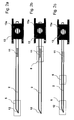
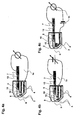
- FIG. 1 a-c the disposition is shown in three different action states.
- Figure 1 a shows the Dispo (1) with the lancet (2) in unused condition.
- the tip (12) of the lancet is surrounded by a protective cap (5).
- the lancet tip (12) is located here with at least one electrode (3) in a test chamber (8).
- Contacts (4) form a connection of the electrodes (3) with a measuring device.
- the test chamber (8) has at least two openings (9, 10) wherein the opening (9) is sealed by the protective cap (5) and the opening (10) is either also sealed by the protective cap (5) or by another seal ( 6).
- Figure 1 b the Dispo is shown in use.
- the holder (13) has on one side a recess (13a) which serves to ensure a connection to a drive (not shown here).
- the lancet (2) emerges from the housing through the opening (9).
- FIG. 1 c shows the lancet (2) after its use in the dispenser (1).
- the lancet (2) has withdrawn both the protective cap (5) and the seal (6) so far that both the opening (9) and the opening (10) are released.
- the proximal end of the lancet in this state communicates with a contact (7).
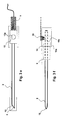
- FIG. 1 d shows a disposition (1) with a plurality of electrodes (3). In this case, there are 4 electrodes, but this can be more. This is to perform control measurements or measure more than one analyte in the sample fluid.
- the geometry of the test chamber is changed, so that lancet holder (13) additionally has a recess (13a), which ensures ventilation of the test chamber after actuation of the lancet.
- the holder (13) has a ventilation channel from the recess (13a) to the test chamber (not shown here). Prior to actuation, the sterility of the test chamber is ensured by a seal of this recess (13a), which is eliminated or injured upon actuation (not shown here).
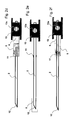
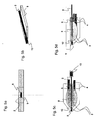
- FIG. 2a the lancet (2) is shown with a catching device (11) at rest.
- the catcher is located between the proximal and distal ends of the lancet (2). It is arranged so that it reaches the protective cap (5) upon actuation of the lancet (2), since the protective cap (5) has a larger diameter than the housing opening (9) and thus the Protective cap (5) is prevented from moving forward further.
- the catcher (11) reaches at maximum deflection of the lancet (2), the protective cap (5) and when retracting the lancet (2), the protective cap (5) due to the interaction of catcher (11) and protective cap (5) with retracted.
- the catching device (11) is preferably a roughened surface on which due to frictional forces the protective cap (5) as well as a second seal (6) hang, as shown in Figures 2 a to 2 d.
- the second seal (6) serves to close a second opening (10) of the test chamber before the lancet is actuated.
- Another embodiment of the catcher (11) is shown in Figure 2 e.
- the catcher (11) is realized by Fangborsten.
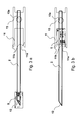
- a further embodiment of the catching device (11) is a catch hook as shown schematically in FIG. 3a.
- the catch hook is fixed by means of a holder (13) on the lancet and has an opening (11a) in the direction of the lancet tip (12).
- the opening (11a) is of the shape that it engages the protective cap (5) at maximum deflection of the lancet (2) and also with the retraction of the lancet (2) also transported back.
- the catch hook has at least one arm (11b) at the distal end of a barb, which pushes upon actuation of the lancet (2) on the protective cap (5) and thus captures the protective cap (5).
- FIGS. 3b and 3d show this catching device after actuation of the lancet (2).
- the catch hook is equipped with two catch arms (11b) and can thus enclose the protective cap (5) and the seal (6) from two sides.
- the catch hook can also have more than 2 tentacles (11b).
- Figures 3c and 3d of this fishing hook principle with at least one arm (11b) for the case of an additional seal (6) is shown.
- FIG. 3c shows the lancet at rest before the actuation
- FIG. 3d shows the lancet after the actuation with the protective cap (5) and seal (6) withdrawn.
- FIGS. 3e and 3f show the contacting of the lancet (2) after the actuation.
- a spring contact (7) engages in a recess (13a) of the lancet holder (13).
- the bent tip (15 a) of the spring contact (7) with the lancet (2) comes into contact.
- the use of the lancet (2) as fill level control or counter electrode is the subject of FIGS. 4a to 4c. In this case, the lancet (2) after Aktuation with a spring contact (7) in connection.
- FIG. 4 a For level measurement, shown in FIG. 4 a, the changing potential between lancet (2) and electrode (3) is measured.
- the filling of the test chamber (8) can also be detected by measuring a current when applying a DC or AC voltage.
- the Lancet needle can be used as a measuring electrode, which is shown in Figure 4 b.
- the lancet (2) after withdrawal with a contact (7) in connection and it is a DC or AC voltage (14) between the working electrode (3) in the chamber and the lancet (2) applied.
- the change of the current flow through the reaction of the test liquid with the test chemistry on the electrode (3) can be measured in this way. In this case, only one electrode is needed in the test chamber.
- FIG. 4 c shows a combination of the two additional properties of level measurement and counterelectrode of the lancet (2).
- two separate circuits (14) are applied to lancet (2) and electrode (3).
- FIG. 5a shows a front view of the device (1), wherein the protective cap (5) with the lancet (2) is arranged in the opening (9).
- Figure 5b which shows the test chamber in a side view, the course of the lancet (2) in the test chamber (8) can be seen.
- Fig. 5c shows an oval test chamber which extends over the electrodes to the protective cap (5).
- An alternative chamber is shown in Figure 5d, wherein the oval chamber is delimited by a boundary on the opposite side of the electrodes and thereby a smaller chamber volume is realized.
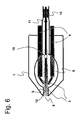
- FIG. 6 shows a system in which the protective cap (5) additionally serves as a closing mechanism for the second opening (10), which in this case is a venting hole in the lidding film.
- the electrodes (3) which extend into the chamber (8) and the protective cap (5), which seals the chamber and the lancet tip (12) and encloses another part of the lancet (3).
- the lancet holder 13
- the catching device (11) is arranged in the direction of the distal end of the lancet (3).
Landscapes
- Health & Medical Sciences (AREA)
- Life Sciences & Earth Sciences (AREA)
- Engineering & Computer Science (AREA)
- Physics & Mathematics (AREA)
- Surgery (AREA)
- Public Health (AREA)
- Biophysics (AREA)
- Pathology (AREA)
- Biomedical Technology (AREA)
- Heart & Thoracic Surgery (AREA)
- Medical Informatics (AREA)
- Molecular Biology (AREA)
- Veterinary Medicine (AREA)
- Animal Behavior & Ethology (AREA)
- General Health & Medical Sciences (AREA)
- Hematology (AREA)
- Manufacturing & Machinery (AREA)
- Optics & Photonics (AREA)
- Dermatology (AREA)
- Emergency Medicine (AREA)
- Chemical & Material Sciences (AREA)
- Chemical Kinetics & Catalysis (AREA)
- General Chemical & Material Sciences (AREA)
- Measurement Of The Respiration, Hearing Ability, Form, And Blood Characteristics Of Living Organisms (AREA)
- Investigating Or Analysing Biological Materials (AREA)
Priority Applications (9)
| Application Number | Priority Date | Filing Date | Title |
|---|---|---|---|
| EP05022830A EP1776925A1 (de) | 2005-10-20 | 2005-10-20 | Analytisches Hilfsmittel mit einer Lanzette und einer Testkammer |
| JP2008535945A JP2009512467A (ja) | 2005-10-20 | 2006-10-14 | ランセットとテスト室とを備える分析補助手段 |
| EP06806285A EP1940289B1 (de) | 2005-10-20 | 2006-10-14 | Analytisches hilfsmittel mit sterilschutz für die lanzette und testkammer |
| CN2006800392336A CN101291621B (zh) | 2005-10-20 | 2006-10-14 | 具有刺血器和测试腔的分析辅助机构 |
| HK09103371.4A HK1125019B (en) | 2005-10-20 | 2006-10-14 | Analytical contrivance with sterile protection for the lancet and test chamber |
| PCT/EP2006/009944 WO2007045411A1 (de) | 2005-10-20 | 2006-10-14 | Analytisches hilfsmittel mit sterilschutz für die lanzette und testkammer |
| DE502006007496T DE502006007496D1 (de) | 2005-10-20 | 2006-10-14 | Analytisches hilfsmittel mit sterilschutz für die lanzette und testkammer |
| AT06806285T ATE474502T1 (de) | 2005-10-20 | 2006-10-14 | Analytisches hilfsmittel mit sterilschutz für die lanzette und testkammer |
| US12/105,304 US20080243032A1 (en) | 2005-10-20 | 2008-04-18 | Analytical device including sterile protection |
Applications Claiming Priority (1)
| Application Number | Priority Date | Filing Date | Title |
|---|---|---|---|
| EP05022830A EP1776925A1 (de) | 2005-10-20 | 2005-10-20 | Analytisches Hilfsmittel mit einer Lanzette und einer Testkammer |
Publications (1)
| Publication Number | Publication Date |
|---|---|
| EP1776925A1 true EP1776925A1 (de) | 2007-04-25 |
Family
ID=35892414
Family Applications (2)
| Application Number | Title | Priority Date | Filing Date |
|---|---|---|---|
| EP05022830A Withdrawn EP1776925A1 (de) | 2005-10-20 | 2005-10-20 | Analytisches Hilfsmittel mit einer Lanzette und einer Testkammer |
| EP06806285A Not-in-force EP1940289B1 (de) | 2005-10-20 | 2006-10-14 | Analytisches hilfsmittel mit sterilschutz für die lanzette und testkammer |
Family Applications After (1)
| Application Number | Title | Priority Date | Filing Date |
|---|---|---|---|
| EP06806285A Not-in-force EP1940289B1 (de) | 2005-10-20 | 2006-10-14 | Analytisches hilfsmittel mit sterilschutz für die lanzette und testkammer |
Country Status (7)
| Country | Link |
|---|---|
| US (1) | US20080243032A1 (enExample) |
| EP (2) | EP1776925A1 (enExample) |
| JP (1) | JP2009512467A (enExample) |
| CN (1) | CN101291621B (enExample) |
| AT (1) | ATE474502T1 (enExample) |
| DE (1) | DE502006007496D1 (enExample) |
| WO (1) | WO2007045411A1 (enExample) |
Families Citing this family (19)
| Publication number | Priority date | Publication date | Assignee | Title |
|---|---|---|---|---|
| US8636672B2 (en) * | 2007-02-28 | 2014-01-28 | Nipro Diagnostics, Inc. | Test strip with integrated lancet |
| JP4956443B2 (ja) * | 2006-01-05 | 2012-06-20 | パナソニック株式会社 | 血液検査装置 |
| US20110036712A1 (en) * | 2007-04-29 | 2011-02-17 | Arkray, Inc. | Analyzing system |
| EP2226008A1 (de) | 2009-02-19 | 2010-09-08 | Roche Diagnostics GmbH | Verfahren zur Herstellung eines analytischen Magazins |
| WO2010094427A2 (de) | 2009-02-19 | 2010-08-26 | Roche Diagnostics Gmbh | Platzsparende magazinierung analytischer hilfsmittel |
| EP2226007A1 (de) * | 2009-02-19 | 2010-09-08 | Roche Diagnostics GmbH | Testelementmagazin mit abgedeckten Testfeldern |
| EP2241252A1 (de) * | 2009-03-17 | 2010-10-20 | F. Hoffmann-La Roche AG | Testvorrichtung insbesondere für Blutzuckertests |
| US20130197452A1 (en) * | 2010-09-27 | 2013-08-01 | Terumo Kabushiki Kaisha | Medical instrument with attached needle |
| ES2565805T3 (es) | 2010-11-09 | 2016-04-07 | Seventh Sense Biosystems, Inc. | Sistemas e interfaces para el muestreo de sangre |
| WO2012106060A2 (en) * | 2011-01-06 | 2012-08-09 | Pepex Biomedical, Inc. | Sensor module with enhanced capillary flow |
| KR102237667B1 (ko) * | 2011-04-29 | 2021-04-12 | 세븐쓰 센스 바이오시스템즈, 인크. | 유체들의 전달 및/또는 수용 |
| WO2014200924A1 (en) | 2013-06-10 | 2014-12-18 | Facet Technologies, Llc | Lancet needle with alignment and retention notch |
| CN107920789A (zh) * | 2015-05-25 | 2018-04-17 | 卡尤迪生物科技宜兴有限公司 | 用于样品收集的装置和方法 |
| US10154809B2 (en) * | 2015-06-24 | 2018-12-18 | University Of Virginia Patent Foundation | Test strip device and related methods thereof |
| IL286606B2 (en) * | 2015-09-07 | 2025-06-01 | Plasmatica Ltd | Protecting shroud for an endoscope under plasma treatment |
| US11246480B2 (en) | 2015-09-07 | 2022-02-15 | Plasmatica Ltd. | Preventing fog on a medical device viewport |
| US11896204B2 (en) | 2015-09-07 | 2024-02-13 | Plasmatica Ltd. | Methods and systems for providing plasma treatments to optical surfaces |
| AU2022260712A1 (en) | 2021-04-22 | 2023-11-30 | Plasmatica Ltd. | Methods and systems for providing plasma treatments to optical surfaces |
| WO2024163311A1 (en) * | 2023-02-02 | 2024-08-08 | Siemens Healthcare Diagnostics Inc. | Laminate urinalysis assay strip and methods of producing and using same |
Citations (2)
| Publication number | Priority date | Publication date | Assignee | Title |
|---|---|---|---|---|
| EP1333756A1 (de) * | 2000-10-31 | 2003-08-13 | Roche Diagnostics GmbH | System zur blutentnahme |
| EP1466558A2 (de) * | 2001-08-29 | 2004-10-13 | Roche Diagnostics GmbH | Verfahren zur Herstellung eines analytischen Hilfsmittels mit Lanzette und Testelement |
Family Cites Families (18)
| Publication number | Priority date | Publication date | Assignee | Title |
|---|---|---|---|---|
| DE3011211A1 (de) * | 1980-03-22 | 1981-10-01 | Clinicon Mannheim GmbH, 6800 Mannheim | Blutlanzettenvorrichtung zur entnahme von blut fuer diagnosezwecke |
| US4627445A (en) * | 1985-04-08 | 1986-12-09 | Garid, Inc. | Glucose medical monitoring system |
| US4963814A (en) * | 1989-12-15 | 1990-10-16 | Boehringer Mannheim Corporation | Regulated bifurcated power supply |
| US5243516A (en) * | 1989-12-15 | 1993-09-07 | Boehringer Mannheim Corporation | Biosensing instrument and method |
| US4999632A (en) * | 1989-12-15 | 1991-03-12 | Boehringer Mannheim Corporation | Analog to digital conversion with noise reduction |
| US4999582A (en) * | 1989-12-15 | 1991-03-12 | Boehringer Mannheim Corp. | Biosensor electrode excitation circuit |
| US5125908A (en) * | 1990-10-19 | 1992-06-30 | Cohen Milton J | Hypodermic syringe with protective holder |
| US5366609A (en) * | 1993-06-08 | 1994-11-22 | Boehringer Mannheim Corporation | Biosensing meter with pluggable memory key |
| JP2704046B2 (ja) * | 1993-06-08 | 1998-01-26 | ベーリンガー マンハイム コーポレーション | 適切な電極の接続を検出し、サンプル片及びチェック片を区別するバイオセンシングメータ |
| US5405511A (en) * | 1993-06-08 | 1995-04-11 | Boehringer Mannheim Corporation | Biosensing meter with ambient temperature estimation method and system |
| US5352351A (en) * | 1993-06-08 | 1994-10-04 | Boehringer Mannheim Corporation | Biosensing meter with fail/safe procedures to prevent erroneous indications |
| DE4320463A1 (de) * | 1993-06-21 | 1994-12-22 | Boehringer Mannheim Gmbh | Blutlanzettenvorrichtung zur Entnahme von Blut für Diagnosezwecke |
| ATE227844T1 (de) * | 1997-02-06 | 2002-11-15 | Therasense Inc | Kleinvolumiger sensor zur in-vitro bestimmung |
| DE19840856B4 (de) * | 1998-09-07 | 2008-04-10 | Roche Diagnostics Gmbh | System zur Gewinnung einer Köperflüssigkeit, Lanzettenmagazin, Lanzette, Lanzettensatz, Stechhilfe und Verfahren zur Entnahme einer Lanzette aus einem Lanzettenmagazin sowie Verwendung des Systems |
| JP3985022B2 (ja) * | 1999-11-08 | 2007-10-03 | アークレイ株式会社 | 体液測定装置、およびこの体液測定装置に挿着して使用する挿着体 |
| DE10010694A1 (de) * | 2000-03-04 | 2001-09-06 | Roche Diagnostics Gmbh | Blutlanzette mit hygienischen Spitzenschutz |
| DE10312357B3 (de) * | 2003-03-20 | 2004-07-08 | Roche Diagnostics Gmbh | Stechhilfe und Lanzettensystem mit Wiederverwendungsschutz sowie eine Stechhilfe dafür |
| ES2305943T3 (es) * | 2005-05-20 | 2008-11-01 | F. Hoffmann-La Roche Ag | Sistema de lancetas con proteccion esteril. |
-
2005
- 2005-10-20 EP EP05022830A patent/EP1776925A1/de not_active Withdrawn
-
2006
- 2006-10-14 CN CN2006800392336A patent/CN101291621B/zh not_active Expired - Fee Related
- 2006-10-14 WO PCT/EP2006/009944 patent/WO2007045411A1/de not_active Ceased
- 2006-10-14 AT AT06806285T patent/ATE474502T1/de active
- 2006-10-14 EP EP06806285A patent/EP1940289B1/de not_active Not-in-force
- 2006-10-14 DE DE502006007496T patent/DE502006007496D1/de active Active
- 2006-10-14 JP JP2008535945A patent/JP2009512467A/ja active Pending
-
2008
- 2008-04-18 US US12/105,304 patent/US20080243032A1/en not_active Abandoned
Patent Citations (2)
| Publication number | Priority date | Publication date | Assignee | Title |
|---|---|---|---|---|
| EP1333756A1 (de) * | 2000-10-31 | 2003-08-13 | Roche Diagnostics GmbH | System zur blutentnahme |
| EP1466558A2 (de) * | 2001-08-29 | 2004-10-13 | Roche Diagnostics GmbH | Verfahren zur Herstellung eines analytischen Hilfsmittels mit Lanzette und Testelement |
Also Published As
| Publication number | Publication date |
|---|---|
| HK1125019A1 (en) | 2009-07-31 |
| JP2009512467A (ja) | 2009-03-26 |
| WO2007045411A1 (de) | 2007-04-26 |
| CN101291621B (zh) | 2010-09-01 |
| US20080243032A1 (en) | 2008-10-02 |
| ATE474502T1 (de) | 2010-08-15 |
| EP1940289B1 (de) | 2010-07-21 |
| CN101291621A (zh) | 2008-10-22 |
| DE502006007496D1 (de) | 2010-09-02 |
| EP1940289A1 (de) | 2008-07-09 |
Similar Documents
| Publication | Publication Date | Title |
|---|---|---|
| EP1940289B1 (de) | Analytisches hilfsmittel mit sterilschutz für die lanzette und testkammer | |
| EP1287785B1 (de) | Analytisches Hilfsmittel mit Lanzette und Testelement | |
| EP1420694B1 (de) | System zur entnahme kleiner körperflüssigkeitsmengen | |
| DE69733486T2 (de) | Vorrichtung zur blutgewinnung für diagnostische tests | |
| DE60214087T2 (de) | Vorrichtung zur Entnahme biologischer Flüssigkeiten und Analytenmessung | |
| DE60303987T2 (de) | Flüssigkeitssensor mit integrierter Lanzette | |
| DE69733836T2 (de) | Vorrichtung zur körperflüssigkeitsentnahme und -analyse | |
| EP1781173B1 (de) | Verfahren zur selektiven sterilisation von diagnostischen testelementen | |
| US7766845B2 (en) | Disposable lancet and lancing cap combination for increased hygiene | |
| DE19855458C2 (de) | Lanzettenkassette zur Blutprobennahme | |
| DE19855465B4 (de) | Vorrichtung zur Blutprobennahme und -Analyse | |
| EP2237717B1 (en) | Rapid blood expression and sampling | |
| DE19855443B4 (de) | Reproduzierbares Stechen zur Blutprobennahme mit Stechvorrichtungen und Verfahren zur Blutprobennahme | |
| EP2129289B1 (de) | Analysesystem zur bestimmung eines analyten in einer körperflüssigkeit und disposibles integriertes probengewinnungs- und analyseelement | |
| EP1714614A2 (de) | Analytisches Hilfsmittel | |
| DE60215645T2 (de) | Vorrichtungen zum ausdrücken von körperflüssigkeiten aus einem einschnitt | |
| EP1491143A1 (de) | Diagnostisches oder analytisches Einmalgebrauchsmittel mit integrierter Lanzette | |
| EP2059169B1 (de) | Medizinisches hilfsmittel | |
| HK1125019B (en) | Analytical contrivance with sterile protection for the lancet and test chamber | |
| EP1220641A1 (de) | System zur transdermalen gewinnung von körperflüssigkeit |
Legal Events
| Date | Code | Title | Description |
|---|---|---|---|
| PUAI | Public reference made under article 153(3) epc to a published international application that has entered the european phase |
Free format text: ORIGINAL CODE: 0009012 |
|
| AK | Designated contracting states |
Kind code of ref document: A1 Designated state(s): AT BE BG CH CY CZ DE DK EE ES FI FR GB GR HU IE IS IT LI LT LU LV MC NL PL PT RO SE SI SK TR |
|
| AX | Request for extension of the european patent |
Extension state: AL BA HR MK YU |
|
| 17P | Request for examination filed |
Effective date: 20071025 |
|
| AKX | Designation fees paid |
Designated state(s): AT BE BG CH CY CZ DE DK EE ES FI FR GB GR HU IE IS IT LI LT LU LV MC NL PL PT RO SE SI SK TR |
|
| 17Q | First examination report despatched |
Effective date: 20071213 |
|
| STAA | Information on the status of an ep patent application or granted ep patent |
Free format text: STATUS: THE APPLICATION IS DEEMED TO BE WITHDRAWN |
|
| 18D | Application deemed to be withdrawn |
Effective date: 20080624 |