EP1749549B1 - Liquor-Drainagesystem - Google Patents
Liquor-Drainagesystem Download PDFInfo
- Publication number
- EP1749549B1 EP1749549B1 EP05016789A EP05016789A EP1749549B1 EP 1749549 B1 EP1749549 B1 EP 1749549B1 EP 05016789 A EP05016789 A EP 05016789A EP 05016789 A EP05016789 A EP 05016789A EP 1749549 B1 EP1749549 B1 EP 1749549B1
- Authority
- EP
- European Patent Office
- Prior art keywords
- liquor
- pressure
- pump
- drainage
- operating
- Prior art date
- Legal status (The legal status is an assumption and is not a legal conclusion. Google has not performed a legal analysis and makes no representation as to the accuracy of the status listed.)
- Expired - Lifetime
Links
Images
Classifications
-
- A—HUMAN NECESSITIES
- A61—MEDICAL OR VETERINARY SCIENCE; HYGIENE
- A61M—DEVICES FOR INTRODUCING MEDIA INTO, OR ONTO, THE BODY; DEVICES FOR TRANSDUCING BODY MEDIA OR FOR TAKING MEDIA FROM THE BODY; DEVICES FOR PRODUCING OR ENDING SLEEP OR STUPOR
- A61M27/00—Drainage appliance for wounds or the like, i.e. wound drains, implanted drains
- A61M27/002—Implant devices for drainage of body fluids from one part of the body to another
- A61M27/006—Cerebrospinal drainage; Accessories therefor, e.g. valves
-
- A—HUMAN NECESSITIES
- A61—MEDICAL OR VETERINARY SCIENCE; HYGIENE
- A61M—DEVICES FOR INTRODUCING MEDIA INTO, OR ONTO, THE BODY; DEVICES FOR TRANSDUCING BODY MEDIA OR FOR TAKING MEDIA FROM THE BODY; DEVICES FOR PRODUCING OR ENDING SLEEP OR STUPOR
- A61M1/00—Suction or pumping devices for medical purposes; Devices for carrying-off, for treatment of, or for carrying-over, body-liquids; Drainage systems
- A61M1/71—Suction drainage systems
- A61M1/73—Suction drainage systems comprising sensors or indicators for physical values
-
- A—HUMAN NECESSITIES
- A61—MEDICAL OR VETERINARY SCIENCE; HYGIENE
- A61M—DEVICES FOR INTRODUCING MEDIA INTO, OR ONTO, THE BODY; DEVICES FOR TRANSDUCING BODY MEDIA OR FOR TAKING MEDIA FROM THE BODY; DEVICES FOR PRODUCING OR ENDING SLEEP OR STUPOR
- A61M1/00—Suction or pumping devices for medical purposes; Devices for carrying-off, for treatment of, or for carrying-over, body-liquids; Drainage systems
- A61M1/71—Suction drainage systems
- A61M1/74—Suction control
-
- F—MECHANICAL ENGINEERING; LIGHTING; HEATING; WEAPONS; BLASTING
- F04—POSITIVE - DISPLACEMENT MACHINES FOR LIQUIDS; PUMPS FOR LIQUIDS OR ELASTIC FLUIDS
- F04B—POSITIVE-DISPLACEMENT MACHINES FOR LIQUIDS; PUMPS
- F04B43/00—Machines, pumps, or pumping installations having flexible working members
- F04B43/12—Machines, pumps, or pumping installations having flexible working members having peristaltic action
- F04B43/1253—Machines, pumps, or pumping installations having flexible working members having peristaltic action by using two or more rollers as squeezing elements, the rollers moving on an arc of a circle during squeezing
-
- A—HUMAN NECESSITIES
- A61—MEDICAL OR VETERINARY SCIENCE; HYGIENE
- A61B—DIAGNOSIS; SURGERY; IDENTIFICATION
- A61B5/00—Measuring for diagnostic purposes; Identification of persons
- A61B5/03—Measuring fluid pressure within the body other than blood pressure, e.g. cerebral pressure ; Measuring pressure in body tissues or organs
- A61B5/031—Intracranial pressure
-
- A—HUMAN NECESSITIES
- A61—MEDICAL OR VETERINARY SCIENCE; HYGIENE
- A61M—DEVICES FOR INTRODUCING MEDIA INTO, OR ONTO, THE BODY; DEVICES FOR TRANSDUCING BODY MEDIA OR FOR TAKING MEDIA FROM THE BODY; DEVICES FOR PRODUCING OR ENDING SLEEP OR STUPOR
- A61M2210/00—Anatomical parts of the body
- A61M2210/06—Head
- A61M2210/0693—Brain, cerebrum
-
- F—MECHANICAL ENGINEERING; LIGHTING; HEATING; WEAPONS; BLASTING
- F04—POSITIVE - DISPLACEMENT MACHINES FOR LIQUIDS; PUMPS FOR LIQUIDS OR ELASTIC FLUIDS
- F04B—POSITIVE-DISPLACEMENT MACHINES FOR LIQUIDS; PUMPS
- F04B2205/00—Fluid parameters
- F04B2205/01—Pressure before the pump inlet
Definitions
- the invention relates generally to a device for drainage of cerebrospinal fluid, and more particularly to a cerebrospinal fluid drainage system according to the preamble of claim 1.
- CSF drainage arrangement normally consists of a brain catheter which is introduced through a skull into the cerebral cavity (ventricle) to be treated and connected to a drainage conduit to the outside or to the desired body cavity or vein.
- cerebral water is about 500 ml / day, with the pressure of the cerebrospinal fluid in the lumbar region of the brain as well as in the brain ventricles a constant value within certain limits.
- a reduced pressure of the brain fluid in the skull of the patient should be produced with the help of the drainage device, wherein the desired during the treatment lower pressure of the cerebrospinal fluid (CSF pressure) should be below the brain blood pressure.
- CSF pressure cerebrospinal fluid
- An external CSF drainage arrangement is for example from DE 296 21 904 U1 in which a so-called balancing chamber is mounted on a height-adjustable stand in which the drained liquid is collected and its volume is determined. Due to the sensitivity of the brain to pressure, it is extremely important for the drainage of cerebrospinal fluid or cerebrospinal fluid to maintain a given drainage pressure. Therefore, the balance chamber of the known CSF drainage assembly must be accurately aligned to a certain height relative to the head of the patient.
- the cerebrospinal fluid line is equipped with a pressure transducer, which measures the current pressure of the cerebrospinal fluid in the cerebrospinal fluid line.
- the drainage pressure and thus the hydrostatic pressure in the drainage line and the balancing chamber should not exceed or fall below certain limit values. If the head position of the patient is changed, for example, by pivoting the back part of the bed, the height of the balancing chamber and the pressure transducer must also be adjusted so that on the one hand the pressure measurement is correct and on the other hand the pressure limits are maintained.
- the DE 103 17 308 describes a CSF drainage assembly, which is also arranged on a height-adjustable stand, with an attached to the stand balancing chamber, connected to the balancing chamber CSF supply line, a pressure transducer in the CSF supply line and a direction finder for adjusting the altitude of the tripod.
- a valve having a certain closing pressure is used to control the process of draining the liquor.
- the operating pressure of the existing valve in the discharge device corresponds to the desired liquor pressure.
- the outflow of cerebral fluid from the ventricles occurs as long as the cerebrospinal fluid pressure is above the switching pressure of the valve.
- the monitoring of the pressure with optical sensor means is disclosed.
- the American patent US6336924 discloses an external fluid drainage system.
- the drainage system comprises a two-part drainage catheter.
- the first part is located near the patient's head and the second part near a drainage bag.
- a pressure sensor is housed between the first and second parts of the catheter.
- One end of the first part is inserted into a ventricle of the patient's head for drainage.
- the other end is connected to the pressure sensor.
- a transparent drainage bag is provided. It is also proposed to detect the drained liquid by means of an optical drop counting system.
- External flow control is provided to control flow through the catheter.
- a pump or a controllable valve are proposed. The flow control is controlled electronically as soon as the measured pressure exceeds a threshold value.
- the object is achieved by the liquor drainage system according to the invention.
- the CSF drainage system includes a CSF supply line and a pressure sensor that detects the pressure in the CSF supply line.
- a pump is provided which evacuates the cerebrospinal fluid in response to predetermined operating parameters and measured operational readings, detection means which detect the volume of drained cerebral fluid.
- the detection means is adapted to calculate the drained liquor volume from the rotation of the pump and the tubing diameter.
- the pump is designed to pump out the brain fluid depending on the volume of drained liquor and depending on the pressure measured in the CSF supply line.
- the measurement of the drained liquor volume based on the pumping processes is inexpensive, because it requires no further measuring device for determining the drained liquor volume.
- the combined use of pressure and drained liquor volume to control the pump is more reliable. Because the sole use of the pressure sensor within the CSF supply line can lead to errors. The control of the pump as a function of the drained liquor volume and the measured pressure therefore allows a more accurate and reliable control of the brain pressure.
- a CSF drainage pumping system that can selectively purge a particular liquor volume with a pressure controlled pump. Since the CSF supply line or the brain catheter is directly connected to the brain cavity (ventricle) to be treated, the same pressure prevails in the CSF supply line and in the brain cavity to be treated, which pressure is determined by the pressure sensor arranged in the CSF supply line. For reasons of safety and the accuracy of the CSF pressure measurement, it is also conceivable to provide a plurality of pressure sensors, so that, for example, incorrect or missing measured values of a defective pressure sensor can be replaced by the measured values of an intact pressure sensor. With several pressure sensors, their measured values can be compared with each other to check or improve the measuring accuracy.
- the pump When the cerebral pressure or pressure of the cerebrospinal fluid (CSF) rises above a defined upper value, the pump is preferably activated automatically and a certain volume of cerebrospinal fluid is pumped off until the desired pressure of the cerebrospinal fluid has been established. This process is actively monitored by the pressure sensor (s) installed in the CSF supply line. Once a sufficient volume of brain fluid has been pumped out and the pressure sensor in the CSF supply line detects that the brain pressure has fallen back to a defined lower value, the pump can be stopped automatically.
- the pressure sensor s
- the pressure sensor is equipped with fastening means which allow an arrangement of the pressure sensor in the head region of the patient.
- the pressure sensor can be fastened by means of a headband in the vicinity of the skull bore or can be arranged via an ear hook or clip on the patient's ear.
- the control of the liquor drainage system is advantageously carried out by an electronic control.
- the electronic control the calculations necessary for the operation of the pump are made on the basis of the given operating parameters and the operating measured values or the measured operating data.
- the electronic control of the CSF drainage system is preferably programmable, so that certain operations can be performed, for example, for different medical applications via appropriate software.
- alarm functions can be set up in the electronic control of the CSF drainage system, which alarms in the event of a deviation of the measured operating data from a predetermined range for the pressure or the pump volume by optical and / or acoustic means. Such an alarm signal is expediently passed on via an appropriate interface and electronically to an external monitoring.
- the CSF drainage system comprises input means via which certain operating parameters, such as predetermined pressure limits of CSF pressure or brain pressure in the ventricle to be treated, may be input to the control electronics.
- control electronics and electronic storage means may be provided in which, for example, certain operations of the CSF drainage system can be stored or kept.
- the CSF drainage system may further comprise controls via which the operation of the Pump can be controlled directly. This gives the possibility to control the pump manually, for example, to generate a short term, higher pumping power to eliminate clogging.
- the pressure sensor in the CSF supply line is preferably designed as an electronic pressure sensor, which forwards the pressure measured in the CSF supply line in the form of electrical signals to the control electronics.
- the control electronics Based on the pressure signals supplied by the pressure sensor and the predetermined pressure limits, the control electronics calculates the required operation of the CSF drainage system or the operation of the CSF pump. In particular, the control electronics performs a comparison between the predetermined CSF pressure limits and the pressure in the CSF supply line determined by the pressure sensor. The control electronics decide on the basis of the calculation whether the pump of the CSF drainage system should be activated or deactivated and / or with which pumping power and, if appropriate, over which period of time the CSF drainage pump should be operated.
- a peristaltic pump is preferably used, which has the merit that the pumped liquid within the tube system does not come in contact with any foreign bodies.
- a piezo-pressure sensor is particularly suitable, which can also detect minimal pressure changes using piezoceramic materials and emits as electrical impulses.
- the liquor drainage system is equipped with a hose system with corresponding branches.
- This tubing system includes a cerebrospinal fluid supply (or brain catheter) leading from the patient's head to the pump, and a CSF drain line leading from the pump to a collection bag for collecting the drained liquor.
- the liquor is pumped out selectively, the pumped volume is controlled pressure controlled.
- the pumped volume is controlled pressure controlled.
- a purely volume-controlled liquor drainage as used e.g. necessary for lumbar permanent drainage.
- the tube system of the liquor drainage system is a closed tube system which allows a simultaneous measurement of the pressure via the pressure sensor during the pumping operation.
- the pressure sensor e.g. Disconnections of the hose connections due to acute pressure drop in the hose system or Schlauchokissesionen or hose closures are recorded by very low or very high pressure values during the pumping process.
- the operating data of the CSF drainage system are detected continuously or at intervals.
- the CSF drainage volume can be calculated continuously from the rotation of the pump and the tubing diameter.
- a recording and documentation of the time course of the determined pumping volume and the pressure in the liquor supply line can be done.
- These data can be forwarded for further evaluation by the control electronics of the liquor drainage system to an evaluation unit. This will result in an automated evaluation of the temporal Brain pressure and cerebro-drainage course allows what was possible in previous systems only by reading the fluid level at the collection bag.
- the operational data of the CSF drainage system e.g. the recording and documentation of the time course of the determined pumping volume or the pressure in the liquor supply line, the running time of the pump, the total volume delivered by the pump, the operating mode or the running time of the pump may conveniently be stored in the electronic storage means of the liquor drainage system according to the invention and be retrieved.
- input means may be provided with which the data stored in the storage means of the CSF drainage system are manually deleted.
- the liquor drainage system according to the invention expediently has a visual display via which set operating parameters and / or current measured values of operating data can be displayed.
- the data transfer from the liquor drainage system to an external evaluation unit takes place via an interface, such as e.g. a cable, infrared, or wireless connection or with the help of a memory card / chip.
- the liquor drainage system according to the invention can also be equipped with an additional output for the transmission of operating data, in particular the CSF pressure signal to external display monitors and with a call button for the nursing staff.
- the liquor drainage system is preferably equipped with an accumulator for electrical energy or an accumulator which ensures the operation independent of the mains for at least a few hours and facilitates transport of the patient to the system.
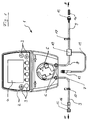
- Figure 1 shows a sketch of the structure of a liquor drainage system according to a preferred embodiment of the present invention.
- the embodiment of the CSF drainage system 1 shown in Fig. 1 comprises, according to the present invention, a main component 2 having a housing 2 in which an electronic control with electronic means for the calculations described above is housed. On the housing 2 input and control elements 3 are arranged, can be entered manually on the required for the operation of the CSF drainage system 1 operating parameters or a desired operating mode of the CSF drainage system. Via a display 4, all entered operating parameters and / or current operating measured values and operating modes of the CSF drainage system 1 can be displayed.
- the main component 2 of the CSF drainage system 1 further comprises a peristaltic pump 5 with connections 6 for hose connections 9 of a hose system.
- the tube connections 9 connected to the peristaltic pump 5 are on the one hand a cerebrospinal fluid supply line (brain catheter) 8 between the peristaltic pump 5 and the patient and on the other hand a hose connection 7 between the peristaltic pump 5 and a discharge bag (not shown) in which collects the pumped cerebrospinal fluid (cerebrospinal fluid).
- the connecting direction of the hose connection 7 to the drainage bag and indicated by the arrow B the connection direction of the hose connection 8 to the patient by the arrow A.
- the hose connections 9 of the hose system have an inner diameter of about 1.0 mm, an outer diameter of about 4.0 mm, a wall thickness of about 1.5 mm and a hardness in the range of 50-55 Shore Have a.
- the peristaltic pump 5 is constructed in a known manner and comprises a flexible circularly arranged pump tube segment.
- the axis of a pump rotor is mounted in the center of the circularly arranged pump tube segment, at the radially outer ends of which rotatably mounted rollers are provided. With the rotation of the pump rotor, the rollers roll on the circular pump tube segment, compressing the pump tube segment.
- a fluid located in the pump hose segment is conveyed in the direction of rotation of the pump rotor.
- Such a peristaltic pump has the advantage that the fluid contained in the tube does not come into contact with foreign bodies and thus contamination of the fluid is excluded.
- a pressure sensor 10 is arranged, which measures the pressure of the liquor in the CSF supply line 8 permanently or at intervals.
- the pressure readings determined by the pressure sensor are converted into electrical signals and forwarded via an electrical line 11 to the electrical control in the main component 2 of the liquor drainage system 1.
- the electrical line 11 is connected by the pressure sensor 10 via a connection 12 to the main component 2 of the liquor drainage system 1 via a corresponding interface (not shown).
- the electrical control of the CSF drainage system 1 uses the operating readings transmitted by the pressure sensor 10 from the pressure in the CSF supply line 8 as a basis for the calculations in the electrical control for controlled operation of the peristaltic pump 5. If, for example, a pressure in the Liquor supply line 8 is detected, which is above a predetermined operating parameter or outside a certain Pressure range is, the electrical control of the CSF drainage system 1, the peristaltic pump 5 can be activated.
- the electrical control can stop the operation of the peristaltic pump 5.
- the CSF drainage system 1 may include detection means which determine the volume of liquor delivered and use the drained liquor volume as the basis for the control of the pump 5. For this purpose, for example, the number of revolutions of the pump rotor can be used, since this is in direct proportion to the funded by the peristaltic pump 5 volume.
- Both the hose connection 7 between the hose pump 5 and the discharge bag and the liquor supply line 8 between the hose pump and the patient can be equipped with a branch, for example in the form of a 3-way valve 17, are connected via the other hose lines to the hose system can.
- the hose connections 9 are respectively connected via suitable hose connection elements 13, 14, 15, 16 to further hose segments or other components of the liquor drainage system 1 which carry liquor liquid.
- the hose connection elements or hose couplings 13, 14, 15, 16 are each designed so that they ensure a pressure-safe connection of the hose connections and thus a closed hose system.
- the hose connection elements or hose couplings 13, 14, 15, 16 may be designed so that they have a disposable use of the hose connections 7, 8 or of the entire Ensure tubing sets, ie that a hose connections 7, 8 can be used only once in the closed-circuit tube to ensure their sterility.
- at least one connecting element 13, 14, 15, 16 may be formed such that the pressure sensor 10 can be received or integrated therein. In this way, the pressure sensor would be placed in direct contact with the liquor in the drainage system and mounted easily replaceable.
- the liquor drainage system 1 is characterized on the one hand by simple operation and on the other hand ensures a controlled liquor drainage process, in which the drained liquor volume regulated as needed and the drainage pressure or the CSF pressure can be reliably maintained within a certain pressure range ,
Landscapes
- Health & Medical Sciences (AREA)
- Engineering & Computer Science (AREA)
- Heart & Thoracic Surgery (AREA)
- Biomedical Technology (AREA)
- Public Health (AREA)
- Hematology (AREA)
- Life Sciences & Earth Sciences (AREA)
- Animal Behavior & Ethology (AREA)
- General Health & Medical Sciences (AREA)
- Veterinary Medicine (AREA)
- Anesthesiology (AREA)
- Vascular Medicine (AREA)
- Ophthalmology & Optometry (AREA)
- Otolaryngology (AREA)
- Neurology (AREA)
- General Engineering & Computer Science (AREA)
- Mechanical Engineering (AREA)
- External Artificial Organs (AREA)
- Measuring And Recording Apparatus For Diagnosis (AREA)
- Separation Using Semi-Permeable Membranes (AREA)
- Quick-Acting Or Multi-Walled Pipe Joints (AREA)
Description
- Die Erfindung bezieht sich allgemein auf eine Vorrichtung zur Drainage von Gehirnflüssigkeit und insbesondere auf ein Liquor-Drainagesystem nach dem Oberbegriff des Anspruchs 1.
- Bei Patienten mit Hydrocephalus und/oder erhöhtem Hirndruck wird das überschüssige Gehirnwasser (Liquor cerebrospinalis oder kurz: Liquor) entweder mittels internen Drainagevorrichtungen in eine beliebige Körperhöhle oder ins Blut abgeleitet oder mittels externen Drainagevorrichtungen nach außen drainiert. Eine Liquor-Drainageanordnung besteht im Normalfall aus einem Gehirnkatheter, welcher durch eine Schädelbohrung in die zu behandelnde Gehirnhöhle (Ventrikel) eingeführt und an eine Ablaufleitung nach außen oder zu der gewünschten Körperhöhle bzw. Vene angeschlossen wird.
- Die Bildung des Hirnwassers liegt etwa bei 500 ml/Tag, wobei der Druck des Liquors im lumbalen Bereich des Gehirns wie auch in den Gehirnventrikeln einen konstanten Wert innerhalb bestimmter Grenzen aufweist. Bei der Behandlung des Hydrocephalus soll mit Hilfe der Drainagevorrichtung ein reduzierter Druck der Gehirnflüssigkeit im Schädel des Patienten hergestellt werden, wobei der während der Behandlung angestrebte niedrigere Druck der Gehirnflüssigkeit (Liquor-Druck) unterhalb des Hirn-Blutdrucks liegen soll.
- Eine externe Liquor-Drainageanordnung ist beispielsweise aus der
DE 296 21 904 U1 bekannt, bei der eine sog. Bilanzierungskammer an einem höhenverstellbaren Stativ angebracht ist, in der die drainierte Flüssigkeit gesammelt und deren Volumen bestimmt wird. Aufgrund der Druckempfindlichkeit des Gehirns ist es bei der Drainage von Gehirnflüssigkeit bzw. Liquor außerordentlich wichtig, einen vorgegebenen Drainagedruck einzuhalten. Deshalb muss die Bilanzierungskammer der bekannten Liquor-Drainageanordnung auf eine bestimmte Höhe relativ zum Kopf des Patienten exakt ausgerichtet werden. In der Liquor-Leitung ist ein Druckmesswandler vorgesehen, der den aktuellen Druck der Gehirnflüssigkeit in der Liquor-Leitung misst. Der Drainagedruck und damit der hydrostatische Druck in der Drainageleitung und der Bilanzierungskammer soll dabei bestimmte Grenzwerte nicht über- oder unterschreiten. Wenn die Kopflage des Patienten beispielsweise durch Verschwenken des Bettrückenteils verändert wird, müssen auch die Bilanzierungskammer und der Druckmesswandler in ihrer Höhe verstellt werden, damit einerseits die Druckmessung korrekt ist und andererseits die Druckgrenzwerte eingehalten werden. - Die
DE 103 17 308 beschreibt eine Liquor-Drainageanordnung, die ebenfalls an einem höhenverstellbaren Stativ angeordnet ist, mit einer an dem Stativ befestigten Bilanzierungskammer, einer an die Bilanzierungskammer angeschlossenen Liquor-Zulaufleitung, einem Druckmesswandler in der Liquor-Zulaufleitung und einer Peileinrichtung zur Justierung der Höhenlage des Stativs. Bei der inDE 31 27 882 offenbarten Vorrichtung wird zur Steuerung des Vorgangs zum Abfluss des Liquors ein Ventil mit einem bestimmten Schließdruck benutzt. Der Betriebsdruck des in der Ableitungsvorrichtung vorhandenen Ventils entspricht dabei dem gewünschten Liquor-Druck. Der Abfluss der Gehirnflüssigkeit aus den Ventrikeln vollzieht sich so lange, wie der Liquor-Druck über dem Schaltdruck des Ventils liegt. In derDE 693 31 185 ist die Überwachung des Druckes mit optischen Sensormitteln offenbart. - Die
Amerikanische Patentschrift US6336924 offenbart ein externes Flüssigkeitsdrainagesystem. Das Drainagesystem umfasst einen zweiteiligen Drainagekatheter. Der erste Teil ist in der Nähe des Patientenkopfs angeordnet und der zweite Teil in der Nähe eines Drainagebeutels. Ein Drucksensor ist zwischen dem ersten und zweiten Teil des Katheters untergebracht. Ein Ende des ersten Teils wird in ein Ventrikel des Patientenkopfes zur Drainage eingeführt. Das andere Ende ist mit dem Drucksensor verbunden. Zur Überwachung der drainierten Flüssigkeit ist ein durchsichtiger Drainagebeutel vorgesehen. Ferner wird vorgeschlagen, mittel eines optischen Tropfenzählsystems die drainierte Flüssigkeit zu erfassen. Eine externe Flusssteuerung ist vorgesehen, um den Fluss durch den Katheter zu steuern. Insbesondere eine Pumpe oder ein steuerbares Ventil werden vorgeschlagen. Die Flusssteuerung wird elektronisch angesteuert, sobald der gemessene Druck einen Schwellwert überschreitet. - Die bekannten Drainagesysteme arbeiten jedoch trotz der druckabhängigen Regelung des Drainageflusses nicht immer zuverlässig und sind relativ teuer.
- Es ist daher Aufgabe der vorliegenden Erfindung, ein Liquor-Drainagesystem bereizustellen, welches auf zuverlässige und preiswerte Weise für die Drainage von Gehirnflüssigkeit sorgt.
- Die Aufgabe wird durch das erfindungsgemäße Liquor-Drainagesystem gelöst. Das Liquor-Drainagesystem umfasst eine Liquor-Zulaufleitung und einem Drucksensor, der den Druck in der Liquor-Zulaufleitung ermittelt. Eine Pumpe ist vorgesehen, welche die Gehirnflüssigkeit in Abhängigkeit von vorgegebenen Betriebsparametern und gemessenen Betriebsmesswerten abpumpt, Erfassungsmitteln, die das Volumen der drainierten Gehirnflüssigkeit ermitteln. Das Erfassungsmittel ist dazu ausgebildet, das drainierte Liquor-Volumen aus der Rotation der Pumpe und dem Schlauchdurchmesser zu berechnen. Die Pumpe ist dazu ausgebildet, die Gehirnflüssigkeit in Abhängigkeit von dem drainierten Liquor-Volumen und in Abhängigkeit von dem in der Liquor-Zulaufleitung gemessenen Druck abzupumpen.
- Die Messung des drainierten Liquorvolumens anhand der Pumprotationen ist preiswert, denn es bedarf keiner weiteren Messvorrichtung zur Ermittlung des drainierten Liquorvolumens. Die kombinierte Verwendung des Drucks und des drainierten Liquor-Volumens zur Steuerung der Pumpe ist zuverlässiger. Denn die alleinige Verwendung des Drucksensors innerhalb der Liquor-Zulaufleitung kann zu Fehlern führen. Die Steuerung der Pumpe in Abhängigkeit von dem drainierten Liquor-Volumen und dem gemessenen Druck erlaubt daher eine genauere und zuverlässigere Regelung des Gehirndrucks.
- Gemäß einer bevorzugten Ausführungsform der vorliegenden Erfindung wird ein Liquor-Drainage-Pumpsystem bereitgestellt, das mit einer druckgesteuerten Pumpe gezielt ein bestimmtes Liquor-Volumen abpumpen kann. Da die Liquor-Zulaufleitung bzw. der Gehirnkatheter direkt mit der zu behandelnden Gehirnhöhle (Ventrikel) verbunden ist, herrscht in der Liquor-Zulaufleitung und in der zu behandelnden Gehirnhöhle der gleiche Druck, der durch den in der Liquor-Zulaufleitung angeordneten Drucksensor ermittelt wird. Aus Gründen der Sicherheit und der Genauigkeit der Liquor-Druckmessung ist es auch denkbar, mehrere Drucksensoren vorzusehen, so dass beispielsweise falsche oder fehlende Messwerte eines defekten Drucksensors durch die Messwerte eines intakten Drucksensors ersetzt werden können. Bei mehreren Drucksensoren können deren Messwerte miteinander abgeglichen werden, um die Messgenauigkeit zu überprüfen oder zu verbessern.
- Wenn der Gehirndruck bzw. der Druck der Gehirnflüssigkeit (Liquor) über einen definierten oberen Wert steigt, wird die Pumpe vorzugsweise automatisch aktiviert und ein bestimmtes Liquor-Volumen abgepumpt bis sich der gewünschte Druck der Gehirnflüssigkeit eingestellt hat. Dieser Vorgang wird aktiv über den/die in der Liquor-Zulaufleitung installierten Drucksensor(en) überwacht. Sobald ein ausreichendes Volumen von Gehirnflüssigkeit abgepumpt wurde und der Drucksensor in der Liquor-Zulaufleitung feststellt, dass der Gehirndruck wieder auf einen definierten unteren Wert gefallen ist, kann die Pumpe automatisch gestoppt werden.
- Der Gehirnwasserdruck kann umso besser gemessen werden, je näher der Drucksensor an der Schädelöffnung angeordnet ist. Gemäß einer weiteren vorteilhaften Ausführungsform der vorliegenden Erfindung ist daher der Drucksensor mit Befestigungsmitteln ausgestattet, die eine Anordnung des Drucksensors im Kopfbereich des Patienten ermöglichen. So kann der Drucksensor beispielsweise über ein Stirnband in der Nähe der Schädelbohrung befestigt werden oder über einen Ohrbügel oder Klipp am Ohr des Patienten angeordnet werden.
- Die Steuerung des Liquor-Drainagesystems erfolgt zweckmäßigerweise durch eine elektronische Steuerung. In der elektronischen Steuerung werden die für den Betrieb der Pumpe erforderlichen Berechnungen aufgrund der vorgegebenen Betriebsparameter und der Betriebsmesswerte bzw. der gemessenen Betriebsdaten vorgenommen. Die elektronische Steuerung des Liquor-Drainagesystems ist vorzugsweise programmierbar, so dass über eine entsprechende Software bestimmte Betriebsabläufe beispielsweise für unterschiedliche medizinische Anwendungen vorgenommen werden können. Ferner können in der elektronischen Steuerung des Liquor-Drainagesystems Alarmfunktionen eingerichtet sein, die bei einer Abweichung der gemessenen Betriebsdaten von einem vorgegebenen Bereich für den Druck oder das Pumpvolumen durch optische und/oder akustische Mittel Alarm geben. Ein solches Alarmsignal wird zweckmäßigerweise über eine entsprechende Schnittstelle auch elektronisch an eine externe Überwachung weitergegeben.
- Gemäß einer bevorzugten Ausführungsform der vorliegenden Erfindung umfasst das Liquor-Drainagesystem Eingabemittel, über die bestimmte Betriebsparameter, wie z.B. vorgegebene Druck-Grenzwerte des Liquor-Drucks bzw. des Gehirndrucks in dem zu behandelnden Ventrikel, in die Steuerungselektronik eingegeben werden können. In der Steuerungselektronik können auch elektronische Speichermittel vorgesehen sein, in denen beispielsweise bestimmte Betriebsabläufe des Liquor-Drainagesystems abgespeichert bzw. vorgehalten werden können. Das Liquor-Drainagesystem kann ferner Bedienungselemente umfassen, über die der Betrieb der Pumpe unmittelbar gesteuert werden kann. Dadurch ist die Möglichkeit gegeben, die Pumpe auch manuell zu steuern, beispielsweise um zur Beseitigung von Verstopfungen kurzfristig eine höhere Pumpleistung zu erzeugen.
- Der Drucksensor in der Liquor-Zulaufleitung ist vorzugsweise als elektronischer Drucksensor ausgebildet, der den in der Liquor-Zulaufleitung gemessenen Druck in Form von elektrischen Signalen an die Steuerungselektronik weiterleitet. Aufgrund der vom Drucksensor gelieferten Drucksignale und der vorgegebenen Druck-Grenzwerte berechnet die Steuerungselektronik den erforderlichen Betrieb des Liquor-Drainagesystems bzw. den Betrieb der Liquor-Pumpe. Dabei führt die Steuerungselektronik insbesondere einen Vergleich zwischen den vorgegebenen Liquor-Druckgrenzwerten und dem vom Drucksensor ermittelten Druck in der Liquor-Zulaufleitung durch. Die Steuerungselektronik entscheidet aufgrund der Berechnung, ob die Pumpe des Liquor-Drainagesystems aktiviert oder deaktiviert werden soll und/oder mit welcher Pumpleistung und ggf. über welche Zeitspanne die Liquor-Drainagepumpe betrieben werden soll.
- Als Pumpe wird zweckmäßigerweise eine Schlauchpumpe verwendet, die den Vorzug hat, dass die gepumpte Flüssigkeit innerhalb des Schlauchssystems nicht mit irgendwelchen Fremdkörpern in Verbindung kommt. Als Drucksensor ist ein Piezo-Drucksensor besonders geeignet, der auch minimale Druckveränderungen mit Hilfe piezokeramischer Materialien ermitteln kann und als elektrische Impulse abgibt.
- Zur Verbindung der einzelnen flüssigkeitsführenden Komponenten ist das erfindungsgemäße Liquor-Drainagesystem mit einem Schlauchsystem mit entsprechenden Verzweigungen ausgestattet. Dieses Schlauchsystem umfasst eine Liquor-Zulaufleitung bzw. einen Gehirnkatheter, der von dem Kopf des Patienten zur Pumpe führt, sowie eine Liquor-Ablaufleitung, die von der Pumpe zu einem Auffangbeutel zum Auffangen des drainierten Liquors führt.
- Im Gegensatz zu den aus dem Stand der Technik bekannten Liquor-Drainageanordnungen, bei denen Liquor nur durch seinen hydrostatischen Eigendruck in einen Auffangbehälter abläuft, wird bei dem erfindungsgemäßen System der Liquor gezielt abgepumpt, wobei das abgepumpte Volumen druckgesteuert geregelt wird. Auf diese Weise ist es möglich, die Liquor-Volumina und die intrakraniellen Druckwerte, über die der Pumpvorgang geregelt wird, frei einzustellen. Zusätzlich ist auch die Generierung eines Druckes im Schlauchsystem unterhalb einer definierten Untergrenze möglich, um z.B. die Durchgängigkeit des Schlauchsystems zu überprüfen oder das Schlauchsystem verschließende Fremdkörper (z.B. Blutkoagel) zu lösen. Dadurch kann mit dem erfindungsgemäßen Liquor-Drainagesystem auch eine rein volumengesteuerte Liquor-Drainage, wie sie z.B. für lumbale Dauerdrainagen notwendig ist, durchgeführt werden.
- Bei dem Schlauchsystem des erfindungsgemäßen Liquor-Drainagesystems handelt es sich um ein geschlossenes Schlauchsystem, das eine gleichzeitige Messung des Drucks über den Drucksensor während des Pumpvorgangs ermöglicht. Dadurch können mittels des Drucksensors z.B. Diskonnektionen der Schlauchverbindungen aufgrund von akutem Druckabfall im Schlauchsystem oder Schlauchokklusionen bzw. Schlauchverschlüsse durch sehr niedrige oder sehr hohe Druckwerte während des Pumpvorganges erfasst werden.
- Gemäß einer weiteren bevorzugten Ausführungsform der vorliegenden Erfindung werden die Betriebsdaten des Liquor-Drainagesystems kontinuierlich oder in Intervallen erfasst. Beispielsweise kann das Liquor-Drainagevolumen aus der Rotation der Pumpe und dem Schlauchdurchmesser kontinuierlich berechnet werden. Dabei kann eine Aufzeichnung und Dokumentation des zeitlichen Verlaufes des ermittelten Pumpvolumens und des Drucks in der Liquor-Zulaufleitung erfolgen. Diese Daten können zur weiteren Auswertung von der Steuerungselektronik des Liquor-Drainagesystems an eine Auswerteeinheit weitergeleitet werden. Dadurch wird eine automatisierte Auswertung des zeitlichen Hirndruck- und Liquor-Drainageverlaufs ermöglicht, was bei bisherigen Systemen nur durch Ablesen des Flüssigkeitsstands am Auffangbeutel möglich war.
- Die Betriebsdaten des Liquor-Drainagesystems, wie z.B. die Aufzeichnung und Dokumentation des zeitlichen Verlaufes des ermittelten Pumpvolumens oder des Drucks in der Liquor-Zulaufleitung, die Laufzeit der Pumpe, das von der Pumpe geförderte Gesamtvolumen, der Betriebsmodus oder die Laufzeit der Pumpe können zweckmäßig in den elektronischen Speichermitteln des erfindungsgemäßen Liquor-Drainagesystems gespeichert und abgerufen werden. Zur Gewährleistung der Datensicherheit können Eingabemittel vorgesehen sein, mit denen die in den Speichermitteln des Liquor-Drainagesystems abgelegten Daten manuell gelöscht werden. Das erfindungsgemäße Liquor-Drainagesystem verfügt zweckmäßigerweise über eine optische Anzeige, über die eingestellte Betriebsparameter und/oder aktuelle Messwerte von Betriebsdaten angezeigt werden können.
- Die Datenübertragung vom Liquor-Drainagesystem an eine externe Auswerteeinheit erfolgt über eine Schnittstelle, wie z.B. eine Kabel-, Infrarot-, bzw. Funkverbindung oder mit Hilfe einer Speicherkarte/Chip. Das erfindungsgemäße Liquor-Drainagesystem kann ferner mit einem zusätzlichen Ausgang zur Übertragung von Betriebsdaten, insbesondere des Liquor-Drucksignals an externe Anzeigemonitore sowie mit einem Rufknopf für das Pflegepersonal ausgestattet sein. Um einen netztunabhängigen Betrieb (beispielsweise bei Stromausfällen) zu gewährleisten ist das Liquor-Drainagesystem vorzugsweise mit einem Speicher für elektrische Energie bzw. einem Akkumulator ausgestattet, der den netztunabhängigen Betrieb für mindestens einige Stunden sicherstellt und einen Transport des Patienten mit dem System erleichtert.
- Weitere Einzelheiten, bevorzugte Ausführungsformen und Vorteile der vorliegenden Erfindung ergeben sich aus der nachfolgenden Beschreibung unter Bezugnahme auf die Zeichnung. Figur 1 zeigt eine Skizze vom Aufbau eines Liquor-Drainagesystems gemäß einer bevorzugten Ausführungsform der vorliegenden Erfindung.
- Die in Fig. 1 gezeigte Ausführungsform des Liquor-Drainagesystems 1 umfasst nach der vorliegenden Erfindung eine Hauptkomponente 2 mit einem Gehäuse 2, in dem eine elektronische Steuerung mit elektronischen Mitteln für die oben beschriebenen Berechnungen untergebracht ist. An dem Gehäuse 2 sind Eingabe- und Bedienungselemente 3 angeordnet, über die für den Betrieb des Liquor-Drainagesystems 1 erforderliche Betriebsparameter oder ein gewünschter Betriebsmodus des Liquor-Drainagesystems 1 manuell eingegeben werden können. Über eine Anzeige 4 können sämtliche eingegebenen Betriebsparameter und/oder aktuelle Betriebsmesswerte und Betriebsmodi des Liquor-Drainagesystems 1 angezeigt werden.
- Die Hauptkomponente 2 des Liquor-Drainagesystems 1 umfasst ferner eine Schlauchpumpe 5 mit Anschlüssen 6 für Schlauchverbindungen 9 eines Schlauchsystems. Bei den an die Schlauchpumpe 5 angeschlossenen Schlauchverbindungen 9 handelt es sich einerseits um eine Liquor-Zulaufleitung (Gehirnkatheter) 8 zwischen der Schlauchpumpe 5 und dem Patienten und andererseits um eine Schlauchverbindung 7 zwischen der Schlauchpumpe 5 und einem Ableitbeutel (nicht gezeigt), in dem sich die abgepumpte Gehirnflüssigkeit (Liquor) sammelt. In der Figur ist durch den Pfeil A die Anschlussrichtung der Schlauchverbindung 7 zum Ableitbeutel und durch den Pfeil B die Anschlussrichtung der Schlauchverbindung 8 zum Patienten angedeutet. Es hat sich als vorteilhaft erwiesen, wenn die Schlauchverbindungen 9 des Schlauchsystems einen Innendurchmesser von etwa 1,0 mm, einen Außendurchmesser von etwa 4,0 mm, eine Wandstärke von etwa 1,5 mm und eine Härte in dem Bereich von 50-55 Shore A haben.
- Die Schlauchpumpe 5 ist in bekannter Weise aufgebaut und umfasst ein flexibles kreisförmig angeordnetes Pumpschlauchsegment. Im Mittelpunkt des kreisförmig angeordneten Pumpschlauchsegments ist die Achse eines Pumpenrotors gelagert, an dessen radial äußeren Enden drehbar gelagerte Rollen vorgesehen sind. Mit der Drehung des Pumpenrotors wälzen sich die Rollen auf dem kreisförmigen Pumpschlauchsegment ab, wobei das Pumpschlauchsegment zusammengedrückt wird. Durch die Drehbewegung des Pumpenrotors mit den auf dem Pumpschlauchsegment abwälzenden Rollen wird ein in dem Pumpschlauchsegment befindliches Fluid in Drehrichtung des Pumpenrotors befördert. Eine solche Schlauchpumpe hat den Vorteil, dass das in dem Schlauch befindliche Fluid nicht mit Fremdkörpern in Kontakt kommt und damit eine Verunreinigung des Fluids ausgeschlossen ist.
- An der Schlauchverbindung (Gehirnkatheter bzw. Liquor-Zulaufleitung) 8 zwischen der Schlauchpumpe 5 und dem Patienten ist ein Drucksensor 10 angeordnet, der den Druck des Liquors in der Liquor-Zulaufleitung 8 permanent oder in Intervallen misst. Die von dem Drucksensor ermittelten Druckmesswerte werden in elektrische Signale umgewandelt und über eine elektrische Leitung 11 an die elektrische Steuerung in der Hauptkomponente 2 des Liquor-Drainagesystems 1 weitergeleitet. Dazu wird die elektrische Leitung 11 vom Drucksensor 10 über einen Anschluss 12 an die Hauptkomponente 2 des Liquor-Drainagesystems 1 über eine entsprechende Schnittstelle (nicht dargestellt) angeschlossen.
- Die elektrische Steuerung des Liquor-Drainagesystems 1 verwendet die von dem Drucksensor 10 übermittelten Betriebsmesswerte vom Druck in der Liquor-Zulaufleitung 8 als Grundlage für die Berechnungen in der elektrischen Steuerung zum geregelten Betrieb der Schlauchpumpe 5. Wenn über den Drucksensor 10 beispielsweise ein Druck in der Liquor-Zulaufleitung 8 festgestellt wird, der oberhalb eines vorgegebenen Betriebsparameters oder außerhalb eines bestimmten Druckbereichs liegt, kann die elektrische Steuerung des Liquor-Drainagesystems 1 die Schlauchpumpe 5 aktivieren.
- Die elektrische Steuerung überwacht während des Pumpvorgangs über den Drucksensor 10 kontinuierlich den Druck in der Liquor-Zulaufleitung 8. Sobald der Druck in der Liquor-Zulaufleitung 8 einen vorgegebenen Betriebsparameter erreicht hat oder einen bestimmten unteren Grenzwert des Drucks in der Liquor-Zulaufleitung 8 erreicht bzw. unterschritten hat, kann die elektrische Steuerung den Betrieb der Schlauchpumpe 5 einstellen. Zusätzlich kann das Liquor-Drainagesystem 1 Erfassungsmittel beinhalten, die das geförderte Volumen des Liquors ermitteln und das drainierte Liquor-Volumen als Grundlage für die Steuerung der Pumpe 5 verwenden. Dazu kann beispielsweise die Anzahl der Umdrehungen des Pumpenrotors herangezogen werden, da diese in einem direktem Verhältnis zu den von der Schlauchpumpe 5 geförderten Volumen steht.
- Sowohl die Schlauchverbindung 7 zwischen der Schlauchpumpe 5 und dem Ableitbeutel als auch die Liquor-Zulaufleitung 8 zwischen der Schlauchpumpe und dem Patienten können mit einer Verzweigung beispielsweise in Form eines 3-Wege-Hahns 17 ausgestattet sein, über die weitere Schlauchleitungen an das Schlauchsystem angeschlossen werden können. Die Schlauchverbindungen 9 werden jeweils über geeignete Schlauchanschlusselemente 13, 14, 15, 16 an weitere Schlauchsegmente oder andere Liquor-Flüssigkeit führende Komponenten des Liquor-Drainagesystems 1 angeschlossen.
- Die Schlauchanschlusselemente bzw. Schlauchkupplungen 13, 14, 15, 16 sind jeweils so ausgebildet, dass sie einen drucksicheren Anschluss der Schlauchverbindungen und damit ein abgeschlossenes Schlauchsystem gewährleisten. Zusätzlich können die Schlauchanschlusselemente bzw. Schlauchkupplungen 13, 14, 15, 16 so ausgebildet sein, dass sie eine Einmalverwendbarkeit der Schlauchverbindungen 7, 8 bzw. des gesamten Schlauchsets sicherstellen, d.h. dass eine Schlauchverbindungen 7, 8 nur einmal in dem abgeschlossenen Schlauchsystem verwendet werden können, um deren Sterilität zu gewährleisten. Ferner kann zumindest ein Anschlusselement 13, 14, 15, 16 so ausgebildet sein, dass der Drucksensor 10 darin aufgenommen bzw. integriert werden kann. Auf diese Weise wäre der Drucksensor in unmittelbarem Kontakt mit dem Liquor im Drainagesystem untergebracht und leicht austauschbar montiert.
- Auf diese Weise kann sichergestellt werden, dass der vom Drucksensor 10 gemessene Druck in der Liquor-Zulaufleitung 8 an der Messstelle auch dem Druck in der behandelten Gehirnhöhle entspricht. Das erfindungsgemäße Liquor-Drainagesystem 1 zeichnet sich einerseits durch einfache Bedienbarkeit aus und gewährleistet andererseits einen kontrollierten Liquor-Drainagevorgang, bei dem das drainierte Liquor-Volumen je nach Bedarf geregelt und der Drainagedruck bzw. der Liquor-Druck zuverlässig innerhalb eines bestimmten Druckbereichs gehalten werden kann.
-
- 1
- Liquor-Drainagesystem
- 2
- Gehäuse der Hauptkomponente des Liquor-Drainagesystems 1
- 3
- Eingabe- bzw. Bedienungselemente
- 4
- Anzeige
- 5
- Schlauchpumpe
- 6
- Schlauchanschlüsse an die Schlauchpumpe 5
- 7
- Schlauchverbindung zwischen Schlauchpumpe 5 und Ableitbeutel
- 8
- Schlauchverbindung zum Patienten bzw. Liquor-Zulaufleitung
- 9
- Schlauchteile eines geschlossenen Schlauchsystems
- 10
- Drucksensor
- 11
- elektrische Leitung vom Drucksensor 10 zur elektronischen Steuerung
- 12
- elektrischer Anschluss der Leitung 11 an die elektronische Steuerung
- 13
- Schlauchanschlusselement
- 14
- Schlauchanschlusselement
- 15
- Schlauchanschlusselement
- 16
- Schlauchanschlusselement
- 17
- Dreiwegehahn
- A
- Anschlussrichtung zum Ableitbeutel
- B
- Anschlussrichtung zum Patienten
Claims (20)
- Liquor-Drainagesystem (1) zur Drainage von Gehirnflüssigkeit (Liquor) miteiner Liquor-Zulaufleitung (8) und einem Drucksensor (10), der den Druck in der Liquor-Zulaufleitung (8) ermittelt, undeiner Pumpe (5), welche die Gehirnflüssigkeit in Abhängigkeit von vorgegebenen Betriebsparametern und gemessenen Betriebsmesswerten abpumpt, Erfassungsmitteln, die das Volumen der drainierten Gehirnflüssigkeit ermitteln,
dadurch gekennzeichnet, dass
das Erfassungsmittel dazu ausgebildet ist, das drainierte Liquor-Volumen aus der Rotation der Pumpe und dem Schlauchdurchmesser zu berechnen, die Pumpe (5) dazu ausgebildet ist, die Gehirnflüssigkeit in Abhängigkeit von dem drainierten Liquor-Volumen und in Abhängigkeit von dem in der Liquor-Zulaufleitung (8) gemessenen Druck abzupumpen. - System gemäß Anspruch 1, wobei die vorgegebenen Betriebsparameter und die Betriebsmesswerte zumindest den in der Liquor-Zulaufleitung (8) gemessenen Druck oder das abgepumpte Liquor-Volumen umfassen.
- System gemäß einem der vorangehenden Ansprüche, wobei die Pumpe (5) als Schlauchpumpe ausgebildet ist.
- System gemäß einem der vorangehenden Ansprüche, wobei der Drucksensor (10) an der Liquor-Zulaufleitung (8), vorzugsweise nahe dem Patienten angeordnet ist.
- System gemäß einem der vorangehenden Ansprüche, wobei der Drucksensor (10) mit Befestigungsmitteln versehen ist, die eine Anordnung des Drucksensors (10) im Kopfbereich des Patienten, vorzugsweise am Ohr des Patienten ermöglichen.
- System gemäß einem der vorangehenden Ansprüche, wobei mehrere Drucksensoren (10) vorgesehen sind, die gemeinsam oder alternativ den Druck in der Liquor-Zulaufleitung (8) ermitteln.
- System gemäß einem vorangehenden der Ansprüche, wobei der Drucksensor (10) als elektronischer Drucksensor, insbesondere als Piezo-Drucksensor ausgebildet ist, der Druckveränderungen in der Liquor-Zulaufleitung (8) in elektrische Impulse umwandelt.
- System gemäß einem der vorangehenden Ansprüche, wobei das Liquor-Drainagesystem (1) eine elektronische Steuerung umfasst, welche die für den Betrieb der Pumpe (5) erforderlichen Berechnungen aufgrund der vorgegebenen Betriebsparameter und der gemessenen Betriebsmesswerte durchführt.
- System gemäß Anspruch 8, wobei die elektronische Steuerung programmierbar ist, so dass bestimmte Betriebsabläufe, z.B. für unterschiedliche medizinische Anwendungen durchführbar sind.
- System gemäß einem der Ansprüche 8 oder 9, wobei die elektronische Steuerung Alarmfunktionen umfasst, die bei einer Abweichung eines gemessenen Betriebsmesswerts von dem entsprechenden vorgegebenen Betriebsparameter aktiviert werden.
- System gemäß einem der Ansprüche 8 bis 10, wobei die elektronische Steuerung mindestens eine Schnittstelle umfasst, wie z.B. eine Kabel-, Infrarot-, bzw. Funkverbindung oder eine entnehmbare Speicherkarte/Chip, über die Betriebsmesswerte und/oder Betriebsparameter an ein externes Überwachungssystem oder eine externe Anzeigevorrichtung weitergegeben werden können.
- System gemäß einem der Ansprüche 8 bis 11, wobei die elektronische Steuerung elektronische Speichermittel umfasst, in denen z.B. vorgegebene Betriebsabläufe des Liquor-Drainagesystems (1) oder eine zeitliche Dokumentation vom Betrieb des Liquor-Drainagesystems (1) abgespeichert werden können.
- System gemäß einem der vorangehenden Ansprüche, wobei das Liquor-Drainagesystem (1) Eingabemittel aufweist, über die Betriebsparameter, wie z.B. vorgegebene Druck-Grenzwerte des Liquor-Drucks in die elektronische Steuerung eingegeben werden können.
- System gemäß einem der vorangehenden Ansprüche, wobei das Liquor-Drainagesystem (1) Bedienungselemente aufweist, über die z.B. der Betrieb der Pumpe (5) unmittelbar steuerbar ist oder eine Alarmfunktion manuell aktivierbar ist.
- System gemäß einem der vorangehenden Ansprüche, wobei das Liquor-Drainagesystem (1) eine optische Anzeige aufweist, über die eingestellte Betriebsparameter und/oder aktuelle Betriebsmesswerte angezeigt werden können.
- System gemäß einem der vorangehenden Ansprüche, wobei das Liquor-Drainagesystem (1) mit einem Speicher für elektrische Energie bzw. einem Akkumulator zur netzunabhängigen Stromversorgung ausgestattet ist.
- System gemäß einem der vorangehenden Ansprüche, wobei das Liquor-Drainagesystem (1) ein abgeschlossenes Schlauchsystem (9) mit abgeschlossenen Schlauchverbindungen (7, 8) zur Verbindung der flüssigkeitsführenden Komponenten umfasst.
- System gemäß Anspruch 17, wobei das abgeschlossene Schlauchsystem (9) Mittel umfasst, insbesondere Anschlusselemente (13, 14, 15, 16), die eine Einmalverwendbarkeit der Schlauchverbindungen (7, 8) sicherstellen.
- System gemäß Anspruch 18, wobei der Drucksensor (10) in einem der Anschlusselemente (13, 14, 15, 16) integriert ist.
- System gemäß einem der vorangehenden Ansprüche, wobei das Liquor-Drainagesystem (1) einen Ableitbeutel zum Auffangen der abgeleiteten Gehirnflüssigkeit umfasst.
Priority Applications (10)
| Application Number | Priority Date | Filing Date | Title |
|---|---|---|---|
| ES05016789T ES2303159T3 (es) | 2005-08-02 | 2005-08-02 | Sistema de drenaje de liquido cefalorraquideo. |
| AT05016789T ATE385194T1 (de) | 2005-08-02 | 2005-08-02 | Liquor-drainagesystem |
| DE502005002730T DE502005002730D1 (de) | 2005-08-02 | 2005-08-02 | Liquor-Drainagesystem |
| EP05016789A EP1749549B1 (de) | 2005-08-02 | 2005-08-02 | Liquor-Drainagesystem |
| AU2006275211A AU2006275211A1 (en) | 2005-08-02 | 2006-03-24 | Drainage system for cerebrospinal fluid |
| PCT/EP2006/002730 WO2007014582A1 (de) | 2005-08-02 | 2006-03-24 | Liquor-drainagesystem |
| JP2008524367A JP4851520B2 (ja) | 2005-08-02 | 2006-03-24 | 脳脊髄液用の排出システム |
| CA2612440A CA2612440C (en) | 2005-08-02 | 2006-03-24 | Drainage system for cerebrospinal fluid |
| US11/818,893 US8608716B2 (en) | 2005-08-02 | 2007-06-15 | Drainage system for cerebrospinal fluid |
| US14/076,543 US9717890B2 (en) | 2005-08-02 | 2013-11-11 | Drainage system for cerebrospinal fluid |
Applications Claiming Priority (1)
| Application Number | Priority Date | Filing Date | Title |
|---|---|---|---|
| EP05016789A EP1749549B1 (de) | 2005-08-02 | 2005-08-02 | Liquor-Drainagesystem |
Publications (2)
| Publication Number | Publication Date |
|---|---|
| EP1749549A1 EP1749549A1 (de) | 2007-02-07 |
| EP1749549B1 true EP1749549B1 (de) | 2008-01-30 |
Family
ID=35406417
Family Applications (1)
| Application Number | Title | Priority Date | Filing Date |
|---|---|---|---|
| EP05016789A Expired - Lifetime EP1749549B1 (de) | 2005-08-02 | 2005-08-02 | Liquor-Drainagesystem |
Country Status (9)
| Country | Link |
|---|---|
| US (2) | US8608716B2 (de) |
| EP (1) | EP1749549B1 (de) |
| JP (1) | JP4851520B2 (de) |
| AT (1) | ATE385194T1 (de) |
| AU (1) | AU2006275211A1 (de) |
| CA (1) | CA2612440C (de) |
| DE (1) | DE502005002730D1 (de) |
| ES (1) | ES2303159T3 (de) |
| WO (1) | WO2007014582A1 (de) |
Cited By (5)
| Publication number | Priority date | Publication date | Assignee | Title |
|---|---|---|---|---|
| EP4474648A1 (de) | 2023-06-07 | 2024-12-11 | B. Braun Avitum AG | Peristaltikpumpe |
| EP4474646A1 (de) | 2023-06-07 | 2024-12-11 | B. Braun Avitum AG | Peristaltikpumpe |
| EP4474647A1 (de) | 2023-06-07 | 2024-12-11 | B. Braun Avitum AG | Peristaltikpumpe |
| EP4474644A1 (de) | 2023-06-07 | 2024-12-11 | B. Braun Avitum AG | Peristaltikpumpe |
| EP4474645A1 (de) | 2023-06-07 | 2024-12-11 | B. Braun Avitum AG | Peristaltikpumpe |
Families Citing this family (68)
| Publication number | Priority date | Publication date | Assignee | Title |
|---|---|---|---|---|
| IL152950A0 (en) | 2002-11-19 | 2003-06-24 | Biometrix Ltd | A fluid administrating manifold |
| US7585280B2 (en) | 2004-12-29 | 2009-09-08 | Codman & Shurtleff, Inc. | System and method for measuring the pressure of a fluid system within a patient |
| DE502005002730D1 (de) * | 2005-08-02 | 2008-03-20 | Moeller Medical Gmbh & Co Kg | Liquor-Drainagesystem |
| CA2604623C (en) | 2006-09-28 | 2018-10-30 | Tyco Healthcare Group Lp | Portable wound therapy system |
| MX2009008397A (es) * | 2007-02-09 | 2009-10-28 | Kci Licensing Inc | Sistema y metodo para administrar presion reducida en un sitio de tejido. |
| GB0712763D0 (en) | 2007-07-02 | 2007-08-08 | Smith & Nephew | Apparatus |
| USD602583S1 (en) | 2007-07-02 | 2009-10-20 | Smith & Nephew Plc | Device for applying negative pressure to a wound |
| USD602582S1 (en) | 2007-07-02 | 2009-10-20 | Smith & Nephew LLC | Therapy unit assembly |
| USD602584S1 (en) | 2007-07-02 | 2009-10-20 | Smith & Nephew Plc | Canister |
| GB0803564D0 (en) | 2008-02-27 | 2008-04-02 | Smith & Nephew | Fluid collection |
| US8414519B2 (en) | 2008-05-21 | 2013-04-09 | Covidien Lp | Wound therapy system with portable container apparatus |
| US10912869B2 (en) | 2008-05-21 | 2021-02-09 | Smith & Nephew, Inc. | Wound therapy system with related methods therefor |
| US8177763B2 (en) | 2008-09-05 | 2012-05-15 | Tyco Healthcare Group Lp | Canister membrane for wound therapy system |
| US8827983B2 (en) | 2008-08-21 | 2014-09-09 | Smith & Nephew, Inc. | Sensor with electrical contact protection for use in fluid collection canister and negative pressure wound therapy systems including same |
| US8679048B2 (en) * | 2009-03-31 | 2014-03-25 | Likvor Ab | Optimization of hydrocephalus shunt settings |
| WO2010141458A2 (en) | 2009-06-03 | 2010-12-09 | Biometrix Ltd | Apparatus and method for bedside collection of body fluids and automatic volume level monitoring |
| US9357950B2 (en) | 2009-06-03 | 2016-06-07 | Biometrix Ltd. | Apparatus and method of fluid aspiration |
| US8109899B2 (en) | 2009-07-06 | 2012-02-07 | Likvor Ab | Fully automated method of measuring and regulating cerebrospinal fluid parameters using disposable tube-set |
| USD645137S1 (en) | 2009-12-04 | 2011-09-13 | Smith & Nephew Plc | Canister |
| US9662478B2 (en) | 2010-03-19 | 2017-05-30 | University Of Washington | Body fluid drainage system |
| CA140189S (en) | 2010-10-15 | 2011-11-07 | Smith & Nephew | Medical dressing |
| CA140188S (en) | 2010-10-15 | 2011-11-07 | Smith & Nephew | Medical dressing |
| DE102012209405A1 (de) | 2012-06-04 | 2013-12-05 | Spiegelberg GmbH & Co. KG | Vorrichtung zur Drainage von Körperflüssigkeiten |
| US9084620B2 (en) | 2013-03-14 | 2015-07-21 | DePuy Synthes Products, Inc. | Detection and clearing of occlusions in catheters |
| USD764654S1 (en) | 2014-03-13 | 2016-08-23 | Smith & Nephew, Inc. | Canister for collecting wound exudate |
| WO2015057648A1 (en) | 2013-10-15 | 2015-04-23 | Icpcheck, Inc. | Internal dynamic and static pressure/force sensor calibration of an intracranial pressure sensor |
| EP3092029B1 (de) | 2014-01-07 | 2025-10-29 | Potrero Medical, Inc. | Systeme, vorrichtungen und verfahren zur drainage und analyse von körperflüssigkeiten |
| CN106102573A (zh) | 2014-01-16 | 2016-11-09 | 华盛顿大学商业化中心 | 用于体液引流系统的压力参考组件及相关方法 |
| CA2944007C (en) * | 2014-04-07 | 2022-06-07 | Csfrefresh Incorporated | Programmable csf metering shunt |
| USD764653S1 (en) | 2014-05-28 | 2016-08-23 | Smith & Nephew, Inc. | Canister for collecting wound exudate |
| USD764047S1 (en) | 2014-05-28 | 2016-08-16 | Smith & Nephew, Inc. | Therapy unit assembly |
| USD764048S1 (en) | 2014-05-28 | 2016-08-16 | Smith & Nephew, Inc. | Device for applying negative pressure to a wound |
| USD770173S1 (en) | 2014-06-02 | 2016-11-01 | Smith & Nephew, Inc. | Bag |
| USD765830S1 (en) | 2014-06-02 | 2016-09-06 | Smith & Nephew, Inc. | Therapy unit assembly |
| US12133789B2 (en) | 2014-07-31 | 2024-11-05 | Smith & Nephew, Inc. | Reduced pressure therapy apparatus construction and control |
| EP3659638B1 (de) | 2014-07-31 | 2026-01-07 | Smith & Nephew, Inc. | Systeme und verfahren zur anwendung einer therapie mit reduziertem druck |
| CN107205675B (zh) * | 2014-09-28 | 2020-06-30 | 波特雷罗医疗公司 | 用于感测生理数据以及引流和分析体液的系统、设备和方法 |
| PL225073B1 (pl) * | 2014-10-24 | 2017-02-28 | Vimex Spółka Z Ograniczoną Odpowiedzialnością | Pompa perystaltyczna |
| EP3297531B1 (de) | 2015-05-20 | 2024-02-28 | Gravitas Medical, Inc. | Vorrichtung zum anleiten einer medizinischen versorgung auf der basis von sensordaten aus dem magen-darm-trakt |
| CN105126186A (zh) * | 2015-10-21 | 2015-12-09 | 王学建 | 脑脊液体外引流系统的引流调节装置 |
| JP1586116S (de) | 2016-02-29 | 2017-09-19 | ||
| SG10201602099QA (en) * | 2016-03-17 | 2017-10-30 | Changi General Hospital Pte Ltd | A body fluid drainage device |
| CO2016005747A1 (es) * | 2016-12-23 | 2018-07-10 | Univ Eia | Dispositivo y método para controlar el flujo de un líquido |
| AU2018235381B2 (en) * | 2017-03-17 | 2023-10-05 | Irras Usa, Inc. | Fluid exchange system and related methods |
| WO2018195101A1 (en) | 2017-04-19 | 2018-10-25 | Smith & Nephew, Inc. | Negative pressure wound therapy canisters |
| US12478261B2 (en) * | 2017-05-09 | 2025-11-25 | Yale University | Multiplexed implantable sensor probe |
| CN107096078A (zh) * | 2017-05-12 | 2017-08-29 | 中国人民解放军第二军医大学第二附属医院 | 脑脊液引流装置 |
| CN107714188A (zh) * | 2017-09-26 | 2018-02-23 | 中国人民解放军总医院 | 一种手术用废液收集装置 |
| EP3723824A4 (de) * | 2017-12-15 | 2021-10-27 | The Board of Regents,The University of Texas System | Systeme und verfahren zur evakuierung von subduralen hämatomen |
| US11672695B2 (en) | 2018-03-22 | 2023-06-13 | Artivion, Inc. | Central nervous system localized hypothermia apparatus and methods |
| CN111956878A (zh) * | 2018-09-28 | 2020-11-20 | 德州飚丰信息技术有限公司 | 一种智能引流控制装置 |
| CN109331234B (zh) * | 2018-09-28 | 2020-12-01 | 王凯 | 智能积液引流装置 |
| KR102201288B1 (ko) * | 2019-04-01 | 2021-01-11 | 국립암센터 | 뇌질환치료 시스템 |
| CN111558125B (zh) * | 2019-04-15 | 2022-03-11 | 华中科技大学同济医学院附属协和医院 | 一种智能颅内脑脊液引流装置 |
| CN110115779A (zh) * | 2019-05-20 | 2019-08-13 | 刘云峰 | 一种胸腹腔液体负压泵吸装置 |
| CN110432974A (zh) * | 2019-07-04 | 2019-11-12 | 中国人民解放军总医院 | 一种手术用废液收集装置 |
| GB201914283D0 (en) | 2019-10-03 | 2019-11-20 | Smith & Nephew | Apparatuses and methods for negative pressure wound therapy |
| US11103683B1 (en) | 2020-02-10 | 2021-08-31 | Frederick H. Sklar | Implantable intracranial pulse pressure modulator and system and method for use of same |
| CA3183415A1 (en) | 2020-05-11 | 2021-11-18 | Minnetronix Neuro, Inc. | Filtering cassettes and filtering systems |
| KR20230095057A (ko) | 2020-09-03 | 2023-06-28 | 브레인스페이스, 인크. | 환자 치료를 위한 체액 관리 시스템 |
| US12350456B2 (en) * | 2021-10-15 | 2025-07-08 | Wisconsin Alumni Research Foundation | Automatic in vitro diagnostic medical device for intraventricular drainage |
| CN113975480B (zh) * | 2021-10-29 | 2024-05-24 | 首都医科大学宣武医院 | 一种引流控制方法和装置 |
| USD1099288S1 (en) | 2022-03-23 | 2025-10-21 | T.J. Smith And Nephew, Limited | Device for applying negative pressure to a wound |
| US12409090B2 (en) | 2022-11-07 | 2025-09-09 | Frederick H. Sklar | Surgical universal headrest including skull pin holder assembly |
| US12082981B2 (en) | 2022-11-07 | 2024-09-10 | Frederick H. Sklar | Surgical armrest |
| US12345373B2 (en) | 2022-11-07 | 2025-07-01 | Frederick H. Sklar | Base station assembly for an operating room table |
| CN115998388B (zh) * | 2023-02-27 | 2024-03-19 | 迈德微创(天津)医疗器械有限责任公司 | 一种腰穿用脑脊液测压装置及方法 |
| CN116077750B (zh) * | 2023-03-20 | 2025-06-10 | 河北医科大学第二医院 | 一种脑脊液引流监测装置 |
Family Cites Families (34)
| Publication number | Priority date | Publication date | Assignee | Title |
|---|---|---|---|---|
| DE3127882A1 (de) | 1981-07-15 | 1983-02-03 | Jean Richard Dr. 3000 Hannover Moringlane | Mess- und ableitungsvorrichtung zum studium sowie zur behandlung des hydrocephalus und zum monitoring bei externer liquordrainage |
| JPS60220074A (ja) * | 1984-04-14 | 1985-11-02 | 株式会社豊田中央研究所 | モニタ付ドレナ−ジチユ−ブ |
| US5000733A (en) * | 1986-05-23 | 1991-03-19 | Orthoconcept S.A. | Circulating a liquid through a joint |
| US4902277A (en) * | 1987-08-26 | 1990-02-20 | Orthoconcept | Circulating a liquid through a joint |
| EP0323535A1 (de) * | 1988-01-05 | 1989-07-12 | Hellige GmbH | Applikationsvorrichtung zur auswechselbaren Implantation von Biosensoren in die Schädelkalotte |
| US4904237A (en) * | 1988-05-16 | 1990-02-27 | Janese Woodrow W | Apparatus for the exchange of cerebrospinal fluid and a method of treating brain and spinal cord injuries |
| ATE97467T1 (de) * | 1990-03-28 | 1993-12-15 | Fms Future Medical System Sa | Montagevorrichtung eines schlauches in einer peristaltischen pumpe. |
| US5195536A (en) * | 1991-09-12 | 1993-03-23 | Axon Medical, Inc. | Self-adhering noninvasive intracorporeal movement detector |
| JPH05300941A (ja) * | 1992-04-28 | 1993-11-16 | Japan Medical Dynamic Marketing Inc | 脳室シャントにおけるシャントバルブの流量のチェック方法 |
| EP0617913B1 (de) | 1993-03-26 | 2001-11-21 | Edwards Lifesciences Corporation | Intra-cranialer Druckmonitor und Drainagekatheter |
| US5492455A (en) * | 1994-06-23 | 1996-02-20 | Lancer Corporation | Pumping apparatus including a quick connect interface |
| DE69526613T2 (de) * | 1994-07-12 | 2002-08-29 | Medrad, Inc. | Informationswegregelkreis für ein System, das medizinische Flüssigkeiten ausliefert |
| US5683357A (en) * | 1995-12-01 | 1997-11-04 | Magram; Gary | External cerebrospinal fluid drain apparatus |
| US20030004495A1 (en) * | 1996-07-11 | 2003-01-02 | Eunoe, Inc. | Apparatus and methods for volumetric CSF removal |
| US5980480A (en) | 1996-07-11 | 1999-11-09 | Cs Fluids, Inc. | Method and apparatus for treating adult-onset dementia of the alzheimer's type |
| US6689085B1 (en) * | 1996-07-11 | 2004-02-10 | Eunoe, Inc. | Method and apparatus for treating adult-onset dementia of the Alzheimer's type |
| DE29621904U1 (de) | 1996-12-17 | 1997-01-30 | DISPOMEDICA GMBH, 22041 Hamburg | Stativ zum Einsatz in der Medizin |
| US6248080B1 (en) * | 1997-09-03 | 2001-06-19 | Medtronic, Inc. | Intracranial monitoring and therapy delivery control device, system and method |
| FR2772278B1 (fr) * | 1997-12-17 | 2000-09-22 | Nmt Neurosciences Implants | Dispositif de drainage externe de fluide biologique |
| EP0982048A1 (de) * | 1998-03-12 | 2000-03-01 | Leonhardt, Steffen, Dr.-Ing. | Implantat zur kontrollierten Ableitung von Gehirnflüssigkeit |
| US6105582A (en) * | 1998-07-28 | 2000-08-22 | Pranevicius; Osvaldas | Cerebral blood outflow maintenance during intracranial hypertension |
| US6533733B1 (en) * | 1999-09-24 | 2003-03-18 | Ut-Battelle, Llc | Implantable device for in-vivo intracranial and cerebrospinal fluid pressure monitoring |
| US7933780B2 (en) * | 1999-10-22 | 2011-04-26 | Telaric, Llc | Method and apparatus for controlling an infusion pump or the like |
| JP3175742B1 (ja) | 1999-10-22 | 2001-06-11 | ライオン株式会社 | コンタクトレンズ用眼科用組成物 |
| WO2002007596A1 (en) * | 2000-07-21 | 2002-01-31 | Medtronic, Inc. | Measurement and communication of body parameters |
| KR100380180B1 (ko) | 2000-09-05 | 2003-04-14 | 한국과학기술연구원 | 매립지 차수막의 파손위치 검지용 감지기 |
| JP2003016357A (ja) | 2001-06-28 | 2003-01-17 | Ntt Docomo Inc | 情報提供方法、情報提供装置、情報提供システム、情報提供サービスの収益分配方法、その収益分配装置、その収益分配システムおよびコンピュータ・プログラム |
| DE10233053B4 (de) | 2002-07-19 | 2005-02-24 | W.O.M. World Of Medicine Ag | Vorrichtung zum Durchspülen einer Körperhöhle |
| DE10317308B4 (de) | 2003-04-14 | 2005-09-08 | Smiths Medical Deutschland Gmbh | Liquor-Drainageanordnung |
| US20050055009A1 (en) * | 2003-09-05 | 2005-03-10 | Codman & Shurtleff, Inc. | Method and apparatus for managing normal pressure hydrocephalus |
| JP2005300941A (ja) | 2004-04-13 | 2005-10-27 | Konica Minolta Opto Inc | 撮像装置 |
| JP4964771B2 (ja) * | 2004-07-20 | 2012-07-04 | メドトロニック,インコーポレイテッド | 脳脊髄液排液装置 |
| FR2879621B1 (fr) | 2004-12-16 | 2007-04-06 | Total France Sa | Huile pour moteur marin 4-temps |
| DE502005002730D1 (de) * | 2005-08-02 | 2008-03-20 | Moeller Medical Gmbh & Co Kg | Liquor-Drainagesystem |
-
2005
- 2005-08-02 DE DE502005002730T patent/DE502005002730D1/de not_active Expired - Lifetime
- 2005-08-02 AT AT05016789T patent/ATE385194T1/de active
- 2005-08-02 ES ES05016789T patent/ES2303159T3/es not_active Expired - Lifetime
- 2005-08-02 EP EP05016789A patent/EP1749549B1/de not_active Expired - Lifetime
-
2006
- 2006-03-24 JP JP2008524367A patent/JP4851520B2/ja not_active Expired - Lifetime
- 2006-03-24 WO PCT/EP2006/002730 patent/WO2007014582A1/de not_active Ceased
- 2006-03-24 CA CA2612440A patent/CA2612440C/en not_active Expired - Lifetime
- 2006-03-24 AU AU2006275211A patent/AU2006275211A1/en not_active Abandoned
-
2007
- 2007-06-15 US US11/818,893 patent/US8608716B2/en active Active
-
2013
- 2013-11-11 US US14/076,543 patent/US9717890B2/en active Active
Cited By (12)
| Publication number | Priority date | Publication date | Assignee | Title |
|---|---|---|---|---|
| EP4474648A1 (de) | 2023-06-07 | 2024-12-11 | B. Braun Avitum AG | Peristaltikpumpe |
| EP4474646A1 (de) | 2023-06-07 | 2024-12-11 | B. Braun Avitum AG | Peristaltikpumpe |
| EP4474647A1 (de) | 2023-06-07 | 2024-12-11 | B. Braun Avitum AG | Peristaltikpumpe |
| EP4474644A1 (de) | 2023-06-07 | 2024-12-11 | B. Braun Avitum AG | Peristaltikpumpe |
| EP4474645A1 (de) | 2023-06-07 | 2024-12-11 | B. Braun Avitum AG | Peristaltikpumpe |
| DE102023115068A1 (de) | 2023-06-07 | 2024-12-12 | B.Braun Avitum Ag | Schlauchrollenpumpe und darin verwendete Schwinge |
| DE102023115055A1 (de) | 2023-06-07 | 2024-12-12 | B.Braun Avitum Ag | Schlauchrollenpumpe |
| DE102023115077A1 (de) | 2023-06-07 | 2024-12-12 | B.Braun Avitum Ag | Schlauchrollenpumpe |
| DE102023115075A1 (de) | 2023-06-07 | 2024-12-12 | B.Braun Avitum Ag | Schlauchrollenpumpe |
| DE102023115053A1 (de) | 2023-06-07 | 2024-12-12 | B.Braun Avitum Ag | Schlauchrollenpumpe |
| US12420078B2 (en) | 2023-06-07 | 2025-09-23 | B. Braun Avitum Ag | Peristaltic pump |
| US12560159B2 (en) | 2023-06-07 | 2026-02-24 | Braun Avitum Ag | Tube roller pump |
Also Published As
| Publication number | Publication date |
|---|---|
| US8608716B2 (en) | 2013-12-17 |
| JP4851520B2 (ja) | 2012-01-11 |
| ES2303159T3 (es) | 2008-08-01 |
| US20140066903A1 (en) | 2014-03-06 |
| ATE385194T1 (de) | 2008-02-15 |
| AU2006275211A1 (en) | 2007-02-08 |
| EP1749549A1 (de) | 2007-02-07 |
| WO2007014582A1 (de) | 2007-02-08 |
| US20080033400A1 (en) | 2008-02-07 |
| US9717890B2 (en) | 2017-08-01 |
| DE502005002730D1 (de) | 2008-03-20 |
| CA2612440C (en) | 2013-11-26 |
| CA2612440A1 (en) | 2007-02-08 |
| JP2009502374A (ja) | 2009-01-29 |
Similar Documents
| Publication | Publication Date | Title |
|---|---|---|
| EP1749549A1 (de) | Liquor-Drainagesystem | |
| DE112009004377B4 (de) | Blutdruckmesseinrichtung, welche eine Manschette beinhaltet, welche um den Messort zu wickeln ist | |
| EP3060805B1 (de) | Verfahren zum betrieb einer versorgungseinrichtung, die einen kanal mit einer flüssigkeit beaufschlagt, sowie versorgungseinrichtung, hohlkatheter und katheterpumpe | |
| EP3141272B1 (de) | Vorrichtung zur überwachung einer extrakorporalen blutbehandlungsvorrichtung und vorrichtung zur extrakorporalen blutbehandlung | |
| DE69230837T2 (de) | Flüssigkeitsbehandlungssystem | |
| DE69315450T2 (de) | Zustandbestimmung einer Flüssigkeitsschlauchleitung | |
| EP0925080B1 (de) | Intrakardiale blutpumpe | |
| DE69117325T2 (de) | Mit Ultraschall arbeitender Luftmengendetektor für ein Medikamenten-Infusionssystem | |
| DE102009039336A1 (de) | Vakuumtherapievorrichtung mit Drucksensor | |
| EP3108809A1 (de) | Vorrichtung und verfahren zur druckmessung am herzen eines patienten | |
| EP2411070A1 (de) | Blutbehandlungsvorrichtung | |
| DE102014214359A1 (de) | Pumpenvorrichtung | |
| DE10033192B4 (de) | Verfahren zur Detektion arterieller Einlaufprobleme während einer extrakorporalen Blutbehandlung und extrakorporale Blutbehandlungsvorrichtung | |
| WO2019175021A1 (de) | Vorrichtung zur überwachung des gefässzugangs bei einer extrakorporalen blutbehandlung | |
| DE202005012136U1 (de) | Liquor-Drainagesystem | |
| EP3520839B1 (de) | Überwachungsvorrichtung und verfahren zur überwachung einer extrakorporalen blutbehandlungsvorrichtung | |
| EP1960017B1 (de) | Verfahren zum freiblasen eines benetzten hydrophobfilters und vorrichtung zur durchführung des verfahrens | |
| DE102015104786B4 (de) | Überwachung einer Infusionspumpe | |
| EP3501560A1 (de) | Verfahren zum betreiben eines unterdrucktherapiesystems | |
| DE10305036A1 (de) | Drucksensor für eine medizinische Schlauchpumpe | |
| DE10040164C2 (de) | Drainage- und Spülkatheter mit Druckmesseinrichtung | |
| DE10152781B4 (de) | Sonde zur physiologischen Druckmessung im menschlichen oder tierischen Körper | |
| EP2805739A1 (de) | Vorrichtung, Anordnung und Verfahren zur Messung eines Volumenstroms eines in einer Leitung strömenden Fluids | |
| DE102004010843A1 (de) | Adapter und Pumpeninterface zur Druckmessung für eine Infusionspumpe | |
| DE102017202795A1 (de) | Drainagevorrichtung |
Legal Events
| Date | Code | Title | Description |
|---|---|---|---|
| PUAI | Public reference made under article 153(3) epc to a published international application that has entered the european phase |
Free format text: ORIGINAL CODE: 0009012 |
|
| 17P | Request for examination filed |
Effective date: 20060531 |
|
| AK | Designated contracting states |
Kind code of ref document: A1 Designated state(s): AT BE BG CH CY CZ DE DK EE ES FI FR GB GR HU IE IS IT LI LT LU LV MC NL PL PT RO SE SI SK TR |
|
| AX | Request for extension of the european patent |
Extension state: AL BA HR MK YU |
|
| 17Q | First examination report despatched |
Effective date: 20060814 |
|
| RIN1 | Information on inventor provided before grant (corrected) |
Inventor name: HOELPER, BERND M. Inventor name: SCHROETER, WERNER Inventor name: TRAXLER, CHRISTOPH Inventor name: HOELPER, MANFRED Inventor name: MARTENS, DANIELA |
|
| 17Q | First examination report despatched |
Effective date: 20060814 |
|
| GRAP | Despatch of communication of intention to grant a patent |
Free format text: ORIGINAL CODE: EPIDOSNIGR1 |
|
| AKX | Designation fees paid |
Designated state(s): AT BE BG CH CY CZ DE DK EE ES FI FR GB GR HU IE IS IT LI LT LU LV MC NL PL PT RO SE SI SK TR |
|
| RIN1 | Information on inventor provided before grant (corrected) |
Inventor name: HOELPER, BERND M. Inventor name: SCHROETER, WERNER Inventor name: MARTENS, DANIELA Inventor name: TRAXLER, CHRISTOPH Inventor name: HOELPER, MANFRED |
|
| GRAS | Grant fee paid |
Free format text: ORIGINAL CODE: EPIDOSNIGR3 |
|
| GRAA | (expected) grant |
Free format text: ORIGINAL CODE: 0009210 |
|
| AK | Designated contracting states |
Kind code of ref document: B1 Designated state(s): AT BE BG CH CY CZ DE DK EE ES FI FR GB GR HU IE IS IT LI LT LU LV MC NL PL PT RO SE SI SK TR |
|
| REG | Reference to a national code |
Ref country code: GB Ref legal event code: FG4D Free format text: NOT ENGLISH |
|
| REG | Reference to a national code |
Ref country code: CH Ref legal event code: EP |
|
| REG | Reference to a national code |
Ref country code: IE Ref legal event code: FG4D Free format text: LANGUAGE OF EP DOCUMENT: GERMAN |
|
| REF | Corresponds to: |
Ref document number: 502005002730 Country of ref document: DE Date of ref document: 20080320 Kind code of ref document: P |
|
| GBT | Gb: translation of ep patent filed (gb section 77(6)(a)/1977) |
Effective date: 20080429 |
|
| PG25 | Lapsed in a contracting state [announced via postgrant information from national office to epo] |
Ref country code: IS Free format text: LAPSE BECAUSE OF FAILURE TO SUBMIT A TRANSLATION OF THE DESCRIPTION OR TO PAY THE FEE WITHIN THE PRESCRIBED TIME-LIMIT Effective date: 20080530 Ref country code: FI Free format text: LAPSE BECAUSE OF FAILURE TO SUBMIT A TRANSLATION OF THE DESCRIPTION OR TO PAY THE FEE WITHIN THE PRESCRIBED TIME-LIMIT Effective date: 20080130 |
|
| NLV1 | Nl: lapsed or annulled due to failure to fulfill the requirements of art. 29p and 29m of the patents act | ||
| REG | Reference to a national code |
Ref country code: ES Ref legal event code: FG2A Ref document number: 2303159 Country of ref document: ES Kind code of ref document: T3 |
|
| ET | Fr: translation filed | ||
| PG25 | Lapsed in a contracting state [announced via postgrant information from national office to epo] |
Ref country code: PT Free format text: LAPSE BECAUSE OF FAILURE TO SUBMIT A TRANSLATION OF THE DESCRIPTION OR TO PAY THE FEE WITHIN THE PRESCRIBED TIME-LIMIT Effective date: 20080630 Ref country code: LV Free format text: LAPSE BECAUSE OF FAILURE TO SUBMIT A TRANSLATION OF THE DESCRIPTION OR TO PAY THE FEE WITHIN THE PRESCRIBED TIME-LIMIT Effective date: 20080130 Ref country code: SI Free format text: LAPSE BECAUSE OF FAILURE TO SUBMIT A TRANSLATION OF THE DESCRIPTION OR TO PAY THE FEE WITHIN THE PRESCRIBED TIME-LIMIT Effective date: 20080130 Ref country code: PL Free format text: LAPSE BECAUSE OF FAILURE TO SUBMIT A TRANSLATION OF THE DESCRIPTION OR TO PAY THE FEE WITHIN THE PRESCRIBED TIME-LIMIT Effective date: 20080130 |
|
| REG | Reference to a national code |
Ref country code: IE Ref legal event code: FD4D |
|
| PG25 | Lapsed in a contracting state [announced via postgrant information from national office to epo] |
Ref country code: NL Free format text: LAPSE BECAUSE OF FAILURE TO SUBMIT A TRANSLATION OF THE DESCRIPTION OR TO PAY THE FEE WITHIN THE PRESCRIBED TIME-LIMIT Effective date: 20080130 Ref country code: SE Free format text: LAPSE BECAUSE OF FAILURE TO SUBMIT A TRANSLATION OF THE DESCRIPTION OR TO PAY THE FEE WITHIN THE PRESCRIBED TIME-LIMIT Effective date: 20080430 Ref country code: SK Free format text: LAPSE BECAUSE OF FAILURE TO SUBMIT A TRANSLATION OF THE DESCRIPTION OR TO PAY THE FEE WITHIN THE PRESCRIBED TIME-LIMIT Effective date: 20080130 Ref country code: DK Free format text: LAPSE BECAUSE OF FAILURE TO SUBMIT A TRANSLATION OF THE DESCRIPTION OR TO PAY THE FEE WITHIN THE PRESCRIBED TIME-LIMIT Effective date: 20080130 Ref country code: CZ Free format text: LAPSE BECAUSE OF FAILURE TO SUBMIT A TRANSLATION OF THE DESCRIPTION OR TO PAY THE FEE WITHIN THE PRESCRIBED TIME-LIMIT Effective date: 20080130 Ref country code: IE Free format text: LAPSE BECAUSE OF FAILURE TO SUBMIT A TRANSLATION OF THE DESCRIPTION OR TO PAY THE FEE WITHIN THE PRESCRIBED TIME-LIMIT Effective date: 20080130 |
|
| REG | Reference to a national code |
Ref country code: CH Ref legal event code: NV Representative=s name: PATENTANWALTSKANZLEI NUECKEL |
|
| PG25 | Lapsed in a contracting state [announced via postgrant information from national office to epo] |
Ref country code: RO Free format text: LAPSE BECAUSE OF FAILURE TO SUBMIT A TRANSLATION OF THE DESCRIPTION OR TO PAY THE FEE WITHIN THE PRESCRIBED TIME-LIMIT Effective date: 20080130 |
|
| PLBE | No opposition filed within time limit |
Free format text: ORIGINAL CODE: 0009261 |
|
| STAA | Information on the status of an ep patent application or granted ep patent |
Free format text: STATUS: NO OPPOSITION FILED WITHIN TIME LIMIT |
|
| 26N | No opposition filed |
Effective date: 20081031 |
|
| PG25 | Lapsed in a contracting state [announced via postgrant information from national office to epo] |
Ref country code: LT Free format text: LAPSE BECAUSE OF FAILURE TO SUBMIT A TRANSLATION OF THE DESCRIPTION OR TO PAY THE FEE WITHIN THE PRESCRIBED TIME-LIMIT Effective date: 20080130 |
|
| PG25 | Lapsed in a contracting state [announced via postgrant information from national office to epo] |
Ref country code: MC Free format text: LAPSE BECAUSE OF NON-PAYMENT OF DUE FEES Effective date: 20080831 |
|
| PG25 | Lapsed in a contracting state [announced via postgrant information from national office to epo] |
Ref country code: EE Free format text: LAPSE BECAUSE OF FAILURE TO SUBMIT A TRANSLATION OF THE DESCRIPTION OR TO PAY THE FEE WITHIN THE PRESCRIBED TIME-LIMIT Effective date: 20080130 Ref country code: BG Free format text: LAPSE BECAUSE OF FAILURE TO SUBMIT A TRANSLATION OF THE DESCRIPTION OR TO PAY THE FEE WITHIN THE PRESCRIBED TIME-LIMIT Effective date: 20080430 |
|
| PG25 | Lapsed in a contracting state [announced via postgrant information from national office to epo] |
Ref country code: CY Free format text: LAPSE BECAUSE OF FAILURE TO SUBMIT A TRANSLATION OF THE DESCRIPTION OR TO PAY THE FEE WITHIN THE PRESCRIBED TIME-LIMIT Effective date: 20080130 Ref country code: BE Free format text: LAPSE BECAUSE OF NON-PAYMENT OF DUE FEES Effective date: 20080831 |
|
| PG25 | Lapsed in a contracting state [announced via postgrant information from national office to epo] |
Ref country code: HU Free format text: LAPSE BECAUSE OF FAILURE TO SUBMIT A TRANSLATION OF THE DESCRIPTION OR TO PAY THE FEE WITHIN THE PRESCRIBED TIME-LIMIT Effective date: 20080731 Ref country code: LU Free format text: LAPSE BECAUSE OF NON-PAYMENT OF DUE FEES Effective date: 20080802 |
|
| PG25 | Lapsed in a contracting state [announced via postgrant information from national office to epo] |
Ref country code: GR Free format text: LAPSE BECAUSE OF FAILURE TO SUBMIT A TRANSLATION OF THE DESCRIPTION OR TO PAY THE FEE WITHIN THE PRESCRIBED TIME-LIMIT Effective date: 20080501 |
|
| PGFP | Annual fee paid to national office [announced via postgrant information from national office to epo] |
Ref country code: CH Payment date: 20130826 Year of fee payment: 9 Ref country code: AT Payment date: 20130821 Year of fee payment: 9 |
|
| PGFP | Annual fee paid to national office [announced via postgrant information from national office to epo] |
Ref country code: FR Payment date: 20130820 Year of fee payment: 9 |
|
| REG | Reference to a national code |
Ref country code: CH Ref legal event code: PL |
|
| REG | Reference to a national code |
Ref country code: AT Ref legal event code: MM01 Ref document number: 385194 Country of ref document: AT Kind code of ref document: T Effective date: 20140802 |
|
| PG25 | Lapsed in a contracting state [announced via postgrant information from national office to epo] |
Ref country code: CH Free format text: LAPSE BECAUSE OF NON-PAYMENT OF DUE FEES Effective date: 20140831 Ref country code: LI Free format text: LAPSE BECAUSE OF NON-PAYMENT OF DUE FEES Effective date: 20140831 |
|
| PG25 | Lapsed in a contracting state [announced via postgrant information from national office to epo] |
Ref country code: AT Free format text: LAPSE BECAUSE OF NON-PAYMENT OF DUE FEES Effective date: 20140802 |
|
| REG | Reference to a national code |
Ref country code: FR Ref legal event code: ST Effective date: 20150430 |
|
| PG25 | Lapsed in a contracting state [announced via postgrant information from national office to epo] |
Ref country code: FR Free format text: LAPSE BECAUSE OF NON-PAYMENT OF DUE FEES Effective date: 20140901 |
|
| P01 | Opt-out of the competence of the unified patent court (upc) registered |
Effective date: 20230526 |
|
| PGFP | Annual fee paid to national office [announced via postgrant information from national office to epo] |
Ref country code: DE Payment date: 20240531 Year of fee payment: 20 |
|
| PGFP | Annual fee paid to national office [announced via postgrant information from national office to epo] |
Ref country code: GB Payment date: 20240822 Year of fee payment: 20 |
|
| PGFP | Annual fee paid to national office [announced via postgrant information from national office to epo] |
Ref country code: ES Payment date: 20240918 Year of fee payment: 20 |
|
| PGFP | Annual fee paid to national office [announced via postgrant information from national office to epo] |
Ref country code: IT Payment date: 20240830 Year of fee payment: 20 |
|
| PGFP | Annual fee paid to national office [announced via postgrant information from national office to epo] |
Ref country code: TR Payment date: 20240723 Year of fee payment: 20 |
|
| REG | Reference to a national code |
Ref country code: DE Ref legal event code: R071 Ref document number: 502005002730 Country of ref document: DE |
|
| REG | Reference to a national code |
Ref country code: ES Ref legal event code: FD2A Effective date: 20250826 |
|
| REG | Reference to a national code |
Ref country code: GB Ref legal event code: PE20 Expiry date: 20250801 |
|
| PG25 | Lapsed in a contracting state [announced via postgrant information from national office to epo] |
Ref country code: ES Free format text: LAPSE BECAUSE OF EXPIRATION OF PROTECTION Effective date: 20250803 |