EP1743799A2 - Gerät zur Bestimmung eines Überstromes in einem zweimotorigen Fahrzeug - Google Patents
Gerät zur Bestimmung eines Überstromes in einem zweimotorigen Fahrzeug Download PDFInfo
- Publication number
- EP1743799A2 EP1743799A2 EP05019780A EP05019780A EP1743799A2 EP 1743799 A2 EP1743799 A2 EP 1743799A2 EP 05019780 A EP05019780 A EP 05019780A EP 05019780 A EP05019780 A EP 05019780A EP 1743799 A2 EP1743799 A2 EP 1743799A2
- Authority
- EP
- European Patent Office
- Prior art keywords
- motor
- current
- fet
- currents
- over current
- Prior art date
- Legal status (The legal status is an assumption and is not a legal conclusion. Google has not performed a legal analysis and makes no representation as to the accuracy of the status listed.)
- Withdrawn
Links
Images






Classifications
-
- B—PERFORMING OPERATIONS; TRANSPORTING
- B60—VEHICLES IN GENERAL
- B60L—PROPULSION OF ELECTRICALLY-PROPELLED VEHICLES; SUPPLYING ELECTRIC POWER FOR AUXILIARY EQUIPMENT OF ELECTRICALLY-PROPELLED VEHICLES; ELECTRODYNAMIC BRAKE SYSTEMS FOR VEHICLES IN GENERAL; MAGNETIC SUSPENSION OR LEVITATION FOR VEHICLES; MONITORING OPERATING VARIABLES OF ELECTRICALLY-PROPELLED VEHICLES; ELECTRIC SAFETY DEVICES FOR ELECTRICALLY-PROPELLED VEHICLES
- B60L3/00—Electric devices on electrically-propelled vehicles for safety purposes; Monitoring operating variables, e.g. speed, deceleration or energy consumption
- B60L3/0023—Detecting, eliminating, remedying or compensating for drive train abnormalities, e.g. failures within the drive train
-
- H—ELECTRICITY
- H02—GENERATION; CONVERSION OR DISTRIBUTION OF ELECTRIC POWER
- H02H—EMERGENCY PROTECTIVE CIRCUIT ARRANGEMENTS
- H02H7/00—Emergency protective circuit arrangements specially adapted for specific types of electric machines or apparatus or for sectionalised protection of cable or line systems, and effecting automatic switching in the event of an undesired change from normal working conditions
- H02H7/08—Emergency protective circuit arrangements specially adapted for specific types of electric machines or apparatus or for sectionalised protection of cable or line systems, and effecting automatic switching in the event of an undesired change from normal working conditions for dynamo-electric motors
-
- H—ELECTRICITY
- H02—GENERATION; CONVERSION OR DISTRIBUTION OF ELECTRIC POWER
- H02P—CONTROL OR REGULATION OF ELECTRIC MOTORS, ELECTRIC GENERATORS OR DYNAMO-ELECTRIC CONVERTERS; CONTROLLING TRANSFORMERS, REACTORS OR CHOKE COILS
- H02P29/00—Arrangements for regulating or controlling electric motors, appropriate for both AC and DC motors
- H02P29/02—Providing protection against overload without automatic interruption of supply
- H02P29/024—Detecting a fault condition, e.g. short circuit, locked rotor, open circuit or loss of load
- H02P29/027—Detecting a fault condition, e.g. short circuit, locked rotor, open circuit or loss of load the fault being an over-current
-
- B—PERFORMING OPERATIONS; TRANSPORTING
- B60—VEHICLES IN GENERAL
- B60L—PROPULSION OF ELECTRICALLY-PROPELLED VEHICLES; SUPPLYING ELECTRIC POWER FOR AUXILIARY EQUIPMENT OF ELECTRICALLY-PROPELLED VEHICLES; ELECTRODYNAMIC BRAKE SYSTEMS FOR VEHICLES IN GENERAL; MAGNETIC SUSPENSION OR LEVITATION FOR VEHICLES; MONITORING OPERATING VARIABLES OF ELECTRICALLY-PROPELLED VEHICLES; ELECTRIC SAFETY DEVICES FOR ELECTRICALLY-PROPELLED VEHICLES
- B60L3/00—Electric devices on electrically-propelled vehicles for safety purposes; Monitoring operating variables, e.g. speed, deceleration or energy consumption
- B60L3/0023—Detecting, eliminating, remedying or compensating for drive train abnormalities, e.g. failures within the drive train
- B60L3/0061—Detecting, eliminating, remedying or compensating for drive train abnormalities, e.g. failures within the drive train relating to electrical machines
-
- Y—GENERAL TAGGING OF NEW TECHNOLOGICAL DEVELOPMENTS; GENERAL TAGGING OF CROSS-SECTIONAL TECHNOLOGIES SPANNING OVER SEVERAL SECTIONS OF THE IPC; TECHNICAL SUBJECTS COVERED BY FORMER USPC CROSS-REFERENCE ART COLLECTIONS [XRACs] AND DIGESTS
- Y02—TECHNOLOGIES OR APPLICATIONS FOR MITIGATION OR ADAPTATION AGAINST CLIMATE CHANGE
- Y02T—CLIMATE CHANGE MITIGATION TECHNOLOGIES RELATED TO TRANSPORTATION
- Y02T10/00—Road transport of goods or passengers
- Y02T10/60—Other road transportation technologies with climate change mitigation effect
- Y02T10/64—Electric machine technologies in electromobility
Definitions
- the present invention relates to an apparatus for over current detection of a dual motor for use in a vehicle. More particularly, this invention is directed to an over current detection apparatus of a dual motor in a vehicle which is capable of preventing each motor from burning out by more precisely detecting an over current of each motor in the dual motor within an overall drive area thereof, wherein this is achieved by setting, as an over current detection reference current, a predefined range between a normal current and a constraint current of each motor by drive input conditions of each motor, detecting a current of each motor flowing in a field effect transistor (FET) via a shunt resistor and a differential amplifier, and comparing the detected currents with the over current detection reference currents.
- FET field effect transistor
- a dual motor is known to provide a driving force necessary for vehicle operation, wherein a power required by the vehicle is supplied by changing a rotary power under the control of a microprocessor.
- Such a dual motor may burn out due to over current that occurs due to internal, external, or constraint effects, etc., during the operation of the motor.
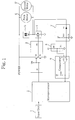
- Fig. 1 is a circuit diagram showing a configuration of an over current detection device of a dual motor used in a vehicle according to the prior art.
- This prior art device comprises an input unit 1 for inputting an external signal including motor drive information with duty cycle, a microprocessor 2 that provides an FET drive control signal to drive an FET according to the motor drive information in the external signal from the input unit 1, determines whether or not there occurs an over current state in the dual motor based on an output from a comparison unit 9 to be described below, and controls the dual motor to halt its operation upon the occurrence of the over current, an FET driver 3 for generating an FET drive signal in response to the FET drive control signal provided by the microprocessor 2, an FET 4 as a dual motor driving element that is turned ON/OFF depending on the FET drive from the FET driver 3 to drive the dual motor simultaneously, a freewheeling diode 5 for passing a recovery current for continuous operation of the dual motor when the FET 4 is OFF, a first and a second motors 6 and 6' as
- Figs. 2A and 2B show output waveforms resulting when the dual motor is in the normal state and over current state, respectively, according to the conventional over current detection device. With reference to these drawings, an operation of the conventional over current detection device will be described in detail below.
- the microprocessor 2 in the prior art over current detection device inputs the motor drive information included in the external signal from the input unit 1 and controls the FET driver 3 according to the motor drive information in order to drive the FET 4 as the dual motor driving element.
- the first and the second motors 6 and 6' are driven by a power (or supply voltage); and upon the OFF operation of the FET 4, the recovery currents issuing from the first and the second motors 6 and 6' enable them to be continuously driven by passing those currents flowed through the freewheeling diode 5.
- the FET 4 includes an internal resistor and the ON operation of the FET 4 is controlled according to the motor drive information. Based on the current variation by such ON operation of the FET 4, the voltage taken between both ends of the internal resistor in the FET 4 is varied.
- a comparator contained in the comparison unit 9 compares the voltage between both ends of the FET 4 detected by the voltage detector 7 with the reference voltage provided by the reference voltage setting unit 8. From the comparison, the comparator provides the microprocessor 2 with an output voltage of 5 V if the detected voltage is less than the reference voltage, and with an output voltage of 0 V if not, i.e., if the detected voltage is above the reference voltage.
- the microprocessor 2 determines that the first and the second motors 6 and 6' are in the normal state if the output voltage from the comparison unit 9 is at a high level of 5 V; and conversely, it determines that an over current state is present in any one or all of the first and the second motors 6 and 6' if the output voltage is at a low level of 0 V, and halts the operation of those motors, in order to prevent the motors from burning out due to the occurrence of the over current.
- the reference voltage set by the reference voltage setting unit for the over current detection cannot be modified, it may be determined that the detected voltage is less than the reference voltage, upon an issuance of the motor over current when the motor is driven with low current. Accordingly, over current of the dual motor is not detected, leading to motor burn out.
- a primary object of the present invention to provide an over current detection apparatus of a dual motor in a vehicle which is capable of preventing each motor from burning out by more precisely detecting an over current of each motor in the dual motor within an overall drive area thereof, wherein this is achieved by setting, as an over current detection reference current, a predefined range between a normal current and a constraint current of each motor by drive input conditions of each motor, detecting a current of each motor flowing in FET via a shunt resistor and a differential amplifier, and comparing the detected currents with the over current detection reference currents.
- an apparatus for detecting an over current of a dual motor in a vehicle comprising: an input unit for inputting an external square wave signal including motor drive information with duty cycle, wherein the signal is converted into an electric potential recognizable by a microprocessor; the microprocessor, which provides a drive control signal to drive a field effect transistor (FET) based on the motor drive information in the external square wave signal from the input unit, sets, as a first and a second over current detection reference currents to decide over current state, predefined ranges between normal currents and constraint currents by driving input conditions of each motor within an overall drive area of the dual motor, and compares a first and a second motor detection currents that correspond to output voltages from a first and a second smoothing units with the first and second reference currents, respectively, wherein it is decided that a first motor is in a normal state if the first detection current is less than the first reference current and in an over current state if the first detection current is greater than the first reference current, and
- FET field effect transistor
- Fig. 3 is a circuit diagram showing a configuration of an over current detection apparatus of a dual motor for a vehicle in accordance with a preferred embodiment of the present invention.
- the inventive apparatus comprises an input unit 11 for inputting an external square wave signal including motor drive information with duty cycle wherein the signal is converted into an electric potential of 5 V recognizable by a microprocessor 12 to be described below, the microprocessor 12 which provides an FET drive control signal to drive an FET based on the motor drive information in the external square wave signal from the input unit 11, sets, as a first and a second over current detection reference currents to detect an over current state, predetermined ranges between a normal current and a constraint current of each motor by drive input conditions of each motor within an overall drive area of the dual motor, compares a first and a second motor detection currents that correspond to output voltages from a first and a second smoothing units 19 and 19' to be mentioned later with the first and second reference currents, respectively, wherein it is determined that a first motor is in a normal state if
- the apparatus of the invention further comprises a second FET driver 13' connected to one end of the first FET driver 13 for amplifying and outputting an FET drive signal to drive the second motor in accordance with the FET drive control signal provided by the microprocessor 12, a second FET 14' that is operated as ON/OFF in response to the FET drive signal from the second FET driver 13', a second freewheeling diode 15' for passing a recovery current for continuous operation of the second motor when the second FET 14' is OFF, the second motor 16', which is driven in accordance with the operation of the second FET 14' and the second freewheeling diode 15', for providing a driving force necessary for the vehicle's operation, a second shunt resistor 17' connected to one end of the second FET 14' for detecting a current of the second motor 16' flowing in the second FET 14', a second amplifier 18' for detecting and amplifying voltage produced by the current flowing via the second shunt resistor 17', while getting rid of ground electronic
- the over current detection apparatus of the dual motor for the vehicle in accordance with the preferred embodiment of the present invention as structured above, in a state that the second FET driver 13' is coupled with one end of the first FET driver 3 and the first and the second motors 16 and 16' constituting the dual motor are driven simultaneously, an over current of each motor is first detected. And then, if an over current is detected from one or both of the motors, the invention makes the operations of all of the two motors stopped, to thereby prevent those motors from being burned.
- differential amplifiers Amp1 and Amp2 in detecting voltages generated by currents flowing through the first and the second shunt resistors 17 and 17' from the first and the second amplifiers 18 and 18', currents flowing in the first and second FETs 14 and 14' for driving the first and the second motors 16 and 16' can be detected more precisely, by removing effects that affect the current detection of a motor by current flowing in another motor when the dual motor is driven, that is, by removing effects that impact the current detection of the motor with the low capacity when current flows in the motor with large capacity.
- Figs. 4A and 4B are output waveforms resulting when the first motor in accordance with the over current detection apparatus of the invention is in the normal state and over current state, respectively
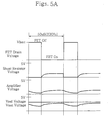
- Figs. 5A and 5B are output waveforms derived when the second motor in accordance with the over current detection apparatus of the invention is in the normal state and over current state, respectively.
- the input unit 11 inputs and converts an external square wave signal SIGNAL containing motor drive information such as duty cycle into an electronic potential of 5 V recognizable by the microprocessor 12.
- the microprocessor 12 computes the motor drive information by measuring a length of high or low level of the external square wave signal from the input unit 11.
- the microprocessor 12 provides the first FET driver 13 with an FET drive control signal so as to drive the first motor 16 at a frequency of 20 KHz in accordance with the motor drive information as computed above.
- the first FET driver 13 amplifies an FET drive signal based on the FET drive control signal and outputs it to the first FET 14 for its driving.
- the first motor 16 When the first FET 14 is ON, the first motor 16 is driven by a power (or supply voltage); and when it is OFF, the first motor 16 is driven continuously by passing a recovery current produced by that motor through the freewheeling diode 15.
- the first amplifier 18 detects and amplifies a voltage produced by the current flowing through the first shunt resistor 17, while eliminating ground electronic potential effects that vary depending upon currents by motor capacities using the differential amplifier Amp1, and outputs it to the first smoothing unit 19.
- the first smoothing unit 19 smoothes the voltage amplified by the first amplifier 18 and provides it to the microprocessor 12.
- the second FET driver 13' connected to one end of the first FET driver 13 inputs the FET drive control signal outputted from the first FET driver 13 by the microprocessor 12; and, in response to this control signal, it amplifies and outputs the FET drive signal for driving the second motor 16' to the second FET 14', which thus drives the second FET 14'.
- the second motor 16' when the second FET 14' is ON, the second motor 16' is driven by a power; and when it is OFF, the second motor 16' is driven continuously by passing a recovery current produced by that motor through the second freewheeling diode 15'.
- the second amplifier 18' detects and amplifies voltage produced by the current flowing through the second shunt resistor 17', while eliminating ground electronic potential effects that vary depending upon currents by motor capacities using the differential amplifier Amp2, and outputs it to the second smoothing unit 19'.
- the second smoothing unit 19' smoothes the voltage amplified by the second amplifier 18' and provides it to the microprocessor 12.
- the microprocessor 12 inputs the analog voltage from the first smoothing unit 19 and converts it into digital data corresponding to the voltage as the first motor detection current. Then, the converted digital data, i.e., the first detection current of the first motor 16 detected at the first shunt resistor 17 and the first amplifier 18 is compared with a first predefined over current detection reference current. As illustrated in Figs. 4A and 4B, if the first detection current, VSen voltage, is less than the first reference current, Vref voltage, it is determined that the first motor 16 is in the normal state, and otherwise, it is determined that the first motor 16 is in the over current state.
- the microprocessor 12 gets the analog voltage from the second smoothing unit 19' and converts it into digital data corresponding to the voltage as a second motor detection current. Then, the converted digital data, i.e., the second detection current of the second motor 16' detected at the second shunt resistor 17' and the second amplifier 18 is compared with a second predefined over current detection reference current. As shown in Figs. 5A and 5B, if the second detection current, VSen voltage, is less than the second reference current, Vref voltage, then it is determined that the second motor 16' is in the normal state, and otherwise, then it is determined that the second motor 16' is in the over current state.
- the microprocessor 12 determines the over current state of each of the first and the second motors 16 and 16' in the dual motor and cuts off, if it is determined that any one of the two motors is bound and in the over current state, the dual motor drive signal. This makes the supply voltage to the two motors interrupted and in turn their operations stopped, thus preventing the bound motor from burning out due to the over current.
- Fig. 6 is a circuitry diagram depicting a structure of an over current detection apparatus of a dual motor for a vehicle in accordance with another embodiment of the present invention. As shown, the structure is almost same as that of the over current detection apparatus in accordance with the preferred embodiment of the present invention as disclosed in Fig. 3, and thus, its details will be omitted herein for simplicity purposes. However, it should be noted that the second FET driver 13" is not connected to one end of the first FET driver 13 but configured to input the FET drive control signal directly from the microprocessor 12, as illustrated in Fig. 6.
- the microprocessor 12 provides the FET drive control signals to the first and the second FET drivers 13 and 13' respectively.
- the microprocessor 12 can detect the over current state of each of the first and the second motors 16 and 16' in the dual motor; and from the detection, if it is determined that any one of the two motors is bound and in the over current state and the other motor is in the normal state, the normal other motor is driven, thus minimizing a power necessary for such driving.
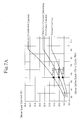
- Fig. 7A shows a waveform diagram of each of the normal current, the constraint current, and the first over current detection reference current of the first motor when a duty cycle of the motor drive input is 55 %, to set the first over current detection reference current by the microprocessor 12
- Fig. 7B depicts a waveform of each of a the normal current, the bound current, and the second over current detection reference current of the second motor when a duty cycle of the motor drive input is 55 %, to set the second over current detection reference current by the microprocessor 12
- Fig. 8 illustrates a flow chart showing the setting operation of the first and second over current detection reference currents, and the over current detection operation of the first and second motors performed by the microprocessor 12.
- the microprocessor 12 inputs the external square wave signal containing motor drive information from the input unit 11 and computes the motor drive information from the signal (S1). Next, it provides motor drive signals, i.e., an FET drive control signal and an FET drive signal, to operate the first and second motors 16 and 16' by driving the first and second FET drivers 13 and 13', and the first and second FETs 14 and 14' based on the computed motor drive information (S2).
- motor drive signals i.e., an FET drive control signal and an FET drive signal
- the microprocessor 12 measures voltages supplied to the first and second motors 16 and 16' and temperatures of the motors (S3). That is, since the motor current is varied depending upon the voltage and temperature, the present invention precisely measures the current flowing in the dual motor, by computing the normal current and the constraint current flowing in the dual motor according to its drive input conditions by properly adding and modifying variations by the input voltage to the dual motor and its temperature when computing the normal current and constraint current. This precise current detection enables the accurate detection of the over current state, upon the next comparison and decision of the detection current and the over current detection reference current.
- the microprocessor 12 inputs the voltages produced at the first and second shunt resistors 17 and 17' by the currents flowing in the first and second motors 16 and 16' and the first and second FETs 14 and 14' through the first and the amplifiers 18 and 18' and the first and the second smoothing units 19 and 19', and converts them into digital data, thereby detecting the first and second currents of the first and second motors 16 and 16' (S4).
- the microprocessor 12 computes the normal currents of the first and second motors 16 and 16', which correspond to the drive input conditions of the dual motor, by properly adding and modifying variations by the input voltages and temperatures of the dual motor measured at said step S3 (S5).
- the microprocessor 12 computes the constraint currents of the first and second motors 16 and 16', which correspond to the drive input conditions of the dual motor, by properly adding and modifying variations in the input voltages and temperatures of the dual motor measured at said step S3 (S6).
- the microprocessor 12 sets predefined ranges between the normal currents of the first and second motors 16 and 16' computed at said step S5 and the constraint currents of the first and second motors 16 and 16' computed at said step S6 as shown in Figs. 7A and 7B, as the first and second over current detection reference currents of the motors, in order to decide the over current state (S7).
- the changes of the over current detection reference currents are available for all the drive input conditions of the dual motor. As a result, this allows more precise detection of the over current state.
- the microprocessor 12 compares the first and second detection currents of the first and second motors 16 and 16' measured at said step S4 with the first and second over current detection reference currents set at said step S7, respectively. Specifically, it first compares the first detected current of the first motor 16 with the first over current detection reference current (S8); and determines that the first motor 16 is in the over current state if the first detected current is greater than the first reference current and makes those motors 16 and 16' interrupted for a preset time, e.g., 15 sec (S9 and S10). However, if the first detected current is less than the first reference current, the microprocessor 12 determines that the first motor 16 is in the normal state and then compares the second detected current of the second motor 16' with the second over current detection reference current (S11)
- step S11 From the comparison at said step S11, if the second detected current of the second motor 16' is less than the second reference current, the microprocessor 12 determines that the second motor 16' is in the normal state and those motors 16 and 16 continue to be driven normally. However, if the second detected current of the second motor 16' is greater than the second reference current, it is determined that the second motor 16' is in the over current state and the operations of the motors 16 and 16' are stopped for a preset time, e.g., 15 sec, as described in the above comparison (S9 and S10).
- a preset time e.g. 15 sec
- the present invention enables the microprocessor to detect the over current that occurs in one or all of the two motors upon the operation of the dual motor, by using the normal currents and constraint currents of the dual motor, which exist for the drive input conditions of all the motors. By doing so, the present invention can prevent the dual motor from burning out, which allows the dual motor to be driven stably.
- the present invention can prevent each motor from burning out by more precisely detecting an over current of each motor in the dual motor within the overall drive area thereof. This can be accomplished by setting, as an over current detection reference current, a predefined range between a normal current and a constraint current of each motor by drive input conditions of each motor, detecting a current of each motor flowing in FET via a shunt resistor and a differential amplifier, and comparing the detected currents with the over current detection reference currents.
Landscapes
- Engineering & Computer Science (AREA)
- Power Engineering (AREA)
- Life Sciences & Earth Sciences (AREA)
- Sustainable Development (AREA)
- Sustainable Energy (AREA)
- Transportation (AREA)
- Mechanical Engineering (AREA)
- Control Of Multiple Motors (AREA)
- Electric Propulsion And Braking For Vehicles (AREA)
- Protection Of Generators And Motors (AREA)
- Control Of Direct Current Motors (AREA)
Applications Claiming Priority (1)
| Application Number | Priority Date | Filing Date | Title |
|---|---|---|---|
| KR1020050063146A KR100670735B1 (ko) | 2005-07-13 | 2005-07-13 | 자동차용 듀얼 모터의 과전류 검출장치 |
Publications (2)
| Publication Number | Publication Date |
|---|---|
| EP1743799A2 true EP1743799A2 (de) | 2007-01-17 |
| EP1743799A3 EP1743799A3 (de) | 2014-04-23 |
Family
ID=35787717
Family Applications (1)
| Application Number | Title | Priority Date | Filing Date |
|---|---|---|---|
| EP05019780.5A Withdrawn EP1743799A3 (de) | 2005-07-13 | 2005-09-12 | Gerät zur Bestimmung eines Überstromes in einem zweimotorigen Fahrzeug |
Country Status (4)
| Country | Link |
|---|---|
| US (1) | US7173386B1 (de) |
| EP (1) | EP1743799A3 (de) |
| KR (1) | KR100670735B1 (de) |
| CN (1) | CN100514787C (de) |
Families Citing this family (15)
| Publication number | Priority date | Publication date | Assignee | Title |
|---|---|---|---|---|
| US8390965B2 (en) * | 2008-05-07 | 2013-03-05 | Cal-Comp Electronics & Communications Company Limited | Over-current protection device for multiple high-voltage motive devices and method thereof |
| CN101614761B (zh) * | 2008-06-25 | 2012-03-14 | 鸿富锦精密工业(深圳)有限公司 | 电流侦测电路 |
| JP2010088187A (ja) * | 2008-09-30 | 2010-04-15 | Sanyo Electric Co Ltd | モータ制御回路 |
| CN101728817A (zh) * | 2008-10-17 | 2010-06-09 | 鸿富锦精密工业(深圳)有限公司 | 多轴驱动系统 |
| JP4672054B2 (ja) * | 2008-11-10 | 2011-04-20 | 三菱電機株式会社 | モータ制御装置 |
| CN102377159A (zh) * | 2010-08-13 | 2012-03-14 | 泰金宝电通股份有限公司 | 多重高压动力元件过电流保护装置及其方法 |
| JP5784930B2 (ja) * | 2011-03-07 | 2015-09-24 | Ntn株式会社 | 電気自動車 |
| JP6201366B2 (ja) * | 2013-03-27 | 2017-09-27 | 株式会社ジェイテクト | 電気負荷制御装置の過電流異常判定装置、駆動力配分制御装置、および過電流異常判定方法ならびに過電流異常判定プログラム |
| KR101470225B1 (ko) * | 2013-10-22 | 2014-12-05 | 현대자동차주식회사 | 차량용 모터 구동 장치 |
| CN104009678A (zh) * | 2014-05-21 | 2014-08-27 | 芜湖蓝宙电子科技有限公司 | 一种双路电机控制模块电路 |
| US20180026556A1 (en) * | 2014-11-20 | 2018-01-25 | Loong-Chiang Hu | Motor system with a changeable power capacity |
| CN111373651B (zh) * | 2017-11-20 | 2024-05-28 | 利纳克有限公司 | 确定在多个电动机之一中流动的电流 |
| JP6814184B2 (ja) * | 2018-09-19 | 2021-01-13 | 株式会社Subaru | 電気自動車 |
| CN113067515B (zh) * | 2021-04-13 | 2024-05-17 | 南通大学 | 一种计及占空比约束的永磁同步电机三矢量模型预测磁链控制方法 |
| CN117410928B (zh) * | 2023-10-17 | 2024-04-30 | 悦芯科技股份有限公司 | 一种双向可控的芯片限流检测电路 |
Family Cites Families (9)
| Publication number | Priority date | Publication date | Assignee | Title |
|---|---|---|---|---|
| DE4192435C1 (de) * | 1990-10-03 | 2002-08-29 | Hitachi Ltd | Steuerung für Elektrofahrzeug |
| US5664048A (en) * | 1990-11-14 | 1997-09-02 | Abbott Laboratories | Speed control circuit for a DC motor |
| US5266787A (en) * | 1991-01-11 | 1993-11-30 | Symbol Technologies, Inc. | Laser scanner using two scan motors independently controlled by a single signal |
| JPH05344788A (ja) * | 1992-06-10 | 1993-12-24 | Matsushita Electric Ind Co Ltd | 機器の制御回路 |
| CN1063896C (zh) * | 1993-09-27 | 2001-03-28 | 日本电装株式会社 | 包含功率晶体管过电流保护电路的负载驱动装置 |
| WO1998029285A1 (en) * | 1997-01-03 | 1998-07-09 | Mccord Winn Textron, Inc. | Windshield wiper system |
| JP4165953B2 (ja) | 1999-03-03 | 2008-10-15 | 株式会社東芝 | ヒステリシスモータ監視装置 |
| KR20050002285A (ko) * | 2003-06-30 | 2005-01-07 | 주식회사 현대오토넷 | Nvh 감소를 위한 팬모터 개별 속도 제어장치 |
| JP2005033933A (ja) | 2003-07-07 | 2005-02-03 | Tachi S Co Ltd | 2モータの同期運転制御方法およびその同期運転制御装置 |
-
2005
- 2005-07-13 KR KR1020050063146A patent/KR100670735B1/ko not_active Expired - Lifetime
- 2005-08-12 US US11/202,630 patent/US7173386B1/en not_active Expired - Lifetime
- 2005-08-30 CN CNB200510097834XA patent/CN100514787C/zh not_active Expired - Fee Related
- 2005-09-12 EP EP05019780.5A patent/EP1743799A3/de not_active Withdrawn
Also Published As
| Publication number | Publication date |
|---|---|
| CN1897386A (zh) | 2007-01-17 |
| EP1743799A3 (de) | 2014-04-23 |
| KR20070008143A (ko) | 2007-01-17 |
| US20070013327A1 (en) | 2007-01-18 |
| KR100670735B1 (ko) | 2007-01-19 |
| CN100514787C (zh) | 2009-07-15 |
| US7173386B1 (en) | 2007-02-06 |
Similar Documents
| Publication | Publication Date | Title |
|---|---|---|
| US7193382B2 (en) | Apparatus for detecting over current of motor in vehicle | |
| US7173386B1 (en) | Apparatus for detecting over current of dual motor in vehicle | |
| US6922040B2 (en) | PWM switching regulator with current and voltage feedback | |
| JP3901698B2 (ja) | 電流検出機能付き半導体集積回路、及びそれを用いた電源装置 | |
| JP2004243969A (ja) | 電動パワーステアリングの制御装置 | |
| JP4775044B2 (ja) | スイッチングレギュレータ | |
| EP0485119A2 (de) | Schaltung zum Ansteuern einer Last und zum Erzeugen eines Signales, das den Lastzustand anzeigt | |
| JP2009055649A (ja) | ブラシレスdcモータの駆動装置 | |
| JP4882710B2 (ja) | 負荷駆動装置の故障検出装置および負荷駆動用ic | |
| JP6238627B2 (ja) | 定電流発生回路および定電流発生回路の保護方法、並びに、抵抗測定装置、および、抵抗測定方法 | |
| JP2006137280A (ja) | 電動パワーステアリング装置 | |
| JP5989171B1 (ja) | 電流検出回路、及びその回路を備えた車両用電子制御装置 | |
| JP3451954B2 (ja) | 電圧比較回路 | |
| JP2008516571A (ja) | 障害保護付きミラー素子駆動回路 | |
| CN114762206A (zh) | 电压监控电路 | |
| JP2001108712A (ja) | 電流検出装置 | |
| CN115981443A (zh) | 程序刻录装置及其电流保护检测方法 | |
| JP4148243B2 (ja) | 異常検出回路 | |
| KR100439499B1 (ko) | 엘시디의 백라이트 인버터 | |
| US7600913B2 (en) | Saturated transistor based temperature sensor | |
| KR101172117B1 (ko) | 전동식 파워스티어링 시스템의 모터 단락 감지 방법 및 그시스템 | |
| JP2007318920A (ja) | スイッチング電源装置の制御方法、制御回路およびスイッチング電源装置 | |
| KR20100054999A (ko) | 모터 구동 시스템에서의 과전류 보호 호로 | |
| JP4024915B2 (ja) | 低抵抗電子装置の抵抗値判定装置 | |
| JP2009294006A (ja) | 車両用センサのヒータを制御するためのヒータ制御装置及びヒータ制御方法 |
Legal Events
| Date | Code | Title | Description |
|---|---|---|---|
| PUAI | Public reference made under article 153(3) epc to a published international application that has entered the european phase |
Free format text: ORIGINAL CODE: 0009012 |
|
| AK | Designated contracting states |
Kind code of ref document: A2 Designated state(s): AT BE BG CH CY CZ DE DK EE ES FI FR GB GR HU IE IS IT LI LT LU LV MC NL PL PT RO SE SI SK TR |
|
| AX | Request for extension of the european patent |
Extension state: AL BA HR MK YU |
|
| PUAL | Search report despatched |
Free format text: ORIGINAL CODE: 0009013 |
|
| AK | Designated contracting states |
Kind code of ref document: A3 Designated state(s): AT BE BG CH CY CZ DE DK EE ES FI FR GB GR HU IE IS IT LI LT LU LV MC NL PL PT RO SE SI SK TR |
|
| AX | Request for extension of the european patent |
Extension state: AL BA HR MK YU |
|
| RIC1 | Information provided on ipc code assigned before grant |
Ipc: H02P 29/02 20060101ALN20140318BHEP Ipc: H02P 29/00 20060101ALI20140318BHEP Ipc: B60L 3/00 20060101AFI20140318BHEP |
|
| AKY | No designation fees paid | ||
| AXX | Extension fees paid |
Extension state: MK Extension state: BA Extension state: YU Extension state: AL Extension state: HR |
|
| REG | Reference to a national code |
Ref country code: DE Ref legal event code: R108 |
|
| REG | Reference to a national code |
Ref country code: DE Ref legal event code: R108 Effective date: 20150106 |
|
| STAA | Information on the status of an ep patent application or granted ep patent |
Free format text: STATUS: THE APPLICATION IS DEEMED TO BE WITHDRAWN |
|
| 18D | Application deemed to be withdrawn |
Effective date: 20141024 |