EP1712598A1 - Verfahren zur Veränderung der Strukturladung von mineralischen Silikatverbindungen - Google Patents
Verfahren zur Veränderung der Strukturladung von mineralischen Silikatverbindungen Download PDFInfo
- Publication number
- EP1712598A1 EP1712598A1 EP06006486A EP06006486A EP1712598A1 EP 1712598 A1 EP1712598 A1 EP 1712598A1 EP 06006486 A EP06006486 A EP 06006486A EP 06006486 A EP06006486 A EP 06006486A EP 1712598 A1 EP1712598 A1 EP 1712598A1
- Authority
- EP
- European Patent Office
- Prior art keywords
- microwave
- minutes
- charge
- treatment
- lithium
- Prior art date
- Legal status (The legal status is an assumption and is not a legal conclusion. Google has not performed a legal analysis and makes no representation as to the accuracy of the status listed.)
- Granted
Links
Images

Classifications
-
- C—CHEMISTRY; METALLURGY
- C09—DYES; PAINTS; POLISHES; NATURAL RESINS; ADHESIVES; COMPOSITIONS NOT OTHERWISE PROVIDED FOR; APPLICATIONS OF MATERIALS NOT OTHERWISE PROVIDED FOR
- C09C—TREATMENT OF INORGANIC MATERIALS, OTHER THAN FIBROUS FILLERS, TO ENHANCE THEIR PIGMENTING OR FILLING PROPERTIES ; PREPARATION OF CARBON BLACK ; PREPARATION OF INORGANIC MATERIALS WHICH ARE NO SINGLE CHEMICAL COMPOUNDS AND WHICH ARE MAINLY USED AS PIGMENTS OR FILLERS
- C09C1/00—Treatment of specific inorganic materials other than fibrous fillers; Preparation of carbon black
- C09C1/28—Compounds of silicon
-
- B—PERFORMING OPERATIONS; TRANSPORTING
- B41—PRINTING; LINING MACHINES; TYPEWRITERS; STAMPS
- B41M—PRINTING, DUPLICATING, MARKING, OR COPYING PROCESSES; COLOUR PRINTING
- B41M5/00—Duplicating or marking methods; Sheet materials for use therein
- B41M5/124—Duplicating or marking methods; Sheet materials for use therein using pressure to make a masked colour visible, e.g. to make a coloured support visible, to create an opaque or transparent pattern, or to form colour by uniting colour-forming components
- B41M5/132—Chemical colour-forming components; Additives or binders therefor
- B41M5/155—Colour-developing components, e.g. acidic compounds; Additives or binders therefor; Layers containing such colour-developing components, additives or binders
- B41M5/1555—Inorganic mineral developers, e.g. clays
-
- C—CHEMISTRY; METALLURGY
- C09—DYES; PAINTS; POLISHES; NATURAL RESINS; ADHESIVES; COMPOSITIONS NOT OTHERWISE PROVIDED FOR; APPLICATIONS OF MATERIALS NOT OTHERWISE PROVIDED FOR
- C09C—TREATMENT OF INORGANIC MATERIALS, OTHER THAN FIBROUS FILLERS, TO ENHANCE THEIR PIGMENTING OR FILLING PROPERTIES ; PREPARATION OF CARBON BLACK ; PREPARATION OF INORGANIC MATERIALS WHICH ARE NO SINGLE CHEMICAL COMPOUNDS AND WHICH ARE MAINLY USED AS PIGMENTS OR FILLERS
- C09C1/00—Treatment of specific inorganic materials other than fibrous fillers; Preparation of carbon black
- C09C1/40—Compounds of aluminium
- C09C1/42—Clays
-
- D—TEXTILES; PAPER
- D21—PAPER-MAKING; PRODUCTION OF CELLULOSE
- D21H—PULP COMPOSITIONS; PREPARATION THEREOF NOT COVERED BY SUBCLASSES D21C OR D21D; IMPREGNATING OR COATING OF PAPER; TREATMENT OF FINISHED PAPER NOT COVERED BY CLASS B31 OR SUBCLASS D21G; PAPER NOT OTHERWISE PROVIDED FOR
- D21H19/00—Coated paper; Coating material
- D21H19/36—Coatings with pigments
- D21H19/38—Coatings with pigments characterised by the pigments
- D21H19/40—Coatings with pigments characterised by the pigments siliceous, e.g. clays
-
- C—CHEMISTRY; METALLURGY
- C01—INORGANIC CHEMISTRY
- C01P—INDEXING SCHEME RELATING TO STRUCTURAL AND PHYSICAL ASPECTS OF SOLID INORGANIC COMPOUNDS
- C01P2002/00—Crystal-structural characteristics
- C01P2002/80—Crystal-structural characteristics defined by measured data other than those specified in group C01P2002/70
- C01P2002/82—Crystal-structural characteristics defined by measured data other than those specified in group C01P2002/70 by IR- or Raman-data
Definitions
- the invention relates to a process for modification, in particular for reducing the structural charge of mineral silicate compounds.
- Mineral raw materials that offer the possibility of charge modification due to their structure structure belong according to G. Lagaly and K. Beneke, Colloid Polym. Sci., Vol. 269, pp. 1198-1211, 1991 , to natural inorganic cation exchangers.
- An example of these industrially widespread minerals are clay minerals from the group of dioctahedral smectites or zeolites.
- the raw material bentonite contains as its main constituent the mineral montmorillonite, which is a dioctahedral smectite.
- Bentonite is used in large quantities for mold making in the foundry industry, as a litter for pets, as a drilling mud and as a pelletizer for iron ore.
- bentonite is used in the manufacture of cosmetic products such as eyeshadows, lipsticks or mascaras, in shampoos, hair tints or toothpastes.
- bentonite is added to detergents such as washing powder and washing pastes.
- bentonite is used in the paper industry in the production of carbonless copying papers and special printing papers as well as in the paint and coatings industry as a filler or rheological additive.
- bentonite is found in pharmaceutical applications, e.g. in mud bath formulations, body slimes for skin treatments or for internal applications in case of digestive problems or as an additive in controlled-release pills.
- the cation exchange capacity of montmorillonite is related to its chemical structure.
- the structural cations of this mineral can be replaced by lower oxidation number cations both in the tetrahedral network (Si 4+ is replaced by Al 3+ ) and in the octahedral network (Al 3+ is replaced by Mg 2+ ).
- a negative charge forms on the elemental layers, which is compensated by exchangeable cations.
- An elementary layer of the mineral consists of two tetrahedral networks (T) and an octahedral network (O), which are coupled together by common oxygen atoms and arranged in the order TOT.
- the DE 197 52 728 C2 discloses the heating of bulk materials and powders in a microwave heated rotary kiln.
- the present invention provides a method of altering, in particular reducing or reducing the structural loading of mineral silicate compounds, preferably of natural mineral feedstocks such as e.g. swelling-capable clay minerals of the smectite family, in particular dioctahedral silicate compounds, or zeolites.
- mineral silicate compounds preferably of natural mineral feedstocks such as e.g. swelling-capable clay minerals of the smectite family, in particular dioctahedral silicate compounds, or zeolites.
- a mixture is prepared which is preferably in the form of a powder, but which may also be present as a dispersion. In the latter case, however, the solid must be separated before the further process steps.
- This mixture is homogenized and dry, ie in the form of a powder, by means of microwaving over a period of time, preferably between 5 minutes and 30 minutes, more preferably between 5 minutes and 10 minutes to a temperature preferably between 100 ° C and 300 ° C, more preferably between 190 ° C and 230 ° C, heated. Longer times are nevertheless possible, worsen but the energy balance. Experiments have surprisingly shown that even a five-minute exposure of this mixture with microwave leads to the same result as an hour-long conventional heating.
- the mixture is applied to a substrate, for. B. as a reactive layer on the surface of a carbonless paper.
- This substrate is continuously pushed through a region within which the reactive layer from the mixture is microwaved.
- the present invention is based on the known fact that the migration of small cations in a solid is determined by its diffusivity in the solid, which usually increases with higher temperature.
- Conventional heating methods based on radiation and convection are characterized by the fact that they heat only the surface of a powder bed, while in the volume of the powder bed the heat passes through heat conduction.
- powder beds are characterized by a very low thermal conductivity, conventional methods require time-consuming process control.
- microwave technology allows direct heating of a powder bed in volume, characterized in that the microwave radiation penetrates the material and is converted in the material by various absorption mechanisms into heat.
- the absorption mechanisms depend on the material to be heated, on its electronic or ionic conductivity, on dipole relaxations or on excitations of lattice vibrations by multi-phonon scattering processes.
- a suitable microwave frequency should be selected. With increasing dielectric losses, ie with decreasing penetration depth of the microwaves or with increasing volumes, a longer wavelength, ie a lower microwave frequency, is more favorable for the method.
- the microwave frequency is preferably in a frequency band that is released for industrial applications (ISM frequency ) .
- the lithium ions added to the material are selectively excited by the microwave field and thereby accelerate from the solid surface to the vacant sites present in the structure of the material.
- the direct and selective volume heating provides in particular procedural advantages that lead to a significant time savings over conventional methods.
- the reduction of process times and process temperatures can be exploited to improve the material properties.
- the illustrated dispersion containing 1M NaCl was then treated with 1M solutions each having a lithium concentration of 20%, 40%, 60%, 80% and 100%.
- the excess amount of salt was washed out with distilled water. In this way, a series of samples was provided which had the composition of cations in the interlayer space.
- the samples were then conventionally heated either in a microwave field or for comparison at the same temperature for the same time.
- the efficiency of the stratified charge neutralization was confirmed by determining the cation exchange capacity LP Maier and G. Kahr, Clay Miner., Vol. 47, pp. 386-388, 1999 , proven.
- the structural changes were examined by means of infrared spectroscopy, the swellability by means of X-ray diffraction and the rheological properties of the aqueous dispersions by means of rheological measurements.
- the cation exchange capacities of the samples Volclay ( Figure 1) and Calcigel ( Figure 2) are as a function of lithium content after conventional ( co ) treatment or after treatment with microwaves ( Mw ) at a temperature of 230 ° C over a holding time of 60 minutes.
- the efficiency of microwave treatment increases significantly. This increase is due to the increased likelihood of a lithium cation reaching a vacant site in the silicate structure. This probability is increased due to the selective absorption of the microwave by the lithium cations and their resulting higher diffusibility.
- the Calcigel sample ( Figure 2) is characterized by a lower cation exchange capacity over the Volclay sample ( Figure 1) .
- the treatment time was by means of microwaves abbreviated to 5 minutes. This time window is virtually unachievable by means of conventional volume heating of the material, since in laboratory conditions alone the heating phase for 190 ° C. is about 10 minutes, at 230 ° C. about 15 minutes and for 270 ° C. about 25 minutes. In contrast, in a microwave treatment, the heating phase at 230 ° C is less than 5 minutes.
- the cation exchange capacity of the Volclay sample occupying 60% lithium cations after conventional treatment and after treatment in the microwave field as a function of treatment time shown. The modification by microwave treatment achieves the maximum achievable change in the cation exchange capacity after only a treatment time of 5-10 minutes.
- the influence of migration of lithium cations into the vacant sites in the structure was further investigated by infrared spectroscopy.
- the lithium cations that penetrate into the structure after treatment affect the vibrational frequency of the structural OH groups.
- the shift of the deformation frequencies to higher wavenumbers serves as proof of the presence of lithium in the vacant structural sites.
- 8 and 9 compare the recorded infrared spectra of the Volclay sample, which was conventionally or in the microwave field to 230 ° C and heated over a period of 60 minutes.
- the ranges of the vibration frequencies correspond to the stretching vibration and between 950-850 cm -1 the bending vibration of the structural OH groups.
- the stretching vibrations of samples treated in the microwave field a systematic shift of the vibrational frequencies to higher wave numbers (3623-3635 cm -1 ) is observed.
- an additional absorption band at ⁇ 3666 cm -1 is formed, which is attributable to the trioctahedral arrangement of the structural OH groups (AlMgLiOH).
- AlMgLiOH trioctahedral arrangement of the structural OH groups
- a bentonite in the natural state becomes a lithium salt or a lithium salt solution is added to the homogenizer in an amount of 20 to 80% of the cation exchange capacity. For example, if a bentonite having a cation exchange capacity of 100 meq / 100 g is modified, then about 0.35 g lithium chloride per 100 g bentonite or about 80% charge neutralization 3.39 g lithium chloride per 100 g bentonite is required for about 20% charge neutralization ,
- an activating acid such as H 2 SO 4 or activating cations in the form AlCl 3 is added to the lithium chloride solution.
- the acid (cation) concentration can be 10-100 meq / liter of the solution.
- any resulting chlorides NaCl, CaCl 2 ) are washed out if necessary.
- the acid activation is alternatively carried out with a solution mentioned above in a second microwave treatment step. After the treatments, the sample material can be ground.
- the in situ modification of the material can be applied, which is applied in thin layers on paper or polymer films.
- a viscous paste with the same lithium salt content as above and a water content of 20-40% is applied to the carrier material.
- a microwave treatment of the material allows at the same time for the modification of the charge the drying of the mineral layer.
- modification of the layer charge on montmorillonite may provide a desirable rheological property of a sand-bentonite mixture, such as a sandstone mixture.
- a modification by means of microwave treatment is achieved here by the fact that the sand-bentonite mixture a lithium salt or a lithium salt solution is added during the homogenization process. In this way, the desired charge neutralization of 20 to 80% of the cation exchange capacity as in Example 1 is achieved.
- the process according to the invention is used for the production of lithium preparations for the therapy of depressive states based on bentonite with controlled release of active ingredient.
- a charge-modified bentonite the treatment of which has been described above, is useful as an antidepressant.
- the charge-modified bentonite is partially dissolved by gastric acid, releasing a certain amount of lithium cations and being absorbed by the body.
- the microwaves used destroy the germs that may be present in the bentonite.
Landscapes
- Chemical & Material Sciences (AREA)
- Dispersion Chemistry (AREA)
- Organic Chemistry (AREA)
- Inorganic Chemistry (AREA)
- Chemical Kinetics & Catalysis (AREA)
- General Chemical & Material Sciences (AREA)
- Silicates, Zeolites, And Molecular Sieves (AREA)
Abstract
Description
- Die Erfindung betrifft ein Verfahren zur Veränderung, insbesondere zur Verringerung der Strukturladung von mineralischen Silikatverbindungen.
- Mineralische Rohstoffe, die von ihrem Strukturaufbau her die Möglichkeit einer Ladungsmodifizierung bieten, gehören gemäß G. Lagaly und K. Beneke, Colloid Polym. Sci., Band 269, S. 1198-1211, 1991, zu den natürlichen anorganischen Kationenaustauschern. Ein Beispiel für diese industriell weit verbreiteten Mineralien sind Tonmineralien aus der Gruppe der dioktaedrischen Smektite oder der Zeolithe.
- Der Rohstoff Bentonit enthält als Hauptbestandteil das Mineral Montmorillonit, das ein dioktaedrisches Smektit ist. Bentonit wird in großen Mengen für die Formenherstellung in der Gießindustrie, als Streu für Haustiere, als Bohrschlamm und als Pelletierungsmittel für Eisenerz eingesetzt. In kleineren Mengen findet Bentonit Verwendung bei der Herstellung von kosmetischen Produkten wie Lidschatten, Lippenstiften oder Mascaras, in Haarwaschmitteln, Haartönungen oder in Zahnpasten. Weiter wird Bentonit zu Reinigungsmitteln wie Waschpulver und Waschpasten zugegeben. Darüber hinaus wird Bentonit eingesetzt in der Papierindustrie bei der Herstellung kohlefreier Durchschreibpapiere und spezieller Druckpapiere sowie in der Farb- und Lackindustrie als Füllstoff oder rheologisches Additiv. Schließlich findet sich Bentonit in pharmazeutischen Anwendungen wie z.B. in Moorbäderformulierungen, Körperschlämmen für Hautbehandlungen oder für innere Anwendungen bei Verdauungsproblemen oder als Zusatz in Pillen zur kontrollierten Wirkstoffabgabe.
- Das Kationenaustauschvermögen von Montmorillonit hängt mit dessen chemischer Struktur zusammen. Die strukturellen Kationen dieses Minerals können ersetzt werden durch Kationen mit niedrigerer Oxidationszahl sowohl im tetraedrischen Netzwerk (Si4+ wird ersetzt durch Al3+) als auch im oktaedrischen Netzwerk (Al3+ wird ersetzt durch Mg2+). Dadurch bildet sich an den Elementarschichten eine negative Ladung, die durch austauschbare Kationen ausgeglichen wird. Eine Elementarschicht des Minerals besteht aus zwei tetraedrischen Netzwerken (T) und einem oktaedrischen Netzwerk (O), die durch gemeinsame Sauerstoffatome zusammenkoppeln und in der Reihenfolge TOT angeordnet sind.
- Eine wichtige Voraussetzung für eine effektive Strukturmodifizierung des Minerals ist die Anwesenheit von vakanten Plätzen in der Struktur. Die Modifizierung erfolgt so, dass diese vakanten Plätze durch kleine Kationen belegt werden und auf diese Weise eine Ladungsmodifizierung des Minerals bewirken. Derartige Plätze sind in dioktaedrischen Smektiten, die Platz für kleine austauschbare Kationen in den Schichten bieten, oder in Zeolithen, die austauschbare Kationen in den Strukturhöhlen besitzen, vorhanden.
- Das Verfahren zur Ladungsmodifizierung an dioktaedrischen Smektiten ist aus U. Hofmann, und R. Klemen, Z. Anorg. Allg. Chem., Band 262, S. 95-99, 1950, als Hofmann-Klemen-Effekt bekannt. Gemäß der
US 4,053,324 sind hierfür kleine austauschbare Kationen, insbesondere Lithiumkationen geeignet, die bei konventioneller Erhitzung des Minerals auf Temperaturen zwischen 105° und 300 °C durch Diffusion in die vakanten Plätze der Struktur wandern. Der Zeitbedarf für die Ladungsmodifizierung ist von der Temperatur und vom gewünschten Grad der Modifizierung abhängig und beträgt zwischen 30 Minuten bis 24 Stunden. - Die
DE 197 52 728 C2 offenbart die Erwärmung von Schüttgütern und Pulvern in einem mit Mikrowellen beheizten Drehrohrofen. - Hieraus ist allerdings nicht ersichtlich, wie sich die Eigenschaften von Materialien gezielt beeinflussen lassen.
- Davon ausgehend ist es die Aufgabe der Erfindung, ein Verfahren zur Veränderung, insbesondere zur Verringerung der Strukturladung von mineralischen Silikatverbindungen anzugeben, das die genannten Nachteile und Einschränkungen nicht aufweist. Insbesondere soll ein Verfahren mit geringen Verfahrenszeiten und Verfahrenstemperaturen bereitgestellt werden.
- Diese Aufgabe wird durch ein Verfahren mit den kennzeichnenden Merkmalen des Anspruchs 1 gelöst. Die Unteransprüche beschreiben vorteilhafte Ausgestaltungen der Erfindung.
- Die vorliegende Erfindung stellt ein Verfahren zur Veränderung, insbesondere zur Verringerung oder Absenkung der Strukturladung von mineralischen Silikatverbindungen, vorzugsweise von natürlichen mineralischen Rohstoffen wie z.B. quellfähigen Tonminerale der Smektit-Familie, insbesondere dioktaedrischen Silikatverbindungen, oder Zeolithen bereit.
- Aus diesen Silikatverbindungen und einem oder mehreren Lithiumsalzen wie z.B. LiCl, LiNO3, LiHCO3, Li2CO3, LiOH oder Li2SO4 wird eine Mischung hergestellt, die vorzugsweise in Form eines Pulvers vorliegt, die aber auch als Dispersion vorliegen kann. Im letzteren Falle muss jedoch vor den weiteren Verfahrensschritten der Feststoff angetrennt werden.
- Diese Mischung wird homogenisiert und trocken, d.h. in Form eines Pulvers, mittels einer Beaufschlagung durch Mikrowelle über einen Zeitraum, der bevorzugt zwischen 5 Minuten und 30 Minuten, besonders bevorzugt zwischen 5 Minuten und 10 Minuten auf eine Temperatur, die vorzugsweise zwischen 100° C und 300 °C, besonders bevorzugt zwischen 190 °C und 230 °C liegt, erwärmt. Längere Zeiten sind gleichwohl möglich, verschlechtern jedoch die Energiebilanz. Versuche haben überraschend gezeigt, dass bereits eine fünfminütige Beaufschlagung dieser Mischung mit Mikrowelle zu demselben Ergebnis führt wie eine stundenlange konventionelle Erwärmung.
- In einer besonderen Ausgestaltung ist die Mischung auf ein Substrat aufgebracht, z. B. als reaktive Schicht auf der Oberfläche eines durchschreibfreien Papiers. Dieses Substrat wird kontinuierlich durch einen Bereich geschoben, innerhalb dessen die reaktive Schicht aus der Mischung mit Mikrowelle beaufschlagt wird. Eine derartige Ausgestaltung wird erst durch das vorliegende Verfahren möglich, da dieses bereits nach einem sehr kurzen Zeitraum, besonders bevorzugt zwischen 5 und 10 Minuten, eine Veränderung der Strukturladung bewirkt.
- Die vorliegende Erfindung basiert auf der bekannten Tatsache, dass die Migration von kleinen Kationen in einem Festkörper durch ihr Diffusionsvermögen im Festkörper bestimmt ist, das üblicherweise mit höherer Temperatur zunimmt. Konventionelle Heizmethoden, die auf Strahlung und Konvektion basieren, sind dadurch charakterisiert, dass sie nur die Oberfläche einer Pulverschüttung erwärmen, während in das Volumen der Pulverschüttung die Wärme über Wärmeleitung gelangt. Als Konsequenz aus der Tatsache, dass sich Pulverschüttungen durch eine sehr geringe Wärmeleitfähigkeit auszeichnen, bedürfen konventionelle Verfahren einer zeitintensiven Prozessführung.
- Der Einsatz der Mikrowellentechnik erlaubt eine direkte Erwärmung einer Pulverschüttung im Volumen, dadurch dass die Mikrowellenstrahlung das Material durchdringt und im Material durch verschiedene Absorptionsmechanismen in Wärme umgewandelt wird. Die Absorptionsmechanismen sind abhängig von dem zu erwärmenden Material, von dessen elektronischer bzw. ionischer Leitfähigkeit, von Dipolrelaxationen oder Anregungen von Gitterschwingungen durch Mehr-Phononen-Streuprozesse.
- Neben diesem verfahrenstechnischen Vorteil der volumetrischen Erwärmung ist es zudem durch selektive Absorption der Mikrowellen möglich, die Mikrowellenenergie so einzusetzen, dass damit bestimmte Prozesse beschleunigt werden. Im Fall der Ladungsmodifizierung der Schichtsilikatstruktur wird auf diese Weise die Mikrowellenabsorption über die ionische Leitfähigkeit ausgenutzt, indem entsprechende Salze zugegeben werden, um die Ionen in vorhandene Lücken in der Gitterstruktur einzulagern. Durch diese selektive Absorption wird eine deutliche Beschleunigung der Ladungsmodifizierung erzielt.
- Je nach Absorptionseigenschaften bzw. der Menge des zu behandelnden Materials ist eine geeignete Mikrowellenfrequenz zu wählen. Mit zunehmenden dielektrischen Verlusten, d.h. mit abnehmender Eindringtiefe der Mikrowellen bzw. mit größer werdenden Volumina ist eine größere Wellenlänge, d.h. eine niedrigere Mikrowellenfrequenz günstiger für das Verfahren. Die Mikrowellenfrequenz liegt bevorzugt in einem Frequenzband, das für industrielle Anwendungen freigegeben ist (ISM Frequenz).
- Die Lithiumionen, die dem Material zugefügt wurden, werden durch das Mikrowellenfeld selektiv angeregt und wandern dadurch beschleunigt aus der Festkörperoberfläche an die vakanten Plätze, die in der Struktur des Materials vorhanden sind.
- Die direkte und selektive Volumenheizung liefert insbesondere verfahrenstechnische Vorteile, die zu einem erheblichen Zeitgewinn gegenüber konventionellen Methoden führen. Die Verringerung von Prozesszeiten und Prozesstemperaturen können ausgenutzt werden, um die Materialeigenschaften zu verbessern.
- Weiterhin ist eine Öffnung des Einsatzgebiets für Mikrowellen behandelte mineralische Rohstoffe im Bereich der Vorbehandlung von Schichtsilikaten und Zeolithen bei gleichzeitiger Kostenminimierung durch Wegfall von aufwendigen Kationen-Austausch-Prozessen möglich.
- Die Erfindung wird im Folgenden anhand von zwei Ausführungsbeispielen näher erläutert. Die Abbildungen zeigen
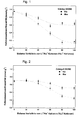
- Fig. 1
- Kationenaustauschkapazität von Volclay als Funktion der Behandlungsart und des Lithiumgehalts.
- Fig. 2
- Kationenaustauschkapazität von Calcigel als Funktion der Behandlungsart und des Lithiumgehalts.
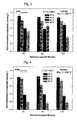
- Fig. 3
- Kationenaustauschkapazität von Volclay, das mittels konventioneller Erwärmung behandelt wurde, als Funktion der Behandlungsdauer.
- Fig. 4
- Kationenaustauschkapazität von Volclay, das mit Mikrowelle behandelt wurde, als Funktion der Behandlungsdauer.
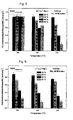
- Fig. 5
- Kationenaustauschkapazität von Volclay, das mittels konventioneller Erwärmung behandelt wurde, als Funktion der Temperatur.
- Fig. 6
- Kationenaustauschkapazität von Volclay, das mit Mikrowelle behandelt wurde, als Funktion der Temperatur.
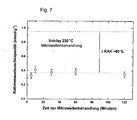
- Fig. 7
- Kationenaustauschkapazität der Volclay Probe als Funktion der Behandlungsdauer.
- Fig. 8
- Infrarotspektren von Volclay mit unterschiedlicher Lithiumionenkonzentration, das mittels konventioneller Erwärmung behandelt wurde.
- Fig. 9
- Infrarotspektren von Volclay mit unterschiedlicher Lithiumionenkonzentration, das mit Mikrowelle behandelt wurde.
- Für die Behandlung wurden zwei Bentonite mit der Bezeichnung Volclay bzw. Calcigel eingesetzt. Zunächst wurde jeweils eine Fraktionierung des Probenmaterials gemäß M. S. Stul und L. van Leemput, Clay Miner., Band 17, S. 209-215, 1982 durchgeführt.
- Hieran anschließend erfolgte eine Modifizierung des Materials gemäß H. Tributh und G. Lagaly, GIT-Fachzeitschrift für das Laboratorium, Band 30, S. 524-529 und S. 771-776, 1986, zur Anreicherung des Hauptbestandteils Montmorillonit.
- Die dargestellte Dispersion mit einem Gehalt an 1M NaCl wurde dann mit jeweils 1M Lösungen mit einer Lithiumkonzentration von 20%, 40%, 60%, 80% und 100% behandelt. Die überflüssige Salzmenge wurde mit destilliertem Wasser ausgewaschen. Auf diese Weise wurde eine Serie von Proben bereitgestellt, die im Zwischenschichtraum die betreffende Zusammensetzung an Kationen aufwies.
- Die Proben wurden anschließend entweder in einem Mikrowellenfeld oder zum Vergleich konventionell auf dieselbe Temperatur über die gleiche Zeit erhitzt. Die Effizienz der Neutralisierung der Schichtladung wurde durch die Bestimmung der Kationenaustauschkapazität nach L.P. Maier und G. Kahr, Clay Miner., Band 47, S. 386-388, 1999, nachgewiesen. Die Strukturänderungen wurden mittels Infrarotspektroskopie, die Quellfähigkeit mittels Röntgendiffraktion und die rheologischen Eigenschaften der wässrigen Dispersionen mittels rheologischen Messungen überprüft.
- In Fig. 1 und 2 sind die Kationenaustauchkapazitäten der Proben Volclay (Fig. 1) und Calcigel (Fig. 2) als Funktion des Lithiumgehaltes nach konventioneller (Ko) Behandlung bzw. nach einer Behandlung mit Mikrowellen (Mw) bei einer Temperatur von 230°C über eine Haltezeit von 60 Minuten dargestellt. Mit zunehmendem Lithiumgehalt der Probe nimmt die Effizienz der Mikrowellenbehandlung deutlich zu. Diese Zunahme ist auf die erhöhte Wahrscheinlichkeit für ein Lithiumkation, auf einen vakanten Platz in der Silikatstruktur zu treffen, zurückzuführen. Diese Wahrscheinlichkeit ist erhöht aufgrund der selektiven Absorption der Mikrowelle durch die Lithiumkationen und ihrem hieraus resultierenden höheren Diffusionsvermögen. Die Calcigel-Probe (Fig. 2) zeichnet sich gegenüber der Volclay-Probe (Fig. 1) durch eine geringere Kationenaustauschkapazität aus.
- Die Abhängigkeit der Kationenaustauschkapazität von der Behandlungszeit bei einer konstanten Behandlungstemperatur von 230 °C wurde für die Volclay-Probe für konventionelle Behandlung (Fig. 3) und Mikrowellenbehandlung (Fig. 4) verglichen. Bei Mikrowellenbehandlung ist eine deutlich erhöhte Ladungsmodifizierung zu erkennen. Bereits nach einer Behandlungszeit von 30 Minuten ist im Mikrowellenfeld die Ladungsreduktion für die Volclay-Probe nahezu abgeschlossen. Danach ändert sich die Kationenaustauschkapazität im Mikrowellenfeld nicht mehr signifikant (Fig. 4). Demgegenüber reicht bei konventioneller Erwärmung (Fig. 3) selbst eine Behandlungszeit von 120 Minuten nicht aus, um die Werte der Kationenaustauschkapazität einer 30 Minuten lang mit Mikrowelle behandelten Probe zu erreichen.
- Die Effizienz der Ladungsmodifizierung bei konstanter Behandlungszeit und bei verschiedenen Temperaturen wird für die Volclay-Probe in den Fig. 5 und 6 verglichen. Bei konventionellem Erhitzen der Proben bei 190 °C über 60 Minuten ist gemäß Fig. 5 keine deutliche Abnahme an der Kationenaustauschkapazität erkennbar. Im Gegensatz hierzu zeigt eine Behandlung im Mikrowellenfeld bei 190 °C über 60 Minuten gemäß Fig. 6 eine systematische Abnahme der Kationenaustauschkapazität bei zunehmendem Lithiumgehalt. Diese Abnahme ändert sich bei weiterer Temperaturerhöhung während der Mikrowellenbehandlung nur wenig. Um dieselbe Effizienz einer Erhitzung der Proben im Mikrowellenfeld während 60 Minuten bei 190 °C zu erzielen, erfordert die konventionelle Erhitzung eine Temperatur von 270 °C.
- Da bei der Behandlung der Proben der Zeitaufwand ein wichtiger Kostenfaktor ist, wurde die Behandlungszeit mittels Mikrowellen bis auf 5 Minuten abgekürzt. Diese Zeitfenster ist mittels konventioneller Volumenerhitzung des Materials praktisch nicht erreichbar, da bei Laborbedingungen alleine die Aufheizphase für 190°C ca. 10 Min., auf 230°C ca. 15 Min. und für 270°C ca. 25 Min. beträgt. Im Gegensatz hierzu beträgt bei einer Mikrowellenbehandlung die Aufheizphase auf 230°C weniger als 5 Min. In Fig. 7 ist die Kationenaustauschkapazität der Volclay-Probe, die mit 60 % Lithiumkationen belegt, nach konventioneller Behandlung und nach der Behandlung im Mikrowellenfeld als Funktion der Behandlungszeit dargestellt. Die Modifizierung durch Mikrowellenbehandlung erreicht praktisch bereits nach einer Behandlungszeit von 5-10 Minuten die maximal erreichbare Änderung der Kationenaustauschkapazität.
- Der Einfluss der Migration der Lithiumkationen in die vakanten Plätze in der Struktur wurde weiter mit Infrarotspektroskopie untersucht. Die Lithiumkationen, die nach der Behandlung in die Struktur eindringen, beeinflussen die Schwingungsfrequenz der strukturellen OH-Gruppen. Die Verschiebung der Deformationsfrequenzen zu höheren Wellenzahlen dient als Nachweis für die Anwesenheit des Lithiums in den vakanten Strukturplätzen. Fig. 8 und 9 vergleichen die aufgenommenen Infrarotspektren der Volclay-Probe, die konventionell bzw. im Mikrowellenfeld auf 230°C und über eine Dauer von 60 Minuten erhitzt wurde.
- Die Bereiche der Schwingungsfrequenzen entsprechen bei ca. 3630 cm-1 der Streckschwingung und zwischen 950-850 cm-1 der Biegeschwingung der strukturellen OH-Gruppen. Für die Streckschwingungen von Proben, die im Mikrowellenfeld behandelt wurden, wird eine systematische Verschiebung der Schwingungsfrequenzen zu höheren Wellenzahlen (3623-3635 cm-1) beobachtet. Darüber hinaus bildet sich bei Proben mit einem Lithiumgehalt von 60-100 % ein zusätzliches Absorptionsband bei ~3666 cm-1 aus, das der trioktaedrischen Anordnung der strukturellen OH-Gruppen (AlMgLiOH) zuzuschreiben ist. Im Bereich der Biegeschwingungen sind deutliche Änderungen an den Schwingungsfrequenzen zu beobachten. Z. B. verschiebt sich die Absorptionsbande von AlAlOH unter Mikrowellenbestrahlung systematisch von 912 bis 929 cm-1.
- Mit der zunehmenden Effizienz der Ladungsmodifizierung und mit erhöhtem Lithiumgehalt verhalten sich die Absorptionsbänder von AlFeOH (879 cm-1) und AlMgOH (844 cm-1) etwas komplizierter. Bei einem Lithiumgehalt von 20-60 % ist nur eine Absorptionsbande beobachtbar. Beim höchsten verwendeten Lithiumgehalt entstehen zwei neue Bänder bei 892 und 858 cm-1. Bei 1122 cm-1 entwickelt sich ebenfalls signifikant ein neues Band, das in der Literatur auch als Pyrofylite-like bekannt ist. Die Si-O Streckschwingung bei 989 cm-1 verschiebt sich zu 1112 cm-1 und eine Andeutung einer Auftrennung des Bandes in zwei Komponenten ist deutlich erkennbar (Fig. 9).
- Für die konventionell erhitzten Proben sind keine signifikanten Änderungen im Bereich der Streckschwingung beobachtbar. Kleine Änderungen ergaben sich für die Absorptionsbänder von AlFeOH (879 cm-1) und AlMgOH (844 cm-1), wobei ähnlich wie bei den Mikrowellen behandelten Proben zwei Absorptionsschultern bei 881 und 858 cm-1 (Fig. 9) entstehen.
- Im Folgenden werden an vier Anwendungsbeispielen exemplarisch die Vorteile des erfindungsgemäßen Verfahrens dargelegt.
- Für die Verwendung von Tonmineralien in durchschreibfreien Papieren wird eine reaktive Schicht an der Papieroberfläche benötigt, die beim angelegten Druck eine Verfärbung des Papiers verursacht. Für diese reaktive Schicht eignet sich ladungsmodifiziertes Montmorillonit. Erfindungsgemäß wird zu einem Bentonit im natürlichen Zustand (Feuchtigkeit 5-20 %) ein Lithiumsalz oder eine Lithiumsalzlösung in die Homogenisiermaschine in einer Menge von 20 bis 80 % der Kationenaustauschkapazität zugegeben. Wird z.B. ein Bentonit mit einer Kationenaustauschkapazität von 100 meq/100 g modifiziert, so ist für etwa 20%-ige Ladungsneutralisierung 0,85 g Lithiumchlorid auf 100 g Bentonit oder für etwa 80 %ige Ladungsneutralisierung 3,39 g Lithiumchlorid auf 100 g Bentonit erforderlich.
- Ist gleichzeitig eine Säureaktivierung erwünscht, wird zu der Lithiumchloridlösung eine geringe Menge an einer Aktivierungssäure wie z.B. H2SO4 oder an Aktivierungskationen in der Form AlCl3 zugegeben. Die Säure-(Kationen)konzentration kann 10-100 meq/Liter der Lösung betragen. Nach der Mikrowellenbehandlung werden bei Bedarf entstehende Chloride (NaCl, CaCl2) ausgewaschen. Die Säureaktivierung wird alternativ mit einer oben genanten Lösung in einem zweiten Mikrowellenbehandlungsschritt durchgeführt. Nach den Behandlungen lässt sich das Probenmaterial mahlen.
- Alternativ bietet sich die in-situ Modifizierung des Materials an, das in dünnen Schichten auf Papier oder Polymerfolien aufgetragenen wird. Hierzu wird eine dickflüssige Paste mit demselben Lithiumsalzgehalt wie oben und einem Wassergehalt von 20-40% auf das Trägermaterial aufgebracht. Eine Mikrowellenbehandlung des Materials erlaubt gleichzeitig zur Ladungsmodifizierung die Trocknung der mineralischen Schicht.
- Bei der Formenherstellung in der Gießindustrie kann die Modifizierung der Schichtladung am Montmorillonit eine erwünschte rheologische Eigenschaft einer Sand-Bentonitmischung wie z. B. eine erwünschte Festigkeit der Formen bewirken. Wie in Beispiel 1 wird auch hier eine Modifizierung mittels Mikrowellenbehandlung dadurch erreicht, dass zur Sand-Bentonitmischung ein Lithiumsalz oder eine Lithiumsalzlösung während des Homogenisierungsprozesses zugegeben wird. Auf diese Weise wird die gewünschte Ladungsneutralisierung von 20 bis 80 % der Kationenaustauschkapazität wie in Beispiel 1 erreicht.
- Bei kosmetischen Formulierungen verursachen bestimmte Mengen von ladungsmodifiziertem Bentonit erwünschte, rheologische Änderungen. Die Modifizierung mittels Mikrowellenbehandlung wird wie in Beispiel 1 und 2 beschrieben durchgeführt, um eine Ladungsneutralisierung von 20 bis 80 % zu erreichen.
- Das erfindungsgemäße Verfahren wird eingesetzt zur Herstellung von Lithium-Präparaten zur Therapie von depressiven Zuständen auf Bentonit-Basis mit kontrollierter Wirkstoffabgabe. Ein ladungsmodifizierter Bentonit, dessen Behandlung oben beschrieben wurde, eignet sich als Antidepressivum. Der ladungsmodifizierte Bentonit wird durch Magensäure teilweise aufgelöst, wodurch eine bestimmte Menge an Lithiumkationen freigesetzt und vom Körper aufgenommen wird. Die eingesetzten Mikrowellen vernichten gleichzeitig die ggf. im Bentonit enthaltenen Keime.
Claims (8)
- Verfahren zur Veränderung der Strukturladung von mineralischen Silikatverbindungen, wobei mindestens ein Lithiumsalz zugegeben wird, dadurch gekennzeichnet, dass die Mischung aus den Silikatverbindungen und dem mindestens einen Lithiumsalz homogenisiert und in Form eines Pulvers mit Mikrowelle beaufschlagt wird.
- Verfahren gemäß Anspruch 1, dadurch gekennzeichnet, dass dioktaedrische Silikatverbindungen oder Zeolithe als mineralische Silikatverbindungen ausgewählt werden.
- Verfahren gemäß Anspruch 2, dadurch gekennzeichnet, dass die mineralischen Silikatverbindungen Montmorillonit umfassen.
- Verfahren gemäß einem der Ansprüche 1 bis 3, dadurch gekennzeichnet, dass die Mischung auf eine Temperatur zwischen 100 °C und 300 °C erwärmt wird.
- Verfahren gemäß Anspruch 4, dadurch gekennzeichnet, dass die Mischung auf eine Temperatur zwischen 190 °C und 230 °C erwärmt wird.
- Verfahren gemäß einem der Ansprüche 1 bis 5, dadurch gekennzeichnet, dass die Mischung zwischen 5 Minuten und 30 Minuten mit Mikrowelle beaufschlagt wird.
- Verfahren gemäß Anspruch 6, dadurch gekennzeichnet, dass die Mischung zwischen 5 Minuten und 10 Minuten mit Mikrowelle beaufschlagt wird.
- Verfahren gemäß einem der Ansprüche 1 bis 7, dadurch gekennzeichnet, dass die Mischung auf ein Substrat aufgebracht ist, das kontinuierlich durch einen Bereich geschoben wird, innerhalb dessen sie mit Mikrowelle beaufschlagt wird.
Applications Claiming Priority (1)
| Application Number | Priority Date | Filing Date | Title |
|---|---|---|---|
| DE102005017412A DE102005017412A1 (de) | 2005-04-15 | 2005-04-15 | Verfahren zur Veränderung der Strukturladung von mineralischen Silikatverbindungen |
Publications (2)
| Publication Number | Publication Date |
|---|---|
| EP1712598A1 true EP1712598A1 (de) | 2006-10-18 |
| EP1712598B1 EP1712598B1 (de) | 2011-10-12 |
Family
ID=36337425
Family Applications (1)
| Application Number | Title | Priority Date | Filing Date |
|---|---|---|---|
| EP06006486A Expired - Lifetime EP1712598B1 (de) | 2005-04-15 | 2006-03-29 | Verfahren zur Veränderung der Strukturladung von mineralischen Silikatverbindungen |
Country Status (3)
| Country | Link |
|---|---|
| EP (1) | EP1712598B1 (de) |
| AT (1) | ATE528361T1 (de) |
| DE (1) | DE102005017412A1 (de) |
Citations (2)
| Publication number | Priority date | Publication date | Assignee | Title |
|---|---|---|---|---|
| DE2701056A1 (de) * | 1976-01-12 | 1977-07-21 | Engelhard Min & Chem | Sensibilisierungspigment fuer aufzeichnungsmaterialien, verfahren zu seiner herstellung und aufzeichnungsmaterial, worin es enthalten ist |
| US4053324A (en) * | 1976-09-22 | 1977-10-11 | Engelhard Minerals & Chemicals Corporation | Production of reduced charge montmorillonite pigment |
Family Cites Families (2)
| Publication number | Priority date | Publication date | Assignee | Title |
|---|---|---|---|---|
| US6046373A (en) * | 1998-04-29 | 2000-04-04 | Exxon Chemical Patents Inc. | Catalytic conversion of oxygenates to olefins |
| US6156284A (en) * | 1999-05-07 | 2000-12-05 | Hurst; Vernon J. | Processing procedure for transforming previously unusable clays and kaolin clays to low viscosity pigment |
-
2005
- 2005-04-15 DE DE102005017412A patent/DE102005017412A1/de not_active Ceased
-
2006
- 2006-03-29 AT AT06006486T patent/ATE528361T1/de active
- 2006-03-29 EP EP06006486A patent/EP1712598B1/de not_active Expired - Lifetime
Patent Citations (2)
| Publication number | Priority date | Publication date | Assignee | Title |
|---|---|---|---|---|
| DE2701056A1 (de) * | 1976-01-12 | 1977-07-21 | Engelhard Min & Chem | Sensibilisierungspigment fuer aufzeichnungsmaterialien, verfahren zu seiner herstellung und aufzeichnungsmaterial, worin es enthalten ist |
| US4053324A (en) * | 1976-09-22 | 1977-10-11 | Engelhard Minerals & Chemicals Corporation | Production of reduced charge montmorillonite pigment |
Also Published As
| Publication number | Publication date |
|---|---|
| ATE528361T1 (de) | 2011-10-15 |
| EP1712598B1 (de) | 2011-10-12 |
| DE102005017412A1 (de) | 2006-10-19 |
Similar Documents
| Publication | Publication Date | Title |
|---|---|---|
| DE864863C (de) | Verfahren zur Herstellung von geformten Aluminiumoxyd enthaltenden Katalysatoren oder Katalysatortraegern | |
| DE2741857C2 (de) | Wäßrige Suspension von Vermiculitlamellen und Verfahren zur Herstellung von Formkörpern aus Vermiculit | |
| DE2317455C3 (de) | Chromatographisches Füllmaterial | |
| DE1667627A1 (de) | Verfahren zur Herstellung von aktiven Tonen oder Kieselsaeuren | |
| DE2707107C3 (de) | Verfahren zur Sinterung eines grünen Keramikkörpers sowie hierzu geeignete Vorrichtung | |
| DE3890173C2 (de) | ||
| DE2205254A1 (de) | Verfahren zum Modifizieren von Tonen | |
| DE3636850C2 (de) | ||
| DE3510753A1 (de) | Hochtemperaturbestaendiges siliciumdioxidfasermaterial | |
| DE3804088A1 (de) | Baumaterial auf der basis eines wasserbestaendigen silikats und verfahren zu seiner herstellung | |
| DE1467062A1 (de) | Reaktives siliziumhaltiges Material und Verfahren zu seiner Herstellung | |
| WO2004047977A1 (de) | Verfahen zum modifizieren von mikropartikeln sowie vorrichtung zum modifizieren von mikropartikeln | |
| DE69208871T2 (de) | Verbrückte Tone | |
| EP1712598B1 (de) | Verfahren zur Veränderung der Strukturladung von mineralischen Silikatverbindungen | |
| DE102007043988A1 (de) | Verfahren zur Verbesserung der hydrophilen Eigenschaften von Produkten, ein Zement und ein Celluloseether mit vorteilhaften hydrophilen Eigenschaften sowie die Verwendung von Plasma zur Behandlung von Produkten | |
| DE2303247A1 (de) | Verfahren zur herstellung von stoffgemischen fuer medizinische oder nahrungsmittelzwecke | |
| DE69631492T2 (de) | Modifizierte kaoline | |
| DE2153658A1 (de) | Verfahren zur Herstellung von Form körpern aus Aluminiumoxid | |
| DE1646696A1 (de) | Verfahren zum Herstellen einer Waermeisolierung | |
| CH448864A (de) | Verfahren zur Herstellung von wasser- und faserhaltigen Brandschutzplatten aus Alkalisilikaten | |
| DE2364255A1 (de) | Chemisch modifizierte tone und verfahren zu ihrer herstellung | |
| DE1467053C3 (de) | Verfahren zur Herstellung eines als Krackkatalysator geeigneten Zeolith | |
| DE3420827C2 (de) | Verfahren zur Herstellung eines organisch modifizierten Tons | |
| DE60001972T2 (de) | Mikroporöses saures oxid mit katalytischen eigenschaften itq-18 | |
| DE2453552C3 (de) | Geblähtes Material aus Rhyolithgläsern und Verfahren zu seiner Herstellung |
Legal Events
| Date | Code | Title | Description |
|---|---|---|---|
| PUAI | Public reference made under article 153(3) epc to a published international application that has entered the european phase |
Free format text: ORIGINAL CODE: 0009012 |
|
| AK | Designated contracting states |
Kind code of ref document: A1 Designated state(s): AT BE BG CH CY CZ DE DK EE ES FI FR GB GR HU IE IS IT LI LT LU LV MC NL PL PT RO SE SI SK TR |
|
| AX | Request for extension of the european patent |
Extension state: AL BA HR MK YU |
|
| 17P | Request for examination filed |
Effective date: 20061110 |
|
| AKX | Designation fees paid |
Designated state(s): AT BE BG CH CY CZ DE DK EE ES FI FR GB GR HU IE IS IT LI LT LU LV MC NL PL PT RO SE SI SK TR |
|
| RAP1 | Party data changed (applicant data changed or rights of an application transferred) |
Owner name: KARLSRUHER INSTITUT FUER TECHNOLOGIE |
|
| GRAP | Despatch of communication of intention to grant a patent |
Free format text: ORIGINAL CODE: EPIDOSNIGR1 |
|
| GRAS | Grant fee paid |
Free format text: ORIGINAL CODE: EPIDOSNIGR3 |
|
| GRAA | (expected) grant |
Free format text: ORIGINAL CODE: 0009210 |
|
| RIN1 | Information on inventor provided before grant (corrected) |
Inventor name: LINK, GUIDO, DR. Inventor name: NUEESCH, ROLF, PROF. DR. Inventor name: ZEMANOVA, MATILDA, DR. Inventor name: JANEK, MARIAN, DR. |
|
| AK | Designated contracting states |
Kind code of ref document: B1 Designated state(s): AT BE BG CH CY CZ DE DK EE ES FI FR GB GR HU IE IS IT LI LT LU LV MC NL PL PT RO SE SI SK TR |
|
| REG | Reference to a national code |
Ref country code: GB Ref legal event code: FG4D Free format text: NOT ENGLISH |
|
| REG | Reference to a national code |
Ref country code: CH Ref legal event code: EP |
|
| REG | Reference to a national code |
Ref country code: IE Ref legal event code: FG4D |
|
| REG | Reference to a national code |
Ref country code: DE Ref legal event code: R096 Ref document number: 502006010367 Country of ref document: DE Effective date: 20111208 |
|
| REG | Reference to a national code |
Ref country code: NL Ref legal event code: VDEP Effective date: 20111012 |
|
| LTIE | Lt: invalidation of european patent or patent extension |
Effective date: 20111012 |
|
| PG25 | Lapsed in a contracting state [announced via postgrant information from national office to epo] |
Ref country code: LT Free format text: LAPSE BECAUSE OF FAILURE TO SUBMIT A TRANSLATION OF THE DESCRIPTION OR TO PAY THE FEE WITHIN THE PRESCRIBED TIME-LIMIT Effective date: 20111012 Ref country code: IS Free format text: LAPSE BECAUSE OF FAILURE TO SUBMIT A TRANSLATION OF THE DESCRIPTION OR TO PAY THE FEE WITHIN THE PRESCRIBED TIME-LIMIT Effective date: 20120212 |
|
| REG | Reference to a national code |
Ref country code: IE Ref legal event code: FD4D |
|
| PG25 | Lapsed in a contracting state [announced via postgrant information from national office to epo] |
Ref country code: GR Free format text: LAPSE BECAUSE OF FAILURE TO SUBMIT A TRANSLATION OF THE DESCRIPTION OR TO PAY THE FEE WITHIN THE PRESCRIBED TIME-LIMIT Effective date: 20120113 Ref country code: NL Free format text: LAPSE BECAUSE OF FAILURE TO SUBMIT A TRANSLATION OF THE DESCRIPTION OR TO PAY THE FEE WITHIN THE PRESCRIBED TIME-LIMIT Effective date: 20111012 Ref country code: SE Free format text: LAPSE BECAUSE OF FAILURE TO SUBMIT A TRANSLATION OF THE DESCRIPTION OR TO PAY THE FEE WITHIN THE PRESCRIBED TIME-LIMIT Effective date: 20111012 Ref country code: PT Free format text: LAPSE BECAUSE OF FAILURE TO SUBMIT A TRANSLATION OF THE DESCRIPTION OR TO PAY THE FEE WITHIN THE PRESCRIBED TIME-LIMIT Effective date: 20120213 Ref country code: LV Free format text: LAPSE BECAUSE OF FAILURE TO SUBMIT A TRANSLATION OF THE DESCRIPTION OR TO PAY THE FEE WITHIN THE PRESCRIBED TIME-LIMIT Effective date: 20111012 Ref country code: SI Free format text: LAPSE BECAUSE OF FAILURE TO SUBMIT A TRANSLATION OF THE DESCRIPTION OR TO PAY THE FEE WITHIN THE PRESCRIBED TIME-LIMIT Effective date: 20111012 |
|
| PG25 | Lapsed in a contracting state [announced via postgrant information from national office to epo] |
Ref country code: CY Free format text: LAPSE BECAUSE OF FAILURE TO SUBMIT A TRANSLATION OF THE DESCRIPTION OR TO PAY THE FEE WITHIN THE PRESCRIBED TIME-LIMIT Effective date: 20111012 |
|
| PG25 | Lapsed in a contracting state [announced via postgrant information from national office to epo] |
Ref country code: SK Free format text: LAPSE BECAUSE OF FAILURE TO SUBMIT A TRANSLATION OF THE DESCRIPTION OR TO PAY THE FEE WITHIN THE PRESCRIBED TIME-LIMIT Effective date: 20111012 Ref country code: IE Free format text: LAPSE BECAUSE OF FAILURE TO SUBMIT A TRANSLATION OF THE DESCRIPTION OR TO PAY THE FEE WITHIN THE PRESCRIBED TIME-LIMIT Effective date: 20111012 Ref country code: DK Free format text: LAPSE BECAUSE OF FAILURE TO SUBMIT A TRANSLATION OF THE DESCRIPTION OR TO PAY THE FEE WITHIN THE PRESCRIBED TIME-LIMIT Effective date: 20111012 Ref country code: BG Free format text: LAPSE BECAUSE OF FAILURE TO SUBMIT A TRANSLATION OF THE DESCRIPTION OR TO PAY THE FEE WITHIN THE PRESCRIBED TIME-LIMIT Effective date: 20120112 Ref country code: EE Free format text: LAPSE BECAUSE OF FAILURE TO SUBMIT A TRANSLATION OF THE DESCRIPTION OR TO PAY THE FEE WITHIN THE PRESCRIBED TIME-LIMIT Effective date: 20111012 Ref country code: CZ Free format text: LAPSE BECAUSE OF FAILURE TO SUBMIT A TRANSLATION OF THE DESCRIPTION OR TO PAY THE FEE WITHIN THE PRESCRIBED TIME-LIMIT Effective date: 20111012 |
|
| PLBE | No opposition filed within time limit |
Free format text: ORIGINAL CODE: 0009261 |
|
| STAA | Information on the status of an ep patent application or granted ep patent |
Free format text: STATUS: NO OPPOSITION FILED WITHIN TIME LIMIT |
|
| PG25 | Lapsed in a contracting state [announced via postgrant information from national office to epo] |
Ref country code: IT Free format text: LAPSE BECAUSE OF FAILURE TO SUBMIT A TRANSLATION OF THE DESCRIPTION OR TO PAY THE FEE WITHIN THE PRESCRIBED TIME-LIMIT Effective date: 20111012 Ref country code: PL Free format text: LAPSE BECAUSE OF FAILURE TO SUBMIT A TRANSLATION OF THE DESCRIPTION OR TO PAY THE FEE WITHIN THE PRESCRIBED TIME-LIMIT Effective date: 20111012 Ref country code: RO Free format text: LAPSE BECAUSE OF FAILURE TO SUBMIT A TRANSLATION OF THE DESCRIPTION OR TO PAY THE FEE WITHIN THE PRESCRIBED TIME-LIMIT Effective date: 20111012 |
|
| 26N | No opposition filed |
Effective date: 20120713 |
|
| BERE | Be: lapsed |
Owner name: KARLSRUHER INSTITUT FUR TECHNOLOGIE Effective date: 20120331 |
|
| PG25 | Lapsed in a contracting state [announced via postgrant information from national office to epo] |
Ref country code: MC Free format text: LAPSE BECAUSE OF NON-PAYMENT OF DUE FEES Effective date: 20120331 |
|
| REG | Reference to a national code |
Ref country code: CH Ref legal event code: PL |
|
| REG | Reference to a national code |
Ref country code: DE Ref legal event code: R097 Ref document number: 502006010367 Country of ref document: DE Effective date: 20120713 |
|
| GBPC | Gb: european patent ceased through non-payment of renewal fee |
Effective date: 20120329 |
|
| REG | Reference to a national code |
Ref country code: FR Ref legal event code: ST Effective date: 20121130 |
|
| PG25 | Lapsed in a contracting state [announced via postgrant information from national office to epo] |
Ref country code: LI Free format text: LAPSE BECAUSE OF NON-PAYMENT OF DUE FEES Effective date: 20120331 Ref country code: BE Free format text: LAPSE BECAUSE OF NON-PAYMENT OF DUE FEES Effective date: 20120331 Ref country code: FR Free format text: LAPSE BECAUSE OF NON-PAYMENT OF DUE FEES Effective date: 20120402 Ref country code: CH Free format text: LAPSE BECAUSE OF NON-PAYMENT OF DUE FEES Effective date: 20120331 Ref country code: GB Free format text: LAPSE BECAUSE OF NON-PAYMENT OF DUE FEES Effective date: 20120329 |
|
| PGFP | Annual fee paid to national office [announced via postgrant information from national office to epo] |
Ref country code: DE Payment date: 20130320 Year of fee payment: 8 |
|
| REG | Reference to a national code |
Ref country code: AT Ref legal event code: MM01 Ref document number: 528361 Country of ref document: AT Kind code of ref document: T Effective date: 20120329 |
|
| PG25 | Lapsed in a contracting state [announced via postgrant information from national office to epo] |
Ref country code: FI Free format text: LAPSE BECAUSE OF FAILURE TO SUBMIT A TRANSLATION OF THE DESCRIPTION OR TO PAY THE FEE WITHIN THE PRESCRIBED TIME-LIMIT Effective date: 20111012 |
|
| PG25 | Lapsed in a contracting state [announced via postgrant information from national office to epo] |
Ref country code: AT Free format text: LAPSE BECAUSE OF NON-PAYMENT OF DUE FEES Effective date: 20120329 |
|
| PG25 | Lapsed in a contracting state [announced via postgrant information from national office to epo] |
Ref country code: ES Free format text: LAPSE BECAUSE OF FAILURE TO SUBMIT A TRANSLATION OF THE DESCRIPTION OR TO PAY THE FEE WITHIN THE PRESCRIBED TIME-LIMIT Effective date: 20120123 |
|
| PG25 | Lapsed in a contracting state [announced via postgrant information from national office to epo] |
Ref country code: TR Free format text: LAPSE BECAUSE OF FAILURE TO SUBMIT A TRANSLATION OF THE DESCRIPTION OR TO PAY THE FEE WITHIN THE PRESCRIBED TIME-LIMIT Effective date: 20111012 |
|
| PG25 | Lapsed in a contracting state [announced via postgrant information from national office to epo] |
Ref country code: LU Free format text: LAPSE BECAUSE OF NON-PAYMENT OF DUE FEES Effective date: 20120329 |
|
| PG25 | Lapsed in a contracting state [announced via postgrant information from national office to epo] |
Ref country code: HU Free format text: LAPSE BECAUSE OF FAILURE TO SUBMIT A TRANSLATION OF THE DESCRIPTION OR TO PAY THE FEE WITHIN THE PRESCRIBED TIME-LIMIT Effective date: 20060329 |
|
| REG | Reference to a national code |
Ref country code: DE Ref legal event code: R119 Ref document number: 502006010367 Country of ref document: DE |
|
| REG | Reference to a national code |
Ref country code: DE Ref legal event code: R119 Ref document number: 502006010367 Country of ref document: DE Effective date: 20141001 |
|
| PG25 | Lapsed in a contracting state [announced via postgrant information from national office to epo] |
Ref country code: DE Free format text: LAPSE BECAUSE OF NON-PAYMENT OF DUE FEES Effective date: 20141001 |