EP1675462B2 - Synergistische insektizide mischungen - Google Patents
Synergistische insektizide mischungen Download PDFInfo
- Publication number
- EP1675462B2 EP1675462B2 EP04765702A EP04765702A EP1675462B2 EP 1675462 B2 EP1675462 B2 EP 1675462B2 EP 04765702 A EP04765702 A EP 04765702A EP 04765702 A EP04765702 A EP 04765702A EP 1675462 B2 EP1675462 B2 EP 1675462B2
- Authority
- EP
- European Patent Office
- Prior art keywords
- spp
- methyl
- active compound
- thiacloprid
- clothianidin
- Prior art date
- Legal status (The legal status is an assumption and is not a legal conclusion. Google has not performed a legal analysis and makes no representation as to the accuracy of the status listed.)
- Expired - Lifetime
Links
- 0 C/C(/[N+](C)CC(C=C*1)=CC=C1Cl)=N\C#N Chemical compound C/C(/[N+](C)CC(C=C*1)=CC=C1Cl)=N\C#N 0.000 description 1
Classifications
-
- A—HUMAN NECESSITIES
- A01—AGRICULTURE; FORESTRY; ANIMAL HUSBANDRY; HUNTING; TRAPPING; FISHING
- A01N—PRESERVATION OF BODIES OF HUMANS OR ANIMALS OR PLANTS OR PARTS THEREOF; BIOCIDES, e.g. AS DISINFECTANTS, AS PESTICIDES OR AS HERBICIDES; PEST REPELLANTS OR ATTRACTANTS; PLANT GROWTH REGULATORS
- A01N51/00—Biocides, pest repellants or attractants, or plant growth regulators containing organic compounds having the sequences of atoms O—N—S, X—O—S, N—N—S, O—N—N or O-halogen, regardless of the number of bonds each atom has and with no atom of these sequences forming part of a heterocyclic ring
Definitions
- the present invention relates to novel drug combinations containing as active ingredients in each case two compounds from the series of Chlornicotinylinsektizide and possess very good insecticidal properties.
- Chlornicotinyl insecticides include the following compounds:
- JP2003063911 A2 describes a combination of acetamiprid, imidacloprid and silafluofen for termite control.
- mixtures containing in each case at least two and in particular exactly two compounds from the series of chloronicotinyl insecticides, in particular of the formulas (I) to (VII), are synergistically active and are suitable for controlling insects in agriculture.
- the ratio of the two active ingredients used to one another is 10: 1-1: 10 based on parts by weight, and the total amount of the mixture to be used depends on the nature and occurrence of the insects or acarines and can be varied within this range.
- the optimal ratios and total amounts can be determined in each application by test series.
- the drug combinations are suitable for good plant tolerance and favorable warm-blooded toxicity for controlling insects that occur in agriculture. They can preferably be used as crop protection agents. They are effective against normally sensitive and resistant species as well as against all or individual stages of development.
- the above mentioned pests include:
- Chilopoda e.g. Geophilus carpophagus, Scutigera spp.
- Symphyla e.g. Scutigerella immaculata.
- Thysanura e.g. Lepisma saccharina.
- Orthoptera e.g. Acheta domesticus, Gryllotalpa spp., Locusta migratoria migratorioides, Melanoplus spp., Schistocerca gregaria.
- Phthiraptera e.g. Pediculus humanus corporis, Haematopinus spp., Linognathus spp., Trichodectes spp., Damalinia spp.
- Thysanoptera e.g. Herculothrips femoralis, Thrips tabaci, Thrips palmi, Frankliniella occidentalis.
- Heteroptera e.g. Eurygaster spp., Dysdercus intermedius, Piesma quadrata, Cimex lectularius, Rhodnius prolixus, Triatoma spp.
- Lepidoptera e.g. Pectinophora gossypiella, Bupalus piniarius, Cheimatobia brumata, Lithocolletis blancardella, Hyponomeuta padella, Plutella xylostella, Malacosoma neustria, Euproctis chrysorrhoea, Lymantria spp., Bucculatrix thurberiella, Phyllocnistis citrella, Agrotis spp., Euxoa spp., Feltia spp., Earias insulana, Heliothis Spp., Mamestra brassicae, Panolis flammea, Spodoptera spp., Trichoplusia ni, Carpocapsa pomonella, Pieris spp., Chilo spp., Pyrausta nubilalis, Ephestia kuehniella, Galleria me
- Hymenoptera e.g. Diprion spp., Hoplocampa spp., Lasius spp., Monomorium pharaonis, Vespa spp.
- Diptera e.g. Aedes spp., Anopheles spp., Culex spp., Drosophila melanogaster, Musca spp., Fannia spp., Calliphora erythrocephala, Lucilia spp., Chrysomyia spp., Cuterebra spp., Gastrophilus spp., Hyppobosca spp., Stomoxys spp.
- Oestrus spp. Hypoderma spp., Tabanus spp., Tannia spp., Bibio hortulanus, Oscinella frit, Phorbia spp., Pegomyia hyoscyami, Ceratitis capitata, Dacus oleae, Tipula paludosa, Hylemyia spp., Liriomyza spp.
- siphonaptera e.g. Xenopsylla cheopis, Ceratophyllus spp.
- plants and parts of plants can be treated.
- plants are understood as meaning all plants and plant populations, such as desired and undesired wild plants or crop plants (including naturally occurring crop plants).
- Crop plants can be plants which can be obtained by conventional breeding and optimization methods or by biotechnological and genetic engineering methods or combinations of these methods, including the transgenic plants and including the plant varieties which can or can not be protected by plant breeders' rights.
- Plant parts are to be understood as meaning all aboveground and subterranean parts and organs of the plants, such as shoot, leaf, flower and root, examples of which include leaves, needles, stems, stems, flowers, fruiting bodies, fruits and seeds, and roots, tubers and rhizomes.
- the plant parts also include crops and vegetative and generative propagation material, such as cuttings, tubers, rhizomes, offshoots and seeds.
- cereal plants such as wheat, oats, barley, spelled, triticale and rye
- cereal plants such as wheat, oats, barley, spelled, triticale and rye
- corn millet, rice, sugar cane, soy, sunflower, potatoes, cotton, Oilseed rape, canola, tobacco, sugar beets, asparagus, hops and fruit plants (including pome fruit such as apples and pears, stone fruits such as peaches, nectarines, cherries, plums and apricots, citrus fruits such as oranges, grapefruit, limes, lemons, kumquats, mandarins and satsumas, nuts such as pistachios, almonds, walnuts and pecans, tropical fruits such as mango, papaya, pineapple, dates and bananas, and grapes) and vegetables (including leafy vegetables such as endives, lamb's lettuce, tubers, head and pickle lettuce, Swiss chard, spinach and chicory salad, cabbage vegetables such as cauliflower,
- the treatment according to the invention of the plants and plant parts with the active compound combinations takes place directly or by acting on their environment, habitat or storage space according to the usual treatment methods, e.g. by dipping, spraying, vaporizing, atomizing, spreading, spreading and in propagation material, in particular in seeds, further by single or multi-layer wrapping.
- the agents which can be used according to the invention are suitable for the treatment of seed.
- This phase is particularly critical, as the roots and shoots of the growing plant are particularly sensitive and even minor damage can lead to the death of the entire plant.
- suitable agents There is therefore a particular interest in protecting the seed and the germinating plant by the use of suitable agents.
- the present invention therefore more particularly relates to a method of protecting seed and germinating plants from infestation by pests by treating the seed with an agent according to the invention.
- the invention also relates to the use of the seed treatment agent for seed protection and germinating plant for insects which can be used according to the invention.
- the invention relates to seed, which has been treated for protection against insects with an inventively employable agent.
- One of the advantages of the present invention is that, because of the particular systemic properties of the agents which can be used according to the invention, the treatment of the seed with these agents not only protects the seed itself, but also the resulting plants after emergence from insects. In this way, the immediate treatment of the culture at the time of sowing or shortly afterwards can be omitted.
- a further advantage consists in the synergistic increase in the insecticidal activity of the agents which can be used according to the invention over the respective individual active ingredient, which goes beyond the sum of the efficacy of the two individually applied active ingredients. This allows optimization of the amount of active ingredient used.
- the agents which can be used according to the invention can also be used in particular for transgenic seed, the plants resulting from this seed being capable of expressing a protein directed against pests.
- certain pests can already be detected by the expression of e.g. Insecticidal protein are controlled, and it additionally surprisingly comes to a synergistic effect supplement with the inventive compositions, which again improves the effectiveness of the protection against pest infestation.
- the agents which can be used according to the invention are suitable for protecting seed of any plant variety as mentioned above, which is used in agriculture, in the greenhouse, in forests, in horticulture or in viticulture.
- these are corn, peanut, canola, rapeseed, poppy seed, olive, coconut, cocoa, soya, cotton, beet (eg sugarbeet and fodder beet), rice, millet, wheat, barley, oats, rye, sunflower, Sugarcane or tobacco.
- the agents which can be used according to the invention are likewise suitable for the treatment of the seed of fruit plants and vegetables as already mentioned above. Of particular importance is the treatment of the seeds of maize, soya, cotton, wheat and canola or rapeseed.
- the agents which can be used according to the invention comprise the active substances methiocarb and imidacloprid, in particular for the treatment of the seed of maize.
- transgenic seed with an agent which can be used according to the invention is of particular importance.
- the heterologous genes in transgenic seed can come from microorganisms such as Bacillus, Rhizobium, Pseudomonas, Serratia, Trichoderma, Clavibacter, Glomus or Gliocladium .
- the present invention is particularly useful for the treatment of transgenic seed containing at least one heterologous gene derived from Bacillus sp. and whose gene product shows activity against corn borer and / or corn rootworm. Most preferably, this is a heterologous gene derived from Bacillus thuringiensis .
- the agent which can be used according to the invention is applied to the seed alone or in a suitable formulation.
- the seed is treated in a condition that is so stable that no damage occurs during the treatment.
- the treatment of the seed can be done at any time between harvesting and sowing.
- seed is used which has been separated from the plant and freed from flasks, shells, stems, hull, wool or pulp.
- the amount of agent and / or other additives applied to the seed according to the invention is chosen such that the germination of the seed is not impaired or the plant resulting therefrom is not damaged. This is especially important for active ingredients, which can show phytotoxic effects in certain application rates.
- the agents which can be used according to the invention can be applied directly, ie without containing further components and without being diluted. In general, it is preferable to apply the agents to the seed in the form of a suitable formulation. Suitable formulations and methods for seed treatment are known to the person skilled in the art and are described, for example, in the following documents: US 4,272,417 A . US 4,245,432 A . US 4,808,430 A . US 5,876,739 A . US 2003/0176428 A1 . WO 2002/080675 A1 . WO 2002/028186 A2 ,
- the active compound combinations can be converted into the customary formulations, such as solutions, emulsions, wettable powders, suspensions, powders, dusts, pastes, soluble powders, granules, suspension-emulsion concentrates, active substance-impregnated natural and synthetic substances and ultrafine encapsulations in polymeric substances.
- formulations are prepared in a known manner, e.g. by mixing the active compounds with extenders, ie liquid solvents and / or solid carriers, if appropriate using surface-active agents, ie emulsifiers and / or dispersants and / or foam-forming agents.
- Suitable liquid solvents are essentially: aromatics, such as xylene, toluene, or alkylnaphthalenes, chlorinated aromatics and chlorinated aliphatic hydrocarbons, such as chlorobenzenes, chloroethylenes or methylene chloride, aliphatic hydrocarbons, such as cyclohexane or paraffins, e.g.
- Petroleum fractions mineral and vegetable oils, alcohols such as butanol or glycol and their ethers and esters, ketones such as acetone, methyl ethyl ketone, methyl isobutyl ketone or cyclohexanone, strongly polar solvents such as dimethylformamide and dimethyl sulfoxide, and water.
- alcohols such as butanol or glycol and their ethers and esters
- ketones such as acetone, methyl ethyl ketone, methyl isobutyl ketone or cyclohexanone
- strongly polar solvents such as dimethylformamide and dimethyl sulfoxide, and water.
- Suitable solid carriers are:
- Ammonium salts and ground natural minerals such as kaolins, clays, talc, chalk, quartz, attapulgite, montmorillonite or diatomaceous earth, and ground synthetic minerals, such as fumed silica, alumina and silicates, as solid carriers for granules are suitable: e.g. crushed and fractionated natural rocks such as calcite, marble, pumice, sepiolite, dolomite and synthetic granules of inorganic and organic flours and granules of organic material such as sawdust, coconut shells, corn cobs and tobacco stalks; suitable emulsifiers and / or foam formers are: e.g.
- nonionic and anionic emulsifiers such as polyoxyethylene fatty acid esters, polyoxyethylene fatty alcohol ethers, e.g. Alkylaryl polyglycol ethers, alkylsulfonates, alkyl sulfates, arylsulfonates and protein hydrolysates; suitable dispersants are: e.g. Lignin-sulphite liquors and methylcellulose.
- Adhesives such as carboxymethyl cellulose, natural and synthetic powdery, granular or latex polymers such as gum arabic, polyvinyl alcohol, polyvinyl acetate, and natural phospholipids such as cephalins and lecithins and synthetic phospholipids may be used in the formulations.
- Other additives may be mineral and vegetable oils.
- Dyes such as inorganic pigments, e.g. Iron oxide, titanium oxide, ferrocyan blue and organic dyes such as alizarin, azo and metal phthalocyanine dyes and trace nutrients such as salts of iron, manganese, boron, copper, cobalt, molybdenum and zinc.
- inorganic pigments e.g. Iron oxide, titanium oxide, ferrocyan blue and organic dyes such as alizarin, azo and metal phthalocyanine dyes and trace nutrients such as salts of iron, manganese, boron, copper, cobalt, molybdenum and zinc.
- the formulations generally contain between 0.1 and 95% by weight of active compound, preferably between 0.5 and 90%.
- the agents which can be used according to the invention preferably contain no further active compounds.
- agents which can be used according to the invention may optionally be present in commercial formulations and in the formulations prepared from these formulations in admixture with other active ingredients, such as insecticides, attractants, sterilants, bactericides, acaricides, nematicides, fungicides, growth-regulating substances or herbicides.
- active ingredients such as insecticides, attractants, sterilants, bactericides, acaricides, nematicides, fungicides, growth-regulating substances or herbicides.
- the insecticides include, for example, phosphoric acid esters, carbamates, carboxylic esters, chlorinated hydrocarbons, phenylureas, microorganism-produced substances and the like.
- the agents which can be used according to the invention can furthermore be present in mixtures with synergists when used as insecticides in their commercially available formulations and in the forms of use prepared from these formulations.
- synergists are compounds that increase the effect of the active ingredients without the added synergist itself having to be active.
- the active substance content of the application forms prepared from the commercial formulations can vary within wide ranges.
- the Wirkstofflconzentration of the application forms may be from 0.0000001 to 95 wt .-% active ingredient, preferably between 0.0001 and 1 wt .-%.
- the application is done in a custom forms adapted to the application forms.
- the inventively used agents not only against plant pests, but also in the veterinary sector against animal parasites (ectoparasites) such as flies (stinging and licking), parasitic fly larvae, lice, hair pieces, feathers and fleas.
- animal parasites ectoparasites
- flies stinging and licking
- parasitic fly larvae lice, hair pieces, feathers and fleas.
- Anoplurida e.g. Haematopinus spp., Linognathus spp., Pediculus spp., Phtirus spp., Solenopotes spp.
- Trimenopon spp. Menopon spp., Trinoton spp., Bovicola spp., Werneckiella spp., Lepikentron spp., Damalina spp., Trichodectes spp., Felicola spp.
- Nematocerina and Brachycerina e.g. Aedes spp., Anopheles spp., Culex spp., Simulium spp., Eusimulium spp., Phlebotomus spp., Lutzomyia spp., Culicoides spp., Chrysops spp., Hybomitra spp., Atylotus spp., Tabanus spp., Haematopota spp , Philipomyia spp., Braula spp., Musca spp., Hydrotaea spp., Stomoxys spp., Haematobia spp., Morellia spp., Fannia spp., Glossina spp., Calliphora spp., Glossina spp., Chrysomyia spppp
- siphonaptrida e.g. Pulex spp., Ctenocephalides spp., Xenopsylla spp., Ceratophyllus spp.
- heteropterid e.g. Cimex spp., Triatoma spp., Rhodnius spp., Panstrongylus spp.
- the agents which can be used according to the invention are also suitable for controlling arthropods which are farm animals, such as e.g. Cattle, sheep, goats, horses, pigs, donkeys, camels, buffalo, rabbits, chickens, turkeys, ducks, geese, bees infested.
- arthropods which are farm animals, such as e.g. Cattle, sheep, goats, horses, pigs, donkeys, camels, buffalo, rabbits, chickens, turkeys, ducks, geese, bees infested.
- the application of the inventively employable means is done in the veterinary sector in a known
- enteral administration in the form of, for example, tablets, capsules, infusions, drenches, granules, pastes, boluses, feed-through, suppositories
- parenteral administration for example by injections (intramuscular, subcutaneous, intravenous, intraperitoneal, etc.)
- Implants by nasal application, by dermal application in the form of, for example, diving or bathing (dipping), spraying, pouring (Pouron and spot-on), washing, powdering and with the aid of active substance-containing moldings, such as collars , Ear tags, tail tags, limb bands, holsters, markers, etc.
- the active ingredients may be used as formulations (for example, powders, emulsions, flowables) containing the active ingredients in an amount of 1 to 80% by weight, directly or after 100 to 10,000 times Apply dilution or use as a chemical bath.
- formulations for example, powders, emulsions, flowables
- the application rates can be varied within a wide range depending on the type of application.
- the application rates of active ingredient combination are generally between 0.1 and 10,000 g / ha, preferably between 10 and 1,000 g / ha.
- the combination is over-additive in its effect, that is, it shows a synergistic effect.
- Solvent 7 parts by weight of dimethylformamide emulsifier: 2 parts by weight of alkylaryl polyglycol ether
- active compound 1 part by weight of active compound is mixed with the indicated amounts of solvent and emulsifier, and the concentrate is diluted with emulsifier-containing water to the desired concentration.
- Cotton leaves which are heavily infested with the cotton aphid (Aphis gossypii) are treated by being dipped into the preparation of active compound of the desired concentration.
- the kill is determined in%. 100% means that all aphids have been killed; 0% means that no aphids have been killed.
- Solvent 7 parts by weight of dimethylformamide emulsifier: 2 parts by weight of alkylaryl polyglycol ether
- active compound 1 part by weight of active compound is mixed with the indicated amounts of solvent and emulsifier, and the concentrate is diluted with water to the desired concentration.
- Cotton plants (Gossypium hirsutum) infested with eggs, larvae and white fly pupae (Bemisia tabaci) are sprayed with the preparation of active compound of the desired concentration.
- the kill is determined in%. 100% means that all white flies have been killed; 0% means that no white flies have been killed.
- Solvent 7 parts by weight of dimethylformamide emulsifier: 2 parts by weight of alkylaryl polyglycol ether
- active compound 1 part by weight of active compound is mixed with the indicated amounts of solvent and emulsifier, and the concentrate is diluted with emulsifier-containing water to the desired concentration.
- Soy shoots (Glycine max) are treated by being dipped into the preparation of active compound of the desired concentration and are infested with Heliothis armigera caterpillars while the leaves are still moist.
- the kill is determined in%. 100% means that all caterpillars have been killed; 0% means that no caterpillars have been killed.
- Solvent 7 parts by weight of dimethylformamide emulsifier: 2 parts by weight of alkylaryl polyglycol ether
- active compound 1 part by weight of active compound is mixed with the indicated amounts of solvent and emulsifier, and the concentrate is diluted with emulsifier-containing water to the desired concentration.
- Cabbage leaves (Brassica oleracea) which are heavily infested with the green peach aphid (Myzus persicae) are treated by being dipped into the preparation of active compound of the desired concentration.
- the kill is determined in%. 100% means that all aphids have been killed; 0% means that no aphids have been killed.
- Solvent 7 parts by weight of dimethylformamide emulsifier: 2 parts by weight of alkylaryl polyglycol ether
- active compound 1 part by weight of active compound is mixed with the indicated amounts of solvent and emulsifier, and the concentrate is diluted with emulsifier-containing water to the desired concentration.
- Cabbage leaves (Brassica oleracea) are treated by being dipped into the preparation of active compound of the desired concentration and are populated with larvae of the cabbage (Plutella xylostella / sensitive strain) while the leaves are still moist.
- the kill is determined in%. 100% means that all caterpillars have been killed; 0% means that no caterpillars have been killed.
- Solvent 7 parts by weight of dimethylformamide emulsifier: 2 parts by weight of alkylaryl polyglycol ether
- active compound 1 part by weight of active compound is mixed with the indicated amounts of solvent and emulsifier, and the concentrate is diluted with emulsifier-containing water to the desired concentration.
- Soy shoots (Glycine max) are treated by being dipped into the preparation of active compound of the desired concentration and are infested with Heliothis armigera caterpillars while the leaves are still moist.
- the kill is determined in%. 100% means that all caterpillars have been killed; 0% means that no caterpillars have been killed.
- Solvent 7 parts by weight of dimethylformamide emulsifier: 2 parts by weight of alkylaryl polyglycol ether
- active compound 1 part by weight of active compound is mixed with the indicated amounts of solvent and emulsifier, and the concentrate is diluted with emulsifier-containing water to the desired concentration.
- Cabbage leaves (Brassica oleracea) which are heavily infested with the green peach aphid (Myzus persicae) are treated by being dipped into the preparation of active compound of the desired concentration.
- the kill is determined in%. 100% means that all aphids have been killed; 0% means that no aphids have been killed.
- Solvent 7 parts by weight of dimethylformamide emulsifier: 2 parts by weight of alkylaryl polyglycol ether
- active compound 1 part by weight of active compound is mixed with the indicated amounts of solvent and emulsifier, and the concentrate is diluted with emulsifier-containing water to the desired concentration.
- Cabbage leaves (Brassica oleracea) are treated by being dipped into the preparation of active compound of the desired concentration and are populated with caterpillars of the cabbage (Plutella xylostella / normal strain) while the leaves are still moist.
- the kill is determined in%. 100% means that all caterpillars have been killed; 0% means that no caterpillars have been killed.
- Solvent 7 parts by weight of dimethylformamide emulsifier: 2 parts by weight of alkylaryl polyglycol ether
- active compound 1 part by weight of active compound is mixed with the indicated amounts of solvent and emulsifier, and the concentrate is diluted with emulsifier-containing water to the desired concentration.
- Cabbage leaves (Brassica oleracea) are treated by being dipped into the preparation of active compound of the desired concentration and are populated with caterpillars of the armyworm (Spodoptera exigua) while the leaves are still moist.
- the kill is determined in%. 100% means that all caterpillars have been killed; 0% means that no caterpillars have been killed.
- Solvent 7 parts by weight of dimethylformamide emulsifier: 2 parts by weight of alkylaryl polyglycol ether
- active compound 1 part by weight of active compound is mixed with the indicated amounts of solvent and emulsifier, and the concentrate is diluted with emulsifier-containing water to the desired concentration.
- Cabbage leaves (Brassica oleracea) are treated by being dipped into the preparation of active compound of the desired concentration and are populated with caterpillars of the armyworm (Spodoptera frugiperda) while the leaves are still moist.
- the kill is determined in%. 100% means that all caterpillars have been killed; 0% means that no caterpillars have been killed.
- Solvent 7 parts by weight of dimethylformamide emulsifier: 2 parts by weight of alkylaryl polyglycol ether
- active compound 1 part by weight of active compound is mixed with the indicated amounts of solvent and emulsifier, and the concentrate is diluted with water to the desired concentration.
- Cotton plants (Gossypium hirsutum) infested with eggs, larvae and white fly pupae (Bemisia tabaci) are sprayed with the preparation of active compound of the desired concentration.
- the kill is determined in%. 100% means that all white flies have been killed; 0% means that no white flies have been killed.
- Solvent 7 parts by weight of dimethylformamide emulsifier: 2 parts by weight of alkylaryl polyglycol ether
- active compound 1 part by weight of active compound is mixed with the indicated amounts of solvent and emulsifier, and the concentrate is diluted with emulsifier-containing water to the desired concentration.
- Soy shoots (Glycine max) are treated by being dipped into the preparation of active compound of the desired concentration and are infested with Heliothis armigera caterpillars while the leaves are still moist.
- the kill is determined in%. 100% means that all caterpillars are killed were; 0% means that no caterpillars have been killed.
- Solvent 7 parts by weight of dimethylformamide emulsifier: 2 parts by weight of alkylaryl polyglycol ether
- active compound 1 part by weight of active compound is mixed with the indicated amounts of solvent and emulsifier, and the concentrate is diluted with emulsifier-containing water to the desired concentration.
- Cabbage leaves (Brassica oleracea) which are heavily infested with the green peach aphid (Myzus persicae) are treated by being dipped into the preparation of active compound of the desired concentration.
- the kill is determined in%. 100% means that all aphids have been killed; 0% means that no aphids have been killed.
- Solvent 7 parts by weight of dimethylformamide emulsifier: 2 parts by weight of alkylaryl polyglycol ether
- active compound 1 part by weight of active compound is mixed with the specified amounts of solvent and emulsifier and the concentrate is diluted with emulsifier-containing water to the desired concentration.
- Cabbage leaves (Brassica oleracea) are treated by being dipped into the preparation of active compound of the desired concentration and are populated with caterpillars of the armyworm (Spodoptera exigua) while the leaves are still moist.
- the kill is determined in%. 100% means that all caterpillars have been killed; 0% means that no caterpillars have been killed.
Landscapes
- Life Sciences & Earth Sciences (AREA)
- Agronomy & Crop Science (AREA)
- Pest Control & Pesticides (AREA)
- Plant Pathology (AREA)
- Health & Medical Sciences (AREA)
- Engineering & Computer Science (AREA)
- Dentistry (AREA)
- General Health & Medical Sciences (AREA)
- Wood Science & Technology (AREA)
- Zoology (AREA)
- Environmental Sciences (AREA)
- Agricultural Chemicals And Associated Chemicals (AREA)
- Pretreatment Of Seeds And Plants (AREA)
Abstract
Description
- Die vorliegende Erfindung betrifft neue Wirkstoffkombinationen, die als Wirkstoffe jeweils zwei Verbindungen aus der Reihe der Chlornicotinylinsektizide enthalten und sehr gute insektizide Eigenschaften besitzen.
- Es ist bereits bekannt, dass Chlornicotinylinsektizide zur Bekämpfung von tierischen Schädlingen, insbesondere Insekten eingesetzt werden können. Zu den Chlornicotinylinsektiziden gehören folgende Verbindungen:


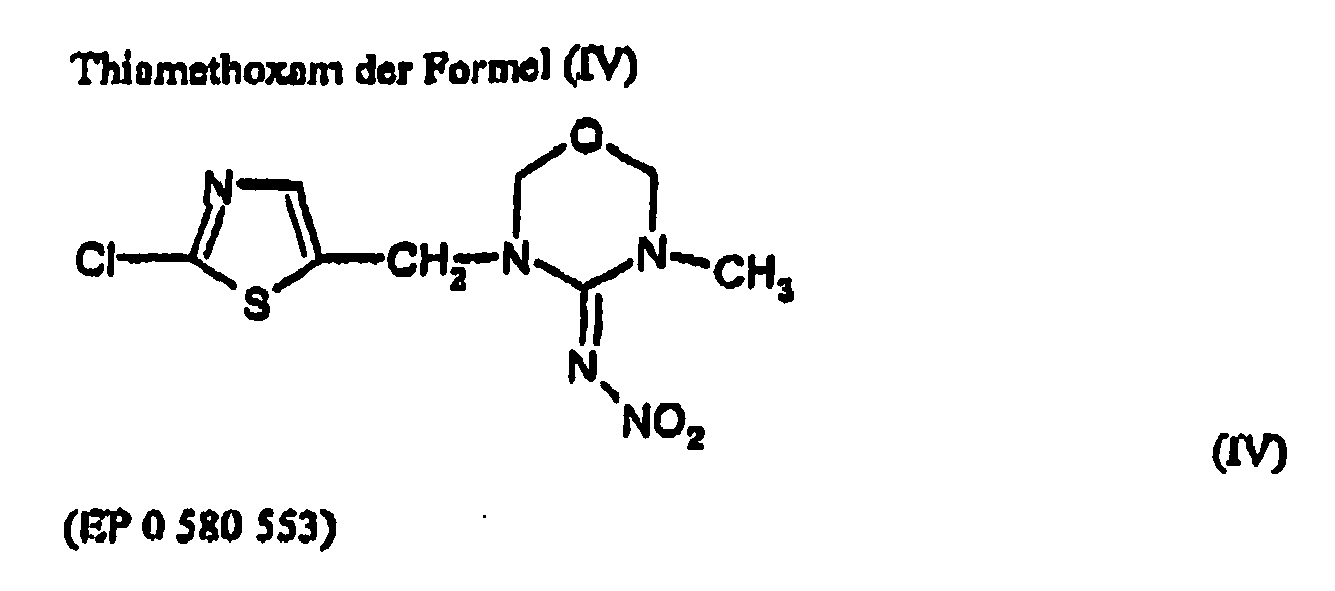


- Die Wirksamkeit dieser Verbindungen ist gut, lässt aber bei niedrigen AutWandmengen oder gegen einzelne Schüdlinge in manchen Füllen zu wünschen übrig,
- In
JP2003063911 A2 - Es wurde nun gefunden, dass Mischungen enthaltend jeweils mindestens zwei und insbesondere genau zwei Verbindungen aus der Reihe der Chlornicotinylinsektizide, insbesondere der Formeln (I) bis (VII), synergistisch wirksam sind und sich zur Bekämpfung von Insekten in der Landwirtschaft eignen.
- Aufgrund dieses Synergismus können deutlich geringere Wirkstoffmengen verwendet werden, d.h. die Wirkung der Mischung ist größer als die Wirkung der Einzelkomponenten.
- Das Verhältnis der beiden eingesetzten Wirkstoffe zueinander, beträgt 10:1-1:10 bezogen auf Gewichtsteile, sowie die anzuwendende Gesamtmenge der Mischung ist von der Art und dem Vorkommen der Insekten bzw. Akarinen abhängig und kann in diesem Bereich variiert werden. Die optimalen Verhältnisse und Gesamteinsatzmengen können bei jeder Anwendung jeweils durch Testreihen ermittelt werden.
- Folgende anzuwendende Mischungen seien im Einzelnen genannt:
Tabelle Mischung Nr. ErsterWirkstoff ZweiterWirkstoff Mischungsverhältnis 1 Imidacloprid Clothianidin 10 : 1 - 1 : 10 2 Imidacloprid Dinotefuran " 4 Imidacloprid Thiacloprid " 5 Imidacloprid Acetamiprid " 6 Imidacloprid Nitenpyram " 7 Clothianidin Dinotefuran " 8 Clothianidin Thiamethoxam " 9 Clothianidin Thiacloprid " 10 Clothianidin Acetamiprid " 11 Clothianidin Nitenpyram " 12 Dinotefuran Thiamethoxam " 13 Dinotefuran Thiacloprid " 14 Dinotefuran Acetamiprid " 15 Dinotefuran Nitenpyram " 16 Thiamethoxam Thiacloprid " 19 Thiacloprid Acetamiprid " 20 Thiacloprid Nitenpyram " 21 Acetamiprid Nitenpyram " - Die Wirkstoffkombinationen eignen sich bei guter Pflanzenverträglichkeit und günstiger Warmblütertoxizität zur Bekämpfung von Insekten, die in der Landwirtschaft vorkommen. Sie können vorzugsweise als Pflanzenschutzmittel eingesetzt werden. Sie sind gegen normal sensible und resistente Arten sowie gegen alle oder einzelne Entwicklungsstadien wirksam. Zu den oben erwähnten Schädlingen gehören:
- Aus der Ordnung der Isopoda z.B. Oniscus asellus, Armadillidium vulgare, Porcellio scaber.
- Aus der Ordnung der Diplopoda z.B. Blaniulus guttulatus.
- Aus der Ordnung der Chilopoda z.B. Geophilus carpophagus, Scutigera spp.
- Aus der Ordnung der Symphyla z.B. Scutigerella immaculata.
- Aus der Ordnung der Thysanura z.B. Lepisma saccharina.
- Aus der Ordnung der Collembola z.B. Onychiurus armatus.
- Aus der Ordnung der Orthoptera z.B. Acheta domesticus, Gryllotalpa spp., Locusta migratoria migratorioides, Melanoplus spp., Schistocerca gregaria.
- Aus der Ordnung der Blattaria z.B. Blatta orientalis, Periplaneta americana, Leucophaea maderae, Blattella germanica.
- Aus der Ordnung der Dermaptera z.B. Forficula auricularia.
- Aus der Ordnung der Isoptera z.B. Reticulitermes spp.
- Aus der Ordnung der Phthiraptera z.B. Pediculus humanus corporis, Haematopinus spp., Linognathus spp., Trichodectes spp., Damalinia spp.
- Aus der Ordnung der Thysanoptera z.B. Hercinothrips femoralis, Thrips tabaci, Thrips palmi, Frankliniella occidentalis.
- Aus der Ordnung der Heteroptera z.B. Eurygaster spp., Dysdercus intermedius, Piesma quadrata, Cimex lectularius, Rhodnius prolixus, Triatoma spp.
- Aus der Ordnung der Homoptera z.B. Aleurodes brassicae, Bemisia tabaci, Trialeurodes vaporariorum, Aphis gossypii, Brevicoryne brassicae, Cryptomyzus ribis, Aphis fabae, Aphis pomi, Eriosoma lanigerum, Hyalopterus arundinis, Phylloxera vastatrix, Pemphigus spp., Maorosiphum avenae, Myzus spp., Phorodon humuli, Rhopalosiphum padi, Empoasca spp., Euscelis bilobatus, Nephotettix cincticeps, Lecanium corni, Saissetia oleae, Laodelphax striatellus, Nilaparvata lugens, Aonidiella aurantii, Aspidiotus hederae, Pseudococcus spp., Psylla spp.
- Aus der Ordnung der Lepidoptera z.B. Pectinophora gossypiella, Bupalus piniarius, Cheimatobia brumata, Lithocolletis blancardella, Hyponomeuta padella, Plutella xylostella, Malacosoma neustria, Euproctis chrysorrhoea, Lymantria spp., Bucculatrix thurberiella, Phyllocnistis citrella, Agrotis spp., Euxoa spp., Feltia spp., Earias insulana, Heliothis spp., Mamestra brassicae, Panolis flammea, Spodoptera spp., Trichoplusia ni, Carpocapsa pomonella, Pieris spp., Chilo spp., Pyrausta nubilalis, Ephestia kuehniella, Galleria mellonella, Tineola bisselliella, Tinea pellionella, Hofmannophila pseudospretella, Cacoecia podana, Capua reticulana, Choristoneura fumiferana, Clysia ambiguella, Homona magnanima, Tortrix viridana, Cnaphalocerus spp., Oulema oryzae.
- Aus der Ordnung der Coleoptera z.B. Anobium punctatum, Rhizopertha dominica, Bruchidius obtectus, Acanthoscelides obtectus, Hylotrupes bajulus, Agelastica alni, Leptinotarsa decemlineata, Phaedon cochleariae, Diabrotica spp., Psylliodes chrysocephala, Epilachna varivestis, Atomaria spp., Oryzaephilus surinamensis, Anthonomus spp., Sitophilus spp., Otiorrhynchus sulcatus, Cosmopolites sordidus, Ceuthorrhynchus assimilis, Hypera postica, Dermestes spp., Trogoderma spp., Anthrenus spp., Attagenus spp., Lyctus spp., Meligethes aeneus, Ptinus spp., Niptus hololeucus, Gibbium psylloides, Tribolium spp., Tenebrio molitor, Agriotes spp., Conoderus spp., Melolontha melolontha, Amphimallon solstitialis, Costelytra zealandica, Lissorhoptrus oryzophilus.
- Aus der Ordnung der Hymenoptera z.B. Diprion spp., Hoplocampa spp., Lasius spp., Monomorium pharaonis, Vespa spp.
- Aus der Ordnung der Diptera z.B. Aedes spp., Anopheles spp., Culex spp., Drosophila melanogaster, Musca spp., Fannia spp., Calliphora erythrocephala, Lucilia spp., Chrysomyia spp., Cuterebra spp., Gastrophilus spp., Hyppobosca spp., Stomoxys spp., Oestrus spp., Hypoderma spp., Tabanus spp., Tannia spp., Bibio hortulanus, Oscinella frit, Phorbia spp., Pegomyia hyoscyami, Ceratitis capitata, Dacus oleae, Tipula paludosa, Hylemyia spp., Liriomyza spp.
- Aus der Ordnung der Siphonaptera z.B. Xenopsylla cheopis, Ceratophyllus spp.
- Erfindungsgemäß können alle Pflanzen und Pflanzenteile behandelt werden. Unter Pflanzen werden hierbei alle Pflanzen und Pflanzenpopulationen verstanden, wie erwünschte und unerwünschte Wildpflanzen oder Kulturpflanzen (einschließlich natürlich vorkommender Kulturpflanzen). Kulturpflanzen können Pflanzen sein, die durch konventionelle Züchtungs- und Optimierungsmethoden oder durch biotechnologische und gentechnologische Methoden oder Kombinationen dieser Methoden erhalten werden können, einschließlich der transgenen Pflanzen und einschließlich der durch Sortenschutzrechte schützbaren oder nicht schützbaren Pflanzensorten. Unter Pflanzenteilen sollen alle oberirdischen und unterirdischen Teile und Organe der Pflanzen, wie Sproß, Blatt, Blüte und Wurzel verstanden werden, wobei beispielhaft Blätter, Nadeln, Stengel, Stämme, Blüten, Fruchtkörper, Früchte und Samen sowie Wurzeln, Knollen und Rhizome aufgeführt werden. Zu den Pflanzenteilen gehört auch Erntegut sowie vegetatives und generatives Vermehrungsmaterial, beispielsweise Stecklinge, Knollen, Rhizome, Ableger und Samen.
- Hervorgehoben sei hierbei die besonders vorteilhafte Wirkung der erfindungsgemäß einsetzbare Mittel hinsichtlich der Anwendung in Getreidepflanzen, wie z.B. Weizen, Hafer, Gerste, Dinkel, Triticale und Roggen, aber auch in Mais, Hirse, Reis, Zuckerrohr, Soja, Sonnenblumen, Kartoffeln, Baumwolle, Raps, Canola, Tabak, Zuckerrüben Futterrüben, Spargel, Hopfen sowie Obstpflanzen (umfassend Kernobst wie z.B. Äpfel und Birnen, Steinobst wie z.B. Pfirsiche, Nektarinen, Kirschen, Pflaumen und Aprikosen, Zitrusfrüchte wie z.B. Orangen, Grapefruits, Limetten, Zitronen, Kumquats, Mandarinen und Satsumas, Nüsse wie z.B. Pistazien, Mandeln, Walnüsse und Pecannüsse, tropische Früchte wie z.B. Mango, Papaya, Ananas, Datteln und Bananen, und Weintrauben) und Gemüse (umfassend Blattgemüse, wie z.B. Endivien, Feldsalat, Knollenfenchel, Kopf- und Pflücksalate, Mangold, Spinat und Zichoriensalat, Kohlgemüse wie z.B. Blumenkohl, Brokkoli, Chinakohl, Grünkohl (Winter- oder Krauskohl), Kohlrabi, Rosenkohl, Rotkohl, Weißkohl und Wirsing, Fruchtgemüse wie z.B. Auberginen, Gurken, Paprika, Speisekürbisse, Tomaten, Zucchini und Zuckermais, Wurzelgemüse wie z.B. Knollensellerie, Mairüben, Möhren, Gelbe Rüben, Radieschen, Rettich, Rote Rüben, Schwarzwurzeln und Stangensellerie, Hülsenfrüchte wie z.B. Erbsen und Bohnen sowie Zwiebelgemüse wie z.B. Lauch und Speisezwiebeln).
- Die erfindungsgemäße Behandlung der Pflanzen und Pflanzenteile mit den Wirkstoffkombinationen erfolgt direkt oder durch Einwirkung auf deren Umgebung, Lebensraum oder Lagerraum nach den üblichen Behandlungsmethoden, z.B. durch Tauchen, Sprühen, Verdampfen, Vernebeln, Streuen, Aufstreichen und bei Vermehrungsmaterial, insbesondere bei Samen, weiterhin durch ein- oder mehrschichtiges Umhüllen.
- Insbesondere eignen sich die erfindungsgemäß einsetzbare Mittel zur Behandlung von Saatgut. So entsteht ein großer Teil des durch Schädlinge verursachten Schadens an Kulturpflanzen bereits durch den Befall des Saatguts während der Lagerung und nach dem Einbringen des Saatguts in den Boden sowie während und unmittelbar nach der Keimung der Pflanzen. Diese Phase ist besonders kritisch, da die Wurzeln und Sprosse der wachsenden Pflanze besonders empfindlich sind und bereits ein geringer Schaden zum Absterben der ganzen Pflanze führen kann. Es besteht daher ein insbesondere großes Interesse daran, das Saatgut und die keimende Pflanze durch den Einsatz geeigneter Mittel zu schützen.
- Die Bekämpfung von Schädlingen durch die Behandlung des Saatguts von Pflanzen ist seit langem bekannt und ist Gegenstand ständiger Verbesserungen. Dennoch ergeben sich bei der Behandlung von Saatgut eine Reihe von Problemen, die nicht immer zufrieden stellen gelöst werden können. So ist es erstrebenswert, Verfahren zum Schutz des Saatguts und der keimenden Pflanze zu entwickeln, die das zusätzliche Ausbringen von Pflanzenschutzmitteln nach der Saat oder nach dem Auflaufen der Pflanzen überflüssig machen. Es ist weiterhin erstrebenswert, die Menge des eingesetzten Wirkstoffs dahingehend zu optimieren, dass das Saatgut und die keimende Pflanze vor dem Befall durch Schädlinge bestmöglich geschützt wird, ohne jedoch die Pflanze selbst durch den eingesetzten Wirkstoff zu schädigen. Insbesondere sollten Verfahren zur Behandlung von Saatgut auch die intrinsischen insektiziden Eigenschaften transgener Pflanzen einbeziehen, um einen optimalen Schutz des Saatguts und der keimenden Pflanze bei einem minimalen Aufwand an Pflanzenschutzmitteln zu erreichen.
- Die vorliegende Erfindung bezieht sich daher insbesondere auch auf ein Verfahren zum Schutz von Saatgut und keimenden Pflanzen vor dem Befall von Schädlingen, indem das Saatgut mit einem erfindungsgemäßen Mittel behandelt wird. Die Erfindung bezieht sich ebenfalls auf die Verwendung der erfindungsgemäß einsetzbare Mittel zur Behandlung von Saatgut zum Schutz des Saatguts und der keimenden Pflanze vor Insekten. Weiterhin bezieht sich die Erfindung auf Saatgut, welches zum Schutz vor Insekten mit einem erfindungsgemäß einsetzbare Mittel behandelt wurde.
- Einer der Vorteile der vorliegenden Erfindung ist es, dass aufgrund der besonderen systemischen Eigenschaften der erfindungsgemäß einsetzbare Mittel die Behandlung des Saatguts mit diesen Mitteln nicht nur das Saatgut selbst, sondern auch die daraus hervorgehenden Pflanzen nach dem Auflaufen vor Insekten schützt. Auf diese Weise kann die unmittelbare Behandlung der Kultur zum Zeitpunkt der Aussaat oder kurz danach entfallen.
- Ein weiterer Vorteil besteht in der synergistischen Erhöhung der insektiziden Wirksamkeit der erfindungsgemäß einsetzbare Mittel gegenüber dem jeweiligen Einzelwirkstoff, die über die Summe der Wirksamkeit der beiden einzeln angewendeten Wirkstoffe hinausgeht. Damit wird eine Optimierung der Menge des eingesetzten Wirkstoffs ermöglicht.
- Ebenso ist es als vorteilhaft anzusehen, dass die erfindungsgemäß einsetzbare Mittel insbesondere auch bei transgenem Saatgut eingesetzt werden können, wobei die aus diesem Saatgut hervorgehenden Pflanzen zur Expression eines gegen Schädlinge gerichteten Proteins befähigt sind. Durch die Behandlung solchen Saatguts mit den erfindungsgemäß einsetzbare Mittel können bestimmte Schädlinge bereits durch die Expression des z.B. insektiziden Proteins kontrolliert werden, und es zusätzlich überraschenderweise zu einer synergistischen Wirkungsergänzung mit den erfindungsgemäßen Mitteln kommt, was die Effektivität des Schutzes vor Schädlingsbefall noch einmal verbessert.
- Die erfindungsgemäß einsetzbare Mittel eignen sich zum Schutz von Saatgut jeglicher Pflanzensorte wie bereits vorstehend genannt, die in der Landwirtschaft, im Gewächshaus, in Forsten, im Gartenbau oder im Weinanbau eingesetzt wird. Insbesondere handelt es sich dabei um Saatgut von Mais, Erdnuss, Canola, Raps, Mohn, Olive, Kokosnuss, Kakao, Soja, Baumwolle, Rübe (z.B. Zuckerrübe und Futterrübe), Reis, Hirse, Weizen, Gerste, Hafer, Roggen, Sonnenblume, Zuckerrohr oder Tabak. Die erfindungsgemäß einsetzbare Mittel eigenen sich ebenfalls zur Behandlung des Saatguts von Obstpflanzen und Gemüse wie vorstehend bereits genannt. Besondere Bedeutung kommt der Behandlung des Saatguts von Mais, Soja, Baumwolle, Weizen und Canola oder Raps zu. So eignet sich z.B. die erfindungsgemäß einsetzbare Mittel umfassend die Wirkstoffe Methiocarb und Imidacloprid insbesondere zur Behandlung des Saatguts von Mais.
- Wie vorstehend bereits erwähnt, kommt auch der Behandlung von transgenem Saatgut mit einem erfindungsgemäß einsetzbare Mittel eine besondere Bedeutung zu. Dabei handelt es sich um das Saatgut von Pflanzen, die in der Regel zumindest ein heterologes Gen enthalten, das die Expression eines Polypeptids mit insbesondere insektiziden Eigenschaften steuert. Die heterologen Gene in transgenem Saatgut können dabei aus Mikroorganismen wie Bacillus, Rhizobium, Pseudomonas, Serratia, Trichoderma, Clavibacter, Glomus oder Gliocladium stammen. Die vorliegende Erfindung eignet sich besonders für die Behandlung von transgenem Saatgut, das zumindest ein heterologes Gen enthält, das aus Bacillus sp. stammt und dessen Genprodukt Wirksamkeit gegen Maiszünsler und/oder Maiswurzel-Bohrer zeigt. Besonders bevorzugt handelt es sich dabei um ein heterologes Gen, das aus Bacillus thuringiensis stammt.
- Im Rahmen der vorliegenden Erfindung wird das erfindungsgemäß einsetzbare Mittel alleine oder in einer geeigneten Formulierung auf das Saatgut aufgebracht. Vorzugsweise wird das Saatgut in einem Zustand behandelt, in dem so stabil ist, dass keine Schäden bei der Behandlung auftreten. Im Allgemeinen kann die Behandlung des Saatguts zu jedem Zeitpunkt zwischen der Ernte und der Aussaat erfolgen. Üblicherweise wird Saatgut verwendet, das von der Pflanze getrennt und von Kolben, Schalen, Stängeln, Hülle, Wolle oder Fruchtfleisch befreit wurde.
- Im Allgemeinen muss bei der Behandlung des Saatguts darauf geachtet werden, dass die Menge des auf das Saatgut aufgebrachten erfindungsgemäß einsetzbare Mittel und/oder weiterer Zusatzstoffe so gewählt wird, dass die Keimung des Saatguts nicht beeinträchtigt bzw. die daraus hervorgehende Pflanze nicht geschädigt wird. Dies ist vor allem bei Wirkstoffen zu beachten, die in bestimmten Aufwandmengen phytotoxische Effekte zeigen können.
- Die erfindungsgemäß einsetzbare Mittel können unmittelbar aufgebracht werden, also ohne weitere Komponenten zu enthalten und ohne verdünnt worden zu sein. In der Regel ist es vorzuziehen, die Mittel in Form einer geeigneten Formulierung auf das Saatgut aufzubringen. Geeignete Formulierungen und Verfahren für die Saatgutbehandlung sind dem Fachmann bekannt und werden z.B. in den folgenden Dokumenten beschrieben:
US 4,272,417 A ,US 4,245,432 A ,US 4,808,430 A ,US 5,876,739 A ,US 2003/0176428 A1 ,WO 2002/080675 A1 ,WO 2002/028186 A2 . - Die Wirkstoffkombinationen können in die üblichen Formulierungen überführt werden, wie Lösungen, Emulsionen, Spritzpulver, Suspensionen, Pulver, Stäubemittel, Pasten, lösliche Pulver, Granulate, Suspensions-Emulsions-Konzentrate, Wirkstoff-imprägnierte Natur- und synthetische Stoffe sowie Feinstverkapselungen in polymeren Stoffen.
- Diese Formulierungen werden in bekannter Weise hergestellt, z.B. durch Vermischen der Wirkstoffe mit Streckmitteln, also flüssigen Lösungsmitteln und/oder festen Trägerstoffen, gegebenenfalls unter Verwendung von oberflächenaktiven Mitteln, also Emulgiermitteln und/oder Dispergiermitteln und/oder schaumerzeugenden Mitteln.
- Im Falle der Benutzung von Wasser als Streckmittel können z.B. auch organische Lösungsmittel als Hilfslösungsmittel verwendet werden. Als flüssige Lösungsmittel kommen im wesentlichen in Frage: Aromaten, wie Xylol, Toluol, oder Alkylnaphthaline, chlorierte Aromaten und chlorierte aliphatische Kohlenwasserstoffe, wie Chlorbenzole, Chlorethylene oder Methylenchlorid, aliphatische Kohlenwasserstoffe, wie Cyclohexan oder Paraffine, z.B. Erdölfraktionen, mineralische und pflanzliche Öle, Alkohole, wie Butanol oder Glykol sowie deren Ether und Ester, Ketone wie Aceton, Methylethylketon, Methylisobutylketon oder Cyclohexanon, stark polare Lösungsmittel, wie Dimethylformamid und Dimethylsulfoxid, sowie Wasser.
- Als feste Trägerstoffe kommen in Frage:
- z.B. Ammoniumsalze und natürliche Gesteinsmehle, wie Kaoline, Tonerden, Talkum, Kreide, Quarz, Attapulgit, Montmorillonit oder Diatomeenerde und synthetische Gesteinsmehle, wie hochdisperse Kieselsäure, Aluminiumoxid und Silikate, als feste Trägerstoffe für Granulate kommen in Frage: z.B. gebrochene und fraktionierte natürliche Gesteine wie Calcit, Marmor, Bims, Sepiolith, Dolomit sowie synthetische Granulate aus anorganischen und organischen Mehlen sowie Granulate aus organischem Material wie Sägemehl, Kokosnußschalen, Maiskolben und Tabakstengeln; als Emulgier- und/oder schaumerzeugende Mittel kommen in Frage: z.B. nichtionogene und anionische Emulgatoren, wie Polyoxyethylen-Fettsäure-Ester, Polyoxyethylen-Fettalkohol-Ether, z.B. Alkylaryl-polyglykolether, Alkylsulfonate, Alkylsulfate, Arylsulfonate sowie Einweißhydrolysate; als Dispergiermittel kommen in Frage: z.B. Lignin-Sulfitablaugen und Methylcellulose.
- Es können in den Formulierungen Haftmittel wie Carboxymethylcellulose, natürliche und synthetische pulvrige, körnige oder latexförmige Polymere verwendet werden, wie Gummiarabicum, Polyvinylalkohol, Polyvinylacetat, sowie natürliche Phospholipide, wie Kephaline und Lecithine und synthetische Phospholipide. Weitere Additive können mineralische und vegetabile Öle sein.
- Es können Farbstoffe wie anorganische Pigmente, z.B. Eisenoxid, Titanoxid, Ferrocyanblau und organische Farbstoffe, wie Alizarin-, Azo- und Metallphthalocyaninfarbstoffe und Spurennährstoffe wie Salze von Eisen, Mangan, Bor, Kupfer, Kobalt, Molybdän und Zink verwendet werden.
- Die Formulierungen enthalten im allgemeinen zwischen 0,1 und 95 Gew.-% Wirkstoff, vorzugsweise zwischen 0,5 und 90 %.
- Die erfindungsgemäß einsetzbare Mittel enthalten bevorzugt neben den beiden Chlornicotinylinsektiziden der Formeln (I) bis(VII) keine weiteren Wirkstoffe.
- Der erfindungsgemäß einsetzbare Mittel können gegebenenfalls in handelsüblichen Formulierungen sowie in den aus diesen Formulierungen bereiteten Anwendungsformen in Mischung mit anderen Wirkstoffen, wie Insektiziden, Lockstoffen, Sterilantien, Bakteriziden, Akariziden, Nematiziden, Fungiziden, wachstumsregulierenden Stoffen oder Herbiziden vorliegen.
- Zu den Insektiziden zählen beispielsweise Phosphorsäureester, Carbamate, Carbonsäureester, chlorierte Kohlenwasserstoffe, Phenylharnstoffe, durch Mikroorganismen hergestellte Stoffe u.a.
- Besonders günstige Mischpartner sind z.B. die folgenden:
Fungizide: - Aldimorph, Ampropylfos, Ampropylfos-Kalium, Andoprim, Anilazin, Azaconazol, Azoxystrobin,
- Benalaxyl, Benodanil, Benomyl, Benzamacril, Benzamacryl-isobutyl, Bialaphos, Binapacryl, Biphenyl, Bitertanol, Blasticidin-S, Bromuconazol, Bupirimat, Buthiobat,
- Calciumpolysulfid, Capsimycin, Captafol, Captan, Carbendazim, Carboxin, Carvon, Chinomethionat (Quinomethionat), Chlobenthiazon, Chlorfenazol, Chloroneb, Chloropicrin, Chlorothalonil, Chlozolinat, Clozylacon, Cufraneb, Cymoxanil, Cyproconazol, Cyprodinil, Cyprofuram,
- Debacarb, Dichlorophen, Diclobutrazol, Diclofluanid, Diclomezin, Dicloran, Diethofencarb, Difenoconazol, Dimethirimol, Dimethomorph, Diniconazol, Diniconazol-M, Dinocap, Diphenylamin, Dipyrithione, Ditalimfos, Dithianon, Dodemorph, Dodine, Drazoxolon,
- Ediphenphos, Epoxiconazol, Etaconazol, Ethirimol, Etridiazol,
- Famoxadon, Fenapanil, Fenarimol, Fenbuconazol, Fenfuram, Fenitropan, Fenpiclonil, Fenpropidin, Fenpropimorph, Fentinacetat, Fentinhydroxyd, Ferbam, Ferimzon, Fluazinam, Flumetover, Fluoromid, Fluquinconazol, Flurprimidol, Flusilazol, Flusulfamid, Flutolanil, Flutriafol, Folpet, Fosetyl-Alminium, Fosetyl-Natrium, Fthalid, Fuberidazol, Furalaxyl, Furametpyr, Furcarbonil, Furconazol, Furconazol-cis, Furmecyclox,
- Guazatin,
- Hexachlorobenzol, Hexaconazol, Hymexazol,
- Imazalil, Imibenconazol, Iminoctadin, Iminoctadinealbesilat, Iminoctadinetriacetat, Iodocarb, lpconazol, Iprobenfos (IBP), Iprodione, Irumamycin, Isoprothiolan, Isovaledione,
- Kasugamycin, Kresoxim-methyl, Kupfer-Zubereitungen, wie: Kupferhydroxid, Kupfernaphthenat, Kupferoxychlorid, Kupfersulfat, Kupferoxid, Oxin-Kupfer und Bordeaux-Mischung,
- Mancopper, Mancozeb, Maneb, Meferimzone, Mepanipyrim, Mepronil, Metalaxyl, Metconazol, Methasulfocarb, Methfuroxam, Metiram, Metomeclam, Metsulfovax, Mildiomycin, Myclobutanil, Myclozolin,
- Nickel-dimethyldithiocarbamat, Nitrothal-isopropyl, Nuarimol,
- Ofurace, Oxadixyl, Oxamocarb, Oxolinicacid, Oxycarboxim, Oxyfenthiin,
- Paclobutrazol, Pefurazoat, Penconazol, Pencycuron, Phosdiphen, Pimaricin, Piperalin, Polyoxin, Polyoxorim, Probenazol, Prochloraz, Procymidon, Propamocarb, Propanosine-Natrium, Propiconazol, Propineb, Pyrazophos, Pyrifenox, Pyrimethanil, Pyroquilon, Pyroxyfur,
- Quinconazol, Quintozen (PCNB),
- Schwefel und Schwefel-Zubereitungen,
- Tebuconazol, Tecloftalam, Tecnazen, Tetcyclacis, Tetraconazol, Thiabendazol, Thicyofen, Thifluzamide, Thiophanate-methyl, Thiram, Tioxymid, Tolclofos-methyl, Tolylfluanid, Triadimefon, Triadimenol, Triazbutil, Triazoxid, Trichlamid, Tricyclazol, Tridemorph, Triflumizol, Triforin, Triticonazol,
- Uniconazol,
- Validamycin A, Vinclozolin, Viniconazol,
- Zarilamid, Zineb, Ziram sowie
- Dagger G,
- OK-8705,
- OK-8801,
- α-(1,1-Dimethylethyl)-β-(2-phenoxyethyl)-1H-1,2,4-triazol-1-ethanol,
- α-(2,4-Dichlorphenyl)-β-fluor-b-propyl-1H-1,2,4-triazol-1-ethanol,
- α-(2,4-Dichlorphenyl)-β-methoxy-a-methyl-1H-1,2,4-triazol-1-ethanol,
- α-(5-Methyl-1,3-dioxan-5-yl)-β-[[4-(trifluormethyl)-phenyl]-methylen]-1H-1,2,4-triazol-1-ethanol,
- (5RS,6RS)-6-Hydroxy-2,2,7,7-tetramethyl-5-(1H-1,2,4-triazol-1-yl)-3-octanon,
- (E)-a-(Methoxyimino)-N-methyl-2-phenoxy-phenylacetamid,
- {2-Methyl-1-[[[1-(4-methylphenyl)-ethyl]-amino]-carbonyl]-propyl}-carbaminsäure-1-isopropylester
- 1-(2,4-Dichlorphenyl)-2-(1H-1,2,4-triazol-1-yl)-ethanon-O-(phenylmethyl)-oxim,
- 1-(2-Methyl-1-naphthalenyl)-1H-pyrrol-2,5-dion,
- 1-(3,5-Dichlorphenyl)-3-(2-propenyl)-2,5-pyrrolidindion,
- 1-[(Diiodmethyl)-sulfonyl]-4-methyl-benzol,
- 1-[[2-(2,4-Dichlorphenyl)-1,3-dioxolan-2-yl]-methyl]-1H-imidazol,
- 1-[[2-(4-Chlorphenyl)-3-phenyloxiranyl]-methyl]-1H-1,2,4-triazol,
- 1-[1-[2-[(2,4-Dichlorphenyl)-methoxy]-phenyl]-ethenyl]-1H-imidazol,
- 1-Methyl-5-nonyl-2-(phenylmethyl)-3-pyrrolidinol,
- 2',6'-Dibrom-2-methyl-4'-trifluormethoxy-4'-trifluor-methyl-1,3-thiazol-5-carboxanilid,
- 2,2-Dichlor-N-[1-(4-chlorphenyl)-ethyl]-1-ethyl-3-methyl-cyclopropancarboxamid,
- 2,6-Dichlor-5-(methylthio)-4-pyrimidinyl-thiocyanat,
- 2,6-Dichlor-N-(4-trifluormethylbenzyl)-benzamid,
- 2,6-Dichlor-N-[[4-(trifluormethyl)-phenyl]-methyl]-benzamid,
- 2-(2,3,3-Triiod-2-propenyl)-2H-tetrazol,
- 2-[(1-Methylethyl)-sulfonyl]-5-(trichlormethyl)-1,3,4-thiadiazol,
- 2-[[6-Deoxy-4-O-(4-O-methyl-β-D-glycopyranosyl)-a-D-glucopyranosyl]-amino]-4-methoxy-1H-pyrrolo[2,3-d]pyrimidin-5-carbonitril,
- 2-Aminobutan,
- 2-Brom-2-(brommethyl)-pentandinitril,
- 2-Chlor-N-(2,3-dihydro-1,1,3-trimethyl-1H-inden-4-yl)-3-pyridincarboxamid,
- 2-Chlor-N-(2,6-dimethylphenyl)-N-(isothiocyanatomethyl)-aoetamid,
- 2-Phenylphenol(OPP),
- 3,4-Dichlor-1-[4-(difluormethoxy)-phenyl]-1H-pyrrol-2,5-dion,
- 3,5-Dichlor-N-[cyan[(1-methyl-2-propynyl)-oxy]-methyl]-benzamid,
- 3-(1,1-Dimethylpropyl-1-oxo)-1H-inden-2-carbonitril,
- 3-[2-(4-Chlorphenyl)-5-ethoxy-3-isoxazolidinyl]-pyridin,
- 4-Chlor-2-cyan-N,N-dimethyl-5-(4-methylphenyl)-1H-imidazol-1-sulfonamid,
- 4-Methyl-tetrazolo[1,5-a]quinazolin-5(4H)-on,
- 8-(1,1-Dimethylethyl)-N-ethyl-N-propyl-1,4-dioxaspiro[4,5]decan-2-methanamin,
- 8-Hydroxychinolinsulfat,
- 9H-Xanthen-9-earbonsäure-2-[(phenylamino)-carbonyl]-hydrazid,
- bis-(1-Methylethyl)-3-methyl-4-[(3-methylbenzoyl)-oxy]-2,5-thiophendicarboxylat,
- cis-1-(4-Chlorphenyl)-2-(1H-1,2,4-triazol-1-yl)-cycloheptanol,
- cis-4-[3-[4-(1,1-Dimethylpropyl)-phenyl-2-methylpropyl]-2,6-dimethyl-morpholin-hydrochlorid,
- Ethyl-[(4-chlorphenyl)-azo]-cyanoacetat,
- Kaliumhydrogencarbonat,
- Methantetrathiol-Natriumsalz,
- Methyl-1-(2,3-dihydro-2,2-dimethyl-1H-inden-1-yl)-1H-imidazol-5-carboxylat,
- Methyl-N-(2,6-dimethylphenyl)-N-(5-isoxazolylcarbonyl)-DL-alaninat,
- Methyl-N-(chloracetyl)-N-(2,6-dimethylphenyl)-DL-alaninat,
- N-(2,3-Dichlor-4-hydroxyphenyl)-1-methyl-cyclohexancarboxamid.
- N-(2,6-Dimeihylphenyl)-2-methoxy-N-(tetrahydro-2-oxo-3-furanyl)-acetamid,
- N-(2,6-Dimethylphenyl)-2-methoxy-N-(tetrahydro-2-oxo-3-thienyl)-acetamid,
- N-(2-Chlor-4-nitrophenyl)-4-methyl-3-nitro-benzolsulfonamid,
- N-(4-Cyclohexylphenyl)-1,4,5,6-tetrahydro-2-pyrimidinamin,
- N-(4-Hexylphenyl)-1,4,5,6-tetrahydro-2-pyrimidinamin,
- N-(5-Chlor-2-methylphenyl)-2-methoxy-N-(2-oxo-3-oxazolidinyl)-acetamid,
- N-(6-Methoxy)-3-pyridinyl)-cyclopropancarboxamid,
- N-[2,2,2-Trichlor-1-[(chloracetyl)-amino]-ethyl]-benzamid,
- N-[3-Chlor-4,5-bis-(2-propinyloxy)-phenyl] N'-methoxy-methanimidamid,
- N-Fonnyl-N-hydroxy-DL-alanin Natriumsalz,
- O,O-Diethyl-[2-(dipropylamino)-2-oxoethyl]-ethylphosphoramidothioat,
- O-Methyl-S-phenyl-phenylpropylphosphoramidothioate,
- S-Methyl-1,2,3-benzothiadiazol-7-carbothioat,
- spiro[2H]-1-Benzopyran-2,1'(3'H)-isobenzofuran]-3'-on.
-
- 1. Acetylcholinesterase (AChE) Inhibitoren
- 1.1 Carbamate, zum Beispiel
Alanycarb, Aldicarb, Aldoxycarb, Allyxycarb, Aminocarb, Bendiocarb, Benfuracarb, Bufencarb, Butacarb, Butocarboxim, Butoxycarboxim, Carbaryl, Carbofuran, Carbosulfan, Cloethocarb, Dimetilan, Ethiofencarb, Fenobucarb, Fenothiocarb, Formetanate, Furathiocarb, Isoprocarb, Metam-sodium, Methiocarb, Methomyl, Metolcarb, Oxamyl, Pirimicarb, Promecarb, Propoxur, Thiodicarb, Thiofanox, Trimethacarb, XMC, Xylylcarb
Triazamate - 1.2 Organophosphate, zum Beispiel
Acephate, Azamethiphos, Azinphos (-methyl, -ethyl), Bromophos-ethyl, Bromfenvinfos (-methyl), Butathiofos, Cadusafos, Carbophenothion, Chlorethoxyfos, Chlorfenvinphos, Chlormephos, Chlorpyrifos (-methyl/-ethyl), Coumaphos, Cyanofenphos, Cyanophos, Chlorfenvinphos, Demeton-S-methyl, Demeton-S-methylsulphon, Dialifos, Diazinon, Dichlofenthion, Dichlorvos/DDVP, Dicrotophos, Dimethoate, Dimethylvinphos, Dioxabenzofos, Disulfoton, EPN, Ethion, Ethoprophos, Etrimfos, Famphur, Fenamiphos, Fenitrothion, Fensulfothion, Fenthion, Flupyrazofos, Fonofos, Formothion, Fosmethilan, Fosthiazate, Heptenophos, Iodofenphos, Iprobenfos, Isazofos, Isofenphos, Isopropyl O-salicylate, Isoxathion, Malathion, Mecarbam, Methacrifos, Methamidophos, Methidathion, Mevinphos, Monocrotophos, Naled, Omethoate, Oxydemeton-methyl, Parathion (-methyl/-ethyl), Phenthoate, Phorate, Phosalone, Phosmet, Phosphamidon, Phosphocarb, Phoxim, Pirimiphos (-methyl/-ethyl), Profenofos, Propaphos, Propetamphos, Prothiofos, Prothoate, Pyraclofos, Pyridaphenthion, Pyridathion, Quinalphos, Sebufos, Sulfotep, Sulprofos, Tebupirimfos, Temephos, Terbufos, Tetrachlorvinphos, Thiometon, Triazophos, Triclorfon, Vamidothion
- 1.1 Carbamate, zum Beispiel
- 2. Natrium-Kanal-Modulatoren / Spannungsabhängige Natrium-Kanal-Blocker
- 2.1 Pyrethroide, zum Beispiel
Acrinathrin, Allethrin (d-cis-trans, d-trans), Beta-Cyfluthrin, Bifenthrin, Bioallethrin, Bioallethrin-S-cyclopentyl-isomer, Bioethanomethrin, Biopermethrin, Bioresmethrin, Chlovaporthrin, Cis-Cypermethrin, Cis-Resmethrin, Cis-Permethrin, Clocythrin, Cycloprothrin, Cyfluthrin, Cyhalothrin, Cypermethrin (alpha-, beta-, theta-, zeta-), Cyphenothrin, Deltamethrin, Empenthrin (1R-isomer), Esfenvalerate, Etofenprox, Fenfluthrin, Fenpropathrin, Fenpyrithrin, Fenvalerate, Flubrocythrinate, Flucythrinate, Flufenprox, Flumethrin, Fluvalinate, Fubfenprox, Gamma-Cyhalothrin, Imiprothrin, Kadethrin, Lambda-Cyhalothrin, Metofluthrin, Permethrin (cis-, trans-), Phenothrin (IR-trans isomer), Prallethrin, Profluthrin, Protrifenbute, Pyresmethrin, Resmethrin, RU 15525, Silafluofen, Tau-Fluvalinate, Tefluthrin, Terallethrin, Tetramethrin (-1R- isomer), Tralomethrin, Transfluthrin, ZXI 8901, Pyrethrins (pyrethrum)
DDT - 2.2 Oxadiazine, zum Beispiel Indoxacarb
- 2.1 Pyrethroide, zum Beispiel
- 3. Acetyleholin-Rezeptor-Agonisten/-Antagonisten
- 3.1 Chloronicotinyle, zum Beispiel
Acetamiprid, Clothianidin, Dinotefuran, Imidacloprid, Nitenpyram, Nithiazine, Thiacloprid, Thiamethoxam - 3.2 Nicotine, Bensultap, Cartap
- 3.1 Chloronicotinyle, zum Beispiel
- 4. Acetylcholin-Rezeptor-Modulatoren
- 4.1 Spinosyne, zum Beispiel Spinosad
- 5, GABA-gesteuerte Chlorid-Kanal-Antagonisten
- 5.1 Cyclodiene Organochlorine, zum Beispiel
Camphechlor, Chlordane, Endosulfan, Gamma-HCH, HCH, Heptachlor, Lindane, Methoxychlor - 5.2 Fiprole, zum Beispiel
Acetoprole, Ethiprole, Fipronil, Vaniliprole
- 5.1 Cyclodiene Organochlorine, zum Beispiel
- 6. Chlorid-Kanal-Aktivatoren
- 6.1 Mectine, zum Beispiel
Avermectin, Emamectin, Emamectin-benzoate, Ivermectin, Milbemycin
- 6.1 Mectine, zum Beispiel
- 7. Juvenilhormon-Mimetika, zum Beispiel
Diofenolan, Epofenonane, Fenoxycarb, Hydroprene, Kinoprene, Methoprene, Pyriproxifen, Triprene - 8. Ecdysonagonisten/disruptoren
- 8.1 Diacylhydrazine, zum Beispiel
Chromafenozide, Halofenozide, Methoxyfenozide, Tebufenozide
- 8.1 Diacylhydrazine, zum Beispiel
- 9. Inhibitoren der Chitinbiosynthese
- 9.1 Benzoylharnstoffe, zum Beispiel
Bistrifluron, Chlofluazuron, Diflubenzuron, Fluazuron, Flucycloxuron, Flufenoxuron, Hexaflumuron, Lufenuron, Novaluron, Noviflumuron, Penfluron, Teflubenzuron, Triflumuron - 9.2 Buprofezin
- 9.3 Cyromazine
- 9.1 Benzoylharnstoffe, zum Beispiel
- 10. Inhibitoren der oxidativen Phosphorylierung, ATP-Disruptoren
- 10.1 Diafenthiuron
- 10.2 Organotine, zum Beispiel Azocyclotin, Cyhexatin, Fenbutatin-oxide
- 11. Entkoppler der oxidativen Phoshorylierung durch Unterbrechung des H-Protongradienten
- 11.1 Pyrrole, zum Beispiel Chlorfenapyr
- 11.2 Dinitrophenole, zum Beispiel Binapacyrl, Dinobuton, Dinocap, DNOC
- 12. Seite-I-Elektronentransportinhibitoren
- 12.1 METI's, zum Beispiel Fenazaquin, Fenpyroximate, Pyrimidifen, Pyridaben, Tebufenpyrad, Tolfenpyrad
- 12.2 Hydramethylnon
- 12.3 Dicofol
- 13. Seite-II-Elektronentransportinhibitoren
Rotenone - 14. Seite-III-Elektronentransportinhibitoren
Acequinocyl, Fluacrypyrim - 15. Mikrobielle Disruptoren der Insektendarmmembran
Bacillus thuringiensis-Stämme - 16. Inhibitoren der Fettsynthese
Tetronsäuren, zum Beispiel
Spirodiclofen, Spiromesifen
Tetramsäuren, zum Beispiel
3-(2,5-Dimethylphenyl)-8-methoxy-2-oxo-1-azaspiro[4.5]dec-3-en-4-yl ethyl carbonate (alias: Carbonic acid, 3-(2,5-dimethylphenyl)-8-methoxy-2-oxo-1-azaspiro[4.5]dec-3-en-4-yl ethyl ester, CAS-Reg.-No.: 382608-10-8) and Carbonic acid, cis-3-(2,5-dimethylphenyl)-8-methoxy-2-oxo-1-azaspiro[4.5]dec-3-en-4-yl ethyl ester (CAS-Reg.-No.: 203313-23-1) - 17, Carboxamide, zum Beispiel Flonicamid
- 18. Oktopaminerge Agonisten, zum Beispiel Amitraz
- 19. Inhibitoren der Magnesium-stimulierten ATPase, zum Beispiel Propargite
- 20. BDCAs, zum Beispiel N2-[1,1-Dimethyl-2-(methylsulfonyl)ethyl]-3-iodo-N1-[2-methyl-4-[1,2,2,2-tetrafluoro-1-(trifluoromethyl)ethyl]phenyl]-1,2-benzenedicarboxamide (CAS-Reg.-No.: 272451-65-7)
- 21. Nereistoxin-Analoge, zum Beispiel Thiocyclam hydrogen oxalate, Thiosultap-sodium
- 22. Biologika, Hormone oder Pheromone, zum Beispiel
Azadirachtin, Bacillus spec., Beauveria spec., Codlemone, Metarrhizium spec., Paecilomyces spec., Thuringiensin, Vertici1lium spec. - 23. Wirkstoffe mit unbekannten oder nicht spezifischen Wirkmechanismen
- 23.1 Begasungsmittel, zum Beispiel
Aluminium phosphide, Methyl bromide, Sulfuryl fluoride - 23.2 Selektive Fraßhemmer, zum Beispiel
Cryolite, Flonicamid, Pymetrozine - 23.3 Milbenwachstumsinhibitoren, zum Beispiel
Clofentezine, Etoxazole, Hexythiazox - 23.4 Amidoflumet, Benclothiaz, Benzoximate, Bifenazate, Bromopropylate, Buprofezin, Chinomethionat, Chlordimeform, Chlorobenzilate, Chloropicrin, Clothiazoben, Cycloprene, Dicyclanil, Fenoxacrim, Fentrifanil, Flubenzimine, Flufenerim, Flutenzin, Gossyplure, Hydramethylnone, Japonilure, Metoxadiazone, Petroleum, Piperonyl butoxide, Potassium oleate, Pyridalyl, Sulfluramid, Tetradifon, Tetrasul, Triarathene,Verbutin,
ferner
(1R-cis)-[5-(Phenylmethyl)-3-furanyl]-methyl-3-[(dihydro-2-oxo-3(2H)-furanyliden)-methyl]-2,2-dimethylcyclopropancarboxylat
(3-Phenoxyphenyl)-methyl-2,2,3,3-tetramethylcyclopropanecarboxylat
1-[(2-Chlor-5-thiazolyl)methyl]tetrahydro-3,5-dimethyl-N-nitro-1,3,5-triazin-2(1H)-imin
2-(2-Chlor-6-fluorphenyl)-4-[4-(1,1-dimethylethyl)phenyl]-4,5-dihydro-oxazol
2-(Acetlyoxy)-3-dodecyl-1,4-naphthalindion
2-Chlor-N-[[[4-(1-phenylethoxy)-phenyl]-amino]-carbonyl]-benzamid
2-Chlor-N-[[[4-(2,2-dichlor-1,1-difluorethoxy)-phenyl]-amino]-carbonyl]-benzamid
3-Methylphenyl-propylcarbamat
4-[4-(4-Ethoxyphenyl)-4-methylpentyl]-1-fluor-2-phenoxy-benzol
4-Chlor-2-(1,1-dimethylethyl)-5-[[2-(2,6-dimethyl-4-phenoxyphenoxy)ethyl]thio]-3(2H)-pyridazinon
4-Chlor-2-(2-chlor-2-methylpropyl)-5-[(6-iod-3-pyridinyl)methoxy]-3(2H)-pyridazinon
4-Chlor-5-[(6-chlor-3-pyridinyl)methoxy]-2-(3,4-dichlorphenyl)-3(2H)-pyridazinon
Bacillus thuringiensis strain EG-2348
Benzoesäure [2-benzoyl-1-(1,1-dimethylethyl)-hydrazid
Butansäure 2,2-dimethyl-3-(2,4-dichlorphenyl)-2-oxo-1-oxaspiro[4.5]dec-3-en-4-yl-ester
[3-[(6-Chlor-3-pyridinyl)methyl]-2-thiazolidinyliden]-cyanamid
Dihydro-2-(nitromethylen)-2H-1,3-thiazine-3(4H)-carboxaldehyd
Ethyl-[2-[[1,6-dihydro-6-oxo-1-(phenylmethyl)-4-pyridazinyl]oxy]ethyl]-carbamat
N-(3,4,4-Trifluor-1-oxo-3-butenyl)-glycin
N-(4-Chlorphenyl)-3-[4-(difluormethoxy)phenyl]-4,5-dihydro-4-phenyl-1H-pyrazol-1-carboxamid
N-Methyl-N'-(1-methyl-2-propenyl)-1,2-hydrazindicarbothioamid
N-Methyl-N'-2-propenyl-1,2-hydrazindicarbothioamid
O,O-Diethyl-[2-(dipropylamino)-2-oxoethyl]-ethylphosphoramidothioat - Auch eine Mischung mit anderen bekannten Wirkstoffen, wie Herbiziden oder mit Düngemitteln und Wachstumsregulatoren ist möglich.
- Die erfindungsgemäß einsetzbare Mittel können ferner beim Einsatz als Insektizide in ihren handelsüblichen Formulierungen sowie in den aus diesen Formulierungen bereiteten Anwendungsformen in Mischung mit Synergisten vorliegen. Synergisten sind Verbindungen, durch die die Wirkung der Wirkstoffe gesteigert wird, ohne dass der zugesetzte Synergist selbst aktiv wirksam sein muss.
- Der Wirkstoffgehalt der aus den handelsüblichen Formulierungen bereiteten Anwendungsformen kann in weiten Bereichen variieren. Die Wirkstofflconzentration der Anwendungsformen kann von 0,0000001 bis zu 95 Gew.-% Wirkstoff, vorzugsweise zwischen 0,0001 und 1 Gew.-% liegen.
- Die Anwendung geschieht in einer den Anwendungsformen angepassten üblichen Weise.
- Die erfindungsgemäß einsetzbare Mittel wirken nicht nur gegen Pflanzen schädlinge, sondern auch auf dem veterinärmedizinischen Sektor gegen tierische Parasiten (Ektoparasiten) wie Fliegen (stechend und leckend), parasitierende Fliegenlarven, Läuse, Haarlinge, Federlinge und Flöhe. Zu diesen Parasiten gehören:
- Aus der Ordnung der Anoplurida z.B. Haematopinus spp., Linognathus spp., Pediculus spp., Phtirus spp., Solenopotes spp.
- Aus der Ordnung der Mallophagida und den Unterordnungen Amblycerina sowie Ischnocerina z.B. Trimenopon spp., Menopon spp., Trinoton spp., Bovicola spp., Werneckiella spp., Lepikentron spp., Damalina spp., Trichodectes spp., Felicola spp.
- Aus der Ordnung Diptera und den Unterordnungen Nematocerina sowie Brachycerina z.B. Aedes spp., Anopheles spp., Culex spp., Simulium spp., Eusimulium spp., Phlebotomus spp., Lutzomyia spp., Culicoides spp., Chrysops spp., Hybomitra spp., Atylotus spp., Tabanus spp., Haematopota spp., Philipomyia spp., Braula spp., Musca spp., Hydrotaea spp., Stomoxys spp., Haematobia spp., Morellia spp., Fannia spp., Glossina spp., Calliphora spp., Lucilia spp., Chrysomyia spp., Wohlfahrtia spp., Sarcophaga spp., Oestrus spp., Hypoderma spp., Gasterophilus spp., Hippobosca spp., Lipoptena spp., Melophagus spp.
- Aus der Ordnung der Siphonapterida z.B. Pulex spp., Ctenocephalides spp., Xenopsylla spp., Ceratophyllus spp.
- Aus der Ordnung der Heteropterida z.B. Cimex spp., Triatoma spp., Rhodnius spp., Panstrongylus spp.
- Aus der Ordnung der Blattarida z.B. Blatta orientalis, Periplaneta americana, Blattela germanica, Supella spp.
- Die erfindungsgemäß einsetzbare Mittel eignen sich auch zur Bekämpfung von Arthropoden, die landwirtschaftliche Nutztiere, wie z.B. Rinder, Schafe, Ziegen, Pferde, Schweine, Esel, Kamele, Büffel, Kaninchen, Hühner, Puten, Enten, Gänse, Bienen befallen. Durch die Bekämpfung dieser Arthropoden sollen Todesfälle und Leistungsminderungen (bei Fleisch, Milch, Wolle, Häuten, Eiern, Honig usw.) vermindert werden, so dass durch den Einsatz der erfindungsgemäßen Wirkstoffkombinationen eine wirtschaftlichere und einfachere Tierhaltung möglich ist.
- Die Anwendung der erfindungsgemäß einsetzbare Mittel geschieht im Veterinärsektor in bekannter Weise durch enterale Verabreichung in Form von beispielsweise Tabletten, Kapseln, Tränken, Drenchen, Granulaten, Pasten, Boli, des feed-through-Verfahrens, von Zäpfchen, durch parenterale Verabreichung, wie zum Beispiel durch Injektionen (intramuskulär, subcutan, intravenös, intraperitonel u.a.), Implantate, durch nasale Applikation, durch dermale Anwendung in Form beispielsweise des Tauchens oder Badens (Dippen), Sprühens (Spray), Aufgießens (Pouron und Spot-on), des Waschens, des Einpuderns sowie mit Hilfe von wirkstoffhaltigen Formkörpern, wie Halsbändern, Ohrmarken, Schwanzmarken, Gliedmaßenbändern, Halftern, Markierungsvorrichtungen usw.
- Bei der Anwendung für Vieh, Geflügel etc. kann man die Wirkstoffe als Formulierungen (beispielsweise Pulver, Emulsionen, fließfähige Mittel), die die Wirkstoffe in einer Menge von 1 bis 80 Gew.-% enthalten, direkt oder nach 100 bis 10 000-facher Verdünnung anwenden oder sie als chemisches Bad verwenden.
- Beim Einsatz der erfindungsgemäß einsetzbare Mittel können die Aufwandmengen je nach Applikationsart innerhalb eines größeren Bereichs variiert werden. Bei der Behandlung von Pflanzenteilen liegen die Aufwandmengen an Wirkstoffkombination im allgemeinen zwischen 0,1 und 10 000 g/ha, vorzugsweise zwischen 10 und 1 000 g/ha.
- Die gute insektizide Wirkung der erfindungsgemäß einsetzbare Mittel geht aus den nachfolgenden Beispielen hervor. Während die einzelnen Wirkstoffe in der Wirkung Schwächen aufweisen, zeigen die Kombinationen eine Wirkung, die über eine einfache Wirkungssummierung hinausgeht.
- Die zu erwartende Wirkung füreine gegebene Kombination zweier Verbindungen kann wie folgt berechent werden (vgl. COLBY, S.R.; "Caculating synergistic and antagonistic responses of herbicide combinations", Weeds 15, Seiten 20-22, 1967);
- Wenn
- X =
- Wirksamkeit ausgedrückt in %, Abtötung im Vergleich zur unbehandelten Kontrolle durch Verbindung A (Wirkstoff der Formel I) bei einer Konzentration von m ppm
und - Y=
- Wirksamkeit ausgedrückt in %, Abtötung im Vergleich zur unbehandelten Kontrolle durch Verbindung B (Wirkstoff der Formel I) bei einer Konzentration von n ppm
und - E =
- Wirksamkeit ausgedrückt in %, Abtötung im Vergleich zur unbehandelten Kontrolle, wenn man die Mischung A und B mit m und n ppm anwendet,
- dann ist
-

- Ist die tatsächliche Schädigung größer als berechnet, so ist die Kombination in ihrer Wirkung überadditiv, das heißt, sie zeigt einen synergistischen Effekt.
-
Lösungsmittel: 7 Gewichtsteile Dimethylformamid Emulgator: 2 Gewichtsteile Alkylarylpolyglykolether - Zur Herstellung einer zweckmäßigen Wirkstoffzubereitung vermischt man 1 Gewichtsteil Wirkstoff mit den angegebenen Mengen Lösungsmittel und Emulgator und verdünnt das Konzentrat mit emulgatorhaltigem Wasser auf die gewünschte Konzentration.
- Baumwollblätter (Gossypium hirsutum), die stark von der Baumwollblattlaus (Aphis gossypii) befallen sind, werden durch Tauchen in die Wirkstoffzubereitung der gewünschten Konzentration behandelt.
- Nach der gewünschten Zeit wird die Abtötung in % bestimmt. Dabei bedeutet 100 %, dass alle Blattläuse abgetötet wurden; 0 % bedeutet, dass keine Blattläuse abgetötet wurden.
- Resultate, die in diesem Test erreicht wurden, werden in der folgenden Tabelle gezeigt.
Tabelle A pflanzenschädigende Insekten Aphis gossypii-Test Wirkstoffe Wirkstoffkonzentration in ppm Abtötungsgrad in % nach 6d Thiacloprid 0,8 25 Clothianidin 0,8 0 Thiacloprid + Clothianidin (1 : 1) erfindungsgemäß 0,8+0,8 gef.* ber.** 98 25 *gef. = beobachtete insektizide Wirksamkeit
**ber. = mit der Colby-Formel berechnete Wirksamkeit -
Lösungsmittel: 7 Gewichtsteile Dimethylformamid Emulgator: 2 Gewichtsteile Alkylarylpolyglykolether - Zur Herstellung einer zweckmäßigen Wirkstoffzubereitung vermischt man 1 Gewichtsteil Wirkstoff mit den angegebenen Mengen Lösungsmittel und Emulgator und verdünnt das Konzentrat mit Wasser auf die gewünschte Konzentration.
- Baumwollpflanzen (Gossypium hirsutum), die von Eiern, Larven und Puparien der Weißen Fliege (Bemisia tabaci) befallen sind, werden mit der Wirkstoffzubereitung der gewünschten Konzentration gespritzt.
- Nach der gewünschten Zeit wird die Abtötung in % bestimmt. Dabei bedeutet 100 %, dass alle Weißen Fliegen abgetötet wurden; 0 % bedeutet, dass keine Weißen Fliegen abgetötet wurden.
- Resultate, die in diesem Test erreicht wurden, werden in der folgenden Tabelle gezeigt.
Tabelle B pflanzenschädigende Insekten Bemisia tabaci-Test Wirkstoffe Wirkstoffkonzentration in ppm Abtötungsgrad in % nach 12d Thiacloprid 0,8 80 Clothianidin 0,8 35 Thiacloprid + Clothianidin (1 : 1) erfindungsgemäß gef.* ber.** 0,8 + 0,8 92,5 87 *gef. = beobachtete insektizide Wirksamkeit
**ber. = mit der Colby-Formel berechnete Wirksamkeit -
Lösungsmittel: 7 Gewichtsteile Dimethylformamid Emulgator: 2 Gewichtsteile Alkylarylpolyglykolether - Zur Herstellung einer zweckmäßigen Wirkstoffzubereitung vermischt man 1 Gewichtsteil Wirkstoff mit den angegebenen Mengen Lösungsmittel und Emulgator und verdünnt das Konzentrat mit emulgatorhaltigem Wasser auf die gewünschte Konzentration.
- Sojatriebe (Glycine max) werden durch Tauchen in die Wirkstoffzubereitung der gewünschten Konzentration behandelt und mit Heliothis armigera-Raupen besetzt, solange die Blätter noch feucht sind.
- Nach der gewünschten Zeit wird die Abtötung in % bestimmt. Dabei bedeutet 100 %, dass alle Raupen abgetötet wurden; 0 % bedeutet, dass keine Raupen abgetötet wurden.
- Resultate, die in diesem Test erreicht wurden, werden in der folgenden Tabelle gezeigt.
Tabelle C pflanzenschädigende Insekten Heliothis armigera-Test Wirkstoffe Wirkstoffkonzentration in ppm Abtötungsgrad in % nach 6d Thiacloprid 4 35 Clothianidin 4 45 Thiacloprid + Clothianidin (1 : 1) erfindungsgemäß gef.* ber.** 4+4 90 64,25 *gef. = beobachtete insektizide Wirksamkeit
**ber. = mit der Colby-Formel berechnete Wirksamkeit -
Lösungsmittel: 7 Gewichtsteile Dimethylformamid Emulgator: 2 Gewichtsteile Alkylarylpolyglykolether - Zur Herstellung einer zweckmäßigen Wirkstoffzubereitung vermischt man 1 Gewichtsteil Wirkstoff mit den angegebenen Mengen Lösungsmittel und Emulgator und verdünnt das Konzentrat mit emulgatorhaltigem Wasser auf die gewünschte Konzentration.
- Kohlblätter (Brassica oleracea), die stark von der Grünen Pfirsichblattlaus (Myzus persicae) befallen sind, werden durch Tauchen in die Wirkstoffzubereitung der gewünschten Konzentration behandelt.
- Nach der gewünschten Zeit wird die Abtötung in % bestimmt. Dabei bedeutet 100 %, dass alle Blattläuse abgetötet wurden; 0 % bedeutet, dass keine Blattläuse abgetötet wurden.
- Resultate, die in diesem Test erreicht wurden, werden in der folgenden Tabelle gezeigt.
Tabelle D pflanzenschädigende Insekten Myzus persicae-Test Wirkstoffe Wirkstoffkonzentration in ppm Abtötungsgrad in % nach 6d Thiacloprid 0,8 20 Clothianidin 0,8 65 Thiacloprid + Clothianidin (1 : 1) erfindungsgemäß gef.* ber.** 0,8 + 0,8 95 72 *gef. = beobachtete insektizide Wirksamkeit
**ber. = mit der Colby-Formel berechnete Wirksamkeit -
Lösungsmittel: 7 Gewichtsteile Dimethylformamid Emulgator: 2 Gewichtsteile Alkylarylpolyglykolether - Zur Herstellung einer zweckmäßigen Wirkstoffzubereitung vermischt man 1 Gewichtsteil Wirkstoff mit den angegebenen Mengen Lösungsmittel und Emulgator und verdünnt das Konzentrat mit emulgatorhaltigem Wasser auf die gewünschte Konzentration.
- Kohlblätter (Brassica oleracea) werden durch Tauchen in die Wirkstoffzubereitung der gewünschten Konzentration behandelt und mit Raupen der Kohlschabe (Plutella xylostella/sensibler Stamm) besetzt, solange die Blätter noch feucht sind.
- Nach der gewünschten Zeit wird die Abtötung in % bestimmt. Dabei bedeutet 100 %, dass alle Raupen abgetötet wurden; 0 % bedeutet, dass keine Raupen abgetötet wurden.
- Resultate, die in diesem Test erreicht wurden, werden in der folgenden Tabelle gezeigt.
Tabelle E pflanzenschädigende Insekten Plutella xylostella-Test (normaler Stamm) Wirkstoffe Wirkstoffkonzentration in ppm Abtötungsgrad in % nach 6d Thiacloprid 20 15 Clothianidin 20 60 Thiacloprid + Clothianidin (1 : 1) erfindungsgemäß gef.* ber.** 20 +20 100 66 *gef. = beobachtete insektizide Wirksamkeit
**ber. = mit der Colby-Formel berechnete Wirksamkeit -
Lösungsmittel: 7 Gewichtsteile Dimethylformamid Emulgator: 2 Gewichtsteile Alkylarylpolyglykolether - Zur Herstellung einer zweckmäßigen Wirkstoffzubereitung vermischt man 1 Gewichtsteil Wirkstoff mit den angegebenen Mengen Lösungsmittel und Emulgator und verdünnt das Konzentrat mit emulgatorhaltigem Wasser auf die gewünschte Konzentration.
- Sojatriebe (Glycine max) werden durch Tauchen in die Wirkstoffzubereitung der gewünschten Konzentration behandelt und mit Heliothis armigera-Raupen besetzt, solange die Blätter noch feucht sind.
- Nach der gewünschten Zeit wird die Abtötung in % bestimmt. Dabei bedeutet 100 %, dass alle Raupen abgetötet wurden; 0 % bedeutet, dass keine Raupen abgetötet wurden.
- Resultate, die in diesem Test erreicht wurden, werden in der folgenden Tabelle gezeigt.
Tabelle F pflanzenschädigende Insekten Heliothis armigera-Test Wirkstoffe Wirkstoffkonzentration in ppm Abtötungsgrad in % nach 7d Imidacloprid 4 10 Thiacloprid 0,8 0 Imidacloprid +Thiacloprid (5 : 1) erfindungsgemäß gef.* ber.** 4+0,8 20 10 *gef. = beobachtete insektizide Wirksamkeit
**ber. = mit der Colby-Formel berechnete Wirksamkeit -
Lösungsmittel: 7 Gewichtsteile Dimethylformamid Emulgator: 2 Gewichtsteile Alkylarylpolyglykolether - Zur Herstellung einer zweckmäßigen Wirkstoffzubereitung vermischt man 1 Gewichtsteil Wirkstoff mit den angegebenen Mengen Lösungsmittel und Emulgator und verdünnt das Konzentrat mit emulgatorhaltigem Wasser auf die gewünschte Konzentration.
- Kohlblätter (Brassica oleracea), die stark von der Grünen Pfirsichblattlaus (Myzus persicae) befallen sind, werden durch Tauchen in die Wirkstoffzubereitung der gewünschten Konzentration behandelt.
- Nach der gewünschten Zeit wird die Abtötung in % bestimmt. Dabei bedeutet 100 %, dass alle Blattläuse abgetötet wurden; 0 % bedeutet, dass keine Blattläuse abgetötet wurden.
- Resultate, die in diesem Test erreicht wurden, werden in der folgenden Tabelle gezeigt.
Tabelle G pflanzenschädigende Insekten Myzus-Test Wirkstoffe Wirkstoffkonzentration in ppm Abtötungsgrad in % nach 6d Imidacloprid 0,16 10 Thiacloprid 0,16 10 Imidacloprid + Thiacloprid (1 : 1) erfindungsgemäß gef.* ber.** 0,16 + 0,16 30 19 *gef. = beobachtete insektizide Wirksamkeit
**ber. = mit der Colby-Formel berechnete Wirksamkeit -
Lösungsmittel: 7 Gewichtsteile Dimethylformamid Emulgator: 2 Gewichtsteile Alkylarylpolyglykolether - Zur Herstellung einer zweckmäßigen Wirkstoffzubereitung vermischt man 1 Gewichtsteil Wirkstoff mit den angegebenen Mengen Lösungsmittel und Emulgator und verdünnt das Konzentrat mit emulgatorhaltigem Wasser auf die gewünschte Konzentration.
- Kohlblätter (Brassica oleracea) werden durch Tauchen in die Wirkstoffzubereitung der gewünschten Konzentration behandelt und mit Raupen der Kohlschabe (Plutella xylostella/normaler Stamm) besetzt, solange die Blätter noch feucht sind.
- Nach der gewünschten Zeit wird die Abtötung in % bestimmt. Dabei bedeutet 100 %, dass alle Raupen abgetötet wurden; 0 % bedeutet, dass keine Raupen abgetötet wurden.
- Resultate, die in diesem Test erreicht wurden, werden in der folgenden Tabelle gezeigt.
Tabelle H pflanzenschädigende Insekten Plutella-Test (normaler Stamm) Wirkstoffe Wirkstoffkonzentration in ppm Abtötungsgrad in % nach 7d Imidacloprid 20 15 Thiacloprid 4 0 Imidacloprid + Thiacloprid (5 : 1) erfindungsgemäß gef.* ber.** 20+4 55 15 *gef. = beobachtete insektizide Wirksamkeit
**ber. = mit der Colby-Formel berechnete Wirksamkeit -
Lösungsmittel: 7 Gewichtsteile Dimethylformamid Emulgator: 2 Gewichtsteile Alkylarylpolyglykolether - Zur Herstellung einer zweckmäßigen Wirkstoffzubereitung vermischt man 1 Gewichtsteil Wirkstoff mit den angegebenen Mengen Lösungsmittel und Emulgator und verdünnt das Konzentrat mit emulgatorhaltigem Wasser auf die gewünschte Konzentration.
- Kohlblätter (Brassica oleracea) werden durch Tauchen in die Wirkstoffzubereitung der gewünschten Konzentration behandelt und mit Raupen des Heerwurms (Spodoptera exigua) besetzt, solange die Blätter noch feucht sind.
- Nach der gewünschten Zeit wird die Abtötung in % bestimmt. Dabei bedeutet 100 %, dass alle Raupen abgetötet wurden; 0 % bedeutet, dass keine Raupen abgetötet wurden.
- Resultate, die in diesem Test erreicht wurden, werden in der folgenden Tabelle gezeigt.
Tabelle I pflanzenschädigende Insekten Spodoptera exigua-Test Wirkstoffe Wirkstoffkonzentration in ppm Abtütungsgrad in % nach 7d Imidacloprid 100 45 Thiacloprid 100 0 Imidacloprid + Thiacloprid (1 : 1) erfindungsgemäß gef.* ber.** 100 + 100 55 45 *gef. = beobachtete insektizide Wirksamkeit
**ber. = mit der Colby-Formel berechnete Wirksamkeit -
Lösungsmittel: 7 Gewichtsteile Dimethylformamid Emulgator: 2 Gewichtsteil Alkylarylpolyglykolether - Zur Herstellung einer zweckmäßigen Wirkstoffzubereitung vermischt man 1 Gewichtsteil Wirkstoff mit den angegebenen Mengen Lösungsmittel und Emulgator und verdünnt das Konzentrat mit emulgatorhaltigem Wasser auf die gewünschte Konzentration.
- Kohlblätter (Brassica oleracea) werden durch Tauchen in die Wirkstoffzubereitung der gewünschten Konzentration behandelt und mit Raupen des Heerwurms (Spodoptera frugiperda) besetzt, solange die Blätter noch feucht sind.
- Nach der gewünschten Zeit wird die Abtötung in % bestimmt. Dabei bedeutet 100%, dass alle Raupen abgetötet wurden; 0% bedeutet, dass keine Raupen abgetötet wurden.
- Resultate, die in diesem Test erreicht wurden, werden in der folgenden Tabelle gezeigt.
Tabelle J pflanzenschädigende Insekten Spodoptera frugiperda-Test Wirkstoffe Wirkstoffkonzentration in ppm Abtötungsgrad in % nach 7d Imidacloprid 0,8 20 Thiacloprid 0,8 10 Imidacloprid + Thiacloprid (1 : 1) erfindungsgemäß gef.* ber.** 0,8 + 0,8 40 28 *gef. = beobachtete insektizide Wirksamkeit
**ber. = mit der Colby-Formel berechnete Wirksamkeit -
Lösungsmittel: 7 Gewichtsteile Dimethylformamid Emulgator: 2 Gewichtsteil Alkylarylpolyglykolether - Zur Herstellung einer zweckmäßigen Wirkstoffzubereitung vermischt man 1 Gewichtsteil Wirkstoff mit den angegebenen Mengen Lösungsmittel und Emulgator und verdünnt das Konzentrat mit Wasser auf die gewünschte Konzentration.
- Baumwollpflanzen (Gossypium hirsutum), die von Eiern, Larven und Puparien der Weißen Fliege (Bemisia tabaci) befallen sind, werden mit der Wirkstoffzubereitung der gewünschten Konzentration gespritzt.
- Nach der gewünschten Zeit wird die Abtötung in % bestimmt. Dabei bedeutet 100%, dass alle Weißen Fliegen abgetötet wurden; 0% bedeutet, dass keine Weißen Fliegen abgetötet wurden.
- Resultate, die in diesem Test erreicht wurden, werden in der folgenden Tabelle gezeigt.
Tabelle K pflanzenschädigende Insekten Bemisia tabaci-Test Wirkstoffe Wirkstoffkonzentration in ppm Abtötungsgrad in % nach 10d Imidacloprid 0,16 5 Clothianidin 0,16 5 Imidacloprid + Clothianidin (1 : 1) erfindungsgemäß gef.* ber.** 0,16+0,16 35 9,75 *gef. = beobachtete insektizide Wirksamkeit
**ber. = mit der Colby-Formel berechnete Wirksamkeit -
Lösungsmittel: 7 Gewichtsteile Dimethylformamid Emulgator: 2 Gewichtsteil Alkylarylpolyglykolether - Zur Herstellung einer zweckmäßigen Wirkstoffzubereitung vermischt man 1 Gewichtsteil Wirkstoff mit den angegebenen Mengen Lösungsmittel und Emulgator und verdünnt das Konzentrat mit emulgatorhaltigem Wasser auf die gewünschte Konzentration.
- Sojatriebe (Glycine max) werden durch Tauchen in die Wirkstoffzubereitung der gewünschten Konzentration behandelt und mit Heliothis armigera-Raupen besetzt, solange die Blätter noch feucht sind.
- Nach der gewünschten Zeit wird die Abtötung in % bestimmt. Dabei bedeutet 100%, dass alle Raupen abgetötet wurden; 0% bedeutet, dass keine Raupen abgetötet wurden.
- Resultate, die in diesem Test erreicht wurden, werden in der folgenden Tabelle gezeigt.
Tabelle L pflanzenschädigende Insekten Heliothis armigera-Test Wirkstoffe Wirkstoffkonzentration in ppm Abtötungsgrad in % nach 6d Imidacloprid 4 10 Clothianidin 4 0 Imidacloprid + Clothianidin (1 : 1) erfindungsgemäß gef.* ber.** 4+4 70 10 *gef. = beobachtete insektizide Wirksamkeit
**ber. = mit der Colby-Fonnel berechnete Wirksamkeit -
Lösungsmittel: 7 Gewichtsteile Dimethylformamid Emulgator: 2 Gewichtsteile Alkylarylpolyglykolether - Zur Herstellung einer zweckmäßigen Wirkstoffzubereitung vermischt man 1 Gewichtsteil Wirkstoff mit den angegebenen Mengen Lösungsmittel und Emulgator und verdünnt das Konzentrat mit emulgatorhaltigem Wasser auf die gewünschte Konzentration.
- Kohlblätter (Brassica oleracea), die stark von der Grünen Pfirsichblattlaus (Myzus persicae) befallen sind, werden durch Tauchen in die Wirkstoffzubereitung der gewünschten Konzentration behandelt.
- Nach der gewünschten Zeit wird die Abtötung in % bestimmt. Dabei bedeutet 100 %, dass alle Blattläuse abgetötet wurden; 0 % bedeutet, dass keine Blattläuse abgetötet wurden.
- Resultate, die in diesem Test erreicht wurden, werden in der folgenden Tabelle gezeigt.
Tabelle M pflanzenschädigende Insekten Myzus persicae-Test Wirkstoffe Wirkstoffkonzentration in ppm Abtötungsgrad in % nach 6d Imidacloprid 0,16 50 Clothianidin 0,16 0 Imidacloprid + Clothianidin (1 : 1) erfindungsgemäß gef.* ber.** 0,16 + 0,16 70 50 *gef. = beobachtete insektizide Wirksamkeit
**ber. = mit der Colby-Formel berechnete Wirksamkeit -
Lösungsmittel: 7 Gewichtsteile Dimethylformamid Emulgator: 2 Gewichtsteil Alkylarylpolyglykolether - Zur Herstellung einer zweckmäßigen Wirkstoffzubereitung vermischt man 1 Gewichtsteil Wirkstoff mit den angegebenen Mengen Lösungsmittel und Emulgator und verdünnt das Konzentrat mit emulgatorhaltigem Wasser auf die-gewünschte Konzentration.
- Kohlblätter (Brassica oleracea) werden durch Tauchen in die Wirkstoffzubereitung der gewünschten Konzentration behandelt und mit Raupen des Heerwurms (Spodoptera exigua) besetzt, solange die Blätter noch feucht sind.
- Nach der gewünschten Zeit wird die Abtötung in % bestimmt. Dabei bedeutet 100%, dass alle Raupen abgetötet wurden; 0% bedeutet, dass keine Raupen abgetötet wurden.
- Resultate, die in diesem Test erreicht wurden, werden in der folgenden Tabelle gezeigt.
Tabelle N pflanzenschädigende Insekten Spodoptera exigua-Test Wirkstoffe Wirkstoffkonzentration in ppm Abtötungsgrad in % nach 6d Imidacloprid 20 10 Clothianin 20 10 Imidacloprid + Clothianin (1 : 1) erfindungsgemäß gef.* ber.** 20 +20 70 19 *gef. = beobachtete insektizide Wirksamkeit
**ber. = mit der Colby-Formel berechnete Wirksamkeit
Bronopol, Dichlorophen, Nitrapyrin, Nickel-Dimethyldithiocarbamat, Kasugamycin, Octhilinon, Furancarbonsäure, Oxytetracyclin, Probenazol, Streptomycin, Tecloftalam, Kupfersulfat und andere Kupfer-Zubereitungen.
Claims (2)
- Verwendung von Wirkstoffkombinationen ausgewählt aus der Liste:
Mischung Nr. Erster Wirkstoff Zweiter Wirkstoff 1 Imidacloprid Clothianidin 2 Imidacloprid Dinotefuran 4 Imidacloprid Thiacloprid 5 Imidacloprid Acetamiprid 6 Imidacloprid Nitenpyram 7 Clothianidin Dinotefuran 8 Clothianidin Thiamethoxam 9 Clothianidin Thiacloprid 10 Clothianidin Acetamiprid 11 Clothianidin Nitenpyram 12 Dinotefuran Thiamethoxam 13 Dinotefuran Thiacloprid 14 Dinotefuran Acetamiprid 15 Dinotefuran Nitenpyram 16 Thiamethoxam Thiacloprid 19 Thiacloprid Acetamiprid 20 Thiacloprid Nitenpyram 21 Acetamiprid Nitenpyram - Verwendung von Wirkstoffkombinationen nach Anspruch 1 zum Schutz von Saatgut gegenüber Insekten.
Priority Applications (2)
| Application Number | Priority Date | Filing Date | Title |
|---|---|---|---|
| PL04765702T PL1675462T5 (pl) | 2003-10-13 | 2004-09-30 | Synergiczne mieszaniny owadobójcze |
| SI200430783T SI1675462T2 (sl) | 2003-10-13 | 2004-09-30 | Sinergistične insekticidne zmesi |
Applications Claiming Priority (2)
| Application Number | Priority Date | Filing Date | Title |
|---|---|---|---|
| DE10347440A DE10347440A1 (de) | 2003-10-13 | 2003-10-13 | Synergistische insektizide Mischungen |
| PCT/EP2004/010912 WO2005036966A1 (de) | 2003-10-13 | 2004-09-30 | Synergistische insektizide mischungen |
Publications (3)
| Publication Number | Publication Date |
|---|---|
| EP1675462A1 EP1675462A1 (de) | 2006-07-05 |
| EP1675462B1 EP1675462B1 (de) | 2008-05-14 |
| EP1675462B2 true EP1675462B2 (de) | 2012-06-20 |
Family
ID=34399474
Family Applications (1)
| Application Number | Title | Priority Date | Filing Date |
|---|---|---|---|
| EP04765702A Expired - Lifetime EP1675462B2 (de) | 2003-10-13 | 2004-09-30 | Synergistische insektizide mischungen |
Country Status (20)
| Country | Link |
|---|---|
| US (2) | US7745375B2 (de) |
| EP (1) | EP1675462B2 (de) |
| JP (2) | JP5039382B2 (de) |
| KR (1) | KR101187704B1 (de) |
| CN (1) | CN100475037C (de) |
| AR (1) | AR045834A1 (de) |
| AT (1) | ATE394928T1 (de) |
| AU (1) | AU2004281516B2 (de) |
| BR (2) | BRPI0415400B1 (de) |
| CO (1) | CO5690512A2 (de) |
| DE (2) | DE10347440A1 (de) |
| DK (1) | DK1675462T4 (de) |
| ES (1) | ES2303646T5 (de) |
| IN (1) | IN2006DE01502A (de) |
| MX (1) | MX266973B (de) |
| PL (1) | PL1675462T5 (de) |
| PT (1) | PT1675462E (de) |
| SI (1) | SI1675462T2 (de) |
| WO (1) | WO2005036966A1 (de) |
| ZA (1) | ZA200602972B (de) |
Families Citing this family (54)
| Publication number | Priority date | Publication date | Assignee | Title |
|---|---|---|---|---|
| DE4426753A1 (de) * | 1994-07-28 | 1996-02-01 | Bayer Ag | Mittel zur Bekämpfung von Pflanzenschädlingen |
| HU230539B1 (hu) | 1998-06-10 | 2016-11-28 | Bayer Intellectual Property Gmbh | Növényvédőszer-készítmény |
| AR036872A1 (es) | 2001-08-13 | 2004-10-13 | Du Pont | Compuesto de antranilamida, composicion que lo comprende y metodo para controlar una plaga de invertebrados |
| DE10140108A1 (de) | 2001-08-16 | 2003-03-06 | Bayer Cropscience Ag | Fungizide Wirkstoffkombinationen |
| DE10228102A1 (de) * | 2002-06-24 | 2004-01-15 | Bayer Cropscience Ag | Fungizide Wirkstoffkombinationen |
| DE10228103A1 (de) * | 2002-06-24 | 2004-01-15 | Bayer Cropscience Ag | Fungizide Wirkstoffkombinationen |
| DE10335183A1 (de) * | 2003-07-30 | 2005-02-24 | Bayer Cropscience Ag | Fungizide Wirkstoffkombinationen |
| DE10341945A1 (de) * | 2003-09-11 | 2005-04-21 | Bayer Cropscience Ag | Verwendung von fungiziden Mitteln zur Beizung von Saatgut |
| DE10347090A1 (de) * | 2003-10-10 | 2005-05-04 | Bayer Cropscience Ag | Synergistische fungizide Wirkstoffkombinationen |
| EP1691611A1 (de) * | 2003-12-04 | 2006-08-23 | Bayer CropScience Aktiengesellschaft | Wirkstoffkombinationen mit insektiziden eigenschaften |
| KR100870174B1 (ko) * | 2003-12-04 | 2008-11-24 | 바이엘 크롭사이언스 아게 | 살충 및 살비성을 가지는 활성 물질 배합물 |
| AP2006003662A0 (en) * | 2003-12-12 | 2006-06-30 | Bayer Corpscience Ag | Synergistic insecticidal mixtures |
| DE102004032418A1 (de) * | 2004-04-07 | 2005-10-27 | Bayer Cropscience Ag | Wirkstoffkombinationen mit insektiziden Eigenschaften |
| EP1606999A1 (de) * | 2004-06-18 | 2005-12-21 | Bayer CropScience AG | Saatgutbehandlungsmittel für Soja |
| US20060074598A1 (en) * | 2004-09-10 | 2006-04-06 | Emigholz Kenneth F | Application of abnormal event detection technology to hydrocracking units |
| DE102004062512A1 (de) | 2004-12-24 | 2006-07-06 | Bayer Cropscience Ag | Synergistische Mischungen mit insektizider und fungizider Wirkung |
| DE102005008949A1 (de) * | 2005-02-26 | 2006-09-14 | Bayer Cropscience Ag | Agrochemische Formulierung zur Verbesserung der Wirkung und Pflanzenverträglichkeit von Pflanzenschutzwirkstoffen |
| DE102005053680A1 (de) * | 2005-11-10 | 2007-05-16 | Bayer Cropscience Ag | Synergistische insektizide Mischungen zur Behandlung von Saatgut |
| DE102006031976A1 (de) * | 2006-07-11 | 2008-01-17 | Bayer Cropscience Ag | Wirkstoffkombinationen mit insektiziden und akariziden Eigenschaften |
| DE102006031978A1 (de) * | 2006-07-11 | 2008-01-17 | Bayer Cropscience Ag | Wirkstoffkombinationen mit insektiziden und akariziden Eigenschaften |
| US20090281157A1 (en) * | 2006-07-11 | 2009-11-12 | Bayer Cropscience Ag | Active Ingredient Combinations With Insecticidal and Acaricidal Properties |
| PT2124557E (pt) * | 2007-02-02 | 2015-02-27 | Plant Health Care Inc | Composições fungicidas sinérgicas compreendendo formononetina |
| EP2008519A1 (de) * | 2007-06-28 | 2008-12-31 | Bayer CropScience AG | Verwendung von Wirkstoffkombinationen mit insektiziden Eigenschaften zur Bekämpfung von tierischen Schädlingen aus der Familie der Stinkwanzen |
| CN103416421B (zh) * | 2007-07-27 | 2016-07-27 | 拜尔农作物科学股份公司 | 三元活性化合物结合物 |
| US8683346B2 (en) * | 2008-11-17 | 2014-03-25 | Sap Portals Israel Ltd. | Client integration of information from a supplemental server into a portal |
| JP5365159B2 (ja) * | 2008-11-25 | 2013-12-11 | 住友化学株式会社 | 有害生物防除用組成物及び有害生物の防除方法 |
| JP2011063529A (ja) * | 2009-09-16 | 2011-03-31 | Sumitomo Chemical Co Ltd | 害虫・ダニ防除用組成物及び害虫・ダニの防除方法 |
| CN102017976A (zh) * | 2009-09-22 | 2011-04-20 | 南京华洲药业有限公司 | 一种含烯啶虫胺和啶虫脒的增效杀虫组合物及其应用 |
| CN102113506A (zh) * | 2010-01-03 | 2011-07-06 | 青岛海利尔药业有限公司 | 一种含有噻虫嗪和吡虫啉的杀虫组合物 |
| CN101836657B (zh) * | 2010-04-01 | 2013-06-19 | 中国热带农业科学院环境与植物保护研究所 | 一种吡虫啉和啶虫脒水乳剂的农药组合物 |
| CN101810189B (zh) * | 2010-04-01 | 2013-10-09 | 中国热带农业科学院环境与植物保护研究所 | 一种吡虫啉和啶虫脒水分散粒剂的农药组合物 |
| CN102415395A (zh) * | 2010-09-28 | 2012-04-18 | 南京华洲药业有限公司 | 一种含呋虫胺和吡虫啉的复合杀虫组合物及其用途 |
| WO2012045680A2 (de) * | 2010-10-04 | 2012-04-12 | Bayer Cropscience Ag | Insektizide und fungizide wirkstoffkombinationen |
| CN102428948A (zh) * | 2011-11-27 | 2012-05-02 | 陕西美邦农药有限公司 | 一种含噻虫胺和啶虫脒的杀虫组合物 |
| CN102657227A (zh) * | 2012-04-28 | 2012-09-12 | 赵国彬 | 杀刺吸式口器害虫的杀虫剂 |
| CN103621531A (zh) * | 2012-08-27 | 2014-03-12 | 南京华洲药业有限公司 | 一种含噻虫嗪和噻虫啉的复合杀虫组合物及其用途 |
| CN103621546A (zh) * | 2012-08-29 | 2014-03-12 | 南京华洲药业有限公司 | 一种含噻虫胺和吡虫啉的增效杀虫组合物及其应用 |
| US9622478B2 (en) | 2012-10-16 | 2017-04-18 | Solano S.P. Ltd. | Topical formulations for treating parasitic infestations |
| CN102960360B (zh) * | 2012-12-06 | 2014-06-04 | 山东农业大学 | 一种含噻虫胺和烟碱的农药组合物 |
| CN102972430A (zh) * | 2012-12-24 | 2013-03-20 | 海利尔药业集团股份有限公司 | 一种含有噻虫嗪和啶虫脒的杀虫组合物 |
| CN103141504A (zh) * | 2013-03-22 | 2013-06-12 | 青岛瀚生生物科技股份有限公司 | 呋虫胺与噻虫胺复配杀虫组合物 |
| CN103583545A (zh) * | 2013-11-29 | 2014-02-19 | 苏州佳辉化工有限公司 | 一种含噻虫嗪和啶虫脒的杀虫组合物 |
| CN103704244A (zh) * | 2013-12-10 | 2014-04-09 | 济南凯因生物科技有限公司 | 用于防治苹果蚜虫的组合物 |
| WO2015163177A1 (ja) | 2014-04-24 | 2015-10-29 | 住友化学株式会社 | 有害節足動物の防除方法 |
| CN104286001A (zh) * | 2014-10-15 | 2015-01-21 | 济南凯因生物科技有限公司 | 用于防治玉米螟蛾类害虫的杀虫组合物 |
| CN104286002A (zh) * | 2014-10-15 | 2015-01-21 | 济南凯因生物科技有限公司 | 防治水稻食蚜蝇的杀虫组合物 |
| JP6682978B2 (ja) * | 2015-04-17 | 2020-04-15 | 住友化学株式会社 | コーティングイネ種子及びその製造方法 |
| RU2606092C1 (ru) * | 2015-09-14 | 2017-01-10 | Закрытое акционерное общество Фирма "Август" | Инсектицидная композиция и способ борьбы с вредителями сельскохозяйственных культур |
| US10492491B2 (en) * | 2015-12-04 | 2019-12-03 | Universite D'angers | Insecticide composition including a synergistic agent |
| EP3175714B1 (de) | 2015-12-04 | 2019-01-16 | Universite D'angers | Synergistische insektizide zusammensetzungen enhaltend thiamethoxam und n-butyl-n-acetyl-3-ethylaminpropionat |
| CN105410006A (zh) * | 2015-12-24 | 2016-03-23 | 安徽美兰农业发展股份有限公司 | 一种呋虫胺和烯啶虫胺复配水分散粒剂及其制备方法 |
| WO2017133938A2 (en) | 2016-02-01 | 2017-08-10 | Bayer Animal Health Gmbh | Rhipicephalus nicotinic acetylcholine receptor and pest control acting thereon |
| WO2017187435A1 (en) | 2016-04-24 | 2017-11-02 | Solano S.P. Ltd. | Dinotefuran liquid flea and tick treatment |
| EP3542630A1 (de) | 2018-03-20 | 2019-09-25 | University of Graz | Pestizidzusammensetzungen zur schädlingsbekämpfung |
Citations (8)
| Publication number | Priority date | Publication date | Assignee | Title |
|---|---|---|---|---|
| US4849432A (en) † | 1986-03-07 | 1989-07-18 | Nihon Tokushu Noyaku Seizo K.K. | Heterocyclic compounds |
| WO1997040692A1 (en) † | 1996-04-29 | 1997-11-06 | Novartis Ag | Pesticidal compositions |
| US6306414B1 (en) † | 1997-02-10 | 2001-10-23 | Takeda Chemical Industries, Ltd. | Aqueous suspension of agrochemical |
| WO2002017720A1 (en) † | 2000-08-28 | 2002-03-07 | Syngenta Participations Ag | Control of wood-destroying pests with thiamethoxam |
| US6479542B2 (en) † | 2000-11-09 | 2002-11-12 | Sumitomo Chemical Co., Ltd. | Ectoparasite control compositions |
| WO2003063592A1 (de) † | 2002-01-31 | 2003-08-07 | Bayer Cropscience Aktiengesellschaft | Synergistische insektizide mischungen |
| WO2003070001A1 (de) † | 2002-02-21 | 2003-08-28 | Bayer Cropscience Ag | Synergistische insektizide mischungen |
| WO2003070000A1 (de) † | 2002-02-21 | 2003-08-28 | Bayer Cropscience Aktiengesellschaft | Synergistische insektizide mischungen |
Family Cites Families (46)
| Publication number | Priority date | Publication date | Assignee | Title |
|---|---|---|---|---|
| US4272417A (en) | 1979-05-22 | 1981-06-09 | Cargill, Incorporated | Stable protective seed coating |
| US4245432A (en) | 1979-07-25 | 1981-01-20 | Eastman Kodak Company | Seed coatings |
| JPS61267575A (ja) * | 1985-05-21 | 1986-11-27 | Nippon Tokushu Noyaku Seizo Kk | ニトロイミノ誘導体、その製法及び殺虫剤 |
| EP0192060B1 (de) | 1985-02-04 | 1991-09-18 | Nihon Bayer Agrochem K.K. | Heterocyclische Verbindungen |
| US4808430A (en) | 1987-02-27 | 1989-02-28 | Yazaki Corporation | Method of applying gel coating to plant seeds |
| IN167709B (de) * | 1987-08-01 | 1990-12-08 | Takeda Chemical Industries Ltd | |
| IL100688A (en) | 1987-08-01 | 1995-08-31 | Takeda Chemical Industries Ltd | Intermediates for the production of unsaturated amines in position A and the process for their preparation |
| JP2546003B2 (ja) * | 1988-12-27 | 1996-10-23 | 武田薬品工業株式会社 | グアニジン誘導体、その製造法及び殺虫剤 |
| IE960441L (en) | 1988-12-27 | 1990-06-27 | Takeda Chemical Industries Ltd | Guanidine derivatives, their production and insecticides |
| HU214992B (hu) * | 1989-10-06 | 1998-12-28 | Nippon Soda Co. Ltd. | Eljárás aminszármazékok előállítására és ilyen vegyületeket tartalmazó inszekticid készítmények |
| TW240163B (en) | 1992-07-22 | 1995-02-11 | Syngenta Participations Ag | Oxadiazine derivatives |
| US5434181A (en) * | 1993-10-26 | 1995-07-18 | Mitsui Toatsu Chemicals, Inc. | Furanyl insecticide |
| DE4426753A1 (de) | 1994-07-28 | 1996-02-01 | Bayer Ag | Mittel zur Bekämpfung von Pflanzenschädlingen |
| DE19519007A1 (de) * | 1995-05-24 | 1996-11-28 | Bayer Ag | Insektizide Mittel |
| US6828275B2 (en) | 1998-06-23 | 2004-12-07 | Bayer Aktiengesellschaft | Synergistic insecticide mixtures |
| US5876739A (en) | 1996-06-13 | 1999-03-02 | Novartis Ag | Insecticidal seed coating |
| DE19716257A1 (de) | 1997-04-18 | 1998-10-22 | Bayer Ag | Fungizide Wirkstoffkombination |
| DE19823396A1 (de) * | 1998-05-26 | 1999-12-02 | Bayer Ag | Synergistische insektizide Mischungen |
| US6503904B2 (en) | 1998-11-16 | 2003-01-07 | Syngenta Crop Protection, Inc. | Pesticidal composition for seed treatment |
| JP4324308B2 (ja) * | 2000-04-26 | 2009-09-02 | 住友化学株式会社 | ハエ類の防除方法 |
| US6660690B2 (en) | 2000-10-06 | 2003-12-09 | Monsanto Technology, L.L.C. | Seed treatment with combinations of insecticides |
| US20020134012A1 (en) | 2001-03-21 | 2002-09-26 | Monsanto Technology, L.L.C. | Method of controlling the release of agricultural active ingredients from treated plant seeds |
| EP1258191A1 (de) * | 2001-05-15 | 2002-11-20 | Mitsui Chemicals, Inc. | Landwirtschaftliche Zusammensetzung |
| DE10140108A1 (de) * | 2001-08-16 | 2003-03-06 | Bayer Cropscience Ag | Fungizide Wirkstoffkombinationen |
| JP4145033B2 (ja) * | 2001-08-22 | 2008-09-03 | 有限会社コーエン | 防蟻性非発泡合成樹脂シート、およびその製造方法 |
| JP4159789B2 (ja) * | 2002-03-01 | 2008-10-01 | 三井化学株式会社 | 農薬粒剤の改善された製造方法 |
| ATE397860T1 (de) | 2002-03-01 | 2008-07-15 | Basf Se | Fungizide mischungen auf der basis von prothioconazole und picoxystrobin |
| DE10228102A1 (de) | 2002-06-24 | 2004-01-15 | Bayer Cropscience Ag | Fungizide Wirkstoffkombinationen |
| DE10228103A1 (de) | 2002-06-24 | 2004-01-15 | Bayer Cropscience Ag | Fungizide Wirkstoffkombinationen |
| DE10228104A1 (de) | 2002-06-24 | 2004-01-15 | Bayer Cropscience Ag | Fungizide Wirkstoffkombination |
| JP2004147643A (ja) * | 2002-10-09 | 2004-05-27 | Earth Chem Corp Ltd | 水溶性殺虫剤の蒸散方法、噴霧方法、並びに超音波霧化装置、エアゾール噴霧装置、および殺虫液 |
| DE10335183A1 (de) | 2003-07-30 | 2005-02-24 | Bayer Cropscience Ag | Fungizide Wirkstoffkombinationen |
| DE10341945A1 (de) | 2003-09-11 | 2005-04-21 | Bayer Cropscience Ag | Verwendung von fungiziden Mitteln zur Beizung von Saatgut |
| DE102004006075A1 (de) | 2003-11-14 | 2005-06-16 | Bayer Cropscience Ag | Wirkstoffkombinationen mit insektiziden Eigenschaften |
| DE102004021564A1 (de) | 2003-11-14 | 2005-07-07 | Bayer Cropscience Ag | Wirkstoffkombinationen mit insektiziden Eigenschaften |
| DE10353281A1 (de) | 2003-11-14 | 2005-06-16 | Bayer Cropscience Ag | Wirkstoffkombination mit insektiziden und akariziden Eigenschaften |
| EP1691611A1 (de) | 2003-12-04 | 2006-08-23 | Bayer CropScience Aktiengesellschaft | Wirkstoffkombinationen mit insektiziden eigenschaften |
| KR100870174B1 (ko) | 2003-12-04 | 2008-11-24 | 바이엘 크롭사이언스 아게 | 살충 및 살비성을 가지는 활성 물질 배합물 |
| AP2006003662A0 (en) | 2003-12-12 | 2006-06-30 | Bayer Corpscience Ag | Synergistic insecticidal mixtures |
| DE102004001271A1 (de) | 2004-01-08 | 2005-08-04 | Bayer Cropscience Ag | Wirkstoffkombinationen mit insektiziden Eigenschaften |
| DE102004045242A1 (de) | 2004-09-17 | 2006-03-23 | Bayer Cropscience Ag | Synergistische fungizide Wirkstoffkombinationen |
| DE102004049761A1 (de) | 2004-10-12 | 2006-04-13 | Bayer Cropscience Ag | Fungizide Wirkstoffkombinationen |
| DE102004062513A1 (de) | 2004-12-24 | 2006-07-06 | Bayer Cropscience Ag | Insektizide auf Basis von Neonicotinoiden und ausgewählten Strobilurinen |
| DE102004062512A1 (de) | 2004-12-24 | 2006-07-06 | Bayer Cropscience Ag | Synergistische Mischungen mit insektizider und fungizider Wirkung |
| EP1728430A1 (de) | 2005-06-04 | 2006-12-06 | Bayer CropScience GmbH | Herbizide Mittel |
| US20070203025A1 (en) | 2006-02-24 | 2007-08-30 | Udo Bickers | Defoliant |
-
2003
- 2003-10-13 DE DE10347440A patent/DE10347440A1/de not_active Withdrawn
-
2004
- 2004-09-27 AR ARP040103492A patent/AR045834A1/es active IP Right Grant
- 2004-09-30 DK DK04765702.8T patent/DK1675462T4/da active
- 2004-09-30 WO PCT/EP2004/010912 patent/WO2005036966A1/de not_active Ceased
- 2004-09-30 KR KR1020067008962A patent/KR101187704B1/ko not_active Expired - Fee Related
- 2004-09-30 CN CNB2004800301094A patent/CN100475037C/zh not_active Expired - Lifetime
- 2004-09-30 EP EP04765702A patent/EP1675462B2/de not_active Expired - Lifetime
- 2004-09-30 AU AU2004281516A patent/AU2004281516B2/en not_active Expired
- 2004-09-30 PT PT04765702T patent/PT1675462E/pt unknown
- 2004-09-30 ES ES04765702T patent/ES2303646T5/es not_active Expired - Lifetime
- 2004-09-30 DE DE502004007168T patent/DE502004007168D1/de not_active Expired - Lifetime
- 2004-09-30 AT AT04765702T patent/ATE394928T1/de active
- 2004-09-30 JP JP2006534630A patent/JP5039382B2/ja not_active Expired - Lifetime
- 2004-09-30 MX MXPA06004056 patent/MX266973B/es active IP Right Grant
- 2004-09-30 SI SI200430783T patent/SI1675462T2/sl unknown
- 2004-09-30 US US10/575,276 patent/US7745375B2/en active Active
- 2004-09-30 BR BRPI0415400-2A patent/BRPI0415400B1/pt not_active IP Right Cessation
- 2004-09-30 BR BR122013032921-8A patent/BR122013032921B1/pt not_active IP Right Cessation
- 2004-09-30 PL PL04765702T patent/PL1675462T5/pl unknown
-
2006
- 2006-04-05 CO CO06033359A patent/CO5690512A2/es not_active Application Discontinuation
- 2006-04-19 ZA ZA200602972A patent/ZA200602972B/en unknown
- 2006-06-27 IN IN1502DE2006 patent/IN2006DE01502A/en unknown
-
2010
- 2010-05-07 US US12/775,813 patent/US20100216637A1/en not_active Abandoned
-
2011
- 2011-03-01 JP JP2011043569A patent/JP2011153145A/ja active Pending
Patent Citations (8)
| Publication number | Priority date | Publication date | Assignee | Title |
|---|---|---|---|---|
| US4849432A (en) † | 1986-03-07 | 1989-07-18 | Nihon Tokushu Noyaku Seizo K.K. | Heterocyclic compounds |
| WO1997040692A1 (en) † | 1996-04-29 | 1997-11-06 | Novartis Ag | Pesticidal compositions |
| US6306414B1 (en) † | 1997-02-10 | 2001-10-23 | Takeda Chemical Industries, Ltd. | Aqueous suspension of agrochemical |
| WO2002017720A1 (en) † | 2000-08-28 | 2002-03-07 | Syngenta Participations Ag | Control of wood-destroying pests with thiamethoxam |
| US6479542B2 (en) † | 2000-11-09 | 2002-11-12 | Sumitomo Chemical Co., Ltd. | Ectoparasite control compositions |
| WO2003063592A1 (de) † | 2002-01-31 | 2003-08-07 | Bayer Cropscience Aktiengesellschaft | Synergistische insektizide mischungen |
| WO2003070001A1 (de) † | 2002-02-21 | 2003-08-28 | Bayer Cropscience Ag | Synergistische insektizide mischungen |
| WO2003070000A1 (de) † | 2002-02-21 | 2003-08-28 | Bayer Cropscience Aktiengesellschaft | Synergistische insektizide mischungen |
Non-Patent Citations (1)
| Title |
|---|
| NAUEN, R., ET AL.: "Thiamethoxam is a neonicotinoid precursor converted to clothianidin in insects and plants", PESTICIDE BIOCHEMISTRY AND PHYSIOLOGY, vol. 76, 2003, USA, pages 55 - 69 † |
Also Published As
Similar Documents
| Publication | Publication Date | Title |
|---|---|---|
| EP1675462B1 (de) | Synergistische insektizide mischungen | |
| EP1696727B1 (de) | Synergistische insektizide mischungen | |
| EP1830651B1 (de) | Insektizide auf basis von neonicotinoiden und ausgewaehlten strobilurinen | |
| EP1947947A1 (de) | Synergistische insektizide mischungen zur behandlung von saatgut | |
| EP2266398A2 (de) | Synergistische Mischungen mit insektizider und fungizider Wirkung | |
| DE102005038585A1 (de) | Synergistische insektizide Mischungen | |
| EP1758455B1 (de) | Synergistische insektizide mischungen | |
| EP2005827A1 (de) | Synergistische insektizide Mischungen | |
| DE102005018262A1 (de) | Suspensionskonzentrate auf Ölbasis | |
| WO2008011990A2 (de) | Synergistische insektizide mischungen | |
| US20080139388A1 (en) | Synergistic Insecticide Mixtures | |
| CN1946295A (zh) | 协同杀虫混合物 | |
| DE102004034272A1 (de) | Synergistische insektizide Mischungen | |
| DE102005055190A1 (de) | Synergistische insektizide Mischungen | |
| MXPA06011995A (es) | Mezclas sinergicas insecticidas | |
| ZA200604743B (en) | Synergistic insecticidal mixtures | |
| DE102004028995A1 (de) | Synergistische insektizide Mischungen |
Legal Events
| Date | Code | Title | Description |
|---|---|---|---|
| PUAI | Public reference made under article 153(3) epc to a published international application that has entered the european phase |
Free format text: ORIGINAL CODE: 0009012 |
|
| 17P | Request for examination filed |
Effective date: 20060515 |
|
| AK | Designated contracting states |
Kind code of ref document: A1 Designated state(s): AT BE BG CH CY CZ DE DK EE ES FI FR GB GR HU IE IT LI LU MC NL PL PT RO SE SI SK TR |
|
| DAX | Request for extension of the european patent (deleted) | ||
| 17Q | First examination report despatched |
Effective date: 20060811 |
|
| GRAP | Despatch of communication of intention to grant a patent |
Free format text: ORIGINAL CODE: EPIDOSNIGR1 |
|
| GRAS | Grant fee paid |
Free format text: ORIGINAL CODE: EPIDOSNIGR3 |
|
| GRAA | (expected) grant |
Free format text: ORIGINAL CODE: 0009210 |
|
| AK | Designated contracting states |
Kind code of ref document: B1 Designated state(s): AT BE BG CH CY CZ DE DK EE ES FI FR GB GR HU IE IT LI LU MC NL PL PT RO SE SI SK TR |
|
| REG | Reference to a national code |
Ref country code: GB Ref legal event code: FG4D Free format text: NOT ENGLISH |
|
| REG | Reference to a national code |
Ref country code: CH Ref legal event code: EP |
|
| REG | Reference to a national code |
Ref country code: IE Ref legal event code: FG4D Free format text: LANGUAGE OF EP DOCUMENT: GERMAN |
|
| REF | Corresponds to: |
Ref document number: 502004007168 Country of ref document: DE Date of ref document: 20080626 Kind code of ref document: P |
|
| REG | Reference to a national code |
Ref country code: PT Ref legal event code: SC4A Free format text: AVAILABILITY OF NATIONAL TRANSLATION Effective date: 20080710 |
|
| REG | Reference to a national code |
Ref country code: RO Ref legal event code: EPE |
|
| REG | Reference to a national code |
Ref country code: CH Ref legal event code: NV Representative=s name: E. BLUM & CO. AG PATENT- UND MARKENANWAELTE VSP |
|
| REG | Reference to a national code |
Ref country code: EE Ref legal event code: FG4A Ref document number: E002054 Country of ref document: EE Effective date: 20080619 |
|
| REG | Reference to a national code |
Ref country code: ES Ref legal event code: FG2A Ref document number: 2303646 Country of ref document: ES Kind code of ref document: T3 |
|
| REG | Reference to a national code |
Ref country code: DK Ref legal event code: T3 |
|
| REG | Reference to a national code |
Ref country code: SE Ref legal event code: TRGR |
|
| REG | Reference to a national code |
Ref country code: GR Ref legal event code: EP Ref document number: 20080401831 Country of ref document: GR |
|
| REG | Reference to a national code |
Ref country code: PL Ref legal event code: T3 |
|
| REG | Reference to a national code |
Ref country code: HU Ref legal event code: AG4A Ref document number: E003916 Country of ref document: HU |
|
| PLBI | Opposition filed |
Free format text: ORIGINAL CODE: 0009260 |
|
| PLAN | Information deleted related to communication of a notice of opposition and request to file observations + time limit |
Free format text: ORIGINAL CODE: EPIDOSDOBS2 |
|
| PLAX | Notice of opposition and request to file observation + time limit sent |
Free format text: ORIGINAL CODE: EPIDOSNOBS2 |
|
| 26 | Opposition filed |
Opponent name: SYNGENTA PARTICIPATIONS AG Effective date: 20090213 |
|
| PLAX | Notice of opposition and request to file observation + time limit sent |
Free format text: ORIGINAL CODE: EPIDOSNOBS2 |
|
| PG25 | Lapsed in a contracting state [announced via postgrant information from national office to epo] |
Ref country code: MC Free format text: LAPSE BECAUSE OF NON-PAYMENT OF DUE FEES Effective date: 20080930 |
|
| NLR1 | Nl: opposition has been filed with the epo |
Opponent name: SYNGENTA PARTICIPATIONS AG |
|
| PLAF | Information modified related to communication of a notice of opposition and request to file observations + time limit |
Free format text: ORIGINAL CODE: EPIDOSCOBS2 |
|
| PLBB | Reply of patent proprietor to notice(s) of opposition received |
Free format text: ORIGINAL CODE: EPIDOSNOBS3 |
|
| PG25 | Lapsed in a contracting state [announced via postgrant information from national office to epo] |
Ref country code: LU Free format text: LAPSE BECAUSE OF NON-PAYMENT OF DUE FEES Effective date: 20080930 Ref country code: CY Free format text: LAPSE BECAUSE OF FAILURE TO SUBMIT A TRANSLATION OF THE DESCRIPTION OR TO PAY THE FEE WITHIN THE PRESCRIBED TIME-LIMIT Effective date: 20080514 |
|
| PUAH | Patent maintained in amended form |
Free format text: ORIGINAL CODE: 0009272 |
|
| STAA | Information on the status of an ep patent application or granted ep patent |
Free format text: STATUS: PATENT MAINTAINED AS AMENDED |
|
| 27A | Patent maintained in amended form |
Effective date: 20120620 |
|
| AK | Designated contracting states |
Kind code of ref document: B2 Designated state(s): AT BE BG CH CY CZ DE DK EE ES FI FR GB GR HU IE IT LI LU MC NL PL PT RO SE SI SK TR |
|
| REG | Reference to a national code |
Ref country code: CH Ref legal event code: AEN Free format text: AUFRECHTERHALTUNG DES PATENTES IN GEAENDERTER FORM |
|
| REG | Reference to a national code |
Ref country code: DE Ref legal event code: R102 Ref document number: 502004007168 Country of ref document: DE Effective date: 20120620 |
|
| REG | Reference to a national code |
Ref country code: EE Ref legal event code: LD4A Ref document number: E002054 Country of ref document: EE |
|
| REG | Reference to a national code |
Ref country code: SE Ref legal event code: RPEO |
|
| REG | Reference to a national code |
Ref country code: NL Ref legal event code: T3 |
|
| REG | Reference to a national code |
Ref country code: DK Ref legal event code: T4 |
|
| REG | Reference to a national code |
Ref country code: ES Ref legal event code: DC2A Ref document number: 2303646 Country of ref document: ES Kind code of ref document: T5 Effective date: 20121017 |
|
| REG | Reference to a national code |
Ref country code: GR Ref legal event code: EP Ref document number: 20120401843 Country of ref document: GR Effective date: 20120920 |
|
| REG | Reference to a national code |
Ref country code: SK Ref legal event code: T5 Ref document number: E 3851 Country of ref document: SK |
|
| REG | Reference to a national code |
Ref country code: PL Ref legal event code: T5 |
|
| PGFP | Annual fee paid to national office [announced via postgrant information from national office to epo] |
Ref country code: BG Payment date: 20140917 Year of fee payment: 11 Ref country code: RO Payment date: 20140901 Year of fee payment: 11 Ref country code: EE Payment date: 20140828 Year of fee payment: 11 Ref country code: DK Payment date: 20140910 Year of fee payment: 11 Ref country code: IE Payment date: 20140909 Year of fee payment: 11 Ref country code: FI Payment date: 20140910 Year of fee payment: 11 Ref country code: CH Payment date: 20140915 Year of fee payment: 11 Ref country code: GR Payment date: 20140828 Year of fee payment: 11 |
|
| PGFP | Annual fee paid to national office [announced via postgrant information from national office to epo] |
Ref country code: SI Payment date: 20140905 Year of fee payment: 11 Ref country code: SK Payment date: 20140905 Year of fee payment: 11 Ref country code: SE Payment date: 20140911 Year of fee payment: 11 |
|
| REG | Reference to a national code |
Ref country code: DE Ref legal event code: R081 Ref document number: 502004007168 Country of ref document: DE Owner name: BAYER INTELLECTUAL PROPERTY GMBH, DE Free format text: FORMER OWNER: BAYER CROPSCIENCE AG, 40789 MONHEIM, DE Effective date: 20141023 |
|
| REG | Reference to a national code |
Ref country code: EE Ref legal event code: GB1A Ref document number: E002054 Country of ref document: EE |
|
| PGFP | Annual fee paid to national office [announced via postgrant information from national office to epo] |
Ref country code: PT Payment date: 20140331 Year of fee payment: 11 |
|
| REG | Reference to a national code |
Ref country code: ES Ref legal event code: PC2A Owner name: BAYER INTELLECTUAL PROPERTY GMBH Effective date: 20150303 |
|
| REG | Reference to a national code |
Ref country code: SI Ref legal event code: SP73 Owner name: BAYER INTELLECTUAL PROPERTY GMBH; DE Effective date: 20150223 |
|
| REG | Reference to a national code |
Ref country code: PT Ref legal event code: PC4A Owner name: BAYER INTELLECTUAL PROPERTY GMBH, DE Effective date: 20150402 |
|
| REG | Reference to a national code |
Ref country code: GB Ref legal event code: 732E Free format text: REGISTERED BETWEEN 20150416 AND 20150422 |
|
| REG | Reference to a national code |
Ref country code: HU Ref legal event code: FH1C Free format text: FORMER REPRESENTATIVE(S): KERENY JUDIT, DANUBIA SZABADALMI ES JOGI IRODA KFT., HU Representative=s name: DANUBIA SZABADALMI ES JOGI IRODA KFT., HU Ref country code: HU Ref legal event code: GB9C Owner name: BAYER INTELLECTUAL PROPERTY GMBH, DE Free format text: FORMER OWNER(S): BAYER CROPSCIENCE AG, DE |
|
| REG | Reference to a national code |
Ref country code: CH Ref legal event code: PUE Owner name: BAYER INTELLECTUAL PROPERTY GMBH, DE Free format text: FORMER OWNER: BAYER CROPSCIENCE AG, DE |
|
| REG | Reference to a national code |
Ref country code: FR Ref legal event code: PLFP Year of fee payment: 12 |
|
| REG | Reference to a national code |
Ref country code: NL Ref legal event code: SD Effective date: 20150819 |
|
| REG | Reference to a national code |
Ref country code: FR Ref legal event code: TP Owner name: BAYER INTELLECTUAL PROPERTY GMBH, DE Effective date: 20151117 |
|
| REG | Reference to a national code |
Ref country code: SK Ref legal event code: PC4A Ref document number: E 3851 Country of ref document: SK Owner name: BAYER INTELLECTUAL PROPERTY GMBH, MONHEIM AM R, DE Free format text: FORMER OWNER: BAYER CROPSCIENCE AG, MONHEIM, DE Effective date: 20151006 |
|
| REG | Reference to a national code |
Ref country code: PT Ref legal event code: MM4A Free format text: LAPSE DUE TO NON-PAYMENT OF FEES Effective date: 20160331 |
|
| REG | Reference to a national code |
Ref country code: DK Ref legal event code: EBP Effective date: 20150930 |
|
| REG | Reference to a national code |
Ref country code: CH Ref legal event code: PL |
|
| REG | Reference to a national code |
Ref country code: EE Ref legal event code: MM4A Ref document number: E002054 Country of ref document: EE Effective date: 20150930 |
|
| PG25 | Lapsed in a contracting state [announced via postgrant information from national office to epo] |
Ref country code: RO Free format text: LAPSE BECAUSE OF NON-PAYMENT OF DUE FEES Effective date: 20150930 Ref country code: PT Free format text: LAPSE BECAUSE OF NON-PAYMENT OF DUE FEES Effective date: 20160331 Ref country code: FI Free format text: LAPSE BECAUSE OF NON-PAYMENT OF DUE FEES Effective date: 20150930 |
|
| REG | Reference to a national code |
Ref country code: SE Ref legal event code: EUG |
|
| REG | Reference to a national code |
Ref country code: SK Ref legal event code: MM4A Ref document number: E 3851 Country of ref document: SK Effective date: 20150930 |
|
| REG | Reference to a national code |
Ref country code: GR Ref legal event code: ML Ref document number: 20120401843 Country of ref document: GR Effective date: 20160405 |
|
| REG | Reference to a national code |
Ref country code: IE Ref legal event code: MM4A |
|
| PG25 | Lapsed in a contracting state [announced via postgrant information from national office to epo] |
Ref country code: IE Free format text: LAPSE BECAUSE OF NON-PAYMENT OF DUE FEES Effective date: 20150930 Ref country code: GR Free format text: LAPSE BECAUSE OF NON-PAYMENT OF DUE FEES Effective date: 20160405 Ref country code: LI Free format text: LAPSE BECAUSE OF NON-PAYMENT OF DUE FEES Effective date: 20150930 Ref country code: CH Free format text: LAPSE BECAUSE OF NON-PAYMENT OF DUE FEES Effective date: 20150930 |
|
| REG | Reference to a national code |
Ref country code: SI Ref legal event code: KO00 Effective date: 20150223 |
|
| REG | Reference to a national code |
Ref country code: FR Ref legal event code: PLFP Year of fee payment: 13 |
|
| PG25 | Lapsed in a contracting state [announced via postgrant information from national office to epo] |
Ref country code: SK Free format text: LAPSE BECAUSE OF NON-PAYMENT OF DUE FEES Effective date: 20150930 Ref country code: EE Free format text: LAPSE BECAUSE OF NON-PAYMENT OF DUE FEES Effective date: 20150930 Ref country code: SI Free format text: LAPSE BECAUSE OF NON-PAYMENT OF DUE FEES Effective date: 20151001 Ref country code: SE Free format text: LAPSE BECAUSE OF NON-PAYMENT OF DUE FEES Effective date: 20151001 |
|
| REG | Reference to a national code |
Ref country code: AT Ref legal event code: PC Ref document number: 394928 Country of ref document: AT Kind code of ref document: T Owner name: BAYER INTELLECTUAL PROPERTY GMBH, DE Effective date: 20160913 |
|
| PG25 | Lapsed in a contracting state [announced via postgrant information from national office to epo] |
Ref country code: DK Free format text: LAPSE BECAUSE OF NON-PAYMENT OF DUE FEES Effective date: 20150930 Ref country code: BG Free format text: LAPSE BECAUSE OF NON-PAYMENT OF DUE FEES Effective date: 20160630 |
|
| REG | Reference to a national code |
Ref country code: FR Ref legal event code: PLFP Year of fee payment: 14 |
|
| REG | Reference to a national code |
Ref country code: FR Ref legal event code: PLFP Year of fee payment: 15 |
|
| REG | Reference to a national code |
Ref country code: DE Ref legal event code: R081 Ref document number: 502004007168 Country of ref document: DE Owner name: BASF CORPORATION, FLORHAM PARK, US Free format text: FORMER OWNER: BAYER INTELLECTUAL PROPERTY GMBH, 40789 MONHEIM, DE |
|
| REG | Reference to a national code |
Ref country code: NL Ref legal event code: PD Owner name: BASF CORPORATION; US Free format text: DETAILS ASSIGNMENT: CHANGE OF OWNER(S), ASSIGNMENT; FORMER OWNER NAME: BAYER INTELLECTUAL PROPERTY GMBH Effective date: 20200127 |
|
| REG | Reference to a national code |
Ref country code: GB Ref legal event code: 732E Free format text: REGISTERED BETWEEN 20200213 AND 20200219 |
|
| REG | Reference to a national code |
Ref country code: ES Ref legal event code: PC2A Owner name: BASF CORPORATION Effective date: 20200331 |
|
| REG | Reference to a national code |
Ref country code: BE Ref legal event code: PD Owner name: BASF CORPORATION; US Free format text: DETAILS ASSIGNMENT: CHANGE OF OWNER(S), CESSION; FORMER OWNER NAME: BAYER INTELLECTUAL PROPERTY GMBH Effective date: 20200225 |
|
| REG | Reference to a national code |
Ref country code: AT Ref legal event code: PC Ref document number: 394928 Country of ref document: AT Kind code of ref document: T Owner name: BASF CORPORATION, US Effective date: 20200226 |
|
| REG | Reference to a national code |
Ref country code: HU Ref legal event code: FH1C Free format text: FORMER REPRESENTATIVE(S): KERENY JUDIT, DANUBIA SZABADALMI ES JOGI IRODA KFT., HU Representative=s name: DR. KOCSOMBA NELLI UEGYVEDI IRODA, HU Ref country code: HU Ref legal event code: GB9C Owner name: BASF CORPORATION, US Free format text: FORMER OWNER(S): BAYER CROPSCIENCE AG, DE; BAYER INTELLECTUAL PROPERTY GMBH, DE |
|
| REG | Reference to a national code |
Ref country code: HU Ref legal event code: HC9C Owner name: BASF CORPORATION, US Free format text: FORMER OWNER(S): BAYER CROPSCIENCE AG, DE; BAYER INTELLECTUAL PROPERTY GMBH, DE |
|
| REG | Reference to a national code |
Ref country code: HU Ref legal event code: HC9C Owner name: BASF CORPORATION, US Free format text: FORMER OWNER(S): BAYER CROPSCIENCE AG, DE; BASF CORPORATION, US; BAYER INTELLECTUAL PROPERTY GMBH, DE |
|
| PGFP | Annual fee paid to national office [announced via postgrant information from national office to epo] |
Ref country code: TR Payment date: 20230911 Year of fee payment: 20 Ref country code: NL Payment date: 20230926 Year of fee payment: 20 Ref country code: IT Payment date: 20230920 Year of fee payment: 20 Ref country code: GB Payment date: 20230926 Year of fee payment: 20 Ref country code: AT Payment date: 20230919 Year of fee payment: 20 |
|
| PGFP | Annual fee paid to national office [announced via postgrant information from national office to epo] |
Ref country code: PL Payment date: 20230911 Year of fee payment: 20 Ref country code: HU Payment date: 20230913 Year of fee payment: 20 Ref country code: FR Payment date: 20230926 Year of fee payment: 20 Ref country code: DE Payment date: 20230928 Year of fee payment: 20 Ref country code: BE Payment date: 20230926 Year of fee payment: 20 |
|
| PGFP | Annual fee paid to national office [announced via postgrant information from national office to epo] |
Ref country code: ES Payment date: 20231017 Year of fee payment: 20 |
|
| PGFP | Annual fee paid to national office [announced via postgrant information from national office to epo] |
Ref country code: CZ Payment date: 20231002 Year of fee payment: 20 |
|
| REG | Reference to a national code |
Ref country code: DE Ref legal event code: R071 Ref document number: 502004007168 Country of ref document: DE |
|
| REG | Reference to a national code |
Ref country code: NL Ref legal event code: MK Effective date: 20240929 |
|
| PG25 | Lapsed in a contracting state [announced via postgrant information from national office to epo] |
Ref country code: GB Free format text: LAPSE BECAUSE OF EXPIRATION OF PROTECTION Effective date: 20240929 |
|
| PG25 | Lapsed in a contracting state [announced via postgrant information from national office to epo] |
Ref country code: CZ Free format text: LAPSE BECAUSE OF EXPIRATION OF PROTECTION Effective date: 20240930 |
|
| REG | Reference to a national code |
Ref country code: GB Ref legal event code: PE20 Expiry date: 20240929 |
|
| PG25 | Lapsed in a contracting state [announced via postgrant information from national office to epo] |
Ref country code: GB Free format text: LAPSE BECAUSE OF EXPIRATION OF PROTECTION Effective date: 20240929 Ref country code: CZ Free format text: LAPSE BECAUSE OF EXPIRATION OF PROTECTION Effective date: 20240930 |
|
| REG | Reference to a national code |
Ref country code: ES Ref legal event code: FD2A Effective date: 20241104 |
|
| REG | Reference to a national code |
Ref country code: AT Ref legal event code: MK07 Ref document number: 394928 Country of ref document: AT Kind code of ref document: T Effective date: 20240930 |
|
| REG | Reference to a national code |
Ref country code: BE Ref legal event code: MK Effective date: 20240930 |
|
| PG25 | Lapsed in a contracting state [announced via postgrant information from national office to epo] |
Ref country code: ES Free format text: LAPSE BECAUSE OF EXPIRATION OF PROTECTION Effective date: 20241001 |
|
| PG25 | Lapsed in a contracting state [announced via postgrant information from national office to epo] |
Ref country code: ES Free format text: LAPSE BECAUSE OF EXPIRATION OF PROTECTION Effective date: 20241001 |