EP1670997B1 - Dämmpanel auf mineralfaserbasis und herstellungsmethode - Google Patents
Dämmpanel auf mineralfaserbasis und herstellungsmethode Download PDFInfo
- Publication number
- EP1670997B1 EP1670997B1 EP04787494.6A EP04787494A EP1670997B1 EP 1670997 B1 EP1670997 B1 EP 1670997B1 EP 04787494 A EP04787494 A EP 04787494A EP 1670997 B1 EP1670997 B1 EP 1670997B1
- Authority
- EP
- European Patent Office
- Prior art keywords
- mineral fibers
- mineral
- core
- facing layer
- fibers
- Prior art date
- Legal status (The legal status is an assumption and is not a legal conclusion. Google has not performed a legal analysis and makes no representation as to the accuracy of the status listed.)
- Expired - Lifetime
Links
Images

Classifications
-
- H—ELECTRICITY
- H05—ELECTRIC TECHNIQUES NOT OTHERWISE PROVIDED FOR
- H05K—PRINTED CIRCUITS; CASINGS OR CONSTRUCTIONAL DETAILS OF ELECTRIC APPARATUS; MANUFACTURE OF ASSEMBLAGES OF ELECTRICAL COMPONENTS
- H05K7/00—Constructional details common to different types of electric apparatus
- H05K7/20—Modifications to facilitate cooling, ventilating, or heating
-
- B—PERFORMING OPERATIONS; TRANSPORTING
- B32—LAYERED PRODUCTS
- B32B—LAYERED PRODUCTS, i.e. PRODUCTS BUILT-UP OF STRATA OF FLAT OR NON-FLAT, e.g. CELLULAR OR HONEYCOMB, FORM
- B32B5/00—Layered products characterised by the non- homogeneity or physical structure, i.e. comprising a fibrous, filamentary, particulate or foam layer; Layered products characterised by having a layer differing constitutionally or physically in different parts
- B32B5/22—Layered products characterised by the non- homogeneity or physical structure, i.e. comprising a fibrous, filamentary, particulate or foam layer; Layered products characterised by having a layer differing constitutionally or physically in different parts characterised by the presence of two or more layers which are next to each other and are fibrous, filamentary, formed of particles or foamed
- B32B5/24—Layered products characterised by the non- homogeneity or physical structure, i.e. comprising a fibrous, filamentary, particulate or foam layer; Layered products characterised by having a layer differing constitutionally or physically in different parts characterised by the presence of two or more layers which are next to each other and are fibrous, filamentary, formed of particles or foamed one layer being a fibrous or filamentary layer
- B32B5/26—Layered products characterised by the non- homogeneity or physical structure, i.e. comprising a fibrous, filamentary, particulate or foam layer; Layered products characterised by having a layer differing constitutionally or physically in different parts characterised by the presence of two or more layers which are next to each other and are fibrous, filamentary, formed of particles or foamed one layer being a fibrous or filamentary layer another layer next to it also being fibrous or filamentary
-
- B—PERFORMING OPERATIONS; TRANSPORTING
- B32—LAYERED PRODUCTS
- B32B—LAYERED PRODUCTS, i.e. PRODUCTS BUILT-UP OF STRATA OF FLAT OR NON-FLAT, e.g. CELLULAR OR HONEYCOMB, FORM
- B32B5/00—Layered products characterised by the non- homogeneity or physical structure, i.e. comprising a fibrous, filamentary, particulate or foam layer; Layered products characterised by having a layer differing constitutionally or physically in different parts
- B32B5/02—Layered products characterised by the non- homogeneity or physical structure, i.e. comprising a fibrous, filamentary, particulate or foam layer; Layered products characterised by having a layer differing constitutionally or physically in different parts characterised by structural features of a fibrous or filamentary layer
- B32B5/022—Non-woven fabric
-
- B—PERFORMING OPERATIONS; TRANSPORTING
- B32—LAYERED PRODUCTS
- B32B—LAYERED PRODUCTS, i.e. PRODUCTS BUILT-UP OF STRATA OF FLAT OR NON-FLAT, e.g. CELLULAR OR HONEYCOMB, FORM
- B32B5/00—Layered products characterised by the non- homogeneity or physical structure, i.e. comprising a fibrous, filamentary, particulate or foam layer; Layered products characterised by having a layer differing constitutionally or physically in different parts
- B32B5/22—Layered products characterised by the non- homogeneity or physical structure, i.e. comprising a fibrous, filamentary, particulate or foam layer; Layered products characterised by having a layer differing constitutionally or physically in different parts characterised by the presence of two or more layers which are next to each other and are fibrous, filamentary, formed of particles or foamed
- B32B5/24—Layered products characterised by the non- homogeneity or physical structure, i.e. comprising a fibrous, filamentary, particulate or foam layer; Layered products characterised by having a layer differing constitutionally or physically in different parts characterised by the presence of two or more layers which are next to each other and are fibrous, filamentary, formed of particles or foamed one layer being a fibrous or filamentary layer
- B32B5/28—Layered products characterised by the non- homogeneity or physical structure, i.e. comprising a fibrous, filamentary, particulate or foam layer; Layered products characterised by having a layer differing constitutionally or physically in different parts characterised by the presence of two or more layers which are next to each other and are fibrous, filamentary, formed of particles or foamed one layer being a fibrous or filamentary layer impregnated with or embedded in a plastic substance
-
- D—TEXTILES; PAPER
- D04—BRAIDING; LACE-MAKING; KNITTING; TRIMMINGS; NON-WOVEN FABRICS
- D04H—MAKING TEXTILE FABRICS, e.g. FROM FIBRES OR FILAMENTARY MATERIAL; FABRICS MADE BY SUCH PROCESSES OR APPARATUS, e.g. FELTS, NON-WOVEN FABRICS; COTTON-WOOL; WADDING ; NON-WOVEN FABRICS FROM STAPLE FIBRES, FILAMENTS OR YARNS, BONDED WITH AT LEAST ONE WEB-LIKE MATERIAL DURING THEIR CONSOLIDATION
- D04H1/00—Non-woven fabrics formed wholly or mainly of staple fibres or like relatively short fibres
- D04H1/40—Non-woven fabrics formed wholly or mainly of staple fibres or like relatively short fibres from fleeces or layers composed of fibres without existing or potential cohesive properties
- D04H1/42—Non-woven fabrics formed wholly or mainly of staple fibres or like relatively short fibres from fleeces or layers composed of fibres without existing or potential cohesive properties characterised by the use of certain kinds of fibres insofar as this use has no preponderant influence on the consolidation of the fleece
- D04H1/4209—Inorganic fibres
-
- D—TEXTILES; PAPER
- D04—BRAIDING; LACE-MAKING; KNITTING; TRIMMINGS; NON-WOVEN FABRICS
- D04H—MAKING TEXTILE FABRICS, e.g. FROM FIBRES OR FILAMENTARY MATERIAL; FABRICS MADE BY SUCH PROCESSES OR APPARATUS, e.g. FELTS, NON-WOVEN FABRICS; COTTON-WOOL; WADDING ; NON-WOVEN FABRICS FROM STAPLE FIBRES, FILAMENTS OR YARNS, BONDED WITH AT LEAST ONE WEB-LIKE MATERIAL DURING THEIR CONSOLIDATION
- D04H1/00—Non-woven fabrics formed wholly or mainly of staple fibres or like relatively short fibres
- D04H1/40—Non-woven fabrics formed wholly or mainly of staple fibres or like relatively short fibres from fleeces or layers composed of fibres without existing or potential cohesive properties
- D04H1/42—Non-woven fabrics formed wholly or mainly of staple fibres or like relatively short fibres from fleeces or layers composed of fibres without existing or potential cohesive properties characterised by the use of certain kinds of fibres insofar as this use has no preponderant influence on the consolidation of the fleece
- D04H1/4209—Inorganic fibres
- D04H1/4218—Glass fibres
-
- D—TEXTILES; PAPER
- D04—BRAIDING; LACE-MAKING; KNITTING; TRIMMINGS; NON-WOVEN FABRICS
- D04H—MAKING TEXTILE FABRICS, e.g. FROM FIBRES OR FILAMENTARY MATERIAL; FABRICS MADE BY SUCH PROCESSES OR APPARATUS, e.g. FELTS, NON-WOVEN FABRICS; COTTON-WOOL; WADDING ; NON-WOVEN FABRICS FROM STAPLE FIBRES, FILAMENTS OR YARNS, BONDED WITH AT LEAST ONE WEB-LIKE MATERIAL DURING THEIR CONSOLIDATION
- D04H1/00—Non-woven fabrics formed wholly or mainly of staple fibres or like relatively short fibres
- D04H1/40—Non-woven fabrics formed wholly or mainly of staple fibres or like relatively short fibres from fleeces or layers composed of fibres without existing or potential cohesive properties
- D04H1/44—Non-woven fabrics formed wholly or mainly of staple fibres or like relatively short fibres from fleeces or layers composed of fibres without existing or potential cohesive properties the fleeces or layers being consolidated by mechanical means, e.g. by rolling
- D04H1/46—Non-woven fabrics formed wholly or mainly of staple fibres or like relatively short fibres from fleeces or layers composed of fibres without existing or potential cohesive properties the fleeces or layers being consolidated by mechanical means, e.g. by rolling by needling or like operations to cause entanglement of fibres
-
- D—TEXTILES; PAPER
- D04—BRAIDING; LACE-MAKING; KNITTING; TRIMMINGS; NON-WOVEN FABRICS
- D04H—MAKING TEXTILE FABRICS, e.g. FROM FIBRES OR FILAMENTARY MATERIAL; FABRICS MADE BY SUCH PROCESSES OR APPARATUS, e.g. FELTS, NON-WOVEN FABRICS; COTTON-WOOL; WADDING ; NON-WOVEN FABRICS FROM STAPLE FIBRES, FILAMENTS OR YARNS, BONDED WITH AT LEAST ONE WEB-LIKE MATERIAL DURING THEIR CONSOLIDATION
- D04H1/00—Non-woven fabrics formed wholly or mainly of staple fibres or like relatively short fibres
- D04H1/40—Non-woven fabrics formed wholly or mainly of staple fibres or like relatively short fibres from fleeces or layers composed of fibres without existing or potential cohesive properties
- D04H1/44—Non-woven fabrics formed wholly or mainly of staple fibres or like relatively short fibres from fleeces or layers composed of fibres without existing or potential cohesive properties the fleeces or layers being consolidated by mechanical means, e.g. by rolling
- D04H1/46—Non-woven fabrics formed wholly or mainly of staple fibres or like relatively short fibres from fleeces or layers composed of fibres without existing or potential cohesive properties the fleeces or layers being consolidated by mechanical means, e.g. by rolling by needling or like operations to cause entanglement of fibres
- D04H1/498—Non-woven fabrics formed wholly or mainly of staple fibres or like relatively short fibres from fleeces or layers composed of fibres without existing or potential cohesive properties the fleeces or layers being consolidated by mechanical means, e.g. by rolling by needling or like operations to cause entanglement of fibres entanglement of layered webs
-
- E—FIXED CONSTRUCTIONS
- E04—BUILDING
- E04B—GENERAL BUILDING CONSTRUCTIONS; WALLS, e.g. PARTITIONS; ROOFS; FLOORS; CEILINGS; INSULATION OR OTHER PROTECTION OF BUILDINGS
- E04B1/00—Constructions in general; Structures which are not restricted either to walls, e.g. partitions, or floors or ceilings or roofs
- E04B1/62—Insulation or other protection; Elements or use of specified material therefor
- E04B1/74—Heat, sound or noise insulation, absorption, or reflection; Other building methods affording favourable thermal or acoustical conditions, e.g. accumulating of heat within walls
- E04B1/76—Heat, sound or noise insulation, absorption, or reflection; Other building methods affording favourable thermal or acoustical conditions, e.g. accumulating of heat within walls specifically with respect to heat only
- E04B1/78—Heat insulating elements
- E04B1/80—Heat insulating elements slab-shaped
-
- Y—GENERAL TAGGING OF NEW TECHNOLOGICAL DEVELOPMENTS; GENERAL TAGGING OF CROSS-SECTIONAL TECHNOLOGIES SPANNING OVER SEVERAL SECTIONS OF THE IPC; TECHNICAL SUBJECTS COVERED BY FORMER USPC CROSS-REFERENCE ART COLLECTIONS [XRACs] AND DIGESTS
- Y10—TECHNICAL SUBJECTS COVERED BY FORMER USPC
- Y10T—TECHNICAL SUBJECTS COVERED BY FORMER US CLASSIFICATION
- Y10T442/00—Fabric [woven, knitted, or nonwoven textile or cloth, etc.]
- Y10T442/30—Woven fabric [i.e., woven strand or strip material]
-
- Y—GENERAL TAGGING OF NEW TECHNOLOGICAL DEVELOPMENTS; GENERAL TAGGING OF CROSS-SECTIONAL TECHNOLOGIES SPANNING OVER SEVERAL SECTIONS OF THE IPC; TECHNICAL SUBJECTS COVERED BY FORMER USPC CROSS-REFERENCE ART COLLECTIONS [XRACs] AND DIGESTS
- Y10—TECHNICAL SUBJECTS COVERED BY FORMER USPC
- Y10T—TECHNICAL SUBJECTS COVERED BY FORMER US CLASSIFICATION
- Y10T442/00—Fabric [woven, knitted, or nonwoven textile or cloth, etc.]
- Y10T442/30—Woven fabric [i.e., woven strand or strip material]
- Y10T442/3854—Woven fabric with a preformed polymeric film or sheet
Definitions
- the present invention relates to an insulating panel based on mineral fibers chosen from glass fibers, glass wool or rock wool, and a method for producing such an insulating panel.
- mineral fibers chosen from glass fibers, glass wool or rock wool
- Thermal insulation panels which are generally used to insulate electrical appliances, in particular domestic appliances, for example kitchen, electric or microwave ovens, refrigerators, boilers, conditioners or air conditioners and the like, are widely distributed on the market. market.
- Such panels provide a core of insulating material, for example glass fibers, which is optionally coated on one side or on both sides with an aluminum film.
- the aluminum coating layer is applied to improve the handling of the panels, to retain the dust created by the glass fibers, to reduce the risk of fraying of the glass fibers and their sticking when the panels are stacked or stacked.
- These panels are generally placed outside the opening of the household appliance, the aluminum coating of the panel generally being arranged on the face of the panel which faces towards the exterior of the household appliance. In general, these panels are not visible and are placed in a gap formed in the box of the household appliance.
- the document EP 0 476 176 A1 describes such a thermal insulation panel based on mineral fibers.
- these panels are preformed with holes which are suitable for accommodating fixing means and for allowing, for example, the passage of the electric cables of the household appliance.
- Insulating panels of the known technique have various drawbacks, which are mainly due to the electrical and thermal conductivity characteristics of the aluminum coating layer.
- the aluminum coating which is electrically conductive, risks creating dangerous short circuits. .
- the aluminum coating is moreover not sufficiently elastic and therefore flexible and is more likely to break, in addition to the risk of cutting on the edges.
- the glass fiber core is a good thermal insulator
- the aluminum coating is a good conductor of heat
- first molten glass is introduced into a fiber production machine from which emerge glass fibers which are mixed with the binder and fall on a conveyor belt on which they undergo a air suction to then be transported in an oven to stabilize the binder.
- these glass fibers gathered on the conveyor belt can undergo a needling operation to obtain a mechanical link by using special hook needles.
- the glass fiber mat with its aluminum coating is rolled up in rolls or possibly cut to form semi-finished panels which are cut so as to obtain the desired dimensions with advantageous fixing and cable passage holes .
- the rolls or panels of the semi-finished product are sent in a final drying phase, to dry the adhesive used for the application of the aluminum coating.
- the object of the present invention is to eliminate the drawbacks of the known technique by proposing a insulating panel based on glass fibers which has good thermal insulation characteristics and at the same time ensures good electrical insulation.
- Another object of the invention is to provide an insulating panel which is extremely flexible and which eliminates any risk of being cut.
- Yet another object of the present invention is to provide such an insulating panel which is versatile, practical for the user, economical and simple to produce.
- Another object of the present invention is to provide a method for producing an insulating panel based on mineral fibers which is efficient, rapid and at the same time economical and simple.
- the invention finally relates to the use of such an insulating panel in an electrical appliance, in particular household appliances, such as those mentioned above.
- the insulating panel based on glass fibers according to the invention comprises a core of glass fibers bonded together and a coating layer connected to at least one face of the core of glass fibers.
- the covering layer comprises a nonwoven fabric (TNT), a fabric of mineral fibers or a veil of mineral fibers, in particular glass fibers.
- TNT nonwoven fabric
- the covering layer will be designated mainly as a non-woven fabric layer (TNT), also commonly called “non-woven”.
- the nonwoven is a good insulator, both electric and thermal.
- the result is that we eliminate the risk of short-circuit of the electric cables which cross the panel and at the same time, we do not notice any sudden thermal jumps between the glass wool core and the coating layer. -woven.
- the TNT coating improves the handling of the panel by guaranteeing a better feeling to the touch by the user than the panels with an aluminum coating.
- TNT is more elastic and flexible than aluminum, in addition to improving the handling of the panel, the risks of breaking the edges of the panel are avoided.
- a molten glass paste 1 is sent to a fiber production machine 2 which produces a plurality of glass fibers 10.
- the machine implements a rotary fibering process known as internal centrifugation, in which the molten material is received in a rotary member with symmetry of revolution called plate, having a wall pierced with a plurality of orifices through which the molten material is ejected and supported by a draft gas stream.
- internal centrifugation a rotary fibering process known as internal centrifugation, in which the molten material is received in a rotary member with symmetry of revolution called plate, having a wall pierced with a plurality of orifices through which the molten material is ejected and supported by a draft gas stream.
- the machine is adjusted to produce fibers characterized by a micronaire of the order of 3 to 4.5 under 5 g.
- the fibers advantageously have a micronaire of the order of 3 to 3.8 in 5g.
- the glass fibers 10 coming out of the machine 2 from fiber production are transported through a spray ring 3 in which one or more binders are sprayed which combine with the glass fibers 10 in order to promote a chemical bond between them.
- binders mineral binders can be used such as, for example an aqueous solution of aluminum polyphosphate salts.
- glass fibers mixed with the binders 11 leave the spraying machine 3 and are collected on a support 9 so as to form an uncompact mass 12 of glass fibers and binder in which the binder exerts its action of bond on glass fibers.
- the support 9 has the form of a ribbon which is unwound from a mother reel 90 and which is moved forward in the direction of the arrow F A by means of a conveyor 4.
- the support 9 is a strip made of non-woven fabric (TNT), glass fabric or glass veil.
- the support 9 is preferably composed of a nonwoven based on plastic material, for example derivatives of polyethylene and / or polyester, to which are optionally added fillers of metal oxides.
- a vacuum cleaner 5 which has the function of sucking the air from the not very compact mass 12 of glass fibers and binder through the support 9 so as to suck the dust from the glass fibers and at the same time promote a first reduction in the humidity of the fibers and binders.
- a pressure roller 6 Downstream of the vacuum cleaner 5, but also of the mass of glass fibers 12, is placed a pressure roller 6 which has the function of carrying out a first compacting of the glass fibers so as to obtain a core or a carpet; essentially homogeneous glass fibers 13 arranged on the support 9.
- the adhesion of the lower support 9 to the glass fiber mat 13 is guaranteed by the suction phase carried out by the vacuum cleaner 5, during which the humidity of the binder is diminished.
- a second mother reel 90 ′ is used from which a strip of TNT 9 ′ is unwound, advantageously essentially identical to the coating 9 unwound by the first mother reel 90.
- an "inking" group 7 which comprises a binder dispensing roller which takes up the binder in a tank located below and extends it over the lower surface of the TNT band 9 '.
- the binder used in this phase can be the same binder as that used in the spraying machine 3 in other aqueous solutions, or be a different mineral binder.
- the need to use the ink unit 7 is due to the fact that downstream of the vacuum cleaner 5, the binder added to the glass fibers during the spraying phase is generally too dry or even completely dried and is therefore not generally suitable. to ensure the grip of the upper support on the glass fiber mat 13.
- the core of mineral fibers generally has a thickness of the order of 15 to 35 mm. , in particular of the order of 20 to 30 mm.
- the glass fiber mat 13 sandwiched between the lower support 9 and the upper support 9' is advanced by means of a lower conveyor belt 80 and an upper conveyor belt 80 ′ in an oven 8 which causes the drying of the binder deposited by the ink unit 7 and consequently the adhesion of the upper support 9 ′ on the glass fiber mat 13 and the stabilization of the adhesive between the fibers.
- the operating temperature of the binder drying oven 8 is in the range of 100 ° C to 200 ° C.
- the layer of glass fibers 13 to which the lower support and the upper support 9, 9 ′ are bonded is taken up in a roll or is cut and cut directly so as to obtain insulating felts of appropriate dimensions, consisting of a layer of glass fibers 13 bonded together and bonded to at least one support 9, 9 'by means of mineral type binders.
- the glass fibers 10 exit from the fiber production machine 2 are not mixed with binders capable of creating a chemical bond between the fibers.
- binders capable of creating a chemical bond between the fibers.
- agents a minimal amount of agents is used, the sole purpose of which is to retain dust and not to create a chemical bond between the fibers.
- Fomblin® a type of agent known per se is used as anti-dust additives.
- the fibers advantageously have a micronaire of the order of 3.5 to 4.5 in 5 g.
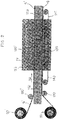
- the glass fibers are gathered so as to form a carpet 112 ( figure 2 ) which can be rolled up into a roll.
- the glass fiber mat 112 is advanced between two supports 9, 9 'unwound from a first and a second mother reel 90, 90'. It is clear that if the coating on one side of the fibers is desired, one of the two coils 90, 90 ', preferably the upper coil 90', can be omitted.
- the fiber mat glass 112 with the respective supports 9, 9 ′ is advanced by means of a conveyor 140 in the direction of arrow F A towards a needling machine 108.
- the needling machine 108 comprises a plurality of hook needles 180 disposed below the plane of the lower support 9, and a plurality of hook needles 180 'disposed above the plane of the upper support 9'.
- the lower needles 180 and the upper needles 180 ′ move vertically in an alternating movement in the direction of the arrows F V.
- the needles 180, 180 ′ pass through the respective supports 9, 9 ′ and bind the glass fibers of the carpet 112 between themselves and to the respective supports 9, 9 ′.
- the outlet of the needling machine 108 there will be a carpet or a core of compact glass fibers 113 in which the glass fibers are mechanically bonded to each other, to the respective lower support and to the upper support 9, 9 '.
- Such a fiber mat 113 with its respective supports 9, 9 'mechanically linked is transported out of the needling machine 108 by means of a conveyor 141 and from there sent to the subsequent phases of winding in rolls and then cutting and / or size, so as to obtain the desired products.
Landscapes
- Engineering & Computer Science (AREA)
- Textile Engineering (AREA)
- Physics & Mathematics (AREA)
- Architecture (AREA)
- Chemical & Material Sciences (AREA)
- Inorganic Chemistry (AREA)
- Mechanical Engineering (AREA)
- Electromagnetism (AREA)
- Acoustics & Sound (AREA)
- Civil Engineering (AREA)
- Structural Engineering (AREA)
- Thermal Sciences (AREA)
- Microelectronics & Electronic Packaging (AREA)
- Laminated Bodies (AREA)
- Nonwoven Fabrics (AREA)
- Cookers (AREA)
- Inorganic Fibers (AREA)
- Thermal Insulation (AREA)
- Treatments For Attaching Organic Compounds To Fibrous Goods (AREA)
Claims (23)
- Dämmpanel zur Wärmedämmung eines Elektrogeräts, wobei das Panel auf Mineralfasern basiert, die aus Glasfasern, Glaswolle oder Steinwolle ausgewählt sind, und einen Kern (13; 113) aus Mineralfasern umfasst, die durch ein mineralisches Bindemittel oder durch eine mechanische Verbindung miteinander verbunden sind, und eine Deckschicht (9, 9'), die auf mindestens eine Seite des Kerns aus Mineralfasern (13; 113) aufgebracht ist, dadurch gekennzeichnet, dass die Deckschicht (9; 9') einen Vliesstoff (TNT), ein Mineralfasergewebe oder eine Mineralfasermatte umfasst, dass die Deckschicht durch ein mineralisches Bindemittel mit den Mineralfasern des Kerns chemisch verbunden oder mit den Mineralfasern des Kerns mechanisch verbunden ist und dass die Deckschicht (9; 9') ein Flächengewicht im Bereich von 10 g/m2 bis 100 g/m2 aufweist.
- Panel nach Anspruch 1, dadurch gekennzeichnet, dass die Deckschicht (9; 9') ein Glasfasergewebe oder -matte umfasst.
- Panel nach Anspruch 1, dadurch gekennzeichnet, dass die Deckschicht (9; 9') einen Vliesstoff (TNT) aus synthetischen Polymerfasern umfasst, insbesondere bestehend aus Polyethylen- und Polyesterderivaten, denen gegebenenfalls Metalloxid-Füllstoffe zugegeben sind.
- Panel nach einem der vorhergehenden Ansprüche, dadurch gekennzeichnet, dass die Deckschicht (9; 9') eine Dicke aufweist, die indikativ im Bereich von 0,05 mm bis 1,5 mm liegt.
- Panel nach einem der vorhergehenden Ansprüche, dadurch gekennzeichnet, dass der Kern aus Mineralfasern eine flächenbezogene Masse in der Größenordnung von 600 bis 1000 g/m2 aufweist.
- Panel nach einem der vorhergehenden Ansprüche, dadurch gekennzeichnet, dass der Kern aus Mineralfasern Glasfasern mit einem Mikronaire in der Größenordnung von 3 bis 4,5 in 5 g umfasst.
- Panel nach einem der vorhergehenden Ansprüche, dadurch gekennzeichnet, dass es chemische Bindemittel umfasst, um sowohl eine chemische Bindung zwischen den Mineralfasern des Kerns (13) als auch eine chemische Bindung zwischen der Deckschicht (9; 9') und den Mineralfasern des Kerns (13) zu ermöglichen.
- Panel nach Anspruch 7, dadurch gekennzeichnet, dass das chemische Bindemittel ein mineralisches Bindemittel ist, das aus einer wässrigen Lösung von Aluminiumpolyphosphatsalzen besteht.
- Panel nach einem der Ansprüche 1 bis 6, dadurch gekennzeichnet, dass die Mineralfasern des Kerns (113) mechanisch miteinander verbunden sind und dass die Deckschicht (9, 9') mit den Mineralfasern des Kerns (113) mechanisch verbunden ist.
- Panel nach Anspruch 9, dadurch gekennzeichnet, dass die mechanische Verbindung durch Vernadelung der Mineralfasern miteinander und durch Vernadelung der Mineralfasern mit der Deckschicht (9, 9') erhalten wird.
- Panel nach Anspruch 9 oder 10, dadurch gekennzeichnet, dass es ein Antistaubmittel zwischen den Mineralfasern des Kerns (113) umfasst.
- Verfahren zur Herstellung eines Dämmpanels basierend auf Mineralfasern nach einem der Ansprüche 1 bis 8, das die folgenden Schritte umfasst:- Spinnen der Mineralfasern (10) aus einer geschmolzenen Mineralsubstanz (1),- chemisches Verbinden zwischen den Mineralfasern (10), um einen Kern aus miteinander chemisch verbundenen Mineralfasern (13; 113) zu erhalten,- chemisches Verbinden des Kerns (13; 113) aus Mineralfasern mit einer Deckschicht (9, 9'), die auf mindestens einer Seite des Kerns (13; 113) aus Mineralfasern angeordnet ist.
- Verfahren nach Anspruch 12, dadurch gekennzeichnet, dass die Phase des Verbindens der Mineralfasern (13; 113) miteinander gleichzeitig mit dem Schritt des Verbindens der Mineralfasern mit der Deckschicht (9, 9') unter Verwendung einer chemischen Verbindung stattfindet.
- Verfahren nach den Ansprüchen 12 oder 13, dadurch gekennzeichnet, dass die Schritte des chemischen Verbindens die folgenden Phasen umfassen:- Zugeben eines mineralischen Bindemittels zu den Mineralfasern (10),- Aufnehmen der Mineralfasern (11) mit dem mineralischen Bindemittel auf einem Streifen der Deckschicht (9),- Ansaugen von Luft durch die Deckschicht (9) und anschließendes Trocknen der mineralischen Bindemittel, um die Verbindung von Mineralfasern miteinander und die Verbindung der Mineralfasern mit der Deckschicht (9) herzustellen.
- Verfahren nach Anspruch 14, dadurch gekennzeichnet, dass es ferner die Schritte umfasst, die bestehen aus:- Abscheiden des mineralischen Bindemittels auf eine zweite Deckschicht (9') und- Aufbringen der zweiten Deckschicht (9') auf die Oberfläche des Kerns (13) aus Mineralfasern, die derjenigen entgegengesetzt ist, mit der die erste Deckschicht (9) verbunden ist, sodass sich das mineralische Bindemittel zwischen der zweiten Deckschicht (9') und einer Seite des Kerns aus Mineralfasern (13) befindet.
- Verfahren nach Anspruch 15, dadurch gekennzeichnet, dass es ferner den Schritt des Trocknens des zwischen der zweiten Deckschicht (9') und einer Oberfläche des Kerns aus Mineralfasern (13) abgeschiedenen mineralischen Bindemittels durch Erwärmen umfasst.
- Verfahren nach Anspruch 16, dadurch gekennzeichnet, dass der Schritt des Trocknens des mineralischen Bindemittels durch Erwärmen bei einer Temperatur im Bereich von 100 °C bis 200 °C durchgeführt wird.
- Verfahren zur Herstellung eines Dämmpanels basierend auf Mineralfasern nach einem der Ansprüche 9 bis 11, das die folgenden Schritte umfasst:- Spinnen der Mineralfasern (10) aus einer geschmolzenen Mineralsubstanz (1),- mechanisches Verbinden der Mineralfasern (10) miteinander, um einen Kern aus Mineralfasern (113) zu erhalten, die miteinander mechanisch verbunden sind,- mechanisches Verbinden des Kerns (113) aus Mineralfasern mit einer Deckschicht (9, 9'), die auf mindestens einer Seite des Kerns (113) aus Mineralfasern angeordnet ist.
- Verfahren nach Anspruch 18, dadurch gekennzeichnet, dass der Schritt des Verbindens von Mineralfasern (113) miteinander gleichzeitig mit dem Schritt des Verbindens der Mineralfasern mit der Deckschicht (9, 9') durch eine mechanische Verbindung erfolgt.
- Verfahren nach den Ansprüchen 18 oder 19, dadurch gekennzeichnet, dass die mechanische Verbindung durch Vernadelung bewirkt wird, wobei Hakennadeln (180, 180') durch die Deckschicht (9, 9') verlaufen, um die Mineralfasern des Kerns (113) miteinander und mit der Deckschicht (9, 9') mechanisch zu verbinden.
- Verfahren nach einem der Ansprüche 18 bis 20, dadurch gekennzeichnet, dass es den Schritt der Zugabe von Antistaubmitteln zu den Mineralfasern vor dem Schritt des mechanischen Verbindens umfasst.
- Verfahren nach einem der Ansprüche 12 bis 21, dadurch gekennzeichnet, dass der Schritt des Spinnens der Mineralfasern (10) aus einer geschmolzenen mineralischen Substanz durch ein Rotationsverfahren durch interne Zentrifugation durchgeführt wird.
- Verwendung eines Dämmpanels nach einem der Ansprüche 1 bis 11 zur Wärmedämmung eines Elektrogeräts, insbesondere eines Haushaltsgeräts, wie eines Herds, Elektro- oder Mikrowellenofens, eines Kühlschranks, eines Heizkessels, eines Klimageräts oder einer Klimaanlage.
Priority Applications (1)
| Application Number | Priority Date | Filing Date | Title |
|---|---|---|---|
| PL04787494T PL1670997T3 (pl) | 2003-09-30 | 2004-09-30 | Płyta izolacyjna na bazie włókna mineralnego, sposób jej wytwarzania i jej zastosowanie |
Applications Claiming Priority (2)
| Application Number | Priority Date | Filing Date | Title |
|---|---|---|---|
| ITMI20031877 ITMI20031877A1 (it) | 2003-09-30 | 2003-09-30 | Pannello isolante a base di fibre minerali e relativo metodo di produzione. |
| PCT/FR2004/002487 WO2005032811A2 (fr) | 2003-09-30 | 2004-09-30 | Panneau isolant a base de fibre minerale, procede pour sa production et son utilisation |
Publications (2)
| Publication Number | Publication Date |
|---|---|
| EP1670997A2 EP1670997A2 (de) | 2006-06-21 |
| EP1670997B1 true EP1670997B1 (de) | 2020-05-20 |
Family
ID=34308110
Family Applications (2)
| Application Number | Title | Priority Date | Filing Date |
|---|---|---|---|
| EP20040021877 Withdrawn EP1520945A3 (de) | 2003-09-30 | 2004-09-15 | Dämmpanel auf Mineralfaserbasis und Herstellungsmethode |
| EP04787494.6A Expired - Lifetime EP1670997B1 (de) | 2003-09-30 | 2004-09-30 | Dämmpanel auf mineralfaserbasis und herstellungsmethode |
Family Applications Before (1)
| Application Number | Title | Priority Date | Filing Date |
|---|---|---|---|
| EP20040021877 Withdrawn EP1520945A3 (de) | 2003-09-30 | 2004-09-15 | Dämmpanel auf Mineralfaserbasis und Herstellungsmethode |
Country Status (13)
| Country | Link |
|---|---|
| US (1) | US20070042661A1 (de) |
| EP (2) | EP1520945A3 (de) |
| JP (1) | JP4927547B2 (de) |
| KR (1) | KR101058841B1 (de) |
| CN (1) | CN1860272B (de) |
| BR (1) | BRPI0414806B1 (de) |
| CA (1) | CA2540482C (de) |
| EA (1) | EA008760B1 (de) |
| ES (1) | ES2807326T3 (de) |
| IT (1) | ITMI20031877A1 (de) |
| PL (1) | PL1670997T3 (de) |
| UA (1) | UA89171C2 (de) |
| WO (1) | WO2005032811A2 (de) |
Families Citing this family (10)
| Publication number | Priority date | Publication date | Assignee | Title |
|---|---|---|---|---|
| JP4914197B2 (ja) * | 2006-12-14 | 2012-04-11 | 旭ファイバーグラス株式会社 | 繊維系断熱材、床断熱構造及び床断熱構造の施工方法 |
| RU2486321C1 (ru) * | 2009-04-06 | 2013-06-27 | Дзеонг Гон СОНГ | Система и способ изготовления теплоизолятора |
| CA2758993A1 (en) * | 2009-04-13 | 2010-10-21 | Owens Corning Intellectual Capital, Llc | Soft fiber insulation product |
| ES2718827T3 (es) * | 2009-07-31 | 2019-07-04 | Rockwool Int | Método para fabricar un elemento que contiene fibra mineral y un elemento producido por este método |
| KR101417243B1 (ko) * | 2012-01-05 | 2014-07-09 | (주)엘지하우시스 | 무기바인더를 포함한 유리섬유 보드 및 그의 제조 방법 |
| CN103572504A (zh) * | 2012-07-24 | 2014-02-12 | 南京航空航天大学 | 一种离心玻璃棉在线强制分层装置 |
| CN103437033A (zh) * | 2013-09-05 | 2013-12-11 | 苏州巨旺纺织有限公司 | 一种绝缘聚酯纤维面料 |
| CN103437209A (zh) * | 2013-09-05 | 2013-12-11 | 苏州巨旺纺织有限公司 | 一种绝缘黏胶纤维面料 |
| US10989417B2 (en) | 2016-01-27 | 2021-04-27 | Owens Corning Intellectual Capital, Llc | Thermal appliance |
| GB201717160D0 (en) | 2017-10-19 | 2017-12-06 | Knauf Insulation | Insulating product |
Family Cites Families (15)
| Publication number | Priority date | Publication date | Assignee | Title |
|---|---|---|---|---|
| US4522876A (en) * | 1984-07-05 | 1985-06-11 | Lydall, Inc. | Integral textile composite fabric |
| US4847140A (en) * | 1985-04-08 | 1989-07-11 | Helmic, Inc. | Nonwoven fibrous insulation material |
| US4726978A (en) * | 1985-10-23 | 1988-02-23 | Siebe Gorman & Company Limited | Charcoal fabric needled to supporting fabrics |
| JPH0637516B2 (ja) * | 1986-11-07 | 1994-05-18 | 北里研究所(社団法人) | 抗生物質sk−2049およびその製造方法 |
| GB8627786D0 (en) * | 1986-11-20 | 1986-12-17 | Tech Textiles Ltd | Composite material |
| FR2619116B1 (fr) * | 1987-08-03 | 1992-04-24 | Saint Gobain Isover | Composition d'encollage de fibres minerales discontinues pour l'obtention de produits d'isolation |
| EP0476176B1 (de) * | 1990-09-21 | 1996-12-04 | EUROFIBRE S.p.A. | Verfahren für die Plattenherstellung aus Mineralfasern, wie Glasfasern, Steinwolle u.a., und nach diesem Verfahren erzeugte Platten |
| FR2668470B1 (fr) * | 1990-10-29 | 1992-12-24 | Saint Gobain Isover | Procede et dispositif de production de fibres par centrifugation interne et application au fibrage de certains verres. |
| US5281470A (en) * | 1991-03-01 | 1994-01-25 | Cci Co., Ltd. | Vibration damper |
| EP0585626A1 (de) * | 1992-08-14 | 1994-03-09 | Hoechst Aktiengesellschaft | Kaschierte Mineralfasermatte |
| US5458960A (en) * | 1993-02-09 | 1995-10-17 | Roctex Oy Ab | Flexible base web for a construction covering |
| JP3007240B2 (ja) * | 1993-04-02 | 2000-02-07 | 東芝モノフラックス株式会社 | 無機質繊維成形体 |
| GB9310592D0 (en) * | 1993-05-22 | 1993-07-14 | Dunlop Ltd | Ultra-high performance carbon composites |
| DE19750564A1 (de) * | 1997-11-14 | 1999-05-20 | Missel Gmbh & Co E | Dämmaterial |
| JP2001233680A (ja) * | 2000-02-23 | 2001-08-28 | Nichias Corp | 断熱材の製造方法 |
-
2003
- 2003-09-30 IT ITMI20031877 patent/ITMI20031877A1/it unknown
-
2004
- 2004-09-15 EP EP20040021877 patent/EP1520945A3/de not_active Withdrawn
- 2004-09-30 CN CN2004800284027A patent/CN1860272B/zh not_active Expired - Fee Related
- 2004-09-30 ES ES04787494T patent/ES2807326T3/es not_active Expired - Lifetime
- 2004-09-30 WO PCT/FR2004/002487 patent/WO2005032811A2/fr not_active Ceased
- 2004-09-30 EP EP04787494.6A patent/EP1670997B1/de not_active Expired - Lifetime
- 2004-09-30 PL PL04787494T patent/PL1670997T3/pl unknown
- 2004-09-30 KR KR1020067005852A patent/KR101058841B1/ko not_active Expired - Fee Related
- 2004-09-30 JP JP2006530411A patent/JP4927547B2/ja not_active Expired - Fee Related
- 2004-09-30 EA EA200600692A patent/EA008760B1/ru unknown
- 2004-09-30 BR BRPI0414806-1B1A patent/BRPI0414806B1/pt not_active IP Right Cessation
- 2004-09-30 US US10/573,076 patent/US20070042661A1/en not_active Abandoned
- 2004-09-30 CA CA 2540482 patent/CA2540482C/fr not_active Expired - Fee Related
- 2004-09-30 UA UAA200604726A patent/UA89171C2/ru unknown
Non-Patent Citations (1)
| Title |
|---|
| None * |
Also Published As
| Publication number | Publication date |
|---|---|
| JP4927547B2 (ja) | 2012-05-09 |
| BRPI0414806B1 (pt) | 2014-11-18 |
| KR20060096421A (ko) | 2006-09-11 |
| ITMI20031877A1 (it) | 2005-04-01 |
| CA2540482A1 (fr) | 2005-04-14 |
| UA89171C2 (ru) | 2010-01-11 |
| CN1860272A (zh) | 2006-11-08 |
| JP2007508958A (ja) | 2007-04-12 |
| ES2807326T3 (es) | 2021-02-22 |
| EP1520945A3 (de) | 2005-06-08 |
| US20070042661A1 (en) | 2007-02-22 |
| BRPI0414806A (pt) | 2006-11-14 |
| CA2540482C (fr) | 2013-11-12 |
| PL1670997T3 (pl) | 2020-11-16 |
| WO2005032811A3 (fr) | 2005-06-02 |
| CN1860272B (zh) | 2010-04-28 |
| EA008760B1 (ru) | 2007-08-31 |
| KR101058841B1 (ko) | 2011-08-23 |
| WO2005032811A2 (fr) | 2005-04-14 |
| EP1520945A2 (de) | 2005-04-06 |
| EA200600692A1 (ru) | 2006-08-25 |
| EP1670997A2 (de) | 2006-06-21 |
Similar Documents
| Publication | Publication Date | Title |
|---|---|---|
| EP1670997B1 (de) | Dämmpanel auf mineralfaserbasis und herstellungsmethode | |
| EP0403403B1 (de) | Textil-Schichtstoff aus Faserbahnen mit verschiedenen Eigenschaften und dessen Verfahren zur Herstellung | |
| KR101283107B1 (ko) | 가변 로프트 작업 표면을 구비한 세척 와이프 | |
| EP1678372A1 (de) | Verfahren und vorrichtung zur impregnierung eines fasernetzwerks mit pulver in einem elektrostatischen feld mit wechselspannung | |
| CN101027182B (zh) | 覆面纤维绝缘材料 | |
| KR20050100611A (ko) | 방수 매트를 구비한 덕트 보드 | |
| FR2667622A1 (fr) | Montisse lie hydrauliquement et son procede de fabrication. | |
| CA2613967A1 (en) | Thin rotary-fiberized glass insulation and process for producing same | |
| WO2001051693A1 (fr) | Procede pour la realisation d'un materiau non tisse complexe et nouveau type de materiau ainsi obtenu | |
| EP2297506A1 (de) | Voraufgetragener wasserfreier haftstoff auf heizungs-, lüftungs- und klimatisierungsverkleidungen mit abdichtbarem flansch | |
| JP4240811B2 (ja) | 二成分ガラス繊維のカード可能な混合物 | |
| WO2018156691A1 (en) | Nonwoven fiber structure for use as an insulator | |
| US20030049488A1 (en) | Insulation containing separate layers of textile fibers and of rotary and/or flame attenuated fibers | |
| EP0501842A1 (de) | Einlageverbundvliesstoff | |
| JP2023002527A (ja) | パイプや容器のための断熱パッド | |
| JP2008511766A5 (de) | ||
| CH661072A5 (fr) | Membrane d'etancheite et son procede de fabrication. | |
| EP1418292A1 (de) | Trittschallisolierende Verbundmatte aus Mineralfasern | |
| JP2016157814A (ja) | 電波吸収体 | |
| JP2024164082A (ja) | 繊維状材料からウェブを形成する方法 | |
| JP4618908B2 (ja) | 補強用シート | |
| WO2020126883A1 (fr) | Matériau multicouche de protection de câble pour hautes températures | |
| CN208584873U (zh) | 一种热熔胶撒粉复合机 | |
| JPH0939143A (ja) | 無機繊維マット及びその製造法 | |
| JPS62121033A (ja) | 表皮層をもつ繊維質吸音、断熱材の製造法 |
Legal Events
| Date | Code | Title | Description |
|---|---|---|---|
| PUAI | Public reference made under article 153(3) epc to a published international application that has entered the european phase |
Free format text: ORIGINAL CODE: 0009012 |
|
| 17P | Request for examination filed |
Effective date: 20060502 |
|
| AK | Designated contracting states |
Kind code of ref document: A2 Designated state(s): AT BE BG CH CY CZ DE DK EE ES FI FR GB GR HU IE IT LI LU MC NL PL PT RO SE SI SK TR |
|
| DAX | Request for extension of the european patent (deleted) | ||
| 17Q | First examination report despatched |
Effective date: 20070302 |
|
| GRAP | Despatch of communication of intention to grant a patent |
Free format text: ORIGINAL CODE: EPIDOSNIGR1 |
|
| STAA | Information on the status of an ep patent application or granted ep patent |
Free format text: STATUS: GRANT OF PATENT IS INTENDED |
|
| INTG | Intention to grant announced |
Effective date: 20191209 |
|
| GRAS | Grant fee paid |
Free format text: ORIGINAL CODE: EPIDOSNIGR3 |
|
| GRAA | (expected) grant |
Free format text: ORIGINAL CODE: 0009210 |
|
| STAA | Information on the status of an ep patent application or granted ep patent |
Free format text: STATUS: THE PATENT HAS BEEN GRANTED |
|
| REG | Reference to a national code |
Ref country code: DE Ref legal event code: R081 Ref document number: 602004054663 Country of ref document: DE Owner name: SAINT-GOBAIN ISOVER, FR Free format text: FORMER OWNER: SAINT-GOBAIN ISOVER, COURBEVOIE, FR |
|
| AK | Designated contracting states |
Kind code of ref document: B1 Designated state(s): AT BE BG CH CY CZ DE DK EE ES FI FR GB GR HU IE IT LI LU MC NL PL PT RO SE SI SK TR |
|
| REG | Reference to a national code |
Ref country code: GB Ref legal event code: FG4D Free format text: NOT ENGLISH |
|
| REG | Reference to a national code |
Ref country code: CH Ref legal event code: EP |
|
| RAP2 | Party data changed (patent owner data changed or rights of a patent transferred) |
Owner name: SAINT-GOBAIN ISOVER |
|
| REG | Reference to a national code |
Ref country code: DE Ref legal event code: R096 Ref document number: 602004054663 Country of ref document: DE |
|
| REG | Reference to a national code |
Ref country code: AT Ref legal event code: REF Ref document number: 1272682 Country of ref document: AT Kind code of ref document: T Effective date: 20200615 |
|
| REG | Reference to a national code |
Ref country code: NL Ref legal event code: MP Effective date: 20200520 |
|
| PG25 | Lapsed in a contracting state [announced via postgrant information from national office to epo] |
Ref country code: GR Free format text: LAPSE BECAUSE OF FAILURE TO SUBMIT A TRANSLATION OF THE DESCRIPTION OR TO PAY THE FEE WITHIN THE PRESCRIBED TIME-LIMIT Effective date: 20200821 Ref country code: PT Free format text: LAPSE BECAUSE OF FAILURE TO SUBMIT A TRANSLATION OF THE DESCRIPTION OR TO PAY THE FEE WITHIN THE PRESCRIBED TIME-LIMIT Effective date: 20200921 Ref country code: FI Free format text: LAPSE BECAUSE OF FAILURE TO SUBMIT A TRANSLATION OF THE DESCRIPTION OR TO PAY THE FEE WITHIN THE PRESCRIBED TIME-LIMIT Effective date: 20200520 Ref country code: SE Free format text: LAPSE BECAUSE OF FAILURE TO SUBMIT A TRANSLATION OF THE DESCRIPTION OR TO PAY THE FEE WITHIN THE PRESCRIBED TIME-LIMIT Effective date: 20200520 |
|
| PG25 | Lapsed in a contracting state [announced via postgrant information from national office to epo] |
Ref country code: BG Free format text: LAPSE BECAUSE OF FAILURE TO SUBMIT A TRANSLATION OF THE DESCRIPTION OR TO PAY THE FEE WITHIN THE PRESCRIBED TIME-LIMIT Effective date: 20200820 |
|
| REG | Reference to a national code |
Ref country code: AT Ref legal event code: MK05 Ref document number: 1272682 Country of ref document: AT Kind code of ref document: T Effective date: 20200520 |
|
| PG25 | Lapsed in a contracting state [announced via postgrant information from national office to epo] |
Ref country code: NL Free format text: LAPSE BECAUSE OF FAILURE TO SUBMIT A TRANSLATION OF THE DESCRIPTION OR TO PAY THE FEE WITHIN THE PRESCRIBED TIME-LIMIT Effective date: 20200520 |
|
| PG25 | Lapsed in a contracting state [announced via postgrant information from national office to epo] |
Ref country code: AT Free format text: LAPSE BECAUSE OF FAILURE TO SUBMIT A TRANSLATION OF THE DESCRIPTION OR TO PAY THE FEE WITHIN THE PRESCRIBED TIME-LIMIT Effective date: 20200520 Ref country code: EE Free format text: LAPSE BECAUSE OF FAILURE TO SUBMIT A TRANSLATION OF THE DESCRIPTION OR TO PAY THE FEE WITHIN THE PRESCRIBED TIME-LIMIT Effective date: 20200520 Ref country code: DK Free format text: LAPSE BECAUSE OF FAILURE TO SUBMIT A TRANSLATION OF THE DESCRIPTION OR TO PAY THE FEE WITHIN THE PRESCRIBED TIME-LIMIT Effective date: 20200520 Ref country code: CZ Free format text: LAPSE BECAUSE OF FAILURE TO SUBMIT A TRANSLATION OF THE DESCRIPTION OR TO PAY THE FEE WITHIN THE PRESCRIBED TIME-LIMIT Effective date: 20200520 |
|
| REG | Reference to a national code |
Ref country code: ES Ref legal event code: FG2A Ref document number: 2807326 Country of ref document: ES Kind code of ref document: T3 Effective date: 20210222 |
|
| REG | Reference to a national code |
Ref country code: DE Ref legal event code: R097 Ref document number: 602004054663 Country of ref document: DE |
|
| PG25 | Lapsed in a contracting state [announced via postgrant information from national office to epo] |
Ref country code: SK Free format text: LAPSE BECAUSE OF FAILURE TO SUBMIT A TRANSLATION OF THE DESCRIPTION OR TO PAY THE FEE WITHIN THE PRESCRIBED TIME-LIMIT Effective date: 20200520 |
|
| PLBE | No opposition filed within time limit |
Free format text: ORIGINAL CODE: 0009261 |
|
| STAA | Information on the status of an ep patent application or granted ep patent |
Free format text: STATUS: NO OPPOSITION FILED WITHIN TIME LIMIT |
|
| 26N | No opposition filed |
Effective date: 20210223 |
|
| PG25 | Lapsed in a contracting state [announced via postgrant information from national office to epo] |
Ref country code: MC Free format text: LAPSE BECAUSE OF FAILURE TO SUBMIT A TRANSLATION OF THE DESCRIPTION OR TO PAY THE FEE WITHIN THE PRESCRIBED TIME-LIMIT Effective date: 20200520 |
|
| REG | Reference to a national code |
Ref country code: CH Ref legal event code: PL |
|
| GBPC | Gb: european patent ceased through non-payment of renewal fee |
Effective date: 20200930 |
|
| PG25 | Lapsed in a contracting state [announced via postgrant information from national office to epo] |
Ref country code: SI Free format text: LAPSE BECAUSE OF FAILURE TO SUBMIT A TRANSLATION OF THE DESCRIPTION OR TO PAY THE FEE WITHIN THE PRESCRIBED TIME-LIMIT Effective date: 20200520 |
|
| REG | Reference to a national code |
Ref country code: BE Ref legal event code: MM Effective date: 20200930 |
|
| PG25 | Lapsed in a contracting state [announced via postgrant information from national office to epo] |
Ref country code: LU Free format text: LAPSE BECAUSE OF NON-PAYMENT OF DUE FEES Effective date: 20200930 |
|
| PG25 | Lapsed in a contracting state [announced via postgrant information from national office to epo] |
Ref country code: BE Free format text: LAPSE BECAUSE OF NON-PAYMENT OF DUE FEES Effective date: 20200930 Ref country code: CH Free format text: LAPSE BECAUSE OF NON-PAYMENT OF DUE FEES Effective date: 20200930 Ref country code: GB Free format text: LAPSE BECAUSE OF NON-PAYMENT OF DUE FEES Effective date: 20200930 Ref country code: LI Free format text: LAPSE BECAUSE OF NON-PAYMENT OF DUE FEES Effective date: 20200930 Ref country code: IE Free format text: LAPSE BECAUSE OF NON-PAYMENT OF DUE FEES Effective date: 20200930 |
|
| PGFP | Annual fee paid to national office [announced via postgrant information from national office to epo] |
Ref country code: TR Payment date: 20210928 Year of fee payment: 18 |
|
| PGFP | Annual fee paid to national office [announced via postgrant information from national office to epo] |
Ref country code: ES Payment date: 20211005 Year of fee payment: 18 |
|
| PG25 | Lapsed in a contracting state [announced via postgrant information from national office to epo] |
Ref country code: CY Free format text: LAPSE BECAUSE OF FAILURE TO SUBMIT A TRANSLATION OF THE DESCRIPTION OR TO PAY THE FEE WITHIN THE PRESCRIBED TIME-LIMIT Effective date: 20200520 |
|
| PGFP | Annual fee paid to national office [announced via postgrant information from national office to epo] |
Ref country code: RO Payment date: 20220829 Year of fee payment: 19 Ref country code: IT Payment date: 20220811 Year of fee payment: 19 Ref country code: DE Payment date: 20220809 Year of fee payment: 19 |
|
| PGFP | Annual fee paid to national office [announced via postgrant information from national office to epo] |
Ref country code: PL Payment date: 20220812 Year of fee payment: 19 Ref country code: FR Payment date: 20220930 Year of fee payment: 19 |
|
| REG | Reference to a national code |
Ref country code: ES Ref legal event code: FD2A Effective date: 20231030 |
|
| PG25 | Lapsed in a contracting state [announced via postgrant information from national office to epo] |
Ref country code: ES Free format text: LAPSE BECAUSE OF NON-PAYMENT OF DUE FEES Effective date: 20221001 |
|
| PG25 | Lapsed in a contracting state [announced via postgrant information from national office to epo] |
Ref country code: ES Free format text: LAPSE BECAUSE OF NON-PAYMENT OF DUE FEES Effective date: 20221001 |
|
| REG | Reference to a national code |
Ref country code: DE Ref legal event code: R119 Ref document number: 602004054663 Country of ref document: DE |
|
| PG25 | Lapsed in a contracting state [announced via postgrant information from national office to epo] |
Ref country code: RO Free format text: LAPSE BECAUSE OF NON-PAYMENT OF DUE FEES Effective date: 20230930 |
|
| PG25 | Lapsed in a contracting state [announced via postgrant information from national office to epo] |
Ref country code: FR Free format text: LAPSE BECAUSE OF NON-PAYMENT OF DUE FEES Effective date: 20230930 Ref country code: DE Free format text: LAPSE BECAUSE OF NON-PAYMENT OF DUE FEES Effective date: 20240403 |
|
| PG25 | Lapsed in a contracting state [announced via postgrant information from national office to epo] |
Ref country code: TR Free format text: LAPSE BECAUSE OF NON-PAYMENT OF DUE FEES Effective date: 20220930 |
|
| PG25 | Lapsed in a contracting state [announced via postgrant information from national office to epo] |
Ref country code: IT Free format text: LAPSE BECAUSE OF NON-PAYMENT OF DUE FEES Effective date: 20230930 |
|
| PG25 | Lapsed in a contracting state [announced via postgrant information from national office to epo] |
Ref country code: IT Free format text: LAPSE BECAUSE OF NON-PAYMENT OF DUE FEES Effective date: 20230930 |
|
| PG25 | Lapsed in a contracting state [announced via postgrant information from national office to epo] |
Ref country code: PL Free format text: LAPSE BECAUSE OF NON-PAYMENT OF DUE FEES Effective date: 20230930 |