EP1664157B1 - Mikrogele in nicht-vernetzbaren organischen medien - Google Patents
Mikrogele in nicht-vernetzbaren organischen medien Download PDFInfo
- Publication number
- EP1664157B1 EP1664157B1 EP04787199A EP04787199A EP1664157B1 EP 1664157 B1 EP1664157 B1 EP 1664157B1 EP 04787199 A EP04787199 A EP 04787199A EP 04787199 A EP04787199 A EP 04787199A EP 1664157 B1 EP1664157 B1 EP 1664157B1
- Authority
- EP
- European Patent Office
- Prior art keywords
- composition according
- microgel
- microgels
- composition
- compositions
- Prior art date
- Legal status (The legal status is an assumption and is not a legal conclusion. Google has not performed a legal analysis and makes no representation as to the accuracy of the status listed.)
- Expired - Lifetime
Links
- 239000000203 mixture Substances 0.000 claims abstract description 167
- 229920001971 elastomer Polymers 0.000 claims abstract description 43
- 239000005060 rubber Substances 0.000 claims abstract description 43
- 238000002360 preparation method Methods 0.000 claims abstract description 27
- 229920000642 polymer Polymers 0.000 claims abstract description 20
- 238000000034 method Methods 0.000 claims abstract description 19
- 230000008569 process Effects 0.000 claims abstract description 14
- 239000000314 lubricant Substances 0.000 claims abstract description 13
- 238000000576 coating method Methods 0.000 claims abstract description 6
- YXFVVABEGXRONW-UHFFFAOYSA-N Toluene Chemical compound CC1=CC=CC=C1 YXFVVABEGXRONW-UHFFFAOYSA-N 0.000 claims description 45
- 239000002245 particle Substances 0.000 claims description 35
- 239000003921 oil Substances 0.000 claims description 27
- 239000011164 primary particle Substances 0.000 claims description 27
- 239000007788 liquid Substances 0.000 claims description 19
- 239000010687 lubricating oil Substances 0.000 claims description 17
- 229920003023 plastic Polymers 0.000 claims description 16
- 239000004033 plastic Substances 0.000 claims description 16
- 238000007720 emulsion polymerization reaction Methods 0.000 claims description 14
- 230000009477 glass transition Effects 0.000 claims description 13
- 230000008961 swelling Effects 0.000 claims description 13
- 125000002887 hydroxy group Chemical group [H]O* 0.000 claims description 12
- 229920000570 polyether Polymers 0.000 claims description 12
- 239000004721 Polyphenylene oxide Substances 0.000 claims description 10
- 230000005855 radiation Effects 0.000 claims description 10
- 239000002904 solvent Substances 0.000 claims description 10
- 239000011324 bead Substances 0.000 claims description 8
- 239000000945 filler Substances 0.000 claims description 7
- 239000000654 additive Substances 0.000 claims description 6
- 239000010696 ester oil Substances 0.000 claims description 6
- 150000001875 compounds Chemical class 0.000 claims description 5
- 238000010348 incorporation Methods 0.000 claims description 5
- 229920002725 thermoplastic elastomer Polymers 0.000 claims description 5
- XUIMIQQOPSSXEZ-UHFFFAOYSA-N Silicon Chemical compound [Si] XUIMIQQOPSSXEZ-UHFFFAOYSA-N 0.000 claims description 4
- 125000000524 functional group Chemical group 0.000 claims description 4
- 239000002994 raw material Substances 0.000 claims description 4
- 239000010703 silicon Substances 0.000 claims description 4
- 229910052710 silicon Inorganic materials 0.000 claims description 4
- 229910052799 carbon Inorganic materials 0.000 claims description 3
- 238000002156 mixing Methods 0.000 claims description 3
- 239000006254 rheological additive Substances 0.000 claims description 3
- 229920001169 thermoplastic Polymers 0.000 claims description 3
- 239000002562 thickening agent Substances 0.000 claims description 3
- 150000004945 aromatic hydrocarbons Chemical class 0.000 claims description 2
- 150000005826 halohydrocarbons Chemical class 0.000 claims description 2
- 230000001050 lubricating effect Effects 0.000 claims description 2
- 150000003014 phosphoric acid esters Chemical class 0.000 claims description 2
- 229920006395 saturated elastomer Polymers 0.000 claims description 2
- 239000004416 thermosoftening plastic Substances 0.000 claims description 2
- 239000008199 coating composition Substances 0.000 claims 2
- 230000000996 additive effect Effects 0.000 claims 1
- 229920001519 homopolymer Polymers 0.000 claims 1
- 229920005604 random copolymer Polymers 0.000 claims 1
- 239000013008 thixotropic agent Substances 0.000 claims 1
- 239000000499 gel Substances 0.000 description 37
- 239000003925 fat Substances 0.000 description 30
- 229920003048 styrene butadiene rubber Polymers 0.000 description 29
- 239000002174 Styrene-butadiene Substances 0.000 description 27
- 235000019198 oils Nutrition 0.000 description 25
- -1 secondary amino (meth) acrylic acid esters Chemical class 0.000 description 19
- 239000006185 dispersion Substances 0.000 description 18
- 239000000047 product Substances 0.000 description 18
- 150000004702 methyl esters Chemical class 0.000 description 16
- 238000000926 separation method Methods 0.000 description 16
- 238000004132 cross linking Methods 0.000 description 15
- 229920000126 latex Polymers 0.000 description 13
- KAKZBPTYRLMSJV-UHFFFAOYSA-N Butadiene Chemical compound C=CC=C KAKZBPTYRLMSJV-UHFFFAOYSA-N 0.000 description 12
- PPBRXRYQALVLMV-UHFFFAOYSA-N Styrene Chemical compound C=CC1=CC=CC=C1 PPBRXRYQALVLMV-UHFFFAOYSA-N 0.000 description 12
- 239000003795 chemical substances by application Substances 0.000 description 12
- 230000035515 penetration Effects 0.000 description 12
- 229920000459 Nitrile rubber Polymers 0.000 description 11
- 239000004816 latex Substances 0.000 description 11
- 238000005259 measurement Methods 0.000 description 11
- 239000004814 polyurethane Substances 0.000 description 11
- XLYOFNOQVPJJNP-UHFFFAOYSA-N water Substances O XLYOFNOQVPJJNP-UHFFFAOYSA-N 0.000 description 11
- RRHGJUQNOFWUDK-UHFFFAOYSA-N Isoprene Natural products CC(=C)C=C RRHGJUQNOFWUDK-UHFFFAOYSA-N 0.000 description 10
- 238000006243 chemical reaction Methods 0.000 description 10
- 239000000178 monomer Substances 0.000 description 10
- 239000012071 phase Substances 0.000 description 10
- 238000009826 distribution Methods 0.000 description 9
- 239000011159 matrix material Substances 0.000 description 9
- 239000005062 Polybutadiene Substances 0.000 description 8
- 230000004048 modification Effects 0.000 description 8
- 238000012986 modification Methods 0.000 description 8
- 235000019484 Rapeseed oil Nutrition 0.000 description 7
- 230000008859 change Effects 0.000 description 7
- 229920001577 copolymer Polymers 0.000 description 7
- 238000000265 homogenisation Methods 0.000 description 7
- 239000007787 solid Substances 0.000 description 7
- 238000012360 testing method Methods 0.000 description 7
- 229920002818 (Hydroxyethyl)methacrylate Polymers 0.000 description 6
- ZWEHNKRNPOVVGH-UHFFFAOYSA-N 2-Butanone Chemical compound CCC(C)=O ZWEHNKRNPOVVGH-UHFFFAOYSA-N 0.000 description 6
- QTBSBXVTEAMEQO-UHFFFAOYSA-N Acetic acid Chemical compound CC(O)=O QTBSBXVTEAMEQO-UHFFFAOYSA-N 0.000 description 6
- WOBHKFSMXKNTIM-UHFFFAOYSA-N Hydroxyethyl methacrylate Chemical compound CC(=C)C(=O)OCCO WOBHKFSMXKNTIM-UHFFFAOYSA-N 0.000 description 6
- 229910000831 Steel Inorganic materials 0.000 description 6
- 239000013256 coordination polymer Substances 0.000 description 6
- 238000010438 heat treatment Methods 0.000 description 6
- 238000004519 manufacturing process Methods 0.000 description 6
- 239000010959 steel Substances 0.000 description 6
- 230000009974 thixotropic effect Effects 0.000 description 6
- NIXOWILDQLNWCW-UHFFFAOYSA-M Acrylate Chemical compound [O-]C(=O)C=C NIXOWILDQLNWCW-UHFFFAOYSA-M 0.000 description 5
- 239000002270 dispersing agent Substances 0.000 description 5
- 239000000463 material Substances 0.000 description 5
- 238000006116 polymerization reaction Methods 0.000 description 5
- 229920002545 silicone oil Polymers 0.000 description 5
- SMZOUWXMTYCWNB-UHFFFAOYSA-N 2-(2-methoxy-5-methylphenyl)ethanamine Chemical compound COC1=CC=C(C)C=C1CCN SMZOUWXMTYCWNB-UHFFFAOYSA-N 0.000 description 4
- XMNIXWIUMCBBBL-UHFFFAOYSA-N 2-(2-phenylpropan-2-ylperoxy)propan-2-ylbenzene Chemical compound C=1C=CC=CC=1C(C)(C)OOC(C)(C)C1=CC=CC=C1 XMNIXWIUMCBBBL-UHFFFAOYSA-N 0.000 description 4
- NIXOWILDQLNWCW-UHFFFAOYSA-N 2-Propenoic acid Natural products OC(=O)C=C NIXOWILDQLNWCW-UHFFFAOYSA-N 0.000 description 4
- DBCAQXHNJOFNGC-UHFFFAOYSA-N 4-bromo-1,1,1-trifluorobutane Chemical compound FC(F)(F)CCCBr DBCAQXHNJOFNGC-UHFFFAOYSA-N 0.000 description 4
- HGINCPLSRVDWNT-UHFFFAOYSA-N Acrolein Chemical compound C=CC=O HGINCPLSRVDWNT-UHFFFAOYSA-N 0.000 description 4
- NLHHRLWOUZZQLW-UHFFFAOYSA-N Acrylonitrile Chemical compound C=CC#N NLHHRLWOUZZQLW-UHFFFAOYSA-N 0.000 description 4
- IJGRMHOSHXDMSA-UHFFFAOYSA-N Atomic nitrogen Chemical compound N#N IJGRMHOSHXDMSA-UHFFFAOYSA-N 0.000 description 4
- NINIDFKCEFEMDL-UHFFFAOYSA-N Sulfur Chemical compound [S] NINIDFKCEFEMDL-UHFFFAOYSA-N 0.000 description 4
- 125000000217 alkyl group Chemical group 0.000 description 4
- 239000007864 aqueous solution Substances 0.000 description 4
- IISBACLAFKSPIT-UHFFFAOYSA-N bisphenol A Chemical compound C=1C=C(O)C=CC=1C(C)(C)C1=CC=C(O)C=C1 IISBACLAFKSPIT-UHFFFAOYSA-N 0.000 description 4
- 238000001816 cooling Methods 0.000 description 4
- 238000001938 differential scanning calorimetry curve Methods 0.000 description 4
- 230000000694 effects Effects 0.000 description 4
- STVZJERGLQHEKB-UHFFFAOYSA-N ethylene glycol dimethacrylate Substances CC(=C)C(=O)OCCOC(=O)C(C)=C STVZJERGLQHEKB-UHFFFAOYSA-N 0.000 description 4
- 230000002349 favourable effect Effects 0.000 description 4
- 239000012530 fluid Substances 0.000 description 4
- 229920000578 graft copolymer Polymers 0.000 description 4
- 239000004519 grease Substances 0.000 description 4
- 229930195733 hydrocarbon Natural products 0.000 description 4
- 150000002430 hydrocarbons Chemical class 0.000 description 4
- 239000000976 ink Substances 0.000 description 4
- 239000002480 mineral oil Substances 0.000 description 4
- PPASLZSBLFJQEF-RKJRWTFHSA-M sodium ascorbate Substances [Na+].OC[C@@H](O)[C@H]1OC(=O)C(O)=C1[O-] PPASLZSBLFJQEF-RKJRWTFHSA-M 0.000 description 4
- 238000003756 stirring Methods 0.000 description 4
- 239000000126 substance Substances 0.000 description 4
- JAHNSTQSQJOJLO-UHFFFAOYSA-N 2-(3-fluorophenyl)-1h-imidazole Chemical compound FC1=CC=CC(C=2NC=CN=2)=C1 JAHNSTQSQJOJLO-UHFFFAOYSA-N 0.000 description 3
- WFDIJRYMOXRFFG-UHFFFAOYSA-N Acetic anhydride Chemical compound CC(=O)OC(C)=O WFDIJRYMOXRFFG-UHFFFAOYSA-N 0.000 description 3
- UHOVQNZJYSORNB-UHFFFAOYSA-N Benzene Chemical compound C1=CC=CC=C1 UHOVQNZJYSORNB-UHFFFAOYSA-N 0.000 description 3
- WKBOTKDWSSQWDR-UHFFFAOYSA-N Bromine atom Chemical compound [Br] WKBOTKDWSSQWDR-UHFFFAOYSA-N 0.000 description 3
- LYCAIKOWRPUZTN-UHFFFAOYSA-N Ethylene glycol Chemical compound OCCO LYCAIKOWRPUZTN-UHFFFAOYSA-N 0.000 description 3
- PEDCQBHIVMGVHV-UHFFFAOYSA-N Glycerine Chemical compound OCC(O)CO PEDCQBHIVMGVHV-UHFFFAOYSA-N 0.000 description 3
- VQTUBCCKSQIDNK-UHFFFAOYSA-N Isobutene Chemical group CC(C)=C VQTUBCCKSQIDNK-UHFFFAOYSA-N 0.000 description 3
- CERQOIWHTDAKMF-UHFFFAOYSA-N Methacrylic acid Chemical compound CC(=C)C(O)=O CERQOIWHTDAKMF-UHFFFAOYSA-N 0.000 description 3
- 239000002253 acid Substances 0.000 description 3
- XECAHXYUAAWDEL-UHFFFAOYSA-N acrylonitrile butadiene styrene Chemical compound C=CC=C.C=CC#N.C=CC1=CC=CC=C1 XECAHXYUAAWDEL-UHFFFAOYSA-N 0.000 description 3
- 239000004676 acrylonitrile butadiene styrene Substances 0.000 description 3
- 229920000122 acrylonitrile butadiene styrene Polymers 0.000 description 3
- 125000001931 aliphatic group Chemical group 0.000 description 3
- 150000001336 alkenes Chemical class 0.000 description 3
- 239000002585 base Substances 0.000 description 3
- 230000008901 benefit Effects 0.000 description 3
- GDTBXPJZTBHREO-UHFFFAOYSA-N bromine Substances BrBr GDTBXPJZTBHREO-UHFFFAOYSA-N 0.000 description 3
- 229910052794 bromium Inorganic materials 0.000 description 3
- 238000005119 centrifugation Methods 0.000 description 3
- 238000012512 characterization method Methods 0.000 description 3
- 238000005345 coagulation Methods 0.000 description 3
- 238000009833 condensation Methods 0.000 description 3
- 230000005494 condensation Effects 0.000 description 3
- 238000005260 corrosion Methods 0.000 description 3
- 150000002148 esters Chemical class 0.000 description 3
- 150000008282 halocarbons Chemical class 0.000 description 3
- WHXSMMKQMYFTQS-BKFZFHPZSA-N lithium-12 Chemical compound [12Li] WHXSMMKQMYFTQS-BKFZFHPZSA-N 0.000 description 3
- 229910052751 metal Inorganic materials 0.000 description 3
- 239000002184 metal Substances 0.000 description 3
- LVHBHZANLOWSRM-UHFFFAOYSA-N methylenebutanedioic acid Natural products OC(=O)CC(=C)C(O)=O LVHBHZANLOWSRM-UHFFFAOYSA-N 0.000 description 3
- 235000010446 mineral oil Nutrition 0.000 description 3
- VLKZOEOYAKHREP-UHFFFAOYSA-N n-Hexane Chemical compound CCCCCC VLKZOEOYAKHREP-UHFFFAOYSA-N 0.000 description 3
- 239000003973 paint Substances 0.000 description 3
- 238000005191 phase separation Methods 0.000 description 3
- 239000000049 pigment Substances 0.000 description 3
- 229920000573 polyethylene Polymers 0.000 description 3
- 229920001223 polyethylene glycol Polymers 0.000 description 3
- 229920001296 polysiloxane Polymers 0.000 description 3
- 239000000843 powder Substances 0.000 description 3
- 238000007639 printing Methods 0.000 description 3
- 238000012545 processing Methods 0.000 description 3
- 239000011265 semifinished product Substances 0.000 description 3
- 238000001694 spray drying Methods 0.000 description 3
- 239000011593 sulfur Substances 0.000 description 3
- 229910052717 sulfur Inorganic materials 0.000 description 3
- VZCYOOQTPOCHFL-UHFFFAOYSA-N trans-butenedioic acid Natural products OC(=O)C=CC(O)=O VZCYOOQTPOCHFL-UHFFFAOYSA-N 0.000 description 3
- MYRTYDVEIRVNKP-UHFFFAOYSA-N 1,2-Divinylbenzene Chemical compound C=CC1=CC=CC=C1C=C MYRTYDVEIRVNKP-UHFFFAOYSA-N 0.000 description 2
- SRZXCOWFGPICGA-UHFFFAOYSA-N 1,6-Hexanedithiol Chemical compound SCCCCCCS SRZXCOWFGPICGA-UHFFFAOYSA-N 0.000 description 2
- XSZYESUNPWGWFQ-UHFFFAOYSA-N 1-(2-hydroperoxypropan-2-yl)-4-methylcyclohexane Chemical compound CC1CCC(C(C)(C)OO)CC1 XSZYESUNPWGWFQ-UHFFFAOYSA-N 0.000 description 2
- OZAIFHULBGXAKX-UHFFFAOYSA-N 2-(2-cyanopropan-2-yldiazenyl)-2-methylpropanenitrile Chemical compound N#CC(C)(C)N=NC(C)(C)C#N OZAIFHULBGXAKX-UHFFFAOYSA-N 0.000 description 2
- BEWCNXNIQCLWHP-UHFFFAOYSA-N 2-(tert-butylamino)ethyl 2-methylprop-2-enoate Chemical compound CC(=C)C(=O)OCCNC(C)(C)C BEWCNXNIQCLWHP-UHFFFAOYSA-N 0.000 description 2
- VTYYLEPIZMXCLO-UHFFFAOYSA-L Calcium carbonate Chemical compound [Ca+2].[O-]C([O-])=O VTYYLEPIZMXCLO-UHFFFAOYSA-L 0.000 description 2
- ZAMOUSCENKQFHK-UHFFFAOYSA-N Chlorine atom Chemical compound [Cl] ZAMOUSCENKQFHK-UHFFFAOYSA-N 0.000 description 2
- RTZKZFJDLAIYFH-UHFFFAOYSA-N Diethyl ether Chemical compound CCOCC RTZKZFJDLAIYFH-UHFFFAOYSA-N 0.000 description 2
- IAZDPXIOMUYVGZ-UHFFFAOYSA-N Dimethylsulphoxide Chemical compound CS(C)=O IAZDPXIOMUYVGZ-UHFFFAOYSA-N 0.000 description 2
- VGGSQFUCUMXWEO-UHFFFAOYSA-N Ethene Chemical compound C=C VGGSQFUCUMXWEO-UHFFFAOYSA-N 0.000 description 2
- 239000005977 Ethylene Substances 0.000 description 2
- YCKRFDGAMUMZLT-UHFFFAOYSA-N Fluorine atom Chemical compound [F] YCKRFDGAMUMZLT-UHFFFAOYSA-N 0.000 description 2
- VZCYOOQTPOCHFL-OWOJBTEDSA-N Fumaric acid Chemical compound OC(=O)\C=C\C(O)=O VZCYOOQTPOCHFL-OWOJBTEDSA-N 0.000 description 2
- OAKJQQAXSVQMHS-UHFFFAOYSA-N Hydrazine Chemical compound NN OAKJQQAXSVQMHS-UHFFFAOYSA-N 0.000 description 2
- 208000008454 Hyperhidrosis Diseases 0.000 description 2
- WHXSMMKQMYFTQS-UHFFFAOYSA-N Lithium Chemical compound [Li] WHXSMMKQMYFTQS-UHFFFAOYSA-N 0.000 description 2
- SECXISVLQFMRJM-UHFFFAOYSA-N N-Methylpyrrolidone Chemical compound CN1CCCC1=O SECXISVLQFMRJM-UHFFFAOYSA-N 0.000 description 2
- CTQNGGLPUBDAKN-UHFFFAOYSA-N O-Xylene Chemical compound CC1=CC=CC=C1C CTQNGGLPUBDAKN-UHFFFAOYSA-N 0.000 description 2
- 244000218514 Opuntia robusta Species 0.000 description 2
- 239000004698 Polyethylene Substances 0.000 description 2
- 239000002202 Polyethylene glycol Substances 0.000 description 2
- OFOBLEOULBTSOW-UHFFFAOYSA-N Propanedioic acid Natural products OC(=O)CC(O)=O OFOBLEOULBTSOW-UHFFFAOYSA-N 0.000 description 2
- VYPSYNLAJGMNEJ-UHFFFAOYSA-N Silicium dioxide Chemical compound O=[Si]=O VYPSYNLAJGMNEJ-UHFFFAOYSA-N 0.000 description 2
- WYURNTSHIVDZCO-UHFFFAOYSA-N Tetrahydrofuran Chemical compound C1CCOC1 WYURNTSHIVDZCO-UHFFFAOYSA-N 0.000 description 2
- OKKRPWIIYQTPQF-UHFFFAOYSA-N Trimethylolpropane trimethacrylate Chemical compound CC(=C)C(=O)OCC(CC)(COC(=O)C(C)=C)COC(=O)C(C)=C OKKRPWIIYQTPQF-UHFFFAOYSA-N 0.000 description 2
- 241000282485 Vulpes vulpes Species 0.000 description 2
- XLOMVQKBTHCTTD-UHFFFAOYSA-N Zinc monoxide Chemical compound [Zn]=O XLOMVQKBTHCTTD-UHFFFAOYSA-N 0.000 description 2
- 238000005299 abrasion Methods 0.000 description 2
- 150000001252 acrylic acid derivatives Chemical class 0.000 description 2
- WNLRTRBMVRJNCN-UHFFFAOYSA-N adipic acid Chemical compound OC(=O)CCCCC(O)=O WNLRTRBMVRJNCN-UHFFFAOYSA-N 0.000 description 2
- 150000001298 alcohols Chemical class 0.000 description 2
- 239000003513 alkali Substances 0.000 description 2
- HTKFORQRBXIQHD-UHFFFAOYSA-N allylthiourea Chemical compound NC(=S)NCC=C HTKFORQRBXIQHD-UHFFFAOYSA-N 0.000 description 2
- TZCXTZWJZNENPQ-UHFFFAOYSA-L barium sulfate Chemical compound [Ba+2].[O-]S([O-])(=O)=O TZCXTZWJZNENPQ-UHFFFAOYSA-L 0.000 description 2
- 239000011575 calcium Substances 0.000 description 2
- 239000000460 chlorine Substances 0.000 description 2
- 229910052801 chlorine Inorganic materials 0.000 description 2
- 230000015271 coagulation Effects 0.000 description 2
- 239000011248 coating agent Substances 0.000 description 2
- 230000007797 corrosion Effects 0.000 description 2
- 238000005336 cracking Methods 0.000 description 2
- 239000003431 cross linking reagent Substances 0.000 description 2
- 238000000113 differential scanning calorimetry Methods 0.000 description 2
- USIUVYZYUHIAEV-UHFFFAOYSA-N diphenyl ether Chemical compound C=1C=CC=CC=1OC1=CC=CC=C1 USIUVYZYUHIAEV-UHFFFAOYSA-N 0.000 description 2
- 239000003995 emulsifying agent Substances 0.000 description 2
- 239000000839 emulsion Substances 0.000 description 2
- 238000005516 engineering process Methods 0.000 description 2
- 230000001747 exhibiting effect Effects 0.000 description 2
- 229910052731 fluorine Inorganic materials 0.000 description 2
- 239000011737 fluorine Substances 0.000 description 2
- 239000003365 glass fiber Substances 0.000 description 2
- ZQBFAOFFOQMSGJ-UHFFFAOYSA-N hexafluorobenzene Chemical compound FC1=C(F)C(F)=C(F)C(F)=C1F ZQBFAOFFOQMSGJ-UHFFFAOYSA-N 0.000 description 2
- 239000003999 initiator Substances 0.000 description 2
- HJOVHMDZYOCNQW-UHFFFAOYSA-N isophorone Chemical compound CC1=CC(=O)CC(C)(C)C1 HJOVHMDZYOCNQW-UHFFFAOYSA-N 0.000 description 2
- 229910052744 lithium Inorganic materials 0.000 description 2
- VZCYOOQTPOCHFL-UPHRSURJSA-N maleic acid Chemical compound OC(=O)\C=C/C(O)=O VZCYOOQTPOCHFL-UPHRSURJSA-N 0.000 description 2
- 239000011976 maleic acid Substances 0.000 description 2
- 239000003607 modifier Substances 0.000 description 2
- 229910052757 nitrogen Inorganic materials 0.000 description 2
- 239000003960 organic solvent Substances 0.000 description 2
- 239000010701 perfluoropolyalkylether Substances 0.000 description 2
- 150000002978 peroxides Chemical class 0.000 description 2
- 229920001084 poly(chloroprene) Polymers 0.000 description 2
- 229920002857 polybutadiene Polymers 0.000 description 2
- 229920001083 polybutene Polymers 0.000 description 2
- 229920000728 polyester Polymers 0.000 description 2
- 229920013636 polyphenyl ether polymer Polymers 0.000 description 2
- 229920001155 polypropylene Polymers 0.000 description 2
- 239000005077 polysulfide Substances 0.000 description 2
- 229920001021 polysulfide Polymers 0.000 description 2
- 150000008117 polysulfides Polymers 0.000 description 2
- 230000008092 positive effect Effects 0.000 description 2
- 230000002285 radioactive effect Effects 0.000 description 2
- 230000000284 resting effect Effects 0.000 description 2
- 230000035939 shock Effects 0.000 description 2
- 239000003381 stabilizer Substances 0.000 description 2
- 229920006132 styrene block copolymer Polymers 0.000 description 2
- 239000012815 thermoplastic material Substances 0.000 description 2
- 229920001187 thermosetting polymer Polymers 0.000 description 2
- 238000005199 ultracentrifugation Methods 0.000 description 2
- 238000003466 welding Methods 0.000 description 2
- 238000009736 wetting Methods 0.000 description 2
- 238000010626 work up procedure Methods 0.000 description 2
- 239000008096 xylene Substances 0.000 description 2
- WRXCBRHBHGNNQA-UHFFFAOYSA-N (2,4-dichlorobenzoyl) 2,4-dichlorobenzenecarboperoxoate Chemical compound ClC1=CC(Cl)=CC=C1C(=O)OOC(=O)C1=CC=C(Cl)C=C1Cl WRXCBRHBHGNNQA-UHFFFAOYSA-N 0.000 description 1
- DNIAPMSPPWPWGF-GSVOUGTGSA-N (R)-(-)-Propylene glycol Chemical compound C[C@@H](O)CO DNIAPMSPPWPWGF-GSVOUGTGSA-N 0.000 description 1
- DHBXNPKRAUYBTH-UHFFFAOYSA-N 1,1-ethanedithiol Chemical compound CC(S)S DHBXNPKRAUYBTH-UHFFFAOYSA-N 0.000 description 1
- CCNDOQHYOIISTA-UHFFFAOYSA-N 1,2-bis(2-tert-butylperoxypropan-2-yl)benzene Chemical compound CC(C)(C)OOC(C)(C)C1=CC=CC=C1C(C)(C)OOC(C)(C)C CCNDOQHYOIISTA-UHFFFAOYSA-N 0.000 description 1
- HIACAHMKXQESOV-UHFFFAOYSA-N 1,2-bis(prop-1-en-2-yl)benzene Chemical compound CC(=C)C1=CC=CC=C1C(C)=C HIACAHMKXQESOV-UHFFFAOYSA-N 0.000 description 1
- VYMPLPIFKRHAAC-UHFFFAOYSA-N 1,2-ethanedithiol Chemical compound SCCS VYMPLPIFKRHAAC-UHFFFAOYSA-N 0.000 description 1
- WZRRRFSJFQTGGB-UHFFFAOYSA-N 1,3,5-triazinane-2,4,6-trithione Chemical compound S=C1NC(=S)NC(=S)N1 WZRRRFSJFQTGGB-UHFFFAOYSA-N 0.000 description 1
- KOMNUTZXSVSERR-UHFFFAOYSA-N 1,3,5-tris(prop-2-enyl)-1,3,5-triazinane-2,4,6-trione Chemical compound C=CCN1C(=O)N(CC=C)C(=O)N(CC=C)C1=O KOMNUTZXSVSERR-UHFFFAOYSA-N 0.000 description 1
- WZCQRUWWHSTZEM-UHFFFAOYSA-N 1,3-phenylenediamine Chemical compound NC1=CC=CC(N)=C1 WZCQRUWWHSTZEM-UHFFFAOYSA-N 0.000 description 1
- IPJGAEWUPXWFPL-UHFFFAOYSA-N 1-[3-(2,5-dioxopyrrol-1-yl)phenyl]pyrrole-2,5-dione Chemical compound O=C1C=CC(=O)N1C1=CC=CC(N2C(C=CC2=O)=O)=C1 IPJGAEWUPXWFPL-UHFFFAOYSA-N 0.000 description 1
- ZAXXZBQODQDCOW-UHFFFAOYSA-N 1-methoxypropyl acetate Chemical compound CCC(OC)OC(C)=O ZAXXZBQODQDCOW-UHFFFAOYSA-N 0.000 description 1
- LIFLRQVHKGGNSG-UHFFFAOYSA-N 2,3-dichlorobuta-1,3-diene Chemical compound ClC(=C)C(Cl)=C LIFLRQVHKGGNSG-UHFFFAOYSA-N 0.000 description 1
- BJELTSYBAHKXRW-UHFFFAOYSA-N 2,4,6-triallyloxy-1,3,5-triazine Chemical compound C=CCOC1=NC(OCC=C)=NC(OCC=C)=N1 BJELTSYBAHKXRW-UHFFFAOYSA-N 0.000 description 1
- FPZWZCWUIYYYBU-UHFFFAOYSA-N 2-(2-ethoxyethoxy)ethyl acetate Chemical compound CCOCCOCCOC(C)=O FPZWZCWUIYYYBU-UHFFFAOYSA-N 0.000 description 1
- NQBXSWAWVZHKBZ-UHFFFAOYSA-N 2-butoxyethyl acetate Chemical compound CCCCOCCOC(C)=O NQBXSWAWVZHKBZ-UHFFFAOYSA-N 0.000 description 1
- IEVADDDOVGMCSI-UHFFFAOYSA-N 2-hydroxybutyl 2-methylprop-2-enoate Chemical compound CCC(O)COC(=O)C(C)=C IEVADDDOVGMCSI-UHFFFAOYSA-N 0.000 description 1
- OMIGHNLMNHATMP-UHFFFAOYSA-N 2-hydroxyethyl prop-2-enoate Chemical compound OCCOC(=O)C=C OMIGHNLMNHATMP-UHFFFAOYSA-N 0.000 description 1
- BIISIZOQPWZPPS-UHFFFAOYSA-N 2-tert-butylperoxypropan-2-ylbenzene Chemical compound CC(C)(C)OOC(C)(C)C1=CC=CC=C1 BIISIZOQPWZPPS-UHFFFAOYSA-N 0.000 description 1
- CCTFMNIEFHGTDU-UHFFFAOYSA-N 3-methoxypropyl acetate Chemical compound COCCCOC(C)=O CCTFMNIEFHGTDU-UHFFFAOYSA-N 0.000 description 1
- ZCYVEMRRCGMTRW-UHFFFAOYSA-N 7553-56-2 Chemical compound [I] ZCYVEMRRCGMTRW-UHFFFAOYSA-N 0.000 description 1
- 235000007173 Abies balsamea Nutrition 0.000 description 1
- HRPVXLWXLXDGHG-UHFFFAOYSA-N Acrylamide Chemical compound NC(=O)C=C HRPVXLWXLXDGHG-UHFFFAOYSA-N 0.000 description 1
- 239000005995 Aluminium silicate Substances 0.000 description 1
- 239000004857 Balsam Substances 0.000 description 1
- OMPJBNCRMGITSC-UHFFFAOYSA-N Benzoylperoxide Chemical compound C=1C=CC=CC=1C(=O)OOC(=O)C1=CC=CC=C1 OMPJBNCRMGITSC-UHFFFAOYSA-N 0.000 description 1
- 239000004604 Blowing Agent Substances 0.000 description 1
- DKPFZGUDAPQIHT-UHFFFAOYSA-N Butyl acetate Natural products CCCCOC(C)=O DKPFZGUDAPQIHT-UHFFFAOYSA-N 0.000 description 1
- DAOAQAVMWZLZRT-UHFFFAOYSA-N C(C)(C)(C)NCCC=C(C(=O)N)C Chemical compound C(C)(C)(C)NCCC=C(C(=O)N)C DAOAQAVMWZLZRT-UHFFFAOYSA-N 0.000 description 1
- GAWIXWVDTYZWAW-UHFFFAOYSA-N C[CH]O Chemical group C[CH]O GAWIXWVDTYZWAW-UHFFFAOYSA-N 0.000 description 1
- 229920000049 Carbon (fiber) Polymers 0.000 description 1
- 239000004971 Cross linker Substances 0.000 description 1
- FBPFZTCFMRRESA-FSIIMWSLSA-N D-Glucitol Natural products OC[C@H](O)[C@H](O)[C@@H](O)[C@H](O)CO FBPFZTCFMRRESA-FSIIMWSLSA-N 0.000 description 1
- FBPFZTCFMRRESA-JGWLITMVSA-N D-glucitol Chemical compound OC[C@H](O)[C@@H](O)[C@H](O)[C@H](O)CO FBPFZTCFMRRESA-JGWLITMVSA-N 0.000 description 1
- 239000004641 Diallyl-phthalate Substances 0.000 description 1
- 229920001174 Diethylhydroxylamine Polymers 0.000 description 1
- RWSOTUBLDIXVET-UHFFFAOYSA-N Dihydrogen sulfide Chemical compound S RWSOTUBLDIXVET-UHFFFAOYSA-N 0.000 description 1
- KCXVZYZYPLLWCC-UHFFFAOYSA-N EDTA Chemical compound OC(=O)CN(CC(O)=O)CCN(CC(O)=O)CC(O)=O KCXVZYZYPLLWCC-UHFFFAOYSA-N 0.000 description 1
- 229920002943 EPDM rubber Polymers 0.000 description 1
- 241000611421 Elia Species 0.000 description 1
- BRLQWZUYTZBJKN-UHFFFAOYSA-N Epichlorohydrin Chemical compound ClCC1CO1 BRLQWZUYTZBJKN-UHFFFAOYSA-N 0.000 description 1
- JOYRKODLDBILNP-UHFFFAOYSA-N Ethyl urethane Chemical compound CCOC(N)=O JOYRKODLDBILNP-UHFFFAOYSA-N 0.000 description 1
- 239000001293 FEMA 3089 Substances 0.000 description 1
- CWYNVVGOOAEACU-UHFFFAOYSA-N Fe2+ Chemical compound [Fe+2] CWYNVVGOOAEACU-UHFFFAOYSA-N 0.000 description 1
- 244000290594 Ficus sycomorus Species 0.000 description 1
- 239000004606 Fillers/Extenders Substances 0.000 description 1
- 244000043261 Hevea brasiliensis Species 0.000 description 1
- 244000018716 Impatiens biflora Species 0.000 description 1
- PEEHTFAAVSWFBL-UHFFFAOYSA-N Maleimide Chemical compound O=C1NC(=O)C=C1 PEEHTFAAVSWFBL-UHFFFAOYSA-N 0.000 description 1
- NTIZESTWPVYFNL-UHFFFAOYSA-N Methyl isobutyl ketone Chemical compound CC(C)CC(C)=O NTIZESTWPVYFNL-UHFFFAOYSA-N 0.000 description 1
- UIHCLUNTQKBZGK-UHFFFAOYSA-N Methyl isobutyl ketone Natural products CCC(C)C(C)=O UIHCLUNTQKBZGK-UHFFFAOYSA-N 0.000 description 1
- 239000006057 Non-nutritive feed additive Substances 0.000 description 1
- 229910019142 PO4 Inorganic materials 0.000 description 1
- 239000002033 PVDF binder Substances 0.000 description 1
- 239000004952 Polyamide Substances 0.000 description 1
- 229920003006 Polybutadiene acrylonitrile Polymers 0.000 description 1
- 239000004743 Polypropylene Substances 0.000 description 1
- 241000872198 Serjania polyphylla Species 0.000 description 1
- 235000019486 Sunflower oil Nutrition 0.000 description 1
- 238000003917 TEM image Methods 0.000 description 1
- ZJCCRDAZUWHFQH-UHFFFAOYSA-N Trimethylolpropane Chemical compound CCC(CO)(CO)CO ZJCCRDAZUWHFQH-UHFFFAOYSA-N 0.000 description 1
- GTVWRXDRKAHEAD-UHFFFAOYSA-N Tris(2-ethylhexyl) phosphate Chemical compound CCCCC(CC)COP(=O)(OCC(CC)CCCC)OCC(CC)CCCC GTVWRXDRKAHEAD-UHFFFAOYSA-N 0.000 description 1
- QYKIQEUNHZKYBP-UHFFFAOYSA-N Vinyl ether Chemical compound C=COC=C QYKIQEUNHZKYBP-UHFFFAOYSA-N 0.000 description 1
- WETWJCDKMRHUPV-UHFFFAOYSA-N acetyl chloride Chemical compound CC(Cl)=O WETWJCDKMRHUPV-UHFFFAOYSA-N 0.000 description 1
- 239000012346 acetyl chloride Substances 0.000 description 1
- 230000021736 acetylation Effects 0.000 description 1
- 238000006640 acetylation reaction Methods 0.000 description 1
- 150000008065 acid anhydrides Chemical class 0.000 description 1
- 239000012190 activator Substances 0.000 description 1
- 239000002318 adhesion promoter Substances 0.000 description 1
- 239000000853 adhesive Substances 0.000 description 1
- 230000001070 adhesive effect Effects 0.000 description 1
- WNLRTRBMVRJNCN-UHFFFAOYSA-L adipate(2-) Chemical compound [O-]C(=O)CCCCC([O-])=O WNLRTRBMVRJNCN-UHFFFAOYSA-L 0.000 description 1
- 239000001361 adipic acid Substances 0.000 description 1
- 235000011037 adipic acid Nutrition 0.000 description 1
- 239000002671 adjuvant Substances 0.000 description 1
- 238000005054 agglomeration Methods 0.000 description 1
- 230000002776 aggregation Effects 0.000 description 1
- 150000001299 aldehydes Chemical class 0.000 description 1
- 229910052783 alkali metal Inorganic materials 0.000 description 1
- 125000005907 alkyl ester group Chemical group 0.000 description 1
- 229910052782 aluminium Inorganic materials 0.000 description 1
- XAGFODPZIPBFFR-UHFFFAOYSA-N aluminium Chemical compound [Al] XAGFODPZIPBFFR-UHFFFAOYSA-N 0.000 description 1
- WNROFYMDJYEPJX-UHFFFAOYSA-K aluminium hydroxide Chemical compound [OH-].[OH-].[OH-].[Al+3] WNROFYMDJYEPJX-UHFFFAOYSA-K 0.000 description 1
- 235000012211 aluminium silicate Nutrition 0.000 description 1
- 125000003368 amide group Chemical group 0.000 description 1
- 150000001408 amides Chemical class 0.000 description 1
- 230000003712 anti-aging effect Effects 0.000 description 1
- 239000007866 anti-wear additive Substances 0.000 description 1
- 239000002518 antifoaming agent Substances 0.000 description 1
- 239000004760 aramid Substances 0.000 description 1
- 238000000149 argon plasma sintering Methods 0.000 description 1
- 229920003235 aromatic polyamide Polymers 0.000 description 1
- 125000003118 aryl group Chemical group 0.000 description 1
- 239000002199 base oil Substances 0.000 description 1
- 235000019400 benzoyl peroxide Nutrition 0.000 description 1
- 239000011230 binding agent Substances 0.000 description 1
- 230000015572 biosynthetic process Effects 0.000 description 1
- ZXZYMQCBRZBVIC-UHFFFAOYSA-N bis(2-ethylhexyl) phenyl phosphate Chemical compound CCCCC(CC)COP(=O)(OCC(CC)CCCC)OC1=CC=CC=C1 ZXZYMQCBRZBVIC-UHFFFAOYSA-N 0.000 description 1
- HLRCXPABTCMRNY-UHFFFAOYSA-N bis(3,5,5-trimethylhexyl) decanedioate Chemical compound CC(C)(C)CC(C)CCOC(=O)CCCCCCCCC(=O)OCCC(C)CC(C)(C)C HLRCXPABTCMRNY-UHFFFAOYSA-N 0.000 description 1
- QUDWYFHPNIMBFC-UHFFFAOYSA-N bis(prop-2-enyl) benzene-1,2-dicarboxylate Chemical compound C=CCOC(=O)C1=CC=CC=C1C(=O)OCC=C QUDWYFHPNIMBFC-UHFFFAOYSA-N 0.000 description 1
- 229920001400 block copolymer Polymers 0.000 description 1
- 229920005557 bromobutyl Polymers 0.000 description 1
- CDQSJQSWAWPGKG-UHFFFAOYSA-N butane-1,1-diol Chemical compound CCCC(O)O CDQSJQSWAWPGKG-UHFFFAOYSA-N 0.000 description 1
- 229920005549 butyl rubber Polymers 0.000 description 1
- 229910000019 calcium carbonate Inorganic materials 0.000 description 1
- BRPQOXSCLDDYGP-UHFFFAOYSA-N calcium oxide Chemical compound [O-2].[Ca+2] BRPQOXSCLDDYGP-UHFFFAOYSA-N 0.000 description 1
- 239000000292 calcium oxide Substances 0.000 description 1
- ODINCKMPIJJUCX-UHFFFAOYSA-N calcium oxide Inorganic materials [Ca]=O ODINCKMPIJJUCX-UHFFFAOYSA-N 0.000 description 1
- 150000001721 carbon Chemical group 0.000 description 1
- 125000004432 carbon atom Chemical group C* 0.000 description 1
- 239000004917 carbon fiber Substances 0.000 description 1
- 150000004649 carbonic acid derivatives Chemical class 0.000 description 1
- 125000003178 carboxy group Chemical group [H]OC(*)=O 0.000 description 1
- 150000001735 carboxylic acids Chemical class 0.000 description 1
- 238000005266 casting Methods 0.000 description 1
- 238000007385 chemical modification Methods 0.000 description 1
- 239000007795 chemical reaction product Substances 0.000 description 1
- 239000003153 chemical reaction reagent Substances 0.000 description 1
- 229920005556 chlorobutyl Polymers 0.000 description 1
- YACLQRRMGMJLJV-UHFFFAOYSA-N chloroprene Chemical compound ClC(=C)C=C YACLQRRMGMJLJV-UHFFFAOYSA-N 0.000 description 1
- UUAGAQFQZIEFAH-UHFFFAOYSA-N chlorotrifluoroethylene Chemical group FC(F)=C(F)Cl UUAGAQFQZIEFAH-UHFFFAOYSA-N 0.000 description 1
- 239000010941 cobalt Substances 0.000 description 1
- 229910017052 cobalt Inorganic materials 0.000 description 1
- GUTLYIVDDKVIGB-UHFFFAOYSA-N cobalt atom Chemical compound [Co] GUTLYIVDDKVIGB-UHFFFAOYSA-N 0.000 description 1
- 230000001427 coherent effect Effects 0.000 description 1
- 238000010276 construction Methods 0.000 description 1
- 238000007334 copolymerization reaction Methods 0.000 description 1
- 230000008878 coupling Effects 0.000 description 1
- 238000010168 coupling process Methods 0.000 description 1
- 238000005859 coupling reaction Methods 0.000 description 1
- 125000004122 cyclic group Chemical group 0.000 description 1
- 238000006298 dechlorination reaction Methods 0.000 description 1
- 230000001419 dependent effect Effects 0.000 description 1
- LSXWFXONGKSEMY-UHFFFAOYSA-N di-tert-butyl peroxide Chemical compound CC(C)(C)OOC(C)(C)C LSXWFXONGKSEMY-UHFFFAOYSA-N 0.000 description 1
- PCERBVBQNKZCFS-UHFFFAOYSA-N dibenzylcarbamodithioic acid Chemical compound C=1C=CC=CC=1CN(C(=S)S)CC1=CC=CC=C1 PCERBVBQNKZCFS-UHFFFAOYSA-N 0.000 description 1
- XPRULOZMJZDZEF-UHFFFAOYSA-N dibutoxy-sulfanyl-sulfanylidene-$l^{5}-phosphane Chemical class CCCCOP(S)(=S)OCCCC XPRULOZMJZDZEF-UHFFFAOYSA-N 0.000 description 1
- 125000001142 dicarboxylic acid group Chemical group 0.000 description 1
- 150000005690 diesters Chemical class 0.000 description 1
- 235000014113 dietary fatty acids Nutrition 0.000 description 1
- FVCOIAYSJZGECG-UHFFFAOYSA-N diethylhydroxylamine Chemical compound CCN(O)CC FVCOIAYSJZGECG-UHFFFAOYSA-N 0.000 description 1
- 230000004069 differentiation Effects 0.000 description 1
- GYZLOYUZLJXAJU-UHFFFAOYSA-N diglycidyl ether Chemical compound C1OC1COCC1CO1 GYZLOYUZLJXAJU-UHFFFAOYSA-N 0.000 description 1
- 238000010790 dilution Methods 0.000 description 1
- 239000012895 dilution Substances 0.000 description 1
- 239000004205 dimethyl polysiloxane Substances 0.000 description 1
- MZGNSEAPZQGJRB-UHFFFAOYSA-N dimethyldithiocarbamic acid Chemical class CN(C)C(S)=S MZGNSEAPZQGJRB-UHFFFAOYSA-N 0.000 description 1
- ZUNYMXPJGBXUCI-UHFFFAOYSA-N dioctoxy-sulfanyl-sulfanylidene-$l^{5}-phosphane Chemical class CCCCCCCCOP(S)(=S)OCCCCCCCC ZUNYMXPJGBXUCI-UHFFFAOYSA-N 0.000 description 1
- VJHINFRRDQUWOJ-UHFFFAOYSA-N dioctyl sebacate Chemical compound CCCCC(CC)COC(=O)CCCCCCCCC(=O)OCC(CC)CCCC VJHINFRRDQUWOJ-UHFFFAOYSA-N 0.000 description 1
- 239000012990 dithiocarbamate Substances 0.000 description 1
- 150000004659 dithiocarbamates Chemical class 0.000 description 1
- AFOSIXZFDONLBT-UHFFFAOYSA-N divinyl sulfone Chemical compound C=CS(=O)(=O)C=C AFOSIXZFDONLBT-UHFFFAOYSA-N 0.000 description 1
- BDJJCLBWKSMGPJ-UHFFFAOYSA-N dodecylsulfanyl-dihydroxy-sulfanylidene-$l^{5}-phosphane Chemical class CCCCCCCCCCCCSP(O)(O)=S BDJJCLBWKSMGPJ-UHFFFAOYSA-N 0.000 description 1
- 239000010459 dolomite Substances 0.000 description 1
- 229910000514 dolomite Inorganic materials 0.000 description 1
- 239000000975 dye Substances 0.000 description 1
- 230000005670 electromagnetic radiation Effects 0.000 description 1
- 239000003822 epoxy resin Substances 0.000 description 1
- 229940052303 ethers for general anesthesia Drugs 0.000 description 1
- ZOOODBUHSVUZEM-UHFFFAOYSA-N ethoxymethanedithioic acid Chemical compound CCOC(S)=S ZOOODBUHSVUZEM-UHFFFAOYSA-N 0.000 description 1
- 238000011156 evaluation Methods 0.000 description 1
- 238000001704 evaporation Methods 0.000 description 1
- 230000008020 evaporation Effects 0.000 description 1
- 239000000194 fatty acid Substances 0.000 description 1
- 229930195729 fatty acid Natural products 0.000 description 1
- 150000004665 fatty acids Chemical class 0.000 description 1
- 239000000835 fiber Substances 0.000 description 1
- 239000010419 fine particle Substances 0.000 description 1
- 238000005189 flocculation Methods 0.000 description 1
- 230000016615 flocculation Effects 0.000 description 1
- 230000009969 flowable effect Effects 0.000 description 1
- 229920001973 fluoroelastomer Polymers 0.000 description 1
- 238000009472 formulation Methods 0.000 description 1
- 239000001530 fumaric acid Substances 0.000 description 1
- 239000013538 functional additive Substances 0.000 description 1
- 239000007863 gel particle Substances 0.000 description 1
- 239000011521 glass Substances 0.000 description 1
- 238000000227 grinding Methods 0.000 description 1
- 150000005171 halobenzenes Chemical class 0.000 description 1
- 229910052736 halogen Inorganic materials 0.000 description 1
- 230000026030 halogenation Effects 0.000 description 1
- 238000005658 halogenation reaction Methods 0.000 description 1
- 150000002367 halogens Chemical class 0.000 description 1
- 239000012760 heat stabilizer Substances 0.000 description 1
- CATSNJVOTSVZJV-UHFFFAOYSA-N heptan-2-one Chemical compound CCCCCC(C)=O CATSNJVOTSVZJV-UHFFFAOYSA-N 0.000 description 1
- 125000005842 heteroatom Chemical group 0.000 description 1
- HCDGVLDPFQMKDK-UHFFFAOYSA-N hexafluoropropylene Chemical compound FC(F)=C(F)C(F)(F)F HCDGVLDPFQMKDK-UHFFFAOYSA-N 0.000 description 1
- ACCCMOQWYVYDOT-UHFFFAOYSA-N hexane-1,1-diol Chemical compound CCCCCC(O)O ACCCMOQWYVYDOT-UHFFFAOYSA-N 0.000 description 1
- FUZZWVXGSFPDMH-UHFFFAOYSA-N hexanoic acid Chemical compound CCCCCC(O)=O FUZZWVXGSFPDMH-UHFFFAOYSA-N 0.000 description 1
- 238000011086 high cleaning Methods 0.000 description 1
- 229920006168 hydrated nitrile rubber Polymers 0.000 description 1
- 229910000037 hydrogen sulfide Inorganic materials 0.000 description 1
- 238000005984 hydrogenation reaction Methods 0.000 description 1
- 150000002440 hydroxy compounds Chemical class 0.000 description 1
- 230000001771 impaired effect Effects 0.000 description 1
- 230000006872 improvement Effects 0.000 description 1
- 239000003112 inhibitor Substances 0.000 description 1
- 239000001023 inorganic pigment Substances 0.000 description 1
- 239000011630 iodine Substances 0.000 description 1
- 229910052740 iodine Inorganic materials 0.000 description 1
- 238000012690 ionic polymerization Methods 0.000 description 1
- BAUYGSIQEAFULO-UHFFFAOYSA-L iron(2+) sulfate (anhydrous) Chemical compound [Fe+2].[O-]S([O-])(=O)=O BAUYGSIQEAFULO-UHFFFAOYSA-L 0.000 description 1
- 229910000359 iron(II) sulfate Inorganic materials 0.000 description 1
- NLYAJNPCOHFWQQ-UHFFFAOYSA-N kaolin Chemical compound O.O.O=[Al]O[Si](=O)O[Si](=O)O[Al]=O NLYAJNPCOHFWQQ-UHFFFAOYSA-N 0.000 description 1
- 239000003879 lubricant additive Substances 0.000 description 1
- 229920002521 macromolecule Polymers 0.000 description 1
- VTHJTEIRLNZDEV-UHFFFAOYSA-L magnesium dihydroxide Chemical compound [OH-].[OH-].[Mg+2] VTHJTEIRLNZDEV-UHFFFAOYSA-L 0.000 description 1
- 239000000347 magnesium hydroxide Substances 0.000 description 1
- 229910001862 magnesium hydroxide Inorganic materials 0.000 description 1
- 239000000395 magnesium oxide Substances 0.000 description 1
- CPLXHLVBOLITMK-UHFFFAOYSA-N magnesium oxide Inorganic materials [Mg]=O CPLXHLVBOLITMK-UHFFFAOYSA-N 0.000 description 1
- AXZKOIWUVFPNLO-UHFFFAOYSA-N magnesium;oxygen(2-) Chemical compound [O-2].[Mg+2] AXZKOIWUVFPNLO-UHFFFAOYSA-N 0.000 description 1
- 150000002734 metacrylic acid derivatives Chemical class 0.000 description 1
- 239000006078 metal deactivator Substances 0.000 description 1
- 229910000000 metal hydroxide Inorganic materials 0.000 description 1
- 150000004692 metal hydroxides Chemical class 0.000 description 1
- 229910044991 metal oxide Inorganic materials 0.000 description 1
- 150000004706 metal oxides Chemical class 0.000 description 1
- FQPSGWSUVKBHSU-UHFFFAOYSA-N methacrylamide Chemical compound CC(=C)C(N)=O FQPSGWSUVKBHSU-UHFFFAOYSA-N 0.000 description 1
- 239000011325 microbead Substances 0.000 description 1
- 238000006011 modification reaction Methods 0.000 description 1
- DNIAPMSPPWPWGF-UHFFFAOYSA-N monopropylene glycol Natural products CC(O)CO DNIAPMSPPWPWGF-UHFFFAOYSA-N 0.000 description 1
- PSZYNBSKGUBXEH-UHFFFAOYSA-N naphthalene-1-sulfonic acid Chemical compound C1=CC=C2C(S(=O)(=O)O)=CC=CC2=C1 PSZYNBSKGUBXEH-UHFFFAOYSA-N 0.000 description 1
- 229920003052 natural elastomer Polymers 0.000 description 1
- 229920001194 natural rubber Polymers 0.000 description 1
- SLCVBVWXLSEKPL-UHFFFAOYSA-N neopentyl glycol Chemical compound OCC(C)(C)CO SLCVBVWXLSEKPL-UHFFFAOYSA-N 0.000 description 1
- 150000002825 nitriles Chemical class 0.000 description 1
- 229940049964 oleate Drugs 0.000 description 1
- ZQPPMHVWECSIRJ-KTKRTIGZSA-N oleic acid Chemical compound CCCCCCCC\C=C/CCCCCCCC(O)=O ZQPPMHVWECSIRJ-KTKRTIGZSA-N 0.000 description 1
- 150000007524 organic acids Chemical class 0.000 description 1
- 235000005985 organic acids Nutrition 0.000 description 1
- 150000001451 organic peroxides Chemical class 0.000 description 1
- 239000012074 organic phase Substances 0.000 description 1
- 239000012860 organic pigment Substances 0.000 description 1
- 230000003647 oxidation Effects 0.000 description 1
- 238000007254 oxidation reaction Methods 0.000 description 1
- 125000004043 oxo group Chemical group O=* 0.000 description 1
- TWNQGVIAIRXVLR-UHFFFAOYSA-N oxo(oxoalumanyloxy)alumane Chemical compound O=[Al]O[Al]=O TWNQGVIAIRXVLR-UHFFFAOYSA-N 0.000 description 1
- 125000006353 oxyethylene group Chemical group 0.000 description 1
- 238000005949 ozonolysis reaction Methods 0.000 description 1
- NWVVVBRKAWDGAB-UHFFFAOYSA-N p-methoxyphenol Chemical compound COC1=CC=C(O)C=C1 NWVVVBRKAWDGAB-UHFFFAOYSA-N 0.000 description 1
- 150000004989 p-phenylenediamines Chemical class 0.000 description 1
- 235000011837 pasties Nutrition 0.000 description 1
- 230000000149 penetrating effect Effects 0.000 description 1
- WXZMFSXDPGVJKK-UHFFFAOYSA-N pentaerythritol Chemical compound OCC(CO)(CO)CO WXZMFSXDPGVJKK-UHFFFAOYSA-N 0.000 description 1
- 239000003208 petroleum Substances 0.000 description 1
- 150000004707 phenolate Chemical class 0.000 description 1
- 235000021317 phosphate Nutrition 0.000 description 1
- 230000000704 physical effect Effects 0.000 description 1
- 238000000053 physical method Methods 0.000 description 1
- 239000004014 plasticizer Substances 0.000 description 1
- 229920000435 poly(dimethylsiloxane) Polymers 0.000 description 1
- 229920003229 poly(methyl methacrylate) Polymers 0.000 description 1
- 229920002589 poly(vinylethylene) polymer Polymers 0.000 description 1
- 229920001515 polyalkylene glycol Polymers 0.000 description 1
- 229920002647 polyamide Polymers 0.000 description 1
- 229920000768 polyamine Polymers 0.000 description 1
- 229920001707 polybutylene terephthalate Polymers 0.000 description 1
- 238000006068 polycondensation reaction Methods 0.000 description 1
- 229920000647 polyepoxide Polymers 0.000 description 1
- 229920000139 polyethylene terephthalate Polymers 0.000 description 1
- 229920001228 polyisocyanate Polymers 0.000 description 1
- 239000005056 polyisocyanate Substances 0.000 description 1
- 229920001195 polyisoprene Polymers 0.000 description 1
- 239000004926 polymethyl methacrylate Substances 0.000 description 1
- 229920005862 polyol Polymers 0.000 description 1
- 150000003077 polyols Chemical class 0.000 description 1
- 229920006324 polyoxymethylene Polymers 0.000 description 1
- 229920001451 polypropylene glycol Polymers 0.000 description 1
- 239000004810 polytetrafluoroethylene Substances 0.000 description 1
- 229920001343 polytetrafluoroethylene Polymers 0.000 description 1
- 229920000915 polyvinyl chloride Polymers 0.000 description 1
- 239000004800 polyvinyl chloride Substances 0.000 description 1
- 229920002981 polyvinylidene fluoride Polymers 0.000 description 1
- JCBJVAJGLKENNC-UHFFFAOYSA-M potassium ethyl xanthate Chemical compound [K+].CCOC([S-])=S JCBJVAJGLKENNC-UHFFFAOYSA-M 0.000 description 1
- 230000002035 prolonged effect Effects 0.000 description 1
- 235000013772 propylene glycol Nutrition 0.000 description 1
- 239000012429 reaction media Substances 0.000 description 1
- 239000011541 reaction mixture Substances 0.000 description 1
- 230000035484 reaction time Effects 0.000 description 1
- 230000009257 reactivity Effects 0.000 description 1
- 230000001603 reducing effect Effects 0.000 description 1
- 239000011342 resin composition Substances 0.000 description 1
- 238000000518 rheometry Methods 0.000 description 1
- 238000005096 rolling process Methods 0.000 description 1
- XWGJFPHUCFXLBL-UHFFFAOYSA-M rongalite Chemical compound [Na+].OCS([O-])=O XWGJFPHUCFXLBL-UHFFFAOYSA-M 0.000 description 1
- 150000003839 salts Chemical class 0.000 description 1
- 125000000467 secondary amino group Chemical group [H]N([*:1])[*:2] 0.000 description 1
- RMAQACBXLXPBSY-UHFFFAOYSA-N silicic acid Chemical class O[Si](O)(O)O RMAQACBXLXPBSY-UHFFFAOYSA-N 0.000 description 1
- 125000005624 silicic acid group Chemical class 0.000 description 1
- 239000000377 silicon dioxide Substances 0.000 description 1
- 235000012239 silicon dioxide Nutrition 0.000 description 1
- 229920002379 silicone rubber Polymers 0.000 description 1
- 239000001488 sodium phosphate Substances 0.000 description 1
- HYHCSLBZRBJJCH-UHFFFAOYSA-N sodium polysulfide Chemical compound [Na+].S HYHCSLBZRBJJCH-UHFFFAOYSA-N 0.000 description 1
- 159000000000 sodium salts Chemical class 0.000 description 1
- RPACBEVZENYWOL-XFULWGLBSA-M sodium;(2r)-2-[6-(4-chlorophenoxy)hexyl]oxirane-2-carboxylate Chemical compound [Na+].C=1C=C(Cl)C=CC=1OCCCCCC[C@]1(C(=O)[O-])CO1 RPACBEVZENYWOL-XFULWGLBSA-M 0.000 description 1
- IRZFQKXEKAODTJ-UHFFFAOYSA-M sodium;propan-2-yloxymethanedithioate Chemical compound [Na+].CC(C)OC([S-])=S IRZFQKXEKAODTJ-UHFFFAOYSA-M 0.000 description 1
- 239000011343 solid material Substances 0.000 description 1
- 239000000600 sorbitol Substances 0.000 description 1
- 238000003860 storage Methods 0.000 description 1
- 125000001424 substituent group Chemical group 0.000 description 1
- JLSYDRKCSNLDNE-UHFFFAOYSA-N sulfanylcarbamodithioic acid Chemical compound SNC(S)=S JLSYDRKCSNLDNE-UHFFFAOYSA-N 0.000 description 1
- 239000002600 sunflower oil Substances 0.000 description 1
- 230000000475 sunscreen effect Effects 0.000 description 1
- 239000000516 sunscreening agent Substances 0.000 description 1
- 210000004243 sweat Anatomy 0.000 description 1
- 239000000454 talc Substances 0.000 description 1
- 229910052623 talc Inorganic materials 0.000 description 1
- GJBRNHKUVLOCEB-UHFFFAOYSA-N tert-butyl benzenecarboperoxoate Chemical compound CC(C)(C)OOC(=O)C1=CC=CC=C1 GJBRNHKUVLOCEB-UHFFFAOYSA-N 0.000 description 1
- BFKJFAAPBSQJPD-UHFFFAOYSA-N tetrafluoroethene Chemical group FC(F)=C(F)F BFKJFAAPBSQJPD-UHFFFAOYSA-N 0.000 description 1
- YLQBMQCUIZJEEH-UHFFFAOYSA-N tetrahydrofuran Natural products C=1C=COC=1 YLQBMQCUIZJEEH-UHFFFAOYSA-N 0.000 description 1
- 230000008719 thickening Effects 0.000 description 1
- 238000004448 titration Methods 0.000 description 1
- YUYCVXFAYWRXLS-UHFFFAOYSA-N trimethoxysilane Chemical compound CO[SiH](OC)OC YUYCVXFAYWRXLS-UHFFFAOYSA-N 0.000 description 1
- GRPURDFRFHUDSP-UHFFFAOYSA-N tris(prop-2-enyl) benzene-1,2,4-tricarboxylate Chemical compound C=CCOC(=O)C1=CC=C(C(=O)OCC=C)C(C(=O)OCC=C)=C1 GRPURDFRFHUDSP-UHFFFAOYSA-N 0.000 description 1
- RYFMWSXOAZQYPI-UHFFFAOYSA-K trisodium phosphate Chemical compound [Na+].[Na+].[Na+].[O-]P([O-])([O-])=O RYFMWSXOAZQYPI-UHFFFAOYSA-K 0.000 description 1
- 229910000406 trisodium phosphate Inorganic materials 0.000 description 1
- 235000019801 trisodium phosphate Nutrition 0.000 description 1
- 229920006305 unsaturated polyester Polymers 0.000 description 1
- 239000003981 vehicle Substances 0.000 description 1
- 229960000834 vinyl ether Drugs 0.000 description 1
- 239000003039 volatile agent Substances 0.000 description 1
- 239000001993 wax Substances 0.000 description 1
- 239000012991 xanthate Substances 0.000 description 1
- 239000011787 zinc oxide Substances 0.000 description 1
Images


Classifications
-
- C—CHEMISTRY; METALLURGY
- C08—ORGANIC MACROMOLECULAR COMPOUNDS; THEIR PREPARATION OR CHEMICAL WORKING-UP; COMPOSITIONS BASED THEREON
- C08L—COMPOSITIONS OF MACROMOLECULAR COMPOUNDS
- C08L21/00—Compositions of unspecified rubbers
-
- C—CHEMISTRY; METALLURGY
- C08—ORGANIC MACROMOLECULAR COMPOUNDS; THEIR PREPARATION OR CHEMICAL WORKING-UP; COMPOSITIONS BASED THEREON
- C08L—COMPOSITIONS OF MACROMOLECULAR COMPOUNDS
- C08L71/00—Compositions of polyethers obtained by reactions forming an ether link in the main chain; Compositions of derivatives of such polymers
- C08L71/02—Polyalkylene oxides
-
- C—CHEMISTRY; METALLURGY
- C08—ORGANIC MACROMOLECULAR COMPOUNDS; THEIR PREPARATION OR CHEMICAL WORKING-UP; COMPOSITIONS BASED THEREON
- C08K—Use of inorganic or non-macromolecular organic substances as compounding ingredients
- C08K5/00—Use of organic ingredients
- C08K5/01—Hydrocarbons
-
- C—CHEMISTRY; METALLURGY
- C08—ORGANIC MACROMOLECULAR COMPOUNDS; THEIR PREPARATION OR CHEMICAL WORKING-UP; COMPOSITIONS BASED THEREON
- C08L—COMPOSITIONS OF MACROMOLECULAR COMPOUNDS
- C08L9/00—Compositions of homopolymers or copolymers of conjugated diene hydrocarbons
- C08L9/06—Copolymers with styrene
Definitions
- the invention relates to a composition
- a composition comprising at least one specific non-crosslinkable medium and at least one microgel prepared by emulsion polymerization, processes for their preparation, uses of the compositions, and microgel-containing polymers, rubbers, lubricants, coatings prepared therefrom.
- various dispersing apparatus such as kneader, bead mill, three-roll or homogenizer, single or multi-shaft extruder screw, and / or a dissolver can be used.
- homogenizers and their mode of operation is described in the Marketing Bulletin of the APV Homogeniser Group "High-pressure homogenizer processes, product and applications" by William D. Pandolfe and Peder Baekgaard, mainly for the homogenization of emulsions.
- thermosetting resin compositions the preparation of which also crosslinked microgel particles with thermosetting prepolymers are mixed (see also EP 1262510 A1 ).
- dispersions of rubber particles with organic solvents are known. These are prepared by adding an aqueous rubber latex with the solvents with the addition of a dispersing agent. Although this document also mentions the possibility of removing water from the latex. Anhydrous dispersions are not described. Dispersions which are essentially anhydrous can practically not be obtained by this process (see also the assessment in US Pat DE-A-3742180 , Page 2, line 10, of the same applicant). However, this is disadvantageous in many applications. Furthermore, the dispersions described in the abovementioned patents necessarily contain additional dispersants or emulsifiers in order to achieve a homogeneous distribution of the aqueous and the organic phases. However, the presence of such emulsifiers or dispersants is very disturbing in many applications. In addition, the rubber particles described there are relatively coarse.
- the inventors of the present invention have now found that it is possible to finely disperse microgels in liquid organic media of certain viscosity, for example with a homogenizer.
- the division of the microgels in the organic medium into the primary particle area is for example one A prerequisite for making the nano properties of the microgels usable in any use, for example during incorporation into plastics, in particular reproducibly.
- the liquid compositions containing the specific microgels of the present invention can provide a myriad of new uses for microgels that were previously inaccessible to the microgels themselves.
- compositions according to the invention can be incorporated, for example, in plastics and lubricants, owing to the achievable fine distributions, giving entirely new properties.
- compositions according to the invention surprisingly show comparable behavior (settling stability, low oil separation, consistency) compared to commercial fats; However, they have a more favorable behavior in terms of z. Shear stability (i.e., almost no change in penetration values after 60,000 strokes working) and extremely high dropping points otherwise only found in heat-resistant fats, e.g. PU fats or Ca complex fats can be achieved.
- the compositions of the invention have a positive effect on friction, which is completely atypical of standard fats.
- microgel-containing compositions according to the invention can be used in a variety of fields, such. B. in elastomeric PU systems (cold casting systems and H hinderg banksysteme), in coating materials or as lubricant additives. In the microgel-containing compositions according to the invention per se incompatible materials form a homogeneous distribution, which remains stable even after prolonged storage (6 months).
- Microgel-containing compositions have been found for which a wide variety of rheological behavior has been found.
- suitable microgel-containing compositions was surprisingly a very strong structural viscosity or thixotropy, but also the Newtonian fluids similar flow behavior found. This can be used to specifically control, among other properties, the flow behavior of any liquid compositions through microgels.
- the present invention thus provides a composition
- a composition comprising at least one non-crosslinkable organic medium (A) having a viscosity of less than 30,000 mPas at a temperature of 120 ° C, and at least one microgel (B), characterized in that the microgel (B) is obtainable by emulsion polymerization and is present in an amount of from 2 to 90% by weight, based on the total amount of the composition, in the composition.
- the viscosity of the organic medium is less than 1000 mPas, more preferably less than 200 mPas, even more preferably less than 100 mPas at 120 ° C, even more preferably less than 20 mPas at 120 ° C.
- the viscosity of the crosslinkable, organic medium (A) is determined at a speed of 5 s -1 with a cone-plate measuring system according to DIN 53018 at 120 ° C.
- the microgel (B) used in the composition of the present invention is a crosslinked microgel. In a preferred embodiment, it is not a crosslinked by high-energy radiation microgel.
- High-energy radiation here expediently means electromagnetic radiation of a wavelength of less than 0.1 ⁇ m.
- the use of high-energy radiation crosslinked microgels such as in Chinese Journal of Polymer Science, Vol. 20, No. 2, (2002), 93-98 , is disadvantageous since microgels crosslinked by high-energy radiation can practically not be produced on an industrial scale.
- the use of high-energy radiation from radioactive radiation sources such as radioactive cobalt involves serious safety problems.
- the modulus of change, when the composition according to the invention is incorporated, for example into plastics, from the matrix phase to the dispersed phase is immediate.
- it can break-away effects between matrix and dispersed at sudden stress Phase, whereby the mechanical properties, the swelling behavior and the stress corrosion cracking of the microgel-containing plastics produced using the compositions according to the invention are impaired.
- the primary particles of the microgel (B) have an approximately spherical geometry.
- the primary particles are the microgel particles dispersed in the coherent phase as detectable by suitable physical methods (electron microscope) as individuals (cf. Römpp Lexikon, Paints and Printing Inks, Georg Thieme Verlag, 1998 ).
- An "approximately spherical" geometry means that the dispersed primary particles of the microgels, as viewed in the composition, for example, with an electron microscope, recognizably image essentially a circular area.
- microgels in the further processing of the compositions according to the invention essentially do not change their morphology or form, the above and following statements apply equally to the microgel-containing compositions obtained with the composition according to the invention, such as, for example, US Pat.
- plastics, coating agents, lubricants or the like As plastics, coating agents, lubricants or the like.
- the deviation is the diameter of a single primary particle, defined as [ ( d ⁇ 1 - d ⁇ 2 ) / d ⁇ 2 ] ⁇ 100 .
- d1 and d2 are any two diameters of the primary particle and d1> d2, preferably less than 250%, more preferably less than 100%, even more preferably less than 80%, even more preferably less than 50%.
- At least 80%, more preferably at least 90%, even more preferably at least 95% of the primary particles of the microgel have a diameter deviation, defined as [ ( d ⁇ 1 - d ⁇ 2 ) / d ⁇ 2 ] ⁇ 100 .
- d1 and d2 are any two diameters of the primary particle and d1> d2, of less than 250%, preferably less than 100%, more preferably less than 80%, even more preferably less than 50%.
- the above-mentioned deviation of the diameters of the individual particles can be determined by the following method. First, a thin section of the solidified composition of the invention is prepared. Then, a transmission electron micrograph is produced at a magnification of, for example, 10,000 or 200,000 times. In an area of 833.7 x 828.8 nm, the largest and the smallest diameter are determined as d1 and d2 on 10 microgel primary particles. If the deviation defined above is at least 80%, more preferably at least 90%, even more preferably at least 95% of the measured microgel primary particles are each below 250%, more preferably below 100%, even more preferably below 80%, even more preferably below 50% the microgel primary particles have the above-defined feature of the deviation.
- the concentration of the microgels in the composition is so high that a strong superposition of the visible microgel primary particles takes place, the evaluability can be improved by prior, appropriate dilution of the test sample.
- the primary particles of the microgel (B) preferably have an average particle diameter of 5 to 500 nm, more preferably 20 to 400 nm, more preferably 20 to 300 nm, more preferably 20 to 250 nm, still more preferably 20 to 99 more preferably 40 to 80 nm (diameter data according to DIN 53206).
- the preparation of particularly finely divided microgels by emulsion polymerization is carried out by controlling the reaction parameters in a manner known per se (see, for example, US Pat HG Elias, Macromolecules, Volume 2, Technology, 5th Edition, 1992, page 99 ff ).
- the average particle diameter of the dispersed primary particles essentially corresponds to the average particle diameter of the dispersed primary particles in the further processing products obtained with the composition according to the invention, such as microgel-containing plastics, lubricants, coatings.
- the customers can be made to a certain extent tailor-made liquid, storage-stable microgel formulations which have a defined morphology of the microgels and which the customer can easily process further in the desired applications. A prior complex dispersion, homogenization or even production of the microgels is no longer necessary, which is why it is expected that such microgels will also find application in areas where their application previously appeared to be too complex.
- the microgels (B) conveniently have toluene insolubles (gel content) at 23 ° C of at least about 70% by weight, more preferably at least about 80%, even more preferably at least about 90% by weight ,
- the insoluble in toluene content is determined in toluene at 23 °.
- 250 mg of the microgel are swollen in 20 ml of toluene for 24 hours with shaking at 23 ° C. After centrifugation at 20,000 rpm, the insoluble fraction is separated and dried. The gel content results from the quotient of the dried residue and the weight and is given in percent by weight.
- the microgels (B) conveniently have a swelling index of less than about 80, more preferably less than 60, more preferably less than 40, in toluene at 23 ° C.
- the swelling indices of the microgels (Qi) can be more preferably between 1-15 and 1-10.
- the swelling index is allowed to swell 250 mg of the microgel in 25 ml of toluene for 24 h with shaking.
- the gel is centrifuged off and weighed and then dried at 70 ° C to constant weight and weighed again.
- the microgels (B) suitably have glass transition temperatures Tg of -100 ° C to + 120 ° C, more preferably -100 ° C to + 100 ° C, even more preferably -80 ° C to +80 ° C.
- Tg glass transition temperatures
- microgels can be used, which have no glass transition temperature due to their high degree of crosslinking.
- the microgels (B) used in the composition according to the invention preferably have a glass transition width of greater than 5 ° C., preferably greater than 10 ° C., more preferably greater than 20 ° C. Microgels which have such a width of the glass transition are generally not completely homogeneously crosslinked, in contrast to completely homogeneously radiation-crosslinked microgels.
- the modulus change from the matrix phase to the dispersed phase in the microgel-containing plastic compositions prepared from the inventive compositions, for example is not immediate.
- there are no tearing-off effects between the matrix and the dispersed phase as a result of which the mechanical properties, the swelling behavior and the stress corrosion cracking are advantageously influenced.
- the determination of the glass transition temperatures (Tg) and the width of the glass transition ( ⁇ Tg) of the microgels is carried out by differential scanning calorimetry (DTA) under the following conditions: For the determination of Tg and ⁇ Tg two cooling / Heating cycles performed. Tg and ⁇ Tg are determined in the second heating cycle. For the determinations, 10-12 mg of the selected microgel is placed in a Perkin-Elmer DSC sample container (standard aluminum pan). The first DSC cycle is carried out by first cooling the sample to -100 ° C with liquid nitrogen and then heating to + 150 ° C at a rate of 20K / min. The second DSC cycle is started by immediately cooling the sample as soon as a sample temperature of + 150 ° C is reached.
- DTA differential scanning calorimetry
- the cooling takes place at a speed of about 320 K / min.
- the sample is again heated to + 150 ° C as in the first cycle.
- the heating rate in the second cycle is again 20K / min.
- Tg and ⁇ Tg are plotted on the DSC curve of the second graph Heating process determined.
- three straight lines are applied to the DSC curve.
- the 1st straight line is applied to the curve part of the DSC curve below Tg, the 2nd straight line to the curve branch with inflection point passing through Tg and the 3rd straight line to the curve branch of the DSC curve above Tg.
- Tg glass transition temperature
- Tg is obtained as the mean value of these two temperatures and the width of the glass transition ⁇ Tg is obtained from the difference between the two temperatures.
- microgels contained in the composition according to the invention can be prepared per se in a known manner (see, for example, US Pat EP-A-405 216 . EP-A-854 171 . DE-A 4220563 . GB-PS 1078400 . DE 197 01 489.5 . DE 197 01 488.7 . DE 198 34 804.5 . DE 198 34 803.7 . DE 198 34 802.9 . DE 199 29 347.3 . DE 199 39 865.8 . DE 199 42 620.1 . DE 199 42 614.7 . DE 100 21 070.8 . DE 100 38 488.9 . DE 100 39 749.2 . DE 100 52 287.4 .
- micro gels are expediently rubber particles which are obtained in particular by crosslinking of the following rubbers: BR: polybutadiene, ABR: Butadiene / acrylic acid C1-4Alkylestercopolymere, IR: polyisoprene, SBR: Styrene-butadiene copolymers having styrene contents of 1-60, preferably 5-50 weight percent, X-SBR: carboxy-lated styrene-butadiene copolymers FKM: Fluoro rubber, ACM: acrylate, NBR: Polybutadiene-acrylonitrile copolymers having acrylonitrile contents of 5-60, preferably 10-50 weight percent, X-NBR: Carboxylated nitrile rubbers CR: polychloroprene IIR: Isobutylene / isoprene copolymers with isoprene contents of 0.5-10% by weight, BIIR: brominated isobutylene /
- the microgels (B) used are those obtainable by emulsion polymerization and crosslinking.
- the following free-radically polymerizable monomers are used: butadiene, styrene, acrylonitrile, isoprene, esters of acrylic and methacrylic acid. Tetrafluoroethylene, Vinylidenfluord, Hexafluoropropene, 2-chlorobutadiene, 2,3-dichlorobutadiene and double bond-containing carboxylic acids such.
- acrylic acid methacrylic acid, maleic acid, itaconic acid, double bond-containing hydroxy compounds such.
- hydroxyethyl methacrylate hydroxyethyl acrylate, hydroxybutyl methacrylate, amine-functionalized (meth) acrylates, acrolein, N-vinyl-2-pyrollidone, N-allyl-urea and N-allyl-thiourea and secondary amino (meth) acrylic acid esters such as 2-tert-butylaminoethyl methacrylate and 2-tert-butylaminoethylmethacrylamide.
- the crosslinking of the gelled rubber may occur directly during the emulsion polymerization, such as by copolymerization with crosslinking multifunctional compounds or by subsequent crosslinking as described below. Direct cross-linking represents a preferred embodiment of the invention.
- the acrylates and methacrylates of polyvalent, preferably 2- to 4-valent C 2 to C 10 alcohols such as ethylene glycol, 1,2-propanediol, butanediol, hexanediol, polyethylene glycol having 2 to 20, preferably 2 to 8 oxyethylene units, neopentyl glycol , Bisphenol A, glycerol, trimethylolpropane, pentaerythritol, sorbitol with unsaturated polyesters of aliphatic di- and polyols and maleic acid, fumaric acid, and / or itaconic acid.
- polyvalent, preferably 2- to 4-valent C 2 to C 10 alcohols such as ethylene glycol, 1,2-propanediol, butanediol, hexanediol, polyethylene glycol having 2 to 20, preferably 2 to 8 oxyethylene units, neopentyl glycol , Bisphenol A, glycerol, tri
- crosslinking to rubber microgels during the emulsion polymerization can also be carried out by continuing the polymerization to high conversions or in the monomer feed process by polymerization with high internal conversions. Another possibility is to carry out the emulsion polymerization in the absence of regulators.
- Suitable crosslinking chemicals are, for example, organic peroxides, such as dicumyl peroxide, t-butylcumyl peroxide, bis (t-butyl-peroxy-isopropyl) benzene, di-t-butyl peroxide, 2,5-ditmethylhexane-2,5-dihydroperoxide, 2, 5-dimethylhexine-3,2,5-dihydroper-oxide, dibenzoyl peroxide, bis (2,4-dichlorobenzoyl) peroxide, t-butyl perbenzoate and organic azo compounds such as azo-bis-isobutyronitrile and azo-bis-cyclohexanenitrile and di and polymercapto compounds such as dimercaptoethane, 1,6-dimercaptohexane, 1,3,5-trimercaptotriazine and mercapto-terminated polysulfide rubbers such as mercapto-terminated
- the optimum temperature for carrying out the post-crosslinking is naturally dependent on the reactivity of the crosslinker and may optionally be carried out at elevated temperatures from room temperature to about 180 ° C. Pressure be carried out (see Houben-Weyl, Methods of Organic Chemistry, 4th Edition, Volume 14/2, page 848 ). Particularly preferred crosslinking agents are peroxides.
- an agglomeration of particles may possibly be carried out.
- microgels for the preparation of the composition according to the invention it is possible to use both unmodified microgels which have essentially no reactive groups, in particular on the surface, and modified microgels modified with functional groups, in particular surface-modified microgels.
- dithiocarbamate, polysulfide, xanthate, thiobenzothiazole and / or Dithiophosphorklare phenomenon and / or unsaturated dicarboxylic acid groups can be chemically bonded to the microgels.
- This also applies to N, N'-m-phenylenediamine.
- the aim of the microgel modification is to improve the microgel compatibility when the composition according to the invention for the preparation of the later matrix in which the microgel is incorporated or the composition according to the invention for incorporation into a matrix is used in order to ensure a good spreadability in the preparation and a good coupling to reach.
- Particularly preferred methods of modification are the grafting of the microgels with functional monomers and the reaction with low molecular weight agents.
- polar monomers such as acrylic acid, methacrylic acid, itaconic acid, hydroxyethyl (meth) acrylate, hydroxypropyl (meth) acrylate, hydroxybutyl (meth) acrylate, acrylamide, methacrylamide, acrylonitrile, acrolein, N-vinyl-2-pyrollidone, N-allyl urea and N-allyl thiourea and secondary amino (meth) acrylic esters such as 2-tert-butylaminoethyl methacrylate and 2-tert-butyl Butylaminoethylmethacrylamid under the conditions of a free-radical emulsion polymerization.
- polar monomers such as acrylic acid, methacrylic acid, itaconic acid, hydroxyethyl (meth) acrylate, hydroxypropyl (meth) acrylate, hydroxybutyl (meth) acrylate, acrylamide, methacrylamide, acryl
- the shell should have a high compatibility with the matrix. It is desirable that the monomer used in the modification step graft as quantitatively as possible onto the unmodified microgel. Conveniently, the functional monomers are added before complete crosslinking of the microgels.
- a grafting of the microgels in nonaqueous systems is also conceivable in principle, whereby modification with monomers by ionic polymerization methods is also possible in this way.
- the following reagents are suitable: elemental sulfur, hydrogen sulfide and / or alkyl polymercaptans, such as 1,2-dimercaptoethane or 1,6-dimercaptohexane, furthermore dialkyl and dialkylaryl dithiocarbamates, such as the alkali metal salts of dimethyldithiocarbamate and / or dibenzyldithiocarbamate, furthermore alkyl and aryl xanthogenates, such as potassium ethylxanthogenate and sodium isopropylxanthogenate, as well as the reaction with the alkali or alkaline earth salts of dibutyldithiophosphoric acid and dioctyldithiophosphoric acid and dodecyldithiophosphoric acid.
- alkyl polymercaptans such as 1,2-dimercaptoethane or 1,6-dimercaptohexane
- the reactions mentioned can advantageously also be carried out in the presence of sulfur, the sulfur being incorporated with the formation of polysulfidic bonds.
- radical initiators such as organic and inorganic peroxides and / or azo initiators can be added.
- the microgels are modified by hydroxyl groups, in particular also on the surface thereof.
- the hydroxyl group content of the microgels is determined by reaction with acetyl chloride and titration of the acetic acid released in this case with KOH according to DIN 53240 as the hydroxyl number with the dimension mg KOH / g polymer.
- the hydroxyl number of the microgels is preferably between 0.1-100, more preferably between 0.5-50 mg KOH / g polymer.
- the amount of the modifier used depends on its effectiveness and the particular requirements placed in the individual case and is in the range of 0.05 to 30 weight percent, based on the total amount of rubber microgel used, more preferably 0.5-10 weight percent based on total amount on rubber gel.
- the modification reactions can be carried out at temperatures of 0-180 ° C, preferably 20-95 ° C, optionally under pressure of 1-30 bar.
- the modifications can be carried out on rubber microgels in bulk or in the form of their dispersion, in which case inert organic solvents or also water can be used as the reaction medium.
- the modification is carried out in aqueous dispersion of the crosslinked rubber.
- compositions according to the invention which are used for incorporation in nonpolar rubbers or non-polar thermoplastic materials, such as polypropylene, polyethylene and block copolymers based on styrene, butadiene, isoprene (SBR, SIR) and hydrogenated isoprene.
- nonpolar rubbers or non-polar thermoplastic materials such as polypropylene, polyethylene and block copolymers based on styrene, butadiene, isoprene (SBR, SIR) and hydrogenated isoprene.
- SEBS Styrene block copolymers
- TPE-Os and TPE-Vs conventional TPE-Os and TPE-Vs.
- modified microgels is particularly preferred in the case of compositions according to the invention which are used for incorporation into polar rubbers or polar thermoplastic materials (A) such as PA, TPE-A, PU, TPE-U, PC, PET, PBT, POM, PMMA, PVC, ABS, PTFE, PVDF.
- polar rubbers or polar thermoplastic materials such as PA, TPE-A, PU, TPE-U, PC, PET, PBT, POM, PMMA, PVC, ABS, PTFE, PVDF.
- the average diameter of the prepared microgels can be adjusted with high accuracy, for example, to 0.1 microns (100 nm) ⁇ 0.01 microns (10 nm), so that, for example, a particle size distribution is achieved at least 75% of all microgel particles between 0.095 microns and 0.105 microns in size.
- Other mean diameters of the microgels in particular in the range between 5 and 500 nm, can be determined with equal accuracy (at least 75% of all particles lie around the maximum of the integrated grain size distribution curve (determined by light scattering) in a range of ⁇ 10% above and below the Maximums) and use.
- the morphology of the microgels dispersed in the composition according to the invention can be set practically "precisely" and thus the properties of the composition according to the invention and of the plastics produced therefrom, for example, can be set.
- the workup of the microgels thus prepared preferably based on BR, SBR, NBR, SNBR, or acrylonitrile or ABR can be carried out, for example, by evaporation, coagulation, by co-coagulation with another latex polymer, by freeze coagulation (cf. U.S. Patent 2,187,146 ) or by spray drying.
- flow aids such as CaCO 3 or silica may be added.
- the microgel (B) is based on rubber.
- the microgel (B) has a swelling index in toluene at 23 ° C of 1 to 15.
- the composition of the invention preferably has a viscosity of 2 mPas up to 50,000,000 mPas, more preferably 50 mPas up to 3,000,000 mPas at a speed of 5 s -1 , measured with a cone plate viscometer according to DIN 53018, at 20 ° C.
- composition according to the invention contains at least one organic medium (A) which at a temperature of 120 ° C has a viscosity of less than 30,000 mPas, more preferably less than 1,000 mPas, more preferably less than 200 mPas, more preferably less than 100 mPas more preferably less than 20 mPas at 120 ° C.
- A organic medium
- Such a medium is at room temperature (20 ° C) liquid to solid, preferably liquid or flowable.
- Organic medium in the sense of the invention means that the medium contains at least one carbon atom.
- crosslinking agents eg., Polyisocyanates, polyamines, acid anhydrides
- organic, non-crosslinkable media it is also possible to use those media which contain, for example, certain proportions of unsaturated bonds (certain polyester oils, rapeseed oil) or hydroxyl groups (polyethers), but which do not cross-link or polymerize to give oligomers or polymers in the customary manner become.
- Non-crosslinkable media are in particular also solvents, in particular those according to DIN 55 945.
- the noncrosslinkable medium (A) is preferably a liquid, non-crosslinkable medium at room temperature (20 ° C.), in particular hydrocarbons (straight-chain, branched, cyclic, saturated, unsaturated and / or aromatic hydrocarbons having 1 to 200 carbon atoms, which may optionally be substituted by one or more substituents selected from halogens such as chlorine, fluorine, hydroxyl, oxo, amino, carboxy, carbonyl, aceto, amido), synthetic hydrocarbons, polyether oils, ester oils, phosphoric esters, silicon-containing oils and halogenated hydrocarbons or halocarbons (see eg.
- hydrocarbons straight-chain, branched, cyclic, saturated, unsaturated and / or aromatic hydrocarbons having 1 to 200 carbon atoms, which may optionally be substituted by one or more substituents selected from halogens such as chlorine, fluorine, hydroxyl, oxo, amino, carboxy, carbonyl,
- non-crosslinkable media (A) are distinguished in particular by viscosities of from 2 to 1500 mm 2 / s (cSt) at 40 ° C.
- the noncrosslinkable medium (A) is preferably a liquid, non-crosslinkable medium at room temperature (20 ° C.), in particular solvent according to DIN 55 945 such as xylene, solvent naphtha, methyl ethyl ketone, methoxypropyl acetate, N-methylpyrrolidone, dimethyl sulfoxide.
- the synthetic hydrocarbons are obtained by polymerization of olefins, condensation of olefins or chlorinated paraffins with aromatics or dechlorination condensation of chlorinated paraffins.
- the polymer oils are the ethylene polymers, the propylene polymers, the polybutenes, the polymers of higher olefins, the alkylaromatics.
- the ethylene polymers have molecular weights between 400 and 2000 g / mol.
- the polybutenes have molecular weights between 300 and 1500 g / mol.
- the polyether oils are distinguished from aliphatic polyether oils, polyalkylene glycols, in particular polyethylene and polypropylene glycols, their copolymers, their mono- and diethers, and also ester ethers and diesters, tetrahydrofuran polymer oils, perfluoropolyalkyl ethers and polyphenyl ethers.
- Perfluoropolyalkyl ethers have molecular weights of 1000-10,000 g / mol.
- the aliphatic polyether oils have viscosities of 8 to 19 500 mm 2 / s at 38 ° C.
- Polyphenyl ethers are prepared by condensation of alkali phenolates with halobenzenes.
- the diphenyl ether and its alkyl derivatives are also used.
- ester oils examples include the alkyl esters of adipic acid, the bis (2-ethylhexyl) sebacate and the bis (3,5,5-trimethylhexyl) sebacate or adipate and the esters of natural fatty acids with monofunctional or polyfunctional alcohols, like TMP oleate.
- Another class is the fluorine-containing ester oils.
- phosphoric acid esters a distinction is made between triaryl, trialkyl and alkylaryl phosphates. Examples are tri- (2-ethylhexyl) -phosphate and bis (2-ethylhexyl) -phenyl-phosphate.
- Silicon-containing oils are the silicone oils (polymers of the alkyl and aryl siloxane series) and the silicic acid esters.
- renewable non-crosslinkable organic media examples include rapeseed oil, sunflower oil.
- halohydrocarbons or halocarbons include chlorinated paraffins such as chlorotrifluoroethylene polymer oils and hexafluorobenzene.
- Non-reactive solvents according to DIN 55 945 are hexane, petroleum ether, benzene, xylene, solvent naphtha, balsam turpentine oil, methyl ethyl ketone, methyl isobutyl ketone, methyl amyl ketone, isophorone, butyl acetate, 1-methoxypropyl acetate, butyl glycol acetate, ethyl diglycol acetate and N-methylpyrrolidone ( Brock, Thomas, Groteklaes, Michael, Mischke, Peter, textbook of paint technology, Curt R. Vincentz Verlag Hannover, (1998) 93ff ).
- non-crosslinkable media include: polyethers, e.g. B. Baylube 68CL, naphthenic oils, e.g. B. Nynas T 110, paraffinic, highly refined mineral oils, eg. Shell Catenex S 932, ester oils, e.g. As methyl ester SU, oils based on renewable raw materials, eg. B. refined rapeseed oil.
- Particularly preferred non-crosslinkable media (A) are the large class of hydrocarbons, the polyether oils, and the solvents according to DIN 55 945.
- composition of the invention contains from 2 to 90% by weight, more preferably from 2 to 30% by weight of the microgel (B), based on the total amount of the composition.
- composition of the present invention further preferably contains 10 to 99.5% by weight, more preferably 40 to 97% by weight, still more preferably 50 to 95% by weight, still more preferably 60 to 95% by weight of the organic medium (A) ).
- composition of the invention preferably consists of the organic non-crosslinkable medium (A) and the microgel (B) and optionally the other components below.
- the presence of water is not preferred, preferably the compositions according to the invention contain less than 0.8% by weight, more preferably less than 0.5% by weight of water. Most preferably, the presence of water is excluded ( ⁇ 0.1 wt%). The latter is generally the case in the case of the compositions according to the invention.
- composition of the invention may additionally contain fillers, pigments and additives such as dispersants, deaerators, flow agents, leveling agents, surface wetting aids, adhesion promoters, anti-settling agents, surface wetting aids, conductivity control agents, color stability stabilizers, gloss and float control aids, Oxidation inhibitors, pour point depressants, High pressure additives, antifoaming agents, demulsifiers, anti-wear additives, anti-corrosion additives, non-ferrous metal deactivators, friction modifiers.
- additives such as dispersants, deaerators, flow agents, leveling agents, surface wetting aids, adhesion promoters, anti-settling agents, surface wetting aids, conductivity control agents, color stability stabilizers, gloss and float control aids, Oxidation inhibitors, pour point depressants, High pressure additives, antifoaming agents, demulsifiers, anti-wear additives, anti-corrosion additives, non-ferrous metal deactivators, friction modifiers
- the abovementioned additives can be incorporated particularly uniformly into the compositions according to the invention, which in turn leads to the improvement of the products produced therefrom, such as polymer compositions, lubricants.
- pigments and fillers for producing the compositions according to the invention which comprise the non-crosslinkable medium (A) and microgel-containing plastics produced therefrom are, for example: inorganic and organic pigments, siliceous fillers such as kaolin, talc, carbonates such as calcium carbonate and dolomite, barium sulfate,
- Metal oxides such as zinc oxide, calcium oxide, magnesium oxide, aluminum oxide, finely divided silicas (precipitated and thermally produced silicic acids), metal hydroxides, such as aluminum hydroxide and magnesium hydroxide, glass fibers and glass fiber products (slats, strands or glass microbeads), carbon fibers, thermoplastic fibers (polyamide, polyester, aramid), Rubber gels based on polychloroprene and / or polybutadiene or else all other previously described gel particles which have a high degree of crosslinking and a particle size of 5 to 1000 nm.
- the fillers mentioned can be used alone or in a mixture.
- compositions of the present invention may contain other adjuvants such as anti-aging agents, heat stabilizers, sunscreens, antiozonants, processing aids, plasticizers, tackifiers, blowing agents, dyes, waxes, extenders, organic acids, as well as filler activators such as trimethoxysilane, polyethylene glycol, or others described in the industries described are known.
- adjuvants such as anti-aging agents, heat stabilizers, sunscreens, antiozonants, processing aids, plasticizers, tackifiers, blowing agents, dyes, waxes, extenders, organic acids, as well as filler activators such as trimethoxysilane, polyethylene glycol, or others described in the industries described are known.
- the auxiliaries are used in customary amounts, which include u.a. according to the intended use, used.
- Usual amounts are z. B. amounts of 0.1 to 50 wt .-%, based on amounts of liquid medium used (A) or on inserted rubber gel (B).
- the composition according to the invention is preferred by mixing at least one non-crosslinkable organic medium (A) which has a viscosity of less than 30,000 mPas at a temperature of 120 ° C., and at least one dry microgel powder (B) less than 1% by weight, more preferably less as 0.5% by weight volatiles (when mixing components (A) and (B) no microgel latexes are used) which is not crosslinked by high-energy jets, by means of a homogenizer, a bead mill, a three-roll, one Single or multi-screw extruder screw, a kneader and / or a dissolver, preferably produced by means of a homogenizer, a bead mill or a three-roll.
- A non-crosslinkable organic medium
- B dry microgel powder
- the kneader in which preferably only very high-viscosity (almost solid to solid) compositions can be used, is the most limited, d. H. it is only applicable in special cases.
- a disadvantage of the bead mill is the comparatively limited viscosity range (tendentially thin compositions), high cleaning effort, expensive product changes of the usable compositions and the abrasion of balls and grinding apparatus.
- Homogenization of the compositions according to the invention is particularly preferably carried out by means of a homogenizer or a three-roll.
- a disadvantage of the three-roll is the comparatively limited viscosity range (tend to be very thick compositions), low throughput and the non-closed operation (poor occupational safety).
- the homogenization of the compositions according to the invention therefore takes place by means of a homogenizer.
- the homogenizer makes it possible to process thin and thick compositions at high throughput (high flexibility). Product changes are comparatively quick and easy.
- microgels (B) can be dispersed in non-crosslinkable organic media; Particularly surprising is the successful dispersion up to the primary particles (see examples).
- the dispersion of the microgels (B) in the liquid medium (A) takes place in the homogenizer in the homogenizing valve (s. Fig. 1 ).
- the product to be homogenized enters the homogenizing valve at a slow speed and is accelerated to high speeds in the homogenizing gap.
- the dispersion takes place behind the gap mainly due to turbulence and cavitation (William D. Pandolfe, Peder Baekgaard, Marketing Bulletin of APV Homogeniser Group - "High-pressure homogenizer processes, product and applications").
- the temperature of the composition according to the invention is suitably -40 - 140 ° C, preferably 20 - 80 ° C when charged into the homogenizer.
- composition according to the invention to be homogenized is expediently homogenized in the apparatus at a pressure of 20 to 4000 bar, preferably 100 to 4000 bar, preferably 200 to 4000 bar, preferably 200 to 2000 bar, very preferably 500 to 1500 bar.
- the number of passes depends on the quality desired dispersing quality and may vary between one and 20, preferably one to 10, more preferably one to four passes.
- compositions produced according to the invention have a particularly fine particle distribution, which is achieved especially with the homogenizer, which is also extremely advantageous in terms of the flexibility of the process with respect to varying viscosities of the liquid media and the resulting compositions and necessary temperatures and dispersing quality.
- the invention further relates to the use of the composition according to the invention for the production of microgel-containing polymers or plastics, as explained above.
- compositions according to the invention are incorporated into thermoplastic polymers, it is surprisingly found that microgel-containing polymers are obtained which behave like thermoplastic elastomers.
- the invention furthermore also relates to the shaped bodies and coatings produced therefrom by customary processes.
- Example 1 demonstrates that using SBR-based microgels, compositions of the invention exhibiting certain rheological characteristics, such as pseudoplasticity, thixotropy, and approximate Newtonian flow behavior, are obtained.
- composition according to the invention as a functional and / or rheological additive.
- Advantageable preconditions for the use of the mixtures according to the invention in rubber or plastic are microgels which have little influence on the viscosity, that is to say, in a first approximation, exhibit Newtonian flow behavior.
- microgels are particularly suitable which strongly influence the viscosity, that is to say exhibit pseudoplastic or thixotropic flow behavior.
- Nynas T 110 is hydrogenated naphthenic oil from Nynas Naphthenics AB.
- Micromorph 5P is a crosslinked rubber gel with an OH number of 4 based on SBR from RheinChemie Rheinau GmbH. Micromorph 5P consists of 40% by weight of styrene, 57.5% by weight of butadiene and 2.5% by weight of dicumyl peroxide.
- Micromorph 1 P is a crosslinked, surface-modified rubber gel based on SBR of RheinChemie Rheinau GmbH.
- Micromorph 1 P consists of 80% by weight of styrene, 12% by weight of butadiene, 5% by weight of ethylene glycol dimethacrylate (EGDMA) and 3% by weight of hydroxyethyl methacrylate (HEMA).
- ELDMA ethylene glycol dimethacrylate
- HEMA hydroxyethyl methacrylate
- the diameter d 50 is defined according to DIN 53 206 as the mean. Here, it represents the average particle diameter of the particles in the latex.
- the particle diameter of the latex particles was determined here by means of ultracentrifugation ( W. Scholtan, H. Lange, "Determination of the Particle Size Distribution of Latexes with the Ultracentrifuge", Kolloid-Zeitschrift and Zeitschrift fur Polymere (1972) Vol. 250, Heft, 8 ).
- the diameter data in the latex and for the primary particles in the compositions according to the invention are practically the same, since the particle size of the microgel particles does not change during the preparation of the composition according to the invention.
- the swelling index QI was determined as follows:
- the swelling index is allowed to swell 250 mg of the microgel in 25 ml of toluene for 24 h with shaking.
- the (wet) gel swollen with toluene is weighed after centrifugation at 20,000 rpm and then dried at 70 ° C. to constant weight and weighed again.
- the OH number (hydroxyl number) is determined according to DIN 53240, and corresponds to the amount of KOH in mg, which is equivalent to the amount of acetic acid which is released in the acetylation with acetic anhydride of 1 g of substance.
- the acid number is determined as already mentioned above according to DIN 53402 and corresponds to the amount of KOH in mg, which is required to neutralize one g of the polymer.
- the gel content corresponds to the toluene-insoluble fraction at 23 ° C.
- the gel content results from the quotient of the dried residue and the weight and is given in percent by weight.
- Micromorph 1P is a microgel based on hydroxyl-modified SBR prepared by direct emulsion polymerization using the crosslinking comonomer ethylene glycol dimethacrylate.
- an aqueous solution consisting of 170 g of water, 1.69 g of ethylenediaminetetraacetic acid (Merck-Schuchardt), 1.35 g of iron (II) sulfate * 7H20, 3.47 g of Rongalit C (Merck-Schuchardt) and 5.24 g trisodium phosphate * 12H2O added.
- the reaction is through Addition of an aqueous solution of 2.8 g of p-menthane hydroperoxide (Trigonox NT 50 from Akzo-Degussa) and 10.53 g of Mersolat K 30/95 dissolved in 250 g of water.
- Micromorph 5P is prepared analogously.
- the dry micromelt powders Micromorph 1 P and Micromorph 5P further processed according to the invention were obtained from the latex by spray drying.
- the homogenizer used was the Laboratory High Pressure Homogenizer APV1000 from Invensys.
- the rheological properties of the composition were determined using a rheometer, MCR300, from Physica.
- the measuring body used was a plate-and-cone system, CP25-1. The measurements were carried out at 20 ° C.
- the table shows the viscosities ⁇ measured at shear rates v 'of 5 s -1 , 100 s -1 , 1000 s -1 , 3000 s -1 and 0.1 s -1 .
- the measurement was carried out with a measuring program in which the measured values (dynamic viscosities ⁇ etc) were recorded in the order mentioned above.
- composition of 80% Nynas T 110 and 20% Micromorph 5P which was passed four times at 950 bar through the homogenizer, shows a similar rheological behavior as Li-120H AK33 or E301, d. H. Micromorph 5P is suitable as a raw material for fat production.
- the measured values show a thickening, which, with a suitable choice of microgel / lubricant combination under the aspect of rheology surprisingly allows the production of lubricating greases.
- compositions according to the invention are of particular interest as thickeners, as drainage and anti-settling agents and as a rheological additive.
- compositions can be used to advantage in greases, paints and inks, adhesives, gums, plastics and gelcoats or thermoplastic elastomers.
- compositions prepared in Example 1 can be used particularly advantageously in greases. There they lead to particularly favorable properties such as high thixotropy or intrinsic viscosity.
- Example 2 Transparency and phase separation as well as rheological and tribological properties of the lubricants from the combination of 2% microgel lubricating oil
- Example 2 it is demonstrated that, using microgels based on SBR and NBR, compositions according to the invention exhibiting certain characteristics of transparency and separation stability are obtained.
- Shell Catenex S 932 is paraffinic, highly refined mineral oil from Irish Shell GmbH.
- Shell Gravex 921 is a hydrogenated, naphthenic base oil from Shell & DEA Oil GmbH.
- Methyl ester SU is a methyl ester (Radia 7961) of Oleon NV.
- Silicone oil M350 is polydimethylsiloxane from Bayer MaterialScience AG.
- Baylube 68CL is a polyether from RheinChemie Rheinau GmbH.
- microgels OBR 1210 and OBR 1212 are crosslinked, surface-modified rubber gels based on SBR from RheinChemie Rheinau GmbH.
- Micromorph 4P is a cross-linked, not surface-modified rubber gel based on SBR of RheinChemie Rheinau GmbH.
- OBR 1310D is a cross-linked, surface-modified rubber gel based on NBR (Table 3).
- the microgels are prepared analogously as described in Example 1 for Micromorph 1 P. Tab. 3.
- Composition of microgels OBR 1210, OBR 1212, OBR 1310D and Micromorph 4P. description acrylonitrile butadiene styrene TMPTMA HEMA Remarks OBR 1210 0 51.6 34.4 12.5 1.5 - OBR 1212 0 46.5 31 12.5 10 - OBR 1310D 23.8 61.2 0 5 10 - Micromorph 4P Like Micromorph 5P; however 1.5 DCP 1)
- the characteristic data of the SBR gels and the NBR gel are summarized in Table 4. Tab. 4. Properties of OBR 1210, OBR 1212, OBR 1310D and Micromorph 4P. microgel Gel type Analytical data D 50 O spec. particle Tg gel QI OH- Acid- Tg level density number number DSC / 2. Aufhzg.
- the width of the glass transition was determined as described above. Otherwise see example 1.
- the samples were visually inspected for separation one week after preparation.
- the respective lubricating oils were initially charged and the respective microgel was added with stirring by means of a dissolver. The mixture was allowed to stand for at least one day and then processed with the homogenizer.
- the composition according to the invention was added to the homogenizer at room temperature and passed through the homogenizer six times at 900 to 1000 bar in batch mode. During the first pass, the microgel paste heats up to approx. 40 ° C, the second pass to approx. 70 ° C. After that was The microgel paste is cooled to room temperature by standing and the process is repeated until six passes have been achieved.
- the rheological properties of the composition were determined using a rheometer, MCR300, from Physica.
- the measuring body used was a plate-and-cone system, CP 50-2.
- the measurements were carried out at 40 ° C.
- composition which is largely transparent and does not separate, namely OBR 1210 in methyl ester SU.
- Tab. 6 Rheological characterization of microgel-containing lubricating oils; 40 ° C; Cone plate: measuring system CP 50-2. binder Microgel homogenization Vis. (40 ° C, 5s -1 ) Vis. (40 ° C; 1000s -1 ) Vis. (40 ° C; 3000s -1 ) Ratio Vis. (5s-1) / Vis.
- SRV tests were carried out to determine the coefficient of friction (Table 7; Fig. 2a and 2b ).
- the SRV tests were performed on the basis of ASTM 5706-97, not using ball-and-plate but a ring-plate geometry: 100 CR 6 steel ring lapped on 100 CR 6 steel plate Frequency: 50 Hz Load: 300 N (vary as needed) Temperature: 100 ° C Amplitude: 1,500 mm duration: 60 minutes Tab. 7.
- microgel like many other microgels, surprisingly has the coefficient of friction reducing properties and can thus be used as Reibwertmodifizierer.
- Example 3 Phase separation and rheological and tribological properties of the lubricants from the combination of 10%, 15%, 20% and 30% microgel lubricating oil
- Example 3 it is shown that, using microgels based on SBR and NBR, compositions according to the invention that exhibit certain characteristics of transparency and stability with respect to separation can be obtained. Furthermore, it is found that greases can be obtained.
- microgel paste 1. lubricating oil 90%, 85%, 80%, 70% 2. Microgel 10%, 15%, 20%, 30% total 100%
- Shell Catenex S 932 is paraffinic, highly refined mineral oil from Irish Shell GmbH.
- Methyl ester SU is a methyl ester (Radia 7961) of Oleon NV.
- Refined rapeseed oil is an oil of Cereol Kunststoff GmbH, which is obtained from renewable raw materials.
- Baylube 68CL is a polyether from RheinChemie Rheinau GmbH.
- Nynas T 110 is hydrogenated naphthenic oil from Nynas Naphthenics AB.
- microgels OBR 1210 and OBR 1212 are preferred, surface-modified rubber gels based on SBR of RheinChemie Rheinau GmbH.
- OBR 1135 and Micromorph 5P are preferred, not surface-modified rubber gels based on BR or SBR of RheinChemie Rheinau GmbH.
- Micromorph 5P is described in Example 1.
- the compositions of microgels OBR 1210 and OBR 1212 are described in Example 2.
- OBR 1135 is a BR gel; It consists of 97.5% and 2.5% dicumyl peroxide.
- the microgels are prepared as described in Example 1 for Micromorph 1 P.
- the rheological properties of the composition were determined using a rheometer, MCR300, from Physica.
- the measuring body used was a plate-and-cone system, CP 25-1. The measurements were carried out at 20 ° C.
- the dropping point describes the temperature at which the first drop emerges from the material to be determined and touches the bottom of the dripping container.
- Penetration is the measurement of the consistency of pasty or waxy solid materials by penetrating a cone-shaped cone sheath into the sample. The penetration depth in 1/10 mm is given as the penetration value P.
- Pw On untreated sample: Pu
- Pw On rolled sample: Pw, 60 (after 60 strokes) or Pw, 100,000 (after 100,000 strokes)
- Oil separation is a measure of the stability of the fat matrix consisting of thickener and base fluid.
- the sample is weighted at 40 ° C for a certain time. In doing so, base fluid emerges from the fat matrix during exercise. The percentage of base fluid after the exposure time at a given temperature is determined.
- Table 9 Physical properties of combinations 30% microgel (Micromorph 5P, OBR 1135, OBR 1210) - lubricating oil (Baylube 68CL, methylester SU, Nynas T 110, Shell Catenex S932) as well as PU fat M10411 and lithium 120H fat Comparison. Dripping point, resting and Walkpenetration.
- the oil separation capacity (18 h / 40 ° C) is the same for the composition of the invention Nynas T110 - OBR 1135 (30%) and the lithium fat Li-120H-Fett: 0.29%
- Typical of fats are small P u and large P w, 60,000 values. This is confirmed by the measurements on the lithium 12 fat and the PU fat, as can be seen from Tab. 9.
- microgel-lubricating oil combinations show little or no difference in the values for the resting penetration P u and the whisk penetration P w, 60,000 .
- the OBR 1210-Baylube 68CL combination is shear stable.
- Tab. 10 SRV test of combinations 30% microgel (Micromorph 5P, OBR 1210) - Lubricating oil (Baylube 68CL, Methylester SU, Shell Catenex S932) as well as PU fat M10411 and Lithium 12 fat for comparison. Load: 300N 100CR6 steel ring / 100CR6 steel plate, lapped Friction coefficient min Friction coefficient max Wear d.
- Friction point [.Mu.m] [.Mu.m] [.Mu.m] Li-120H fat unadd. Fa.Fuchs (P 1031) 0,020 0.230 2.84 metal. blank, environment with a lot of black abrasion. Methyl ester SU micromorph 5P (30%) 0,095 0,295 2.07 metal. blank, environment black with grooves. Baylube 68CL-OBR1210 (30%) 0.045 0,080 Not measurable metal. blank, environment without deposits. PU grease M 10411 (12%) in Nynes T110 0,075 > 0.40 5.92 Friction point has olfactory and tribocorrosion, environment strongly black deposits.
- the OBR 1210 grease exhibits a smooth curve which ends at a lower level of the coefficient of friction and a smooth metallic friction point.
- VKA shock load (based on DIN 51350, DIN balls) 1000N, 1420rpm, 1min VKA good / welding load (DIN 51350, part 4) 1420rpm, 1 min Li-12OH fat unadd.
- Table 11 shows that according to the invention the shock load and VKA good / welding load are significantly improved.
- Example 3 shows that the compositions according to the invention with a relatively high content of microgel (15-30%) surprisingly comparable behavior (settling stability, low oil separation, consistency) but more favorable behavior (high shear stability, ie almost no change in the penetration values after walking with 60,000 strokes) and extraordinarily high dropping points as otherwise only from heat-resistant fats, such as PU fats or Ca complex fats, can be achieved.
- these compositions show a positive effect on friction, which is completely atypical of standard fats.
- Example 4 Hydroxyl group modified SBR gel OBR 1312B in Baylube 68CL
- compositions according to the invention which mainly contain primary particles having a mean particle diameter of about 43 nm are obtained in a homogenizer by using 900 to 1000 bar with 2 to 6 Passages can be made.
- composition 1. Baylube 68CL 97.8 2. OBR 1312B 2.0 3. Dispersing agent 0.2 total 100.0
- Baylube 68CL is a polyether from RheinChemie Rheinau GmbH.
- the microgel OBR 1312B is a crosslinked, surface-modified rubber gel based on SBR from RheinChemie Rheinau GmbH (Tab. 12). The microgel is prepared analogously to Example 1 for Micromorph 1 P. Tab. 12. Composition of the microgel OBR 1312B. description acrylonitrile butadiene styrene TMPTMA HEMA Remarks OBR 1312B 0 46 42.5 1.5 10 -
- OBR 1312B The characteristic data of OBR 1312B are summarized in Table 13. Tab. 13. Properties of OBR 1312B. microgel gel type Analytical data d 50 d 50 O spec. O spec . particle Tg gel QI OH- Acid- Tg level density number number DSC / 2. Aufhzg. [Nm] [m 2 / g] [G / ml] [° C] [Wt .-%] [mg KOH / g] [° C] OBR 1312B SBR 43 141 0.996 -21.5 99.9 9.7 44 1.3 -
- Baylube 68CL was initially charged and OBR 1312B added with stirring by means of a dissolver. The mixture was allowed to stand for at least one day and then processed with the homogenizer.
- composition according to the invention was added to the homogenizer at room temperature and passed through the homogenizer 6 times in batch mode at 960 bar. During the first pass, the microgel paste heats up to approx. 40 ° C, the second pass to approx. 70 ° C. Thereafter, microgel paste was cooled to room temperature and dispersed a third and fourth times. This was repeated until six passes were reached.
- the particle diameter of the latex particles was determined by ultracentrifugation ( W. Scholtan, H. Lange, "Determination of the Particle Size Distribution of Latexes with the Ultracentrifuge", Kolloid-Zeitschrift and Zeitschrift fur Polymere (1972) Vol. 250, Heft, 8 ).
- Figures 2 and 3 below show the particle size distributions of the original, not yet dried latex of the OBR 1312B microgel and the Baylube 68CL redispersed OBR 1312B (TZE 122).
- the redispersed composition is highly transparent due to its low content of reagglomerated particles.
Landscapes
- Chemical & Material Sciences (AREA)
- Health & Medical Sciences (AREA)
- Chemical Kinetics & Catalysis (AREA)
- Medicinal Chemistry (AREA)
- Polymers & Plastics (AREA)
- Organic Chemistry (AREA)
- Lubricants (AREA)
- Compositions Of Macromolecular Compounds (AREA)
- Colloid Chemistry (AREA)
- Silicon Polymers (AREA)
Description
- Die Erfindung betrifft eine Zusammensetzung, die mindestens ein spezifisches nicht-vernetzbares Medium und mindestens ein Mikrogel aufweist, welches durch Emulsionspolymerisation hergestellt wird, Verfahren zu ihrer Herstellung, Verwendungen der Zusammensetzungen, und daraus hergestellte Mikrogel-enthaltende Polymere, Kautschuke, Schmierstoffe, Beschichtungen.
- Es ist bekannt, Kautschukgele, auch modifizierte Kautschukgele, in Abmischungen mit verschiedensten Kautschuken einzusetzen, um beispielsweise den Rollwiderstand bei der Herstellung von Kfz-Reifen zu verbessern (siehe z. B.
DE 42 20 563 ,GB-PS 10 78 400 EP 405 216 EP 854 171 - Bekannt ist auch, Druckfarbenpigmente in dafür geeigneten flüssigen Medien fein verteilt einzuarbeiten, um letztendlich Druckfarben herzustellen (siehe z. B.
EP 0 953 615 A2 ,EP 0 953 615 A3 ). Hierbei werden Teilchengrößen von bis hinab zu 100 nm erreicht. - Für die Dispergierung können verschiedene Dispergierapparate wie Kneter, Perlmühle, Dreiwalze oder Homogenisator, Ein- oder Mehrwellen-Extruderschnecke, und/oder eines Dissolvers verwendet werden. Die Verwendung von Homogenisatoren sowie deren Funktionsweise ist beschrieben im Marketing Bulletin der Fa. APV Homogeniser Group-"High-pressure homogenisers processes, product and applications" von William D. Pandolfe und Peder Baekgaard, hauptsächlich für die Homogenisierung von Emulsionen.
- Nicht beschrieben in den genannten Dokumenten wird der Einsatz von Kautschukgelen als Feststoffkomponente in Mischungen mit flüssigen organischen Medien mit dem Ziel, feinstverteilte Kautschukgeldispersionen mit Teilchendurchmessern deutlich unter einem µm herzustellen sowie deren Homogenisierung mittels eines Homogenisators.
- In Chinese Journal of Polymer Science, Band 20, Nr. 2, (2002), 93 - 98, werden durch energiereiche Strahlung vollständig vernetzte Mikrogele und ihre Verwendung zur Erhöhung der Schlagzähigkeit von Kunststoffen beschrieben. Bei der Herstellung spezieller Epoxyharzzusammensetzungen tritt intermediär eine Mischung aus einem strahlenvernetzten carboxylendgestoppten Nitril-Butadien-Mikrogel und dem Diglycidylether von Bisphenol A, einem vemetzbaren organischen Medium, auf. Weitere flüssige Mikrogel-enthaltende Zusammensetzungen werden nicht beschrieben.
- Ähnlich offenbart die
US 20030088036 A1 verstärkte wärmehärtende Harzzusammensetzungen, bei deren Herstellung ebenfalls strahlenvernetzte Mikrogelpartikel mit wärmehärtenden Prepolymeren vermischt werden (s. a.EP 1262510 A1 ). - Aus der
DE 2910154 sind Dispersionen von Kautschukteilchen mit organischen Lösungsmitteln bekannt. Diese werden durch Versetzen eines wässrigen Kautschuk-Latex mit den Lösungsmitteln unter Zusatz eines Dispergators hergestellt. Zwar erwähnt diese Schrift auch die Möglichkeit, dass aus dem Latex resultierende Wasser zu entfernen. Wasserfreie Dispersionen werden jedoch nicht beschrieben. Dispersionen, die im wesentlichen wasserfrei sind, können nach diesem Verfahren praktisch nicht erhalten werden (s. a. die Würdigung in derDE-A-3742180 , Seite 2, Zeile 10, des selben Anmelders). Dies ist jedoch bei zahlreichen Anwendungen nachteilig. Weiterhin enthalten die in den genannten Patenten beschriebenen Dispersionen zwingend zusätzliche Dispergatoren bzw. Emulgatoren um eine homogene Verteilung der wässrigen und der organischen Phasen zu erzielen. Die Anwesenheit solcher Emulgatoren bzw. Dispergatoren ist jedoch in vielen Anwendungen sehr störend. Außerdem sind die dort beschriebenen Kautschuk-Partikel relativ grobteilig. - Aus der
DE-A-3742180 sind Dispersionen von silicon-haltigen Pfropfpolymerisaten in flüssigen Amiden bekannt, die ebenfalls aus wässrigen Latices hergestellt werden. Bei den dort beschriebenen Dispersionen wird das Wasser jedoch nur weitgehend abgetrennt und eine vollständige Abtrennung ist schwierig. Die silicon-haltigen Pfropfpolymerisate sind außerdem sehr grobteilig (240 nm). Die dort beschriebenen Dispersionen können zur Verbesserung des Fibrillierungsverhalten von PAN-Folien verwendet werden. Aufgrund ihres speziellen Aufbaus mit Silicon-Kern und Acrylathülle sind die Pfropfpolymerisate jedoch insbesondere für die Anwendung in Schmierstoffen durch ihre Unverträglichkeit ungeeignet. - Die Erfinder der vorliegenden Erfindung fanden nun, dass es möglich ist, Mikrogele in flüssigen organischen Medien bestimmter Viskosität beispielsweise mit einem Homogenisator fein zu verteilen. Die Zerteilung der Mikrogele in dem organischen Medium bis in den Primärpartikelbereich ist beispielsweise eine Voraussetzung, um die Nanoeigenschaften der Mikrogele in jedweden Verwendungen, beispielsweise bei der Einarbeitung in Kunststoffen, insbesondere reproduzierbar nutzbar zu machen. Die erfindungsgemäßen, flüssigen, die speziellen Mikrogele enthaltenden Zusammensetzungen können eine Vielzahl neuer Anwendungen von Mikrogelen erschließen, die mit den Mikrogelen selbst bislang nicht zugänglich waren.
- So können zum Beispiel in einer Ausführungsform der Erfindung die erfindungsgemäßen, Zusammensetzungen aufgrund der erzielbaren feinen Verteilungen beispielsweise in Kunststoffe und Schmierstoffen eingearbeitet werden, wodurch völlig neue Eigenschaften erhalten werden. So zeigen erfindungsgemäße Zusammensetzungen überraschenderweise gegenüber kommerziellen Fetten vergleichbares Verhalten (Absetzstabilität, geringe Ölabscheidung, Konsistenz); sie besitzen jedoch ein günstigeres Verhalten hinsichtlich z. B. Scherstabilität (d.h. fast keine Änderung der Penetrationswerte nach Walken mit 60.000 Hüben) und außerordentlich hohe Tropfpunkte wie sie sonst nur von wärmefesten Fetten, wie z.B. PU-Fetten oder Ca-Komplexfetten, erreicht werden. Zudem zeigen die erfindungsgemäßen Zusammensetzungen eine positive Wirkung auf Reibwerte, was völlig untypisch ist bei Standardfetten.
- Die erfindungsgemäßen Mikrogel-enthaltenden Zusammensetzungen können auf einer Vielzahl von Gebieten Anwendung finden, wie z. B. in elastomeren PU-Systemen (Kaltgießsysteme und Heißgießsysteme), in Beschichtungsmitteln oder als Schmierstoffadditive. In den erfindungsgemäßen Mikrogel-enthaltenden Zusammensetzungen bilden an sich unverträgliche Materialien eine homogene Verteilung, die auch bei längerer Lagerung (6 Monate) stabil bleibt.
- P. Pötschke et al., Kautschuk Gummi Kunststoffe, 50 (11) (1997) 787 zeigen, dass bei unverträglichen Materialien wie z. B. p-Phenylendiamin-Derivat als dispergierte Phase und TPU als umgebender Phase keine Domänen kleiner als 1,5 µm realisiert werden können.
- Es ist überraschend, dass mit den Mikrogel-Zusammensetzungen der vorliegenden Erfindung derartig kleine dispergierte Phasen erreicht werden.
- Es wurden Mikrogel-haltige Zusammensetzungen gefunden, für die unterschiedlichstes rheologisches Verhalten festgestellt wurde. In geeigneten Mikrogel-haltigen Zusammensetzungen wurde überraschenderweise eine sehr starke Strukturviskosität oder Thixotropie, aber auch den Newton'schen Flüssigkeiten ähnliches Fließverhalten gefunden. Dies kann genutzt werden, um neben anderen Eigenschaften das Fließverhalten von beliebigen flüssigen Zusammensetzungen durch Mikrogele gezielt zu steuern.
- Die vorliegende Erfindung stellt somit eine Zusammensetzung bereit, enthaltend mindestens ein nicht-vernetzbares organisches Medium (A), welches bei einer Temperatur von 120°C eine Viskosität von weniger als 30000 mPas aufweist, und mindestens ein Mikrogel (B), dadurch gekennzeichnet, dass das Mikrogel (B) durch Emulsionspolymerisation erhältlich ist und in einer Menge von 2 bis 90 Gew.-%, bezogen auf die Gesamtmenge der Zusammensetzung, in der Zusammensetzung vorliegt.
- Bevorzugt ist die Viskosität des organischen Mediums weniger als 1000 mPas, bevorzugter weniger als 200 mPas, noch bevorzugter weniger als 100 mPas bei 120°C, noch bevorzugter weniger als 20 mPas bei 120°C. Die Viskosität des vernetzbaren, organischen Mediums (A) wird bei einer Drehzahl von 5 s-1 mit einem Kegel-Platte-Meßsystem nach DIN 53018 bei 120°C bestimmt.
- Das in der erfindungsgemäßen Zusammensetzung verwendete Mikrogel (B) ist ein vernetztes Mikrogel. In einer bevorzugten Ausführungsform handelt es sich nicht um ein durch energiereiche Strahlung vernetztes Mikrogel. Energiereiche Strahlung meint hier zweckmäßig elektromagnetische Strahlung einer Wellenlänge von weniger als 0,1 µm. Die Verwendung von durch energiereiche Strahlung vernetzten Mikrogelen, wie beispielsweise in Chinese Journal of Polymer Science, Band 20, Nr. 2, (2002), 93 - 98, beschrieben, ist nachteilig, da durch energiereiche Strahlung vernetzte Mikrogele in industriellem Maßstab praktisch nicht hergestellt werden können. Außerdem gehen mit der Verwendung energiereicher Strahlung aus radioaktiven Strahlungsquellen wie radioaktivem Kobalt schwerwiegende Sicherheitsprobleme einher. Da es sich weiterhin bei den strahlenvernetzten Mikrogelen in der Regel um vollständig strahlenvemetzte Mikrogele handelt, ist die Moduländerung, bei Einarbeitung der erfindungsgemäßen Zusammensetzung beispielsweise in Kunststoffe, von der Matrixphase zur dispergierten Phase unmittelbar. Hierdurch kann es bei schlagartiger Beanspruchung zu Abreißeffekten zwischen Matrix und dispergierter Phase kommen, wodurch die mechanischen Eigenschaften, das Quellverhalten und die Spannungsrisskorrosion der unter Verwendung der erfindungsgemäßen Zusammensetzungen hergestellten Mikrogel-enthaltenden Kunststoffe beeinträchtigt werden.
- In einer bevorzugten Ausführungsform der Erfindung weisen die Primärpartikel des Mikrogels (B) eine annähernd kugelförmige Geometrie auf. Als Primärpartikel werden nach DIN 53206:1992-08 die durch geeignete physikalische Verfahren (Elektronenmikroskop), als Individuen erkennbare, in der kohärenten Phase dispergierten Mikrogelteilchen bezeichnet (Vgl. z. B. Römpp Lexikon, Lacke und Druckfarben, Georg Thieme Verlag, 1998). Eine "annähernd kugelförmige" Geometrie bedeutet, dass die dispergierten Primärpartikel der Mikrogele bei der Ansicht der Zusammensetzung, beispielsweise mit einem Elektronenmikroskop, erkennbar im wesentlichen eine kreisförmige Fläche abbilden. Da die Mikrogele bei der Weiterverarbeitung der erfindungsgemäßen Zusammensetzungen ihre Form bzw. Morphologie im wesentlichen nicht verändern, gelten die vorstehenden und nachstehenden Ausführungen in gleicher Weise auch für die mit der erfindungsgemäßen Zusammensetzung erhaltenen mikrogel-enthaltenden Zusammensetzungen, wie z. B. Kunststoffe, Beschichtungsmittel, Schmierstoffe oder dergleichen.
- In den in der erfindungsgemäßen Zusammensetzung enthaltenen Primärpartikeln des Mikrogels (B) beträgt die Abweichung der Durchmesser eines einzelnen Primärpartikels, definiert als

worin d1 und d2 zwei beliebige Durchmesser des Primärpartikels sind und d1 > d2 ist, bevorzugt weniger als 250 %, bevorzugter weniger als 100 %, noch bevorzugter weniger als 80 %, noch bevorzugter weniger als 50 %. - Bevorzugt weisen mindestens 80 %, bevorzugter mindestens 90 %, noch bevorzugter mindestens 95% der Primärpartikel des Mikrogels eine Abweichung der Durchmesser, definiert als
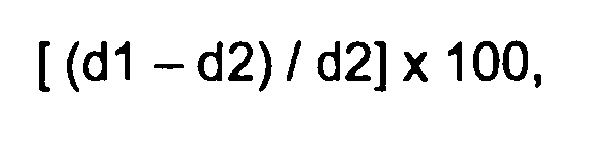
worin d1 und d2 zwei beliebige Durchmesser des Primärpartikels sind und d1 > d2 ist, von weniger als 250 %, bevorzugt weniger als 100 %, noch bevorzugter weniger als 80 %, noch bevorzugter weniger als 50 % auf. - Die vorstehend erwähnte Abweichung der Durchmesser der einzelnen Partikel kann nach folgendem Verfahren bestimmt werden. Zunächst wird ein Dünnschnitt der erfindungsgemäßen verfestigten Zusammensetzung hergestellt. Dann wird eine transmissionselektronen-mikroskopische Aufnahme bei einer Vergrößerung von beispielsweise 10 000fach oder 200 000fach hergestellt. In einer Fläche von 833,7 x 828,8 nm wird an 10 Mikrogel-Primärpartikeln der größte und der kleinste Durchmesser als d1 und d2 bestimmt. Liegt die oben definierte Abweichung bei mindestens 80 %, bevorzugter mindestens 90 %, noch bevorzugter mindestens 95% der vermessenen Mikrogel-Primärpartikeln jeweils unter 250 %, bevorzugter unter 100 %, noch bevorzugter weniger als 80 %, noch bevorzugter unter 50 %, so weisen die Mikrogel-Primärpartikeln das oben definierte Merkmal der Abweichung auf.
- Liegt in der Zusammensetzung die Konzentration der Mikrogele so hoch, dass eine starke Überlagerung der sichtbaren Mikrogel-Primärpartikel erfolgt, kann die Auswertbarkeit durch vorheriges, geeignetes Verdünnen der Messprobe verbessert werden.
- In der erfindungsgemäßen Zusammensetzung weisen die Primärpartikel des Mikrogels (B) bevorzugt einen durchschnittlichen Teilchendurchmesser von 5 bis 500 nm, bevorzugter von 20 bis 400 nm, bevorzugter von 20 bis 300 nm, bevorzugter von 20 bis 250 nm, noch bevorzugter 20 bis 99, noch bevorzugter 40 bis 80 nm auf (Durchmesserangaben nach DIN 53206). Die Herstellung besonders feinteiliger Mikrogele durch Emulsionspolymerisation erfolgt durch Steuerung der Reaktionsparameter in an sich bekannter Weise (s. z.B. H.G. Elias, Makromoleküle, Band 2, Technologie, 5. Auflage, 1992, Seite 99 ff).
- Da sich die Morphologie der Mikrogele bei der Weiterverarbeitung der erfindungsgemäßen Zusammensetzung im wesentlichen nicht verändert, entspricht der durchschnittliche Teilchendurchmesser der dispergierten Primärpartikel im wesentlichen dem durchschnittlichen Teilchendurchmesser der dispergierten Primärpartikel, in den mit der erfindungsgemäßen Zusammensetzung erhaltenen Weiterverarbeitungsprodukten, wie Mikrogel-enthaltenden Kunststoffen, Schmierstoffen, Beschichtungen. Dies stellt einen besonderen Vorteil der erfindungsgemäßen Zusammensetzung dar. Den Abnehmern können gewissermaßen maßgeschneiderte flüssige, lagerstabile Mikrogelformulierungen zur Verfügung gestellt werden, die eine definierte Morphologie der Mikrogele aufweisen und die der Abnehmer leicht in den gewünschten Anwendungen weiterverarbeiten kann. Eine vorherige aufwändige Dispergierung, Homogenisierung oder gar Herstellung der Mikrogele ist nicht mehr erforderlich, weshalb zu erwarten ist, dass derartige Mikrogele auch Anwendung auf Gebieten finden werden, auf denen ihre Anwendung bisher als zu aufwändig erschien.
- In der erfindungsgemäßen Zusammensetzung weisen die Mikrogele (B) zweckmäßig in Toluol bei 23°C unlösliche Anteile (Gelgehalt) von mindestens etwa 70 Gew.-%, bevorzugter mindestens etwa 80 Gew.-%, noch bevorzugter mindestens etwa 90 Gew.-% auf.
- Der in Toluol unlösliche Anteil wird dabei in Toluol bei 23° bestimmt. Hierbei werden 250 mg des Mikrogels in 20 ml Toluol 24 Stunden unter Schütteln bei 23°C gequollen. Nach Zentrifugation mit 20.000 Upm wird der unlösliche Anteil abgetrennt und getrocknet. Der Gelgehalt ergibt sich aus dem Quotienten des getrockneten Rückstands und der Einwaage und wird in Gewichtsprozent angegeben.
- In der erfindungsgemäßen Zusammensetzung weisen die Mikrogele (B) zweckmäßig in Toluol bei 23°C einen Quellungsindex von weniger als etwa 80, bevorzugter von weniger als 60 noch bevorzugter von weniger als 40 auf. So können die Quellungsindizes der Mikrogele (Qi) besonders bevorzugt zwischen 1 - 15 und 1-10 liegen. Der Quellungsindex wird aus dem Gewicht des in Toluol bei 23° für 24 Stunden gequollenen lösungsmittelhaltigen Mikrogels (nach Zentrifugation mit 20.000 Upm) und dem Gewicht des trockenen Mikrogels berechnet:
Qi = Naßgewicht des Mikrogels /Trockengewicht des Mikrogels. - Zur Ermittlung des Quellungsindex läßt man 250 mg des Mikrogels in 25 ml Toluol 24 h unter Schütteln quellen. Das Gel wird abzentrifugiert und gewogen und anschließend bei 70 °C bis zur Gewichtskonstanz getrocknet und nochmals gewogen.
- In der erfindungsgemäßen Zusammensetzung weisen die Mikrogele (B) zweckmäßig Glastemperaturen Tg von -100°C bis +120°C, bevorzugter von -100°C bis +100°C, noch bevorzugter von -80°C bis +80 °C auf. In seltenen Fällen können auch Mikrogele verwendet werden, die aufgrund ihres hohen Vernetzungsgrades keine Glastemperatur aufweisen.
- Weiterhin weisen die in der erfindungsgemäßen Zusammensetzung eingesetzten Mikrogele (B) bevorzugt eine Breite des Glasübergangs von größer als 5 °C, bevorzugt größer als 10°C, bevorzugter größer als 20 °C auf. Mikrogele, die eine solche Breite des Glasübergangs aufweisen, sind in der Regel - im Gegensatz zu vollständig homogen strahlenvernetzten Mikrogelen - nicht vollständig homogen vernetzt. Dies führt dazu, dass die Moduländerung von der Matrixphase zur dispergierten Phase in den aus den erfindungsgemäßen Zusammensetzungen beispielsweise hergestellten Mikrogel-enthaltenden Kunststoff-Zusammensetzungen nicht unmittelbar ist. Hierdurch kommt es bei schlagartiger Beanspruchung dieser Zusammensetzungen nicht zu Abreißeffekten zwischen Matrix und dispergierter Phase, wodurch die mechanischen Eigenschaften, das Quellverhalten und die Spannungsrisskorrosion vorteilhaft beeinflusst werden.
- Die Bestimmung der Glasübergangstemperaturen (Tg) und der Breite des Glasübergangs (ΔTg) der Mikrogele erfolgt durch Differentialthermoanalyse (DTA, engl. Differential-Scanning-Calorimetry (DSC)) unter folgenden Bedingungen: Für die Bestimmung von Tg und ΔTg werden zwei Abkühl-/Aufheizzyklen durchgeführt. Tg und ΔTg werden im zweiten Aufheizzyklus bestimmt. Für die Bestimmungen werden 10 - 12 mg des ausgewählten Mikrogels in einem DSC-Probenbehälter (Standard-Aluminium-Pfanne) von Perkin-Elmer eingesetzt. Der erste DSC-Zyklus wird durchgeführt, indem die Probe zuerst mit flüssigem Stickstoff auf -100°C abgekühlt und dann mit einer Geschwindigkeit von 20K/min auf +150°C aufgeheizt wird. Der zweite DSC-Zyklus wird durch sofortige Abkühlung der Probe begonnen, sobald eine Probentemperatur von +150°C erreicht ist. Die Abkühlung erfolgt mit einer Geschwindigkeit von ungefähr 320 K/min. Im zweiten Aufheizzyklus wird die Probe wie im ersten Zyklus noch einmal auf +150°C aufgeheizt. Die Aufheizgeschwindigkeit im zweiten Zyklus ist erneut 20K/min. Tg und ΔTg werden graphisch an der DSC-Kurve des zweiten Aufheizvorgangs bestimmt. Für diesen Zweck werden an die DSC-Kurve drei Geraden angelegt. Die 1. Gerade wird am Kurventeil der DSC-Kurve unterhalb Tg, die 2. Gerade an dem durch Tg verlaufenden Kurvenast mit Wendepunkt und die 3. Gerade an dem Kurvenast der DSC- Kurve oberhalb Tg angelegt. Auf diese Weise werden drei Geraden mit zwei Schnittpunkten erhalten. Beide Schnittpunkte sind jeweils durch eine charakteristische Temperatur gekennzeichnet. Die Glastemperatur Tg erhält man als Mittelwert dieser beiden Temperaturen und die Breite des Glasübergangs ΔTg erhält man aus der Differenz der beiden Temperaturen.
- Die in der erfindungsgemäßen Zusammensetzung enthaltenen, bevorzugt nicht durch energiereiche Strahlen vernetzten Mikrogele können an sich in bekannter Weise hergestellt werden (s. zum Beispiel
EP-A- 405 216 EP-A-854171 DE-A 4220563 ,GB-PS 1078400 DE 197 01 489.5 ,DE 197 01 488.7 ,DE 198 34 804.5 ,DE 198 34 803.7 ,DE 198 34 802.9 ,DE 199 29 347.3 ,DE 199 39 865.8 ,DE 199 42 620.1 ,DE 199 42 614.7 ,DE 100 21 070.8 ,DE 100 38 488.9 ,DE 100 39 749.2 ,DE 100 52 287.4 ,DE 100 56 311.2 undDE 100 61 174.5 ). In den Patent(anmeldungen)EP-A 405 216 DE-A 4220563 sowie inGB-PS 1078400 DE 197 01 489.5 wird die Verwendung von nachträglich modifizierten Mikrogelen in Mischungen mit doppelbindungshaltigen Kautschuken wie NR, SBR und BR beschrieben. - Unter Mikrogelen werden zweckmäßig Kautschukpartikel verstanden, die insbesondere durch Vernetzung folgender Kautschuke erhalten werden:
BR: Polybutadien, ABR: Butadien/Acrylsäure-C1-4Alkylestercopolymere, IR: Polyisopren, SBR: Styrol-Butadien-Copolymerisate mit Styrolgehalten von 1-60, vorzugsweise 5-50 Gewichtsprozent, X-SBR: carboxlylierte Styrol-Butadien-Copolymerisate FKM: Fluorkautschuk, ACM: Acrylatkautschuk, NBR: Polybutadien-Acrylnitril-Copolymerisate mit Acrylnitrilgehalten von 5-60, vorzugsweise 10-50 Gewichtsprozent, X-NBR: carboxlierte Nitrilkautschuke CR: Polychloropren IIR: Isobutylen/Isopren-Copolymerisate mit Isoprengehalten von 0,5-10 Gewichtsprozent, BIIR: bromierte Isobutylen/Isopren-Copolymerisate mit Bromgehalten von 0,1-10 Gewichtsprozent, CIIR: chlorierte Isobutylen/Isopren-Copolymerisate mit Bromgehalten von 0,1-10 Gewichtsprozent, HNBR: teil- und vollhydrierte Nitrilkautschuke EPDM: Ethylen-Propylen-Dien-Copolymerisate, EAM: Ethylen/Acrylatcopolymere, EVM: Ethylen/Vinylacetatcopolymere CO und ECO: Epichlorhydrinkautschuke, Q: Silikonkautschuke, mit Ausnahme von Silikon-Propfpolymerisaten, AU: Polyesterurethanpolymerisate, EU: Polyetherurethanpolymerisate ENR: Epoxydierter Naturkautschuk oder Mischungen davon. - In der erfindungsgemäßen Zusammensetzung sind die verwendeten Mikrogele (B) solche, die durch Emulsionspolymerisation und Vernetzung erhältlich sind.
- Bei der Herstellung der erfindungsgemäß verwendeten Mikrogele durch Emulsionspolymerisation werden beispielsweise folgende, radikalisch polymerisierbare Monomere eingesetzt: Butadien, Styrol, Acrylnitril, Isopren, Ester der Acryl- und Methacrylsäure. Tetrafluorethylen, Vinylidenfluord, Hexafluorpropen, 2-Chlorbutadien, 2,3-Dichlorbutadien sowie doppelbindungshaltige Carbonsäuren wie z. B. Acrylsäure, Methacrylsäure, Maleinsäure, Itakonsäure, doppelbindungshaltige Hydroxyverbindungen wie z. B. Hydroxyethylmethacrylat, Hydroxyethylacrylat, Hydroxybutylmethacrylat, Aminfunktionalisierte (Meth)acrylate, Acrolein, N-Vinyl-2-pyrollidon, N-Allyl-Harnstoff und N-Allyl-Thioharnstoff sowie sekundäre Amino-(meth)-acrylsäureester wie 2-tert-Butylaminoethylmethacrylat und 2-tert-Butylaminoethylmethacrylamid. Die Vernetzung des Kautschukgels kann direkt während der Emulsionspolymerisation, wie durch Copolymerisation mit vernetzend wirkenden multifunktionellen Verbindungen oder durch anschließende Vernetzung wie untenstehend beschrieben erreicht werden. Die direkte Vernetzung stellt eine bevorzugte Ausführungsform der Erfindung dar. Bevorzugte multifunktionelle Comonomere sind Verbindungen mit mindestens zwei, vorzugsweise 2 bis 4 copolymerisierbaren C=C-Doppelbindungen, wie Diisopropenylbenzol, Divinylbenzol, Divinylether, Divinylsulfon, Diallylphthalat, Triallylcyanurat, Triallylisocyanurat, 1,2-Polybutadien, N,N'-m-Phenylenmaleimid, 2,4-Toluylenbis(maleimid) und/oder Triallyltrimellitat. Darüber hinaus kommen in Betracht die Acrylate und Methacrylate von mehrwertigen, vorzugsweise 2- bis 4-wertigen C2 bis C10 Alkoholen, wie Ethylenglykol, Propandiol-1,2, Butandiol, Hexandiol, Polyethylenglykol mit 2 bis 20, vorzugsweise 2 bis 8 Oxyethyleneinheiten, Neopentylglykol, Bisphenol-A, Glycerin, Trimethylolpropan, Pentaerythrit, Sorbit mit ungesättigten Polyestern aus aliphatischen Di- und Polyolen sowie Maleinsäure, Fumarsäure, und/oder Itaconsäure.
- Die Vernetzung zu Kautschuk-Mikrogelen während der Emulsionspolymerisation kann auch durch Fortführung der Polymerisation bis zu hohen Umsätzen oder im Monomerzulaufverfahren durch Polymerisation mit hohen internen Umsätzen erfolgen. Eine andere Möglichkeit besteht auch in der Durchführung der Emulsionspolymerisation in Abwesenheit von Reglern.
- Für die Vernetzung der unvernetzten oder der schwach vernetzten Mikrogel-Ausgangsprodukte im Anschluß an die Emulsionspolymerisation setzt man am besten die Latices ein, die bei der Emulsionspolymerisation erhalten werden.
- Geeignete, vernetzend wirkende Chemikalien sind beispielsweise organische Peroxide, wie Dicumylperoxid, t-Butylcumylperoxid, Bis-(t-butyl-peroxy-isopropyl)benzol, Di-t-butylperoxid, 2,5-Ditmethylhexan-2,5-dihydroperoxid, 2,5-Dimethylhexin-3,2,5-dihydroper-oxid, Dibenzoyl-peroxid, Bis-(2,4-dichlorobenzoyl)peroxid, t-Butylperbenzoat sowie organische Azoverbindungen, wie Azo-bis-isobutyronitril und Azo-bis-cyclohexannitril sowie Di- und Polymercaptoverbindungen, wie Dimercaptoethan, 1,6-Dimercaptohexan, 1,3,5-Trimercaptotriazin und Mercapto-terminierte Polysulfidkautschuke wie Mercapto-terminierte Umsetzungsprodukte von Bis-Chlorethylformal mit Natriumpolysulfid.
- Die optimale Temperatur zur Durchführung der Nachvemetzung ist naturgemäß von der Reaktivität des Vernetzers abhängig und kann bei Temperaturen von Raumtemperatur bis ca. 180 °C gegebenenfalls unter erhöhtem Druck durchgeführt werden (siehe hierzu Houben-Weyl, Methoden der organischen Chemie, 4. Auflage, Band 14/2, Seite 848). Besonders bevorzugte Vernetzungsmittel sind Peroxide.
- Die Vernetzung C=C-Doppelbindungen enthaltender Kautschuke zu Mikrogelen kann auch in Dispersion bzw. Emulsion bei gleichzeitiger, partieller, ggf. vollständiger, Hydrierung der C=C- Doppelbindung durch Hydrazin wie in
US 5,302,696 oderUS 5,442,009 beschrieben oder ggf. andere Hydrierungsmitteln, beispielsweise Organometallhydridkomplexe erfolgen. - Vor, während oder nach der Nachvernetzung kann ggf. eine Teilchenvergrößerung durch Agglomeration durchgeführt werden.
- Bei dem erfindungsgemäß bevorzugt verwendeten Herstellungsverfahren ohne Anwendung energiereicher Strahlung werden stets nicht vollständig homogen vernetzte Mikrogele erhalten, die die oben beschriebenen Vorteile aufweisen können.
- Als Mikrogele zur Herstellung der erfindungsgemäßen Zusammensetzung können sowohl nicht-modifizierte Mikrogele, die im wesentlichen keine reaktiven Gruppen insbesondere an der Oberfläche aufweisen als auch, modifizierte, mit funktionellen Gruppen, insbesondere an der Oberfläche modifizierte Mikrogele verwendet werden. Letztere können durch chemische Umsetzung der bereits vernetzten Mikrogele mit gegenüber C=C-Doppelbindungen reaktiven Chemikalien hergestellt werden. Diese reaktiven Chemikalien sind insbesondere solche Verbindungen, mit deren Hilfe polare Gruppen wie z. B. Aldehyd-, Hydroxyl-, Carboxyl-, Nitril- sowie schwefelhaltige Gruppen, wie z. B. Mercapto-, Dithiocarbamat-, Polysulfid-, Xanthogenat-, Thiobenzthiazol- und/oder Dithiophosphorsäuregruppen und/oder ungesättigte Dicarbonsäuregruppen an die Mikrogele chemisch gebunden werden können. Dies trifft auch auf N,N'-m-Phenylendiamin zu. Ziel der Mikrogelmodifizierung ist die Verbesserung der Mikrogelverträglichkeit, wenn die erfindungsgemäße Zusammensetzung zur Herstellung der späteren Matrix, in die das Mikrogel eingearbeitet ist, oder die erfindungsgemäße Zusammensetzung zur Einarbeitung in eine Matrix verwendet wird, um eine gute Verteilbarkeit bei der Herstellung sowie eine gute Ankopplung zu erreichen.
- Besonders bevorzugte Methoden der Modifizierung sind die Pfropfung der Mikrogele mit funktionellen Monomeren sowie die Umsetzung mit niedermolekularen Agentien.
- Für die Pfropfung der Mikrogele mit funktionellen Monomeren geht man zweckmäßigerweise von der wässrigen Mikrogeldispersion aus, die man mit polaren Monomeren wie Acrylsäure, Methacrylsäure, Itakonsäure, Hydroxyethyl-(meth)-acrylat, Hydroxypropyl-(meth)-acrylat, Hydroxybutyl-(meth)-acrylat, Acrylamid, Methacrylamid, Acrylnitril, Acrolein, N-Vinyl-2-pyrollidon, N-Allyl-Harnstoff und N-Allyl-Thioharnstoff sowie sekundären Amino-(meth)-acrylsäureester wie 2-tert-Butylaminoethylmethacrylat und 2-tert-Butylaminoethylmethacrylamid unter den Bedingungen einer radikalischen Emulsionspolymerisation umsetzt. Auf diese Weise werden Mikrogele mit einer Kern/Schale-Morphologie erhalten, wobei die Schale eine hohe Verträglichkeit mit der Matrix aufweisen soll. Es ist wünschenswert, daß das im Modifikationsschritt verwendete Monomer möglichst quantitativ auf das unmodifizierte Mikrogel aufpfropft. Zweckmäßigerweise werden die funktionellen Monomere vor der vollständigen Vernetzung der Mikrogele hinzudosiert.
- Prinzipiell denkbar ist auch eine Pfropfung der Mikrogele in nichtwässrigen Systemen, wobei auf diese Weise auch eine Modifikation mit Monomeren durch ionische Polymerisationsmethoden möglich wird.
- Für eine Oberflächenmodifikation der Mikrogele mit niedermolekularen Agentien kommen insbesondere folgende Reagentien in Frage: elementarer Schwefel, Schwefelwasserstoff und/oder Alkylpolymercaptanen, wie 1,2-Dimercaptoethan oder 1,6-Dimercaptohexan, desweiteren Dialkyl- und Dialkylaryldithiocarbamat, wie den Alkalisalzen von Dimethyldithiocarbamat und/oder Dibenzyldithiocarbamat, ferner Alkyl- und Arylxanthogenaten, wie Kaliumethylxanthogenat und Natrium-isopropylxanthogenat sowie die Umsetzung mit den Alkali- oder Erdalkalisalzen der Dibutyldithiophosphorsäure und Dioctyldithiophosphorsäure sowie Dodecyldithiophosphorsäure. Die genannten Reaktionen können vorteilhafterweise auch in Gegenwart von Schwefel durchgeführt werden, wobei der Schwefel unter Bildung polysulfidischer Bindungen mit eingebaut wird. Zur Addition dieser Verbindung können Radikalstarter wie organische und anorganische Peroxide und/oder Azoinitiatoren, zugesetzt werden.
- Auch eine Modifikation doppelbindungshaltiger Mikrogele wie z. B. durch Ozonolyse sowie durch Halogenierung mit Chlor, Brom und Jod kommen infrage. Auch eine weitere Umsetzung modifizierter Mikrogele wie z. B. die Herstellung hydroxylgruppenmodifizierter Mikrogele aus epoxydierten Mikrogelen wird als chemische Modifikation von Mikrogelen verstanden.
- In einer bevorzugten Ausführungsform sind die Mikrogele durch HydroxylGruppen insbesondere auch an der Oberfläche davon modifiziert. Der Hydroxylgruppengehalt der Mikrogele wird durch Umsetzung mit Acetanydrid und Titration der hierbei frei werdenden Essigsäure mit KOH nach DIN 53240 als Hydroxyl-Zahl mit der Dimension mg KOH/g Polymer bestimmt. Die Hydroxylzahl der Mikrogele liegt bevorzugt zwischen 0,1-100, noch bevorzugter zwischen 0,5-50 mg KOH/g Polymer.
- Die Menge des eingesetzten Modifizierungsmittels richtet sich nach dessen Wirksamkeit und den im Einzelfall gestellten Anforderungen und liegt im Bereich von 0,05 bis 30 Gewichtsprozent, bezogen auf die Gesamtmenge an eingesetztem Kautschuk-Mikrogel, besonders bevorzugt sind 0,5-10 Gewichtsprozent bezogen auf Gesamtmenge an Kautschukgel.
- Die Modifizierungsreaktionen können bei Temperaturen von 0-180 °C, bevorzugt 20-95 °C, ggf. unter Druck von 1-30 bar, durchgeführt werden. Die Modifizierungen können an Kautschuk-Mikrogelen in Substanz oder in Form ihrer Dispersion vorgenommen werden, wobei beim letzten Fall inerte organische Lösungsmittel oder auch Wasser als Reaktionsmedium verwendet werden können. Besonders bevorzugt wird die Modifizierung in wäßriger Dispersion des vernetzten Kautschuks durchgeführt.
- Die Verwendung von unmodifizierten Mikrogelen ist insbesondere bei erfindungsgemäßen Zusammensetzungen bevorzugt, die zur Einarbeitung in unpolare Kautschuke oder unpolare thermoplastische Werkstoffen verwendet werden, wie zum Beispiel Polypropylen, Polyethylen und Blockcopolymeren auf Basis von Styrol, Butadien, Isopren (SBR, SIR) und hydrierten Isopren-Styrol-Blockcopolymeren (SEBS), und üblichen TPE-Os und TPE-Vs.
- Die Verwendung von modifizierten Mikrogelen ist insbesondere bei erfindungsgemäßen Zusammensetzungen bevorzugt, die zur Einarbeitung in polare Kautschuke oder polare thermoplastische Werkstoffe (A) verwendet werden, wie zum Beispiel PA, TPE-A, PU, TPE-U, PC, PET, PBT, POM, PMMA, PVC, ABS , PTFE, PVDF.
- Der mittlere Durchmesser der hergestellten Mikrogele kann mit hoher Genauigkeit beispielsweise auf 0,1 Mikrometer (100 nm) ± 0,01 Mikrometer (10 nm) eingestellt werden, so dass beispielsweise eine Teilchengrößenverteilung erreicht wird, bei der mindestens 75 % aller Mikrogel-Partikel zwischen 0,095 Mikrometer und 0,105 Mikrometer groß sind. Andere mittlere Durchmesser der Mikrogele insbesondere im Bereich zwischen 5 bis 500 nm lassen sich mit gleicher Genauigkeit (mindestens Gew.-75 % aller Teilchen liegen um das Maximum der integrierten Korngrößenverteilungskurve (bestimmt durch Lichtstreuung) in einem Bereich von ± 10 % oberhalb und unterhalb des Maximums) herstellen und einsetzen. Dadurch kann die Morphologie der in der erfindungsgemäßen Zusammensetzung dispergierten Mikrogele praktisch "punktgenau" eingestellt und damit die Eigenschaften der erfindungsgemäßen Zusammensetzung sowie der daraus beispielsweise hergestellten Kunststoffe eingestellt werden.
- Die Aufarbeitung der so hergestellten Mikrogele vorzugsweise auf Basis von BR, SBR, NBR, SNBR, oder Acrylnitril oder ABR kann beispielsweise durch Eindampfen, Koagulation, durch Cokoagulation mit einem weiteren Latexpolymer, durch Gefrierkoagulation (vgl.
US-PS 2187146 ) oder durch Sprühtrocknung erfolgen. Bei der Aufarbeitung durch Sprühtrocknung können handelsübliche auch Fließhilfen wie beispielsweise CaCO3 oder Kieselsäure zugesetzt werden. - In einer bevorzugten Ausführungsform der erfindungsgemäßen Zusammensetzung basiert das Mikrogel (B) auf Kautschuk.
- In einer bevorzugten Ausführungsform der erfindungsgemäßen Zusammensetzung ist das Mikrogel (B) durch funktionelle, gegenüber C=C-Doppelbindungen reaktive Gruppen modifiziert.
- In einer bevorzugten Ausführungsform weist das Mikrogel (B) einen Quellungsindex in Toluol bei 23 °C von 1 bis 15 auf.
- Die erfindungsgemäße Zusammensetzung weist bevorzugt eine Viskosität von 2 mPas bis zu 50000000 mPas, bevorzugter 50 mPas bis zu 3000000 mPas bei einer Drehzahl von 5 s-1, mit einem Kegelplattenviskosimeter nach DIN 53018 gemessen, bei 20°C auf.
- Die erfindungsgemäße Zusammensetzung enthält mindestens ein organisches Medium (A), welches bei einer Temperatur von 120°C eine Viskosität von weniger als 30000 mPas, bevorzugter von weniger als 1000 mPas, bevorzugter von weniger als 200 mPas, bevorzugter von weniger als 100 mPas, noch bevorzugter weniger als 20 mPas bei 120°C aufweist.
- Ein solches Medium ist bei Raumtemperatur (20°C) flüssig bis fest, bevorzugt flüssig bzw. fließfähig.
- Organisches Medium im Sinne der Erfindung bedeutet, dass das Medium mindestens ein Kohlenstoffatom enthält.
- Unter nicht-vernetzbaren Medien im Sinne der Erfindung werden insbesondere solche Medien verstanden, die keine über Heteroatome-enthaltende funktionelle Gruppen oder C=C-Gruppen vernetzbare Gruppen enthalten, wie insbesondere übliche Monomere oder Prepolymere, die in üblicher Weise radikalisch, mit UV-Strahlen, thermisch und/oder durch Polyaddition bzw. Polykondensation unter Zusatz von Vernetzungsmitteln (z. B. Polyisocyanate, Polyamine, Säureanhydride) unter Bildung von Oligomeren oder Polymeren in üblicher Weise vernetzt bzw. polymerisiert werden. Erfindungsgemäß können als organische, nicht-vernetzbare Medien auch solche Medien verwendet werden, die zwar beispielsweise gewisse Anteile an ungesättigten Bindungen (gewisse Polyesteröle, Rapsöl) oder Hydroxygruppen (Polyether) enthalten, die jedoch nicht zu Oligomeren oder Polymeren in üblicher Weise vernetzt bzw. polymerisiert werden. Nicht-vernetzbaren Medien sind insbesondere auch Lösemittel, insbesondere solche nach DIN 55 945.
- Bevorzugt handelt es sich bei dem nicht vernetzbaren Medium (A) um bei Raumtemperatur (20°C) flüssige, nicht vemetzbaren Medien, insbesondere um Kohlenwasserstoffe (geradkettige, verzweigte, cyclische, gesättigte, ungesättigte und/oder aromatische Kohlenwasserstoffe mit 1 bis 200 Kohlenstoffatomen, die gegebenenfalls durch ein oder mehrere Substituenten ausgewählt aus Halogenen, wie Chlor, Fluor, Hydroxy, Oxo, Amino, Carboxy, Carbonyl, Aceto, Amido substituiert sein können), synthetische Kohlenwasserstoffe, Polyetheröle, Esteröle, Phosphorsäureester, Siliciumhaltige Öle und Halogenkohlenwasserstoffe bzw. Halogenkohlenstoffe (s. z. B. Ullmanns Enzyklopädie der technischen Chemie, Verlag Chemie Weinheim, Band 20, (1981) 457 ff, 504, 507ff, 517/518, 524). Diese nicht vemetzbaren Medien (A) zeichnen sich insbesondere durch Viskositäten von 2 bis 1500 mm2/s (cSt) bei 40°C aus. Bevorzugt handelt es sich bei dem nicht vernetzbaren Medium (A) um bei Raumtemperatur (20°C) flüssige, nicht vemetzbaren Medien, insbesondere um Lösemittel nach DIN 55 945 wie Xylol, Solvent Naphtha, Methylethylketon, Methoxypropylacetat, N-Methylpyrrolidon, Dimethylsulfoxid.
- Die synthetischen Kohlenwasserstoffe werden gewonnen durch Polymerisation von Olefinen, Kondensation von Olefinen oder Chlorparaffinen mit Aromaten oder dechlorierende Kondensation von Chlorparaffinen. Beispiele sind für die Polymerisatöle die Ethylen-Polymere, die Propylen-Polymere, die Polybutene, die Polymere höherer Olefine, die Alkylaromaten. Die Ethylen-Polymere haben Molekulargewichte zwischen 400 und 2000 g/mol. Die Polybutene besitzen Molekulargewichte zwischen 300 und 1500 g/mol.
- Bei den Polyetherölen unterscheidet man aliphatische Polyetheröle, Polyalkylenglykole, insbesondere Polyethylen- und Polypropylenglykole, deren Mischpolymerisate, ihre Mono- und Diether sowie Esterether und Diester, Tetrahydrofuran-Polymeröle, Perfluorpolyalkylether und Polyphenylether. Perfluorpolyalkylether haben Molmassen von 1000 - 10000 g/Mol. Die aliphatischen Polyetheröle weisen Viskositäten von 8 bis 19 500 mm2/s bei 38°C auf.
- Polyphenylether werden durch Kondensation von Alkaliphenolaten mit Halogenbenzolen hergestellt. Auch der Diphenylether und seine Alkylderivate finden Anwendung.
- Beispiele für die Esteröle sind die Alkylester der Adipinsäure, das Bis-(2-ethylhexyl)-sebacat und das Bis-(3,5,5-trimethylhexyl)-sebacat oder-adipat sowie die Ester natürlicher Fettsäuren mit mono- oder polyfunktionellen Alkoholen, wie TMP-Oleat. Eine weitere Klasse bildet die fluorhaltigen Esteröle. Bei Phosphorsäureestern unterscheidet man Triaryl-, Trialkyl- und Alkylarylphosphate. Beispiele sind Tri-(2-ethylhexyl)-phosphat und Bis-(2-ethylhexyl)-phenyl-phosphat.
- Siliciumhaltige Öle sind die Silikonöle (Polymere der Alkyl- und Arylsiloxanreihe) und die Kieselsäureester.
- Beispiele für nachwachsende nicht-vernetzbare organische Medien sind Rapsöl, Sonnenblumenöl.
- Zu den Halogenkohlenwasserstoffen bzw. Halogenkohlenstoffen gehören chlorierte Paraffine, wie Chlortrifluorethylenpolymeröle und Hexafluorbenzol.
- (Nicht-reaktive) Lösemittel nach DIN 55 945 sind Hexan, Siedegrenzbenzine, Testbenzine, Xylol, Solvent Naphtha, Balsamterpentinöl, Methylethylketon, Methylisobutylketon, Methylamylketon, Isophoron, Butylacetat, 1-Methoxypropylacetat, Butylglykolacetat, Ethyldiglykolacetat und N-Methylpyrrolidon (Brock, Thomas, Groteklaes, Michael, Mischke, Peter, Lehrbuch der Lacktechnologie, Curt R. Vincentz Verlag Hannover, (1998) 93ff).
- Besonders bevorzugte nicht-vernetzbare Medien schließen ein: Polyether, z. B. Baylube 68CL, naphthenische Öle, z. B. Nynas T 110, paraffinische, hochraffinierte Mineralöle, z. B. Shell Catenex S 932, Esteröle, z. B. Methylester SU, Öle auf Basis nachwachsender Rohstoffe, z. B. raffiniertes Rüböl. Besonders bevorzugte nicht vernetzbare Medien (A) sind die große Klasse der Kohlenwasserstoffe, die Polyetheröle, und die Lösemittel nach DIN 55 945.
- Die erfindungsgemäße Zusammensetzung enthält 2 bis 90 Gew.-%, bevorzugter 2 - 30 Gew.-% des Mikrogels (B), bezogen auf die Gesamtmenge der Zusammensetzung.
- Die erfindungsgemäße Zusammensetzung enthält weiterhin bevorzugt 10 bis 99,5 Gew.-%, bevorzugter 40 bis 97 Gew.-%, noch bevorzugter 50 bis 95 Gew.-%, weiterhin bevorzugter 60 bis 95 Gew.-% des organischen Mediums (A)).
- Die erfindungsgemäße Zusammensetzung besteht bevorzugt aus dem organischen nicht vemetzbaren Medium (A) und dem Mikrogel (B) und gegebenenfalls den unten stehenden weiteren Komponenten. Die Anwesenheit von Wasser ist nicht bevorzugt, bevorzugt enthalten die erfindungsgemäßen Zusammensetzungen weniger als 0,8 Gew.-%, noch bevorzugter weniger als 0,5 Gew.-% Wasser. Am meisten bevorzugt ist die Anwesenheit von Wasser ausgeschlossen (< 0,1 Gew.-%). Letzteres ist herstellungsbedingt im allgemeinen bei den erfindungsgemäßen Zusammensetzungen der Fall.
- Die erfindungsgemäße Zusammensetzung kann zusätzlich Füllstoffe, Pigmente und Additive wie Dispergierhilfsmittel, Entlüfter, Fließmittel, Verlaufsmittel, Hilfsmittel zur Untergrundbenetzung, Haftverbessererer, AntiAbsetzmittel, Hilfsmittel zur Steuerung der Untergrundbenetzung, zur Steuerung der Leitfähigkeit, Hilfsmittel zur Steuerung der Farbtonstabilität, des Glanzes und des Ausschwimmens, Oxidationsinhibitoren, Stockpunktserniedriger, Hochdruckzusätze, Schaumverhütungsmittel, Demulgatoren, Verschleißschutzadditive, Korrosionschutzadditive, Buntmetalldesaktivatoren, Reibwertmodifizierungsmittel enthalten.
- Dabei lassen sich insbesondere die genannten Additive besonders gleichmäßig in die erfindungsgemäßen Zusammensetzungen einarbeiten, was wiederum zur Verbesserung der daraus hergestellten Produkte, wie Polymerzusammensetzungen, Schmierstoffe führt.
- Besonders geeignete Pigmente und Füllstoffe zur Herstellung der erfindungsgemäßen Zusammensetzungen, die das nicht-vernetzbare Medium (A) enthalten, und daraus hergestellter Mikrogel-enthaltende Kunststoffe sind beispielsweise: anorganische und organische Pigmente, silikatische Füllstoffe wie Kaolin, Talkum, Carbonate wie Calciumcarbonat und Dolomit, Bariumsulfat,
- Metalloxide, wie Zinkoxid, Calciumoxid, Magnesiumoxid, Aluminiumoxid, hochdisperse Kieselsäuren (gefällte und thermisch hergestellte Kieselsäuren), Metallhydroxide, wie Aluminiumhydroxid und Magnesiumhydroxid, Glasfasern und Glasfaserprodukte (Latten, Stränge oder Mikroglaskugeln), Kohlenstofffasern, Thermoplastfasern (Polyamid, Polyester, Aramid), Kautschukgele auf Basis Polychloropren und/oder Polybutadien oder auch aller anderer vorher beschriebener Gelpartikel, die einen hohen Vernetzungsgrad besitzen und Teilchengröße 5 bis 1000 nm.
- Die genannten Füllstoffe können alleine oder im Gemisch eingesetzt werden. In einer besonders bevorzugten Ausführung des Verfahrens werden 0,5 - 30 Gewichtsteile Kautschukgel (B), gegebenenfalls zusammen mit 0,1 bis 40 Gewichtsteilen Füllstoffen, und 30 - 99,5 Gewichtsteile des flüssigen nicht-vernetzbaren Mediums (A) zur Herstellung der erfindungsgemäßen Zusammensetzungen eingesetzt.
- Die erfindungsgemäßen Zusammensetzungen können weitere Hilfsmittel enthalten wie Alterungsschutzmittel, Wärmestabilisatoren, Lichtschutzmittel, Ozonschutzmittel, Verarbeitungshilfsmittel, Weichmacher, Tackifier, Treibmittel, Farbstoffe, Wachse, Streckmittel, organische Säuren, sowie Füllstoffaktivatoren, wie beispielsweise Trimethoxysilan, Polyethylenglykol, oder andere, die in den beschriebenen Industrien bekannt sind.
- Die Hilfsmittel werden in üblichen Mengen, die sich u.a. nach dem Verwendungszweck richten, eingesetzt. Übliche Mengen sind z. B. Mengen von 0,1 bis 50 Gew.-%, bezogen auf eingesetzte Mengen an flüssigem Medium (A) bzw. an eingesetztem Kautschukgel (B).
- In einer bevorzugten Ausführungsform wird die erfindungsgemäße Zusammensetzung durch Mischen von mindestens einem nicht-vernetzbaren, organischen Medium (A), welches bei einer Temperatur von 120°C eine Viskosität von weniger als 30000 mPas aufweist, und mindestens einem trockenen Mikrogelpulver (B) (bevorzugt weniger als 1 Gew.-%, noch bevorzugter weniger als 0,5 Gew.-% flüchtige Anteile (beim Mischen der Komponente (A) und (B) werden keine Mikrogel-Latices verwendet)), das nicht durch energiereiche Strahlen vernetzt ist, mittels eines Homogenisators, einer Perlmühle, einer Dreiwalze, einer Ein- oder Mehrwellen-Extruderschnecke, eines Kneters und/ oder eines Dissolvers, bevorzugt mittels eines Homogenisators, einer Perlmühle oder einer Dreiwalze hergestellt.
- Hinsichtlich der Viskosität der herzustellenden Zusammensetzung ist der Kneter, im welchem bevorzugt nur sehr hochviskose (fast feste bis feste) Zusammensetzungen eingesetzt werden können, am eingeschränktesten, d. h. er ist nur in Sonderfällen anwendbar.
- Nachteilig an der Perlmühle ist der vergleichsweise eingeschränkte Viskositätsbereich (tendenziell dünne Zusammensetzungen), hohe Reinigungsaufwand, teure Produktwechsel der verwendbaren Zusammensetzungen sowie der Abrieb von Kugeln und Mahlapparatur.
- Besonders bevorzugt erfolgt die Homogenisierung der erfindungsgemäßen Zusammensetzungen mittels eines Homogenisators oder einer Dreiwalze. Nachteilig an der Dreiwalze ist der vergleichsweise eingeschränkte Viskositätsbereich (tendenziell sehr dicke Zusammensetzungen), geringer Durchsatz und die nicht geschlossene Arbeitsweise (schlechter Arbeitsschutz). Sehr bevorzugt erfolgt die Homogenisierung der erfindungsgemäßen Zusammensetzungen daher mittels eines Homogenisators. Der Homogenisator erlaubt es dünne und dicke Zusammensetzungen bei hohem Durchsatz zu verarbeiten (hohe Flexibilität). Produktwechsel sind vergleichsweise schnell und problemlos möglich.
- Überraschend und neu ist, dass die Mikrogele (B) in nicht vemetzbaren organischen Medien dispergiert werden können; insbesonders überraschend ist die bis zu den Primärpartikeln gelungene Dispergierung (s. Beispiele).
- Die Dispergierung der Mikrogele (B) im flüssigen Medium (A) erfolgt im Homogenisator im Homogenisierventil (s.
Abb. 1 ). - Bei dem erfindungsgemäß bevorzugt eingesetzten Verfahren werden Agglomerate in Aggregate und/oder Primärpartikel zerteilt. Agglomerate sind physikalisch trennbare Einheiten, bei deren Dispergierung keine Änderung der Primärpartikelgröße erfolgt.
-
Abb. 1 zeigt die Funktionsweise des Homogenisierventils. - (Darin bedeuten:
- Basic product: Ausgangsprodukt,
- Valve seat: Ventilsitz
- Valve: Ventil
- Homogenised product: Homogenisiertes Produkt).
- Das zu homogenisierende Produkt tritt in das Homogenisierventil mit langsamer Geschwindigkeit ein und wird im Homogenisierspalt auf hohe Geschwindigkeiten beschleunigt. Die Dispergierung erfolgt hinter dem Spalt hauptsächlich aufgrund von Turbulenzen und Kavitation (William D. Pandolfe, Peder Baekgaard, Marketing Bulletin der Fa. APV Homogeniser Group - "Highpressure homogenisers processes, product and applications").
- Die Temperatur der erfindungsgemäßen Zusammensetzung beträgt bei Aufgabe in den Homogenisator zweckmäßig -40 - 140°C, vorzugsweise 20 - 80 °C.
- Die zu homogenisierende erfindungsgemäßen Zusammensetzung wird zweckmäßig bei einem Druck von 20 bis 4000 bar, bevorzugt 100 bis 4000 bar, bevorzugt 200 bis 4000 bar, bevorzugt 200 - 2000 bar, sehr bevorzugt 500 - 1500 bar im Gerät homogenisiert. Die Anzahl der Durchläufe richtet sich nach der Güte gewünschten Dispergiergüte und kann zwischen einem und 20, bevorzugt einem bis 10, bevorzugter einem bis vier Durchgängen variieren.
- Die erfindungsgemäß hergestellten Zusammensetzungen besitzen eine besonders feine Partikelverteilung, die besonders mit dem Homogenisator erreicht wird, der auch hinsichtlich der Flexibilität des Verfahrens bezüglich variierender Viskositäten der flüssigen Medien und der resultierenden Zusammensetzungen und notwendigen Temperaturen sowie der Dispergiergüte äußerst vorteilhaft ist.
- Die Erfindung betrifft weiterhin die Verwendung der erfindungsgemäßen Zusammensetzung zur Herstellung von Mikrogel-enthaltenden Polymeren bzw. Kunststoffen, wie vorstehend erläutert.
- Werden die erfindungsgemäßen Zusammensetzungen in thermoplastische Polymere eingearbeitet, so stellt man völlig überraschend fest, das Mikrogel-enthaltenden Polymere erhalten werden, die sich wie thermoplastische Elastomere verhalten.
- Die Erfindung betrifft weiterhin auch die daraus nach üblichen Verfahren hergestellten Formkörper und Beschichtungen.
- Die Erfindung wird mit Blick auf die folgenden Beispiele näher erläutert. Die Erfindung ist selbstverständlich nicht auf diese Beispiele beschränkt.
- In dem nachfolgend beschriebenen Beispiel 1 wird gezeigt, dass unter der Verwendung von Mikrogelen auf Basis von SBR erfindungsgemäße Zusammensetzungen, die bestimmte rheologische Charakteristika wie Strukturviskosität, Thixotropie und angenähert Newton'sches Fließverhalten zeigen, erhalten werden.
- Daraus ergibt sich der u. a. der Einsatz der erfindungsgemäßen Zusammmensetzung als funktionales und/oder rheologisches Additiv. Günstige Voraussetzungen für den Einsatz der erfindungsgemäßen Mischungen in Kautschuk oder Kunststoff haben Mikrogele, die die Viskosität wenig beeinflussen, also in erster Näherung Newton'sches Fließverhalten zeigen. Für den Einsatz der erfindungsgemäßen Mischungen in Fetten sind insbesondere Mikrogele geeignet, die die Viskosität stark beeinflussen, also strukturviskoses oder thixotropes Fließverhalten zeigen.
- In der nachfolgenden Tabelle ist die Zusammensetzung angegeben:
1. Nynas T 110 80 % 2. Micromorph 1 P oder 5P 20 % Summe 100 % - Bei Nynas T 110 handelt es sich um hydriertes naphthenisches Öl der Nynas Naphthenics AB.
- Micromorph 5P ist ein vernetztes Kautschukgel mit einer OH-Zahl von 4 auf Basis von SBR der Firma RheinChemie Rheinau GmbH. Micromorph 5P besteht aus 40 Gew.-% Styrol, 57,5 Gew.-% Butadien und 2,5 Gew.-% Dicumylperoxid.
- Micromorph 1 P ist ein vernetztes, oberflächenmodifiziertes Kautschukgel auf Basis SBR der Fa. RheinChemie Rheinau GmbH. Micromorph 1 P besteht aus 80 Gew.-% Styrol, 12 Gew.-% Butadien, 5 Gew.-% Ethylenglykoldimethacrylat (EGDMA) und 3 Gew.-% Hydroxyethylmethacrylat (HEMA).
- Die charakteristischen Daten der SBR-Gele sind in der Tabelle 1 zusammengefasst.
Tab. 1. Eigenschaften der Mikrogele Micromorph 1 P und 5P. Produkt Gel-typ D50 Tg Gel-Gehalt OH- Säure- Zahl [nm] [°C] [Gew.-%] [mg KOH/ gpol.] Micromorph 1 P SBR 69 56 96 41 0,4 Micromorph 5P SBR 50 keine 92 4 0,7 - d 50 : Der Durchmesser
d 50 ist nach DIN 53 206 als der Mittelwert definiert. Es stellt hier den mittleren Teilchendurchmesser der Teilchen im Latex dar. Der Teilchendurchmesser der Latexteilchen wurde hier mittels Ultrazentrifugation bestimmt (W. Scholtan, H. Lange, "Bestimmung der Teilchengrößenverteilung von Latices mit der Ultrazentrifuge", Kolloid-Zeitschrift und Zeitschrift für Polymere (1972) Band 250, Heft, 8). Die Durchmesserangaben im Latex und für die Primärpartikel in den erfindungsgemäßen Zusammensetzungen sind praktisch gleich, da sich die Teilchengröße der Mikrogelteilchen bei der Herstellung der erfindungsgemäßen Zusammensetzung nicht ändert. - Für die Bestimmung von Tg: und ΔTg wird das Gerät DSC-2 von Perkin-Elmer benutzt.
- Der Quellungsindex QI wurde wie folgt bestimmt:
- Der Quellungsindex wird aus dem Gewicht des in Toluol bei 23° für 24 Stunden gequollenen lösungsmittelhaltigen Mikrogels und dem Gewicht des trockenen Mikrogels berechnet:
Qi = Naßgewicht des Mikrogels /Trockengewicht des Mikrogels. - Zur Ermittlung des Quellungsindex läßt man 250 mg des Mikrogels in 25 ml Toluol 24 h unter Schütteln quellen. Das mit Toluol gequollene (nasse) Gel wird nach Zentrifugation mit 20.000 Upm gewogen und anschließend bei 70 °C bis zur Gewichtskonstanz getrocknet und nochmals gewogen.
- Die OH-Zahl (Hydroxylzahl) wird nach DIN 53240 bestimmt, und entspricht der Menge an KOH in mg, die der Essigsäure-Menge äquivalent ist, die bei der Acetylierung mit Essigsäureanhydrid von 1 g Substanz freigesetzt wird.
- Die Säurezahl wird wie oben bereits erwähnt nach DIN 53402 bestimmt und entspricht der Menge KOH in mg, die erforderlich ist um ein g des Polymers zu neutralisieren.
- Der Gelgehalt entspricht dem in Toluol unlöslichen Anteil bei 23°C. Der Gelgehalt ergibt sich aus dem Quotienten des getrockneten Rückstands und der Einwaage und wird in Gewichtsprozent angegeben.
- Micromorph 1 P ist ein Mikrogel auf Basis von hydroxylmodifiziertem SBR, hergestellt durch direkte Emulsionspolymerisation unter Verwendung des vernetzenden Comonomers Ethylenglykoldimethacrylat.
- Es werden 325 g des Na-Salzes einer langkettigen Alkylsulfonsäure (330 g Mersolat K30/95 der Bayer AG) und 235 g des Na-Salzes methylenverbrückter Naphthalinsulfonsäure (Baykanol PQ der Bayer AG) in 18,71 kg Wasser gelöst und in einem 40 l-Autoklaven vorgelegt. Der Autoklav wird 3mal evakuiert und mit Stickstoff beaufschlagt. Danach werden 8,82 kg Styrol, 1,32 kg Butadien, 503 g Ethylenglykoldimethacrylat (90%ig), 314 g Hydroxyethylmethacrylat (96%) und 0,75 g Hydrochinonmonomethylether zugegeben. Die Reaktionsmischung wird unter Rühren auf 30°C aufgeheizt. Anschließend wird eine wässrige Lösung bestehend aus 170 g Wasser, 1,69 g Ethylendiamintetraessigsäure (Merck-Schuchardt), 1,35 g Eisen(II)-Sulfat*7H20, 3,47 g Rongalit C (Merck-Schuchardt) sowie 5,24 g Trinatriumphosphat*12H2O zudosiert. Die Reaktion wird durch Zugabe einer wässrigen Lösung von 2,8 g p-Menthanhydroperoxid (Trigonox NT 50 der Akzo-Degussa) und 10,53 g Mersolat K 30/95, gelöst in 250 g Wasser gestartet. Nach 5 Stunden Reaktionszeit aktiviert man mit einer wässrigen Lösung bestehend aus 250 g Wasser, in dem 10,53 g Mersolat K30/95 und 2,8 g p-Menthanhydroperoxid (Trigonox NT 50) gelöst sind, nach. Bei Erreichen eines Polymerisationsumsatzes von 95-99 % wird die Polymerisation durch Zugabe einer wässrigen Lösung von 25,53 g Diethylhydroxylamin, gelöst in 500 g Wasser, abgestoppt. Danach werden nicht umgesetzte Monomeren durch Strippen mit Wasserdampf aus dem Latex entfernt. Der Latex wird filtriert und wie im Beispiel 2 der
US 6399706 mit Stabilisator versetzt, koaguliert und getrocknet. - Micromorph 5P wird analog hergestellt. Die trockenen erfindungsgemäß weiterverarbeiteten Mikrogelpulver Micromorph 1 P und Micromorph 5P wurden aus dem Latex durch Sprühtrocknung gewonnen.
- Für die Herstellung der erfindungsgemäßen Zusammensetzung wurde Nynas T 110 vorgelegt und Micromorph 5P unter Rühren mittels Dissolver zugegeben. Die Zusammensetzung wurde viermal bei 950 bar durch den Homogenisator gegeben.
- Als Homogenisator wurde der Labor-Hochdruckhomogenisator APV1000 der Fa. Invensys verwendet.
- Die rheologischen Eigenschaften der Zusammensetzung wurden mit einem Rheometer, MCR300, der Firma Physica bestimmt. Als Messkörper wurde ein Platte-Kegel-System, CP25-1, benutzt. Die Messungen wurden bei 20°C durchgeführt.
- Für die Zusammensetzung aus 80 % Nynas T 110 und 20 % Micromorph 1 P bzw. Micromorph 5P sind einige Messergebnisse in der folgenden Tabelle 2 dargestellt.
- Als Vergleich wurden die Fette Li-120H, ein Halbfabrikat, und E301 (15 %), ein Laborprodukt der Firma RheinChemie Rheinau GmbH, mitgemessen.
- In der Tabelle sind die Viskositäten η, die bei Scherraten v' von 5 s-1, 100 s-1, 1000 s-1, 3000 s-1 und 0,1 s-1 gemessen wurden, dargestellt. Die Messung erfolgte mit einem Messprogramm, bei welchem in der oben genannten Reihenfolge die Messwerte (dynamische Viskositäten η etc) erfasst wurden. Als willkürliches Maß für die viskositätserhöhende Wirkung von Mikrogel wurde der Quotient η (v'=0,1 s-1)/η (v'=3000 s-1) definiert.
- Die Zusammensetzung aus 80 % Nynas T 110 und 20 % Micromorph 5P, welche viermal bei 950 bar durch den Homogenisator gegeben wurde, zeigt ein vergleichbares rheologisches Verhalten wie Li-120H AK33 oder E301, d. h. Micromorph 5P ist als Rohstoff für die Fettherstellung geeignet.
- Die Werte in der Tabelle 2 bringen sehr schön zum Ausdruck, welche vielfältigen rheologischen Eigenschaften mit den Mikrogelen erzielt werden können.
Tab. 2. Rheologische Charakterisierung von Mikromorph 1 P bzw. 5P (je 20 Gew.-%) in Nynas T 110; 20°C; Kegel-Platte: CP 25-1. Bezeichnung Charakteristika η / ν' = 5 s-1 η ν' = 100 s-1 η ν' = 1000 s-1 η ν' = 3000 s-1 η ν' = 0,1 s-1 η (ν'=0,1 s-1)η (ν'=3000 s-1) Bemerkungen [Pas] [Pas] [Pas] [Pas] [Pas] [ ] 0,0935 s-1 Unadditiviertes Beispielfett (Halbfabrikat) strukturviskos, wenig Li-120H statt 0,1 s-1 375 23,3 3,9 - 7950 20233) thixotrop 0,15 s-1 statt Unadditiviertes Beispielfett; in Mineralöl E301 (15%) 0,1 s-1 83 14,6 6,6 - 2420 3683) strukturviskos M. 1P/0x950 AE25648/51) bar 23,4 5,1 3,45 2,3 1350 391 M. 1P/1x950 fast newtonsch'sches AE25648/51) bar 1,81 1,42 1,24 1,11 5,9 5 Fließverhalten M. 1P/2x950 fast newtonsch'sches AE25648/51) bar 2,3 1,77 1,34 1,20 1,99 1,5 Fließverhalten M. 1P/3x950 AE25648/51) bar 3,9 2,01 1,42 1,25 1,72 1,2 leicht thixotrop M. 1P/4x950 AE25648/51) bar 9,3 2,80 1,71 1,46 3,3 2 thixotrop M. 5P/0x950 AE25648/62) bar 6,8 1,94 1,56 1,38 2,02 1,3 M. 5P/1x950 AE25648/62) bar 11,9 5,4 3,8 2,44 2150 563 strukturviskos M. 5P/2x950 AE25648/62) bar 19,6 6,0 3,6 2,34 1750 489 strukturviskos M. 5P/3x950 AE25648/62) bar 33 6,8 3,6 2,36 1580 444 strukturviskos M. 5P/4x950 strukturviskos, wenig AE25648/62) bar 57 7,7 3,6 2,40 1720 475 thixotrop 1) 20 Gew.-% Micromorph 5P in Nynas T 110
2) 20 Gew.-% Micromorph 5P in Nynas T 110
3) η (ν' = 0,1 s-1) / η (ν' = 1000 s-1) - Die gemessenen Werte zeigen eine Verdickung, die bei geeigneter Wahl der Mikrogel/Schmierstoff-Kombination unter dem Aspekt der Rheologie überraschenderweise die Herstellung von Schmierfetten ermöglicht.
- Darüber hinaus können mit Mikrogelen in den beschriebenen flüssigen Medien rheologische Eigenschaften gesteuert werden. Die erfindungsgemäßen Zusammensetzungen sind insbesondere interessant als Verdickungsmittel, als Ablauf- und Absetzverhinderungsmittel sowie als rheologisches Additiv.
- Die beschriebenen oder ähnliche Zusammensetzungen können vorteilhaft verwendet werden in Schmierfetten, Lacken und Farben, Klebstoffen, Gummi, Kunststoffen und Gelcoats oder thermoplastischen Elastomeren.
- Die in Beispiel 1 hergestellten Zusammensetzungen können besonders vorteilhaft in Schmierfetten verwendet werden. Sie führen dort zu besonders günstigen Eigenschaften wie einer hohen Thixotropie oder Strukturviskosität.
- Weitere sehr vorteilhafte Eigenschaften, die in die jeweiligen Systeme über die Mikrogele mit eingebracht werden, sind aus den folgenden Beispielen ersichtlich.
- In dem nachfolgend beschriebenen Beispiel 2 wird gezeigt, dass unter der Verwendung von Mikrogelen auf Basis von SBR und NBR erfindungsgemäße Zusammensetzungen, die bestimmte Charakteristika bezüglich Transparenz und Separationsstabilität zeigen, erhalten werden.
- In der nachfolgenden Tabelle ist die Zusammensetzung angegeben:
1. Schmieröl 98 % 2. Mikrogel 2 % Summe 100 % - Bei Shell Catenex S 932 handelt es sich um paraffinisches, hochraffiniertes Mineralöl der Deutschen Shell GmbH.
- Bei Shell Gravex 921 handelt es sich um hydriertes, naphthenbasisches Fabrikationsöl der Shell&DEA Oil GmbH.
- Bei Methylester SU handelt es sich um einen Methylester (Radia 7961) der Oleon NV.
- Bei Silikonöl M350 handelt es sich um Polydimethylsiloxan der Bayer MaterialScience AG.
- Bei Baylube 68CL handelt es sich um einen Polyether der RheinChemie Rheinau GmbH.
- Die Mikrogele OBR 1210 und OBR 1212 sind vernetzte, oberflächenmodifizierte Kautschukgele auf Basis SBR der Fa. RheinChemie Rheinau GmbH. Micromorph 4P ist ein vernetztes, nicht oberflächenmodifiziertes Kautschukgel auf Basis SBR der Fa. RheinChemie Rheinau GmbH.
- OBR 1310D ist ein vernetztes, oberflächenmodifiziertes Kautschukgel auf Basis NBR (Tab. 3). Die Mikrogele werden analog hergestellt wie in Beispiel 1 für Micromorph 1 P beschrieben.
Tab. 3. Zusammensetzung der Mikrogele OBR 1210, OBR 1212, OBR 1310D und Micromorph 4P. Bezeichnung Acrylnitril Butadien Styrol TMPTMA HEMA Bemerkungen OBR 1210 0 51,6 34,4 12,5 1,5 - OBR 1212 0 46,5 31 12,5 10 - OBR 1310D 23,8 61,2 0 5 10 - Micromorph 4P Wie Micromorph 5P; jedoch 1,5 DCP1) - Die charakteristischen Daten der SBR-Gele und des NBR-Gels sind in der Tabelle 4 zusammengefasst.
Tab. 4. Eigenschaften von OBR 1210, OBR 1212, OBR 1310D und Micromorph 4P. Mikrogel Gel-typ Analytische Daten D50 Ospez. Teilchen- Tg Gel QI OH- Säure- Tg-Stufe Dichte Zahl zahl DSC/2. Aufhzg. [nm] [m2/g] [g/ml] [°C] [Gew.-%] [mg KOH/g] [°C] OBR 1210 SBR 60 102 0,993 -20,0 95,4 4,9 4 1,1 - OBR 1212 SBR 55 107 1,017 -5,0 99,2 4,4 42 1,7 - OBR 1310 D NBR 78 80 0,992 -25,0 99,4 4,9 32 1,3 11,0 Micromorph 4P SBR 57 111 - -15,0 94,6 9,0 8 6 - - Ospez.: spezifische Oerfläche in m2/g
- Die Breite des Glasübergangs wurde wie oben beschrieben bestimmt. Ansonsten siehe Beispiel 1.
- Die Proben wurden eine Woche nach der Herstellung auf Separation visuell geprüft.
- Die Transparenz der Proben wurde visuell überprüft. Proben, die Separation oder Flokkulation zeigten, wurden vor Beurteilung aufgerührt.
- Für die Herstellung der erfindungsgemäßen Zusammensetzung wurden die jeweiligen Schmieröle vorgelegt und das jeweilige Mikrogel unter Rühren mittels Dissolver zugegeben. Die Mischung wurde mindestens einen Tag lang stehen gelassen und dann mit dem Homogenisator weiterverarbeitet. Die erfindungsgemäßen Zusammensetzung wurde bei Raumtemperatur in den Homogenisator gegeben und bei 900 bis 1000 bar im Batchbetrieb sechsmal durch den Homogenisator gegeben. Beim ersten Durchgang erwärmt sich die Mikrogelpaste auf ca. 40°C, beim zweiten Durchgang auf ca. 70°C. Danach wurde die Mikrogelpaste auf Raumtemperatur durch Stehenlassen abgekühlt und der Vorgang wiederholt, bis sechs Durchgänge erreicht worden sind.
- Die rheologischen Eigenschaften der Zusammensetzung wurden mit einem Rheometer, MCR300, der Firma Physica bestimmt. Als Messkörper wurde ein Platte-Kegel-System, CP 50-2, benutzt. Die Messungen wurden bei 40°C durchgeführt.
- Für die oben beschriebenen Mikrogele sind einige Messergebnisse in der folgenden Tabelle 5 bis 7 dargestellt.
Tab. 5. Trübung und Separation der mikrogelhaltigen Schmieröle (2% Mikrogel); Raumtemperatur. Schmieröl Mikrogel Dispergrierung Trübung Phasentrennung Shell Catenex S932 OBR 1212 6 x Milchig trüb kein Absetzen OBR 1310D 6 x Mäßig transparent starkes Absetzen Micromorph 4P 6 x Milchig trüb starkes Absetzen Shell Gravex 921 OBR 1210 6 x Milchig trüb starkes Absetzen OBR 1310D 6 x Trüb/mäßig transp. starkes Absetzen Micromorph 4P 6 x Milchig trüb kein Absetzen Methylester SU OBR 1210 6 x sehr schwach transparent kein Absetzen OBR 1212 6 x Milchig trüb kein Absetzen OBR 1310D 6 x Milchig trüb mäßiges Absetzen Micromorph 4P 6 x Milchig trüb kein Absetzen Silikonöl M350 OBR 1210 6 x Milchig trüb kein Absetzen OBR 1310D 6 x Milchig trüb Starkes Absetzen Micromorph 4P 6 x Milchig trüb kein Absetzen - Aus Tab. 5 ist ersichtlich, dass es viele erfindungsgemäße Zusammensetzungen gibt, die zum einen auf unterschiedlichen Schmierölen basieren und zum anderen nicht absetzen. Insbesondere Micromorph 4P setzt in keiner Kombination ab. Dies ist überraschend, da nur 2 Gew.-% Mikrogel zugesetzt wurden.
- Des weiteren wurde eine Zusammensetzung gefunden, die weitgehend transparent ist und nicht separiert, nämlich OBR 1210 in Methylester SU.
Tab. 6. Rheologische Charakterisierung der mikrogelhaltigen Schmieröle; 40°C; Kegel-Platte: Meßsystem CP 50-2. Bindemittel Microgel Homogenisierung Vis. (40°C; 5s-1) Vis. (40°C; 1000s-1) Vis. (40°C; 3000s-1) Quotient Vis.(5s-1)/ Vis.(3000s-1) [mPas] [mPas] [mPas] [mPas] Methylester SU - 0x 1,83 3,9 5,3 0,35 Methylester SU OBR1310D (2%) 6x 23,8 5,9 6,4 3,7 Methylester SU Micromorph 4P (2%) 6x 83,8 9,5 8,3 10, Shell Catenex S932 - 0x 55 54 53 1,0 Shell Catenex S932 OBR1212 (2%) 6x 10⁷ 64 60 1,8 Shell Gravex 921 - 0x 19,8 21 21 0,9 Shell Gravex 921 Micromorph 4P (2%) 6x 118 34 30 4,0 Silikonöl M350 OBR1210 (2%) 6x 269 244 238 1,1 - Aus den Werten der Tabelle 6 ist die rheologische Wirkung der Mikrogele selbst bei einer Konzentration von zwei Prozent deutlich erkennbar; trotzdem ergibt sich eine deutliche Differenzierung in newton'sches, strukturviskoses bzw. thixotropes Fließverhalten. OBR 1210 besitzt in Silikonöl M350 newton'sches Fließverhalten.
- Weiterhin wurden SRV-Tests zur Bestimmung des Reibungskoeffizienten durchgeführt (Tab. 7;
Abb. 2a und 2b ). Die SRV-Tests wurden in Anlehnung an die ASTM 5706-97 durchgeführt, wobei nicht Kugel-Platte- sondern eine Ring-Platte-Geometrie gewählt wurde:100 CR 6-Stahlring auf 100 CR 6-Stahlplatte geläppt Frequenz: 50 Hz Last: 300 N (nach Bedarf variieren) Temperatur: 100°C Amplitude : 1,500 mm Dauer: 60 Minuten Tab. 7. SRV-Test der Kombinationen 2 Gew.-% Mikrogel (OBR 1210) - Schmieröl (Baylube 68CL) sowie von Baylube 68CL zum Vergleich; Ring-Platte. Last: 300N Reibwert Reibwert Verschleiß Aussehen der Reibstelle 100CR6 Stahlring/ min max d. Platte 100CR6 Stahlplatte,geläppt 68CL-1210 0,025µ 0,087µ nicht meßbar Metallisch blank Baylube 68CL als Referenz 0,044µ 0,081 dto dto - Aus der Tabelle 7 ist ersichtlich, dass für die erfindungsgemäße Zusammensetzung OBR 1210/Baylube 68CL gegenüber dem reinen Schmieröl Baylube 68CL ein eindeutig niedrigerer Reibungskoeffizient gefunden wird. Außerdem wird beobachtet, dass auch der Kurvenverlauf bei der Messung glätter ist, was darauf hindeutet, dass die Mikrogele zu einem geringeren Verschleiß an der Oberfläche der Prüfplatte führen.
- Das Mikrogel, wie auch viele andere Mikrogele, besitzt überraschenderweise den Reibungskoeffizient mindernde Eigenschaften und kann damit als Reibwertmodifizierer eingesetzt werden.
- In dem nachfolgend beschriebenen Beispiel 3 wird gezeigt, dass unter der Verwendung von Mikrogelen auf Basis von SBR und NBR erfindungsgemäße Zusammensetzungen, die bestimmte Charakteristika bezüglich Transparenz und Stabilität hinsichtlich Separation zeigen, erhalten werden können. Weiterhin wird gefunden, dass Schmierfette erhalten werden können.
- In der nachfolgenden Tabelle ist die Zusammensetzung der Mikrogelpaste angegeben:
1. Schmieröl 90%, 85%, 80%, 70% 2. Mikrogel 10%, 15%, 20%, 30% Summe 100 % - Bei Shell Catenex S 932 handelt es sich um paraffinisches, hochraffiniertes Mineralöl der Deutschen Shell GmbH.
- Bei Methylester SU handelt es sich um einen Methylester (Radia 7961) der Oleon NV.
- Bei raffiniertem Rüböl handelt es sich um ein Öl der Cereol Deutschland GmbH, welches aus nachwachsenden Rohstoffen gewonnen wird.
- Bei Baylube 68CL handelt es sich um einen Polyether der RheinChemie Rheinau GmbH.
- Bei Nynas T 110 handelt es sich um hydriertes naphthenisches Öl der Nynas Naphthenics AB.
- Die Mikrogele OBR 1210 und OBR 1212 sind vernezte, oberflächenmodifizierte Kautschukgele auf Basis SBR der Fa. RheinChemie Rheinau GmbH. OBR 1135 und Micromorph 5P sind vernezte, nicht oberflächenmodifizierte Kautschukgele auf Basis BR bzw. SBR der Fa. RheinChemie Rheinau GmbH.
- Micromorph 5P ist im Beispiel 1 beschrieben. Die Zusammensetzungen der Mikrogele OBR 1210 und OBR 1212 sind im Beispiel 2 beschrieben. OBR 1135 ist ein BR-Gel; es besteht aus 97,5 % und 2,5% Dicumylperoxid. Die Mikrogele werden hergestellt wie in Beispiel 1 für Micromorph 1 P beschrieben.
- Als Vergleich wurden die Fette Li-120H, ein Halbfabrikat, und E301 (15 %) bzw. M10411, Laborprodukte der Firma RheinChemie Rheinau GmbH, mitgemessen.
- Die charakteristischen Daten der Mikrogele sind in den Beispielen 1 und 2 zusammengefasst.
- Die Herstellung der erfindungsgemäßen Zusammensetzung erfolgte wie oben bereits beschrieben. Abweichend hiervon wurde zur Förderung des Materials in den Homogenisator in bestimmten Fällen ein Luftdruck von 1 bis 5 bar benötigt. Die Anzahl der Durchgänge ist im folgenden angegeben.
- Die rheologischen Eigenschaften der Zusammensetzung wurden mit einem Rheometer, MCR300, der Firma Physica bestimmt. Als Messkörper wurde ein Platte-Kegel-System, CP 25-1, benutzt. Die Messungen wurden bei 20°C durchgeführt.
- Für die oben beschriebenen Mikrogele sind einige Messergebnisse im folgenden dargestellt (Tab. 8-10):
- 20 und 30%iges Micromorph 5P/Nynas T110 schwitzen wenig Schmieröl aus und sind fest.
- Nur 30%iges OBR 1135 bzw. OBR 1210/Nynas T110 schwitzen wenig Schmieröl aus und sind fest.
- Auch 20% OBR 1135/Rüböl und 20% Micromorph 5P/Rüböl zeigen keine Separation an der Oberfläche, und dies nach 1,5 Jahren. Auch mit 10 % der gleichen Gele in Rüböl zeigt sich kaum Separation.
- Der Tropfpunkt beschreibt diejenige Temperatur, bei der der erste Tropfen aus dem zu bestimmenden Material austritt und den Boden des Tropfbehälters berührt.
- Unter der Penetration versteht man die Messung der Konsistenz pastöser bzw. wachsartig fester Materialien mittels Eindringen einer konusförmigen Kegelhülle in die Probe. Die Eindringtiefe in 1/10 mm wird als Penetrationswert P angegeben. An unbehandelter Probe: Pu
An gewalkter Probe: Pw,60 (nach 60 Hüben) oder Pw, 100.000 (nach 100.000 Hüben) - Die Ölabscheidung ist ein Maß für die Stabilität der Fettmatrix aus Verdicker und Basisflüssigkeit. Die Probe wird beispielsweise bei 40 °C einer bestimmten Zeit nach mit einem Gewicht beschwert. Hierbei tritt während der Belastung Basisflüssigkeit aus der Fettmatrix aus. Bestimmt wird der prozentuale Anteil anBasisflüssigkeit nach der Belastungsdauer bei gegebener Temperatur.
Tab. 9. Physikalische Eigenschaften der Kombinationen 30% Mikrogel (Micromorph 5P, OBR 1135, OBR 1210) - Schmieröl (Baylube 68CL, Methylester SU, Nynas T 110, Shell Catenex S932) sowie von PU-Fett M10411 und Lithium 120H-Fett zum Vergleich. Tropfpunkt, Ruhe- und Walkpenetration. Tropfpunkt Penetration Penetration Pu / Pw 60 Pw,60.000 (DIN 51801) (DIN 51580] [°C] [1/10 mm] 1/10 mm] Li-120H-Fett 186 188/190 241 Methylester SU - Micromorph 5P (30%) 177 215 / 214 249 Baylube 68CL - OBR1210 (30%) 174/137 238 / 247 238 Nynas T110 - OBR 1135 (30%) >280 180 / 191 196 Nynas T110 - PU-Fett M 10411 (12%) 190 / 213 320 - Das Ölabscheidevermögen (18 h / 40°C) ist für die erfindungsgemäße Zusammensetzung Nynas T110 - OBR 1135 (30%) und das Lithiumfett Li-120H-Fett gleich: 0,29%
- Typisch für Fette sind kleine Pu- und große Pw,60000-Werte. Dies wird durch die Messungen an dem Lithium 12fett und dem PU-Fett bestätigt wie aus Tab. 9 ersichtlich ist.
- Die Mikrogel-Schmieröl-Kombinationen zeigen geringe oder keine Unterschiede in den Werten für die Ruhepenetration Pu und die Walkpenetration Pw,60000. So ist insbesondere die OBR 1210-Baylube 68CL-Kombination scherstabil.
Tab. 10. SRV-Test der Kombinationen 30% Mikrogel (Micromorph 5P, OBR 1210) - Schmieröl (Baylube 68CL, Methylester SU, Shell Catenex S932) sowie von PU-Fett M10411 und Lithium12-Fett zum Vergleich. Last: 300N 100CR6 Stahlring/100CR6 Stahlplatte,geläppt Reibwert min Reibwert max Verschleiß d. Platte Aussehen der Reibstelle [µm] [µm] [µm] Li-120H-Fett unadd. Fa.Fuchs (P 1031) 0,020 0,230 2,84 metall. blank,Umfeld mit viel schwarzem Abrieb. Methylester SU-Micromorph 5P (30%) 0,095 0,295 2,07 metall. blank,Umfeld schwarz mit Riefen. Baylube 68CL-OBR1210 (30%) 0,045 0,080 Nicht messbar metall. blank,Umfeld ohne Ablagerungen. PU-Fett M 10411 (12%) in Nynes T110 0,075 > 0,40 5,92 Reibstelle hat Freßer und Tribokorrosion, Umfeld stark schwarze Ablagerungen. - Das OBR 1210-Fett zeigt im Gegensatz zu den Vergleichsfetten einen glatten Kurvenverlauf, der auf niedrigerem Niveau des Reibkoeffizienten endet, und eine metallisch blanke Reibstelle.
Tab. 11 Verschleißtests der Kombinationen 30% Mikrogel (Micromorph 5P, OBR 1210) - Schmieröl (Baylube 68CL, Methylester SU, Shell Catenex S932) sowie von PU-Fett M10411 und Lithium12-Fett zum Vergleich. VKA Schocklast (in Anlehnung an DIN 51350; DIN-Kugeln) 1000N,1420rpm,1min VKA Gut-/Schweißlast (DIN 51350, Teil 4) 1420rpm, 1 min Li-12OH-Fett unadd. Fa.Fuchs (P 1031) 2,60 mm +1400/-1500 N Methylester SU-Micromorph 5P (30%) 1,75 mm +1800 / -1900 N Baylube 68CL-OBR1210 (30%) 0,78 mm +1800 / -1900 N PU-Fett M 10411 (12%) in Nynes T110 3,50 mm < 1400 N - Die Tabelle 11 zeigt, dass erfindungsgemäß die Schocklast und VKA Gut/Schweißlast deutlich verbessert sind.
- Beispiel 3 zeigt, dass die erfindungsgemäßen Zusammensetzungen mit einem relativ hohen Gehalts an Mikrogel (15 - 30 %) überraschenderweise mit kommerziellen Fetten vergleichbares Verhalten (Absetzstabilität, geringe Ölabscheidung, Konsistenz) jedoch günstigeres Verhalten (hohe Scherstabilität, d.h. fast keine Änderung der Penetrationswerte nach Walken mit 60.000 Hüben) und außerordentlich hohe Tropfpunkte wie sie sonst nur von wärmefesten Fetten, wie z.B. PU-Fetten oder Ca- Komplexfetten, erreicht werden, zeigen. Zudem zeigen diese Zusammensetzungen eine positive Wirkung auf Reibwerte, was völlig untypisch ist bei Standardfetten.
- In dem nachfolgend beschriebenen Beispiel 4 wird gezeigt, daß unter Verwendung von hydroxylgruppenmodifizierten Mikrogelen auf Basis von SBR erfindungsgemäße Zusammensetzungen, die hauptsächlich Primärpartikel mit einem mittleren Teilchendurchmesser von ca. 43 nm enthalten, in einem Homogenisator durch Anwendung von 900 bis 1000 bar mit 2 bis 6 Durchgängen hergestellt werden können.
- In der nachfolgenden Tabelle ist die Zusammensetzung angegeben:
1. Baylube 68CL 97,8 2. OBR 1312B 2,0 3. Dispergierhilfsmittel 0,2 Summe 100,0 - Bei Baylube 68CL handelt es sich um einen Polyether der RheinChemie Rheinau GmbH.
- Das Mikrogel OBR 1312B ist ein vernetztes, oberflächenmodifiziertes Kautschukgel auf Basis SBR der Fa. RheinChemie Rheinau GmbH(Tab. 12). Das Mikrogel wird analog zu Beispiel 1 für Micromorph 1 P hergestellt.
Tab. 12. Zusammensetzung des Mikrogels OBR 1312B. Bezeichnung Acrylnitril Butadien Styrol TMPTMA HEMA Bemerkungen OBR 1312B 0 46 42,5 1,5 10 - - Die charakteristischen Daten von OBR 1312B sind in der Tabelle 13 zusammengefasst.
Tab. 13. Eigenschaften von OBR 1312B. Mikrogel Geltyp Analytische Daten d50 d50 Ospez. Ospez. Teilchen- Tg Gel QI OH- Säure- Tg-Stufe Dichte zahl zahl DSC/2. Aufhzg. [nm] [m2/g] [g/ml] [°C] [Gew.-%] [mg KOH/g] [°C] OBR 1312B SBR 43 141 0,996 -21,5 99,9 9,7 44 1,3 - - Für die Herstellung der erfindungsgemäßen Zusammensetzung wurde Baylube 68CL vorgelegt und OBR 1312B unter Rühren mittels Dissolver zugeben. Die Mischung wurde mindestens einen Tag lang stehen gelassen und dann mit dem Homogenisator weiterverarbeitet.
- Die erfindungsgemäßen Zusammensetzung wurde bei Raumtemperatur in den Homogenisator gegeben und bei 960 bar im Batchbetrieb 6 mal durch den Homogenisator gegeben. Beim ersten Durchgang erwärmt sich die Mikrogelpaste auf ca. 40°C, beim zweiten Durchgang auf ca. 70°C. Danach wurde Mikrogelpaste auf Raumtemperatur abgekühlt und ein drittes und viertes Mal dispergiert. Dies wurde wiederholt bis sechs Durchgänge erreicht waren.
- Der Teilchendurchmesser der Latexteilchen wurde mittels Ultrazentrifugation bestimmt (W. Scholtan, H. Lange, "Bestimmung der Teilchengrößenverteilung von Latices mit der Ultrazentrifuge", Kolloid-Zeitschrift und Zeitschrift für Polymere (1972) Band 250, Heft, 8).
- In den folgenden Abbildungen 2 und 3 sind die Teilchengrößenverteilungen des ursprünglichen, noch nicht getrockneten Latex des OBR 1312B-Mikrogels und des in Baylube 68CL redispergierten OBR 1312B (TZE 122) zu sehen.
- Es ist ersichtlich, dass es überraschenderweise gelungen ist, fast die gesamte Menge des getrockneten und damit agglomerierten OBR-Pulvers bis zu den Primärteilchen zu redispergieren, wobei der mittlere Teilchendurchmesser der redispergierten Mischung sogar unterhalb des mittleren Teilchendurchmessers des Ursprungslatex liegt. Zusätzlich ist zu beachten, dass die Messung an einer 6 Monate bei Raumtemperatur gelagerten, redispergierten Probe durchgeführt wurde, d.h. die Dispersionen überraschend über 6 Monate stabil blieb.
- Außerdem ist die redispergierte Zusammensetzung aufgrund ihres niedrigen Anteils an reagglomerierten Teilchen hoch transparent.
| Schmieröl | Microgel | Homogenisierung | Vis. (20°C; 5s-1,) | Vis. (20°C; 100s-1) | Vis. (20°C; 1000s-1) | Quotient Vis.(5s-1)/ Vis.(1000s-1) |
| [Pas] | [Pas] | [Pas] | [ ] | |||
| Baylube 68CL | OBR1210 (30%) | 6x | 172 | 20,4 | 5,7 | 30 |
| Shell Catenex S932 | OBR1212 (30%) | 6x | 22,6 | 4,2 | 1,4 | 16 |
Claims (38)
- Zusammensetzung, enthaltend mindestens ein nicht-vernetzbares organisches Medium (A), welches bei einer Temperatur von 120°C eine Viskosität von weniger als 30000 mPas aufweist, und mindestens ein Mikrogel (B), dadurch gekennzeichnet, dass das Mikrogel (B) durch Emulsionspolymerisation erhältlich ist und in einer Menge von 2 bis 90 Gew.-%, bezogen auf die Gesamtmenge der Zusammensetzung, in der Zusammensetzung vorliegt.
- Zusammensetzung nach Anspruch 1, worin das nicht-vernetzbare, organische Medium (A) bei einer Temperatur von 120°C eine Viskosität von weniger als 1000 mPas aufweist.
- Zusammensetzung nach Anspruch 1, worin das nicht-vemetzbare, organische Medium (A) bei einer Temperatur von 120°C eine Viskosität von weniger als 200 mPas aufweist.
- Zusammensetzung nach den Ansprüchen 1 bis 3, dadurch gekennzeichnet, dass die Primärpartikel des Mikrogels (B) eine annähernd kugelförmige Geometrie aufweisen.
- Zusammensetzung nach den Ansprüchen 1 oder 4, dadurch gekennzeichnet, dass die Abweichung der Durchmesser eines einzelnen Primärpartikels des Mikrogels (B), definiert als

worin d1 und d2 zwei beliebige Durchmesser des Primärpartikels sind und d1 > d2 ist, weniger als 250 % beträgt. - Zusammensetzung nach Anspruch 5, worin die genannte Abweichung weniger als 50 % beträgt.
- Zusammensetzung nach einem der Ansprüche 1 bis 6, dadurch gekennzeichnet, dass die Primärpartikel des Mikrogels (B) eine durchschnittliche Teilchengröße von 5 bis 500 nm aufweisen.
- Zusammensetzung nach einem der Ansprüche 1 bis 6, dadurch gekennzeichnet, dass die Primärpartikel des Mikrogels (B) eine durchschnittliche Teilchengröße von weniger als 99 nm aufweisen.
- Zusammensetzung nach einem der Ansprüche 1 bis 8, dadurch gekennzeichnet, dass die Mikrogele (B) in Toluol bei 23°C unlösliche Anteile von mindestens 70 Gew.-% aufweisen.
- Zusammensetzung nach einem der Ansprüche 1 bis 9, dadurch gekennzeichnet, dass die Mikrogele (B) in Toluol bei 23°C einen Quellungsindex von weniger als 80 aufweisen.
- Zusammensetzung nach einem der Ansprüche 1 bis 10, dadurch gekennzeichnet, dass die Mikrogele (B) Glastemperaturen von -100°C bis +120°C aufweisen.
- Zusammensetzung nach einem der Ansprüche 1 bis 11, dadurch gekennzeichnet, dass das Mikrogel (B) ein vernetztes Mikrogel ist, dass nicht durch energiereiche Strahlung vernetzt ist.
- Zusammensetzung nach einem der Ansprüche 1 bis 12, dadurch gekennzeichnet, dass die Mikrogele (B) eine Breite des Glasübergangsbereichs von größer als 5 °C aufweisen.
- Zusammensetzung nach einem der Ansprüche 1 bis 13, dadurch gekennzeichnet, dass das Mikrogel (B) auf Kautschuk basiert.
- Zusammensetzung nach einem der Ansprüche 1 bis 14, dadurch gekennzeichnet, dass das Mikrogel (B) auf Homopolymeren oder statistischen Copolymeren basiert.
- Zusammensetzung nach einem der Ansprüche 1 bis 15, dadurch gekennzeichnet, dass das Mikrogel (B) durch funktionelle, gegenüber C=C-Doppelbindungen reaktive Gruppen modifiziert ist.
- Zusammensetzung nach einem der Ansprüche 1 bis 16, worin das nicht-vernetzbare Medium (A) mindestens eine Verbindung ist, die aus der Gruppe ausgewählt wird, die aus Lösemitteln, gesättigten oder aromatischen Kohlenwasserstoffen, Polyetherölen, natürlichen und synthetischen Esterölen, Polyetheresterölen, Phosphorsäureestern, siliciumhaltigen Ölen, Halogenkohlenwasserstoffen und flüssigen nachwachsenden Rohstoffen besteht.
- Zusammensetzung nach einem der Ansprüche 1 bis 17, dadurch gekennzeichnet, dass sie 10 bis 99,9 Gew.-% des nicht-vernetzbaren organischen Mediums (A) enthält.
- Zusammensetzung nach einem der Ansprüchen 1 bis 18, dadurch gekennzeichnet, dass sie zusätzlich Füllstoffe und/oder Additive enthält.
- Zusammensetzung nach einem der Ansprüche 1 bis 19, dadurch gekennzeichnet, dass sie durch Mischen des nicht-vernetzbaren Mediums (A) und des Mikrogels (B) mittels eines Homogenisators, einer Perlmühle (Rührwerkskugelmühle), einer Dreiwalze, einer Ein- oder Mehrwellen-Extruderschnecke, eines Kneters, eines Ultra-Turrax-Gerätes und/oder eines Dissolvers hergestellt worden ist.
- Zusammensetzung nach Anspruch 20, dadurch gekennzeichnet, dass sie mittels eines Homogenisators, einer Perlmühle (Rührwerkskugelmühle), einer Dreiwalze oder eines Dissolvers hergestellt worden ist.
- Zusammensetzung nach einem der Ansprüche 1 bis 21, dadurch gekennzeichnet, dass sie eine Viskosität von 2 mPas bis zu 50000000 mPas bei einer Drehzahl von 5 s-1, bestimmt mit einem Kegel-Platte-Meßsystem nach DIN 53018 bei 20°C aufweist.
- Zusammensetzung nach einem der Ansprüche 1 bis 22, dadurch gekennzeichnet, daß das Mikrogel (B) einen Quellungsindex in Toluol bei 23 °C von 1 bis 15 besitzt.
- Zusammensetzung nach einem der Ansprüche 1 bis 23, dadurch gekennzeichnet, dass die Mikrogele (B) in Toluol bei 23°C unlösliche Anteile von mindestens 95 Gew.-% aufweisen.
- Zusammensetzung nach einem der Ansprüche 1 bis 24, dadurch gekennzeichnet, daß das Mikrogel nicht mit Hydroxylgruppen modfiziert ist.
- Zusammensetzung nach einem der Ansprüche 1 bis 25, dadurch gekennzeichnet, daß das Mikrogel nicht modifiziert ist.
- Verwendung der Zusammensetzung nach einem der Ansprüche 1 bis 26 zur Einarbeitung in thermoplastische Kunststoffe, Kautschuke oder thermoplastische Elastomere.
- Verwendung der Zusammensetzung nach einem der Ansprüche 1 bis 27 zur Herstellung von Mikrogel-enthaltenden Polymeren.
- Verwendung nach Anspruch 28 zur Herstellung von Mikrogel-enthaltenden Kautschuken.
- Verwendung nach Anspruch 28 zur Herstellung von Mikrogel-enthaltenden thermoplastischen Elastomeren.
- Verwendung der Zusammensetzungen nach einem der Ansprüche 1 bis 26 zur Herstellung von Schmierstoffen, Formkörpern oder Beschichtungen.
- Verwendung der Zusammensetzung nach Anspruch 31 zur Herstellung von Schmierfetten oder modifizierten Schmierölen.
- Verwendung der Zusammensetzungen nach einem der Ansprüche 1 bis 26 als Additiv für Kunststoffe, Kautschuke, Beschichtungsmittel oder Schmiermittel.
- Verwendung von durch Emulsionspolymerisation erhältlichen Mikrogelen als rheologisches Additiv in nicht-vernetzbaren organischen Medien, welche bei einer Temperatur von 120°C eine Viskosität von weniger als 30000 mPas aufweisen.
- Verwendung von Mikrogelen nach Anspruch 34 als Verdicker oder Thixotropiermittel.
- Kunststoffe, Kautschuke, thermoplastische Elastomere, Beschichtungsmittel oder Schmiermittel, enthaltend die Zusammensetzungen nach einem der Ansprüche 1 bis 26.
- Verfahren zur Herstellung der Zusammensetzung nach einem der Ansprüche 1 bis 26, dadurch gekennzeichnet, dass die Komponenten (A) und (B) gemeinsam der Behandlung mit einem Homogenisator, einer Perlmühle, einer Dreiwalze, einer Ein- oder Mehrwellen-Extruderschnecke, eines Kneters und/oder eines Dissolvers unterworfen werden.
- Verfahren zur Herstellung der Zusammensetzung nach einem der Ansprüche 1 bis 26, dadurch gekennzeichnet, dass die Komponenten (A) und (B) gemeinsam der Behandlung mit einem Homogenisator, einer Perlmühle, einer Dreiwalze und/oder eines Dissolvers unterworfen werden.
Applications Claiming Priority (2)
| Application Number | Priority Date | Filing Date | Title |
|---|---|---|---|
| DE10344975A DE10344975A1 (de) | 2003-09-27 | 2003-09-27 | Mikrogele in nicht-vernetzbaren organischen Medien |
| PCT/EP2004/052290 WO2005030843A1 (de) | 2003-09-27 | 2004-09-23 | Mikrogele in nicht-vernetzbaren organischen medien |
Publications (2)
| Publication Number | Publication Date |
|---|---|
| EP1664157A1 EP1664157A1 (de) | 2006-06-07 |
| EP1664157B1 true EP1664157B1 (de) | 2008-11-12 |
Family
ID=34353138
Family Applications (1)
| Application Number | Title | Priority Date | Filing Date |
|---|---|---|---|
| EP04787199A Expired - Lifetime EP1664157B1 (de) | 2003-09-27 | 2004-09-23 | Mikrogele in nicht-vernetzbaren organischen medien |
Country Status (12)
| Country | Link |
|---|---|
| US (2) | US20050197443A1 (de) |
| EP (1) | EP1664157B1 (de) |
| JP (2) | JP2007506831A (de) |
| CN (1) | CN100528939C (de) |
| AT (1) | ATE414121T1 (de) |
| BR (1) | BRPI0414461B1 (de) |
| CA (1) | CA2539906C (de) |
| DE (2) | DE10344975A1 (de) |
| ES (1) | ES2317056T3 (de) |
| RU (1) | RU2404200C2 (de) |
| UA (1) | UA84161C2 (de) |
| WO (1) | WO2005030843A1 (de) |
Families Citing this family (36)
| Publication number | Priority date | Publication date | Assignee | Title |
|---|---|---|---|---|
| DE10344976A1 (de) * | 2003-09-27 | 2005-04-21 | Rhein Chemie Rheinau Gmbh | Mikrogele in vernetzbaren, organischen Medien |
| DE10344975A1 (de) * | 2003-09-27 | 2005-04-21 | Rhein Chemie Rheinau Gmbh | Mikrogele in nicht-vernetzbaren organischen Medien |
| DE10345043A1 (de) | 2003-09-27 | 2005-04-21 | Rhein Chemie Rheinau Gmbh | Mikrogel-enthaltende Zusammensetzung |
| DE102004062551A1 (de) * | 2004-12-24 | 2006-07-06 | Rhein Chemie Rheinau Gmbh | Mikrogel-enthaltende duroplastische Zusammensetzung |
| DE102005014270A1 (de) | 2005-03-24 | 2006-10-05 | Rhein Chemie Rheinau Gmbh | Verwendung von vernetzten Mikrogelen zur Modifikation des temperaturabhängigen Verhaltens von nicht-vernetzbaren organischen Medien |
| DE102005014271A1 (de) * | 2005-03-24 | 2006-09-28 | Rhein Chemie Rheinau Gmbh | Mikrogele in Kombination mit funktionalen Additiven |
| DE102005014272A1 (de) * | 2005-03-24 | 2006-09-28 | Rhein Chemie Rheinau Gmbh | Mikrogele und Verdickungsmittel enthaltende Zusammensetzungen |
| US7947782B2 (en) | 2005-05-16 | 2011-05-24 | Rhein Chemie Rheinau Gmbh | Microgel-containing vulcanisable composition |
| US8044003B2 (en) * | 2005-11-04 | 2011-10-25 | Nok Kluber Co., Ltd. | Grease composition |
| US7632788B2 (en) * | 2005-12-12 | 2009-12-15 | Afton Chemical Corporation | Nanosphere additives and lubricant formulations containing the nanosphere additives |
| US20070219307A1 (en) * | 2006-03-17 | 2007-09-20 | Yong Yang | Emulsion polymer blend coating compositions and methods for increasing chalky substrate adhesion |
| US7867958B2 (en) * | 2006-04-28 | 2011-01-11 | Afton Chemical Corporation | Diblock monopolymers as lubricant additives and lubricant formulations containing same |
| DE102007011424A1 (de) | 2007-03-08 | 2008-09-11 | Lanxess Deutschland Gmbh | Polymerelektrolytmembran mit funktionalisierten Nanopartikeln |
| WO2009014037A1 (ja) * | 2007-07-25 | 2009-01-29 | Kaneka Corporation | 樹脂組成物、および該樹脂組成物を用いた重縮合体 |
| US8091855B1 (en) * | 2010-06-30 | 2012-01-10 | Hydril Usa Manufacturing Llc | Fluorinated elastomeric blowout preventer packers and method |
| JP5901995B2 (ja) * | 2012-02-23 | 2016-04-13 | 東洋ゴム工業株式会社 | タイヤ用ゴム組成物及びタイヤ用ゴム組成物の製造方法 |
| EP2796503B1 (de) * | 2013-04-26 | 2016-03-02 | LANXESS Deutschland GmbH | Zusammensetzungen, enthaltend Thermoplasten auf Basis von Polyvinylchlorid sowie mit Hydroxylgruppen modifizierte, vernetzte NBR-Mikrogele |
| GB2534775B (en) * | 2013-12-26 | 2020-12-09 | Halliburton Energy Services Inc | Fluid loss additive for water based drilling fluids with improved thermal stability |
| WO2016126801A1 (en) | 2015-02-04 | 2016-08-11 | E I Du Pont De Nemours And Company | Conductive paste composition and semiconductor devices made therewith |
| CN106147933B (zh) * | 2015-04-20 | 2019-03-26 | 中国石油化工股份有限公司 | 一种润滑脂组合物及其制备方法 |
| CN106147957B (zh) * | 2015-04-20 | 2019-08-20 | 中国石油化工股份有限公司 | 一种润滑油组合物及其制备方法 |
| CN106147951B (zh) * | 2015-04-20 | 2019-04-19 | 中国石油化工股份有限公司 | 一种润滑油组合物及其制备方法 |
| CN106147956B (zh) * | 2015-04-20 | 2019-08-20 | 中国石油化工股份有限公司 | 一种润滑脂组合物及其制备方法 |
| CN106147936B (zh) * | 2015-04-20 | 2019-08-20 | 中国石油化工股份有限公司 | 一种润滑脂组合物及其制备方法 |
| CN106147958B (zh) * | 2015-04-20 | 2019-08-20 | 中国石油化工股份有限公司 | 一种润滑油组合物及其制备方法 |
| CN106147959B (zh) | 2015-04-20 | 2019-08-20 | 中国石油化工股份有限公司 | 一种润滑剂组合物及其制备方法和应用 |
| CN106147931B (zh) * | 2015-04-20 | 2019-04-16 | 中国石油化工股份有限公司 | 一种润滑油组合物及其制备方法 |
| CN106147955B (zh) * | 2015-04-20 | 2019-08-20 | 中国石油化工股份有限公司 | 一种润滑油组合物及其制备方法 |
| CN106147952B (zh) * | 2015-04-20 | 2019-03-26 | 中国石油化工股份有限公司 | 一种润滑脂组合物及其制备方法 |
| CN106147954B (zh) * | 2015-04-20 | 2019-03-26 | 中国石油化工股份有限公司 | 一种润滑脂组合物及其制备方法 |
| CN106147930B (zh) * | 2015-04-20 | 2019-08-20 | 中国石油化工股份有限公司 | 一种润滑油组合物及其制备方法 |
| CN106147950B (zh) * | 2015-04-20 | 2019-05-31 | 中国石油化工股份有限公司 | 一种润滑油组合物及其制备方法 |
| CN106147935B (zh) * | 2015-04-20 | 2019-08-20 | 中国石油化工股份有限公司 | 一种润滑脂组合物及其制备方法 |
| CN106147934B (zh) * | 2015-04-20 | 2019-03-26 | 中国石油化工股份有限公司 | 一种润滑脂组合物及其制备方法 |
| US20230173145A1 (en) * | 2019-12-17 | 2023-06-08 | Maxwell Biosciences, Inc. | Peptoid-containing personal lubricant |
| CN112335651B (zh) * | 2020-11-05 | 2022-09-06 | 辽宁蓝水化学品制造有限公司 | 一种二氧化氯消毒缓释凝胶的制备方法 |
Family Cites Families (50)
| Publication number | Priority date | Publication date | Assignee | Title |
|---|---|---|---|---|
| GB1078400A (en) | 1963-08-13 | 1967-08-09 | Rubber Res Inst Of Malaya Boar | Processing improvements to synthetic rubbers |
| DE2910168A1 (de) * | 1979-03-15 | 1980-09-25 | Bayer Ag | Kautschukdispersionen |
| DE2910154A1 (de) * | 1979-03-15 | 1980-09-25 | Bayer Ag | Kautschukdispersionen |
| GB8334631D0 (en) | 1983-12-30 | 1984-02-08 | Gourlandt A J A | Apparatus for automatically treating animals |
| US4569966A (en) * | 1984-04-19 | 1986-02-11 | Ppg Industries, Inc. | Polymeric microparticles |
| JPS6182835A (ja) * | 1984-09-29 | 1986-04-26 | Ricoh Co Ltd | 微粒子体を含有するミクロゲル分散液 |
| US4863990A (en) * | 1986-03-05 | 1989-09-05 | Rohm And Haas Company | Modified solution polymers for coatings, films, mastics, caulks, and adhesives |
| US5238977A (en) | 1987-12-12 | 1993-08-24 | Bayer Aktiengesellschaft | Graft polymer dispersions |
| DE3742180A1 (de) * | 1987-12-12 | 1989-06-22 | Bayer Ag | Pfropfpolymerisat-dispersionen |
| JPH02170848A (ja) | 1988-12-23 | 1990-07-02 | Nippon Oil & Fats Co Ltd | ゴム系ミクロゲル分散液、その製造方法及びこの分散液を含有する塗料組成物 |
| DE3920745A1 (de) * | 1989-06-24 | 1991-01-03 | Bayer Ag | Kautschukmischungen enthaltend schwefel-modifizierte polychloroprengel |
| DE4026884A1 (de) * | 1990-08-25 | 1992-02-27 | Bayer Ag | Mehrkomponenten-elastomere auf basis von polyurethanharnstoffen und vernetzten, feinteiligen kautschukpolymerisaten und ein verfahren zu ihrer herstellung |
| JP3763853B2 (ja) * | 1990-10-25 | 2006-04-05 | 株式会社リコー | ミクロゲルの製造方法 |
| JP3042546B2 (ja) * | 1991-04-23 | 2000-05-15 | 昭和電工株式会社 | 微粒子状の架橋型n−ビニルアミド樹脂及びミクロゲル、その製造法及び用途 |
| DE4220563A1 (de) * | 1992-06-24 | 1994-01-13 | Bayer Ag | Kautschukmischungen enthaltend Polybutadien-Gel |
| US5331025A (en) * | 1992-11-04 | 1994-07-19 | Rohm And Haas Company | Coating compositions incorporating composite polymer particles |
| FR2710646B1 (fr) | 1993-10-01 | 1995-12-22 | Lvmh Rech | Microdispersions stables et microgels à base de polymères acryliques, leur procédé d'obtention et compositions, notamment cosmétiques, les contenant. |
| US5945471A (en) * | 1995-11-30 | 1999-08-31 | Dow Corning Toray Silicone Co., Ltd. | Composite cured silicone powder and method for the preparation thereof |
| DE19701488A1 (de) | 1997-01-17 | 1998-07-23 | Bayer Ag | SBR-Kautschukgele enthaltende Kautschukmischungen |
| DE19701489A1 (de) | 1997-01-17 | 1998-07-23 | Bayer Ag | Modifizierte Kautschukgele enthaltende Kautschukmischungen |
| JPH10226715A (ja) | 1997-02-17 | 1998-08-25 | Showa Denko Kk | 微粒子状の架橋型n−ビニルアミド樹脂 |
| GB2329905B (en) * | 1997-08-29 | 1999-12-15 | Nsk Ltd | Lubricant composition for a rolling apparatus |
| US5976232A (en) | 1998-04-30 | 1999-11-02 | Hewlett-Packard Company | Homogenization process for ink-jet inks containing fine dispersions of pigments |
| DE19834802A1 (de) | 1998-08-01 | 2000-02-03 | Continental Ag | Kautschukmischung |
| DE19834803A1 (de) | 1998-08-01 | 2000-02-03 | Continental Ag | Kautschukmischung |
| DE19834804A1 (de) | 1998-08-01 | 2000-02-03 | Continental Ag | Kautschukmischung |
| DE19919459A1 (de) * | 1999-04-29 | 2000-11-02 | Rheinchemie Rheinau Gmbh | Polyurethan-Kautschukmischungen enthaltend modifizierte Kautschukgele |
| EP1063259A1 (de) * | 1999-06-26 | 2000-12-27 | Bayer Ag | Mikrogelhaltige Kautschukcompounds mit schwefelhaltigen Organosiliciumverbindungen |
| DE19939865A1 (de) | 1999-08-23 | 2001-03-01 | Bayer Ag | Agglomerierte Kautschukgele enthaltende Kautschukmischungen und Vulkanisate |
| DE19942620A1 (de) | 1999-09-07 | 2001-03-08 | Bayer Ag | Mikrogelhaltige Kautschukmischungen mit verkappten bifunktionellen Mercaptanen und hieraus hergestellte Vulkanisate |
| DE50015539D1 (de) | 1999-09-07 | 2009-03-19 | Bayer Materialscience Ag | Oligomere und polymere Telechelen |
| ES2280244T3 (es) | 1999-12-03 | 2007-09-16 | China Petro-Chemical Corporation | Caucho en polvo totalmente vulcanizado con diametro de particula controlable, procedimiento de preparacion y uso del mismo. |
| JP3531735B2 (ja) * | 2000-01-11 | 2004-05-31 | 株式会社資生堂 | 増粘剤の製造方法および化粧料 |
| DE10021070A1 (de) | 2000-04-28 | 2001-10-31 | Bayer Ag | Gelhaltige Kautschukmischungen für dynamisch belastete Reifenbauteile |
| DE10035493A1 (de) * | 2000-07-21 | 2002-01-31 | Bayer Ag | Verfahren zur Herstellung vernetzter Kautschukpartikel |
| DE10038488A1 (de) * | 2000-08-08 | 2002-02-21 | Bayer Ag | Isocyanatosilan- und mikrogelhaltige Kautschukmischungen |
| DE10039749A1 (de) | 2000-08-16 | 2002-02-28 | Bayer Ag | Kautschukmischungen auf Basis von unvernetzten Kautschuken und vernetzten Kautschukpartikeln sowie multifunktionellen Isocyanaten auf Polyuretbasis |
| DE10052287A1 (de) | 2000-10-20 | 2002-04-25 | Bayer Ag | Kautschukgele und Phenolharzedukte enthaltende Kautschukmischungen |
| DE10054533A1 (de) | 2000-11-03 | 2002-05-08 | Bayer Ag | Mikrogelhaltige Kautschukmischungen mit Phoshorylpolysulfiden und hieraus hergestellte Vulkanisate bzw. Formkörper |
| DE10056311A1 (de) | 2000-11-14 | 2002-05-16 | Bayer Ag | Gelhaltige Kautschukmischungen mit anorganischen Peroxiden |
| DE10061174A1 (de) | 2000-12-07 | 2002-06-20 | Bayer Ag | NBR-Gele in Butylkautschukcompounds |
| CN1177895C (zh) * | 2001-10-12 | 2004-12-01 | 中国石油化工股份有限公司 | 一种增韧热固性树脂及其制备方法 |
| DE10345043A1 (de) | 2003-09-27 | 2005-04-21 | Rhein Chemie Rheinau Gmbh | Mikrogel-enthaltende Zusammensetzung |
| DE10344975A1 (de) * | 2003-09-27 | 2005-04-21 | Rhein Chemie Rheinau Gmbh | Mikrogele in nicht-vernetzbaren organischen Medien |
| DE10344976A1 (de) | 2003-09-27 | 2005-04-21 | Rhein Chemie Rheinau Gmbh | Mikrogele in vernetzbaren, organischen Medien |
| DE102004062551A1 (de) | 2004-12-24 | 2006-07-06 | Rhein Chemie Rheinau Gmbh | Mikrogel-enthaltende duroplastische Zusammensetzung |
| DE102005014271A1 (de) | 2005-03-24 | 2006-09-28 | Rhein Chemie Rheinau Gmbh | Mikrogele in Kombination mit funktionalen Additiven |
| DE102005014272A1 (de) | 2005-03-24 | 2006-09-28 | Rhein Chemie Rheinau Gmbh | Mikrogele und Verdickungsmittel enthaltende Zusammensetzungen |
| DE102005014270A1 (de) | 2005-03-24 | 2006-10-05 | Rhein Chemie Rheinau Gmbh | Verwendung von vernetzten Mikrogelen zur Modifikation des temperaturabhängigen Verhaltens von nicht-vernetzbaren organischen Medien |
| US7947782B2 (en) | 2005-05-16 | 2011-05-24 | Rhein Chemie Rheinau Gmbh | Microgel-containing vulcanisable composition |
-
2003
- 2003-09-27 DE DE10344975A patent/DE10344975A1/de not_active Withdrawn
-
2004
- 2004-09-23 DE DE502004008452T patent/DE502004008452D1/de not_active Expired - Lifetime
- 2004-09-23 ES ES04787199T patent/ES2317056T3/es not_active Expired - Lifetime
- 2004-09-23 AT AT04787199T patent/ATE414121T1/de active
- 2004-09-23 US US10/947,876 patent/US20050197443A1/en not_active Abandoned
- 2004-09-23 WO PCT/EP2004/052290 patent/WO2005030843A1/de not_active Ceased
- 2004-09-23 UA UAA200603265A patent/UA84161C2/ru unknown
- 2004-09-23 EP EP04787199A patent/EP1664157B1/de not_active Expired - Lifetime
- 2004-09-23 CA CA2539906A patent/CA2539906C/en not_active Expired - Fee Related
- 2004-09-23 CN CN200480027909.0A patent/CN100528939C/zh not_active Expired - Fee Related
- 2004-09-23 JP JP2006527421A patent/JP2007506831A/ja active Pending
- 2004-09-23 US US10/573,374 patent/US7842732B2/en not_active Expired - Lifetime
- 2004-09-23 BR BRPI0414461-9A patent/BRPI0414461B1/pt not_active IP Right Cessation
- 2004-09-23 RU RU2006114342/05A patent/RU2404200C2/ru active
-
2011
- 2011-04-06 JP JP2011084707A patent/JP5647933B2/ja not_active Expired - Fee Related
Also Published As
| Publication number | Publication date |
|---|---|
| UA84161C2 (ru) | 2008-09-25 |
| CN100528939C (zh) | 2009-08-19 |
| CA2539906C (en) | 2012-04-03 |
| BRPI0414461B1 (pt) | 2014-09-09 |
| US20080064768A1 (en) | 2008-03-13 |
| US20050197443A1 (en) | 2005-09-08 |
| JP2011174078A (ja) | 2011-09-08 |
| ATE414121T1 (de) | 2008-11-15 |
| BRPI0414461A (pt) | 2006-11-14 |
| US7842732B2 (en) | 2010-11-30 |
| JP5647933B2 (ja) | 2015-01-07 |
| CN1856527A (zh) | 2006-11-01 |
| JP2007506831A (ja) | 2007-03-22 |
| EP1664157A1 (de) | 2006-06-07 |
| RU2006114342A (ru) | 2007-11-20 |
| RU2404200C2 (ru) | 2010-11-20 |
| WO2005030843A1 (de) | 2005-04-07 |
| CA2539906A1 (en) | 2005-04-07 |
| DE10344975A1 (de) | 2005-04-21 |
| ES2317056T3 (es) | 2009-04-16 |
| DE502004008452D1 (de) | 2008-12-24 |
Similar Documents
| Publication | Publication Date | Title |
|---|---|---|
| EP1705210B1 (de) | Mikrogele und Verdickungsmittel enthaltende Zusammensetzungen | |
| EP1664157A1 (de) | Mikrogele in nicht-vernetzbaren organischen medien | |
| EP1664158B1 (de) | Mikrogele in vernetzbaren, organischen medien | |
| EP1705209B1 (de) | Mikrogele in Kombination mit funktionalen Additiven | |
| EP1670851B1 (de) | Mikrogel-enthaltende thermoplastische elastomer- zusammensetzung | |
| JP5802720B2 (ja) | 非架橋性有機媒体の温度依存性挙動を改変するための架橋ミクロゲルの使用 | |
| EP2285874B1 (de) | Kohlenstoffnanoröhren und mikrogele enthaltende organische medien | |
| EP1674501B1 (de) | Mikrogel-enthaltende duroplastische Zusammensetzung | |
| EP2796503B1 (de) | Zusammensetzungen, enthaltend Thermoplasten auf Basis von Polyvinylchlorid sowie mit Hydroxylgruppen modifizierte, vernetzte NBR-Mikrogele | |
| MXPA06003200A (en) | Microgels in non-crosslinkable organic media |
Legal Events
| Date | Code | Title | Description |
|---|---|---|---|
| PUAI | Public reference made under article 153(3) epc to a published international application that has entered the european phase |
Free format text: ORIGINAL CODE: 0009012 |
|
| 17P | Request for examination filed |
Effective date: 20060309 |
|
| AK | Designated contracting states |
Kind code of ref document: A1 Designated state(s): AT BE BG CH CY CZ DE DK EE ES FI FR GB GR HU IE IT LI LU MC NL PL PT RO SE SI SK TR |
|
| 17Q | First examination report despatched |
Effective date: 20060719 |
|
| DAX | Request for extension of the european patent (deleted) | ||
| 17Q | First examination report despatched |
Effective date: 20060719 |
|
| GRAP | Despatch of communication of intention to grant a patent |
Free format text: ORIGINAL CODE: EPIDOSNIGR1 |
|
| GRAS | Grant fee paid |
Free format text: ORIGINAL CODE: EPIDOSNIGR3 |
|
| GRAA | (expected) grant |
Free format text: ORIGINAL CODE: 0009210 |
|
| AK | Designated contracting states |
Kind code of ref document: B1 Designated state(s): AT BE BG CH CY CZ DE DK EE ES FI FR GB GR HU IE IT LI LU MC NL PL PT RO SE SI SK TR |
|
| REG | Reference to a national code |
Ref country code: GB Ref legal event code: FG4D Free format text: NOT ENGLISH |
|
| REG | Reference to a national code |
Ref country code: CH Ref legal event code: EP |
|
| REG | Reference to a national code |
Ref country code: IE Ref legal event code: FG4D Free format text: LANGUAGE OF EP DOCUMENT: GERMAN |
|
| REF | Corresponds to: |
Ref document number: 502004008452 Country of ref document: DE Date of ref document: 20081224 Kind code of ref document: P |
|
| REG | Reference to a national code |
Ref country code: CH Ref legal event code: NV Representative=s name: HEPP WENGER RYFFEL AG |
|
| REG | Reference to a national code |
Ref country code: ES Ref legal event code: FG2A Ref document number: 2317056 Country of ref document: ES Kind code of ref document: T3 |
|
| NLV1 | Nl: lapsed or annulled due to failure to fulfill the requirements of art. 29p and 29m of the patents act | ||
| PG25 | Lapsed in a contracting state [announced via postgrant information from national office to epo] |
Ref country code: SI Free format text: LAPSE BECAUSE OF FAILURE TO SUBMIT A TRANSLATION OF THE DESCRIPTION OR TO PAY THE FEE WITHIN THE PRESCRIBED TIME-LIMIT Effective date: 20081112 Ref country code: NL Free format text: LAPSE BECAUSE OF FAILURE TO SUBMIT A TRANSLATION OF THE DESCRIPTION OR TO PAY THE FEE WITHIN THE PRESCRIBED TIME-LIMIT Effective date: 20081112 Ref country code: FI Free format text: LAPSE BECAUSE OF FAILURE TO SUBMIT A TRANSLATION OF THE DESCRIPTION OR TO PAY THE FEE WITHIN THE PRESCRIBED TIME-LIMIT Effective date: 20081112 Ref country code: PL Free format text: LAPSE BECAUSE OF FAILURE TO SUBMIT A TRANSLATION OF THE DESCRIPTION OR TO PAY THE FEE WITHIN THE PRESCRIBED TIME-LIMIT Effective date: 20081112 |
|
| REG | Reference to a national code |
Ref country code: IE Ref legal event code: FD4D |
|
| PG25 | Lapsed in a contracting state [announced via postgrant information from national office to epo] |
Ref country code: EE Free format text: LAPSE BECAUSE OF FAILURE TO SUBMIT A TRANSLATION OF THE DESCRIPTION OR TO PAY THE FEE WITHIN THE PRESCRIBED TIME-LIMIT Effective date: 20081112 Ref country code: DK Free format text: LAPSE BECAUSE OF FAILURE TO SUBMIT A TRANSLATION OF THE DESCRIPTION OR TO PAY THE FEE WITHIN THE PRESCRIBED TIME-LIMIT Effective date: 20081112 Ref country code: IE Free format text: LAPSE BECAUSE OF FAILURE TO SUBMIT A TRANSLATION OF THE DESCRIPTION OR TO PAY THE FEE WITHIN THE PRESCRIBED TIME-LIMIT Effective date: 20081112 Ref country code: RO Free format text: LAPSE BECAUSE OF FAILURE TO SUBMIT A TRANSLATION OF THE DESCRIPTION OR TO PAY THE FEE WITHIN THE PRESCRIBED TIME-LIMIT Effective date: 20081112 Ref country code: BG Free format text: LAPSE BECAUSE OF FAILURE TO SUBMIT A TRANSLATION OF THE DESCRIPTION OR TO PAY THE FEE WITHIN THE PRESCRIBED TIME-LIMIT Effective date: 20090212 |
|
| PG25 | Lapsed in a contracting state [announced via postgrant information from national office to epo] |
Ref country code: SE Free format text: LAPSE BECAUSE OF FAILURE TO SUBMIT A TRANSLATION OF THE DESCRIPTION OR TO PAY THE FEE WITHIN THE PRESCRIBED TIME-LIMIT Effective date: 20090212 Ref country code: CZ Free format text: LAPSE BECAUSE OF FAILURE TO SUBMIT A TRANSLATION OF THE DESCRIPTION OR TO PAY THE FEE WITHIN THE PRESCRIBED TIME-LIMIT Effective date: 20081112 Ref country code: PT Free format text: LAPSE BECAUSE OF FAILURE TO SUBMIT A TRANSLATION OF THE DESCRIPTION OR TO PAY THE FEE WITHIN THE PRESCRIBED TIME-LIMIT Effective date: 20090413 |
|
| PLBE | No opposition filed within time limit |
Free format text: ORIGINAL CODE: 0009261 |
|
| STAA | Information on the status of an ep patent application or granted ep patent |
Free format text: STATUS: NO OPPOSITION FILED WITHIN TIME LIMIT |
|
| PG25 | Lapsed in a contracting state [announced via postgrant information from national office to epo] |
Ref country code: SK Free format text: LAPSE BECAUSE OF FAILURE TO SUBMIT A TRANSLATION OF THE DESCRIPTION OR TO PAY THE FEE WITHIN THE PRESCRIBED TIME-LIMIT Effective date: 20081112 |
|
| 26N | No opposition filed |
Effective date: 20090813 |
|
| PG25 | Lapsed in a contracting state [announced via postgrant information from national office to epo] |
Ref country code: MC Free format text: LAPSE BECAUSE OF NON-PAYMENT OF DUE FEES Effective date: 20090930 |
|
| PG25 | Lapsed in a contracting state [announced via postgrant information from national office to epo] |
Ref country code: GR Free format text: LAPSE BECAUSE OF FAILURE TO SUBMIT A TRANSLATION OF THE DESCRIPTION OR TO PAY THE FEE WITHIN THE PRESCRIBED TIME-LIMIT Effective date: 20090213 |
|
| PG25 | Lapsed in a contracting state [announced via postgrant information from national office to epo] |
Ref country code: LU Free format text: LAPSE BECAUSE OF NON-PAYMENT OF DUE FEES Effective date: 20090923 |
|
| PG25 | Lapsed in a contracting state [announced via postgrant information from national office to epo] |
Ref country code: HU Free format text: LAPSE BECAUSE OF FAILURE TO SUBMIT A TRANSLATION OF THE DESCRIPTION OR TO PAY THE FEE WITHIN THE PRESCRIBED TIME-LIMIT Effective date: 20090513 |
|
| PG25 | Lapsed in a contracting state [announced via postgrant information from national office to epo] |
Ref country code: CY Free format text: LAPSE BECAUSE OF FAILURE TO SUBMIT A TRANSLATION OF THE DESCRIPTION OR TO PAY THE FEE WITHIN THE PRESCRIBED TIME-LIMIT Effective date: 20081112 |
|
| PGFP | Annual fee paid to national office [announced via postgrant information from national office to epo] |
Ref country code: AT Payment date: 20130828 Year of fee payment: 10 Ref country code: CH Payment date: 20130912 Year of fee payment: 10 |
|
| REG | Reference to a national code |
Ref country code: DE Ref legal event code: R082 Ref document number: 502004008452 Country of ref document: DE Representative=s name: SIEGERS, BRITTA, DIPL.-CHEM. DR.RER.NAT., DE |
|
| PGFP | Annual fee paid to national office [announced via postgrant information from national office to epo] |
Ref country code: IT Payment date: 20130917 Year of fee payment: 10 |
|
| REG | Reference to a national code |
Ref country code: DE Ref legal event code: R082 Ref document number: 502004008452 Country of ref document: DE Representative=s name: SIEGERS, BRITTA, DIPL.-CHEM. DR.RER.NAT., DE Effective date: 20131119 Ref country code: DE Ref legal event code: R081 Ref document number: 502004008452 Country of ref document: DE Owner name: LANXESS DEUTSCHLAND GMBH, DE Free format text: FORMER OWNER: RHEIN CHEMIE RHEINAU GMBH, LANXESS DEUTSCHLAND GMBH, , DE Effective date: 20131119 Ref country code: DE Ref legal event code: R081 Ref document number: 502004008452 Country of ref document: DE Owner name: RHEIN CHEMIE RHEINAU GMBH, DE Free format text: FORMER OWNER: RHEIN CHEMIE RHEINAU GMBH, LANXESS DEUTSCHLAND GMBH, , DE Effective date: 20131119 Ref country code: DE Ref legal event code: R081 Ref document number: 502004008452 Country of ref document: DE Owner name: LANXESS DEUTSCHLAND GMBH, DE Free format text: FORMER OWNERS: RHEIN CHEMIE RHEINAU GMBH, 68219 MANNHEIM, DE; LANXESS DEUTSCHLAND GMBH, 51373 LEVERKUSEN, DE Effective date: 20131119 Ref country code: DE Ref legal event code: R081 Ref document number: 502004008452 Country of ref document: DE Owner name: RHEIN CHEMIE RHEINAU GMBH, DE Free format text: FORMER OWNERS: RHEIN CHEMIE RHEINAU GMBH, 68219 MANNHEIM, DE; LANXESS DEUTSCHLAND GMBH, 51373 LEVERKUSEN, DE Effective date: 20131119 Ref country code: DE Ref legal event code: R081 Ref document number: 502004008452 Country of ref document: DE Owner name: ARLANXEO DEUTSCHLAND GMBH, DE Free format text: FORMER OWNERS: RHEIN CHEMIE RHEINAU GMBH, 68219 MANNHEIM, DE; LANXESS DEUTSCHLAND GMBH, 51373 LEVERKUSEN, DE Effective date: 20131119 Ref country code: DE Ref legal event code: R082 Ref document number: 502004008452 Country of ref document: DE Representative=s name: WICHMANN, BIRGID, DIPL.-CHEM. DR.RER.NAT., DE Effective date: 20131119 |
|
| PGFP | Annual fee paid to national office [announced via postgrant information from national office to epo] |
Ref country code: BE Payment date: 20130912 Year of fee payment: 10 |
|
| REG | Reference to a national code |
Ref country code: CH Ref legal event code: PL |
|
| REG | Reference to a national code |
Ref country code: AT Ref legal event code: MM01 Ref document number: 414121 Country of ref document: AT Kind code of ref document: T Effective date: 20140923 |
|
| REG | Reference to a national code |
Ref country code: FR Ref legal event code: PLFP Year of fee payment: 12 |
|
| PG25 | Lapsed in a contracting state [announced via postgrant information from national office to epo] |
Ref country code: BE Free format text: LAPSE BECAUSE OF NON-PAYMENT OF DUE FEES Effective date: 20140930 |
|
| PG25 | Lapsed in a contracting state [announced via postgrant information from national office to epo] |
Ref country code: LI Free format text: LAPSE BECAUSE OF NON-PAYMENT OF DUE FEES Effective date: 20140930 Ref country code: CH Free format text: LAPSE BECAUSE OF NON-PAYMENT OF DUE FEES Effective date: 20140930 |
|
| PG25 | Lapsed in a contracting state [announced via postgrant information from national office to epo] |
Ref country code: IT Free format text: LAPSE BECAUSE OF NON-PAYMENT OF DUE FEES Effective date: 20140923 Ref country code: AT Free format text: LAPSE BECAUSE OF NON-PAYMENT OF DUE FEES Effective date: 20140923 |
|
| REG | Reference to a national code |
Ref country code: DE Ref legal event code: R082 Ref document number: 502004008452 Country of ref document: DE Representative=s name: WICHMANN, BIRGID, DIPL.-CHEM. DR.RER.NAT., DE Ref country code: DE Ref legal event code: R082 Ref document number: 502004008452 Country of ref document: DE Ref country code: DE Ref legal event code: R081 Ref document number: 502004008452 Country of ref document: DE Owner name: ARLANXEO DEUTSCHLAND GMBH, DE Free format text: FORMER OWNERS: LANXESS DEUTSCHLAND GMBH, 50569 KOELN, DE; RHEIN CHEMIE RHEINAU GMBH, 68219 MANNHEIM, DE Ref country code: DE Ref legal event code: R081 Ref document number: 502004008452 Country of ref document: DE Owner name: RHEIN CHEMIE RHEINAU GMBH, DE Free format text: FORMER OWNERS: LANXESS DEUTSCHLAND GMBH, 50569 KOELN, DE; RHEIN CHEMIE RHEINAU GMBH, 68219 MANNHEIM, DE |
|
| REG | Reference to a national code |
Ref country code: FR Ref legal event code: PLFP Year of fee payment: 13 |
|
| REG | Reference to a national code |
Ref legal event code: R082 Ref document number: 502004008452 Country of ref document: DE Ref country code: DE Ref legal event code: R082 Ref document number: 502004008452 Country of ref document: DE Representative=s name: WICHMANN, BIRGID, DIPL.-CHEM. DR.RER.NAT., DE Ref country code: DE Ref legal event code: R081 Ref document number: 502004008452 Country of ref document: DE Owner name: ARLANXEO DEUTSCHLAND GMBH, DE Free format text: FORMER OWNERS: ARLANXEO DEUTSCHLAND GMBH, 41540 DORMAGEN, DE; RHEIN CHEMIE RHEINAU GMBH, 68219 MANNHEIM, DE |
|
| REG | Reference to a national code |
Ref country code: FR Ref legal event code: TP Owner name: ARLANXEO DEUTSCHLAND GMBH, DE Effective date: 20161116 |
|
| PGFP | Annual fee paid to national office [announced via postgrant information from national office to epo] |
Ref country code: TR Payment date: 20160825 Year of fee payment: 13 Ref country code: ES Payment date: 20160811 Year of fee payment: 13 |
|
| REG | Reference to a national code |
Ref country code: GB Ref legal event code: 732E Free format text: REGISTERED BETWEEN 20170406 AND 20170412 |
|
| REG | Reference to a national code |
Ref country code: FR Ref legal event code: PLFP Year of fee payment: 14 |
|
| REG | Reference to a national code |
Ref country code: ES Ref legal event code: PC2A Owner name: ARLANXEO DEUTSCHLAND GMBH Effective date: 20171010 |
|
| REG | Reference to a national code |
Ref country code: ES Ref legal event code: PC2A Owner name: ARLANXEO DEUTSCHLAND GMBH Effective date: 20171017 |
|
| REG | Reference to a national code |
Ref country code: GB Ref legal event code: 732E Free format text: REGISTERED BETWEEN 20171130 AND 20171206 |
|
| REG | Reference to a national code |
Ref country code: FR Ref legal event code: PLFP Year of fee payment: 15 |
|
| REG | Reference to a national code |
Ref country code: ES Ref legal event code: FD2A Effective date: 20181018 |
|
| PG25 | Lapsed in a contracting state [announced via postgrant information from national office to epo] |
Ref country code: ES Free format text: LAPSE BECAUSE OF NON-PAYMENT OF DUE FEES Effective date: 20170924 |
|
| REG | Reference to a national code |
Ref country code: DE Ref legal event code: R082 Ref document number: 502004008452 Country of ref document: DE |
|
| PG25 | Lapsed in a contracting state [announced via postgrant information from national office to epo] |
Ref country code: TR Free format text: LAPSE BECAUSE OF NON-PAYMENT OF DUE FEES Effective date: 20170923 |
|
| PGFP | Annual fee paid to national office [announced via postgrant information from national office to epo] |
Ref country code: GB Payment date: 20220804 Year of fee payment: 19 Ref country code: DE Payment date: 20220609 Year of fee payment: 19 |
|
| PGFP | Annual fee paid to national office [announced via postgrant information from national office to epo] |
Ref country code: FR Payment date: 20220808 Year of fee payment: 19 |
|
| REG | Reference to a national code |
Ref country code: DE Ref legal event code: R119 Ref document number: 502004008452 Country of ref document: DE |
|
| GBPC | Gb: european patent ceased through non-payment of renewal fee |
Effective date: 20230923 |
|
| PG25 | Lapsed in a contracting state [announced via postgrant information from national office to epo] |
Ref country code: GB Free format text: LAPSE BECAUSE OF NON-PAYMENT OF DUE FEES Effective date: 20230923 |
|
| PG25 | Lapsed in a contracting state [announced via postgrant information from national office to epo] |
Ref country code: GB Free format text: LAPSE BECAUSE OF NON-PAYMENT OF DUE FEES Effective date: 20230923 Ref country code: FR Free format text: LAPSE BECAUSE OF NON-PAYMENT OF DUE FEES Effective date: 20230930 Ref country code: DE Free format text: LAPSE BECAUSE OF NON-PAYMENT OF DUE FEES Effective date: 20240403 |