EP1648894B1 - Verfahren zur herstellung von oh-geschützten [4-(2,6-diamino-9h-purin-9-yl)-1,3-dioxolan-2-yl]methanol-derivaten - Google Patents
Verfahren zur herstellung von oh-geschützten [4-(2,6-diamino-9h-purin-9-yl)-1,3-dioxolan-2-yl]methanol-derivaten Download PDFInfo
- Publication number
- EP1648894B1 EP1648894B1 EP04741219A EP04741219A EP1648894B1 EP 1648894 B1 EP1648894 B1 EP 1648894B1 EP 04741219 A EP04741219 A EP 04741219A EP 04741219 A EP04741219 A EP 04741219A EP 1648894 B1 EP1648894 B1 EP 1648894B1
- Authority
- EP
- European Patent Office
- Prior art keywords
- general formula
- radicals
- atoms
- group
- dioxolane
- Prior art date
- Legal status (The legal status is an assumption and is not a legal conclusion. Google has not performed a legal analysis and makes no representation as to the accuracy of the status listed.)
- Expired - Lifetime
Links
- 238000000034 method Methods 0.000 title claims description 49
- 238000004519 manufacturing process Methods 0.000 title claims description 3
- RLAHNGKRJJEIJL-UHFFFAOYSA-N [4-(2,6-diaminopurin-9-yl)-1,3-dioxolan-2-yl]methanol Chemical class C12=NC(N)=NC(N)=C2N=CN1C1COC(CO)O1 RLAHNGKRJJEIJL-UHFFFAOYSA-N 0.000 title description 4
- MSSXOMSJDRHRMC-UHFFFAOYSA-N 9H-purine-2,6-diamine Chemical class NC1=NC(N)=C2NC=NC2=N1 MSSXOMSJDRHRMC-UHFFFAOYSA-N 0.000 claims abstract description 27
- 150000001875 compounds Chemical class 0.000 claims abstract description 26
- 239000002841 Lewis acid Substances 0.000 claims abstract description 14
- 150000007517 lewis acids Chemical class 0.000 claims abstract description 14
- 125000001181 organosilyl group Chemical group [SiH3]* 0.000 claims abstract description 7
- -1 alkyl radical Chemical class 0.000 claims description 78
- 125000004432 carbon atom Chemical group C* 0.000 claims description 45
- 150000003254 radicals Chemical class 0.000 claims description 28
- 125000006239 protecting group Chemical group 0.000 claims description 23
- 125000002924 primary amino group Chemical group [H]N([H])* 0.000 claims description 18
- 229910052739 hydrogen Inorganic materials 0.000 claims description 17
- 239000001257 hydrogen Substances 0.000 claims description 17
- UFHFLCQGNIYNRP-UHFFFAOYSA-N Hydrogen Chemical compound [H][H] UFHFLCQGNIYNRP-UHFFFAOYSA-N 0.000 claims description 10
- 238000001953 recrystallisation Methods 0.000 claims description 10
- WPYMKLBDIGXBTP-UHFFFAOYSA-N benzoic acid Chemical compound OC(=O)C1=CC=CC=C1 WPYMKLBDIGXBTP-UHFFFAOYSA-N 0.000 claims description 8
- 150000002431 hydrogen Chemical class 0.000 claims description 7
- 150000007933 aliphatic carboxylic acids Chemical class 0.000 claims description 6
- 125000002887 hydroxy group Chemical group [H]O* 0.000 claims description 6
- 230000003287 optical effect Effects 0.000 claims description 6
- 125000003545 alkoxy group Chemical group 0.000 claims description 5
- 150000005840 aryl radicals Chemical class 0.000 claims description 5
- OLRJXMHANKMLTD-UHFFFAOYSA-N silyl Chemical compound [SiH3] OLRJXMHANKMLTD-UHFFFAOYSA-N 0.000 claims description 5
- 125000001931 aliphatic group Chemical group 0.000 claims description 4
- 150000002690 malonic acid derivatives Chemical class 0.000 claims description 4
- 125000005279 aryl sulfonyloxy group Chemical group 0.000 claims description 3
- 229910052736 halogen Inorganic materials 0.000 claims description 3
- 150000002367 halogens Chemical class 0.000 claims description 3
- 125000004423 acyloxy group Chemical group 0.000 claims description 2
- 125000000217 alkyl group Chemical group 0.000 claims description 2
- 125000005278 alkyl sulfonyloxy group Chemical group 0.000 claims description 2
- 125000004104 aryloxy group Chemical group 0.000 claims description 2
- 125000004665 trialkylsilyl group Chemical group 0.000 claims description 2
- 125000002252 acyl group Chemical group 0.000 claims 1
- 125000004183 alkoxy alkyl group Chemical group 0.000 claims 1
- 125000005127 aryl alkoxy alkyl group Chemical group 0.000 claims 1
- 125000003710 aryl alkyl group Chemical group 0.000 claims 1
- 238000006243 chemical reaction Methods 0.000 abstract description 36
- 239000006227 byproduct Substances 0.000 abstract description 6
- 238000006206 glycosylation reaction Methods 0.000 abstract description 4
- 230000013595 glycosylation Effects 0.000 abstract description 3
- YMWUJEATGCHHMB-UHFFFAOYSA-N Dichloromethane Chemical compound ClCCl YMWUJEATGCHHMB-UHFFFAOYSA-N 0.000 description 108
- 239000000243 solution Substances 0.000 description 39
- CSRZQMIRAZTJOY-UHFFFAOYSA-N trimethylsilyl iodide Chemical compound C[Si](C)(C)I CSRZQMIRAZTJOY-UHFFFAOYSA-N 0.000 description 32
- KFZMGEQAYNKOFK-UHFFFAOYSA-N Isopropanol Chemical compound CC(C)O KFZMGEQAYNKOFK-UHFFFAOYSA-N 0.000 description 25
- 239000000047 product Substances 0.000 description 25
- 238000004128 high performance liquid chromatography Methods 0.000 description 23
- 230000008569 process Effects 0.000 description 22
- 239000000203 mixture Substances 0.000 description 19
- 239000002904 solvent Substances 0.000 description 17
- JKUYRAMKJLMYLO-UHFFFAOYSA-N tert-butyl 3-oxobutanoate Chemical compound CC(=O)CC(=O)OC(C)(C)C JKUYRAMKJLMYLO-UHFFFAOYSA-N 0.000 description 17
- 238000002360 preparation method Methods 0.000 description 16
- XEKOWRVHYACXOJ-UHFFFAOYSA-N Ethyl acetate Chemical compound CCOC(C)=O XEKOWRVHYACXOJ-UHFFFAOYSA-N 0.000 description 15
- WYURNTSHIVDZCO-UHFFFAOYSA-N Tetrahydrofuran Chemical compound C1CCOC1 WYURNTSHIVDZCO-UHFFFAOYSA-N 0.000 description 12
- 239000012074 organic phase Substances 0.000 description 10
- 239000012071 phase Substances 0.000 description 10
- XLYOFNOQVPJJNP-UHFFFAOYSA-N water Substances O XLYOFNOQVPJJNP-UHFFFAOYSA-N 0.000 description 10
- WSLDOOZREJYCGB-UHFFFAOYSA-N 1,2-Dichloroethane Chemical compound ClCCCl WSLDOOZREJYCGB-UHFFFAOYSA-N 0.000 description 9
- WFDIJRYMOXRFFG-UHFFFAOYSA-N Acetic anhydride Chemical compound CC(=O)OC(C)=O WFDIJRYMOXRFFG-UHFFFAOYSA-N 0.000 description 9
- WNXJIVFYUVYPPR-UHFFFAOYSA-N 1,3-dioxolane Chemical compound C1COCO1 WNXJIVFYUVYPPR-UHFFFAOYSA-N 0.000 description 8
- WEVYAHXRMPXWCK-UHFFFAOYSA-N Acetonitrile Chemical compound CC#N WEVYAHXRMPXWCK-UHFFFAOYSA-N 0.000 description 8
- QGZKDVFQNNGYKY-UHFFFAOYSA-N Ammonia Chemical compound N QGZKDVFQNNGYKY-UHFFFAOYSA-N 0.000 description 8
- 239000008346 aqueous phase Substances 0.000 description 8
- 230000000694 effects Effects 0.000 description 7
- 229910052708 sodium Inorganic materials 0.000 description 7
- 239000011734 sodium Substances 0.000 description 7
- 239000007858 starting material Substances 0.000 description 7
- 238000003786 synthesis reaction Methods 0.000 description 7
- WQPANMRHXMBPKM-UHFFFAOYSA-N C[Si](C)(C)N1C(N(C(=C2N=CN=C12)N)[Si](C)(C)C)(N)[Si](C)(C)C Chemical compound C[Si](C)(C)N1C(N(C(=C2N=CN=C12)N)[Si](C)(C)C)(N)[Si](C)(C)C WQPANMRHXMBPKM-UHFFFAOYSA-N 0.000 description 6
- 239000002253 acid Substances 0.000 description 6
- 239000012043 crude product Substances 0.000 description 6
- FFUAGWLWBBFQJT-UHFFFAOYSA-N hexamethyldisilazane Chemical compound C[Si](C)(C)N[Si](C)(C)C FFUAGWLWBBFQJT-UHFFFAOYSA-N 0.000 description 6
- QWAGPHBRSKHZBJ-UHFFFAOYSA-N tert-butyl 2-acetyl-3-oxobutanoate Chemical compound CC(=O)C(C(C)=O)C(=O)OC(C)(C)C QWAGPHBRSKHZBJ-UHFFFAOYSA-N 0.000 description 6
- 238000003458 Hilbert-Johnson synthesis reaction Methods 0.000 description 5
- VEXZGXHMUGYJMC-UHFFFAOYSA-N Hydrochloric acid Chemical compound Cl VEXZGXHMUGYJMC-UHFFFAOYSA-N 0.000 description 5
- IMNFDUFMRHMDMM-UHFFFAOYSA-N N-Heptane Chemical compound CCCCCCC IMNFDUFMRHMDMM-UHFFFAOYSA-N 0.000 description 5
- RLAHNGKRJJEIJL-RFZPGFLSSA-N [(2r,4r)-4-(2,6-diaminopurin-9-yl)-1,3-dioxolan-2-yl]methanol Chemical compound C12=NC(N)=NC(N)=C2N=CN1[C@H]1CO[C@@H](CO)O1 RLAHNGKRJJEIJL-RFZPGFLSSA-N 0.000 description 5
- 238000004440 column chromatography Methods 0.000 description 5
- 239000013078 crystal Substances 0.000 description 5
- 150000002148 esters Chemical class 0.000 description 5
- FTVLMFQEYACZNP-UHFFFAOYSA-N trimethylsilyl trifluoromethanesulfonate Chemical compound C[Si](C)(C)OS(=O)(=O)C(F)(F)F FTVLMFQEYACZNP-UHFFFAOYSA-N 0.000 description 5
- 238000010626 work up procedure Methods 0.000 description 5
- 0 **c1nc(*)c2nc[n]([C@]3O[C@](CO)OC3)c2n1 Chemical compound **c1nc(*)c2nc[n]([C@]3O[C@](CO)OC3)c2n1 0.000 description 4
- VHYFNPMBLIVWCW-UHFFFAOYSA-N 4-Dimethylaminopyridine Chemical compound CN(C)C1=CC=NC=C1 VHYFNPMBLIVWCW-UHFFFAOYSA-N 0.000 description 4
- RYYIULNRIVUMTQ-UHFFFAOYSA-N 6-chloroguanine Chemical compound NC1=NC(Cl)=C2N=CNC2=N1 RYYIULNRIVUMTQ-UHFFFAOYSA-N 0.000 description 4
- VYPSYNLAJGMNEJ-UHFFFAOYSA-N Silicium dioxide Chemical compound O=[Si]=O VYPSYNLAJGMNEJ-UHFFFAOYSA-N 0.000 description 4
- CDBYLPFSWZWCQE-UHFFFAOYSA-L Sodium Carbonate Chemical compound [Na+].[Na+].[O-]C([O-])=O CDBYLPFSWZWCQE-UHFFFAOYSA-L 0.000 description 4
- AOGGYIVDWGCMSW-UHFFFAOYSA-N acetic acid;1,3-dioxolane Chemical compound CC(O)=O.C1COCO1 AOGGYIVDWGCMSW-UHFFFAOYSA-N 0.000 description 4
- YRKCREAYFQTBPV-UHFFFAOYSA-N acetylacetone Chemical compound CC(=O)CC(C)=O YRKCREAYFQTBPV-UHFFFAOYSA-N 0.000 description 4
- 229910021529 ammonia Inorganic materials 0.000 description 4
- 230000015572 biosynthetic process Effects 0.000 description 4
- 239000007795 chemical reaction product Substances 0.000 description 4
- 238000002425 crystallisation Methods 0.000 description 4
- 230000008025 crystallization Effects 0.000 description 4
- 230000007062 hydrolysis Effects 0.000 description 4
- 238000006460 hydrolysis reaction Methods 0.000 description 4
- 229910052757 nitrogen Inorganic materials 0.000 description 4
- 229940127073 nucleoside analogue Drugs 0.000 description 4
- 239000003960 organic solvent Substances 0.000 description 4
- 239000011541 reaction mixture Substances 0.000 description 4
- 125000000026 trimethylsilyl group Chemical group [H]C([H])([H])[Si]([*])(C([H])([H])[H])C([H])([H])[H] 0.000 description 4
- DYLIWHYUXAJDOJ-OWOJBTEDSA-N (e)-4-(6-aminopurin-9-yl)but-2-en-1-ol Chemical compound NC1=NC=NC2=C1N=CN2C\C=C\CO DYLIWHYUXAJDOJ-OWOJBTEDSA-N 0.000 description 3
- QTBSBXVTEAMEQO-UHFFFAOYSA-N Acetic acid Chemical compound CC(O)=O QTBSBXVTEAMEQO-UHFFFAOYSA-N 0.000 description 3
- RTZKZFJDLAIYFH-UHFFFAOYSA-N Diethyl ether Chemical compound CCOCC RTZKZFJDLAIYFH-UHFFFAOYSA-N 0.000 description 3
- LFQSCWFLJHTTHZ-UHFFFAOYSA-N Ethanol Chemical compound CCO LFQSCWFLJHTTHZ-UHFFFAOYSA-N 0.000 description 3
- 238000005481 NMR spectroscopy Methods 0.000 description 3
- HEMHJVSKTPXQMS-UHFFFAOYSA-M Sodium hydroxide Chemical compound [OH-].[Na+] HEMHJVSKTPXQMS-UHFFFAOYSA-M 0.000 description 3
- YXFVVABEGXRONW-UHFFFAOYSA-N Toluene Chemical compound CC1=CC=CC=C1 YXFVVABEGXRONW-UHFFFAOYSA-N 0.000 description 3
- 150000001412 amines Chemical class 0.000 description 3
- 239000002585 base Substances 0.000 description 3
- 238000009835 boiling Methods 0.000 description 3
- 229910052799 carbon Inorganic materials 0.000 description 3
- 239000000460 chlorine Substances 0.000 description 3
- 230000000052 comparative effect Effects 0.000 description 3
- VLKZOEOYAKHREP-UHFFFAOYSA-N n-Hexane Chemical compound CCCCCC VLKZOEOYAKHREP-UHFFFAOYSA-N 0.000 description 3
- 125000004433 nitrogen atom Chemical group N* 0.000 description 3
- 238000010992 reflux Methods 0.000 description 3
- 125000001981 tert-butyldimethylsilyl group Chemical group [H]C([H])([H])[Si]([H])(C([H])([H])[H])[*]C(C([H])([H])[H])(C([H])([H])[H])C([H])([H])[H] 0.000 description 3
- 125000000025 triisopropylsilyl group Chemical group C(C)(C)[Si](C(C)C)(C(C)C)* 0.000 description 3
- RMFWVOLULURGJI-UHFFFAOYSA-N 2,6-dichloro-7h-purine Chemical compound ClC1=NC(Cl)=C2NC=NC2=N1 RMFWVOLULURGJI-UHFFFAOYSA-N 0.000 description 2
- ZYXNLVMBIHVDRH-UHFFFAOYSA-N 2-Methylpropyl 3-oxobutanoate Chemical compound CC(C)COC(=O)CC(C)=O ZYXNLVMBIHVDRH-UHFFFAOYSA-N 0.000 description 2
- ZCYVEMRRCGMTRW-UHFFFAOYSA-N 7553-56-2 Chemical compound [I] ZCYVEMRRCGMTRW-UHFFFAOYSA-N 0.000 description 2
- VKKXEIQIGGPMHT-UHFFFAOYSA-N 7h-purine-2,8-diamine Chemical compound NC1=NC=C2NC(N)=NC2=N1 VKKXEIQIGGPMHT-UHFFFAOYSA-N 0.000 description 2
- IJGRMHOSHXDMSA-UHFFFAOYSA-N Atomic nitrogen Chemical compound N#N IJGRMHOSHXDMSA-UHFFFAOYSA-N 0.000 description 2
- FERIUCNNQQJTOY-UHFFFAOYSA-N Butyric acid Chemical compound CCCC(O)=O FERIUCNNQQJTOY-UHFFFAOYSA-N 0.000 description 2
- DCERHCFNWRGHLK-UHFFFAOYSA-N C[Si](C)C Chemical compound C[Si](C)C DCERHCFNWRGHLK-UHFFFAOYSA-N 0.000 description 2
- XQSPYNMVSIKCOC-NTSWFWBYSA-N Emtricitabine Chemical compound C1=C(F)C(N)=NC(=O)N1[C@H]1O[C@@H](CO)SC1 XQSPYNMVSIKCOC-NTSWFWBYSA-N 0.000 description 2
- 229910010082 LiAlH Inorganic materials 0.000 description 2
- OFOBLEOULBTSOW-UHFFFAOYSA-N Malonic acid Chemical compound OC(=O)CC(O)=O OFOBLEOULBTSOW-UHFFFAOYSA-N 0.000 description 2
- UIIMBOGNXHQVGW-UHFFFAOYSA-M Sodium bicarbonate Chemical compound [Na+].OC([O-])=O UIIMBOGNXHQVGW-UHFFFAOYSA-M 0.000 description 2
- WQDUMFSSJAZKTM-UHFFFAOYSA-N Sodium methoxide Chemical compound [Na+].[O-]C WQDUMFSSJAZKTM-UHFFFAOYSA-N 0.000 description 2
- DTQVDTLACAAQTR-UHFFFAOYSA-N Trifluoroacetic acid Chemical compound OC(=O)C(F)(F)F DTQVDTLACAAQTR-UHFFFAOYSA-N 0.000 description 2
- DZBRMCZGONTAIP-JGVFFNPUSA-N [(2r,4s)-4-(2,6-diaminopurin-9-yl)-1,3-dioxolan-2-yl]methyl 2-methylpropanoate Chemical compound O1[C@H](COC(=O)C(C)C)OC[C@H]1N1C2=NC(N)=NC(N)=C2N=C1 DZBRMCZGONTAIP-JGVFFNPUSA-N 0.000 description 2
- 125000002777 acetyl group Chemical group [H]C([H])([H])C(*)=O 0.000 description 2
- 125000003668 acetyloxy group Chemical group [H]C([H])([H])C(=O)O[*] 0.000 description 2
- 239000003513 alkali Substances 0.000 description 2
- 125000003277 amino group Chemical group 0.000 description 2
- 125000004429 atom Chemical group 0.000 description 2
- 150000001540 azides Chemical class 0.000 description 2
- 125000003236 benzoyl group Chemical group [H]C1=C([H])C([H])=C(C([H])=C1[H])C(*)=O 0.000 description 2
- 125000001797 benzyl group Chemical group [H]C1=C([H])C([H])=C(C([H])=C1[H])C([H])([H])* 0.000 description 2
- SIPUZPBQZHNSDW-UHFFFAOYSA-N bis(2-methylpropyl)aluminum Chemical compound CC(C)C[Al]CC(C)C SIPUZPBQZHNSDW-UHFFFAOYSA-N 0.000 description 2
- 239000003638 chemical reducing agent Substances 0.000 description 2
- 238000004587 chromatography analysis Methods 0.000 description 2
- 239000000470 constituent Substances 0.000 description 2
- XBDQKXXYIPTUBI-UHFFFAOYSA-N dimethylselenoniopropionate Natural products CCC(O)=O XBDQKXXYIPTUBI-UHFFFAOYSA-N 0.000 description 2
- 238000000605 extraction Methods 0.000 description 2
- 229910052740 iodine Inorganic materials 0.000 description 2
- 239000011630 iodine Substances 0.000 description 2
- JTEGQNOMFQHVDC-NKWVEPMBSA-N lamivudine Chemical compound O=C1N=C(N)C=CN1[C@H]1O[C@@H](CO)SC1 JTEGQNOMFQHVDC-NKWVEPMBSA-N 0.000 description 2
- 239000007788 liquid Substances 0.000 description 2
- 238000002844 melting Methods 0.000 description 2
- 230000008018 melting Effects 0.000 description 2
- 125000002496 methyl group Chemical group [H]C([H])([H])* 0.000 description 2
- 239000002777 nucleoside Substances 0.000 description 2
- BWHMMNNQKKPAPP-UHFFFAOYSA-L potassium carbonate Chemical compound [K+].[K+].[O-]C([O-])=O BWHMMNNQKKPAPP-UHFFFAOYSA-L 0.000 description 2
- 239000002243 precursor Substances 0.000 description 2
- 238000000746 purification Methods 0.000 description 2
- 229910000029 sodium carbonate Inorganic materials 0.000 description 2
- 239000007787 solid Substances 0.000 description 2
- 239000000126 substance Substances 0.000 description 2
- 125000004213 tert-butoxy group Chemical group [H]C([H])([H])C(O*)(C([H])([H])[H])C([H])([H])[H] 0.000 description 2
- HDXQNJQEDFHZAR-UHFFFAOYSA-N tert-butyl 3-trimethylsilyloxybut-2-enoate Chemical compound C[Si](C)(C)OC(C)=CC(=O)OC(C)(C)C HDXQNJQEDFHZAR-UHFFFAOYSA-N 0.000 description 2
- 125000000999 tert-butyl group Chemical group [H]C([H])([H])C(*)(C([H])([H])[H])C([H])([H])[H] 0.000 description 2
- HBOMLICNUCNMMY-XLPZGREQSA-N zidovudine Chemical compound O=C1NC(=O)C(C)=CN1[C@@H]1O[C@H](CO)[C@@H](N=[N+]=[N-])C1 HBOMLICNUCNMMY-XLPZGREQSA-N 0.000 description 2
- LABTWGUMFABVFG-ONEGZZNKSA-N (3E)-pent-3-en-2-one Chemical compound C\C=C\C(C)=O LABTWGUMFABVFG-ONEGZZNKSA-N 0.000 description 1
- HZFOOXNVWXVDJP-UHFFFAOYSA-N (4-acetyloxy-1,3-dioxolan-2-yl)methyl benzoate Chemical compound O1C(OC(=O)C)COC1COC(=O)C1=CC=CC=C1 HZFOOXNVWXVDJP-UHFFFAOYSA-N 0.000 description 1
- GZTMCZAOQTVOJK-UHFFFAOYSA-N 1,3-dioxolan-4-one Chemical class O=C1COCO1 GZTMCZAOQTVOJK-UHFFFAOYSA-N 0.000 description 1
- UXTFKIJKRJJXNV-UHFFFAOYSA-N 1-$l^{1}-oxidanylethanone Chemical compound CC([O])=O UXTFKIJKRJJXNV-UHFFFAOYSA-N 0.000 description 1
- LABTWGUMFABVFG-UHFFFAOYSA-N 1-propenyl methyl ketone Natural products CC=CC(C)=O LABTWGUMFABVFG-UHFFFAOYSA-N 0.000 description 1
- 238000005160 1H NMR spectroscopy Methods 0.000 description 1
- LTMRRSWNXVJMBA-UHFFFAOYSA-L 2,2-diethylpropanedioate Chemical compound CCC(CC)(C([O-])=O)C([O-])=O LTMRRSWNXVJMBA-UHFFFAOYSA-L 0.000 description 1
- YQTCQNIPQMJNTI-UHFFFAOYSA-N 2,2-dimethylpropan-1-one Chemical group CC(C)(C)[C]=O YQTCQNIPQMJNTI-UHFFFAOYSA-N 0.000 description 1
- XDLJIIILKATPAQ-UHFFFAOYSA-N 2,8-dichloro-7h-purine Chemical compound ClC1=NC=C2NC(Cl)=NC2=N1 XDLJIIILKATPAQ-UHFFFAOYSA-N 0.000 description 1
- JDJVDRPZECIOLV-UHFFFAOYSA-N 2-chloro-7h-purin-8-amine Chemical compound ClC1=NC=C2NC(N)=NC2=N1 JDJVDRPZECIOLV-UHFFFAOYSA-N 0.000 description 1
- TYEYBOSBBBHJIV-UHFFFAOYSA-M 2-oxobutanoate Chemical compound CCC(=O)C([O-])=O TYEYBOSBBBHJIV-UHFFFAOYSA-M 0.000 description 1
- GONJOQKUKVYDLI-UHFFFAOYSA-N 3-trimethylsilyloxybut-2-enoic acid Chemical compound C[Si](C)(C)OC(C)=CC(O)=O GONJOQKUKVYDLI-UHFFFAOYSA-N 0.000 description 1
- WREGKURFCTUGRC-UHFFFAOYSA-N 4-Amino-1-[5-(hydroxymethyl)oxolan-2-yl]pyrimidin-2-one Chemical compound O=C1N=C(N)C=CN1C1OC(CO)CC1 WREGKURFCTUGRC-UHFFFAOYSA-N 0.000 description 1
- IAMFYRDAOZLQIO-UHFFFAOYSA-N 4-[tert-butyl(diphenyl)silyl]oxypent-3-en-2-one Chemical compound C=1C=CC=CC=1[Si](C(C)(C)C)(OC(C)=CC(=O)C)C1=CC=CC=C1 IAMFYRDAOZLQIO-UHFFFAOYSA-N 0.000 description 1
- 125000004217 4-methoxybenzyl group Chemical group [H]C1=C([H])C(=C([H])C([H])=C1OC([H])([H])[H])C([H])([H])* 0.000 description 1
- ZYMPVTBKHCYRLQ-UHFFFAOYSA-N 4-triethylsilyloxypent-3-en-2-one Chemical compound CC[Si](CC)(CC)OC(C)=CC(C)=O ZYMPVTBKHCYRLQ-UHFFFAOYSA-N 0.000 description 1
- FBADCSUQBLLAHW-UHFFFAOYSA-N 4-trimethylsilyloxypent-3-en-2-one Chemical compound CC(=O)C=C(C)O[Si](C)(C)C FBADCSUQBLLAHW-UHFFFAOYSA-N 0.000 description 1
- DCULGZFNFONBFS-UHFFFAOYSA-N 8,8-bis(trimethylsilyl)purine-2,6-diamine Chemical compound C[Si](C)(C)C1(N=C2N=C(N=C(C2=N1)N)N)[Si](C)(C)C DCULGZFNFONBFS-UHFFFAOYSA-N 0.000 description 1
- GNJUBPDUMMSOQI-UHFFFAOYSA-N 8-trimethylsilyl-7h-purine-2,6-diamine Chemical compound NC1=NC(N)=C2NC([Si](C)(C)C)=NC2=N1 GNJUBPDUMMSOQI-UHFFFAOYSA-N 0.000 description 1
- QTBSBXVTEAMEQO-UHFFFAOYSA-M Acetate Chemical compound CC([O-])=O QTBSBXVTEAMEQO-UHFFFAOYSA-M 0.000 description 1
- 239000005711 Benzoic acid Substances 0.000 description 1
- WOFAGNLBCJWEOE-UHFFFAOYSA-N Benzyl acetoacetate Chemical compound CC(=O)CC(=O)OCC1=CC=CC=C1 WOFAGNLBCJWEOE-UHFFFAOYSA-N 0.000 description 1
- WKBOTKDWSSQWDR-UHFFFAOYSA-N Bromine atom Chemical compound [Br] WKBOTKDWSSQWDR-UHFFFAOYSA-N 0.000 description 1
- REIYHFWZISXFKU-UHFFFAOYSA-N Butyl acetoacetate Chemical compound CCCCOC(=O)CC(C)=O REIYHFWZISXFKU-UHFFFAOYSA-N 0.000 description 1
- DZBRMCZGONTAIP-HTQZYQBOSA-N CC(C)C(OC[C@H](OC1)O[C@H]1[n]1c2nc(N)nc(N)c2nc1)=O Chemical compound CC(C)C(OC[C@H](OC1)O[C@H]1[n]1c2nc(N)nc(N)c2nc1)=O DZBRMCZGONTAIP-HTQZYQBOSA-N 0.000 description 1
- FXNFIWGAKJDHMG-UHFFFAOYSA-N COC(=O)C=CO[Si](C)(C)C Chemical compound COC(=O)C=CO[Si](C)(C)C FXNFIWGAKJDHMG-UHFFFAOYSA-N 0.000 description 1
- OKKJLVBELUTLKV-UHFFFAOYSA-N Methanol Chemical class OC OKKJLVBELUTLKV-UHFFFAOYSA-N 0.000 description 1
- WRQNANDWMGAFTP-UHFFFAOYSA-N Methylacetoacetic acid Chemical compound COC(=O)CC(C)=O WRQNANDWMGAFTP-UHFFFAOYSA-N 0.000 description 1
- 235000019502 Orange oil Nutrition 0.000 description 1
- KDCGOANMDULRCW-UHFFFAOYSA-N Purine Natural products N1=CNC2=NC=NC2=C1 KDCGOANMDULRCW-UHFFFAOYSA-N 0.000 description 1
- CZPWVGJYEJSRLH-UHFFFAOYSA-N Pyrimidine Chemical compound C1=CN=CN=C1 CZPWVGJYEJSRLH-UHFFFAOYSA-N 0.000 description 1
- LCTONWCANYUPML-UHFFFAOYSA-M Pyruvate Chemical compound CC(=O)C([O-])=O LCTONWCANYUPML-UHFFFAOYSA-M 0.000 description 1
- STKSTTXGUPJHDV-SSDOTTSWSA-N [(2r)-4-oxo-1,3-dioxolan-2-yl]methyl 2-methylpropanoate Chemical compound CC(C)C(=O)OC[C@@H]1OCC(=O)O1 STKSTTXGUPJHDV-SSDOTTSWSA-N 0.000 description 1
- RAFKCLFWELPONH-UHFFFAOYSA-N acetonitrile;dichloromethane Chemical compound CC#N.ClCCl RAFKCLFWELPONH-UHFFFAOYSA-N 0.000 description 1
- HFJFKDJWYFXWCV-UHFFFAOYSA-N acetyl 3,3-dimethylbutanoate Chemical compound CC(=O)OC(=O)CC(C)(C)C HFJFKDJWYFXWCV-UHFFFAOYSA-N 0.000 description 1
- CUJRVFIICFDLGR-UHFFFAOYSA-N acetylacetonate Chemical compound CC(=O)[CH-]C(C)=O CUJRVFIICFDLGR-UHFFFAOYSA-N 0.000 description 1
- 230000002378 acidificating effect Effects 0.000 description 1
- 230000009471 action Effects 0.000 description 1
- 239000000654 additive Substances 0.000 description 1
- 230000000996 additive effect Effects 0.000 description 1
- 150000001298 alcohols Chemical class 0.000 description 1
- BFNBIHQBYMNNAN-UHFFFAOYSA-N ammonium sulfate Chemical compound N.N.OS(O)(=O)=O BFNBIHQBYMNNAN-UHFFFAOYSA-N 0.000 description 1
- 229910052921 ammonium sulfate Inorganic materials 0.000 description 1
- 235000011130 ammonium sulphate Nutrition 0.000 description 1
- 239000003443 antiviral agent Substances 0.000 description 1
- 239000011260 aqueous acid Substances 0.000 description 1
- 239000007864 aqueous solution Substances 0.000 description 1
- 125000003118 aryl group Chemical group 0.000 description 1
- CBHOOMGKXCMKIR-UHFFFAOYSA-N azane;methanol Chemical compound N.OC CBHOOMGKXCMKIR-UHFFFAOYSA-N 0.000 description 1
- 235000010233 benzoic acid Nutrition 0.000 description 1
- PASDCCFISLVPSO-UHFFFAOYSA-N benzoyl chloride Chemical compound ClC(=O)C1=CC=CC=C1 PASDCCFISLVPSO-UHFFFAOYSA-N 0.000 description 1
- 125000001231 benzoyloxy group Chemical group C(C1=CC=CC=C1)(=O)O* 0.000 description 1
- 125000001584 benzyloxycarbonyl group Chemical group C(=O)(OCC1=CC=CC=C1)* 0.000 description 1
- SWBJZPDGKVYSLT-UHFFFAOYSA-N bis(2-methylpropyl) propanedioate Chemical compound CC(C)COC(=O)CC(=O)OCC(C)C SWBJZPDGKVYSLT-UHFFFAOYSA-N 0.000 description 1
- KRUQDZRWZXUUAD-UHFFFAOYSA-N bis(trimethylsilyl) sulfate Chemical compound C[Si](C)(C)OS(=O)(=O)O[Si](C)(C)C KRUQDZRWZXUUAD-UHFFFAOYSA-N 0.000 description 1
- GDTBXPJZTBHREO-UHFFFAOYSA-N bromine Substances BrBr GDTBXPJZTBHREO-UHFFFAOYSA-N 0.000 description 1
- 229910052794 bromium Inorganic materials 0.000 description 1
- 238000009903 catalytic hydrogenation reaction Methods 0.000 description 1
- 150000001768 cations Chemical group 0.000 description 1
- 239000003795 chemical substances by application Substances 0.000 description 1
- 229910052801 chlorine Inorganic materials 0.000 description 1
- 125000001309 chloro group Chemical group Cl* 0.000 description 1
- 238000003776 cleavage reaction Methods 0.000 description 1
- DEZRYPDIMOWBDS-UHFFFAOYSA-N dcm dichloromethane Chemical compound ClCCl.ClCCl DEZRYPDIMOWBDS-UHFFFAOYSA-N 0.000 description 1
- AIHCVGFMFDEUMO-UHFFFAOYSA-N diiodosilane Chemical compound I[SiH2]I AIHCVGFMFDEUMO-UHFFFAOYSA-N 0.000 description 1
- BEPAFCGSDWSTEL-UHFFFAOYSA-N dimethyl malonate Chemical compound COC(=O)CC(=O)OC BEPAFCGSDWSTEL-UHFFFAOYSA-N 0.000 description 1
- QRVSDVDFJFKYKA-UHFFFAOYSA-N dipropan-2-yl propanedioate Chemical compound CC(C)OC(=O)CC(=O)OC(C)C QRVSDVDFJFKYKA-UHFFFAOYSA-N 0.000 description 1
- 238000004821 distillation Methods 0.000 description 1
- 239000003480 eluent Substances 0.000 description 1
- 229960000366 emtricitabine Drugs 0.000 description 1
- 150000002170 ethers Chemical class 0.000 description 1
- YMCDYRGMTRCAPZ-UHFFFAOYSA-N ethyl 2-acetyl-3-oxobutanoate Chemical compound CCOC(=O)C(C(C)=O)C(C)=O YMCDYRGMTRCAPZ-UHFFFAOYSA-N 0.000 description 1
- KQWWVLVLVYYYDT-UHFFFAOYSA-N ethyl 3-oxohexanoate Chemical compound CCCC(=O)CC(=O)OCC KQWWVLVLVYYYDT-UHFFFAOYSA-N 0.000 description 1
- UDRCONFHWYGWFI-UHFFFAOYSA-N ethyl 3-oxopentanoate Chemical compound CCOC(=O)CC(=O)CC UDRCONFHWYGWFI-UHFFFAOYSA-N 0.000 description 1
- TYQSGJQIXZTWHI-UHFFFAOYSA-N ethyl 3-trimethylsilyloxybut-2-enoate Chemical compound CCOC(=O)C=C(C)O[Si](C)(C)C TYQSGJQIXZTWHI-UHFFFAOYSA-N 0.000 description 1
- BQTQNWNOHAFMOP-UHFFFAOYSA-N ethyl 3-trimethylsilyloxyprop-2-enoate Chemical compound CCOC(=O)C=CO[Si](C)(C)C BQTQNWNOHAFMOP-UHFFFAOYSA-N 0.000 description 1
- XYIBRDXRRQCHLP-UHFFFAOYSA-N ethyl acetoacetate Chemical compound CCOC(=O)CC(C)=O XYIBRDXRRQCHLP-UHFFFAOYSA-N 0.000 description 1
- 125000001495 ethyl group Chemical group [H]C([H])([H])C([H])([H])* 0.000 description 1
- 238000002474 experimental method Methods 0.000 description 1
- 238000004817 gas chromatography Methods 0.000 description 1
- 150000004820 halides Chemical class 0.000 description 1
- 125000005843 halogen group Chemical group 0.000 description 1
- 238000010438 heat treatment Methods 0.000 description 1
- DGCTVLNZTFDPDJ-UHFFFAOYSA-N heptane-3,5-dione Chemical compound CCC(=O)CC(=O)CC DGCTVLNZTFDPDJ-UHFFFAOYSA-N 0.000 description 1
- NDOGLIPWGGRQCO-UHFFFAOYSA-N hexane-2,4-dione Chemical compound CCC(=O)CC(C)=O NDOGLIPWGGRQCO-UHFFFAOYSA-N 0.000 description 1
- XMBWDFGMSWQBCA-UHFFFAOYSA-N hydrogen iodide Chemical compound I XMBWDFGMSWQBCA-UHFFFAOYSA-N 0.000 description 1
- 230000003301 hydrolyzing effect Effects 0.000 description 1
- 239000012535 impurity Substances 0.000 description 1
- 150000002497 iodine compounds Chemical class 0.000 description 1
- KQNPFQTWMSNSAP-UHFFFAOYSA-N isobutyric acid Chemical class CC(C)C(O)=O KQNPFQTWMSNSAP-UHFFFAOYSA-N 0.000 description 1
- 238000002955 isolation Methods 0.000 description 1
- 125000003253 isopropoxy group Chemical group [H]C([H])([H])C([H])(O*)C([H])([H])[H] 0.000 description 1
- 150000002596 lactones Chemical group 0.000 description 1
- 229960001627 lamivudine Drugs 0.000 description 1
- HTBVGZAVHBZXMS-UHFFFAOYSA-N lithium;tris[(2-methylpropan-2-yl)oxy]alumane Chemical compound [Li].[Al+3].CC(C)(C)[O-].CC(C)(C)[O-].CC(C)(C)[O-] HTBVGZAVHBZXMS-UHFFFAOYSA-N 0.000 description 1
- 229910052751 metal Inorganic materials 0.000 description 1
- 239000002184 metal Substances 0.000 description 1
- 125000005948 methanesulfonyloxy group Chemical group 0.000 description 1
- 125000000956 methoxy group Chemical group [H]C([H])([H])O* 0.000 description 1
- 125000004184 methoxymethyl group Chemical group [H]C([H])([H])OC([H])([H])* 0.000 description 1
- UHCPCQYUMVLUKU-UHFFFAOYSA-N methyl 2-acetyl-3-oxobutanoate Chemical compound COC(=O)C(C(C)=O)C(C)=O UHCPCQYUMVLUKU-UHFFFAOYSA-N 0.000 description 1
- XJMIXEAZMCTAGH-UHFFFAOYSA-N methyl 3-oxopentanoate Chemical compound CCC(=O)CC(=O)OC XJMIXEAZMCTAGH-UHFFFAOYSA-N 0.000 description 1
- OQNKCUVOGBTGDJ-UHFFFAOYSA-N methyl 3-trimethylsilyloxybut-2-enoate Chemical compound COC(=O)C=C(C)O[Si](C)(C)C OQNKCUVOGBTGDJ-UHFFFAOYSA-N 0.000 description 1
- 150000003833 nucleoside derivatives Chemical class 0.000 description 1
- 125000003835 nucleoside group Chemical group 0.000 description 1
- 239000010502 orange oil Substances 0.000 description 1
- UYWQUFXKFGHYNT-UHFFFAOYSA-N phenylmethyl ester of formic acid Natural products O=COCC1=CC=CC=C1 UYWQUFXKFGHYNT-UHFFFAOYSA-N 0.000 description 1
- 239000002798 polar solvent Substances 0.000 description 1
- 229910000027 potassium carbonate Inorganic materials 0.000 description 1
- GVIIRWAJDFKJMJ-UHFFFAOYSA-N propan-2-yl 3-oxobutanoate Chemical compound CC(C)OC(=O)CC(C)=O GVIIRWAJDFKJMJ-UHFFFAOYSA-N 0.000 description 1
- 235000019260 propionic acid Nutrition 0.000 description 1
- 125000001501 propionyl group Chemical group O=C([*])C([H])([H])C([H])([H])[H] 0.000 description 1
- DHGFMVMDBNLMKT-UHFFFAOYSA-N propyl 3-oxobutanoate Chemical compound CCCOC(=O)CC(C)=O DHGFMVMDBNLMKT-UHFFFAOYSA-N 0.000 description 1
- 239000012063 pure reaction product Substances 0.000 description 1
- IGFXRKMLLMBKSA-UHFFFAOYSA-N purine Chemical compound N1=C[N]C2=NC=NC2=C1 IGFXRKMLLMBKSA-UHFFFAOYSA-N 0.000 description 1
- IUVKMZGDUIUOCP-BTNSXGMBSA-N quinbolone Chemical compound O([C@H]1CC[C@H]2[C@H]3[C@@H]([C@]4(C=CC(=O)C=C4CC3)C)CC[C@@]21C)C1=CCCC1 IUVKMZGDUIUOCP-BTNSXGMBSA-N 0.000 description 1
- 230000035484 reaction time Effects 0.000 description 1
- 230000009257 reactivity Effects 0.000 description 1
- 230000000717 retained effect Effects 0.000 description 1
- 150000003290 ribose derivatives Chemical class 0.000 description 1
- 230000007017 scission Effects 0.000 description 1
- 238000000926 separation method Methods 0.000 description 1
- 239000000741 silica gel Substances 0.000 description 1
- 229910002027 silica gel Inorganic materials 0.000 description 1
- 125000003808 silyl group Chemical group [H][Si]([H])([H])[*] 0.000 description 1
- 238000006884 silylation reaction Methods 0.000 description 1
- 229910000030 sodium bicarbonate Inorganic materials 0.000 description 1
- 235000017557 sodium bicarbonate Nutrition 0.000 description 1
- 238000003756 stirring Methods 0.000 description 1
- 239000000758 substrate Substances 0.000 description 1
- 239000000725 suspension Substances 0.000 description 1
- AGFWFCUOAZIKPK-UHFFFAOYSA-N tert-butyl 3-oxopentanoate Chemical compound CCC(=O)CC(=O)OC(C)(C)C AGFWFCUOAZIKPK-UHFFFAOYSA-N 0.000 description 1
- 125000005931 tert-butyloxycarbonyl group Chemical group [H]C([H])([H])C(OC(*)=O)(C([H])([H])[H])C([H])([H])[H] 0.000 description 1
- 125000002088 tosyl group Chemical group [H]C1=C([H])C(=C([H])C([H])=C1C([H])([H])[H])S(*)(=O)=O 0.000 description 1
- 229910052723 transition metal Inorganic materials 0.000 description 1
- 150000003624 transition metals Chemical class 0.000 description 1
- 125000005951 trifluoromethanesulfonyloxy group Chemical group 0.000 description 1
Classifications
-
- C—CHEMISTRY; METALLURGY
- C07—ORGANIC CHEMISTRY
- C07D—HETEROCYCLIC COMPOUNDS
- C07D473/00—Heterocyclic compounds containing purine ring systems
-
- A—HUMAN NECESSITIES
- A61—MEDICAL OR VETERINARY SCIENCE; HYGIENE
- A61P—SPECIFIC THERAPEUTIC ACTIVITY OF CHEMICAL COMPOUNDS OR MEDICINAL PREPARATIONS
- A61P31/00—Antiinfectives, i.e. antibiotics, antiseptics, chemotherapeutics
- A61P31/12—Antivirals
-
- C—CHEMISTRY; METALLURGY
- C07—ORGANIC CHEMISTRY
- C07D—HETEROCYCLIC COMPOUNDS
- C07D473/00—Heterocyclic compounds containing purine ring systems
- C07D473/02—Heterocyclic compounds containing purine ring systems with oxygen, sulphur, or nitrogen atoms directly attached in positions 2 and 6
- C07D473/16—Heterocyclic compounds containing purine ring systems with oxygen, sulphur, or nitrogen atoms directly attached in positions 2 and 6 two nitrogen atoms
Definitions
- the invention relates to a process for the preparation of [4- (2,6-diamino-9 H -purin-9-yl) -1,3-dioxolan-2-yl] methanol derivatives containing a protecting group R 1 (at the hydroxyl group in the following briefly hydroxy protecting group or "OH-protected (e) / (s)”) of the general formula (1), wherein the radicals R 8 , R 9 , R 10 and R 11 are independently hydrogen or an amino protecting group.
- Nucleosides and nucleoside analogues are an important class of antiviral agents.
- Examples of nucleoside analogues that show activity against HIV are 3'-azido-3'-deoxythymidine (AZT) and 2 ', 3'-dideoxycytidine (ddC). Due to various effects, but especially because of the emergence of resistances, more modern substances with a modified profile of action have been developed.
- nucleoside analogs have been found that a 1,3-Oxathiolanring such as lamivudine (3TC) and coviracil (FTC) or a 1,3-Dioxolanring such as [(2 R , 4 R ) - [4- (2, 6-diamino-9 H -purin-9-yl) -1,3-dioxolan-2-yl] methanol (hereinafter referred to briefly included) "(-) - DAPD”.
- a 1,3-Oxathiolanring such as lamivudine (3TC) and coviracil (FTC) or a 1,3-Dioxolanring such as [(2 R , 4 R ) - [4- (2, 6-diamino-9 H -purin-9-yl) -1,3-dioxolan-2-yl] methanol (hereinafter referred to briefly included) "(-) - DAPD”.
- silylated nucleobase If a silylated nucleobase is used, the Reaction known as "Silyl-Hilbert-Johnson reaction" [ H. Vorbrüggen, G. Hoefle, Chem. Ber. 1981, 114, 1256-1268 ].
- Lewis acids are used in addition to metal and transition metal halides and alcoholates such as SnCl 4 , TiCl 4 or TiCl 2 (OiPr) 2 often silyl derivatives of perfluorosulfonic such as Trifluormethansulfonklaretrimethylsilylester or trialkylsilyl halides such as iodotrimethylsilane.
- ribose derivatives ie 2'-substituted sugar units
- a cation forms from the sugar unit containing a leaving group in the 1'-position, such as acetate under the influence of the Lewis acid by neighboring group effect, in the second
- silyl halides such as iodotrimethylsilane
- WO 01/58894 first, the replacement of the leaving group by halide, such as iodide, postulated. Subsequently, the formed iodine compound is then reacted with the silylated nucleobase.
- 2,6-dichloropurine or 2-amino-6-chloropurine is normally first introduced as the base precursor, and in a later step the chlorine atom (s) are converted into amino groups.
- This can be done directly by reaction with ammonia or in two steps by reaction with azide to Diazidoderivat and subsequent catalytic hydrogenation to Diaminoderivat.
- the direct reaction with ammonia succeeds only poorly to achieve very low yields.
- the azide variant has the disadvantage that two reaction steps are needed.
- WO 97/21706 describes a process for the preparation of ⁇ -Nucleosidanaloga with 1,3-Dioxolanring, wherein a purine or pyrimidine base is reacted at temperatures below -10 ° C with a 1,3-dioxolan, which contains as a leaving group a halogen atom.
- the Dioxolanbaustein is preferably prepared from the corresponding acetoxy derivative by reaction with iodotrimethylsilane or diiodosilane. Particular attention is drawn to the high stereoselection when performing at low temperatures.
- a disadvantage of this process is that one relies on low-temperature reactions, because particularly high stereoselectivities ( ⁇ : ⁇ -isomer ratio) are described at a reaction temperature of -78 ° C. If 2,6-diaminopurine is used as the base, only poor yields or numerous by-products are obtained by this process (compare Comparative Example 5). Furthermore, due to the low reactivity of diaminopurine low reaction temperatures, but according to the teaching of WO 97/21706 are necessary for the achievement of high stereoselectivities, procedurally of great disadvantage, since they require very long reaction times (> 24 h).
- WO 01/58894 describes the preparation of DAPD or its enantiomer in which the WO 97/21706 known method for the reaction of 4-acetoxy-2-benzoyloxymethyl-1,3-dioxolane with 2-amino-6-chloropurine (carried out at -15 ° C) is applied.
- the disadvantage here again is the use of expensive 2-amino-6-chloropurine and the multiple use of column chromatography.
- the invention was based on the object, a cost-effective and industrially easy to implement method for the production of To provide OH-protected [4- (2,6-diamino-9H-purin-9-yl) -1,3-dioxolan-2-yl] methanol derivatives in racemic or optically pure form, which is based on the direct reaction of 2 , 6-diaminopurine or a mono- or multi-silylated 2,6-diaminopurine or derivatives thereof.
- the invention relates to a process for the preparation of compounds of the general formula (1) in which R 1 for a hydroxy protecting group and R 8 , R 9 , R 10 , R 11 are independently selected from the group consisting of hydrogen or an amino protecting group by reacting a compound of general formula (2) in which X stands for a leaving group with a 2,6-diaminopurine derivative of the general formula (5) in which R 12 is a silyl radical in the presence of a Lewis acid, characterized in that in addition a 1,3-dicarbonyl compound or a silylated derivative of a 1,3-dicarbonyl compound is present, wherein as the 1,3-dicarbonyl compound, a ⁇ -carbonyl carboxylic acid ester, a 1,3-diketone or a Malonkladerivat with 5 to 20 carbon atoms of the general Formula (3) is used in which Y and Z are independently hydrogen, an alkyl radical with 1 to 20 C atoms, an aryl radical having 6 to 20 C
- the process according to the invention is in this case for the preparation of racemic compounds of the general formula (1) as well as for the preparation of optically pure products of the general Formula (1) having the optical configurations of the general formulas (1a), (1b), (1c) and (1d) is applicable.
- the process can be carried out with high stereoselectivity.
- the process according to the invention is suitable for the preparation of products in the optical configuration of the general formula (1a).
- the hydroxy-protecting group R 1 can be selected from all OH-protecting groups which are suitable and known to the person skilled in the art. a selection of suitable OH-protecting groups is especially in TW Greene, PGM Wuts, "Protective Groups in Organic Synthesis", 2nd Edition, Wiley 1991, pp. 10-117 described.
- the hydroxy protective groups R 1 are preferably selected from the group consisting of acyl radicals, alkyl radicals, alkoxyalkyl radicals, arylalkyl radicals, arylalkoxyalkyl radicals or silyl radicals.
- Acyl radicals for R 1 are preferably derived from an aromatic or aliphatic carboxylic acid having 2 to 20 C atoms, particularly preferably from the group comprising benzoyl, n-butyryl, isobutyryl (2-methylpropionyl), pivaloyl, propionyl and acetyl residues.
- Alkyl radicals for R 1 preferably consist of 1 to 20 C atoms, particularly preferred are radicals from the group containing methyl, ethyl and propyl radicals.
- Alkoxyalkyl radicals for R 1 preferably consist of 1 to 20 C atoms, particularly preferred are radicals from the group comprising methoxymethyl, 1-ethoxyethyl and 2-methoxyethoxymethyl radicals.
- Arylalkyl radicals for R 1 are preferably from 1 to 20 C atoms, particularly preferably radicals from the group comprising benzyl, 4-methoxybenzyl and triphenylmethyl radicals.
- Arylalkoxyalkylreste for R 1 consist preferably of 1 to 20 carbon atoms, particularly preferred are radicals from the group containing benzyloxymethyl and 4-Methoxybenzyloxymethyl radicals.
- Silyl radicals for R 1 can generally contain aliphatic and / or aromatic substituents each having 1 to 20 C atoms, in particular each having 1 to 10 C atoms, on the Si atom. Preference is given to radicals from the group comprising trimethylsilyl-triethylsilyl, triisopropylsilyl, tert- butyldimethylsilyl and tert- butyldiphenylsilyl radicals.
- the leaving group X is after J. March, "Advanced Organic Chemistry", 3rd Edition, Wiley 1985, p. 179 and 310ff as part of a substrate molecule which is cleaved off in a reaction. It is referred to as a "nucleofuge" when the leaving group carries the electron pair of the cleaved bond with it.
- leaving groups X are selected from the group consisting of halogen, acyloxy, alkylsulfonyloxy, arylsulfonyloxy, alkoxy or aryloxy.
- Halogens for X are preferably iodine or bromine, particularly preferably iodine.
- Acyloxyreste for X preferably consist of 1 to 20 carbon atoms, particularly preferred are radicals from the group containing acetoxy, benzoyloxy, propionyloxy, n-butyryloxy and trifluoroacetoxy radicals. Very particular preference is given to the acetoxy radical.
- Alkylsulfonyloxy radicals for X preferably consist of 1 to 20 C atoms, particularly preferably radicals from the group comprising methanesulfonyloxy, trifluoromethanesulfonyloxy and nonafluorobutylsulfonyloxy radicals.
- Arylsulfonyloxy for X preferably consist of 1 to 20 carbon atoms, particularly preferred are radicals from the group containing p-toluenesulfonyloxy (tosyl), p-Brombenzolsulfonyloxy- and p-nitrobenzenesulfonyloxy radicals.
- Alkoxy radicals for X preferably consist of 1 to 20 carbon atoms, particularly preferred are radicals from the group containing methoxy and ethoxy radicals.
- Aryloxy radicals for X preferably consist of 1 to 20 carbon atoms, particularly preferred are radicals from the group containing phenoxy, 4-nitrophenoxy and 2,4,6-trinitrophenoxy radicals.
- the 2,6-diaminopurine derivative of the general formula (5) used as starting material contains at least one silyl radical R 12 on the nitrogen atom in the 9-position, and optionally further silyl radicals on the two amino functions in the 2- and 6-positions, which in one possible embodiment in FIG a reaction step are introduced together with the silyl group R 12 on the nitrogen atom in the 9-position and in the further reaction after the Process of the invention act as amino protecting groups for the two amino functions in the 2- and 6-position.
- a persilylated educt of the general formula (5) can contain up to 5 identical or different silyl radicals.
- 2,6-diaminopurine derivatives of the general formula (5) having one to three silyl radicals, very particularly preferably those having three silyl radicals, in particular having a silyl radical on the nitrogen in the 9-position and in each case one silyl radical on the two amino functions in 2- and 6 -Position.
- the silyl radicals for R 12 generally contain at the Si atom aliphatic and / or aromatic substituents each having 1 to 20 C-atoms, in particular each having 1 to 10 C-atoms. Preference is given to radicals from the group comprising trimethylsilyl, triethylsilyl, triisopropylsilyl, tert- butyldimethylsilyl and tert- butyldiphenylsilyl radicals. Particularly preferred is the trimethylsilyl radical.
- the 2,6-diaminopurine derivatives of the general formula (5) silylated at least at the nitrogen atom in the 9-position can also be used as free amines in the 2- and 6-position as free amines, in unprotected form, or in a form in which one or both primary amino groups are protected with other amino protecting groups are used.
- radicals R 8 , R 9 , R 10 , R 11 can therefore independently of one another represent hydrogen or an amino-protecting group.
- amino protecting groups can be determined by the person skilled in the art TW Greene, PGM Wuts, "Protective Groups in Organic Synthesis", 2nd Edition, Wiley 1991, pp. 309-385 remove.
- Acyl radicals, acyloxycarbonyl radicals, alkyl radicals, arylalkyl radicals or silyl radicals are preferably used as amino-protecting groups.
- Acyl radicals as amino-protecting group are preferably derived from an aromatic or aliphatic carboxylic acid having 2 to 20 C atoms, particularly preferably with the radicals from the group containing benzoyl, acetyl and formyl radicals.
- Acyloxycarbonylreste as amino protecting group preferably have 2 to 20 carbon atoms, particularly preferred are radicals from the group containing tert-butyloxycarbonyl (BOC), 9-fluorenylmethyloxycarbonyl (Fmoc) and benzyloxycarbonyl (Z) radicals.
- BOC tert-butyloxycarbonyl
- Fmoc 9-fluorenylmethyloxycarbonyl
- Z benzyloxycarbonyl
- Alkyl radicals as amino protecting group preferably consist of 1 to 20 C atoms, particularly preferred are radicals from the group containing methyl and allyl radicals.
- Arylalkyl radicals as amino-protecting group preferably consist of 1 to 20 carbon atoms, particularly preferred are radicals from the group containing benzyl and 4-methoxybenzyl radicals.
- Silyl radicals as amino protecting group can contain aliphatic and / or aromatic substituents each having 1 to 20 C atoms, in particular having in each case 1 to 10 C atoms, on the Si atom.
- radicals from the group comprising trimethylsilyl, triethylsilyl, triisopropylsilyl, tert- butyldimethylsilyl and tert- butyldiphenylsilyl radicals. Particularly preferred is the trimethylsilyl radical.
- R 12 and in each case a radical R 8 or R 9 or R 10 or R 11 of the amino functions are in the 2- and 6-position for trimethylsilyl and the other radicals R 8 or R 9 or R 10 or R 11 for hydrogen.
- the 1,3-dicarbonyl compound present in the reaction is preferably a ⁇ -carbonyl carboxylic acid ester, in particular a ⁇ -ketocarboxylic acid ester, a 1,3-diketone or a malonic acid derivative having 5 to 20 C atoms according to the general formula (3), or a silyl derivative of a ⁇ -carbonylcarboxylic acid ester, in particular a ⁇ -ketocarboxylic acid ester of a 1,3-diketone or a malonic acid derivative according to the general formula (4), wherein Y and Z in the general formula (3) and the general formula 4 are independently hydrogen, an alkyl group having 1 to 20 C atoms, an aryl group having 6 to 20 C atoms or an alkyloxy group having 1 to 20 C atoms and R 2 and R 3 in the general formula (3) independently of one another and R 2 in the general formula (4) hydrogen, an acyl radical of an aromatic or aliphatic carboxylic acid having 2 to 20 C
- 1,3-dicarbonyl compounds from the group comprising methyl glyoxylate, Ethyl glyoxylate, ethyl acetoacetate, tert- butyl acetoacetate, isobutyl acetoacetate, isopropyl acetoacetate, n-propyl acetoacetate, benzyl acetoacetate, methyl 2-acetylacetoacetate, ethyl 2-acetylacetoacetate, 2-acetylacetoacetic acid tert - butyl ester, methyl 3-oxopentanoate, ethyl 3-oxopentanoate, tert -butyl 3-oxopentanoate, methyl 3-oxohexanoate, ethyl 3-oxohexanoate, acetylacetone, 2,4-hexanedione, 3,5-heptanedione, dimethyl malonate, dieth
- silyl derivatives of 1,3-dicarbonyl compounds from the group comprising methyl 3-trimethylsilyloxyacrylate, ethyl 3-trimethylsilyloxyacrylate, 4-trimethylsilyloxypent-3-en-2-one, 4-triethylsilyloxypent-3-en-2-one, 4- ( tert-butyl) Butyldimethylsilyloxy) pent-3-en-2-one, 4- (tert-butyldiphenylsilyloxy) pent-3-en-2-one, methyl 3-trimethylsilyloxybut-2-enoate, ethyl 3-trimethylsilyloxybut-2-enoate, 3 Trimethylsilyloxybut-2-enoic acid tert-butyl ester.
- Preferred Lewis acids are trialkylsilyl halides and perfluoroalkanesulfonic acid trialkylsilyl esters. Particularly preferred are iodotrimethylsilane and Trifluormethansulfonklaretrimethylsilylester. Very particular preference is given to iodotrimethylsilane.
- solvents it is generally possible to use all aprotic organic solvents.
- suitable solvents are methylene chloride (dichloromethane), 1,2-dichloroethane and acetonitrile.
- Particularly preferred are methylene chloride (dichloromethane) and 1,2-dichloroethane.
- methylene chloride (dichloromethane) is particularly preferred.
- the reaction can in principle be carried out at any temperature, which is usually limited only by the properties of the solvent and the components used (boiling point, melting point, solubility, etc.).
- the reaction is carried out at a temperature between -5 ° C and the boiling point of the solvent used. Particular preference is given to working at a temperature between 0 ° C and + 30 ° C.
- the reaction is carried out at atmospheric pressure.
- WO 92/14729 reduces the lactone function with a selective reducing agent and reacts the product directly with an acylating agent such as acetic anhydride or benzoyl chloride without isolation.
- Suitable reducing agents are, for example, diisobutylaluminum hydride (DIBAL-H) or lithium tri ( tert- butoxy) aluminum hydride (LTTBA).
- the compounds of the type of general formula (2) are contained in the crude products thus presented at levels of about 40 to 70%.
- By-products and other constituents of the crude products include, but are not limited to, 1,3-dicarbonyl compounds, in particular ⁇ -ketocarboxylic acid esters such as tert- butyl acetoacetate or isobutyl acetoacetate can be identified.
- the desired product is obtained with a high yield and purity.
- 1,3-dicarbonyl compounds or their silylated derivatives can either be added to the reaction mixture for the glycosylation by selective addition or by selection of an appropriate synthesis of the starting material of the general formula (2) and the effect according to the invention can be achieved.
- the work-up of the reaction mixtures by the process according to the invention is advantageously carried out initially by hydrolysis with water, aqueous acid or alkali.
- both the Lewis acid used and, depending on the work-up conditions, if appropriate, the amino protective groups of the reaction products formed are also hydrolyzed simultaneously, so that free amine functions result in the 2- and 6-position.
- the hydrolysis conditions can also be chosen so that the amino-protecting groups are retained in the 2- and 6-position.
- Silyl protecting groups e.g. Trimethylsilyl are already cleaved by dilute acid at room temperature, while acyl radicals such as e.g. Benzoyl- first by heating in the basic or by reaction with ammonia or amines are cleaved.
- the hydrolytic workup is carried out first in the acidic pH range (pH 0 to 3).
- By-products and impurities can be removed by extraction with an organic solvent, especially methylene chloride, 1,2-dichloroethane, toluene, hexane, heptane, THF or diethyl ether.
- an organic solvent especially methylene chloride, 1,2-dichloroethane, toluene, hexane, heptane, THF or diethyl ether.
- the product is converted into the organic phase by addition of aqueous alkali, in particular aqueous solutions of sodium hydroxide, sodium carbonate, sodium bicarbonate or potassium carbonate and renewed extraction with an organic solvent, in particular the abovementioned solvents.
- optically pure reaction products can be prepared in the optical configurations of the general formulas (1a), (1b), (1c) and (1d) by selecting appropriately optically configured starting materials in which all radicals R 8 , R 9 , R 10 and R 11 are hydrogen.
- the process can be applied to the preparation of products in the optical configuration of general formula 1a wherein all of R 8 , R 9 , R 10 and R 11 are hydrogen.
- a further subject of the invention is a process for purifying the compounds of the general formula (1) obtained by the process according to the invention by recrystallization.
- polar solvents such as alcohols, ethers or esters having 1-10 C atoms are particularly suitable for recrystallization.
- compounds of the general formula (1) are already used in which the amino protective groups have already been cleaved off by the process described above and therefore all radicals R 8 , R 9 , R 10 and R 11 are hydrogen.
- the compounds of general formula (6) can be obtained in racemic or optically pure form.
- the products of the general formula (1) prepared according to the invention can be reacted in optically pure form to give optically pure compounds of the general formula (6).
- Preferred methods for the removal of acyl radicals as the OH-protecting group are the reaction with ammonia or aliphatic amines, the basic aqueous hydrolysis and the reaction with alcoholates such as sodium methylate.
- the cis / trans ratio is between 2.8 and 3.6.
- Other constituents include acetoacetic acid tert-butyl ester (about 8 to about 27%) and 2-acetyl-acetoacetic acid tert - butyl ester (about 6% to about 15%).
- HPLC analysis of the solution showed 67.8% cis- ( 2R ) -2-isobutyryloxymethyl-4- (2,6-diaminopurine-9-yl) -1,3-dioxolane and 31.7% trans- ( 2R ) -2-isobutyryloxymethyl -4- (2,6-diaminopurine-9-yl) -1,3-dioxolane (isomer ratio 2.1: 1; HPLC Fl%).
- the solution was treated with 750 ml of 0.5N HCl and stirred for 30 min. The phases were separated and the aqueous phase washed four times with methylene chloride. After renewed addition of 500 ml of methylene chloride, the pH was adjusted to 8-9 by addition of 10% Na 2 CO 3 solution and stirred for 15 min.
- the phases were separated and the aqueous phase was back-extracted with methylene chloride.
- the methylene chloride was largely distilled off and 1 1 isopropanol was added.
- the mixture was further distilled until a head temperature of 80 ° C was reached.
- Precipitated product was dissolved by addition of another 900 ml of isopropanol in the boiling heat.
- the solution was cooled to 25 ° C within 2 h, stirred for 1 h and the precipitated crystals were filtered off with suction. It was then washed with isopropanol and dried at 60 ° C in a vacuum.
- HPLC of the organic phase showed, in addition to a large number of by-products, 1.6% 2,6-diaminopurine and 34.2% cis- and 30.4% trans- (2R) -2-isobutyryloxymethyl-4- (2,6-diaminopurin-9-yl) - 1,3-dioxolane.
- HPLC showed no 2,6-diaminopurine and 58.2% cis- and 28.0% trans- ( 2R ) -2-isobutyryloxymethyl-4- (2,6-diaminopurine-9-yl) -1,3-dioxolane.
- HPLC showed no 2,6-diaminopurine and 59.5% cis and 27.1% trans- ( 2R ) -2-isobutyryloxymethyl-4- (2,6-diaminopurine-9-yl) -1,3-dioxolane.
- the mixture was warmed to 25 ° C and stirred for 15 min.
- the phases were separated and the organic phase was back-extracted once with 125 ml of 0.5N hydrochloric acid.
- the combined aqueous phases were washed twice with 100 ml of methylene chloride.
- the pH was adjusted to 9.0 by addition of 700 g of a 10% strength sodium carbonate solution.
- the mixture was stirred for 1 h at 25 ° C and separated the phases.
- the aqueous phase was back-extracted twice with 123 ml of methylene chloride and the combined organic phases were washed once with 200 ml of water.
Landscapes
- Organic Chemistry (AREA)
- Chemical & Material Sciences (AREA)
- Health & Medical Sciences (AREA)
- Life Sciences & Earth Sciences (AREA)
- General Chemical & Material Sciences (AREA)
- Pharmacology & Pharmacy (AREA)
- Oncology (AREA)
- Chemical Kinetics & Catalysis (AREA)
- Virology (AREA)
- Medicinal Chemistry (AREA)
- Nuclear Medicine, Radiotherapy & Molecular Imaging (AREA)
- Communicable Diseases (AREA)
- Animal Behavior & Ethology (AREA)
- General Health & Medical Sciences (AREA)
- Public Health (AREA)
- Veterinary Medicine (AREA)
- Nitrogen Condensed Heterocyclic Rings (AREA)
- Pharmaceuticals Containing Other Organic And Inorganic Compounds (AREA)
- Saccharide Compounds (AREA)
Description
- Die Erfindung betrifft ein Verfahren zur Herstellung von [4-(2,6-diamino-9H-purin-9-yl)-1,3-dioxolan-2-yl]methanol-Derivaten enthaltend eine Schutzgruppe R1 an der Hydroxylgruppe (im folgenden kurz Hydroxyschutzgruppe bzw. "OH-geschützt(e)/(en)") der allgemeinen Formel (1), wobei die Reste R8, R9, R10 und R11 unabhängig voneinander für Wasserstoff oder eine Aminoschutzgruppe stehen.

- Nucleoside und Nucleosidanaloga stellen eine wichtige Klasse von antiviral wirksamen Substanzen dar. Beispiele für Nucleosidanaloga, die Wirksamkeit gegen HIV zeigen, sind 3'-Azido-3'-deoxythymidin (AZT) und 2',3'-Dideoxycytidin (ddC). Aufgrund von verschiedenen Effekten, vor allem aber wegen des Aufkommens von Resistenzen, wurden modernere Substanzen mit verändertem Wirkprofil entwickelt.
- Als besonders vorteilhaft haben sich solche Nucleosidanaloga erwiesen, die einen 1,3-Oxathiolanring wie z.B. Lamivudin (3TC) und Coviracil (FTC) oder einen 1,3-Dioxolanring wie [(2R, 4R)-[4-(2,6-diamino-9H-purin-9-yl)-1,3-dioxolan-2-yl]methanol (im folgenden kurz "(-)-DAPD") enthalten.
Für die Synthese solcher Nucleosidanaloga stellt die Umsetzung der Nucleobase bzw. ihres synthetischen Vorläufers mit dem Zuckerbaustein in Gegenwart einer Lewis-Säure mittlerweile eine aus dem Stand der Technik bekannte Standardreaktion dar. Verwendet man dabei eine silylierte Nucleobase, ist die Reaktion als "Silyl-Hilbert-Johnson-Reaktion" bekannt [H. Vorbrüggen, G. Hoefle, Chem. Ber. 1981, 114, 1256-1268]. - Als Lewis-Säuren verwendet man neben Metall- und Übergangsmetallhalogeniden und -alkoholaten wie z.B. SnCl4, TiCl4 oder TiCl2(OiPr)2 häufig auch Silylderivate von Perfluorsulfonsäuren wie z.B. Trifluormethansulfonsäuretrimethylsilylester oder Trialkylsilylhalogenide wie z.B. Iodtrimethylsilan.
- Mechanistisch geht man im Falle von Ribosederivaten (d.h. 2'-substituierten Zuckerbausteinen) davon aus, dass sich aus dem Zuckerbaustein enthaltend eine Abgangsgruppe in 1'-Position, wie z.B. Acetat unter Einfluss der Lewis-Säure durch Nachbargruppeneffekt ein Kation ausbildet, das im zweiten Schritt mit der silylierten Nucleobase reagiert.Im Falle von Silylhalogeniden wie Iodtrimethylsilan wird in
WO 01/58894 - Zur Synthese von Nucleosidanaloga, welche 2,6-Diaminopurin als Base enthalten, wird normalerweise zunächst 2,6-Dichlorpurin oder 2-Amino-6-chlorpurin als Basenvorläufer eingefügt und in einem späteren Schritt das / die Chloratom/e in Aminogruppen überführt. Dies kann direkt durch Umsetzung mit Ammoniak geschehen oder in zwei Schritten durch Umsetzung mit Azid zum Diazidoderivat und anschließender katalytischer Hydrierung zum Diaminoderivat. Die direkte Umsetzung mit Ammoniak gelingt nur schlecht unter Erzielung sehr niedriger Ausbeuten. Die Azid-Variante hat den Nachteil, dass zwei Reaktionsschritte benötigt werden. Von großem Nachteil in beiden Verfahren ist jedoch, dass der Einsatz des sehr teueren 2,6-Dichlorpurin bzw. 2-Amino-6-chlorpurin, die Reaktion wirtschaftlich uninteressant macht. Zusätzlich muss man aufgrund der höheren Molgewichte der Edukte in den beschriebenen Reaktionsvarianten statt 1 kg Diaminopurin ca. 1.25 kg Dichlorpurin bzw. 1.13 kg Aminochlorpurin (gleiche Ausbeuten vorausgesetzt) einsetzen.
- In
WO 97/21706
Dabei wird besonders auf die hohe Stereoselektion bei der Durchführung bei tiefen Temperaturen hingewiesen.
Nachteilig bei diesem Verfahren ist, dass man auf Tieftemperaturreaktionen angewiesen ist, denn besonders hohe Stereoselektivitäten (β:α-Isomerenverhältnis) werden bei einer Reaktionstemperatur von -78°C beschrieben.
Verwendet man 2,6-Diaminopurin als Base, so erhält man nach diesem Verfahren nur schlechte Ausbeuten bzw. zahlreiche Nebenprodukte (vgl. Vergleichsbeispiel 5). Ferner sind aufgrund der geringen Reaktivität von Diaminopurin niedrige Reaktionstemperaturen, die jedoch nach der Lehre vonWO 97/21706 - In
WO 01/58894 WO 97/21706 - Der Erfindung lag die Aufgabe zugrunde, ein kostengünstiges und großtechnisch einfach umsetzbares Verfahren zur Herstellung von OH-geschützten [4-(2,6-diamino-9H-purin-9-yl)-1,3-dioxolan-2-yl]methanol-Derivaten in racemischer oder optisch reiner Form bereitzustellen, welches auf der direkten Umsetzung von 2,6-Diaminopurin bzw. eines ein- oder mehrfach silylierten 2,6-Diaminopurins oder deren Derivaten basiert.
- Es wurde nun überraschend gefunden, dass die direkte Umsetzung von 2,6-Diaminopurin bzw. eines ein- oder mehrfach silylierten 2,6-Diaminopurins oder deren Derivate mit hohen chemischen Ausbeuten und ggf. hoher Stereoselektivität ohne aufwändige Reinigungsschritte gelingt, wenn bei der Glycosylierungsreaktion in der Reaktionsmischung mindestens ein Hilfsstoff in Form einer 1,3-Dicarbonylverbindung oder eines silylierten Derivates einer 1,3-Dicarbonylverbindung zugegen ist.
- Gegenstand der Erfindung ist ein Verfahren zur Herstellung von Verbindungen der allgemeinen Formel (1)

R1 für eine Hydroxyschutzgruppe und
R8, R9, R10, R11 unabhängig voneinander ausgewählt werden aus der Gruppe enthaltend Wasserstoff oder eine Aminoschutzgruppe
durch Umsetzung einer Verbindung der allgemeinen Formel (2)

X für eine Abgangsgruppe steht
mit einem 2,6-Diaminopurinderivat der allgemeinen Formel (5)
R12 für einen Silylrest steht
in Gegenwart einer Lewis-Säure, dadurch gekennzeichnet, dass
zusätzlich eine 1,3-Dicarbonylverbindung oder ein silyliertes Derivat einer 1,3-Dicarbonylverbindung zugegen ist, wobei als 1,3-Dicarbonylverbindung ein β-Carbonylcarbonsäureester, ein 1,3-Diketon oder ein Malonsäurederivat mit 5 bis 20 C-Atomen der allgemeinen Formel (3) verwendet wird,
Y und Z unabhängig voneinander Wasserstoff, einen Alkylrest mit 1 bis 20 C-Atomen, einen Arylrest mit 6 bis 20 C-Atomen oder eine Alkyloxygruppe mit 1 bis 20 C-Atomen und
R2 und R3 unabhängig voneinander Wasserstoff, einen Acylrest einer aromatischen oder aliphatischen Carbonsäure mit 2 bis 20 C-Atomen, einen Alkylrest mit 1 bis 20 C-Atomen oder einen Arylrest mit 6 bis 20 C-Atomen
bedeuten können. - Durch das erfindungsgemäße Verfahren ist es möglich in einer großtechnische einfach realisierbaren Reaktion direkt kostengünstige 2,6-Diaminopurinderivate als Edukte einzusetzen ohne die Reaktion bei großtechnisch schwierig zu realisierenden Tieftemperaturbedingungen durchführen zu müssen oder die erhaltenen Rohprodukte durch anschließende aufwändige Aufarbeitungsverfahren von unerwünschten Nebenprodukten zu befreien.
- Das erfindungsgemäße Verfahren ist dabei für die Herstellung racemischer Verbindungen der allgemeinen Formel (1) wie auch zur Herstellung von optisch reinen Produkten der allgemeinen Formel (1) mit den optischen Konfigurationen der allgemeinen Formeln (1a), (1b), (1c) und (1d) anwendbar.


- Durch Auswahl entsprechend optisch konfigurierter Edukte lässt sich das Verfahren mit hoher Stereoselektivität durchführen.
- Insbesondere eignet sich das erfindungsgemäße Verfahren zur Herstellung von Produkten in der optischen Konfiguration der allgemeinen Formel (1a).
- Die Hydroxyschutzgruppe R1 kann dabei aus allen dem Fachmann geeigneten und bekannten OH-Schutzgruppen ausgewählt werden; eine Auswahl geeigneter OH-Schutzgruppen ist insbesondere in T.W. Greene, P.G.M. Wuts, "Protective Groups in Organic Synthesis", 2nd Edition, Wiley 1991, S. 10-117 beschrieben.
- Vorzugsweise werden die Hydroxyschutzgruppen R1 aus der Gruppe enthaltend Acylreste, Alkylreste, Alkoxyalkylreste, Arylalkylreste, Arylalkoxyalkylreste oder Silylreste ausgewählt.
- Acylreste für R1 leiten sich dabei bevorzugt aus einer aromatischen oder aliphatischen Carbonsäure mit 2 bis 20 C-Atomen ab, besonders bevorzugt aus der Gruppe enthaltend Benzoyl-, n-Butyryl-, Isobutyryl- (2-Methylpropionyl-), Pivaloyl-, Propionyl- und Acetyl-Reste.
- Alkylreste für R1 bestehen bevorzugt aus 1 bis 20 C-Atomen, besonders bevorzugt sind Reste aus der Gruppe enthaltend Methyl-, Ethyl- und Propyl-Reste.
- Alkoxyalkylreste für R1 bestehen bevorzugt aus 1 bis 20 C-Atomen, besonders bevorzugt sind Reste aus der Gruppe enthaltend Methoxymethyl-, 1-Ethoxyethyl- und 2-Methoxyethoxymethyl-Reste.
- Arylalkylreste für R1 bestehen bevorzugt aus 1 bis 20 C-Atomen, besonders bevorzugt sind Reste aus der Gruppe enthaltend Benzyl-, 4-Methoxybenzyl- und Triphenylmethyl-Reste.
- Arylalkoxyalkylreste für R1 bestehen dabei bevorzugt aus 1 bis 20 C-Atomen, besonders bevorzugt sind Reste aus der Gruppe enthaltend Benzyloxymethyl- und 4-Methoxybenzyloxymethyl-Reste.
- Silylreste für R1 können am Si-Atom generell aliphatische und/oder aromatische Substituenten mit jeweils 1 bis 20 C-Atomen, insbesondere mit jeweils 1 bis 10 C-Atomen enthalten. Bevorzugt sind Reste aus der Gruppe enthaltend Trimethylsilyl-Triethylsilyl-, Triisopropylsilyl-, tert-Butyldimethylsilyl- und tert-Butyldiphenylsilyl-Reste.
- Die Abgangsgruppe X ist nach J. March, "Advanced Organic Chemistry", 3rd Edition, Wiley 1985, S. 179 und 310ff als Teil eines Substrat-Moleküls definiert, welches bei einer Reaktion abgespalten wird. Es wird dabei von einem "Nucleofug" gesprochen, wenn die Abgangsgruppe das Elektronenpaar der gespaltenen Bindung mit sich trägt.
- Vorzugsweise werden Abgangsgruppen X aus der Gruppe enthaltend Halogen, Acyloxyrest, Alkylsulfonyloxyrest, Arylsulfonyloxyrest, Alkoxyrest oder Aryloxyrest ausgewählt.
- Halogene für X sind bevorzugt Iod oder Brom, besonders bevorzugt ist Iod.
- Acyloxyreste für X bestehen dabei bevorzugt aus 1 bis 20 C-Atomen, besonders bevorzugt sind Reste aus der Gruppe enthaltend Acetoxy-, Benzoyloxy-, Propionyloxy-, n-Butyryloxy- und Trifluoracetoxy-Reste. Ganz besonders bevorzugt ist der Acetoxy-Rest.
- Alkylsulfonyloxyreste für X bestehen dabei bevorzugt aus 1 bis 20 C-Atomen, besonders bevorzugt sind Reste aus der Gruppe enthaltend Methansulfonyloxy-, Trifluormethansulfonyloxy- und Nonafluorbutylsulfonyloxy-Reste.
- Arylsulfonyloxyreste für X bestehen dabei bevorzugt aus 1 bis 20 C-Atomen, besonders bevorzugt sind Reste aus der Gruppe enthaltend p-Toluolsulfonyloxy- (Tosyl-), p-Brombenzolsulfonyloxy- und p-Nitrobenzolsulfonyloxy-Reste.
- Alkoxyreste für X bestehen dabei bevorzugt aus 1 bis 20 C-Atomen, besonders bevorzugt sind Reste aus der Gruppe enthaltend Methoxy- und Ethoxy-Reste.
- Aryloxyreste für X bestehen dabei bevorzugt aus 1 bis 20 C-Atomen, besonders bevorzugt sind Reste aus der Gruppe enthaltend Phenoxy-, 4-Nitrophenoxy- und 2,4,6-Trinitrophenoxy-Reste.
- Das als Edukt eingesetzte 2,6-Diaminopurinderivat der allgemeinen Formel (5) enthält mindestens einen Silylrest R12 am Stickstoffatom in 9-Position, sowie optional weitere Silylreste an den beiden Aminofunktionen in 2- und 6-Position, welche in einer möglichen Ausführungsform in einem Reaktionsschritt zusammen mit der Silylgruppe R12 am Stickstoffatom in 9-Position eingeführt werden und bei der weiteren Umsetzung nach dem erfindungsgemäßen Verfahren als Aminoschutzgruppen für die beiden Aminofunktionen in 2- und 6-Position fungieren. Ein persilyliertes Edukt der allgemeinen Formel (5) kann dabei bis zu 5 gleiche oder verschiedene Silylreste enthalten. Bevorzugt sind 2,6-Diaminopurinderivate der allgemeinen Formel (5) mit ein bis drei Silylresten, ganz besonders bevorzugt solche mit drei Silylresten, insbesondere mit einem Silylrest am Stickstoff in 9-Position und jeweils einem Silylrest an den beiden Aminofunktionen in 2- und 6-Position.
- Die Silylreste für R12 enthalten dabei in der Regel am Si-Atom aliphatische und/oder aromatische Substituenten mit jeweils 1 bis 20 C-Atomen, insbesondere mit jeweils 1 bis 10 C-Atomen. Bevorzugt sind Reste aus der Gruppe enthaltend Trimethylsilyl-, Triethylsilyl-, Triisopropylsilyl-, tert-Butyldimethylsilyl- und tert-Butyldiphenylsilyl-Reste. Besonders bevorzugt ist der Trimethylsilyl-Rest.
- Die mindestens am Stickstoffatom in 9-Position silylierten 2,6-Diaminopurinderivate der allgemeinen Formel (5) können auch bezüglich der Aminfunktionen in 2- und 6-Position als freie Amine, in ungeschützter Form, oder in einer Form, in der eine oder beide primäre Aminogruppen mit anderen Aminoschutzgruppen geschützt werden, eingesetzt werden.
- Die Reste R8, R9, R10, R11 können folglich unabhängig voneinander für Wasserstoff oder eine Aminoschutzgruppe stehen.
- Eine Auswahl an geeigneten Aminoschutzgruppen kann der Fachmann aus T.W. Greene, P.G.M. Wuts, "Protective Groups in Organic Synthesis", 2nd Edition, Wiley 1991, S. 309-385 entnehmen. Als Aminoschutzgruppen werden dabei vorzugsweise Acylreste, Acyloxycarbonylreste, Alkylreste, Arylalkylreste oder Silylreste verwendet.
- Acylreste als Aminoschutzgruppe leiten sich dabei bevorzugt aus einer aromatischen oder aliphatischen Carbonsäure mit 2 bis 20 C-Atomen ab, besonders bevorzugt mit den Resten aus der Gruppe enthaltend Benzoyl-, Acetyl- und Formyl-Reste.
- Acyloxycarbonylreste als Aminoschutzgruppe besitzen dabei vorzugsweise 2 bis 20 C-Atome, besonders bevorzugt sind Reste aus der Gruppe enthaltend tert-Butyloxycarbonyl- (BOC-), 9-Fluorenylmethyloxycarbonyl- (Fmoc-) und Benzyloxycarbonyl-(Z-) Reste.
- Alkylreste als Aminoschutzgruppe bestehen dabei bevorzugt aus 1 bis 20 C-Atomen, besonders bevorzugt sind Reste aus der Gruppe enthaltend Methyl- und Allyl-Reste.
- Arylalkylreste als Aminoschutzgruppe bestehen dabei bevorzugt aus 1 bis 20 C-Atomen, besonders bevorzugt sind Reste aus der Gruppe enthaltend Benzyl- und 4-Methoxybenzyl-Reste.
- Silylreste als Aminoschutzgruppe können dabei am Si-Atom aliphatische und/oder aromatische Substituenten mit jeweils 1 bis 20 C-Atomen, insbesondere mit jeweils 1 bis 10 C-Atomen enthalten. Bevorzugt sind Reste aus der Gruppe enthaltend Trimethylsilyl-, Triethylsilyl-, Triisopropylsilyl-, tert-Butyldimethylsilyl- und tert-Butyldiphenylsilyl-Reste. Besonders bevorzugt ist der Trimethylsilyl-Rest.
- In einer besonders bevorzugten Ausführungsform des erfindungsgemäßen Verfahrens stehen R12 und jeweils ein Rest R8 oder R9 bzw. R10 oder R11 der Aminofunktionen in 2- und 6-Position für Trimethylsilyl und die jeweils anderen Reste R8 oder R9 bzw. R10 oder R11 für Wasserstoff.
- Die bei der Reaktion anwesende 1,3-Dicarbonylverbindung ist vorzugsweise ein β-Carbonylcarbonsäureester, insbesondere ein β-Ketocarbonsäureester, ein 1,3-Diketon oder ein Malonsäurederivat mit 5 bis 20 C-Atomen gemäß der allgemeinen Formel (3),

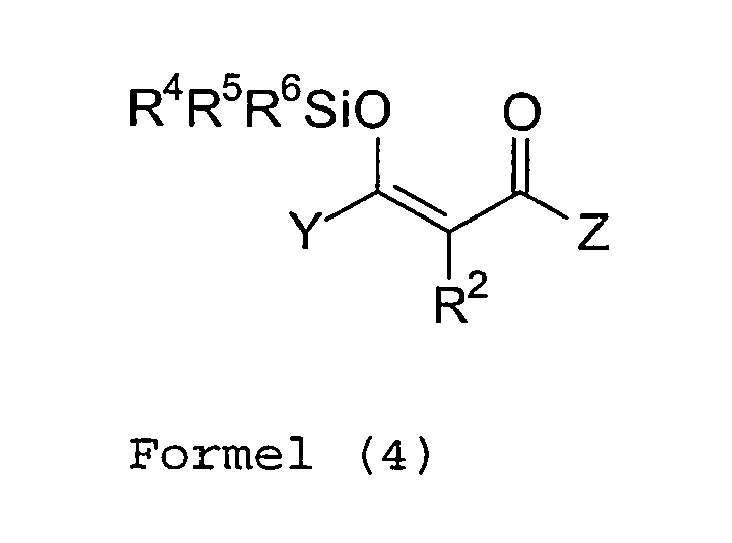
R2 und R3 in der allgemeinen Formel (3) unabhängig voneinander und R2 in der allgemeinen Formel (4) Wasserstoff, einen Acylrest einer aromatischen oder aliphatischen Carbonsäure mit 2 bis 20 C-Atomen, einen Alkylrest mit 1 bis 20 C-Atomen oder einen Arylrest mit 6 bis 20 C-Atomen und
R4, R5 und R6 in der allgemeinen Formel (4) unabhängig voneinander einen aliphatischen oder aromatischen Rest mit 1 bis 20 C-Atomen bedeuten können. - Besonders bevorzugt sind 1,3-Dicarbonylverbindungen aus der Gruppe enthaltend Glyoxylsäuremethylester, Glyoxylsäureethylester, Acetessigsäuremethylester, Acetessigsäureethylester, Acetessigsäure-tert-butyl-ester, Acetessigsäure-isobutylester, Acetessigsäure-isopropylester, Acetessigsäure-n-propylester, Acetessigsäure-benzylester, 2-Acetyl-acetessigsäuremethylester, 2-Acetylacetessigsäureethylester, 2-Acetyl-acetessigsäure-tert-butylester, 3-Oxopentansäuremethylester, 3-Oxopentansäureethylester, 3-Oxopentansäure-tert-butylester, 3-Oxohexansäuremethylester, 3-Oxohexansäureethylester, Acetylaceton, 2,4-Hexandion, 3,5-Heptandion, Malonsäuredimethylester, Malonsäurediethylester, Malonsäurediisobutylester, Malonsäurediisopropylester und Malonsäuredi-tert-butylester.
- Besonders bevorzugt sind Silylderivate von 1,3-Dicarbonylverbindungen aus der Gruppe enthaltend3-Trimethylsilyloxyacrylsäuremethylester, 3-Trimethylsilyloxyacrylsäureethylester, 4-Trimethylsilyloxypent-3-en-2-on, 4-Triethylsilyloxypent-3-en-2-on, 4-(tert-Butyldimethylsilyloxy)pent-3-en-2-on, 4-(tert-Butyldiphenylsilyloxy)pent-3-en-2-on, 3-Trimethylsilyloxybut-2-ensäure-methylester, 3-Trimethylsilyloxybut-2-ensäure-ethylester, 3-Trimethylsilyloxybut-2-ensäure-tert-butylester.
- Als Lewis-Säuren sind bevorzugt Trialkylsilylhalogenide und Perfluoralkansulfonsäuretrialkylsilylester. Besonders bevorzugt sind dabei Iodtrimethylsilan und Trifluormethansulfonsäuretrimethylsilylester. Ganz besonders bevorzugt ist Iodtrimethylsilan.
- Als Lösungsmittel können generell alle aprotischen organischen Lösungsmittel verwendet werden. Beispiele für geeignete Lösungsmittel sind Methylenchlorid (Dichlormethan), 1,2-Dichlorethan und Acetonitril. Besonders bevorzugt sind Methylenchlorid (Dichlormethan) und 1,2-Dichlorethan. Ganz besonders bevorzugt ist Methylenchlorid (Dichlormethan).
- Die Reaktion kann grundsätzlich bei einer beliebigen Temperatur durchgeführt werden, die in der Regel nur durch die Eigenschaften des Lösungsmittels und der eingesetzten Komponenten (Siedepunkt, Schmelzpunkt, Löslichkeit, etc.) eingeschränkt wird.
- Vorzugsweise wird die Reaktion bei einer Temperatur zwischen -5°C und dem Siedepunkt des verwendeten Lösungsmittels durchgeführt. Besonders bevorzugt wird bei einer Temperatur zwischen 0°C und +30°C gearbeitet.
- Vorzugsweise wird bei Atmosphärendruck gearbeitet.
- Als Zuckerbausteine in Form von Verbindungen der allgemeinen Formel (2) haben sich insbesondere Verbindungen mit einer Abgangsgruppe X = OCOR7 (Acyloxyreste) als zweckmäßig erwiesen, wobei sich der Rest -COR7 von einer aliphatischen oder aromatischen Carbonsäure mit 1 bis 20 C-Atomen ableitet, insbesondere Essigsäure (Acetoxy-), Propionsäure (Propionyloxy-), n-Buttersäure (n-Butyryloxy-), Trifluoressigsäure (Trifluoracetoxy-) oder Benzoesäure (Benzoyloxy-).
- Zur Herstellung solcher Verbindungen stehen eine Reihe von bekannten Verfahren zur Auswahl, wobei sich u.a. die Synthese aus 1,3-Dioxolan-4-on-Derivaten bewährt hat.
- Hierbei wird nach
WO 92/14729 - Die Verbindungen vom Typ der allgemeinen Formel (2) sind in den so dargestellten Rohprodukten mit Gehalten von ca. 40 bis 70% enthalten. Als Nebenprodukte und weitere Bestandteile der Rohprodukte können dabei unter anderem 1,3-Dicarbonylverbindungen, insbesondere β-Ketocarbonsäureester wie z.B. Acetessigsäure-tert-butylester oder Acetessigsäureisobutylester identifiziert werden.
- Es hat sich als besonders vorteilhaft herausgestellt, die nach
WO 92/14729 - Der Vergleichsversuch belegt, dass, wenn das nach
WO 92/14729 - Durch den gezielten, erfindungsgemäßen Zusatz zu der gereinigten Verbindung vom Typ der allgemeinen Formel (2) von 1,3-Dicarbonylverbindungen oder deren silylierten Derivaten wird hingegen das gewünschte Produkt mit einer hohen Ausbeute und Reinheit erhalten.
- Nach dem erfindungsgemäßen Verfahren können 1,3-Dicarbonylverbindungen bzw. deren silylierte Derivate entweder durch gezielten Zusatz oder durch Auswahl einer entsprechenden Synthese des Ausgangsmaterials der allgemeinen Formel (2) der Reaktionsmischung für die Glykosylierung zugeführt werden und der erfindungsgemäße Effekt erzielt werden.
- Bei der beschriebenen Silyl-Hilbert-Johnson-Reaktion entstehen immer zwei Hauptprodukte, die sich durch ihre relative Stereochemie unterscheiden. Wie bereits in
WO 97/21706 - Im Gegensatz zur Lehre der
WO 97/21706 - Überraschenderweise konnte jedoch eine signifikante Auswirkung auf die cis/trans-Selektivität in Abhängigkeit von der verwendeten Lewis-Säure beobachtet werden (vgl. Tabelle 2): Während bei Verwendung von Iodtrimethylsilan in der Regel das cis-Isomere das Hauptprodukt darstellt (cis/trans-Verhältnis zwischen 1.5:1 und 2.5:1), wurde bei Verwendung von Trifluormethansulfonsäuretrimethylsilylester als Hauptprodukt das trans-Isomer gefunden (cis/trans-Verhältnis zwischen 0.7:1 und 0.8:1).
- Die Aufarbeitung der Reaktionsmischungen nach dem erfindungsgemäßen Verfahren erfolgt zweckmäßigerweise zunächst durch Hydrolyse mit Wasser, wässriger Säure oder Lauge. Dabei werden sowohl die verwendete Lewis-Säure und in Abhängigkeit von den Aufarbeitungsbedingungen gegebenenfalls auch gleichzeitig die Aminoschutzgruppen der gebildeten Reaktionsprodukte hydrolysiert, so dass in 2- und 6- Position freie Aminfunktionen resultieren. In Abhängigkeit des gewünschten Endproduktes, können die Hydrolysebedingungen auch so gewählt werden, dass die Aminoschutzgruppen in 2- und 6-Position erhalten bleiben.
- Silylschutzgruppen, wie z.B. Trimethylsilyl-, werden bereits durch verdünnte Säure bei Zimmertemperatur abgespalten, während Acylreste wie z.B. Benzoyl- erst durch Erhitzen im Basischen oder durch Umsetzung mit Ammoniak bzw. Aminen gespalten werden.
- Typischerweise wird die hydrolytische Aufarbeitung zunächst im sauren pH-Bereich (pH 0 bis 3) vorgenommen. Nebenprodukte und Verunreinigungen können durch Extraktion mit einem organischen Lösungsmittel, insbesondere Methylenchlorid, 1,2-Dichlorethan, Toluol, Hexan, Heptan, THF oder Diethylether entfernt werden. Anschließend wird durch Zugabe von wässriger Lauge, insbesondere wässriger Lösungen von Natriumhydroxid, Natriumcarbonat, Natriumhydrogencarbonat oder Kaliumcarbonat und erneute Extraktion mit einem organischen Lösungsmittel, insbesondere den oben genannten Lösungsmitteln, das Produkt in die organische Phase überführt.
Nach dem Entfernen des organischen Lösungsmittels durch Destillation wird das Produkt erhalten, das anschließend ggf. noch durch weitere Schritte, insbesondere Umkristallisation oder Chromatographie weiter gereinigt werden kann.
Die abschließende wässrige Hydrolyse führt demzufolge zu Reaktionsprodukten der allgemeinen Formel (1) in denen die Reste R8, R9, R10 und R11 unabhängig voneinander für Wasserstoff oder eine Aminoschutzgruppe stehen können, insbesondere zu solchen Reaktionsprodukten der allgemeinen Formel (1) in denen alle Reste R8, R9, R10 und R11 für Wasserstoff stehen. - In einer bevorzugten Ausführungsform des erfindungsgemäßen Verfahrens lassen sich optisch reine Reaktionsprodukte - durch Auswahl entsprechend optisch konfigurierter Edukte - in den optischen Konfigurationen der allgemeinen Formeln (1a), (1b), (1c) und (1d) herstellen, in denen alle Reste R8, R9, R10 und R11 für Wasserstoff stehen. Ganz besonders bevorzugt lässt sich das Verfahren auf die Herstellung von Produkten in der optischen Konfiguration der allgemeinen Formel 1a anwenden, wobei alle Reste R8, R9, R10 und R11 für Wasserstoff stehen.
- Bei Aufarbeitung der nach dem erfindungsgemäßen Verfahren hergestellten Verbindungen kann eine weitere Anreicherung des gewünschten Isomeren (in der Regel das cis-Isomer in der optischen Konfiguration der allgemeinen Formeln 1a oder 1c) insbesondere durch Kristallisation oder Säulenchromatographie erreicht werden. Dabei ist insbesondere bei der großtechnischen Umsetzung des erfindungsgemäßen Verfahrens die Kristallisation aus Kostengründen vorzuziehen.
So ist ein weiterer Gegenstand der Erfindung ein Verfahren zur Reinigung der nach dem erfindungsgemäßen Verfahren erhaltenen Verbindungen der allgemeinen Formel (1) durch Umkristallisation. - Da die Produkte der allgemeinen Formel (1) stark polare Verbindungen mit relativ hohen Schmelzpunkten darstellen, eignen sich insbesondere polare Lösungsmittel wie Alkohole, Ether oder Ester mit 1-10 C-Atomen für die Umkristallisation.
- So ist beispielsweise für die Umkristallisation von Isobutyraten der allgemeinen Formel (1) wobei R1 = (H3C)2CHCO-bedeutet, Isopropanol als Lösungsmittel besonders bevorzugt.
- Durch einmalige Kristallisation wird aus dem Gemisch (cis /trans ~ 60-70 : 30-40) ein Produkt erhalten, das zwischen 97 und 99% Gehalt an cis-Isomer aufweist (vgl. Beispiel 4). Durch erneute Umkristallisation kann bis auf Gehalte von >99.5% des cis-Isomers angereichert werden.
- Zur Herstellung von (nicht OH-geschützten) [4-(2,6-diamino-9H-purin-9-yl)-1,3-dioxolan-2-yl]methanol-Derivaten der allgemeinen Formel 1, wobei R1 hier Wasserstoff bedeutet, werden dem Fachmann geläufige Verfahren zur Abspaltung der entsprechenden OH-Schutzgruppe angewandt.
- Eine Auswahl von Verfahren ist insbesondere in T.W. Greene, P.G.M. Wuts, "Protective Groups in Organic Synthesis", 2nd Edition, Wiley 1991, S. 10-117 beschrieben.
- So ist ein weiterer Gegenstand der Erfindung die Verwendung der nach dem erfindungsgemäßen Verfahren erhaltenen Verbindungen der allgemeinen Formel (1) zur Herstellung von Verbindungen der allgemeinen Formel (6)

- Dies erfolgt allgemein durch die Abspaltung der Hydroxylschutzgruppen.
- In einer besonders bevorzugten Variante werden bereits Verbindungen der allgemeinen Formel (1) eingesetzt, in denen die Aminoschutzgruppen bereits nach dem oben beschriebenen Verfahren abgespalten wurden und demnach alle Reste R8, R9, R10 und R11 für Wasserstoff stehen.
- Die Verbindungen der allgemeinen Formel (6) können in racemischer Form oder in optisch reiner Form erhalten werden. Insbesondere lassen sich die erfindungsgemäß hergestellten Produkte der allgemeinen Formel (1) in optisch reiner Form zu optisch reinen Verbindungen der allgemeinen Formel (6) umsetzen.
- In einer besonders bevorzugten Verwendung der erfindungsgemäß hergestellten Produkte kann auf diese Weise (2R,4R)-[4-(2,6-diamino-9H-purin-9-yl)-1,3-dioxolan-2-yl]methanol [(-)-DAPD] hergestellt werden.
- Bevorzugte Verfahren zur Abspaltung von Acylresten als OH-Schutzgruppe sind die Umsetzung mit Ammoniak oder aliphatischen Aminen, die basische wässrige Hydrolyse und die Umsetzung mit Alkoholaten wie z.B. Natriummethylat.
- (Der in einigen Beispielen vorkommende griechische Buchstabe "Ξ" bezeichnet ein Stereozentrum mit nicht festgelegter absoluter Konfiguration)
- 75 g 2,6-Diaminopurin, 17,8 g Ammoniumsulfat und 1451 g Hexamethyldisilazan wurden in einem 4-1-Dreihalskolben vorgelegt. Die Suspension wurde unter Rühren zum Rückfluss erhitzt (Rückflussbeginn 108°C) und dort für 3-4 h gehalten, wobei die Rückflusstemp. auf 122°C ansteigt und die Mischung klar wurde. Die Lösung wurde etwas abgekühlt (auf ca. 80°C) und langsam Vakuum angezogen. Das überschüssige Hexamethyldisilazan wurde anschließend bis 85°C Sumpftemp. / 5 mbar abdestilliert. Die GC-Analyse des Rückstandes zeigte folgende Zusammensetzung: 86.3% Tris(trimethylsilyl)-2,6-diaminopurin, 0.5% Trimethylsilyl-2,6-diaminopurin, 0.9% Bis(trimethylsilyl)-2,6-diaminopurin, 10.0% Bis(trimethylsilyl)sulfat, 0.3% Hexamethyldisilazan.
Der Rückstand wurde in trockenem Methylenchlorid gelöst. Die Menge wurde dabei so berechnet, dass eine ca. 1-molare Lösung entstand. -

- 316,2 g einer 1.1-molaren Lösung von LiAlH(OtBu)3 in THF und 142 g THF wurden in einem trockenem Kolben vorgelegt und auf - 5°C abgekühlt. 53.0 g (2R)-2-Isobutyryloxymethyl-1,3-dioxolan-4-on wurden innerhalb von 45 min zugetropft. Die Mischung wurde auf 25°C erwärmt, 33,7 g 4-Dimethylaminopyridin zugegeben und 1 h gerührt. Es wurde erneut auf -5°C abgekühlt und anschließend 209 g Acetanhydrid bei dieser Temperatur zugetropft. Die Mischung wurde 15 h bei -5 bis 0°C gerührt.
Dann wurde durch Zugabe von 415 g 15%iger NH4Cl-Lösung gequencht und mit 400 g Wasser verdünnt. Das THF wurde durch Abdestillieren im Vakuum weitgehend entfernt und anschließend 480 g Ethylacetat zugegeben. Die Mischung wurde gut durchgeschüttelt und die Phasen wurden getrennt. Die wässrige Phase wurde einmal mit Ethylacetat nachextrahiert und die vereinigten organischen Phasen mit Wasser und NaHCO3-Lösung gewaschen. Das Lösungsmittel wurde im Vakuum abdestilliert und man erhielt das Produkt als orangefarbene Flüssigkeit (Ausbeute 69.0 g mit 65% Gehalt entspr. 70% d.Th.).
Das Produkt wird nach diesem Verfahren mit Gehalten zwischen 40 und 70% (GC) als cis/trans-Gemisch erhalten. Das cis/trans-Verhältnis beträgt zwischen 2.8 und 3.6. Als weitere Bestandteile sind u.a. enthalten Acetessigsäure-tert-butylester (ca. 8 bis ca. 27%) und 2-Acetyl-acetessigsäure-tert-butylester (ca. 6% bis ca. 15%). - 30 g eines nach Beispiel 2 hergestellten Produktes mit einem Gehalt von 42.5% wurden über 200 g Kieselgel chromatographiert (Laufmittel n-Heptan / Ethylacetat 4:1). Die produkthaltigen Fraktionen wurden vereinigt und das Lösungsmittel im Vakuum entfernt. Man erhielt 14 g farblose Flüssigkeit. Der Gehalt nach GC betrug 79.5% (Ausbeute 88%).
-

- 105.1 g (2R-4- Ξ )-4-Acetoxy-2-isobutyryloxymethyl-1,3-dioxolan mit einem Gehalt von 55.3% (13.2% Acetessigsäure-tert-butylester und 6.3% 2-Acetyl-acetessigsäure-tert-butylester; dies entspricht 0.48 Mol an 1,3-Dicarbonylverbindung pro Mol Dioxolan) wurden in 540 ml Methylenchlorid vorgelegt. Eine Lösung von 19.8 g Acetessigsäure-tert-butylester in 120 ml Methylenchlorid und 275 ml einer 1.0-molaren Lösung von Tris(trimethylsilyl)-2,6-diaminopurin in Methylenchlorid (nach Beispiel 1) wurden ebenfalls zugegeben. Die Lösung wurde auf 0°C abgekühlt und bei dieser Temperatur eine Lösung von 125.0 g Iodtrimethylsilan (Gehalt 95.8%) in 250 ml Methylenchlorid innerhalb von 20 min zugetropft. Die Mischung wurde 1 h bei 0°C nachgerührt, auf 25°C erwärmt und bei dieser Temperatur 15 h gerührt. Durch Zugabe von 1 1 einer 10%igen Na2CO3-Lösung wurde gequencht und 10 min gerührt. Die Phasen wurden getrennt und die wässrige Phase zweimal mit Methylenchlorid nachextrahiert. Die vereinigten organischen Phasen wurden mit 10%iger Na2CO3-Lösung und Wasser gewaschen und über Kieselgur filtriert. Die Lösung wurde anschließend auf ca. 1000 ml aufkonzentriert. Die HPLC-Analyse der Lösung zeigte 67.8% cis-(2R)-2-Isobutyryloxymethyl-4-(2,6-diaminopurin-9-yl)-1,3-dioxolan und 31.7% trans-(2R)-2-Isobutyryloxymethyl-4-(2,6-diaminopurin-9-yl)-1,3-dioxolan (Isomerenverhältnis 2.1:1; HPLC Fl%). Die Lösung wurde mit 750 ml 0.5N HCl versetzt und 30 min gerührt. Die Phasen wurden getrennt und die wässrige Phase viermal mit Methylenchlorid gewaschen.
Nach erneuter Zugabe von 500 ml Methylenchlorid wurde der pH-Wert durch Zugabe von 10%iger Na2CO3-Lösung auf 8-9 eingestellt und 15 min gerührt. - Die Phasen wurden getrennt und die wässrige Phase mit Methylenchlorid nachextrahiert.
Das Methylenchlorid wurde weitgehend abdestilliert und 1 1 Isopropanol zugegeben. Man destillierte weiter, bis eine Kopftemperatur von 80°C erreicht war. Ausgefallenes Produkt wurde durch Zugabe von weiteren 900 ml Isopropanol in der Siedehitze gelöst. Die Lösung wurde innerhalb von 2 h auf 25°C abgekühlt, 1 h nachgerührt und die ausgefallenen Kristalle abgesaugt. Anschließend wurde mit Isopropanol gewaschen und bei 60°C im Vakuum getrocknet.
Man erhielt 35.2 g farblose Kristalle, die laut NMR-Analyse neben (2R)-2-Isobutyryloxymethyl-4-(2,6-diaminopurin-9-yl)-1,3-dioxolan noch 1 Mol Isopropanol enthielten. Nach HPLC waren 98.0% cis- und 1.6% trans-(2R)-2-Isobutyryloxymethyl-4-(2,6-diaminopurin-9-yl)-1,3-dioxolan enthalten. Dies entspricht einer Ausbeute von 36.1% cis-Isomer bezogen auf (2R-4Ξ )-4-Acetoxy-2-isobutyryloxymethyl-1,3-dioxolan.
Durch Umkristallisation aus Isopropanol erhielt man reines cis-Isomer mit einem Gehalt von 99.6% (Umkristallisationsausbeute 90%) . - 9.3 ml einer 1.0-molaren Lösung von Tris(trimethylsilyl)-2,6-diaminopurin in Methylenchlorid (nach Beispiel 1) wurden auf 0°C abgekühlt. Die Lösung von 2.52 g (2R-4Ξ )-4-Acetoxy-2-isobutyryloxymethyl-1,3-dioxolan aus Beispiel 3 mit einem Gehalt von 79.5% wurde zugegeben. Bei 0 bis 5°C wurde eine Lösung von 4.0 g Iodtrimethylsilan zugegeben, anschließend auf 25°C erwärmt und 15 h gerührt. Es wurde mit 10%iger Na2CO3-Lösung hydrolysiert. Die Phasen wurden anschließend getrennt und die organische Phase wird im HPLC analysiert.
Das HPLC der organischen Phase zeigte neben einer Vielzahl von Nebenprodukten 1.6% 2,6-Diaminopurin sowie 34.2% cis- und 30.4% trans-(2R)-2-Isobutyryloxymethyl-4-(2,6-diaminopurin-9-yl)-1,3-dioxolan. - Es wurde analog zu Beispiel 5 vorgegangen, mit dem Unterschied, dass vor der Zugabe des Iodtrimethylsilans eine Lösung von 1.16 g Acetessigsäure-tert-butylester in 5 ml Methylenchlorid zugegeben wurde.
Das HPLC zeigte kein 2,6-Diaminopurin sowie 67.8% cis- und 31.7% trans-(2R)-2-Isobutyryloxymethyl-4-(2,6-diaminopurin-9-yl)-1,3-dioxolan. - Es wurde analog zu Beispiel 5 vorgegangen, mit dem Unterschied, dass vor der Zugabe des Iodtrimethylsilans eine Lösung von 0.9 g 3-Trimethylsilyloxy-2-butensäure-tert-butylester in 5 ml Methylenchlorid zugegeben wurde.
Das HPLC zeigte 0.5% 2,6-Diaminopurin sowie 62.6% cis- und 33.6% trans-(2R)-2-Isobutyryloxymethyl-4-(2,6-diaminopurin-9-yl)-1,3-dioxolan. - 10,3 ml einer 0.93-molaren Lösung von Tris(trimethylsilyl)-2,6-diaminopurin in Methylenchlorid (nach Beispiel 1) wurden in einem trockenem Kolben vorgelegt.
3.97 g (2R-4Ξ )-4-Acetoxy-2-isobutyryloxymethyl-1,3-dioxolan (vgl. Beispiel 2) mit einem Gehalt von 50.4% und einem Gehalt von 17.1% Acetessigsäure-tert-butylester sowie 7.5% 2-Acetyl-acetessigsäure-tert-butylester (dies entspricht 0.67 Mol an 1,3-Dicarbonylverbindung pro Mol Dioxolan) wurden in 20 ml Methylenchlorid gelöst und zugegeben. Bei 0°C wurde eine Lösung von 4.31 g Iodtrimethylsilan in 10 ml Methylenchlorid zugegeben. Die Mischung wurde auf 25°C erwärmt und 15 h gerührt. Anschließend wurde mit 10%iger Na2CO3-Lösung hydrolysiert.
Die Phasen wurden getrennt und die organische Phase wird im HPLC analysiert. - Das HPLC zeigte kein 2,6-Diaminopurin sowie 58.2% cis- und 28.0% trans-(2R)-2-Isobutyryloxymethyl-4-(2,6-diaminopurin-9-yl)-1,3-dioxolan.
- Es wurde analog zu Beispiel 8 vorgegangen unter Verwendung von 3.40 g (2R-4Ξ )-4-Acetoxy-2-isobutyryloxymethyl-1,3-dioxolan mit einem Gehalt von 58.9% (9.0% Acetessigsäure-tert-butylester und 8.7% 2-Acetyl-acetessigsäure-tert-butylester; dies entspricht 0.40 Mol an 1,3-Dicarbonylverbindung pro Mol Dioxolan) mit dem Unterschied, dass statt Acetessigsäure-tert-butylester 0.5 Mol-Eq Acetessigsäuremethylester zugegeben wurde.
Das HPLC zeigte kein 2,6-Diaminopurin sowie 59.5% cis- und 27.1% trans-(2R)-2-Isobutyryloxymethyl-4-(2,6-diaminopurin-9-yl)-1,3-dioxolan. - Es wurde analog zu Beispiel 9 vorgegangen mit dem Unterschied, dass kein weiterer Zusatz einer 1,3-Dicarbonylverbindung vorgenommen wurde (d.h. nur der aus dem Edukt stammende Anteil von 0.4 Mol 1,3-Dicarbonylverbindung pro Mol Dioxolan enthalten ist).
Das HPLC zeigte 8.9% 2,6-Diaminopurin sowie 45.9% cis- und 28.8% trans-(2R)-2-Isobutyryloxymethyl-4-(2,6-diaminopurin-9-yl)-1,3-dioxolan. - Es wurde analog zu Beispiel 4 vorgegangen unter Verwendung von 49.3 g (2R-4Ξ )-4-Acetoxy-2-isobutyryloxymethyl-1,3-dioxolan mit einem Gehalt von 58.9% (9.0% Acetessigsäure-tert-butylester und 8.7% 2-Acetyl-acetessigsäure-tert-butylester; dies entspricht 0.40 Mol an 1,3-Dicarbonylverbindung pro Mol Dioxolan) mit dem Unterschied, dass statt Acetessigsäure-tert-butylester 0.5 Mol-Eq Acetylaceton zugegeben wurden.
- Die HPLC-Analyse des Rohproduktes zeigte 57.1% cis-(2R)-2-Isobutyryloxymethyl-4-(2,6-diaminopurin-9-yl)-1,3-dioxolan und 27.1% trans-(2R)-2-Isobutyryloxymethyl-4-(2,6-diaminopurin-9-yl)-1,3-dioxolan (Isomerenverhältnis 2.1:1; HPLC F1%).
Nach Kristallisation aus Isopropanol wurden 17.7 g farblose Kristalle erhalten, die laut NMR-Analyse neben (2R)-2-Isobutyryloxymethyl-4-(2,6-diaminopurin-9-yl)-1,3-dioxolan noch 1 Mol Isopropanol enthielten. Nach HPLC waren 97.5% cis- und 2.2% trans-(2R)-2-Isobutyryloxymethyl-4-(2,6-diaminopurin-9-yl)-1,3-dioxolan enthalten. Dies entspricht einer Ausbeute von 36.1% cis-Isomer bezogen auf (2R-4Ξ )-4-Acetoxy-2-isobutyryloxymethyl-1,3-dioxolan.
Durch Umkristallisation aus Isopropanol erhielt man reines cis-Isomer mit einem Gehalt von 99.8% (Umkristallisationsausbeute 90%) .Tabelle 1: Hilbert-Johnson-Reaktion in Gegenwart verschiedener 1,3-Dicarbonylverbindungen (alle Reaktionen in Methylenchlorid in Ggw. von 2.5 Mol-Eq Iodtrimethylsilan): Beispiel ACTB + AACTB enthalten in Dioxolan-acetat [Mol-Eq] Zusatz Mol-Eq cis-Isomer [Fl%] trans-Isomer [Fl%] 5 0.045 - - 34.2 30.4 6 0.045 ACTB 0.85 67.8 31.7 7 0.045 TMS-ACTB 0.50 62.6 33.6 8 0.67 - - 58.2 28.0 9 0.40 ACM 0.5 59.5 27.1 10 0.4 - - 45.9 28.8 11 0.4 AcAc 0.5 57.1 27.1 ACTB = Acetessigsäure-tert-butylester;
AACTB = 2-Acetyl-acetessigsäure-tert-butylester
TMS-ACTB = 3-Trimethylsilyloxybut-2-ensäure-tert-butylester - Es wurde analog zu Beispiel 8 vorgegangen mit dem Unterschied, dass statt Methylenchlorid 1,2-Dichlorethan als Lösungsmittel verwendet wurde.
Das HPLC zeigte kein 2,6-Diaminopurin sowie 53.1% cis- und 29.9% trans-(2R)-2-Isobutyryloxymethyl-4-(2,6-diaminopurin-9-yl)-1,3-dioxolan. - Es wurde analog zu Beispiel 8 vorgegangen mit dem Unterschied, dass statt Methylenchlorid Acetonitril als Lösungsmittel verwendet wurde. Bei der Aufarbeitung wurde Methylenchlorid zugegeben, um das Produkt zu extrahieren.
Das HPLC zeigte kein 2,6-Diaminopurin sowie 45.3% cis- und 36.4% trans-(2R)-2-Isobutyryloxymethyl-4-(2,6-diaminopurin-9-yl)-1,3-dioxolan. - Es wurde analog zu Beispiel 8 vorgegangen mit dem Unterschied, dass statt Iodtrimethylsilan Trifluormethansulfonsäuretrimethylsilylester als Lewis-Säure verwendet wurde.
Das HPLC zeigte kein 2,6-Diaminopurin sowie 33.7% cis- und 47.5% trans-(2R)-2-Isobutyryloxymethyl-4-(2,6-diaminopurin-9-yl)-1,3-dioxolan. - Es wurde analog zu Beispiel 14 vorgegangen mit dem Unterschied, dass an Stelle von Methylenchlorid 1,2-Dichlorethan als Lösungsmittel verwendet wurde.
Das HPLC zeigte kein 2,6-Diaminopurin sowie 31.7% cis- und 40.9% trans-(2R)-2-Isobutyryloxymethyl-4-(2,6-diaminopurin-9-yl)-1,3-dioxolan.Tabelle 2: Hilbert-Johnson-Reaktion in verschiedenen Lösungsmitteln und mit verschiedenen Lewis-Säuren: Beispiel ACTB + AACTB enthalten in Dioxolan-acetat [Mol-Eq] Lösungsmittel Lewis-Säure [2.5 Mol-Eq] cis-Isomer [Fl%] trans-Isomer [Fl%] 12 0.67 1,2-DCE TMSI 53.1 29.9 13 0.67 MeCN TMSI 45.3 36.4 14 0.67 CH2Cl2 TMSOTf 33.7 47.5 15 0.67 1,2-DCE TMSOTf 31.7 40.9 ACTB = Acetessigsäure-tert-butylester;
AACTB = 2-Acetyl-acetessigsäure-tert-butylester
1,2-DCE = 1,2-Dichlorethan
MeCN = Acetonitril
TMSOTf = Trifluormethansulfonsäuretrimethylsilylester (Trimethylsilyltriflat) -
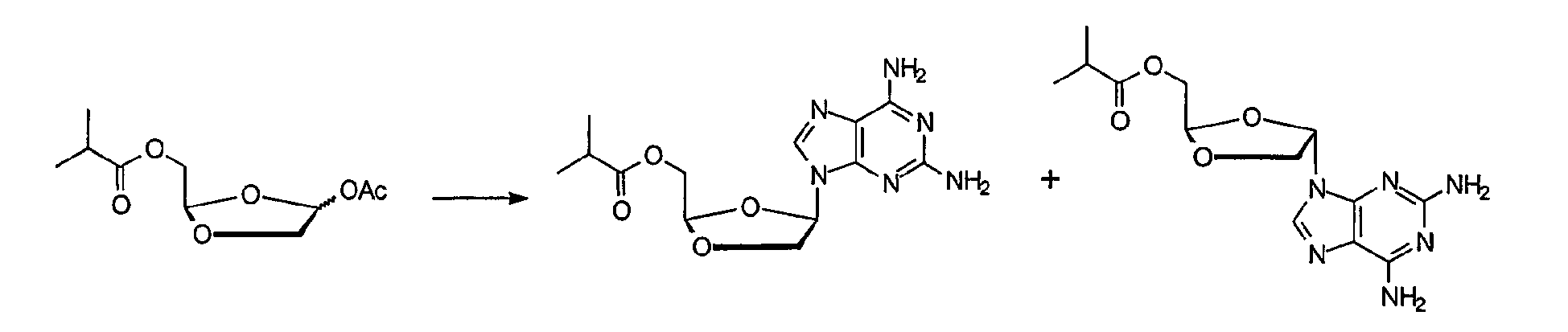
- 48.0 g (2R-4Ξ )-4-Acetoxy-2-isobutyryloxymethyl-1,3-dioxolan mit einem Gehalt von 60.5% (9.0% Acetessigsäure-tert-butylester und 3.1% 2-Acetyl-acetessigsäure-tert-butylester; dies entspricht 0.28 Mol an 1,3-Dicarbonylverbindung pro Mol Dioxolan) wurden in 520 ml Methylenchlorid vorgelegt. 14.8 g Acetessigsäure-tert-butylester und 179.8 g einer 0.8-molalen Lösung von Tris(trimethylsilyl)-2,6-diaminopurin in Methylenchlorid (nach Beispiel 1) wurden zugegeben. Die Lösung wurde auf 0°C abgekühlt und bei dieser Temperatur eine Lösung von 62.6 g Iodtrimethylsilan (Gehalt 98%) in 125 ml Methylenchlorid innerhalb von 20 min zugetropft. Die Mischung wurde 20 h bei 0 bis 10°C nachgerührt.
Die Reaktionsmischung wurde bei 0 bis 10°C zu einer Lösung von 34.2 g 20%iger Salzsäure in 725 g Wasser zugetropft. Die Mischung wurde auf 25°C erwärmt und 15 min gerührt.
Die Phasen wurden getrennt und die organische Phase einmal mit 125 ml 0.5N Salzsäure nachextrahiert. Die vereinigten wässrigen Phasen wurden zweimal mit je 100 ml Methylenchlorid gewaschen. Anschließend wurde nach Zugabe von weiteren 474 ml Methylenchlorid der pH-Wert durch Zugabe von 700 g einer 10%igen Natriumcarbonatlösung auf 9.0 eingestellt.
Man rührte 1 h bei 25°C und trennte die Phasen. Die wässrige Phase wurde zweimal mit je 123 ml Methylenchlorid nachextrahiert und die vereinigten organischen Phasen einmal mit 200 ml Wasser gewaschen.
Nach Entfernen des Lösungsmittels im Vakuum erhielt man 27.6 g gelblichen Feststoff.
Die HPLC-Analyse zeigte 71.2% cis-(2R)-2-Isobutyryloxymethyl-4-(2,6-diaminopurin-9-yl)-1,3-dioxolan und 26.5% trans-(2R)-2-Isobutyryloxymethyl-4-(2,6-diaminopurin-9-yl)-1,3-dioxolan (Isomerenverhältnis 2.7:1; HPLC Fl%; Rohausbeute 49%).
Das Rohprodukt wurde aus Isopropanol umkristallisiert.
Man erhielt 16.2 g farblose Kristalle, die laut NMR-Analyse neben (2R)-2-Isobutyryloxymethyl-4-(2,6-diaminopurin-9-yl)-1,3-dioxolan noch 1 Mol Isopropanol enthielten. Nach HPLC waren 99.0% cis- und 0.9% trans-(2R)-2-Isobutyryloxymethyl-4-(2,6-diaminopurin-9-yl)-1,3-dioxolan enthalten. Dies entspricht einer Ausbeute von 33.3% cis-Isomer bezogen auf (2R-4Ξ )-4-Acetoxy-2-isobutyryloxymethyl-1,3-dioxolan. -

- 98.4 g LiAlH(OtBu)3 und 964 g THF wurden in einem trockenem Kolben vorgelegt und auf -10°C abgekühlt. 98.5 g (2R)-2-tert-Butyldiphenylsilyloxymethyl-1,3-dioxolan-4-on wurden innerhalb von 45 min zugetropft. Die Mischung wurde auf 25°C erwärmt, 33.7g 4-Dimethylaminopyridin zugegeben und 1 h gerührt. Es wurde erneut auf -10°C abgekühlt und anschließend 209 g Acetanhydrid bei dieser Temperatur zugetropft. Die Mischung wurde 15 h bei -10 bis 0°C gerührt.
Dann wurde durch Zugabe von 415 g 15%iger NH4Cl-Lösung gequencht und mit 400 g Wasser verdünnt. Das THF wurde durch Abdestillieren im Vakuum weitgehend entfernt und anschließend 480 g Ethylacetat zugegeben. Die Mischung wurde gut durchgeschüttelt und die Phasen wurden getrennt. Die wässrige Phase wurde einmal mit Ethylacetat nachextrahiert und die vereinigten organischen Phasen mit Wasser und NaHCO3-Lösung gewaschen. Das Lösungsmittel wurde im Vakuum abdestilliert und man erhielt das Produkt als orangefarbenes Öl (Ausbeute 110.7 g mit 70% Gehalt entspr. 70% d.Th.). -

- 27.5 g (2R-4Ξ )-4-Acetoxy-2-tert-butyldiphenylsilyloxymethyl-1,3-dioxolan mit einem Gehalt von 70.0% (11.2% Acetessigsäure-tert-butylester und 5.3% 2-Acetyl-acetessigsäure-tert-butylester; dies entspricht 0.50 Mol an 1,3-Dicarbonylverbindung pro Mol Dioxolan) wurden in 96 ml Methylenchlorid vorgelegt. Eine Lösung von 5.4 g Acetessigsäure-tert-butylester in 21 ml Methylenchlorid und 50 ml einer 1.0-molaren Lösung von Tris(trimethylsilyl)-2,6-diaminopurin in Methylenchlorid (s. Beispiel 1) wurden ebenfalls zugegeben. Die Lösung wurde auf 0°C abgekühlt und bei dieser Temperatur eine Lösung von 22.6 g Iodtrimethylsilan (Gehalt 95.8%) in 45 ml Methylenchlorid innerhalb von 20 min zugetropft. Die Mischung wurde 1 h bei 0°C nachgerührt, auf 25°C erwärmt und bei dieser Temperatur 15 h gerührt. Durch Zugabe von 250 ml einer 10%igen Na2CO3-Lösung wurde gequencht und 10 min gerührt. Die Phasen wurden getrennt und die wässrige Phase zweimal mit Methylenchlorid nachextrahiert. Die vereinigten organischen Phasen wurden mit 10%iger Na2CO3-Lösung und Wasser gewaschen und über Kieselgur filtriert. Das Lösungsmittel wurde im Vakuum entfernt und man erhielt 13.5 g gelblichen Feststoff.
Die HPLC-Analyse des Produktes zeigte 65,8% cis-(2R)-2-tert-Butyldiphenylsilyloxymethyl-4-(2,6-diaminopurin-9-yl)-1,3-dioxolan und 33,4% trans-(2R)-2-tert-Butyl-diphenylsilyloxymethyl-4-(2,6-diaminopurin-9-yl)-1,3-dioxolan (Isomerenverhältnis 2.0:1; HPLC Fl%). Dies entspricht einer Ausbeute an cis-Isomer von 40%. -

- 31.05 g (2R,4R)-2-Isobutyryloxymethyl-4-(2,6-diaminopurin-9-yl)-1,3-dioxolan x 2-Propanol (vgl. Beispiel 4) wurden in 310 ml NH3-gesättigtem Methanol gelöst. Die Lösung wurde 15 h bei 25°C gerührt und das Lösungsmittel im Vakuum abdestilliert.
Der Rückstand wurde aus Ethanol / Wasser umkristallisiert. Man erhielt 17.10 g (83%) (-)-DAPD als farblose Kristalle.
1H-NMR (360 MHz, DMSO-d6) : δ= 3.61 (dd, J1 = 6.0 Hz, J2 = 3.2 Hz; CH 2OH) ; 4.20 (dd, J1 = 9.5 Hz, J2 = 5.5 Hz; 1H-C(5')) ; 4.45 (dd, J1 = 9.5 Hz, J2 = 1.8 Hz; 1H-C(5')) ; 5.05 (ψt, J = 3.2 Hz; 1H-C(2')); 5.15 (ψt, J = 6.0 Hz; CH2OH); 5 . 83 (s; 2H-NH2) ; 6.21 (dd, J1 = 5.5 Hz, J2 = 1.8 Hz; 1H-C(4')); 5.83 (s; 2H-NH2) ; 7.87 (s; 1H-C(8)).
Claims (9)
- Verfahren zur Herstellung von Verbindungen der allgemeinen Formel (1)

R1 für eine Hydroxyschutzgruppe und
R8, R9, R10, R11 unabhängig voneinander ausgewählt werden aus der Gruppe enthaltend Wasserstoff oder eine Aminoschutzgruppe
durch Umsetzung einer Verbindung der allgemeinen Formel (2)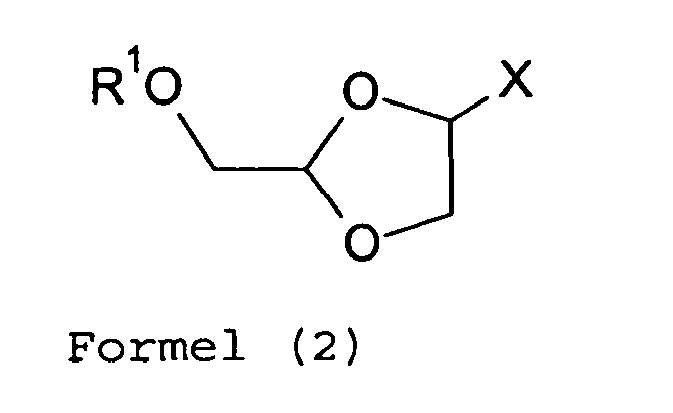
X für eine Abgangsgruppe steht
mit einem 2,6-Diaminopurinderivat der allgemeinen Formel (5)
R12 für einen Silylrest steht
in Gegenwart einer Lewis-Säure, dadurch gekennzeichnet, dass
zusätzlich eine 1,3-Dicarbonylverbindung oder ein silyliertes Derivat einer 1,3-Dicarbonylverbindung zugegen ist, wobei als 1,3-Dicarbonylverbindung ein β-Carbonylcarbonsäureester, ein 1,3-Diketon oder ein Malonsäurederivat mit 5 bis 20 C-Atomen der allgemeinen Formel (3) verwendet wird,
Y und Z unabhängig voneinander Wasserstoff, einen Alkylrest mit 1 bis 20 C-Atomen, einen Arylrest mit 6 bis 20 C-Atomen oder eine Alkyloxygruppe mit 1 bis 20 C-Atomen und
R2 und R3 unabhängig voneinander Wasserstoff, einen Acylrest einer aromatischen oder aliphatischen Carbonsäure mit 2 bis 20 C-Atomen, einen Alkylrest mit 1 bis 20 C-Atomen oder einen Arylrest mit 6 bis 20 C-Atomen
bedeuten können. - Verfahren nach Anspruch 1, dadurch gekennzeichnet, dass die Verbindungen der allgemeinen Formel (1) in der optischen Konfiguration der allgemeinen Formeln (1a), (1b), (1c) oder (1d)


- Verfahren nach Anspruch 1 oder 2, dadurch gekennzeichnet, dass R1 ausgewählt wird aus der Gruppe enthaltend Acyl, Alkyl, Alkoxyalkyl, Arylalkyl, Arylalkoxyalkyl oder Silyl.
- Verfahren nach einem oder mehreren der Ansprüche 1 bis 3, dadurch gekennzeichnet, dass X ausgewählt wird aus der Gruppe enthaltend Halogen, Acyloxy, Alkylsulfonyloxy, Arylsulfonyloxy, Alkoxy oder Aryloxy.
- Verfahren nach einem oder mehreren der Ansprüche 1 bis 4, dadurch gekennzeichnet, dass als Lewis-Säure eine Verbindung ausgewählt aus der Gruppe enthaltend Trialkylsilylhalogenide oder Perfluoralkansulfonsäuretrialkylsilylester verwendet wird.
- Verfahren nach einem oder mehreren der Ansprüche 1 bis 5, dadurch gekennzeichnet, dass als silyliertes Derivat einer 1,3-Dicarbonylverbindung ein Silylderivat eines β-Carbonylcarbonsäureesters, eines 1,3-Diketons oder eines Malonsäurederivates der allgemeinen Formel (4) verwendet wird,

Y, Z und R3 die Bedeutung nach Anspruch 1 haben und
R4, R5 und R6 unabhängig voneinander einen aliphatischen oder aromatischen Rest mit 1 bis 20 C-Atomen bedeuten können. - Verfahren nach einem oder mehreren der Ansprüche 1 bis 6, dadurch gekennzeichnet, dass die Aminoschutzgruppen ausgewählt werden aus der Gruppe enthaltend Acylreste, Acyloxycarbonylreste, Alkylreste, Arylalkylreste oder Silylreste.
- Verfahren nach einem oder mehreren der Ansprüche 1 bis 7, dadurch gekennzeichnet, dass die erhaltenen Verbindungen der allgemeinen Formel (1) anschließend durch Umkristallisation gereinigt werden.
- Verfahren nach einem oder mehreren der Ansprüche 1 bis 8, dadurch gekennzeichnet, dass die erhaltenen Verbindungen der allgemeinen Formel (1) durch Abspaltung der Schutzgruppen zu Verbindungen der allgemeinen Formel (6)

Applications Claiming Priority (2)
| Application Number | Priority Date | Filing Date | Title |
|---|---|---|---|
| DE10335061A DE10335061B4 (de) | 2003-07-31 | 2003-07-31 | Verfahren zur Herstellung von OH-geschützten [4-(2,6-damino-9H-purin-9-yl)-1,3-dioxolan-2-yl]methanol-Derivaten |
| PCT/EP2004/008197 WO2005012302A1 (de) | 2003-07-31 | 2004-07-22 | Verfahren zur herstellung von oh-geschützten [4-(2,6-diamino-9h-purin-9-yl)- 1,3-dioxolan-2-yl]methanol-derivaten |
Publications (2)
| Publication Number | Publication Date |
|---|---|
| EP1648894A1 EP1648894A1 (de) | 2006-04-26 |
| EP1648894B1 true EP1648894B1 (de) | 2007-09-12 |
Family
ID=34111788
Family Applications (1)
| Application Number | Title | Priority Date | Filing Date |
|---|---|---|---|
| EP04741219A Expired - Lifetime EP1648894B1 (de) | 2003-07-31 | 2004-07-22 | Verfahren zur herstellung von oh-geschützten [4-(2,6-diamino-9h-purin-9-yl)-1,3-dioxolan-2-yl]methanol-derivaten |
Country Status (7)
| Country | Link |
|---|---|
| US (1) | US7560550B2 (de) |
| EP (1) | EP1648894B1 (de) |
| JP (1) | JP4518422B2 (de) |
| AT (1) | ATE373001T1 (de) |
| DE (2) | DE10335061B4 (de) |
| ES (1) | ES2290728T3 (de) |
| WO (1) | WO2005012302A1 (de) |
Families Citing this family (17)
| Publication number | Priority date | Publication date | Assignee | Title |
|---|---|---|---|---|
| BRPI0618901A2 (pt) * | 2005-11-22 | 2011-09-13 | Aromagen Corp | cetais de glicerol levulinatos e seus usos |
| BRPI0813036A2 (pt) * | 2007-07-30 | 2017-10-24 | Rfs Pharma Llc | processo estereosseletivo para preparar derivados do nucleosídeo dioxolana de purina. |
| EP2367811A1 (de) * | 2008-09-25 | 2011-09-28 | Segetis, Inc. | Ketalesterderivate |
| CN102459219A (zh) | 2009-06-22 | 2012-05-16 | 赛格提斯公司 | 缩酮化合物及其用途 |
| US20110300083A1 (en) | 2010-05-10 | 2011-12-08 | Segetis, Inc. | Personal care formulations containing alkyl ketal esters and methods of manufacture |
| US9074065B2 (en) | 2010-08-12 | 2015-07-07 | Segetis, Inc. | Latex coating compositions including carboxy ester ketal coalescents, methods of manufacture, and uses thereof |
| AU2011289224B2 (en) | 2010-08-12 | 2015-04-16 | Gfbiochemicals Limited | Carboxy ester ketal removal compositions, methods of manufacture, and uses thereof |
| WO2012054505A2 (en) | 2010-10-18 | 2012-04-26 | Segetis, Inc. | Water reducible coating compositions including carboxy ester ketals, methods of manufacture, and uses thereof |
| WO2014047428A1 (en) | 2012-09-21 | 2014-03-27 | Segetis, Inc. | Cleaning, surfactant, and personal care compositions |
| WO2014085609A1 (en) | 2012-11-29 | 2014-06-05 | Segetis, Inc. | Carboxy ester ketals, methods of manufacture, and uses thereof |
| GEP20217282B (en) | 2015-03-06 | 2021-08-10 | Atea Pharmaceuticals Inc | β-D-2'-DEOXY-2'α-FLUORO-2'-β-C-SUBSTITUTED-2-MODIFIED-N6-SUBSTITUTED PURINE NUCLEOTIDES FOR HCV TREATMENT |
| WO2018013937A1 (en) | 2016-07-14 | 2018-01-18 | Atea Pharmaceuticals, Inc. | Beta-d-2'-deoxy-2'-alpha-fluoro-2'-beta-c-substituted-4'-fluoro-n6-substituted-6-amino-2-substituted purine nucleotides for the treatment of hepatitis c virus infection |
| PT3512863T (pt) | 2016-09-07 | 2022-03-09 | Atea Pharmaceuticals Inc | Nucleótidos de purina 2'-substituídos-n6-substituídos para tratamento de vírus de rna |
| CN110248951B (zh) | 2017-02-01 | 2022-10-28 | 阿堤亚制药公司 | 用于治疗丙型肝炎病毒的核苷酸半硫酸盐 |
| WO2019200005A1 (en) | 2018-04-10 | 2019-10-17 | Atea Pharmaceuticals, Inc. | Treatment of hcv infected patients with cirrhosis |
| US10874687B1 (en) | 2020-02-27 | 2020-12-29 | Atea Pharmaceuticals, Inc. | Highly active compounds against COVID-19 |
| BR112023026356A2 (pt) | 2021-06-17 | 2024-03-05 | Atea Pharmaceuticals Inc | Método para tratar vírus da hepatite c ou uma condição resultante de uma infecção por hepatite c, combinação, uso da combinação, composição farmacêutica, e, kit para o tratamento de vírus da hepatite c |
Family Cites Families (11)
| Publication number | Priority date | Publication date | Assignee | Title |
|---|---|---|---|---|
| NZ228645A (en) * | 1988-04-11 | 1991-09-25 | Iaf Biochem Int | 1,3-dioxolane derivatives substituted in the 5th position by a purine or pyrimidine radical; treatment of viral infections |
| US6903224B2 (en) * | 1988-04-11 | 2005-06-07 | Biochem Pharma Inc. | Substituted 1,3-oxathiolanes |
| US5276151A (en) | 1990-02-01 | 1994-01-04 | Emory University | Method of synthesis of 1,3-dioxolane nucleosides |
| US5179104A (en) * | 1990-12-05 | 1993-01-12 | University Of Georgia Research Foundation, Inc. | Process for the preparation of enantiomerically pure β-D-(-)-dioxolane-nucleosides |
| US5444063A (en) * | 1990-12-05 | 1995-08-22 | Emory University | Enantiomerically pure β-D-dioxolane nucleosides with selective anti-Hepatitis B virus activity |
| US5428176A (en) * | 1994-04-14 | 1995-06-27 | Eli Lilly And Company | Process for preparing 2,2-difluoroketene silyl O,S-acetals and α,α-difluoro-β-silyloxy-1,3-dioxolane-4-propanoic acid O,S-esters |
| GB9525606D0 (en) * | 1995-12-14 | 1996-02-14 | Iaf Biochem Int | Method and compositions for the synthesis of dioxolane nucleosides with - configuration |
| DK1140937T3 (da) * | 1998-12-23 | 2004-03-22 | Shire Biochem Inc | Antivirale nucleosid-analoger |
| WO2000047759A1 (en) * | 1999-02-11 | 2000-08-17 | Shire Biochem Inc. | Stereoselective synthesis of nucleoside analogues |
| AU1262001A (en) * | 1999-11-04 | 2001-05-14 | Biochem Pharma Inc. | Method for the treatment or prevention of flaviviridae viral infection using nucleoside analogues |
| CA2399062C (en) * | 2000-02-11 | 2010-01-12 | Shire Biochem Inc. | Stereoselective synthesis of nucleoside analogues |
-
2003
- 2003-07-31 DE DE10335061A patent/DE10335061B4/de not_active Expired - Fee Related
-
2004
- 2004-07-22 AT AT04741219T patent/ATE373001T1/de not_active IP Right Cessation
- 2004-07-22 WO PCT/EP2004/008197 patent/WO2005012302A1/de not_active Ceased
- 2004-07-22 DE DE502004004970T patent/DE502004004970D1/de not_active Expired - Lifetime
- 2004-07-22 EP EP04741219A patent/EP1648894B1/de not_active Expired - Lifetime
- 2004-07-22 ES ES04741219T patent/ES2290728T3/es not_active Expired - Lifetime
- 2004-07-22 US US10/595,067 patent/US7560550B2/en not_active Expired - Fee Related
- 2004-07-22 JP JP2006521481A patent/JP4518422B2/ja not_active Expired - Fee Related
Also Published As
| Publication number | Publication date |
|---|---|
| ES2290728T3 (es) | 2008-02-16 |
| WO2005012302A1 (de) | 2005-02-10 |
| US20060211855A1 (en) | 2006-09-21 |
| EP1648894A1 (de) | 2006-04-26 |
| DE10335061A1 (de) | 2005-03-17 |
| ATE373001T1 (de) | 2007-09-15 |
| US7560550B2 (en) | 2009-07-14 |
| JP2007533598A (ja) | 2007-11-22 |
| DE502004004970D1 (de) | 2007-10-25 |
| JP4518422B2 (ja) | 2010-08-04 |
| DE10335061B4 (de) | 2005-11-17 |
Similar Documents
| Publication | Publication Date | Title |
|---|---|---|
| DE10335061B4 (de) | Verfahren zur Herstellung von OH-geschützten [4-(2,6-damino-9H-purin-9-yl)-1,3-dioxolan-2-yl]methanol-Derivaten | |
| DE69620042T2 (de) | Verfahren und zusammensetzungen zur synthese von dioxolan-nukleoside mit beta-struktur | |
| DE69510347T2 (de) | Verfahren zu diastereoselektiven herstellung von nucleosid analoga | |
| DE69233014T2 (de) | Verfahren für die herstellung von antiviralen substituierten 1, 3-oxathiolanen | |
| EP3483161B1 (de) | Zwischenprodukte für die synthese von entecavir | |
| DE68929277T2 (de) | Verfahren zur Herstellung von Purinderivaten | |
| SK129393A3 (en) | Processes for the diastereoselective synthesis of optical active cis-nucleosides and their analogues and derivatives | |
| DE69229492T2 (de) | Verfahren zur Herstellung von azyklischen Nukleosiden | |
| Chong et al. | A divergent synthesis of d-and l-carbocyclic 4′-fluoro-2′, 3′-dideoxynucleosides as potential antiviral agents | |
| DE69509182T2 (de) | Herstellung N-9-substituierter Guanin-Verbindungen | |
| DE69206893T2 (de) | Nucleosidderivate und deren Herstellung | |
| EP4153569A1 (de) | Verfahren zur herstellung von butyl-(5s)-5-({2-[4-(butoxycarbonyl)phenyl]ethyl}[2-(2-{[3-chlor-4'-(trifluormethyl)[biphenyl]-4-yl]methoxy}phenyl)ethyl]amino)-5,6,7,8-tetrahydrochinolin-2-carboxylat | |
| DE60204859T2 (de) | Verfahren zur Herstellung von 2'-Halo-beta-L-arabino-furanosylnucleosiden | |
| DE102004025072A1 (de) | Verfahren zur Herstellung von Diphenyl-azetidinon-Derivaten | |
| DE3508356C2 (de) | ||
| DE69027084T2 (de) | Verfahren zur Herstellung von Purinverbindungen | |
| EP0814078B1 (de) | Herstellung von Polyenestern und -säuren | |
| EP1781677A1 (de) | Verfahren zur herstellung eines d-erythro-2,2-difluor-2-desoxy-1-oxoribosederivats | |
| US5220003A (en) | Process for the synthesis of 2',3'-dideoxynucleosides | |
| WO1994029301A1 (en) | Stereoselective synthesis of nucleoside analogues using bicyclic intermediate | |
| DE2420474C3 (de) | ||
| DE60011787T2 (de) | Carbocyclische nukleoside und verfahren zu deren herstellung | |
| EP1124805B1 (de) | Verfahren zur herstellung von 4-[(2',5'-diamino-6'-halogenpyrimidin-4'-yl)amino]-cyclopent-2-enylmethanolen | |
| DE69628424T2 (de) | Verfahren zur herstellung von nukleosid-analogen | |
| US20050171126A1 (en) | Process for the production of purine nucleoside compounds |
Legal Events
| Date | Code | Title | Description |
|---|---|---|---|
| PUAI | Public reference made under article 153(3) epc to a published international application that has entered the european phase |
Free format text: ORIGINAL CODE: 0009012 |
|
| 17P | Request for examination filed |
Effective date: 20060119 |
|
| AK | Designated contracting states |
Kind code of ref document: A1 Designated state(s): AT BE BG CH CY CZ DE DK EE ES FI FR GB GR HU IE IT LI LU MC NL PL PT RO SE SI SK TR |
|
| 17Q | First examination report despatched |
Effective date: 20060629 |
|
| DAX | Request for extension of the european patent (deleted) | ||
| 17Q | First examination report despatched |
Effective date: 20060629 |
|
| GRAP | Despatch of communication of intention to grant a patent |
Free format text: ORIGINAL CODE: EPIDOSNIGR1 |
|
| GRAS | Grant fee paid |
Free format text: ORIGINAL CODE: EPIDOSNIGR3 |
|
| GRAA | (expected) grant |
Free format text: ORIGINAL CODE: 0009210 |
|
| AK | Designated contracting states |
Kind code of ref document: B1 Designated state(s): AT BE BG CH CY CZ DE DK EE ES FI FR GB GR HU IE IT LI LU MC NL PL PT RO SE SI SK TR |
|
| REG | Reference to a national code |
Ref country code: GB Ref legal event code: FG4D Free format text: NOT ENGLISH |
|
| REG | Reference to a national code |
Ref country code: CH Ref legal event code: EP |
|
| REF | Corresponds to: |
Ref document number: 502004004970 Country of ref document: DE Date of ref document: 20071025 Kind code of ref document: P |
|
| REG | Reference to a national code |
Ref country code: IE Ref legal event code: FG4D Free format text: LANGUAGE OF EP DOCUMENT: GERMAN |
|
| GBT | Gb: translation of ep patent filed (gb section 77(6)(a)/1977) |
Effective date: 20071024 |
|
| ET | Fr: translation filed | ||
| PG25 | Lapsed in a contracting state [announced via postgrant information from national office to epo] |
Ref country code: FI Free format text: LAPSE BECAUSE OF FAILURE TO SUBMIT A TRANSLATION OF THE DESCRIPTION OR TO PAY THE FEE WITHIN THE PRESCRIBED TIME-LIMIT Effective date: 20070912 |
|
| REG | Reference to a national code |
Ref country code: ES Ref legal event code: FG2A Ref document number: 2290728 Country of ref document: ES Kind code of ref document: T3 |
|
| PG25 | Lapsed in a contracting state [announced via postgrant information from national office to epo] |
Ref country code: PL Free format text: LAPSE BECAUSE OF FAILURE TO SUBMIT A TRANSLATION OF THE DESCRIPTION OR TO PAY THE FEE WITHIN THE PRESCRIBED TIME-LIMIT Effective date: 20070912 |
|
| NLV1 | Nl: lapsed or annulled due to failure to fulfill the requirements of art. 29p and 29m of the patents act | ||
| PG25 | Lapsed in a contracting state [announced via postgrant information from national office to epo] |
Ref country code: NL Free format text: LAPSE BECAUSE OF FAILURE TO SUBMIT A TRANSLATION OF THE DESCRIPTION OR TO PAY THE FEE WITHIN THE PRESCRIBED TIME-LIMIT Effective date: 20070912 Ref country code: GR Free format text: LAPSE BECAUSE OF FAILURE TO SUBMIT A TRANSLATION OF THE DESCRIPTION OR TO PAY THE FEE WITHIN THE PRESCRIBED TIME-LIMIT Effective date: 20071213 |
|
| PG25 | Lapsed in a contracting state [announced via postgrant information from national office to epo] |
Ref country code: PT Free format text: LAPSE BECAUSE OF FAILURE TO SUBMIT A TRANSLATION OF THE DESCRIPTION OR TO PAY THE FEE WITHIN THE PRESCRIBED TIME-LIMIT Effective date: 20080212 Ref country code: SK Free format text: LAPSE BECAUSE OF FAILURE TO SUBMIT A TRANSLATION OF THE DESCRIPTION OR TO PAY THE FEE WITHIN THE PRESCRIBED TIME-LIMIT Effective date: 20070912 Ref country code: CZ Free format text: LAPSE BECAUSE OF FAILURE TO SUBMIT A TRANSLATION OF THE DESCRIPTION OR TO PAY THE FEE WITHIN THE PRESCRIBED TIME-LIMIT Effective date: 20070912 |
|
| PG25 | Lapsed in a contracting state [announced via postgrant information from national office to epo] |
Ref country code: SE Free format text: LAPSE BECAUSE OF FAILURE TO SUBMIT A TRANSLATION OF THE DESCRIPTION OR TO PAY THE FEE WITHIN THE PRESCRIBED TIME-LIMIT Effective date: 20071212 Ref country code: RO Free format text: LAPSE BECAUSE OF FAILURE TO SUBMIT A TRANSLATION OF THE DESCRIPTION OR TO PAY THE FEE WITHIN THE PRESCRIBED TIME-LIMIT Effective date: 20070912 |
|
| PLBE | No opposition filed within time limit |
Free format text: ORIGINAL CODE: 0009261 |
|
| STAA | Information on the status of an ep patent application or granted ep patent |
Free format text: STATUS: NO OPPOSITION FILED WITHIN TIME LIMIT |
|
| PG25 | Lapsed in a contracting state [announced via postgrant information from national office to epo] |
Ref country code: DK Free format text: LAPSE BECAUSE OF FAILURE TO SUBMIT A TRANSLATION OF THE DESCRIPTION OR TO PAY THE FEE WITHIN THE PRESCRIBED TIME-LIMIT Effective date: 20070912 |
|
| 26N | No opposition filed |
Effective date: 20080613 |
|
| REG | Reference to a national code |
Ref country code: CH Ref legal event code: PL |
|
| PG25 | Lapsed in a contracting state [announced via postgrant information from national office to epo] |
Ref country code: MC Free format text: LAPSE BECAUSE OF NON-PAYMENT OF DUE FEES Effective date: 20080731 |
|
| PG25 | Lapsed in a contracting state [announced via postgrant information from national office to epo] |
Ref country code: EE Free format text: LAPSE BECAUSE OF FAILURE TO SUBMIT A TRANSLATION OF THE DESCRIPTION OR TO PAY THE FEE WITHIN THE PRESCRIBED TIME-LIMIT Effective date: 20070912 |
|
| PG25 | Lapsed in a contracting state [announced via postgrant information from national office to epo] |
Ref country code: CH Free format text: LAPSE BECAUSE OF NON-PAYMENT OF DUE FEES Effective date: 20080731 Ref country code: LI Free format text: LAPSE BECAUSE OF NON-PAYMENT OF DUE FEES Effective date: 20080731 Ref country code: SI Free format text: LAPSE BECAUSE OF FAILURE TO SUBMIT A TRANSLATION OF THE DESCRIPTION OR TO PAY THE FEE WITHIN THE PRESCRIBED TIME-LIMIT Effective date: 20070912 |
|
| PG25 | Lapsed in a contracting state [announced via postgrant information from national office to epo] |
Ref country code: CY Free format text: LAPSE BECAUSE OF FAILURE TO SUBMIT A TRANSLATION OF THE DESCRIPTION OR TO PAY THE FEE WITHIN THE PRESCRIBED TIME-LIMIT Effective date: 20070912 |
|
| PG25 | Lapsed in a contracting state [announced via postgrant information from national office to epo] |
Ref country code: BG Free format text: LAPSE BECAUSE OF FAILURE TO SUBMIT A TRANSLATION OF THE DESCRIPTION OR TO PAY THE FEE WITHIN THE PRESCRIBED TIME-LIMIT Effective date: 20071212 |
|
| PG25 | Lapsed in a contracting state [announced via postgrant information from national office to epo] |
Ref country code: AT Free format text: LAPSE BECAUSE OF NON-PAYMENT OF DUE FEES Effective date: 20080722 |
|
| PG25 | Lapsed in a contracting state [announced via postgrant information from national office to epo] |
Ref country code: LU Free format text: LAPSE BECAUSE OF NON-PAYMENT OF DUE FEES Effective date: 20080722 Ref country code: HU Free format text: LAPSE BECAUSE OF FAILURE TO SUBMIT A TRANSLATION OF THE DESCRIPTION OR TO PAY THE FEE WITHIN THE PRESCRIBED TIME-LIMIT Effective date: 20080313 Ref country code: BE Free format text: LAPSE BECAUSE OF NON-PAYMENT OF DUE FEES Effective date: 20080731 |
|
| PG25 | Lapsed in a contracting state [announced via postgrant information from national office to epo] |
Ref country code: TR Free format text: LAPSE BECAUSE OF FAILURE TO SUBMIT A TRANSLATION OF THE DESCRIPTION OR TO PAY THE FEE WITHIN THE PRESCRIBED TIME-LIMIT Effective date: 20070912 |
|
| PG25 | Lapsed in a contracting state [announced via postgrant information from national office to epo] |
Ref country code: IT Free format text: LAPSE BECAUSE OF NON-PAYMENT OF DUE FEES Effective date: 20100722 |
|
| PGRI | Patent reinstated in contracting state [announced from national office to epo] |
Ref country code: IT Effective date: 20110616 |
|
| PGFP | Annual fee paid to national office [announced via postgrant information from national office to epo] |
Ref country code: GB Payment date: 20120712 Year of fee payment: 9 Ref country code: IE Payment date: 20120725 Year of fee payment: 9 |
|
| PGFP | Annual fee paid to national office [announced via postgrant information from national office to epo] |
Ref country code: DE Payment date: 20120725 Year of fee payment: 9 Ref country code: IT Payment date: 20120723 Year of fee payment: 9 Ref country code: ES Payment date: 20120724 Year of fee payment: 9 Ref country code: FR Payment date: 20120802 Year of fee payment: 9 |
|
| GBPC | Gb: european patent ceased through non-payment of renewal fee |
Effective date: 20130722 |
|
| REG | Reference to a national code |
Ref country code: IE Ref legal event code: MM4A |
|
| REG | Reference to a national code |
Ref country code: DE Ref legal event code: R119 Ref document number: 502004004970 Country of ref document: DE Effective date: 20140201 |
|
| REG | Reference to a national code |
Ref country code: FR Ref legal event code: ST Effective date: 20140331 |
|
| PG25 | Lapsed in a contracting state [announced via postgrant information from national office to epo] |
Ref country code: DE Free format text: LAPSE BECAUSE OF NON-PAYMENT OF DUE FEES Effective date: 20140201 Ref country code: GB Free format text: LAPSE BECAUSE OF NON-PAYMENT OF DUE FEES Effective date: 20130722 |
|
| PG25 | Lapsed in a contracting state [announced via postgrant information from national office to epo] |
Ref country code: IT Free format text: LAPSE BECAUSE OF NON-PAYMENT OF DUE FEES Effective date: 20130722 Ref country code: FR Free format text: LAPSE BECAUSE OF NON-PAYMENT OF DUE FEES Effective date: 20130731 |
|
| PG25 | Lapsed in a contracting state [announced via postgrant information from national office to epo] |
Ref country code: IE Free format text: LAPSE BECAUSE OF NON-PAYMENT OF DUE FEES Effective date: 20130722 |
|
| REG | Reference to a national code |
Ref country code: ES Ref legal event code: FD2A Effective date: 20150709 |
|
| PG25 | Lapsed in a contracting state [announced via postgrant information from national office to epo] |
Ref country code: ES Free format text: LAPSE BECAUSE OF NON-PAYMENT OF DUE FEES Effective date: 20130723 |