EP1636788B1 - Transforming three color input signals to more color signals - Google Patents
Transforming three color input signals to more color signals Download PDFInfo
- Publication number
- EP1636788B1 EP1636788B1 EP04755281A EP04755281A EP1636788B1 EP 1636788 B1 EP1636788 B1 EP 1636788B1 EP 04755281 A EP04755281 A EP 04755281A EP 04755281 A EP04755281 A EP 04755281A EP 1636788 B1 EP1636788 B1 EP 1636788B1
- Authority
- EP
- European Patent Office
- Prior art keywords
- color
- signals
- signal
- display
- primary
- Prior art date
- Legal status (The legal status is an assumption and is not a legal conclusion. Google has not performed a legal analysis and makes no representation as to the accuracy of the status listed.)
- Expired - Lifetime
Links
- 230000001131 transforming effect Effects 0.000 title claims description 7
- 238000000034 method Methods 0.000 claims description 71
- 238000012952 Resampling Methods 0.000 claims description 27
- 230000009466 transformation Effects 0.000 claims description 8
- 238000012886 linear function Methods 0.000 claims description 5
- OAICVXFJPJFONN-UHFFFAOYSA-N Phosphorus Chemical compound [P] OAICVXFJPJFONN-UHFFFAOYSA-N 0.000 description 19
- 239000003086 colorant Substances 0.000 description 19
- 239000011159 matrix material Substances 0.000 description 19
- 238000005070 sampling Methods 0.000 description 15
- 238000010586 diagram Methods 0.000 description 8
- 238000010606 normalization Methods 0.000 description 8
- 230000008569 process Effects 0.000 description 7
- 238000004364 calculation method Methods 0.000 description 6
- 238000006243 chemical reaction Methods 0.000 description 6
- 239000000654 additive Substances 0.000 description 5
- 230000000996 additive effect Effects 0.000 description 5
- 238000004422 calculation algorithm Methods 0.000 description 5
- 239000004973 liquid crystal related substance Substances 0.000 description 5
- 238000012545 processing Methods 0.000 description 4
- 238000004458 analytical method Methods 0.000 description 3
- 238000013459 approach Methods 0.000 description 3
- 210000003127 knee Anatomy 0.000 description 3
- 239000000463 material Substances 0.000 description 3
- 230000008901 benefit Effects 0.000 description 2
- 230000003247 decreasing effect Effects 0.000 description 2
- 230000001419 dependent effect Effects 0.000 description 2
- 230000000694 effects Effects 0.000 description 2
- 238000005286 illumination Methods 0.000 description 2
- 238000013507 mapping Methods 0.000 description 2
- 230000004048 modification Effects 0.000 description 2
- 238000012986 modification Methods 0.000 description 2
- 238000009877 rendering Methods 0.000 description 2
- 230000032683 aging Effects 0.000 description 1
- 230000002238 attenuated effect Effects 0.000 description 1
- 230000003190 augmentative effect Effects 0.000 description 1
- 230000008859 change Effects 0.000 description 1
- 238000012937 correction Methods 0.000 description 1
- 230000007423 decrease Effects 0.000 description 1
- 238000013461 design Methods 0.000 description 1
- 230000004069 differentiation Effects 0.000 description 1
- 230000003292 diminished effect Effects 0.000 description 1
- 238000005516 engineering process Methods 0.000 description 1
- 239000005262 ferroelectric liquid crystals (FLCs) Substances 0.000 description 1
- 230000002431 foraging effect Effects 0.000 description 1
- 238000003384 imaging method Methods 0.000 description 1
- 238000004519 manufacturing process Methods 0.000 description 1
- 238000005457 optimization Methods 0.000 description 1
- 239000011368 organic material Substances 0.000 description 1
- 238000003672 processing method Methods 0.000 description 1
- 230000004044 response Effects 0.000 description 1
- 238000004088 simulation Methods 0.000 description 1
- 238000001228 spectrum Methods 0.000 description 1
- 238000003860 storage Methods 0.000 description 1
- 239000000758 substrate Substances 0.000 description 1
- 238000000844 transformation Methods 0.000 description 1
- 230000000007 visual effect Effects 0.000 description 1
Images






Classifications
-
- G—PHYSICS
- G09—EDUCATION; CRYPTOGRAPHY; DISPLAY; ADVERTISING; SEALS
- G09G—ARRANGEMENTS OR CIRCUITS FOR CONTROL OF INDICATING DEVICES USING STATIC MEANS TO PRESENT VARIABLE INFORMATION
- G09G3/00—Control arrangements or circuits, of interest only in connection with visual indicators other than cathode-ray tubes
- G09G3/20—Control arrangements or circuits, of interest only in connection with visual indicators other than cathode-ray tubes for presentation of an assembly of a number of characters, e.g. a page, by composing the assembly by combination of individual elements arranged in a matrix no fixed position being assigned to or needed to be assigned to the individual characters or partial characters
- G09G3/22—Control arrangements or circuits, of interest only in connection with visual indicators other than cathode-ray tubes for presentation of an assembly of a number of characters, e.g. a page, by composing the assembly by combination of individual elements arranged in a matrix no fixed position being assigned to or needed to be assigned to the individual characters or partial characters using controlled light sources
- G09G3/30—Control arrangements or circuits, of interest only in connection with visual indicators other than cathode-ray tubes for presentation of an assembly of a number of characters, e.g. a page, by composing the assembly by combination of individual elements arranged in a matrix no fixed position being assigned to or needed to be assigned to the individual characters or partial characters using controlled light sources using electroluminescent panels
- G09G3/32—Control arrangements or circuits, of interest only in connection with visual indicators other than cathode-ray tubes for presentation of an assembly of a number of characters, e.g. a page, by composing the assembly by combination of individual elements arranged in a matrix no fixed position being assigned to or needed to be assigned to the individual characters or partial characters using controlled light sources using electroluminescent panels semiconductive, e.g. using light-emitting diodes [LED]
- G09G3/3208—Control arrangements or circuits, of interest only in connection with visual indicators other than cathode-ray tubes for presentation of an assembly of a number of characters, e.g. a page, by composing the assembly by combination of individual elements arranged in a matrix no fixed position being assigned to or needed to be assigned to the individual characters or partial characters using controlled light sources using electroluminescent panels semiconductive, e.g. using light-emitting diodes [LED] organic, e.g. using organic light-emitting diodes [OLED]
-
- G—PHYSICS
- G09—EDUCATION; CRYPTOGRAPHY; DISPLAY; ADVERTISING; SEALS
- G09G—ARRANGEMENTS OR CIRCUITS FOR CONTROL OF INDICATING DEVICES USING STATIC MEANS TO PRESENT VARIABLE INFORMATION
- G09G5/00—Control arrangements or circuits for visual indicators common to cathode-ray tube indicators and other visual indicators
- G09G5/02—Control arrangements or circuits for visual indicators common to cathode-ray tube indicators and other visual indicators characterised by the way in which colour is displayed
-
- G—PHYSICS
- G09—EDUCATION; CRYPTOGRAPHY; DISPLAY; ADVERTISING; SEALS
- G09G—ARRANGEMENTS OR CIRCUITS FOR CONTROL OF INDICATING DEVICES USING STATIC MEANS TO PRESENT VARIABLE INFORMATION
- G09G3/00—Control arrangements or circuits, of interest only in connection with visual indicators other than cathode-ray tubes
- G09G3/20—Control arrangements or circuits, of interest only in connection with visual indicators other than cathode-ray tubes for presentation of an assembly of a number of characters, e.g. a page, by composing the assembly by combination of individual elements arranged in a matrix no fixed position being assigned to or needed to be assigned to the individual characters or partial characters
-
- G—PHYSICS
- G09—EDUCATION; CRYPTOGRAPHY; DISPLAY; ADVERTISING; SEALS
- G09G—ARRANGEMENTS OR CIRCUITS FOR CONTROL OF INDICATING DEVICES USING STATIC MEANS TO PRESENT VARIABLE INFORMATION
- G09G3/00—Control arrangements or circuits, of interest only in connection with visual indicators other than cathode-ray tubes
- G09G3/20—Control arrangements or circuits, of interest only in connection with visual indicators other than cathode-ray tubes for presentation of an assembly of a number of characters, e.g. a page, by composing the assembly by combination of individual elements arranged in a matrix no fixed position being assigned to or needed to be assigned to the individual characters or partial characters
- G09G3/22—Control arrangements or circuits, of interest only in connection with visual indicators other than cathode-ray tubes for presentation of an assembly of a number of characters, e.g. a page, by composing the assembly by combination of individual elements arranged in a matrix no fixed position being assigned to or needed to be assigned to the individual characters or partial characters using controlled light sources
- G09G3/30—Control arrangements or circuits, of interest only in connection with visual indicators other than cathode-ray tubes for presentation of an assembly of a number of characters, e.g. a page, by composing the assembly by combination of individual elements arranged in a matrix no fixed position being assigned to or needed to be assigned to the individual characters or partial characters using controlled light sources using electroluminescent panels
-
- G—PHYSICS
- G09—EDUCATION; CRYPTOGRAPHY; DISPLAY; ADVERTISING; SEALS
- G09G—ARRANGEMENTS OR CIRCUITS FOR CONTROL OF INDICATING DEVICES USING STATIC MEANS TO PRESENT VARIABLE INFORMATION
- G09G3/00—Control arrangements or circuits, of interest only in connection with visual indicators other than cathode-ray tubes
- G09G3/20—Control arrangements or circuits, of interest only in connection with visual indicators other than cathode-ray tubes for presentation of an assembly of a number of characters, e.g. a page, by composing the assembly by combination of individual elements arranged in a matrix no fixed position being assigned to or needed to be assigned to the individual characters or partial characters
- G09G3/22—Control arrangements or circuits, of interest only in connection with visual indicators other than cathode-ray tubes for presentation of an assembly of a number of characters, e.g. a page, by composing the assembly by combination of individual elements arranged in a matrix no fixed position being assigned to or needed to be assigned to the individual characters or partial characters using controlled light sources
- G09G3/30—Control arrangements or circuits, of interest only in connection with visual indicators other than cathode-ray tubes for presentation of an assembly of a number of characters, e.g. a page, by composing the assembly by combination of individual elements arranged in a matrix no fixed position being assigned to or needed to be assigned to the individual characters or partial characters using controlled light sources using electroluminescent panels
- G09G3/32—Control arrangements or circuits, of interest only in connection with visual indicators other than cathode-ray tubes for presentation of an assembly of a number of characters, e.g. a page, by composing the assembly by combination of individual elements arranged in a matrix no fixed position being assigned to or needed to be assigned to the individual characters or partial characters using controlled light sources using electroluminescent panels semiconductive, e.g. using light-emitting diodes [LED]
-
- G—PHYSICS
- G09—EDUCATION; CRYPTOGRAPHY; DISPLAY; ADVERTISING; SEALS
- G09G—ARRANGEMENTS OR CIRCUITS FOR CONTROL OF INDICATING DEVICES USING STATIC MEANS TO PRESENT VARIABLE INFORMATION
- G09G2300/00—Aspects of the constitution of display devices
- G09G2300/04—Structural and physical details of display devices
- G09G2300/0439—Pixel structures
- G09G2300/0452—Details of colour pixel setup, e.g. pixel composed of a red, a blue and two green components
-
- G—PHYSICS
- G09—EDUCATION; CRYPTOGRAPHY; DISPLAY; ADVERTISING; SEALS
- G09G—ARRANGEMENTS OR CIRCUITS FOR CONTROL OF INDICATING DEVICES USING STATIC MEANS TO PRESENT VARIABLE INFORMATION
- G09G2320/00—Control of display operating conditions
- G09G2320/04—Maintaining the quality of display appearance
- G09G2320/043—Preventing or counteracting the effects of ageing
-
- G—PHYSICS
- G09—EDUCATION; CRYPTOGRAPHY; DISPLAY; ADVERTISING; SEALS
- G09G—ARRANGEMENTS OR CIRCUITS FOR CONTROL OF INDICATING DEVICES USING STATIC MEANS TO PRESENT VARIABLE INFORMATION
- G09G2340/00—Aspects of display data processing
- G09G2340/06—Colour space transformation
Definitions
- the present invention relates to color processing three color image signals for display on a color OLED display having four or more color primaries.
- Additive color digital image display devices are well known and are based upon a variety of technologies such as cathode ray tubes, liquid crystal modulators, and solid-state light emitters such as Organic Light Emitting Diodes (OLEDs).
- OLEDs Organic Light Emitting Diodes
- a pixel includes red, green, and blue colored OLEDs. These light emitting color primaries define a color gamut, and by additively combining the illumination from each of these three OLEDs, i.e. with the integrative capabilities of the human visual system, a wide variety of colors can be achieved.
- OLEDs may be used to generate color directly using organic materials that are doped to emit energy in desired portions of the electromagnetic spectrum, or alternatively, broadband emitting (apparently white) OLEDs may be attenuated with color filters to achieve red, green and blue.
- images and other data destined for display on a color display device are typically stored and/or transmitted in three channels, that is, having three signals corresponding to a standard (e.g. sRGB) or specific (e.g. measured CRT phosphors) set of primaries. It is also important to recognize that this data is typically sampled to assume a particular spatial arrangement of light emitting elements. In an OLED display device these light emitting elements are typically arranged side by side on a plane. Therefore if incoming image data is sampled for display on a three color display device, the data will also have to be resampled for display on a display having four OLEDs per pixel rather than the three OLEDs used in a three channel display device.
- a standard e.g. sRGB
- specific e.g. measured CRT phosphors
- Lee et al. calculates the white signal as the minimum of the red, green, and blue signals, then scale the red, green, and blue signals to correct some, but not all, color errors, with the goal of luminance enhancement paramount.
- the method of Lee et al. suffers from the same color inaccuracy as that of Morgan and no reference is made to spatially resampling of the incoming three color data to the array of red, green, blue and white elements.
- Tanioka In the field of ferroelectric liquid crystal displays, another method is presented by Tanioka in US 5,929,843, issued July 27, 1999 . Tanioka's method follows an algorithm analogous to the familiar CMYK approach, assigning the minimum of the R,G, and B signals to the W signal and subtracting the same from each of the R, G, and B signals. To avoid spatial artifacts, the method teaches a variable scale factor applied to the minimum signal that results in smoother colors at low luminance levels. Because of its similarity to the CMYK algorithm, it suffers from the same problem cited above, namely that a white pixel having a color different from that of the display white point will cause color errors. Similarly to Morgan et al. ( US 6,453,067 , referenced above), the color elements are typically projected to spatially overlap one another and so there is no need for spatial resampling of the data.
- OLED display devices differ significantly from the physics of devices used in printing, display devices typically used in field sequential color projection, and liquid crystal displays. These differences impose different constraints upon the method for transforming three color input signals. Among these differences is the ability of the OLED display device to turn off the illumination source on an OLED by OLED basis. This differs from devices typically used in field sequential display devices and liquid crystal displays since these devices typically modulate the light that is emitted from a large area light source that is maintained at a constant level. Further, it is well known in the field of OLED display devices that high drive current densities result in shorter OLED lifetimes. This same effect is not characteristic of devices applied in the beforementioned fields.
- OLED display devices While stacked OLED display devices have been discussed in the prior art, providing full color data at each visible spatial location, OLED display devices are commonly constructed from multiple colors of OLEDs that are arranged on a single plane. When displays provide color light emitting elements that have different spatial location, it is known to sample the data for the spatial arrangement. For example, US 5,341,153 issued August 23, 1994 to Benzschawel et al ., discusses a method for displaying a high resolution color image on a lower resolution liquid crystal display in which the light emitting elements of different colors have different spatial locations. Using this method, the spatial location and the area of the original image that is sampled to produce a signal for each light emitting element is considered when sampling the data to a format that provides sub-pixel rendering.
- the prior art also includes methods for resampling image data from one intended spatial arrangement of light emitting elements to a second spatial arrangement of light emitting elements.
- US Patent Application No. 2003/0034992A1 by Brown Elliott et al., published February 20, 2003 , discusses a method of resampling data that was intended for presentation on a display device having one spatial arrangement of light emitting elements having three colors to a display device having a different spatial arrangement of three color light emitting elements.
- this patent application discusses resampling three color data that was intended for presentation on a display device with a traditional arrangement of light emitting elements to three color data that is intended for presentation on a display device with an alternate arrangement of light emitting elements.
- this application does not discuss the conversion of data for presentation on a four or more color device.
- the need is met according to the present invention by providing a method for transforming three color input signals (R, G, B) corresponding to three gamut-defining color primaries to four color output signals (R', G', B', W) corresponding to the gamut-defining color primaries and one additional color primary W for driving a display having a white point different from W that includes the steps of: normalizing the color input signals (R,G,B) such that a combination of equal amounts in each signal produces a color having XYZ tristimulus values identical to those of the additional color primary to produce normalized color signals (Rn,Gn,Bn); calculating a common signal S that is a function F1 of the three normalized color signals (Rn,Gn,Bn); calculating a function F2 of the common signal S and adding it to each of the three normalized color signals (Rn,Gn,Bn) to provide three color signals (Rn',Gn',Bn'); normalizing the three color signals (Rn',Gn',B
- the present invention has the advantage of providing a transformation that preserves color accuracy in the display system when the additional OLED is not at the white point of the display. Additionally, according to one aspect of the invention, the transformation allows optimization of the mapping to preserve the lifetime of the OLED display device. The transformation also may provide a method of spatially reformatting the data to a desired spatial arrangement of OLEDs.
- the present invention is directed to a method for transforming three color input signals, bearing images or other data, to four or more color output signals for display on an additive display device having four or more color primaries.
- the present invention is useful, for example, for converting a standard 3-color RGB input color image signal to a four color signal for driving a four-color OLED display device having pixels made up of light emitting elements that each emit light of one of the four colors.
- Fig. 1 shows a 1931 CIE chromaticity diagram displaying hypothetical representations of the primaries of the four-color OLED display device.
- the red primary 2, green primary 4, and blue primary 6 define a color gamut, bounded by the triangle 8.
- the additional primary 10 is substantially white, because it is near the center of the diagram in this example, but it is not necessarily at the white point of the display.
- An alternative additional primary 12 is shown, outside the gamut 8, the use of which will be described later.
- a given display device has a white point, generally adjustable by hardware or software via methods known in the art, but fixed for the purposes of this example.
- the white point is the color resulting from the combination of three color primaries, in this example the red, green, and blue primaries, being driven to their highest addressable extent.
- the phosphor matrix converts intensities to XYZ tristimulus values, effectively modeling the additive color system that is the display, and in its inversion, converts XYZ tristimulus values to intensities.
- the intensity of a primary is herein defined as a value proportional to the luminance of that primary and scaled such that the combination of unit intensity of each of the three primaries produces a color stimulus having XYZ tristimulus values equal to those of the display white point. This definition also constrains the scaling of the terms of the phosphor matrix.
- I1 is the intensity of the red primary
- I2 is the intensity of the green primary
- I3 is the intensity of the blue primary.
- phosphor matrices are typically linear matrix transformations, but the concept of a phosphor matrix transform may be generalized to any transform or series of transforms that leads from intensities to XYZ tristimulus values, or vice-versa.
- the phosphor matrix may also be generalized to handle more than three primaries.
- the current example contains an additional primary with xy chromaticity coordinates (0.3405, 0.3530) - close to white, but not at the D65 white point.
- the additional primary has XYZ tristimulus values of (96.5, 100.0, 86.8).
- These three values may be appended to phosphor matrix M3 without modification to create a fourth column, although for convenience, the XYZ tristimulus values are scaled to the maximum values possible within the gamut defined by the red, green, and blue primaries.
- the value of a phosphor matrix lies in its inversion, which allows for the specification of a color in XYZ tristimulus values and results in the intensities required to produce that color on the display device.
- the color gamut limits the range of colors whose reproduction is possible, and out-of-gamut XYZ tristimulus specifications result in intensities outside the range [0,1].
- Known gamut-mapping techniques maybe applied to avoid this situation, but their use is tangential to the present invention and will not be discussed.
- the inversion is simple in the case of 3x3 phosphor matrix M3, but in the case of 3x4 phosphor matrix M4 it is not uniquely defined.
- the present invention provides a method for assigning intensity values for all four primary channels without requiring the inversion of the 3x4 phosphor matrix.
- the method of the present invention begins with color signals for the three gamut-defining primaries, in this example, intensities of the red, green, and blue primaries. These are reached either from a XYZ tristimulus value specification by the above described inversion of phosphor matrix M3 or by known methods of converting RGB, YCC, or other three-channel color signals, linearly or nonlinearly encoded, to intensities corresponding to the gamut-defining primaries and the display white point.
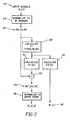
- Fig. 2 shows a flow diagram of the general steps in the method of the present invention.
- the three color input signals (R,G,B) 22 are first normalized 24 with respect to the additional primary W.
- the red, green, and blue intensities are normalized such that the combination of unit intensity of each produces a color stimulus having XYZ tristimulus values equal to those of the additional primary W. This is accomplished by scaling the red, green, and blue intensities, shown as a column vector, by the inverse of the intensities required to reproduce the color of the additional primary using the gamut-defining primaries: 1.010 0 0 0 1.000 0 0 0 1.400 ⁇
- R G B Rn Gn Bn
- the normalized signals (Rn,Gn,Bn) 26 are used to calculate 28 a common signal S that is a function F1 (Rn, Gn, Bn).
- the function F1 is a special minimum function which chooses the smallest non-negative signal of the three.
- the common signal S is used to calculate 30 the value of function F2(S).
- the output of function F2 is added 32 to the normalized color signals (Rn,Gn,Bn), resulting in normalized output signals (Rn',Gn',Bn') 34 corresponding to the original primary channels.
- These signals are normalized 36 to the display white point by scaling by the intensities required to reproduce the color of the additional primary using the gamut-defining primaries, resulting in the output signals (R',G',B') which correspond to the input color channels: 1.990 0 0 0 1.000 0 0 0 0.715 ⁇
- Rn ⁇ Gn ⁇ Bn ⁇ R ⁇ G ⁇ B ⁇
- the common signal S is used to calculate 40 the value of function F3(S).
- function F3 is simply the identity function.
- the output of function F3 is assigned to the output signal W 42, which is the color signal for the additional primary W.
- the four color output signals in this example are intensities and may be combined into a four-value vector (R',G',B',W), or in general (I1',I2',I3',I4').
- function F1 chooses the minimum non-negative signal
- the choice of functions F2 and F3 determine how accurate the color reproduction will be for in-gamut colors. If F2 and F3 are both linear functions, F2 having negative slope and F3 having positive slope, the effect is the subtraction of intensity from the red, green, and blue primaries and the addition of intensity to the additional primary. Further, when linear functions F2 and F3 have slopes equal in magnitude but opposite in sign, the intensity subtracted from the red, green, and blue primaries is completely accounted for by the intensity assigned to the additional primary, preserving accurate color reproduction and providing luminance identical to the three color system.
- functions F2 and F3 may be designed to vary according to the color represented by the color input signals. For example, they may become steeper as the luminance increases or the color saturation decreases, or they may change with respect to the hue of the color input signal (R,G,B).
- functions F2 and F3 There are many combinations of functions F2 and F3 that will provide color accuracy with different levels of utilization of the additional primary with respect to the gamut-defining primaries. Additionally, combinations of functions F2 and F3 exist that allow a trade of color accuracy in favor of luminance. Choice of these functions in the design or use of a display device will depend on its intended use and specifications.
- a portable OLED display device benefits greatly in terms of power efficiency, and thus battery life, with maximum utilization of an additional primary having a higher power efficiency than one or more of the gamut defining primaries.
- Use of such a display with a digital camera or other imaging device demands color accuracy as well, and the method of the present invention provides both.
- the normalization steps provided by the present invention allow for accurate reproduction of colors within the gamut of the display device regardless of the color of the additional primary.
- these normalization steps reduce to identity functions, and the method produces the same result as simple white replacement.
- the amount of color error introduced by ignoring the normalization steps depends largely on the difference in color between the additional primary and the display white point.
- Normalization is especially useful in the transformation of color signals for display in a display device having an additional primary outside the gamut defined by the gamut-defining primaries.
- the red and blue values are negative, and the green value is positive.
- the function F1 selects the green as the minimum non-negative value and the green is replaced in part or in total by intensity from the additional primary.
- the negatives are removed after the additional primary intensity is calculated by undoing the normalization: 1.000 0 0 0 - 0.709 0 0 0 0.648 ⁇
- Rn ⁇ Gn ⁇ Bn ⁇ R ⁇ G ⁇ B ⁇
- the normalization steps preserve color accuracy, clearly allowing white, near-white, or any other color to be used as an additional primary in an additive color display.
- the use of a white emitter near but not at the display white point is very feasible, as is the use of a second blue, a second green, a second red, or even a gamut-expanding emitter such as yellow or purple.
- Fig. 3 shows the characteristic curve for an OLED, illustrating its non-linear intensity response to code value.
- the curve has a knee 52 above which it is much more linear in appearance than below.
- Using code value to approximate intensity is probably a bad choice, but subtracting a constant (approximately 175 for the example shown in Fig. 3 ) to use the knee 52 shown, from the code value makes a much better approximation.
- This approximation may save processing time or hardware cost, because it replaces a lookup operation with simple addition.
- Utilizing the present invention to transform three color input signals to more than four color output signals requires successive application of the method shown in Fig. 2 .
- Each successive application of the method calculates the signal for one of the additional primaries, and the order of calculation is determined by the inverse of a priority specified for the primary. For example, consider an OLED display device having the red, green, and blue primaries already discussed, having chromaticities (0.637, 0.3592), (0.2690, 0.6508), and (0.1441, 0.1885) respectively, plus two additional primaries, one slightly yellow having chromaticities (0.3405, 0.3530) and the other slightly blue having chromaticities (0.2980, 0.3105). The additional primaries will be referred to as yellow and light blue, respectively.
- Prioritizing the additional primaries may take into account luminance stability over time, power efficiency, or other characteristics of the emitter.
- the yellow primary is more power efficient than the light blue primary, so the order of calculation proceeds with light blue first, then yellow.
- intensities for red, green, blue, and light blue have been calculated, one must be set aside to allow the method to transform the remaining three signals to four.
- the choice of the value to set aside may be arbitrary, but is best chosen to be the signal which was the source of the minimum calculated by function F1. If that signal was the green intensity, the method calculates the yellow intensity based on the red, blue, and light blue intensities. All five are brought together at the end: red, green, blue, light blue, and yellow intensities for display.
- a 3x5 phosphor matrix may be created to model their combination in the display device. This technique may easily be expanded to calculate signals for any number of additional primaries starting from three input color signals.
- the method described in Fig. 2 may be further modified to optimize the RGB to R'G'B'W conversion to better match the physical constraints of an OLED display device.
- Mathematical simulations performed by the authors to model the lifetime of an OLED display indicate that when the chromaticity coordinates of the white OLED is close to the chromaticity coordinates of the display white point, the lifetime of a white OLED that is the same size as the RGB OLEDs can be significantly shorter than the lifetime of the RGB OLEDs.
- the projected lifetime of the red, green, and blue OLEDs is more than twice as long as the projected lifetime of the white OLED under certain conditions. Since the lifetime of the display device is limited by the OLED with the shortest lifetime, it is important to provide a better balance between the lifetime of the four OLEDs that are used to generate the four primaries.
- Fig. 4 shows a curve of OLED lifetime as a function of current density. It is further known that the current density in a display is proportional to the current used to drive the OLED and the current is proportional to the luminance that is produced. Therefore, by avoiding using any of high intensities for any OLED, one can increase the lifetime of the OLED.
- the algorithm shown in Fig. 2 generally reduces the intensities of the R,G,B and increases the intensity of the W channel. This fact increases the lifetime of the red, green, and blue OLEDs but produces high intensities for the white OLED when the chromaticity coordinate of the white you are trying to generate is near the chromaticity coordinate of the white OLED.
- F2 and F3 may be defined to be nonlinear functions such that when the value of S is higher, F2 and F3 produce smaller absolute values than when S is lower. These functions may be described either mathematically or through a lookup table.
- a preferred lookup table would provide values of -S for F2 and S for F3 but a fraction of -S and S, respectively, when the value of S was higher than some threshold. By selecting the fraction and the cutoff value for S appropriately, a maximum intensity for W can be selected without loss of color accuracy. The maximum value for the intensity of W can then be chosen such that the lifetime of the white OLED is equivalent to the lifetime of the red, green, and blue OLEDs for the intended application.
- the normalization steps 24 and 36 of the RGB signals may also not be required. Alternatively, one may normalize 24 the RGB intensities to the white primary but not normalize 36 these values to the white point of the display.
- the method of the present invention can be implemented in the context of an image processing method that allows the incoming data to be spatially resampled to the RGBW pattern of OLEDs on the OLED display device.
- the three-color input signal is typically converted to a four (or more) color signal using a method such as the methods described above.
- a resampling is then performed to determine the appropriate intensities for the OLEDs within the four or more color display device. This resampling process may consider relevant display attributes, such as the sampling area, sampling location, and size of each intended OLED.
- This process may further include a step of determining the intended RGB display format for the input data. If this step determines that the image data has already been sampled for a display device having a particular spatial arrangement of OLEDs, a preliminary resampling can be performed that results in the three color input signals representing the same spatial location within a pixel. This preliminary step allows the subsequent three to four color transformation to determine four color values at each spatial location on the display device.
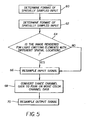
- FIG. 5 A process that may be used for resampling and transformation of the three color signal is shown in Fig. 5 .
- the process receives 60 three color input signals in linear intensities.
- the sample format of the spatially sampled input signal is determined 62. Once the sample format is determined, it is determined 64 if the signals for the three color input signals are rendered for OLEDs that have different spatial locations. If the data has been rendered for light emitting elements having different spatial locations, the optional step of resampling 66 the data to have three color information at each sampling location is then performed and may result in color values at each spatial position represented in the three color input signal, color values at each spatial position on the final display, or color values at other spatial locations
- the three color signal is then converted 68 to form four or more color signals using the method such as the one shown in Fig. 2 and discussed earlier.
- the four or more color output signals are then resampled 70 to the spatial pattern of the four or more color display device if this resampling was not completed in step 66. While these basic steps may be applied in any three to four or more color spatial interpolation process, the steps of determining the input signal and resampling the data may be accomplished through a number of methods that include various levels of complexity. Each of these steps will be elaborated further.
- a spatially overlapping input signal i.e., a signal that provides three color input signals at each spatial location
- the input signal may have already have been sampled for a display device with a particular spatial arrangement of light emitting elements.
- the incoming signal may have been spatially sampled for a display device as shown in Fig. 6a wherein the display device 80 has pixels 82 composed of a common arrangement of red 84, green 86, and blue 88 OLEDs arranged in a stripe pattern. That is, a typical rendering routine in a computer operating system, such as MS Windows 2000, may render information with the intent of having it displayed on a display device with a stripe pattern.
- a number of means may be employed, including communicating intended data formats through metadata flags or through signal analysis.
- one or more data fields may be provided with the three color input signal, indicating the intended arrangement of light emitting elements on the display device.
- the incoming signal may also be analyzed to determine any spatial offset in the data. To perform such an analysis, it is important to determine features of the incoming signal that indicate if resampling has been applied to the three input color signals.
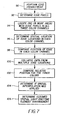
- One method of performing this analysis is shown in Fig. 7 . This method allows the automatic differentiation of different three color input signals, including color input signals without resampling, color input signals resampled to be presented on a stripe pattern as shown in Fig. 6a , and color input signals resampled to be presented on a delta pattern as shown in Fig. 6b . These patterns were included in this example since as these spatial arrangements are the commonly employed arrangements within the display industry. However, it will be appreciated by one skilled in the art that this method can be extended to determine if the color input signals have been resampled to alternative patterns.
- edge enhancement is performed 90 on each of the three color input signals. Since OLED arrangements such as the stripe pattern shown in Fig. 6a consist of OLEDs that are offset from each other in the horizontal direction, a horizontal edge enhancement routine may be applied to the image signal.
- E i , j , c V i , j , c - V i + 1 , j , c
- E ⁇ ,j,c the enhanced value for horizontal location i in color signal c
- V i,j,c the input value for location i,j in color c
- V (i+1,j,c) is the input value for location i+1,j in color c.
- Edge pixels are then determined 92 in each of the three edge enhanced, color input signals.
- a common technique for determining edge pixels is to apply a threshold to the enhanced values. Locations with a value higher than the appropriate threshold are considered edge pixels.
- the threshold may be the same or different for each of the three edge enhanced color signals.
- One or more edge locations with signal in all three color channels are then located 94. These edge locations may be found by determining a spatial location containing enhanced pixels in which values greater than the threshold all occur within a sampling window determined by the size of a pixel.
- An appropriate edge feature may, for example, be the spatial location of the half height of each edge.
- a contour such as a second order polynomial or a sigmoidal function can be fit to the original data within 3 to 5 pixels of the edge pixel location.
- a point on the function i.e., half of the maximum amplitude, is then determined and the spatial location of this value is determined as the location of the edge feature. This step is completed independently for edges in each of the three color input signals.
- the spatial location of the feature on the edges for the three color signals can be compared 98 and the degree of alignment of each edge feature is analyzed. However, since these positions may not be precise, the relative spatial location with respect to the spatial location of a pixel edge is determined for a number of edges within each color signal and averaged 100 for all identified edge locations within each color input signal.
- the average relative location of the edge feature for each color is then compared 102 with the average relative location of the edge features for the other colors. If at least two of these edge features for the three colors are misaligned by more than the width of an OLED, there is a strong indication that a previous spatial resampling step has been performed. Through this comparison, it is determined 104 if spatial resampling has been applied. If all three edge features are misaligned, then the signal has been interpolated to a pattern of light emitting elements that have all of their energy within one dimension, such as the stripe pattern shown in Fig. 6a .
- the signal has been interpolated to a pattern of light emitting elements that are spread across two rows, as in the Delta pattern shown in Fig. 6b .
- the assumed spatial arrangement of the light emitting elements in the display is determined 106.
- Resampling may be performed either to resample data from a format intended for display on a prior art stripe or delta pattern as shown in Fig 6a and Fig. 6b to a format with a color signal representing a value at every spatial location or it may be used to resample data from a format with a color signal at every spatial location to a pattern that includes a white subpixel, such as the stripe pattern shown in Fig. 8a or the quad pattern shown in Fig. 8b .
- the display device 110 is composed of pixels 112 having red 114, green 116, blue 118 and white 120 OLEDs.
- resampling techniques are known in the art and have been described by others including US Patent Application No. 2003/0034992A1 , referenced above, and Klompenhouwer, et al., Subpixel Image Scaling for Color Matrix Displays, SID 02 Digest, pp. 176-179 . These techniques generally include the same basic steps.
- a single color signal e.g., red, green, blue, or white
- the sampling grid i.e., location of each sample
- the desired sampling grid 134 is then determined.
- a sample point corresponding to a spatial location in a pixel is selected 136 in the desired sampling grid.
- neighboring input signal values in the color signal are located 138 in either one or two dimensions.
- a set of weighted fractions related to the spatial locations represented by the neighboring input signal values are then computed 140. These fractions may be computed by a number of means including determining the distance from the desired sample location to the neighboring samples in the input signal within each spatial dimension and summing these distances and dividing each distance by the sum of the distance from the selected sample point to the position of the neighboring samples in each dimension.
- the neighboring input signal values are then multiplied 142 by their respective weighted fractions to produce weighted input signal values.
- the resulting values are then added 144 together, resulting in the resampled data at the selected position in the desired sampling grid. This same process is repeated 146 for each grid position in the desired sampling grid and then for each color signal.
- the resulting signal is not only converted from a three to a four or more color signal, the resulting signal is also converted from a three color signal with one assumed spatial sampling to a more than three color signal with a desired spatial sampling.
- This method may be employed in an application specific integrated circuit (asic), programmable logic device, a display driver or a software product.
- an application specific integrated circuit asic
- programmable logic device programmable logic device
- display driver or a software product.
- Each of these products may allow the form of the functions F1, F2 and F3 to be adjusted through the storage of programmable parameters. These parameters may be adjusted within a manufacturing environment or adjusted through a software product that allows access to these parameters.
- adjustment of any or all of F1, F2 and F3 can be used to shift more luminance output to the red, green and blue primaries or to the white primary where lowering the luminance output of one of these groups of OLEDs slows the decay of the OLEDs used to produce a desired color.
Landscapes
- Engineering & Computer Science (AREA)
- Physics & Mathematics (AREA)
- Computer Hardware Design (AREA)
- General Physics & Mathematics (AREA)
- Theoretical Computer Science (AREA)
- Control Of Indicators Other Than Cathode Ray Tubes (AREA)
- Transforming Electric Information Into Light Information (AREA)
- Processing Of Color Television Signals (AREA)
- Electroluminescent Light Sources (AREA)
Applications Claiming Priority (2)
| Application Number | Priority Date | Filing Date | Title |
|---|---|---|---|
| US10/607,374 US6897876B2 (en) | 2003-06-26 | 2003-06-26 | Method for transforming three color input signals to four or more output signals for a color display |
| PCT/US2004/019004 WO2005004104A2 (en) | 2003-06-26 | 2004-06-16 | Transforming three color input signals to more color signals |
Publications (2)
| Publication Number | Publication Date |
|---|---|
| EP1636788A2 EP1636788A2 (en) | 2006-03-22 |
| EP1636788B1 true EP1636788B1 (en) | 2009-04-08 |
Family
ID=33540249
Family Applications (1)
| Application Number | Title | Priority Date | Filing Date |
|---|---|---|---|
| EP04755281A Expired - Lifetime EP1636788B1 (en) | 2003-06-26 | 2004-06-16 | Transforming three color input signals to more color signals |
Country Status (8)
| Country | Link |
|---|---|
| US (1) | US6897876B2 (https=) |
| EP (1) | EP1636788B1 (https=) |
| JP (1) | JP4829110B2 (https=) |
| KR (1) | KR101041882B1 (https=) |
| CN (1) | CN100444245C (https=) |
| DE (1) | DE602004020471D1 (https=) |
| TW (1) | TWI367476B (https=) |
| WO (1) | WO2005004104A2 (https=) |
Cited By (1)
| Publication number | Priority date | Publication date | Assignee | Title |
|---|---|---|---|---|
| WO2020086576A1 (en) * | 2018-10-25 | 2020-04-30 | Baylor University | System and method for a six-primary wide gamut color system |
Families Citing this family (159)
| Publication number | Priority date | Publication date | Assignee | Title |
|---|---|---|---|---|
| US7283142B2 (en) | 2000-07-28 | 2007-10-16 | Clairvoyante, Inc. | Color display having horizontal sub-pixel arrangements and layouts |
| US8022969B2 (en) * | 2001-05-09 | 2011-09-20 | Samsung Electronics Co., Ltd. | Rotatable display with sub-pixel rendering |
| US7221381B2 (en) | 2001-05-09 | 2007-05-22 | Clairvoyante, Inc | Methods and systems for sub-pixel rendering with gamma adjustment |
| US7184066B2 (en) | 2001-05-09 | 2007-02-27 | Clairvoyante, Inc | Methods and systems for sub-pixel rendering with adaptive filtering |
| US7123277B2 (en) * | 2001-05-09 | 2006-10-17 | Clairvoyante, Inc. | Conversion of a sub-pixel format data to another sub-pixel data format |
| US7307646B2 (en) * | 2001-05-09 | 2007-12-11 | Clairvoyante, Inc | Color display pixel arrangements and addressing means |
| US7714824B2 (en) | 2001-06-11 | 2010-05-11 | Genoa Color Technologies Ltd. | Multi-primary display with spectrally adapted back-illumination |
| US8289266B2 (en) | 2001-06-11 | 2012-10-16 | Genoa Color Technologies Ltd. | Method, device and system for multi-color sequential LCD panel |
| AU2002304276A1 (en) | 2001-06-11 | 2002-12-23 | Moshe Ben-Chorin | Device, system and method for color display |
| US20030117423A1 (en) * | 2001-12-14 | 2003-06-26 | Brown Elliott Candice Hellen | Color flat panel display sub-pixel arrangements and layouts with reduced blue luminance well visibility |
| AU2002353139A1 (en) | 2001-12-14 | 2003-06-30 | Clairvoyante Laboratories, Inc. | Improvements to color flat panel display sub-pixel arrangements and layouts with reduced visibility of a blue luminance well |
| US7492379B2 (en) * | 2002-01-07 | 2009-02-17 | Samsung Electronics Co., Ltd. | Color flat panel display sub-pixel arrangements and layouts for sub-pixel rendering with increased modulation transfer function response |
| US7583279B2 (en) * | 2004-04-09 | 2009-09-01 | Samsung Electronics Co., Ltd. | Subpixel layouts and arrangements for high brightness displays |
| US7755652B2 (en) * | 2002-01-07 | 2010-07-13 | Samsung Electronics Co., Ltd. | Color flat panel display sub-pixel rendering and driver configuration for sub-pixel arrangements with split sub-pixels |
| US7417648B2 (en) | 2002-01-07 | 2008-08-26 | Samsung Electronics Co. Ltd., | Color flat panel display sub-pixel arrangements and layouts for sub-pixel rendering with split blue sub-pixels |
| US20040051724A1 (en) * | 2002-09-13 | 2004-03-18 | Elliott Candice Hellen Brown | Four color arrangements of emitters for subpixel rendering |
| EP1497820A4 (en) * | 2002-04-11 | 2009-03-11 | Genoa Color Technologies Ltd | COLOR DISPLAY DEVICES AND METHODS WITH ADVANCED ATTRIBUTES |
| US7365722B2 (en) * | 2002-09-11 | 2008-04-29 | Samsung Electronics Co., Ltd. | Four color liquid crystal display and driving device and method thereof |
| US7046256B2 (en) * | 2003-01-22 | 2006-05-16 | Clairvoyante, Inc | System and methods of subpixel rendering implemented on display panels |
| WO2004068460A1 (en) | 2003-01-28 | 2004-08-12 | Koninklijke Philips Electronics N.V. | Optimal subpixel arrangement for displays with more than three primary colors |
| US20040196302A1 (en) | 2003-03-04 | 2004-10-07 | Im Moon Hwan | Systems and methods for temporal subpixel rendering of image data |
| KR100929673B1 (ko) * | 2003-03-25 | 2009-12-03 | 삼성전자주식회사 | 표시 장치의 구동 장치 및 그 구동 방법 |
| US7352374B2 (en) * | 2003-04-07 | 2008-04-01 | Clairvoyante, Inc | Image data set with embedded pre-subpixel rendered image |
| KR100943273B1 (ko) * | 2003-05-07 | 2010-02-23 | 삼성전자주식회사 | 4-컬러 변환 방법 및 그 장치와 이를 이용한 유기전계발광표시장치 |
| US7230584B2 (en) * | 2003-05-20 | 2007-06-12 | Clairvoyante, Inc | Projector systems with reduced flicker |
| US7268748B2 (en) * | 2003-05-20 | 2007-09-11 | Clairvoyante, Inc | Subpixel rendering for cathode ray tube devices |
| US20040233308A1 (en) * | 2003-05-20 | 2004-11-25 | Elliott Candice Hellen Brown | Image capture device and camera |
| US7209105B2 (en) * | 2003-06-06 | 2007-04-24 | Clairvoyante, Inc | System and method for compensating for visual effects upon panels having fixed pattern noise with reduced quantization error |
| US20040246280A1 (en) * | 2003-06-06 | 2004-12-09 | Credelle Thomas Lloyd | Image degradation correction in novel liquid crystal displays |
| US7397455B2 (en) * | 2003-06-06 | 2008-07-08 | Samsung Electronics Co., Ltd. | Liquid crystal display backplane layouts and addressing for non-standard subpixel arrangements |
| US7187353B2 (en) * | 2003-06-06 | 2007-03-06 | Clairvoyante, Inc | Dot inversion on novel display panel layouts with extra drivers |
| US8035599B2 (en) | 2003-06-06 | 2011-10-11 | Samsung Electronics Co., Ltd. | Display panel having crossover connections effecting dot inversion |
| US7598961B2 (en) * | 2003-10-21 | 2009-10-06 | Samsung Electronics Co., Ltd. | method and apparatus for converting from a source color space to a target color space |
| US7728846B2 (en) * | 2003-10-21 | 2010-06-01 | Samsung Electronics Co., Ltd. | Method and apparatus for converting from source color space to RGBW target color space |
| US7084923B2 (en) * | 2003-10-28 | 2006-08-01 | Clairvoyante, Inc | Display system having improved multiple modes for displaying image data from multiple input source formats |
| US7525526B2 (en) * | 2003-10-28 | 2009-04-28 | Samsung Electronics Co., Ltd. | System and method for performing image reconstruction and subpixel rendering to effect scaling for multi-mode display |
| US7929752B2 (en) * | 2003-10-31 | 2011-04-19 | Nano Picture Co., Ltd. | Method for generating structured-light pattern |
| KR101012790B1 (ko) * | 2003-12-30 | 2011-02-08 | 삼성전자주식회사 | 4색 표시 장치의 영상 신호 변환 장치 및 방법, 그리고이를 포함하는 표시 장치 |
| KR20050072505A (ko) * | 2004-01-06 | 2005-07-12 | 삼성전자주식회사 | 4색 표시 장치의 영상 신호 변환 장치 및 방법 |
| WO2005076257A2 (en) * | 2004-02-09 | 2005-08-18 | Genoa Color Technologies Ltd. | Method device, and system of displaying a more-than-three primary color image |
| US7825921B2 (en) * | 2004-04-09 | 2010-11-02 | Samsung Electronics Co., Ltd. | System and method for improving sub-pixel rendering of image data in non-striped display systems |
| US7301543B2 (en) * | 2004-04-09 | 2007-11-27 | Clairvoyante, Inc. | Systems and methods for selecting a white point for image displays |
| US7248268B2 (en) * | 2004-04-09 | 2007-07-24 | Clairvoyante, Inc | Subpixel rendering filters for high brightness subpixel layouts |
| US7590299B2 (en) * | 2004-06-10 | 2009-09-15 | Samsung Electronics Co., Ltd. | Increasing gamma accuracy in quantized systems |
| JP2006003475A (ja) * | 2004-06-15 | 2006-01-05 | Eastman Kodak Co | Oled表示装置 |
| US20050285828A1 (en) * | 2004-06-25 | 2005-12-29 | Sanyo Electric Co., Ltd. | Signal processing circuit and method for self-luminous type display |
| KR101328547B1 (ko) * | 2004-11-01 | 2013-11-13 | 테크니컬러, 인크. | 향상된 컬러 공간 콘텐츠를 마스터하고 분배하는 방법 및 시스템 |
| JP4752294B2 (ja) * | 2005-03-04 | 2011-08-17 | パナソニック株式会社 | ディスプレイ装置 |
| CN1882103B (zh) * | 2005-04-04 | 2010-06-23 | 三星电子株式会社 | 实现改进的色域对映演算的系统及方法 |
| KR101298921B1 (ko) | 2005-04-04 | 2013-08-30 | 삼성디스플레이 주식회사 | 디스플레이 시스템에서의 사전-서브픽셀 렌더링된 이미지처리 |
| CN101171594A (zh) * | 2005-04-04 | 2008-04-30 | 克雷沃耶提公司 | 实现低成本全范围映射算法的系统和方法 |
| EP2372609A3 (en) * | 2005-05-20 | 2011-11-30 | Samsung Electronics Co., Ltd. | Multiprimary color subpixel rendering with metameric filtering |
| US7705855B2 (en) | 2005-06-15 | 2010-04-27 | Samsung Electronics Co., Ltd. | Bichromatic display |
| US7433514B2 (en) * | 2005-07-13 | 2008-10-07 | Canon Kabushiki Kaisha | Tone mapping of high dynamic range images |
| US7636076B2 (en) * | 2005-09-22 | 2009-12-22 | Au Optronics Corporation | Four-color transflective color liquid crystal display |
| US20070076276A1 (en) * | 2005-10-05 | 2007-04-05 | Dell Products L.P. | Color optimization of displayed image for PC projectors |
| WO2007060672A2 (en) * | 2005-11-28 | 2007-05-31 | Genoa Color Technologies Ltd. | Sub-pixel rendering of a multiprimary image |
| US7742205B2 (en) * | 2005-12-16 | 2010-06-22 | Vp Assets Limited Registered In British Virgin Islands | Perceptual color matching method between two different polychromatic displays |
| WO2007078563A2 (en) | 2005-12-21 | 2007-07-12 | Thomson Licensing | Constrained color palette in a color space |
| US20070159492A1 (en) * | 2006-01-11 | 2007-07-12 | Wintek Corporation | Image processing method and pixel arrangement used in the same |
| US7791621B2 (en) * | 2006-04-18 | 2010-09-07 | Toppoly Optoelectronics Corp. | Systems and methods for providing driving voltages to RGBW display panels |
| US7969428B2 (en) * | 2006-05-08 | 2011-06-28 | Global Oled Technology Llc | Color display system with improved apparent resolution |
| US20070257866A1 (en) * | 2006-05-08 | 2007-11-08 | Eastman Kodak Company | Method and apparatus for defect correction in a display |
| US7965305B2 (en) * | 2006-05-08 | 2011-06-21 | Global Oled Technology Llc | Color display system with improved apparent resolution |
| US20070257945A1 (en) * | 2006-05-08 | 2007-11-08 | Eastman Kodak Company | Color EL display system with improved resolution |
| US20070257943A1 (en) * | 2006-05-08 | 2007-11-08 | Eastman Kodak Company | Method for rendering color EL display and display device with improved resolution |
| US7592996B2 (en) * | 2006-06-02 | 2009-09-22 | Samsung Electronics Co., Ltd. | Multiprimary color display with dynamic gamut mapping |
| WO2007143340A2 (en) * | 2006-06-02 | 2007-12-13 | Clairvoyante, Inc | High dynamic contrast display system having multiple segmented backlight |
| CN101460917B (zh) * | 2006-06-02 | 2011-09-28 | 三星电子株式会社 | 具有多分段背光的高动态对比度显示系统 |
| US20070291510A1 (en) * | 2006-06-15 | 2007-12-20 | Wintek Corporation | Backlight module and light guide plate thereof |
| KR20070121163A (ko) * | 2006-06-21 | 2007-12-27 | 삼성전자주식회사 | 다색 표시 장치 및 그 구동 방법 |
| KR20080009497A (ko) * | 2006-07-24 | 2008-01-29 | 삼성전자주식회사 | 다색 표시 장치 및 그 구동 방법 |
| US7876341B2 (en) * | 2006-08-28 | 2011-01-25 | Samsung Electronics Co., Ltd. | Subpixel layouts for high brightness displays and systems |
| US8018476B2 (en) | 2006-08-28 | 2011-09-13 | Samsung Electronics Co., Ltd. | Subpixel layouts for high brightness displays and systems |
| JP4363430B2 (ja) * | 2006-08-31 | 2009-11-11 | ソニー株式会社 | 色域変換装置、色域変換方法 |
| WO2008035259A1 (en) * | 2006-09-20 | 2008-03-27 | Koninklijke Philips Electronics N.V. | Dynamic gamut control |
| US8259127B2 (en) | 2006-09-30 | 2012-09-04 | Samsung Electronics Co., Ltd. | Systems and methods for reducing desaturation of images rendered on high brightness displays |
| CN101529496B (zh) * | 2006-10-19 | 2012-01-11 | 皇家飞利浦电子股份有限公司 | 颜色映射方法、系统和显示器设备 |
| US8269799B2 (en) * | 2006-10-25 | 2012-09-18 | Sanyo Electric Co., Ltd. | Image signal processor and image display device |
| US8134647B2 (en) * | 2006-11-09 | 2012-03-13 | Wintek Corporation | Image processing method and apparatus |
| EP2095353B1 (en) * | 2006-12-20 | 2019-05-01 | Signify Holding B.V. | Lighting device with multiple primary colors |
| US7478922B2 (en) * | 2007-03-14 | 2009-01-20 | Renaissance Lighting, Inc. | Set-point validation for color/intensity settings of light fixtures |
| US9185268B2 (en) * | 2007-04-03 | 2015-11-10 | Thomson Licensing | Methods and systems for displays with chromatic correction with differing chromatic ranges |
| US20080252797A1 (en) | 2007-04-13 | 2008-10-16 | Hamer John W | Method for input-signal transformation for rgbw displays with variable w color |
| KR101329125B1 (ko) * | 2007-08-13 | 2013-11-14 | 삼성전자주식회사 | RGB-to-RGBW 컬러 분해 방법 및 시스템 |
| US8094933B2 (en) * | 2007-12-13 | 2012-01-10 | Global Oled Technology Llc | Method for converting an input color signal |
| TWI385638B (zh) * | 2007-12-21 | 2013-02-11 | Wintek Corp | 影像處理方法、影像資料轉換方法及其裝置 |
| JP4683343B2 (ja) * | 2007-12-27 | 2011-05-18 | 株式会社 日立ディスプレイズ | 色信号生成装置 |
| KR101373501B1 (ko) * | 2007-12-29 | 2014-03-13 | 엘지디스플레이 주식회사 | 액정표시장치 구동방법 |
| KR101397398B1 (ko) * | 2008-01-14 | 2014-05-22 | 삼성전자주식회사 | Rgbw 출력 디스플레이의 색역에 따른rgb-to-rgbw 변환 시스템 및 방법 |
| KR101480001B1 (ko) * | 2008-02-26 | 2015-01-09 | 삼성디스플레이 주식회사 | 유기 발광 표시 장치 및 그 구동 방법 |
| JP2010020241A (ja) * | 2008-07-14 | 2010-01-28 | Sony Corp | 表示装置、表示装置の駆動方法、駆動用集積回路、駆動用集積回路による駆動方法及び信号処理方法 |
| US8169389B2 (en) | 2008-07-16 | 2012-05-01 | Global Oled Technology Llc | Converting three-component to four-component image |
| US8184112B2 (en) * | 2008-09-24 | 2012-05-22 | Global Oled Technology Llc | Increasing dynamic range of display output |
| US20100123721A1 (en) * | 2008-11-18 | 2010-05-20 | Hon Wah Wong | Image device and data processing system |
| WO2010085505A1 (en) | 2009-01-21 | 2010-07-29 | Dolby Laboratories Licensing Corporation | Apparatus and methods for color displays |
| TWI415105B (zh) * | 2009-03-23 | 2013-11-11 | Au Optronics Corp | 顯示器及其驅動方法 |
| US8237633B2 (en) * | 2009-05-12 | 2012-08-07 | Global Oled Technology Llc | Electro-luminescent display with adjustable white point |
| JP2013504080A (ja) | 2009-09-01 | 2013-02-04 | エンターテインメント イクスピアリアンス エルエルシー | カラー画像を生成する方法及び当該方法を使用した画像化装置 |
| US8860751B2 (en) | 2009-09-01 | 2014-10-14 | Entertainment Experience Llc | Method for producing a color image and imaging device employing same |
| TWI500010B (zh) * | 2009-09-03 | 2015-09-11 | Prime View Int Co Ltd | 彩色電泳顯示器及其顯示方法 |
| CN101866629B (zh) * | 2010-03-05 | 2012-04-18 | 华映视讯(吴江)有限公司 | 色序型液晶显示器的色彩调整方法 |
| TWI408670B (zh) * | 2010-03-17 | 2013-09-11 | 冠捷投資有限公司 | 用於顯示器色彩校正的查找表產生方法 |
| JP4956686B2 (ja) * | 2010-10-26 | 2012-06-20 | シャープ株式会社 | 表示装置 |
| TWI463464B (zh) | 2010-12-17 | 2014-12-01 | Chunghwa Picture Tubes Ltd | 紅綠藍白光顯示系統之背光調整裝置及其方法 |
| US8619103B2 (en) | 2011-01-31 | 2013-12-31 | Global Oled Technology Llc | Electroluminescent device multilevel-drive chromaticity-shift compensation |
| US9311841B2 (en) * | 2011-09-07 | 2016-04-12 | Sharp Kabushiki Kaisha | Multi-primary colour display device |
| KR101870991B1 (ko) * | 2011-10-06 | 2018-06-26 | 엘지디스플레이 주식회사 | 표시 장치의 색 보정장치 및 방법 |
| KR101992103B1 (ko) * | 2011-12-09 | 2019-06-25 | 엘지디스플레이 주식회사 | 액정표시장치 및 그 구동방법 |
| KR101979802B1 (ko) * | 2012-06-04 | 2019-05-20 | 삼성전자주식회사 | 화상표시방법, 상기 방법을 기록한 컴퓨터 판독 가능 저장매체 및 신호처리장치 |
| TWI463476B (zh) * | 2012-08-01 | 2014-12-01 | Au Optronics Corp | 使用畫素顯示影像之方法 |
| TWI485691B (zh) | 2013-04-23 | 2015-05-21 | Au Optronics Corp | 顯示影像之方法 |
| US9179042B2 (en) | 2013-10-09 | 2015-11-03 | Dolby Laboratories Licensing Corporation | Systems and methods to optimize conversions for wide gamut opponent color spaces |
| JP6533656B2 (ja) | 2013-10-22 | 2019-06-19 | 株式会社ジャパンディスプレイ | 画像処理装置、画像表示装置、電子機器及び画像処理方法 |
| JP6514482B2 (ja) * | 2013-10-22 | 2019-05-15 | 株式会社ジャパンディスプレイ | 表示装置及び色変換方法 |
| CN103903588B (zh) * | 2014-03-21 | 2017-02-08 | 京东方科技集团股份有限公司 | 一种显示方法和显示系统 |
| JP2015184623A (ja) * | 2014-03-26 | 2015-10-22 | ソニー株式会社 | 画像表示装置、カラーフィルタおよび画像信号処理装置 |
| JP6065296B2 (ja) | 2014-05-20 | 2017-01-25 | パナソニックIpマネジメント株式会社 | 画像表示システム、および画像表示システムに用いられるディスプレイ |
| KR20160065397A (ko) * | 2014-11-28 | 2016-06-09 | 삼성디스플레이 주식회사 | 표시 장치 및 그 구동 방법 |
| EP3043558B1 (en) * | 2014-12-21 | 2022-11-02 | Production Resource Group, L.L.C. | Large-format display systems having color pixels and white pixels |
| US10699476B2 (en) * | 2015-08-06 | 2020-06-30 | Ams Sensors Singapore Pte. Ltd. | Generating a merged, fused three-dimensional point cloud based on captured images of a scene |
| CN105070270B (zh) * | 2015-09-14 | 2017-10-17 | 深圳市华星光电技术有限公司 | Rgbw面板子像素的补偿方法及装置 |
| CN106023818B (zh) * | 2016-05-18 | 2019-09-17 | 京东方科技集团股份有限公司 | 一种像素结构、显示面板及像素结构的驱动方法 |
| KR102464253B1 (ko) * | 2016-07-07 | 2022-11-09 | 삼성전자주식회사 | 전자 장치 및 이의 영상 데이터 처리 방법 |
| JP2018021963A (ja) * | 2016-08-01 | 2018-02-08 | 株式会社ジャパンディスプレイ | 表示装置及び表示方法 |
| CN106652886B (zh) * | 2016-10-12 | 2019-08-20 | 上海三思电子工程有限公司 | Led像素器件、led显示屏及显示方法 |
| US10565957B2 (en) * | 2018-06-19 | 2020-02-18 | Shenzhen China Star Optoelectronics Technology Co., Ltd. | Gamut mapping method and device for compressing out-of-gamut area to in-of-gamut area, storage medium, and electronic device |
| CN108965843B (zh) * | 2018-07-17 | 2020-09-29 | 天津市智博源微电子技术有限公司 | 光谱分段确定矩阵系数法提取宽色域数据的方法 |
| US11289000B2 (en) | 2018-10-25 | 2022-03-29 | Baylor University | System and method for a multi-primary wide gamut color system |
| US11289003B2 (en) | 2018-10-25 | 2022-03-29 | Baylor University | System and method for a multi-primary wide gamut color system |
| US12555507B2 (en) | 2018-10-25 | 2026-02-17 | Baylor University | System and method for a multi-primary wide gamut color system |
| US11062638B2 (en) | 2018-10-25 | 2021-07-13 | Baylor University | System and method for a multi-primary wide gamut color system |
| US11069279B2 (en) | 2018-10-25 | 2021-07-20 | Baylor University | System and method for a multi-primary wide gamut color system |
| US12444334B2 (en) | 2018-10-25 | 2025-10-14 | Baylor University | System and method for a multi-primary wide gamut color system |
| US11043157B2 (en) | 2018-10-25 | 2021-06-22 | Baylor University | System and method for a six-primary wide gamut color system |
| US11587491B1 (en) | 2018-10-25 | 2023-02-21 | Baylor University | System and method for a multi-primary wide gamut color system |
| US11475819B2 (en) | 2018-10-25 | 2022-10-18 | Baylor University | System and method for a multi-primary wide gamut color system |
| US11403987B2 (en) | 2018-10-25 | 2022-08-02 | Baylor University | System and method for a multi-primary wide gamut color system |
| US11373575B2 (en) | 2018-10-25 | 2022-06-28 | Baylor University | System and method for a multi-primary wide gamut color system |
| US10950161B2 (en) | 2018-10-25 | 2021-03-16 | Baylor University | System and method for a six-primary wide gamut color system |
| US11030934B2 (en) | 2018-10-25 | 2021-06-08 | Baylor University | System and method for a multi-primary wide gamut color system |
| US11532261B1 (en) | 2018-10-25 | 2022-12-20 | Baylor University | System and method for a multi-primary wide gamut color system |
| US11488510B2 (en) | 2018-10-25 | 2022-11-01 | Baylor University | System and method for a multi-primary wide gamut color system |
| US12444337B2 (en) | 2018-10-25 | 2025-10-14 | Baylor University | System and method for a multi-primary wide gamut color system |
| US11341890B2 (en) | 2018-10-25 | 2022-05-24 | Baylor University | System and method for a multi-primary wide gamut color system |
| US11410593B2 (en) | 2018-10-25 | 2022-08-09 | Baylor University | System and method for a multi-primary wide gamut color system |
| US11189210B2 (en) | 2018-10-25 | 2021-11-30 | Baylor University | System and method for a multi-primary wide gamut color system |
| US11315467B1 (en) | 2018-10-25 | 2022-04-26 | Baylor University | System and method for a multi-primary wide gamut color system |
| US10997896B2 (en) | 2018-10-25 | 2021-05-04 | Baylor University | System and method for a six-primary wide gamut color system |
| US11069280B2 (en) | 2018-10-25 | 2021-07-20 | Baylor University | System and method for a multi-primary wide gamut color system |
| US10950162B2 (en) | 2018-10-25 | 2021-03-16 | Baylor University | System and method for a six-primary wide gamut color system |
| US11037481B1 (en) | 2018-10-25 | 2021-06-15 | Baylor University | System and method for a multi-primary wide gamut color system |
| US12475826B2 (en) | 2018-10-25 | 2025-11-18 | Baylor University | System and method for a multi-primary wide gamut color system |
| CN109461417B (zh) * | 2018-12-11 | 2020-05-22 | 惠科股份有限公司 | 一种显示面板的驱动方法、驱动系统和显示装置 |
| CN109377961B (zh) * | 2018-12-17 | 2021-02-26 | 惠科股份有限公司 | 三色数据到四色数据的转换方法及装置 |
| CN111381420B (zh) * | 2018-12-27 | 2022-04-22 | 深圳光峰科技股份有限公司 | 显示设备及其控制方法 |
| US20240339063A1 (en) * | 2020-10-21 | 2024-10-10 | Baylor University | System and method for a multi-primary wide gamut color system |
| CN113852820B (zh) * | 2021-08-30 | 2023-06-30 | 电子科技大学 | 一种新型色彩空间转换矩阵生成方法 |
| US12462772B1 (en) | 2024-06-20 | 2025-11-04 | 6P Color, Inc. | System and method for conversion from XYZ to multiple primaries using pseudo white points |
Family Cites Families (20)
| Publication number | Priority date | Publication date | Assignee | Title |
|---|---|---|---|---|
| US4800375A (en) | 1986-10-24 | 1989-01-24 | Honeywell Inc. | Four color repetitive sequence matrix array for flat panel displays |
| US5341153A (en) | 1988-06-13 | 1994-08-23 | International Business Machines Corporation | Method of and apparatus for displaying a multicolor image |
| JPH05241551A (ja) * | 1991-11-07 | 1993-09-21 | Canon Inc | 画像処理装置 |
| GB9124444D0 (en) | 1991-11-18 | 1992-01-08 | Black Box Vision Limited | Display device |
| US5233385A (en) | 1991-12-18 | 1993-08-03 | Texas Instruments Incorporated | White light enhanced color field sequential projection |
| US5638084A (en) | 1992-05-22 | 1997-06-10 | Dielectric Systems International, Inc. | Lighting-independent color video display |
| JPH06189325A (ja) * | 1992-12-18 | 1994-07-08 | Kyocera Corp | 特定色引き込み回路 |
| US6453067B1 (en) * | 1997-10-20 | 2002-09-17 | Texas Instruments Incorporated | Brightness gain using white segment with hue and gain correction |
| TW434628B (en) | 1999-02-24 | 2001-05-16 | Koninkl Philips Electronics Nv | Color display device |
| JP4197788B2 (ja) * | 1999-02-25 | 2008-12-17 | オリンパス株式会社 | 色再現システム |
| JP3702699B2 (ja) * | 1999-03-26 | 2005-10-05 | 三菱電機株式会社 | カラー画像表示装置 |
| JP2000338950A (ja) * | 1999-05-26 | 2000-12-08 | Olympus Optical Co Ltd | 色再現システム |
| EP1098537B1 (en) | 1999-11-06 | 2005-03-23 | Samsung Electronics Co., Ltd. | Projection display device using two liquid crystal display panels |
| JP2002072980A (ja) * | 2000-08-31 | 2002-03-12 | Nec Corp | カラー映像表示方法および装置 |
| JP3815542B2 (ja) * | 2000-12-13 | 2006-08-30 | 富士ゼロックス株式会社 | 色変換装置、色変換係数算出装置、色変換方法、及び色変換係数算出方法 |
| EP1227687A3 (en) | 2000-12-30 | 2005-05-25 | Texas Instruments Incorporated | System for reducing color separation artifacts in sequential color displays |
| US7123277B2 (en) * | 2001-05-09 | 2006-10-17 | Clairvoyante, Inc. | Conversion of a sub-pixel format data to another sub-pixel data format |
| US7012588B2 (en) | 2001-06-05 | 2006-03-14 | Eastman Kodak Company | Method for saving power in an organic electroluminescent display using white light emitting elements |
| US7184067B2 (en) * | 2003-03-13 | 2007-02-27 | Eastman Kodak Company | Color OLED display system |
| US7075242B2 (en) * | 2002-12-16 | 2006-07-11 | Eastman Kodak Company | Color OLED display system having improved performance |
-
2003
- 2003-06-26 US US10/607,374 patent/US6897876B2/en not_active Expired - Lifetime
-
2004
- 2004-06-16 JP JP2006517281A patent/JP4829110B2/ja not_active Expired - Lifetime
- 2004-06-16 KR KR1020057024988A patent/KR101041882B1/ko not_active Expired - Lifetime
- 2004-06-16 CN CNB2004800180460A patent/CN100444245C/zh not_active Expired - Lifetime
- 2004-06-16 DE DE602004020471T patent/DE602004020471D1/de not_active Expired - Lifetime
- 2004-06-16 EP EP04755281A patent/EP1636788B1/en not_active Expired - Lifetime
- 2004-06-16 WO PCT/US2004/019004 patent/WO2005004104A2/en not_active Ceased
- 2004-06-25 TW TW093118625A patent/TWI367476B/zh not_active IP Right Cessation
Cited By (1)
| Publication number | Priority date | Publication date | Assignee | Title |
|---|---|---|---|---|
| WO2020086576A1 (en) * | 2018-10-25 | 2020-04-30 | Baylor University | System and method for a six-primary wide gamut color system |
Also Published As
| Publication number | Publication date |
|---|---|
| US6897876B2 (en) | 2005-05-24 |
| DE602004020471D1 (de) | 2009-05-20 |
| JP2007524109A (ja) | 2007-08-23 |
| TW200509058A (en) | 2005-03-01 |
| CN100444245C (zh) | 2008-12-17 |
| EP1636788A2 (en) | 2006-03-22 |
| JP4829110B2 (ja) | 2011-12-07 |
| WO2005004104A3 (en) | 2005-07-14 |
| US20040263528A1 (en) | 2004-12-30 |
| CN1813283A (zh) | 2006-08-02 |
| KR20060024001A (ko) | 2006-03-15 |
| WO2005004104A2 (en) | 2005-01-13 |
| KR101041882B1 (ko) | 2011-06-16 |
| TWI367476B (en) | 2012-07-01 |
Similar Documents
| Publication | Publication Date | Title |
|---|---|---|
| EP1636788B1 (en) | Transforming three color input signals to more color signals | |
| US6885380B1 (en) | Method for transforming three colors input signals to four or more output signals for a color display | |
| CN111968570B (zh) | 显示补偿信息的获取方法、显示补偿方法及装置 | |
| EP2135461B1 (en) | Input-signal transformation for rgbw displays | |
| US7091941B2 (en) | Color OLED display with improved power efficiency | |
| US8094933B2 (en) | Method for converting an input color signal | |
| KR101348369B1 (ko) | 디스플레이 장치의 색 변환 방법 및 장치 | |
| EP2309760A2 (en) | Method and apparatus for efficiently calculating multiprimary color conversion matrices | |
| US20080198180A1 (en) | Method and Apparatus of Converting Signals for Driving Display and a Display Using the Same | |
| US8576245B2 (en) | Colour conversion for a multy-primary display | |
| KR20070116618A (ko) | 저비용 색역 매핑 알고리즘을 구현하기 위한 시스템과 방법 | |
| US6774953B2 (en) | Method and apparatus for color warping | |
| CN101501751B (zh) | 显示装置以及生成4个以上的原色信号的方法 | |
| EP1484742A2 (en) | Color signal processing for a multi-primary display | |
| US8791890B2 (en) | Presentation of highly saturated colors with high luminance | |
| US7742205B2 (en) | Perceptual color matching method between two different polychromatic displays | |
| KR101397398B1 (ko) | Rgbw 출력 디스플레이의 색역에 따른rgb-to-rgbw 변환 시스템 및 방법 | |
| US7719715B2 (en) | Tone characteristics-conversion determining apparatus, tone characteristics-conversion determining method, tone characteristics-conversion determining program, image processing apparatus, and image display apparatus | |
| KR20060008132A (ko) | 영상의 랜더링 장치 및 방법 |
Legal Events
| Date | Code | Title | Description |
|---|---|---|---|
| PUAI | Public reference made under article 153(3) epc to a published international application that has entered the european phase |
Free format text: ORIGINAL CODE: 0009012 |
|
| 17P | Request for examination filed |
Effective date: 20051212 |
|
| AK | Designated contracting states |
Kind code of ref document: A2 Designated state(s): DE GB |
|
| DAX | Request for extension of the european patent (deleted) | ||
| RBV | Designated contracting states (corrected) |
Designated state(s): DE GB |
|
| 17Q | First examination report despatched |
Effective date: 20080402 |
|
| GRAP | Despatch of communication of intention to grant a patent |
Free format text: ORIGINAL CODE: EPIDOSNIGR1 |
|
| GRAS | Grant fee paid |
Free format text: ORIGINAL CODE: EPIDOSNIGR3 |
|
| GRAA | (expected) grant |
Free format text: ORIGINAL CODE: 0009210 |
|
| AK | Designated contracting states |
Kind code of ref document: B1 Designated state(s): DE GB |
|
| REG | Reference to a national code |
Ref country code: GB Ref legal event code: FG4D |
|
| REF | Corresponds to: |
Ref document number: 602004020471 Country of ref document: DE Date of ref document: 20090520 Kind code of ref document: P |
|
| PLBE | No opposition filed within time limit |
Free format text: ORIGINAL CODE: 0009261 |
|
| STAA | Information on the status of an ep patent application or granted ep patent |
Free format text: STATUS: NO OPPOSITION FILED WITHIN TIME LIMIT |
|
| 26N | No opposition filed |
Effective date: 20100111 |
|
| REG | Reference to a national code |
Ref country code: GB Ref legal event code: 732E Free format text: REGISTERED BETWEEN 20110224 AND 20110302 |
|
| PGFP | Annual fee paid to national office [announced via postgrant information from national office to epo] |
Ref country code: DE Payment date: 20220914 Year of fee payment: 20 |
|
| PGFP | Annual fee paid to national office [announced via postgrant information from national office to epo] |
Ref country code: GB Payment date: 20230620 Year of fee payment: 20 |
|
| REG | Reference to a national code |
Ref country code: DE Ref legal event code: R071 Ref document number: 602004020471 Country of ref document: DE |
|
| PG25 | Lapsed in a contracting state [announced via postgrant information from national office to epo] |
Ref country code: GB Free format text: LAPSE BECAUSE OF EXPIRATION OF PROTECTION Effective date: 20240615 |
|
| PG25 | Lapsed in a contracting state [announced via postgrant information from national office to epo] |
Ref country code: GB Free format text: LAPSE BECAUSE OF EXPIRATION OF PROTECTION Effective date: 20240615 |