EP1635255A2 - Informationsverarbeitungssystem - Google Patents
Informationsverarbeitungssystem Download PDFInfo
- Publication number
- EP1635255A2 EP1635255A2 EP05077843A EP05077843A EP1635255A2 EP 1635255 A2 EP1635255 A2 EP 1635255A2 EP 05077843 A EP05077843 A EP 05077843A EP 05077843 A EP05077843 A EP 05077843A EP 1635255 A2 EP1635255 A2 EP 1635255A2
- Authority
- EP
- European Patent Office
- Prior art keywords
- storage device
- memory area
- processor
- information
- information processing
- Prior art date
- Legal status (The legal status is an assumption and is not a legal conclusion. Google has not performed a legal analysis and makes no representation as to the accuracy of the status listed.)
- Withdrawn
Links
Images



Classifications
-
- G—PHYSICS
- G06—COMPUTING OR CALCULATING; COUNTING
- G06F—ELECTRIC DIGITAL DATA PROCESSING
- G06F8/00—Arrangements for software engineering
- G06F8/40—Transformation of program code
- G06F8/52—Binary to binary
-
- G—PHYSICS
- G06—COMPUTING OR CALCULATING; COUNTING
- G06F—ELECTRIC DIGITAL DATA PROCESSING
- G06F9/00—Arrangements for program control, e.g. control units
- G06F9/06—Arrangements for program control, e.g. control units using stored programs, i.e. using an internal store of processing equipment to receive or retain programs
- G06F9/44—Arrangements for executing specific programs
- G06F9/455—Emulation; Interpretation; Software simulation, e.g. virtualisation or emulation of application or operating system execution engines
- G06F9/45504—Abstract machines for programme code execution, e.g. Java virtual machine [JVM], interpreters, emulators
-
- G—PHYSICS
- G06—COMPUTING OR CALCULATING; COUNTING
- G06F—ELECTRIC DIGITAL DATA PROCESSING
- G06F9/00—Arrangements for program control, e.g. control units
- G06F9/06—Arrangements for program control, e.g. control units using stored programs, i.e. using an internal store of processing equipment to receive or retain programs
- G06F9/44—Arrangements for executing specific programs
- G06F9/455—Emulation; Interpretation; Software simulation, e.g. virtualisation or emulation of application or operating system execution engines
- G06F9/45533—Hypervisors; Virtual machine monitors
- G06F9/45537—Provision of facilities of other operating environments, e.g. WINE
Definitions
- the present invention relates to a technique of converting program codes constructed by a different instruction set from an instruction set for a processor into codes executable by the processor.
- the processor automatically carries out the code conversion and stores the converted codes into a main memory. In the case of re-execution of the same code information, the converted codes stored in the main memory are reused. This reduces the overhead (deterioration of the performance), due to the code conversion.
- the CMS is written in, for example, in a flash memory at the time of shipment of the processor, and is present in the main memory during its execution. The computer users and software developers are accordingly not aware of the presence of the CMS and can not directly operate the CMS, although there is means for updating the CWS. When significant bugs are found in the CMS, the CMS is updated to eliminate the problems without replacing the processor. Multiple CMS programs corresponding to multiple instruction sets may be mounted on the information processing terminal to be compatible with diverse processors.
- the preset data is stored in the data memory area
- the predetermined information for specifying the operating system which is used to process the preset data stored in the data memory area, is stored in the specific memory area.
- the output means outputs the predetermined information on the operating system stored in the specific memory area to the preset destination.
- the external storage device has the specific memory area, in addition to the general data memory area.
- the OS switchover means switches over the setting to an appropriate operating system, based on the predetermined information stored in the specific memory area.
- the specific memory area may store information on an instruction set, which is used to construct codes of an application program stored in the data memory area.
- the information processing terminal can readily implement the switchover of the setting to the appropriate operating system based on this information, regardless of the model of the processor and the type of the operating system corresponding to the application program stored in the data memory area.
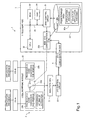
- the I/O control circuit 20 controls data transmission between the information processing terminal 2 and the external storage device 3 via the data communication bus 4.
- the processor B code conversion sub-module 22c converts the codes constructed by an instruction set of a CISC-type processor B (an application program B shown in Fig. 1) into codes executable by the RISC-type CPU 21.
- the bus 35 is a data transmission path used for data transmission between the respective elements like the CPU 32.
- the information processing terminal 2 is activated in the following manner, while the external storage device 3 including the configuration ROM 30b with the information written therein is connected with the information processing terminal 2 via the data communication bus 4 that is in conformity with the IEEE 1394 standard.
- the RISC-type CPU 21 included in the information processing terminal 2 reads the contents of the configuration ROM 30b of the external storage device 3 via the data communication bus 4.
- the RISC-type CPU 21 can read the storage contents of the configuration ROM 30b that is in conformity with the IEEE 1212 standard via the data communication bus 4 that is in conformity with the IEEE 1394 standard.
- the read-out application program consists of the codes constructed by the instruction set that is not executable by the RISC-type CPU 21.
- the code conversion sub-module 22b or 22c selected by the code conversion selection sub-module 22a thus converts the codes of the read-out application program into codes executable by the RISC-type CPU 21.
- the RISC-type CPU 21 executes the code-converted application program on the activated OS.
- the CPU 32 When the program enters the processing routine of Fig. 2, the CPU 32 first executes a certain program and reads the information on the application program from the predetermined area 30a of the data memory area 30 via the Disk control circuit 31 at step S200.
- step S204 the CPU 32 determines whether or not the codes of the application program are constructed by the instruction set for the processor A, based on the results of the analysis.
- the program goes to step S206. Otherwise, that is, in the case of a negative answer at step S204, the program goes to step S208.
- the arrangement of the embodiment is effectively applicable to the case in which the application program constructed by the instruction set of either the processor A or the processor B is stored in the predetermined area 30a of the data memory area 30.
- the application program is constructed by another instruction set, the information with regard to the processor B is written into the configuration ROM 30b.
- the code morphing module 22 determines whether or not the read-out storage contents represent the information regarding the processor A. In the case of the information regarding the processor A, that is, in the case of an affirmative answer at step S302, the program goes to step S304. Otherwise, that is, in the case of a negative answer at step S302, the program goes to step S306.
- the code-converted OS is stored. This arrangement ensures high-speed activation of the code-converted OS.
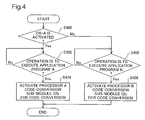
- the code morphing module 22 first determines whether or not the processor A code conversion sub-module 22b has been selected to switch over the setting of code conversion to the OS-A at step S400. In the case of the setting of code conversion to activate the OS-A, that is, in the case of an affirmative answer at step S400, the program goes to step S402. Otherwise, that is, in the case of a negative answer at step S400, the program goes to step S406.
- the OS-B is set as the object of code conversion.
- the code morphing module 22 determines whether or not a disk management operation on the selected OS-B is performed to execute an application program that is executable by the processor B and is stored in the predetermined area 30a of the data memory area 30 in the external storage device 3 (hereafter referred to the application program B) at step S406.
- the execution operation for the application program B that is, in the case of an affirmative answer at step S406, the program goes to step S408. Otherwise, that is, in the case of a negative answer at step S406, the program waits for an execution operation for the application program B.
- the processor B code conversion sub-module 22c works to convert the codes of the application program B into codes executable by the RISC-type CPU 21. The program then exits from this processing routine.
- the code morphing module 22 converts the codes of the application program, which is stored in the predetermined area 30a of the data memory area 30 in the external storage device 3, into the codes executable by the RISC-type CPU 21 of the information processing terminal 2.
- the RISC-type CPU 21 can thus execute the code-converted application program and utilize the data for the application program stored in the predetermined area 30a.
- the external storage device 3 is the intelligent external memory device that can independently execute the application program stored in the predetermined area 30a.
- the external storage device 3 may thus be separated from the system and dynamically used to fetch data for an application program from another information processing terminal or fetch an application program executable by the external storage device 3.
- terminals having the functions of the information processing terminal 2 discussed above become popular, for example, the external storage device 3 may be connected with a terminal at an outside place and cause the application program stored in the predetermined area 30a of the data memory area 30 in the external storage device 3 to be executed on the terminal. In this case, it is not required to take account of the model of the processor or the type of the OS corresponding to the application program.
- the external storage device 3 writes the information regarding the model of the processor and the type of the OS, which can execute the application program stored in the predetermined area 30a, into the configuration ROM 30b.
- the application program stored in the predetermined area 30a has been subjected to the code conversion to another instruction set, the information on the model of the processor and the type of the OS is updated at the time of activation of the external storage device 3. This arrangement effectively prevents the information processing terminal 2 from being activated with a wrong OS.
- the two different instruction sets for the processor A and the processor B can be subjected to the code conversion carried out by the code morphing module 22 of the information processing terminal 2.
- This is, however, not restrictive at all, and three or a greater number of instruction sets for the respective processors may be subjected to the code conversion.
- the information regarding both of the model of the processor and the type of the OS that can execute the application program is written in the configuration ROM 30b.
- This is, however, not restrictive at all. Any information that enables the code conversion selection sub-module 22a of the code morphing module 22 in the information processing terminal 2 to carry out the switchover of the active OS may be written in the configuration ROM 30b.
- a required minimum piece of information that is, either the model of the processor or the type of the OS, may be written in the configuration ROM 30b.
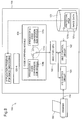
- Fig. 5 is a block diagram illustrating the construction of another information processing system 101 including an external storage device 102 in the second embodiment of the present invention.
- the information processing system 101 includes the external storage device 102, a data communication bus 103, and an information processing terminal 104.
- the external storage device 102 includes an I/O control circuit 120, a data memory area 121, a Disk control circuit 122, a RISC (reduced instruction set computer)-type CPU 123, and a code morphing module 124.
- I/O control circuit 120 includes an I/O control circuit 120, a data memory area 121, a Disk control circuit 122, a RISC (reduced instruction set computer)-type CPU 123, and a code morphing module 124.
- RISC reduced instruction set computer
- the I/O control circuit 120 controls data transmission to and from the information processing terminal 104 via the data communication bus 103, and also functions to determine whether or not the external storage device 102 is connected with an external device.
- the I/O control circuit 120 detects the status of the external storage device 102 connecting with or disconnecting from the information processing terminal 104.
- the I/O control circuit 120 fetches attribute information from the information processing terminal 104 and specifies the setting of the external storage device 102 in either an independent operation mode or a dependent operation mode, based on the connecting status and the fetched attribute information.
- the attribute information here is a distinct piece of information to discriminate an independent device, such as a PC or a PDA, from a dependent device, such as a printer or a scanner, under control of an independent device.
- the data memory area 121 is a mass storage area for storing predetermined data therein, and includes a protective area 121a, in which an objective application program executable by the external storage device 102 is stored.
- the application program stored in the protective area 121a is protected to be rewritable only by an exclusive rewriting program (discussed later). Any information processing terminal without this exclusive rewriting program is allowed to only read the application program stored in the protective area 121a.
- the Disk control circuit 122 carries out Disk access control, that is, controls operations of writing data into the data memory area 121 and of reading data from the data memory area 121.
- the RISC-type CPU 123 is designed to enhance the efficiency of the pipeline processing and improve the processing performance by simplification of individual instructions, and has various programs to be executed in the external storage device 102.
- the code morphing module 124 includes a code conversion selection sub-module 124a, a processor A code conversion sub-module 124b, and a processor B code conversion sub-module 124c.
- the code conversion selection sub-module 124a selects either one of the processor A code conversion sub-module 124b and the processor B code conversion sub-module 124c according to the storage contents of the protective area 121a, and switches over the setting between the OS-A and the OS-B to activate the external storage device 102.
- the processor A code conversion sub-module 124b converts the codes constructed by an instruction set of a processor A (that is, an application program A shown in Fig. 5), which is a CISC (complex instruction set computer)-type processor that makes individual instructions approach to a high level language to allow execution of complicated processing and thereby improve the processing performance, into codes executable by the RISC ⁇ type CPU 123.
- a processor A that is, an application program A shown in Fig. 5
- CISC complex instruction set computer
- the processor B code conversion sub-module 124c converts the codes constructed by an instruction set of a CISC-type processor B (that is an application program B shown in Fig. 5) into codes executable by the RISC-type CPU 123.
- the codes of the OS and the application program converted by the code morphing module 124 are stored in the main memory of the external storage device 102.
- the converted codes stored in the main memory are reused. This desirably reduces the overhead (deterioration of the performance), due to the code conversion.
- the external storage device 102 stores an exclusive rewriting program, which is used to rewrite the application program stored in the protective area 121a of the data memory area 121, as mentioned previously.
- the information processing terminal 104 is an independent device, such as a PC or a PDA, and includes a storage device for storing programs and data, a CPU executing the programs stored in the storage device, and a RAM for temporarily storing data used for execution of the programs.
- the information processing terminal 4 also stores the exclusive rewriting program, which is used to rewrite the application program stored in the protective area 121a of the data memory area 121 in the external storage device 102.
- the I/O control circuit 120 activates its connection status detecting function to detect the status of the external storage device 102 connecting with or disconnecting from an external device, that is, the information processing terminal 104.
- the external storage device 102 is set in the dependent operation mode. In the dependent operation mode, the external storage device 102 hands the control to the information processing terminal 104 and works as a secondary storage device of the information processing terminal 104.
- the access operation for example, the operation of writing data into the data memory area 121 of the external storage device 102
- the information processing terminal 104 accordingly controls the operation of writing predetermined data into the data memory area 121 of the external storage device 102 and the operation of reading predetermined data from the data memory area 121 via the data communication bus 103.
- the information processing terminal 104 may execute the exclusive rewriting program to rewrite the application program stored in the protective area 121 of the data memory area 121. Execution of the exclusive rewriting program may write another application program stored in the information processing terminal 104 over the application program stored in the protective area 121a or may delete the application program stored in the protective area 121a.
- the external storage device 102 When the connection status detecting function of the I/O control circuit 120 detects the disconnecting status from the information processing terminal 104, on the other hand, the external storage device 102 is set in the independent operation mode.
- the code conversion selection sub-module 124a of the code morphing module 124 reads the information regarding the application program stored in the protective area 121a of the data memory area 121 via the Disk control circuit 122.
- the code conversion selection sub-module 124a specifies the type of the OS to be activated, based on the read-out information, and selects the code conversion sub-module 124b or 124c corresponding to the selected OS.
- the code conversion selection sub-module 124a identifies the type of the instruction set used for production of the codes of the application program stored in the protective area 121a, that is, either the instruction set for the processor A or the instruction set for the processor B. The code conversion selection sub-module 124a then selects either the processor A code conversion sub-module 124b or the processor B code conversion sub-module 124c to be activated for code conversion, and also switches over the active OS between the OS-A and the OS-B, based on the result of the identification.
- the code conversion sub-module 124b or 124c of the code morphing module 124 which is selected by the code conversion selection sub-module 124a, makes the OS-A or the OS-B, which is set by the code conversion selection sub-module 124a, subjected to code conversion.
- the RISC-type CPU 123 executes the code-converted OS. This completes activation of the external storage device 102.
- the OS corresponding to the application program stored in the protective area 121a of the data memory area 121 becomes active in the external storage device 102.
- the selected code conversion sub-module 124b or 124c carries out the code conversion of the application program on the active OS.
- the RISC-type CPU 123 then executes the code-converted application program.
- the RISC-type CPU 123 of the external storage device 102 independently executes the application program stored in the protective area 121a of the data memory area 121.
- a power source unit for independent operations as well as a speaker, a control unit, a liquid crystal display, and other required elements according to executable application programs are appropriately mounted on the external storage device 102.
- the external storage device 102 is capable of writing another application program stored in a different place from the protective area 121a in the data memory area 121 over the application program stored in the protective area 121a, according to the exclusive rewriting program stored therein.
- the external storage device 102 of the second embodiment may be connected with a printer device to construct a printing system.
- the data memory area 121 includes the protective area 121a that stores an application program for controlling the printer device, which has been written in advance by the information processing terminal 104, and a predetermined area that is different from the protective area 121a and stores image data, which has been written in advance by the information processing terminal 104.
- Fig. 8 is a block diagram illustrating the construction of a printing system 105, in which the external storage device 102 of the second embodiment is connected with a printer device 106.
- the printing system 105 includes the external storage device 102 and the printer device 106, which are connected with each other via the data communication bus 103.
- the external storage device 102 and the data communication bus 103 included in the printing system 105 are identical with those included in the information processing system 101 of the second embodiment shown in Fig. 5 and are thus not specifically described.
- the printer device 106 is constructed by the same technique as that of known printers. According to the application program for controlling the printer device executed by the external storage device 102, the printer device 106 receives print data transmitted from the external storage device 102 and prints an image on a printing medium based on the input print data.
- the I/O control circuit 120 activates its connection status detecting function to detect the status of the external storage device 102 connecting with or disconnecting from an external device, that is, the printer device 106.
- the external storage device 102 is set in the independent operation mode.
- the application program for controlling the printer device stored in the protective area 121a of the data memory area 121 is automatically executed on the selected active OS. The execution of the application program causes the printer device 106 to print the image data stored in the predetermined area of the data memory area 121.
- the connection status detecting function of the I/O control circuit 120 first determines whether or not the external storage device 102 is connected with or disconnected from an external device at step S1200. In the case of the connecting status, that is, in the case of an affirmative answer at step S1200, the program goes to step S1202. Otherwise, that is, in the case of a negative answer at step S1200, the program goes to step S1208.
- connection status detecting function determines whether or not the attribute information fetched from the external device represents an independent device. In the case of the independent device, that is, in the case of an affirmative answer at step S1202, the program goes to step S1204. Otherwise, that is, in the case of a negative answer at step S1202, the program goes to step S1206.
- connection status detecting function sets the external storage device 102 in the dependent operation mode.
- the program then exists from this processing routine.
- connection status detecting function sets the external storage device 102 in the independent operation mode at step S1206. The program then exits from this processing routine.
- connection status detecting function When it is determined at step S1200 that the external storage device 102 is disconnected from the external device, the connection status detecting function also sets the external storage device 102 in the independent operation mode at step S1208. The program then exits from this processing routine.
- the external storage device 102 When the program enters the processing routine of Fig. 7, the external storage device 102 first determines whether or not the application program has been stored in advance in the protective area 121a of the data memory area 121 at step S1300. When the application program is present in the protective area 121a, that is, in the case of an affirmative answer at step S1300, the program goes to step S1302. Otherwise, that is, in the case of a negative answer at step S1300, the program goes to step S1314.
- the external storage device 102 determines whether or not the codes for the processor A are included in the application program read from the protective area 121a.
- the application program includes the codes for the processor A, that is, in the case of an affirmative answer at step S1302, the program goes to step S1304. Otherwise, that is, in the case of a negative answer at step S1302, the program goes to step S1310.
- the external storage device 102 activates the OS-A at step S1304.
- the code conversion selection sub-module 124a selects the processor A code conversion sub-module 124b and the OS-A corresponding to the application program A.
- the RISC-type CPU 23 then activates the selected OS-A in the following manner.
- the processor A code conversion sub-module 124b converts the codes of the OS-A into the codes executable by the RISC-type CPU 123, and the RISC-type CPU 23 executes the code-converted OS-A. This completes activation of the selected OS-A.
- the external storage device 102 executes the application program A stored in the protective area 121 on the activated OS-A at step S1306, and the program then proceeds to step S1308.
- the application program A stored in the protective area 121 on the activated OS-A at step S1306, and the program then proceeds to step S1308.
- only one application program that is, either the application program A or the application program B, is recorded in the protective area 121a.
- the application program corresponding to the selected OS is automatically executed on the activated OS.
- the external storage device 102 then waits for the user's operation on the activated OS or the executed application program at step S1308.
- the external storage device 102 activates the OS-B at step S1310.
- the code conversion selection sub-module 124a selects the processor B code conversion sub-module 124c and the OS-B corresponding to the application program B.
- the RISC-type CPU 23 then activates the selected OS-B in the following manner.
- the processor B code conversion sub-module 124c converts the codes of the OS-B into the codes executable by the RISC-type CPU 123, and the RISC-type CPU 23 executes the code-converted OS-B. This completes activation of the selected OS-B.
- the external storage device 102 executes the application program B stored in the protective area 121 on the activated OS-B at step S1312, and the program then proceeds to step S1308.
- the code conversion selection sub-module 124a of the code morphing module 124 selects the code conversion sub-module 124b or 124c to be activated, based on the code information of the application program stored in the protective area 121a of the data memory area 121, and specifies the OS that can execute the application program and is used to activate the external storage device 102.
- Activation of the external storage device 102 in the independent operation mode enables the application program to be executed on the appropriate OS, irrespective of the instruction set of the codes constituting the application program stored in the external storage device 102.
- the external storage device 102 detects the connection status with an external device and automatically sets either the independent operation mode or the dependent operation mode, based on the result of the detection. This arrangement desirably saves the user's labor and time for manual setting and enables the external storage device 102 to be readily used through simple connection with an external device.
- the application program executed by the external storage device 102 is stored in the protective area 121a of the data memory area 121. This arrangement effectively prevents the application program from being deleted or destroyed by, for example, malfunction of the external device.
- the contents of the protective area 121a are rewritable by the exclusive rewriting program. This arrangement enables the application program executed by the external storage device 102 to be modified or upgraded to a new version.
- the code morphing module 124 shown in Fig. 5 corresponds to the code morphing module of the claims.
- the code conversion selection sub-module 124a corresponds to the code conversion selection module or the OS switchover means of the claims.
- the processor A code conversion sub-module 124b and the processor B code conversion sub-module 124c correspond to the multiple code conversion modules of the claims.
- the data communication bus 103 corresponds to the data communication means of the claims.
- the two different instruction sets for the processor A and the processor B can be subjected to the code conversion carried out by the code morphing module 124 of the external storage device 102.
- This is, however, not restrictive at all, and three or a greater number of instruction sets for the respective processors may be subjected to the code conversion.
Landscapes
- Engineering & Computer Science (AREA)
- Software Systems (AREA)
- Theoretical Computer Science (AREA)
- General Engineering & Computer Science (AREA)
- Physics & Mathematics (AREA)
- General Physics & Mathematics (AREA)
- Stored Programmes (AREA)
Applications Claiming Priority (3)
| Application Number | Priority Date | Filing Date | Title |
|---|---|---|---|
| JP2002078542A JP4026383B2 (ja) | 2002-03-20 | 2002-03-20 | 情報処理システム、情報処理端末、外部記憶装置、情報処理端末制御用プログラム及び外部記憶装置制御用プログラム |
| JP2002086671A JP4106944B2 (ja) | 2002-03-26 | 2002-03-26 | 外部記憶装置及び外部記憶装置制御プログラム |
| EP03251551A EP1347373A3 (de) | 2002-03-20 | 2003-03-13 | Anordnung zur Verarbeitung von Befehlen verschiedener Befehlsatzarchitekturen |
Related Parent Applications (1)
| Application Number | Title | Priority Date | Filing Date |
|---|---|---|---|
| EP03251551A Division EP1347373A3 (de) | 2002-03-20 | 2003-03-13 | Anordnung zur Verarbeitung von Befehlen verschiedener Befehlsatzarchitekturen |
Publications (2)
| Publication Number | Publication Date |
|---|---|
| EP1635255A2 true EP1635255A2 (de) | 2006-03-15 |
| EP1635255A3 EP1635255A3 (de) | 2006-05-24 |
Family
ID=27791038
Family Applications (2)
| Application Number | Title | Priority Date | Filing Date |
|---|---|---|---|
| EP03251551A Withdrawn EP1347373A3 (de) | 2002-03-20 | 2003-03-13 | Anordnung zur Verarbeitung von Befehlen verschiedener Befehlsatzarchitekturen |
| EP05077843A Withdrawn EP1635255A3 (de) | 2002-03-20 | 2003-03-13 | Informationsverarbeitungssystem |
Family Applications Before (1)
| Application Number | Title | Priority Date | Filing Date |
|---|---|---|---|
| EP03251551A Withdrawn EP1347373A3 (de) | 2002-03-20 | 2003-03-13 | Anordnung zur Verarbeitung von Befehlen verschiedener Befehlsatzarchitekturen |
Country Status (3)
| Country | Link |
|---|---|
| US (1) | US20030221087A1 (de) |
| EP (2) | EP1347373A3 (de) |
| CN (1) | CN1251064C (de) |
Cited By (3)
| Publication number | Priority date | Publication date | Assignee | Title |
|---|---|---|---|---|
| WO2008004006A1 (en) * | 2006-07-06 | 2008-01-10 | Imperas Ltd | Multiprocessor development environment |
| US20100017183A1 (en) * | 2006-07-06 | 2010-01-21 | Imperas Ltd. | Multiprocessor Development Environment |
| EP2154609A1 (de) * | 2008-08-12 | 2010-02-17 | Sony Ericsson Mobile Communications Japan, Inc. | Tragbares Endgerät, Steuerungsverfahren für das tragbare Endgerät und Steuerungsprogramm für das tragbare Endgerät |
Families Citing this family (17)
| Publication number | Priority date | Publication date | Assignee | Title |
|---|---|---|---|---|
| JP4185346B2 (ja) * | 2002-10-18 | 2008-11-26 | 株式会社日立製作所 | ストレージ装置及びその構成設定方法 |
| US7320127B2 (en) * | 2003-11-25 | 2008-01-15 | Cisco Technology, Inc. | Configuration synchronization for redundant processors executing different versions of software |
| JP4629382B2 (ja) * | 2004-08-05 | 2011-02-09 | インターナショナル・ビジネス・マシーンズ・コーポレーション | 情報処理装置、プログラム、記録媒体、及び制御方法 |
| US8020152B2 (en) | 2005-02-24 | 2011-09-13 | Microsoft Corporation | Code morphing |
| US7913252B2 (en) * | 2006-04-11 | 2011-03-22 | Installfree, Inc. | Portable platform for executing software applications in a virtual environment |
| US20090083829A1 (en) * | 2007-09-20 | 2009-03-26 | C & S Operations, Inc. | Computer system |
| JP4888742B2 (ja) | 2009-02-25 | 2012-02-29 | ソニー株式会社 | 情報処理装置および方法、並びにプログラム |
| US9389877B2 (en) * | 2009-07-20 | 2016-07-12 | Google Technology Holdings LLC | Multi-environment operating system |
| US8868899B2 (en) * | 2009-07-20 | 2014-10-21 | Motorola Mobility Llc | System and method for switching between environments in a multi-environment operating system |
| US9367331B2 (en) * | 2009-07-20 | 2016-06-14 | Google Technology Holdings LLC | Multi-environment operating system |
| US9348633B2 (en) * | 2009-07-20 | 2016-05-24 | Google Technology Holdings LLC | Multi-environment operating system |
| US9372711B2 (en) * | 2009-07-20 | 2016-06-21 | Google Technology Holdings LLC | System and method for initiating a multi-environment operating system |
| JP2011257904A (ja) * | 2010-06-08 | 2011-12-22 | Hitachi Ltd | 制御装置及びそのデータ処理方法 |
| US8983536B2 (en) | 2010-10-22 | 2015-03-17 | Google Technology Holdings LLC | Resource management in a multi-operating environment |
| US9354900B2 (en) | 2011-04-28 | 2016-05-31 | Google Technology Holdings LLC | Method and apparatus for presenting a window in a system having two operating system environments |
| US9417753B2 (en) | 2012-05-02 | 2016-08-16 | Google Technology Holdings LLC | Method and apparatus for providing contextual information between operating system environments |
| US9342325B2 (en) | 2012-05-17 | 2016-05-17 | Google Technology Holdings LLC | Synchronizing launch-configuration information between first and second application environments that are operable on a multi-modal device |
Family Cites Families (14)
| Publication number | Priority date | Publication date | Assignee | Title |
|---|---|---|---|---|
| US5313614A (en) * | 1988-12-06 | 1994-05-17 | At&T Bell Laboratories | Method and apparatus for direct conversion of programs in object code form between different hardware architecture computer systems |
| US6496922B1 (en) * | 1994-10-31 | 2002-12-17 | Sun Microsystems, Inc. | Method and apparatus for multiplatform stateless instruction set architecture (ISA) using ISA tags on-the-fly instruction translation |
| US5560013A (en) * | 1994-12-06 | 1996-09-24 | International Business Machines Corporation | Method of using a target processor to execute programs of a source architecture that uses multiple address spaces |
| US5889941A (en) * | 1996-04-15 | 1999-03-30 | Ubiq Inc. | System and apparatus for smart card personalization |
| TW384611B (en) * | 1997-02-14 | 2000-03-11 | Canon Kk | Data communication apparatus and method |
| CN1088218C (zh) * | 1999-11-14 | 2002-07-24 | 邓国顺 | 用于数据处理系统的快闪电子式外存储方法及其装置 |
| US6668287B1 (en) * | 1999-12-15 | 2003-12-23 | Transmeta Corporation | Software direct memory access |
| JP2001256066A (ja) * | 2000-02-29 | 2001-09-21 | Internatl Business Mach Corp <Ibm> | コンピュータシステム、オペレーティングシステムの切り替えシステム、オペレーティングシステムの実装方法、オペレーティングシステムの切り替え方法、記憶媒体及びプログラム伝送装置 |
| US6715016B1 (en) * | 2000-06-01 | 2004-03-30 | Hitachi, Ltd. | Multiple operating system control method |
| US6694428B2 (en) * | 2000-11-29 | 2004-02-17 | Palm One, Inc. | System for indentifying a peripheral device by sending an inquiry thereto after receiving an interrupt notification message if the interrupt and communication port meet predetermined conditions |
| JP2002215398A (ja) * | 2001-01-17 | 2002-08-02 | Nec Corp | 情報処理装置、その使用方法及びプログラム |
| EP1248193A1 (de) * | 2001-04-02 | 2002-10-09 | Hewlett-Packard Company | Initialisierungsmodule für einen Gerätetreiber |
| CN1122281C (zh) * | 2001-06-30 | 2003-09-24 | 深圳市朗科科技有限公司 | 一种多功能半导体存储装置 |
| US6871244B1 (en) * | 2002-02-28 | 2005-03-22 | Microsoft Corp. | System and method to facilitate native use of small form factor devices |
-
2003
- 2003-03-13 EP EP03251551A patent/EP1347373A3/de not_active Withdrawn
- 2003-03-13 EP EP05077843A patent/EP1635255A3/de not_active Withdrawn
- 2003-03-18 US US10/390,157 patent/US20030221087A1/en not_active Abandoned
- 2003-03-20 CN CN03107441.3A patent/CN1251064C/zh not_active Expired - Fee Related
Cited By (6)
| Publication number | Priority date | Publication date | Assignee | Title |
|---|---|---|---|---|
| WO2008004006A1 (en) * | 2006-07-06 | 2008-01-10 | Imperas Ltd | Multiprocessor development environment |
| US20100017183A1 (en) * | 2006-07-06 | 2010-01-21 | Imperas Ltd. | Multiprocessor Development Environment |
| US8417508B2 (en) | 2006-07-06 | 2013-04-09 | Imperas Software Ltd. | Multiprocessor development environment |
| EP2154609A1 (de) * | 2008-08-12 | 2010-02-17 | Sony Ericsson Mobile Communications Japan, Inc. | Tragbares Endgerät, Steuerungsverfahren für das tragbare Endgerät und Steuerungsprogramm für das tragbare Endgerät |
| US8826263B2 (en) | 2008-08-12 | 2014-09-02 | Sony Corporation | Portable terminal, portable terminal control method, and portable terminal control program |
| CN101650661B (zh) * | 2008-08-12 | 2016-03-16 | 索尼移动通信日本株式会社 | 便携式终端、便携式终端控制方法 |
Also Published As
| Publication number | Publication date |
|---|---|
| CN1445659A (zh) | 2003-10-01 |
| EP1347373A2 (de) | 2003-09-24 |
| EP1347373A3 (de) | 2005-02-02 |
| EP1635255A3 (de) | 2006-05-24 |
| CN1251064C (zh) | 2006-04-12 |
| US20030221087A1 (en) | 2003-11-27 |
Similar Documents
| Publication | Publication Date | Title |
|---|---|---|
| EP1635255A2 (de) | Informationsverarbeitungssystem | |
| CN1323353C (zh) | 信息处理装置及其控制方法 | |
| EP1999557B1 (de) | Druckkontrollgerät, gui-anzeigeverfahren, druckertreiber und aufzeichnungsmedium | |
| JP4235441B2 (ja) | 文書処理プログラム、文書処理方法および装置 | |
| US8451484B2 (en) | Information processing apparatus, printing apparatus, electronic device, and computer program therefor based on existence of printer configuration file | |
| KR20060073832A (ko) | 프린터 드라이버 변경장치 및 방법과 이를 이용한드라이버 변경가능한 프린터 시스템 및 방법 | |
| CN112231176B (zh) | 一种简便的VxWorks操作系统系统日志记录方法 | |
| JPH10283129A (ja) | 印刷制御装置及び印刷制御プログラムのインストール方法及び記憶媒体 | |
| JP4239392B2 (ja) | 印刷装置、印刷システムおよび印刷方法 | |
| JP4026383B2 (ja) | 情報処理システム、情報処理端末、外部記憶装置、情報処理端末制御用プログラム及び外部記憶装置制御用プログラム | |
| JP4106944B2 (ja) | 外部記憶装置及び外部記憶装置制御プログラム | |
| JP2005309511A (ja) | 情報処理装置、ステータス取得方法、及びプログラム | |
| KR100788677B1 (ko) | Usb 디바이스 및 그에 구비된 저장매체의 제어 방법 | |
| US20050007811A1 (en) | Storage device and data conversion program | |
| JP3774703B2 (ja) | 印刷装置、制御方法、記憶媒体 | |
| JPH04318616A (ja) | プリンタ装置 | |
| JPH01274229A (ja) | 固定ディスク装置 | |
| JP6163853B2 (ja) | プログラム及びデータ変換方法 | |
| JP2003330871A (ja) | データ転送装置 | |
| JPH10275069A (ja) | 画像処理装置及びその方法 | |
| JP2005141367A (ja) | 記録媒体、インストール補助プログラム、インストール方法及び情報処理装置 | |
| JPH07160431A (ja) | コマンド拡張cd−rom装置 | |
| JP2008171443A (ja) | 装置、装置の制御方法、プログラム、記録媒体 | |
| JP2003080770A (ja) | 画像印刷システム | |
| JPH09106352A (ja) | 情報処理方法及びその装置 |
Legal Events
| Date | Code | Title | Description |
|---|---|---|---|
| PUAI | Public reference made under article 153(3) epc to a published international application that has entered the european phase |
Free format text: ORIGINAL CODE: 0009012 |
|
| 17P | Request for examination filed |
Effective date: 20051222 |
|
| AC | Divisional application: reference to earlier application |
Ref document number: 1347373 Country of ref document: EP Kind code of ref document: P |
|
| AK | Designated contracting states |
Kind code of ref document: A2 Designated state(s): AT BE BG CH CY CZ DE DK EE ES FI FR GB GR HU IE IT LI LU MC NL PT RO SE SI SK TR |
|
| PUAL | Search report despatched |
Free format text: ORIGINAL CODE: 0009013 |
|
| AK | Designated contracting states |
Kind code of ref document: A3 Designated state(s): AT BE BG CH CY CZ DE DK EE ES FI FR GB GR HU IE IT LI LU MC NL PT RO SE SI SK TR |
|
| RIC1 | Information provided on ipc code assigned before grant |
Ipc: G06F 9/318 20060101AFI20060405BHEP |
|
| RTI1 | Title (correction) |
Free format text: APPARATUS FOR PROCESSING INSTRUCTIONS OF DIFFERENT INSTRUCTION SET ARCHITECTURES |
|
| 17Q | First examination report despatched |
Effective date: 20060717 |
|
| AKX | Designation fees paid |
Designated state(s): AT BE BG CH CY CZ DE DK EE ES FI FR GB GR HU IE IT LI LU MC NL PT RO SE SI SK TR |
|
| STAA | Information on the status of an ep patent application or granted ep patent |
Free format text: STATUS: THE APPLICATION IS DEEMED TO BE WITHDRAWN |
|
| 18D | Application deemed to be withdrawn |
Effective date: 20091103 |