EP1634558B1 - Pflegebett - Google Patents
Pflegebett Download PDFInfo
- Publication number
- EP1634558B1 EP1634558B1 EP04021259A EP04021259A EP1634558B1 EP 1634558 B1 EP1634558 B1 EP 1634558B1 EP 04021259 A EP04021259 A EP 04021259A EP 04021259 A EP04021259 A EP 04021259A EP 1634558 B1 EP1634558 B1 EP 1634558B1
- Authority
- EP
- European Patent Office
- Prior art keywords
- weight
- height
- care bed
- support carrier
- adjusting device
- Prior art date
- Legal status (The legal status is an assumption and is not a legal conclusion. Google has not performed a legal analysis and makes no representation as to the accuracy of the status listed.)
- Expired - Lifetime
Links
- 238000011156 evaluation Methods 0.000 claims description 8
- 230000000474 nursing effect Effects 0.000 description 27
- 238000005259 measurement Methods 0.000 description 16
- 238000012544 monitoring process Methods 0.000 description 4
- 125000006850 spacer group Chemical group 0.000 description 4
- 238000005303 weighing Methods 0.000 description 3
- 230000001419 dependent effect Effects 0.000 description 2
- 238000013459 approach Methods 0.000 description 1
- 230000037396 body weight Effects 0.000 description 1
- 230000007423 decrease Effects 0.000 description 1
- 230000037213 diet Effects 0.000 description 1
- 235000005911 diet Nutrition 0.000 description 1
- 230000000694 effects Effects 0.000 description 1
- 239000000314 lubricant Substances 0.000 description 1
- 230000000737 periodic effect Effects 0.000 description 1
- 230000000284 resting effect Effects 0.000 description 1
- 230000001360 synchronised effect Effects 0.000 description 1
- 230000001225 therapeutic effect Effects 0.000 description 1
Images


Classifications
-
- G—PHYSICS
- G01—MEASURING; TESTING
- G01G—WEIGHING
- G01G19/00—Weighing apparatus or methods adapted for special purposes not provided for in the preceding groups
- G01G19/44—Weighing apparatus or methods adapted for special purposes not provided for in the preceding groups for weighing persons
- G01G19/445—Weighing apparatus or methods adapted for special purposes not provided for in the preceding groups for weighing persons in a horizontal position
-
- A—HUMAN NECESSITIES
- A61—MEDICAL OR VETERINARY SCIENCE; HYGIENE
- A61G—TRANSPORT, PERSONAL CONVEYANCES, OR ACCOMMODATION SPECIALLY ADAPTED FOR PATIENTS OR DISABLED PERSONS; OPERATING TABLES OR CHAIRS; CHAIRS FOR DENTISTRY; FUNERAL DEVICES
- A61G7/00—Beds specially adapted for nursing; Devices for lifting patients or disabled persons
- A61G7/002—Beds specially adapted for nursing; Devices for lifting patients or disabled persons having adjustable mattress frame
- A61G7/012—Beds specially adapted for nursing; Devices for lifting patients or disabled persons having adjustable mattress frame raising or lowering of the whole mattress frame
-
- A—HUMAN NECESSITIES
- A61—MEDICAL OR VETERINARY SCIENCE; HYGIENE
- A61G—TRANSPORT, PERSONAL CONVEYANCES, OR ACCOMMODATION SPECIALLY ADAPTED FOR PATIENTS OR DISABLED PERSONS; OPERATING TABLES OR CHAIRS; CHAIRS FOR DENTISTRY; FUNERAL DEVICES
- A61G7/00—Beds specially adapted for nursing; Devices for lifting patients or disabled persons
- A61G7/05—Parts, details or accessories of beds
- A61G7/0527—Weighing devices
-
- A—HUMAN NECESSITIES
- A61—MEDICAL OR VETERINARY SCIENCE; HYGIENE
- A61G—TRANSPORT, PERSONAL CONVEYANCES, OR ACCOMMODATION SPECIALLY ADAPTED FOR PATIENTS OR DISABLED PERSONS; OPERATING TABLES OR CHAIRS; CHAIRS FOR DENTISTRY; FUNERAL DEVICES
- A61G2203/00—General characteristics of devices
- A61G2203/30—General characteristics of devices characterised by sensor means
- A61G2203/44—General characteristics of devices characterised by sensor means for weight
-
- A—HUMAN NECESSITIES
- A61—MEDICAL OR VETERINARY SCIENCE; HYGIENE
- A61G—TRANSPORT, PERSONAL CONVEYANCES, OR ACCOMMODATION SPECIALLY ADAPTED FOR PATIENTS OR DISABLED PERSONS; OPERATING TABLES OR CHAIRS; CHAIRS FOR DENTISTRY; FUNERAL DEVICES
- A61G7/00—Beds specially adapted for nursing; Devices for lifting patients or disabled persons
- A61G7/002—Beds specially adapted for nursing; Devices for lifting patients or disabled persons having adjustable mattress frame
- A61G7/018—Control or drive mechanisms
Definitions
- the present invention relates to a nursing bed with feet or wheels, a distance above the chassis frame arranged support and a support arranged between the chassis frame and support plate height adjustment, which is attached to the support carrier at a central position
- Modern nursing beds such as those used in hospitals, have a height adjustment device in order to be able to vary a height determined by a support on the support support lying surface.
- the lying surface is lowered, for example, to facilitate patient entry and exit.
- the lying surface is raised with the patient, so that the nursing staff can carry out these activities at an ergonomically sensible height.
- Such care beds are in the DE 102 15 395 C1 as well as in the DE 299 18 805 U1 disclosed.
- a heavy load height adjustment of the chassis frame is provided with rollers, so designed as a chassis.
- telescopic guides Between the chassis frame and the support beam are telescopic guides, which allow for a tilt-free stroke of the support support relative to the chassis frame to care.
- the stroke is accomplished by means of a gear provided in a central column which is driven by one or more electric motors.
- the motors are housed in a closed housing and bring sufficient forces, so that the required lifting weight and the necessary stroke distance is guaranteed.
- the present invention is therefore based on the object in a simple way to enable weight monitoring of patients, especially bedridden patients.
- a nursing bed of the type mentioned in the invention is characterized in that arranged on the height adjustment, acting on a central position of the support carrier weight measuring device with at least one weight sensor.
- a weight measuring device is thus provided between the height adjustment device and the support carrier, wherein the height adjustment device is arranged centrally below the support carrier.
- the lifting movement thus starts only at a central position on the support carrier.
- the invention enables weight monitoring of patients, especially bedridden patients, by means of a weight measuring device integrated into the structure of the nursing bed.
- the weight of the patient lying on the lying surface can be recorded without the patient having to leave the nursing bed.
- the weight measurement is carried out in a simple manner without special measures and without a special additional frame.
- the structure of the nursing bed is thus structurally simple and allows regular weight measurement with a small time and personnel costs.
- the arrangement of the weight measuring device in the center of the nursing bed ensures a high accuracy of measurement.
- the weight measuring device has a base body which is fixedly mounted with its underside on the top of the height adjustment and with its top is movably mounted on the underside of the support.
- the one-sided fixed and opposite side movable storage allows reliable weight measurement, since on the movably mounted side, the occurring weight forces are passed into the weight sensors.
- the support carrier assumes the function of the weighing pan or weighing surface.
- the nursing bed in the base body at least one vertical bore for receiving a mounted on the support carrier and provided by this projecting cylinder, so that the main body on the cylinder is up and down slidingly movable.
- the up and down sliding movement depends on the resting on the support carrier mass or the weight there.
- the bore wall, which slides along the cylinder wall, ensures reliable guidance of the body during weight-dependent movement.
- the base body of the weight measuring device has a recess open to the movably mounted side.
- this recess for example, a blind bore, at least one weight sensor is introduced and stored stable.
- the nursing bed according to the invention is provided with a preferably electronic evaluation and control device connected to the weight measuring device.
- a zero position can take place via this evaluation and control device. That is, the weight measuring device is calibrated to zero after the nursing bed has been completely prepared for patient reception, that is after mattress, bedding and necessary medical equipment has been applied. If a patient is subsequently bedded on the lying surface of the nursing bed, the weight acting on the weight measuring device changes. Consequently, only the patient weight is detected by the weight measuring device.
- it can be adjusted, for example, via the evaluation and control device, at which intervals a weight measurement is carried out. In this case, for example, a permanent measurement or a measurement is possible only when prompted. A periodic, automatically repeated measurement of the weight is conceivable.
- a display connected to the evaluation and control device for displaying the measured weight is provided in a nursing bed according to the invention.
- This display is arranged, for example, in a well-visible place of the nursing bed and displays the result of the weight measurement converted into kg-figures.
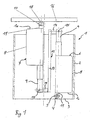
- An in FIG. 1 illustrated height adjustment device 1 has a cylindrical shell-shaped housing 2, the lower end face 3 can be covered open or hygienic reasons. Over the depth of the housing 2 extends at the lower end of a mounting rail 4, which has at least one passage opening for a fastening bolt 5.
- the two electric motors 6, 7 each have a cylindrical housing 8, from which a spindle rod 9 axially slidably extends outwardly on one end face.
- a fork-like projection 11 of the first electric motor 6 engages over the mounting rail 4 and has in the fork-shaped part through holes for the fastening bolt 5, so that the first electric motor 6 is fixed to the rail 4 by means of the fastening bolt 5.
- the two electric motors 6, 7 are arranged in the housing 2 next to each other, but antiparallel to each other.
- the two spindle rods 9 are partially extended.
- a connecting part 12 is fixed, which consists of a height distance between the two ends of the spindle rod 9 bridging middle piece 13 and two at the ends of the central piece 13 at right angles approaches 14.
- the lugs 14 are diametrically opposed to each other with respect to the center axis of the center piece 13, thus pointing in opposite directions.
- the attachment of the lugs 14 to the spindle rods 9 can be done in an analogous manner with a forked end of the spindle rod 9, in which the projection 14 can be inserted.
- a connecting bolt 15 which cause relative to the movement of the spindle rods 9 in the direction of the height rigid attachment of the connecting part 12 with the spindle rods 9.
- the two electric motors 6, 7 are preferably synchronized controlled by a common control, so that both electric motors 6, 7 at the same time and in the same way their spindle rods 9 extend out of the housing 8.
- a weight measuring device 17 is arranged between the bottom end 10 of the second electric motor 7 and a head plate 16 arranged above it as a support support.
- the second electric motor 7 is connected to the weight measuring device 17 with a fork-like projection 11.
- a preferably electronic weight sensor 18 is arranged, which contacts the top plate 16.
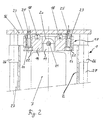
- FIG. 2 is shown in a cross-sectional view of the weight measuring device 17, which is arranged at the top of the height adjustment device 1.
- the weight measuring device 17 has a base body 19, in which a web 20 is formed centrally.
- the web 20 is inserted into the fork-like projection 11 of the second electric motor 7, so that the projection 11 engages over the web 20.
- a fastening bolt 21 is inserted into aligned passage openings of the fork-like projection 11 and the web 20 and thus causes a firm connection of the base body 19 with the height adjustment device. 1
- the base body 19 has on its two sides next to the web 20 two holes 22.
- a spacer sleeve 23 is introduced in each case.
- the spacer sleeve 23 is fastened by means of a washer 24 and a screw 25 to the top plate 16.
- a sliding movement of the inner wall surface of the bore 22 on the outer wall surface of the spacer sleeve 23 a vertical movement of the base body 19 is made possible relative to the top plate 16. Consequently, the base body 19 is movably mounted on the top plate 16.
- a sliding or lubricant between the spacer sleeve 23 and the bore 22 is preferably provided.
- the vertical relative movement between the base body 19 and the top plate 16 is caused by the weight acting on the top plate 16.
- the weight is now forwarded to the weight sensors 18.
- the top plate 16 is moved in the direction of the base body 19, thus decreases with increasing weight, the distance between the base body 19 and the top plate 16 from.
- slide bearings 26 are arranged, in which associated cylindrical piston 27 are guided, which are connected at its upper end to the top plate 16.
- the cylindrical piston 27 ensure that the top plate 16 does not tilt about the fastening bolt 21 as a fulcrum.
- the head plate 16 is held in a horizontal position relative to the direction of movement of the stroke.
- FIG. 3a a cross-section of the base body 19 is shown.
- the main body 19 has in its middle the web 20 with a through hole 28 for receiving the fastening bolt 21 FIG. 2 on.
- a bore 22 is formed in each case.
- the bore has a circular shoulder 29, so that the bore 22 below the shoulder 29 has a larger diameter.
- the paragraph 29 serves as a stop for the washer 24 FIG. 2 ,
- the main body preferably has a length of about 70 to 80 mm, a width of about 10 to 20 mm and a height of about 20 to 30 mm. In the embodiment shown in the figures, the values are 74 mm in length, 15 mm in width and 25 mm in height.
- FIG. 4 illustrates the substructure of a nursing bed and leaves the - shown in this illustration - head plate 16, located in contact with the top plate 16 pressure sensor 18, the relative to the top plate 16 movably mounted weight measuring device 17 and the attached electric motor 7 recognize. Also visible are the cylindrical piston 27, which are guided in plain bearings 26 on the side of the housing 2 and are connected at its upper end to the top plate 16.
- the housing 2 is by screw 31 with a chassis frame 32nd connected, which is provided with wheels 33 and so forms a chassis for the nursing bed.
- the wheelbase of the wheels 33 is preferably wider in comparison to the width of the housing 2.
- FIG. 5 corresponds to the illustration from the FIG. 4 with an additionally illustrated lying surface 34.
- the lying surface 34 is disposed above the top plate 16 and secured thereto. It can be seen from the figures that the lying surface 34 represents the measuring surface for the weight measurement.
- a patient lying above the lying surface 34 and the lying on the bed surface 34 (not shown) lying patient can be monitored with the help of the nursing bed according to the invention in terms of body weight, without having to leave the nursing bed or another increased effort is required.
- use in a changing table and / or a treatment table in medical therapeutic area is possible.
Landscapes
- Health & Medical Sciences (AREA)
- Nursing (AREA)
- Life Sciences & Earth Sciences (AREA)
- Animal Behavior & Ethology (AREA)
- General Health & Medical Sciences (AREA)
- Public Health (AREA)
- Veterinary Medicine (AREA)
- Physics & Mathematics (AREA)
- General Physics & Mathematics (AREA)
- Invalid Beds And Related Equipment (AREA)
- Devices For Medical Bathing And Washing (AREA)
- Thermotherapy And Cooling Therapy Devices (AREA)
Description
- Die vorliegende Erfindung betrifft ein Pflegebett mit Füßen oder Rädern, einem mit Abstand über dem Chassisrahmen angeordneten Auflageträger und einer zwischen Chassisrahmen und Auflageträger angeordneten Höhenverstelleinrichtung, die an einer zentralen Position an dem Auflageträger angesetzt ist
- Moderne Pflegebetten, wie sie beispielsweise in Krankenhäusern verwendet werden, weisen eine Höhenverstelleinrichtung auf, um eine durch eine Auflage auf dem Auflageträger bestimmte Liegefläche in der Höhe variieren zu können. Die Liegefläche wird abgesenkt, um beispielsweise Patienten das Ein- bzw. Aussteigen zu erleichtern. Für Pflegearbeiten wird die Liegefläche mit dem Patienten angehoben, damit das Pflegepersonal diese Tätigkeiten auf einer ergonomisch sinnvollen Höhe durchführen kann.
- Derartige Pflegebetten sind in der
DE 102 15 395 C1 sowie in derDE 299 18 805 U1 offenbart. Bei den dort beschriebenen Pflegebetten mit einer Schwerlasthöhenverstellung ist der Chassisrahmen mit Rollen versehen, also als Fahrgestell ausgebildet. Zwischen dem Chassisrahmen und dem Auflageträger befinden sich Teleskopführungen, die für einen kippfreien Hub des Auflageträgers relativ zum Chassisrahmen sorgen. Der Hub wird mittels eines in einer zentralen Säule vorgesehenen Getriebes bewerkstelligt, das durch einen oder durch mehrere Elektromotoren angetrieben wird. Die Motoren sind in einem geschlossenen Gehäuse untergebracht und bringen ausreichende Kräfte auf, damit das erforderliche Hubgewicht und die notwendige Hubstrecke gewährleistet wird. - Bei einigen Patienten ist es sinnvoll, dass deren Gewicht regelmäßig festgestellt wird, beispielsweise für eine Überwachung einer Diät oder aus anderen, medizinisch indizierten Gründen. Das Patientengewicht wird deshalb üblicherweise außerhalb des Pflegebettes mittels einer separaten Waage erfasst. Einigen Patienten, insbesondere bettlägerigen Patienten, ist allerdings ein Verlassen des Pflegebettes für eine Gewichtsmessung nicht zumutbar oder gänzlich unmöglich. Eine regelmäßige Gewichtsüberwachung ist bei diesen Patienten nur mit einem enorm hohen Zeit- und/oder Personalaufwand durchführbar. Um eine Gewichtsmessung mit einem möglichst geringen Aufwand zu bewerkstelligen, ist bei einem bekannten Pflegebett ein zusätzlicher Rahmen vorgesehen. Zwischen den dann vorhandenen zwei Rahmen ist eine Messanordnung mit mehreren Gewichtssensoren angeordnet, die üblicherweise in den vier Eckbereichen der Rahmen vorgesehen sind.
-
DE 297 07 518 U1 beschreibt einen Behandlungstisch mit einer integrierten Wägeeinrichtung. Hierzu ist die Tischplatte mit vier Tischbeinen über Gewichtssensoren verbunden. Soweit der Behandlungstisch höhenverstellbar ausgebildet ist, sind zwei der Sensoren über ein Y-Gesteil mit einer hydraulischen Hubeinrichtung verbunden. Auch hierbei wird das Gewicht mittels vier zu einem Rechteck flächig verteilten Sensoren ermittelt. Eine derartige Gewichtsmessung mit vier Sensoren ist aufwändig und erfordert eine komplizierte Auswertung. - Der vorliegenden Erfindung liegt daher die Aufgabe zugrunde, in einfacher Weise eine Gewichtsüberwachung von Patienten, insbesondere von bettlägerigen Patienten, zu ermöglichen.
- Zur Lösung dieser Aufgabe ist erfindungsgemäß ein Pflegebett der eingangs erwähnten Art dadurch gekennzeichnet, dass eine an der Höhenverstelleinrichtung angeordnete, an einer zentralen Position des Auflageträgers angreifende Gewichtsmesseinrichtung mit wenigstens einem Gewichtssensor.
- Erfindungsgemäß ist somit eine Gewichtmesseinrichtung zwischen der Höhenverstelleinrichtung und dem Auflageträger vorgesehen, wobei die Höhenverstelleinrichtung zentral unter dem Auflageträger angeordnet ist. Die Hubbewegung setzt somit nur an einer zentralen Position an dem Auflageträger an. Durch die Anordnung der Gewichtsmesseinrichtung an dieser zentralen Position ist eine Gewichtsmessung mit einem zentralen Messpunkt möglich. Hierdurch entfällt die für eine bisherige Messeinrichtungen mit vier Messpunkten aufwändige Auswertung der mehreren Gewichtsmesswerte. Die zentrale Gewichtsmessung wird dadurch unterstützt, dass mit Gleitlagern ein Verkippen des Auflagerträgers relativ zu der Höhenverstelleinrichtung verhindert wird.
- Somit ermöglicht die Erfindung eine Gewichtsüberwachung von Patienten, insbesondere bettlägerigen Patienten, durch eine in den Aufbau des Pflegebettes integrierte Gewichtsmesseinrichtung. Das Gewicht des auf der Liegefläche befindlichen Patienten kann erfasst werden, ohne dass der Patient das Pflegebett verlassen muss. Die Gewichtsmessung erfolgt in einfacher Weise ohne besondere Maßnahmen und ohne einen besonderen Zusatzrahmen. Der Aufbau des Pflegebettes ist somit konstruktiv einfach und ermöglicht eine regelmäßige Gewichtsmessung mit einem geringen Zeit- und Personalaufwand. Durch die Anordnung der Gewichtsmesseinrichtung im Zentrum des Pflegebettes ist eine hohe Messgenauigkeit gewährleistet.
- Bei einem vorteilhaften Ausführungsbeispiel des erfindungsgemäßen Pflegebettes weist die Gewichtsmesseinrichtung einen Grundkörper auf, der mit seiner Unterseite an der Oberseite der Höhenverstelleinrichtung fest gelagert und mit seiner Oberseite an der Unterseite des Auflageträgers beweglich gelagert ist. Die einseitig feste und gegenüberliegendseitig bewegliche Lagerung ermöglicht eine zuverlässige Gewichtsmessung, da an der beweglich gelagerten Seite die auftretenden Gewichts kräfte in die Gewichtssensoren geleitet werden. Der Auflageträger übernimmt hierbei die Funktion der Waagschale bzw. Wägefläche.
- Bei einer Ausführungsform des erfindungsgemäßen Pflegebettes ist vorgesehen, dass in dem Grundkörper zumindest eine vertikale Bohrung zur Aufnahme eines an dem Auflageträger befestigten und von diesem vorstehenden Zylinders vorgesehen ist, so dass der Grundkörper an dem Zylinder auf- und abgleitend beweglich ist. Die auf- und abgleitende Bewegung ist abhängig von der auf dem Auflageträger aufliegenden Masse bzw. dem dort vorhandenen Gewicht. Die an der Zylinderwand entlang gleitende Bohrungsinnenwand sorgt bei der gewichtsabhängigen Bewegung für eine sichere Führung des Grundkörpers.
- Zur Aufnahme des Gewichtssensors weist bei einem erfindungsgemäßen Pflegebett der Grundkörper der Gewichtsmesseinrichtung eine zu der beweglich gelagerten Seite offene Ausnehmung auf. In diese Ausnehmung, beispielsweise eine Sackbohrung, wird zumindest ein Gewichtssensor eingebracht und stabil gelagert.
- In vorteilhafter Weise ist das erfindungsgemäße Pflegebett mit einer mit der Gewichtsmesseinrichtung verbundenen bevorzugt elektronischen Auswerte- und Steuereinrichtung versehen. Über diese Auswerte- und Steuereinrichtung kann beispielsweise eine Null-Stellung erfolgen. D.h., die Gewichtsmesseinrichtung wird auf Null geeicht, nachdem das Pflegebett vollständig für eine Patientenaufnahme vorbereitet wurde, also nach Auflage von Matratze, Bettzeug und notwendigen medizinischen Anlagen. Wird anschließend ein Patient auf die Liegefläche des Pflegebettes gebettet, so ändert sich das auf die Gewichtsmesseinrichtung wirkende Gewicht. Folglich wird lediglich das Patientengewicht von der Gewichtsmesseinrichtung erfasst. Ferner ist beispielsweise über die Auswerte- und Steuereinrichtung einstellbar, in welchen Abständen eine Gewichtsmessung durchgeführt wird. Hierbei ist beispielsweise eine permanente Messung oder eine Messung nur nach Aufforderung möglich. Auch eine periodische, automatisch wiederholte Messung des Gewichts ist denkbar.
- Bevorzugt ist bei einem erfindungsgemäßen Pflegebett eine mit der Auswerte- und Steuereinrichtung verbundene Anzeige zur Darstellung des gemessenen Gewichts vorgesehen. Diese Anzeige ist beispielsweise an einer gut einsehbaren Stelle des Pflegebettes angeordnet und zeigt das in kg-Angaben umgerechnete Ergebnis der Gewichtsmessung an.
- Wenn die Höhenverstelleinrichtung des erfindungsgemäßen Pflegebettes durch eine elektrische Motoranordnung angetrieben ist, ist eine für das Pflegepersonal einfache und Kraft sparende Bedienung des Pflegebettes ermöglicht.
- Die Erfindung soll im Folgenden anhand eines in der Zeichnung dargestellten Ausführungsbeispiels näher erläutert werden. Es zeigen:
- Figur 1
- eine schematische Darstellung einer Höhenverstelleinrichtung mit einer daran angeordneten Gewichtsmesseinrichtung gemäß einem Ausführungsbeispiel der Erfindung,
- Figur 2
- einen Querschnitt der Gewichtsmesseinrichtung aus
Figur 1 , - Figur 3a
- einen Querschnitt eines Grundkörpers der Gewichtsmesseinrichtung aus
Figur 2 , - Figur 3b
- eine Draufsicht auf den Grundkörper aus den
Figuren 2 und3a , - Figur 4
- eine Seitenansicht eines Untergestells eines Pflegebettes gemäß einem Ausführungsbeispiel der Erfindung,
- Figur 5
- eine Seitenansicht eines Untergestells gemäß
Figur 4 mit einer zu messenden Last. - Eine in
Figur 1 dargestellte Höhenverstelleinrichtung 1 weist ein zylindrisches mantelförmiges Gehäuse 2 auf, dessen untere Stirnseite 3 offen oder aus hygienischen Gründen abgedeckt sein kann. Über die Tiefe des Gehäuses 2 erstreckt sich am unteren Ende eine Befestigungsschiene 4, die wenigstens eine Durchgangsöffnung für einen Befestigungsbolzen 5 aufweist. In dem Gehäuse 2 befindet sich ein erster Elektromotor 6 und ein zweiter Elektromotor 7. Die beiden Elektromotoren 6, 7 weisen jeweils ein zylindrisches Gehäuse 8 auf, aus dem sich an einer Stirnseite eine Spindelstange 9 axial verschiebbar nach außen erstreckt. An dem der Spindelstange 9 gegenüberliegenden bodenseitigen Ende 10 des Gehäuses 2 befindet sich ein gabelartiger Ansatz 11. Der gabelartige Ansatz 11 des ersten Elektromotors 6 greift über die Befestigungsschiene 4 und weist im gabelförmigen Teil Durchgangslöcher für den Befestigungsbolzen 5 auf, so dass der erste Elektromotor 6 an der Schiene 4 mittels des Befestigungsbolzens 5 befestigt ist. - Die beiden Elektromotoren 6, 7 sind in dem Gehäuse 2 nebeneinander, jedoch antiparallel zueinander angeordnet. In der in der
Figur 1 dargestellten Situation sind die beiden Spindelstangen 9 teilweise ausgefahren. An den freien Enden der beiden Spindelstangen 9 ist ein Verbindungsteil 12 befestigt, das aus einem den Höhenabstand zwischen den beiden Enden der Spindelstange 9 überbrückenden Mittelstück 13 und zwei an den Enden des Mittelstücks 13 rechtwinklig angesetzten Ansätzen 14 besteht. Die Ansätze 14 liegen bezüglich der Mittelachse des Mittelstücks 13 einander diametral gegenüber, zeigen also in entgegengesetzte Richtungen. - Die Befestigung der Ansätze 14 an den Spindelstangen 9 kann in analoger Weise mit einem gabelförmigen Ende der Spindelstange 9 erfolgen, in das der Ansatz 14 einlegbar ist. Durch miteinander fluchtende Durchgangsöffnungen kann ein Verbindungsbolzen 15 die bezüglich der Bewegung der Spindelstangen 9 in Richtung der Höhe starre Befestigung des Verbindungsteils 12 mit den Spindelstangen 9 bewirken.
- Zur Betätigung der Höhenverstelleinrichtung 1 werden die beiden Elektromotoren 6, 7 vorzugsweise durch eine gemeinsame Steuerung synchronisiert gesteuert, so dass beide Elektromotoren 6, 7 gleichzeitig und in gleicher Weise ihre Spindelstangen 9 aus dem Gehäuse 8 ausfahren.
- Zwischen dem bodenseitigen Ende 10 des zweiten Elektromotors 7 und einer darüber angeordneten Kopfplatte 16 als Auflageträger ist eine Gewichtsmesseinrichtung 17 angeordnet. Der zweite Elektromotor 7 ist mit einem gabelartigen Ansatz 11 mit der Gewichtsmesseinrichtung 17 verbunden. An der dem Elektromotor 7 gegenüberliegenden Seite der Gewichtsmesseinrichtung 17 ist ein bevorzugt elektronischer Gewichtssensor 18 angeordnet, der die Kopfplatte 16 berührt.
- In der
Figur 2 ist in einer Querschnittsdarstellung die Gewichtsmesseinrichtung 17 gezeigt, die an der Oberseite der Höhenverstelleinrichtung 1 angeordnet ist. Die Gewichtsmesseinrichtung 17 weist einen Grundkörper 19 auf, bei dem mittig ein Steg 20 ausgebildet ist. Der Steg 20 wird in den gabelartigen Ansatz 11 des zweiten Elektromotors 7 eingelegt, so dass der Ansatz 11 den Steg 20 übergreift. Ein Befestigungsbolzen 21 wird in fluchtenden Durchgangsöffnungen des gabelartigen Ansatzes 11 und des Steges 20 eingeschoben und bewirkt somit eine feste Verbindung des Grundkörpers 19 mit der Höhenverstelleinrichtung 1. - Der Grundkörper 19 weist auf seinen beiden Seiten neben dem Steg 20 zwei Bohrungen 22 auf. In die Bohrungen 22 ist jeweils eine Distanzhülse 23 eingebracht. Die Distanzhülse 23 ist mittels einer Unterlegscheibe 24 und einer Schraube 25 an der Kopfplatte 16 befestigt. Durch eine gleitende Bewegung der Innenwandfläche der Bohrung 22 an der Außenwandfläche der Distanzhülse 23 wird eine vertikale Bewegung des Grundkörpers 19 relativ zu der Kopfplatte 16 ermöglicht. Folglich ist der Grundkörper 19 an der Kopfplatte 16 beweglich gelagert. Um eine möglichst ruckfreie Gleitbewegung sicherzustellen, ist bevorzugt ein Gleit bzw. Schmiermittel zwischen der Distanzhülse 23 und der Bohrung 22 vorgesehen.
- Die vertikale relative Bewegung zwischen dem Grundkörper 19 und der Kopfplatte 16 wird durch das auf die Kopfplatte 16 wirkende Gewicht verursacht. Die Gewichtskraft wird nun auf die Gewichtssensoren 18 weitergeleitet. Bei einem gewichtsabhängigen Nachgeben der Gewichtssensoren 18 wird die Kopfplatte 16 in Richtung des Grundkörpers 19 bewegt, folglich nimmt mit einem zunehmendem Gewicht der Abstand zwischen dem Grundkörper 19 und der Kopfplatte 16 ab. An der Außenseite des Gehäuses 2 sind Gleitlager 26 angeordnet, in denen zugehörige zylindrische Kolben 27 geführt werden, die an ihrem oberen Ende mit der Kopfplatte 16 verbunden sind. Die zylindrischen Kolben 27 sorgen dafür, dass die Kopfplatte 16 sich nicht um den Befestigungsbolzen 21 als Drehpunkt verkippt. Somit wird die Kopfplatte 16 in einer horizontalen Position relativ zur Bewegungsrichtung des Hubes gehalten.
- In der
Figur 3a ist ein Querschnitt des Grundkörpers 19 dargestellt. Der Grundkörper 19 weist in seiner Mitte den Steg 20 mit einem Durchgangsloch 28 zur Aufnahme des Befestigungsbolzens 21 ausFigur 2 auf. In den seitlichen Endbereichen des Grundkörpers 19 ist jeweils eine Bohrung 22 ausgebildet. Die Bohrung weist einen kreisförmigen Absatz 29 auf, so dass die Bohrung 22 unterhalb des Absatzes 29 einen größeren Durchmesser aufweist. Der Absatz 29 dient als Anschlag für die Unterlegscheibe 24 ausFigur 2 . - An der Oberseite des Grundkörpers 19 ist beidseitig des Steges 20 jeweils eine noch oben offene Ausnehmung 30 zwischen der Bohrung 22 und dem Steg 20 vorgesehen. Die Ausnehmung 30 ist beispielsweise eine Sackbohrung und dient zur Aufnahme der Gewichtssensoren 18 (nicht dargestellt in dieser Figur). Der Grundkörper weist bevorzugt eine Länge von etwa 70 bis 80 mm, eine Breite von etwa 10 bis 20 mm und eine Höhe von etwa 20 bis 30 mm auf. In dem in den Figuren dargestellten Ausführungsbeispiel betragen die Werte 74 mm Länge, 15 mm Breite und 25 mm Höhe.
- In der in der
Figur 3b dargestellten Draufsicht auf den Grundkörper 19 ist deutlich der zum restlichen Grundkörper 19 dünnere Steg 20 zu erkennen, der in den gabelartigen Ansatz 11 (Figur 2 ) eingelegt werden kann. Auf beiden Seiten des Steges 20 befinden sich jeweils nebeneinander die Ausnehmung 30 und weiter nach Außen die Bohrung 22. Die Breite des Absatzes 29 innerhalb der Bohrung 22 ist durch eine Strichlinie angedeutet. -
Figur 4 verdeutlicht den Unterbau eines Pflegebettes und lässt die - in dieser Darstellung angehobene - Kopfplatte 16, den in Kontakt mit der Kopfplatte 16 befindlichen Drucksensor 18, die relativ zu der Kopfplatte 16 beweglich gelagerte Gewichtsmesseinrichtung 17 sowie den daran befestigten Elektromotor 7 erkennen. Ebenfalls zu erkennen sind die zylindrischen Kolben 27, die in Gleitlagern 26 an der Seite des Gehäuses 2 geführt werden und an ihrem oberen Ende mit der Kopfplatte 16 verbunden sind. Das Gehäuse 2 ist durch Schraubverbindungen 31 mit einem Chassisrahmen 32 verbunden, der mit Rädern 33 versehen ist und so ein Fahrgestell für das Pflegebett bildet. Um die Standsicherheit des Pflegebettes zu erhöhen, ist bevorzugt der Radstand der Räder 33 im Vergleich zu der Breite des Gehäuses 2 breiter. - Die
Figur 5 entspricht der Darstellung aus derFigur 4 mit einer zusätzlich dargestellten Liegefläche 34. Die Liegefläche 34 ist oberhalb der Kopfplatte 16 angeordnet und auf dieser befestigt. Es ist aus den Figuren erkennbar, dass die Liegefläche 34 die Messfläche für die Gewichtsmessung darstellt. Ein oberhalb der Liegefläche 34 und den auf der Liegefläche 34 aufgelegten Bettzeug (nicht dargestellt) liegender Patient kann mit Hilfe des erfindungsgemäßen Pflegebettes bezüglich seines Körpergewichts überwacht werden, ohne dass er hierzu das Pflegebett verlassen muss oder ein anderer erhöhter Aufwand erforderlich ist. Neben der Anwendung als Pflegebett ist eine Verwendung bei einem Wickeltisch und/oder einem Behandlungstisch im medizinischtherapeutischen Bereich möglich.
Claims (8)
- Pflegebett mit einem Chassisrahmen (32) mit Füßen oder Rädern (33), einem mit Abstand über dem Chassisrahmen (32) angeordneten Auflageträger, einer zwischen Chassisrahmen (32) und Auflageträger angeordneten Höhenverstelleinrichtung (1), die an einer zentralen Position an dem Auflageträger angesetzt ist und Gleitlager (26) der Höhenverstelleinrichtung (1) für mit dem Auflageträger verbundene zylindrische Kolben (27) zur Vermeidung einer Verkippung des Auflageträgers relativ zur Höhenverstelleinrichtung (1), gekennzeichnet durch eine an der Höhenverstelleinrichtung (1) angeordnete, an einer zentralen Position des Auflageträgers angreifende Gewichtsmesseinrichtung (17) mit wenigstens einem Gewichtssensor (18).
- Pflegebett nach Anspruch 1, dadurch gekennzeichnet, dass die Gleitlager (26) an der Außenseite eines Gehäuses (2) der Höhenverstelleinrichtung (1) angeordnet sind.
- Pflegebett nach Anspruch 1 oder 2, dadurch gekennzeichnet, dass die Gewichtsmesseinrichtung (17) einen Grundkörper (19) aufweist, der mit seiner Unterseite an der Oberseite der Höhenverstelleinrichtung (1) fest und mit seiner Oberseite an der Unterseite des Auflageträgers beweglich gelagert ist.
- Pflegebett nach Anspruch 3, dadurch gekennzeichnet, dass in dem Grundkörper (19) zumindest eine vertikale Bohrung (22) zur Aufnahme eines an dem Auflageträger befestigten und von diesem vorstehenden Zylinders (23) vorgesehen ist, so dass der Grundkörper (19) an dem Zylinder (23) auf- und abgleitend beweglich ist.
- Pflegebett nach einem der Ansprüche 3 oder 4, dadurch gekennzeichnet, dass der Grundkörper (19) zur Aufnahme zumindest eines Gewichtssensors (18) eine zu der beweglich gelagerten Seite offene Ausnehmung (30) aufweist.
- Pflegebett nach einem der vorstehenden Ansprüche, dadurch gekennzeichnet, dass eine mit der Gewichtsmesseinrichtung (17) verbundene Auswerte- und Steuereinrichtung vorgesehen ist.
- Pflegebett nach Anspruch 6, dadurch gekennzeichnet, dass eine mit der Auswerte- und Steuereinrichtung verbundene Anzeige zur Darstellung des gemessenen Gewichts vorgesehen ist.
- Pflegebett nach einem der vorstehenden Ansprüche, dadurch gekennzeichnet, dass die Höhenverstelleinrichtung (1) durch eine elektrische Motoranordnung angetrieben ist.
Priority Applications (7)
| Application Number | Priority Date | Filing Date | Title |
|---|---|---|---|
| DE502004008353T DE502004008353D1 (de) | 2004-09-08 | 2004-09-08 | Pflegebett |
| DK04021259T DK1634558T3 (da) | 2004-09-08 | 2004-09-08 | Plejeseng |
| PL04021259T PL1634558T3 (pl) | 2004-09-08 | 2004-09-08 | Łóżko pielęgnacyjne |
| AT04021259T ATE412394T1 (de) | 2004-09-08 | 2004-09-08 | Pflegebett |
| EP04021259A EP1634558B1 (de) | 2004-09-08 | 2004-09-08 | Pflegebett |
| ES04021259T ES2316905T3 (es) | 2004-09-08 | 2004-09-08 | Cama para cuidados. |
| PCT/EP2005/009626 WO2006027237A1 (de) | 2004-09-08 | 2005-09-08 | Pflegebett |
Applications Claiming Priority (1)
| Application Number | Priority Date | Filing Date | Title |
|---|---|---|---|
| EP04021259A EP1634558B1 (de) | 2004-09-08 | 2004-09-08 | Pflegebett |
Publications (2)
| Publication Number | Publication Date |
|---|---|
| EP1634558A1 EP1634558A1 (de) | 2006-03-15 |
| EP1634558B1 true EP1634558B1 (de) | 2008-10-29 |
Family
ID=34926447
Family Applications (1)
| Application Number | Title | Priority Date | Filing Date |
|---|---|---|---|
| EP04021259A Expired - Lifetime EP1634558B1 (de) | 2004-09-08 | 2004-09-08 | Pflegebett |
Country Status (7)
| Country | Link |
|---|---|
| EP (1) | EP1634558B1 (de) |
| AT (1) | ATE412394T1 (de) |
| DE (1) | DE502004008353D1 (de) |
| DK (1) | DK1634558T3 (de) |
| ES (1) | ES2316905T3 (de) |
| PL (1) | PL1634558T3 (de) |
| WO (1) | WO2006027237A1 (de) |
Cited By (1)
| Publication number | Priority date | Publication date | Assignee | Title |
|---|---|---|---|---|
| CN108992256A (zh) * | 2018-08-24 | 2018-12-14 | 南方医科大学南方医院 | 透析患者用称重轮椅 |
Families Citing this family (6)
| Publication number | Priority date | Publication date | Assignee | Title |
|---|---|---|---|---|
| EP2020217B1 (de) | 2007-08-03 | 2011-04-27 | TRUMPF Medizin Systeme GmbH | Operationstisch |
| PL2175759T3 (pl) | 2007-08-11 | 2012-05-31 | Linak As | Mebel wypoczynkowy, jak łóżko lub krzesło |
| US8717181B2 (en) | 2010-07-29 | 2014-05-06 | Hill-Rom Services, Inc. | Bed exit alert silence with automatic re-enable |
| DE102010051126A1 (de) | 2010-11-11 | 2012-05-16 | Berchtold Holding Gmbh | Operationstisch |
| WO2012066580A2 (en) * | 2010-11-19 | 2012-05-24 | Sundaram Medical Devices (P) Ltd | Hospital bed |
| CZ2016582A3 (cs) * | 2016-09-20 | 2017-07-12 | BORCAD Medical a.s. | Zdravotnický prostředek s teleskopickým podpěrným sloupem |
Family Cites Families (6)
| Publication number | Priority date | Publication date | Assignee | Title |
|---|---|---|---|---|
| DE29707518U1 (de) * | 1997-03-01 | 1997-08-14 | Heins, Uwe, 76473 Iffezheim | Gerät zur automatischen Gewichtsfeststellung von menschlichen oder tierischen Patienten zur Vorbereitung der Anästhesie |
| DE29917639U1 (de) * | 1998-10-06 | 2000-03-16 | Takata Corp., Shiga | Sitzgewichtsmeßvorrichtung |
| DE29918805U1 (de) | 1999-10-26 | 2000-01-20 | Bangemann, Eckhard, 38312 Börßum | Krankenhauspflegebett |
| ATE482635T1 (de) * | 2002-03-18 | 2010-10-15 | Hill Rom Services Inc | Krankenbett mit einer geregelten aufblasbaren auflage |
| DE10215395C1 (de) | 2002-04-08 | 2003-10-23 | Eckhard Bangemann | Pflegebett |
| US6866288B2 (en) * | 2002-04-10 | 2005-03-15 | Willis Martin | Convertible wheelchair and separate lift module for connecting to and elevating the wheelchair |
-
2004
- 2004-09-08 PL PL04021259T patent/PL1634558T3/pl unknown
- 2004-09-08 ES ES04021259T patent/ES2316905T3/es not_active Expired - Lifetime
- 2004-09-08 EP EP04021259A patent/EP1634558B1/de not_active Expired - Lifetime
- 2004-09-08 DK DK04021259T patent/DK1634558T3/da active
- 2004-09-08 AT AT04021259T patent/ATE412394T1/de not_active IP Right Cessation
- 2004-09-08 DE DE502004008353T patent/DE502004008353D1/de not_active Expired - Lifetime
-
2005
- 2005-09-08 WO PCT/EP2005/009626 patent/WO2006027237A1/de not_active Ceased
Cited By (2)
| Publication number | Priority date | Publication date | Assignee | Title |
|---|---|---|---|---|
| CN108992256A (zh) * | 2018-08-24 | 2018-12-14 | 南方医科大学南方医院 | 透析患者用称重轮椅 |
| CN108992256B (zh) * | 2018-08-24 | 2019-09-27 | 南方医科大学南方医院 | 透析患者用称重轮椅 |
Also Published As
| Publication number | Publication date |
|---|---|
| WO2006027237A1 (de) | 2006-03-16 |
| ES2316905T3 (es) | 2009-04-16 |
| ATE412394T1 (de) | 2008-11-15 |
| DK1634558T3 (da) | 2009-03-09 |
| PL1634558T3 (pl) | 2009-05-29 |
| EP1634558A1 (de) | 2006-03-15 |
| DE502004008353D1 (de) | 2008-12-11 |
Similar Documents
| Publication | Publication Date | Title |
|---|---|---|
| DE3535303A1 (de) | Verstellbarer arbeitstisch | |
| EP1634558A1 (de) | Pflegebett | |
| DE2310603A1 (de) | Bett, insbesondere krankenbett | |
| EP2183554A1 (de) | Liegevorrichtung | |
| EP1001247A2 (de) | Positionsgeber zur Anstellhubwegmessung der Walzen eines Walzgerüstes | |
| DE4039097C2 (de) | Höhenverstellbarer Fuß für Möbel | |
| DE3516539C2 (de) | ||
| EP0242811B1 (de) | An einer senkrechten Wand montierbares Schrank- und/oder Tischmöbel | |
| DE3305074A1 (de) | Hebebuehne, die durch eine mechanische hoehenverstelleinrichtung heb- und senkbar ist | |
| AT396745B (de) | Verstellbare gelenkuntermatratze für ein spital- oder pflegebett | |
| DE19626854B4 (de) | Traggestell für einen höhenverstellbaren Tisch | |
| DE102021100387A1 (de) | Luftbefüllungsvorrichtung | |
| DE19626855B4 (de) | Traggestell für einen höhenverstellbaren Tisch | |
| DE4442039A1 (de) | Vorrichtung zum Hochlagern der Beine | |
| DE10215395C1 (de) | Pflegebett | |
| AT412836B (de) | Stativ zur halterung medizinischer geräte | |
| DE3902334A1 (de) | Bett mit einem zumindest in der neigung verstellbaren liegeelement | |
| DE10113807C1 (de) | Höhenverstellbare Tragsäule eines Behandlungstisches, insbesondere für chirurgische Eingriffe | |
| EP0406462A1 (de) | Behandlungstisch, insbesondere für physikalische Therapie | |
| DE3133026A1 (de) | Vorrichtung zur erfassung mechanischer koerperfunktionen von lebewesen | |
| DE3739782C1 (de) | Stufenbett | |
| EP0916284A2 (de) | Höhenverstellbarer Arbeitstisch | |
| DE212021000352U1 (de) | Patientenlagereinrichtung mit Scherenhub und Waagen | |
| DE9306723U1 (de) | Hebevorrichtung | |
| DE19934484A1 (de) | Eine kompakte in kleiner Bauweise höhenverstellbare Säule, insbesondere für Tisch und Arbeitsplatten |
Legal Events
| Date | Code | Title | Description |
|---|---|---|---|
| PUAI | Public reference made under article 153(3) epc to a published international application that has entered the european phase |
Free format text: ORIGINAL CODE: 0009012 |
|
| 17P | Request for examination filed |
Effective date: 20050910 |
|
| AK | Designated contracting states |
Kind code of ref document: A1 Designated state(s): AT BE BG CH CY CZ DE DK EE ES FI FR GB GR HU IE IT LI LU MC NL PL PT RO SE SI SK TR |
|
| AX | Request for extension of the european patent |
Extension state: AL HR LT LV MK |
|
| AKX | Designation fees paid |
Designated state(s): AT BE BG CH CY CZ DE DK EE ES FI FR GB GR HU IE IT LI LU MC NL PL PT RO SE SI SK TR |
|
| 17Q | First examination report despatched |
Effective date: 20061106 |
|
| GRAP | Despatch of communication of intention to grant a patent |
Free format text: ORIGINAL CODE: EPIDOSNIGR1 |
|
| GRAS | Grant fee paid |
Free format text: ORIGINAL CODE: EPIDOSNIGR3 |
|
| GRAA | (expected) grant |
Free format text: ORIGINAL CODE: 0009210 |
|
| AK | Designated contracting states |
Kind code of ref document: B1 Designated state(s): AT BE BG CH CY CZ DE DK EE ES FI FR GB GR HU IE IT LI LU MC NL PL PT RO SE SI SK TR |
|
| REG | Reference to a national code |
Ref country code: GB Ref legal event code: FG4D Free format text: NOT ENGLISH |
|
| REG | Reference to a national code |
Ref country code: CH Ref legal event code: EP |
|
| REG | Reference to a national code |
Ref country code: IE Ref legal event code: FG4D Free format text: LANGUAGE OF EP DOCUMENT: GERMAN |
|
| REF | Corresponds to: |
Ref document number: 502004008353 Country of ref document: DE Date of ref document: 20081211 Kind code of ref document: P |
|
| REG | Reference to a national code |
Ref country code: CH Ref legal event code: NV Representative=s name: BRAUNPAT BRAUN EDER AG |
|
| REG | Reference to a national code |
Ref country code: SE Ref legal event code: TRGR |
|
| REG | Reference to a national code |
Ref country code: DK Ref legal event code: T3 |
|
| REG | Reference to a national code |
Ref country code: ES Ref legal event code: FG2A Ref document number: 2316905 Country of ref document: ES Kind code of ref document: T3 |
|
| PG25 | Lapsed in a contracting state [announced via postgrant information from national office to epo] |
Ref country code: BG Free format text: LAPSE BECAUSE OF FAILURE TO SUBMIT A TRANSLATION OF THE DESCRIPTION OR TO PAY THE FEE WITHIN THE PRESCRIBED TIME-LIMIT Effective date: 20090129 |
|
| PG25 | Lapsed in a contracting state [announced via postgrant information from national office to epo] |
Ref country code: FI Free format text: LAPSE BECAUSE OF FAILURE TO SUBMIT A TRANSLATION OF THE DESCRIPTION OR TO PAY THE FEE WITHIN THE PRESCRIBED TIME-LIMIT Effective date: 20081029 Ref country code: PT Free format text: LAPSE BECAUSE OF FAILURE TO SUBMIT A TRANSLATION OF THE DESCRIPTION OR TO PAY THE FEE WITHIN THE PRESCRIBED TIME-LIMIT Effective date: 20090330 Ref country code: SI Free format text: LAPSE BECAUSE OF FAILURE TO SUBMIT A TRANSLATION OF THE DESCRIPTION OR TO PAY THE FEE WITHIN THE PRESCRIBED TIME-LIMIT Effective date: 20081029 |
|
| REG | Reference to a national code |
Ref country code: PL Ref legal event code: T3 |
|
| REG | Reference to a national code |
Ref country code: IE Ref legal event code: FD4D |
|
| PG25 | Lapsed in a contracting state [announced via postgrant information from national office to epo] |
Ref country code: RO Free format text: LAPSE BECAUSE OF FAILURE TO SUBMIT A TRANSLATION OF THE DESCRIPTION OR TO PAY THE FEE WITHIN THE PRESCRIBED TIME-LIMIT Effective date: 20081029 Ref country code: IE Free format text: LAPSE BECAUSE OF FAILURE TO SUBMIT A TRANSLATION OF THE DESCRIPTION OR TO PAY THE FEE WITHIN THE PRESCRIBED TIME-LIMIT Effective date: 20081029 Ref country code: EE Free format text: LAPSE BECAUSE OF FAILURE TO SUBMIT A TRANSLATION OF THE DESCRIPTION OR TO PAY THE FEE WITHIN THE PRESCRIBED TIME-LIMIT Effective date: 20081029 |
|
| REG | Reference to a national code |
Ref country code: HU Ref legal event code: AG4A Ref document number: E005513 Country of ref document: HU |
|
| PG25 | Lapsed in a contracting state [announced via postgrant information from national office to epo] |
Ref country code: IT Free format text: LAPSE BECAUSE OF FAILURE TO SUBMIT A TRANSLATION OF THE DESCRIPTION OR TO PAY THE FEE WITHIN THE PRESCRIBED TIME-LIMIT Effective date: 20081029 |
|
| PLBE | No opposition filed within time limit |
Free format text: ORIGINAL CODE: 0009261 |
|
| STAA | Information on the status of an ep patent application or granted ep patent |
Free format text: STATUS: NO OPPOSITION FILED WITHIN TIME LIMIT |
|
| PG25 | Lapsed in a contracting state [announced via postgrant information from national office to epo] |
Ref country code: SK Free format text: LAPSE BECAUSE OF FAILURE TO SUBMIT A TRANSLATION OF THE DESCRIPTION OR TO PAY THE FEE WITHIN THE PRESCRIBED TIME-LIMIT Effective date: 20081029 |
|
| 26N | No opposition filed |
Effective date: 20090730 |
|
| BERE | Be: lapsed |
Owner name: BANGEMANN ECKHARD Effective date: 20090930 |
|
| REG | Reference to a national code |
Ref country code: NL Ref legal event code: V1 Effective date: 20100401 |
|
| PG25 | Lapsed in a contracting state [announced via postgrant information from national office to epo] |
Ref country code: CZ Free format text: LAPSE BECAUSE OF NON-PAYMENT OF DUE FEES Effective date: 20090908 Ref country code: MC Free format text: LAPSE BECAUSE OF NON-PAYMENT OF DUE FEES Effective date: 20090930 |
|
| REG | Reference to a national code |
Ref country code: CH Ref legal event code: PL |
|
| EUG | Se: european patent has lapsed | ||
| REG | Reference to a national code |
Ref country code: DK Ref legal event code: EBP |
|
| GBPC | Gb: european patent ceased through non-payment of renewal fee |
Effective date: 20090908 |
|
| PG25 | Lapsed in a contracting state [announced via postgrant information from national office to epo] |
Ref country code: NL Free format text: LAPSE BECAUSE OF NON-PAYMENT OF DUE FEES Effective date: 20100401 Ref country code: HU Free format text: LAPSE BECAUSE OF NON-PAYMENT OF DUE FEES Effective date: 20090909 |
|
| PG25 | Lapsed in a contracting state [announced via postgrant information from national office to epo] |
Ref country code: BE Free format text: LAPSE BECAUSE OF NON-PAYMENT OF DUE FEES Effective date: 20090930 |
|
| PGFP | Annual fee paid to national office [announced via postgrant information from national office to epo] |
Ref country code: NL Payment date: 20100330 Year of fee payment: 6 |
|
| REG | Reference to a national code |
Ref country code: NL Ref legal event code: BK Free format text: ONTERECHT VERVALLEN 01.04.2010PUBLIKATIE VERVAL IE 21.04.2010IE NUMMER 2010/10 |
|
| PG25 | Lapsed in a contracting state [announced via postgrant information from national office to epo] |
Ref country code: LI Free format text: LAPSE BECAUSE OF NON-PAYMENT OF DUE FEES Effective date: 20090930 Ref country code: GR Free format text: LAPSE BECAUSE OF FAILURE TO SUBMIT A TRANSLATION OF THE DESCRIPTION OR TO PAY THE FEE WITHIN THE PRESCRIBED TIME-LIMIT Effective date: 20090130 Ref country code: CH Free format text: LAPSE BECAUSE OF NON-PAYMENT OF DUE FEES Effective date: 20090930 |
|
| PGFP | Annual fee paid to national office [announced via postgrant information from national office to epo] |
Ref country code: ES Payment date: 20100921 Year of fee payment: 7 |
|
| PG25 | Lapsed in a contracting state [announced via postgrant information from national office to epo] |
Ref country code: GB Free format text: LAPSE BECAUSE OF NON-PAYMENT OF DUE FEES Effective date: 20090908 Ref country code: AT Free format text: LAPSE BECAUSE OF NON-PAYMENT OF DUE FEES Effective date: 20090908 |
|
| PGFP | Annual fee paid to national office [announced via postgrant information from national office to epo] |
Ref country code: FR Payment date: 20101006 Year of fee payment: 7 |
|
| PG25 | Lapsed in a contracting state [announced via postgrant information from national office to epo] |
Ref country code: DK Free format text: LAPSE BECAUSE OF NON-PAYMENT OF DUE FEES Effective date: 20090930 |
|
| REG | Reference to a national code |
Ref country code: NL Ref legal event code: V1 Effective date: 20110401 |
|
| PG25 | Lapsed in a contracting state [announced via postgrant information from national office to epo] |
Ref country code: LU Free format text: LAPSE BECAUSE OF NON-PAYMENT OF DUE FEES Effective date: 20090908 |
|
| PG25 | Lapsed in a contracting state [announced via postgrant information from national office to epo] |
Ref country code: SE Free format text: LAPSE BECAUSE OF NON-PAYMENT OF DUE FEES Effective date: 20090909 |
|
| PG25 | Lapsed in a contracting state [announced via postgrant information from national office to epo] |
Ref country code: PL Free format text: LAPSE BECAUSE OF NON-PAYMENT OF DUE FEES Effective date: 20090908 Ref country code: NL Free format text: LAPSE BECAUSE OF NON-PAYMENT OF DUE FEES Effective date: 20110401 |
|
| REG | Reference to a national code |
Ref country code: PL Ref legal event code: LAPE |
|
| PG25 | Lapsed in a contracting state [announced via postgrant information from national office to epo] |
Ref country code: CY Free format text: LAPSE BECAUSE OF FAILURE TO SUBMIT A TRANSLATION OF THE DESCRIPTION OR TO PAY THE FEE WITHIN THE PRESCRIBED TIME-LIMIT Effective date: 20081029 |
|
| REG | Reference to a national code |
Ref country code: FR Ref legal event code: ST Effective date: 20120531 |
|
| PG25 | Lapsed in a contracting state [announced via postgrant information from national office to epo] |
Ref country code: FR Free format text: LAPSE BECAUSE OF NON-PAYMENT OF DUE FEES Effective date: 20110930 |
|
| REG | Reference to a national code |
Ref country code: ES Ref legal event code: FD2A Effective date: 20130530 |
|
| PG25 | Lapsed in a contracting state [announced via postgrant information from national office to epo] |
Ref country code: ES Free format text: LAPSE BECAUSE OF NON-PAYMENT OF DUE FEES Effective date: 20110909 |
|
| PG25 | Lapsed in a contracting state [announced via postgrant information from national office to epo] |
Ref country code: TR Free format text: LAPSE BECAUSE OF FAILURE TO SUBMIT A TRANSLATION OF THE DESCRIPTION OR TO PAY THE FEE WITHIN THE PRESCRIBED TIME-LIMIT Effective date: 20081029 |
|
| PGFP | Annual fee paid to national office [announced via postgrant information from national office to epo] |
Ref country code: DE Payment date: 20140930 Year of fee payment: 11 |
|
| REG | Reference to a national code |
Ref country code: DE Ref legal event code: R082 Ref document number: 502004008353 Country of ref document: DE Representative=s name: GRAMM, LINS & PARTNER PATENT- UND RECHTSANWAEL, DE |
|
| REG | Reference to a national code |
Ref country code: DE Ref legal event code: R119 Ref document number: 502004008353 Country of ref document: DE |
|
| PG25 | Lapsed in a contracting state [announced via postgrant information from national office to epo] |
Ref country code: DE Free format text: LAPSE BECAUSE OF NON-PAYMENT OF DUE FEES Effective date: 20160401 |