EP1598359A1 - Verfahren zur Herstellung von Dinitrotetraoxodiazaisowurzitan - Google Patents
Verfahren zur Herstellung von Dinitrotetraoxodiazaisowurzitan Download PDFInfo
- Publication number
- EP1598359A1 EP1598359A1 EP05090144A EP05090144A EP1598359A1 EP 1598359 A1 EP1598359 A1 EP 1598359A1 EP 05090144 A EP05090144 A EP 05090144A EP 05090144 A EP05090144 A EP 05090144A EP 1598359 A1 EP1598359 A1 EP 1598359A1
- Authority
- EP
- European Patent Office
- Prior art keywords
- acid
- reacting
- thdfp
- nitrating
- dtiw
- Prior art date
- Legal status (The legal status is an assumption and is not a legal conclusion. Google has not performed a legal analysis and makes no representation as to the accuracy of the status listed.)
- Withdrawn
Links
Images
Classifications
-
- C—CHEMISTRY; METALLURGY
- C06—EXPLOSIVES; MATCHES
- C06B—EXPLOSIVES OR THERMIC COMPOSITIONS; MANUFACTURE THEREOF; USE OF SINGLE SUBSTANCES AS EXPLOSIVES
- C06B25/00—Compositions containing a nitrated organic compound
- C06B25/34—Compositions containing a nitrated organic compound the compound being a nitrated acyclic, alicyclic or heterocyclic amine
-
- C—CHEMISTRY; METALLURGY
- C07—ORGANIC CHEMISTRY
- C07D—HETEROCYCLIC COMPOUNDS
- C07D241/00—Heterocyclic compounds containing 1,4-diazine or hydrogenated 1,4-diazine rings
- C07D241/02—Heterocyclic compounds containing 1,4-diazine or hydrogenated 1,4-diazine rings not condensed with other rings
- C07D241/04—Heterocyclic compounds containing 1,4-diazine or hydrogenated 1,4-diazine rings not condensed with other rings having no double bonds between ring members or between ring members and non-ring members
Definitions
- the present invention relates to a method of producing explosives and more specifically, to an improved method of producing dinitrotetraoxadiazaisowurzitane, DTIW and a precursor thereof, 1,4-diformyl-2,3,5,6-tetrahydroxypiperazine (THDFP).
- DTIW dinitrotetraoxadiazaisowurzitane
- TDDFP 1,4-diformyl-2,3,5,6-tetrahydroxypiperazine
- DTIW also known as "TEX”
- TEX is a low sensitivity, high energy explosive that has been widely suggested for use in insensitive high explosive compositions complying with the insensitive munitions requirements.
- the structure of DTIW and the structure of the THDFP precursor are provided below:
- THDFP is produced in the base-catalyzed condensation of aqueous glyoxal and formamide.
- a typical condensation is carried out by dissolving formamide in 40% w/w aqueous glyoxal in a molar ratio of 1:1 or 1:2, cooling to 0°C, and adding a base (NaHCO 3 or NaOH), to achieve a pH of 8-10.
- the synthesis of THDFP is often characterized by extremely long reaction times of 25-72 hours. The yields in this reaction step of these syntheses vary widely, from 28% to 81%.
- THDFP is insoluble in most organic solvents
- purification of the material by standard techniques is practically impossible, and attempts to purify the product in hot polar solvents result in decomposition of a substantial amount of the material.
- the thermal behavior is the main indication of purity. Heating the solid material has been reported to cause blackening of the solid, followed by decomposition thereof, according to inconsistent data in the literature.
- Vail, et al. J. Org. Chem . 1965, 30, pp. 1195-1199
- Vedachalam, et al. J. Chem. Soc. 1991, 56, 3413-3419 discloses a method of producing THDFP in which formamide is added to glyoxal at a stoichiometric, equimolar ratio. After adding a NaOH solution to adjust the pH of the mixture to 8.5, the temperature of the mixture was allowed to rise to 30°C over the course of 30 minutes. The mixture was then stirred for 4 hours and allowed to stand for 3 days. A first crop of THDFP was collected by filtration. The pH of the remaining mixture was adjusted to 9, and subsequently, the mixture was controlled at 25°C for 5 hours by cooling in ice water, to obtain a second crop of THDFP.
- the crude THDFP product was extensively washed with water, dried, and purified by twice digesting the crude product with hot aqueous dimethylformamide, washing and drying to obtain a THDFP product.
- the yield was 66%.
- the method taught by Vedachalam, et al. is lengthy, requires extensive purification procedures, and achieves an unsatisfactory yield.
- Vail, et al. J. Org. Chem . 1965, 30, 1195-1199 discloses a general procedure of adding monoamides to glyoxal at various molar ratios to produce N,N'-dihydroxyethylenebisamides.
- formamide was dissolved in a solution of glyoxal, the molar ratio of formamide to glyoxal being 1:2.
- Individual experiments were conducted at a pH as low as 4.5 and as high as 10, and within a temperature range of 0°C to 25°C. The reaction mixture was allowed to stand for 1-2 hours. Yields of up to 60% were obtained.
- Vail, et al. fails to disclose optimal pH and temperature ranges for the synthesis of THDFP, nor is a satisfactory yield achieved.
- Currie, et al. discloses a method of producing THDFP in which formamide and glyoxal in a ratio of 2 moles of formamide to 1 mole of glyoxal are mixed. Sodium bicarbonate is then added to bring the pH to 8, and stirring is continued until only a trace of solid remains. The mixture is cooled to maintain the temperature below 25°C during the mixing and subsequent reaction period. After standing at room temperature for 3 days, with occasional stirring, most of the reaction mixture crystallizes out. Methanol is introduced to facilitate the filtration, and the solids are filtered off, washed with methanol, and dried to obtain the crude THDFP product.
- the solids are further purified by adding boiling 0.1 N HCl, stirring at the boiling point for 5 minutes, cooling rapidly, and maintaining the mixture at 0°C for 2 hours.
- the yield of THDFP obtained using this method was 27.4%.
- the process appears to produce a relatively pure product, however, the procedure is arduous, requires rapid cooling to low temperatures and, results in an exceptionally low yield.
- DTIW is synthesized by reacting 1.4-diformyl-2,3,5,6-tetrahydroxypiperazine and derivatives thereof with a strong acid and a nitrate source at temperatures greater than ambient temperature (e.g., 50°C to 70°C).
- the preferred strong acid and preferred nitrate source are sulfuric acid and nitric acid, respectively.
- the reaction is exothermic and is allowed to continue for two to three hours.
- the mixture is then poured onto ice, and a solid precipitate is isolated and washed to give a mixture containing the DTIW.
- Purification can then be accomplished by heating the reaction product in nitric acid, washing with methanol, and/or washing with a base to neutralize excess acid.
- the pure product may be obtained by recrystallization.
- the synthesis route reported in the '711 patent produces DTIW in yields and purities that constitute improvements over the previously-known art.
- the method of the '711 patent results in the generation of NO x by-product gases.
- NO x gases such as NO 2
- the generation of NO x gases, such as NO 2 is an autocatalytic reaction that becomes rapid within a relatively brief period of time, causing fume-off of reactants and product, and lowering thereby, the product yield.
- there is a tangible safety risk associated with an uncontrolled, exothermic reaction due to autocatalytic generation and release of NO 2 become even more acute when the production is scaled-up, such that the process appears to be highly unsuitable for implementing as an industrial process.
- Hajik, et al. attempts to ameliorate some of the problems inherent in the process taught by the '711 patent, by adding a mixture of THDFP and the urea scavenger at a relatively-high temperature of 55-60°C.
- the reaction is violent, thereby necessitating a lengthy and careful addition if the reaction is to be scaled-up to an industrial scale. It is disclosed that a 7-hour period was required to add 618g of THDFP, in portions of 30g, to the reaction mixture.
- the process achieves a characteristic yield of approximately 27% (w/w based on THDFP), which leaves room for improvement.
- the present invention is an improved method of synthesizing dinitrotetraoxadiazaisowurzitane, DTIW, via a precursor, 1,4-diformyl-2,3,5,6-tetrahydroxypiperazine (THDFP).
- DTIW dinitrotetraoxadiazaisowurzitane
- TDDFP 1,4-diformyl-2,3,5,6-tetrahydroxypiperazine
- a process for producing DTIW including the steps of: (a) combining glyoxal and a base to produce a mixture; (b) subsequently to step (a), adding formamide to the mixture, and (c) reacting the formamide with the mixture in a reaction stage to produce a solid product containing THDFP.
- a process for producing DTIW including the steps of: (a) providing reactants including glyoxal, formamide, and a base, and (b) reacting the reactants in a reaction stage to produce a solid product containing THDFP, wherein the reaction stage is controlled such that the reacting is conducted at a pH above 10.5.
- the reaction stage is controlled such that the reacting is conducted at a pH above 11, preferably at a pH between 11 and 13.
- the reaction stage is controlled such that the reacting is conducted at a temperature above 30°C, preferably within a temperature range between 35°C and 50°C.
- the process further includes the step of: (d) reacting the solid product with a nitrating acid to produce the DTIW.
- the solid product is directly added to the nitrating acid.
- the nitrating acid includes nitric acid and sulfuric acid.
- a process for producing DTIW including the steps of: (a) introducing a solid material including THDFP and a nitrating acid to a reaction vessel, and (b) reacting the THDFP with the nitrating acid in a reaction stage so as to form a solid product containing DTIW, wherein the nitrating acid includes nitric acid and sulfuric acid, and wherein a weight fraction of the nitric acid in the nitrating acid is within a range of 0.40 to 0.55, a weight fraction of the sulfuric acid is within a range of 0.60 to 0.45, and a weight fraction of water in the nitrating acid, with respect to the nitric acid and the sulfuric acid, is less than 0.015.
- the weight fraction of water is less than 0.012, more preferably, less than 0.010, and most preferably, less than 0.005.
- a weight to weight ratio of the nitrating acid to the THDFP is greater than 8.5 to 1, preferably greater than 10 to 1, and most preferably between 12 to 1 and 15 to 1.
- the reaction to produce DTIW is conducted at a temperature above 40°C, preferably between 40°C to 65°C, and most preferably between 45°C to 55°C.
- the present invention successfully addresses the shortcomings of the existing technologies by providing a process for the simple, reliable, and inexpensive large-scale production of DTIW.
- the present invention is an improved method of synthesizing dinitrotetraoxadiazaisowurzitane, DTIW, via a precursor, 1,4-diformyl-2,3,5,6-tetrahydroxypiperazine (THDFP).
- DTIW dinitrotetraoxadiazaisowurzitane
- TDDFP 1,4-diformyl-2,3,5,6-tetrahydroxypiperazine
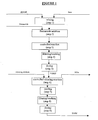
- FIG. 1 is a block diagram illustrating one embodiment of the method of the present invention.
- step 1 glyoxal is combined with a base, in an aqueous medium, so as to raise the pH of the mixture above 10, and preferably, to a pH within the range of 10-13. More preferably, the pH of the mixture should exceed 10.5, and most preferably, the pH should be in the range of 11-13.
- step 2 formamide is introduced to the basic, glyoxal-containing medium formed in step 1, and the reaction of formamide with the glyoxal to produce THDFP ensues.
- step 3 the reaction mixture is controlled at a temperature preferably between 25°C and 50°C, and, more preferably, between 30°C and 45°C.
- the reaction is allowed to proceed within the controlled temperature range, for approximately 30 minutes to 4 hours, and, more preferably, 40 minutes to 1 hour.
- the reaction is then terminated by filtering the white solid that has precipitated in the reaction.
- the solid is washed with water and/or with acetone (step 4 ) prior to drying (step 5 ).
- the formamide and glyoxal reactants are added in an equimolar, or near-equimolar ratio.
- the base may be aqueous NaOH, for example, having a concentration of 10M.
- the introduction of formamide should be performed slowly, to avoid reaching high temperatures (above ⁇ 50°C), at which THDFP tends to decompose in basic, aqueous media.
- the glyoxal-containing medium formed in step 1 can be maintained at a low temperature (e.g., 5°-20°C), such that heat produced by the exothermic formation of THDFP supplies the sensible heat for raising the temperature of the reaction mixture to a pre-determined value (e.g., 35°C - 45°C).
- a cooling system is used, as necessary, to maintain the temperature of the reaction mixture below another pre-determined value (e.g., 45°C - 50°C).
- the methods of the instant invention allow for an extremely short residence time with respect to most methods of the prior art.
- the inventive method achieves a yield of 80-85%, typically within one hour.
- the THDFP produced is sufficiently pure for the subsequent DTIW production, without dissolution and recrytallization.
- the results achieved have been found to be reproducible, and the unit operations are eminently suitable for scaling-up to an industrial process.
- the improved product quality can allow the THDFP produced to be directly added to the nitrating reaction stage (DTIW production) without having to undergo complex, expensive purification processes such as dissolution and recrystallization, as in various known processes.
- the method of the present invention eliminates or considerably diminishes the possibility of autocatalytic production of NO 2 and fume-off. As a result, process safety is improved, the yield and purity of the explosive material are enhanced, and reasonable reaction times are achieved.
- the weight fraction of nitric acid is within the range of 0.40 to 0.55, the weight fraction of sulfuric acid is within the range of 0.60 to 0.45, and the weight fraction of water with respect to the nitric acid and the sulfuric acid is less than 0.015. More preferably, the weight fraction of nitric acid is within the range of 0.40 to 0.52 (the corresponding weight fraction of sulfuric acid being within the range of 0.60 to 0.48), and most preferably, the weight fraction of nitric acid is within the range of 0.42 to 0.50 (the corresponding weight fraction of sulfuric acid being within the range of 0.58 to 0.50).
- the weight fraction of water with respect to the nitric acid and sulfuric acid is preferably less than 0.012, more preferably less than 0.010, and most preferably, less than 0.005.
- the ratio of mixed acid to the THDFP reactant is preferably increased with respect to the ratios disclosed by presently-known methods.
- the increased ratio of mixed acid to THDFP reactant acts, inter alia, as a considerable heat sink capable of dissipating the heat of the reaction.
- the increased amount of sulfuric acid in the mixed acid also reduces the solubility of DTIW in the reaction mixture, which results in a moderate increase in the yield.
- the nitrating solution can be prepared from inexpensive, commercial 100% nitric acid and concentrated sulfuric acid using standard methods, obviating the need for purification or distillation of the acid, or for the addition of water (as in known processes).
- the entire amount of THDPF is added to the nitrating mixture in a controlled nitrating reaction (step 6), preferably at ambient temperatures. Only a slight exothermic reaction is observed.
- the preferred range of ratios of mixed acid to THDFP is about 8.5:1 to about 20:1, more preferably 10:1 to 16:1, and most preferably 12:1 to 15:1, on a weight-to-weight basis.
- the reaction mixture is then heated to a temperature above 40°C, preferably to 45-65°C, and most preferably to 45-55°C. The reaction mixture is maintained at this temperature for approximately 3 hours. In the reaction, which is slightly exothermic, a negligible gas release is observed, having a faint red-brown coloration typical of NO 2 .
- the solid THDFP completely disappears and DTIW crystallizes from the reaction mixture.
- the heating is terminated and the reaction is slowly cooled (step 7) to the ambient temperature.
- the solid DTIW is filtered (step 8) from the reaction mixture, and washed (step 8) to neutral pH with water and base. Subsequently, the DTIW product is washed with methanol and dried in air (step 9).
- the material thus obtained is 97-98% pure, as confirmed by HPLC analysis, and has an average particle size of about 40-50 ⁇ m.
- the reaction in these conditions is very stable and has been conducted both on a small scale (based on 1-2 liters of the nitrating mixture) and on a larger scale (8-10 liters of the nitrating mixture).
- the reaction proceeds in a safe and extremely consistent fashion, yielding results: yield, purity, and particle size, which are also consistent and favorable.
- the process has yielded DTIW in 30% w/w concentration based on THDFP, or in 36% concentration based on assumption that each mole of THDFP should give 2/3 moles of DTIW.
- the yield obtained is an improvement over yields obtained in known processes, and is obtained in a reaction procedure that is mild, safe and reproducible, and releases insignificant amounts of NO 2 gas.
- the solid was washed twice with water and then with acetone, and was dried overnight. 1.8 kilogram of dry THDFP product was produced, corresponding to a yield of 83%.
- the product had a melting (and decomposition) point of 205°C.
- the product material was found to contain 34.72% C, 4.90% H, and 13.42% N, a composition that closely approaches the theoretical, calculated elemental analysis for C 6 H 10 N 2 O 6 (34.96% C, 4.89% H, 13.59% N).
- the product was filtered from the reaction mixture, washed several times with water, and was then washed in series with a saturated NaHCO 3 solution, water, and methanol, respectively.
- the filter cake after being dried overnight, weighed 76.5 grams.
- the product containing more than 99% DTIW such that a DTIW yield of 30.6% based on the THDFP weight (or a DTIW yield of 36.1% based on the assumed stoichiometry) was attained.
- the reaction was reproduced twice, using the same quantities of the starting materials, and yielding 77.5g and 77.0g DTIW, respectively.
- THDFP directly and the like, used in conjunction with the formation of THDFP, refers to the formation of THDFP from glyoxal, without prior formation of any intermediate species.
- directly filtering refers to the separation of DTIW from the mother liquor thereof without an intermediate quenching step.
- weight fraction of nitric acid refers to the weight of pure (100%) nitric acid in relation to the total weight of the nitric acid and the pure sulfuric acid, the weight of both acids being calculated on a 100% pure acid basis.
- weight fraction of sulfuric acid refers to the weight of pure (100%) sulfuric acid in relation to the total weight of the nitric acid and the pure sulfuric acid, the weight of both acids being calculated on a 100% pure acid basis.
- weight fraction of water refers to the weight of water in the nitrating acid with respect to the total weight of nitric acid and sulfuric acid, the weight of both acids being calculated on a 100% pure acid basis.
Landscapes
- Chemical & Material Sciences (AREA)
- Organic Chemistry (AREA)
- Organic Low-Molecular-Weight Compounds And Preparation Thereof (AREA)
Applications Claiming Priority (2)
| Application Number | Priority Date | Filing Date | Title |
|---|---|---|---|
| IL16207104 | 2004-05-19 | ||
| IL162071A IL162071A (en) | 2004-05-19 | 2004-05-19 | Process for synthesis of dinitrotetraoxadiazaisowurtzitane (dtiw) |
Publications (1)
| Publication Number | Publication Date |
|---|---|
| EP1598359A1 true EP1598359A1 (de) | 2005-11-23 |
Family
ID=34938455
Family Applications (1)
| Application Number | Title | Priority Date | Filing Date |
|---|---|---|---|
| EP05090144A Withdrawn EP1598359A1 (de) | 2004-05-19 | 2005-05-19 | Verfahren zur Herstellung von Dinitrotetraoxodiazaisowurzitan |
Country Status (4)
| Country | Link |
|---|---|
| US (1) | US20050261494A1 (de) |
| EP (1) | EP1598359A1 (de) |
| CN (1) | CN1699367A (de) |
| IL (1) | IL162071A (de) |
Families Citing this family (4)
| Publication number | Priority date | Publication date | Assignee | Title |
|---|---|---|---|---|
| CN104262266A (zh) * | 2014-10-09 | 2015-01-07 | 西安近代化学研究所 | 一种1,4-二甲酰基-2,3,5,6-四羟基哌嗪的合成方法 |
| CN105418639B (zh) * | 2015-11-13 | 2017-08-29 | 南京理工大学 | 以非离子型表面活性剂催化合成tex的方法 |
| CN107501293A (zh) * | 2017-10-11 | 2017-12-22 | 中国工程物理研究院化工材料研究所 | 二呋咱并哌嗪硝胺类高能离子盐及其合成方法 |
| CN117886763A (zh) * | 2023-12-25 | 2024-04-16 | 西安近代化学研究所 | 一种1,4-二甲酰基-2,3,5,6-四羟基哌嗪的超声强化合成方法 |
Citations (1)
| Publication number | Priority date | Publication date | Assignee | Title |
|---|---|---|---|---|
| US6512113B1 (en) * | 1999-06-10 | 2003-01-28 | Alliant Techsystems Inc. | Synthesis for 4,10-dinitro-2,6,8,12-tetraoxa-4,10-diazatetracyclo[5.5.0.05,903,11]-dodecane |
Family Cites Families (1)
| Publication number | Priority date | Publication date | Assignee | Title |
|---|---|---|---|---|
| US5498711A (en) * | 1993-02-03 | 1996-03-12 | Thiokol Corporation | Synthesis of 4,10-dinitro-2,6,8,12-tetraoxa-4,10-diazatetracyclo[5.5.0.05,903,11]dodecane |
-
2004
- 2004-05-19 IL IL162071A patent/IL162071A/en active IP Right Grant
-
2005
- 2005-05-18 US US11/131,288 patent/US20050261494A1/en not_active Abandoned
- 2005-05-19 EP EP05090144A patent/EP1598359A1/de not_active Withdrawn
- 2005-05-19 CN CN200510071479.9A patent/CN1699367A/zh active Pending
Patent Citations (1)
| Publication number | Priority date | Publication date | Assignee | Title |
|---|---|---|---|---|
| US6512113B1 (en) * | 1999-06-10 | 2003-01-28 | Alliant Techsystems Inc. | Synthesis for 4,10-dinitro-2,6,8,12-tetraoxa-4,10-diazatetracyclo[5.5.0.05,903,11]-dodecane |
Non-Patent Citations (1)
| Title |
|---|
| CURRIE, ANDREW C. ET AL: "Base-catalyzed reactions of glyoxal. I. 1,4-Diformyl- and 1,4-bis(methylsulfonyl) derivatives of 2,3,5,6- tetrahydroxypiperazines", JOURNAL OF THE CHEMICAL SOCIETY [SECTION] C: ORGANIC , (6), 491-6 CODEN: JSOOAX; ISSN: 0022-4952, 1967, XP002341322 * |
Also Published As
| Publication number | Publication date |
|---|---|
| US20050261494A1 (en) | 2005-11-24 |
| IL162071A (en) | 2011-02-28 |
| IL162071A0 (en) | 2005-11-20 |
| CN1699367A (zh) | 2005-11-23 |
Similar Documents
| Publication | Publication Date | Title |
|---|---|---|
| EP2323990B1 (de) | Verfahren zur herstellung von 2-halogeno-4-nitroimidazolen | |
| EP1598359A1 (de) | Verfahren zur Herstellung von Dinitrotetraoxodiazaisowurzitan | |
| US5498711A (en) | Synthesis of 4,10-dinitro-2,6,8,12-tetraoxa-4,10-diazatetracyclo[5.5.0.05,903,11]dodecane | |
| KR20070039948A (ko) | 2-아미노-5-요오도 안식향산의 제조 방법 | |
| Nielsen et al. | Nitrocarbons. 3. Synthesis of decanitrobiphenyl | |
| JP7622405B2 (ja) | 次亜塩素酸塩を用いた2-ヨードキシ安息香酸およびデス・マーチン・ペルヨージナンの製造方法 | |
| ES2335924T3 (es) | Procedimiento para la preparacion de acido 3,4-dicloro-isotiazolcarboxilico. | |
| JP2000256332A (ja) | 5,5’−ビ−1h−テトラゾール塩の製造法 | |
| SK15832002A3 (sk) | Spôsob prípravy derivátov benzoovej kyseliny substituovanej trifluoretoxyskupinou | |
| CN113372281A (zh) | 一种特硝唑的合成方法 | |
| CN111732544A (zh) | 一种合成3-(4-甲基-1h-咪唑-1-基)-5-(三氟甲基)苯胺的方法 | |
| CN114163309B (zh) | 一种多拉韦林中间体的制备方法 | |
| CN118459425B (zh) | 一种吡咯烷-1-胺-二盐酸盐的制备方法 | |
| JPS60100554A (ja) | Ν−フエニルマレイミド化合物の製造方法 | |
| CN113173872B (zh) | 一种丁醚脲杂质c的合成方法 | |
| RU2152389C1 (ru) | Способ получения нитрата 3,5-диамино-1,2,4-триазола | |
| JPS6125713B2 (de) | ||
| JPH0558985A (ja) | シアノグアニジン誘導体の製造法 | |
| KR0127251B1 (ko) | 4,4'-비스클로로메틸비페닐의 제조방법 | |
| KR100228919B1 (ko) | 벤조페논유도체의 제조방법 | |
| KR920009575B1 (ko) | 파라위치가 치환된 6-브로모-2-시아노벤젠아민의 제조방법 | |
| KR910001436B1 (ko) | 파라위치가 치환된 2,6-디브로모벤젠아민의 제조방법 | |
| KR100281825B1 (ko) | 디니트로아미드염의 제조 방법 | |
| KR960005518B1 (ko) | 1-아미노-4-[[2-(치환된아미노)메틸-4-메틸-6-술포페닐]아미노]-9,10-디히드로-9, 10-디옥소-2-안트라센술폰산의 제조방법 | |
| US4103088A (en) | Formation of crystalline [(mono-trichloro) tetra-(monopotassium dichloro)]p |
Legal Events
| Date | Code | Title | Description |
|---|---|---|---|
| PUAI | Public reference made under article 153(3) epc to a published international application that has entered the european phase |
Free format text: ORIGINAL CODE: 0009012 |
|
| AK | Designated contracting states |
Kind code of ref document: A1 Designated state(s): AT BE BG CH CY CZ DE DK EE ES FI FR GB GR HU IE IS IT LI LT LU MC NL PL PT RO SE SI SK TR |
|
| AX | Request for extension of the european patent |
Extension state: AL BA HR LV MK YU |
|
| AKX | Designation fees paid |
Designated state(s): AT BE BG CH CY CZ DE DK EE ES FI FR GB GR HU IE IS IT LI LT LU MC NL PL PT RO SE SI SK TR |
|
| STAA | Information on the status of an ep patent application or granted ep patent |
Free format text: STATUS: THE APPLICATION IS DEEMED TO BE WITHDRAWN |
|
| 18D | Application deemed to be withdrawn |
Effective date: 20060524 |