EP1598358A1 - Verbindungen enthaltend 3,4-Methylendioxythiopen-Einheiten - Google Patents
Verbindungen enthaltend 3,4-Methylendioxythiopen-Einheiten Download PDFInfo
- Publication number
- EP1598358A1 EP1598358A1 EP05009630A EP05009630A EP1598358A1 EP 1598358 A1 EP1598358 A1 EP 1598358A1 EP 05009630 A EP05009630 A EP 05009630A EP 05009630 A EP05009630 A EP 05009630A EP 1598358 A1 EP1598358 A1 EP 1598358A1
- Authority
- EP
- European Patent Office
- Prior art keywords
- bis
- methylenedioxythiophene
- methylendioxythiophen
- ethylidendioxythiophen
- ethylidenedioxythiophene
- Prior art date
- Legal status (The legal status is an assumption and is not a legal conclusion. Google has not performed a legal analysis and makes no representation as to the accuracy of the status listed.)
- Granted
Links
- DKICMBNFLNCQMP-UHFFFAOYSA-N CC(C)c1c2OCOc2c(C(C)C)[s]1 Chemical compound CC(C)c1c2OCOc2c(C(C)C)[s]1 DKICMBNFLNCQMP-UHFFFAOYSA-N 0.000 description 1
- DFQRUJFQVFEUOI-UHFFFAOYSA-N CCCCCCC(C)(C)c1c2OCOc2c(C(C)(C)c2c3OCOc3c(C)[s]2)[s]1 Chemical compound CCCCCCC(C)(C)c1c2OCOc2c(C(C)(C)c2c3OCOc3c(C)[s]2)[s]1 DFQRUJFQVFEUOI-UHFFFAOYSA-N 0.000 description 1
Classifications
-
- C—CHEMISTRY; METALLURGY
- C07—ORGANIC CHEMISTRY
- C07D—HETEROCYCLIC COMPOUNDS
- C07D495/00—Heterocyclic compounds containing in the condensed system at least one hetero ring having sulfur atoms as the only ring hetero atoms
- C07D495/02—Heterocyclic compounds containing in the condensed system at least one hetero ring having sulfur atoms as the only ring hetero atoms in which the condensed system contains two hetero rings
- C07D495/04—Ortho-condensed systems
-
- C—CHEMISTRY; METALLURGY
- C08—ORGANIC MACROMOLECULAR COMPOUNDS; THEIR PREPARATION OR CHEMICAL WORKING-UP; COMPOSITIONS BASED THEREON
- C08G—MACROMOLECULAR COMPOUNDS OBTAINED OTHERWISE THAN BY REACTIONS ONLY INVOLVING UNSATURATED CARBON-TO-CARBON BONDS
- C08G61/00—Macromolecular compounds obtained by reactions forming a carbon-to-carbon link in the main chain of the macromolecule
- C08G61/12—Macromolecular compounds containing atoms other than carbon in the main chain of the macromolecule
- C08G61/122—Macromolecular compounds containing atoms other than carbon in the main chain of the macromolecule derived from five- or six-membered heterocyclic compounds, other than imides
- C08G61/123—Macromolecular compounds containing atoms other than carbon in the main chain of the macromolecule derived from five- or six-membered heterocyclic compounds, other than imides derived from five-membered heterocyclic compounds
- C08G61/126—Macromolecular compounds containing atoms other than carbon in the main chain of the macromolecule derived from five- or six-membered heterocyclic compounds, other than imides derived from five-membered heterocyclic compounds with a five-membered ring containing one sulfur atom in the ring
Definitions
- the invention relates to compounds containing optionally substituted 3,4-methylenedioxythiophene units (Thieno [3,4-d] -1,3-dioxole units), their preparation and use as organic semiconductors.
- OFETs By simple Structuring and integration of OFETs into integrated organic semiconductor circuits cheap solutions for smart cards or price tags are possible, the so far with the help of silicon technology due to the price and the lack of flexibility the silicon components can not be realized. Likewise, OFETs could be used as switching elements be used in large area flexible matrix displays.
- An overview of organic Semiconductors, semiconductor integrated circuits and their applications are, for example, in electronics 2002, Vol. 15, p. 38.
- Known semiconductive organic compounds are, for example, polyfluorenes and fluorene copolymers, such as, for example, poly (9,9-dioctylfluorene-co-bithiophene), with which charge carrier mobilities, also referred to below as mobilities, have been achieved until 0.02 cm 2 / Vs (Science, Vol. 2000, vol. 290, p. 2123). With regioregular poly (3-hexylthiophene-2,5-diyl), mobilities as high as 0.1 cm 2 / Vs have even been achieved (Science, 1998, vol. 280, p. 1741).
- oligothiophenes in particular those having terminal alkyl substituents, and pentacene.
- Typical mobilities for, for example, ⁇ , ⁇ '-dihexyl-quater, -quinque and -exithiophene are 0.05-0.1 cm 2 / Vs.
- the compounds described above are only of limited suitability for use in (opto) electronic components. For example, some of these compounds have phase transformations that preclude their use above a typical temperature for the particular compound, or their mobilities are not sufficient for some applications.
- Task was therefore to produce new semiconducting organic compounds, which a small Have oxidation sensitivity and good for use as organic semiconductors in (opto) electronic components are suitable.
- the asterisk (*) in each case denotes a binding site for adjacent groups or terminal groups R 3 or R 4 .
- the compounds according to the invention are polymers.
- polymers are in the The invention includes all compounds in which n + m is an integer greater than 1.
- polymers are all those compounds which are either polydisperse are, i. have a molecular weight distribution, or are monodisperse, i. a unified one Have molecular weight. Preference is given to the compounds according to the invention in the sense the previous definition monodisperse. It may be in the compounds of the invention are homopolymers of identical repeating units of the general formula (I) or copolymers of several different repeating units of the general Formula (I) or several identical or different repeating units of the general Formulas (I) and (II).
- the repeating units in the copolymer can be statistically, be arranged alternately or block.
- recurring units are in the In the context of the invention, all units of the general formulas (I) and (II) are understood independently of whether they are contained once or more times in the polymer.
- substitution with a group from the series of alkyl, in particular C 1 to C 6 alkyl, cycloalkyl, in particular C 6 to C 14 cycloalkyl, aryl, in particular C 6 to, is optionally substituted below C 12 aryl, aralkyl, in particular C 7 to C 14 aralkyl, halogen, in particular F, Cl, Br and J, oxyalkyl, oxyaryl, ether, thioether, disulfide, sulfoxide, sulfone , Sulfonate, amino, aldehyde, keto, carboxylic acid ester, carboxylic acid, carbonate, carboxylate, cyano, alkylsilane and alkoxysilane groups and carboxylamide understood.
- R 1 and R 2 in the general formula (I) are preferably, independently of one another, H, a linear or branched, optionally substituted C 1 -C 20 -alkyl group, optionally interrupted by 1 to 5 oxygen and / or sulfur atoms, such as methyl , Ethyl, n-propyl, iso-propyl, n-butyl, sec-butyl, iso-butyl, tert-butyl, n-pentyl, 1-methylbutyl, 2-methylbutyl, 3-methylbutyl , 1-ethylpropyl, 1,1-dimethylpropyl, 1,2-dimethylpropyl, 2,2-dimethylpropyl, n-hexyl, n-heptyl, n-octyl, 2-ethylhexyl, n-nonyl, n Decyl, n-undecyl, n-dodecyl, n-tri
- R 3 and R 4 in the general formula (I) are preferably, independently of one another, H, an optionally substituted linear or branched C 1 -C 20 -alkyl group, such as, for example, methyl, ethyl, n-propyl, iso-propyl , n-butyl, sec-butyl, isobutyl, tert-butyl, n-pentyl, 1-methylbutyl, 2-methylbutyl, 3-methylbutyl, 1-ethylpropyl, 1,1- Dimethylpropyl, 1,2-dimethylpropyl, 2,2-dimethylpropyl, n-hexyl, n-heptyl, n-octyl, 2-ethylhexyl, n-nonyl, n-decyl, n-undecyl -, n-dodecyl, n-tridecyl, n-tetradecy
- X 1 in the general formula (II) is preferably an optionally substituted vinylidene, arylidene or a hetarylidene unit, for example 1,4-phenylene, 2,5-thienylene, 1,4'-biphenylene, 2,5-thienylenevinylene, 2,5'-bithienylene, 2,5 "-terthienylene, 2,5 '''- quaterthienylene.
- R 1 to R 4 or X 1 are numerous organic groups, for example alkyl, partially or perfluorinated alkyl, cycloalkyl, aryl, halogen, ether, thioether, disulfide, sulfoxide , Sulfone, sulfonate, amino, aldehyde, keto, carboxylic ester, carboxylic acid, carbonate, carboxylate, cyano, alkylsilane and alkoxysilane groups and carboxylamide groups.
- organic groups for example alkyl, partially or perfluorinated alkyl, cycloalkyl, aryl, halogen, ether, thioether, disulfide, sulfoxide , Sulfone, sulfonate, amino, aldehyde, keto, carboxylic ester, carboxylic acid, carbonate, carboxylate, cyano, alkylsilane and alkoxysilane groups and carboxylamide groups.
- the above compounds having 1 ', 1'-ethylidenedioxythiophene groups are compounds having one or more building blocks of the following structure
- Preferred subject of the present invention are such compounds of the invention, the recurring units of the general formula (I) in a proportion of at least 10 mol% included.
- these are compounds of the general formula (III-a), wherein R 1 or R 2 is H, and R 3 , R 4 and n have the meaning given above for the general formulas (I) and (II). Preferred ranges and combinations of these preferred ranges apply analogously. In very particularly preferred embodiments, these are those compounds in which R 1 is H and R 2 is methyl.
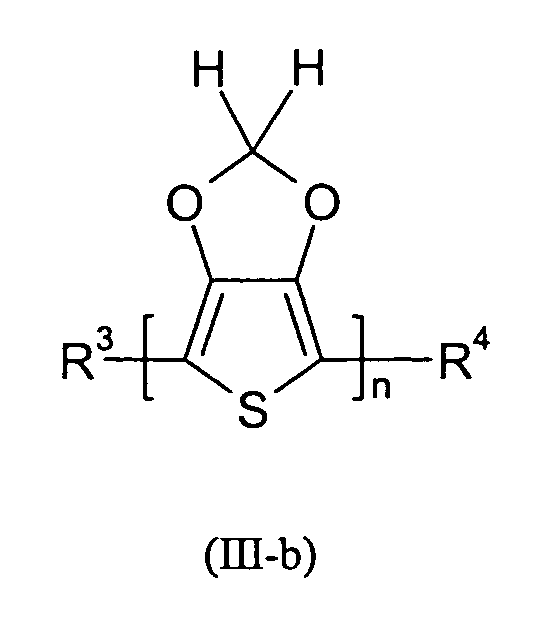
- the compounds according to the invention are those of the general formula (III-b), wherein R 1 and R 2 are H, and R 3 , R 4 and n have the meaning given above for the general formulas (I) and (II). Preferred ranges and combinations of these preferred ranges apply analogously.
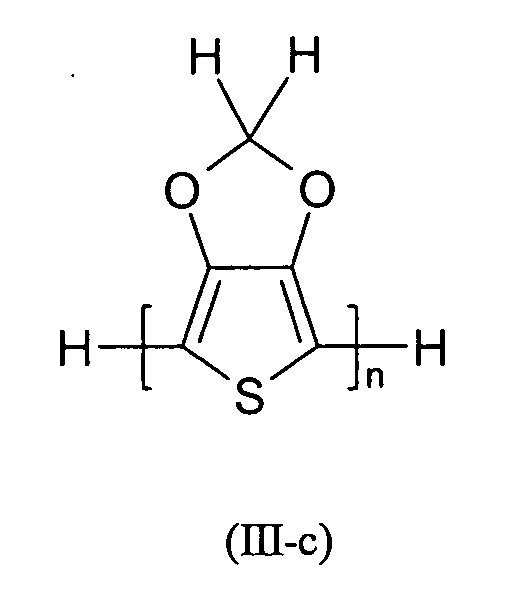
- the compounds according to the invention are those of the general formula (III-c), wherein R 1 , R 2 , R 3 and R 4 are H and n has the meaning previously given for the general formula (I). Preferred ranges apply analogously.
- the invention further provides a process for the preparation of a novel process Compound wherein the compound of the invention by at least one organometallic Reaction is produced.
- the compounds of the invention by means of a Variant of Suzuki coupling, often referred to as Suzuki condensation prepared.
- the Suzuki condensation or Suzuki coupling i. the reaction of aryl halides and aryl boronic acid compounds with a Pd compound as a catalyst in the presence of a base e.g. in Suzuki et al., Chem. Rev. 1995, 95, 2457-2483.
- a base e.g. in Suzuki et al., Chem. Rev. 1995, 95, 2457-2483.
- Subgroup of the Periodic Table of the Elements hereinafter referred to as metal the VIII. Subgroup refers, contains, to be implemented.
- the preferred embodiment of the method is at a temperature of + 20 ° C to + 200 ° C, preferably from + 40 ° C to + 150 ° C, particularly preferred from + 80 ° C to + 130 ° C, carried out in an organic solvent or solvent mixture.
- catalysts containing a metal of the VIII. Subgroup in principle, all suitable Compounds in question which are a metal of the VIII subgroup, preferably Pd, Ni or Pt, particularly preferably Pd.
- the catalyst (s) are preferably used in amounts of 0.05 wt .-% to 10 wt .-%, particularly preferably from 0.5 wt .-% to 5 wt .-%, based on the Total weight of the compounds to be coupled used.
- catalysts are complex compounds of metals of subgroup VIII, in particular complexes of palladium (0) which are stable in air, Pd complexes which react readily with organometallic reagents (for example lithium alkyl compounds or organomagnesium compounds) or phosphines to give palladium (0).
- Organometallic reagents for example lithium alkyl compounds or organomagnesium compounds
- phosphines to give palladium (0).
- PdCl 2 (PPh 3 ) 2 , PdBr 2 (PPh 3 ) 2 or Pd (OAc) 2 or mixtures of these compounds can be used with the addition of PPh 3 .
- Pd (PPh 3 ) 4 without or with the addition of phosphines, in a preferred embodiment without the addition of phosphines, which is available in inexpensive form.
- phosphines preferably PPh 3, PEtPh 2, PMePh 2, PEt 2 Ph or PEt 3, particularly preferably PPh 3, are used.
- Suitable bases include hydroxides such as NaOH, KOH, LiOH, Ba (OH) 2 , Ca (OH) 2 , alkoxides such as NaOEt, KOEt, LiOEt, NaOMe, KOMe, LiOMe, alkali metal salts of carboxylic acids such as sodium , Potassium or lithium carbonate, bicarbonate, acetate, citrate, acetylacetonate, glycinate, or other carbonates, such as Cs 2 CO 3 or Tl 2 CO 3 , phosphates, such as sodium phosphate, potassium phosphate or lithium phosphate, or mixtures of these are used.
- sodium carbonate is used.
- the bases can be used as solutions in water or as suspensions in organic solvents, such as toluene, dioxane or DMF. Preference is given to solutions in water, since the products obtained can be easily separated from the reaction mixture due to their low solubility in water.
- solvents or solvent mixtures come as organic solvents in question, which do not react with the boronic acid esters. These are usually connections, which are not halogen atoms or no hydrogen atoms reactive with boronic acid esters exhibit.
- Suitable solvents are, for example, alkanes such as pentane, hexane and Heptane, aromatics such as benzene, toluene and xylenes, compounds containing ether groups such as Dioxane, dimethoxyethane and tetrahydrofuran and polar solvents such as dimethylformamide or dimethyl sulfoxide.
- Aromatic solvents are preferred in the process according to the invention used. Very particular preference is given to toluene. It is also possible as a solvent Use mixtures of two or more of these solvents.
- the organyl halides used in this process can be prepared by known methods be or are available for purchase.
- the preparation of the boronic acid esters may be, for example by the reaction of aryl halides and bis (organyl) diborane by metal-catalyzed Coupling (WO-A 01/29051 A1, Tetrahedron Lett. 2002, p 5649), by coupling of Oligothiophenhalogeniden with Pinakolboran example (J. Org. Chem. 1997, B.62, P. 6458; J. Organomet. Chem. 2001, p. 640, p. 197; Chem. Commun. 2002, p. 1566) or by Reaction of organometallic compounds, e.g. organomagnesium compounds (e.g. Grignard compounds) or organolithium compounds, with boronic acid esters. These methods are known to the person skilled in the art.
- the compounds of the invention produced by means of a Kumada coupling.
- the Kumada coupling i. the implementation of a Aryl halides and an aryl Grignard compound in the presence of a Pd or a Ni catalyst is e.g. in Kumada et al., J. Am. Chem. Soc. 1972, 94, 4373-4376.
- the process according to the invention is carried out according to the invention Variant of this Kumada coupling carried out, wherein aryl or heteroaryl halides and Grignard compounds of aryl or heteroaryl halides in the presence of a Catalyst, which is a metal of VIII.
- Subgroup of the Periodic Table of the Elements below briefly referred to as metal of the VIII. Subgroup, contains, be implemented.
- the preferred Embodiment of the method according to the invention is at a temperature from 0 ° C to 200 ° C, preferably from + 20 ° C to + 150 ° C, more preferably from + 40 ° C to + 130 ° C, carried out in an organic solvent or a solvent mixture
- catalysts containing a metal of the VIII As catalysts containing a metal of the VIII. Subgroup, in principle, all suitable Compounds in question, a metal of VIII. Subgroup, preferably Pd or Ni, especially preferably Pd, included.
- the catalyst (s) are preferably used in amounts of 0.05 wt .-% to 10 wt .-%, particularly preferably from 0.5 wt .-% to 5 wt .-%, based on the Total weight of the compounds to be coupled used.
- catalysts are complex compounds of metals of subgroup VIII, in particular complexes of palladium (0) which are stable in air, Pd complexes which react readily with organometallic reagents (for example lithium alkyl compounds or organomagnesium compounds) or phosphines to give palladium (0).
- organometallic reagents for example lithium alkyl compounds or organomagnesium compounds
- phosphines to give palladium (0).
- Complex reduce, or palladium (2) complexes optionally with the addition of PPh 3 or other phosphines.
- PdCl 2 (PPh 3 ) 2 , PdBr 2 (PPh 3 ) 2 or Pd (OAc) 2 or mixtures of these compounds with addition of diphenylphosphinoethane (dppe) or diphenylphosphinopropane (dppp) or 1,1'-bis (diphenylphoshino) ferrocene (dppf) can be used.
- solvents or solvent mixtures come as organic solvents in question, which do not react with the Grignard reagents. These are usually connections, which are not halogen atoms or not reactive towards Grignard compounds Have hydrogen atoms.
- Suitable solvents are, for example, aromatics such as benzene, Toluene and xylenes, compounds containing ether groups, such as dioxane, dimethoxyethane, diethyl ether, Dibutyl ether and tetrahydrofuran. Preference is given in the process according to the invention used ethereal solvents. Very particular preference is tetrahydrofuran. It is also possible to use as solvent mixtures of two or more of these solvents.
- the compounds of the invention made by means of a silent coupling.
- the silence coupling i. the reaction of an aryl halide and an aryl or alkenylstannyl compound in the presence of a Pd catalyst e.g. in Stille et al., Angew. Chem. 1986, 98, 504.
- a Pd catalyst e.g. in Stille et al., Angew. Chem. 1986, 98, 504.
- Stille coupling wherein aryl or heteroaryl halides and aryl and alkenyl-stannyl compounds in the presence of a catalyst containing a metal of VIII. subgroup of Periodic Table of the Elements, hereinafter referred to as metal of the VIII. Subgroup, contains, be implemented.
- the preferred embodiment of the method according to the invention is at a temperature of 0 ° C to 200 ° C, preferably from + 20 ° C to + 150 ° C, more preferably from + 40 ° C to + 130 ° C, in an organic solvent or a mixed solvent
- catalysts containing a metal of the VIII in principle, all suitable Compounds in question which are a metal of VIII. Subgroup, particularly preferably Pd, contain.
- the catalyst (s) are preferably added in amounts of 0.05% by weight 10 wt .-%, particularly preferably from 0.5 wt .-% to 5 wt .-%, based on the total weight the compounds to be coupled used.
- catalysts are complex compounds of metals of subgroup VIII, in particular complexes of palladium (0) which are stable in air, Pd complexes which react readily with organometallic reagents (for example lithium alkyl compounds or organomagnesium compounds) or phosphines to give palladium (0).
- Organometallic reagents for example lithium alkyl compounds or organomagnesium compounds
- phosphines to give palladium (0).
- PdCl 2 (PPh 3 ) 2 , PdBr 2 (PPh 3 ) 2 or Pd (OAc) 2 or mixtures of these compounds can be used with the addition of PPh 3 .
- Pd (PPh 3 ) 4 without or with the addition of phosphines, in a preferred embodiment without the addition of phosphines, which is available in inexpensive form.
- phosphines preferably PPh 3, PEtPh 2, PMePh 2, PEt 2 Ph or PEt 3, particularly preferably PPh 3, are used.
- solvents or solvent mixtures come as organic solvents in question, which do not react with the stannyl compounds. These are usually connections, which are not halogen atoms or not reactive towards stannyl compounds Have hydrogen atoms.
- Suitable solvents are, for example, aromatics such as benzene, Toluene and xylenes, compounds containing ether groups, such as dioxane, dimethoxyethane, diethyl ether, Dibutyl ether and tetrahydrofuran, or polar solvents such as dimethylformamide, N-methylpyrrolidone or acetonitrile. It is also possible to use as solvent mixtures of two or more of these solvents.
- the workup of the respective reaction mixture is carried out according to known methods, e.g. by dilution, precipitation, filtration, extraction, washing, recrystallization from suitable Solvents, chromatography and / or sublimation.
- a workup carried out in such a way that the reaction mixture after completion of reaction in a mixture from acidic (ice) water, e.g. prepared from 1 molar hydrochloric acid, and poured toluene, the separated organic phase, washed with water, the product contained as a solid filtered off, washed with toluene and then dried in vacuo.
- acidic (ice) water e.g. prepared from 1 molar hydrochloric acid
- poured toluene the separated organic phase
- the compounds of the invention are electrically neutral and semiconducting and have a low oxidation sensitivity. They can also be applied well from solution. consequently They are well suited for use as organic semiconductors in (opto) electronic components.
- the present invention is therefore the use of the invention Compounds as organic semiconductors in electronic devices, in active and light-emitting, electronic components such as field-effect transistors, organic light-emitting diodes, photovoltaic cells, lasers or sensors.
- the compounds according to the invention in the form of layers on suitable substrates, for example, silicon wafers provided with electrical or electronic structures, Applied polymer films or glass sheets.
- suitable substrates for example, silicon wafers provided with electrical or electronic structures, Applied polymer films or glass sheets.
- the compounds of the general formula (I) are applied from the gas phase or from solution, wherein the Solvent then evaporated.
- the solution can be applied according to the known Process, for example by spraying, dipping, printing and knife coating, spin coating and by Ink jet printing done.
- the compounds of the invention may also be from the gas phase, e.g. by vapor deposition. In this way, layers with the least Defective and highest cargo mobility can be obtained.
- the subject of the present invention is therefore an electronic component containing at least one compound of the invention.
Landscapes
- Chemical & Material Sciences (AREA)
- Organic Chemistry (AREA)
- Health & Medical Sciences (AREA)
- Chemical Kinetics & Catalysis (AREA)
- Medicinal Chemistry (AREA)
- Polymers & Plastics (AREA)
- Heterocyclic Carbon Compounds Containing A Hetero Ring Having Oxygen Or Sulfur (AREA)
- Organic Low-Molecular-Weight Compounds And Preparation Thereof (AREA)
- Heterocyclic Compounds Containing Sulfur Atoms (AREA)
- Acyclic And Carbocyclic Compounds In Medicinal Compositions (AREA)
- Electroluminescent Light Sources (AREA)
- Thin Film Transistor (AREA)
- Nitrogen And Oxygen Or Sulfur-Condensed Heterocyclic Ring Systems (AREA)
Abstract
Description

- R1 und R2
- unabhängig voneinander für H, eine lineare oder verzweigte gegebenenfalls substituierte, gegebenenfalls durch 1 bis 5 Sauerstoff- und/oder Schwefelatome unterbrochene C1-C20-Alkylgruppe, eine teilweise fluorierte oder eine perfluorierte lineare oder verzweigte C1-C20-Alkylgruppe, eine lineare oder verzweigte C1-C20-Oxyalkylgruppe, eine gegebenenfalls substituierte C6-C24-Arylgruppe, eine gegebenenfalls substituierte C6-C24-Alkylarylgruppe, eine gegebenenfalls substituierte C6-C24-Oxyarylgruppe oder eine gegebenenfalls substituierte C2-C24-Heteroarylgruppe oder gemeinsam für eine gegebenenfalls substituierte, gegebenenfalls durch 1 bis 5 Sauerstoff- und/oder Schwefelatome unterbrochene C1-C20-Alkyengruppe, eine C1-C20-Dioxyalkylengruppe, eine C6-C30-Dialkylenarylengruppe oder eine C6-C24-Dioxyarylengruppe stehen,
- X1
- für eine gegebenenfalls substituierte Vinyliden-, Aryliden- oder eine Hetaryliden-Einheit steht,
- n
- für eine ganze Zahl von 1 bis 1000, bevorzugt von 1 bis 200 und
- m
- für eine ganze Zahl von 0 bis 1000, bevorzugt von 0 bis 20 steht,
und die Verbindung Endgruppen R3 und R4 trägt, wobei
- R3 und R4
- unabhängig voneinander für H, eine lineare oder verzweigte C1-C20-Alkylgruppe, eine teilweise fluorierte oder eine perfluorierte lineare oder verzweigte C1-C20-Alkylgruppe, eine lineare oder verzweigte C1-C20-Oxyalkylgruppe, eine gegebennenfalls substituierte C6-C24-Arylgruppe, eine gegebenenfalls substituierte C1-C20-Alkylarylgruppe, eine gegebenenfalls substituierte C1-C20-Oxyarylgruppe oder eine gegebenenfalls substituierte C1-C20-Heteroarylgruppe stehen.
R1 und R2 stehen in der allgemeinen Formel (I) bevorzugt unabhängig voneinander für H, eine lineare oder verzweigte gegebenenfalls substituierte, gegebenenfalls durch 1 bis 5 Sauerstoff- und/oder Schwefelatome unterbrochene C1-C20-Alkylgruppe, wie z.B. Methyl-, Ethyl-, n-Propyl-, iso-Propyl-, n-Butyl-, sec-Butyl, iso-Butyl, tert-Butyl, n-Pentyl-, 1-Methylbutyl-, 2-Methylbutyl-, 3-Methylbutyl-, 1-Ethylpropyl-, 1,1-Dimethylpropyl-, 1,2-Dimethylpropyl-, 2,2-Dimethylpropyl-, n-Hexyl-, n- Heptyl-, n-Octyl, 2-Ethylhexyl, n-Nonyl, n-Decyl, n-Undecyl, n-Dodecyl, n-Tridecyl, n-Tetradecyl, n-Hexadecyl, n-Octadecyl- oder n-Eicosyl-, eine teilweise fluorierte oder eine perfluorierte lineare oder verzweigte C1-C20-Alkylgruppe, wie z.B. Trifluormethyl- Pentafluorethyl-, Heptafluorpropyl-, Nonafluorbutyl-, Perfluorpentyl-, Perfluorhexyl-, Perfluorheptyl-, Perfluoroctyl-, Perfluornonyl-, Perfluordecyl-, Perfluorundecyl-, Perfluordodecyl-, Perfluortridecyl- Perfluortetradecyl-, Perfluorhexadecyl-, Perfluoroctadecyl-, Perfluoreicosyl-, eine lineare oder verzweigte C1-C20-Oxyalkylgruppe, wie z.B. Methoxy-, Ethoxy-, n- oder iso-Propoxy-, n-, iso-, sec- oder tert-Butoxy-, n-Pentyloxy-, 1-Methylbutyloxy-, 2-Methylbutyloxy-, 3-Methylbutyloxy-, 1-Ethylpropyloxy-, 1,1-Dimethylpropyloxy-, 1,2-Dimethylpropyloxy-, 2,2-Dimethylpropyloxy-, n-Hexyloxy-, n-Heptyloxy-, n-Octyloxy-, 2-Ethylhexyloxy-, n-Nonyloxy-, n-Decyloxy-, n-Undecyloxy-, n-Dodecyloxy-, n-Tridecyloxy-, n-Tetradecyloxy-, n-Hexadecyloxy-, n-Octadecyloxy-, n-Nonadecyloxy- oder n-Eicosyloxy-, eine gegebenenfalls substituierte C6-C24-Arylgruppe, wie z.B. Phenyl-, Naphthyl-, Anthryl, Methylphenyl-, Ethylphenyl-, Pentylphenyl-, Butylphenyl-, Dimethylphenyl-, Biphenylyl-, eine gegebenenfalls substituierte C6-C24-Alkylarylgruppe, wie z.B. Benzyl, eine gegebenenfalls substituierte C6-C24-Oxyarylgruppe, wie z.B. Phenoxy, oder eine gegebenenfalls substituierte C2-C24-Heteroarylgruppe, wie z.B. 2-Thienyl-, 3-Thienyl-, 2-Furanyl-, 3-Furanyl-, 2-Pyrrolyl-, 3-Pyrrolyl-, Pyrazolyl-, Thiazolyl-, 2-Pyridyl-, 3-Pyridyl-, 4-Pyridyl-, Chinolinyl-, Oxazolyl-, und Thiazolyl-, oder gemeinsam für eine gegebenenfalls substituierte, gegebenenfalls durch 1 bis 5 Sauerstoff- und/oder Schwefelatome unterbrochene C1-C20-Alkyengruppe, wie z.B. 1,2-Ethylen-, 1,3-Propyliden-, 1,4-Butyliden-, 1,5-Pentyliden-, eine C1-C20-Dioxyalkylengruppe, eine C6-C30-Dialkylenarylengruppe, wie z.B. 1,2-Xyliden, oder eine C6-C24-Dioxyarylengruppe.



Schmp.: 225 - 231°C
| Elementaranalyse: | Gemessen: | C: 46,7 % | H: 2,25 % | S: 24,6 % |
| Berrechnet: | C: 47,0 %) | H: 2,37 % | S: 25,6 % (für C10H6O4S2) |

Claims (10)
- Neutrale Verbindung enthaltend gleiche oder verschiedene wiederkehrende Einheiten der allgemeinen Formel (I) und gegebenenfalls enthaltend gleiche oder verschiedene wiederkehrende Einheiten der allgemeinen Formel (II)worin

- R1 und R2
- unabhängig voneinander für H, eine lineare oder verzweigte gegebenenfalls substituierte, gegebenenfalls durch 1 bis 5 Sauerstoff- und/oder Schwefelatome unterbrochene C1-C20-Alkylgruppe, eine teilweise fluorierte oder eine perfluorierte lineare oder verzweigte C1-C20-Alkylgruppe, eine lineare oder verzweigte C1-C20-Oxyalkylgruppe, eine gegebenenfalls substituierte C6-C24-Arylgruppe, eine gegebenenfalls substituierte C6-C24-Alkylarylgruppe, eine gegebenenfalls substituierte C6-C24-Oxyarylgruppe oder eine gegebenenfalls substituierte C2-C24-Heteroarylgruppe oder gemeinsam für eine gegebenenfalls substituierte, gegebenenfalls durch 1 bis 5 Sauerstoff- und/oder Schwefelatome unterbrochene C1-C20-Alkyengruppe, eine C1-C20-Dioxyalkylengruppe, eine C6-C30-Dialkylenarylengruppe oder eine C6-C24-Dioxyarylengruppe stehen,
- X1
- für eine gegebenenfalls substituierte Vinyliden-, Aryliden- oder eine Hetaryliden-Einheit steht,
- n
- für eine ganze Zahl von 1 bis 1000 und
- m
- für eine ganze Zahl von 0 bis 1000 steht,
und die Verbindung Endgruppen R3 und R4 trägt, wobei- R3 und R4
- unabhängig voneinander für H, eine lineare oder verzweigte C1-C20-Alkylgruppe, eine teilweise fluorierte oder eine perfluorierte lineare oder verzweigte C1-C20-Alkylgruppe, eine lineare oder verzweigte C1-C20-Oxyalkylgruppe, eine gegebenenfalls substituierte C6-C24-Arylgruppe, eine gegebenenfalls substituierte C1-C20-Alkylarylgruppe, eine gegebenenfalls substituierte C1-C20-Oxyarylgruppe oder eine gegebenenfalls substituierte C1-C20-Heteroarylgruppe stehen.
- Verbindung gemäß Anspruch 1, dadurch gekennzeichnet, dass sie die wiederkehrenden Einheiten der allgemeinen Formel (I) zu einem Anteil von mindestens 10 Mol-% enthalten.
- Verbindung gemäß Anspruch 1 oder 2, dadurch gekennzeichnet, dass R1 und/oder R2 für H steht.
- Verbindung gemäß wenigstens einem der Ansprüche 1 bis 3, dadurch gekennzeichnet, dass R3 und R4 für H stehen.
- Verbindung gemäß wenigstens einem der Ansprüche 1 bis 4, dadurch gekennzeichnet, dass m gleich 0 ist und n für eine ganze Zahl von 2 bis 1000 steht.
- Verfahren zur Herstellung einer Verbindung gemäß wenigstens einem der Ansprüche 1 bis 5, dadurch gekennzeichnet, dass die Verbindung durch wenigstens eine metallorganische Reaktion hergestellt wird.
- Verfahren gemäß Anspruch 6, dadurch gekennzeichnet, dass die Verbindung durch eine Kumada-Kupplung, Suzuki-Kupplung oder Stille-Kupplung hergestellt wird.
- Verwendung der Verbindungen gemäß wenigstens einem der Ansprüche 1 bis 5 als organischer Halbleiter in elektronischen Bauelementen.
- Verwendung gemäß Anspruch 8, dadurch gekennzeichnet, dass die elektronischen Bauelemente aus der Gruppe: Feld-Effekt-Transistoren, lichtemittierende Bauelemente wie organische Lumineszenzdioden, photovoltaische Zellen, Laser und Sensoren ausgewählt sind.
- Elektronisches Bauelement, dadurch gekennzeichnet, dass es wenigstens eine Verbindung gemäß wenigstens einem der Ansprüche 1 bis 5 enthält.
Priority Applications (2)
| Application Number | Priority Date | Filing Date | Title |
|---|---|---|---|
| SI200530585T SI1598358T1 (sl) | 2004-05-15 | 2005-05-03 | Spojine, ki vsebujejo 3,4-metilendioksitiofenske enote |
| PL05009630T PL1598358T3 (pl) | 2004-05-15 | 2005-05-03 | Związki zawierające jednostki 3,4-metylenodioksytiofenu |
Applications Claiming Priority (2)
| Application Number | Priority Date | Filing Date | Title |
|---|---|---|---|
| DE102004024271 | 2004-05-15 | ||
| DE102004024271A DE102004024271A1 (de) | 2004-05-15 | 2004-05-15 | Verbindungen enthaltend 3,4-Methylendioxythiophen-Einheiten |
Publications (2)
| Publication Number | Publication Date |
|---|---|
| EP1598358A1 true EP1598358A1 (de) | 2005-11-23 |
| EP1598358B1 EP1598358B1 (de) | 2008-12-03 |
Family
ID=34936056
Family Applications (1)
| Application Number | Title | Priority Date | Filing Date |
|---|---|---|---|
| EP05009630A Revoked EP1598358B1 (de) | 2004-05-15 | 2005-05-03 | Verbindungen enthaltend 3,4-Methylendioxythiopen-Einheiten |
Country Status (14)
| Country | Link |
|---|---|
| US (1) | US20060011907A1 (de) |
| EP (1) | EP1598358B1 (de) |
| JP (1) | JP2005325124A (de) |
| KR (1) | KR20060047873A (de) |
| CN (1) | CN1696132A (de) |
| AT (1) | ATE416178T1 (de) |
| DE (2) | DE102004024271A1 (de) |
| DK (1) | DK1598358T3 (de) |
| ES (1) | ES2318381T3 (de) |
| PL (1) | PL1598358T3 (de) |
| PT (1) | PT1598358E (de) |
| RU (1) | RU2402555C2 (de) |
| SI (1) | SI1598358T1 (de) |
| TW (1) | TW200606166A (de) |
Cited By (2)
| Publication number | Priority date | Publication date | Assignee | Title |
|---|---|---|---|---|
| FR2960237A1 (fr) * | 2010-05-19 | 2011-11-25 | Univ Paris Diderot Paris 7 | Composes organiques, procede de preparation et utilisations en electronique |
| EP3339310A1 (de) * | 2016-12-23 | 2018-06-27 | Karlsruher Institut für Technologie | Organische halbleiter, verfahren zu ihrer herstellung und ihre verwendung |
Families Citing this family (2)
| Publication number | Priority date | Publication date | Assignee | Title |
|---|---|---|---|---|
| WO2012058416A2 (en) * | 2010-10-28 | 2012-05-03 | University Of Florida Research Foundation, Inc. | Cathodically coloring yellow soluble electrochromic and light emitting polymers |
| JP7687593B2 (ja) * | 2021-06-18 | 2025-06-03 | 三菱マテリアル株式会社 | センサ及び生体物質検出方法 |
Family Cites Families (6)
| Publication number | Priority date | Publication date | Assignee | Title |
|---|---|---|---|---|
| DE3843412A1 (de) * | 1988-04-22 | 1990-06-28 | Bayer Ag | Neue polythiophene, verfahren zu ihrer herstellung und ihre verwendung |
| DE19507413A1 (de) * | 1994-05-06 | 1995-11-09 | Bayer Ag | Leitfähige Beschichtungen |
| BE1012802A3 (fr) * | 1999-07-28 | 2001-03-06 | Cockerill Rech & Dev | Dispositif electroluminescent et son procede de fabrication. |
| US6916553B2 (en) * | 2001-03-29 | 2005-07-12 | Agfa-Gevaert | Stable electroluminescent devices |
| DE10058116A1 (de) * | 2000-11-22 | 2002-05-23 | Bayer Ag | Polythiophene |
| SE520339C2 (sv) * | 2001-03-07 | 2003-06-24 | Acreo Ab | Elektrokemisk transistoranordning och dess tillverkningsförfarande |
-
2004
- 2004-05-15 DE DE102004024271A patent/DE102004024271A1/de not_active Withdrawn
-
2005
- 2005-05-03 DE DE502005006117T patent/DE502005006117D1/de not_active Expired - Fee Related
- 2005-05-03 PT PT05009630T patent/PT1598358E/pt unknown
- 2005-05-03 PL PL05009630T patent/PL1598358T3/pl unknown
- 2005-05-03 US US11/120,850 patent/US20060011907A1/en not_active Abandoned
- 2005-05-03 AT AT05009630T patent/ATE416178T1/de not_active IP Right Cessation
- 2005-05-03 SI SI200530585T patent/SI1598358T1/sl unknown
- 2005-05-03 ES ES05009630T patent/ES2318381T3/es not_active Expired - Lifetime
- 2005-05-03 DK DK05009630T patent/DK1598358T3/da active
- 2005-05-03 EP EP05009630A patent/EP1598358B1/de not_active Revoked
- 2005-05-13 KR KR1020050040074A patent/KR20060047873A/ko not_active Ceased
- 2005-05-13 TW TW094115466A patent/TW200606166A/zh unknown
- 2005-05-13 RU RU2005114472/04A patent/RU2402555C2/ru not_active IP Right Cessation
- 2005-05-13 JP JP2005140715A patent/JP2005325124A/ja not_active Withdrawn
- 2005-05-16 CN CNA2005100729370A patent/CN1696132A/zh active Pending
Non-Patent Citations (1)
| Title |
|---|
| AHONEN HJ ET AL: "Electrochemical synthesis and spectroscopic study of poly(3,4-methylenedioxythiophene)", SYNTHETIC METALS, vol. 84, 1997, pages 215 - 216, XP002341697 * |
Cited By (3)
| Publication number | Priority date | Publication date | Assignee | Title |
|---|---|---|---|---|
| FR2960237A1 (fr) * | 2010-05-19 | 2011-11-25 | Univ Paris Diderot Paris 7 | Composes organiques, procede de preparation et utilisations en electronique |
| EP3339310A1 (de) * | 2016-12-23 | 2018-06-27 | Karlsruher Institut für Technologie | Organische halbleiter, verfahren zu ihrer herstellung und ihre verwendung |
| DE102016125644A1 (de) * | 2016-12-23 | 2018-06-28 | Karlsruher Institut für Technologie | Organische Halbleiter, Verfahren zu ihrer Herstellung und ihre Verwendung |
Also Published As
| Publication number | Publication date |
|---|---|
| PT1598358E (pt) | 2009-02-19 |
| US20060011907A1 (en) | 2006-01-19 |
| DE102004024271A1 (de) | 2005-12-01 |
| EP1598358B1 (de) | 2008-12-03 |
| SI1598358T1 (sl) | 2009-04-30 |
| RU2005114472A (ru) | 2006-11-20 |
| CN1696132A (zh) | 2005-11-16 |
| TW200606166A (en) | 2006-02-16 |
| ES2318381T3 (es) | 2009-05-01 |
| RU2402555C2 (ru) | 2010-10-27 |
| DE502005006117D1 (de) | 2009-01-15 |
| DK1598358T3 (da) | 2009-03-30 |
| ATE416178T1 (de) | 2008-12-15 |
| PL1598358T3 (pl) | 2009-06-30 |
| JP2005325124A (ja) | 2005-11-24 |
| KR20060047873A (ko) | 2006-05-18 |
Similar Documents
| Publication | Publication Date | Title |
|---|---|---|
| DE602005003629T2 (de) | Substituierte Thienothiophene und leitfähige Polymere | |
| JP5524043B2 (ja) | 置換されたペンタセン類の調製方法 | |
| JP4336296B2 (ja) | キノキサリン環を主鎖に有する有機薄膜トランジスタ用有機半導体高分子 | |
| TWI454475B (zh) | 吡咯並吡咯衍生物、其製造及用途 | |
| US9133211B2 (en) | Dithienobenzodithiophene semiconductive material and electronic device using the same | |
| DE60305540T2 (de) | Polythiophene und damit hergestellte Vorrichtungen | |
| EP2111642B1 (de) | Organischer transistor und herstellungsverfahren dafür | |
| EP1434285A2 (de) | Organisches, halbleitendes Polymer und ein organischer Dünnschichttransistor | |
| DE102011009415A1 (de) | Sternförmige Verbindungen für organische Solarzellen | |
| DE602005002515T2 (de) | Pentafluorosulfanylsubstituierte Thienothiophenemonomere und konduktive Polymere | |
| EP3342769B1 (de) | Organische verbindung, verfahren zur herstellung davon, organisches halbleitermaterial damit und organischer transistor damit | |
| EP1867651A1 (de) | Halbleitende Schichten enthaltend lineare organische Thiophen-Phenylen-Oligomere | |
| DE602005000959T2 (de) | Verfahren zur Herstellung oligomerer Thiophenverbindungen | |
| KR101222200B1 (ko) | 선형 유기 올리고머의 제조 방법 | |
| DE112006002392T5 (de) | Polymer, umfassend eine Einheit, umfassend einen Fluorcyclopentanring kondensiert mit einem aromatischen Ring, und organischer Dünnfilm und organisches Dünnfilmelement, die es beide umfassen | |
| DE102004024271A1 (de) | Verbindungen enthaltend 3,4-Methylendioxythiophen-Einheiten | |
| EP4116304A1 (de) | Aromatische verbindung, organische halbleiterschicht und organischer dünnschichttransistor | |
| DE102007052522A1 (de) | Verfahren zur Beschichtung von unpolaren Polyaromaten enthaltenden Schichten | |
| EP1531155B1 (de) | Unsymmetrische lineare organische Oligomere | |
| KR101072477B1 (ko) | 고분자 곁사슬에 알킬티오펜 기가 치환된 유기 반도체 화합물 및 이를 이용한 유기 박막 트랜지스터 | |
| EP4647432A1 (de) | Aromatische verbindung, organische halbleiterschicht und organischer dünnschichttransistor | |
| KR20060108173A (ko) | 신규한 폴리티오펜 유도체 및 이를 이용한 유기박막트랜지스터 | |
| HK1085471A (en) | Compounds containing 3,4-methylenedioxythiophene units | |
| JP2003036727A (ja) | 導電性高分子材料並びに固体電解コンデンサ |
Legal Events
| Date | Code | Title | Description |
|---|---|---|---|
| PUAI | Public reference made under article 153(3) epc to a published international application that has entered the european phase |
Free format text: ORIGINAL CODE: 0009012 |
|
| AK | Designated contracting states |
Kind code of ref document: A1 Designated state(s): AT BE BG CH CY CZ DE DK EE ES FI FR GB GR HU IE IS IT LI LT LU MC NL PL PT RO SE SI SK TR |
|
| AX | Request for extension of the european patent |
Extension state: AL BA HR LV MK YU |
|
| 17P | Request for examination filed |
Effective date: 20060523 |
|
| AKX | Designation fees paid |
Designated state(s): AT BE BG CH CY CZ DE DK EE ES FI FR GB GR HU IE IS IT LI LT LU MC NL PL PT RO SE SI SK TR |
|
| RAP1 | Party data changed (applicant data changed or rights of an application transferred) |
Owner name: H.C. STARCK GMBH & CO. KG |
|
| 17Q | First examination report despatched |
Effective date: 20070111 |
|
| RAP1 | Party data changed (applicant data changed or rights of an application transferred) |
Owner name: H.C. STARCK GMBH |
|
| GRAP | Despatch of communication of intention to grant a patent |
Free format text: ORIGINAL CODE: EPIDOSNIGR1 |
|
| GRAS | Grant fee paid |
Free format text: ORIGINAL CODE: EPIDOSNIGR3 |
|
| GRAA | (expected) grant |
Free format text: ORIGINAL CODE: 0009210 |
|
| AK | Designated contracting states |
Kind code of ref document: B1 Designated state(s): AT BE BG CH CY CZ DE DK EE ES FI FR GB GR HU IE IS IT LI LT LU MC NL PL PT RO SE SI SK TR |
|
| REG | Reference to a national code |
Ref country code: GB Ref legal event code: FG4D Free format text: NOT ENGLISH |
|
| REG | Reference to a national code |
Ref country code: CH Ref legal event code: EP |
|
| REG | Reference to a national code |
Ref country code: IE Ref legal event code: FG4D Free format text: LANGUAGE OF EP DOCUMENT: GERMAN |
|
| REF | Corresponds to: |
Ref document number: 502005006117 Country of ref document: DE Date of ref document: 20090115 Kind code of ref document: P |
|
| REG | Reference to a national code |
Ref country code: RO Ref legal event code: EPE |
|
| REG | Reference to a national code |
Ref country code: PT Ref legal event code: SC4A Free format text: AVAILABILITY OF NATIONAL TRANSLATION Effective date: 20090211 |
|
| REG | Reference to a national code |
Ref country code: GR Ref legal event code: EP Ref document number: 20090400581 Country of ref document: GR Ref country code: SE Ref legal event code: TRGR |
|
| REG | Reference to a national code |
Ref country code: DK Ref legal event code: T3 |
|
| REG | Reference to a national code |
Ref country code: ES Ref legal event code: FG2A Ref document number: 2318381 Country of ref document: ES Kind code of ref document: T3 |
|
| REG | Reference to a national code |
Ref country code: PL Ref legal event code: T3 |
|
| PLBI | Opposition filed |
Free format text: ORIGINAL CODE: 0009260 |
|
| 26 | Opposition filed |
Opponent name: CABOT CORPORATION Effective date: 20090828 |
|
| PLAX | Notice of opposition and request to file observation + time limit sent |
Free format text: ORIGINAL CODE: EPIDOSNOBS2 |
|
| REG | Reference to a national code |
Ref country code: HU Ref legal event code: AG4A Ref document number: E005796 Country of ref document: HU |
|
| BERE | Be: lapsed |
Owner name: H.C. STARCK G.M.B.H. Effective date: 20090531 |
|
| NLR1 | Nl: opposition has been filed with the epo |
Opponent name: CABOT CORPORATION |
|
| LTLA | Lt: lapse of european patent or patent extension |
Effective date: 20090503 |
|
| PG25 | Lapsed in a contracting state [announced via postgrant information from national office to epo] |
Ref country code: MC Free format text: LAPSE BECAUSE OF NON-PAYMENT OF DUE FEES Effective date: 20090531 |
|
| REG | Reference to a national code |
Ref country code: CH Ref legal event code: PL |
|
| REG | Reference to a national code |
Ref country code: DK Ref legal event code: EBP |
|
| GBPC | Gb: european patent ceased through non-payment of renewal fee |
Effective date: 20090503 |
|
| PG25 | Lapsed in a contracting state [announced via postgrant information from national office to epo] |
Ref country code: LI Free format text: LAPSE BECAUSE OF NON-PAYMENT OF DUE FEES Effective date: 20090531 Ref country code: EE Free format text: LAPSE BECAUSE OF NON-PAYMENT OF DUE FEES Effective date: 20090531 Ref country code: CZ Free format text: LAPSE BECAUSE OF NON-PAYMENT OF DUE FEES Effective date: 20090503 Ref country code: FI Free format text: LAPSE BECAUSE OF NON-PAYMENT OF DUE FEES Effective date: 20090503 Ref country code: CH Free format text: LAPSE BECAUSE OF NON-PAYMENT OF DUE FEES Effective date: 20090531 Ref country code: HU Free format text: LAPSE BECAUSE OF NON-PAYMENT OF DUE FEES Effective date: 20090504 |
|
| NLV4 | Nl: lapsed or anulled due to non-payment of the annual fee |
Effective date: 20091201 |
|
| REG | Reference to a national code |
Ref country code: SK Ref legal event code: MM4A Ref document number: E 4988 Country of ref document: SK Effective date: 20090503 |
|
| REG | Reference to a national code |
Ref country code: PT Ref legal event code: MM4A Free format text: LAPSE DUE TO NON-PAYMENT OF FEES Effective date: 20100203 |
|
| REG | Reference to a national code |
Ref country code: EE Ref legal event code: MM4A Ref document number: E002943 Country of ref document: EE Effective date: 20090531 |
|
| PG25 | Lapsed in a contracting state [announced via postgrant information from national office to epo] |
Ref country code: NL Free format text: LAPSE BECAUSE OF NON-PAYMENT OF DUE FEES Effective date: 20091201 Ref country code: SK Free format text: LAPSE BECAUSE OF NON-PAYMENT OF DUE FEES Effective date: 20090503 Ref country code: LT Free format text: LAPSE BECAUSE OF NON-PAYMENT OF DUE FEES Effective date: 20090503 |
|
| REG | Reference to a national code |
Ref country code: FR Ref legal event code: ST Effective date: 20100129 |
|
| REG | Reference to a national code |
Ref country code: IE Ref legal event code: MM4A |
|
| PG25 | Lapsed in a contracting state [announced via postgrant information from national office to epo] |
Ref country code: CY Free format text: LAPSE BECAUSE OF NON-PAYMENT OF DUE FEES Effective date: 20090503 |
|
| REG | Reference to a national code |
Ref country code: SI Ref legal event code: KO00 Effective date: 20100129 |
|
| PG25 | Lapsed in a contracting state [announced via postgrant information from national office to epo] |
Ref country code: DK Free format text: LAPSE BECAUSE OF NON-PAYMENT OF DUE FEES Effective date: 20090531 Ref country code: FR Free format text: LAPSE BECAUSE OF NON-PAYMENT OF DUE FEES Effective date: 20090602 Ref country code: PT Free format text: LAPSE BECAUSE OF NON-PAYMENT OF DUE FEES Effective date: 20100203 Ref country code: IE Free format text: LAPSE BECAUSE OF NON-PAYMENT OF DUE FEES Effective date: 20090503 |
|
| PG25 | Lapsed in a contracting state [announced via postgrant information from national office to epo] |
Ref country code: GB Free format text: LAPSE BECAUSE OF NON-PAYMENT OF DUE FEES Effective date: 20090503 Ref country code: SI Free format text: LAPSE BECAUSE OF NON-PAYMENT OF DUE FEES Effective date: 20090504 |
|
| PG25 | Lapsed in a contracting state [announced via postgrant information from national office to epo] |
Ref country code: GR Free format text: LAPSE BECAUSE OF NON-PAYMENT OF DUE FEES Effective date: 20091202 Ref country code: BE Free format text: LAPSE BECAUSE OF NON-PAYMENT OF DUE FEES Effective date: 20090531 Ref country code: DE Free format text: LAPSE BECAUSE OF NON-PAYMENT OF DUE FEES Effective date: 20091201 |
|
| REG | Reference to a national code |
Ref country code: ES Ref legal event code: FD2A Effective date: 20090504 |
|
| PG25 | Lapsed in a contracting state [announced via postgrant information from national office to epo] |
Ref country code: RO Free format text: LAPSE BECAUSE OF NON-PAYMENT OF DUE FEES Effective date: 20081203 |
|
| PG25 | Lapsed in a contracting state [announced via postgrant information from national office to epo] |
Ref country code: AT Free format text: LAPSE BECAUSE OF NON-PAYMENT OF DUE FEES Effective date: 20090503 Ref country code: PL Free format text: LAPSE BECAUSE OF NON-PAYMENT OF DUE FEES Effective date: 20090503 |
|
| REG | Reference to a national code |
Ref country code: PL Ref legal event code: LAPE |
|
| PG25 | Lapsed in a contracting state [announced via postgrant information from national office to epo] |
Ref country code: ES Free format text: LAPSE BECAUSE OF NON-PAYMENT OF DUE FEES Effective date: 20090504 |
|
| PG25 | Lapsed in a contracting state [announced via postgrant information from national office to epo] |
Ref country code: BG Free format text: LAPSE BECAUSE OF FAILURE TO SUBMIT A TRANSLATION OF THE DESCRIPTION OR TO PAY THE FEE WITHIN THE PRESCRIBED TIME-LIMIT Effective date: 20090531 Ref country code: IT Free format text: LAPSE BECAUSE OF NON-PAYMENT OF DUE FEES Effective date: 20090503 |
|
| PG25 | Lapsed in a contracting state [announced via postgrant information from national office to epo] |
Ref country code: LU Free format text: LAPSE BECAUSE OF NON-PAYMENT OF DUE FEES Effective date: 20090503 Ref country code: IS Free format text: LAPSE BECAUSE OF NON-PAYMENT OF DUE FEES Effective date: 20090531 |
|
| RDAE | Information deleted related to despatch of communication that patent is revoked |
Free format text: ORIGINAL CODE: EPIDOSDREV1 |
|
| RDAF | Communication despatched that patent is revoked |
Free format text: ORIGINAL CODE: EPIDOSNREV1 |
|
| PG25 | Lapsed in a contracting state [announced via postgrant information from national office to epo] |
Ref country code: SE Free format text: LAPSE BECAUSE OF NON-PAYMENT OF DUE FEES Effective date: 20090504 |
|
| RDAG | Patent revoked |
Free format text: ORIGINAL CODE: 0009271 |
|
| STAA | Information on the status of an ep patent application or granted ep patent |
Free format text: STATUS: PATENT REVOKED |
|
| 27W | Patent revoked |
Effective date: 20110527 |