EP1595607A1 - Verfahren zur verarbeitung entsorgter sitzgurtstraffer - Google Patents
Verfahren zur verarbeitung entsorgter sitzgurtstraffer Download PDFInfo
- Publication number
- EP1595607A1 EP1595607A1 EP03768285A EP03768285A EP1595607A1 EP 1595607 A1 EP1595607 A1 EP 1595607A1 EP 03768285 A EP03768285 A EP 03768285A EP 03768285 A EP03768285 A EP 03768285A EP 1595607 A1 EP1595607 A1 EP 1595607A1
- Authority
- EP
- European Patent Office
- Prior art keywords
- seatbelt pretensioner
- seatbelt
- pretensioner
- thermally treating
- attachments
- Prior art date
- Legal status (The legal status is an assumption and is not a legal conclusion. Google has not performed a legal analysis and makes no representation as to the accuracy of the status listed.)
- Withdrawn
Links
Images
Classifications
-
- F—MECHANICAL ENGINEERING; LIGHTING; HEATING; WEAPONS; BLASTING
- F23—COMBUSTION APPARATUS; COMBUSTION PROCESSES
- F23J—REMOVAL OR TREATMENT OF COMBUSTION PRODUCTS OR COMBUSTION RESIDUES; FLUES
- F23J15/00—Arrangements of devices for treating smoke or fumes
- F23J15/02—Arrangements of devices for treating smoke or fumes of purifiers, e.g. for removing noxious material
- F23J15/022—Arrangements of devices for treating smoke or fumes of purifiers, e.g. for removing noxious material for removing solid particulate material from the gasflow
-
- B—PERFORMING OPERATIONS; TRANSPORTING
- B09—DISPOSAL OF SOLID WASTE; RECLAMATION OF CONTAMINATED SOIL
- B09B—DISPOSAL OF SOLID WASTE NOT OTHERWISE PROVIDED FOR
- B09B3/00—Destroying solid waste or transforming solid waste into something useful or harmless
- B09B3/40—Destroying solid waste or transforming solid waste into something useful or harmless involving thermal treatment, e.g. evaporation
-
- F—MECHANICAL ENGINEERING; LIGHTING; HEATING; WEAPONS; BLASTING
- F23—COMBUSTION APPARATUS; COMBUSTION PROCESSES
- F23G—CREMATION FURNACES; CONSUMING WASTE PRODUCTS BY COMBUSTION
- F23G5/00—Incineration of waste; Incinerator constructions; Details, accessories or control therefor
- F23G5/006—General arrangement of incineration plant, e.g. flow sheets
-
- F—MECHANICAL ENGINEERING; LIGHTING; HEATING; WEAPONS; BLASTING
- F23—COMBUSTION APPARATUS; COMBUSTION PROCESSES
- F23G—CREMATION FURNACES; CONSUMING WASTE PRODUCTS BY COMBUSTION
- F23G7/00—Incinerators or other apparatus for consuming industrial waste, e.g. chemicals
- F23G7/003—Incinerators or other apparatus for consuming industrial waste, e.g. chemicals for used articles
-
- B—PERFORMING OPERATIONS; TRANSPORTING
- B60—VEHICLES IN GENERAL
- B60R—VEHICLES, VEHICLE FITTINGS, OR VEHICLE PARTS, NOT OTHERWISE PROVIDED FOR
- B60R22/00—Safety belts or body harnesses in vehicles
- B60R22/34—Belt retractors, e.g. reels
- B60R22/46—Reels with means to tension the belt in an emergency by forced winding up
- B60R22/4628—Reels with means to tension the belt in an emergency by forced winding up characterised by fluid actuators, e.g. pyrotechnic gas generators
-
- F—MECHANICAL ENGINEERING; LIGHTING; HEATING; WEAPONS; BLASTING
- F23—COMBUSTION APPARATUS; COMBUSTION PROCESSES
- F23G—CREMATION FURNACES; CONSUMING WASTE PRODUCTS BY COMBUSTION
- F23G2900/00—Special features of, or arrangements for incinerators
- F23G2900/70—Incinerating particular products or waste
- F23G2900/7001—Air bags or seat belt pre-tensioners
-
- F—MECHANICAL ENGINEERING; LIGHTING; HEATING; WEAPONS; BLASTING
- F23—COMBUSTION APPARATUS; COMBUSTION PROCESSES
- F23J—REMOVAL OR TREATMENT OF COMBUSTION PRODUCTS OR COMBUSTION RESIDUES; FLUES
- F23J2217/00—Intercepting solids
- F23J2217/50—Intercepting solids by cleaning fluids (washers or scrubbers)
-
- F—MECHANICAL ENGINEERING; LIGHTING; HEATING; WEAPONS; BLASTING
- F23—COMBUSTION APPARATUS; COMBUSTION PROCESSES
- F23J—REMOVAL OR TREATMENT OF COMBUSTION PRODUCTS OR COMBUSTION RESIDUES; FLUES
- F23J2219/00—Treatment devices
- F23J2219/80—Quenching
Definitions
- the present invention relates to a disposal method for a seatbelt pretensioner attached to a seatbelt of an automobile.
- a seatbelt is attached to an automobile to protect a passenger from impact during a collision
- a seatbelt pretensioner (a device attached with a gas generator containing an ignition charge and a gas generating agent for tightening the seatbelt) is attached to the seatbelt as means for tightening the seatbelt to protect the passenger when the automobile collides.
- JP-A No. 11-101422 may be cited as prior art relating to the present invention.
- An object of the present invention is to provide a seatbelt pretensioner disposal method with which a seatbelt pretensioner can be treated safely and efficiently during the disposal of an automobile or the like, and which facilitates the recovery and reuse of usable materials.
- the present invention provides a seatbelt pretensioner disposal method for a seatbelt pretensioner and attachments thereof, wherein the seatbelt pretensioner, which contains an explosive component, and the attachments thereof, are subjected to thermal treatment at a temperature that is equal to or higher than an ignition point of the explosive component.
- the present invention provides a seatbelt pretensioner disposal method for a seatbelt pretensioner and attachments thereof, wherein the seatbelt pretensioner, which contains an explosive component, is subjected to thermal treatment at a temperature that is equal to or higher than an ignition point of the explosive component after removing the attachments.
- the present invention provides a seatbelt pretensioner disposal method for a seatbelt pretensioner and attachments thereof, wherein only a part containing an explosive component is removed from the seatbelt pretensioner, and this part is subjected to thermal treatment at a temperature that is equal to or higher than an ignition point of the explosive component.
- the explosive component of the present invention includes both an ignition charge for igniting a gas generating agent and a gas generating agent for generating a gas.
- the seatbelt pretensioner is attached to an automobile together with a seatbelt and a retractor attached with a fixing buckle, and therefore, when removed from a discarded vehicle, the seatbelt pretensioner, seatbelt, fixing buckle, and retractor are removed in integral form. Accordingly, the attachments of the present invention denote the parts other than the seatbelt pretensioner, i.e. the seatbelt, fixing buckle, and retractor.
- the seatbelt pretensioner and attachments serving as the treatment subjects of the present invention comprise all components that need to be treated for a variety of reasons, for example defective goods produced during the manufacturing process, goods returned from the automobile maker, inventory goods that are no longer in production, and seatbelt pretensioners removed from discarded vehicles. Note that defective goods produced during the manufacturing process, goods returned from the automobile maker, and inventory goods that are no longer in production include seatbelt pretensioners without attachments.
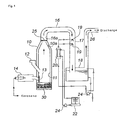
- Fig. 1 is a view illustrating a treatment method of the present invention.
- FIG. 1 illustrates thermally treating equipment that may also be applied to the treatment of inflators for various types of air bags, comprising a thermally treating tower, an introducing port for introducing a seatbelt pretensioner into the thermally treating tower, a heating device disposed within the thermally treating tower, and a cooling device for cooling gas that is discharged from the thermally treating tower.
- the attachments constituted by a seatbelt, a fixing buckle, and a retractor, are removed as preliminary processing for thermally treating the seatbelt pretensioner.
- the seatbelt pretensioner is constituted by a main body portion and a micro gas generator (abbreviated to MGG) accommodating an ignition charge and a gas generating agent, and therefore such a method may be employed that the main body portion and MGG are separated from each other, the MGG alone is subjected to thermal treatment, and the main body portion is subjected to separation and recovery processing together with the attachments.
- MGG micro gas generator
- the seatbelt pretensioner is separated into plastic and metal types.
- the plastic may be separated into thermoplastic resins and thermosetting resins, or may be separated according to the material of the plastic.
- the seatbelt pretensioner often contains metals such as iron, stainless steel, zinc alloy, and aluminum, and therefore it is important to conduct the separation operation with a view to recycling valuable resources.
- the seatbelt pretensioner having undergone preliminary processing if necessary, is introduced into the thermally treating tower, where the processing of a thermal treatment step is performed at a temperature which burns the ignition charge and gas generating agent in the seatbelt pretensioner, but does not melt the metals constituting the seatbelt pretensioner.
- a thermally treating tower 10 form an entire, single treatment system (thermally treating equipment) together with an exhaust gas tube 16, a seatbelt pretensioner introducing port 12, a combustion furnace (for example, a combination of a high-calorie burner and a low-calorie burner) 14, an exhaust gas cooling tower 17, an exhaust gas cooling shower 19, a cooling tower tank 18, and a gas discharge tube 26, all of which are annexed to the thermally treating tower 10.
- the reference numerals 13 and 25 denote metal gratings or the like formed from wire mesh, punched metal, iron, or similar
- the reference numeral 20 denotes a heat exchanger
- the reference numeral 22 denotes a cooling tower
- the reference numeral 24 denotes a pump.
- a metal partition wall 11 (see Fig. 1), which exhibits the same action (protecting the inner wall of the thermally treating tower 10) as a device disclosed in Fig. 1 and so on of JP-A No. 11-101422, may be provided inside the thermally treating tower 10.
- Other devices or systems may be combined with the system shown in Fig. 1 as required.
- a seatbelt pretensioner 30 is heated to at least a predetermined temperature such that the ignition charge and gas generating agent therein are ignited and burned.
- the thermal treatment temperature in the thermally treating tower 10 is set such that the ignition charge and gas generating agent inside the seatbelt pretensioner 30 burn but the metals constituting the seatbelt pretensioner 30 do not melt.
- the temperature at which the gas generating agent burns is equal to or greater than the ignition point of the ignition charge and gas generating agent.
- the ignition point differs according to the composition of the ignition charge and gas generating agent.
- the ignition point of a typical ignition charge or gas generating agent is approximately 150 to 500°C, but at excessively high temperatures, the inner wall of the thermally treating tower 10 may be damaged, and therefore the temperature in the interior of the thermally treating tower 10 is preferably in the range of 150 to 700°C.
- the temperature at which the main metals constituting the seatbelt pretensioner do not melt depends on the material of the seatbelt pretensioner.
- these metals are typically aluminum, iron, and stainless steel, and therefore a temperature which is lower than the melting temperature of these metals serves as a maximum temperature.
- a temperature range of 450 to 550°C is preferable, whereas in the case of iron and stainless steel, a temperature range of 550 to 700°C is preferable.
- the combustion gas is discharged through the exhaust gas tube 16 connected to a ceiling portion of the thermally treating tower 10, cooled in the cooling tower 17 by a water spray produced by the cooling shower 1-9, and then led into water contained in the cooling tower tank 18.
- the gas that accumulates inside the cooling tower tank 18 is discharged into the atmosphere through the gas discharge tube 26.
- the internal temperature of the thermally treating tower 10 is preferably raised in advance, using the combustion furnace 14, to a temperature at which the ignition charge and gas generating agent inside the seatbelt pretensioner 30 burns but the metals constituting the seatbelt pretensioner 30 do not melt (in the case of aluminum, about 500°C), and then maintained at that temperature.
- a method in which the high-calorie burner and low-calorie burner are burned simultaneously, the high-calorie burner is halted when the predetermined temperature is reached, and only the low-calorie burner is burned thereafter, may be applied as this temperature raising and maintaining method. At this time, the amount of air blown into the thermally treating tower 10 may be adjusted accordingly.
- the predetermined temperature is maintained until treatment of the seatbelt pretensioner 30 is complete.
- measures are taken to ensure that the predetermined temperature is maintained until treatment of the seatbelt pretensioner 30 introduced last is complete.
- the duration period of the predetermined temperature during the thermal treatment process is determined in advance by confirming one or both of an amount of time required for all of the ignition charge, gas generating agent, or other agent in the seatbelt pretensioner to be activated, which is determined by means of a thermal stability test in which the seatbelt pretensioner is exposed to an atmosphere having the temperature at which the seatbelt pretensioner is to be treated in the thermally treating tower 10, and an amount of time required for the seatbelt pretensioner to be treated, which is determined by means of a bonfire test performed on the seatbelt pretensioner (in which the seatbelt pretensioner is exposed to a flame and the state of the seatbelt pretensioner is observed).
- the predetermined temperature duration period is set at least equal to or longer than a period in which the seatbelt pretensioner can be treated.
- the duration period of the predetermined temperature during the thermal treatment process is preferably set between one and one hundred times the time required to complete treatment of the seatbelt pretensioner following introduction thereof, or following introduction of the final seatbelt pretensioner when a plurality of seatbelt pretensioners is introduced in several batches, and more preferably between three and thirty times this time.
- treatment in the thermally treating tower 10 may be performed using a method in which the internal temperature of the thermally treating tower 10 is raised in advance to a temperature near the ignition point of the ignition charge and gas generating agent, the seatbelt pretensioner 30 is introduced therein, and then the temperature is raised at once, or a method in which the internal temperature of the thermally treating tower 10 is held at normal temperature or a temperature that is considerably lower than the ignition point of the ignition charge and gas generating agent, the seatbelt pretensioner 30 is introduced therein, and then the temperature is raised gradually.
- the partition means 25 formed from wire mesh, punched metal, a metal grating, or similar are attached removably between the thermally treating tower 10 and the exhaust gas tube 16, and therefore the seatbelt pretensioner 30 is prevented from flying out of the thermally treating tower 10.
- the partition means 25 are attached removably using a bolt and nut in a flange portion provided on an inner wall surface 10a of the thermally treating tower 10 or an inner wall surface 16a of the exhaust gas tube 16. Further, by providing the partition means 13 between the thermally treating tower 10 and combustion furnace 14 to perform a similar function to the partition means 25, the seatbelt pretensioner 30 is prevented from flying into the combustion furnace 14.
- the processes performed prior to thermal treatment are preferably performed in an indoor facility comprising a lightning conductor to prevent the seatbelt pretensioner from malfunctioning prior to treatment in the event of a lightning strike.
- the seatbelt pretensioner is preferably stored in an indoor facility comprising a lightning conductor.
- the metals and other valuable resources contained in the combustion residue are preferably separated and recovered together with or separately from the attachments.
- a seatbelt pretensioner and its attachments obtained during the demolition of a discarded vehicle, are formed integrally, and therefore the attachments, constituted by a seatbelt, a fixing buckle, and a retractor, were removed, leaving a metal component (the seatbelt pretensioner) including an MGG.
- the seatbelt pretensioner including the MGG (outer diameter: 17mm; height: 31.5mm in columnar form; outer shell container is formed from aluminum with a melting point of 660°C; ignition charge is constituted by zirconium/potassium perchlorate with an ignition point of 491°C; gas generating agent is constituted by 0.85g of a substance containing cellulose nitrate and potassium nitrate, with an ignition point between 160 and 180°C) was subjected to thermal treatment.
- MGG outer diameter: 17mm; height: 31.5mm in columnar form
- outer shell container is formed from aluminum with a melting point of 660°C
- ignition charge is constituted by zirconium/potassium perchlorate with an ignition point of 491°C
- gas generating agent is constituted by 0.85g of a substance containing cellulose nitrate and potassium nitrate, with an ignition point between 160 and 180°C) was subjected to thermal treatment.
- the combustion furnace 14 was activated, whereby the internal temperature of the thermally treating tower 10 was raised in advance to, and maintained at, approximately 500°C.
- a total of two hundred seatbelt pretensioners 30 were introduced into the thermally treating tower 10 through the seatbelt pretensioner introducing port 12 in ten batches at six-minute intervals.
- the internal temperature of the thermally treating tower 10 was maintained at 500°C for approximately 25 minutes.
- the time required to treat twenty seatbelt pretensioners 30 was determined, as a result of experiment, to be between 114 and 484 seconds, and therefore high-temperature treatment of the inflator 30 was completed by maintaining the interior of the thermally treating tower 10 at the predetermined temperature for approximately 6 to 24 minutes.
- the gas generating agent in the seatbelt pretensioner 30 was ignited and burned, and the gas produced by this combustion was discharged to the cooling tower 17 through the exhaust gas tube 16.
- the gas was cooled in the cooling tower 17 by a water spray produced by the cooling shower 19, and then led into the water inside the cooling tower tank 18.
- the accumulated gas inside the cooling tower tank 18 was discharged into the atmosphere through the gas discharge tube 26.
- the temperature of the gas at the time of discharge was approximately 50°C.
- the dioxin concentration thereof was found to be not more than 0.15ng-TEQ/Nm 3 .
- Analysis was performed in accordance with the "Dioxins Measurement Manual In Waste Matter Treatment", prepared by the Waste Management Section of the Water Supply and Environmental Sanitation Department in the Environmental Health Bureau of the Japanese Ministry of Health and Welfare.
Landscapes
- Engineering & Computer Science (AREA)
- Mechanical Engineering (AREA)
- General Engineering & Computer Science (AREA)
- Environmental & Geological Engineering (AREA)
- Physics & Mathematics (AREA)
- Thermal Sciences (AREA)
- Air Bags (AREA)
- Processing Of Solid Wastes (AREA)
- Automotive Seat Belt Assembly (AREA)
- Gasification And Melting Of Waste (AREA)
Applications Claiming Priority (5)
| Application Number | Priority Date | Filing Date | Title |
|---|---|---|---|
| JP2003007801 | 2003-01-16 | ||
| JP2003007801 | 2003-01-16 | ||
| JP2003077055 | 2003-03-20 | ||
| JP2003077055A JP2004268002A (ja) | 2003-01-16 | 2003-03-20 | シートベルトプリテンショナーの廃棄処理法 |
| PCT/JP2003/016853 WO2004062826A1 (ja) | 2003-01-16 | 2003-12-26 | シートベルトプリテンショナーの廃棄処理法 |
Publications (2)
| Publication Number | Publication Date |
|---|---|
| EP1595607A1 true EP1595607A1 (de) | 2005-11-16 |
| EP1595607A4 EP1595607A4 (de) | 2007-09-26 |
Family
ID=32716405
Family Applications (1)
| Application Number | Title | Priority Date | Filing Date |
|---|---|---|---|
| EP03768285A Withdrawn EP1595607A4 (de) | 2003-01-16 | 2003-12-26 | Verfahren zur verarbeitung entsorgter sitzgurtstraffer |
Country Status (4)
| Country | Link |
|---|---|
| US (1) | US20060070560A1 (de) |
| EP (1) | EP1595607A4 (de) |
| JP (1) | JP2004268002A (de) |
| WO (1) | WO2004062826A1 (de) |
Cited By (1)
| Publication number | Priority date | Publication date | Assignee | Title |
|---|---|---|---|---|
| EP4163026A1 (de) * | 2021-10-11 | 2023-04-12 | ROXEL France | Anlage und verfahren zur vernichtung pyrotechnischer abfälle |
Families Citing this family (3)
| Publication number | Priority date | Publication date | Assignee | Title |
|---|---|---|---|---|
| CN106765254B (zh) * | 2016-12-27 | 2018-12-07 | 东北农业大学 | 一种燃烧炉 |
| US10428713B2 (en) | 2017-09-07 | 2019-10-01 | Denso International America, Inc. | Systems and methods for exhaust heat recovery and heat storage |
| CN114620167A (zh) * | 2022-02-28 | 2022-06-14 | 上海新金桥环保有限公司 | 一种安全带卷收器智能引爆装置 |
Family Cites Families (11)
| Publication number | Priority date | Publication date | Assignee | Title |
|---|---|---|---|---|
| US1626180A (en) * | 1924-06-04 | 1927-04-26 | Burkett Lightning Rod Company | Lightning-rod connecter |
| US3903814A (en) * | 1974-11-13 | 1975-09-09 | Olin Corp | Method for destruction of pyrotechnic waste |
| JP3533533B2 (ja) * | 1994-04-11 | 2004-05-31 | ダイセル化学工業株式会社 | エアバッグ用ガス発生器の廃棄処理方法 |
| JP3176518B2 (ja) * | 1994-11-04 | 2001-06-18 | ダイセル化学工業株式会社 | エアバッグ用ガス発生器の金属材料回収方法 |
| JPH09253619A (ja) * | 1996-03-22 | 1997-09-30 | Daicel Chem Ind Ltd | エアバッグ装置パッドモジュールの処理方法及び装置 |
| DE19637677A1 (de) * | 1996-09-05 | 1998-03-12 | Werec Gmbh Berlin Wertstoff Re | Verfahren und Vorrichtung zum Recycling von Airbagmodulen |
| JP3905610B2 (ja) * | 1997-09-29 | 2007-04-18 | ダイセル化学工業株式会社 | インフレータ処理装置およびインフレータ投入判定方法 |
| JPH11304130A (ja) * | 1998-04-24 | 1999-11-05 | Toyota Motor Corp | インフレータ処理装置 |
| DE19853045C2 (de) * | 1998-11-18 | 2001-02-08 | Kd Stahl Und Maschb Gmbh | Vorrichtung und Verfahren zur thermischen Entsorgung von Explosivstoffen |
| JP2001116230A (ja) * | 1999-10-20 | 2001-04-27 | Nippon Steel Corp | エアバッグ装置の処理設備及びその方法 |
| JP4086130B2 (ja) * | 2001-01-15 | 2008-05-14 | 関東自動車工業株式会社 | ガス発生器を備えた自動車部品の処理装置 |
-
2003
- 2003-03-20 JP JP2003077055A patent/JP2004268002A/ja active Pending
- 2003-12-26 EP EP03768285A patent/EP1595607A4/de not_active Withdrawn
- 2003-12-26 US US10/540,876 patent/US20060070560A1/en not_active Abandoned
- 2003-12-26 WO PCT/JP2003/016853 patent/WO2004062826A1/ja not_active Ceased
Cited By (3)
| Publication number | Priority date | Publication date | Assignee | Title |
|---|---|---|---|---|
| EP4163026A1 (de) * | 2021-10-11 | 2023-04-12 | ROXEL France | Anlage und verfahren zur vernichtung pyrotechnischer abfälle |
| FR3127891A1 (fr) * | 2021-10-11 | 2023-04-14 | Roxel France | Installation et procédé de destruction de déchets pyrotechniques |
| US12508634B2 (en) | 2021-10-11 | 2025-12-30 | Roxel France | Installation and method for destroying pyrotechnic waste |
Also Published As
| Publication number | Publication date |
|---|---|
| WO2004062826A1 (ja) | 2004-07-29 |
| EP1595607A4 (de) | 2007-09-26 |
| JP2004268002A (ja) | 2004-09-30 |
| US20060070560A1 (en) | 2006-04-06 |
Similar Documents
| Publication | Publication Date | Title |
|---|---|---|
| US9051224B2 (en) | Gas generating system | |
| JP3288048B2 (ja) | 廃車処理工程におけるエアバッグ用ガス発生器の作動・未作動選別方法 | |
| JPWO1997000144A1 (ja) | 廃車処理工程におけるエアバッグ用ガス発生器の作動・未作動選別方法 | |
| US5613705A (en) | Airbag inflator having a housing protected from high-temperature reactive generated gases | |
| DE20023652U1 (de) | Mehrstufiger Gasgenerator für einen Airbag und Airbagvorrichtung | |
| EP1744938A2 (de) | Aufblasvorrichtung | |
| JPH05185899A (ja) | エアバッグ装置のインフレータ | |
| DE19733034C2 (de) | Notausstieg für Kraftfahrzeuge | |
| EP2605938B1 (de) | Flüssigkeitsgekühlte aufblasvorrichtung | |
| EP1595607A1 (de) | Verfahren zur verarbeitung entsorgter sitzgurtstraffer | |
| JPH01289736A (ja) | 自動車乗客用無抵抗拘束システムの展開のための膨張装置 | |
| US7427082B2 (en) | Gas generator | |
| JP3992384B2 (ja) | ガス発生器の廃棄処理方法、及び廃棄処理システム | |
| DE69834414T2 (de) | Verarbeitungsgerät für aufblasvorrichtung und verfahren zur beurteilung der aufblasvorrichtungsladung | |
| EP1577174A1 (de) | Hochtemperaturverarbeitungsverfahren für aufblasvorrichtung | |
| US20210308689A1 (en) | Destruction of air bag inflators by shredding under water | |
| KR100401792B1 (ko) | 자동차용 에어백 장치의 폭발 처리장치 | |
| JP4152217B2 (ja) | トリガ発生装置 | |
| JP7478796B2 (ja) | ガス発生器の処理方法及びガス発生器処理装置 | |
| JPH0761314A (ja) | ガス発生器における点火器の取付構造 | |
| US20040227337A1 (en) | Inflation device for a vehicle occupant restraint system | |
| SU948717A1 (ru) | Система пассивной безопасности пользователей транспортным средством | |
| US20040164467A1 (en) | Inflator thermal treatment equipment | |
| JPH09253619A (ja) | エアバッグ装置パッドモジュールの処理方法及び装置 | |
| Jones et al. | Safe steering wheel airbag removal using active disassembly |
Legal Events
| Date | Code | Title | Description |
|---|---|---|---|
| PUAI | Public reference made under article 153(3) epc to a published international application that has entered the european phase |
Free format text: ORIGINAL CODE: 0009012 |
|
| 17P | Request for examination filed |
Effective date: 20050706 |
|
| AK | Designated contracting states |
Kind code of ref document: A1 Designated state(s): AT BE BG CH CY CZ DE DK EE ES FI FR GB GR HU IE IT LI LU MC NL PT RO SE SI SK TR |
|
| RBV | Designated contracting states (corrected) |
Designated state(s): DE FR |
|
| A4 | Supplementary search report drawn up and despatched |
Effective date: 20070828 |
|
| RAP1 | Party data changed (applicant data changed or rights of an application transferred) |
Owner name: DAICEL CHEMICAL INDUSTRIES, LTD. |
|
| STAA | Information on the status of an ep patent application or granted ep patent |
Free format text: STATUS: THE APPLICATION IS DEEMED TO BE WITHDRAWN |
|
| 18D | Application deemed to be withdrawn |
Effective date: 20071127 |